EP3992436B1 - Turbine exhaust drain system - Google Patents
Turbine exhaust drain system Download PDFInfo
- Publication number
- EP3992436B1 EP3992436B1 EP21206073.5A EP21206073A EP3992436B1 EP 3992436 B1 EP3992436 B1 EP 3992436B1 EP 21206073 A EP21206073 A EP 21206073A EP 3992436 B1 EP3992436 B1 EP 3992436B1
- Authority
- EP
- European Patent Office
- Prior art keywords
- turbine
- sump
- exhaust
- suction pipe
- engine
- Prior art date
- Legal status (The legal status is an assumption and is not a legal conclusion. Google has not performed a legal analysis and makes no representation as to the accuracy of the status listed.)
- Active
Links
Images

Classifications
-
- F—MECHANICAL ENGINEERING; LIGHTING; HEATING; WEAPONS; BLASTING
- F01—MACHINES OR ENGINES IN GENERAL; ENGINE PLANTS IN GENERAL; STEAM ENGINES
- F01D—NON-POSITIVE DISPLACEMENT MACHINES OR ENGINES, e.g. STEAM TURBINES
- F01D25/00—Component parts, details, or accessories, not provided for in, or of interest apart from, other groups
- F01D25/32—Collecting of condensation water; Drainage ; Removing solid particles
-
- F—MECHANICAL ENGINEERING; LIGHTING; HEATING; WEAPONS; BLASTING
- F01—MACHINES OR ENGINES IN GENERAL; ENGINE PLANTS IN GENERAL; STEAM ENGINES
- F01D—NON-POSITIVE DISPLACEMENT MACHINES OR ENGINES, e.g. STEAM TURBINES
- F01D9/00—Stators
- F01D9/06—Fluid supply conduits to nozzles or the like
- F01D9/065—Fluid supply or removal conduits traversing the working fluid flow, e.g. for lubrication-, cooling-, or sealing fluids
-
- F—MECHANICAL ENGINEERING; LIGHTING; HEATING; WEAPONS; BLASTING
- F01—MACHINES OR ENGINES IN GENERAL; ENGINE PLANTS IN GENERAL; STEAM ENGINES
- F01D—NON-POSITIVE DISPLACEMENT MACHINES OR ENGINES, e.g. STEAM TURBINES
- F01D25/00—Component parts, details, or accessories, not provided for in, or of interest apart from, other groups
- F01D25/002—Cleaning of turbomachines
-
- F—MECHANICAL ENGINEERING; LIGHTING; HEATING; WEAPONS; BLASTING
- F01—MACHINES OR ENGINES IN GENERAL; ENGINE PLANTS IN GENERAL; STEAM ENGINES
- F01D—NON-POSITIVE DISPLACEMENT MACHINES OR ENGINES, e.g. STEAM TURBINES
- F01D25/00—Component parts, details, or accessories, not provided for in, or of interest apart from, other groups
- F01D25/18—Lubricating arrangements
-
- F—MECHANICAL ENGINEERING; LIGHTING; HEATING; WEAPONS; BLASTING
- F01—MACHINES OR ENGINES IN GENERAL; ENGINE PLANTS IN GENERAL; STEAM ENGINES
- F01D—NON-POSITIVE DISPLACEMENT MACHINES OR ENGINES, e.g. STEAM TURBINES
- F01D25/00—Component parts, details, or accessories, not provided for in, or of interest apart from, other groups
- F01D25/30—Exhaust heads, chambers, or the like
-
- F—MECHANICAL ENGINEERING; LIGHTING; HEATING; WEAPONS; BLASTING
- F02—COMBUSTION ENGINES; HOT-GAS OR COMBUSTION-PRODUCT ENGINE PLANTS
- F02C—GAS-TURBINE PLANTS; AIR INTAKES FOR JET-PROPULSION PLANTS; CONTROLLING FUEL SUPPLY IN AIR-BREATHING JET-PROPULSION PLANTS
- F02C3/00—Gas-turbine plants characterised by the use of combustion products as the working fluid
- F02C3/32—Inducing air flow by fluid jet, e.g. ejector action
-
- F—MECHANICAL ENGINEERING; LIGHTING; HEATING; WEAPONS; BLASTING
- F05—INDEXING SCHEMES RELATING TO ENGINES OR PUMPS IN VARIOUS SUBCLASSES OF CLASSES F01-F04
- F05D—INDEXING SCHEME FOR ASPECTS RELATING TO NON-POSITIVE-DISPLACEMENT MACHINES OR ENGINES, GAS-TURBINES OR JET-PROPULSION PLANTS
- F05D2220/00—Application
- F05D2220/30—Application in turbines
- F05D2220/32—Application in turbines in gas turbines
-
- F—MECHANICAL ENGINEERING; LIGHTING; HEATING; WEAPONS; BLASTING
- F05—INDEXING SCHEMES RELATING TO ENGINES OR PUMPS IN VARIOUS SUBCLASSES OF CLASSES F01-F04
- F05D—INDEXING SCHEME FOR ASPECTS RELATING TO NON-POSITIVE-DISPLACEMENT MACHINES OR ENGINES, GAS-TURBINES OR JET-PROPULSION PLANTS
- F05D2260/00—Function
- F05D2260/60—Fluid transfer
- F05D2260/602—Drainage
Definitions
- the invention relates generally to gas turbine engines and, more particularly, to a system for draining a sump through the exhaust of the engine.
- US 2,949,736 discloses an expansion joint with a fuel drainage collector for the ducting of gas turbine power plants.
- US 2018/017025 discloses a method and systems for draining fluid from an engine.
- US 2,814,931 discloses gas turbine power plant installations with means for the disposal of drainage fuel.
- a turbine exhaust drain system for a gas turbine engine in accordance with claim 1.
- an engine assembly for an aircraft in accordance with claim 10.
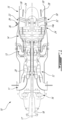
- Fig. 1 illustrates a gas turbine engine 10 of a type preferably provided for use in subsonic flight, generally comprising in serial flow communication an air inlet 11, a compressor 12 for pressurizing the air from the air inlet 11, a combustor 13 in which the compressed air is mixed with fuel and ignited for generating an annular stream of hot combustion gases, a turbine 14 for extracting energy from the combustion gases, and an exhaust 15 through which the combustion gases exit the engine 10.
- the turbine 14 includes a low pressure or power turbine 14a drivingly connected to an input end of a reduction gearbox RGB 16.
- the RGB 16 has an output end drivingly connected to an output shaft 18 configured to drive a rotatable load (not shown).
- the rotatable load can, for instance, take the form of a propeller or a rotor, such as a helicopter main rotor.
- the gas turbine engine 10 has an engine centerline 17. According to the gases; a sump where liquid collects; a hairpin mounting including a flange underneath the sump; a drain hole extending through the flange, the drain hole in fluid communication with the sump; and a suction pipe having an inlet end fluidly connected to the drain hole of the sump and an outlet end fluidly connected to the core gas path passage, wherein, during engine operation, the sump has a pressure P1 and the core gas path passage has a pressure P2, and wherein P2 ⁇ P1, thereby causing the liquid collected in the sump to be drawn into the core gas path passage before being ejected from the turbine exhaust case together with the flow of combustion gases.
- the flange may have a bottom portion with a locally increased thickness, and the drain hole may be defined in the bottom portion of the flange.
- the turbine exhaust case may further comprise a boss projecting from an outer surface of the exhaust case, and the outlet end of the suction pipe may be connected to the boss.
- the boss may define a hole fluidly connected to the core gas path passage, and the outlet end of the suction pipe may be brazed in the hole of the boss.
- a length of the suction pipe may be selected to accommodate movement between the flange and the boss when subject to thermal expansion.
- a method of draining a cavity at a bottom dead center of a gas turbine engine comprising: fluidly connecting the cavity to a core gas path passage in an exhaust case having an outlet configured to exhaust an engine core flow into the atmosphere; and using the engine core flow as a motive flow to draw liquid collected in the cavity.
- a method of draining a sump in which liquid collects at a bottom of an aircraft engine comprising: fluidly connecting the sump to a core gas path passage of a turbine exhaust case, the turbine exhaust case having an outlet in fluid communication with an environment of the aircraft engine for discharging a flow of combustion gases into the environment, and using the flow of combustion gases as a motive flow to entrain the liquid collected in the sump into the core gas path passage where the liquid combines with the flow of combustion gases before being discharged as a mixed flow through the outlet of the turbine exhaust case.
- Fig. 1 illustrates a gas turbine engine 10 of a type preferably provided for use in subsonic flight, generally comprising in serial flow communication an air inlet 11, a compressor 12 for pressurizing the air from the air inlet 11, a combustor 13 in which the compressed air is mixed with fuel and ignited for generating an annular stream of hot combustion gases, a turbine 14 for extracting energy from the combustion gases, and an exhaust 15 through which the combustion gases exit the engine 10.
- the turbine 14 includes a low pressure or power turbine 14a drivingly connected to an input end of a reduction gearbox RGB 16.
- the RGB 16 has an output end drivingly connected to an output shaft 18 configured to drive a rotatable load (not shown).
- the rotatable load can, for instance, take the form of a propeller or a rotor, such as a helicopter main rotor.
- the gas turbine engine 10 has an engine centerline 17. According to the illustrated embodiment, the compressor and the turbine rotors are mounted in-line for rotation about the engine centerline 17.
- the gas turbine engine 10 has an axially extending central core which defines an annular core gas path 20 through which gases flow, as depicted by flow arrows in Fig. 1 . It is understood that the engine could adopt different configurations, the engine configuration illustrated in Fig. 1 being provided for context purposes only. For instance, the engine could be configured as a turboprop, a turboshaft, a turbofan or an auxiliary power unit (APU) in a through flow or a reverse flow arrangement.
- APU auxiliary power unit
- the exhaust 15 comprises an exhaust case 22 mounted to a downstream end of a turbine support case 24 relative to the core flow through the engine 10.
- the exhaust case 22 has a radially inner flow boundary wall 24 and a radially outer flow boundary wall 26 defining a core gas path passage 28 forming part of the core gas path 20.
- the core gas path passage 28 of the exhaust case 22 has an outlet end 30 for discharging combustion gases received from the turbine 14 into the environment of the aircraft engine (i.e. the atmosphere).
- the exhaust case 22 has an upstream end including an axisymmetric hairpin mounting 32 to accommodate different thermal expansion gradients between the turbine support case 24 and the exhaust case 22 while ensuring the integrity of the core gas path 20.
- An annular mounting flange 34 projects radially outwardly from an outer leg of the hairpin mounting 32.
- the exhaust case mounting flange 34 is bolted to a corresponding mounting flange 36 at the downstream end of the turbine support case 24.
- the radially outer flow boundary wall 26 of the exhaust case 22 forms part of the inner leg of the hairpin mounting 32 and has an upstream end portion which axially projects into the downstream end portion of the turbine support case 24 so as to form a cavity 38 radially between the radially outer flow boundary wall 26 of the exhaust case 22 and the downstream end portion of the turbine support case 24.
- the cavity 38 acts as a sump 40 at the bottom dead center of the engine where liquids, such as compressor wash liquid, collect by gravity through the axial gap 42 existing between the radially outer flow boundary wall 26 and the adjacent turbine part 44 when the engine 10 is not operated (i.e. absent of thermal expansion).
- the drain system 50 generally comprises a suction pipe 52 fluidly connected to the sump 40 and the core gas path passage 28 for drawing liquid from the sump 40 using the flow of combustion gases G ( Fig. 4 ) passing through the exhaust case 22 as a motive flow.
- the suction pipe 52 has an inlet end 52a which is brazed or otherwise suitably joined to a port 54 defined in the mounting flange 34 of the exhaust case 22.
- the thickness of the mounting flange 34 is locally increased to accommodate the port 54 and the connection with the pipe 52. Accordingly, the flange 34 has an extra thickness at a bottom location thereof for connection with the inlet end 52a of the suction pipe 52.
- At least one drain hole 56 is machined or otherwise suitably defined in this thickened bottom portion 34a of the mounting flange 34 to fluidly connect the sump 40 to the port 54 and, thus, the inlet end 52a of the suction pipe 52.
- the drain hole(s) 56 extend(s) from the bottom of the sump 40 to the port 54 in the mounting flange 34 of the exhaust case 22.
- the locally thickened flange 34 allows preserving the symmetry and structural integrity of the hairpin mounting 32 of the exhaust case 22.
- the suction pipe 52 has an outlet end 52b brazed or otherwise suitably joined to a boss 58 provided on an outer surface of the exhaust case 22 at a location downstream from the hairpin relative to the flow of combustion gases G through the exhaust case 22.
- the boss 58 defines a hole 58a or suction port which is in fluid communication with the core gas path passage 28 of the exhaust case 22.
- the outlet end 52b of the suction pipe 52 is received in the hole 58a of the boss 58 and is, thus, fluidly coupled to the core gas path passage 28 of the exhaust case 22.
- the length of the suction pipe 52 is selected to accommodate thermal growth between its points of attachment to the mounting flange 34 and the boss 58.
- the extra length of the pipe 52 may take the form of a curved portion 52c giving a serpentine shape to the pipe 52.
- the curved portion 52c of the pipe may straighten up in response to the thermal expansion of the exhaust case 22.
- a bellows could be formed along a portion of the pipe 52 or a slip joint could be provided.
- the pipe 52 is made of a heat resistant material offering a desired level of flexibility to accept deformation due to thermal expansion between its points of attachment.
- the pipe 52 could be made of an INCONEL alloy (e.g. IN625) or stainless steel.
- Fig. 4 illustrates the drain system 50 during a drain or active mode when the gas turbine engine 10 is being operated.
- the suction pipe 52 between the sump 40 and the core gas path passage 28 creates a venturi effect that converts pressure energy of the engine core combustion gases flow G (the motive fluid) to velocity energy to create a low pressure zone in the core gas path passage 28 in the vicinity of the boss 58.
- the low pressure zone creates a vacuum that draws in and entrains the liquid collected in the sump 40 through the suction pipe 52. That is because the pressure P2 at the boss 58 is less than the pressure P1 in the sump 40.
- the exhaust flow G i.e. the combustion gases flowing through the exhaust case
- the suction flow S i.e. the liquid drawn from the sump 40
- the mixed flow is discharged from the exhaust case 22 via the outlet end 30 thereof into the atmosphere.
- any liquid collected in the sump 40 while the engine 10 is not operated, as shown in Fig. 3 is suction from the sump 40 through the suction pipe 52 into the core gas path passage 28 of the exhaust case 22 before being exhausted with the combustion gases.
- the suction pipe 52 allows the liquid to be withdrawn from the sump 40 without any interaction, moving parts, and/or indication of functionality. No action is required to actuate the drain system 50. Drainage of the sump 40 automatically takes place when the engine 10 is powered and exhaust flow G flows through the core passage 28.
- a one-way valve 70 may be fluidly connected to the suction pipe 52 to prevent any fluid flow from the core gas path passage 28 to the sump 40.
- the valve 70 may be installed at a pipe connection at the flange interface to allow fluid flow in only one direction along the pipe 52. That is from the sump 40 to the core gas path passage 28.
- the valve 70 can be designed to open at a predetermined pressure differential between the sump 40 and the core gas path passage 28. For instance, it could be provided in the form of a spring-loaded ball check valve. However, it is understood that various types of check valves could be used.
- a scavenge tube design and location acting as a drain for undesirable accumulated liquid in the hot section module of an aircraft engine.
- the configuration allows redirecting the liquid into the core gas path of the engine where it is evacuated together with the combustion gases via the engine exhaust. According to some embodiment, this is accomplished by using the flow of combustion gases in the engine exhaust case as a motive flow to draw the liquid accumulated in a bottom cavity of the hot section module using a venturi effect.
- a suction pipe fluidly connects the cavity where the liquid is collected to an exhaust portion of the core gas path in the exhaust case of the engine downstream of the turbine section.
- a turbine exhaust case draining system can be provided using the engine core exhaust flow as a motive fluid for pumping out any fluid accumulated in a cavity at the bottom of the engine case. This can be achieved without the complexity of tubing connected to an ecology tank or going thru the airframe fuselage.
Landscapes
- Engineering & Computer Science (AREA)
- Mechanical Engineering (AREA)
- General Engineering & Computer Science (AREA)
- Physics & Mathematics (AREA)
- Fluid Mechanics (AREA)
- Chemical & Material Sciences (AREA)
- Combustion & Propulsion (AREA)
- Supercharger (AREA)
- Structures Of Non-Positive Displacement Pumps (AREA)
Description
- The invention relates generally to gas turbine engines and, more particularly, to a system for draining a sump through the exhaust of the engine.
- During operation of an aircraft turbine engine a significant volume of air flows through the compressor. Such air, depending on the flight path where the aircraft is operating contains various types of materials such as dirt, corrosive particulates, dust, salt carried in air when flying over ocean bodies, etc. This results in deposits on the blades of the compressor and eventual build-up which has an effect on the performance of the aircraft engine. Accordingly, the compressor must be washed on a regular basis in order to dislodge these deposits. This is typically accomplished by spraying, washing and rinsing liquid, such as water into the compressor. The sprayed liquid then flows by gravity from the compressor section to the bottom of the engine where it cumulates in a cavity of the engine hot section module.
- There is a need for draining this cavity from such undesirable accumulated liquid.
-
US 2,949,736 discloses an expansion joint with a fuel drainage collector for the ducting of gas turbine power plants. -
US 2018/017025 discloses a method and systems for draining fluid from an engine. -
US 2,814,931 discloses gas turbine power plant installations with means for the disposal of drainage fuel. - According to an aspect of the present invention, there is provided a turbine exhaust drain system for a gas turbine engine in accordance with
claim 1. - According to another aspect of the present invention, there is provided an engine assembly for an aircraft in accordance with
claim 10. - Features of embodiments are recited in the dependent claims.
- Reference is now made to the accompanying figures in which:
-
Fig. 1 is a schematic cross section view of a gas turbine engine having an exhaust drain system; -
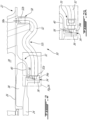
Fig. 2 is a schematic enlarged cross section view illustrating details of the drain system for draining a cavity between the turbine support case and the exhaust case of the engine at a bottom dead center of the engine shown inFig. 1 ; -
Fig. 2a is a schematic enlarged cross-section view illustrating an optional one-way valve installed in the cavity purge line of the drain system to prevent ingestion of fluid from the exhaust core gas path to the bottom cavity. -
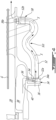
Fig. 3 is a schematic enlarged cross section view illustrating the accumulation of liquid, such as compressor wash liquid, in the engine bottom cavity; and -
Fig. 4 is a schematic enlarged cross section view illustrating the purging of the cavity through the core gas path of exhaust case. -
Fig. 1 illustrates agas turbine engine 10 of a type preferably provided for use in subsonic flight, generally comprising in serial flow communication anair inlet 11, acompressor 12 for pressurizing the air from theair inlet 11, acombustor 13 in which the compressed air is mixed with fuel and ignited for generating an annular stream of hot combustion gases, aturbine 14 for extracting energy from the combustion gases, and anexhaust 15 through which the combustion gases exit theengine 10. Theturbine 14 includes a low pressure orpower turbine 14a drivingly connected to an input end of areduction gearbox RGB 16. TheRGB 16 has an output end drivingly connected to anoutput shaft 18 configured to drive a rotatable load (not shown). The rotatable load can, for instance, take the form of a propeller or a rotor, such as a helicopter main rotor. Thegas turbine engine 10 has anengine centerline 17. According to the gases; a sump where liquid collects; a hairpin mounting including a flange underneath the sump; a drain hole extending through the flange, the drain hole in fluid communication with the sump; and a suction pipe having an inlet end fluidly connected to the drain hole of the sump and an outlet end fluidly connected to the core gas path passage, wherein, during engine operation, the sump has a pressure P1 and the core gas path passage has a pressure P2, and wherein P2< P1, thereby causing the liquid collected in the sump to be drawn into the core gas path passage before being ejected from the turbine exhaust case together with the flow of combustion gases. - In an embodiment of the foregoing, the flange may have a bottom portion with a locally increased thickness, and the drain hole may be defined in the bottom portion of the flange.
- In a further embodiment of any of the foregoing, the turbine exhaust case may further comprise a boss projecting from an outer surface of the exhaust case, and the outlet end of the suction pipe may be connected to the boss.
- In a further embodiment of any of the foregoing, the boss may define a hole fluidly connected to the core gas path passage, and the outlet end of the suction pipe may be brazed in the hole of the boss.
- In a further embodiment of any of the foregoing, a length of the suction pipe may be selected to accommodate movement between the flange and the boss when subject to thermal expansion.
- According to another aspect of the present invention, there is provided a method of draining a cavity at a bottom dead center of a gas turbine engine, the method comprising: fluidly connecting the cavity to a core gas path passage in an exhaust case having an outlet configured to exhaust an engine core flow into the atmosphere; and using the engine core flow as a motive flow to draw liquid collected in the cavity.
- According to another aspect of the present invention, there is provided a method of draining a sump in which liquid collects at a bottom of an aircraft engine, the method comprising: fluidly connecting the sump to a core gas path passage of a turbine exhaust case, the turbine exhaust case having an outlet in fluid communication with an environment of the aircraft engine for discharging a flow of combustion gases into the environment, and using the flow of combustion gases as a motive flow to entrain the liquid collected in the sump into the core gas path passage where the liquid combines with the flow of combustion gases before being discharged as a mixed flow through the outlet of the turbine exhaust case.
- Features of embodiments are recited in the dependent claims.
- Reference is now made to the accompanying figures in which:
-
Fig. 1 is a schematic cross section view of a gas turbine engine having an exhaust drain system; -
Fig. 2 is a schematic enlarged cross section view illustrating details of the drain system for draining a cavity between the turbine support case and the exhaust case of the engine at a bottom dead center of the engine shown inFig. 1 ; -
Fig. 2a is a schematic enlarged cross-section view illustrating an optional one-way valve installed in the cavity purge line of the drain system to prevent ingestion of fluid from the exhaust core gas path to the bottom cavity. -
Fig. 3 is a schematic enlarged cross section view illustrating the accumulation of liquid, such as compressor wash liquid, in the engine bottom cavity; and -
Fig. 4 is a schematic enlarged cross section view illustrating the purging of the cavity through the core gas path of exhaust case. -
Fig. 1 illustrates agas turbine engine 10 of a type preferably provided for use in subsonic flight, generally comprising in serial flow communication anair inlet 11, acompressor 12 for pressurizing the air from theair inlet 11, acombustor 13 in which the compressed air is mixed with fuel and ignited for generating an annular stream of hot combustion gases, aturbine 14 for extracting energy from the combustion gases, and anexhaust 15 through which the combustion gases exit theengine 10. Theturbine 14 includes a low pressure orpower turbine 14a drivingly connected to an input end of areduction gearbox RGB 16. TheRGB 16 has an output end drivingly connected to anoutput shaft 18 configured to drive a rotatable load (not shown). The rotatable load can, for instance, take the form of a propeller or a rotor, such as a helicopter main rotor. Thegas turbine engine 10 has anengine centerline 17. According to the illustrated embodiment, the compressor and the turbine rotors are mounted in-line for rotation about theengine centerline 17. - The
gas turbine engine 10 has an axially extending central core which defines an annular core gas path 20 through which gases flow, as depicted by flow arrows inFig. 1 . It is understood that the engine could adopt different configurations, the engine configuration illustrated inFig. 1 being provided for context purposes only. For instance, the engine could be configured as a turboprop, a turboshaft, a turbofan or an auxiliary power unit (APU) in a through flow or a reverse flow arrangement. - Referring jointly to
Figs. 1 and2 , it can be seen that theexhaust 15 comprises anexhaust case 22 mounted to a downstream end of aturbine support case 24 relative to the core flow through theengine 10. Theexhaust case 22 has a radially innerflow boundary wall 24 and a radially outerflow boundary wall 26 defining a coregas path passage 28 forming part of the core gas path 20. The coregas path passage 28 of theexhaust case 22 has anoutlet end 30 for discharging combustion gases received from theturbine 14 into the environment of the aircraft engine (i.e. the atmosphere). According to the illustrated embodiment, theexhaust case 22 has an upstream end including anaxisymmetric hairpin mounting 32 to accommodate different thermal expansion gradients between theturbine support case 24 and theexhaust case 22 while ensuring the integrity of the core gas path 20. Anannular mounting flange 34 projects radially outwardly from an outer leg of thehairpin mounting 32. The exhaustcase mounting flange 34 is bolted to acorresponding mounting flange 36 at the downstream end of theturbine support case 24. - As best shown in
Fig. 2 , the radially outerflow boundary wall 26 of theexhaust case 22 forms part of the inner leg of thehairpin mounting 32 and has an upstream end portion which axially projects into the downstream end portion of theturbine support case 24 so as to form acavity 38 radially between the radially outerflow boundary wall 26 of theexhaust case 22 and the downstream end portion of theturbine support case 24. As shown inFig. 3 , thecavity 38 acts as asump 40 at the bottom dead center of the engine where liquids, such as compressor wash liquid, collect by gravity through theaxial gap 42 existing between the radially outerflow boundary wall 26 and theadjacent turbine part 44 when theengine 10 is not operated (i.e. absent of thermal expansion). - Referring jointly to
Figs. 2-4 , there is shown a turbineexhaust drain system 50 for draining thesump 40. Thedrain system 50 generally comprises asuction pipe 52 fluidly connected to thesump 40 and the coregas path passage 28 for drawing liquid from thesump 40 using the flow of combustion gases G (Fig. 4 ) passing through theexhaust case 22 as a motive flow. Thesuction pipe 52 has aninlet end 52a which is brazed or otherwise suitably joined to aport 54 defined in the mountingflange 34 of theexhaust case 22. The thickness of the mountingflange 34 is locally increased to accommodate theport 54 and the connection with thepipe 52. Accordingly, theflange 34 has an extra thickness at a bottom location thereof for connection with theinlet end 52a of thesuction pipe 52. At least onedrain hole 56 is machined or otherwise suitably defined in this thickenedbottom portion 34a of the mountingflange 34 to fluidly connect thesump 40 to theport 54 and, thus, theinlet end 52a of thesuction pipe 52. The drain hole(s) 56 extend(s) from the bottom of thesump 40 to theport 54 in the mountingflange 34 of theexhaust case 22. The locally thickenedflange 34 allows preserving the symmetry and structural integrity of the hairpin mounting 32 of theexhaust case 22. - The
suction pipe 52 has anoutlet end 52b brazed or otherwise suitably joined to aboss 58 provided on an outer surface of theexhaust case 22 at a location downstream from the hairpin relative to the flow of combustion gases G through theexhaust case 22. Theboss 58 defines ahole 58a or suction port which is in fluid communication with the coregas path passage 28 of theexhaust case 22. Theoutlet end 52b of thesuction pipe 52 is received in thehole 58a of theboss 58 and is, thus, fluidly coupled to the coregas path passage 28 of theexhaust case 22. - As schematically illustrated in
Figs. 2-4 , the length of thesuction pipe 52 is selected to accommodate thermal growth between its points of attachment to the mountingflange 34 and theboss 58. The extra length of thepipe 52 may take the form of acurved portion 52c giving a serpentine shape to thepipe 52. In use, thecurved portion 52c of the pipe may straighten up in response to the thermal expansion of theexhaust case 22. Alternatively, a bellows could be formed along a portion of thepipe 52 or a slip joint could be provided. Thepipe 52 is made of a heat resistant material offering a desired level of flexibility to accept deformation due to thermal expansion between its points of attachment. For instance, thepipe 52 could be made of an INCONEL alloy (e.g. IN625) or stainless steel. -
Fig. 4 illustrates thedrain system 50 during a drain or active mode when thegas turbine engine 10 is being operated. In running condition, thesuction pipe 52 between thesump 40 and the coregas path passage 28 creates a venturi effect that converts pressure energy of the engine core combustion gases flow G (the motive fluid) to velocity energy to create a low pressure zone in the coregas path passage 28 in the vicinity of theboss 58. The low pressure zone creates a vacuum that draws in and entrains the liquid collected in thesump 40 through thesuction pipe 52. That is because the pressure P2 at theboss 58 is less than the pressure P1 in thesump 40. The exhaust flow G (i.e. the combustion gases flowing through the exhaust case) and the suction flow S (i.e. the liquid drawn from the sump 40) combine in the coregas path passage 28 downstream of theboss 58 to form a mixed flow. The mixed flow is discharged from theexhaust case 22 via the outlet end 30 thereof into the atmosphere. - During the drain mode, any liquid collected in the
sump 40 while theengine 10 is not operated, as shown inFig. 3 , is suction from thesump 40 through thesuction pipe 52 into the coregas path passage 28 of theexhaust case 22 before being exhausted with the combustion gases. Thesuction pipe 52 allows the liquid to be withdrawn from thesump 40 without any interaction, moving parts, and/or indication of functionality. No action is required to actuate thedrain system 50. Drainage of thesump 40 automatically takes place when theengine 10 is powered and exhaust flow G flows through thecore passage 28. - As schematically shown in
Fig. 2a , a one-way valve 70 (also known as a check valve) may be fluidly connected to thesuction pipe 52 to prevent any fluid flow from the coregas path passage 28 to thesump 40. As shown inFig. 2a , thevalve 70 may be installed at a pipe connection at the flange interface to allow fluid flow in only one direction along thepipe 52. That is from thesump 40 to the coregas path passage 28. Also, thevalve 70 can be designed to open at a predetermined pressure differential between thesump 40 and the coregas path passage 28. For instance, it could be provided in the form of a spring-loaded ball check valve. However, it is understood that various types of check valves could be used. - According to at least one embodiment, there is provided a scavenge tube design and location, acting as a drain for undesirable accumulated liquid in the hot section module of an aircraft engine. The configuration allows redirecting the liquid into the core gas path of the engine where it is evacuated together with the combustion gases via the engine exhaust. According to some embodiment, this is accomplished by using the flow of combustion gases in the engine exhaust case as a motive flow to draw the liquid accumulated in a bottom cavity of the hot section module using a venturi effect. A suction pipe fluidly connects the cavity where the liquid is collected to an exhaust portion of the core gas path in the exhaust case of the engine downstream of the turbine section. This provides a simple solution to drain undesirable fluid that may accumulate at the bottom of the engine case and that without resorting to an ecology tank. It provides for a compact solution. It contributes to reduce weight and engine complexity.
- At least some embodiments thus allow for a compact turbine exhaust design with no external reservoir or tank for collecting undesirable fluid. According to some aspects of those embodiments, a turbine exhaust case draining system can be provided using the engine core exhaust flow as a motive fluid for pumping out any fluid accumulated in a cavity at the bottom of the engine case. This can be achieved without the complexity of tubing connected to an ecology tank or going thru the airframe fuselage.
- The embodiments described in this document provide non-limiting examples of possible implementations of the present invention. A a person of ordinary skill in the art will recognize that changes may be made to the embodiments described herein without departing from the scope of the present invention as defined by the claims.
Claims (13)
- A turbine exhaust drain system (50) for a gas turbine engine (10), comprising:a sump (40) fluidly connected to a compressor (12) of the gas turbine engine (10) for collecting compressor wash liquid (S);an exhaust case (22) having a core gas path passage (28) for discharging a flow of combustion gases (G) received from a turbine section of the gas turbine engine (10); anda suction pipe (52) having an inlet end (52a) fluidly connected to the sump (40) and an outlet end (52b) fluidly connected to the core gas path passage (28), in use, the combustion gases (G) flowing through the exhaust case (22) creating a venturi effect to draw the compressor wash liquid (S) from the sump (40) into the core gas path passage (28) where the compressor wash liquid (S) and the combustions gases (G) combine into a mixed flow before being discharged through an outlet end (30) of the exhaust case (22).
- The turbine exhaust drain system (50) according to claim 1, wherein the sump (40) is at a bottom portion of a cavity (38) defined radially between the exhaust case (22) and a turbine support case (24), and the sump (40) is fluidly connected to the compressor (12) via an axial gap (42) existing between a radially outer flow boundary wall (26) of the exhaust case (22) and an adjacent turbine part (44).
- The turbine exhaust drain system (50) according to claim 1 or 2, wherein the sump (40) has a drain hole (56) defined in a mounting flange (34) of the exhaust case (22), the inlet end (52a) of the suction pipe (52) being joined to the mounting flange (34) and connected in fluid connection to the drain hole (56).
- The turbine exhaust drain system (50) according to claim 3, wherein the mounting flange (34) has a bottom portion (34a) with a locally increased thickness, and wherein the drain hole (56) is defined in the bottom portion (34a).
- The turbine exhaust drain system (50) according to claim 3 or 4, wherein the outlet end (52b) of the suction pipe (52) is engaged with a boss (58) provided on an outer surface of the exhaust case (22), the boss (58) defining a hole (58a) fluidly connected to the core gas path passage (28).
- The turbine exhaust drain system (50) according to claim 5, wherein the suction pipe (52) has a length that is greater than a distance between a first point of attachment of the inlet end (52a) of the suction pipe (52) to the mounting flange (34) and a second point of attachment of the outlet end (52b) of the suction pipe (52) to the boss (58), the suction pipe (52) having a curved portion (52c) along the length thereof.
- The turbine exhaust drain system (50) according to claim 5 or 6, wherein the outlet end (52b) of the suction pipe (52) is brazed in the hole (58a) of the boss (58).
- The turbine exhaust drain system (50) according to any of claims 5 to 7, wherein a length of the suction pipe (52) is selected to accommodate movement between the mounting flange (34) and the boss (58) when subject to thermal expansion.
- The turbine exhaust drain system (50) according to any preceding claim, further comprising a one-way valve (70) fluidly connected to the suction pipe (52) and configured to prevent fluid flow from the core gas path passage (28) to the sump (40).
- An engine assembly for an aircraft (10), comprising:a compressor (12);a turbine (14) fluidly connected to the compressor (12), the turbine (14) having a turbine support case (24); anda turbine exhaust drain system (50) according to any preceding claim.
- The engine assembly according to claim 10, wherein the exhaust case (22) has a hairpin mounting (32), and a or the mounting flange (34) is provided at an end of an outer leg of the hairpin mounting (32).
- The engine assembly according to claim 11, wherein the sump (40) is located radially between the turbine support case (24) and the exhaust case (22), the sump (40) partly defined by the hairpin mounting (32).
- The engine assembly of any one of claims 10 to 12, wherein, during engine operation, the sump (40) has a pressure P1 and the core gas path passage (28) has a pressure P2, and wherein P2 < P1, thereby causing the compressor wash liquid (S) collected in the sump (40) to be drawn into the core gas path passage (28) before being ejected from the exhaust case (22) together with the flow of combustion gases (G).
Applications Claiming Priority (1)
| Application Number | Priority Date | Filing Date | Title |
|---|---|---|---|
| US17/086,741 US11624298B2 (en) | 2020-11-02 | 2020-11-02 | Turbine exhaust drain system |
Publications (2)
| Publication Number | Publication Date |
|---|---|
| EP3992436A1 EP3992436A1 (en) | 2022-05-04 |
| EP3992436B1 true EP3992436B1 (en) | 2023-09-27 |
Family
ID=78500555
Family Applications (1)
| Application Number | Title | Priority Date | Filing Date |
|---|---|---|---|
| EP21206073.5A Active EP3992436B1 (en) | 2020-11-02 | 2021-11-02 | Turbine exhaust drain system |
Country Status (4)
| Country | Link |
|---|---|
| US (1) | US11624298B2 (en) |
| EP (1) | EP3992436B1 (en) |
| CA (1) | CA3135742A1 (en) |
| PL (1) | PL3992436T3 (en) |
Families Citing this family (4)
| Publication number | Priority date | Publication date | Assignee | Title |
|---|---|---|---|---|
| FR3143008B1 (en) * | 2022-12-09 | 2024-11-01 | Airbus Helicopters | Aircraft equipped with an engine and an exhaust duct around an engine exhaust nozzle |
| FR3156162A1 (en) * | 2023-12-01 | 2025-06-06 | Safran Helicopter Engines | Venturi drainage assembly for turbomachine |
| US12460577B2 (en) * | 2024-03-27 | 2025-11-04 | Rtx Corporation | AFT gear based engine with heat recovery system |
| US20260015946A1 (en) * | 2024-07-11 | 2026-01-15 | Pratt & Whitney Canada Corp. | Service tube assembly for turbine engine |
Family Cites Families (9)
| Publication number | Priority date | Publication date | Assignee | Title |
|---|---|---|---|---|
| US2949736A (en) * | 1952-10-03 | 1960-08-23 | Rolls Royce | Expansion joint with fuel drainage collector for ducting of gas turbine power plants |
| US2814931A (en) | 1953-02-13 | 1957-12-03 | Rolls Royce | Gas-turbine power plant installations with means for disposal of drainage fuel |
| FR1597209A (en) * | 1968-02-02 | 1970-06-22 | ||
| US8621839B2 (en) * | 2009-09-28 | 2014-01-07 | Pratt & Whitney Canada Corp. | Gas turbine engine breather exhaust oil collector |
| US9903222B2 (en) | 2013-03-08 | 2018-02-27 | United Technologies Corporation | Gas turbine engine exhaust drain |
| FR3014132B1 (en) * | 2013-12-04 | 2018-10-26 | Safran Aircraft Engines | DRAIN FLUID EVACUATION MAT FOR A PROPULSIVE ASSEMBLY |
| FR3040737B1 (en) * | 2015-09-04 | 2017-09-22 | Snecma | PROPULSIVE ASSEMBLY WITH DISMANTLING CASTER PARTS |
| US10167741B2 (en) * | 2015-11-03 | 2019-01-01 | Rohr, Inc. | Nacelle fluid drain |
| US10323607B2 (en) | 2016-07-14 | 2019-06-18 | Ge Global Sourcing Llc | Method and systems for draining fluid from an engine |
-
2020
- 2020-11-02 US US17/086,741 patent/US11624298B2/en active Active
-
2021
- 2021-10-25 CA CA3135742A patent/CA3135742A1/en active Pending
- 2021-11-02 EP EP21206073.5A patent/EP3992436B1/en active Active
- 2021-11-02 PL PL21206073.5T patent/PL3992436T3/en unknown
Also Published As
| Publication number | Publication date |
|---|---|
| EP3992436A1 (en) | 2022-05-04 |
| CA3135742A1 (en) | 2022-05-02 |
| US11624298B2 (en) | 2023-04-11 |
| US20220136410A1 (en) | 2022-05-05 |
| PL3992436T3 (en) | 2024-01-15 |
Similar Documents
| Publication | Publication Date | Title |
|---|---|---|
| EP3992436B1 (en) | Turbine exhaust drain system | |
| US12025015B2 (en) | Cleaning system and a method of cleaning | |
| US11306658B2 (en) | Cooling system for a turbine engine | |
| EP3473893A1 (en) | Lubrication fluid collection in a gearbox of a gas turbine engine | |
| CN106150701B (en) | System for the armature spindle for supporting the fanjet driven indirectly | |
| CN110139976B (en) | Particulate separator assembly for a turbine engine | |
| CN106285948B (en) | Gas-turbine unit | |
| EP4303414A1 (en) | Contrail suppression system | |
| EP3597875A1 (en) | Debris separator for a gas turbine engine | |
| JP4057891B2 (en) | Ejector in a double flow turbojet engine. | |
| US11674438B1 (en) | Thermal management system | |
| EP4116560B1 (en) | Bleed air offtake assembly for a gas turbine engine | |
| EP3176387B1 (en) | HOUSING OF A TURBO FAN DRIVE UNIT, TURBO FAN DRIVE UNIT AND ASSEMBLY METHOD OF THE HOUSING OF THE TURBO FAN DRIVE UNIT | |
| CN113833827B (en) | Gear assembly for an aircraft engine having a lubricant reservoir pocket | |
| CN112443652A (en) | Gear assembly for an aircraft engine with a collector | |
| EP3447247A2 (en) | Damped fluid transfer tube for a gas turbine engine | |
| CN109996934B (en) | Collection system for gas turbine engine cleaning components | |
| EP4556690A1 (en) | Cyclonic separator for a gas turbine seal support | |
| CN114658547B (en) | System for lubricating components of a gas turbine engine including a lubricant bypass conduit |
Legal Events
| Date | Code | Title | Description |
|---|---|---|---|
| PUAI | Public reference made under article 153(3) epc to a published international application that has entered the european phase |
Free format text: ORIGINAL CODE: 0009012 |
|
| STAA | Information on the status of an ep patent application or granted ep patent |
Free format text: STATUS: THE APPLICATION HAS BEEN PUBLISHED |
|
| AK | Designated contracting states |
Kind code of ref document: A1 Designated state(s): AL AT BE BG CH CY CZ DE DK EE ES FI FR GB GR HR HU IE IS IT LI LT LU LV MC MK MT NL NO PL PT RO RS SE SI SK SM TR |
|
| STAA | Information on the status of an ep patent application or granted ep patent |
Free format text: STATUS: REQUEST FOR EXAMINATION WAS MADE |
|
| 17P | Request for examination filed |
Effective date: 20221104 |
|
| RBV | Designated contracting states (corrected) |
Designated state(s): AL AT BE BG CH CY CZ DE DK EE ES FI FR GB GR HR HU IE IS IT LI LT LU LV MC MK MT NL NO PL PT RO RS SE SI SK SM TR |
|
| GRAP | Despatch of communication of intention to grant a patent |
Free format text: ORIGINAL CODE: EPIDOSNIGR1 |
|
| STAA | Information on the status of an ep patent application or granted ep patent |
Free format text: STATUS: GRANT OF PATENT IS INTENDED |
|
| INTG | Intention to grant announced |
Effective date: 20230419 |
|
| GRAS | Grant fee paid |
Free format text: ORIGINAL CODE: EPIDOSNIGR3 |
|
| GRAA | (expected) grant |
Free format text: ORIGINAL CODE: 0009210 |
|
| STAA | Information on the status of an ep patent application or granted ep patent |
Free format text: STATUS: THE PATENT HAS BEEN GRANTED |
|
| AK | Designated contracting states |
Kind code of ref document: B1 Designated state(s): AL AT BE BG CH CY CZ DE DK EE ES FI FR GB GR HR HU IE IS IT LI LT LU LV MC MK MT NL NO PL PT RO RS SE SI SK SM TR |
|
| REG | Reference to a national code |
Ref country code: GB Ref legal event code: FG4D |
|
| REG | Reference to a national code |
Ref country code: CH Ref legal event code: EP |
|
| REG | Reference to a national code |
Ref country code: DE Ref legal event code: R096 Ref document number: 602021005438 Country of ref document: DE |
|
| REG | Reference to a national code |
Ref country code: IE Ref legal event code: FG4D |
|
| REG | Reference to a national code |
Ref country code: LT Ref legal event code: MG9D |
|
| PG25 | Lapsed in a contracting state [announced via postgrant information from national office to epo] |
Ref country code: GR Free format text: LAPSE BECAUSE OF FAILURE TO SUBMIT A TRANSLATION OF THE DESCRIPTION OR TO PAY THE FEE WITHIN THE PRESCRIBED TIME-LIMIT Effective date: 20231228 |
|
| PG25 | Lapsed in a contracting state [announced via postgrant information from national office to epo] |
Ref country code: SE Free format text: LAPSE BECAUSE OF FAILURE TO SUBMIT A TRANSLATION OF THE DESCRIPTION OR TO PAY THE FEE WITHIN THE PRESCRIBED TIME-LIMIT Effective date: 20230927 Ref country code: RS Free format text: LAPSE BECAUSE OF FAILURE TO SUBMIT A TRANSLATION OF THE DESCRIPTION OR TO PAY THE FEE WITHIN THE PRESCRIBED TIME-LIMIT Effective date: 20230927 Ref country code: NO Free format text: LAPSE BECAUSE OF FAILURE TO SUBMIT A TRANSLATION OF THE DESCRIPTION OR TO PAY THE FEE WITHIN THE PRESCRIBED TIME-LIMIT Effective date: 20231227 Ref country code: LV Free format text: LAPSE BECAUSE OF FAILURE TO SUBMIT A TRANSLATION OF THE DESCRIPTION OR TO PAY THE FEE WITHIN THE PRESCRIBED TIME-LIMIT Effective date: 20230927 Ref country code: LT Free format text: LAPSE BECAUSE OF FAILURE TO SUBMIT A TRANSLATION OF THE DESCRIPTION OR TO PAY THE FEE WITHIN THE PRESCRIBED TIME-LIMIT Effective date: 20230927 Ref country code: HR Free format text: LAPSE BECAUSE OF FAILURE TO SUBMIT A TRANSLATION OF THE DESCRIPTION OR TO PAY THE FEE WITHIN THE PRESCRIBED TIME-LIMIT Effective date: 20230927 Ref country code: GR Free format text: LAPSE BECAUSE OF FAILURE TO SUBMIT A TRANSLATION OF THE DESCRIPTION OR TO PAY THE FEE WITHIN THE PRESCRIBED TIME-LIMIT Effective date: 20231228 Ref country code: FI Free format text: LAPSE BECAUSE OF FAILURE TO SUBMIT A TRANSLATION OF THE DESCRIPTION OR TO PAY THE FEE WITHIN THE PRESCRIBED TIME-LIMIT Effective date: 20230927 |
|
| REG | Reference to a national code |
Ref country code: NL Ref legal event code: MP Effective date: 20230927 |
|
| REG | Reference to a national code |
Ref country code: AT Ref legal event code: MK05 Ref document number: 1615626 Country of ref document: AT Kind code of ref document: T Effective date: 20230927 |
|
| PG25 | Lapsed in a contracting state [announced via postgrant information from national office to epo] |
Ref country code: NL Free format text: LAPSE BECAUSE OF FAILURE TO SUBMIT A TRANSLATION OF THE DESCRIPTION OR TO PAY THE FEE WITHIN THE PRESCRIBED TIME-LIMIT Effective date: 20230927 |
|
| PG25 | Lapsed in a contracting state [announced via postgrant information from national office to epo] |
Ref country code: IS Free format text: LAPSE BECAUSE OF FAILURE TO SUBMIT A TRANSLATION OF THE DESCRIPTION OR TO PAY THE FEE WITHIN THE PRESCRIBED TIME-LIMIT Effective date: 20240127 |
|
| PG25 | Lapsed in a contracting state [announced via postgrant information from national office to epo] |
Ref country code: AT Free format text: LAPSE BECAUSE OF FAILURE TO SUBMIT A TRANSLATION OF THE DESCRIPTION OR TO PAY THE FEE WITHIN THE PRESCRIBED TIME-LIMIT Effective date: 20230927 |
|
| PG25 | Lapsed in a contracting state [announced via postgrant information from national office to epo] |
Ref country code: ES Free format text: LAPSE BECAUSE OF FAILURE TO SUBMIT A TRANSLATION OF THE DESCRIPTION OR TO PAY THE FEE WITHIN THE PRESCRIBED TIME-LIMIT Effective date: 20230927 |
|
| PG25 | Lapsed in a contracting state [announced via postgrant information from national office to epo] |
Ref country code: SM Free format text: LAPSE BECAUSE OF FAILURE TO SUBMIT A TRANSLATION OF THE DESCRIPTION OR TO PAY THE FEE WITHIN THE PRESCRIBED TIME-LIMIT Effective date: 20230927 Ref country code: RO Free format text: LAPSE BECAUSE OF FAILURE TO SUBMIT A TRANSLATION OF THE DESCRIPTION OR TO PAY THE FEE WITHIN THE PRESCRIBED TIME-LIMIT Effective date: 20230927 Ref country code: IS Free format text: LAPSE BECAUSE OF FAILURE TO SUBMIT A TRANSLATION OF THE DESCRIPTION OR TO PAY THE FEE WITHIN THE PRESCRIBED TIME-LIMIT Effective date: 20240127 Ref country code: ES Free format text: LAPSE BECAUSE OF FAILURE TO SUBMIT A TRANSLATION OF THE DESCRIPTION OR TO PAY THE FEE WITHIN THE PRESCRIBED TIME-LIMIT Effective date: 20230927 Ref country code: EE Free format text: LAPSE BECAUSE OF FAILURE TO SUBMIT A TRANSLATION OF THE DESCRIPTION OR TO PAY THE FEE WITHIN THE PRESCRIBED TIME-LIMIT Effective date: 20230927 Ref country code: AT Free format text: LAPSE BECAUSE OF FAILURE TO SUBMIT A TRANSLATION OF THE DESCRIPTION OR TO PAY THE FEE WITHIN THE PRESCRIBED TIME-LIMIT Effective date: 20230927 Ref country code: SK Free format text: LAPSE BECAUSE OF FAILURE TO SUBMIT A TRANSLATION OF THE DESCRIPTION OR TO PAY THE FEE WITHIN THE PRESCRIBED TIME-LIMIT Effective date: 20230927 Ref country code: PT Free format text: LAPSE BECAUSE OF FAILURE TO SUBMIT A TRANSLATION OF THE DESCRIPTION OR TO PAY THE FEE WITHIN THE PRESCRIBED TIME-LIMIT Effective date: 20240129 |
|
| PG25 | Lapsed in a contracting state [announced via postgrant information from national office to epo] |
Ref country code: IT Free format text: LAPSE BECAUSE OF FAILURE TO SUBMIT A TRANSLATION OF THE DESCRIPTION OR TO PAY THE FEE WITHIN THE PRESCRIBED TIME-LIMIT Effective date: 20230927 |
|
| REG | Reference to a national code |
Ref country code: DE Ref legal event code: R097 Ref document number: 602021005438 Country of ref document: DE |
|
| PG25 | Lapsed in a contracting state [announced via postgrant information from national office to epo] |
Ref country code: MC Free format text: LAPSE BECAUSE OF FAILURE TO SUBMIT A TRANSLATION OF THE DESCRIPTION OR TO PAY THE FEE WITHIN THE PRESCRIBED TIME-LIMIT Effective date: 20230927 |
|
| PG25 | Lapsed in a contracting state [announced via postgrant information from national office to epo] |
Ref country code: DK Free format text: LAPSE BECAUSE OF FAILURE TO SUBMIT A TRANSLATION OF THE DESCRIPTION OR TO PAY THE FEE WITHIN THE PRESCRIBED TIME-LIMIT Effective date: 20230927 |
|
| PG25 | Lapsed in a contracting state [announced via postgrant information from national office to epo] |
Ref country code: LU Free format text: LAPSE BECAUSE OF NON-PAYMENT OF DUE FEES Effective date: 20231102 |
|
| PG25 | Lapsed in a contracting state [announced via postgrant information from national office to epo] |
Ref country code: MC Free format text: LAPSE BECAUSE OF FAILURE TO SUBMIT A TRANSLATION OF THE DESCRIPTION OR TO PAY THE FEE WITHIN THE PRESCRIBED TIME-LIMIT Effective date: 20230927 Ref country code: LU Free format text: LAPSE BECAUSE OF NON-PAYMENT OF DUE FEES Effective date: 20231102 Ref country code: DK Free format text: LAPSE BECAUSE OF FAILURE TO SUBMIT A TRANSLATION OF THE DESCRIPTION OR TO PAY THE FEE WITHIN THE PRESCRIBED TIME-LIMIT Effective date: 20230927 |
|
| REG | Reference to a national code |
Ref country code: BE Ref legal event code: MM Effective date: 20231130 |
|
| PLBE | No opposition filed within time limit |
Free format text: ORIGINAL CODE: 0009261 |
|
| STAA | Information on the status of an ep patent application or granted ep patent |
Free format text: STATUS: NO OPPOSITION FILED WITHIN TIME LIMIT |
|
| 26N | No opposition filed |
Effective date: 20240628 |
|
| REG | Reference to a national code |
Ref country code: IE Ref legal event code: MM4A |
|
| PG25 | Lapsed in a contracting state [announced via postgrant information from national office to epo] |
Ref country code: IE Free format text: LAPSE BECAUSE OF NON-PAYMENT OF DUE FEES Effective date: 20231102 |
|
| PG25 | Lapsed in a contracting state [announced via postgrant information from national office to epo] |
Ref country code: BE Free format text: LAPSE BECAUSE OF NON-PAYMENT OF DUE FEES Effective date: 20231130 |
|
| PG25 | Lapsed in a contracting state [announced via postgrant information from national office to epo] |
Ref country code: SI Free format text: LAPSE BECAUSE OF FAILURE TO SUBMIT A TRANSLATION OF THE DESCRIPTION OR TO PAY THE FEE WITHIN THE PRESCRIBED TIME-LIMIT Effective date: 20230927 |
|
| PG25 | Lapsed in a contracting state [announced via postgrant information from national office to epo] |
Ref country code: SI Free format text: LAPSE BECAUSE OF FAILURE TO SUBMIT A TRANSLATION OF THE DESCRIPTION OR TO PAY THE FEE WITHIN THE PRESCRIBED TIME-LIMIT Effective date: 20230927 Ref country code: IE Free format text: LAPSE BECAUSE OF NON-PAYMENT OF DUE FEES Effective date: 20231102 Ref country code: BE Free format text: LAPSE BECAUSE OF NON-PAYMENT OF DUE FEES Effective date: 20231130 |
|
| PG25 | Lapsed in a contracting state [announced via postgrant information from national office to epo] |
Ref country code: BG Free format text: LAPSE BECAUSE OF FAILURE TO SUBMIT A TRANSLATION OF THE DESCRIPTION OR TO PAY THE FEE WITHIN THE PRESCRIBED TIME-LIMIT Effective date: 20230927 |
|
| PG25 | Lapsed in a contracting state [announced via postgrant information from national office to epo] |
Ref country code: BG Free format text: LAPSE BECAUSE OF FAILURE TO SUBMIT A TRANSLATION OF THE DESCRIPTION OR TO PAY THE FEE WITHIN THE PRESCRIBED TIME-LIMIT Effective date: 20230927 |
|
| REG | Reference to a national code |
Ref country code: CH Ref legal event code: PL |
|
| REG | Reference to a national code |
Ref country code: CH Ref legal event code: PL |
|
| PG25 | Lapsed in a contracting state [announced via postgrant information from national office to epo] |
Ref country code: CH Free format text: LAPSE BECAUSE OF NON-PAYMENT OF DUE FEES Effective date: 20241130 |
|
| PG25 | Lapsed in a contracting state [announced via postgrant information from national office to epo] |
Ref country code: CY Free format text: LAPSE BECAUSE OF FAILURE TO SUBMIT A TRANSLATION OF THE DESCRIPTION OR TO PAY THE FEE WITHIN THE PRESCRIBED TIME-LIMIT; INVALID AB INITIO Effective date: 20211102 |
|
| PG25 | Lapsed in a contracting state [announced via postgrant information from national office to epo] |
Ref country code: TR Free format text: LAPSE BECAUSE OF FAILURE TO SUBMIT A TRANSLATION OF THE DESCRIPTION OR TO PAY THE FEE WITHIN THE PRESCRIBED TIME-LIMIT Effective date: 20230927 |
|
| PGFP | Annual fee paid to national office [announced via postgrant information from national office to epo] |
Ref country code: DE Payment date: 20251022 Year of fee payment: 5 |
|
| PGFP | Annual fee paid to national office [announced via postgrant information from national office to epo] |
Ref country code: GB Payment date: 20251023 Year of fee payment: 5 |
|
| PGFP | Annual fee paid to national office [announced via postgrant information from national office to epo] |
Ref country code: FR Payment date: 20251022 Year of fee payment: 5 |
|
| PGFP | Annual fee paid to national office [announced via postgrant information from national office to epo] |
Ref country code: CZ Payment date: 20251029 Year of fee payment: 5 |
|
| PGFP | Annual fee paid to national office [announced via postgrant information from national office to epo] |
Ref country code: PL Payment date: 20251023 Year of fee payment: 5 |
|
| P01 | Opt-out of the competence of the unified patent court (upc) registered |
Free format text: CASE NUMBER: UPC_APP_0000180_3992436/2026 Effective date: 20260105 |
|
| PG25 | Lapsed in a contracting state [announced via postgrant information from national office to epo] |
Ref country code: HU Free format text: LAPSE BECAUSE OF FAILURE TO SUBMIT A TRANSLATION OF THE DESCRIPTION OR TO PAY THE FEE WITHIN THE PRESCRIBED TIME-LIMIT; INVALID AB INITIO Effective date: 20211102 |