EP3992225A1 - Curable composition, method for producing same, eyeglass lens, eyeglasses and method for producing eyeglass lens - Google Patents
Curable composition, method for producing same, eyeglass lens, eyeglasses and method for producing eyeglass lens Download PDFInfo
- Publication number
- EP3992225A1 EP3992225A1 EP20830877.5A EP20830877A EP3992225A1 EP 3992225 A1 EP3992225 A1 EP 3992225A1 EP 20830877 A EP20830877 A EP 20830877A EP 3992225 A1 EP3992225 A1 EP 3992225A1
- Authority
- EP
- European Patent Office
- Prior art keywords
- curable composition
- group
- moiety
- compound
- organosilicon compound
- Prior art date
- Legal status (The legal status is an assumption and is not a legal conclusion. Google has not performed a legal analysis and makes no representation as to the accuracy of the status listed.)
- Pending
Links
Classifications
-
- C—CHEMISTRY; METALLURGY
- C08—ORGANIC MACROMOLECULAR COMPOUNDS; THEIR PREPARATION OR CHEMICAL WORKING-UP; COMPOSITIONS BASED THEREON
- C08G—MACROMOLECULAR COMPOUNDS OBTAINED OTHERWISE THAN BY REACTIONS ONLY INVOLVING UNSATURATED CARBON-TO-CARBON BONDS
- C08G18/00—Polymeric products of isocyanates or isothiocyanates
- C08G18/06—Polymeric products of isocyanates or isothiocyanates with compounds having active hydrogen
- C08G18/08—Processes
- C08G18/16—Catalysts
- C08G18/22—Catalysts containing metal compounds
- C08G18/24—Catalysts containing metal compounds of tin
- C08G18/244—Catalysts containing metal compounds of tin tin salts of carboxylic acids
- C08G18/246—Catalysts containing metal compounds of tin tin salts of carboxylic acids containing also tin-carbon bonds
-
- C—CHEMISTRY; METALLURGY
- C08—ORGANIC MACROMOLECULAR COMPOUNDS; THEIR PREPARATION OR CHEMICAL WORKING-UP; COMPOSITIONS BASED THEREON
- C08K—Use of inorganic or non-macromolecular organic substances as compounding ingredients
- C08K5/00—Use of organic ingredients
- C08K5/16—Nitrogen-containing compounds
- C08K5/34—Heterocyclic compounds having nitrogen in the ring
- C08K5/3467—Heterocyclic compounds having nitrogen in the ring having more than two nitrogen atoms in the ring
- C08K5/3472—Five-membered rings
- C08K5/3475—Five-membered rings condensed with carbocyclic rings
-
- C—CHEMISTRY; METALLURGY
- C08—ORGANIC MACROMOLECULAR COMPOUNDS; THEIR PREPARATION OR CHEMICAL WORKING-UP; COMPOSITIONS BASED THEREON
- C08G—MACROMOLECULAR COMPOUNDS OBTAINED OTHERWISE THAN BY REACTIONS ONLY INVOLVING UNSATURATED CARBON-TO-CARBON BONDS
- C08G18/00—Polymeric products of isocyanates or isothiocyanates
- C08G18/06—Polymeric products of isocyanates or isothiocyanates with compounds having active hydrogen
- C08G18/28—Polymeric products of isocyanates or isothiocyanates with compounds having active hydrogen characterised by the compounds used containing active hydrogen
- C08G18/30—Low-molecular-weight compounds
- C08G18/32—Polyhydroxy compounds; Polyamines; Hydroxyamines
- C08G18/3203—Polyhydroxy compounds
- C08G18/3215—Polyhydroxy compounds containing aromatic groups or benzoquinone groups
-
- C—CHEMISTRY; METALLURGY
- C08—ORGANIC MACROMOLECULAR COMPOUNDS; THEIR PREPARATION OR CHEMICAL WORKING-UP; COMPOSITIONS BASED THEREON
- C08G—MACROMOLECULAR COMPOUNDS OBTAINED OTHERWISE THAN BY REACTIONS ONLY INVOLVING UNSATURATED CARBON-TO-CARBON BONDS
- C08G18/00—Polymeric products of isocyanates or isothiocyanates
- C08G18/06—Polymeric products of isocyanates or isothiocyanates with compounds having active hydrogen
- C08G18/28—Polymeric products of isocyanates or isothiocyanates with compounds having active hydrogen characterised by the compounds used containing active hydrogen
- C08G18/30—Low-molecular-weight compounds
- C08G18/38—Low-molecular-weight compounds having heteroatoms other than oxygen
- C08G18/3819—Low-molecular-weight compounds having heteroatoms other than oxygen having nitrogen
- C08G18/3842—Low-molecular-weight compounds having heteroatoms other than oxygen having nitrogen containing heterocyclic rings having at least one nitrogen atom in the ring
- C08G18/3851—Low-molecular-weight compounds having heteroatoms other than oxygen having nitrogen containing heterocyclic rings having at least one nitrogen atom in the ring containing three nitrogen atoms in the ring
-
- C—CHEMISTRY; METALLURGY
- C08—ORGANIC MACROMOLECULAR COMPOUNDS; THEIR PREPARATION OR CHEMICAL WORKING-UP; COMPOSITIONS BASED THEREON
- C08G—MACROMOLECULAR COMPOUNDS OBTAINED OTHERWISE THAN BY REACTIONS ONLY INVOLVING UNSATURATED CARBON-TO-CARBON BONDS
- C08G18/00—Polymeric products of isocyanates or isothiocyanates
- C08G18/06—Polymeric products of isocyanates or isothiocyanates with compounds having active hydrogen
- C08G18/70—Polymeric products of isocyanates or isothiocyanates with compounds having active hydrogen characterised by the isocyanates or isothiocyanates used
- C08G18/71—Monoisocyanates or monoisothiocyanates
- C08G18/718—Monoisocyanates or monoisothiocyanates containing silicon
-
- C—CHEMISTRY; METALLURGY
- C08—ORGANIC MACROMOLECULAR COMPOUNDS; THEIR PREPARATION OR CHEMICAL WORKING-UP; COMPOSITIONS BASED THEREON
- C08G—MACROMOLECULAR COMPOUNDS OBTAINED OTHERWISE THAN BY REACTIONS ONLY INVOLVING UNSATURATED CARBON-TO-CARBON BONDS
- C08G77/00—Macromolecular compounds obtained by reactions forming a linkage containing silicon with or without sulfur, nitrogen, oxygen or carbon in the main chain of the macromolecule
- C08G77/04—Polysiloxanes
- C08G77/22—Polysiloxanes containing silicon bound to organic groups containing atoms other than carbon, hydrogen and oxygen
- C08G77/26—Polysiloxanes containing silicon bound to organic groups containing atoms other than carbon, hydrogen and oxygen nitrogen-containing groups
-
- C—CHEMISTRY; METALLURGY
- C08—ORGANIC MACROMOLECULAR COMPOUNDS; THEIR PREPARATION OR CHEMICAL WORKING-UP; COMPOSITIONS BASED THEREON
- C08K—Use of inorganic or non-macromolecular organic substances as compounding ingredients
- C08K5/00—Use of organic ingredients
- C08K5/04—Oxygen-containing compounds
- C08K5/13—Phenols; Phenolates
- C08K5/132—Phenols containing keto groups, e.g. benzophenones
-
- C—CHEMISTRY; METALLURGY
- C08—ORGANIC MACROMOLECULAR COMPOUNDS; THEIR PREPARATION OR CHEMICAL WORKING-UP; COMPOSITIONS BASED THEREON
- C08K—Use of inorganic or non-macromolecular organic substances as compounding ingredients
- C08K5/00—Use of organic ingredients
- C08K5/54—Silicon-containing compounds
- C08K5/544—Silicon-containing compounds containing nitrogen
-
- C—CHEMISTRY; METALLURGY
- C09—DYES; PAINTS; POLISHES; NATURAL RESINS; ADHESIVES; COMPOSITIONS NOT OTHERWISE PROVIDED FOR; APPLICATIONS OF MATERIALS NOT OTHERWISE PROVIDED FOR
- C09D—COATING COMPOSITIONS, e.g. PAINTS, VARNISHES OR LACQUERS; FILLING PASTES; CHEMICAL PAINT OR INK REMOVERS; INKS; CORRECTING FLUIDS; WOODSTAINS; PASTES OR SOLIDS FOR COLOURING OR PRINTING; USE OF MATERIALS THEREFOR
- C09D175/00—Coating compositions based on polyureas or polyurethanes; Coating compositions based on derivatives of such polymers
- C09D175/04—Polyurethanes
-
- C—CHEMISTRY; METALLURGY
- C09—DYES; PAINTS; POLISHES; NATURAL RESINS; ADHESIVES; COMPOSITIONS NOT OTHERWISE PROVIDED FOR; APPLICATIONS OF MATERIALS NOT OTHERWISE PROVIDED FOR
- C09D—COATING COMPOSITIONS, e.g. PAINTS, VARNISHES OR LACQUERS; FILLING PASTES; CHEMICAL PAINT OR INK REMOVERS; INKS; CORRECTING FLUIDS; WOODSTAINS; PASTES OR SOLIDS FOR COLOURING OR PRINTING; USE OF MATERIALS THEREFOR
- C09D183/00—Coating compositions based on macromolecular compounds obtained by reactions forming in the main chain of the macromolecule a linkage containing silicon, with or without sulfur, nitrogen, oxygen, or carbon only; Coating compositions based on derivatives of such polymers
- C09D183/04—Polysiloxanes
- C09D183/08—Polysiloxanes containing silicon bound to organic groups containing atoms other than carbon, hydrogen, and oxygen
-
- C—CHEMISTRY; METALLURGY
- C09—DYES; PAINTS; POLISHES; NATURAL RESINS; ADHESIVES; COMPOSITIONS NOT OTHERWISE PROVIDED FOR; APPLICATIONS OF MATERIALS NOT OTHERWISE PROVIDED FOR
- C09D—COATING COMPOSITIONS, e.g. PAINTS, VARNISHES OR LACQUERS; FILLING PASTES; CHEMICAL PAINT OR INK REMOVERS; INKS; CORRECTING FLUIDS; WOODSTAINS; PASTES OR SOLIDS FOR COLOURING OR PRINTING; USE OF MATERIALS THEREFOR
- C09D4/00—Coating compositions, e.g. paints, varnishes or lacquers, based on organic non-macromolecular compounds having at least one polymerisable carbon-to-carbon unsaturated bond ; Coating compositions, based on monomers of macromolecular compounds of groups C09D183/00 - C09D183/16
-
- C—CHEMISTRY; METALLURGY
- C09—DYES; PAINTS; POLISHES; NATURAL RESINS; ADHESIVES; COMPOSITIONS NOT OTHERWISE PROVIDED FOR; APPLICATIONS OF MATERIALS NOT OTHERWISE PROVIDED FOR
- C09D—COATING COMPOSITIONS, e.g. PAINTS, VARNISHES OR LACQUERS; FILLING PASTES; CHEMICAL PAINT OR INK REMOVERS; INKS; CORRECTING FLUIDS; WOODSTAINS; PASTES OR SOLIDS FOR COLOURING OR PRINTING; USE OF MATERIALS THEREFOR
- C09D5/00—Coating compositions, e.g. paints, varnishes or lacquers, characterised by their physical nature or the effects produced; Filling pastes
- C09D5/32—Radiation-absorbing paints
-
- G—PHYSICS
- G02—OPTICS
- G02B—OPTICAL ELEMENTS, SYSTEMS OR APPARATUS
- G02B1/00—Optical elements characterised by the material of which they are made; Optical coatings for optical elements
- G02B1/04—Optical elements characterised by the material of which they are made; Optical coatings for optical elements made of organic materials, e.g. plastics
- G02B1/041—Lenses
-
- G—PHYSICS
- G02—OPTICS
- G02B—OPTICAL ELEMENTS, SYSTEMS OR APPARATUS
- G02B1/00—Optical elements characterised by the material of which they are made; Optical coatings for optical elements
- G02B1/10—Optical coatings produced by application to, or surface treatment of, optical elements
-
- C—CHEMISTRY; METALLURGY
- C08—ORGANIC MACROMOLECULAR COMPOUNDS; THEIR PREPARATION OR CHEMICAL WORKING-UP; COMPOSITIONS BASED THEREON
- C08K—Use of inorganic or non-macromolecular organic substances as compounding ingredients
- C08K3/00—Use of inorganic substances as compounding ingredients
- C08K3/34—Silicon-containing compounds
- C08K3/36—Silica
-
- G—PHYSICS
- G02—OPTICS
- G02C—SPECTACLES; SUNGLASSES OR GOGGLES INSOFAR AS THEY HAVE THE SAME FEATURES AS SPECTACLES; CONTACT LENSES
- G02C7/00—Optical parts
- G02C7/02—Lenses; Lens systems ; Methods of designing lenses
Definitions
- the present invention relates to a curable composition, a method for preparing the same, a spectacle lens, spectacles, and a method for producing a spectacle lens.
- a spectacle lens usually has a configuration in which one or more functional layers are formed on a lens substrate.
- Patent Literature 1 discloses a spectacle lens including a hard coating layer containing an ultraviolet absorber and formed on a lens substrate (a lens substrate in Patent Literature 1).
- Patent Literature 1 JP 9-265059 A
- a layer positioned on a lens substrate contains an ultraviolet absorber
- ultraviolet absorbability can be imparted to the layer. It is desirable for a spectacle lens to include a layer having ultraviolet absorbability in order to suppress deterioration of the spectacle lens due to exposure to ultraviolet rays outdoors or the like. Furthermore, when weather resistance of the layer containing an ultraviolet absorber can be improved, deterioration of the spectacle lens can be further suppressed, which is more desirable.
- An object of one aspect of the present invention is to provide a spectacle lens including a layer having excellent weather resistance.
- One aspect of the present invention relates to a curable composition containing an organosilicon compound in which an ultraviolet absorbing moiety and a silane coupling moiety are linked by a urethane bond.
- the curable composition can be used, for example, for forming a cured layer on a lens substrate of a spectacle lens.
- the cured layer thus formed contains an organosilicon compound in which an ultraviolet absorbing moiety and a silane coupling moiety are linked by a urethane bond, and thus, can exhibit excellent weather resistance.
- a spectacle lens including a cured layer having excellent weather resistance.
- the curable composition contains an organosilicon compound in which an ultraviolet absorbing moiety and a silane coupling moiety are linked by a urethane bond.
- the organosilicon compound can function as an ultraviolet absorber because it has an ultraviolet absorbing moiety, and can function as a curable component because it has a silane coupling moiety.
- the curable component refers to a component that can contribute to curing of the curable composition.
- the organosilicon compound has a structure in which the ultraviolet absorbing moiety is linked to the silane coupling moiety by the urethane bond, such that the organosilicon compound can exhibit more excellent weather resistance than an ultraviolet absorber that does not have such a structure.
- a cured layer containing the organosilicon compound can exhibit excellent adhesion to a portion adjacent to the layer.
- the cured layer containing the organosilicon compound can exhibit excellent ultraviolet absorbability.
- organosilicon compound will be described in more detail.
- the ultraviolet absorbability refers to a property exhibiting absorbability to light in a wavelength range of at least 300 nm to 380 nm.
- Examples of the ultraviolet absorbing moiety exhibiting such a property can include a moiety having a structure of a compound generally known as a compound exhibiting ultraviolet absorbability.
- the ultraviolet absorbing moiety can include a moiety having one or two or more of a benzotriazole skeleton, a benzophenone skeleton, a triazine skeleton, a benzoate skeleton, a cyanoacrylate skeleton, an indole skeleton, a hindered amine skeleton, an azomethine skeleton, a salicylate skeleton, an anthracene skeleton, an acrylonitrile skeleton, a naphthalimide skeleton, an azine skeleton, and the like.
- the ultraviolet absorbing moiety included in the organosilicon compound can be a benzotriazole skeleton-containing moiety.
- the benzotriazole skeleton may be a 2H-benzotriazole skeleton or a 1H-benzotriazole skeleton that is a skeleton of an isomer thereof.
- the ultraviolet absorbing moiety included in the organosilicon compound can be a benzophenone skeleton-containing moiety. At least one ultraviolet absorbing moiety may be included in the organosilicon compound per molecule.
- the silane coupling moiety refers to a moiety having a silane coupling reactable group.
- Examples of such a silane coupling moiety can include a moiety having a structure having a compound generally known as a silane coupling agent.
- the silane coupling agent can be a compound represented by Z-SiR 3 , Z can represent a substituent, three R's per molecule can be the same or different groups, and among them, one, two, or three groups can represent an alkoxy group. When a group other than an alkoxy group is included as R, such a group can be a substituent such as an alkyl group.
- At least one silane coupling moiety may be included in the organosilicon compound per molecule.
- the organosilicon compound has a structure in which an ultraviolet absorbing moiety and a silane coupling moiety are linked by a urethane bond.
- the urethane bond can contribute to exhibition of excellent adhesion of the cured layer containing the organosilicon compound to a portion adjacent to the cured layer.
- the organosilicon compound contained in the curable composition may have any structure as long as an ultraviolet absorbing moiety and a silane coupling moiety are linked by a urethane bond, and can have various structures.
- Examples of a specific aspect of the organosilicon compound can include a compound represented by the following General Formula (1).
- X represents an ultraviolet absorbing moiety
- L represents a urethane bond
- R 1 represents a divalent linking group
- R 2 , R 3 , and R 4 each independently represent an alkoxy group or an alkyl group, where one or more of R 2 , R 3 , and R 4 represent an alkoxy group.
- X represents an ultraviolet absorbing moiety, and the details thereof are as described above.
- L represents a urethane bond
- the ultraviolet absorbing moiety X is linked to -R 1 -SiR 2 R 3 R 4 (silane coupling moiety) by the urethane bond L.
- R 1 that links the urethane bond L and a silicon atom Si represents a divalent linking group.
- the divalent linking group can include a combination of one or two or more of various divalent linking groups such as an alkylene group, an ether bond, a thioether bond, and an ester bond.
- the number of carbon atoms in the alkylene group can be one or more, two or more, or three or more.
- the number of carbon atoms in the alkylene group can be, for example, 10 or less, nine or less, eight or less, seven or less, six or less, five or less, or four or less.
- the alkylene group can be a linear alkylene group or a branched alkylene group.
- the alkylene group can be an unsubstituted alkylene group and can be a substituted alkylene group.
- examples of the substituent included in the substituted alkylene group can include an alkyl group (for example, an alkyl group having 1 to 6 carbon atoms), a hydroxy group, an alkoxy group (for example, an alkoxy group having 1 to 6 carbon atoms), a halogen atom (for example, a fluorine atom, a chlorine atom, a bromine atom, or the like), a cyano group, an amino group, a nitro group, an acyl group, a carboxy group, a salt of a carboxy group, a sulfonic acid group, and a salt of a sulfonic acid group.
- an alkyl group for example, an alkyl group having 1 to 6 carbon atoms
- a hydroxy group for example, an alkoxy group (for example, an alkoxy group having 1 to 6 carbon atoms), a halogen atom (for example, a fluorine atom, a chlorine atom, a bromine
- the group described above may have a substituent and may be unsubstituted.
- the "number of carbon atoms" in the group having a substituent refers to the number of carbon atoms not including the number of carbon atoms of the substituent, unless otherwise specified.
- R 2 , R 3 , and R 4 each independently represent an alkoxy group or an alkyl group, where one or more of R 2 , R 3 , and R 4 represent an alkoxy group. All R 2 , R 3 , and R 4 may be alkoxy groups, and one or two of R 2 , R 3 , and R 4 may be an alkoxy group and the others may be an alkyl group. A plurality of alkoxy groups may be the same alkoxy groups or different alkoxy groups.
- the number of carbon atoms in the alkoxy group can be one or more or two or more. In addition, the number of carbon atoms in the alkoxy group can be, for example, five or less, four or less, or three or less.
- the alkoxy group can include a methoxy group and an ethoxy group.
- the number of carbon atoms in such an alkyl group can be one or more, two or more, or three or more.
- the number of carbon atoms in such an alkyl group can be, for example, eight or less, seven or less, six or less, five or less, or four or less.
- the organosilicon compound can be synthesized by a urethanization reaction between a compound having an ultraviolet absorbing moiety and a compound having a silane coupling moiety.
- a urethane bond can be formed by a reaction between a hydroxy group and an isocyanate group by using a hydroxy group-containing compound as one compound of a compound having an ultraviolet absorbing moiety and a compound having a silane coupling moiety and using an isocyanate group-containing compound as the other compound.
- a hydroxy group-containing compound is used as a compound having an ultraviolet absorbing moiety and an isocyanate group-containing compound is used as a compound having a silane coupling moiety.
- Examples of the organosilicon compound obtained by a urethanization reaction of these compounds can include a compound represented by the following General Formula (1-1).
- an isocyanate group-containing compound can be used as a compound having an ultraviolet absorbing moiety
- a hydroxy group-containing compound can be used as a compound having a silane coupling moiety.
- organosilicon compound obtained by a urethanization reaction of these compounds can include a compound represented by the following General Formula (1-2).
- the hydroxy group-containing compound has one or more hydroxy groups, preferably two or more hydroxy groups, and more preferably two to four hydroxy groups, per molecule.
- the isocyanate group-containing compound has one or more isocyanate groups, and preferably one or two isocyanate groups, per molecule.
- the number of isocyanate groups per molecule is more preferably one.
- the hydroxy group-containing compound and the isocyanate group-containing compound used to obtain the organosilicon compound can be obtained from commercially available products and can also be synthesized by a known method.
- the hydroxy group-containing compound When the hydroxy group-containing compound has two or more hydroxy groups per molecule, some hydroxy groups included in the compound may form a urethane bond with an isocyanate group and the remaining hydroxy groups may be included in the organosilicon compound that is a reaction product as hydroxy groups in an unreacted state, and all the hydroxy groups included in the compound may form a urethane bond with an isocyanate group.
- the compound having the structure in the former case and the compound having the structure in the latter case may be included in a reaction product after the urethanization reaction between the compound having an ultraviolet absorbing moiety and the compound having a silane coupling moiety. The same applies to a case where the isocyanate group-containing compound has two or more isocyanate groups per molecule.
- Examples of the hydroxy group-containing compound having an ultraviolet absorbing moiety can include a benzotriazole-based compound represented by the following General Formula (A).
- R 10 represents a monovalent substituent, m1 is 0 or 1, and n1 is an integer of 1 to 3.
- Examples of the monovalent substituent represented by R 10 can include an aliphatic hydrocarbon group.
- the number of carbon atoms in the aliphatic hydrocarbon group can be, for example, one to three.
- Examples of the aliphatic hydrocarbon group can include an alkyl group, and an alkyl group having 1 to 3 carbon atoms is preferable.
- Specific examples of the alkyl group can include a methyl group, an ethyl group, and a propyl group. Among them, a methyl group is preferable.
- m1 is preferably 0.
- n1 is preferably 2 or 3 and more preferably 2.
- Examples of the hydroxy group-containing compound having an ultraviolet absorbing moiety can include a benzophenone-based compound represented by the following General Formula (B).
- R 11 and R 12 can be each independently a monovalent substituent, m2 and m3 are each independently 0 or 1, and n2 and n3 are each independently an integer of 0 to 3, where n2 + n3 is an integer of 1 or more.
- Examples of the monovalent substituent represented by R 11 or R 12 can include an aliphatic hydrocarbon group.
- the number of carbon atoms in the aliphatic hydrocarbon group can be, for example, one to three.
- Examples of the hydrocarbon group can include an alkyl group, and an alkyl group having 1 to 3 carbon atoms is preferable.
- Specific examples of the alkyl group can include a methyl group, an ethyl group, and a propyl group. Among them, a methyl group is preferable.
- n2 and m3 are preferably 0.
- n2 and n3 are preferably each independently 2 or 3 and more preferably 2.
- examples of the isocyanate group-containing compound having a silane coupling moiety can include an organosilicon compound represented by the following General Formula (C).
- R 1 , R 2 , R 3 , and R 4 in General Formula (C) is as described above for General Formula (1).
- the organosilicon compound in which the ultraviolet absorbing moiety and the silane coupling moiety are linked by the urethane bond can be a reaction product of the compound represented by General Formula (A) and the compound represented by General Formula (C).
- the organosilicon compound in which the ultraviolet absorbing moiety and the silane coupling moiety are linked by the urethane bond can be a reaction product of the compound represented by General Formula (B) and the compound represented by General Formula (C).
- the urethanization reaction between the compound having an ultraviolet absorbing moiety and the compound having a silane coupling moiety can be performed, for example, in the presence of a catalyst.
- the catalyst for the urethanization reaction can include known catalysts, for example, organotin compounds such as dibutyltin diacetate, dibutyltin dilaurate, dibutyltin dichloride, dimethyltin dichloride, monomethyltin trichloride, trimethyltin chloride, tributyltin chloride, tributyltin fluoride, and dimethyltin dibromide, and tertiary amines (for example, tertiary alkylamines such as trimethylamine, triethylamine, tripropylamine, tributylamine, N,N-dimethylcyclohexylamine, and N.N-dicyclohexylmethylamine).
- the reaction conditions such as the reaction temperature, the reaction time,
- the curable composition preferably contains the organosilicon compound, for example, in an amount of preferably 5.0 mass% or more, more preferably 6.0 mass% or more, still more preferably 7.0 mass% or more, further still more preferably 8.0 mass% or more, and even still more preferably 8.6 mass% or more, with respect to a total amount (100 mass%) of the effective components contained in the curable composition.
- a content of the organosilicon compound can be, for example, 30.0 mass% or less, 28.0 mass% or less, or 26.0 mass% or less, and is preferably less than 24.7 mass%, with respect to the total amount of the effective components contained in the curable composition.
- the effective components refer to components other than the solvent.
- the curable composition contains at least the organosilicon compound, and can contain one or more additional components.
- the additional component can include an organosilicon compound other than the organosilicon compound.
- examples of such an organosilicon compound can include a compound represented by the following General Formula (2).
- Such an organosilicon compound may or may not contain one or both of an isocyanate group and a hydroxy group.
- R 21 represents a substituted or unsubstituted monovalent hydrocarbon group having 1 to 20 carbon atoms
- R 22 and R 23 each independently represent an alkyl group, an aryl group, an aralkyl group, or an acyl group
- a is an integer of 1 to 3
- b is an integer of 0 to 3 where (a + b) is an integer of 3 or less.
- examples of the substituent can include various substituents, and as an example, an epoxy group-containing substituent can be exemplified.
- examples of the epoxy group-containing substituent can include an epoxy group and a glycidyloxy group.
- the number of carbon atoms of R 21 is preferably two or more and more preferably three or more, but is preferably 15 or less, more preferably 12 or less, and still more preferably 10 or less. Note that in a case where R 21 has a substituent, the number of carbon atoms of R 21 refers to a total carbon number of an R 21 part having the number of carbon atoms of the substituent.
- the alkyl group represented by R 22 or R 23 is preferably a linear, branched, or cyclic alkyl group having 1 to 8 carbon atoms. Specific examples thereof can include a methyl group, an ethyl group, an n-propyl group, an isopropyl group, an n-butyl group, an isobutyl group, a sec-butyl group, a tert-butyl group, a pentyl group, a hexyl group, a cyclopentyl group, and a cyclohexyl group.
- the aryl group represented by R 22 or R 23 is preferably an aryl group having 6 to 10 carbon atoms. Specific examples thereof can include a phenyl group and a tolyl group.
- the aralkyl group represented by R 22 or R 23 is preferably an aralkyl group having 7 to 10 carbon atoms. Specific examples thereof can include a benzyl group and a phenethyl group.
- the acyl group represented by R 22 or R 23 is preferably an acyl group having 2 to 10 carbon atoms. Specific examples thereof can include an acetyl group.
- R 22 and R 23 are preferably each independently a methyl group or an ethyl group.
- a is an integer of 1 to 3, and is preferably 1 or 2 and more preferably 1.
- b is an integer of 0 to 3, and is preferably 0 or 1 and more preferably 0.
- the plurality of R 21 's may be the same as or different from each other. The same applies to R 22 and R23.
- Examples of the compound represented by General Formula (2) can include 3-glycidoxypropylmethyldimethoxysilane, 3-glycidoxypropylmethyldiethoxysilane, 3-glycidoxypropyltrimethoxysilane, 3-glycidoxypropyltriethoxysilane, 3-isocyanatepropyltriethoxysilane, 3-aminopropyltriethoxysilane, 2-(3,4-epoxycyclohexyl)ethyltrimethoxysilane, and 3-ethyl-3- ⁇ [3-(triethoxysilyl)propoxy]methyl ⁇ oxetane.
- 3-glycidoxypropyltrimethoxysilane, 3-isocyanatepropyltriethoxysilane, and 3-aminopropyltriethoxysilane are preferable, and 3-glycidoxypropyltrimethoxysilane is more preferable.
- the curable composition contains an organosilicon compound other than the organosilicon compound in which an ultraviolet absorbing moiety and a silane coupling moiety are linked by a urethane bond
- a content thereof is not particularly limited, and can be in an arbitrary range.
- the curable composition may or may not contain a bi- or higher polyfunctional epoxy compound.
- the polyfunctional epoxy compound is preferably not an organosilicon compound.
- polyfunctional epoxy compound examples include sorbitol polyglycidyl ether, pentaerythritol polyglycidyl ether, trimethylolpropane polyglycidyl ether, resorcinol diglycidyl ether, neopentyl glycol diglycidyl ether, 1,6-hexanediol diglycidyl ether, hydrogenated bisphenol A diglycidyl ether, ethylene-polyethylene glycol diglycidyl ether, propylene-polypropylene glycol diglycidyl ether, allyl glycidyl ether, 2-ethylhexyl glycidyl ether, phenyl glycidyl ether, glycidyl ether of a phenol polyethylene oxide adduct, p-tert-butylphenyl glycidyl ether, glycidyl ether of a lauryl alcohol poly
- a content thereof is preferably 1 to 30 mass%, more preferably 3 to 20 mass%, and still more preferably 5 to 10 mass%, with respect to the total amount of the effective components of the curable composition.
- the curable composition can contain one or more curing catalysts.
- a known catalyst can be used, and examples thereof can include tris(acetylacetonato)aluminum(III).
- a content of the curing catalyst is preferably 0.1 to 20 mass%, more preferably 0.5 to 10 mass%, and still more preferably 1 to 5 mass%, with respect to the total amount of the effective components of the curable composition.
- the curable composition may not contain a solvent, and may contain one or more solvents for improving coatability of the composition.
- the solvent is preferably one or more organic solvents selected from the group consisting of an ether-based solvent, an ester-based solvent, an acetal-based solvent, an alcohol-based solvent, and a non-polar solvent, and specific examples thereof include propylene glycol monomethyl ether, propylene glycol monomethyl ether acetate, diacetone alcohol, methanol, ethanol, isopropanol, methyl ethyl ketone, ethylene glycol mono-n-propyl ether, and tetrahydrofuran.
- a total amount of the effective components in the curable composition is preferably 1 to 70 mass%, more preferably 5 to 50 mass%, and still more preferably 10 to 40 mass%, with respect to the total amount (100 mass%) of all the components of the curable composition containing the solvent.
- the curable composition can contain one or more fillers for adjusting a refractive index of the cured layer formed of the composition.
- the filler can include inorganic oxides, and specific examples thereof include silicon oxide, titanium oxide, aluminum oxide, zirconium oxide, iron oxide, antimony oxide, tin oxide, and tungsten oxide.
- a content of the inorganic oxide in the curable composition is preferably 10 to 80 mass%, more preferably 20 to 70 mass%, and still more preferably 30 to 60 mass%, with respect to the total amount of the effective components of the curable composition.
- an inorganic oxide may be added as an inorganic oxide sol such as inorganic oxide particles.
- the inorganic oxide particles may be subjected to a surface treatment by an organic treatment agent or the like.
- An average particle size of the inorganic oxide particles is preferably 1 to 100 nm, more preferably 5 to 50 nm, and still more preferably 8 to 30 nm.
- the average particle size of the inorganic oxide particles is a value calculated from specific surface area data by a Brunauer-Emmett-Teller equation (BET) method.
- BET Brunauer-Emmett-Teller equation
- the curable composition may or may not contain one or more additives in addition to the components.
- the additive can include one or more known additives such as a leveling agent, a fluorine compound, a dye, a pigment, a photochromic agent, an antistatic agent, an antioxidant, and a light stabilizer.
- the additives can be used in an arbitrary amount depending on the purpose of addition.
- the curable composition can be prepared by a preparation method including: obtaining the organosilicon compound by a urethanization reaction between a hydroxy group-containing compound having an ultraviolet absorbing moiety and an isocyanate group-containing compound having a silane coupling moiety; and preparing the curable composition by mixing the obtained organosilicon compound with one or more additional components.
- the curable composition can be prepared by adding various components for preparing a curable composition to a reactant (for example, a liquid reactant (reaction liquid)) obtained by the process in an arbitrary order or at the same time, and stirring and mixing the components.
- a reactant for example, a liquid reactant (reaction liquid)
- the curable composition can be prepared by subjecting a reactant to a purification process after the process for obtaining the organosilicon compound, performing a process of isolating or highly purifying the organosilicon compound, adding various components for preparing a curable composition to the organosilicon compound in an arbitrary order or at the same time, and stirring and mixing the components.
- the former aspect is preferable in terms of preparation because the number of processes is small.
- the curable composition described above can be used as a coating composition for forming a coating layer (cured layer).
- the curable composition can be used as a coating composition for various optical products.
- the optical product can include various lenses such as a spectacle lens and a goggle lens, a visor portion of a sun visor, and a shield member of a helmet.
- a cured layer can be formed by applying the composition onto a substrate for an optical product and subjecting the applied composition to a curing treatment.
- the cured layer thus formed can contribute to improvement of durability of the optical product as a hard coating layer.
- the cured layer can exhibit excellent ultraviolet absorbability.
- the curable composition can be a coating composition for a spectacle lens.
- One aspect of the present invention relates to a spectacle lens including a cured layer obtained by curing the curable composition.
- the spectacle lens can be produced by a production method including coating a lens substrate with the curable composition to form a coating layer and subjecting the coating layer to a curing treatment to form a cured layer. In this way, a spectacle lens including a lens substrate and the cured layer can be obtained.
- a thickness of the cured layer can be, for example, the same as a thickness of a hard coating layer usually provided in a spectacle lens, and is, for example, preferably 0.5 to 50 ⁇ m, more preferably 5 to 20 ⁇ m, and still more preferably 1 to 5 ⁇ m.
- the lens substrate included in the spectacle lens can be a plastic lens substrate or a glass lens substrate.
- the glass lens substrate can include an inorganic glass lens substrate.
- a plastic lens substrate is preferable from the viewpoint of being lightweight, hard to break, and easy to handle.
- the plastic lens substrate can include a styrene resin including a (meth)acrylic resin, a polycarbonate resin, an allyl resin, an allyl carbonate resin such as diethyleneglycol bis(allylcarbonate) resin (CR-39), a vinyl resin, a polyester resin, a polyether resin, a urethane resin obtained by a reaction between an isocyanate compound and a hydroxy compound such as diethylene glycol, a thiourethane resin obtained by a reaction between an isocyanate compound and a polythiol compound, and a cured product obtained by curing a curable composition containing a (thio)epoxy compound having one or more disulfide bonds in a molecule.
- a styrene resin including a (meth)acrylic resin, a polycarbonate resin, an allyl resin, an allyl carbonate resin such as diethyleneglycol bis(allylcarbonate) resin (CR-39), a vinyl resin,
- the lens substrate may be undyed (a colorless lens) or dyed (a dyed lens).
- a refractive index of the lens substrate can be, for example, about 1.50 to 1.75.
- the refractive index of the lens substrate is not limited thereto but may be within the above range or deviate from the above range.
- the refractive index refers to a refractive index ne.
- the lens substrate may be a lens having a power (so-called prescription lens) or a lens having no power (so-called non-prescription lens).
- a thickness and diameter of the lens substrate are not particularly limited.
- the thickness of the lens substrate can be about 0.5 to 30 mm, and the diameter of the lens substrate can be about 50 to 100 mm.
- the spectacle lens can be various lenses such as a monofocal lens, a multifocal lens, and a progressive addition lens.
- the type of the lens is determined depending on the shapes of both surfaces of the lens substrate.
- the surface of the lens substrate may be a convex surface, a concave surface, or a flat surface.
- an object-side surface is a convex surface
- an eyeball-side surface is a concave surface.
- the cured layer can be provided one or both of the object-side surface and the eyeball-side surface of the lens substrate.
- the surface of the lens substrate can be subjected to one or more pretreatments such as a chemical treatment with an acid, an alkali, or an organic solvent, a plasma treatment, an ultraviolet irradiation treatment, and a cleaning treatment with a cleaning liquid.
- one or more other layers may or may not be included between the lens substrate and the cured layer. Examples of the other layers can include one or more various functional layers described below.
- the coating with the curable composition can be performed by a known coating method such as a spin coating method or a dip coating method.
- the curing treatment can be heating and/or light irradiation.
- the curing treatment conditions may be determined according to the types of various components contained in the composition and the composition of the composition.
- a heating temperature is preferably 60 to 180°C, more preferably 70 to 150°C, and still more preferably 80 to 130°C.
- the heating temperature is an ambient temperature at which heating is performed. During thermal curing, the heating temperature may or may not be changed.
- a heating time is preferably 30 minutes to 5 hours, more preferably 40 minutes to 4 hours, and still more preferably 45 minutes to 3 hours.
- the spectacle lens may or may not include one or more functional layers in addition to the cured layer.
- the functional layer can include layers known as functional layers of a spectacle lens, such as an antireflection layer, a photochromic layer, a polarizing layer, a primer layer, a water-repellent or hydrophilic antifouling layer, and an antifogging layer.
- One aspect of the present invention relates to spectacles including the spectacle lenses. Details of the spectacle lenses included in the spectacles are as described above. A known technique related to the spectacles can be applied to a configuration such as a frame.
- the room temperature described below is in a range of 20 to 25°C. Unless otherwise specified, various operations and evaluations described below were performed in the air at room temperature. In addition, the temperature described below is a liquid temperature of a reaction liquid, unless otherwise specified.
- a container hereinafter, described as a "container 1"
- 2-(2,4-dihydroxyphenyl)-2H-benzotriazole ultraviolet absorber
- dibutyltin diacetate catalyst
- (3-isocyanatopropyl)triethoxysilane isocyanate group-containing silane coupling agent
- FT-IR Fourier Transform Infrared Spectroscopy
- silica sol silica sol, propylene glycol monomethyl ether, water, and tris(acetylacetonato)aluminum(III) were sequentially added in this order, and then, the mixture was stirred at room temperature for 3 hours.
- the reaction liquid in the container 1 was added to the container 2 while the mixture was continuously stirred.
- a leveling agent was added to the container 2 while the mixture was continuously stirred, the mixture was stirred at about 5°C for 144 hours, and then, the mixture was stirred at room temperature for 48 hours.
- a curable composition containing an organosilicon compound in which an ultraviolet absorbing moiety and a silane coupling moiety were linked by a urethane bond was prepared.
- the amounts of various components used (unit: mass%) in the preparation of the curable composition are shown in Table 1.
- a lens substrate for spectacles (S-4.00D, refractive index: 1.67, diameter: 75 mm, thickness: 1.0 mm, polythiourethane resin) was immersed in an aqueous sodium hydroxide solution having a concentration of 10 mass% (liquid temperature: 45°C) for 10 minutes, and the solution was washed with pure water and then dried.
- a coating layer obtained by coating the convex surface (object-side surface) and the concave surface (eyeball-side surface) of the lens substrate with the curable composition by a dip coating method was formed, the coating layer was heated in a heat treatment furnace at an in-furnace atmosphere temperature of 80°C for 20 minutes, and then, the coating layer was further heated for 2 hours by raising the in-furnace atmosphere temperature to 110°C, thereby thermally curing the coating layer.
- a spectacle lens including a cured layer having a thickness of 3.1 ⁇ m and formed on each of an object-side and an eyeball-side thereof was produced.
- a curable composition was prepared in the same manner as that of Example 1, except that the amounts of various components used in the preparation of the curable composition were changed as shown in Table 1. Also in Examples 2 to 5, FT-IR analysis was performed in the same manner as that of Example 1 to confirm disappearance of the peak of isocyanate and the presence of the peak of urethane.
- a spectacle lens including a cured layer formed on both surfaces thereof was produced in the same manner as that of Example 1 using the prepared curable composition.
- a curable composition was prepared in the same manner as that of Example 1, except that (3-isocyanatopropyl)triethoxysilane (isocyanate group-containing silane coupling agent) was not used and the amounts of components used in the preparation of the curable composition were changed as shown in Table 1.
- a spectacle lens including a cured layer formed on both surfaces thereof was produced in the same manner as that of Example 1 using the prepared curable composition.
- a curable composition was prepared in the same manner as that of Example 1, except that 2,2',4,4'-tetrahydroxybenzophenone was used as an ultraviolet absorber and various compounds were used in amounts shown in Table 2 in the preparation of the curable composition. Also in Example 6, FT-IR analysis was performed in the same manner as that of Example 1 to confirm disappearance of the peak of isocyanate and the presence of the peak of urethane.
- a spectacle lens including a cured layer formed on both surfaces thereof was produced in the same manner as that of Example 1 using the prepared curable composition.
- a curable composition was prepared in the same manner as that of Example 1, except that (3-isocyanatopropyl)triethoxysilane (isocyanate group-containing silane coupling agent) was not used, 2,2',4,4'-tetrahydroxybenzophenone was used as an ultraviolet absorber, and the amounts of components used in the preparation of the curable composition were changed as shown in Table 2.
- a spectacle lens including a cured layer formed on both surfaces thereof was produced in the same manner as that of Example 1 using the prepared curable composition.
- Example 1 Example 2
- Example 3 Example 4
- Example 5 Comparative Example 1 Comparative Example 2 Comparative Example 3
- Inorganic oxide Silica sol 40.86 40.59 40. 32 39. 58 37. 93
- Ultraviolet rays were intermittently emitted toward the object-side surface of each of the spectacle lenses of Examples and Comparative Examples under the condition of 0.77 W/m 2 in a QUV ultraviolet fluorescent tube type accelerated weathering tester (manufactured by Q-Lab Corporation) under a high-temperature and high-humidity environment of a temperature of 45°C and a relative humidity of 90%.
- the spectacle lens was taken out from the tester, the object-side surface of the cured layer was visually observed, and a crack generation was evaluated based on the following criteria. After visual observation, the spectacle lens was placed in the tester again, and ultraviolet ray irradiation was continued.
- a first silicon oxide layer was formed on the object-side surface of each of the spectacle lenses of Examples 2 to 4 and Comparative Example 1 by a vacuum vapor deposition method, and a zirconium oxide layer and a silicon oxide layer as second to seventh layers were alternately layered to form an antireflection layer (multilayer antireflection film).
- a spectacle lens was produced in the same manner as that of the method for producing each of the spectacle lenses of Examples 1 to 5 and Comparative Example 1, except that a primer liquid was applied on the lens substrate before the curable composition was applied by a dip coating method, and the lens substrate was subjected to a heat treatment in a heating furnace at an in-furnace temperature of 80°C for 20 minutes to form a primer layer on both surfaces of the lens substrate.
- An antireflection layer was formed on the object-side surface of each spectacle lens thus produced in the same manner as that of the method for producing a spectacle lens for Evaluation 1 of adhesion.
- the cured layer has excellent adhesion to the portion adjacent thereto (the lens substrate or the antireflection layer) compared to each of the spectacle lenses of Comparative Examples.
- the present inventors presume that the organosilicon compound contained in the cured layer of each of the spectacle lenses of Examples has the urethane bond, which contributes to the improvement of adhesion.
- this presumption does not limit the present invention.
- the spectacle lens having a lower value of the average transmittance in the wavelength region of 300 nm to 380 nm obtained by the above method has more excellent ultraviolet absorbability.
- a curable composition containing an organosilicon compound in which an ultraviolet absorbing moiety and a silane coupling moiety are linked by a urethane bond.
- the cured layer formed using the curable composition contains an organosilicon compound in which an ultraviolet absorbing moiety and a silane coupling moiety are linked by a urethane bond, and thus, can exhibit excellent weather resistance.
- a cured layer provided can contribute to suppression of deterioration of various optical products such as a spectacle lens.
- the cured layer can be a cured layer having excellent adhesion to a portion adjacent to the layer such as a lens substrate.
- the spectacle lens including the cured layer can exhibit excellent ultraviolet absorbability.
- the ultraviolet absorbing moiety can be a benzotriazole skeleton-containing moiety.
- the ultraviolet absorbing moiety can be a benzophenone skeleton-containing moiety.
- the organosilicon compound can be a compound represented by General Formula (1) shown above.
- the curable composition can be a coating composition.
- the curable composition can be a coating composition for a spectacle lens.
- a spectacle lens including a cured layer obtained by curing the curable composition.
- spectacles including the spectacle lenses are provided.
- a method for preparing the curable composition including:
- the additional component can include an organosilicon compound different from the organosilicon compound.
- a method for producing a spectacle lens including: coating a lens substrate with the curable composition to form a coating layer and subjecting the coating layer to a curing treatment to form a cured layer.
- One aspect of the present invention is useful in the field of producing various optical products such as a spectacle lens.
Landscapes
- Chemical & Material Sciences (AREA)
- Organic Chemistry (AREA)
- Chemical Kinetics & Catalysis (AREA)
- Health & Medical Sciences (AREA)
- Medicinal Chemistry (AREA)
- Polymers & Plastics (AREA)
- Physics & Mathematics (AREA)
- Materials Engineering (AREA)
- Engineering & Computer Science (AREA)
- Wood Science & Technology (AREA)
- Life Sciences & Earth Sciences (AREA)
- General Physics & Mathematics (AREA)
- Optics & Photonics (AREA)
- Eyeglasses (AREA)
- Polyurethanes Or Polyureas (AREA)
- Epoxy Resins (AREA)
- Paints Or Removers (AREA)
- Silicon Polymers (AREA)
- Optical Filters (AREA)
Abstract
Description
- The present invention relates to a curable composition, a method for preparing the same, a spectacle lens, spectacles, and a method for producing a spectacle lens.
- A spectacle lens usually has a configuration in which one or more functional layers are formed on a lens substrate. For example, Patent Literature 1 discloses a spectacle lens including a hard coating layer containing an ultraviolet absorber and formed on a lens substrate (a lens substrate in Patent Literature 1).
- Patent Literature 1:
JP 9-265059 A - When a layer positioned on a lens substrate contains an ultraviolet absorber, ultraviolet absorbability can be imparted to the layer. It is desirable for a spectacle lens to include a layer having ultraviolet absorbability in order to suppress deterioration of the spectacle lens due to exposure to ultraviolet rays outdoors or the like. Furthermore, when weather resistance of the layer containing an ultraviolet absorber can be improved, deterioration of the spectacle lens can be further suppressed, which is more desirable.
- An object of one aspect of the present invention is to provide a spectacle lens including a layer having excellent weather resistance.
- One aspect of the present invention relates to a curable composition containing an organosilicon compound in which an ultraviolet absorbing moiety and a silane coupling moiety are linked by a urethane bond.
- The curable composition can be used, for example, for forming a cured layer on a lens substrate of a spectacle lens. The cured layer thus formed contains an organosilicon compound in which an ultraviolet absorbing moiety and a silane coupling moiety are linked by a urethane bond, and thus, can exhibit excellent weather resistance.
- According to one aspect of the present invention, it is possible to provide a spectacle lens including a cured layer having excellent weather resistance.
- Hereinafter, the curable composition and the method for preparing the same will be described in more detail.
- The curable composition contains an organosilicon compound in which an ultraviolet absorbing moiety and a silane coupling moiety are linked by a urethane bond. The organosilicon compound can function as an ultraviolet absorber because it has an ultraviolet absorbing moiety, and can function as a curable component because it has a silane coupling moiety. The curable component refers to a component that can contribute to curing of the curable composition. The organosilicon compound has a structure in which the ultraviolet absorbing moiety is linked to the silane coupling moiety by the urethane bond, such that the organosilicon compound can exhibit more excellent weather resistance than an ultraviolet absorber that does not have such a structure. Furthermore, a cured layer containing the organosilicon compound can exhibit excellent adhesion to a portion adjacent to the layer. In addition, the cured layer containing the organosilicon compound can exhibit excellent ultraviolet absorbability.
- Hereinafter, the organosilicon compound will be described in more detail.
- In the present invention and the present specification, the ultraviolet absorbability refers to a property exhibiting absorbability to light in a wavelength range of at least 300 nm to 380 nm. Examples of the ultraviolet absorbing moiety exhibiting such a property can include a moiety having a structure of a compound generally known as a compound exhibiting ultraviolet absorbability. Specific examples of the ultraviolet absorbing moiety can include a moiety having one or two or more of a benzotriazole skeleton, a benzophenone skeleton, a triazine skeleton, a benzoate skeleton, a cyanoacrylate skeleton, an indole skeleton, a hindered amine skeleton, an azomethine skeleton, a salicylate skeleton, an anthracene skeleton, an acrylonitrile skeleton, a naphthalimide skeleton, an azine skeleton, and the like. For example, in one aspect, the ultraviolet absorbing moiety included in the organosilicon compound can be a benzotriazole skeleton-containing moiety. The benzotriazole skeleton may be a 2H-benzotriazole skeleton or a 1H-benzotriazole skeleton that is a skeleton of an isomer thereof. In addition, in another aspect, the ultraviolet absorbing moiety included in the organosilicon compound can be a benzophenone skeleton-containing moiety. At least one ultraviolet absorbing moiety may be included in the organosilicon compound per molecule.
- In the present invention and the present specification, the silane coupling moiety refers to a moiety having a silane coupling reactable group. Examples of such a silane coupling moiety can include a moiety having a structure having a compound generally known as a silane coupling agent. In general, the silane coupling agent can be a compound represented by Z-SiR3, Z can represent a substituent, three R's per molecule can be the same or different groups, and among them, one, two, or three groups can represent an alkoxy group. When a group other than an alkoxy group is included as R, such a group can be a substituent such as an alkyl group. At least one silane coupling moiety may be included in the organosilicon compound per molecule.
- The organosilicon compound has a structure in which an ultraviolet absorbing moiety and a silane coupling moiety are linked by a urethane bond. In one aspect, it is presumed that the urethane bond can contribute to exhibition of excellent adhesion of the cured layer containing the organosilicon compound to a portion adjacent to the cured layer.
- The organosilicon compound contained in the curable composition may have any structure as long as an ultraviolet absorbing moiety and a silane coupling moiety are linked by a urethane bond, and can have various structures. Examples of a specific aspect of the organosilicon compound can include a compound represented by the following General Formula (1).

- In General Formula (1), X represents an ultraviolet absorbing moiety, and the details thereof are as described above.
- In General Formula (1), L represents a urethane bond.
- In the compound represented by General Formula (1), the ultraviolet absorbing moiety X is linked to -R1-SiR2R3R4 (silane coupling moiety) by the urethane bond L. R1 that links the urethane bond L and a silicon atom Si represents a divalent linking group. Examples of the divalent linking group can include a combination of one or two or more of various divalent linking groups such as an alkylene group, an ether bond, a thioether bond, and an ester bond. The number of carbon atoms in the alkylene group can be one or more, two or more, or three or more. In addition, the number of carbon atoms in the alkylene group can be, for example, 10 or less, nine or less, eight or less, seven or less, six or less, five or less, or four or less. The alkylene group can be a linear alkylene group or a branched alkylene group. In addition, the alkylene group can be an unsubstituted alkylene group and can be a substituted alkylene group. In the case of the substituted alkylene group, examples of the substituent included in the substituted alkylene group can include an alkyl group (for example, an alkyl group having 1 to 6 carbon atoms), a hydroxy group, an alkoxy group (for example, an alkoxy group having 1 to 6 carbon atoms), a halogen atom (for example, a fluorine atom, a chlorine atom, a bromine atom, or the like), a cyano group, an amino group, a nitro group, an acyl group, a carboxy group, a salt of a carboxy group, a sulfonic acid group, and a salt of a sulfonic acid group. In addition, in the present invention and the present specification, unless otherwise specified, the group described above may have a substituent and may be unsubstituted. In addition, the "number of carbon atoms" in the group having a substituent refers to the number of carbon atoms not including the number of carbon atoms of the substituent, unless otherwise specified.
- In General Formula (1), R2, R3, and R4 each independently represent an alkoxy group or an alkyl group, where one or more of R2, R3, and R4 represent an alkoxy group. All R2, R3, and R4 may be alkoxy groups, and one or two of R2, R3, and R4 may be an alkoxy group and the others may be an alkyl group. A plurality of alkoxy groups may be the same alkoxy groups or different alkoxy groups. The number of carbon atoms in the alkoxy group can be one or more or two or more. In addition, the number of carbon atoms in the alkoxy group can be, for example, five or less, four or less, or three or less. Specific examples of the alkoxy group can include a methoxy group and an ethoxy group. In addition, in a case where any one of R2, R3, and R4 is an alkyl group, the number of carbon atoms in such an alkyl group can be one or more, two or more, or three or more. In addition, the number of carbon atoms in such an alkyl group can be, for example, eight or less, seven or less, six or less, five or less, or four or less.
- The organosilicon compound can be synthesized by a urethanization reaction between a compound having an ultraviolet absorbing moiety and a compound having a silane coupling moiety. For example, a urethane bond can be formed by a reaction between a hydroxy group and an isocyanate group by using a hydroxy group-containing compound as one compound of a compound having an ultraviolet absorbing moiety and a compound having a silane coupling moiety and using an isocyanate group-containing compound as the other compound. From the viewpoint of easy availability of the compound, it is preferable that a hydroxy group-containing compound is used as a compound having an ultraviolet absorbing moiety and an isocyanate group-containing compound is used as a compound having a silane coupling moiety. Examples of the organosilicon compound obtained by a urethanization reaction of these compounds can include a compound represented by the following General Formula (1-1).

- Each of X, R1, R2, R3, and R4 in General Formula (1-1) is as described above for General Formula (1).
- In addition, an isocyanate group-containing compound can be used as a compound having an ultraviolet absorbing moiety, and a hydroxy group-containing compound can be used as a compound having a silane coupling moiety. Examples of the organosilicon compound obtained by a urethanization reaction of these compounds can include a compound represented by the following General Formula (1-2).

- Each of X, R1, R2, R3, and R4 in General Formula (1-2) is as described above for General Formula (1).
- The hydroxy group-containing compound has one or more hydroxy groups, preferably two or more hydroxy groups, and more preferably two to four hydroxy groups, per molecule. The isocyanate group-containing compound has one or more isocyanate groups, and preferably one or two isocyanate groups, per molecule. The number of isocyanate groups per molecule is more preferably one. The hydroxy group-containing compound and the isocyanate group-containing compound used to obtain the organosilicon compound can be obtained from commercially available products and can also be synthesized by a known method. When the hydroxy group-containing compound has two or more hydroxy groups per molecule, some hydroxy groups included in the compound may form a urethane bond with an isocyanate group and the remaining hydroxy groups may be included in the organosilicon compound that is a reaction product as hydroxy groups in an unreacted state, and all the hydroxy groups included in the compound may form a urethane bond with an isocyanate group. In addition, the compound having the structure in the former case and the compound having the structure in the latter case may be included in a reaction product after the urethanization reaction between the compound having an ultraviolet absorbing moiety and the compound having a silane coupling moiety. The same applies to a case where the isocyanate group-containing compound has two or more isocyanate groups per molecule.
- Examples of the hydroxy group-containing compound having an ultraviolet absorbing moiety can include a benzotriazole-based compound represented by the following General Formula (A).

- In General Formula (A), R10 represents a monovalent substituent, m1 is 0 or 1, and n1 is an integer of 1 to 3.
- Examples of the monovalent substituent represented by R10 can include an aliphatic hydrocarbon group. The number of carbon atoms in the aliphatic hydrocarbon group can be, for example, one to three.
- Examples of the aliphatic hydrocarbon group can include an alkyl group, and an alkyl group having 1 to 3 carbon atoms is preferable. Specific examples of the alkyl group can include a methyl group, an ethyl group, and a propyl group. Among them, a methyl group is preferable.
- m1 is preferably 0.
- n1 is preferably 2 or 3 and more preferably 2.
- Examples of the hydroxy group-containing compound having an ultraviolet absorbing moiety can include a benzophenone-based compound represented by the following General Formula (B).

- In General Formula (B), R11 and R12 can be each independently a monovalent substituent, m2 and m3 are each independently 0 or 1, and n2 and n3 are each independently an integer of 0 to 3, where n2 + n3 is an integer of 1 or more.
- Examples of the monovalent substituent represented by R11 or R12 can include an aliphatic hydrocarbon group. The number of carbon atoms in the aliphatic hydrocarbon group can be, for example, one to three.
- Examples of the hydrocarbon group can include an alkyl group, and an alkyl group having 1 to 3 carbon atoms is preferable. Specific examples of the alkyl group can include a methyl group, an ethyl group, and a propyl group. Among them, a methyl group is preferable.
- m2 and m3 are preferably 0.
- n2 and n3 are preferably each independently 2 or 3 and more preferably 2.
- In addition, examples of the isocyanate group-containing compound having a silane coupling moiety can include an organosilicon compound represented by the following General Formula (C).

- Each of R1, R2, R3, and R4 in General Formula (C) is as described above for General Formula (1).
- In one aspect, the organosilicon compound in which the ultraviolet absorbing moiety and the silane coupling moiety are linked by the urethane bond can be a reaction product of the compound represented by General Formula (A) and the compound represented by General Formula (C). In addition, in one aspect, the organosilicon compound in which the ultraviolet absorbing moiety and the silane coupling moiety are linked by the urethane bond can be a reaction product of the compound represented by General Formula (B) and the compound represented by General Formula (C).
- The urethanization reaction between the compound having an ultraviolet absorbing moiety and the compound having a silane coupling moiety can be performed, for example, in the presence of a catalyst. Examples of the catalyst for the urethanization reaction can include known catalysts, for example, organotin compounds such as dibutyltin diacetate, dibutyltin dilaurate, dibutyltin dichloride, dimethyltin dichloride, monomethyltin trichloride, trimethyltin chloride, tributyltin chloride, tributyltin fluoride, and dimethyltin dibromide, and tertiary amines (for example, tertiary alkylamines such as trimethylamine, triethylamine, tripropylamine, tributylamine, N,N-dimethylcyclohexylamine, and N.N-dicyclohexylmethylamine). In addition, as for the reaction conditions such as the reaction temperature, the reaction time, the presence or absence of the reaction solvent, and the type of the solvent in the case of using the solvent, a known technique related to the urethanization reaction can be applied.
- From the viewpoint of improving the ultraviolet absorbability of the cured layer formed of the composition, the curable composition preferably contains the organosilicon compound, for example, in an amount of preferably 5.0 mass% or more, more preferably 6.0 mass% or more, still more preferably 7.0 mass% or more, further still more preferably 8.0 mass% or more, and even still more preferably 8.6 mass% or more, with respect to a total amount (100 mass%) of the effective components contained in the curable composition. In addition, a content of the organosilicon compound can be, for example, 30.0 mass% or less, 28.0 mass% or less, or 26.0 mass% or less, and is preferably less than 24.7 mass%, with respect to the total amount of the effective components contained in the curable composition. Here, the effective components refer to components other than the solvent.
- The curable composition contains at least the organosilicon compound, and can contain one or more additional components. Examples of the additional component can include an organosilicon compound other than the organosilicon compound. Examples of such an organosilicon compound can include a compound represented by the following General Formula (2). Such an organosilicon compound may or may not contain one or both of an isocyanate group and a hydroxy group.

- In a case where R21 has a substituent, examples of the substituent can include various substituents, and as an example, an epoxy group-containing substituent can be exemplified. Examples of the epoxy group-containing substituent can include an epoxy group and a glycidyloxy group.
- The number of carbon atoms of R21 is preferably two or more and more preferably three or more, but is preferably 15 or less, more preferably 12 or less, and still more preferably 10 or less. Note that in a case where R21 has a substituent, the number of carbon atoms of R21 refers to a total carbon number of an R21 part having the number of carbon atoms of the substituent.
- The alkyl group represented by R22 or R23 is preferably a linear, branched, or cyclic alkyl group having 1 to 8 carbon atoms. Specific examples thereof can include a methyl group, an ethyl group, an n-propyl group, an isopropyl group, an n-butyl group, an isobutyl group, a sec-butyl group, a tert-butyl group, a pentyl group, a hexyl group, a cyclopentyl group, and a cyclohexyl group.
- The aryl group represented by R22 or R23 is preferably an aryl group having 6 to 10 carbon atoms. Specific examples thereof can include a phenyl group and a tolyl group.
- The aralkyl group represented by R22 or R23 is preferably an aralkyl group having 7 to 10 carbon atoms. Specific examples thereof can include a benzyl group and a phenethyl group.
- The acyl group represented by R22 or R23 is preferably an acyl group having 2 to 10 carbon atoms. Specific examples thereof can include an acetyl group.
- Among them, R22 and R23 are preferably each independently a methyl group or an ethyl group.
- In General Formula (2), a is an integer of 1 to 3, and is preferably 1 or 2 and more preferably 1.
- b is an integer of 0 to 3, and is preferably 0 or 1 and more preferably 0.
- In General Formula (2), in a case where a plurality of R21's are present, the plurality of R21's may be the same as or different from each other. The same applies to R22 and R23.
- Examples of the compound represented by General Formula (2) can include 3-glycidoxypropylmethyldimethoxysilane, 3-glycidoxypropylmethyldiethoxysilane, 3-glycidoxypropyltrimethoxysilane, 3-glycidoxypropyltriethoxysilane, 3-isocyanatepropyltriethoxysilane, 3-aminopropyltriethoxysilane, 2-(3,4-epoxycyclohexyl)ethyltrimethoxysilane, and 3-ethyl-3-{[3-(triethoxysilyl)propoxy]methyl}oxetane. Among them, 3-glycidoxypropyltrimethoxysilane, 3-isocyanatepropyltriethoxysilane, and 3-aminopropyltriethoxysilane are preferable, and 3-glycidoxypropyltrimethoxysilane is more preferable.
- In a case where the curable composition contains an organosilicon compound other than the organosilicon compound in which an ultraviolet absorbing moiety and a silane coupling moiety are linked by a urethane bond, a content thereof is not particularly limited, and can be in an arbitrary range.
- In addition, the curable composition may or may not contain a bi- or higher polyfunctional epoxy compound. The polyfunctional epoxy compound is preferably not an organosilicon compound.
- Examples of the polyfunctional epoxy compound include sorbitol polyglycidyl ether, pentaerythritol polyglycidyl ether, trimethylolpropane polyglycidyl ether, resorcinol diglycidyl ether, neopentyl glycol diglycidyl ether, 1,6-hexanediol diglycidyl ether, hydrogenated bisphenol A diglycidyl ether, ethylene-polyethylene glycol diglycidyl ether, propylene-polypropylene glycol diglycidyl ether, allyl glycidyl ether, 2-ethylhexyl glycidyl ether, phenyl glycidyl ether, glycidyl ether of a phenol polyethylene oxide adduct, p-tert-butylphenyl glycidyl ether, glycidyl ether of a lauryl alcohol polyethylene oxide adduct, polybutadiene diglycidyl ether, and polyglycerol polyglycidyl ether. In a case where a polyfunctional epoxy compound that is not an organosilicon compound is contained in the curable composition, a content thereof is preferably 1 to 30 mass%, more preferably 3 to 20 mass%, and still more preferably 5 to 10 mass%, with respect to the total amount of the effective components of the curable composition.
- The curable composition can contain one or more curing catalysts. As the curing catalyst, a known catalyst can be used, and examples thereof can include tris(acetylacetonato)aluminum(III). A content of the curing catalyst is preferably 0.1 to 20 mass%, more preferably 0.5 to 10 mass%, and still more preferably 1 to 5 mass%, with respect to the total amount of the effective components of the curable composition.
- The curable composition may not contain a solvent, and may contain one or more solvents for improving coatability of the composition. The solvent is preferably one or more organic solvents selected from the group consisting of an ether-based solvent, an ester-based solvent, an acetal-based solvent, an alcohol-based solvent, and a non-polar solvent, and specific examples thereof include propylene glycol monomethyl ether, propylene glycol monomethyl ether acetate, diacetone alcohol, methanol, ethanol, isopropanol, methyl ethyl ketone, ethylene glycol mono-n-propyl ether, and tetrahydrofuran. In a case where the curable composition contains a solvent, a total amount of the effective components in the curable composition is preferably 1 to 70 mass%, more preferably 5 to 50 mass%, and still more preferably 10 to 40 mass%, with respect to the total amount (100 mass%) of all the components of the curable composition containing the solvent.
- The curable composition can contain one or more fillers for adjusting a refractive index of the cured layer formed of the composition. Examples of the filler can include inorganic oxides, and specific examples thereof include silicon oxide, titanium oxide, aluminum oxide, zirconium oxide, iron oxide, antimony oxide, tin oxide, and tungsten oxide. A content of the inorganic oxide in the curable composition is preferably 10 to 80 mass%, more preferably 20 to 70 mass%, and still more preferably 30 to 60 mass%, with respect to the total amount of the effective components of the curable composition. When preparing the curable composition, an inorganic oxide may be added as an inorganic oxide sol such as inorganic oxide particles. In addition, the inorganic oxide particles may be subjected to a surface treatment by an organic treatment agent or the like. An average particle size of the inorganic oxide particles is preferably 1 to 100 nm, more preferably 5 to 50 nm, and still more preferably 8 to 30 nm. Here, the average particle size of the inorganic oxide particles is a value calculated from specific surface area data by a Brunauer-Emmett-Teller equation (BET) method.
- The curable composition may or may not contain one or more additives in addition to the components. Examples of the additive can include one or more known additives such as a leveling agent, a fluorine compound, a dye, a pigment, a photochromic agent, an antistatic agent, an antioxidant, and a light stabilizer. The additives can be used in an arbitrary amount depending on the purpose of addition.
- The curable composition can be prepared by a preparation method including: obtaining the organosilicon compound by a urethanization reaction between a hydroxy group-containing compound having an ultraviolet absorbing moiety and an isocyanate group-containing compound having a silane coupling moiety; and preparing the curable composition by mixing the obtained organosilicon compound with one or more additional components.
- A process for obtaining an organosilicon compound in which an ultraviolet absorbing moiety and a silane coupling moiety are linked by a urethane bond is as described above. In one aspect, the curable composition can be prepared by adding various components for preparing a curable composition to a reactant (for example, a liquid reactant (reaction liquid)) obtained by the process in an arbitrary order or at the same time, and stirring and mixing the components. In addition, in another aspect, the curable composition can be prepared by subjecting a reactant to a purification process after the process for obtaining the organosilicon compound, performing a process of isolating or highly purifying the organosilicon compound, adding various components for preparing a curable composition to the organosilicon compound in an arbitrary order or at the same time, and stirring and mixing the components. The former aspect is preferable in terms of preparation because the number of processes is small.
- The curable composition described above can be used as a coating composition for forming a coating layer (cured layer). Preferably, the curable composition can be used as a coating composition for various optical products. Examples of the optical product can include various lenses such as a spectacle lens and a goggle lens, a visor portion of a sun visor, and a shield member of a helmet. A cured layer can be formed by applying the composition onto a substrate for an optical product and subjecting the applied composition to a curing treatment. The cured layer thus formed can contribute to improvement of durability of the optical product as a hard coating layer. In addition, the cured layer can exhibit excellent ultraviolet absorbability. More preferably, the curable composition can be a coating composition for a spectacle lens.
- One aspect of the present invention relates to a spectacle lens including a cured layer obtained by curing the curable composition. The spectacle lens can be produced by a production method including coating a lens substrate with the curable composition to form a coating layer and subjecting the coating layer to a curing treatment to form a cured layer. In this way, a spectacle lens including a lens substrate and the cured layer can be obtained.
- A thickness of the cured layer can be, for example, the same as a thickness of a hard coating layer usually provided in a spectacle lens, and is, for example, preferably 0.5 to 50 µm, more preferably 5 to 20 µm, and still more preferably 1 to 5 µm.
- The lens substrate included in the spectacle lens can be a plastic lens substrate or a glass lens substrate. Examples of the glass lens substrate can include an inorganic glass lens substrate. As the lens substrate, a plastic lens substrate is preferable from the viewpoint of being lightweight, hard to break, and easy to handle. Examples of the plastic lens substrate can include a styrene resin including a (meth)acrylic resin, a polycarbonate resin, an allyl resin, an allyl carbonate resin such as diethyleneglycol bis(allylcarbonate) resin (CR-39), a vinyl resin, a polyester resin, a polyether resin, a urethane resin obtained by a reaction between an isocyanate compound and a hydroxy compound such as diethylene glycol, a thiourethane resin obtained by a reaction between an isocyanate compound and a polythiol compound, and a cured product obtained by curing a curable composition containing a (thio)epoxy compound having one or more disulfide bonds in a molecule. The lens substrate may be undyed (a colorless lens) or dyed (a dyed lens). A refractive index of the lens substrate can be, for example, about 1.50 to 1.75. However, the refractive index of the lens substrate is not limited thereto but may be within the above range or deviate from the above range. In the present invention and the present specification, the refractive index refers to a refractive index ne. In addition, the lens substrate may be a lens having a power (so-called prescription lens) or a lens having no power (so-called non-prescription lens). A thickness and diameter of the lens substrate are not particularly limited. For example, the thickness of the lens substrate can be about 0.5 to 30 mm, and the diameter of the lens substrate can be about 50 to 100 mm.
- The spectacle lens can be various lenses such as a monofocal lens, a multifocal lens, and a progressive addition lens. The type of the lens is determined depending on the shapes of both surfaces of the lens substrate. In addition, the surface of the lens substrate may be a convex surface, a concave surface, or a flat surface. In a common lens substrate and spectacle lens, an object-side surface is a convex surface, and an eyeball-side surface is a concave surface. However, the present invention is not limited thereto. The cured layer can be provided one or both of the object-side surface and the eyeball-side surface of the lens substrate. Before the coating with the curable composition, the surface of the lens substrate can be subjected to one or more pretreatments such as a chemical treatment with an acid, an alkali, or an organic solvent, a plasma treatment, an ultraviolet irradiation treatment, and a cleaning treatment with a cleaning liquid. In addition, one or more other layers may or may not be included between the lens substrate and the cured layer. Examples of the other layers can include one or more various functional layers described below.
- The coating with the curable composition can be performed by a known coating method such as a spin coating method or a dip coating method. The curing treatment can be heating and/or light irradiation. The curing treatment conditions may be determined according to the types of various components contained in the composition and the composition of the composition. For example, in the curing treatment (thermal curing) by heating, a heating temperature is preferably 60 to 180°C, more preferably 70 to 150°C, and still more preferably 80 to 130°C. The heating temperature is an ambient temperature at which heating is performed. During thermal curing, the heating temperature may or may not be changed. A heating time is preferably 30 minutes to 5 hours, more preferably 40 minutes to 4 hours, and still more preferably 45 minutes to 3 hours.
- The spectacle lens may or may not include one or more functional layers in addition to the cured layer. Examples of the functional layer can include layers known as functional layers of a spectacle lens, such as an antireflection layer, a photochromic layer, a polarizing layer, a primer layer, a water-repellent or hydrophilic antifouling layer, and an antifogging layer.
- One aspect of the present invention relates to spectacles including the spectacle lenses. Details of the spectacle lenses included in the spectacles are as described above. A known technique related to the spectacles can be applied to a configuration such as a frame.
- Hereinafter, the present invention will be further described with reference to Examples. However, the present invention is not limited to aspects described in Examples. The room temperature described below is in a range of 20 to 25°C. Unless otherwise specified, various operations and evaluations described below were performed in the air at room temperature. In addition, the temperature described below is a liquid temperature of a reaction liquid, unless otherwise specified.
- To a container (hereinafter, described as a "container 1"), 2-(2,4-dihydroxyphenyl)-2H-benzotriazole (ultraviolet absorber), dibutyltin diacetate (catalyst), and (3-isocyanatopropyl)triethoxysilane (isocyanate group-containing silane coupling agent) were added, and the mixture was stirred at 80°C for 3 hours.

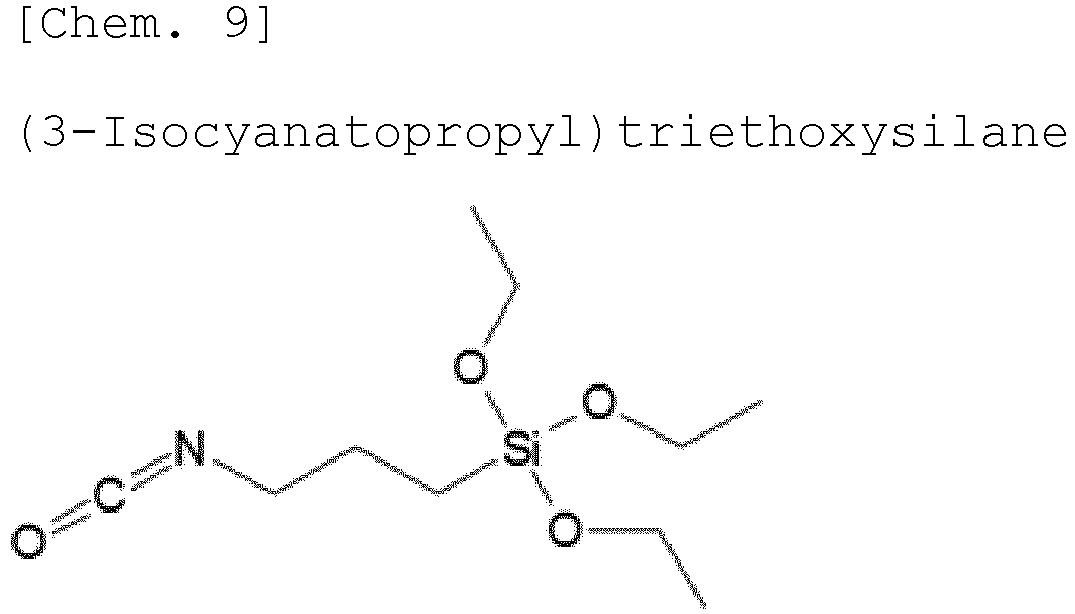
- In a Fourier Transform Infrared Spectroscopy (FT-IR) spectrum obtained by collecting a part of the reactant obtained above and performing FT-IR analysis, a peak of isocyanate near the wavenumber of 2,160 to 2,330 cm-1 confirmed in the FT-IR spectrum obtained by performing FT-IR analysis on the isocyanate group-containing silane coupling agent was not observed, whereas a peak of urethane near the wavenumber of 1,670 to 1,750 cm-1 was confirmed. It was confirmed from the results that the urethanization reaction between the hydroxy group contained in the ultraviolet absorber and the isocyanate group contained in the silane coupling agent proceeded, and the total amount of the isocyanate groups was subjected to the urethanization reaction to form a urethane bond.
- To the container 1 containing the reactant, 3-glycidoxypropyltrimethoxysilane was added while the reactant in the container was stirred at room temperature, and thereafter, methanol (solvent) was added.
- To a container different from the container (hereinafter, described as a "container 2"), silica sol, propylene glycol monomethyl ether, water, and tris(acetylacetonato)aluminum(III) were sequentially added in this order, and then, the mixture was stirred at room temperature for 3 hours. The reaction liquid in the container 1 was added to the container 2 while the mixture was continuously stirred. Thereafter, a leveling agent was added to the container 2 while the mixture was continuously stirred, the mixture was stirred at about 5°C for 144 hours, and then, the mixture was stirred at room temperature for 48 hours.
- Then, a curable composition containing an organosilicon compound in which an ultraviolet absorbing moiety and a silane coupling moiety were linked by a urethane bond was prepared. The amounts of various components used (unit: mass%) in the preparation of the curable composition are shown in Table 1.
- A lens substrate for spectacles (S-4.00D, refractive index: 1.67, diameter: 75 mm, thickness: 1.0 mm, polythiourethane resin) was immersed in an aqueous sodium hydroxide solution having a concentration of 10 mass% (liquid temperature: 45°C) for 10 minutes, and the solution was washed with pure water and then dried.
- Thereafter, a coating layer obtained by coating the convex surface (object-side surface) and the concave surface (eyeball-side surface) of the lens substrate with the curable composition by a dip coating method was formed, the coating layer was heated in a heat treatment furnace at an in-furnace atmosphere temperature of 80°C for 20 minutes, and then, the coating layer was further heated for 2 hours by raising the in-furnace atmosphere temperature to 110°C, thereby thermally curing the coating layer.
- In this way, a spectacle lens including a cured layer having a thickness of 3.1 µm and formed on each of an object-side and an eyeball-side thereof was produced.
- A curable composition was prepared in the same manner as that of Example 1, except that the amounts of various components used in the preparation of the curable composition were changed as shown in Table 1. Also in Examples 2 to 5, FT-IR analysis was performed in the same manner as that of Example 1 to confirm disappearance of the peak of isocyanate and the presence of the peak of urethane.
- A spectacle lens including a cured layer formed on both surfaces thereof was produced in the same manner as that of Example 1 using the prepared curable composition.
- A curable composition was prepared in the same manner as that of Example 1, except that (3-isocyanatopropyl)triethoxysilane (isocyanate group-containing silane coupling agent) was not used and the amounts of components used in the preparation of the curable composition were changed as shown in Table 1.
- A spectacle lens including a cured layer formed on both surfaces thereof was produced in the same manner as that of Example 1 using the prepared curable composition.
- A curable composition was prepared in the same manner as that of Example 1, except that 2,2',4,4'-tetrahydroxybenzophenone was used as an ultraviolet absorber and various compounds were used in amounts shown in Table 2 in the preparation of the curable composition. Also in Example 6, FT-IR analysis was performed in the same manner as that of Example 1 to confirm disappearance of the peak of isocyanate and the presence of the peak of urethane.
- A spectacle lens including a cured layer formed on both surfaces thereof was produced in the same manner as that of Example 1 using the prepared curable composition.

- A curable composition was prepared in the same manner as that of Example 1, except that (3-isocyanatopropyl)triethoxysilane (isocyanate group-containing silane coupling agent) was not used, 2,2',4,4'-tetrahydroxybenzophenone was used as an ultraviolet absorber, and the amounts of components used in the preparation of the curable composition were changed as shown in Table 2.
- A spectacle lens including a cured layer formed on both surfaces thereof was produced in the same manner as that of Example 1 using the prepared curable composition.
[Table 1] Example 1 Example 2 Example 3 Example 4 Example 5 Comparative Example 1 Comparative Example 2 Comparative Example 3 Inorganic oxide Silica sol 40.86 40.59 40. 32 39. 58 37. 93 40. 92 40.79 40.66 Organosilicon compound Si-1 15.68 15. 57 15. 47 15. 19 14.56 15.70 15.65 15.60 Si-2 0.16 0. 49 0. 84 1. 77 3. 81 - - - Catalyst Al (acac)3 0.57 0.57 0.56 0.55 0.53 0.57 0.57 0.57 Catalyst Sn cat. 0.01 0.02 0.03 0.07 0.15 - - - Ultraviolet absorber UV-1 0.15 0.45 0.77 1.62 3.50 0.16 0.48 0.79 Solvent PGM 18.31 18.20 18.07 17.74 17.00 18.34 18.29 18.23 MeOH 18.86 18.73 18.61 18.25 17.50 18.89 18.83 18.77 Water 5.41 5.37 5.33 5.22 5.01 5.41 5.40 5.38 Total 100.00 100.00 100.00 100.00 100.00 100.00 100.00 100.00 [Table 2] Example 6 Comparative Example 4 Inorganic oxide Silica sol 40.57 40.78 Organosilicon compound Si-1 15.57 15.65 Si-2 0.50 - Catalyst Al(acac)3 0.57 0.57 Catalyst Sn cat. 0.02 - Ultraviolet absorber UV-2 0.50 0.51 Solvent PGM 18.19 18.28 MeOH 18.72 18.82 Water 5.37 5.40 Total 100.00 100.00 - The various components in the above table are as follows.
- Silica sol: concentration of silicon oxide: 30 mass%,
- dispersion medium: propylene glycol monomethyl ether
- Si-1: 3-glycidoxypropyltrimethoxysilane
- Si-2: (3-isocyanatopropyl)triethoxysilane
- Al(acac)3: tris(acetylacetonato)aluminum(III)
- Sn cat.: dibutyltin diacetate
- UV-1: 2-(2,4-dihydroxyphenyl)-2H-benzotriazole
- UV-2: 2,2',4,4'-tetrahydroxybenzophenone
- PGM: propylene glycol monomethyl ether
- MeOH: methanol
- <Evaluation of weather resistance>
- Ultraviolet rays were intermittently emitted toward the object-side surface of each of the spectacle lenses of Examples and Comparative Examples under the condition of 0.77 W/m2 in a QUV ultraviolet fluorescent tube type accelerated weathering tester (manufactured by Q-Lab Corporation) under a high-temperature and high-humidity environment of a temperature of 45°C and a relative humidity of 90%. At the time when the number of days shown in Table 3 (Tables 3-1 and 3-2) has elapsed, the spectacle lens was taken out from the tester, the object-side surface of the cured layer was visually observed, and a crack generation was evaluated based on the following criteria. After visual observation, the spectacle lens was placed in the tester again, and ultraviolet ray irradiation was continued.
-
- 5: No crack
- 4: Slight cracks on outer periphery of surface of cured layer
- 3: Cracks more severe than in 4 on outer periphery of surface of cured layer
- 2: Cracks on outer periphery of surface of cured layer, and cracks partially in central portion
- 1: Slight cracks on entire surface of cured layer
- 0: Cracks more severe than in 1 on entire surface of cured layer
- From the results shown in Table 3, it can be confirmed that in each of the spectacle lenses of Examples, the generation of the cracks is suppressed (that is, the weather resistance is excellent) compared to each of the spectacle lenses of Comparative Examples. As a result of visually observing the object-side surface of the cured layer of each of the spectacle lenses of Comparative Examples during the weather resistance evaluation, a precipitate was confirmed. It is presumed that the precipitate was a precipitate of the ultraviolet absorber. On the other hand, such a precipitate was not observed in each of the spectacle lenses of Examples after the weather resistance evaluation.
- A first silicon oxide layer was formed on the object-side surface of each of the spectacle lenses of Examples 2 to 4 and Comparative Example 1 by a vacuum vapor deposition method, and a zirconium oxide layer and a silicon oxide layer as second to seventh layers were alternately layered to form an antireflection layer (multilayer antireflection film).
- Thereafter, 10 × 10 squares (100 squares in total) were formed on the object-side surface of each spectacle lens based on JIS K5600-5-6 (ISO 2409:1992), a peeling test was performed twice using a cellophane adhesive tape, in the entire squares, the square in which peeling was not observed was evaluated as "not peeled", the square that was entirely or partially peeled was evaluated as "peeled", and the number of squares having no peeling was counted. The evaluation results are shown in Table 4.
- In the squares in which peeling was generated in the peeling test, peeling was generated between the lens substrate and the cured layer. The peeling was generated because a primer layer was not formed between the lens substrate and the cured layer in the process of producing the spectacle lens for Evaluation 1 of adhesion, unlike a method for producing a spectacle lens for Evaluation 2 of adhesion described below. Therefore, it can be determined that the adhesion between the lens substrate and the cured layer is higher as the number of squares having no peeling is larger.
[Table 4] Comparative Example 1 Example 2 Example 3 Example 4 Evaluation results (number of squares having no peeling/number of all squares) 45/100 100/100 100/100 100/100 - A spectacle lens was produced in the same manner as that of the method for producing each of the spectacle lenses of Examples 1 to 5 and Comparative Example 1, except that a primer liquid was applied on the lens substrate before the curable composition was applied by a dip coating method, and the lens substrate was subjected to a heat treatment in a heating furnace at an in-furnace temperature of 80°C for 20 minutes to form a primer layer on both surfaces of the lens substrate. An antireflection layer was formed on the object-side surface of each spectacle lens thus produced in the same manner as that of the method for producing a spectacle lens for Evaluation 1 of adhesion.
- Thereafter, 10 × 10 squares (100 squares in total) were formed on the object-side surface of each spectacle lens based on JIS K5600-5-6 (ISO 2409:1992), a peeling test was performed twice using a cellophane adhesive tape, and then, adhesion was evaluated based on the following evaluation criteria. In the squares in which peeling was generated in the peeling test, peeling was generated between the cured layer and the antireflection layer. The evaluation results are shown in Table 5.
- A: No peeling was observed in the squares.
- B: There were squares in which peeling was very slightly and partially observed (slight peeling than in C).
- C: There were squares in which peeling was slightly and partially observed (slight peeling than in D).
- D: There were squares in which peeling was partially observed.
- E: All squares were peeled off.
- From the results shown in Tables 4 and 5, it can be confirmed that in each of the spectacle lenses of Examples, the cured layer has excellent adhesion to the portion adjacent thereto (the lens substrate or the antireflection layer) compared to each of the spectacle lenses of Comparative Examples. In this regard, the present inventors presume that the organosilicon compound contained in the cured layer of each of the spectacle lenses of Examples has the urethane bond, which contributes to the improvement of adhesion. However, this presumption does not limit the present invention.
- For each of the spectacle lenses of Examples and Comparative Examples shown in Table 6, a transmittance was measured in a wavelength region of 280 nm to 780 nm using a spectrophotometer (U-4100, manufactured by Hitachi High-Technologies Corporation).
- From the measurement results, an average transmittance in the wavelength region of 300 nm to 380 nm was calculated.
[Table 6] Average transmittance (300 nm to 380 nm) Comparative Example 1 81.6% Example 1 69.0% Comparative Example 2 52.3% Example 2 47.3% Comparative Example 3 45.5% Example 3 34.9% - It can be regarded that the spectacle lens having a lower value of the average transmittance in the wavelength region of 300 nm to 380 nm obtained by the above method has more excellent ultraviolet absorbability.
- In Table 6, when comparing Examples and Comparative Examples in which the amounts of ultraviolet absorbers used in the preparation of the curable composition are the same as each other, the value of the average transmittance in each of Examples in which the ultraviolet absorbing moiety of the ultraviolet absorber is linked to the silane coupling agent by the urethane bond is lower than the value in each of Comparative Examples to be compared.
- It was confirmed from the above results that the cured layer containing the organosilicon compound in which the ultraviolet absorbing moiety and the silane coupling moiety were linked by the urethane bond imparted excellent ultraviolet absorbability to the spectacle lens.
- Finally, the aspects described above will be summarized.
- According to one aspect, there is provided a curable composition containing an organosilicon compound in which an ultraviolet absorbing moiety and a silane coupling moiety are linked by a urethane bond.
- The cured layer formed using the curable composition contains an organosilicon compound in which an ultraviolet absorbing moiety and a silane coupling moiety are linked by a urethane bond, and thus, can exhibit excellent weather resistance. Such a cured layer provided can contribute to suppression of deterioration of various optical products such as a spectacle lens. In one aspect, the cured layer can be a cured layer having excellent adhesion to a portion adjacent to the layer such as a lens substrate. In addition, in one aspect, the spectacle lens including the cured layer can exhibit excellent ultraviolet absorbability.
- In one aspect, the ultraviolet absorbing moiety can be a benzotriazole skeleton-containing moiety.
- In one aspect, the ultraviolet absorbing moiety can be a benzophenone skeleton-containing moiety.
- In one aspect, the organosilicon compound can be a compound represented by General Formula (1) shown above.
- In one aspect, the curable composition can be a coating composition.
- In one aspect, the curable composition can be a coating composition for a spectacle lens.
- According to one aspect, there is provided a spectacle lens including a cured layer obtained by curing the curable composition.
- According to one aspect, spectacles including the spectacle lenses are provided.
- According to one aspect, there is provided a method for preparing the curable composition, the method including:
- obtaining the organosilicon compound by a urethanization reaction between a hydroxy group-containing compound having an ultraviolet absorbing moiety and an isocyanate group-containing compound having a silane coupling moiety; and
- preparing the curable composition by mixing the obtained organosilicon compound with one or more additional components.
- In one aspect, the additional component can include an organosilicon compound different from the organosilicon compound.
- According to one aspect, there is provided a method for producing a spectacle lens, the method including: coating a lens substrate with the curable composition to form a coating layer and subjecting the coating layer to a curing treatment to form a cured layer.
- The embodiment disclosed here is exemplary in all respects, and it should be considered that the embodiment is not restrictive. The scope of the present invention is defined not by the above description but by claims, and intends to include all modifications within meaning and a scope equal to claims.
- One aspect of the present invention is useful in the field of producing various optical products such as a spectacle lens.
| Number of elapsed days (days) | Comparative Example 1 | Example 1 | Example 2 | Example 3 | Example 4 | Example 5 |
| 0 | 5 | 5 | 5 | 5 | 5 | 5 |
| 9 | 0 | 5 | 5 | 5 | - | - |
| 10 | - | - | - | - | 5 | 5 |
| 14 | 0 | 4 | 4 | 5 | 5 | 5 |
| 18 | 0 | 0 | 3 | 3 | 5 | 5 |
| 21 | 0 | 0 | 3 | 3 | 4 | 4 |
| 24 | 0 | 0 | 3 | 3 | 4 | 4 |
| 28 | 0 | 0 | 1 | 2 | 2 | 3 |
| Number of elapsed days (days) | Comparative Example 6 | Example 6 |
| 0 | 5 | 5 |
| 9 | 4 | 5 |
| 14 | 1 | 5 |
| 24 | 0 | 1 |
| Comparative Example 1 | Example 1 | Example 2 | Example 3 | Example 4 | Example 5 | |
| Evaluation results | D | B | B | A | B | B |
Claims (11)
- A curable composition comprising an organosilicon compound in which an ultraviolet absorbing moiety and a silane coupling moiety are linked by a urethane bond.
- The curable composition according to claim 1, wherein the ultraviolet absorbing moiety is a benzotriazole skeleton-containing moiety.
- The curable composition according to claim 1, wherein the ultraviolet absorbing moiety is a benzophenone skeleton-containing moiety.
- The curable composition according to any one of claims 1 to 3, wherein the organosilicon compound is a compound represented by the following General Formula (1),

- The curable composition according to any one of claims 1 to 4, wherein the curable composition is a coating composition.
- The curable composition according to any one of claims 1 to 5, wherein the curable composition is a coating composition for a spectacle lens.
- A spectacle lens comprising a cured layer obtained by curing the curable composition according to any one of claims 1 to 6.
- Spectacles comprising the spectacle lenses according to claim 7.
- A method for preparing the curable composition according to any one of claims 1 to 6, the method comprising:obtaining the organosilicon compound by a urethanization reaction between a hydroxy group-containing compound having an ultraviolet absorbing moiety and an isocyanate group-containing compound having a silane coupling moiety; andpreparing the curable composition by mixing the obtained organosilicon compound with one or more additional components.
- The method for preparing the curable composition according to claim 9, wherein the additional component includes an organosilicon compound different from the organosilicon compound.
- A method for producing a spectacle lens, the method comprising:coating a lens substrate with the curable composition according to any one of claims 1 to 6 to form a coating layer; andsubjecting the coating layer to a curing treatment to form a cured layer.
Applications Claiming Priority (2)
| Application Number | Priority Date | Filing Date | Title |
|---|---|---|---|
| JP2019120665A JP7377636B2 (en) | 2019-06-28 | 2019-06-28 | Curable composition and method for producing the same, spectacle lens, spectacles, and method for producing spectacle lenses |
| PCT/JP2020/025361 WO2020262658A1 (en) | 2019-06-28 | 2020-06-26 | Curable composition, method for producing same, eyeglass lens, eyeglasses and method for producing eyeglass lens |
Publications (2)
| Publication Number | Publication Date |
|---|---|
| EP3992225A1 true EP3992225A1 (en) | 2022-05-04 |
| EP3992225A4 EP3992225A4 (en) | 2023-07-05 |
Family
ID=74061276
Family Applications (1)
| Application Number | Title | Priority Date | Filing Date |
|---|---|---|---|
| EP20830877.5A Pending EP3992225A4 (en) | 2019-06-28 | 2020-06-26 | CURABLE COMPOSITION, METHOD OF MAKING THEREOF, EYEGLASSES, EYEGLASSES AND METHOD OF MAKING AN EYEGLASSES |
Country Status (4)
| Country | Link |
|---|---|
| US (1) | US20220112355A1 (en) |
| EP (1) | EP3992225A4 (en) |
| JP (1) | JP7377636B2 (en) |
| WO (1) | WO2020262658A1 (en) |
Families Citing this family (4)
| Publication number | Priority date | Publication date | Assignee | Title |
|---|---|---|---|---|
| CN117083560B (en) * | 2021-03-31 | 2026-03-13 | 豪雅镜片泰国有限公司 | Eyeglass lenses |
| CN117255960A (en) * | 2021-05-14 | 2023-12-19 | 日本板硝子株式会社 | Light-absorbing composition, light-absorbing film, method for manufacturing light-absorbing film, and optical filter |
| JP7836720B2 (en) * | 2022-06-29 | 2026-03-27 | ホヤ レンズ タイランド リミテッド | Photochromic articles and eyeglasses |
| CN119998697A (en) * | 2022-10-27 | 2025-05-13 | 日本板硝子株式会社 | Light-absorbing composition, method for producing light-absorbing composition, light-absorbing film, optical filter, and method for producing optical filter |
Family Cites Families (9)
| Publication number | Priority date | Publication date | Assignee | Title |
|---|---|---|---|---|
| US4321400A (en) * | 1980-05-30 | 1982-03-23 | General Electric Company | Ultraviolet light absorbing agents and compositions and articles containing same |
| US4390660A (en) * | 1980-05-30 | 1983-06-28 | General Electric Company | Ultraviolet light absorbing compositions |
| JP3524617B2 (en) * | 1995-03-13 | 2004-05-10 | 新日本石油株式会社 | UV absorbers and coating materials |
| JPH09265059A (en) * | 1996-03-28 | 1997-10-07 | Asahi Optical Co Ltd | Eyeglass lens |
| US6072018A (en) * | 1996-09-30 | 2000-06-06 | Virginia Tech Intellectual Properties, Inc. | High abrasion resistant coating material |
| JP2000160130A (en) * | 1998-11-30 | 2000-06-13 | Shigeki Iida | Curable ultraviolet absorbent, coating solution for forming ultraviolet blocking film and ultraviolet blocking film using the same |
| JP5867192B2 (en) * | 2012-03-13 | 2016-02-24 | 信越化学工業株式会社 | Coating composition and plastic lens |
| CN105764948B (en) * | 2013-12-13 | 2018-07-06 | Sdc 科技有限公司 | Include the coating composition of blocked isocyanate silane |
| WO2015152289A1 (en) * | 2014-03-31 | 2015-10-08 | Jnc株式会社 | Silicon compound, coating agent resin composition, molded body, and image display device |
-
2019
- 2019-06-28 JP JP2019120665A patent/JP7377636B2/en active Active
-
2020
- 2020-06-26 EP EP20830877.5A patent/EP3992225A4/en active Pending
- 2020-06-26 WO PCT/JP2020/025361 patent/WO2020262658A1/en not_active Ceased
-
2021
- 2021-12-23 US US17/560,883 patent/US20220112355A1/en not_active Abandoned
Also Published As
| Publication number | Publication date |
|---|---|
| EP3992225A4 (en) | 2023-07-05 |
| US20220112355A1 (en) | 2022-04-14 |
| JP7377636B2 (en) | 2023-11-10 |
| WO2020262658A1 (en) | 2020-12-30 |
| JP2021006600A (en) | 2021-01-21 |
Similar Documents
| Publication | Publication Date | Title |
|---|---|---|
| US20220112355A1 (en) | Curable composition, method for preparing the same, spectacle lens, spectacles, and method for producing spectacle lens | |
| CN105176154B (en) | The product of photo-curable coating composition and coating | |
| US5679820A (en) | Silylated ultraviolet light absorbers having resistance to humidity | |
| JP6915405B2 (en) | Poly (meth) acrylate and coating compositions and coating articles containing it | |
| EP2880473B1 (en) | Optical article containing a self-healing coating and improved initial haze | |
| JP3524617B2 (en) | UV absorbers and coating materials | |
| US12428517B2 (en) | Moisture curable polyurethane composition and laminate | |
| US11136471B2 (en) | UV curable coating composition | |
| US9670167B2 (en) | Reactive UV absorber, making method, coating composition, and coated article | |
| DE102018116875A1 (en) | laminate | |
| JP2024143167A (en) | Photochromic article, eyeglasses, and method for producing photochromic article | |
| US20140162069A1 (en) | Coating compositions for resins | |
| JP7012458B2 (en) | A composition for forming a hard coat of a resin base material, a method for forming a hard coat, and an article using the same. | |
| JP7410949B2 (en) | Composition for forming hard coat on resin base material and laminate using same | |
| WO2017209104A1 (en) | Eyeglass lens | |
| EP3893044A1 (en) | Optical member, curable composition, and production method for optical member | |
| JP2020066577A (en) | (meth)acrylate compound, and coating composition and coated article containing the same | |
| US20220017775A1 (en) | Optical member, curable composition, and production method for optical member | |
| JPH02202953A (en) | Silicone resin composition and hard coating film | |
| JPH0519102A (en) | Hard coating agents and plastic optical products | |
| KR20020034657A (en) | Methods for preparing organic-inorganic hydrid, hard coating liquid comprising the same, and hard coating thin film using the same |
Legal Events
| Date | Code | Title | Description |
|---|---|---|---|
| STAA | Information on the status of an ep patent application or granted ep patent |
Free format text: STATUS: THE INTERNATIONAL PUBLICATION HAS BEEN MADE |
|
| PUAI | Public reference made under article 153(3) epc to a published international application that has entered the european phase |
Free format text: ORIGINAL CODE: 0009012 |
|
| STAA | Information on the status of an ep patent application or granted ep patent |
Free format text: STATUS: REQUEST FOR EXAMINATION WAS MADE |
|
| 17P | Request for examination filed |
Effective date: 20211222 |
|
| AK | Designated contracting states |
Kind code of ref document: A1 Designated state(s): AL AT BE BG CH CY CZ DE DK EE ES FI FR GB GR HR HU IE IS IT LI LT LU LV MC MK MT NL NO PL PT RO RS SE SI SK SM TR |
|
| DAV | Request for validation of the european patent (deleted) | ||
| DAX | Request for extension of the european patent (deleted) | ||
| A4 | Supplementary search report drawn up and despatched |
Effective date: 20230605 |
|
| RIC1 | Information provided on ipc code assigned before grant |
Ipc: C08G 18/38 20060101ALI20230530BHEP Ipc: G02B 5/22 20060101ALI20230530BHEP Ipc: C07F 7/18 20060101ALI20230530BHEP Ipc: C09D 183/08 20060101ALI20230530BHEP Ipc: G02C 7/00 20060101ALI20230530BHEP Ipc: C09D 5/32 20060101ALI20230530BHEP Ipc: G02C 7/02 20060101ALI20230530BHEP Ipc: C08G 77/26 20060101ALI20230530BHEP Ipc: C09D 175/04 20060101ALI20230530BHEP Ipc: C08G 18/24 20060101ALI20230530BHEP Ipc: C08K 3/36 20060101ALI20230530BHEP Ipc: C09D 4/00 20060101ALI20230530BHEP Ipc: C08G 18/32 20060101ALI20230530BHEP Ipc: C08G 18/71 20060101ALI20230530BHEP Ipc: C08G 59/30 20060101AFI20230530BHEP |
|
| STAA | Information on the status of an ep patent application or granted ep patent |
Free format text: STATUS: EXAMINATION IS IN PROGRESS |
|
| 17Q | First examination report despatched |
Effective date: 20260127 |