EP3992177B1 - Derivative compound introducing biphenyl group into novel aminoalkanoic acid and antifungal pharmaceutical composition comprising same - Google Patents
Derivative compound introducing biphenyl group into novel aminoalkanoic acid and antifungal pharmaceutical composition comprising same Download PDFInfo
- Publication number
- EP3992177B1 EP3992177B1 EP20830693.6A EP20830693A EP3992177B1 EP 3992177 B1 EP3992177 B1 EP 3992177B1 EP 20830693 A EP20830693 A EP 20830693A EP 3992177 B1 EP3992177 B1 EP 3992177B1
- Authority
- EP
- European Patent Office
- Prior art keywords
- biphenyl
- compound
- amino
- mmol
- ethyl
- Prior art date
- Legal status (The legal status is an assumption and is not a legal conclusion. Google has not performed a legal analysis and makes no representation as to the accuracy of the status listed.)
- Active
Links
Images

Classifications
-
- C—CHEMISTRY; METALLURGY
- C07—ORGANIC CHEMISTRY
- C07C—ACYCLIC OR CARBOCYCLIC COMPOUNDS
- C07C231/00—Preparation of carboxylic acid amides
- C07C231/02—Preparation of carboxylic acid amides from carboxylic acids or from esters, anhydrides, or halides thereof by reaction with ammonia or amines
-
- A—HUMAN NECESSITIES
- A01—AGRICULTURE; FORESTRY; ANIMAL HUSBANDRY; HUNTING; TRAPPING; FISHING
- A01N—PRESERVATION OF BODIES OF HUMANS OR ANIMALS OR PLANTS OR PARTS THEREOF; BIOCIDES, e.g. AS DISINFECTANTS, AS PESTICIDES OR AS HERBICIDES; PEST REPELLANTS OR ATTRACTANTS; PLANT GROWTH REGULATORS
- A01N37/00—Biocides, pest repellants or attractants, or plant growth regulators containing organic compounds containing a carbon atom having three bonds to hetero atoms with at the most two bonds to halogen, e.g. carboxylic acids
- A01N37/44—Biocides, pest repellants or attractants, or plant growth regulators containing organic compounds containing a carbon atom having three bonds to hetero atoms with at the most two bonds to halogen, e.g. carboxylic acids containing at least one carboxylic group or a thio analogue, or a derivative thereof, and a nitrogen atom attached to the same carbon skeleton by a single or double bond, this nitrogen atom not being a member of a derivative or of a thio analogue of a carboxylic group, e.g. amino-carboxylic acids
-
- A—HUMAN NECESSITIES
- A61—MEDICAL OR VETERINARY SCIENCE; HYGIENE
- A61K—PREPARATIONS FOR MEDICAL, DENTAL OR TOILETRY PURPOSES
- A61K31/00—Medicinal preparations containing organic active ingredients
- A61K31/16—Amides, e.g. hydroxamic acids
- A61K31/165—Amides, e.g. hydroxamic acids having aromatic rings, e.g. colchicine, atenolol, progabide
-
- A—HUMAN NECESSITIES
- A61—MEDICAL OR VETERINARY SCIENCE; HYGIENE
- A61P—SPECIFIC THERAPEUTIC ACTIVITY OF CHEMICAL COMPOUNDS OR MEDICINAL PREPARATIONS
- A61P31/00—Antiinfectives, i.e. antibiotics, antiseptics, chemotherapeutics
- A61P31/10—Antimycotics
-
- C—CHEMISTRY; METALLURGY
- C07—ORGANIC CHEMISTRY
- C07C—ACYCLIC OR CARBOCYCLIC COMPOUNDS
- C07C237/00—Carboxylic acid amides, the carbon skeleton of the acid part being further substituted by amino groups
- C07C237/02—Carboxylic acid amides, the carbon skeleton of the acid part being further substituted by amino groups having the carbon atoms of the carboxamide groups bound to acyclic carbon atoms of the carbon skeleton
- C07C237/04—Carboxylic acid amides, the carbon skeleton of the acid part being further substituted by amino groups having the carbon atoms of the carboxamide groups bound to acyclic carbon atoms of the carbon skeleton the carbon skeleton being acyclic and saturated
- C07C237/06—Carboxylic acid amides, the carbon skeleton of the acid part being further substituted by amino groups having the carbon atoms of the carboxamide groups bound to acyclic carbon atoms of the carbon skeleton the carbon skeleton being acyclic and saturated having the nitrogen atoms of the carboxamide groups bound to hydrogen atoms or to acyclic carbon atoms
-
- C—CHEMISTRY; METALLURGY
- C07—ORGANIC CHEMISTRY
- C07C—ACYCLIC OR CARBOCYCLIC COMPOUNDS
- C07C237/00—Carboxylic acid amides, the carbon skeleton of the acid part being further substituted by amino groups
- C07C237/02—Carboxylic acid amides, the carbon skeleton of the acid part being further substituted by amino groups having the carbon atoms of the carboxamide groups bound to acyclic carbon atoms of the carbon skeleton
- C07C237/04—Carboxylic acid amides, the carbon skeleton of the acid part being further substituted by amino groups having the carbon atoms of the carboxamide groups bound to acyclic carbon atoms of the carbon skeleton the carbon skeleton being acyclic and saturated
- C07C237/08—Carboxylic acid amides, the carbon skeleton of the acid part being further substituted by amino groups having the carbon atoms of the carboxamide groups bound to acyclic carbon atoms of the carbon skeleton the carbon skeleton being acyclic and saturated having the nitrogen atom of at least one of the carboxamide groups bound to an acyclic carbon atom of a hydrocarbon radical substituted by singly-bound oxygen atoms
-
- C—CHEMISTRY; METALLURGY
- C07—ORGANIC CHEMISTRY
- C07C—ACYCLIC OR CARBOCYCLIC COMPOUNDS
- C07C237/00—Carboxylic acid amides, the carbon skeleton of the acid part being further substituted by amino groups
- C07C237/02—Carboxylic acid amides, the carbon skeleton of the acid part being further substituted by amino groups having the carbon atoms of the carboxamide groups bound to acyclic carbon atoms of the carbon skeleton
- C07C237/20—Carboxylic acid amides, the carbon skeleton of the acid part being further substituted by amino groups having the carbon atoms of the carboxamide groups bound to acyclic carbon atoms of the carbon skeleton the carbon skeleton containing six-membered aromatic rings
-
- Y—GENERAL TAGGING OF NEW TECHNOLOGICAL DEVELOPMENTS; GENERAL TAGGING OF CROSS-SECTIONAL TECHNOLOGIES SPANNING OVER SEVERAL SECTIONS OF THE IPC; TECHNICAL SUBJECTS COVERED BY FORMER USPC CROSS-REFERENCE ART COLLECTIONS [XRACs] AND DIGESTS
- Y02—TECHNOLOGIES OR APPLICATIONS FOR MITIGATION OR ADAPTATION AGAINST CLIMATE CHANGE
- Y02P—CLIMATE CHANGE MITIGATION TECHNOLOGIES IN THE PRODUCTION OR PROCESSING OF GOODS
- Y02P20/00—Technologies relating to chemical industry
- Y02P20/50—Improvements relating to the production of bulk chemicals
- Y02P20/55—Design of synthesis routes, e.g. reducing the use of auxiliary or protecting groups
Definitions
- the present invention relates to a derivative compound in which a biphenyl group is introduced into an aminoalkanoic acid, a stereoisomer thereof, or a pharmaceutically acceptable salt thereof, and a pharmaceutical composition for preventing and/or treating a fungal infectious disease, including the same as an active ingredient.
- Cryptococcus neoformans which is a pathogenic fungus causing systemic infections, is typically found in soil worldwide, and its basidiospores could be inhaled from the surrounding environment into the lungs through the human respiratory organs.
- fungi lurking in the lungs may evoke lung infections and penetrate into the central nervous system through the blood-brain barrier (BBB) to cause life-threatening encephalomeningitis.
- BBB blood-brain barrier
- encephalomeningitis caused by Cryptococcus results in the highest mortality rate among encephalomeningitis, with more than 600,000 deaths worldwide each year.
- fungi consist of eukaryotic cells like animal cells, the biochemical metabolic pathways of fungi and mammals are so similar that it is difficult to find fungal-specific drug target.
- conventional antifungal agents to treat cryptococcosis have a number of limitations in their clinical use.
- the antifungal agents developed so far to suppress Cryptococcus fungi include polyene class comprising amphotericin B; azole class comprising ketoconazole, fluconazole, itraconazole, and voriconazole; and non-azole class such as terbinafine and flucytosine; echinocandin class such as caspofungin.
- Amphotericin B one of the polyene antifungals, binds to ergosterol in cell membrane of Cryptococcus to induce oxidative damage and causes fungal cell death.
- the amphotericin B causes adverse effects resulting from its severe toxicity to the human body.
- Azole class antifungals are known to inhibit biosynthesis of ergosterol, one of the essential elements of fungal cell membrane, by inhibiting 14- ⁇ -demethylase which is involved in the conversion of lanosterol to ergosterol, thereby weakening the cell membrane and causing fungal cell death. It was reported, however, that emergence of azole resistance within fungal species has been increased. Terbinafine suppresses ergosterol synthesis by inhibiting the conversion of squalene to squalene epoxy. Flucytosine, which is a metabolic antagonist inhibiting nucleic acid synthesis, exhibits antifungal effects by causing fungal RNA miscoding and antagonizing fungal DNA synthesis.
- Echinocandin class antifungals reveal antifungal effects by inhibiting fungal cell wall synthesis while the other antifungal agents mentioned above act on fungal cell membrane.
- Biphenyl derivatives used in antifungal compositions are disclosed in Bioorganic & Medicinal Chemistry Letters, 27 (19), 4571-4575 (2017 ).
- the conventional antifungal agents or drugs have a number of problems of side effects such as severe toxicity and drug resistance development, etc. Therefore, it has been highly required to develop a new class antifungal agent which is capable of enhancing antifungal effects while minimizing side effects.
- the present invention is to provide a novel aminoalkanoic acid derivative containing a biphenyl group, a salt and/or a solvate thereof.
- the present invention is to provide an antifungal pharmaceutical composition
- an antifungal pharmaceutical composition comprising the said aminoalkanoic acid derivative, a salt and/or a solvate thereof as an active ingredient.
- the present invention is to provide an agricultural antifungal agent comprising the said aminoalkanoic acid derivative, a salt and/or a solvate thereof as an active ingredient.
- the present invention is to provide an animal antifungal agent comprising the said aminoalkanoic acid derivative, a salt and/or a solvate thereof as an active ingredient.
- the present invention is to provide an antifungal composition
- an antifungal composition comprising the said aminoalkanoic acid derivative, a salt and/or a solvate thereof as an active ingredient.
- the present invention is to provide a human body cleansing composition, cosmetic composition, or shampoo composition comprising the said aminoalkanoic acid derivative, a salt and/or a solvate thereof as an active ingredient.
- an object of the present invention is to provide a method for preparing a benzyloxybenzylaminyl amino acid derivative of the present invention.
- the present invention provides a compound represented by the following Formula 1, a stereoisomer thereof, or a pharmaceutically acceptable salt thereof: in the said Formula 1,
- the compound represented by the Formula 1 is a compound having no limitation on a 3D arrangement structure of a substituent attached to a chiral carbon, and may include all structurally available enantiomers or optical isomers.
- the compound represented by the Formula 1 may be provided in the form of a (R) or (S) isomer thereof alone or a mixture thereof, for example, a racemic mixture or racemate thereof, but not limited thereto.
- the halogen may be selected from the group consisting of fluoro, chloro, bromo and iodo
- the C 1-7 alkyl may be a straight, branched or cyclic alkyl, and may be selected from the group consisting of methyl, ethyl, propyl, isopropyl, cyclopropyl, butyl, isobutyl, sec-butyl, t-butyl, pentyl, hexyl, heptyl and octyl.
- the C 1-7 alkyloxy group may be selected from the group consisting of methoxy, ethoxy, propoxy, butoxy, pentoxy, hexyloxy, heptyloxy and octyloxy.
- the halogenated C 1-7 alkyl may be selected from the group consisting of difluoromethyl, trifluoromethyl, difluoroethyl, trifluoroethyl, trifluoropropyl, trifluoropentyl, trifluorohexyl and trifluoroheptyl
- the halogenated C 1-7 alkyloxy may be selected from the group consisting of difluoromethyloxy, trifluoromethyloxy, difluoroethyloxy, trifluoroethyloxy, trifluoropropyloxy, trifluoropentyloxy, trifluorohexyloxy and trifluoroheptyloxy.
- the present invention may include not only the said Formula 1 or a pharmaceutically acceptable salt thereof, but also a solvate or hydrate presenting the same effects, which can be prepared therefrom within the scope of the present invention.
- the compound of the present invention is based on an aminoalkanoic acid and may be a derivative in which a biphenyl group is introduced into the aminoalkanoic acid.
- the aminoalkanoic acid may be an ⁇ -amino acid derivative containing a C 2-4 straight hydrocarbon chain in the side chain, for example, ⁇ -aminobutyric acid, norvaline or norleucine.
- ⁇ -aminobutyric acid refers to a compound represented by the following Formula 6, which has an IUPAC name of 2-aminobutyric acid, and is a non-proteinogenic ⁇ -amino acid of formula C 4 H 9 NO 2 , which is also known to be homoalanine in biochemistry.
- the ⁇ -aminobutyric acid includes a C 2 straight hydrocarbon chain in the side chain, which contains additional C 1 comparing to alanine.
- valine refers to a compound represented by the following Formula 7, which has an IUPAC name of 2-aminopentanoic acid, and is a water-soluble amino acid that is an isomer of valine, which is a branched chain amino acid (BCAA) of formula CH 3 (CH 2 ) 2 CH(NH 2 )CO 2 H.
- Nle norleucine
- Formula 8 a compound represented by the following Formula 8, which has an IUPAC name of 2-aminohexanoic acid, and is an amino acid having the formula CH 3 (CH 2 ) 3 CH(NH 2 )CO 2 H.
- the compound of the present invention may be a compound in which R 1 and R 2 are each independently H or methyl, ethyl, n-propyl, isopropyl, cyclopropyl, n-butyl, isobutyl, cyclobutyl, n-pentyl, cyclopentyl, n-hexyl or cyclohexyl, and R 3 is methyl, ethyl, n-propyl, isopropyl, cyclopropyl, n-butyl, isobutyl, sec-butyl or tert-butyl.
- the compound of the present invention may be a compound in which R 1 and R 2 are each independently H or methyl, and R 3 is methyl, ethyl, or n-propyl, but not limited thereto.
- X in the compound of the present invention may be any one or two identical or different substituents selected from the group consisting of fluoro, chloro, trifluoromethyl and trifluoromethoxy.
- the substituent may be one, or two or more which are the same as each other or differently selected.
- X in the compound of the present invention may be fluoro, chloro, trifluoromethyl or trifluoromethoxy, and in particular, X may be p-fluoro, m-fluoro, p,m-difluoro, p-chloro, m-chloro, p,m-dichloro, p-trifluoromethyl or p-trifluoromethoxy, but not limited thereto.
- the compound of the present invention may be any organic compound that is organic or organic compound that has a wide range of properties.
- the compound of the present invention may be organic compound that has a wide range of properties.
- the compound of the present invention may be in the form of a pharmaceutically acceptable salt.
- a salt an acid addition salt formed by a pharmaceutically acceptable free acid may be used.
- pharmaceutically acceptable salt refers to an organic or inorganic addition salt of the compound represented by Formula 1 that is tolerated and sufficiently non-toxic to be used for patients at any concentration exhibiting pharmacological effects of the compound.
- the acid addition salt is prepared by typical methods, for example, dissolving the compound in an excess aqueous acid solution, and precipitating the obtained salt using a water-miscible organic solvent, for example, methanol, ethanol, acetone or acetonitrile.
- a water-miscible organic solvent for example, methanol, ethanol, acetone or acetonitrile.
- the same molar amount of compound and acid or alcohol (for example, glycol monomethyl ether) in water are heated, and then the resulting mixture may be evaporated and dried, or the precipitated salt may be suction filtered.
- organic acids and inorganic acids may be used as the free acid.
- inorganic acids hydrochloric acid, phosphoric acid, sulfuric acid, nitric acid, tartaric acid, and the like may be used, and as the organic acids, methanesulfonic acid, p-toluenesulfonic acid, acetic acid, trifluoroacetic acid, maleic acid, succinic acid, oxalic acid, benzoic acid, tartaric acid, fumaric acid, mandelic acid, propionic acid, citric acid, lactic acid, glycolic acid, gluconic acid, galacturonic acid, glutamic acid, glutaric acid, glucuronic acid, aspartic acid, ascorbic acid, carbonic acid, vanillic acid, hydroiodic acid, and the like may be used, but the free acid is not limited thereto.
- a pharmaceutically acceptable metal salt may be prepared using a base.
- An alkali metal salt or an alkaline earth metal salt is obtained, for example, by dissolving the compound in an excessive amount of an alkali metal hydroxide or alkaline earth metal hydroxide solution, filtering a non-dissolved compound salt, and then evaporating and drying a filtrate.
- the metal salt it is pharmaceutically preferable to prepare particularly, sodium, potassium, or calcium salts, but the metal salt is not limited thereto.
- a silver salt corresponding thereto may be obtained by reacting an alkali metal or alkaline earth metal salt with a suitable silver salt (for example, silver nitrate).
- the pharmaceutically acceptable salt of the compound of the present invention includes a salt of an acidic or basic group that may be present in the compound of Formula 1, unless otherwise indicated.
- the pharmaceutically acceptable salt may comprise sodium, calcium, potassium salts and the like of a hydroxyl group.
- other pharmaceutically acceptable salts of an amino group include hydrobromide, sulfate, hydrogen sulfate, phosphate, hydrogen phosphate, dihydrogen phosphate, acetate, succinate, citrate, tartrate, lactate, mandelate, methanesulfonate (mesylate), p-toluenesulfonate (tosylate) salts, and the like, and may be prepared by a salt preparation method known in the art.
- the salt of the compound of Formula 1 of the present invention is a pharmaceutically acceptable salt, and any salt is available without limitation as long as the salt shows a pharmacological activity equivalent to that of the compound of Formula 1.
- a salt of the compound of Formula 1 presents antifungal activity.
- the present invention provides a method for preparing a derivative compound, a stereoisomer thereof, or a pharmaceutically acceptable salt thereof in which a biphenyl group is introduced into the aminoalkanoic acid, the method including a first step of forming a peptide bond by reacting an aminoalkanoic acid derivative compound protected by a butoxycarbonyl (Boc) protecting group, which is represented by the following Formula 2, with a biphenyl derivative compound including a primary amine group, which is represented by the following Formula 3; and a second step of removing the Boc protecting group by reacting the compound obtained in the first step with an acid: in Formula 1,
- Boc butoxycarbonyl
- the aminoalkanoic acid derivative compound protected by the Boc protecting group which is represented by Formula 2 may be prepared by reacting an amino acid derivative represented by the following Formula 4 with di-tert-butyl dicarbonate (also known as Boc anhydride): in the said Formula 4, R 1 ', R 2 , and R 3 are each independently the same as or different from each other, and are each independently selected from the group consisting of hydrogen, a C 1-7 alkyl, hydroxyl, a halogen, a halogenated C 1-7 alkyl, a C 1-7 alkyloxy and a halogenated C 1-7 alkyloxy.
- di-tert-butyl dicarbonate also known as Boc anhydride
- R 2 of the finally prepared compound is an alkyl
- a step of alkylating the compound by reacting the compound with a haloalkane in the presence of a base after the above reaction may be further performed.
- the alkylation may be carried out by dissolving the compound represented by Formula 4 and a haloalkane compound corresponding 5 to 20 equivalents of the compound, for example, alkane iodide in an organic solvent, for example, tetrahydrofuran, adding sodium hydride as a base at a low temperature, for example, 0°C and then reacting the reactants at 15 to 30°C for 12 to 48 hours, but not limited thereto.
- An alkylation reaction of amines known in the art may be used without limitation or performed by being modified.
- a biphenyl derivative compound containing a primary amine group which is represented by Formula 3 may be prepared by reacting a C 0-2 alkylamine derivative in which a halophenyl group at one end is substituted, which is represented by the following Formula 5 with di-tert-butyl dicarbonate to introduce a Boc protecting group into an amine group, reacting the resulting alkylamine derivative with a phenylboronic acid derivative represented by the following Formula 6, and then reacting the reactants with an acid to remove the Boc protecting group: in the said formulae,
- the reaction with the phenylboronic acid derivative may be achieved by a cross-coupling reaction using a metal catalyst in the presence of a base.
- the reaction may be performed under basic conditions by a metal catalyst such as palladium or nickel.
- the metal catalyst may be a catalyst in which a phosphine ligand is bound to a metal.
- the reaction may be a Suzuki-Miyaura cross-coupling reaction performed by Pd(PPh 3 ) 4 in the presence of Na 2 CO 3 , but is not limited thereto.
- the first step may be achieved by an anhydride coupling reaction performed in an organic solvent in the presence of N-methylmorpholine (NMM) or isobutyl chloroformate (IBCF).
- NMM N-methylmorpholine
- IBCF isobutyl chloroformate
- the organic solvent tetrahydrofuran may be used, but the organic solvent is not limited thereto.
- the second step to remove the Boc protecting group may be performed by carrying out a reaction with hydrochloric acid, but is not limited thereto.
- the preparation method of the present invention may further include a third step of forming a secondary amine by alkylating amine after the second step when each of R 1 and R 2 of the compound finally prepared is an alkyl.
- the amination may be performed by reacting with formaldehyde while supplying hydrogen gas in the presence of Pd/C as a reducing agent.
- the reaction may be performed at 15 to 30°C for 6 to 24 hours, but is not limited thereto, and the alkylation reaction of amines known in the art may be used without limitation or performed by being modified.
- the present invention provides an antifungal composition
- the present invention provides a pharmaceutical composition for use in a method of treating or preventing a fungal infectious disease, wherein the composition comprises, as an active ingredient, an aminoalkanoic acid derivative into which a biphenyl group is introduced, a stereoisomer thereof, or a pharmaceutically acceptable salt thereof.
- novel aminoalkanoic acid derivative into which a biphenyl group is introduced, a stereoisomer thereof, or a pharmaceutically acceptable salt thereof of the present invention may exhibit antifungal activity against opportunistic infectious fungi, and thus may be used as an antifungal composition, and furthermore, may be used for preventing or treating a fungal infectious disease.
- prevention refers to any actions that suppress, inhibit or delay the onset, development or recurrence of any concerned disease by administering the said pharmaceutical composition.
- treatment refers to any actions in which the symptoms of any concerned disease are alleviated or beneficially improved by administering the said pharmaceutical composition.
- a fungal infectious disease that can be prevented or treated by the pharmaceutical composition of the present invention may include, for example, infectious diseases caused by Cryptococcus neoformans, Candida albicans, Candida auris, Candida glabrata, and Aspergillus fumigatus.
- the fungal infectious disease may be encephalomeningitis caused by Cryptococcus, but not limited thereto.
- the pharmaceutical composition according to the present invention may comprise, as an active ingredient, a compound represented by Formula 1, a stereoisomer thereof, or a pharmaceutically acceptable salt thereof, and may also further include a pharmaceutically acceptable carrier, diluent or excipient.
- the pharmaceutical composition according to the present invention may be formulated and used in various forms such as an oral dosage form such as a powder, granules, a tablet, a capsule, a suspension, an emulsion, a syrup, or an aerosol, or an injection of a sterile injection solution by a conventional method according to each intended use, and may be administered orally or through various routes including intravenous, intraperitoneal, subcutaneous, rectal, topical administration and the like.
- compositions of the present invention may further include a filler, an anticoagulant, a lubricant, a wetting agent, a fragrance, an emulsifying agent, a preservative, and the like.
- a solid preparation for oral administration includes a tablet, a pill, a powder, granules, a capsule, and the like, and the solid preparation is formulated by mixing at least one excipient, for example, starch, calcium carbonate, sucrose, lactose, gelatin, and the like with the composition. Further, in addition to a simple excipient, a lubricant such as magnesium stearate and talc may be used.
- excipient for example, starch, calcium carbonate, sucrose, lactose, gelatin, and the like
- a lubricant such as magnesium stearate and talc may be used.
- a suspension, a liquid for internal use, an emulsion, a syrup or the like may be used, and in addition to water and liquid paraffin, which are simple commonly used diluents, various excipients, for example, a wetting agent, a sweetener, a flavoring agent, a preserving agent or the like may be employed.
- Examples of a preparation for parenteral administration include an aqueous sterile solution, a non-aqueous solvent, a suspension, an emulsion, a freeze-dried preparation, and a suppository.
- the non-aqueous solvent and the suspension it is possible to use propylene glycol, polyethylene glycol, a vegetable oil such as olive oil, an injectable ester such as ethyl oleate, and the like.
- As a base of the suppository it is possible to use Witepsol ® , Macrogol, Tween 61, cacao butter, laurin fat, glycerogelatin, and the like.
- the injection may include additives in the related art, such as a solubilizer, an isotonic agent, a suspending agent, an emulsifier, a stabilizer, and a preservative.
- composition of the present invention is administered in a pharmaceutically effective amount.
- pharmaceutically effective amount refers to an amount that is sufficient enough to treat diseases at a reasonable benefit/risk ratio applicable to medical treatment and does not cause side effects, and an effective dosage level may be determined according to various factors including patient's health status, type of diseases, severity of disease, activity of drugs, sensitivity to drugs, administration method, administration time, administration route and excretion rate, duration of treatment, and drugs used in combination or simultaneously, and other factors well known in the medical field.
- the composition of the present invention may be administered as an individual therapeutic agent or in combination with other therapeutic agents, may be administered sequentially or simultaneously with certain conventional therapeutic agents, and may be administered in a single dose or multiple doses. It is important to administer the composition in a minimum amount that can obtain the maximum effects without any side effects, in consideration of all the aforementioned factors, and this amount may be easily determined by those skilled in the art.
- the dosage is not intended to limit the scope of the present invention in any way.
- the present invention provides compounds of use in a a method for treating a fungal infectious disease, the method including administering the pharmaceutical composition to an individual in need thereof.
- the term "individual” refers to animals including a monkey, a cow, a horse, a sheep, a pig, a chicken, a turkey, a quail, a cat, a dog, a mouse, a rat, a rabbit, or a guinea pig, including a human who developed a fungal infectious disease or is likely to develop the fungal infectious disease, and the disease may be effectively prevented or treated by administering the pharmaceutical composition of the present invention to an individual.
- the pharmaceutical composition of the present invention exhibits a therapeutic effect on a disease induced by a fungal infection due to the antifungal activity thereof, and thus may exhibit a synergistic effect when administered in combination with an existing therapeutic agent.
- the term "administration" refers to provision of a predetermined material to a patient by any appropriate method.
- the route of administration of the composition of the present invention may be administered via any general route, which may reach a target tissue.
- the route of administration may be intraperitoneal administration, intravenous administration, intramuscular administration, subcutaneous administration, intradermal administration, oral administration, topical administration, intranasal administration, intrapulmonary administration, and rectal administration, but is not limited thereto.
- the pharmaceutical composition of the present invention may also be administered by any device which may allow an active material or ingredient to move to a target cell.
- Preferred administration modes and preparations are intravenous injection, subcutaneous injection, intradermal injection, intramuscular injection, drip injection and the like.
- An injectable preparation may be prepared using an aqueous solvent such as physiological saline and Ringer's solution, a non-aqueous solvent such as a vegetable oil, a higher fatty acid ester (for example, ethyl oleate, and the like), and an alcohol (for example, ethanol, benzyl alcohol, propylene glycol, glycerin, and the like), and may include a pharmaceutical carrier such as a stabilizer for preventing spoilage (for example, ascorbic acid, sodium bisulfite, sodium pyrosulfite, BHA, tocopherol, EDTA, and the like), an emulsifier, a buffer for pH control, and a preservative for inhibiting microbial growth (for example, phenylmercuric nitrate, thimerosal, benzalkonium chloride, phenol,
- terapéuticaally effective amount used in combination with the active ingredient in the present invention refers to an amount of a aminoalkanoic acid derivative compound in which a biphenyl group is introduced into aminoalkanoic acid, which is effective for preventing or treating a target disease, a stereoisomer thereof, or a pharmaceutically acceptable salt thereof.
- the disadvantages of conventional drugs used as antifungal agents can be overcome through a compound using an aminoalkanoic acid containing a biphenyl group, for example, alpha-aminobutyric acid or norvaline or norleucine as a basic skeleton.
- the present invention can provide antifungal agents having improved safety and efficacy to alleviate or eliminate the side effects of the conventional antifungals and to enhance therapeutic effects. Therefore, the present invention can provide a pharmaceutical composition to treat and/or prevent various fungal infectious diseases.
- the compound of the present invention can be used to prepare an antibacterial composition against gram-positive, gram-negative, and MRSA-resistant bacteria.
- the compound of the present invention can be used for the development of an antiinflammatory therapeutic agent.
- Norleucine (1.0 eq), Boc anhydride (1.5 eq), and sodium bicarbonate (1.5 eq) were dissolved in a 1:1 mixed solvent of distilled water and methanol and reacted at room temperature for 36 to 48 hours. After the mixture was concentrated in a vacuum state, the pH of an aqueous layer was adjusted to 2 with 1.0 M hydrochloric acid. Then, the moisture of an organic layer obtained by extraction with ethyl acetate was removed with sodium sulfate, and the solvent was evaporated in vacuum to obtain the title compound.
- the obtained residue was separated and purified by chromatography using silica gel. After the purified product was dissolved in an ethyl acetate solvent, the resulting solution was stirred at room temperature while adding 4.0 M hydrochloric acid (6.0 to 10.0 eq) thereto. The obtained white solid in the form of a salt was washed with ethyl acetate, and then completely dried in a vacuum state to obtain the title compound.
- the compound (1.0 eq) obtained from Reaction Scheme f was dissolved in methanol, triethylamine (6.0 eq) was added thereto, and then formaldehyde (37% by weight solution, 1.0 to 2.5 eq) and a 10% palladium catalyst (0.1 to 0.5 eq) were sequentially added thereto.
- the reactants were reacted at room temperature for 18 hours.
- the catalyst was removed by filtration through Celite, and the filtered organic layer was evaporated in a vacuum state to obtain a white solid.
- the resulting product was recrystallized with methanol and diethyl ether to obtain the title compound.
- Example 1 Analysis of antifungal activity against human pathogenic fungi
- Candida species and Cryptococcus neoformans were incubated in a Sabouraud dextrose agar (SDA) (Sigma-Aldrich) solid medium for 24 and 48 hours, respectively to obtain single colonies.
- SDA Sabouraud dextrose agar
- the obtained single colonies were suspended in 0.85% physiological saline to prepare fungal cell suspension (1 to 5 ⁇ 10 6 cells/ml).
- Fungal cells 2000-fold diluted in RPMI1640 broth (Sigma-Aldrich) were seeded on 96-well plates (5 ⁇ 10 2 to 2.5 ⁇ 10 3 cells/ml, 195 ⁇ l/well).
- Serial two-fold dilutions (128, 64, 32, 16, 8, 4, 2, 1, and 0.5 ⁇ g/ml) of compounds were prepared by diluting the compounds synthesized according to the above preparation examples. Then, 5 ⁇ l from each dilution was added to the well of the 96-well plate containing fungal cell suspension to give a final suspension of 200 ⁇ l per well.
- the compound-treated Candida species and C . neoformans were incubated at 35°C for 48 hours and for 72 hours, respectively, and then MICs were determined by visually observing the bottom of the 96-well plate to confirm whether the fungi were developed and grown.
- amphotericin B As a positive control, amphotericin B (AMB), which is highly toxic to the human body but is known as a representative antifungal agent, was used. The results are shown in Tables 1 to 3. [Table 1] Preparation example # (compound #) R1 R2 R3 X MIC ( ⁇ g/mL) C.neoformans C.
- MIC minimum inhibitory concentration capable of inhibiting the growth of fungi was measured in accordance with the Clinical and Laboratory Standards Institute (CLSI) guidelines.
- Fungal cells were spread on YPD solid media (Sigma-Aldrich) and then aliquoted into the wells of the 96-well plates (2.5 ⁇ 10 3 microconidia/ml for T. rubrum and T. mentagrophytes species or was 2.5 ⁇ 10 3 cfu/ml for Candida albicans , Candida glabrata and Cryptococcus neoformans species, 195 ⁇ l/well).
- Two-fold serial dilutions of the Compound 74 of which concentration are ranging from 128 to 0.5 ⁇ g/ml (128, 64, 32, 16, 8, 4, 2, 1 and 0.5 ⁇ g/ml), ware prepared.
- 5 ⁇ l from each dilution of Compound 74 was added to the well of the 96-well plate including fungal cells to give a final suspension of 200 ⁇ l/well.
- the compound-treated fungal cells were incubated in a 35°C incubator for 48 hours ( Candida species) and for 72 hours ( C . neoformans and Trichophyton species), respectively.
- Candida albicans were studied by treating Candida albicans with Compound 74 or commercially available drug of Efinaconazole, Tavaborole, Terbinafine, or Ciclopirox at the same concentration for the same period of time.
- Candida albicans were prepared at a concentration of 2.5 ⁇ 10 3 cfu/ml and aliquoted at 195 ⁇ l/well into 96-well plates.
- Candida albicans cells in 96-well plate were treated with Compound 74 or each of the commercially available comparative drugs (50 ⁇ g/ml or 100 ⁇ g/ml) for 30 minutes, respectively.
- Compound 74 treated fungal cells were seeded on YPD media (Sigma-Aldrich), and the number of single colonies grown was counted. The results are shown in FIG. 1 . As shown in FIG. 1 , it was confirmed that Compound 74 has an excellent fast-acting effects comparing to the commercially available competitive drugs.
- T. rubrum To evaluate fungicidal effects of Compound 74, the growth of T. rubrum was studied after treating T. rubrum with Compound 74 or commercially available antifungal drug of Efinaconazole, Amorolfine, Terbinafine, Ciclopirox, or Amphotericin B (0.5, 1-, 2-, 4-, 8- or 16-fold of the respective MICs of Compound 74 or the other commercially available antifungal drugs) for a predetermined time. Specifically, T . rubrum cells (6 ⁇ 10 3 cfu/ml were prepared and aliquoted at 195 ⁇ l/well into 96-well plates.
- Example 5 Comparison of biofilm disruption activities of Compound 74 with commercially available drugs
- the biofilm disruption activities of Compound 74 were studied.
- Candida albicans was allowed to form a biofilm.
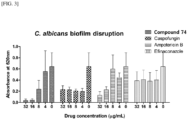
- Compound 74 or commercially available drug of Caspofungin, Amphotericin B or Efinaconazole was added to the obtained biofilm at respective concentrations of 4, 8, 16 and 32 ⁇ g/ml to evaluate the disruption of the biofilm.
- Candida albicans cells (2.5 ⁇ 10 3 cfu/ml) were seeded on a 96-well plate and incubated for 90 minutes to form a biofilm, and then the biofilm was treated with Compound 74 or each of the comparative drugs above, and then the growth of Candida albicans was studied 24 hours after the treatment.
- FIG. 3 it was suggested that Compound 74 of the present invention exhibited remarkably excellent growth inhibitory effects on Candida albicans through biofilm disruption especially in comparison to those of the commercially available comparative drugs.
- E . coli ( - ), P. aeruginosa ( - ), and S . enterica ( - ) were used as Gram-negative bacteria, B. cereus (+) , B. subtilis (+) , B. coagulans (+) , L. monocytogenes (+) , M. luteus (+) , P. acnes (+) , S. epidermidis (+) , and S . aureus (+) were used as Gram-positive bacteria.
- Methicillin-resistant Staphylococcus aureus was used as multi-drug resistant bacteria.
- the bacterial cells were incubated until the OD 600 of the single colonies reached 0.1.
- Cells diluted in 100-fold in a MHB liquid medium (Sigma-Aldrich) were seeded on 96-well plates to give a suspension of 100 ⁇ l per well with 0.001 OD 600 .
- two-fold serially diluted compounds of the present invention 64, 32, 16, 8, 4, 2, 1, and 0.5 ⁇ g/ml were added to the wells to provide a final suspension of 200 ⁇ l/well.
- aureus enterica ( - ) 74 32 >32 84 >32 >32 51 >32 >32 75 32 >32 46 32 32 85 >32 >32 30 >32 >32 78 8 16 76 16 32 81 8 16 79 16 32 31 ⁇ 4 8 73 8 16 86 32 64 89 16 32 88 8 >64 91 8 16 29 8 8 33 8 16 35 ⁇ 4 64 34 8 32 Nofloxacin ⁇ 0.125 ⁇ 0.125 Vancomycin 64 >64 [Table 7] Compound L. monocytogenes ( + ) M. luteus ( + ) P.
- RAW264.7 cells which were stimulated to secrete interleukin 6 (IL-6).
- IL-6 interleukin 6
- RAW264.7 cells obtained from Korean Cell Line Bank
- mouse macrophages were inoculated into a 12-well plate at 5 ⁇ 10 5 cells/well and incubated at 37°C for 16 to 24 hours.
- the compounds of the present invention were added to the cell culture medium containing RAW264.7 cells incubated as above at a final concentration of 0 or 8 ⁇ g/ml, and then incubated at 37°C for 1 hour.
- LPS lipopolysaccharide
- S lipopolysaccharide
- IL-6 levels produced by the RAW264.7 cells were measured using an ELISA kit (Komabiotech Inc. Korea) according to the manufacturer's instructions.
- IL6 levels were expressed as a relative percentage (%) between LPS-induced IL6 levels after the treatment with the compound of the present invention and LPS-induced IL6 levels without the treatment of the compound of the present invention.
- Compound No. Relative IL-6 levels (%) 76 9.58 47 12 48 67 49 50 50 68 52 13 32 16 53 5 77 5 45 3 80 6 82 3 83 9 36 9 87 24
- the present invention relates to a novel compound and the use of the same, can be used for the preparation of antifungal and antibacterial compositions, and can be used for the development of a pharmaceutical composition for use in a method for preventing and treating fungal infection diseases.
Landscapes
- Chemical & Material Sciences (AREA)
- Organic Chemistry (AREA)
- Health & Medical Sciences (AREA)
- Life Sciences & Earth Sciences (AREA)
- General Health & Medical Sciences (AREA)
- Chemical Kinetics & Catalysis (AREA)
- Animal Behavior & Ethology (AREA)
- Veterinary Medicine (AREA)
- Public Health (AREA)
- Medicinal Chemistry (AREA)
- Pharmacology & Pharmacy (AREA)
- Nuclear Medicine, Radiotherapy & Molecular Imaging (AREA)
- General Chemical & Material Sciences (AREA)
- Oncology (AREA)
- Communicable Diseases (AREA)
- Epidemiology (AREA)
- Wood Science & Technology (AREA)
- Plant Pathology (AREA)
- Engineering & Computer Science (AREA)
- Dentistry (AREA)
- Pest Control & Pesticides (AREA)
- Zoology (AREA)
- Environmental Sciences (AREA)
- Agronomy & Crop Science (AREA)
- Organic Low-Molecular-Weight Compounds And Preparation Thereof (AREA)
- Acyclic And Carbocyclic Compounds In Medicinal Compositions (AREA)
- Agricultural Chemicals And Associated Chemicals (AREA)
- Pharmaceuticals Containing Other Organic And Inorganic Compounds (AREA)
Description
- The present invention relates to a derivative compound in which a biphenyl group is introduced into an aminoalkanoic acid, a stereoisomer thereof, or a pharmaceutically acceptable salt thereof, and a pharmaceutical composition for preventing and/or treating a fungal infectious disease, including the same as an active ingredient.
- The longer the life span of the contemporary people, the more opportunistic fungal infections increase especially among the elderly due to the decline of immune functions. Furthermore, infections by opportunistic infectious fungi are increasing worldwide, in particular among the immune-compromised patients who are treated with immunosuppressive agents to reduce a transplant rejection response, or the organ transplant patients with impaired immune functions, or patients with weakened immunity due to chemotherapy or acquired immunodeficiency syndrome (AIDS). For fungal infections in the past, local fungal infections such as athlete's foot, tinea cruris and thrush commonly occurred, but recently, systemic fungal infections have tended to occur so frequently that they are the fourth most common of all infection types in hospitals. As representative opportunistic pathogenic fungi, Candida albicans, Candida glabrata, Candida krusei, Cryptococcus neoformans, and the like have been reported. Cryptococcus neoformans, which is a pathogenic fungus causing systemic infections, is typically found in soil worldwide, and its basidiospores could be inhaled from the surrounding environment into the lungs through the human respiratory organs. In the case of patients with weakened immunity, such as organ transplant patients or patients with AIDS, fungi lurking in the lungs may evoke lung infections and penetrate into the central nervous system through the blood-brain barrier (BBB) to cause life-threatening encephalomeningitis. In particular, encephalomeningitis caused by Cryptococcus results in the highest mortality rate among encephalomeningitis, with more than 600,000 deaths worldwide each year. However, since fungi consist of eukaryotic cells like animal cells, the biochemical metabolic pathways of fungi and mammals are so similar that it is difficult to find fungal-specific drug target. Thus, conventional antifungal agents to treat cryptococcosis have a number of limitations in their clinical use. The antifungal agents developed so far to suppress Cryptococcus fungi include polyene class comprising amphotericin B; azole class comprising ketoconazole, fluconazole, itraconazole, and voriconazole; and non-azole class such as terbinafine and flucytosine; echinocandin class such as caspofungin. Amphotericin B, one of the polyene antifungals, binds to ergosterol in cell membrane of Cryptococcus to induce oxidative damage and causes fungal cell death. The amphotericin B, however, causes adverse effects resulting from its severe toxicity to the human body. Azole class antifungals are known to inhibit biosynthesis of ergosterol, one of the essential elements of fungal cell membrane, by inhibiting 14-α-demethylase which is involved in the conversion of lanosterol to ergosterol, thereby weakening the cell membrane and causing fungal cell death. It was reported, however, that emergence of azole resistance within fungal species has been increased. Terbinafine suppresses ergosterol synthesis by inhibiting the conversion of squalene to squalene epoxy. Flucytosine, which is a metabolic antagonist inhibiting nucleic acid synthesis, exhibits antifungal effects by causing fungal RNA miscoding and antagonizing fungal DNA synthesis. Echinocandin class antifungals reveal antifungal effects by inhibiting fungal cell wall synthesis while the other antifungal agents mentioned above act on fungal cell membrane. Biphenyl derivatives used in antifungal compositions are disclosed in Bioorganic & Medicinal Chemistry Letters, 27 (19), 4571-4575 (2017).
- As disclosed above, the conventional antifungal agents or drugs have a number of problems of side effects such as severe toxicity and drug resistance development, etc. Therefore, it has been highly required to develop a new class antifungal agent which is capable of enhancing antifungal effects while minimizing side effects.
- The present invention is to provide a novel aminoalkanoic acid derivative containing a biphenyl group, a salt and/or a solvate thereof.
- In addition, the present invention is to provide an antifungal pharmaceutical composition comprising the said aminoalkanoic acid derivative, a salt and/or a solvate thereof as an active ingredient.
- In addition, the present invention is to provide an agricultural antifungal agent comprising the said aminoalkanoic acid derivative, a salt and/or a solvate thereof as an active ingredient.
- Furthermore, the present invention is to provide an animal antifungal agent comprising the said aminoalkanoic acid derivative, a salt and/or a solvate thereof as an active ingredient.
- Furthermore, the present invention is to provide an antifungal composition comprising the said aminoalkanoic acid derivative, a salt and/or a solvate thereof as an active ingredient.
- Furthermore, the present invention is to provide a human body cleansing composition, cosmetic composition, or shampoo composition comprising the said aminoalkanoic acid derivative, a salt and/or a solvate thereof as an active ingredient.
- Furthermore, an object of the present invention is to provide a method for preparing a benzyloxybenzylaminyl amino acid derivative of the present invention.
- As one aspect to achieve the objects above, the present invention provides a compound represented by the following Formula 1, a stereoisomer thereof, or a pharmaceutically acceptable salt thereof:

Formula 1, - n is 0, 1, 2, 3, 4 or 5,
- R1, R2, and R3 are each independently the same as or different from each other, and are each independently selected from hydrogen, a C1-7 alkyl, hydroxyl, a halogen, a halogenated C1-7 alkyl, a C1-7 alkyloxy and a halogenated C1-7 alkyloxy, and
- X is m substituents (m is an integer from 1 to 5) which are the same as or different from each other, selected from the group consisting of a halogen group, a halogenated C1-7 alkyl group and a halogenated C1-7 alkoxy group.
- In addition, the compound represented by the Formula 1 is a compound having no limitation on a 3D arrangement structure of a substituent attached to a chiral carbon, and may include all structurally available enantiomers or optical isomers. In particular, the compound represented by the Formula 1 may be provided in the form of a (R) or (S) isomer thereof alone or a mixture thereof, for example, a racemic mixture or racemate thereof, but not limited thereto.
- In the present invention, the halogen may be selected from the group consisting of fluoro, chloro, bromo and iodo, and
the C1-7 alkyl may be a straight, branched or cyclic alkyl, and may be selected from the group consisting of methyl, ethyl, propyl, isopropyl, cyclopropyl, butyl, isobutyl, sec-butyl, t-butyl, pentyl, hexyl, heptyl and octyl. - The C1-7 alkyloxy group may be selected from the group consisting of methoxy, ethoxy, propoxy, butoxy, pentoxy, hexyloxy, heptyloxy and octyloxy.
- The halogenated C1-7 alkyl may be selected from the group consisting of difluoromethyl, trifluoromethyl, difluoroethyl, trifluoroethyl, trifluoropropyl, trifluoropentyl, trifluorohexyl and trifluoroheptyl, and
the halogenated C1-7 alkyloxy may be selected from the group consisting of difluoromethyloxy, trifluoromethyloxy, difluoroethyloxy, trifluoroethyloxy, trifluoropropyloxy, trifluoropentyloxy, trifluorohexyloxy and trifluoroheptyloxy. - The present invention may include not only the said Formula 1 or a pharmaceutically acceptable salt thereof, but also a solvate or hydrate presenting the same effects, which can be prepared therefrom within the scope of the present invention.
- The compound of the present invention is based on an aminoalkanoic acid and may be a derivative in which a biphenyl group is introduced into the aminoalkanoic acid.
- For example, the aminoalkanoic acid may be an α-amino acid derivative containing a C2-4 straight hydrocarbon chain in the side chain, for example, α-aminobutyric acid, norvaline or norleucine.
- As used herein, the term "α-aminobutyric acid (AABA)" refers to a compound represented by the following Formula 6, which has an IUPAC name of 2-aminobutyric acid, and is a non-proteinogenic α-amino acid of formula C4H9NO2, which is also known to be homoalanine in biochemistry. The α-aminobutyric acid includes a C2 straight hydrocarbon chain in the side chain, which contains additional C1 comparing to alanine.

- As used herein, the term "norvaline (Nva)" refers to a compound represented by the following Formula 7, which has an IUPAC name of 2-aminopentanoic acid, and is a water-soluble amino acid that is an isomer of valine, which is a branched chain amino acid (BCAA) of formula CH3(CH2)2CH(NH2)CO2H.

- As used herein, the term "norleucine (Nle)" refer to a compound represented by the following Formula 8, which has an IUPAC name of 2-aminohexanoic acid, and is an amino acid having the formula CH3(CH2)3CH(NH2)CO2H.

- For example, the compound of the present invention may be a compound in which R1 and R2 are each independently H or methyl, ethyl, n-propyl, isopropyl, cyclopropyl, n-butyl, isobutyl, cyclobutyl, n-pentyl, cyclopentyl, n-hexyl or cyclohexyl, and R3 is methyl, ethyl, n-propyl, isopropyl, cyclopropyl, n-butyl, isobutyl, sec-butyl or tert-butyl.
- Furthermore, the compound of the present invention may be a compound in which R1 and R2 are each independently H or methyl, and R3 is methyl, ethyl, or n-propyl, but not limited thereto.
- For example, X in the compound of the present invention may be any one or two identical or different substituents selected from the group consisting of fluoro, chloro, trifluoromethyl and trifluoromethoxy. For example, the substituent may be one, or two or more which are the same as each other or differently selected.
- For example, X in the compound of the present invention may be fluoro, chloro, trifluoromethyl or trifluoromethoxy, and in particular, X may be p-fluoro, m-fluoro, p,m-difluoro, p-chloro, m-chloro, p,m-dichloro, p-trifluoromethyl or p-trifluoromethoxy, but not limited thereto.
- Specifically, the compound of the present invention may be
- 1) 2-amino-N-(3',4'-dichloro-[1,1'-biphenyl]-4-yl)butanamide;
- 2) 2-amino-N-(3',4'-dichloro-[1,1'-biphenyl]-4-yl)pentanamide;
- 3) 2-amino-N-(3',4'-dichloro-[1,1'-biphenyl]-4-yl)hexanamide;
- 4) 2-amino-N-(4'-(trifluoromethoxy)-[1,1'-biphenyl]-4-yl)pentanamide;
- 5) N-(3',4'-dichloro-[1,1'-biphenyl]-4-yl)-2-(methylamino)butanamide;
- 6) N-(3',4'-dichloro-[1,1'-biphenyl]-4-yl)-2-(methylamino)pentanamide;
- 7) N-(3',4'-dichloro-[1,1'-biphenyl]-4-yl)-2-(methylamino)hexanamide;
- 8) N-(3',4'-dichloro-[1,1'-biphenyl]-4-yl)-2-(dimethylamino)pentanamide;
- 9) 2-amino-N-((3',4'-dichloro-[1,1'-biphenyl]-4-yl)methyl)pentanamide;
- 10) 2-amino-N-((3',4'-dichloro-[1,1'-biphenyl]-4-yl)methyl)hexanamide;
- 11) 2-amino-N-((4'-(trifluoromethyl)-[1,1'-biphenyl]-4-yl)methyl)pentanamide;
- 12) 2-amino-N-((4'-(trifluoromethyl)-[1,1'-biphenyl]-4-yl)methyl)hexanamide;
- 13) 2-amino-N-((4'-(trifluoromethoxy)-[1,1'-biphenyl]-4-yl)methyl)pentanamide;
- 14) 2-amino-N-((4'-(trifluoromethoxy)-[1,1'-biphenyl]-4-yl)methyl)hexanamide;
- 15) N-((3',4'-dichloro-[1,1'-biphenyl]-4-yl)methyl)-2-(methylamino)pentanamide;
- 16) 2-(methylamino)-N-((4'-(trifuloromethyl)-[1,1'-biphenyl]-4-yl)methyl)pentanamide;
- 17) N-((3',4'-dichloro-[1,1'-biphenyl]-4-yl)methyl)-2-(dimethylamino)pentanamide;
- 18) 2-amino-N-(2-(3',4'-dichloro-[1,1'-biphenyl]-4-yl)ethyl)butanamide;
- 19) 2-amino-N-(2-(3',4'-dichloro-[1,1'-biphenyl]-4-yl)ethyl)pentanamide;
- 20) 2-amino-N-(2-(3',4'-dichloro-[1,1'-biphenyl]-4-yl)ethyl)hexanamide;
- 21) 2-amino-N-(2-(4'-(trifluoromethyl)-[1,1'-biphenyl]-4-yl)ethyl)butanamide;
- 22) 2-amino-N-(2-(4'-(trifluoromethyl)-[1,1'-biphenyl]-4-yl)ethyl)pentanamide;
- 23) 2-amino-N-(2-(4'-(trifluoromethyl)-[1,1'-biphenyl]-4-yl)ethyl)hexanamide;
- 24) 2-amino-N-(2-(4'-(trifluoromethoxy)-[1,1'-biphenyl]-4-yl)ethyl)butanamide;
- 25) 2-amino-N-(2-(4'-(trifluoromethoxy)-[1,1'-biphenyl]-4-yl)ethyl)pentanamide;
- 26) 2-amino-N-(2-(4'-(trifluoromethoxy)-[1,1'-biphenyl]-4-yl)ethyl)hexanamide;
- 27) 2-amino-N-(2-(3',4'-difluoro-[1,1'-biphenyl]-4-yl)ethyl)pentanamide;
- 28) N-(2-(3',4'-dichloro-[1,1'-biphenyl]-4-yl)ethyl)-2-(methylamino)butanamide;
- 29) N-(2-(3',4'-dichloro-[1,1'-biphenyl]-4-yl)ethyl)-2-(methylamino)pentanamide;
- 30) N-(2-(3',4'-dichloro-[1,1'-biphenyl]-4-yl)ethyl)-2-(methylamino)hexanamide;
- 31) 2-(methylamino)-N-(2-(4'-(trifluoromethyl)-[1,1'-biphenyl]-4-yl)ethyl)butanamide;
- 32) 2-(methylamino)-N-(2-(4'-(trifluoromethyl)-[1,1'-biphenyl]-4-yl)ethyl)pentanamide;
- 33) 2-(methylamino)-N-(2-(4'-(trifluoromethyl)-[1,1'-biphenyl]-4-yl)ethyl)hexanamide;
- 34) 2-(methylamino)-N-(2-(4'-(trifluoromethoxy)-[1,1'-biphenyl]-4-yl)ethyl)butanamide;
- 35) 2-(methylamino)-N-(2-(4'-(trifluoromethoxy)-[1,1'-biphenyl]-4-yl)ethyl)pentanamide;
- 36) 2-(methylamino)-N-(2-(4'-(trifluoromethoxy)-[1,1'-biphenyl]-4-yl)ethyl)hexanamide; or
- 37) N-(2-(3',4'-dichloro-[1,1'-biphenyl]-4-yl)ethyl)-2-(dimethylamino)pentanamide;
- The compound of the present invention may be in the form of a pharmaceutically acceptable salt. As a salt, an acid addition salt formed by a pharmaceutically acceptable free acid may be used. As used herein, the term "pharmaceutically acceptable salt" refers to an organic or inorganic addition salt of the compound represented by
Formula 1 that is tolerated and sufficiently non-toxic to be used for patients at any concentration exhibiting pharmacological effects of the compound. - The acid addition salt is prepared by typical methods, for example, dissolving the compound in an excess aqueous acid solution, and precipitating the obtained salt using a water-miscible organic solvent, for example, methanol, ethanol, acetone or acetonitrile. The same molar amount of compound and acid or alcohol (for example, glycol monomethyl ether) in water are heated, and then the resulting mixture may be evaporated and dried, or the precipitated salt may be suction filtered.
- In this case, as the free acid, organic acids and inorganic acids may be used. Further, as the inorganic acids, hydrochloric acid, phosphoric acid, sulfuric acid, nitric acid, tartaric acid, and the like may be used, and as the organic acids, methanesulfonic acid, p-toluenesulfonic acid, acetic acid, trifluoroacetic acid, maleic acid, succinic acid, oxalic acid, benzoic acid, tartaric acid, fumaric acid, mandelic acid, propionic acid, citric acid, lactic acid, glycolic acid, gluconic acid, galacturonic acid, glutamic acid, glutaric acid, glucuronic acid, aspartic acid, ascorbic acid, carbonic acid, vanillic acid, hydroiodic acid, and the like may be used, but the free acid is not limited thereto.
- Further, a pharmaceutically acceptable metal salt may be prepared using a base. An alkali metal salt or an alkaline earth metal salt is obtained, for example, by dissolving the compound in an excessive amount of an alkali metal hydroxide or alkaline earth metal hydroxide solution, filtering a non-dissolved compound salt, and then evaporating and drying a filtrate. In this case, as the metal salt, it is pharmaceutically preferable to prepare particularly, sodium, potassium, or calcium salts, but the metal salt is not limited thereto. In addition, a silver salt corresponding thereto may be obtained by reacting an alkali metal or alkaline earth metal salt with a suitable silver salt (for example, silver nitrate).
- The pharmaceutically acceptable salt of the compound of the present invention includes a salt of an acidic or basic group that may be present in the compound of
Formula 1, unless otherwise indicated. For example, the pharmaceutically acceptable salt may comprise sodium, calcium, potassium salts and the like of a hydroxyl group. The examples of other pharmaceutically acceptable salts of an amino group include hydrobromide, sulfate, hydrogen sulfate, phosphate, hydrogen phosphate, dihydrogen phosphate, acetate, succinate, citrate, tartrate, lactate, mandelate, methanesulfonate (mesylate), p-toluenesulfonate (tosylate) salts, and the like, and may be prepared by a salt preparation method known in the art. - The salt of the compound of
Formula 1 of the present invention is a pharmaceutically acceptable salt, and any salt is available without limitation as long as the salt shows a pharmacological activity equivalent to that of the compound ofFormula 1. For example, a salt of the compound ofFormula 1 presents antifungal activity. - As another aspect, the present invention provides a method for preparing a derivative compound, a stereoisomer thereof, or a pharmaceutically acceptable salt thereof in which a biphenyl group is introduced into the aminoalkanoic acid, the method including a first step of forming a peptide bond by reacting an aminoalkanoic acid derivative compound protected by a butoxycarbonyl (Boc) protecting group, which is represented by the following
Formula 2, with a biphenyl derivative compound including a primary amine group, which is represented by the following Formula 3; and a second step of removing the Boc protecting group by reacting the compound obtained in the first step with an acid:


Formula 1, - n is 0, 1, 2, 3, 4 or 5,
- R1, R2, and R3 are each independently the same as or different from each other, and are each independently selected from the group consisting of hydrogen, a C1-7 alkyl, hydroxyl, a halogen, a halogenated C1-7 alkyl, a C1-7 alkyloxy and a halogenated C1-7 alkyloxy, and
- X is m substituents (m is an integer from 1 to 5) which are the same as or different from each other, selected from the group consisting of a halogen group, a halogenated C1-7 alkyl group and a halogenated C1-7 alkoxy group.
- In the preparation method of the present invention, the aminoalkanoic acid derivative compound protected by the Boc protecting group, which is represented by
Formula 2 may be prepared by reacting an amino acid derivative represented by the followingFormula 4 with di-tert-butyl dicarbonate (also known as Boc anhydride):
Formula 4,
R1', R2, and R3 are each independently the same as or different from each other, and are each independently selected from the group consisting of hydrogen, a C1-7 alkyl, hydroxyl, a halogen, a halogenated C1-7 alkyl, a C1-7 alkyloxy and a halogenated C1-7 alkyloxy. - In this case, when R2 of the finally prepared compound is an alkyl, a step of alkylating the compound by reacting the compound with a haloalkane in the presence of a base after the above reaction may be further performed. For example, the alkylation may be carried out by dissolving the compound represented by
Formula 4 and a haloalkane compound corresponding 5 to 20 equivalents of the compound, for example, alkane iodide in an organic solvent, for example, tetrahydrofuran, adding sodium hydride as a base at a low temperature, for example, 0°C and then reacting the reactants at 15 to 30°C for 12 to 48 hours, but not limited thereto. An alkylation reaction of amines known in the art may be used without limitation or performed by being modified. - Meanwhile, in the preparation method of the present invention, a biphenyl derivative compound containing a primary amine group, which is represented by Formula 3 may be prepared by reacting a C0-2 alkylamine derivative in which a halophenyl group at one end is substituted, which is represented by the following Formula 5 with di-tert-butyl dicarbonate to introduce a Boc protecting group into an amine group, reacting the resulting alkylamine derivative with a phenylboronic acid derivative represented by the following
Formula 6, and then reacting the reactants with an acid to remove the Boc protecting group:

- X' is a halogen, and
- X is m substituents (m is an integer from 1 to 5) which are the same as or different from each other, selected from the group consisting of a halogen group, a halogenated C1-7 alkyl group and a halogenated C1-7 alkoxy group.
- In this case, the reaction with the phenylboronic acid derivative may be achieved by a cross-coupling reaction using a metal catalyst in the presence of a base. For example, the reaction may be performed under basic conditions by a metal catalyst such as palladium or nickel. The metal catalyst may be a catalyst in which a phosphine ligand is bound to a metal. For example, the reaction may be a Suzuki-Miyaura cross-coupling reaction performed by Pd(PPh3)4 in the presence of Na2CO3, but is not limited thereto.
- For example, in the preparation method of the present invention, the first step may be achieved by an anhydride coupling reaction performed in an organic solvent in the presence of N-methylmorpholine (NMM) or isobutyl chloroformate (IBCF). As the organic solvent, tetrahydrofuran may be used, but the organic solvent is not limited thereto.
- For example, in the preparation method of the present invention, the second step to remove the Boc protecting group may be performed by carrying out a reaction with hydrochloric acid, but is not limited thereto.
- Furthermore, the preparation method of the present invention may further include a third step of forming a secondary amine by alkylating amine after the second step when each of R1 and R2 of the compound finally prepared is an alkyl. The amination may be performed by reacting with formaldehyde while supplying hydrogen gas in the presence of Pd/C as a reducing agent. For example, the reaction may be performed at 15 to 30°C for 6 to 24 hours, but is not limited thereto, and the alkylation reaction of amines known in the art may be used without limitation or performed by being modified.
- As still another aspect, the present invention provides an antifungal composition comprising, as an active ingredient, a derivative compound in which a biphenyl group is introduced into an aminoalkanoic acid, and a stereoisomer thereof, or a pharmaceutically acceptable salt thereof.
- As yet another aspect, the present invention provides a pharmaceutical composition for use in a method of treating or preventing a fungal infectious disease, wherein the composition comprises, as an active ingredient, an aminoalkanoic acid derivative into which a biphenyl group is introduced, a stereoisomer thereof, or a pharmaceutically acceptable salt thereof.
- For example, the novel aminoalkanoic acid derivative into which a biphenyl group is introduced, a stereoisomer thereof, or a pharmaceutically acceptable salt thereof of the present invention may exhibit antifungal activity against opportunistic infectious fungi, and thus may be used as an antifungal composition, and furthermore, may be used for preventing or treating a fungal infectious disease.
- As used herein, the term "prevention" refers to any actions that suppress, inhibit or delay the onset, development or recurrence of any concerned disease by administering the said pharmaceutical composition. The term "treatment" refers to any actions in which the symptoms of any concerned disease are alleviated or beneficially improved by administering the said pharmaceutical composition.
- For example, a fungal infectious disease that can be prevented or treated by the pharmaceutical composition of the present invention may include, for example, infectious diseases caused by Cryptococcus neoformans, Candida albicans, Candida auris, Candida glabrata, and Aspergillus fumigatus. The fungal infectious disease may be encephalomeningitis caused by Cryptococcus, but not limited thereto.
- The pharmaceutical composition according to the present invention may comprise, as an active ingredient, a compound represented by
Formula 1, a stereoisomer thereof, or a pharmaceutically acceptable salt thereof, and may also further include a pharmaceutically acceptable carrier, diluent or excipient. For example, the pharmaceutical composition according to the present invention may be formulated and used in various forms such as an oral dosage form such as a powder, granules, a tablet, a capsule, a suspension, an emulsion, a syrup, or an aerosol, or an injection of a sterile injection solution by a conventional method according to each intended use, and may be administered orally or through various routes including intravenous, intraperitoneal, subcutaneous, rectal, topical administration and the like. Examples of a suitable carrier, diluent, or excipient that may be included in such a composition include lactose, dextrose, sucrose, sorbitol, mannitol, xylitol, erythritol, maltitol, starch, acacia rubber, alginate, gelatin, calcium phosphate, calcium silicate, cellulose, methylcellulose, microcrystalline cellulose, polyvinylpyrrolidone, water, methylhydroxybenzoate, propylhydroxybenzoate, talc, magnesium stearate, mineral oil, and the like. Further, the composition of the present invention may further include a filler, an anticoagulant, a lubricant, a wetting agent, a fragrance, an emulsifying agent, a preservative, and the like. - A solid preparation for oral administration includes a tablet, a pill, a powder, granules, a capsule, and the like, and the solid preparation is formulated by mixing at least one excipient, for example, starch, calcium carbonate, sucrose, lactose, gelatin, and the like with the composition. Further, in addition to a simple excipient, a lubricant such as magnesium stearate and talc may be used.
- As a liquid preparation for oral administration, a suspension, a liquid for internal use, an emulsion, a syrup or the like may be used, and in addition to water and liquid paraffin, which are simple commonly used diluents, various excipients, for example, a wetting agent, a sweetener, a flavoring agent, a preserving agent or the like may be employed.
- Examples of a preparation for parenteral administration include an aqueous sterile solution, a non-aqueous solvent, a suspension, an emulsion, a freeze-dried preparation, and a suppository. As the non-aqueous solvent and the suspension, it is possible to use propylene glycol, polyethylene glycol, a vegetable oil such as olive oil, an injectable ester such as ethyl oleate, and the like. As a base of the suppository, it is possible to use Witepsol®, Macrogol, Tween 61, cacao butter, laurin fat, glycerogelatin, and the like. Meanwhile, the injection may include additives in the related art, such as a solubilizer, an isotonic agent, a suspending agent, an emulsifier, a stabilizer, and a preservative.
- The composition of the present invention is administered in a pharmaceutically effective amount. The term "pharmaceutically effective amount" as used herein refers to an amount that is sufficient enough to treat diseases at a reasonable benefit/risk ratio applicable to medical treatment and does not cause side effects, and an effective dosage level may be determined according to various factors including patient's health status, type of diseases, severity of disease, activity of drugs, sensitivity to drugs, administration method, administration time, administration route and excretion rate, duration of treatment, and drugs used in combination or simultaneously, and other factors well known in the medical field. The composition of the present invention may be administered as an individual therapeutic agent or in combination with other therapeutic agents, may be administered sequentially or simultaneously with certain conventional therapeutic agents, and may be administered in a single dose or multiple doses. It is important to administer the composition in a minimum amount that can obtain the maximum effects without any side effects, in consideration of all the aforementioned factors, and this amount may be easily determined by those skilled in the art.
- For example, since the amount may be increased or decreased depending on the administration route, the severity of disease, gender, body weight, age, and the like, the dosage is not intended to limit the scope of the present invention in any way.
- Furthermore, the present invention provides compounds of use in a a method for treating a fungal infectious disease, the method including administering the pharmaceutical composition to an individual in need thereof.
- As used herein, the term "individual" refers to animals including a monkey, a cow, a horse, a sheep, a pig, a chicken, a turkey, a quail, a cat, a dog, a mouse, a rat, a rabbit, or a guinea pig, including a human who developed a fungal infectious disease or is likely to develop the fungal infectious disease, and the disease may be effectively prevented or treated by administering the pharmaceutical composition of the present invention to an individual. Further, the pharmaceutical composition of the present invention exhibits a therapeutic effect on a disease induced by a fungal infection due to the antifungal activity thereof, and thus may exhibit a synergistic effect when administered in combination with an existing therapeutic agent.
- As used herein, the term "administration" refers to provision of a predetermined material to a patient by any appropriate method. With regard to the route of administration of the composition of the present invention, the composition of the present invention may be administered via any general route, which may reach a target tissue. The route of administration may be intraperitoneal administration, intravenous administration, intramuscular administration, subcutaneous administration, intradermal administration, oral administration, topical administration, intranasal administration, intrapulmonary administration, and rectal administration, but is not limited thereto. In addition, the pharmaceutical composition of the present invention may also be administered by any device which may allow an active material or ingredient to move to a target cell. Preferred administration modes and preparations are intravenous injection, subcutaneous injection, intradermal injection, intramuscular injection, drip injection and the like. An injectable preparation may be prepared using an aqueous solvent such as physiological saline and Ringer's solution, a non-aqueous solvent such as a vegetable oil, a higher fatty acid ester (for example, ethyl oleate, and the like), and an alcohol (for example, ethanol, benzyl alcohol, propylene glycol, glycerin, and the like), and may include a pharmaceutical carrier such as a stabilizer for preventing spoilage (for example, ascorbic acid, sodium bisulfite, sodium pyrosulfite, BHA, tocopherol, EDTA, and the like), an emulsifier, a buffer for pH control, and a preservative for inhibiting microbial growth (for example, phenylmercuric nitrate, thimerosal, benzalkonium chloride, phenol, cresol, benzyl alcohol, and the like).
- The term "therapeutically effective amount" used in combination with the active ingredient in the present invention refers to an amount of a aminoalkanoic acid derivative compound in which a biphenyl group is introduced into aminoalkanoic acid, which is effective for preventing or treating a target disease, a stereoisomer thereof, or a pharmaceutically acceptable salt thereof.
- According to various exemplary embodiments of the present invention, the disadvantages of conventional drugs used as antifungal agents can be overcome through a compound using an aminoalkanoic acid containing a biphenyl group, for example, alpha-aminobutyric acid or norvaline or norleucine as a basic skeleton. In particular, the present invention can provide antifungal agents having improved safety and efficacy to alleviate or eliminate the side effects of the conventional antifungals and to enhance therapeutic effects. Therefore, the present invention can provide a pharmaceutical composition to treat and/or prevent various fungal infectious diseases. Further, the compound of the present invention can be used to prepare an antibacterial composition against gram-positive, gram-negative, and MRSA-resistant bacteria. In addition, the compound of the present invention can be used for the development of an antiinflammatory therapeutic agent.
-
-
FIG. 1 compares the antifungal activity ofCompound 74 of the present invention with those of commercially available comparative drugs. -
FIG. 2 compares the fungicidal activity ofCompound 74 of the present invention with those of commercially available comparative drugs. -
FIG. 3 compares the effect of removing a biofilm ofCompound 74 of the present invention with those of commercially available comparative drugs. - Hereinafter, the present invention will be described in more detail with reference to the following Preparation Examples and Examples. However, the following Preparation Examples and Examples are only for exemplifying the present invention, and the scope of the present invention is not limited thereto.
- First, reactions used in the synthesis of the compound of the present invention were generalized and summarized as follows.
-

- Norleucine (1.0 eq), Boc anhydride (1.5 eq), and sodium bicarbonate (1.5 eq) were dissolved in a 1:1 mixed solvent of distilled water and methanol and reacted at room temperature for 36 to 48 hours. After the mixture was concentrated in a vacuum state, the pH of an aqueous layer was adjusted to 2 with 1.0 M hydrochloric acid. Then, the moisture of an organic layer obtained by extraction with ethyl acetate was removed with sodium sulfate, and the solvent was evaporated in vacuum to obtain the title compound.
-

- The compound (1.0 eq) obtained from Reaction Scheme a and iodomethane (10 eq) were dissolved in a tetrahydrofuran solvent, and sodium hydride (10 eq) was very slowly added dropwise thereto at 0°C. The reactants were reacted at room temperature for 24 hours. After the reaction was completed, the resulting product was diluted with an ether solvent, and distilled water was added thereto. The pH of an aqueous layer was adjusted to 2 with a 20% citric acid solution. Then, the moisture of an organic layer obtained by extraction with ethyl acetate was removed with sodium sulfate, and the solvent was evaporated in vacuum. The obtained residue was separated and purified by chromatography using silica gel to obtain the title compound.
-

- After 4-bromophenetylamine (1.0 eq) was dissolved in a methylene chloride solvent, potassium carbonate (1.5 eq) and Boc anhydride (1.05 eq) were added thereto, and the resulting mixture was reacted at room temperature for about 12 to 18 hours. The reaction mixture was diluted with methylene chloride and washed twice with distilled water. The organic layer was dried with sodium sulfate and then concentrated in vacuum. The obtained residue was washed with hexane and then evaporated in a vacuum state to obtain the title compound.
-

- The compound obtained from Reaction Scheme c, tert-butyl (4-bromobenzyl)carbamate or tert-butyl (4-bromophenyl)carbamate (1.0 eq), benzene boronic acid (1.5 eq), sodium carbonate (5.0 eq), and tetrakis(triphenylphosphine)palladium (0.04 eq) were dissolved in a 2:1 to 2.5:1 mixed solvent of degassed toluene and distilled water, and reacted under reflux at a temperature of 140°C for 12 to 18 hours. After the reaction, the catalyst was removed by filtration through Celite, and the solvent was evaporated from the filtered organic layer in a vacuum state. The obtained residue was separated and purified by chromatography using silica gel. After the purified product was dissolved in an ethyl acetate solvent, the resulting solution was stirred at room temperature while adding 4.0 M hydrochloric acid (6.0 to 10.0 eq) thereto. The obtained white solid in the form of a salt was washed with ethyl acetate, and then completely dried in a vacuum state to obtain the title compound.
-

- The compound synthesized according to Reaction Scheme a or the compound synthesized according to Reaction Scheme b (1.0 eq), and N-methylmorpholine (NMM, 2.5 to 2.8 eq) were put into a distilled tetrahydrofuran solvent and the resulting mixture was stirred for 15 minutes. Then isobutyl chloroformate (IBCF, 1.3 eq) was added thereto, and the resulting mixture was further stirred for 15 minutes, and then the compound (1.05 eq) obtained from Reaction Scheme d was added thereto. The reaction mixture was allowed to react at room temperature for about 3 to 5 hours. The mixture was filtered to evaporate the solvent in a vacuum state. The obtained residue was separated and purified by chromatography using silica gel to obtain the title compound.
-

- After the compound derivative (1.0 eq) obtained from Reaction Scheme e was dissolved in an ethyl acetate solvent, the resulting solution was stirred at room temperature while adding 4.0 M hydrochloric acid (6.0 to 10.0 eq) thereto. The obtained white solid in the form of a salt was washed with ethyl acetate, and then completely dried in a vacuum state to obtain the title compound.
-

- The compound (1.0 eq) obtained from Reaction Scheme f was dissolved in methanol, triethylamine (6.0 eq) was added thereto, and then formaldehyde (37% by weight solution, 1.0 to 2.5 eq) and a 10% palladium catalyst (0.1 to 0.5 eq) were sequentially added thereto. The reactants were reacted at room temperature for 18 hours. After the reaction, the catalyst was removed by filtration through Celite, and the filtered organic layer was evaporated in a vacuum state to obtain a white solid. The resulting product was recrystallized with methanol and diethyl ether to obtain the title compound.

- Preparation Examples for synthesizing the compound of the present invention are as follows.
-

- Compound 1 (2-aminobutanoic acid, 5.00 g, 48.5 mmol), Boc anhydride (19.9 mL, 72.7 mmol), and NaHCO3 (6.11 g, 72.7 mmol) were reacted using Reaction Scheme a to synthesize
Compound 4, (R)/(S)-2-((tert-butoxycarbonyl)amino)butanoic acid (8.25 g, 83%) in the form of a white powder. - Rε = 0.00 (DCM 9.5 : Methanol 0.5 and few drops of acetic acid);
- 1H NMR (DMSO-d6, 300 MHz) 12.40 (C(O)OH), 7.02 (d, J = 7.9 Hz, Boc-NH), 3.69-3.82 (m, Chiral-H), 1.48-1.72 (m, CH2CH3), 1.38 (s, Boc), 0.87 (t, J = 7.3 Hz, CH2CH3).
-

- Compound 2 (2-aminopentanoic acid, 10.00 g, 25.6 mmol), Boc anhydride (35.1 mL, 128.0 mmol), and NaHCO3 (10.8 g, 128.0 mmol) were reacted using Reaction Scheme a to synthesize Compound 5, (R)/(S)-2-((tert-butoxycarbonyl)amino)pentanoic acid (13.40 g, 83%) in the form of a white powder. Rf = 0.85 (DCM 3 : Methanol 17);
1H NMR(DMSO-d6 , 400 MHz) 12.40 (C(O)OH), 7.03 (d, J = 8.0 Hz, Boc-NH), 3.75-3.89 (m, Chiral-H), 1.50-1.65 (m, CH2CH2CH3), 1.20-1.38 (m, CH2CH2CH3, Boc), 0.85 (t, J = 7.4 Hz, CH2CH2CH3). -

- Compound 3 (2-aminohexanoic acid, 5.00 g, 38.1 mmol), Boc anhydride (15.7 mL, 57.2 mmol), and NaHCO3 (4.80 g, 57.2 mmol) were reacted using Reaction Scheme a to synthesize
Compound 6, (R)/(S)-2-((tert-butoxycarbonyl)amino)hexanoic acid (7.14 g, 81%) in the form of a white powder. - Rf = 0.40 (DCM 9: Methanol 1);
- 1H NMR (CDCl3, 400 MHz) 10.26 (C(O)OH), 5.00 (d, J = 7.6 Hz, Boc-NH), 4.32-4.33 (m, Chiral-H), 1.63-1.87 (m, CH2CH2CH2CH3), 1.47 (s, Boc), 1.31-1.38 (m, CH2CH2CH2CH3), 0.93 (t, J = 7.0 Hz, CH2CH2CH2CH3).
-
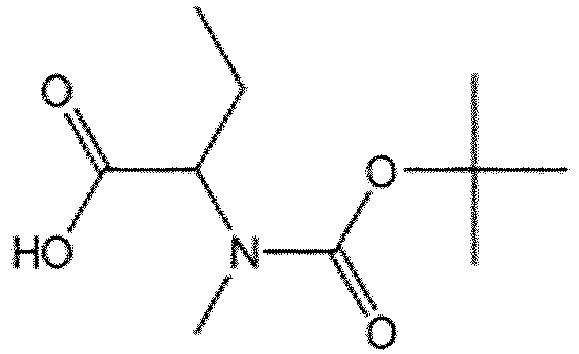
- Compound 4 (3.00 g, 14.8 mmol), CH3I (9.2 ml, 147.6 mmol), and NaH (3.54 g, 147.6 mmol) were reacted using Reaction Scheme b to synthesize Compound 7, (R)/(S)-2-((tert-butoxycarbonyl)(methyl)amino)butanoic acid (2.84 g, 88%) in the form of a yellow oil.
- Rε = 0.45 (DCM 9 :
Methanol 1 and few drops of acetic acid); - 1H NMR (DMSO-d6, 300 MHz) 12.7 (C(O)OH), 4.14-4.43 (m, Chiral-H), 2.71 (s, NCH3), 1.50-1.73 (m, CH2CH3, Boc), 0.79-0.87 (m, CH2CH3).
- Compound 5 (1.50 g, 6.90 mmol), CH3I (4.3 ml, 69.0 mmol), and NaH (1.66 g, 69.0 mmol) were reacted using Reaction Scheme b to synthesize
Compound 8, (R)/(S)-2-((tert-butoxycarbonyl)(methyl)amino)pentanoic acid (1.34 g, 83%) in the form of a yellow oil. - Rε = 0.45 (DCM 9 :
Methanol 1 and few drops of acetic acid); - 1H NMR (DMSO-d6, 300 MHz) 12.7 (C(O)OH), 4.54-4.28 (m, Chiral-H), 2.70 (s, NCH3), 1.79-1.64 (m, CH2CH2CH3), 1.41-1.37 (m, CH2CH2CH3, Boc), 1.37-1.29 (m, CH2CH2CH3).
- Compound 6 (3.00 g, 13.0 mmol), CH3I (8.1 ml, 129.7 mmol), and NaH (5.19 g, 129.7 mmol) were reacted using Reaction Scheme b to synthesize Compound 9, (R)/(S)-2-((tert-butoxycarbonyl)(methyl)amino)hexanoic acid (3.18 g, 100%) in the form of a yellow oil.
- Rf = 0.38 (DCM 9: Methanol 1);
- 1H NMR (CDCl3, 400 MHz) 12.6 (C(O)OH), 4.25-4.52 (m, Chiral-H), 2.70 (s, NCH3), 1.66-1.79 (m, CH2CH2CH2CH3), 1.18-1.40 (m, CH2CH2CH2CH3, Boc), 0.86-0.89 (m, CH2CH2CH2CH3).
- 4-bromophenethylamine (3.9 ml, 25.1 mmol), K2CO3 (5.21 g, 37.7 mmol), and Boc anhydride (7.2 ml, 26.4 mmol) were reacted using Reaction Scheme c to synthesize
Compound 12, tert-butyl(4-bromophenethyl)carbamate (6.23 g, 83%) in the form of a white powder. - Rε = 0.36 (EtOAc 1 : n-hexane 5);
- 1H NMR (DMSO-d6 , 400 MHz) 7.46 (d, J = 8.6 Hz, ArH), 7.15 (d, J = 8.2 Hz, ArH), 6.87 (s, NH), 3.09-3.14 (m, NHCH2CH2), 2.64-2.67 (m, NHCH2CH2), 1.35 (s, Boc).
- After a compound was obtained by reacting Compound 10 (tert-butyl 4-bromophenylcarbamate, 4.00 g, 14.7 mmol), 3,4-dichlorophenylboronic acid (3.37 g, 17.6 mmol), tetrakis(triphenylphosphine)palladium (0.68 g, 0.59 mmol), and Na2CO3 (7.80 g, 73.5 mmol) using Reaction Scheme d, a Boc group was removed using 4.0 M HCl (7.9 mL, 31.5 mmol in dioxane) to synthesize Compound 13, 3',4'-dichloro-[1,1'-biphenyl]-4-amine hydrochloride (1.27 g, 34%) in the form of a white powder.
- Rf = 0.00 (EtOAc 9 : acetone 1);
- 1H NMR (DMSO-d6, 400 MHz) 9.94 (s, NH3), 7.95 (d, J = 2.0 Hz, ArH), 7.40-7.80 (m, ArH), 7.39 (d, J = 8.5 Hz, ArH).
- After a compound was obtained by reacting Compound 10 (3.99 g, 14.7 mmol), 4-(trifluoromethoxy)phenylboronic acid (7.77 g, 22.0 mmol), tetrakis(triphenylphosphine)palladium (0.68 g, 0.59 mmol), and Na2CO3 (7.77 g, 73.3 mmol) using Reaction Scheme d, a Boc group was removed using 4.0 M HCl (12.8 mL, 51.1 mmol in dioxane) to synthesize Compound 14, 4'-(trifluoromethoxy)-[1,1'-biphenyl]-4-amine hydrochloride (1.99 g, 48%) in the form of a white powder.
- Rf = 0.00 (EtOAc 9 : acetone 1);
- 1H NMR (DMSO-d6, 400 MHz) 9.45 (bRs, NH3), 7.77 (d, J = 8.7 Hz, ArH), 7.71 (d, J = 8.4 Hz, ArH), 7.45 (d, J = 8.4 Hz, ArH), 7.28 (d, J = 8.2 Hz, ArH).
- After a compound was obtained by reacting Compound 11 (tert-butyl 4-bromobenzylcarbamate, 6.00 g, 21.0 mmol), 3,4-dichlorophenylboronic acid (4.80 g, 25.2 mmol), tetrakis(triphenylphosphine)palladium (0.97 g, 0.84 mmol), and Na2CO3 (111.1 g, 104.8 mmol) using Reaction Scheme d, a Boc group was removed using 4.0 M HCl (3.1 ml, 12.3 mmol in dioxane) to synthesize Compound 15, 2-(3',4'-dichloro-[1,1'-biphenyl]-4-yl)methan-1-amine hydrochloride (1.08 g, 17%) in the form of a white powder.
- Rf = 0.00 (EtOAc 9 : acetone 1);
- 1H NMR (DMSO-d6, 400 MHz) 8.71 (s, NH3), 7.97 (s, ArH), 7.63-7.83 (m, ArH), 4.07 (s, NH3CH2).
- After a compound was obtained by reacting Compound 11 (6.00 g, 21.0 mmol), 4-(trifluoromethyl)phenylboronic acid (5.97 g, 31.5 mmol), tetrakis(triphenylphosphine)palladium (0.97 g, 0.84 mmol), and Na2CO3 (11.1 g, 104.8 mmol) using Reaction Scheme d, a Boc group was removed using 4.0 M HCl (17.9 ml, 71.7 mmol in dioxane) to synthesize
Compound 16, (4'-(trifluoromethyl)-[1,1'-biphenyl]-4-yl)methanamine hydrochloride (1.08 g, 66%) in the form of a white powder. Rf = 0.00 (EtOAc 9 : acetone 1);
1H NMR (DMSO-d6, 400 MHz) 8.49 (s, NH3), 7.93 (d, J = 8.2 Hz, ArH), 7.83 (t, J = 9.0 Hz, ArH), 7.64 (d, J = 8.2 Hz, ArH), 4.09 (s, NH3CH2). - After a compound was obtained by reacting Compound 11 (4.00 g, 14.0 mmol), 4-(trifluoromethoxy)phenylboronic acid (4.32 g, 21.0 mmol), tetrakis(triphenylphosphine)palladium (0.65 g, 0.56 mmol), and Na2CO3 (7.41 g, 69.9 mmol) using Reaction Scheme d, a Boc group was removed using 4.0 M HCl (13.9 ml, 55.6 mmol in dioxane) to synthesize Compound 17, (4'-(trifluoromethoxy)-[1,1'-biphenyl]-4-yl)methanamine hydrochloride (2.73 g, 65%) in the form of a white powder.
- Rf = 0.00 (EtOAc 9 : acetone 1);
- 1H NMR (DMSO-d6, 400 MHz) 8.33 (s, NH3), 7.81-7.83 (m, ArH), 7.75 (d, J = 8.2 Hz, ArH), 7.59 (d, J = 8.2 Hz, ArH), 7.48 (d, J = 8.3 Hz, ArH), 4.08 (s, NH3CH2).
- After a compound was obtained by reacting Compound 12 (tert-butyl (4-bromophenethyl)carbamate, 1.00 g, 3.33 mmol), 3,4-dichlorophenylboronic acid (0.76 g, 4.00 mmol), tetrakis(triphenylphosphine)palladium (0.15 g, 0.15 mmol), and Na2CO3 (1.77 g, 16.7 mmol) using Reaction Scheme d, a Boc group was removed using 4.0 M HCl (2.50 ml, 10.0 mmol in dioxane) to synthesize Compound 18, 2-(3',4'-dichloro-[1,1'-biphenyl]-4-yl)ethan-1-amine hydrochloride (2.73 g, 65%) in the form of a white powder.
- Rf = 0.00 (EtOAc 9 : acetone 1);
- 1H NMR (DMSO-d6 , 400 MHz) 8.33 (s, NH3), 7.93 (d, J = 1.9 Hz, ArH), 7.66-7.72 (m, ArH), 7.39 (d, J = 8.2 Hz, ArH), 2.98-3.07 (m, NH3CH2CH2).
- After a compound was obtained by reacting Compound 12 (0.50 g, 1.67 mmol), 4-(trifluoromethyl)phenylboronic acid (0.38 g, 2.00 mmol), tetrakis(triphenylphosphine)palladium (0.08 g, 0.07 mmol), and Na2CO3 (0.88 g, 8.33 mmol) using Reaction Scheme d, a Boc group was removed using 4.0 M HCl (1.25 ml, 5.00 mmol in dioxane) to synthesize Compound 19, 2-(4'-(trifluoromethyl)-[1,1'-biphenyl]-4-yl)ethan-1-amine hydrochloride (0.28 g, 56%) in the form of a white powder.
- Rf = 0.00 (EtOAc 9 : acetone 1);
- 1H NMR (DMSO-d6 , 400 MHz) 8.37 (s, NH3), 7.71-7.91 (m, ArH), 7.44 (d, J = 8.1 Hz, ArH), 3.01-3.11 (m, NH3CH2CH2).
- After a compound was obtained by reacting Compound 12 (1.50 g, 5.00 mmol), 4-(trifluoromethoxy)phenylboronic acid (1.23 g, 6.00 mmol), tetrakis(triphenylphosphine)palladium (0.23 g, 0.20 mmol), and Na2CO3 (2.65 g, 25.0 mmol) using Reaction Scheme d, a Boc group was removed using 4.0 M HCl (3.75 ml, 15.0 mmol in dioxane) to synthesize Compound 20, 2-(4'-(trifluoromethoxy)-[1,1'-biphenyl]-4-yl)ethan-1-amine hydrochloride (0.88 g, 55%) in the form of a white powder.
- Rf = 0.00 (EtOAc 9 : acetone 1);
- 1H NMR (DMSO-d6, 400 MHz) 8.31 (s, NH3), 7.79 (d, J = 8.7 Hz, ArH), 7.66 (d, J = 8.1 Hz, ArH), 7.45 (d, J = 8.2 Hz, ArH), 7.40 (d, J = 8.1 Hz, ArH), 2.97-3.10 (m, NH3CH2CH2).
- After a compound was obtained by reacting Compound 12 (1.00 g, 3.33 mmol), 3,4-dichlorophenylboronic acid (0.76 g, 4.00 mmol), tetrakis(triphenylphosphine)palladium (0.15 g, 0.15 mmol), and Na2CO3 (1.77 g, 16.7 mmol) using Reaction Scheme d, a Boc group was removed using 4.0 M HCl (2.50 ml, 10.0 mmol in dioxane) to synthesize Compound 21, 2-(3',4'-difluoro-[1,1'-biphenyl]-4-yl)ethan-1-amine hydrochloride (2.73 g, 65%) in the form of a white powder.
- Rf = 0.00 (EtOAc 9 : acetone 1);
- 1H NMR (DMSO-d6 , 400 MHz) 7.95 (s, NH3), 7.74-7.79 (m, ArH), 7.67 (d, J = 8.1 Hz, ArH), 7.48-7.54 (m, ArH), 7.37 (d, J = 8.1 Hz, ArH), 2.90-3.09 (m, NH3CH2CH2).
- Compound 4 (0.63 g, 3.12 mmol), NMM (0.96 ml, 8.74 mmol), IBCF (0.53 ml, 4.06 mmol), and Compound 13 (0.90 g, 3.28 mmol) were reacted using Reaction Scheme e to synthesize Compound 22, (R)/(S)-tert-butyl(1-((3',4'-dichloro-[1,1'-biphenyl]-4-yl)amino)-1-oxobutan-2-yl)carbamate (1.09 g, 82%) in the form of a pale yellow powder.
- Rf = 0.33 (EtOAc 1 : n-hexane 3);
- 1H NMR (CDCl3, 400 MHz) 8.55 (s, C(O)NH), 7.58 (d, J = 7.3 Hz, ArH), 7.44-7.47 (m, ArH), 7.34 (dd, J = 1.8 Hz, 8.3 Hz, ArH), 5.12 (s, Boc-NH), 4.18 (s, Chiral-H), 1.67-2.05 (m, CH2CH3), 1.47 (s, Boc), 1.03 (t, J = 7.4 Hz, CH2CH3).
- Compound 5 (0.30 g, 1.52 mmol), NMM (0.42 ml, 3.80 mmol), IBCF (0.26 ml, 1.98 mmol), and Compound 13 (0.44 g, 1.60 mmol) were reacted using Reaction Scheme e to synthesize Compound 23, (R)/(S)-tert-butyl(1-((3',4'-dichloro-[1,1'-biphenyl]-4-yl)amino)-1-oxopentan-2-yl)carbamate (0.61 g, 92%) in the form of a white powder.
- Rε = 0.37 (EtOAc 1 : n-hexane 3);
- 1H NMR (CDCl3, 400 MHz) 8.53 (s, C(O)NH), 7.62 (d, J = 8.6 Hz, ArH), 7.48-7.50 (m, ArH), 7.38 (dd, J = 2.0 Hz, 8.3 Hz, ArH), 5.08 (s, Boc-NH), 4.24 (s, Chiral-H), 1.63-1.99 (m, CH2CH2CH3), 1.47-1.50 (m, Boc, CH2CH2CH3), 0.99 (t, J = 7.3 Hz, CH2CH2CH3).
- Compound 6 (0.80 g, 3.46 mmol), NMM (0.95 ml, 8.69 mmol), IBCF (0.58 ml, 4.50 mmol), and Compound 13 (1.00 g, 3.64 mmol) were reacted using Reaction Scheme e to synthesize
Compound 24, (R)/(S)-tert-butyl(1-((3',4'-dichloro-[1,1'-biphenyl]-4-yl)amino)-1-oxohexan-2-yl)carbamate (1.11 g, 71%) in the form of a white powder. - Rε = 0.50 (EtOAc 1 : n-hexane 3);
- 1H NMR (DMSO-d6 , 400 MHz) 10.10 (s, NH), 7.91 (d, J = 1.9 Hz, ArH), 7.64-7.74 (m, ArH), 7.04 (d, J = 7.8 Hz, NH), 4.02-4.07 (m, NHCHCH2), 1.57-1.64 (m, CH2CH2CH2CH3), 1.39 (s, Boc), 1.26-1.32 (m, CH2CH2CH2CH3), 0.86 (t, J = 6.8 Hz, CH2CH2CH2CH3).
- Compound 5 (0.43 g, 1.97 mmol), NMM (0.61 ml, 5.52 mmol), IBCF (0.33 ml, 2.56 mmol), and Compound 14 (0.60 g, 2.07 mmol) were reacted using Reaction Scheme e to synthesize Compound 25, (R)/(S)-tert-butyl(1-oxo-1-((4'-(trifluoromethoxy)-[1,1'-biphenyl]-4-yl)amino)pentan-2-yl)carbamate (0.66 g, 73%) in the form of a white powder.
- Rε = 0.30 (EtOAc 1 : n-hexane 3);
- 1H NMR (CDCl3, 400 MHz) 8.62 (s, C(O)NH), 7.61 (d, J = 7.3 Hz, ArH), 7.54 (d, J = 7.6 Hz, ArH), 7.49 (d, J = 7.9 Hz, ArH), 7.26-7.29 (m, ArH), 5.19 (d, J = 7.4 Hz, Boc-NH), 4.29 (s, Chiral-H), 1.65-1.98 (m, CH2CH2CH3), 1.43-1.56 (m, Boc, CH2CH2CH3), 0.99 (t, J = 7.1 Hz, CH2CH2CH3).
- Compound 7 (0.68 g, 3.12 mmol), NMM (0.96 ml, 8.74 mmol), IBCF (0.53 ml, 4.06 mmol), and Compound 13 (0.90 g, 3.28 mmol) were reacted using Reaction Scheme e to synthesize Compound 26, (R)/(S)-tert-butyl(1-((3',4'-dichloro-[1,1'-biphenyl]-4-yl)amino)-1-oxobutan-2-yl)(methyl)carbamate (0.74 g, 54%) in the form of an oil.
- Rε = 0.50 (EtOAc 1 : n-hexane 3);
- 1H NMR (CDCl3, 400 MHz) 8.50 (s, C(O)NH), 7.58-7.63 (m, ArH), 7.46-7.50 (m, ArH), 7.38 (dd, J = 1.8 Hz, 8.2 Hz, ArH), 4.57 (s, Chiral-H), 2.83 (s, NCH3), 1.71-2.04 (m, CH2CH3), 1.51 (d, J = 6.8 Hz, Boc), 0.97 (t, J = 7.3 Hz, CH2CH3).
- Compound 8 (0.86 g, 3.72 mmol), NMM (1.14 ml, 10.4 mmol), IBCF (0.63 ml, 4.83 mmol), and Compound 13 (1.07 g, 3.90 mmol) were reacted using Reaction Scheme e to synthesize Compound 27, (R)/(S)-tert-butyl(1-((3',4'-dichloro-[1,1'-biphenyl]-4-yl)amino)-1-oxopentan-2-yl)(methyl)carbamate (0.79 g, 47%) in the form of a yellow powder.
- Rε = 0.48 (EtOAc 1 : n-hexane 3);
- 1H NMR (CDCl3, 400 MHz) 8.49 (s, C(O)NH), 7.58-7.64 (m, ArH), 7.47-7.51 (m, ArH), 7.38 (d, J = 8.3 Hz, ArH), 4.66 (s, Chiral-H), 2.82 (s, NCH3), 1.67-2.04 (m, CH2CH2CH3), 1.51 (s, Boc), 1.33-1.39 (m, CH2CH2CH3), 0.99 (t, J = 7.3 Hz, CH2CH2CH3).
- Compound 9 (R)/(S)-2-((tert-butoxycarbonyl)(methyl)amino)hexanoic acid (0.84 g, 3.47 mmol), NMM (1.10 ml, 9.71 mmol), IBCF (0.58 ml, 4.51 mmol), and Compound 13 (1.00 g, 3.64 mmol) were reacted using Reaction Scheme e to synthesize Compound 28, (R)/(S)-tert-butyl(1-((3',4'-dichloro-[1,1'-biphenyl]-4-yl)amino)-1-oxohexan-2-yl)(methyl)carbamate (0.86 g, 53%) in the form of an oil.
- Rε = 0.55 (EtOAc 1 : n-hexane 3);
- 1H NMR (CDCl3, 400 MHz) 8.49 (s, C(O)NH), 7.58-7.64 (m, ArH), 7.47-7.51 (m, ArH), 7.38 (dd, J = 2.1 Hz, 8.4 Hz, ArH), 4.64 (s, Chiral-H), 2.82 (s, NCH3), 1.67-2.01 (m, CH2CH2CH2CH3), 1.52 (s, Boc), 1.24-1.44 (m, CH2CH2CH2CH3), 0.93 (t, J = 7.1 Hz, CH2CH2CH3).
- Compound 22 (1.06 g, 2.50 mmol) and 4.0 M HCl (3.80 ml, 15.0 mmol in dioxane) were reacted using Reaction Scheme f to synthesize Compound 29, (R)/(S)-2-amino-N-(3',4'-dichloro-[1,1'-biphenyl]-4-yl)butanamide hydrochloride (0.87 g, 97%) in the form of a white powder.
- Rf = 0.00 (EtOAc 9: acetone 1);
- 1H NMR (CDCl3, 400 MHz) 11.05 (s, C(O)NH), 8.38 (s, NH3), 7.93 (d, J = 1.9 Hz, ArH), 7.66-7.79 (m, ArH), 4.01-4.04 (m, Chiral-H), 1.86-1.91 (m, CH2CH3), 0.96 (t, J = 7.5 Hz, CH2CH3).
- Compound 23 (0.58 g, 1.33 mmol) and 4.0 M HCl (2.00 ml, 7.95 mmol in dioxane) were reacted using Reaction Scheme f to synthesize Compound 30, (R)/(S)-2-amino-N-(3',4'-dichloro-[1,1'-biphenyl]-4-yl)pentanamide hydrochloride (0.40 g, 81%) in the form of a white powder.
- Rf = 0.00 (EtOAc 9: acetone 1);
- 1H NMR (DMSO-d6 , 400 MHz) 11.05 (s, C(O)NH), 8.40 (s, NH 3), 7.93 (d, J = 1.5 Hz, ArH), 7.66-7.79 (m, ArH), 4.06 (s, Chiral-H), 1.79-1.85 (m, CH2CH2CH3), 1.36-1.43 (m, CH2CH2CH3), 0.91 (t, J = 7.3 Hz, CH2CH2CH3).
- Compound 24 (1.10 g, 2.44 mmol) and 4.0 M HCl (3.66 ml, 14.6 mmol in dioxane) were reacted using Reaction Scheme f to synthesize Compound 31, (R)/(S)-2-amino-N-(3',4'-dichloro-[1,1'-biphenyl]-4-yl)hexanamide hydrochloride (0.81 g, 86%) in the form of a white powder.
- Rf = 0.00 (EtOAc 9: acetone 1);
- 1H NMR (DMSO-d6 , 400 MHz) 10.97 (s, C(O)NH), 8.38 (s, NH3), 7.93 (d, J = 2.0 Hz, ArH), 7.66-7.78 (m, ArH), 4.03 (s, Chiral-H), 1.81-1.87 (m, CH2CH2CH2CH3), 1.33-1.39 (m, CH2CH2CH2CH3), 0.87 (t, J = 6.9 Hz, CH2CH2CH2CH3).
- Compound 25 (0.64 g, 1.41 mmol) and 4.0 M HCl (2.12 ml, 8.46 mmol in dioxane) were reacted using Reaction Scheme f to synthesize
Compound 32, (R)/(S)-2-amino-N-(4'-(trifluoromethoxy)-[1,1'-biphenyl]-4-yl)pentanamide hydrochloride (0.51 g, 93%) in the form of a white powder. - Rf = 0.00 (EtOAc 9: acetone 1);
- 1H NMR (DMSO-d6 , 400 MHz) 10.90 (s, C(O)NH), 8.35 (s, NH3), 7.76-7.79 (m, ArH), 7.70 (d, J = 8.8 Hz, ArH), 7.45 (d, J = 8.2 Hz, ArH), 4.03 (s, Chiral-H), 1.82 (q, J = 6.9 Hz, 7.9 Hz, CH2CH2CH3), 1.34-1.47 (m, CH2CH2CH3), 0.92 (t, J = 7.3 Hz, CH2CH2CH3).
- Compound 26 (0.69 g, 1.58 mmol) and 4.0 M HCl (2.40 ml, 9.50 mmol in dioxane) were reacted using Reaction Scheme f to synthesize Compound 33, (R)/(S)-N-(3',4'-dichloro-[1,1'-biphenyl]-4-yl)-2-(methylamino)butanamide hydrochloride (0.55 g, 93%) in the form of a white powder.
- Rf = 0.00 (EtOAc 9: acetone 1);
- 1H NMR (DMSO-d6 , 400 MHz) 11.00 (s, C(O)NH), 9.13 (s, NH2), 7.94 (d, J = 1.7 Hz, ArH), 7.66-7.78 (m, ArH), 3.96 (t, J = 5.5 Hz, Chiral-H), 2.57 (s, NCH3), 1.87-2.05 (m, CH2CH3), 0.94 (t, J = 7.5 Hz, CH2CH3).
- Compound 27 (0.38 g, 0.83 mmol) and 4.0 M HCl (1.25 ml, 4.98 mmol in dioxane) were reacted using Reaction Scheme f to synthesize Compound 34, (R)/(S)-N-(3',4'-dichloro-[1,1'-biphenyl]-4-yl)-2-(methylamino)pentanamide hydrochloride (0.23 g, 71%) in the form of a white powder.
- Rf = 0.00 (EtOAc 9: acetone 1);
- 1H NMR (DMSO-d6 , 400 MHz) 10.98 (s, C(O)NH), 9.09 (s, NH2), 7.94 (s, ArH), 7.66-7.76 (m, ArH), 3.96 (t, J = 6.1 Hz, Chiral-H), 2.57 (s, NCH3), 1.80-1.93 (m, CH2CH2CH3), 1.31-1.39 (m, CH2CH2CH3), 0.91 (t, J = 7.3 Hz, CH2CH2CH3).
- Compound 28 (0.82 g, 1.77 mmol) and 4.0 M HCl (2.65 ml, 10.6 mmol in dioxane) were reacted using Reaction Scheme f to synthesize Compound 35, (R)/(S)-N-(3',4'-dichloro-[1,1'-biphenyl]-4-yl)-2-(methylamino)hexanamide hydrochloride (0.60 g, 84%) in the form of a white powder.
- Rf = 0.00 (EtOAc 9: acetone 1);
- 1H NMR (DMSO-d6 , 400 MHz) 10.81 (s, C(O)NH), 9.05 (s, NH2), 7.94 (d, J = 2.0 Hz, ArH), 7.66-7.77 (m, ArH), 3.92 (s, Chiral-H), 2.57 (s, NCH 3), 1.87-1.99 (m, CH2CH2CH2CH3), 1.29-1.33 (m, CH2CH2CH2CH3), 0.86 (t, J = 6.8 Hz, CH2CH2CH2CH3).
- Compound 30 (1.0 eq), triethylamine (6.0 eq), formaldehyde (2.0 eq), and a palladium catalyst (0.4 eq) were reacted using Reaction Scheme g to synthesize Compound 36, (R)/(S)-N-(3',4'-dichloro-[1,1'-biphenyl]-4-yl)-2-(dimethylamino)pentanamide.
- 1H NMR (DMSO-d6 , 400 MHz) 10.98 (s, C(O)NH), 7.94 (s, ArH), 7.66-7.76 (m, ArH), 3.96 (t, J = 6.1 Hz, Chiral-H), 2.57 (s, N(CH3)2), 1.80-1.93 (m, CH2CH2CH3), 1.31-1.39 (m, CH2CH2CH3), 0.91 (t, J = 7.3 Hz, CH2CH2CH3).

- Compound 5 (0.57 g, 2.64 mmol), NMM (0.73 ml, 6.60 mmol), IBCF (0.45 ml, 3.43 mmol), and Compound 15 (0.80 g, 2.77 mmol) were reacted using Reaction Scheme e to synthesize Compound 37, (R)/(S)-tert-butyl (1-((3',4'-dichloro-[1,1'-biphenyl]-4-yl)methyl)amino)-1-oxopentan-2-yl)carbamate (1.20 g, 100%) in the form of a white powder.
- Rε = 0.04 (EtOAc 1 : n-hexane 3);
- 1H NMR (CDCl3, 400 MHz) 7.64 (d, J = 2.0 Hz, ArH), 7.49 (dd, J = 2.6 Hz, 8.5 Hz, ArH), 7.33-7.40 (m, ArH), 6.48 (s, C(O)NH), 4.93 (s, Boc-NH), 4.49 (d, J = 4.2 Hz, NHCH2), 4.07-4.09 (m, Chiral-H), 1.36-1.43 (m, CH2CH2CH3, Boc), 0.95 (t, J = 7.3 Hz, CH2CH2CH3).
- Compound 6 (0.38 g, 1.65 mmol), NMM (0.45 ml, 4.13 mmol), IBCF (0.28 ml, 2.15 mmol), and Compound 15 (0.50 g, 1.74 mmol) were reacted using Reaction Scheme e to synthesize Compound 38, (R)/(S)-tert-butyl (1-(((3',4'-dichloro-[1,1'-biphenyl]-4-yl)methyl)amino)-1-oxohexan-2-yl)carbamate (0.46 g, 60%) in the form of a white powder.
- Rε = 0.19 (EtOAc 1 : n-hexane 3);
- 1H NMR (CDCl3, 400 MHz) 7.63 (d, J = 2.0 Hz, ArH), 7.49 (dd, J = 4.3 Hz, 8.2 Hz, ArH), 7.33-7.39 (m, ArH), 6.55 (s, C(O)NH), 4.98 (d, J = 3.8 Hz, Boc-NH), 4.49 (d, J = 5.5 Hz, NHCH 2), 4.07-4.11 (m, Chiral-H), 1.58-1.90 (m, CH2CH2CH2CH3), 1.42 (s, Boc), 1.34 (d, J = 2.2 Hz, CH2CH2CH2CH3), 0.88-0.94 (m, CH2CH2CH2CH3).
- Compound 5 (0.36 g, 1.66 mmol), NMM (0.46 ml, 4.14 mmol), IBCF (0.28 ml, 2.15 mmol), and Compound 16 (0.50 g, 1.74 mmol) were reacted using Reaction Scheme e to synthesize Compound 39, (R)/(S)-tert-butyl (1-oxo-1-(((4'-(trifluoromethyl)-[1,1'-biphenyl]-4-yl)methyl)amino)pentan-2-yl)carbamate (0.72 g, 96%) in the form of a white powder.
- Rε = 0.17 (EtOAc 1 : n-hexane 3);
- 1H NMR (CDCl3, 300 MHz) 7.62-7.70 (m, ArH), 7.44 (dd, J = 8.1 Hz, 44.7 Hz, ArH), 6.85 (s, C(O)NH), 5.16-5.18 (m, Boc-NH), 4.47-4.49 (m, ArCH2), 4.11-4.15 (m, Chiral-H), 1.54-1.89 (m, CH2CH2CH3), 1.41 (s, Boc, CH2CH2CH3), 0.93 (t, J = 7.2 Hz, CH2CH2CH3).
- Compound 6 (0.54 g, 2.32 mmol), NMM (0.71 ml, 6.49 mmol), IBCF (0.39 ml, 3.01 mmol), and Compound 16 (0.70 g, 2.43 mmol) were reacted using Reaction Scheme e to synthesize Compound 40, (R)/(S)-tert-butyl (1-oxo-1-(((4'-(trifluoromethyl)-[1,1'-biphenyl]-4-yl)methyl)amino)hexan-2-yl)carbamate (0.87 g, 81%) in the form of a white powder.
- Rε = 0.16 (EtOAc 1 : n-hexane 3);
- 1H NMR (CDCl3, 400 MHz) 7.70 (q, J = 4.6 Hz, 8.6 Hz, ArH), 7.57 (d, J = 8.2 Hz, ArH), 7.39 (d, J = 8.2 Hz, ArH), 6.50 (s, C(O)NH), 4.96 (s, Boc-NH), 4.53 (d, J = 4.7 Hz, NHCH2), 4.09-4.10 (m, Chiral-H), 1.59-1.94 (m, CH2CH2CH2CH3), 1.45 (s, Boc), 1.37-1.38 (m, CH2CH2CH2CH3), 0.93 (t, J = 7.0 Hz, CH2CH2CH2CH3).
- Compound 5 (0.55 g, 2.51 mmol), NMM (0.77 ml, 7.02 mmol), IBCF (0.42 ml, 3.26 mmol), and Compound 17 (0.80 g, 2.63 mmol) were reacted using Reaction Scheme e to synthesize Compound 41, (R)/(S)-tert-butyl (1-oxo-1-(((4'-(trifluoromethoxy)-[1,1'-biphenyl]-4-yl)methyl)amino)pentan-2-yl)carbamate (1.05 g, 90%) in the form of a white powder.
- Rε = 0.09 (EtOAc 1 : n-hexane 3);
- 1H NMR (CDCl3, 400 MHz) 7.57-7.61 (m, ArH), 7.53 (d, J = 8.2 Hz, ArH), 7.37 (d, J = 8.2 Hz, ArH), 7.30 (d, J = 8.2 Hz, ArH), 6.47 (s, C(O)NH), 4.96 (s, Boc-NH), 4.52 (s, NHCH2), 4.10-4.11 (m, Chiral-H), 1.59-1.94 (m, CH2CH2CH3), 1.37-1.45 (m, CH2CH2CH3, Boc), 0.97 (t, J = 7.3 Hz, CH2CH2CH3).
- Compound 6 (0.58 g, 2.51 mmol), NMM (0.77 ml, 7.02 mmol), IBCF (0.42 ml, 3.26 mmol), and Compound 17 (0.80 g, 2.63 mmol) were reacted using Reaction Scheme e to synthesize Compound 42, (R)/(S)-tert-butyl (1-oxo-1-(((4'-(trifluoromethoxy)-[1,1'-biphenyl]-4-yl)methyl)amino)hexan-2-yl)carbamate (1.06 g, 88%) in the form of a white powder.
- Rε = 0.18 (EtOAc 1 : n-hexane 3);
- 1H NMR (CDCl3, 400 MHz) 7.58-7.61 (m, ArH), 7.53 (d, J = 8.1 Hz, ArH), 7.37 (d, J = 8.1 Hz, ArH), 7.30 (d, J = 8.5 Hz, ArH), 6.52 (s, C(O)NH), 4.99 (s, Boc-NH), 4.53 (d, J = 5.1 Hz, NHCH2), 4.09-4.11 (m, Chiral-H), 1.62-1.94 (m, CH2CH2CH2CH3), 1.45 (s, Boc), 1.36-1.37 (m, CH2CH2CH2CH3), 0.92 (t, J = 6.9 Hz, CH2CH2CH2CH3).
- Compound 8 (0.38 g, 1.65 mmol), NMM (0.46 ml, 4.13 mmol), IBCF (0.28 ml, 2.15 mmol), and Compound 15 (0.50 g, 1.73 mmol) were reacted using Reaction Scheme e to synthesize Compound 43, (R)/(S)-tert-butyl (1-(((3',4'-dichloro-[1,1'-biphenyl]-4-yl)methyl)amino)-1-oxopentan-2-yl)(methyl)carbamate (0.57 g, 73%) in the form of an oil.
- Rε = 0.18 (EtOAc 1 : n-hexane 3);
- 1H NMR (CDCl3, 300 MHz) 7.30-7.68 (m, ArH), 6.27-6.64 (m, C(O)NH), 4.41-4.59 (m, NHCH2, Chiral-H), 2.78 (s, NCH3), 2.04-1.63 (m, CH2CH2CH3), 1.44 (s, Boc), 1.32-1.26 (m, CH2CH2CH3), 0.96 (t, J = 7.3 Hz, CH2CH2CH3).
- Compound 8 (0.38 g, 1.66 mmol), NMM (0.46 ml, 4.14 mmol), IBCF (0.28 ml, 2.15 mmol), and Compound 16 (0.50 g, 1.74 mmol) were reacted using Reaction Scheme e to synthesize Compound 44, (R)/(S)-tert-butyl methyl (1-oxo-1-(((4'-(trifluoromethyl)-[1,1'-biphenyl]-4-yl)methyl)amino)pentan-2-yl)carbamate (0.49 g, 64%) in the form of an oil.
- Rε = 0.22 (EtOAc 1 : n-hexane 3);
- 1H NMR (CDCl3, 300 MHz) 7.64-7.71 (m, ArH), 7.44 (dd, J = 7.9 Hz, 53.4 Hz, ArH), 6.28-6.64 (m, C(O)NH), 4.43-4.61 (m, NHCH2, Chiral-H), 2.78 (s, NCH3), 1.63-2.04 (m, CH2CH2CH3), 1.44 (s, Boc), 1.26-1.35 (m, CH2CH2CH3), 0.96 (t, J = 7.3 Hz, CH2CH2CH3).
- Compound 37 (1.19 g, 2.64 mmol) and 4.0 M HCl (3.95 ml, 15.8 mmol in dioxane) were reacted using Reaction Scheme f to synthesize Compound 45, (R)/(S)-2-amino-N-((3',4'-dichloro-[1,1'-biphenyl]-4-yl)methyl)pentanamide hydrochloride (0.73 g, 71%) in the form of a white powder.
- Rf = 0.00 (EtOAc 9: acetone 1);
- 1H NMR (DMSO-d6, 300 MHz) 9.04 (s, C(O)NH), 8.21 (s, NH 3), 7.94 (s, ArH), 7.66-7.73 (m, ArH), 7.40 (d, J = 8.1 Hz, ArH), 4.39-4.41 (m, NHCH2), 3.78-3.82 (t, J = 6.3 Hz, Chiral-H), 1.68-1.76 (m, CH2CH2CH3), 1.29-1.39 (m, CH2CH2CH3), 0.89 (t, J = 7.2 Hz, CH2CH2CH3).
- Compound 38 (0.46 g, 0.99 mmol) and 4.0 M HCl (1.48 ml, 1.48 mmol in dioxane) were reacted using Reaction Scheme f to synthesize Compound 46, (R)/(S)-2-amino-N-((3',4'-dichloro-[1,1'-biphenyl]-4-yl)methyl)hexanamide hydrochloride (0.27 g, 85%) in the form of a white powder.
- Rf = 0.00 (EtOAc 9: acetone 1);
- 1H NMR (DMSO-d6 , 400 MHz) 9.17 (m, C(O)NH), 8.32 (s, NH3), 7.94 (d, J = 2.0 Hz, ArH), 7.66-7.73 (m, ArH), 7.41 (d, J = 8.2 Hz, ArH), 4.34-4.45 (m, NHCH2), 3.81 (t, J = 6.1 Hz, Chiral-H), 1.75-1.76 (m, CH2CH2CH2CH3), 1.27-1.28 (m, CH2CH2CH2CH3), 0.85 (t, J = 6.6 Hz, CH2CH2CH2CH3).
- Compound 39 (0.70 g, 1.55 mmol) and 4.0 M HCl (2.33 ml, 9.32 mmol in dioxane) were reacted using Reaction Scheme f to synthesize Compound 47, (R)/(S)-2-amino-N-(4'-(trifluoromethyl)-[1,1'-biphenyl]-4-yl)methyl)pentanamide hydrochloride (0.60 g, 99%) in the form of a white powder.
- Rf = 0.00 (EtOAc 9: acetone 1);
- 1H NMR (DMSO-d6, 300 MHz) 9.37 (t, J = 5.7 Hz, C(O)NH), 8.46 (s, NH 3), 7.71-7.92 (m, ArH), 7.45-7.51 (m, ArH), 4.40-4.43 (m, NHCH2), 3.89 (s, Chiral-H), 1.74-1.82 (m, CH2CH2CH3), 1.16-1.42 (m, CH2CH2CH3), 0.89 (t, J = 7.2 Hz, CH2CH2CH3).
- Compound 40 (0.85 g, 1.83 mmol) and 4.0 M HCl (2.75 ml, 11.0 mmol in dioxane) were reacted using Reaction Scheme f to synthesize
Compound 48, (R)/(S)-2-amino-N-(4'-(trifluoromethyl)-[1,1'-biphenyl]-4-yl)methyl)hexanamide hydrochloride (0.72 g, 98%) in the form of a white powder. - Rf = 0.00 (EtOAc 9: acetone 1);
- 1H NMR (DMSO-d6 , 400 MHz) 9.09 (s, C(O)NH), 8.23 (s, NH3), 7.89 (d, J = 8.2 Hz, ArH), 7.82 (d, J = 8.4 Hz, ArH), 7.73 (d, J = 8.1 Hz, ArH), 7.44 (d, J = 8.1 Hz, ArH), 4.36-4.46 (m, NHCH2), 3.80 (t, J = 6.4 Hz, Chiral-H), 1.74-1.76 (m, CH2CH2CH2CH3), 1.27-1.29 (m, CH2CH2CH2CH3), 0.85 (t, J = 6.5 Hz, CH2CH2CH2CH3).
- Compound 41 (1.04 g, 2.22 mmol) and 4.0 M HCl (3.34 ml, 13.3 mmol in dioxane) were reacted using Reaction Scheme f to synthesize Compound 49, (R)/(S)-2-amino-N-((4'-(trifluoromethoxy)-[1,1'-biphenyl]-4-yl)methyl)pentanamide hydrochloride (0.82 g, 92%) in the form of a white powder.
- Rf = 0.00 (EtOAc 9: acetone 1);
- 1H NMR (DMSO-d6, 400 MHz) 9.14 (t, J = 5.7 Hz, C(O)NH), 8.30 (s, NH3), 7.77-7.81 (m, ArH), 7.67 (d, J = 8.2 Hz, ArH), 7.46 (d, J = 8.1 Hz, ArH), 7.41 (d, J = 8.2 Hz, ArH), 4.40 (d, J = 5.8 Hz, NHCH2), 3.82 (t, J = 6.5 Hz, Chiral-H), 1.71-1.76 (m, CH2CH2CH3), 1.28-1.38 (m, CH2CH2CH3), 0.89 (t, J = 7.3 Hz, CH2CH2CH3).
- Compound 42 (1.04 g, 2.17 mmol) and 4.0 M HCl (3.26 ml, 13.0 mmol in dioxane) were reacted using Reaction Scheme f to synthesize
Compound 50, (R)/(S)-2-amino-N-((4'-(trifluoromethoxy)-[1,1'-biphenyl]-4-yl)methyl)hexanamide hydrochloride (0.88 g, 97%) in the form of a white powder. - Rf = 0.00 (EtOAc 9: acetone 1);
- 1H NMR (DMSO-d6 , 400 MHz) 9.09 (t, J = 5.8 Hz, C(O)NH), 8.25 (s, NH 3), 7.78 (d, J = 8.7 Hz, ArH), 7.66 (d, J = 8.2 Hz, ArH), 7.45 (d, J = 8.3 Hz, ArH), 7.41 (d, J = 8.2 Hz, ArH), 4.35-4.44 (m, NHCH2), 3.80 (t, J = 6.4 Hz, Chiral-H), 1.72-1.75 (m, CH2CH2CH2CH3), 1.27-1.28 (m, CH2CH2CH2CH3), 0.85 (t, J = 6.5 Hz, CH2CH2CH2CH3).
- Compound 43 (0.84 g, 1.81 mmol) and 4.0 M HCl (2.80 ml, 10.9 mmol in dioxane) were reacted using Reaction Scheme f to synthesize Compound 51, (R)/(S)-N-(3',4'-dichloro-[1,1'-biphenyl]-4-yl)methyl)-2-(methylamino)pentanamide hydrochloride (0.64 g, 88%) in the form of a white powder.
- Rf = 0.00 (EtOAc 9: acetone 1);
- 1H NMR (DMSO-d6, 300 MHz) 9.10-9.78 (m, NH2), 9.57 (t, J = 5.5 Hz, C(O)NH), 7.96 (s, ArH), 7.69-7.72 (m, ArH), 7.43 (d, J = 10.7 Hz, ArH), 4.42-4.44 (m, NHCH2), 3.85-3.90 (m, Chiral-H), 2.48 (s, NCH3), 1.76-1.90 (m, CH2CH2CH3), 1.26-1.38 (m, CH2CH2CH3), 0.90 (t, J = 7.1 Hz, CH2CH2CH3).
- Compound 44 (0.45 g, 0.97 mmol) and 4.0 M HCl (1.45 ml, 5.81 mmol in dioxane) were reacted using Reaction Scheme f to synthesize Compound 52, (R)/(S)-2-(methylamino)-N-((4'-(trifluoromethyl)- [1,1 '-biphenyl] -4-yl)methyl)pentanamide hydrochloride (0.32 g, 82%) in the form of a white powder.
- Rf = 0.00 (EtOAc 9: acetone 1);
- 1H NMR (DMSO-d6, 300 MHz) 9.03-9.81 (m, NH 2), 9.52 (t, J = 5.5 Hz, C(O)NH), 7.72-7.92 (m, ArH), 7.46 (d, J = 8.2 Hz, ArH), 4.43-4.45 (m, NHCH 2), 3.86 (s, Chiral-H), 2.48 (s, NCH3), 1.77-1.89 (m, CH2CH2CH3), 1.25-1.38 (m, CH2CH2CH3), 0.90 (t, J = 7.2 Hz, CH2CH2CH3).

- Compound 45 (1.0 eq), triethylamine (6.0 eq), formaldehyde (1.05 eq), and a palladium catalyst (0.2 eq) were reacted using Reaction Scheme g to synthesize Compound 53, (R)/(S)-N-((3',4'-dichloro-[1,1'-biphenyl]-4-yl)methyl)-2-(dimethylamino)pentanamide.
- 1H NMR (DMSO-d6, 300 MHz) 9.57 (t, J = 5.5 Hz, C(O)NH), 7.96 (s, ArH), 7.69-7.72 (m, ArH), 7.43 (d, J = 10.7 Hz, ArH), 4.42-4.44 (m, NHCH2), 3.85-3.90 (m, Chiral-H), 2.48 (s, N(CH3)2), 1.76-1.90 (m, CH2CH2CH3), 1.26-1.38 (m, CH2CH2CH3), 0.90 (t, J = 7.1 Hz, CH2CH2CH3).

- Compound 4 (0.32 g, 1.57 mmol), NMM (0.43 ml, 3.93 mmol), IBCF (0.27 ml, 2.05 mmol), and Compound 18 (0.50 g, 1.65 mmol) were reacted using Reaction Scheme e to synthesize Compound 54, (R)/(S)-tert-butyl (1-((2-(3',4'-dichloro-[1,1'-biphenyl]-4-yl)ethyl)amino)-1-oxobutan-2-yl)carbamate (0.66 g, 93%) in the form of a white powder.
- Rε = 0.05 (EtOAc 1 : n-hexane 3);
- 1H NMR (CDCl3, 400 MHz) 7.65 (s, ArH), 7.47-7.50 (m, ArH), 7.39 (d, J = 8.2 Hz, ArH), 7.26-7.28 (m, ArH), 6.07 (s, C(O)NH), 4.94 (s, Boc-NH), 3.93 (d, J = 6.6 Hz, Chiral-H), 3.50-3.94 (m, NHCH2CH2), 2.86 (t, J = 6.9 Hz, NHCH2CH2), 1.55-2.88 (m, CH2CH3), 1.43 (s, Boc), 0.91 (t, J = 7.4 Hz, CH2CH3).
- Compound 5 (0.50 g, 2.30 mmol), NMM (0.51 ml, 4.60 mmol), IBCF (0.39 ml, 2.99 mmol), and Compound 18 (0.73 g, 2.42 mmol) were reacted using Reaction Scheme e to synthesize Compound 55, (R)/(S)-tert-butyl (1-((2-(3',4'-dichloro-[1,1'-biphenyl]-4-yl)ethyl)amino)-1-oxopentan-2-yl)carbamate (0.96 g, 89%) in the form of a white powder.
- Rε = 0.26 (EtOAc 1 : n-hexane 3);
- 1H NMR (CDCl3, 400 MHz) 7.46-7.64 (m, ArH), 7.26-7.40 (m, ArH), 6.36 (s, C(O)NH), 5.07 (s, Boc-NH), 4.01-4.03 (m, Chiral-H), 3.47-3.61 (m, NHCH2CH2), 2.85 (t, J = 7.0 Hz, NHCH2CH2), 2.67 (s, NCH3), 1.48-1.80 (m, CH2CH2CH3), 1.42 (s, Boc), 1.26-1.36 (m, CH2CH2CH3), 0.90 (t, J = 7.2 Hz, CH2CH2CH3).
- Compound 6 (0.36 g, 1.57 mmol), NMM (0.43 ml, 3.93 mmol), IBCF (0.27 g, 2.05 mmol), and Compound 18 (0.50 g, 16.5 mmol) were reacted using Reaction Scheme e to synthesize Compound 56, (R)/(S)-tert-butyl (1-((2-(3',4'-dichloro-[1,1'-biphenyl]-4-yl)ethyl)amino)-1-oxohexan-2-yl)carbamate (0.76 g, 100%) in the form of a white powder.
- Rε = 0.07 (EtOAc 1 : n-hexane 3);
- 1H NMR (CDCl3, 400 MHz) 7.65 (s, ArH), 7.48 (d, J = 6.3 Hz, ArH), 7.39 (d, J = 8.0 Hz, ArH), 7.26-7.28 (m, ArH), 6.07 (s, C(O)NH), 4.91 (s, Boc-NH), 3.97 (d, J = 5.6 Hz, Chiral-H), 3.51-3.62 (m, NHCH2CH2), 2.86 (t, J = 6.1 Hz, NHCH2CH2), 1.51-1.81 (m, CH2CH2CH2CH3), 1.42 (s, Boc), 1.27 (d, J = 6.7 Hz, CH2CH2CH2CH3), 0.87 (d, J = 5.5 Hz, CH2CH2CH2CH3).
- Compound 4 (0.42 g, 2.08 mmol), NMM (0.57 ml, 5.21 mmol), IBCF (0.35 ml, 2.71 mmol), and Compound 19 (0.66 g, 2.19 mmol) were reacted using Reaction Scheme e to synthesize Compound 57, (R)/(S)-tert-butyl (1-oxo-1-((2-(4'-(trifluoromethyl)-[1,1'-biphenyl]-4-yl)ethyl)amino)butan-2-yl)carbamate (0.92 g, 98%) in the form of a white powder.
- Rε = 0.16 (EtOAc 1 : n-hexane 3);
- 1H NMR (CDCl3, 400 MHz) 7.70 (s, ArH), 7.57 (d, J = 8.0 Hz, ArH), 7.29-7.33 (m, ArH), 6.15 (s, C(O)NH), 5.00 (s, Boc-NH), 3.94-3.99 (m, Chiral-H), 3.53-3.66 (m, NHCH2CH2), 2.90 (t, J = 7.0 Hz, NHCH2CH2), 1.58-1.90 (m, CH2CH3), 1.45 (s, Boc), 0.93 (t, J = 7.5 Hz, CH2CH3).
- Compound 5 (0.55 g, 2.53 mmol), NMM (0.69 ml, 6.31 mmol), IBCF (0.43 ml, 3.28 mmol), and Compound 19 (0.80 g, 2.65 mmol) were reacted using Reaction Scheme e to synthesize Compound 58, (R)/(S)-tert-butyl (1-oxo-1-((2-(4'-(trifluoromethyl)-[1,1'-biphenyl]-4-yl)ethyl)amino)pentan-2-yl)carbamate (1.05 g, 89%) in the form of a white powder.
- Rε = 0.20 (EtOAc 1 : n-hexane 3);
- 1H NMR (CDCl3, 300 MHz) 7.67 (s, ArH), 7.41 (dd, J = 8.1 Hz, 63.6 Hz, ArH), 6.36 (s, C(O)NH), 5.05-5.07 (m, Boc-NH), 4.00-4.05 (m, Chiral-H), 3.45-3.66 (m, NHCH2CH2), 2.87 (t, J = 7.1 Hz, NHCH2CH2), 1.50-1.83 (m, CH2CH2CH3), 1.42 (s, Boc), 1.28-1.39 (m, CH2CH2CH3), 0.90 (t, J = 7.2 Hz, CH2CH2CH3).
- Compound 6 (0.76 g, 3.16 mmol), NMM (0.87 ml, 7.89 mmol), IBCF (0.53 ml, 4.10 mmol), and Compound 19 (1.00 g, 3.31 mmol) were reacted using Reaction Scheme e to synthesize Compound 59, (R)/(S)-tert-butyl (1-oxo-1-((2-(4'-(trifluoromethyl)-[1,1'-biphenyl]-4-yl)ethyl)amino)carbamate (1.34 g, 89%) in the form of a white powder.
- Rf = 0.13 (EtOAc 1 : n-hexane 3);
- 1H NMR (DMSO-d6, 400 MHz) 7.87 (d, J = 8.2 Hz, ArH, C(O)NH), 7.80 (d, J = 8.5 Hz, ArH), 7.66 (d, J = 8.1 Hz, ArH), 7.35 (d, J = 8.1 Hz, ArH), 6.73 (d, J = 8.2 Hz, Boc-NH), 3.83 (q, J = 5.6 Hz, 8.4 Hz, Chiral-H), 3.24-3.43 (m, NHCH2CH2), 2.77 (t, J = 7.0 Hz, NHCH2CH2), 1.37-1.52 (m, CH2CH2CH2CH3, Boc), 1.15-1.20 (m, CH2CH2CH2CH3), 0.80 (t, J = 6.8 Hz, CH2CH2CH2CH3).
- Compound 4 (0.49 g, 2.40 mmol), NMM (0.66 ml, 6.00 mmol), IBCF (0.41 ml, 3.12 mmol), and Compound 20 (0.80 g, 2.52 mmol) were reacted using Reaction Scheme e to synthesize Compound 60, (R)/(S)-tert-butyl (1-oxo-1-((2-(4'-(trifluoromethoxy)-[1,1'-biphenyl]-4-yl)ethyl)amino)butan-2-yl)carbamate (0.94 g, 84%) in the form of a white powder.
- Rε = 0.14 (EtOAc 1 : n-hexane 3);
- 1H NMR (CDCl3, 400 MHz) 7.68-7.73 (m, ArH), 7.51-7.62 (m, ArH), 7.29-7.33 (m, ArH), 6.17 (d, J = 5.6 Hz, C(O)NH), 5.01 (s, NH), 3.95-3.98 (m, Chiral-H), 3.51-3.67 (m, NHCH2CH2), 2.87-2.92 (m, NHCH2CH2), 1.56-1.92 (m, CH2CH3), 1.45 (s, Boc), 0.93 (t, J = 7.4 Hz, CH2CH3).
- Compound 5 (0.33 g, 1.50 mmol), NMM (0.41 ml, 3.75 mmol), IBCF (0.25 ml, 1.95 mmol), and Compound 20 (0.50 g, 1.57 mmol) were reacted using Reaction Scheme e to synthesize Compound 61, (R)/(S)-tert-butyl (1-oxo-1-((2-(4'-(trifluoromethoxy)-[1,1'-biphenyl]-4-yl)ethyl)amino)pentan-2-yl)carbamate (0.70 g, 98%) in the form of a white powder.
- Rε = 0.12 (EtOAc 1 : n-hexane 3);
- 1H NMR (DMSO-d6, 400 MHz) 7.88 (t, J = 5.6 Hz, C(O)NH), 7.74-7.77 (m, ArH), 7.59 (d, J = 8.2 Hz, ArH), 7.44 (d, J = 8.1 Hz, ArH), 7.32 (d, J = 8.2 Hz, ArH), 6.74 (d, J = 8.2 Hz, Boc-NH), 4.86 (q, J = 5.6 Hz, 8.2 Hz, Chiral-H), 3.26-3.40 (m, NHCH2CH2), 2.76 (t, J = 7.0 Hz, NHCH2CH2), 1.37-1.52 (m, CH2CH2CH3, Boc), 1.17-1.25 (m, CH2CH2CH3), 0.81 (t, J = 7.3 Hz, CH2CH2CH3).
- Compound 6 (0.50 g, 2.18 mmol), NMM (0.60 ml, 5.45 mmol), IBCF (0.37 ml, 2.83 mmol), and Compound 20 (0.72 g, 2.29 mmol) were reacted using Reaction Scheme e to synthesize Compound 62, (R)/(S)-tert-butyl (1-oxo-1-((2-(4'-(trifluoromethoxy)-[1,1'-biphenyl]-4-yl)ethyl)amino)hexan-2-yl)carbamate (0.95 g, 88%) in the form of a white powder.
- Rf = 0.13 (EtOAc 1 : n-hexane 3);
- 1H NMR (CDCl3, 400 MHz) 7.70-7.73 (m, ArH), 7.57 (d, J = 8.1 Hz, ArH), 7.32 (d, J = 8.1 Hz, ArH), 6.15 (s, C(O)NH), 4.95 (s, Boc-NH), 4.00 (q, J = 6.4 Hz, 7.2 Hz, Chiral-H), 3.53-3.65 (m, NHCH2CH2), 2.90 (t, J = 7.0 Hz, NHCH2CH2), 1.52-1.85 (m, CH2CH2CH2CH3), 1.45 (s, Boc), 1.31-1.34 (m, CH2CH2CH2CH3), 0.90 (t, J = 6.9 Hz, CH2CH2CH2CH3).
- Compound 5 (0.50 g, 2.29 mmol), NMM (0.70 ml, 6.40 mmol), IBCF (0.39 ml, 2.97 mmol), and Compound 21 (0.80 g, 2.40 mmol) were reacted using Reaction Scheme e to synthesize Compound 63, (R)/(S)-tert-butyl (1-((2-(3',4'-difluoro-[1,1'-biphenyl]-4-yl)ethyl)amino)-1-oxopentan-2-yl)carbamate (0.97 g, 98%) in the form of a white powder.
- Rε = 0.10 (EtOAc 1 : n-hexane 3);
- 1H NMR (CDCl3, 400 MHz) 7.46 (d, J = 7.9 Hz, ArH), 7.33-7.38 (m, ArH), 7.17-7.27 (m, ArH), 6.11 (s, C(O)NH), 4.92 (s, Boc-NH), 3.96-4.01 (m, Chiral-H), 3.47-3.63 (m, NHCH2CH2), 2.85 (t, J = 7.0 Hz, NHCH2CH2), 1.48-1.82 (m, CH2CH2CH3), 1.42 (s, Boc), 1.26-1.36 (m, CH2CH2CH3), 0.90 (t, J = 7.3 Hz, CH2CH2CH3).
- Compound 7 (0.82 g, 3.78 mmol), NMM (1.04 ml, 9.44 mmol), IBCF (0.64 ml, 4.91 mmol), and Compound 18 (1.20 g, 3.97 mmol) were reacted using Reaction Scheme e to synthesize Compound 64, (R)/(S)-tert-butyl (1-((2-((3',4'-dichloro-[1,1'-biphenyl]-4-yl)ethyl)amino)-1-oxobutan-2-yl)(methyl)carbamate (1.38 g, 79%) in the form of an oil.
- Rε = 0.22 (EtOAc 1 : n-hexane 3);
- 1H NMR (CDCl3, 400 MHz) 7.66 (d, J = 2.0 Hz, ArH), 7.49-7.53 (m, ArH), 7.41 (dd, J = 2.1 Hz, 6.3 Hz, ArH), 7.27-7.29 (m ArH), 6.26 (s, C(O)NH), 4.44 (s, Chiral-H), 3.55-3.64 (m, NHCH2CH2), 2.87 (t, J = 6.7 Hz, NHCH2CH2), 2.70 (s, NCH 3), 1.61-1.98 (m, CH2CH3), 1.45 (s, Boc), 0.88 (t, J = 7.4 Hz, CH2CH3).
- Compound 8 (0.35 g, 1.51 mmol), NMM (0.33 ml, 3.03 mmol), IBCF (0.26 ml, 1.97 mmol), and Compound 18 (0.48 g, 1.59 mmol) were reacted using Reaction Scheme e to synthesize Compound 65, (R)/(S)-tert-butyl (1-((2-(3',4'-dichloro-[1,1'-biphenyl]-4-yl)ethyl)amino)-1-oxopentan-2-yl)(methyl)carbamate (0.69 g, 95%) in the form of an oil.
- Rε = 0.33 (EtOAc 1 : n-hexane 3);
- 1H NMR (CDCl3, 400 MHz) 7.46-7.64 (m, ArH), 7.35-7.40 (m, ArH), 7.25-7.27 (m, ArH), 5.95-6.25 (m, C(O)NH), 4.51 (s, Chiral-H), 3.53-3.60 (m, NHCH2CH2), 2.84 (t, J = 6.6 Hz, NHCH2CH2), 2.67 (s, NCH3), 1.57-1.90 (m, CH2CH2CH3), 1.42 (s, Boc), 1.22-1.32 (m, CH2CH2CH3), 0.95 (t, J = 7.3 Hz, CH2CH2CH3).
- Compound 9 (0.29 g, 1.20 mmol), NMM (0.33 ml, 2.99 mmol), IBCF (0.20 ml, 0.16 mmol), and Compound 18 (0.38 g, 1.26 mmol) were reacted using Reaction Scheme e to synthesize Compound 66, (R)/(S)-tert-butyl (1-((2-((3',4'-dichloro-[1,1'-biphenyl]-4-yl)ethyl)amino)-1-oxohexan-2-yl)(methyl)carbamate (0.60 g, 97%) in the form of an oil.
- Rε = 0.30 (EtOAc 1 : n-hexane 3);
- 1H NMR (DMSO-d6 , 400 MHz) 7.89 (d, J = 1.9 Hz, ArH, C(O)NH), 7.62-7.71 (m, ArH), 7.30 (d, J = 8.1 Hz, ArH), 4.27-4.47 (m, Chiral-H), 3.32-3.35 (m, NHCH2CH2), 2.77 (t, J = 6.5 Hz, NHCH2CH2), 2.67 (s, NCH3), 1.53-1.71 (m, CH2CH2CH2CH3), 1.39 (s, Boc), 1.12-1.28 (m, CH2CH2CH2CH3), 0.84 (s, CH2CH2CH2CH3).
- Compound 7 (0.62 g, 2.84 mmol), NMM (0.87 ml, 7.95 mmol), IBCF (0.48 ml, 3.69 mmol), and Compound 19 (0.90 g, 2.98 mmol) were reacted using Reaction Scheme e to synthesize Compound 67, (R)/(S)-tert-butyl methyl(1-oxo-1-((2-(4'-(trifluoromethyl)-[1,1'-biphenyl]-4-yl)ethyl)amino)butan-2-yl)carbamate (0.89 g, 67%) in the form of a white powder.
- Rε = 0.15 (EtOAc 1 : n-hexane 3);
- 1H NMR (CDCl3, 400 MHz) 7.70 (t, J = 9.7 Hz, ArH), 7.56 (d, J = 7.9 Hz, ArH), 7.28-7.32 (m, ArH), 5.94-6.22 (m, C(O)NH), 4.45 (s, Chiral-H), 3.57-3.64 (m, NHCH2CH2), 2.89 (d, J = 6.1 Hz, NHCH2CH2), 2.70 (s, NCH3), 1.61-1.99 (m, CH2CH3), 1.45 (s, Boc), 0.89 (t, J = 7.3 Hz, CH2CH3).
- Compound 8 (0.58 g, 2.53 mmol), NMM (0.69 ml, 6.31 mmol), IBCF (0.43 ml, 3.28 mmol), and Compound 19 (0.80 g, 2.65 mmol) were reacted using Reaction Scheme e to synthesize Compound 68, (R)/(S)-tert-butyl methyl (1-oxo-1-((2-(4'-(trifluoromethyl)-[1,1'-biphenyl]-4-yl)ethyl)amino)pentan-2-yl)carbamate (1.19 g, 98%) in the form of an oil.
- Rε = 0.26 (EtOAc 1 : n-hexane 3);
- 1H NMR (CDCl3, 300 MHz) 7.64-7.70 (m, ArH), 7.41 (dd, J = 8.1 Hz, 67.4 Hz, ArH), 5.95-6.21 (s, C(O)NH), 4.52 (s, Chiral-H), 3.54-3.63 (m, NHCH2CH2), 2.86 (t, J = 6.8 Hz, NHCH2CH2), 2.67 (s, NCH3), 1.55-1.91 (m, CH2CH2CH3), 1.42 (s, Boc), 1.23-1.27 (m, CH2CH2CH3), 0.88-0.95 (m, CH2CH2CH3).
- Compound 9 (0.70 g, 2.84 mmol), NMM (0.87 ml, 7.95 mmol), IBCF (0.48 ml, 3.69 mmol), and Compound 19 (0.90 g, 2.98 mmol) were reacted using Reaction Scheme e to synthesize Compound 69, (R)/(S)-tert-butyl methyl(1-oxo-1-((2-(4'-(trifluoromethyl)-[1,1'-biphenyl]-4-yl)ethyl)amino)hexan-2-yl)carbamate (0.88 g, 63%) in the form of a yellow powder.
- Rε = 0.32 (EtOAc 1 : n-hexane 3);
- 1H NMR (DMSO-d6 , 400 MHz) 7.87 (d, J = 8.3 Hz, ArH, C(O)NH), 7.80 (d, J = 8.4 Hz, ArH), 7.66 (d, J = 8.2 Hz, ArH), 7.33 (d, J = 8.1 Hz, ArH), 4.27-4.47 (m, Chiral-H), 3.32-3.33 (m, NHCH2CH2), 2.78 (t, J = 6.8 Hz, NHCH2CH2), 2.66 (s, NCH3), 1.53-1.71 (m, CH2CH2CH2CH3), 1.39 (s, Boc), 1.12-1.28 (m, CH2CH2CH2CH3), 0.84-0.89 (m, CH2CH2CH2CH3).
- Compound 7 (0.65 g, 3.00 mmol), NMM (0.92 ml, 8.99 mmol), IBCF (0.51 ml, 3.90 mmol), and Compound 20 (1.00 g, 3.15 mmol) were reacted using Reaction Scheme e to synthesize Compound 70, (R)/(S)-tert-butyl methyl (1-oxo-1-((2-(4'-(trifluoromethoxy)-[1,1'-biphenyl]-4-yl)ethyl)amino)butan-2-yl)carbamate (1.00 g, 69%) in the form of an oil.
- Rε = 0.19 (EtOAc 1 : n-hexane 3);
- 1H NMR (CDCl3, 400 MHz) 7.51-7.70 (m, ArH), 7.29 (t, J = 3.7 Hz, ArH), 5.98-6.26 (m, C(O)NH), 4.45 (s, Chiral-H), 3.59-3.60 (m, NHCH2CH2), 2.87 (s, NHCH2CH2), 2.70 (d, J = 3.2 Hz, NCH3), 1.62-2.07 (m, CH2CH3), 1.45 (s, Boc), 0.90 (m, CH2CH3).
- Compound 8 (0.25 g, 1.08 mmol), NMM (0.30 ml, 2.69 mmol), IBCF (0.18 ml, 1.40 mmol), and Compound 20 (0.36 g, 1.13 mmol) were reacted using Reaction Scheme e to synthesize Compound 71, (R)/(S)-tert-butyl methyl(1-oxo-1-((2-(4'-(trifluoromethoxy)-[1,1'-biphenyl]-4-yl)ethyl)amino)pentan-2-yl)carbamate (0.32 g, 60%) in the form of a white powder.
- Rε = 0.18 (EtOAc 1 : n-hexane 3);
- 1H NMR (DMSO-d6 , 400 MHz) 7.89 (s, C(O)NH), 7.76 (d, J = 8.4 Hz, ArH), 7.59 (d, J = 7.8 Hz, ArH), 7.44 (d, J = 8.2 Hz, ArH), 7.30 (d, J = 7.8 Hz, ArH), 4.30-4.49 (m, Chiral-H), 3.28-3.40 (m, NHCH2CH2), 2.77 (s, NHCH2CH2), 2.66 (s, NCH3), 1.53-1.90 (m, CH2CH2CH3), 1.39 (s, Boc), 1.16-1.23 (m, CH2CH2CH3), 0.88-0.89 (m, CH2CH2CH3)
- Compound 9 (0.74 g, 3.00 mmol), NMM (0.92 ml, 8.99 mmol), IBCF (0.51 ml, 3.90 mmol), and Compound 20 (1.00 g, 3.15 mmol) were reacted using Reaction Scheme e to synthesize
Compound 72, (R)/(S)-tert-butyl methyl(1-oxo-1-((2-(4'-(trifluoromethoxy)-[1,1'-biphenyl]-4-yl)ethyl)amino)hexan-2-yl)carbamate (0.92 g, 60%) in the form of an oil.. - Rε = 0.29 (EtOAc 1 : n-hexane 3);
- 1H NMR (DMSO-d6 , 400 MHz) 7.88 (s, C(O)NH), 7.74-7.77 (m, ArH), 7.59 (d, J = 8.2 Hz, ArH), 7.44 (d, J = 8.0 Hz, ArH), 7.30 (d, J = 8.1 Hz, ArH), 4.28-4.47 (m, Chiral-H), 3.30-3.34 (m, NHCH2CH2), 2.77 (t, J = 6.7 Hz, NHCH2CH2), 2.66 (s, NCH3), 1.53-1.72 (m, CH2CH2CH2CH3), 1.39 (s, Boc), 1.12-1.29 (m, CH2CH2CH2CH3), 0.84-0.90 (m, CH2CH2CH2CH3).
- Compound 54 (0.66 g, 1.47 mmol) and 4.0 M HCl (2.20 ml, 8.81 mmol in dioxane) were reacted using Reaction Scheme f to synthesize Compound 73, (R)/(S)-2-amino-N-(2-(3',4'-dichloro-[1,1'-biphenyl]-4-yl)ethyl)butanamide hydrochloride (0.52 g, 91%) in the form of a white powder.
- Rf = 0.00 (EtOAc 9: acetone 1);
- 1H NMR (DMSO-d6 , 400 MHz) 8.66 (t, J = 5.3 Hz, C(O)NH), 8.23 (s, NH3), 7.92 (d, J = 1.9 Hz, ArH), 7.65-7.72 (m, ArH), 7.35 (d, J = 8.1 Hz, ArH), 3.67 (t, J = 6.0 Hz, Chiral-H), 3.31-3.55 (m, NHCH2CH2), 2.79-2.83 (m, NHCH2CH2), 1.67-1.74 (m, CH2CH3), 0.79 (t, J = 7.4 Hz, CH2CH3).
- Compound 55 (0.95 g, 2.04 mmol) and 4.0 M HCl (3.06 ml, 12.2 mmol in dioxane) were reacted using Reaction Scheme f to synthesize
Compound 74, (R)/(S)-2-amino-N-(2-(3',4'-dichloro-[1,1'-biphenyl]-4-yl)ethyl)pentanamide hydrochloride (0.66 g, 80%) in the form of a yellow powder. - Rf = 0.00 (EtOAc 9: acetone 1);
- 1H NMR (DMSO-d6 , 400 MHz) 8.82 (t, J = 5.3 Hz, C(O)NH), 8.34 (s, NH3), 7.64-7.90 (m, ArH), 7.35-7.38 (d, J = 8.1 Hz, ArH), 3.73 (t, J = 6.3 Hz, Chiral-H), 3.29-3.57 (m, NHCH2CH2), 2.82-2.85 (m, NHCH2CH2), 1.60-1.67 (m, CH2CH2CH3), 1.14-1.22 (m, CH2CH2CH3), 0.80 (t, J = 7.1 Hz, CH2CH2CH3).
- Compound 56 (0.75 g, 1.56 mmol) and 4.0 M HCl (2.35 ml, 9.39 mmol in dioxane) were reacted using Reaction Scheme f to synthesize Compound 75, (R)/(S)-2-amino-N-(2-(3',4'-dichloro-[1,1'-biphenyl]-4-yl)ethyl)hexanamide hydrochloride (0.60 g, 92%) in the form of a white powder.
- Rf = 0.00 (EtOAc 9: acetone 1);
- 1H NMR (DMSO-d6 , 400 MHz) 8.60 (t, J = 5.5 Hz, C(O)NH), 8.18 (s, NH 3), 7.91 (d, J = 2.0 Hz, ArH), 7.65-7.72 (m, ArH), 7.35 (d, J = 8.2 Hz, ArH), 3.66 (t, J = 6.2 Hz, Chiral-H), 3.28-3.58 (m, NHCH2CH2), 2.81-2.85 (m, NHCH2CH2), 1.59-1.64 (m, CH2CH2CH2CH3), 1.14-1.23 (m, CH2CH2CH2CH3), 0.79 (t, J = 6.8 Hz, CH2CH2CH2CH 3).
- Compound 57 (0.90 g, 2.00 mmol) and 4.0 M HCl (3.00 ml, 12.0 mmol in dioxane) were reacted using Reaction Scheme f to synthesize Compound 76, (R)/(S)-2-amino-N-(2-(4'-(trifluoromethyl)-[1,1'-biphenyl]-4-yl)ethyl)butanamide hydrochloride (0.75 g, 96%) in the form of a white powder.
- Rf = 0.00 (EtOAc 9: acetone 1);
- 1H NMR (DMSO-d6 , 400 MHz) 8.62 (s, C(O)NH), 8.17 (s, NH 3), 7.88 (d, J = 8.2 Hz, ArH), 7.81 (d, J = 8.4 Hz, ArH), 7.68 (d, J = 8.3 Hz, ArH), 7.38 (d, J = 8.1 Hz, ArH), 3.66 (t, J = 6.1 Hz, Chiral-H), 3.30-3.57 (m, NHCH2CH2), 2.82 (t, J = 7.0 Hz, NHCH2CH2), 1.67-1.74 (m, CH2CH3), 0.79 (t, J = 7.5 Hz, CH2CH3).
- Compound 58 (1.03 g, 2.22 mmol) and 4.0 M HCl (5.56 ml, 22.2 mmol in dioxane) were reacted using Reaction Scheme f to synthesize Compound 77, (R)/(S)-2-amino-N-(2-(4'-(trifluoromethyl)-[1,1'-biphenyl]-4-yl)ethyl)pentanamide hydrochloride (0.75 g, 85%) in the form of a white powder.
- Rf = 0.00 (EtOAc 9: acetone 1);
- 1H NMR (DMSO-d6 , 300 MHz) 8.81 (t, J = 5.3 Hz, C(O)NH), 8.35 (s, NH3), 7.84 (dd, J = 8.2 Hz, 15.7 Hz, ArH), 7.54 (dd, J = 8.1 Hz, 73.4 Hz, ArH), 3.71-3.75 (t, J = 6.3 Hz, Chiral-H), 3.30-3.60 (m, NH2CH2CH2), 2.85 (t, J = 6.3 Hz, NHCH2CH2), 1.61-1.68 (m, CH2CH2CH3), 1.15-1.22 (m, CH2CH2CH3), 0.80 (t, J = 7.2 Hz, CH2CH2CH3).
- Compound 59 (1.32 g, 2.76 mmol) and 4.0 M HCl (4.14 ml, 16.6 mmol in dioxane) were reacted using Reaction Scheme f to synthesize Compound 78, (R)/(S)-2-amino-N-(2-(4'-(trifluoromethyl)-[1,1'-biphenyl]-4-yl)ethyl)hexanamide hydrochloride (0.82 g, 72%) in the form of a white powder.
- Rf = 0.00 (EtOAc 9: acetone 1);
- 1H NMR (DMSO-d6 , 400 MHz) 8.69 (t, J = 4.9 Hz, C(O)NH), 8.26 (s, NH3), 7.88 (d, J = 8.2 Hz, ArH), 7.81 (d, J = 8.3 Hz, ArH), 7.68 (d, J = 8.1 Hz, ArH), 7.39 (d, J = 8.0 Hz, ArH), 3.69 (t, J = 6.2 Hz, Chiral-H), 3.29-3.59 (m, NHCH2CH2), 2.80-2.89 (m, NHCH2CH2), 1.61-1.67 (m, CH2CH2CH2CH3), 1.14-1.23 (m, CH2CH2CH2CH3), 0.79 (t, J = 6.8 Hz, CH2CH2CH2CH3).
- Compound 60 (0.91 g, 1.95 mmol) and 4.0 M HCl (2.92 ml, 11.7 mmol in dioxane) were reacted using Reaction Scheme f to synthesize Compound 79, (R)/(S)-2-amino-N-(2-(4'-(trifluoromethoxy)-[1,1'-biphenyl]-4-yl)ethyl)butanamide hydrochloride (0.43 g, 54%) in the form of a yellow powder.
- Rf = 0.00 (EtOAc 9: acetone 1);
- 1H NMR (DMSO-d6 , 400 MHz) 8.67 (s, C(O)NH), 8.24 (s, NH 3), 7.35-7.89 (m, ArH), 3.67 (d, J = 4.3 Hz, Chiral-H), 3.30-3.55 (m, NHCH2CH2), 2.80-2.85 (m, NHCH2CH2), 1.68-1.75 (m, CH2CH3), 0.80 (t, J = 7.5 Hz, CH2CH3).
- Compound 61 (0.70 g, 1.45 mmol) and 4.0 M HCl (2.18 ml, 8.70 mmol in dioxane) were reacted using Reaction Scheme f to synthesize Compound 80, (R)/(S)-2-amino-N-(2-(4'-(trifluoromethoxy)-[1,1'-biphenyl]-4-yl)ethyl)pentanamide hydrochloride (0.55 g, 91%) in the form of a white powder.
- Rf = 0.00 (EtOAc 9: acetone 1);
- 1H NMR (DMSO-d6 , 400 MHz) 8.71 (t, J = 5.4 Hz, C(O)NH), 8.28 (s, NH 3), 7.77 (d, J = 8.8 Hz, ArH), 7.62 (d, J = 8.2 Hz, ArH), 7.35-7.45 (m, ArH), 3.70 (t, J = 6.4 Hz, Chiral-H), 3.28-3.57 (m, NHCH2CH2), 2.80-2.86 (m, NHCH2CH2), 1.61-1.65 (m, CH2CH2CH3), 1.13-1.24 (m, CH2CH2CH3), 0.80 (t, J = 7.4 Hz, CH2CH2CH3).
- Compound 62 (0.79 g, 1.59 mmol) and 4.0 M HCl (2.38 ml, 9.54 mmol in dioxane) were reacted using Reaction Scheme f to synthesize Compound 81, (R)/(S)-2-amino-N-(2-(4'-(trifluoromethoxy)-[1,1'-biphenyl]-4-yl)ethyl)hexanamide hydrochloride (0.62 g, 91%) in the form of a white powder.
- Rf = 0.00 (EtOAc 9: acetone 1);
- 1H NMR (DMSO-d6 , 400 MHz) 8.66 (t, J = 5.4 Hz, C(O)NH), 8.23 (s, NH3), 7.88 (d, J = 8.2 Hz, ArH), 7.81 (d, J = 8.4 Hz, ArH), 7.68 (d, J = 8.2 Hz, ArH), 7.39 (d, J = 8.2 Hz, ArH), 3.68 (t, J = 6.4 Hz, Chiral-H), 3.29-3.59 (m, NHCH2CH2), 2.81-2.87 (m, NHCH2CH2), 1.60-1.66 (m, CH2CH2CH2CH3), 1.13-1.23 (m, CH2CH2CH2CH3), 0.79 (t, J = 7.0 Hz, CH2CH2CH2CH3).
- Compound 62 (0.94 g, 2.17 mmol) and 4.0 M HCl (3.26 ml, 13.0 mmol in dioxane) were reacted using Reaction Scheme f to synthesize Compound 82, (R)/(S)-2-amino-N-(2-(3',4'-difluoro-[1,1'-biphenyl]-4-yl)ethyl)pentanamide hydrochloride (0.68 g, 85%) in the form of a white powder.
- Rf = 0.00 (EtOAc 9: acetone 1);
- 1H NMR (DMSO-d6 , 400 MHz) 8.55 (s, C(O)NH), 8.10 (s, NH3), 7.72-7.77 (m, ArH), 7.62 (d, J = 8.1 Hz, ArH), 7.50-7.53 (m, ArH), 7.33 (d, J = 8.1 Hz, ArH), 3.65 (t, J = 5.9 Hz, Chiral-H), 3.29-3.57 (m, NHCH2CH2), 2.78-2.84 (m, NHCH2CH2), 1.58 (q, J = 6.9 Hz, 8.8 Hz, CH2CH2CH3), 1.14-1.20 (m, CH2CH2CH3), 0.80 (t, J = 7.3 Hz, CH2CH2CH3).
- Compound 64 (1.31 g, 2.81 mmol) and 4.0 M HCl (4.20 ml, 16.9 mmol in dioxane) were reacted using Reaction Scheme f to synthesize Compound 83, (R)/(S)-N-(2-(3',4'-dichloro-[1,1'-biphenyl]-4-yl)ethyl)-2-(methylamino)butanamide hydrochloride (1.07 g, 94%) in the form of a yellow powder.
- Rf = 0.00 (EtOAc 9: acetone 1);
- 1H NMR (DMSO-d6 , 400 MHz) 8.79 (s, C(O)NH, NH2), 7.92 (d, J = 2.0 Hz, ArH), 7.65-7.72 (m, ArH), 7.36 (d, J = 8.1 Hz, ArH), 3.59 (t, J = 6.4 Hz, Chiral-H), 3.39-3.53 (m, NHCH2CH2), 2.83 (t, J = 6.8 Hz, NHCH2CH2), 2.38 (t, J = 6.1 Hz, NCH3), 1.68-1.80 (m, CH2CH3), 0.77 (t, J = 7.5 Hz, CH2CH3).
- Compound 65 (0.65 g, 1.36 mmol) and 4.0 M HCl (2.03 ml, 8.13 mmol in dioxane) were reacted using Reaction Scheme f to synthesize Compound 84, (R)/(S)-N-(2-(3',4'-dichloro-[1,1'-biphenyl]-4-yl)ethyl)-2-(methylamino)pentanamide hydrochloride (0.33 g, 57%) in the form of a yellow powder.
- Rf = 0.00 (EtOAc 9: acetone 1);
- 1H NMR (DMSO-d6 , 400 MHz) 9.26 (s, NH2), 8.96 (t, J = 5.3 Hz, C(O)NH), 7.90-7.91 (m, ArH), 7.64-7.71 (m, ArH), 7.36 (d, J = 8.1 Hz, ArH), 3.64-3.68 (m, Chiral-H), 3.42-3.56 (m, NHCH2CH2), 2.84 (t, J = 6.8 Hz, NHCH2CH2), 2.35 (s, NCH3), 1.60-1.77 (m, CH2CH2CH3), 1.09-1.16 (m, CH2CH2CH3), 0.80 (t, J = 7.2 Hz, CH2CH2CH3).
- Compound 66 (0.57 g, 1.16 mmol) and 4.0 M HCl (1.74 ml, 6.95 mmol in dioxane) were reacted using Reaction Scheme f to synthesize Compound 85, (R)/(S)-N-(2-(3',4'-dichloro-[1,1'-biphenyl]-4-yl)ethyl)-2-(methylamino)hexanamide hydrochloride (0.38 g, 75%) in the form of a white powder.
- Rf = 0.00 (EtOAc 9: acetone 1);
- 1H NMR (DMSO-d6 , 400 MHz) 8.70-9.36 (s, NH2), 8.80 (t, J = 5.4 Hz, C(O)NH), 7.91 (d, J = 2.0 Hz, ArH), 7.65-7.72 (m, ArH), 7.35 (d, J = 8.2 Hz, ArH), 3.55 (t, J = 6.6 Hz, Chiral-H), 3.38-3.52 (m, NHCH2CH2), 2.83 (t, J = 6.8 Hz, NHCH2CH2), 2.35 (s, NCH3), 1.60-1.76 (m, CH2CH2CH2CH3), 1.05-1.23 (m, CH2CH2CH2CH3), 0.78 (t, J = 7.2 Hz, CH2CH2CH2CH3).
- Compound 67 (0.86 g, 1.84 mmol) and 4.0 M HCl (2.77 ml, 11.1 mmol in dioxane) were reacted using Reaction Scheme f to synthesize Compound 86, (R)/(S)-2-(methylamino)-N-(2-(4'-(trifluoromethyl)-[1,1'-biphenyl]-4-yl)ethyl)butanamide hydrochloride (0.65 g, 88%) in the form of a white powder.
- Rf = 0.00 (EtOAc 9: acetone 1);
- 1H NMR (DMSO-d6 , 400 MHz) 9.04 (s, NH2), 8.79 (s, C(O)NH), 7.87 (d, J = 8.3 Hz, ArH), 7.80 (d, J = 8.4 Hz, ArH), 7.68 (d, J = 8.2 Hz, ArH), 7.39 (d, J = 8.2 Hz, ArH), 3.59 (t, J = 2.5 Hz, 4.9 Hz, Chiral-H), 3.40-3.56 (m, NHCH2CH2), 2.84 (t, J = 6.9 Hz, NHCH2CH2), 2.37 (s, NCH3), 1.67-1.85 (m, CH2CH3), 0.77 (t, J = 7.5 Hz, CH2CH3).
- Compound 68 (1.17 g, 2.45 mmol) and 4.0 M HCl (3.67 ml, 14.7 mmol in dioxane) were reacted using Reaction Scheme f to synthesize Compound 87, (R)/(S)-2-(methylamino)-N-(2-(4'-(trifluoromethyl)-[1,1'-biphenyl]-4-yl)ethyl)pentanamide hydrochloride (81%) in the form of a white powder.
- Rf = 0.00 (EtOAc 9: acetone 1);
- 1H NMR (DMSO-d6 , 400 MHz) 8.93-9.79 (m, NH2), 9.04 (t, J = 5.2 Hz, C(O)NH), 7.84 (dd, J = 8.3 Hz, 15.1 Hz, ArH), 7.54 (dd, J = 8.0 Hz, 73.4 Hz, ArH), 3.68-3.72 (m, Chiral-H), 3.42-3.58 (m, NHCH2CH2), 2.87 (t, J = 6.7 Hz, NHCH2CH2), 2.36 (s, NCH3), 1.64-1.82 (m, CH2CH2CH3), 1.09-1.22 (m, CH2CH2CH3), 0.81 (t, J = 7.1 Hz, CH2CH2CH3).
- Compound 69 (0.85 g, 1.72 mmol) and 4.0 M HCl (2.60 ml, 10.3 mmol in dioxane) were reacted using Reaction Scheme f to synthesize Compound 88, (R)/(S)-2-(methylamino)-N-(2-(4'-(trifluoromethyl)-[1,1'-biphenyl]-4-yl)ethyl)hexanamide hydrochloride (0.53 g, 71%) in the form of a white powder.
- Rf = 0.00 (EtOAc 9: acetone 1);
- 1H NMR (DMSO-d6 , 400 MHz) 9.00 (s, NH2), 8.75 (t, J = 5.4 Hz, C(O)NH), 7.87 (d, J = 8.3 Hz, ArH), 7.81 (d, J = 8.4 Hz, ArH), 7.68 (d, J = 8.2 Hz, ArH), 7.38 (d, J = 8.2 Hz, ArH), 3.57-3.61 (m, Chiral-H), 3.40-3.55 (m, NHCH2CH2), 2.84 (t, J = 6.8 Hz, NHCH2CH2), 2.36 (s, NCH3), 1.60-1.75 (m, CH2CH2CH2CH3), 1.06-1.24 (m, CH2CH2CH2CH3), 0.78 (t, J = 7.2 Hz, CH2CH2CH2CH3).
- Compound 70 (0.97 g, 2.01 mmol) and 4.0 M HCl (3.00 ml, 12.1 mmol in dioxane) were reacted using Reaction Scheme f to synthesize Compound 89, (R)/(S)-2-(methylamino)-N-(2-(4'-(trifluoromethoxy)-[1,1'-biphenyl]-4-yl)ethyl)butanamide hydrochloride (0.73 g, 88%) in the form of a yellow powder.
- Rf = 0.00 (EtOAc 9: acetone 1);
- 1H NMR (DMSO-d6 , 400 MHz) 9.00 (s, NH2), 8.77 (s, C(O)NH), 7.77 (d, J = 8.7 Hz, ArH), 7.61 (d, J = 8.2 Hz, ArH), 7.44 (d, J = 8.2 Hz, ArH), 7.35 (d, J = 8.1 Hz, ArH), 3.57-3.60 (m, Chiral-H), 3.39-3.55 (m, NHCH2CH2), 2.82 (t, J = 6.9 Hz, NHCH2CH2), 2.37 (s, NCH3), 1.67-1.83 (m, CH2CH3), 0.77 (t, J = 7.5 Hz, CH2CH3).
- Compound 71 (0.83 g, 1.67 mmol) and 4.0 M HCl (2.51 ml, 10.0 mmol in dioxane) were reacted using Reaction Scheme f to synthesize Compound 90, (R)/(S)-2-(methylamino)-N-(2-(4'-(trifluoromethoxy)-[1,1'-biphenyl]-4-yl)ethyl)pentanamide hydrochloride (0.40 g, 61%) in the form of a white powder.
- Rf = 0.00 (EtOAc 9: acetone 1);
- 1H NMR (DMSO-d6 , 400 MHz) 8.85-9.19 (m, NH2), 8.75 (s, C(O)NH), 7.76 (d, J = 7.7 Hz, ArH), 7.61 (d, J = 7.5 Hz, ArH), 7.44 (d, J = 8.0 Hz, ArH), 7.35 (d, J = 7.4 Hz, ArH), 3.60 (s, Chiral-H), 3.40-3.56 (m, NHCH2CH2), 2.83 (t, J = 6.5 Hz, NHCH2CH2), 2.36 (s, NCH3), 1.60-1.66 (m, CH2CH2CH3), 1.09-1.17 (m, CH2CH2CH3), 0.80 (t, J = 7.0 Hz, CH2CH2CH3).
- Compound 72 (0.89 g, 1.74 mmol) and 4.0 M HCl (2.61 ml, 10.4 mmol in dioxane) were reacted using Reaction Scheme f to synthesize Compound 91, (R)/(S)-2-(methylamino)-N-(2-(4'-(trifluoromethoxy)-[1,1'-biphenyl]-4-yl)ethyl)hexanamide hydrochloride (0.66 g, 86%) in the form of a white powder.
- Rf = 0.00 (EtOAc 9: acetone 1);
- 1H NMR (DMSO-d6 , 400 MHz) 8.95 (s, NH2), 8.72 (s, C(O)NH), 7.76 (d, J = 8.7 Hz, ArH), 7.61 (d, J = 8.1 Hz, ArH), 7.44 (d, J = 8.4 Hz, ArH), 7.35 (d, J = 8.1 Hz, ArH), 3.57-3.60 (m, Chiral-H), 3.29-3.56 (m, NHCH2CH2), 2.83 (t, J = 6.8 Hz, NHCH2CH2), 2.37 (s, NCH3), 1.59-1.74 (m, CH2CH2CH2CH3), 1.08-1.24 (m, CH2CH2CH2CH3), 0.78 (t, J = 7.2 Hz, CH2CH2CH2CH3).
- Compound 74 (1.0 eq), triethylamine (6.0 eq), formaldehyde (1.05 eq), and a palladium catalyst (0.2 eq) were reacted using Reaction Scheme g to synthesize Compound 92, (R)/(S)-N-(2-(3',4'-dichloro-[1,1'-biphenyl]-4-yl)ethyl)-2-(dimethylamino)pentanamide.
- 1H NMR (DMSO-d6 , 400 MHz) 8.96 (t, J = 5.3 Hz, C(O)NH), 7.90-7.91 (m, ArH), 7.64-7.71 (m, ArH), 7.36 (d, J = 8.1 Hz, ArH), 3.64-3.68 (m, Chiral-H), 3.42-3.56 (m, NHCH2CH2), 2.82-2.85 (m, NHCH2CH2), 2.35 (s, N(CH3)2), 1.60-1.77 (m, CH2CH2CH3), 1.09-1.16 (m, CH2CH2CH3), 0.80 (t, J = 7.2 Hz, CH2CH2CH3).
- An in vitro antifungal susceptibility test was performed in accordance with the US Clinical and Laboratory Standards Institute (CLSI) guidelines to measure the degree of antifungal activity of the compounds synthesized in the Preparation Examples against opportunistic pathogenic fungi. In the present example, the minimum inhibitory concentrations (MICs) at which the compounds can inhibit the growth of fungi for pathogenic fungi Cryptococcus neoformans, Candida albicans, Candida glabrata, and Aspergillus fumigatus were determined, and are shown in Table 1. The MIC value (µg/mℓ) is expressed as a range value. Specifically, Candida species and Cryptococcus neoformans were incubated in a Sabouraud dextrose agar (SDA) (Sigma-Aldrich) solid medium for 24 and 48 hours, respectively to obtain single colonies. The obtained single colonies were suspended in 0.85% physiological saline to prepare fungal cell suspension (1 to 5 × 10⁶ cells/mℓ). Fungal cells 2000-fold diluted in RPMI1640 broth (Sigma-Aldrich) were seeded on 96-well plates (5×10² to 2.5×10³ cells/mℓ, 195 µℓ/well). Serial two-fold dilutions (128, 64, 32, 16, 8, 4, 2, 1, and 0.5 µg/mℓ) of compounds were prepared by diluting the compounds synthesized according to the above preparation examples. Then, 5 µℓ from each dilution was added to the well of the 96-well plate containing fungal cell suspension to give a final suspension of 200 µℓ per well. The compound-treated Candida species and C. neoformans were incubated at 35°C for 48 hours and for 72 hours, respectively, and then MICs were determined by visually observing the bottom of the 96-well plate to confirm whether the fungi were developed and grown. As a positive control, amphotericin B (AMB), which is highly toxic to the human body but is known as a representative antifungal agent, was used. The results are shown in Tables 1 to 3.
[Table 1] 
Preparation example # (compound #) R1 R2 R3 X MIC (µg/mL) C.neoformans C. albicans C.glabrata A.fumigatus 24 (29) H H CH3 3,4-Cl 2-8 4-16 4-16 4-16 25 (30) H H CH2CH3 3,4-Cl 2-8 4-16 4-16 4-16 26 (31) H H CH2CH2CH3 3,4-Cl 0.5-4 0.5-4 0.5-4 0.5-4 27 (32) H H CH2CH3 4-OCF3 2-8 4-16 4-16 4-16 28 (33) H CH3 CH3 3,4-Cl 4-16 8-32 8-32 8-32 29 (34) H CH3 CH2CH3 3,4-Cl 2-8 4-16 8-32 8-32 30 (35) H CH3 CH2CH2CH3 3,4-Cl 0.5-4 0.5-4 0.5-4 0.5-4 31 (36) CH3 CH3 CH2CH3 3,4-Cl 2-8 4-16 4-16 4-16 [Table 2] 
Preparation example # (compound #) R1 R2 R3 X MIC (µg/mL) C. neoformans C. albicans C.glabrata A.fumigatus 40 (45) H H CH2CH3 3,4-Cl 2-8 8-32 8-32 8-32 41 (46) H H CH2CH2CH3 3,4-Cl 0.5-4 2-8 2-8 2-8 42 (47) H H CH2CH3 4-CF3 4-16 8-32 8-32 8-32 43 (48) H H CH2CH2CH3 4-CF3 4-16 4-16 4-16 4-16 44 (49) H H CH2CH3 4-OCF3 4-16 8-32 8-32 8-32 45 (50) H H CH2CH2CH3 4-OCF3 4-16 4-16 4-16 4-16 46 (51) H CH3 CH2CH3 3,4-Cl 2-8 4-16 4-16 4-16 47 (52) H CH3 CH2CH3 4-CF3 4-16 8-32 8-32 8-32 48 (53) CH3 CH3 CH2CH3 3,4-Cl 2-8 8-32 8-32 8-32 [Table 3] 
Preparation example # (compound #) R1 R2 R3 X MIC (µg/mL) C.neoformans C.albicans C.glabrata A.fumigatus 68 (73) H H CH3 3,4-Cl 2-8 8-32 8-32 8-32 69 (74) H H CH2CH3 3,4-Cl 0.5-4 0.5-4 0.5-4 0.5-4 70 (75) H H CH2CH2CH3 3,4-Cl 0.5-4 0.5-4 0.5-4 0.5-4 71 (76) H H CH3 4-CF3 8-32 16-64 8-32 8-32 72 (77) H H CH2CH3 4-CF3 4-16 8-32 8-32 8-32 73 (78) H H CH2CH2CH3 4-CF3 2-8 4-16 4-16 4-16 74 (79) H H CH3 4-OCF3 8-32 8-32 8-32 8-32 75 (80) H H CH2CH3 4-OCF3 2-8 4-16 4-16 4-16 76 (81) H H CH2CH2CH3 4-OCF3 2-8 2-8 2-8 2-8 77 (82) H H CH2CH3 3,4-F 4-16 4-16 4-16 4-16 78 (83) H CH3 CH3 3,4-Cl 2-8 8-32 8-32 8-32 79 (84) H CH3 CH2CH3 3,4-Cl 2-8 4-1 4-1 4-1 80 (85) H CH3 CH2CH2CH3 3,4-Cl 0.5-4 0.5-4 0.5-4 0.5-4 81 (86) H CH3 CH3 4-CF3 8-32 16-64 16-64 16-64 82 (87) H CH3 CH2CH3 4-CF3 4-16 4-16 4-16 4-16 83 (88) H CH3 CH2CH2CH3 4-CF3 2-8 4-16 4-16 4-16 84 (89) H CH3 CH3 4-OCF3 8-32 8-32 8-32 8-32 85 (90) H CH3 CH2CH3 4-OCF3 4-16 4-16 4-16 4-16 86 (91) H CH3 CH2CH2CH3 4-OCF3 2-8 4-16 4-16 4-16 87 (92) CH3 CH3 CH3 3,4-Cl 4-16 8-32 8-32 8-32 ABM 0.25 0.25 0.5 1 - To evaluate the antifungal activity of
Compound 74, the minimum inhibitory concentration (MIC) capable of inhibiting the growth of fungi was measured in accordance with the Clinical and Laboratory Standards Institute (CLSI) guidelines. Fungal cells were spread on YPD solid media (Sigma-Aldrich) and then aliquoted into the wells of the 96-well plates (2.5 × 10³ microconidia/mℓ for T. rubrum and T. mentagrophytes species or was 2.5 × 10³ cfu/mℓ for Candida albicans, Candida glabrata and Cryptococcus neoformans species, 195 µℓ/well). Two-fold serial dilutions of theCompound 74, of which concentration are ranging from 128 to 0.5 µg/mℓ (128, 64, 32, 16, 8, 4, 2, 1 and 0.5 µg/mℓ), ware prepared. Next, 5 µℓ from each dilution ofCompound 74 was added to the well of the 96-well plate including fungal cells to give a final suspension of 200 µℓ/well. The compound-treated fungal cells were incubated in a 35°C incubator for 48 hours (Candida species) and for 72 hours (C. neoformans and Trichophyton species), respectively. After incubation, MICs (µg/mℓ) were determined by visually reading the bottom of the 96-well plate to detect fungal growth. The results are shown in Table 4.[Table 4] Target Fungus MIC (µg/mℓ) T. rubrum (KCCM60443) 1 ∼ 4 T. rubrum (KCCM60450) 2 ∼ 4 T. mentagrophyte (KCCM60449) 2 ∼ 8 C. albicans ATCC90028 (WT), n=30 2 ∼ 4 C. albicans 12-99 (Mutant) 2 ∼ 8 C. glabrata , n=30 2 ∼ 4 C. tropicalis 2 ∼ 4 C. neoformans , n=10 2 ∼ 4 A. fumigatus 2 ∼ 8 - To evaluate fast-acting effects of
Compound 74, the growth of Candida albicans was studied by treating Candida albicans withCompound 74 or commercially available drug of Efinaconazole, Tavaborole, Terbinafine, or Ciclopirox at the same concentration for the same period of time. Specifically, Candida albicans were prepared at a concentration of 2.5 × 10³ cfu/mℓ and aliquoted at 195 µℓ/well into 96-well plates. Subsequently, Candida albicans cells in 96-well plate were treated withCompound 74 or each of the commercially available comparative drugs (50 µg/mℓ or 100 µg/mℓ) for 30 minutes, respectively. Next,Compound 74 treated fungal cells were seeded on YPD media (Sigma-Aldrich), and the number of single colonies grown was counted. The results are shown inFIG. 1 . As shown inFIG. 1 , it was confirmed thatCompound 74 has an excellent fast-acting effects comparing to the commercially available competitive drugs. - To evaluate fungicidal effects of
Compound 74, the growth of T. rubrum was studied after treating T. rubrum withCompound 74 or commercially available antifungal drug of Efinaconazole, Amorolfine, Terbinafine, Ciclopirox, or Amphotericin B (0.5, 1-, 2-, 4-, 8- or 16-fold of the respective MICs ofCompound 74 or the other commercially available antifungal drugs) for a predetermined time. Specifically, T. rubrum cells (6 × 10³ cfu/mℓ were prepared and aliquoted at 195 µℓ/well into 96-well plates. Next, 5 µℓ ofCompound 74 or each of the other commercially available drugs was added the well of the 96-well plate containing T. rubrum cells to give a final suspension of 200 µℓ/well. 0, 2, 4, 6, 12, 24, 48, 72 or 120 hours after the addition, fungal cells treated with theCompound 74 or other antifungal drugs were spread on YPD solid media, and then the number of single colonies grown was counted. The results are illustrated inFIG. 2 . As shown inFIG. 2 ,Compound 74 exhibited fungicidal effects at the MIC concentration, which suggests thatCompound 74 has fungicidal effects at a lower concentration than other comparators. - The biofilm disruption activities of
Compound 74 were studied. Candida albicans was allowed to form a biofilm. Next,Compound 74 or commercially available drug of Caspofungin, Amphotericin B or Efinaconazole was added to the obtained biofilm at respective concentrations of 4, 8, 16 and 32 µg/mℓ to evaluate the disruption of the biofilm. Specifically, Candida albicans cells (2.5 × 10 3 cfu/mℓ) were seeded on a 96-well plate and incubated for 90 minutes to form a biofilm, and then the biofilm was treated withCompound 74 or each of the comparative drugs above, and then the growth of Candida albicans was studied 24 hours after the treatment. The results are presented inFIG. 3 . As shown inFIG. 3 , it was suggested thatCompound 74 of the present invention exhibited remarkably excellent growth inhibitory effects on Candida albicans through biofilm disruption especially in comparison to those of the commercially available comparative drugs. - The antibacterial activities against Gram-positive bacteria, Gram-negative bacteria or multi-drug resistant bacteria were evaluated for the compounds of the present invention. The MIC test was conducted in accordance CLSI guidelines. E. coli(-), P. aeruginosa(-), and S. enterica(-) were used as Gram-negative bacteria, B. cereus(+), B. subtilis(+), B. coagulans(+), L. monocytogenes(+), M. luteus(+), P. acnes(+), S. epidermidis(+), and S. aureus(+) were used as Gram-positive bacteria. Methicillin-resistant Staphylococcus aureus (MRSA) was used as multi-drug resistant bacteria. The bacterial cells were incubated until the OD600 of the single colonies reached 0.1. Cells diluted in 100-fold in a MHB liquid medium (Sigma-Aldrich) were seeded on 96-well plates to give a suspension of 100 µℓ per well with 0.001 OD600. Next, two-fold serially diluted compounds of the present invention (64, 32, 16, 8, 4, 2, 1, and 0.5 µg/mℓ) were added to the wells to provide a final suspension of 200 µℓ/well. Subsequently, bacterial cells were incubated at 37°C for 24 hours, and then the MICs (µg/mℓ) were determined by visual reading and optical density detection at 600 nm (OD600). As a positive control, Nofloxacin and Vancomycin were used. The results are shown in Tables 5 to 8.
[Table 5] Compound B. cereus (+) B. subtilis (+) B. coagulans (+) 74 16 8 2 84 32 16 8 51 32 16 4 75 16 8 2,4 46 16 8 4 85 32 16 4 30 32 16 8 78 16 <4 <4 76 64 16 <4 81 16 4 <4 79 64 16 <4 31 <4 <4 <4 73 32 8 <4 86 64 32 <4 89 >64 16 <4 88 >64 32 <4 91 16 16 <4 29 8 <4 <4 33 16 8 <4 35 <4 <4 <4 34 8 <4 <4 Nofloxacin 1 <0.125 <0.125 Vancomycin 0.5 0.25 0.25 [Table 6] Compound E. coli (-) S. aureus enterica (-) 74 32 >32 84 >32 >32 51 >32 >32 75 32 >32 46 32 32 85 >32 >32 30 >32 >32 78 8 16 76 16 32 81 8 16 79 16 32 31 <4 8 73 8 16 86 32 64 89 16 32 88 8 >64 91 8 16 29 8 8 33 8 16 35 <4 64 34 8 32 Nofloxacin <0.125 <0.125 Vancomycin 64 >64 [Table 7] Compound L. monocytogenes (+) M. luteus (+) P. acnes (+) 74 8 8 8 84 16 16 16 51 16 16 16 75 8 8 8 46 8 8 8 85 16 8 16 30 16 8, 16 16 78 <4 8 >64 76 16 16 16 81 <4 <4 8 79 16 16 16 31 <4 <4 <4 73 8 8 8 86 16 16 16 89 16 16 16 88 <4 >64 <4 91 <4 <4 <4 29 <4 <4 <4 33 <4 <4 <4 35 >64 <4 <4 34 <4 <4 <4 Nofloxacin <0.125 <0.125 <0.125 Vancomycin 0.25 0.25 <0.125 [Table 8] Compound S. epidermidis (+) S. aureus (+) MRSA 74 8 8 8 84 16 16 16 51 16 16 16 75 8 8 8 46 8 8 8 85 16 16 16 30 16 16 16 78 8 8 8 76 16 32 32 81 8 8 8 79 8 16 16 31 <4 <4 <4 73 8 8 8 86 16 32 32 89 16 32 32 88 8 8 8 91 <4 8 8 29 <4 <4 <4 33 <4 8 <4 35 <4 8 <4 34 <4 <4 <4 Nofloxacin 0.5 Vancomycin 1 - The anti-inflammatory effects of the compounds of the present invention were evaluated using RAW264.7 cells which were stimulated to secrete interleukin 6 (IL-6). Specifically, RAW264.7 cells (obtained from Korean Cell Line Bank), mouse macrophages, were inoculated into a 12-well plate at 5 × 10⁵ cells/well and incubated at 37°C for 16 to 24 hours. The compounds of the present invention were added to the cell culture medium containing RAW264.7 cells incubated as above at a final concentration of 0 or 8 µg/mℓ, and then incubated at 37°C for 1 hour. Next, lipopolysaccharide (LPS, Sigma-Aldrich, USA) was further added to the medium at a final concentration of 1 µg/mℓ, and the medium was incubated at 37°C for 24 hours to induce IL-6 expression. Thereafter, IL-6 levels produced by the RAW264.7 cells were measured using an ELISA kit (Komabiotech Inc. Korea) according to the manufacturer's instructions. The results are shown in Table 9. In Table 9, IL6 levels were expressed as a relative percentage (%) between LPS-induced IL6 levels after the treatment with the compound of the present invention and LPS-induced IL6 levels without the treatment of the compound of the present invention.
[Table 9] Compound No. Relative IL-6 levels (%) 76 9.58 47 12 48 67 49 50 50 68 52 13 32 16 53 5 77 5 45 3 80 6 82 3 83 9 36 9 87 24 - The present invention relates to a novel compound and the use of the same, can be used for the preparation of antifungal and antibacterial compositions, and can be used for the development of a pharmaceutical composition for use in a method for preventing and treating fungal infection diseases.


Claims (21)
- A compound represented by the following Formula 1, a stereoisomer thereof, or a pharmaceutically acceptable salt thereof:
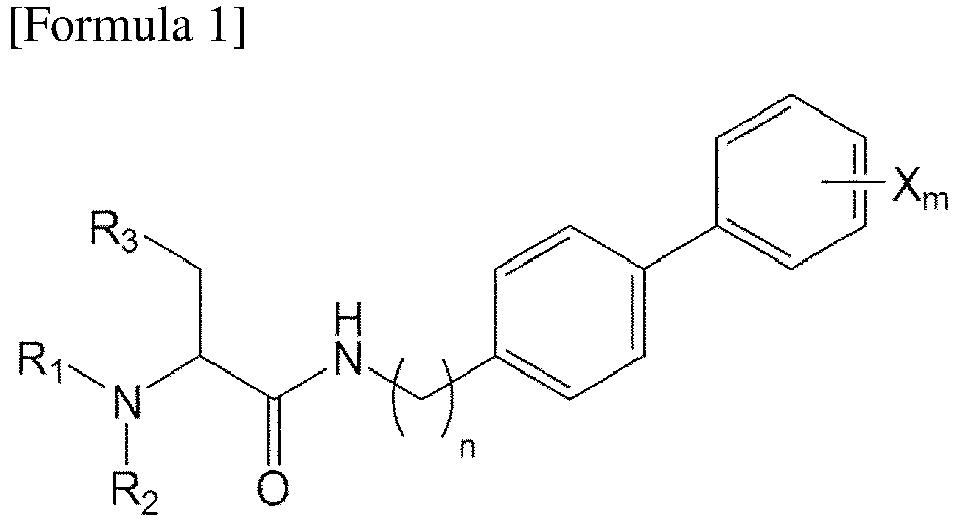 n is 0, 1, 2, 3, 4 or 5,R1, R2, and R3 are each independently the same as or different from each other, and are each independently selected from hydrogen, a C1-7 alkyl, hydroxyl, a halogen, a halogenated C1-7 alkyl, a C1-7 alkyloxy and a halogenated C1-7 alkyloxy, andX is m substituents (m is an integer from 1 to 5) which are the same as or different from each other, selected from the group consisting of a halogen group, a halogenated C1-7 alkyl group and a halogenated C1-7 alkoxy group.
 - The compound, the stereoisomer thereof, or the pharmaceutically acceptable salt thereof of claim 1,wherein R1 and R2 are each independently H or methyl, ethyl, n-propyl, isopropyl, cyclopropyl, n-butyl, isobutyl, cyclobutyl, n-pentyl, cyclopentyl, n-hexyl or cyclohexyl, andR3 is methyl, ethyl, n-propyl, isopropyl, cyclopropyl, n-butyl, isobutyl, sec-butyl or tert-butyl.
- The compound, the stereoisomer thereof, or the pharmaceutically acceptable salt thereof of claim 1, wherein X is any one or two identical or different substituents selected from the group consisting of fluoro, chloro, trifluoromethyl and trifluoromethoxy.
- The compound, the stereoisomer thereof, or the pharmaceutically acceptable salt thereof of claim 3, wherein X is p-fluoro, m-fluoro, p,m-difluoro, p-chloro, m-chloro, p,m-dichloro, p-trifluoromethyl or p-trifluoromethoxy.
- The compound, the stereoisomer thereof, or the pharmaceutically acceptable salt thereof of claim 1, wherein the compound is1) 2-amino-N-(3',4'-dichloro-[1,1'-biphenyl]-4-yl)butanamide;2) 2-amino-N-(3',4'-dichloro-[1,1'-biphenyl]-4-yl)pentanamide;3) 2-amino-N-(3',4'-dichloro-[1,1'-biphenyl]-4-yl)hexanamide;4) 2-amino-N-(4'-(trifluoromethoxy)-[1,1'-biphenyl]-4-yl)pentanamide;5) N-(3',4'-dichloro-[1,1'-biphenyl]-4-yl)-2-(methylamino)butanamide;6) N-(3',4'-dichloro-[1,1'-biphenyl]-4-yl)-2-(methylamino)pentanamide;7) N-(3',4'-dichloro-[1,1'-biphenyl]-4-yl)-2-(methylamino)hexanamide;8) N-(3',4'-dichloro-[1,1'-biphenyl]-4-yl)-2-(dimethylamino)pentanamide;9) 2-amino-N-((3',4'-dichloro-[1,1'-biphenyl]-4-yl)methyl)pentanamide;10) 2-amino-N-((3',4'-dichloro-[1,1'-biphenyl]-4-yl)methyl)hexanamide;11) 2-amino-N-((4'-(trifluoromethyl)-[1,1'-biphenyl]-4-yl)methyl)pentanamide;12) 2-amino-N-((4'-(trifluoromethyl)-[1,1'-biphenyl]-4-yl)methyl)hexanamide;13) 2-amino-N-((4'-(trifluoromethoxy)-[1,1'-biphenyl]-4-yl)methyl)pentanamide;14) 2-amino-N-((4'-(trifluoromethoxy)-[1,1'-biphenyl]-4-yl)methyl)hexanamide;15) N-((3',4'-dichloro-[1,1'-biphenyl]-4-yl)methyl)-2-(methylamino)pentanamide;16) 2-(methylamino)-N-((4'-(trifuloromethyl)-[1,1'-biphenyl]-4-yl)methyl)pentanamide;17) N-((3',4'-dichloro-[1,1'-biphenyl]-4-yl)methyl)-2-(dimethylamino)pentanamide;18) 2-amino-N-(2-(3',4'-dichloro-[1,1'-biphenyl]-4-yl)ethyl)butanamide;19) 2-amino-N-(2-(3',4'-dichloro-[1,1'-biphenyl]-4-yl)ethyl)pentanamide;20) 2-amino-N-(2-(3',4'-dichloro-[1,1'-biphenyl]-4-yl)ethyl)hexanamide;21) 2-amino-N-(2-(4'-(trifluoromethyl)-[1,1'-biphenyl]-4-yl)ethyl)butanamide;22) 2-amino-N-(2-(4'-(trifluoromethyl)-[1,1'-biphenyl]-4-yl)ethyl)pentanamide;23) 2-amino-N-(2-(4'-(trifluoromethyl)-[1,1'-biphenyl]-4-yl)ethyl)hexanamide;24) 2-amino-N-(2-(4'-(trifluoromethoxy)-[1,1'-biphenyl]-4-yl)ethyl)butanamide;25) 2-amino-N-(2-(4'-(trifluoromethoxy)-[1,1'-biphenyl]-4-yl)ethyl)pentanamide;26) 2-amino-N-(2-(4'-(trifluoromethoxy)-[1,1'-biphenyl]-4-yl)ethyl)hexanamide;27) 2-amino-N-(2-(3',4'-difluoro-[1,1'-biphenyl]-4-yl)ethyl)pentanamide;28) N-(2-(3',4'-dichloro-[1,1'-biphenyl]-4-yl)ethyl)-2-(methylamino)butanamide;29) N-(2-(3',4'-dichloro-[1,1'-biphenyl]-4-yl)ethyl)-2-(methylamino)pentanamide;30) N-(2-(3',4'-dichloro-[1,1'-biphenyl]-4-yl)ethyl)-2-(methylamino)hexanamide;31) 2-(methylamino)-N-(2-(4'-(trifluoromethyl)-[1,1'-biphenyl]-4-yl)ethyl)butanamide;32) 2-(methylamino)-N-(2-(4'-(trifluoromethyl)-[1,1'-biphenyl]-4-yl)ethyl)pentanamide;33) 2-(methylamino)-N-(2-(4'-(trifluoromethyl)-[1,1'-biphenyl]-4-yl)ethyl)hexanamide;34) 2-(methylamino)-N-(2-(4'-(trifluoromethoxy)-[1,1'-biphenyl]-4-yl)ethyl)butanamide;35) 2-(methylamino)-N-(2-(4'-(trifluoromethoxy)-[1,1'-biphenyl]-4-yl)ethyl)pentanamide;36) 2-(methylamino)-N-(2-(4'-(trifluoromethoxy)-[1,1'-biphenyl]-4-yl)ethyl)hexanamide; or37) N-(2-(3',4'-dichloro-[1,1'-biphenyl]-4-yl)ethyl)-2-(dimethylamino)pentanamide.
- A method for preparing the compound, the stereoisomer thereof, or the pharmaceutically acceptable salt thereof of any one of claims 1 to 5, the method comprising a first step of forming a peptide bond by reacting an aminoalkanoic acid derivative compound protected by a butoxycarbonyl (Boc) protecting group, which is represented by the following Formula 2, with a biphenyl derivative compound containing a primary amine group, which is represented by the following Formula 3; anda second step of removing the Boc protecting group by reacting the compound obtained in the first step with an acid:


 in the formulae,n is 0, 1, 2, 3, 4 or 5,R1, R2 and R3 are each independently the same as or different from each other, and are each independently selected from hydrogen, a C1-7 alkyl, hydroxyl, a halogen, a halogenated C1-7 alkyl, a C1-7 alkyloxy and a halogenated C1-7 alkyloxy, andX is m substituents (m is an integer from 1 to 5) which are the same as or different from each other, selected from the group consisting of a halogen group, a halogenated C1-7 alkyl group and a halogenated C1-7 alkoxy group.
 - The method of claim 6, wherein the aminoalkanoic acid derivative compound protected by the Boc protecting group, which is represented by Formula 2 is prepared by reacting an amino acid derivative represented by the following Formula 4 with di-tert-butyl dicarbonate (Boc anhydride):

R1', R2 and R3 are each independently the same as or different from each other, and are each independently selected from hydrogen, a C1-7 alkyl, hydroxyl, a halogen, a halogenated C1-7 alkyl, a C1-7 alkyloxy and a halogenated C1-7 alkyloxy. - The method of claim 7, wherein when R2 of the finally prepared compound is an alkyl, a step of alkylating the compound by reacting the compound with a haloalkane in the presence of a base after the above reaction is further performed.
- The method of claim 6, wherein a biphenyl derivative compound comprising a primary amine group, which is represented by Formula 3 is prepared by reacting a C0-2 alkylamine derivative in which a halophenyl group at one end is substituted, which is represented by the following Formula 5, with di-tert-butyl dicarbonate to introduce a Boc protecting group into an amine group, then reacting the resulting alkylamine derivative with a phenylboronic acid derivative represented by the following Formula 6, and then reacting the reactants with an acid to remove the Boc protecting group:

 X' is a halogen, andX is m substituents (m is an integer from 1 to 5) which are the same as or different from each other, selected from the group consisting of a halogen group, a halogenated C1-7 alkyl group and a halogenated C1-7 alkoxy group.
 - The method of claim 9, wherein the reaction with the phenylboronic acid derivative is achieved by a cross-coupling reaction using a metal catalyst in the presence of a base.
- The method of claim 6, wherein the first step is achieved by an anhydride coupling reaction performed in an organic solvent in the presence of N-methylmorpholine (NMM) and isobutyl chloroformate (IBCF).
- The method of claim 6, further comprising a third step of forming a secondary amine by alkylating amine after the second step when both R1 and R2 of the compound finally prepared are an alkyl.
- An antifungal composition comprising, as an active ingredient, the compound, the stereoisomer thereof, or the pharmaceutically acceptable salt thereof of any one of claims 1 to 5.
- The antifungal composition of claim 13, wherein the antifungal composition exhibits antifungal activity against Cryptococcus neoformans, Candida albicans, Candida glabrata, or Aspergillus fumigatus.
- A pharmaceutical composition for use in a method for treating or preventing a fungal infectious disease, comprising, as an active ingredient, the compound, the stereoisomer thereof, or the pharmaceutically acceptable salt thereof of any one of claims 1 to 5.
- The pharmaceutical composition for use of claim 15, wherein the fungal infectious disease is caused by infections of Cryptococcus neoformans, Candida albicans, Candida glabrata, or Aspergillus fumigatus.
- The pharmaceutical composition for use of claim 15, further comprising a pharmaceutically acceptable carrier, diluent or excipient.
- An antibacterial composition comprising, as an active ingredient, the compound, the stereoisomer thereof, or the pharmaceutically acceptable salt thereof of any one of claims 1 to 5.
- The antibacterial composition of claim 18, wherein the antibacterial composition exhibits antibacterial activity against Gram-negative bacteria, Gram-positive bacteria, or multi-drug resistant bacteria.
- A pharmaceutical composition for use in a method for treating or preventing a bacterial infectious disease, comprising, as an active ingredient, the compound, the stereoisomer thereof, or the pharmaceutically acceptable salt thereof of any one of claims 1 to 5.
- A pharmaceutical composition for use in a method for treating or preventing an anti-inflammatory disease, comprising the compound, the stereoisomer thereof, or the pharmaceutically acceptable salt thereof of any one of claims 1 to 5, and a pharmaceutically acceptable carrier, diluent or excipient.
Applications Claiming Priority (2)
| Application Number | Priority Date | Filing Date | Title |
|---|---|---|---|
| KR20190075893 | 2019-06-25 | ||
| PCT/KR2020/008306 WO2020262996A1 (en) | 2019-06-25 | 2020-06-25 | Derivative compound introducing biphenyl group into novel aminoalkanoic acid and antifungal pharmaceutical composition comprising same |
Publications (4)
| Publication Number | Publication Date |
|---|---|
| EP3992177A1 EP3992177A1 (en) | 2022-05-04 |
| EP3992177A4 EP3992177A4 (en) | 2023-08-16 |
| EP3992177B1 true EP3992177B1 (en) | 2024-05-08 |
| EP3992177C0 EP3992177C0 (en) | 2024-05-08 |
Family
ID=74061024
Family Applications (1)
| Application Number | Title | Priority Date | Filing Date |
|---|---|---|---|
| EP20830693.6A Active EP3992177B1 (en) | 2019-06-25 | 2020-06-25 | Derivative compound introducing biphenyl group into novel aminoalkanoic acid and antifungal pharmaceutical composition comprising same |
Country Status (15)
| Country | Link |
|---|---|
| US (4) | US11479526B2 (en) |
| EP (1) | EP3992177B1 (en) |
| JP (1) | JP7290361B2 (en) |
| KR (1) | KR102286897B1 (en) |
| CN (1) | CN114051496B (en) |
| AU (1) | AU2020303814B2 (en) |
| BR (1) | BR112021026076A2 (en) |
| CA (1) | CA3145394C (en) |
| CO (1) | CO2022000187A2 (en) |
| ES (1) | ES2984182T3 (en) |
| HU (1) | HUE067087T2 (en) |
| IL (1) | IL289445B2 (en) |
| MX (1) | MX2021015652A (en) |
| PL (1) | PL3992177T3 (en) |
| WO (1) | WO2020262996A1 (en) |
Families Citing this family (5)
| Publication number | Priority date | Publication date | Assignee | Title |
|---|---|---|---|---|
| US20250281433A1 (en) * | 2020-12-25 | 2025-09-11 | Amtixbio Co., Ltd. | Novel derivative compound having biphenyl group introduced into amino-alkanoic acid and anti-inflammatory composition comprising same |
| KR20230103336A (en) | 2021-12-31 | 2023-07-07 | (주)앰틱스바이오 | A novel antifungal composition for inhibiting the development of fungal biofilms |
| WO2023128033A1 (en) * | 2021-12-31 | 2023-07-06 | (주)앰틱스바이오 | Novel anti-fungal composition for inhibiting biofilm production of infectious fungi |
| CN115784848B (en) * | 2022-12-07 | 2024-04-30 | 成都理工大学 | Nor-Aronia melanocarpa derivatives, and preparation method and application thereof |
| CN118063337B (en) * | 2024-02-19 | 2025-01-28 | 绵阳师范学院 | A preparation method of (S)-3-amino-2-pentanone hydrochloride |
Family Cites Families (15)
| Publication number | Priority date | Publication date | Assignee | Title |
|---|---|---|---|---|
| IT1283489B1 (en) * | 1996-07-23 | 1998-04-21 | Chiesi Farma Spa | AMIDES OF ALPHA-AMINO ACIDS, THEIR PREPARATION AND THEIR THERAPEUTIC USE |
| WO2004110988A1 (en) * | 2003-06-18 | 2004-12-23 | Prozymex A/S | Protease inhibitors |
| US20060173023A1 (en) * | 2005-02-01 | 2006-08-03 | Wood Michael R | 2-(Bicyclo)alkylamino-derivatives as mediators of chronic pain and inflammation |
| WO2007087442A2 (en) * | 2006-01-25 | 2007-08-02 | Synta Pharmaceuticals Corp. | Substituted biaryl compounds for inflammation and immune-related uses |
| ITMI20060179A1 (en) | 2006-02-02 | 2007-08-03 | Abiogen Pharma Spa | PROCEDURE FOR RESOLUTION OF RACEMIC MIXTURES AND DIASTEREOISOMERIC COMPLEX OF A SOLVING AGENT AND UNANTIOMER OF INTEREST |
| CA2750818A1 (en) | 2009-01-27 | 2010-08-05 | Proteogenix, Inc. | Biomarkers for detection of neonatal sepsis in biological fluid |
| EP2408753A4 (en) | 2009-03-20 | 2012-11-07 | Univ Brandeis | COMPOUNDS AND METHODS FOR TREATING MAMMALIAN GASTROINTESTINAL MICROBIAL INFECTIONS |
| PH12013501882A1 (en) | 2011-03-15 | 2013-10-14 | Rib X Pharmaceuticals Inc | Antimicrobial agents |
| WO2013131018A1 (en) | 2012-03-02 | 2013-09-06 | Zalicus Pharmaceuticals Ltd. | Biaryl inhibitors of the sodium channel |
| CA3217159A1 (en) | 2013-02-01 | 2014-08-07 | Wellstat Therapeutics Corporation | Substituted quinazolin-4-amine compounds and pharmaceutical compositions thereof having anti-inflammatory, antifungal, antiparasitic and anticancer activity |
| KR20170084200A (en) | 2014-11-14 | 2017-07-19 | 멜린타 테라퓨틱스, 인크. | Method for treating, preventing, or reducing the risk of skin infection |
| TW201804994A (en) * | 2016-08-01 | 2018-02-16 | 中央研究院 | Antifungal agents |
| WO2018026866A1 (en) | 2016-08-03 | 2018-02-08 | Neuropore Therapies, Inc. | Lipid-substituted amino 1,2-and 1,3-diol compounds as modulators of tlr2 dimerization |
| KR20180046730A (en) | 2016-10-28 | 2018-05-09 | (주)앰틱스바이오 | Functionalized alanine and proline derivatives and pharmaceutical composition comprising the same |
| EP3388444A1 (en) | 2017-04-10 | 2018-10-17 | F. Hoffmann-La Roche AG | Anti-bacterial peptide macrocycles and use thereof |
-
2020
- 2020-06-25 MX MX2021015652A patent/MX2021015652A/en unknown
- 2020-06-25 AU AU2020303814A patent/AU2020303814B2/en active Active
- 2020-06-25 ES ES20830693T patent/ES2984182T3/en active Active
- 2020-06-25 JP JP2021577309A patent/JP7290361B2/en active Active
- 2020-06-25 KR KR1020217000289A patent/KR102286897B1/en active Active
- 2020-06-25 PL PL20830693.6T patent/PL3992177T3/en unknown
- 2020-06-25 EP EP20830693.6A patent/EP3992177B1/en active Active
- 2020-06-25 CN CN202080046307.9A patent/CN114051496B/en active Active
- 2020-06-25 BR BR112021026076A patent/BR112021026076A2/en unknown
- 2020-06-25 HU HUE20830693A patent/HUE067087T2/en unknown
- 2020-06-25 CA CA3145394A patent/CA3145394C/en active Active
- 2020-06-25 IL IL289445A patent/IL289445B2/en unknown
- 2020-06-25 WO PCT/KR2020/008306 patent/WO2020262996A1/en not_active Ceased
-
2021
- 2021-12-27 US US17/562,956 patent/US11479526B2/en active Active
-
2022
- 2022-01-13 CO CONC2022/0000187A patent/CO2022000187A2/en unknown
- 2022-09-19 US US17/948,165 patent/US12180139B2/en active Active
- 2022-09-19 US US17/948,162 patent/US12172945B2/en active Active
- 2022-09-19 US US17/948,157 patent/US12129220B2/en active Active
Also Published As
| Publication number | Publication date |
|---|---|
| WO2020262996A1 (en) | 2020-12-30 |
| EP3992177A4 (en) | 2023-08-16 |
| CA3145394C (en) | 2024-01-09 |
| US12172945B2 (en) | 2024-12-24 |
| AU2020303814B2 (en) | 2023-02-23 |
| AU2020303814A1 (en) | 2022-02-03 |
| CN114051496A (en) | 2022-02-15 |
| HUE067087T2 (en) | 2024-09-28 |
| CO2022000187A2 (en) | 2022-01-17 |
| KR20210030343A (en) | 2021-03-17 |
| US12180139B2 (en) | 2024-12-31 |
| US20230056812A1 (en) | 2023-02-23 |
| US20230053855A1 (en) | 2023-02-23 |
| CA3145394A1 (en) | 2020-12-30 |
| JP7290361B2 (en) | 2023-06-13 |
| BR112021026076A2 (en) | 2022-03-29 |
| EP3992177A1 (en) | 2022-05-04 |
| CN114051496B (en) | 2023-08-04 |
| EP3992177C0 (en) | 2024-05-08 |
| IL289445B1 (en) | 2024-11-01 |
| MX2021015652A (en) | 2022-02-03 |
| US20230067422A1 (en) | 2023-03-02 |
| US12129220B2 (en) | 2024-10-29 |
| IL289445A (en) | 2022-02-01 |
| US11479526B2 (en) | 2022-10-25 |
| IL289445B2 (en) | 2025-03-01 |
| US20220144755A1 (en) | 2022-05-12 |
| JP2022535613A (en) | 2022-08-09 |
| PL3992177T3 (en) | 2024-08-26 |
| KR102286897B1 (en) | 2021-08-09 |
| ES2984182T3 (en) | 2024-10-29 |
Similar Documents
| Publication | Publication Date | Title |
|---|---|---|
| US12129220B2 (en) | Pharmaceutical composition comprising aminoalkanoic acid derivative containing biphenyl group | |
| CA2583092C (en) | Antiangiogenic calixarene-based peptide mimetics | |
| US20250034083A1 (en) | Methods for preparing benzyloxybenzylamine amino acid derivatives | |
| RU2826219C2 (en) | Novel aminoalkanoic acid derivative containing biphenyl group, and antifungal pharmaceutical composition containing it | |
| HK40060177A (en) | Derivative compound introducing biphenyl group into novel aminoalkanoic acid and antifungal pharmaceutical composition comprising same | |
| HK40060177B (en) | Derivative compound introducing biphenyl group into novel aminoalkanoic acid and antifungal pharmaceutical composition comprising same | |
| EP4268811A1 (en) | Novel derivative compound having biphenyl group introduced into amino-alkanoic acid and anti-inflammatory composition comprising same | |
| KR20230103336A (en) | A novel antifungal composition for inhibiting the development of fungal biofilms | |
| WO2023128033A1 (en) | Novel anti-fungal composition for inhibiting biofilm production of infectious fungi |
Legal Events
| Date | Code | Title | Description |
|---|---|---|---|
| STAA | Information on the status of an ep patent application or granted ep patent |
Free format text: STATUS: THE INTERNATIONAL PUBLICATION HAS BEEN MADE |
|
| PUAI | Public reference made under article 153(3) epc to a published international application that has entered the european phase |
Free format text: ORIGINAL CODE: 0009012 |
|
| STAA | Information on the status of an ep patent application or granted ep patent |
Free format text: STATUS: REQUEST FOR EXAMINATION WAS MADE |
|
| 17P | Request for examination filed |
Effective date: 20211217 |
|
| AK | Designated contracting states |
Kind code of ref document: A1 Designated state(s): AL AT BE BG CH CY CZ DE DK EE ES FI FR GB GR HR HU IE IS IT LI LT LU LV MC MK MT NL NO PL PT RO RS SE SI SK SM TR |
|
| DAV | Request for validation of the european patent (deleted) | ||
| DAX | Request for extension of the european patent (deleted) | ||
| A4 | Supplementary search report drawn up and despatched |
Effective date: 20230719 |
|
| RIC1 | Information provided on ipc code assigned before grant |
Ipc: A61P 31/10 20060101ALI20230713BHEP Ipc: A61K 31/165 20060101ALI20230713BHEP Ipc: C07C 237/20 20060101AFI20230713BHEP |
|
| GRAP | Despatch of communication of intention to grant a patent |
Free format text: ORIGINAL CODE: EPIDOSNIGR1 |
|
| STAA | Information on the status of an ep patent application or granted ep patent |
Free format text: STATUS: GRANT OF PATENT IS INTENDED |
|
| INTG | Intention to grant announced |
Effective date: 20231207 |
|
| GRAS | Grant fee paid |
Free format text: ORIGINAL CODE: EPIDOSNIGR3 |
|
| GRAA | (expected) grant |
Free format text: ORIGINAL CODE: 0009210 |
|
| STAA | Information on the status of an ep patent application or granted ep patent |
Free format text: STATUS: THE PATENT HAS BEEN GRANTED |
|
| AK | Designated contracting states |
Kind code of ref document: B1 Designated state(s): AL AT BE BG CH CY CZ DE DK EE ES FI FR GB GR HR HU IE IS IT LI LT LU LV MC MK MT NL NO PL PT RO RS SE SI SK SM TR |
|
| REG | Reference to a national code |
Ref country code: GB Ref legal event code: FG4D |
|
| REG | Reference to a national code |
Ref country code: CH Ref legal event code: EP |
|
| REG | Reference to a national code |
Ref country code: DE Ref legal event code: R096 Ref document number: 602020030730 Country of ref document: DE |
|
| REG | Reference to a national code |
Ref country code: IE Ref legal event code: FG4D |
|
| U01 | Request for unitary effect filed |
Effective date: 20240606 |
|
| U07 | Unitary effect registered |
Designated state(s): AT BE BG DE DK EE FI FR IT LT LU LV MT NL PT SE SI Effective date: 20240620 |
|
| U20 | Renewal fee for the european patent with unitary effect paid |
Year of fee payment: 5 Effective date: 20240620 |
|
| REG | Reference to a national code |
Ref country code: HU Ref legal event code: AG4A Ref document number: E067087 Country of ref document: HU |
|
| PG25 | Lapsed in a contracting state [announced via postgrant information from national office to epo] |
Ref country code: IS Free format text: LAPSE BECAUSE OF FAILURE TO SUBMIT A TRANSLATION OF THE DESCRIPTION OR TO PAY THE FEE WITHIN THE PRESCRIBED TIME-LIMIT Effective date: 20240908 |
|
| PG25 | Lapsed in a contracting state [announced via postgrant information from national office to epo] |
Ref country code: HR Free format text: LAPSE BECAUSE OF FAILURE TO SUBMIT A TRANSLATION OF THE DESCRIPTION OR TO PAY THE FEE WITHIN THE PRESCRIBED TIME-LIMIT Effective date: 20240508 |
|
| PG25 | Lapsed in a contracting state [announced via postgrant information from national office to epo] |
Ref country code: GR Free format text: LAPSE BECAUSE OF FAILURE TO SUBMIT A TRANSLATION OF THE DESCRIPTION OR TO PAY THE FEE WITHIN THE PRESCRIBED TIME-LIMIT Effective date: 20240809 |
|
| REG | Reference to a national code |
Ref country code: ES Ref legal event code: FG2A Ref document number: 2984182 Country of ref document: ES Kind code of ref document: T3 Effective date: 20241029 |
|
| PG25 | Lapsed in a contracting state [announced via postgrant information from national office to epo] |
Ref country code: NO Free format text: LAPSE BECAUSE OF FAILURE TO SUBMIT A TRANSLATION OF THE DESCRIPTION OR TO PAY THE FEE WITHIN THE PRESCRIBED TIME-LIMIT Effective date: 20240808 Ref country code: IS Free format text: LAPSE BECAUSE OF FAILURE TO SUBMIT A TRANSLATION OF THE DESCRIPTION OR TO PAY THE FEE WITHIN THE PRESCRIBED TIME-LIMIT Effective date: 20240908 Ref country code: HR Free format text: LAPSE BECAUSE OF FAILURE TO SUBMIT A TRANSLATION OF THE DESCRIPTION OR TO PAY THE FEE WITHIN THE PRESCRIBED TIME-LIMIT Effective date: 20240508 Ref country code: GR Free format text: LAPSE BECAUSE OF FAILURE TO SUBMIT A TRANSLATION OF THE DESCRIPTION OR TO PAY THE FEE WITHIN THE PRESCRIBED TIME-LIMIT Effective date: 20240809 Ref country code: RS Free format text: LAPSE BECAUSE OF FAILURE TO SUBMIT A TRANSLATION OF THE DESCRIPTION OR TO PAY THE FEE WITHIN THE PRESCRIBED TIME-LIMIT Effective date: 20240808 |
|
| PG25 | Lapsed in a contracting state [announced via postgrant information from national office to epo] |
Ref country code: CZ Free format text: LAPSE BECAUSE OF FAILURE TO SUBMIT A TRANSLATION OF THE DESCRIPTION OR TO PAY THE FEE WITHIN THE PRESCRIBED TIME-LIMIT Effective date: 20240508 |
|
| PG25 | Lapsed in a contracting state [announced via postgrant information from national office to epo] |
Ref country code: SK Free format text: LAPSE BECAUSE OF FAILURE TO SUBMIT A TRANSLATION OF THE DESCRIPTION OR TO PAY THE FEE WITHIN THE PRESCRIBED TIME-LIMIT Effective date: 20240508 Ref country code: RO Free format text: LAPSE BECAUSE OF FAILURE TO SUBMIT A TRANSLATION OF THE DESCRIPTION OR TO PAY THE FEE WITHIN THE PRESCRIBED TIME-LIMIT Effective date: 20240508 |
|
| PG25 | Lapsed in a contracting state [announced via postgrant information from national office to epo] |
Ref country code: SM Free format text: LAPSE BECAUSE OF FAILURE TO SUBMIT A TRANSLATION OF THE DESCRIPTION OR TO PAY THE FEE WITHIN THE PRESCRIBED TIME-LIMIT Effective date: 20240508 |
|
| PG25 | Lapsed in a contracting state [announced via postgrant information from national office to epo] |
Ref country code: SM Free format text: LAPSE BECAUSE OF FAILURE TO SUBMIT A TRANSLATION OF THE DESCRIPTION OR TO PAY THE FEE WITHIN THE PRESCRIBED TIME-LIMIT Effective date: 20240508 Ref country code: SK Free format text: LAPSE BECAUSE OF FAILURE TO SUBMIT A TRANSLATION OF THE DESCRIPTION OR TO PAY THE FEE WITHIN THE PRESCRIBED TIME-LIMIT Effective date: 20240508 Ref country code: RO Free format text: LAPSE BECAUSE OF FAILURE TO SUBMIT A TRANSLATION OF THE DESCRIPTION OR TO PAY THE FEE WITHIN THE PRESCRIBED TIME-LIMIT Effective date: 20240508 Ref country code: CZ Free format text: LAPSE BECAUSE OF FAILURE TO SUBMIT A TRANSLATION OF THE DESCRIPTION OR TO PAY THE FEE WITHIN THE PRESCRIBED TIME-LIMIT Effective date: 20240508 |
|
| PG25 | Lapsed in a contracting state [announced via postgrant information from national office to epo] |
Ref country code: MC Free format text: LAPSE BECAUSE OF FAILURE TO SUBMIT A TRANSLATION OF THE DESCRIPTION OR TO PAY THE FEE WITHIN THE PRESCRIBED TIME-LIMIT Effective date: 20240508 |
|
| REG | Reference to a national code |
Ref country code: DE Ref legal event code: R097 Ref document number: 602020030730 Country of ref document: DE |
|
| PLBE | No opposition filed within time limit |
Free format text: ORIGINAL CODE: 0009261 |
|
| STAA | Information on the status of an ep patent application or granted ep patent |
Free format text: STATUS: NO OPPOSITION FILED WITHIN TIME LIMIT |
|
| 26N | No opposition filed |
Effective date: 20250211 |
|
| PG25 | Lapsed in a contracting state [announced via postgrant information from national office to epo] |
Ref country code: IE Free format text: LAPSE BECAUSE OF NON-PAYMENT OF DUE FEES Effective date: 20240625 |
|
| PG25 | Lapsed in a contracting state [announced via postgrant information from national office to epo] |
Ref country code: CY Free format text: LAPSE BECAUSE OF FAILURE TO SUBMIT A TRANSLATION OF THE DESCRIPTION OR TO PAY THE FEE WITHIN THE PRESCRIBED TIME-LIMIT; INVALID AB INITIO Effective date: 20200625 |
|
| REG | Reference to a national code |
Ref country code: CH Ref legal event code: U11 Free format text: ST27 STATUS EVENT CODE: U-0-0-U10-U11 (AS PROVIDED BY THE NATIONAL OFFICE) Effective date: 20251222 |
|
| PGFP | Annual fee paid to national office [announced via postgrant information from national office to epo] |
Ref country code: GB Payment date: 20251219 Year of fee payment: 6 |
|
| PGFP | Annual fee paid to national office [announced via postgrant information from national office to epo] |
Ref country code: HU Payment date: 20251223 Year of fee payment: 6 |
|
| PGFP | Annual fee paid to national office [announced via postgrant information from national office to epo] |
Ref country code: TR Payment date: 20251219 Year of fee payment: 6 |
|
| PGFP | Annual fee paid to national office [announced via postgrant information from national office to epo] |
Ref country code: CH Payment date: 20251222 Year of fee payment: 6 |
|
| PGFP | Annual fee paid to national office [announced via postgrant information from national office to epo] |
Ref country code: PL Payment date: 20251222 Year of fee payment: 6 |
|
| PGFP | Annual fee paid to national office [announced via postgrant information from national office to epo] |
Ref country code: ES Payment date: 20251229 Year of fee payment: 6 |
|
| U21 | Renewal fee for the european patent with unitary effect paid with additional fee |
Year of fee payment: 6 Effective date: 20251229 |