EP3992086B1 - Aircraft and method of operating same - Google Patents
Aircraft and method of operating same Download PDFInfo
- Publication number
- EP3992086B1 EP3992086B1 EP21206298.8A EP21206298A EP3992086B1 EP 3992086 B1 EP3992086 B1 EP 3992086B1 EP 21206298 A EP21206298 A EP 21206298A EP 3992086 B1 EP3992086 B1 EP 3992086B1
- Authority
- EP
- European Patent Office
- Prior art keywords
- engine
- thrust
- compressed gas
- aircraft
- wing
- Prior art date
- Legal status (The legal status is an assumption and is not a legal conclusion. Google has not performed a legal analysis and makes no representation as to the accuracy of the status listed.)
- Active
Links
Images

Classifications
-
- B—PERFORMING OPERATIONS; TRANSPORTING
- B64—AIRCRAFT; AVIATION; COSMONAUTICS
- B64D—EQUIPMENT FOR FITTING IN OR TO AIRCRAFT; FLIGHT SUITS; PARACHUTES; ARRANGEMENT OR MOUNTING OF POWER PLANTS OR PROPULSION TRANSMISSIONS IN AIRCRAFT
- B64D27/00—Arrangement or mounting of power plants in aircraft; Aircraft characterised by the type or position of power plants
- B64D27/02—Aircraft characterised by the type or position of power plants
- B64D27/16—Aircraft characterised by the type or position of power plants of jet type
- B64D27/18—Aircraft characterised by the type or position of power plants of jet type within, or attached to, wings
-
- B—PERFORMING OPERATIONS; TRANSPORTING
- B64—AIRCRAFT; AVIATION; COSMONAUTICS
- B64C—AEROPLANES; HELICOPTERS
- B64C15/00—Attitude, flight direction, or altitude control by jet reaction
- B64C15/02—Attitude, flight direction, or altitude control by jet reaction the jets being propulsion jets
-
- B—PERFORMING OPERATIONS; TRANSPORTING
- B64—AIRCRAFT; AVIATION; COSMONAUTICS
- B64D—EQUIPMENT FOR FITTING IN OR TO AIRCRAFT; FLIGHT SUITS; PARACHUTES; ARRANGEMENT OR MOUNTING OF POWER PLANTS OR PROPULSION TRANSMISSIONS IN AIRCRAFT
- B64D33/00—Arrangement in aircraft of power plant parts or auxiliaries not otherwise provided for
- B64D33/04—Arrangement in aircraft of power plant parts or auxiliaries not otherwise provided for of exhaust outlets or jet pipes
-
- F—MECHANICAL ENGINEERING; LIGHTING; HEATING; WEAPONS; BLASTING
- F02—COMBUSTION ENGINES; HOT-GAS OR COMBUSTION-PRODUCT ENGINE PLANTS
- F02C—GAS-TURBINE PLANTS; AIR INTAKES FOR JET-PROPULSION PLANTS; CONTROLLING FUEL SUPPLY IN AIR-BREATHING JET-PROPULSION PLANTS
- F02C6/00—Plural gas-turbine plants; Combinations of gas-turbine plants with other apparatus; Adaptations of gas-turbine plants for special use
- F02C6/04—Gas-turbine plants providing heated or pressurised working fluid for other apparatus, e.g. without mechanical power output
- F02C6/06—Gas-turbine plants providing heated or pressurised working fluid for other apparatus, e.g. without mechanical power output providing compressed gas
- F02C6/08—Gas-turbine plants providing heated or pressurised working fluid for other apparatus, e.g. without mechanical power output providing compressed gas the gas being bled from the gas-turbine compressor
-
- F—MECHANICAL ENGINEERING; LIGHTING; HEATING; WEAPONS; BLASTING
- F02—COMBUSTION ENGINES; HOT-GAS OR COMBUSTION-PRODUCT ENGINE PLANTS
- F02C—GAS-TURBINE PLANTS; AIR INTAKES FOR JET-PROPULSION PLANTS; CONTROLLING FUEL SUPPLY IN AIR-BREATHING JET-PROPULSION PLANTS
- F02C9/00—Controlling gas-turbine plants; Controlling fuel supply in air- breathing jet-propulsion plants
- F02C9/16—Control of working fluid flow
- F02C9/18—Control of working fluid flow by bleeding, bypassing or acting on variable working fluid interconnections between turbines or compressors or their stages
-
- B—PERFORMING OPERATIONS; TRANSPORTING
- B64—AIRCRAFT; AVIATION; COSMONAUTICS
- B64C—AEROPLANES; HELICOPTERS
- B64C21/00—Influencing air flow over aircraft surfaces by affecting boundary layer flow
- B64C21/02—Influencing air flow over aircraft surfaces by affecting boundary layer flow by use of slot, ducts, porous areas or the like
- B64C21/04—Influencing air flow over aircraft surfaces by affecting boundary layer flow by use of slot, ducts, porous areas or the like for blowing
-
- F—MECHANICAL ENGINEERING; LIGHTING; HEATING; WEAPONS; BLASTING
- F05—INDEXING SCHEMES RELATING TO ENGINES OR PUMPS IN VARIOUS SUBCLASSES OF CLASSES F01-F04
- F05D—INDEXING SCHEME FOR ASPECTS RELATING TO NON-POSITIVE-DISPLACEMENT MACHINES OR ENGINES, GAS-TURBINES OR JET-PROPULSION PLANTS
- F05D2220/00—Application
- F05D2220/30—Application in turbines
- F05D2220/32—Application in turbines in gas turbines
- F05D2220/323—Application in turbines in gas turbines for aircraft propulsion, e.g. jet engines
-
- F—MECHANICAL ENGINEERING; LIGHTING; HEATING; WEAPONS; BLASTING
- F05—INDEXING SCHEMES RELATING TO ENGINES OR PUMPS IN VARIOUS SUBCLASSES OF CLASSES F01-F04
- F05D—INDEXING SCHEME FOR ASPECTS RELATING TO NON-POSITIVE-DISPLACEMENT MACHINES OR ENGINES, GAS-TURBINES OR JET-PROPULSION PLANTS
- F05D2260/00—Function
- F05D2260/60—Fluid transfer
- F05D2260/606—Bypassing the fluid
-
- F—MECHANICAL ENGINEERING; LIGHTING; HEATING; WEAPONS; BLASTING
- F05—INDEXING SCHEMES RELATING TO ENGINES OR PUMPS IN VARIOUS SUBCLASSES OF CLASSES F01-F04
- F05D—INDEXING SCHEME FOR ASPECTS RELATING TO NON-POSITIVE-DISPLACEMENT MACHINES OR ENGINES, GAS-TURBINES OR JET-PROPULSION PLANTS
- F05D2260/00—Function
- F05D2260/80—Diagnostics
-
- F—MECHANICAL ENGINEERING; LIGHTING; HEATING; WEAPONS; BLASTING
- F05—INDEXING SCHEMES RELATING TO ENGINES OR PUMPS IN VARIOUS SUBCLASSES OF CLASSES F01-F04
- F05D—INDEXING SCHEME FOR ASPECTS RELATING TO NON-POSITIVE-DISPLACEMENT MACHINES OR ENGINES, GAS-TURBINES OR JET-PROPULSION PLANTS
- F05D2270/00—Control
- F05D2270/01—Purpose of the control system
- F05D2270/05—Purpose of the control system to affect the output of the engine
- F05D2270/051—Thrust
-
- F—MECHANICAL ENGINEERING; LIGHTING; HEATING; WEAPONS; BLASTING
- F05—INDEXING SCHEMES RELATING TO ENGINES OR PUMPS IN VARIOUS SUBCLASSES OF CLASSES F01-F04
- F05D—INDEXING SCHEME FOR ASPECTS RELATING TO NON-POSITIVE-DISPLACEMENT MACHINES OR ENGINES, GAS-TURBINES OR JET-PROPULSION PLANTS
- F05D2270/00—Control
- F05D2270/01—Purpose of the control system
- F05D2270/09—Purpose of the control system to cope with emergencies
- F05D2270/093—Purpose of the control system to cope with emergencies of one engine in a multi-engine system
-
- F—MECHANICAL ENGINEERING; LIGHTING; HEATING; WEAPONS; BLASTING
- F05—INDEXING SCHEMES RELATING TO ENGINES OR PUMPS IN VARIOUS SUBCLASSES OF CLASSES F01-F04
- F05D—INDEXING SCHEME FOR ASPECTS RELATING TO NON-POSITIVE-DISPLACEMENT MACHINES OR ENGINES, GAS-TURBINES OR JET-PROPULSION PLANTS
- F05D2270/00—Control
- F05D2270/30—Control parameters, e.g. input parameters
- F05D2270/335—Output power or torque
-
- Y—GENERAL TAGGING OF NEW TECHNOLOGICAL DEVELOPMENTS; GENERAL TAGGING OF CROSS-SECTIONAL TECHNOLOGIES SPANNING OVER SEVERAL SECTIONS OF THE IPC; TECHNICAL SUBJECTS COVERED BY FORMER USPC CROSS-REFERENCE ART COLLECTIONS [XRACs] AND DIGESTS
- Y02—TECHNOLOGIES OR APPLICATIONS FOR MITIGATION OR ADAPTATION AGAINST CLIMATE CHANGE
- Y02T—CLIMATE CHANGE MITIGATION TECHNOLOGIES RELATED TO TRANSPORTATION
- Y02T50/00—Aeronautics or air transport
- Y02T50/40—Weight reduction
-
- Y—GENERAL TAGGING OF NEW TECHNOLOGICAL DEVELOPMENTS; GENERAL TAGGING OF CROSS-SECTIONAL TECHNOLOGIES SPANNING OVER SEVERAL SECTIONS OF THE IPC; TECHNICAL SUBJECTS COVERED BY FORMER USPC CROSS-REFERENCE ART COLLECTIONS [XRACs] AND DIGESTS
- Y02—TECHNOLOGIES OR APPLICATIONS FOR MITIGATION OR ADAPTATION AGAINST CLIMATE CHANGE
- Y02T—CLIMATE CHANGE MITIGATION TECHNOLOGIES RELATED TO TRANSPORTATION
- Y02T50/00—Aeronautics or air transport
- Y02T50/60—Efficient propulsion technologies, e.g. for aircraft
Definitions
- the application relates generally to aircrafts and, more particularly, to the propulsion and stabilisation systems thereof.
- Engine failure in the case of a twin-engine aircraft, for instance, leads to a scenario where the operating engine generates torque around the center of gravity of the aircraft, which can induce yaw.
- the torque corresponds to the thrust (force) generated by the operating engine times the distance with the center of gravity of the aircraft.
- torque can be compensated using a tail rudder, but ensuring that the tail rudder will be able to compensate for this torque may require oversizing the tail rudder compared to the size it would otherwise require, leading, amongst other potentially undesirable aspects, to additional weight. There always remains room for improvement.
- US 3173628 A discloses a prior art aircraft.
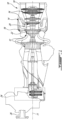
- Fig. 1 illustrates an example of a turbine engine.
- the turbine engine 10 is a turboprop engine generally comprising in serial flow communication, a compressor section 12 for pressurizing the air, a combustor section 14 in which the compressed air is mixed with fuel and ignited for generating an annular stream of hot combustion gases around the engine axis 11, and a turbine section 16 for extracting energy from the combustion gases.
- the turbine engine 10 terminates in an exhaust section 19.
- the turboshaft engine 10 has two compressor and turbine stages, including a high pressure stage associated to a high pressure shaft 20, and a low pressure stage associated to a low pressure shaft 22.
- the low pressure shaft 22 is used as a power source for a propeller during use.
- Turboprop engines typically have some form of gearing by which the power of the low pressure shaft 22 is transferred to an external shaft 26 bearing blades or propeller. This gearing, which can be referred to as a gearbox 24 for the sake of simplicity, typically reduces the rotation speed to reach an external rotation speed which is better adapted to rotate the blades or propeller for instance.
- Turbofans are another common type of aircraft engine. Instead of using a propeller, turbofans typically have a fan extending across a bypass duct, the bypass duct extending around the core gas path.
- the fan can be driven using a lower pressure turbine stage, for instance, while the compressor can be driven using a higher pressure turbine stage, via a concentric shaft arrangement.
Landscapes
- Engineering & Computer Science (AREA)
- Chemical & Material Sciences (AREA)
- Combustion & Propulsion (AREA)
- Aviation & Aerospace Engineering (AREA)
- Mechanical Engineering (AREA)
- General Engineering & Computer Science (AREA)
- Physics & Mathematics (AREA)
- Fluid Mechanics (AREA)
- Structures Of Non-Positive Displacement Pumps (AREA)
Description
- The application relates generally to aircrafts and, more particularly, to the propulsion and stabilisation systems thereof.
- Some events, such as engine failure for instance, can cause disruptions to the ability of an aircraft to stay its course. Engine failure in the case of a twin-engine aircraft, for instance, leads to a scenario where the operating engine generates torque around the center of gravity of the aircraft, which can induce yaw. The torque corresponds to the thrust (force) generated by the operating engine times the distance with the center of gravity of the aircraft. To a certain extent, such torque can be compensated using a tail rudder, but ensuring that the tail rudder will be able to compensate for this torque may require oversizing the tail rudder compared to the size it would otherwise require, leading, amongst other potentially undesirable aspects, to additional weight. There always remains room for improvement.
-
US 3173628 A discloses a prior art aircraft. - In one aspect, there is provided a method of operating an aircraft as set forth in claim 1.
- In another aspect, there is provided an aircraft as set forth in claim 8.
- Reference is now made to the accompanying figures in which:
-
Fig. 1 is a schematic cross-sectional view of a gas turbine engine; and -
Fig. 2 is a schematic top plan view of an aircraft. -
Fig. 1 illustrates an example of a turbine engine. In this example, the turbine engine 10 is a turboprop engine generally comprising in serial flow communication, acompressor section 12 for pressurizing the air, a combustor section 14 in which the compressed air is mixed with fuel and ignited for generating an annular stream of hot combustion gases around the engine axis 11, and aturbine section 16 for extracting energy from the combustion gases. The turbine engine 10 terminates in anexhaust section 19. - The fluid path extending sequentially across the
compressor section 12, the combustor section 14 theturbine section 16 and theexhaust section 19 can be referred to as thecore gas path 18. In the embodiment shown inFig. 1 , the turboshaft engine 10 has two compressor and turbine stages, including a high pressure stage associated to ahigh pressure shaft 20, and a low pressure stage associated to alow pressure shaft 22. Thelow pressure shaft 22 is used as a power source for a propeller during use. Turboprop engines typically have some form of gearing by which the power of thelow pressure shaft 22 is transferred to anexternal shaft 26 bearing blades or propeller. This gearing, which can be referred to as agearbox 24 for the sake of simplicity, typically reduces the rotation speed to reach an external rotation speed which is better adapted to rotate the blades or propeller for instance. - Turbofans are another common type of aircraft engine. Instead of using a propeller, turbofans typically have a fan extending across a bypass duct, the bypass duct extending around the core gas path. The fan can be driven using a lower pressure turbine stage, for instance, while the compressor can be driven using a higher pressure turbine stage, via a concentric shaft arrangement.
-
Fig. 2 presents anexample aircraft 30 having afirst engine 32 and asecond engine 34. Thefirst engine 32 is supported by afirst wing 36 extending from aproximal end 38 to adistal end 40 on a first side of thefuselage 42, whereas thesecond engine 34 is supported by asecond wing 44 extending from aproximal end 46 to a distal end 48 on a second side of thefuselage 42. Theengines corresponding wing fuselage 42 and thewing tip fuselage 42 than to thewing tip aircraft 30, bothengines engine aircraft 30 by a spacing distance d, they generate a yawing torque in opposite directions, and the yawing torques generated cancel each other out, leaving no significant amount of net torque affecting the orientation of the aircraft relative to its course. If, however, one of the engines, e.g. thesecond engine 34, fails, it will stop generating its yawing torque, and therefore stop balancing the yawing torque of the other engine. To a certain extent, this can be compensated by operating arudder 52, typically incorporated into a vertical stabilizer located at the tail of theaircraft 30, to generate a laterally oriented "lift" force to generate a torque opposite to the torque generated by the operating engine. Enabling therudder 52 to generate a sufficient amount of torque, may require oversizing therudder 52, which may be undesirable, for instance. - In the illustrated embodiment, the aircraft further comprises two thrust generating devices: a first
thrust generating device 54 located at the distal end 48 of thesecond wing 44, at or near thewing tip 52, and a secondthrust generating device 56 located at thedistal end 40 of thefirst wing 36, at or near thewing tip 50. Compressedgas passages - Each
compressed gas conduit engines fuselage 42, to thethrust generating device aircraft 30. The firstcompressed gas passage 58, extending from thefirst engine 32 to the firstthrust generating device 54, can be entirely distinct from, or have acommon segment 62 shared with the second compressedgas passage 60. If asegment 62 of the passages is shared, valves can be used to selectively close the non-common, dedicated segments associated to thefirst engine 32 and firstthrust generating device 54 from the common segment, while maintaining the dedicated segments associated to thesecond engine 34 and the secondthrust generating device 56 in fluid communication with the shared segment, or vice versa. Using a shared segment can reduce weight by contrast with using two fully dedicated lines or ducts, for instance. Thegas passages - The thrust generating
devices thrust generating devices - The thrust generating
devices engine aircraft 30 can include fluid flow control devices, which will be referred to herein as valves for simplicity, such as afirst valve 66 in the first compressedgas conduit 58, and a second valve 64 in the second compressedgas conduit 60, or any other configuration of valves found suitable for a given application, and the valves can be selectively operable to open or close the corresponding conduit, or a corresponding segment of the compressed gas passage network. The valves can either be configured to switch between the open or closed configuration, or to be gradually openable to corresponding intermediate configurations between the open and closed configuration, depending on the needs. For instance, partially opening one valve to operate one of the thrust generating devices at partial power may be relevant if the other engine is still operating at partial power, or to voluntarily exert a yaw-inducing torque to the aircraft, for instance. Any suitable mechanism can be used as the valve. As such, the valves can be selectively controlled to control the operation of the corresponding thrust generating device. For instance, a corresponding valve can be switched to the fully open configuration to fully drive the corresponding thrust generating device in the event of failure of the other engine, while being maintained in the fully closed configuration to avoid or mitigate any associated power/efficiency loss when both engines operate normally. - The thrust generating
devices corresponding engines corresponding engine rudder 52 in compensating the yawing torque of the corresponding engine, for instance. - Accordingly, in one embodiment, in the event of an engine failure, such as
engine 34 for instance, the second thrust generating device andsecond engine 34 can remain inoperative whileengine 32 remains operative,thrust generating device 54 is operated in a manner to generate a maximum amount of thrust which is still not enough to fully compensate the yawing torque generated by thefirst engine 32, and therudder 52 can be operated to generate transversal, horizontal lift L and cooperate with the thrust generated by the firstthrust generating device 54 in canceling out the yawing torque generated by thefirst engine 32. - In one embodiment, the compressed gas can be compressed air bled within the compressor section, e.g. from a radially outer wall of the compressor gas path or between the compressor and the combustor. The compressed gas source can be a port in the form of one or more manifold inlets configured to receive the compressed air.
- The compressed gas is exhaust gas received from the exhaust sections, e.g. from across the exhaust duct. The compressed gas source can be a port in the form of one or more manifold inlets configured to receive exhaust gases from the turbine and/or exhaust sections. In some embodiments, a fluid flow control devices/valve can be integrated to the port itself, whereas in alternate embodiments a fluid flow control device/valve can be located at an intermediary position along the compressed air conduit, or at the compressed air outlet leading into the thrust generating device, for example. Conduits used to convey compressed gas are often referred to as lines, whereas conduits used to convey exhaust gases are often referred to as ducts. The expression compressed gas passage will be used herein to cover both scenarios.
- It will be understood that while in the illustrated embodiment, the aircraft is a twin-engine turboprop aircraft, alternate embodiments can have more than two engines, such as four engines for instance, and that the engines can be other aircraft engines than turboprop engines, such as turbofan engines for instance. For the purpose of this specification, turbofan fans will be considered as compressors, and the compressed gas conduit can draw compressed air from the bypass ducts, for instance. In some embodiments, nozzle thrust can be augmented by electrically driven or mechanically driven boost compressors for instance, and can be statically parallel to the fuselage, or vectored to provide additional aircraft control. In an embodiment where the compressed gas is used to drive a fan or propeller, a wing tip fan or propeller can be driven using the compressed gas. The drive system could be either direct drive or via a reduction gear box from a power turbine. In still another embodiment, a compact or simplified turbofan can be used as wing tip thruster. In such a scenario, a power turbine can be used to drive a ducted fan, the power turbine can be driven by compressed air supplied from the main turboprop engine on the other side of the fuselage for instance, in which case this would be a turbofan engine without a core. The nozzle system could be either separate duct or mixed nozzle. In still an alternate embodiment, independent, fully functional gas turbine engines, having core engines and powered by fuel, can be used at or near the wing tips instead of the compressed-gas driven thrust generating devices. Indeed, using a small turbofan engine as a wing tip thruster would only require a fuel supply to the wing tip. For example, to achieve a 3.5 thrust ratio between the main engine and the wing tip thruster, a PW127 engine with a PW615 engine could be used to give the desired thrust ratio. This may allow using turbofans at the wing tips in addition to two twin turboprop as main engines. Even using such engines at the wing tip may lead to lesser weight penalties than some other mechanical or electrical power diversion strategies. Moreover, using such small, fully functional engines at the wing tips may allow downsizing the main engines to a certain extent, and therefore achieve a better overall weight utilization.
Claims (14)
- A method of operating an aircraft (30) having a first engine (32) secured to a first wing (36) on a first side of a fuselage (42), and a second engine (34) secured to a second wing (44) on a second side of the fuselage (42), the second wing (44) having a proximal end (46) secured to the fuselage (42), and a distal end (48) extending away from the fuselage (42), the method comprising:operating the first engine (32) to generate a yawing torque around a center of gravity (G) of the aircraft (30),while operating the first engine (32), conveying compressed gas from the first engine (32) to a thrust generating device (54) located at the distal end (48) of the second wing (44), andthe thrust generating device (54) generating thrust using the energy of the compressed gas to compensate for the yawing torque generated by the first engine (32);wherein the first engine (32) has a compressor section (12), a combustor section (14), a turbine section (16) and an exhaust duct (19) in sequential fluid flow communication, characterised in thatthe compressed gas source is exhaust gas from the exhaust duct (19).
- The method of claim 1, wherein said generating thrust includes expanding the compressed gas in a jet nozzle of the thrust generating device (54).
- The method of claim 1 or 2, wherein said generating thrust includes expanding the compressed gas in a turbine of the thrust generating device (54), said turbine driving a compressor or a propeller.
- The method of any preceding claim, further comprising cancelling the yawing torque by a counter-torque generated by the thrust of the thrust generating device (54).
- The method of any preceding claim, comprising generating said thrust while said second engine (34) is inoperative.
- The method of any of claims 1 to 4, further comprising while operating the first engine (32) and generating said thrust, the thrust generating device (54) being a first thrust generating device, operating the second engine (34), conveying compressed gas from the second engine (34) to a second thrust generating device (56) located at a distal end (40) of the first wing (36), and the second thrust generating device (56) generating thrust using the energy of the compressed gas.
- The method of any preceding claim, further comprising opening a passage (58) conveying the compressed gas contingent upon detecting malfunction of the second engine (34).
- An aircraft (30) having:a fuselage (42);a first wing (36) extending on a first side of the fuselage (42) from a proximal end (38) to a distal end (40);a second wing (44) extending on a second side of the fuselage (42) from a proximal end (46) to a distal end (48);a first engine (32) supported by the first wing (36);a second engine (34) supported by the second wing (44), wherein each of the first and second engines (32, 34) are separated from a center of gravity (G) of the aircraft (30) by a spacing distance (d) and are configured generate a yawing torque in opposite directions during operation;a first thrust generating device (54) located at the distal end (48) of the second wing (44);a second thrust generating device (56) located at the distal end (40) of the first wing (36);a first compressed gas passage (58) extending from the first engine (32) to the first thrust generating device (54);a second compressed gas passage (60) extending from the second engine (34) to the second thrust generating device (56);the first and second thrust generating devices (54, 56) being configured to generate thrust using energy from the expansion of compressed gas received from the corresponding compressed gas passage (58, 60) to compensate for the yawing torque generated by the corresponding engine (32, 34),wherein each one of the first engine (32) and of the second engine (34) has, in sequential fluid flow communication, a compressor section (12), a combustor section (14), a turbine section (16) and an exhaust section (19), characterised in thatthe first and second compressed gas passages (58, 60) each have an inlet port fluidly connected to the exhaust section (19) of the respective engine (32, 34).
- The aircraft (30) of claim 8, wherein the first and second compressed gas passages (58, 60) are distinct from one another.
- The aircraft (30) of claim 8 or 9, wherein the first and second compressed gas passages (58, 60) have a common segment (62) extending between the first and second engines (32, 34), dedicated segments, and valves (64, 66), the valves (64, 66) operable to selectively close the dedicated segments associated to one of the first and second compressed gas passages (58, 60) from the common segment (62).
- The aircraft (30) of claim 8, 9 or 10, wherein the first and second thrust generating devices (54, 56) are located at the wing tip (52, 50) of the corresponding wings (44, 36).
- The aircraft (30) of any of claims 8 to 11, wherein the first engine and the second engines (32, 34) are twin engines.
- The aircraft (30) of any of claims 8 to 12, wherein the first and second thrust generating devices (54, 56) are jet nozzles
- The aircraft (30) of any of claims 8 to 12, wherein the first and second thrust generating devices (54, 56) each have a turbine connected to a propeller or fan.
Applications Claiming Priority (1)
| Application Number | Priority Date | Filing Date | Title |
|---|---|---|---|
| US17/088,128 US11585280B2 (en) | 2020-11-03 | 2020-11-03 | Aircraft and method of operating same |
Publications (2)
| Publication Number | Publication Date |
|---|---|
| EP3992086A1 EP3992086A1 (en) | 2022-05-04 |
| EP3992086B1 true EP3992086B1 (en) | 2024-07-10 |
Family
ID=78516675
Family Applications (1)
| Application Number | Title | Priority Date | Filing Date |
|---|---|---|---|
| EP21206298.8A Active EP3992086B1 (en) | 2020-11-03 | 2021-11-03 | Aircraft and method of operating same |
Country Status (3)
| Country | Link |
|---|---|
| US (1) | US11585280B2 (en) |
| EP (1) | EP3992086B1 (en) |
| CA (1) | CA3129994A1 (en) |
Family Cites Families (10)
| Publication number | Priority date | Publication date | Assignee | Title |
|---|---|---|---|---|
| US3154917A (en) * | 1963-04-15 | 1964-11-03 | Ryan Aeronautical Co | Diverter for ducted fan aircraft |
| US3173628A (en) | 1963-08-05 | 1965-03-16 | Bristol Siddeley Engines Ltd | Aircraft having gas-turbine jet propulsion and sustentation engines |
| US3387457A (en) * | 1965-03-01 | 1968-06-11 | George H. Garraway | Combined turbojet and turboprop engine |
| DE2010607A1 (en) * | 1969-03-08 | 1970-09-24 | Rolls-Royce Ltd., Derby (Großbritannien) | Aircraft jet engine |
| US4589611A (en) | 1983-03-01 | 1986-05-20 | Maurice Ramme | Air jet reaction contrarotating rotor gyrodyne |
| US6729575B2 (en) * | 2002-04-01 | 2004-05-04 | Lockheed Martin Corporation | Propulsion system for a vertical and short takeoff and landing aircraft |
| FR2914075B1 (en) * | 2007-03-22 | 2009-04-24 | Airbus France Sas | METHOD AND DEVICE FOR LIMITING THE ROLL CONTROL OF AN AIRCRAFT BASED ON A PUSHED DISSYMETRY |
| RU2494920C1 (en) | 2012-11-06 | 2013-10-10 | Юлия Алексеевна Щепочкина | Aircraft wing |
| US10227138B2 (en) | 2016-03-04 | 2019-03-12 | Embraer S.A. | Asymmetry-proof multi-engine aircraft |
| US10005561B2 (en) * | 2016-06-16 | 2018-06-26 | Ge Aviation Systems Llc | Controlling aircraft using thrust differential trim |
-
2020
- 2020-11-03 US US17/088,128 patent/US11585280B2/en active Active
-
2021
- 2021-09-03 CA CA3129994A patent/CA3129994A1/en active Pending
- 2021-11-03 EP EP21206298.8A patent/EP3992086B1/en active Active
Also Published As
| Publication number | Publication date |
|---|---|
| EP3992086A1 (en) | 2022-05-04 |
| CA3129994A1 (en) | 2022-05-03 |
| US11585280B2 (en) | 2023-02-21 |
| US20220136448A1 (en) | 2022-05-05 |
Similar Documents
| Publication | Publication Date | Title |
|---|---|---|
| US20220018262A1 (en) | Mechanically driven air vehicle thermal management device | |
| US8887485B2 (en) | Three spool gas turbine engine having a clutch and compressor bypass | |
| JP5121440B2 (en) | Convertible gas turbine engine | |
| EP2472081B1 (en) | Variable cycle gas turbine engine | |
| US8061119B2 (en) | Actuation mechanism for a convertible gas turbine propulsion system | |
| US8511058B2 (en) | Convertible gas turbine propulsion system | |
| US10563593B2 (en) | System and method of transferring power in a gas turbine engine | |
| EP2966266A1 (en) | Two-part gas turbine engine | |
| US11453488B2 (en) | Lightweight parallel combustion lift system for vertical takeoff aircraft | |
| EP3628848A1 (en) | Differential geared amplification of auxiliary power unit | |
| US11286881B2 (en) | Gas turbine engine with reversible heat exchanger | |
| EP3744636B1 (en) | Air system of multi-engine aircraft | |
| CA3078037A1 (en) | Aircraft engine and method of operation thereof | |
| EP1917427B1 (en) | Turbine engine having two off-axis spools with valving-enabled modulation between high and low power modes | |
| US10947929B2 (en) | Integrated aircraft propulsion system | |
| EP3992086B1 (en) | Aircraft and method of operating same | |
| EP4242427B1 (en) | Blower system | |
| US3018982A (en) | Ducted fan aircraft incorporating a blown flap arrangement | |
| US12305569B2 (en) | Distributed propulsion with offset propulsion modules |
Legal Events
| Date | Code | Title | Description |
|---|---|---|---|
| PUAI | Public reference made under article 153(3) epc to a published international application that has entered the european phase |
Free format text: ORIGINAL CODE: 0009012 |
|
| STAA | Information on the status of an ep patent application or granted ep patent |
Free format text: STATUS: THE APPLICATION HAS BEEN PUBLISHED |
|
| AK | Designated contracting states |
Kind code of ref document: A1 Designated state(s): AL AT BE BG CH CY CZ DE DK EE ES FI FR GB GR HR HU IE IS IT LI LT LU LV MC MK MT NL NO PL PT RO RS SE SI SK SM TR |
|
| STAA | Information on the status of an ep patent application or granted ep patent |
Free format text: STATUS: REQUEST FOR EXAMINATION WAS MADE |
|
| 17P | Request for examination filed |
Effective date: 20221101 |
|
| RBV | Designated contracting states (corrected) |
Designated state(s): AL AT BE BG CH CY CZ DE DK EE ES FI FR GB GR HR HU IE IS IT LI LT LU LV MC MK MT NL NO PL PT RO RS SE SI SK SM TR |
|
| GRAP | Despatch of communication of intention to grant a patent |
Free format text: ORIGINAL CODE: EPIDOSNIGR1 |
|
| STAA | Information on the status of an ep patent application or granted ep patent |
Free format text: STATUS: GRANT OF PATENT IS INTENDED |
|
| RIC1 | Information provided on ipc code assigned before grant |
Ipc: B64C 21/04 20060101ALN20240103BHEP Ipc: F02C 6/08 20060101ALI20240103BHEP Ipc: B64C 15/02 20060101ALI20240103BHEP Ipc: B64D 33/04 20060101ALI20240103BHEP Ipc: B64D 27/18 20060101AFI20240103BHEP |
|
| INTG | Intention to grant announced |
Effective date: 20240130 |
|
| GRAS | Grant fee paid |
Free format text: ORIGINAL CODE: EPIDOSNIGR3 |
|
| GRAA | (expected) grant |
Free format text: ORIGINAL CODE: 0009210 |
|
| STAA | Information on the status of an ep patent application or granted ep patent |
Free format text: STATUS: THE PATENT HAS BEEN GRANTED |
|
| AK | Designated contracting states |
Kind code of ref document: B1 Designated state(s): AL AT BE BG CH CY CZ DE DK EE ES FI FR GB GR HR HU IE IS IT LI LT LU LV MC MK MT NL NO PL PT RO RS SE SI SK SM TR |
|
| REG | Reference to a national code |
Ref country code: CH Ref legal event code: EP |
|
| REG | Reference to a national code |
Ref country code: DE Ref legal event code: R096 Ref document number: 602021015408 Country of ref document: DE |
|
| REG | Reference to a national code |
Ref country code: LT Ref legal event code: MG9D |
|
| REG | Reference to a national code |
Ref country code: NL Ref legal event code: MP Effective date: 20240710 |
|
| PG25 | Lapsed in a contracting state [announced via postgrant information from national office to epo] |
Ref country code: PT Free format text: LAPSE BECAUSE OF FAILURE TO SUBMIT A TRANSLATION OF THE DESCRIPTION OR TO PAY THE FEE WITHIN THE PRESCRIBED TIME-LIMIT Effective date: 20241111 |
|
| REG | Reference to a national code |
Ref country code: AT Ref legal event code: MK05 Ref document number: 1701865 Country of ref document: AT Kind code of ref document: T Effective date: 20240710 |
|
| PG25 | Lapsed in a contracting state [announced via postgrant information from national office to epo] |
Ref country code: NL Free format text: LAPSE BECAUSE OF FAILURE TO SUBMIT A TRANSLATION OF THE DESCRIPTION OR TO PAY THE FEE WITHIN THE PRESCRIBED TIME-LIMIT Effective date: 20240710 |
|
| PG25 | Lapsed in a contracting state [announced via postgrant information from national office to epo] |
Ref country code: PT Free format text: LAPSE BECAUSE OF FAILURE TO SUBMIT A TRANSLATION OF THE DESCRIPTION OR TO PAY THE FEE WITHIN THE PRESCRIBED TIME-LIMIT Effective date: 20241111 Ref country code: NL Free format text: LAPSE BECAUSE OF FAILURE TO SUBMIT A TRANSLATION OF THE DESCRIPTION OR TO PAY THE FEE WITHIN THE PRESCRIBED TIME-LIMIT Effective date: 20240710 |
|
| PG25 | Lapsed in a contracting state [announced via postgrant information from national office to epo] |
Ref country code: NO Free format text: LAPSE BECAUSE OF FAILURE TO SUBMIT A TRANSLATION OF THE DESCRIPTION OR TO PAY THE FEE WITHIN THE PRESCRIBED TIME-LIMIT Effective date: 20241010 |
|
| PG25 | Lapsed in a contracting state [announced via postgrant information from national office to epo] |
Ref country code: GR Free format text: LAPSE BECAUSE OF FAILURE TO SUBMIT A TRANSLATION OF THE DESCRIPTION OR TO PAY THE FEE WITHIN THE PRESCRIBED TIME-LIMIT Effective date: 20241011 Ref country code: FI Free format text: LAPSE BECAUSE OF FAILURE TO SUBMIT A TRANSLATION OF THE DESCRIPTION OR TO PAY THE FEE WITHIN THE PRESCRIBED TIME-LIMIT Effective date: 20240710 Ref country code: PL Free format text: LAPSE BECAUSE OF FAILURE TO SUBMIT A TRANSLATION OF THE DESCRIPTION OR TO PAY THE FEE WITHIN THE PRESCRIBED TIME-LIMIT Effective date: 20240710 |
|
| PG25 | Lapsed in a contracting state [announced via postgrant information from national office to epo] |
Ref country code: BG Free format text: LAPSE BECAUSE OF FAILURE TO SUBMIT A TRANSLATION OF THE DESCRIPTION OR TO PAY THE FEE WITHIN THE PRESCRIBED TIME-LIMIT Effective date: 20240710 |
|
| PG25 | Lapsed in a contracting state [announced via postgrant information from national office to epo] |
Ref country code: LV Free format text: LAPSE BECAUSE OF FAILURE TO SUBMIT A TRANSLATION OF THE DESCRIPTION OR TO PAY THE FEE WITHIN THE PRESCRIBED TIME-LIMIT Effective date: 20240710 |
|
| PG25 | Lapsed in a contracting state [announced via postgrant information from national office to epo] |
Ref country code: AT Free format text: LAPSE BECAUSE OF FAILURE TO SUBMIT A TRANSLATION OF THE DESCRIPTION OR TO PAY THE FEE WITHIN THE PRESCRIBED TIME-LIMIT Effective date: 20240710 Ref country code: IS Free format text: LAPSE BECAUSE OF FAILURE TO SUBMIT A TRANSLATION OF THE DESCRIPTION OR TO PAY THE FEE WITHIN THE PRESCRIBED TIME-LIMIT Effective date: 20241110 |
|
| PG25 | Lapsed in a contracting state [announced via postgrant information from national office to epo] |
Ref country code: HR Free format text: LAPSE BECAUSE OF FAILURE TO SUBMIT A TRANSLATION OF THE DESCRIPTION OR TO PAY THE FEE WITHIN THE PRESCRIBED TIME-LIMIT Effective date: 20240710 |
|
| PG25 | Lapsed in a contracting state [announced via postgrant information from national office to epo] |
Ref country code: ES Free format text: LAPSE BECAUSE OF FAILURE TO SUBMIT A TRANSLATION OF THE DESCRIPTION OR TO PAY THE FEE WITHIN THE PRESCRIBED TIME-LIMIT Effective date: 20240710 Ref country code: RS Free format text: LAPSE BECAUSE OF FAILURE TO SUBMIT A TRANSLATION OF THE DESCRIPTION OR TO PAY THE FEE WITHIN THE PRESCRIBED TIME-LIMIT Effective date: 20241010 |
|
| PG25 | Lapsed in a contracting state [announced via postgrant information from national office to epo] |
Ref country code: RS Free format text: LAPSE BECAUSE OF FAILURE TO SUBMIT A TRANSLATION OF THE DESCRIPTION OR TO PAY THE FEE WITHIN THE PRESCRIBED TIME-LIMIT Effective date: 20241010 Ref country code: PL Free format text: LAPSE BECAUSE OF FAILURE TO SUBMIT A TRANSLATION OF THE DESCRIPTION OR TO PAY THE FEE WITHIN THE PRESCRIBED TIME-LIMIT Effective date: 20240710 Ref country code: NO Free format text: LAPSE BECAUSE OF FAILURE TO SUBMIT A TRANSLATION OF THE DESCRIPTION OR TO PAY THE FEE WITHIN THE PRESCRIBED TIME-LIMIT Effective date: 20241010 Ref country code: LV Free format text: LAPSE BECAUSE OF FAILURE TO SUBMIT A TRANSLATION OF THE DESCRIPTION OR TO PAY THE FEE WITHIN THE PRESCRIBED TIME-LIMIT Effective date: 20240710 Ref country code: IS Free format text: LAPSE BECAUSE OF FAILURE TO SUBMIT A TRANSLATION OF THE DESCRIPTION OR TO PAY THE FEE WITHIN THE PRESCRIBED TIME-LIMIT Effective date: 20241110 Ref country code: HR Free format text: LAPSE BECAUSE OF FAILURE TO SUBMIT A TRANSLATION OF THE DESCRIPTION OR TO PAY THE FEE WITHIN THE PRESCRIBED TIME-LIMIT Effective date: 20240710 Ref country code: GR Free format text: LAPSE BECAUSE OF FAILURE TO SUBMIT A TRANSLATION OF THE DESCRIPTION OR TO PAY THE FEE WITHIN THE PRESCRIBED TIME-LIMIT Effective date: 20241011 Ref country code: FI Free format text: LAPSE BECAUSE OF FAILURE TO SUBMIT A TRANSLATION OF THE DESCRIPTION OR TO PAY THE FEE WITHIN THE PRESCRIBED TIME-LIMIT Effective date: 20240710 Ref country code: ES Free format text: LAPSE BECAUSE OF FAILURE TO SUBMIT A TRANSLATION OF THE DESCRIPTION OR TO PAY THE FEE WITHIN THE PRESCRIBED TIME-LIMIT Effective date: 20240710 Ref country code: BG Free format text: LAPSE BECAUSE OF FAILURE TO SUBMIT A TRANSLATION OF THE DESCRIPTION OR TO PAY THE FEE WITHIN THE PRESCRIBED TIME-LIMIT Effective date: 20240710 Ref country code: AT Free format text: LAPSE BECAUSE OF FAILURE TO SUBMIT A TRANSLATION OF THE DESCRIPTION OR TO PAY THE FEE WITHIN THE PRESCRIBED TIME-LIMIT Effective date: 20240710 |
|
| REG | Reference to a national code |
Ref country code: DE Ref legal event code: R097 Ref document number: 602021015408 Country of ref document: DE |
|
| PG25 | Lapsed in a contracting state [announced via postgrant information from national office to epo] |
Ref country code: DK Free format text: LAPSE BECAUSE OF FAILURE TO SUBMIT A TRANSLATION OF THE DESCRIPTION OR TO PAY THE FEE WITHIN THE PRESCRIBED TIME-LIMIT Effective date: 20240710 Ref country code: SM Free format text: LAPSE BECAUSE OF FAILURE TO SUBMIT A TRANSLATION OF THE DESCRIPTION OR TO PAY THE FEE WITHIN THE PRESCRIBED TIME-LIMIT Effective date: 20240710 Ref country code: RO Free format text: LAPSE BECAUSE OF FAILURE TO SUBMIT A TRANSLATION OF THE DESCRIPTION OR TO PAY THE FEE WITHIN THE PRESCRIBED TIME-LIMIT Effective date: 20240710 |
|
| PG25 | Lapsed in a contracting state [announced via postgrant information from national office to epo] |
Ref country code: EE Free format text: LAPSE BECAUSE OF FAILURE TO SUBMIT A TRANSLATION OF THE DESCRIPTION OR TO PAY THE FEE WITHIN THE PRESCRIBED TIME-LIMIT Effective date: 20240710 |
|
| PG25 | Lapsed in a contracting state [announced via postgrant information from national office to epo] |
Ref country code: CZ Free format text: LAPSE BECAUSE OF FAILURE TO SUBMIT A TRANSLATION OF THE DESCRIPTION OR TO PAY THE FEE WITHIN THE PRESCRIBED TIME-LIMIT Effective date: 20240710 |
|
| PG25 | Lapsed in a contracting state [announced via postgrant information from national office to epo] |
Ref country code: SK Free format text: LAPSE BECAUSE OF FAILURE TO SUBMIT A TRANSLATION OF THE DESCRIPTION OR TO PAY THE FEE WITHIN THE PRESCRIBED TIME-LIMIT Effective date: 20240710 Ref country code: IT Free format text: LAPSE BECAUSE OF FAILURE TO SUBMIT A TRANSLATION OF THE DESCRIPTION OR TO PAY THE FEE WITHIN THE PRESCRIBED TIME-LIMIT Effective date: 20240710 |
|
| PLBE | No opposition filed within time limit |
Free format text: ORIGINAL CODE: 0009261 |
|
| STAA | Information on the status of an ep patent application or granted ep patent |
Free format text: STATUS: NO OPPOSITION FILED WITHIN TIME LIMIT |
|
| 26N | No opposition filed |
Effective date: 20250411 |
|
| REG | Reference to a national code |
Ref country code: CH Ref legal event code: PL |
|
| PG25 | Lapsed in a contracting state [announced via postgrant information from national office to epo] |
Ref country code: MC Free format text: LAPSE BECAUSE OF FAILURE TO SUBMIT A TRANSLATION OF THE DESCRIPTION OR TO PAY THE FEE WITHIN THE PRESCRIBED TIME-LIMIT Effective date: 20240710 |
|
| PG25 | Lapsed in a contracting state [announced via postgrant information from national office to epo] |
Ref country code: LU Free format text: LAPSE BECAUSE OF NON-PAYMENT OF DUE FEES Effective date: 20241103 |
|
| REG | Reference to a national code |
Ref country code: CH Ref legal event code: PL |
|
| PG25 | Lapsed in a contracting state [announced via postgrant information from national office to epo] |
Ref country code: CH Free format text: LAPSE BECAUSE OF NON-PAYMENT OF DUE FEES Effective date: 20241130 |
|
| REG | Reference to a national code |
Ref country code: BE Ref legal event code: MM Effective date: 20241130 |
|
| PG25 | Lapsed in a contracting state [announced via postgrant information from national office to epo] |
Ref country code: SE Free format text: LAPSE BECAUSE OF FAILURE TO SUBMIT A TRANSLATION OF THE DESCRIPTION OR TO PAY THE FEE WITHIN THE PRESCRIBED TIME-LIMIT Effective date: 20240710 |
|
| PG25 | Lapsed in a contracting state [announced via postgrant information from national office to epo] |
Ref country code: BE Free format text: LAPSE BECAUSE OF NON-PAYMENT OF DUE FEES Effective date: 20241130 |
|
| PG25 | Lapsed in a contracting state [announced via postgrant information from national office to epo] |
Ref country code: IE Free format text: LAPSE BECAUSE OF NON-PAYMENT OF DUE FEES Effective date: 20241103 |
|
| PGFP | Annual fee paid to national office [announced via postgrant information from national office to epo] |
Ref country code: DE Payment date: 20251022 Year of fee payment: 5 |
|
| PGFP | Annual fee paid to national office [announced via postgrant information from national office to epo] |
Ref country code: GB Payment date: 20251023 Year of fee payment: 5 |
|
| PGFP | Annual fee paid to national office [announced via postgrant information from national office to epo] |
Ref country code: FR Payment date: 20251022 Year of fee payment: 5 |
|
| PG25 | Lapsed in a contracting state [announced via postgrant information from national office to epo] |
Ref country code: HU Free format text: LAPSE BECAUSE OF FAILURE TO SUBMIT A TRANSLATION OF THE DESCRIPTION OR TO PAY THE FEE WITHIN THE PRESCRIBED TIME-LIMIT; INVALID AB INITIO Effective date: 20211103 |
|
| PG25 | Lapsed in a contracting state [announced via postgrant information from national office to epo] |
Ref country code: CY Free format text: LAPSE BECAUSE OF FAILURE TO SUBMIT A TRANSLATION OF THE DESCRIPTION OR TO PAY THE FEE WITHIN THE PRESCRIBED TIME-LIMIT; INVALID AB INITIO Effective date: 20211103 |