EP3991535B1 - Work vehicle - Google Patents
Work vehicle Download PDFInfo
- Publication number
- EP3991535B1 EP3991535B1 EP20831179.5A EP20831179A EP3991535B1 EP 3991535 B1 EP3991535 B1 EP 3991535B1 EP 20831179 A EP20831179 A EP 20831179A EP 3991535 B1 EP3991535 B1 EP 3991535B1
- Authority
- EP
- European Patent Office
- Prior art keywords
- switch
- speed
- changing
- actuation device
- prime mover
- Prior art date
- Legal status (The legal status is an assumption and is not a legal conclusion. Google has not performed a legal analysis and makes no representation as to the accuracy of the status listed.)
- Active
Links
Images



Classifications
-
- B—PERFORMING OPERATIONS; TRANSPORTING
- B60—VEHICLES IN GENERAL
- B60K—ARRANGEMENT OR MOUNTING OF PROPULSION UNITS OR OF TRANSMISSIONS IN VEHICLES; ARRANGEMENT OR MOUNTING OF PLURAL DIVERSE PRIME-MOVERS IN VEHICLES; AUXILIARY DRIVES FOR VEHICLES; INSTRUMENTATION OR DASHBOARDS FOR VEHICLES; ARRANGEMENTS IN CONNECTION WITH COOLING, AIR INTAKE, GAS EXHAUST OR FUEL SUPPLY OF PROPULSION UNITS IN VEHICLES
- B60K28/00—Safety devices for propulsion-unit control, specially adapted for, or arranged in, vehicles, e.g. preventing fuel supply or ignition in the event of potentially dangerous conditions
- B60K28/02—Safety devices for propulsion-unit control, specially adapted for, or arranged in, vehicles, e.g. preventing fuel supply or ignition in the event of potentially dangerous conditions responsive to conditions relating to the driver
- B60K28/04—Safety devices for propulsion-unit control, specially adapted for, or arranged in, vehicles, e.g. preventing fuel supply or ignition in the event of potentially dangerous conditions responsive to conditions relating to the driver responsive to presence or absence of the driver, e.g. to weight or lack thereof
-
- B—PERFORMING OPERATIONS; TRANSPORTING
- B60—VEHICLES IN GENERAL
- B60K—ARRANGEMENT OR MOUNTING OF PROPULSION UNITS OR OF TRANSMISSIONS IN VEHICLES; ARRANGEMENT OR MOUNTING OF PLURAL DIVERSE PRIME-MOVERS IN VEHICLES; AUXILIARY DRIVES FOR VEHICLES; INSTRUMENTATION OR DASHBOARDS FOR VEHICLES; ARRANGEMENTS IN CONNECTION WITH COOLING, AIR INTAKE, GAS EXHAUST OR FUEL SUPPLY OF PROPULSION UNITS IN VEHICLES
- B60K17/00—Arrangement or mounting of transmissions in vehicles
- B60K17/04—Arrangement or mounting of transmissions in vehicles characterised by arrangement, location or kind of gearing
- B60K17/06—Arrangement or mounting of transmissions in vehicles characterised by arrangement, location or kind of gearing of change-speed gearing
- B60K17/08—Arrangement or mounting of transmissions in vehicles characterised by arrangement, location or kind of gearing of change-speed gearing of mechanical type
-
- A—HUMAN NECESSITIES
- A01—AGRICULTURE; FORESTRY; ANIMAL HUSBANDRY; HUNTING; TRAPPING; FISHING
- A01B—SOIL WORKING IN AGRICULTURE OR FORESTRY; PARTS, DETAILS, OR ACCESSORIES OF AGRICULTURAL MACHINES OR IMPLEMENTS, IN GENERAL
- A01B71/00—Construction or arrangement of setting or adjusting mechanisms, of implement or tool drive or of power take-off; Means for protecting parts against dust, or the like; Adapting machine elements to or for agricultural purposes
- A01B71/02—Setting or adjusting mechanisms
-
- B—PERFORMING OPERATIONS; TRANSPORTING
- B60—VEHICLES IN GENERAL
- B60K—ARRANGEMENT OR MOUNTING OF PROPULSION UNITS OR OF TRANSMISSIONS IN VEHICLES; ARRANGEMENT OR MOUNTING OF PLURAL DIVERSE PRIME-MOVERS IN VEHICLES; AUXILIARY DRIVES FOR VEHICLES; INSTRUMENTATION OR DASHBOARDS FOR VEHICLES; ARRANGEMENTS IN CONNECTION WITH COOLING, AIR INTAKE, GAS EXHAUST OR FUEL SUPPLY OF PROPULSION UNITS IN VEHICLES
- B60K17/00—Arrangement or mounting of transmissions in vehicles
- B60K17/28—Arrangement or mounting of transmissions in vehicles characterised by arrangement, location, or type of power take-off
-
- B—PERFORMING OPERATIONS; TRANSPORTING
- B60—VEHICLES IN GENERAL
- B60R—VEHICLES, VEHICLE FITTINGS, OR VEHICLE PARTS, NOT OTHERWISE PROVIDED FOR
- B60R16/00—Electric or fluid circuits specially adapted for vehicles and not otherwise provided for; Arrangement of elements of electric or fluid circuits specially adapted for vehicles and not otherwise provided for
- B60R16/02—Electric or fluid circuits specially adapted for vehicles and not otherwise provided for; Arrangement of elements of electric or fluid circuits specially adapted for vehicles and not otherwise provided for electric constitutive elements
- B60R16/023—Electric or fluid circuits specially adapted for vehicles and not otherwise provided for; Arrangement of elements of electric or fluid circuits specially adapted for vehicles and not otherwise provided for electric constitutive elements for transmission of signals between vehicle parts or subsystems
- B60R16/0231—Circuits relating to the driving or the functioning of the vehicle
-
- B—PERFORMING OPERATIONS; TRANSPORTING
- B60—VEHICLES IN GENERAL
- B60W—CONJOINT CONTROL OF VEHICLE SUB-UNITS OF DIFFERENT TYPE OR DIFFERENT FUNCTION; CONTROL SYSTEMS SPECIALLY ADAPTED FOR HYBRID VEHICLES; ROAD VEHICLE DRIVE CONTROL SYSTEMS FOR PURPOSES NOT RELATED TO THE CONTROL OF A PARTICULAR SUB-UNIT
- B60W10/00—Conjoint control of vehicle sub-units of different type or different function
- B60W10/04—Conjoint control of vehicle sub-units of different type or different function including control of propulsion units
- B60W10/06—Conjoint control of vehicle sub-units of different type or different function including control of propulsion units including control of combustion engines
-
- B—PERFORMING OPERATIONS; TRANSPORTING
- B60—VEHICLES IN GENERAL
- B60W—CONJOINT CONTROL OF VEHICLE SUB-UNITS OF DIFFERENT TYPE OR DIFFERENT FUNCTION; CONTROL SYSTEMS SPECIALLY ADAPTED FOR HYBRID VEHICLES; ROAD VEHICLE DRIVE CONTROL SYSTEMS FOR PURPOSES NOT RELATED TO THE CONTROL OF A PARTICULAR SUB-UNIT
- B60W10/00—Conjoint control of vehicle sub-units of different type or different function
- B60W10/10—Conjoint control of vehicle sub-units of different type or different function including control of change-speed gearings
- B60W10/11—Stepped gearings
-
- B—PERFORMING OPERATIONS; TRANSPORTING
- B60—VEHICLES IN GENERAL
- B60W—CONJOINT CONTROL OF VEHICLE SUB-UNITS OF DIFFERENT TYPE OR DIFFERENT FUNCTION; CONTROL SYSTEMS SPECIALLY ADAPTED FOR HYBRID VEHICLES; ROAD VEHICLE DRIVE CONTROL SYSTEMS FOR PURPOSES NOT RELATED TO THE CONTROL OF A PARTICULAR SUB-UNIT
- B60W10/00—Conjoint control of vehicle sub-units of different type or different function
- B60W10/30—Conjoint control of vehicle sub-units of different type or different function including control of auxiliary equipment, e.g. air-conditioning compressors or oil pumps
-
- B—PERFORMING OPERATIONS; TRANSPORTING
- B60—VEHICLES IN GENERAL
- B60W—CONJOINT CONTROL OF VEHICLE SUB-UNITS OF DIFFERENT TYPE OR DIFFERENT FUNCTION; CONTROL SYSTEMS SPECIALLY ADAPTED FOR HYBRID VEHICLES; ROAD VEHICLE DRIVE CONTROL SYSTEMS FOR PURPOSES NOT RELATED TO THE CONTROL OF A PARTICULAR SUB-UNIT
- B60W30/00—Purposes of road vehicle drive control systems not related to the control of a particular sub-unit, e.g. of systems using conjoint control of vehicle sub-units
- B60W30/18—Propelling the vehicle
- B60W30/18009—Propelling the vehicle related to particular drive situations
- B60W30/18054—Propelling the vehicle related to particular drive situations at stand still, e.g. engine in idling state
-
- B—PERFORMING OPERATIONS; TRANSPORTING
- B60—VEHICLES IN GENERAL
- B60W—CONJOINT CONTROL OF VEHICLE SUB-UNITS OF DIFFERENT TYPE OR DIFFERENT FUNCTION; CONTROL SYSTEMS SPECIALLY ADAPTED FOR HYBRID VEHICLES; ROAD VEHICLE DRIVE CONTROL SYSTEMS FOR PURPOSES NOT RELATED TO THE CONTROL OF A PARTICULAR SUB-UNIT
- B60W30/00—Purposes of road vehicle drive control systems not related to the control of a particular sub-unit, e.g. of systems using conjoint control of vehicle sub-units
- B60W30/18—Propelling the vehicle
- B60W30/188—Controlling power parameters of the driveline, e.g. determining the required power
- B60W30/1886—Controlling power supply to auxiliary devices
- B60W30/1888—Control of power take off [PTO]
-
- B—PERFORMING OPERATIONS; TRANSPORTING
- B60—VEHICLES IN GENERAL
- B60K—ARRANGEMENT OR MOUNTING OF PROPULSION UNITS OR OF TRANSMISSIONS IN VEHICLES; ARRANGEMENT OR MOUNTING OF PLURAL DIVERSE PRIME-MOVERS IN VEHICLES; AUXILIARY DRIVES FOR VEHICLES; INSTRUMENTATION OR DASHBOARDS FOR VEHICLES; ARRANGEMENTS IN CONNECTION WITH COOLING, AIR INTAKE, GAS EXHAUST OR FUEL SUPPLY OF PROPULSION UNITS IN VEHICLES
- B60K28/00—Safety devices for propulsion-unit control, specially adapted for, or arranged in, vehicles, e.g. preventing fuel supply or ignition in the event of potentially dangerous conditions
- B60K2028/003—Safety devices for propulsion-unit control, specially adapted for, or arranged in, vehicles, e.g. preventing fuel supply or ignition in the event of potentially dangerous conditions inhibiting the starter motor, e.g. by controlling ignition or park lock circuits
-
- B—PERFORMING OPERATIONS; TRANSPORTING
- B60—VEHICLES IN GENERAL
- B60Y—INDEXING SCHEME RELATING TO ASPECTS CROSS-CUTTING VEHICLE TECHNOLOGY
- B60Y2200/00—Type of vehicle
- B60Y2200/20—Off-Road Vehicles
- B60Y2200/22—Agricultural vehicles
- B60Y2200/221—Tractors
-
- F—MECHANICAL ENGINEERING; LIGHTING; HEATING; WEAPONS; BLASTING
- F02—COMBUSTION ENGINES; HOT-GAS OR COMBUSTION-PRODUCT ENGINE PLANTS
- F02D—CONTROLLING COMBUSTION ENGINES
- F02D29/00—Controlling engines, such controlling being peculiar to the devices driven thereby, the devices being other than parts or accessories essential to engine operation, e.g. controlling of engines by signals external thereto
-
- F—MECHANICAL ENGINEERING; LIGHTING; HEATING; WEAPONS; BLASTING
- F02—COMBUSTION ENGINES; HOT-GAS OR COMBUSTION-PRODUCT ENGINE PLANTS
- F02N—STARTING OF COMBUSTION ENGINES; STARTING AIDS FOR SUCH ENGINES, NOT OTHERWISE PROVIDED FOR
- F02N2200/00—Parameters used for control of starting apparatus
- F02N2200/08—Parameters used for control of starting apparatus said parameters being related to the vehicle or its components
- F02N2200/0803—Parking brake state
-
- F—MECHANICAL ENGINEERING; LIGHTING; HEATING; WEAPONS; BLASTING
- F02—COMBUSTION ENGINES; HOT-GAS OR COMBUSTION-PRODUCT ENGINE PLANTS
- F02N—STARTING OF COMBUSTION ENGINES; STARTING AIDS FOR SUCH ENGINES, NOT OTHERWISE PROVIDED FOR
- F02N2200/00—Parameters used for control of starting apparatus
- F02N2200/08—Parameters used for control of starting apparatus said parameters being related to the vehicle or its components
- F02N2200/0812—Power-take-off state
-
- F—MECHANICAL ENGINEERING; LIGHTING; HEATING; WEAPONS; BLASTING
- F02—COMBUSTION ENGINES; HOT-GAS OR COMBUSTION-PRODUCT ENGINE PLANTS
- F02N—STARTING OF COMBUSTION ENGINES; STARTING AIDS FOR SUCH ENGINES, NOT OTHERWISE PROVIDED FOR
- F02N2200/00—Parameters used for control of starting apparatus
- F02N2200/10—Parameters used for control of starting apparatus said parameters being related to driver demands or status
- F02N2200/106—Driver presence, e.g. detected by door lock, seat sensor or belt sensor
Definitions
- the present invention relates to a working vehicle.
- Patent Document JP2012-30616 is known, which is a technique for driving a PTO shaft that is configured to be driven by an engine power in a working vehicle.
- a tractor disclosed in JP2012-30616 includes a PTO selecting switch to turn on/off driving of the PTO shaft, a detection switch to detect a state of a parking brake, and a controller to stop an engine, that is, to control the driving of the PTO shaft according to states of the PTO selecting switch and the detection switch.
- the controller detects that the PTO selecting switch is turned on and the detection switch detects activation of the parking brake, the controller maintains the driving of the PTO shaft without stopping the engine.
- the PTO shaft is driven under a condition that the detection switch detects parking of the tractor, so that an operator can perform a work with the tractor being parked. If the PTO shaft can be driven with the tractor being parked, it is convenient for the operator and others. In recent years, a driving device for the PTO shaft that includes further developed functions has been desired.
- the present invention intends to provide a working vehicle that allows an operator to perform a work outside a vehicle body by driving a PTO shaft while the vehicle body is parked.
- a working vehicle includes a prime mover, a driver's seat selectively set in either a first posture where a driver can sit on the driver's seat or a second posture where the driver cannot sit on the driver's seat, a speed-changing device configured to receive power from the prime mover and to perform a speed-changing of the power, a PTO shaft configured to receive the speed-changed power output from the speed-changing device, a posture switch configured to detect whether the driver's seat is set in the first posture or the second posture, a parking switch configured to detect parking of a vehicle body, and a first actuation device configured so that, during driving of the prime mover, the first actuation device maintains the driving of the prime mover when both the parking and the driver's seat set in the second posture are detected, and the first actuation device stops the driving of the prime mover when neither the parking nor the driver's seat set in the second posture is detected.
- the working vehicle further includes a speed-changing switch configured to be turned on to allow the speed-changing performed by the speed-changing device, and to be turned off to disable the speed-changing device from performing the speed-changing.
- the first actuation device is configured to maintain the driving of the prime mover when the speed-changing device is turned off, and to stop the driving of the prime mover when the speed-changing device is turned on.
- the working vehicle further includes an on-off switch operable to be turned on to allow driving of the PTO shaft, and to be turned off to disable the PTO shaft from driving, a key switch operable to issue an instruction for starting of the prime mover, a second actuation device configured to output an allowance signal when the PTO shaft is disabled from driving and the speed-changing switch is turned off, and a third actuation device operably connected to the second actuation device, and configured to perform the starting of the prime mover when the instruction for the starting of the prime mover is issued and the allowance signal is input to the third actuation device.
- an on-off switch operable to be turned on to allow driving of the PTO shaft, and to be turned off to disable the PTO shaft from driving
- a key switch operable to issue an instruction for starting of the prime mover
- a second actuation device configured to output an allowance signal when the PTO shaft is disabled from driving and the speed-changing switch is turned off
- a third actuation device operably connected to the second actuation device, and
- the first actuation device is configured to maintain the driving of the prime mover when the allowance signal is input to the first actuation device during the driving of the prime mover.
- the first actuation device is configured as a relay including a first input terminal, a second input terminal and a first output terminal.
- the second actuation device is configured as a relay including a third input terminal, a fourth input terminal and a second output terminal.
- the third actuation device is configured as a relay including a fifth input terminal, a sixth input terminal and a third output terminal.
- a first line connecting the first actuation device and the second actuation device to each other is connected to the first input terminal.
- An electric source line is connected to the second input terminal.
- An output terminal of the on-off switch is connected to the third input terminal.
- An output terminal of the speed-changing switch is connected to the fourth input terminal.
- An output terminal of the key switch is connected to the fifth input terminal.
- a second line connected to the second output terminal is connected to the sixth input terminal.
- a stopping device for stopping the prime mover is connected to the first output terminal.
- a starter for performing the starting of the prime mover is connected to the third output terminal
- the working vehicle further includes a seat switch configured to detect sitting of a driver on the driver's seat, and a notification device configured to notify information in correspondence to a predetermined condition.
- the notification device notifies the information when the speed-changing switch is turned off and the sitting of the driver is not detected.
- an operator is capable of performing a work outside a vehicle body by driving a PTO shaft while the vehicle body is parked.
- Fig. 5 shows an overall view of a working vehicle 1 according to this embodiment.
- the working vehicle 1 is not limited to a tractor, but may be an agricultural machine such as a combine harvester or a rice transplanter.
- the tractor 1 includes a traveling vehicle body (hereinafter referred to as a vehicle body) 3 having wheels, a prime mover 4, and a speed-changing device 5.
- the prime mover 4 is a diesel engine, a gasoline engine, an electric motor, or the like.
- the prime mover 4 is the diesel engine (hereinafter referred to as an engine).
- the vehicle body 3 includes a driver's seat 6 and a cabin 7 surrounding the driver's seat 6 at a rear portion of the vehicle body 3, a connecting portion 8 constituted of a three-point linkage mechanism or the like.
- a working device 2 can be attached to and detached from the connecting portion 8.
- the working device 2, such as a cultivator, fertilizer applicator, chemical sprayer, or the like, can be connected to the connecting portion 8 to be towed by the vehicle body 3.
- the speed-changing device 5 includes a main shaft (propulsion shaft) 5a, a main speed-changing unit 5b, a sub speed-changing unit 5c, a shuttle unit 5d, and a PTO power transmission unit 5e.
- the propulsion shaft 5a is rotatably supported by a housing case of the speed-changing device 5, and a power from a crankshaft of the prime mover 4 is transmitted to the propulsion shaft 5a.
- the main speed-changing unit 5b includes a plurality of gears and a shifter for changing connection between the gears. The main speed-changing unit 5b appropriately changes the connection (engagement) between the plurality of gears with the shifter to change the rotation input from the propulsion shaft 5a, thereby outputting the changed rotation (changing a speed).
- the sub speed-changing unit 5c has a plurality of gears and a shifter for selecting which gears to be drivingly connected.
- the sub speed-changing unit 5c appropriately changes the connection (engagement) between the plurality of gears with the shifter to change the rotation input from the main speed-changing unit 5b, thereby outputting the changed rotation (changing a speed).
- the shuttle unit 5d includes a shuttle shaft 12 and a forward /backward-traveling switching unit 13.
- a power output from the sub speed-changing unit 5c is transmitted to the shuttle shaft 12 through the gears and the like.
- the forward /backward-traveling switching unit 13 is constituted of, for example, a hydraulic clutch and the like, and engages or disengages the hydraulic clutch to switch a rotational direction of the shuttle shaft 12, i.e., a traveling direction of the tractor 1 between the forward traveling and the backward traveling.
- the PTO power transmission unit 5e includes a PTO propulsion shaft 14 and a PTO clutch 15.
- the PTO propulsion shaft 14 is rotatably supported and capable of transmitting a power from the propulsion shaft 5a.
- the PTO propulsion shaft 14 is connected to the PTO shaft 16 via a gear and the like.
- the PTO clutch 15 is a clutch to selectively perform a first operation in which a power of the propulsion shaft 5a is transmitted to the PTO propulsion shaft 14 or a second operation in which the power of the propulsion shaft 5a is not transmitted to the PTO propulsion shaft 14.
- the PTO clutch 15 is constituted of a hydraulic clutch and includes a housing 15a that can rotate integrally with the PTO propulsion shaft 14, a clutch member 15b that can rotate integrally with the propulsion shaft 5a, and a piston 15c that can be moved in the housing 15a by hydraulic fluid.
- the PTO clutch 15 shifts to perform the first operation, a power from the prime mover 4 is transmitted to the PTO propulsion shaft 14 via the propulsion shaft 5a and the PTO clutch 15, and then a power of the PTO propulsion shaft 14 is transmitted to the PTO shaft 16. That is, the PTO shaft 16 is driven by the power of the prime mover 4 via the speed-changing device 5.
- the PTO clutch 15 shifts to perform the second operation, the power of the propulsion shaft 5a is not transmitted to the PTO propulsion shaft 14, and thus it is isolated from the power of the propulsion shaft 5a.
- the transmission or disconnection of the power by the PTO clutch 15 is performed by an actuation valve 17 (switching valve) connected to the piston 15c via a fluid passage.
- a pump 18 for supplying hydraulic fluid (oil) is connected to the actuation valve 17.
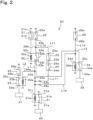
- Fig. 2 shows the control circuit for driving the PTO shaft.
- the control circuit 20 for the PTO shaft includes an on-off switch 21, a speed-changing switch 22, a parking switch 23, a posture switch 24, a key switch 25, and a seat switch 26.
- the on-off switch 21 can be shifted between an on state and an off state so as to selectively allow or disable the driving of the PTO shaft 16. For example, when the on-off switch 21 is in the on state (a contact is closed), the PTO shaft 16 is "disabled” from driving, and when the on-off switch 21 is in the off state (the contact is opened), the PTO shaft 16 is "allowed” to drive.
- the on-off switch 21 is disposed in the vicinity of the driver's seat 6 and can be operated by an operator (driver).
- the on-off switch 21 is shifted to the off state, the actuation valve 17 is shifted to a predetermined position, the PTO clutch 15 performs the first operation, and the PTO shaft 16 is driven (rotated).
- the on-off switch 21 is shifted to the on state, the actuation valve 17 is shifted to another predetermined position, the PTO clutch 15 performs the second operation, and the PTO shaft 16 stops being driven (rotated).
- the speed-changing switch 22 can be shifted between an on state and an off state so as to selectively allow or disable the speed-changing of the speed-changing device 5.
- the speed-changing switch 22 is in the on state (a contact is closed)
- the speed-changing device 5 is disabled from performing the speed-changing
- the speed-changing switch 22 is in the off state (the contact is opened)
- the speed-changing device 5 is allowed to perform the speed-changing.
- the speed-changing switch 22 is disposed in the vicinity of the driver's seat 6 and can be operated by an operator (driver).
- the speed-changing switch 22 When the speed-changing switch 22 is shifted to the off state, the speed-changing is performed according to an operation of a speed-changing operation member (e.g., a speed-changing operation switch, a speed-changing operation lever) for performing the speed-changing by operating either the main speed-changing unit 5b or the sub speed-changing unit 5c.
- a speed-changing operation member e.g., a speed-changing operation switch, a speed-changing operation lever
- the parking switch 23 is a switch to detect parking of the traveling vehicle body (vehicle body) 3. Specifically, the parking switch 23 is switchable to be on or off. When a parking (parking-brake) lever swingably supported by the vehicle body 3 is shifted to a position to brake the vehicle body 3 (a braking position), the parking switch 23 is switched to its on state (a contact is closed) in accordance with the swinging of the parking lever, and detects the parking. In addition, when the parking lever 3 is shifted to a position to release the braking of the vehicle body 3 (a releasing position), the parking switch 23 is switched to its off state (the contact is opened) in accordance with the swinging of the parking lever, and does not detect the parking.
- a parking (parking-brake) lever swingably supported by the vehicle body 3 is shifted to a position to brake the vehicle body 3 (a braking position)
- the parking switch 23 is switched to its on state (a contact is closed) in accordance with the swinging of the parking lever, and detects the parking
- the posture switch 24 is a switch to detect a state of the driver's seat 6 as shown in Fig. 3 , the posture switch 24 is a switch configured to detect whether the driver's seat 6 is in a first posture H1 to allow a driver to sit thereon or in a second posture H2 to disable the driver from sitting thereon.
- a seat portion 6a and backrest 6b of the driver's seat 6 are pivotable on a lateral axis 6c supported by the vehicle body 3 (driver's seat stand 3a).
- the posture switch 24 When the seat portion 6a is substantially parallel with an upper surface of the driver's seat stand 3a and the driver is allowed to be seated on the seat portion (in the first posture H1), the posture switch 24 is shifted to its off state, and when the seat portion 6a is substantially perpendicular to the upper surface of the driver's seat stand 3a and the driver is disabled from being seated on the seat portion (in the second posture H2), the posture switch 24 is shifted to its on state.
- the key switch 25 is shiftable to an on state to instruct starting (driving) of the prime mover 4 or to an off state. For example, when the key switch 25 is shifted to the on state (a contact is closed), the key switch 25 is in the state of instructing the driving of the prime mover 4, and when the key switch 25 is shifted to the off state (the contact is opened), the key switch 25 is in the state of not-instructing the driving of the prime mover 4.
- the key switch 25 is disposed in the vicinity of the driver's seat 6 and can be operated by an operator (driver).
- the seat switch 26 is a switch to detect the operator seated on the driver's seat 6.
- the seat switch 26 is shiftable to an on state or an off state.
- the seat switch 26 is disposed in a portion (seat portion, backrest) of the driver's seat 6, below the seat, or the like.
- the seat switch 26 is shifted to the on state (a contact is closed) to detect the seating.
- the seat switch 26 is shifted to the off state (the contact is opened) to detect that the operator is not seated on the seat.
- the control circuit 20 for the PTO shaft includes a first actuation device 31, a second actuation device 32, a third actuation device 33, a fourth actuation device 34, and a notification device 35.
- the first actuation device 31, the second actuation device 32, the third actuation device 33, and the fourth actuation device 34 are, for example, contact relays, non-contact relays, sequencers, or the like.
- the first actuation device 31 After the driving of the prime mover is started, the first actuation device 31 maintains the driving of the prime mover 4 while the parking is detected and the second posture H2 is detected, and the first actuation device 31 stops the driving of the prime mover 4 when neither the parking nor the second posture H2 is detected.
- the first actuation device 31 is the contact relay including a coil portion 31a, a switch portion 31b, a first input terminal 31c, a second input terminal 31d, and a first output terminal 31e.
- the first actuation device (relay) 31 may be a "single-stable type” relay in which the switch portion 31b is shifted to an on state when the coil portion 31a is magnetized, may be a “latching type” relay in which the switch portion 31b is shifted to the on state with the magnetization of the coil portion 31a being held (latched), or may be any other relay.
- the stopping device 40 connected to the first output terminal 31e is continuously actuated to maintain the driving of the prime mover 4.
- the first actuation device 31 does not electrically energize the coil portion 31a and the switch portion 31b is shifted to the off state (when the contact is opened), an electric power supply to the stopping device 40 is stopped, and the prime mover 4 stops.
- the stopping device 40 includes an engine-stopping solenoid, which maintains the driving of the prime mover 4 when it is magnetized (when it is supplied with electric power), and which stops the prime mover 4 when it is demagnetized (when it is not supplied with the electric power).
- the second actuation device 32 outputs the allowance signal when the driving of the PTO shaft 16 is disabled (ON) and the speed-changing switch 22 is shifted to the off state (ON).
- the second actuation device 32 is a contact relay including a coil portion 32a, a switch portion 32b, a third input terminal 32c, a fourth input terminal 32d, and a second output terminal 32e.
- the second actuation device (relay) 32 may be a single-stable type relay, a latching type relay, or any other relay.
- the second actuation device 32 When the coil portion 32a is electrically energized by electricity from the third input terminal 32c and the switch portion 32b is shifted to the on state, the second actuation device 32 connects the fourth input terminal 32d to the second output terminal 32e, and outputs, from the second output terminal 32e, the allowance signal indicated by a predetermined voltage. On the other hand, when the coil portion 32a is not electrically energized and the switch portion 32b is shifted to the off state, the second actuation device 32 connects the fourth input terminal 32d to the output terminal 32f, and outputs a notification signal.
- the third actuation device 33 is connected to the second actuation device 32 and starts the prime mover 4 when the allowance signal is input to the third actuation device 33 under an instruction to start the prime mover 4.
- the third actuation device 33 is a contact relay including a coil portion 33a, a switch portion 33b, a fifth input terminal 33c, a sixth input terminal 33d, and a third output terminal 33e.
- the third actuation device (relay) 33 may be a single-stable type relay, a latching type relay, or any other relay.
- the switch portion 33b When the coil portion 33a is electrically energized by electricity from the sixth input terminal 33d of the third actuation device 33, the switch portion 33b is shifted to the on state (a contact is closed) and a starter 41 is activated to start the prime mover 4.
- the switch portion 33b is shifted to the off state (the contact is opened), the starter 41 is not activated, and thus the prime mover 4 is not started.
- the fourth actuation device 34 is connected to the seat switch 26 and outputs a notification signal when the seat switch 26 is in the on state.
- the fourth actuation device 34 is a contact relay including a coil portion 34a, a switch portion 34b, a seventh input terminal 34c, an eighth input terminal 34d, and a fourth output terminal 34e.
- the fourth actuation device (relay) 34 may be a single-stable type relay, a latching type relay, or any other relay.
- the switch portion 34b When the coil portion 34a is electrically energized by electricity from the eighth input terminal 34d of the fourth actuation device 34, the switch portion 34b is shifted to the on state (a contact is closed), and thus no notification signal is output. On the other hand, when the coil portion 34a of the fourth actuation device 34 is not electrically energized, the switch portion 34b is shifted to the off state (the contact is opened), and then the notification signal is output from the fourth output terminal 34e.
- the notification device 35 is a device configured to execute a notification according to a predetermined condition, and is, for example, a speaker that generates sound.
- the notification device 35 outputs a notification when the notification signal output from the fourth actuation device 34 is input to the notification device 35. That is, the notification device 35 executes a notification when the input switch 21 is in the off state, the speed-changing switch 22 is in the on state, and the seat switch 26 is in the on state (the seating is detected). It is desirable that the notification device 35 includes a timer. That is, the notification device 35 generates a sound for at least several seconds after the electrically energizing of the coil portion 34a is stopped.
- the first input terminal 31c of the first actuation device 31 is connected to the second output terminal 32e of the second actuation device 32 via the first line L1.
- the second input terminal 31d of the first actuation device 31 is connected to a power supply system.
- the first output terminal 31e of the first actuation device 31 is connected to the stopping device 40.
- the input terminal 21a of the on-off switch 21 and the input terminal 22a of the speed-changing switch 22 are connected to the power supply system.
- the output terminal 21b of the on-off switch 21 is connected to the third input terminal 32c of the second actuation device 32, and the output terminal 22b of the speed-changing switch 22 is connected to the fourth input terminal 32d of the second actuation device 32.
- the second output terminal 32e of the second actuation device 32 is connected to the third actuation device 33 via a second line L2 connecting the second output terminal 32e to the sixth input terminal 33d of the third actuation device 33.
- the first line L1 includes a portion between the second output terminal 32e of the second actuation device 32 and a branching portion 39a, and the portion serves as a line (common line) shared with the second line L2.
- the power supply system is connected to the input terminal 25a of the key switch 25, and the fifth input terminal 33c of the third actuation device 33 is connected to the output terminal 25b.
- a line L11 branches, via a branch 39b, from a line L10 which connects the output terminal 22b of the speed-changing switch 22 to the fourth input terminal 32d of the second actuation device 32.
- the parking switch 23 and the posture switch 24 are connected in series to the line L11, and the line L11 is connected to the first line L1. That is, an input terminal 23a of the parking switch 23 is connected to an intermediate portion of the line L11.
- An output terminal 23b of the parking switch 23 is connected to the input terminal 24a of the posture switch 24 via the line L11.
- the output terminal 24b of the posture switch 24 is connected to the first line L1 via the line L11.
- the switch portion 31b of the first actuation device 31 can be shifted to the on state when the parking switch 23 is in the on state and the posture switch 24 is in the on state, thereby maintaining the driving of the prime mover 4.
- the output terminal 32f of the second actuation device 32 is connected to the seventh input terminal 34c of the fourth actuation device 34 via a line L13.
- the input terminal 26a of the seat switch 26 is connected to the power supply system.
- the output terminal 26b of the seat switch 26 is connected to the eighth input terminal 34d of the fourth actuation device 34 via a line L14.
- the output terminal 26b of the seat switch 26 is connected to the first line L1 via a line L15. Accordingly, also when the speed-changing device 5 is disabled from performing the speed-changing (the speed-changing switch 22 is in the on state) and the seat switch 26 is shifted to the on state, the driving of the prime mover 4 can be maintained.
- diodes 43a, 43b, and 43c each of which supplies electric current (signal) in one direction, on the line (first line) L1, line 11, and line 15, respectively.
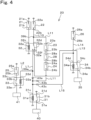
- a PTO selecting switch 28 may be provided on the line L11.
- the PTO selecting switch 28 is a switch to selectively supply the power of the PTO shaft 16 to either a front portion of the vehicle body 3 or a rear portion of the vehicle body 3.
- the PTO selecting switch 28 is in the on state (a contact is closed) when the PTO shaft 16 is set to supply power to the front, and is in the off state (the contact is opened) when the PTO shaft 16 is set to supply power to the rear.
- the input terminal 28a of the PTO selecting switch 28 is connected to the output terminal 23b of the parking switch 23, and the input terminal 28b is connected to the input terminal 24a of the posture switch 24.
- the driving of the prime mover 4 can be maintained.
- the PTO power transmission unit 5e is a clutch shiftable between an engaged state in which a power of the propulsion shaft 5a is transmitted to the PTO propulsion shaft 14 and a disengaged state in which the power of the propulsion shaft 5a is not transmitted to the PTO propulsion shaft 14; however, the PTO power transmission unit 5e may include a speed-changing mechanism configured to change a rotation speed of the PTO shaft 16 (PTO rotation speed) in multiple steps in the engaged state. For example, the PTO power transmission unit 5e switches the PTO rotation speed between the first speed, which is a low speed, and the second speed, which is a high speed.
- the on-off switch 21 can be shifted to three levels: a first speed, a second speed, and a neutral position (neutral).
- the on-off switch 21 is in the on state (a contact is closed) when in the neutral position, and is in the off state (the contact is opened) when in the first speed and the second speed.
- the working vehicle 1 includes the prime mover 4, the driver's seat 6 selectively set in either the first posture H1 where a driver can sit on the driver's seat 6 or the second posture H2 where the driver cannot sit on the driver's seat 6, the speed-changing device 5 configured to receive power from the prime mover 4 and to perform a speed-changing of the power, the PTO shaft 16 configured to receive the speed-changed power output from the speed-changing device 5, the posture switch 24 configured to detect whether the driver's seat 6 is set in the first posture H1 or the second posture H2, the parking switch 23 configured to detect parking of the vehicle body, and the first actuation device 31 configured so that, during driving of the prime mover 4, the first actuation device 31 maintains the driving of the prime mover 4 when both the parking and the driver's seat 6 set in the second posture H2 are detected, and the first actuation device 31 stops the driving of the prime mover 4 when neither the parking nor the driver's seat 6 set in the second posture H2 is detected.
- the working vehicle 1 further includes the speed-changing switch 22 configured to be turned on to allow the speed-changing performed by the speed-changing device 5, and to be turned off to disable the speed-changing device 5 from performing the speed-changing.
- the first actuation device 31 is configured to maintain the driving of the prime mover 4 when the speed-changing device 5 is turned off, and to stop the driving of the prime mover 4 when the speed-changing device 5 is turned on. According to this configuration, the driving of the prime mover 4 is stopped when the speed-changing of the speed-changing device 5 enters an on-state, while an outside work can be performed by driving the PTO shaft when the speed-changing of the speed-changing device 5 enters an off-state, that is, when the vehicle body 3 is securely parked.
- the working vehicle 1 further includes the on-off switch 21 operable to be turned on to allow driving of the PTO shaft 16, and to be turned off to disable the PTO shaft 16 from driving, the key switch operable to issue an instruction for starting of the prime mover 4, the second actuation device 32 configured to output an allowance signal when the PTO shaft 16 is disabled from driving and the speed-changing switch 22 is turned off, and the third actuation device 33 operably connected to the second actuation device 32, and configured to perform the starting of the prime mover 4 when the instruction for the starting of the prime mover 4 is issued and the allowance signal is input to the third actuation device 33.
- the prime mover 4 can be started when the PTO shaft 16 is not driven and the traveling is not performed.
- the first actuation device 31 is configured to maintain the driving of the prime mover 4 when the allowance signal is input to the first actuation device 31 during the driving of the prime mover 4. According to this configuration, when the PTO shaft is driven during the driving of the prime mover 4, the PTO shaft can be continuously driven.
- the first actuation device 31 is configured as a relay including the first input terminal 31c, the second input terminal 31d and the first output terminal 31e.
- the second actuation device 32 is configured as a relay including the third input terminal 32c, the fourth input terminal 32d and the second output terminal 32e.
- the third actuation device 33 is configured as a relay including the fifth input terminal 33c, the sixth input terminal 33d and the third output terminal 33e.
- the first line L1 connecting the first actuation device 31 and the second actuation device 32 to each other is connected to the first input terminal 31c.
- the electric source line is connected to the second input terminal 31d.
- the output terminal 21b of the on-off switch 21 is connected to the third input terminal 32c.
- the output terminal 22b of the speed-changing switch 22 is connected to the fourth input terminal 32d.
- the output terminal 25b of the key switch 25 is connected to the fifth input terminal 33c.
- the second line L2 connected to the second output terminal 32e is connected to the sixth input terminal 33d.
- the stopping device 40 for stopping the prime mover 4 is connected to the first output terminal 31e.
- the starter 41 for performing the starting of the prime mover 4 is connected to the third output terminal 33e. According to this configuration, the starting, stopping, and continuous driving of the prime mover 4 can be performed stably and reliably by a sequential operation with the relay.
- the working vehicle 1 further includes the seat switch 26 configured to detect sitting of a driver on the driver's seat 6, and the notification device 35 configured to notify information in correspondence to a predetermined condition.
- the notification device 35 notifies the information when the speed-changing switch 22 is turned off and the sitting of the driver is not detected. According to this configuration, it is easy to inform that the traveling is not being performed and a driver is not seated on the driver's seat.
Landscapes
- Engineering & Computer Science (AREA)
- Mechanical Engineering (AREA)
- Chemical & Material Sciences (AREA)
- Combustion & Propulsion (AREA)
- Transportation (AREA)
- Automation & Control Theory (AREA)
- Life Sciences & Earth Sciences (AREA)
- Soil Sciences (AREA)
- Environmental Sciences (AREA)
- Arrangement And Driving Of Transmission Devices (AREA)
- Agricultural Machines (AREA)
- Control Of Vehicle Engines Or Engines For Specific Uses (AREA)
- Auxiliary Drives, Propulsion Controls, And Safety Devices (AREA)
- Braking Elements And Transmission Devices (AREA)
- Arrangement And Mounting Of Devices That Control Transmission Of Motive Force (AREA)
Description
- The present invention relates to a working vehicle.
- A technique disclosed in Patent Document
JP2012-30616 - A tractor disclosed in
JP2012-30616 - Documents
JP 2008 063969 A EP 3 260 323 A2EP 2 412 591 A2US 2004/026150 A1 describe further known working vehicles. - In
JP2012-30616 - In view of the above-described problems, the present invention intends to provide a working vehicle that allows an operator to perform a work outside a vehicle body by driving a PTO shaft while the vehicle body is parked.
- Technical means of the invention to solve this technical problems are characterized by the following points.
- A working vehicle includes a prime mover, a driver's seat selectively set in either a first posture where a driver can sit on the driver's seat or a second posture where the driver cannot sit on the driver's seat, a speed-changing device configured to receive power from the prime mover and to perform a speed-changing of the power, a PTO shaft configured to receive the speed-changed power output from the speed-changing device, a posture switch configured to detect whether the driver's seat is set in the first posture or the second posture, a parking switch configured to detect parking of a vehicle body, and a first actuation device configured so that, during driving of the prime mover, the first actuation device maintains the driving of the prime mover when both the parking and the driver's seat set in the second posture are detected, and the first actuation device stops the driving of the prime mover when neither the parking nor the driver's seat set in the second posture is detected.
- The working vehicle further includes a speed-changing switch configured to be turned on to allow the speed-changing performed by the speed-changing device, and to be turned off to disable the speed-changing device from performing the speed-changing. The first actuation device is configured to maintain the driving of the prime mover when the speed-changing device is turned off, and to stop the driving of the prime mover when the speed-changing device is turned on.
- The working vehicle further includes an on-off switch operable to be turned on to allow driving of the PTO shaft, and to be turned off to disable the PTO shaft from driving, a key switch operable to issue an instruction for starting of the prime mover, a second actuation device configured to output an allowance signal when the PTO shaft is disabled from driving and the speed-changing switch is turned off, and a third actuation device operably connected to the second actuation device, and configured to perform the starting of the prime mover when the instruction for the starting of the prime mover is issued and the allowance signal is input to the third actuation device.
- The first actuation device is configured to maintain the driving of the prime mover when the allowance signal is input to the first actuation device during the driving of the prime mover.
- The first actuation device is configured as a relay including a first input terminal, a second input terminal and a first output terminal. The second actuation device is configured as a relay including a third input terminal, a fourth input terminal and a second output terminal. The third actuation device is configured as a relay including a fifth input terminal, a sixth input terminal and a third output terminal. A first line connecting the first actuation device and the second actuation device to each other is connected to the first input terminal. An electric source line is connected to the second input terminal. An output terminal of the on-off switch is connected to the third input terminal. An output terminal of the speed-changing switch is connected to the fourth input terminal. An output terminal of the key switch is connected to the fifth input terminal. A second line connected to the second output terminal is connected to the sixth input terminal. A stopping device for stopping the prime mover is connected to the first output terminal. A starter for performing the starting of the prime mover is connected to the third output terminal.
- The working vehicle further includes a seat switch configured to detect sitting of a driver on the driver's seat, and a notification device configured to notify information in correspondence to a predetermined condition. The notification device notifies the information when the speed-changing switch is turned off and the sitting of the driver is not detected.
- According to the present invention, an operator is capable of performing a work outside a vehicle body by driving a PTO shaft while the vehicle body is parked.
-
- Fig. 1
- is a schematic view of a whole of a transmission device.
- Fig. 2
- is a whole view of a control circuit of a PTO shaft.
- Fig. 3
- is a side view of an operator seat.
- Fig. 4
- is a whole view of a control circuit according to a modified example of
FIG. 2 . - Fig. 5
- is a whole view of a working vehicle.
- Referring to drawings, an embodiment of the present invention will be described below.
-
Fig. 5 shows an overall view of a working vehicle 1 according to this embodiment. The working vehicle 1 is not limited to a tractor, but may be an agricultural machine such as a combine harvester or a rice transplanter. - First, an overall configuration of the tractor 1 will be explained.
- As shown in
Fig. 5 , the tractor 1 includes a traveling vehicle body (hereinafter referred to as a vehicle body) 3 having wheels, aprime mover 4, and a speed-changingdevice 5. Theprime mover 4 is a diesel engine, a gasoline engine, an electric motor, or the like. In this embodiment, theprime mover 4 is the diesel engine (hereinafter referred to as an engine). - The
vehicle body 3 includes a driver'sseat 6 and acabin 7 surrounding the driver'sseat 6 at a rear portion of thevehicle body 3, a connectingportion 8 constituted of a three-point linkage mechanism or the like. A workingdevice 2 can be attached to and detached from the connectingportion 8. Theworking device 2, such as a cultivator, fertilizer applicator, chemical sprayer, or the like, can be connected to the connectingportion 8 to be towed by thevehicle body 3. - As shown in
Fig. 1 , the speed-changingdevice 5 includes a main shaft (propulsion shaft) 5a, a main speed-changingunit 5b, a sub speed-changingunit 5c, ashuttle unit 5d, and a PTOpower transmission unit 5e. Thepropulsion shaft 5a is rotatably supported by a housing case of the speed-changingdevice 5, and a power from a crankshaft of theprime mover 4 is transmitted to thepropulsion shaft 5a. The main speed-changingunit 5b includes a plurality of gears and a shifter for changing connection between the gears. The main speed-changingunit 5b appropriately changes the connection (engagement) between the plurality of gears with the shifter to change the rotation input from thepropulsion shaft 5a, thereby outputting the changed rotation (changing a speed). - Similar to the main speed-changing
unit 5b, the sub speed-changingunit 5c has a plurality of gears and a shifter for selecting which gears to be drivingly connected. The sub speed-changingunit 5c appropriately changes the connection (engagement) between the plurality of gears with the shifter to change the rotation input from the main speed-changingunit 5b, thereby outputting the changed rotation (changing a speed). - The
shuttle unit 5d includes ashuttle shaft 12 and a forward /backward-travelingswitching unit 13. A power output from the sub speed-changingunit 5c is transmitted to theshuttle shaft 12 through the gears and the like. The forward /backward-travelingswitching unit 13 is constituted of, for example, a hydraulic clutch and the like, and engages or disengages the hydraulic clutch to switch a rotational direction of theshuttle shaft 12, i.e., a traveling direction of the tractor 1 between the forward traveling and the backward traveling. - The PTO
power transmission unit 5e includes aPTO propulsion shaft 14 and a PTO clutch 15. - The
PTO propulsion shaft 14 is rotatably supported and capable of transmitting a power from thepropulsion shaft 5a. ThePTO propulsion shaft 14 is connected to thePTO shaft 16 via a gear and the like. The PTO clutch 15 is a clutch to selectively perform a first operation in which a power of thepropulsion shaft 5a is transmitted to thePTO propulsion shaft 14 or a second operation in which the power of thepropulsion shaft 5a is not transmitted to thePTO propulsion shaft 14. Specifically, the PTO clutch 15 is constituted of a hydraulic clutch and includes ahousing 15a that can rotate integrally with thePTO propulsion shaft 14, aclutch member 15b that can rotate integrally with thepropulsion shaft 5a, and apiston 15c that can be moved in thehousing 15a by hydraulic fluid. - Accordingly, when the
piston 15c is moved and theclutch member 15b is joined to thehousing 15a, the PTO clutch 15 shifts to perform the first operation, a power from theprime mover 4 is transmitted to thePTO propulsion shaft 14 via thepropulsion shaft 5a and the PTO clutch 15, and then a power of thePTO propulsion shaft 14 is transmitted to thePTO shaft 16. That is, thePTO shaft 16 is driven by the power of theprime mover 4 via the speed-changingdevice 5. On the other hand, when thepiston 15c is moved to separate theclutch member 15b from thehousing 15a, the PTO clutch 15 shifts to perform the second operation, the power of thepropulsion shaft 5a is not transmitted to thePTO propulsion shaft 14, and thus it is isolated from the power of thepropulsion shaft 5a. The transmission or disconnection of the power by the PTO clutch 15 is performed by an actuation valve 17 (switching valve) connected to thepiston 15c via a fluid passage. Apump 18 for supplying hydraulic fluid (oil) is connected to theactuation valve 17. -
Fig. 2 shows the control circuit for driving the PTO shaft. - The
control circuit 20 for the PTO shaft includes an on-off switch 21, a speed-changingswitch 22, aparking switch 23, aposture switch 24, akey switch 25, and aseat switch 26. - The on-
off switch 21 can be shifted between an on state and an off state so as to selectively allow or disable the driving of thePTO shaft 16. For example, when the on-off switch 21 is in the on state (a contact is closed), thePTO shaft 16 is "disabled" from driving, and when the on-off switch 21 is in the off state (the contact is opened), thePTO shaft 16 is "allowed" to drive. The on-off switch 21 is disposed in the vicinity of the driver'sseat 6 and can be operated by an operator (driver). When the on-off switch 21 is shifted to the off state, theactuation valve 17 is shifted to a predetermined position, the PTO clutch 15 performs the first operation, and thePTO shaft 16 is driven (rotated). On the other hand, when the on-off switch 21 is shifted to the on state, theactuation valve 17 is shifted to another predetermined position, the PTO clutch 15 performs the second operation, and thePTO shaft 16 stops being driven (rotated). - The speed-changing
switch 22 can be shifted between an on state and an off state so as to selectively allow or disable the speed-changing of the speed-changingdevice 5. When the speed-changingswitch 22 is in the on state (a contact is closed), the speed-changingdevice 5 is disabled from performing the speed-changing, and when the speed-changingswitch 22 is in the off state (the contact is opened), the speed-changingdevice 5 is allowed to perform the speed-changing. The speed-changingswitch 22 is disposed in the vicinity of the driver'sseat 6 and can be operated by an operator (driver). When the speed-changingswitch 22 is shifted to the off state, the speed-changing is performed according to an operation of a speed-changing operation member (e.g., a speed-changing operation switch, a speed-changing operation lever) for performing the speed-changing by operating either the main speed-changingunit 5b or the sub speed-changingunit 5c. When the speed-changingswitch 22 is shifted to the on state, the speed-changing is not performed even if the speed-changing operation member is operated. - The
parking switch 23 is a switch to detect parking of the traveling vehicle body (vehicle body) 3. Specifically, theparking switch 23 is switchable to be on or off. When a parking (parking-brake) lever swingably supported by thevehicle body 3 is shifted to a position to brake the vehicle body 3 (a braking position), theparking switch 23 is switched to its on state (a contact is closed) in accordance with the swinging of the parking lever, and detects the parking. In addition, when theparking lever 3 is shifted to a position to release the braking of the vehicle body 3 (a releasing position), theparking switch 23 is switched to its off state (the contact is opened) in accordance with the swinging of the parking lever, and does not detect the parking. - The
posture switch 24 is a switch to detect a state of the driver'sseat 6 as shown inFig. 3 , theposture switch 24 is a switch configured to detect whether the driver'sseat 6 is in a first posture H1 to allow a driver to sit thereon or in a second posture H2 to disable the driver from sitting thereon. Specifically, aseat portion 6a andbackrest 6b of the driver'sseat 6 are pivotable on alateral axis 6c supported by the vehicle body 3 (driver'sseat stand 3a). When theseat portion 6a is substantially parallel with an upper surface of the driver'sseat stand 3a and the driver is allowed to be seated on the seat portion (in the first posture H1), theposture switch 24 is shifted to its off state, and when theseat portion 6a is substantially perpendicular to the upper surface of the driver'sseat stand 3a and the driver is disabled from being seated on the seat portion (in the second posture H2), theposture switch 24 is shifted to its on state. - The
key switch 25 is shiftable to an on state to instruct starting (driving) of theprime mover 4 or to an off state. For example, when thekey switch 25 is shifted to the on state (a contact is closed), thekey switch 25 is in the state of instructing the driving of theprime mover 4, and when thekey switch 25 is shifted to the off state (the contact is opened), thekey switch 25 is in the state of not-instructing the driving of theprime mover 4. Thekey switch 25 is disposed in the vicinity of the driver'sseat 6 and can be operated by an operator (driver). - The
seat switch 26 is a switch to detect the operator seated on the driver'sseat 6. For example, theseat switch 26 is shiftable to an on state or an off state. Theseat switch 26 is disposed in a portion (seat portion, backrest) of the driver'sseat 6, below the seat, or the like. When the operator is seated on the seat, theseat switch 26 is shifted to the on state (a contact is closed) to detect the seating. In addition, when the operator gets off the seat, theseat switch 26 is shifted to the off state (the contact is opened) to detect that the operator is not seated on the seat. - The
control circuit 20 for the PTO shaft includes afirst actuation device 31, asecond actuation device 32, athird actuation device 33, afourth actuation device 34, and anotification device 35. Thefirst actuation device 31, thesecond actuation device 32, thethird actuation device 33, and thefourth actuation device 34 are, for example, contact relays, non-contact relays, sequencers, or the like. - After the driving of the prime mover is started, the
first actuation device 31 maintains the driving of theprime mover 4 while the parking is detected and the second posture H2 is detected, and thefirst actuation device 31 stops the driving of theprime mover 4 when neither the parking nor the second posture H2 is detected. Thefirst actuation device 31 is the contact relay including acoil portion 31a, aswitch portion 31b, afirst input terminal 31c, asecond input terminal 31d, and afirst output terminal 31e. The first actuation device (relay) 31 may be a "single-stable type" relay in which theswitch portion 31b is shifted to an on state when thecoil portion 31a is magnetized, may be a "latching type" relay in which theswitch portion 31b is shifted to the on state with the magnetization of thecoil portion 31a being held (latched), or may be any other relay. - In the
first actuation device 31, when an allowance signal, which is a predetermined voltage, electrically energizes thecoil portion 31a from thefirst input terminal 31c and then theswitch portion 31b is shifted to the on state (when the contact is closed), the stoppingdevice 40 connected to thefirst output terminal 31e is continuously actuated to maintain the driving of theprime mover 4. On the other hand, when thefirst actuation device 31 does not electrically energize thecoil portion 31a and theswitch portion 31b is shifted to the off state (when the contact is opened), an electric power supply to the stoppingdevice 40 is stopped, and theprime mover 4 stops. That is, thefirst actuation device 31 maintains the driving of theprime mover 4 when the allowance signal is input to thefirst actuation device 31 after theprime mover 4 has started to be driven. The stoppingdevice 40 includes an engine-stopping solenoid, which maintains the driving of theprime mover 4 when it is magnetized (when it is supplied with electric power), and which stops theprime mover 4 when it is demagnetized (when it is not supplied with the electric power). - The
second actuation device 32 outputs the allowance signal when the driving of thePTO shaft 16 is disabled (ON) and the speed-changingswitch 22 is shifted to the off state (ON). Thesecond actuation device 32 is a contact relay including acoil portion 32a, aswitch portion 32b, athird input terminal 32c, afourth input terminal 32d, and asecond output terminal 32e. The second actuation device (relay) 32 may be a single-stable type relay, a latching type relay, or any other relay. - When the
coil portion 32a is electrically energized by electricity from thethird input terminal 32c and theswitch portion 32b is shifted to the on state, thesecond actuation device 32 connects thefourth input terminal 32d to thesecond output terminal 32e, and outputs, from thesecond output terminal 32e, the allowance signal indicated by a predetermined voltage. On the other hand, when thecoil portion 32a is not electrically energized and theswitch portion 32b is shifted to the off state, thesecond actuation device 32 connects thefourth input terminal 32d to theoutput terminal 32f, and outputs a notification signal. - The
third actuation device 33 is connected to thesecond actuation device 32 and starts theprime mover 4 when the allowance signal is input to thethird actuation device 33 under an instruction to start theprime mover 4. Thethird actuation device 33 is a contact relay including acoil portion 33a, aswitch portion 33b, afifth input terminal 33c, asixth input terminal 33d, and athird output terminal 33e. The third actuation device (relay) 33 may be a single-stable type relay, a latching type relay, or any other relay. - When the
coil portion 33a is electrically energized by electricity from thesixth input terminal 33d of thethird actuation device 33, theswitch portion 33b is shifted to the on state (a contact is closed) and astarter 41 is activated to start theprime mover 4. On the other hand, when thecoil portion 33a of thethird actuation device 33 is not electrically energized, theswitch portion 33b is shifted to the off state (the contact is opened), thestarter 41 is not activated, and thus theprime mover 4 is not started. - The
fourth actuation device 34 is connected to theseat switch 26 and outputs a notification signal when theseat switch 26 is in the on state. Thefourth actuation device 34 is a contact relay including acoil portion 34a, aswitch portion 34b, aseventh input terminal 34c, aneighth input terminal 34d, and afourth output terminal 34e. The fourth actuation device (relay) 34 may be a single-stable type relay, a latching type relay, or any other relay. - When the
coil portion 34a is electrically energized by electricity from theeighth input terminal 34d of thefourth actuation device 34, theswitch portion 34b is shifted to the on state (a contact is closed), and thus no notification signal is output. On the other hand, when thecoil portion 34a of thefourth actuation device 34 is not electrically energized, theswitch portion 34b is shifted to the off state (the contact is opened), and then the notification signal is output from thefourth output terminal 34e. - The
notification device 35 is a device configured to execute a notification according to a predetermined condition, and is, for example, a speaker that generates sound. Thenotification device 35 outputs a notification when the notification signal output from thefourth actuation device 34 is input to thenotification device 35. That is, thenotification device 35 executes a notification when theinput switch 21 is in the off state, the speed-changingswitch 22 is in the on state, and theseat switch 26 is in the on state (the seating is detected). It is desirable that thenotification device 35 includes a timer. That is, thenotification device 35 generates a sound for at least several seconds after the electrically energizing of thecoil portion 34a is stopped. - Next, connections between the switches (on-
off switch 21, speed-changingswitch 22,parking switch 23,posture switch 24,key switch 25, seat switch 26), the actuation devices (first actuation device 31,second actuation device 32,third actuation device 33, fourth actuation device 34), and thenotification device 35 will be described. - The
first input terminal 31c of thefirst actuation device 31 is connected to thesecond output terminal 32e of thesecond actuation device 32 via the first line L1. Thesecond input terminal 31d of thefirst actuation device 31 is connected to a power supply system. Thefirst output terminal 31e of thefirst actuation device 31 is connected to the stoppingdevice 40. - The
input terminal 21a of the on-off switch 21 and theinput terminal 22a of the speed-changingswitch 22 are connected to the power supply system. Theoutput terminal 21b of the on-off switch 21 is connected to thethird input terminal 32c of thesecond actuation device 32, and theoutput terminal 22b of the speed-changingswitch 22 is connected to thefourth input terminal 32d of thesecond actuation device 32. - The
second output terminal 32e of thesecond actuation device 32 is connected to thethird actuation device 33 via a second line L2 connecting thesecond output terminal 32e to thesixth input terminal 33d of thethird actuation device 33. The first line L1 includes a portion between thesecond output terminal 32e of thesecond actuation device 32 and a branchingportion 39a, and the portion serves as a line (common line) shared with the second line L2. The power supply system is connected to theinput terminal 25a of thekey switch 25, and thefifth input terminal 33c of thethird actuation device 33 is connected to theoutput terminal 25b. - A line L11 branches, via a
branch 39b, from a line L10 which connects theoutput terminal 22b of the speed-changingswitch 22 to thefourth input terminal 32d of thesecond actuation device 32. Theparking switch 23 and theposture switch 24 are connected in series to the line L11, and the line L11 is connected to the first line L1. That is, aninput terminal 23a of theparking switch 23 is connected to an intermediate portion of the line L11. Anoutput terminal 23b of theparking switch 23 is connected to theinput terminal 24a of theposture switch 24 via the line L11. Theoutput terminal 24b of theposture switch 24 is connected to the first line L1 via the line L11. - Accordingly, even in a state where the speed-changing
device 5 is disabled from performing the speed-changing (the speed-changingswitch 22 is in the on state), theswitch portion 31b of thefirst actuation device 31 can be shifted to the on state when theparking switch 23 is in the on state and theposture switch 24 is in the on state, thereby maintaining the driving of theprime mover 4. - The
output terminal 32f of thesecond actuation device 32 is connected to theseventh input terminal 34c of thefourth actuation device 34 via a line L13. Theinput terminal 26a of theseat switch 26 is connected to the power supply system. Theoutput terminal 26b of theseat switch 26 is connected to theeighth input terminal 34d of thefourth actuation device 34 via a line L14. In addition, theoutput terminal 26b of theseat switch 26 is connected to the first line L1 via a line L15. Accordingly, also when the speed-changingdevice 5 is disabled from performing the speed-changing (the speed-changingswitch 22 is in the on state) and theseat switch 26 is shifted to the on state, the driving of theprime mover 4 can be maintained. - It is preferable to provide
diodes line 15, respectively. - As shown in
Fig. 4 , aPTO selecting switch 28 may be provided on the line L11. ThePTO selecting switch 28 is a switch to selectively supply the power of thePTO shaft 16 to either a front portion of thevehicle body 3 or a rear portion of thevehicle body 3. ThePTO selecting switch 28 is in the on state (a contact is closed) when thePTO shaft 16 is set to supply power to the front, and is in the off state (the contact is opened) when thePTO shaft 16 is set to supply power to the rear. Theinput terminal 28a of thePTO selecting switch 28 is connected to theoutput terminal 23b of theparking switch 23, and theinput terminal 28b is connected to theinput terminal 24a of theposture switch 24. - According to the above description, in a case where the
PTO selecting switch 28 is in the on state in addition to a case where thevehicle switch 23 is in the on state and theposture switch 24 is in the on state, the driving of theprime mover 4 can be maintained. - In the above-described embodiment, the PTO
power transmission unit 5e is a clutch shiftable between an engaged state in which a power of thepropulsion shaft 5a is transmitted to thePTO propulsion shaft 14 and a disengaged state in which the power of thepropulsion shaft 5a is not transmitted to thePTO propulsion shaft 14; however, the PTOpower transmission unit 5e may include a speed-changing mechanism configured to change a rotation speed of the PTO shaft 16 (PTO rotation speed) in multiple steps in the engaged state. For example, the PTOpower transmission unit 5e switches the PTO rotation speed between the first speed, which is a low speed, and the second speed, which is a high speed. In this case, the on-off switch 21 can be shifted to three levels: a first speed, a second speed, and a neutral position (neutral). In the circuits inFigs. 2 and4 , the on-off switch 21 is in the on state (a contact is closed) when in the neutral position, and is in the off state (the contact is opened) when in the first speed and the second speed. - The working vehicle 1 includes the
prime mover 4, the driver'sseat 6 selectively set in either the first posture H1 where a driver can sit on the driver'sseat 6 or the second posture H2 where the driver cannot sit on the driver'sseat 6, the speed-changingdevice 5 configured to receive power from theprime mover 4 and to perform a speed-changing of the power, thePTO shaft 16 configured to receive the speed-changed power output from the speed-changingdevice 5, theposture switch 24 configured to detect whether the driver'sseat 6 is set in the first posture H1 or the second posture H2, theparking switch 23 configured to detect parking of the vehicle body, and thefirst actuation device 31 configured so that, during driving of theprime mover 4, thefirst actuation device 31 maintains the driving of theprime mover 4 when both the parking and the driver'sseat 6 set in the second posture H2 are detected, and thefirst actuation device 31 stops the driving of theprime mover 4 when neither the parking nor the driver'sseat 6 set in the second posture H2 is detected. According to this configuration, since the driving of theprime mover 4 is continued when the driver is in the second posture H2 in which the driver cannot be seated on the driver's seat and the parking is detected, a work can be performed while the driver is outside thevehicle body 3 and thePTO shaft 16 is being driven. That is, an operator can perform the work outside the vehicle body by driving the PTO shaft while the vehicle body is parked. - The working vehicle 1 further includes the speed-changing
switch 22 configured to be turned on to allow the speed-changing performed by the speed-changingdevice 5, and to be turned off to disable the speed-changingdevice 5 from performing the speed-changing. Thefirst actuation device 31 is configured to maintain the driving of theprime mover 4 when the speed-changingdevice 5 is turned off, and to stop the driving of theprime mover 4 when the speed-changingdevice 5 is turned on. According to this configuration, the driving of theprime mover 4 is stopped when the speed-changing of the speed-changingdevice 5 enters an on-state, while an outside work can be performed by driving the PTO shaft when the speed-changing of the speed-changingdevice 5 enters an off-state, that is, when thevehicle body 3 is securely parked. - The working vehicle 1 further includes the on-
off switch 21 operable to be turned on to allow driving of thePTO shaft 16, and to be turned off to disable thePTO shaft 16 from driving, the key switch operable to issue an instruction for starting of theprime mover 4, thesecond actuation device 32 configured to output an allowance signal when thePTO shaft 16 is disabled from driving and the speed-changingswitch 22 is turned off, and thethird actuation device 33 operably connected to thesecond actuation device 32, and configured to perform the starting of theprime mover 4 when the instruction for the starting of theprime mover 4 is issued and the allowance signal is input to thethird actuation device 33. According to this configuration, theprime mover 4 can be started when thePTO shaft 16 is not driven and the traveling is not performed. - The
first actuation device 31 is configured to maintain the driving of theprime mover 4 when the allowance signal is input to thefirst actuation device 31 during the driving of theprime mover 4. According to this configuration, when the PTO shaft is driven during the driving of theprime mover 4, the PTO shaft can be continuously driven. - The
first actuation device 31 is configured as a relay including thefirst input terminal 31c, thesecond input terminal 31d and thefirst output terminal 31e. Thesecond actuation device 32 is configured as a relay including thethird input terminal 32c, thefourth input terminal 32d and thesecond output terminal 32e. Thethird actuation device 33 is configured as a relay including thefifth input terminal 33c, thesixth input terminal 33d and thethird output terminal 33e. The first line L1 connecting thefirst actuation device 31 and thesecond actuation device 32 to each other is connected to thefirst input terminal 31c. The electric source line is connected to thesecond input terminal 31d. Theoutput terminal 21b of the on-off switch 21 is connected to thethird input terminal 32c. Theoutput terminal 22b of the speed-changingswitch 22 is connected to thefourth input terminal 32d. Theoutput terminal 25b of thekey switch 25 is connected to thefifth input terminal 33c. The second line L2 connected to thesecond output terminal 32e is connected to thesixth input terminal 33d. The stoppingdevice 40 for stopping theprime mover 4 is connected to thefirst output terminal 31e. Thestarter 41 for performing the starting of theprime mover 4 is connected to thethird output terminal 33e. According to this configuration, the starting, stopping, and continuous driving of theprime mover 4 can be performed stably and reliably by a sequential operation with the relay. - The working vehicle 1 further includes the
seat switch 26 configured to detect sitting of a driver on the driver'sseat 6, and thenotification device 35 configured to notify information in correspondence to a predetermined condition. Thenotification device 35 notifies the information when the speed-changingswitch 22 is turned off and the sitting of the driver is not detected. According to this configuration, it is easy to inform that the traveling is not being performed and a driver is not seated on the driver's seat. - In the above description, the embodiment of the present invention has been explained. However, all the features of the embodiment disclosed in this application should be considered just as examples, and the embodiment does not restrict the present invention accordingly. A scope of the present invention is shown not in the above-described embodiment but in claims, and is intended to include all modifications within and equivalent to a scope of the claims.
-
- 1
- Working vehicle
- 2
- Working device
- 3
- Vehicle body
- 4
- Prime mover
- 5
- Speed-changing device
- 6
- Driver's seat
- 16
- PTO shaft
- 21
- On-off switch
- 21a
- Input terminal
- 21b
- Output terminal
- 22
- Speed-changing switch
- 22a
- Input terminal
- 22b
- Output terminal
- 23
- Parking switch
- 23a
- Input terminal
- 23b
- Output terminal
- 24
- Posture switch
- 24a
- Input terminal
- 24b
- Output terminal
- 25
- Key switch
- 25a
- Input terminal
- 25b
- Output terminal
- 26
- Seat switch
- 26a
- Input terminal
- 26b
- Output terminal
- 28a
- Input terminal
- 28b
- Output terminal
- 31
- First actuation device
- 31c
- First input terminal
- 31d
- Second input terminal
- 31e
- First output terminal
- 32
- Second actuation device
- 32c
- Third input terminal
- 32d
- Fourth input terminal
- 32e
- Second output terminal
- 32f
- Output terminal
- 33
- Third actuation device
- 33c
- Fifth input terminal
- 33d
- Sixth input terminal
- 33e
- Third output terminal
- 35
- Notification device
- 40
- Stopping device
- 41
- Starter
Claims (6)
- A working vehicle (1), comprising:- a prime mover (4);- a driver's seat (6) selectively set in either a first posture where a driver can sit on the driver's seat or a second posture where the driver cannot sit on the driver's seat;- a speed-changing device (5) configured to receive power from the prime mover and to perform a speed-changing of the power;- a PTO shaft (16) configured to receive the speed-changed power output from the speed-changing device;- a posture switch (24) configured to detect whether the driver's seat is set in the first posture or the second posture;- a parking switch (23) configured to detect parking of a vehicle body; and- a first actuation device (31) configured so that, during driving of the prime mover,- the first actuation device maintains the driving of the prime mover when both the parking and the driver's seat set in the second posture are detected, and- the first actuation device stops the driving of the prime mover when neither the parking nor the driver's seat set in the second posture is detected.
- The working vehicle according to claim 1, further comprising:- a speed-changing switch (22) configured to be turned on to allow the speed-changing performed by the speed-changing device, and to be turned off to disable the speed-changing device from performing the speed-changing,
wherein the first actuation device is configured- to maintain the driving of the prime mover when the speed-changing device is turned off, and- to stop the driving of the prime mover when the speed-changing device is turned on. - The working vehicle according to claim 2, further comprising:- an on-off switch (21) operable to be turned on to allow driving of the PTO shaft, and to be turned off to disable the PTO shaft from driving;- a key switch (25) operable to issue an instruction for starting of the prime mover; and- a second actuation device (32) configured to output an allowance signal when the PTO shaft is disabled from driving and the speed-changing switch is turned off; and- a third actuation device (33) operably connected to the second actuation device, and configured to perform the starting of the prime mover when the instruction for the starting of the prime mover is issued and the allowance signal is input to the third actuation device.
- The working vehicle according to claim 3, wherein the first actuation device is configured to maintain the driving of the prime mover when the allowance signal is input to the first actuation device during the driving of the prime mover.
- The working vehicle according to claim 4, wherein:- the first actuation device is configured as a relay including a first input terminal, a second input terminal and a first output terminal;- the second actuation device is configured as a relay including a third input terminal, a fourth input terminal and a second output terminal;- the third actuation device is configured as a relay including a fifth input terminal, a sixth input terminal and a third output terminal;- a first line connecting the first actuation device and the second actuation device to each other is connected to the first input terminal;- an electric source line is connected to the second input terminal;- an output terminal of the on-off switch is connected to the third input terminal;- an output terminal of the speed-changing switch is connected to the fourth input terminal;- an output terminal of the key switch is connected to the fifth input terminal;- a second line connected to the second output terminal is connected to the sixth input terminal;- a stopping device (40) for stopping the prime mover is connected to the first output terminal; and- a starter (41) for performing the starting of the prime mover is connected to the third output terminal.
- The working vehicle according to any one of claims 2 to 5, further comprising:- a seat switch (26) configured to detect sitting of a driver on the driver's seat; and- a notification device (35) configured to notify information in correspondence to a predetermined condition,wherein the notification device notifies the information when the speed-changing switch is turned off and the sitting of the driver is not detected.
Applications Claiming Priority (2)
| Application Number | Priority Date | Filing Date | Title |
|---|---|---|---|
| JP2019122527A JP7234056B2 (en) | 2019-06-28 | 2019-06-28 | work vehicle |
| PCT/JP2020/024419 WO2020262305A1 (en) | 2019-06-28 | 2020-06-22 | Work vehicle |
Publications (3)
| Publication Number | Publication Date |
|---|---|
| EP3991535A1 EP3991535A1 (en) | 2022-05-04 |
| EP3991535A4 EP3991535A4 (en) | 2023-07-26 |
| EP3991535B1 true EP3991535B1 (en) | 2025-01-15 |
Family
ID=74059963
Family Applications (1)
| Application Number | Title | Priority Date | Filing Date |
|---|---|---|---|
| EP20831179.5A Active EP3991535B1 (en) | 2019-06-28 | 2020-06-22 | Work vehicle |
Country Status (5)
| Country | Link |
|---|---|
| US (1) | US11926211B2 (en) |
| EP (1) | EP3991535B1 (en) |
| JP (1) | JP7234056B2 (en) |
| CN (1) | CN113924224B (en) |
| WO (1) | WO2020262305A1 (en) |
Family Cites Families (16)
| Publication number | Priority date | Publication date | Assignee | Title |
|---|---|---|---|---|
| JPH082447Y2 (en) * | 1990-09-20 | 1996-01-29 | 本田技研工業株式会社 | Operation control device for work vehicle |
| JP3953382B2 (en) * | 2002-08-06 | 2007-08-08 | 株式会社クボタ | Engine automatic stop release structure for work equipment |
| JP4664881B2 (en) * | 2006-09-05 | 2011-04-06 | ヤンマー株式会社 | Work vehicle |
| JP4859856B2 (en) * | 2008-02-27 | 2012-01-25 | 三菱重工業株式会社 | Industrial vehicle control device and industrial vehicle equipped with the device |
| JP2011017272A (en) * | 2009-07-08 | 2011-01-27 | Yanmar Co Ltd | Engine control device for working vehicle |
| JP2011116145A (en) * | 2009-10-30 | 2011-06-16 | Imasen Electric Ind Co Ltd | Automobile antitheft device |
| JP5337113B2 (en) * | 2010-07-28 | 2013-11-06 | 株式会社クボタ | Tractor |
| JP2013148036A (en) * | 2012-01-20 | 2013-08-01 | Mitsubishi Agricultural Machinery Co Ltd | Engine control device of working vehicle |
| JP5811148B2 (en) * | 2013-07-11 | 2015-11-11 | トヨタ自動車株式会社 | Vehicle with regenerative generator |
| JP6150081B2 (en) * | 2015-05-12 | 2017-06-21 | トヨタ自動車株式会社 | Vehicle control device |
| US9714706B1 (en) * | 2016-06-20 | 2017-07-25 | Ford Global Technologies, Llc | Driver interface with inferred park logic |
| US10632841B2 (en) * | 2016-06-22 | 2020-04-28 | Kubota Corporation | Drive device for PTO shaft of working machine |
| JP6713633B2 (en) * | 2016-12-05 | 2020-06-24 | ヤンマーパワーテクノロジー株式会社 | Tractor |
| US10919518B2 (en) * | 2017-03-09 | 2021-02-16 | Ford Global Technologies, Llc | Methods and system for improving hybrid vehicle transmission gear shifting |
| US10399440B2 (en) * | 2017-06-15 | 2019-09-03 | Ford Global Technologies, Llc | Methods and system for regenerative hybrid vehicle braking |
| KR102566904B1 (en) * | 2017-06-26 | 2023-08-16 | 가부시끼 가이샤 구보다 | Display apparatus included in work machine |
-
2019
- 2019-06-28 JP JP2019122527A patent/JP7234056B2/en active Active
-
2020
- 2020-06-22 CN CN202080040958.7A patent/CN113924224B/en active Active
- 2020-06-22 WO PCT/JP2020/024419 patent/WO2020262305A1/en not_active Ceased
- 2020-06-22 EP EP20831179.5A patent/EP3991535B1/en active Active
-
2021
- 2021-12-09 US US17/546,145 patent/US11926211B2/en active Active
Also Published As
| Publication number | Publication date |
|---|---|
| EP3991535A4 (en) | 2023-07-26 |
| US11926211B2 (en) | 2024-03-12 |
| CN113924224A (en) | 2022-01-11 |
| JP2021008845A (en) | 2021-01-28 |
| CN113924224B (en) | 2024-07-19 |
| US20220097520A1 (en) | 2022-03-31 |
| WO2020262305A1 (en) | 2020-12-30 |
| EP3991535A1 (en) | 2022-05-04 |
| JP7234056B2 (en) | 2023-03-07 |
Similar Documents
| Publication | Publication Date | Title |
|---|---|---|
| US11472285B2 (en) | Drive device for PTO shaft of working machine | |
| US9421958B2 (en) | Braking system for a work vehicle | |
| US6720679B2 (en) | Interlock circuit for a working vehicle | |
| US20040255706A1 (en) | Transmission shift control for selecting forward, reverse, neutral and park, and method of operation of the same | |
| JP2017226324A (en) | Drive device for PTO shaft in work machine | |
| US11745584B2 (en) | PTO shaft driving device in working machine | |
| EP1380488A2 (en) | Vacuum actuated direction and speed control mechanism | |
| EP3991535B1 (en) | Work vehicle | |
| US20150327426A1 (en) | Working vehicle | |
| JP4556368B2 (en) | Shift control device for transmission | |
| JP2004190636A (en) | Tractor engine control device | |
| WO2018173115A1 (en) | Work vehicle and method for controlling work vehicle | |
| JP6599288B2 (en) | Drive device for PTO shaft in work machine | |
| JP3766464B2 (en) | Power transmission activation and neutralization system | |
| US12054200B2 (en) | Working vehicle | |
| JPH01101235A (en) | Operation control device for riding type work equipment | |
| RU2509940C2 (en) | Relay of control system of gearbox switching | |
| JP4132613B2 (en) | Engine operation restriction device for work vehicle | |
| JPS6227734Y2 (en) | ||
| JPH084347Y2 (en) | On-vehicle work equipment moving device | |
| JP2001059571A (en) | Tractor traveling transmission | |
| JP2577189Y2 (en) | Tractor transmission | |
| JP2003293917A (en) | Work vehicle engine starter | |
| JP2001328465A (en) | Control method for engine | |
| JPH10122362A (en) | Electric shift type power shift transmission |
Legal Events
| Date | Code | Title | Description |
|---|---|---|---|
| STAA | Information on the status of an ep patent application or granted ep patent |
Free format text: STATUS: THE INTERNATIONAL PUBLICATION HAS BEEN MADE |
|
| PUAI | Public reference made under article 153(3) epc to a published international application that has entered the european phase |
Free format text: ORIGINAL CODE: 0009012 |
|
| STAA | Information on the status of an ep patent application or granted ep patent |
Free format text: STATUS: REQUEST FOR EXAMINATION WAS MADE |
|
| 17P | Request for examination filed |
Effective date: 20211208 |
|
| AK | Designated contracting states |
Kind code of ref document: A1 Designated state(s): AL AT BE BG CH CY CZ DE DK EE ES FI FR GB GR HR HU IE IS IT LI LT LU LV MC MK MT NL NO PL PT RO RS SE SI SK SM TR |
|
| DAV | Request for validation of the european patent (deleted) | ||
| DAX | Request for extension of the european patent (deleted) | ||
| REG | Reference to a national code |
Ref country code: DE Free format text: PREVIOUS MAIN CLASS: A01B0071020000 Ref country code: DE Ref legal event code: R079 Ref document number: 602020044930 Country of ref document: DE Free format text: PREVIOUS MAIN CLASS: A01B0071020000 Ipc: B60K0017280000 |
|
| A4 | Supplementary search report drawn up and despatched |
Effective date: 20230627 |
|
| RIC1 | Information provided on ipc code assigned before grant |
Ipc: B60W 30/188 20120101ALI20230621BHEP Ipc: B60W 30/18 20120101ALI20230621BHEP Ipc: B60W 10/30 20060101ALI20230621BHEP Ipc: B60W 10/11 20120101ALI20230621BHEP Ipc: B60W 10/06 20060101ALI20230621BHEP Ipc: B60T 7/02 20060101ALI20230621BHEP Ipc: B60K 28/04 20060101ALI20230621BHEP Ipc: F02D 29/00 20060101ALI20230621BHEP Ipc: A01B 71/02 20060101ALI20230621BHEP Ipc: B60K 17/28 20060101AFI20230621BHEP |
|
| GRAP | Despatch of communication of intention to grant a patent |
Free format text: ORIGINAL CODE: EPIDOSNIGR1 |
|
| STAA | Information on the status of an ep patent application or granted ep patent |
Free format text: STATUS: GRANT OF PATENT IS INTENDED |
|
| INTG | Intention to grant announced |
Effective date: 20240408 |
|
| GRAJ | Information related to disapproval of communication of intention to grant by the applicant or resumption of examination proceedings by the epo deleted |
Free format text: ORIGINAL CODE: EPIDOSDIGR1 |
|
| STAA | Information on the status of an ep patent application or granted ep patent |
Free format text: STATUS: REQUEST FOR EXAMINATION WAS MADE |
|
| INTC | Intention to grant announced (deleted) | ||
| GRAP | Despatch of communication of intention to grant a patent |
Free format text: ORIGINAL CODE: EPIDOSNIGR1 |
|
| STAA | Information on the status of an ep patent application or granted ep patent |
Free format text: STATUS: GRANT OF PATENT IS INTENDED |
|
| INTG | Intention to grant announced |
Effective date: 20240912 |
|
| GRAS | Grant fee paid |
Free format text: ORIGINAL CODE: EPIDOSNIGR3 |
|
| GRAA | (expected) grant |
Free format text: ORIGINAL CODE: 0009210 |
|
| STAA | Information on the status of an ep patent application or granted ep patent |
Free format text: STATUS: THE PATENT HAS BEEN GRANTED |
|
| AK | Designated contracting states |
Kind code of ref document: B1 Designated state(s): AL AT BE BG CH CY CZ DE DK EE ES FI FR GB GR HR HU IE IS IT LI LT LU LV MC MK MT NL NO PL PT RO RS SE SI SK SM TR |
|
| REG | Reference to a national code |
Ref country code: CH Ref legal event code: EP Ref country code: GB Ref legal event code: FG4D |
|
| P01 | Opt-out of the competence of the unified patent court (upc) registered |
Free format text: CASE NUMBER: APP_67008/2024 Effective date: 20241218 |
|
| REG | Reference to a national code |
Ref country code: DE Ref legal event code: R096 Ref document number: 602020044930 Country of ref document: DE |
|
| REG | Reference to a national code |
Ref country code: IE Ref legal event code: FG4D |
|
| REG | Reference to a national code |
Ref country code: NL Ref legal event code: MP Effective date: 20250115 |
|
| PG25 | Lapsed in a contracting state [announced via postgrant information from national office to epo] |
Ref country code: NL Free format text: LAPSE BECAUSE OF FAILURE TO SUBMIT A TRANSLATION OF THE DESCRIPTION OR TO PAY THE FEE WITHIN THE PRESCRIBED TIME-LIMIT Effective date: 20250115 |
|
| PG25 | Lapsed in a contracting state [announced via postgrant information from national office to epo] |
Ref country code: RS Free format text: LAPSE BECAUSE OF FAILURE TO SUBMIT A TRANSLATION OF THE DESCRIPTION OR TO PAY THE FEE WITHIN THE PRESCRIBED TIME-LIMIT Effective date: 20250415 |
|
| PG25 | Lapsed in a contracting state [announced via postgrant information from national office to epo] |
Ref country code: FI Free format text: LAPSE BECAUSE OF FAILURE TO SUBMIT A TRANSLATION OF THE DESCRIPTION OR TO PAY THE FEE WITHIN THE PRESCRIBED TIME-LIMIT Effective date: 20250115 |
|
| PG25 | Lapsed in a contracting state [announced via postgrant information from national office to epo] |
Ref country code: PL Free format text: LAPSE BECAUSE OF FAILURE TO SUBMIT A TRANSLATION OF THE DESCRIPTION OR TO PAY THE FEE WITHIN THE PRESCRIBED TIME-LIMIT Effective date: 20250115 |
|
| PGFP | Annual fee paid to national office [announced via postgrant information from national office to epo] |
Ref country code: DE Payment date: 20250626 Year of fee payment: 6 |
|
| PG25 | Lapsed in a contracting state [announced via postgrant information from national office to epo] |
Ref country code: ES Free format text: LAPSE BECAUSE OF FAILURE TO SUBMIT A TRANSLATION OF THE DESCRIPTION OR TO PAY THE FEE WITHIN THE PRESCRIBED TIME-LIMIT Effective date: 20250115 |
|
| REG | Reference to a national code |
Ref country code: LT Ref legal event code: MG9D |
|
| PG25 | Lapsed in a contracting state [announced via postgrant information from national office to epo] |
Ref country code: NO Free format text: LAPSE BECAUSE OF FAILURE TO SUBMIT A TRANSLATION OF THE DESCRIPTION OR TO PAY THE FEE WITHIN THE PRESCRIBED TIME-LIMIT Effective date: 20250415 Ref country code: IS Free format text: LAPSE BECAUSE OF FAILURE TO SUBMIT A TRANSLATION OF THE DESCRIPTION OR TO PAY THE FEE WITHIN THE PRESCRIBED TIME-LIMIT Effective date: 20250515 |
|
| REG | Reference to a national code |
Ref country code: AT Ref legal event code: MK05 Ref document number: 1759657 Country of ref document: AT Kind code of ref document: T Effective date: 20250115 |
|
| PG25 | Lapsed in a contracting state [announced via postgrant information from national office to epo] |
Ref country code: HR Free format text: LAPSE BECAUSE OF FAILURE TO SUBMIT A TRANSLATION OF THE DESCRIPTION OR TO PAY THE FEE WITHIN THE PRESCRIBED TIME-LIMIT Effective date: 20250115 |
|
| PG25 | Lapsed in a contracting state [announced via postgrant information from national office to epo] |
Ref country code: LV Free format text: LAPSE BECAUSE OF FAILURE TO SUBMIT A TRANSLATION OF THE DESCRIPTION OR TO PAY THE FEE WITHIN THE PRESCRIBED TIME-LIMIT Effective date: 20250115 Ref country code: PT Free format text: LAPSE BECAUSE OF FAILURE TO SUBMIT A TRANSLATION OF THE DESCRIPTION OR TO PAY THE FEE WITHIN THE PRESCRIBED TIME-LIMIT Effective date: 20250515 |
|
| PGFP | Annual fee paid to national office [announced via postgrant information from national office to epo] |
Ref country code: FR Payment date: 20250624 Year of fee payment: 6 |
|
| PG25 | Lapsed in a contracting state [announced via postgrant information from national office to epo] |
Ref country code: BG Free format text: LAPSE BECAUSE OF FAILURE TO SUBMIT A TRANSLATION OF THE DESCRIPTION OR TO PAY THE FEE WITHIN THE PRESCRIBED TIME-LIMIT Effective date: 20250115 Ref country code: GR Free format text: LAPSE BECAUSE OF FAILURE TO SUBMIT A TRANSLATION OF THE DESCRIPTION OR TO PAY THE FEE WITHIN THE PRESCRIBED TIME-LIMIT Effective date: 20250416 |
|
| PG25 | Lapsed in a contracting state [announced via postgrant information from national office to epo] |
Ref country code: AT Free format text: LAPSE BECAUSE OF FAILURE TO SUBMIT A TRANSLATION OF THE DESCRIPTION OR TO PAY THE FEE WITHIN THE PRESCRIBED TIME-LIMIT Effective date: 20250115 |
|
| PG25 | Lapsed in a contracting state [announced via postgrant information from national office to epo] |
Ref country code: SE Free format text: LAPSE BECAUSE OF FAILURE TO SUBMIT A TRANSLATION OF THE DESCRIPTION OR TO PAY THE FEE WITHIN THE PRESCRIBED TIME-LIMIT Effective date: 20250115 |
|
| PG25 | Lapsed in a contracting state [announced via postgrant information from national office to epo] |
Ref country code: SM Free format text: LAPSE BECAUSE OF FAILURE TO SUBMIT A TRANSLATION OF THE DESCRIPTION OR TO PAY THE FEE WITHIN THE PRESCRIBED TIME-LIMIT Effective date: 20250115 |
|
| PG25 | Lapsed in a contracting state [announced via postgrant information from national office to epo] |
Ref country code: DK Free format text: LAPSE BECAUSE OF FAILURE TO SUBMIT A TRANSLATION OF THE DESCRIPTION OR TO PAY THE FEE WITHIN THE PRESCRIBED TIME-LIMIT Effective date: 20250115 |
|
| PG25 | Lapsed in a contracting state [announced via postgrant information from national office to epo] |
Ref country code: IT Free format text: LAPSE BECAUSE OF FAILURE TO SUBMIT A TRANSLATION OF THE DESCRIPTION OR TO PAY THE FEE WITHIN THE PRESCRIBED TIME-LIMIT Effective date: 20250115 |
|
| REG | Reference to a national code |
Ref country code: DE Ref legal event code: R097 Ref document number: 602020044930 Country of ref document: DE |
|
| PG25 | Lapsed in a contracting state [announced via postgrant information from national office to epo] |
Ref country code: CZ Free format text: LAPSE BECAUSE OF FAILURE TO SUBMIT A TRANSLATION OF THE DESCRIPTION OR TO PAY THE FEE WITHIN THE PRESCRIBED TIME-LIMIT Effective date: 20250115 Ref country code: EE Free format text: LAPSE BECAUSE OF FAILURE TO SUBMIT A TRANSLATION OF THE DESCRIPTION OR TO PAY THE FEE WITHIN THE PRESCRIBED TIME-LIMIT Effective date: 20250115 |
|
| PG25 | Lapsed in a contracting state [announced via postgrant information from national office to epo] |
Ref country code: RO Free format text: LAPSE BECAUSE OF FAILURE TO SUBMIT A TRANSLATION OF THE DESCRIPTION OR TO PAY THE FEE WITHIN THE PRESCRIBED TIME-LIMIT Effective date: 20250115 |
|
| PG25 | Lapsed in a contracting state [announced via postgrant information from national office to epo] |
Ref country code: SK Free format text: LAPSE BECAUSE OF FAILURE TO SUBMIT A TRANSLATION OF THE DESCRIPTION OR TO PAY THE FEE WITHIN THE PRESCRIBED TIME-LIMIT Effective date: 20250115 |
|
| PLBE | No opposition filed within time limit |
Free format text: ORIGINAL CODE: 0009261 |
|
| STAA | Information on the status of an ep patent application or granted ep patent |
Free format text: STATUS: NO OPPOSITION FILED WITHIN TIME LIMIT |
|
| REG | Reference to a national code |
Ref country code: CH Ref legal event code: L10 Free format text: ST27 STATUS EVENT CODE: U-0-0-L10-L00 (AS PROVIDED BY THE NATIONAL OFFICE) Effective date: 20251126 |
|
| 26N | No opposition filed |
Effective date: 20251016 |
|
| REG | Reference to a national code |
Ref country code: CH Ref legal event code: H13 Free format text: ST27 STATUS EVENT CODE: U-0-0-H10-H13 (AS PROVIDED BY THE NATIONAL OFFICE) Effective date: 20260127 |
|
| PG25 | Lapsed in a contracting state [announced via postgrant information from national office to epo] |
Ref country code: MC Free format text: LAPSE BECAUSE OF FAILURE TO SUBMIT A TRANSLATION OF THE DESCRIPTION OR TO PAY THE FEE WITHIN THE PRESCRIBED TIME-LIMIT Effective date: 20250115 |
|
| PG25 | Lapsed in a contracting state [announced via postgrant information from national office to epo] |
Ref country code: LU Free format text: LAPSE BECAUSE OF NON-PAYMENT OF DUE FEES Effective date: 20250622 |
|
| GBPC | Gb: european patent ceased through non-payment of renewal fee |
Effective date: 20250622 |
|
| REG | Reference to a national code |
Ref country code: BE Ref legal event code: MM Effective date: 20250630 |
|
| PG25 | Lapsed in a contracting state [announced via postgrant information from national office to epo] |
Ref country code: GB Free format text: LAPSE BECAUSE OF NON-PAYMENT OF DUE FEES Effective date: 20250622 |
|
| PG25 | Lapsed in a contracting state [announced via postgrant information from national office to epo] |
Ref country code: IE Free format text: LAPSE BECAUSE OF NON-PAYMENT OF DUE FEES Effective date: 20250622 |
|
| PG25 | Lapsed in a contracting state [announced via postgrant information from national office to epo] |
Ref country code: BE Free format text: LAPSE BECAUSE OF NON-PAYMENT OF DUE FEES Effective date: 20250630 |
|
| PG25 | Lapsed in a contracting state [announced via postgrant information from national office to epo] |
Ref country code: CH Free format text: LAPSE BECAUSE OF NON-PAYMENT OF DUE FEES Effective date: 20250630 |