EP3991518B1 - Energy management system and method for a kitchen appliance - Google Patents
Energy management system and method for a kitchen appliance Download PDFInfo
- Publication number
- EP3991518B1 EP3991518B1 EP20832481.4A EP20832481A EP3991518B1 EP 3991518 B1 EP3991518 B1 EP 3991518B1 EP 20832481 A EP20832481 A EP 20832481A EP 3991518 B1 EP3991518 B1 EP 3991518B1
- Authority
- EP
- European Patent Office
- Prior art keywords
- battery
- energy
- controller
- energy storage
- storage system
- Prior art date
- Legal status (The legal status is an assumption and is not a legal conclusion. Google has not performed a legal analysis and makes no representation as to the accuracy of the status listed.)
- Active
Links
Images



Classifications
-
- H—ELECTRICITY
- H02—GENERATION; CONVERSION OR DISTRIBUTION OF ELECTRIC POWER
- H02J—ELECTRIC POWER NETWORKS; CIRCUIT ARRANGEMENTS OR SYSTEMS FOR SUPPLYING OR DISTRIBUTING ELECTRIC POWER; SYSTEMS FOR STORING ELECTRIC ENERGY
- H02J7/00—Circuit arrangements for charging or discharging batteries or for supplying loads from batteries
- H02J7/90—Regulation of charging or discharging current or voltage
- H02J7/96—Regulation of charging or discharging current or voltage in response to battery voltage
-
- A—HUMAN NECESSITIES
- A47—FURNITURE; DOMESTIC ARTICLES OR APPLIANCES; COFFEE MILLS; SPICE MILLS; SUCTION CLEANERS IN GENERAL
- A47J—KITCHEN EQUIPMENT; COFFEE MILLS; SPICE MILLS; APPARATUS FOR MAKING BEVERAGES
- A47J27/00—Cooking-vessels
- A47J27/21—Water-boiling vessels, e.g. kettles
- A47J27/21008—Water-boiling vessels, e.g. kettles electrically heated
-
- A—HUMAN NECESSITIES
- A47—FURNITURE; DOMESTIC ARTICLES OR APPLIANCES; COFFEE MILLS; SPICE MILLS; SUCTION CLEANERS IN GENERAL
- A47J—KITCHEN EQUIPMENT; COFFEE MILLS; SPICE MILLS; APPARATUS FOR MAKING BEVERAGES
- A47J27/00—Cooking-vessels
- A47J27/21—Water-boiling vessels, e.g. kettles
- A47J27/21008—Water-boiling vessels, e.g. kettles electrically heated
- A47J27/2105—Water-boiling vessels, e.g. kettles electrically heated of the cordless type, i.e. whereby the water vessel can be plugged into an electrically-powered base element
-
- A—HUMAN NECESSITIES
- A47—FURNITURE; DOMESTIC ARTICLES OR APPLIANCES; COFFEE MILLS; SPICE MILLS; SUCTION CLEANERS IN GENERAL
- A47J—KITCHEN EQUIPMENT; COFFEE MILLS; SPICE MILLS; APPARATUS FOR MAKING BEVERAGES
- A47J27/00—Cooking-vessels
- A47J27/21—Water-boiling vessels, e.g. kettles
- A47J27/21008—Water-boiling vessels, e.g. kettles electrically heated
- A47J27/21058—Control devices to avoid overheating, i.e. "dry" boiling, or to detect boiling of the water
- A47J27/21091—Control devices to avoid overheating, i.e. "dry" boiling, or to detect boiling of the water of electronic type
-
- H—ELECTRICITY
- H02—GENERATION; CONVERSION OR DISTRIBUTION OF ELECTRIC POWER
- H02J—ELECTRIC POWER NETWORKS; CIRCUIT ARRANGEMENTS OR SYSTEMS FOR SUPPLYING OR DISTRIBUTING ELECTRIC POWER; SYSTEMS FOR STORING ELECTRIC ENERGY
- H02J7/00—Circuit arrangements for charging or discharging batteries or for supplying loads from batteries
- H02J7/50—Circuit arrangements for charging or discharging batteries or for supplying loads from batteries acting upon multiple batteries simultaneously or sequentially
- H02J7/52—Circuit arrangements for charging or discharging batteries or for supplying loads from batteries acting upon multiple batteries simultaneously or sequentially for charge balancing, e.g. equalisation of charge between batteries
-
- H—ELECTRICITY
- H02—GENERATION; CONVERSION OR DISTRIBUTION OF ELECTRIC POWER
- H02J—ELECTRIC POWER NETWORKS; CIRCUIT ARRANGEMENTS OR SYSTEMS FOR SUPPLYING OR DISTRIBUTING ELECTRIC POWER; SYSTEMS FOR STORING ELECTRIC ENERGY
- H02J7/00—Circuit arrangements for charging or discharging batteries or for supplying loads from batteries
- H02J7/80—Circuit arrangements for charging or discharging batteries or for supplying loads from batteries including monitoring or indicating arrangements
- H02J7/82—Control of state of charge [SOC]
-
- H—ELECTRICITY
- H02—GENERATION; CONVERSION OR DISTRIBUTION OF ELECTRIC POWER
- H02J—ELECTRIC POWER NETWORKS; CIRCUIT ARRANGEMENTS OR SYSTEMS FOR SUPPLYING OR DISTRIBUTING ELECTRIC POWER; SYSTEMS FOR STORING ELECTRIC ENERGY
- H02J7/00—Circuit arrangements for charging or discharging batteries or for supplying loads from batteries
- H02J7/80—Circuit arrangements for charging or discharging batteries or for supplying loads from batteries including monitoring or indicating arrangements
- H02J7/84—Control of state of health [SOH]
-
- H—ELECTRICITY
- H02—GENERATION; CONVERSION OR DISTRIBUTION OF ELECTRIC POWER
- H02J—ELECTRIC POWER NETWORKS; CIRCUIT ARRANGEMENTS OR SYSTEMS FOR SUPPLYING OR DISTRIBUTING ELECTRIC POWER; SYSTEMS FOR STORING ELECTRIC ENERGY
- H02J7/00—Circuit arrangements for charging or discharging batteries or for supplying loads from batteries
- H02J7/855—Circuit arrangements for charging or discharging batteries or for supplying loads from batteries with circuits adapted for supplying loads from the battery
-
- H—ELECTRICITY
- H02—GENERATION; CONVERSION OR DISTRIBUTION OF ELECTRIC POWER
- H02J—ELECTRIC POWER NETWORKS; CIRCUIT ARRANGEMENTS OR SYSTEMS FOR SUPPLYING OR DISTRIBUTING ELECTRIC POWER; SYSTEMS FOR STORING ELECTRIC ENERGY
- H02J7/00—Circuit arrangements for charging or discharging batteries or for supplying loads from batteries
- H02J7/90—Regulation of charging or discharging current or voltage
-
- H—ELECTRICITY
- H02—GENERATION; CONVERSION OR DISTRIBUTION OF ELECTRIC POWER
- H02J—ELECTRIC POWER NETWORKS; CIRCUIT ARRANGEMENTS OR SYSTEMS FOR SUPPLYING OR DISTRIBUTING ELECTRIC POWER; SYSTEMS FOR STORING ELECTRIC ENERGY
- H02J7/00—Circuit arrangements for charging or discharging batteries or for supplying loads from batteries
- H02J7/90—Regulation of charging or discharging current or voltage
- H02J7/933—Regulation of charging or discharging current or voltage the cycle being controlled or terminated in response to electric parameters
-
- H—ELECTRICITY
- H02—GENERATION; CONVERSION OR DISTRIBUTION OF ELECTRIC POWER
- H02J—ELECTRIC POWER NETWORKS; CIRCUIT ARRANGEMENTS OR SYSTEMS FOR SUPPLYING OR DISTRIBUTING ELECTRIC POWER; SYSTEMS FOR STORING ELECTRIC ENERGY
- H02J7/00—Circuit arrangements for charging or discharging batteries or for supplying loads from batteries
- H02J7/90—Regulation of charging or discharging current or voltage
- H02J7/94—Regulation of charging or discharging current or voltage in response to battery current
-
- H—ELECTRICITY
- H02—GENERATION; CONVERSION OR DISTRIBUTION OF ELECTRIC POWER
- H02J—ELECTRIC POWER NETWORKS; CIRCUIT ARRANGEMENTS OR SYSTEMS FOR SUPPLYING OR DISTRIBUTING ELECTRIC POWER; SYSTEMS FOR STORING ELECTRIC ENERGY
- H02J7/00—Circuit arrangements for charging or discharging batteries or for supplying loads from batteries
- H02J7/90—Regulation of charging or discharging current or voltage
- H02J7/971—Regulation of charging or discharging current or voltage the charge cycle being controlled or terminated in response to non-electric parameters
- H02J7/975—Regulation of charging or discharging current or voltage the charge cycle being controlled or terminated in response to non-electric parameters in response to temperature
- H02J7/977—Regulation of charging or discharging current or voltage the charge cycle being controlled or terminated in response to non-electric parameters in response to temperature of the battery
-
- H—ELECTRICITY
- H02—GENERATION; CONVERSION OR DISTRIBUTION OF ELECTRIC POWER
- H02J—ELECTRIC POWER NETWORKS; CIRCUIT ARRANGEMENTS OR SYSTEMS FOR SUPPLYING OR DISTRIBUTING ELECTRIC POWER; SYSTEMS FOR STORING ELECTRIC ENERGY
- H02J2105/00—Networks for supplying or distributing electric power characterised by their spatial reach or by the load
- H02J2105/40—Networks for supplying or distributing electric power characterised by their spatial reach or by the load characterised by the loads connecting to the networks or being supplied by the networks
- H02J2105/42—Home appliances
-
- H—ELECTRICITY
- H02—GENERATION; CONVERSION OR DISTRIBUTION OF ELECTRIC POWER
- H02J—ELECTRIC POWER NETWORKS; CIRCUIT ARRANGEMENTS OR SYSTEMS FOR SUPPLYING OR DISTRIBUTING ELECTRIC POWER; SYSTEMS FOR STORING ELECTRIC ENERGY
- H02J2207/00—Details of circuit arrangements for charging or discharging batteries or supplying loads from batteries
- H02J2207/10—Control circuit supply, e.g. means for supplying power to the control circuit
-
- H—ELECTRICITY
- H02—GENERATION; CONVERSION OR DISTRIBUTION OF ELECTRIC POWER
- H02J—ELECTRIC POWER NETWORKS; CIRCUIT ARRANGEMENTS OR SYSTEMS FOR SUPPLYING OR DISTRIBUTING ELECTRIC POWER; SYSTEMS FOR STORING ELECTRIC ENERGY
- H02J2207/00—Details of circuit arrangements for charging or discharging batteries or supplying loads from batteries
- H02J2207/50—Charging of capacitors, supercapacitors, ultra-capacitors or double layer capacitors
-
- H—ELECTRICITY
- H02—GENERATION; CONVERSION OR DISTRIBUTION OF ELECTRIC POWER
- H02J—ELECTRIC POWER NETWORKS; CIRCUIT ARRANGEMENTS OR SYSTEMS FOR SUPPLYING OR DISTRIBUTING ELECTRIC POWER; SYSTEMS FOR STORING ELECTRIC ENERGY
- H02J7/00—Circuit arrangements for charging or discharging batteries or for supplying loads from batteries
- H02J7/02—Circuit arrangements for charging or discharging batteries or for supplying loads from batteries for charging batteries from AC mains by converters
-
- H—ELECTRICITY
- H02—GENERATION; CONVERSION OR DISTRIBUTION OF ELECTRIC POWER
- H02J—ELECTRIC POWER NETWORKS; CIRCUIT ARRANGEMENTS OR SYSTEMS FOR SUPPLYING OR DISTRIBUTING ELECTRIC POWER; SYSTEMS FOR STORING ELECTRIC ENERGY
- H02J7/00—Circuit arrangements for charging or discharging batteries or for supplying loads from batteries
- H02J7/40—Circuit arrangements for charging or discharging batteries or for supplying loads from batteries characterised by the exchange of charge or discharge related data
-
- H—ELECTRICITY
- H02—GENERATION; CONVERSION OR DISTRIBUTION OF ELECTRIC POWER
- H02J—ELECTRIC POWER NETWORKS; CIRCUIT ARRANGEMENTS OR SYSTEMS FOR SUPPLYING OR DISTRIBUTING ELECTRIC POWER; SYSTEMS FOR STORING ELECTRIC ENERGY
- H02J7/00—Circuit arrangements for charging or discharging batteries or for supplying loads from batteries
- H02J7/60—Circuit arrangements for charging or discharging batteries or for supplying loads from batteries including safety or protection arrangements
-
- H—ELECTRICITY
- H02—GENERATION; CONVERSION OR DISTRIBUTION OF ELECTRIC POWER
- H02J—ELECTRIC POWER NETWORKS; CIRCUIT ARRANGEMENTS OR SYSTEMS FOR SUPPLYING OR DISTRIBUTING ELECTRIC POWER; SYSTEMS FOR STORING ELECTRIC ENERGY
- H02J7/00—Circuit arrangements for charging or discharging batteries or for supplying loads from batteries
- H02J7/70—Circuit arrangements for charging or discharging batteries or for supplying loads from batteries characterised by the mechanical construction
- H02J7/731—Circuit arrangements for charging or discharging batteries or for supplying loads from batteries characterised by the mechanical construction specially adapted for holding portable devices containing batteries
Definitions
- the present invention relates generally to an energy management system and method for a kitchen appliance.
- the present invention also relates to a computer program product including a computer readable medium having recorded thereon a computer program for controlling an energy management system for a kitchen appliance.
- Kitchen appliances may use a combination of mains power and backup power in order to power various functions of the kitchen appliance, usually applying both the mains power and the backup power to operate one or more functions of the kitchen appliance.
- the power available via the main domestic power supply, or indeed any other provided power supply may not be sufficient to operate one or more desired functions in what is considered to be a reasonable amount of time.
- the domestic mains power supply provides a power source with a maximum power output of 1800 Watts.
- the maximum power output from the domestic mains power supply is 2400 Watts. Therefore, in the U.S.A. a kettle, for example, may take a certain amount of time to boil water, or at least heat the water to a desired temperature, whereas in Australia, the same kettle may take less time to boil the water or heat the water to the desired temperature.
- a domestic mains power supply is provided having a maximum power output of 3000 Watts, the time to boil the water or reach the desired temperature may be reduced even further.
- kitchen appliances may have the mains supply switched off, either manually, accidentally or by way of a power cut for example. This loss of mains power can result in the kitchen appliance being left in an unsafe or non-preferred mode of non-operation that can result in damaged food preparation or damage to the kitchen appliance.
- a method for controlling a battery capacity of a secondary battery and a respective battery-driven household electrical appliance are disclosed in document US 2016/0365741 .
- a determination of a loss of mains supply may result in activating one or more functions of the kitchen appliance using a backup power supply in order to put the kitchen appliance in a safer or more preferable state of operation.
- an energy management system may provide an improved monitoring system that monitors the state of health and/or the state of charge of a backup power supply to determine how best to utilise the power that is available from a mains power supply and a backup power supply.
- an energy management system may provide an improved charging system for a removeable power source, such as a battery for example, to enable the removeable power source to be charged by one kitchen appliance (e.g. when that kitchen appliance is plugged in and not in use) in readiness for the removeable power source to be removed and used by another kitchen appliance when the other kitchen appliance requires additional power that is not readily available from the main power source.
- a removeable power source such as a battery for example
- an energy management system for a kitchen appliance comprising: a mains power system, a backup energy storage system, and at least one controller, wherein the controller is arranged to: determine a state of health of the energy storage system; determine a state of charge of the energy storage system; determine how energy from the energy storage system is to be used based on the determined state of health, the determined state of charge and at least one measured variable obtained from a kitchen appliance, and apply the energy to operate at least one function of the kitchen appliance.
- the energy management system may have a controller arranged to determine one or more of the following, in any combination, i) whether to use the energy from the energy storage system or not, ii) how much energy to use from the energy storage system, iii) how long to use the energy storage system for, and iv) which of the at least one function of the kitchen appliance can be performed using energy from the energy storage system.
- the energy management system may have a controller further arranged to determine how many power cycles there are based on the determined discharge power limit, and indicate the determined number of power cycles.
- the energy management system may have an energy storage system that has at least one battery, where the controller is further arranged to determine the state of charge based on a measured battery current and an estimated open circuit battery voltage.
- the energy management system may have an energy storage system that has at least one battery, and the controller is further arranged to determine the estimated open circuit battery voltage based on the battery temperature and the battery voltage.
- the energy management system may have an energy storage system that has at least one battery, and the controller is further arranged to determine the state of health based on the internal resistance of the battery, the operating temperature of the battery and the lifetime capacity of the battery.
- the energy management system may have an energy storage system that has at least one battery, where the controller is an energy storage system controller arranged to determine how the energy from the battery is to be used based on the determined state of health, a determined state of charge and at least one function being or to be performed by the kitchen appliance.
- the energy management system may have an energy storage system that has one or more of a capacitor, a capacitor bank, a super capacitor, a super capacitor bank, or a battery.
- Fig. 1A shows an example of a boil cycle for a kettle using a mains power supply and a backup battery power supply, where the time is indicated on the x-axis and the water temperature is indicated on the y-axis.
- the initial heating cycle of heating water applies power to the heating elements from battery power and mains power.
- the kettle may have a first heating element that uses mains power and a second heating element that uses battery power. That is, the first heating track may be an AC heating track, and the second heating track may be a DC heating track.
- the combination of applying two different sources of power to different heating tracks enables the kettle to heat the water up faster than just using mains power. This advantage is more pronounced in regions in which lower power mains supply is provided.
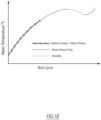
- Fig. 1B shows another example of a boil cycle for a kettle using a mains power supply and a backup battery power supply, where the time is indicated on the x-axis and the water temperature is indicated on the y-axis.
- a top up boil cycle is applied by the user after a standby period.
- the controller of the kettle only applies mains power because the water us already substantially at the required temperature and it is preferable to save the battery power for a time when it is more usefully used, such as during the initial heating cycle.
- Fig. 2 shows a kitchen appliance, in the form of a kettle 201.
- the kettle 201 has a main body 203 with a handle 205, a lid 207 and a vessel 209. Liquid (e.g. water) is poured into the vessel 209 via the lid 207 and poured out of the vessel 209 via the spout 211.
- a heating element (not shown) for heating the liquid.
- a backup power unit 215 Underneath the base 213 is a backup power unit 215 in which are located a backup power source 217, which in this example is a battery pack, and a control board 219 with various electronic components fitted thereon.
- the heating element has multiple elements, where at least one element is powered using mains power and at least one other element is powered using the backup power source.
- the control board in this example is a battery controller, where the battery controller and battery pack form a battery control system (as shown in Figure 4 . It will be understood that other components are also fitted on the control board such as a memory, resistors, capacitors, switches, connectors and interconnecting tracks to enable the control board to operate.
- the controller also has access to a set of instructions that are either stored within the controller or in a connected memory. The controller is configured to read the set of instructions to control the operation of the battery as well as to send and receive signals to and from an external main controller that is arranged to control operation of the kettle 201. Therefore, there is provided a computer program product including a computer readable medium having recorded thereon a computer program for controlling the herein described energy management system.
- Fig. 3 shows a backup power supply, in the form of a removable battery 301.
- the backup power supply has a casing 303 in which a battery pack (not shown) is located.
- the removable battery 301 has connectors 305 that enable the battery to be connected to corresponding connectors (not shown) on a backup power unit of a kitchen appliance (such as a kettle for example).
- This removable battery therefore negates the need to have a stationary battery pack located in the backup power unit (as shown in Figure 2 ), although a stationary battery pack may be used in addition to the removable battery.
- the removable battery pack may be charged on one kitchen appliance and used on that same kitchen appliance or on an alternative kitchen appliance.
- the battery pack may also be used on different types of kitchen appliance if that appliance has a corresponding connector to connect to the battery pack.
- Fig. 4 shows a schematic block diagram representation of an energy management system upon which the herein described processes can be implemented.
- the energy management system 401 is suitable for any type of kitchen appliance.
- the energy management system 401 has a mains power system 403 that is connected to a mains outlet.
- a backup energy storage subsystem (e.g. battery control subsystem) 405 includes a backup energy store 407 (e.g. a battery) and optionally a backup energy controller 409.
- the controller 411 receives one or more inputs 413 from various sensors of the kitchen appliance, such as, for example, temperature sensors, water levels etc.
- the controller 411 is used to control one or more functions 415 of the kitchen appliance.
- the controller 411 is connected to a user interface 417 that enables a user to control the one or more functions 415 of the kitchen appliance.
- the energy management system 401 has a main controller 411, wherein the controller 411, in one example, is arranged to (by virtue of software instructions) determine a state of health of the energy storage system 407, determine a state of charge of the energy storage system 407, determine how energy from the energy storage system 407 is to be used based on the determined state of health, the determined state of charge and at least one measured variable 413 obtained from the kitchen appliance, and apply the energy to operate at least one function 415 of the kitchen appliance.
- the backup energy controller 409 is arranged to (by virtue of software instructions) determine a state of health of the energy storage system 407, determine a state of charge of the energy storage system 407, determine how energy from the energy storage system 407 is to be used based on the determined state of health, the determined state of charge and at least one measured variable 413 obtained from the kitchen appliance, and apply the energy to operate at least one function 415 of the kitchen appliance.
- controller 411 that is used to determine how energy from the energy storage system is to be used.
- controller 409 that is used to determine how energy from the energy storage system is to be used, and a further main controller 411 used to control one or more functions of the kitchen appliance.
- Figs. 5A and 5B show a process flow diagram for implementation on one or more kitchen appliances using the energy management system described herein.
- the kitchen appliance is switched on by pressing "Start", for example.
- the appliance enters a listening mode to listen for a user command being entered via the user interface of the appliance.
- a determination is made by the controller whether a user interrupt has been detected, and upon a negative determination, the process moves to step S507 where the appliance enters a standby mode. Subsequently, the appliance is placed into a low power state at step S509 and continues to monitor for a user interrupt at step S505.
- step S511 Upon a positive determination that a user interrupt has been detected at step S505, an estimate of the state of health (SOH) of the backup power source is determined at step S511.
- SOH state of health
- the SOH is determined from at least three inputs i) battery capacity throughput (or lifetime capacity) measured in Ampere Hours (Ah), ii) battery operating temperature measured in degrees Celsius and iii) battery DC internal resistance measured in ohms.
- the backup power source is a battery or set of batteries
- the backup power source may be any other suitable form of backup power source as mentioned herein, and that the SOH of the particular backup power source may be determined using any suitable known method for that type of power source.
- the measured state of health is a measurement of the battery's reliability to provide power as it gets older after use.
- an estimate of the state of charge (SOC) of the backup power source is determined at step S513.
- the SOC is determined from at least two inputs i) battery current measured in Amperes (A) and ii) an estimated battery open circuit voltage (OCV-R).
- the OCV-R is determined at step S515 based on at least two inputs i) battery temperature measured in degrees Celsius and ii) battery voltage measure in volts (v)
- the OCV-R is determined based on the battery specifications provided by the manufacturer of the battery. That is, "state of charge” data is stored in memory and used by the controller to determine the OCV-R.
- the controller may monitor the voltage, current and temperature of the battery, to calculate the SOC.
- the backup power source is a battery or set of batteries
- the backup power source may be any other suitable form of backup power source as mentioned herein, and that the SOC of the particular backup power source may be determined using any suitable known method for that type of power source.
- step S517 the controller determines whether the estimated SOC is lower than a predefined threshold. Upon a positive determination, the process moves to step S519 and the controller starts charging the battery to its maximum charge Vmax using a constant current (CC) and a constant voltage (CV).
- CC constant current
- CV constant voltage
- cells are charged using a predefined constant current, which is selected to optimise the lifetime of the cells and the charge time.
- a predefined constant current which is selected to optimise the lifetime of the cells and the charge time.
- the CV charge mode will hold a constant voltage in order to charge the cells.
- the cells which are at the upper voltage limit will be passively balanced whilst the lower voltage cells are subsequently charged.
- the charging current will be reduced automatically.
- the CV charge mode will be terminated when the charging current reaches a value which is equal to the capacity of the cells divided by 20, for example.
- a series cell string of capacity of 2Ah charging will be terminated at charging current of less than 0.1A
- step S521 the controller determines whether a user has requested a boiling function to be operated while the battery is being charged to Vmax, and upon a negative determination that a boiling function has been requested (i.e. a boiling function has not been requested) the process returns to step S517 to determine whether the SOC is below a predetermined threshold.
- step S521 Upon a positive determination at step S521 that a boil request has been made by the user while the battery is being charged to Vmax (i.e. the SOC is below a predetermined threshold), the process moves to step S523 to operate the device function using the mains power only, and subsequently, at step S525, in this example, boils the kettle using the mains power only.
- a sous-vides device may operate a water pump and/or heating element
- a pizza oven may operate a fan and/or a heating element, etc.
- step S517 Upon a negative determination at step S517 (i.e. the SOC is at or above a predefined threshold), the process moves to step S527 to calculate the charge power limit (CPL), and step S529 to calculate the discharge power limit (DPL).
- CPL charge power limit
- DPL discharge power limit
- the CPL calculation step is an optional step that provides the controller with information on the available power in the battery to manage the voltage and current being used to charge the battery to safely charge the battery and also to assist in prolonging the life of the battery by not overcharging, undercharging, repeat charging etc.
- the CPL may be calculated as is known in the art based on one or more of measured parameters taken from the power source, manufacturing parameters of the power source, the load etc.
- the charge power limit calculates that only a little bit of current and voltage need to be applied for it to reach 100%. Otherwise it may overcharge, which is detrimental to the battery.
- the DPL is used to manage the voltage and current that is to be supplied to the load For a discharge, if there is little charge left, then it will not be beneficial to max out the voltage and current that the load can draw from the battery, as the battery will be drained very quickly.
- the DPL may be calculated as is known in the art based on one or more of measured parameters taken from the power source, manufacturing parameters of the power source, the load etc.
- the controller uses a minimum of three inputs to determine the power required to boil the kettle and, optionally, the time to boil.
- a first input is a variable associated with the kitchen appliance that can be measured and provided as an input to the controller.
- a second input is the SOH of the backup power supply (e.g. battery).
- the backup power supply e.g. battery
- a third input is the SOC, and so subsequently the DPL as calculated from the SOC, of the backup power source.
- the controller is configured to determine one or more (in any combination) of the following: i) whether to use the backup power source or not, ii) how much power to use from the backup power source, iii) how long to use the backup power source for, and iv) which of one or more functions of the kitchen appliance can be performed using the backup power source.
- the water temperature sensed by a temperature sensor may be used as a variable input.
- the controller may determine that, based on the measured water temperature, the SOH of the battery and the DPL (based on the SOC) that the backup battery should not be used to reheat the water is no need to pump more power than needed.
- State of health is another input and discharge power limit based on the state of charge, the third.
- a separate backup power subsystem may be used to perform the process shown in Figure 5B . That is, this separate subsystem may be incorporated onto a separate circuit board with a separate battery controller all located within a separate detachable/removeable unit that can communicate with the main controller in the kitchen appliance when connected. This separate unit may also receive the required variables and sensed inputs to perform the process shown in Figure 5B .
- the separate backup power subsystem may communicate with the controller when the controller is initiating the process shown in Fig 5A , determining the SOH characteristics of the backup power source and determining the DPL (based on the SOC) of the backup power source.
- the system activates hybrid power (battery and mains) to boil the kettle.
- the process determines, for example, the amount of power to be applied to the function of the appliance (e.g. boiling function) based on the DPL, the SOH and a variable measured from the appliance.
- the process may also in addition determine the time required to perform the function (e.g. time to boil).
- the variable may be a sensed variable taken from a sensor reading on the kitchen appliance.
- the variable may be a temperature measurement (inside or outside the appliance), a temperature measurement of a liquid and/or ingredient in the appliance, a liquid level of liquid in the appliance, a liquid flow rate of liquid in the appliance, a speed or rotation measurement of rotating elements in the appliance or any other variable of a function performed by the appliance that can be measured using any suitable sensor
- the controller may determine and indicate on the user interface the number of remaining boil cycles at step S533 based on the current battery charge level. This may be determined from the SOC, the SOH, the CPL and the DPL or any suitable combination thereof.
- the controller initiates the use of the backup power either separate from the mains power, or in addition to the mains power.
- the kettle is boiled using either the backup power alone, the mains power or a combination of both depending on one or more of the previous determinations made in the process.
- the herein described system may determine when to use the backup power available from the energy storage system in a kitchen appliance based on the power requirements of one or more functions of the kitchen appliance.
- the input variable may be a measured temperature of a pizza oven, where the temperature provides an indication of whether the pizza oven meeds to be cooled down or not.
- the temperature may be measured from any suitable location on, near to or inside the pizza oven.
- the controller also uses the SOC and DPL with the measured variable to make a determination of whether the backup power supply should be used to operate a function of the pizza oven, i.e. a cooling fan, to cool the pizza oven down in the event of a loss of mains power (e.g. because the mains plug was disconnected from the mains outlet).
- the life of the one or more batteries used in the energy storage system may be extended by limiting the power cycle depth during use.
- the controller may be arranged to determine whether the user has selected a function that is a "top up boil", that is the water has recently boiled and the appliance is being used to quickly reheat the water within a short period of time.
- the controller can determine that the temperature of the water is above a defined threshold and so then ensure the kitchen appliance only uses the mains AC power to drive the power loads (heating elements). In this manner, the battery life may be extended by reducing the times the battery is used in short bursts.
- a subsystem of the energy management system is a battery management system (BMS).
- BMS battery management system
- the BMS provides a self-contained modular system that can monitor and assist with controlling operation of the battery.
- the modular format if the BMS unit enables the unit to be removably attached to other appliances of the same type and different types.
- the BMS may have a safety protection circuit that is arranged to monitor and control various factors associated with battery management including, but not limited to, overcharge, undercharge, unsafe or over discharge, charging management, cell balancing, short circuits, pre-charging and over temperature control.
- hybrid mode is a mode of operation in which an alternative power source is used, where the alternative power source is a different power source to the mains power source that is controlled by the mains power system.
- the alternative power source may include a backup power supply, such as an energy storage device that includes a plurality of capacitor banks and has associated with it one or more control switches.
- the energy storage device may include one or more battery storage devices, where the device has associated with it one or more control switches. Therefore, the backup power supply may have an energy storage device that includes a capacitor, a capacitor bank, a super capacitor, a super capacitor bank, or a battery. It will be understood that any suitable form of energy storage may be used for the backup power supply.
- the backup power supply may be removable.
- the backup power supply can be moved from one device to another device.
- the same backup power supply can be used on different types of appliance.
- the alternative power source can be used even when the appliance is switched off, and also when unplugged.
- one appliance may be used to charge a battery while the appliance is plugged in to the mains power outlet (i.e. has mains power available) but is not actually using the mains power to carry out the usual functions of that appliance.
- food processing appliances are generally kept plugged into the mains power outlet even when not in use. Therefore, the removable battery may be charged by the food processing appliance in readiness for use by a different appliance.
- the removable battery may be removed from the first appliance (e.g. food processor) and attached to the second appliance (e.g. kettle) to reduce the heating cycle time.
- That battery may then be moved to another appliance, where the other appliance is either the same type of appliance or a different type of appliance, so that the other appliance is able to utilise the battery power.
- the controller may determine the water level in a kettle (or sous-vide device) based on a sensed water level detected by a water sensor and determine one or more functions to be performed in response to the sensed water level, the state of charge of the backup power supply and the state of health of the backup power supply.
- the herein described energy management system may adapt to an aged battery to reduce the amount of power drawn from a backup power supply when the energy management system controller has determined that the backup power supply (e.g. battery) life is being reduced at a rate above a defined threshold.
- the backup power supply e.g. battery
- the pizza oven can be cooled down by the function of a cooling fan operating using the power from the battery. This can occur even if the mains power is switched off at the power outlet and also if the mains power is completely unplugged from the outlet. Therefore, the pizza oven can still be cooled down and so provide sufficient cooling without the use of mains power.
- a temperature sensor for example an NTC, can provide temperature feedback to the microcontroller to enable the microcontroller to determine whether the temperature of the pizza oven has dropped below a predetermined temperature. Upon determining that the temperature has dropped below the predetermined temperature, the microcontroller can remove the power provided to the function of the cooling fan.
- a lighting function may be activated where the light is powered by the battery.
- a door locking function may be activated where the lock is powered by the battery.
- an appliance in the form of a kitchen device such as a sous-vide device may utilise one or more of the herein described processes to control functions on the sous-vide device when a cycle interruption has occurred.
- the battery power may be used to perform (e.g. execute, initiate, start or control) a function of the sous-vide device.
- the battery power may be used to perform the function of maintaining the water temperature of the sous-vide device.
- the battery power may be used to perform the function of maintaining the water flow of the sous-vide device.
- Other examples are also envisaged.
- an appliance in the form of an espresso machine may utilise one or more of the herein described processes to control functions on the espresso machine during operation of the espresso machine.
- power from the backup power source may be used to enable multiple functions to be performed (e.g. executed, initiated, started or controlled) at the same time, where those functions could not be performed simultaneously with mains power only as there would not be enough power available.
- One example would be providing heated water or steam through one group head of the espresso machine while at the same time producing an espresso through another group head of the espresso machine.
- Other examples are also envisaged.
- Some appliances may have the mains chord detachable so that when the appliance is using the backup power source, the detachable mains cord can be removed so that the appliance can be used chord free. This may be particularly useful for an appliance such as a stick mixer, for example.
Landscapes
- Engineering & Computer Science (AREA)
- Power Engineering (AREA)
- Food Science & Technology (AREA)
- Charge And Discharge Circuits For Batteries Or The Like (AREA)
- Health & Medical Sciences (AREA)
- General Health & Medical Sciences (AREA)
- Medical Informatics (AREA)
- Secondary Cells (AREA)
Description
- The present invention relates generally to an energy management system and method for a kitchen appliance. The present invention also relates to a computer program product including a computer readable medium having recorded thereon a computer program for controlling an energy management system for a kitchen appliance.
- Kitchen appliances may use a combination of mains power and backup power in order to power various functions of the kitchen appliance, usually applying both the mains power and the backup power to operate one or more functions of the kitchen appliance.
- At times, depending on which country or location the appliance is being used, the power available via the main domestic power supply, or indeed any other provided power supply, may not be sufficient to operate one or more desired functions in what is considered to be a reasonable amount of time.
- For example, in the U.S.A., the domestic mains power supply provides a power source with a maximum power output of 1800 Watts. Whereas, in Australia, the maximum power output from the domestic mains power supply is 2400 Watts. Therefore, in the U.S.A. a kettle, for example, may take a certain amount of time to boil water, or at least heat the water to a desired temperature, whereas in Australia, the same kettle may take less time to boil the water or heat the water to the desired temperature. Where a domestic mains power supply is provided having a maximum power output of 3000 Watts, the time to boil the water or reach the desired temperature may be reduced even further.
- At times, kitchen appliances may have the mains supply switched off, either manually, accidentally or by way of a power cut for example. This loss of mains power can result in the kitchen appliance being left in an unsafe or non-preferred mode of non-operation that can result in damaged food preparation or damage to the kitchen appliance. A method for controlling a battery capacity of a secondary battery and a respective battery-driven household electrical appliance are disclosed in document
US 2016/0365741 . - It is an object of the present invention to substantially overcome, or at least ameliorate, one or more disadvantages of existing arrangements.
- Disclosed are arrangements which seek to address the above problems by providing an improved energy management system and method for kitchen appliances.
- For example, a determination of a loss of mains supply may result in activating one or more functions of the kitchen appliance using a backup power supply in order to put the kitchen appliance in a safer or more preferable state of operation.
- As a further example, an energy management system may provide an improved monitoring system that monitors the state of health and/or the state of charge of a backup power supply to determine how best to utilise the power that is available from a mains power supply and a backup power supply.
- As another example, an energy management system may provide an improved charging system for a removeable power source, such as a battery for example, to enable the removeable power source to be charged by one kitchen appliance (e.g. when that kitchen appliance is plugged in and not in use) in readiness for the removeable power source to be removed and used by another kitchen appliance when the other kitchen appliance requires additional power that is not readily available from the main power source.
- According to a first aspect of the present disclosure, there is provided an energy management system for a kitchen appliance, the energy management system comprising: a mains power system, a backup energy storage system, and at least one controller, wherein the controller is arranged to: determine a state of health of the energy storage system; determine a state of charge of the energy storage system; determine how energy from the energy storage system is to be used based on the determined state of health, the determined state of charge and at least one measured variable obtained from a kitchen appliance, and apply the energy to operate at least one function of the kitchen appliance.
- The energy management system may have a controller arranged to determine one or more of the following, in any combination, i) whether to use the energy from the energy storage system or not, ii) how much energy to use from the energy storage system, iii) how long to use the energy storage system for, and iv) which of the at least one function of the kitchen appliance can be performed using energy from the energy storage system.
- The energy management system may have a controller further arranged to determine a discharge power limit of the energy storage system based on the determined state of charge and determine how energy from the energy storage device is to be used based on the determined state of health, the determined discharge power limit and the least one measured variable obtained from the kitchen appliance.
- The energy management system may have a controller further arranged to determine how many power cycles there are based on the determined discharge power limit, and indicate the determined number of power cycles.
- The energy management system may have an energy storage system that has at least one battery, where the controller is further arranged to determine the state of charge based on a measured battery current and an estimated open circuit battery voltage.
- The energy management system may have an energy storage system that has at least one battery, and the controller is further arranged to determine the estimated open circuit battery voltage based on the battery temperature and the battery voltage.
- The energy management system may have an energy storage system that has at least one battery, and the controller is further arranged to determine the state of health based on the internal resistance of the battery, the operating temperature of the battery and the lifetime capacity of the battery.
- The energy management system may have an energy storage system that has at least one battery, where the controller is an energy storage system controller arranged to determine how the energy from the battery is to be used based on the determined state of health, a determined state of charge and at least one function being or to be performed by the kitchen appliance.
- The energy management system may have the energy storage system controller and the battery in a self-contained unit, where the self-contained unit is removably attached to the kitchen appliance.
- The energy management system may have an energy storage system that has one or more of a capacitor, a capacitor bank, a super capacitor, a super capacitor bank, or a battery.
- Also provided is a kitchen appliance that has an energy management system as described herein.
- Also provided is a computer readable medium having recorded thereon a computer program for controlling an energy management system for a kitchen appliance as described herein.
- Other aspects are also disclosed.
- At least one embodiment of the present invention will now be described with reference to the drawings, in which:
-
Fig. 1A shows an example of a boil cycle for a kettle using a mains power supply and a backup battery power supply; -
Fig. 1B shows a further example of a boil cycle for a kettle using a mains power supply and a backup battery power supply; -
Fig. 2 shows a kitchen appliance, in the form of a kettle, in accordance with the present disclosure; -
Fig. 3 shows a backup power supply, in the form of a removable battery, in accordance with the present disclosure; -
Fig. 4 shows a schematic block diagram representation of an energy management system upon which the herein described processes can be implemented according to the present disclosure; and -
Figs. 5A and5B show a process flow diagram for implementation on one or more kitchen appliances according to the present disclosure. - Where reference is made in any one or more of the accompanying drawings to steps and/or features, which have the same reference numerals, those steps and/or features have for the purposes of this description the same function(s) or operation(s), unless the contrary intention appears.
- The following processes and systems may apply to various different types of kitchen appliance, including for example, a kettle, a pizza oven, a stick blender, a food processing device, a coffee machine, a toaster, a sandwich maker etc.
-
Fig. 1A shows an example of a boil cycle for a kettle using a mains power supply and a backup battery power supply, where the time is indicated on the x-axis and the water temperature is indicated on the y-axis. In this example, it can be seen that the initial heating cycle of heating water applies power to the heating elements from battery power and mains power. For example, the kettle may have a first heating element that uses mains power and a second heating element that uses battery power. That is, the first heating track may be an AC heating track, and the second heating track may be a DC heating track. The combination of applying two different sources of power to different heating tracks enables the kettle to heat the water up faster than just using mains power. This advantage is more pronounced in regions in which lower power mains supply is provided. -
Fig. 1B shows another example of a boil cycle for a kettle using a mains power supply and a backup battery power supply, where the time is indicated on the x-axis and the water temperature is indicated on the y-axis. In this example, a top up boil cycle is applied by the user after a standby period. During the top up boil cycle, the controller of the kettle only applies mains power because the water us already substantially at the required temperature and it is preferable to save the battery power for a time when it is more usefully used, such as during the initial heating cycle. -
Fig. 2 shows a kitchen appliance, in the form of akettle 201. - The
kettle 201 has amain body 203 with ahandle 205, alid 207 and avessel 209. Liquid (e.g. water) is poured into thevessel 209 via thelid 207 and poured out of thevessel 209 via thespout 211. In thebase 213 is a heating element (not shown) for heating the liquid. Underneath thebase 213 is abackup power unit 215 in which are located abackup power source 217, which in this example is a battery pack, and acontrol board 219 with various electronic components fitted thereon. - The heating element has multiple elements, where at least one element is powered using mains power and at least one other element is powered using the backup power source.
- The control board in this example is a battery controller, where the battery controller and battery pack form a battery control system (as shown in
Figure 4 . It will be understood that other components are also fitted on the control board such as a memory, resistors, capacitors, switches, connectors and interconnecting tracks to enable the control board to operate. The controller also has access to a set of instructions that are either stored within the controller or in a connected memory. The controller is configured to read the set of instructions to control the operation of the battery as well as to send and receive signals to and from an external main controller that is arranged to control operation of thekettle 201. Therefore, there is provided a computer program product including a computer readable medium having recorded thereon a computer program for controlling the herein described energy management system. -
Fig. 3 shows a backup power supply, in the form of aremovable battery 301. The backup power supply has acasing 303 in which a battery pack (not shown) is located. - In this example, the
removable battery 301 hasconnectors 305 that enable the battery to be connected to corresponding connectors (not shown) on a backup power unit of a kitchen appliance (such as a kettle for example). This removable battery therefore negates the need to have a stationary battery pack located in the backup power unit (as shown inFigure 2 ), although a stationary battery pack may be used in addition to the removable battery. - The removable battery pack may be charged on one kitchen appliance and used on that same kitchen appliance or on an alternative kitchen appliance. The battery pack may also be used on different types of kitchen appliance if that appliance has a corresponding connector to connect to the battery pack.
-
Fig. 4 shows a schematic block diagram representation of an energy management system upon which the herein described processes can be implemented. - The
energy management system 401 is suitable for any type of kitchen appliance. Theenergy management system 401 has amains power system 403 that is connected to a mains outlet. A backup energy storage subsystem (e.g. battery control subsystem) 405 includes a backup energy store 407 (e.g. a battery) and optionally abackup energy controller 409. Thecontroller 411 receives one ormore inputs 413 from various sensors of the kitchen appliance, such as, for example, temperature sensors, water levels etc. Thecontroller 411 is used to control one ormore functions 415 of the kitchen appliance. - The
controller 411 is connected to auser interface 417 that enables a user to control the one ormore functions 415 of the kitchen appliance. - The
energy management system 401 has amain controller 411, wherein thecontroller 411, in one example, is arranged to (by virtue of software instructions) determine a state of health of theenergy storage system 407, determine a state of charge of theenergy storage system 407, determine how energy from theenergy storage system 407 is to be used based on the determined state of health, the determined state of charge and at least one measured variable 413 obtained from the kitchen appliance, and apply the energy to operate at least onefunction 415 of the kitchen appliance. - According to another example, the
backup energy controller 409, is arranged to (by virtue of software instructions) determine a state of health of theenergy storage system 407, determine a state of charge of theenergy storage system 407, determine how energy from theenergy storage system 407 is to be used based on the determined state of health, the determined state of charge and at least one measured variable 413 obtained from the kitchen appliance, and apply the energy to operate at least onefunction 415 of the kitchen appliance. - That is, in one example, there is one
controller 411 that is used to determine how energy from the energy storage system is to be used. In another example, there is onecontroller 409 that is used to determine how energy from the energy storage system is to be used, and a furthermain controller 411 used to control one or more functions of the kitchen appliance. -
Figs. 5A and5B show a process flow diagram for implementation on one or more kitchen appliances using the energy management system described herein. - At step S501, the kitchen appliance is switched on by pressing "Start", for example. At step S503, the appliance enters a listening mode to listen for a user command being entered via the user interface of the appliance. At step S505, a determination is made by the controller whether a user interrupt has been detected, and upon a negative determination, the process moves to step S507 where the appliance enters a standby mode. Subsequently, the appliance is placed into a low power state at step S509 and continues to monitor for a user interrupt at step S505.
- Upon a positive determination that a user interrupt has been detected at step S505, an estimate of the state of health (SOH) of the backup power source is determined at step S511.
- The SOH is determined from at least three inputs i) battery capacity throughput (or lifetime capacity) measured in Ampere Hours (Ah), ii) battery operating temperature measured in degrees Celsius and iii) battery DC internal resistance measured in ohms.
- It will be understood that any suitable method for calculating the SOH known to the person skilled in the art may be used depending on the type of backup power source being used.
- Although in the above described example for determined SOH the backup power source is a battery or set of batteries, it will be understood that the backup power source may be any other suitable form of backup power source as mentioned herein, and that the SOH of the particular backup power source may be determined using any suitable known method for that type of power source.
- The measured state of health is a measurement of the battery's reliability to provide power as it gets older after use.
- Also, upon a positive determination that a user interrupt has been detected at step S505, an estimate of the state of charge (SOC) of the backup power source is determined at step S513.
- The SOC is determined from at least two inputs i) battery current measured in Amperes (A) and ii) an estimated battery open circuit voltage (OCV-R).
- The OCV-R is determined at step S515 based on at least two inputs i) battery temperature measured in degrees Celsius and ii) battery voltage measure in volts (v)
- The OCV-R is determined based on the battery specifications provided by the manufacturer of the battery. That is, "state of charge" data is stored in memory and used by the controller to determine the OCV-R.
- It will be understood that any suitable method for calculating the SOC known to the person skilled in the art may be used depending on the type of backup power source being used.
- For example, the controller may monitor the voltage, current and temperature of the battery, to calculate the SOC.
- Although in the above described example for determining the SOC the backup power source is a battery or set of batteries, it will be understood that the backup power source may be any other suitable form of backup power source as mentioned herein, and that the SOC of the particular backup power source may be determined using any suitable known method for that type of power source.
- At step S517 the controller determines whether the estimated SOC is lower than a predefined threshold. Upon a positive determination, the process moves to step S519 and the controller starts charging the battery to its maximum charge Vmax using a constant current (CC) and a constant voltage (CV).
- For example, in a battery, cells are charged using a predefined constant current, which is selected to optimise the lifetime of the cells and the charge time. When one of the cells in the cell series string reaches its upper voltage limit, the charge mode will automatically switch to constant voltage charge mode. The CV charge mode will hold a constant voltage in order to charge the cells. The cells which are at the upper voltage limit will be passively balanced whilst the lower voltage cells are subsequently charged. As this process progresses, the charging current will be reduced automatically. The CV charge mode will be terminated when the charging current reaches a value which is equal to the capacity of the cells divided by 20, for example. In one example scenario, a series cell string of capacity of 2Ah, charging will be terminated at charging current of less than 0.1A
- At step S521, the controller determines whether a user has requested a boiling function to be operated while the battery is being charged to Vmax, and upon a negative determination that a boiling function has been requested (i.e. a boiling function has not been requested) the process returns to step S517 to determine whether the SOC is below a predetermined threshold.
- Upon a positive determination at step S521 that a boil request has been made by the user while the battery is being charged to Vmax (i.e. the SOC is below a predetermined threshold), the process moves to step S523 to operate the device function using the mains power only, and subsequently, at step S525, in this example, boils the kettle using the mains power only.
- It will be understood that for other kitchen appliances different functions can be performed at step S525. For example, a sous-vides device may operate a water pump and/or heating element, a pizza oven may operate a fan and/or a heating element, etc.
- Upon a negative determination at step S517 (i.e. the SOC is at or above a predefined threshold), the process moves to step S527 to calculate the charge power limit (CPL), and step S529 to calculate the discharge power limit (DPL).
- The CPL calculation step is an optional step that provides the controller with information on the available power in the battery to manage the voltage and current being used to charge the battery to safely charge the battery and also to assist in prolonging the life of the battery by not overcharging, undercharging, repeat charging etc.
- It will be understood that any suitable method for calculating the CPL known to the person skilled in the art may be used depending on the type of backup power source being used. The CPL may be calculated as is known in the art based on one or more of measured parameters taken from the power source, manufacturing parameters of the power source, the load etc.
- For example, if the battery is 98% charged, then the charge power limit calculates that only a little bit of current and voltage need to be applied for it to reach 100%. Otherwise it may overcharge, which is detrimental to the battery.
- The DPL is used to manage the voltage and current that is to be supplied to the load For a discharge, if there is little charge left, then it will not be beneficial to max out the voltage and current that the load can draw from the battery, as the battery will be drained very quickly.
- It will be understood that any suitable method for calculating the DPL known to the person skilled in the art may be used depending on the type of backup power source being used. The DPL may be calculated as is known in the art based on one or more of measured parameters taken from the power source, manufacturing parameters of the power source, the load etc.
- The controller uses a minimum of three inputs to determine the power required to boil the kettle and, optionally, the time to boil.
- A first input is a variable associated with the kitchen appliance that can be measured and provided as an input to the controller.
- A second input is the SOH of the backup power supply (e.g. battery).
- A third input is the SOC, and so subsequently the DPL as calculated from the SOC, of the backup power source.
- By monitoring these three inputs, the controller is configured to determine one or more (in any combination) of the following: i) whether to use the backup power source or not, ii) how much power to use from the backup power source, iii) how long to use the backup power source for, and iv) which of one or more functions of the kitchen appliance can be performed using the backup power source.
- For example, the water temperature sensed by a temperature sensor may be used as a variable input. For example, in one scenario, if there has been a recent boil and the water in the kettle is hot, the controller may determine that, based on the measured water temperature, the SOH of the battery and the DPL (based on the SOC) that the backup battery should not be used to reheat the water is no need to pump more power than needed. State of health is another input and discharge power limit based on the state of charge, the third.
- Although the process shown in
Figures 5A and5B may be performed by a single controller on the main circuit board of the kitchen appliance, a separate backup power subsystem may be used to perform the process shown inFigure 5B . That is, this separate subsystem may be incorporated onto a separate circuit board with a separate battery controller all located within a separate detachable/removeable unit that can communicate with the main controller in the kitchen appliance when connected. This separate unit may also receive the required variables and sensed inputs to perform the process shown inFigure 5B . - The separate backup power subsystem may communicate with the controller when the controller is initiating the process shown in
Fig 5A , determining the SOH characteristics of the backup power source and determining the DPL (based on the SOC) of the backup power source. - Finally, the system activates hybrid power (battery and mains) to boil the kettle. At step S531, the process determines, for example, the amount of power to be applied to the function of the appliance (e.g. boiling function) based on the DPL, the SOH and a variable measured from the appliance. The process may also in addition determine the time required to perform the function (e.g. time to boil).
- The variable may be a sensed variable taken from a sensor reading on the kitchen appliance. For example, the variable may be a temperature measurement (inside or outside the appliance), a temperature measurement of a liquid and/or ingredient in the appliance, a liquid level of liquid in the appliance, a liquid flow rate of liquid in the appliance, a speed or rotation measurement of rotating elements in the appliance or any other variable of a function performed by the appliance that can be measured using any suitable sensor
- Optionally, the controller may determine and indicate on the user interface the number of remaining boil cycles at step S533 based on the current battery charge level. This may be determined from the SOC, the SOH, the CPL and the DPL or any suitable combination thereof.
- At step S535, the controller initiates the use of the backup power either separate from the mains power, or in addition to the mains power.
- At step S525, the kettle is boiled using either the backup power alone, the mains power or a combination of both depending on one or more of the previous determinations made in the process.
- According to another example, the herein described system may determine when to use the backup power available from the energy storage system in a kitchen appliance based on the power requirements of one or more functions of the kitchen appliance. For example, the input variable may be a measured temperature of a pizza oven, where the temperature provides an indication of whether the pizza oven meeds to be cooled down or not. The temperature may be measured from any suitable location on, near to or inside the pizza oven. The controller also uses the SOC and DPL with the measured variable to make a determination of whether the backup power supply should be used to operate a function of the pizza oven, i.e. a cooling fan, to cool the pizza oven down in the event of a loss of mains power (e.g. because the mains plug was disconnected from the mains outlet).
- According to various implementations, the life of the one or more batteries used in the energy storage system may be extended by limiting the power cycle depth during use.
- According to one example, the controller may be arranged to determine whether the user has selected a function that is a "top up boil", that is the water has recently boiled and the appliance is being used to quickly reheat the water within a short period of time. In this scenario, the controller can determine that the temperature of the water is above a defined threshold and so then ensure the kitchen appliance only uses the mains AC power to drive the power loads (heating elements). In this manner, the battery life may be extended by reducing the times the battery is used in short bursts.
- A subsystem of the energy management system is a battery management system (BMS). The BMS provides a self-contained modular system that can monitor and assist with controlling operation of the battery. The modular format if the BMS unit enables the unit to be removably attached to other appliances of the same type and different types.
- The BMS may have a safety protection circuit that is arranged to monitor and control various factors associated with battery management including, but not limited to, overcharge, undercharge, unsafe or over discharge, charging management, cell balancing, short circuits, pre-charging and over temperature control.
- The energy management system described herein can determine whether a hybrid mode should be enabled based on the determination of state of health, state of charge and at least one measurable variable associated with a function of the kitchen appliance. The "hybrid mode" is a mode of operation in which an alternative power source is used, where the alternative power source is a different power source to the mains power source that is controlled by the mains power system.
- According to one example, the alternative power source may include a backup power supply, such as an energy storage device that includes a plurality of capacitor banks and has associated with it one or more control switches. According to an alternative example, the energy storage device may include one or more battery storage devices, where the device has associated with it one or more control switches. Therefore, the backup power supply may have an energy storage device that includes a capacitor, a capacitor bank, a super capacitor, a super capacitor bank, or a battery. It will be understood that any suitable form of energy storage may be used for the backup power supply.
- According to various implementations, the backup power supply may be removable. For example, the backup power supply can be moved from one device to another device. The same backup power supply can be used on different types of appliance.
- With the provision of a backup power supply, such as a battery, that is an alternative to the mains power, the alternative power source can be used even when the appliance is switched off, and also when unplugged.
- For example, one appliance may be used to charge a battery while the appliance is plugged in to the mains power outlet (i.e. has mains power available) but is not actually using the mains power to carry out the usual functions of that appliance. For example, food processing appliances are generally kept plugged into the mains power outlet even when not in use. Therefore, the removable battery may be charged by the food processing appliance in readiness for use by a different appliance. For example, where the different appliance is a different type of appliance such as a kettle, when the user requires the water in the kettle to be heated up more quickly than with a standard mains power only heating cycle, the removable battery may be removed from the first appliance (e.g. food processor) and attached to the second appliance (e.g. kettle) to reduce the heating cycle time.
- That battery may then be moved to another appliance, where the other appliance is either the same type of appliance or a different type of appliance, so that the other appliance is able to utilise the battery power.
- According to an example, the controller may determine the water level in a kettle (or sous-vide device) based on a sensed water level detected by a water sensor and determine one or more functions to be performed in response to the sensed water level, the state of charge of the backup power supply and the state of health of the backup power supply.
- The herein described energy management system may adapt to an aged battery to reduce the amount of power drawn from a backup power supply when the energy management system controller has determined that the backup power supply (e.g. battery) life is being reduced at a rate above a defined threshold.
- According to another example, where the appliance is a pizza oven, the pizza oven can be cooled down by the function of a cooling fan operating using the power from the battery. This can occur even if the mains power is switched off at the power outlet and also if the mains power is completely unplugged from the outlet. Therefore, the pizza oven can still be cooled down and so provide sufficient cooling without the use of mains power. A temperature sensor, for example an NTC, can provide temperature feedback to the microcontroller to enable the microcontroller to determine whether the temperature of the pizza oven has dropped below a predetermined temperature. Upon determining that the temperature has dropped below the predetermined temperature, the microcontroller can remove the power provided to the function of the cooling fan. Further, other features may also be activated as an alternative to, or as well as, the cooling fan. For example, a lighting function may be activated where the light is powered by the battery. As a further example, a door locking function may be activated where the lock is powered by the battery.
- According to a further example, an appliance in the form of a kitchen device, such as a sous-vide device may utilise one or more of the herein described processes to control functions on the sous-vide device when a cycle interruption has occurred. For example, the battery power may be used to perform (e.g. execute, initiate, start or control) a function of the sous-vide device. According to one example, the battery power may be used to perform the function of maintaining the water temperature of the sous-vide device. According to another example, the battery power may be used to perform the function of maintaining the water flow of the sous-vide device. Other examples are also envisaged.
- As a further example, an appliance in the form of an espresso machine may utilise one or more of the herein described processes to control functions on the espresso machine during operation of the espresso machine. For example, power from the backup power source may be used to enable multiple functions to be performed (e.g. executed, initiated, started or controlled) at the same time, where those functions could not be performed simultaneously with mains power only as there would not be enough power available. One example would be providing heated water or steam through one group head of the espresso machine while at the same time producing an espresso through another group head of the espresso machine. Other examples are also envisaged.
- Some appliances may have the mains chord detachable so that when the appliance is using the backup power source, the detachable mains cord can be removed so that the appliance can be used chord free. This may be particularly useful for an appliance such as a stick mixer, for example.
- The arrangements described are applicable to the kitchen appliance industries.
- The foregoing describes only some embodiments of the present invention, and modifications and/or changes can be made thereto without departing from the scope and spirit of the invention, the embodiments being illustrative and not restrictive.
- In the context of this specification, the word "comprising" means "including principally but not necessarily solely" or "having" or "including", and not "consisting only of". Variations of the word "comprising", such as "comprise" and "comprises" have correspondingly varied meanings.
Claims (10)
- An energy management system (401) for a kitchen appliance, the energy management system (401) comprising:a mains power system (403),a backup energy storage system (405), andat least one controller (411),wherein the controller (411) is arranged to:determine a state of health of the energy storage system (401);determine a state of charge of the energy storage system (401);determine how energy from the energy storage system (401) is to be used based on the determined state of health, the determined state of charge and at least one measured variable obtained from the kitchen appliance, andapply the energy to operate at least one function of the kitchen appliance,wherein the energy storage system (405) comprises at least one battery (407), and the controller (411) is further arranged to determine the state of charge based on a measured battery current and an estimated open circuit battery voltage, andwherein the controller (411) is further arranged to determine the estimated open circuit battery voltage based on the battery temperature and the battery voltage.
- The energy management system (401) of claim 1, wherein the controller (411) is arranged to determine one or more of the following, in any combination, i) whether to use the energy from the energy storage system (405) or not, ii) how much energy to use from the energy storage system (405), iii) how long to use the energy storage system (405) for, and iv) which of the at least one function of the kitchen appliance can be performed using energy from the energy storage system (405).
- The energy management system (401) of claim 1 or 2, wherein the controller (411) is further arranged to determine a discharge power limit of the energy storage system (405) based on the determined state of charge and determine how energy from the energy storage system (405) is to be used based on the determined state of health, the determined discharge power limit and the least one measured variable obtained from the kitchen appliance.
- The energy management system (401) of any one of the preceding claims, wherein the controller (411) is further arranged to determine how many power cycles of the battery (407) there are based on the determined discharge power limit, and indicate the determined number of power cycles.
- The energy management system (401) of any one of the preceding claims, wherein the controller (411) is further arranged to determine the state of health based on an internal resistance of the battery (407), an operating temperature of the battery (407) and a lifetime capacity of the battery (407).
- The energy management system (401) of any one of the preceding claims, wherein the controller (411) is an energy storage system controller arranged to determine how the energy from the battery (407) is to be used based on the determined state of health, the determined state of charge and at least one function being or to be performed by the kitchen appliance.
- The energy management system (401) of claim 6, wherein the energy storage system controller and the battery (407) are in a self-contained unit and the self-contained unit is removably attached to the kitchen appliance.
- The energy management system (401) of claim 1, wherein the energy storage system (405) comprises one or more of a capacitor, a capacitor bank, a super capacitor, a super capacitor bank, or a battery.
- A kitchen appliance comprising the energy management system (401) of any one of claims 1 to 8.
- A computer readable medium having recorded thereon a computer program for controlling an energy management system (401) for a kitchen appliance as claimed in any one of claims 1 to 8.
Applications Claiming Priority (2)
| Application Number | Priority Date | Filing Date | Title |
|---|---|---|---|
| AU2019902276A AU2019902276A0 (en) | 2019-06-28 | Energy management system and method for a kitchen appliance | |
| PCT/AU2020/050648 WO2020257860A1 (en) | 2019-06-28 | 2020-06-26 | Energy management system and method for a kitchen appliance |
Publications (3)
| Publication Number | Publication Date |
|---|---|
| EP3991518A1 EP3991518A1 (en) | 2022-05-04 |
| EP3991518A4 EP3991518A4 (en) | 2023-11-15 |
| EP3991518B1 true EP3991518B1 (en) | 2025-04-30 |
Family
ID=74059904
Family Applications (1)
| Application Number | Title | Priority Date | Filing Date |
|---|---|---|---|
| EP20832481.4A Active EP3991518B1 (en) | 2019-06-28 | 2020-06-26 | Energy management system and method for a kitchen appliance |
Country Status (5)
| Country | Link |
|---|---|
| US (1) | US20220360101A1 (en) |
| EP (1) | EP3991518B1 (en) |
| CN (1) | CN114097304A (en) |
| AU (1) | AU2020307147B2 (en) |
| WO (1) | WO2020257860A1 (en) |
Families Citing this family (8)
| Publication number | Priority date | Publication date | Assignee | Title |
|---|---|---|---|---|
| US11531403B2 (en) | 2020-10-06 | 2022-12-20 | Blendjet Inc. | One button interface of a blender |
| US11690482B1 (en) * | 2020-12-10 | 2023-07-04 | Blendjet Inc. | Power boost mode for a blender |
| US20230074320A1 (en) * | 2021-09-06 | 2023-03-09 | Mohammad Shafikul Huq | System and method for recharagable battery module by combining cells of varying sizes |
| USD1083507S1 (en) | 2022-03-11 | 2025-07-15 | Mavorco Operations Llc | Jar for a portable blender |
| USD1085813S1 (en) | 2022-03-11 | 2025-07-29 | Mavorco Operations Llc | Portable blender jar with handle |
| USD1085814S1 (en) | 2022-04-11 | 2025-07-29 | Mavorco Operations Llc | Jar of a portable blender |
| US20230378802A1 (en) * | 2022-05-17 | 2023-11-23 | Dillon Allen | Multipurpose Battery Pack Component for Electronic Device and Method of Use |
| USD1059951S1 (en) | 2022-10-26 | 2025-02-04 | Blendjet Inc. | Portable blender jar |
Family Cites Families (17)
| Publication number | Priority date | Publication date | Assignee | Title |
|---|---|---|---|---|
| GB362134A (en) * | 1930-11-17 | 1931-12-03 | Ludwig Dreyfus | Improvements in electric induction furnaces |
| JP2002189066A (en) * | 2000-12-22 | 2002-07-05 | Hitachi Ltd | Battery level estimation method |
| JP2002360426A (en) * | 2001-06-05 | 2002-12-17 | Zojirushi Corp | Electric pot |
| JP4252909B2 (en) * | 2004-02-13 | 2009-04-08 | 株式会社日立製作所 | Vehicle diagnostic system |
| CA2915847C (en) * | 2005-10-21 | 2019-01-08 | Stryker Corporation | System and method for recharging a battery exposed to a harsh environment |
| DE102008043212A1 (en) * | 2008-10-28 | 2010-04-29 | Robert Bosch Gmbh | Energy expenditure device and method for issuing a remaining possibility of use |
| WO2010109956A1 (en) * | 2009-03-27 | 2010-09-30 | 株式会社日立製作所 | Electric storage device |
| JP5452162B2 (en) * | 2009-10-15 | 2014-03-26 | 三菱電機株式会社 | Induction heating cooker |
| JP5853144B2 (en) * | 2011-05-19 | 2016-02-09 | パナソニックIpマネジメント株式会社 | Power supply control device and power supply system including the same |
| US9244132B2 (en) * | 2011-09-12 | 2016-01-26 | Eaglepicher Technologies, Llc | Systems and methods for determining battery state-of-health |
| CN202616826U (en) * | 2012-05-16 | 2012-12-19 | 北汽福田汽车股份有限公司 | An active balance testing device of a battery |
| US10333319B2 (en) * | 2013-05-17 | 2019-06-25 | Electro Standards Laboratories | Hybrid super-capacitor / rechargeable battery system |
| KR20150019190A (en) * | 2013-08-13 | 2015-02-25 | 현대모비스 주식회사 | Method of Estimating Battery Stste-Of-Charge and Apparatus therefor the same |
| CN108064433B (en) * | 2015-06-10 | 2022-04-19 | 博朗公司 | Method for controlling battery capacity of secondary battery and battery-driven home appliance |
| GB2560176A (en) * | 2017-03-01 | 2018-09-05 | Kenwood Ltd | Beverage making appliance |
| CN210185310U (en) * | 2017-09-12 | 2020-03-27 | 布瑞威利私人有限公司 | Liquid heating appliance for brewing beverage and its power management system |
| CN121369929A (en) * | 2017-11-07 | 2026-01-23 | 布瑞威利私人有限公司 | Apparatus for making beverages and associated method and power management system |
-
2020
- 2020-06-26 CN CN202080049676.3A patent/CN114097304A/en active Pending
- 2020-06-26 AU AU2020307147A patent/AU2020307147B2/en active Active
- 2020-06-26 US US17/621,406 patent/US20220360101A1/en not_active Abandoned
- 2020-06-26 WO PCT/AU2020/050648 patent/WO2020257860A1/en not_active Ceased
- 2020-06-26 EP EP20832481.4A patent/EP3991518B1/en active Active
Also Published As
| Publication number | Publication date |
|---|---|
| CN114097304A (en) | 2022-02-25 |
| EP3991518A1 (en) | 2022-05-04 |
| WO2020257860A1 (en) | 2020-12-30 |
| US20220360101A1 (en) | 2022-11-10 |
| EP3991518A4 (en) | 2023-11-15 |
| AU2020307147B2 (en) | 2026-03-26 |
| AU2020307147A1 (en) | 2022-01-20 |
Similar Documents
| Publication | Publication Date | Title |
|---|---|---|
| EP3991518B1 (en) | Energy management system and method for a kitchen appliance | |
| EP3682524B1 (en) | A liquid heating appliance for making a beverage and associated method, power management system and microcontroller readable medium | |
| WO2008117239A2 (en) | Ultra fast battery charger with battery sensing | |
| CN215863300U (en) | Steam ablation apparatus | |
| US20140183954A1 (en) | Power supply device and electric apparatus | |
| CN108520993A (en) | Battery constant temperature system and cell charging-discharging management method | |
| WO2016138968A1 (en) | An electric liquid heating appliance | |
| RU2833369C2 (en) | System and method for controlling energy consumption for kitchen electric household appliance | |
| US20230036413A1 (en) | Electric steam control method, electric steam control system, and steam cleaner | |
| JP5974298B2 (en) | Induction heating cooker | |
| CN202929380U (en) | Appliance control device | |
| JP3298095B2 (en) | Electric cooker | |
| CN111124008A (en) | Control method of food processing machine | |
| EP2982275B1 (en) | Machine for preparing beverages, with minimum energy requirements, and method for operating the machine | |
| CN112787388B (en) | AC charging control | |
| CN115299774B (en) | Electric kettle power supply control method, electric kettle power supply control system, storage medium and intelligent terminal | |
| JP6101933B2 (en) | Induction heating cooker | |
| WO2024243997A1 (en) | Improved managing of a charging of an aerosol-generating system | |
| JP5855198B2 (en) | Cooking device | |
| CN103829800A (en) | Intelligent coffeepot | |
| RU2848715C2 (en) | Aerosol generating device | |
| JPH09149849A (en) | Rice cooker | |
| RU2783352C2 (en) | Electrical household appliance for heating liquid for beverage making, and related method, power control system, and microcontroller-readable carrier | |
| CN115663961A (en) | Outdoor mobile energy storage system and control method thereof | |
| JPS6335244B2 (en) |
Legal Events
| Date | Code | Title | Description |
|---|---|---|---|
| STAA | Information on the status of an ep patent application or granted ep patent |
Free format text: STATUS: THE INTERNATIONAL PUBLICATION HAS BEEN MADE |
|
| PUAI | Public reference made under article 153(3) epc to a published international application that has entered the european phase |
Free format text: ORIGINAL CODE: 0009012 |
|
| STAA | Information on the status of an ep patent application or granted ep patent |
Free format text: STATUS: REQUEST FOR EXAMINATION WAS MADE |
|
| 17P | Request for examination filed |
Effective date: 20220118 |
|
| AK | Designated contracting states |
Kind code of ref document: A1 Designated state(s): AL AT BE BG CH CY CZ DE DK EE ES FI FR GB GR HR HU IE IS IT LI LT LU LV MC MK MT NL NO PL PT RO RS SE SI SK SM TR |
|
| DAV | Request for validation of the european patent (deleted) | ||
| DAX | Request for extension of the european patent (deleted) | ||
| A4 | Supplementary search report drawn up and despatched |
Effective date: 20231012 |
|
| RIC1 | Information provided on ipc code assigned before grant |
Ipc: A47J 27/21 20060101ALI20231006BHEP Ipc: H05B 1/02 20060101ALI20231006BHEP Ipc: H02J 7/00 20060101ALI20231006BHEP Ipc: H05B 6/06 20060101AFI20231006BHEP |
|
| GRAP | Despatch of communication of intention to grant a patent |
Free format text: ORIGINAL CODE: EPIDOSNIGR1 |
|
| STAA | Information on the status of an ep patent application or granted ep patent |
Free format text: STATUS: GRANT OF PATENT IS INTENDED |
|
| INTG | Intention to grant announced |
Effective date: 20241126 |
|
| GRAS | Grant fee paid |
Free format text: ORIGINAL CODE: EPIDOSNIGR3 |
|
| GRAA | (expected) grant |
Free format text: ORIGINAL CODE: 0009210 |
|
| STAA | Information on the status of an ep patent application or granted ep patent |
Free format text: STATUS: THE PATENT HAS BEEN GRANTED |
|
| P01 | Opt-out of the competence of the unified patent court (upc) registered |
Free format text: CASE NUMBER: APP_13017/2025 Effective date: 20250317 |
|
| AK | Designated contracting states |
Kind code of ref document: B1 Designated state(s): AL AT BE BG CH CY CZ DE DK EE ES FI FR GB GR HR HU IE IS IT LI LT LU LV MC MK MT NL NO PL PT RO RS SE SI SK SM TR |
|
| REG | Reference to a national code |
Ref country code: CH Ref legal event code: EP Ref country code: GB Ref legal event code: FG4D |
|
| REG | Reference to a national code |
Ref country code: IE Ref legal event code: FG4D |
|
| REG | Reference to a national code |
Ref country code: DE Ref legal event code: R096 Ref document number: 602020050548 Country of ref document: DE |
|
| PGFP | Annual fee paid to national office [announced via postgrant information from national office to epo] |
Ref country code: DE Payment date: 20250611 Year of fee payment: 6 |
|
| PGFP | Annual fee paid to national office [announced via postgrant information from national office to epo] |
Ref country code: GB Payment date: 20250612 Year of fee payment: 6 |
|
| PGFP | Annual fee paid to national office [announced via postgrant information from national office to epo] |
Ref country code: FR Payment date: 20250610 Year of fee payment: 6 |
|
| REG | Reference to a national code |
Ref country code: NL Ref legal event code: MP Effective date: 20250430 |
|
| REG | Reference to a national code |
Ref country code: AT Ref legal event code: MK05 Ref document number: 1791303 Country of ref document: AT Kind code of ref document: T Effective date: 20250430 |
|
| PG25 | Lapsed in a contracting state [announced via postgrant information from national office to epo] |
Ref country code: PT Free format text: LAPSE BECAUSE OF FAILURE TO SUBMIT A TRANSLATION OF THE DESCRIPTION OR TO PAY THE FEE WITHIN THE PRESCRIBED TIME-LIMIT Effective date: 20250901 Ref country code: FI Free format text: LAPSE BECAUSE OF FAILURE TO SUBMIT A TRANSLATION OF THE DESCRIPTION OR TO PAY THE FEE WITHIN THE PRESCRIBED TIME-LIMIT Effective date: 20250430 Ref country code: ES Free format text: LAPSE BECAUSE OF FAILURE TO SUBMIT A TRANSLATION OF THE DESCRIPTION OR TO PAY THE FEE WITHIN THE PRESCRIBED TIME-LIMIT Effective date: 20250430 |
|
| REG | Reference to a national code |
Ref country code: LT Ref legal event code: MG9D |
|
| PG25 | Lapsed in a contracting state [announced via postgrant information from national office to epo] |
Ref country code: GR Free format text: LAPSE BECAUSE OF FAILURE TO SUBMIT A TRANSLATION OF THE DESCRIPTION OR TO PAY THE FEE WITHIN THE PRESCRIBED TIME-LIMIT Effective date: 20250731 Ref country code: NO Free format text: LAPSE BECAUSE OF FAILURE TO SUBMIT A TRANSLATION OF THE DESCRIPTION OR TO PAY THE FEE WITHIN THE PRESCRIBED TIME-LIMIT Effective date: 20250730 |
|
| PG25 | Lapsed in a contracting state [announced via postgrant information from national office to epo] |
Ref country code: NL Free format text: LAPSE BECAUSE OF FAILURE TO SUBMIT A TRANSLATION OF THE DESCRIPTION OR TO PAY THE FEE WITHIN THE PRESCRIBED TIME-LIMIT Effective date: 20250430 Ref country code: PL Free format text: LAPSE BECAUSE OF FAILURE TO SUBMIT A TRANSLATION OF THE DESCRIPTION OR TO PAY THE FEE WITHIN THE PRESCRIBED TIME-LIMIT Effective date: 20250430 |
|
| PG25 | Lapsed in a contracting state [announced via postgrant information from national office to epo] |
Ref country code: BG Free format text: LAPSE BECAUSE OF FAILURE TO SUBMIT A TRANSLATION OF THE DESCRIPTION OR TO PAY THE FEE WITHIN THE PRESCRIBED TIME-LIMIT Effective date: 20250430 |
|
| PG25 | Lapsed in a contracting state [announced via postgrant information from national office to epo] |
Ref country code: HR Free format text: LAPSE BECAUSE OF FAILURE TO SUBMIT A TRANSLATION OF THE DESCRIPTION OR TO PAY THE FEE WITHIN THE PRESCRIBED TIME-LIMIT Effective date: 20250430 |
|
| PG25 | Lapsed in a contracting state [announced via postgrant information from national office to epo] |
Ref country code: AT Free format text: LAPSE BECAUSE OF FAILURE TO SUBMIT A TRANSLATION OF THE DESCRIPTION OR TO PAY THE FEE WITHIN THE PRESCRIBED TIME-LIMIT Effective date: 20250430 |
|
| PG25 | Lapsed in a contracting state [announced via postgrant information from national office to epo] |
Ref country code: RS Free format text: LAPSE BECAUSE OF FAILURE TO SUBMIT A TRANSLATION OF THE DESCRIPTION OR TO PAY THE FEE WITHIN THE PRESCRIBED TIME-LIMIT Effective date: 20250731 |
|
| PG25 | Lapsed in a contracting state [announced via postgrant information from national office to epo] |
Ref country code: IS Free format text: LAPSE BECAUSE OF FAILURE TO SUBMIT A TRANSLATION OF THE DESCRIPTION OR TO PAY THE FEE WITHIN THE PRESCRIBED TIME-LIMIT Effective date: 20250830 |
|
| PG25 | Lapsed in a contracting state [announced via postgrant information from national office to epo] |
Ref country code: LV Free format text: LAPSE BECAUSE OF FAILURE TO SUBMIT A TRANSLATION OF THE DESCRIPTION OR TO PAY THE FEE WITHIN THE PRESCRIBED TIME-LIMIT Effective date: 20250430 |
|
| PG25 | Lapsed in a contracting state [announced via postgrant information from national office to epo] |
Ref country code: DK Free format text: LAPSE BECAUSE OF FAILURE TO SUBMIT A TRANSLATION OF THE DESCRIPTION OR TO PAY THE FEE WITHIN THE PRESCRIBED TIME-LIMIT Effective date: 20250430 Ref country code: SM Free format text: LAPSE BECAUSE OF FAILURE TO SUBMIT A TRANSLATION OF THE DESCRIPTION OR TO PAY THE FEE WITHIN THE PRESCRIBED TIME-LIMIT Effective date: 20250430 |
|
| PG25 | Lapsed in a contracting state [announced via postgrant information from national office to epo] |
Ref country code: CZ Free format text: LAPSE BECAUSE OF FAILURE TO SUBMIT A TRANSLATION OF THE DESCRIPTION OR TO PAY THE FEE WITHIN THE PRESCRIBED TIME-LIMIT Effective date: 20250430 |
|
| PG25 | Lapsed in a contracting state [announced via postgrant information from national office to epo] |
Ref country code: EE Free format text: LAPSE BECAUSE OF FAILURE TO SUBMIT A TRANSLATION OF THE DESCRIPTION OR TO PAY THE FEE WITHIN THE PRESCRIBED TIME-LIMIT Effective date: 20250430 |
|
| PG25 | Lapsed in a contracting state [announced via postgrant information from national office to epo] |
Ref country code: SK Free format text: LAPSE BECAUSE OF FAILURE TO SUBMIT A TRANSLATION OF THE DESCRIPTION OR TO PAY THE FEE WITHIN THE PRESCRIBED TIME-LIMIT Effective date: 20250430 Ref country code: RO Free format text: LAPSE BECAUSE OF FAILURE TO SUBMIT A TRANSLATION OF THE DESCRIPTION OR TO PAY THE FEE WITHIN THE PRESCRIBED TIME-LIMIT Effective date: 20250430 |
|
| REG | Reference to a national code |
Ref country code: CH Ref legal event code: H13 Free format text: ST27 STATUS EVENT CODE: U-0-0-H10-H13 (AS PROVIDED BY THE NATIONAL OFFICE) Effective date: 20260127 |
|
| PG25 | Lapsed in a contracting state [announced via postgrant information from national office to epo] |
Ref country code: IT Free format text: LAPSE BECAUSE OF FAILURE TO SUBMIT A TRANSLATION OF THE DESCRIPTION OR TO PAY THE FEE WITHIN THE PRESCRIBED TIME-LIMIT Effective date: 20250430 |
|
| PG25 | Lapsed in a contracting state [announced via postgrant information from national office to epo] |
Ref country code: MC Free format text: LAPSE BECAUSE OF FAILURE TO SUBMIT A TRANSLATION OF THE DESCRIPTION OR TO PAY THE FEE WITHIN THE PRESCRIBED TIME-LIMIT Effective date: 20250430 |
|
| REG | Reference to a national code |
Ref country code: DE Ref legal event code: R097 Ref document number: 602020050548 Country of ref document: DE |
|
| PG25 | Lapsed in a contracting state [announced via postgrant information from national office to epo] |
Ref country code: LU Free format text: LAPSE BECAUSE OF NON-PAYMENT OF DUE FEES Effective date: 20250626 |
|
| REG | Reference to a national code |
Ref country code: BE Ref legal event code: MM Effective date: 20250630 |
|
| PLBE | No opposition filed within time limit |
Free format text: ORIGINAL CODE: 0009261 |
|
| STAA | Information on the status of an ep patent application or granted ep patent |
Free format text: STATUS: NO OPPOSITION FILED WITHIN TIME LIMIT |
|
| REG | Reference to a national code |
Ref country code: CH Ref legal event code: L10 Free format text: ST27 STATUS EVENT CODE: U-0-0-L10-L00 (AS PROVIDED BY THE NATIONAL OFFICE) Effective date: 20260311 |
|
| 26N | No opposition filed |
Effective date: 20260202 |
|
| PG25 | Lapsed in a contracting state [announced via postgrant information from national office to epo] |
Ref country code: IE Free format text: LAPSE BECAUSE OF NON-PAYMENT OF DUE FEES Effective date: 20250626 |
|
| PG25 | Lapsed in a contracting state [announced via postgrant information from national office to epo] |
Ref country code: BE Free format text: LAPSE BECAUSE OF NON-PAYMENT OF DUE FEES Effective date: 20250630 |
|
| PG25 | Lapsed in a contracting state [announced via postgrant information from national office to epo] |
Ref country code: CH Free format text: LAPSE BECAUSE OF NON-PAYMENT OF DUE FEES Effective date: 20250630 |