EP3991213B1 - Procede d'homogeneisation de la section de nanofils pour diodes electroluminescentes - Google Patents
Procede d'homogeneisation de la section de nanofils pour diodes electroluminescentes Download PDFInfo
- Publication number
- EP3991213B1 EP3991213B1 EP20734543.0A EP20734543A EP3991213B1 EP 3991213 B1 EP3991213 B1 EP 3991213B1 EP 20734543 A EP20734543 A EP 20734543A EP 3991213 B1 EP3991213 B1 EP 3991213B1
- Authority
- EP
- European Patent Office
- Prior art keywords
- wire
- iii
- wires
- semiconductor
- elements
- Prior art date
- Legal status (The legal status is an assumption and is not a legal conclusion. Google has not performed a legal analysis and makes no representation as to the accuracy of the status listed.)
- Active
Links
Images


Classifications
-
- H—ELECTRICITY
- H10—SEMICONDUCTOR DEVICES; ELECTRIC SOLID-STATE DEVICES NOT OTHERWISE PROVIDED FOR
- H10H—INORGANIC LIGHT-EMITTING SEMICONDUCTOR DEVICES HAVING POTENTIAL BARRIERS
- H10H20/00—Individual inorganic light-emitting semiconductor devices having potential barriers, e.g. light-emitting diodes [LED]
- H10H20/01—Manufacture or treatment
- H10H20/011—Manufacture or treatment of bodies, e.g. forming semiconductor layers
- H10H20/013—Manufacture or treatment of bodies, e.g. forming semiconductor layers having light-emitting regions comprising only Group III-V materials
-
- B—PERFORMING OPERATIONS; TRANSPORTING
- B29—WORKING OF PLASTICS; WORKING OF SUBSTANCES IN A PLASTIC STATE IN GENERAL
- B29C—SHAPING OR JOINING OF PLASTICS; SHAPING OF MATERIAL IN A PLASTIC STATE, NOT OTHERWISE PROVIDED FOR; AFTER-TREATMENT OF THE SHAPED PRODUCTS, e.g. REPAIRING
- B29C45/00—Injection moulding, i.e. forcing the required volume of moulding material through a nozzle into a closed mould; Apparatus therefor
- B29C45/0053—Injection moulding, i.e. forcing the required volume of moulding material through a nozzle into a closed mould; Apparatus therefor combined with a final operation, e.g. shaping
- B29C45/0055—Shaping
-
- B—PERFORMING OPERATIONS; TRANSPORTING
- B29—WORKING OF PLASTICS; WORKING OF SUBSTANCES IN A PLASTIC STATE IN GENERAL
- B29C—SHAPING OR JOINING OF PLASTICS; SHAPING OF MATERIAL IN A PLASTIC STATE, NOT OTHERWISE PROVIDED FOR; AFTER-TREATMENT OF THE SHAPED PRODUCTS, e.g. REPAIRING
- B29C45/00—Injection moulding, i.e. forcing the required volume of moulding material through a nozzle into a closed mould; Apparatus therefor
- B29C45/14—Injection moulding, i.e. forcing the required volume of moulding material through a nozzle into a closed mould; Apparatus therefor incorporating preformed parts or layers, e.g. injection moulding around inserts or for coating articles
- B29C45/14639—Injection moulding, i.e. forcing the required volume of moulding material through a nozzle into a closed mould; Apparatus therefor incorporating preformed parts or layers, e.g. injection moulding around inserts or for coating articles for obtaining an insulating effect, e.g. for electrical components
-
- H—ELECTRICITY
- H10—SEMICONDUCTOR DEVICES; ELECTRIC SOLID-STATE DEVICES NOT OTHERWISE PROVIDED FOR
- H10H—INORGANIC LIGHT-EMITTING SEMICONDUCTOR DEVICES HAVING POTENTIAL BARRIERS
- H10H20/00—Individual inorganic light-emitting semiconductor devices having potential barriers, e.g. light-emitting diodes [LED]
- H10H20/80—Constructional details
- H10H20/81—Bodies
- H10H20/813—Bodies having a plurality of light-emitting regions, e.g. multi-junction LEDs or light-emitting devices having photoluminescent regions within the bodies
-
- H—ELECTRICITY
- H10—SEMICONDUCTOR DEVICES; ELECTRIC SOLID-STATE DEVICES NOT OTHERWISE PROVIDED FOR
- H10H—INORGANIC LIGHT-EMITTING SEMICONDUCTOR DEVICES HAVING POTENTIAL BARRIERS
- H10H20/00—Individual inorganic light-emitting semiconductor devices having potential barriers, e.g. light-emitting diodes [LED]
- H10H20/80—Constructional details
- H10H20/81—Bodies
- H10H20/819—Bodies characterised by their shape, e.g. curved or truncated substrates
-
- H—ELECTRICITY
- H10—SEMICONDUCTOR DEVICES; ELECTRIC SOLID-STATE DEVICES NOT OTHERWISE PROVIDED FOR
- H10H—INORGANIC LIGHT-EMITTING SEMICONDUCTOR DEVICES HAVING POTENTIAL BARRIERS
- H10H20/00—Individual inorganic light-emitting semiconductor devices having potential barriers, e.g. light-emitting diodes [LED]
- H10H20/80—Constructional details
- H10H20/81—Bodies
- H10H20/822—Materials of the light-emitting regions
- H10H20/824—Materials of the light-emitting regions comprising only Group III-V materials, e.g. GaP
-
- H—ELECTRICITY
- H10—SEMICONDUCTOR DEVICES; ELECTRIC SOLID-STATE DEVICES NOT OTHERWISE PROVIDED FOR
- H10H—INORGANIC LIGHT-EMITTING SEMICONDUCTOR DEVICES HAVING POTENTIAL BARRIERS
- H10H29/00—Integrated devices, or assemblies of multiple devices, comprising at least one light-emitting semiconductor element covered by group H10H20/00
- H10H29/10—Integrated devices comprising at least one light-emitting semiconductor component covered by group H10H20/00
- H10H29/14—Integrated devices comprising at least one light-emitting semiconductor component covered by group H10H20/00 comprising multiple light-emitting semiconductor components
- H10H29/142—Two-dimensional arrangements, e.g. asymmetric LED layout
-
- H—ELECTRICITY
- H10—SEMICONDUCTOR DEVICES; ELECTRIC SOLID-STATE DEVICES NOT OTHERWISE PROVIDED FOR
- H10W—GENERIC PACKAGES, INTERCONNECTIONS, CONNECTORS OR OTHER CONSTRUCTIONAL DETAILS OF DEVICES COVERED BY CLASS H10
- H10W90/00—Package configurations
-
- B—PERFORMING OPERATIONS; TRANSPORTING
- B29—WORKING OF PLASTICS; WORKING OF SUBSTANCES IN A PLASTIC STATE IN GENERAL
- B29C—SHAPING OR JOINING OF PLASTICS; SHAPING OF MATERIAL IN A PLASTIC STATE, NOT OTHERWISE PROVIDED FOR; AFTER-TREATMENT OF THE SHAPED PRODUCTS, e.g. REPAIRING
- B29C45/00—Injection moulding, i.e. forcing the required volume of moulding material through a nozzle into a closed mould; Apparatus therefor
- B29C45/0053—Injection moulding, i.e. forcing the required volume of moulding material through a nozzle into a closed mould; Apparatus therefor combined with a final operation, e.g. shaping
- B29C45/0055—Shaping
- B29C2045/0058—Shaping removing material
-
- B—PERFORMING OPERATIONS; TRANSPORTING
- B29—WORKING OF PLASTICS; WORKING OF SUBSTANCES IN A PLASTIC STATE IN GENERAL
- B29C—SHAPING OR JOINING OF PLASTICS; SHAPING OF MATERIAL IN A PLASTIC STATE, NOT OTHERWISE PROVIDED FOR; AFTER-TREATMENT OF THE SHAPED PRODUCTS, e.g. REPAIRING
- B29C45/00—Injection moulding, i.e. forcing the required volume of moulding material through a nozzle into a closed mould; Apparatus therefor
- B29C45/14—Injection moulding, i.e. forcing the required volume of moulding material through a nozzle into a closed mould; Apparatus therefor incorporating preformed parts or layers, e.g. injection moulding around inserts or for coating articles
- B29C45/14778—Injection moulding, i.e. forcing the required volume of moulding material through a nozzle into a closed mould; Apparatus therefor incorporating preformed parts or layers, e.g. injection moulding around inserts or for coating articles the article consisting of a material with particular properties, e.g. porous, brittle
- B29C45/14811—Multilayered articles
-
- B—PERFORMING OPERATIONS; TRANSPORTING
- B60—VEHICLES IN GENERAL
- B60R—VEHICLES, VEHICLE FITTINGS, OR VEHICLE PARTS, NOT OTHERWISE PROVIDED FOR
- B60R16/00—Electric or fluid circuits specially adapted for vehicles and not otherwise provided for; Arrangement of elements of electric or fluid circuits specially adapted for vehicles and not otherwise provided for
- B60R16/02—Electric or fluid circuits specially adapted for vehicles and not otherwise provided for; Arrangement of elements of electric or fluid circuits specially adapted for vehicles and not otherwise provided for electric constitutive elements
- B60R16/0207—Wire harnesses
-
- H—ELECTRICITY
- H10—SEMICONDUCTOR DEVICES; ELECTRIC SOLID-STATE DEVICES NOT OTHERWISE PROVIDED FOR
- H10H—INORGANIC LIGHT-EMITTING SEMICONDUCTOR DEVICES HAVING POTENTIAL BARRIERS
- H10H20/00—Individual inorganic light-emitting semiconductor devices having potential barriers, e.g. light-emitting diodes [LED]
- H10H20/01—Manufacture or treatment
- H10H20/011—Manufacture or treatment of bodies, e.g. forming semiconductor layers
- H10H20/013—Manufacture or treatment of bodies, e.g. forming semiconductor layers having light-emitting regions comprising only Group III-V materials
- H10H20/0133—Manufacture or treatment of bodies, e.g. forming semiconductor layers having light-emitting regions comprising only Group III-V materials with a substrate not being Group III-V materials
-
- H—ELECTRICITY
- H10—SEMICONDUCTOR DEVICES; ELECTRIC SOLID-STATE DEVICES NOT OTHERWISE PROVIDED FOR
- H10H—INORGANIC LIGHT-EMITTING SEMICONDUCTOR DEVICES HAVING POTENTIAL BARRIERS
- H10H20/00—Individual inorganic light-emitting semiconductor devices having potential barriers, e.g. light-emitting diodes [LED]
- H10H20/01—Manufacture or treatment
- H10H20/011—Manufacture or treatment of bodies, e.g. forming semiconductor layers
- H10H20/013—Manufacture or treatment of bodies, e.g. forming semiconductor layers having light-emitting regions comprising only Group III-V materials
- H10H20/0133—Manufacture or treatment of bodies, e.g. forming semiconductor layers having light-emitting regions comprising only Group III-V materials with a substrate not being Group III-V materials
- H10H20/01335—Manufacture or treatment of bodies, e.g. forming semiconductor layers having light-emitting regions comprising only Group III-V materials with a substrate not being Group III-V materials the light-emitting regions comprising nitride materials
-
- H—ELECTRICITY
- H10—SEMICONDUCTOR DEVICES; ELECTRIC SOLID-STATE DEVICES NOT OTHERWISE PROVIDED FOR
- H10H—INORGANIC LIGHT-EMITTING SEMICONDUCTOR DEVICES HAVING POTENTIAL BARRIERS
- H10H20/00—Individual inorganic light-emitting semiconductor devices having potential barriers, e.g. light-emitting diodes [LED]
- H10H20/01—Manufacture or treatment
- H10H20/011—Manufacture or treatment of bodies, e.g. forming semiconductor layers
- H10H20/013—Manufacture or treatment of bodies, e.g. forming semiconductor layers having light-emitting regions comprising only Group III-V materials
- H10H20/0137—Manufacture or treatment of bodies, e.g. forming semiconductor layers having light-emitting regions comprising only Group III-V materials the light-emitting regions comprising nitride materials
-
- H—ELECTRICITY
- H10—SEMICONDUCTOR DEVICES; ELECTRIC SOLID-STATE DEVICES NOT OTHERWISE PROVIDED FOR
- H10H—INORGANIC LIGHT-EMITTING SEMICONDUCTOR DEVICES HAVING POTENTIAL BARRIERS
- H10H20/00—Individual inorganic light-emitting semiconductor devices having potential barriers, e.g. light-emitting diodes [LED]
- H10H20/80—Constructional details
- H10H20/81—Bodies
- H10H20/817—Bodies characterised by the crystal structures or orientations, e.g. polycrystalline, amorphous or porous
- H10H20/818—Bodies characterised by the crystal structures or orientations, e.g. polycrystalline, amorphous or porous within the light-emitting regions
-
- H—ELECTRICITY
- H10—SEMICONDUCTOR DEVICES; ELECTRIC SOLID-STATE DEVICES NOT OTHERWISE PROVIDED FOR
- H10H—INORGANIC LIGHT-EMITTING SEMICONDUCTOR DEVICES HAVING POTENTIAL BARRIERS
- H10H20/00—Individual inorganic light-emitting semiconductor devices having potential barriers, e.g. light-emitting diodes [LED]
- H10H20/80—Constructional details
- H10H20/81—Bodies
- H10H20/822—Materials of the light-emitting regions
- H10H20/824—Materials of the light-emitting regions comprising only Group III-V materials, e.g. GaP
- H10H20/825—Materials of the light-emitting regions comprising only Group III-V materials, e.g. GaP containing nitrogen, e.g. GaN
Definitions
- the present invention relates generally to light-emitting diode optoelectronic devices comprising three-dimensional semiconductor elements, for example, microwires, nanowires, micrometer- or nanometer-sized tapered elements, or micrometer- or nanometer-sized frustoconical elements and methods of fabricating such devices.
- the improvement of optoelectronic devices with axial-type light-emitting diodes, comprising an active zone formed at the top of each three-dimensional element, is considered here in particular.
- the active zone of the light-emitting diode is the region from which the majority of the electromagnetic radiation provided by the light-emitting diode is emitted.
- the three-dimensional elements considered here comprise a semiconductor material comprising predominantly a group III element and a group V element (e.g. gallium nitride GaN), hereinafter referred to as a III-V compound.
- group III element e.g. gallium nitride GaN
- III-V compound e.g. gallium nitride GaN
- Each active area is sandwiched between the associated three-dimensional semiconductor element, which is generally doped with a first conductivity type, and a semiconductor layer of the same III-V compound as the semiconductor element and doped with the opposite conductivity type.
- An example of a manufacturing process for the optoelectronic device involves the formation of three-dimensional semiconductor elements by metal-organic chemical vapor deposition (MOCVD).
- MOCVD metal-organic chemical vapor deposition
- the same optoelectronic device may include semiconductor elements having different average diameters.
- the wavelength of the radiation emitted by the active region of the light-emitting diode may depend on the average diameter of the active region and therefore on the average diameter of the semiconductor element on which the active region is formed. Uncontrolled wavelength dispersion of the radiation emitted by the light-emitting diodes may then be achieved.
- an object of an embodiment is to at least partially overcome the drawbacks of the optoelectronic devices described previously and their manufacturing methods.
- Another object of an embodiment is to reduce the wavelength dispersion of the radiation emitted by the light-emitting diodes of the optoelectronic device.
- one embodiment provides a method of manufacturing an optoelectronic device comprising light emitting diodes comprising forming three-dimensional semiconductor elements in a compound III-V each comprising a lower portion and an upper portion, and, for each semiconductor element, the formation of an active zone covering the top of the upper portion and the formation of at least one semiconductor layer of the III-V compound covering the active zone.
- the upper portions are formed by vapor deposition at a pressure of less than 1.33 mPa.
- the lower portions are formed by selective etching or by epitaxial growth, preferably by an organometallic chemical vapor deposition technique, or by molecular beam epitaxy.
- the upper portions are formed by molecular beam epitaxy.
- the upper portion is flared relative to the lower portion.
- the top of the upper portion has an area greater than at least 20% compared to the cross section of the lower portion.
- the III/V ratio is between 1.3 and 2.
- the temperature of the upper portions is between 700°C and 850°C.
- the III/V ratio is between 0.01 and 1.
- the temperature of the lower portions is between 700°C and 850°C.
- the active zones are formed by molecular beam epitaxy.
- the lower portions of the three-dimensional semiconductor elements are microwires, nanowires, conical elements of micrometric or nanometric size, or frustoconical elements of micrometric or nanometric size.
- the active zones are the regions from which the majority of the electromagnetic radiation provided by the light-emitting diodes is emitted.
- the expressions "about”, “approximately”, “substantially”, and “of the order of” mean to within 10%, preferably to within 5%.
- the terms “insulator” and “conductor” are considered here to mean “electrically insulating” and “electrically conducting”, respectively.
- the present invention relates to optoelectronic devices comprising three-dimensional semiconductor elements, for example microwires, nanowires, conical elements of micrometric or nanometric size, or frustoconical elements of micrometric or nanometric size.
- the term "microwire”, “nanowire”, “conical element” or “truncated element” designates a three-dimensional structure of elongated shape, for example cylindrical, conical or frustoconical, in a preferred direction, called axis hereinafter, of which at least two dimensions, called minor dimensions, are between 5 nm and 2.5 ⁇ m, preferably between 50 nm and 1 ⁇ m, the third dimension, called major dimension, being greater than or equal to 1 time, preferably greater than or equal to 5 times and even more preferably greater than or equal to 10 times, the largest of the minor dimensions, for example between 1 ⁇ m and 50 ⁇ m.
- a conical or frustoconical element may be a circular or circular frustoconical conical element or a pyramidal or pyramidal frustoconical conical element.
- embodiments are described for optoelectronic devices comprising microwires or nanowires, generally called wires. However, these embodiments may be implemented for semiconductor elements other than microwires or nanowires, for example conical or frustoconical elements.
- the average diameter of a wire is called the diameter of the disk with the same surface area as the cross-section of the wire.
- the central wavelength of radiation is called the wavelength of the radiation which carries the most energy.
- the optoelectronic device 10 comprises another electrode, not shown, for polarizing the base of the wires 26.
- each wire 26 and the associated head 28 corresponds to a light-emitting diode DEL in axial configuration.
- the semiconductor stack 42 may further comprise an electron blocking layer 46 between the active area 40 and the semiconductor layer 44 and a semiconductor bonding layer 48 covering the semiconductor layer 44 on the side opposite the active area 40, the bonding layer 48 being covered by the electrode layer 34 and in contact with the electrode layer 34.
- the electron blocking layer 46 is in contact with the active area 40 and the semiconductor layer 44, and makes it possible to optimize the presence of electrical carriers in the active area 40.
- the bonding layer 48 may be of the same material as the semiconductor layer 44 and doped with the same conductivity type as the semiconductor layer 44 but with a higher concentration of dopants to allow the formation of an ohmic contact between the semiconductor layer 44 and the electrode layer 34.
- the active area 40 is the area of the light-emitting diode LED from which the majority of the electromagnetic radiation provided by the light-emitting diode LED is emitted.
- the active area 40 may comprise confinement means.
- the active area 40 may comprise at least one quantum well, comprising a layer of a semiconductor material having a bandgap energy lower than that of the wire 26 and the semiconductor layer 44, preferably interposed between two barrier layers, thereby improving the confinement of the charge carriers, the barrier layers being able to be of the same material as the wire 26 and not intentionally doped.
- the active area 40 may be formed of a single quantum well or a plurality of quantum wells. For example, in Figure 1 , an alternation along the C axis of two quantum wells 50 and three barrier layers 52 has been represented.
- An example of a method for manufacturing the optoelectronic device 10 comprises growing the wires 26, the active zones 40 and the semiconductor stacks 42 by implementing a growth method which promotes crystal growth along the C axis of the wires 26.
- the method for growing the wires may be a method of the organometallic chemical vapor deposition (MOCVD) type.
- MOCVD organometallic chemical vapor deposition
- English acronym for Metal-Organic Chemical Vapor Deposition also known as Metal-Organic Vapor Phase Epitaxy (or MOVPE).
- MOCVD process has the advantage of high growth rates.
- the growth of each wire 26 begins in one of the openings 24 and continues outside the opening 24.
- the average diameter of the wire 26 outside the opening 24 may be different from the average diameter of the opening 24, and is generally greater than the average diameter of the opening 24.
- a disadvantage is that the MOCVD method may not allow the average diameter of the wires 26 to be precisely controlled. As a result, a significant dispersion of the average diameters of the wires 26 of the optoelectronic device 10 may be obtained.
- the average diameter of the active area 40 depends on the average diameter of the wire 26 and may be substantially equal to the average diameter of the wire 26.
- the central wavelength of the radiation emitted by the active area 40 of the light-emitting diode (LED) depends in particular on the average diameter of the active area 40 and therefore on the average diameter of the wire 26 on which the active area 40 is formed. A significant dispersion of the central wavelengths of the radiation emitted by the light-emitting diodes may then be obtained.
- the inventors have demonstrated that, after a first step of growth of the wires 26 by MOCVD in which a lower portion of each wire is formed, and before the step of formation of the active zones 40, by carrying out a second step of growth of the wires 26 by a particular growth method, it is formed, for each wire 26, an upper portion delimiting the upper face 30, on which the active zone 40 will be formed such that the dispersion of the average diameters of the upper surfaces is less than the dispersion of the average diameters of the lower portions of the wires.
- the particular growth methods are vacuum vapor deposition growth methods at a pressure lower than 1.33 mPa (10 -5 Torr), preferably lower than 0.0133 mPa (10 -7 Torr), for which molecular beams are projected onto the surfaces on which crystal growth is desired.
- MBE molecular beam epitaxy
- PA-MBE plasma-assisted molecular beam epitaxy
- ammonia-assisted MBE ammonia-assisted MBE.
- FIG. 2 is a sectional view of an embodiment of an optoelectronic device 60.
- the optoelectronic device 60 comprises all of the elements of the optoelectronic device 10 shown in Figure 1 with the difference that each wire 26 comprises a lower portion 62 of substantially constant cross-section extending into an upper portion 64 which, in the present embodiment, has a shape that flares outwards for which the cross-section increases along the axis C moving away from the substrate 14.
- the wires 26 can be divided into first wires each comprising the upper portion 64 that flares outwards and into second wires for each of which the upper portion 64 has the shape of a truncated pyramid whose large base rests on the lower portion 62.
- the upper face 30 of the upper portion 64 of the wire 26 corresponds to a substantially planar face orthogonal to the axis C of the wire 26.
- the area of the upper face 30 is at least 20% greater than the cross-section of the lower portion 62 of the wire 26.
- the height of the upper portion 64 of each wire 26 measured along the axis C may be between 5 nm and 2 ⁇ m, preferably between 20 nm and 500 nm.
- the height of the lower portion 62 of each wire 26 measured along the axis C may be between 200 nm and 5 ⁇ m.
- the average diameter of the lower portion 62 of the wire 26 may be between 50 nm and 10 ⁇ m, preferably between 100 nm and 2 ⁇ m, more preferably between 100 nm and 1 ⁇ m.
- the cross-section of the lower portion 62 of the wire 26 may have different shapes, for example oval, circular or polygonal, in particular rectangular, square or hexagonal.
- the wires 26, the barrier layers 52, the semiconductor layers 44 and the bonding layers 48 may be, at least in part, formed from semiconductor materials comprising predominantly a III-V compound, for example a III-N compound.
- group III elements include gallium (Ga), indium (In) or aluminum (Al).
- III-N compounds are GaN, AlN, InN, InGaN, AlGaN or AlInGaN.
- Other group V elements may also be used, for example phosphorus or arsenic.
- the elements in the III-V compound may be combined with different mole fractions.
- the III-V compounds of the wires 26 and the layers 44, 48 may comprise a dopant, for example silicon (Si) which is an n-type dopant for the III-V compounds or magnesium (Mg) which is a p-type dopant for the III-V compounds.
- a dopant for example silicon (Si) which is an n-type dopant for the III-V compounds or magnesium (Mg) which is a p-type dopant for the III-V compounds.
- the semiconductor material of the quantum well 50 or quantum wells 50 of the active area 40 may comprise the III-V compound of the wire 26 and the semiconductor layer 44 in which at least one additional element is incorporated.
- the additional element is for example indium (In).
- the atomic percentage of the additional element is a function of the desired optical properties and the emission spectrum of the light-emitting diode LED.
- the electron blocking layer 46 may be formed from a ternary alloy, for example aluminum gallium nitride (AlGaN) or aluminum indium nitride (AlInN).
- AlGaN aluminum gallium nitride
- AlInN aluminum indium nitride
- the substrate 14 may correspond to a single-piece structure or correspond to a layer covering a support made of another material.
- the substrate 14 is preferably a semiconductor substrate, for example a substrate made of silicon, germanium, silicon carbide, a III-V compound, such as GaN or GaAs, or a conductive substrate, for example a metal substrate, in particular copper, titanium, molybdenum, a nickel-based alloy or steel, or a sapphire substrate.
- the substrate 14 is a monocrystalline silicon substrate.
- it is a semiconductor substrate compatible with the manufacturing methods implemented in microelectronics.
- the substrate 14 may correspond to a multilayer structure of the silicon-on-insulator type, also called SOI (Silicon On Insulator).
- the seed layer 20 is made of a material that promotes the growth of the wires 26.
- the material composing the seed layer 20 may be a nitride, a carbide or a boride of a transition metal from column IV, V or VI of the periodic table of elements or a combination of these compounds.
- the seed layer 20 may be made of aluminum nitride (AlN).
- AlN aluminum nitride
- the seed layer 20 may have a single-layer structure or correspond to a stack of two layers or more than two layers. Examples of material for the seed layer 20 are described in the patent FR2997557 .
- the insulating layer 22 may be made of a dielectric material, for example silicon oxide (SiO 2 ) or silicon nitride (Si x N y , where x is approximately equal to 3 and y is approximately equal to 4, for example Si 3 N 4 ).
- the thickness of the insulating layer 22 is between 5 nm and 100 nm, for example equal to approximately 30 nm.
- the insulating layer 22 may have a single-layer structure or correspond to a stack of two layers or more than two layers.
- the insulating layer 32 may be made of a dielectric material, for example silicon oxide (SiO 2 ) or silicon nitride (Si x N y , where x is approximately equal to 3 and y is approximately equal to 4, for example Si 3 N 4 ).
- the insulating layer 32 may have a single-layer structure or correspond to a stack of two layers or more than two layers.
- the insulating layer 32 may be made of a polymeric material, an inorganic material, or a combination of a polymeric material and an inorganic material.
- the inorganic material may be titanium oxide (TiO 2 ) or aluminum oxide (Al x O y , where x is approximately 2 and y is approximately 3, e.g., Al 2 O 3 ).
- the electrode layer 34 is adapted to polarize the active zone 40 covering each wire 26 and to allow the electromagnetic radiation emitted by the light-emitting diodes LED to pass through.
- the material forming the electrode layer 34 may be a transparent and conductive material such as indium-tin oxide (or ITO, English acronym for Indium Tin Oxide), zinc oxide doped or not with aluminum or gallium, or graphene.
- the electrode layer 34 has a thickness of between 5 nm and 200 nm, preferably between 20 nm and 50 nm.
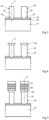
- THE figures 3 to 5 are partial and schematic sectional views of the structure obtained at successive stages of an embodiment of a method of manufacturing the optoelectronic device 60 shown in Figure 2 .
- the seed layer 20 and the insulating layer 22 may be formed by chemical vapor deposition (CVD), physical vapor deposition (PVD) or ALD.
- CVD chemical vapor deposition
- PVD physical vapor deposition
- ALD ALD
- the growth of the lower portions 62 of the wires 26 is carried out by MOCVD.
- the method may comprise injecting into a reactor a precursor of a group III element and a precursor of a group V element.
- precursors of group III elements are trimethylgallium (TMGa), triethylgallium (TEGa), trimethylindium (TMIn) or trimethylaluminum (TMAl).
- precursors of group V elements are ammonia (NH 3 ), tertiarybutylphoshine (TBT), arsine (AsH 3 ), or asymmetric dimethylhydrazine (UDMH).
- the III/V ratio refers to the ratio between the gas flow of the precursor of the group III element and the gas flow of the precursor of the group V element.
- the pressure in the reactor is between 50 torr (about 7 kPa) and 500 torr (70 kPa).
- the growth conditions in the reactor are adapted to promote preferential growth of the lower portion 62 of each wire 26 along its C axis. This means that the growth rate of the wire 26 along the C axis is significantly higher, preferably by at least one order of magnitude, than the growth rate of the wire 26 along a direction perpendicular to the C axis.
- the III/V ratio is between 0.01 and 1, preferably between 0.01 and 0.1.
- the temperature in the reactor is, for example, between 900°C and 1150°C, preferably between 1000°C and 1100°C.
- the lower portions 62 of the wires 26 can be formed by etching in a layer of the III-V compound, in particular according to a so-called top-down technology.
- FIG. 4 represents the structure obtained after the growth of the upper portions 64 of the wires 26.
- the growth of the upper portions 64 of the wires 26 is carried out by MBE, preferably PA-MBE.
- the pressure in the reactor is less than 1.33 mPa (10 -5 Torr), preferably between 10 -4 (approximately 13.3 mPa) and 10 -7 Torr (approximately 0.0133 mPa).
- the III/V ratio which is then the ratio between the atomic flux of the group III element and the atomic flux of the group V element, is between 0.8 and 2.
- the III/V ratio is greater than 1.3, in particular between 1.3 and 2.
- the temperature in the reactor is preferably between 750°C and 875°C, according to the invention, the temperature is between 700°C and 850°C.
- the growth phase of the upper portions 64 by PA-MBE can lead to the formation of a GaN shell on the side walls of the lower portions 62 of the wires 26.
- the dimensions of the upper face 30 are fixed by the ratio n Ga /n N . It therefore appears, advantageously, that when the upper portions 64 of the wires 26 are formed by PA-MBE, the dimensions of the upper face 30 of each upper portion 64, where the active zone 40 is formed, evolve towards dimensions which are substantially independent of the average diameter of the lower portion 62 of the wire 26 from which the upper portion 64 extends and which depend on the III/V ratio used for the formation of the upper portion 64. This therefore makes it possible to precisely control the dimensions of the upper face 30 of the upper portion 64 and therefore the lateral dimensions of the active zone 40.
- the wavelength of the radiation emitted by a quantum well depends in particular on the proportion of the additional element of group III, for example indium, incorporated in the ternary compound of the quantum well. This proportion itself depends on the lateral dimensions of the active zone 40. Therefore, precise control of the lateral dimensions of the active zone 40 makes it possible to precisely control the wavelength of the radiation emitted by the active zone 40. The wavelength dispersion of the radiation emitted by the light-emitting diodes can therefore be reduced.
- FIG. 5 represents the structure obtained after the growth of the layers of the active zones 40 and the semiconductor stacks 42.
- the growth of the layers of the active zones 40 and the semiconductor stacks 42 is carried out by PA-MBE.
- the pressure in the reactor is between 10 -4 and 10 -7 torr.
- an additional element of group III is added to the reactor.
- the ratio between the atomic fluxes of the elements of group III and the atomic flux of the element of group V for the formation of the active zones 40 can be between 0.3 and 2.
- the temperature in the reactor is, for example, between 600°C and 850°C, preferably between 700°C and 800°C.
- the III/V ratio is preferably close to 1 and the ratio between the atomic flux of the additional element and the atomic flux of the group V element is between 0.1 and 0.3.
- the electron blocking layer 46 may be p-doped, for example with magnesium.
- the temperature in the reactor is, for example, between 600°C and 1000°C, preferably between 700°C and 950°C, more preferably between 750°C and 900°C.
- the III/V ratio is preferably less than 1.3, in particular between 1.1 and 1.3.
- the temperature in the reactor is, for example, between 700°C and 900°C, preferably between 750°C and 850°C.
- each active zone 40 has been represented with a substantially constant cross section along the C axis.
- the growth conditions of the active zone 40 can be selected so that the active zone 40 has a truncated pyramid shape with axis C with a cross section which decreases along axis C moving away from the substrate 14.
- Such a shape can be obtained without significant loss of the volume of the quantum well or quantum wells compared to the case where the cross section is constant.
- An active zone 40 in the shape of a truncated pyramid advantageously makes it possible to increase the thickness of the semiconductor layer 44 which covers it and to improve the passivation of the surface of the active zone 40.
- the growth of the active zones 40 and/or the semiconductor stacks 42 is carried out by MOCVD.
- Tests were carried out. For these tests, four GaN wires NW1, NW2, NW3 and NW4 having lower portions 62 of different average diameters were made by MOCVD using openings 24 of different diameters.
- the upper GaN portions 64 of the wires NW1, NW2, NW3 and NW4 were formed by PA-MBE.
- D0 or initial diameter
- the initial diameter of the wire NW1 was equal to 120 nm.
- the initial diameter of the wire NW2 was equal to 180 nm.
- the initial diameter of the wire NW3 was equal to 260 nm.
- the initial diameter of the wire NW4 was equal to 480 nm.
- different temperatures and different Ga/N ratios were used for the MBE growth phase.
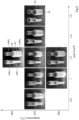
- FIG. 6 represents images obtained by scanning electron microscopy of the NW1, NW2, NW3 and NW4 wires for different growth temperatures and Ga/N ratios used for the MBE.
- the NW1 wire is located at the bottom left of the image
- the NW2 wire is located at the top right of the image
- the NW3 wire is located at the top left of the image
- the NW4 wire is located at the bottom right of the image.
- the Ga/N ratio is between 1.3 and 2 and the temperature is between 700°C and 850°C.
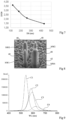
- FIG. 7 is a curve showing the evolution of the D/D0 ratio between the average diameter D of a wire after widening and the initial average diameter D0 of the nanowire before widening as a function of the initial average diameter D0 of the nanowire before widening.
- FIG 8 represents an image obtained by scanning electron microscopy of the wires and active areas 40 of axial-type light-emitting diodes formed with the wires NW1, NW2, NW3 and NW4 for which only the lower portion 62 was present.
- the lower portions 62 of the wires 26 were made of n-type doped GaN.
- Each active area 40 comprised a single InGaN quantum well between barrier layers of intentionally undoped GaN.
- Each semiconductor stack 42 comprised an AlGaN blocking layer and a p-type doped GaN semiconductor layer.
- the lower portions 62 of the wires were formed by PA-MBE with a Ga/N ratio of 1.3 and a temperature of 900°C.
- the InGaN quantum wells were formed by PA-MBE with a Ga+In/N ratio of 1.6 and a temperature of 750°C.
- the AlGaN blocking layers 46 were formed by PA-MBE with a Ga+Al/N ratio of 1, an Al/N ratio of 0.2, and a Ga/N ratio of 0.8.
- the p-type doped GaN semiconductor layers 44 were formed by PA-MBE with a Ga/N ratio of 0.8 and a temperature of 850°C.
- FIG 9 represents evolution curves C1, C2, C3 and C4, as a function of the wavelength, of the spectrum of the radiation emitted by photoluminescence by the active zones 40 of the figure 8 corresponding respectively to wires NW1, NW2, NW3 and NW4.
- the difference between the central wavelength of the light-emitting diode corresponding to wire NW1 and the central wavelength of the diode electroluminescent corresponding to the NW4 wire was about 80 nm.
- FIGS. 10 and 11 are figures analogous respectively to the figures 8 and 9 in the case where the wires NW1, NW2, NW3 and NW4 were formed as previously described with an upper portion 64 formed by PA-MBE.
- the upper portions 64 of the wires 26 were made of unintentionally doped GaN.
- the upper portions 64 of the wires 26 were formed by PA-MBE with a Ga/N ratio of 1.6 and a temperature of 850°C for 10 minutes.
- the difference between the central wavelength of the light-emitting diode corresponding to the wire NW1 and the central wavelength of the light-emitting diode corresponding to the wire NW4 was about 50 nm.
- the wavelength dispersion of the active areas shown in Figure 10 is lower than the dispersion obtained with the active zones represented in figure 8 .
Landscapes
- Engineering & Computer Science (AREA)
- Manufacturing & Machinery (AREA)
- Mechanical Engineering (AREA)
- Led Devices (AREA)
- Physical Vapour Deposition (AREA)
Description
- La présente demande de brevet revendique la priorité de la demande de brevet français
FR19/06898 - La présente invention concerne de façon générale les dispositifs optoélectroniques à diodes électroluminescentes comprenant des éléments semiconducteurs tridimensionnels, par exemple des microfils, des nanofils, des éléments coniques de taille micrométrique ou nanométrique, ou des éléments tronconiques de taille micrométrique ou nanométrique et les procédés de fabrication de tels dispositifs.
- On considère ici plus particulièrement l'amélioration des dispositifs optoélectroniques à diodes électroluminescentes du type axial, comprenant une zone active formée au sommet de chaque élément tridimensionnel. On appelle zone active de la diode électroluminescente la région depuis laquelle est émise la majorité du rayonnement électromagnétique fourni par la diode électroluminescente.
- Les éléments tridimensionnels considérés ici comprennent un matériau semiconducteur comportant majoritairement un élément du groupe III et un élément du groupe V (par exemple du nitrure de gallium GaN), appelé par la suite composé III-V. De tels dispositifs sont, par exemple, décrits dans le brevet
US9728680 - Chaque zone active est prise en sandwich entre l'élément semiconducteur tridimensionnel associé, qui est généralement dopé d'un premier type de conductivité, et une couche semiconductrice du même composé III-V que l'élément semiconducteur et dopée du type de conductivité opposé.
- Un exemple de procédé de fabrication du dispositif optoélectronique comprend la formation des éléments semiconducteurs tridimensionnels par dépôt chimique en phase vapeur aux organométalliques (MOCVD, sigle anglais pour Metal-Organic Chemical Vapor Deposition). Toutefois, il peut être difficile de contrôler avec précision le diamètre moyen des éléments semiconducteurs avec un tel procédé de croissance. De ce fait, un même dispositif optoélectronique peut comprendre des éléments semiconducteurs ayant des diamètres moyens différents. La longueur d'onde du rayonnement émis par la zone active de la diode électroluminescente peut dépendre du diamètre moyen de la zone active et donc du diamètre moyen de l'élément semiconducteur sur lequel la zone active est formée. Une dispersion non contrôlée en longueur d'onde des rayonnements émis par les diodes électroluminescentes peut alors être obtenue.
- Les documents
WO 2019/002786 A1 ,US 2014/110664 A1 etUS 2016/365480 A1 décrivent chacun des procédés de fabrication des dispositifs optoélectroniques comprenant des diodes électroluminescentes (DEL). - Ainsi, un objet d'un mode de réalisation est de pallier au moins en partie les inconvénients des dispositifs optoélectroniques décrits précédemment et de leurs procédés de fabrication.
- Un autre objet d'un mode de réalisation est de réduire la dispersion en longueur d'onde des rayonnements émis par les diodes électroluminescentes du dispositif optoélectronique.
- Ainsi, un mode de réalisation prévoit un procédé de fabrication d'un dispositif optoélectronique comprenant des diodes électroluminescentes comprenant la formation d'éléments semiconducteurs tridimensionnels en un composé III-V comprenant chacun une portion inférieure et une portion supérieure, et, pour chaque élément semiconducteur, la formation d'une zone active recouvrant le sommet de la portion supérieure et la formation d'au moins une couche semiconductrice du composé III-V recouvrant la zone active. Les portions supérieures sont formées par dépôt sous phase vapeur à une pression inférieure à 1,33 mPa.
- Selon un mode de réalisation, les portions inférieures sont formées par gravure sélective ou par croissance épitaxiale, de préférence par une technique de dépôt chimique en phase vapeur aux organométalliques, ou par épitaxie par jets moléculaires.
- Selon l'invention, les portions supérieures sont formées par épitaxie par jets moléculaires.
- Selon l'invention, pour chaque élément semiconducteur, la portion supérieure est évasée par rapport à la portion inférieure.
- Selon l'invention, pour chaque élément semiconducteur, le sommet de la portion supérieure a une aire supérieure d'au moins 20 % par rapport à la section droite de la portion inférieure.
- Selon l'invention, pour la formation des portions supérieures, le rapport III/V est compris entre 1,3 et 2.
- Selon l'invention, pour la formation des portions supérieures, la température des portions supérieures est comprise entre 700°C et 850°C.
- Selon un mode de réalisation, pour la formation des portions inférieures, le rapport III/V est compris entre 0,01 et 1.
- Selon un mode de réalisation, pour la formation des portions inférieures, la température des portions inférieures est comprise entre 700°C et 850°C.
- Selon un mode de réalisation, les zones actives sont formées par épitaxie par jets moléculaires.
- Selon un mode de réalisation, les portions inférieures des éléments semiconducteurs tridimensionnels sont des microfils, des nanofils, des éléments coniques de taille micrométrique ou nanométrique, ou des éléments tronconiques de taille micrométrique ou nanométrique.
- Selon un mode de réalisation, les zones actives sont les régions depuis lesquelles est émise la majorité du rayonnement électromagnétique fourni par les diodes électroluminescentes.
- Ces caractéristiques et avantages, ainsi que d'autres, seront exposés en détail dans la description suivante de modes de réalisation particuliers faite à titre non limitatif en relation avec les figures jointes parmi lesquelles :
- la
figure 1 est une vue en coupe, partielle et schématique, d'un exemple d'un dispositif optoélectronique à diodes électroluminescentes du type axial ; - la
figure 2 est une vue en coupe, partielle et schématique, d'un mode de réalisation d'un dispositif optoélectronique à diodes électroluminescentes du type axial ; - la
figure 3 illustre une étape d'un mode de réalisation d'un procédé de fabrication du dispositif optoélectronique représenté enfigure 2 ; - la
figure 4 illustre une autre étape du procédé ; - la
figure 5 illustre une autre étape du procédé ; - la
figure 6 représente des images obtenues par microscopie électronique à balayage de nanofils pour différentes conditions de croissance ; - la
figure 7 est une courbe d'évolution du rapport entre le diamètre moyen d'un nanofil après élargissement et le diamètre moyen du nanofil avant élargissement en fonction du diamètre moyen du nanofil avant élargissement ; - la
figure 8 représente une image obtenue par microscopie électronique à balayage d'un exemple de certains éléments de diodes électroluminescentes de type axial ayant chacune la structure illustrée enfigure 1 ; - la
figure 9 représente, en fonction de la longueur d'onde, les spectres des rayonnements émis par les zones actives représentées enfigure 8 ; - la
figure 10 représente une image obtenue par microscopie électronique à balayage d'un mode de réalisation de certains éléments de diodes électroluminescentes de type axial ayant chacune la structure illustrée enfigure 2 ; et - la
figure 11 représente, en fonction de la longueur d'onde, les spectres des rayonnements émis par les zones actives représentées à lafigure 10 . - De mêmes éléments ont été désignés par de mêmes références dans les différentes figures. En particulier, les éléments structurels et/ou fonctionnels communs aux différents modes de réalisation peuvent présenter les mêmes références et peuvent disposer de propriétés structurelles, dimensionnelles et matérielles identiques. Par souci de clarté, seuls les étapes et éléments utiles à la compréhension des modes de réalisation décrits ont été représentés et sont détaillés. En particulier, les moyens de commande des dispositifs optoélectroniques sont bien connus et ne sont pas décrits.
- Dans la description qui suit, lorsque l'on fait référence à des qualificatifs de position absolue, tels que les termes "avant", "arrière", "haut", "bas", "gauche", "droite", etc., ou relative, tels que les termes "dessus", "dessous", "supérieur", "inférieur", etc., ou à des qualificatifs d'orientation, tels que les termes "horizontal", "vertical", etc., il est fait référence sauf précision contraire à l'orientation des figures ou à un dispositif optoélectronique dans une position normale d'utilisation.
- Sauf précision contraire, les expressions "environ", "approximativement", "sensiblement", et "de l'ordre de" signifient à 10 % près, de préférence à 5 % près. En outre, on considère ici que les termes "isolant" et "conducteur" signifient respectivement "isolant électriquement" et "conducteur électriquement".
- La présente invention concerne des dispositifs optoélectroniques comprenant des éléments semiconducteurs tridimensionnels, par exemple des microfils, des nanofils, des éléments coniques de taille micrométrique ou nanométrique, ou des éléments tronconiques de taille micrométrique ou nanométrique. Le terme "microfil", "nanofil", "élément conique" ou "élément tronconique" désigne une structure tridimensionnelle de forme allongée, par exemple cylindrique, conique ou tronconique, selon une direction privilégiée, appelée axe par la suite, dont au moins deux dimensions, appelées dimensions mineures, sont comprises entre 5 nm et 2,5 µm, de préférence entre 50 nm et 1 µm, la troisième dimension, appelée dimension majeure, étant supérieure ou égale à 1 fois, de préférence supérieure ou égale à 5 fois et encore plus préférentiellement supérieure ou égale à 10 fois, la plus grande des dimensions mineures, par exemple comprise entre 1 µm et 50 µm. En particulier, un élément conique ou tronconique peut être un élément conique circulaire ou tronconique circulaire ou un élément conique pyramidal ou tronconique pyramidal. Dans la suite de la description, des modes de réalisation sont décrits pour des dispositifs optoélectroniques comprenant des microfils ou des nanofils, appelés de façon générale fils. Toutefois, ces modes de réalisation peuvent être mis en oeuvre pour des éléments semiconducteurs autres que des microfils ou des nanofils, par exemple des éléments coniques ou tronconiques. Dans la suite de la description, on appelle diamètre moyen d'un fil le diamètre du disque de même surface que la section droite du fil. En outre, on appelle longueur d'onde centrale d'un rayonnement la longueur d'onde du rayonnement qui transporte le plus d'énergie.
- La
figure 1 est une vue en coupe, partielle et schématique, d'un exemple d'un dispositif optoélectronique 10 à diodes électroluminescentes de type axial. Le dispositif optoélectronique 10 comprend du bas vers le haut enfigure 1 : - un substrat 14, par exemple un substrat semiconducteur, comprenant des faces parallèles 16 et 18, de préférence planes, la face 18 étant traitée pour promouvoir la croissance de fils. Ce traitement est représenté de façon schématique en
figure 1 par une couche 20 de germination en un matériau favorisant la croissance des fils, sur la face 18 du substrat 14 ; - une couche isolante 22 recouvrant la couche de germination 20 et comprenant des ouvertures 24 traversantes ;
- des fils 26 d'axes C parallèles, deux fils 26 étant représentés sur la
figure 1 au moins en partie dopés d'un premier type de conductivité, par exemple dopés de type n ; - pour chaque fil 26, une tête 28 recouvrant la face supérieure 30, également appelée sommet, du fil 26 ;
- une couche isolante 32 recouvrant les faces latérales des fils 26 et partiellement les faces latérales des têtes 28 ; et
- une couche d'électrode 34 recouvrant la couche isolante 32 et en contact avec les têtes 28.
- Le dispositif optoélectronique 10 comprend une autre électrode, non représentée, pour polariser la base des fils 26.
- Chaque tête 28 comprend du bas vers le haut en
figure 1 : - une zone active 40 recouvrant la face supérieure 30 du fil 26 ; et
- un empilement semiconducteur 42 recouvrant la zone active 40 et comprenant une couche semiconductrice 44 dopée d'un deuxième type de conductivité opposé à celui du fil 26, par exemple dopée de type p, et recouvrant la zone active 40.
- L'ensemble formé par chaque fil 26 et la tête 28 associée correspond à une diode électroluminescente DEL en configuration axiale.
- L'empilement semiconducteur 42 peut en outre comprendre une couche de blocage d'électrons 46 entre la zone active 40 et la couche semiconductrice 44 et une couche semiconductrice de liaison 48 recouvrant la couche semiconductrice 44 du côté opposé à la zone active 40, la couche de liaison 48 étant recouverte par la couche d'électrode 34 et au contact de la couche d'électrode 34. La couche de blocage d'électrons 46 est en contact avec la zone active 40 et la couche semiconductrice 44, et permet d'optimiser la présence des porteurs électriques dans la zone active 40. La couche de liaison 48 peut être du même matériau que la couche semiconductrice 44 et dopée du même type de conductivité que la couche semiconductrice 44 mais avec une concentration de dopants plus importante pour permettre la formation d'un contact ohmique entre la couche semiconductrice 44 et la couche d'électrode 34.
- La zone active 40 est la zone de la diode électroluminescente DEL depuis laquelle est émise la majorité du rayonnement électromagnétique fourni par la diode électroluminescente DEL. Selon un exemple, la zone active 40 peut comporter des moyens de confinement. La zone active 40 peut comprendre au moins un puits quantique, comprenant une couche d'un matériau semiconducteur ayant une énergie de bande interdite inférieure à celle du fil 26 et de la couche semiconductrice 44, de préférence interposée entre deux couches barrières, améliorant ainsi le confinement des porteurs de charge, les couches barrières pouvant être du même matériau que le fil 26 et non intentionnellement dopées. La zone active 40 peut être formée d'un seul puits quantique ou d'une pluralité de puits quantiques. A titre d'exemple, en
figure 1 , on a représenté une alternance selon l'axe C de deux puits quantiques 50 et de trois couches barrières 52. - Un exemple de procédé de fabrication du dispositif optoélectronique 10 comprend la croissance des fils 26, des zones actives 40 et des empilements semiconducteurs 42 en mettant en oeuvre un procédé de croissance qui favorise une croissance cristalline selon l'axe C des fils 26. Le procédé de croissance des fils peut être un procédé du type dépôt chimique en phase vapeur aux organométalliques (MOCVD, acronyme anglais pour Metal-Organic Chemical Vapor Deposition), également connu sous le nom d'épitaxie organométallique en phase vapeur (ou MOVPE, acronyme anglais pour Metal-Organic Vapor Phase Epitaxy) . Le procédé MOCVD présente notamment l'avantage de vitesses de croissance élevées. La croissance de chaque fil 26 débute dans l'une des ouvertures 24 et continue en dehors de l'ouverture 24. Le diamètre moyen du fil 26 en dehors de l'ouverture 24 peut être différent du diamètre moyen de l'ouverture 24, et est en général supérieur au diamètre moyen de l'ouverture 24.
- Un inconvénient est que le procédé MOCVD peut ne pas permettre de commander avec précision le diamètre moyen des fils 26. De ce fait, une dispersion importante des diamètres moyens des fils 26 du dispositif optoélectronique 10 peut être obtenue. Pour chaque diode électroluminescente DEL, le diamètre moyen de la zone active 40 dépend du diamètre moyen du fil 26 et peut être sensiblement égal au diamètre moyen du fil 26. Lorsque la zone active 40 comprend un puits quantique ou des puits quantiques, la longueur d'onde centrale du rayonnement émis par la zone active 40 de la diode électroluminescente DEL dépend notamment du diamètre moyen de la zone active 40 et donc du diamètre moyen du fil 26 sur lequel la zone active 40 est formée. Une dispersion importante des longueurs d'onde centrales des rayonnements émis par les diodes électroluminescentes peut alors être obtenue.
- Les inventeurs ont mis en évidence que, après une première étape de croissance des fils 26 par MOCVD dans laquelle une portion inférieure de chaque fil est formée, et avant l'étape de formation des zones actives 40, en réalisant une deuxième étape de croissance des fils 26 par un procédé de croissance particulier, il est formé, pour chaque fil 26, une portion supérieure délimitant la face supérieure 30, sur laquelle sera formée la zone active 40 de telle sorte que la dispersion des diamètres moyens des surfaces supérieures est inférieure à la dispersion des diamètres moyens des portions inférieures des fils. Les procédés de croissance particuliers sont des procédés de croissance par dépôt sous phase vapeur sous vide à une pression inférieure à 1,33 mPa (10-5 Torr), de préférence inférieure à 0,0133 mPa (10-7 Torr), pour lesquels des jets moléculaires sont projetés sur les surfaces sur lesquelles une croissance cristalline est souhaitée. Il s'agit d'épitaxie par jets moléculaires (MBE, sigle anglais pour Molecular-Beam Epitaxy), notamment d'épitaxie par jets moléculaires assistée par plasma (PA-MBE, sigle anglais pour Plasma-Assisted Molecular-Beam Epitaxy) ou MBE assistée à l'ammoniac.
- La
figure 2 est une vue en coupe d'un mode de réalisation d'un dispositif optoélectronique 60. Le dispositif optoélectronique 60 comprend l'ensemble des éléments du dispositif optoélectronique 10 représenté enfigure 1 à la différence que chaque fil 26 comprend une portion inférieure 62 de section droite sensiblement constante se prolongeant par une portion supérieure 64 qui, dans le présent mode de réalisation, a une forme évasée vers l'extérieur pour laquelle la section droite augmente selon l'axe C en s'éloignant du substrat 14. Selon un autre mode de réalisation, les fils 26 peuvent se répartir en premiers fils comprenant chacun la portion supérieure 64 évasée vers l'extérieur et en deuxièmes fils pour chacun desquels la portion supérieure 64 a une forme de pyramide tronquée dont la grande base repose sur la portion inférieure 62. - De préférence, pour chaque fil 26, la face supérieure 30 de la portion supérieure 64 du fil 26 correspond à une face sensiblement plane orthogonale à l'axe C du fil 26. L'aire de la face supérieure 30 est supérieure d'au moins 20 % à la section droite de la portion inférieure 62 du fil 26. La hauteur de la portion supérieure 64 de chaque fil 26 mesurée selon l'axe C peut être comprise entre 5 nm et 2 µm, de préférence entre 20 nm et 500 nm. La hauteur de la portion inférieure 62 de chaque fil 26 mesurée selon l'axe C peut être comprise entre 200 nm et 5 µm. Pour chaque fil 26, le diamètre moyen de la portion inférieure 62 du fil 26 peut être compris entre 50 nm et 10 µm, de préférence entre 100 nm et 2 µm, plus préférentiellement entre 100 nm et 1 µm. La section droite de la portion inférieure 62 du fil 26 peut avoir différentes formes, par exemple ovale, circulaire ou polygonale, en particulier rectangulaire, carrée ou hexagonale.
- Les fils 26, les couches barrières 52, les couches semiconductrices 44 et les couches de liaison 48 peuvent être, au moins en partie, formés à partir de matériaux semiconducteurs comportant majoritairement un composé III-V, par exemple un composé III-N. Des exemples d'éléments du groupe III comprennent le gallium (Ga), l'indium (In) ou l'aluminium (Al). Des exemples de composés III-N sont GaN, AlN, InN, InGaN, AlGaN ou AlInGaN. D'autres éléments du groupe V peuvent également être utilisés, par exemple le phosphore ou l'arsenic. De façon générale, les éléments dans le composé III-V peuvent être combinés avec différentes fractions molaires. Les composés III-V des fils 26 et des couches 44, 48 peuvent comprendre un dopant, par exemple du silicium (Si) qui est un dopant de type n pour les composés III-V ou du magnésium (Mg) qui est un dopant de type p pour les composés III-V.
- Le matériau semiconducteur du puits quantique 50 ou des puits quantiques 50 de la zone active 40 peut comprendre le composé III-V du fil 26 et de la couche semiconductrice 44 dans lequel au moins un élément supplémentaire est incorporé. A titre d'exemple, dans le cas de fils 26 constitués de GaN, l'élément supplémentaire est par exemple l'indium (In). Le pourcentage atomique de l'élément supplémentaire est fonction des propriétés optiques souhaitées et du spectre d'émission de la diode électroluminescente DEL. Lorsque la portion supérieure 64 du fil 26 n'est pas intentionnellement dopée, celle-ci peut remplacer l'une des couches barrières 52 de la zone active 40.
- La couche de blocage d'électrons 46 peut être formée en un alliage ternaire, par exemple en nitrure de gallium et d'aluminium (AlGaN) ou en nitrure d'indium et d'aluminium (AlInN).
- Le substrat 14 peut correspondre à une structure monobloc ou correspondre à une couche recouvrant un support constitué d'un autre matériau. Le substrat 14 est de préférence un substrat semiconducteur, par exemple un substrat en silicium, en germanium, en carbure de silicium, en un composé III-V, tel que du GaN ou du GaAs, ou un substrat conducteur, par exemple un substrat métallique, notamment en cuivre, en titane, en molybdène, en un alliage à base de nickel ou en acier, ou un substrat en saphir. De préférence, le substrat 14 est un substrat de silicium monocristallin. De préférence, il s'agit d'un substrat semiconducteur compatible avec les procédés de fabrication mis en oeuvre en microélectronique. Le substrat 14 peut correspondre à une structure multicouches de type silicium sur isolant, également appelée SOI (acronyme anglais pour Silicon On Insulator).
- La couche de germination 20 est en un matériau favorisant la croissance des fils 26. A titre d'exemple, le matériau composant la couche de germination 20 peut être un nitrure, un carbure ou un borure d'un métal de transition de la colonne IV, V ou VI du tableau périodique des éléments ou une combinaison de ces composés. A titre d'exemple, la couche de germination 20 peut être en nitrure d'aluminium (AlN). La couche de germination 20 peut avoir une structure monocouche ou correspondre à un empilement de deux couches ou de plus de deux couches. Des exemples de matériau pour la couche de germination 20 sont décrits dans le brevet
FR2997557 - La couche isolante 22 peut être en un matériau diélectrique, par exemple en oxyde de silicium (SiO2) ou en nitrure de silicium (SixNy, où x est environ égal à 3 et y est environ égal à 4, par exemple du Si3N4). A titre d'exemple, l'épaisseur de la couche isolante 22 est comprise entre 5 nm et 100 nm, par exemple égale à environ 30 nm. La couche isolante 22 peut avoir une structure monocouche ou correspondre à un empilement de deux couches ou de plus de deux couches.
- La couche isolante 32 peut être en un matériau diélectrique, par exemple en oxyde de silicium (SiO2) ou en nitrure de silicium (SixNy, où x est environ égal à 3 et y est environ égal à 4, par exemple du Si3N4). La couche isolante 32 peut avoir une structure monocouche ou correspondre à un empilement de deux couches ou de plus de deux couches. A titre d'exemple, la couche isolante 32 peut être constituée d'un matériau polymère, d'un matériau inorganique ou d'une combinaison d'un matériau polymère et d'un matériau inorganique. A titre d'exemple, le matériau inorganique peut être de l'oxyde de titane (TiO2) ou de l'oxyde d'aluminium (AlxOy, où x est environ égal à 2 et y est environ égal à 3, par exemple du Al2O3).
- La couche d'électrode 34 est adaptée à polariser la zone active 40 recouvrant chaque fil 26 et à laisser passer le rayonnement électromagnétique émis par les diodes électroluminescentes DEL. Le matériau formant la couche d'électrode 34 peut être un matériau transparent et conducteur tel que de l'oxyde d'indium-étain (ou ITO, acronyme anglais pour Indium Tin Oxide), de l'oxyde de zinc dopé ou non à l'aluminium ou au gallium, ou du graphène. A titre d'exemple, la couche d'électrode 34 a une épaisseur comprise entre 5 nm et 200 nm, de préférence entre 20 nm et 50 nm.
- Les
figures 3 à 5 sont des vues en coupe, partielles et schématiques, de la structure obtenue à des étapes successives d'un mode de réalisation d'un procédé de fabrication du dispositif optoélectronique 60 représenté enfigure 2 . - La
figure 3 représente la structure obtenue après les étapes suivantes : - formation sur le substrat 14 de la couche de germination 20 ;
- formation de la couche isolante 22 sur la couche de germination 20 ;
- formation des ouvertures 24 dans la couche isolante 22 pour exposer des portions de la couche de germination 20 aux emplacements souhaités des fils 26, le diamètre des ouvertures 24 correspondant sensiblement au diamètre moyen des fils 26 ; et
- croissance des portions inférieures 62 des fils 26 à partir de la couche de germination 20 dans les ouvertures 24.
- La couche de germination 20 et la couche isolante 22 peuvent être formées par dépôt chimique en phase vapeur (CVD, sigle anglais pour Chemical Vapor Deposition), dépôt physique en phase vapeur (PVD, sigle anglais pour Physical Vapor Deposition) ou ALD.
- Selon un mode de réalisation, la croissance des portions inférieures 62 des fils 26 est réalisée par MOCVD. A titre d'exemple, le procédé peut comprendre l'injection dans un réacteur d'un précurseur d'un élément du groupe III et d'un précurseur d'un élément du groupe V. Des exemples de précurseurs d'éléments du groupe III sont le triméthylgallium (TMGa), le triéthylgallium (TEGa), le triméthylindium (TMIn) ou le triméthylaluminium (TMAl). Des exemples de précurseurs d'éléments du groupe V sont l'ammoniac (NH3), le tertiarybutylphoshine (TBT), l'arsine (AsH3), ou le diméthylhydrazine asymétrique (UDMH). On appelle rapport III/V le rapport entre le flux de gaz du précurseur de l'élément du groupe III et le flux de gaz du précurseur de l'élément du groupe V. La pression dans le réacteur est comprise entre 50 torr (environ 7 kPa) et 500 torr (70 kPa). Les conditions de croissance dans le réacteur sont adaptées pour favoriser une croissance préférentielle de la portion inférieure 62 de chaque fil 26 selon son axe C. Cela signifie que la vitesse de croissance du fil 26 selon l'axe C est nettement supérieure, de préférence d'au moins un ordre de grandeur, à la vitesse de croissance du fil 26 selon une direction perpendiculaire à l'axe C. Selon un mode de réalisation, le rapport III/V est compris entre 0,01 et 1, de préférence compris entre 0,01 et 0,1. La température dans le réacteur est, par exemple, comprise entre 900°C et 1150°C, de préférence entre 1000°C et 1100°C.
- Selon un autre mode de réalisation, les portions inférieures 62 des fils 26 peuvent être formées par gravure dans une couche du composé III-V, notamment selon une technologie dite descendante (en anglais top-down).
- La
figure 4 représente la structure obtenue après la croissance des portions supérieures 64 des fils 26. Selon l'invention, la croissance des portions supérieures 64 des fils 26 est réalisée par MBE, de préférence PA-MBE. La pression dans le réacteur est inférieure à 1,33 mPa (10-5 Torr), de préférence comprise entre 10-4 (environ 13,3 mPa) et 10-7 torr (environ 0,0133 mPa). Le rapport III/V, qui est alors le rapport entre le flux atomique de l'élément du groupe III et le flux atomique de l'élément du groupe V, est compris entre 0,8 et 2. Pour obtenir un élargissement de la portion supérieure 64 de chaque fil 26, le rapport III/V est supérieur à 1,3, notamment compris entre 1,3 et 2. Pour obtenir un élargissement de la portion supérieure 64 de chaque fil 26, la température dans le réacteur est de préférence comprise entre 750°C et 875°C, selon l'invention, la température est comprise entre 700°C et 850°C. La phase de croissance des portions supérieures 64 par PA-MBE peut entraîner la formation d'une coque de GaN sur les parois latérales des portions inférieures 62 des fils 26. - Si on appelle ϕGa le flux atomique de l'élément du groupe III, ϕN le flux atomique de l'élément du groupe V, D le diamètre de la portion inférieure 62 du fil (que l'on considère de façon approximative cylindrique à base circulaire), θ l'angle d'incidence du flux atomique de l'élément du groupe III et du flux atomique de l'élément du groupe V sur la face supérieure 30 du fil 26, nGa le nombre effectif d'atomes de l'élément du groupe III sur la face supérieure 30 et nN le nombre effectif d'atomes de l'élément du groupe V sur la face supérieure 30, et si on considère que la longueur de diffusion λ de l'élément du groupe III sur les parois latérales des fils dépend seulement de la température, on peut déterminer la relation Math 1 suivante :

- En régime stabilisé, les dimensions de la face supérieure 30 sont fixées par le rapport nGa/nN. Il apparaît donc, de façon avantageuse, que lorsque les portions supérieures 64 des fils 26 sont formées par PA-MBE, les dimensions de la face supérieure 30 de chaque portion supérieure 64, où est formée la zone active 40, évoluent vers des dimensions qui sont sensiblement indépendantes du diamètre moyen de la portion inférieure 62 du fil 26 depuis laquelle s'étend la portion supérieure 64 et qui dépendent du rapport III/V utilisé pour la formation de la portion supérieure 64. Ceci permet donc de commander avec précision les dimensions de la face supérieure 30 de la portion supérieure 64 et donc les dimensions latérales de la zone active 40. Ceci permet de compenser au moins partiellement la dispersion des diamètres moyens des portions inférieures 62 des fils 26 qui peuvent résulter du procédé de fabrication de ces portions inférieures 62. Si la croissance des portions supérieures 64 est interrompue avant d'atteindre le régime stabilité, les faces supérieures 30 des fils 26 peuvent ne pas avoir exactement les mêmes dimensions.
- En outre, la longueur d'onde du rayonnement émis par un puits quantique dépend notamment de la proportion de l'élément supplémentaire du groupe III, par exemple l'indium, incorporé dans le composé ternaire du puits quantique. Cette proportion dépend elle-même des dimensions latérales de la zone active 40. De ce fait, un contrôle précis des dimensions latérales de la zone active 40 permet de contrôler avec précision la longueur d'onde du rayonnement émis par la zone active 40. La dispersion en longueurs d'onde des rayonnements émis par les diodes électroluminescentes peut donc être réduite.
- La
figure 5 représente la structure obtenue après la croissance des couches des zones actives 40 et des empilements semiconducteurs 42. Selon un mode de réalisation, la croissance des couches des zones actives 40 et des empilements semiconducteurs 42 est réalisée par PA-MBE. La pression dans le réacteur est comprise entre 10-4 et 10-7 torr. Pour la formation du puits quantique ou de chaque puits quantique, un élément supplémentaire du groupe III est ajouté dans le réacteur. Le rapport entre les flux atomiques des éléments du groupe III et le flux atomique de l'élément du groupe V pour la formation des zones actives 40 peut être compris entre 0,3 et 2. La température dans le réacteur est, par exemple, comprise entre 600°C et 850°C, de préférence entre 700°C et 800°C. - Pour la formation de la couche de blocage d'électrons 46, un élément supplémentaire du groupe III est ajouté dans le réacteur, le rapport III/V est de préférence proche de 1 et le rapport entre le flux atomique de l'élément supplémentaire et le flux atomique de l'élément du groupe V est compris entre 0,1 et 0,3. La couche de blocage d'électrons 46 peut être dopée de type p, par exemple avec du magnésium. Pour la formation de la couche de blocage d'électrons 46, la température dans le réacteur est, par exemple, comprise entre 600°C et 1000°C, de préférence entre 700°C et 950°C, plus préférentiellement entre 750°C et 900°C. Pour la formation de la couche semiconductrice 44 ou 48, le rapport III/V est de préférence inférieur à 1,3, notamment compris entre 1,1 et 1,3. Pour la formation de la couche semiconductrice 44 ou 48, la température dans le réacteur est, par exemple, comprise entre 700°C et 900°C, de préférence entre 750°C et 850°C.
- Sur la
figure 5 , on a représenté chaque zone active 40 avec une section droite sensiblement constante selon l'axe C. A titre de variante, les conditions de croissance de la zone active 40 peuvent être sélectionnées de façon que la zone active 40 ait une forme de pyramide tronquée d'axe C avec une section droite qui diminue selon l'axe C en s'éloignant du substrat 14. Une telle forme peut être obtenue sans perte notable du volume du puits quantique ou des puits quantiques par rapport au cas où la section droite est constante. Une zone active 40 en forme de pyramide tronquée permet, de façon avantageuse, d'augmenter l'épaisseur de la couche semiconductrice 44 qui la recouvre et d'améliorer la passivation de la surface de la zone active 40. - Selon un autre mode de réalisation, la croissance des zones actives 40 et/ou des empilements semiconducteurs 42 est réalisée par MOCVD.
- Des essais ont été réalisés. Pour ces essais, quatre fils NW1, NW2, NW3 et NW4 en GaN ayant des portions inférieures 62 de diamètres moyens différents ont été réalisés par MOCVD en utilisant des ouvertures 24 de diamètres différents. Les portions supérieures 64 en GaN des fils NW1, NW2, NW3 et NW4 ont été formées par PA-MBE. On appelle D0, ou diamètre initial, le diamètre moyen de la portion inférieure 62 du fil 26 mesuré au niveau du sommet de la portion inférieure 62 avant la phase de croissance par MBE de la portion supérieure 64. Le diamètre initial du fil NW1 était égal à 120 nm. Le diamètre initial du fil NW2 était égal à 180 nm. Le diamètre initial du fil NW3 était égal à 260 nm. Le diamètre initial du fil NW4 était égal à 480 nm. Pour la phase de croissance par MBE, différentes températures et différents rapports Ga/N ont été utilisés.
- La
figure 6 représente des images obtenues par microscopie électronique à balayage des fils NW1, NW2, NW3 et NW4 pour différentes températures de croissance et rapports Ga/N utilisés pour la MBE. Sur chaque image, le fil NW1 est situé en bas à gauche de l'image, le fil NW2 est situé en haut à droite de l'image, le fil NW3 est situé en haut à gauche de l'image et le fil NW4 est situé en bas à droite de l'image. Dans le cas de l'invention où une portion supérieure 64 de forme évasée est recherchée pour la majorité des fils NW1, NW2, NW3 et NW4, le rapport Ga/N est compris entre 1,3 et 2 et la température est comprise entre 700°C et 850°C. - Les résultats de mesures dans le cas où le rapport Ga/N était égal sensiblement à 1,6 et la température était égale sensiblement à 850°C sont rassemblés dans le tableau I ci-dessous.
[Table 1] Fil D0 (nm) D (nm) D/D0 NW1 120 434,55 3,62 NW2 180 520,70 2,89 NW3 260 551,65 2,12 NW4 480 626,48 1,46 - La
figure 7 est une courbe d'évolution du rapport D/D0 entre le diamètre moyen D d'un fil après élargissement et le diamètre moyen initial D0 du nanofil avant élargissement en fonction du diamètre moyen initial D0 du nanofil avant élargissement. - La
figure 8 représente une image obtenue par microscopie électronique à balayage des fils et des zones actives 40 de diodes électroluminescentes de type axial formées avec les fils NW1, NW2, NW3 et NW4 pour lesquels seule la portion inférieure 62 était présente. Les portions inférieures 62 des fils 26 étaient en GaN dopé de type n. Chaque zone active 40 comprenait un puits quantique unique en InGaN entre des couches barrières de GaN non dopé intentionnellement. Chaque empilement semiconducteur 42 comprenait une couche de blocage en AlGaN et une couche semiconductrice en GaN dopé de type p. Les portions inférieures 62 des fils ont été formées par PA-MBE avec un rapport Ga/N de 1,3 et une température de 900°C. Les puits quantiques en InGaN ont été formés par PA-MBE avec un rapport Ga+In/N de 1,6 et une température de 750°C. Les couches de blocage 46 en AlGaN ont été formées par PA-MBE avec un rapport Ga+Al/N de 1, un rapport Al/N de 0,2 et un rapport Ga/N de 0,8. Les couches semiconductrices 44 de GaN dopé de type p ont été formées par PA-MBE avec un rapport Ga/N de 0,8 et une température de 850°C. - La
figure 9 représente des courbes d'évolution C1, C2, C3 et C4, en fonction de la longueur d'onde, du spectre des rayonnements émis par photoluminescence par les zones actives 40 de lafigure 8 correspondant respectivement aux fils NW1, NW2, NW3 et NW4. L'écart entre la longueur d'onde centrale de la diode électroluminescente correspondant au fil NW1 et la longueur d'onde centrale de la diode électroluminescente correspondant au fil NW4 était d'environ 80 nm. - Les
figures 10 et 11 sont des figures analogues respectivement auxfigures 8 et 9 dans le cas où les fils NW1, NW2, NW3 et NW4 ont été formés comme cela a été décrit précédemment avec une portion supérieure 64 formée par PA-MBE. Les portions supérieures 64 des fils 26 étaient en GaN non intentionnellement dopé. Les portions supérieures 64 des fils 26 ont été formées par PA-MBE avec un rapport Ga/N de 1,6 et une température de 850°C pendant 10 minutes. L'écart entre la longueur d'onde centrale de la diode électroluminescente correspondant au fil NW1 et la longueur d'onde centrale de la diode électroluminescente correspondant au fil NW4 était d'environ 50 nm. La dispersion en longueur d'onde des zones actives représentées enfigure 10 est inférieure à la dispersion obtenue avec les zones actives représentées enfigure 8 . - Divers modes de réalisation et variantes ont été décrits. L'homme de l'art comprendra que certaines caractéristiques de ces divers modes de réalisation et variantes pourraient être combinées, et d'autres variantes apparaîtront à l'homme de l'art. Les modes de réalisation selon l'invention sont définis dans les revendications suivantes.
Claims (7)
- Procédé de fabrication d'un dispositif optoélectronique (60) comprenant des diodes électroluminescentes (DEL) comprenant la formation d'éléments semiconducteurs tridimensionnels (26) en un composé III-V comprenant chacun une portion inférieure (62) et une portion supérieure (64), et, pour chaque élément semiconducteur, la formation d'une zone active (40) recouvrant le sommet (30) de la portion supérieure et la formation d'au moins une couche semiconductrice (44) du composé III-V recouvrant la zone active, les portions supérieures sont formées par épitaxie par jets moléculaires à une pression inférieure à 1,33 mPa, pour chaque élément semiconducteur (26), la portion supérieure (64) est évasée par rapport à la portion inférieure (62), le sommet (30) de la portion supérieure (64) ayant une aire supérieure d'au moins 20 % par rapport à la section droite de la portion inférieure (62), pour la formation des portions supérieures (64), le rapport III/V est compris entre 1,3 et 2 et la température des portions supérieures est comprise entre 700°C et 850°C.
- Procédé selon la revendication 1, dans lequel les portions inférieures (62) sont formées par gravure sélective ou par croissance épitaxiale, de préférence par une technique de dépôt chimique en phase vapeur aux organométalliques, ou par épitaxie par jets moléculaires.
- Procédé selon la revendication 1 ou 2, dans lequel, pour la formation des portions inférieures (62), le rapport III/V est compris entre 0,01 et 1.
- Procédé selon la revendication 3, dans lequel, pour la formation des portions inférieures (62), la température des portions inférieures est comprise entre 700°C et 850°C.
- Procédé selon l'une quelconque des revendications 1 à 4, dans lequel les zones actives (40) sont formées par épitaxie par jets moléculaires.
- Procédé selon l'une quelconque des revendications 1 à 5, dans lequel les portions inférieures (62) des éléments semiconducteurs tridimensionnels (26) sont des microfils, des nanofils, des éléments coniques de taille micrométrique ou nanométrique, ou des éléments tronconiques de taille micrométrique ou nanométrique.
- Procédé selon l'une quelconque des revendications 1 à 6, dans lequel les zones actives (40) sont les régions depuis lesquelles est émise la majorité du rayonnement électromagnétique fourni par les diodes électroluminescentes (DEL).
Applications Claiming Priority (2)
| Application Number | Priority Date | Filing Date | Title |
|---|---|---|---|
| FR1906898A FR3098012B1 (fr) | 2019-06-25 | 2019-06-25 | Procédé d'homogénéisation de la section de nanofils pour diodes électroluminescentes |
| PCT/EP2020/067959 WO2020260541A1 (fr) | 2019-06-25 | 2020-06-25 | Procede d'homogeneisation de la section de nanofils pour diodes electroluminescentes |
Publications (2)
| Publication Number | Publication Date |
|---|---|
| EP3991213A1 EP3991213A1 (fr) | 2022-05-04 |
| EP3991213B1 true EP3991213B1 (fr) | 2025-05-28 |
Family
ID=67810943
Family Applications (1)
| Application Number | Title | Priority Date | Filing Date |
|---|---|---|---|
| EP20734543.0A Active EP3991213B1 (fr) | 2019-06-25 | 2020-06-25 | Procede d'homogeneisation de la section de nanofils pour diodes electroluminescentes |
Country Status (4)
| Country | Link |
|---|---|
| US (1) | US12206040B2 (fr) |
| EP (1) | EP3991213B1 (fr) |
| FR (1) | FR3098012B1 (fr) |
| WO (1) | WO2020260541A1 (fr) |
Family Cites Families (11)
| Publication number | Priority date | Publication date | Assignee | Title |
|---|---|---|---|---|
| TWI500072B (zh) * | 2004-08-31 | 2015-09-11 | 學校法人上智學院 | 發光元件之製造方法 |
| US8306083B2 (en) * | 2008-09-30 | 2012-11-06 | The Regents Of The University Of California | High performance ZnO-based laser diodes |
| WO2011009465A1 (fr) * | 2009-07-23 | 2011-01-27 | Danmarks Tekniske Universitet | Source de photon unique à entraînement électrique |
| US9653286B2 (en) * | 2012-02-14 | 2017-05-16 | Hexagem Ab | Gallium nitride nanowire based electronics |
| TWI482311B (zh) * | 2012-10-19 | 2015-04-21 | 國立中山大學 | 三族氮化物量子井結構及其製造方法 |
| FR2997557B1 (fr) | 2012-10-26 | 2016-01-01 | Commissariat Energie Atomique | Dispositif electronique a nanofil(s) muni d'une couche tampon en metal de transition, procede de croissance d'au moins un nanofil, et procede de fabrication d'un dispositif |
| FR3000612B1 (fr) | 2012-12-28 | 2016-05-06 | Commissariat Energie Atomique | Dispositif optoelectronique a microfils ou nanofils |
| WO2015095049A1 (fr) * | 2013-12-17 | 2015-06-25 | Glo Ab | Del à nanofil de nitrure d'élément iii ayant une région active de surface modifiée par contrainte et son procédé de fabrication |
| US10290767B2 (en) * | 2015-06-09 | 2019-05-14 | The Royal Institution For The Advancement Of Learning/Mcgill University | High efficiency visible and ultraviolet nanowire emitters |
| FR3044470B1 (fr) * | 2015-11-30 | 2018-03-23 | Commissariat A L'energie Atomique Et Aux Energies Alternatives | Dispositif optoelectronique comportant des structures semiconductrices tridimensionnelles en configuration axiale |
| FR3068517B1 (fr) * | 2017-06-30 | 2019-08-09 | Aledia | Dispositif optoelectronique comportant des structures semiconductrices tridimensionnelles en configuration axiale |
-
2019
- 2019-06-25 FR FR1906898A patent/FR3098012B1/fr active Active
-
2020
- 2020-06-25 US US17/619,820 patent/US12206040B2/en active Active
- 2020-06-25 EP EP20734543.0A patent/EP3991213B1/fr active Active
- 2020-06-25 WO PCT/EP2020/067959 patent/WO2020260541A1/fr not_active Ceased
Also Published As
| Publication number | Publication date |
|---|---|
| WO2020260541A1 (fr) | 2020-12-30 |
| US12206040B2 (en) | 2025-01-21 |
| EP3991213A1 (fr) | 2022-05-04 |
| FR3098012B1 (fr) | 2023-01-13 |
| FR3098012A1 (fr) | 2021-01-01 |
| US20220359782A1 (en) | 2022-11-10 |
Similar Documents
| Publication | Publication Date | Title |
|---|---|---|
| EP3991214B1 (fr) | Procédé de fabrication d'un dispositif optoélectronique à diodes électroluminescentes de type axial | |
| EP3646383B1 (fr) | Dispositif optoelectronique comportant des structures semiconductrices tridimensionnelles en configuration axiale | |
| FR3061607A1 (fr) | Dispositif optoelectronique a diodes electroluminescentes | |
| EP3248227B1 (fr) | Dispositif optoelectronique et son procede de fabrication | |
| EP3090450B1 (fr) | Dispositif optoélectronique à éléments semiconducteurs et son procédé de fabrication | |
| EP3201951B1 (fr) | Dispositif optoelectronique a elements semiconducteurs tridimensionnels | |
| EP3323151A1 (fr) | Dispositif optoelectronique a elements semiconducteurs tridimensionnels et son procede de fabrication | |
| EP2939276B1 (fr) | Dispositif opto-électronique à microfils ou nanofils | |
| EP3053201B1 (fr) | Dispositif optoélectronique à diodes électroluminescentes | |
| EP2939277B1 (fr) | Dispositif optoelectronique a microfils ou nanofils | |
| WO2019129473A1 (fr) | Dispositif optoelectronique comprenant des diodes electroluminescentes tridimensionnelles | |
| WO2022069431A1 (fr) | Dispositif optoelectronique a diodes electroluminescentes a affichage couleur | |
| EP3991213B1 (fr) | Procede d'homogeneisation de la section de nanofils pour diodes electroluminescentes | |
| EP3144983B1 (fr) | Dispositif électroluminescent à puits quantiques multiples | |
| FR3098019A1 (fr) | Dispositif optoélectronique comprenant des éléments semi-conducteurs tridimensionnels et procédé pour sa fabrication | |
| EP3991199A1 (fr) | Procede de fabrication de microfils ou nanofils | |
| FR3000611A1 (fr) | Dispositif optoelectronique a microfils ou nanofils |
Legal Events
| Date | Code | Title | Description |
|---|---|---|---|
| STAA | Information on the status of an ep patent application or granted ep patent |
Free format text: STATUS: UNKNOWN |
|
| STAA | Information on the status of an ep patent application or granted ep patent |
Free format text: STATUS: THE INTERNATIONAL PUBLICATION HAS BEEN MADE |
|
| PUAI | Public reference made under article 153(3) epc to a published international application that has entered the european phase |
Free format text: ORIGINAL CODE: 0009012 |
|
| STAA | Information on the status of an ep patent application or granted ep patent |
Free format text: STATUS: REQUEST FOR EXAMINATION WAS MADE |
|
| 17P | Request for examination filed |
Effective date: 20211220 |
|
| AK | Designated contracting states |
Kind code of ref document: A1 Designated state(s): AL AT BE BG CH CY CZ DE DK EE ES FI FR GB GR HR HU IE IS IT LI LT LU LV MC MK MT NL NO PL PT RO RS SE SI SK SM TR |
|
| DAV | Request for validation of the european patent (deleted) | ||
| DAX | Request for extension of the european patent (deleted) | ||
| RAP3 | Party data changed (applicant data changed or rights of an application transferred) |
Owner name: UNIVERSITE GRENOBLE ALPES Owner name: COMMISSARIAT A L'ENERGIE ATOMIQUE ET AUX ENERGIESALTERNATIVES Owner name: ALEDIA |
|
| REG | Reference to a national code |
Ref country code: DE Free format text: PREVIOUS MAIN CLASS: H01L0033000000 Ipc: H10H0020010000 Ref country code: DE Ref legal event code: R079 Ref document number: 602020052001 Country of ref document: DE Free format text: PREVIOUS MAIN CLASS: H01L0033000000 Ipc: H10H0020010000 |
|
| GRAP | Despatch of communication of intention to grant a patent |
Free format text: ORIGINAL CODE: EPIDOSNIGR1 |
|
| STAA | Information on the status of an ep patent application or granted ep patent |
Free format text: STATUS: GRANT OF PATENT IS INTENDED |
|
| RIC1 | Information provided on ipc code assigned before grant |
Ipc: H01L 25/075 20060101ALI20250106BHEP Ipc: H10H 29/14 20250101ALI20250106BHEP Ipc: H10H 20/824 20250101ALI20250106BHEP Ipc: H10H 20/819 20250101ALI20250106BHEP Ipc: H10H 20/818 20250101ALI20250106BHEP Ipc: H10H 20/813 20250101ALI20250106BHEP Ipc: H10H 20/01 20250101AFI20250106BHEP |
|
| INTG | Intention to grant announced |
Effective date: 20250116 |
|
| GRAS | Grant fee paid |
Free format text: ORIGINAL CODE: EPIDOSNIGR3 |
|
| GRAA | (expected) grant |
Free format text: ORIGINAL CODE: 0009210 |
|
| STAA | Information on the status of an ep patent application or granted ep patent |
Free format text: STATUS: THE PATENT HAS BEEN GRANTED |
|
| AK | Designated contracting states |
Kind code of ref document: B1 Designated state(s): AL AT BE BG CH CY CZ DE DK EE ES FI FR GB GR HR HU IE IS IT LI LT LU LV MC MK MT NL NO PL PT RO RS SE SI SK SM TR |
|
| REG | Reference to a national code |
Ref country code: GB Ref legal event code: FG4D Free format text: NOT ENGLISH |
|
| REG | Reference to a national code |
Ref country code: CH Ref legal event code: EP |
|
| REG | Reference to a national code |
Ref country code: DE Ref legal event code: R096 Ref document number: 602020052001 Country of ref document: DE |
|
| REG | Reference to a national code |
Ref country code: IE Ref legal event code: FG4D Free format text: LANGUAGE OF EP DOCUMENT: FRENCH |
|
| PGFP | Annual fee paid to national office [announced via postgrant information from national office to epo] |
Ref country code: GB Payment date: 20250625 Year of fee payment: 6 |
|
| PGFP | Annual fee paid to national office [announced via postgrant information from national office to epo] |
Ref country code: FR Payment date: 20250626 Year of fee payment: 6 |
|
| REG | Reference to a national code |
Ref country code: NL Ref legal event code: MP Effective date: 20250528 |
|
| PG25 | Lapsed in a contracting state [announced via postgrant information from national office to epo] |
Ref country code: FI Free format text: LAPSE BECAUSE OF FAILURE TO SUBMIT A TRANSLATION OF THE DESCRIPTION OR TO PAY THE FEE WITHIN THE PRESCRIBED TIME-LIMIT Effective date: 20250528 Ref country code: ES Free format text: LAPSE BECAUSE OF FAILURE TO SUBMIT A TRANSLATION OF THE DESCRIPTION OR TO PAY THE FEE WITHIN THE PRESCRIBED TIME-LIMIT Effective date: 20250528 |
|
| PGFP | Annual fee paid to national office [announced via postgrant information from national office to epo] |
Ref country code: DE Payment date: 20250629 Year of fee payment: 6 |
|
| REG | Reference to a national code |
Ref country code: LT Ref legal event code: MG9D |
|
| PG25 | Lapsed in a contracting state [announced via postgrant information from national office to epo] |
Ref country code: GR Free format text: LAPSE BECAUSE OF FAILURE TO SUBMIT A TRANSLATION OF THE DESCRIPTION OR TO PAY THE FEE WITHIN THE PRESCRIBED TIME-LIMIT Effective date: 20250829 Ref country code: NO Free format text: LAPSE BECAUSE OF FAILURE TO SUBMIT A TRANSLATION OF THE DESCRIPTION OR TO PAY THE FEE WITHIN THE PRESCRIBED TIME-LIMIT Effective date: 20250828 |
|
| PG25 | Lapsed in a contracting state [announced via postgrant information from national office to epo] |
Ref country code: NL Free format text: LAPSE BECAUSE OF FAILURE TO SUBMIT A TRANSLATION OF THE DESCRIPTION OR TO PAY THE FEE WITHIN THE PRESCRIBED TIME-LIMIT Effective date: 20250528 Ref country code: PL Free format text: LAPSE BECAUSE OF FAILURE TO SUBMIT A TRANSLATION OF THE DESCRIPTION OR TO PAY THE FEE WITHIN THE PRESCRIBED TIME-LIMIT Effective date: 20250528 |
|
| PG25 | Lapsed in a contracting state [announced via postgrant information from national office to epo] |
Ref country code: BG Free format text: LAPSE BECAUSE OF FAILURE TO SUBMIT A TRANSLATION OF THE DESCRIPTION OR TO PAY THE FEE WITHIN THE PRESCRIBED TIME-LIMIT Effective date: 20250528 |
|
| PG25 | Lapsed in a contracting state [announced via postgrant information from national office to epo] |
Ref country code: HR Free format text: LAPSE BECAUSE OF FAILURE TO SUBMIT A TRANSLATION OF THE DESCRIPTION OR TO PAY THE FEE WITHIN THE PRESCRIBED TIME-LIMIT Effective date: 20250528 |
|
| PG25 | Lapsed in a contracting state [announced via postgrant information from national office to epo] |
Ref country code: RS Free format text: LAPSE BECAUSE OF FAILURE TO SUBMIT A TRANSLATION OF THE DESCRIPTION OR TO PAY THE FEE WITHIN THE PRESCRIBED TIME-LIMIT Effective date: 20250828 |
|
| PG25 | Lapsed in a contracting state [announced via postgrant information from national office to epo] |
Ref country code: IS Free format text: LAPSE BECAUSE OF FAILURE TO SUBMIT A TRANSLATION OF THE DESCRIPTION OR TO PAY THE FEE WITHIN THE PRESCRIBED TIME-LIMIT Effective date: 20250928 |
|
| PG25 | Lapsed in a contracting state [announced via postgrant information from national office to epo] |
Ref country code: LV Free format text: LAPSE BECAUSE OF FAILURE TO SUBMIT A TRANSLATION OF THE DESCRIPTION OR TO PAY THE FEE WITHIN THE PRESCRIBED TIME-LIMIT Effective date: 20250528 |
|
| REG | Reference to a national code |
Ref country code: AT Ref legal event code: MK05 Ref document number: 1799409 Country of ref document: AT Kind code of ref document: T Effective date: 20250528 |
|
| PG25 | Lapsed in a contracting state [announced via postgrant information from national office to epo] |
Ref country code: AT Free format text: LAPSE BECAUSE OF FAILURE TO SUBMIT A TRANSLATION OF THE DESCRIPTION OR TO PAY THE FEE WITHIN THE PRESCRIBED TIME-LIMIT Effective date: 20250528 Ref country code: DK Free format text: LAPSE BECAUSE OF FAILURE TO SUBMIT A TRANSLATION OF THE DESCRIPTION OR TO PAY THE FEE WITHIN THE PRESCRIBED TIME-LIMIT Effective date: 20250528 Ref country code: SM Free format text: LAPSE BECAUSE OF FAILURE TO SUBMIT A TRANSLATION OF THE DESCRIPTION OR TO PAY THE FEE WITHIN THE PRESCRIBED TIME-LIMIT Effective date: 20250528 |
|
| PG25 | Lapsed in a contracting state [announced via postgrant information from national office to epo] |
Ref country code: CZ Free format text: LAPSE BECAUSE OF FAILURE TO SUBMIT A TRANSLATION OF THE DESCRIPTION OR TO PAY THE FEE WITHIN THE PRESCRIBED TIME-LIMIT Effective date: 20250528 |
|
| PG25 | Lapsed in a contracting state [announced via postgrant information from national office to epo] |
Ref country code: EE Free format text: LAPSE BECAUSE OF FAILURE TO SUBMIT A TRANSLATION OF THE DESCRIPTION OR TO PAY THE FEE WITHIN THE PRESCRIBED TIME-LIMIT Effective date: 20250528 |
|
| PG25 | Lapsed in a contracting state [announced via postgrant information from national office to epo] |
Ref country code: SK Free format text: LAPSE BECAUSE OF FAILURE TO SUBMIT A TRANSLATION OF THE DESCRIPTION OR TO PAY THE FEE WITHIN THE PRESCRIBED TIME-LIMIT Effective date: 20250528 |
|
| REG | Reference to a national code |
Ref country code: CH Ref legal event code: H13 Free format text: ST27 STATUS EVENT CODE: U-0-0-H10-H13 (AS PROVIDED BY THE NATIONAL OFFICE) Effective date: 20260127 |
|
| PG25 | Lapsed in a contracting state [announced via postgrant information from national office to epo] |
Ref country code: IT Free format text: LAPSE BECAUSE OF FAILURE TO SUBMIT A TRANSLATION OF THE DESCRIPTION OR TO PAY THE FEE WITHIN THE PRESCRIBED TIME-LIMIT Effective date: 20250528 |
|
| PG25 | Lapsed in a contracting state [announced via postgrant information from national office to epo] |
Ref country code: LU Free format text: LAPSE BECAUSE OF NON-PAYMENT OF DUE FEES Effective date: 20250625 |
|
| PG25 | Lapsed in a contracting state [announced via postgrant information from national office to epo] |
Ref country code: MC Free format text: LAPSE BECAUSE OF FAILURE TO SUBMIT A TRANSLATION OF THE DESCRIPTION OR TO PAY THE FEE WITHIN THE PRESCRIBED TIME-LIMIT Effective date: 20250528 |
|
| REG | Reference to a national code |
Ref country code: BE Ref legal event code: MM Effective date: 20250630 |
|
| REG | Reference to a national code |
Ref country code: DE Ref legal event code: R097 Ref document number: 602020052001 Country of ref document: DE |
|
| PG25 | Lapsed in a contracting state [announced via postgrant information from national office to epo] |
Ref country code: RO Free format text: LAPSE BECAUSE OF FAILURE TO SUBMIT A TRANSLATION OF THE DESCRIPTION OR TO PAY THE FEE WITHIN THE PRESCRIBED TIME-LIMIT Effective date: 20250528 |
|
| PLBE | No opposition filed within time limit |
Free format text: ORIGINAL CODE: 0009261 |
|
| STAA | Information on the status of an ep patent application or granted ep patent |
Free format text: STATUS: NO OPPOSITION FILED WITHIN TIME LIMIT |
|
| REG | Reference to a national code |
Ref country code: CH Ref legal event code: L10 Free format text: ST27 STATUS EVENT CODE: U-0-0-L10-L00 (AS PROVIDED BY THE NATIONAL OFFICE) Effective date: 20260409 |
|
| PG25 | Lapsed in a contracting state [announced via postgrant information from national office to epo] |
Ref country code: IE Free format text: LAPSE BECAUSE OF NON-PAYMENT OF DUE FEES Effective date: 20250625 |
|
| PG25 | Lapsed in a contracting state [announced via postgrant information from national office to epo] |
Ref country code: BE Free format text: LAPSE BECAUSE OF NON-PAYMENT OF DUE FEES Effective date: 20250630 |
|
| PG25 | Lapsed in a contracting state [announced via postgrant information from national office to epo] |
Ref country code: CH Free format text: LAPSE BECAUSE OF NON-PAYMENT OF DUE FEES Effective date: 20250630 |