EP3989166A1 - Artificial intelligence-based image region recognition method and apparatus, and model training method and apparatus - Google Patents
Artificial intelligence-based image region recognition method and apparatus, and model training method and apparatus Download PDFInfo
- Publication number
- EP3989166A1 EP3989166A1 EP20827039.7A EP20827039A EP3989166A1 EP 3989166 A1 EP3989166 A1 EP 3989166A1 EP 20827039 A EP20827039 A EP 20827039A EP 3989166 A1 EP3989166 A1 EP 3989166A1
- Authority
- EP
- European Patent Office
- Prior art keywords
- image
- heatmap
- region
- segmentation
- segmentation region
- Prior art date
- Legal status (The legal status is an assumption and is not a legal conclusion. Google has not performed a legal analysis and makes no representation as to the accuracy of the status listed.)
- Granted
Links
Images




Classifications
-
- G—PHYSICS
- G06—COMPUTING OR CALCULATING; COUNTING
- G06T—IMAGE DATA PROCESSING OR GENERATION, IN GENERAL
- G06T7/00—Image analysis
- G06T7/10—Segmentation; Edge detection
- G06T7/11—Region-based segmentation
-
- G—PHYSICS
- G06—COMPUTING OR CALCULATING; COUNTING
- G06T—IMAGE DATA PROCESSING OR GENERATION, IN GENERAL
- G06T7/00—Image analysis
- G06T7/10—Segmentation; Edge detection
- G06T7/12—Edge-based segmentation
-
- G—PHYSICS
- G06—COMPUTING OR CALCULATING; COUNTING
- G06T—IMAGE DATA PROCESSING OR GENERATION, IN GENERAL
- G06T7/00—Image analysis
- G06T7/10—Segmentation; Edge detection
- G06T7/149—Segmentation; Edge detection involving deformable models, e.g. active contour models
-
- G—PHYSICS
- G06—COMPUTING OR CALCULATING; COUNTING
- G06T—IMAGE DATA PROCESSING OR GENERATION, IN GENERAL
- G06T7/00—Image analysis
- G06T7/10—Segmentation; Edge detection
- G06T7/187—Segmentation; Edge detection involving region growing; involving region merging; involving connected component labelling
-
- G—PHYSICS
- G06—COMPUTING OR CALCULATING; COUNTING
- G06V—IMAGE OR VIDEO RECOGNITION OR UNDERSTANDING
- G06V10/00—Arrangements for image or video recognition or understanding
- G06V10/20—Image preprocessing
- G06V10/26—Segmentation of patterns in the image field; Cutting or merging of image elements to establish the pattern region, e.g. clustering-based techniques; Detection of occlusion
-
- G—PHYSICS
- G06—COMPUTING OR CALCULATING; COUNTING
- G06V—IMAGE OR VIDEO RECOGNITION OR UNDERSTANDING
- G06V10/00—Arrangements for image or video recognition or understanding
- G06V10/40—Extraction of image or video features
- G06V10/44—Local feature extraction by analysis of parts of the pattern, e.g. by detecting edges, contours, loops, corners, strokes or intersections; Connectivity analysis, e.g. of connected components
- G06V10/443—Local feature extraction by analysis of parts of the pattern, e.g. by detecting edges, contours, loops, corners, strokes or intersections; Connectivity analysis, e.g. of connected components by matching or filtering
- G06V10/449—Biologically inspired filters, e.g. difference of Gaussians [DoG] or Gabor filters
- G06V10/451—Biologically inspired filters, e.g. difference of Gaussians [DoG] or Gabor filters with interaction between the filter responses, e.g. cortical complex cells
- G06V10/454—Integrating the filters into a hierarchical structure, e.g. convolutional neural networks [CNN]
-
- G—PHYSICS
- G06—COMPUTING OR CALCULATING; COUNTING
- G06V—IMAGE OR VIDEO RECOGNITION OR UNDERSTANDING
- G06V10/00—Arrangements for image or video recognition or understanding
- G06V10/40—Extraction of image or video features
- G06V10/46—Descriptors for shape, contour or point-related descriptors, e.g. scale invariant feature transform [SIFT] or bags of words [BoW]; Salient regional features
- G06V10/469—Contour-based spatial representations, e.g. vector-coding
-
- G—PHYSICS
- G06—COMPUTING OR CALCULATING; COUNTING
- G06V—IMAGE OR VIDEO RECOGNITION OR UNDERSTANDING
- G06V10/00—Arrangements for image or video recognition or understanding
- G06V10/70—Arrangements for image or video recognition or understanding using pattern recognition or machine learning
- G06V10/77—Processing image or video features in feature spaces; using data integration or data reduction, e.g. principal component analysis [PCA] or independent component analysis [ICA] or self-organising maps [SOM]; Blind source separation
- G06V10/774—Generating sets of training patterns; Bootstrap methods, e.g. bagging or boosting
-
- G—PHYSICS
- G06—COMPUTING OR CALCULATING; COUNTING
- G06V—IMAGE OR VIDEO RECOGNITION OR UNDERSTANDING
- G06V10/00—Arrangements for image or video recognition or understanding
- G06V10/70—Arrangements for image or video recognition or understanding using pattern recognition or machine learning
- G06V10/82—Arrangements for image or video recognition or understanding using pattern recognition or machine learning using neural networks
-
- G—PHYSICS
- G06—COMPUTING OR CALCULATING; COUNTING
- G06V—IMAGE OR VIDEO RECOGNITION OR UNDERSTANDING
- G06V20/00—Scenes; Scene-specific elements
- G06V20/20—Scenes; Scene-specific elements in augmented reality scenes
-
- G—PHYSICS
- G06—COMPUTING OR CALCULATING; COUNTING
- G06T—IMAGE DATA PROCESSING OR GENERATION, IN GENERAL
- G06T2207/00—Indexing scheme for image analysis or image enhancement
- G06T2207/10—Image acquisition modality
- G06T2207/10004—Still image; Photographic image
-
- G—PHYSICS
- G06—COMPUTING OR CALCULATING; COUNTING
- G06T—IMAGE DATA PROCESSING OR GENERATION, IN GENERAL
- G06T2207/00—Indexing scheme for image analysis or image enhancement
- G06T2207/10—Image acquisition modality
- G06T2207/10024—Color image
-
- G—PHYSICS
- G06—COMPUTING OR CALCULATING; COUNTING
- G06T—IMAGE DATA PROCESSING OR GENERATION, IN GENERAL
- G06T2207/00—Indexing scheme for image analysis or image enhancement
- G06T2207/20—Special algorithmic details
- G06T2207/20081—Training; Learning
-
- G—PHYSICS
- G06—COMPUTING OR CALCULATING; COUNTING
- G06T—IMAGE DATA PROCESSING OR GENERATION, IN GENERAL
- G06T2207/00—Indexing scheme for image analysis or image enhancement
- G06T2207/20—Special algorithmic details
- G06T2207/20084—Artificial neural networks [ANN]
-
- G—PHYSICS
- G06—COMPUTING OR CALCULATING; COUNTING
- G06T—IMAGE DATA PROCESSING OR GENERATION, IN GENERAL
- G06T2207/00—Indexing scheme for image analysis or image enhancement
- G06T2207/20—Special algorithmic details
- G06T2207/20092—Interactive image processing based on input by user
- G06T2207/20101—Interactive definition of point of interest, landmark or seed
Definitions
- the present disclosure relates to the field of artificial intelligence (AI), and in particular, to image region segmentation and recognition.
- AI artificial intelligence
- the image segmentation technology is a technology of segmenting an image into several particular regions having special properties, and abstracting a target of interest. For example, in a scenario of human tissue image segmentation, a medical image may be segmented, so that various human tissues can be clearly distinguished in the segmented image.
- a tool for auxiliary segmentation is provided.
- a user draws a bounding box (bbox) in the image, and a to-be-annotated target is included in the bbox, and then a polygon segmentation result for the to-be-annotated target is outputted through a neural network model. If the segmentation result is not accurate, the user may correct the result.
- bbox bounding box
- Embodiments of the present disclosure provide an AI-based image region recognition method, an AI-based image region recognition apparatus, an AI-based model training method and an AI-based model training apparatus.
- a region with a relatively poor segmentation effect in image segmentation at the first stage is further segmented by using auxiliary segmentation at the second stage, to obtain a more accurate image segmentation result, thereby improving image segmentation performance.
- an image region recognition method performed by an image processing device, the method including:
- a model training method performed by an image processing device, the method including:
- an image processing device including
- an image processing device including
- a terminal device including: a memory, a transceiver, a processor, and a bus system,
- a server including a memory, a transceiver, a processor, and a bus system,
- a computer-readable storage medium stores a computer program, the computer program being configured to perform the methods according to the foregoing aspects.
- a computer program product including instructions is provided, the instructions, when run on a computer, causing the computer to perform the methods according to the foregoing aspects.
- the embodiments of the present disclosure have at least the following advantages.
- an image region recognition method is provided.
- a to-be-segmented image is first obtained, the to-be-segmented image including a plurality of extreme points.
- first image feature information is generated according to the to-be-segmented image.
- a first image segmentation region corresponding to the first image feature information is obtained by using a first image segmentation model.
- a second heatmap is obtained based on an annotation point corresponding to the first image segmentation region and the first image segmentation region; and finally a second image segmentation region corresponding to the to-be-segmented image is obtained by using a second image segmentation model.
- a region with a relatively poor segmentation effect obtained in image segmentation at the first stage may be further segmented by using auxiliary segmentation at the second stage, so as to obtain a more accurate image segmentation result without requiring a lot of time for correcting the image segmentation result, thereby improving image segmentation performance.
- the image recognition result for the to-be-segmented image may be generated according to the second image segmentation region, thereby improving recognition accuracy.
- Embodiments of the present disclosure provide an image region recognition method, an image region recognition apparatus, a model training method and a model training apparatus.
- a region with a relatively poor segmentation effect in image segmentation at the first stage is further segmented by using auxiliary segmentation at the second stage, so as to obtain a more accurate image segmentation result, thereby improving image segmentation performance.
- the image region segmentation method provided in the present disclosure may be applied to the field of AI, and specifically, to the field of computer vision.
- AI computer science technology
- a scientific system has been established in image processing and analysis, in which more and more new processing methods are emerging.
- image processing and analysis has received extensive attention from all aspects.
- vision is the most important means of human perception
- image is the basis of vision. Therefore, digital images have become an effective tool for researchers in many fields such as psychology, physiology, and computer science to study visual perception.
- image processing is increasingly required in large-scale applications such as military, remote sensing, and meteorology.
- Image segmentation technology has always been the basic technology and important research direction in the field of computer vision, and specifically, it is to segment regions of interest (such as people, cars, buildings, and the like) from an image according to real contours.
- the image segmentation technology is an important part of image semantic understanding.
- image processing capability is significantly increased, and the image segmentation technology plays a more important role in many fields such as medical image analysis (including positioning of tumors and other pathologies, tissue volume measurement, computer guided surgery, customization of treatment regimens, research on anatomical structures), face recognition, fingerprint recognition, unmanned driving, and machine vision.
- FIG. 1 is a schematic architectural diagram of an image region recognition system according to an embodiment of the present disclosure.
- an image processing device provided in the present disclosure includes a terminal device or a server, for example, the image processing device may be a terminal device deployed with a client, and the client may be specifically an auxiliary segmentation tool.
- the terminal device deployed with the client includes, but is not limited to, a tablet computer, a notebook computer, a palmtop computer, a mobile phone, a speech interaction device, and a personal computer (PC), and is not limited herein.
- an interactive image auxiliary segmentation tool based on neural network models that is, a first image segmentation model and a second image segmentation model
- the auxiliary segmentation tool can, with only a small quantity of user interaction behaviors, feed back a relatively accurate pre-segmentation result (that is, a first image segmentation region) by using a neural network model (that is, the first image segmentation model), and then performs a small quantity of secondary annotations on the pre-segmentation result (that is, the first image segmentation region) to obtain a final segmentation result (that is, a second image segmentation region) by using a neural network model (that is, the second image segmentation model).
- a segmentation method based on "interaction of a small quantity of annotation points" is provided, and an image segmentation model is improved, thereby obtaining better segmentation results and tool real-time performance.
- the first image segmentation model and the second image segmentation model may be deployed in a server used as an image processing device, to achieve the on-line image segmentation by prediction of an image segmentation region using the first image segmentation model and the second image segmentation model.
- the first image segmentation model and the second image segmentation model may be alternatively deployed in a terminal device used as an image processing device, to achieve the off-line image segmentation by prediction of an image segmentation region in an off-line state.
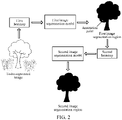
- FIG. 2 is a schematic flowchart of an image region recognition method according to an embodiment of the present disclosure.
- a user annotates an extreme point for a to-be-processed image by using an auxiliary segmentation tool.
- the user annotates a tree in a to-be-segmented image in FIG. 2 .
- the auxiliary segmentation tool generates a first heatmap according to an annotation result from the user, and combines the first heatmap and an image matrix of the to-be-segmented image to obtain first image feature information.
- the first image feature information is inputted into a first image segmentation model, and feature extraction is performed on the first image feature information by using the first image segmentation model to output a first image segmentation region.
- the first image segmentation model may be an image segmentation convolutional neural network (CNN), and a model structure thereof mainly includes an input layer, a feature extraction layer, and an output layer.
- CNN image segmentation convolutional neural network
- the auxiliary segmentation tool may be further used to input an annotation point.
- a second heatmap is generated according to the annotation point inputted by the user. The second heatmap, the image matrix of the to-be-processed image, and the first image segmentation region are combined to obtain second image feature information.
- the second image feature information is inputted into a second image segmentation model, and feature extraction is performed on the second image feature information by using the second image segmentation model to output a second image segmentation region, so as to obtain a more accurate segmentation region of the tree.
- Image recognition is performed on the to-be-segmented image according to the second image segmentation region, and the obtained image recognition result is relatively accurate.
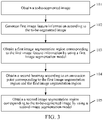
- an embodiment of the image region recognition method in the embodiment of the present disclosure includes the following steps 101 to 105.
- step 101 a to-be-segmented image is obtained.
- the to-be-segmented image includes a plurality of extreme points.
- an image region recognition device obtains a to-be-segmented image.
- the image processing device may be embodied as an auxiliary segmentation tool deployed therein.
- the to-be-segmented image may be obtained through annotation by using the auxiliary segmentation tool.
- the user uses the auxiliary segmentation tool to annotate a plurality of extreme points, and the to-be-segmented image is generated according to the extreme points. It may be understood that, the image processing device provided in the present disclosure may be deployed on a terminal device.
- the plurality of extreme points may be some or all of the highest point, the lowest point, the leftmost point, and the rightmost point of a target object in the to-be-segmented image, which is not limited herein.
- first image feature information is generated according to the to-be-segmented image.
- the first image feature information includes N image matrices and a first heatmap, the first heatmap being generated according to the plurality of extreme points, N being an integer greater than or equal to 1.
- an image region segmentation apparatus generates the N image matrices according to the to-be-segmented image, generates the first heatmap according to the plurality of extreme points, and combines the first heatmap and the N image matrices to obtain first image feature information corresponding to the to-be-segmented image.
- Digital image data may be represented by using a matrix. If a size of the read to-be-segmented image is 128 ⁇ 128, a size of the image matrix is 128 ⁇ 128 ⁇ N, N being an integer greater than or equal to 1.
- the image matrix may be a matrix corresponding to a grayscale image.
- the image matrix may be a matrix of a red green blue (RGB) image.
- RGB image has three dimensions, and the three dimensions respectively represent three components: red, green, and blue.
- a size of the component is 0 to 255, and each pixel is a combination of the three components.
- Each of R,G and B channels corresponds to one image matrix (that is, a first image matrix, a second image matrix, and a third image matrix), and therefore, the three R,G and B channels are superimposed to form a color image, that is, a to-be-segmented image is obtained.
- the image matrix may be in a red green blue Alpha (RGBA) color space.
- RGBA red green blue Alpha
- PNG portable network graphics
- a first image segmentation region corresponding to the first image feature information is obtained by using a first image segmentation model.
- the first image segmentation model includes a first heatmap channel and N first matrix channels, the N first matrix channels being in one-to-one correspondence with the N image matrices, the first heatmap channel being corresponding to the first heatmap.
- the correspondence proposed herein may be interpreted as follows: if an image matrix a corresponds to a first matrix channel a, when a first image segmentation region corresponding to the image feature information is obtained by using the image segmentation model, the image matrix a is inputted into the image segmentation model via the first matrix channel a.
- the correspondence between the first heatmap and the first heatmap channel is also in the similar manner.
- the image processing device inputs the first image feature information into the first image segmentation model, where the first image segmentation model may adopt a deep lab structure, including, but not limited to DeepLabV1, DeepLabV2, DeepLabV3, and DeepLabV3+.
- the DeepLabV2 structure is a CNN model structure used for image segmentation, which can, when inputted with an original image, output a mask image of the same size as the original image, a value of each pixel in the mask image represents a class label value to which the pixel belongs.
- DeepLabV3+ is a CNN model structure improved based on DeeplabV2 for image segmentation, usually having better performance in image segmentation.
- the CNN is a network obtained by replacing a fully connected layer structure in an artificial neural network with a convolutional layer, which achieves excellent performance in various computer vision fields.
- a structure of the first image segmentation model is adapted.
- a first-layer parameter of the first image segmentation model is modified so that the first image segmentation model can receive image data of (N+1) channels, that is, the first image segmentation model includes N first matrix channels and one first heatmap channel. Assuming that N is 3, it indicates that there are three image matrices. In this case, there are three corresponding first matrix channels, each first matrix channel being corresponding to one image matrix. In addition, there is also one first heatmap channel, the first heatmap channel being corresponding to the first heatmap.
- N 1, it indicates that there is one image matrix.
- there is one corresponding first matrix channel the one first matrix channel being corresponding to one image matrix of a grayscale image.
- N 4
- N 4
- there are four corresponding first matrix channels each first matrix channel being corresponding to one image matrix.
- there is also one first heatmap channel the first heatmap channel being corresponding to the first heatmap.
- step 104 a second heatmap is obtained according to an annotation point corresponding to the first image segmentation region and the first image segmentation region.
- the image processing device receives an annotation point, where there may be one or more annotation points, and the annotation point is obtained through annotation by the user according to the first image segmentation region.
- the image region segmentation apparatus generates a second heatmap according to the annotation point.
- a generation method of the second heatmap is similar to that of the first heatmap, and details are not repeated herein.
- the first image segmentation region may include a region that is missed in recognition and an excess region that is recognized.
- the region that is missed in recognition may be understood as a part that belongs to the target object but is not in the first image segmentation region, and the excess region that is recognized may be understood as a region that is in the first image segmentation region but obviously does not belong to the target object.
- An annotation point corresponding to the region that is missed in recognition may be at the edge or not at the edge.
- the annotation point corresponding to the region that is missed in recognition is a negative point, and may be denoted by -1. If the annotation point is a negative point, -1 is used for multiplication in generating a Gaussian distribution (that is, the second heatmap).
- An annotation point corresponding to the excess region that is recognized may be at the edge or not at the edge.
- the annotation point corresponding to the excess region that is recognized is a positive point, and may be denoted by 1. If the annotation point is a positive point, 1 is used for multiplication in generating a Gaussian distribution (that is, the second heatmap).
- a second image segmentation region corresponding to the to-be-segmented image is obtained by using a second image segmentation model.
- the second image segmentation model includes a segmentation region channel, a second heatmap channel, and N second matrix channels, the N second matrix channels being in one-to-one correspondence with the N image matrices, the segmentation region channel being corresponding to the first image segmentation region, the second heatmap channel being corresponding to the second heatmap.
- the image processing device combines the second heatmap, the first image segmentation region, and the N image matrices of the to-be-segmented image to obtain second image feature information corresponding to the to-be-segmented image, and then inputs the second image feature information into the second image segmentation model, the second image segmentation model including N second matrix channels, a segmentation region channel, and a second heatmap channel, the N second matrix channels being in one-to-one correspondence with the N image matrices, the segmentation region channel being corresponding to the first image segmentation region, the second heatmap channel being corresponding to the second heatmap.
- step 106 an image recognition result for the to-be-segmented image is generated according to the second image segmentation region.
- the image processing device may further generate an image recognition result for the to-be-segmented image according to the second image segmentation region.
- the second image segmentation region and the first image segmentation region are both mask images.
- An edge of the target object in the to-be-segmented image may be obtained based on the mask images, and an image recognition result is finally obtained.
- the image recognition result may be displayed by using text information.
- the image recognition result is text of an object such as a "monkey” or a "car”.
- the image recognition result may be a target object highlighted in the to-be-segmented image, and the target object may be an object such as a "car” or a "monkey".
- an image region segmentation method is provided.
- a to-be-segmented image is first obtained, the to-be-segmented image including a plurality of extreme points.
- first image feature information is generated according to the to-be-segmented image.
- a first image segmentation region corresponding to the first image feature information is obtained by using a first image segmentation model.
- a second heatmap is obtained based on the first image segmentation region, the second heatmap being generated according to an annotation point.
- a second image segmentation region corresponding to the to-be-segmented image is obtained by using a second image segmentation model.
- a region with a relatively poor segmentation effect obtained in image segmentation at the first stage may be further segmented by using auxiliary segmentation at the second stage, so as to obtain a more accurate image segmentation result without requiring a lot of time for correcting the image segmentation result, thereby improving image segmentation performance.
- the image recognition result for the to-be-segmented image may be generated according to the second image segmentation region, thereby improving recognition accuracy.
- the obtaining a to-be-segmented image includes: receiving an object annotation instruction for a to-be-processed image, the to-be-processed image including a target object, the object annotation instruction carrying location information of a plurality of extreme points corresponding to the target object, the plurality of extreme points being used for identifying a contour edge of the target object.
- the extreme points may be determined by using the contour edge of the target object at four directions.
- the extreme points may be extreme points in four directions of up, down, left, and right, as shown in FIG. 4 .
- location information of the four extreme points includes first extreme point location information, second extreme point location information, third extreme point location information, and fourth extreme point location information.
- the obtaining a to-be-segmented image further includes: generating, in response to the object annotation instruction, the to-be-segmented image according to the to-be-processed image.
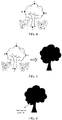
- FIG. 4 is a schematic diagram of an embodiment of selecting four extreme points according to an embodiment of the present disclosure.
- a to-be-processed image is first displayed, the to-be-processed image including a target object, for example, including flowers, haystacks, and a tree.
- the target object includes, but is not limited to a person, an animal, a car, or the like.
- the auxiliary segmentation tool is enabled, the user may trigger an object annotation instruction.
- multiple extreme points are selected from the to-be-processed image by clicking.
- FIG. 4 as an example, assuming that the target object is a tree, the user selects four extreme points of the tree by using the auxiliary segmentation tool, that is, a first extreme point A, a second extreme point B, a third extreme point C, and a fourth extreme point D.
- the object annotation instruction specifically carries coordinate information of the four extreme points, and therefore, a to-be-segmented image corresponding to the to-be-processed image is generated according to the object annotation instruction.
- the to-be-segmented image is an image corresponding to the tree shown in FIG. 4 , and the to-be-segmented image includes a region formed by the first extreme point A, the second extreme point B, the third extreme point C, and the fourth extreme point D.
- the auxiliary segmentation tool generates first image feature information (including a first heatmap and N image matrices) according to the to-be-segmented image, and then obtains a first image segmentation region corresponding to the first image feature information by using a first image segmentation model.
- FIG. 5 is a schematic diagram of returning a first image segmentation region by a first image segmentation model according to an embodiment of the present disclosure. As shown in FIG. 5 , the auxiliary segmentation tool calculates a first image segmentation region according to the four extreme points, and returns the first image segmentation region. For example, an image corresponding to a shaded area in FIG. 5 is the image segmentation region. It may be understood that the image segmentation region may be a pre-segmented polygon result, and FIG. 5 is merely an example and is not to be understood as a limitation on the present disclosure.
- a method for annotating extreme points is provided.
- a to-be-processed image is displayed first; and then an object annotation instruction is received, the object annotation instruction carrying first extreme point location information, second extreme point location information, third extreme point location information, and fourth extreme point location information corresponding to the target object.
- a to-be-segmented image is generated according to the to-be-processed image in response to the object annotation instruction.
- the obtaining a second heatmap according to the first image segmentation region may include: receiving a first annotation instruction, the first annotation instruction being corresponding to M annotation points, the annotation point being located inside the first image segmentation region, M being an integer greater than or equal to 1; and generating, in response to the first annotation instruction, the second heatmap according to the M annotation points corresponding to the first annotation instruction.
- FIG. 6 is a schematic diagram of an annotation location based on a first image segmentation region according to an embodiment of the present disclosure.
- the first image segmentation region has an excess region that does not belong to a target object (for example, a tree).
- the user marks M annotation points in the excess region by using the auxiliary segmentation tool, M being an integer greater than or equal to 1.
- the M annotation points are located inside the first image segmentation region, that is, the annotation is performed on the excess region in the first image segmentation region.
- an annotation point A is marked as shown in FIG. 6 .
- an annotation point corresponding to an excess region that is recognized may be at the edge or not at the edge, which is not limited herein.
- the annotation point corresponding to the excess region that is recognized is a positive point and may be denoted by 1.
- a method for generating a second heatmap according to an annotation point is provided, that is: receiving a first annotation instruction, and generating, in response to the first annotation instruction, the second heatmap according to the M annotation points carried in the first annotation instruction.
- the auxiliary segmentation tool can be used to perform secondary annotation on the first image segmentation region obtained through preliminary prediction.
- the auxiliary segmentation tool is easy to operate and convenient to use; on the other hand, a more accurate image segmentation result can be generated through the secondary annotation, thereby improving the operability and feasibility of the solution.
- the obtaining a second heatmap according to the first image segmentation region may include: receiving a second annotation instruction, the second annotation instruction being corresponding to M annotation points, the annotation point being located outside the first image segmentation region, M being an integer greater than or equal to 1; and generating, in response to the second annotation instruction, the second heatmap according to the M annotation points corresponding to the second annotation instruction.
- FIG. 7 is a schematic diagram of another annotation location based on a first image segmentation region according to an embodiment of the present disclosure.
- the first image segmentation region has a missing region that belongs to the target object (for example, a tree).
- the user marks M annotation points in the missing region by using the auxiliary segmentation tool, M being an integer greater than or equal to 1.
- the M annotation points are located inside the first image segmentation region, that is, annotation is performed on the missing region of the target object.
- an annotation point B is marked as shown in FIG. 7 .
- an annotation point corresponding to a region that is missed in recognition may be at the edge or not at the edge, which is not limited herein.
- the annotation point corresponding to the region that is missed in recognition is a negative point and may be denoted by -1. If the annotation point is a negative point, -1 is used for multiplication in generating a Gaussian distribution.
- another method for generating a second heatmap according to an annotation point includes: receiving a second annotation instruction, and generating, in response to the second annotation instruction, the second heatmap according to the M annotation points carried in the second annotation instruction.
- the N first matrix channels include a red channel, a green channel, and a blue channel
- the generating first image feature information according to the to-be-segmented image may include:
- FIG. 8 is a schematic diagram of an embodiment of generating first image feature information according to an embodiment of the present disclosure.
- an image matrix of four channels is inputted by using an input format of deep extreme cut (DEXTR). That is, an input of the first image segmentation model adopted in the present disclosure further includes information of four extreme points in addition to the original image.
- a heatmap with the same size as the to-be-segmented image, that is, the first heatmap is generated. That is, as shown in FIG.
- a 2D Gaussian distribution is generated by using coordinates of the four extreme points as centers respectively, and then the first heatmap is used as an input of the first heatmap channel (that is, the fourth matrix channel) to be combined with the other three image matrices to obtain the first image feature information, and finally the first image feature information is used as an input of the first image segmentation model.
- the three image matrices are respectively a first image matrix, a second image matrix, and a third image matrix.
- the first image matrix corresponds to a red (R) input channel
- the second image matrix corresponds to a green (G) input channel
- the third image matrix corresponds to a blue (B) input channel.
- the heatmap generation mainly includes four steps, which are specifically as follows:
- a method for generating first image feature information according to a to-be-segmented image is provided.
- a first heatmap is generated according to a plurality of extreme points in the to-be-segmented image, a first image matrix is generated according to the to-be-segmented image, a second image matrix is generated according to the to-be-segmented image, and a third image matrix is generated according to the to-be-segmented image.
- the N second matrix channels include a red channel, a green channel, and a blue channel
- the N image matrices are determined by generating N image matrices according to the to-be-segmented image, the N image matrices including a first image matrix corresponding to the red channel, a second image matrix corresponding to the green channel, and a third image matrix corresponding to the blue channel.
- the method may further include: generating second image feature information according to the first image segmentation region, the second heatmap, the first image matrix, the second image matrix, and the third image matrix, the second image feature information being input information to the second image segmentation model for obtaining the second image segmentation region.
- FIG. 9 is a schematic diagram of generating second image feature information according to an embodiment of the present disclosure.
- an image matrix of five channels is inputted by using the input format of DEXTR. That is, an input of the second image segmentation model adopted in the present disclosure includes information of the annotation points and the first image segmentation region outputted by the first image segmentation model, in addition to the original image.
- a heatmap with the same size as the to-be-segmented image that is, the second heatmap. That is, as shown in FIG. 9 , a 2D Gaussian distribution is generated by using coordinates of the M annotation points as centers respectively, then the second heatmap is used as an input of the second heatmap channel (that is, the fourth matrix channel), the first image segmentation region is used as an input of a segmentation region channel (that is, the fifth matrix channel), the inputs are combined with the other three image matrices to obtain the second image feature information, and finally the second image feature information is used as an input of the second image segmentation model.
- the three image matrices are respectively a first image matrix, a second image matrix, and a third image matrix.
- the first image matrix corresponds to an R input channel
- the second image matrix corresponds to a G input channel
- the third image matrix corresponds to a B input channel.
- the distribution is generated as the second heatmap by using the annotation points as the centers.
- a method for generating second image feature information according to a to-be-segmented image is provided. After the second heatmap is obtained according to the first image segmentation region, a first image matrix may be generated according to the to-be-segmented image, a second image matrix may be generated according to the to-be-segmented image, a third image matrix may be generated according to the to-be-segmented image, and second image feature information may be generated according to the first image segmentation region, the second heatmap, the first image matrix, the second image matrix, and the third image matrix, the second image feature information being input information to the second image segmentation model.
- annotation points selected by the user are fully used, and a generated heatmap may better provide effective information, so as to improve feasibility and operability of the solution.
- the obtaining a second image segmentation region corresponding to the to-be-segmented image by using a second image segmentation model may include:
- a structure of the second image segmentation model is described.
- two models are adopted, which are the first image segmentation model and the second image segmentation model respectively.
- a mask is obtained by using the first image segmentation model at the first stage, and a boundary point of a correction region corresponding to the mask is marked in an interaction manner, a Gaussian center is formed at the boundary point to form a first heatmap corresponding to an instance size, and finally an input matrix with 5 channels is formed by the original image, the mask (that is, the first image segmentation region) generated by the first image segmentation model, and the first heatmap.
- the input matrix is inputted into the second image segmentation region at the second stage to obtain a corresponding segmentation result.
- DeeplabV3+ is an efficient and fast semantic segmentation algorithm that can handle multi-scale instances.
- FIG. 10 is provided, which is a schematic structural diagram of a second image segmentation model according to an embodiment of the present disclosure.
- the second image feature information is inputted into the second image segmentation model.
- the second image segmentation model includes an encoder and a decoder.
- the encoder is used to obtain rich high-level semantic information
- the decoder is used to gradually restore boundary information.
- the image feature information is encoded by using a deep convolutional neural network (DCNN) in the encoder, that is, restoring the resolution of 4 times by using a bilinear interpolation, to obtain the first feature map.
- a quantity of channels is reduced by using 1 ⁇ 1 convolution processing, so as to extract low-level features of the image feature information, that is, the second feature map.
- the first feature map and the second feature map are concatenated by using a concatenation layer in the decoder of the image segmentation model to obtain a target feature map.
- the target feature map is enhanced by 3 ⁇ 3 convolution, and the resolution is further restored, by using an interpolation, to 4 times to have the size of the to-be-segmented image.
- the encoder mainly includes an improved extreme inception (Xception) and an atrous space pyramid.
- FIG. 11 is provided, which is a schematic structural diagram of an Xception model according to an embodiment of the present disclosure.
- the improved Xception is configured to perform feature extraction on an image. Specific structure parameters are as shown in FIG. 11 , and details are not repeated herein.
- the middle flow module in the original Xception performs 8 repetitions, and the improved middle flow module performs at least 9 repetitions.
- the present disclosure uses 16 repetitions as an example, but it is not limited thereto.
- the encoder further includes an atrous depthwise separable convolution to replace all maximum pooling operations in the encoder with depthwise separable convolutions having a stride. Therefore, the present disclosure may use the atrous separable convolution to extract a feature map at any resolution.
- a schematic diagram of an atrous separable convolution model is shown in FIG. 12.
- FIG. 12 is a schematic diagram of an atrous depthwise separable convolution according to an embodiment of the present disclosure. After the inputted feature maps (the first feature map and the second feature map) are separated according to the channels, and then are subjected to a convolution performed by using a depthwise convolution operation in FIG. 12 (a) .
- the obtained results are connected according to the channels and then are subjected to a pointwise convolution operation in FIG. 12 (b) , to obtain a result of the depthwise separable convolution.
- a pointwise convolution operation in FIG. 12 (b) to obtain a result of the depthwise separable convolution.
- the atrous depthwise separable convolution operation can be achieved.
- batch normalization and a rectified linear unit (ReLU) activation function is added after each 3x3 depthwise separable convolution.
- the improved Xception has a strong feature extraction performance.
- the depthwise separable convolution can greatly reduce the quantity of parameters and the amount of calculation while ensuring the model performance.
- the encoder uses an atrous space pyramid, and the atrous space pyramid is configured to capture multi-scale information, so as to process instances of different scales.
- the feature map is inputted into the atrous space pyramid structure.
- a method for obtaining a second image segmentation region by using the second image segmentation model is provided. That is, the second image feature information is encoded by an encoder of the second image segmentation model to obtain a first feature map and a second feature map; then the first feature map and the second feature map are concatenated to obtain a target feature map; and finally the target feature map is decoded by using a decoder of the second image segmentation model to obtain the second image segmentation region.
- the image segmentation region is predicted by using a model structure based on DeeplabV3+. A total parameter quantity of the DeeplabV3+ model structure is relatively small.
- the model structure has a relatively high running speed during both training and actual prediction, and thus can respond to user operations more rapidly when being applied to the auxiliary segmentation tool, thereby improving use efficiency and increasing user stickiness.
- the improved Xception model decreases a model size by using the depthwise separable convolution while ensuring the feature extraction performance, so as to improve the segmentation speed.
- the atrous space pyramid is used to construct multi-atrous-rate convolution operations and pooling operations, to obtain multi-scale information, which may help the model process multi-scale instances.
- the decoding the target feature map by using a decoder of the second image segmentation model to obtain a second image segmentation region may include:
- a method for generating a second image segmentation region based on the second image segmentation model is described.
- a first pixel set and a second pixel set are obtained.
- the first pixel set belongs to pixels of the target object, and for example, may be denoted by "1"; the second pixel set belongs to the background, and for example, may be denoted by "0".
- the first pixel set and the second pixel set jointly form the second image segmentation region, that is, a segmentation result for the target object may be seen in the second image segmentation region.
- the encoding-decoding structure can be used to obtain edge information of an object by gradually restoring spatial information.
- the DeeplabV3+ model structure is a model structure of adding a decoder to the DeeplabV3 model structure, so as to enhance the segmentation of the object edge.
- the decoder in the DeeplabV3+ model performs decoding by using high-level semantic information outputted by the encoder and a feature map with feature map resolution being 1/4 of the original image resolution from the encoder.
- a 1 ⁇ 1 convolution operation (the operation is mainly used for reducing a quantity of channels of the low-level feature map, so as to reduce a proportion of the low-level feature map) is performed on a low-level feature map with rich detail information outputted by the encoder, to obtain a new low-level feature map.
- 4-times sampling is performed on the high-level feature map with rich semantic information outputted by the encoder to obtain a new high-level feature map.
- the new low-level feature map and the new high-level feature map are concatenated according to the channels, and the obtained result is subjected to a 3x3 convolution operation and then 4-times upsampling, to obtain a feature map with the same size as the original image, which is used as a final output of the decoder.
- the model performance is improved.
- a method for obtaining a second image segmentation region through decoding by using the second image segmentation model is provided.
- the target feature map is decoded by using a decoder of the second image segmentation model to obtain a first pixel set and a second pixel set, and the second image segmentation region is generated according to the first pixel set and the second pixel set.
- the details for the implementation of the solution are provide.
- the feature is decoded based on the structure of the second image segmentation model, which helps improve the application reliability of the second image segmentation model.
- an embodiment of the model training method according to an embodiment of the present disclosure includes the following steps 201 to 26.
- step 201 a to-be-used image set is obtained, the to-be-used image set including at least one to-be-used image.
- a model training apparatus obtains a to-be-used image set, the to-be-used image set including at least one to-be-used image, the to-be-used image including an instance original image, for example, a "horse", a "person”, a “television”, a “building”, or the like. It may be understood that, a training set "train” in a Pascal-VOC2012 data set may be adopted as the to-be-used image set for model training, which is not limited herein.
- a first predicted segmentation region of the to-be-used image is obtained by using a first image segmentation model, the first image segmentation model being a pre-trained image segmentation model.
- the model training apparatus inputs the to-be-used image into a pre-trained first image segmentation model, for the first image segmentation model to output a first predicted segmentation region corresponding to the to-be-used image.
- the first predicted segmentation region includes a foreground and a background. A pixel in the foreground may be denoted by " 1", and a pixel in the background may be denoted by "0".
- the first predicted segmentation region is a mask image.
- a to-be-used heatmap is generated according to a real segmentation region of the to-be-used image and the first predicted segmentation region, the to-be-used heatmap being generated by using at least one difference point.
- the model training apparatus automatically generates at least one difference point according to the first predicted segmentation region and the real segmentation region of the to-be-used image, and then generates a corresponding to-be-used heatmap by using the at least one difference point.
- the process of automatically generating at least one difference point is a process of simulating annotation point marking performed by a user.
- the real segmentation region is an actual segmentation region segmented based on the to-be-used image.
- a second predicted segmentation region is obtained according to the to-be-used image, the first predicted segmentation region, the to-be-used heatmap, and the real segmentation region by using a to-be-trained image segmentation model.
- the model training apparatus obtains four pieces of input information, which are the to-be-used image (an original image), the first predicted segmentation region, the to-be-used heatmap, and the real segmentation region, and then trains the to-be-trained image segmentation model by using the four pieces of input information, that is, the to-be-used image, the first predicted segmentation region, the to-be-used heatmap, and the real segmentation region are inputted into the to-be-trained image segmentation model, and a corresponding second predicted segmentation region is outputted by using the to-be-trained image segmentation model, the second predicted segmentation region being a mask image.
- a model parameter corresponding to the to-be-trained image segmentation model is determined according to the second predicted segmentation region and the real segmentation region by using a target loss function.
- the model training apparatus trains, based on the second predicted segmentation region and the real segmentation region, the to-be-trained image segmentation model required in the second stage by using the target loss function.
- the to-be-used image set adopted in the training may include 1464 to-be-used images and 3507 instances.
- a first image segmentation model obtained in beginning epochs in the first stage is selected. That is, a segmentation result for the first image segmentation model for the to-be-used image set is not very good.
- the first image segmentation model is used to test the to-be-used image set to obtain a corresponding first predicted segmentation region (a mask image).
- a momentum is set to 0.9
- a weight decay coefficient is set to 0.0005
- a learning rate is set to 10 -8
- a batch size is set to 5. 100 epochs are set in total, and the generated mask image of the to-be-used image set is updated by using the trained to-be-trained image segmentation model every 5 epochs.
- step 206 the to-be-trained image segmentation model is trained by using the model parameter to obtain a second image segmentation model.
- the model training apparatus determines a model parameter of the to-be-trained image segmentation model, the model parameter being used for updating the to-be-trained image segmentation model, so as to obtain a second image segmentation model.
- a model training method is provided. That is, first a to-be-used image set is obtained; then a first predicted segmentation region of the to-be-used image is obtained by using a first image segmentation model; next a to-be-used heatmap is generated according to a real segmentation region of the to-be-used image and the first predicted segmentation region; a second predicted segmentation region is obtained according to the to-be-used image, the first predicted segmentation region, the to-be-used heatmap, and the real segmentation region by using a to-be-trained image segmentation model; and finally a model parameter corresponding to the to-be-trained image segmentation model is determined according to the second predicted segmentation region and the real segmentation region by using a target loss function, and the to-be-trained image segmentation model is trained by using the model parameter to obtain a second image segmentation model.
- mlOU Intersection Over Union
- the target loss function is a cross entropy loss function using positive and negative balance.
- a probability graph is obtained by using a softmax function according to a result outputted by the decoder of the second image segmentation model, and a loss is calculated by comparing the probability graph with the real segmentation region.
- the loss function in the present disclosure adopts a cross entropy loss function of positive and negative balance. With the cross entropy loss function of positive and negative balance, the quantity of positive and negative samples are taken into account based on the original standard cross entropy loss function, so that proportions of the positive and negative samples are obtained by calculating the quantity of positive samples and the quantity of negative samples in the real segmentation region.
- the positive sample is a positive point (that is, a foreground point) of
- a cross entropy loss using positive and negative balance is provided, so that the model can better process positive and negative losses in the training, so as to prevent the trending towards the loss of the type of samples of a larger quantity which may cause a training failure, thereby improving reliability of training.
- the generating a to-be-used heatmap according to a real segmentation region of the to-be-used image and the first predicted segmentation region may include:
- a method for automatically generating a to-be-used heatmap is described.
- a maximum difference point between the mask generated by using the auxiliary segmentation algorithm at the first stage and a real mask of the instance is required.
- the difference point is generated through simulation by using the following method.
- FIG. 14 is a schematic diagram of an instance original image according to an embodiment of the present disclosure. As shown in FIG. 14 , after an original image is read, because of the "binding" relationship, pixel values of a real segmentation region corresponding to the original image may be used to extract an instance from the real segmentation region.
- an upper extreme point, a lower extreme point, a left extreme point, and a right extreme point corresponding to the instance are calculated.
- the original image, a real mask, and a generated mask are cut by using the four extreme points, to obtain corresponding instance parts.
- a sample image is extracted by using a bounding box (BBox). Considering the factor of the background, the cutting is performed by reserving 50 pixels around the BBox of the sample image to obtain the instance original image.
- Pixels on the real mask (that is, the real segmentation region) and the generated mask (that is, the first predicted segmentation region) are supplemented with pixels of 0, and then size adjustment is performed on the cut instance original image, the real mask of the instance, and the generated mask of the instance, to change their resolutions to be 512 ⁇ 512. It may be understood that, the foregoing resolution is merely an example, and is not understood as a limitation to the present disclosure.
- a difference point (which may be a maximum difference point) between the real mask (that is, the real segmentation region) and the generated mask (that is, the first predicted segmentation region)
- all difference points between the real mask (that is, the real segmentation region) and the generated mask (that is, the first predicted segmentation region) after the size adjustment need to be calculated.
- FIG. 15 is provided, which is a schematic diagram of an embodiment of selecting a difference point according to an embodiment of the present disclosure.
- the difference map may be represented as a region S1 and a region S2 shown in FIG. 15 .
- a connected domain is calculated for the difference map, and a largest region in the connected domain is obtained as a candidate region 1. Since the region S2 is larger than the region S1, the region S2 is used as the candidate region 1.
- a boundary (or a center location) of the real mask (that is, the real segmentation region) of the instance is calculated, and the boundary (or the center location) is used as a candidate region 2.
- at least one difference point is randomly selected from an intersection of the candidate region 1 and the candidate region 2. For example, a point D1 shown in FIG. 15 is a randomly selected difference point.
- the to-be-used heatmap may be generated according to the at least one difference point.
- a method for automatically generating a to-be-used heatmap is provided, that is, a difference map is determined according to the real segmentation region and the first predicted segmentation region; then a first candidate region and a second candidate region are determined according to the difference map; next, at least one difference point is selected according to the first candidate region and the second candidate region, and finally the to-be-used heatmap is generated according to the at least one difference point.
- an attention mechanism is used to generate a Gaussian center at a difference point between a generated predicted mask and a real mask to form a heatmap, so as to improve the attention of the model to the region.
- FIG. 16 is a schematic diagram of an embodiment of an image processing device according to an embodiment of the present disclosure.
- An image processing device 30 includes:
- the obtaining module 301 obtains a to-be-segmented image, the to-be-segmented image including a plurality of extreme points.
- the generation module 302 generates first image feature information according to the to-be-segmented image obtained by the obtaining module 301, the first image feature information including N image matrices and a first heatmap, the first heatmap being generated according to the plurality of extreme points, N being an integer greater than or equal to 1.
- the obtaining module 301 obtains, by using a first image segmentation model, a first image segmentation region corresponding to the first image feature information generated by the generation module 302, the first image segmentation model including N first matrix channels and a first heatmap channel, the N first matrix channels being in one-to-one correspondence with the N image matrices, the first heatmap channel being corresponding to the first heatmap.
- the obtaining module 301 obtains a second heatmap according to the first image segmentation region, the second heatmap being generated according to an annotation point.
- the obtaining module 301 obtains a second image segmentation region corresponding to the to-be-segmented image by using a second image segmentation model, the second image segmentation model including N second matrix channels, a segmentation region channel, and a second heatmap channel, the N second matrix channels being in one-to-one correspondence with the N image matrices, the segmentation region channel being corresponding to the first image segmentation region, the second heatmap channel being corresponding to the second heatmap.
- an image processing device is provided.
- the process of image segmentation is divided into two stages.
- a region with a relatively poor segmentation effect obtained in image segmentation at the first stage may be further segmented by using auxiliary segmentation at the second stage, so as to obtain a more accurate image segmentation result, without requiring a lot of time for correcting the image segmentation result, thereby improving image segmentation performance.
- the obtaining module 301 is specifically configured to:
- the location information of the plurality of extreme points includes first extreme point location information, second extreme point location information, third extreme point location information, and fourth extreme point location information respectively identifying the contour edge of the target object at four directions.
- auxiliary segmentation tool can be used to annotate a to-be-processed image.
- the auxiliary segmentation tool is easy to operate and convenient to use, thereby improving the feasibility and operability of the solution.
- the obtaining module 301 is specifically configured to:
- a method for generating a second heatmap according to an annotation point is provided.
- the auxiliary segmentation tool can be used to perform secondary annotation on a first image segmentation region obtained through preliminary prediction.
- the auxiliary segmentation tool is easy to operate and convenient to use; on the other hand, a more accurate image segmentation result can be generated through the secondary annotation, thereby improving the operability and feasibility of the solution.
- the obtaining module 301 is specifically configured to:
- the auxiliary segmentation tool can be used to perform secondary annotation on a first image segmentation region obtained through preliminary prediction.
- the auxiliary segmentation tool is easy to operate and convenient to use; on the other hand, a more accurate image segmentation result can be generated through the secondary annotation, thereby improving the operability and feasibility of the solution.
- the N first matrix channels include a red channel, a green channel, and a blue channel.
- the generation module 302 is specifically configured to:
- a method for generating first image feature information according to a to-be-segmented image is provided.
- the N second matrix channels include a red channel, a green channel, and a blue channel.
- the generation module 302 is further configured to: generate the N image matrices according to the to-be-segmented image, the N image matrices including a first image matrix corresponding to the red channel, a second image matrix corresponding to the green channel, and a third image matrix corresponding to the blue channel; and generate second image feature information according to the first image segmentation region, the second heatmap, the first image matrix, the second image matrix, and the third image matrix, the second image feature information being input information to the second image segmentation model for obtaining the second image segmentation region.
- a method for generating second image feature information according to a to-be-segmented image is provided.
- annotation points selected by the user are fully used, and a generated heatmap may better provide effective information, so as to improve feasibility and operability of the solution.
- the obtaining module 301 is specifically configured to:
- a method for obtaining a second image segmentation region by using a second image segmentation model is provided.
- the image segmentation region is predicted by using a model structure based on DeeplabV3+.
- a total quantity of parameters of the DeeplabV3+ model structure is relatively small. Therefore, the model structure has a relatively high running speed during both training and actual prediction, and thus can respond to user operations more rapidly when being applied to the auxiliary segmentation tool, thereby improving use efficiency and increasing user stickiness.
- the improved Xception model decreases a model size by using the depthwise separable convolution while ensuring the feature extraction performance, so as to improve the segmentation speed.
- the atrous space pyramid is used to construct multi-atrous-rate convolution operations and pooling operations, to obtain multi-scale information, which may help the model process multi-scale instances.
- the obtaining module 301 is specifically configured to:
- a method for obtaining a second image segmentation region through decoding by using the second image segmentation model is provided.
- the target feature map is decoded by using a decoder of the second image segmentation model to obtain a first pixel set and a second pixel set, and the second image segmentation region is generated according to the first pixel set and the second pixel set.
- FIG. 17 is a schematic diagram of an embodiment of an image processing device according to an embodiment of the present disclosure.
- An image processing device 40 includes:
- the obtaining module 401 obtains a to-be-used image set, the to-be-used image set including at least one to-be-used image.
- the obtaining module 401 obtains a first predicted segmentation region of the to-be-used image by using a first image segmentation model, the first image segmentation model being a pre-trained image segmentation model.
- the generation module 402 generates a to-be-used heatmap according to a real segmentation region of the to-be-used image and the first predicted segmentation region obtained by the obtaining module 401, the to-be-used heatmap being generated by using at least one difference point.
- the obtaining module 401 obtains a second predicted segmentation region according to the to-be-used image, the first predicted segmentation region, the to-be-used heatmap generated by the generation module 402, and the real segmentation region by using a to-be-trained image segmentation model.
- the determining module 403 determines a model parameter corresponding to the to-be-trained image segmentation model according to the second predicted segmentation region obtained by the obtaining module 401 and the real segmentation region by using a target loss function.
- the training module 404 trains the to-be-trained image segmentation model by using the model parameter determined by the determining module 403, to obtain a second image segmentation model.
- a model training method is provided. Through the foregoing manner, a higher mIOU value may be obtained based on the segmentation algorithm at the first stage, so as to obtain the second image segmentation model through training, and the segmentation result for the image may be predicted more accurately based on the first image segmentation model and the second image segmentation model.
- a cross entropy loss using positive and negative balance is provided, so that the model can better process positive and negative losses in the training, so as to prevent the trending towards the loss of the type of samples of a larger quantity which may cause a training failure, thereby improving reliability of training.
- the generation module 402 is specifically configured to:
- a method for automatically generating a to-be-used heatmap is provided, that is, a difference map is determined according to the real segmentation region and the first predicted segmentation region; then a first candidate region and a second candidate region are determined according to the difference map; next, at least one difference point is selected according to the first candidate region and the second candidate region, and finally the to-be-used heatmap is generated according to the at least one difference point.
- an attention mechanism is used to generate a Gaussian center at a difference point between a generated predicted mask and a real mask to form a heatmap, so as to improve the attention of the model to the region.
- An embodiment of the present disclosure further provides another image processing device. As shown in FIG. 18 , for ease of description, only parts related to the embodiments of the present disclosure are shown. For specific technical details that are not disclosed, reference may be made to the method part in the embodiments of the present disclosure.
- the image processing device is a terminal device used for image region recognition.
- the terminal device may be any terminal device including a mobile phone, a tablet computer, a personal digital assistant (PDA), a point of sales (POS), and an on-board computer, and the terminal device being a mobile phone is used as an example.
- PDA personal digital assistant
- POS point of sales
- FIG. 18 is a block diagram of a partial structure of a mobile phone related to a terminal device according to an embodiment of the present disclosure.
- the mobile phone includes components such as: a radio frequency (RF) circuit 510, a memory 520, an input unit 530, a display unit 540, a sensor 550, an audio circuit 560, a wireless fidelity (Wi-Fi) module 570, a processor 580, and a power supply 590.
- RF radio frequency
- the RF circuit 510 may be configured to receive and transmit a signal in an information receiving and transmission process or a call process, and in particular, after receiving downlink information of a base station, transmit the downlink information to the processor 580 for processing. In addition, the RF circuit transmits uplink data to the base station.
- the RF circuit 510 includes, but is not limited to, an antenna, at least one amplifier, a transceiver, a coupler, a low noise amplifier (LNA), and a duplexer.
- the RF circuit 510 may also communicate with a network and another device by means of wireless communication.
- the wireless communication may use any communication standard or protocol, which includes, but is not limited to, global system for mobile communications (GSM), general packet radio service (GPRS), code division multiple access (CDMA), wideband code division multiple access (WCDMA), long term evolution (LTE), e-mail, short messaging service (SMS), and the like.
- GSM global system for mobile communications
- GPRS general packet radio service
- CDMA code division multiple access
- WCDMA wideband code division multiple access
- LTE long term evolution
- SMS short messaging service
- the memory 520 may be configured to store a software program and a module.
- the processor 580 runs the software program and the module that are stored in the memory 520, to implement various functional applications and data processing of the mobile phone.
- the memory 520 may mainly include a program storage area and a data storage area.
- the program storage area may store an operating system, an application program required by at least one function (for example, a sound playback function and an image playback function), or the like.
- the data storage area may store data (for example, audio data and a phone book) created according to use of the mobile phone.
- the memory 520 may include a high-speed random access memory, and may also include a non-volatile memory such as at least one magnetic disk storage device, a flash memory, or another volatile solid-state storage device.
- the input unit 530 may be configured to receive inputted digit or character information, and generate a keyboard signal input related to the user setting and function control of the mobile phone.
- the input unit 530 may include a touch panel 531 and another input device 532.
- the touch panel 531 is also referred to as a touchscreen, may collect a touch operation that is performed by a user on or near the touch panel 531 (for example, an operation that is performed by a user by using any appropriate object or accessory such as a finger or a stylus on or near the touch panel 531), and drive a corresponding connection apparatus according to a preset program.
- the touch panel 531 may include two parts: a touch detection apparatus and a touch controller.
- the touch detection apparatus detects a touch orientation of the user, detects a signal brought by the touch operation, and transmits the signal to the touch controller.
- the touch controller receives touch information from the touch detection apparatus, converts the touch information into a contact coordinate, then transmits the contact coordinate to the processor 580, and receives and executes a command transmitted by the processor 580.
- the touch panel 531 may be a resistive, capacitive, infrared, or surface acoustic touch panel.
- the input unit 530 may further include another input device 532.
- the another input device 532 may include, but is not limited to, one or more of a physical keyboard, a functional key (such as a volume control key or a switch key), a track ball, a mouse, and a joystick.
- the display unit 540 may be configured to display information inputted by the user or information provided for the user, and various menus of the mobile phone.
- the display unit 540 may include a display panel 541.
- the display panel 541 may be configured in the form of a liquid crystal display (LCD), an organic light-emitting diode (OLED), or the like.
- the touch panel 531 may cover the display panel 541. After detecting a touch operation on or near the touch panel, the touch panel 531 transfers the operation to the processor 580 to determine a touch event type. Then the processor 580 provides corresponding visual output on the display panel 541 according to the touch event type.
- the touch panel 531 and the display panel 541 are used as two separate parts to implement input and output functions of the mobile phone, in some embodiments, the touch panel 531 and the display panel 541 may be integrated to implement the input and output functions of the mobile phone.
- the mobile phone may further include at least one sensor 550 such as an optical sensor, a motion sensor, and other sensors.
- the optical sensor may include an ambient light sensor and a proximity sensor, where the ambient light sensor may adjust luminance of the display panel 541 according to the luminance of the ambient light, and the proximity sensor may switch off the display panel 541 and/or backlight when the mobile phone is moved to the ear.
- an acceleration sensor can detect magnitude of accelerations in various directions (generally on three axes), may detect magnitude and a direction of the gravity when static, and may be applied to an application that recognizes the attitude of the mobile phone (for example, switching between landscape orientation and portrait orientation, a related game, and magnetometer attitude calibration), a function related to vibration recognition (such as a pedometer and a knock), and the like.
- Other sensors such as a gyroscope, a barometer, a hygrometer, a thermometer, and an infrared sensor, which may be configured in the mobile phone, are not further described herein.
- the audio circuit 560, a speaker 561, and a microphone 562 may provide audio interfaces between the user and the mobile phone.
- the audio circuit 560 may convert received audio data into an electrical signal and transmit the electrical signal to the speaker 561.
- the speaker 561 converts the electrical signal into a sound signal and outputs the sound signal.
- the microphone 562 converts a collected sound signal into an electrical signal.
- the audio circuit 560 converts the electrical signal into audio data, and then outputs the audio data to the processor 580. After being processed by the processor 580, the audio data is transmitted through the RF circuit 510 to, for example, another mobile phone or the audio data is outputted to the memory 520 for further processing.
- Wi-Fi is a short distance wireless transmission technology.
- the mobile phone may help, by using the Wi-Fi module 570, a user to receive and transmit an e-mail, browse a web page, access streaming media, and the like, which provides wireless broadband Internet access for the user.
- FIG. 18 shows the Wi-Fi module 570, it may be understood that the Wi-Fi module is not a necessary component of the mobile phone, and when required, the Wi-Fi module may be omitted as long as the scope of the essence of the present disclosure is not changed.
- the processor 580 is the control center of the mobile phone, and is connected to various parts of the mobile phone by using various interfaces and lines. By running or executing the software program and/or module stored in the memory 520, and invoking data stored in the memory 520, the processor performs various functions and data processing of the mobile phone, thereby performing overall monitoring on the mobile phone.
- the processor 580 may include one or more processing units.
- the processor 580 may integrate an application processor and a modem, where the application processor mainly processes an operating system, a user interface, an application program, and the like, and the modem mainly processes wireless communication. It may be understood that the foregoing modem may either not be integrated into the processor 580.
- the mobile phone further includes the power supply 590 (such as a battery) for supplying power to the components.
- the power supply may be logically connected to the processor 580 by using a power management system, thereby implementing functions such as charging, discharging and power consumption management by using the power management system.
- the mobile phone may further include a camera, a Bluetooth module, and the like, which are not further described herein.
- the processor 580 included in the terminal device further has the following functions:
- FIG. 19 is a schematic structural diagram of a server according to an embodiment of the present disclosure.
- the server 600 is a possible implementation of the image processing device.
- the server 600 may vary considerably depending on configuration or performance, and may include one or more central processing units (CPU) 622 (for example, one or more processors), a memory 632, and one or more storage media 630 (for example, one or more massive storage devices) storing an application program 642 or data 644.
- the memory 632 and the storage medium 630 may be transient storage or persistent storage.
- the program stored in the storage medium 630 may include one or more modules (not shown), and each module may include a series of instruction operations for the server.
- the CPU 622 may be configured to communicate with the storage medium 630 to perform the series of instruction operations in the storage medium 630 on the server 600.
- the server 600 may further include one or more power supplies 626, one or more wired or wireless network interfaces 650, one or more input/output interfaces 658, and/or one or more operating systems 641, for example, Windows ServerTM, Mac OS XTM, UnixTM, LinuxTM, and FreeBSDTM.
- the steps performed by the server in the foregoing embodiment may be based on the structure of the server shown in FIG. 19 .
- the CPU 622 included in the server further has the following functions:
- an embodiment of the present disclosure further provides a storage medium, the storage medium being configured to store a computer program, the computer program being configured to perform the method according to the foregoing embodiments.
- An embodiment of the present disclosure further provides a computer program product including instructions, the instructions, when run on a computer, causing the computer to perform the method according to the foregoing embodiments.
- the disclosed system, apparatus, and method may be implemented in other manners.
- the described apparatus embodiment is merely an example.
- the unit division is merely logical function division and may be other division during actual implementation.
- a plurality of units or components may be combined or integrated into another system, or some features may be ignored or not performed.
- the displayed or discussed mutual couplings or direct couplings or communication connections may be implemented by using some interfaces.
- the indirect couplings or communication connections between the apparatuses or units may be implemented in electronic, mechanical, or other forms.
- the units described as separate components may or may not be physically separated, and the components displayed as units may or may not be physical units, and may be located in one place or may be distributed over a plurality of network units. Some or all of the units may be selected according to actual requirements to achieve the objectives of the solutions of the embodiments.
- functional units in the embodiments of the present disclosure may be integrated into one processing unit, or each of the units may exist alone physically, or two or more units may be integrated into one unit.
- the integrated unit may be implemented in a form of hardware, or may be implemented in a form of a software functional unit.
- the integrated unit When the integrated unit is implemented in the form of a software functional unit and sold or used as an independent product, the integrated unit may be stored in a computer-readable storage medium.
- the computer software product is stored in a storage medium and includes several instructions for instructing a computer device (which may be a personal computer, a server, a network device, or the like) to perform all or some of the steps of the methods described in the embodiments of the present disclosure.
- the foregoing storage medium includes: any medium that can store program code, such as a USB flash drive, a removable hard disk, a read-only memory (ROM), a random access memory (RAM), a magnetic disk, or an optical disc.
Landscapes
- Engineering & Computer Science (AREA)
- Theoretical Computer Science (AREA)
- Physics & Mathematics (AREA)
- General Physics & Mathematics (AREA)
- Computer Vision & Pattern Recognition (AREA)
- Multimedia (AREA)
- Evolutionary Computation (AREA)
- General Health & Medical Sciences (AREA)
- Artificial Intelligence (AREA)
- Health & Medical Sciences (AREA)
- Software Systems (AREA)
- Computing Systems (AREA)
- Databases & Information Systems (AREA)
- Medical Informatics (AREA)
- Biomedical Technology (AREA)
- Biodiversity & Conservation Biology (AREA)
- Molecular Biology (AREA)
- Life Sciences & Earth Sciences (AREA)
- Image Analysis (AREA)
- Image Processing (AREA)
Abstract
Description
- This application claims priority to
Chinese Patent Application No. 201910537529.X - The present disclosure relates to the field of artificial intelligence (AI), and in particular, to image region segmentation and recognition.
- With the development of computer technologies, the image segmentation technology is increasingly widely applied, such as medical image segmentation, and natural image segmentation. The image segmentation technology is a technology of segmenting an image into several particular regions having special properties, and abstracting a target of interest. For example, in a scenario of human tissue image segmentation, a medical image may be segmented, so that various human tissues can be clearly distinguished in the segmented image.
- Currently, a tool for auxiliary segmentation is provided. First, a user draws a bounding box (bbox) in the image, and a to-be-annotated target is included in the bbox, and then a polygon segmentation result for the to-be-annotated target is outputted through a neural network model. If the segmentation result is not accurate, the user may correct the result.
- Embodiments of the present disclosure provide an AI-based image region recognition method, an AI-based image region recognition apparatus, an AI-based model training method and an AI-based model training apparatus. A region with a relatively poor segmentation effect in image segmentation at the first stage is further segmented by using auxiliary segmentation at the second stage, to obtain a more accurate image segmentation result, thereby improving image segmentation performance.
- In view of this, according to a first aspect of the present disclosure, an image region recognition method is provided, performed by an image processing device, the method including:
- obtaining a to-be-segmented image, the to-be-segmented image including a plurality of extreme points;
- generating first image feature information according to the to-be-segmented image, the first image feature information including N image matrices and a first heatmap, the first heatmap being generated according to the plurality of extreme points, N being an integer greater than or equal to 1;
- obtaining a first image segmentation region corresponding to the first image feature information by using a first image segmentation model, the first image segmentation model including a first heatmap channel and N first matrix channels, the N first matrix channels being in one-to-one correspondence with the N image matrices, the first heatmap channel being corresponding to the first heatmap;
- obtaining a second heatmap according to an annotation point corresponding to the first image segmentation region and the first image segmentation region; and
- obtaining a second image segmentation region corresponding to the to-be-segmented image by using a second image segmentation model, the second image segmentation model including a segmentation region channel, a second heatmap channel, and N second matrix channels, the N second matrix channels being in one-to-one correspondence with the N image matrices, the segmentation region channel being corresponding to the first image segmentation region, the second heatmap channel being corresponding to the second heatmap.
- According to a second aspect of the present disclosure, a model training method is provided, performed by an image processing device, the method including:
- obtaining a to-be-used image set, the to-be-used image set including at least one to-be-used image;
- obtaining a first predicted segmentation region of the to-be-used image by using a first image segmentation model, the first image segmentation model being a pre-trained image segmentation model;
- generating a to-be-used heatmap according to a real segmentation region of the to-be-used image and the first predicted segmentation region, the to-be-used heatmap being generated by using at least one difference point;
- obtaining a second predicted segmentation region according to the to-be-used image, the first predicted segmentation region, the to-be-used heatmap, and the real segmentation region by using a to-be-trained image segmentation model;
- determining a model parameter corresponding to the to-be-trained image segmentation model by using a target loss function and according to the second predicted segmentation region and the real segmentation region; and
- training the to-be-trained image segmentation model by using the model parameter to obtain a second image segmentation model.
- According to a third aspect of the present disclosure, an image processing device is provided, including
- an obtaining module, configured to obtain a to-be-segmented image, the to-be-segmented image including a plurality of extreme points; and
- a generation module, configured to generate first image feature information according to the to-be-segmented image obtained by the obtaining module, the first image feature information including N image matrices and a first heatmap, the first heatmap being generated according to the plurality of extreme points, N being an integer greater than or equal to 1;
- the obtaining module being configured to obtain, by using a first image segmentation model, a first image segmentation region corresponding to the first image feature information generated by the generation module, the first image segmentation model including a first heatmap channel and N first matrix channels, the N first matrix channels being in one-to-one correspondence with the N image matrices, the first heatmap channel being corresponding to the first heatmap;
- the obtaining module being further configured to obtain a second heatmap according to an annotation point corresponding to the first image segmentation region and the first image segmentation region;
- the obtaining module being further configured to obtain a second image segmentation region corresponding to the to-be-segmented image by using a second image segmentation model, the second image segmentation model including a segmentation region channel, a second heatmap channel, and N second matrix channels, the N second matrix channels being in one-to-one correspondence with the N image matrices, the segmentation region channel being corresponding to the first image segmentation region, the second heatmap channel being corresponding to the second heatmap; and
- the generation module being configured to generate an image recognition result for the to-be-segmented image according to the second image segmentation region.
- According to a fourth aspect of the present disclosure, an image processing device is provided, including
- an obtaining module, configured to obtain a to-be-used image set, the to-be-used image set including at least one to-be-used image,
- the obtaining module being further configured to obtain a first predicted segmentation region of the to-be-used image by using a first image segmentation model, the first image segmentation model being a pre-trained image segmentation model;
- a generation module, configured to generate a to-be-used heatmap according to a real segmentation region of the to-be-used image and the first predicted segmentation region obtained by the obtaining module, the to-be-used heatmap being generated by using at least one difference point,
- the obtaining module being further configured to obtain a second predicted segmentation region according to the to-be-used image, the first predicted segmentation region, the to-be-used heatmap generated by the generation module, and the real segmentation region by using a to-be-trained image segmentation model;
- a determining module, configured to determine a model parameter corresponding to the to-be-trained image segmentation model according to the second predicted segmentation region obtained by the obtaining module and the real segmentation region by using a target loss function; and
- a training module, configured to train the to-be-trained image segmentation model by using the model parameter determined by the determining module to obtain a second image segmentation model.
- According to a fifth aspect of the present disclosure, a terminal device is provided, including: a memory, a transceiver, a processor, and a bus system,
- the memory being configured to store a program;
- the processor being configured to execute the program in the memory, to perform the following operations:
- obtaining a to-be-segmented image, the to-be-segmented image including a plurality of extreme points;
- generating first image feature information according to the to-be-segmented image, the first image feature information including N image matrices and a first heatmap, the first heatmap being generated according to the plurality of extreme points, N being an integer greater than or equal to 1;
- obtaining a first image segmentation region corresponding to the first image feature information by using a first image segmentation model, the first image segmentation model including a first heatmap channel and N first matrix channels, the N first matrix channels being in one-to-one correspondence with the N image matrices, the first heatmap channel being corresponding to the first heatmap;
- obtaining a second heatmap according to an annotation point corresponding to the first image segmentation region and the first image segmentation region;
- obtaining a second image segmentation region corresponding to the to-be-segmented image by using a second image segmentation model, the second image segmentation model including a segmentation region channel, a second heatmap channel, and N second matrix channels, the N second matrix channels being in one-to-one correspondence with the N image matrices, the segmentation region channel being corresponding to the first image segmentation region, the second heatmap channel being corresponding to the second heatmap; and
- generating an image recognition result for the to-be-segmented image according to the second image segmentation region; and
- the bus system being used to connect the memory and the processor for communication between the memory and the processor.
- According to a sixth aspect of the present disclosure, a server is provided, including a memory, a transceiver, a processor, and a bus system,
- the memory being configured to store a program;
- the processor being configured to execute the program in the memory, to perform the following operations:
- obtaining a to-be-used image set, the to-be-used image set including at least one to-be-used image;
- obtaining a first predicted segmentation region of the to-be-used image by using a first image segmentation model, the first image segmentation model being a pre-trained image segmentation model;
- generating a to-be-used heatmap according to a real segmentation region of the to-be-used image and the first predicted segmentation region, the to-be-used heatmap being generated by using at least one difference point;
- obtaining a second predicted segmentation region according to the to-be-used image, the first predicted segmentation region, the to-be-used heatmap, and the real segmentation region by using a to-be-trained image segmentation model;
- determining a model parameter corresponding to the to-be-trained image segmentation model according to the second predicted segmentation region and the real segmentation region by using a target loss function; and
- training the to-be-trained image segmentation model by using the model parameter to obtain a second image segmentation model; and the bus system being used to connect the memory and the processor, for communication between the memory and the processor.
- According to a seventh aspect of the present disclosure, a computer-readable storage medium is provided, the storage medium stores a computer program, the computer program being configured to perform the methods according to the foregoing aspects.
- According to an eighth aspect of the present disclosure, a computer program product including instructions is provided, the instructions, when run on a computer, causing the computer to perform the methods according to the foregoing aspects.
- As can be seen from the foregoing technical solution, the embodiments of the present disclosure have at least the following advantages.
- According to an embodiment of the present disclosure, an image region recognition method is provided. A to-be-segmented image is first obtained, the to-be-segmented image including a plurality of extreme points. Then first image feature information is generated according to the to-be-segmented image. Next, a first image segmentation region corresponding to the first image feature information is obtained by using a first image segmentation model. further, a second heatmap is obtained based on an annotation point corresponding to the first image segmentation region and the first image segmentation region; and finally a second image segmentation region corresponding to the to-be-segmented image is obtained by using a second image segmentation model. Through the foregoing manner, a process of image segmentation is divided into two stages. A region with a relatively poor segmentation effect obtained in image segmentation at the first stage may be further segmented by using auxiliary segmentation at the second stage, so as to obtain a more accurate image segmentation result without requiring a lot of time for correcting the image segmentation result, thereby improving image segmentation performance. In addition, the image recognition result for the to-be-segmented image may be generated according to the second image segmentation region, thereby improving recognition accuracy.
-
-
FIG. 1 is a schematic architectural diagram of an image region recognition system according to an embodiment of the present disclosure. -
FIG. 2 is a schematic flowchart of an image region recognition method according to an embodiment of the present disclosure. -
FIG. 3 is a schematic diagram of an image region recognition method according to an embodiment of the present disclosure. -
FIG. 4 is a schematic diagram of selecting four extreme points according to an embodiment of the present disclosure. -
FIG. 5 is a schematic diagram of returning a first image segmentation region by a first image segmentation model according to an embodiment of the present disclosure. -
FIG. 6 is a schematic diagram of an annotation location based on a first image segmentation region according to an embodiment of the present disclosure. -
FIG. 7 is a schematic diagram of another annotation location based on a first image segmentation region according to an embodiment of the present disclosure. -
FIG. 8 is a schematic diagram of generating first image feature information according to an embodiment of the present disclosure. -
FIG. 9 is a schematic diagram of generating second image feature information according to an embodiment of the present disclosure. -
FIG. 10 is a schematic structural diagram of a second image segmentation model according to an embodiment of the present disclosure. -
FIG. 11 is a schematic structural diagram of an Xception model according to an embodiment of the present disclosure. -
FIG. 12 is a schematic diagram of an atrous depthwise separable convolution according to an embodiment of the present disclosure. -
FIG. 13 is a schematic diagram of a model training method according to an embodiment of the present disclosure. -
FIG. 14 is a schematic diagram of an instance original image according to an embodiment of the present disclosure. -
FIG. 15 is a schematic diagram of selecting a difference point according to an embodiment of the present disclosure. -
FIG. 16 is a schematic diagram of an image processing device according to an embodiment of the present disclosure. -
FIG. 17 is a schematic diagram of an image processing device according to an embodiment of the present disclosure. -
FIG. 18 is a schematic structural diagram of a terminal device according to an embodiment of the present disclosure. -
FIG. 19 is a schematic structural diagram of a server according to an embodiment of the present disclosure. - Embodiments of the present disclosure provide an image region recognition method, an image region recognition apparatus, a model training method and a model training apparatus. A region with a relatively poor segmentation effect in image segmentation at the first stage is further segmented by using auxiliary segmentation at the second stage, so as to obtain a more accurate image segmentation result, thereby improving image segmentation performance.
- The terms such as "first", "second", "third", and "fourth" (if any) in the specification and claims of the present disclosure and in the accompanying drawings are used for distinguishing similar objects and not necessarily used for describing any particular order or sequence. Items used in this way are interchangeable in a suitable case, so that the embodiments of the present disclosure described herein can be implemented in a sequence in addition to the sequence shown or described herein. In addition, the terms "comprising", "corresponding to" and any other variants are intended to cover the non-exclusive inclusion. For example, a process, method, system, product, or device that includes a series of steps or units is not necessarily limited to those expressly listed steps or units, but may include other steps or units not expressly listed or inherent to such a process, method, product, or device.
- It is to be understood that, the image region segmentation method provided in the present disclosure may be applied to the field of AI, and specifically, to the field of computer vision. With the continuous development of the computer science technology, a scientific system has been established in image processing and analysis, in which more and more new processing methods are emerging. In spite of the short development history, image processing and analysis has received extensive attention from all aspects. First, vision is the most important means of human perception, and image is the basis of vision. Therefore, digital images have become an effective tool for scholars in many fields such as psychology, physiology, and computer science to study visual perception. Secondly, image processing is increasingly required in large-scale applications such as military, remote sensing, and meteorology. Image segmentation technology has always been the basic technology and important research direction in the field of computer vision, and specifically, it is to segment regions of interest (such as people, cars, buildings, and the like) from an image according to real contours. The image segmentation technology is an important part of image semantic understanding. In recent years, with the development of neural network, image processing capability is significantly increased, and the image segmentation technology plays a more important role in many fields such as medical image analysis (including positioning of tumors and other pathologies, tissue volume measurement, computer guided surgery, customization of treatment regimens, research on anatomical structures), face recognition, fingerprint recognition, unmanned driving, and machine vision.
- For ease of understanding,
FIG. 1 is a schematic architectural diagram of an image region recognition system according to an embodiment of the present disclosure. As shown inFIG. 1 , an image processing device provided in the present disclosure includes a terminal device or a server, for example, the image processing device may be a terminal device deployed with a client, and the client may be specifically an auxiliary segmentation tool. The terminal device deployed with the client includes, but is not limited to, a tablet computer, a notebook computer, a palmtop computer, a mobile phone, a speech interaction device, and a personal computer (PC), and is not limited herein. - To make it easier for users to annotate an image segmentation data set, an interactive image auxiliary segmentation tool based on neural network models (that is, a first image segmentation model and a second image segmentation model) is provided in the present disclosure. In an image segmentation annotation task, the auxiliary segmentation tool can, with only a small quantity of user interaction behaviors, feed back a relatively accurate pre-segmentation result (that is, a first image segmentation region) by using a neural network model (that is, the first image segmentation model), and then performs a small quantity of secondary annotations on the pre-segmentation result (that is, the first image segmentation region) to obtain a final segmentation result (that is, a second image segmentation region) by using a neural network model (that is, the second image segmentation model). According to the present disclosure, a segmentation method based on "interaction of a small quantity of annotation points" is provided, and an image segmentation model is improved, thereby obtaining better segmentation results and tool real-time performance.
- The first image segmentation model and the second image segmentation model may be deployed in a server used as an image processing device, to achieve the on-line image segmentation by prediction of an image segmentation region using the first image segmentation model and the second image segmentation model. Optionally, the first image segmentation model and the second image segmentation model may be alternatively deployed in a terminal device used as an image processing device, to achieve the off-line image segmentation by prediction of an image segmentation region in an off-line state.
-
FIG. 2 is a schematic flowchart of an image region recognition method according to an embodiment of the present disclosure. As shown inFIG. 2 , a user annotates an extreme point for a to-be-processed image by using an auxiliary segmentation tool. For example, the user annotates a tree in a to-be-segmented image inFIG. 2 . The auxiliary segmentation tool generates a first heatmap according to an annotation result from the user, and combines the first heatmap and an image matrix of the to-be-segmented image to obtain first image feature information. The first image feature information is inputted into a first image segmentation model, and feature extraction is performed on the first image feature information by using the first image segmentation model to output a first image segmentation region. For example, a segmentation region of the tree is obtained. The first image segmentation model may be an image segmentation convolutional neural network (CNN), and a model structure thereof mainly includes an input layer, a feature extraction layer, and an output layer. Because an effect of the generated first image segmentation region is not good enough, the auxiliary segmentation tool may be further used to input an annotation point. For example, a second heatmap is generated according to the annotation point inputted by the user. The second heatmap, the image matrix of the to-be-processed image, and the first image segmentation region are combined to obtain second image feature information. The second image feature information is inputted into a second image segmentation model, and feature extraction is performed on the second image feature information by using the second image segmentation model to output a second image segmentation region, so as to obtain a more accurate segmentation region of the tree. Image recognition is performed on the to-be-segmented image according to the second image segmentation region, and the obtained image recognition result is relatively accurate. - The image region segmentation method in the present disclosure is introduced below with reference to the foregoing introduction. Referring to
FIG. 3 , an embodiment of the image region recognition method in the embodiment of the present disclosure includes the followingsteps 101 to 105. - In
step 101, a to-be-segmented image is obtained. The to-be-segmented image includes a plurality of extreme points. - In this embodiment, an image region recognition device obtains a to-be-segmented image. The image processing device may be embodied as an auxiliary segmentation tool deployed therein. The to-be-segmented image may be obtained through annotation by using the auxiliary segmentation tool. The user uses the auxiliary segmentation tool to annotate a plurality of extreme points, and the to-be-segmented image is generated according to the extreme points. It may be understood that, the image processing device provided in the present disclosure may be deployed on a terminal device.
- Specifically, the plurality of extreme points may be some or all of the highest point, the lowest point, the leftmost point, and the rightmost point of a target object in the to-be-segmented image, which is not limited herein.
- In
step 102, first image feature information is generated according to the to-be-segmented image. The first image feature information includes N image matrices and a first heatmap, the first heatmap being generated according to the plurality of extreme points, N being an integer greater than or equal to 1. - In this embodiment, an image region segmentation apparatus generates the N image matrices according to the to-be-segmented image, generates the first heatmap according to the plurality of extreme points, and combines the first heatmap and the N image matrices to obtain first image feature information corresponding to the to-be-segmented image.
- Digital image data may be represented by using a matrix. If a size of the read to-be-segmented image is 128∗128, a size of the image matrix is 128∗128∗N, N being an integer greater than or equal to 1. When N is 1, the image matrix may be a matrix corresponding to a grayscale image. When N is 3, the image matrix may be a matrix of a red green blue (RGB) image. The RGB image has three dimensions, and the three dimensions respectively represent three components: red, green, and blue. A size of the component is 0 to 255, and each pixel is a combination of the three components. Each of R,G and B channels corresponds to one image matrix (that is, a first image matrix, a second image matrix, and a third image matrix), and therefore, the three R,G and B channels are superimposed to form a color image, that is, a to-be-segmented image is obtained. When N is 4, the image matrix may be in a red green blue Alpha (RGBA) color space. For portable network graphics (PNG), there are also four image matrices, and a value of N is not limited herein.
- In
step 103, a first image segmentation region corresponding to the first image feature information is obtained by using a first image segmentation model. The first image segmentation model includes a first heatmap channel and N first matrix channels, the N first matrix channels being in one-to-one correspondence with the N image matrices, the first heatmap channel being corresponding to the first heatmap. The correspondence proposed herein may be interpreted as follows: if an image matrix a corresponds to a first matrix channel a, when a first image segmentation region corresponding to the image feature information is obtained by using the image segmentation model, the image matrix a is inputted into the image segmentation model via the first matrix channel a. The correspondence between the first heatmap and the first heatmap channel is also in the similar manner. - In this embodiment, the image processing device inputs the first image feature information into the first image segmentation model, where the first image segmentation model may adopt a deep lab structure, including, but not limited to DeepLabV1, DeepLabV2, DeepLabV3, and DeepLabV3+. The DeepLabV2 structure is a CNN model structure used for image segmentation, which can, when inputted with an original image, output a mask image of the same size as the original image, a value of each pixel in the mask image represents a class label value to which the pixel belongs. DeepLabV3+ is a CNN model structure improved based on DeeplabV2 for image segmentation, usually having better performance in image segmentation. As a development of the neural network model, the CNN is a network obtained by replacing a fully connected layer structure in an artificial neural network with a convolutional layer, which achieves excellent performance in various computer vision fields.
- According to the present disclosure, a structure of the first image segmentation model is adapted. A first-layer parameter of the first image segmentation model is modified so that the first image segmentation model can receive image data of (N+1) channels, that is, the first image segmentation model includes N first matrix channels and one first heatmap channel. Assuming that N is 3, it indicates that there are three image matrices. In this case, there are three corresponding first matrix channels, each first matrix channel being corresponding to one image matrix. In addition, there is also one first heatmap channel, the first heatmap channel being corresponding to the first heatmap.
- Similarly, assuming that N is 1, it indicates that there is one image matrix. In this case, there is one corresponding first matrix channel, the one first matrix channel being corresponding to one image matrix of a grayscale image. In addition, there is also one first heatmap channel, the first heatmap channel being corresponding to the first heatmap.
- Similarly, assuming that N is 4, it indicates that there are four image matrices. In this case, there are four corresponding first matrix channels, each first matrix channel being corresponding to one image matrix. In addition, there is also one first heatmap channel, the first heatmap channel being corresponding to the first heatmap.
- In
step 104, a second heatmap is obtained according to an annotation point corresponding to the first image segmentation region and the first image segmentation region. - In this embodiment, the image processing device receives an annotation point, where there may be one or more annotation points, and the annotation point is obtained through annotation by the user according to the first image segmentation region. The image region segmentation apparatus generates a second heatmap according to the annotation point. A generation method of the second heatmap is similar to that of the first heatmap, and details are not repeated herein.
- It may be understood that, compared with a target object actually to be recognized in the to-be-segmented image, the first image segmentation region may include a region that is missed in recognition and an excess region that is recognized. The region that is missed in recognition may be understood as a part that belongs to the target object but is not in the first image segmentation region, and the excess region that is recognized may be understood as a region that is in the first image segmentation region but obviously does not belong to the target object.
- An annotation point corresponding to the region that is missed in recognition may be at the edge or not at the edge. The annotation point corresponding to the region that is missed in recognition is a negative point, and may be denoted by -1. If the annotation point is a negative point, -1 is used for multiplication in generating a Gaussian distribution (that is, the second heatmap).
- An annotation point corresponding to the excess region that is recognized may be at the edge or not at the edge. The annotation point corresponding to the excess region that is recognized is a positive point, and may be denoted by 1. If the annotation point is a positive point, 1 is used for multiplication in generating a Gaussian distribution (that is, the second heatmap).
- In
step 105, a second image segmentation region corresponding to the to-be-segmented image is obtained by using a second image segmentation model. The second image segmentation model includes a segmentation region channel, a second heatmap channel, and N second matrix channels, the N second matrix channels being in one-to-one correspondence with the N image matrices, the segmentation region channel being corresponding to the first image segmentation region, the second heatmap channel being corresponding to the second heatmap. - In this embodiment, the image processing device combines the second heatmap, the first image segmentation region, and the N image matrices of the to-be-segmented image to obtain second image feature information corresponding to the to-be-segmented image, and then inputs the second image feature information into the second image segmentation model, the second image segmentation model including N second matrix channels, a segmentation region channel, and a second heatmap channel, the N second matrix channels being in one-to-one correspondence with the N image matrices, the segmentation region channel being corresponding to the first image segmentation region, the second heatmap channel being corresponding to the second heatmap.
- In step 106, an image recognition result for the to-be-segmented image is generated according to the second image segmentation region.
- The image processing device may further generate an image recognition result for the to-be-segmented image according to the second image segmentation region. Specifically, the second image segmentation region and the first image segmentation region are both mask images. An edge of the target object in the to-be-segmented image may be obtained based on the mask images, and an image recognition result is finally obtained. The image recognition result may be displayed by using text information. For example, the image recognition result is text of an object such as a "monkey" or a "car". The image recognition result may be a target object highlighted in the to-be-segmented image, and the target object may be an object such as a "car" or a "monkey".
- According to an embodiment of the present disclosure, an image region segmentation method is provided. A to-be-segmented image is first obtained, the to-be-segmented image including a plurality of extreme points. Then first image feature information is generated according to the to-be-segmented image. Then a first image segmentation region corresponding to the first image feature information is obtained by using a first image segmentation model. Then a second heatmap is obtained based on the first image segmentation region, the second heatmap being generated according to an annotation point. Finally a second image segmentation region corresponding to the to-be-segmented image is obtained by using a second image segmentation model. Through the foregoing method, a process of image segmentation is divided into two stages. A region with a relatively poor segmentation effect obtained in image segmentation at the first stage may be further segmented by using auxiliary segmentation at the second stage, so as to obtain a more accurate image segmentation result without requiring a lot of time for correcting the image segmentation result, thereby improving image segmentation performance. In addition, the image recognition result for the to-be-segmented image may be generated according to the second image segmentation region, thereby improving recognition accuracy.
- Optionally, based on the embodiments corresponding to
FIG. 3 , in an optional embodiment of the image region recognition method provided in this embodiment of the present disclosure, the obtaining a to-be-segmented image includes: receiving an object annotation instruction for a to-be-processed image, the to-be-processed image including a target object, the object annotation instruction carrying location information of a plurality of extreme points corresponding to the target object, the plurality of extreme points being used for identifying a contour edge of the target object. - To identify the target object, the extreme points may be determined by using the contour edge of the target object at four directions. For example, the extreme points may be extreme points in four directions of up, down, left, and right, as shown in
FIG. 4 . In this case, there may be four extreme points. Correspondingly, location information of the four extreme points includes first extreme point location information, second extreme point location information, third extreme point location information, and fourth extreme point location information. - The obtaining a to-be-segmented image further includes: generating, in response to the object annotation instruction, the to-be-segmented image according to the to-be-processed image.
- In this embodiment, a method based on extreme point annotation manner is described, in which the user may use the auxiliary segmentation tool to annotate a plurality of extreme points. For ease of understanding,
FIG. 4 is provided, which is a schematic diagram of an embodiment of selecting four extreme points according to an embodiment of the present disclosure. As shown inFIG. 4 , a to-be-processed image is first displayed, the to-be-processed image including a target object, for example, including flowers, haystacks, and a tree. In actual application, the target object includes, but is not limited to a person, an animal, a car, or the like. After the auxiliary segmentation tool is enabled, the user may trigger an object annotation instruction. For example, multiple extreme points are selected from the to-be-processed image by clicking. UsingFIG. 4 as an example, assuming that the target object is a tree, the user selects four extreme points of the tree by using the auxiliary segmentation tool, that is, a first extreme point A, a second extreme point B, a third extreme point C, and a fourth extreme point D. The object annotation instruction specifically carries coordinate information of the four extreme points, and therefore, a to-be-segmented image corresponding to the to-be-processed image is generated according to the object annotation instruction. The to-be-segmented image is an image corresponding to the tree shown inFIG. 4 , and the to-be-segmented image includes a region formed by the first extreme point A, the second extreme point B, the third extreme point C, and the fourth extreme point D. - The auxiliary segmentation tool generates first image feature information (including a first heatmap and N image matrices) according to the to-be-segmented image, and then obtains a first image segmentation region corresponding to the first image feature information by using a first image segmentation model.
FIG. 5 is a schematic diagram of returning a first image segmentation region by a first image segmentation model according to an embodiment of the present disclosure. As shown inFIG. 5 , the auxiliary segmentation tool calculates a first image segmentation region according to the four extreme points, and returns the first image segmentation region. For example, an image corresponding to a shaded area inFIG. 5 is the image segmentation region. It may be understood that the image segmentation region may be a pre-segmented polygon result, andFIG. 5 is merely an example and is not to be understood as a limitation on the present disclosure. - Secondly, in this embodiment of the present disclosure, a method for annotating extreme points is provided. A to-be-processed image is displayed first; and then an object annotation instruction is received, the object annotation instruction carrying first extreme point location information, second extreme point location information, third extreme point location information, and fourth extreme point location information corresponding to the target object. Finally a to-be-segmented image is generated according to the to-be-processed image in response to the object annotation instruction. Through the foregoing manner, the auxiliary segmentation tool can be used to annotate a to-be-processed image. The auxiliary segmentation tool is easy to operate and convenient to use, thereby improving the feasibility and operability of the solution.
- Optionally, based on the embodiments corresponding to
FIG. 3 , in an optional embodiment of the image region segmentation method provided in this embodiment of the present disclosure, the obtaining a second heatmap according to the first image segmentation region may include: receiving a first annotation instruction, the first annotation instruction being corresponding to M annotation points, the annotation point being located inside the first image segmentation region, M being an integer greater than or equal to 1; and generating, in response to the first annotation instruction, the second heatmap according to the M annotation points corresponding to the first annotation instruction. - In this embodiment, a method for generating a second heatmap according to an annotation point is described. For ease of description,
FIG. 6 is provided, which is a schematic diagram of an annotation location based on a first image segmentation region according to an embodiment of the present disclosure. As shown inFIG. 6 , assuming that the first image segmentation region has an excess region that does not belong to a target object (for example, a tree). The user marks M annotation points in the excess region by using the auxiliary segmentation tool, M being an integer greater than or equal to 1. The M annotation points are located inside the first image segmentation region, that is, the annotation is performed on the excess region in the first image segmentation region. For example, an annotation point A is marked as shown inFIG. 6 . - It may be understood that, an annotation point corresponding to an excess region that is recognized may be at the edge or not at the edge, which is not limited herein. In addition, the annotation point corresponding to the excess region that is recognized is a positive point and may be denoted by 1.
- Secondly, in this embodiment of the present disclosure, a method for generating a second heatmap according to an annotation point is provided, that is: receiving a first annotation instruction, and generating, in response to the first annotation instruction, the second heatmap according to the M annotation points carried in the first annotation instruction. Through the foregoing manner, the auxiliary segmentation tool can be used to perform secondary annotation on the first image segmentation region obtained through preliminary prediction. On one hand, the auxiliary segmentation tool is easy to operate and convenient to use; on the other hand, a more accurate image segmentation result can be generated through the secondary annotation, thereby improving the operability and feasibility of the solution.
- Optionally, based on the embodiments corresponding to
FIG. 3 , in an optional embodiment of the image region segmentation method provided in this embodiment of the present disclosure, the obtaining a second heatmap according to the first image segmentation region may include: receiving a second annotation instruction, the second annotation instruction being corresponding to M annotation points, the annotation point being located outside the first image segmentation region, M being an integer greater than or equal to 1; and generating, in response to the second annotation instruction, the second heatmap according to the M annotation points corresponding to the second annotation instruction. - In this embodiment, another method for generating a second heatmap according to an annotation point is described. For ease of description,
FIG. 7 is provided, which is a schematic diagram of another annotation location based on a first image segmentation region according to an embodiment of the present disclosure. As shown inFIG. 7 , assuming that the first image segmentation region has a missing region that belongs to the target object (for example, a tree). The user marks M annotation points in the missing region by using the auxiliary segmentation tool, M being an integer greater than or equal to 1. The M annotation points are located inside the first image segmentation region, that is, annotation is performed on the missing region of the target object. For example, an annotation point B is marked as shown inFIG. 7 . - It may be understood that, an annotation point corresponding to a region that is missed in recognition may be at the edge or not at the edge, which is not limited herein. In addition, the annotation point corresponding to the region that is missed in recognition is a negative point and may be denoted by -1. If the annotation point is a negative point, -1 is used for multiplication in generating a Gaussian distribution.
- Secondly, in this embodiment of the present disclosure, another method for generating a second heatmap according to an annotation point is provided, which includes: receiving a second annotation instruction, and generating, in response to the second annotation instruction, the second heatmap according to the M annotation points carried in the second annotation instruction. Through the foregoing manner, the auxiliary segmentation tool can be used to perform secondary annotation on the first image segmentation region obtained through preliminary prediction. On one hand, the auxiliary segmentation tool is easy to operate and convenient to use; on the other hand, a more accurate image segmentation result can be generated through the secondary annotation, thereby improving the operability and feasibility of the solution.
- Optionally, based on the embodiments corresponding to
FIG. 3 , forstep 102 inFIG. 3 , an optional embodiment is provided in the present disclosure. The N first matrix channels include a red channel, a green channel, and a blue channel, and the generating first image feature information according to the to-be-segmented image may include: - generating the first heatmap according to the plurality of extreme points in the to-be-segmented image;
- generating N image matrices according to the to-be-segmented image, the N image matrices including a first image matrix corresponding to the red channel, a second image matrix corresponding to the green channel, and a third image matrix corresponding to the blue channel; and
- generating the first image feature information according to the first heatmap, the first image matrix, the second image matrix, and the third image matrix.
- In this embodiment, a method for generating first image feature information is described by using an example of N=3 matrix channels and 1 first heatmap channel. For ease of understanding,
FIG. 8 is provided, which is a schematic diagram of an embodiment of generating first image feature information according to an embodiment of the present disclosure. As shown inFIG. 8 , according to the present disclosure, an image matrix of four channels is inputted by using an input format of deep extreme cut (DEXTR). That is, an input of the first image segmentation model adopted in the present disclosure further includes information of four extreme points in addition to the original image. To fully utilize the information of the four extreme points, a heatmap with the same size as the to-be-segmented image, that is, the first heatmap, is generated. That is, as shown inFIG. 8 , a 2D Gaussian distribution is generated by using coordinates of the four extreme points as centers respectively, and then the first heatmap is used as an input of the first heatmap channel (that is, the fourth matrix channel) to be combined with the other three image matrices to obtain the first image feature information, and finally the first image feature information is used as an input of the first image segmentation model. - The three image matrices are respectively a first image matrix, a second image matrix, and a third image matrix. The first image matrix corresponds to a red (R) input channel, the second image matrix corresponds to a green (G) input channel, and the third image matrix corresponds to a blue (B) input channel.
- A large quantity of data may be simply aggregated by using the first heatmap, and may be represented by using a progressive color band. A final effect is generally better than a direct display of discrete points, which can intuitively show the density or frequency of spatial data. The heatmap generation mainly includes four steps, which are specifically as follows:
- (1) setting a radius and creating a buffer for each discrete point;
- (2) filling the buffer of each discrete point by using a progressive grayscale band from the inside to the outside and from shallow to deep;
- (3) accumulating grayscale values for a region of overlapping buffers because the grayscale values may be stacked, where a region of more overlapping buffers has a larger grayscale value and thus is hotter; and
- (4) using the accumulated grayscale value as an index, mapping a color from a color band with 256 colors, and recoloring the image, to generate a heatmap.
- It may be understood that, in actual application, there are other manners for generating a heatmap. For example, four solid circles may be directly constructed with each extreme point as the center. A feature of the 2D Gaussian distribution is that: a point closer to the center point has a larger value, and the value decreases rapidly as the distance from the center point increases. According to the present disclosure, when the first heatmap is inputted, some prior knowledge is given to the first image segmentation model, to let the first image segmentation model know that the four points are extreme points selected by the user. However, considering that the user may not select real extreme points and there may be some errors, the distribution is generated as the first heatmap by using the extreme points as the centers.
- Secondly, in this embodiment of the present disclosure, a method for generating first image feature information according to a to-be-segmented image is provided. A first heatmap is generated according to a plurality of extreme points in the to-be-segmented image, a first image matrix is generated according to the to-be-segmented image, a second image matrix is generated according to the to-be-segmented image, and a third image matrix is generated according to the to-be-segmented image. Through the foregoing manner, extreme points selected by the user are fully used, and a generated heatmap may better provide effective information, so as to improve feasibility and operability of the solution.
- Optionally, based on the embodiments corresponding to
FIG. 3 , forstep 102 inFIG. 3 , an optional embodiment is provided in the embodiments of the present disclosure. The N second matrix channels include a red channel, a green channel, and a blue channel, and the N image matrices are determined by generating N image matrices according to the to-be-segmented image, the N image matrices including a first image matrix corresponding to the red channel, a second image matrix corresponding to the green channel, and a third image matrix corresponding to the blue channel. - For
step 104, after the obtaining a second heatmap according to an annotation point corresponding to the first image segmentation region and the first image segmentation region, the method may further include: generating second image feature information according to the first image segmentation region, the second heatmap, the first image matrix, the second image matrix, and the third image matrix, the second image feature information being input information to the second image segmentation model for obtaining the second image segmentation region. - In this embodiment, a method for generating second image feature information is described by using an example of N=3 matrix channels, 1 segmentation region channel, and 1 second heatmap channel. For ease of understanding,
FIG. 9 is provided, which is a schematic diagram of generating second image feature information according to an embodiment of the present disclosure. As shown inFIG. 9 , according to the present disclosure, an image matrix of five channels is inputted by using the input format of DEXTR. That is, an input of the second image segmentation model adopted in the present disclosure includes information of the annotation points and the first image segmentation region outputted by the first image segmentation model, in addition to the original image. To fully utilize the information of the M annotation points, a heatmap with the same size as the to-be-segmented image, that is, the second heatmap, is generated. That is, as shown inFIG. 9 , a 2D Gaussian distribution is generated by using coordinates of the M annotation points as centers respectively, then the second heatmap is used as an input of the second heatmap channel (that is, the fourth matrix channel), the first image segmentation region is used as an input of a segmentation region channel (that is, the fifth matrix channel), the inputs are combined with the other three image matrices to obtain the second image feature information, and finally the second image feature information is used as an input of the second image segmentation model. The three image matrices are respectively a first image matrix, a second image matrix, and a third image matrix. The first image matrix corresponds to an R input channel, the second image matrix corresponds to a G input channel, and the third image matrix corresponds to a B input channel. - According to the present disclosure, when the second heatmap is inputted, some prior knowledge is given to the second image segmentation model, to let the second image segmentation model know that the annotation points are selected by the user. However, considering that the user may not select optimal annotation points, the distribution is generated as the second heatmap by using the annotation points as the centers.
- Secondly, in this embodiment of the present disclosure, a method for generating second image feature information according to a to-be-segmented image is provided. After the second heatmap is obtained according to the first image segmentation region, a first image matrix may be generated according to the to-be-segmented image, a second image matrix may be generated according to the to-be-segmented image, a third image matrix may be generated according to the to-be-segmented image, and second image feature information may be generated according to the first image segmentation region, the second heatmap, the first image matrix, the second image matrix, and the third image matrix, the second image feature information being input information to the second image segmentation model. Through the foregoing manner, annotation points selected by the user are fully used, and a generated heatmap may better provide effective information, so as to improve feasibility and operability of the solution.
- Optionally, based on the embodiments corresponding to
FIG. 3 , in an optional embodiment of the image region segmentation method provided in the present disclosure, the obtaining a second image segmentation region corresponding to the to-be-segmented image by using a second image segmentation model may include: - encoding the second image feature information by using an encoder of the second image segmentation model to obtain a first feature map and a second feature map, the encoder including a middle flow module and an atrous depthwise separable convolution, where the atrous depthwise separable convolution is used to extract a feature map of the second image feature information, and the middle flow module is configured to perform T repetitions, T being an integer greater than 8;
- concatenating the first feature map and the second feature map to obtain a target feature map; and
- decoding the target feature map by using a decoder of the second image segmentation model to obtain the second image segmentation region.
- In this embodiment, a structure of the second image segmentation model is described. According to the present disclosure, two models are adopted, which are the first image segmentation model and the second image segmentation model respectively. First, a mask is obtained by using the first image segmentation model at the first stage, and a boundary point of a correction region corresponding to the mask is marked in an interaction manner, a Gaussian center is formed at the boundary point to form a first heatmap corresponding to an instance size, and finally an input matrix with 5 channels is formed by the original image, the mask (that is, the first image segmentation region) generated by the first image segmentation model, and the first heatmap. The input matrix is inputted into the second image segmentation region at the second stage to obtain a corresponding segmentation result.
- An example in which the second image segmentation model is in a structure based on DeeplabV3+ version (DeeplabV3+) is used in the present disclosure for description. It may be understood that, DeeplabV2 model structure, U-Net, Mask Region-CNN (Mask R-CNN), pyramid scene parsing network (PSPNet), or the like may also be adopted. It may be understood that, the first image segmentation model may also adopt DeeplabV3+. DeeplabV3+ is an efficient and fast semantic segmentation algorithm that can handle multi-scale instances.
- For ease of understanding,
FIG. 10 is provided, which is a schematic structural diagram of a second image segmentation model according to an embodiment of the present disclosure. As shown inFIG. 10 , after the second image feature information is obtained, the second image feature information is inputted into the second image segmentation model. The second image segmentation model includes an encoder and a decoder. The encoder is used to obtain rich high-level semantic information, and the decoder is used to gradually restore boundary information. - The image feature information is encoded by using a deep convolutional neural network (DCNN) in the encoder, that is, restoring the resolution of 4 times by using a bilinear interpolation, to obtain the first feature map. A quantity of channels is reduced by using 1∗1 convolution processing, so as to extract low-level features of the image feature information, that is, the second feature map. The first feature map and the second feature map are concatenated by using a concatenation layer in the decoder of the image segmentation model to obtain a target feature map. The target feature map is enhanced by 3∗3 convolution, and the resolution is further restored, by using an interpolation, to 4 times to have the size of the to-be-segmented image.
- It may be understood that, the encoder mainly includes an improved extreme inception (Xception) and an atrous space pyramid. For ease of understanding,
FIG. 11 is provided, which is a schematic structural diagram of an Xception model according to an embodiment of the present disclosure. As shown inFIG. 11 , the improved Xception is configured to perform feature extraction on an image. Specific structure parameters are as shown inFIG. 11 , and details are not repeated herein. The middle flow module in the original Xception performs 8 repetitions, and the improved middle flow module performs at least 9 repetitions. The present disclosure uses 16 repetitions as an example, but it is not limited thereto. - The encoder further includes an atrous depthwise separable convolution to replace all maximum pooling operations in the encoder with depthwise separable convolutions having a stride. Therefore, the present disclosure may use the atrous separable convolution to extract a feature map at any resolution. A schematic diagram of an atrous separable convolution model is shown in
FIG. 12. FIG. 12 is a schematic diagram of an atrous depthwise separable convolution according to an embodiment of the present disclosure. After the inputted feature maps (the first feature map and the second feature map) are separated according to the channels, and then are subjected to a convolution performed by using a depthwise convolution operation inFIG. 12 (a) . The obtained results are connected according to the channels and then are subjected to a pointwise convolution operation inFIG. 12 (b) , to obtain a result of the depthwise separable convolution. In addition, if the depthwise convolution inFIG. 12 (a) is replaced with the atrous depthwise convolution inFIG. 12 (c) and then the pointwise convolution inFIG. 12 (b) is performed, the atrous depthwise separable convolution operation can be achieved. - In the encoder, batch normalization and a rectified linear unit (ReLU) activation function is added after each 3x3 depthwise separable convolution. The improved Xception has a strong feature extraction performance. The depthwise separable convolution can greatly reduce the quantity of parameters and the amount of calculation while ensuring the model performance.
- The encoder uses an atrous space pyramid, and the atrous space pyramid is configured to capture multi-scale information, so as to process instances of different scales. After the original image is processed by the improved Xception to reduce the resolution of the feature map to 1/16 of the original resolution, the feature map is inputted into the atrous space pyramid structure. As shown in the encoder part in
FIG. 10 , the atrous space pyramid is formed by a 1×1 convolution, three 3x3 atrous convolutions with a sampling rate={6,12,18}, and a global draw pooling, which are parallel to each other. - The results obtained after five parallel operations of the atrous space pyramid are connected according to the channels, and then a final output result of the encoder is obtained by using a 1×1 convolution operation, that is, the second image segmentation region is obtained.
- Secondly, in this embodiment of the present disclosure, a method for obtaining a second image segmentation region by using the second image segmentation model is provided. That is, the second image feature information is encoded by an encoder of the second image segmentation model to obtain a first feature map and a second feature map; then the first feature map and the second feature map are concatenated to obtain a target feature map; and finally the target feature map is decoded by using a decoder of the second image segmentation model to obtain the second image segmentation region. Through the foregoing manner, the image segmentation region is predicted by using a model structure based on DeeplabV3+. A total parameter quantity of the DeeplabV3+ model structure is relatively small. Therefore, the model structure has a relatively high running speed during both training and actual prediction, and thus can respond to user operations more rapidly when being applied to the auxiliary segmentation tool, thereby improving use efficiency and increasing user stickiness. In addition, the improved Xception model decreases a model size by using the depthwise separable convolution while ensuring the feature extraction performance, so as to improve the segmentation speed. In addition, the atrous space pyramid is used to construct multi-atrous-rate convolution operations and pooling operations, to obtain multi-scale information, which may help the model process multi-scale instances.
- Optionally, based on the embodiments corresponding to
FIG. 3 , in an optional embodiment of the image region segmentation method provided in this embodiment of the present disclosure, the decoding the target feature map by using a decoder of the second image segmentation model to obtain a second image segmentation region may include: - decoding the target feature map by using the decoder of the second image segmentation model to obtain a first pixel set and a second pixel set, the first pixel set including a plurality of first pixels, the second pixel set including a plurality of second pixels; and
- generating the second image segmentation region according to the first pixel set and the second pixel set.
- In this embodiment, a method for generating a second image segmentation region based on the second image segmentation model is described. After the target feature map in the image segmentation region is decoded, a first pixel set and a second pixel set are obtained. The first pixel set belongs to pixels of the target object, and for example, may be denoted by "1"; the second pixel set belongs to the background, and for example, may be denoted by "0". The first pixel set and the second pixel set jointly form the second image segmentation region, that is, a segmentation result for the target object may be seen in the second image segmentation region.
- The encoding-decoding structure can be used to obtain edge information of an object by gradually restoring spatial information. The DeeplabV3+ model structure is a model structure of adding a decoder to the DeeplabV3 model structure, so as to enhance the segmentation of the object edge.
- The decoder in the DeeplabV3+ model performs decoding by using high-level semantic information outputted by the encoder and a feature map with feature map resolution being 1/4 of the original image resolution from the encoder. As shown in
FIG. 10 , a 1×1 convolution operation (the operation is mainly used for reducing a quantity of channels of the low-level feature map, so as to reduce a proportion of the low-level feature map) is performed on a low-level feature map with rich detail information outputted by the encoder, to obtain a new low-level feature map. 4-times sampling is performed on the high-level feature map with rich semantic information outputted by the encoder to obtain a new high-level feature map. The new low-level feature map and the new high-level feature map are concatenated according to the channels, and the obtained result is subjected to a 3x3 convolution operation and then 4-times upsampling, to obtain a feature map with the same size as the original image, which is used as a final output of the decoder. By using the high-level semantic information and low-level detail information in the decoder, the model performance is improved. - Further, in this embodiment of the present disclosure, a method for obtaining a second image segmentation region through decoding by using the second image segmentation model is provided. First, the target feature map is decoded by using a decoder of the second image segmentation model to obtain a first pixel set and a second pixel set, and the second image segmentation region is generated according to the first pixel set and the second pixel set. In the foregoing manner, the details for the implementation of the solution are provide. The feature is decoded based on the structure of the second image segmentation model, which helps improve the application reliability of the second image segmentation model.
- The model training method according to the present disclosure is described below with reference to the foregoing descriptions. Referring to
FIG. 13 , an embodiment of the model training method according to an embodiment of the present disclosure includes the followingsteps 201 to 26. - In
step 201, a to-be-used image set is obtained, the to-be-used image set including at least one to-be-used image. - In this embodiment, a model training apparatus obtains a to-be-used image set, the to-be-used image set including at least one to-be-used image, the to-be-used image including an instance original image, for example, a "horse", a "person", a "television", a "building", or the like. It may be understood that, a training set "train" in a Pascal-VOC2012 data set may be adopted as the to-be-used image set for model training, which is not limited herein.
- In
step 202, a first predicted segmentation region of the to-be-used image is obtained by using a first image segmentation model, the first image segmentation model being a pre-trained image segmentation model. - In this embodiment, the model training apparatus inputs the to-be-used image into a pre-trained first image segmentation model, for the first image segmentation model to output a first predicted segmentation region corresponding to the to-be-used image. The first predicted segmentation region includes a foreground and a background. A pixel in the foreground may be denoted by " 1", and a pixel in the background may be denoted by "0". The first predicted segmentation region is a mask image.
- In
step 203, a to-be-used heatmap is generated according to a real segmentation region of the to-be-used image and the first predicted segmentation region, the to-be-used heatmap being generated by using at least one difference point. - In this embodiment, the model training apparatus automatically generates at least one difference point according to the first predicted segmentation region and the real segmentation region of the to-be-used image, and then generates a corresponding to-be-used heatmap by using the at least one difference point. The process of automatically generating at least one difference point is a process of simulating annotation point marking performed by a user. The real segmentation region is an actual segmentation region segmented based on the to-be-used image.
- In
step 204, a second predicted segmentation region is obtained according to the to-be-used image, the first predicted segmentation region, the to-be-used heatmap, and the real segmentation region by using a to-be-trained image segmentation model. - In this embodiment, the model training apparatus obtains four pieces of input information, which are the to-be-used image (an original image), the first predicted segmentation region, the to-be-used heatmap, and the real segmentation region, and then trains the to-be-trained image segmentation model by using the four pieces of input information, that is, the to-be-used image, the first predicted segmentation region, the to-be-used heatmap, and the real segmentation region are inputted into the to-be-trained image segmentation model, and a corresponding second predicted segmentation region is outputted by using the to-be-trained image segmentation model, the second predicted segmentation region being a mask image.
- In
step 205, a model parameter corresponding to the to-be-trained image segmentation model is determined according to the second predicted segmentation region and the real segmentation region by using a target loss function. - In this embodiment, the model training apparatus trains, based on the second predicted segmentation region and the real segmentation region, the to-be-trained image segmentation model required in the second stage by using the target loss function. The to-be-used image set adopted in the training may include 1464 to-be-used images and 3507 instances. First, a first image segmentation model obtained in beginning epochs in the first stage is selected. That is, a segmentation result for the first image segmentation model for the to-be-used image set is not very good. The first image segmentation model is used to test the to-be-used image set to obtain a corresponding first predicted segmentation region (a mask image). Then a difference point of each instance original image is obtained, and a Gaussian center is generated at the difference point to form a to-be-used heatmap. Finally an instance original image with a size of a∗b (for example, 512∗512), the first predicted segmentation region, the real segmentation region, and the to-be-used heatmap are inputted into the to-be-trained image segmentation model for training.
- In the training, a momentum is set to 0.9, a weight decay coefficient is set to 0.0005, a learning rate is set to 10-8, and a batch size (batchsize) is set to 5. 100 epochs are set in total, and the generated mask image of the to-be-used image set is updated by using the trained to-be-trained image segmentation model every 5 epochs.
- In
step 206, the to-be-trained image segmentation model is trained by using the model parameter to obtain a second image segmentation model. - In this embodiment, when the target loss function converges, the model training apparatus determines a model parameter of the to-be-trained image segmentation model, the model parameter being used for updating the to-be-trained image segmentation model, so as to obtain a second image segmentation model.
- In this embodiment of the present disclosure, a model training method is provided. That is, first a to-be-used image set is obtained; then a first predicted segmentation region of the to-be-used image is obtained by using a first image segmentation model; next a to-be-used heatmap is generated according to a real segmentation region of the to-be-used image and the first predicted segmentation region; a second predicted segmentation region is obtained according to the to-be-used image, the first predicted segmentation region, the to-be-used heatmap, and the real segmentation region by using a to-be-trained image segmentation model; and finally a model parameter corresponding to the to-be-trained image segmentation model is determined according to the second predicted segmentation region and the real segmentation region by using a target loss function, and the to-be-trained image segmentation model is trained by using the model parameter to obtain a second image segmentation model. Through the foregoing manner, a higher mean Intersection Over Union (mlOU) value may be obtained based on the segmentation algorithm at the first stage, so as to obtain the second image segmentation model through training. The segmentation result for the image may be predicted more accurately based on the first image segmentation model and the second image segmentation model.
- Optionally, based on the embodiments corresponding to
FIG. 13 , in an optional embodiment of the model training method provided in this embodiment of the present disclosure, the target loss function may be expressed as:
- In this embodiment, a specific implementation of the target loss function is described, that is, the target loss function is a cross entropy loss function using positive and negative balance. A probability graph is obtained by using a softmax function according to a result outputted by the decoder of the second image segmentation model, and a loss is calculated by comparing the probability graph with the real segmentation region. The loss function in the present disclosure adopts a cross entropy loss function of positive and negative balance. With the cross entropy loss function of positive and negative balance, the quantity of positive and negative samples are taken into account based on the original standard cross entropy loss function, so that proportions of the positive and negative samples are obtained by calculating the quantity of positive samples and the quantity of negative samples in the real segmentation region. After the cross entropy loss is calculated, a loss of the positive samples is multiplied by the proportion of the negative samples to obtain a product, and a loss of the negative samples is multiplied by the proportion of the positive samples to obtain a product. The two products are added together to obtain a final loss, and the cross entropy loss function of positive and negative balance (that is, the target loss function) may be expressed as:

- Secondly, in this embodiment of the present disclosure, a cross entropy loss using positive and negative balance is provided, so that the model can better process positive and negative losses in the training, so as to prevent the trending towards the loss of the type of samples of a larger quantity which may cause a training failure, thereby improving reliability of training.
- Optionally, based on the embodiments corresponding to
FIG. 13 , in an optional embodiment of the model training method provided in this embodiment of the present disclosure, the generating a to-be-used heatmap according to a real segmentation region of the to-be-used image and the first predicted segmentation region may include: - determining a difference map according to the real segmentation region and the first predicted segmentation region, the difference map representing a region in which the real segmentation region is not consistent with the first predicted segmentation region;
- determining a first candidate region and a second candidate region according to the difference map;
- selecting at least one difference point according to the first candidate region and the second candidate region; and
- generating the to-be-used heatmap according to the at least one difference point.
- In this embodiment, a method for automatically generating a to-be-used heatmap is described. In an auxiliary segmentation algorithm at the second stage, a maximum difference point between the mask generated by using the auxiliary segmentation algorithm at the first stage and a real mask of the instance is required. However, there is no need to manually denote the maximum difference point in the training. Therefore, the difference point is generated through simulation by using the following method.
- Specifically, first, an original image, a real segmentation region corresponding to the original image, and a first predicted segmentation region outputted by the auxiliary segmentation model at the first stage are "bound", so that the original image, the real segmentation region, and the first predicted segmentation region have fixed correspondences when being read. For ease of understanding,
FIG. 14 is provided, which is a schematic diagram of an instance original image according to an embodiment of the present disclosure. As shown inFIG. 14 , after an original image is read, because of the "binding" relationship, pixel values of a real segmentation region corresponding to the original image may be used to extract an instance from the real segmentation region. Then four extreme points: an upper extreme point, a lower extreme point, a left extreme point, and a right extreme point corresponding to the instance are calculated. Then the original image, a real mask, and a generated mask are cut by using the four extreme points, to obtain corresponding instance parts. A sample image is extracted by using a bounding box (BBox). Considering the factor of the background, the cutting is performed by reserving 50 pixels around the BBox of the sample image to obtain the instance original image. - Pixels on the real mask (that is, the real segmentation region) and the generated mask (that is, the first predicted segmentation region) are supplemented with pixels of 0, and then size adjustment is performed on the cut instance original image, the real mask of the instance, and the generated mask of the instance, to change their resolutions to be 512∗512. It may be understood that, the foregoing resolution is merely an example, and is not understood as a limitation to the present disclosure.
- To obtain a difference point (which may be a maximum difference point) between the real mask (that is, the real segmentation region) and the generated mask (that is, the first predicted segmentation region), all difference points between the real mask (that is, the real segmentation region) and the generated mask (that is, the first predicted segmentation region) after the size adjustment need to be calculated.
- For ease of understanding,
FIG. 15 is provided, which is a schematic diagram of an embodiment of selecting a difference point according to an embodiment of the present disclosure. As shown inFIG. 15 , specifically, first, whether pixels at corresponding locations of the real mask (that is, the real segmentation region) and the generated mask (that is, the first predicted segmentation region) are consistent is determined, so as to obtain a difference map. The difference map may be represented as a region S1 and a region S2 shown inFIG. 15 . A connected domain is calculated for the difference map, and a largest region in the connected domain is obtained as acandidate region 1. Since the region S2 is larger than the region S1, the region S2 is used as thecandidate region 1. In addition, a boundary (or a center location) of the real mask (that is, the real segmentation region) of the instance is calculated, and the boundary (or the center location) is used as acandidate region 2. Finally, at least one difference point is randomly selected from an intersection of thecandidate region 1 and thecandidate region 2. For example, a point D1 shown inFIG. 15 is a randomly selected difference point. The to-be-used heatmap may be generated according to the at least one difference point. - Secondly, in this embodiment of the present disclosure, a method for automatically generating a to-be-used heatmap is provided, that is, a difference map is determined according to the real segmentation region and the first predicted segmentation region; then a first candidate region and a second candidate region are determined according to the difference map; next, at least one difference point is selected according to the first candidate region and the second candidate region, and finally the to-be-used heatmap is generated according to the at least one difference point. Through the foregoing manner, there is no need to manually annotate a difference point in the training. Instead, an attention mechanism is used to generate a Gaussian center at a difference point between a generated predicted mask and a real mask to form a heatmap, so as to improve the attention of the model to the region.
- An image processing device in the present disclosure is described below in detail.
FIG. 16 is a schematic diagram of an embodiment of an image processing device according to an embodiment of the present disclosure. Animage processing device 30 includes: - an obtaining
module 301, configured to obtain a to-be-segmented image, the to-be-segmented image including a plurality of extreme points; and - a
generation module 302, configured to generate first image feature information according to the to-be-segmented image obtained by the obtainingmodule 301, the first image feature information including N image matrices and a first heatmap, the first heatmap being generated according to the plurality of extreme points, N being an integer greater than or equal to 1; - the obtaining
module 301 being configured to obtain, by using a first image segmentation model, a first image segmentation region corresponding to the first image feature information generated by thegeneration module 302, the first image segmentation model including a first heatmap channel and N first matrix channels, the N first matrix channels being in one-to-one correspondence with the N image matrices, the first heatmap channel being corresponding to the first heatmap; - the obtaining
module 301 being further configured to obtain a second heatmap according to an annotation point corresponding to the first image segmentation region and the first image segmentation region; - the obtaining
module 301 being further configured to obtain a second image segmentation region corresponding to the to-be-segmented image by using a second image segmentation model, the second image segmentation model including a segmentation region channel, a second heatmap channel, and N second matrix channels, the N second matrix channels being in one-to-one correspondence with the N image matrices, the segmentation region channel being corresponding to the first image segmentation region, the second heatmap channel being corresponding to the second heatmap; and - the
generation module 302 being configured to generate an image recognition result for the to-be-segmented image according to the second image segmentation region. - In this embodiment, the obtaining
module 301 obtains a to-be-segmented image, the to-be-segmented image including a plurality of extreme points. Thegeneration module 302 generates first image feature information according to the to-be-segmented image obtained by the obtainingmodule 301, the first image feature information including N image matrices and a first heatmap, the first heatmap being generated according to the plurality of extreme points, N being an integer greater than or equal to 1. The obtainingmodule 301 obtains, by using a first image segmentation model, a first image segmentation region corresponding to the first image feature information generated by thegeneration module 302, the first image segmentation model including N first matrix channels and a first heatmap channel, the N first matrix channels being in one-to-one correspondence with the N image matrices, the first heatmap channel being corresponding to the first heatmap. The obtainingmodule 301 obtains a second heatmap according to the first image segmentation region, the second heatmap being generated according to an annotation point. The obtainingmodule 301 obtains a second image segmentation region corresponding to the to-be-segmented image by using a second image segmentation model, the second image segmentation model including N second matrix channels, a segmentation region channel, and a second heatmap channel, the N second matrix channels being in one-to-one correspondence with the N image matrices, the segmentation region channel being corresponding to the first image segmentation region, the second heatmap channel being corresponding to the second heatmap. - In this embodiment of the present disclosure, an image processing device is provided. Through the foregoing manner, the process of image segmentation is divided into two stages. A region with a relatively poor segmentation effect obtained in image segmentation at the first stage may be further segmented by using auxiliary segmentation at the second stage, so as to obtain a more accurate image segmentation result, without requiring a lot of time for correcting the image segmentation result, thereby improving image segmentation performance.
- Optionally, based on the embodiment corresponding to
FIG. 16 , in another embodiment of theimage processing device 30 according to an embodiment of the present disclosure, the obtainingmodule 301 is specifically configured to: - receive an object annotation instruction for a to-be-processed image, the to-be-processed image including a target object, the object annotation instruction carrying location information of a plurality of extreme points corresponding to the target object, the plurality of extreme points being used for identifying a contour edge of the target object; and
- generate, in response to the object annotation instruction, the to-be-segmented image according to the to-be-processed image.
- Optionally, the location information of the plurality of extreme points includes first extreme point location information, second extreme point location information, third extreme point location information, and fourth extreme point location information respectively identifying the contour edge of the target object at four directions.
- Secondly, in this embodiment of the present disclosure, a method for annotating extreme points is provided. Through the foregoing manner, the auxiliary segmentation tool can be used to annotate a to-be-processed image. The auxiliary segmentation tool is easy to operate and convenient to use, thereby improving the feasibility and operability of the solution.
- Optionally, based on the embodiment corresponding to
FIG. 16 , in another embodiment of theimage processing device 30 according to an embodiment of the present disclosure, the obtainingmodule 301 is specifically configured to: - receive a first annotation instruction, the first annotation instruction being corresponding to M annotation points, the annotation point being located inside the first image segmentation region, M being an integer greater than or equal to 1; and
- generate, in response to the first annotation instruction, the second heatmap according to the M annotation points corresponding to the first annotation instruction.
- Secondly, in this embodiment of the present disclosure, a method for generating a second heatmap according to an annotation point is provided. Through the foregoing manner, the auxiliary segmentation tool can be used to perform secondary annotation on a first image segmentation region obtained through preliminary prediction. On one hand, the auxiliary segmentation tool is easy to operate and convenient to use; on the other hand, a more accurate image segmentation result can be generated through the secondary annotation, thereby improving the operability and feasibility of the solution.
- Optionally, based on the embodiment corresponding to
FIG. 16 , in another embodiment of theimage processing device 30 according to an embodiment of the present disclosure, the obtainingmodule 301 is specifically configured to: - receive a second annotation instruction, the second annotation instruction being corresponding to M annotation points, the annotation point being located outside the first image segmentation region, M being an integer greater than or equal to 1; and
- generate, in response to the second annotation instruction, the second heatmap according to the M annotation points corresponding to the second annotation instruction.
- Secondly, in this embodiment of the present disclosure, another method for generating a second heatmap according to an annotation point is provided. Through the foregoing manner, the auxiliary segmentation tool can be used to perform secondary annotation on a first image segmentation region obtained through preliminary prediction. On one hand, the auxiliary segmentation tool is easy to operate and convenient to use; on the other hand, a more accurate image segmentation result can be generated through the secondary annotation, thereby improving the operability and feasibility of the solution.
- Optionally, based on the embodiment corresponding to
FIG. 16 , the N first matrix channels include a red channel, a green channel, and a blue channel. In another embodiment of theimage processing device 30 according to an embodiment of the present disclosure, thegeneration module 302 is specifically configured to: - generate the first heatmap according to the plurality of extreme points in the to-be-segmented image;
- generate N image matrices according to the to-be-segmented image, the N image matrices including a first image matrix corresponding to the red channel, a second image matrix corresponding to the green channel, and a third image matrix corresponding to the blue channel; and generate the first image feature information according to the first heatmap, the first image matrix, the second image matrix, and the third image matrix.
- Secondly, in this embodiment of the present disclosure, a method for generating first image feature information according to a to-be-segmented image is provided. Through the foregoing manner, extreme points selected by the user are fully used, and a generated heatmap may better provide effective information, so as to improve feasibility and operability of the solution.
- Optionally, based on the embodiment corresponding to
FIG. 16 , in another embodiment of theimage processing device 30 according to an embodiment of the present disclosure, the N second matrix channels include a red channel, a green channel, and a blue channel. Thegeneration module 302 is further configured to:
generate the N image matrices according to the to-be-segmented image, the N image matrices including a first image matrix corresponding to the red channel, a second image matrix corresponding to the green channel, and a third image matrix corresponding to the blue channel; and generate second image feature information according to the first image segmentation region, the second heatmap, the first image matrix, the second image matrix, and the third image matrix, the second image feature information being input information to the second image segmentation model for obtaining the second image segmentation region. - Secondly, in this embodiment of the present disclosure, a method for generating second image feature information according to a to-be-segmented image is provided. Through the foregoing manner, annotation points selected by the user are fully used, and a generated heatmap may better provide effective information, so as to improve feasibility and operability of the solution.
- Optionally, based on the embodiment corresponding to
FIG. 16 , in another embodiment of theimage processing device 30 according to an embodiment of the present disclosure, the obtainingmodule 301 is specifically configured to: - encode the second image feature information by using an encoder of the second image segmentation model to obtain a first feature map and a second feature map, the encoder including a middle flow module and an atrous depthwise separable convolution, the atrous depthwise separable convolution being configured to extract a feature map of the second image feature information, the middle flow module being configured to perform T repetitions, T being an integer greater than 8;
- concatenate the first feature map and the second feature map to obtain a target feature map; and
- decode the target feature map by using a decoder of the second image segmentation model to obtain the second image segmentation region.
- Secondly, in this embodiment of the present disclosure, a method for obtaining a second image segmentation region by using a second image segmentation model is provided. The image segmentation region is predicted by using a model structure based on DeeplabV3+. A total quantity of parameters of the DeeplabV3+ model structure is relatively small. Therefore, the model structure has a relatively high running speed during both training and actual prediction, and thus can respond to user operations more rapidly when being applied to the auxiliary segmentation tool, thereby improving use efficiency and increasing user stickiness. In addition, the improved Xception model decreases a model size by using the depthwise separable convolution while ensuring the feature extraction performance, so as to improve the segmentation speed. In addition, the atrous space pyramid is used to construct multi-atrous-rate convolution operations and pooling operations, to obtain multi-scale information, which may help the model process multi-scale instances.
- Optionally, based on the embodiment corresponding to
FIG. 16 , in another embodiment of theimage processing device 30 according to an embodiment of the present disclosure, the obtainingmodule 301 is specifically configured to: - decode the target feature map by using the decoder of the second image segmentation model to obtain a first pixel set and a second pixel set, the first pixel set including a plurality of first pixels, the second pixel set including a plurality of second pixels; and
- generate the second image segmentation region according to the first pixel set and the second pixel set.
- Further, in this embodiment of the present disclosure, a method for obtaining a second image segmentation region through decoding by using the second image segmentation model is provided. First, the target feature map is decoded by using a decoder of the second image segmentation model to obtain a first pixel set and a second pixel set, and the second image segmentation region is generated according to the first pixel set and the second pixel set. Through the foregoing manner, the details for the implementation of the solution are provided. The feature is decoded based on the structure of the second image segmentation model, which helps improve the application reliability of the second image segmentation model.
- A model training apparatus in the present disclosure is described below in detail.
FIG. 17 is a schematic diagram of an embodiment of an image processing device according to an embodiment of the present disclosure. Animage processing device 40 includes: - an obtaining
module 401, configured to obtain a to-be-used image set, the to-be-used image set including at least one to-be-used image, - the obtaining
module 401 being further configured to obtain a first predicted segmentation region of the to-be-used image by using a first image segmentation model, the first image segmentation model being a pre-trained image segmentation model; - a
generation module 402, configured to generate a to-be-used heatmap according to a real segmentation region of the to-be-used image and the first predicted segmentation region obtained by the obtainingmodule 401, the to-be-used heatmap being generated by using at least one difference point, - the obtaining
module 401 being further configured to obtain a second predicted segmentation region according to the to-be-used image, the first predicted segmentation region, the to-be-used heatmap generated by thegeneration module 402, and the real segmentation region by using a to-be-trained image segmentation model; - a determining
module 403, configured to determine a model parameter corresponding to the to-be-trained image segmentation model according to the second predicted segmentation region obtained by the obtainingmodule 401 and the real segmentation region by using a target loss function; and - a
training module 404, configured to train the to-be-trained image segmentation model by using the model parameter determined by the determiningmodule 403, to obtain a second image segmentation model. - In this embodiment, the obtaining
module 401 obtains a to-be-used image set, the to-be-used image set including at least one to-be-used image. The obtainingmodule 401 obtains a first predicted segmentation region of the to-be-used image by using a first image segmentation model, the first image segmentation model being a pre-trained image segmentation model. Thegeneration module 402 generates a to-be-used heatmap according to a real segmentation region of the to-be-used image and the first predicted segmentation region obtained by the obtainingmodule 401, the to-be-used heatmap being generated by using at least one difference point. The obtainingmodule 401 obtains a second predicted segmentation region according to the to-be-used image, the first predicted segmentation region, the to-be-used heatmap generated by thegeneration module 402, and the real segmentation region by using a to-be-trained image segmentation model. The determiningmodule 403 determines a model parameter corresponding to the to-be-trained image segmentation model according to the second predicted segmentation region obtained by the obtainingmodule 401 and the real segmentation region by using a target loss function. Thetraining module 404 trains the to-be-trained image segmentation model by using the model parameter determined by the determiningmodule 403, to obtain a second image segmentation model. - In this embodiment of the present disclosure, a model training method is provided. Through the foregoing manner, a higher mIOU value may be obtained based on the segmentation algorithm at the first stage, so as to obtain the second image segmentation model through training, and the segmentation result for the image may be predicted more accurately based on the first image segmentation model and the second image segmentation model.
- Optionally, based on the embodiment corresponding to
FIG. 17 , in another embodiment of theimage processing device 40 according to an embodiment of the present disclosure, the target loss function is expressed as:
- Secondly, in this embodiment of the present disclosure, a cross entropy loss using positive and negative balance is provided, so that the model can better process positive and negative losses in the training, so as to prevent the trending towards the loss of the type of samples of a larger quantity which may cause a training failure, thereby improving reliability of training.
- Optionally, based on the embodiment corresponding to
FIG. 17 , in another embodiment of theimage processing device 40 according to an embodiment of the present disclosure, thegeneration module 402 is specifically configured to: - determine a difference map according to the real segmentation region and the first predicted segmentation region, the difference map representing a region in which the real segmentation region is not consistent with the first predicted segmentation region;
- determine a first candidate region and a second candidate region according to the difference map;
- select at least one difference point according to the first candidate region and the second candidate region; and
- generate the to-be-used heatmap according to the at least one difference point.
- Secondly, in this embodiment of the present disclosure, a method for automatically generating a to-be-used heatmap is provided, that is, a difference map is determined according to the real segmentation region and the first predicted segmentation region; then a first candidate region and a second candidate region are determined according to the difference map; next, at least one difference point is selected according to the first candidate region and the second candidate region, and finally the to-be-used heatmap is generated according to the at least one difference point. Through the foregoing manner, there is no need to manually annotate a difference point in the training. Instead, an attention mechanism is used to generate a Gaussian center at a difference point between a generated predicted mask and a real mask to form a heatmap, so as to improve the attention of the model to the region.
- An embodiment of the present disclosure further provides another image processing device. As shown in
FIG. 18 , for ease of description, only parts related to the embodiments of the present disclosure are shown. For specific technical details that are not disclosed, reference may be made to the method part in the embodiments of the present disclosure. In this embodiment, the image processing device is a terminal device used for image region recognition. - The terminal device may be any terminal device including a mobile phone, a tablet computer, a personal digital assistant (PDA), a point of sales (POS), and an on-board computer, and the terminal device being a mobile phone is used as an example.
-
FIG. 18 is a block diagram of a partial structure of a mobile phone related to a terminal device according to an embodiment of the present disclosure. Referring toFIG. 18 , the mobile phone includes components such as: a radio frequency (RF)circuit 510, amemory 520, aninput unit 530, adisplay unit 540, asensor 550, anaudio circuit 560, a wireless fidelity (Wi-Fi)module 570, aprocessor 580, and apower supply 590. A person skilled in the art may understand that the structure of the mobile phone shown inFIG. 18 does not constitute any limitation on the mobile phone, and instead, the mobile phone may include components more or fewer than those shown in the figure, or combine some components, or have a different component arrangement. - The following makes a specific description of the components of the mobile phone with reference to
FIG. 18 . - The
RF circuit 510 may be configured to receive and transmit a signal in an information receiving and transmission process or a call process, and in particular, after receiving downlink information of a base station, transmit the downlink information to theprocessor 580 for processing. In addition, the RF circuit transmits uplink data to the base station. Generally, theRF circuit 510 includes, but is not limited to, an antenna, at least one amplifier, a transceiver, a coupler, a low noise amplifier (LNA), and a duplexer. In addition, theRF circuit 510 may also communicate with a network and another device by means of wireless communication. The wireless communication may use any communication standard or protocol, which includes, but is not limited to, global system for mobile communications (GSM), general packet radio service (GPRS), code division multiple access (CDMA), wideband code division multiple access (WCDMA), long term evolution (LTE), e-mail, short messaging service (SMS), and the like. - The
memory 520 may be configured to store a software program and a module. Theprocessor 580 runs the software program and the module that are stored in thememory 520, to implement various functional applications and data processing of the mobile phone. Thememory 520 may mainly include a program storage area and a data storage area. The program storage area may store an operating system, an application program required by at least one function (for example, a sound playback function and an image playback function), or the like. The data storage area may store data (for example, audio data and a phone book) created according to use of the mobile phone. In addition, thememory 520 may include a high-speed random access memory, and may also include a non-volatile memory such as at least one magnetic disk storage device, a flash memory, or another volatile solid-state storage device. - The
input unit 530 may be configured to receive inputted digit or character information, and generate a keyboard signal input related to the user setting and function control of the mobile phone. Specifically, theinput unit 530 may include atouch panel 531 and anotherinput device 532. Thetouch panel 531 is also referred to as a touchscreen, may collect a touch operation that is performed by a user on or near the touch panel 531 (for example, an operation that is performed by a user by using any appropriate object or accessory such as a finger or a stylus on or near the touch panel 531), and drive a corresponding connection apparatus according to a preset program. Optionally, thetouch panel 531 may include two parts: a touch detection apparatus and a touch controller. The touch detection apparatus detects a touch orientation of the user, detects a signal brought by the touch operation, and transmits the signal to the touch controller. The touch controller receives touch information from the touch detection apparatus, converts the touch information into a contact coordinate, then transmits the contact coordinate to theprocessor 580, and receives and executes a command transmitted by theprocessor 580. In addition, thetouch panel 531 may be a resistive, capacitive, infrared, or surface acoustic touch panel. Besides thetouch panel 531, theinput unit 530 may further include anotherinput device 532. Specifically, the anotherinput device 532 may include, but is not limited to, one or more of a physical keyboard, a functional key (such as a volume control key or a switch key), a track ball, a mouse, and a joystick. - The
display unit 540 may be configured to display information inputted by the user or information provided for the user, and various menus of the mobile phone. Thedisplay unit 540 may include adisplay panel 541. Optionally, thedisplay panel 541 may be configured in the form of a liquid crystal display (LCD), an organic light-emitting diode (OLED), or the like. Further, thetouch panel 531 may cover thedisplay panel 541. After detecting a touch operation on or near the touch panel, thetouch panel 531 transfers the operation to theprocessor 580 to determine a touch event type. Then theprocessor 580 provides corresponding visual output on thedisplay panel 541 according to the touch event type. Although inFIG. 18 , thetouch panel 531 and thedisplay panel 541 are used as two separate parts to implement input and output functions of the mobile phone, in some embodiments, thetouch panel 531 and thedisplay panel 541 may be integrated to implement the input and output functions of the mobile phone. - The mobile phone may further include at least one
sensor 550 such as an optical sensor, a motion sensor, and other sensors. Specifically, the optical sensor may include an ambient light sensor and a proximity sensor, where the ambient light sensor may adjust luminance of thedisplay panel 541 according to the luminance of the ambient light, and the proximity sensor may switch off thedisplay panel 541 and/or backlight when the mobile phone is moved to the ear. As one type of motion sensor, an acceleration sensor can detect magnitude of accelerations in various directions (generally on three axes), may detect magnitude and a direction of the gravity when static, and may be applied to an application that recognizes the attitude of the mobile phone (for example, switching between landscape orientation and portrait orientation, a related game, and magnetometer attitude calibration), a function related to vibration recognition (such as a pedometer and a knock), and the like. Other sensors, such as a gyroscope, a barometer, a hygrometer, a thermometer, and an infrared sensor, which may be configured in the mobile phone, are not further described herein. - The
audio circuit 560, aspeaker 561, and amicrophone 562 may provide audio interfaces between the user and the mobile phone. Theaudio circuit 560 may convert received audio data into an electrical signal and transmit the electrical signal to thespeaker 561. Thespeaker 561 converts the electrical signal into a sound signal and outputs the sound signal. In addition, themicrophone 562 converts a collected sound signal into an electrical signal. After receiving the electrical signal, theaudio circuit 560 converts the electrical signal into audio data, and then outputs the audio data to theprocessor 580. After being processed by theprocessor 580, the audio data is transmitted through theRF circuit 510 to, for example, another mobile phone or the audio data is outputted to thememory 520 for further processing. - Wi-Fi is a short distance wireless transmission technology. The mobile phone may help, by using the Wi-
Fi module 570, a user to receive and transmit an e-mail, browse a web page, access streaming media, and the like, which provides wireless broadband Internet access for the user. AlthoughFIG. 18 shows the Wi-Fi module 570, it may be understood that the Wi-Fi module is not a necessary component of the mobile phone, and when required, the Wi-Fi module may be omitted as long as the scope of the essence of the present disclosure is not changed. - The
processor 580 is the control center of the mobile phone, and is connected to various parts of the mobile phone by using various interfaces and lines. By running or executing the software program and/or module stored in thememory 520, and invoking data stored in thememory 520, the processor performs various functions and data processing of the mobile phone, thereby performing overall monitoring on the mobile phone. Optionally, theprocessor 580 may include one or more processing units. Optionally, theprocessor 580 may integrate an application processor and a modem, where the application processor mainly processes an operating system, a user interface, an application program, and the like, and the modem mainly processes wireless communication. It may be understood that the foregoing modem may either not be integrated into theprocessor 580. - The mobile phone further includes the power supply 590 (such as a battery) for supplying power to the components. Optionally, the power supply may be logically connected to the
processor 580 by using a power management system, thereby implementing functions such as charging, discharging and power consumption management by using the power management system. - Although not shown in the figure, the mobile phone may further include a camera, a Bluetooth module, and the like, which are not further described herein.
- In this embodiment of the present disclosure, the
processor 580 included in the terminal device further has the following functions: - obtaining a to-be-segmented image, the to-be-segmented image including a plurality of extreme points;
- generating first image feature information according to the to-be-segmented image, the first image feature information including N image matrices and a first heatmap, the first heatmap being generated according to the plurality of extreme points, N being an integer greater than or equal to 1;
- obtaining a first image segmentation region corresponding to the first image feature information by using a first image segmentation model, the first image segmentation model including a first heatmap channel and N first matrix channels, the N first matrix channels being in one-to-one correspondence with the N image matrices, the first heatmap channel being corresponding to the first heatmap;
- obtaining a second heatmap according to an annotation point corresponding to the first image segmentation region and the first image segmentation region;
- obtaining a second image segmentation region corresponding to the to-be-segmented image by using a second image segmentation model, the second image segmentation model including a segmentation region channel, a second heatmap channel, and N second matrix channels, the N second matrix channels being in one-to-one correspondence with the N image matrices, the segmentation region channel being corresponding to the first image segmentation region, the second heatmap channel being corresponding to the second heatmap; and
- generating an image recognition result for the to-be-segmented image according to the second image segmentation region.
-
FIG. 19 is a schematic structural diagram of a server according to an embodiment of the present disclosure. Theserver 600 is a possible implementation of the image processing device. Theserver 600 may vary considerably depending on configuration or performance, and may include one or more central processing units (CPU) 622 (for example, one or more processors), amemory 632, and one or more storage media 630 (for example, one or more massive storage devices) storing anapplication program 642 ordata 644. Thememory 632 and thestorage medium 630 may be transient storage or persistent storage. The program stored in thestorage medium 630 may include one or more modules (not shown), and each module may include a series of instruction operations for the server. Further, theCPU 622 may be configured to communicate with thestorage medium 630 to perform the series of instruction operations in thestorage medium 630 on theserver 600. - The
server 600 may further include one ormore power supplies 626, one or more wired or wireless network interfaces 650, one or more input/output interfaces 658, and/or one ormore operating systems 641, for example, Windows ServerTM, Mac OS XTM, UnixTM, LinuxTM, and FreeBSDTM. - The steps performed by the server in the foregoing embodiment may be based on the structure of the server shown in
FIG. 19 . - In this embodiment of the present disclosure, the
CPU 622 included in the server further has the following functions: - obtaining a to-be-used image set, the to-be-used image set including at least one to-be-used image;
- obtaining a first predicted segmentation region of the to-be-used image by using a first image segmentation model, the first image segmentation model being a pre-trained image segmentation model;
- generating a to-be-used heatmap according to a real segmentation region of the to-be-used image and the first predicted segmentation region, the to-be-used heatmap being generated by using at least one difference point;
- obtaining a second predicted segmentation region according to the to-be-used image, the first predicted segmentation region, the to-be-used heatmap, and the real segmentation region by using a to-be-trained image segmentation model;
- determining a model parameter corresponding to the to-be-trained image segmentation model according to the second predicted segmentation region and the real segmentation region by using a target loss function; and
- training the to-be-trained image segmentation model by using the model parameter to obtain a second image segmentation model.
- A person skilled in the art may clearly understand that for convenience and conciseness of description, for specific working processes of the foregoing described system, apparatus and unit, refer to the corresponding processes in the foregoing method embodiments, and details are not described herein.
- In addition, an embodiment of the present disclosure further provides a storage medium, the storage medium being configured to store a computer program, the computer program being configured to perform the method according to the foregoing embodiments.
- An embodiment of the present disclosure further provides a computer program product including instructions, the instructions, when run on a computer, causing the computer to perform the method according to the foregoing embodiments.
- In the several embodiments provided in the present disclosure, it is to be understood that, the disclosed system, apparatus, and method may be implemented in other manners. For example, the described apparatus embodiment is merely an example. For example, the unit division is merely logical function division and may be other division during actual implementation. For example, a plurality of units or components may be combined or integrated into another system, or some features may be ignored or not performed. In addition, the displayed or discussed mutual couplings or direct couplings or communication connections may be implemented by using some interfaces. The indirect couplings or communication connections between the apparatuses or units may be implemented in electronic, mechanical, or other forms.
- The units described as separate components may or may not be physically separated, and the components displayed as units may or may not be physical units, and may be located in one place or may be distributed over a plurality of network units. Some or all of the units may be selected according to actual requirements to achieve the objectives of the solutions of the embodiments.
- In addition, functional units in the embodiments of the present disclosure may be integrated into one processing unit, or each of the units may exist alone physically, or two or more units may be integrated into one unit. The integrated unit may be implemented in a form of hardware, or may be implemented in a form of a software functional unit.
- When the integrated unit is implemented in the form of a software functional unit and sold or used as an independent product, the integrated unit may be stored in a computer-readable storage medium. Based on such an understanding, the technical solutions of the present disclosure essentially, or the part contributing to the related art, or all or some of the technical solutions may be implemented in the form of a software product. The computer software product is stored in a storage medium and includes several instructions for instructing a computer device (which may be a personal computer, a server, a network device, or the like) to perform all or some of the steps of the methods described in the embodiments of the present disclosure. The foregoing storage medium includes: any medium that can store program code, such as a USB flash drive, a removable hard disk, a read-only memory (ROM), a random access memory (RAM), a magnetic disk, or an optical disc.
- The foregoing embodiments are merely intended for describing the technical solutions of the present disclosure, but not for limiting the present disclosure. Although the present disclosure is described in detail with reference to the foregoing embodiments, persons of ordinary skill in the art are to understand that they may still make modifications to the technical solutions described in the foregoing embodiments or make equivalent replacements to some technical features thereof, without departing from the spirit and scope of the technical solutions of the embodiments of the present disclosure.
Claims (17)
- An image region recognition method, performed by an image processing device, the method comprising:obtaining a to-be-segmented image, the to-be-segmented image comprising a plurality of extreme points;generating first image feature information according to the to-be-segmented image, the first image feature information comprising N image matrices and a first heatmap, the first heatmap being generated according to the plurality of extreme points, N being an integer greater than or equal to 1;obtaining a first image segmentation region corresponding to the first image feature information by using a first image segmentation model, the first image segmentation model comprising a first heatmap channel and N first matrix channels, the N first matrix channels being in one-to-one correspondence with the N image matrices, the first heatmap channel being corresponding to the first heatmap;obtaining a second heatmap according to an annotation point corresponding to the first image segmentation region and the first image segmentation region;obtaining a second image segmentation region corresponding to the to-be-segmented image by using a second image segmentation model, the second image segmentation model comprising a segmentation region channel, a second heatmap channel, and N second matrix channels, the N second matrix channels being in one-to-one correspondence with the N image matrices, the segmentation region channel being corresponding to the first image segmentation region, the second heatmap channel being corresponding to the second heatmap; andgenerating an image recognition result for the to-be-segmented image according to the second image segmentation region.
- The method according to claim 1, wherein the obtaining a to-be-segmented image comprises:receiving an object annotation instruction for a to-be-processed image, the to-be-processed image comprising a target object, the object annotation instruction carrying location information of the plurality of extreme points corresponding to the target object, the plurality of extreme points being used for identifying a contour edge of the target object; andgenerating, in response to the object annotation instruction, the to-be-segmented image according to the to-be-processed image.
- The method according to claim 2, wherein the location information of the plurality of extreme points comprises first extreme point location information, second extreme point location information, third extreme point location information, and fourth extreme point location information respectively identifying the contour edge of the target object at four directions.
- The method according to claim 1, whereinthe obtaining a second heatmap according to an annotation point corresponding to the first image segmentation region and the first image segmentation region comprises:receiving a first annotation instruction, the first annotation instruction being corresponding to M annotation points, the annotation point being located inside the first image segmentation region, M being an integer greater than or equal to 1; andgenerating, in response to the first annotation instruction, the second heatmap according to the M annotation points corresponding to the first annotation instruction; orthe obtaining a second heatmap according to an annotation point corresponding to the first image segmentation region and the first image segmentation region comprises:receiving a second annotation instruction, the second annotation instruction being corresponding to M annotation points, the annotation point being located outside the first image segmentation region, M being an integer greater than or equal to 1; andgenerating, in response to the second annotation instruction, the second heatmap according to the M annotation points corresponding to the second annotation instruction.
- The method according to claim 1, wherein the N first matrix channels comprise a red channel, a green channel, and a blue channel, and the generating first image feature information according to the to-be-segmented image comprises:generating the first heatmap according to the plurality of extreme points in the to-be-segmented image;generating N image matrices according to the to-be-segmented image, the N image matrices comprising a first image matrix corresponding to the red channel, a second image matrix corresponding to the green channel, and a third image matrix corresponding to the blue channel; andgenerating the first image feature information according to the first heatmap, the first image matrix, the second image matrix, and the third image matrix.
- The method according to claim 1, wherein the N second matrix channels comprise a red channel, a green channel, and a blue channel,the N image matrices are determined by:
generating the N image matrices according to the to-be-segmented image, the N image matrices comprising a first image matrix corresponding to the red channel, a second image matrix corresponding to the green channel, and a third image matrix corresponding to the blue channel; andafter the obtaining a second heatmap according to an annotation point corresponding to the first image segmentation region and the first image segmentation region, the method further comprises:
generating second image feature information according to the first image segmentation region, the second heatmap, the first image matrix, the second image matrix, and the third image matrix, the second image feature information being input information to the second image segmentation model for obtaining the second image segmentation region. - The method according to claim 6, wherein the obtaining a second image segmentation region corresponding to the to-be-segmented image by using a second image segmentation model comprises:encoding the second image feature information by using an encoder of the second image segmentation model to obtain a first feature map and a second feature map, the encoder comprising a middle flow module and an atrous depthwise separable convolution, the atrous depthwise separable convolution being configured to extract a feature map of the second image feature information, the middle flow module being configured to perform T repetitions, T being an integer greater than 8;concatenating the first feature map and the second feature map to obtain a target feature map; anddecoding the target feature map by using a decoder of the second image segmentation model to obtain the second image segmentation region.
- The method according to claim 7, wherein the decoding the target feature map by using a decoder of the second image segmentation model to obtain the second image segmentation region comprises:decoding the target feature map by using the decoder of the second image segmentation model to obtain a first pixel set and a second pixel set, the first pixel set comprising a plurality of first pixels, the second pixel set comprising a plurality of second pixels; andgenerating the second image segmentation region according to the first pixel set and the second pixel set.
- A model training method, performed by an image processing device, the method comprising:obtaining a to-be-used image set, the to-be-used image set comprising at least one to-be-used image;obtaining a first predicted segmentation region of the to-be-used image by using a first image segmentation model, the first image segmentation model being a pre-trained image segmentation model;generating a to-be-used heatmap according to a real segmentation region of the to-be-used image and the first predicted segmentation region, the to-be-used heatmap being generated by using at least one difference point;obtaining a second predicted segmentation region according to the to-be-used image, the first predicted segmentation region, the to-be-used heatmap, and the real segmentation region by using a to-be-trained image segmentation model;determining a model parameter corresponding to the to-be-trained image segmentation model according to the second predicted segmentation region and the real segmentation region by using a target loss function; andtraining the to-be-trained image segmentation model by using the model parameter to obtain a second image segmentation model.
- The method according to claim 9, wherein the target loss function is expressed as:

- The method according to claim 9, wherein the generating a to-be-used heatmap according to a real segmentation region of the to-be-used image and the first predicted segmentation region comprises:determining a difference map according to the real segmentation region and the first predicted segmentation region, the difference map representing a region in which the real segmentation region is not consistent with the first predicted segmentation region;determining a first candidate region and a second candidate region according to the difference map;selecting at least one difference point according to the first candidate region and the second candidate region; andgenerating the to-be-used heatmap according to the at least one difference point.
- An image processing device, comprising:an obtaining module, configured to obtain a to-be-segmented image, the to-be-segmented image comprising a plurality of extreme points; anda generation module, configured to generate first image feature information according to the to-be-segmented image obtained by the obtaining module, the first image feature information comprising N image matrices and a first heatmap, the first heatmap being generated according to the plurality of extreme points, N being an integer greater than or equal to 1;the obtaining module being configured to obtain, by using a first image segmentation model, a first image segmentation region corresponding to the first image feature information generated by the generation module, the first image segmentation model comprising a first heatmap channel and N first matrix channels, the N first matrix channels being in one-to-one correspondence with the N image matrices, the first heatmap channel being corresponding to the first heatmap;the obtaining module being further configured to obtain a second heatmap according to an annotation point corresponding to the first image segmentation region and the first image segmentation region;the obtaining module being further configured to obtain a second image segmentation region corresponding to the to-be-segmented image by using a second image segmentation model, the second image segmentation model comprising a segmentation region channel, a second heatmap channel, and N second matrix channels, the N second matrix channels being in one-to-one correspondence with the N image matrices, the segmentation region channel being corresponding to the first image segmentation region, the second heatmap channel being corresponding to the second heatmap; andthe generation module being configured to generate an image recognition result for the to-be-segmented image according to the second image segmentation region.
- An image processing device, comprising:an obtaining module, configured to obtain a to-be-used image set, the to-be-used image set comprising at least one to-be-used image,the obtaining module being further configured to obtain a first predicted segmentation region of the to-be-used image by using a first image segmentation model, the first image segmentation model being a pre-trained image segmentation model;a generation module, configured to generate a to-be-used heatmap according to a real segmentation region of the to-be-used image and the first predicted segmentation region obtained by the obtaining module, the to-be-used heatmap being generated by using at least one difference point,the obtaining module being further configured to obtain a second predicted segmentation region according to the to-be-used image, the first predicted segmentation region, the to-be-used heatmap generated by the generation module, and the real segmentation region by using a to-be-trained image segmentation model;a determining module, configured to determine a model parameter corresponding to the to-be-trained image segmentation model according to the second predicted segmentation region obtained by the obtaining module and the real segmentation region by using a target loss function; anda training module, configured to train the to-be-trained image segmentation model by using the model parameter determined by the determining module to obtain a second image segmentation model.
- A terminal device, comprising: a memory, a transceiver, a processor, and a bus system,the memory being configured to store a program;the processor being configured to execute the program in the memory, to perform following operations:obtaining a to-be-segmented image, the to-be-segmented image comprising a plurality of extreme points;generating first image feature information according to the to-be-segmented image, the first image feature information comprising N image matrices and a first heatmap, the first heatmap being generated according to the plurality of extreme points, N being an integer greater than or equal to 1;obtaining a first image segmentation region corresponding to the first image feature information by using a first image segmentation model, the first image segmentation model comprising a first heatmap channel and N first matrix channels, the N first matrix channels being in one-to-one correspondence with the N image matrices, the first heatmap channel being corresponding to the first heatmap;obtaining a second heatmap according to an annotation point corresponding to the first image segmentation region and the first image segmentation region;obtaining a second image segmentation region corresponding to the to-be-segmented image by using a second image segmentation model, the second image segmentation model comprising a segmentation region channel, a second heatmap channel, and N second matrix channels, the N second matrix channels being in one-to-one correspondence with the N image matrices, the segmentation region channel being corresponding to the first image segmentation region, the second heatmap channel being corresponding to the second heatmap; andgenerating an image recognition result for the to-be-segmented image according to the second image segmentation region; andthe bus system being used to connect the memory and the processor for communication between the memory and the processor.
- A server, comprising a memory, a transceiver, a processor, and a bus system;the memory being configured to store a program;the processor being configured to execute the program in the memory, to perform following operations:obtaining a to-be-used image set, the to-be-used image set comprising at least one to-be-used image;obtaining a first predicted segmentation region of the to-be-used image by using a first image segmentation model, the first image segmentation model being a pre-trained image segmentation model;generating a to-be-used heatmap according to a real segmentation region of the to-be-used image and the first predicted segmentation region, the to-be-used heatmap being generated by using at least one difference point;obtaining a second predicted segmentation region according to the to-be-used image, the first predicted segmentation region, the to-be-used heatmap, and the real segmentation region by using a to-be-trained image segmentation model;determining a model parameter corresponding to the to-be-trained image segmentation model according to the second predicted segmentation region and the real segmentation region by using a target loss function; andtraining the to-be-trained image segmentation model by using the model parameter to obtain a second image segmentation model; and the bus system being used to connect the memory and the processor for communication between the memory and the processor.
- A computer-readable storage medium, the storage medium storing a computer program, the computer program being configured to perform the method according to any one of claims 1 to 8, or perform the method according to any one of claims 9 to 11.
- A computer program product comprising instructions, the instructions, when run on a computer, causing the computer to perform the method according to any one of claims 1 to 8, or perform the method according to any one of claims 9 to 11.
Applications Claiming Priority (2)
| Application Number | Priority Date | Filing Date | Title |
|---|---|---|---|
| CN201910537529.XA CN110232696B (en) | 2019-06-20 | 2019-06-20 | An image area segmentation method, model training method and device |
| PCT/CN2020/096237 WO2020253663A1 (en) | 2019-06-20 | 2020-06-16 | Artificial intelligence-based image region recognition method and apparatus, and model training method and apparatus |
Publications (3)
| Publication Number | Publication Date |
|---|---|
| EP3989166A1 true EP3989166A1 (en) | 2022-04-27 |
| EP3989166A4 EP3989166A4 (en) | 2022-08-17 |
| EP3989166B1 EP3989166B1 (en) | 2026-04-22 |
Family
ID=67856917
Family Applications (1)
| Application Number | Title | Priority Date | Filing Date |
|---|---|---|---|
| EP20827039.7A Active EP3989166B1 (en) | 2019-06-20 | 2020-06-16 | Artificial intelligence-based image region recognition method and apparatus, and model training method and apparatus |
Country Status (5)
| Country | Link |
|---|---|
| US (1) | US11983881B2 (en) |
| EP (1) | EP3989166B1 (en) |
| JP (1) | JP7238139B2 (en) |
| CN (1) | CN110232696B (en) |
| WO (1) | WO2020253663A1 (en) |
Families Citing this family (52)
| Publication number | Priority date | Publication date | Assignee | Title |
|---|---|---|---|---|
| CN110232696B (en) * | 2019-06-20 | 2024-03-08 | 腾讯科技(深圳)有限公司 | An image area segmentation method, model training method and device |
| US12462377B1 (en) * | 2019-08-14 | 2025-11-04 | Nvidia Corporation | Object detection using one or more neural networks |
| KR20210042696A (en) * | 2019-10-10 | 2021-04-20 | 삼성전자주식회사 | Apparatus and method for learning model |
| CN110826449A (en) * | 2019-10-30 | 2020-02-21 | 杭州叙简科技股份有限公司 | Non-motor vehicle re-identification target retrieval method based on light convolutional neural network |
| CN110910405B (en) * | 2019-11-20 | 2023-04-18 | 湖南师范大学 | Brain tumor segmentation method and system based on multi-scale cavity convolutional neural network |
| CN110889858A (en) * | 2019-12-03 | 2020-03-17 | 中国太平洋保险(集团)股份有限公司 | Automobile part segmentation method and device based on point regression |
| CN111210439B (en) * | 2019-12-26 | 2022-06-24 | 中国地质大学(武汉) | Semantic segmentation method and device by suppressing uninteresting information and storage device |
| CN111259900A (en) * | 2020-01-13 | 2020-06-09 | 河海大学 | A Semantic Segmentation Method for Satellite Remote Sensing Images |
| CN111325714B (en) * | 2020-01-21 | 2024-03-26 | 上海联影智能医疗科技有限公司 | Method for processing region of interest, computer device and readable storage medium |
| CN113221897B (en) * | 2020-02-06 | 2023-04-18 | 马上消费金融股份有限公司 | Image correction method, image text recognition method, identity verification method and device |
| CN111445440B (en) * | 2020-02-20 | 2023-10-31 | 上海联影智能医疗科技有限公司 | Medical image analysis method, equipment and storage medium |
| CN113362351B (en) * | 2020-03-05 | 2025-02-28 | 阿里巴巴集团控股有限公司 | Image processing method, device, electronic device and storage medium |
| CN113538447A (en) * | 2020-04-14 | 2021-10-22 | 阿里巴巴集团控股有限公司 | Labeling method, labeling device and data processing method |
| JP7446903B2 (en) * | 2020-04-23 | 2024-03-11 | 株式会社日立製作所 | Image processing device, image processing method, and image processing system |
| CN111582104B (en) * | 2020-04-28 | 2021-08-06 | 中国科学院空天信息创新研究院 | Remote sensing image semantic segmentation method and device based on self-attention feature aggregation network |
| CN111598900B (en) | 2020-05-18 | 2022-08-09 | 腾讯医疗健康(深圳)有限公司 | Image region segmentation model training method, segmentation method and device |
| CN114005114B (en) * | 2020-07-28 | 2024-11-12 | 阿里巴巴集团控股有限公司 | Identification method and device, segmentation model training method and device |
| US11823379B2 (en) * | 2020-08-05 | 2023-11-21 | Ping An Technology (Shenzhen) Co., Ltd. | User-guided domain adaptation for rapid annotation from user interactions for pathological organ segmentation |
| CN112116612A (en) * | 2020-09-15 | 2020-12-22 | 南京林业大学 | Instance segmentation method of street tree image based on Mask R-CNN |
| CN112258431B (en) * | 2020-09-27 | 2021-07-20 | 成都东方天呈智能科技有限公司 | Image classification model and classification method based on hybrid depthwise separable dilated convolution |
| CN114492720B (en) * | 2020-10-23 | 2025-09-12 | 杭州海康威视数字技术股份有限公司 | Method and device for constructing neural network model |
| CN112634282B (en) * | 2020-12-18 | 2024-02-13 | 北京百度网讯科技有限公司 | Image processing method, device and electronic equipment |
| CN112633148B (en) * | 2020-12-22 | 2022-08-09 | 杭州景联文科技有限公司 | Method and system for detecting authenticity of signature fingerprint |
| CN112529894B (en) * | 2020-12-22 | 2022-02-15 | 徐州医科大学 | Thyroid nodule diagnosis method based on deep learning network |
| CN116671106B (en) * | 2020-12-24 | 2026-01-09 | 华为技术有限公司 | Signal decoding using segmented information |
| WO2022139616A1 (en) * | 2020-12-24 | 2022-06-30 | Huawei Technologies Co., Ltd. | Decoding with signaling of feature map data |
| CN113538456B (en) * | 2021-06-22 | 2022-03-18 | 复旦大学 | Image Soft Segmentation and Background Replacement System Based on GAN Network |
| CN113608805B (en) * | 2021-07-08 | 2024-04-12 | 阿里巴巴创新公司 | Mask prediction method, image processing method, display method and device |
| CN113989251B (en) * | 2021-11-02 | 2022-05-24 | 河南中平自动化股份有限公司 | Intelligent control system and method for separating coal and gangue for mine |
| CN113850249A (en) * | 2021-12-01 | 2021-12-28 | 深圳市迪博企业风险管理技术有限公司 | Method for formatting and extracting chart information |
| CN114239949A (en) * | 2021-12-10 | 2022-03-25 | 中信银行股份有限公司 | Website access amount prediction method and system based on two-stage attention mechanism |
| CN114187318B (en) * | 2021-12-10 | 2023-05-05 | 北京百度网讯科技有限公司 | Image segmentation method, device, electronic equipment and storage medium |
| CN114049569B (en) * | 2022-01-13 | 2022-03-18 | 自然资源部第三地理信息制图院 | Deep learning model performance evaluation method and system |
| CN114677325B (en) * | 2022-01-25 | 2024-08-16 | 安徽农业大学 | Construction method of rice stem cross-section segmentation model and detection method based on the model |
| CN114742988B (en) * | 2022-03-14 | 2024-06-28 | 上海人工智能创新中心 | Method for converting point mark to frame mark by multi-stage detector |
| CN114693927B (en) * | 2022-03-25 | 2025-05-27 | 西安交通大学 | An interactive image segmentation method and system based on internal and external guidance |
| CN116934769A (en) * | 2022-03-29 | 2023-10-24 | 北京字跳网络技术有限公司 | Interactive segmentation model training method, annotation data generation method and equipment |
| CN114708521B (en) * | 2022-04-07 | 2025-03-25 | 中南大学 | Urban functional area recognition method and system based on street view image object relationship perception network |
| CN114918944A (en) * | 2022-06-02 | 2022-08-19 | 哈尔滨理工大学 | Family service robot grabbing detection method based on convolutional neural network fusion |
| CN115272288B (en) * | 2022-08-22 | 2023-06-02 | 杭州微引科技有限公司 | Automatic identification method for medical image mark points, electronic equipment and storage medium |
| CN115471722B (en) * | 2022-09-21 | 2026-03-17 | 中国建设银行股份有限公司 | Target object identification method, apparatus, device and storage medium |
| US20240104842A1 (en) * | 2022-09-23 | 2024-03-28 | Nvidia Corporation | Encoder-based approach for inferring a three-dimensional representation from an image |
| CN116228789A (en) * | 2022-12-21 | 2023-06-06 | 河南大学 | A Remote Sensing Image Segmentation Method Based on DeepLabv3+ Network |
| CN115861739B (en) * | 2023-02-08 | 2023-07-14 | 海纳云物联科技有限公司 | Image segmentation model training method, device, equipment, storage medium and product |
| CN116020122B (en) * | 2023-03-24 | 2023-06-09 | 深圳游禧科技有限公司 | Game attack recommendation method, device, equipment and storage medium |
| CN116071376B (en) * | 2023-04-04 | 2023-06-20 | 江苏势通生物科技有限公司 | Image segmentation method, related device, equipment and storage medium |
| CN116385465A (en) * | 2023-04-11 | 2023-07-04 | 上海电气集团股份有限公司 | Construction of image segmentation model and image segmentation method, system, device and medium |
| CN116188995B (en) * | 2023-04-13 | 2023-08-15 | 国家基础地理信息中心 | A remote sensing image feature extraction model training method, retrieval method and device |
| CN116563615B (en) * | 2023-04-21 | 2023-11-07 | 南京讯思雅信息科技有限公司 | Bad picture classification method based on improved multi-scale attention mechanism |
| US20250265848A1 (en) * | 2024-02-15 | 2025-08-21 | Nvidia Corporation | Feature identification using language models for autonomous systems and applications |
| CN119313646B (en) * | 2024-10-17 | 2025-09-30 | 广东电网有限责任公司 | Fault detection method, system, device and medium for electric power equipment |
| CN121482039B (en) * | 2026-01-07 | 2026-04-24 | 四川卫生康复职业学院 | A microbial detection system and method based on image recognition |
Family Cites Families (10)
| Publication number | Priority date | Publication date | Assignee | Title |
|---|---|---|---|---|
| US8131075B2 (en) * | 2007-03-29 | 2012-03-06 | Siemens Aktiengesellschaft | Fast 4D segmentation of large datasets using graph cuts |
| JP5959168B2 (en) * | 2011-08-31 | 2016-08-02 | オリンパス株式会社 | Image processing apparatus, operation method of image processing apparatus, and image processing program |
| US9805248B2 (en) * | 2014-08-29 | 2017-10-31 | Definiens Ag | Applying pixelwise descriptors to a target image that are generated by segmenting objects in other images |
| US9740957B2 (en) * | 2014-08-29 | 2017-08-22 | Definiens Ag | Learning pixel visual context from object characteristics to generate rich semantic images |
| US9965719B2 (en) * | 2015-11-04 | 2018-05-08 | Nec Corporation | Subcategory-aware convolutional neural networks for object detection |
| EP3679581A4 (en) * | 2017-08-31 | 2021-09-01 | Zeto, Inc. | HIGH-RESOLUTION ELECTROENCEPHALOGRAPHY DATA HOSTING PROCESS |
| CN107657619B (en) * | 2017-10-13 | 2019-03-01 | 西安科技大学 | A low-light forest fire image segmentation method |
| CN110210487A (en) * | 2019-05-30 | 2019-09-06 | 上海商汤智能科技有限公司 | A kind of image partition method and device, electronic equipment and storage medium |
| CN110276344B (en) * | 2019-06-04 | 2023-11-24 | 腾讯科技(深圳)有限公司 | An image segmentation method, image recognition method and related devices |
| CN110232696B (en) * | 2019-06-20 | 2024-03-08 | 腾讯科技(深圳)有限公司 | An image area segmentation method, model training method and device |
-
2019
- 2019-06-20 CN CN201910537529.XA patent/CN110232696B/en active Active
-
2020
- 2020-06-16 WO PCT/CN2020/096237 patent/WO2020253663A1/en not_active Ceased
- 2020-06-16 JP JP2021537734A patent/JP7238139B2/en active Active
- 2020-06-16 EP EP20827039.7A patent/EP3989166B1/en active Active
-
2021
- 2021-08-05 US US17/395,329 patent/US11983881B2/en active Active
Also Published As
| Publication number | Publication date |
|---|---|
| US20210366123A1 (en) | 2021-11-25 |
| CN110232696B (en) | 2024-03-08 |
| CN110232696A (en) | 2019-09-13 |
| EP3989166B1 (en) | 2026-04-22 |
| WO2020253663A1 (en) | 2020-12-24 |
| JP2022515620A (en) | 2022-02-21 |
| US11983881B2 (en) | 2024-05-14 |
| JP7238139B2 (en) | 2023-03-13 |
| EP3989166A4 (en) | 2022-08-17 |
Similar Documents
| Publication | Publication Date | Title |
|---|---|---|
| EP3989166B1 (en) | Artificial intelligence-based image region recognition method and apparatus, and model training method and apparatus | |
| US12045990B2 (en) | Image recognition method and related apparatus based on artificial intelligence | |
| CN109635621B (en) | System and method for recognizing gestures based on deep learning in first-person perspective | |
| CN110704661B (en) | Image classification method and device | |
| EP3940638A1 (en) | Image region positioning method, model training method, and related apparatus | |
| EP3944147A1 (en) | Target detection method, model training method, device, apparatus and storage medium | |
| CN112101329B (en) | Video-based text recognition method, model training method and model training device | |
| CN110517339B (en) | Animation image driving method and device based on artificial intelligence | |
| CN110555337B (en) | Method and device for detecting indication object and related equipment | |
| CN111209423B (en) | Image management method and device based on electronic album and storage medium | |
| CN111582116A (en) | Video erasing trace detection method, device, equipment and storage medium | |
| CN113822427B (en) | Model training method, image matching method, device and storage medium | |
| CN113536876A (en) | Image recognition method and related device | |
| CN111225237A (en) | A kind of video sound and picture matching method, related device and storage medium | |
| CN113723168B (en) | A subject identification method based on artificial intelligence, related device and storage medium | |
| CN113705309B (en) | A method, device, electronic device and storage medium for determining scene type | |
| CN114550185B (en) | Document generation method, related device, equipment and storage medium | |
| HK40020118A (en) | Image classification method and device | |
| HK40020118B (en) | Image classification method and device | |
| CN121686168A (en) | Visual perception method and related products | |
| HK40086097A (en) | Training method, apparatus, device, and storage medium for feature extraction model | |
| CN121397134A (en) | Processing method, electronic device and storage medium | |
| CN121686148A (en) | Visual perception method and related products | |
| HK40056105A (en) | Image recognition method and related device | |
| HK40020855B (en) | Method and device for detecting object, and equipment |
Legal Events
| Date | Code | Title | Description |
|---|---|---|---|
| STAA | Information on the status of an ep patent application or granted ep patent |
Free format text: STATUS: THE INTERNATIONAL PUBLICATION HAS BEEN MADE |
|
| PUAI | Public reference made under article 153(3) epc to a published international application that has entered the european phase |
Free format text: ORIGINAL CODE: 0009012 |
|
| STAA | Information on the status of an ep patent application or granted ep patent |
Free format text: STATUS: REQUEST FOR EXAMINATION WAS MADE |
|
| 17P | Request for examination filed |
Effective date: 20210629 |
|
| AK | Designated contracting states |
Kind code of ref document: A1 Designated state(s): AL AT BE BG CH CY CZ DE DK EE ES FI FR GB GR HR HU IE IS IT LI LT LU LV MC MK MT NL NO PL PT RO RS SE SI SK SM TR |
|
| RAP3 | Party data changed (applicant data changed or rights of an application transferred) |
Owner name: TENCENT TECHNOLOGY (SHENZHEN) COMPANY LIMITED |
|
| A4 | Supplementary search report drawn up and despatched |
Effective date: 20220715 |
|
| RIC1 | Information provided on ipc code assigned before grant |
Ipc: G06V 10/82 20220101ALI20220711BHEP Ipc: G06V 10/44 20220101ALI20220711BHEP Ipc: G06V 10/26 20220101ALI20220711BHEP Ipc: G06V 10/774 20220101ALI20220711BHEP Ipc: G06V 10/46 20220101ALI20220711BHEP Ipc: G06T 7/187 20170101ALI20220711BHEP Ipc: G06T 7/11 20170101AFI20220711BHEP |
|
| DAV | Request for validation of the european patent (deleted) | ||
| DAX | Request for extension of the european patent (deleted) | ||
| STAA | Information on the status of an ep patent application or granted ep patent |
Free format text: STATUS: EXAMINATION IS IN PROGRESS |
|
| 17Q | First examination report despatched |
Effective date: 20231204 |
|
| GRAP | Despatch of communication of intention to grant a patent |
Free format text: ORIGINAL CODE: EPIDOSNIGR1 |
|
| STAA | Information on the status of an ep patent application or granted ep patent |
Free format text: STATUS: GRANT OF PATENT IS INTENDED |
|
| INTG | Intention to grant announced |
Effective date: 20250709 |
|
| GRAJ | Information related to disapproval of communication of intention to grant by the applicant or resumption of examination proceedings by the epo deleted |
Free format text: ORIGINAL CODE: EPIDOSDIGR1 |
|
| REG | Reference to a national code |
Ref country code: DE Ref legal event code: R079 Free format text: PREVIOUS MAIN CLASS: G06T0007110000 Ipc: G06V0010260000 Ref document number: 602020070831 Country of ref document: DE |
|
| STAA | Information on the status of an ep patent application or granted ep patent |
Free format text: STATUS: EXAMINATION IS IN PROGRESS |
|
| GRAP | Despatch of communication of intention to grant a patent |
Free format text: ORIGINAL CODE: EPIDOSNIGR1 |
|
| STAA | Information on the status of an ep patent application or granted ep patent |
Free format text: STATUS: GRANT OF PATENT IS INTENDED |
|
| INTC | Intention to grant announced (deleted) | ||
| RIC1 | Information provided on ipc code assigned before grant |
Ipc: G06V 10/26 20220101AFI20251112BHEP Ipc: G06V 10/44 20220101ALI20251112BHEP Ipc: G06V 10/82 20220101ALI20251112BHEP Ipc: G06T 7/11 20170101ALI20251112BHEP Ipc: G06V 10/46 20220101ALI20251112BHEP Ipc: G06V 10/774 20220101ALI20251112BHEP |
|
| INTG | Intention to grant announced |
Effective date: 20251121 |
|
| GRAS | Grant fee paid |
Free format text: ORIGINAL CODE: EPIDOSNIGR3 |
|
| GRAA | (expected) grant |
Free format text: ORIGINAL CODE: 0009210 |
|
| STAA | Information on the status of an ep patent application or granted ep patent |
Free format text: STATUS: THE PATENT HAS BEEN GRANTED |
|
| AK | Designated contracting states |
Kind code of ref document: B1 Designated state(s): AL AT BE BG CH CY CZ DE DK EE ES FI FR GB GR HR HU IE IS IT LI LT LU LV MC MK MT NL NO PL PT RO RS SE SI SK SM TR |
|
| REG | Reference to a national code |
Ref country code: CH Ref legal event code: F10 Free format text: ST27 STATUS EVENT CODE: U-0-0-F10-F00 (AS PROVIDED BY THE NATIONAL OFFICE) Effective date: 20260422 Ref country code: GB Ref legal event code: FG4D |