EP3989163A1 - Method and system for unsupervised prediction of image depth and confidence map - Google Patents
Method and system for unsupervised prediction of image depth and confidence map Download PDFInfo
- Publication number
- EP3989163A1 EP3989163A1 EP21203445.8A EP21203445A EP3989163A1 EP 3989163 A1 EP3989163 A1 EP 3989163A1 EP 21203445 A EP21203445 A EP 21203445A EP 3989163 A1 EP3989163 A1 EP 3989163A1
- Authority
- EP
- European Patent Office
- Prior art keywords
- image
- depth
- map
- information
- pose
- Prior art date
- Legal status (The legal status is an assumption and is not a legal conclusion. Google has not performed a legal analysis and makes no representation as to the accuracy of the status listed.)
- Granted
Links
Images



Classifications
-
- G—PHYSICS
- G06—COMPUTING OR CALCULATING; COUNTING
- G06T—IMAGE DATA PROCESSING OR GENERATION, IN GENERAL
- G06T7/00—Image analysis
- G06T7/50—Depth or shape recovery
- G06T7/55—Depth or shape recovery from multiple images
- G06T7/593—Depth or shape recovery from multiple images from stereo images
-
- G—PHYSICS
- G06—COMPUTING OR CALCULATING; COUNTING
- G06T—IMAGE DATA PROCESSING OR GENERATION, IN GENERAL
- G06T7/00—Image analysis
- G06T7/50—Depth or shape recovery
- G06T7/55—Depth or shape recovery from multiple images
-
- G—PHYSICS
- G06—COMPUTING OR CALCULATING; COUNTING
- G06N—COMPUTING ARRANGEMENTS BASED ON SPECIFIC COMPUTATIONAL MODELS
- G06N3/00—Computing arrangements based on biological models
- G06N3/02—Neural networks
- G06N3/04—Architecture, e.g. interconnection topology
- G06N3/045—Combinations of networks
- G06N3/0455—Auto-encoder networks; Encoder-decoder networks
-
- G—PHYSICS
- G06—COMPUTING OR CALCULATING; COUNTING
- G06N—COMPUTING ARRANGEMENTS BASED ON SPECIFIC COMPUTATIONAL MODELS
- G06N3/00—Computing arrangements based on biological models
- G06N3/02—Neural networks
- G06N3/04—Architecture, e.g. interconnection topology
- G06N3/0464—Convolutional networks [CNN, ConvNet]
-
- G—PHYSICS
- G06—COMPUTING OR CALCULATING; COUNTING
- G06N—COMPUTING ARRANGEMENTS BASED ON SPECIFIC COMPUTATIONAL MODELS
- G06N3/00—Computing arrangements based on biological models
- G06N3/02—Neural networks
- G06N3/08—Learning methods
-
- G—PHYSICS
- G06—COMPUTING OR CALCULATING; COUNTING
- G06N—COMPUTING ARRANGEMENTS BASED ON SPECIFIC COMPUTATIONAL MODELS
- G06N3/00—Computing arrangements based on biological models
- G06N3/02—Neural networks
- G06N3/08—Learning methods
- G06N3/0895—Weakly supervised learning, e.g. semi-supervised or self-supervised learning
-
- G—PHYSICS
- G06—COMPUTING OR CALCULATING; COUNTING
- G06N—COMPUTING ARRANGEMENTS BASED ON SPECIFIC COMPUTATIONAL MODELS
- G06N5/00—Computing arrangements using knowledge-based models
- G06N5/04—Inference or reasoning models
-
- G—PHYSICS
- G06—COMPUTING OR CALCULATING; COUNTING
- G06T—IMAGE DATA PROCESSING OR GENERATION, IN GENERAL
- G06T7/00—Image analysis
- G06T7/70—Determining position or orientation of objects or cameras
- G06T7/73—Determining position or orientation of objects or cameras using feature-based methods
-
- H—ELECTRICITY
- H04—ELECTRIC COMMUNICATION TECHNIQUE
- H04N—PICTORIAL COMMUNICATION, e.g. TELEVISION
- H04N13/00—Stereoscopic video systems; Multi-view video systems; Details thereof
- H04N13/10—Processing, recording or transmission of stereoscopic or multi-view image signals
- H04N13/106—Processing image signals
- H04N13/128—Adjusting depth or disparity
-
- H—ELECTRICITY
- H04—ELECTRIC COMMUNICATION TECHNIQUE
- H04N—PICTORIAL COMMUNICATION, e.g. TELEVISION
- H04N13/00—Stereoscopic video systems; Multi-view video systems; Details thereof
- H04N13/20—Image signal generators
- H04N13/204—Image signal generators using stereoscopic image cameras
- H04N13/239—Image signal generators using stereoscopic image cameras using two two-dimensional [2D] image sensors having a relative position equal to or related to the interocular distance
-
- G—PHYSICS
- G06—COMPUTING OR CALCULATING; COUNTING
- G06T—IMAGE DATA PROCESSING OR GENERATION, IN GENERAL
- G06T2207/00—Indexing scheme for image analysis or image enhancement
- G06T2207/10—Image acquisition modality
- G06T2207/10004—Still image; Photographic image
- G06T2207/10012—Stereo images
-
- G—PHYSICS
- G06—COMPUTING OR CALCULATING; COUNTING
- G06T—IMAGE DATA PROCESSING OR GENERATION, IN GENERAL
- G06T2207/00—Indexing scheme for image analysis or image enhancement
- G06T2207/10—Image acquisition modality
- G06T2207/10016—Video; Image sequence
-
- G—PHYSICS
- G06—COMPUTING OR CALCULATING; COUNTING
- G06T—IMAGE DATA PROCESSING OR GENERATION, IN GENERAL
- G06T2207/00—Indexing scheme for image analysis or image enhancement
- G06T2207/20—Special algorithmic details
- G06T2207/20076—Probabilistic image processing
-
- G—PHYSICS
- G06—COMPUTING OR CALCULATING; COUNTING
- G06T—IMAGE DATA PROCESSING OR GENERATION, IN GENERAL
- G06T2207/00—Indexing scheme for image analysis or image enhancement
- G06T2207/20—Special algorithmic details
- G06T2207/20081—Training; Learning
-
- G—PHYSICS
- G06—COMPUTING OR CALCULATING; COUNTING
- G06T—IMAGE DATA PROCESSING OR GENERATION, IN GENERAL
- G06T2207/00—Indexing scheme for image analysis or image enhancement
- G06T2207/20—Special algorithmic details
- G06T2207/20084—Artificial neural networks [ANN]
-
- G—PHYSICS
- G06—COMPUTING OR CALCULATING; COUNTING
- G06T—IMAGE DATA PROCESSING OR GENERATION, IN GENERAL
- G06T2207/00—Indexing scheme for image analysis or image enhancement
- G06T2207/20—Special algorithmic details
- G06T2207/20212—Image combination
- G06T2207/20221—Image fusion; Image merging
-
- H—ELECTRICITY
- H04—ELECTRIC COMMUNICATION TECHNIQUE
- H04N—PICTORIAL COMMUNICATION, e.g. TELEVISION
- H04N13/00—Stereoscopic video systems; Multi-view video systems; Details thereof
- H04N2013/0074—Stereoscopic image analysis
- H04N2013/0081—Depth or disparity estimation from stereoscopic image signals
Definitions
- the disclosure herein generally relates to the field of image processing and, more particular, to a method and system for unsupervised prediction of image depth and confidence map.
- Depth estimation of Red Green Blue (RGB) images is an active field of research and it is having wide range of application in Augmented Reality, 3D graphics and robotics. Deep learning methods are providing better results compared to traditional methods, which use hand crafted features and exploit camera geometry and/or motion to estimate depth.
- the Deep learning methods are broadly classified into two categories like supervised or unsupervised.
- a method for unsupervised prediction of image depth and confidence map includes receiving, by one or more hardware processors, a plurality of monocular images from an imaging device, wherein the plurality of monocular images includes consecutive image frames.
- the method includes predicting, by the one or more hardware processors a depth information and a confidence map based on a monocular image from the plurality of monocular images, wherein training the depth neural network includes the following steps: (i) receiving a rectified stereo image pair comprising a left image and a right image (ii) computing a plurality of disparity maps based on the rectified stereo image pair, wherein the plurality of disparity maps comprise a right to left disparity and a left to right disparity (iii) computing the depth information based on a plurality of parameters comprising a baseline distance of the rectified stereo image, a rectified camera focal length and the plurality of disparity maps (iv) reconstructing the received rectified stereo image pair based on the depth information, wherein the left image is reconstructed using the right image and the right to left disparity, wherein the right image is reconstructed using the left image and the left to right disparity (v) computing a photometric loss by comparing the reconstructed stereo image pair and the received rectified stereo
- the method further includes predicting, by the one or more hardware processors, a pose information associated with the plurality of monocular image sequences based on the depth information by a trained pose neural network.
- the method finally computes by the one or more hardware processors a fused data by combining the predicted data and a propagated data, wherein the fused data includes the combined depth map and the combined confidence map, wherein the predicted data comprising the predicted depth information, the uncertainty map and the pose information associated with the monocular image, by using Bayesian Inference model by: (i) receiving the propagated data associated with a previous frame, wherein the propagated data includes a propagated depth information and a propagated uncertainty map associated with the previous frame and (ii) combining the propagated data with the predicted data to obtain the fused data, wherein the predicted data of the current image frame is propagated to the next image frame.
- a system for unsupervised prediction of image depth and confidence map includes at least one memory storing programmed instructions, one or more Input /Output (I/O) interfaces, and one or more hardware processors operatively coupled to the at least one memory, wherein the one or more hardware processors of the server machine are configured by the programmed instructions to receive a plurality of monocular images from an imaging device, wherein the plurality of monocular images includes consecutive image frames.
- I/O Input /Output
- the one or more hardware processors of the server machine are configured by the programmed instructions to predict, by a trained depth neural network, a depth information and a confidence map based on a monocular image from the plurality of monocular images, wherein training the depth neural network includes: (i) receiving a rectified stereo image pair comprising a left image and a right image (ii) computing a plurality of disparity maps based on the rectified stereo image pair, wherein the plurality of disparity maps includes a right to left disparity and a left to right disparity (iii) computing the depth information based on a plurality of parameters comprising a baseline distance of the rectified stereo image, a rectified camera focal length and the plurality of disparity maps (iv) reconstructing the received rectified stereo image pair based on the depth information, wherein the left image is reconstructed using the right image and the right to left disparity, wherein the right image is reconstructed using the left image and the left to right disparity (v) computing a photometric loss by comparing
- the one or more hardware processors of the server machine are configured by the programmed instructions to predict a pose information associated with the plurality of monocular image sequences based on the depth information by a trained pose neural network.
- the one or more hardware processors of the server machine are configured by the programmed instructions to compute a fused data by combining the predicted data and a propagated data, wherein the fused data includes the combined depth map and the combined confidence map, wherein the predicted data comprising the predicted depth information, the uncertainty map and the pose information associated with the monocular image, by using Bayesian Inference model by: (i) receiving the propagated data associated with a previous frame, wherein the propagated data includes a propagated depth information and a propagated uncertainty map associated with the previous frame and (ii) combining the propagated data with the predicted data to obtain the fused data, wherein the predicted data of the current image frame is propagated to the next image frame.
- a computer program product including a non-transitory computer-readable medium having embodied therein a computer program for unsupervised prediction of image depth and confidence map.
- the computer readable program when executed on a computing device, causes the computing device to receive a plurality of monocular images from an imaging device, wherein the plurality of monocular images includes consecutive image frames.
- the computer readable program when executed on a computing device, causes the computing device to predict, by a trained depth neural network, a depth information and a confidence map based on a monocular image from the plurality of monocular images, wherein training the depth neural network includes: (i) receiving a rectified stereo image pair comprising a left image and a right image (ii) computing a plurality of disparity maps based on the rectified stereo image pair, wherein the plurality of disparity maps includes a right to left disparity and a left to right disparity (iii) computing the depth information based on a plurality of parameters comprising a baseline distance of the rectified stereo image, a rectified camera focal length and the plurality of disparity maps (iv) reconstructing the received rectified stereo image pair based on the depth information, wherein the left image is reconstructed using the right image and the right to left disparity, wherein the right image is reconstructed using the left image and the left to right disparity (v) computing a photometric loss by comparing
- the computer readable program when executed on a computing device, causes the computing device to predict a pose information associated with the plurality of monocular image sequences based on the depth information by a trained pose neural network.
- the computer readable program when executed on a computing device, causes the computing device to compute a fused data by combining the predicted data and a propagated data, wherein the fused data includes the combined depth map and the combined confidence map, wherein the predicted data comprising the predicted depth information, the uncertainty map and the pose information associated with the monocular image, by using Bayesian Inference model by: (i) receiving the propagated data associated with a previous frame, wherein the propagated data includes a propagated depth information and a propagated uncertainty map associated with the previous frame and (ii) combining the propagated data with the predicted data to obtain the fused data, wherein the predicted data of the current image frame is propagated to the next image frame.
- Embodiments herein provide a method and system for unsupervised prediction of image depth and confidence map.
- the method and system estimates accurate depth information and confidence map of a given monocular image in an unsupervised manner.
- the method includes a depth Neural Network (NN), a pose NN and a Bayesian inference model.
- the depth NN receives a monocular image as an input and predicts per-pixel depth map D and a confidence-map C.
- the predicted confidence-map C is further used to estimate per-pixel uncertainty map U.
- the pose NN receives a plurality of consecutive of monocular images and predicts a plurality of pose vectors between each of the plurality of the consecutive monocular images.
- the Bayesian inference module is designed to fuse a previous temporally aligned depth map with the depth map predicted using the depth NN and the plurality of pose vectors predicted by the pose NN to obtain the fused depth information and the fused uncertainty map.
- FIGS. 1 through 4 where similar reference characters denote corresponding features consistently throughout the figures, there are shown preferred embodiments and these embodiments are described in the context of the following exemplary system and/or method.
- FIG. 1 is a functional block diagram of a system 100 for unsupervised prediction of image depth and confidence map, according to some embodiments of the present disclosure.
- the system 100 includes or is otherwise in communication with hardware processors 102, at least one memory such as a memory 104, an I/O interface 112.
- the hardware processors 102, memory 104, and the Input /Output (I/O) interface 112 may be coupled by a system bus such as a system bus 108 or a similar mechanism.
- the hardware processors 102 can be one or more hardware processors.
- the I/O interface 112 may include a variety of software and hardware interfaces, for example, a web interface, a graphical user interface, and the like.
- the I/O interface 112 may include a variety of software and hardware interfaces, for example, interfaces for peripheral device(s), such as a keyboard, a mouse, an external memory, a printer and the like. Further, the I/O interface 112 may enable the system 100 to communicate with other devices, such as web servers and external databases.
- the I/O interface 112 can facilitate multiple communications within a wide variety of networks and protocol types, including wired networks, for example, local area network (LAN), cable, etc., and wireless networks, such as Wireless LAN (WLAN), cellular, or satellite.
- the I/O interface 112 may include one or more ports for connecting a number of computing systems with one another or to another server computer.
- the I/O interface 112 may include one or more ports for connecting a number of devices to one another or to another server.
- the I/O interface connects an imaging device (not shown in FIG. 1 ) to the system 100.
- the one or more hardware processors 102 may be implemented as one or more microprocessors, microcomputers, microcontrollers, digital signal processors, central processing units, node machines, logic circuitries, and/or any devices that manipulate signals based on operational instructions.
- the one or more hardware processors 102 is configured to fetch and execute computer-readable instructions stored in the memory 104.
- the memory 104 may include any computer-readable medium known in the art including, for example, volatile memory, such as static random access memory (SRAM) and dynamic random access memory (DRAM), and/or non-volatile memory, such as read only memory (ROM), erasable programmable ROM, flash memories, hard disks, optical disks, and magnetic tapes.
- volatile memory such as static random access memory (SRAM) and dynamic random access memory (DRAM)
- non-volatile memory such as read only memory (ROM), erasable programmable ROM, flash memories, hard disks, optical disks, and magnetic tapes.
- the memory 104 includes a plurality of modules 106 and an image depth computation unit 114.
- the memory 104 also includes a data repository (or repository) 110 for storing data processed, received, and generated by the plurality of modules 106 and the image depth computation unit 114.
- the plurality of modules 106 include programs or coded instructions that supplement applications or functions performed by the system 100 for Unsupervised prediction of image depth and confidence map.
- the plurality of modules 106 can include routines, programs, objects, components, and data structures, which performs particular tasks or implement particular abstract data types.
- the plurality of modules 106 may also be used as, signal processor(s), node machine(s), logic circuitries, and/or any other device or component that manipulates signals based on operational instructions.
- the plurality of modules 106 can be used by hardware, by computer-readable instructions executed by the one or more hardware processors 102, or by a combination thereof.
- the plurality of modules 106 can include various sub-modules (not shown).
- the plurality of modules 106 may include computer-readable instructions that supplement applications or functions performed by the system 100 for unsupervised prediction of image depth and confidence map.
- the data repository (or repository) 110 may include a plurality of abstracted piece of code for refinement and data that is processed, received, or generated as a result of the execution of the plurality of modules in the module(s) 106 and the modules associated with the image depth computation unit 114.
- the depth NN, the pose NN and the Bayesian inference model is present inside the image depth computation unit 114.
- the data repository may also include the plurality of images used for training and testing the depth NN, the pose NN and the Bayesian inference model associated with the method for unsupervised prediction of image depth and confidence map.
- the data repository 110 is shown internal to the system 100, it will be noted that, in alternate embodiments, the data repository 110 can also be implemented external to the system 100, where the data repository 110 may be stored within a database (not shown in FIG. 1 ) communicatively coupled to the system 100.
- the data contained within such external database may be periodically updated. For example, new data may be added into the database (not shown in FIG. 1 ) and/or existing data may be modified and/or non-useful data may be deleted from the database (not shown in FIG. 1 ).
- the data may be stored in an external system, such as a Lightweight Directory Access Protocol (LDAP) directory and a Relational Database Management System (RDBMS).
- LDAP Lightweight Directory Access Protocol
- RDBMS Relational Database Management System
- FIG. 2A and 2B are exemplary flow diagrams for a processor implemented method for unsupervised prediction of image depth and confidence map implemented by the system of FIG. 1A and FIG. 1B according to some embodiments of the present disclosure.
- the system 100 includes one or more data storage devices or the memory 104 operatively coupled to the one or more hardware processor(s) 102 and is configured to store instructions for execution of steps of the method 200 by the one or more hardware processors 102.
- the steps of the method 200 of the present disclosure will now be explained with reference to the components or blocks of the system 100 as depicted in FIG. 1 and the steps of flow diagram as depicted in FIG. 2A and FIG. 2B .
- the method 200 may be described in the general context of computer executable instructions.
- computer executable instructions can include routines, programs, objects, components, data structures, procedures, modules, functions, etc., that perform particular functions or implement particular abstract data types.
- the method 200 may also be practiced in a distributed computing environment where functions are performed by remote processing devices that are linked through a communication network.
- the order in which the method 200 is described is not intended to be construed as a limitation, and any number of the described method blocks can be combined in any order to implement the method 200, or an alternative method.
- the method 200 can be implemented in any suitable hardware, software, firmware, or combination thereof.
- the one or more hardware processors 108 receive a plurality of monocular images from an imaging device.
- the plurality of monocular images includes consecutive image frames.
- the one or more hardware processors 108 predict a depth information and a confidence map based on a monocular image from the plurality of monocular images by a trained depth NN
- the depth NN is trained by the following steps: Initially, the depth NN receives a rectified stereo image pair comprising a left image and a right image. Further, a plurality of disparity maps and confidence map are computed based on the rectified stereo image pair.
- the plurality of disparity maps includes a right to left disparity and a left to right disparity.
- the depth information is computed based on a plurality of parameters comprising a baseline distance of the rectified stereo image, a rectified camera focal length and the plurality of disparity maps. Further, the received rectified stereo image pair is reconstructed based on the depth information. The left image is reconstructed using the right image and the right to left disparity.
- the right image is reconstructed using the left image and the left to right disparity. Further, a photometric loss is computed by comparing the reconstructed stereo image pair and the received rectified stereo image pair. A negative exponential of the photometric loss is computed. The negative exponential provides a ground truth confidence information. Further, the confidence loss is estimated by comparing ground-truth confidence and network predicted confidence. The pixel with large photometric error maps to a smallest confidence value. The pixel with small photometric error maps to a larger confidence value. Simultaneously, natural log of the confidence map is computed to obtain an uncertainty map associated with the confidence map. The depth NN is trained based on the computed confidence map, the depth information and the plurality of disparity maps.
- the one or more hardware processors 108 predict a pose information associated with the plurality of monocular image sequences based on the depth information by a trained pose neural network.
- the pose NN is trained as follows: Initially, the pose NN receives a plurality of consecutive monocular images from an imaging device. Further, the pose NN computes a plurality of pose vectors based on the plurality of consecutive monocular images. The plurality of pose vectors includes translation and rotation information of the imaging device. Further, the plurality of consecutive monocular images are reconstructed based on the corresponding depth information and the plurality of pose vectors. The depth information is computed using the depth neural network. Further, a temporal loss information is computed by comparing the plurality of reconstructed consecutive monocular images and the plurality of received consecutive monocular images and the pose neural network is trained based on the computed loss information.
- the one or more hardware processors 108 compute a fused data by combining the predicted data and a propagated data by using Bayesian Inference model.
- the fused data includes the combined depth map and the combined confidence map.
- the predicted data comprising the predicted depth information, the uncertainty map and the pose information associated with the monocular image.
- the method of computing the fused data includes steps of: (i) receiving the propagated data associated with a previous image frame.
- the propagated data includes a propagated depth information and a propagated uncertainty map associated with the previous image frame and (ii) combining the propagated data with the predicted data to obtain the fused data.
- the predicted data of the current image frame is propagated to the next image frame.
- FIG. 3 illustrates an overall architecture illustrating the method for unsupervised prediction of image depth and confidence map, in accordance with some embodiments of the present disclosure.
- the trained depth NN 302 receives the monocular image and computes the depth information and the confidence map.
- the trained pose NN 304 receives the depth information, the plurality of consecutive monocular images and computes the plurality of pose information.
- the Bayesian inference model 306 receives depth information and confidence map propagated from previous image frame and computes the fused depth information and the fused confidence map.
- the trained depth NN 302 predicts a correspondence-map between the left image and the right image i.e., disparity map dto obtain the depth.
- the trained depth NN is trained as follows. During training, the disparity NN receives a rectified stereo image pair ⁇ I l , I r ). A disparity function associated with the disparity NN receives the left image I l and predicts a dense correspondence maps d rl (right-to-left disparity) and d lr (left-to-right disparity). The predicted disparities are then used to reconstruct the stereo images. The left image is reconstructed using the right image I r and left-to-right disparity d lr .
- right image is also reconstructed using left image I l and right-to-left disparity d rl .
- the disparity NN is a fully convolutional encoder-decoder style network with four output layers.
- Each of the output layer predicts two disparity maps (left-right and right-left disparities) and the confidence map.
- the predicted disparities are normalized to have maximum value as 30% of input image width using a sigmoid activation function and the confidence values are normalized to be between 0 and 1.
- the confidence map C is predicted by the depth NN lie between [0,1] where, higher the confidence value signifies network is much more certain about its predictions and correspondingly for the lower confidence value.
- the motivation behind this comes from the fact that the accuracy of the estimated disparity defines the reconstruction quality of the image. In other words, if the predicted disparity is accurate, the images will get reconstructed accurately and the error between the original and reconstructed image will be small.
- appearance loss is calculated between the reconstructed images obtained from the spatial and temporal reconstruction modules and their respective original images.
- This loss function makes sure the that the reconstructed images and their original images are same in all the aspects such as color and structure.
- Two metrics namely, L1 and Structural Similarity Index (SSIM) are used to calculate this loss.
- SSIM Structural Similarity Index
- the convex combination of these two metrics is referred as appearance or photo-metric loss and mathematically, it can be written as given in equation 2.
- smoothness loss encourages the predicted disparities to be locally smooth between the strong gradient regions like edges to preserve the spatial layout of the scene.
- the trained depth NN predicts two (left-right and right-left) disparity-maps.
- the left-right consistency loss enforces the cycle-consistency constraint between the predicted disparities by predicting left-right disparity from right-left disparity and vice versa. This loss makes the predicted disparities to be coherent with each other and improves the overall performance. The loss is calculated for both the disparities.
- the loss with left-right disparity can be mathematically written as given in equation 4.
- L lr l 1 N ⁇ ij d l ij ⁇ d r ij + d l ij
- a confidence loss is calculated as L 1 difference between the ground-truth and predicted confidences.
- L ds L ds l + L ds r is disparity smoothness loss
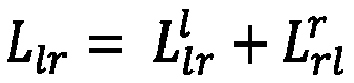
- L lr L lr l + L rl r is left-right consistency loss
- L cl L cl l + L cl r is confidence loss.
- the ⁇ 's are weight coefficients given to each loss.
- the trained pose NN 304 is trained as follows: Given a pair of consecutive monocular images, the trained pose NN predicts 6-DOF ego-motion of the camera between them. For instance, given a pair of images ( I t- 1 , I t ) from either left or right camera, the pose NN predicts a vector P t t ⁇ 1 comprising of translation ( t x , t y , t z ) and rotation ( ⁇ , ⁇ , ⁇ ) of the camera between the frames. The predicted pose information P t t ⁇ 1 and the depth of the t-th frame D t is used to reconstruct the I t using a temporal reconstruction module from I t- 1 ,. The reconstructed image I ' t is compared against the original I t to calculate the losses necessary for the training.
- the trained pose NN is composed of a convolutional encoder followed by two fully connected layers that output a 6-DOF pose vectors for a given pair of images. Relu is used as an activation function in both of the networks except in the output layers. The outputs of the trained pose NN are not processed through any activation.
- D t p D t ⁇ 1 + T Z U t p ⁇ T Z + ⁇ w 2
- T z is the translation of the camera in z-direction
- ⁇ w 2 is white Gaussian noise with mean zero and variance of ⁇ 2 .
- the noise is added to supplant the inherent noises that are present in the pose-estimation.
- the predicted depth map D t and uncertainty map U t at time t are fused with the propagated depth map D t p and uncertainty map U t p to get a final fused depth map D t f and uncertainty map U t f .
- the detailed overview of the proposed method is depicted in Figure 2 .
- the fused depth is defined as given in equation 12: P D t f
- D t P D t
- Probability of the propagated depth is represented by prior probability P D t p and the probability of the predicted depth is represented by the likelihood P D t
- the image depth computation unit 114 when executed by one or more processors of the system 100, receive the plurality of monocular images from the imaging device.
- the plurality of monocular images includes consecutive image frames.
- the image depth computation unit 114 when executed by one or more processors of the system 100 predicts the depth information and the confidence map based on the monocular image from the plurality of monocular images by the trained depth NN
- the depth NN is trained by the following steps: Initially, the depth NN receives the rectified stereo image pair including the left image and the right image. Further, the plurality of disparity maps are computed based on the rectified stereo image pair. The plurality of disparity maps includes the right to left disparity and the left to right disparity. The depth information is computed based on the plurality of parameters comprising the baseline distance of the rectified stereo image, the rectified camera focal length and the plurality of disparity maps. Further, the received rectified stereo image pair is reconstructed based on the depth information. The left image is reconstructed using the right image and the right to left disparity. The right image is reconstructed using the left image and the left to right disparity.
- the photometric loss is computed by comparing the reconstructed stereo image pair and the received rectified stereo image pair.
- the negative exponential of the photometric loss is computed.
- the negative exponential provides the ground truth confidence information.
- the confidence map is computed based on the negative exponential.
- the pixel with large photometric error maps to the smallest confidence value.
- the pixel with small photometric error maps to the larger confidence value.
- natural log of the confidence map is computed to obtain the uncertainty map associated with the confidence map.
- the depth NN is trained based on the computed confidence map, the depth information and the plurality of disparity maps.
- the image depth computation unit 114 when executed by one or more processors of the system 100 predicts the pose information associated with the plurality of monocular image sequences based on the depth information by the trained pose neural network.
- the pose NN is trained as follows: Initially, the pose NN receives the plurality of consecutive monocular images from the imaging device. Further, the pose NN computes the plurality of pose vectors based on the plurality of consecutive monocular images. The plurality of pose vectors includes translation and rotation information of the imaging device. Further, the plurality of consecutive monocular images are reconstructing based on the corresponding depth information and the plurality of pose vectors. The depth information is computed using the depth neural network. Further, the temporal loss information is computed by comparing the plurality of reconstructed consecutive monocular images and the plurality of received consecutive monocular images and the pose neural network is trained based on the computed loss information.
- the image depth computation unit 114 when executed by one or more processors of the system 100 computes the fused data by combining the predicted data and the propagated data by using Bayesian inference model.
- the fused data includes the combined depth map and the combined confidence map.
- the predicted data includes the predicted depth information, the uncertainty map and the pose information associated with the monocular image.
- the method of computing the fused data is: (i) receiving the propagated data associated with the previous image frame.
- the propagated data includes the propagated depth information and the propagated uncertainty map associated with the previous image frame and (ii) combining the propagated data with the predicted data to obtain the fused data.
- the predicted data of the current image frame is propagated to the next image frame.
- FIG. 4 illustrates an average Root Mean Square (RMS) and Log RMS error plots for depth estimation on a continuous sequence of images taken from KITTI dataset, in accordance with some embodiments of the present disclosure.
- RMS Root Mean Square
- the plot 402 illustrates the RMS error without fusion using Bayesian inference model and the plot 404 illustrates the RMS error with fusion using Bayesian inference model.
- the plot 406 illustrates the Log RMS error without fusion using Bayesian inference model and the plot 404 illustrates the Log RMS error with fusion using Bayesian inference model. It is observed that the RMS and Log RMS error is minimized when the depth information and confidence map fusion is performed using the Bayesian inference model.
- the present disclosure is experimented as follows:
- the input image resolution is set to 256 ⁇ 512 and the batch size is set to 4.
- the initial learning rate is set to 1 e -04 . It gets reduced by half after completing (3/5) th of total iteration and further reduced by half after completing (4/5) th of the total number of iterations.
- the weights ⁇ 1 , ⁇ 2 , ⁇ 3 and ⁇ 4 in the loss function are set to 1.0 and ⁇ 2 to 0.1.
- Data augmentation is used to reduce the possibility of over fitting which include change in brightness, change in saturation and change in gamma in a range of [0.5,2.0], [0.8, 1.2] and [0.8,1.2] respectively.
- KITTI-Dataset KITTI is a popular outdoor driving dataset to benchmark the efficacy of the depth-estimation methods in this domain. It is comprised of 61 different outdoor driving sequences with 42,382 images of resolution 1242 ⁇ 345. As per the literature, the dataset is divided into two splits, namely kitti-split and eigen-split which are commonly used for evaluating the depth estimation accuracy. The performance of the proposed method is demonstrated using the eigen-split for a fair comparison with the state-of-the-art methods.
- the predicted depth information and confidence map predicted can be used for pick and place operation.
- a pick-and-place task is performed using an industrial manipulator.
- the estimated depth-maps, confidence maps and 3D reconstructed point clouds are further processed using the region-growing algorithm to estimate a possible position for picking the object. Once the picking position is known, the manipulator plans the trajectory to carry out the picking operation to a pre-defined placing point.
- the embodiments of present disclosure herein address unresolved problem of computing robust depth information and confidence map.
- the present disclosure provides the unsupervised method for estimating the depth information and the confidence map in an accurate manner.
- the confidence map is computed based on the negative exponential of the photometric loss.
- the negative exponential of the photometric loss is used as the ground truth confidence information.
- the present disclosure fuses the predicted depth and uncertainty information with the propagated depth information and confidence information which provides more accurate computation of depth and confidence information. Further, the present disclosure is efficient in computing the depth information in the images captured in indoor environment.
- the hardware device can be any kind of device which can be programmed including e.g. any kind of computer like a server or a personal computer, or the like, or any combination thereof.
- the device may also include means which could be e.g. hardware means like e.g. an application-specific integrated circuit (ASIC), a field-programmable gate array (FPGA), or a combination of hardware and software means, e.g.
- ASIC application-specific integrated circuit
- FPGA field-programmable gate array
- the means can include both hardware means and software means.
- the method embodiments described herein could be implemented in hardware and software.
- the device may also include software means.
- the embodiments may be implemented on different hardware devices, e.g. using a plurality of CPUs, GPUs and edge computing devices.
- the embodiments herein can comprise hardware and software elements.
- the embodiments that are implemented in software include but are not limited to, firmware, resident software, microcode, etc.
- the functions performed by various modules described herein may be implemented in other modules or combinations of other modules.
- a computer-usable or computer readable medium can be any apparatus that can comprise, store, communicate, propagate, or transport the program for use by or in connection with the instruction execution system, apparatus, or device.
- the illustrated steps are set out to explain the exemplary embodiments shown, and it should be anticipated that ongoing technological development will change the manner in which particular functions are performed. These examples are presented herein for purposes of illustration, and not limitation. Further, the boundaries of the functional building blocks have been arbitrarily defined herein for the convenience of the description.
- a computer-readable storage medium refers to any type of physical memory on which information or data readable by a processor may be stored.
- a computer-readable storage medium may store instructions for execution by one or more processors, including instructions for causing the processor(s) to perform steps or stages consistent with the embodiments described herein.
- the term "computer-readable medium” should be understood to include tangible items and exclude carrier waves and transient signals, i.e. non-transitory. Examples include random access memory (RAM), read-only memory (ROM), volatile memory, nonvolatile memory, hard drives, CD ROMs, DVDs, flash drives, disks, and any other known physical storage media.
Landscapes
- Engineering & Computer Science (AREA)
- Theoretical Computer Science (AREA)
- Physics & Mathematics (AREA)
- General Physics & Mathematics (AREA)
- Computing Systems (AREA)
- Software Systems (AREA)
- Artificial Intelligence (AREA)
- Mathematical Physics (AREA)
- Computational Linguistics (AREA)
- Data Mining & Analysis (AREA)
- Evolutionary Computation (AREA)
- General Engineering & Computer Science (AREA)
- Biomedical Technology (AREA)
- Molecular Biology (AREA)
- General Health & Medical Sciences (AREA)
- Biophysics (AREA)
- Life Sciences & Earth Sciences (AREA)
- Health & Medical Sciences (AREA)
- Computer Vision & Pattern Recognition (AREA)
- Multimedia (AREA)
- Signal Processing (AREA)
- Image Analysis (AREA)
- Image Processing (AREA)
Abstract
Description
- This patent application claims priority to
India Patent Application 202021046429, filed on October 24, 2020 - The disclosure herein generally relates to the field of image processing and, more particular, to a method and system for unsupervised prediction of image depth and confidence map.
- Depth estimation of Red Green Blue (RGB) images is an active field of research and it is having wide range of application in Augmented Reality, 3D graphics and robotics. Deep learning methods are providing better results compared to traditional methods, which use hand crafted features and exploit camera geometry and/or motion to estimate depth. The Deep learning methods are broadly classified into two categories like supervised or unsupervised.
- Conventional methods are utilizing supervised methods and the supervised methods require explicit ground truth depth information obtained from range sensors for training. However, it is challenging to obtain explicit ground truth depth information in many real time applications. Hence there is a growing interest for unsupervised learning methods over the years aiming to overcome this limitation. However, the conventional unsupervised methods fails to provide a generalized solution since they rely on strong geometric constraints and hand-crafted features which is challenging to obtain.
- Embodiments of the present disclosure present technological improvements as solutions to one or more of the above-mentioned technical problems recognized by the inventors in conventional systems. For example, in one embodiment, a method for unsupervised prediction of image depth and confidence map is provided. The method includes receiving, by one or more hardware processors, a plurality of monocular images from an imaging device, wherein the plurality of monocular images includes consecutive image frames. The method includes predicting, by the one or more hardware processors a depth information and a confidence map based on a monocular image from the plurality of monocular images, wherein training the depth neural network includes the following steps: (i) receiving a rectified stereo image pair comprising a left image and a right image (ii) computing a plurality of disparity maps based on the rectified stereo image pair, wherein the plurality of disparity maps comprise a right to left disparity and a left to right disparity (iii) computing the depth information based on a plurality of parameters comprising a baseline distance of the rectified stereo image, a rectified camera focal length and the plurality of disparity maps (iv) reconstructing the received rectified stereo image pair based on the depth information, wherein the left image is reconstructed using the right image and the right to left disparity, wherein the right image is reconstructed using the left image and the left to right disparity (v) computing a photometric loss by comparing the reconstructed stereo image pair and the received rectified stereo image pair (vi) computing a negative exponential of the photometric loss, wherein the negative exponential provides a ground truth confidence information (vii) computing the confidence map based on the negative exponential, wherein a pixel with large photometric error maps to a smallest confidence value, wherein the pixel with small photometric error maps to a larger confidence value (viii) simultaneously computing natural log of the confidence map to obtain an uncertainty map associated with the confidence map and (ix) training the depth neural network based on the computed confidence map, the depth information and the plurality of disparity maps. The method further includes predicting, by the one or more hardware processors, a pose information associated with the plurality of monocular image sequences based on the depth information by a trained pose neural network. The method finally computes by the one or more hardware processors a fused data by combining the predicted data and a propagated data, wherein the fused data includes the combined depth map and the combined confidence map, wherein the predicted data comprising the predicted depth information, the uncertainty map and the pose information associated with the monocular image, by using Bayesian Inference model by: (i) receiving the propagated data associated with a previous frame, wherein the propagated data includes a propagated depth information and a propagated uncertainty map associated with the previous frame and (ii) combining the propagated data with the predicted data to obtain the fused data, wherein the predicted data of the current image frame is propagated to the next image frame.
- In another aspect, a system for unsupervised prediction of image depth and confidence map is provided. The system includes at least one memory storing programmed instructions, one or more Input /Output (I/O) interfaces, and one or more hardware processors operatively coupled to the at least one memory, wherein the one or more hardware processors of the server machine are configured by the programmed instructions to receive a plurality of monocular images from an imaging device, wherein the plurality of monocular images includes consecutive image frames. Further, the one or more hardware processors of the server machine are configured by the programmed instructions to predict, by a trained depth neural network, a depth information and a confidence map based on a monocular image from the plurality of monocular images, wherein training the depth neural network includes: (i) receiving a rectified stereo image pair comprising a left image and a right image (ii) computing a plurality of disparity maps based on the rectified stereo image pair, wherein the plurality of disparity maps includes a right to left disparity and a left to right disparity (iii) computing the depth information based on a plurality of parameters comprising a baseline distance of the rectified stereo image, a rectified camera focal length and the plurality of disparity maps (iv) reconstructing the received rectified stereo image pair based on the depth information, wherein the left image is reconstructed using the right image and the right to left disparity, wherein the right image is reconstructed using the left image and the left to right disparity (v) computing a photometric loss by comparing the reconstructed stereo image pair and the received rectified stereo image pair (vi) computing a negative exponential of the photometric loss, wherein the negative exponential provides a ground truth confidence information (vii) computing the confidence map based on the negative exponential, wherein a pixel with large photometric error maps to a smallest confidence value, wherein the pixel with small photometric error maps to a larger confidence value (viii) simultaneously computing natural log of the confidence map to obtain an uncertainty map associated with the confidence map and (ix) training the depth neural network based on the computed confidence map, the depth information and the plurality of disparity maps. Furthermore, the one or more hardware processors of the server machine are configured by the programmed instructions to predict a pose information associated with the plurality of monocular image sequences based on the depth information by a trained pose neural network. Finally, the one or more hardware processors of the server machine are configured by the programmed instructions to compute a fused data by combining the predicted data and a propagated data, wherein the fused data includes the combined depth map and the combined confidence map, wherein the predicted data comprising the predicted depth information, the uncertainty map and the pose information associated with the monocular image, by using Bayesian Inference model by: (i) receiving the propagated data associated with a previous frame, wherein the propagated data includes a propagated depth information and a propagated uncertainty map associated with the previous frame and (ii) combining the propagated data with the predicted data to obtain the fused data, wherein the predicted data of the current image frame is propagated to the next image frame.
- In yet another aspect, a computer program product including a non-transitory computer-readable medium having embodied therein a computer program for unsupervised prediction of image depth and confidence map is provided. The computer readable program, when executed on a computing device, causes the computing device to receive a plurality of monocular images from an imaging device, wherein the plurality of monocular images includes consecutive image frames. Further, The computer readable program, when executed on a computing device, causes the computing device to predict, by a trained depth neural network, a depth information and a confidence map based on a monocular image from the plurality of monocular images, wherein training the depth neural network includes: (i) receiving a rectified stereo image pair comprising a left image and a right image (ii) computing a plurality of disparity maps based on the rectified stereo image pair, wherein the plurality of disparity maps includes a right to left disparity and a left to right disparity (iii) computing the depth information based on a plurality of parameters comprising a baseline distance of the rectified stereo image, a rectified camera focal length and the plurality of disparity maps (iv) reconstructing the received rectified stereo image pair based on the depth information, wherein the left image is reconstructed using the right image and the right to left disparity, wherein the right image is reconstructed using the left image and the left to right disparity (v) computing a photometric loss by comparing the reconstructed stereo image pair and the received rectified stereo image pair (vi) computing a negative exponential of the photometric loss, wherein the negative exponential provides a ground truth confidence information (vii) computing the confidence map based on the negative exponential, wherein a pixel with large photometric error maps to a smallest confidence value, wherein the pixel with small photometric error maps to a larger confidence value (viii) simultaneously computing natural log of the confidence map to obtain an uncertainty map associated with the confidence map and (ix) training the depth neural network based on the computed confidence map, the depth information and the plurality of disparity maps. Furthermore, the computer readable program, when executed on a computing device, causes the computing device to predict a pose information associated with the plurality of monocular image sequences based on the depth information by a trained pose neural network. Finally, the computer readable program, when executed on a computing device, causes the computing device to compute a fused data by combining the predicted data and a propagated data, wherein the fused data includes the combined depth map and the combined confidence map, wherein the predicted data comprising the predicted depth information, the uncertainty map and the pose information associated with the monocular image, by using Bayesian Inference model by: (i) receiving the propagated data associated with a previous frame, wherein the propagated data includes a propagated depth information and a propagated uncertainty map associated with the previous frame and (ii) combining the propagated data with the predicted data to obtain the fused data, wherein the predicted data of the current image frame is propagated to the next image frame.
- It is to be understood that both the foregoing general description and the following detailed description are exemplary and explanatory only and are not restrictive of the invention, as claimed.
- The accompanying drawings, which are incorporated in and constitute a part of this disclosure, illustrate exemplary embodiments and, together with the description, serve to explain the disclosed principles:
-
FIG. 1 is a functional block diagram of a system for unsupervised prediction of image depth and confidence map, according to some embodiments of the present disclosure. -
FIG. 2A and2B are exemplary flow diagrams for a method for unsupervised prediction of image depth and confidence map implemented by the system ofFIG. 1 , in accordance with some embodiments of the present disclosure. -
FIG. 3 illustrates an overall architecture illustrating the method for unsupervised prediction of image depth and confidence map, in accordance with some embodiments of the present disclosure. -
FIG. 4 illustrates an average Root Mean Square (RMS) and Log RMS error plots for depth estimation on a continuous sequence of images taken from standard dataset, in accordance with some embodiments of the present disclosure. - Exemplary embodiments are described with reference to the accompanying drawings. In the figures, the left-most digit(s) of a reference number identifies the figure in which the reference number first appears. Wherever convenient, the same reference numbers are used throughout the drawings to refer to the same or like parts. While examples and features of disclosed principles are described herein, modifications, adaptations, and other implementations are possible without departing from the scope of the disclosed embodiments.
- Embodiments herein provide a method and system for unsupervised prediction of image depth and confidence map. The method and system estimates accurate depth information and confidence map of a given monocular image in an unsupervised manner. The method includes a depth Neural Network (NN), a pose NN and a Bayesian inference model. The depth NN receives a monocular image as an input and predicts per-pixel depth map D and a confidence-map C. The predicted confidence-map C is further used to estimate per-pixel uncertainty map U. The pose NN receives a plurality of consecutive of monocular images and predicts a plurality of pose vectors between each of the plurality of the consecutive monocular images. Finally, the Bayesian inference module is designed to fuse a previous temporally aligned depth map with the depth map predicted using the depth NN and the plurality of pose vectors predicted by the pose NN to obtain the fused depth information and the fused uncertainty map.
- Referring now to the drawings, and more particularly to
FIGS. 1 through 4 , where similar reference characters denote corresponding features consistently throughout the figures, there are shown preferred embodiments and these embodiments are described in the context of the following exemplary system and/or method. -
FIG. 1 is a functional block diagram of asystem 100 for unsupervised prediction of image depth and confidence map, according to some embodiments of the present disclosure. Thesystem 100 includes or is otherwise in communication withhardware processors 102, at least one memory such as amemory 104, an I/O interface 112. Thehardware processors 102,memory 104, and the Input /Output (I/O)interface 112 may be coupled by a system bus such as asystem bus 108 or a similar mechanism. In an embodiment, thehardware processors 102 can be one or more hardware processors. - The I/
O interface 112 may include a variety of software and hardware interfaces, for example, a web interface, a graphical user interface, and the like. The I/O interface 112 may include a variety of software and hardware interfaces, for example, interfaces for peripheral device(s), such as a keyboard, a mouse, an external memory, a printer and the like. Further, the I/O interface 112 may enable thesystem 100 to communicate with other devices, such as web servers and external databases. - The I/
O interface 112 can facilitate multiple communications within a wide variety of networks and protocol types, including wired networks, for example, local area network (LAN), cable, etc., and wireless networks, such as Wireless LAN (WLAN), cellular, or satellite. For the purpose, the I/O interface 112 may include one or more ports for connecting a number of computing systems with one another or to another server computer. The I/O interface 112 may include one or more ports for connecting a number of devices to one another or to another server. For example, the I/O interface connects an imaging device (not shown inFIG. 1 ) to thesystem 100. - The one or
more hardware processors 102 may be implemented as one or more microprocessors, microcomputers, microcontrollers, digital signal processors, central processing units, node machines, logic circuitries, and/or any devices that manipulate signals based on operational instructions. Among other capabilities, the one ormore hardware processors 102 is configured to fetch and execute computer-readable instructions stored in thememory 104. - The
memory 104 may include any computer-readable medium known in the art including, for example, volatile memory, such as static random access memory (SRAM) and dynamic random access memory (DRAM), and/or non-volatile memory, such as read only memory (ROM), erasable programmable ROM, flash memories, hard disks, optical disks, and magnetic tapes. In an embodiment, thememory 104 includes a plurality ofmodules 106 and an imagedepth computation unit 114. Thememory 104 also includes a data repository (or repository) 110 for storing data processed, received, and generated by the plurality ofmodules 106 and the imagedepth computation unit 114. - The plurality of
modules 106 include programs or coded instructions that supplement applications or functions performed by thesystem 100 for Unsupervised prediction of image depth and confidence map. The plurality ofmodules 106, amongst other things, can include routines, programs, objects, components, and data structures, which performs particular tasks or implement particular abstract data types. The plurality ofmodules 106 may also be used as, signal processor(s), node machine(s), logic circuitries, and/or any other device or component that manipulates signals based on operational instructions. Further, the plurality ofmodules 106 can be used by hardware, by computer-readable instructions executed by the one ormore hardware processors 102, or by a combination thereof. The plurality ofmodules 106 can include various sub-modules (not shown). The plurality ofmodules 106 may include computer-readable instructions that supplement applications or functions performed by thesystem 100 for unsupervised prediction of image depth and confidence map. - The data repository (or repository) 110 may include a plurality of abstracted piece of code for refinement and data that is processed, received, or generated as a result of the execution of the plurality of modules in the module(s) 106 and the modules associated with the image
depth computation unit 114. In an embodiment, the depth NN, the pose NN and the Bayesian inference model is present inside the imagedepth computation unit 114. The data repository may also include the plurality of images used for training and testing the depth NN, the pose NN and the Bayesian inference model associated with the method for unsupervised prediction of image depth and confidence map. - Although the
data repository 110 is shown internal to thesystem 100, it will be noted that, in alternate embodiments, thedata repository 110 can also be implemented external to thesystem 100, where thedata repository 110 may be stored within a database (not shown inFIG. 1 ) communicatively coupled to thesystem 100. The data contained within such external database may be periodically updated. For example, new data may be added into the database (not shown inFIG. 1 ) and/or existing data may be modified and/or non-useful data may be deleted from the database (not shown inFIG. 1 ). In one example, the data may be stored in an external system, such as a Lightweight Directory Access Protocol (LDAP) directory and a Relational Database Management System (RDBMS). -
FIG. 2A and2B are exemplary flow diagrams for a processor implemented method for unsupervised prediction of image depth and confidence map implemented by the system of FIG. 1A and FIG. 1B according to some embodiments of the present disclosure. In an embodiment, thesystem 100 includes one or more data storage devices or thememory 104 operatively coupled to the one or more hardware processor(s) 102 and is configured to store instructions for execution of steps of themethod 200 by the one ormore hardware processors 102. The steps of themethod 200 of the present disclosure will now be explained with reference to the components or blocks of thesystem 100 as depicted inFIG. 1 and the steps of flow diagram as depicted inFIG. 2A andFIG. 2B . Themethod 200 may be described in the general context of computer executable instructions. Generally, computer executable instructions can include routines, programs, objects, components, data structures, procedures, modules, functions, etc., that perform particular functions or implement particular abstract data types. Themethod 200 may also be practiced in a distributed computing environment where functions are performed by remote processing devices that are linked through a communication network. The order in which themethod 200 is described is not intended to be construed as a limitation, and any number of the described method blocks can be combined in any order to implement themethod 200, or an alternative method. Furthermore, themethod 200 can be implemented in any suitable hardware, software, firmware, or combination thereof. - At
step 202 of themethod 200, the one ormore hardware processors 108 receive a plurality of monocular images from an imaging device. The plurality of monocular images includes consecutive image frames. - At 204 of the
method 200, the one ormore hardware processors 108 predict a depth information and a confidence map based on a monocular image from the plurality of monocular images by a trained depth NN - In an embodiment, the depth NN is trained by the following steps: Initially, the depth NN receives a rectified stereo image pair comprising a left image and a right image. Further, a plurality of disparity maps and confidence map are computed based on the rectified stereo image pair. The plurality of disparity maps includes a right to left disparity and a left to right disparity. The depth information is computed based on a plurality of parameters comprising a baseline distance of the rectified stereo image, a rectified camera focal length and the plurality of disparity maps. Further, the received rectified stereo image pair is reconstructed based on the depth information. The left image is reconstructed using the right image and the right to left disparity. The right image is reconstructed using the left image and the left to right disparity. Further, a photometric loss is computed by comparing the reconstructed stereo image pair and the received rectified stereo image pair. A negative exponential of the photometric loss is computed. The negative exponential provides a ground truth confidence information. Further, the confidence loss is estimated by comparing ground-truth confidence and network predicted confidence. The pixel with large photometric error maps to a smallest confidence value. The pixel with small photometric error maps to a larger confidence value. Simultaneously, natural log of the confidence map is computed to obtain an uncertainty map associated with the confidence map. The depth NN is trained based on the computed confidence map, the depth information and the plurality of disparity maps.
- At 206 of the
method 200, the one ormore hardware processors 108 predict a pose information associated with the plurality of monocular image sequences based on the depth information by a trained pose neural network. - In an embodiment, the pose NN is trained as follows: Initially, the pose NN receives a plurality of consecutive monocular images from an imaging device. Further, the pose NN computes a plurality of pose vectors based on the plurality of consecutive monocular images. The plurality of pose vectors includes translation and rotation information of the imaging device. Further, the plurality of consecutive monocular images are reconstructed based on the corresponding depth information and the plurality of pose vectors. The depth information is computed using the depth neural network. Further, a temporal loss information is computed by comparing the plurality of reconstructed consecutive monocular images and the plurality of received consecutive monocular images and the pose neural network is trained based on the computed loss information.
- At 208 of the
method 200, the one ormore hardware processors 108 compute a fused data by combining the predicted data and a propagated data by using Bayesian Inference model. The fused data includes the combined depth map and the combined confidence map. The predicted data comprising the predicted depth information, the uncertainty map and the pose information associated with the monocular image. The method of computing the fused data includes steps of: (i) receiving the propagated data associated with a previous image frame. The propagated data includes a propagated depth information and a propagated uncertainty map associated with the previous image frame and (ii) combining the propagated data with the predicted data to obtain the fused data. The predicted data of the current image frame is propagated to the next image frame. -
FIG. 3 illustrates an overall architecture illustrating the method for unsupervised prediction of image depth and confidence map, in accordance with some embodiments of the present disclosure. - Now referring to
FIG.3 , the traineddepth NN 302 receives the monocular image and computes the depth information and the confidence map. Further, the trainedpose NN 304 receives the depth information, the plurality of consecutive monocular images and computes the plurality of pose information. Further, theBayesian inference model 306 receives depth information and confidence map propagated from previous image frame and computes the fused depth information and the fused confidence map. - In an embodiment, the trained
depth NN 302 predicts a correspondence-map between the left image and the right image i.e., disparity map dto obtain the depth. In an embodiment, the trained depth NN is trained as follows. During training, the disparity NN receives a rectified stereo image pair {I l ,Ir ). A disparity function associated with the disparity NN receives the left image Il and predicts a dense correspondence maps drl (right-to-left disparity) and dlr (left-to-right disparity). The predicted disparities are then used to reconstruct the stereo images. The left image is reconstructed using the right image Ir and left-to-right disparity dlr . Similarly, right image is also reconstructed using left imageIl and right-to-left disparity drl . The depth map D can be calculated as D = bfld ,where, b is the baseline distance of the stereo rig, ƒ is the rectified camera focal length and d = dlr is the predicted disparity. These estimated left I' l and right I'r are compared against the original left and right images to calculate the photo-metric losses required for training the network. Since the model takes only left image as input, it can work as a monocular-depth estimation network during the inference time. - In an embodiment, the disparity NN is a fully convolutional encoder-decoder style network with four output layers. Each of the output layer predicts two disparity maps (left-right and right-left disparities) and the confidence map. The predicted disparities are normalized to have maximum value as 30% of input image width using a sigmoid activation function and the confidence values are normalized to be between 0 and 1. There are multiple skip-connections attached to different stages of decoder from the encoder in-order to facilitate the exchange of low-dimensional information while estimating disparity and confidence maps.
- In an embodiment, the confidence map C is predicted by the depth NN lie between [0,1] where, higher the confidence value signifies network is much more certain about its predictions and correspondingly for the lower confidence value. A negative exponential of the photo-metric error calculated using the reconstructed left and right images as shown in Equation 1. The negative exponential is utilized as a ground truth depth information. Hence, a pixel having large photometric error will map to a smaller confidence value and pixel having small photo-metric error will map to a larger confidence value. The motivation behind this comes from the fact that the accuracy of the estimated disparity defines the reconstruction quality of the image. In other words, if the predicted disparity is accurate, the images will get reconstructed accurately and the error between the original and reconstructed image will be small. Mathematically, the ground-truth confidence is calculated as given in equation 1:

- In an embodiment, appearance loss is calculated between the reconstructed images obtained from the spatial and temporal reconstruction modules and their respective original images. This loss function makes sure the that the reconstructed images and their original images are same in all the aspects such as color and structure. Two metrics namely, L1 and Structural Similarity Index (SSIM) are used to calculate this loss. The convex combination of these two metrics is referred as appearance or photo-metric loss and mathematically, it can be written as given in equation 2.

- In an embodiment, smoothness loss encourages the predicted disparities to be locally smooth between the strong gradient regions like edges to preserve the spatial layout of the scene. To achieve this, the disparity gradients ∂d are weighted with negative exponential image gradients ∂I and the same can be mathematically written as given in equation 3:

- In an embodiment, the trained depth NN predicts two (left-right and right-left) disparity-maps. The left-right consistency loss enforces the cycle-consistency constraint between the predicted disparities by predicting left-right disparity from right-left disparity and vice versa. This loss makes the predicted disparities to be coherent with each other and improves the overall performance. The loss is calculated for both the disparities. The loss with left-right disparity can be mathematically written as given in equation 4.

- In an embodiment, a confidence loss is calculated as L 1 difference between the ground-truth and predicted confidences. As the direct ground-truth confidence is not available, the present disclosure utilizes the confidence map calculated based on the equation 1 as a reference. The loss can be defined as given in equation 5:



- In an embodiment, the trained
pose NN 304 is trained as follows: Given a pair of consecutive monocular images, the trained pose NN predicts 6-DOF ego-motion of the camera between them. For instance, given a pair of images (I t-1, It ) from either left or right camera, the pose NN predicts a vector

- In an embodiment, the trained pose NN is composed of a convolutional encoder followed by two fully connected layers that output a 6-DOF pose vectors for a given pair of images. Relu is used as an activation function in both of the networks except in the output layers. The outputs of the trained pose NN are not processed through any activation.
- In an embodiment, the Bayesian inference model computes a fused depth map and the fused confidence map using the previous depth maps, the predicted confidence map and the predicted depth map. Given a pair of estimated depth-maps D t-1, Dt, uncertainty-maps U t-1, Ut , and the transformation between the frames


- The predicted depth map Dt and uncertainty map Ut at time t, are fused with the propagated depth map


Figure 2 . Using the Bayesian inference, the fused depth is defined as given in equation 12:


- Further, the image
depth computation unit 114, when executed by one or more processors of thesystem 100, receive the plurality of monocular images from the imaging device. The plurality of monocular images includes consecutive image frames. - Further, the image
depth computation unit 114, when executed by one or more processors of thesystem 100 predicts the depth information and the confidence map based on the monocular image from the plurality of monocular images by the trained depth NN - In an embodiment, the depth NN is trained by the following steps: Initially, the depth NN receives the rectified stereo image pair including the left image and the right image. Further, the plurality of disparity maps are computed based on the rectified stereo image pair. The plurality of disparity maps includes the right to left disparity and the left to right disparity. The depth information is computed based on the plurality of parameters comprising the baseline distance of the rectified stereo image, the rectified camera focal length and the plurality of disparity maps. Further, the received rectified stereo image pair is reconstructed based on the depth information. The left image is reconstructed using the right image and the right to left disparity. The right image is reconstructed using the left image and the left to right disparity. Further, the photometric loss is computed by comparing the reconstructed stereo image pair and the received rectified stereo image pair. the negative exponential of the photometric loss is computed. The negative exponential provides the ground truth confidence information. Further, the confidence map is computed based on the negative exponential. The pixel with large photometric error maps to the smallest confidence value. The pixel with small photometric error maps to the larger confidence value. Simultaneously, natural log of the confidence map is computed to obtain the uncertainty map associated with the confidence map. The depth NN is trained based on the computed confidence map, the depth information and the plurality of disparity maps.
- Further, the image
depth computation unit 114, when executed by one or more processors of thesystem 100 predicts the pose information associated with the plurality of monocular image sequences based on the depth information by the trained pose neural network. - In an embodiment, the pose NN is trained as follows: Initially, the pose NN receives the plurality of consecutive monocular images from the imaging device. Further, the pose NN computes the plurality of pose vectors based on the plurality of consecutive monocular images. The plurality of pose vectors includes translation and rotation information of the imaging device. Further, the plurality of consecutive monocular images are reconstructing based on the corresponding depth information and the plurality of pose vectors. The depth information is computed using the depth neural network. Further, the temporal loss information is computed by comparing the plurality of reconstructed consecutive monocular images and the plurality of received consecutive monocular images and the pose neural network is trained based on the computed loss information.
- Further, the image
depth computation unit 114, when executed by one or more processors of thesystem 100 computes the fused data by combining the predicted data and the propagated data by using Bayesian inference model. The fused data includes the combined depth map and the combined confidence map. The predicted data includes the predicted depth information, the uncertainty map and the pose information associated with the monocular image. The method of computing the fused data is: (i) receiving the propagated data associated with the previous image frame. The propagated data includes the propagated depth information and the propagated uncertainty map associated with the previous image frame and (ii) combining the propagated data with the predicted data to obtain the fused data. The predicted data of the current image frame is propagated to the next image frame. -
FIG. 4 illustrates an average Root Mean Square (RMS) and Log RMS error plots for depth estimation on a continuous sequence of images taken from KITTI dataset, in accordance with some embodiments of the present disclosure. Now, referring toFIG. 4 , theplot 402 illustrates the RMS error without fusion using Bayesian inference model and theplot 404 illustrates the RMS error with fusion using Bayesian inference model. Similarly, theplot 406 illustrates the Log RMS error without fusion using Bayesian inference model and theplot 404 illustrates the Log RMS error with fusion using Bayesian inference model. It is observed that the RMS and Log RMS error is minimized when the depth information and confidence map fusion is performed using the Bayesian inference model. - In an embodiment, the present disclosure is experimented as follows: In an embodiment, the input image resolution is set to 256×512 and the batch size is set to 4. The loss function is set with β 1 = 0.9, β 2 = 0.99. The initial learning rate is set to 1e -04. It gets reduced by half after completing (3/5) th of total iteration and further reduced by half after completing (4/5) th of the total number of iterations. The weights µ1, µ2, µ3 and µ4 in the loss function are set to 1.0 and µ2 to 0.1. Data augmentation is used to reduce the possibility of over fitting which include change in brightness, change in saturation and change in gamma in a range of [0.5,2.0], [0.8, 1.2] and [0.8,1.2] respectively. In the following subsections, details about both qualitative and quantitative evaluation on KITTI and Indoor Datasets are given.
- KITTI-Dataset: KITTI is a popular outdoor driving dataset to benchmark the efficacy of the depth-estimation methods in this domain. It is comprised of 61 different outdoor driving sequences with 42,382 images of resolution 1242×345. As per the literature, the dataset is divided into two splits, namely kitti-split and eigen-split which are commonly used for evaluating the depth estimation accuracy. The performance of the proposed method is demonstrated using the eigen-split for a fair comparison with the state-of-the-art methods.
- In an embodiment, the predicted depth information and confidence map predicted can be used for pick and place operation. To further demonstrate the usability of the estimated depth and confidence maps in the real-world applications, a pick-and-place task is performed using an industrial manipulator. The dataset of 22K images with a resolution of 720 × 1280 having 5 different object configurations using a ZED-Mini stereo camera. The estimated depth-maps, confidence maps and 3D reconstructed point clouds. One can observe that the proposed method is able to generate plausible depth maps and retain most of the structural attributes of the objects. The reconstructed point clouds are further processed using the region-growing algorithm to estimate a possible position for picking the object. Once the picking position is known, the manipulator plans the trajectory to carry out the picking operation to a pre-defined placing point.
- The written description describes the subject matter herein to enable any person skilled in the art to make and use the embodiments. The scope of the subject matter embodiments is defined by the claims and may include other modifications that occur to those skilled in the art. Such other modifications are intended to be within the scope of the claims if they have similar elements that do not differ from the literal language of the claims or if they include equivalent elements with insubstantial differences from the literal language of the claims.
- The embodiments of present disclosure herein address unresolved problem of computing robust depth information and confidence map. The present disclosure provides the unsupervised method for estimating the depth information and the confidence map in an accurate manner. The confidence map is computed based on the negative exponential of the photometric loss. The negative exponential of the photometric loss is used as the ground truth confidence information. Further, the present disclosure fuses the predicted depth and uncertainty information with the propagated depth information and confidence information which provides more accurate computation of depth and confidence information. Further, the present disclosure is efficient in computing the depth information in the images captured in indoor environment.
- It is to be understood that the scope of the protection is extended to such a program and in addition to a computer-readable means having a message therein such computer-readable storage means contain program-code means for implementation of one or more steps of the method, when the program runs on a server or mobile device or any suitable programmable device. The hardware device can be any kind of device which can be programmed including e.g. any kind of computer like a server or a personal computer, or the like, or any combination thereof. The device may also include means which could be e.g. hardware means like e.g. an application-specific integrated circuit (ASIC), a field-programmable gate array (FPGA), or a combination of hardware and software means, e.g. an ASIC and an FPGA, or at least one microprocessor and at least one memory with software modules located therein. Thus, the means can include both hardware means and software means. The method embodiments described herein could be implemented in hardware and software. The device may also include software means. Alternatively, the embodiments may be implemented on different hardware devices, e.g. using a plurality of CPUs, GPUs and edge computing devices.
- The embodiments herein can comprise hardware and software elements. The embodiments that are implemented in software include but are not limited to, firmware, resident software, microcode, etc. The functions performed by various modules described herein may be implemented in other modules or combinations of other modules. For the purposes of this description, a computer-usable or computer readable medium can be any apparatus that can comprise, store, communicate, propagate, or transport the program for use by or in connection with the instruction execution system, apparatus, or device. The illustrated steps are set out to explain the exemplary embodiments shown, and it should be anticipated that ongoing technological development will change the manner in which particular functions are performed. These examples are presented herein for purposes of illustration, and not limitation. Further, the boundaries of the functional building blocks have been arbitrarily defined herein for the convenience of the description. Alternative boundaries can be defined so long as the specified functions and relationships thereof are appropriately performed. Alternatives (including equivalents, extensions, variations, deviations, etc., of those described herein) will be apparent to persons skilled in the relevant art(s) based on the teachings contained herein. Such alternatives fall within the scope and spirit of the disclosed embodiments. Also, the words "comprising," "having," "containing," and "including," and other similar forms are intended to be equivalent in meaning and be open ended in that an item or items following any one of these words is not meant to be an exhaustive listing of such item or items, or meant to be limited to only the listed item or items. It must also be noted that as used herein and in the appended claims, the singular forms "a," "an," and "the" include plural references unless the context clearly dictates otherwise. Furthermore, one or more computer-readable storage media may be utilized in implementing embodiments consistent with the present disclosure. A computer-readable storage medium refers to any type of physical memory on which information or data readable by a processor may be stored. Thus, a computer-readable storage medium may store instructions for execution by one or more processors, including instructions for causing the processor(s) to perform steps or stages consistent with the embodiments described herein. The term "computer-readable medium" should be understood to include tangible items and exclude carrier waves and transient signals, i.e. non-transitory. Examples include random access memory (RAM), read-only memory (ROM), volatile memory, nonvolatile memory, hard drives, CD ROMs, DVDs, flash drives, disks, and any other known physical storage media.
- It is intended that the disclosure and examples be considered as exemplary only, with a true scope of disclosed embodiments being indicated by the following claims.
Claims (9)
- A processor implemented method (200), the method comprising:receiving, by one or more hardware processors, a plurality of monocular images from an imaging device, wherein the plurality of monocular images comprises consecutive image frames (202);predicting, by a trained depth neural network executed by via the one or more hardware processors, a depth information and a confidence map based on a monocular image from the plurality of monocular images (204);predicting, by a trained pose neural network executed by via the one or more hardware processors, a pose information associated with the plurality of monocular image sequences based on the depth information by a trained pose neural network (206); andcomputing, by the one or more hardware processors, a fused data by combining the predicted data and a propagated data, wherein the fused data comprises the combined depth map and the combined confidence map, wherein the predicted data comprising the predicted depth information, the uncertainty map and the pose information associated with the monocular image, by using Bayesian Inference model (208) by:receiving the propagated data associated with a previous frame, wherein the propagated data comprises a propagated depth information and a propagated uncertainty map associated with the previous frame; andcombining the propagated data with the predicted data to obtain the fused data, wherein the predicted data of the current image frame is propagated to the next image frame.
- The method of claim 1, wherein training the depth neural network comprises (204):receiving a rectified stereo image pair comprising a left image and a right image;computing a plurality of disparity maps based on the rectified stereo image pair, wherein the plurality of disparity maps comprise a right to left disparity and a left to right disparity;computing the depth information based on a plurality of parameters comprising a baseline distance of the rectified stereo image, a rectified camera focal length and the plurality of disparity maps;reconstructing the received rectified stereo image pair based on the depth information, wherein the left image is reconstructed using the right image and the right to left disparity, wherein the right image is reconstructed using the left image and the left to right disparity;computing a photometric loss by comparing the reconstructed stereo image pair and the received rectified stereo image pair;computing a negative exponential of the photometric loss, wherein the negative exponential provides a ground truth confidence information;computing the confidence map based on the negative exponential, wherein a pixel with large photometric error maps to a smallest confidence value, wherein the pixel with small photometric error maps to a larger confidence value;simultaneously computing natural log of the confidence map to obtain an uncertainty map associated with the confidence map; andtraining the depth neural network based on the computed confidence map, the depth information and the plurality of disparity maps.
- The method of claim 1, wherein training the pose neural network comprises:receiving a plurality of consecutive monocular images from the imaging device;computing a plurality of pose vectors based on the plurality of consecutive monocular images, wherein the plurality of pose vectors comprises translation and rotation information of the imaging device;reconstructing the plurality of consecutive monocular images based on the depth information and the plurality of pose vectors, wherein the corresponding depth information is computed using the depth neural network;computing a temporal loss information by comparing the plurality of reconstructed consecutive monocular images and the plurality of received consecutive monocular images; andtraining the pose neural network based on the computed loss information.
- A system (100) comprising:at least one memory (104) storing programmed instructions; one or more Input /Output (I/O) interfaces (112); and one or more hardware processors (102) operatively coupled to the at least one memory (104), wherein the one or more hardware processors (102) are configured by the programmed instructions to:receive a plurality of monocular images from an imaging device, wherein the plurality of monocular images comprises consecutive image frames;predict, by a trained depth neural network, a depth information and a confidence map based on a monocular image from the plurality of monocular images;predict a pose information associated with the plurality of monocular image sequences based on the depth information by a trained pose neural network; andcompute a fused data by combining the predicted data and a propagated data, wherein the fused data comprises the combined depth map and the combined confidence map, wherein the predicted data comprising the predicted depthinformation, the uncertainty map and the pose information associated with the monocular image, by using Bayesian Inference model by:receiving the propagated data associated with a previous frame, wherein the propagated data comprises a propagated depth information and a propagated uncertainty map associated with the previous frame; andcombining the propagated data with the predicted data to obtain the fused data, wherein the predicted data of the current image frame is propagated to the next image frame.
- The system of claim 4, wherein training the depth neural network comprises:receiving a rectified stereo image pair comprising a left image and a right image;computing a plurality of disparity maps based on the rectified stereo image pair, wherein the plurality of disparity maps comprises a right to left disparity and a left to right disparity;computing the depth information based on a plurality of parameters comprising a baseline distance of the rectified stereo image, a rectified camera focal length and the plurality of disparity maps;reconstructing the received rectified stereo image pair based on the depth information, wherein the left image is reconstructed using the right image and the right to left disparity, wherein the right image is reconstructed using the left image and the left to right disparity;computing a photometric loss by comparing the reconstructed stereo image pair and the received rectified stereo image pair;computing a negative exponential of the photometric loss, wherein the negative exponential provides a ground truth confidence information;computing the confidence map based on the negative exponential, wherein a pixel with large photometric error maps to a smallest confidence value, wherein the pixel with small photometric error maps to a larger confidence value;simultaneously computing natural log of the confidence map to obtain an uncertainty map associated with the confidence map; andtraining the depth neural network based on the computed confidence map, the depth information and the plurality of disparity maps.
- The system of claim 4, wherein training the pose neural network comprises:receiving a plurality of consecutive monocular images from the imaging device;computing a plurality of pose vectors based on the plurality of consecutive monocular images, wherein the plurality of pose vectors comprises translation and rotation information of the imaging device;reconstructing the plurality of consecutive monocular images based on the depth information and the plurality of pose vectors, wherein the corresponding depth information is computed using the depth neural network;computing a temporal loss information by comparing the plurality of reconstructed consecutive monocular images and the plurality of received consecutive monocular images; andtraining the pose neural network based on the computed loss information.
- One or more non-transitory machine readable information storage mediums comprising one or more instructions which when executed by one or more hardware processors causes:receiving, by one or more hardware processors, a plurality of monocular images from an imaging device, wherein the plurality of monocular images comprises consecutive image frames;predicting, by a trained depth neural network executed by via the one or more hardware processors, a depth information and a confidence map based on a monocular image from the plurality of monocular images;predicting, by a trained pose neural network executed by via the one or more hardware processors, a pose information associated with the plurality of monocular image sequences based on the depth information by a trained pose neural network; andcomputing, by the one or more hardware processors, a fused data by combining the predicted data and a propagated data, wherein the fused data comprises the combined depth map and the combined confidence map, wherein the predicted data comprising the predicted depth information, the uncertainty map and the pose information associated with the monocular image, by using Bayesian Inference model by:receiving the propagated data associated with a previous frame, wherein the propagated data comprises a propagated depth information and a propagated uncertainty map associated with the previous frame; andcombining the propagated data with the predicted data to obtain the fused data, wherein the predicted data of the current image frame is propagated to the next image frame.
- The one or more non-transitory machine readable information storage mediums of claim 7, wherein training the depth neural network comprises:receiving a rectified stereo image pair comprising a left image and a right image;computing a plurality of disparity maps based on the rectified stereo image pair, wherein the plurality of disparity maps comprises a right to left disparity and a left to right disparity;computing the depth information based on a plurality of parameters comprising a baseline distance of the rectified stereo image, a rectified camera focal length and the plurality of disparity maps;reconstructing the received rectified stereo image pair based on the depth information, wherein the left image is reconstructed using the right image and the right to left disparity, wherein the right image is reconstructed using the left image and the left to right disparity;computing a photometric loss by comparing the reconstructed stereo image pair and the received rectified stereo image pair;computing a negative exponential of the photometric loss, wherein the negative exponential provides a ground truth confidence information;computing the confidence map based on the negative exponential, wherein a pixel with large photometric error maps to a smallest confidence value, wherein the pixel with small photometric error maps to a larger confidence value;simultaneously computing natural log of the confidence map to obtain an uncertainty map associated with the confidence map; andtraining the depth neural network based on the computed confidence map, the depth information and the plurality of disparity maps.
- The one or more non-transitory machine readable information storage mediums of claim 7, wherein training the pose neural network comprises:receiving a plurality of consecutive monocular images from the imaging device;computing a plurality of pose vectors based on the plurality of consecutive monocular images, wherein the plurality of pose vectors comprises translation and rotation information of the imaging device;reconstructing the plurality of consecutive monocular images based on the depth information and the plurality of pose vectors, wherein the corresponding depth information is computed using the depth neural network;computing a temporal loss information by comparing the plurality of reconstructed consecutive monocular images and the plurality of received consecutive monocular images; andtraining the pose neural network based on the computed loss information.
Applications Claiming Priority (1)
| Application Number | Priority Date | Filing Date | Title |
|---|---|---|---|
| IN202021046429 | 2020-10-24 |
Publications (3)
| Publication Number | Publication Date |
|---|---|
| EP3989163A1 true EP3989163A1 (en) | 2022-04-27 |
| EP3989163B1 EP3989163B1 (en) | 2023-12-06 |
| EP3989163C0 EP3989163C0 (en) | 2023-12-06 |
Family
ID=78516527
Family Applications (1)
| Application Number | Title | Priority Date | Filing Date |
|---|---|---|---|
| EP21203445.8A Active EP3989163B1 (en) | 2020-10-24 | 2021-10-19 | Method and system for unsupervised prediction of image depth and confidence map |
Country Status (2)
| Country | Link |
|---|---|
| US (1) | US12100173B2 (en) |
| EP (1) | EP3989163B1 (en) |
Cited By (1)
| Publication number | Priority date | Publication date | Assignee | Title |
|---|---|---|---|---|
| CN115049173A (en) * | 2022-08-17 | 2022-09-13 | 中国石油大学(华东) | Deep learning and Eaton method coupling driving stratum pore pressure prediction method |
Families Citing this family (11)
| Publication number | Priority date | Publication date | Assignee | Title |
|---|---|---|---|---|
| US12315182B2 (en) * | 2022-02-02 | 2025-05-27 | Rapyuta Robotics Co., Ltd. | Apparatus and a method for estimating depth of a scene |
| KR20230144371A (en) * | 2022-04-07 | 2023-10-16 | 한국전자통신연구원 | Method and apparatus for estimating depth information of images |
| CN117152223B (en) * | 2022-05-24 | 2025-12-12 | 鸿海精密工业股份有限公司 | Depth image generation methods, systems, electronic devices, and readable storage media |
| CN115035172B (en) * | 2022-06-08 | 2024-09-06 | 山东大学 | Depth estimation method and system based on confidence grading and inter-level fusion enhancement |
| CN114782782B (en) * | 2022-06-20 | 2022-10-04 | 武汉大学 | An Uncertainty Quantification Method for Learning Performance of Monocular Depth Estimation Model |
| US12225180B2 (en) * | 2022-10-25 | 2025-02-11 | Orbbec 3D Technology International, Inc. | Method and apparatus for generating stereoscopic display contents |
| CN116524606B (en) * | 2023-03-27 | 2026-04-28 | 深圳先进技术研究院 | Facial liveness recognition methods, devices, electronic equipment and storage media |
| US20240412493A1 (en) * | 2023-06-06 | 2024-12-12 | Qualcomm Incorporated | Test-time self-supervised guidance for diffusion models |
| CN116612182B (en) * | 2023-07-19 | 2023-09-29 | 煤炭科学研究总院有限公司 | Monocular pose estimation method and monocular pose estimation device |
| CN117714859B (en) * | 2023-08-01 | 2024-11-08 | 上海荣耀智慧科技开发有限公司 | Defocus amount acquisition method, device, electronic device and readable storage medium |
| CN119277182B (en) * | 2024-03-14 | 2025-10-10 | 荣耀终端股份有限公司 | Image blurring method, depth prediction model training method, and electronic device |
Citations (2)
| Publication number | Priority date | Publication date | Assignee | Title |
|---|---|---|---|---|
| US20200273190A1 (en) * | 2018-03-14 | 2020-08-27 | Dalian University Of Technology | Method for 3d scene dense reconstruction based on monocular visual slam |
| WO2020188120A1 (en) * | 2019-03-21 | 2020-09-24 | Five AI Limited | Depth extraction |
Family Cites Families (4)
| Publication number | Priority date | Publication date | Assignee | Title |
|---|---|---|---|---|
| US9165199B2 (en) | 2007-12-21 | 2015-10-20 | Honda Motor Co., Ltd. | Controlled human pose estimation from depth image streams |
| EP3525167B1 (en) * | 2018-02-08 | 2022-01-05 | Fraunhofer-Gesellschaft zur Förderung der angewandten Forschung e.V. | Concept for determining a confidence/uncertainty measure for disparity measurement |
| US10984545B2 (en) | 2018-11-16 | 2021-04-20 | Nvidia Corporation | Estimating depth for a video stream captured with a monocular rgb camera |
| US11341719B2 (en) * | 2020-05-07 | 2022-05-24 | Toyota Research Institute, Inc. | System and method for estimating depth uncertainty for self-supervised 3D reconstruction |
-
2021
- 2021-10-19 EP EP21203445.8A patent/EP3989163B1/en active Active
- 2021-10-21 US US17/451,663 patent/US12100173B2/en active Active
Patent Citations (2)
| Publication number | Priority date | Publication date | Assignee | Title |
|---|---|---|---|---|
| US20200273190A1 (en) * | 2018-03-14 | 2020-08-27 | Dalian University Of Technology | Method for 3d scene dense reconstruction based on monocular visual slam |
| WO2020188120A1 (en) * | 2019-03-21 | 2020-09-24 | Five AI Limited | Depth extraction |
Non-Patent Citations (1)
| Title |
|---|
| BHUTANI VISHAL ET AL: "Unsupervised Depth and Confidence Prediction from Monocular Images using Bayesian Inference", 2020 IEEE/RSJ INTERNATIONAL CONFERENCE ON INTELLIGENT ROBOTS AND SYSTEMS (IROS), 24 October 2020 (2020-10-24), pages 10108 - 10115, XP055899517, ISBN: 978-1-7281-6212-6, DOI: 10.1109/IROS45743.2020.9341024 * |
Cited By (1)
| Publication number | Priority date | Publication date | Assignee | Title |
|---|---|---|---|---|
| CN115049173A (en) * | 2022-08-17 | 2022-09-13 | 中国石油大学(华东) | Deep learning and Eaton method coupling driving stratum pore pressure prediction method |
Also Published As
| Publication number | Publication date |
|---|---|
| US20220130062A1 (en) | 2022-04-28 |
| EP3989163B1 (en) | 2023-12-06 |
| US12100173B2 (en) | 2024-09-24 |
| EP3989163C0 (en) | 2023-12-06 |
Similar Documents
| Publication | Publication Date | Title |
|---|---|---|
| EP3989163B1 (en) | Method and system for unsupervised prediction of image depth and confidence map | |
| US12387096B2 (en) | Image-to-image mapping by iterative de-noising | |
| US11948309B2 (en) | Systems and methods for jointly training a machine-learning-based monocular optical flow, depth, and scene flow estimator | |
| US11741693B2 (en) | System and method for semi-supervised conditional generative modeling using adversarial networks | |
| US11182620B2 (en) | Method for training a convolutional recurrent neural network and for semantic segmentation of inputted video using the trained convolutional recurrent neural network | |
| US20240371081A1 (en) | Neural Radiance Field Generative Modeling of Object Classes from Single Two-Dimensional Views | |
| US11494616B2 (en) | Decoupling category-wise independence and relevance with self-attention for multi-label image classification | |
| Žbontar et al. | Stereo matching by training a convolutional neural network to compare image patches | |
| US20210241531A1 (en) | Method and apparatus for providing virtual clothing wearing service based on deep-learning | |
| US20230410447A1 (en) | View dependent three-dimensional morphable models | |
| US20200273190A1 (en) | Method for 3d scene dense reconstruction based on monocular visual slam | |
| EP3018627A1 (en) | A method and an apparatus for automatic segmentation of an object | |
| CN111914809B (en) | Target object positioning method, image processing method, device and computer equipment | |
| US12307589B2 (en) | Generating semantically-labelled three-dimensional models | |
| CN111445496B (en) | Underwater image recognition tracking system and method | |
| Sharjeel et al. | Real time drone detection by moving camera using COROLA and CNN algorithm | |
| CN113569887B (en) | Picture recognition model training and picture recognition method, device and storage medium | |
| US12406487B2 (en) | Systems and methods for training machine-learned visual attention models | |
| US12299913B2 (en) | Image processing framework for performing object depth estimation | |
| US20220301216A1 (en) | Efficient pose estimation through iterative refinement | |
| CN119469131A (en) | Positioning method, device and equipment based on multi-state color consistency constraints | |
| Lazcano et al. | Anisotropic Operator Based on Adaptable Metric-Convolution Stage-Depth Filtering Applied to Depth Completion | |
| Fritzsche et al. | Inpainting Applied to Facade Images: A Comparison of Algorithms | |
| CN119541004B (en) | Training method and device for people number detection model, computer equipment and storage medium | |
| CN118781193B (en) | Visual positioning method and device based on lifelong learning |
Legal Events
| Date | Code | Title | Description |
|---|---|---|---|
| PUAI | Public reference made under article 153(3) epc to a published international application that has entered the european phase |
Free format text: ORIGINAL CODE: 0009012 |
|
| STAA | Information on the status of an ep patent application or granted ep patent |
Free format text: STATUS: THE APPLICATION HAS BEEN PUBLISHED |
|
| AK | Designated contracting states |
Kind code of ref document: A1 Designated state(s): AL AT BE BG CH CY CZ DE DK EE ES FI FR GB GR HR HU IE IS IT LI LT LU LV MC MK MT NL NO PL PT RO RS SE SI SK SM TR |
|
| STAA | Information on the status of an ep patent application or granted ep patent |
Free format text: STATUS: REQUEST FOR EXAMINATION WAS MADE |
|
| 17P | Request for examination filed |
Effective date: 20220809 |
|
| RBV | Designated contracting states (corrected) |
Designated state(s): AL AT BE BG CH CY CZ DE DK EE ES FI FR GB GR HR HU IE IS IT LI LT LU LV MC MK MT NL NO PL PT RO RS SE SI SK SM TR |
|
| GRAP | Despatch of communication of intention to grant a patent |
Free format text: ORIGINAL CODE: EPIDOSNIGR1 |
|
| STAA | Information on the status of an ep patent application or granted ep patent |
Free format text: STATUS: GRANT OF PATENT IS INTENDED |
|
| INTG | Intention to grant announced |
Effective date: 20230525 |
|
| GRAS | Grant fee paid |
Free format text: ORIGINAL CODE: EPIDOSNIGR3 |
|
| GRAA | (expected) grant |
Free format text: ORIGINAL CODE: 0009210 |
|
| STAA | Information on the status of an ep patent application or granted ep patent |
Free format text: STATUS: THE PATENT HAS BEEN GRANTED |
|
| AK | Designated contracting states |
Kind code of ref document: B1 Designated state(s): AL AT BE BG CH CY CZ DE DK EE ES FI FR GB GR HR HU IE IS IT LI LT LU LV MC MK MT NL NO PL PT RO RS SE SI SK SM TR |
|
| REG | Reference to a national code |
Ref country code: GB Ref legal event code: FG4D |
|
| REG | Reference to a national code |
Ref country code: DE Ref legal event code: R096 Ref document number: 602021007464 Country of ref document: DE |
|
| REG | Reference to a national code |
Ref country code: CH Ref legal event code: EP |
|
| REG | Reference to a national code |
Ref country code: IE Ref legal event code: FG4D |
|
| U01 | Request for unitary effect filed |
Effective date: 20231206 |
|
| U07 | Unitary effect registered |
Designated state(s): AT BE BG DE DK EE FI FR IT LT LU LV MT NL PT SE SI Effective date: 20231211 |
|
| PG25 | Lapsed in a contracting state [announced via postgrant information from national office to epo] |
Ref country code: GR Free format text: LAPSE BECAUSE OF FAILURE TO SUBMIT A TRANSLATION OF THE DESCRIPTION OR TO PAY THE FEE WITHIN THE PRESCRIBED TIME-LIMIT Effective date: 20240307 |
|
| PG25 | Lapsed in a contracting state [announced via postgrant information from national office to epo] |
Ref country code: ES Free format text: LAPSE BECAUSE OF FAILURE TO SUBMIT A TRANSLATION OF THE DESCRIPTION OR TO PAY THE FEE WITHIN THE PRESCRIBED TIME-LIMIT Effective date: 20231206 |
|
| PG25 | Lapsed in a contracting state [announced via postgrant information from national office to epo] |
Ref country code: GR Free format text: LAPSE BECAUSE OF FAILURE TO SUBMIT A TRANSLATION OF THE DESCRIPTION OR TO PAY THE FEE WITHIN THE PRESCRIBED TIME-LIMIT Effective date: 20240307 Ref country code: ES Free format text: LAPSE BECAUSE OF FAILURE TO SUBMIT A TRANSLATION OF THE DESCRIPTION OR TO PAY THE FEE WITHIN THE PRESCRIBED TIME-LIMIT Effective date: 20231206 |
|
| PG25 | Lapsed in a contracting state [announced via postgrant information from national office to epo] |
Ref country code: RS Free format text: LAPSE BECAUSE OF FAILURE TO SUBMIT A TRANSLATION OF THE DESCRIPTION OR TO PAY THE FEE WITHIN THE PRESCRIBED TIME-LIMIT Effective date: 20231206 Ref country code: NO Free format text: LAPSE BECAUSE OF FAILURE TO SUBMIT A TRANSLATION OF THE DESCRIPTION OR TO PAY THE FEE WITHIN THE PRESCRIBED TIME-LIMIT Effective date: 20240306 Ref country code: HR Free format text: LAPSE BECAUSE OF FAILURE TO SUBMIT A TRANSLATION OF THE DESCRIPTION OR TO PAY THE FEE WITHIN THE PRESCRIBED TIME-LIMIT Effective date: 20231206 |
|
| PG25 | Lapsed in a contracting state [announced via postgrant information from national office to epo] |
Ref country code: IS Free format text: LAPSE BECAUSE OF FAILURE TO SUBMIT A TRANSLATION OF THE DESCRIPTION OR TO PAY THE FEE WITHIN THE PRESCRIBED TIME-LIMIT Effective date: 20240406 |
|
| PG25 | Lapsed in a contracting state [announced via postgrant information from national office to epo] |
Ref country code: CZ Free format text: LAPSE BECAUSE OF FAILURE TO SUBMIT A TRANSLATION OF THE DESCRIPTION OR TO PAY THE FEE WITHIN THE PRESCRIBED TIME-LIMIT Effective date: 20231206 |
|
| PG25 | Lapsed in a contracting state [announced via postgrant information from national office to epo] |
Ref country code: SK Free format text: LAPSE BECAUSE OF FAILURE TO SUBMIT A TRANSLATION OF THE DESCRIPTION OR TO PAY THE FEE WITHIN THE PRESCRIBED TIME-LIMIT Effective date: 20231206 |
|
| PG25 | Lapsed in a contracting state [announced via postgrant information from national office to epo] |
Ref country code: SM Free format text: LAPSE BECAUSE OF FAILURE TO SUBMIT A TRANSLATION OF THE DESCRIPTION OR TO PAY THE FEE WITHIN THE PRESCRIBED TIME-LIMIT Effective date: 20231206 Ref country code: SK Free format text: LAPSE BECAUSE OF FAILURE TO SUBMIT A TRANSLATION OF THE DESCRIPTION OR TO PAY THE FEE WITHIN THE PRESCRIBED TIME-LIMIT Effective date: 20231206 Ref country code: RO Free format text: LAPSE BECAUSE OF FAILURE TO SUBMIT A TRANSLATION OF THE DESCRIPTION OR TO PAY THE FEE WITHIN THE PRESCRIBED TIME-LIMIT Effective date: 20231206 Ref country code: IS Free format text: LAPSE BECAUSE OF FAILURE TO SUBMIT A TRANSLATION OF THE DESCRIPTION OR TO PAY THE FEE WITHIN THE PRESCRIBED TIME-LIMIT Effective date: 20240406 Ref country code: CZ Free format text: LAPSE BECAUSE OF FAILURE TO SUBMIT A TRANSLATION OF THE DESCRIPTION OR TO PAY THE FEE WITHIN THE PRESCRIBED TIME-LIMIT Effective date: 20231206 |
|
| PG25 | Lapsed in a contracting state [announced via postgrant information from national office to epo] |
Ref country code: PL Free format text: LAPSE BECAUSE OF FAILURE TO SUBMIT A TRANSLATION OF THE DESCRIPTION OR TO PAY THE FEE WITHIN THE PRESCRIBED TIME-LIMIT Effective date: 20231206 |
|
| PG25 | Lapsed in a contracting state [announced via postgrant information from national office to epo] |
Ref country code: PL Free format text: LAPSE BECAUSE OF FAILURE TO SUBMIT A TRANSLATION OF THE DESCRIPTION OR TO PAY THE FEE WITHIN THE PRESCRIBED TIME-LIMIT Effective date: 20231206 |
|
| REG | Reference to a national code |
Ref country code: DE Ref legal event code: R097 Ref document number: 602021007464 Country of ref document: DE |
|
| PLBE | No opposition filed within time limit |
Free format text: ORIGINAL CODE: 0009261 |
|
| STAA | Information on the status of an ep patent application or granted ep patent |
Free format text: STATUS: NO OPPOSITION FILED WITHIN TIME LIMIT |
|
| 26N | No opposition filed |
Effective date: 20240909 |
|
| U20 | Renewal fee for the european patent with unitary effect paid |
Year of fee payment: 4 Effective date: 20241025 |
|
| PG25 | Lapsed in a contracting state [announced via postgrant information from national office to epo] |
Ref country code: MC Free format text: LAPSE BECAUSE OF FAILURE TO SUBMIT A TRANSLATION OF THE DESCRIPTION OR TO PAY THE FEE WITHIN THE PRESCRIBED TIME-LIMIT Effective date: 20231206 |
|
| PG25 | Lapsed in a contracting state [announced via postgrant information from national office to epo] |
Ref country code: IE Free format text: LAPSE BECAUSE OF NON-PAYMENT OF DUE FEES Effective date: 20241019 |
|
| REG | Reference to a national code |
Ref country code: CH Ref legal event code: U11 Free format text: ST27 STATUS EVENT CODE: U-0-0-U10-U11 (AS PROVIDED BY THE NATIONAL OFFICE) Effective date: 20251101 |
|
| U20 | Renewal fee for the european patent with unitary effect paid |
Year of fee payment: 5 Effective date: 20251027 |
|
| PGFP | Annual fee paid to national office [announced via postgrant information from national office to epo] |
Ref country code: GB Payment date: 20251023 Year of fee payment: 5 |
|
| PGFP | Annual fee paid to national office [announced via postgrant information from national office to epo] |
Ref country code: CH Payment date: 20251101 Year of fee payment: 5 |
|
| PG25 | Lapsed in a contracting state [announced via postgrant information from national office to epo] |
Ref country code: CY Free format text: LAPSE BECAUSE OF FAILURE TO SUBMIT A TRANSLATION OF THE DESCRIPTION OR TO PAY THE FEE WITHIN THE PRESCRIBED TIME-LIMIT; INVALID AB INITIO Effective date: 20211019 |
|
| PG25 | Lapsed in a contracting state [announced via postgrant information from national office to epo] |
Ref country code: HU Free format text: LAPSE BECAUSE OF FAILURE TO SUBMIT A TRANSLATION OF THE DESCRIPTION OR TO PAY THE FEE WITHIN THE PRESCRIBED TIME-LIMIT; INVALID AB INITIO Effective date: 20211019 |