EP3989114A1 - System and method for recognizing online handwriting - Google Patents
System and method for recognizing online handwriting Download PDFInfo
- Publication number
- EP3989114A1 EP3989114A1 EP21169984.8A EP21169984A EP3989114A1 EP 3989114 A1 EP3989114 A1 EP 3989114A1 EP 21169984 A EP21169984 A EP 21169984A EP 3989114 A1 EP3989114 A1 EP 3989114A1
- Authority
- EP
- European Patent Office
- Prior art keywords
- handwriting
- module
- machine learning
- learning model
- instrument
- Prior art date
- Legal status (The legal status is an assumption and is not a legal conclusion. Google has not performed a legal analysis and makes no representation as to the accuracy of the status listed.)
- Granted
Links
Images


Classifications
-
- G—PHYSICS
- G06—COMPUTING OR CALCULATING; COUNTING
- G06V—IMAGE OR VIDEO RECOGNITION OR UNDERSTANDING
- G06V30/00—Character recognition; Recognising digital ink; Document-oriented image-based pattern recognition
- G06V30/10—Character recognition
- G06V30/32—Digital ink
- G06V30/333—Preprocessing; Feature extraction
- G06V30/347—Sampling; Contour coding; Stroke extraction
-
- G—PHYSICS
- G06—COMPUTING OR CALCULATING; COUNTING
- G06V—IMAGE OR VIDEO RECOGNITION OR UNDERSTANDING
- G06V30/00—Character recognition; Recognising digital ink; Document-oriented image-based pattern recognition
- G06V30/10—Character recognition
- G06V30/22—Character recognition characterised by the type of writing
- G06V30/226—Character recognition characterised by the type of writing of cursive writing
- G06V30/2268—Character recognition characterised by the type of writing of cursive writing using stroke segmentation
-
- G—PHYSICS
- G06—COMPUTING OR CALCULATING; COUNTING
- G06V—IMAGE OR VIDEO RECOGNITION OR UNDERSTANDING
- G06V30/00—Character recognition; Recognising digital ink; Document-oriented image-based pattern recognition
- G06V30/10—Character recognition
- G06V30/19—Recognition using electronic means
- G06V30/191—Design or setup of recognition systems or techniques; Extraction of features in feature space; Clustering techniques; Blind source separation
- G06V30/19147—Obtaining sets of training patterns; Bootstrap methods, e.g. bagging or boosting
-
- G—PHYSICS
- G06—COMPUTING OR CALCULATING; COUNTING
- G06V—IMAGE OR VIDEO RECOGNITION OR UNDERSTANDING
- G06V30/00—Character recognition; Recognising digital ink; Document-oriented image-based pattern recognition
- G06V30/10—Character recognition
- G06V30/19—Recognition using electronic means
- G06V30/191—Design or setup of recognition systems or techniques; Extraction of features in feature space; Clustering techniques; Blind source separation
- G06V30/1918—Fusion techniques, i.e. combining data from various sources, e.g. sensor fusion
-
- G—PHYSICS
- G06—COMPUTING OR CALCULATING; COUNTING
- G06V—IMAGE OR VIDEO RECOGNITION OR UNDERSTANDING
- G06V30/00—Character recognition; Recognising digital ink; Document-oriented image-based pattern recognition
- G06V30/10—Character recognition
- G06V30/22—Character recognition characterised by the type of writing
- G06V30/228—Character recognition characterised by the type of writing of three-dimensional [3D] handwriting, e.g. writing in the air
-
- G—PHYSICS
- G06—COMPUTING OR CALCULATING; COUNTING
- G06V—IMAGE OR VIDEO RECOGNITION OR UNDERSTANDING
- G06V30/00—Character recognition; Recognising digital ink; Document-oriented image-based pattern recognition
- G06V30/10—Character recognition
- G06V30/32—Digital ink
- G06V30/36—Matching; Classification
Definitions
- This disclosure pertains to the field of systems and methods for recognizing online handwriting. More precisely, the disclosure pertains to the field of systems and methods for online and continuous recognition of handwriting.
- handwriting recognition consists of performing the recognition of a character, or a sequence of characters, while the user is writing it.
- Another type of handwriting recognition is based on the analysis of a picture showing text.
- One purpose of this disclosure is to improve the situation.
- the module is embedded in the second end of the handwriting instrument.
- the module is distinct from the handwriting instrument, said module being intended to be placed on the second end of the handwriting instrument.
- the module further comprises the calculating unit.
- the module further includes a short-range radio communication interface configured to communicate raw motion data acquired by the motion sensor to a mobile device comprising said calculating unit via a communication interface of said mobile device.
- the motion sensor is a three-axis accelerometer.
- the module further comprises a second motion sensor being a three-axis gyroscope.
- the characters of the characters sequence comprise numbers and/or letters.
- the method further comprises a prior step of multi-task training of the machine learning model, wherein the machine learning model is trained to perform:
- the stroke segmentation task comprises labelizing samples of the acquired motion data in at least one of the following classes:
- the acquired motion data are pre-processed before being used in the stroke segmentation task by:
- the in-air movement label comprises at least two sub labels:
- the method further comprising the analysis of said acquired motion data continuously and in real time with the trained machine learning model.
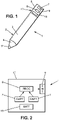
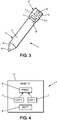
- Figure 1 and 2 generally illustrates a system 1 according to a first embodiment.
- the system 1 comprises a handwriting instrument 2.
- the handwriting instrument 2 can be a pen, a pencil, a brush or any element allowing a user to write with it on a support.
- the support can be paper, canvas, or any surface on which a user can write or draw.
- the handwriting instrument 2 comprises a body 3 extending longitudinally between a first end 4 and a second end 5.
- the first end 4 comprises a writing tip 6 which is able to write on a support.
- the tip 6 can deliver ink or color.
- the system 1 may comprise a module 17.
- the module 17 comprises at least one motion sensor 7.
- the motion sensor 7 can be a three-axis accelerometer.
- the module 17 may further comprise a second motion sensor 7.
- the second motion sensor 7 is a three-axis gyroscope.
- the module 17 is embedded in the handwriting instrument 2.
- the module 17 is embedded near or at the second end 5 of the handwriting instrument.
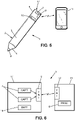
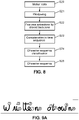
- the module 17 is distinct from the handwriting instrument 2. In this embodiment, shown figures 3 and 4 , the module 17 is able to be placed on the second end 5 of the handwriting instrument.
- the module 17 may comprise a hole of a diameter D allowing the insertion of the second end 5 of the handwriting instrument in it.
- At least one motion sensor 7 is then placed or at the second end 5 of the handwriting instrument 2. In this way, the user of the handwriting instrument is not bothered when he uses the handwriting instrument 2, since module 17 does not block his sight.
- the module 17 can be embedded in the handwriting instrument 2, or distinct from the handwriting instrument 2.
- At least one motion sensor 7 is able to acquire data on the handwriting of the user when the user is using the handwriting instrument 2. These data are communicated to a calculating unit 8 which is configured to analyze the data and perform the recognition of handwriting.
- the calculating unit 8 can comprise a volatile memory to store the data acquired by the motion sensor 7 and a non-volatile memory to store a machine learning model enabling the handwriting recognition.
- the module 17 further comprises the calculating unit 8.
- the module 17 does not comprise the calculating unit 8.
- the calculating unit 8 may be comprised in a mobile device.
- the mobile device 11 can typically be an electronic tablet, a mobile phone or a computer.
- the module 17 can also comprise a short-range radio communication interface 9 allowing the communication of data between the at least one motion sensor 7 and the calculating unit 8.
- the short-range radio communication interface is using a Wi-Fi, Bluetooth ® , LORA ® , SigFox ® or NBIoT network. In another embodiment, it can also communicate using a 2G, 3G, 4G or 5G network.
- the mobile device 11 further comprises a short-range radio communication interface 12 enabling communication between the calculating unit 8 and the module 17 via the short-range radio communication interface 9.
- the calculating unit 8 may be comprised in the cloud.
- the calculating unit 8 may be accessible via the mobile device 11.
- the module 17 may still comprise the short-range radio communication interface 9, in order to communicate results to a deported server (not shown), as a non-limitative example.
- the module 17 may further include a battery 10 providing power to at least the motion sensor 7 when the user is using the handwriting instrument.
- the battery 9 can also provide power to all the other components that may be comprised in said module 17, such as the calculating unit 8, the short-range radio communication interface 9.
- the calculating unit 8 receives motion data acquired from at least on motion sensor 7 to analyze them and perform handwriting recognition.
- the motion data received by the calculating unit 8 are raw motion data.
- the calculating unit 8 can store a machine learning model able to analyze the motion data acquired by the motion sensor 7.
- the machine learning model can comprise at least one neural network.
- the machine learning model is trained to perform the recognition of a sequence of characters which has been written by the user while using the handwriting instrument 2.
- the machine learning model is trained in a multi-task way.
- the machine learning model may be trained to perform two tasks being the recognition of a character which has been written by the user while using the handwriting instrument 2, which is designated as the first task, and the segmentation of strokes, which is designated as the second task.
- the first and second tasks share the same backbone being a neural network, which extracts the hidden features of the motion data.
- This neural network is, in a non-limitative embodiment, a convolutional neural network such as an encoder.
- This encoding neural network is designated hereinafter as the shared backbone.
- the first task may be performed, in a non-limitative embodiment, by the neural network being the shared backbone, together with a recursive neural network, such as a BLSTM or a Transformer, trained with the CTC loss function.
- a recursive neural network such as a BLSTM or a Transformer
- the second task may be performed, in a non-limitative embodiment, by an auto-encoder neural network, whose encoder is the shared backbone and decoder is an additional convolutional neural network with upsampling.
- the machine learning model is trained in a multi-task way such that it is capable of performing at least these two tasks at the same time.
- FIG 7 illustrating steps of the training phases of the multi-task machine learning model.
- step S1 the calculating unit 8 receives the motion data acquired by at least one motion sensor 7 while the user is writing a character, or a sequence of characters with the handwriting instrument 2.
- a step S2 of pre-processing is performed.
- the pre-processing step comprises the time windowing of the motion data such that the motion data is cut into time-steps.
- the motion data is windowed into time-steps of a size comprised between 1 and 5 seconds.
- the windowed motion data i.e. the time-steps, are then fed in the shared backbone.
- the shared backbone further receives labels at step S3.
- the labels correspond to on-paper and in-air time stamped labels.
- the labels correspond to whether the writing tip 6 of the handwriting instrument 2 touched the paper, which corresponds to the on-paper label, or not, which corresponds to the in-air label.
- the labels are time stamped and relative to each data sample.
- the motion data acquired by the motion sensor 7 is continuous and lacks positional information. More particularly, the motion data comprise both motion data corresponding to when the user is writing with it on a support and motion data corresponding to when the user is just moving the handwriting instrument 2 in the air, without writing.
- the shared backbone performs hidden features extraction to obtain intermediate features at step S6.
- the segmentation task or second task, is performed at step S7.
- This step allows finding the starting and ending time of each stroke.
- the segmentation task comprises the segmentation of the on-paper strokes and in-air movements.
- step S8 the on-paper strokes and in-air movements classes are obtained for each time sample in the signals.
- step S6 The intermediate features of step S6 are also used in step S9.
- step S9 the machine learning model performs the concatenation in time sequence of the on-paper strokes and in-air movements.
- step S10 other labels are sent to the machine learning model for performing the first task of sequence of characters recognition.
- these labels may be fed into the recursive neural network participating in the first task.
- These labels may correspond to character labels or character sequence labels that are used in the character sequence classification step S11.
- the labels may be individual characters, words, or even sentences.
- the classification step S11 may be performed at least in part by the recursive neural network, such as a BLSTM or a Transformer, trained with a loss function such as the CTC loss function, as described above.
- the recursive neural network such as a BLSTM or a Transformer, trained with a loss function such as the CTC loss function, as described above.
- a characters sequence is obtained at step S12, which corresponds to the characters sequence written by the user while using the handwriting instrument 2, and to which the motion data was associated at step S1.
- the machine learning model learns to recognize both on-paper strokes and in-air movements from the motion data in addition to continuously recognize characters sequence.
- the multi-task training of the machine learning model renders the system more efficient. Indeed, the learning of the second task and the first task, at the same time, makes the learning of the first task significantly more efficient.
- the machine learning model acquires the knowledge to identify individual on-paper strokes and in-air movements from the motion data, it is able to learn any character of any language.
- Steps S1 to S6 and S9 to S12 may be assimilated to the first task of characters sequence recognition.
- Steps S1 to S8 may be assimilated to the second task of stroke segmentation.
- the machine learning model can be stored in the calculating unit 8.
- only the weights of the first task are used during the inference phase, such that the machine learning model stored in the calculating unit only comprises the weights of the first task.
- the machine learning model is further trained to differentiate forward in-air movement and backward in-air movement.
- paper strokes are not always ordered such that it cannot be assumed that the most recent stroke belongs to the most recent character, as people can go back to finish a previous character.
- the motion data corresponds to the acceleration signal acquired by a three-axis accelerometer.
- the graphic of figure 9B shows the amplitude of the acceleration signal according to the tree-axis x, y, z as a function of time.
- the characters sequence of figure 9A comprises ten paper stroke, six forward jumps between letters, one forward jump between words and two backward jumps (before the "i" point and before the "t” bar).
- the circled numbers are associated with each of the paper stroke and show the order in which they have been written.
- the detection of forward in-air movement may help the machine learning model to recognize the space between characters or words.
- the detection of backward in-air movement may help the machine learning model to recognize that a character is being finished (for example with the points on the i).
- the labels can include on-paper time label, forward in-air movement and backward in-air movement, such that in step S7 the segmentation task is made to obtain on-paper stroke, forward in-air movement and backward in-air movement.
- the machine learning model is further trained with another label.
- This label may be other in-air movement.
- This label can help the machine learning model to determine that a user is not writing anymore. For example, it detects that the user is thinking or simply wagging the handwriting instrument 2 in the air.
- the trained machine learning model can then be stored in the calculating unit 8.
- Figure 8 illustrates the inference phase of the machine learning model.
- the motion data is obtained from at least one motion sensor 7.
- the motion data corresponds to the raw signals acquired by at least one motion sensor 7 while the user is writing a sequence of characters with the handwriting instrument 2.
- the motion data are then pre-processed by windowing these motion data into time steps at step S21.
- This step corresponds to step S2 described in reference with figure 7 .
- the windowed motion data are then fed, at step S22, in the shared backbone which performs the features extraction such as described with reference to step S5 of figure 7 .
- the machine learning model performs the concatenation in time sequence, such that the character sequence classification performed at step S24 is made on the on-paper strokes and in-air movement in the correct chronological order.
- the in-air movement may comprise forward in-air movement and backward in-air movement.
- a character sequence is obtained as an output of the machine learning model, which corresponds to the character sequence written by the user with the handwriting instrument.
- the machine learning model does preferably not perform the segmentation task anymore since the shared backbone has already been trained with the weights corresponding to both the segmentation and the character classification task, due to the multi-task training.
- the machine learning model performs, after the segmentation task (step S7 of figure 7 ), a stroke acceleration regression and or/ or in-air movement acceleration regression tasks. This enables the machine learning model to derive the coordinates of the writing tip, based on the motion data. In this way, the machine learning model may deliver as an output a replica of the sequence of characters written by the user, including the shape of the characters.
Landscapes
- Engineering & Computer Science (AREA)
- Computer Vision & Pattern Recognition (AREA)
- Physics & Mathematics (AREA)
- General Physics & Mathematics (AREA)
- Multimedia (AREA)
- Theoretical Computer Science (AREA)
- Character Discrimination (AREA)
Abstract
- a handwriting instrument (2) including a body (3) extending longitudinally between a first end (4) and a second end (5), the first end (4) having a writing tip (6) which is able to write on a support, the handwriting instrument (2) further including a module (17) comprising one motion sensor (7) configured to acquire motion data on the handwriting of a user when the user is writing a characters sequence with the handwriting instrument (2),
- a calculating unit (8) communicating with the motion sensor (7) and configured to analyze the motion data by a machine learning model trained in a multitask way, the machine learning model being configured to deliver as an output the sequence of characters which was written by the user with the handwriting instrument.
Description
- This disclosure pertains to the field of systems and methods for recognizing online handwriting. More precisely, the disclosure pertains to the field of systems and methods for online and continuous recognition of handwriting.
- Currently, several systems or methods exist for recognizing the handwriting of a user. One type of handwriting recognition, called online handwriting recognition, consists of performing the recognition of a character, or a sequence of characters, while the user is writing it. Another type of handwriting recognition, called offline handwriting recognition, is based on the analysis of a picture showing text.
- For example, it is know from patent document
US10126825 - It is also known from the scientific publication Learning Spatial-Semantic Context with Fully Convolutional Recurrent Network for Online Handwritten Chinese Text Recognition, Xie et al. published in August 2018 in IEEE Transactions on Pattern Analysis and Machine Intelligence, a method for detecting online handwriting. The method uses four neural networks: MC-FCRN (multi-spatial-context fully convolutional recurrent network), FCN (fully convolutional network), LSTM (long-short term memory) and CTC (connectionist temporal classification). The neural networks are jointly trained. The method uses the path signature method, applied on reduced windows of data. This publication does not describe how the data are effectively acquired, however using path signature method implies to use positional sensors like a camera or a touchscreen. Another drawback is the need of using four neural networks, each being trained in chain with the entry of the preceding neural network.
- It is also known from the publication Offline Handwritten Chinese Text Recognition with Convolutional Neural Networks, Liu et al., published in 2020 in ArXiv, a method for offline handwriting recognition which cut line-of-text images into small time-steps before feeding them in a feature extractor neural network. However, this publication performs offline handwriting recognition, which is not adapted for the online handwriting recognition.
- One purpose of this disclosure is to improve the situation.
- It is proposed a system for recognizing online handwriting comprising:
- a handwriting instrument including a body extending longitudinally between a first end and a second end, said first end having a writing tip which is able to write on a support, said handwriting instrument further including a module comprising at least one motion sensor configured to acquire motion data on the handwriting of a user when the user is writing a characters sequence with said handwriting instrument,
- a calculating unit communicating with said at least one motion sensor and configured to analyze said motion data by a machine learning model trained in a multitask way, said machine learning model being configured to deliver as an output the sequence of characters which was written by the user with said handwriting instrument.
- In an embodiment, the module is embedded in the second end of the handwriting instrument.
- In an embodiment, the module is distinct from the handwriting instrument, said module being intended to be placed on the second end of the handwriting instrument.
- In an embodiment, the module further comprises the calculating unit.
- In an embodiment, the module further includes a short-range radio communication interface configured to communicate raw motion data acquired by the motion sensor to a mobile device comprising said calculating unit via a communication interface of said mobile device.
- In an embodiment, the motion sensor is a three-axis accelerometer.
- In an embodiment, the module further comprises a second motion sensor being a three-axis gyroscope.
- In an embodiment, the characters of the characters sequence comprise numbers and/or letters.
- It is also proposed a method for recognizing online handwriting comprising
- acquiring, by means of a handwriting instrument comprising a module comprising at least one motion sensor, motion data on the handwriting of the user when said user is writing a sequence of characters with said handwriting instrument, said handwriting instrument further including a body extending longitudinally between a first end and a second end, said first end having a writing tip which is able to write on a support,
- analyzing said motion data with a machine learning model trained in a multi-task way, said machine learning model being configured to deliver as an output the sequence of characters which was written by the user with said handwriting instrument.
- In an embodiment, the method further comprises a prior step of multi-task training of the machine learning model, wherein the machine learning model is trained to perform:
- a stroke segmentation task,
- a character classification task.
- In an embodiment, the stroke segmentation task comprises labelizing samples of the acquired motion data in at least one of the following classes:
- on-paper stroke,
- in-air movement.
- In an embodiment, the acquired motion data are pre-processed before being used in the stroke segmentation task by:
- windowing the raw motion data in time frames of N samples, each sample in the time frame being labelized in one of the on-paper stroke and/or in-air movement.
- In an embodiment, the in-air movement label comprises at least two sub labels:
- forward in-air movement,
- backward in-air movement.
- In an embodiment, once trained, the machine learning model is stored, the method further comprising the analysis of said acquired motion data continuously and in real time with the trained machine learning model.
- Other features, details and advantages will be shown in the following detailed description and on the figures, on which:
-
Fig. 1
[Fig. 1 ] is an illustration of a system for detecting handwriting problems according to a first embodiment. -
Fig. 2
[Fig. 2 ] is a block schema of the system illustrated infigure 1 . -
Fig. 3
[Fig. 3 ] is an illustration of a system for detecting handwriting problems according to a second embodiment. -
Fig. 4
[Fig. 4 ] is a block schema of the system illustrated infigure 3 . -
Fig. 5
[Fig. 5 ] is an illustration of a system for detecting handwriting problems according to a third embodiment. -
Fig. 6
[Fig. 6 ] is a block schema of the system illustrated infigure 5 . -
Fig. 7
[Fig. 7 ] is a block diagram illustrating the multi-task training phase of the machine learning model according to an embodiment. -
Fig. 8
[Fig. 8 ] is a block diagram illustrating the inference phase of the machine learning model after its multi-task training according to an embodiment. -
Fig. 9A and9B
[Fig. 9A and9B ] illustrate a characters sequence written by a user using the handwriting instrument and the associated motion data. - It is now referred to
figures 1 to 6 illustrating embodiments of asystem 1 for recognizing online handwriting. The same reference numbers are used to describe identical elements of thesystem 1. -
Figure 1 and 2 generally illustrates asystem 1 according to a first embodiment. Thesystem 1 comprises ahandwriting instrument 2. Typically, thehandwriting instrument 2 can be a pen, a pencil, a brush or any element allowing a user to write with it on a support. Typically, the support can be paper, canvas, or any surface on which a user can write or draw. - The
handwriting instrument 2 comprises abody 3 extending longitudinally between afirst end 4 and asecond end 5. Thefirst end 4 comprises awriting tip 6 which is able to write on a support. Typically, thetip 6 can deliver ink or color. - The
system 1 may comprise amodule 17. In an embodiment, themodule 17 comprises at least onemotion sensor 7. In one embodiment, themotion sensor 7 can be a three-axis accelerometer. - In another embodiment, the
module 17 may further comprise asecond motion sensor 7. For example, thesecond motion sensor 7 is a three-axis gyroscope. - In an embodiment, the
module 17 is embedded in thehandwriting instrument 2. For example, themodule 17 is embedded near or at thesecond end 5 of the handwriting instrument. - In another embodiment, the
module 17 is distinct from thehandwriting instrument 2. In this embodiment, shownfigures 3 and 4 , themodule 17 is able to be placed on thesecond end 5 of the handwriting instrument. - Hence, the
module 17 may comprise a hole of a diameter D allowing the insertion of thesecond end 5 of the handwriting instrument in it. - In these configurations, at least one
motion sensor 7 is then placed or at thesecond end 5 of thehandwriting instrument 2. In this way, the user of the handwriting instrument is not bothered when he uses thehandwriting instrument 2, sincemodule 17 does not block his sight. - For all the embodiments described hereinafter, the
module 17 can be embedded in thehandwriting instrument 2, or distinct from thehandwriting instrument 2. - In all the embodiments, at least one
motion sensor 7 is able to acquire data on the handwriting of the user when the user is using thehandwriting instrument 2. These data are communicated to a calculatingunit 8 which is configured to analyze the data and perform the recognition of handwriting. - The calculating
unit 8 can comprise a volatile memory to store the data acquired by themotion sensor 7 and a non-volatile memory to store a machine learning model enabling the handwriting recognition. - In the embodiment shown
figures 1 to 4 , themodule 17 further comprises the calculatingunit 8. - In another embodiment shown
figures 5 and 6 , themodule 17 does not comprise the calculatingunit 8. - In this embodiment, the calculating
unit 8 may be comprised in a mobile device. Themobile device 11 can typically be an electronic tablet, a mobile phone or a computer. - The
module 17 can also comprise a short-rangeradio communication interface 9 allowing the communication of data between the at least onemotion sensor 7 and the calculatingunit 8. In one embodiment, the short-range radio communication interface is using a Wi-Fi, Bluetooth®, LORA®, SigFox® or NBIoT network. In another embodiment, it can also communicate using a 2G, 3G, 4G or 5G network. - The
mobile device 11 further comprises a short-rangeradio communication interface 12 enabling communication between the calculatingunit 8 and themodule 17 via the short-rangeradio communication interface 9. - In another embodiment, the calculating
unit 8 may be comprised in the cloud. The calculatingunit 8 may be accessible via themobile device 11. - When the calculating
unit 8 is comprised in themodule 17, as shown onfigures 1 to 4 , themodule 17 may still comprise the short-rangeradio communication interface 9, in order to communicate results to a deported server (not shown), as a non-limitative example. - The
module 17 may further include abattery 10 providing power to at least themotion sensor 7 when the user is using the handwriting instrument. Thebattery 9 can also provide power to all the other components that may be comprised in saidmodule 17, such as the calculatingunit 8, the short-rangeradio communication interface 9. - In all the embodiments described above, the calculating
unit 8 receives motion data acquired from at least onmotion sensor 7 to analyze them and perform handwriting recognition. - In a preferred embodiment, the motion data received by the calculating
unit 8 are raw motion data. - More specifically, the calculating
unit 8 can store a machine learning model able to analyze the motion data acquired by themotion sensor 7. The machine learning model can comprise at least one neural network. The machine learning model is trained to perform the recognition of a sequence of characters which has been written by the user while using thehandwriting instrument 2. - In one embodiment the machine learning model is trained in a multi-task way.
- More specifically, the machine learning model may be trained to perform two tasks being the recognition of a character which has been written by the user while using the
handwriting instrument 2, which is designated as the first task, and the segmentation of strokes, which is designated as the second task. - The first and second tasks share the same backbone being a neural network, which extracts the hidden features of the motion data. This neural network is, in a non-limitative embodiment, a convolutional neural network such as an encoder. This encoding neural network is designated hereinafter as the shared backbone.
- The first task may be performed, in a non-limitative embodiment, by the neural network being the shared backbone, together with a recursive neural network, such as a BLSTM or a Transformer, trained with the CTC loss function.
- The second task may be performed, in a non-limitative embodiment, by an auto-encoder neural network, whose encoder is the shared backbone and decoder is an additional convolutional neural network with upsampling.
- The machine learning model is trained in a multi-task way such that it is capable of performing at least these two tasks at the same time.
- Reference is made to
figure 7 , illustrating steps of the training phases of the multi-task machine learning model. - In step S1, the calculating
unit 8 receives the motion data acquired by at least onemotion sensor 7 while the user is writing a character, or a sequence of characters with thehandwriting instrument 2. - A step S2 of pre-processing is performed. The pre-processing step comprises the time windowing of the motion data such that the motion data is cut into time-steps.
- For example, the motion data is windowed into time-steps of a size comprised between 1 and 5 seconds.
- The windowed motion data, i.e. the time-steps, are then fed in the shared backbone. The shared backbone further receives labels at step S3.
- In an embodiment, the labels correspond to on-paper and in-air time stamped labels. In other words, the labels correspond to whether the
writing tip 6 of thehandwriting instrument 2 touched the paper, which corresponds to the on-paper label, or not, which corresponds to the in-air label. The labels are time stamped and relative to each data sample. - Typically, when using a
motion sensor 7 such as a three-axis accelerometer (or a three-axis accelerometer and a three-axis gyroscope), the motion data acquired by themotion sensor 7 is continuous and lacks positional information. More particularly, the motion data comprise both motion data corresponding to when the user is writing with it on a support and motion data corresponding to when the user is just moving thehandwriting instrument 2 in the air, without writing. - At step S5, the shared backbone performs hidden features extraction to obtain intermediate features at step S6.
- From these intermediate features, the segmentation task, or second task, is performed at step S7. This step allows finding the starting and ending time of each stroke. During this step, the segmentation task comprises the segmentation of the on-paper strokes and in-air movements.
- At step S8, the on-paper strokes and in-air movements classes are obtained for each time sample in the signals.
- The intermediate features of step S6 are also used in step S9. In step S9, the machine learning model performs the concatenation in time sequence of the on-paper strokes and in-air movements.
- At step S10, other labels are sent to the machine learning model for performing the first task of sequence of characters recognition.
- More specifically, these labels may be fed into the recursive neural network participating in the first task.
- These labels may correspond to character labels or character sequence labels that are used in the character sequence classification step S11.
- The labels may be individual characters, words, or even sentences.
- The classification step S11 may be performed at least in part by the recursive neural network, such as a BLSTM or a Transformer, trained with a loss function such as the CTC loss function, as described above.
- Finally, a characters sequence is obtained at step S12, which corresponds to the characters sequence written by the user while using the
handwriting instrument 2, and to which the motion data was associated at step S1. - During the training of the machine learning model, the machine learning model learns to recognize both on-paper strokes and in-air movements from the motion data in addition to continuously recognize characters sequence.
- The multi-task training of the machine learning model renders the system more efficient. Indeed, the learning of the second task and the first task, at the same time, makes the learning of the first task significantly more efficient.
- Moreover, since the machine learning model acquires the knowledge to identify individual on-paper strokes and in-air movements from the motion data, it is able to learn any character of any language.
- Steps S1 to S6 and S9 to S12 may be assimilated to the first task of characters sequence recognition.
- Steps S1 to S8 may be assimilated to the second task of stroke segmentation.
- Once the multi-task training is performed, the machine learning model can be stored in the calculating
unit 8. - In an embodiment, only the weights of the first task are used during the inference phase, such that the machine learning model stored in the calculating unit only comprises the weights of the first task.
- In another preferred embodiment, the machine learning model is further trained to differentiate forward in-air movement and backward in-air movement. Indeed, paper strokes are not always ordered such that it cannot be assumed that the most recent stroke belongs to the most recent character, as people can go back to finish a previous character.
- This is for example illustrated on
figures 9A and9B showing the characters sequence "written down" being written on paper and the associated motion data. - In this example the motion data corresponds to the acceleration signal acquired by a three-axis accelerometer. The graphic of
figure 9B shows the amplitude of the acceleration signal according to the tree-axis x, y, z as a function of time. - The characters sequence of
figure 9A comprises ten paper stroke, six forward jumps between letters, one forward jump between words and two backward jumps (before the "i" point and before the "t" bar). - The circled numbers are associated with each of the paper stroke and show the order in which they have been written.
- It then appears that it may be important to consider also the direction of the in-air movements.
- In particular, the detection of forward in-air movement may help the machine learning model to recognize the space between characters or words. The detection of backward in-air movement may help the machine learning model to recognize that a character is being finished (for example with the points on the i).
- Then, in step S3 of
figure 7 , the labels can include on-paper time label, forward in-air movement and backward in-air movement, such that in step S7 the segmentation task is made to obtain on-paper stroke, forward in-air movement and backward in-air movement. - In another embodiment, the machine learning model is further trained with another label. This label may be other in-air movement.
- This label can help the machine learning model to determine that a user is not writing anymore. For example, it detects that the user is thinking or simply wagging the
handwriting instrument 2 in the air. - The trained machine learning model can then be stored in the calculating
unit 8. -
Figure 8 illustrates the inference phase of the machine learning model. - At step S20, the motion data is obtained from at least one
motion sensor 7. - Preferably, the motion data corresponds to the raw signals acquired by at least one
motion sensor 7 while the user is writing a sequence of characters with thehandwriting instrument 2. - The motion data are then pre-processed by windowing these motion data into time steps at step S21. This step corresponds to step S2 described in reference with
figure 7 . - The windowed motion data are then fed, at step S22, in the shared backbone which performs the features extraction such as described with reference to step S5 of
figure 7 . - From these features extraction, the machine learning model performs the concatenation in time sequence, such that the character sequence classification performed at step S24 is made on the on-paper strokes and in-air movement in the correct chronological order.
- As already described, the in-air movement may comprise forward in-air movement and backward in-air movement.
- At step S25, a character sequence is obtained as an output of the machine learning model, which corresponds to the character sequence written by the user with the handwriting instrument.
- During the inference phase, the machine learning model does preferably not perform the segmentation task anymore since the shared backbone has already been trained with the weights corresponding to both the segmentation and the character classification task, due to the multi-task training.
- This invention is not restricted to the embodiments described herein above. Other variants of the invention may be implemented.
- In an embodiment, the machine learning model performs, after the segmentation task (step S7 of
figure 7 ), a stroke acceleration regression and or/ or in-air movement acceleration regression tasks. This enables the machine learning model to derive the coordinates of the writing tip, based on the motion data. In this way, the machine learning model may deliver as an output a replica of the sequence of characters written by the user, including the shape of the characters.
Claims (8)
- System (1) for recognizing online handwriting comprising:- a handwriting instrument (2) including a body (3) extending longitudinally between a first end (4) and a second end (5), said first end (4) having a writing tip (6) which is able to write on a support, said handwriting instrument (2) further including a module (17) comprising at least one motion sensor (7) configured to acquire motion data on the handwriting of a user when the user is writing a characters sequence with said handwriting instrument (2),- a calculating unit (8) communicating with said at least one motion sensor (7) and configured to analyze said motion data by a machine learning model trained in a multitask way, said machine learning model being configured to deliver as an output the sequence of characters which was written by the user with said handwriting instrument.
- System (1) according to claim 1, wherein the module (17) is embedded in the second end (5) of the handwriting instrument.
- System according to any of claims 1 or 2, wherein the module (17) is distinct from the handwriting instrument (2), said module (17) being intended to be placed on the second end (5) of the handwriting instrument (2).
- System according to any of claims 1 to 3, wherein the module (17) further comprises the calculating unit (8).
- System (1) according to any of claims 1 to 4, wherein the module (17) further includes a short-range radio communication interface (9) configured to communicate raw motion data acquired by the motion sensor (7) to a mobile device (11) comprising said calculating unit (8) via a communication interface (12) of said mobile device (11).
- System (1) according to any of claims 1 to 5, wherein the motion sensor (7) is a three-axis accelerometer.
- System (1) according to claim 6, wherein the module (17) further comprises a second motion sensor (7) being a three-axis gyroscope.
- System (1) according to any of claims 1 to 7, wherein the characters of the characters sequence comprise numbers and/or letters.
Priority Applications (2)
| Application Number | Priority Date | Filing Date | Title |
|---|---|---|---|
| EP21169984.8A EP3989114B1 (en) | 2020-10-26 | 2020-10-26 | System for recognizing online handwriting |
| ES21169984T ES2985375T3 (en) | 2020-10-26 | 2020-10-26 | Online handwriting recognition system |
Applications Claiming Priority (2)
| Application Number | Priority Date | Filing Date | Title |
|---|---|---|---|
| EP21169984.8A EP3989114B1 (en) | 2020-10-26 | 2020-10-26 | System for recognizing online handwriting |
| EP20306281.5A EP3989108B1 (en) | 2020-10-26 | 2020-10-26 | System and method for recognizing online handwriting |
Related Parent Applications (2)
| Application Number | Title | Priority Date | Filing Date |
|---|---|---|---|
| EP20306281.5A Division EP3989108B1 (en) | 2020-10-26 | 2020-10-26 | System and method for recognizing online handwriting |
| EP20306281.5A Division-Into EP3989108B1 (en) | 2020-10-26 | 2020-10-26 | System and method for recognizing online handwriting |
Publications (3)
| Publication Number | Publication Date |
|---|---|
| EP3989114A1 true EP3989114A1 (en) | 2022-04-27 |
| EP3989114B1 EP3989114B1 (en) | 2024-07-24 |
| EP3989114C0 EP3989114C0 (en) | 2024-07-24 |
Family
ID=73288531
Family Applications (2)
| Application Number | Title | Priority Date | Filing Date |
|---|---|---|---|
| EP21169984.8A Active EP3989114B1 (en) | 2020-10-26 | 2020-10-26 | System for recognizing online handwriting |
| EP20306281.5A Active EP3989108B1 (en) | 2020-10-26 | 2020-10-26 | System and method for recognizing online handwriting |
Family Applications After (1)
| Application Number | Title | Priority Date | Filing Date |
|---|---|---|---|
| EP20306281.5A Active EP3989108B1 (en) | 2020-10-26 | 2020-10-26 | System and method for recognizing online handwriting |
Country Status (5)
| Country | Link |
|---|---|
| US (2) | US12626525B2 (en) |
| EP (2) | EP3989114B1 (en) |
| CN (1) | CN116724341B (en) |
| ES (1) | ES2985375T3 (en) |
| WO (1) | WO2022090096A1 (en) |
Families Citing this family (4)
| Publication number | Priority date | Publication date | Assignee | Title |
|---|---|---|---|---|
| EP3910454B1 (en) * | 2020-05-04 | 2025-09-10 | Société BIC | Mountable device for retrofitting handwriting instruments to detect handwriting problems |
| US11605187B1 (en) * | 2020-08-18 | 2023-03-14 | Corel Corporation | Drawing function identification in graphics applications |
| EP3989114B1 (en) * | 2020-10-26 | 2024-07-24 | Société BIC | System for recognizing online handwriting |
| CN115631205B (en) * | 2022-12-01 | 2023-03-21 | 阿里巴巴(中国)有限公司 | Method, device and equipment for image segmentation and model training |
Citations (3)
| Publication number | Priority date | Publication date | Assignee | Title |
|---|---|---|---|---|
| US20160259436A1 (en) * | 2015-03-04 | 2016-09-08 | Lenovo (Singapore) Pte, Ltd. | Apparatus, method, and program product for erasing with a stylus |
| US10126825B2 (en) | 2015-06-26 | 2018-11-13 | Orange | Method for recognizing handwriting on a physical surface |
| CN110134257A (en) * | 2019-05-09 | 2019-08-16 | 兰州工业学院 | Electronic pen and its writing recognition model building method based on inertial sensor |
Family Cites Families (14)
| Publication number | Priority date | Publication date | Assignee | Title |
|---|---|---|---|---|
| US6256410B1 (en) * | 1998-07-30 | 2001-07-03 | International Business Machines Corp. | Methods and apparatus for customizing handwriting models to individual writers |
| SE520022C2 (en) * | 2001-09-21 | 2003-05-06 | Anoto Ab C O C Technologies Ab | Procedure and apparatus for segmentation of handwritten objects |
| CN101872259B (en) * | 2010-06-03 | 2012-01-25 | 中国人民解放军第二炮兵工程学院 | Natural interaction pen capable of automatically inputting written contents and handwriting detection method |
| DE102013214020A1 (en) * | 2013-07-17 | 2015-02-19 | Stabilo International Gmbh | Digital pen |
| KR20160143428A (en) * | 2015-06-05 | 2016-12-14 | 엘지전자 주식회사 | Pen terminal and method for controlling the same |
| US20180299976A1 (en) * | 2015-09-07 | 2018-10-18 | Somboon Chiewcharnpipat | Digitized writing apparatus |
| CN106648149B (en) * | 2016-09-22 | 2019-10-18 | 华南理工大学 | A Recognition Method of In-Air Handwritten Characters Based on Accelerometer and Gyroscope |
| EP3598339B1 (en) * | 2018-07-19 | 2024-09-04 | Tata Consultancy Services Limited | Systems and methods for end-to-end handwritten text recognition using neural networks |
| CN109263362A (en) * | 2018-10-29 | 2019-01-25 | 广东小天才科技有限公司 | Intelligent pen and control method thereof |
| US11120255B2 (en) * | 2019-02-06 | 2021-09-14 | Arizona Board Of Regents On Behalf Of Arizona State University | Systems and methods for a multifactor user identification and authentication framework for in-air-handwriting with hand geometry and deep hashing |
| KR20190103090A (en) * | 2019-08-15 | 2019-09-04 | 엘지전자 주식회사 | Method and apparatus for learning a model to generate poi data using federated learning |
| CN110866499B (en) * | 2019-11-15 | 2022-12-13 | 爱驰汽车有限公司 | Handwritten text recognition method, system, device and medium |
| EP3910454B1 (en) | 2020-05-04 | 2025-09-10 | Société BIC | Mountable device for retrofitting handwriting instruments to detect handwriting problems |
| EP3989114B1 (en) * | 2020-10-26 | 2024-07-24 | Société BIC | System for recognizing online handwriting |
-
2020
- 2020-10-26 EP EP21169984.8A patent/EP3989114B1/en active Active
- 2020-10-26 ES ES21169984T patent/ES2985375T3/en active Active
- 2020-10-26 EP EP20306281.5A patent/EP3989108B1/en active Active
-
2021
- 2021-10-22 WO PCT/EP2021/079431 patent/WO2022090096A1/en not_active Ceased
- 2021-10-22 US US18/250,312 patent/US12626525B2/en active Active
- 2021-10-22 CN CN202180076389.6A patent/CN116724341B/en active Active
- 2021-12-23 US US17/560,623 patent/US20220366713A1/en not_active Abandoned
Patent Citations (3)
| Publication number | Priority date | Publication date | Assignee | Title |
|---|---|---|---|---|
| US20160259436A1 (en) * | 2015-03-04 | 2016-09-08 | Lenovo (Singapore) Pte, Ltd. | Apparatus, method, and program product for erasing with a stylus |
| US10126825B2 (en) | 2015-06-26 | 2018-11-13 | Orange | Method for recognizing handwriting on a physical surface |
| CN110134257A (en) * | 2019-05-09 | 2019-08-16 | 兰州工业学院 | Electronic pen and its writing recognition model building method based on inertial sensor |
Non-Patent Citations (3)
| Title |
|---|
| HSU YU-LIANG ET AL: "An Inertial Pen With Dynamic Time Warping Recognizer for Handwriting and Gesture Recognition", IEEE SENSORS JOURNAL, IEEE SERVICE CENTER, NEW YORK, NY, US, vol. 15, no. 1, 1 January 2015 (2015-01-01), pages 154 - 163, XP011563608, ISSN: 1530-437X, [retrieved on 20141104], DOI: 10.1109/JSEN.2014.2339843 * |
| LIU ET AL.: "Offline Handwritten Chinese Text Recognition with Convolutional Neural Networks", ARXIV, 2020 |
| XIE ET AL.: "Learning Spatial-Semantic Context with Fully Convolutional Recurrent Network for Online Handwritten Chinese Text Recognition", IEEE TRANSACTIONS ON PATTERN ANALYSIS AND MACHINE INTELLIGENCE, August 2018 (2018-08-01) |
Also Published As
| Publication number | Publication date |
|---|---|
| EP3989108C0 (en) | 2024-09-25 |
| US20220366713A1 (en) | 2022-11-17 |
| EP3989114B1 (en) | 2024-07-24 |
| CN116724341A (en) | 2023-09-08 |
| ES2985375T3 (en) | 2024-11-05 |
| US12626525B2 (en) | 2026-05-12 |
| CN116724341B (en) | 2026-05-08 |
| EP3989108B1 (en) | 2024-09-25 |
| WO2022090096A1 (en) | 2022-05-05 |
| EP3989108A1 (en) | 2022-04-27 |
| EP3989114C0 (en) | 2024-07-24 |
| US20230401878A1 (en) | 2023-12-14 |
Similar Documents
| Publication | Publication Date | Title |
|---|---|---|
| US12626525B2 (en) | System for recognizing online handwriting | |
| CN100403235C (en) | Information processing method and information processing device | |
| US12379790B2 (en) | System and method for detecting handwriting problems | |
| US20220335752A1 (en) | Emotion recognition and notification system | |
| Wehbi et al. | Digitizing handwriting with a sensor pen: A writer-independent recognizer | |
| KR20190121593A (en) | Sign language recognition system | |
| CN119295271B (en) | A voice-interactive teaching system integrating visual-tactile sensors and Braille recognition algorithms | |
| KR20230112979A (en) | Apparatus and method for providing writing training service based on user's handwriting recognition | |
| CN112204506B (en) | System and method for automatic language detection of handwritten text | |
| US20250060870A1 (en) | Chatbot systems and methods using dynamic features of handwriting | |
| KR101667910B1 (en) | Method and apparatus for generating digital artifical hand-writing data and computer program stored in computer readable medium therefor | |
| KR101669821B1 (en) | Method and apparatus for generating hand-writing data base and computer program stored in computer readable medium therefor | |
| Kotak et al. | An accelerometer based handwriting recognition of English alphabets using basic strokes | |
| CN116244025A (en) | Information display method, device, device and storage medium | |
| Deoghare et al. | Interactive Sign Language Learning Platform Fostering Sign Language Literacy | |
| Farhan et al. | Real-time interpretation of American Sign Language using SSD-MobileNet | |
| Harshitha et al. | Real Time Implementation of Telugu Character Recognition Using Raspberry Pi | |
| Kumar et al. | Hand Motion Sign Language Detection Using Convolutional Neural Network (CNN) and YOLOv5 Object Detection Framework | |
| Kirubananthavalli et al. | Convolutional Neural Network-Based Hand Gesture Recognizer | |
| Radhika | Long Short-Term Memory Models and Mediapipe Based Framework for Indian Sign Language Translator | |
| Nareshkumar et al. | Transformer-Based Attention for Gestural Language Identification | |
| SubrahmanyeswaraRao et al. | Gesture Communicator: Empowering Deaf-Mute Communication using Deep Learning | |
| CN117950558A (en) | Interaction method, interaction device, interconnection blackboard, electronic device and storage medium | |
| Modak et al. | Real-Time Sign Language Recognition and Conversion into Text Using Deep Learning | |
| CN122049926A (en) | Intelligent handwriting recognition and teaching feedback method based on deep learning |
Legal Events
| Date | Code | Title | Description |
|---|---|---|---|
| PUAI | Public reference made under article 153(3) epc to a published international application that has entered the european phase |
Free format text: ORIGINAL CODE: 0009012 |
|
| STAA | Information on the status of an ep patent application or granted ep patent |
Free format text: STATUS: THE APPLICATION HAS BEEN PUBLISHED |
|
| AC | Divisional application: reference to earlier application |
Ref document number: 3989108 Country of ref document: EP Kind code of ref document: P |
|
| AK | Designated contracting states |
Kind code of ref document: A1 Designated state(s): AL AT BE BG CH CY CZ DE DK EE ES FI FR GB GR HR HU IE IS IT LI LT LU LV MC MK MT NL NO PL PT RO RS SE SI SK SM TR |
|
| RAP3 | Party data changed (applicant data changed or rights of an application transferred) |
Owner name: SOCIETE BIC |
|
| STAA | Information on the status of an ep patent application or granted ep patent |
Free format text: STATUS: REQUEST FOR EXAMINATION WAS MADE |
|
| 17P | Request for examination filed |
Effective date: 20221011 |
|
| RBV | Designated contracting states (corrected) |
Designated state(s): AL AT BE BG CH CY CZ DE DK EE ES FI FR GB GR HR HU IE IS IT LI LT LU LV MC MK MT NL NO PL PT RO RS SE SI SK SM TR |
|
| REG | Reference to a national code |
Ref country code: DE Ref legal event code: R079 Free format text: PREVIOUS MAIN CLASS: G06K0009000000 Ipc: G06V0030320000 Ref country code: DE Ref legal event code: R079 Ref document number: 602020034681 Country of ref document: DE Free format text: PREVIOUS MAIN CLASS: G06K0009000000 Ipc: G06V0030320000 |
|
| GRAP | Despatch of communication of intention to grant a patent |
Free format text: ORIGINAL CODE: EPIDOSNIGR1 |
|
| STAA | Information on the status of an ep patent application or granted ep patent |
Free format text: STATUS: GRANT OF PATENT IS INTENDED |
|
| RIC1 | Information provided on ipc code assigned before grant |
Ipc: G06V 30/32 20220101AFI20240328BHEP |
|
| INTG | Intention to grant announced |
Effective date: 20240412 |
|
| GRAS | Grant fee paid |
Free format text: ORIGINAL CODE: EPIDOSNIGR3 |
|
| GRAA | (expected) grant |
Free format text: ORIGINAL CODE: 0009210 |
|
| STAA | Information on the status of an ep patent application or granted ep patent |
Free format text: STATUS: THE PATENT HAS BEEN GRANTED |
|
| AC | Divisional application: reference to earlier application |
Ref document number: 3989108 Country of ref document: EP Kind code of ref document: P |
|
| AK | Designated contracting states |
Kind code of ref document: B1 Designated state(s): AL AT BE BG CH CY CZ DE DK EE ES FI FR GB GR HR HU IE IS IT LI LT LU LV MC MK MT NL NO PL PT RO RS SE SI SK SM TR |
|
| REG | Reference to a national code |
Ref country code: GB Ref legal event code: FG4D |
|
| REG | Reference to a national code |
Ref country code: CH Ref legal event code: EP |
|
| REG | Reference to a national code |
Ref country code: DE Ref legal event code: R096 Ref document number: 602020034681 Country of ref document: DE |
|
| REG | Reference to a national code |
Ref country code: IE Ref legal event code: FG4D |
|
| U01 | Request for unitary effect filed |
Effective date: 20240806 |
|
| U07 | Unitary effect registered |
Designated state(s): AT BE BG DE DK EE FI FR IT LT LU LV MT NL PT SE SI Effective date: 20240823 |
|
| U20 | Renewal fee for the european patent with unitary effect paid |
Year of fee payment: 5 Effective date: 20240919 |
|
| REG | Reference to a national code |
Ref country code: ES Ref legal event code: FG2A Ref document number: 2985375 Country of ref document: ES Kind code of ref document: T3 Effective date: 20241105 |
|
| PG25 | Lapsed in a contracting state [announced via postgrant information from national office to epo] |
Ref country code: NO Free format text: LAPSE BECAUSE OF FAILURE TO SUBMIT A TRANSLATION OF THE DESCRIPTION OR TO PAY THE FEE WITHIN THE PRESCRIBED TIME-LIMIT Effective date: 20241024 |
|
| PG25 | Lapsed in a contracting state [announced via postgrant information from national office to epo] |
Ref country code: PL Free format text: LAPSE BECAUSE OF FAILURE TO SUBMIT A TRANSLATION OF THE DESCRIPTION OR TO PAY THE FEE WITHIN THE PRESCRIBED TIME-LIMIT Effective date: 20240724 Ref country code: GR Free format text: LAPSE BECAUSE OF FAILURE TO SUBMIT A TRANSLATION OF THE DESCRIPTION OR TO PAY THE FEE WITHIN THE PRESCRIBED TIME-LIMIT Effective date: 20241025 |
|
| PG25 | Lapsed in a contracting state [announced via postgrant information from national office to epo] |
Ref country code: IS Free format text: LAPSE BECAUSE OF FAILURE TO SUBMIT A TRANSLATION OF THE DESCRIPTION OR TO PAY THE FEE WITHIN THE PRESCRIBED TIME-LIMIT Effective date: 20241124 |
|
| PG25 | Lapsed in a contracting state [announced via postgrant information from national office to epo] |
Ref country code: HR Free format text: LAPSE BECAUSE OF FAILURE TO SUBMIT A TRANSLATION OF THE DESCRIPTION OR TO PAY THE FEE WITHIN THE PRESCRIBED TIME-LIMIT Effective date: 20240724 |
|
| PG25 | Lapsed in a contracting state [announced via postgrant information from national office to epo] |
Ref country code: RS Free format text: LAPSE BECAUSE OF FAILURE TO SUBMIT A TRANSLATION OF THE DESCRIPTION OR TO PAY THE FEE WITHIN THE PRESCRIBED TIME-LIMIT Effective date: 20241024 |
|
| PG25 | Lapsed in a contracting state [announced via postgrant information from national office to epo] |
Ref country code: RS Free format text: LAPSE BECAUSE OF FAILURE TO SUBMIT A TRANSLATION OF THE DESCRIPTION OR TO PAY THE FEE WITHIN THE PRESCRIBED TIME-LIMIT Effective date: 20241024 Ref country code: PL Free format text: LAPSE BECAUSE OF FAILURE TO SUBMIT A TRANSLATION OF THE DESCRIPTION OR TO PAY THE FEE WITHIN THE PRESCRIBED TIME-LIMIT Effective date: 20240724 Ref country code: NO Free format text: LAPSE BECAUSE OF FAILURE TO SUBMIT A TRANSLATION OF THE DESCRIPTION OR TO PAY THE FEE WITHIN THE PRESCRIBED TIME-LIMIT Effective date: 20241024 Ref country code: IS Free format text: LAPSE BECAUSE OF FAILURE TO SUBMIT A TRANSLATION OF THE DESCRIPTION OR TO PAY THE FEE WITHIN THE PRESCRIBED TIME-LIMIT Effective date: 20241124 Ref country code: HR Free format text: LAPSE BECAUSE OF FAILURE TO SUBMIT A TRANSLATION OF THE DESCRIPTION OR TO PAY THE FEE WITHIN THE PRESCRIBED TIME-LIMIT Effective date: 20240724 Ref country code: GR Free format text: LAPSE BECAUSE OF FAILURE TO SUBMIT A TRANSLATION OF THE DESCRIPTION OR TO PAY THE FEE WITHIN THE PRESCRIBED TIME-LIMIT Effective date: 20241025 |
|
| PG25 | Lapsed in a contracting state [announced via postgrant information from national office to epo] |
Ref country code: SM Free format text: LAPSE BECAUSE OF FAILURE TO SUBMIT A TRANSLATION OF THE DESCRIPTION OR TO PAY THE FEE WITHIN THE PRESCRIBED TIME-LIMIT Effective date: 20240724 Ref country code: RO Free format text: LAPSE BECAUSE OF FAILURE TO SUBMIT A TRANSLATION OF THE DESCRIPTION OR TO PAY THE FEE WITHIN THE PRESCRIBED TIME-LIMIT Effective date: 20240724 |
|
| PG25 | Lapsed in a contracting state [announced via postgrant information from national office to epo] |
Ref country code: CZ Free format text: LAPSE BECAUSE OF FAILURE TO SUBMIT A TRANSLATION OF THE DESCRIPTION OR TO PAY THE FEE WITHIN THE PRESCRIBED TIME-LIMIT Effective date: 20240724 |
|
| PG25 | Lapsed in a contracting state [announced via postgrant information from national office to epo] |
Ref country code: SK Free format text: LAPSE BECAUSE OF FAILURE TO SUBMIT A TRANSLATION OF THE DESCRIPTION OR TO PAY THE FEE WITHIN THE PRESCRIBED TIME-LIMIT Effective date: 20240724 |
|
| PLBE | No opposition filed within time limit |
Free format text: ORIGINAL CODE: 0009261 |
|
| STAA | Information on the status of an ep patent application or granted ep patent |
Free format text: STATUS: NO OPPOSITION FILED WITHIN TIME LIMIT |
|
| REG | Reference to a national code |
Ref country code: CH Ref legal event code: PL |
|
| 26N | No opposition filed |
Effective date: 20250425 |
|
| PG25 | Lapsed in a contracting state [announced via postgrant information from national office to epo] |
Ref country code: MC Free format text: LAPSE BECAUSE OF FAILURE TO SUBMIT A TRANSLATION OF THE DESCRIPTION OR TO PAY THE FEE WITHIN THE PRESCRIBED TIME-LIMIT Effective date: 20240724 |
|
| PG25 | Lapsed in a contracting state [announced via postgrant information from national office to epo] |
Ref country code: CH Free format text: LAPSE BECAUSE OF NON-PAYMENT OF DUE FEES Effective date: 20241031 |
|
| PG25 | Lapsed in a contracting state [announced via postgrant information from national office to epo] |
Ref country code: IE Free format text: LAPSE BECAUSE OF NON-PAYMENT OF DUE FEES Effective date: 20241026 |
|
| U20 | Renewal fee for the european patent with unitary effect paid |
Year of fee payment: 6 Effective date: 20251027 |
|
| PGFP | Annual fee paid to national office [announced via postgrant information from national office to epo] |
Ref country code: GB Payment date: 20251024 Year of fee payment: 6 |
|
| PG25 | Lapsed in a contracting state [announced via postgrant information from national office to epo] |
Ref country code: CY Free format text: LAPSE BECAUSE OF FAILURE TO SUBMIT A TRANSLATION OF THE DESCRIPTION OR TO PAY THE FEE WITHIN THE PRESCRIBED TIME-LIMIT; INVALID AB INITIO Effective date: 20201026 |
|
| PGFP | Annual fee paid to national office [announced via postgrant information from national office to epo] |
Ref country code: ES Payment date: 20251114 Year of fee payment: 6 |
|
| PG25 | Lapsed in a contracting state [announced via postgrant information from national office to epo] |
Ref country code: HU Free format text: LAPSE BECAUSE OF FAILURE TO SUBMIT A TRANSLATION OF THE DESCRIPTION OR TO PAY THE FEE WITHIN THE PRESCRIBED TIME-LIMIT; INVALID AB INITIO Effective date: 20201026 |
|
| PG25 | Lapsed in a contracting state [announced via postgrant information from national office to epo] |
Ref country code: TR Free format text: LAPSE BECAUSE OF FAILURE TO SUBMIT A TRANSLATION OF THE DESCRIPTION OR TO PAY THE FEE WITHIN THE PRESCRIBED TIME-LIMIT Effective date: 20240724 |