EP3988823B1 - Poppet valve assembly - Google Patents
Poppet valve assembly Download PDFInfo
- Publication number
- EP3988823B1 EP3988823B1 EP21187534.9A EP21187534A EP3988823B1 EP 3988823 B1 EP3988823 B1 EP 3988823B1 EP 21187534 A EP21187534 A EP 21187534A EP 3988823 B1 EP3988823 B1 EP 3988823B1
- Authority
- EP
- European Patent Office
- Prior art keywords
- valve
- outlet
- inlet
- assembly
- valve member
- Prior art date
- Legal status (The legal status is an assumption and is not a legal conclusion. Google has not performed a legal analysis and makes no representation as to the accuracy of the status listed.)
- Active
Links
Images


Classifications
-
- F—MECHANICAL ENGINEERING; LIGHTING; HEATING; WEAPONS; BLASTING
- F16—ENGINEERING ELEMENTS AND UNITS; GENERAL MEASURES FOR PRODUCING AND MAINTAINING EFFECTIVE FUNCTIONING OF MACHINES OR INSTALLATIONS; THERMAL INSULATION IN GENERAL
- F16K—VALVES; TAPS; COCKS; ACTUATING-FLOATS; DEVICES FOR VENTING OR AERATING
- F16K3/00—Gate valves or sliding valves, i.e. cut-off apparatus with closing members having a sliding movement along the seat for opening and closing
- F16K3/22—Gate valves or sliding valves, i.e. cut-off apparatus with closing members having a sliding movement along the seat for opening and closing with sealing faces shaped as surfaces of solids of revolution
- F16K3/24—Gate valves or sliding valves, i.e. cut-off apparatus with closing members having a sliding movement along the seat for opening and closing with sealing faces shaped as surfaces of solids of revolution with cylindrical valve members
-
- F—MECHANICAL ENGINEERING; LIGHTING; HEATING; WEAPONS; BLASTING
- F16—ENGINEERING ELEMENTS AND UNITS; GENERAL MEASURES FOR PRODUCING AND MAINTAINING EFFECTIVE FUNCTIONING OF MACHINES OR INSTALLATIONS; THERMAL INSULATION IN GENERAL
- F16K—VALVES; TAPS; COCKS; ACTUATING-FLOATS; DEVICES FOR VENTING OR AERATING
- F16K31/00—Actuating devices; Operating means; Releasing devices
- F16K31/12—Actuating devices; Operating means; Releasing devices actuated by fluid
- F16K31/36—Actuating devices; Operating means; Releasing devices actuated by fluid in which fluid from the circuit is constantly supplied to the fluid motor
- F16K31/363—Actuating devices; Operating means; Releasing devices actuated by fluid in which fluid from the circuit is constantly supplied to the fluid motor the fluid acting on a piston
-
- F—MECHANICAL ENGINEERING; LIGHTING; HEATING; WEAPONS; BLASTING
- F16—ENGINEERING ELEMENTS AND UNITS; GENERAL MEASURES FOR PRODUCING AND MAINTAINING EFFECTIVE FUNCTIONING OF MACHINES OR INSTALLATIONS; THERMAL INSULATION IN GENERAL
- F16K—VALVES; TAPS; COCKS; ACTUATING-FLOATS; DEVICES FOR VENTING OR AERATING
- F16K3/00—Gate valves or sliding valves, i.e. cut-off apparatus with closing members having a sliding movement along the seat for opening and closing
- F16K3/22—Gate valves or sliding valves, i.e. cut-off apparatus with closing members having a sliding movement along the seat for opening and closing with sealing faces shaped as surfaces of solids of revolution
- F16K3/24—Gate valves or sliding valves, i.e. cut-off apparatus with closing members having a sliding movement along the seat for opening and closing with sealing faces shaped as surfaces of solids of revolution with cylindrical valve members
- F16K3/246—Combination of a sliding valve and a lift valve
-
- F—MECHANICAL ENGINEERING; LIGHTING; HEATING; WEAPONS; BLASTING
- F01—MACHINES OR ENGINES IN GENERAL; ENGINE PLANTS IN GENERAL; STEAM ENGINES
- F01D—NON-POSITIVE DISPLACEMENT MACHINES OR ENGINES, e.g. STEAM TURBINES
- F01D17/00—Regulating or controlling by varying flow
- F01D17/10—Final actuators
- F01D17/105—Final actuators by passing part of the fluid
-
- F—MECHANICAL ENGINEERING; LIGHTING; HEATING; WEAPONS; BLASTING
- F01—MACHINES OR ENGINES IN GENERAL; ENGINE PLANTS IN GENERAL; STEAM ENGINES
- F01D—NON-POSITIVE DISPLACEMENT MACHINES OR ENGINES, e.g. STEAM TURBINES
- F01D17/00—Regulating or controlling by varying flow
- F01D17/10—Final actuators
- F01D17/12—Final actuators arranged in stator parts
-
- F—MECHANICAL ENGINEERING; LIGHTING; HEATING; WEAPONS; BLASTING
- F01—MACHINES OR ENGINES IN GENERAL; ENGINE PLANTS IN GENERAL; STEAM ENGINES
- F01D—NON-POSITIVE DISPLACEMENT MACHINES OR ENGINES, e.g. STEAM TURBINES
- F01D25/00—Component parts, details, or accessories, not provided for in, or of interest apart from, other groups
- F01D25/30—Exhaust heads, chambers, or the like
-
- F—MECHANICAL ENGINEERING; LIGHTING; HEATING; WEAPONS; BLASTING
- F02—COMBUSTION ENGINES; HOT-GAS OR COMBUSTION-PRODUCT ENGINE PLANTS
- F02C—GAS-TURBINE PLANTS; AIR INTAKES FOR JET-PROPULSION PLANTS; CONTROLLING FUEL SUPPLY IN AIR-BREATHING JET-PROPULSION PLANTS
- F02C6/00—Plural gas-turbine plants; Combinations of gas-turbine plants with other apparatus; Adaptations of gas-turbine plants for special use
- F02C6/04—Gas-turbine plants providing heated or pressurised working fluid for other apparatus, e.g. without mechanical power output
- F02C6/06—Gas-turbine plants providing heated or pressurised working fluid for other apparatus, e.g. without mechanical power output providing compressed gas
- F02C6/08—Gas-turbine plants providing heated or pressurised working fluid for other apparatus, e.g. without mechanical power output providing compressed gas the gas being bled from the gas-turbine compressor
-
- F—MECHANICAL ENGINEERING; LIGHTING; HEATING; WEAPONS; BLASTING
- F02—COMBUSTION ENGINES; HOT-GAS OR COMBUSTION-PRODUCT ENGINE PLANTS
- F02C—GAS-TURBINE PLANTS; AIR INTAKES FOR JET-PROPULSION PLANTS; CONTROLLING FUEL SUPPLY IN AIR-BREATHING JET-PROPULSION PLANTS
- F02C7/00—Features, components parts, details or accessories, not provided for in, or of interest apart form groups F02C1/00 - F02C6/00; Air intakes for jet-propulsion plants
-
- F—MECHANICAL ENGINEERING; LIGHTING; HEATING; WEAPONS; BLASTING
- F16—ENGINEERING ELEMENTS AND UNITS; GENERAL MEASURES FOR PRODUCING AND MAINTAINING EFFECTIVE FUNCTIONING OF MACHINES OR INSTALLATIONS; THERMAL INSULATION IN GENERAL
- F16K—VALVES; TAPS; COCKS; ACTUATING-FLOATS; DEVICES FOR VENTING OR AERATING
- F16K11/00—Multiple-way valves, e.g. mixing valves; Pipe fittings incorporating such valves
- F16K11/02—Multiple-way valves, e.g. mixing valves; Pipe fittings incorporating such valves with all movable sealing faces moving as one unit
- F16K11/04—Multiple-way valves, e.g. mixing valves; Pipe fittings incorporating such valves with all movable sealing faces moving as one unit comprising only lift valves
- F16K11/044—Multiple-way valves, e.g. mixing valves; Pipe fittings incorporating such valves with all movable sealing faces moving as one unit comprising only lift valves with movable valve members positioned between valve seats
-
- F—MECHANICAL ENGINEERING; LIGHTING; HEATING; WEAPONS; BLASTING
- F16—ENGINEERING ELEMENTS AND UNITS; GENERAL MEASURES FOR PRODUCING AND MAINTAINING EFFECTIVE FUNCTIONING OF MACHINES OR INSTALLATIONS; THERMAL INSULATION IN GENERAL
- F16K—VALVES; TAPS; COCKS; ACTUATING-FLOATS; DEVICES FOR VENTING OR AERATING
- F16K27/00—Construction of housing; Use of materials therefor
- F16K27/02—Construction of housing; Use of materials therefor of lift valves
-
- F—MECHANICAL ENGINEERING; LIGHTING; HEATING; WEAPONS; BLASTING
- F16—ENGINEERING ELEMENTS AND UNITS; GENERAL MEASURES FOR PRODUCING AND MAINTAINING EFFECTIVE FUNCTIONING OF MACHINES OR INSTALLATIONS; THERMAL INSULATION IN GENERAL
- F16K—VALVES; TAPS; COCKS; ACTUATING-FLOATS; DEVICES FOR VENTING OR AERATING
- F16K27/00—Construction of housing; Use of materials therefor
- F16K27/04—Construction of housing; Use of materials therefor of sliding valves
- F16K27/041—Construction of housing; Use of materials therefor of sliding valves cylindrical slide valves
-
- F—MECHANICAL ENGINEERING; LIGHTING; HEATING; WEAPONS; BLASTING
- F16—ENGINEERING ELEMENTS AND UNITS; GENERAL MEASURES FOR PRODUCING AND MAINTAINING EFFECTIVE FUNCTIONING OF MACHINES OR INSTALLATIONS; THERMAL INSULATION IN GENERAL
- F16K—VALVES; TAPS; COCKS; ACTUATING-FLOATS; DEVICES FOR VENTING OR AERATING
- F16K3/00—Gate valves or sliding valves, i.e. cut-off apparatus with closing members having a sliding movement along the seat for opening and closing
- F16K3/30—Details
-
- F—MECHANICAL ENGINEERING; LIGHTING; HEATING; WEAPONS; BLASTING
- F16—ENGINEERING ELEMENTS AND UNITS; GENERAL MEASURES FOR PRODUCING AND MAINTAINING EFFECTIVE FUNCTIONING OF MACHINES OR INSTALLATIONS; THERMAL INSULATION IN GENERAL
- F16K—VALVES; TAPS; COCKS; ACTUATING-FLOATS; DEVICES FOR VENTING OR AERATING
- F16K3/00—Gate valves or sliding valves, i.e. cut-off apparatus with closing members having a sliding movement along the seat for opening and closing
- F16K3/30—Details
- F16K3/314—Forms or constructions of slides; Attachment of the slide to the spindle
-
- F—MECHANICAL ENGINEERING; LIGHTING; HEATING; WEAPONS; BLASTING
- F16—ENGINEERING ELEMENTS AND UNITS; GENERAL MEASURES FOR PRODUCING AND MAINTAINING EFFECTIVE FUNCTIONING OF MACHINES OR INSTALLATIONS; THERMAL INSULATION IN GENERAL
- F16K—VALVES; TAPS; COCKS; ACTUATING-FLOATS; DEVICES FOR VENTING OR AERATING
- F16K31/00—Actuating devices; Operating means; Releasing devices
- F16K31/12—Actuating devices; Operating means; Releasing devices actuated by fluid
-
- F—MECHANICAL ENGINEERING; LIGHTING; HEATING; WEAPONS; BLASTING
- F16—ENGINEERING ELEMENTS AND UNITS; GENERAL MEASURES FOR PRODUCING AND MAINTAINING EFFECTIVE FUNCTIONING OF MACHINES OR INSTALLATIONS; THERMAL INSULATION IN GENERAL
- F16K—VALVES; TAPS; COCKS; ACTUATING-FLOATS; DEVICES FOR VENTING OR AERATING
- F16K31/00—Actuating devices; Operating means; Releasing devices
- F16K31/12—Actuating devices; Operating means; Releasing devices actuated by fluid
- F16K31/42—Actuating devices; Operating means; Releasing devices actuated by fluid by means of electrically-actuated members in the supply or discharge conduits of the fluid motor
-
- F—MECHANICAL ENGINEERING; LIGHTING; HEATING; WEAPONS; BLASTING
- F16—ENGINEERING ELEMENTS AND UNITS; GENERAL MEASURES FOR PRODUCING AND MAINTAINING EFFECTIVE FUNCTIONING OF MACHINES OR INSTALLATIONS; THERMAL INSULATION IN GENERAL
- F16K—VALVES; TAPS; COCKS; ACTUATING-FLOATS; DEVICES FOR VENTING OR AERATING
- F16K37/00—Special means in or on valves or other cut-off apparatus for indicating or recording operation thereof, or for enabling an alarm to be given
- F16K37/0025—Electrical or magnetic means
- F16K37/0041—Electrical or magnetic means for measuring valve parameters
-
- F—MECHANICAL ENGINEERING; LIGHTING; HEATING; WEAPONS; BLASTING
- F16—ENGINEERING ELEMENTS AND UNITS; GENERAL MEASURES FOR PRODUCING AND MAINTAINING EFFECTIVE FUNCTIONING OF MACHINES OR INSTALLATIONS; THERMAL INSULATION IN GENERAL
- F16K—VALVES; TAPS; COCKS; ACTUATING-FLOATS; DEVICES FOR VENTING OR AERATING
- F16K37/00—Special means in or on valves or other cut-off apparatus for indicating or recording operation thereof, or for enabling an alarm to be given
- F16K37/0075—For recording or indicating the functioning of a valve in combination with test equipment
- F16K37/0083—For recording or indicating the functioning of a valve in combination with test equipment by measuring valve parameters
-
- Y—GENERAL TAGGING OF NEW TECHNOLOGICAL DEVELOPMENTS; GENERAL TAGGING OF CROSS-SECTIONAL TECHNOLOGIES SPANNING OVER SEVERAL SECTIONS OF THE IPC; TECHNICAL SUBJECTS COVERED BY FORMER USPC CROSS-REFERENCE ART COLLECTIONS [XRACs] AND DIGESTS
- Y02—TECHNOLOGIES OR APPLICATIONS FOR MITIGATION OR ADAPTATION AGAINST CLIMATE CHANGE
- Y02T—CLIMATE CHANGE MITIGATION TECHNOLOGIES RELATED TO TRANSPORTATION
- Y02T50/00—Aeronautics or air transport
- Y02T50/60—Efficient propulsion technologies, e.g. for aircraft
Definitions
- valve assemblies including for example valve assemblies that can control bleed air from turbine engines.
- Turbine engines and particularly gas or combustion turbine engines, are rotary engines that extract energy from a flow of combusted gases passing through the engine onto a multitude of rotating turbine blades.
- Gas turbine engines have been used for land and nautical locomotion and power generation, but are most commonly used for aeronautical applications such as airplanes or helicopters. In airplanes, gas turbine engines are used for propulsion of the aircraft.
- Various types of valves can be used such as butterfly valves, poppet valves, check valves, and others. Configurations of the valves can either partially or completely restrict the flow of bleed air.
- US 4,340,086 relates to a hydraulic control valve unit according to the preamble of claim 1.
- EP 3 584 475 relates to a pilotoperated hydraulic directional cartridge valve.
- DE 10 2016 209 439 relates to a directional control valve with a non-return valve function.
- DE 197 24 076 relates to an electromagnetic actuating device for a hydraulic control valve.
- US-4381099-A relates to a faucet for a frozen carbonated beverage machine.
- Air actuated valves are commonly used on jet engines to provide or restrict bleed air to be utilized for environmental control systems or anti-ice systems.
- Poppet valves can be used to allow or disallow this bleed air flow from the engine to the system.
- the operating element keeping the poppet on its seat can be operated mechanically, pneumatically, hydraulically, or electrically by means of a solenoid.
- Valves can be either normally open or closed, specifically referring to state that they return to when power is removed.
- the valve assembly selectively opens and closes a fluid passage.
- the fluid passage and the location of the poppet are selected to reduces forces on the poppet by the fluid in the fluid passage that, when applied, encourage the poppet to remain in the closed position.
- the valve assembly as described herein can reduce turbulence in the fluid that flows through the fluid passage. Aspect of the valve assembly described herein can allow for a smaller, lighter weight valve assembly.
- a turbine engine For the purposes of illustration, one exemplary environment within which the valve can be utilized will be described in the form of a turbine engine.
- a turbine engine can be in the form of a gas turbine engine, a turboprop, turboshaft or a turbofan engine, in non-limiting examples.
- aspects of the disclosure described herein are not so limited and can have general applicability within other valves.
- the disclosure can have applicability for a valve in other engines or vehicles, and can be used to provide benefits in industrial, commercial, and residential applications.
- upstream refers to a direction that is opposite the fluid flow direction
- downstream refers to a direction that is in the same direction as the fluid flow.
- forward means in front of something and "aft” or “rearward” means behind something.
- fore/forward can mean upstream and aft/rearward can mean downstream.
- radial refers to a direction away from a common center.
- radial refers to a direction along a ray extending between a center longitudinal axis of the engine and an outer engine circumference.
- excitation can essentially be interchanged and are intended to indicate the control or influence of a regulator or valve.
- the "excitation,” “energization,” “actuation,” or “activation” regulator or valve can correspond to a change in the output of that device, whether that be of a bi-state or a proportional nature to the control or influence provided.
- excitation can correspond to a change in the output of that device, whether that be of a bi-state or a proportional nature to the control or influence provided.
- the use of such terms will be readily understood to be used in a non-limiting manner by anyone knowledgeable in the art which constitutes the scope of this document.
- FIG. 1 is a schematic cross-sectional diagram of a gas turbine engine 10 for an aircraft.
- the engine 10 has a generally longitudinally extending axis or centerline 12 extending forward 14 to aft 16.
- the engine 10 includes, in downstream serial flow relationship, a fan section 18 including a fan 20, a compressor section 22 including a booster or low pressure (LP) compressor 24 and a high pressure (HP) compressor 26, a combustion section 28 including a combustor 30, a turbine section 32 including a HP turbine 34, and a LP turbine 36, and an exhaust section 38.
- LP booster or low pressure
- HP high pressure
- the fan section 18 includes a fan casing 40 surrounding the fan 20.
- the fan 20 includes a plurality of fan blades 42 disposed radially about the centerline 12.
- the HP compressor 26, the combustor 30, and the HP turbine 34 form a core 44 of the engine 10, which generates combustion gases.
- the core 44 is surrounded by core casing 46, which can be coupled with the fan casing 40.
- a total air temperature (TAT) sensor 100 can be disposed in the fan casing 40 as shown; however, this example is not meant to be limiting and the TAT sensor 100 can be positioned in other locations in the engine 10.
- a LP shaft or LP spool 50 which is disposed coaxially about the centerline 12 of the engine 10 within the larger diameter annular HP spool 48, drivingly connects the LP turbine 36 to the LP compressor 24 and fan 20.
- the spools 48, 50 are rotatable about the engine centerline and couple to a plurality of rotatable elements, which can collectively define a rotor 51.
- the LP compressor 24 and the HP compressor 26 respectively include a plurality of compressor stages 52, 54, in which a set of compressor blades 56, 58 rotate relative to a corresponding set of static compressor vanes 60, 62 to compress or pressurize the stream of fluid passing through the stage.
- a single compressor stage 52, 54 multiple compressor blades 56, 58 can be provided in a ring and can extend radially outwardly relative to the centerline 12, from a blade platform to a blade tip, while the corresponding static compressor vanes 60, 62 are positioned upstream of and adjacent to the rotating blades 56, 58. It is noted that the number of blades, vanes, and compressor stages shown in FIG. 1 were selected for illustrative purposes only, and that other numbers are possible.
- the blades 56, 58 for a stage of the compressor can be mounted to (or integral to) a disk 61, which is mounted to the corresponding one of the HP and LP spools 48, 50.
- the vanes 60, 62 for a stage of the compressor can be mounted to the core casing 46 in a circumferential arrangement.
- the HP turbine 34 and the LP turbine 36 respectively include a plurality of turbine stages 64, 66, in which a set of turbine blades 68, 70 are rotated relative to a corresponding set of static turbine vanes 72, 74 (also called a nozzle) to extract energy from the stream of fluid passing through the stage.
- a single turbine stage 64, 66 multiple turbine blades 68, 70 can be provided in a ring and can extend radially outwardly relative to the centerline 12 while the corresponding static turbine vanes 72, 74 are positioned upstream of and adjacent to the rotating blades 68, 70. It is noted that the number of blades, vanes, and turbine stages shown in FIG. 1 were selected for illustrative purposes only, and that other numbers are possible.
- the blades 68, 70 for a stage of the turbine can be mounted to a disk 71, which is mounted to the corresponding one of the HP and LP spools 48, 50.
- the vanes 72, 74 for a stage of the compressor can be mounted to the core casing 46 in a circumferential arrangement.
- stator 63 can refer to the combination of non-rotating elements throughout the engine 10.
- the airflow exiting the fan section 18 is split such that a portion of the airflow is channeled into the LP compressor 24, which then supplies pressurized air 76 to the HP compressor 26, which further pressurizes the air.
- the pressurized air 76 from the HP compressor 26 is mixed with fuel in the combustor 30 and ignited, thereby generating combustion gases. Some work is extracted from these gases by the HP turbine 34, which drives the HP compressor 26.
- the combustion gases are discharged into the LP turbine 36, which extracts additional work to drive the LP compressor 24, and the exhaust gas is ultimately discharged from the engine 10 via the exhaust section 38.
- the driving of the LP turbine 36 drives the LP spool 50 to rotate the fan 20 and the LP compressor 24.
- a portion of the pressurized airflow 76 can be drawn from the compressor section 22 as bleed air 77.
- the bleed air 77 can be drawn from the pressurized airflow 76 and provided to engine components requiring cooling.
- the temperature of pressurized airflow 76 entering the combustor 30 is significantly increased. As such, cooling provided by the bleed air 77 is necessary for operating of such engine components in the heightened temperature environments.
- a remaining portion of the airflow 78 bypasses the LP compressor 24 and core 44 and exits the engine 10 through a stationary vane row, and more particularly an outlet guide vane assembly 80, comprising a plurality of airfoil guide vanes 82, at the fan exhaust side 84. More specifically, a circumferential row of radially extending airfoil guide vanes 82 are utilized adjacent the fan section 18 to exert some directional control of the airflow 78.
- Some of the air supplied by the fan 20 can bypass the core 44 and be used for cooling of portions, especially hot portions, of the engine 10, and/or used to cool or power other aspects of the aircraft.
- the hot portions of the engine are normally downstream of the combustor 30, especially the turbine section 32, with the HP turbine 34 being the hottest portion as it is directly downstream of the combustion section 28.
- Other sources of cooling fluid can be, but are not limited to, fluid discharged from the LP compressor 24 or the HP compressor 26.
- FIG. 2 a schematic valve assembly 200 is illustrated in the open position.
- a pressure regulator 210, a valve housing 220, a valve chamber 221, a position sensor assembly 240, a valve member 230, and a fluid passage 250 are included in the valve assembly 200.
- the valve housing 220 includes the inlet/outlet tubes 251.
- the valve housing 220 defines an inlet conduit 251a having an inlet centerline 256a and an outlet conduit 251b having an outlet centerline 256b.
- the inlet conduit 251a and the outlet conduit 251b can connect by junction 253.
- the inlet conduit 251a and the outlet conduit 251b can be located such that the junction 253 connecting them forms an angle less than 180 degrees. That is, intersection of the inlet centerline 256a and the outlet centerline 256b can form an angle 258.
- the inlet conduit 251a is illustrated as being generally perpendicular from the outlet conduit 251b, it is contemplated that the inlet conduit 251a and the outlet conduit 251b can be oriented in any suitable manner.
- the inlet conduit 251a and the outlet conduit 251b can be at any non-linear angle with respect to each other.
- the inlet conduit 251a and the outlet conduit 251b can be arranged so that the angle 258 is between 45 degrees and 180 degrees.
- the inlet conduit 251a defines an inlet 255a and the outlet conduits 251b defines an outlet 255b.
- the fluid passage 250 is defined within the valve housing 220 from the inlet 255a to the outlet 255b. While the relative terms inlet and outlet are used and it is understood and herein described for the remainder that fluid flows from the inlet to the outlet via the fluid passage 250, it will be understood that the fluid flow can be reversed in this valve assembly configuration and thus either conduit can be configured to be either an inlet or an outlet based on flow of fluid through the valve assembly 200.
- the arrow 257 indicates that the flow can be in either direction.
- the inlet/outlet tubes 251 can be referred to by their respective function, inlet or outlet or generically as inlet/outlet tubes.
- the valve housing 220 further defines the valve chamber 221 that is adjacent the fluid passage 250. More specifically, a first end 221a of the valve chamber 221 is fluidly coupled to the pressure regulator 210. A second end 221b of the valve chamber opposite the first end 221a is adjacent the fluid passage 250. While not shown in detail in this schematic diagram it will be understood that the valve housing 220 can be a single unitary piece or can be formed from multiple pieces including, but not limited to, a conduit portion including the inlet conduit 251a and the outlet conduit 251b and a manifold section on which the pressure regulator 210 can be provided and optionally forming at least a portion of the valve chamber 221. Regardless of the number of pieces, valve chamber sides 222 can define the valve chamber 221 and extend from the first end 221a to the second end 221b.
- the valve member 230 is slidably disposed within the valve chamber 221.
- the valve member 230 has a first end or base 231 which is shaped to fit against the first end 221a of the valve chamber 221 when the valve assembly 200 is in an open position.
- the valve member 230 further extends in the valve chamber 221 away from the base 231 and adjacent the valve chamber sides 222 defining valve member sides 233 which lead into a second end or top 235 of the valve member 230.
- One or more seals 243 can be located in the valve chamber 221 or other portions of the valve housing 220.
- a first seal is located at the second end 221b of the valve chamber 221 and a second seal is spaced therefrom towards the first end 221a of the valve chamber 221.
- the seals 243 can provide for blocking fluid movement between the valve chamber sides 222 and the valve member 230.
- the seals 243 can also retain a biasing element 225 therebetween.
- the biasing element 225 has been illustrated as a spring that provides a spring force or biasing force to maintain the valve member 230 in the opened position when the pressure regulator 210 is off.
- valve member 230 is depicted in a first position or open position in which the base 231 of the valve member 230 is against the first end 221a of the valve chamber 221. Additionally, the valve member 230 is designed to be a length that minimizes interference with the fluid passage 250 when the valve assembly 200 is in the opened position. In some non-limiting examples, the valve member 230 does not extend into the fluid passage 250 when the valve assembly 200 is open or the valve member 230 extends into the fluid passage 250 less than 25% of the width 254 of the fluid passage 250 of the inlet/outlet tubes 251.
- the position sensor assembly 240 is adapted to output a signal indicative of a location of the valve member 230 within the valve housing 220.
- the position sensor assembly 240 can be in the form of a linear variable differential transformer (LVDT) having a coil 241 and a core 242.
- the coil 241 can include one or more coils. It is contemplated that the coil 241 can further include redundant windings.
- the coil 241 is inlaid into the valve housing 220. It is further contemplated that the coil 241 can be contained in a manifold or housing defining the valve chamber 221 or otherwise disposed adjacent to the valve chamber 221.
- the core 242 is disposed on the base 231 of the valve member 230. That is, the core 242 can be coupled to or formed as part of the base 231 of the valve member 230.
- the position sensor assembly 240 is generally configured to detect the location of the valve member 230 within the valve housing 220 and more specifically within the valve chamber 221. The location can be determined by electrical signals sent from the coil 241 indicative of the location of the core 242, and therefore the location of the valve member 230 within the valve housing 220.
- the electrical signal sent from the coil 241 can be a result of the position of the core 242 or the movement of the core 242, as the coil 241 can be used to detect changes in the magnetic or electric fields based on the movement or position of the core 242.
- the position sensor assembly 240 can have components of the position sensor assembly that are located in other parts of the engine or other parts of the vehicle. For example, a transmitter or display. Further, the measurements made by the position sensor assembly 240 can be received by one or more controllers. Alternately, the measurements made by the position sensor assembly 240 can be combined, compared, or replaced by measurements made by other pressure, temperature, or fluid sensors.
- the pressure regulator 210 can include a pressure regulator inlet 211, a vent 213, a regulation valve 217, a regulation valve actuator 219, and a pressure regulator outlet 215.
- the pressure regulator inlet 211 receives a pressurized fluid, for example pressurized air, from the engine 10.
- the pressurized fluid can be a portion of the bleed air 77.
- the pressurized fluid received at the pressure regulator inlet 211 is then pushed through the vent 213 or the regulation valve 217.
- the vent 213 and regulation valve 217 are generally spaced apart such that the regulation valve actuator 219 can direct the pressurized fluid through at least one of the vent 213 and the regulation valve 217.
- the regulation valve actuator 219 is able to direct the pressurized fluid though only one of the vent 213 and the regulation valve 217 at a time.
- the regulation valve actuator 219 allows or prevents the pressurized fluid through the vent 213 and the regulation valve 217.
- the regulation valve actuator 219 can be a solenoid with an electromagnet to pull the closing aspect, for example a plug, plunger, or pivoted armature to allow fluid flow through the regulation valve 217.
- the regulation valve actuator 219 can be designed as any valve actuator which is bistable which is configured to fully open the valve or fully close the valve in response to electronic signaling or electric pulse.
- the regulation valve actuator 219 allows varying flow through the regulation valve 217.
- this can be done with an electronic control and a torque motor.
- the regulator valve 217 is opened to a degree proportional to the excitation current flowing in the torque motor coil, allowing for varying flow through the valve. That is, the pressure regulator 210 allows varying flow through the pressure regulator outlet 215 that can be determined by the excitation to the pressure regulator 210.
- the excitation to the pressure regulator 210 can be increased or decreased by increasing or decreasing the energizing current provided to the regulation valve actuator 219.
- Increases or decreases in the energizing current provided to the regulation valve actuator 219 can correspond to increases or decreases in output flow through the pressure regulator outlet 215.
- a predetermined threshold can be determined, wherein excitation above the predetermined threshold can indicate an open valve and excitation at or below the predetermined threshold can indicate a closed or "off" valve.
- the pressurized fluid moves through the regulation valve 217 and through the pressure regulator outlet 215. Additionally, or alternatively, the power or the excitation to the pressure regulator 210 can be varied, that is, the output flow from the pressure regulator outlet 215 can be varied. The variation of power to the pressure regulator 210 can therefore be used to provide variable output flow.
- a sensor system can be associated with the pressure regulator 210.
- the sensor system can be configured to sense the current state of the regulator valve 217, for example open, closed, or a percentage open.
- the regulation valve 217 is controlled by an on/off regulation valve actuator 219 which will open the valve fully and push the valve member 230 to the fully extended length.
- the regulation valve 217 is modulated such that the full capacity of the pressurized fluid is not put through the regulation valve 217.
- pressurized fluid can exit the pressure regulator 210 at pressure regulator outlet 215 and enter the valve chamber 221 via a channel 260.
- the regulation valve actuator 219 is disabled or otherwise does not allow the regulation valve 217 to open, the pressurized fluid can exit the pressure regulator 210 at the vent 213. It is contemplated that any pressurized air in the valve chamber 221 can also flow back to the pressure regulator 210 via the channel 260 to be released through the vent 213.
- FIG. 3 shows a non-schematic illustration of the valve assembly of FIG. 2 , depicting the valve assembly 200 in the opened position.
- the open position is the biased position of the valve member 230 determined by the biasing element 225.
- the valve housing 220 is at least partially formed by a manifold mounted to a conduit portion.
- the pressure regulator 210 is provided on the manifold and at least a portion of the valve chamber 221 is defined within the manifold and fluidly coupled to the pressure regulator 210.
- the poppet forming the moveable valve member 230 extends past the manifold in the open position. Further still it is easier to see that the inlet conduit 251a and the outlet conduit 251b are at an angle less than 180 degrees and are generally perpendicular at a 90-degree angle at the junction 253.
- the position sensor assembly 240 is generally configured to detect the location of the valve member 230.
- the coil 241 is inlaid into the valve housing 220 adjacent the valve chamber 221 and extends from the first end 221a of the valve chamber 221 to the second end 221b of the valve chamber 221.
- the core 242 formed as part of the base 231 of the valve member 230 can be at the first end 221a of the valve chamber 221 when the valve assembly 200 is in the opened position.
- a valve seat 232 can be located at the junction 253 or at any location in the outlet conduit 251b.
- the poppet or valve member 230 in the open position, is spaced from the valve seat 232, allowing fluid to flow from the inlet 255a to the outlet 255b via the fluid passage 250.
- FIG. 4 depicts a valve assembly 300 in the closed position.
- the valve assembly 300 includes similar components as described for the valve assembly 200, where similar components have similar numbers increased by 100.
- the valve assembly 300 includes the pressure regulator 210, the valve housing 220, the valve chamber 221, a position sensor assembly 340, the valve member 230, and the fluid passage 250.
- the valve housing 220 includes conduits defining an inlet conduit 251a and an outlet conduit 251b.
- the inlet conduit 251a and the outlet conduit 251b can be connect by junction 253.
- the inlet conduit 251a and the outlet conduit 251b can be located such that the junction 253 connecting them forms an angle less than 180 degrees.
- the inlet conduit 251a defines the inlet 255a and the outlet conduits 251b defines the outlet 255b.
- the fluid passage 250 is defined within the valve housing 220 from the inlet 255a to the outlet 255b. While the relative terms inlet and outlet are used and it is understood and herein described for the remainder that fluid flows from the inlet to the outlet via the fluid passage 250, it will be understood that the fluid flow can be reversed in this valve assembly configuration and thus either conduit can be configured to be either an inlet or an outlet based on flow of fluid through the valve assembly 200.
- the inlet/outlet tubes 251 can be referred to by their respective function, inlet or outlet or generically as inlet/outlet tubes.
- the valve housing 220 further defines the valve chamber 221 that is adjacent the fluid passage 250. It is contemplated that the valve member 230 fluidly isolates the valve chamber 221 from the fluid passage 250.
- the valve member 230 is slidably disposed within the valve chamber 221.
- the valve member 230 has the base 231 which moves away from the first end 221a of the valve chamber 221 when the valve assembly 300 is in a partially open or closed position.
- the valve assembly 300 is in a second position or the closed position when the valve member 230 reaches the valve seat 232. It is contemplated that the valve member 230, when seated in the valve seat 232, provides a fluid barrier within the fluid passage. That is, when the valve member 230 is seated in the valve seat 232, fluid cannot flow from the inlet 255a to the outlet 255b.
- the seat can be located adjacent the junction 253 of the inlet conduit 251a and the outlet conduit 251b.
- the valve seat 232 can be contoured, angled, or otherwise shaped to receive a portion of the valve member 230.
- the position sensor assembly 340 is adapted to output a signal indicative of a location of the valve member 230 within the valve housing 220.
- the position sensor assembly 340 can include at least two coil segments and the core 242.
- a first coil segment 341a can be located near the first end 221a of the valve chamber 221 and a second coil segment 341b can be located spaced away from the first end 221a toward the second end 221b.
- the core 242 can be coupled to or formed as part of the base 231 of the valve member 230.
- the position sensor assembly 340 can use known methods for detecting a change in the electric field or the magnetic field caused by the movement or location of the core 242 in relationship to the first coil segment 341a and/or the second coil segment 341b. Detection by the position sensor assembly 340 can be used to determine the position of the valve member 230 within the valve chamber 221.
- the position sensor assembly 340 can include or couple to a controller or other known device for communication or determination of the position of the valve member 230.
- the spring force pushes the valve member 230 to the opened position when the solenoid or regulation valve actuator 219 is unpowered.
- the regulation valve actuator 219 or solenoid is powered. Pressurized fluid is introduced by the pressure regulator 210 via the opening leading to the valve chamber 221 and as generally illustrated by an airflow line 262 ( FIG. 4 ).
- the valve chamber 221 behind the base 231 of the valve member 230 is pressurized and the valve member 230 moves against the spring force of the biasing element 225.
- valve member 230 moves into or further into the fluid passage 250 until it is sealed on the valve seat 232 formed in the valve housing 220, closing off the flow within the fluid passage 250 by fluidly isolating the inlet conduit 251a from the outlet conduit 251b. That is, the poppet or valve member 230 extends into the fluid passage 250, so that the inlet conduit 251a and the outlet conduit 251b are no longer fluidly connected.
- the movement of the valve member is sensed by the position sensor assembly 240, 340.
- the movement of the core 242 that forms a portion of the base 231 or is couples to the base 231 communicates with the coil 241 or the first and second coil segments 341a, 341b.
- the coil 241 or the first and second coil segments 341a, 341b can detect differences or fluctuations of a magnetic field or an electric field to determine the location of the core 242.
- the pressurized fluid in in valve chamber 221 can exit through the vent 213. At this point, the pressurized air is no longer provided to the valve chamber 221.
- the valve member 230 lifts off or retreats from the valve seat 232 by the biasing force provided by the biasing element 225. It will be understood that the valve member 230 can begin to move to the opened position as soon as the force acting thereon is relieved or switched off. After lifting the valve member 230 off the valve seat 232, the valve seat 232 and the portion of the fluid passage 250 defined by the outlet conduit 251b are exposed to the flow of fluid flowing from the inlet 255a.
- Benefits of the aspects of the disclosure include that fluid pressure from the fluid in the fluid passage 250 does not create additional force that would keep the poppet or valve member 230 in the closed position, thus allowing for a weaker spring or biasing element 225. Further, the orientation of the inlet conduit 251a, the outlet conduit 251b, and the valve member 230 allows for a smaller valve assembly 200. This is advantageous in aircraft applications where size and weight are often critical. Further, the valve assembly can also be used in a proportional control configuration as illustrated in FIG. 5 .
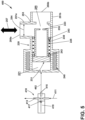
- FIG. 5 depicts a valve assembly 400 in the partially open position.
- the valve assembly 400 includes similar components as described for the valve assembly 200, 300, where similar components have similar numbers further increased by 100.
- the valve assembly 400 includes a pressure regulator 410 or regulating valve, the valve housing 220, the valve chamber 221, the position sensor assembly 240, the valve member 230, and the fluid passage 250.
- the pressure regulator 410 or regulating valve can be a proportional control valve such as, but not limited to, a pulse width modulation (PWM) regulated fluid or hydraulic switch valve or proportional solenoid valve.
- PWM pulse width modulation
- valve housing 220 defines the valve chamber 221 in operable connection to the pressure regulator 410.
- a valve member 230 in the form of a poppet is slidably received within the valve chamber 221.
- At least one biasing element 225 can bias the valve member 230 into the opened positioned.
- Seals 243 can provide sealing functionality and maintain the biasing element 225 in location.
- the position sensor assembly 240 is provided adjacent the valve chamber 221 and can provide an output signal indicative of a position of the valve member 230 within the valve chamber 221. Such output signal can be received by a controller including a controller operably coupled to and controlling the pressure regulator 410.
- the valve housing 220 further includes the inlet conduit 251a defining the inlet 255a and the outlet conduit 251b defining the outlet 255b.
- the inlet conduit2 and the outlet conduit 551b can be coupled via a junction 253 that defines an angle between the inlet conduit 251a and the outlet conduit 251b. the angle can be less than 180 degrees and as illustrated can arrange the inlet conduit 251a and the outlet conduit 251b in generally perpendicular arrangement.
- the valve assembly 400 allows for fluid flow in either direction.
- the valve member or poppet 230 is slidably disposed within the valve chamber 221 and into the fluid passage 250.
- the poppet 230 has the base 231 that can include the core 242, which is detectable via the position sensor assembly 240.
- the top 235 of the poppet 230 is shaped to fit against the seat 223 defined within the valve housing 220.
- the seat 223 can be located at the junction 253 or the outlet conduit 251b.
- the poppet 230 is moveable between a first position or opened position wherein the base 231 is generally adjacent the first end of the valve chamber 221 and a second position or closed position herein the top 235 seals against the seat 223.
- the poppet 230 is depicted in an intermediate position.
- the poppet 230 can be designed to be a length, profile, or shape that minimizes interference with the fluid passage 250 when the poppet is in the opened position.
- the poppet 230 does not extend into the fluid passage 250 when the valve assembly 200 is open.
- the poppet 230 minimally extends into the fluid passage 250 such as less than 25% of a width 254 of the fluid passage 250 when the valve assembly 200 is open.
- the pressure regulator 410 can include a pressure regulator inlet 411, a vent 413, a regulation valve 417, a regulation valve actuator 419, and a pressure regulator outlet 415.
- the pressure regulator inlet 411 receives a pressurized fluid, for example pressurized air, from the engine 10.
- the pressurized fluid can be a portion of the bleed air 77.
- the pressurized fluid received at the pressure regulator inlet 411 is then pushed through the vent 413 or the regulation valve 417.
- the regulation valve actuator 419 can be orientated to allow pressurized air to exit the vent 413 or to be directed to the regulation valve 417.
- the pressure regulator inlet 411 can be aligned with the vent 413, whereas the regulation valve 417 can be activated by regulation valve actuator 419 to close the vent 413 and fluidly connect the pressure regulator inlet 411 to the pressure regulator outlet 415.
- the regulation valve actuator 419 is able to direct the pressurized fluid though only one of the vent 413 and the pressure regulator outlet 415 at a time.
- the regulation valve actuator 419 allows or prevents the pressurized fluid through the vent 413 and the regulation valve 417.
- the regulation valve actuator 419 can be a proportional solenoid or PWM solenoid. That is, the average value of the current flowing through the solenoid can be controlled by applying an intermittent electrical signal at a high rate. Proportional control of the regulation valve 417 by the regulation valve actuator 419 can allow for varying flow through the regulation valve 417 by way of the pressure regulator outlet 415.
- the regulated pressure pushes the base 231 towards the fluid passage 250 obstructing the flow through the fluid passage 250 at a percentage relative to the force applied to the poppet 230.
- proportional control can be achieved using any known electronic control or torque motor actuator when torque motor is energized the regulator valve 417 is opened to a degree proportional to the current applied to the torque motor, allowing for varying degrees of open flow through the valve. If the regulation valve 417 is open, the pressurized fluid moves through the regulation valve 417 and through the pressure regulator outlet 415.
- a sensor system can be associated with associated with the pressure regulator 410.
- the sensor system can be configured to sense the current state of the regulator valve 417, for example open, closed, percentage open.
- pressurized fluid enters the pressure regulator inlet 411. Then the fluid is either vented, through the vent 413, and/or enters the regulation valve 417 and exits the pressure regulator outlet 415 into the valve chamber 221, as shown in airflow line 462. The pressurized fluid then meets the base 231 of the poppet 230, which is in the first position or open position. As pressurized fluid is added to the valve chamber 221, the addition of the pressurized fluid overcomes the force provided by the biasing element 225 and moves the poppet 230 towards the second position.
- the regulation valve 417 is controlled by an on/off regulation valve actuator 419 which will open the valve fully and push the member 230 to the fully extended length.
- the regulation valve 417 is modulated such that the full capacity of the pressurized fluid is not put through the regulation valve 417.
- the pressurized fluid moves the poppet 230 partially away from the first end 221a.
- the poppet 230 thusly protrudes into the fluid passage 250 precluding part or all of the fluid traversing the fluid passage 250 from passing from the inlet 255a to the outlet 255b.
- the movement of the valve member can be sensed by the position sensor assembly 240 to indicate operation or errors in operation.
- the poppet or valve member causes less interference with the fluid in the fluid passage when in the first or open position.
- valve assembly can provide a better seal when in the second or closed position.
- the poppet or valve member is seated in the seat and supported by the sides of the valve chamber.
- the orientation of the poppet or valve member in the fluid passage when seated can reduce the turning effect or torque on the poppet or valve member that can be experienced in previous designs.
- valve assembly as described herein, can allow for flow in either direction as the inlet can become the outlet and the outlet can become the inlet.
- valve assembly as described herein, can be used as a universal design with either a normally opened or normally closed configurations.
Landscapes
- Engineering & Computer Science (AREA)
- General Engineering & Computer Science (AREA)
- Mechanical Engineering (AREA)
- Chemical & Material Sciences (AREA)
- Combustion & Propulsion (AREA)
- Magnetically Actuated Valves (AREA)
- Lift Valve (AREA)
Description
- This invention was made with government support under Contract No. W58RGZ-16-C-0047 awarded by the United States Government. The government has certain rights in the invention.
- The disclosure relates to valve assemblies including for example valve assemblies that can control bleed air from turbine engines.
- Turbine engines, and particularly gas or combustion turbine engines, are rotary engines that extract energy from a flow of combusted gases passing through the engine onto a multitude of rotating turbine blades. Gas turbine engines have been used for land and nautical locomotion and power generation, but are most commonly used for aeronautical applications such as airplanes or helicopters. In airplanes, gas turbine engines are used for propulsion of the aircraft. Various types of valves can be used such as butterfly valves, poppet valves, check valves, and others. Configurations of the valves can either partially or completely restrict the flow of bleed air.
-
US 4,340,086 relates to a hydraulic control valve unit according to the preamble of claim 1.EP 3 584 475 relates to a pilotoperated hydraulic directional cartridge valve.DE 10 2016 209 439DE 197 24 076 relates to an electromagnetic actuating device for a hydraulic control valve.US-4381099-A relates to a faucet for a frozen carbonated beverage machine. - Aspects and advantages of the disclosure will be set forth in part in the following description, or may be obvious from the description, or may be learned through practice of the disclosure herein. The scope of the present invention is defined by the appended claims.
- A full and enabling disclosure, including the best mode thereof, directed to one of ordinary skill in the art, is set forth in the specification, which refers to the appended figures in which:
-
FIG. 1 is a schematic cross-sectional diagram of a gas turbine engine for an aircraft. -
FIG. 2 is a schematic cross-sectional diagram of a valve assembly, in an open position, that can be utilized with the gas turbine engine ofFIG. 1 . -
FIG. 3 is a perspective cross-sectional view of the valve assembly ofFIG. 2 in an open position. -
FIG. 4 is a variation of the perspective cross-sectional view of the valve assembly ofFIG. 3 in a closed position. -
FIG. 5 is a variation of the schematic cross-sectional diagram ofFIG. 2 in a partially open position. - Aspects of the disclosure described herein are broadly directed to an apparatus for controlling air flow by a valve. Air actuated valves are commonly used on jet engines to provide or restrict bleed air to be utilized for environmental control systems or anti-ice systems. Poppet valves can be used to allow or disallow this bleed air flow from the engine to the system. Generally, in poppet valves the operating element keeping the poppet on its seat can be operated mechanically, pneumatically, hydraulically, or electrically by means of a solenoid. Valves can be either normally open or closed, specifically referring to state that they return to when power is removed.
- The valve assembly, as described herein, selectively opens and closes a fluid passage. The fluid passage and the location of the poppet are selected to reduces forces on the poppet by the fluid in the fluid passage that, when applied, encourage the poppet to remain in the closed position. Further, the valve assembly as described herein can reduce turbulence in the fluid that flows through the fluid passage. Aspect of the valve assembly described herein can allow for a smaller, lighter weight valve assembly.
- For the purposes of illustration, one exemplary environment within which the valve can be utilized will be described in the form of a turbine engine. Such a turbine engine can be in the form of a gas turbine engine, a turboprop, turboshaft or a turbofan engine, in non-limiting examples. It will be understood, however, that aspects of the disclosure described herein are not so limited and can have general applicability within other valves. For example, the disclosure can have applicability for a valve in other engines or vehicles, and can be used to provide benefits in industrial, commercial, and residential applications.
- As used herein, the term "upstream" refers to a direction that is opposite the fluid flow direction, and the term "downstream" refers to a direction that is in the same direction as the fluid flow. The term "fore" or "forward" means in front of something and "aft" or "rearward" means behind something. For example, when used in terms of fluid flow, fore/forward can mean upstream and aft/rearward can mean downstream.
- Additionally, as used herein, the terms "radial" or "radially" refer to a direction away from a common center. For example, in the overall context of a turbine engine, radial refers to a direction along a ray extending between a center longitudinal axis of the engine and an outer engine circumference.
- Additionally, as used herein, the terms "excitation," "energize," "actuate," or "activate" and their various noun/verb forms can essentially be interchanged and are intended to indicate the control or influence of a regulator or valve. The "excitation," "energization," "actuation," or "activation" regulator or valve can correspond to a change in the output of that device, whether that be of a bi-state or a proportional nature to the control or influence provided. The use of such terms will be readily understood to be used in a non-limiting manner by anyone knowledgeable in the art which constitutes the scope of this document.
- All directional references (e.g., radial, axial, proximal, distal, upper, lower, upward, downward, left, right, lateral, front, back, top, bottom, above, below, vertical, horizontal, clockwise, counterclockwise, upstream, downstream, forward, aft, etc.) are only used for identification purposes to aid the reader's understanding of the present disclosure, and do not create limitations, particularly as to the position, orientation, or use of aspects of the disclosure described herein. Connection references (e.g., attached, coupled, secured, fastened, connected, and joined) are to be construed broadly and can include intermediate members between a collection of elements and relative movement between elements unless otherwise indicated. As such, connection references do not necessarily infer that two elements are directly connected and in fixed relation to one another. The exemplary drawings are for purposes of illustration only and the dimensions, positions, order and relative sizes reflected in the drawings attached hereto can vary.
-
FIG. 1 is a schematic cross-sectional diagram of agas turbine engine 10 for an aircraft. Theengine 10 has a generally longitudinally extending axis orcenterline 12 extending forward 14 toaft 16. Theengine 10 includes, in downstream serial flow relationship, afan section 18 including afan 20, acompressor section 22 including a booster or low pressure (LP)compressor 24 and a high pressure (HP)compressor 26, acombustion section 28 including acombustor 30, aturbine section 32 including a HPturbine 34, and aLP turbine 36, and anexhaust section 38. - The
fan section 18 includes afan casing 40 surrounding thefan 20. Thefan 20 includes a plurality offan blades 42 disposed radially about thecenterline 12. The HPcompressor 26, thecombustor 30, and the HPturbine 34 form acore 44 of theengine 10, which generates combustion gases. Thecore 44 is surrounded bycore casing 46, which can be coupled with thefan casing 40. A total air temperature (TAT)sensor 100 can be disposed in thefan casing 40 as shown; however, this example is not meant to be limiting and theTAT sensor 100 can be positioned in other locations in theengine 10. - A HP shaft or
spool 48 disposed coaxially about thecenterline 12 of theengine 10 drivingly connects the HPturbine 34 to the HPcompressor 26. A LP shaft orLP spool 50, which is disposed coaxially about thecenterline 12 of theengine 10 within the larger diameter annular HPspool 48, drivingly connects theLP turbine 36 to theLP compressor 24 andfan 20. Thespools rotor 51. - The
LP compressor 24 and the HPcompressor 26 respectively include a plurality ofcompressor stages compressor blades static compressor vanes single compressor stage multiple compressor blades centerline 12, from a blade platform to a blade tip, while the corresponding static compressor vanes 60, 62 are positioned upstream of and adjacent to therotating blades FIG. 1 were selected for illustrative purposes only, and that other numbers are possible. - The
blades disk 61, which is mounted to the corresponding one of the HP and LP spools 48, 50. Thevanes core casing 46 in a circumferential arrangement. - The
HP turbine 34 and theLP turbine 36 respectively include a plurality of turbine stages 64, 66, in which a set ofturbine blades static turbine vanes 72, 74 (also called a nozzle) to extract energy from the stream of fluid passing through the stage. In asingle turbine stage multiple turbine blades centerline 12 while the correspondingstatic turbine vanes rotating blades FIG. 1 were selected for illustrative purposes only, and that other numbers are possible. - The
blades disk 71, which is mounted to the corresponding one of the HP and LP spools 48, 50. Thevanes core casing 46 in a circumferential arrangement. - Complementary to the rotor portion, the stationary portions of the
engine 10, such as thestatic vanes turbine section stator 63. As such, thestator 63 can refer to the combination of non-rotating elements throughout theengine 10. - In operation, the airflow exiting the
fan section 18 is split such that a portion of the airflow is channeled into theLP compressor 24, which then suppliespressurized air 76 to theHP compressor 26, which further pressurizes the air. Thepressurized air 76 from theHP compressor 26 is mixed with fuel in thecombustor 30 and ignited, thereby generating combustion gases. Some work is extracted from these gases by theHP turbine 34, which drives theHP compressor 26. The combustion gases are discharged into theLP turbine 36, which extracts additional work to drive theLP compressor 24, and the exhaust gas is ultimately discharged from theengine 10 via theexhaust section 38. The driving of theLP turbine 36 drives theLP spool 50 to rotate thefan 20 and theLP compressor 24. - A portion of the
pressurized airflow 76 can be drawn from thecompressor section 22 asbleed air 77. Thebleed air 77 can be drawn from thepressurized airflow 76 and provided to engine components requiring cooling. The temperature ofpressurized airflow 76 entering thecombustor 30 is significantly increased. As such, cooling provided by thebleed air 77 is necessary for operating of such engine components in the heightened temperature environments. - A remaining portion of the
airflow 78 bypasses theLP compressor 24 andcore 44 and exits theengine 10 through a stationary vane row, and more particularly an outletguide vane assembly 80, comprising a plurality ofairfoil guide vanes 82, at thefan exhaust side 84. More specifically, a circumferential row of radially extendingairfoil guide vanes 82 are utilized adjacent thefan section 18 to exert some directional control of theairflow 78. - Some of the air supplied by the
fan 20 can bypass thecore 44 and be used for cooling of portions, especially hot portions, of theengine 10, and/or used to cool or power other aspects of the aircraft. In the context of a turbine engine, the hot portions of the engine are normally downstream of thecombustor 30, especially theturbine section 32, with theHP turbine 34 being the hottest portion as it is directly downstream of thecombustion section 28. Other sources of cooling fluid can be, but are not limited to, fluid discharged from theLP compressor 24 or theHP compressor 26. - Turning to
FIG. 2 , aschematic valve assembly 200 is illustrated in the open position. Apressure regulator 210, avalve housing 220, avalve chamber 221, aposition sensor assembly 240, avalve member 230, and afluid passage 250 are included in thevalve assembly 200. - The
valve housing 220 includes the inlet/outlet tubes 251. By way of non-limiting example, thevalve housing 220 defines aninlet conduit 251a having an inlet centerline 256a and anoutlet conduit 251b having anoutlet centerline 256b. Theinlet conduit 251a and theoutlet conduit 251b can connect byjunction 253. Theinlet conduit 251a and theoutlet conduit 251b can be located such that thejunction 253 connecting them forms an angle less than 180 degrees. That is, intersection of the inlet centerline 256a and theoutlet centerline 256b can form anangle 258. While theinlet conduit 251a is illustrated as being generally perpendicular from theoutlet conduit 251b, it is contemplated that theinlet conduit 251a and theoutlet conduit 251b can be oriented in any suitable manner. By way of non-limiting example, theinlet conduit 251a and theoutlet conduit 251b can be at any non-linear angle with respect to each other. By way of further non-limiting examples, theinlet conduit 251a and theoutlet conduit 251b can be arranged so that theangle 258 is between 45 degrees and 180 degrees. - It will be understood that the
inlet conduit 251a defines aninlet 255a and theoutlet conduits 251b defines anoutlet 255b. It will further be understood that thefluid passage 250 is defined within thevalve housing 220 from theinlet 255a to theoutlet 255b. While the relative terms inlet and outlet are used and it is understood and herein described for the remainder that fluid flows from the inlet to the outlet via thefluid passage 250, it will be understood that the fluid flow can be reversed in this valve assembly configuration and thus either conduit can be configured to be either an inlet or an outlet based on flow of fluid through thevalve assembly 200. Thearrow 257 indicates that the flow can be in either direction. As such, the inlet/outlet tubes 251 can be referred to by their respective function, inlet or outlet or generically as inlet/outlet tubes. - The
valve housing 220 further defines thevalve chamber 221 that is adjacent thefluid passage 250. More specifically, afirst end 221a of thevalve chamber 221 is fluidly coupled to thepressure regulator 210. Asecond end 221b of the valve chamber opposite thefirst end 221a is adjacent thefluid passage 250. While not shown in detail in this schematic diagram it will be understood that thevalve housing 220 can be a single unitary piece or can be formed from multiple pieces including, but not limited to, a conduit portion including theinlet conduit 251a and theoutlet conduit 251b and a manifold section on which thepressure regulator 210 can be provided and optionally forming at least a portion of thevalve chamber 221. Regardless of the number of pieces, valve chamber sides 222 can define thevalve chamber 221 and extend from thefirst end 221a to thesecond end 221b. - The
valve member 230 is slidably disposed within thevalve chamber 221. Thevalve member 230 has a first end orbase 231 which is shaped to fit against thefirst end 221a of thevalve chamber 221 when thevalve assembly 200 is in an open position. Thevalve member 230 further extends in thevalve chamber 221 away from thebase 231 and adjacent the valve chamber sides 222 defining valve member sides 233 which lead into a second end or top 235 of thevalve member 230. - One or
more seals 243 can be located in thevalve chamber 221 or other portions of thevalve housing 220. In the illustrated example, a first seal is located at thesecond end 221b of thevalve chamber 221 and a second seal is spaced therefrom towards thefirst end 221a of thevalve chamber 221. Theseals 243 can provide for blocking fluid movement between the valve chamber sides 222 and thevalve member 230. Theseals 243 can also retain abiasing element 225 therebetween. The biasingelement 225 has been illustrated as a spring that provides a spring force or biasing force to maintain thevalve member 230 in the opened position when thepressure regulator 210 is off. - In
FIG. 2 thevalve member 230 is depicted in a first position or open position in which thebase 231 of thevalve member 230 is against thefirst end 221a of thevalve chamber 221. Additionally, thevalve member 230 is designed to be a length that minimizes interference with thefluid passage 250 when thevalve assembly 200 is in the opened position. In some non-limiting examples, thevalve member 230 does not extend into thefluid passage 250 when thevalve assembly 200 is open or thevalve member 230 extends into thefluid passage 250 less than 25% of thewidth 254 of thefluid passage 250 of the inlet/outlet tubes 251. - The
position sensor assembly 240 is adapted to output a signal indicative of a location of thevalve member 230 within thevalve housing 220. Theposition sensor assembly 240 can be in the form of a linear variable differential transformer (LVDT) having acoil 241 and acore 242. Thecoil 241 can include one or more coils. It is contemplated that thecoil 241 can further include redundant windings. Thecoil 241 is inlaid into thevalve housing 220. It is further contemplated that thecoil 241 can be contained in a manifold or housing defining thevalve chamber 221 or otherwise disposed adjacent to thevalve chamber 221. - The
core 242 is disposed on thebase 231 of thevalve member 230. That is, thecore 242 can be coupled to or formed as part of thebase 231 of thevalve member 230. Theposition sensor assembly 240, is generally configured to detect the location of thevalve member 230 within thevalve housing 220 and more specifically within thevalve chamber 221. The location can be determined by electrical signals sent from thecoil 241 indicative of the location of thecore 242, and therefore the location of thevalve member 230 within thevalve housing 220. The electrical signal sent from thecoil 241 can be a result of the position of the core 242 or the movement of thecore 242, as thecoil 241 can be used to detect changes in the magnetic or electric fields based on the movement or position of thecore 242. - In a further non-limiting example, the
position sensor assembly 240 can have components of the position sensor assembly that are located in other parts of the engine or other parts of the vehicle. For example, a transmitter or display. Further, the measurements made by theposition sensor assembly 240 can be received by one or more controllers. Alternately, the measurements made by theposition sensor assembly 240 can be combined, compared, or replaced by measurements made by other pressure, temperature, or fluid sensors. - The
pressure regulator 210 can include apressure regulator inlet 211, avent 213, aregulation valve 217, aregulation valve actuator 219, and apressure regulator outlet 215. Thepressure regulator inlet 211 receives a pressurized fluid, for example pressurized air, from theengine 10. By way of non-limiting example, the pressurized fluid can be a portion of thebleed air 77. The pressurized fluid received at thepressure regulator inlet 211 is then pushed through thevent 213 or theregulation valve 217. - The
vent 213 andregulation valve 217 are generally spaced apart such that theregulation valve actuator 219 can direct the pressurized fluid through at least one of thevent 213 and theregulation valve 217. In some non-limiting examples, theregulation valve actuator 219 is able to direct the pressurized fluid though only one of thevent 213 and theregulation valve 217 at a time. Theregulation valve actuator 219 allows or prevents the pressurized fluid through thevent 213 and theregulation valve 217. By way of example, theregulation valve actuator 219 can be a solenoid with an electromagnet to pull the closing aspect, for example a plug, plunger, or pivoted armature to allow fluid flow through theregulation valve 217. In addition, theregulation valve actuator 219 can be designed as any valve actuator which is bistable which is configured to fully open the valve or fully close the valve in response to electronic signaling or electric pulse. - In another non-limiting example, the
regulation valve actuator 219 allows varying flow through theregulation valve 217. As a non-limiting example, this can be done with an electronic control and a torque motor. When the torque motor is variably energized, theregulator valve 217 is opened to a degree proportional to the excitation current flowing in the torque motor coil, allowing for varying flow through the valve. That is, thepressure regulator 210 allows varying flow through thepressure regulator outlet 215 that can be determined by the excitation to thepressure regulator 210. The excitation to thepressure regulator 210 can be increased or decreased by increasing or decreasing the energizing current provided to theregulation valve actuator 219. Increases or decreases in the energizing current provided to theregulation valve actuator 219 can correspond to increases or decreases in output flow through thepressure regulator outlet 215. A predetermined threshold can be determined, wherein excitation above the predetermined threshold can indicate an open valve and excitation at or below the predetermined threshold can indicate a closed or "off" valve. - If the
regulation valve 217 is open, the pressurized fluid moves through theregulation valve 217 and through thepressure regulator outlet 215. Additionally, or alternatively, the power or the excitation to thepressure regulator 210 can be varied, that is, the output flow from thepressure regulator outlet 215 can be varied. The variation of power to thepressure regulator 210 can therefore be used to provide variable output flow. - Additionally, in a non-limiting example, a sensor system can be associated with the
pressure regulator 210. The sensor system can be configured to sense the current state of theregulator valve 217, for example open, closed, or a percentage open. - In some non-limiting examples, the
regulation valve 217 is controlled by an on/offregulation valve actuator 219 which will open the valve fully and push thevalve member 230 to the fully extended length. In another non-limiting embodiments, theregulation valve 217 is modulated such that the full capacity of the pressurized fluid is not put through theregulation valve 217. - When the
regulation valve actuator 219 allow theregulation valve 217 to be open or partially open, pressurized fluid can exit thepressure regulator 210 atpressure regulator outlet 215 and enter thevalve chamber 221 via achannel 260. When theregulation valve actuator 219 is disabled or otherwise does not allow theregulation valve 217 to open, the pressurized fluid can exit thepressure regulator 210 at thevent 213. It is contemplated that any pressurized air in thevalve chamber 221 can also flow back to thepressure regulator 210 via thechannel 260 to be released through thevent 213. -
FIG. 3 shows a non-schematic illustration of the valve assembly ofFIG. 2 , depicting thevalve assembly 200 in the opened position. The open position is the biased position of thevalve member 230 determined by the biasingelement 225. One detail shown in the view ofFIG. 3 is that thevalve housing 220 is at least partially formed by a manifold mounted to a conduit portion. Thepressure regulator 210 is provided on the manifold and at least a portion of thevalve chamber 221 is defined within the manifold and fluidly coupled to thepressure regulator 210. The poppet forming themoveable valve member 230 extends past the manifold in the open position. Further still it is easier to see that theinlet conduit 251a and theoutlet conduit 251b are at an angle less than 180 degrees and are generally perpendicular at a 90-degree angle at thejunction 253. - The
position sensor assembly 240 is generally configured to detect the location of thevalve member 230. Thecoil 241 is inlaid into thevalve housing 220 adjacent thevalve chamber 221 and extends from thefirst end 221a of thevalve chamber 221 to thesecond end 221b of thevalve chamber 221. - The
core 242 formed as part of thebase 231 of thevalve member 230 can be at thefirst end 221a of thevalve chamber 221 when thevalve assembly 200 is in the opened position. - A
valve seat 232 can be located at thejunction 253 or at any location in theoutlet conduit 251b. The poppet orvalve member 230, in the open position, is spaced from thevalve seat 232, allowing fluid to flow from theinlet 255a to theoutlet 255b via thefluid passage 250. The location and orientation of the poppet orvalve member 230 and thevalve seat 232, as described herein, minimizes effects on the flow of the fluid from theinlet 255a to theoutlet 255b. -
FIG. 4 depicts avalve assembly 300 in the closed position. Thevalve assembly 300 includes similar components as described for thevalve assembly 200, where similar components have similar numbers increased by 100. - The
valve assembly 300 includes thepressure regulator 210, thevalve housing 220, thevalve chamber 221, aposition sensor assembly 340, thevalve member 230, and thefluid passage 250. Thevalve housing 220 includes conduits defining aninlet conduit 251a and anoutlet conduit 251b. Theinlet conduit 251a and theoutlet conduit 251b can be connect byjunction 253.
Theinlet conduit 251a and theoutlet conduit 251b can be located such that thejunction 253 connecting them forms an angle less than 180 degrees. - It will be understood that the
inlet conduit 251a defines theinlet 255a and theoutlet conduits 251b defines theoutlet 255b. It will further be understood that thefluid passage 250 is defined within thevalve housing 220 from theinlet 255a to theoutlet 255b. While the relative terms inlet and outlet are used and it is understood and herein described for the remainder that fluid flows from the inlet to the outlet via thefluid passage 250, it will be understood that the fluid flow can be reversed in this valve assembly configuration and thus either conduit can be configured to be either an inlet or an outlet based on flow of fluid through thevalve assembly 200. As such, the inlet/outlet tubes 251 can be referred to by their respective function, inlet or outlet or generically as inlet/outlet tubes. - The
valve housing 220 further defines thevalve chamber 221 that is adjacent thefluid passage 250. It is contemplated that thevalve member 230 fluidly isolates thevalve chamber 221 from thefluid passage 250. Thevalve member 230 is slidably disposed within thevalve chamber 221. Thevalve member 230 has the base 231 which moves away from thefirst end 221a of thevalve chamber 221 when thevalve assembly 300 is in a partially open or closed position. - The
valve assembly 300 is in a second position or the closed position when thevalve member 230 reaches thevalve seat 232. It is contemplated that thevalve member 230, when seated in thevalve seat 232, provides a fluid barrier within the fluid passage. That is, when thevalve member 230 is seated in thevalve seat 232, fluid cannot flow from theinlet 255a to theoutlet 255b. Optionally, the seat can be located adjacent thejunction 253 of theinlet conduit 251a and theoutlet conduit 251b. Thevalve seat 232 can be contoured, angled, or otherwise shaped to receive a portion of thevalve member 230. - The
position sensor assembly 340 is adapted to output a signal indicative of a location of thevalve member 230 within thevalve housing 220. Theposition sensor assembly 340 can include at least two coil segments and thecore 242. Afirst coil segment 341a can be located near thefirst end 221a of thevalve chamber 221 and asecond coil segment 341b can be located spaced away from thefirst end 221a toward thesecond end 221b. - The
core 242 can be coupled to or formed as part of thebase 231 of thevalve member 230. Theposition sensor assembly 340 can use known methods for detecting a change in the electric field or the magnetic field caused by the movement or location of the core 242 in relationship to thefirst coil segment 341a and/or thesecond coil segment 341b. Detection by theposition sensor assembly 340 can be used to determine the position of thevalve member 230 within thevalve chamber 221. Theposition sensor assembly 340 can include or couple to a controller or other known device for communication or determination of the position of thevalve member 230. - Referring back to
FIG. 2 andFIG. 3 , in a normally open valve, the spring force pushes thevalve member 230 to the opened position when the solenoid orregulation valve actuator 219 is unpowered. During operation when thevalve assembly 200 is commanded to be closed and moved from the normally opened position, theregulation valve actuator 219 or solenoid is powered. Pressurized fluid is introduced by thepressure regulator 210 via the opening leading to thevalve chamber 221 and as generally illustrated by an airflow line 262 (FIG. 4 ). Thevalve chamber 221 behind thebase 231 of thevalve member 230 is pressurized and thevalve member 230 moves against the spring force of the biasingelement 225. Thevalve member 230 moves into or further into thefluid passage 250 until it is sealed on thevalve seat 232 formed in thevalve housing 220, closing off the flow within thefluid passage 250 by fluidly isolating theinlet conduit 251a from theoutlet conduit 251b. That is, the poppet orvalve member 230 extends into thefluid passage 250, so that theinlet conduit 251a and theoutlet conduit 251b are no longer fluidly connected. - The movement of the valve member is sensed by the
position sensor assembly base 231 communicates with thecoil 241 or the first andsecond coil segments coil 241 or the first andsecond coil segments core 242. - When the output of the
pressure regulator 210 is set to zero, for example by removing power from theregulation valve actuator 219, the pressurized fluid in invalve chamber 221 can exit through thevent 213. At this point, the pressurized air is no longer provided to thevalve chamber 221. Thevalve member 230 lifts off or retreats from thevalve seat 232 by the biasing force provided by the biasingelement 225. It will be understood that thevalve member 230 can begin to move to the opened position as soon as the force acting thereon is relieved or switched off. After lifting thevalve member 230 off thevalve seat 232, thevalve seat 232 and the portion of thefluid passage 250 defined by theoutlet conduit 251b are exposed to the flow of fluid flowing from theinlet 255a. - Benefits of the aspects of the disclosure include that fluid pressure from the fluid in the
fluid passage 250 does not create additional force that would keep the poppet orvalve member 230 in the closed position, thus allowing for a weaker spring or biasingelement 225. Further, the orientation of theinlet conduit 251a, theoutlet conduit 251b, and thevalve member 230 allows for asmaller valve assembly 200. This is advantageous in aircraft applications where size and weight are often critical. Further, the valve assembly can also be used in a proportional control configuration as illustrated inFIG. 5 . -
FIG. 5 depicts avalve assembly 400 in the partially open position. Thevalve assembly 400 includes similar components as described for thevalve assembly - The
valve assembly 400 includes apressure regulator 410 or regulating valve, thevalve housing 220, thevalve chamber 221, theposition sensor assembly 240, thevalve member 230, and thefluid passage 250. Thepressure regulator 410 or regulating valve can be a proportional control valve such as, but not limited to, a pulse width modulation (PWM) regulated fluid or hydraulic switch valve or proportional solenoid valve. - As with the previous assembly, the
valve housing 220 defines thevalve chamber 221 in operable connection to thepressure regulator 410. Avalve member 230 in the form of a poppet is slidably received within thevalve chamber 221. At least one biasingelement 225 can bias thevalve member 230 into the opened positioned.Seals 243 can provide sealing functionality and maintain thebiasing element 225 in location. Further, theposition sensor assembly 240 is provided adjacent thevalve chamber 221 and can provide an output signal indicative of a position of thevalve member 230 within thevalve chamber 221. Such output signal can be received by a controller including a controller operably coupled to and controlling thepressure regulator 410. - The
valve housing 220 further includes theinlet conduit 251a defining theinlet 255a and theoutlet conduit 251b defining theoutlet 255b. The inlet conduit2 and the outlet conduit 551b can be coupled via ajunction 253 that defines an angle between theinlet conduit 251a and theoutlet conduit 251b. the angle can be less than 180 degrees and as illustrated can arrange theinlet conduit 251a and theoutlet conduit 251b in generally perpendicular arrangement. As indicated by thearrow 257, thevalve assembly 400 allows for fluid flow in either direction. - The valve member or
poppet 230 is slidably disposed within thevalve chamber 221 and into thefluid passage 250. Thepoppet 230 has the base 231 that can include thecore 242, which is detectable via theposition sensor assembly 240. The top 235 of thepoppet 230 is shaped to fit against theseat 223 defined within thevalve housing 220. Theseat 223 can be located at thejunction 253 or theoutlet conduit 251b. - The
poppet 230 is moveable between a first position or opened position wherein thebase 231 is generally adjacent the first end of thevalve chamber 221 and a second position or closed position herein the top 235 seals against theseat 223. InFIG. 5 thepoppet 230 is depicted in an intermediate position. It will be understood that thepoppet 230 can be designed to be a length, profile, or shape that minimizes interference with thefluid passage 250 when the poppet is in the opened position. In some non-limiting examples, thepoppet 230 does not extend into thefluid passage 250 when thevalve assembly 200 is open. Alternatively, thepoppet 230 minimally extends into thefluid passage 250 such as less than 25% of awidth 254 of thefluid passage 250 when thevalve assembly 200 is open. - The
pressure regulator 410 can include apressure regulator inlet 411, avent 413, aregulation valve 417, aregulation valve actuator 419, and apressure regulator outlet 415. Thepressure regulator inlet 411 receives a pressurized fluid, for example pressurized air, from theengine 10. By way of non-limiting example, the pressurized fluid can be a portion of thebleed air 77. The pressurized fluid received at thepressure regulator inlet 411 is then pushed through thevent 413 or theregulation valve 417. - The
regulation valve actuator 419 can be orientated to allow pressurized air to exit thevent 413 or to be directed to theregulation valve 417. By way of non-limiting example, thepressure regulator inlet 411 can be aligned with thevent 413, whereas theregulation valve 417 can be activated byregulation valve actuator 419 to close thevent 413 and fluidly connect thepressure regulator inlet 411 to thepressure regulator outlet 415. - In some non-limiting examples, the
regulation valve actuator 419 is able to direct the pressurized fluid though only one of thevent 413 and thepressure regulator outlet 415 at a time. Theregulation valve actuator 419 allows or prevents the pressurized fluid through thevent 413 and theregulation valve 417. By way of example and as shown inFIG. 5 , theregulation valve actuator 419 can be a proportional solenoid or PWM solenoid. That is, the average value of the current flowing through the solenoid can be controlled by applying an intermittent electrical signal at a high rate. Proportional control of theregulation valve 417 by theregulation valve actuator 419 can allow for varying flow through theregulation valve 417 by way of thepressure regulator outlet 415. The regulated pressure pushes the base 231 towards thefluid passage 250 obstructing the flow through thefluid passage 250 at a percentage relative to the force applied to thepoppet 230. - Alternatively, proportional control can be achieved using any known electronic control or torque motor actuator when torque motor is energized the
regulator valve 417 is opened to a degree proportional to the current applied to the torque motor, allowing for varying degrees of open flow through the valve. If theregulation valve 417 is open, the pressurized fluid moves through theregulation valve 417 and through thepressure regulator outlet 415. - Additionally, in a non-limiting example, a sensor system can be associated with associated with the
pressure regulator 410. The sensor system can be configured to sense the current state of theregulator valve 417, for example open, closed, percentage open. - In a non-limiting example of the operation of the
valve assembly 400, pressurized fluid enters thepressure regulator inlet 411. Then the fluid is either vented, through thevent 413, and/or enters theregulation valve 417 and exits thepressure regulator outlet 415 into thevalve chamber 221, as shown inairflow line 462. The pressurized fluid then meets thebase 231 of thepoppet 230, which is in the first position or open position. As pressurized fluid is added to thevalve chamber 221, the addition of the pressurized fluid overcomes the force provided by the biasingelement 225 and moves thepoppet 230 towards the second position. - In some non-limiting examples, the
regulation valve 417 is controlled by an on/offregulation valve actuator 419 which will open the valve fully and push themember 230 to the fully extended length. In another non-limiting embodiments, theregulation valve 417 is modulated such that the full capacity of the pressurized fluid is not put through theregulation valve 417. The pressurized fluid moves thepoppet 230 partially away from thefirst end 221a. Thepoppet 230 thusly protrudes into thefluid passage 250 precluding part or all of the fluid traversing thefluid passage 250 from passing from theinlet 255a to theoutlet 255b. The movement of the valve member can be sensed by theposition sensor assembly 240 to indicate operation or errors in operation. - Several advantages are realized by the non-limiting examples discussed above, including non-limiting examples of the design allow pressure to be applied on "back" side of a normally open valve without increased spring force and negates effects of back pressure from the fluid in the fluid passage resulting in a smaller design that allows for proportional control.
- Further, the poppet or valve member causes less interference with the fluid in the fluid passage when in the first or open position.
- The design, as described here, the valve assembly can provide a better seal when in the second or closed position. The poppet or valve member is seated in the seat and supported by the sides of the valve chamber. The orientation of the poppet or valve member in the fluid passage when seated can reduce the turning effect or torque on the poppet or valve member that can be experienced in previous designs.
- The valve assembly, as described herein, can allow for flow in either direction as the inlet can become the outlet and the outlet can become the inlet.
- Further, the valve assembly, as described herein, can be used as a universal design with either a normally opened or normally closed configurations.
- To the extent not already described, the different features and structures of the various aspects can be used in combination with each other as desired. That one feature cannot be illustrated in all of the aspects is not meant to be construed that it cannot be, but is done for brevity of description. Thus, the various features of the different aspects can be mixed and matched as desired to form new aspects, whether or not the new aspects are expressly described. Combinations or permutations of features described herein are covered by this disclosure.
- This written description uses examples to disclose aspects of the disclosure, including the best mode, and also to enable any person skilled in the art to practice aspects of the disclosure, including making and using any devices or systems and performing any incorporated methods. The patentable scope of the disclosure is defined by the claims, and can include other examples that occur to those skilled in the art. Such other examples are intended to be within the scope of the claims if they have structural elements that do not differ from the literal language of the
Claims (10)
- A valve assembly (200, 300, 400) comprising:a valve housing (220) having an inlet (251a) and an outlet (251b) that is angled from the inlet (251a), the valve housing (220) defining a fluid passage (250) therein and fluidly coupling the inlet (251a) and the outlet (251b), the valve housing (220) further defining a valve chamber (221) offset from the fluid passage (250);a valve member (230) slidably disposed within the valve housing (220) between a first position wherein the valve member (230) is closed and abuts a seat (232) within the valve housing (220), and a second position wherein the valve member (230) is in a position a distance away from the seat (232) and enables fluid flow from the inlet to the outlet via the fluid passage (250);a biasing element (225) configured to bias the valve member;a pressure regulator (210, 410) fluidly coupled to the valve chamber (221) and adapted to provide pneumatic pressure into the valve chamber (221); anda position sensor assembly (240, 340) provided within the valve housing (220), the position sensor assembly (240, 340) adapted to determine a location of the valve member (230),characterized in thatthe biasing element (225) is configured to bias the valve member (230) toward the second position.
- The valve assembly (200, 300, 400) of claim 1 wherein the position sensor assembly (240, 340) is a linear variable differential transformer that comprises a coil (241, 341a, 341b) and a core (242), wherein the coil (241, 341a, 341b) is disposed adjacent to the valve chamber (221) and the core (242) disposed on a first end of the valve member (230).
- The valve assembly (200, 300, 400) of any one of claims 1-2 wherein the position sensor assembly (240, 340) further comprises at least two coils (241, 341a, 341b) disposed in a spaced relationship adjacent the valve chamber (221) and a core (242) disposed on a first end of the valve member (230).
- The valve assembly (200, 300, 400) of any one of claims 1-3 wherein the inlet (251a) is generally perpendicular to the outlet (251b).
- The valve assembly (200, 300, 400) of any one of claims 1-4 wherein the pressure regulator (210, 410) is disposed at a first end (221a) of the valve chamber (221) and is configured to apply pressure to the first end of the valve member (230).
- The valve assembly (200, 300, 400) of claim 5 wherein the valve member (230) partially extends into the fluid passage (250) in the first position.
- The valve assembly (200, 300, 400) of claim 5 or 6, wherein the valve member (230) is a poppet held in the second position by the biasing element (225).
- The valve assembly (200, 300, 400) of any one of claims 1-7 wherein the inlet (251a) and the outlet (251b) are at an angle less than 180 degrees.
- The valve assembly (200, 300, 400) of claim 8 wherein the inlet (251a) and the outlet (251b) are at a 90-degree angle.
- The valve assembly (200, 300, 400) of any one of claims 1-9 wherein the pressure regulator (210, 410) allows varying flow though the pressure regulator outlet (215, 415) determined by the excitation to the pressure regulator (210, 410), wherein flow is provided when the excitation is greater than a predetermined value and the valve assembly (200, 300, 400) closes when the excitation falls below the predetermined value.
Applications Claiming Priority (1)
| Application Number | Priority Date | Filing Date | Title |
|---|---|---|---|
| US17/076,360 US20220120358A1 (en) | 2020-10-21 | 2020-10-21 | Poppet valve assembly |
Publications (2)
| Publication Number | Publication Date |
|---|---|
| EP3988823A1 EP3988823A1 (en) | 2022-04-27 |
| EP3988823B1 true EP3988823B1 (en) | 2024-04-24 |
Family
ID=77050844
Family Applications (1)
| Application Number | Title | Priority Date | Filing Date |
|---|---|---|---|
| EP21187534.9A Active EP3988823B1 (en) | 2020-10-21 | 2021-07-23 | Poppet valve assembly |
Country Status (3)
| Country | Link |
|---|---|
| US (1) | US20220120358A1 (en) |
| EP (1) | EP3988823B1 (en) |
| CN (1) | CN114382908A (en) |
Citations (2)
| Publication number | Priority date | Publication date | Assignee | Title |
|---|---|---|---|---|
| US3542332A (en) * | 1968-11-22 | 1970-11-24 | Alain A Chevalier | Air operated poppet seat valve |
| US4381099A (en) * | 1981-04-28 | 1983-04-26 | The Penmont Company | Faucet for frozen carbonated beverage machine |
Family Cites Families (18)
| Publication number | Priority date | Publication date | Assignee | Title |
|---|---|---|---|---|
| US891808A (en) * | 1907-12-14 | 1908-06-30 | Frederick W Adams | Automatic drain-cock for air-brakes. |
| DE2915783C2 (en) * | 1979-04-19 | 1986-07-03 | Vickers Systems GmbH, 6380 Bad Homburg | For safety reasons, work-monitored valve arrangement |
| DE19724076B4 (en) * | 1997-06-07 | 2005-05-04 | Robert Bosch Gmbh | Electromagnetic actuator |
| US6527010B1 (en) * | 2001-09-07 | 2003-03-04 | Gilmore Valve Co. | Single pilot dual pulse spool valve |
| AU2002300046A1 (en) * | 2002-07-10 | 2004-01-29 | Der-Fan Shen | Flow regulator for water pump |
| US7287739B2 (en) * | 2005-11-01 | 2007-10-30 | Vetco Gray Inc. | Fast closing well choke |
| US20100092116A1 (en) * | 2008-10-15 | 2010-04-15 | Honeywell International Inc. | Pressure balanced valve assembly and aircraft buffer cooler system employing the same |
| US8827243B2 (en) * | 2011-10-31 | 2014-09-09 | Phuong Taylor Nguyen | Media control valve |
| US9228674B2 (en) * | 2012-08-23 | 2016-01-05 | Fisher Controls International, Llc | Methods and apparatus to assemble actuators |
| MX2016001478A (en) * | 2013-08-02 | 2016-09-16 | Daniel Measurement & Control Inc | A flow control system and control valve having closure assistance. |
| DE102013014673A1 (en) * | 2013-09-04 | 2015-03-05 | Hydac Fluidtechnik Gmbh | Load-holding valve |
| US10267318B2 (en) * | 2014-03-21 | 2019-04-23 | Fluid Equipment Development Company, Llc | Method and system for tuning a turbine using a secondary injection valve |
| DE102016209439A1 (en) * | 2016-01-11 | 2017-07-13 | Robert Bosch Gmbh | Directional control valve with check valve function |
| US10309544B2 (en) * | 2017-02-13 | 2019-06-04 | Cameron International Corporation | Valve assembly |
| CN110475997A (en) * | 2017-03-30 | 2019-11-19 | 株式会社富士金 | Valve gear |
| JP7011526B2 (en) * | 2018-05-07 | 2022-01-26 | 川崎重工業株式会社 | Electromagnetic flow control valve |
| EP3584475B1 (en) * | 2018-06-20 | 2022-03-23 | Robert Bosch GmbH | Pilot-operated hydraulic installed distributing valve |
| CN210461866U (en) * | 2019-03-13 | 2020-05-05 | 杭州鑫高科技有限公司 | An ultra-high pressure digital steering valve with precision displacement sensor |
-
2020
- 2020-10-21 US US17/076,360 patent/US20220120358A1/en not_active Abandoned
-
2021
- 2021-07-23 EP EP21187534.9A patent/EP3988823B1/en active Active
- 2021-08-19 CN CN202110953959.7A patent/CN114382908A/en active Pending
Patent Citations (2)
| Publication number | Priority date | Publication date | Assignee | Title |
|---|---|---|---|---|
| US3542332A (en) * | 1968-11-22 | 1970-11-24 | Alain A Chevalier | Air operated poppet seat valve |
| US4381099A (en) * | 1981-04-28 | 1983-04-26 | The Penmont Company | Faucet for frozen carbonated beverage machine |
Also Published As
| Publication number | Publication date |
|---|---|
| US20220120358A1 (en) | 2022-04-21 |
| EP3988823A1 (en) | 2022-04-27 |
| CN114382908A (en) | 2022-04-22 |
Similar Documents
| Publication | Publication Date | Title |
|---|---|---|
| CN112173078B (en) | Propeller assembly and pitch control unit | |
| EP2384400B1 (en) | Variable pressure ratio compressor | |
| EP3246606B1 (en) | Solenoid pilot valve for gas turbine engine bleed valves | |
| US11008949B2 (en) | Multi-source air system and switching valve assembly for a gas turbine engine | |
| US10590856B2 (en) | Gas turbine engine having an annular core bleed | |
| CN109312665B (en) | Fuel delivery system and method for gas turbine engine | |
| US11891959B2 (en) | Fuel control system | |
| EP3663566B1 (en) | Passive stability bleed valve with adjustable reference pressure regulator and remote override capability | |
| EP3988823B1 (en) | Poppet valve assembly | |
| US11365825B2 (en) | Actuator fail fix system | |
| US12286930B1 (en) | Turbine engine fan case with bleed air for tip injection and heat exchanger cooling | |
| EP3754230B1 (en) | Inline valves, gas turbine engines with inline bleed valves, and methods controlling flow through inline valves | |
| EP3348799B1 (en) | Multi-flowpath fluid control valve | |
| CN114165639A (en) | Valve assembly and locking mechanism | |
| EP4715183A1 (en) | Gas turbine engine inlet anti-ice system | |
| US12221971B1 (en) | Bleed valve assembly for aircraft engines | |
| US12345211B2 (en) | Uncommanded or uncontrollable high thrust detection and mitigation |
Legal Events
| Date | Code | Title | Description |
|---|---|---|---|
| PUAI | Public reference made under article 153(3) epc to a published international application that has entered the european phase |
Free format text: ORIGINAL CODE: 0009012 |
|
| STAA | Information on the status of an ep patent application or granted ep patent |
Free format text: STATUS: THE APPLICATION HAS BEEN PUBLISHED |
|
| AK | Designated contracting states |
Kind code of ref document: A1 Designated state(s): AL AT BE BG CH CY CZ DE DK EE ES FI FR GB GR HR HU IE IS IT LI LT LU LV MC MK MT NL NO PL PT RO RS SE SI SK SM TR |
|
| STAA | Information on the status of an ep patent application or granted ep patent |
Free format text: STATUS: REQUEST FOR EXAMINATION WAS MADE |
|
| 17P | Request for examination filed |
Effective date: 20221027 |
|
| RBV | Designated contracting states (corrected) |
Designated state(s): AL AT BE BG CH CY CZ DE DK EE ES FI FR GB GR HR HU IE IS IT LI LT LU LV MC MK MT NL NO PL PT RO RS SE SI SK SM TR |
|
| STAA | Information on the status of an ep patent application or granted ep patent |
Free format text: STATUS: EXAMINATION IS IN PROGRESS |
|
| 17Q | First examination report despatched |
Effective date: 20230313 |
|
| GRAP | Despatch of communication of intention to grant a patent |
Free format text: ORIGINAL CODE: EPIDOSNIGR1 |
|
| STAA | Information on the status of an ep patent application or granted ep patent |
Free format text: STATUS: GRANT OF PATENT IS INTENDED |
|
| INTG | Intention to grant announced |
Effective date: 20231123 |
|
| GRAS | Grant fee paid |
Free format text: ORIGINAL CODE: EPIDOSNIGR3 |
|
| GRAA | (expected) grant |
Free format text: ORIGINAL CODE: 0009210 |
|
| STAA | Information on the status of an ep patent application or granted ep patent |
Free format text: STATUS: THE PATENT HAS BEEN GRANTED |
|
| AK | Designated contracting states |
Kind code of ref document: B1 Designated state(s): AL AT BE BG CH CY CZ DE DK EE ES FI FR GB GR HR HU IE IS IT LI LT LU LV MC MK MT NL NO PL PT RO RS SE SI SK SM TR |
|
| REG | Reference to a national code |
Ref country code: GB Ref legal event code: FG4D |
|
| REG | Reference to a national code |
Ref country code: CH Ref legal event code: EP |
|
| P01 | Opt-out of the competence of the unified patent court (upc) registered |
Effective date: 20240326 |
|
| REG | Reference to a national code |
Ref country code: DE Ref legal event code: R096 Ref document number: 602021012163 Country of ref document: DE |
|
| REG | Reference to a national code |
Ref country code: IE Ref legal event code: FG4D |
|
| REG | Reference to a national code |
Ref country code: LT Ref legal event code: MG9D |
|
| REG | Reference to a national code |
Ref country code: NL Ref legal event code: MP Effective date: 20240424 |
|
| REG | Reference to a national code |
Ref country code: AT Ref legal event code: MK05 Ref document number: 1679933 Country of ref document: AT Kind code of ref document: T Effective date: 20240424 |
|
| PG25 | Lapsed in a contracting state [announced via postgrant information from national office to epo] |
Ref country code: NL Free format text: LAPSE BECAUSE OF FAILURE TO SUBMIT A TRANSLATION OF THE DESCRIPTION OR TO PAY THE FEE WITHIN THE PRESCRIBED TIME-LIMIT Effective date: 20240424 |
|
| PG25 | Lapsed in a contracting state [announced via postgrant information from national office to epo] |
Ref country code: NL Free format text: LAPSE BECAUSE OF FAILURE TO SUBMIT A TRANSLATION OF THE DESCRIPTION OR TO PAY THE FEE WITHIN THE PRESCRIBED TIME-LIMIT Effective date: 20240424 |
|
| PG25 | Lapsed in a contracting state [announced via postgrant information from national office to epo] |
Ref country code: IS Free format text: LAPSE BECAUSE OF FAILURE TO SUBMIT A TRANSLATION OF THE DESCRIPTION OR TO PAY THE FEE WITHIN THE PRESCRIBED TIME-LIMIT Effective date: 20240824 |
|
| PG25 | Lapsed in a contracting state [announced via postgrant information from national office to epo] |
Ref country code: BG Free format text: LAPSE BECAUSE OF FAILURE TO SUBMIT A TRANSLATION OF THE DESCRIPTION OR TO PAY THE FEE WITHIN THE PRESCRIBED TIME-LIMIT Effective date: 20240424 |
|
| PG25 | Lapsed in a contracting state [announced via postgrant information from national office to epo] |
Ref country code: HR Free format text: LAPSE BECAUSE OF FAILURE TO SUBMIT A TRANSLATION OF THE DESCRIPTION OR TO PAY THE FEE WITHIN THE PRESCRIBED TIME-LIMIT Effective date: 20240424 Ref country code: FI Free format text: LAPSE BECAUSE OF FAILURE TO SUBMIT A TRANSLATION OF THE DESCRIPTION OR TO PAY THE FEE WITHIN THE PRESCRIBED TIME-LIMIT Effective date: 20240424 |
|
| PG25 | Lapsed in a contracting state [announced via postgrant information from national office to epo] |
Ref country code: GR Free format text: LAPSE BECAUSE OF FAILURE TO SUBMIT A TRANSLATION OF THE DESCRIPTION OR TO PAY THE FEE WITHIN THE PRESCRIBED TIME-LIMIT Effective date: 20240725 |
|
| PG25 | Lapsed in a contracting state [announced via postgrant information from national office to epo] |
Ref country code: PT Free format text: LAPSE BECAUSE OF FAILURE TO SUBMIT A TRANSLATION OF THE DESCRIPTION OR TO PAY THE FEE WITHIN THE PRESCRIBED TIME-LIMIT Effective date: 20240826 |
|
| PG25 | Lapsed in a contracting state [announced via postgrant information from national office to epo] |
Ref country code: ES Free format text: LAPSE BECAUSE OF FAILURE TO SUBMIT A TRANSLATION OF THE DESCRIPTION OR TO PAY THE FEE WITHIN THE PRESCRIBED TIME-LIMIT Effective date: 20240424 |
|
| PG25 | Lapsed in a contracting state [announced via postgrant information from national office to epo] |
Ref country code: AT Free format text: LAPSE BECAUSE OF FAILURE TO SUBMIT A TRANSLATION OF THE DESCRIPTION OR TO PAY THE FEE WITHIN THE PRESCRIBED TIME-LIMIT Effective date: 20240424 |
|
| PG25 | Lapsed in a contracting state [announced via postgrant information from national office to epo] |
Ref country code: PL Free format text: LAPSE BECAUSE OF FAILURE TO SUBMIT A TRANSLATION OF THE DESCRIPTION OR TO PAY THE FEE WITHIN THE PRESCRIBED TIME-LIMIT Effective date: 20240424 |
|
| PG25 | Lapsed in a contracting state [announced via postgrant information from national office to epo] |
Ref country code: LV Free format text: LAPSE BECAUSE OF FAILURE TO SUBMIT A TRANSLATION OF THE DESCRIPTION OR TO PAY THE FEE WITHIN THE PRESCRIBED TIME-LIMIT Effective date: 20240424 |
|
| PG25 | Lapsed in a contracting state [announced via postgrant information from national office to epo] |
Ref country code: PT Free format text: LAPSE BECAUSE OF FAILURE TO SUBMIT A TRANSLATION OF THE DESCRIPTION OR TO PAY THE FEE WITHIN THE PRESCRIBED TIME-LIMIT Effective date: 20240826 Ref country code: PL Free format text: LAPSE BECAUSE OF FAILURE TO SUBMIT A TRANSLATION OF THE DESCRIPTION OR TO PAY THE FEE WITHIN THE PRESCRIBED TIME-LIMIT Effective date: 20240424 Ref country code: NO Free format text: LAPSE BECAUSE OF FAILURE TO SUBMIT A TRANSLATION OF THE DESCRIPTION OR TO PAY THE FEE WITHIN THE PRESCRIBED TIME-LIMIT Effective date: 20240724 Ref country code: LV Free format text: LAPSE BECAUSE OF FAILURE TO SUBMIT A TRANSLATION OF THE DESCRIPTION OR TO PAY THE FEE WITHIN THE PRESCRIBED TIME-LIMIT Effective date: 20240424 Ref country code: IS Free format text: LAPSE BECAUSE OF FAILURE TO SUBMIT A TRANSLATION OF THE DESCRIPTION OR TO PAY THE FEE WITHIN THE PRESCRIBED TIME-LIMIT Effective date: 20240824 Ref country code: HR Free format text: LAPSE BECAUSE OF FAILURE TO SUBMIT A TRANSLATION OF THE DESCRIPTION OR TO PAY THE FEE WITHIN THE PRESCRIBED TIME-LIMIT Effective date: 20240424 Ref country code: GR Free format text: LAPSE BECAUSE OF FAILURE TO SUBMIT A TRANSLATION OF THE DESCRIPTION OR TO PAY THE FEE WITHIN THE PRESCRIBED TIME-LIMIT Effective date: 20240725 Ref country code: FI Free format text: LAPSE BECAUSE OF FAILURE TO SUBMIT A TRANSLATION OF THE DESCRIPTION OR TO PAY THE FEE WITHIN THE PRESCRIBED TIME-LIMIT Effective date: 20240424 Ref country code: ES Free format text: LAPSE BECAUSE OF FAILURE TO SUBMIT A TRANSLATION OF THE DESCRIPTION OR TO PAY THE FEE WITHIN THE PRESCRIBED TIME-LIMIT Effective date: 20240424 Ref country code: BG Free format text: LAPSE BECAUSE OF FAILURE TO SUBMIT A TRANSLATION OF THE DESCRIPTION OR TO PAY THE FEE WITHIN THE PRESCRIBED TIME-LIMIT Effective date: 20240424 Ref country code: AT Free format text: LAPSE BECAUSE OF FAILURE TO SUBMIT A TRANSLATION OF THE DESCRIPTION OR TO PAY THE FEE WITHIN THE PRESCRIBED TIME-LIMIT Effective date: 20240424 Ref country code: RS Free format text: LAPSE BECAUSE OF FAILURE TO SUBMIT A TRANSLATION OF THE DESCRIPTION OR TO PAY THE FEE WITHIN THE PRESCRIBED TIME-LIMIT Effective date: 20240724 |
|
| PG25 | Lapsed in a contracting state [announced via postgrant information from national office to epo] |
Ref country code: DK Free format text: LAPSE BECAUSE OF FAILURE TO SUBMIT A TRANSLATION OF THE DESCRIPTION OR TO PAY THE FEE WITHIN THE PRESCRIBED TIME-LIMIT Effective date: 20240424 |
|
| PG25 | Lapsed in a contracting state [announced via postgrant information from national office to epo] |
Ref country code: EE Free format text: LAPSE BECAUSE OF FAILURE TO SUBMIT A TRANSLATION OF THE DESCRIPTION OR TO PAY THE FEE WITHIN THE PRESCRIBED TIME-LIMIT Effective date: 20240424 |
|
| PG25 | Lapsed in a contracting state [announced via postgrant information from national office to epo] |
Ref country code: CZ Free format text: LAPSE BECAUSE OF FAILURE TO SUBMIT A TRANSLATION OF THE DESCRIPTION OR TO PAY THE FEE WITHIN THE PRESCRIBED TIME-LIMIT Effective date: 20240424 |
|
| PG25 | Lapsed in a contracting state [announced via postgrant information from national office to epo] |
Ref country code: RO Free format text: LAPSE BECAUSE OF FAILURE TO SUBMIT A TRANSLATION OF THE DESCRIPTION OR TO PAY THE FEE WITHIN THE PRESCRIBED TIME-LIMIT Effective date: 20240424 Ref country code: SK Free format text: LAPSE BECAUSE OF FAILURE TO SUBMIT A TRANSLATION OF THE DESCRIPTION OR TO PAY THE FEE WITHIN THE PRESCRIBED TIME-LIMIT Effective date: 20240424 |
|
| REG | Reference to a national code |
Ref country code: DE Ref legal event code: R097 Ref document number: 602021012163 Country of ref document: DE |
|
| PG25 | Lapsed in a contracting state [announced via postgrant information from national office to epo] |
Ref country code: SM Free format text: LAPSE BECAUSE OF FAILURE TO SUBMIT A TRANSLATION OF THE DESCRIPTION OR TO PAY THE FEE WITHIN THE PRESCRIBED TIME-LIMIT Effective date: 20240424 |
|
| PG25 | Lapsed in a contracting state [announced via postgrant information from national office to epo] |
Ref country code: SM Free format text: LAPSE BECAUSE OF FAILURE TO SUBMIT A TRANSLATION OF THE DESCRIPTION OR TO PAY THE FEE WITHIN THE PRESCRIBED TIME-LIMIT Effective date: 20240424 Ref country code: SK Free format text: LAPSE BECAUSE OF FAILURE TO SUBMIT A TRANSLATION OF THE DESCRIPTION OR TO PAY THE FEE WITHIN THE PRESCRIBED TIME-LIMIT Effective date: 20240424 Ref country code: RO Free format text: LAPSE BECAUSE OF FAILURE TO SUBMIT A TRANSLATION OF THE DESCRIPTION OR TO PAY THE FEE WITHIN THE PRESCRIBED TIME-LIMIT Effective date: 20240424 Ref country code: EE Free format text: LAPSE BECAUSE OF FAILURE TO SUBMIT A TRANSLATION OF THE DESCRIPTION OR TO PAY THE FEE WITHIN THE PRESCRIBED TIME-LIMIT Effective date: 20240424 Ref country code: DK Free format text: LAPSE BECAUSE OF FAILURE TO SUBMIT A TRANSLATION OF THE DESCRIPTION OR TO PAY THE FEE WITHIN THE PRESCRIBED TIME-LIMIT Effective date: 20240424 Ref country code: CZ Free format text: LAPSE BECAUSE OF FAILURE TO SUBMIT A TRANSLATION OF THE DESCRIPTION OR TO PAY THE FEE WITHIN THE PRESCRIBED TIME-LIMIT Effective date: 20240424 |
|
| PG25 | Lapsed in a contracting state [announced via postgrant information from national office to epo] |
Ref country code: MC Free format text: LAPSE BECAUSE OF FAILURE TO SUBMIT A TRANSLATION OF THE DESCRIPTION OR TO PAY THE FEE WITHIN THE PRESCRIBED TIME-LIMIT Effective date: 20240424 |
|
| PLBE | No opposition filed within time limit |
Free format text: ORIGINAL CODE: 0009261 |
|
| REG | Reference to a national code |
Ref country code: CH Ref legal event code: PL |
|
| STAA | Information on the status of an ep patent application or granted ep patent |
Free format text: STATUS: NO OPPOSITION FILED WITHIN TIME LIMIT |
|
| PG25 | Lapsed in a contracting state [announced via postgrant information from national office to epo] |
Ref country code: LU Free format text: LAPSE BECAUSE OF NON-PAYMENT OF DUE FEES Effective date: 20240723 |
|
| PG25 | Lapsed in a contracting state [announced via postgrant information from national office to epo] |
Ref country code: LU Free format text: LAPSE BECAUSE OF NON-PAYMENT OF DUE FEES Effective date: 20240723 |
|
| 26N | No opposition filed |
Effective date: 20250127 |
|
| PG25 | Lapsed in a contracting state [announced via postgrant information from national office to epo] |
Ref country code: SI Free format text: LAPSE BECAUSE OF FAILURE TO SUBMIT A TRANSLATION OF THE DESCRIPTION OR TO PAY THE FEE WITHIN THE PRESCRIBED TIME-LIMIT Effective date: 20240424 Ref country code: CH Free format text: LAPSE BECAUSE OF NON-PAYMENT OF DUE FEES Effective date: 20240731 Ref country code: BE Free format text: LAPSE BECAUSE OF NON-PAYMENT OF DUE FEES Effective date: 20240731 |
|
| REG | Reference to a national code |
Ref country code: BE Ref legal event code: MM Effective date: 20240731 |
|
| PGFP | Annual fee paid to national office [announced via postgrant information from national office to epo] |
Ref country code: GB Payment date: 20250619 Year of fee payment: 5 |
|
| PGFP | Annual fee paid to national office [announced via postgrant information from national office to epo] |
Ref country code: FR Payment date: 20250619 Year of fee payment: 5 |
|
| PG25 | Lapsed in a contracting state [announced via postgrant information from national office to epo] |
Ref country code: IE Free format text: LAPSE BECAUSE OF NON-PAYMENT OF DUE FEES Effective date: 20240723 |
|
| PG25 | Lapsed in a contracting state [announced via postgrant information from national office to epo] |
Ref country code: SE Free format text: LAPSE BECAUSE OF FAILURE TO SUBMIT A TRANSLATION OF THE DESCRIPTION OR TO PAY THE FEE WITHIN THE PRESCRIBED TIME-LIMIT Effective date: 20240424 |
|
| PGFP | Annual fee paid to national office [announced via postgrant information from national office to epo] |
Ref country code: DE Payment date: 20250620 Year of fee payment: 5 |
|
| PG25 | Lapsed in a contracting state [announced via postgrant information from national office to epo] |
Ref country code: IT Free format text: LAPSE BECAUSE OF FAILURE TO SUBMIT A TRANSLATION OF THE DESCRIPTION OR TO PAY THE FEE WITHIN THE PRESCRIBED TIME-LIMIT Effective date: 20240424 Ref country code: CY Free format text: LAPSE BECAUSE OF FAILURE TO SUBMIT A TRANSLATION OF THE DESCRIPTION OR TO PAY THE FEE WITHIN THE PRESCRIBED TIME-LIMIT; INVALID AB INITIO Effective date: 20210723 |
|
| PG25 | Lapsed in a contracting state [announced via postgrant information from national office to epo] |
Ref country code: HU Free format text: LAPSE BECAUSE OF FAILURE TO SUBMIT A TRANSLATION OF THE DESCRIPTION OR TO PAY THE FEE WITHIN THE PRESCRIBED TIME-LIMIT; INVALID AB INITIO Effective date: 20210723 |