EP3988712A1 - Inkjet textile printing ink and image forming method - Google Patents
Inkjet textile printing ink and image forming method Download PDFInfo
- Publication number
- EP3988712A1 EP3988712A1 EP21204092.7A EP21204092A EP3988712A1 EP 3988712 A1 EP3988712 A1 EP 3988712A1 EP 21204092 A EP21204092 A EP 21204092A EP 3988712 A1 EP3988712 A1 EP 3988712A1
- Authority
- EP
- European Patent Office
- Prior art keywords
- pigment
- ink
- fabric
- meth
- mass
- Prior art date
- Legal status (The legal status is an assumption and is not a legal conclusion. Google has not performed a legal analysis and makes no representation as to the accuracy of the status listed.)
- Withdrawn
Links
- 239000004753 textile Substances 0.000 title claims abstract description 33
- 238000000034 method Methods 0.000 title claims description 35
- 239000002245 particle Substances 0.000 claims abstract description 206
- 239000000049 pigment Substances 0.000 claims abstract description 184
- 229920000642 polymer Polymers 0.000 claims abstract description 94
- XLYOFNOQVPJJNP-UHFFFAOYSA-N water Substances O XLYOFNOQVPJJNP-UHFFFAOYSA-N 0.000 claims abstract description 16
- 230000009477 glass transition Effects 0.000 claims abstract description 6
- 239000004744 fabric Substances 0.000 claims description 94
- PPBRXRYQALVLMV-UHFFFAOYSA-N Styrene Chemical compound C=CC1=CC=CC=C1 PPBRXRYQALVLMV-UHFFFAOYSA-N 0.000 claims description 29
- 229920005989 resin Polymers 0.000 claims description 17
- 239000011347 resin Substances 0.000 claims description 17
- 239000004925 Acrylic resin Substances 0.000 claims description 9
- 229920000178 Acrylic resin Polymers 0.000 claims description 9
- 239000000976 ink Substances 0.000 description 130
- 239000006185 dispersion Substances 0.000 description 56
- 239000007788 liquid Substances 0.000 description 51
- 239000002270 dispersing agent Substances 0.000 description 43
- 239000000178 monomer Substances 0.000 description 32
- 239000000835 fiber Substances 0.000 description 31
- 125000000129 anionic group Chemical group 0.000 description 28
- 125000002091 cationic group Chemical group 0.000 description 27
- NIXOWILDQLNWCW-UHFFFAOYSA-M Acrylate Chemical compound [O-]C(=O)C=C NIXOWILDQLNWCW-UHFFFAOYSA-M 0.000 description 23
- 239000000203 mixture Substances 0.000 description 22
- 238000001035 drying Methods 0.000 description 21
- LYCAIKOWRPUZTN-UHFFFAOYSA-N Ethylene glycol Chemical compound OCCO LYCAIKOWRPUZTN-UHFFFAOYSA-N 0.000 description 20
- 238000009835 boiling Methods 0.000 description 20
- 238000002360 preparation method Methods 0.000 description 20
- 229920003229 poly(methyl methacrylate) Polymers 0.000 description 19
- 239000004926 polymethyl methacrylate Substances 0.000 description 19
- DNIAPMSPPWPWGF-UHFFFAOYSA-N Propylene glycol Chemical compound CC(O)CO DNIAPMSPPWPWGF-UHFFFAOYSA-N 0.000 description 18
- 229920001577 copolymer Polymers 0.000 description 17
- -1 for example Substances 0.000 description 16
- 239000002904 solvent Substances 0.000 description 15
- 239000004094 surface-active agent Substances 0.000 description 14
- 238000011156 evaluation Methods 0.000 description 13
- 229920002554 vinyl polymer Polymers 0.000 description 13
- PEDCQBHIVMGVHV-UHFFFAOYSA-N Glycerine Chemical compound OCC(O)CO PEDCQBHIVMGVHV-UHFFFAOYSA-N 0.000 description 12
- 125000000391 vinyl group Chemical group [H]C([*])=C([H])[H] 0.000 description 12
- 230000015572 biosynthetic process Effects 0.000 description 10
- 230000001771 impaired effect Effects 0.000 description 10
- 239000007787 solid Substances 0.000 description 10
- 239000002253 acid Substances 0.000 description 9
- 239000003795 chemical substances by application Substances 0.000 description 9
- 239000003755 preservative agent Substances 0.000 description 9
- 230000001965 increasing effect Effects 0.000 description 8
- 238000002156 mixing Methods 0.000 description 8
- 239000000126 substance Substances 0.000 description 8
- NLHHRLWOUZZQLW-UHFFFAOYSA-N Acrylonitrile Chemical compound C=CC#N NLHHRLWOUZZQLW-UHFFFAOYSA-N 0.000 description 7
- 239000004793 Polystyrene Substances 0.000 description 7
- 150000001252 acrylic acid derivatives Chemical class 0.000 description 7
- 239000003086 colorant Substances 0.000 description 7
- 229920002223 polystyrene Polymers 0.000 description 7
- 229920002635 polyurethane Polymers 0.000 description 7
- 239000004814 polyurethane Substances 0.000 description 7
- VVQNEPGJFQJSBK-UHFFFAOYSA-N Methyl methacrylate Chemical compound COC(=O)C(C)=C VVQNEPGJFQJSBK-UHFFFAOYSA-N 0.000 description 6
- DMSMPAJRVJJAGA-UHFFFAOYSA-N benzo[d]isothiazol-3-one Chemical compound C1=CC=C2C(=O)NSC2=C1 DMSMPAJRVJJAGA-UHFFFAOYSA-N 0.000 description 6
- 150000001875 compounds Chemical class 0.000 description 6
- 238000007334 copolymerization reaction Methods 0.000 description 6
- 235000011187 glycerol Nutrition 0.000 description 6
- 229920005990 polystyrene resin Polymers 0.000 description 6
- 230000002335 preservative effect Effects 0.000 description 6
- 150000001298 alcohols Chemical class 0.000 description 5
- 239000000975 dye Substances 0.000 description 5
- 229920002239 polyacrylonitrile Polymers 0.000 description 5
- 125000001453 quaternary ammonium group Chemical group 0.000 description 5
- 150000003839 salts Chemical class 0.000 description 5
- HRPVXLWXLXDGHG-UHFFFAOYSA-N Acrylamide Chemical compound NC(=O)C=C HRPVXLWXLXDGHG-UHFFFAOYSA-N 0.000 description 4
- IJGRMHOSHXDMSA-UHFFFAOYSA-N Atomic nitrogen Chemical compound N#N IJGRMHOSHXDMSA-UHFFFAOYSA-N 0.000 description 4
- 229920000742 Cotton Polymers 0.000 description 4
- MCMNRKCIXSYSNV-UHFFFAOYSA-N Zirconium dioxide Chemical compound O=[Zr]=O MCMNRKCIXSYSNV-UHFFFAOYSA-N 0.000 description 4
- HSFWRNGVRCDJHI-UHFFFAOYSA-N alpha-acetylene Natural products C#C HSFWRNGVRCDJHI-UHFFFAOYSA-N 0.000 description 4
- 125000002843 carboxylic acid group Chemical group 0.000 description 4
- WGCNASOHLSPBMP-UHFFFAOYSA-N hydroxyacetaldehyde Natural products OCC=O WGCNASOHLSPBMP-UHFFFAOYSA-N 0.000 description 4
- 238000004519 manufacturing process Methods 0.000 description 4
- 239000000463 material Substances 0.000 description 4
- 125000001302 tertiary amino group Chemical group 0.000 description 4
- SMZOUWXMTYCWNB-UHFFFAOYSA-N 2-(2-methoxy-5-methylphenyl)ethanamine Chemical compound COC1=CC=C(C)C=C1CCN SMZOUWXMTYCWNB-UHFFFAOYSA-N 0.000 description 3
- NIXOWILDQLNWCW-UHFFFAOYSA-N 2-Propenoic acid Natural products OC(=O)C=C NIXOWILDQLNWCW-UHFFFAOYSA-N 0.000 description 3
- DBCAQXHNJOFNGC-UHFFFAOYSA-N 4-bromo-1,1,1-trifluorobutane Chemical compound FC(F)(F)CCCBr DBCAQXHNJOFNGC-UHFFFAOYSA-N 0.000 description 3
- WVDDGKGOMKODPV-UHFFFAOYSA-N Benzyl alcohol Chemical compound OCC1=CC=CC=C1 WVDDGKGOMKODPV-UHFFFAOYSA-N 0.000 description 3
- CERQOIWHTDAKMF-UHFFFAOYSA-N Methacrylic acid Chemical compound CC(=C)C(O)=O CERQOIWHTDAKMF-UHFFFAOYSA-N 0.000 description 3
- OKKJLVBELUTLKV-UHFFFAOYSA-N Methanol Chemical compound OC OKKJLVBELUTLKV-UHFFFAOYSA-N 0.000 description 3
- ZMXDDKWLCZADIW-UHFFFAOYSA-N N,N-Dimethylformamide Chemical compound CN(C)C=O ZMXDDKWLCZADIW-UHFFFAOYSA-N 0.000 description 3
- OAICVXFJPJFONN-UHFFFAOYSA-N Phosphorus Chemical compound [P] OAICVXFJPJFONN-UHFFFAOYSA-N 0.000 description 3
- HEMHJVSKTPXQMS-UHFFFAOYSA-M Sodium hydroxide Chemical compound [OH-].[Na+] HEMHJVSKTPXQMS-UHFFFAOYSA-M 0.000 description 3
- 229920002472 Starch Polymers 0.000 description 3
- 150000003926 acrylamides Chemical class 0.000 description 3
- 239000003429 antifungal agent Substances 0.000 description 3
- 229940121375 antifungal agent Drugs 0.000 description 3
- 229920006317 cationic polymer Polymers 0.000 description 3
- KRKNYBCHXYNGOX-UHFFFAOYSA-N citric acid Chemical compound OC(=O)CC(O)(C(O)=O)CC(O)=O KRKNYBCHXYNGOX-UHFFFAOYSA-N 0.000 description 3
- 238000000576 coating method Methods 0.000 description 3
- XCJYREBRNVKWGJ-UHFFFAOYSA-N copper(II) phthalocyanine Chemical compound [Cu+2].C12=CC=CC=C2C(N=C2[N-]C(C3=CC=CC=C32)=N2)=NC1=NC([C]1C=CC=CC1=1)=NC=1N=C1[C]3C=CC=CC3=C2[N-]1 XCJYREBRNVKWGJ-UHFFFAOYSA-N 0.000 description 3
- MTHSVFCYNBDYFN-UHFFFAOYSA-N diethylene glycol Chemical compound OCCOCCO MTHSVFCYNBDYFN-UHFFFAOYSA-N 0.000 description 3
- 150000002170 ethers Chemical class 0.000 description 3
- STVZJERGLQHEKB-UHFFFAOYSA-N ethylene glycol dimethacrylate Substances CC(=C)C(=O)OCCOC(=O)C(C)=C STVZJERGLQHEKB-UHFFFAOYSA-N 0.000 description 3
- 238000005342 ion exchange Methods 0.000 description 3
- 239000003960 organic solvent Substances 0.000 description 3
- 239000003002 pH adjusting agent Substances 0.000 description 3
- 229910052698 phosphorus Inorganic materials 0.000 description 3
- 239000011574 phosphorus Substances 0.000 description 3
- 235000019698 starch Nutrition 0.000 description 3
- 125000000542 sulfonic acid group Chemical group 0.000 description 3
- 229920002803 thermoplastic polyurethane Polymers 0.000 description 3
- VZCYOOQTPOCHFL-UHFFFAOYSA-N trans-butenedioic acid Natural products OC(=O)C=CC(O)=O VZCYOOQTPOCHFL-UHFFFAOYSA-N 0.000 description 3
- 238000000108 ultra-filtration Methods 0.000 description 3
- PUPZLCDOIYMWBV-UHFFFAOYSA-N (+/-)-1,3-Butanediol Chemical compound CC(O)CCO PUPZLCDOIYMWBV-UHFFFAOYSA-N 0.000 description 2
- MYRTYDVEIRVNKP-UHFFFAOYSA-N 1,2-Divinylbenzene Chemical compound C=CC1=CC=CC=C1C=C MYRTYDVEIRVNKP-UHFFFAOYSA-N 0.000 description 2
- OZAIFHULBGXAKX-UHFFFAOYSA-N 2-(2-cyanopropan-2-yldiazenyl)-2-methylpropanenitrile Chemical compound N#CC(C)(C)N=NC(C)(C)C#N OZAIFHULBGXAKX-UHFFFAOYSA-N 0.000 description 2
- JAHNSTQSQJOJLO-UHFFFAOYSA-N 2-(3-fluorophenyl)-1h-imidazole Chemical compound FC1=CC=CC(C=2NC=CN=2)=C1 JAHNSTQSQJOJLO-UHFFFAOYSA-N 0.000 description 2
- HZAXFHJVJLSVMW-UHFFFAOYSA-N 2-Aminoethan-1-ol Chemical compound NCCO HZAXFHJVJLSVMW-UHFFFAOYSA-N 0.000 description 2
- OZAIFHULBGXAKX-VAWYXSNFSA-N AIBN Substances N#CC(C)(C)\N=N\C(C)(C)C#N OZAIFHULBGXAKX-VAWYXSNFSA-N 0.000 description 2
- VEXZGXHMUGYJMC-UHFFFAOYSA-M Chloride anion Chemical compound [Cl-] VEXZGXHMUGYJMC-UHFFFAOYSA-M 0.000 description 2
- IAZDPXIOMUYVGZ-UHFFFAOYSA-N Dimethylsulphoxide Chemical compound CS(C)=O IAZDPXIOMUYVGZ-UHFFFAOYSA-N 0.000 description 2
- LFQSCWFLJHTTHZ-UHFFFAOYSA-N Ethanol Chemical compound CCO LFQSCWFLJHTTHZ-UHFFFAOYSA-N 0.000 description 2
- ZHNUHDYFZUAESO-UHFFFAOYSA-N Formamide Chemical compound NC=O ZHNUHDYFZUAESO-UHFFFAOYSA-N 0.000 description 2
- VZCYOOQTPOCHFL-OWOJBTEDSA-N Fumaric acid Chemical compound OC(=O)\C=C\C(O)=O VZCYOOQTPOCHFL-OWOJBTEDSA-N 0.000 description 2
- VEXZGXHMUGYJMC-UHFFFAOYSA-N Hydrochloric acid Chemical compound Cl VEXZGXHMUGYJMC-UHFFFAOYSA-N 0.000 description 2
- YNAVUWVOSKDBBP-UHFFFAOYSA-N Morpholine Chemical compound C1COCCN1 YNAVUWVOSKDBBP-UHFFFAOYSA-N 0.000 description 2
- SECXISVLQFMRJM-UHFFFAOYSA-N N-Methylpyrrolidone Chemical compound CN1CCCC1=O SECXISVLQFMRJM-UHFFFAOYSA-N 0.000 description 2
- AMQJEAYHLZJPGS-UHFFFAOYSA-N N-Pentanol Chemical compound CCCCCO AMQJEAYHLZJPGS-UHFFFAOYSA-N 0.000 description 2
- GLUUGHFHXGJENI-UHFFFAOYSA-N Piperazine Chemical compound C1CNCCN1 GLUUGHFHXGJENI-UHFFFAOYSA-N 0.000 description 2
- OFOBLEOULBTSOW-UHFFFAOYSA-N Propanedioic acid Natural products OC(=O)CC(O)=O OFOBLEOULBTSOW-UHFFFAOYSA-N 0.000 description 2
- 229920000297 Rayon Polymers 0.000 description 2
- ZJCCRDAZUWHFQH-UHFFFAOYSA-N Trimethylolpropane Chemical compound CCC(CO)(CO)CO ZJCCRDAZUWHFQH-UHFFFAOYSA-N 0.000 description 2
- MZVQCMJNVPIDEA-UHFFFAOYSA-N [CH2]CN(CC)CC Chemical group [CH2]CN(CC)CC MZVQCMJNVPIDEA-UHFFFAOYSA-N 0.000 description 2
- 238000010521 absorption reaction Methods 0.000 description 2
- 238000000862 absorption spectrum Methods 0.000 description 2
- 150000007513 acids Chemical class 0.000 description 2
- 150000001412 amines Chemical class 0.000 description 2
- 239000011324 bead Substances 0.000 description 2
- CQEYYJKEWSMYFG-UHFFFAOYSA-N butyl acrylate Chemical compound CCCCOC(=O)C=C CQEYYJKEWSMYFG-UHFFFAOYSA-N 0.000 description 2
- 239000011248 coating agent Substances 0.000 description 2
- 125000004985 dialkyl amino alkyl group Chemical group 0.000 description 2
- 238000000113 differential scanning calorimetry Methods 0.000 description 2
- GQOKIYDTHHZSCJ-UHFFFAOYSA-M dimethyl-bis(prop-2-enyl)azanium;chloride Chemical compound [Cl-].C=CC[N+](C)(C)CC=C GQOKIYDTHHZSCJ-UHFFFAOYSA-M 0.000 description 2
- 238000004043 dyeing Methods 0.000 description 2
- 239000003292 glue Substances 0.000 description 2
- ZSIAUFGUXNUGDI-UHFFFAOYSA-N hexan-1-ol Chemical compound CCCCCCO ZSIAUFGUXNUGDI-UHFFFAOYSA-N 0.000 description 2
- TZMQHOJDDMFGQX-UHFFFAOYSA-N hexane-1,1,1-triol Chemical compound CCCCCC(O)(O)O TZMQHOJDDMFGQX-UHFFFAOYSA-N 0.000 description 2
- 229920001519 homopolymer Polymers 0.000 description 2
- VZCYOOQTPOCHFL-UPHRSURJSA-N maleic acid Chemical compound OC(=O)\C=C/C(O)=O VZCYOOQTPOCHFL-UPHRSURJSA-N 0.000 description 2
- 239000011976 maleic acid Substances 0.000 description 2
- 238000005259 measurement Methods 0.000 description 2
- LVHBHZANLOWSRM-UHFFFAOYSA-N methylenebutanedioic acid Natural products OC(=O)CC(=C)C(O)=O LVHBHZANLOWSRM-UHFFFAOYSA-N 0.000 description 2
- 229910052757 nitrogen Inorganic materials 0.000 description 2
- 239000004745 nonwoven fabric Substances 0.000 description 2
- 230000003287 optical effect Effects 0.000 description 2
- 230000035699 permeability Effects 0.000 description 2
- 125000002467 phosphate group Chemical group [H]OP(=O)(O[H])O[*] 0.000 description 2
- 230000000704 physical effect Effects 0.000 description 2
- 229920000233 poly(alkylene oxides) Polymers 0.000 description 2
- 229920000728 polyester Polymers 0.000 description 2
- 239000003505 polymerization initiator Substances 0.000 description 2
- 238000006116 polymerization reaction Methods 0.000 description 2
- 229920005862 polyol Polymers 0.000 description 2
- 150000003077 polyols Chemical group 0.000 description 2
- 229920001451 polypropylene glycol Polymers 0.000 description 2
- 230000008569 process Effects 0.000 description 2
- 239000002964 rayon Substances 0.000 description 2
- 239000004576 sand Substances 0.000 description 2
- 238000001179 sorption measurement Methods 0.000 description 2
- 239000008107 starch Substances 0.000 description 2
- 150000003440 styrenes Chemical class 0.000 description 2
- 150000005846 sugar alcohols Polymers 0.000 description 2
- 238000000870 ultraviolet spectroscopy Methods 0.000 description 2
- 238000005406 washing Methods 0.000 description 2
- 239000002759 woven fabric Substances 0.000 description 2
- 239000001052 yellow pigment Substances 0.000 description 2
- QGKMIGUHVLGJBR-UHFFFAOYSA-M (4z)-1-(3-methylbutyl)-4-[[1-(3-methylbutyl)quinolin-1-ium-4-yl]methylidene]quinoline;iodide Chemical compound [I-].C12=CC=CC=C2N(CCC(C)C)C=CC1=CC1=CC=[N+](CCC(C)C)C2=CC=CC=C12 QGKMIGUHVLGJBR-UHFFFAOYSA-M 0.000 description 1
- MWZJGRDWJVHRDV-UHFFFAOYSA-N 1,4-bis(ethenoxy)butane Chemical compound C=COCCCCOC=C MWZJGRDWJVHRDV-UHFFFAOYSA-N 0.000 description 1
- JOLQKTGDSGKSKJ-UHFFFAOYSA-N 1-ethoxypropan-2-ol Chemical compound CCOCC(C)O JOLQKTGDSGKSKJ-UHFFFAOYSA-N 0.000 description 1
- ARXJGSRGQADJSQ-UHFFFAOYSA-N 1-methoxypropan-2-ol Chemical compound COCC(C)O ARXJGSRGQADJSQ-UHFFFAOYSA-N 0.000 description 1
- IGGDKDTUCAWDAN-UHFFFAOYSA-N 1-vinylnaphthalene Chemical compound C1=CC=C2C(C=C)=CC=CC2=C1 IGGDKDTUCAWDAN-UHFFFAOYSA-N 0.000 description 1
- VILCJCGEZXAXTO-UHFFFAOYSA-N 2,2,2-tetramine Chemical compound NCCNCCNCCN VILCJCGEZXAXTO-UHFFFAOYSA-N 0.000 description 1
- BJELTSYBAHKXRW-UHFFFAOYSA-N 2,4,6-triallyloxy-1,3,5-triazine Chemical compound C=CCOC1=NC(OCC=C)=NC(OCC=C)=N1 BJELTSYBAHKXRW-UHFFFAOYSA-N 0.000 description 1
- TXWSZJSDZKWQAU-UHFFFAOYSA-N 2,9-dimethyl-5,12-dihydroquinolino[2,3-b]acridine-7,14-dione Chemical compound N1C2=CC=C(C)C=C2C(=O)C2=C1C=C(C(=O)C=1C(=CC=C(C=1)C)N1)C1=C2 TXWSZJSDZKWQAU-UHFFFAOYSA-N 0.000 description 1
- VZSRBBMJRBPUNF-UHFFFAOYSA-N 2-(2,3-dihydro-1H-inden-2-ylamino)-N-[3-oxo-3-(2,4,6,7-tetrahydrotriazolo[4,5-c]pyridin-5-yl)propyl]pyrimidine-5-carboxamide Chemical compound C1C(CC2=CC=CC=C12)NC1=NC=C(C=N1)C(=O)NCCC(N1CC2=C(CC1)NN=N2)=O VZSRBBMJRBPUNF-UHFFFAOYSA-N 0.000 description 1
- SBASXUCJHJRPEV-UHFFFAOYSA-N 2-(2-methoxyethoxy)ethanol Chemical compound COCCOCCO SBASXUCJHJRPEV-UHFFFAOYSA-N 0.000 description 1
- JKNCOURZONDCGV-UHFFFAOYSA-N 2-(dimethylamino)ethyl 2-methylprop-2-enoate Chemical compound CN(C)CCOC(=O)C(C)=C JKNCOURZONDCGV-UHFFFAOYSA-N 0.000 description 1
- XNWFRZJHXBZDAG-UHFFFAOYSA-N 2-METHOXYETHANOL Chemical compound COCCO XNWFRZJHXBZDAG-UHFFFAOYSA-N 0.000 description 1
- FMVOPJLFZGSYOS-UHFFFAOYSA-N 2-[2-(2-ethoxypropoxy)propoxy]propan-1-ol Chemical compound CCOC(C)COC(C)COC(C)CO FMVOPJLFZGSYOS-UHFFFAOYSA-N 0.000 description 1
- POAOYUHQDCAZBD-UHFFFAOYSA-N 2-butoxyethanol Chemical compound CCCCOCCO POAOYUHQDCAZBD-UHFFFAOYSA-N 0.000 description 1
- 125000000954 2-hydroxyethyl group Chemical group [H]C([*])([H])C([H])([H])O[H] 0.000 description 1
- 125000003903 2-propenyl group Chemical group [H]C([*])([H])C([H])=C([H])[H] 0.000 description 1
- FWTBRYBHCBCJEQ-UHFFFAOYSA-N 4-[(4-phenyldiazenylnaphthalen-1-yl)diazenyl]phenol Chemical compound C1=CC(O)=CC=C1N=NC(C1=CC=CC=C11)=CC=C1N=NC1=CC=CC=C1 FWTBRYBHCBCJEQ-UHFFFAOYSA-N 0.000 description 1
- LVOJOIBIVGEQBP-UHFFFAOYSA-N 4-[[2-chloro-4-[3-chloro-4-[(5-hydroxy-3-methyl-1-phenylpyrazol-4-yl)diazenyl]phenyl]phenyl]diazenyl]-5-methyl-2-phenylpyrazol-3-ol Chemical compound CC1=NN(C(O)=C1N=NC1=CC=C(C=C1Cl)C1=CC(Cl)=C(C=C1)N=NC1=C(O)N(N=C1C)C1=CC=CC=C1)C1=CC=CC=C1 LVOJOIBIVGEQBP-UHFFFAOYSA-N 0.000 description 1
- CFKMVGJGLGKFKI-UHFFFAOYSA-N 4-chloro-m-cresol Chemical compound CC1=CC(O)=CC=C1Cl CFKMVGJGLGKFKI-UHFFFAOYSA-N 0.000 description 1
- HVCNXQOWACZAFN-UHFFFAOYSA-N 4-ethylmorpholine Chemical compound CCN1CCOCC1 HVCNXQOWACZAFN-UHFFFAOYSA-N 0.000 description 1
- CGLVZFOCZLHKOH-UHFFFAOYSA-N 8,18-dichloro-5,15-diethyl-5,15-dihydrodiindolo(3,2-b:3',2'-m)triphenodioxazine Chemical compound CCN1C2=CC=CC=C2C2=C1C=C1OC3=C(Cl)C4=NC(C=C5C6=CC=CC=C6N(C5=C5)CC)=C5OC4=C(Cl)C3=NC1=C2 CGLVZFOCZLHKOH-UHFFFAOYSA-N 0.000 description 1
- QTBSBXVTEAMEQO-UHFFFAOYSA-M Acetate Chemical compound CC([O-])=O QTBSBXVTEAMEQO-UHFFFAOYSA-M 0.000 description 1
- 229920002126 Acrylic acid copolymer Polymers 0.000 description 1
- 244000025254 Cannabis sativa Species 0.000 description 1
- 235000012766 Cannabis sativa ssp. sativa var. sativa Nutrition 0.000 description 1
- 235000012765 Cannabis sativa ssp. sativa var. spontanea Nutrition 0.000 description 1
- OKTJSMMVPCPJKN-UHFFFAOYSA-N Carbon Chemical compound [C] OKTJSMMVPCPJKN-UHFFFAOYSA-N 0.000 description 1
- 229920002134 Carboxymethyl cellulose Polymers 0.000 description 1
- 229920003043 Cellulose fiber Polymers 0.000 description 1
- 239000004641 Diallyl-phthalate Substances 0.000 description 1
- 241000196324 Embryophyta Species 0.000 description 1
- PIICEJLVQHRZGT-UHFFFAOYSA-N Ethylenediamine Chemical compound NCCN PIICEJLVQHRZGT-UHFFFAOYSA-N 0.000 description 1
- YCKRFDGAMUMZLT-UHFFFAOYSA-N Fluorine atom Chemical compound [F] YCKRFDGAMUMZLT-UHFFFAOYSA-N 0.000 description 1
- CERQOIWHTDAKMF-UHFFFAOYSA-M Methacrylate Chemical compound CC(=C)C([O-])=O CERQOIWHTDAKMF-UHFFFAOYSA-M 0.000 description 1
- OKIZCWYLBDKLSU-UHFFFAOYSA-M N,N,N-Trimethylmethanaminium chloride Chemical compound [Cl-].C[N+](C)(C)C OKIZCWYLBDKLSU-UHFFFAOYSA-M 0.000 description 1
- FXHOOIRPVKKKFG-UHFFFAOYSA-N N,N-Dimethylacetamide Chemical compound CN(C)C(C)=O FXHOOIRPVKKKFG-UHFFFAOYSA-N 0.000 description 1
- AKNUHUCEWALCOI-UHFFFAOYSA-N N-ethyldiethanolamine Chemical compound OCCN(CC)CCO AKNUHUCEWALCOI-UHFFFAOYSA-N 0.000 description 1
- 239000004677 Nylon Substances 0.000 description 1
- 229920002230 Pectic acid Polymers 0.000 description 1
- KWYUFKZDYYNOTN-UHFFFAOYSA-M Potassium hydroxide Chemical compound [OH-].[K+] KWYUFKZDYYNOTN-UHFFFAOYSA-M 0.000 description 1
- 241000220317 Rosa Species 0.000 description 1
- XTXRWKRVRITETP-UHFFFAOYSA-N Vinyl acetate Chemical compound CC(=O)OC=C XTXRWKRVRITETP-UHFFFAOYSA-N 0.000 description 1
- QYKIQEUNHZKYBP-UHFFFAOYSA-N Vinyl ether Chemical class C=COC=C QYKIQEUNHZKYBP-UHFFFAOYSA-N 0.000 description 1
- 229920002978 Vinylon Polymers 0.000 description 1
- PFRUBEOIWWEFOL-UHFFFAOYSA-N [N].[S] Chemical class [N].[S] PFRUBEOIWWEFOL-UHFFFAOYSA-N 0.000 description 1
- YJVBLROMQZEFPA-UHFFFAOYSA-L acid red 26 Chemical compound [Na+].[Na+].CC1=CC(C)=CC=C1N=NC1=C(O)C(S([O-])(=O)=O)=CC2=CC(S([O-])(=O)=O)=CC=C12 YJVBLROMQZEFPA-UHFFFAOYSA-L 0.000 description 1
- 229920006322 acrylamide copolymer Polymers 0.000 description 1
- 229920006243 acrylic copolymer Polymers 0.000 description 1
- 230000009471 action Effects 0.000 description 1
- 150000001336 alkenes Chemical class 0.000 description 1
- SOGAXMICEFXMKE-UHFFFAOYSA-N alpha-Methyl-n-butyl acrylate Natural products CCCCOC(=O)C(C)=C SOGAXMICEFXMKE-UHFFFAOYSA-N 0.000 description 1
- XYLMUPLGERFSHI-UHFFFAOYSA-N alpha-Methylstyrene Chemical compound CC(=C)C1=CC=CC=C1 XYLMUPLGERFSHI-UHFFFAOYSA-N 0.000 description 1
- 150000001408 amides Chemical class 0.000 description 1
- 239000003945 anionic surfactant Substances 0.000 description 1
- 239000012736 aqueous medium Substances 0.000 description 1
- QFFVPLLCYGOFPU-UHFFFAOYSA-N barium chromate Chemical compound [Ba+2].[O-][Cr]([O-])(=O)=O QFFVPLLCYGOFPU-UHFFFAOYSA-N 0.000 description 1
- BNZLJNRQXPJPJY-UHFFFAOYSA-L barium(2+) 4-[(5-chloro-4-methyl-2-sulfophenyl)diazenyl]-3-oxidonaphthalene-2-carboxylate Chemical compound CC1=CC(=C(C=C1Cl)N=NC2=C(C(=CC3=CC=CC=C32)C(=O)[O-])[O-])S(=O)(=O)O.[Ba+2] BNZLJNRQXPJPJY-UHFFFAOYSA-L 0.000 description 1
- 235000019445 benzyl alcohol Nutrition 0.000 description 1
- ZGCZDEVLEULNLJ-UHFFFAOYSA-M benzyl-dimethyl-(2-prop-2-enoyloxyethyl)azanium;chloride Chemical compound [Cl-].C=CC(=O)OCC[N+](C)(C)CC1=CC=CC=C1 ZGCZDEVLEULNLJ-UHFFFAOYSA-M 0.000 description 1
- QUDWYFHPNIMBFC-UHFFFAOYSA-N bis(prop-2-enyl) benzene-1,2-dicarboxylate Chemical compound C=CCOC(=O)C1=CC=CC=C1C(=O)OCC=C QUDWYFHPNIMBFC-UHFFFAOYSA-N 0.000 description 1
- 235000009120 camo Nutrition 0.000 description 1
- 239000006229 carbon black Substances 0.000 description 1
- 125000003178 carboxy group Chemical group [H]OC(*)=O 0.000 description 1
- 239000001768 carboxy methyl cellulose Substances 0.000 description 1
- 235000010948 carboxy methyl cellulose Nutrition 0.000 description 1
- 150000001735 carboxylic acids Chemical class 0.000 description 1
- 125000002057 carboxymethyl group Chemical group [H]OC(=O)C([H])([H])[*] 0.000 description 1
- 239000008112 carboxymethyl-cellulose Substances 0.000 description 1
- 235000012730 carminic acid Nutrition 0.000 description 1
- 238000005119 centrifugation Methods 0.000 description 1
- 235000005607 chanvre indien Nutrition 0.000 description 1
- 239000011362 coarse particle Substances 0.000 description 1
- 230000000052 comparative effect Effects 0.000 description 1
- VVOLVFOSOPJKED-UHFFFAOYSA-N copper phthalocyanine Chemical compound [Cu].N=1C2=NC(C3=CC=CC=C33)=NC3=NC(C3=CC=CC=C33)=NC3=NC(C3=CC=CC=C33)=NC3=NC=1C1=CC=CC=C12 VVOLVFOSOPJKED-UHFFFAOYSA-N 0.000 description 1
- 238000004132 cross linking Methods 0.000 description 1
- HPXRVTGHNJAIIH-UHFFFAOYSA-N cyclohexanol Chemical compound OC1CCCCC1 HPXRVTGHNJAIIH-UHFFFAOYSA-N 0.000 description 1
- 230000006735 deficit Effects 0.000 description 1
- 150000001993 dienes Chemical class 0.000 description 1
- XXJWXESWEXIICW-UHFFFAOYSA-N diethylene glycol monoethyl ether Chemical compound CCOCCOCCO XXJWXESWEXIICW-UHFFFAOYSA-N 0.000 description 1
- 229940075557 diethylene glycol monoethyl ether Drugs 0.000 description 1
- SBZXBUIDTXKZTM-UHFFFAOYSA-N diglyme Chemical compound COCCOCCOC SBZXBUIDTXKZTM-UHFFFAOYSA-N 0.000 description 1
- KIQKWYUGPPFMBV-UHFFFAOYSA-N diisocyanatomethane Chemical compound O=C=NCN=C=O KIQKWYUGPPFMBV-UHFFFAOYSA-N 0.000 description 1
- 239000004815 dispersion polymer Substances 0.000 description 1
- 238000009826 distribution Methods 0.000 description 1
- 230000000694 effects Effects 0.000 description 1
- 230000002708 enhancing effect Effects 0.000 description 1
- 239000003822 epoxy resin Substances 0.000 description 1
- 150000002148 esters Chemical class 0.000 description 1
- UIWXSTHGICQLQT-UHFFFAOYSA-N ethenyl propanoate Chemical compound CCC(=O)OC=C UIWXSTHGICQLQT-UHFFFAOYSA-N 0.000 description 1
- TUEYHEWXYWCDHA-UHFFFAOYSA-N ethyl 5-methylthiadiazole-4-carboxylate Chemical compound CCOC(=O)C=1N=NSC=1C TUEYHEWXYWCDHA-UHFFFAOYSA-N 0.000 description 1
- 125000001495 ethyl group Chemical group [H]C([H])([H])C([H])([H])* 0.000 description 1
- 239000002657 fibrous material Substances 0.000 description 1
- 239000011737 fluorine Substances 0.000 description 1
- 229910052731 fluorine Inorganic materials 0.000 description 1
- 239000001530 fumaric acid Substances 0.000 description 1
- 125000000524 functional group Chemical group 0.000 description 1
- 238000005227 gel permeation chromatography Methods 0.000 description 1
- 125000003055 glycidyl group Chemical group C(C1CO1)* 0.000 description 1
- 239000001056 green pigment Substances 0.000 description 1
- 229910052736 halogen Inorganic materials 0.000 description 1
- 150000002367 halogens Chemical class 0.000 description 1
- LNEPOXFFQSENCJ-UHFFFAOYSA-N haloperidol Chemical compound C1CC(O)(C=2C=CC(Cl)=CC=2)CCN1CCCC(=O)C1=CC=C(F)C=C1 LNEPOXFFQSENCJ-UHFFFAOYSA-N 0.000 description 1
- 239000011487 hemp Substances 0.000 description 1
- 125000000623 heterocyclic group Chemical group 0.000 description 1
- XXMIOPMDWAUFGU-UHFFFAOYSA-N hexane-1,6-diol Chemical compound OCCCCCCO XXMIOPMDWAUFGU-UHFFFAOYSA-N 0.000 description 1
- 125000001841 imino group Chemical group [H]N=* 0.000 description 1
- 239000012535 impurity Substances 0.000 description 1
- 239000001023 inorganic pigment Substances 0.000 description 1
- 125000000959 isobutyl group Chemical group [H]C([H])([H])C([H])(C([H])([H])[H])C([H])([H])* 0.000 description 1
- 125000001449 isopropyl group Chemical group [H]C([H])([H])C([H])(*)C([H])([H])[H] 0.000 description 1
- 125000002496 methyl group Chemical group [H]C([H])([H])* 0.000 description 1
- RNTIBYGPJVJCCJ-UHFFFAOYSA-N n,n-dimethylmethanamine;ethyl 2-methylprop-2-enoate Chemical compound CN(C)C.CCOC(=O)C(C)=C RNTIBYGPJVJCCJ-UHFFFAOYSA-N 0.000 description 1
- ZFNCKGXGCCDDFN-UHFFFAOYSA-N n-(2,6-diflouro-benzyl)-4-sulfamoyl-benzamide Chemical compound C1=CC(S(=O)(=O)N)=CC=C1C(=O)NCC1=C(F)C=CC=C1F ZFNCKGXGCCDDFN-UHFFFAOYSA-N 0.000 description 1
- 125000004108 n-butyl group Chemical group [H]C([H])([H])C([H])([H])C([H])([H])C([H])([H])* 0.000 description 1
- PZYDAVFRVJXFHS-UHFFFAOYSA-N n-cyclohexyl-2-pyrrolidone Chemical compound O=C1CCCN1C1CCCCC1 PZYDAVFRVJXFHS-UHFFFAOYSA-N 0.000 description 1
- 125000001280 n-hexyl group Chemical group C(CCCCC)* 0.000 description 1
- 229920001778 nylon Polymers 0.000 description 1
- 235000014593 oils and fats Nutrition 0.000 description 1
- JRZJOMJEPLMPRA-UHFFFAOYSA-N olefin Natural products CCCCCCCC=C JRZJOMJEPLMPRA-UHFFFAOYSA-N 0.000 description 1
- 239000001053 orange pigment Substances 0.000 description 1
- 239000012860 organic pigment Substances 0.000 description 1
- LCLHHZYHLXDRQG-ZNKJPWOQSA-N pectic acid Chemical compound O[C@@H]1[C@@H](O)[C@@H](O)O[C@H](C(O)=O)[C@@H]1OC1[C@H](O)[C@@H](O)[C@@H](OC2[C@@H]([C@@H](O)[C@@H](O)[C@H](O2)C(O)=O)O)[C@@H](C(O)=O)O1 LCLHHZYHLXDRQG-ZNKJPWOQSA-N 0.000 description 1
- 229920001277 pectin Polymers 0.000 description 1
- WXZMFSXDPGVJKK-UHFFFAOYSA-N pentaerythritol Chemical compound OCC(CO)(CO)CO WXZMFSXDPGVJKK-UHFFFAOYSA-N 0.000 description 1
- ACVYVLVWPXVTIT-UHFFFAOYSA-N phosphinic acid Chemical group O[PH2]=O ACVYVLVWPXVTIT-UHFFFAOYSA-N 0.000 description 1
- ABLZXFCXXLZCGV-UHFFFAOYSA-N phosphonic acid group Chemical group P(O)(O)=O ABLZXFCXXLZCGV-UHFFFAOYSA-N 0.000 description 1
- OJMIONKXNSYLSR-UHFFFAOYSA-N phosphorous acid Chemical group OP(O)O OJMIONKXNSYLSR-UHFFFAOYSA-N 0.000 description 1
- 229940110337 pigment blue 1 Drugs 0.000 description 1
- 229940067265 pigment yellow 138 Drugs 0.000 description 1
- 229920000058 polyacrylate Polymers 0.000 description 1
- 229920000647 polyepoxide Polymers 0.000 description 1
- 229920001225 polyester resin Polymers 0.000 description 1
- 239000004645 polyester resin Substances 0.000 description 1
- 239000010318 polygalacturonic acid Substances 0.000 description 1
- 229920001296 polysiloxane Polymers 0.000 description 1
- QYUMESOEHIJKHV-UHFFFAOYSA-M prop-2-enamide;trimethyl(propyl)azanium;chloride Chemical compound [Cl-].NC(=O)C=C.CCC[N+](C)(C)C QYUMESOEHIJKHV-UHFFFAOYSA-M 0.000 description 1
- HJWLCRVIBGQPNF-UHFFFAOYSA-N prop-2-enylbenzene Chemical compound C=CCC1=CC=CC=C1 HJWLCRVIBGQPNF-UHFFFAOYSA-N 0.000 description 1
- BDERNNFJNOPAEC-UHFFFAOYSA-N propan-1-ol Chemical compound CCCO BDERNNFJNOPAEC-UHFFFAOYSA-N 0.000 description 1
- 125000001436 propyl group Chemical group [H]C([*])([H])C([H])([H])C([H])([H])[H] 0.000 description 1
- HNJBEVLQSNELDL-UHFFFAOYSA-N pyrrolidin-2-one Chemical compound O=C1CCCN1 HNJBEVLQSNELDL-UHFFFAOYSA-N 0.000 description 1
- 239000000985 reactive dye Substances 0.000 description 1
- 125000000467 secondary amino group Chemical group [H]N([*:1])[*:2] 0.000 description 1
- 239000001509 sodium citrate Substances 0.000 description 1
- NLJMYIDDQXHKNR-UHFFFAOYSA-K sodium citrate Chemical compound O.O.[Na+].[Na+].[Na+].[O-]C(=O)CC(O)(CC([O-])=O)C([O-])=O NLJMYIDDQXHKNR-UHFFFAOYSA-K 0.000 description 1
- 239000007921 spray Substances 0.000 description 1
- HXJUTPCZVOIRIF-UHFFFAOYSA-N sulfolane Chemical compound O=S1(=O)CCCC1 HXJUTPCZVOIRIF-UHFFFAOYSA-N 0.000 description 1
- 150000003457 sulfones Chemical class 0.000 description 1
- 150000003462 sulfoxides Chemical class 0.000 description 1
- ZIBGPFATKBEMQZ-UHFFFAOYSA-N triethylene glycol Chemical compound OCCOCCOCCO ZIBGPFATKBEMQZ-UHFFFAOYSA-N 0.000 description 1
- JLGLQAWTXXGVEM-UHFFFAOYSA-N triethylene glycol monomethyl ether Chemical compound COCCOCCOCCO JLGLQAWTXXGVEM-UHFFFAOYSA-N 0.000 description 1
- FZGFBJMPSHGTRQ-UHFFFAOYSA-M trimethyl(2-prop-2-enoyloxyethyl)azanium;chloride Chemical compound [Cl-].C[N+](C)(C)CCOC(=O)C=C FZGFBJMPSHGTRQ-UHFFFAOYSA-M 0.000 description 1
- 229920001567 vinyl ester resin Polymers 0.000 description 1
- 239000001993 wax Substances 0.000 description 1
- 210000002268 wool Anatomy 0.000 description 1
Images

Classifications
-
- D—TEXTILES; PAPER
- D06—TREATMENT OF TEXTILES OR THE LIKE; LAUNDERING; FLEXIBLE MATERIALS NOT OTHERWISE PROVIDED FOR
- D06P—DYEING OR PRINTING TEXTILES; DYEING LEATHER, FURS OR SOLID MACROMOLECULAR SUBSTANCES IN ANY FORM
- D06P5/00—Other features in dyeing or printing textiles, or dyeing leather, furs, or solid macromolecular substances in any form
- D06P5/30—Ink jet printing
-
- C—CHEMISTRY; METALLURGY
- C09—DYES; PAINTS; POLISHES; NATURAL RESINS; ADHESIVES; COMPOSITIONS NOT OTHERWISE PROVIDED FOR; APPLICATIONS OF MATERIALS NOT OTHERWISE PROVIDED FOR
- C09D—COATING COMPOSITIONS, e.g. PAINTS, VARNISHES OR LACQUERS; FILLING PASTES; CHEMICAL PAINT OR INK REMOVERS; INKS; CORRECTING FLUIDS; WOODSTAINS; PASTES OR SOLIDS FOR COLOURING OR PRINTING; USE OF MATERIALS THEREFOR
- C09D11/00—Inks
- C09D11/02—Printing inks
- C09D11/10—Printing inks based on artificial resins
- C09D11/106—Printing inks based on artificial resins containing macromolecular compounds obtained by reactions only involving carbon-to-carbon unsaturated bonds
-
- C—CHEMISTRY; METALLURGY
- C09—DYES; PAINTS; POLISHES; NATURAL RESINS; ADHESIVES; COMPOSITIONS NOT OTHERWISE PROVIDED FOR; APPLICATIONS OF MATERIALS NOT OTHERWISE PROVIDED FOR
- C09D—COATING COMPOSITIONS, e.g. PAINTS, VARNISHES OR LACQUERS; FILLING PASTES; CHEMICAL PAINT OR INK REMOVERS; INKS; CORRECTING FLUIDS; WOODSTAINS; PASTES OR SOLIDS FOR COLOURING OR PRINTING; USE OF MATERIALS THEREFOR
- C09D11/00—Inks
- C09D11/02—Printing inks
- C09D11/10—Printing inks based on artificial resins
- C09D11/106—Printing inks based on artificial resins containing macromolecular compounds obtained by reactions only involving carbon-to-carbon unsaturated bonds
- C09D11/107—Printing inks based on artificial resins containing macromolecular compounds obtained by reactions only involving carbon-to-carbon unsaturated bonds from unsaturated acids or derivatives thereof
-
- C—CHEMISTRY; METALLURGY
- C09—DYES; PAINTS; POLISHES; NATURAL RESINS; ADHESIVES; COMPOSITIONS NOT OTHERWISE PROVIDED FOR; APPLICATIONS OF MATERIALS NOT OTHERWISE PROVIDED FOR
- C09D—COATING COMPOSITIONS, e.g. PAINTS, VARNISHES OR LACQUERS; FILLING PASTES; CHEMICAL PAINT OR INK REMOVERS; INKS; CORRECTING FLUIDS; WOODSTAINS; PASTES OR SOLIDS FOR COLOURING OR PRINTING; USE OF MATERIALS THEREFOR
- C09D11/00—Inks
- C09D11/30—Inkjet printing inks
- C09D11/32—Inkjet printing inks characterised by colouring agents
- C09D11/322—Pigment inks
Definitions
- the present invention relates to an inkjet textile printing ink and an image forming method.
- inkjet textile printing minute droplets of ink are ejected from an inkjet recording head and landed on a fabric to form an image.
- Dye inks are known as inks to be used in inkjet textile printing (inkjet textile printing ink).
- inks containing reactive dyes are known.
- the dye dissolves in or reacts with the fibers of a fabric, thus an image with high fastness without losing the texture of the fibers can be readily formed.
- a washing process is required to wash away the undissolved or unreacted dye, thus it is desirable that such a process be omitted from the viewpoint of further increasing production efficiency.
- pigment inks suitable for inkjet textile printing are also being studied.
- a pigment textile inkjet ink composition containing a pigment, urethane resin particles, a surfactant, and water is known (see, for example, Japanese Patent Application Laid-Open No. 2019-163397 ).
- the reference teaches in the Examples thereof that the content of urethane resin particles in the ink composition is 1.5 or less with respect to the content of the pigment.
- a colorant composition for preventing see-through of fabric, containing a pigment, a polymer particle dispersion having a Tg of 20°C or lower, and water is also known (see, for example, Japanese Patent Application Laid-Open No. 2008-133461 ).
- This reference teaches that after applying the colorant composition to the back surface of a fabric, the solvent is evaporated and the polymer particles form a coating film to fix the pigment to the fabric together with the polymer particles.
- the colorant composition of Japanese Patent Application Laid-Open No. 2008-133461 contains polymer particles having a low Tg, and thus when the colorant composition applied to a fabric is dried, it is more likely that the polymer particles form a coating film and the fibers adhere to each other. As a result, the obtained image-formed product (product on which an image is formed) is more likely to become hard, and the texture of the fabric is more likely to be impaired.
- the present invention has been made in the view of the above situations, and an object of the present invention is to provide an inkjet textile printing ink and an image forming method that uses the inkjet textile printing ink capable of forming an image having sufficient density without impairing the texture of the fabric.
- the present invention relates to an inkjet textile printing ink and an image forming method as follows.
- an inkjet textile printing ink reflecting one aspect of the present invention contains a pigment, a polymer particle having a glass transition temperature (Tg) of 50°C or higher, and water, and the ratio M2/M1 between the content M1 of the pigment and the content M2 of the polymer particle is 3 to 19 at mass ratio.
- Tg glass transition temperature
- an image forming method reflecting one aspect of the present invention includes applying a droplet of the inkjet textile printing ink of the present invention to a fabric by an inkjet method.
- the present invention provides an inkjet textile printing ink and an image forming method that uses the inkjet textile printing ink capable of forming an image having sufficient density without impairing the texture of a fabric.
- the present inventors have found that an image having a high density can be formed without impairing the texture of the fabric by setting the Tg of the polymer particles contained in a pigment ink to 50°C or higher and suitably increasing the content M2 of the polymer particles with respect to the content M1 of the pigment. The reason for this is not clear, but it is presumed as follows.
- FIG. 1A is a cross-sectional view showing an image of the adhesion state of an conventional ink in the periphery of the surface of a fabric when the ink is applied to the fabric; and FIG. 1B is a cross-sectional view showing an image of the adhesion state of an ink of the present invention in the periphery of the surface of a fabric when the ink is applied to the fabric.
- an ink containing no polymer particle is used as an example of the conventional ink.
- pigment particles 11 are more likely to gather in the gap between fibers 10 due to capillary action during drying of the ink, and pigment particles 11 are less present on the surface of fibers 10 (see FIG. 1A ). Therefore, the obtained image is more likely to show the ground color of fibers 10 and less likely to increase the optical density (image density) of pigment particles 11.
- the pigment ink of the present invention contains a suitable large amount of polymer particles 12 in addition to pigment particles 11.
- polymer particles 12 suitably gather in the gap between fibers 10 during drying of the ink, thus reducing the ratio of pigment particles 11 that gather in the gap between fibers 10 (see FIG. 1B ).
- pigment particles 11 are more likely to be distributed on the surface of fibers 10, thus the ground color of fibers 10 becomes less noticeable, and the optical density (image density) of pigment particles 11 is more likely to increase.
- pigment particles 11 usually have a high refractive index
- densely packed pigment particles 11 in a specific area would increase light reflection on the surface of pigment particles 11 in the densely packed area, thereby making colors appear duller.
- the use of the pigment ink of the present invention can lower the concentration of pigment particles 11 per volume, and reduce the light reflection per volume, thus colors are less likely to appear dull and beautiful colors can be reproduced.
- the obtained image-formed product is more likely to become hard because polymer particles 12 fuse to form a film during drying of the ink, causing adhesion of fibers 10 to each other.
- polymer particles 12 in the pigment ink of the present invention has a higher Tg of 50°C or higher, polymer particles 12 are less likely to fuse each other to form a film during drying of the ink. Thereby, fibers 10 are less likely to adhere to each other, and thus the obtained image-formed product is less likely to become hard and the texture of the fabric is less likely to be impaired.
- the configuration of an ink of the present invention will be described.
- the inkjet textile printing ink contains a pigment, at least one polymer particle, and water.
- the pigment may be any one of, for example, organic pigments and inorganic pigments having the following numbers listed in the Color Index.
- orange or yellow pigments examples include C.I. Pigment Orange 31, C.I. Pigment Orange 43, C.I. Pigment Yellow 12, C.I. Pigment Yellow 13, C.I. Pigment Yellow 14, C.I. Pigment Yellow 15, C.I. Pigment Yellow 17, C.I. Pigment Yellow 74, C.I. Pigment Yellow 83, C.I. Pigment Yellow 93, C.I. Pigment Yellow 94, C.I. Pigment Yellow 128, C.I. Pigment Yellow 138, C.I. Pigment Yellow 151, C.I. Pigment Yellow 154, C.I. Pigment Yellow 155, C.I. Pigment Yellow 180, C.I. Pigment Yellow 185, and C.I. Pigment Yellow 213.
- red or magenta pigments examples include Pigment Red 3, 5, 19, 22, 31, 38, 43, 48:1, 48:2, 48:3, 48:4, 48:5, 49:1, 53:1, 57:1, 57:2, 58:4, 63:1, 81, 81:1, 81:2, 81:3, 81:4, 88, 104, 108, 112, 122, 123, 144, 146, 149, 166, 168, 169, 170, 177, 178, 179, 184, 185, 208, 216, 226, and 257, Pigment Violet 3, 19, 23, 29, 30, 37, 50, and 88, and Pigment Orange 13, 16, 20, and 36.
- blue or cyan pigments examples include Pigment Blue 1, 15, 15:1, 15:2, 15:3, 15:4, 15:6, 16, 17-1, 22, 27, 28, 29, 36, and 60.
- green pigments include Pigment Green 7, 26, 36, and 50.
- yellow pigments include Pigment Yellow 1, 3, 12, 13, 14, 17, 34, 35, 37, 55, 74, 81, 83, 93, 94, 95, 97, 108, 109, 110, 137, 138, 139, 153, 154, 155, 157, 166, 167, 168, 180, 185, and 193.
- black pigments examples include Pigment Black 7, 26, and 28.
- Examples of commercially available products of such pigments include Chromofine Yellow 2080, 5900, 5930, AF-1300, and 2700L, Chromofine Orange 3700L and 6730, Chromofine Scarlet 6750, Chromofine Magenta 6880, 6886, 6891N, 6790, and 6887, Chromofine Violet RE, Chromofine Red 6820 and 6830, Chromofine Blue HS-3, 5187, 5108, 5197, 5085N, SR-5020, 5026, 5050, 4920, 4927, 4937, 4824, 4933GN-EP, 4940, 4973, 5205, 5208, 5214, 5221, and 5000P, Chromofine Green 2GN, 2GO, 2G-550D, 5310, 5370, and 6830, Chromofine Black A-1103, Seikafast Yellow 10GH, A-3, 2035, 2054, 2200, 2270, 2300, 2400(B), 2500, 2600,
- the pigment is preferably further dispersed with a pigment dispersant from the viewpoint of enhancing the dispersibility of the pigment in the ink.
- the pigment dispersant will be described below.
- the pigment may be a self-dispersible pigment.
- the self-dispersible pigment is obtained by modifying the surface of pigment particles with groups having hydrophilic groups so that the self-dispersible pigment has pigment particles and groups having hydrophilicity bonded to the surface thereof.
- hydrophilic groups include carboxyl group, sulfonic acid group, and phosphorus-containing groups.
- phosphorus-containing groups include phosphoric group, phosphonic acid group, phosphinic acid group, phosphite group, and phosphate group.
- Examples of commercially available self-dispersible pigments include Cab-0-Jet TM 200K, 250C, 260M, and 270V (sulfonic acid group-containing self-dispersible pigment), Cab-0-Jet TM 300K (carboxylic acid group-containing self-dispersible pigment), and Cab-0-Jet TM 400K, 450C, 465M, 470V, and 480V (phosphate group-containing self-dispersible pigment) from Cabot Corporation.
- the average particle size d1 of the pigment means the average particle size of the pigment dispersed in the ink, specifically, when the ink contains a pigment dispersant, the average particle size d1 means the average dispersed particle size (Z-average) of the pigment particles with the pigment dispersant adsorbed thereto.
- the average particle size d1 of the pigment may be any value in a range that does not impair the emission property of the pigment emitted by the inkjet method, but is preferably 50 to 350 nm, and more preferably 70 to 250 nm.
- the dispersed particle size of a pigment can be measured by a particle size distribution measuring device using dynamic scattering.
- the average particle size d1 of the pigment can be adjusted mainly by the size of the pigment particles themselves, but can also be adjusted by the molecular weight and content of the pigment dispersant and the conditions of the dispersion process of the pigment particles.
- the content M of the pigment may be any value, but from the viewpoint of adjusting the viscosity of the ink to fall within the range described below and enabling the formation of high density images, the content is preferably 0.3 to 10 mass% with respect to the ink.
- the pigment content M1 is 0.3 mass% or more, a large amount of polymer particles can also be contained, so that the color of the obtained image is more likely to become vivid.
- the pigment content M1 is 5 mass% or less, the viscosity of the ink does not become too high, so that the emission stability is less likely to be impaired.
- the pigment content M1 is more preferably 0.5 to 3 mass% with respect to the ink.
- Polymer particles having a Tg of 50°C or higher mix with the pigment particles to reduce the volume density of the pigment particles and increase the volume of all particles, thereby allowing the pigment particles to be less likely to gather in the gaps between the fibers.
- Polymer particles having a Tg of 50°C or higher are less likely to fuse to form a film during drying of the ink that is applied to a fabric. The image-formed product is thus less likely to become hard, and the texture of the fabric is less likely to be impaired.
- the Tg of the polymer particles is more preferably 80 to 150°C. Polymer particles having a Tg of 150°C or lower further reduces the possibility of the impairment of the fixability of the polymer particles and pigment particles to the fabric.
- the Tg of polymer particles can be measured by the following method.
- polymer particles separated from the ink are dried to be used as a sample.
- This sample is then measured by differential scanning calorimetry at a temperature-raising rate of 10°C/min in accordance with JIS K7121, thereby determining the glass transition temperature (Tg).
- the Tg of the polymer particles can be adjusted by, for example, the composition and/or the cross-linking degree of the resin constituting the polymer particles.
- the polymer particles are preferably colorless from the viewpoint of reproducing the color of the pigment particles to a high degree.
- Colorless polymer particles specifically refer to polymer particles that do not have a UV absorption peak at a wavelength of 400 to 700 nm in the absorption spectrum obtained by UV-Vis spectroscopy.
- the polymer particles are preferably translucent, and more preferably transparent. In other words, the polymer particles are particularly preferably colorless and transparent.
- the polymer particles preferably include one or more resins selected from the group consisting of, for example, (meth)acrylic resins, polystyrene resins, acrylonitrile resins, urethane resins, polyester resins, and epoxy resins.
- the polymer particles preferably include a resin selected from the group consisting of (meth)acrylic resins and polystyrene resins.
- the (meth)acrylic resin may be a homopolymer of at least one of (meth)acrylates and (meth)acrylonitrile, or a copolymer of the at least one of (meth)acrylates and (meth)acrylonitrile and another monomer for the copolymerization.
- the (meth)acrylate is a monofunctional (meth)acrylate, and examples thereof include methyl (meth)acrylate, ethyl (meth)acrylate, propyl (meth)acrylate, n-butyl (meth)acrylate, isopropyl (meth) acrylate, isobutyl (meth)acrylate, 2-ethylhexyl (meth)acrylate, and n-hexyl (meth) acrylate, and preferably methyl methacrylate.
- the (meth)acrylonitrile is acrylonitrile or methacryloylnitrile.
- the total content of the structural units derived from the (meth)acrylate and the structural units derived from the (meth)acrylonitrile may be 50 mass% or more, preferably 60 mass% or more, based on all the structural units constituting the resin.
- the monomer for the copolymerization may be another (additional) monofunctional vinyl monomer or a polyfunctional vinyl monomer (cross-linkable vinyl monomer).
- the additional monofunctional vinyl monomers include ethylenically unsaturated carboxylic acids (for example, (meth)acrylic acid, maleic acid, and itaconic acid), functional group-containing (meth)acrylates (for example, quaternary ammonium group-containing (meth)acrylates such as trimethylammonium ethyl (meth)acrylate, 2-hydroxyethyl (meth)acrylate, 2-hydroxypropyl (meth)acrylate, and glycidyl (meth)acrylate), acrylamides, styrenes (for example, styrene, ⁇ -methylstyrene, and vinyl toluene), and saturated fatty acid vinyls (for example, vinyl acetate and vinyl propionate).
- the content of the structural units derived from the additional monofunctional vinyl monomer(s) may be 50 mass% or less based on all the structural units constituting the resin.
- polyfunctional vinyl monomer examples include vinyl compounds (for example, 1,4-divinyloxybutane and divinylbenzene), allyl compounds (for example, diallyl phthalate and triallyl cyanurate), and polyfunctional (meth)acrylates (for example, ethylene glycol di(meth)acrylate, diethylene glycol di(meth)acrylate, propylene glycol di(meth)acrylate, triethylene glycol di(meth)acrylate, trimethylolpropane tri(meth)acrylate, and pentaerythritol tetra(meth)acrylate).
- the content of the structural units derived from the polyfunctional vinyl monomer(s) may be 20 mass% or less, preferably 0.5 to 10 mass%, based on all the structural units constituting the resin.
- the (meth)acrylic resin may be cross-linked (that is, may be a cross-linked (meth)acrylic resin).
- the cross-linked (meth)acrylic resin is a copolymer of a monofunctional vinyl monomer, including at least one of (meth)acrylates and (meth)acrylonitrile, and a polyfunctional vinyl monomer.
- Such a cross-linked (meth)acrylic resin is less likely to fuse to form a film during ink drying.
- the polystyrene resin may be a homopolymer of a styrene or a copolymer of a styrene and another monomer for the copolymerization.
- the styrene may be any one of the above described styrenes.
- the content of the structural units derived from the styrene may be 50 mass% or more, preferably 60 mass% or more, based on all the structural units constituting the resin.
- the monomer for the copolymerization may be any one of the above described monomers for the copolymerization.
- the polystyrene resin may be a cross-linked polystyrene resin.
- the cross-linked polystyre resin is a copolymer of a monofunctional vinyl monomer, including a styrene, and a polyfunctional vinyl monomer.
- the polymer particles preferably include polymethylmethacrylate (PMMA), polyacrylonitrile (PAN), methacrylate / acrylonitrile copolymer, polystyrene or styrene copolymer.
- PMMA polymethylmethacrylate
- PAN polyacrylonitrile
- methacrylate / acrylonitrile copolymer polystyrene or styrene copolymer.
- the acid value of the resin (water-dispersible resin) constituting the polymer particles may be of any resin that can be satisfactorily dispersed in a aqueous medium, and for example, 20 to 140 mgKOH/g, preferably 30 to 70 mgKOH/g.
- the acid value can be measured in accordance with JIS K0070 or ISO3961. Specifically, the acid value can be measured as the number of mg of potassium hydroxide (KOH) required to neutralize 1 g of the sample.
- the average particle size d2 of the polymer particles may be any value, but it is preferable that the average particle size d2 is not too small with respect to the average particle size d1 of the pigment particles from the viewpoint of allowing the pigment particles to be less likely to gather in the gaps between the fibers of a fabric.
- the ratio d2/dl between the average particle size d1 of the pigment and the average particle size d2 of the polymer particles is preferably 0.5 to 3, more preferably 1.1 to 2.5.
- the average particle size d2 of the polymer particles is preferably, for example, 80 to 400 nm, more preferably 150 to 300 nm.
- the average particle size d2 of the polymer particles can be measured in the same manner as the average particle size d1 of the pigment particles.
- the ratio M2/M1 between the polymer particle content M2 and the pigment content M1 is preferably 3 to 19 (mass ratio).
- a ratio M2/M1 of 3 (mass ratio) or more can reduce the ratio of pigment particles that gather in the gaps between fibers of a fabric when the ink is applied to the fabric. The pigment particles are thus more likely to be distributed uniformly on the surface of fibers, thereby obtaining satisfactory image density.
- a ratio M2/M1 of 19 (mass ratio) or less does not excessively reduce the percentage of pigment particles in the ink, so the image density is less likely to be reduced, and also does not excessively increase the percentage of polymer particles, so the texture is less likely to be impaired, either.
- the ratio M2/M1 is preferably 5 to 17 (mass ratio), more preferably 8 to 14 (mass ratio).
- the content M2 of the polymer particles is preferably 1 to 10 mass%, more preferably 3 to 8 mass%, with respect to the ink.
- the polymer particles may be used alone or in combination of two or more.
- any solvent may be used, but the solvent preferably contains water, and more preferably further contains a water-soluble organic solvent.
- the ink thus preferably contains a high boiling point solvent having a boiling point of 200°C or higher.
- the high boiling point solvent having a boiling point of 200°C or higher may be any water-soluble organic solvent that has a boiling point of 200°C or higher, but is preferably a polyol or a polyalkylene oxide.
- Examples of the polyol having a boiling point of 200°C or higher include dihydric alcohols such as 1,3-butanediol (boiling point 208°C), 1,6-hexanediol (boiling point 223°C), and polypropylene glycol; and trihydric or higher alcohols such as glycerin (boiling point 290°C) and trimethylolpropane (boiling point 295°C).
- dihydric alcohols such as 1,3-butanediol (boiling point 208°C), 1,6-hexanediol (boiling point 223°C), and polypropylene glycol
- trihydric or higher alcohols such as glycerin (boiling point 290°C) and trimethylolpropane (boiling point 295°C).
- Examples of the polyalkylene oxide having a boiling point of 200°C or higher include diethylene glycol monoethyl ether (boiling point 202°C), triethylene glycol monomethyl ether (boiling point 245°C), tetraethylene glycol monomethyl ether (boiling point 305°C), tripropylene glycol monoethyl ether (boiling point 256°C), ethers of divalent alcohols such as polypropylene glycol, and ethers of trihydric or higher alcohols such as glycerin (boiling point 290°C) and hexanetriol.
- the solvent may contain an additional solvent other than the above-described high boiling point solvent.
- additional solvent include polyhydric alcohols having a boiling point of less than 200°C (for example, ethylene glycol, propylene glycol, and hexanetriol); polyhydric alcohol ethers having a boiling point of less than 200°C (for example, ethylene glycol monomethyl ether, ethylene glycol monobutyl ether, diethylene glycol monomethyl ether, diethylene glycol dimethyl ether, propylene glycol monomethyl ether, and propylene glycol monoethyl ether); monohydric alcohols (for example, methanol, ethanol, propanol, pentanol, hexanol, cyclohexanol, and benzyl alcohol); amines (for example, ethanolamine, N-ethyldiethanolamine, morpholine, N-ethylmorpholine, ethylenediamine, diethylenediamine, and triethylenetetramine);
- the inkjet textile printing ink may additionally contain other components, as necessary.
- additional components may include pigment dispersants, surfactants, preservatives, antifungal agents, and pH adjusters.
- a pigment dispersant surrounds the surface of the pigment particles in the ink or is adsorbed on the surface of the pigment particles to form a pigment dispersion in the ink, thereby satisfactorily dispersing the pigment.
- the pigment dispersant is preferably a polymeric dispersant from the viewpoint of excellent dispersibility of the pigment.
- polymeric dispersant examples include anionic dispersants and cationic dispersants.
- the anionic dispersant may be a polymeric dispersant having a hydrophilic group selected from the group consisting of a carboxylic acid group, a phosphorus-containing group and a sulfonic acid group.
- a polymeric dispersant having a carboxylic acid group is preferred.
- polymeric dispersants having a carboxylic acid group examples include polycarboxylic acids and salts thereof.
- polycarboxylic acids include (co)polymers of a monomer selected from acrylic acid or derivatives thereof, maleic acid or derivatives thereof, itaconic acid or derivatives thereof, and fumaric acid or derivatives thereof, and salts of the (co)polymers.
- examples of other monomers constituting the copolymer include styrene and vinylnaphthalene.
- the anionic group equivalent of the anionic dispersant may be any value such that the pigment particles can be sufficiently dispersed, but is preferably, for example, 1.1 to 3.8 meq/g. An anionic group equivalent within the above range is more likely to allow for high pigment dispersibility without increasing the molecular weight of the anionic dispersant.
- the anionic group equivalent may be measured in the same manner as the acid value.
- Examples of the cationic group in the cationic dispersant may include secondary amino groups (imino group), tertiary amino groups, and quaternary ammonium groups. Any cationic dispersant capable of forming the above pigment dispersion may be used.
- the cationic dispersant may be, for example, a cationic polymer (polymer or prepolymer).
- Examples of the cationic polymer include (co)polymers of ethylenically unsaturated monomers having a cationic group (tertiary amino group or quaternary ammonium group).
- Examples of the ethylenically unsaturated monomers having a tertiary amino group include dialkylaminoalkyl (meth)acrylates such as dimethyl- or diethylaminoethyl (meth)acrylate and dimethyl- or diethylaminopropyl (meth)acrylate; dialkylaminoalkyl (meth)acrylamides such as dimethyl- or diethylaminoethyl (meth)acrylamide and dimethyl- or diethylaminopropyl (meth)acrylamide; and (meth)acrylamides such as acrylamide.
- dialkylaminoalkyl (meth)acrylates such as dimethyl- or diethylaminoethyl (meth)acrylate and dimethyl- or diethylaminopropyl (meth)acrylate
- dialkylaminoalkyl (meth)acrylamides such as dimethyl- or diethylaminoethyl (meth)acrylamide and di
- Examples of the ethylenically unsaturated monomers having a quaternary ammonium group include (meth)acryloyloxyalkyltrialkylammonium salts such as 2-(meth)acryloyloxyethyltrimethylammonium chloride and 3-(meth)acryloyloxy-2-hydroxypropyltrimethylammonium chloride; (meth)acrylamide alkyltrialkylammonium salts such as acrylamide-2-(acryloyloxy)methyltrimethylammonium chloride, (3-(meth)acrylamidepropyltrimethylammonium chloride, and 3-(meth)acryloylamino-2-hydroxypropyltrimethylammonium chloride); 2- (meth) acryloyloxyalkylbenzylammonium salts such as 2-(meth)acryloyloxyethylbenzylammonium chloride and 2- (meth) acryloyloxyethyldimethylbenzylammonium chlor
- the ethylenically unsaturated monomers having a cationic group may be used alone or in combination of two or more.
- an ethylenically unsaturated monomer having a tertiary amino group and an ethylenically unsaturated monomer having a quaternary ammonium group may be copolymerized.
- the ethylenically unsaturated monomer having a cationic group may be copolymerized with another monomer.
- the other monomers include (meth)acrylic acid and esters thereof, allyl ethers, vinyl ethers, aromatic vinyl monomers, vinyl ester monomers, olefin monomers, and diene monomers.
- cationic polymers examples include dimethylaminoethyl methacrylate polymer, methacrylate-2-dimethylaminoethyl methacrylate copolymer, butyl acrylate-dimethylaminoethyl methacrylate copolymer, acrylamide-2-(acryloyloxy) methyltrimethylammonium chloride polymer, and dimethyldiallylammonium chloride / acrylamide copolymer.
- the cationic group equivalent of the cationic dispersant may be any value such that the pigment particles can be sufficiently dispersed, but is preferably, for example, 1 to 5 meq/g.
- a cationic group equivalent within the above range is more likely to allow for high pigment dispersibility without increasing the molecular weight of the cationic dispersant.
- the cationic group equivalent may be measured in the same manner as an amine value.
- the pigment dispersant in the pigment ink is preferably a cationic dispersant from the viewpoint of eliminating the cationic pretreatment that may cause dirt or stains and allowing the color reproducibility to continue for a longer period of time.
- the weight average molecular weight of the polymeric dispersant may be any value, but is preferably 5,000 to 30,000.
- a polymeric dispersant having a weight average molecular weight of 5,000 or more is more likely to sufficiently disperse the pigment particles.
- a polymeric dispersant having a weight average molecular weight of 30,000 or less allows the ink to be not excessively thicken, so that the permeability to the fabric is less likely to be impaired.
- the weight average molecular weight of the polymeric dispersant can be measured in terms of polystyrene by gel permeation chromatography.
- the content of the polymeric dispersant may be any value in a range such that pigment particles are sufficiently dispersed the and the polymeric dispersant has a viscosity that does not impair the permeability to the fabric, but is preferably 20 to 100 mass%, more preferably 25 to 60 mass%, with respect to the pigment.
- the inkjet textile printing ink may additionally contain a surfactant as necessary.
- Surfactants can reduce the surface tension of an ink and increase the wettability of the ink to the fabric. Any type of surfactant may be used, but for example, any one of acetylene glycol-based surfactants, silicone-based surfactants, and fluorine-based surfactants may be used.
- preservative or the antifungal agent examples include aromatic halogen compounds (such as Preventol CMK), methylene diisocyanate, halogen-containing nitrogen-sulfur compounds, and 1,2-benzisothiazolin-3-one (such as PROXEL GXL).
- aromatic halogen compounds such as Preventol CMK
- methylene diisocyanate such as halogen-containing nitrogen-sulfur compounds
- 1,2-benzisothiazolin-3-one such as PROXEL GXL
- pH adjuster examples include citric acid, sodium citrate, hydrochloric acid, and sodium hydroxide.
- the viscosity of the ink at 25°C may be any value such that the emission property by the inkjet method becomes satisfactory, but is preferably 3 to 20 mPa ⁇ s, and more preferably 4 to 12 mPa ⁇ s.
- the viscosity of the ink can be measured by an E-type viscometer at 25°C.
- the ink of the present invention may be produced by any method.
- the ink of the present invention may be produced by the steps of 1) mixing a pigment, a pigment dispersant, and a solvent (such as water) to obtain a pigment dispersion liquid, and 2) further mixing the obtained pigment dispersion liquid with a dispersion liquid containing polymer particles and another optional component (such as a surfactant and/or high-boiling point solvent).
- a solvent such as water
- another optional component such as a surfactant and/or high-boiling point solvent
- An image forming method of the present invention includes a step of applying a droplet of the ink of the present invention to a fabric by an inkjet method.
- the image forming method of the present invention includes steps of 1) ejecting the ink from an inkjet recording head to apply droplets of the ink on a fabric (ink applying step) and 2) a drying and fixing the ink applied to the fabric (drying and fixing step).
- Step 1 Ink Applying Step
- the ink is ejected from an inkjet recording head to apply droplets of the ink on a fabric.
- the fiber material constituting the fabric may be of any type, and preferably contains natural fibers such as cotton (cellulose fiber), linen, wool, or silk; and/or chemical fibers such as rayon, vinylon, nylon, acryl, polyurethane, polyester, or acetate.
- the fabric may be in any form of these fibers, such as a woven fabric, a non-woven fabric, or a knitted fabric.
- the fabric may be a blended woven fabric or blended non-woven fabric of two or more types of fibers.
- the fabric when the ink contains an anionic dispersant, the fabric preferably has a cationic group or an acid group at least on the surface thereof from the viewpoint of increasing the adsorption rate and fixability of the pigment.
- the fabric having a cationic group or an acid group at least on the surface thereof may be a pretreated fabric or a non-pretreated fabric.
- the fabric preferably has an anionic group at least on the surface thereof from the viewpoint of increasing the adsorption rate and fixability of the pigment. That is, a fabric containing fibers having anionic groups (for example, cotton or polyester with anionic groups) does not necessarily need to be pretreated for imparting anionic groups, since the fabric already has anionic groups. On the other hand, it is preferable to impart anionic groups by pretreatment for a fabric that does not contain fibers with anionic groups because such a fabric has no anionic group without any pretreatment.
- anionic groups for example, cotton or polyester with anionic groups
- the polymer particles in the ink gather in the gaps between fibers to some extent, thus the pigment particles are less likely to gather in excess in the gaps between fibers and are more likely to be distributed uniformly on the surface of the fibers during the application of the ink (see FIG. IB).
- Step 2 Drying and Fixing Step
- the ink applied to the fabric is dried to remove the solvent component in the ink, thereby fixing the pigment to the fabric.
- the drying method may be any method, such as a method using a heater, a hot air dryer, or a heat roller.
- a method using a heater, a hot air dryer, or a heat roller it is preferable to heat both sides of the fabric to dry the fabric by using a hot air dryer and a heater.
- the drying temperature and drying time are preferably set in such a way that the polymer particles do not form a film while the solvent component in the ink is evaporated.
- the drying temperature is preferably (Tg + 50)°C (where Tg is the Tg of polymer particles) or less.
- the drying temperature may be room temperature.
- the drying time depends on the drying temperature, but may be, for example, about 0.5 to 30 minutes.
- the Tg of the polymer particles applied to the fabric is suitably high in the present invention, thus the polymer particles are less likely to fuse together excessively, and less likely to form a film during drying of the ink. Therefore, as the fibers do not adhere to each other thus not close the gaps therebetween, the image-formed product is less likely to become hard (see, FIG. IB).
- the image forming method of the present invention may further include a step of 3) pretreating a fabric (pretreatment step), as necessary.
- Step 3 Pretreatment Step
- a pretreatment agent is applied to the fabric.
- the pretreatment agent may be of any type and may be selected in accordance with the composition of the ink.
- the pretreatment agent preferably contains a compound having an acid group or a cationic group.
- the pretreatment agent is preferably an anionic pretreatment agent containing a compound having an anionic group.
- the compound having an anionic group may be any compound, and may be the same as an anionic surfactant, or may be a polymer compound having an anionic group or the like.
- the polymer compound having an anionic group include outer part of plant such as pectic acid, fibrous derivatives such as carboxymethyl cellulose, processed starches such as carboxymethyl starch and carboxyethyl starch, and synthetic glues such as acrylic polymers containing acrylic acid as a copolymerization component, such as acrylic acid / acrylate copolymers and styrene / acrylic acid copolymers.
- the pretreatment agent may further contain a pH adjuster, a preservative, and/or the like, as necessary.
- a preservative any one of the preservatives described as the preservatives for the inkjet textile printing ink can be used.
- Any method for applying the pretreatment agent to a fabric such as a pad method, a coating method, a spray method, or an inkjet method, may be used.
- the pretreatment agent applied to the fabric may be heated and dried by using hot air, a hot plate, or a heat roller.
- washing may be performed before the application of the pretreatment agent to the fabric for removing natural impurities (such as oils and fats, waxes, pectic substances and natural pigments) adhering to the fabric fibers, residues of chemicals used in the fabric production process remaining to the fabric (such as glue), and dirt adhering to the fabric.
- natural impurities such as oils and fats, waxes, pectic substances and natural pigments
- the obtained image-formed product includes a fabric and an image layer disposed on the surface of the fabric.
- the image layer contains the dried material of an ink containing pigment particles and polymer particles.
- the dried material of the ink most of the polymer particles do not form a film, but retain the particle shape and the fibers of the fabric adhere to each other at least in part. As a result, the image-formed product is less likely to become hard, and the texture of the fabric can be satisfactorily maintained.
- a cyan pigment dispersion liquid having a pigment concentration of 15 mass% was obtained in the same manner as described above except that C.I. Pigment Red 122 was used as the pigment.
- the average particle size d1 of the pigment in the pigment dispersion liquid was measured by the following method.
- the average dispersed particle size (Z-average) of the pigment in the obtained pigment dispersion liquid was measured by Zetasizer Nano S90 (from Malvern Panalytical) and was identified as the average particle size d1.
- the Tg of the PMMA particles of the obtained PMMA particle dispersion liquids A1 to A3 was 100°C, the average particle size of the dispersion liquid A1 was 210 nm, the average particle size of the dispersion liquid A2 was 430 nm, and the average particle size of the dispersion liquid A3 was 460 nm.
- a dispersion liquid of PMMA particles (non-cross-linked particles) having a solid content of 20 mass% was obtained by polymerization and concentration by ultrafiltration in the same manner as the preparation method for PMMA particle dispersion liquid 1 above, except that ethylene glycol dimethacrylate was not added.
- Aqueous dispersion liquid of polyacrylonitrile particles (Tg: 104°C, average particle size: 180 nm)
- Polystyrene particle dispersion liquid 1 (Tg: 95°C, average particle size: 280 nm) was obtained in the same manner as the polymer dispersion liquid A1 except that styrene was used in place of methyl methacrylate.
- Aqueous dispersion liquid of styrene / methylmethacrylate / butyl methacrylate copolymer (monomer ratio: 5/4/1 (mass ratio), Tg: 90°C, average particle size: 220 nm)
- the Tg of polymer particles was measured by the following method.
- Polymer particles were collected from each polymer particle dispersion liquid, and the dried sample was measured by the differential scanning calorimetry to determine the glass transition temperature. The measurement was performed under the conditions described above.
- the dispersed particle size (Z-average) of the polymer particles in the polymer particle dispersion liquid was measured by Zetasizer Nano S90 (from Malvern Panalytical) and was identified as the average particle size d2.
- These polymer particles did not have a UV absorption peak at a wavelength of 400 to 700 nm in the absorption spectrum obtained by UV-Vis spectroscopy.
- OLFINE E1010 (from Nissin Chemical Industry Co. Ltd., acetylene glycol-based surfactant)
- the dispersed particle size of polymer particles in the obtained ink was substantially the same as the dispersed particle size of the polymer particles in the polymer particle dispersion, and the dispersed particle size of pigment particles in the ink was substantially the same as the dispersed particle size of the pigment particles in the pigment dispersion liquid.
- Inks 2 to 16 were similarly obtained by mixing the components to have the respective compositions shown in Table 1.
- An inkjet head (printhead # 204 from Konica Minolta, Inc.) was prepared as an image forming apparatus. Each ink shown in Table 1 was ejected from the nozzle of the inkjet head of the image forming apparatus to form an image on cotton cloth (as the fabric). Specifically, image formation was performed by the following procedure.
- the obtained ink was placed in the image forming apparatus.
- a solid image was formed on the fabric by using the obtained ink by a main scan of 540 dpi ⁇ a sub scan of 720 dpi.
- the "dpi” represents the number of ink droplets (dots) per 2.54 cm.
- the ejection frequency was 22.4 kHz.
- the fabric with the ink applied thereon was dried at 120°C for 5 minutes in a conveyor belt dryer.
- the following methods were used to evaluate the emission stability (emission property), color reproducibility and texture of the obtained image-formed product when the image formation test was performed by using each ink.
- the obtained image-formed product was visually observed to evaluate the emission stability of the image based on the following evaluation criteria.
- the obtained image-formed product was visually observed to evaluate the color reproducibility.
- the evaluation was made visually based on the following criteria.
- the texture of an obtained image-formed product and fabric was evaluated sensorily by touching the object with fingers. The evaluation was made based on the following evaluation criteria.
- Table 1 shows the evaluation results of inks I to 16.
- Table 1 shows that using inks 1 to 7, 9 to 11, and 13 to 15, which contain polymer particles having a Tg of 50°C or higher and have the ratio (M2/M1) between the polymer particle content M2 and the pigment content M1 of 3 to 19 (mass ratio), allows uniform formation of a high-density image on the surface of a fabric without impairing the texture of the fabric, and also allows satisfactory color reproducibility.
- the emission stability (emission property) can be maintained when using the above inks.
- inks 12 and 16 which have the ratio (M2/M1) between the polymer particle content M2 and the pigment content M1 of less than 3 (mass ratio), could not obtain sufficiently high image density and could obtain only low color reproducibility.
- Table 1 also shows that in ink 8, which has the ratio (M2/M1) higher than 19 (mass ratio), the content of polymer particles is increased and the ratio of the pigment particle content becomes too low, resulting in an overall decrease in image density.
- the image-formed product obtained from ink 6, which contains polymer particles having a Tg of less than 50°C obviously has inferior texture. The reason for the inferior texture may be because polymer particles having a Tg of less than 50°C formed a film during drying, resulting in a hardened image-formed product.
- a cyan pigment dispersion liquid having a pigment concentration of 15 mass% was obtained in the same manner as described above except that C.I. Pigment Red 122 was used as the pigment.
- the average particle size d1 of the pigment in each obtained pigment dispersion liquid was measured by the same method as described above.
- Aqueous polystyrene particle dispersion liquid 2 (Tg: 100°C, average particle size: 180 nm) was obtained in the same manner as the PMMA particle dispersion liquid C1 except that styrene was used in place of methyl methacrylate.
- Ink 17 was obtained by mixing the following components to make a total of 100 mass parts.
- Inks 18 to 30 were similarly obtained by mixing the components to have the respective compositions shown in Table 2.
- Table 2 shows that using inks 17 to 19, 23 to 25, and 27 to 29, which contain polymer particles having a Tg of 50°C or higher and have the ratio (M2/M1) between the polymer particle content M2 and the pigment content M1 of 3 to 19 (mass ratio), allows uniform formation of a high-density image on the surface of a fabric without impairing the texture of the fabric, and also allows satisfactory color reproducibility.
- the emission stability (emission property) can be maintained when using the above inks.
- inks 26 and 30 which have the ratio (M2/M1) between the polymer particle content M2 and the pigment content M1 of less than 3 (mass ratio), could not obtain sufficiently high image density and could obtain only low color reproducibility.
- Table 2 also shows that in ink 22, which has the ratio (M2/M1) higher than 19 (mass ratio), the content of polymer particles is increased and the ratio of the pigment particle content becomes too low, resulting in an overall decrease in image density.
- the present invention provides an inkjet textile printing ink capable of forming an image having sufficient density without impairing the texture of a fabric.
Landscapes
- Chemical & Material Sciences (AREA)
- Engineering & Computer Science (AREA)
- Life Sciences & Earth Sciences (AREA)
- Materials Engineering (AREA)
- Wood Science & Technology (AREA)
- Organic Chemistry (AREA)
- Chemical Kinetics & Catalysis (AREA)
- Textile Engineering (AREA)
- Inks, Pencil-Leads, Or Crayons (AREA)
- Coloring (AREA)
- Ink Jet Recording Methods And Recording Media Thereof (AREA)
- Ink Jet (AREA)
Abstract
An inkjet textile printing ink of the present invention contains a pigment, a polymer particle having a glass transition temperature of 50°C or higher, and water, and the ratio M2/M1 between the pigment content M1 and the polymer particle content M2 is 3 to 19 at mass ratio.
Description
- The present invention relates to an inkjet textile printing ink and an image forming method.
- As a conventional textile printing method, for example, exhaustion printing in which a fabric is immersed in a bath filled with a dye to perform textile printing is known, but the production efficiency is low because of a long time required for dyeing. In recent years, an inkjet method that forms image on a fabric (known as inkjet textile printing) is widely used for image formation on a fabric because of a short dyeing time and high production efficiency.
- In the inkjet textile printing, minute droplets of ink are ejected from an inkjet recording head and landed on a fabric to form an image. Dye inks are known as inks to be used in inkjet textile printing (inkjet textile printing ink). For fabrics including cotton, rayon fibers, or hemp fibers, for example, inks containing reactive dyes are known.
- In a dye ink, the dye dissolves in or reacts with the fibers of a fabric, thus an image with high fastness without losing the texture of the fibers can be readily formed. However, a washing process is required to wash away the undissolved or unreacted dye, thus it is desirable that such a process be omitted from the viewpoint of further increasing production efficiency.
- On the other hand, pigment inks suitable for inkjet textile printing are also being studied. For example, a pigment textile inkjet ink composition containing a pigment, urethane resin particles, a surfactant, and water is known (see, for example,
Japanese Patent Application Laid-Open No. 2019-163397 - A colorant composition, for preventing see-through of fabric, containing a pigment, a polymer particle dispersion having a Tg of 20°C or lower, and water is also known (see, for example,
Japanese Patent Application Laid-Open No. 2008-133461 - However, when an ink having a relatively low content of resin particles as described in
Japanese Patent Application Laid-Open No. 2019-163397 - The colorant composition of
Japanese Patent Application Laid-Open No. 2008-133461 - The present invention has been made in the view of the above situations, and an object of the present invention is to provide an inkjet textile printing ink and an image forming method that uses the inkjet textile printing ink capable of forming an image having sufficient density without impairing the texture of the fabric.
- The present invention relates to an inkjet textile printing ink and an image forming method as follows.
- To achieve at least one of the abovementioned objects, according to an aspect of the present invention, an inkjet textile printing ink reflecting one aspect of the present invention contains a pigment, a polymer particle having a glass transition temperature (Tg) of 50°C or higher, and water, and the ratio M2/M1 between the content M1 of the pigment and the content M2 of the polymer particle is 3 to 19 at mass ratio.
- To achieve at least one of the abovementioned objects, according to an aspect of the present invention, an image forming method reflecting one aspect of the present invention includes applying a droplet of the inkjet textile printing ink of the present invention to a fabric by an inkjet method.
- The present invention provides an inkjet textile printing ink and an image forming method that uses the inkjet textile printing ink capable of forming an image having sufficient density without impairing the texture of a fabric.
- The advantages and features provided by one or more embodiments of the invention will become more fully understood from the detailed description given hereinbelow and the appended drawings which are given by way of illustration only, and thus are not intended as a definition of the limits of the present invention:
-
FIG. 1A is a cross-sectional view showing an image of the adhesion state of an conventional ink in the periphery of the surface of a fabric when the ink is applied to the fabric; and -
FIG. 1B is a cross-sectional view showing an image of the adhesion state of an ink of the present invention in the periphery of the surface of a fabric when the ink is applied to the fabric. - Hereinafter, one or more embodiments of the present invention will be described with reference to the drawings. However, the scope of the invention is not limited to the disclosed embodiments.
- The present inventors have found that an image having a high density can be formed without impairing the texture of the fabric by setting the Tg of the polymer particles contained in a pigment ink to 50°C or higher and suitably increasing the content M2 of the polymer particles with respect to the content M1 of the pigment. The reason for this is not clear, but it is presumed as follows.
-
FIG. 1A is a cross-sectional view showing an image of the adhesion state of an conventional ink in the periphery of the surface of a fabric when the ink is applied to the fabric; andFIG. 1B is a cross-sectional view showing an image of the adhesion state of an ink of the present invention in the periphery of the surface of a fabric when the ink is applied to the fabric. InFIG. 1A , an ink containing no polymer particle is used as an example of the conventional ink. - When the conventional pigment ink containing no polymer particle or having relatively low polymer particle content is applied to the surface of the fabric,
pigment particles 11 are more likely to gather in the gap betweenfibers 10 due to capillary action during drying of the ink, andpigment particles 11 are less present on the surface of fibers 10 (seeFIG. 1A ). Therefore, the obtained image is more likely to show the ground color offibers 10 and less likely to increase the optical density (image density) ofpigment particles 11. - The pigment ink of the present invention contains a suitable large amount of
polymer particles 12 in addition topigment particles 11. When such a pigment ink is applied to the surface of a fabric,polymer particles 12 suitably gather in the gap betweenfibers 10 during drying of the ink, thus reducing the ratio ofpigment particles 11 that gather in the gap between fibers 10 (seeFIG. 1B ). As a result,pigment particles 11 are more likely to be distributed on the surface offibers 10, thus the ground color offibers 10 becomes less noticeable, and the optical density (image density) ofpigment particles 11 is more likely to increase. - In addition, as
pigment particles 11 usually have a high refractive index, densely packedpigment particles 11 in a specific area as in the convenient art would increase light reflection on the surface ofpigment particles 11 in the densely packed area, thereby making colors appear duller. The use of the pigment ink of the present invention can lower the concentration ofpigment particles 11 per volume, and reduce the light reflection per volume, thus colors are less likely to appear dull and beautiful colors can be reproduced. - When the Tg of
polymer particles 12 is equals to or lower than 20°C as inJapanese Patent Application Laid-Open No. 2019-163397 polymer particles 12 fuse to form a film during drying of the ink, causing adhesion offibers 10 to each other. Aspolymer particles 12 in the pigment ink of the present invention has a higher Tg of 50°C or higher,polymer particles 12 are less likely to fuse each other to form a film during drying of the ink. Thereby,fibers 10 are less likely to adhere to each other, and thus the obtained image-formed product is less likely to become hard and the texture of the fabric is less likely to be impaired. Hereinafter, the configuration of an ink of the present invention will be described. - The inkjet textile printing ink contains a pigment, at least one polymer particle, and water.
- The pigment may be any one of, for example, organic pigments and inorganic pigments having the following numbers listed in the Color Index.
- Examples of orange or yellow pigments include C.I. Pigment Orange 31, C.I. Pigment Orange 43, C.I. Pigment Yellow 12, C.I. Pigment Yellow 13, C.I. Pigment Yellow 14, C.I. Pigment Yellow 15, C.I. Pigment Yellow 17, C.I. Pigment Yellow 74, C.I. Pigment Yellow 83, C.I. Pigment Yellow 93, C.I. Pigment Yellow 94, C.I. Pigment Yellow 128, C.I. Pigment Yellow 138, C.I. Pigment Yellow 151, C.I. Pigment Yellow 154, C.I. Pigment Yellow 155, C.I. Pigment Yellow 180, C.I. Pigment Yellow 185, and C.I. Pigment Yellow 213.
- Examples of red or magenta pigments include Pigment Red 3, 5, 19, 22, 31, 38, 43, 48:1, 48:2, 48:3, 48:4, 48:5, 49:1, 53:1, 57:1, 57:2, 58:4, 63:1, 81, 81:1, 81:2, 81:3, 81:4, 88, 104, 108, 112, 122, 123, 144, 146, 149, 166, 168, 169, 170, 177, 178, 179, 184, 185, 208, 216, 226, and 257, Pigment Violet 3, 19, 23, 29, 30, 37, 50, and 88, and Pigment Orange 13, 16, 20, and 36.
- Examples of blue or cyan pigments include Pigment Blue 1, 15, 15:1, 15:2, 15:3, 15:4, 15:6, 16, 17-1, 22, 27, 28, 29, 36, and 60.
- Examples of green pigments include Pigment Green 7, 26, 36, and 50. Examples of yellow pigments include
Pigment Yellow 1, 3, 12, 13, 14, 17, 34, 35, 37, 55, 74, 81, 83, 93, 94, 95, 97, 108, 109, 110, 137, 138, 139, 153, 154, 155, 157, 166, 167, 168, 180, 185, and 193. - Examples of black pigments include Pigment Black 7, 26, and 28.
- Examples of commercially available products of such pigments include Chromofine Yellow 2080, 5900, 5930, AF-1300, and 2700L, Chromofine Orange 3700L and 6730, Chromofine Scarlet 6750, Chromofine Magenta 6880, 6886, 6891N, 6790, and 6887, Chromofine Violet RE, Chromofine Red 6820 and 6830, Chromofine Blue HS-3, 5187, 5108, 5197, 5085N, SR-5020, 5026, 5050, 4920, 4927, 4937, 4824, 4933GN-EP, 4940, 4973, 5205, 5208, 5214, 5221, and 5000P, Chromofine Green 2GN, 2GO, 2G-550D, 5310, 5370, and 6830, Chromofine Black A-1103, Seikafast Yellow 10GH, A-3, 2035, 2054, 2200, 2270, 2300, 2400(B), 2500, 2600, ZAY-260, 2700(B), and 2770, Seikafast Red 8040, C405(F), CA120, LR-116, 1531B, 8060R, 1547, ZAW-262, 1537B, GY, 4R-4016, 3820, 3891, and ZA-215, Seikafast Carmine 6B1476T-7, 1483LT, 3840, and 3870, Seikafast Bordeaux 10B-430, Seikalight Rose R40, Seikalight Violet B800, 7805, Seikafast Maroon 460N, Seikafast Orange 900 and 2900, Seikalight Blue C718, A612, and Cyanine Blue 4933M, 4933GN-EP, 4940, and 4973 (from Dainichiseika Color & Chemicals Mfg. Co., Ltd.);
- KET Yellow 401, 402, 403, 404, 405, 406, 416, and 424, KET Orange 501, KET Red 301, 302, 303, 304, 305, 306, 307, 308, 309, 310, 336, 337, 338, and 346, KET Blue 101, 102, 103, 104, 105, 106, 111, 118, and 124, and KET Green 201 (from DIC Corporation);
- Colortex Yellow 301, 314, 315, 316, P-624, 314, U10GN, U3GN, UNN, UA-414, and U263, Finecol Yellow T-13 and T-05, Pigment Yellow 1705, Colortex Orange 202, Colortex Red 101, 103, 115, 116, D3B, P-625, 102, H-1024, 105C, UFN, UCN, UBN, U3BN, URN, UGN, UG276, U456, U457, 105C, and USN, Colortex Maroon 601, Colortex Brown B610N, Colortex Violet 600, Pigment Red 122, Colortex Blue 516, 517, 518, 519, A818, P-908, and 510, Colortex Green 402 and 403, and Colortex Black 702 and U905 (from Sanyo Color Works, LTD.);
- Lionol Yellow 1405G, Lionol Blue FG7330, FG7350, FG7400G, FG7405G, ES, and ESP-S (from Toyo Ink Co., Ltd.), and Toner Magenta E02, Permanent Rubin F6B, Toner Yellow HG, Permanent Yellow GG-02, and Hostapeam Blue B2G (from Hoechst Industry Limited.);
- Novoperm P-HG, Hostaperm Pink E, and Hostaperm Blue B2G (from Clariant); and
- Carbon Black #2600, #2400, #2350, #2200, #1000, #990, #980, #970, #960, #950, #850, MCF88, #750, #650, MA600, MA7, MA8, MA11, MA100, MA100R, MA77, #52, #50, #47, #45, #45L, #40, #33, #32, #30, #25, #20, #10, #5, #44, and CF9 (from Mitsubishi Chemical Corporation).
- The pigment is preferably further dispersed with a pigment dispersant from the viewpoint of enhancing the dispersibility of the pigment in the ink. The pigment dispersant will be described below.
- The pigment may be a self-dispersible pigment. The self-dispersible pigment is obtained by modifying the surface of pigment particles with groups having hydrophilic groups so that the self-dispersible pigment has pigment particles and groups having hydrophilicity bonded to the surface thereof.
- Examples of the hydrophilic groups include carboxyl group, sulfonic acid group, and phosphorus-containing groups. Examples of the phosphorus-containing groups include phosphoric group, phosphonic acid group, phosphinic acid group, phosphite group, and phosphate group.
- Examples of commercially available self-dispersible pigments include Cab-0-Jet™ 200K, 250C, 260M, and 270V (sulfonic acid group-containing self-dispersible pigment), Cab-0-Jet™ 300K (carboxylic acid group-containing self-dispersible pigment), and Cab-0-Jet™ 400K, 450C, 465M, 470V, and 480V (phosphate group-containing self-dispersible pigment) from Cabot Corporation.
- The average particle size d1 of the pigment means the average particle size of the pigment dispersed in the ink, specifically, when the ink contains a pigment dispersant, the average particle size d1 means the average dispersed particle size (Z-average) of the pigment particles with the pigment dispersant adsorbed thereto. The average particle size d1 of the pigment may be any value in a range that does not impair the emission property of the pigment emitted by the inkjet method, but is preferably 50 to 350 nm, and more preferably 70 to 250 nm. The dispersed particle size of a pigment can be measured by a particle size distribution measuring device using dynamic scattering.
- The average particle size d1 of the pigment can be adjusted mainly by the size of the pigment particles themselves, but can also be adjusted by the molecular weight and content of the pigment dispersant and the conditions of the dispersion process of the pigment particles.
- The content M of the pigment may be any value, but from the viewpoint of adjusting the viscosity of the ink to fall within the range described below and enabling the formation of high density images, the content is preferably 0.3 to 10 mass% with respect to the ink. When the pigment content M1 is 0.3 mass% or more, a large amount of polymer particles can also be contained, so that the color of the obtained image is more likely to become vivid. When the pigment content M1 is 5 mass% or less, the viscosity of the ink does not become too high, so that the emission stability is less likely to be impaired. From the same viewpoint, the pigment content M1 is more preferably 0.5 to 3 mass% with respect to the ink.
- Polymer particles having a Tg of 50°C or higher mix with the pigment particles to reduce the volume density of the pigment particles and increase the volume of all particles, thereby allowing the pigment particles to be less likely to gather in the gaps between the fibers. Polymer particles having a Tg of 50°C or higher are less likely to fuse to form a film during drying of the ink that is applied to a fabric. The image-formed product is thus less likely to become hard, and the texture of the fabric is less likely to be impaired. From the same viewpoint, the Tg of the polymer particles is more preferably 80 to 150°C. Polymer particles having a Tg of 150°C or lower further reduces the possibility of the impairment of the fixability of the polymer particles and pigment particles to the fabric.
- The Tg of polymer particles can be measured by the following method.
- First, polymer particles separated from the ink are dried to be used as a sample. This sample is then measured by differential scanning calorimetry at a temperature-raising rate of 10°C/min in accordance with JIS K7121, thereby determining the glass transition temperature (Tg).
- The Tg of the polymer particles can be adjusted by, for example, the composition and/or the cross-linking degree of the resin constituting the polymer particles.
- The polymer particles are preferably colorless from the viewpoint of reproducing the color of the pigment particles to a high degree. Colorless polymer particles specifically refer to polymer particles that do not have a UV absorption peak at a wavelength of 400 to 700 nm in the absorption spectrum obtained by UV-Vis spectroscopy.
- In addition, the polymer particles are preferably translucent, and more preferably transparent. In other words, the polymer particles are particularly preferably colorless and transparent.
- Any resin with the Tg satisfying the above range may be used as such polymer particles. The polymer particles preferably include one or more resins selected from the group consisting of, for example, (meth)acrylic resins, polystyrene resins, acrylonitrile resins, urethane resins, polyester resins, and epoxy resins. In particular, from the viewpoint that the Tg is suitably high and the texture is less likely to be impaired, the polymer particles preferably include a resin selected from the group consisting of (meth)acrylic resins and polystyrene resins.
- The (meth)acrylic resin may be a homopolymer of at least one of (meth)acrylates and (meth)acrylonitrile, or a copolymer of the at least one of (meth)acrylates and (meth)acrylonitrile and another monomer for the copolymerization.
- The (meth)acrylate is a monofunctional (meth)acrylate, and examples thereof include methyl (meth)acrylate, ethyl (meth)acrylate, propyl (meth)acrylate, n-butyl (meth)acrylate, isopropyl (meth) acrylate, isobutyl (meth)acrylate, 2-ethylhexyl (meth)acrylate, and n-hexyl (meth) acrylate, and preferably methyl methacrylate. The (meth)acrylonitrile is acrylonitrile or methacryloylnitrile.
- The total content of the structural units derived from the (meth)acrylate and the structural units derived from the (meth)acrylonitrile may be 50 mass% or more, preferably 60 mass% or more, based on all the structural units constituting the resin.
- The monomer for the copolymerization may be another (additional) monofunctional vinyl monomer or a polyfunctional vinyl monomer (cross-linkable vinyl monomer).
- Examples of the additional monofunctional vinyl monomers include ethylenically unsaturated carboxylic acids (for example, (meth)acrylic acid, maleic acid, and itaconic acid), functional group-containing (meth)acrylates (for example, quaternary ammonium group-containing (meth)acrylates such as trimethylammonium ethyl (meth)acrylate, 2-hydroxyethyl (meth)acrylate, 2-hydroxypropyl (meth)acrylate, and glycidyl (meth)acrylate), acrylamides, styrenes (for example, styrene, α-methylstyrene, and vinyl toluene), and saturated fatty acid vinyls (for example, vinyl acetate and vinyl propionate). The content of the structural units derived from the additional monofunctional vinyl monomer(s) may be 50 mass% or less based on all the structural units constituting the resin.
- Examples of the polyfunctional vinyl monomer include vinyl compounds (for example, 1,4-divinyloxybutane and divinylbenzene), allyl compounds (for example, diallyl phthalate and triallyl cyanurate), and polyfunctional (meth)acrylates (for example, ethylene glycol di(meth)acrylate, diethylene glycol di(meth)acrylate, propylene glycol di(meth)acrylate, triethylene glycol di(meth)acrylate, trimethylolpropane tri(meth)acrylate, and pentaerythritol tetra(meth)acrylate). The content of the structural units derived from the polyfunctional vinyl monomer(s) may be 20 mass% or less, preferably 0.5 to 10 mass%, based on all the structural units constituting the resin.
- From the viewpoint of reducing the possibility for the polymer particles to fuse to each other, the (meth)acrylic resin may be cross-linked (that is, may be a cross-linked (meth)acrylic resin). The cross-linked (meth)acrylic resin is a copolymer of a monofunctional vinyl monomer, including at least one of (meth)acrylates and (meth)acrylonitrile, and a polyfunctional vinyl monomer. Such a cross-linked (meth)acrylic resin is less likely to fuse to form a film during ink drying.
- The polystyrene resin may be a homopolymer of a styrene or a copolymer of a styrene and another monomer for the copolymerization.
- The styrene may be any one of the above described styrenes. The content of the structural units derived from the styrene may be 50 mass% or more, preferably 60 mass% or more, based on all the structural units constituting the resin. The monomer for the copolymerization may be any one of the above described monomers for the copolymerization.
- The polystyrene resin may be a cross-linked polystyrene resin. The cross-linked polystyre resin is a copolymer of a monofunctional vinyl monomer, including a styrene, and a polyfunctional vinyl monomer.
- In particular, the polymer particles preferably include polymethylmethacrylate (PMMA), polyacrylonitrile (PAN), methacrylate / acrylonitrile copolymer, polystyrene or styrene copolymer.
- The acid value of the resin (water-dispersible resin) constituting the polymer particles may be of any resin that can be satisfactorily dispersed in a aqueous medium, and for example, 20 to 140 mgKOH/g, preferably 30 to 70 mgKOH/g. The acid value can be measured in accordance with JIS K0070 or ISO3961. Specifically, the acid value can be measured as the number of mg of potassium hydroxide (KOH) required to neutralize 1 g of the sample.
- The average particle size d2 of the polymer particles may be any value, but it is preferable that the average particle size d2 is not too small with respect to the average particle size d1 of the pigment particles from the viewpoint of allowing the pigment particles to be less likely to gather in the gaps between the fibers of a fabric. Specifically, the ratio d2/dl between the average particle size d1 of the pigment and the average particle size d2 of the polymer particles is preferably 0.5 to 3, more preferably 1.1 to 2.5.
- The average particle size d2 of the polymer particles is preferably, for example, 80 to 400 nm, more preferably 150 to 300 nm. The average particle size d2 of the polymer particles can be measured in the same manner as the average particle size d1 of the pigment particles.
- In the ink, the ratio M2/M1 between the polymer particle content M2 and the pigment content M1 is preferably 3 to 19 (mass ratio). A ratio M2/M1 of 3 (mass ratio) or more can reduce the ratio of pigment particles that gather in the gaps between fibers of a fabric when the ink is applied to the fabric. The pigment particles are thus more likely to be distributed uniformly on the surface of fibers, thereby obtaining satisfactory image density. On the other hand, a ratio M2/M1 of 19 (mass ratio) or less does not excessively reduce the percentage of pigment particles in the ink, so the image density is less likely to be reduced, and also does not excessively increase the percentage of polymer particles, so the texture is less likely to be impaired, either. From the same viewpoint, the ratio M2/M1 is preferably 5 to 17 (mass ratio), more preferably 8 to 14 (mass ratio).
- Specifically, the content M2 of the polymer particles is preferably 1 to 10 mass%, more preferably 3 to 8 mass%, with respect to the ink. The polymer particles may be used alone or in combination of two or more.
- Any solvent may be used, but the solvent preferably contains water, and more preferably further contains a water-soluble organic solvent.
- Any water-soluble organic solvent which is compatible with water may be used, but from the viewpoints of facilitating the permeation of the ink into a fabric and allowing the emission stability to be less likely to be impaired in an inkjet method, it is preferable that the ink is less likely to thicken due to drying. The ink thus preferably contains a high boiling point solvent having a boiling point of 200°C or higher.
- The high boiling point solvent having a boiling point of 200°C or higher may be any water-soluble organic solvent that has a boiling point of 200°C or higher, but is preferably a polyol or a polyalkylene oxide.
- Examples of the polyol having a boiling point of 200°C or higher include dihydric alcohols such as 1,3-butanediol (boiling point 208°C), 1,6-hexanediol (boiling point 223°C), and polypropylene glycol; and trihydric or higher alcohols such as glycerin (boiling point 290°C) and trimethylolpropane (boiling point 295°C).
- Examples of the polyalkylene oxide having a boiling point of 200°C or higher include diethylene glycol monoethyl ether (boiling point 202°C), triethylene glycol monomethyl ether (boiling point 245°C), tetraethylene glycol monomethyl ether (boiling point 305°C), tripropylene glycol monoethyl ether (boiling point 256°C), ethers of divalent alcohols such as polypropylene glycol, and ethers of trihydric or higher alcohols such as glycerin (boiling point 290°C) and hexanetriol.
- The solvent may contain an additional solvent other than the above-described high boiling point solvent. Examples of the additional solvent include polyhydric alcohols having a boiling point of less than 200°C (for example, ethylene glycol, propylene glycol, and hexanetriol); polyhydric alcohol ethers having a boiling point of less than 200°C (for example, ethylene glycol monomethyl ether, ethylene glycol monobutyl ether, diethylene glycol monomethyl ether, diethylene glycol dimethyl ether, propylene glycol monomethyl ether, and propylene glycol monoethyl ether); monohydric alcohols (for example, methanol, ethanol, propanol, pentanol, hexanol, cyclohexanol, and benzyl alcohol); amines (for example, ethanolamine, N-ethyldiethanolamine, morpholine, N-ethylmorpholine, ethylenediamine, diethylenediamine, and triethylenetetramine); amides (for example, formamide, N,N-dimethylformamide, and N,N-dimethylacetamide); heterocycles (for example, 2-pyrrolidone, N-methyl-2-pyrrolidone, N-cyclohexyl-2-pyrrolidone, 2-oxazoridone, and 1,3-dimethyl-2-imidazolidine); sulfoxides (for example, dimethyl sulfoxide); and sulfones (for example, sulfolane).
- The inkjet textile printing ink may additionally contain other components, as necessary. Examples of the additional components may include pigment dispersants, surfactants, preservatives, antifungal agents, and pH adjusters.
- A pigment dispersant surrounds the surface of the pigment particles in the ink or is adsorbed on the surface of the pigment particles to form a pigment dispersion in the ink, thereby satisfactorily dispersing the pigment. The pigment dispersant is preferably a polymeric dispersant from the viewpoint of excellent dispersibility of the pigment.
- Examples of the polymeric dispersant include anionic dispersants and cationic dispersants.
- The anionic dispersant may be a polymeric dispersant having a hydrophilic group selected from the group consisting of a carboxylic acid group, a phosphorus-containing group and a sulfonic acid group. In particular, a polymeric dispersant having a carboxylic acid group is preferred.
- Examples of the polymeric dispersants having a carboxylic acid group include polycarboxylic acids and salts thereof. Examples of the polycarboxylic acids include (co)polymers of a monomer selected from acrylic acid or derivatives thereof, maleic acid or derivatives thereof, itaconic acid or derivatives thereof, and fumaric acid or derivatives thereof, and salts of the (co)polymers. Examples of other monomers constituting the copolymer include styrene and vinylnaphthalene.
- The anionic group equivalent of the anionic dispersant may be any value such that the pigment particles can be sufficiently dispersed, but is preferably, for example, 1.1 to 3.8 meq/g. An anionic group equivalent within the above range is more likely to allow for high pigment dispersibility without increasing the molecular weight of the anionic dispersant. The anionic group equivalent may be measured in the same manner as the acid value.
- Examples of the cationic group in the cationic dispersant may include secondary amino groups (imino group), tertiary amino groups, and quaternary ammonium groups. Any cationic dispersant capable of forming the above pigment dispersion may be used. The cationic dispersant may be, for example, a cationic polymer (polymer or prepolymer).
- Examples of the cationic polymer include (co)polymers of ethylenically unsaturated monomers having a cationic group (tertiary amino group or quaternary ammonium group).
- Examples of the ethylenically unsaturated monomers having a tertiary amino group include dialkylaminoalkyl (meth)acrylates such as dimethyl- or diethylaminoethyl (meth)acrylate and dimethyl- or diethylaminopropyl (meth)acrylate; dialkylaminoalkyl (meth)acrylamides such as dimethyl- or diethylaminoethyl (meth)acrylamide and dimethyl- or diethylaminopropyl (meth)acrylamide; and (meth)acrylamides such as acrylamide.
- Examples of the ethylenically unsaturated monomers having a quaternary ammonium group include (meth)acryloyloxyalkyltrialkylammonium salts such as 2-(meth)acryloyloxyethyltrimethylammonium chloride and 3-(meth)acryloyloxy-2-hydroxypropyltrimethylammonium chloride; (meth)acrylamide alkyltrialkylammonium salts such as acrylamide-2-(acryloyloxy)methyltrimethylammonium chloride, (3-(meth)acrylamidepropyltrimethylammonium chloride, and 3-(meth)acryloylamino-2-hydroxypropyltrimethylammonium chloride); 2- (meth) acryloyloxyalkylbenzylammonium salts such as 2-(meth)acryloyloxyethylbenzylammonium chloride and 2- (meth) acryloyloxyethyldimethylbenzylammonium chloride; and dialkyl diallyl ammonium salts such as dimethyl diallyl ammonium chloride.
- The ethylenically unsaturated monomers having a cationic group may be used alone or in combination of two or more. For example, an ethylenically unsaturated monomer having a tertiary amino group and an ethylenically unsaturated monomer having a quaternary ammonium group may be copolymerized.
- Further, the ethylenically unsaturated monomer having a cationic group may be copolymerized with another monomer. Examples of the other monomers include (meth)acrylic acid and esters thereof, allyl ethers, vinyl ethers, aromatic vinyl monomers, vinyl ester monomers, olefin monomers, and diene monomers.
- Examples of such cationic polymers include dimethylaminoethyl methacrylate polymer, methacrylate-2-dimethylaminoethyl methacrylate copolymer, butyl acrylate-dimethylaminoethyl methacrylate copolymer, acrylamide-2-(acryloyloxy) methyltrimethylammonium chloride polymer, and dimethyldiallylammonium chloride / acrylamide copolymer.
- The cationic group equivalent of the cationic dispersant may be any value such that the pigment particles can be sufficiently dispersed, but is preferably, for example, 1 to 5 meq/g. A cationic group equivalent within the above range is more likely to allow for high pigment dispersibility without increasing the molecular weight of the cationic dispersant. The cationic group equivalent may be measured in the same manner as an amine value.
- In particular, the pigment dispersant in the pigment ink is preferably a cationic dispersant from the viewpoint of eliminating the cationic pretreatment that may cause dirt or stains and allowing the color reproducibility to continue for a longer period of time.
- The weight average molecular weight of the polymeric dispersant may be any value, but is preferably 5,000 to 30,000. A polymeric dispersant having a weight average molecular weight of 5,000 or more is more likely to sufficiently disperse the pigment particles. A polymeric dispersant having a weight average molecular weight of 30,000 or less allows the ink to be not excessively thicken, so that the permeability to the fabric is less likely to be impaired. The weight average molecular weight of the polymeric dispersant can be measured in terms of polystyrene by gel permeation chromatography.
- The content of the polymeric dispersant may be any value in a range such that pigment particles are sufficiently dispersed the and the polymeric dispersant has a viscosity that does not impair the permeability to the fabric, but is preferably 20 to 100 mass%, more preferably 25 to 60 mass%, with respect to the pigment.
- The inkjet textile printing ink may additionally contain a surfactant as necessary.
- Surfactants can reduce the surface tension of an ink and increase the wettability of the ink to the fabric. Any type of surfactant may be used, but for example, any one of acetylene glycol-based surfactants, silicone-based surfactants, and fluorine-based surfactants may be used.
- Examples of the preservative or the antifungal agent include aromatic halogen compounds (such as Preventol CMK), methylene diisocyanate, halogen-containing nitrogen-sulfur compounds, and 1,2-benzisothiazolin-3-one (such as PROXEL GXL).
- Examples of the pH adjuster include citric acid, sodium citrate, hydrochloric acid, and sodium hydroxide.
- The viscosity of the ink at 25°C may be any value such that the emission property by the inkjet method becomes satisfactory, but is preferably 3 to 20 mPa·s, and more preferably 4 to 12 mPa·s. The viscosity of the ink can be measured by an E-type viscometer at 25°C.
- The ink of the present invention may be produced by any method. For example, the ink of the present invention may be produced by the steps of 1) mixing a pigment, a pigment dispersant, and a solvent (such as water) to obtain a pigment dispersion liquid, and 2) further mixing the obtained pigment dispersion liquid with a dispersion liquid containing polymer particles and another optional component (such as a surfactant and/or high-boiling point solvent). An ink in which the pigment is satisfactorily dispersed is readily obtained by such a method.
- An image forming method of the present invention includes a step of applying a droplet of the ink of the present invention to a fabric by an inkjet method.
- Specifically, the image forming method of the present invention includes steps of 1) ejecting the ink from an inkjet recording head to apply droplets of the ink on a fabric (ink applying step) and 2) a drying and fixing the ink applied to the fabric (drying and fixing step).
- In the step, the ink is ejected from an inkjet recording head to apply droplets of the ink on a fabric.
- The fiber material constituting the fabric may be of any type, and preferably contains natural fibers such as cotton (cellulose fiber), linen, wool, or silk; and/or chemical fibers such as rayon, vinylon, nylon, acryl, polyurethane, polyester, or acetate. The fabric may be in any form of these fibers, such as a woven fabric, a non-woven fabric, or a knitted fabric. The fabric may be a blended woven fabric or blended non-woven fabric of two or more types of fibers.
- For example, when the ink contains an anionic dispersant, the fabric preferably has a cationic group or an acid group at least on the surface thereof from the viewpoint of increasing the adsorption rate and fixability of the pigment. The fabric having a cationic group or an acid group at least on the surface thereof may be a pretreated fabric or a non-pretreated fabric.
- When the ink contains a cationic dispersant, the fabric preferably has an anionic group at least on the surface thereof from the viewpoint of increasing the adsorption rate and fixability of the pigment. That is, a fabric containing fibers having anionic groups (for example, cotton or polyester with anionic groups) does not necessarily need to be pretreated for imparting anionic groups, since the fabric already has anionic groups. On the other hand, it is preferable to impart anionic groups by pretreatment for a fabric that does not contain fibers with anionic groups because such a fabric has no anionic group without any pretreatment.
- In the present invention, the polymer particles in the ink gather in the gaps between fibers to some extent, thus the pigment particles are less likely to gather in excess in the gaps between fibers and are more likely to be distributed uniformly on the surface of the fibers during the application of the ink (see FIG. IB).
- In the drying step, the ink applied to the fabric is dried to remove the solvent component in the ink, thereby fixing the pigment to the fabric.
- The drying method may be any method, such as a method using a heater, a hot air dryer, or a heat roller. In particular, it is preferable to heat both sides of the fabric to dry the fabric by using a hot air dryer and a heater.
- The drying temperature and drying time are preferably set in such a way that the polymer particles do not form a film while the solvent component in the ink is evaporated. Specifically, the drying temperature is preferably (Tg + 50)°C (where Tg is the Tg of polymer particles) or less. The drying temperature may be room temperature. The drying time depends on the drying temperature, but may be, for example, about 0.5 to 30 minutes.
- The Tg of the polymer particles applied to the fabric is suitably high in the present invention, thus the polymer particles are less likely to fuse together excessively, and less likely to form a film during drying of the ink. Therefore, as the fibers do not adhere to each other thus not close the gaps therebetween, the image-formed product is less likely to become hard (see, FIG. IB).
- The image forming method of the present invention may further include a step of 3) pretreating a fabric (pretreatment step), as necessary.
- In the pretreatment step, a pretreatment agent is applied to the fabric.
- The pretreatment agent may be of any type and may be selected in accordance with the composition of the ink. For example, when the ink contains an anionic dispersant, the pretreatment agent preferably contains a compound having an acid group or a cationic group. When the ink contains a cationic dispersant, the pretreatment agent is preferably an anionic pretreatment agent containing a compound having an anionic group.
- The compound having an anionic group may be any compound, and may be the same as an anionic surfactant, or may be a polymer compound having an anionic group or the like. Examples of the polymer compound having an anionic group include outer part of plant such as pectic acid, fibrous derivatives such as carboxymethyl cellulose, processed starches such as carboxymethyl starch and carboxyethyl starch, and synthetic glues such as acrylic polymers containing acrylic acid as a copolymerization component, such as acrylic acid / acrylate copolymers and styrene / acrylic acid copolymers.
- The pretreatment agent may further contain a pH adjuster, a preservative, and/or the like, as necessary. As the preservative, any one of the preservatives described as the preservatives for the inkjet textile printing ink can be used.
- Any method for applying the pretreatment agent to a fabric, such as a pad method, a coating method, a spray method, or an inkjet method, may be used.
- The pretreatment agent applied to the fabric may be heated and dried by using hot air, a hot plate, or a heat roller.
- From the viewpoint of facilitating the obtainment of a uniform image, washing may be performed before the application of the pretreatment agent to the fabric for removing natural impurities (such as oils and fats, waxes, pectic substances and natural pigments) adhering to the fabric fibers, residues of chemicals used in the fabric production process remaining to the fabric (such as glue), and dirt adhering to the fabric.
- The obtained image-formed product includes a fabric and an image layer disposed on the surface of the fabric. The image layer contains the dried material of an ink containing pigment particles and polymer particles. In the dried material of the ink, most of the polymer particles do not form a film, but retain the particle shape and the fibers of the fabric adhere to each other at least in part. As a result, the image-formed product is less likely to become hard, and the texture of the fabric can be satisfactorily maintained.
- Hereinafter, the present invention will be specifically described with reference to Examples, but the present invention is not limited thereto.
- After mixing 7 parts by mass of styrene / butyl acrylate / methacrylate copolymer (anionic dispersant, weight average molecular weight 16,000, anionic group equivalent 3.5 meq/g) as a pigment dispersant with 78 parts by mass of water, the mixture was heated and stirred to prepare a neutralized product of the pigment dispersant. To this mixture, 15 parts by mass of C.I. Pigment Blue 15:3 was added, and the mixture was pre-mixed and dispersed by using a sand grinder filled with 0.5 mm zirconia beads at a volume fraction of 50% to obtain a cyan pigment dispersion liquid having a pigment concentration of 15 mass%.
- A cyan pigment dispersion liquid having a pigment concentration of 15 mass% was obtained in the same manner as described above except that C.I. Pigment Red 122 was used as the pigment.
- The average particle size d1 of the pigment in the pigment dispersion liquid was measured by the following method.
- The average dispersed particle size (Z-average) of the pigment in the obtained pigment dispersion liquid was measured by Zetasizer Nano S90 (from Malvern Panalytical) and was identified as the average particle size d1.
- In a three-necked flask, 50 g of methyl methacrylate, 5 g of methacrylic acid, 1 g of ethylene glycol dimethacrylate, and 0.5 g of the polymerization initiator AIBN were mixed, and 500 mL of water was added. The mixture was dispersed with ultrasonic waves, and then polymerized under a nitrogen stream. The mixture was then neutralized and concentrated by ultrafiltration, and coarse particles were removed by centrifugation, thereby obtaining a dispersion liquid of PMMA particles (cross-linked particles) having a solid content of 20 mass%.
- The Tg of the PMMA particles of the obtained PMMA particle dispersion liquids A1 to A3 was 100°C, the average particle size of the dispersion liquid A1 was 210 nm, the average particle size of the dispersion liquid A2 was 430 nm, and the average particle size of the dispersion liquid A3 was 460 nm.
- A dispersion liquid of PMMA particles (non-cross-linked particles) having a solid content of 20 mass% was obtained by polymerization and concentration by ultrafiltration in the same manner as the preparation method for PMMA particle dispersion liquid 1 above, except that ethylene glycol dimethacrylate was not added.
- Aqueous dispersion liquid of polyacrylonitrile particles (Tg: 104°C, average particle size: 180 nm)
- Polystyrene particle dispersion liquid 1 (Tg: 95°C, average particle size: 280 nm) was obtained in the same manner as the polymer dispersion liquid A1 except that styrene was used in place of methyl methacrylate.
- Aqueous dispersion liquid of styrene / methylmethacrylate / butyl methacrylate copolymer (monomer ratio: 5/4/1 (mass ratio), Tg: 90°C, average particle size: 220 nm)
- Superflex 860 (from DKS Co. Ltd., Tg: 36°C, average particle size: 200 nm)
- Superflex 870 (from DKS Co. Ltd., Tg: 78°C, average particle size: 30 nm)
- The Tg of polymer particles was measured by the following method.
- Polymer particles were collected from each polymer particle dispersion liquid, and the dried sample was measured by the differential scanning calorimetry to determine the glass transition temperature. The measurement was performed under the conditions described above.
- The dispersed particle size (Z-average) of the polymer particles in the polymer particle dispersion liquid was measured by Zetasizer Nano S90 (from Malvern Panalytical) and was identified as the average particle size d2.
- These polymer particles did not have a UV absorption peak at a wavelength of 400 to 700 nm in the absorption spectrum obtained by UV-Vis spectroscopy.
- OLFINE E1010 (from Nissin Chemical Industry Co. Ltd., acetylene glycol-based surfactant)
-
- Propylene Glycol
- Glycerin
-
- Preparation of Ink 1
- Preparation of Ink
- Ink 1 was obtained by mixing the following components to make a total of 100 mass parts.
- Anionic pigment dispersion liquid 1 (15 mass% of pigment concentration): 6.7 parts by mass (1 part by mass of solid content)
- PMMA particle dispersion liquid A1 (20 mass% of solid content concentration): 45 parts by mass (9 parts by mass of solid content)
- Ethylene glycol: 20 parts by mass
- Propylene glycol: 5 parts by mass
- Glycerin: 5 parts by mass
- OLFINE E1010 (from Nissin Chemical Industry Co. Ltd., acetylene glycol-based surfactant): 0.1 part by mass
- Proxel GXL (from LONZA Japan): 0.1 part by mass
- Ion exchange water: balance
- The dispersed particle size of polymer particles in the obtained ink was substantially the same as the dispersed particle size of the polymer particles in the polymer particle dispersion, and the dispersed particle size of pigment particles in the ink was substantially the same as the dispersed particle size of the pigment particles in the pigment dispersion liquid.
- Inks 2 to 16 were similarly obtained by mixing the components to have the respective compositions shown in Table 1.
- An image formation test was performed by using each of the obtained inks 1 to 16.
- An inkjet head (printhead # 204 from Konica Minolta, Inc.) was prepared as an image forming apparatus. Each ink shown in Table 1 was ejected from the nozzle of the inkjet head of the image forming apparatus to form an image on cotton cloth (as the fabric). Specifically, image formation was performed by the following procedure.
- The obtained ink was placed in the image forming apparatus. A solid image was formed on the fabric by using the obtained ink by a main scan of 540 dpi × a sub scan of 720 dpi. The "dpi" represents the number of ink droplets (dots) per 2.54 cm. The ejection frequency was 22.4 kHz.
- The fabric with the ink applied thereon was dried at 120°C for 5 minutes in a conveyor belt dryer.
- The following methods were used to evaluate the emission stability (emission property), color reproducibility and texture of the obtained image-formed product when the image formation test was performed by using each ink.
- The obtained image-formed product was visually observed to evaluate the emission stability of the image based on the following evaluation criteria.
- Good: The image was not blurred and appears uniform.
- Fair: A part of the image was blurred.
- Poor: Many parts of the image were blurred.
- When the evaluation was "Fair" or better, the emission stability was evaluated as in an allowable range.
- The obtained image-formed product was visually observed to evaluate the color reproducibility. The evaluation was made visually based on the following criteria.
- Excellent: Excellent color density and color vividness
- Good: Slightly lighter color density or slightly inferior color vividness, but at a satisfactory level
- Fair: A little light color density or a little inferior color vividness, but at a level posing no problem in practical use
- Poor: Substantially light color density or dull color at a level posing a problem in practical use
- When the evaluation was "Fair" or better, the color reproducibility was evaluated as in an allowable range.
- The texture of an obtained image-formed product and fabric was evaluated sensorily by touching the object with fingers. The evaluation was made based on the following evaluation criteria.
- Excellent: Original softness of the fabric was maintained.
- Good: The original softness of the fabric was slightly lost and the fabric became hard, but the texture of the fabric was not impaired.
- Fair: The original softness of the fabric was lost and the fabric became hard, but the texture of the fabric was maintained.
- Poor: The fabric became harder than the original fabric, and the texture of the fabric was impaired.
- When the evaluation was "Fair" or better, the texture was evaluated as in an allowable range.
- Table 1 shows the evaluation results of inks I to 16.
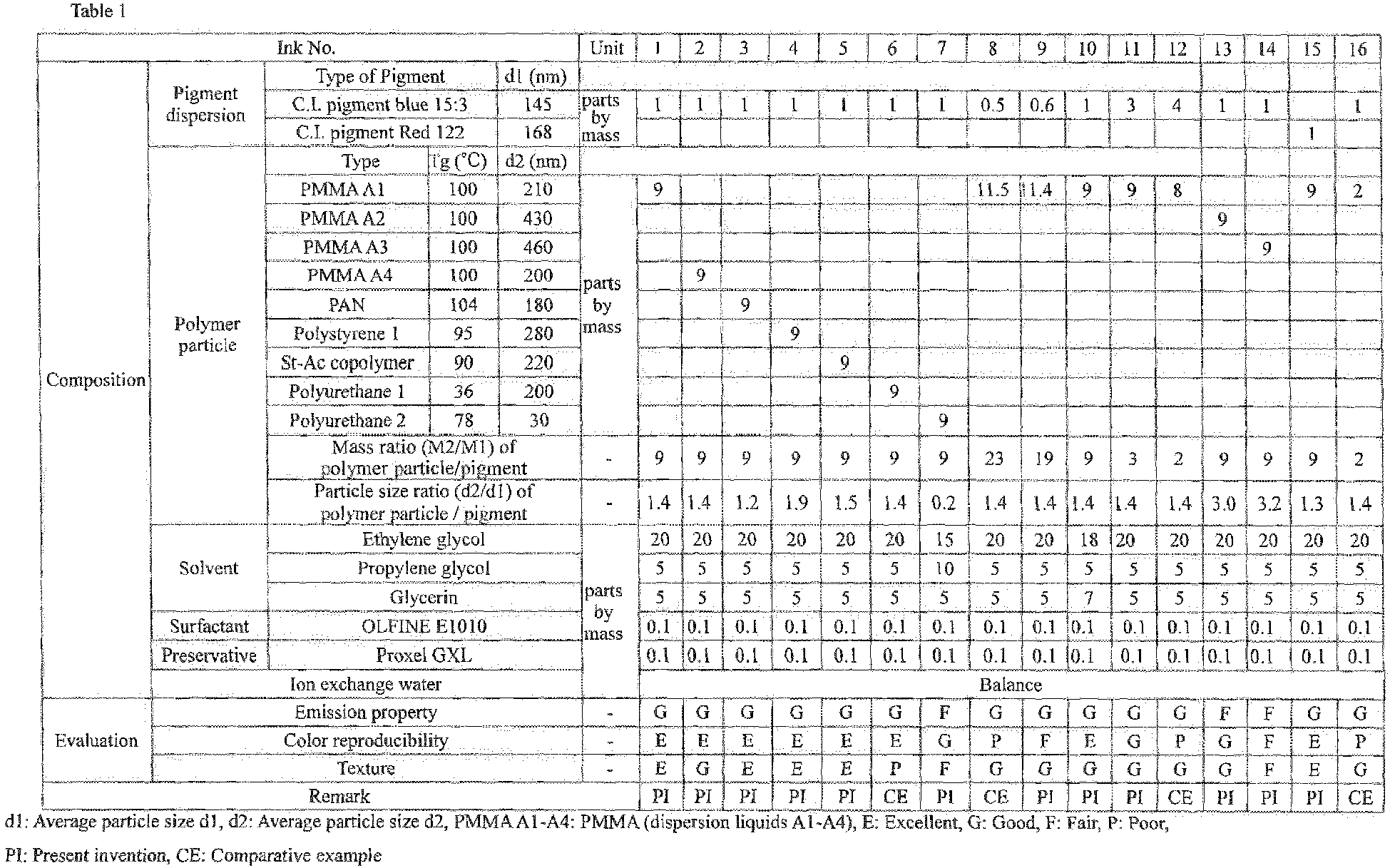
- Table 1 shows that using inks 1 to 7, 9 to 11, and 13 to 15, which contain polymer particles having a Tg of 50°C or higher and have the ratio (M2/M1) between the polymer particle content M2 and the pigment content M1 of 3 to 19 (mass ratio), allows uniform formation of a high-density image on the surface of a fabric without impairing the texture of the fabric, and also allows satisfactory color reproducibility. In addition, the emission stability (emission property) can be maintained when using the above inks.
- Using
inks 12 and 16, which have the ratio (M2/M1) between the polymer particle content M2 and the pigment content M1 of less than 3 (mass ratio), could not obtain sufficiently high image density and could obtain only low color reproducibility. Table 1 also shows that in ink 8, which has the ratio (M2/M1) higher than 19 (mass ratio), the content of polymer particles is increased and the ratio of the pigment particle content becomes too low, resulting in an overall decrease in image density. The image-formed product obtained from ink 6, which contains polymer particles having a Tg of less than 50°C, obviously has inferior texture. The reason for the inferior texture may be because polymer particles having a Tg of less than 50°C formed a film during drying, resulting in a hardened image-formed product. - After mixing 7 parts by mass of butyl acrylate / dimethylaminoethyl methacrylate copolymer (cationic dispersant, weight average molecular weight 16,000, cationic group equivalent 4.4 meq/g) as a pigment dispersant with 78 parts by mass of water, the mixture was heated and stirred to prepare a neutralized product of the pigment dispersant. To this mixture, 15 parts by mass of C.I. Pigment Blue 15:3 was added, and the mixture was pre-mixed and dispersed by using a sand grinder filled with 0.5 mm zirconia beads at a volume fraction of 50% to obtain a cyan pigment dispersion liquid having a pigment concentration of 15 mass%.
- A cyan pigment dispersion liquid having a pigment concentration of 15 mass% was obtained in the same manner as described above except that C.I. Pigment Red 122 was used as the pigment.
- The average particle size d1 of the pigment in each obtained pigment dispersion liquid was measured by the same method as described above.
- In a three-necked flask, 50 g of methyl methacrylate, 5 g of trimethylammonium ethyl methacrylate, 1 g of ethylene glycol dimethacrylate, and 0.5 g of the polymerization initiator AIBN were mixed, and 500 mL of water was added. The mixture was dispersed with ultrasonic waves, and then polymerized under a nitrogen stream. The mixture was concentrated by ultrafiltration to obtain a dispersion liquid of PMMA particles (cross-linked particles having cationic groups) having a solid content of 20 mass%. The polymerization time was adjusted to obtain the average particle size d2 shown in Table 2.
- Aqueous polystyrene particle dispersion liquid 2 (Tg: 100°C, average particle size: 180 nm) was obtained in the same manner as the PMMA particle dispersion liquid C1 except that styrene was used in place of methyl methacrylate.
- Superflex 620 (from DKS Co. Ltd., Tg: 43°C, average particle size: 20 nm)
- Superflex E4800 (from DKS Co. Ltd., Tg: -65°C, average particle size: 300 nm)
- Ink 17 was obtained by mixing the following components to make a total of 100 mass parts.
- Cationic pigment dispersion liquid 1 (15 mass% of pigment concentration): 6.7 parts by mass (1 part by mass of solid content)
- PMMA particle dispersion liquid C1 (20 mass% of solid content concentration): 45 parts by mass (9 parts by mass of solid content)
- Ethylene glycol: 20 parts by mass
- Propylene glycol: 5 parts by mass
- Glycerin: 5 parts by mass
- OLFINE E1010 (from Nissin Chemical Industry Co. Ltd., acetylene glycol-based surfactant): 0.1 part by mass
- Proxel GXL (from LONZA Japan): 0.1 part by mass
- Ion exchange water: balance
- Inks 18 to 30 were similarly obtained by mixing the components to have the respective compositions shown in Table 2.
- Using the obtained inks 17 to 30, image formation tests were performed in the same manner as described above, and the same evaluations (emission stability (emission property), color reproducibility, and texture of the obtained image-formed product) were performed in the same manner as described above. Table 2 shows the results.
Table 2 Ink No. Unit 17 18 19 20 21 22 23 24 25 26 27 28 29 30 Composition Pigment dispersion Type of Pigment d1 (nm) C.I. pigment blue 15:3 165 parts mass 1 1 1 1 1 0.5 0.6 1 3 4 1 1 1 C.I. pigment Red 122 200 1 Polymer particle Type Tg (°C) d2(nm) PMMA C1 100 230 parts by mass 9 ' 11.5 11.4 9 9 8 9 2 PMMA C2 100 470 9 PMMA C3 100 510 9 PAN 104 220 9 Polystyrene 2 95 180 9 Polyurethane 3 (SF620) 43 20 9 Polyurethane 4 (E4800) -65 300 9 Mass ratio (M2/M1) of polvmer particle / pigment - 9 9 9 9 9 23 19 9 3 2 9 9 9 2 Particle size ratio (d2/d1) of polymer particle / pigment - 1.4 1.3 1.1 0.1 1.8 1.4 1.4 1.4 1.4 1.4 2.8 3.1 1.3 1.4 Ethylene glycol parts by mass 20 20 20 20 15 20 20 18 20 20 20 20 20 20 Solvent Propylene glycol 5 5 5 5 10 5 5 5 5 5 5 5 5 5 Glycerin 5 5 5 5 5 5 5 7 5 5 5 5 5 5 Surfactant OLFINE E1010 0.1 0.1 0.1 0.1 0.1 0.1 0.1 0.1 0.1 0.1 0.1 0.1 0.1 0.1 Preservative Proxel GXL 0.1 0.1 0.1 0.1 0.1 0.1 0.1 0.1 0.1 0.1 0.1 0.1 0.1 0.1 Ion exchange water Balance Evaluation Emission property - G G G G P G G G G F G F G G Color reproducibility - E E E E E P F E G P G F E P Texture - G E E P P F G G G G G G E F Remark PI PI PI CE CE CE PI PI PI CE PI PI PI CE d1: Average particle size d1, d2: Average particle size d2, PMMA C1-C3: PMMA (dispersion liquids C1-C3), E: Excellent, G: Good, F: Fair, P: Poor,
PI: Present invention, CE: Comparative example - Table 2 shows that using inks 17 to 19, 23 to 25, and 27 to 29, which contain polymer particles having a Tg of 50°C or higher and have the ratio (M2/M1) between the polymer particle content M2 and the pigment content M1 of 3 to 19 (mass ratio), allows uniform formation of a high-density image on the surface of a fabric without impairing the texture of the fabric, and also allows satisfactory color reproducibility. In addition, the emission stability (emission property) can be maintained when using the above inks.
- Using inks 26 and 30, which have the ratio (M2/M1) between the polymer particle content M2 and the pigment content M1 of less than 3 (mass ratio), could not obtain sufficiently high image density and could obtain only low color reproducibility. Table 2 also shows that in ink 22, which has the ratio (M2/M1) higher than 19 (mass ratio), the content of polymer particles is increased and the ratio of the pigment particle content becomes too low, resulting in an overall decrease in image density.
- The present invention provides an inkjet textile printing ink capable of forming an image having sufficient density without impairing the texture of a fabric.
- Although embodiments of the present invention have been described and illustrated in detail, it is clearly understood that the same is by way of illustration and example only and not limitation, the scope of the present invention should be interpreted by terms of the appended claims.
-
- 10
- Fiber (of fabric)
- 11
- Pigment particle
- 12
- Polymer particle.
Claims (8)
- An inkjet textile printing ink, comprising:
a pigment (11) ; a polymer particle (12) having a glass transition temperature of 50°C or higher; and water, wherein
a ratio between a content M1 of the pigment (11) and a content M2 of the polymer particle (12) (the ratio M2/M1) is 3 to 19 at mass ratio. - The inkjet textile printing ink according to claim 1, wherein:
the polymer particle (12) is colorless. - The inkjet textile printing ink according to claim 1 or 2, wherein:
a ratio between an average particle size d1 of the pigment (11) and an average particle size d2 of the polymer particle (12) (the ratio d2/d1) is 0.5 to 3 in the inkjet textile printing ink. - The inkjet textile printing ink according to claim 3, wherein:
the ratio d2/d1 is 1.1 to 2.5. - The inkjet textile printing ink according to any one of claims 1 to 4, wherein:
the polymer particle (12) includes a resin selected from the group consisting of (meth)acrylic resins and styrene resins. - The inkjet textile printing ink according to claim 5, wherein:
a part of the resin is cross-linked. - The inkjet textile printing ink according to any one of claims 1 to 6, wherein:
an average particle size d2 of the polymer particle (12) is 80 to 400 nm. - An image forming method, comprising:
applying a droplet of the inkjet textile printing ink according to any one of claims 1 to 7 to a fabric by an inkjet method.
Applications Claiming Priority (1)
| Application Number | Priority Date | Filing Date | Title |
|---|---|---|---|
| JP2020179022A JP7600617B2 (en) | 2020-10-26 | 2020-10-26 | Inkjet printing ink and image forming method |
Publications (1)
| Publication Number | Publication Date |
|---|---|
| EP3988712A1 true EP3988712A1 (en) | 2022-04-27 |
Family
ID=78371900
Family Applications (1)
| Application Number | Title | Priority Date | Filing Date |
|---|---|---|---|
| EP21204092.7A Withdrawn EP3988712A1 (en) | 2020-10-26 | 2021-10-22 | Inkjet textile printing ink and image forming method |
Country Status (2)
| Country | Link |
|---|---|
| EP (1) | EP3988712A1 (en) |
| JP (1) | JP7600617B2 (en) |
Citations (17)
| Publication number | Priority date | Publication date | Assignee | Title |
|---|---|---|---|---|
| EP0004940A1 (en) | 1978-04-18 | 1979-10-31 | Max-Planck-Gesellschaft zur Förderung der Wissenschaften e.V. | Radioimmunoassay method for the determination of procollagen (type III) and procollagen-peptide (type III), for the production of procollagen-peptide (type III) used in this method and for the production of anti-procollagen-peptide (type III) serum |
| EP0004973A1 (en) | 1978-04-26 | 1979-10-31 | Hoechst Aktiengesellschaft | Thermoplastic moulding compositions on the basis of polyacetals |
| EP0005221A2 (en) | 1978-05-03 | 1979-11-14 | Bayer Ag | Process for preparing acrylonitrile copolymer dispersions |
| EP0005214A1 (en) | 1978-04-22 | 1979-11-14 | BADE & THEELEN GmbH | Motorized dummy polo horse |
| EP0005208A1 (en) | 1978-04-28 | 1979-11-14 | Siemens Aktiengesellschaft | Electrical switchgear |
| EP0005205A1 (en) | 1978-04-27 | 1979-11-14 | Troponwerke GmbH & Co. KG | Substituted 5.6-dimethylpyrrolo(2,3-d)pyrimidines, methods for their preparation and medicines containing them |
| EP1122068A1 (en) * | 2000-01-28 | 2001-08-08 | Seiren Co., Ltd. | Ink-jet printing method and ink-jet printed cloth |
| JP2008133461A (en) | 2006-10-25 | 2008-06-12 | Mitsubishi Pencil Co Ltd | Colorant composition for preventing see-through of fabric, coloring method using the colorant composition, and fabric colored on the back side |
| JP2009035579A (en) * | 2007-07-31 | 2009-02-19 | Konica Minolta Ij Technologies Inc | Pigment ink for inkjet textile printing, and inkjet textile printing method |
| JP2009057452A (en) * | 2007-08-31 | 2009-03-19 | Konica Minolta Ij Technologies Inc | Inkjet textile printing ink and inkjet textile printing method |
| JP2012179789A (en) * | 2011-03-01 | 2012-09-20 | Konica Minolta Ij Technologies Inc | Inkjet image forming method |
| CN103834232A (en) * | 2012-11-26 | 2014-06-04 | 江苏格美高科技发展有限公司 | Pigment ink for inkjet printing of high fastness textile and preparation method thereof |
| EP3272818A1 (en) * | 2015-03-20 | 2018-01-24 | DNP Fine Chemicals Co., Ltd. | Ink composition and ink jet recording method using same |
| EP3409831A1 (en) * | 2016-01-29 | 2018-12-05 | FUJIFILM Corporation | Inkjet printing method, inkjet ink, ink cartridge, and colored fabric |
| EP3540018A1 (en) * | 2018-03-16 | 2019-09-18 | Seiko Epson Corporation | Ink jet printing clear ink composition, ink jet printing ink set, and ink jet printing method |
| JP2019163397A (en) | 2018-03-20 | 2019-09-26 | セイコーエプソン株式会社 | Pigment printing inkjet ink composition, ink set for pigment printing, and inkjet recording method |
| JP2020105304A (en) * | 2018-12-26 | 2020-07-09 | 花王株式会社 | Ink set for printing |
Family Cites Families (5)
| Publication number | Priority date | Publication date | Assignee | Title |
|---|---|---|---|---|
| JP5490419B2 (en) | 2009-01-15 | 2014-05-14 | 富士フイルム株式会社 | Ink set and inkjet image forming method |
| JP5398415B2 (en) | 2009-08-17 | 2014-01-29 | 富士フイルム株式会社 | Ink set and image forming method |
| JP2016011320A (en) | 2014-06-27 | 2016-01-21 | キヤノン株式会社 | Water-based ink and inkjet recording method |
| JP2018001735A (en) | 2016-07-08 | 2018-01-11 | キヤノンファインテックニスカ株式会社 | Image recording method and image recording device |
| JP2018053094A (en) | 2016-09-28 | 2018-04-05 | 富士フイルム株式会社 | Ink-jet ink for printing, ink cartridge, ink-jet printing method, and colored cloth |
-
2020
- 2020-10-26 JP JP2020179022A patent/JP7600617B2/en active Active
-
2021
- 2021-10-22 EP EP21204092.7A patent/EP3988712A1/en not_active Withdrawn
Patent Citations (17)
| Publication number | Priority date | Publication date | Assignee | Title |
|---|---|---|---|---|
| EP0004940A1 (en) | 1978-04-18 | 1979-10-31 | Max-Planck-Gesellschaft zur Förderung der Wissenschaften e.V. | Radioimmunoassay method for the determination of procollagen (type III) and procollagen-peptide (type III), for the production of procollagen-peptide (type III) used in this method and for the production of anti-procollagen-peptide (type III) serum |
| EP0005214A1 (en) | 1978-04-22 | 1979-11-14 | BADE & THEELEN GmbH | Motorized dummy polo horse |
| EP0004973A1 (en) | 1978-04-26 | 1979-10-31 | Hoechst Aktiengesellschaft | Thermoplastic moulding compositions on the basis of polyacetals |
| EP0005205A1 (en) | 1978-04-27 | 1979-11-14 | Troponwerke GmbH & Co. KG | Substituted 5.6-dimethylpyrrolo(2,3-d)pyrimidines, methods for their preparation and medicines containing them |
| EP0005208A1 (en) | 1978-04-28 | 1979-11-14 | Siemens Aktiengesellschaft | Electrical switchgear |
| EP0005221A2 (en) | 1978-05-03 | 1979-11-14 | Bayer Ag | Process for preparing acrylonitrile copolymer dispersions |
| EP1122068A1 (en) * | 2000-01-28 | 2001-08-08 | Seiren Co., Ltd. | Ink-jet printing method and ink-jet printed cloth |
| JP2008133461A (en) | 2006-10-25 | 2008-06-12 | Mitsubishi Pencil Co Ltd | Colorant composition for preventing see-through of fabric, coloring method using the colorant composition, and fabric colored on the back side |
| JP2009035579A (en) * | 2007-07-31 | 2009-02-19 | Konica Minolta Ij Technologies Inc | Pigment ink for inkjet textile printing, and inkjet textile printing method |
| JP2009057452A (en) * | 2007-08-31 | 2009-03-19 | Konica Minolta Ij Technologies Inc | Inkjet textile printing ink and inkjet textile printing method |
| JP2012179789A (en) * | 2011-03-01 | 2012-09-20 | Konica Minolta Ij Technologies Inc | Inkjet image forming method |
| CN103834232A (en) * | 2012-11-26 | 2014-06-04 | 江苏格美高科技发展有限公司 | Pigment ink for inkjet printing of high fastness textile and preparation method thereof |
| EP3272818A1 (en) * | 2015-03-20 | 2018-01-24 | DNP Fine Chemicals Co., Ltd. | Ink composition and ink jet recording method using same |
| EP3409831A1 (en) * | 2016-01-29 | 2018-12-05 | FUJIFILM Corporation | Inkjet printing method, inkjet ink, ink cartridge, and colored fabric |
| EP3540018A1 (en) * | 2018-03-16 | 2019-09-18 | Seiko Epson Corporation | Ink jet printing clear ink composition, ink jet printing ink set, and ink jet printing method |
| JP2019163397A (en) | 2018-03-20 | 2019-09-26 | セイコーエプソン株式会社 | Pigment printing inkjet ink composition, ink set for pigment printing, and inkjet recording method |
| JP2020105304A (en) * | 2018-12-26 | 2020-07-09 | 花王株式会社 | Ink set for printing |
Non-Patent Citations (1)
| Title |
|---|
| KHAN MUHAMMAD RAFIQUE: "Pigment Ink Formulation, Tests and Test Methods for Pigmented Textile Inks", CHEMISTRY AND MATERIALS RESEARCH, 1 January 2016 (2016-01-01), pages 78 - 86, XP055879403, Retrieved from the Internet <URL:https://www.iiste.org/Journals/index.php/CMR/article/viewFile/32340/33228> [retrieved on 20220114] * |
Also Published As
| Publication number | Publication date |
|---|---|
| JP7600617B2 (en) | 2024-12-17 |
| JP2022070019A (en) | 2022-05-12 |
Similar Documents
| Publication | Publication Date | Title |
|---|---|---|
| CN101617004B (en) | Water-based ink jet ink and recording method | |
| EP3063238B1 (en) | Aqueous ink-jet inks containing two or more binders | |
| CN109844042A (en) | Ink-jet print system | |
| JP7358045B2 (en) | Ink set for textile printing | |
| EP1792955B1 (en) | Method of ink-jet textile printing | |
| EP4123088A1 (en) | Textile printing ink | |
| JP2010201752A (en) | Image forming method and recorded matter | |
| CN101084344A (en) | Method for printing or colouring substrates | |
| JP7600617B2 (en) | Inkjet printing ink and image forming method | |
| JP7379903B2 (en) | Inkjet recording method | |
| JP7824042B2 (en) | Water-based inkjet ink set and method for producing printed matter | |
| EP4290006A1 (en) | Image forming method and ink set | |
| JP2021008554A (en) | Ink composition, decorative sheet and method for producing decorative sheet | |
| JP7727443B2 (en) | Manufacturing method for printed materials | |
| US20240191428A1 (en) | Image forming method and ink set for ink jet textile printing | |
| EP4450573B1 (en) | Ink set for inkjet textile printing, image forming method, and image-formed product | |
| JP2025136857A (en) | Image forming method | |
| JP2024082042A (en) | Image forming method and ink set for ink-jet printing | |
| JP7459520B2 (en) | Image forming method and water-based inkjet textile printing ink | |
| JP7847435B2 (en) | Decorative sheet | |
| JP2020122093A (en) | Dispersion liquid, ink composition for inkjet recording, and inkjet recording method | |
| JP2004051820A (en) | Aqueous ink for inkjet printing and inkjet printing method | |
| US20260139144A1 (en) | Inkjet ink and image forming method | |
| JP2026003330A (en) | Inkjet clear ink liquid for textile printing, ink set, image forming apparatus, and image forming method | |
| JP2026002018A (en) | Ink set for thermal transfer sheet, thermal transfer sheet, method for manufacturing thermal transfer sheet, and method for manufacturing transfer print |
Legal Events
| Date | Code | Title | Description |
|---|---|---|---|
| PUAI | Public reference made under article 153(3) epc to a published international application that has entered the european phase |
Free format text: ORIGINAL CODE: 0009012 |
|
| STAA | Information on the status of an ep patent application or granted ep patent |
Free format text: STATUS: THE APPLICATION HAS BEEN PUBLISHED |
|
| AK | Designated contracting states |
Kind code of ref document: A1 Designated state(s): AL AT BE BG CH CY CZ DE DK EE ES FI FR GB GR HR HU IE IS IT LI LT LU LV MC MK MT NL NO PL PT RO RS SE SI SK SM TR |
|
| STAA | Information on the status of an ep patent application or granted ep patent |
Free format text: STATUS: THE APPLICATION IS DEEMED TO BE WITHDRAWN |
|
| 18D | Application deemed to be withdrawn |
Effective date: 20221028 |