EP3988547A1 - Indazole derivative, preparation method therefor, and pharmaceutical application thereof - Google Patents
Indazole derivative, preparation method therefor, and pharmaceutical application thereof Download PDFInfo
- Publication number
- EP3988547A1 EP3988547A1 EP20827542.0A EP20827542A EP3988547A1 EP 3988547 A1 EP3988547 A1 EP 3988547A1 EP 20827542 A EP20827542 A EP 20827542A EP 3988547 A1 EP3988547 A1 EP 3988547A1
- Authority
- EP
- European Patent Office
- Prior art keywords
- compound
- group
- heterocyclyl
- alkyl
- formula
- Prior art date
- Legal status (The legal status is an assumption and is not a legal conclusion. Google has not performed a legal analysis and makes no representation as to the accuracy of the status listed.)
- Pending
Links
Classifications
-
- C—CHEMISTRY; METALLURGY
- C07—ORGANIC CHEMISTRY
- C07D—HETEROCYCLIC COMPOUNDS
- C07D401/00—Heterocyclic compounds containing two or more hetero rings, having nitrogen atoms as the only ring hetero atoms, at least one ring being a six-membered ring with only one nitrogen atom
- C07D401/02—Heterocyclic compounds containing two or more hetero rings, having nitrogen atoms as the only ring hetero atoms, at least one ring being a six-membered ring with only one nitrogen atom containing two hetero rings
- C07D401/06—Heterocyclic compounds containing two or more hetero rings, having nitrogen atoms as the only ring hetero atoms, at least one ring being a six-membered ring with only one nitrogen atom containing two hetero rings linked by a carbon chain containing only aliphatic carbon atoms
-
- A—HUMAN NECESSITIES
- A61—MEDICAL OR VETERINARY SCIENCE; HYGIENE
- A61K—PREPARATIONS FOR MEDICAL, DENTAL OR TOILETRY PURPOSES
- A61K31/00—Medicinal preparations containing organic active ingredients
- A61K31/33—Heterocyclic compounds
- A61K31/395—Heterocyclic compounds having nitrogen as a ring hetero atom, e.g. guanethidine or rifamycins
- A61K31/41—Heterocyclic compounds having nitrogen as a ring hetero atom, e.g. guanethidine or rifamycins having five-membered rings with two or more ring hetero atoms, at least one of which being nitrogen, e.g. tetrazole
- A61K31/415—1,2-Diazoles
- A61K31/416—1,2-Diazoles condensed with carbocyclic ring systems, e.g. indazole
-
- A—HUMAN NECESSITIES
- A61—MEDICAL OR VETERINARY SCIENCE; HYGIENE
- A61K—PREPARATIONS FOR MEDICAL, DENTAL OR TOILETRY PURPOSES
- A61K31/00—Medicinal preparations containing organic active ingredients
- A61K31/33—Heterocyclic compounds
- A61K31/395—Heterocyclic compounds having nitrogen as a ring hetero atom, e.g. guanethidine or rifamycins
- A61K31/435—Heterocyclic compounds having nitrogen as a ring hetero atom, e.g. guanethidine or rifamycins having six-membered rings with one nitrogen as the only ring hetero atom
- A61K31/44—Non condensed pyridines; Hydrogenated derivatives thereof
- A61K31/4427—Non condensed pyridines; Hydrogenated derivatives thereof containing further heterocyclic ring systems
- A61K31/4439—Non condensed pyridines; Hydrogenated derivatives thereof containing further heterocyclic ring systems containing a five-membered ring with nitrogen as a ring hetero atom, e.g. omeprazole
-
- A—HUMAN NECESSITIES
- A61—MEDICAL OR VETERINARY SCIENCE; HYGIENE
- A61K—PREPARATIONS FOR MEDICAL, DENTAL OR TOILETRY PURPOSES
- A61K31/00—Medicinal preparations containing organic active ingredients
- A61K31/33—Heterocyclic compounds
- A61K31/395—Heterocyclic compounds having nitrogen as a ring hetero atom, e.g. guanethidine or rifamycins
- A61K31/435—Heterocyclic compounds having nitrogen as a ring hetero atom, e.g. guanethidine or rifamycins having six-membered rings with one nitrogen as the only ring hetero atom
- A61K31/44—Non condensed pyridines; Hydrogenated derivatives thereof
- A61K31/445—Non condensed piperidines, e.g. piperocaine
- A61K31/4523—Non condensed piperidines, e.g. piperocaine containing further heterocyclic ring systems
- A61K31/4545—Non condensed piperidines, e.g. piperocaine containing further heterocyclic ring systems containing a six-membered ring with nitrogen as a ring hetero atom, e.g. pipamperone, anabasine
-
- A—HUMAN NECESSITIES
- A61—MEDICAL OR VETERINARY SCIENCE; HYGIENE
- A61K—PREPARATIONS FOR MEDICAL, DENTAL OR TOILETRY PURPOSES
- A61K31/00—Medicinal preparations containing organic active ingredients
- A61K31/33—Heterocyclic compounds
- A61K31/395—Heterocyclic compounds having nitrogen as a ring hetero atom, e.g. guanethidine or rifamycins
- A61K31/535—Heterocyclic compounds having nitrogen as a ring hetero atom, e.g. guanethidine or rifamycins having six-membered rings with at least one nitrogen and one oxygen as the ring hetero atoms, e.g. 1,2-oxazines
- A61K31/5375—1,4-Oxazines, e.g. morpholine
- A61K31/5377—1,4-Oxazines, e.g. morpholine not condensed and containing further heterocyclic rings, e.g. timolol
-
- A—HUMAN NECESSITIES
- A61—MEDICAL OR VETERINARY SCIENCE; HYGIENE
- A61P—SPECIFIC THERAPEUTIC ACTIVITY OF CHEMICAL COMPOUNDS OR MEDICINAL PREPARATIONS
- A61P35/00—Antineoplastic agents
-
- C—CHEMISTRY; METALLURGY
- C07—ORGANIC CHEMISTRY
- C07D—HETEROCYCLIC COMPOUNDS
- C07D401/00—Heterocyclic compounds containing two or more hetero rings, having nitrogen atoms as the only ring hetero atoms, at least one ring being a six-membered ring with only one nitrogen atom
- C07D401/14—Heterocyclic compounds containing two or more hetero rings, having nitrogen atoms as the only ring hetero atoms, at least one ring being a six-membered ring with only one nitrogen atom containing three or more hetero rings
-
- C—CHEMISTRY; METALLURGY
- C07—ORGANIC CHEMISTRY
- C07D—HETEROCYCLIC COMPOUNDS
- C07D405/00—Heterocyclic compounds containing both one or more hetero rings having oxygen atoms as the only ring hetero atoms, and one or more rings having nitrogen as the only ring hetero atom
- C07D405/14—Heterocyclic compounds containing both one or more hetero rings having oxygen atoms as the only ring hetero atoms, and one or more rings having nitrogen as the only ring hetero atom containing three or more hetero rings
-
- C—CHEMISTRY; METALLURGY
- C07—ORGANIC CHEMISTRY
- C07D—HETEROCYCLIC COMPOUNDS
- C07D413/00—Heterocyclic compounds containing two or more hetero rings, at least one ring having nitrogen and oxygen atoms as the only ring hetero atoms
- C07D413/14—Heterocyclic compounds containing two or more hetero rings, at least one ring having nitrogen and oxygen atoms as the only ring hetero atoms containing three or more hetero rings
Definitions
- the present disclosure belongs to the field of medicine, and relates to an indazole derivative, a method for preparing the same, and a use thereof in medicine.
- the present disclosure discloses a use of the indazole derivative as an estrogen receptor modulator for preventing and/or treating estrogen receptor-mediated or estrogen receptor-dependent disease or disorder, wherein the disease is particularly preferably breast cancer.
- Breast cancer is one of the most common malignant tumors in women. According to GLOBALCAN statistics in 2012 ( CA CANCER J CLIN 2015; 65:87-108 ), there are approximately 1.7 million new cases and 520,000 deaths in the world each year. Regardless of morbidity and mortality, breast cancer ranks first among female malignancies. According to the China Cancer Registry Annual Report (2017) released by the National Cancer Center of China , breast cancer ranks first in the incidence of female malignant tumors, with about 279,000 new cases each year, and an annual increase of about 2%.
- endocrine therapy occupies an important position.
- aromatase inhibitor AI
- SERM selective estrogen receptor modulator
- SELD selective estrogen receptor degrader
- endocrine therapy is the first choice for estrogen receptor-positive breast cancer
- about 30% of patients receiving adjuvant therapy will relapse, and almost all patients with metastatic breast cancer will develop resistance and progress.
- One type of mechanism focuses on the estrogen receptor signaling pathway itself, including activating mutation and amplification of the ESR1 gene encoding estrogen receptor, fusion of the ESR1 gene encoding estrogen receptor with other genes, disturbance of estrogen receptor co-mediating factor and downstream factors that control cell cycle, etc.
- Another type of mechanism includes activation of signaling pathways that cross-react with the estrogen receptor signaling pathway, such as the growth factor receptor pathway ( Nat Rev Clin Oncol. 2015 Oct; 12(10):573-83 ).
- ESR1 gene mutation was found in 11 to 55% of estrogen receptor-positive metastatic breast cancer patients who have received aromatase inhibitor therapy. Further studies found that the mutant receptor can be phosphorylated independently of estrogen and provide a transcription effect, so that the tumor inoculated with estrogen-dependent MCF7 can grow in the body without relying on estrogen. Moreover, the mutated receptor will reduce the activity of SERM tamoxifen and SERD fulvestrant. Therefore, ESR1 gene mutation may be one of the mechanisms of drug resistance in estrogen receptor-positive breast cancer ( Nat Rev Clin Oncol. 2015 Oct; 12(10):573-83 and Nat Genet 2013; 45:1439-45 ).
- ESR1 gene mutations were found in patients with estrogen receptor-positive metastatic breast cancer, and the mutation proportion was about 30%.
- ER Y537S and ER D538G mutations were found in the ctDNA of 29% of patients with estrogen receptor-positive metastatic breast cancer who progressed after AIs treatment.
- PFS progression free survival
- OS overall survival
- ESR1 gene mutation mostly occurs in patients with metastatic estrogen receptor-positive breast cancer who have progressed after AIs treatment. These patients are no longer sensitive to AIs treatment. Therefore, there is a need to develop estrogen receptor antagonists that target ESR1 gene mutation.
- the first-in-class estrogen receptor covalent binding antagonist H3B-6545 developed by Eisai has strong inhibitory activity on wild-type and mutant estrogen receptors, and can exert a prolonged efficacy by covalently binding with the receptor. It is currently undergoing phase I and II clinical trials.
- Currently published patent applications related to estrogen receptor antagonists targeting ESR1 gene mutation include WO2016196346 and WO2016196342 .
- the object of the present disclosure is to provide a compound of formula (I) or a tautomer, mesomer, racemate, enantiomer, diastereomer thereof, or mixture thereof, or a pharmaceutically acceptable salt thereof: wherein:
- ring A is selected from the group consisting of C 3 -C 6 cycloalkyl and 3 to 6 membered heterocyclyl, wherein the heterocyclyl contains one to three heteroatoms selected from the group consisting of N, O and S.
- ring A is selected from the group consisting of cyclopropyl, cyclopentyl, cyclohexyl, tetrahydropyrrolyl and piperidinyl.
- ring A is selected from the group consisting of and preferably selected from the group consisting of
- the compound of formula (I) or the tautomer, mesomer, racemate, enantiomer, diastereomer thereof, or mixture thereof, or the pharmaceutically acceptable salt thereof is a compound of formula (II) or a tautomer, mesomer, racemate, enantiomer, diastereomer thereof, or mixture thereof, or a pharmaceutically acceptable salt thereof: wherein ring A, G, Z, R 1 , R 2 , R 3 , R 4 , R a , R b , n, m, s and q are as defined in formula (I).
- the compound of formula (I) or the tautomer, mesomer, racemate, enantiomer, diastereomer thereof, or mixture thereof, or the pharmaceutically acceptable salt thereof is a compound of formula (III) or a tautomer, mesomer, racemate, enantiomer, diastereomer thereof, or mixture thereof, or a pharmaceutically acceptable salt thereof: wherein: G, Z, R 1 , R 2 , R 3 , R 4 , R a , R b , n, m, s and q are as defined in formula (I).
- the compound of formula (I) or the tautomer, mesomer, racemate, enantiomer, diastereomer thereof, or mixture thereof, or the pharmaceutically acceptable salt thereof is a compound of formula (IV) or a tautomer, mesomer, racemate, enantiomer, diastereomer thereof, or mixture thereof, or a pharmaceutically acceptable salt thereof: wherein:
- G is an N atom.
- R 1 is selected from the group consisting of halogen and hydrogen atom.
- R 2 is a haloalkyl, preferably C 1 -C 6 haloalkyl, and more preferably -CH 2 CF 3 .
- R 3 is selected from the group consisting of hydrogen atom, halogen, alkyl, cyano, haloalkyl, NR 13 C(O)R 14 , C(O)NR 13 R 14 and SO 2 R 15 ;
- R 13 and R 14 are identical or different and are each independently selected from the group consisting of hydrogen atom and alkyl; and
- R 15 is selected from the group consisting of hydrogen atom and alkyl.
- each R 4 is identical or different and each is independently selected from the group consisting of hydrogen atom, halogen, alkyl and alkoxy, and preferably hydrogen.
- Z is selected from the group consisting of a bond, -O-, -O-CH 2 - and -NH-.
- R 8 and R 9 are identical or different and are each independently selected from the group consisting of hydrogen atom, alkyl, cycloalkyl and heterocyclyl; or, R 8 and R 9 together with the nitrogen atom to which they are attached form a heterocyclyl, wherein the heterocyclyl optionally contains one to two identical or different heteroatoms selected from the group consisting of N, O and S in addition to one nitrogen atom,, and the heterocyclyl is optionally substituted by one or more substituents selected from the group consisting of alkyl, alkoxy, halogen, amino,
- Typical compounds of formula (I) include, but are not limited to: Example No. Structure and name of the compound 1 ( E )-1-Morpholino-4-((1-(((5-(( Z )-4,4,4-trifluoro-1-(3-fluoro-1 H -indazol-5-yl)-2-phen ylbut-1-en-1-yl)pyridin-2-yl)oxy)methyl)cyclopropyl)amino)but-2-en-1-one 1 2 ( E )-1-(Pyrrolidin-1-yl)-4-((1-(((5-(( Z )-4,4,4-trifluoro-1-(3-fluoro-1 H -indazol-5-yl)-2-phenylbut-1-en-1-yl)pyridin-2-yl)oxy)methyl)cyclopropyl)amino)but-2-en-1-one 2 3 ( E )-1-(Piperidin-1-yl
- the present disclosure provides a compound of formula (IA) or a tautomer, mesomer, racemate, enantiomer, diastereomer thereof, or mixture thereof, or a pharmaceutically acceptable salt thereof,
- the present disclosure provides a compound of formula (IIA) or a tautomer, mesomer, racemate, enantiomer, diastereomer thereof, or mixture thereof, or a pharmaceutically acceptable salt thereof,
- the present disclosure provides a compound of formula (IIIA) or a tautomer, mesomer, racemate, enantiomer, diastereomer thereof, or mixture thereof, or a pharmaceutically acceptable salt thereof,
- the present disclosure provides a compound of formula (IVA) or a tautomer, mesomer, racemate, enantiomer, diastereomer thereof, or mixture thereof, or a pharmaceutically acceptable salt thereof,
- Typical compounds of formula (IA) include, but are not limited to: Example No. Structure and name of the compound 1i ( E )-1-Morpholino-4-((1-(((5-(( Z )-4,4,4-trifluoro-1-(3-fluoro-1-(tetrahydro-2 H -pyran-2-yl)-1 H -indazol-5-yl)-2-phenylbut-1-en-1-yl)pyridin-2-yl)oxy)methyl)cyclopropyl)a mino)but-2-en-1-one 1i 2b ( E )-1-(Pyrrolidin-1-yl)-4-((1-(((5-(( Z )-4,4,4-trifluoro-1-(3-fluoro-1-(tetrahydro-2 H -py ran-2-yl)-1 H -indazol-5-yl)-2-phenylbut-1-en-1-yl)pyridin-2
- the present disclosure provides a method for preparing the compound of formula (I) or the tautomer, mesomer, racemate, enantiomer, diastereomer thereof, or mixture thereof, or the pharmaceutically acceptable salt thereof, comprising a step of:
- the present disclosure provides a method for preparing the compound of formula (II) or the tautomer, mesomer, racemate, enantiomer, diastereomer thereof, or mixture thereof, or the pharmaceutically acceptable salt thereof, comprising a step of:
- the present disclosure provides a method for preparing the compound of formula (III) or the tautomer, mesomer, racemate, enantiomer, diastereomer thereof, or mixture thereof, or the pharmaceutically acceptable salt thereof, comprising a step of:
- the present disclosure provides a method for preparing the compound of formula (IV) or the tautomer, mesomer, racemate, enantiomer, diastereomer thereof, or mixture thereof, or the pharmaceutically acceptable salt thereof, comprising a step of:
- the present disclosure relates to a pharmaceutical composition
- a pharmaceutical composition comprising a therapeutically effective amount of the compound of formula (I) to (IV) as defined above or the tautomer, mesomer, racemate, enantiomer, diastereomer thereof, or mixture thereof, or the pharmaceutically acceptable salt thereof, and one or more pharmaceutically acceptable carriers, diluents or excipients.
- the present disclosure also relates to a method for preparing the pharmaceutical composition as defined above, comprising a step of mixing the compound of formula (I) to (IV), or the tautomer, mesomer, racemate, enantiomer, diastereomer thereof, or mixture thereof, or the pharmaceutically acceptable salt thereof with the pharmaceutically acceptable carriers, diluents or excipients.
- the present disclosure further relates to a use of the compound of formula (I) to (IV), or the tautomer, mesomer, racemate, enantiomer, diastereomer thereof, or mixture thereof, or the pharmaceutically acceptable salt thereof, or the pharmaceutical composition comprising the same in the preparation of an estrogen receptor modulator.
- the present disclosure further relates to a use of the compound of formula (I) to (IV), or the tautomer, mesomer, racemate, enantiomer, diastereomer thereof, or mixture thereof, or the pharmaceutically acceptable salt thereof, or the pharmaceutical composition comprising the same in the preparation of a medicament for preventing and/or treating estrogen receptor-mediated or estrogen receptor-dependent disease or disorder, wherein the estrogen receptor-mediated or estrogen receptor-dependent disease or disorder is preferably cancer, more preferably breast cancer, ovarian cancer, endometrial cancer, prostate cancer or uterine cancer, and further preferably breast cancer.
- the present disclosure further relates to the compound of formula (I) to (IV), or the tautomer, mesomer, racemate, enantiomer, diastereomer thereof, or mixture thereof, or the pharmaceutically acceptable salt thereof, for use as a medicament.
- the present disclosure further relates to the compound of formula (I) to (IV), or the tautomer, mesomer, racemate, enantiomer, diastereomer thereof, or mixture thereof, or the pharmaceutically acceptable salt thereof, for use as a medicament for treating estrogen receptor-mediated or estrogen receptor-dependent disease or disorder, wherein the estrogen receptor-mediated or estrogen receptor-dependent disease or disorder is preferably cancer, more preferably breast cancer, ovarian cancer, endometrial cancer, prostate cancer or uterine cancer, and further preferably breast cancer.
- the present disclosure further relates to a method for treating estrogen receptor-mediated or estrogen receptor-dependent disease or disorder, comprising a step of administering to a patient in need thereof a therapeutically effective amount of the compound of formula (I) to (IV) or the tautomer, mesomer, racemate, enantiomer, diastereomer thereof, or mixture thereof, or the pharmaceutically acceptable salt thereof of the present disclosure.
- This method shows outstanding efficacy and less side effects.
- the estrogen receptor-mediated or estrogen receptor-dependent disease or disorder is preferably cancer, more preferably breast cancer, ovarian cancer, endometrial cancer, prostate cancer or uterine cancer, and further preferably breast cancer.
- the active compound can be formulated into a form suitable for administration by any appropriate route, and the active compound is preferably in the form of a unit dose, or in a form in which the patient can self-administer in a single dose.
- the form of the unit dose of the compound or composition of the present invention can be tablet, capsule, cachet, bottled potion, powder, granule, lozenge, suppository, regenerating powder or liquid preparation.
- the dosage of the compound or composition used in the treatment method of the present invention will generally vary according to the severity of the disease, the weight of the patient, and the relative efficacy of the compound.
- a suitable unit dose can be 0.1 to 1000 mg.
- the pharmaceutical composition of the present invention can further comprise one or more auxiliaries including filler (diluent), binder, wetting agent, disintegrant, excipient and the like.
- auxiliaries including filler (diluent), binder, wetting agent, disintegrant, excipient and the like.
- the composition can comprise 0.1 to 99% by weight of the active compound.
- the pharmaceutical composition containing the active ingredient can be in a form suitable for oral administration, for example, a tablet, troche, lozenge, aqueous or oily suspension, dispersible powder or granule, emulsion, hard or soft capsule, syrup or elixir.
- An oral composition can be prepared according to any known method in the art for the preparation of pharmaceutical composition.
- Such a composition can contain one or more ingredient(s) selected from the group consisting of sweeteners, flavoring agents, colorants and preservatives, in order to provide a pleasing and palatable pharmaceutical formulation.
- the tablet contains the active ingredient in admixture with nontoxic, pharmaceutically acceptable excipients suitable for the manufacture of tablets.
- excipients can be inert excipients, granulating agents, disintegrants and lubricants.
- the tablet can be uncoated or coated by means of a known technique to mask drug taste or delay the disintegration and absorption of the active ingredient in the gastrointestinal tract, thereby providing a sustained release over a long period of time.
- water soluble taste masking materials can be used.
- An oral formulation can also be provided as soft gelatin capsules in which the active ingredient is mixed with an inert solid diluent, or the active ingredient is mixed with a water-soluble carrier.
- An aqueous suspension comprises an active ingredient in admixture with excipients suitable for the manufacture of an aqueous suspension.
- excipients are suspending agents, dispersants or wetting agents.
- the active ingredient of the aqueous suspension can be dispersible powders or granules.
- the active ingredient is mixed with one or more dispersant(s), wetting agent(s) or suspending agent(s) by adding water.
- the aqueous suspension can also comprise one or more preservative(s), one or more colorant(s), one or more flavoring agent(s), and one or more sweetener(s).
- An oil suspension can be formulated by suspending the active ingredient in a vegetable oil or mineral oil.
- the oil suspension can comprise a thickener.
- the aforementioned sweeteners and flavoring agents can be added to provide a palatable formulation. These compositions can be preserved by adding an antioxidant.
- the dispersible powders or granules suitable for the preparation of an aqueous suspension can provide the active ingredient in admixture with the dispersants or wetting agents, suspending agent or one or more preservatives by adding water.
- Suitable dispersants or wetting agents and suspending agents are exemplified by those already mentioned above. Additional excipients, such as sweeteners, flavoring agents and colorants, can also be added.
- These compositions can be preserved by adding an antioxidant, such as ascorbic acid.
- the pharmaceutical composition of the present disclosure can also be in the form of an oil-in-water emulsion.
- the oil phase can be a vegetable oil, or a mineral oil, or a mixture thereof.
- Suitable emulsifying agents can be naturally occurring phospholipids.
- a sweetening agent can be used.
- Such formulations can also contain a demulcent, a preservative, a coloring agent and an antioxidant.
- the pharmaceutical composition of the present disclosure can be in the form of a sterile injectable aqueous solution.
- Acceptable vehicles or solvents that can be used are water, Ringer's solution or isotonic sodium chloride solution.
- the sterile injectable formulation can be a sterile injectable oil-in-water micro-emulsion in which the active ingredient is dissolved in an oil phase.
- the injectable solution or micro-emulsion can be introduced into a patient's bloodstream by local bolus injection.
- the solution and micro-emulsion are preferably administered in a manner that maintains a constant circulating concentration of the compound of the present disclosure.
- a continuous intravenous delivery device can be used.
- An example of such a device is Deltec CADD-PLUS. TM. 5400 intravenous injection pump.
- the pharmaceutical composition of the present disclosure can be in the form of a sterile injectable aqueous or oily suspension for intramuscular and subcutaneous administration.
- a suspension can be formulated with suitable dispersants or wetting agents and suspending agents as described above according to known techniques.
- the sterile injectable formulation can also be a sterile injectable solution or suspension prepared in a nontoxic parenterally acceptable diluent or solvent.
- sterile fixed oils can easily be used as a solvent or suspending medium.
- fatty acids can also be used to prepare injections.
- the compound of the present disclosure can be administered in the form of a suppository for rectal administration.
- These pharmaceutical compositions can be prepared by mixing the drug with a suitable non-irritating excipient that is solid at ordinary temperatures, but liquid in the rectum, thereby melting in the rectum to release the drug.
- the dosage of a drug depends on a variety of factors including, but not limited to the following factors: activity of a specific compound, age of the patient, weight of the patient, general health of the patient, behavior of the patient, diet of the patient, administration time, administration route, excretion rate, drug combination and the like.
- the optimal treatment such as treatment mode, daily dose of the compound of formula (I) or the type of pharmaceutically acceptable salt thereof can be verified according to traditional therapeutic regimens.
- alkyl refers to a saturated aliphatic hydrocarbon group, which is a straight or branched chain group comprising 1 to 20 carbon atoms, preferably an alkyl having 1 to 12 carbon atoms, and more preferably an alkyl having 1 to 6 carbon atoms.
- Non-limiting examples include methyl, ethyl, n -propyl, isopropyl, n -butyl, isobutyl, tert -butyl, sec -butyl, n -pentyl, 1,1-dimethylpropyl, 1,2-dimethylpropyl, 2,2-dimethylpropyl, 1-ethylpropyl, 2-methylbutyl, 3-methylbutyl, n -hexyl, 1-ethyl-2-methylpropyl, 1,1,2-trimethylpropyl, 1,1-dimethylbutyl, 1,2-dimethylbutyl, 2,2-dimethylbutyl, 1,3-dimethylbutyl, 2-ethylbutyl, 2-methylpentyl, 3-methylpentyl, 4-methylpentyl, 2,3-dimethylbutyl, n -heptyl, 2-methylhexyl, 3-methylhexyl, 4-methylhexyl,
- the alkyl group is a lower alkyl having 1 to 6 carbon atoms, and non-limiting examples include methyl, ethyl, n -propyl, isopropyl, n -butyl, isobutyl, tert -butyl, sec -butyl, n -pentyl, 1,1-dimethylpropyl, 1,2-dimethylpropyl, 2,2-dimethylpropyl, 1-ethylpropyl, 2-methylbutyl, 3-methylbutyl, n -hexyl, 1-ethyl-2-methylpropyl, 1,1,2-trimethylpropyl, 1,1-dimethylbutyl, 1,2-dimethylbutyl, 2,2-dimethylbutyl, 1,3-dimethylbutyl, 2-ethylbutyl, 2-methylpentyl, 3-methylpentyl, 4-methylpentyl, 2,3-dimethylbutyl and the like.
- the alkyl can be substituted or unsubstituted. When substituted, the substituent group(s) can be substituted at any available connection point.
- the substituent group(s) is preferably one or more groups independently selected from the group consisting of alkyl, alkenyl, alkynyl, alkoxy, alkylthio, alkylamino, halogen, thiol, hydroxy, nitro, cyano, cycloalkyl, heterocyclyl, aryl, heteroaryl, cycloalkoxy, heterocycloalkoxy, cycloalkylthio, heterocyclylthio, oxo, carboxy and alkoxycarbonyl.
- alkylene refers to a saturated linear or branched aliphatic hydrocarbon group having two residues derived from the removal of two hydrogen atoms from the same carbon atom or two different carbon atoms of the parent alkane. It is a linear or branched alkylene having 1 to 20 carbon atoms, preferably 1 to 12 carbon atoms, and more preferably 1 to 6 carbon atoms.
- Non-limiting examples of alkylene include, but are not limited to, methylene (-CH 2 -), 1,1-ethylene (-CH(CH 3 )-), 1,2-ethylene (-CH 2 CH 2 )-, 1,1-propylene (-CH(CH 2 CH 3 )-), 1,2-propylene (-CH 2 CH(CH 3 )-), 1,3-propylene (-CH 2 CH 2 CH 2 -), 1,4-butylene (-CH 2 CH 2 CH 2 CH 2 -) and the like.
- the alkylene can be substituted or unsubstituted. When substituted, the substituent group(s) can be substituted at any available connection point.
- the substituent group(s) is preferably one or more groups independently optionally selected from the group consisting of alkyl, alkenyl, alkynyl, alkoxy, alkylthio, alkylamino, halogen, thiol, hydroxy, nitro, cyano, cycloalkyl, heterocyclyl, aryl, heteroaryl, cycloalkoxy, heterocycloalkoxy, cycloalkylthio, heterocyclylthio and oxo.
- alkenyl refers to an alkyl containing carbon-carbon double bond(s) in the molecule, wherein the definition of the alkyl is as described above.
- the alkenyl can be substituted or unsubstituted.
- the substituent group(s) is preferably one or more groups independently selected from the group consisting of hydrogen atom, alkyl, alkoxy, halogen, haloalkyl, hydroxy, hydroxyalkyl, cyano, amino, nitro, cycloalkyl, heterocyclyl, aryl and heteroaryl.
- alkynyl refers to an alkyl containing carbon-carbon triple bond(s) in the molecule, wherein the definition of the alkyl is as described above.
- the alkynyl can be substituted or unsubstituted.
- the substituent group(s) is preferably one or more groups independently selected from the group consisting of hydrogen atom, alkyl, alkoxy, halogen, haloalkyl, hydroxy, hydroxyalkyl, cyano, amino, nitro, cycloalkyl, heterocyclyl, aryl and heteroaryl.
- alkoxy refers to an -O-(alkyl) or an -O-(unsubstituted cycloalkyl) group, wherein the alkyl is as defined above.
- alkoxy include methoxy, ethoxy, propoxy, butoxy, cyclopropyloxy, cyclobutyloxy, cyclopentyloxy, cyclohexyloxy.
- the alkoxy can be optionally substituted or unsubstituted.
- the substituent group(s) is preferably one or more groups independently selected from the group consisting of alkyl, alkenyl, alkynyl, alkoxy, alkylthio, alkylamino, halogen, thiol, hydroxy, nitro, cyano, cycloalkyl, heterocyclyl, aryl, heteroaryl, cycloalkoxy, heterocycloalkoxy, cycloalkylthio, heterocyclylthio, carboxy and alkoxycarbonyl.
- cycloalkyl refers to a saturated or partially unsaturated monocyclic or polycyclic hydrocarbon substituent group having 3 to 20 carbon atoms, preferably 3 to 12 carbon atoms (for example 3, 4, 5, 6, 7, 8, 9, 10, 11, 12 carbon atoms), and more preferably 3 to 6 carbon atoms.
- monocyclic cycloalkyl include cyclopropyl, cyclobutyl, cyclopentyl, cyclopentenyl, cyclohexyl, cyclohexenyl, cyclohexadienyl, cycloheptyl, cycloheptatrienyl, cyclooctyl and the like.
- Polycyclic cycloalkyl includes a cycloalkyl having a spiro ring, fused ring or bridged ring.
- spiro cycloalkyl refers to a 5 to 20 membered polycyclic group with individual rings connected through one shared carbon atom (called a spiro atom), wherein the rings can contain one or more double bonds, but none of the rings has a completely conjugated ⁇ -electron system.
- the spiro cycloalkyl is preferably a 6 to 14 membered spiro cycloalkyl (for example 6, 7, 8, 9, 10, 11, 12, 13, 14 membered spiro cycloalkyl), and more preferably a 7 to 10 membered spiro cycloalkyl.
- the spiro cycloalkyl can be divided into a mono-spiro cycloalkyl, di-spiro cycloalkyl, or poly-spiro cycloalkyl, and the spiro cycloalkyl is preferably a mono-spiro cycloalkyl or di-spiro cycloalkyl, and more preferably a 4-membered/4-membered, 4-membered/5-membered, 4-membered/6-membered, 5-membered/5-membered, or 5-membered/6-membered mono-spiro cycloalkyl.
- spiro cycloalkyl include:
- fused cycloalkyl refers to a 5 to 20 membered all-carbon polycyclic group, wherein each ring in the system shares an adjacent pair of carbon atoms with another ring, one or more rings can contain one or more double bonds, but none of the rings has a completely conjugated ⁇ -electron system.
- the fused cycloalkyl is preferably a 6 to 14 membered fused cycloalkyl, and more preferably a 7 to 10 membered fused cycloalkyl (for example 7, 8, 9 or 10 membered fused cycloalkyl).
- the fused cycloalkyl can be divided into a bicyclic, tricyclic, tetracyclic or polycyclic fused cycloalkyl, and the fused cycloalkyl is preferably a bicyclic or tricyclic fused cycloalkyl, and more preferably a 5-membered/5-membered, or 5-membered/6-membered bicyclic fused cycloalkyl.
- fused cycloalkyl include:
- bridged cycloalkyl refers to a 5 to 20 membered all-carbon polycyclic group, wherein every two rings in the system share two disconnected carbon atoms, the rings can have one or more double bonds, but none of the rings has a completely conjugated ⁇ -electron system.
- the bridged cycloalkyl is preferably a 6 to 14 membered bridged cycloalkyl, and more preferably a 7 to 10 membered bridged cycloalkyl (for example 7, 8, 9 or 10 membered bridged cycloalkyl).
- the bridged cycloalkyl can be divided into a bicyclic, tricyclic, tetracyclic or polycyclic bridged cycloalkyl, and the bridged cycloalkyl is preferably a bicyclic, tricyclic or tetracyclic bridged cycloalkyl, and more preferably a bicyclic or tricyclic bridged cycloalkyl.
- bridged cycloalkyl include:
- the cycloalkyl (including cycloalkyl, spiro cycloalkyl, fused cycloalkyl and bridged cycloalkyl) ring can be fused to the ring of aryl, heteroaryl or heterocyclyl, wherein the ring bound to the parent structure is cycloalkyl.
- Non-limiting examples include indanyl, tetrahydronaphthyl, benzocycloheptyl and the like.
- the cycloalkyl can be optionally substituted or unsubstituted.
- the substituent group(s) is preferably one or more groups independently selected from the group consisting of alkyl, alkenyl, alkynyl, alkoxy, alkylthio, alkylamino, halogen, thiol, hydroxy, nitro, cyano, cycloalkyl, heterocyclyl, aryl, heteroaryl, cycloalkoxy, heterocycloalkoxy, cycloalkylthio, heterocyclylthio, oxo, carboxy and alkoxycarbonyl.
- heterocyclyl refers to a 3 to 20 membered saturated or partially unsaturated monocyclic or polycyclic hydrocarbon substituent group, wherein one or more ring atoms are heteroatoms selected from the group consisting of N, O, S, S(O) and S(O) 2 , but excluding -O-O-, -O-S- or -S-S- in the ring, with the remaining ring atoms being carbon atoms.
- the heterocyclyl has 3 to 12 ring atoms wherein 1 to 4 atoms (for example 1, 2, 3 or 4 atoms) are heteroatoms; more preferably, 3 to 6 ring atoms (for example 3, 4, 5 or 6 ring atoms).
- Non-limiting examples of monocyclic heterocyclyl include pyrrolidinyl, imidazolidinyl, tetrahydrofuranyl, tetrahydrothienyl, dihydroimidazolyl, dihydrofuranyl, dihydropyrazolyl, dihydropyrrolyl, piperidinyl, piperazinyl, morpholinyl, thiomorpholinyl, homopiperazinyl and the like, and preferably piperidinyl, pyrrolidinyl.
- Polycyclic heterocyclyl includes a heterocyclyl having a spiro ring, fused ring or bridged ring.
- spiro heterocyclyl refers to a 5 to 20 membered polycyclic heterocyclyl group with individual rings connected through one shared atom (called a spiro atom), wherein one or more ring atoms are heteroatoms selected from the group consisting of N, O, S, S(O) and S(O) 2 , with the remaining ring atoms being carbon atoms, where the rings can contain one or more double bonds, but none of the rings has a completely conjugated ⁇ -electron system.
- the spiro heterocyclyl is preferably a 6 to 14 membered spiro heterocyclyl, and more preferably a 7 to 10 membered spiro heterocyclyl (for example 7, 8, 9 or 10 membered spiro heterocyclyl).
- the spiro heterocyclyl is divided into a mono-spiro heterocyclyl, di-spiro heterocyclyl, or poly-spiro heterocyclyl, and the spiro heterocyclyl is preferably a mono-spiro heterocyclyl or di-spiro heterocyclyl, and more preferably a 4-membered/4-membered, 4-membered/5-membered, 4-membered/6-membered, 5-membered/5-membered, or 5-membered/6-membered mono-spiro heterocyclyl.
- spiro heterocyclyl include:
- fused heterocyclyl refers to a 5 to 20 membered polycyclic heterocyclyl group, wherein each ring in the system shares an adjacent pair of atoms with another ring, wherein one or more rings can contain one or more double bonds, but none of the rings has a completely conjugated ⁇ -electron system, and wherein one or more ring atoms are heteroatoms selected from the group consisting of N, O, S, S(O) and S(O) 2 , with the remaining ring atoms being carbon atoms.
- the fused heterocyclyl is preferably a 6 to 14 membered fused heterocyclyl, and more preferably a 7 to 10 membered fused heterocyclyl (for example 7, 8, 9 or 10 membered fused heterocyclyl).
- the fused heterocyclyl can be divided into a bicyclic, tricyclic, tetracyclic or polycyclic fused heterocyclyl, and the fused heterocyclyl is preferably a bicyclic or tricyclic fused heterocyclyl, and more preferably a 5-membered/5-membered or 5-membered/6-membered bicyclic fused heterocyclyl.
- fused heterocyclyl include:
- bridged heterocyclyl refers to a 5 to 14 membered polycyclic heterocyclyl group, wherein every two rings in the system share two disconnected atoms, wherein the rings can have one or more double bonds, but none of the rings has a completely conjugated ⁇ -electron system, and wherein one or more ring atoms are heteroatoms selected from the group consisting of N, O, S, S(O) and S(O) 2 , with the remaining ring atoms being carbon atoms.
- the bridged heterocyclyl is preferably a 6 to 14 membered bridged heterocyclyl, and more preferably a 7 to 10 membered bridged heterocyclyl (for example 7, 8, 9 or 10 membered bridged heterocyclyl).
- the bridged heterocyclyl can be divided into a bicyclic, tricyclic, tetracyclic or polycyclic bridged heterocyclyl, and the bridged heterocyclyl is preferably a bicyclic, tricyclic or tetracyclic bridged heterocyclyl, and more preferably a bicyclic or tricyclic bridged heterocyclyl.
- bridged heterocyclyl include:
- heterocyclyl including heterocyclyl, spiro heterocyclyl, fused heterocyclyl and bridged heterocyclyl
- ring can be fused to the ring of aryl, heteroaryl or cycloalkyl, wherein the ring bound to the parent structure is heterocyclyl, and non-limiting examples thereof include: and the like.
- the heterocyclyl can be optionally substituted or unsubstituted.
- the substituent group(s) is preferably one or more groups independently selected from the group consisting of alkyl, alkenyl, alkynyl, alkoxy, alkylthio, alkylamino, halogen, thiol, hydroxy, nitro, cyano, cycloalkyl, heterocyclyl, aryl, heteroaryl, cycloalkoxy, heterocycloalkoxy, cycloalkylthio, heterocyclylthio, oxo, carboxy and alkoxycarbonyl.
- aryl refers to a 6 to 14 membered all-carbon monocyclic ring or polycyclic fused ring ( i.e. each ring in the system shares an adjacent pair of carbon atoms with another ring in the system) having a conjugated ⁇ -electron system, preferably a 6 to 10 membered aryl, for example, phenyl and naphthyl.
- the aryl ring can be fused to the ring of heteroaryl, heterocyclyl or cycloalkyl, wherein the ring bound to the parent structure is aryl ring, and non-limiting examples thereof include:
- the aryl can be substituted or unsubstituted.
- the substituent group(s) is preferably one or more groups independently selected from the group consisting of alkyl, alkenyl, alkynyl, alkoxy, alkylthio, alkylamino, halogen, thiol, hydroxy, nitro, cyano, cycloalkyl, heterocyclyl, aryl, heteroaryl, cycloalkoxy, heterocycloalkoxy, cycloalkylthio, heterocyclylthio, carboxy and alkoxycarbonyl, and preferably phenyl.
- heteroaryl refers to a 5 to 14 membered heteroaromatic system having 1 to 4 heteroatoms selected from the group consisting of O, S and N.
- the heteroaryl is preferably a 5 to 10 membered heteroaryl (for example 5, 6, 7, 8, 9 or 10 membered heteroaryl), more preferably a 5 or 6 membered heteroaryl, for example, imidazolyl, furyl, thienyl, thiazolyl, pyrazolyl, oxazolyl, pyrrolyl, tetrazolyl, pyridyl, pyrimidinyl, thiadiazolyl, pyrazinyl and the like, preferably imidazolyl, pyrazolyl, pyrimidinyl or thiazolyl, and more preferably pyrazolyl or thiazolyl.
- the heteroaryl ring can be fused to the ring of aryl, heterocyclyl or cycloalkyl, wherein the
- the heteroaryl can be optionally substituted or unsubstituted.
- the substituent group(s) is preferably one or more groups independently selected from the group consisting of alkyl, alkenyl, alkynyl, alkoxy, alkylthio, alkylamino, halogen, thiol, hydroxy, nitro, cyano, cycloalkyl, heterocyclyl, aryl, heteroaryl, cycloalkoxy, heterocycloalkoxy, cycloalkylthio, heterocyclylthio, carboxy and alkoxycarbonyl.
- hydroxyalkyl refers to an alkyl group substituted by hydroxy(s), wherein the alkyl is as defined above.
- haloalkyl refers to an alkyl group substituted by halogen(s), wherein the alkyl is as defined above.
- deuterated alkyl refers to an alkyl group substituted by deuterium atom(s), wherein the alkyl is as defined above.
- hydroxy refers to an -OH group.
- halogen refers to fluorine, chlorine, bromine or iodine.
- amino refers to a -NH 2 group.
- cyano refers to a -CN group.
- nitro refers to a -NO 2 group.
- alkoxycarbonyl refers to a -C(O)O(alkyl) or -C(O)O(cycloalkyl) group, wherein the alkyl and cycloalkyl are as defined above.
- acyl halide refers to a compound containing a -C(O)-halogen group.
- Optional or “optionally” means that the event or circumstance described subsequently can, but need not, occur, and such a description includes the situation in which the event or circumstance does or does not occur.
- the heterocyclyl optionally substituted by alkyl means that an alkyl group can be, but need not be, present, and such a description includes the situation of the heterocyclyl being substituted by alkyl and the heterocyclyl being not substituted by alkyl.
- Substituted refers to one or more hydrogen atoms in a group, preferably up to 5, and more preferably 1 to 3 hydrogen atoms, independently substituted by corresponding number of substituents. It goes without saying that the substituents only exist in their possible chemical position. The person skilled in the art is able to determine whether the substitution is possible or impossible by experiments or theory without excessive effort. For example, the combination of amino or hydroxy having free hydrogen and carbon atoms having unsaturated bonds (such as olefinic) may be unstable.
- pharmaceutical composition refers to a mixture of one or more of the compounds described herein or physiologically/pharmaceutically acceptable salts or prodrugs thereof with other chemical components, and other components such as physiologically/pharmaceutically acceptable carriers and excipients.
- the purpose of the pharmaceutical composition is to facilitate administration of a compound to an organism, which is conducive to the absorption of the active ingredient so as to show biological activity.
- a “pharmaceutically acceptable salt” refers to a salt of the compound of the present disclosure, which is safe and effective in mammals and has the desired biological activity.
- X is selected from the group consisting of A, B, or C
- X is selected from the group consisting of A, B and C
- X is A, B or C
- X is A, B and C
- the like all have the same meaning. They mean that X can be any one or more of A, B and C.
- the compound of the present disclosure can also comprise isotopic derivatives thereof.
- isotopic derivatives refers to compounds that differ in structure only in the presence of one or more isotopically enriched atoms.
- a compound having the structure of the present disclosure with replacing hydrogen with “deuterium” or “tritium”, or replacing fluorine with an 18 F-fluorine labeling ( 18 F isotope), or replacing carbon with 11 C-, 13 C-, or 14 C-enriched carbon ( 11 C-, 13 C-, or 14 C-carbon labeling; 11 C-, 13 C-, or 14 C-isotope) is within the scope of the present disclosure.
- Such compounds can be used, for example, as analytical tools or probes in biological assays, or as tracers for in vivo diagnostic imaging of disease, or as tracers for pharmacodynamics, pharmacokinetics or receptor studies.
- Deuterated compounds can generally retain activity comparable to undeuterated compounds, and when deuterated at certain specific sites, better metabolic stability can be achieved, resulting in certain therapeutic advantages (such as increased half-life in vivo or reduced required dose).
- the term "therapeutically effective amount” refers to a sufficient amount of a drug or medicament that is non-toxic but capable of achieving the desired effect.
- the determination of the effective amount varies from person to person, depending on the age and general condition of the recipient, and also on the specific active substance. The appropriate effective amount in a case can be determined by those skilled in the art based on routine experiments.
- the present disclosure provides an estrogen receptor antagonist having a novel structure of formula (I). It is found that the compound having this kind of structure shows excellent in vitro activity. Compared with the prior art, this amide compound with ⁇ , ⁇ unsaturated bond can inactivate the estrogen receptor by specifically binding to the cysteine in the ligand binding domain of the estrogen receptor.
- a method for preparing the compound of formula (I) or the tautomer, mesomer, racemate, enantiomer, diastereomer thereof, or mixture thereof, or the pharmaceutically acceptable salt thereof according to the present disclosure comprising the following step of:
- the reagent that provides an acidic condition in the above schemes includes, but is not limited to, pyridine hydrobromide, trifluoroacetic acid, formic acid, acetic acid, hydrochloric acid, sulfuric acid and methanesulfonic acid, and preferably hydrochloric acid.
- the amino protecting group is selected from the group consisting of tetrahydropyranyl, tert -butoxycarbonyl, acetyl, benzyl, allyl and p -methoxybenzyl, and preferably tetrahydropyranyl.
- the above reactions are preferably carried out in a solvent.
- the solvent used includes, but is not limited to, acetic acid, methanol, ethanol, toluene, tetrahydrofuran, dichloromethane, dimethyl sulfoxide, 1,4-dioxane, water, N , N -dimethylformamide and mixtures thereof.
- NMR nuclear magnetic resonance
- MS mass spectrometry
- MS was determined by an Agilent 1200 /1290 DAD- 6110/6120 Quadrupole MS liquid chromatograph/mass spectrometer (manufacturer: Agilent, MS model: 6110/6120 Quadrupole MS), waters ACQuity UPLC-QD/SQD (manufacturer: waters, MS model: waters ACQuity Qda Detector/waters SQ Detector), THERMO Ultimate 3000-Q Exactive (manufacturer: THERMO, MS model: THERMO Q Exactive).
- HPLC High Performance Liquid Chromatography
- Chiral HPLC was determined on an Agilent 1260 DAD high performance liquid chromatograph.
- Yantai Huanghai HSGF254 or Qingdao GF254 silica gel plate was used as the thin-layer silica gel chromatography (TLC) plate.
- TLC thin-layer silica gel chromatography
- the dimension of the silica gel plate used in TLC was 0.15 mm to 0.2 mm, and the dimension of the silica gel plate used in product purification was 0.4 mm to 0.5 mm.
- Yantai Huanghai 200 to 300 mesh silica gel was generally used as a carrier for silica gel column chromatography.
- the average kinase inhibition rates and IC 50 values were determined by a NovoStar microplate reader (BMG Co., Germany).
- the known starting materials of the present disclosure can be prepared by the known methods in the art, or can be purchased from ABCR GmbH & Co. KG, Acros Organics, Aldrich Chemical Company, Accela ChemBio Inc., Dari Chemical Company etc.
- argon atmosphere or "nitrogen atmosphere” means that a reaction flask is equipped with an argon or nitrogen balloon (about1 L).
- Hydrogen atmosphere means that a reaction flask is equipped with a hydrogen balloon (about1 L).
- the solution refers to an aqueous solution.
- reaction temperature is room temperature from 20°C to 30°C.
- the reaction process in the examples was monitored by thin layer chromatography (TLC).
- TLC thin layer chromatography
- the developing solvent used in the reactions, the eluent system in column chromatography and the developing solvent system in thin layer chromatography for purification of the compounds included: A: dichloromethane/methanol system, B: n -hexane/ethyl acetate system, and C: petroleum ether/ethyl acetate system.
- the ratio of the volume of the solvent was adjusted according to the polarity of the compounds, and a small quantity of alkaline reagent such as triethylamine or acidic reagent such as acetic acid could also be added for adjustment.
- reaction solution was purged with argon three times, warmed up to 85°C and stirred for 3 hours.
- the reaction solution was cooled to room temperature, followed by the addition of compound 1c (2.0 g, 5.2 mmol), bis(triphenylphosphine)palladium dichloride (741 mg, 1.1 mmol), cesium carbonate (3.6 g, 11.0 mmol) and water (1 mL).
- the reaction solution was stirred at room temperature overnight.
- Iodobenzene 1e 1.2 g, 6.1 mmol
- potassium hydroxide 1.5 g, 27.6 mmol
- reaction solution was stirred at room temperature overnight.
- Compound 1e 63 mg, 0.3 mmol
- potassium hydroxide 26 mg, 0.5 mmol
- the reaction solution was purged with argon three times, warmed up to 85°C, stirred for 2 hours, and cooled to room temperature.
- the reaction solution was concentrated under reduced pressure, and the resulting residues were purified by thin layer chromatography with developing system B to obtain the title product 7d (84 mg, yield: 78%).
- reaction solution was stirred at room temperature overnight.
- Compound 1e (187 mg, 0.9 mmol) and potassium hydroxide (129 mg, 2.3 mmol) were added.
- the reaction solution was purged with argon three times, warmed up to 85°C, stirred for 2 hours, and cooled to room temperature.
- the reaction solution was concentrated under reduced pressure, and the resulting residues were purified by thin layer chromatography with developing system B to obtain the title product 9c (210 mg, yield: 67%).
- the starting material 1g in Step 4 was replaced with compound 11f , and the starting material 1h was replaced with 11b , to give the title compound 11g (50 mg, yield: 86%).
- reaction solution was stirred at room temperature overnight.
- 4-Fluoroiodobenzene 19c (68 mg, 0.3 mmol) and potassium hydroxide (43 mg, 0.8 mmol) were added.
- the reaction solution was purged with argon three times, warmed up to 85°C, stirred for 2 hours, and cooled to room temperature.
- the reaction solution was concentrated under reduced pressure, and the resulting residues were purified by thin layer chromatography with developing system B to obtain the title product 19d (50 mg, yield: 46%).
- the starting material 9d in Step 1 was replaced with compound 11f , and the starting material 10a was replaced with acrylic acid 26a, to give the title compound 26b (30 mg, yield: 73%).
- Example 2 In accordance with the synthetic route in Example 1, the starting material 1g in Step 4 was replaced with 43a (prepared according to the method disclosed in Example 1 on page 77 of the description of the patent application WO2018098305 ), to give the title compound 43 (21 mg, yield: 42%).
- Test Example 1 Inhibitory effect of the compounds of the present disclosure on the activity of the estrogen receptor reporter gene
- the purpose of the experiment is to determine the inhibitory effect of the compounds of the present disclosure on the activity of the estrogen receptor reporter gene, and evaluate the in vitro activity of the compounds according to IC 50 .
- MCF7 cells MCF7/ERE-luc (ATCC, HTB-22) expressing the luciferase reporter gene ERE-luc (synthesized by GENEWIZ, Inc.) controlled by the estrogen receptor response element were cultured in MEM (GE Healthcare, SH30024.01) medium containing 10% fetal bovine serum and 500 ⁇ g/ml G418.
- MEM GE Healthcare, SH30024.01
- MCF7/ERE-luc cells were seeded in a 96-well plate with incomplete MEM medium containing 10% fetal bovine serum treated with activated charcoal (BioSun, BS-0004-500) at a density of 30,000 cells/well (100 ⁇ l of cell suspension per well), and the plate was incubated in a cell incubator at 37°C and 5% CO 2 overnight.
- the 96-well plate was taken out, and 100 ⁇ l of ONE-Glo TM Luciferase Assay system (Promega, E6110) was added to each well to determine the activity of luciferase.
- the plate was left to stand at at room temperature for 3 minutes until the cells were fully lysed, and the luminescence signal values were measured using a multi-label microplate reader (PerkinElmer, VICTOR 3).
- the IC 50 values of the inhibitory activity of the compounds were calculated using Graphpad Prism software based on the concentrations and luminescence signal values of the compounds.
- the inhibitory effect of the compounds of the present disclosure on the activity of the estrogen receptor reporter gene was determined by the above test. A graph of the chemiluminescence signal values versus the logarithmic concentrations of the compound was made using Graghpad Prism. The resulting IC 50 values are shown in Table 1 below. Table 1 IC 50 of inhibitory activity of the compounds of the present disclosure on the activity of the estrogen receptor reporter gene Example No. IC 50 (nM) 1 1 2 3 3 4 4 4 5 3 6 0.5 7 38 8 3 9 2 10 8 11 3 12 2 13 3 14 2 15 3 16 5 17 6 18 6 19 4 22 24 23 13 24 9 25 3 26 3 27 7 28 4 29 3 30 3 31 6 32 28 33 3 34 3 35 4 36 5 37 8 38 5 39 2 40 2 41 3 42 0.7
- the compounds of the present disclosure have a significant inhibitory effect on the estrogen receptor reporter gene.
- Test Example 2 Inhibitory effect of the compounds of the present disclosure on the proliferation of MCF7 cell
- the purpose of the experiment is to determine the inhibitory activity of the compounds of the present disclosure on the proliferation of MCF7 cell, and evaluate the in vitro activity of the compounds according to IC 50 .
- MCF7 cells (ATCC, HTB-22) were cultured in MEM (GE Healthcare, SH30024.01) complete medium containing 10% fetal bovine serum.
- MEM GE Healthcare, SH30024.01
- complete medium containing 10% fetal bovine serum.
- MCF7 cells were seeded in a 96-well plate with the complete medium at a density of 3,000 cells/well (100 ⁇ l of cell suspension per well), and the plate was incubated in a cell incubator at 37°C and 5% CO 2 overnight.
- the medium in each well was replaced with 135 ⁇ l of MEM incomplete medium containing 2% fetal bovine serum.
- the purpose of the experiment is to determine the inhibitory activity of the compounds of the present disclosure on the proliferation of MCF7 cell expressing ERa mutant.
- mutants ERa Y537S and ERa D538G of human estrogen receptor ⁇ (ER ⁇ ) protein were obtained by site-directed mutagenesis using the cDNA of wild-type ESR1 gene (Accession No. NM000125) as a template according to double-primer PCR.
- the primer sequences used for mutagenesis are as follows (the nucleotides underlined are the sites of mutagenesis): No. Primer name Primer sequence SEQ ID NO: 1 Y537S-F SEQ ID NO: 2 Y537S-R SEQ ID NO: 3 D538G-F SEQ ID NO: 4 D538G-R
- the cDNA of mutant ESR1 was cloned into the target lentiviral vector pCDH-CMV-MCS-EF1-Puro (SBI, CD510B-1).
- the lentiviral plasmid with the mutant ESR1 gene sequence and the lentiviral packaging plasmids pVSV-G and pCMV-dR8.91 (SBI, LV500A-1) were transfected into HEK-293T cells (ATCC, CRL-3216) by Lipofectamine 3000 Transfection Reagent (ThermoFisher Scientific, Cat# L3000075).
- the supernatant of the virus-containing DMEM high-glycemic medium (GE Healthcare, SH30243.01) containing 10% FBS was filtered, and ultracentrifuged to obtain the virus pellet.
- the virus pellet was resuspended in an appropriate amount of MEM medium (GE Healthcare, SH30024.01) containing 10% FBS, non-essential amino acids (SIGMA, M7145-100ML) and sodium pyruvate (SIGMA, S8636-100ML), and the resulting suspension was added to MCF7 cells (ATCC, HTB-22).
- Polybrene (SIGMA, H9268-5G) at a final concentration of 8 ⁇ g/ml was added, and the cells were incubated overnight.
- MCF7 cells expressing ERa mutant were cultured in MEM (GE Healthcare, SH30024.01) complete medium containing 10% fetal bovine serum.
- MEM GE Healthcare, SH30024.01
- complete medium containing 10% fetal bovine serum.
- the cells were seeded in a 96-well plate with the complete medium at a density of 3,000 cells/well (100 ⁇ l of cell suspension per well), and the plate was incubated in a cell incubator at 37°C and 5% CO 2 overnight.
- the medium in each well was replaced with 135 ⁇ l of MEM incomplete medium containing 2% fetal bovine serum.
- test compound solution 15 ⁇ l of test compound solution of different concentrations formulated with the incomplete medium was added to each well, wherein the final concentrations of the compound were nine concentration points obtained by a 4-fold gradient dilution starting from 100 nM.
- a blank control containing 0.5% DMSO was set. The plate was incubated in a cell incubator at 37°C and 5% CO 2 for 144 hours. On the eighth day, the 96-well plate was taken out, and 150 ⁇ l of CellTiter-Glo ® Luminescent Cell Viability Assay (Promega, G7573) was added to each well. The plate was left to stand at at room temperature for 10 minutes, and the luminescence signal values were measured using a multi-label microplate reader (PerkinElmer, VICTOR 3).
- IC 50 values of the inhibitory activity of the compounds were calculated based on the concentrations and luminescence signal values of the compounds using Graphpad Prism software. Table 3 IC 50 of inhibitory effect of the compounds of the present disclosure on the proliferation of MCF7 cell expressing ERa mutant Example No.
- Test Example 4 Determination of the inhibitory activity of the compounds of the present invention on Nav1.5
- the purpose of the experiment is to investigate the effect of the compounds on Nav1.5 ion channel in an ex-vivo experiment.
- Nav1.5 ion channel is stably expressed on HEK293 cell. After the Na v 1.5 current becomes stable, the Nav1.5 currents before and after the administration of the compound are compared so as to obtain the effect of the compound on the Nav1.5 ion channel.
- Extracellular fluid NaCl, 137 mM; KCl, 4 mM; CaCl 2 , 1.8 mM; MgCl 2 , 1 mM; HEPES, 10; glucose, 10 mM; pH 7.4 (NaOH titration).
- Intracellular fluid aspartic acid, 140 mM; MgCl 2 , 2 mM; EGTA, 11 mM; HEPES, 10 mM; pH 7.2 (CsOH titration).
- test compound was dissolved in dimethyl sulfoxide (DMSO) at a stock concentration of 9 mM.
- DMSO dimethyl sulfoxide
- the stock solution of the test compound was dissolved in the extracellular fluid on the day of the test and formulated into the required concentration.
- the cell was clamped at -80 mV.
- the cell was depolarized to Vhalf with a square wave lasting 8 milliseconds, hyperpolarized to -120 mV with a square wave lasting 20 milliseconds, and depolarized to -10mV with a square wave lasting 20 milliseconds to obtain the Na v 1.5 current. This procedure was repeated every 15 seconds. The maximum current caused by the -10mV square wave was measured. After the current became stable, the test compound was perfused. After the response became stable, the blocking intensity was calculated.
- Stable current means that the absolute average value of the peak current of four consecutive scans exceeds 200 pA and the CV value is less than 10%, or the average value of the peak current of four consecutive scans is between 200 pA and 50 pA and the CV value is less than 30%.
- the average value of the last four current peaks after the current stabilized was used to calculate the effect of the compound at the concentration.
- the inhibitory activity of the compounds of the present invention on Nav1.5 was determined by the above test, and the resulting IC 50 values are shown in Table 4 below.
- the inhibitory effect of compounds 1 and 39 to 41 of the present invention on Nav1.5 channel is weaker than that of the compound of Example 43. It can be seen that the risk of cardiotoxicity of these compounds is significantly lower than that of the compound of Example 43.
- Test Example 5 Pharmacokinetics assay of the compounds of the Examples of the present disclosure in BALB/C nude mice
- BALB/C nude mice were used as test animals.
- the drug concentration in plasma at different time points was determined by LC/MS/MS method after intragastric administration of the compounds of the present disclosure to BALB/C nude mice.
- the pharmacokinetic behavior and characteristics of the compounds of the present disclosure was studied and evaluated in BALB/C nude mice.
- LC/MS/MS instruments LC/MS/MS API4000 triple quadrupole tandem mass spectrometer (No.3, Applied Biosystems, USA), Shimadzu LC-30AD ultra high performance liquid chromatography system (Shimadzu, Japan).
- mice Sixty-three BALB/C nude mice (female, equally divided into seven groups, nine mice per group) were purchased from Jiesijie Laboratory Animal Co., LTD. (Certificate No.: SCXK(Shanghai)2013-0006).
- Example 14 For the compound of Example 14, an appropriate amount of the compound was weighed, followed by the addition of 5% of DMSO, 5% of tween 80 and 90% of normal saline by volume to obtain a colorless, clear and transparent solution (0.1 mg/mL).
- test compounds were intragastrically administered at an administration volume of 0.2ml/10g respectively.
- the administration dose of the compound of Example 14 was 2 mg/kg, and the administration dose of the compounds of Examples 1, 15 and 39 to 42 was 30 mg/kg.
- mice After an overnight fast, sixty-three female BALB/C nude mice were intragastrically administered the test compounds.
- 0.1 ml of blood was taken at 0.25, 0.5, 1.0, 2.0, 4.0, 6.0, 8.0, 11.0 and 24.0 hours after the administration (from three animals per time point).
- the samples were stored in blood collection tubes treated with heparin (Sinopharm Chemical Reagent Co., Ltd.), and centrifuged for 10 minutes at 3500 rpm to separate the blood plasma.
- the blood plasma was stored at -20°C. The content of the test compound in the plasma of nude mouse after intragastrical administration of the test compound was determined.
- nude mouse plasma 25 ⁇ L of nude mouse plasma at each time point after the administration was taken, followed by the addition of 30 ⁇ L of the internal standard camptothecin solution (National Institutes for Food and Drug Control) (100 ng/mL) and 225 ⁇ L of acetonitrile.
- camptothecin solution National Institutes for Food and Drug Control
- the resulting solution was vortex-mixed for 5 minutes, and centrifuged for 10 minutes (3700 to 4000 rpm). 0.1 to 0.5 ⁇ L of the supernatant was taken from the plasma samples for LC/MS/MS analysis.
- 0.1 ml of blood was taken at 0.5, 1.0, 2.0, 4.0, 6.0, 8.0, 11.0 and 24.0 hours after the administration (from three animals per time point).
- the samples were stored in heparinized tubes, and centrifuged for 10 minutes at 3500 rpm to separate the blood plasma.
- the blood plasma was stored at -20°C.
- the content of the test compound in the plasma of nude mouse after intragastrical administration of the test compound was determined. 25 ⁇ L of nude mouse plasma at each time point after the administration was taken, followed by the addition of 30 ⁇ L of the internal standard camptothecin solution (100 ng/mL) and 200 ⁇ L of acetonitrile.
- the resulting solution was vortex-mixed for 5 minutes, and centrifuged for 10 minutes (3700 rpm). 0.25 to 1 ⁇ L of the supernatant was taken from the plasma samples for LC/MS/MS analysis.
- 0.1 ml of blood was taken at 0.25, 0.5, 1.0, 2.0, 4.0, 6.0, 8.0, 11.0 and 24.0 hours after the administration (from three animals per time point).
- the samples were stored in tubes anticoagulated with EDTA-K2 (Shanghai Titan Scientific Co., Ltd.), and centrifuged for 1 minute at 10000 rpm and 4°C.
- the blood plasma was separated within one hour, and stored at -20°C.
- the process from blood collection to centrifugation was operated under an ice bath condition.
- the content of the test compound in the plasma of nude mouse after intragastrical administration of the test compound was determined.
- nude mouse plasma 25 ⁇ L of nude mouse plasma at each time point after the administration was taken, followed by the addition of 50 ⁇ L of the internal standard camptothecin solution (100 ng/mL) and 200 ⁇ L of acetonitrile. The resulting solution was vortex-mixed for 5 minutes, and centrifuged for 10 minutes (3700 rpm). 1 ⁇ L of the supernatant was taken from the plasma samples for LC/MS/MS analysis.
- the compounds of the present disclosure are well absorbed, and have a significant pharmacokinetic absorption effect.
- the purpose of the experiment is to determine the covalent modification effect of the compounds of the present disclosure on estrogen receptor ERa wild-type and ERa Y537S mutant-type.
- the ligand binding domain (LBD, aa296-554) of estrogen receptor ERa wild-type and ERa Y537S mutant-type was expressed in E. coli and purified. 2 ⁇ M ERa wild-type or ERa Y537S mutant-type protein and 10 ⁇ M compound were added to a buffer solution containing 50 mM Tris-HCl, pH7.5, 150 mM NaCl, 1 mM TCEP and 5% glycerol and mixed well. The solution was incubated at 4°C for 24 hours, followed by high-resolution mass spectrometry (Agilent Technologies, Agilent Q-tof 6530) assay.
- 1 ⁇ M ERa wild-type or ERa Y537S mutant-type protein and 3 ⁇ M compound were added to a buffer solution containing 50 mM Tris-HCl, pH7.5, 150 mM NaCl, 1 mM TCEP and 5% glycerol and mixed well.
- the solution was incubated at 37°C for 15 minutes, followed by high-resolution mass spectrometry assay.
- the peak whose molecular weight is the sum of the molecular weight of the protein and compound is the product of covalent modification.
- the percentage of covalent modification is obtained by calculating the ratio of unbound protein to total protein. The results are shown in Table 6 below.
- the tested compounds have excellent covalent modification effect on the ERa wild-type or ERa Y537S mutant-type protein.
Landscapes
- Chemical & Material Sciences (AREA)
- Organic Chemistry (AREA)
- Health & Medical Sciences (AREA)
- Life Sciences & Earth Sciences (AREA)
- General Health & Medical Sciences (AREA)
- Veterinary Medicine (AREA)
- Public Health (AREA)
- Pharmacology & Pharmacy (AREA)
- Medicinal Chemistry (AREA)
- Animal Behavior & Ethology (AREA)
- Epidemiology (AREA)
- Chemical Kinetics & Catalysis (AREA)
- General Chemical & Material Sciences (AREA)
- Nuclear Medicine, Radiotherapy & Molecular Imaging (AREA)
- Pharmaceuticals Containing Other Organic And Inorganic Compounds (AREA)
- Plural Heterocyclic Compounds (AREA)
- Peptides Or Proteins (AREA)
Abstract
Description
- The present disclosure belongs to the field of medicine, and relates to an indazole derivative, a method for preparing the same, and a use thereof in medicine. The present disclosure discloses a use of the indazole derivative as an estrogen receptor modulator for preventing and/or treating estrogen receptor-mediated or estrogen receptor-dependent disease or disorder, wherein the disease is particularly preferably breast cancer.
- Breast cancer is one of the most common malignant tumors in women. According to GLOBALCAN statistics in 2012 (CA CANCER J CLIN 2015; 65:87-108), there are approximately 1.7 million new cases and 520,000 deaths in the world each year. Regardless of morbidity and mortality, breast cancer ranks first among female malignancies. According to the China Cancer Registry Annual Report (2017) released by the National Cancer Center of China, breast cancer ranks first in the incidence of female malignant tumors, with about 279,000 new cases each year, and an annual increase of about 2%.
- About 70% of breast cancer patients are suffered from estrogen receptor (ER)-positive breast cancer. Among the therapies for these breast cancer patients, endocrine therapy occupies an important position. There are three main types of endocrine therapy, that is, aromatase inhibitor (AI), which can inhibit the conversion of androgens into estrogen and reduce the level of estrogen in the body; selective estrogen receptor modulator (SERM), which antagonizes the activity of estrogen receptor; and selective estrogen receptor degrader (SERD), which can not only antagonize the activity of estrogen receptor, but also promote the degradation of the receptor (Pharmacol Ther. 2017 Dec 28). Although endocrine therapy is the first choice for estrogen receptor-positive breast cancer, about 30% of patients receiving adjuvant therapy will relapse, and almost all patients with metastatic breast cancer will develop resistance and progress. There are two main types of mechanisms for the resistance to endocrine therapy. One type of mechanism focuses on the estrogen receptor signaling pathway itself, including activating mutation and amplification of the ESR1 gene encoding estrogen receptor, fusion of the ESR1 gene encoding estrogen receptor with other genes, disturbance of estrogen receptor co-mediating factor and downstream factors that control cell cycle, etc. Another type of mechanism includes activation of signaling pathways that cross-react with the estrogen receptor signaling pathway, such as the growth factor receptor pathway (Nat Rev Clin Oncol. 2015 Oct; 12(10):573-83).
- Two studies carried out in 2013 showed that ESR1 gene mutation was found in 11 to 55% of estrogen receptor-positive metastatic breast cancer patients who have received aromatase inhibitor therapy. Further studies found that the mutant receptor can be phosphorylated independently of estrogen and provide a transcription effect, so that the tumor inoculated with estrogen-dependent MCF7 can grow in the body without relying on estrogen. Moreover, the mutated receptor will reduce the activity of SERM tamoxifen and SERD fulvestrant. Therefore, ESR1 gene mutation may be one of the mechanisms of drug resistance in estrogen receptor-positive breast cancer (Nat Rev Clin Oncol. 2015 Oct; 12(10):573-83 and Nat Genet 2013; 45:1439-45). In subsequent studies, a certain proportion of ESR1 gene mutations were found in patients with estrogen receptor-positive metastatic breast cancer, and the mutation proportion was about 30%. In the BOLERO-2 clinical trial, ER Y537S and ER D538G mutations were found in the ctDNA of 29% of patients with estrogen receptor-positive metastatic breast cancer who progressed after AIs treatment. In the exemestane-only group, the progression free survival (PFS) and overall survival (OS) of patients with mutations were shorter than those of patients without mutations (Nat Genet 2013;45:1446-51).
- In summary, ESR1 gene mutation mostly occurs in patients with metastatic estrogen receptor-positive breast cancer who have progressed after AIs treatment. These patients are no longer sensitive to AIs treatment. Therefore, there is a need to develop estrogen receptor antagonists that target ESR1 gene mutation.
- The first-in-class estrogen receptor covalent binding antagonist H3B-6545 developed by Eisai has strong inhibitory activity on wild-type and mutant estrogen receptors, and can exert a prolonged efficacy by covalently binding with the receptor. It is currently undergoing phase I and II clinical trials. Currently published patent applications related to estrogen receptor antagonists targeting ESR1 gene mutation include
WO2016196346 andWO2016196342 . - The object of the present disclosure is to provide a compound of formula (I) or a tautomer, mesomer, racemate, enantiomer, diastereomer thereof, or mixture thereof, or a pharmaceutically acceptable salt thereof:

- G is CH or N;
- Z is selected from the group consisting of a bond, CR5R6, -O-(CH2)t- and -NR7-(CH2)t-;
- ring A is selected from the group consisting of cycloalkyl and heterocyclyl;
- Ra is selected from the group consisting of -CH2CH=CHC(O)NR8R9, -C(O)CH=CR10R11 and -C(O)C≡CR12;
- Rb is selected from the group consisting of hydrogen atom and alkyl;
- each R1 is identical or different and each is independently selected from the group consisting of hydrogen atom, halogen, alkyl, haloalkyl, hydroxyalkyl, cycloalkyl, heterocyclyl, aryl and heteroaryl;
- R2 is selected from the group consisting of hydrogen atom, halogen, alkyl, haloalkyl, alkoxy, amino, cyano, nitro, carboxy, formyl, hydroxy, hydroxyalkyl, cycloalkyl, aryl and heteroaryl;
- each R3 is identical or different and each is independently selected from the group consisting of hydrogen atom, halogen, alkyl, haloalkyl, alkoxy, cyano, amino, nitro, carboxy, formyl, hydroxy, hydroxyalkyl, NR13C(O)R14, C(O)NR13R14, SO2R15, cycloalkyl, heterocyclyl, aryl and heteroaryl;
- each R4 is identical or different and each is independently selected from the group consisting of hydrogen atom, halogen, alkyl, haloalkyl, alkoxy, cyano, amino, nitro, carboxy, formyl, hydroxy, hydroxyalkyl, cycloalkyl, heterocyclyl, aryl and heteroaryl;
- R5 and R6 are identical or different and are each independently selected from the group consisting of hydrogen atom, halogen, alkyl, haloalkyl, alkoxy, cyano, amino, nitro, carboxy, formyl, hydroxy, hydroxyalkyl, cycloalkyl, heterocyclyl, aryl and heteroaryl;
- R7 is selected from the group consisting of hydrogen atom, alkyl, haloalkyl, hydroxyalkyl, cycloalkyl, heterocyclyl, aryl and heteroaryl;
- R8 and R9 are identical or different and are each independently selected from the group consisting of hydrogen atom, alkyl, haloalkyl, hydroxyalkyl, cycloalkyl, heterocyclyl, aryl and heteroaryl;
- or, R8 and R9 together with the nitrogen atom to which they are attached form a heterocyclyl, wherein the heterocyclyl optionally contains one to two identical or different heteroatoms selected from the group consisting of N, O and S in addition to the said nitrogen atom, and the said heterocyclyl is optionally substituted by one or more substituents selected from the group consisting of alkyl, alkoxy, halogen, amino, cyano, nitro, hydroxy, hydroxyalkyl, cycloalkyl, heterocyclyl, aryl and heteroaryl;
- R10 and R11 are identical or different and are each independently selected from the group consisting of hydrogen atom, halogen, alkyl, haloalkyl, alkoxy, cyano, amino, nitro, carboxy, formyl, hydroxy, hydroxyalkyl, cycloalkyl, heterocyclyl, aryl and heteroaryl;
- R12 is selected from the group consisting of hydrogen atom, alkyl, haloalkyl, hydroxyalkyl, cycloalkyl, heterocyclyl, aryl and heteroaryl;
- R13 and R14 are identical or different and are each independently selected from the group consisting of hydrogen atom, halogen, alkyl, haloalkyl, alkoxy, cyano, amino, nitro, carboxy, formyl, hydroxy, hydroxyalkyl, cycloalkyl, heterocyclyl, aryl and heteroaryl;
- R15 is selected from the group consisting of hydrogen atom, alkyl, haloalkyl, hydroxyalkyl, cycloalkyl, heterocyclyl, aryl and heteroaryl;
- m is 0 or 1;
- n is 0, 1, 2 or 3;
- q is 0, 1, 2, 3, 4 or 5;
- s is 0, 1, 2 or 3; and
- t is 0, 1, 2, 3, 4, 5 or 6.
- In a preferred embodiment of the present disclosure, in the compound of formula (I) or the tautomer, mesomer, racemate, enantiomer, diastereomer thereof, or mixture thereof, or the pharmaceutically acceptable salt thereof, ring A is selected from the group consisting of C3-C6 cycloalkyl and 3 to 6 membered heterocyclyl, wherein the heterocyclyl contains one to three heteroatoms selected from the group consisting of N, O and S.
- In another preferred embodiment of the present disclosure, in the compound of formula (I) or the tautomer, mesomer, racemate, enantiomer, diastereomer thereof, or mixture thereof, or the pharmaceutically acceptable salt thereof, ring A is selected from the group consisting of cyclopropyl, cyclopentyl, cyclohexyl, tetrahydropyrrolyl and piperidinyl.
- In another preferred embodiment of the present disclosure, in the compound of formula (I) or the tautomer, mesomer, racemate, enantiomer, diastereomer thereof, or mixture thereof, or the pharmaceutically acceptable salt thereof, ring A is selected from the group consisting of


- In a preferred embodiment of the present disclosure, the compound of formula (I) or the tautomer, mesomer, racemate, enantiomer, diastereomer thereof, or mixture thereof, or the pharmaceutically acceptable salt thereof is a compound of formula (II) or a tautomer, mesomer, racemate, enantiomer, diastereomer thereof, or mixture thereof, or a pharmaceutically acceptable salt thereof:

ring A, G, Z, R1, R2, R3, R4, Ra, Rb, n, m, s and q are as defined in formula (I). - In another preferred embodiment of the present disclosure, the compound of formula (I) or the tautomer, mesomer, racemate, enantiomer, diastereomer thereof, or mixture thereof, or the pharmaceutically acceptable salt thereof, is a compound of formula (III) or a tautomer, mesomer, racemate, enantiomer, diastereomer thereof, or mixture thereof, or a pharmaceutically acceptable salt thereof:

- In another preferred embodiment of the present disclosure, the compound of formula (I) or the tautomer, mesomer, racemate, enantiomer, diastereomer thereof, or mixture thereof, or the pharmaceutically acceptable salt thereof, is a compound of formula (IV) or a tautomer, mesomer, racemate, enantiomer, diastereomer thereof, or mixture thereof, or a pharmaceutically acceptable salt thereof:

- G, Z, R1, R2, R3, R4, R8, R9, Rb, n, s and q are as defined in formula (I);
- preferably, R8 and R9 together with the nitrogen atom to which they are attached form a heterocyclyl, wherein the heterocyclyl optionally contains one to two identical or different heteroatoms selected from the group consisting of N, O and S in addition to the said nitrogen atom, and the said heterocyclyl is optionally substituted by one or more substituents selected from the group consisting of alkyl, alkoxy, halogen, amino, cyano, nitro, hydroxy, hydroxyalkyl, cycloalkyl, heterocyclyl, aryl and heteroaryl; more preferably, the heterocyclyl is optionally substituted by hydroxy or hydroxyalkyl; and further preferably, the heterocyclyl is optionally substituted by hydroxy.
- In another preferred embodiment of the present disclosure, in the compound of formula (I) or the tautomer, mesomer, racemate, enantiomer, diastereomer thereof, or mixture thereof, or the pharmaceutically acceptable salt thereof, G is an N atom.
- In another preferred embodiment of the present disclosure, in the compound of formula (I) or the tautomer, mesomer, racemate, enantiomer, diastereomer thereof, or mixture thereof, or the pharmaceutically acceptable salt thereof, R1 is selected from the group consisting of halogen and hydrogen atom.
- In another preferred embodiment of the present disclosure, in the compound of formula (I) or the tautomer, mesomer, racemate, enantiomer, diastereomer thereof, or mixture thereof, or the pharmaceutically acceptable salt thereof, R2 is a haloalkyl, preferably C1-C6 haloalkyl, and more preferably -CH2CF3.
- In another preferred embodiment of the present disclosure, in the compound of formula (I) or the tautomer, mesomer, racemate, enantiomer, diastereomer thereof, or mixture thereof, or the pharmaceutically acceptable salt thereof, R3 is selected from the group consisting of hydrogen atom, halogen, alkyl, cyano, haloalkyl, NR13C(O)R14, C(O)NR13R14 and SO2R15; R13 and R14 are identical or different and are each independently selected from the group consisting of hydrogen atom and alkyl; and R15 is selected from the group consisting of hydrogen atom and alkyl.
- In another preferred embodiment of the present disclosure, in the compound of formula (I) or the tautomer, mesomer, racemate, enantiomer, diastereomer thereof, or mixture thereof, or the pharmaceutically acceptable salt thereof, each R4 is identical or different and each is independently selected from the group consisting of hydrogen atom, halogen, alkyl and alkoxy, and preferably hydrogen.
- In another preferred embodiment of the present disclosure, in the compound of formula (I) or the tautomer, mesomer, racemate, enantiomer, diastereomer thereof, or mixture thereof, or the pharmaceutically acceptable salt thereof, Z is selected from the group consisting of a bond, -O-, -O-CH2- and -NH-.
- In another preferred embodiment of the present disclosure, in the compound of formula (I) or the tautomer, mesomer, racemate, enantiomer, diastereomer thereof, or mixture thereof, or the pharmaceutically acceptable salt thereof, Ra is selected from the group consisting of -CH2CH=CHC(O)NR8R9, -C(O)CH=CR10R11 and -C(O)C≡CR12; R8 and R9 are identical or different and are each independently selected from the group consisting of hydrogen atom, alkyl, cycloalkyl and heterocyclyl; or, R8 and R9 together with the nitrogen atom to which they are attached form a heterocyclyl, wherein the heterocyclyl optionally contains one to two identical or different heteroatoms selected from the group consisting of N, O and S in addition to one nitrogen atom,, and the heterocyclyl is optionally substituted by one or more substituents selected from the group consisting of alkyl, alkoxy, halogen, amino, cyano, nitro, hydroxy, hydroxyalkyl, cycloalkyl, heterocyclyl, aryl and heteroaryl; R10 and R11 are identical or different and are each independently selected from the group consisting of hydrogen atom and alkyl; and R12 is selected from the group consisting of hydrogen atom and alkyl.
- In another preferred embodiment of the present disclosure, in the compound of formula (I) or the tautomer, mesomer, racemate, enantiomer, diastereomer thereof, or mixture thereof, or the pharmaceutically acceptable salt thereof, Ra is selected from the group consisting of -CH2CH=CHC(O)N(CH3)2, -CH2CH=CHC(O)NH(CH3), -CH2CH=CHC(O)NHC(CH3)3, -C(O)CH=CH2, -C(O)C≡CCH3,


- Typical compounds of formula (I) include, but are not limited to:
Example No. Structure and name of the compound 1 
(E)-1-Morpholino-4-((1-(((5-((Z)-4,4,4-trifluoro-1-(3-fluoro-1H-indazol-5-yl)-2-phen ylbut-1-en-1-yl)pyridin-2-yl)oxy)methyl)cyclopropyl)amino)but-2-en-1-one 1 2 
(E)-1-(Pyrrolidin-1-yl)-4-((1-(((5-((Z)-4,4,4-trifluoro-1-(3-fluoro-1H-indazol-5-yl)-2-phenylbut-1-en-1-yl)pyridin-2-yl)oxy)methyl)cyclopropyl)amino)but-2-en-1-one 2 3 
(E)-1-(Piperidin-1-yl)-4-((1-(((5-((Z)-4,4,4-trifluoro-1-(3-fluoro-1H-indazol-5-yl)-2-p henylbut-1-en-1-yl)pyridin-2-yl)oxy)methyl)cyclopropyl)amino)but-2-en-1-one 3 4 
(E)-1-(Piperazin-1-yl)-4-((1-(((5-((Z)-4,4,4-trifluoro-1-(3-fluoro-1H-indazol-5-yl)-2-p henylbut-1-en-1-yl)pyridin-2-yl)oxy)methyl)cyclopropyl)amino)but-2-en-1-one 4 5 
(E)-N,N-Dimethyl-4-(methyl(1-(((5-((Z)-4,4,4-trifluoro-1-(3-fluoro-1H-indazol-5-yl)-2-phenylbut-1-en-1-yl)pyridin-2-yl)oxy)methyl)cyclopropyl)amino)but-2-enamide 5 6 
(E)-4-(Ethyl(1-(((5-((Z)-4,4,4-trifluoro-1-(3-fluoro-1H-indazol-5-yl)-2-phenylbut-1-e n-1-yl)pyridin-2-yl)oxy)methyl)cyclopropyl)amino)-N,N-dimethylbut-2-enamide 6 7 
(E)-N,N-Dimethyl-4-((1-(((5-((Z)-4,4,4-trifluoro-1-(3-fluoro-1H-indazol-5-yl)-2-phen ylbut-1-en-1-yl)pyridin-2-yl)oxy)methyl)cyclopentyl)amino)but-2-enamide 7 8 
(E)-N,N-Dimethyl-4-((1-(((5-((Z)-4,4,4-trifluoro-1-(3-fluoro-1H-indazol-5-yl)-2-phen ylbut-1-en-1-yl)pyridin-2-yl)oxy)methyl)cyclohexyl)amino)but-2-enamide 8 9 
(E)-N,N-Dimethyl-4-(4-((5-((Z)-4,4,4-trifluoro-1-(3-fluoro-1H-indazol-5-yl)-2-phenyl but-1-en-1-yl)pyridin-2-yl)oxy)piperidin-1-yl)but-2-enamide 9 10 
(Z)-1-(4-((5-(4,4,4-Trifluoro-1-(3-fluoro-1H-indazol-5-yl)-2-phenylbut-1-en-1-yl)pyri din-2-yl)oxy)piperidin-1-yl)but-2-yn-1-one 10 11 
(E)-N-Methyl-4-((R)-3-((5-((Z)-4,4,4-trifluoro-1-(3-fluoro-1H-indazol-5-yl)-2-phenyl but-1-en-1-yl)pyridin-2-yl)oxy)piperidin-1-yl)but-2-enamide 11 12 
(E)-1-Morpholino-4-((R)-3-((5-((Z)-4,4,4-trifluoro-1-(3-fluoro-1H-indazol-5-yl)-2-ph enylbut-1-en-1-yl)pyridin-2-yl)oxy)piperidin-1-yl)but-2-en-1-one 12 13 
(E)-N-(Tetrahydro-2H-pyran-4-yl)-4-((R)-3-((5-((Z)-4,4,4-trifluoro-1-(3-fluoro-1H-in dazol-5-yl)-2-phenylbut-1-en-1-yl)pyridin-2-yl)oxy)piperidin-1-yl)but-2-enamide 13 14 
(E)-N,N-Dimethyl-4-((R)-3-((5-((Z)-4,4,4-trifluoro-1-(3-fluoro-1H-indazol-5-yl)-2-ph enylbut-1-en-1-yl)pyridin-2-yl)oxy)piperidin-1-yl)but-2-enamide 14 15 
(E)-1-(Pyrrolidin-1-yl)-4-((R)-3-((5-((Z)-4,4,4-trifluoro-1-(3-fluoro-1H-indazol-5-yl)-2-phenylbut-1-en-1-yl)pyridin-2-yl)oxy)piperidin-1-yl)but-2-en-1-one 15 16 
(E)-N-(Tert-butyl)-4-((R)-3-((5-((Z)-4,4,4-trifluoro-1-(3-fluoro-1H-indazol-5-yl)-2-ph enylbut-1-en-1-yl)pyridin-2-yl)oxy)piperidin-1-yl)but-2-enamide 16 17 
(E)-N-Cyclopentyl-4-((R)-3-((5-((Z)-4,4,4-trifluoro-1-(3-fluoro-1H-indazol-5-yl)-2-p henylbut-1-en-1-yl)pyridin-2-yl)oxy)piperidin-1-yl)but-2-enamide 17 18 
(E)-1-(Piperazin-1-yl)-4-((R)-3-((5-((Z)-4,4,4-trifluoro-1-(3-fluoro-1H-indazol-5-yl)-2-phenylbut-1-en-1-yl)pyridin-2-yl)oxy)piperidin-1-yl)but-2-en-1-one 18 19 
(E)-N,N-Dimethyl-4-((R)-3-((5-((Z)-4,4,4-trifluoro-1-(3-fluoro-1H-indazol-5-yl)-2-(4-fluorophenyl)but-1-en-1-yl)pyridin-2-yl)oxy)piperidin-1-yl)but-2-enamide 19 20 
(E)-4-((R)-3-((5-((Z)-2-(4-Acetamidophenyl)-4,4,4-trifluoro-1-(3-fluoro-1H-indazol-5 -yl)but-1-en-1-yl)pyridin-2-yl)oxy)piperidin-1-yl)-N,N-dimethylbut-2-enamide 20 21 
4-((Z)-1-(6-(((R)-1-((E)-4-(Dimethylamino)-4-oxobut-2-en-1-yl)piperidin-3-yl)oxy)p yridin-3-yl)-4,4,4-trifluoro-1-(3-fluoro-1H-indazol-5-yl)but-1-en-2-yl)-N-methylbenz amide 21 22 
(E)-N,N-Dimethyl-4-((R)-3-((5-((Z)-4,4,4-trifluoro-1-(3-fluoro-1H-indazol-5-yl)-2-(4-(trifluoromethyl)phenyl)but-1-en-1-yl)pyridin-2-yl)oxy)piperidin-1-yl)but-2-enamide 22 23 
(E)-N,N-Dimethyl-4-((R)-3-((5-((Z)-4,4,4-trifluoro-1-(3-fluoro-1H-indazol-5-yl)-2-(4-(methylsulfonyl)phenyl)but-1-en-1-yl)pyridin-2-yl)oxy)piperidin-1-yl)but-2-enamide 23 24 
(E)-4-((R)-3-((5-((Z)-2-(4-Cyanophenyl)-4,4,4-trifluoro-1-(3-fluoro-1H-indazol-5-yl) but-1-en-1-yl)pyridin-2-yl)oxy)piperidin-1-yl)-N,N-dimethylbut-2-enamide 24 25 
(R,Z)-1-(3-((5-(4,4,4-Trifluoro-1-(3-fluoro-1H-indazol-5-yl)-2-phenylbut-1-en-1-yl)p yridin-2-yl)oxy)piperidin-1-yl)but-2-yn-1-one 25 26 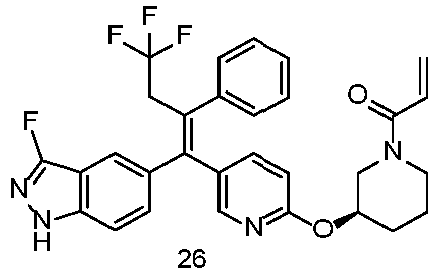
(R,Z)-1-(3-((5-(4,4,4-Trifluoro-1-(3-fluoro-1H-indazol-5-yl)-2-phenylbut-1-en-1-yl)p yridin-2-yl)oxy)piperidin-1-yl)prop-2-en-1-one 26 27 
(E)-N,N-Dimethyl-4-((S)-3-((5-((Z)-4,4,4-trifluoro-1-(3-fluoro-1H-indazol-5-yl)-2-ph enylbut-1-en-1-yl)pyridin-2-yl)oxy)piperidin-1-yl)but-2-enamide 27 28 
(Z)-1-(4-((5-(4,4,4-Trifluoro-1-(3-fluoro-1H-indazol-5-yl)-2-phenylbut-1-en-1-yl)pyridin-2-yl)oxy)piperidin-1-yl)prop-2-en-1-one 28 29 
(E)-N,N-Dimethyl-4-((R)-3-((5-((Z)-4,4,4-trifluoro-1-(3-fluoro-1H-indazol-5-yl)-2-ph enylbut-1-en-1-yl)pyridin-2-yl)oxy)pyrrolidin-1-yl)but-2-enamide 29 30 
(E)-N,N-Dimethyl-4-((S)-3-((5-((Z)-4,4,4-trifluoro-1-(3-fluoro-1H-indazol-5-yl)-2-ph enylbut-1-en-1-yl)pyridin-2-yl)oxy)pyrrolidin-1-yl)but-2-enamide 30 31 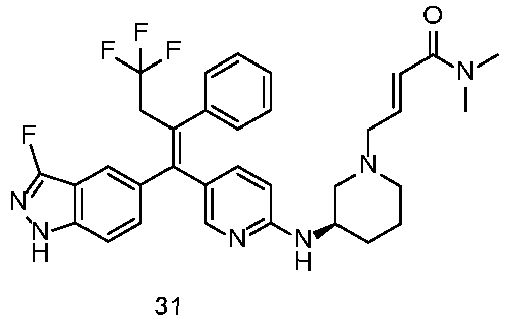
(E)-N,N-Dimethyl-4-((R)-3-((5-((Z)-4,4,4-trifluoro-1-(3-fluoro-1H-indazol-5-yl)-2-ph enylbut-1-en-1-yl)pyridin-2-yl)amino)piperidin-1-yl)but-2-enamide 31 32 
(E)-1-Morpholino-4-((R)-3-((5-((Z)-4,4,4-trifluoro-1-(3-fluoro-1H-indazol-5-yl)-2-ph enylbut-1-en-1-yl)pyridin-2-yl)amino)piperidin-1-yl)but-2-en-1-one 32 33 
(E)-N,N-Dimethyl-4-(4-((5-((Z)-4,4,4-trifluoro-1-(3-fluoro-1H-indazol-5-yl)-2-phenyl but-1-en-1-yl)pyridin-2-yl)amino)piperidin-1-yl)but-2-enamide 33 34 
(E)-Dimethyl-4-(((R)-1-(5-((Z)-4,4,4-trifluoro-1-(3-fluoro-1H-indazol-5-yl)-2-ph enylbut-1-en-1-yl)pyridin-2-yl)pyrrolidin-3-yl)amino)but-2-enamide 34 35 
(E)-N,N-Dimethyl-4-(((S)-1-(5-((Z)-4,4,4-trifluoro-1-(3-fluoro-1H-indazol-5-yl)-2-ph enylbut-1-en-1-yl)pyridin-2-yl)pyrrolidin-3-yl)amino)but-2-enamide 35 36 
(E)-N,N-Dimethyl-4-((1-(5-((Z)-4,4,4-trifluoro-1-(3-fluoro-1H-indazol-5-yl)-2-phenyl but-1-en-1-yl)pyridin-2-yl)piperidin-4-yl)amino)but-2-enamide 36 37 
(E)-N,N-Dimethyl-4-(methyl((S)-1-(5-((Z)-4,4,4-trifluoro-1-(3-fluoro-1H-indazol-5-yl )-2-phenylbut-1-en-1-yl)pyridin-2-yl)piperidin-3-yl)amino)but-2-enamide 37 38 
(E)-1-Morpholino-4-(((S)-1-(5-((Z)-4,4,4-trifluoro-1-(3-fluoro-1H-indazol-5-yl)-2-ph enylbut-1-en-1-yl)pyridin-2-yl)piperidin-3-yl)amino)but-2-en-1-one 38 39 
(E)-N,N-Dimethyl-4-((1-(((5-((Z)-4,4,4-trifluoro-1-(3-fluoro-1H-indazol-5-yl)-2-phen ylbut-1-en-1-yl)pyridin-2-yl)oxy)methyl)cyclopropyl)amino)but-2-enamide 39 40 
(E)-1-(3-Hydroxyazetidin-1-yl)-4-((1-(((5-((Z)-4,4,4-trifluoro-1-(3-fluoro-1H-indazol -5-yl)-2-phenylbut-1-en-1-yl)pyridin-2-yl)oxy)methyl)cyclopropyl)amino)but-2-en-1-one 40 41 
(E)-1-((S)-3-Hydroxypyrrolidin-1-yl)-4-((1-(((5-((Z)-4,4,4-trifluoro-1-(3-fluoro-1H-in dazol-5-yl)-2-phenylbut-1-en-1-yl)pyridin-2-yl)oxy)methyl)cyclopropyl)amino)but-2-en-1-one 41 42 
(E)-1-((R)-2-(Hydroxymethyl)morpholino)-4-((1-(((5-((Z)-4,4,4-trifluoro-1-(3-fluoro-1H-indazol-5-yl)-2-phenylbut-1-en-1-yl)pyridin-2-yl)oxy)methyl)cyclopropyl)amino) but-2-en-1-one 42 - or a tautomer, mesomer, racemate, enantiomer, diastereomer thereof, or mixture thereof,
- or a pharmaceutically acceptable salt thereof.
- In another aspect, the present disclosure provides a compound of formula (IA) or a tautomer, mesomer, racemate, enantiomer, diastereomer thereof, or mixture thereof, or a pharmaceutically acceptable salt thereof,

- which is an intermediate for synthesizing the compound of formula (I),
- wherein:
- Rw is an amino protecting group, and preferably tetrahydropyranyl;
- R is selected from the group consisting of -CH2CH=CHC(O)NR8R9, -C(O)CH=CR10R11 and -C(O)C≡CR12;
- R8 and R9 are identical or different and are each independently selected from the group consisting of hydrogen atom, alkyl, haloalkyl, hydroxyalkyl, cycloalkyl, heterocyclyl, aryl and heteroaryl;
- or, R8 and R9 together with the nitrogen atom to which they are attached form a heterocyclyl, wherein the heterocyclyl optionally contains one to two identical or different heteroatoms selected from the group consisting of N, O and S in addition to one nitrogen atom, and the heterocyclyl is optionally substituted by one or more substituents selected from the group consisting of alkyl, alkoxy, halogen, amino, cyano, nitro, hydroxy, hydroxyalkyl, -COOR16-, cycloalkyl, heterocyclyl, aryl and heteroaryl;
- R10 and R11 are identical or different and are each independently selected from the group consisting of hydrogen atom, halogen, alkyl, haloalkyl, alkoxy, cyano, amino, nitro, carboxy, formyl, hydroxy, hydroxyalkyl, cycloalkyl, heterocyclyl, aryl and heteroaryl;
- R12 is selected from the group consisting of hydrogen atom, alkyl, haloalkyl, hydroxyalkyl, cycloalkyl, heterocyclyl, aryl and heteroaryl;
- R16 is selected from the group consisting of hydrogen atom, alkyl, haloalkyl and hydroxyalkyl;
- ring A, G, Z, R1, R2, R3, R4, Rb, n, m, s and q are as defined in formula (I).
- In another aspect, the present disclosure provides a compound of formula (IIA) or a tautomer, mesomer, racemate, enantiomer, diastereomer thereof, or mixture thereof, or a pharmaceutically acceptable salt thereof,
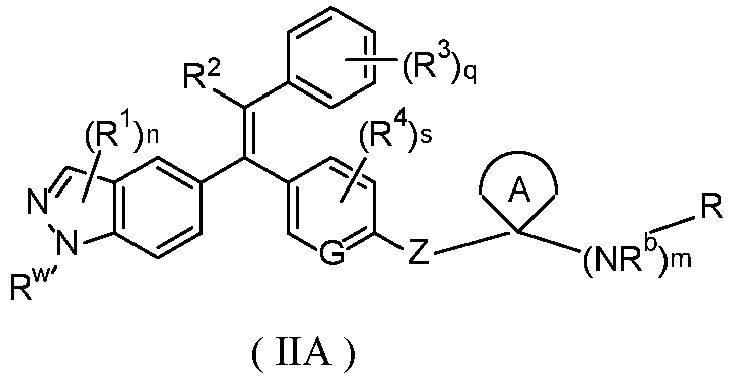
- which is an intermediate for synthesizing the compound of formula (II),
- wherein:
- Rw is an amino protecting group, and preferably tetrahydropyranyl;
- R is as defined in formula (IA);
- ring A, G, Z, R1, R2, R3, R4, Rb, n, m, s and q are as defined in formula (II).
- In another aspect, the present disclosure provides a compound of formula (IIIA) or a tautomer, mesomer, racemate, enantiomer, diastereomer thereof, or mixture thereof, or a pharmaceutically acceptable salt thereof,

- which is an intermediate for synthesizing the compound of formula (III),
- wherein:
- Rw is an amino protecting group, and preferably tetrahydropyranyl;
- R is as defined in formula (IA);
- G, Z, R1, R2, R3, R4, Rb, n, s and q are as defined in formula (III).
- In another aspect, the present disclosure provides a compound of formula (IVA) or a tautomer, mesomer, racemate, enantiomer, diastereomer thereof, or mixture thereof, or a pharmaceutically acceptable salt thereof,

- which is an intermediate for synthesizing the compound of formula (IV),
- wherein:
- Rw is an amino protecting group, and preferably tetrahydropyranyl;
- G, Z, R1, R2, R3, R4, Rb, R8, R9, n, s and q are as defined in formula (IV).
- Typical compounds of formula (IA) include, but are not limited to:
Example No. Structure and name of the compound 1i 
(E)-1-Morpholino-4-((1-(((5-((Z)-4,4,4-trifluoro-1-(3-fluoro-1-(tetrahydro-2H-pyran-2-yl)-1H-indazol-5-yl)-2-phenylbut-1-en-1-yl)pyridin-2-yl)oxy)methyl)cyclopropyl)a mino)but-2-en-1-one 1i 2b 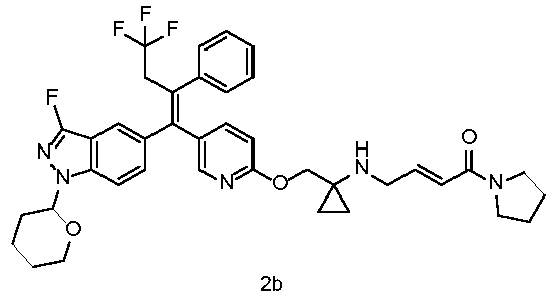
(E)-1-(Pyrrolidin-1-yl)-4-((1-(((5-((Z)-4,4,4-trifluoro-1-(3-fluoro-1-(tetrahydro-2H-py ran-2-yl)-1H-indazol-5-yl)-2-phenylbut-1-en-1-yl)pyridin-2-yl)oxy)methyl)cycloprop yl)amino)but-2-en-1-one 2b 3b 
(E)-1-(Piperidin-1-yl)-4-((1-(((5-((Z)-4,4,4-trifluoro-1-(3-fluoro-1-(tetrahydro-2H-pyr an-2-yl)-1H-indazol-5-yl)-2-phenylbut-1-en-1-yl)pyridin-2-yl)oxy)methyl)cyclopropy l)amino)but-2-en-1-one 3b 4b 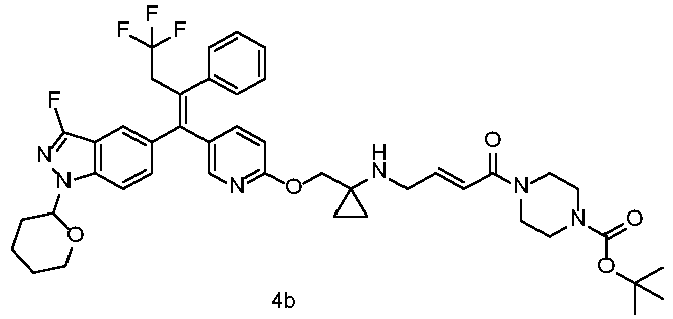
Tert-butyl 4-((E)-4-((1-(((5-((Z)-4,4,4-trifluoro-1-(3-fluoro-1-(tetrahydro-2H-pyran-2-yl)-1H-ind azol-5-yl)-2-phenylbut-1-en-1-yl)pyridin-2-yl)oxy)methyl)cyclopropyl)amino)but-2-e noyl)piperazine-1-carboxylate 4b 5e 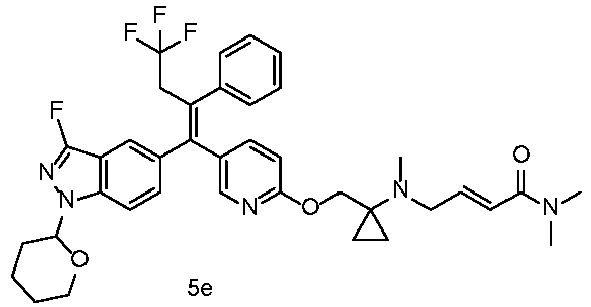
(E)-N,N-Dimethyl-4-(methyl(1-(((5-((Z)-4,4,4-trifluoro-1-(3-fluoro-1-(tetrahydro-2H-pyran-2-yl)-1H-indazol-5-yl)-2-phenylbut-1-en-1-yl)pyridin-2-yl)oxy)methyl)cyclopr opyl)amino)but-2-enamide 5e 6d 
(E)-4-(Ethyl(1-(((5-((Z)-4,4,4-trifluoro-1-(3-fluoro-1-(tetrahydro-2H-pyran-2-yl)-1H-i ndazol-5-yl)-2-phenylbut-1-en-1-yl)pyridin-2-yl)oxy)methyl)cyclopropyl)amino)-N,N -dimethylbut-2-enamide 6d 7d 
(E)-N,N-Dimethyl-4-((1-(((5-((Z)-4,4,4-trifluoro-1-(3-fluoro-1-(tetrahydro-2H-pyran-2-yl)-1H-indazol-5-yl)-2-phenylbut-1-en-1-yl)pyridin-2-yl)oxy)methyl)cyclopentyl)a mino)but-2-enamide 7d 8d 
(E)-N,N-Dimethyl-4-((1-(((5-((Z)-4,4,4-trifluoro-1-(3-fluoro-1-(tetrahydro-2H-pyran-2-yl)-1H-indazol-5-yl)-2-phenylbut-1-en-1-yl)pyridin-2-yl)oxy)methyl)cyclohexyl)a mino)but-2-enamide 8d 9e 
(E)-N,N-Dimethyl-4-(4-((5-((Z)-4,4,4-trifluoro-1-(3-fluoro-1-(tetrahydro-2H-pyran-2-yl)-1H-indazol-5-yl)-2-phenylbut-1-en-1-yl)pyridin-2-yl)oxy)piperidin-1-yl)but-2-ena mide 9e 10b 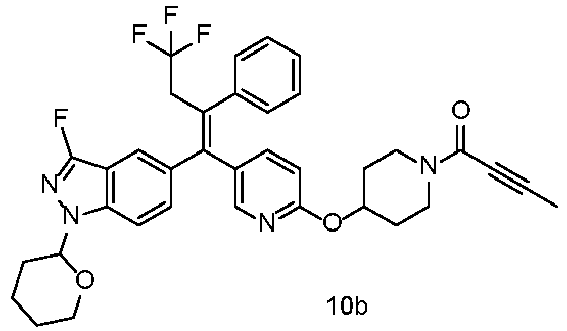
(Z)-1-(4-((5-(4,4,4-Trifluoro-1-(3-fluoro-1-(tetrahydro-2H-pyran-2-yl)-1H-indazol-5-yl)-2-phenylbut-1-en-1-yl)pyridin-2-yl)oxy)piperidin-1-yl)but-2-yn-1-one 10b 11g 
(E)-N-Methyl-4-((3R)-3-((5-((Z)-4,4,4-trifluoro-1-(3-fluoro-1-(tetrahydro-2H-pyran-2 -yl)-1H-indazol-5-yl)-2-phenylbut-1-en-1-yl)pyridin-2-yl)oxy)piperidin-1-yl)but-2-en amide 11g 12a 
(E)-1-Morpholino-4-((3R)-3-((5 -((Z)-4,4,4-trifluoro-1-(3-fluoro-1-(tetrahydro-2H-pyr an-2-yl)-1H-indazol-5-yl)-2-phenylbut-1-en-1-yl)pyridin-2-yl)oxy)piperidin-1-yl)but-2-en-1-one 12a 13b 
(E)-N-(Tetrahydro-2H-pyran-4-yl)-4-((3R)-3-((5-((Z)-4,4,4-trifluoro-1-(3-fluoro-1-(tet rahydro-2H-pyran-2-yl)-1H-indazol-5-yl)-2-phenylbut-1-en-1-yl)pyridin-2-yl)oxy)pip eridin-1-yl)but-2-enamide 13b 14a 
(E)-N,N-Dimethyl-4-((3R)-3-((5-((Z)-4,4,4-trifluoro-1-(3-fluoro-1-(tetrahydro-2H-pyr an-2-yl)-1H-indazol-5-yl)-2-phenylbut-1-en-1-yl)pyridin-2-yl)oxy)piperidin-1-yl)but-2-enamide 14a 15a 
(E)-1-(Pyrrolidin-1-yl)-4-((3R)-3-((5-((Z)-4,4,4-trifluoro-1-(3-fluoro-1-(tetrahydro-2 H-pyran-2-yl)-1H-indazol-5-yl)-2-phenylbut-1-en-1-yl)pyridin-2-yl)oxy)piperidin-1-yl)but-2-en-1-one 15a 16b 
(E)-N-(Tert-butyl)-4-((3R)-3-((5-((Z)-4,4,4-trifluoro-1-(3-fluoro-1-(tetrahydro-2H-pyr an-2-yl)-1H-indazol-5-yl)-2-phenylbut-1-en-1-yl)pyridin-2-yl)oxy)piperidin-1-yl)but-2-enamide 16b 17b 
(E)-N-Cyclopentyl-4-((3R)-3-((5-((Z)-4,4,4-trifluoro-1-(3-fluoro-1-(tetrahydro-2H-py ran-2-yl)-1H-indazol-5-yl)-2-phenylbut-1-en-1-yl)pyridin-2-yl)oxy)piperidin-1-yl)but -2-enamide 17b 18a 
Tert-butyl 4-((E)-4-((3R)-3-((5-((Z)-4,4,4-trifluoro-1-(3-fluoro-1-(tetrahydro-2H-pyran-2-yl)-1H -indazol-5-yl)-2-phenylbut-1-en-1-yl)pyridin-2-yl)oxy)piperidin-1-yl)but-2-enoyl)pip erazine-1-carboxylate 18a 19d 
(E)-N,N-Dimethyl-4-((3R)-3-((5-((Z)-4,4,4-trifluoro-1-(3-fluoro-1-(tetrahydro-2H-pyr an-2-yl)-1H-indazol-5-yl)-2-(4-fluorophenyl)but-1-en-1-yl)pyridin-2-yl)oxy)piperidin-1-yl)but-2-enamide 19d 20b 
(E)-4-((3R)-3-((5-((Z)-2-(4-Acetamidophenyl)-4,4,4-trifluoro-1-(3-fluoro-1-(tetrahydr o-2H-pyran-2-yl)-1H-indazol-5-yl)but-1-en-1-yl)pyridin-2-yl)oxy)piperidin-1-yl)-N,N -dimethylbut-2-enamide 20b 21b 
4-((Z)-1-(6-(((R)-1-((E)-4-(Dimethylamino)-4-oxobut-2-en-1-yl)piperidin-3-yl)oxy)p yridin-3-yl)-4,4,4-trifluoro-1-(3-fluoro-1-(tetrahydro-2H-pyran-2-yl)-1H-indazol-5-yl )but-1-en-2-yl)-N-methylbenzamide 21b 22b 
(E)-N,N-Dimethyl-4-((3R)-3-((5-((Z)-4,4,4-trifluoro-1-(3-fluoro-1-(tetrahydro-2H-pyr an-2-yl)-1H-indazol-5-yl)-2-(4-(trifluoromethyl)phenyl)but-1-en-1-yl)pyridin-2-yl)ox y)piperidin-1-yl)but-2-enamide 22b 23b 
(E)-N,N-Dimethyl-4-((3R)-3-((5-((Z)-4,4,4-trifluoro-1-(3-fluoro-1-(tetrahydro-2H-pyr an-2-yl)-1H-indazol-5-yl)-2-(4-(methylsulfonyl)phenyl)but-1-en-1-yl)pyridin-2-yl)ox y)piperidin-1-yl)but-2-enamide 23b 24b 
(E)-4-((3R)-3-((5-((Z)-2-(4-Cyanophenyl)-4,4,4-trifluoro-1-(3-fluoro-1-(tetrahydro-2 H-pyran-2-yl)-1H-indazol-5-yl)but-1-en-1-yl)pyridin-2-yl)oxy)piperidin-1-yl)-N,N-di methylbut-2-enamide 24b 25a 
1-((3R)-3-((5-((Z)-4,4,4-Trifluoro-1-(3-fluoro-1-(tetrahydro-2H-pyran-2-yl)-1H-indaz ol-5-yl)-2-phenylbut-1-en-1-yl)pyridin-2-yl)oxy)piperidin-1-yl)but-2-yn-1-one 25a 26b 
1-((3R)-3-((5-((Z)-4,4,4-Trifluoro-1-(3-fluoro-1-(tetrahydro-2H-pyran-2-yl)-1H-indaz ol-5-yl)-2-phenylbut-1-en-1-yl)pyridin-2-yl)oxy)piperidin-1-yl)prop-2-en-1-one 26b 27e 
(E)-N,N-Dimethyl-4-((3S)-3-((5-((Z)-4,4,4-trifluoro-1-(3-fluoro-1-(tetrahydro-2H-pyr an-2-yl)-1H-indazol-5-yl)-2-phenylbut-1-en-1-yl)pyridin-2-yl)oxy)piperidin-1-yl)but-2-enamide 27e 28a 
(Z)-1-(4-((5-(4,4,4-Trifluoro-1-(3-fluoro-1-(tetrahydro-2H-pyran-2-yl)-1H-indazol-5-yl)-2-phenylbut-1-en-1-yl)pyridin-2-yl)oxy)piperidin-1-yl)prop-2-en-1-one 28a 29e 
(E)-N,N-Dimethyl-4-((3R)-3-((5-((Z)-4,4,4-trifluoro-1-(3-fluoro-1-(tetrahydro-2H-pyr an-2-yl)-1H-indazol-5-yl)-2-phenylbut-1-en-1-yl)pyridin-2-yl)oxy)pyrrolidin-1-yl)but -2-enamide 29e 30e 
(E)-N,N-Dimethyl-4-((3S)-3-((5-((Z)-4,4,4-trifluoro-1-(3-fluoro-1-(tetrahydro-2H-pyr an-2-yl)-1H-indazol-5-yl)-2-phenylbut-1-en-1-yl)pyridin-2-yl)oxy)pyrrolidin-1-yl)but -2-enamide 30e 33e 
(E)-N,N-Dimethyl-4-(4-((5-((Z)-4,4,4-trifluoro-1-(3-fluoro-1-(tetrahydro-2H-pyran-2-yl)-1H-indazol-5-yl)-2-phenylbut-1-en-1-yl)pyridin-2-yl)amino)piperidin-1-yl)but-2-enamide 33e 34e 
(E)-N,N-Dimethyl-4-(((3R)-1-(5-((Z)-4,4,4-trifluoro-1-(3-fluoro-1-(tetrahydro-2H-pyr an-2-yl)-1H-indazol-5-yl)-2-phenylbut-1-en-1-yl)pyridin-2-yl)pyrrolidin-3-yl)amino) but-2-enamide 34e 35e 
(E)-N,N-Dimethyl-4-(((3S)-1-(5-((Z)-4,4,4-trifluoro-1-(3-fluoro-1-(tetrahydro-2H-pyr an-2-yl)-1H-indazol-5-yl)-2-phenylbut-1-en-1-yl)pyridin-2-yl)pyrrolidin-3-yl)amino) but-2-enamide 35e 36e 
(E)-N,N-Dimethyl-4-((1-(5-((Z)-4,4,4-trifluoro-1-(3-fluoro-1-(tetrahydro-2H-pyran-2-yl)-1H-indazol-5-yl)-2-phenylbut-1-en-1-yl)pyridin-2-yl)piperidin-4-yl)amino)but-2-enamide 36e 37f 
(E)-N,N-Dimethyl-4-(methyl((3S)-1-(5-((Z)-4,4,4-trifluoro-1-(3-fluoro-1-(tetrahydro-2H-pyran-2-yl)-1H-indazol-5-yl)-2-phenylbut-1-en-1-yl)pyridin-2-yl)piperidin-3-yl)a mino)but-2-enamide 37f 38c 
(E)-1-Morpholino-4-(((3S)-1-(5-((Z)-4,4,4-trifluoro-1-(3-fluoro-1-(tetrahydro-2H-pyr an-2-yl)-1H-indazol-5-yl)-2-phenylbut-1-en-1-yl)pyridin-2-yl)piperidin-3-yl)amino)b ut-2-en-1-one 38c 39a 
(E)-N,N-Dimethyl-4-((1-(((5-((Z)-4,4,4-trifluoro-1-(3-fluoro-1-(tetrahydro-2H-pyran-2-yl)-1H-indazol-5-yl)-2-phenylbut-1-en-1-yl)pyridin-2-yl)oxy)methyl)cyclopropyl)a mino)but-2-enamide 39a 40b 
(E)-1-(3-Hydroxyazetidin-1-yl)-4-((1-(((5-((Z)-4,4,4-trifluoro-1-(3-fluoro-1-(tetrahyd ro-2H-pyran-2-yl)-1H-indazol-5-yl)-2-phenylbut-1-en-1-yl)pyridin-2-yl)oxy)methyl)c yclopropyl)amino)but-2-en-1-one 40b 41b 
(E)-1-((S)-3-Hydroxypyrrolidin-1-yl)-4-((1-(((5-((Z)-4,4,4-trifluoro-1-(3-fluoro-1-(tet rahydro-2H-pyran-2-yl)-1H-indazol-5-yl)-2-phenylbut-1-en-1-yl)pyridin-2-yl)oxy)me thyl)cyclopropyl)amino)but-2-en-1-one 41b 42b 
(E)-1-((R)-2-(Hydroxymethyl)morpholino)-4-((1-(((5-((Z)-4,4,4-trifluoro-1-(3-fluoro-1-(tetrahydro-2H-pyran-2-yl)-1H-indazol-5-yl)-2-phenylbut-1-en-1-yl)pyridin-2-yl)o xy)methyl)cyclopropyl)amino)but-2-en-1-one 42b - or a tautomer, mesomer, racemate, enantiomer, diastereomer thereof, or mixture thereof,
- or a pharmaceutically acceptable salt thereof.
- In another aspect, the present disclosure provides a method for preparing the compound of formula (I) or the tautomer, mesomer, racemate, enantiomer, diastereomer thereof, or mixture thereof, or the pharmaceutically acceptable salt thereof, comprising a step of:

- subjecting the compound of formula (IA) or the tautomer, mesomer, racemate, enantiomer, diastereomer thereof, or mixture thereof, or the pharmaceutically acceptable salt thereof to a deprotection reaction under an acidic condition to obtain the compound of formula (I) or the tautomer, mesomer, racemate, enantiomer, diastereomer thereof, or mixture thereof, or the pharmaceutically acceptable salt thereof;
- wherein:
- Rw is an amino protecting group, and preferably tetrahydropyranyl or tert-butoxycarbonyl;
- R is as defined in formula (IA);
- ring A, G, Z, R1, R2, R3, R4, Ra , Rb, n, m, s and q are as defined in formula (I).
- In another aspect, the present disclosure provides a method for preparing the compound of formula (II) or the tautomer, mesomer, racemate, enantiomer, diastereomer thereof, or mixture thereof, or the pharmaceutically acceptable salt thereof, comprising a step of:

- subjecting the compound of formula (IIA) or the tautomer, mesomer, racemate, enantiomer, diastereomer thereof, or mixture thereof, or the pharmaceutically acceptable salt thereof to a deprotection reaction under an acidic condition to obtain the compound of formula (II) or the tautomer, mesomer, racemate, enantiomer, diastereomer thereof, or mixture thereof, or the pharmaceutically acceptable salt thereof;
- wherein:
- Rw is an amino protecting group, and preferably tetrahydropyranyl or tert-butoxycarbonyl;
- R is as defined in formula (IIA);
- ring A, G, Z, R1, R2, R3, R4, Ra , Rb, n, m, s and q are as defined in formula (II).
- In another aspect, the present disclosure provides a method for preparing the compound of formula (III) or the tautomer, mesomer, racemate, enantiomer, diastereomer thereof, or mixture thereof, or the pharmaceutically acceptable salt thereof, comprising a step of:
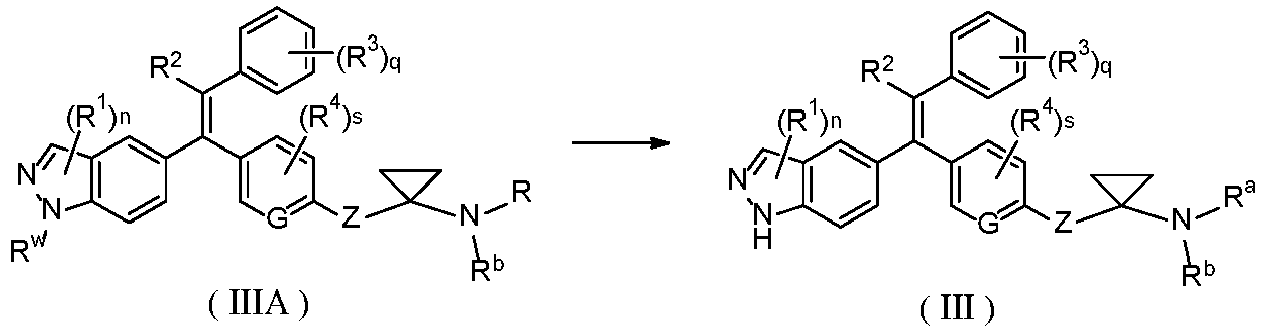
- subjecting the compound of formula (IIIA) or the tautomer, mesomer, racemate, enantiomer, diastereomer thereof, or mixture thereof, or the pharmaceutically acceptable salt thereof to a deprotection reaction under an acidic condition to obtain the compound of formula (III) or the tautomer, mesomer, racemate, enantiomer, diastereomer thereof, or mixture thereof, or the pharmaceutically acceptable salt thereof;
- wherein:
- Rw is an amino protecting group, and preferably tetrahydropyranyl or tert-butoxycarbonyl;
- R is as defined in formula (IIIA);
- G, Z, R1, R2, R3, R4, Ra, Rb, n, s and q are as defined in formula (III).
- In another aspect, the present disclosure provides a method for preparing the compound of formula (IV) or the tautomer, mesomer, racemate, enantiomer, diastereomer thereof, or mixture thereof, or the pharmaceutically acceptable salt thereof, comprising a step of:

- subjecting the compound of formula (IVA) or the tautomer, mesomer, racemate, enantiomer, diastereomer thereof, or mixture thereof, or the pharmaceutically acceptable salt thereof to a deprotection reaction under an acidic condition to obtain the compound of formula (IV) or the tautomer, mesomer, racemate, enantiomer, diastereomer thereof, or mixture thereof, or the pharmaceutically acceptable salt thereof;
- wherein:
- Rw is an amino protecting group, and preferably tetrahydropyranyl or tert-butoxycarbonyl;
- G, Z, R1, R2, R3, R4, R8, R9, Rb, n, s and q are as defined in formula (IV).
- In another aspect, the present disclosure relates to a pharmaceutical composition comprising a therapeutically effective amount of the compound of formula (I) to (IV) as defined above or the tautomer, mesomer, racemate, enantiomer, diastereomer thereof, or mixture thereof, or the pharmaceutically acceptable salt thereof, and one or more pharmaceutically acceptable carriers, diluents or excipients. The present disclosure also relates to a method for preparing the pharmaceutical composition as defined above, comprising a step of mixing the compound of formula (I) to (IV), or the tautomer, mesomer, racemate, enantiomer, diastereomer thereof, or mixture thereof, or the pharmaceutically acceptable salt thereof with the pharmaceutically acceptable carriers, diluents or excipients.
- The present disclosure further relates to a use of the compound of formula (I) to (IV), or the tautomer, mesomer, racemate, enantiomer, diastereomer thereof, or mixture thereof, or the pharmaceutically acceptable salt thereof, or the pharmaceutical composition comprising the same in the preparation of an estrogen receptor modulator.
- The present disclosure further relates to a use of the compound of formula (I) to (IV), or the tautomer, mesomer, racemate, enantiomer, diastereomer thereof, or mixture thereof, or the pharmaceutically acceptable salt thereof, or the pharmaceutical composition comprising the same in the preparation of a medicament for preventing and/or treating estrogen receptor-mediated or estrogen receptor-dependent disease or disorder, wherein the estrogen receptor-mediated or estrogen receptor-dependent disease or disorder is preferably cancer, more preferably breast cancer, ovarian cancer, endometrial cancer, prostate cancer or uterine cancer, and further preferably breast cancer.
- The present disclosure further relates to the compound of formula (I) to (IV), or the tautomer, mesomer, racemate, enantiomer, diastereomer thereof, or mixture thereof, or the pharmaceutically acceptable salt thereof, for use as a medicament.
- The present disclosure further relates to the compound of formula (I) to (IV), or the tautomer, mesomer, racemate, enantiomer, diastereomer thereof, or mixture thereof, or the pharmaceutically acceptable salt thereof, for use as a medicament for treating estrogen receptor-mediated or estrogen receptor-dependent disease or disorder, wherein the estrogen receptor-mediated or estrogen receptor-dependent disease or disorder is preferably cancer, more preferably breast cancer, ovarian cancer, endometrial cancer, prostate cancer or uterine cancer, and further preferably breast cancer.
- The present disclosure further relates to a method for treating estrogen receptor-mediated or estrogen receptor-dependent disease or disorder, comprising a step of administering to a patient in need thereof a therapeutically effective amount of the compound of formula (I) to (IV) or the tautomer, mesomer, racemate, enantiomer, diastereomer thereof, or mixture thereof, or the pharmaceutically acceptable salt thereof of the present disclosure. This method shows outstanding efficacy and less side effects. The estrogen receptor-mediated or estrogen receptor-dependent disease or disorder is preferably cancer, more preferably breast cancer, ovarian cancer, endometrial cancer, prostate cancer or uterine cancer, and further preferably breast cancer.
- The active compound can be formulated into a form suitable for administration by any appropriate route, and the active compound is preferably in the form of a unit dose, or in a form in which the patient can self-administer in a single dose. The form of the unit dose of the compound or composition of the present invention can be tablet, capsule, cachet, bottled potion, powder, granule, lozenge, suppository, regenerating powder or liquid preparation.
- The dosage of the compound or composition used in the treatment method of the present invention will generally vary according to the severity of the disease, the weight of the patient, and the relative efficacy of the compound. However, as a general guide, a suitable unit dose can be 0.1 to 1000 mg.
- In addition to the active ingredients, the pharmaceutical composition of the present invention can further comprise one or more auxiliaries including filler (diluent), binder, wetting agent, disintegrant, excipient and the like. Depending on the administration mode, the composition can comprise 0.1 to 99% by weight of the active compound.
- The pharmaceutical composition containing the active ingredient can be in a form suitable for oral administration, for example, a tablet, troche, lozenge, aqueous or oily suspension, dispersible powder or granule, emulsion, hard or soft capsule, syrup or elixir. An oral composition can be prepared according to any known method in the art for the preparation of pharmaceutical composition. Such a composition can contain one or more ingredient(s) selected from the group consisting of sweeteners, flavoring agents, colorants and preservatives, in order to provide a pleasing and palatable pharmaceutical formulation. The tablet contains the active ingredient in admixture with nontoxic, pharmaceutically acceptable excipients suitable for the manufacture of tablets. These excipients can be inert excipients, granulating agents, disintegrants and lubricants. The tablet can be uncoated or coated by means of a known technique to mask drug taste or delay the disintegration and absorption of the active ingredient in the gastrointestinal tract, thereby providing a sustained release over a long period of time. For example, water soluble taste masking materials can be used. An oral formulation can also be provided as soft gelatin capsules in which the active ingredient is mixed with an inert solid diluent, or the active ingredient is mixed with a water-soluble carrier.
- An aqueous suspension comprises an active ingredient in admixture with excipients suitable for the manufacture of an aqueous suspension. Such excipients are suspending agents, dispersants or wetting agents. The active ingredient of the aqueous suspension can be dispersible powders or granules. The active ingredient is mixed with one or more dispersant(s), wetting agent(s) or suspending agent(s) by adding water. The aqueous suspension can also comprise one or more preservative(s), one or more colorant(s), one or more flavoring agent(s), and one or more sweetener(s).
- An oil suspension can be formulated by suspending the active ingredient in a vegetable oil or mineral oil. The oil suspension can comprise a thickener. The aforementioned sweeteners and flavoring agents can be added to provide a palatable formulation. These compositions can be preserved by adding an antioxidant.
- The dispersible powders or granules suitable for the preparation of an aqueous suspension can provide the active ingredient in admixture with the dispersants or wetting agents, suspending agent or one or more preservatives by adding water. Suitable dispersants or wetting agents and suspending agents are exemplified by those already mentioned above. Additional excipients, such as sweeteners, flavoring agents and colorants, can also be added. These compositions can be preserved by adding an antioxidant, such as ascorbic acid.
- The pharmaceutical composition of the present disclosure can also be in the form of an oil-in-water emulsion. The oil phase can be a vegetable oil, or a mineral oil, or a mixture thereof. Suitable emulsifying agents can be naturally occurring phospholipids. A sweetening agent can be used. Such formulations can also contain a demulcent, a preservative, a coloring agent and an antioxidant.
- The pharmaceutical composition of the present disclosure can be in the form of a sterile injectable aqueous solution. Acceptable vehicles or solvents that can be used are water, Ringer's solution or isotonic sodium chloride solution. The sterile injectable formulation can be a sterile injectable oil-in-water micro-emulsion in which the active ingredient is dissolved in an oil phase. The injectable solution or micro-emulsion can be introduced into a patient's bloodstream by local bolus injection. Alternatively, the solution and micro-emulsion are preferably administered in a manner that maintains a constant circulating concentration of the compound of the present disclosure. In order to maintain this constant concentration, a continuous intravenous delivery device can be used. An example of such a device is Deltec CADD-PLUS. TM. 5400 intravenous injection pump.
- The pharmaceutical composition of the present disclosure can be in the form of a sterile injectable aqueous or oily suspension for intramuscular and subcutaneous administration. Such a suspension can be formulated with suitable dispersants or wetting agents and suspending agents as described above according to known techniques. The sterile injectable formulation can also be a sterile injectable solution or suspension prepared in a nontoxic parenterally acceptable diluent or solvent. Moreover, sterile fixed oils can easily be used as a solvent or suspending medium. In addition, fatty acids can also be used to prepare injections.
- The compound of the present disclosure can be administered in the form of a suppository for rectal administration. These pharmaceutical compositions can be prepared by mixing the drug with a suitable non-irritating excipient that is solid at ordinary temperatures, but liquid in the rectum, thereby melting in the rectum to release the drug.
- It is well known to those skilled in the art that the dosage of a drug depends on a variety of factors including, but not limited to the following factors: activity of a specific compound, age of the patient, weight of the patient, general health of the patient, behavior of the patient, diet of the patient, administration time, administration route, excretion rate, drug combination and the like. In addition, the optimal treatment, such as treatment mode, daily dose of the compound of formula (I) or the type of pharmaceutically acceptable salt thereof can be verified according to traditional therapeutic regimens.
- Unless otherwise stated, the terms used in the specification and claims have the meanings described below.
- The term "alkyl" refers to a saturated aliphatic hydrocarbon group, which is a straight or branched chain group comprising 1 to 20 carbon atoms, preferably an alkyl having 1 to 12 carbon atoms, and more preferably an alkyl having 1 to 6 carbon atoms. Non-limiting examples include methyl, ethyl, n-propyl, isopropyl, n-butyl, isobutyl, tert-butyl, sec-butyl, n-pentyl, 1,1-dimethylpropyl, 1,2-dimethylpropyl, 2,2-dimethylpropyl, 1-ethylpropyl, 2-methylbutyl, 3-methylbutyl, n-hexyl, 1-ethyl-2-methylpropyl, 1,1,2-trimethylpropyl, 1,1-dimethylbutyl, 1,2-dimethylbutyl, 2,2-dimethylbutyl, 1,3-dimethylbutyl, 2-ethylbutyl, 2-methylpentyl, 3-methylpentyl, 4-methylpentyl, 2,3-dimethylbutyl, n-heptyl, 2-methylhexyl, 3-methylhexyl, 4-methylhexyl, 5-methylhexyl, 2,3-dimethylpentyl, 2,4-dimethylpentyl, 2,2-dimethylpentyl, 3,3-dimethylpentyl, 2-ethylpentyl, 3-ethylpentyl, n-octyl, 2,3-dimethylhexyl, 2,4-dimethylhexyl, 2,5-dimethylhexyl, 2,2-dimethylhexyl, 3,3-dimethylhexyl, 4,4-dimethylhexyl, 2-ethylhexyl, 3-ethylhexyl, 4-ethylhexyl, 2-methyl-2-ethylpentyl, 2-methyl-3-ethylpentyl, n-nonyl, 2-methyl-2-ethylhexyl, 2-methyl-3-ethylhexyl, 2,2-diethylpentyl, n-decyl, 3,3-diethylhexyl, 2,2-diethylhexyl, and various branched isomers thereof. More preferably, the alkyl group is a lower alkyl having 1 to 6 carbon atoms, and non-limiting examples include methyl, ethyl, n-propyl, isopropyl, n-butyl, isobutyl, tert-butyl, sec-butyl, n-pentyl, 1,1-dimethylpropyl, 1,2-dimethylpropyl, 2,2-dimethylpropyl, 1-ethylpropyl, 2-methylbutyl, 3-methylbutyl, n-hexyl, 1-ethyl-2-methylpropyl, 1,1,2-trimethylpropyl, 1,1-dimethylbutyl, 1,2-dimethylbutyl, 2,2-dimethylbutyl, 1,3-dimethylbutyl, 2-ethylbutyl, 2-methylpentyl, 3-methylpentyl, 4-methylpentyl, 2,3-dimethylbutyl and the like. The alkyl can be substituted or unsubstituted. When substituted, the substituent group(s) can be substituted at any available connection point. The substituent group(s) is preferably one or more groups independently selected from the group consisting of alkyl, alkenyl, alkynyl, alkoxy, alkylthio, alkylamino, halogen, thiol, hydroxy, nitro, cyano, cycloalkyl, heterocyclyl, aryl, heteroaryl, cycloalkoxy, heterocycloalkoxy, cycloalkylthio, heterocyclylthio, oxo, carboxy and alkoxycarbonyl.
- The term "alkylene" refers to a saturated linear or branched aliphatic hydrocarbon group having two residues derived from the removal of two hydrogen atoms from the same carbon atom or two different carbon atoms of the parent alkane. It is a linear or branched alkylene having 1 to 20 carbon atoms, preferably 1 to 12 carbon atoms, and more preferably 1 to 6 carbon atoms. Non-limiting examples of alkylene include, but are not limited to, methylene (-CH2-), 1,1-ethylene (-CH(CH3)-), 1,2-ethylene (-CH2CH2)-, 1,1-propylene (-CH(CH2CH3)-), 1,2-propylene (-CH2CH(CH3)-), 1,3-propylene (-CH2CH2CH2-), 1,4-butylene (-CH2CH2CH2CH2-) and the like. The alkylene can be substituted or unsubstituted. When substituted, the substituent group(s) can be substituted at any available connection point. The substituent group(s) is preferably one or more groups independently optionally selected from the group consisting of alkyl, alkenyl, alkynyl, alkoxy, alkylthio, alkylamino, halogen, thiol, hydroxy, nitro, cyano, cycloalkyl, heterocyclyl, aryl, heteroaryl, cycloalkoxy, heterocycloalkoxy, cycloalkylthio, heterocyclylthio and oxo.
- The term "alkenyl" refers to an alkyl containing carbon-carbon double bond(s) in the molecule, wherein the definition of the alkyl is as described above. The alkenyl can be substituted or unsubstituted. When substituted, the substituent group(s) is preferably one or more groups independently selected from the group consisting of hydrogen atom, alkyl, alkoxy, halogen, haloalkyl, hydroxy, hydroxyalkyl, cyano, amino, nitro, cycloalkyl, heterocyclyl, aryl and heteroaryl.
- The term "alkynyl" refers to an alkyl containing carbon-carbon triple bond(s) in the molecule, wherein the definition of the alkyl is as described above. The alkynyl can be substituted or unsubstituted. When substituted, the substituent group(s) is preferably one or more groups independently selected from the group consisting of hydrogen atom, alkyl, alkoxy, halogen, haloalkyl, hydroxy, hydroxyalkyl, cyano, amino, nitro, cycloalkyl, heterocyclyl, aryl and heteroaryl.
- The term "alkoxy" refers to an -O-(alkyl) or an -O-(unsubstituted cycloalkyl) group, wherein the alkyl is as defined above. Non-limiting examples of alkoxy include methoxy, ethoxy, propoxy, butoxy, cyclopropyloxy, cyclobutyloxy, cyclopentyloxy, cyclohexyloxy. The alkoxy can be optionally substituted or unsubstituted. When substituted, the substituent group(s) is preferably one or more groups independently selected from the group consisting of alkyl, alkenyl, alkynyl, alkoxy, alkylthio, alkylamino, halogen, thiol, hydroxy, nitro, cyano, cycloalkyl, heterocyclyl, aryl, heteroaryl, cycloalkoxy, heterocycloalkoxy, cycloalkylthio, heterocyclylthio, carboxy and alkoxycarbonyl.
- The term "cycloalkyl" refers to a saturated or partially unsaturated monocyclic or polycyclic hydrocarbon substituent group having 3 to 20 carbon atoms, preferably 3 to 12 carbon atoms (for example 3, 4, 5, 6, 7, 8, 9, 10, 11, 12 carbon atoms), and more preferably 3 to 6 carbon atoms. Non-limiting examples of monocyclic cycloalkyl include cyclopropyl, cyclobutyl, cyclopentyl, cyclopentenyl, cyclohexyl, cyclohexenyl, cyclohexadienyl, cycloheptyl, cycloheptatrienyl, cyclooctyl and the like. Polycyclic cycloalkyl includes a cycloalkyl having a spiro ring, fused ring or bridged ring.
- The term "spiro cycloalkyl" refers to a 5 to 20 membered polycyclic group with individual rings connected through one shared carbon atom (called a spiro atom), wherein the rings can contain one or more double bonds, but none of the rings has a completely conjugated π-electron system. The spiro cycloalkyl is preferably a 6 to 14 membered spiro cycloalkyl (for example 6, 7, 8, 9, 10, 11, 12, 13, 14 membered spiro cycloalkyl), and more preferably a 7 to 10 membered spiro cycloalkyl. According to the number of the spiro atoms shared between the rings, the spiro cycloalkyl can be divided into a mono-spiro cycloalkyl, di-spiro cycloalkyl, or poly-spiro cycloalkyl, and the spiro cycloalkyl is preferably a mono-spiro cycloalkyl or di-spiro cycloalkyl, and more preferably a 4-membered/4-membered, 4-membered/5-membered, 4-membered/6-membered, 5-membered/5-membered, or 5-membered/6-membered mono-spiro cycloalkyl. Non-limiting examples of spiro cycloalkyl include:

- The term "fused cycloalkyl" refers to a 5 to 20 membered all-carbon polycyclic group, wherein each ring in the system shares an adjacent pair of carbon atoms with another ring, one or more rings can contain one or more double bonds, but none of the rings has a completely conjugated π-electron system. The fused cycloalkyl is preferably a 6 to 14 membered fused cycloalkyl, and more preferably a 7 to 10 membered fused cycloalkyl (for example 7, 8, 9 or 10 membered fused cycloalkyl). According to the number of membered rings, the fused cycloalkyl can be divided into a bicyclic, tricyclic, tetracyclic or polycyclic fused cycloalkyl, and the fused cycloalkyl is preferably a bicyclic or tricyclic fused cycloalkyl, and more preferably a 5-membered/5-membered, or 5-membered/6-membered bicyclic fused cycloalkyl. Non-limiting examples of fused cycloalkyl include:

- The term "bridged cycloalkyl" refers to a 5 to 20 membered all-carbon polycyclic group, wherein every two rings in the system share two disconnected carbon atoms, the rings can have one or more double bonds, but none of the rings has a completely conjugated π-electron system. The bridged cycloalkyl is preferably a 6 to 14 membered bridged cycloalkyl, and more preferably a 7 to 10 membered bridged cycloalkyl (for example 7, 8, 9 or 10 membered bridged cycloalkyl). According to the number of membered rings, the bridged cycloalkyl can be divided into a bicyclic, tricyclic, tetracyclic or polycyclic bridged cycloalkyl, and the bridged cycloalkyl is preferably a bicyclic, tricyclic or tetracyclic bridged cycloalkyl, and more preferably a bicyclic or tricyclic bridged cycloalkyl. Non-limiting examples of bridged cycloalkyl include:


- The cycloalkyl (including cycloalkyl, spiro cycloalkyl, fused cycloalkyl and bridged cycloalkyl) ring can be fused to the ring of aryl, heteroaryl or heterocyclyl, wherein the ring bound to the parent structure is cycloalkyl. Non-limiting examples include indanyl, tetrahydronaphthyl, benzocycloheptyl and the like. The cycloalkyl can be optionally substituted or unsubstituted. When substituted, the substituent group(s) is preferably one or more groups independently selected from the group consisting of alkyl, alkenyl, alkynyl, alkoxy, alkylthio, alkylamino, halogen, thiol, hydroxy, nitro, cyano, cycloalkyl, heterocyclyl, aryl, heteroaryl, cycloalkoxy, heterocycloalkoxy, cycloalkylthio, heterocyclylthio, oxo, carboxy and alkoxycarbonyl.
- The term "heterocyclyl" refers to a 3 to 20 membered saturated or partially unsaturated monocyclic or polycyclic hydrocarbon substituent group, wherein one or more ring atoms are heteroatoms selected from the group consisting of N, O, S, S(O) and S(O)2, but excluding -O-O-, -O-S- or -S-S- in the ring, with the remaining ring atoms being carbon atoms. Preferably, the heterocyclyl has 3 to 12 ring atoms wherein 1 to 4 atoms (for example 1, 2, 3 or 4 atoms) are heteroatoms; more preferably, 3 to 6 ring atoms (for example 3, 4, 5 or 6 ring atoms). Non-limiting examples of monocyclic heterocyclyl include pyrrolidinyl, imidazolidinyl, tetrahydrofuranyl, tetrahydrothienyl, dihydroimidazolyl, dihydrofuranyl, dihydropyrazolyl, dihydropyrrolyl, piperidinyl, piperazinyl, morpholinyl, thiomorpholinyl, homopiperazinyl and the like, and preferably piperidinyl, pyrrolidinyl. Polycyclic heterocyclyl includes a heterocyclyl having a spiro ring, fused ring or bridged ring.
- The term "spiro heterocyclyl" refers to a 5 to 20 membered polycyclic heterocyclyl group with individual rings connected through one shared atom (called a spiro atom), wherein one or more ring atoms are heteroatoms selected from the group consisting of N, O, S, S(O) and S(O)2, with the remaining ring atoms being carbon atoms, where the rings can contain one or more double bonds, but none of the rings has a completely conjugated π-electron system. The spiro heterocyclyl is preferably a 6 to 14 membered spiro heterocyclyl, and more preferably a 7 to 10 membered spiro heterocyclyl (for example 7, 8, 9 or 10 membered spiro heterocyclyl). According to the number of the spiro atoms shared between the rings, the spiro heterocyclyl is divided into a mono-spiro heterocyclyl, di-spiro heterocyclyl, or poly-spiro heterocyclyl, and the spiro heterocyclyl is preferably a mono-spiro heterocyclyl or di-spiro heterocyclyl, and more preferably a 4-membered/4-membered, 4-membered/5-membered, 4-membered/6-membered, 5-membered/5-membered, or 5-membered/6-membered mono-spiro heterocyclyl. Non-limiting examples of spiro heterocyclyl include:

- The term "fused heterocyclyl" refers to a 5 to 20 membered polycyclic heterocyclyl group, wherein each ring in the system shares an adjacent pair of atoms with another ring, wherein one or more rings can contain one or more double bonds, but none of the rings has a completely conjugated π-electron system, and wherein one or more ring atoms are heteroatoms selected from the group consisting of N, O, S, S(O) and S(O)2, with the remaining ring atoms being carbon atoms. The fused heterocyclyl is preferably a 6 to 14 membered fused heterocyclyl, and more preferably a 7 to 10 membered fused heterocyclyl (for example 7, 8, 9 or 10 membered fused heterocyclyl). According to the number of membered rings, the fused heterocyclyl can be divided into a bicyclic, tricyclic, tetracyclic or polycyclic fused heterocyclyl, and the fused heterocyclyl is preferably a bicyclic or tricyclic fused heterocyclyl, and more preferably a 5-membered/5-membered or 5-membered/6-membered bicyclic fused heterocyclyl. Non-limiting examples of fused heterocyclyl include:


- The term "bridged heterocyclyl" refers to a 5 to 14 membered polycyclic heterocyclyl group, wherein every two rings in the system share two disconnected atoms, wherein the rings can have one or more double bonds, but none of the rings has a completely conjugated π-electron system, and wherein one or more ring atoms are heteroatoms selected from the group consisting of N, O, S, S(O) and S(O)2, with the remaining ring atoms being carbon atoms. The bridged heterocyclyl is preferably a 6 to 14 membered bridged heterocyclyl, and more preferably a 7 to 10 membered bridged heterocyclyl (for example 7, 8, 9 or 10 membered bridged heterocyclyl). According to the number of membered rings, the bridged heterocyclyl can be divided into a bicyclic, tricyclic, tetracyclic or polycyclic bridged heterocyclyl, and the bridged heterocyclyl is preferably a bicyclic, tricyclic or tetracyclic bridged heterocyclyl, and more preferably a bicyclic or tricyclic bridged heterocyclyl. Non-limiting examples of bridged heterocyclyl include:


- The heterocyclyl (including heterocyclyl, spiro heterocyclyl, fused heterocyclyl and bridged heterocyclyl) ring can be fused to the ring of aryl, heteroaryl or cycloalkyl, wherein the ring bound to the parent structure is heterocyclyl, and non-limiting examples thereof include:

- The heterocyclyl can be optionally substituted or unsubstituted. When substituted, the substituent group(s) is preferably one or more groups independently selected from the group consisting of alkyl, alkenyl, alkynyl, alkoxy, alkylthio, alkylamino, halogen, thiol, hydroxy, nitro, cyano, cycloalkyl, heterocyclyl, aryl, heteroaryl, cycloalkoxy, heterocycloalkoxy, cycloalkylthio, heterocyclylthio, oxo, carboxy and alkoxycarbonyl.
- The term "aryl" refers to a 6 to 14 membered all-carbon monocyclic ring or polycyclic fused ring (i.e. each ring in the system shares an adjacent pair of carbon atoms with another ring in the system) having a conjugated π-electron system, preferably a 6 to 10 membered aryl, for example, phenyl and naphthyl. The aryl ring can be fused to the ring of heteroaryl, heterocyclyl or cycloalkyl, wherein the ring bound to the parent structure is aryl ring, and non-limiting examples thereof include:



- The aryl can be substituted or unsubstituted. When substituted, the substituent group(s) is preferably one or more groups independently selected from the group consisting of alkyl, alkenyl, alkynyl, alkoxy, alkylthio, alkylamino, halogen, thiol, hydroxy, nitro, cyano, cycloalkyl, heterocyclyl, aryl, heteroaryl, cycloalkoxy, heterocycloalkoxy, cycloalkylthio, heterocyclylthio, carboxy and alkoxycarbonyl, and preferably phenyl.
- The term "heteroaryl" refers to a 5 to 14 membered heteroaromatic system having 1 to 4 heteroatoms selected from the group consisting of O, S and N. The heteroaryl is preferably a 5 to 10 membered heteroaryl (for example 5, 6, 7, 8, 9 or 10 membered heteroaryl), more preferably a 5 or 6 membered heteroaryl, for example, imidazolyl, furyl, thienyl, thiazolyl, pyrazolyl, oxazolyl, pyrrolyl, tetrazolyl, pyridyl, pyrimidinyl, thiadiazolyl, pyrazinyl and the like, preferably imidazolyl, pyrazolyl, pyrimidinyl or thiazolyl, and more preferably pyrazolyl or thiazolyl. The heteroaryl ring can be fused to the ring of aryl, heterocyclyl or cycloalkyl, wherein the ring bound to the parent structure is heteroaryl ring, and non-limiting examples thereof include:


- The heteroaryl can be optionally substituted or unsubstituted. When substituted, the substituent group(s) is preferably one or more groups independently selected from the group consisting of alkyl, alkenyl, alkynyl, alkoxy, alkylthio, alkylamino, halogen, thiol, hydroxy, nitro, cyano, cycloalkyl, heterocyclyl, aryl, heteroaryl, cycloalkoxy, heterocycloalkoxy, cycloalkylthio, heterocyclylthio, carboxy and alkoxycarbonyl.
- The term "hydroxyalkyl" refers to an alkyl group substituted by hydroxy(s), wherein the alkyl is as defined above.
- The term "haloalkyl" refers to an alkyl group substituted by halogen(s), wherein the alkyl is as defined above.
- The term "deuterated alkyl" refers to an alkyl group substituted by deuterium atom(s), wherein the alkyl is as defined above.
- The term "hydroxy" refers to an -OH group.
- The term "halogen" refers to fluorine, chlorine, bromine or iodine.
- The term "amino" refers to a -NH2 group.
- The term "cyano" refers to a -CN group.
- The term "nitro" refers to a -NO2 group.
- The term "carboxy" refers to a -C(O)OH group.
- The term "formyl" refers to a -CHO group.
- The term "alkoxycarbonyl" refers to a -C(O)O(alkyl) or -C(O)O(cycloalkyl) group, wherein the alkyl and cycloalkyl are as defined above.
- The term "acyl halide" refers to a compound containing a -C(O)-halogen group.
- "Optional" or "optionally" means that the event or circumstance described subsequently can, but need not, occur, and such a description includes the situation in which the event or circumstance does or does not occur. For example, "the heterocyclyl optionally substituted by alkyl" means that an alkyl group can be, but need not be, present, and such a description includes the situation of the heterocyclyl being substituted by alkyl and the heterocyclyl being not substituted by alkyl.
- "Substituted" refers to one or more hydrogen atoms in a group, preferably up to 5, and more preferably 1 to 3 hydrogen atoms, independently substituted by corresponding number of substituents. It goes without saying that the substituents only exist in their possible chemical position. The person skilled in the art is able to determine whether the substitution is possible or impossible by experiments or theory without excessive effort. For example, the combination of amino or hydroxy having free hydrogen and carbon atoms having unsaturated bonds (such as olefinic) may be unstable.
- The term "pharmaceutical composition" refers to a mixture of one or more of the compounds described herein or physiologically/pharmaceutically acceptable salts or prodrugs thereof with other chemical components, and other components such as physiologically/pharmaceutically acceptable carriers and excipients. The purpose of the pharmaceutical composition is to facilitate administration of a compound to an organism, which is conducive to the absorption of the active ingredient so as to show biological activity.
- A "pharmaceutically acceptable salt" refers to a salt of the compound of the present disclosure, which is safe and effective in mammals and has the desired biological activity.
- Different expressions "X is selected from the group consisting of A, B, or C", "X is selected from the group consisting of A, B and C", "X is A, B or C", "X is A, B and C" and the like all have the same meaning. They mean that X can be any one or more of A, B and C.
- The compound of the present disclosure can also comprise isotopic derivatives thereof. The term "isotopic derivatives" refers to compounds that differ in structure only in the presence of one or more isotopically enriched atoms. For example, a compound having the structure of the present disclosure with replacing hydrogen with "deuterium" or "tritium", or replacing fluorine with an 18F-fluorine labeling (18F isotope), or replacing carbon with 11C-, 13C-, or 14C-enriched carbon (11C-, 13C-, or 14C-carbon labeling; 11C-, 13C-, or 14C-isotope) is within the scope of the present disclosure. Such compounds can be used, for example, as analytical tools or probes in biological assays, or as tracers for in vivo diagnostic imaging of disease, or as tracers for pharmacodynamics, pharmacokinetics or receptor studies. Deuterated compounds can generally retain activity comparable to undeuterated compounds, and when deuterated at certain specific sites, better metabolic stability can be achieved, resulting in certain therapeutic advantages (such as increased half-life in vivo or reduced required dose).
- For drugs or pharmacologically active agents, the term "therapeutically effective amount" refers to a sufficient amount of a drug or medicament that is non-toxic but capable of achieving the desired effect. The determination of the effective amount varies from person to person, depending on the age and general condition of the recipient, and also on the specific active substance. The appropriate effective amount in a case can be determined by those skilled in the art based on routine experiments.
- The present disclosure provides an estrogen receptor antagonist having a novel structure of formula (I). It is found that the compound having this kind of structure shows excellent in vitro activity. Compared with the prior art, this amide compound with α,β unsaturated bond can inactivate the estrogen receptor by specifically binding to the cysteine in the ligand binding domain of the estrogen receptor.
- In order to achieve the object of the present disclosure, the present disclosure applies the following technical solutions:
- A method for preparing the compound of formula (I) or the tautomer, mesomer, racemate, enantiomer, diastereomer thereof, or mixture thereof, or the pharmaceutically acceptable salt thereof according to the present disclosure, comprising the following step of:

- subjecting the compound of formula (IA) or the tautomer, mesomer, racemate, enantiomer, diastereomer thereof, or mixture thereof, or the pharmaceutically acceptable salt thereof to a deprotection reaction under an acidic condition to obtain the compound of formula (I) or the tautomer, mesomer, racemate, enantiomer, diastereomer thereof, or mixture thereof, or the pharmaceutically acceptable salt thereof;
- wherein:
- Rw is an amino protecting group; R is as defined in formula (IA);
- ring A, G, Z, R1, R2, R3, R4, Ra , Rb, n, m, s and q are as defined in formula (I).

- subjecting the compound of formula (IIA) or the tautomer, mesomer, racemate, enantiomer, diastereomer thereof, or mixture thereof, or the pharmaceutically acceptable salt thereof to a deprotection reaction under an acidic condition to obtain the compound of formula (II) or the tautomer, mesomer, racemate, enantiomer, diastereomer thereof, or mixture thereof, or the pharmaceutically acceptable salt thereof;
- wherein:
- Rw is an amino protecting group;
- R is as defined in formula (IIA);
- ring A, G, Z, R1, R2, R3, R4, Ra , Rb, n, m, s and q are as defined in formula (II).

- subjecting the compound of formula (IIIA) or the tautomer, mesomer, racemate, enantiomer, diastereomer thereof, or mixture thereof, or the pharmaceutically acceptable salt thereof to a deprotection reaction under an acidic condition to obtain the compound of formula (III) or the tautomer, mesomer, racemate, enantiomer, diastereomer thereof, or mixture thereof, or the pharmaceutically acceptable salt thereof;
- wherein:
- Rw is an amino protecting group;
- R is as defined in formula (IIIA);
- G, Z, R1, R2, R3, R4, Ra, Rb, n, s and q are as defined in formula (III).

- subjecting the compound of formula (IVA) or the tautomer, mesomer, racemate, enantiomer, diastereomer thereof, or mixture thereof, or the pharmaceutically acceptable salt thereof to a deprotection reaction under an acidic condition to obtain the compound of formula (IV) or the tautomer, mesomer, racemate, enantiomer, diastereomer thereof, or mixture thereof, or the pharmaceutically acceptable salt thereof;
- wherein:
- Rw is an amino protecting group;
- G, Z, R1, R2, R3, R4, R8, R9, Rb, n, s and q are as defined in formula (IV).
- The reagent that provides an acidic condition in the above schemes includes, but is not limited to, pyridine hydrobromide, trifluoroacetic acid, formic acid, acetic acid, hydrochloric acid, sulfuric acid and methanesulfonic acid, and preferably hydrochloric acid.
- The amino protecting group is selected from the group consisting of tetrahydropyranyl, tert-butoxycarbonyl, acetyl, benzyl, allyl and p-methoxybenzyl, and preferably tetrahydropyranyl.
- The above reactions are preferably carried out in a solvent. The solvent used includes, but is not limited to, acetic acid, methanol, ethanol, toluene, tetrahydrofuran, dichloromethane, dimethyl sulfoxide, 1,4-dioxane, water, N,N-dimethylformamide and mixtures thereof.
- The present disclosure will be further described with reference to the following examples, but the examples should not be considered as limiting the scope of the present disclosure.
- The structures of the compounds were identified by nuclear magnetic resonance (NMR) and/or mass spectrometry (MS). NMR shifts (δ) were given in 10-6 (ppm). NMR was determined by a Bruker AVANCE-400 machine. The solvents for determination were deuterated-dimethyl sulfoxide (DMSO-d6 ), deuterated-chloroform (CDCl3) and deuterated-methanol (CD3OD), and the internal standard is tetramethylsilane (TMS).
- MS was determined by an Agilent 1200 /1290 DAD- 6110/6120 Quadrupole MS liquid chromatograph/mass spectrometer (manufacturer: Agilent, MS model: 6110/6120 Quadrupole MS), waters ACQuity UPLC-QD/SQD (manufacturer: waters, MS model: waters ACQuity Qda Detector/waters SQ Detector), THERMO Ultimate 3000-Q Exactive (manufacturer: THERMO, MS model: THERMO Q Exactive).
- High Performance Liquid Chromatography (HPLC) was determined on an Agilent HPLC 1200DAD, Agilent HPLC 1200VWD and Waters HPLC e2695-2489 high pressure liquid chromatograph.
- Chiral HPLC was determined on an Agilent 1260 DAD high performance liquid chromatograph.
- High Performance Liquid Preparative Chromatography was carried out on Waters 2545-2767, Waters 2767-SQ Detecor2, Shimadzu LC-20AP and Gilson GX-281 preparative chromatographs.
- Chiral preparative HPLC was carried out on a Shimadzu LC-20AP preparative chromatograph.
- CombiFlash rapid preparation instrument used was Combiflash Rf200 (TELEDYNE ISCO).
- Yantai Huanghai HSGF254 or Qingdao GF254 silica gel plate was used as the thin-layer silica gel chromatography (TLC) plate. The dimension of the silica gel plate used in TLC was 0.15 mm to 0.2 mm, and the dimension of the silica gel plate used in product purification was 0.4 mm to 0.5 mm.
- Yantai Huanghai 200 to 300 mesh silica gel was generally used as a carrier for silica gel column chromatography.
- The average kinase inhibition rates and IC50 values were determined by a NovoStar microplate reader (BMG Co., Germany).
- The known starting materials of the present disclosure can be prepared by the known methods in the art, or can be purchased from ABCR GmbH & Co. KG, Acros Organics, Aldrich Chemical Company, Accela ChemBio Inc., Dari Chemical Company etc.
- Unless otherwise stated, the reactions were carried out under argon atmosphere or nitrogen atmosphere.
- "Argon atmosphere" or "nitrogen atmosphere" means that a reaction flask is equipped with an argon or nitrogen balloon (about1 L).
- "Hydrogen atmosphere" means that a reaction flask is equipped with a hydrogen balloon (about1 L).
- Pressurized hydrogenation reaction was performed on a Parr 3916EKX hydrogenation instrument and a Qinglan QL-500 hydrogen generator or HC2-SS hydrogenation instrument.
- In hydrogenation reactions, the reaction system was generally vacuumed and filled with hydrogen, and the above operation was repeated three times.
- CEM Discover-S 908860 type microwave reactor was used in microwave reactions.
- Unless otherwise stated, the solution refers to an aqueous solution.
- Unless otherwise stated, the reaction temperature is room temperature from 20°C to 30°C.
- The reaction process in the examples was monitored by thin layer chromatography (TLC). The developing solvent used in the reactions, the eluent system in column chromatography and the developing solvent system in thin layer chromatography for purification of the compounds included: A: dichloromethane/methanol system, B: n-hexane/ethyl acetate system, and C: petroleum ether/ethyl acetate system. The ratio of the volume of the solvent was adjusted according to the polarity of the compounds, and a small quantity of alkaline reagent such as triethylamine or acidic reagent such as acetic acid could also be added for adjustment.
-


- Sodium hydride (0.4 g, 10.7 mmol) was dissolved in N,N-dimethylformamide (20 mL), followed by the addition of tert-butyl (1-(hydroxymethyl)cyclopropyl)carbamate 1b (1.0 g, 5.3 mmol, prepared according to the method disclosed in "Journal of Organic Chemistry, 2002, 67(11), 3965-3968") at room temperature. After completion of the addition, 2-fluoro-5-iodopyridine 1a (1.8 g, 8.0 mmol) was added slowly. The reaction was stirred at room temperature for 2 hours. The reaction solution was concentrated under reduced pressure, and the resulting residues were purified by thin layer chromatography with developing system B to obtain the title product 1c (2.4 g, yield: 86%).
- MS m/z(ESI): 391.0 [M+1].
- 3-Fluoro-1-(tetrahydro-2H-pyran-2-yl)-5-(4,4,4-trifluorobut-1-yn-1-yl)-1H-indazol e 1d (1.8 g, 5.5 mmol, prepared according to the method disclosed in Example 3 on page 84 of the description of the patent application
WO2018098305 ) was dissolved in methyltetrahydrofuran (40 mL), followed by the addition of bis(pinacolato)diboron (1.7 g, 6.6 mmol) and tetrakis(triphenylphosphine)platinum (137 mg, 0.1 mmol). The reaction solution was purged with argon three times, warmed up to 85°C and stirred for 3 hours. The reaction solution was cooled to room temperature, followed by the addition of compound 1c (2.0 g, 5.2 mmol), bis(triphenylphosphine)palladium dichloride (741 mg, 1.1 mmol), cesium carbonate (3.6 g, 11.0 mmol) and water (1 mL). The reaction solution was stirred at room temperature overnight. Iodobenzene 1e (1.2 g, 6.1 mmol) and potassium hydroxide (1.5 g, 27.6 mmol) were added. The reaction solution was purged with argon three times, warmed up to 85°C, stirred for 2 hours, and cooled to room temperature. The reaction solution was concentrated under reduced pressure, and the resulting residues were purified by thin layer chromatography with developing system B to obtain the title product 1f (3.0 g, yield: 88%). - MS m/z(ESI): 667.2 [M+1].
- Compound 1f (1.8 g, 2.7 mmol) was dissolved in dichloromethane (15 mL), followed by the addition of trifluoroacetic acid (3 mL). The reaction was stirred at room temperature for 5 hours. The reaction solution was concentrated under reduced pressure, adjusted to about pH 8 with saturated sodium bicarbonate solution (100 mL), dried over anhydrous sodium sulfate and filtered. The filtrate was concentrated under reduced pressure to obtain the crude title product 1g (1.4 g, yield: 89%), which was used directly in the next step without purification.
- Compound 1g (1.7 g, 2.8 mmol) was dissolved in N,N-dimethylformamide (20 mL), followed by the addition of diisopropylethylamine (1.1 g, 8.5 mmol) at room temperature. (E)-4-Bromo-1-morpholinobut-2-en-1-one 1h (0.7 g, 2.8 mmol, prepared according to the method disclosed in Example 15 on page 65 of the description of the patent application
US2016347717 ) was added, and the reaction solution was stirred for 2 hours. The reaction was stopped, and the reaction solution was cooled. Saturated sodium bicarbonate solution (15 mL) was added, and the solution was extracted with ethyl acetate (50 mL×2). The organic phases were combined, washed with saturated sodium chloride solution (50 mL×4), dried over anhydrous sodium sulfate and filtered. The filtrate was concentrated under reduced pressure, and the resulting residues were purified by thin layer chromatography with developing system A to obtain the title product 1i (1.3 g, yield: 65%). - MS m/z(ESI): 720.2 [M+1].
- Compound 1i (2.0 g, 2.8 mmol) was dissolved in methanol (5 mL), followed by the addition of hydrochloric acid (12N, 10 mL). The reaction solution was stirred for 3 hours. The reaction was stopped, and the reaction solution was cooled and concentrated. Saturated sodium bicarbonate solution (15 mL) was added, and the solution was extracted with dichloromethane (50 mL×4). The organic phases were combined, washed with water (30 mL×3) and saturated sodium chloride solution (50 mL) successively, dried over anhydrous sodium sulfate and filtered. The filtrate was concentrated under reduced pressure, and the resulting residues were purified by thin layer chromatography with developing system A to obtain the title product 1 (1.3 g, yield: 73%).
- MS m/z(ESI): 636.2 [M+1].
- 1H NMR (400 MHz, CD3OD) 7.65 (d, 2H), 7.49 (d, 1H), 7.30-7.22 (m, 7H), 6.82-6.76 (m, 1H), 6.60-6.52 (m, 2H), 4.15 (s, 2H), 3.62-3.39 (m, 12H), 0.76-0.64 (m, 4H).
-

- In accordance with the synthetic route in Example 1, the starting material 1h in Step 4 was replaced with (E)-4-bromo-1-(pyrrolidin-1-yl)but-2-en-1-one 2a (prepared according to the method disclosed in Example 11 on page 58 of the description of the patent application
US2016347717 ), to give the title compound 2b (51 mg, yield: 69%). - MS m/z(ESI): 704.3 [M+1].
- In accordance with the synthetic route in Example 1, the starting material 1i in Step 5 was replaced with compound 2b, to give the title compound 2 (20 mg, yield: 65%).
- MS m/z(ESI): 620.3 [M+1].
- 1H NMR (400 MHz, CD3OD) 7.65 (d, 2H), 7.50 (d, 1H), 7.31-7.21 (m, 7H), 6.84-6.80 (m, 1H), 6.59 (d, 1H), 6.38 (d, 1H), 4.16 (s, 2H), 3.61-3.39 (m, 8H), 0.92-0.60 (m, 4H), 0.72-0.64 (m, 4H).
-

- In accordance with the synthetic route in Example 1, the starting material 1h in Step 4 was replaced with (E)-4-bromo-1-(piperidin-1-yl)but-2-en-1-one 3a (prepared according to the method disclosed in Example 12 on page 58 of the description of the patent application
US2016347717 ), to give the title compound 3b (40 mg, yield: 74%). - MS m/z(ESI): 718.4 [M+1].
- In accordance with the synthetic route in Example 1, the starting material 1i in Step 5 was replaced with compound 3b, to give the title compound 3 (15 mg, yield: 61%).
- MS m/z(ESI): 634.3 [M+1].
- 1H NMR (400 MHz, CD3OD) 7.65 (d, 2H), 7.50 (d, 1H), 7.30-7.21 (m, 7H), 6.74-6.70 (m, 1H), 6.60-6.55 (m, 2H), 5.36-5.35 (m, 1H), 4.36 (s, 2H), 3.56-3.53 (m, 5H), 3.46-3.39 (m, 2H), 2.05 (s, 1H), 1.67-1.54 (m, 3H), 0.92-0.68 (m, 6H).
-

- In accordance with the synthetic route in Example 1, the starting material 1h in Step 4 was replaced with tert-butyl (E)-4-(4-bromobut-2-enoyl)piperazine-1-carboxylate 4a (prepared according to the method disclosed in Example 32 on page 129 of the description of the patent application
WO2014160200 ), to give the title compound 4b (61 mg, yield: 72%). - MS m/z(ESI): 819.4 [M+1].
- In accordance with the synthetic route in Example 1, the starting material 1i in Step 5 was replaced with compound 4b, to give the title compound 4 (20 mg, yield: 41%).
- MS m/z(ESI): 635.3 [M+1].
- 1H NMR (400 MHz, CD3OD) 7.65 (d, 2H), 7.50 (d, 1H), 7.30-7.20 (m, 7H), 6.82-6.77 (m, 1H), 6.59-6.53 (m, 2H), 4.15 (s, 2H), 3.69-3.67 (m, 4H), 3.53-3.41 (m, 4H), 2.96-2.94 (m, 4H), 0.72-0.62 (m, 4H).
-


- Compound 1c (0.5 g, 1.3 mmol) was dissolved in N,N-dimethylformamide (25 mL), followed by the addition of sodium hydride (0.1 g, 2.6 mmol) at room temperature. After completion of the addition, iodomethane (0.3 g, 1.9 mmol) was slowly added. The reaction was stirred at room temperature for 2 hours. The reaction solution was concentrated under reduced pressure, and the resulting residues were purified by thin layer chromatography with developing system B to obtain the title product 5a (0.5 g, yield: 87%).
- MS m/z(ESI): 405.1 [M+1].
- In accordance with the synthetic route in Example 1, the starting material 1c in Step 2 was replaced with compound 5a, to give the title compound 5b (89 mg, yield: 85%) was prepared.
- MS m/z(ESI): 681.3 [M+1].
- In accordance with the synthetic route in Example 1, the starting material If in Step 3 was replaced with compound 5b, to give the title compound 5c (60 mg, yield: 70%) was prepared.
- In accordance with the synthetic route in Example 1, the starting material 1h in Step 4 was replaced with (E)-4-bromo-N,N-dimethylbut-2-enamide 5d (prepared according to the method disclosed in Example 1 on page 39 of the description of the patent application
US2016347717 ), and the starting material 1g was replaced with 5c, to give the title compound 5e (60 mg, yield: 50%). - In accordance with the synthetic route in Example 1, the starting material 1i in Step 5 was replaced with compound 5e, to give the title compound 5 (15 mg, yield: 28%).
- MS m/z(ESI): 608.2 [M+1].
- 1H NMR (400 MHz, CDCl3) 9.59 (s, 1H), 7.65 (d, 2H), 7.33 (d, 1H), 7.28-7.23 (m, 6H), 7.10 (d, 1H), 6.79-6.75 (m, 1H), 6.46 (d, 1H), 6.35 (d, 1H), 4.22 (s, 2H), 3.48 (d, 2H), 3.38-3.35 (m, 2H), 3.05 (d, 6H), 2.38 (s, 3H), 0.73-0.63 (m, 4H).
-

- In accordance with the synthetic route in Example 5, the reagent iodomethane in Step 1 was replaced with iodoethane, to give the title compound 6a (58 mg, yield: 88%).
- In accordance with the synthetic route in Example 1, the starting material 1c in Step 2 was replaced with compound 6a, to give the title compound 6b (85 mg, yield: 80%).
- In accordance with the synthetic route in Example 1, the starting material If in Step 3 was replaced with compound 6b, to give the title compound 6c (65 mg, yield: 76%).
- In accordance with the synthetic route in Example 5, the starting material 5c in Step 4 was replaced with compound 6c, to give the title compound 6d (70 mg, yield: 59%).
- MS m/z(ESI): 706.3 [M+1].
- In accordance with the synthetic route in Example 1, the starting material 1i in Step 5 was replaced with compound 6d, to give the title compound 6 (15 mg, yield: 28%).
- MS m/z(ESI): 622.3 [M+1].
- 1H NMR (400 MHz, CDCl3) 9.74 (s, 1H), 7.66 (d, 2H), 7.31 (d, 1H), 7.28-7.25 (m, 6H), 7.21 (d, 1H), 6.86-6.82 (m, 1H), 6.46-6.36 (m, 2H), 4.19 (s, 2H), 3.53 (d, 2H), 3.35-3.30 (m, 2H), 3.06 (d, 6H), 2.73-2.70 (m, 2H), 1.05-1.02 (m, 3H), 0.73-0.61 (m, 4H).
-

- Potassium tert-butoxide (0.4 g, 3.5 mmol) was dissolved in tetrahydrofuran (10 mL), followed by the addition of (1-aminocyclopentyl)methanol 7a (0.4 g, 3.5 mmol, prepared according to the method disclosed in "Journal of the American Chemical Society, 2004, 126(46), 15195-15201") at room temperature. After completion of the addition, compound 1a (0.8 g, 3.5 mmol) was added slowly. The reaction was stirred at room temperature for 2 hours. The reaction solution was concentrated under reduced pressure, and the resulting residues were purified by thin layer chromatography with developing system B to obtain the title product 7b (0.7 g, yield: 66%).
- MS m/z(ESI): 319.1 [M+1].
- Compound 7b (100 mg, 0.3 mmol) was dissolved in N,N-dimethylformamide (10 mL), followed by the successive addition of diisopropylethylamine (41 mg, 0.3 mmol) and compound 5d (60 g, 0.3 mmol) at room temperature. The reaction solution was stirred for 2 hours. The reaction was stopped, and the reaction solution was cooled. Saturated sodium bicarbonate solution (15 mL) was added, and the solution was extracted with ethyl acetate (50 mL×2). The organic phases were combined, washed with saturated sodium chloride solution (50 mL×4), dried over anhydrous sodium sulfate and filtered. The filtrate was concentrated under reduced pressure, and the resulting residues were purified by thin layer chromatography with developing system A to obtain the title product 7c (86 mg, yield: 67%).
- Compound 1d (50 mg, 0.2 mmol) was dissolved in methyltetrahydrofuran (20 mL), followed by the addition of bis(pinacolato)diboron (47 mg, 0.2 mmol) and tetrakis(triphenylphosphine)platinum (10 mg, 0.01 mmol). The reaction solution was purged with argon three times, warmed up to 85°C and stirred for 3 hours. The reaction solution was cooled to room temperature, followed by the addition of compound 7c (66 mg, 0.2 mmol), bis(triphenylphosphine)palladium dichloride (11 mg, 0.02 mmol), cesium carbonate (150 mg, 0.5 mmol) and water (0.2 mL). The reaction solution was stirred at room temperature overnight. Compound 1e (63 mg, 0.3 mmol) and potassium hydroxide (26 mg, 0.5 mmol) were added. The reaction solution was purged with argon three times, warmed up to 85°C, stirred for 2 hours, and cooled to room temperature. The reaction solution was concentrated under reduced pressure, and the resulting residues were purified by thin layer chromatography with developing system B to obtain the title product 7d (84 mg, yield: 78%).
- Compound 7d (30 mg, 0.04 mmol) was dissolved in methanol (1 mL), followed by the addition of hydrochloric acid (12N, 2 mL). The reaction solution was stirred for 3 hours. The reaction was stopped, and the reaction solution was cooled and concentrated. Saturated sodium bicarbonate solution (15 mL) was added, and the solution was extracted with dichloromethane (10 mL×4). The organic phases were combined, washed with water (10 mL×3) and saturated sodium chloride solution (10 mL) successively, dried over anhydrous sodium sulfate and filtered. The filtrate was concentrated under reduced pressure, and the resulting residues were purified by thin layer chromatography with developing system A to obtain the title product 7 (10 mg, yield: 41%).
- MS m/z(ESI): 622.3 [M+1].
- 1H NMR (400 MHz, CDCl3) 7.61-7.45 (m, 3H), 7.29-7.01 (m, 7H), 6.54-6.42 (m, 3H), 3.95 (s, 2H), 3.42-3.39 (m, 1H), 3.17-3.14 (m, 1H), 2.91 (s, 1H), 2.77 (s, 1H), 2.62 (s, 3H), 2.26 (s, 3H), 1.63-1.52 (m, 4H), 1.49-1.38 (m, 4H).
-

- In accordance with the synthetic route in Example 7, the starting material 7a in Step 1 was replaced with (1-aminocyclohexyl)methanol 8a (prepared according to the method disclosed in "Journal of Medicinal Chemistry, 2004, 47(18), 4613-4626"), to give the title compound 8b (650 mg, yield: 68%).
- MS m/z(ESI): 333.1 [M+1].
- In accordance with the synthetic route in Example 7, the starting material 7b in Step 2 was replaced with compound 8b, to give the title compound 8c (500 mg, yield: 58%).
- MS m/z(ESI): 444.2 [M+1].
- In accordance with the synthetic route in Example 7, the starting material 7c in Step 3 was replaced with compound 8c, to give the title compound 8d (250 mg, yield: 94%).
- MS m/z(ESI): 720.4 [M+1].
- In accordance with the synthetic route in Example 7, the starting material 7d in Step 4 was replaced with compound 8d, to give the title compound 8 (80 mg, yield: 36%).
- MS m/z(ESI): 636.2 [M+1].
- 1H NMR (400 MHz, CD3OD) 7.72 (d, 1H), 7.65 (s, 1H), 7.49 (dd, 1H), 7.33 (dd, 2H), 7.31-7.24 (m, 5H), 6.80 (d, 1H), 6.68-6.65 (m, 2H), 4.53 (s, 2H), 3.85 (d, 2H), 3.46-3.38 (m, 2H), 3.08 (s, 3H), 2.98 (s, 3H), 2.06 (d, 2H), 1.75-1.64 (m, 3H), 1.64-1.47 (m, 4H), 1.31 (m, 1H).
-

- Sodium hydride (0.6 g, 14.9 mmol) was dissolved in N,N-dimethylformamide (30 mL), followed by the addition of tert-butyl 4-hydroxypiperidine-1-carboxylate 9a (1.0 g, 5.0 mmol, prepared according to the method disclosed in "Journal of the American Chemical Society, 2018, 140(1), 155-158") at room temperature. After completion of the addition, compound 1a (2.2 g, 9.9 mmol) was added slowly. The reaction was stirred at room temperature for 2 hours. The reaction solution was concentrated under reduced pressure, and the resulting residues were purified by thin layer chromatography with developing system B to obtain the title product 9b (0.6 g, yield: 30%).
- Compound 1d (150 mg, 0.5 mmol) was dissolved in methyltetrahydrofuran (15 mL), followed by the addition of bis(pinacolato)diboron (140 mg, 0.6 mmol) and tetrakis(triphenylphosphine)platinum (28 mg, 0.02 mmol). The reaction solution was purged with argon three times, warmed up to 85°C and stirred for 3 hours. The reaction solution was cooled to room temperature, followed by the addition of compound 9b (167 mg, 0.4 mmol), bis(triphenylphosphine)palladium dichloride (31 mg, 0.05 mmol), cesium carbonate (300 mg, 0.9 mmol) and water (1 mL). The reaction solution was stirred at room temperature overnight. Compound 1e (187 mg, 0.9 mmol) and potassium hydroxide (129 mg, 2.3 mmol) were added. The reaction solution was purged with argon three times, warmed up to 85°C, stirred for 2 hours, and cooled to room temperature. The reaction solution was concentrated under reduced pressure, and the resulting residues were purified by thin layer chromatography with developing system B to obtain the title product 9c (210 mg, yield: 67%).
- MS m/z(ESI): 681.3 [M+1].
- Compound 9c (120 mg, 0.2 mmol) was dissolved in dichloromethane (5 mL), followed by the addition of trifluoroacetic acid (1 mL). The reaction was stirred at room temperature for 5 hours. The reaction solution was concentrated under reduced pressure, adjusted to about pH 8 with saturated sodium bicarbonate solution (10 mL), dried over anhydrous sodium sulfate and filtered. The filtrate was concentrated under reduced pressure to obtain the crude title product 9d (100 mg, yield: 98%), which was used directly in the next step without purification.
- Compound 9d (100 mg, 0.2 mmol) was dissolved in N,N-dimethylformamide (5 mL), followed by the successive addition of diisopropylethylamine (67 mg, 0.5 mmol) and compound 5d (31 mg, 0.2 mmol) at room temperature. The reaction solution was stirred for 2 hours. The reaction was stopped, and the reaction solution was cooled. Saturated sodium bicarbonate solution (15 mL) was added, and the solution was extracted with ethyl acetate (20 mL×2). The organic phases were combined, washed with saturated sodium chloride solution (20 mL×4), dried over anhydrous sodium sulfate and filtered. The filtrate was concentrated under reduced pressure, and the resulting residues were purified by thin layer chromatography with developing system A to obtain the title product 9e (85 mg, yield: 71%).
- Compound 9e (80 mg, 0.1 mmol) was dissolved in methanol (5 mL), followed by the addition of hydrochloric acid (12N, 3 mL). The reaction solution was stirred for 3 hours. The reaction was stopped, and the reaction solution was cooled and concentrated. Saturated sodium bicarbonate solution (15 mL) was added, and the solution was extracted with dichloromethane (10 mL×4). The organic phases were combined, washed with water (10 mL×3) and saturated sodium chloride solution (10 mL) successively, dried over anhydrous sodium sulfate and filtered. The filtrate was concentrated under reduced pressure, and the resulting residues were purified by thin layer chromatography with developing system A to obtain the title product 9 (25 mg, yield: 36%).
- MS m/z(ESI): 608.4 [M+1].
- 1H NMR (400 MHz, CDCl3) 9.91 (br, 1H), 7.68 (d, 2H), 7.45 (d, 1H), 7.33 (s, 1H), 7.24-7.15 (m, 5H), 6.82 (s, 2H), 6.47 (d, 1H), 5.31 (s, 1H), 3.86 (s, 2H), 3.49 (s, 2H), 3.80-3.31 (m, 2H), 3.15-3.12 (s, 3H), 3.11 (s, 3H), 3.05 (s, 3H), 2.26-2.18 (m, 4H).
-

- Compound 9d (60 mg, 0.1 mmol) was dissolved in N,N-dimethylformamide (3 mL), followed by the addition of triethylamine (52 mg, 0.5 mmol), but-2-ynoic acid 10a (17 mg, 0.2 mmol), 1-(3-dimethylaminopropyl)-3-ethylcarbodiimide hydrochloride (30 mg, 0.2 mmol) and 1-hydroxybenzotriazole (24 mg, 0.2 mmol) at room temperature. The reaction solution was stirred for 12 hours. The reaction solution was cooled. Saturated sodium bicarbonate solution (15 mL) was added, and the solution was extracted with ethyl acetate (20 mL×2). The organic phases were combined, washed with saturated sodium chloride solution (20 mL×4), dried over anhydrous sodium sulfate and filtered. The filtrate was concentrated under reduced pressure, and the resulting residues were purified by thin layer chromatography with developing system A to obtain the title product 10b (45 mg, yield: 67%).
- Compound 10b (45 mg, 0.07 mmol) was dissolved in methanol (5 mL), followed by the addition of hydrochloric acid (12N, 3 mL). The reaction solution was stirred for 3 hours. The reaction solution was cooled and concentrated. Saturated sodium bicarbonate solution (15 mL) was added, and the solution was extracted with dichloromethane (10 mL×4). The organic phases were combined, washed with water (10 mL×3) and saturated sodium chloride solution (10 mL) successively, dried over anhydrous sodium sulfate and filtered. The filtrate was concentrated under reduced pressure, and the resulting residues were purified by thin layer chromatography with developing system A to obtain the title product 10 (15 mg, yield: 38%).
- MS m/z(ESI): 563.3 [M+1].
- 1H NMR (400 MHz, CDCl3) 9.67 (br, 1H), 7.65 (d, 2H), 7.45 (d, 1H), 7.34 (m, 1H), 7.21-7.17 (m, 4H), 6.50 (d, 1H), 5.11 (s, 1H), 3.94-3.92 (m, 1H), 3.80-3.71 (m, 4H), 3.37-3.29 (m, 2H), 2.02 (s, 3H), 1.94-1.75 (m, 4H).
-


- (E)-4-Bromobut-2-enoic acid 11a (0.5 g, 3.0 mmol) was dissolved in dichloromethane (5 mL), followed by the addition of triethylamine (0.3 g, 3.3 mmol), methylamine (0.1 g, 3.3 mmol), 1-(3-dimethylaminopropyl)-3-ethylcarbodiimide hydrochloride (0.6 g, 3.3 mmol) and 1-hydroxybenzotriazole (0.4 g, 3.3 mmol) at room temperature. The reaction solution was stirred for 12 hours. The reaction solution was cooled. Saturated sodium bicarbonate solution (15 mL) was added, and the solution was extracted with ethyl acetate (20 mL×2). The organic phases were combined, washed with saturated sodium chloride solution (20 mL×4), dried over anhydrous sodium sulfate and filtered. The filtrate was concentrated under reduced pressure, and the resulting residues were purified by thin layer chromatography with developing system A to obtain the title product 11b (0.4 g, yield: 77%).
- In accordance with the synthetic route in Example 1, the starting material 1b in Step 1 was replaced with tert-butyl (R)-3-hydroxypiperidine-1-carboxylate 11c (prepared according to the method disclosed in " Tetrahedron, 2011, 67(7), 1485-1500"), to give the title compound 11d (653 mg, yield: 91%).
- In accordance with the synthetic route in Example 1, the starting material 1c in Step 2 was replaced with compound 11d, to give the title compound 11e (200 mg, yield: 64%).
- MS m/z(ESI): 680.9 [M+1].
- In accordance with the synthetic route in Example 1, the starting material If in Step 3 was replaced with compound 11e, to give the title compound 11f (170 mg, yield: 100%).
- In accordance with the synthetic route in Example 1, the starting material 1g in Step 4 was replaced with compound 11f, and the starting material 1h was replaced with 11b, to give the title compound 11g (50 mg, yield: 86%).
- In accordance with the synthetic route in Example 1, the starting material 1i in Step 5 was replaced with compound 11g, to give the title compound 11 (20 mg, yield: 45%).
- MS m/z(ESI): 594.2 [M+1].
- 1H NMR (400 MHz, CD3OD) 7.65 (d, 2H), 7.49 (d, 1H), 7.31-7.19 (m, 6H), 6.68-6.62 (m, 2H), 6.30 (d, 1H), 5.39 (s, 1H), 3.88 (s, 2H), 3.67 (s, 1H), 3.48-3.38 (m, 3H), 3.26-3.13 (m, 2H), 3.01 (s, 1H), 2.80 (s, 3H), 2.06 (s, 2H), 1.86-1.73 (m, 2H).
-
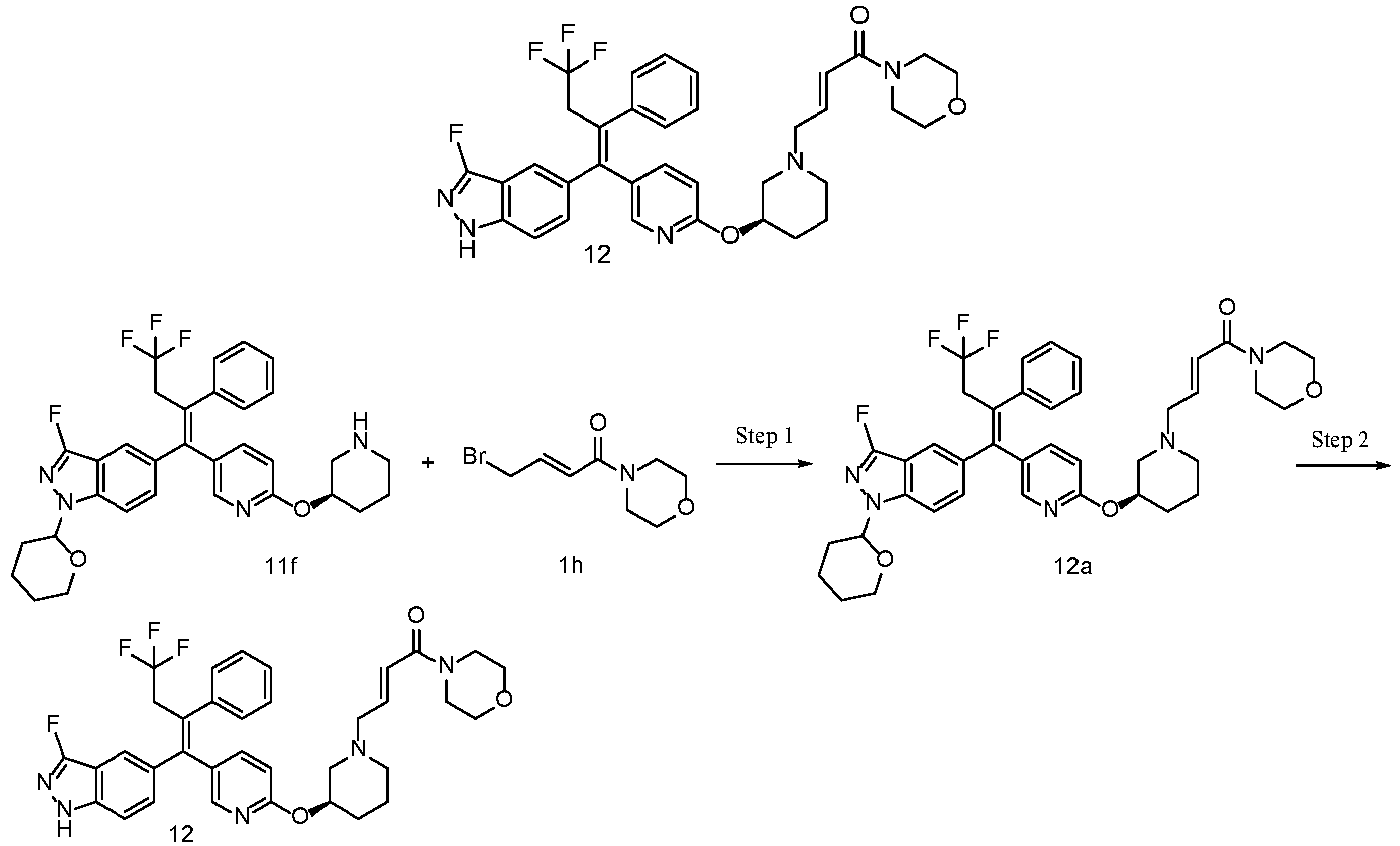
- In accordance with the synthetic route in Example 1, the starting material 1g in Step 4 was replaced with compound 11f, to give the title compound 12a (50 mg, yield: 79%).
- (E)-1-Morpholino-4-((R)-3-((5-((Z)-4,4,4-trifluoro-1-(3-fluoro-1H-indazol-5-yl)-2-phen ylbut-1-en-1-yl)pyridin-2-yl)oxy)piperidin-1-yl)but-2-en-1-one 12
- In accordance with the synthetic route in Example 1, the starting material 1i in Step 5 was replaced with compound 12a, to give the title compound 12 (20 mg, yield: 42%).
- MS m/z(ESI): 650.3 [M+1].
- 1H NMR (400 MHz, CDCl3) 10.10 (s, 1H), 7.67-7.62 (m, 3H), 7.50 (d, 1H), 7.27-7.11 (m, 6H), 6.79 (s, 2H), 6.48 (s, 1H), 5.38 (s, 1H), 3.93 (s, 2H), 3.70 (s, 7H), 3.55 (s, 2H), 3.38-3.31 (m, 3H), 3.09-2.82 (m, 2H), 1.85-1.65 (m, 4H).
-

- (E)-4-Bromobut-2-enoic acid 11a (1.0 g, 6.1 mmol) was dissolved in dichloromethane (10 mL), followed by the addition of triethylamine (1.8 g, 18.2 mmol), tetrahydropyran-4-amine (0.6 g, 6.1 mmol), 1-(3-dimethylaminopropyl)-3-ethylcarbodiimide hydrochloride (1.3 g, 6.7 mmol) and 1-hydroxybenzotriazole (0.9 g, 6.7 mmol) at room temperature. The reaction solution was stirred for 12 hours. The reaction solution was cooled. Saturated sodium bicarbonate solution (15 mL) was added, and the solution was extracted with ethyl acetate (20 mL×2). The organic phases were combined, washed with saturated sodium chloride solution (20 mL×4), dried over anhydrous sodium sulfate and filtered. The filtrate was concentrated under reduced pressure, and the resulting residues were purified by thin layer chromatography with developing system A to obtain the title product 13a (1.2 g, yield: 79%).
- In accordance with the synthetic route in Example 1, the starting material 1g in Step 4 was replaced with compound 11f, and the starting material 1h was replaced with 13a, to give the title compound 13b (41 mg, yield: 81%).
- (E)-N-(Tetrahydro-2H-pyran-4-yl)-4-((R)-3-((5-((Z)-4,4,4-trifluoro-1-(3-fluoro-1H-inda zol-5-yl)-2-phenylbut-1-en-1-yl)pyridin-2-yl)oxy)piperidin-1-yl)but-2-enamide 13
- In accordance with the synthetic route in Example 1, the starting material 1i in Step 5 was replaced with compound 13b, to give the title compound 13 (20 mg, yield: 32%).
- MS m/z(ESI): 664.3 [M+1].
- 1H NMR (400 MHz, DMSO-d 6) 12.68 (s, 1H), 7.92-7.90 (d, 1H), 7.60-7.59 (m, 1H), 7.52-7.50 (m, 1H), 7.23-7.14 (m, 6H), 6.50-6.43 (m, 2H), 5.97-5.93 (d, 1H), 4.86-4.79 (m, 1H), 3.79-3.74 (m, 3H), 3.47-3.38 (m, 2H), 3.33-3.32 (m, 1H), 3.00-2.98 (m, 2H), 2.80-2.78 (m, 1H), 2.55-2.50 (m, 1H), 2.00-1.24 (m, 12H).
-

- In accordance with the synthetic route in Example 1, the starting material 1g in Step 4 was replaced with compound 11f, and the starting material 1h was replaced with 5d, to give the title compound 14a (80 mg, yield: 79%).
- In accordance with the synthetic route in Example 1, the starting material 1i in Step 5 was replaced with compound 14a, to give the title compound 14 (10 mg, yield: 27%). MS m/z(ESI): 608.3 [M+1].
- 1H NMR (400 MHz, CDCl3) 9.77-7.75 (br, 1H), 7.68-7.62 (m, 2H), 7.46-7.43 (m, 1H), 7.36-7.30 (m, 2H), 7.27-7.18 (d, 5H), 6.87-6.76 (m, 2H), 6.80-6.48 (m, 1H), 5.42-5.28 (m, 1H), 3.97-3.67 (m, 5H), 3.38-3.31 (m, 2H), 3.12-3.07 (m, 6H), 2.31-1.69 (m, 4H).
-

- In accordance with the synthetic route in Example 1, the starting material 1g in Step 4 was replaced with compound 11f, and the starting material 1h was replaced with 2a, to give the title compound 15a (49 mg, yield: 72%).
- In accordance with the synthetic route in Example 1, the starting material 1i in Step 5 was replaced with compound 15a, to give the title compound 15 (20 mg, yield: 47%).
- MS m/z(ESI): 634.3 [M+1].
- 1H NMR (400 MHz, CD3OD) 7.63 (d, 2H), 7.49 (dd, 1H), 7.29-7.19 (m, 7H), 6.79-6.74 (m, 1H), 6.49-6.43 (m, 2H), 5.02-4.98 (m, 1H), 3.56-3.54 (m, 2H), 3.47-3.44 (m, 4H), 3.25 (d, 2H), 2.92 (d, 1H), 2.65-2.64 (m, 1H), 2.37-2.35 (m, 2H), 1.94-1.85 (m, 6H), 1.64-1.52 (m, 2H).
-
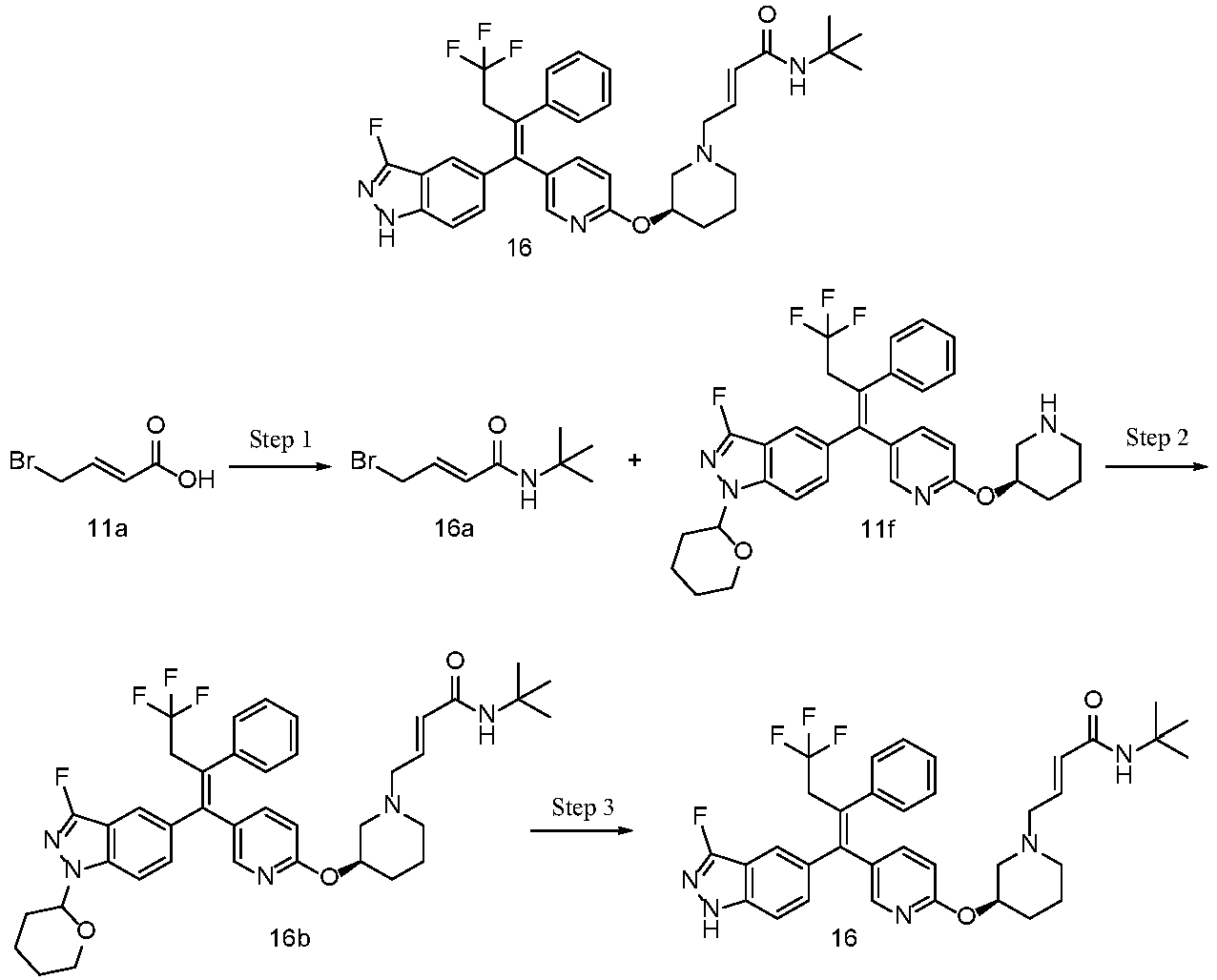
- Compound 11a (0.5 g, 3.0 mmol) was dissolved in dichloromethane (10 mL), followed by the addition of triethylamine (0.4 g, 3.6 mmol), tert-butylamine (0.2 g, 3.0 mmol), 1-(3-dimethylaminopropyl)-3-ethylcarbodiimide hydrochloride (0.7 g, 3.6 mmol) and 1-hydroxybenzotriazole (0.5 g, 3.6 mmol) at room temperature. The reaction solution was stirred for 12 hours. The reaction solution was cooled. Saturated sodium bicarbonate solution (15 mL) was added, and the solution was extracted with ethyl acetate (20 mL×2). The organic phases were combined, washed with saturated sodium chloride solution (20 mL×4), dried over anhydrous sodium sulfate and filtered. The filtrate was concentrated under reduced pressure, and the resulting residues were purified by thin layer chromatography with developing system A to obtain the title product 16a (0.3 g, yield: 39%).
- In accordance with the synthetic route in Example 1, the starting material 1g in Step 4 was replaced with compound 11f, and the starting material 1h was replaced with 16a, to give the title compound 16b (47 mg, yield: 83%).
- In accordance with the synthetic route in Example 1, the starting material 1i in Step 5 was replaced with compound 16b, to give the title compound 16 (23 mg, yield: 28%).
- MS m/z(ESI): 636.5 [M+1].
- 1H NMR (400 MHz, CD3OD) 7.67 (d, 2H), 7.50 (dd, 1H), 7.32-7.22 (m, 7H), 6.64-6.55 (m, 2H), 6.33 (d, 1H), 5.40 (s, 1H), 3.88 (s, 2H), 3.69 (d, 1H), 3.52-3.41 (m, 3H), 3.24 (d, 1H), 3.02-2.99 (m, 1H), 2.10-2.07 (m, 2H), 1.87-1.75 (m, 2H), 1.36 (s, 9H).
-

- Compound 11a (0.5 g, 3.0 mmol) was dissolved in dichloromethane (10 mL), followed by the addition of triethylamine (0.4 g, 3.6 mmol), cyclopentylamine (0.3 g, 3.0 mmol), 1-(3-dimethylaminopropyl)-3-ethylcarbodiimide hydrochloride (0.7 g, 3.6 mmol) and 1-hydroxybenzotriazole (0.5 g, 3.6 mmol) at room temperature. The reaction solution was stirred for 12 hours. The reaction solution was cooled. Saturated sodium bicarbonate solution (15 mL) was added, and the solution was extracted with ethyl acetate (20 mL×2). The organic phases were combined, washed with saturated sodium chloride solution (20 mL×4), dried over anhydrous sodium sulfate and filtered. The filtrate was concentrated under reduced pressure, and the resulting residues were purified by thin layer chromatography with developing system A to obtain the title product 17a (0.3 g, yield: 49%).
- In accordance with the synthetic route in Example 1, the starting material 1g in Step 4 was replaced with compound 11f, and the starting material 1h was replaced with 17a, to give the title compound 17b (42 mg, yield: 73%).
- In accordance with the synthetic route in Example 1, the starting material 1i in Step 5 was replaced with compound 17b, to give the title compound 17 (21 mg, yield: 38%).
- MS m/z(ESI): 648.3 [M+1].
- 1H NMR (400 MHz, DMSO-d 6) 12.75-12.68 (m, 1H) 7.88-7.86 (d, 1H), 7.61-7.59 (m, 2H), 7.53-7.50 (m, 1H), 7.23-7.15 (m, 6H), 6.47-6.41 (m, 2H), 5.96-5.93 (d, 1H), 4.85-4.79 (m, 1H), 4.02-3.97 (m, 1H), 3.47-3.39 (m, 2H), 2.99-2.98 (m, 2H), 2.80-2.79 (m, 1H), 2.56-2.50 (m, 2H), 2.30-2.25 (m, 1H), 1.99-1.27 (m, 12H).
-
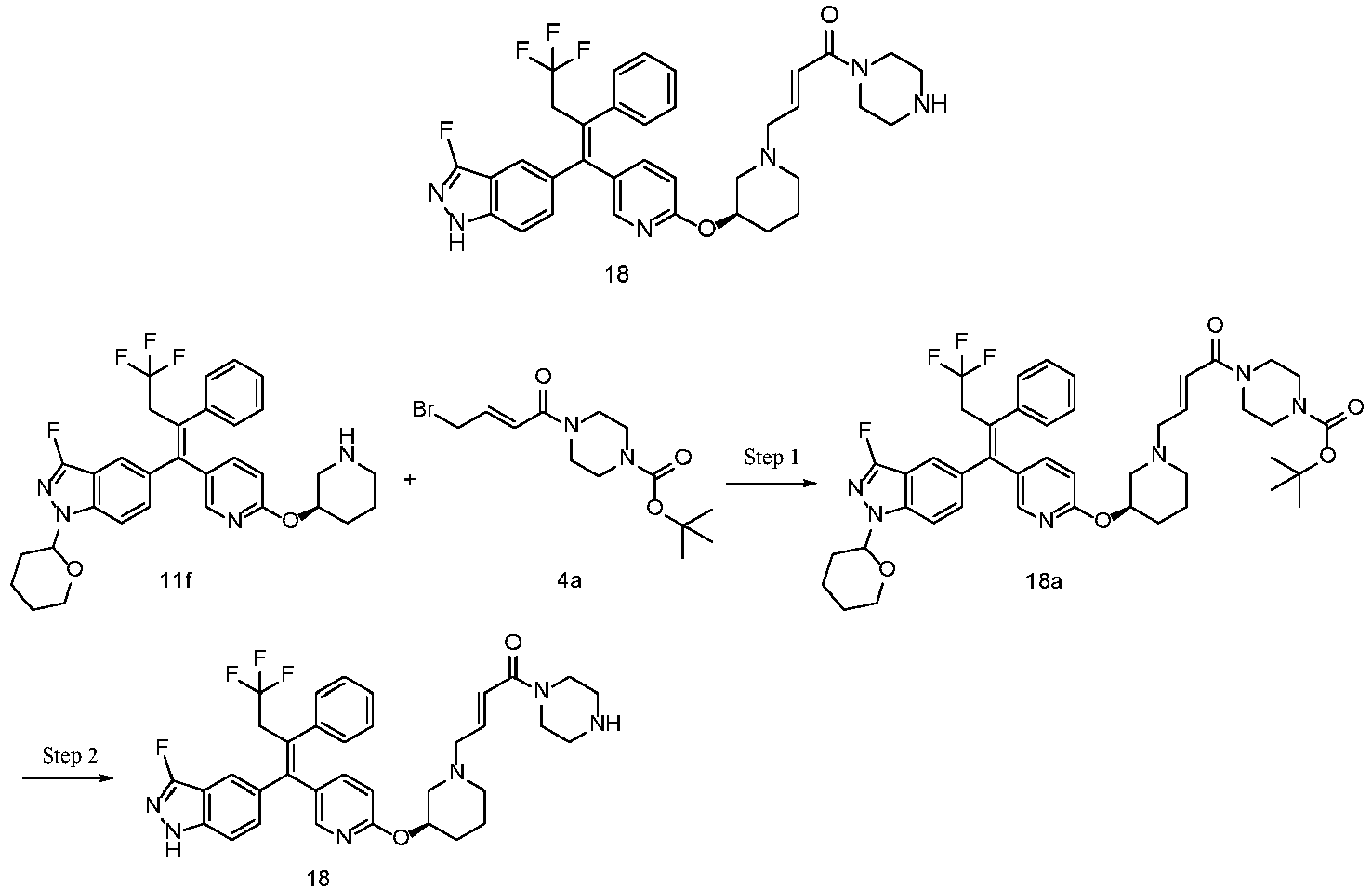
- Tert-butyl 4-((E)-4-((3R)-3-((5-((Z)-4,4,4-trifluoro-1-(3-fluoro-1-(tetrahydro-2H-pyran-2-yl)-1H-in dazol-5-yl)-2-phenylbut-1-en-1-yl)pyridin-2-yl)oxy)piperidin-1-yl)but-2-enoyl)piperazi ne-1-carboxylate 18a
- In accordance with the synthetic route in Example 1, the starting material 1g in Step 4 was replaced with compound 11f, and the starting material 1h was replaced with compound 4a, to give the title compound 18a (51 mg, yield: 76%).
- In accordance with the synthetic route in Example 1, the starting material 1i in Step 5 was replaced with compound 18a, to give the title compound 18 (21 mg, yield: 31%).
- MS m/z(ESI): 649.3 [M+1].
- 1H NMR (400 MHz, CD3OD) 7.67 (d, 2H), 7.50 (d, 1H), 7.34-7.20 (m, 6H), 6.92 (d, 1H), 6.78-6.61 (m, 2H), 5.36 (s, 1H), 3.94-3.88 (m, 5H), 3.50-3.39 (m, 6H), 3.28 (s, 2H), 2.23-1.88 (m, 5H), 1.34-1.30 (m, 3H).
-

- Compound 11d (1.0 g, 2.5 mmol) was dissolved in dichloromethane (15 mL), followed by the addition of trifluoroacetic acid (3 mL). The reaction was stirred at room temperature for 5 hours. The reaction solution was concentrated under reduced pressure, adjusted to about pH 8 with saturated sodium bicarbonate solution (100 mL), dried over anhydrous sodium sulfate and filtered. The filtrate was concentrated under reduced pressure to obtain the crude title product 19a (0.8 g, yield: 100%), which was used directly in the next step without purification.
- Compound 19a (752 mg, 2.5 mmol) was dissolved in N,N-dimethylformamide (20 mL), followed by the successive addition of diisopropylethylamine (1.6 g, 12.4 mmol) and compound 5d (470 mg, 2.5 mmol) at room temperature. The reaction solution was stirred for 2 hours. The reaction solution was cooled. Saturated sodium bicarbonate solution (15 mL) was added, and the solution was extracted with ethyl acetate (50 mL×2). The organic phases were combined, washed with saturated sodium chloride solution (50 mL×4), dried over anhydrous sodium sulfate and filtered. The filtrate was concentrated under reduced pressure, and the resulting residues were purified by thin layer chromatography with developing system A to obtain the title product 19b (0.7 g, yield: 68%).
- MS m/z(ESI) :416.1 [M+1].
- Compound 1d (50 mg, 0.2 mmol) was dissolved in methyltetrahydrofuran (10 mL), followed by the addition of bis(pinacolato)diboron (47 mg, 0.2 mmol) and tetrakis(triphenylphosphine)platinum (4 mg, 0.003 mmol). The reaction solution was purged with argon three times, warmed up to 85°C and stirred for 3 hours. The reaction solution was cooled to room temperature, followed by the addition of compound 19b (57 mg, 0.1 mmol), bis(triphenylphosphine)palladium dichloride (20 mg, 0.03 mmol), cesium carbonate (128 mg, 0.4 mmol) and water (0.5 mL). The reaction solution was stirred at room temperature overnight. 4-Fluoroiodobenzene 19c (68 mg, 0.3 mmol) and potassium hydroxide (43 mg, 0.8 mmol) were added. The reaction solution was purged with argon three times, warmed up to 85°C, stirred for 2 hours, and cooled to room temperature. The reaction solution was concentrated under reduced pressure, and the resulting residues were purified by thin layer chromatography with developing system B to obtain the title product 19d (50 mg, yield: 46%).
- MS m/z(ESI): 710.3 [M+1].
- Compound 19d (50 mg, 0.07 mmol) was dissolved in methanol (2 mL), followed by the addition of hydrochloric acid (12N, 1 mL). The reaction solution was stirred for 3 hours. The reaction solution was cooled and concentrated. Saturated sodium bicarbonate solution (15 mL) was added, and the solution was extracted with dichloromethane (10 mL×4). The organic phases were combined, washed with water (10 mL×3) and saturated sodium chloride solution (10 mL) successively, dried over anhydrous sodium sulfate and filtered. The filtrate was concentrated under reduced pressure, and the resulting residues were purified by thin layer chromatography with developing system A to obtain the title product 19 (15 mg, yield: 34%).
- MS m/z(ESI): 626.2 [M+1].
- 1H NMR (400 MHz, CD3OD) 7.70 (s, 1H), 7.65 (s, 1H), 7.52 (dd, 1H), 7.32-7.26 (m, 4H), 7.02-6.97 (t, 2H), 6.91-6.87 (m, 1H), 6.65-6.61 (d, 2H), 5.44 (s, 1H), 3.94 (s, 3H), 3.50-3.38 (m, 4H), 3.14 (s, 3H), 3.12-3.05 (m, 1H), 3.01 (s, 3H), 2.11-2.09 (m, 2H), 1.89-1.77 (m, 2H).
-
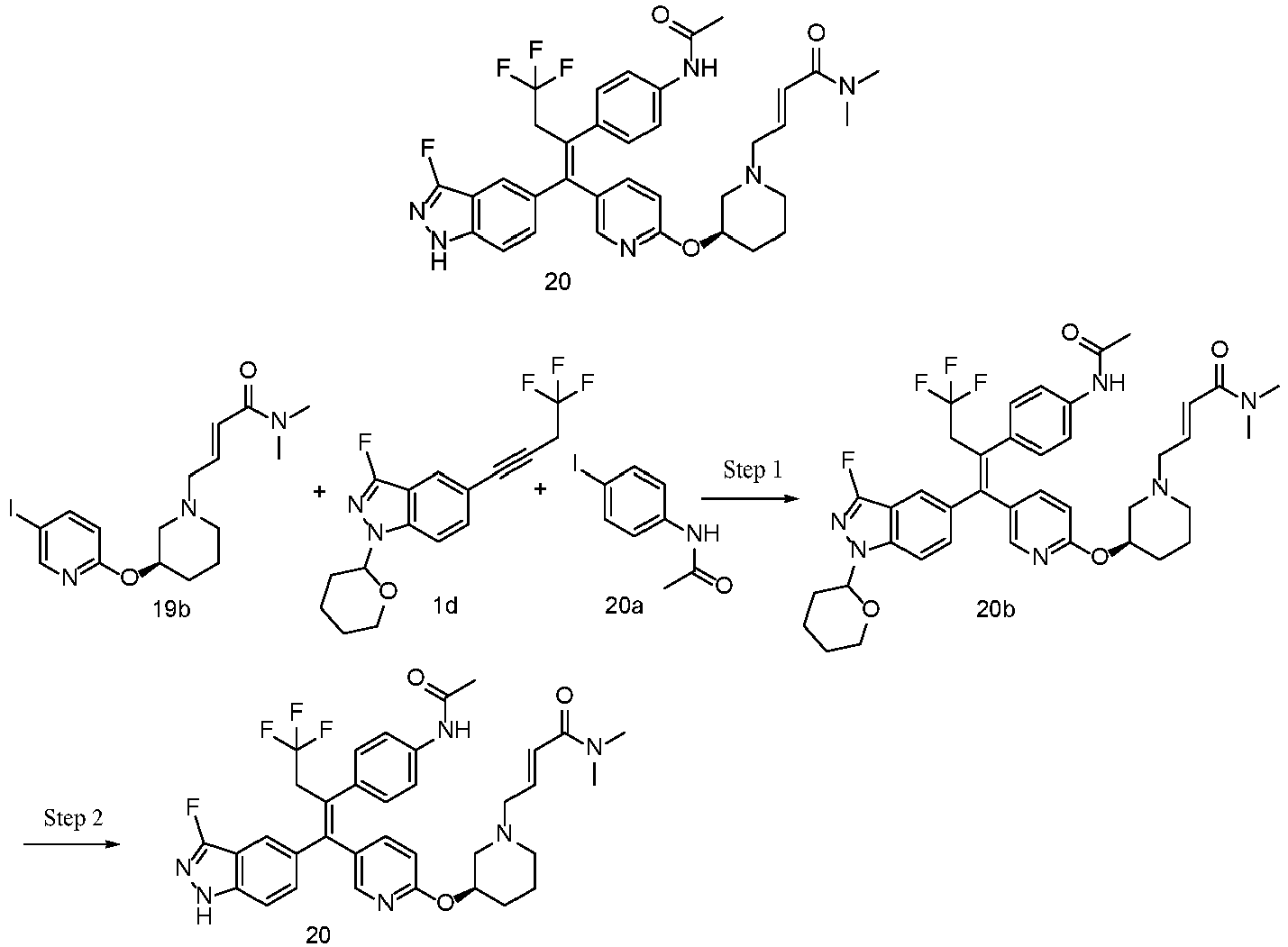
- In accordance with the synthetic route in Example 19, the starting material 19c in Step 3 was replaced with N-(4-iodophenyl)acetamide 20a (prepared according to the method disclosed in " Journal of Organic Chemistry, 2018, 83(2), 930-938"), to give the title compound 20b (70 mg, yield: 61%).
- In accordance with the synthetic route in Example 19, the starting material 19d in Step 4 was replaced with compound 20b, to give the title compound 20 (22 mg, yield: 41%).
- MS m/z(ESI): 665.2 [M+1].
- 1H NMR (400 MHz, CD3OD) 7.67 (d, 2H), 7.48-7.44 (m, 3H), 7.28 (dd, 2H), 7.18 (d, 2H), 6.82 (d, 1H), 6.67-6.59 (m, 2H), 5.28 (s, 1H), 3.76 (s, 2H), 3.49-3.39 (m, 4H), 3.25 (d, 1H), 3.10 (s, 3H), 3.03 (d, 1H), 2.99 (s, 3H), 2.11 (s, 3H), 1.99-1.94 (m, 2H), 1.86-1.74 (m, 2H).
-

- In accordance with the synthetic route in Example 19, the starting material 19c in Step 3 was replaced with 4-iodo-N-methylbenzamide 21a (prepared according to the method disclosed in " Journal of the American Chemical Society, 2013, 135(12), 4628-4631"), to give the title compound 21b (50 mg, yield: 44%).
- In accordance with the synthetic route in Example 19, the starting material 19d in Step 4 was replaced with compound 21b, to give the title compound 21 (10 mg, yield: 32%).
- MS m/z(ESI): 665.3 [M+1].
- 1H NMR (400 MHz, CD3OD) 7.71-7.69 (m, 4H), 7.50 (d, 1H), 7.36-7.29 (m, 4H), 6.88 (d, 1H), 6.65-6.58 (m, 2H), 5.39 (s, 1H), 3.97-3.91 (m, 2H), 3.69 (d, 1H), 3.49-3.44 (m, 3H), 3.06 (s, 3H), 3.05-3.00 (m, 2H), 2.99 (s, 3H), 2.89 (s, 3H), 2.10-2.03 (m, 2H), 1.86-1.74 (m, 2H).
-

- In accordance with the synthetic route in Example 19, the starting material 19c in Step 3 was replaced with 1-iodo-4-(trifluoromethyl)benzene 22a, to give the title compound 22b (80 mg, yield: 69%).
- In accordance with the synthetic route in Example 19, the starting material 19d in Step 4 was replaced with compound 22b, to give the title compound 22 (20 mg, yield: 31%).
- MS m/z(ESI): 676.2 [M+1].
- 1H NMR (400 MHz, CD3OD) 7.70 (dd, 2H), 7.57-7.55 (m, 3H), 7.47 (d, 2H), 7.32 (dd, 2H), 6.88 (d, 1H), 6.65-6.59 (m, 2H), 5.37 (s, 1H), 3.91 (d, 2H), 3.50 (q, 2H), 3.32 (s, 4H), 3.12 (s, 3H), 3.00 (s, 3H), 2.09-2.04 (m, 2H), 1.84 (d, 2H).
-

- In accordance with the synthetic route in Example 19, the starting material 19c in Step 3 was replaced with 1-iodo-4-(methylsulfonyl)benzene 23a (prepared according to the method disclosed in " Organic Letters, 2014, 16(9), 2306-2309"), to give the title compound 23b (60 mg, yield: 51%).
- In accordance with the synthetic route in Example 19, the starting material 19d in Step 4 was replaced with compound 23b, to give the title compound 23 (10 mg, yield: 28%).
- MS m/z(ESI): 686.2 [M+1].
- 1H NMR (400 MHz, CD3OD) 7.83 (d, 2H), 7.67 (s, 2H), 7.53-7.50 (m, 3H), 7.30 (d, 2H), 6.89 (dd, 1H), 6.66-6.59 (m, 2H), 5.38 (s, 1H), 3.97-3.91 (m, 3H), 3.70-3.65 (m, 1H), 3.50 (q, 3H), 3.28 (d, 1H), 3.11 (s, 6H), 2.99 (s, 3H), 2.10-2.01 (m, 2H), 1.94-1.86 (m, 2H).
-

- In accordance with the synthetic route in Example 19, the starting material 19c in Step 3 was replaced with 4-iodobenzonitrile 24a, to give the title compound 24b (80 mg, yield: 73%).
- In accordance with the synthetic route in Example 19, the starting material 19d in Step 4 was replaced with compound 24b, to give the title compound 24 (20 mg, yield: 38%).
- MS m/z(ESI): 633.2 [M+1].
- 1H NMR (400 MHz, CD3OD) 7.67-7.61 (m, 4H), 7.47 (d, 1H), 7.45 (d, 2H), 7.33 (d, 2H), 6.89 (d, 1H), 6.66-6.61 (m, 2H), 5.44 (s, 1H), 3.94-3.91 (m, 2H), 3.71 (d, 1H), 3.52-3.45 (m, 3H), 3.25 (d, 1H), 3.12 (s, 3H), 3.05 (d, 1H), 3.01 (s, 3H), 2.11-2.04 (m, 2H), 1.90-1.77 (m, 2H).
-

- In accordance with the synthetic route in Example 10, the starting material 9d in Step 1 was replaced with compound 11f, to give the title compound 25a (37 mg, yield: 83%).
- In accordance with the synthetic route in Example 10, the starting material 10b in Step 2 was replaced with compound 25a, to give the title compound 25 (4 mg, yield: 15%).
- MS m/z(ESI): 563.2 [M+1].
- 1H NMR (400 MHz, CDCl3) 9.38 (s, 1H), 7.68-7.65 (m, 2H), 7.43-7.12 (m, 8H), 6.46-6.39 (m, 1H), 5.02 (d, 1H), 3.95-3.77 (m, 2H), 3.33-3.00 (m, 4H), 2.13-1.93 (m, 4H), 1.69 (d, 3H).
-


- In accordance with the synthetic route in Example 10, the starting material 9d in Step 1 was replaced with compound 11f, and the starting material 10a was replaced with acrylic acid 26a, to give the title compound 26b (30 mg, yield: 73%).
- In accordance with the synthetic route in Example 10, the starting material 10b in Step 2 was replaced with compound 26b, to give the title compound 26 (3 mg, yield: 12%).
- MS m/z(ESI): 551.2 [M+1].
- 1H NMR (400 MHz, CDCl3) 9.31 (s, 1H), 7.68 (d, 2H), 7.43 (d, 2H), 7.29-7.27 (m, 5H), 7.20-7.09 (m, 1H), 6.40 (d, 1H), 6.39-6.20 (m, 1H), 5.49-5.37 (m, 2H), 4.95 (s, 1H), 3.72(s, 1H), 3.68 (d, 2H), 3.39 (d, 1H), 3.36-3.31 (m, 2H), 2.04-1.90 (m, 4H).
-


- In accordance with the synthetic route in Example 1, the starting material 1b in Step 1 was replaced with tert-butyl (S)-3-hydroxypiperidine-1-carboxylate 27a (prepared according to the method disclosed in " Tetrahedron, 2007, 63(2), 331-336"), to give the title compound 27b (531 mg, yield: 92%).
- In accordance with the synthetic route in Example 1, the starting material 1c in Step 2 was replaced with compound 27b, to give the title compound 27c (190 mg, yield: 76%).
- MS m/z(ESI): 680.9 [M+1].
- In accordance with the synthetic route in Example 1, the starting material If in Step 3 was replaced with compound 27c, to give the title compound 27d (85 mg, yield: 100%).
- In accordance with the synthetic route in Example 1, the starting material 1g in Step 4 was replaced with compound 27d, and the starting material 1h was replaced with compound 5d, to give the title compound 27e (65 mg, yield: 64%).
- In accordance with the synthetic route in Example 1, the starting material 1i in Step 5 was replaced with compound 27e, to give the title compound 27 (15 mg, yield: 43%).
- MS m/z(ESI): 607.9 [M+1].
- 1H NMR (400 MHz, CDCl3) 9.36 (s, 1H), 7.69-7.67 (m, 1H), 7.64-7.63 (d, 1H), 7.45-7.43 (m, 1H), 7.35-7.32 (d, 1H), 7.28-7.19 (m, 4H), 7.08-7.06 (d, 1H), 6.89-6.82 (m, 1H), 6.46-6.41 (m, 1H), 5.39-5.36 (m, 1H), 5.08-5.02 (br, 1H), 3.38-3.30 (m, 2H), 3.22-3.16 (m, 2H), 3.05 (s, 3H), 3.10 (s, 3H), 2.92-2.86 (m, 1H), 2.67-2.61 (m, 1H), 2.34-2.24 (m, 2H), 2.07-1.77 (m, 4H), 1.53-1.48 (m, 1H).
-

- In accordance with the synthetic route in Example 10, the starting material 10a in Step 1 was replaced with compound 26a, to give the title compound 28a (50 mg, yield: 63%).
- In accordance with the synthetic route in Example 10, the starting material 10b in Step 2 was replaced with compound 28a, to give the title compound 28 (10 mg, yield: 23%).
- MS m/z(ESI): 551.2 [M+1].
- 1H NMR (400 MHz, CDCl3) 9.47 (br, 1H), 7.60 (d, 2H), 7.35 (d, 1H), 7.28 (d, 1H), 7.26-7.19 (m, 5H), 6.59 (dd, 1H), 6.49 (d, 1H), 6.29 (d, 1H), 5.76 (d, 1H), 5.14 (m, 1H), 3.89-3.53 (m, 5H), 3.34 (t, 2H), 1.99-1.94 (m, 2H), 1.77-1.66 (m, 2H).
-

- In accordance with the synthetic route in Example 1, the starting material 1b in Step 1 was replaced with tert-butyl (R)-3-hydroxypyrrolidine-1-carboxylate 29a, to give the title compound 29b (0.9 g, yield: 86%).
- In accordance with the synthetic route in Example 1, the starting material 1c in Step 2 was replaced with compound 29b, to give the title compound 29c (260 mg, yield: 37%).
- In accordance with the synthetic route in Example 1, the starting material If in Step 3 was replaced with compound 29c, to give the title compound 29d (93 mg, yield: 99%).
- In accordance with the synthetic route in Example 1, the starting material 1g in Step 4 was replaced with compound 29d, and the starting material 1h was replaced with compound 5d, to give the title compound 29e (60 mg, yield: 54%).
- MS m/z(ESI): 678.3 [M+1].
- In accordance with the synthetic route in Example 1, the starting material 1i in Step 5 was replaced with compound 29e, to give the title compound 29 (15 mg, yield: 29%). MS m/z(ESI): 594.3 [M+1].
- 1H NMR (400 MHz, CDCl3) 12.72 (s, 1H), 7.70-7.65 (m, 2H), 7.60-7.50 (d, 1H), 7.25-7.20 (m, 5H), 7.19-7.15 (m, 2H), 6.55-6.45 (m, 3H), 5.17-5.10 (m, 1H), 3.50-3.35 (m, 2H), 3.15-3.10 (m, 2H), 2.95 (s, 3H), 2.83 (s, 3H), 2.70-2.60 (m, 2H), 2.50-2.45 (m, 1H), 2.35-2.25 (m, 1H), 2.15-2.05 (m, 1H), 1.70-1.60 (m, 1H).
-


- In accordance with the synthetic route in Example 1, the starting material 1b in Step 1 was replaced with tert-butyl (S)-3-hydroxypyrrolidine-1-carboxylate 30a, to give the title compound 30b (0.5 g, yield: 50%).
- In accordance with the synthetic route in Example 1, the starting material 1c in Step 2 was replaced with compound 30b, to give the title compound 30c (260 mg, yield: 85%).
- In accordance with the synthetic route in Example 1, the starting material If in Step 3 was replaced with compound 30c, to give the title compound 30d (100 mg, yield: 98%).
- In accordance with the synthetic route in Example 1, the starting material 1g in Step 4 was replaced with compound 30d, and the starting material 1h was replaced with compound 5d, to give the title compound 30e (70 mg, yield: 62%).
- MS m/z(ESI): 678.3 [M+1].
- In accordance with the synthetic route in Example 1, the starting material 1i in Step 5 was replaced with compound 30e, to give the title compound 30 (10 mg, yield: 23%).
- MS m/z(ESI): 593.9 [M+1].
- 1H NMR (400 MHz, CDCl3) 9.58 (s, 1H), 7.67-7.65 (m, 2H), 7.46 (d, 1H), 7.34-7.30 (m, 2H), 7.27-7.16 (m, 4H), 6.87-6.77 (m, 2H), 6.59 (d, 1H), 5.53 (s, 1H), 4.14 (s, 1H), 3.93 (s, 3H), 3.39-3.31 (m, 2H), 3.29-3.03 (m, 7H), 2.41-2.28 (m, 4H).
-

- In accordance with the synthetic route in Example 1, the starting material 1b in Step 1 was replaced with tert-butyl (R)-3-aminopiperidine-1-carboxylate 31a, to give the title compound 31b (0.8 g, yield: 57%).
- In accordance with the synthetic route in Example 1, the starting material 1c in Step 2 was replaced with compound 31b, to give the title compound 31c (210 mg, yield: 75%).
- In accordance with the synthetic route in Example 1, the starting material If in Step 3 was replaced with compound 31c, to give the title compound 31d (42 mg, yield: 92%).
- In accordance with the synthetic route in Example 1, the starting material 1g in Step 4 was replaced with compound 31d, and the starting material 1h was replaced with compound 5d, to give the title compound 31 (20 mg, yield: 39%).
- MS m/z(ESI): 607.3 [M+1].
- 1H NMR (400 MHz, CDCl3) 9.26 (s, 1H), 7.68 (s, 1H), 7.55-7.54 (m, 1H), 7.44-7.41 (m, 1H), 7.36-7.31 (m, 1H), 7.28-7.23 (m, 4H), 6.92-6.80 (m, 2H), 6.45-6.41 (m, 1H), 6.15-6.13 (m, 1H), 5.39-5.37 (m, 1H), 3.35-3.28 (m, 2H), 3.17-3.15 (m, 2H), 3.07 (s, 3H), 3.02 (s, 3H), 2.70-2.68 (m, 1H), 2.47-2.45 (m, 1H), 2.47-2.45 (m, 1H), 2.06-2.04 (m, 2H), 1.34-1.29 (m, 4H).
-

- In accordance with the synthetic route in Example 31, the starting material 5d in Step 4 was replaced with compound 1h, to give the title compound 32 (8 mg, yield: 19%).
- MS m/z(ESI): 649.2 [M+1].
- 1H NMR (400 MHz, CDCl3) 9.25 (s, 1H), 7.68 (s, 1H), 7.56-7.52 (m, 1H), 7.45-7.40 (m, 1H), 7.36-7.32 (m, 1H), 7.28-7.21 (m, 4H), 6.94-6.82 (m, 2H), 6.44-6.37 (m, 1H), 6.15-6.07 (m, 1H), 5.39-5.35 (m, 1H), 3.76-3.46 (m, 8H), 3.36-3.26 (m, 2H), 3.17-3.05 (m, 2H), 2.99-2.92 (m, 1H), 2.65-2.03 (m, 7H), 0.95-0.87 (m, 1H).
-

- In accordance with the synthetic route in Example 1, the starting material 1b in Step 1 was replaced with tert-butyl 4-aminopiperidine-1-carboxylate 33a, to give the title compound 33b (0.2 g, yield: 20%).
- In accordance with the synthetic route in Example 1, the starting material 1c in Step 2 was replaced with compound 33b, to give the title compound 33c (80 mg, yield: 64%).
- MS m/z(ESI): 680.3 [M+1].
- In accordance with the synthetic route in Example 1, the starting material If in Step 3 was replaced with compound 33c, to give the title compound 33d (68 mg, yield: 100%).
- In accordance with the synthetic route in Example 1, the starting material 1g in Step 4 was replaced with compound 33d, and the starting material 1h was replaced with compound 5d, to give the title compound 33e (70 mg, yield: 86%).
- In accordance with the synthetic route in Example 1, the starting material 1i in Step 5 was replaced with compound 33e, to give the title compound 33 (15 mg, yield: 24%).
- MS m/z(ESI): 607.7 [M+1].
- 1H NMR (400 MHz, CDCl3) 7.63 (s, 1H), 7.59 (s, 1H), 7.38-7.32 (m, 4H), 7.24 (d, 2H), 7.23-7.02 (m, 2H), 6.77 (s, 2H), 6.47 (d, 1H), 5.36 (s, 1H), 3.93 (s, 1H), 3.83 (s, 2H), 3.39-3.29 (m, 6H), 3.12 (s, 3H), 3.09 (s, 3H), 2.42 (m, 2H), 2.07 (s, 2H).
-

- In accordance with the synthetic route in Example 1, the starting material 1b in Step 1 was replaced with tert-butyl (R)-pyrrolidin-3-ylcarbamate 34a, to give the title compound 34b (0.8 g, yield: 70%).
- In accordance with the synthetic route in Example 1, the starting material 1c in Step 2 was replaced with compound 34b, to give the title compound 34c (85 mg, yield: 83%).
- MS m/z(ESI): 665.9 [M+1].
- In accordance with the synthetic route in Example 1, the starting material If in Step 3 was replaced with compound 34c, to give the title compound 34d (60 mg, yield: 82%).
- In accordance with the synthetic route in Example 1, the starting material 1g in Step 4 was replaced with compound 34d, and the starting material 1h was replaced with compound 5d, to give the title compound 34e (45 mg, yield: 63%).
- In accordance with the synthetic route in Example 1, the starting material 1i in Step 5 was replaced with compound 34e, to give the title compound 34 (9 mg, yield: 23%).
- MS m/z(ESI): 592.9 [M+1].
- 1H NMR (400 MHz, CDCl3) 9.53 (s, 1H), 7.67 (s, 2H), 7.38 (d, 1H), 7.30-7.22 (m, 6H), 6.95-6.87 (m, 2H), 6.45 (d, 1H), 6.07(d, 1H), 3.63-3.59 (m, 1H), 3.54-3.48 (m, 3H), 3.41-3.28 (m, 3H), 3.23-3.19 (m, 1H), 3.06 (d, 6H), 2.27-2.14 (m, 2H), 1.89-1.81 (m, 2H).
-


- In accordance with the synthetic route in Example 1, the starting material 1b in Step 1 was replaced with Tert-butyl (S)-pyrrolidin-3-ylcarbamate 35a, to give the title compound 35b (0.8 g, yield: 69%).
- In accordance with the synthetic route in Example 1, the starting material 1c in Step 2 was replaced with compound 35b, to give the title compound 35c (86 mg, yield: 84%).
- MS m/z(ESI): 666.3 [M+1].
- In accordance with the synthetic route in Example 1, the starting material If in Step 3 was replaced with compound 35c, to give the title compound 35d (55 mg, yield: 80%).
- In accordance with the synthetic route in Example 1, the starting material 1g in Step 4 was replaced with compound 35d, and the starting material 1h was replaced with compound 5d, to give the title compound 35e (40 mg, yield: 61%).
- In accordance with the synthetic route in Example 1, the starting material 1i in Step 5 was replaced with compound 35e, to give the title compound 35 (8 mg, yield: 23%).
- MS m/z(ESI): 592.9 [M+1].
- 1H NMR (400 MHz, CDCl3) 9.47 (s, 1H), 7.67 (s, 2H), 7.39 (dd, 1H), 7.34 (dd, 1H),7.28-7.22 (m, 5H), 6.96-6.87 (m, 2H), 6.45 (dd, 1H), 6.07 (dd, 1H), 3.63-3.59 (m, 1H), 3.54-3.46 (m, 3H), 3.41-3.28(m, 3H), 3.22-3.19 (m, 1H), 3.07 (d, 6H), 2.20-2.15 (m, 2H),1.88-1.81 (m, 2H).
-
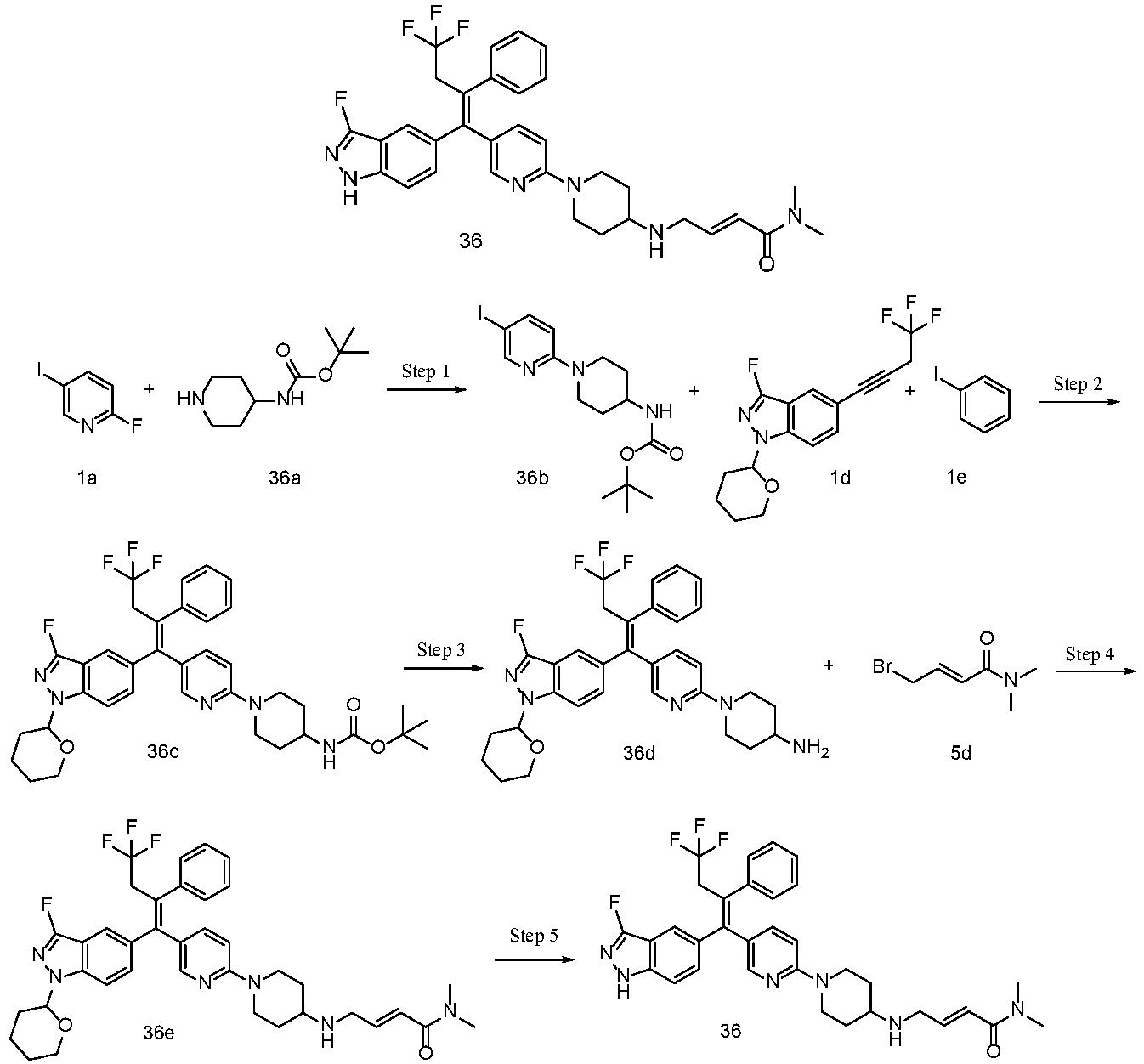
- In accordance with the synthetic route in Example 1, the starting material 1b in Step 1 was replaced with tert-butyl piperidin-4-ylcarbamate 36a, to give the title compound 36b (0.3 g, yield: 28%).
- In accordance with the synthetic route in Example 1, the starting material 1c in Step 2 was replaced with compound 36b, to give the title compound 36c (120 mg, yield: 74%).
- MS m/z(ESI): 679.9 [M+1].
- In accordance with the synthetic route in Example 1, the starting material If in Step 3 was replaced with compound 36c, to give the title compound 36d (68 mg, yield: 100%).
- In accordance with the synthetic route in Example 1, the starting material 1g in Step 4 was replaced with compound 36d, and the starting material 1h was replaced with compound 5d, to give the title compound 36e (70 mg, yield: 86%).
- In accordance with the synthetic route in Example 1, the starting material 1i in Step 5 was replaced with compound 36e, to give the title compound 36 (15 mg, yield: 24%).
- MS m/z(ESI): 607.7 [M+1].
- 1H NMR (400 MHz, CD3OD) 7.70 (s, 1H), 7.56-7.53 (m, 1H), 7.48-7.42 (m, 1H), 7.35-7.32 (m, 1H), 7.30-7.26 (m, 6H), 7.00-6.98 (d, 1H), 6.92-6.89 (m, 1H), 6.72-6.64 (m, 1H), 4.25-4.21 (d, 2H), 3.92-3.90 (d, 2H), 3.57-3.39 (m, 4H), 3.17-3.11 (m, 4H), 3.01 (s, 3H), 2.24-2.22 (m, 2H), 1.67-1.67 (m, 2H).
-


- Potassium carbonate (1.5 g, 20.5 mmol) was dissolved in N,N-dimethylformamide (10 mL), followed by the addition of tert-butyl (S)-piperidin-3-ylcarbamate 37a (2.0 g, 10.0 mmol) at room temperature. After completion of the addition, compound 1a (2.2 g, 10.0 mmol) was slowly added. The reaction was heated to 100°C, and stirred for 4 hours. The reaction solution was concentrated under reduced pressure, and the resulting residues were purified by thin layer chromatography with developing system B to obtain the title product 37b (3.5 g, yield: 87%).
- Sodium hydride (12 mg, 0.5 mmol) was dissolved in N,N-dimethylformamide (10 mL), followed by the addition of compound 37b (100 mg, 0.2 mmol) at room temperature. After completion of the addition, iodomethane (28 mg, 0.2 mmol) was slowly added. The reaction was stirred at room temperature for 2 hours. The reaction solution was concentrated under reduced pressure, and the resulting residues were purified by thin layer chromatography with developing system B to obtain the title product 37c (95 mg, yield: 92%).
- MS m/z(ESI): 418.1 [M+1].
- In accordance with the synthetic route in Example 1, the starting material 1c in Step 2 was replaced with compound 37c, to give the title compound 37d (150 mg, yield: 71%).
- MS m/z(ESI): 694.4 [M+1].
- In accordance with the synthetic route in Example 1, the starting material If in Step 3 was replaced with compound 37d, to give the title compound 37e (80 mg, yield: 93%).
- In accordance with the synthetic route in Example 1, the starting material 1g in Step 4 was replaced with compound 37e, and the starting material 1h was replaced with compound 5d, to give the title compound 37f (75 mg, yield: 79%).
- In accordance with the synthetic route in Example 1, the starting material 1i in Step 5 was replaced with compound 37f, to give the title compound 37 (22 mg, yield: 25%).
- MS m/z(ESI): 621.2 [M+1].
- 1H NMR (400 MHz, CDCl3) 10.51 (s, 1H), 7.71 (s, 1H), 7.62 (s, 1H), 7.74-7.31 (m, 4H), 7.29-7.21 (m, 4H), 6.80 (s, 2H), 6.65 (dd, 1H), 4.71 (dd, 1H), 4.04 (d, 2H), 3.87 (d, 2H), 3.41 (d, 2H), 3.35-3.31 (m, 2H), 3.06 (d, 6H), 2.84 (s, 3H), 2.29 (d, 1H), 2.02-1.92 (m, 2H), 1.69 (d, 1H).
-

- In accordance with the synthetic route in Example 1, the starting material 1c in Step 2 was replaced with compound 37b, to give the title compound 38a (100 mg, yield: 80%).
- MS m/z(ESI): 680.4 [M+1].
- In accordance with the synthetic route in Example 1, the starting material If in Step 3 was replaced with compound 38a, to give the title compound 38b (35 mg, yield: 82%).
- In accordance with the synthetic route in Example 1, the starting material 1g in Step 4 was replaced with compound 38b, to give the title compound 38c (75 mg, yield: 79%).
- In accordance with the synthetic route in Example 1, the starting material 1i in Step 5 was replaced with compound 38c, to give the title compound 38 (9 mg, yield: 25%).
- MS m/z(ESI): 649.3 [M+1].
- 1H NMR (400 MHz, CDCl3) 9.92 (s, 1H), 7.65 (s, 2H), 7.37 (d, 1H), 7.30-7.22 (m, 6H), 6.95-6.88 (m, 2H), 6.40 (d, 2H), 4.15 (d, 1H), 3.76-3.49 (m, 7H), 3.53-3.49 (m, 4H), 3.32-3.29 (m, 2H), 3.00-2.95 (m, 1H), 2.86-2.81 (m, 1H), 2.73-2.69 (m, 1H), 1.99-1.94 (m, 1H), 1.78-1.72 (m, 1H), 1.58-1.48 (m, 1H), 1.33-1.27 (m, 2H).
-


- In accordance with the synthetic route in Example 1, the starting material 1h in Step 4 was replaced with compound 5d, to give the title compound 39a (53 mg, yield: 65%).
- In accordance with the synthetic route in Example 1, the starting material 1i in Step 5 was replaced with compound 39a, to give the title compound 39 (24 mg, yield: 62%).
- MS m/z(ESI): 593.9 [M+1].
- 1H NMR (400 MHz, CD3OD) 7.63 (d, 2H), 7.41-7.08 (m, 8H), 6.83-6.76 (m, 1H), 6.48-6.36 (m, 2H), 4.12 (s, 2H), 3.49-3.48 (m, 2H), 3.36-3.31 (m, 2H), 3.09 (s, 3H), 3.03 (s, 3H), 0.67-0.55 (m, 4H).
-


- Compound 11a (0.5 g, 3.0 mmol) was dissolved in dichloromethane (5 mL), followed by the addition of triethylamine (0.3 g, 3.3 mmol), 3-hydroxyazetidine (0.2 g, 3.3 mmol), 1-(3-dimethylaminopropyl)-3-ethylcarbodiimide hydrochloride (0.6 g, 3.3 mmol) and 1-hydroxybenzotriazole (0.4 g, 3.3 mmol) at room temperature. The reaction solution was stirred for 12 hours. The reaction solution was cooled. Saturated sodium bicarbonate solution (15 mL) was added, and the solution was extracted with ethyl acetate (20 mL×2). The organic phases were combined, washed with saturated sodium chloride solution (20 mL×4), dried over anhydrous sodium sulfate and filtered. The filtrate was concentrated under reduced pressure, and the resulting residues were purified by thin layer chromatography with developing system A to obtain the title product 40a (0.5 g, yield: 72%).
- In accordance with the synthetic route in Example 1, the starting material 1h in Step 4 was replaced with compound 40a, to give the title compound 40b (43 mg, yield: 51%).
- In accordance with the synthetic route in Example 1, the starting material 1i in Step 5 was replaced with compound 40b, to give the title compound 40 (27 mg, yield: 67%).
- MS m/z(ESI): 622.1 [M+1].
- 1H NMR (400 MHz, CD3OD) 7.71-7.66 (m, 2H), 7.53-7.51 (m, 1H), 7.35-7.21 (m, 8H), 6.71-6.65 (m, 2H), 4.63-4.48 (m, 2H), 4.43 (s, 2H), 4.29-4.25 (m, 1H), 4.05-4.00 (m, 3H), 3.85-3.81 (m, 1H), 3.48-3.33 (m, 2H), 1.17-1.11 (m, 4H).
-
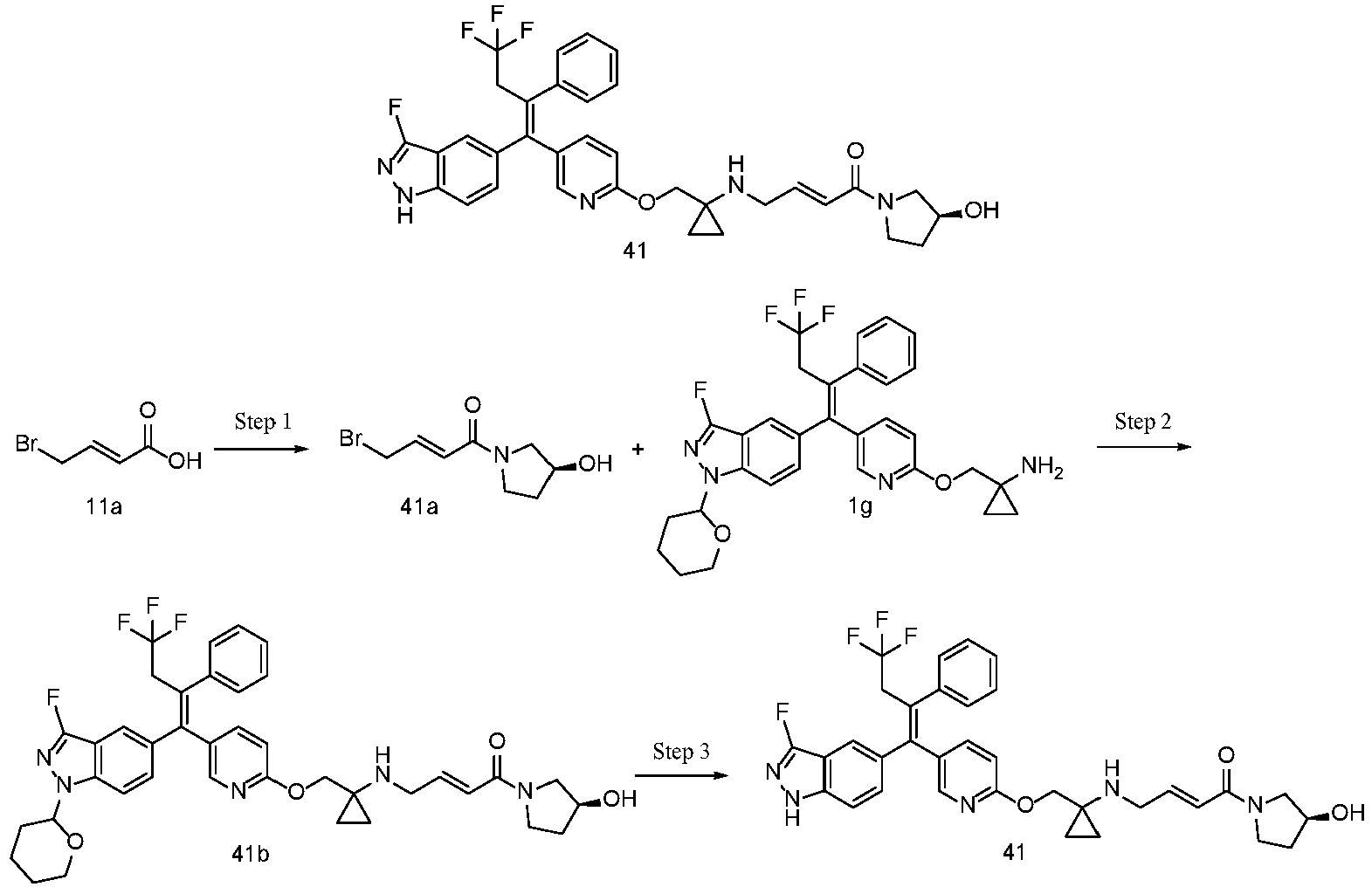
- Compound 11a (0.5 g, 3.0 mmol) was dissolved in dichloromethane (5 mL), followed by the addition of triethylamine (0.3 g, 3.3 mmol), (S)-3-hydroxypyrrolidine (0.2 g, 3.3 mmol), 1-(3-dimethylaminopropyl)-3-ethylcarbodiimide hydrochloride (0.6 g, 3.3 mmol) and 1-hydroxybenzotriazole (0.4 g, 3.3 mmol) at room temperature. The reaction solution was stirred for 12 hours. The reaction solution was cooled. Saturated sodium bicarbonate solution (15 mL) was added, and the solution was extracted with ethyl acetate (20 mL×2). The organic phases were combined, washed with saturated sodium chloride solution (20 mL×4), dried over anhydrous sodium sulfate and filtered. The filtrate was concentrated under reduced pressure, and the resulting residues were purified by thin layer chromatography with developing system A to obtain the title product 41a (0.5 g, yield: 73%).
- In accordance with the synthetic route in Example 1, the starting material 1h in Step 4 was replaced with compound 41a, to give the title compound 41b (41 mg, yield: 57%).
- In accordance with the synthetic route in Example 1, the starting material 1i in Step 5 was replaced with compound 41b, to give the title compound 41 (37 mg, yield: 69%).
- MS m/z(ESI): 636.2 [M+1].
- 1H NMR (400 MHz, CD3OD) 7.71-7.66 (m, 2H), 7.53-7.51 (m, 1H), 7.35-7.22 (m, 8H), 6.71-6.66 (m, 2H), 4.44 (s, 2H), 4.07-4.00 (m, 2H), 3.74-3.67 (m, 2H), 3.55-3.51 (m, 5H), 2.21-2.19 (m, 2H), 1.19-1.13 (m, 4H).
-

- Compound 11a (0.5 g, 3.0 mmol) was dissolved in dichloromethane (5 mL), followed by the addition of triethylamine (0.3 g, 3.3 mmol), (R)-morpholin-2-ylmethanol (0.4 g, 3.3 mmol), 1-(3-dimethylaminopropyl)-3-ethylcarbodiimide hydrochloride (0.6 g, 3.3 mmol) and 1-hydroxybenzotriazole (0.4 g, 3.3 mmol) at room temperature. The reaction solution was stirred for 12 hours. The reaction solution was cooled. Saturated sodium bicarbonate solution (15 mL) was added, and the solution was extracted with ethyl acetate (20 mL×2). The organic phases were combined, washed with saturated sodium chloride solution (20 mL×4), dried over anhydrous sodium sulfate and filtered. The filtrate was concentrated under reduced pressure, and the resulting residues were purified by thin layer chromatography with developing system A to obtain the title product 42a (0.5 g, yield: 63%).
- In accordance with the synthetic route in Example 1, the starting material 1h in Step 4 was replaced with compound 42a, to give the title compound 42b (31 mg, yield: 47%).
- In accordance with the synthetic route in Example 1, the starting material 1i in Step 5 was replaced with compound 42b, to give the title compound 42 (27 mg, yield: 59%).
- MS m/z(ESI): 666.1 [M+1].
- 1H NMR (400 MHz, CD3OD) 7.67-7.65 (m, 2H), 7.52-7.50 (m, 1H), 7.31-7.26 (m, 7H), 6.81-6.77 (m, 1H), 6.61-6.59 (m, 2H), 4.45-4.42 (m, 1H), 4.30 (s, 2H), 3.99-3.93 (m, 2H), 3.61-3.42 (m, 9H), 3.03-3.00 (m, 1H), 0.81-0.72 (m, 4H).
-

- In accordance with the synthetic route in Example 1, the starting material 1g in Step 4 was replaced with 43a (prepared according to the method disclosed in Example 1 on page 77 of the description of the patent application
WO2018098305 ), to give the title compound 43 (21 mg, yield: 42%). - MS m/z(ESI): 610.2 [M+1].
- 1H NMR (400 MHz, CD3OD) 7.69-7.67 (m, 2H), 7.53-7.50 (m, 1H), 7.32-7.20 (m, 7H), 6.80-6.59 (m, 3H), 4.36-4.34 (m, 2H), 3.66-3.58 (m, 10H), 3.48-3.40 (m, 3H), 3.13-3.10 (m, 2H).
- The present disclosure will be further described with reference to the following test examples, but the examples should not be considered as limiting the scope of the present disclosure.
- Test Example 1. Inhibitory effect of the compounds of the present disclosure on the activity of the estrogen receptor reporter gene
- The purpose of the experiment is to determine the inhibitory effect of the compounds of the present disclosure on the activity of the estrogen receptor reporter gene, and evaluate the in vitro activity of the compounds according to IC50.
- MCF7 cells MCF7/ERE-luc (ATCC, HTB-22) expressing the luciferase reporter gene ERE-luc (synthesized by GENEWIZ, Inc.) controlled by the estrogen receptor response element were cultured in MEM (GE Healthcare, SH30024.01) medium containing 10% fetal bovine serum and 500 µg/ml G418. On the first day of the experiment, MCF7/ERE-luc cells were seeded in a 96-well plate with incomplete MEM medium containing 10% fetal bovine serum treated with activated charcoal (BioSun, BS-0004-500) at a density of 30,000 cells/well (100 µl of cell suspension per well), and the plate was incubated in a cell incubator at 37°C and 5% CO2 overnight. On the second day, 10 µl of β-estradiol (SIGMA, E2758-250MG) solution formulated with the above incomplete medium or test compound solution of different concentrations formulated with the above incomplete medium was added to each well, wherein the final concentration of β-estradiol was 0.1 nM, and the final concentrations of the compound were nine concentration points obtained by a 10-fold gradient dilution starting from 10 µM, a blank control containing 0.5% DMSO was set, and the plate was incubated in a cell incubator at 37°C and 5% CO2 for 20 hours. On the third day, the 96-well plate was taken out, and 100 µl of ONE-Glo™ Luciferase Assay system (Promega, E6110) was added to each well to determine the activity of luciferase. The plate was left to stand at at room temperature for 3 minutes until the cells were fully lysed, and the luminescence signal values were measured using a multi-label microplate reader (PerkinElmer, VICTOR 3). The IC50 values of the inhibitory activity of the compounds were calculated using Graphpad Prism software based on the concentrations and luminescence signal values of the compounds.
- The inhibitory effect of the compounds of the present disclosure on the activity of the estrogen receptor reporter gene was determined by the above test. A graph of the chemiluminescence signal values versus the logarithmic concentrations of the compound was made using Graghpad Prism. The resulting IC50 values are shown in Table 1 below.
Table 1 IC50 of inhibitory activity of the compounds of the present disclosure on the activity of the estrogen receptor reporter gene Example No. IC50 (nM) 1 1 2 3 3 4 4 4 5 3 6 0.5 7 38 8 3 9 2 10 8 11 3 12 2 13 3 14 2 15 3 16 5 17 6 18 6 19 4 22 24 23 13 24 9 25 3 26 3 27 7 28 4 29 3 30 3 31 6 32 28 33 3 34 3 35 4 36 5 37 8 38 5 39 2 40 2 41 3 42 0.7 - Conclusion: The compounds of the present disclosure have a significant inhibitory effect on the estrogen receptor reporter gene.
- Test Example 2. Inhibitory effect of the compounds of the present disclosure on the proliferation of MCF7 cell
- The purpose of the experiment is to determine the inhibitory activity of the compounds of the present disclosure on the proliferation of MCF7 cell, and evaluate the in vitro activity of the compounds according to IC50.
- MCF7 cells (ATCC, HTB-22) were cultured in MEM (GE Healthcare, SH30024.01) complete medium containing 10% fetal bovine serum. On the first day of the experiment, MCF7 cells were seeded in a 96-well plate with the complete medium at a density of 3,000 cells/well (100 µl of cell suspension per well), and the plate was incubated in a cell incubator at 37°C and 5% CO2 overnight. On the second day, the medium in each well was replaced with 135 µl of MEM incomplete medium containing 2% fetal bovine serum. 15 µl of test compound solution of different concentrations formulated with the incomplete medium was added to each well, wherein the final concentrations of the compound were nine concentration points obtained by a 4-fold gradient dilution starting from 100 nM. A blank control containing 0.5% DMSO was set. The plate was incubated in a cell incubator at 37°C and 5% CO2 for 144 hours. On the eighth day, the 96-well plate was taken out, and 150 µl of CellTiter-Glo® Luminescent Cell Viability Assay (Promega, G7573) was added to each well. The plate was left to stand at at room temperature for 10 minutes, and the luminescence signal values were measured using a multi-label microplate reader (PerkinElmer, VICTOR 3). The IC50 values of the inhibitory activity of the compounds were calculated based on the concentrations and luminescence signal values of the compounds using Graphpad Prism software.
- A graph of the chemiluminescence signal values versus the logarithmic concentrations of the compound was made using Graghpad Prism to obtain the IC50 values of the compound. The results are shown in Table 2.
Table 2 IC50 of the inhibitory effect IC50 of the compounds of the present disclosure on the proliferation of MCF7 cell Example No. IC50 (nM) Maximum inhibition (%) 1 0.5 100 2 0.6 112 3 2 101 4 1.5 113 5 0.1 96 6 0.15 94 7 2 102 8 0.1 113 9 0.1 110 10 0.3 104 11 0.5 110 12 0.4 108 13 0.6 88 14 0.8 108 15 0.2 107 16 0.8 102 17 0.6 96 18 1 100 19 0.4 97 21 45 90 22 4 103 23 1 97 24 1 98 25 0.5 109 26 0.3 103 27 0.3 86 28 0.1 90 29 0.4 93 30 0.2 93 31 0.7 97 32 5 100 33 0.3 105 34 0.2 103 35 1.1 105 36 0.5 104 37 0.8 98 38 0.8 96 39 0.2 113 40 0.1 115 41 0.1 115 42 0.03 105 Conclusion: The compounds of the present disclosure have a significant inhibitory effect on the proliferation of MCF7 cell. - The purpose of the experiment is to determine the inhibitory activity of the compounds of the present disclosure on the proliferation of MCF7 cell expressing ERa mutant.
- The mutants ERa Y537S and ERa D538G of human estrogen receptor α (ERα) protein were obtained by site-directed mutagenesis using the cDNA of wild-type ESR1 gene (Accession No. NM000125) as a template according to double-primer PCR. The primer sequences used for mutagenesis are as follows (the nucleotides underlined are the sites of mutagenesis):
No. Primer name Primer sequence SEQ ID NO: 1 Y537S-F 
SEQ ID NO: 2 Y537S-R 
SEQ ID NO: 3 D538G-F 
SEQ ID NO: 4 D538G-R 
- The cDNA of mutant ESR1 was cloned into the target lentiviral vector pCDH-CMV-MCS-EF1-Puro (SBI, CD510B-1). The lentiviral plasmid with the mutant ESR1 gene sequence and the lentiviral packaging plasmids pVSV-G and pCMV-dR8.91 (SBI, LV500A-1) were transfected into HEK-293T cells (ATCC, CRL-3216) by Lipofectamine 3000 Transfection Reagent (ThermoFisher Scientific, Cat# L3000075). 48 hours after the transfection, the supernatant of the virus-containing DMEM high-glycemic medium (GE Healthcare, SH30243.01) containing 10% FBS was filtered, and ultracentrifuged to obtain the virus pellet. The virus pellet was resuspended in an appropriate amount of MEM medium (GE Healthcare, SH30024.01) containing 10% FBS, non-essential amino acids (SIGMA, M7145-100ML) and sodium pyruvate (SIGMA, S8636-100ML), and the resulting suspension was added to MCF7 cells (ATCC, HTB-22). Polybrene (SIGMA, H9268-5G) at a final concentration of 8 µg/ml was added, and the cells were incubated overnight. Two days after the transfection, 1 µg/ml puromycin (invitrogen, A11138-03) was added to the cell culture medium for resistance screening. After about two weeks, the MCF7 cell line capable of stably expressing ERaY537S and ERa D538G mutants was obtained.
- MCF7 cells expressing ERa mutant were cultured in MEM (GE Healthcare, SH30024.01) complete medium containing 10% fetal bovine serum. On the first day of the experiment, the cells were seeded in a 96-well plate with the complete medium at a density of 3,000 cells/well (100 µl of cell suspension per well), and the plate was incubated in a cell incubator at 37°C and 5% CO2 overnight. On the second day, the medium in each well was replaced with 135 µl of MEM incomplete medium containing 2% fetal bovine serum. 15 µl of test compound solution of different concentrations formulated with the incomplete medium was added to each well, wherein the final concentrations of the compound were nine concentration points obtained by a 4-fold gradient dilution starting from 100 nM. A blank control containing 0.5% DMSO was set. The plate was incubated in a cell incubator at 37°C and 5% CO2 for 144 hours. On the eighth day, the 96-well plate was taken out, and 150 µl of CellTiter-Glo® Luminescent Cell Viability Assay (Promega, G7573) was added to each well. The plate was left to stand at at room temperature for 10 minutes, and the luminescence signal values were measured using a multi-label microplate reader (PerkinElmer, VICTOR 3). The IC50 values of the inhibitory activity of the compounds were calculated based on the concentrations and luminescence signal values of the compounds using Graphpad Prism software.
Table 3 IC50 of inhibitory effect of the compounds of the present disclosure on the proliferation of MCF7 cell expressing ERa mutant Example No. MCF7 D538G MCF7 ERaY537S IC50 (nM) Maximum inhibition (%) IC50 (nM) Maximum inhibition (%) 1 2 100 3 100 2 2 104 3 107 3 9 96 9 93 4 10 105 11 101 5 0.2 98 0.3 107 6 0.5 98 1 102 7 12 84 12 88 8 1 103 2 107 9 0.8 108 2 94 10 4 104 7 86 11 1 100 2 107 12 1 96 2 104 13 3 107 5 104 14 3 107 6 97 15 1 105 2 102 16 2 110 4 88 17 3 104 3 102 18 5 104 8 92 19 2 97 2 106 22 15 93 15 97 23 7 101 5 94 24 8 94 8 102 25 1 112 1 107 26 1 111 2 104 29 3 93 2 93 31 2 101 3 105 32 11 95 19 84 33 1 106 2 105 34 1 101 1 105 35 3 104 6 97 36 2 99 3 100 37 2 101 3 86 38 2 108 4 102 39 0.6 105 1 112 40 0.2 106 0.5 112 41 0.2 106 0.6 111 42 0.1 105 0.2 107 Conclusion: The compounds of the present disclosure have a significant inhibitory effect on the proliferation of MCF7 cell expressing ERa mutant. - The purpose of the experiment is to investigate the effect of the compounds on Nav1.5 ion channel in an ex-vivo experiment. Nav1.5 ion channel is stably expressed on HEK293 cell. After the Nav1.5 current becomes stable, the Nav1.5 currents before and after the administration of the compound are compared so as to obtain the effect of the compound on the Nav1.5 ion channel.
-
- 1) Patch clamp amplifier: patch clamp PC-505B (WARNER instruments)
- 2) Digital-to-analog converter: Digidata 1440A (Axon CNS)
- 3) Micro-manipulator: MP-225 (SUTTER instrument)
- 4) Inverted microscope: TL4 (Olympus)
- 5) Glass microelectrode puller: PC-10 (NARISHIGE)
- 6) Microelectrode glass capillary: B12024F (Wuhan Weitan Scientific Instrument Co., Ltd.)
- 7) Dimethyl sulfoxide (DMSO): D2650 (Sigma-Aldrich)
- Except for NaOH and KOH used for acid titration and base titration, all the agents used for formulating the extracellular fluid and intracellular fluid were purchased from Sigma (St. Louis, MO).
- Extracellular fluid: NaCl, 137 mM; KCl, 4 mM; CaCl2, 1.8 mM; MgCl2, 1 mM; HEPES, 10; glucose, 10 mM; pH 7.4 (NaOH titration).
- Intracellular fluid: aspartic acid, 140 mM; MgCl2, 2 mM; EGTA, 11 mM; HEPES, 10 mM; pH 7.2 (CsOH titration).
- The test compound was dissolved in dimethyl sulfoxide (DMSO) at a stock concentration of 9 mM. The stock solution of the test compound was dissolved in the extracellular fluid on the day of the test and formulated into the required concentration.
-
- 1) The compound was formulated into solutions with specified concentrations. The solutions were added to the pipelines respectively in order from high to low concentration, and the pipelines were marked.
- 2) The cell was transferred to the perfusion tank, and perfused with the extracellular fluid. The intracellular fluid was stored in small batches in a -80°C refrigerator, and melted on the day of the experiment. The electrode was pulled with PC-10 (Narishige, Japan). Recording was carried out with the whole-cell patch clamp, and the noise was filtered at one-fifth of the sampling frequency.
- 3) All compounds were perfused with a perfusion system that uses its own gravity. Each concentration was tested in at least two cells. After the current stabilized (or after 5 minutes), the blocking effect of the compound was calculated by comparing the changes in the current before and after the administration of the compound.
- 4) The perfusion tank was cleaned. The perfusion tank was rinsed with the drug solutions in order from high to low concentration, and the rinse duration for each concentration of drug solution was 20 seconds. The perfusion tank was finally rinsed with the extracellular fluid for 1 mintue.
- The cell was clamped at -80 mV. The cell was depolarized to Vhalf with a square wave lasting 8 milliseconds, hyperpolarized to -120 mV with a square wave lasting 20 milliseconds, and depolarized to -10mV with a square wave lasting 20 milliseconds to obtain the Nav1.5 current. This procedure was repeated every 15 seconds. The maximum current caused by the -10mV square wave was measured. After the current became stable, the test compound was perfused. After the response became stable, the blocking intensity was calculated.
- The data was stored in the computer system for analysis. Data collection and analysis were carried out by pCLAMP 10 (Molecular Devices, Union City, CA). Stable current means that the absolute average value of the peak current of four consecutive scans exceeds 200 pA and the CV value is less than 10%, or the average value of the peak current of four consecutive scans is between 200 pA and 50 pA and the CV value is less than 30%. The average value of the last four current peaks after the current stabilized was used to calculate the effect of the compound at the concentration.
- The inhibitory activity of the compounds of the present invention on Nav1.5 was determined by the above test, and the resulting IC50 values are shown in Table 4 below.
Table 4 IC50 of the compounds of the present invention on inhibiting the Nav1.5 channel activity Example No. IC50 (uM) 1 >10 39 8.2 40 11.5 41 5.3 43 2.7 Conclusion: The inhibitory effect of compounds 1 and 39 to 41 of the present invention on Nav1.5 channel is weaker than that of the compound of Example 43. It can be seen that the risk of cardiotoxicity of these compounds is significantly lower than that of the compound of Example 43. - BALB/C nude mice were used as test animals. The drug concentration in plasma at different time points was determined by LC/MS/MS method after intragastric administration of the compounds of the present disclosure to BALB/C nude mice. The pharmacokinetic behavior and characteristics of the compounds of the present disclosure was studied and evaluated in BALB/C nude mice.
- Compounds of Example 1, Example 14, Example 15 and Examples 39 to 42.
- LC/MS/MS instruments: LC/MS/MS API4000 triple quadrupole tandem mass spectrometer (No.3, Applied Biosystems, USA), Shimadzu LC-30AD ultra high performance liquid chromatography system (Shimadzu, Japan).
- Sixty-three BALB/C nude mice (female, equally divided into seven groups, nine mice per group) were purchased from Jiesijie Laboratory Animal Co., LTD. (Certificate No.: SCXK(Shanghai)2013-0006).
- For the compound of Example 14, an appropriate amount of the compound was weighed, followed by the addition of 5% of DMSO, 5% of tween 80 and 90% of normal saline by volume to obtain a colorless, clear and transparent solution (0.1 mg/mL).
- For the compounds of Examples 1, 15 and 39 to 42, an appropriate amount of the compound was weighed, followed by the addition of 9% of PEG400, 0.5% of tween 80 and 90.5% of 0.5%CMC-Na by volume to obtain a colorless, clear and transparent solution (1.5 mg/mL).
- After an overnight fast, the test compounds were intragastrically administered at an administration volume of 0.2ml/10g respectively. The administration dose of the compound of Example 14 was 2 mg/kg, and the administration dose of the compounds of Examples 1, 15 and 39 to 42 was 30 mg/kg.
- After an overnight fast, sixty-three female BALB/C nude mice were intragastrically administered the test compounds.
- For the compounds of Examples 1 and 39, 0.1 ml of blood was taken at 0.25, 0.5, 1.0, 2.0, 4.0, 6.0, 8.0, 11.0 and 24.0 hours after the administration (from three animals per time point). The samples were stored in blood collection tubes treated with heparin (Sinopharm Chemical Reagent Co., Ltd.), and centrifuged for 10 minutes at 3500 rpm to separate the blood plasma. The blood plasma was stored at -20°C. The content of the test compound in the plasma of nude mouse after intragastrical administration of the test compound was determined. 25 µL of nude mouse plasma at each time point after the administration was taken, followed by the addition of 30 µL of the internal standard camptothecin solution (National Institutes for Food and Drug Control) (100 ng/mL) and 225 µL of acetonitrile. The resulting solution was vortex-mixed for 5 minutes, and centrifuged for 10 minutes (3700 to 4000 rpm). 0.1 to 0.5 µL of the supernatant was taken from the plasma samples for LC/MS/MS analysis.
- For the compounds of Examples 14 and 15, 0.1 ml of blood was taken at 0.5, 1.0, 2.0, 4.0, 6.0, 8.0, 11.0 and 24.0 hours after the administration (from three animals per time point). The samples were stored in heparinized tubes, and centrifuged for 10 minutes at 3500 rpm to separate the blood plasma. The blood plasma was stored at -20°C. The content of the test compound in the plasma of nude mouse after intragastrical administration of the test compound was determined. 25 µL of nude mouse plasma at each time point after the administration was taken, followed by the addition of 30 µL of the internal standard camptothecin solution (100 ng/mL) and 200 µL of acetonitrile. The resulting solution was vortex-mixed for 5 minutes, and centrifuged for 10 minutes (3700 rpm). 0.25 to 1 µL of the supernatant was taken from the plasma samples for LC/MS/MS analysis.
- For the compounds of Examples 40 to 42, 0.1 ml of blood was taken at 0.25, 0.5, 1.0, 2.0, 4.0, 6.0, 8.0, 11.0 and 24.0 hours after the administration (from three animals per time point). The samples were stored in tubes anticoagulated with EDTA-K2 (Shanghai Titan Scientific Co., Ltd.), and centrifuged for 1 minute at 10000 rpm and 4°C. The blood plasma was separated within one hour, and stored at -20°C. The process from blood collection to centrifugation was operated under an ice bath condition. The content of the test compound in the plasma of nude mouse after intragastrical administration of the test compound was determined. 25 µL of nude mouse plasma at each time point after the administration was taken, followed by the addition of 50 µL of the internal standard camptothecin solution (100 ng/mL) and 200 µL of acetonitrile. The resulting solution was vortex-mixed for 5 minutes, and centrifuged for 10 minutes (3700 rpm). 1 µL of the supernatant was taken from the plasma samples for LC/MS/MS analysis.
- The pharmacokinetic parameters of the compounds of the Examples of the present disclosure are shown in Table 5 below.
Table 5 Pharmacokinetic parameters of the compounds of the Examples of the present disclosure in BALB/C nude mice Exam ple No. Compou nd dose Plasma concentrat ion Area under curve Half-li fe Residen ce time Clearanc e rate Apparen t volume of distributi on Bioavailabi lity Cmax (ng/mL) AUC (ng/mL ∗h) t1/2 (h) MRT (h) CL/F (ml/min/ kg) Vz/F (ml/kg) F(%) 1 30 mg/kg 4276 9849 1.99 1.6 50.8 8760 - 14 2 mg/kg 87 205 1.01 1.9 163 14214 24.8 15 30 mg/kg 4573 6564 0.89 1.41 76 5871 - 39 30 mg/kg 6597 16486 0.94 1.57 30.3 2468 - 40 30 mg/kg 3565 11867 1.26 2.3 42.1 4587 - 41 30 mg/kg 2889 5019 1.67 2.26 99.6 14392 - 42 30 mg/kg 2567 4512 1.2 1.56 111 11502 - "-" refers to not determined. - Conclusion: The compounds of the present disclosure are well absorbed, and have a significant pharmacokinetic absorption effect.
- The purpose of the experiment is to determine the covalent modification effect of the compounds of the present disclosure on estrogen receptor ERa wild-type and ERa Y537S mutant-type.
- The ligand binding domain (LBD, aa296-554) of estrogen receptor ERa wild-type and ERa Y537S mutant-type was expressed in E. coli and purified. 2 µM ERa wild-type or ERa Y537S mutant-type protein and 10 µM compound were added to a buffer solution containing 50 mM Tris-HCl, pH7.5, 150 mM NaCl, 1 mM TCEP and 5% glycerol and mixed well. The solution was incubated at 4°C for 24 hours, followed by high-resolution mass spectrometry (Agilent Technologies, Agilent Q-tof 6530) assay. Alternatively, 1 µM ERa wild-type or ERa Y537S mutant-type protein and 3 µM compound were added to a buffer solution containing 50 mM Tris-HCl, pH7.5, 150 mM NaCl, 1 mM TCEP and 5% glycerol and mixed well. The solution was incubated at 37°C for 15 minutes, followed by high-resolution mass spectrometry assay. In the mass spectrometry assay results, the peak whose molecular weight is the sum of the molecular weight of the protein and compound is the product of covalent modification. The percentage of covalent modification is obtained by calculating the ratio of unbound protein to total protein. The results are shown in Table 6 below.
Table 6 Percentage of covalent modification of the estrogen receptor ERa wild-type and ERa Y537S mutant-type after 24 hours of covalent modification by the compounds of the present disclosure Example No. Covalent modification effect on the estrogen receptor ERa wild-type (%) Covalent modification effect on the estrogen receptor ERa Y537S mutant-type (%) 1 97 97 2 87 90 8 96 97 12 85 83 14 93 94 15 95 96 18 98 99 19 94 97 22 95 100 23 95 99 24 90 99 31 80 83 32 94 95 38 95 96 39 97 98 40 96 98 41 93 95 42 - 97 - Conclusion: The tested compounds have excellent covalent modification effect on the ERa wild-type or ERa Y537S mutant-type protein.
Claims (21)
- A compound of formula (I) or a tautomer, mesomer, racemate, enantiomer, diastereomer thereof, or mixture thereof, or a pharmaceutically acceptable salt thereof:
 G is CH or N;Z is selected from the group consisting of a bond, CR5R6, -O-(CH2)t- and -NR7-(CH2)t-;ring A is selected from the group consisting of cycloalkyl and heterocyclyl;Ra is selected from the group consisting of -CH2CH=CHC(O)NR8R9, -C(O)CH=CR10R11 and -C(O)C-CR12;Rb is selected from the group consisting of hydrogen atom and alkyl;each R1 is identical or different and each is independently selected from the group consisting of hydrogen atom, halogen, alkyl, haloalkyl, hydroxyalkyl, cycloalkyl, heterocyclyl, aryl and heteroaryl;R2 is selected from the group consisting of hydrogen atom, halogen, alkyl, haloalkyl, alkoxy, amino, cyano, nitro, carboxy, formyl, hydroxy, hydroxyalkyl, cycloalkyl, aryl and heteroaryl;each R3 is identical or different and each is independently selected from the group consisting of hydrogen atom, halogen, alkyl, haloalkyl, alkoxy, cyano, amino, nitro, carboxy, formyl, hydroxy, hydroxyalkyl, NR13C(O)R14, C(O)NR13R14, SO2R15, cycloalkyl, heterocyclyl, aryl and heteroaryl;each R4 is identical or different and each is independently selected from the group consisting of hydrogen atom, halogen, alkyl, haloalkyl, alkoxy, cyano, amino, nitro, carboxy, formyl, hydroxy, hydroxyalkyl, cycloalkyl, heterocyclyl, aryl and heteroaryl;R5 and R6 are identical or different and are each independently selected from the group consisting of hydrogen atom, halogen, alkyl, haloalkyl, alkoxy, cyano, amino, nitro, carboxy, formyl, hydroxy, hydroxyalkyl, cycloalkyl, heterocyclyl, aryl and heteroaryl;R7 is selected from the group consisting of hydrogen atom, alkyl, haloalkyl, hydroxyalkyl, cycloalkyl, heterocyclyl, aryl and heteroaryl;R8 and R9 are identical or different and are each independently selected from the group consisting of hydrogen atom, alkyl, haloalkyl, hydroxyalkyl, cycloalkyl, heterocyclyl, aryl and heteroaryl;or, R8 and R9 together with the nitrogen atom to which they are attached form a heterocyclyl, wherein the heterocyclyl optionally contains in addition to one nitrogen atom, one to two identical or different heteroatoms selected from the group consisting of N, O and S , and the heterocyclyl is optionally substituted by one or more substituents selected from the group consisting of alkyl, alkoxy, halogen, amino, cyano, nitro, hydroxy, hydroxyalkyl, cycloalkyl, heterocyclyl, aryl and heteroaryl;R10 and R11 are identical or different and are each independently selected from the group consisting of hydrogen atom, halogen, alkyl, haloalkyl, alkoxy, cyano, amino, nitro, carboxy, formyl, hydroxy, hydroxyalkyl, cycloalkyl, heterocyclyl, aryl and heteroaryl;R12 is selected from the group consisting of hydrogen atom, alkyl, haloalkyl, hydroxyalkyl, cycloalkyl, heterocyclyl, aryl and heteroaryl;R13 and R14 are identical or different and are each independently selected from the group consisting of hydrogen atom, halogen, alkyl, haloalkyl, alkoxy, cyano, amino, nitro, carboxy, formyl, hydroxy, hydroxyalkyl, cycloalkyl, heterocyclyl, aryl and heteroaryl;R15 is selected from the group consisting of hydrogen atom, alkyl, haloalkyl, hydroxyalkyl, cycloalkyl, heterocyclyl, aryl and heteroaryl;m is 0 or 1;n is 0, 1, 2 or 3;q is 0, 1, 2, 3, 4 or 5;s is 0, 1, 2 or 3; andt is 0, 1, 2, 3, 4, 5 or 6.
 - The compound of formula (I) or the tautomer, mesomer, racemate, enantiomer, diastereomer thereof, or mixture thereof, or the pharmaceutically acceptable salt thereof according to claim 1, wherein ring A is selected from the group consisting of C3-C6 cycloalkyl and 3 to 6 membered heterocyclyl; the heterocyclyl contains one to three heteroatoms selected from the group consisting of N, O and S; preferably, ring A is selected from the group consisting of cyclopropyl, cyclopentyl, cyclohexyl, tetrahydropyrrolyl and piperidinyl.
- The compound of formula (I) or the tautomer, mesomer, racemate, enantiomer, diastereomer thereof, or mixture thereof, or the pharmaceutically acceptable salt thereof according to claim 1 or 2, wherein ring A is selected from the group consisting of

- The compound of formula (I) or the tautomer, mesomer, racemate, enantiomer, diastereomer thereof, or mixture thereof, or the pharmaceutically acceptable salt thereof according to claim 1 or 2, being a compound of formula (II) or a tautomer, mesomer, racemate, enantiomer, diastereomer thereof, or mixture thereof, or a pharmaceutically acceptable salt thereof:

ring A, G, Z, R1, R2, R3, R4, Ra, Rb, n, m, s and q are as defined in claim 1. - The compound of formula (I) or the tautomer, mesomer, racemate, enantiomer, diastereomer thereof, or mixture thereof, or the pharmaceutically acceptable salt thereof according to any one of claims 1 to 4, being a compound of formula (III) or a tautomer, mesomer, racemate, enantiomer, diastereomer thereof, or mixture thereof, or a pharmaceutically acceptable salt thereof:

- The compound of formula (I) or the tautomer, mesomer, racemate, enantiomer, diastereomer thereof, or mixture thereof, or the pharmaceutically acceptable salt thereof according to any one of claims 1 to 5, wherein G is an N atom.
- The compound of formula (I) or the tautomer, mesomer, racemate, enantiomer, diastereomer thereof, or mixture thereof, or the pharmaceutically acceptable salt thereof according to any one of claims 1 to 6, wherein R1 is selected from the group consisting of halogen and hydrogen atom.
- The compound of formula (I) or the tautomer, mesomer, racemate, enantiomer, diastereomer thereof, or mixture thereof, or the pharmaceutically acceptable salt thereof according to any one of claims 1 to 7, wherein R2 is a haloalkyl, preferably C1-C6 haloalkyl, and more preferably -CH2CF3.
- The compound of formula (I) or the tautomer, mesomer, racemate, enantiomer, diastereomer thereof, or mixture thereof, or the pharmaceutically acceptable salt thereof according to any one of claims 1 to 8, wherein R3 is selected from the group consisting of hydrogen atom, cyano, halogen, alkyl, haloalkyl, NR13C(O)R14, C(O)NR13R14 and SO2R15; R13 and R14 are identical or different and are each independently selected from the group consisting of hydrogen atom and alkyl; and R15 is selected from the group consisting of hydrogen atom and alkyl.
- The compound of formula (I) or the tautomer, mesomer, racemate, enantiomer, diastereomer thereof, or mixture thereof, or the pharmaceutically acceptable salt thereof according to any one of claims 1 to 9, wherein each R4 is identical or different and each is independently selected from the group consisting of hydrogen atom, halogen, alkyl and alkoxy, and preferably hydrogen atom.
- The compound of formula (I) or the tautomer, mesomer, racemate, enantiomer, diastereomer thereof, or mixture thereof, or the pharmaceutically acceptable salt thereof according to any one of claims 1 to 10, wherein Z is selected from the group consisting of a bond, -O-, -O-CH2- and -NH-.
- The compound of formula (I) or the tautomer, mesomer, racemate, enantiomer, diastereomer thereof, or mixture thereof, or the pharmaceutically acceptable salt thereof according to any one of claims 1 to 11, wherein Ra is selected from the group consisting of -CH2CH=CHC(O)NR8R9, -C(O)CH=CR10R11 and -C(O)C=CR12;R8 and R9 are identical or different and are each independently selected from the group consisting of hydrogen atom, alkyl, cycloalkyl and heterocyclyl;or, R8 and R9 together with the nitrogen atom to which they are attached form a heterocyclyl, wherein the heterocyclyl optionally contains in addition to one nitrogen atom, one to two identical or different heteroatoms selected from the group consisting of N, O and S , and the heterocyclyl is optionally substituted by one or more substituents selected from the group consisting of alkyl, alkoxy, halogen, amino, cyano, nitro, hydroxy, hydroxyalkyl, cycloalkyl, heterocyclyl, aryl and heteroaryl;R10 and R11 are identical or different and are each independently selected from the group consisting of hydrogen atom and alkyl;R12 is selected from the group consisting of hydrogen atom and alkyl.
- The compound of formula (I) or the tautomer, mesomer, racemate, enantiomer, diastereomer thereof, or mixture thereof, or the pharmaceutically acceptable salt thereof according to any one of claims 1 to 12, wherein Ra is selected from the group consisting of -CH2CH=CHC(O)N(CH3)2, -CH2CH=CHC(O)NH(CH3), -CH2CH=CHC(0)NHC(CH3)3, -C(O)CH=CH2, -C(O)C=CCH3,


- The compound of formula (I) or the tautomer, mesomer, racemate, enantiomer, diastereomer thereof, or mixture thereof, or the pharmaceutically acceptable salt thereof according to any one of claims 1 to 13, selected from the group consisting of:







- A compound of formula (IA) or a tautomer, mesomer, racemate, enantiomer, diastereomer thereof, or mixture thereof, or a pharmaceutically acceptable salt thereof,
 Rw is an amino protecting group, and preferably tetrahydropyranyl;R is selected from the group consisting of -CH2CH=CHC(O)NR8R9, -C(O)CH=CR10R11 and -C(O)C=CR12;R8 and R9 are identical or different and are each independently selected from the group consisting of hydrogen atom, alkyl, haloalkyl, hydroxyalkyl, cycloalkyl, heterocyclyl, aryl and heteroaryl;or, R8 and R9 together with the nitrogen atom to which they are attached form a heterocyclyl, wherein the heterocyclyl optionally contains in addition to one nitrogen atom, one to two identical or different heteroatoms selected from the group consisting of N, O and S , and the heterocyclyl is optionally substituted by one or more substituents selected from the group consisting of alkyl, alkoxy, halogen, amino, cyano, nitro, hydroxy, hydroxyalkyl, -COOR16-, cycloalkyl, heterocyclyl, aryl and heteroaryl;R10 and R11 are identical or different and are each independently selected from the group consisting of hydrogen atom, halogen, alkyl, haloalkyl, alkoxy, cyano, amino, nitro, carboxy, formyl, hydroxy, hydroxyalkyl, cycloalkyl, heterocyclyl, aryl and heteroaryl;R12 is selected from the group consisting of hydrogen atom, alkyl, haloalkyl, hydroxyalkyl, cycloalkyl, heterocyclyl, aryl and heteroaryl;R16 is selected from the group consisting of hydrogen atom, alkyl, haloalkyl and hydroxyalkyl;ring A, G, Z, R1, R2, R3, R4, Rb, n, m, s and q are as defined in claim 1.
 - The compound of formula (IA) or the tautomer, mesomer, racemate, enantiomer, diastereomer thereof, or mixture thereof, or the pharmaceutically acceptable salt thereof according to claim 15, selected from the group consisting of:



- A method for preparing the compound of formula (I) or the tautomer, mesomer, racemate, enantiomer, diastereomer thereof, or mixture thereof, or the pharmaceutically acceptable salt thereof according to any one of claims 1 to 14, comprising a step of:
 subjecting the compound of formula (IA) or the tautomer, mesomer, racemate, enantiomer, diastereomer thereof, or mixture thereof, or the pharmaceutically acceptable salt thereof to a deprotection reaction under an acidic condition to obtain the compound of formula (I) or the tautomer, mesomer, racemate, enantiomer, diastereomer thereof, or mixture thereof, or the pharmaceutically acceptable salt thereof;wherein:Rw is an amino protecting group, and preferably tetrahydropyranyl;R is as defined in claim 15;ring A, G, Z, R1, R2, R3, R4, Ra , Rb, n, m, s and q are as defined in claim 1.
 - A pharmaceutical composition, comprising a therapeutically effective amount of the compound of formula (I) or the tautomer, mesomer, racemate, enantiomer, diastereomer thereof, or mixture thereof, or the pharmaceutically acceptable salt thereof according to any one of claims 1 to 14, and one or more pharmaceutically acceptable carriers, diluents or excipients.
- Use of the compound of formula (I), or the tautomer, mesomer, racemate, enantiomer, diastereomer thereof, or mixture thereof, or the pharmaceutically acceptable salt thereof according to any one of claims 1 to 14, or the pharmaceutical composition according to claim 18 in the preparation of an estrogen receptor modulator.
- Use of the compound of formula (I), or the tautomer, mesomer, racemate, enantiomer, diastereomer thereof, or mixture thereof, or the pharmaceutically acceptable salt thereof according to any one of claims 1 to 14, or the pharmaceutical composition according to claim 18 in the preparation of a medicament for preventing and/or treating estrogen receptor-mediated or estrogen receptor-dependent disease or disorder.
- The use according to claim 20, wherein the estrogen receptor-mediated or estrogen receptor-dependent disease or disorder is a cancer, preferably breast cancer, ovarian cancer, endometrial cancer, prostate cancer or uterine cancer, and more preferably breast cancer.
Applications Claiming Priority (2)
| Application Number | Priority Date | Filing Date | Title |
|---|---|---|---|
| CN201910530981 | 2019-06-19 | ||
| PCT/CN2020/096744 WO2020253762A1 (en) | 2019-06-19 | 2020-06-18 | Indazole derivative, preparation method therefor, and pharmaceutical application thereof |
Publications (2)
| Publication Number | Publication Date |
|---|---|
| EP3988547A1 true EP3988547A1 (en) | 2022-04-27 |
| EP3988547A4 EP3988547A4 (en) | 2022-07-27 |
Family
ID=74040676
Family Applications (1)
| Application Number | Title | Priority Date | Filing Date |
|---|---|---|---|
| EP20827542.0A Pending EP3988547A4 (en) | 2019-06-19 | 2020-06-18 | INDAZOLE DERIVATIVE, METHOD FOR PREPARATION AND PHARMACEUTICAL APPLICATION |
Country Status (12)
| Country | Link |
|---|---|
| US (1) | US12325696B2 (en) |
| EP (1) | EP3988547A4 (en) |
| JP (1) | JP2022537330A (en) |
| KR (1) | KR20220024476A (en) |
| CN (2) | CN119320379A (en) |
| AU (1) | AU2020294642A1 (en) |
| BR (1) | BR112021025601A2 (en) |
| CA (1) | CA3143367A1 (en) |
| MX (1) | MX2021015486A (en) |
| TW (1) | TWI858082B (en) |
| WO (1) | WO2020253762A1 (en) |
| ZA (1) | ZA202200538B (en) |
Families Citing this family (3)
| Publication number | Priority date | Publication date | Assignee | Title |
|---|---|---|---|---|
| CN116615418B (en) * | 2020-12-18 | 2025-11-11 | 江苏恒瑞医药股份有限公司 | Pharmaceutically acceptable salt and crystal form of indazole derivative and preparation method thereof |
| CN117642169A (en) * | 2021-07-13 | 2024-03-01 | 江苏恒瑞医药股份有限公司 | Use of a selective estrogen receptor covalent antagonist in combination with a CDK4/6 inhibitor for the treatment of breast cancer |
| CN115960082B (en) * | 2021-10-13 | 2024-06-07 | 长春金赛药业有限责任公司 | Tetra-substituted olefin compound, preparation method thereof and application thereof in medicine |
Family Cites Families (11)
| Publication number | Priority date | Publication date | Assignee | Title |
|---|---|---|---|---|
| WO2011096342A1 (en) | 2010-02-04 | 2011-08-11 | 独立行政法人科学技術振興機構 | Process for production of selectively chemically modified carbon nano-tube |
| GB2483736B (en) * | 2010-09-16 | 2012-08-29 | Aragon Pharmaceuticals Inc | Estrogen receptor modulators and uses thereof |
| US9499538B2 (en) * | 2012-03-20 | 2016-11-22 | Seragon Pharmaceuticals, Inc. | Estrogen receptor modulators and uses thereof |
| JP2016512846A (en) | 2013-03-13 | 2016-05-09 | ダナ−ファーバー キャンサー インスティテュート, インコーポレイテッド | RAS inhibitors and uses thereof |
| SG11201607339VA (en) * | 2014-03-13 | 2016-10-28 | Hoffmann La Roche | Methods and compositions for modulating estrogen receptor mutants |
| WO2016196342A1 (en) | 2015-05-29 | 2016-12-08 | Eisai R&D Management Co., Ltd. | Tetrasubstituted alkene compounds and their use |
| MD3302471T2 (en) * | 2015-05-29 | 2021-12-31 | Eisai R&D Man Co Ltd | Tetrasubstituted alkene compounds and their use |
| ES3039455T3 (en) * | 2016-11-17 | 2025-10-21 | Sanofi Sa | Novel substituted n-(3-fluoropropyl)-pyrrolidine compounds, processes for their preparation and therapeutic uses thereof |
| MA46896A (en) | 2016-11-24 | 2019-10-02 | Eisai R&D Man Co Ltd | TETRASUBSTITUTED ALCENE COMPOUNDS AND THEIR USE |
| US20180141913A1 (en) | 2016-11-24 | 2018-05-24 | Eisai R & D Management Co., Ltd. | Tetrasubstituted alkene compounds and their use |
| WO2018138739A1 (en) * | 2017-01-27 | 2018-08-02 | Sun Pharma Advanced Research Company Limited | Novel antiestrogenic heterocyclic compounds |
-
2020
- 2020-06-18 CA CA3143367A patent/CA3143367A1/en active Pending
- 2020-06-18 EP EP20827542.0A patent/EP3988547A4/en active Pending
- 2020-06-18 WO PCT/CN2020/096744 patent/WO2020253762A1/en not_active Ceased
- 2020-06-18 AU AU2020294642A patent/AU2020294642A1/en not_active Abandoned
- 2020-06-18 CN CN202411269253.9A patent/CN119320379A/en active Pending
- 2020-06-18 JP JP2021575257A patent/JP2022537330A/en not_active Ceased
- 2020-06-18 US US17/618,767 patent/US12325696B2/en active Active
- 2020-06-18 BR BR112021025601A patent/BR112021025601A2/en unknown
- 2020-06-18 KR KR1020227000865A patent/KR20220024476A/en not_active Ceased
- 2020-06-18 TW TW109120610A patent/TWI858082B/en active
- 2020-06-18 MX MX2021015486A patent/MX2021015486A/en unknown
- 2020-06-18 CN CN202080038970.4A patent/CN113874367B/en active Active
-
2022
- 2022-01-11 ZA ZA2022/00538A patent/ZA202200538B/en unknown
Also Published As
| Publication number | Publication date |
|---|---|
| WO2020253762A1 (en) | 2020-12-24 |
| TW202115022A (en) | 2021-04-16 |
| CN113874367B (en) | 2024-09-13 |
| CA3143367A1 (en) | 2020-12-24 |
| MX2021015486A (en) | 2022-01-24 |
| US12325696B2 (en) | 2025-06-10 |
| CN113874367A (en) | 2021-12-31 |
| CN119320379A (en) | 2025-01-17 |
| AU2020294642A1 (en) | 2022-02-03 |
| KR20220024476A (en) | 2022-03-03 |
| JP2022537330A (en) | 2022-08-25 |
| EP3988547A4 (en) | 2022-07-27 |
| ZA202200538B (en) | 2025-03-26 |
| US20220267304A1 (en) | 2022-08-25 |
| TWI858082B (en) | 2024-10-11 |
| BR112021025601A2 (en) | 2022-02-01 |
Similar Documents
| Publication | Publication Date | Title |
|---|---|---|
| CN115244056B (en) | Condensed imidazole derivatives, preparation methods thereof and their application in medicine | |
| CN113816948B (en) | Condensed imidazole derivative, preparation method and medical application thereof | |
| EP4209490B1 (en) | 2-(((2,3-dihydrobenzo[b][1,4]dioxan-5-yl)piperidin-1-yl)methyl)-1-((oxetan-2-yl)methyl)-1h-benzo[d]imidazole-6-carboxylic acid derivatives and similar compounds as glp-1 modulators for the treatment of diabetes | |
| KR20230023672A (en) | Pyridine-pyrimidine derivatives, methods for their preparation and pharmaceutical uses thereof | |
| EP4317146A1 (en) | Tetrahydronaphthalene compound, and preparation method therefor and use thereof in medicine | |
| EP4438603A1 (en) | Chimeric compound for targeted degradation of androgen receptor protein, preparation method therefor, and medical use thereof | |
| JP7657807B2 (en) | Tricyclic tetrahydroisoquinoline derivatives, their preparation method and their medical applications | |
| EP4063363A1 (en) | Pyrazolo-heteroaryl derivative, preparation method therefor, and medical use thereof | |
| EP3988547A1 (en) | Indazole derivative, preparation method therefor, and pharmaceutical application thereof | |
| EP4692088A1 (en) | Compound acting as wrn helicase inhibitor | |
| CN113825757B (en) | Substituted fused bicyclic derivatives, their preparation methods and their applications in medicine | |
| EP3950693A1 (en) | Thienoheterocyclic derivative, preparation method therefor and medical use thereof | |
| CN112996783A (en) | 2-aminopyrimidine derivatives, preparation method and application thereof in medicines | |
| EP4587429B1 (en) | Substituted oxoisoindolinyl piperidine-2,6-dione compounds | |
| RU2817737C2 (en) | Indazole derivative, method for preparation and pharmaceutical use thereof | |
| HK40064838A (en) | Indazole derivative, preparation method therefor, and pharmaceutical application thereof | |
| RU2830109C1 (en) | Tricyclic tetrahydroisoquinoline derivative, method for production thereof and use thereof in medicine | |
| HK40064838B (en) | Indazole derivative, preparation method therefor, and pharmaceutical application thereof | |
| CN121362177A (en) | APJ agonists | |
| HK40082497B (en) | Fused imidazole derivatives, preparation method and medical use thereof | |
| HK40082497A (en) | Fused imidazole derivatives, preparation method and medical use thereof |
Legal Events
| Date | Code | Title | Description |
|---|---|---|---|
| STAA | Information on the status of an ep patent application or granted ep patent |
Free format text: STATUS: THE INTERNATIONAL PUBLICATION HAS BEEN MADE |
|
| PUAI | Public reference made under article 153(3) epc to a published international application that has entered the european phase |
Free format text: ORIGINAL CODE: 0009012 |
|
| STAA | Information on the status of an ep patent application or granted ep patent |
Free format text: STATUS: REQUEST FOR EXAMINATION WAS MADE |
|
| 17P | Request for examination filed |
Effective date: 20211223 |
|
| AK | Designated contracting states |
Kind code of ref document: A1 Designated state(s): AL AT BE BG CH CY CZ DE DK EE ES FI FR GB GR HR HU IE IS IT LI LT LU LV MC MK MT NL NO PL PT RO RS SE SI SK SM TR |
|
| A4 | Supplementary search report drawn up and despatched |
Effective date: 20220624 |
|
| RIC1 | Information provided on ipc code assigned before grant |
Ipc: A61K 31/416 20060101ALI20220620BHEP Ipc: A61P 35/00 20060101ALI20220620BHEP Ipc: C07D 401/06 20060101ALI20220620BHEP Ipc: C07D 231/56 20060101ALI20220620BHEP Ipc: C07D 401/14 20060101ALI20220620BHEP Ipc: C07D 403/12 20060101AFI20220620BHEP |
|
| DAV | Request for validation of the european patent (deleted) | ||
| DAX | Request for extension of the european patent (deleted) | ||
| STAA | Information on the status of an ep patent application or granted ep patent |
Free format text: STATUS: EXAMINATION IS IN PROGRESS |
|
| 17Q | First examination report despatched |
Effective date: 20240904 |
|
| STAA | Information on the status of an ep patent application or granted ep patent |
Free format text: STATUS: THE APPLICATION IS DEEMED TO BE WITHDRAWN |