EP3988329B1 - Tire - Google Patents
Tire Download PDFInfo
- Publication number
- EP3988329B1 EP3988329B1 EP20827760.8A EP20827760A EP3988329B1 EP 3988329 B1 EP3988329 B1 EP 3988329B1 EP 20827760 A EP20827760 A EP 20827760A EP 3988329 B1 EP3988329 B1 EP 3988329B1
- Authority
- EP
- European Patent Office
- Prior art keywords
- tire
- reinforcing layer
- gap
- layer
- belt
- Prior art date
- Legal status (The legal status is an assumption and is not a legal conclusion. Google has not performed a legal analysis and makes no representation as to the accuracy of the status listed.)
- Active
Links
Images



Classifications
-
- B—PERFORMING OPERATIONS; TRANSPORTING
- B60—VEHICLES IN GENERAL
- B60C—VEHICLE TYRES; TYRE INFLATION; TYRE CHANGING; CONNECTING VALVES TO INFLATABLE ELASTIC BODIES IN GENERAL; DEVICES OR ARRANGEMENTS RELATED TO TYRES
- B60C9/00—Reinforcements or ply arrangement of pneumatic tyres
- B60C9/18—Structure or arrangement of belts or breakers, crown-reinforcing or cushioning layers
- B60C9/20—Structure or arrangement of belts or breakers, crown-reinforcing or cushioning layers built-up from rubberised plies each having all cords arranged substantially parallel
- B60C9/22—Structure or arrangement of belts or breakers, crown-reinforcing or cushioning layers built-up from rubberised plies each having all cords arranged substantially parallel the plies being arranged with all cords disposed along the circumference of the tyre
-
- B—PERFORMING OPERATIONS; TRANSPORTING
- B60—VEHICLES IN GENERAL
- B60C—VEHICLE TYRES; TYRE INFLATION; TYRE CHANGING; CONNECTING VALVES TO INFLATABLE ELASTIC BODIES IN GENERAL; DEVICES OR ARRANGEMENTS RELATED TO TYRES
- B60C9/00—Reinforcements or ply arrangement of pneumatic tyres
- B60C9/18—Structure or arrangement of belts or breakers, crown-reinforcing or cushioning layers
- B60C9/20—Structure or arrangement of belts or breakers, crown-reinforcing or cushioning layers built-up from rubberised plies each having all cords arranged substantially parallel
- B60C9/22—Structure or arrangement of belts or breakers, crown-reinforcing or cushioning layers built-up from rubberised plies each having all cords arranged substantially parallel the plies being arranged with all cords disposed along the circumference of the tyre
- B60C9/2204—Structure or arrangement of belts or breakers, crown-reinforcing or cushioning layers built-up from rubberised plies each having all cords arranged substantially parallel the plies being arranged with all cords disposed along the circumference of the tyre obtained by circumferentially narrow strip winding
-
- B—PERFORMING OPERATIONS; TRANSPORTING
- B60—VEHICLES IN GENERAL
- B60C—VEHICLE TYRES; TYRE INFLATION; TYRE CHANGING; CONNECTING VALVES TO INFLATABLE ELASTIC BODIES IN GENERAL; DEVICES OR ARRANGEMENTS RELATED TO TYRES
- B60C9/00—Reinforcements or ply arrangement of pneumatic tyres
- B60C9/0007—Reinforcements made of metallic elements, e.g. cords, yarns, filaments or fibres made from metal
-
- B—PERFORMING OPERATIONS; TRANSPORTING
- B60—VEHICLES IN GENERAL
- B60C—VEHICLE TYRES; TYRE INFLATION; TYRE CHANGING; CONNECTING VALVES TO INFLATABLE ELASTIC BODIES IN GENERAL; DEVICES OR ARRANGEMENTS RELATED TO TYRES
- B60C9/00—Reinforcements or ply arrangement of pneumatic tyres
- B60C9/18—Structure or arrangement of belts or breakers, crown-reinforcing or cushioning layers
- B60C9/20—Structure or arrangement of belts or breakers, crown-reinforcing or cushioning layers built-up from rubberised plies each having all cords arranged substantially parallel
- B60C9/22—Structure or arrangement of belts or breakers, crown-reinforcing or cushioning layers built-up from rubberised plies each having all cords arranged substantially parallel the plies being arranged with all cords disposed along the circumference of the tyre
- B60C2009/2252—Physical properties or dimension of the zero degree ply cords
- B60C2009/2266—Density of the cords in width direction
-
- B—PERFORMING OPERATIONS; TRANSPORTING
- B60—VEHICLES IN GENERAL
- B60C—VEHICLE TYRES; TYRE INFLATION; TYRE CHANGING; CONNECTING VALVES TO INFLATABLE ELASTIC BODIES IN GENERAL; DEVICES OR ARRANGEMENTS RELATED TO TYRES
- B60C9/00—Reinforcements or ply arrangement of pneumatic tyres
- B60C9/18—Structure or arrangement of belts or breakers, crown-reinforcing or cushioning layers
- B60C9/20—Structure or arrangement of belts or breakers, crown-reinforcing or cushioning layers built-up from rubberised plies each having all cords arranged substantially parallel
- B60C9/22—Structure or arrangement of belts or breakers, crown-reinforcing or cushioning layers built-up from rubberised plies each having all cords arranged substantially parallel the plies being arranged with all cords disposed along the circumference of the tyre
- B60C2009/2252—Physical properties or dimension of the zero degree ply cords
- B60C2009/2266—Density of the cords in width direction
- B60C2009/2271—Density of the cords in width direction with variable density
-
- Y—GENERAL TAGGING OF NEW TECHNOLOGICAL DEVELOPMENTS; GENERAL TAGGING OF CROSS-SECTIONAL TECHNOLOGIES SPANNING OVER SEVERAL SECTIONS OF THE IPC; TECHNICAL SUBJECTS COVERED BY FORMER USPC CROSS-REFERENCE ART COLLECTIONS [XRACs] AND DIGESTS
- Y02—TECHNOLOGIES OR APPLICATIONS FOR MITIGATION OR ADAPTATION AGAINST CLIMATE CHANGE
- Y02T—CLIMATE CHANGE MITIGATION TECHNOLOGIES RELATED TO TRANSPORTATION
- Y02T10/00—Road transport of goods or passengers
- Y02T10/80—Technologies aiming to reduce greenhouse gasses emissions common to all road transportation technologies
- Y02T10/86—Optimisation of rolling resistance, e.g. weight reduction
Definitions
- the present invention relates to a tire suitable for sport driving.
- a pneumatic tire (hereinafter abbreviated as tire) having a reinforcing layer provided on the outside of a pair of crossing belt in a tire radial direction is known (Patent literature 1).
- the reinforcing layer is formed by a strip-like member (strip member) in which a plurality of cords are rubbed is wound around along tire circumferential direction.
- Japanese Unexamined Patent Application Publication No. 2001-322405 WO02102610A1 discloses a pneumatic radial tire provided with a band layer consisting of a band ply formed by arranging one or a plurality of band cords on the inner side of a tread section and a radially outer side of a belt layer, and spirally coiling a tape-form, band-like ply buried in topping rubber.
- WO2014181705A1 discloses a technique for reducing the frequency of occurrence of a groove crack in every tire having a helically wound circumferential reinforcement layer.
- EP1167003A2 discloses a method of making a pneumatic tire (1) with a breaker (7) and a band (9), comprising: applying a raw breaker material to a cylindrical drum (F); spirally winding a plurality of parallel band cords (10) around the raw breaker material on the cylindrical drum so that angles of the windings are not more than 5 degrees with respect to the tire equator; and gradually increasing one of an average density of the band cords in the tire axial direction and an average tension of the band cords in the tire axial direction, from a center portion of the band towards each axial edge of the band during winding the band cords.
- EP0414470A2 discloses a high performance pneumatic radial tire (1) comprising a toroidal carcass (3), a tread (17) radially outside a crown portion of the carcass, a belt layer (10) interposed between the carcass and the tread and having the same width as the tread, and an auxiliary layer (16) arranged between the belt layer and the tread and covering the entire belt layer.
- EP3653401A1 discloses a pneumatic tyre including a tread portion (2) provided with circumferential grooves (G) to form circumferential land portions, a belt layer (7), and a band layer (9) disposed outwardly in the tyre radial direction of the belt layer.
- steering stability in high-speed driving is improved, but in recent years, as the performance of vehicles is improved, it has been demanded from the market that the improvement of steering stability in high-speed driving and the improvement of gripping force of the road surface can be made at a higher level especially in a tire used for sporting driving. It is also important to improve the life of tire, especially when the tire is used by average users, even in the case of sporting driving.
- an object of the present invention is to provide a tire in which gripping force is further improved while extending the life of tire.
- One aspect of the present invention is a tire (pneumatic tire 10) as defined in claim 1.
- FIG. 1 is a cross-sectional view of a pneumatic tire 10 according to the present embodiment. Specifically, FIG. 1 is a cross-sectional view of the pneumatic tire 10 taken along tire width direction and tire radial direction. In FIG. 1 , the sectional hatching is not shown (hereinafter the same).
- the pneumatic tire 10 includes a tread 20, a tire side portion 30, a carcass 40, a belt layer 50, a bead portion 60, and a reinforcing layer 100.
- the pneumatic tire 10 is a tire that is assumed to be mounted on a four-wheel vehicle, specifically a passenger vehicle.
- the pneumatic tire 10 may be suitably used for a four-wheel vehicle, such as a sports type four-wheel vehicle, suitable for sport driving (including a racetrack).
- the tread 20 is a portion in contact with the road surface.
- a pattern (not shown) is formed according to the usage environment of the pneumatic tire 10 and the type of vehicle to be mounted.
- the tire side portion 30 is continuous to the tread 20 and positioned inside in the tire radial direction of the tread 20.
- the tire side portion 30 is an area from the tire width direction outer end of the tread 20 to the upper end of bead portion 60.
- the tire side portion 30 is sometimes referred to as a sidewall.
- the carcass 40 forms the skeleton of the pneumatic tire 10.
- the carcass 40 has a radial structure in which a carcass cord (not shown) arranged radially along tire radial direction is covered with a rubber material.
- the present invention is not limited to a radial structure, and may be a bias structure in which the carcass cords are arranged so as to cross each other in the tire radial direction.
- the carcass 40 has a body portion 41 and a folded portion 42.
- the body portion 41 extends over the tread 20, the tire side portion 30 and the bead portion 60 until it is folded back at the bead portion 60.
- the folded portion 42 is a portion continuous to the body portion 41 and folded back to the outside in the tire width direction via a bead core 61.
- An outer end 42 e of the folded portion 42 in the tire radial direction extends to the inside in the tire radial direction of the belt layer 50. That is, the carcass 40 has an envelope structure.
- the carcass 40 need not necessarily have an envelope structure, and for example, the outer end 42 e does not reach the belt layer 50, but may have a high-turn-up structure positioned inside in the tire radial direction of the belt layer 50, specifically, near the maximum width of the tire side portion 30.
- the carcass cord is formed of an organic fiber such as nylon as in the case of a tire for standard four-wheel vehicles.
- the carcass 40 is formed of a plurality of plies (carcass plies).
- the belt layer 50 is provided inside in the tire radial direction of the tread 20, specifically inside in the tire radial direction of the reinforcing layer 100.
- the belt layer 50 is provided from one end to the other end in the tire width direction of the tread 20. Specifically, the belt layer 50 is provided from one shoulder portion 21 (not shown in FIG. 1 , see FIG. 2 ) to the other shoulder portion (not shown) of the tread 20.
- the shoulder portion may be defined as an area including a boundary between the tread 20 and tire side portion 30.
- the belt layer 50 is formed by a pair of crossing belt with crossing cords (not shown) made of metal, such as steel.
- the belt layer 50 may not necessarily be formed by a crossing belt. If the carcass 40 has a bias structure, the belt layer 50 need not be provided.
- the belt layer 50 may be a single layer spiral belt with a reinforcing cord formed of a metallic material (for example, steel.) coated with a resin. That is, the belt layer 50 may be provided outside in the tire radial direction of the carcass 40, so long as the structure contributes to generation of a cornering force (CF), securing of rigidity of the carcass 40, and the like, when a slip angle is applied to the pneumatic tire 10.
- CF cornering force
- the belt layer 50 may also be less rigid than a belt layer used in a typical pneumatic tire of the same type. Specifically, the belt layer 50 may have a lower in-belt please shear stiffness (may simply be referred to as in-plane shear rigidity) of the pair of crossing belt than a crossing belt typically used in the same type of a pneumatic tire. The belt layer 50 contributes to an increase in ground contact area of the tread 20.
- the belt layer 50 is therefore easily deformed by an external force, but is required to be strong against twisting. For example, by making the diameter (wire diameter) of the cords that make up the belt layer 50 smaller than a crossing belt layer used in a typical pneumatic tire of the same type, such characteristics can be imparted to the belt layer 50.
- the bead portion 60 is continuous to the tire side portion 30 and is positioned inside in the tire radial direction of the tire side portion 30.
- the bead portion 60 is an annular shape extending to tire circumferential direction and is locked to a rim wheel (not shown).
- the bead portion 60 includes a bead core 61 and a bead filler 62.
- the bead core 61 is formed by twisting a plurality of metal cords.
- the bead core 61 may be formed of steel cords.
- the number of cords (number of cores) is not particularly limited.
- the bead filler 62 is provided outside in the tire radial direction of the bead core 61.
- the bead filler 62 is formed by using rubber (or resin) harder than other parts formed by using rubber.
- the bead filler 62 is provided to fill a space having wedge-shaped in cross-sectional shape formed by the body portion 41 and the folded portion 42 of the carcass 40.
- the bead filler 62 may be referred to as a stiffener.
- a rim line 90 is provided on an outside in the tire width direction of the bead portion 60.
- the rim line 90 is a projection formed along the tire circumferential direction to confirm that the bead portion 60 is correctly mounted on the rim wheel.
- the reinforcing layer 100 is provided outside in the tire radial direction of the belt layer 50. Specifically, the reinforcing layer 100 is provided inside in the tire radial direction of the tread 20.
- the reinforcing layer 100 has a two-layer structure of a layer (which may be called a ply) provided inside in the tire radial direction and a layer provided outside in the tire radial direction.
- the reinforcing layer 100 is formed by winding a strip member in which a plurality of cords are rubbed a plurality of times along tire circumferential direction.
- the reinforcing layer 100 may also be referred to as a cap , a layer, or cap and layer, and the like.
- FIG. 2 is a partially enlarged sectional view of the pneumatic tire 10 including a shoulder portion of the tread 20.
- the reinforcing layer 100 includes an inner reinforcing layer 110 and an outer reinforcing layer 120.
- the inner reinforcing layer 110 and the outer reinforcing layer 120 are formed by winding a strip member having a plurality of cords along the tire circumferential direction.
- the outer reinforcing layer 120 is provided outside in the tire radial direction of the inner reinforcing layer 110.
- adjacent strip members in the tire width direction are closely attached.
- gaps (space) are provided between adjacent strip members in the tire width direction. That is, in the outer reinforcing layer 120, the strip members are spaced apart in the tire width direction.
- the reinforcing layer 100 is provided up to a shoulder portion 21 of the tread 20.
- the reinforcing layer 100 is positioned outside in the tire width direction than an end portion 50 e of the belt layer 50.
- the reinforcing layer 100 is provided so as to overlap the folded portion 42 of the carcass 40 in the tire width direction. Specifically, an outer end 42 e of the folded portion 42 is positioned inside in the tire width direction than an end portion 100 e of the reinforcing layer 100.
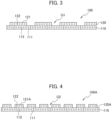
- FIG. 3 is a partially enlarged cross-sectional view of the reinforcing layer 100. Specifically, FIG. 3 is a partially enlarged cross-sectional view of the reinforcing layer 100 of the pneumatic tire 10 along the tire width direction and the tire radial direction.
- the reinforcing layer 100 is formed by the inner reinforcing layer 110 and the outer reinforcing layer 120.
- the inner reinforcing layer 110 is formed by winding a strip member 111 spirally wound along the tire circumferential direction at the tire radial direction outside of the belt layer 50.
- the outer reinforcing layer 120 is formed by a strip member 121 spirally wound along the tire circumferential direction at the tire radial direction outside of the inner reinforcing layer 110.
- the strip member 111 is formed by covering a plurality of cords 112 with a rubber material.
- the strip member 121 is formed by coating a plurality of cords 122 with a rubber material.
- the cords 112 and 122 may be formed of organic fibers or metal, such as or steel. In the case of the organic fiber, for example, polyester, aramid fiber or the like can be used.
- the strip member 111 is formed of 6 pieces of the cords 112.
- the strip member 121 is formed of 6 pieces of the cords 122.
- the number of cords 112 forming the strip member 111 and the number of cords 122 forming the strip member 121 are not limited to 6, and may be more than 6 or less than 6.
- the number of cords 112 forming the strip member 111 or the number of cords 122 forming the strip member 121 may be smaller.
- the inner reinforcing layer 110 is provided with strip members 111 continuously throughout the entire area in the tire width direction (see also FIGs. 1 and 2 ). That is, no gap is provided between the adjacent strip members 111.
- the outer reinforcing layer 120 has a gap G1 between adjacent strip members 121 in the tire width direction. That is, the strip member 121 is spirally wound along the tire circumferential direction with the gap G1.
- the plurality of gaps G1 are all the same and do not vary.
- the outer reinforcing layer 120 may also have at least the gap G1 in a central region CT (see FIG. 1 ) in the tire width direction including a tire equatorial line CL. That is, in a region other than the central region CT in the tire width direction, for example, a region closer to the shoulder portion 21 (see FIG. 2 ), the outer reinforcing layer 120 may not have the gap G1.
- the center region CT is defined as a region from the tire equatorial line CL up to 30% of a half (TW/2) of the tread width (TW) of the pneumatic tire 10.
- the inner reinforcing layer 110 is provided with the strip members 111 continuously throughout in the tire width direction, but the inner reinforcing layer 110 may have a continuous portion 115 (see FIG. 1 ) in which the strip members 111 are provided continuously at least in the center region CT without the gap G1.
- the width of the gap G1 is narrower than the width of the strip member 121.
- the width of the strip member 111 and the strip member 121 along the tire width direction is about 6 mm.
- the width of the gap G1 along the tire width direction is about 3 mm.
- the gap G1 and the width of the strip member 121 have a relationship of about 1: 2.
- FIG. 4 is a partially enlarged cross-sectional view of the reinforcing layer 100 A according to modified example. As shown in FIG. 4 , the reinforcing layer 100 A is formed of the inner reinforcing layer 110 and an outer reinforcing layer 120 A.
- the outer reinforcing layer 120 A is formed of a strip member 121 A.
- the strip member 121 A has a smaller number of cords 122 than the strip member 121 forming the outer reinforcing layer 120 of the reinforcing layer 100, and is formed of 3 pieces of cords 122.
- a gap G2 is provided in the strip members 121 A adjacent to each other in the tire width direction.
- the gap G2 is narrower than the width of the strip member 121 A along the tire width direction.
- the number (6) of cords 112 forming the strip member 111 may be different from the number (3) of cords 122 forming the strip member 121 A.
- the number of cords 122 forming the strip member 121 A may be larger or smaller than the number of cords 112 forming the strip member 111.
- the rigidity of the reinforcing layer 100 A can be easily adjusted, and the suppression of the diameter growth of the pneumatic tire 10 and the increase of ground contact area can be realized in a good balance.
- FIG. 5 which does not form part of the present invention, is a partially enlarged cross-sectional view of the reinforcing layer 100 B according to modified example.
- the reinforcing layer 100 B is formed of an inner reinforcing layer 110 B and an outer reinforcing layer 120 B.
- the inner reinforcing layer 110 B has a gap G3 between adjacent strip members 111 B in the tire width direction. That is, the strip member 111 B is spirally wound along the tire circumferential direction with the gap G3.
- a strip member 121 B is continuously provided throughout the tire width direction. That is, no gap is provided between the adjacent strip members 121 B.
- the gap G3 may be provided in the inner reinforcing layer 120 B instead of the outer reinforcing layer 110 B.
- the ground contact area can be increased while surely suppressing the diameter growth of the pneumatic tire 10.
- FIG. 6 which does not form part of the present invention, is a partially enlarged cross-sectional view of the reinforcing layer 100 C of modified example. As shown in FIG. 6 , the reinforcing layer 100 C is formed of an inner reinforcing layer 110 and an outer reinforcing layer 120 C.
- the inner reinforcing layer 110 is formed of the strip member 111.
- the outer reinforcing layer 120 C is formed of the strip member 121, but the gap between the strip members 121 is different.
- the outer reinforcing layer 120 C has a plurality of different gaps. More specifically, a gap G4, a gap G5, and a gap G6 are provided.
- the gap G5 is wider than the gap G4, and the gap G6 is wider than the gap G5. That is, the gap G4, the gap G5, and the gap G6 have the relationship of G4 ⁇ G5 ⁇ G6.
- the gap G4 is provided closer to the shoulder portion 21 (see FIG. 2 ), and the gap G6 is provided closer to the tire equatorial line CL. That is, the gap between the strip members may increase from the shoulder portion 21 toward the tire equatorial line CL. Alternatively, the gap between the strip members in the center region CT may be wider than the gap between the strip members in a region other than the center region CT (for example, shoulder portion 21).
- the reinforcing layer 100 C can increase ground contact area in the center region of the pneumatic tire 10 while suppressing the diameter growth of the shoulder portion of the pneumatic tire 10.
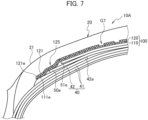
- FIG. 7 is a partially enlarged cross-sectional view of a pneumatic tire 10 A including a shoulder portion of the tread 20 according to modified example.
- the reinforcing layer 100 D of pneumatic tire 10 A is formed of an inner reinforcing layer 110 and an outer reinforcing layer 120 D.
- the outer reinforcing layer 120 D has a continuous portion 125 in which the strip member 121 is continuously provided in the shoulder portion 21 without a gap G7.
- the outer reinforcing layer 120 D has the gap G7 between the strip members 121 adjacent to each other in the tire width direction in the region other than the shoulder portion 21, for example, near the tire equatorial line CL(see FIG. 1 ).
- the region in which the continuous portion 125 is formed is not particularly limited to the shoulder portion 21, but the continuous portion 125 is preferably formed in a region overlapping the end portion 50 e of the belt layer 50 in the tire width direction.
- the continuous portion 125 is preferably formed to cover both the end portion 50 e in the tire width direction of the inner belt (which may be referred to as the first belt) forming the pair of crossing belt and an end portion 51 e in the tire width direction of the outer belt (which may be referred to as the second belt) forming the pair of crossing belt.
- the continuous portion 125 may be formed so as to cover not only the end portion 50 e and the end portion 51 e but also the outer end 42 e of the folded portion 42 of the carcass 40.
- the width of the outer reinforcing layer 120 D along the tire width direction may be wider than the width of the inner reinforcing layer 110 along the tire width direction. That is, An end portion 121 e in the tire width direction of the outer reinforcing layer 120 D may be positioned outside of an end 110 e in the tire width direction of the inner reinforcing layer 111.
- the pneumatic tire 10 is provided with the reinforcing layer 100 having an inner reinforcing layer 110 around which the strip member 111 is wound along the tire circumferential direction and the outer reinforcing layer 120 around which the strip member 121 is wound along the tire circumferential direction.
- the outer reinforcing layer 120 has the gap G1 between the strip members 121.
- the gap G1 is formed between the strip members 121 of the outer reinforcing layer 120, the rigidity of the outer reinforcing layer 120 is lower than that of the inner reinforcing layer 110, and the restricting force of the belt layer 50 is weakened. This increases ground contact area of the tread 20.
- ground contact area is increased, particularly in the tire circumferential direction, as compared to the case where no gap G1 is formed. That is, the out-of-plane rigidity in the circumferential direction of the tread 20 is reduced, and ground contact area is increased.
- gripping force may mean the sum of longitudinal force (Fx, braking and driving forces) and lateral forces (Fy, force required to travel on curve), or more simply, the so-called friction circle indicated by Fx and Fy.
- the rubber used for the tread 20 need not be a material exhibiting a high gripping force but rapid progress of wear.
- the reinforcing layer 100 is formed by winding a strip member along the tire circumferential direction at outside in tire radial direction of the belt layer 50. Therefore, since the diameter growth of the pneumatic tire 10, specifically, the belt layer 50 due to centrifugal force generated during high-speed traveling is suppressed, steering stability during high-speed traveling is improved.
- the pneumatic tire 10 while extending the life of tire, gripping force can be further improved.
- the reinforcing layer 100 although the outer reinforcing layer 120 has the gap G1, the lowering steering stability due to the diameter growth of the belt layer 50 can be prevented because of the two-layer structure with the inner reinforcing layer 110. Further, since the gap G1 can suppress the weight increase of the pneumatic tire 10, it can also contribute to the reduction of rolling resistance.
- the outer reinforcing layer 120 may have at least the gap G1 in the center region CT including tire equatorial line CL.
- ground contact area can be effectively increased in the center region CT that contributes to substantial ground contact area increase.
- gripping force can be further improved.
- the inner reinforcing layer 110 has a continuous portion 115 in which the strip members 111 are continuously provided at least in the center region CT without a gap. Therefore, the diameter growth of the belt layer 50 in the center region CT having a large influence on steering stability can be effectively suppressed.
- gaps may be provided in areas other than the center region CT of the inner reinforcing layer 110. Thus, the weight increase of the pneumatic tire 10 can be suppressed, and steering stability during high-speed traveling can be improved.
- the outer reinforcing layer 120 D has the continuous portion 125 in which the strip members 121 are continuously provided without the gap G7 in a region overlapping the end portion 50 e and the end portion 51 e of belt layer 50. Therefore, the reinforcing layer 100 D can surely suppress the diameter growth of the belt layer 50 near the end portion 50 e and the end portion 51 e. Thus, steering stability can be further improved during high-speed traveling.
- the width of the gap G1 may be narrower than the width of the strip member 111 and the strip member 121.
- the width of the gap G1 narrower than the width of the strip member 111 and the strip member 121, the suppression of the diameter growth of the belt layer 50 and the increase of ground contact area can be achieved in a good balance. As a result, steering stability and gripping force can be improved at a high level.
- the belt layer 50 may have a lower rigidity than a typical pneumatic tire of the same type.
- the belt layer 50 is easily deformed by an external force, but it may be strong for twisting.
- the rigidity of the tread 20 can be reduced when a load is applied to the pneumatic tire 10, thereby contributing to an increase in ground contact area.
- the rigidity of the tread 20 is not too low when the pneumatic tire 10 is twisted due to cornering or the like. Therefore, damage due to excessive deformation of the tread 20 can be prevented. As a result, the improvement of steering stability and gripping force can be achieved at a higher level.
- the pneumatic tire 10 may be suitably used for a four-wheel vehicle, such as a sports type four-wheel vehicle, suitable for sport driving (including a racetrack), the pneumatic tire 10 is not limited to such a four-wheel vehicle, and the pneumatic tire 10 may be used for different types of vehicles, such as a conventional passenger vehicle (including SUV: sport utility vehicles).
- a conventional passenger vehicle including SUV: sport utility vehicles.
- the reinforcing layer may also be referred to as a reinforcing belt layer, a spiral belt layer, or simply a reinforcing belt.
Landscapes
- Engineering & Computer Science (AREA)
- Mechanical Engineering (AREA)
- Tires In General (AREA)
Description
- The present invention relates to a tire suitable for sport driving.
- Conventionally, a pneumatic tire (hereinafter abbreviated as tire) having a reinforcing layer provided on the outside of a pair of crossing belt in a tire radial direction is known (Patent literature 1). The reinforcing layer is formed by a strip-like member (strip member) in which a plurality of cords are rubbed is wound around along tire circumferential direction.
- According to tire, since the diameter growth of the tire due to the centrifugal force generated during high-speed driving is suppressed, steering stability during high-speed driving is improved.
- [PTL 1]
Japanese Unexamined Patent Application Publication No. 2001-322405
WO02102610A1
WO2014181705A1 discloses a technique for reducing the frequency of occurrence of a groove crack in every tire having a helically wound circumferential reinforcement layer.
EP1167003A2 discloses a method of making a pneumatic tire (1) with a breaker (7) and a band (9), comprising: applying a raw breaker material to a cylindrical drum (F); spirally winding a plurality of parallel band cords (10) around the raw breaker material on the cylindrical drum so that angles of the windings are not more than 5 degrees with respect to the tire equator; and gradually increasing one of an average density of the band cords in the tire axial direction and an average tension of the band cords in the tire axial direction, from a center portion of the band towards each axial edge of the band during winding the band cords.EP0414470A2 discloses a high performance pneumatic radial tire (1) comprising a toroidal carcass (3), a tread (17) radially outside a crown portion of the carcass, a belt layer (10) interposed between the carcass and the tread and having the same width as the tread, and an auxiliary layer (16) arranged between the belt layer and the tread and covering the entire belt layer.
EP3653401A1 discloses a pneumatic tyre including a tread portion (2) provided with circumferential grooves (G) to form circumferential land portions, a belt layer (7), and a band layer (9) disposed outwardly in the tyre radial direction of the belt layer. - According to the tire described above, steering stability in high-speed driving is improved, but in recent years, as the performance of vehicles is improved, it has been demanded from the market that the improvement of steering stability in high-speed driving and the improvement of gripping force of the road surface can be made at a higher level especially in a tire used for sporting driving. It is also important to improve the life of tire, especially when the tire is used by average users, even in the case of sporting driving.
- Accordingly, an object of the present invention is to provide a tire in which gripping force is further improved while extending the life of tire.
- One aspect of the present invention is a tire (pneumatic tire 10) as defined in claim 1.
-
-
FIG. 1 is a cross-sectional view of apneumatic tire 10. -
FIG. 2 is a partially enlarged cross-sectional view of thepneumatic tire 10 including a shoulder portion of atread 20. -
FIG. 3 is a partially enlarged cross-sectional view of a reinforcinglayer 100. -
FIG. 4 is partially enlarged cross-sectional view of a reinforcinglayer 100 A according to modified example. -
FIG. 5 is partially enlarged cross-sectional view of a reinforcing layer 100 B according to modified example which does not form part of the present invention. -
FIG. 6 is partially enlarged cross-sectional view of a reinforcinglayer 100 C according to modified example which does not form part of the present invention. -
FIG. 7 is partially enlarged cross-sectional view of apneumatic tire 10 A including the shoulder portion of thetread 20 according to modified example. - Embodiments will be described below with reference to the drawings. The same functions and configurations are denoted by the same or similar reference numerals, and descriptions thereof are omitted as appropriate.
-
FIG. 1 is a cross-sectional view of apneumatic tire 10 according to the present embodiment. Specifically,FIG. 1 is a cross-sectional view of thepneumatic tire 10 taken along tire width direction and tire radial direction. InFIG. 1 , the sectional hatching is not shown (hereinafter the same). - As shown in
FIG. 1 , thepneumatic tire 10 includes atread 20, atire side portion 30, acarcass 40, abelt layer 50, abead portion 60, and a reinforcinglayer 100. - In the present embodiment, the
pneumatic tire 10 is a tire that is assumed to be mounted on a four-wheel vehicle, specifically a passenger vehicle. In particular, thepneumatic tire 10 may be suitably used for a four-wheel vehicle, such as a sports type four-wheel vehicle, suitable for sport driving (including a racetrack). - The
tread 20 is a portion in contact with the road surface. On thetread 20, a pattern (not shown) is formed according to the usage environment of thepneumatic tire 10 and the type of vehicle to be mounted. - The
tire side portion 30 is continuous to thetread 20 and positioned inside in the tire radial direction of thetread 20. Thetire side portion 30 is an area from the tire width direction outer end of thetread 20 to the upper end ofbead portion 60. Thetire side portion 30 is sometimes referred to as a sidewall. - The
carcass 40 forms the skeleton of thepneumatic tire 10. Thecarcass 40 has a radial structure in which a carcass cord (not shown) arranged radially along tire radial direction is covered with a rubber material. However, the present invention is not limited to a radial structure, and may be a bias structure in which the carcass cords are arranged so as to cross each other in the tire radial direction. Thecarcass 40 has abody portion 41 and a foldedportion 42. - The
body portion 41 extends over thetread 20, thetire side portion 30 and thebead portion 60 until it is folded back at thebead portion 60. - The folded
portion 42 is a portion continuous to thebody portion 41 and folded back to the outside in the tire width direction via abead core 61. Anouter end 42 e of the foldedportion 42 in the tire radial direction extends to the inside in the tire radial direction of thebelt layer 50. That is, thecarcass 40 has an envelope structure. - However, the
carcass 40 need not necessarily have an envelope structure, and for example, theouter end 42 e does not reach thebelt layer 50, but may have a high-turn-up structure positioned inside in the tire radial direction of thebelt layer 50, specifically, near the maximum width of thetire side portion 30. - The carcass cord is formed of an organic fiber such as nylon as in the case of a tire for standard four-wheel vehicles. In the present embodiment, the
carcass 40 is formed of a plurality of plies (carcass plies). - The
belt layer 50 is provided inside in the tire radial direction of thetread 20, specifically inside in the tire radial direction of the reinforcinglayer 100. - The
belt layer 50 is provided from one end to the other end in the tire width direction of thetread 20. Specifically, thebelt layer 50 is provided from one shoulder portion 21 (not shown inFIG. 1 , seeFIG. 2 ) to the other shoulder portion (not shown) of thetread 20. The shoulder portion may be defined as an area including a boundary between thetread 20 andtire side portion 30. - In this embodiment, the
belt layer 50 is formed by a pair of crossing belt with crossing cords (not shown) made of metal, such as steel. However, thebelt layer 50 may not necessarily be formed by a crossing belt. If thecarcass 40 has a bias structure, thebelt layer 50 need not be provided. - For example, the
belt layer 50 may be a single layer spiral belt with a reinforcing cord formed of a metallic material (for example, steel.) coated with a resin. That is, thebelt layer 50 may be provided outside in the tire radial direction of thecarcass 40, so long as the structure contributes to generation of a cornering force (CF), securing of rigidity of thecarcass 40, and the like, when a slip angle is applied to thepneumatic tire 10. - The
belt layer 50 may also be less rigid than a belt layer used in a typical pneumatic tire of the same type. Specifically, thebelt layer 50 may have a lower in-belt please shear stiffness (may simply be referred to as in-plane shear rigidity) of the pair of crossing belt than a crossing belt typically used in the same type of a pneumatic tire. Thebelt layer 50 contributes to an increase in ground contact area of thetread 20. - The
belt layer 50 is therefore easily deformed by an external force, but is required to be strong against twisting. For example, by making the diameter (wire diameter) of the cords that make up thebelt layer 50 smaller than a crossing belt layer used in a typical pneumatic tire of the same type, such characteristics can be imparted to thebelt layer 50. - The
bead portion 60 is continuous to thetire side portion 30 and is positioned inside in the tire radial direction of thetire side portion 30. Thebead portion 60 is an annular shape extending to tire circumferential direction and is locked to a rim wheel (not shown). Thebead portion 60 includes abead core 61 and abead filler 62. - The
bead core 61 is formed by twisting a plurality of metal cords. For example, thebead core 61 may be formed of steel cords. The number of cords (number of cores) is not particularly limited. - The
bead filler 62 is provided outside in the tire radial direction of thebead core 61. Thebead filler 62 is formed by using rubber (or resin) harder than other parts formed by using rubber. Thebead filler 62 is provided to fill a space having wedge-shaped in cross-sectional shape formed by thebody portion 41 and the foldedportion 42 of thecarcass 40. Thebead filler 62 may be referred to as a stiffener. - A
rim line 90 is provided on an outside in the tire width direction of thebead portion 60. Therim line 90 is a projection formed along the tire circumferential direction to confirm that thebead portion 60 is correctly mounted on the rim wheel. - The reinforcing
layer 100 is provided outside in the tire radial direction of thebelt layer 50. Specifically, the reinforcinglayer 100 is provided inside in the tire radial direction of thetread 20. - The reinforcing
layer 100 has a two-layer structure of a layer (which may be called a ply) provided inside in the tire radial direction and a layer provided outside in the tire radial direction. The reinforcinglayer 100 is formed by winding a strip member in which a plurality of cords are rubbed a plurality of times along tire circumferential direction. - The reinforcing
layer 100 may also be referred to as a cap , a layer, or cap and layer, and the like. -
FIG. 2 is a partially enlarged sectional view of thepneumatic tire 10 including a shoulder portion of thetread 20. As shown inFIG. 2 , the reinforcinglayer 100 includes an inner reinforcinglayer 110 and an outer reinforcinglayer 120. - The inner reinforcing
layer 110 and the outer reinforcinglayer 120 are formed by winding a strip member having a plurality of cords along the tire circumferential direction. - The outer reinforcing
layer 120 is provided outside in the tire radial direction of the inner reinforcinglayer 110. In the inner reinforcinglayer 110, adjacent strip members in the tire width direction are closely attached. On the other hand, in the outer reinforcinglayer 120, gaps (space) are provided between adjacent strip members in the tire width direction. That is, in the outer reinforcinglayer 120, the strip members are spaced apart in the tire width direction. - The reinforcing
layer 100 is provided up to ashoulder portion 21 of thetread 20. The reinforcinglayer 100 is positioned outside in the tire width direction than anend portion 50 e of thebelt layer 50. - The reinforcing
layer 100 is provided so as to overlap the foldedportion 42 of thecarcass 40 in the tire width direction. Specifically, anouter end 42 e of the foldedportion 42 is positioned inside in the tire width direction than anend portion 100 e of the reinforcinglayer 100. -
FIG. 3 is a partially enlarged cross-sectional view of the reinforcinglayer 100. Specifically,FIG. 3 is a partially enlarged cross-sectional view of the reinforcinglayer 100 of thepneumatic tire 10 along the tire width direction and the tire radial direction. - As shown in
FIG. 3 , in the present embodiment, the reinforcinglayer 100 is formed by the inner reinforcinglayer 110 and the outer reinforcinglayer 120. - The inner reinforcing
layer 110 is formed by winding astrip member 111 spirally wound along the tire circumferential direction at the tire radial direction outside of thebelt layer 50. - The outer reinforcing
layer 120 is formed by astrip member 121 spirally wound along the tire circumferential direction at the tire radial direction outside of the inner reinforcinglayer 110. - The
strip member 111 is formed by covering a plurality ofcords 112 with a rubber material. Similarly, thestrip member 121 is formed by coating a plurality ofcords 122 with a rubber material. Thecords - In this embodiment, the
strip member 111 is formed of 6 pieces of thecords 112. Similarly, thestrip member 121 is formed of 6 pieces of thecords 122. The number ofcords 112 forming thestrip member 111 and the number ofcords 122 forming thestrip member 121 are not limited to 6, and may be more than 6 or less than 6. - In some portion in the tire width direction, such as the
end portion 100 e (seeFIG. 2 ), the number ofcords 112 forming thestrip member 111 or the number ofcords 122 forming thestrip member 121 may be smaller. - In this embodiment, the inner reinforcing
layer 110 is provided withstrip members 111 continuously throughout the entire area in the tire width direction (see alsoFIGs. 1 and2 ). That is, no gap is provided between theadjacent strip members 111. - On the other hand, the outer reinforcing
layer 120 has a gap G1 betweenadjacent strip members 121 in the tire width direction. That is, thestrip member 121 is spirally wound along the tire circumferential direction with the gap G1. - In the present embodiment, the plurality of gaps G1 are all the same and do not vary. The outer reinforcing
layer 120 may also have at least the gap G1 in a central region CT (seeFIG. 1 ) in the tire width direction including a tire equatorial line CL. That is, in a region other than the central region CT in the tire width direction, for example, a region closer to the shoulder portion 21 (seeFIG. 2 ), the outer reinforcinglayer 120 may not have the gap G1. - In the present embodiment, the center region CT is defined as a region from the tire equatorial line CL up to 30% of a half (TW/2) of the tread width (TW) of the
pneumatic tire 10. - Further, in the present embodiment, as described above, the inner reinforcing
layer 110 is provided with thestrip members 111 continuously throughout in the tire width direction, but the inner reinforcinglayer 110 may have a continuous portion 115 (seeFIG. 1 ) in which thestrip members 111 are provided continuously at least in the center region CT without the gap G1. - As shown in
FIG. 3 , the width of the gap G1 is narrower than the width of thestrip member 121. In this embodiment, the width of thestrip member 111 and thestrip member 121 along the tire width direction is about 6 mm. The width of the gap G1 along the tire width direction is about 3 mm. - The gap G1 and the width of the
strip member 121 have a relationship of about 1: 2. - Next, modified example of the reinforcing
layer 100 will be described. Specifically, with reference toFIGs. 4 to 7 , the structure of the reinforcinglayer 100 A, the reinforcing layer 100 B, the reinforcinglayer 100 C, and the reinforcing layer 100 D according to modified example will be described. Hereinafter, the different portions from the reinforcinglayer 100 will be mainly described. -
FIG. 4 is a partially enlarged cross-sectional view of the reinforcinglayer 100 A according to modified example. As shown inFIG. 4 , the reinforcinglayer 100 A is formed of the inner reinforcinglayer 110 and an outer reinforcinglayer 120 A. - The outer reinforcing
layer 120 A is formed of astrip member 121 A. Thestrip member 121 A has a smaller number ofcords 122 than thestrip member 121 forming the outer reinforcinglayer 120 of the reinforcinglayer 100, and is formed of 3 pieces ofcords 122. - A gap G2 is provided in the
strip members 121 A adjacent to each other in the tire width direction. The gap G2 is narrower than the width of thestrip member 121 A along the tire width direction. - Further, as in the case of the reinforcing
layer 100 A, the number (6) ofcords 112 forming thestrip member 111 may be different from the number (3) ofcords 122 forming thestrip member 121 A. The number ofcords 122 forming thestrip member 121 A may be larger or smaller than the number ofcords 112 forming thestrip member 111. - According to the reinforcing
layer 100 A, the rigidity of the reinforcinglayer 100 A can be easily adjusted, and the suppression of the diameter growth of thepneumatic tire 10 and the increase of ground contact area can be realized in a good balance. -
FIG. 5 , which does not form part of the present invention, is a partially enlarged cross-sectional view of the reinforcing layer 100 B according to modified example. As shown inFIG. 5 , the reinforcing layer 100 B is formed of an inner reinforcing layer 110 B and an outer reinforcinglayer 120 B. - The inner reinforcing layer 110 B has a gap G3 between
adjacent strip members 111 B in the tire width direction. That is, thestrip member 111 B is spirally wound along the tire circumferential direction with the gap G3. - On the other hand, in the outer reinforcing
layer 120 B, astrip member 121 B is continuously provided throughout the tire width direction. That is, no gap is provided between theadjacent strip members 121 B. - As in the case of the reinforcing layer 100 B, the gap G3 may be provided in the inner reinforcing
layer 120 B instead of the outer reinforcing layer 110 B. - According to the reinforcing layer 100 B, since the outer reinforcing
layer 120 B having no gap is provided on the outside in the tire radial direction of the inner reinforcing layer 110 B, the ground contact area can be increased while surely suppressing the diameter growth of thepneumatic tire 10. -
FIG. 6 , which does not form part of the present invention, is a partially enlarged cross-sectional view of the reinforcinglayer 100 C of modified example. As shown inFIG. 6 , the reinforcinglayer 100 C is formed of an inner reinforcinglayer 110 and an outer reinforcinglayer 120 C. - The inner reinforcing
layer 110, like the reinforcinglayer 100, is formed of thestrip member 111. On the other hand, the outer reinforcinglayer 120 C, like the reinforcinglayer 100, is formed of thestrip member 121, but the gap between thestrip members 121 is different. - Specifically, the outer reinforcing
layer 120 C has a plurality of different gaps. More specifically, a gap G4, a gap G5, and a gap G6 are provided. The gap G5 is wider than the gap G4, and the gap G6 is wider than the gap G5. That is, the gap G4, the gap G5, and the gap G6 have the relationship of G4 < G5 < G6. - The gap G4 is provided closer to the shoulder portion 21 (see
FIG. 2 ), and the gap G6 is provided closer to the tire equatorial line CL. That is, the gap between the strip members may increase from theshoulder portion 21 toward the tire equatorial line CL. Alternatively, the gap between the strip members in the center region CT may be wider than the gap between the strip members in a region other than the center region CT (for example, shoulder portion 21). - The reinforcing
layer 100 C can increase ground contact area in the center region of thepneumatic tire 10 while suppressing the diameter growth of the shoulder portion of thepneumatic tire 10. -
FIG. 7 is a partially enlarged cross-sectional view of apneumatic tire 10 A including a shoulder portion of thetread 20 according to modified example. As shown inFIG. 7 , the reinforcing layer 100 D ofpneumatic tire 10 A is formed of an inner reinforcinglayer 110 and an outer reinforcing layer 120 D. - The outer reinforcing layer 120 D has a
continuous portion 125 in which thestrip member 121 is continuously provided in theshoulder portion 21 without a gap G7. On the other hand, the outer reinforcing layer 120 D has the gap G7 between thestrip members 121 adjacent to each other in the tire width direction in the region other than theshoulder portion 21, for example, near the tire equatorial line CL(seeFIG. 1 ). - The region in which the
continuous portion 125 is formed is not particularly limited to theshoulder portion 21, but thecontinuous portion 125 is preferably formed in a region overlapping theend portion 50 e of thebelt layer 50 in the tire width direction. - Furthermore, if, as in modified example, the
belt layer 50 is formed of a pair of crossing belt, thecontinuous portion 125 is preferably formed to cover both theend portion 50 e in the tire width direction of the inner belt (which may be referred to as the first belt) forming the pair of crossing belt and anend portion 51 e in the tire width direction of the outer belt (which may be referred to as the second belt) forming the pair of crossing belt. - The
continuous portion 125 may be formed so as to cover not only theend portion 50 e and theend portion 51 e but also theouter end 42 e of the foldedportion 42 of thecarcass 40. - Further, like the reinforcing layer 100 D, the width of the outer reinforcing layer 120 D along the tire width direction may be wider than the width of the inner reinforcing
layer 110 along the tire width direction. That is, Anend portion 121 e in the tire width direction of the outer reinforcing layer 120 D may be positioned outside of an end 110 e in the tire width direction of the inner reinforcinglayer 111. - According to the embodiment described above, the following effects can be obtained. Specifically, the
pneumatic tire 10 is provided with the reinforcinglayer 100 having an inner reinforcinglayer 110 around which thestrip member 111 is wound along the tire circumferential direction and the outer reinforcinglayer 120 around which thestrip member 121 is wound along the tire circumferential direction. The outer reinforcinglayer 120 has the gap G1 between thestrip members 121. - Since the gap G1 is formed between the
strip members 121 of the outer reinforcinglayer 120, the rigidity of the outer reinforcinglayer 120 is lower than that of the inner reinforcinglayer 110, and the restricting force of thebelt layer 50 is weakened. This increases ground contact area of thetread 20. - Specifically, ground contact area is increased, particularly in the tire circumferential direction, as compared to the case where no gap G1 is formed. That is, the out-of-plane rigidity in the circumferential direction of the
tread 20 is reduced, and ground contact area is increased. - As ground contact area of the
tread 20 increases, the friction between thetread 20 and the road surface increases, and gripping force of the road surface of thepneumatic tire 10 can be improved. Note that gripping force may mean the sum of longitudinal force (Fx, braking and driving forces) and lateral forces (Fy, force required to travel on curve), or more simply, the so-called friction circle indicated by Fx and Fy. - Further, since gripping force can be enhanced by the increase of ground contact area, the rubber used for the
tread 20 need not be a material exhibiting a high gripping force but rapid progress of wear. - The reinforcing
layer 100 is formed by winding a strip member along the tire circumferential direction at outside in tire radial direction of thebelt layer 50. Therefore, since the diameter growth of thepneumatic tire 10, specifically, thebelt layer 50 due to centrifugal force generated during high-speed traveling is suppressed, steering stability during high-speed traveling is improved. - In particular, in a four-wheel vehicle such as a sports type four-wheel vehicle, suitable for sport driving (including a racetrack), since the vehicle is driven at high speed, it is important to suppress the diameter growth of
belt layer 50. Further, since the rigidity of thebelt layer 50 is improved by the reinforcinglayer 100, the responsiveness when the slip angle is applied to thepneumatic tire 10 is improved. - In other words, according to the
pneumatic tire 10, while extending the life of tire, gripping force can be further improved. Incidentally, according to the reinforcinglayer 100, although the outer reinforcinglayer 120 has the gap G1, the lowering steering stability due to the diameter growth of thebelt layer 50 can be prevented because of the two-layer structure with the inner reinforcinglayer 110. Further, since the gap G1 can suppress the weight increase of thepneumatic tire 10, it can also contribute to the reduction of rolling resistance. - The outer reinforcing
layer 120 may have at least the gap G1 in the center region CT including tire equatorial line CL. Thus, ground contact area can be effectively increased in the center region CT that contributes to substantial ground contact area increase. Thus, gripping force can be further improved. - On the other hand, the inner reinforcing
layer 110 has acontinuous portion 115 in which thestrip members 111 are continuously provided at least in the center region CT without a gap. Therefore, the diameter growth of thebelt layer 50 in the center region CT having a large influence on steering stability can be effectively suppressed. In addition, gaps may be provided in areas other than the center region CT of the inner reinforcinglayer 110. Thus, the weight increase of thepneumatic tire 10 can be suppressed, and steering stability during high-speed traveling can be improved. - As shown in the modified example 4, the outer reinforcing layer 120 D has the
continuous portion 125 in which thestrip members 121 are continuously provided without the gap G7 in a region overlapping theend portion 50 e and theend portion 51 e ofbelt layer 50. Therefore, the reinforcing layer 100 D can surely suppress the diameter growth of thebelt layer 50 near theend portion 50 e and theend portion 51 e. Thus, steering stability can be further improved during high-speed traveling. - Further, as with the reinforcing
layer 100 and the like described above, the width of the gap G1 may be narrower than the width of thestrip member 111 and thestrip member 121. By making the width of the gap G1 narrower than the width of thestrip member 111 and thestrip member 121, the suppression of the diameter growth of thebelt layer 50 and the increase of ground contact area can be achieved in a good balance. As a result, steering stability and gripping force can be improved at a high level. - In this embodiment, the
belt layer 50 may have a lower rigidity than a typical pneumatic tire of the same type. On the other hand, thebelt layer 50 is easily deformed by an external force, but it may be strong for twisting. According to thebelt layer 50, in particular, the rigidity of thetread 20 can be reduced when a load is applied to thepneumatic tire 10, thereby contributing to an increase in ground contact area. - Further, according to the combination of the
belt layer 50 and the outer reinforcinglayer 120 having the gap G1, the rigidity of thetread 20 is not too low when thepneumatic tire 10 is twisted due to cornering or the like. Therefore, damage due to excessive deformation of thetread 20 can be prevented. As a result, the improvement of steering stability and gripping force can be achieved at a higher level. - Although the contents of the present invention have been described above with reference to the examples, the present invention is not limited to these descriptions but only by the appended claims.
- For example, in the embodiment described above, although the
pneumatic tire 10 may be suitably used for a four-wheel vehicle, such as a sports type four-wheel vehicle, suitable for sport driving (including a racetrack), thepneumatic tire 10 is not limited to such a four-wheel vehicle, and thepneumatic tire 10 may be used for different types of vehicles, such as a conventional passenger vehicle (including SUV: sport utility vehicles). - Although the term strip member has been used in the above-described embodiments, it may be simply referred to as a strip. The reinforcing layer may also be referred to as a reinforcing belt layer, a spiral belt layer, or simply a reinforcing belt.
-
- 10 pneumatic tire
- 20 tread
- 21 shoulder section
- 30 tire side portion
- 40 carcass
- 41 body portion
- 42 folding section
- 42 e outer end
- 50 belt layer
- 50 e, 51 e end portion
- 60 bead portion
- 61 bead core
- 62 bead filler
- 90 rim line
- 100, 100 A to 100 D reinforcing layer
- 100 e end portion
- 110, 110 B inner reinforcing layer
- 111, 111 B strip member
- 111 e end portion
- 112 cord
- 115 continuous portion
- 120, 120 A to 120 D outer reinforcing layer
- 121, 121 A, 121 B strip member
- 121 e end portion
- 122 cord
- 125 continuous portion
- G1 to G7 gap
Claims (4)
- A tire (10) comprising:a belt layer (50) extending along a tire circumferential direction and extending from one end to other end in a tire width direction; anda reinforcing layer (100) provided on the outer side of the belt layer (50) in a tire radial direction, whereinthe reinforcing layer (100) comprises:an inner reinforcing layer (110) in which strip members (111) having a plurality of cords (112) are wound along the tire circumferential direction; andan outer reinforcing layer (120) provided outside in the tire radial direction of the inner reinforcing layer (110), in which strip members (121) having a plurality of cords (122) are wound along the tire circumferential direction, whereinat least either the inner reinforcing layer (110) or the outer reinforcing layer (120) has a gap between the strip members adjacent to each other in the tire width direction,the outer reinforcing layer (120) has at least the gap in a central region in the tire width direction, which is a region from a tire equatorial line up to 30% of a half (TW/2) of a tread width,the inner reinforcing layer (110) has a continuous portion (115) at least in the center region, in which the strip members (111) are continuously provided without the gap, andthe gap and the width of the strip members (121) have a relationship of 1: 2.
- The tire (10) according to claim 1, wherein the outer reinforcing layer (120) has at least the gap in a central region in the tire width direction including a tire equatorial line.
- The tire (10) according to claim 1 or 2, wherein the outer reinforcing layer (120) has a continuous portion (125) in which the strip members are continuously provided without the gap in a region overlapping an end of the of belt layer (50) in the tire width direction.
- The tire (10) according to any one of claims 1 to 3, wherein width of the gap is narrower than width of the strip members (121A).
Applications Claiming Priority (2)
| Application Number | Priority Date | Filing Date | Title |
|---|---|---|---|
| JP2019112964A JP2020203613A (en) | 2019-06-18 | 2019-06-18 | tire |
| PCT/JP2020/023392 WO2020255919A1 (en) | 2019-06-18 | 2020-06-15 | Tire |
Publications (3)
| Publication Number | Publication Date |
|---|---|
| EP3988329A1 EP3988329A1 (en) | 2022-04-27 |
| EP3988329A4 EP3988329A4 (en) | 2023-07-05 |
| EP3988329B1 true EP3988329B1 (en) | 2024-07-17 |
Family
ID=73836879
Family Applications (1)
| Application Number | Title | Priority Date | Filing Date |
|---|---|---|---|
| EP20827760.8A Active EP3988329B1 (en) | 2019-06-18 | 2020-06-15 | Tire |
Country Status (5)
| Country | Link |
|---|---|
| US (1) | US11919341B2 (en) |
| EP (1) | EP3988329B1 (en) |
| JP (2) | JP2020203613A (en) |
| CN (1) | CN113950417B (en) |
| WO (1) | WO2020255919A1 (en) |
Families Citing this family (1)
| Publication number | Priority date | Publication date | Assignee | Title |
|---|---|---|---|---|
| TWI912878B (en) * | 2024-08-09 | 2026-01-21 | 正新橡膠工業股份有限公司 | Tire belt reinforcement structure |
Family Cites Families (16)
| Publication number | Priority date | Publication date | Assignee | Title |
|---|---|---|---|---|
| DE1917511C3 (en) * | 1969-04-05 | 1974-01-31 | Maschinenfabrik Sack Gmbh, 4000 Duesseldorf | Hydraulic drive for forging machines |
| DE3780311T2 (en) * | 1987-08-31 | 1993-01-07 | Bridgestone Corp | TIRE. |
| US5228933A (en) | 1989-08-24 | 1993-07-20 | Bridgestone Corporation | High performance pneumatic radial tires |
| JPH075001B2 (en) * | 1989-08-24 | 1995-01-25 | 株式会社ブリヂストン | High performance pneumatic radial tire |
| JP2001322405A (en) * | 2000-05-12 | 2001-11-20 | Bridgestone Corp | Pneumatic radial tire |
| JP2002001833A (en) * | 2000-06-26 | 2002-01-08 | Sumitomo Rubber Ind Ltd | Method of forming band of pneumatic tire |
| CN100467290C (en) * | 2001-06-13 | 2009-03-11 | 住友橡胶工业株式会社 | Pneumatic radial tire |
| JP4901144B2 (en) * | 2005-06-29 | 2012-03-21 | 株式会社ブリヂストン | Pneumatic tire |
| JP5639415B2 (en) * | 2010-08-26 | 2014-12-10 | 株式会社ブリヂストン | Pneumatic tire |
| JP6003024B2 (en) | 2011-08-24 | 2016-10-05 | 横浜ゴム株式会社 | Pneumatic radial tire for passenger cars |
| JP5977566B2 (en) | 2012-04-17 | 2016-08-24 | 株式会社ブリヂストン | Pneumatic radial tire and method for manufacturing pneumatic radial tire |
| US20130284337A1 (en) | 2012-04-26 | 2013-10-31 | Bernard Jean Francois Croissant | Accordion spiral overlay for a pneumatic tire |
| JP5486109B1 (en) | 2013-05-10 | 2014-05-07 | 株式会社ブリヂストン | Tire and manufacturing method thereof |
| EP3753755B1 (en) * | 2014-09-04 | 2022-11-09 | Sumitomo Rubber Industries, Ltd. | Pneumatic tire |
| EP3312023B1 (en) | 2016-08-30 | 2019-10-09 | Sumitomo Rubber Industries, Ltd. | Motorcycle tire |
| JP7135752B2 (en) * | 2018-11-13 | 2022-09-13 | 住友ゴム工業株式会社 | pneumatic tire |
-
2019
- 2019-06-18 JP JP2019112964A patent/JP2020203613A/en active Pending
-
2020
- 2020-06-15 CN CN202080043082.1A patent/CN113950417B/en active Active
- 2020-06-15 WO PCT/JP2020/023392 patent/WO2020255919A1/en not_active Ceased
- 2020-06-15 US US17/596,115 patent/US11919341B2/en active Active
- 2020-06-15 EP EP20827760.8A patent/EP3988329B1/en active Active
-
2023
- 2023-01-17 JP JP2023005001A patent/JP2023033469A/en active Pending
Also Published As
| Publication number | Publication date |
|---|---|
| US11919341B2 (en) | 2024-03-05 |
| JP2020203613A (en) | 2020-12-24 |
| EP3988329A1 (en) | 2022-04-27 |
| CN113950417B (en) | 2023-08-25 |
| US20220242169A1 (en) | 2022-08-04 |
| CN113950417A (en) | 2022-01-18 |
| JP2023033469A (en) | 2023-03-10 |
| WO2020255919A1 (en) | 2020-12-24 |
| EP3988329A4 (en) | 2023-07-05 |
Similar Documents
| Publication | Publication Date | Title |
|---|---|---|
| JP5410038B2 (en) | Pneumatic tire | |
| JP5635588B2 (en) | Heavy-duty vehicle tire having a layer of circumferential reinforcing elements | |
| US9038682B2 (en) | Pneumatic tire | |
| JP2008114841A (en) | Reduced weight aircraft tire | |
| US5725702A (en) | Heavy duty pneumatic radial tires with deformation-absorbing rubber layer covering turnup portion outer surface | |
| JP2017222209A (en) | Pneumatic tire | |
| EP3988329B1 (en) | Tire | |
| JP6450112B2 (en) | Pneumatic tire | |
| JP4526363B2 (en) | Pneumatic tire | |
| JP7691224B2 (en) | Lighter aircraft tires | |
| JPH09105084A (en) | Heavy duty tire | |
| JPH11348509A (en) | Heavy load resistant pneumatic radial tire | |
| JP2000062416A (en) | Pneumatic tires for passenger cars | |
| EP3900953B1 (en) | Tire | |
| CN112739557A (en) | Tire with reduced weight bead area | |
| CN101213095B (en) | tires for heavy vehicles | |
| JP7611362B2 (en) | Pneumatic tires | |
| JP7386779B2 (en) | Aircraft pneumatic tires | |
| EP1072443A2 (en) | Motor-cycle radial tyre | |
| JP7664915B2 (en) | Crown reinforcement for urban tires | |
| JP7648872B2 (en) | Pneumatic radial tires | |
| JP7587400B2 (en) | Aircraft pneumatic tires | |
| CN101855098B (en) | Vehicle having tyres with reinforced sidewalls | |
| JP5030545B2 (en) | Pneumatic radial tire | |
| JP2004130860A (en) | Pneumatic tire |
Legal Events
| Date | Code | Title | Description |
|---|---|---|---|
| STAA | Information on the status of an ep patent application or granted ep patent |
Free format text: STATUS: THE INTERNATIONAL PUBLICATION HAS BEEN MADE |
|
| PUAI | Public reference made under article 153(3) epc to a published international application that has entered the european phase |
Free format text: ORIGINAL CODE: 0009012 |
|
| STAA | Information on the status of an ep patent application or granted ep patent |
Free format text: STATUS: REQUEST FOR EXAMINATION WAS MADE |
|
| 17P | Request for examination filed |
Effective date: 20211206 |
|
| AK | Designated contracting states |
Kind code of ref document: A1 Designated state(s): AL AT BE BG CH CY CZ DE DK EE ES FI FR GB GR HR HU IE IS IT LI LT LU LV MC MK MT NL NO PL PT RO RS SE SI SK SM TR |
|
| DAV | Request for validation of the european patent (deleted) | ||
| DAX | Request for extension of the european patent (deleted) | ||
| A4 | Supplementary search report drawn up and despatched |
Effective date: 20230607 |
|
| RIC1 | Information provided on ipc code assigned before grant |
Ipc: B60C 9/22 20060101AFI20230601BHEP |
|
| GRAP | Despatch of communication of intention to grant a patent |
Free format text: ORIGINAL CODE: EPIDOSNIGR1 |
|
| STAA | Information on the status of an ep patent application or granted ep patent |
Free format text: STATUS: GRANT OF PATENT IS INTENDED |
|
| INTG | Intention to grant announced |
Effective date: 20240209 |
|
| P01 | Opt-out of the competence of the unified patent court (upc) registered |
Effective date: 20240219 |
|
| GRAS | Grant fee paid |
Free format text: ORIGINAL CODE: EPIDOSNIGR3 |
|
| GRAA | (expected) grant |
Free format text: ORIGINAL CODE: 0009210 |
|
| STAA | Information on the status of an ep patent application or granted ep patent |
Free format text: STATUS: THE PATENT HAS BEEN GRANTED |
|
| AK | Designated contracting states |
Kind code of ref document: B1 Designated state(s): AL AT BE BG CH CY CZ DE DK EE ES FI FR GB GR HR HU IE IS IT LI LT LU LV MC MK MT NL NO PL PT RO RS SE SI SK SM TR |
|
| REG | Reference to a national code |
Ref country code: CH Ref legal event code: EP |
|
| REG | Reference to a national code |
Ref country code: DE Ref legal event code: R096 Ref document number: 602020034235 Country of ref document: DE |
|
| REG | Reference to a national code |
Ref country code: IE Ref legal event code: FG4D |
|
| REG | Reference to a national code |
Ref country code: LT Ref legal event code: MG9D |
|
| REG | Reference to a national code |
Ref country code: NL Ref legal event code: MP Effective date: 20240717 |
|
| PG25 | Lapsed in a contracting state [announced via postgrant information from national office to epo] |
Ref country code: PT Free format text: LAPSE BECAUSE OF FAILURE TO SUBMIT A TRANSLATION OF THE DESCRIPTION OR TO PAY THE FEE WITHIN THE PRESCRIBED TIME-LIMIT Effective date: 20241118 |
|
| REG | Reference to a national code |
Ref country code: AT Ref legal event code: MK05 Ref document number: 1703790 Country of ref document: AT Kind code of ref document: T Effective date: 20240717 |
|
| PG25 | Lapsed in a contracting state [announced via postgrant information from national office to epo] |
Ref country code: NL Free format text: LAPSE BECAUSE OF FAILURE TO SUBMIT A TRANSLATION OF THE DESCRIPTION OR TO PAY THE FEE WITHIN THE PRESCRIBED TIME-LIMIT Effective date: 20240717 |
|
| PG25 | Lapsed in a contracting state [announced via postgrant information from national office to epo] |
Ref country code: PT Free format text: LAPSE BECAUSE OF FAILURE TO SUBMIT A TRANSLATION OF THE DESCRIPTION OR TO PAY THE FEE WITHIN THE PRESCRIBED TIME-LIMIT Effective date: 20241118 Ref country code: NL Free format text: LAPSE BECAUSE OF FAILURE TO SUBMIT A TRANSLATION OF THE DESCRIPTION OR TO PAY THE FEE WITHIN THE PRESCRIBED TIME-LIMIT Effective date: 20240717 |
|
| PG25 | Lapsed in a contracting state [announced via postgrant information from national office to epo] |
Ref country code: NO Free format text: LAPSE BECAUSE OF FAILURE TO SUBMIT A TRANSLATION OF THE DESCRIPTION OR TO PAY THE FEE WITHIN THE PRESCRIBED TIME-LIMIT Effective date: 20241017 |
|
| PG25 | Lapsed in a contracting state [announced via postgrant information from national office to epo] |
Ref country code: PL Free format text: LAPSE BECAUSE OF FAILURE TO SUBMIT A TRANSLATION OF THE DESCRIPTION OR TO PAY THE FEE WITHIN THE PRESCRIBED TIME-LIMIT Effective date: 20240717 Ref country code: GR Free format text: LAPSE BECAUSE OF FAILURE TO SUBMIT A TRANSLATION OF THE DESCRIPTION OR TO PAY THE FEE WITHIN THE PRESCRIBED TIME-LIMIT Effective date: 20241018 Ref country code: FI Free format text: LAPSE BECAUSE OF FAILURE TO SUBMIT A TRANSLATION OF THE DESCRIPTION OR TO PAY THE FEE WITHIN THE PRESCRIBED TIME-LIMIT Effective date: 20240717 |
|
| PG25 | Lapsed in a contracting state [announced via postgrant information from national office to epo] |
Ref country code: BG Free format text: LAPSE BECAUSE OF FAILURE TO SUBMIT A TRANSLATION OF THE DESCRIPTION OR TO PAY THE FEE WITHIN THE PRESCRIBED TIME-LIMIT Effective date: 20240717 |
|
| PG25 | Lapsed in a contracting state [announced via postgrant information from national office to epo] |
Ref country code: LV Free format text: LAPSE BECAUSE OF FAILURE TO SUBMIT A TRANSLATION OF THE DESCRIPTION OR TO PAY THE FEE WITHIN THE PRESCRIBED TIME-LIMIT Effective date: 20240717 |
|
| PG25 | Lapsed in a contracting state [announced via postgrant information from national office to epo] |
Ref country code: IS Free format text: LAPSE BECAUSE OF FAILURE TO SUBMIT A TRANSLATION OF THE DESCRIPTION OR TO PAY THE FEE WITHIN THE PRESCRIBED TIME-LIMIT Effective date: 20241117 Ref country code: AT Free format text: LAPSE BECAUSE OF FAILURE TO SUBMIT A TRANSLATION OF THE DESCRIPTION OR TO PAY THE FEE WITHIN THE PRESCRIBED TIME-LIMIT Effective date: 20240717 |
|
| PG25 | Lapsed in a contracting state [announced via postgrant information from national office to epo] |
Ref country code: HR Free format text: LAPSE BECAUSE OF FAILURE TO SUBMIT A TRANSLATION OF THE DESCRIPTION OR TO PAY THE FEE WITHIN THE PRESCRIBED TIME-LIMIT Effective date: 20240717 |
|
| PG25 | Lapsed in a contracting state [announced via postgrant information from national office to epo] |
Ref country code: ES Free format text: LAPSE BECAUSE OF FAILURE TO SUBMIT A TRANSLATION OF THE DESCRIPTION OR TO PAY THE FEE WITHIN THE PRESCRIBED TIME-LIMIT Effective date: 20240717 Ref country code: RS Free format text: LAPSE BECAUSE OF FAILURE TO SUBMIT A TRANSLATION OF THE DESCRIPTION OR TO PAY THE FEE WITHIN THE PRESCRIBED TIME-LIMIT Effective date: 20241017 |
|
| PG25 | Lapsed in a contracting state [announced via postgrant information from national office to epo] |
Ref country code: RS Free format text: LAPSE BECAUSE OF FAILURE TO SUBMIT A TRANSLATION OF THE DESCRIPTION OR TO PAY THE FEE WITHIN THE PRESCRIBED TIME-LIMIT Effective date: 20241017 Ref country code: PL Free format text: LAPSE BECAUSE OF FAILURE TO SUBMIT A TRANSLATION OF THE DESCRIPTION OR TO PAY THE FEE WITHIN THE PRESCRIBED TIME-LIMIT Effective date: 20240717 Ref country code: NO Free format text: LAPSE BECAUSE OF FAILURE TO SUBMIT A TRANSLATION OF THE DESCRIPTION OR TO PAY THE FEE WITHIN THE PRESCRIBED TIME-LIMIT Effective date: 20241017 Ref country code: LV Free format text: LAPSE BECAUSE OF FAILURE TO SUBMIT A TRANSLATION OF THE DESCRIPTION OR TO PAY THE FEE WITHIN THE PRESCRIBED TIME-LIMIT Effective date: 20240717 Ref country code: IS Free format text: LAPSE BECAUSE OF FAILURE TO SUBMIT A TRANSLATION OF THE DESCRIPTION OR TO PAY THE FEE WITHIN THE PRESCRIBED TIME-LIMIT Effective date: 20241117 Ref country code: HR Free format text: LAPSE BECAUSE OF FAILURE TO SUBMIT A TRANSLATION OF THE DESCRIPTION OR TO PAY THE FEE WITHIN THE PRESCRIBED TIME-LIMIT Effective date: 20240717 Ref country code: GR Free format text: LAPSE BECAUSE OF FAILURE TO SUBMIT A TRANSLATION OF THE DESCRIPTION OR TO PAY THE FEE WITHIN THE PRESCRIBED TIME-LIMIT Effective date: 20241018 Ref country code: FI Free format text: LAPSE BECAUSE OF FAILURE TO SUBMIT A TRANSLATION OF THE DESCRIPTION OR TO PAY THE FEE WITHIN THE PRESCRIBED TIME-LIMIT Effective date: 20240717 Ref country code: ES Free format text: LAPSE BECAUSE OF FAILURE TO SUBMIT A TRANSLATION OF THE DESCRIPTION OR TO PAY THE FEE WITHIN THE PRESCRIBED TIME-LIMIT Effective date: 20240717 Ref country code: BG Free format text: LAPSE BECAUSE OF FAILURE TO SUBMIT A TRANSLATION OF THE DESCRIPTION OR TO PAY THE FEE WITHIN THE PRESCRIBED TIME-LIMIT Effective date: 20240717 Ref country code: AT Free format text: LAPSE BECAUSE OF FAILURE TO SUBMIT A TRANSLATION OF THE DESCRIPTION OR TO PAY THE FEE WITHIN THE PRESCRIBED TIME-LIMIT Effective date: 20240717 |
|
| PG25 | Lapsed in a contracting state [announced via postgrant information from national office to epo] |
Ref country code: RO Free format text: LAPSE BECAUSE OF FAILURE TO SUBMIT A TRANSLATION OF THE DESCRIPTION OR TO PAY THE FEE WITHIN THE PRESCRIBED TIME-LIMIT Effective date: 20240717 Ref country code: SM Free format text: LAPSE BECAUSE OF FAILURE TO SUBMIT A TRANSLATION OF THE DESCRIPTION OR TO PAY THE FEE WITHIN THE PRESCRIBED TIME-LIMIT Effective date: 20240717 Ref country code: DK Free format text: LAPSE BECAUSE OF FAILURE TO SUBMIT A TRANSLATION OF THE DESCRIPTION OR TO PAY THE FEE WITHIN THE PRESCRIBED TIME-LIMIT Effective date: 20240717 |
|
| REG | Reference to a national code |
Ref country code: DE Ref legal event code: R097 Ref document number: 602020034235 Country of ref document: DE |
|
| PG25 | Lapsed in a contracting state [announced via postgrant information from national office to epo] |
Ref country code: EE Free format text: LAPSE BECAUSE OF FAILURE TO SUBMIT A TRANSLATION OF THE DESCRIPTION OR TO PAY THE FEE WITHIN THE PRESCRIBED TIME-LIMIT Effective date: 20240717 |
|
| PG25 | Lapsed in a contracting state [announced via postgrant information from national office to epo] |
Ref country code: CZ Free format text: LAPSE BECAUSE OF FAILURE TO SUBMIT A TRANSLATION OF THE DESCRIPTION OR TO PAY THE FEE WITHIN THE PRESCRIBED TIME-LIMIT Effective date: 20240717 |
|
| PG25 | Lapsed in a contracting state [announced via postgrant information from national office to epo] |
Ref country code: SK Free format text: LAPSE BECAUSE OF FAILURE TO SUBMIT A TRANSLATION OF THE DESCRIPTION OR TO PAY THE FEE WITHIN THE PRESCRIBED TIME-LIMIT Effective date: 20240717 |
|
| PLBE | No opposition filed within time limit |
Free format text: ORIGINAL CODE: 0009261 |
|
| STAA | Information on the status of an ep patent application or granted ep patent |
Free format text: STATUS: NO OPPOSITION FILED WITHIN TIME LIMIT |
|
| 26N | No opposition filed |
Effective date: 20250422 |
|
| PGFP | Annual fee paid to national office [announced via postgrant information from national office to epo] |
Ref country code: DE Payment date: 20250618 Year of fee payment: 6 |
|
| PGFP | Annual fee paid to national office [announced via postgrant information from national office to epo] |
Ref country code: FR Payment date: 20250627 Year of fee payment: 6 |
|
| PG25 | Lapsed in a contracting state [announced via postgrant information from national office to epo] |
Ref country code: SE Free format text: LAPSE BECAUSE OF FAILURE TO SUBMIT A TRANSLATION OF THE DESCRIPTION OR TO PAY THE FEE WITHIN THE PRESCRIBED TIME-LIMIT Effective date: 20240717 |
|
| REG | Reference to a national code |
Ref country code: CH Ref legal event code: H13 Free format text: ST27 STATUS EVENT CODE: U-0-0-H10-H13 (AS PROVIDED BY THE NATIONAL OFFICE) Effective date: 20260127 |
|
| PG25 | Lapsed in a contracting state [announced via postgrant information from national office to epo] |
Ref country code: IT Free format text: LAPSE BECAUSE OF FAILURE TO SUBMIT A TRANSLATION OF THE DESCRIPTION OR TO PAY THE FEE WITHIN THE PRESCRIBED TIME-LIMIT Effective date: 20240717 |
|
| PG25 | Lapsed in a contracting state [announced via postgrant information from national office to epo] |
Ref country code: MC Free format text: LAPSE BECAUSE OF FAILURE TO SUBMIT A TRANSLATION OF THE DESCRIPTION OR TO PAY THE FEE WITHIN THE PRESCRIBED TIME-LIMIT Effective date: 20240717 |
|
| PG25 | Lapsed in a contracting state [announced via postgrant information from national office to epo] |
Ref country code: LU Free format text: LAPSE BECAUSE OF NON-PAYMENT OF DUE FEES Effective date: 20250615 |
|
| GBPC | Gb: european patent ceased through non-payment of renewal fee |
Effective date: 20250615 |
|
| REG | Reference to a national code |
Ref country code: BE Ref legal event code: MM Effective date: 20250630 |
|
| PG25 | Lapsed in a contracting state [announced via postgrant information from national office to epo] |
Ref country code: GB Free format text: LAPSE BECAUSE OF NON-PAYMENT OF DUE FEES Effective date: 20250615 |
|
| PG25 | Lapsed in a contracting state [announced via postgrant information from national office to epo] |
Ref country code: IE Free format text: LAPSE BECAUSE OF NON-PAYMENT OF DUE FEES Effective date: 20250615 |
|
| PG25 | Lapsed in a contracting state [announced via postgrant information from national office to epo] |
Ref country code: BE Free format text: LAPSE BECAUSE OF NON-PAYMENT OF DUE FEES Effective date: 20250630 |
|
| PG25 | Lapsed in a contracting state [announced via postgrant information from national office to epo] |
Ref country code: CH Free format text: LAPSE BECAUSE OF NON-PAYMENT OF DUE FEES Effective date: 20250630 |