EP3988206A1 - Hydrocarbon reforming catalyst and hydrocarbon reforming device - Google Patents
Hydrocarbon reforming catalyst and hydrocarbon reforming device Download PDFInfo
- Publication number
- EP3988206A1 EP3988206A1 EP20846636.7A EP20846636A EP3988206A1 EP 3988206 A1 EP3988206 A1 EP 3988206A1 EP 20846636 A EP20846636 A EP 20846636A EP 3988206 A1 EP3988206 A1 EP 3988206A1
- Authority
- EP
- European Patent Office
- Prior art keywords
- hydrocarbon reforming
- hydrocarbon
- reforming catalyst
- baceo
- catalyst
- Prior art date
- Legal status (The legal status is an assumption and is not a legal conclusion. Google has not performed a legal analysis and makes no representation as to the accuracy of the status listed.)
- Granted
Links
Images

Classifications
-
- B—PERFORMING OPERATIONS; TRANSPORTING
- B01—PHYSICAL OR CHEMICAL PROCESSES OR APPARATUS IN GENERAL
- B01J—CHEMICAL OR PHYSICAL PROCESSES, e.g. CATALYSIS OR COLLOID CHEMISTRY; THEIR RELEVANT APPARATUS
- B01J23/00—Catalysts comprising metals or metal oxides or hydroxides, not provided for in group B01J21/00
- B01J23/38—Catalysts comprising metals or metal oxides or hydroxides, not provided for in group B01J21/00 of noble metals
- B01J23/40—Catalysts comprising metals or metal oxides or hydroxides, not provided for in group B01J21/00 of noble metals of the platinum group metals
- B01J23/46—Ruthenium, rhodium, osmium or iridium
- B01J23/462—Ruthenium
-
- C—CHEMISTRY; METALLURGY
- C01—INORGANIC CHEMISTRY
- C01B—NON-METALLIC ELEMENTS; COMPOUNDS THEREOF; METALLOIDS OR COMPOUNDS THEREOF NOT COVERED BY SUBCLASS C01C
- C01B3/00—Hydrogen; Gaseous mixtures containing hydrogen; Separation of hydrogen from mixtures containing it; Purification of hydrogen; Reversible storage of hydrogen
- C01B3/02—Production of hydrogen; Production of gaseous mixtures containing hydrogen
- C01B3/32—Production of hydrogen; Production of gaseous mixtures containing hydrogen by reaction of gaseous or liquid organic compounds with gasifying agents, e.g. water, carbon dioxide or air
- C01B3/34—Production of hydrogen; Production of gaseous mixtures containing hydrogen by reaction of gaseous or liquid organic compounds with gasifying agents, e.g. water, carbon dioxide or air by reaction of hydrocarbons with gasifying agents
- C01B3/38—Production of hydrogen; Production of gaseous mixtures containing hydrogen by reaction of gaseous or liquid organic compounds with gasifying agents, e.g. water, carbon dioxide or air by reaction of hydrocarbons with gasifying agents using catalysts
- C01B3/40—Production of hydrogen; Production of gaseous mixtures containing hydrogen by reaction of gaseous or liquid organic compounds with gasifying agents, e.g. water, carbon dioxide or air by reaction of hydrocarbons with gasifying agents using catalysts characterised by the catalyst
-
- B—PERFORMING OPERATIONS; TRANSPORTING
- B01—PHYSICAL OR CHEMICAL PROCESSES OR APPARATUS IN GENERAL
- B01J—CHEMICAL OR PHYSICAL PROCESSES, e.g. CATALYSIS OR COLLOID CHEMISTRY; THEIR RELEVANT APPARATUS
- B01J19/00—Chemical, physical or physico-chemical processes in general; Their relevant apparatus
- B01J19/24—Stationary reactors without moving elements inside
- B01J19/2415—Tubular reactors
-
- B—PERFORMING OPERATIONS; TRANSPORTING
- B01—PHYSICAL OR CHEMICAL PROCESSES OR APPARATUS IN GENERAL
- B01J—CHEMICAL OR PHYSICAL PROCESSES, e.g. CATALYSIS OR COLLOID CHEMISTRY; THEIR RELEVANT APPARATUS
- B01J23/00—Catalysts comprising metals or metal oxides or hydroxides, not provided for in group B01J21/00
- B01J23/002—Mixed oxides other than spinels, e.g. perovskite
-
- B—PERFORMING OPERATIONS; TRANSPORTING
- B01—PHYSICAL OR CHEMICAL PROCESSES OR APPARATUS IN GENERAL
- B01J—CHEMICAL OR PHYSICAL PROCESSES, e.g. CATALYSIS OR COLLOID CHEMISTRY; THEIR RELEVANT APPARATUS
- B01J23/00—Catalysts comprising metals or metal oxides or hydroxides, not provided for in group B01J21/00
- B01J23/38—Catalysts comprising metals or metal oxides or hydroxides, not provided for in group B01J21/00 of noble metals
- B01J23/54—Catalysts comprising metals or metal oxides or hydroxides, not provided for in group B01J21/00 of noble metals combined with metals, oxides or hydroxides provided for in groups B01J23/02 - B01J23/36
- B01J23/56—Platinum group metals
- B01J23/58—Platinum group metals with alkali- or alkaline earth metals
-
- B—PERFORMING OPERATIONS; TRANSPORTING
- B01—PHYSICAL OR CHEMICAL PROCESSES OR APPARATUS IN GENERAL
- B01J—CHEMICAL OR PHYSICAL PROCESSES, e.g. CATALYSIS OR COLLOID CHEMISTRY; THEIR RELEVANT APPARATUS
- B01J23/00—Catalysts comprising metals or metal oxides or hydroxides, not provided for in group B01J21/00
- B01J23/38—Catalysts comprising metals or metal oxides or hydroxides, not provided for in group B01J21/00 of noble metals
- B01J23/54—Catalysts comprising metals or metal oxides or hydroxides, not provided for in group B01J21/00 of noble metals combined with metals, oxides or hydroxides provided for in groups B01J23/02 - B01J23/36
- B01J23/56—Platinum group metals
- B01J23/63—Platinum group metals with rare earths or actinides
-
- B—PERFORMING OPERATIONS; TRANSPORTING
- B01—PHYSICAL OR CHEMICAL PROCESSES OR APPARATUS IN GENERAL
- B01J—CHEMICAL OR PHYSICAL PROCESSES, e.g. CATALYSIS OR COLLOID CHEMISTRY; THEIR RELEVANT APPARATUS
- B01J27/00—Catalysts comprising the elements or compounds of halogens, sulfur, selenium, tellurium, phosphorus or nitrogen; Catalysts comprising carbon compounds
- B01J27/20—Carbon compounds
- B01J27/232—Carbonates
-
- B—PERFORMING OPERATIONS; TRANSPORTING
- B01—PHYSICAL OR CHEMICAL PROCESSES OR APPARATUS IN GENERAL
- B01J—CHEMICAL OR PHYSICAL PROCESSES, e.g. CATALYSIS OR COLLOID CHEMISTRY; THEIR RELEVANT APPARATUS
- B01J35/00—Catalysts, in general, characterised by their form or physical properties
- B01J35/70—Catalysts, in general, characterised by their form or physical properties characterised by their crystalline properties, e.g. semi-crystalline
- B01J35/733—Perovskite-type
-
- C—CHEMISTRY; METALLURGY
- C07—ORGANIC CHEMISTRY
- C07C—ACYCLIC OR CARBOCYCLIC COMPOUNDS
- C07C1/00—Preparation of hydrocarbons from one or more compounds, none of them being a hydrocarbon
- C07C1/02—Preparation of hydrocarbons from one or more compounds, none of them being a hydrocarbon from oxides of a carbon
- C07C1/04—Preparation of hydrocarbons from one or more compounds, none of them being a hydrocarbon from oxides of a carbon from carbon monoxide with hydrogen
- C07C1/0425—Catalysts; their physical properties
- C07C1/043—Catalysts; their physical properties characterised by the composition
- C07C1/0435—Catalysts; their physical properties characterised by the composition containing a metal of group 8 or a compound thereof
-
- B—PERFORMING OPERATIONS; TRANSPORTING
- B01—PHYSICAL OR CHEMICAL PROCESSES OR APPARATUS IN GENERAL
- B01J—CHEMICAL OR PHYSICAL PROCESSES, e.g. CATALYSIS OR COLLOID CHEMISTRY; THEIR RELEVANT APPARATUS
- B01J2235/00—Indexing scheme associated with group B01J35/00, related to the analysis techniques used to determine the catalysts form or properties
- B01J2235/15—X-ray diffraction
-
- B—PERFORMING OPERATIONS; TRANSPORTING
- B01—PHYSICAL OR CHEMICAL PROCESSES OR APPARATUS IN GENERAL
- B01J—CHEMICAL OR PHYSICAL PROCESSES, e.g. CATALYSIS OR COLLOID CHEMISTRY; THEIR RELEVANT APPARATUS
- B01J2523/00—Constitutive chemical elements of heterogeneous catalysts
-
- C—CHEMISTRY; METALLURGY
- C01—INORGANIC CHEMISTRY
- C01B—NON-METALLIC ELEMENTS; COMPOUNDS THEREOF; METALLOIDS OR COMPOUNDS THEREOF NOT COVERED BY SUBCLASS C01C
- C01B2203/00—Integrated processes for the production of hydrogen or synthesis gas
- C01B2203/02—Processes for making hydrogen or synthesis gas
- C01B2203/0205—Processes for making hydrogen or synthesis gas containing a reforming step
- C01B2203/0227—Processes for making hydrogen or synthesis gas containing a reforming step containing a catalytic reforming step
- C01B2203/0233—Processes for making hydrogen or synthesis gas containing a reforming step containing a catalytic reforming step the reforming step being a steam reforming step
-
- C—CHEMISTRY; METALLURGY
- C01—INORGANIC CHEMISTRY
- C01B—NON-METALLIC ELEMENTS; COMPOUNDS THEREOF; METALLOIDS OR COMPOUNDS THEREOF NOT COVERED BY SUBCLASS C01C
- C01B2203/00—Integrated processes for the production of hydrogen or synthesis gas
- C01B2203/02—Processes for making hydrogen or synthesis gas
- C01B2203/0205—Processes for making hydrogen or synthesis gas containing a reforming step
- C01B2203/0227—Processes for making hydrogen or synthesis gas containing a reforming step containing a catalytic reforming step
- C01B2203/0238—Processes for making hydrogen or synthesis gas containing a reforming step containing a catalytic reforming step the reforming step being a carbon dioxide reforming step
-
- C—CHEMISTRY; METALLURGY
- C01—INORGANIC CHEMISTRY
- C01B—NON-METALLIC ELEMENTS; COMPOUNDS THEREOF; METALLOIDS OR COMPOUNDS THEREOF NOT COVERED BY SUBCLASS C01C
- C01B2203/00—Integrated processes for the production of hydrogen or synthesis gas
- C01B2203/10—Catalysts for performing the hydrogen forming reactions
- C01B2203/1041—Composition of the catalyst
- C01B2203/1047—Group VIII metal catalysts
- C01B2203/1064—Platinum group metal catalysts
-
- C—CHEMISTRY; METALLURGY
- C01—INORGANIC CHEMISTRY
- C01B—NON-METALLIC ELEMENTS; COMPOUNDS THEREOF; METALLOIDS OR COMPOUNDS THEREOF NOT COVERED BY SUBCLASS C01C
- C01B2203/00—Integrated processes for the production of hydrogen or synthesis gas
- C01B2203/12—Feeding the process for making hydrogen or synthesis gas
- C01B2203/1205—Composition of the feed
- C01B2203/1211—Organic compounds or organic mixtures used in the process for making hydrogen or synthesis gas
- C01B2203/1235—Hydrocarbons
-
- C—CHEMISTRY; METALLURGY
- C01—INORGANIC CHEMISTRY
- C01B—NON-METALLIC ELEMENTS; COMPOUNDS THEREOF; METALLOIDS OR COMPOUNDS THEREOF NOT COVERED BY SUBCLASS C01C
- C01B2203/00—Integrated processes for the production of hydrogen or synthesis gas
- C01B2203/12—Feeding the process for making hydrogen or synthesis gas
- C01B2203/1205—Composition of the feed
- C01B2203/1211—Organic compounds or organic mixtures used in the process for making hydrogen or synthesis gas
- C01B2203/1235—Hydrocarbons
- C01B2203/1241—Natural gas or methane
-
- C—CHEMISTRY; METALLURGY
- C01—INORGANIC CHEMISTRY
- C01B—NON-METALLIC ELEMENTS; COMPOUNDS THEREOF; METALLOIDS OR COMPOUNDS THEREOF NOT COVERED BY SUBCLASS C01C
- C01B2203/00—Integrated processes for the production of hydrogen or synthesis gas
- C01B2203/12—Feeding the process for making hydrogen or synthesis gas
- C01B2203/1205—Composition of the feed
- C01B2203/1211—Organic compounds or organic mixtures used in the process for making hydrogen or synthesis gas
- C01B2203/1235—Hydrocarbons
- C01B2203/1247—Higher hydrocarbons
-
- C—CHEMISTRY; METALLURGY
- C07—ORGANIC CHEMISTRY
- C07C—ACYCLIC OR CARBOCYCLIC COMPOUNDS
- C07C2523/00—Catalysts comprising metals or metal oxides or hydroxides, not provided for in group C07C2521/00
- C07C2523/38—Catalysts comprising metals or metal oxides or hydroxides, not provided for in group C07C2521/00 of noble metals
- C07C2523/54—Catalysts comprising metals or metal oxides or hydroxides, not provided for in group C07C2521/00 of noble metals combined with metals, oxides or hydroxides provided for in groups C07C2523/02 - C07C2523/36
- C07C2523/56—Platinum group metals
- C07C2523/58—Platinum group metals with alkali- or alkaline earth metals or beryllium
-
- C—CHEMISTRY; METALLURGY
- C07—ORGANIC CHEMISTRY
- C07C—ACYCLIC OR CARBOCYCLIC COMPOUNDS
- C07C2523/00—Catalysts comprising metals or metal oxides or hydroxides, not provided for in group C07C2521/00
- C07C2523/38—Catalysts comprising metals or metal oxides or hydroxides, not provided for in group C07C2521/00 of noble metals
- C07C2523/54—Catalysts comprising metals or metal oxides or hydroxides, not provided for in group C07C2521/00 of noble metals combined with metals, oxides or hydroxides provided for in groups C07C2523/02 - C07C2523/36
- C07C2523/56—Platinum group metals
- C07C2523/63—Platinum group metals with rare earths or actinides
-
- Y—GENERAL TAGGING OF NEW TECHNOLOGICAL DEVELOPMENTS; GENERAL TAGGING OF CROSS-SECTIONAL TECHNOLOGIES SPANNING OVER SEVERAL SECTIONS OF THE IPC; TECHNICAL SUBJECTS COVERED BY FORMER USPC CROSS-REFERENCE ART COLLECTIONS [XRACs] AND DIGESTS
- Y02—TECHNOLOGIES OR APPLICATIONS FOR MITIGATION OR ADAPTATION AGAINST CLIMATE CHANGE
- Y02P—CLIMATE CHANGE MITIGATION TECHNOLOGIES IN THE PRODUCTION OR PROCESSING OF GOODS
- Y02P20/00—Technologies relating to chemical industry
- Y02P20/141—Feedstock
-
- Y—GENERAL TAGGING OF NEW TECHNOLOGICAL DEVELOPMENTS; GENERAL TAGGING OF CROSS-SECTIONAL TECHNOLOGIES SPANNING OVER SEVERAL SECTIONS OF THE IPC; TECHNICAL SUBJECTS COVERED BY FORMER USPC CROSS-REFERENCE ART COLLECTIONS [XRACs] AND DIGESTS
- Y02—TECHNOLOGIES OR APPLICATIONS FOR MITIGATION OR ADAPTATION AGAINST CLIMATE CHANGE
- Y02P—CLIMATE CHANGE MITIGATION TECHNOLOGIES IN THE PRODUCTION OR PROCESSING OF GOODS
- Y02P20/00—Technologies relating to chemical industry
- Y02P20/50—Improvements relating to the production of bulk chemicals
- Y02P20/52—Improvements relating to the production of bulk chemicals using catalysts, e.g. selective catalysts
Definitions
- the present invention relates to a hydrocarbon reforming catalyst used for forming a synthetic gas containing hydrogen and carbon monoxide from a hydrocarbon-based gas and to a hydrocarbon reforming apparatus including the hydrocarbon reforming catalyst.
- a synthetic gas containing hydrogen and carbon monoxide is obtained from a hydrocarbon-based gas by using a catalyst.
- the known catalyst used for a reforming reaction of the hydrocarbon-based gas include nickel-based catalysts in which nickel is supported by a base substrate such as alumina, ruthenium-based catalysts in which ruthenium is supported (refer to Patent Document 1), and rhodium-based catalysts in which rhodium is supported by a base substrate such as alumina (refer to Patent Document 2).
- rhodium, cobalt, or nickel serving as an active component is supported by a carrier including lanthanum aluminate, strontium titanate, or barium titanate, which are perovskite-type compounds, to suppress carbon from depositing and to improve the activity at low temperature (refer to Patent Document 3).
- Patent Document 1 to Patent Document 3 As a common method for producing a metal-supporting catalyst, an impregnation method in which an active metal is dispersed on the carrier surface by dipping an oxide serving as a carrier into a solution of a metal salt or the like and, thereafter, performing heat treatment is used (Patent Document 1 to Patent Document 3).
- the carrier component is required to have high heat stability and strength and, therefore, is sufficiently sintered by being subjected to heat treatment at high temperature, while the dispersibility of the supported metal has to be maintained to obtain high activity. Consequently, to minimize aggregation during a heat treatment step, the supported metal is fixed to the carrier under a heat treatment condition at relatively low temperature by using a production step different from the synthesis of the carrier, as in the impregnation method.
- the catalyst produced by the impregnation method can maintain high metal dispersibility.
- the impregnation step of supporting the metal component is necessary in addition to the carrier component synthesis step.
- the metal component is made to adhere by heat treatment at relatively low temperature, coupling between the metal and the carrier is weak, carbon deposition may cause an activity deterioration problem.
- Patent Document 4 a method in which a complex oxide containing BaNiY 2 O 5 is synthesized through solid-phase synthesis so as to improve the dispersibility of a Ni component is proposed.
- Patent Document 4 can suppress carbon from depositing. However, it cannot be said that the activity is sufficiently high, and there is room for improvement.
- the present invention addresses the above-described problem, and it is an object to provide a hydrocarbon reforming catalyst having high activity and to provide a hydrocarbon reforming apparatus including such a hydrocarbon reforming catalyst.
- a hydrocarbon reforming catalyst according to the present invention is a hydrocarbon reforming catalyst according to the present invention
- a hydrocarbon reforming catalyst having high activity and a hydrocarbon reforming apparatus including such a hydrocarbon reforming catalyst are provided.
- the hydrocarbon reforming catalyst according to the present invention is a catalyst used for forming a synthetic gas containing hydrogen and carbon monoxide from a hydrocarbon-based gas and satisfies the requirements, that is, containing a complex oxide having a perovskite structure, wherein the complex oxide has a crystal phase containing BaCeO 3 as a primary component and contains Ru (hereafter referred to as requirements of the present invention) .
- a propane gas containing propane as a primary component or a natural gas containing methane as a primary component may be used as the hydrocarbon-based gas that is a treatment object gas.
- hydrocarbon-based gases obtained by vaporizing liquid hydrocarbons such as gasoline, kerosene, methanol, and ethanol, may also be used.
- the method for forming a synthetic gas containing hydrogen and carbon monoxide from a hydrocarbon-based gas is not limited to steam reforming.
- oxygen, carbon dioxide, or a mixture thereof may be contained instead of steam.
- carbon dioxide is contained, the reforming reaction is represented by formula (2) below.
- Fig. 1 is a diagram illustrating the outline of the configuration of a hydrocarbon reforming apparatus 100 to form a synthetic gas containing hydrogen and carbon monoxide from a treatment object gas containing at least a hydrocarbon.
- the hydrocarbon reforming apparatus 100 includes a pipe 1 through which the treatment object gas passes, a heating portion 2 to heat the treatment object gas passing through the pipe 1, and a hydrocarbon reforming catalyst 3 disposed at a position in contact with the treatment object gas inside the pipe 1.
- the hydrocarbon reforming catalyst 3 is a catalyst that satisfies the requirements of the present invention and contains a complex oxide having a perovskite structure, and the complex oxide has a crystal phase containing BaCeO 3 as a primary component and containing Ru. In this regard, when just the treatment object gas is at sufficiently high temperature, the heating portion 2 may be skipped.
- a gas feed pipe 4 is coupled to the upstream side of the pipe 1.
- a hydrocarbon is fed from a hydrocarbon supply source 6 to the gas feed pipe 4.
- the hydrocarbon supply source 6 may be disposed at the former stage of the gas feed pipe 4.
- the hydrocarbon fed from the hydrocarbon supply source 6 may contain other components.
- a gas discharge pipe 5 to discharge a synthetic gas containing hydrogen and carbon monoxide obtained through reforming is coupled to the downstream side of the pipe 1.
- the gas discharge pipe 5 is provided with a hydrogen outlet 7 and is configured to be capable of separating hydrogen contained in the synthetic gas.
- a CO converter may be disposed in the gas discharge pipe 5 so as to remove carbon monoxide contained in the synthetic gas, and hydrogen may be separated through the hydrogen outlet 7.
- BaCO 3 , ZrO 2 , CeO 2 , Y 2 O 3 , and RuO 2 were prepared as the materials for forming the hydrocarbon reforming catalyst and weighed so that the molar ratio of Ba:Zr:Ce:Y:Ru was set to be equal to the ratio described in Table 1, and pebbles, water, and a binder were wet-mixed so as to obtain a mixture.
- the resulting mixture was dried in an oven at a temperature of 120°C and was pulverized and classified so as to have a granular shape with the size of 0.5 mm or more and 0.7 mm or less. Thereafter, hydrocarbon reforming catalysts of examples 1 to 24 were obtained by firing the granular sample in air under the conditions of 1,000°C and 1 hour.
- the hydrocarbon reforming catalysts of examples 1 to 24 are catalysts satisfying the requirements of the present invention. As described in Table 1, the hydrocarbon reforming catalysts of examples 1 to 24 contain Ba, Zr, Ce, Y, and Ru.
- the molar ratio of Ce to Ba is 0.10 or more and 0.70 or less
- the molar ratio of Ru to Ba is 0.04 or more and 0.43 or less
- the molar ratio of Y to Ba is 0.05 or more and 0.50 or less
- the molar ratio of Zr to Ba is 0.10 or more and 0.80 or less.
- the molar ratio of a total amount of Zr, Ce, and Y to Ba is 0.71 or more and 1.67 or less.
- hydrocarbon reforming catalysts of examples 25 to 28 were produced by using the same method as the method for producing the hydrocarbon reforming catalysts of examples 1 to 24.
- the hydrocarbon reforming catalysts of examples 25 to 28 are catalysts satisfying the requirements of the present invention. As described in Table 1, the hydrocarbon reforming catalysts of examples 25 to 28 contain Ba, Zr, Ce, and Ru.
- hydrocarbon reforming catalysts of examples 29 to 32 were produced by using the same method as the method for producing the hydrocarbon reforming catalysts of examples 1 to 24.
- the hydrocarbon reforming catalysts of examples 29 to 32 are catalysts satisfying the requirements of the present invention. As described in Table 1, the hydrocarbon reforming catalysts of examples 29 to 32 contain Ba, Ce, Y, and Ru.
- a hydrocarbon reforming catalyst of example 33 was produced by using the same method as the method for producing the hydrocarbon reforming catalysts of examples 1 to 24.
- the hydrocarbon reforming catalyst of example 33 is a catalyst satisfying the requirements of the present invention. As described in Table 1, the hydrocarbon reforming catalyst of example 33 contains Ba, Ce, and Ru.
- the impregnation step to make the carrier to support a metal component is unnecessary.
- a hydrocarbon reforming catalyst of comparative example 1 was produced by using the same method as the method for producing the hydrocarbon reforming catalyst of example 26 except that the firing temperature was set to be 500°C.
- the hydrocarbon reforming catalyst of comparative example 1 is a catalyst not satisfying the requirements of the present invention.
- BaCO 3 , ZrO 2 , CeO 2 , Y 2 O 3 , and RuO 2 were prepared and weighed so that the molar ratio of Ba:Zr:Ce:Y:Ru was set to be equal to the ratio described in Table 1, and pebbles, water, and a binder were wet-mixed so as to obtain a mixture.
- the molar ratio of Ba:Zr:Ce:Y:Ru in the resulting mixture was equal to the molar ratio of the materials used for producing the hydrocarbon reforming catalyst of example 2.
- a hydrocarbon reforming catalyst of comparative example 2 was produced by using the same method as the method for producing the hydrocarbon reforming catalyst of example 2 except that the firing temperature was set to be 500°C.
- the hydrocarbon reforming catalyst of comparative example 2 is a catalysts not satisfying the requirements of the present invention.
- hydrocarbon reforming catalysts of examples 1 to 33 and comparative examples 1 and 2 above were pulverized by using a mortar, and the crystal phase was examined by powder XRD measurement.
- powder XRD measurement Cu-K ⁇ 1 was used as the X-ray.
- Table 1 describes the crystal phase and the composition (molar ratio) examined with respect to the hydrocarbon reforming catalysts of examples 1 to 33 and comparative examples 1 and 2.
- Table 1 Catalyst Crystal phase Molar ratio Ba Zr Ce Y Ru
- Example 1 BaZrO 3 , BaCeO 3 1.00 0.40 0.30 0.30 0.04
- Example 2 BaZrO 3 , BaCeO 3 1.00 0.40 0.30 0.30 0.09
- Example 3 BaZrO 3 , BaCeO 3 1.00 0.40 0.30 0.30 0.13
- Example 4 BaZrO 3 , BaCeO 3 1.00 0.40 0.30 0.30 0.22
- Example 5 BaZrO 3 , BaCeO 3 1.00 0.40 0.30 0.30 0.43
- Example 6 BaZrO 3 , BaCeO 3 1.00 0.65 0.30 0.05 0.09
- Example 7 BaZrO 3 , BaCeO 3 1.00 0.60 0.30 0.10 0.09
- Example 8 BaZrO 3 , BaCe
- hydrocarbon reforming catalysts of examples 1 to 33 it was ascertained that a crystal phase of a complex oxide having a perovskite structure, specifically, a crystal phase containing BaCeO 3 as a primary component was present. Further, regarding the hydrocarbon reforming catalysts of examples 1 to 28, it was ascertained that a crystal phase containing BaCeO 3 as a primary component and a crystal phase containing BaZrO 3 as a primary component were present.
- the main crystal phase of the complex oxide having a perovskite structure is a crystal phase containing BaCeO 3 as a primary component when a crystal phase containing BaZrO 3 as a primary component is not contained and is a crystal phase containing BaCeO 3 as a primary component and a crystal phase containing BaZrO 3 as a primary component when a crystal phase containing BaZrO 3 as a primary component is contained.
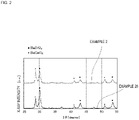
- Fig. 2 illustrates X-ray diffraction patterns of the hydrocarbon reforming catalysts of example 2 and example 26.
- a crystal phase containing BaZrO 3 as a primary component and a crystal phase containing BaCeO 3 as a primary component are present in the hydrocarbon reforming catalysts of example 2 and example 26.
- no diffraction lines attributed to RuO 2 and Ru simple substance were observed.
- the hydrocarbon reforming catalyst of example 2 in which Y 2 O 3 was contained in the raw material when the catalyst was produced no diffraction lines attributed to Y 2 O 3 were observed.
- each of Y and Ru is present in at least one structure of a crystal phase containing BaZrO 3 as a primary component and a crystal phase containing BaCeO 3 as a primary component.
- each of Y and Ru is present as a component constituting a complex oxide having a perovskite structure.
- each of Y and Ru is present as a component constituting a complex oxide having a perovskite structure in the hydrocarbon reforming catalysts of examples 1, 3 to 24, and 29 to 32.
- Ru is present as a component constituting the complex oxide having a perovskite structure.
- the perovskite structure of the complex oxide constituting the hydrocarbon reforming catalyst of each example will be described.
- the perovskite structure is composed of at least Ba, Zr, Ce, Y, and Ru.
- the perovskite structure is composed of at least Ba, Zr, Ce, and Ru.
- the perovskite structure is composed of at least Ba, Ce, Y, and Ru.
- the perovskite structure is composed of at least Ba, Ce, and Ru.
- the hydrocarbon reforming catalyst of comparative example 1 was a mixture of BaCO 3 , ZrO 2 , CeO 2 , and RuO 2 that were used for preparation since the firing temperature during production was 500°C which was lower than the formation temperature of the complex oxide having a perovskite structure.
- the hydrocarbon reforming catalyst of comparative example 2 was also a mixture of BaCO 3 , ZrO 2 , CeO 2 , Y 2 O 3 , and RuO 2 that were used for preparation.
- the hydrocarbon reforming catalysts of examples 1 to 33 and the hydrocarbon reforming catalysts of comparative examples 1 and 2 were finely pulverized by using a mortar, and the resulting powders were subjected to composition analysis by X-ray fluorescence analysis (XRF analysis). As a result, it was ascertained that regarding all the hydrocarbon reforming catalysts subjected to the composition analysis, the element molar ratio of formulation for weighing was maintained and a change in element molar ratio, such as reduction in the Ru component due to heating and firing treatment, did not occur.
- XRF analysis X-ray fluorescence analysis
- the hydrocarbon reforming catalyst of each of examples 1 to 33 and comparative examples of 1 and 2 was pulverized and classified into the size of 0.5 mm to 0.7 mm. Thereafter, a steam reforming evaluation test of a propane gas which is a hydrocarbon-based gas was performed.
- the pipe 1 of the hydrocarbon reforming apparatus 100 illustrated in Fig. 1 was filled with 0.3 g of hydrocarbon reforming catalyst produced by using the above-described method, and heating at 600°C was performed in the heating portion 2. Subsequently, a raw material gas was introduced from the gas feed pipe 4 at a flow rate of nitrogen (N 2 ) of 360 cc/min, propane (C 3 H 8 ) of 7 cc/min, steam (H 2 O) of 60 cc/min, and carbon dioxide (CO 2 ) of 60 cc/min.
- N 2 nitrogen
- propane C 3 H 8
- steam H 2 O
- CO 2 carbon dioxide
- the raw material gas introduced into the pipe 1 was reformed, and a synthetic gas containing hydrogen and carbon monoxide was discharged from the gas discharge pipe 5.
- the synthetic gas discharged from the gas discharge pipe 5 was introduced into a gas analyzer (gas chromatograph) after moisture was removed by a cooling-type trap, and a hydrogen concentration was measured.
- the gas concentration percentage in an equilibrium state was 8.1% by volume except for moisture. Therefore, when the reaction of the introduced raw material gas progresses 100%, the concentration of hydrogen in an equilibrium state (hereafter referred to as an equilibrium hydrogen concentration) discharged from the gas discharge pipe 5 is 8.1% by volume.
- the hydrocarbon reforming catalyst was heated to 700°C while a flow rate of 360 cc/min of nitrogen (N 2 ), 60 cc/min of steam (H 2 O), and 60 cc/min of carbon dioxide (CO 2 ) were introduced into the pipe 1, and heat treatment was successively performed for 1 hour.
- Table 2 describes the concentration of hydrogen discharged from the gas discharge pipe 5 after heat treatment and the recovery factor due to heating when the hydrocarbon reforming catalyst of each of the examples and the comparative examples was used.
- the recovery factor due to heating was defined by formula (5) below.
- recovery factor due to heating hydrogen concentration after heat treatment ⁇ hydrogen concentration after deterioration due to sulfur /equilibrium hydrogen concentration ⁇ 100
- the recovery factor determined by formula (5) being positive indicates that the hydrocarbon reforming catalyst that was deteriorated due to sulfur was recovered due to heat treatment.
- the reason for the hydrocarbon reforming catalyst satisfying the requirements of the present invention having high initial activity is conjectured to be that the complex oxide having at least a crystal phase containing BaCeO 3 as a primary component and having a perovskite structure is stabilized by containing dispersed Ru component in a solid solution state, aggregation and vaporization of the Ru component under a high-temperature oxidizing condition can be suppressed from occurring, and, as a result, the activity is improved.
- the hydrocarbon reforming catalysts of comparative examples not satisfying the requirements of the present invention it is conjectured that since a crystal phase having a perovskite structure is not included, the above-described structure, i.e. a structure in which a Ru component in a solid solution state is dispersed in the complex oxide having a perovskite structure, is not obtained, and the initial activity is reduced.
- the complex oxide has a crystal phase containing BaCeO 3 as a primary component and a crystal phase containing BaZrO 3 as a primary component
- the equilibrium achievement percentage after deterioration due to sulfur was 44% or more and was a higher value. Therefore, regarding the hydrocarbon reforming catalysts satisfying the requirements of the present invention, it is preferable that the complex oxide further have a crystal phase containing BaZrO 3 as a primary component.
- the complex oxide having a perovskite structure further having a crystal phase containing BaZrO 3 as a primary component enables a catalyst function to be exerted for a long time even when sulfur impurities are contained in a raw material to be reformed.
- Y be contained in the complex oxide from the viewpoint of recovering the catalyst function that was deteriorated due to sulfur by heat treatment.
- the hydrocarbon reforming catalysts of examples 25 to 28 which satisfied the requirements of the present invention and in which the perovskite structure of the complex oxide was composed of at least Ba, Zr, Ce, and Ru without containing Y
- the hydrocarbon reforming catalysts of examples 27 and 28 in which the molar ratio of Ce to Ba was 0.50 or more and 0.70 or less
- the recovery factor due to heating was a value higher than 0%. Therefore, regarding the hydrocarbon reforming catalyst in which the perovskite structure of the complex oxide is composed of at least Ba, Zr, Ce, and Ru without containing Y, the molar ratio of Ce to Ba is preferably 0.50 or more and 0.70 or less.
- the hydrocarbon reforming catalyst that is recovered from deterioration due to sulfur by heating being used enables the catalyst function to be recovered by heat treatment from deterioration so as to continuously form a synthetic gas containing hydrogen and carbon monoxide from a hydrocarbon-based gas even in a reaction environment containing a sulfur component.
- the hydrocarbon reforming catalysts of the above-described examples take on granular forms.
- a hydrocarbon reforming catalyst made into a powder may be supported by a ceramic or metal base material and be used.
- a catalyst powder may be formed by a method of press molding, extrusion molding, or the like without using a base material and be used in the form of a pellet, a ring, a honeycomb, or the like.
Landscapes
- Chemical & Material Sciences (AREA)
- Chemical Kinetics & Catalysis (AREA)
- Organic Chemistry (AREA)
- Engineering & Computer Science (AREA)
- Materials Engineering (AREA)
- Combustion & Propulsion (AREA)
- Health & Medical Sciences (AREA)
- General Health & Medical Sciences (AREA)
- Inorganic Chemistry (AREA)
- Oil, Petroleum & Natural Gas (AREA)
- General Chemical & Material Sciences (AREA)
- Hydrogen, Water And Hydrids (AREA)
- Catalysts (AREA)
- Investigating Materials By The Use Of Optical Means Adapted For Particular Applications (AREA)
- Testing Or Measuring Of Semiconductors Or The Like (AREA)
Abstract
Description
- The present invention relates to a hydrocarbon reforming catalyst used for forming a synthetic gas containing hydrogen and carbon monoxide from a hydrocarbon-based gas and to a hydrocarbon reforming apparatus including the hydrocarbon reforming catalyst.
- In a known method, a synthetic gas containing hydrogen and carbon monoxide is obtained from a hydrocarbon-based gas by using a catalyst. Examples of the known catalyst used for a reforming reaction of the hydrocarbon-based gas include nickel-based catalysts in which nickel is supported by a base substrate such as alumina, ruthenium-based catalysts in which ruthenium is supported (refer to Patent Document 1), and rhodium-based catalysts in which rhodium is supported by a base substrate such as alumina (refer to Patent Document 2).
- Further, in known catalysts, rhodium, cobalt, or nickel serving as an active component is supported by a carrier including lanthanum aluminate, strontium titanate, or barium titanate, which are perovskite-type compounds, to suppress carbon from depositing and to improve the activity at low temperature (refer to Patent Document 3).
- As a common method for producing a metal-supporting catalyst, an impregnation method in which an active metal is dispersed on the carrier surface by dipping an oxide serving as a carrier into a solution of a metal salt or the like and, thereafter, performing heat treatment is used (
Patent Document 1 to Patent Document 3). - In this regard, the carrier component is required to have high heat stability and strength and, therefore, is sufficiently sintered by being subjected to heat treatment at high temperature, while the dispersibility of the supported metal has to be maintained to obtain high activity. Consequently, to minimize aggregation during a heat treatment step, the supported metal is fixed to the carrier under a heat treatment condition at relatively low temperature by using a production step different from the synthesis of the carrier, as in the impregnation method.
- The catalyst produced by the impregnation method can maintain high metal dispersibility. However, the impregnation step of supporting the metal component is necessary in addition to the carrier component synthesis step. Further, since the metal component is made to adhere by heat treatment at relatively low temperature, coupling between the metal and the carrier is weak, carbon deposition may cause an activity deterioration problem.
- Consequently, as a method for producing a catalyst without using the impregnation step, a method in which a complex oxide containing BaNiY2O5 is synthesized through solid-phase synthesis so as to improve the dispersibility of a Ni component is proposed (Patent Document 4).
-
- Patent Document 1:
Japanese Unexamined Patent Application Publication No. 8-231204 - Patent Document 2:
Japanese Unexamined Patent Application Publication No. 9-168740 - Patent Document 3:
Japanese Unexamined Patent Application Publication No. 2006-346598 - Patent Document 4:
Japanese Unexamined Patent Application Publication No. 2015-136668 - The catalyst described in Patent Document 4 can suppress carbon from depositing. However, it cannot be said that the activity is sufficiently high, and there is room for improvement.
- The present invention addresses the above-described problem, and it is an object to provide a hydrocarbon reforming catalyst having high activity and to provide a hydrocarbon reforming apparatus including such a hydrocarbon reforming catalyst.
- A hydrocarbon reforming catalyst according to the present invention
- is a catalyst used for forming a synthetic gas containing hydrogen and carbon monoxide from a hydrocarbon-based gas, and
- contains a complex oxide having a perovskite structure,
- wherein the complex oxide has a crystal phase containing BaCeO3 as a primary component and contains Ru. Advantageous Effects of Invention
- According to the present invention, a hydrocarbon reforming catalyst having high activity and a hydrocarbon reforming apparatus including such a hydrocarbon reforming catalyst are provided.
-
- [
Fig. 1] Fig. 1 is a diagram illustrating the outline of the configuration of a hydrocarbon reforming apparatus. - [
Fig. 2] Fig. 2 is a diagram illustrating X-ray diffraction patterns of the hydrocarbon reforming catalysts of example 2 and example 26. - An embodiment according to the present invention will be illustrated below so as to specifically describe the features of the present invention.
- The hydrocarbon reforming catalyst according to the present invention is a catalyst used for forming a synthetic gas containing hydrogen and carbon monoxide from a hydrocarbon-based gas and satisfies the requirements, that is, containing a complex oxide having a perovskite structure, wherein the complex oxide has a crystal phase containing BaCeO3 as a primary component and contains Ru (hereafter referred to as requirements of the present invention) .
- For example, a propane gas containing propane as a primary component or a natural gas containing methane as a primary component may be used as the hydrocarbon-based gas that is a treatment object gas. In addition, hydrocarbon-based gases obtained by vaporizing liquid hydrocarbons, such as gasoline, kerosene, methanol, and ethanol, may also be used.
- The reaction which forms a synthetic gas containing hydrogen and carbon monoxide from a hydrocarbon-based gas will be described with reference to steam reforming of a propane gas as an example. The steam reforming of a propane gas is represented by formula (1) below.
C3H8 + 3H2O → 7H2 + 3CO (1)
- In this regard, the method for forming a synthetic gas containing hydrogen and carbon monoxide from a hydrocarbon-based gas is not limited to steam reforming. For example, oxygen, carbon dioxide, or a mixture thereof may be contained instead of steam. When carbon dioxide is contained, the reforming reaction is represented by formula (2) below.
C3H8 + 3CO2 → 4H2 + 6CO (2)
-
Fig. 1 is a diagram illustrating the outline of the configuration of ahydrocarbon reforming apparatus 100 to form a synthetic gas containing hydrogen and carbon monoxide from a treatment object gas containing at least a hydrocarbon. Thehydrocarbon reforming apparatus 100 includes apipe 1 through which the treatment object gas passes, aheating portion 2 to heat the treatment object gas passing through thepipe 1, and ahydrocarbon reforming catalyst 3 disposed at a position in contact with the treatment object gas inside thepipe 1. Thehydrocarbon reforming catalyst 3 is a catalyst that satisfies the requirements of the present invention and contains a complex oxide having a perovskite structure, and the complex oxide has a crystal phase containing BaCeO3 as a primary component and containing Ru. In this regard, when just the treatment object gas is at sufficiently high temperature, theheating portion 2 may be skipped. - A gas feed pipe 4 is coupled to the upstream side of the
pipe 1. A hydrocarbon is fed from ahydrocarbon supply source 6 to the gas feed pipe 4. However, thehydrocarbon supply source 6 may be disposed at the former stage of the gas feed pipe 4. In this regard, the hydrocarbon fed from thehydrocarbon supply source 6 may contain other components. - A
gas discharge pipe 5 to discharge a synthetic gas containing hydrogen and carbon monoxide obtained through reforming is coupled to the downstream side of thepipe 1. Thegas discharge pipe 5 is provided with ahydrogen outlet 7 and is configured to be capable of separating hydrogen contained in the synthetic gas. For example, a CO converter may be disposed in thegas discharge pipe 5 so as to remove carbon monoxide contained in the synthetic gas, and hydrogen may be separated through thehydrogen outlet 7. - BaCO3, ZrO2, CeO2, Y2O3, and RuO2 were prepared as the materials for forming the hydrocarbon reforming catalyst and weighed so that the molar ratio of Ba:Zr:Ce:Y:Ru was set to be equal to the ratio described in Table 1, and pebbles, water, and a binder were wet-mixed so as to obtain a mixture. The resulting mixture was dried in an oven at a temperature of 120°C and was pulverized and classified so as to have a granular shape with the size of 0.5 mm or more and 0.7 mm or less. Thereafter, hydrocarbon reforming catalysts of examples 1 to 24 were obtained by firing the granular sample in air under the conditions of 1,000°C and 1 hour.
- The hydrocarbon reforming catalysts of examples 1 to 24 are catalysts satisfying the requirements of the present invention. As described in Table 1, the hydrocarbon reforming catalysts of examples 1 to 24 contain Ba, Zr, Ce, Y, and Ru. The molar ratio of Ce to Ba is 0.10 or more and 0.70 or less, the molar ratio of Ru to Ba is 0.04 or more and 0.43 or less, the molar ratio of Y to Ba is 0.05 or more and 0.50 or less, and the molar ratio of Zr to Ba is 0.10 or more and 0.80 or less. In addition, the molar ratio of a total amount of Zr, Ce, and Y to Ba is 0.71 or more and 1.67 or less.
- Regarding the material for forming the hydrocarbon reforming catalyst, BaCO3, ZrO2, CeO2, and RuO2 were prepared and weighed so that the molar ratio of Ba:Zr:Ce:Ru was set to be equal to the ratio described in Table 1, and pebbles, water, and a binder were wet-mixed so as to obtain a mixture. Thereafter, hydrocarbon reforming catalysts of examples 25 to 28 were produced by using the same method as the method for producing the hydrocarbon reforming catalysts of examples 1 to 24.
- The hydrocarbon reforming catalysts of examples 25 to 28 are catalysts satisfying the requirements of the present invention. As described in Table 1, the hydrocarbon reforming catalysts of examples 25 to 28 contain Ba, Zr, Ce, and Ru.
- Regarding the material for forming the hydrocarbon reforming catalyst, BaCO3, CeO2, Y2O3, and RuO2 were prepared and weighed so that the molar ratio of Ba:Ce:Y:Ru was set to be equal to the ratio described in Table 1, and pebbles, water, and a binder were wet-mixed so as to obtain a mixture. Thereafter, hydrocarbon reforming catalysts of examples 29 to 32 were produced by using the same method as the method for producing the hydrocarbon reforming catalysts of examples 1 to 24.
- The hydrocarbon reforming catalysts of examples 29 to 32 are catalysts satisfying the requirements of the present invention. As described in Table 1, the hydrocarbon reforming catalysts of examples 29 to 32 contain Ba, Ce, Y, and Ru.
- Regarding the material for forming the hydrocarbon reforming catalyst, BaCO3, CeO2, and RuO2 were prepared and weighed so that the molar ratio of Ba:Ce:Ru was set to equal to the ratio described in Table 1, and pebbles, water, and a binder were wet-mixed so as to obtain a mixture. Thereafter, a hydrocarbon reforming catalyst of example 33 was produced by using the same method as the method for producing the hydrocarbon reforming catalysts of examples 1 to 24.
- The hydrocarbon reforming catalyst of example 33 is a catalyst satisfying the requirements of the present invention. As described in Table 1, the hydrocarbon reforming catalyst of example 33 contains Ba, Ce, and Ru.
- In this regard, in the production steps of the hydrocarbon reforming catalysts of examples 1 to 33, the impregnation step to make the carrier to support a metal component is unnecessary.
- Regarding the material for forming the hydrocarbon reforming catalyst, BaCO3, ZrO2, CeO2, and RuO2 were prepared and weighed so that the molar ratio of Ba:Zr:Ce:Ru was set to be equal to the ratio described in Table 1, and pebbles, water, and a binder were wet-mixed so as to obtain a mixture. The molar ratio of Ba:Zr:Ce:Ru in the resulting mixture was equal to the molar ratio of the materials used for producing the hydrocarbon reforming catalyst of example 26. Thereafter, a hydrocarbon reforming catalyst of comparative example 1 was produced by using the same method as the method for producing the hydrocarbon reforming catalyst of example 26 except that the firing temperature was set to be 500°C. The hydrocarbon reforming catalyst of comparative example 1 is a catalyst not satisfying the requirements of the present invention.
- Regarding the material for forming the hydrocarbon reforming catalyst, BaCO3, ZrO2, CeO2, Y2O3, and RuO2 were prepared and weighed so that the molar ratio of Ba:Zr:Ce:Y:Ru was set to be equal to the ratio described in Table 1, and pebbles, water, and a binder were wet-mixed so as to obtain a mixture. The molar ratio of Ba:Zr:Ce:Y:Ru in the resulting mixture was equal to the molar ratio of the materials used for producing the hydrocarbon reforming catalyst of example 2. Thereafter, a hydrocarbon reforming catalyst of comparative example 2 was produced by using the same method as the method for producing the hydrocarbon reforming catalyst of example 2 except that the firing temperature was set to be 500°C. The hydrocarbon reforming catalyst of comparative example 2 is a catalysts not satisfying the requirements of the present invention.
- The hydrocarbon reforming catalysts of examples 1 to 33 and comparative examples 1 and 2 above were pulverized by using a mortar, and the crystal phase was examined by powder XRD measurement. Regarding the powder XRD measurement, Cu-Kα1 was used as the X-ray.
- Table 1 describes the crystal phase and the composition (molar ratio) examined with respect to the hydrocarbon reforming catalysts of examples 1 to 33 and comparative examples 1 and 2.
[Table 1] Catalyst Crystal phase Molar ratio Ba Zr Ce Y Ru Example 1 BaZrO3, BaCeO3 1.00 0.40 0.30 0.30 0.04 Example 2 BaZrO3, BaCeO3 1.00 0.40 0.30 0.30 0.09 Example 3 BaZrO3, BaCeO3 1.00 0.40 0.30 0.30 0.13 Example 4 BaZrO3, BaCeO3 1.00 0.40 0.30 0.30 0.22 Example 5 BaZrO3, BaCeO3 1.00 0.40 0.30 0.30 0.43 Example 6 BaZrO3, BaCeO3 1.00 0.65 0.30 0.05 0.09 Example 7 BaZrO3, BaCeO3 1.00 0.60 0.30 0.10 0.09 Example 8 BaZrO3, BaCeO3 1.00 0.50 0.30 0.20 0.09 Example 9 BaZrO3, BaCeO3 1.00 0.30 0.30 0.40 0.09 Example 10 BaZrO3, BaCeO3 1.00 0.20 0.30 0.50 0.09 Example 11 BaZrO3, BaCeO3 1.00 0.60 0.10 0.30 0.08 Example 12 BaZrO3, BaCeO3 1.00 0.50 0.20 0.30 0.09 Example 13 BaZrO3, BaCeO3 1.00 0.30 0.40 0.30 0.09 Example 14 BaZrO3, BaCeO3 1.00 0.20 0.50 0.30 0.09 Example 15 BaZrO3, BaCeO3 1.00 0.10 0.50 0.40 0.09 Example 16 BaZrO3, BaCeO3, BaCO3 1.00 0.10 0.70 0.20 0.09 Example 17 BaZrO3, BaCeO3, BaCO3 1.00 0.20 0.70 0.10 0.09 Example 18 BaZrO3, BaCeO3, Y2O3, BaCO3 1.00 0.20 0.30 0.50 0.09 Example 19 BaZrO3, BaCeO3, Y2O3, BaCO3 1.00 0.40 0.10 0.50 0.08 Example 20 BaZrO3, BaCeO3 1.00 0.80 0.10 0.10 0.08 Example 21 BaZrO3, BaCeO3, BaCO3 1.00 0.67 0.50 0.50 0.11 Example 22 BaZrO3, BaCeO3, BaCO3 1.00 0.50 0.38 0.38 0.10 Example 23 BaZrO3, BaCeO3, BaCO3 1.00 0.33 0.25 0.25 0.08 Example 24 BaZrO3, BaCeO3, BaCO3 1.00 0.29 0.21 0.21 0.08 Example 25 BaZrO3, BaCeO3, BaCO3 1.00 0.80 0.20 - 0.09 Example 26 BaZrO3, BaCeO3, BaCO3 1.00 0.70 0.30 - 0.09 Example 27 BaZrO3, BaCeO3, BaCO3 1.00 0.50 0.50 - 0.09 Example 28 BaZrO3, BaCeO3, BaCO3 1.00 0.30 0.70 - 0.09 Example 29 BaCeO3, Y2O3, BaCO3 1.00 - 0.30 0.70 0.09 Example 30 BaCeO3, Y2O3, BaCO3 1.00 - 0.50 0.50 0.09 Example 31 BaCeO3, Y2O3, BaCO3 1.00 - 0.70 0.30 0.09 Example 32 BaCeO3, Y2O3, BaCO3 1.00 - 0.90 0.10 0.10 Example 33 BaCeO3 1.00 - 1.00 - 0.10 Comparative example 1 BaCO3, ZrO2, CeO2, RuO2 1.00 0.70 0.30 - 0.09 Comparative example 2 BaCO3, ZrO2, CeO2, Y2O3, RuO2 1.00 0.40 0.30 0.30 0.09 - Regarding the hydrocarbon reforming catalysts of examples 1 to 33, it was ascertained that a crystal phase of a complex oxide having a perovskite structure, specifically, a crystal phase containing BaCeO3 as a primary component was present. Further, regarding the hydrocarbon reforming catalysts of examples 1 to 28, it was ascertained that a crystal phase containing BaCeO3 as a primary component and a crystal phase containing BaZrO3 as a primary component were present.
- Regarding hydrocarbon reforming catalysts of some examples, heterogeneous phases such as BaCO3 and Y2O3 were also observed in accordance with the composition ratio. However, even in these hydrocarbon reforming catalysts, the main crystal phase of the complex oxide having a perovskite structure is a crystal phase containing BaCeO3 as a primary component when a crystal phase containing BaZrO3 as a primary component is not contained and is a crystal phase containing BaCeO3 as a primary component and a crystal phase containing BaZrO3 as a primary component when a crystal phase containing BaZrO3 as a primary component is contained.
-
Fig. 2 illustrates X-ray diffraction patterns of the hydrocarbon reforming catalysts of example 2 and example 26. As illustrated inFig. 2 , it can be ascertained that a crystal phase containing BaZrO3 as a primary component and a crystal phase containing BaCeO3 as a primary component are present in the hydrocarbon reforming catalysts of example 2 and example 26. On the other hand, no diffraction lines attributed to RuO2 and Ru simple substance were observed. Regarding the hydrocarbon reforming catalyst of example 2 in which Y2O3 was contained in the raw material when the catalyst was produced, no diffraction lines attributed to Y2O3 were observed. - That is, each of Y and Ru is present in at least one structure of a crystal phase containing BaZrO3 as a primary component and a crystal phase containing BaCeO3 as a primary component. In other words, each of Y and Ru is present as a component constituting a complex oxide having a perovskite structure.
- Likewise, each of Y and Ru is present as a component constituting a complex oxide having a perovskite structure in the hydrocarbon reforming catalysts of examples 1, 3 to 24, and 29 to 32. Regarding the hydrocarbon reforming catalysts of examples 25 to 28 and 33 in which Y is not contained in a complex oxide, Ru is present as a component constituting the complex oxide having a perovskite structure.
- The perovskite structure of the complex oxide constituting the hydrocarbon reforming catalyst of each example will be described. In the hydrocarbon reforming catalysts of examples 1 to 24, the perovskite structure is composed of at least Ba, Zr, Ce, Y, and Ru. In the hydrocarbon reforming catalysts of examples 25 to 28, the perovskite structure is composed of at least Ba, Zr, Ce, and Ru. In the hydrocarbon reforming catalysts of examples 29 to 32, the perovskite structure is composed of at least Ba, Ce, Y, and Ru. In the hydrocarbon reforming catalyst of example 33, the perovskite structure is composed of at least Ba, Ce, and Ru.
- On the other hand, it was ascertained that the hydrocarbon reforming catalyst of comparative example 1 was a mixture of BaCO3, ZrO2, CeO2, and RuO2 that were used for preparation since the firing temperature during production was 500°C which was lower than the formation temperature of the complex oxide having a perovskite structure. Likewise, it was ascertained that the hydrocarbon reforming catalyst of comparative example 2 was also a mixture of BaCO3, ZrO2, CeO2, Y2O3, and RuO2 that were used for preparation.
- The hydrocarbon reforming catalysts of examples 1 to 33 and the hydrocarbon reforming catalysts of comparative examples 1 and 2 were finely pulverized by using a mortar, and the resulting powders were subjected to composition analysis by X-ray fluorescence analysis (XRF analysis). As a result, it was ascertained that regarding all the hydrocarbon reforming catalysts subjected to the composition analysis, the element molar ratio of formulation for weighing was maintained and a change in element molar ratio, such as reduction in the Ru component due to heating and firing treatment, did not occur.
- In this regard, when a common Ru-based catalyst is heated at high temperature in an atmosphere containing oxygen, a Ru component is converted to RuO4 and is sublimated so that the Ru content is decreased. However, regarding the hydrocarbon reforming catalysts of examples 1 to 33 satisfying the requirements of the present invention, it is conjectured that since Ru is present in the structure of at least one of a crystal phase containing BaZrO3 as a primary component and a crystal phase containing BaCeO3 as a primary component, the above-described reduction in Ru does not occur.
- The hydrocarbon reforming catalyst of each of examples 1 to 33 and comparative examples of 1 and 2 was pulverized and classified into the size of 0.5 mm to 0.7 mm. Thereafter, a steam reforming evaluation test of a propane gas which is a hydrocarbon-based gas was performed.
- The
pipe 1 of thehydrocarbon reforming apparatus 100 illustrated inFig. 1 was filled with 0.3 g of hydrocarbon reforming catalyst produced by using the above-described method, and heating at 600°C was performed in theheating portion 2. Subsequently, a raw material gas was introduced from the gas feed pipe 4 at a flow rate of nitrogen (N2) of 360 cc/min, propane (C3H8) of 7 cc/min, steam (H2O) of 60 cc/min, and carbon dioxide (CO2) of 60 cc/min. - The raw material gas introduced into the
pipe 1 was reformed, and a synthetic gas containing hydrogen and carbon monoxide was discharged from thegas discharge pipe 5. The synthetic gas discharged from thegas discharge pipe 5 was introduced into a gas analyzer (gas chromatograph) after moisture was removed by a cooling-type trap, and a hydrogen concentration was measured. - Herein, as a result of calculation of the equilibrium gas composition at the above-described conditions of the gas partial pressure and the temperature, the gas concentration percentage in an equilibrium state was 8.1% by volume except for moisture. Therefore, when the reaction of the introduced raw material gas progresses 100%, the concentration of hydrogen in an equilibrium state (hereafter referred to as an equilibrium hydrogen concentration) discharged from the
gas discharge pipe 5 is 8.1% by volume. - It was assumed that no sulfur component was present for the first 1 hour from introduction of the raw material gas, and the hydrogen concentration after 1 hour was measured so as to examine the initial activity of the hydrocarbon reforming catalyst. Table 2 describes the concentration of hydrogen discharged from the gas discharge pipe 5 (initial hydrogen concentration) and the equilibrium achievement percentage of the initial activity when the hydrocarbon reforming catalyst of each of the examples and the comparative examples was used. The equilibrium achievement percentage of the initial activity was defined by formula (3) below.

- After the above-described initial activity was examined, a SO2 gas was mixed so that the proportion was set to be 50 ppm relative to the total flow rate of the raw material gas of 487 cc/min, the hydrogen gas concentration after 1 hour was measured so as to examine deterioration in the catalyst activity in the presence of sulfur. Table 2 describes the concentration of hydrogen discharged from the
gas discharge pipe 5 after 1 hour in the presence of sulfur and the equilibrium achievement percentage when the hydrocarbon reforming catalyst of each of the examples and the comparative examples was used. In Table 2, these are expressed as the hydrogen concentration "After deterioration due to sulfur" and "Equilibrium achievement percentage after deterioration due to sulfur". The equilibrium achievement percentage after deterioration due to sulfur was defined by formula (4) below.
- After the above-described characteristics after deterioration due to sulfur were examined, the hydrocarbon reforming catalyst was heated to 700°C while a flow rate of 360 cc/min of nitrogen (N2), 60 cc/min of steam (H2O), and 60 cc/min of carbon dioxide (CO2) were introduced into the
pipe 1, and heat treatment was successively performed for 1 hour. Thereafter, the temperature was lowered to 600°C, and a flow rate of 360 cc/min of nitrogen (N2), 7 cc/min of propane (C3H8), 60 cc/min of steam (H2O), and 60 cc/min of carbon dioxide (CO2) were introduced again, and the hydrogen concentration after 1 hour was measured so as to examine the activity of the hydrocarbon reforming catalyst after heat treatment. - Table 2 describes the concentration of hydrogen discharged from the
gas discharge pipe 5 after heat treatment and the recovery factor due to heating when the hydrocarbon reforming catalyst of each of the examples and the comparative examples was used. The recovery factor due to heating was defined by formula (5) below.
- The recovery factor determined by formula (5) being positive indicates that the hydrocarbon reforming catalyst that was deteriorated due to sulfur was recovered due to heat treatment.
- After the test was completed, to examine presence or absence of carbon deposition, the hydrocarbon reforming catalyst was cooled and removed in a N2 atmosphere, and a change in the weight of the catalyst due to carbon combustion was examined by TG-DTA (thermogravimetric-differential thermal analysis). As a result, regarding all the hydrocarbon reforming catalysts of the examples and comparative examples subjected to the evaluation, carbon deposition was not observed.
[Table 2] Catalyst Hydrogen concentration (% by volume) Equilibrium achievement percentage of initial activity Equilibrium achievement percentage after deterioration due to sulfur Recovery factor due to heating Initial stage After deterioration due to sulfur After heat treatment Example 1 5.4 3.6 3.9 67% 44% 4% Example 2 8.0 5.8 6.4 99% 72% 7% Example 3 8.0 7.5 7.7 99% 93% 2% Example 4 8.1 7.6 7.8 100% 94% 2% Example 5 8.1 7.9 8.0 100% 98% 1% Example 6 8.0 6.7 7.0 99% 83% 4% Example 7 7.9 6.9 7.1 98% 85% 2% Example 8 8.0 6.4 6.7 99% 79% 4% Example 9 8.0 6.8 7.0 99% 84% 2% Example 10 8.0 6.5 6.9 99% 80% 5% Example 11 8.0 6.8 7.0 99% 84% 2% Example 12 8.0 7.1 7.3 99% 88% 2% Example 13 8.1 6.2 6.8 100% 77% 7% Example 14 8.1 6.2 6.6 100% 77% 5% Example 15 8.1 4.2 4.9 100% 52% 9% Example 16 8.1 5.0 6.0 100% 62% 12% Example 17 8.0 5.0 5.5 99% 62% 6% Example 18 8.1 4.5 5.5 100% 56% 12% Example 19 8.1 6.0 6.5 100% 74% 6% Example 20 7.9 4.6 4.8 98% 57% 2% Example 21 8.1 7.1 7.3 100% 88% 2% Example 22 8.1 7.4 7.6 100% 91% 2% Example 23 8.0 6.8 7.1 99% 84% 4% Example 24 8.1 6.9 7.2 100% 85% 4% Example 25 7.9 0.0 0.0 98% 59% -10% Example 26 7.8 6.6 6.3 96% 81% -4% Example 27 7.9 7.0 7.2 98% 86% 2% Example 28 7.9 7.5 7.7 98% 93% 2% Example 29 8.0 1.5 5.0 99% 19% 43% Example 30 8.0 2.0 4.0 99% 25% 25% Example 31 8.1 2.5 4.3 100% 31% 22% Example 32 7.9 3.0 5.0 98% 37% 25% Example 33 8.1 1.5 3.2 100% 19% 21% Comparative example 1 2.6 0.0 0.0 32% 0% 0% Comparative example 2 3.0 0.0 0.0 37% 0% 0% - As described in Table 2, when the hydrocarbon reforming catalysts of examples 1 to 33 satisfying the requirements of the present invention were used, the equilibrium achievement percentage of the initial activity was 67% or more. On the other hand, when the hydrocarbon reforming catalysts of comparative examples 1 and 2 not satisfying the requirements of the present invention were used, the equilibrium achievement percentage of the initial activity was 37% or less and was a low value.
- The reason for the hydrocarbon reforming catalyst satisfying the requirements of the present invention having high initial activity is conjectured to be that the complex oxide having at least a crystal phase containing BaCeO3 as a primary component and having a perovskite structure is stabilized by containing dispersed Ru component in a solid solution state, aggregation and vaporization of the Ru component under a high-temperature oxidizing condition can be suppressed from occurring, and, as a result, the activity is improved.
- On the other hand, regarding the hydrocarbon reforming catalysts of comparative examples not satisfying the requirements of the present invention, it is conjectured that since a crystal phase having a perovskite structure is not included, the above-described structure, i.e. a structure in which a Ru component in a solid solution state is dispersed in the complex oxide having a perovskite structure, is not obtained, and the initial activity is reduced.
- In addition, when the hydrocarbon reforming catalysts of examples 2 to 33 in which the molar ratio of Ru to Ba was 0.08 or more and 0.43 or less, of the hydrocarbon reforming catalysts satisfying the requirements of the present invention, were used, the equilibrium achievement percentage of the initial activity was 96% or more and was a higher value. Therefore, regarding the hydrocarbon reforming catalysts satisfying the requirements of the present invention, the molar ratio of Ru to Ba is preferably 0.08 or more and 0.43 or less.
- As described in Table 2, when the hydrocarbon reforming catalysts of comparative examples 1 and 2 not satisfying the requirements of the present invention were used, the equilibrium achievement percentage after deterioration due to sulfur was 0%. On the other hand, when the hydrocarbon reforming catalysts of examples 1 to 33 satisfying the requirements of the present invention were used, the equilibrium achievement percentage of the initial activity after deterioration due to sulfur was 19% or more. It is conjectured that regarding the hydrocarbon reforming catalysts satisfying the requirements of the present invention, since Ru component in a solid solution state is dispersed in the complex oxide, the bonding force is strong, an effect of suppressing a poisoning component such as sulfur from adsorbing or forming a compound is obtained, and high sulfur resistance is provided.
- In addition, when the hydrocarbon reforming catalysts of examples 1 to 28 in which the complex oxide has a crystal phase containing BaCeO3 as a primary component and a crystal phase containing BaZrO3 as a primary component were used, the equilibrium achievement percentage after deterioration due to sulfur was 44% or more and was a higher value. Therefore, regarding the hydrocarbon reforming catalysts satisfying the requirements of the present invention, it is preferable that the complex oxide further have a crystal phase containing BaZrO3 as a primary component. The complex oxide having a perovskite structure further having a crystal phase containing BaZrO3 as a primary component enables a catalyst function to be exerted for a long time even when sulfur impurities are contained in a raw material to be reformed.
- As described in Table 2, when the hydrocarbon reforming catalysts of examples 1 to 24 and 29 to 32 in which Y was contained in the complex oxide, of the hydrocarbon reforming catalysts satisfying the requirements of the present invention, were used, the recovery factor due to heating was a value higher than 0%. That is, regarding these hydrocarbon reforming catalysts, the catalyst function that was deteriorated due to sulfur was recovered by heat treatment.
- Therefore, regarding the hydrocarbon reforming catalysts satisfying the requirements of the present invention, it is preferable that Y be contained in the complex oxide from the viewpoint of recovering the catalyst function that was deteriorated due to sulfur by heat treatment.
- In addition, of the hydrocarbon reforming catalysts of examples 25 to 28 which satisfied the requirements of the present invention and in which the perovskite structure of the complex oxide was composed of at least Ba, Zr, Ce, and Ru without containing Y, regarding the hydrocarbon reforming catalysts of examples 27 and 28 in which the molar ratio of Ce to Ba was 0.50 or more and 0.70 or less, the recovery factor due to heating was a value higher than 0%. Therefore, regarding the hydrocarbon reforming catalyst in which the perovskite structure of the complex oxide is composed of at least Ba, Zr, Ce, and Ru without containing Y, the molar ratio of Ce to Ba is preferably 0.50 or more and 0.70 or less.
- The hydrocarbon reforming catalyst that is recovered from deterioration due to sulfur by heating being used enables the catalyst function to be recovered by heat treatment from deterioration so as to continuously form a synthetic gas containing hydrogen and carbon monoxide from a hydrocarbon-based gas even in a reaction environment containing a sulfur component.
- The present invention is not limited to the above-described embodiment and can be variously applied and modified within the scope of the present invention.
- For example, the hydrocarbon reforming catalysts of the above-described examples take on granular forms. However, similarly to the common metal-supporting catalyst, a hydrocarbon reforming catalyst made into a powder may be supported by a ceramic or metal base material and be used. Alternatively, a catalyst powder may be formed by a method of press molding, extrusion molding, or the like without using a base material and be used in the form of a pellet, a ring, a honeycomb, or the like.
- In the above-described embodiment, explanations are made with reference to the example in which a propane gas is used as the hydrocarbon-based gas, but the hydrocarbon-based gas is not limited to the propane gas.
-
- 1
- pipe
- 2
- heating portion
- 3
- hydrocarbon reforming catalyst
- 4
- gas feed pipe
- 5
- gas discharge pipe
- 6
- hydrocarbon supply source
- 7
- hydrogen outlet
- 100
- hydrocarbon reforming apparatus
Claims (12)
- A hydrocarbon reforming catalyst used for forming a synthetic gas containing hydrogen and carbon monoxide from a hydrocarbon-based gas, the hydrocarbon reforming catalyst comprising:a complex oxide having a perovskite structure,wherein the complex oxide has a crystal phase containing BaCeO3 as a primary component and contains Ru.
- The hydrocarbon reforming catalyst according to Claim 1, wherein the complex oxide further has a crystal phase containing BaZrO3 as a primary component.
- The hydrocarbon reforming catalyst according to Claim 2, wherein the perovskite structure is composed of at least Ba, Zr, Ce, and Ru.
- The hydrocarbon reforming catalyst according to any one of Claims 1 to 3,wherein the complex oxide does not contain Y, anda molar ratio of Ce to Ba is 0.50 or more and 0.70 or less.
- The hydrocarbon reforming catalyst according to Claim 2, wherein the complex oxide contains Y.
- The hydrocarbon reforming catalyst according to Claim 5, wherein the perovskite structure is composed of at least Ba, Zr, Ce, Y, and Ru.
- The hydrocarbon reforming catalyst according to Claim 6, wherein a molar ratio of the Ce to the Ba is 0.10 or more and 0.70 or less.
- The hydrocarbon reforming catalyst according to Claim 6 or Claim 7, wherein a molar ratio of the Ru to the Ba is 0.04 or more and 0.43 or less.
- The hydrocarbon reforming catalyst according to Claim 8, wherein the molar ratio of the Ru to the Ba is 0.08 or more and 0.43 or less.
- The hydrocarbon reforming catalyst according to any one of Claims 6 to 9, wherein a molar ratio of the Y to the Ba is 0.05 or more and 0.50 or less.
- The hydrocarbon reforming catalyst according to any one of Claims 6 to 10, wherein a molar ratio of a total amount of the Zr, the Ce, and the Y to the Ba is 0.71 or more and 1.67 or less.
- A hydrocarbon reforming apparatus comprising:a pipe through which a treatment object gas containing at least a hydrocarbon passes; andthe hydrocarbon reforming catalyst according to any one of Claims 1 to 11 disposed at a position in contact with the treatment object gas inside the pipe.
Applications Claiming Priority (2)
| Application Number | Priority Date | Filing Date | Title |
|---|---|---|---|
| JP2019142202 | 2019-08-01 | ||
| PCT/JP2020/019744 WO2021019869A1 (en) | 2019-08-01 | 2020-05-19 | Hydrocarbon reforming catalyst and hydrocarbon reforming device |
Publications (3)
| Publication Number | Publication Date |
|---|---|
| EP3988206A1 true EP3988206A1 (en) | 2022-04-27 |
| EP3988206A4 EP3988206A4 (en) | 2023-06-28 |
| EP3988206B1 EP3988206B1 (en) | 2024-10-30 |
Family
ID=74228639
Family Applications (1)
| Application Number | Title | Priority Date | Filing Date |
|---|---|---|---|
| EP20846636.7A Active EP3988206B1 (en) | 2019-08-01 | 2020-05-19 | Hydrocarbon reforming catalyst and hydrocarbon reforming device |
Country Status (5)
| Country | Link |
|---|---|
| US (1) | US12179178B2 (en) |
| EP (1) | EP3988206B1 (en) |
| JP (1) | JP7044206B2 (en) |
| CN (1) | CN114080273A (en) |
| WO (1) | WO2021019869A1 (en) |
Family Cites Families (20)
| Publication number | Priority date | Publication date | Assignee | Title |
|---|---|---|---|---|
| JPH08231204A (en) | 1994-12-27 | 1996-09-10 | Sekiyu Sangyo Kasseika Center | Method for producing hydrogen and carbon monoxide by carbon dioxide reforming reaction |
| JP3638358B2 (en) | 1995-12-20 | 2005-04-13 | 財団法人石油産業活性化センター | Carbon dioxide reforming catalyst and reforming method using the same |
| AU759921B2 (en) * | 1998-09-21 | 2003-05-01 | University Of Queensland, The | Catalysts and process for reforming of hydrocarbons |
| ITMI20011519A1 (en) * | 2001-07-17 | 2003-01-17 | Uni Degli Studi Di L Aquila | SOLID SOLUTIONS WITH PEROVSKITIC STRUCTURE INCLUDING NOBLE METALS USEFUL AS CATALYSTS |
| EP1432058A3 (en) * | 2002-12-17 | 2005-07-13 | Max-Planck-Gesellschaft zur Förderung der Wissenschaften e.V. | Anode material with catalytic activity |
| WO2004074175A1 (en) * | 2003-02-24 | 2004-09-02 | National University Corporation Nagoya University | Hydrogen gas separator |
| JP2006036558A (en) * | 2004-07-23 | 2006-02-09 | Dowa Mining Co Ltd | Perovskite complex oxides and catalysts |
| JP2006346598A (en) | 2005-06-16 | 2006-12-28 | Nissan Motor Co Ltd | Steam reforming catalyst |
| US20080169449A1 (en) * | 2006-09-08 | 2008-07-17 | Eltron Research Inc. | Catalytic membrane reactor and method for production of synthesis gas |
| JP5428103B2 (en) * | 2007-02-21 | 2014-02-26 | 国立大学法人 大分大学 | Catalyst for low-temperature hydrogen production, its production method and hydrogen production method |
| JP5127672B2 (en) * | 2008-11-06 | 2013-01-23 | 日立造船株式会社 | Ammonia decomposition catalyst |
| CN102557855B (en) * | 2010-12-22 | 2015-11-25 | 通用电气公司 | The coating process of hydrocarbon cracking method and reaction unit and hydrocarbon cracking reaction unit |
| CN104710845A (en) * | 2013-12-13 | 2015-06-17 | 通用电气公司 | Composition and corresponding device and method |
| WO2015103591A1 (en) * | 2014-01-06 | 2015-07-09 | North Carolina State University | Mixed-conductor enhanced composite and core-shell oxides for cyclic redox production of fuels and chemicals |
| CN104774639A (en) * | 2014-01-13 | 2015-07-15 | 通用电气公司 | Hydrocarbon cracking method and hydrocarbon cracking apparatus |
| CN103706360B (en) * | 2014-01-22 | 2015-08-12 | 福州大学 | A kind of Ru/BaCeO3 ammonia synthesis catalyst and preparation method thereof |
| JP6187282B2 (en) * | 2014-01-23 | 2017-08-30 | 株式会社村田製作所 | Hydrocarbon reforming catalyst |
| US11668012B2 (en) * | 2017-12-11 | 2023-06-06 | Battelle Energy Alliance, Llc | Methods for producing hydrocarbon products and hydrogen gas through electrochemical activation of methane |
| JP6940002B2 (en) * | 2018-07-09 | 2021-09-22 | 株式会社村田製作所 | Hydrocarbon reforming catalyst and hydrocarbon reforming equipment |
| US11731920B2 (en) * | 2018-08-06 | 2023-08-22 | Battelle Energy Alliance, Llc | Methods for co-producing hydrocarbon products and ammonia |
-
2020
- 2020-05-19 EP EP20846636.7A patent/EP3988206B1/en active Active
- 2020-05-19 WO PCT/JP2020/019744 patent/WO2021019869A1/en not_active Ceased
- 2020-05-19 CN CN202080044529.7A patent/CN114080273A/en active Pending
- 2020-05-19 JP JP2021536620A patent/JP7044206B2/en active Active
-
2021
- 2021-12-15 US US17/551,293 patent/US12179178B2/en active Active
Also Published As
| Publication number | Publication date |
|---|---|
| US20220105495A1 (en) | 2022-04-07 |
| CN114080273A (en) | 2022-02-22 |
| US12179178B2 (en) | 2024-12-31 |
| JPWO2021019869A1 (en) | 2021-02-04 |
| JP7044206B2 (en) | 2022-03-30 |
| EP3988206A4 (en) | 2023-06-28 |
| WO2021019869A1 (en) | 2021-02-04 |
| EP3988206B1 (en) | 2024-10-30 |
Similar Documents
| Publication | Publication Date | Title |
|---|---|---|
| EP3804850B1 (en) | Hydrocarbon reforming catalyst and hydrocarbon reforming apparatus | |
| US8329612B2 (en) | Catalyst for reforming hydrocarbon gas, method of manufacturing the same, and method of manufacturing synthesized gas | |
| JP5141765B2 (en) | Carbon dioxide reforming method | |
| EP2474355A1 (en) | Hydrocarbon gas reforming catalyst, method for producing same, and method for producing synthetic gas | |
| US20110084237A1 (en) | Proton conducting membranes for hydrogen production and separation | |
| EP4245409A1 (en) | Methane-reforming catalyst and method for producing same | |
| JP6187282B2 (en) | Hydrocarbon reforming catalyst | |
| US12589381B2 (en) | Hydrocarbon reforming catalyst and hydrocarbon reforming apparatus | |
| US12390792B2 (en) | Hydrocarbon reforming catalyst and hydrocarbon reforming device | |
| US12179178B2 (en) | Hydrocarbon reforming catalyst and hydrocarbon reforming apparatus | |
| EP4056268A1 (en) | Hydrocarbon reforming catalyst, hydrocarbon reforming device, and method for regenerating hydrocarbon reforming catalyst poisoned by sulfur | |
| JP2006116372A (en) | Carbon monoxide selective oxidation catalyst | |
| JP5626446B2 (en) | Hydrocarbon carbon dioxide reforming catalyst and hydrocarbon carbon dioxide reforming method | |
| JP2006116370A (en) | Carbon monoxide shift reaction catalyst |
Legal Events
| Date | Code | Title | Description |
|---|---|---|---|
| STAA | Information on the status of an ep patent application or granted ep patent |
Free format text: STATUS: THE INTERNATIONAL PUBLICATION HAS BEEN MADE |
|
| PUAI | Public reference made under article 153(3) epc to a published international application that has entered the european phase |
Free format text: ORIGINAL CODE: 0009012 |
|
| STAA | Information on the status of an ep patent application or granted ep patent |
Free format text: STATUS: REQUEST FOR EXAMINATION WAS MADE |
|
| 17P | Request for examination filed |
Effective date: 20220121 |
|
| AK | Designated contracting states |
Kind code of ref document: A1 Designated state(s): AL AT BE BG CH CY CZ DE DK EE ES FI FR GB GR HR HU IE IS IT LI LT LU LV MC MK MT NL NO PL PT RO RS SE SI SK SM TR |
|
| DAV | Request for validation of the european patent (deleted) | ||
| DAX | Request for extension of the european patent (deleted) | ||
| A4 | Supplementary search report drawn up and despatched |
Effective date: 20230601 |
|
| RIC1 | Information provided on ipc code assigned before grant |
Ipc: B01J 23/00 20060101ALI20230525BHEP Ipc: C01B 3/40 20060101ALI20230525BHEP Ipc: B01J 23/63 20060101AFI20230525BHEP |
|
| GRAP | Despatch of communication of intention to grant a patent |
Free format text: ORIGINAL CODE: EPIDOSNIGR1 |
|
| STAA | Information on the status of an ep patent application or granted ep patent |
Free format text: STATUS: GRANT OF PATENT IS INTENDED |
|
| RIC1 | Information provided on ipc code assigned before grant |
Ipc: B01J 35/30 20240101ALI20240222BHEP Ipc: B01J 23/00 20060101ALI20240222BHEP Ipc: C01B 3/40 20060101ALI20240222BHEP Ipc: B01J 23/63 20060101AFI20240222BHEP |
|
| INTG | Intention to grant announced |
Effective date: 20240314 |
|
| GRAS | Grant fee paid |
Free format text: ORIGINAL CODE: EPIDOSNIGR3 |
|
| GRAJ | Information related to disapproval of communication of intention to grant by the applicant or resumption of examination proceedings by the epo deleted |
Free format text: ORIGINAL CODE: EPIDOSDIGR1 |
|
| GRAL | Information related to payment of fee for publishing/printing deleted |
Free format text: ORIGINAL CODE: EPIDOSDIGR3 |
|
| STAA | Information on the status of an ep patent application or granted ep patent |
Free format text: STATUS: REQUEST FOR EXAMINATION WAS MADE |
|
| GRAP | Despatch of communication of intention to grant a patent |
Free format text: ORIGINAL CODE: EPIDOSNIGR1 |
|
| STAA | Information on the status of an ep patent application or granted ep patent |
Free format text: STATUS: GRANT OF PATENT IS INTENDED |
|
| INTC | Intention to grant announced (deleted) | ||
| INTG | Intention to grant announced |
Effective date: 20240814 |
|
| GRAA | (expected) grant |
Free format text: ORIGINAL CODE: 0009210 |
|
| STAA | Information on the status of an ep patent application or granted ep patent |
Free format text: STATUS: THE PATENT HAS BEEN GRANTED |
|
| AK | Designated contracting states |
Kind code of ref document: B1 Designated state(s): AL AT BE BG CH CY CZ DE DK EE ES FI FR GB GR HR HU IE IS IT LI LT LU LV MC MK MT NL NO PL PT RO RS SE SI SK SM TR |
|
| REG | Reference to a national code |
Ref country code: GB Ref legal event code: FG4D |
|
| REG | Reference to a national code |
Ref country code: CH Ref legal event code: EP |
|
| REG | Reference to a national code |
Ref country code: DE Ref legal event code: R096 Ref document number: 602020040485 Country of ref document: DE |
|
| REG | Reference to a national code |
Ref country code: IE Ref legal event code: FG4D |
|
| REG | Reference to a national code |
Ref country code: LT Ref legal event code: MG9D |
|
| REG | Reference to a national code |
Ref country code: NL Ref legal event code: MP Effective date: 20241030 |
|
| PG25 | Lapsed in a contracting state [announced via postgrant information from national office to epo] |
Ref country code: PT Free format text: LAPSE BECAUSE OF FAILURE TO SUBMIT A TRANSLATION OF THE DESCRIPTION OR TO PAY THE FEE WITHIN THE PRESCRIBED TIME-LIMIT Effective date: 20250228 Ref country code: IS Free format text: LAPSE BECAUSE OF FAILURE TO SUBMIT A TRANSLATION OF THE DESCRIPTION OR TO PAY THE FEE WITHIN THE PRESCRIBED TIME-LIMIT Effective date: 20250228 Ref country code: HR Free format text: LAPSE BECAUSE OF FAILURE TO SUBMIT A TRANSLATION OF THE DESCRIPTION OR TO PAY THE FEE WITHIN THE PRESCRIBED TIME-LIMIT Effective date: 20241030 |
|
| PG25 | Lapsed in a contracting state [announced via postgrant information from national office to epo] |
Ref country code: FI Free format text: LAPSE BECAUSE OF FAILURE TO SUBMIT A TRANSLATION OF THE DESCRIPTION OR TO PAY THE FEE WITHIN THE PRESCRIBED TIME-LIMIT Effective date: 20241030 Ref country code: NL Free format text: LAPSE BECAUSE OF FAILURE TO SUBMIT A TRANSLATION OF THE DESCRIPTION OR TO PAY THE FEE WITHIN THE PRESCRIBED TIME-LIMIT Effective date: 20241030 |
|
| REG | Reference to a national code |
Ref country code: AT Ref legal event code: MK05 Ref document number: 1736385 Country of ref document: AT Kind code of ref document: T Effective date: 20241030 |
|
| PG25 | Lapsed in a contracting state [announced via postgrant information from national office to epo] |
Ref country code: BG Free format text: LAPSE BECAUSE OF FAILURE TO SUBMIT A TRANSLATION OF THE DESCRIPTION OR TO PAY THE FEE WITHIN THE PRESCRIBED TIME-LIMIT Effective date: 20241030 |
|
| PG25 | Lapsed in a contracting state [announced via postgrant information from national office to epo] |
Ref country code: ES Free format text: LAPSE BECAUSE OF FAILURE TO SUBMIT A TRANSLATION OF THE DESCRIPTION OR TO PAY THE FEE WITHIN THE PRESCRIBED TIME-LIMIT Effective date: 20241030 |
|
| PG25 | Lapsed in a contracting state [announced via postgrant information from national office to epo] |
Ref country code: NO Free format text: LAPSE BECAUSE OF FAILURE TO SUBMIT A TRANSLATION OF THE DESCRIPTION OR TO PAY THE FEE WITHIN THE PRESCRIBED TIME-LIMIT Effective date: 20250130 |
|
| PG25 | Lapsed in a contracting state [announced via postgrant information from national office to epo] |
Ref country code: LV Free format text: LAPSE BECAUSE OF FAILURE TO SUBMIT A TRANSLATION OF THE DESCRIPTION OR TO PAY THE FEE WITHIN THE PRESCRIBED TIME-LIMIT Effective date: 20241030 Ref country code: AT Free format text: LAPSE BECAUSE OF FAILURE TO SUBMIT A TRANSLATION OF THE DESCRIPTION OR TO PAY THE FEE WITHIN THE PRESCRIBED TIME-LIMIT Effective date: 20241030 Ref country code: GR Free format text: LAPSE BECAUSE OF FAILURE TO SUBMIT A TRANSLATION OF THE DESCRIPTION OR TO PAY THE FEE WITHIN THE PRESCRIBED TIME-LIMIT Effective date: 20250131 |
|
| PG25 | Lapsed in a contracting state [announced via postgrant information from national office to epo] |
Ref country code: PL Free format text: LAPSE BECAUSE OF FAILURE TO SUBMIT A TRANSLATION OF THE DESCRIPTION OR TO PAY THE FEE WITHIN THE PRESCRIBED TIME-LIMIT Effective date: 20241030 |
|
| PG25 | Lapsed in a contracting state [announced via postgrant information from national office to epo] |
Ref country code: RS Free format text: LAPSE BECAUSE OF FAILURE TO SUBMIT A TRANSLATION OF THE DESCRIPTION OR TO PAY THE FEE WITHIN THE PRESCRIBED TIME-LIMIT Effective date: 20250130 |
|
| PG25 | Lapsed in a contracting state [announced via postgrant information from national office to epo] |
Ref country code: SM Free format text: LAPSE BECAUSE OF FAILURE TO SUBMIT A TRANSLATION OF THE DESCRIPTION OR TO PAY THE FEE WITHIN THE PRESCRIBED TIME-LIMIT Effective date: 20241030 |
|
| PGFP | Annual fee paid to national office [announced via postgrant information from national office to epo] |
Ref country code: DE Payment date: 20250528 Year of fee payment: 6 |
|
| PG25 | Lapsed in a contracting state [announced via postgrant information from national office to epo] |
Ref country code: DK Free format text: LAPSE BECAUSE OF FAILURE TO SUBMIT A TRANSLATION OF THE DESCRIPTION OR TO PAY THE FEE WITHIN THE PRESCRIBED TIME-LIMIT Effective date: 20241030 |
|
| PG25 | Lapsed in a contracting state [announced via postgrant information from national office to epo] |
Ref country code: EE Free format text: LAPSE BECAUSE OF FAILURE TO SUBMIT A TRANSLATION OF THE DESCRIPTION OR TO PAY THE FEE WITHIN THE PRESCRIBED TIME-LIMIT Effective date: 20241030 |
|
| PG25 | Lapsed in a contracting state [announced via postgrant information from national office to epo] |
Ref country code: RO Free format text: LAPSE BECAUSE OF FAILURE TO SUBMIT A TRANSLATION OF THE DESCRIPTION OR TO PAY THE FEE WITHIN THE PRESCRIBED TIME-LIMIT Effective date: 20241030 |
|
| PG25 | Lapsed in a contracting state [announced via postgrant information from national office to epo] |
Ref country code: SK Free format text: LAPSE BECAUSE OF FAILURE TO SUBMIT A TRANSLATION OF THE DESCRIPTION OR TO PAY THE FEE WITHIN THE PRESCRIBED TIME-LIMIT Effective date: 20241030 |
|
| PG25 | Lapsed in a contracting state [announced via postgrant information from national office to epo] |
Ref country code: CZ Free format text: LAPSE BECAUSE OF FAILURE TO SUBMIT A TRANSLATION OF THE DESCRIPTION OR TO PAY THE FEE WITHIN THE PRESCRIBED TIME-LIMIT Effective date: 20241030 |
|
| PG25 | Lapsed in a contracting state [announced via postgrant information from national office to epo] |
Ref country code: IT Free format text: LAPSE BECAUSE OF FAILURE TO SUBMIT A TRANSLATION OF THE DESCRIPTION OR TO PAY THE FEE WITHIN THE PRESCRIBED TIME-LIMIT Effective date: 20241030 |
|
| REG | Reference to a national code |
Ref country code: DE Ref legal event code: R097 Ref document number: 602020040485 Country of ref document: DE |
|
| PLBE | No opposition filed within time limit |
Free format text: ORIGINAL CODE: 0009261 |
|
| STAA | Information on the status of an ep patent application or granted ep patent |
Free format text: STATUS: NO OPPOSITION FILED WITHIN TIME LIMIT |
|
| PG25 | Lapsed in a contracting state [announced via postgrant information from national office to epo] |
Ref country code: SE Free format text: LAPSE BECAUSE OF FAILURE TO SUBMIT A TRANSLATION OF THE DESCRIPTION OR TO PAY THE FEE WITHIN THE PRESCRIBED TIME-LIMIT Effective date: 20241030 |
|
| 26N | No opposition filed |
Effective date: 20250731 |
|
| REG | Reference to a national code |
Ref country code: CH Ref legal event code: H13 Free format text: ST27 STATUS EVENT CODE: U-0-0-H10-H13 (AS PROVIDED BY THE NATIONAL OFFICE) Effective date: 20251223 |
|
| PG25 | Lapsed in a contracting state [announced via postgrant information from national office to epo] |
Ref country code: LU Free format text: LAPSE BECAUSE OF NON-PAYMENT OF DUE FEES Effective date: 20250519 |
|
| PG25 | Lapsed in a contracting state [announced via postgrant information from national office to epo] |
Ref country code: CH Free format text: LAPSE BECAUSE OF NON-PAYMENT OF DUE FEES Effective date: 20250531 |
|
| GBPC | Gb: european patent ceased through non-payment of renewal fee |
Effective date: 20250519 |
|
| REG | Reference to a national code |
Ref country code: BE Ref legal event code: MM Effective date: 20250531 |
|
| PG25 | Lapsed in a contracting state [announced via postgrant information from national office to epo] |
Ref country code: MC Free format text: LAPSE BECAUSE OF FAILURE TO SUBMIT A TRANSLATION OF THE DESCRIPTION OR TO PAY THE FEE WITHIN THE PRESCRIBED TIME-LIMIT Effective date: 20241030 |
|
| PG25 | Lapsed in a contracting state [announced via postgrant information from national office to epo] |
Ref country code: GB Free format text: LAPSE BECAUSE OF NON-PAYMENT OF DUE FEES Effective date: 20250519 |
|
| PG25 | Lapsed in a contracting state [announced via postgrant information from national office to epo] |
Ref country code: IE Free format text: LAPSE BECAUSE OF NON-PAYMENT OF DUE FEES Effective date: 20250519 |
|
| PG25 | Lapsed in a contracting state [announced via postgrant information from national office to epo] |
Ref country code: BE Free format text: LAPSE BECAUSE OF NON-PAYMENT OF DUE FEES Effective date: 20250531 |
|
| PG25 | Lapsed in a contracting state [announced via postgrant information from national office to epo] |
Ref country code: FR Free format text: LAPSE BECAUSE OF NON-PAYMENT OF DUE FEES Effective date: 20250531 |