EP3987376B1 - Autonomous utility cart and robotic cart platform - Google Patents
Autonomous utility cart and robotic cart platform Download PDFInfo
- Publication number
- EP3987376B1 EP3987376B1 EP20833205.6A EP20833205A EP3987376B1 EP 3987376 B1 EP3987376 B1 EP 3987376B1 EP 20833205 A EP20833205 A EP 20833205A EP 3987376 B1 EP3987376 B1 EP 3987376B1
- Authority
- EP
- European Patent Office
- Prior art keywords
- cart
- weight
- mounting
- bracket
- sensor
- Prior art date
- Legal status (The legal status is an assumption and is not a legal conclusion. Google has not performed a legal analysis and makes no representation as to the accuracy of the status listed.)
- Active
Links
Images






Classifications
-
- B—PERFORMING OPERATIONS; TRANSPORTING
- B60—VEHICLES IN GENERAL
- B60W—CONJOINT CONTROL OF VEHICLE SUB-UNITS OF DIFFERENT TYPE OR DIFFERENT FUNCTION; CONTROL SYSTEMS SPECIALLY ADAPTED FOR HYBRID VEHICLES; ROAD VEHICLE DRIVE CONTROL SYSTEMS FOR PURPOSES NOT RELATED TO THE CONTROL OF A PARTICULAR SUB-UNIT
- B60W50/00—Details of control systems for road vehicle drive control not related to the control of a particular sub-unit, e.g. process diagnostic or vehicle driver interfaces
- B60W50/08—Interaction between the driver and the control system
- B60W50/14—Means for informing the driver, warning the driver or prompting a driver intervention
-
- B—PERFORMING OPERATIONS; TRANSPORTING
- B60—VEHICLES IN GENERAL
- B60W—CONJOINT CONTROL OF VEHICLE SUB-UNITS OF DIFFERENT TYPE OR DIFFERENT FUNCTION; CONTROL SYSTEMS SPECIALLY ADAPTED FOR HYBRID VEHICLES; ROAD VEHICLE DRIVE CONTROL SYSTEMS FOR PURPOSES NOT RELATED TO THE CONTROL OF A PARTICULAR SUB-UNIT
- B60W60/00—Drive control systems specially adapted for autonomous road vehicles
- B60W60/001—Planning or execution of driving tasks
- B60W60/0011—Planning or execution of driving tasks involving control alternatives for a single driving scenario, e.g. planning several paths to avoid obstacles
-
- B—PERFORMING OPERATIONS; TRANSPORTING
- B60—VEHICLES IN GENERAL
- B60W—CONJOINT CONTROL OF VEHICLE SUB-UNITS OF DIFFERENT TYPE OR DIFFERENT FUNCTION; CONTROL SYSTEMS SPECIALLY ADAPTED FOR HYBRID VEHICLES; ROAD VEHICLE DRIVE CONTROL SYSTEMS FOR PURPOSES NOT RELATED TO THE CONTROL OF A PARTICULAR SUB-UNIT
- B60W60/00—Drive control systems specially adapted for autonomous road vehicles
- B60W60/005—Handover processes
- B60W60/0053—Handover processes from vehicle to occupant
-
- B—PERFORMING OPERATIONS; TRANSPORTING
- B62—LAND VEHICLES FOR TRAVELLING OTHERWISE THAN ON RAILS
- B62B—HAND-PROPELLED VEHICLES, e.g. HAND CARTS OR PERAMBULATORS; SLEDGES
- B62B3/00—Hand carts having more than one axis carrying transport wheels; Steering devices therefor; Equipment therefor
-
- B—PERFORMING OPERATIONS; TRANSPORTING
- B62—LAND VEHICLES FOR TRAVELLING OTHERWISE THAN ON RAILS
- B62B—HAND-PROPELLED VEHICLES, e.g. HAND CARTS OR PERAMBULATORS; SLEDGES
- B62B5/00—Accessories or details specially adapted for hand carts
- B62B5/0026—Propulsion aids
- B62B5/0033—Electric motors
- B62B5/0036—Arrangements of motors
- B62B5/0043—One motor drives one wheel
-
- B—PERFORMING OPERATIONS; TRANSPORTING
- B62—LAND VEHICLES FOR TRAVELLING OTHERWISE THAN ON RAILS
- B62B—HAND-PROPELLED VEHICLES, e.g. HAND CARTS OR PERAMBULATORS; SLEDGES
- B62B5/00—Accessories or details specially adapted for hand carts
- B62B5/0026—Propulsion aids
- B62B5/0033—Electric motors
- B62B5/0053—Arrangements of batteries
-
- B—PERFORMING OPERATIONS; TRANSPORTING
- B62—LAND VEHICLES FOR TRAVELLING OTHERWISE THAN ON RAILS
- B62B—HAND-PROPELLED VEHICLES, e.g. HAND CARTS OR PERAMBULATORS; SLEDGES
- B62B5/00—Accessories or details specially adapted for hand carts
- B62B5/0026—Propulsion aids
- B62B5/0069—Control
-
- B—PERFORMING OPERATIONS; TRANSPORTING
- B62—LAND VEHICLES FOR TRAVELLING OTHERWISE THAN ON RAILS
- B62D—MOTOR VEHICLES; TRAILERS
- B62D63/00—Motor vehicles or trailers not otherwise provided for
- B62D63/02—Motor vehicles
-
- G—PHYSICS
- G01—MEASURING; TESTING
- G01G—WEIGHING
- G01G19/00—Weighing apparatus or methods adapted for special purposes not provided for in the preceding groups
- G01G19/02—Weighing apparatus or methods adapted for special purposes not provided for in the preceding groups for weighing wheeled or rolling bodies, e.g. vehicles
-
- G—PHYSICS
- G05—CONTROLLING; REGULATING
- G05D—SYSTEMS FOR CONTROLLING OR REGULATING NON-ELECTRIC VARIABLES
- G05D1/00—Control of position, course, altitude or attitude of land, water, air or space vehicles, e.g. using automatic pilots
- G05D1/0055—Control of position, course, altitude or attitude of land, water, air or space vehicles, e.g. using automatic pilots with safety arrangements
- G05D1/0061—Control of position, course, altitude or attitude of land, water, air or space vehicles, e.g. using automatic pilots with safety arrangements for transition from automatic pilot to manual pilot and vice versa
-
- G—PHYSICS
- G05—CONTROLLING; REGULATING
- G05D—SYSTEMS FOR CONTROLLING OR REGULATING NON-ELECTRIC VARIABLES
- G05D1/00—Control of position, course, altitude or attitude of land, water, air or space vehicles, e.g. using automatic pilots
- G05D1/02—Control of position or course in two dimensions
- G05D1/021—Control of position or course in two dimensions specially adapted to land vehicles
- G05D1/0212—Control of position or course in two dimensions specially adapted to land vehicles with means for defining a desired trajectory
- G05D1/0214—Control of position or course in two dimensions specially adapted to land vehicles with means for defining a desired trajectory in accordance with safety or protection criteria, e.g. avoiding hazardous areas
-
- G—PHYSICS
- G05—CONTROLLING; REGULATING
- G05D—SYSTEMS FOR CONTROLLING OR REGULATING NON-ELECTRIC VARIABLES
- G05D1/00—Control of position, course, altitude or attitude of land, water, air or space vehicles, e.g. using automatic pilots
- G05D1/02—Control of position or course in two dimensions
- G05D1/021—Control of position or course in two dimensions specially adapted to land vehicles
- G05D1/0231—Control of position or course in two dimensions specially adapted to land vehicles using optical position detecting means
-
- G—PHYSICS
- G05—CONTROLLING; REGULATING
- G05D—SYSTEMS FOR CONTROLLING OR REGULATING NON-ELECTRIC VARIABLES
- G05D1/00—Control of position, course, altitude or attitude of land, water, air or space vehicles, e.g. using automatic pilots
- G05D1/02—Control of position or course in two dimensions
- G05D1/021—Control of position or course in two dimensions specially adapted to land vehicles
- G05D1/0231—Control of position or course in two dimensions specially adapted to land vehicles using optical position detecting means
- G05D1/0238—Control of position or course in two dimensions specially adapted to land vehicles using optical position detecting means using obstacle or wall sensors
- G05D1/024—Control of position or course in two dimensions specially adapted to land vehicles using optical position detecting means using obstacle or wall sensors in combination with a laser
-
- G—PHYSICS
- G05—CONTROLLING; REGULATING
- G05D—SYSTEMS FOR CONTROLLING OR REGULATING NON-ELECTRIC VARIABLES
- G05D1/00—Control of position, course, altitude or attitude of land, water, air or space vehicles, e.g. using automatic pilots
- G05D1/02—Control of position or course in two dimensions
- G05D1/021—Control of position or course in two dimensions specially adapted to land vehicles
- G05D1/0268—Control of position or course in two dimensions specially adapted to land vehicles using internal positioning means
- G05D1/0272—Control of position or course in two dimensions specially adapted to land vehicles using internal positioning means comprising means for registering the travel distance, e.g. revolutions of wheels
-
- G—PHYSICS
- G05—CONTROLLING; REGULATING
- G05D—SYSTEMS FOR CONTROLLING OR REGULATING NON-ELECTRIC VARIABLES
- G05D1/00—Control of position, course, altitude or attitude of land, water, air or space vehicles, e.g. using automatic pilots
- G05D1/02—Control of position or course in two dimensions
- G05D1/021—Control of position or course in two dimensions specially adapted to land vehicles
- G05D1/0268—Control of position or course in two dimensions specially adapted to land vehicles using internal positioning means
- G05D1/0274—Control of position or course in two dimensions specially adapted to land vehicles using internal positioning means using mapping information stored in a memory device
-
- B—PERFORMING OPERATIONS; TRANSPORTING
- B60—VEHICLES IN GENERAL
- B60W—CONJOINT CONTROL OF VEHICLE SUB-UNITS OF DIFFERENT TYPE OR DIFFERENT FUNCTION; CONTROL SYSTEMS SPECIALLY ADAPTED FOR HYBRID VEHICLES; ROAD VEHICLE DRIVE CONTROL SYSTEMS FOR PURPOSES NOT RELATED TO THE CONTROL OF A PARTICULAR SUB-UNIT
- B60W50/00—Details of control systems for road vehicle drive control not related to the control of a particular sub-unit, e.g. process diagnostic or vehicle driver interfaces
- B60W50/08—Interaction between the driver and the control system
- B60W50/14—Means for informing the driver, warning the driver or prompting a driver intervention
- B60W2050/146—Display means
-
- B—PERFORMING OPERATIONS; TRANSPORTING
- B60—VEHICLES IN GENERAL
- B60W—CONJOINT CONTROL OF VEHICLE SUB-UNITS OF DIFFERENT TYPE OR DIFFERENT FUNCTION; CONTROL SYSTEMS SPECIALLY ADAPTED FOR HYBRID VEHICLES; ROAD VEHICLE DRIVE CONTROL SYSTEMS FOR PURPOSES NOT RELATED TO THE CONTROL OF A PARTICULAR SUB-UNIT
- B60W2300/00—Indexing codes relating to the type of vehicle
- B60W2300/40—Carts, e.g. trolleys
-
- B—PERFORMING OPERATIONS; TRANSPORTING
- B60—VEHICLES IN GENERAL
- B60W—CONJOINT CONTROL OF VEHICLE SUB-UNITS OF DIFFERENT TYPE OR DIFFERENT FUNCTION; CONTROL SYSTEMS SPECIALLY ADAPTED FOR HYBRID VEHICLES; ROAD VEHICLE DRIVE CONTROL SYSTEMS FOR PURPOSES NOT RELATED TO THE CONTROL OF A PARTICULAR SUB-UNIT
- B60W2420/00—Indexing codes relating to the type of sensors based on the principle of their operation
-
- B—PERFORMING OPERATIONS; TRANSPORTING
- B60—VEHICLES IN GENERAL
- B60W—CONJOINT CONTROL OF VEHICLE SUB-UNITS OF DIFFERENT TYPE OR DIFFERENT FUNCTION; CONTROL SYSTEMS SPECIALLY ADAPTED FOR HYBRID VEHICLES; ROAD VEHICLE DRIVE CONTROL SYSTEMS FOR PURPOSES NOT RELATED TO THE CONTROL OF A PARTICULAR SUB-UNIT
- B60W2420/00—Indexing codes relating to the type of sensors based on the principle of their operation
- B60W2420/10—Transducer, e.g. piezoelectric elements
-
- B—PERFORMING OPERATIONS; TRANSPORTING
- B60—VEHICLES IN GENERAL
- B60W—CONJOINT CONTROL OF VEHICLE SUB-UNITS OF DIFFERENT TYPE OR DIFFERENT FUNCTION; CONTROL SYSTEMS SPECIALLY ADAPTED FOR HYBRID VEHICLES; ROAD VEHICLE DRIVE CONTROL SYSTEMS FOR PURPOSES NOT RELATED TO THE CONTROL OF A PARTICULAR SUB-UNIT
- B60W2420/00—Indexing codes relating to the type of sensors based on the principle of their operation
- B60W2420/22—Strain gauge
-
- B—PERFORMING OPERATIONS; TRANSPORTING
- B60—VEHICLES IN GENERAL
- B60W—CONJOINT CONTROL OF VEHICLE SUB-UNITS OF DIFFERENT TYPE OR DIFFERENT FUNCTION; CONTROL SYSTEMS SPECIALLY ADAPTED FOR HYBRID VEHICLES; ROAD VEHICLE DRIVE CONTROL SYSTEMS FOR PURPOSES NOT RELATED TO THE CONTROL OF A PARTICULAR SUB-UNIT
- B60W2420/00—Indexing codes relating to the type of sensors based on the principle of their operation
- B60W2420/40—Photo, light or radio wave sensitive means, e.g. infrared sensors
- B60W2420/408—Radar; Laser, e.g. lidar
-
- B—PERFORMING OPERATIONS; TRANSPORTING
- B60—VEHICLES IN GENERAL
- B60W—CONJOINT CONTROL OF VEHICLE SUB-UNITS OF DIFFERENT TYPE OR DIFFERENT FUNCTION; CONTROL SYSTEMS SPECIALLY ADAPTED FOR HYBRID VEHICLES; ROAD VEHICLE DRIVE CONTROL SYSTEMS FOR PURPOSES NOT RELATED TO THE CONTROL OF A PARTICULAR SUB-UNIT
- B60W2530/00—Input parameters relating to vehicle conditions or values, not covered by groups B60W2510/00 or B60W2520/00
- B60W2530/10—Weight
-
- B—PERFORMING OPERATIONS; TRANSPORTING
- B62—LAND VEHICLES FOR TRAVELLING OTHERWISE THAN ON RAILS
- B62B—HAND-PROPELLED VEHICLES, e.g. HAND CARTS OR PERAMBULATORS; SLEDGES
- B62B2203/00—Grasping, holding, supporting the objects
- B62B2203/50—Grasping, holding, supporting the objects comprising weighing means
-
- B—PERFORMING OPERATIONS; TRANSPORTING
- B62—LAND VEHICLES FOR TRAVELLING OTHERWISE THAN ON RAILS
- B62B—HAND-PROPELLED VEHICLES, e.g. HAND CARTS OR PERAMBULATORS; SLEDGES
- B62B5/00—Accessories or details specially adapted for hand carts
- B62B5/0026—Propulsion aids
- B62B5/0033—Electric motors
- B62B5/0036—Arrangements of motors
- B62B5/005—Detachably mounted motor units
Definitions
- This invention relates to a robotic cart platform that converts a conventional manually pushed utility cart into an autonomous utility cart with manual and autonomous modes of operation, tracks the movements of the cart in both modes of operation, warns when unsafe loading conditions occur and is operable with or without a wireless communication system.
- the carts hold and transport tools, equipment, component parts and completed products, many of which are heavy, bulky or awkward to carry, and often include associated paperwork that needs to be kept with an item as it moves from station to station or room to room.
- the carts come in a wide variety of shapes, sizes and styles.
- the corners of the carts typically include vertical risers and multiple horizontal trays.
- the carts are typically made of plastic or metal, and their front and rear corners are typically supported by caster wheels.
- Plastic carts often have trays and risers made of molded foam plastic.
- Metal carts frequently have metal tubes for risers and meshed wire baskets for trays. Some carts have metal tube risers and reinforced plastic trays.
- the utility carts are often rated for 200 to 500 lbs (90 to 225 kg) load capacities. Examples of these utility carts are made by Rubbermaid Commercial Products, LLC of Winchester, VA and sold as Uline Model Nos. H-1053, H-2470, H-2471, H-2475 and H-2505, AMSA, Inc. of Boulder, CO and sold as Uline Model Nos. H2505 and H7435, and Suncast Technologies, LLC of Palm Beach Gardens, FL and sold as Model No. PUCPN1937. These and other utility carts are shown and described in U.S. Patent Nos. D618,418 and D618,419 to Cotron , U.S. Patent Nos. D798,018 and D855,275 to Walter and U.S. Patent No. 10,377,403 to Lee .
- One problem with conventional autonomous mobile robots is their integral design. Many components form the autonomous navigation structures, such as environmental mapping and proximity sensors, a power supply, control and drive systems, warning systems and a wireless system. These components and their associated wiring are built into the overall robot design. Even when the robot takes the form of a cart, the components that form the autonomous navigation structures are built into the overall cart design. Determining the locations of the various sensors and their wiring so they can perform their intended function while keeping them safe from inadvertent damage and out of the way from interfering with the normal operation of the cart can be particularly challenging. Businesses must either buy manual carts or dramatically more expensive autonomous robotic carts. Due to their complexity, there is no presently known way to convert a manual cart into an autonomous cart. Existing navigation structures are not intended to convert an off-the-shelf, manually pushed cart into an autonomous mobile robotic cart.
- Another problem with conventional autonomous vehicles is their dependency on wireless communication with an independent operating system.
- the robots do not operate independently. They require wireless communication with an off-board database or control system.
- the operator must interact with the operating system and database via a wireless communication system such as WiFi to control the movements of the robotic vehicle.
- a wireless communication system such as WiFi
- the cost of installing a wireless communication system such as WiFi can be prohibitively expensive for many organizations.
- the system may include dead zones that can sever communication with an autonomous vehicle, or cause the vehicle to receive redundant signals when multiple communication cells or transceivers are transmitting a given signal.
- the robot When the autonomous vehicle stops in a dead zone, the robot must be manual pushed out of the dead zone and reset to advise it of its current location.
- a further problem with conventional robotic carts is they are not compatible with manual operation.
- many conventional robotic carts do not allow for manual movement. If a user attempts to push a robotic cart, the wheels drag or turn with a high amount of resistance.
- robotic carts become disoriented when they are manually pushed to a different location than the location to which the cart last autonomously moved. They cannot determine their location when the robotic cart is turned off and manually moved.
- power to the robot microprocessor and drive motor are turned off, the robot loses its ability to track its movements and determine its location.
- the robotic vehicle is turned off, its motor encoder does not monitor drive shaft and wheel rotation. As a result, the robotic vehicle loses track of its location when it is turned off and manually pushed.
- the robotic vehicle is turned back on, the new location coordinates for the robot must be entered or other means must be used to allow the robot to determine its current location.
- a still further problem with conventional robotic vehicles is that unsafe loading conditions go undetected. There is no mechanism to determine the weight of the vehicle or the items placed on it. Similarly, there is no mechanism to determine if the load is unbalanced, which could cause the vehicle to tip over when making a turn. There is also no mechanism to determine if an object is extending outwardly from the vehicle to a point where that item could hit other objects when the vehicle is moving.
- the present invention is intended to solve these and other problems.
- US2012/239238A1 discloses a propulsion drive system operated by a controller to propel an industrial vehicle along a path in an unmanned mode.
- An autonomous processor module sends commands to the vehicle controller in response to messages received via a communication network from a guidance and navigation system.
- JP2018022215A describes a movement teaching device which teaches an appropriate movement route to an autonomous vehicle.
- US2016/349757A1 describes a laser automatically guided vehicle.
- US5534762 describes a self-propelled cleaning robot.
- the invention provides a utility cart according to the claims.
- this invention pertains to a robotic cart platform with a navigation and movement system that integrates into a conventional utility cart to provide both manual and autonomous modes of operation.
- the platform includes a drive unit with drive wheels replacing the front wheels of the cart.
- the drive unit has motors, encoders, a processor and a microcontroller.
- the components forming the robotic cart platform include a drive unit, an autonomous mapping and navigation system, environmental mapping and obstacle avoidance sensor, input components and structures that are readily installed on a conventional cart.
- the drive unit is designed to fit under the cart, which is an area not utilized for payload transport. This area also offers a substantially unobstructed 360 degree view of the surrounding environment, which makes it desirable for mounting the LIDAR sensor.
- Proximity sensors are positioned near the comers of the cart to give them an optimal view of where the cart is moving.
- the front caster wheels are removed and replaced by the base unit and its drive wheels.
- a pre-fabricated array of electric cables that are harnessed together at one end near their terminal ports is plugged into the drive unit.
- the individual cables for the proximity sensors and input devices are routed through existing channels and openings in the conventional cart.
- Existing openings in the risers and trays are also used to mount proximity sensors and lights to convert the conventional utility cart into an autonomous robotic cart. Minimal modifications to the cart are required. Businesses that use conventional, off-the-shelf, manually pushed utility carts can inexpensively convert them into autonomous mobile robotic carts.
- the present robotic cart platform of some embodiments is its independent operating system.
- the present cart platform design has an on-board operating system and database capable of operating independently, and does not require support from an off-board operating system or server. Workers interact directly with the robotic cart to control the movements of the cart. The cost of installing an off-board server and wireless support system is avoided, allowing the benefits of robotic carts to many companies that cannot practically install a WiFi system or otherwise cannot afford a more expensive robotic cart system.
- the independent operation of the autonomous cart avoids the problems associated with dead zones that occur in many robotic cart systems.
- a separate power source is activated to run its motor encoder and microcontroller, which continue to track wheel rotations to determine the location of the robotic cart.
- the microcontroller transmits wheel and shaft rotation data to the main onboard processor to determine the current location of the robotic cart.
- the robotic vehicle does not lose track of its location when it is manually moved. A worker does not need to enter the new location of the cart, or otherwise require the cart to determine its new location, such as through the use of RFID tags or an off-board WiFi type operating system.
- a still further advantage of the robotic cart platform of some embodiments is its harnessed array of cabled sensors, safety/status lights and input devices, such as the control panel, battery and on/off, "GO,” and emergency stop buttons. While the drive unit is located under the cart, these components are not. Cabled sensors and lights that need to be substantially unobstructed or highly visible are located in optimal locations on the cart. Input devices that would be awkward to reach and use if placed under the cart, are located at appropriate and easily accessed locations on the cart. Components such as the battery that might need to be periodically recharged or replaced are located at more easily accessible locations.
- the RCP drive unit circuitry has multiple power supply input terminals, so battery packs can be hot swapped while the RCP processor continues to run.
- the appropriate harnessed array of cabled sensors is selected so that the necessary number of individual cables and cable lengths is available to hook up the appropriate components for that make and model of utility cart.
- the cabled sensors and input devices conform to the unique configuration of a particular cart, instead of the cart conforming to the sensors and input devices. Cable lengths are easily changed for varying carts without changing the size, configuration, mounting structures and internal components of the RCP drive unit.
- a still further advantage of the robotic cart platform of some embodiments is serviceability.
- the cables and each of these components are replaced or upgraded without needing to replace or modify the main robotic cart platform.
- Each cable has ports at both its ends.
- an external component such as a sensor, light, control panel, battery, etc.
- the appropriate cable simply has to be disconnected from the port of that particular external component.
- the ports at both ends of the cables are disconnected.
- the robotic cart platform is its ease of integration into a conventional cart.
- the cables are routed through existing channels and openings in conventional carts.
- the sensors and safety lights are mounted in or via existing openings in the carts.
- Speakers and WiFi unit are mounted inside compartments in the trays.
- a still further advantage of the robotic cart platform of some embodiments is the scanning area of its proximity sensors.
- Each corner riser of the autonomous cart has four proximity sensors. Two sensors point sideward, and two sensors point forward or rearward. Two sensors are located higher up on the cart frame, and two sensors are located lower on the frame. The higher sensors are angled downwardly and the lower sensors are angled upwardly, so that the scanning cones of paired sensors intersect at about half of the cart height. Should one of the paired sensor fail, the other paired sensor will still cover the area where their scanning cones intersect.
- the upward angling sensors detect instances where an item placed on a cart extends out from the edge of the cart a significant distance, and a worker is alerted as this can lead to a collision of that overhanging item or an unbalanced payload.
- the downward angled proximity sensors more reliably detect lower height obstacles and drop offs such as stairwells, which help prevent the cart from falling into a stairwell or out of a shipping dock.
- a still further advantage of the robotic cart platform of some embodiments is the location and scanning area of its LIDAR sensor.
- the sensor is located at a protected location between the drive unit and the lower tray.
- the LIDAR sensor peers out from between the drive unit and lower tray to scan in almost a full 360 degrees. Only the tops of the drive wheels, drive unit mounting posts and the front caster wheel assemblies obstruct the full 360 degree of view.
- a still further advantage of the RCP of some embodiments is its weight sensors.
- Two weight sensors are located just above the rear caster wheel assemblies, and two sensors are located just above the RCP mounting assembly. These sensors measure the weight of the cart (not including the caster wheels or RCP).
- the weight measurements are used multiple ways. The cart uses the measurements to determine if an object has been placed onto or taken off of the cart. The cart also uses the weight measurements when the cart is planning its movements (e.g. will need more power for heavier payloads). The cart can also determine if the payload is exceeding a threshold and causing a safety issue, or if the payload is balanced or unbalanced. The cart will then warn a worker and use the weight information to take appropriate action, such as turn at a slow rate or stop altogether.
- Weight measurements and safety determinations can be performed when the cart is stationary or when it is moving. If there is a change from balanced to unbalanced while moving, the cart can act upon that to prevent the loss of the payload or to inform the user of the imbalance. Lastly, the cart detects when a person presses on the cart (like pressing a button), which is recognized as user input, such as an indication that the cart is empty.
- FIG. 1A and 1B An example of a conventional utility cart 2 is shown in Figures 1A and 1B .
- the conventional plastic cart 2 has a front end 2a, rear end 2b and sides 2c.
- the cart or vehicle 2 has a structure or frame 3 that includes a number of stacked trays 5 and vertical risers 10.
- Each tray 5 has a generally flat and horizontal surface 6 upon which items are placed and an upwardly extending lip 7 around its perimeter to keep items from sliding or rolling off the tray.
- Each riser 10 has a generally linear shape with top 11a and bottom 11b ends.
- the vertical risers 10 join and space apart the horizontal trays 5.
- the trays 5 are secured proximal the upper 11a and lower 11b ends of the risers 10.
- a handle 12 is secured proximal the upper ends 11a of the rear risers 10, and extends rearwardly from the rear risers to provide walking space behind the cart 2. Workers grip and hold the handle 12 to push or pull the cart.
- the underside or bottom of the cart structure 3 or lower tray 5 includes caster wheel mounting structures 8 to firmly and securely mount a number of caster wheel assemblies 14.
- One caster wheel mounting structure 8 is typically located proximal each lower corner of the cart structure 3 or lower tray 5.
- the mounting structure 8 includes a number of vertical fastener openings 8a, which are relatively deep to ensure the caster wheels are securely attached to the cart frame or structure 3.
- Each caster wheel assembly 14 has a wheel 15 and a swiveling hub 16.
- Each hub 16 supports an axel 15a that rotatably holds its wheel 15 to allow the wheel to rotate and roll along the floor of the building.
- Each hub 16 also has a caster mounting structure 17 that swivelingly secures the wheel 15 and hub 16 to the cart mounting structure 8.
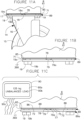
- the upper surface of the caster mounting structure 17 frequently has a central area 17c having a rounded crown 18 with a curved surface 18a as in Figures 3 and 11A .
- the caster mounting structure 17 has fastener openings 17a formed around its perimeter portion 17b, and is secured to the cart mounting structure 8 by fasteners 19 so that each hub 16 is free to rotate or swivel about a hub mounting axis which allows the wheel to turn to the right or left through 360 degrees (360°) and allows the cart 2 to move in any direction.
- Each hub 16 is free to directionally swivel or rotate independently of the other caster wheel hubs to allow the cart 2 to be pushed or pulled in any direction through 360 degrees, so the cart can turn, move sideways or back up.
- Two caster wheel assemblies 14 are located proximal the corners of the front end 2a of the cart 2, and two caster wheel assemblies 14 are located proximal the corners of the rear end 2b of the cart.
- While the cart 2 is shown to have a certain shape and height, with two trays 5, four risers 10 and four caster wheel assemblies 14, it should be readily understood that the cart can have a variety of shapes and heights, one or more trays, and three or more caster wheel assemblies.
- a plastic embodiment 20 of the conventional utility cart 2 is shown in Figures 1A , 1B and 6 -9.
- the cart 20 shown has a length of about 39 inches (1 meter), width of about 17 inches (43 cm), height of about 33 inches (84 cm) and weight of about 31 pounds (14 kg) , and four caster wheel assemblies 14 with five inch (13 cm) diameter wheels.
- the cart 20 has two robustly designed plastic trays 21 and 22.
- the stacked trays 21 and 22 have a rectangular shape and a depth of about 2-1/2 inches (6 cm).
- Each tray 21 and 22 has structural webbing 23 supporting its upper surface 6.
- the webbing 23 forms compartments or openings 24 under the surface 6 of the tray.
- each tray uniformly spans the length and width of the rectangular tray 21 and 22.
- the cart 20 has four robustly designed plastic risers 25.
- Each riser 25 has an L-shaped cross-sectional shape with perpendicular sides 25a and 25b that form an inner channel 26 along its vertical length.
- Each riser 25 has a forwardly or rearwardly facing side 25a and a sidewardly facing side 25b. Openings 27 are formed at spaced locations along the vertical height of both sides 25a and 25b of each riser 25.
- Each riser 25 has three forwardly or rearwardly facing openings 27, and three sidewardly facing openings 27.
- the upper tray 22 includes an integrally formed rearwardly cantilevered tray 28.
- the handle 14 extends upwardly from the rear end 2b of the cantilevered tray 28.
- Each of the caster wheel mounting structure takes the form of a plate or bracket 17 that is secured by four fasteners 19, such as screw-type fasteners.
- the fasteners 19 extend through bracket holes 17a and into the four aligned holes 8a of the mounting structure 8 to firmly secure a caster wheel assembly 14 to the cart structure 3 or lower tray 21.
- FIG. 12 A metal embodiment 30 of the conventional cart 2 with its two front caster wheel assemblies 14 removed is shown in Figure 12 .
- This cart 30 has three robustly designed lower 31, upper 32 and middle 33 wire mesh trays or baskets.
- the stacked trays 31-33 have a rectangular shape.
- the corners of the trays 31-33 are joined together by four metal, vertical, tubular risers 35.
- Each tubular riser 35 has an open interior 36 and an open bottom end 37.
- the mounting structure of each caster wheel assembly 14 takes the form of a mounting bracket or plate 17 with an upwardly extending mounting post 39.
- Each mounting post 39 is secured to the cart mounting structure 8, which takes the form of the open bottom end 37 of the tubular risers 35 that receives the post 39 in an in-line manner.
- the present invention pertains to a robotic cart platform system integrated into a conventional cart 2, 20, 30 to form an autonomous robotic cart or vehicle generally indicated by reference numbers 40 and 45 as shown in Figures 2-12 .
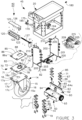
- the components forming the robotic cart platform 40 and its navigation and movement system 42 are shown in Figure 2- 5B.
- the integration of these components into a conventional plastic 20 or metal 30 cart to form an autonomous cart 45 with the navigation and movement system 42 is shown in Figures 6-12 .
- the robotic cart platform 40 has a drive unit 50 that propels itself and the autonomous cart 45 in a forward 47 or rearward 48 direction of travel, and can readily turn by moving in arcuate directions 49 of travel as shown in Figures 8 , 10 and 13 .
- the robotic cart platform or RCP 40 has a motor driven autonomous drive unit 50 shown in Figures 2-5B .
- the RCP 40 and its navigation and movement system 42 use the wheeled drive unit 50 to autonomously propel the cart 20, 30.
- the drive or base unit 50 is compact and has a low profile to fit under the cart structure 3 or lower tray 21, 31.
- the drive unit 50 has a weight of about 20 kilograms, width of about 45 centimeters, height of about 11 centimeters, length of about 23 centimeters and a top speed of about 2 meters per second.
- the drive unit 50 has a generally rectangular block shaped housing 51 with a front, rear, top, bottom and right and left sides 52-57.
- the housing 51 is robustly designed to maintain its shape during use, and is formed by upper 58 and lower 59 metal portions best shown in Figure 4 .
- the load-bearing upper portion 58 is made of 1/4 inch (6 mm) plate steel, and has side flaps 58a that form the right and left housing side surfaces 56 and 57.
- the lower portion 59 is made of 18 gauge sheet metal, and has flaps 59a that form the front and rear housing surfaces 52 and 53.
- the thick metal construction of the housing 51 acts as a heat sink to dissipated heat from internal electrical components.
- the top surface 54 of the upper portion 58 has a central LIDAR scanner opening.
- the side flaps 58a have wheel holes 58b aligned to form a linear wheel axis parallel to the front and rear housing surfaces 52 and 53.
- the rear flap 59a includes a series of punch-outs or openings 59b for the input/output terminals or connections of various external input and communication devices, such as sensors, lights, power supply, control panel and optional WiFi unit.
- An adjustable mounting assembly 60 secures the autonomous drive unit 50 to the conventional utility cart 20, 30 as shown in Figure 3 .
- spacers 61 are inserted above each of the rear caster wheel assemblies 14.
- the adjustable mounting assembly 60 includes a mounting bracket or bar 62 rigidly secured to the top 54 of the housing 51 along the front end 52 or edge of the housing 51.
- the bracket 62 has a cross-sectional shape forming a generally upside-down T-shaped opening along its length.
- the bracket 62 and T-shaped opening form an adjustable mounting track 63 along the length of the bracket.
- the adjustable assembly 60 and bracket 62 accommodate both a cart 20 with a caster wheel mounting structure 8 formed with fasteners holes 8a, and a cart 30 with a caster wheel mounting structure formed by a mounting bracket 17 with a mounting post 39 that is received by the open bottom ends 37 of the tubular cart risers 35.
- a cart 20 with a caster wheel mounting structure that takes the form of mounting brackets 17 and fasteners 19 ( Figures 3 , 4 and 7 )
- headed fasteners 64 are slidingly received by the track 63 and matingly held by the bracket 62.
- each headed fastener 64 is received inside the broader portion of the T-shaped track opening with the narrower elongated shaft of the fastener 64 extending upwardly through and out of the narrower portion of the T-shaped track 63.
- a spacer 65 is placed over each of the two fasteners 64 to adjust the height of the drive unit 50 and mounting assembly 60.
- a mounting plate 66 with fastener openings 66a formed around its perimeter portion 66b is secured to the upper protruding end of the fastener 64.
- the mounting plate 66 has a threaded hole 67 for receiving the threaded shaft of the fastener 64 to securely fix and set the height of the mounting plate 66.
- the top or tip 64a of the threaded fastener 64 protrudes through hole 67 a predetermined amount to form a raised abutment above the upper surface of the mounting plate 66.
- the focusing area 78 of the sensor plate 71 rests on the tip 64a of the fastener 64 as shown in Figures 3 and 4 , which forms a gap 89 as in Figure 11A between the mounting and sensor plates 66 and 71.
- head mounting posts 69 are used as shown in Figure 12 .
- the height of the drive unit 50 and mounting assembly 60 generally equals the height of the rear caster wheel assemblies 14 and spacers 61 so that the cart 2, 20, 30 and their trays 5, 21- 22, 31-33 are level.
- the cart has four weight sensor assemblies 70. Two weight sensor assemblies 70 are located directly above the mounting plates 66 of the mounting assembly 60 as shown in Figure 3 , and two weight sensor assemblies are located directly above the mounting structure or bracket 17 of the rear caster wheel assemblies 14 as shown in Figures 3 , 11A and 11B .
- Each sensor assembly 70 includes a sensing plate 71 and a spacer plate 85.
- the sensor plate 71 has a perimeter portion 72 with fastener openings 72a.
- the plate 71 has a generally U-shaped slot or opening 74 is cut out of the plate around and proximal its center to form an inwardly extending weight supporting tab 75.
- the support tab 75 extends from one side of the perimeter portion 72 toward and into the center of the plate 71.
- the support tab 75 has an upper surface 76, a semi-flexible neck 77 and a weight supporting central area 78.
- the central area 78 has a downwardly facing crown, dimple or depression 79 with a curved surface 79a as in Figures 11B and 11C .
- the neck 77 is semi-flexible in that it elastically bends a slight amount (less than about an eighth of an inch (3 mm) depending on the weight or force applied, but continues to support the weight of the cart 45 and items or payload placed on the cart.
- a weight sensor 80 such as a piezoelectric sensor is secured to the upper surface 76 of the semi-flexible neck 77.
- the threaded fasteners 19 are non weight-bearing and move down to form a gap between the fastener heads 19b and the mounting plates 66 when an item is placed on the cart.
- a visual display 90 ( Figure 11C ) having a programmed processor 90a and memory 90b is secured to the cart 2.
- the processor 90a is in electrical communication with the visual display 90, and each sensor 80 sends weight data to the processor via wires 90c.
- each sensor 80 is in electrical communication with the RCP circuitry via wires 82.
- the spacer plate 81 is located above the weight sensing plate 71.
- the spacer plate 81 has a perimeter portion 86 with fastener openings 86a, and a hollowed out center opening 88.
- the central opening 88 accommodates the upward flexing of the support tab 75, and provides a pathway for routing the sensor wires 82.
- the central weight focusing area 78 of the sensing plate 71 rides on top of and is in weight supporting engagement with mounting plate 17 ( Figures 11A-11C ) or fastener tip 64a of mounting plate 66. ( Figure 3 ).
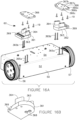
- the downwardly facing crown, dimple or depression 79 ( Figure 11B ) of the focusing area 78 rides on and engages the upper surface of the mounting bracket 66 or 366. ( Figures 3 and 16A ).
- the sensing and spacer plates 71 and 85 above the rear caster wheel assemblies 14 are located between the caster mounting bracket 17 and lower surface of the cart mounting structure 8.
- the sensing and spacer plates 71 and 85 above the drive unit mounting assembly 60 are located between the upper surface of each mounting plate 66 or 366 and the lower surface of the cart mounting structure 8.
- the weight of the cart 20, 30 is supported by the central focusing areas 78 of the support tabs 75 of the four sensor plates 71.
- the sensor 80 is firmly secured to the semi-flexible portion or neck 77 of the sensor plate 71.
- the deformation of the support tab 75 by the weight of the cart 2, 20, 30 and its load causes a change in resistance in the sensors 80.
- the sensor 80 changes resistance when force is applied to the focal area 78 or dimple point 79 of plate 71.
- This change in resistance data or weight level data is sent to the visual display processor 90a or RCP processor 102 and automatically used by the processor to determine a digital weight measurement of the amount of weight carried by each sensing plate 71.
- the weight measurement data is then used by the higher-level functions of the visual display or RCP processor.
- each sensor plate 71 carries a quarter of the load weight.
- one or two sensors carry significantly more of the load weight than the other sensor plates.
- the processor then sends a digital warning message to the visual display 90 or control panel 170 (discussed below) to display a warning message via an icon on a key (such as "load capacity exceeded,” “unbalanced load” and lighting the key “red”).
- the weight sensor 80 is shown and described as being a strain gauge sensor, such as a piezoelectric sensor, it should be understood that other embodiments such as a force resistor may also be used.
- the drive unit 50 has two drive motors 91 and 92 and two drive wheels 93 and 94 as shown in Figures 4 , 5A and 5B .
- Each wheel 93, 94 has a hub 95 that securely receives the drive shaft or wheel axel 96 of its associated motor 91 or 92.
- the motor 91 on the right side 56 of the base unit 50 drives the right wheel 93, and the motor 92 of the left side 57 of the base unit drives the left wheel 94.
- Each motor 91 and 92 independently drives or turns its associate drive shaft 96 and wheel 93 or 94.
- Each motor 91 and 92 can turn its drive shaft 96 and wheel 93 or 94 either in a clockwise direction or a counterclockwise direction.
- the independent operation of the drive motors 91 and 92 allows the RCP drive unit 50 to rotate in place, and allows the autonomous cart 20, 30 to make turns with a minimal distance of travel.
- the right and left motors 91 and 92 are mounted to the inside surface of the right and left sides 56 and 57 of the housing 51, respectively.
- the motors 91 and 92 are securely mounted by screw fasteners, so that their drive shaft or wheel axel 96 extends through the housing wheel openings 58b in side flaps 58a.
- the wheel axels 96 are colinear, and the drive wheels 93 and 94 are parallel to the sides 2c of the cart 2.
- the wheels 93 and 94 do not swivel to the right or left as do the rear caster wheels 15. Turns are taken by differing the rate of rotation or direction of rotation of the right and left drive wheels 93 and 94.
- the wheels 93 and 94 have a diameter of about six inches (15 cm) and are sized and positioned outside of housing 51 with their outer perimeters riding along the ground. There is preferably about 1.1 inch (2.8 cm) of clearance between the bottom 55 of the housing 51 and level ground so that the RCP 40 can traverse deviation in the ground surface.
- the drive wheels 93 and 94 are also sized in combination with the height of the base unit 50 and its mounting assembly 60 to ensure the cart 20, 30 is level.
- the cart 20, 30 When the RCP 40 is turned on or activated, the cart 20, 30 is in its autonomous mode. Electric power is supplied to the motors 91 and 92, which turn their respective wheels 93 and 94 to propel the cart from one location to another along straight 47, 48 or curved 49 paths of travel.
- the cart 20, 30 When the RCP 40 is turned off or deactivated, the cart 20, 30 is in a manual mode, and power to the motors 91 and 92 is cut off.
- the deactivated motors 91 and 92 do not inhibit the free rotation of the drive wheels 93 and 94 so that workers can readily push or pull the cart 20, 30 from one location to another.
- the drive motors 91 and 92 are preferably brushless direct current (BLDC) motors with both clockwise and counterclockwise rotation connected to a planetary reduction gearbox.
- BLDC brushless direct current
- Each high torque electric motor 91, 92 has a length of about 6 inches (15 cm), diameter of about 3 inches(7.5 cm), rated voltage of about 24 volts, no-load speed of about 600 rotations per minute, rated torque of about 1.5 kilograms-centimeters, a reduction ratio of about 1/10 and output shaft diameter of about 1/4 inch (6 mm).
- the output shaft 96 extends from the motor housing about 0.6 inch (15 mm), and the end of the shaft is notched to facilitate the rotationally locked securement of its associated wheel 93 or 94.
- the motors 91 and 92 are interfaced to an associated dual motor controller 97.
- the rotational speed and direction (clockwise or counterclockwise) of each output shaft 96 is controlled by the controller 97, which is in electrical communication with motor 91 or 92 and controls the electric power supplied to each motor.
- the controlled power supply to each motor 91 or 92 via the motor controller 97 controls the speed of drive shaft 96 of each motor, and thus the rotational speed of the drive wheels 93 and 94.
- the controller 97 is preferably a brushless direct current (BLDC) motor controller with a 6.5 to 50 volt input, 350 watt brushless DC motor speed regulator control module, a 12 volt, 24 volt, 36 volt and 48 volt high power BLDC speed motor controller driver board with heat sinks and 0 to 5 volt PWM duty ratio control with an FG pulse signal and 9 pulse/round.
- BLDC brushless direct current
- Each motor 91 and 92 is interfaced to an associated "always-on" encoder 98 and 99.
- Each encoder 98 and 99 has a rotary disk and output cable.
- Each rotary disk is mounted to its respective motor 91 or 92 to optically view the rotational movements of its associated motor drive shaft 96, and thus the rotational movements of its associated wheel 93 or 94.
- the rotary disk transmits this shaft rotational movement data or information via its output cable to the microcontroller 106 and its memory 107, which is then periodically transmitted to the RCP processer 102 and its memory 103.
- This shaft rotation or wheel movement data is used by the RCP processor 102 to determine the distance of travel and path of travel taken by the RCP 40 and autonomous cart 45 from its start location or start location coordinates, and to determine the coordinates or coordinated data associated with the current physical location 100 of the RCP 40 and cart 45.
- the high impact resistance encoders 98 and 99 preferably have a power supply of about 5 volts DC, resolution of about 400 pulses per rotation, speed of about 2400 rotations per minute, optical disk with a thickness of about 0.05 inches (1 mm), diameter of about one inch (2.5 cm) and hole diameter of about 0.47 inches (12 mm), AB 2 phase output, and line driver with ABZA-B-Z channels.
- the RCP navigation and movement system 42 and drive unit 50 have circuit boards including a single board computer 101, power board 104 and digital board 105 as shown in Figures 5A and 5B .
- the single board computer 101 includes the main processor or CPU 102 with associated long-term hard drive memory 103.
- the digital board 102 includes a microcontroller 106 with associated short-term dynamic rapid access memory or (DRAM) 107.
- DRAM dynamic rapid access memory
- Circuitry 109 interconnects the boards 101-103, processor 102, microcontroller 106 and their associated memories 103 and 107, motor controller 97, drive units 91, 92 and encoders 98, 99, as well as components external to the housing 51, such as weight sensors 80, power supply, LIDAR scanner 140, proximity sensors 150, safety lights 160, control panel 170, etc., as discussed below.
- Components mounted inside the drive unit housing 51, such as motors 91 and 92, motor controller 97 and encoders 98 and 99, are wired for power and communication with the processor 102 and microcontroller 106 directly to connections in the drive unit circuitry 109.
- Devices mounted on the cart structure 3 external to the drive unit 50 are electrically connected for power and communication to the drive unit circuitry 109 and circuit boards 101, 104 and 105 via a number of input/output terminals or ports 110, including two battery ports 111 and 112, LED lights port 113, control panel port 114, two proximity sensor line ports 115 and 116, weight sensor port 117, WiFi port 118 and an audio port.
- the LIDAR scanner mounted atop the drive unit 50 is wired directly to LIDAR connections in the circuitry 109 or to a LIDAR port 119.
- the control panel port 114 is equipped to power and communicate with switches, such as an On/Off switch, and "GO" and emergency stop buttons, discussed below.
- Data processing by the navigation and movement system 42 is handled by the programmed RCP processor 102 and microcontroller 106.
- the microcontroller 106 runs low level firmware that provides very fast, real time processing.
- the RCP processor 102 provides higher level functionality such as planning a route 149 and motor movement instructions for the RCP 40 and communicating with workers via the safety lights, control panel, audio speakers and WiFi unit, as discussed below.
- RCP mapping data obtained by the LIDAR sensor 140 flows from the microcontroller 106 to the main RCP processor 102.
- the microcontroller 106 saves mapping data in its short-term memory or DRAM 107, and then periodically conveys that data to the RCP processor 102 for storage in its long-term hard drive memory 103. Both the processor 102 and microcontroller 106 do some processing of data.
- the microcontroller 106 use the proximity sensors 150 to scan or detect an obstacle that is present for several seconds then goes away (someone walking by). As the microcontroller 106 passes this data to the RCP processor 102, the RCP processor filters out the temporary or passing obstacle data from long term storage 103 since the obstacle was more momentary and not long term like a wall, pillar or the edge of a loading dock.
- the RCP processor 102 has both associated dynamic memory, such as DRAM that is deleted from storage when power is removed, and long term hard drive memory 103 that remains stored even when power is removed.
- the RCP 40 includes a portable power supply or battery pack 120 mounted to the autonomous cart 45.
- the battery 120 has power and communication ports 122 and 123, and supplies electric power to all the internal and external components and devices of the RCP 40 via its drive unit circuitry 109 and terminals 110.
- the battery pack 120 is secured to the cart 45 at a location that avoids interfering with loading and unloading the cart or impairs other activities of the workers using the cart, and allows easy access for swapping out a first battery pack with a second replacement battery pack when the first battery pack needs recharging.
- the power source 120 is designed to provide sufficient power to the RCP 40 for a four hour work shift and propel the cart for 500 to 1,500 meters carrying a 50 to 100 kilogram payload at a walking speed of about one meter per second.
- the main power source 120 is preferably a multi-cell battery pack with multiple lithium ion batteries (about 50 cells) to produce about 129.5 Wh, with each cell having a rechargeable capacity of about 4.1 volt/ 2500 mAh, a 24 volt output port and an RS-485 (two wire) communication port.
- the battery pack 120 is secured to the cart 20, 45 via a mounting bracket assembly 125 that includes a support bracket 126 with a slide bar 127.
- the slide bar 127 allows the battery pack 120 to be quickly removed for recharging and allows a fully charged battery pack to be quickly secured.
- the RCP circuitry 109 includes a backup power circuit 130 on the digital board 105 as shown in Figure 5B .
- the RCP 40 When the RCP 40 is turned on, power from the battery 120 is supplied to the encoders 98 and 99 via a normal encoder power line 131, and is supplied to the microcontroller or MCU 106 and its memory or DRAM 107 via a normal microcontroller power line 132.
- the backup circuit 130 supplies electric backup power to the encoders 98 and 99, MCU 106 and DRAM 107.
- the backup power circuit 130 has a backup power source 135, such as a super capacitor.
- Electric power from the super capacitor 135 is supplied to the encoders 98 and 99 via an encoder backup line 136, and is supplied to the microcontroller 106 via an microcontroller backup line 137.
- the backup power lines 136 and 137 are electrically connected to the super capacitor and the normal power lines 131 and 132, respectively. Diodes 138 and 139 in the normal power lines 131 and 132 prevent power from the super capacitor 135 from flowing to the battery 120. Then, when the battery 120 power to the RCP 40 is turned back on, power from the battery 120 flows through the diodes 138 and 139 and backup lines 136 and 137 to recharge the super capacitor 135.
- the super capacitor 135 holds sufficient power to operate the encoders 98 and 99, MCU 106 and DRAM 107 for about one week.
- the super capacitor 135 is preferably an SCCY83B507SLBLE by AVX corporation.
- the autonomous cart 45 includes a time-of-flight laser scanner 140 as shown in Figures 2-4 , 8-9 and 12.
- the laser scanner 140 creates constantly updated mapping data or a high-resolution image map 260' ( Figure 14 ) of the surrounding work environment 260 ( Figure 13 ) for navigation and avoidance of fixed structures (such as walls, posts, support columns and staircases) and more permanent obstacles (such as furniture, workbenches and shelving units).
- the scanner 140 also detects temporary obstacles (such as workers walking by or packages temporarily placed on the floor), the processor 102 deletes these temporary obstacles from its environmental mapping data stored in its long-term memory 103.
- the laser scanner 140 is preferably a triangulation type laser scanner such as a LIDAR (light detection and ranging) sensor with 2D imaging, three hundred and sixty degree (360°) omnidirectional laser range, scanning range of about 12 meters, power input of about 5 volts, sample rate of about 8,000, configurable scan rate from about 2 to 10 hertz, breakout of about 940nm and is plug-and-play, such as an RPLIDAR A2 by Slamtec.
- the RCP 40 uses the LIDAR scanner 140 to obtain environmental mapping data that is stored in its memory 103. The RCP 40 uses this mapping data to identify open areas 261 in the building through which the RCP 40 and cart 45 can travel, and to identify fixed structures 262 in the building through which it cannot travel.
- the RCP 40 uses the mapping data and current location 100 data to determine a route 149 along which the cart 45 can travel to a selected destination 172 as discussed below. ( Figures 13 and 14 ).
- the RCP 40 also uses the LIDAR scanner 140 to detect obstacles as it is en route to a destination.
- the LIDAR scanner 140 is preferably mounted on the RCP drive unit 50 below the cart structure 3 and lower tray 21, 31.
- the scanner 140 is secured to the autonomous cart 45 at a location providing a substantially unobstructed 360° view of the environment 260 around the cart, is protected from inadvertent contact by workers and objects, and does not interfere with the operation of the cart or workers.
- a particularly good location for the 360° scanner 140 is in the middle of the top surface 54 of the drive unit housing 51, although other locations on the RCP drive unit 50 or cart 45 are possible.
- the rotating scanner (not shown) of the LIDAR scanner 140 is located above the drive unit mounting bracket 62, so the bracket does not obstruct the view of the scanner.
- the LIDAR scanner 140 views a working range of greater than about 340° of the surrounding environment.
- the forward viewing area 144 in front of the cart 45 is virtually unobstructed through about 180° and is completely open and unobstructed through about 90°.
- the rearward viewing area 145 to the rear of the cart 45 is virtually unobstructed through about 180° and is completely open and unobstructed through about 35°.
- LIDAR scanner 140 As the LIDAR scanner 140 is mounted directly to the drive unit housing 51 via a mounting bracket 146, its electrical power and communication wires 148 pass through an opening in the top 54 of the housing 51 ( Figure 4 ), and are directly connected to designated LIDAR connections in drive unit circuitry 109 as discussed above.
- Proximity sensors 150 are mounted on the autonomous cart 45 shown in Figures 2-3 , 6-10 and 12 . These sensors 150 allow the autonomous cart 45 to detect, and when necessary navigate around, fixed and temporary obstacles.
- the proximity sensors 150 are a type of time-of-flight distance sensor or ranging system integrated into a compact module.
- the sensors 150 are preferably a laser ranging system with a maximum sensing range of about four meters, working voltage of about 2.6 volts to 5.5 volts, supply current of about 15 milliamps, eye-safe 940 nm invisible emitter, programmable region of interest (ROI), field or view (FoV) or scanning cone of 27 degrees, configurable detection interrupts and dimensions of about 0.5 x 0.7 x 0.1 inches (2.5 mm).
- each sensor 150 is pointed in a particular aimed direction 151 and has a 27° sensing cone 152 extending from the sensor for a range of about four meters. Each sensor 150 independently detects the presence of objects within its range and scanning cone 152. Each sensor 150 has a terminal for receiving electric power and sending or receiving communication signals from the microprocessor 106 or drive unit circuitry 109, and is secured inside the riser opening 27 by a mounting clip.
- proximity sensors 150 are mounted to the autonomous cart 45 as shown in Figure 6-10 . Together these sensors 150 provide a substantially unobstructed view of the environment around the cart, particularly in the forward 47 and rearward 48 directions of travel, as well as outward from the sides 2c of the cart 45.
- the RCP 40 uses the proximity sensors 150 to detect obstacles when it is en route to a destination, and the microcontroller 106 can determine which of the sensors 150 was triggered by an obstacle.
- the sensors 150 are placed at locations that protect them from inadvertent contact by workers and objects and do not interfere with the operation of the cart or workers.
- the proximity sensors 150 are mounted inside the riser channel 26, with each sensor peering from or out of riser openings 27.
- Each riser 25 has two proximity sensors 150 pointing sideward 2c, and two proximity sensors pointing forward 2a or rearward 2b.
- the top sensors 150 are aimed 151 downward at an angle of about thirty degrees (30°), and the bottom sensors are aimed upward at an angle of about thirty degrees (30°), so that their scanning cones 152 start to overlap 154 about half way up the height of the cart 45.
- the proximity sensors 150 are mounted to the outside of the lip 7 of the upper tray 32. Two proximity sensors 150 are mounted along each side of the tray 32. Two sensors are directed outwardly or forwardly from the front side 2a of the cart 30. Two sensors are directed rearwardly from the rear side 2b of the cart 30, and two sensor are directed sidewardly from each side 2c of the cart. No matter which direction the autonomous cart 20, 30, 45 is traveling, forward 47, rearward 48 or turning to the right or left 49, the cart has two proximity sensor 150 facing in that general direction.
- Diferent colors can flag different situations such as purple - proximity sensor not working, white - cart is moving in that direction (headlights), red - cart is moving away (taillights) and green - all actions completed and cart is ready for another command.
- Each light 160 has a connection terminal for receiving electric power, and is secured inside the riser openings 27 by a mounting clip 165.
- the communication device or control panel 170 is preferably secured to the to the rear side 2b of the utility tray 28 by a mounting bracket and fasteners.
- the panel 170 has a connection that receives a USB cable to provide electric power from the battery as well as send and receive signals, or otherwise communicate with the navigation and movement systems 42, processor 102 and memory 103.
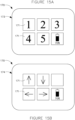
- the RCP memory 103 is loaded with sets of icons 173 and 174 to selectively display on the six control keys 171. One set of icons 173 or 174 is displayed at a time on the keys. ( Figures 15A and 15B ).
- the 6-key control panel 170 allows the navigation and movement system 42 to perform a wide range of functions.
- the RCP processor 102 displays the set of destination icons 173 on the keys 171 as shown in Figure 15A .
- the workers use this set of destination icons 173 (e.g. icon “1,” "2,” “3,” etc.) to enter multiple distinct desired destination locations 172 into the RCP memory 103.
- the worker presses and holds one of the keys 171 displaying a destination icon 173 (e.g., icon "1") for more than a predetermined threshold period of time, such as more than three seconds.
- the RCP processor 102 uses RCP movement data such as drive shaft rotation data obtained from encoders 98 and 99 to determine the current physical location 100 and associated coordinates or coordinate data of the cart 45, and saves the coordinate data for this location in the RCP memory 103 as the desired or selected destination 172 associated with that particular key 171 and its associated icon image 173 ("1" icon).
- the background color of the destination key 172 will change from an unset color (gray) to a set color (green). This provides a visual indication to the workers that the desired destination 172 has been successfully set and stored in the RCP memory 103.
- the autonomous cart or vehicle 45 is programmable to stop when it gets to a desired destination 172 and wait for a worker to enter further control panel instructions, or move in a looped manner from one predetermined destination location 172 to another. For the later, once the cart 45 reaches a first desired destination 172 ("1" icon) and waits a predetermined period of time, the cart 45 goes to the next numerical predetermined destination 172 ("2" icon). Workers can change the order of the loop by resetting the particular destination 172 associated with each destination icon. Workers can delete a predetermined destination 172, and if desired replace it with another destination location 172 as noted above.
- the set of arrow or movement icons 174 allows workers to use the RCP drive motors 91 and 92 to move the cart or vehicle 45 in a self propelled manner as they walk behind the cart.
- a key 171 with an arrow icon 174 e.g., " ⁇ " icon
- the cart 45 moves under its own power in the direction of the arrow until the worker stops pressing the key with that arrow icon.
- Destinations can be set by manually pushing the cart 45 or by using the keys 171 with the arrow icons to move the cart to a desired destination.
- Given backup circuit 130 and "always on encoders" 98 and 99 the cart 45 can be turned off and manually pushed to a location to be set as a destination.
- the RCP 40 uses its encoders 98 and 99 and drive shaft rotation data to determine the current, real-time location 100 of the cart 45 when a key 171 displaying a destination icon 173 (e.g., "1" icon) is pressed. To set a desired destination 172, the autonomous cart 45 and communication device 170 needs to be powered on. The 6-key control pad 170 does not function when the cart 45 is not powered on.
- a large visible on/off switch 175 is provided on or near the control panel 170.
- This switch or depressible button 175 is used to turn on or activate the RCP drive unit 50 by allowing electric power from the battery 120 to energize the internal and external RCP drive unit 50 components and devices that form the RCP 40, and place the RCP 40, navigation and movement system 42 and cart 45 in an autonomous mode of operation.
- the switch 175 is also used to turn off or deactivate the RCP 40 by disconnecting the flow of electric power from the battery 120 to the RCP, and place it and cart 45 in a manual mode of operation.
- the switch 175 is mounted through a hole drilled into the cart 20 and secured by a nut on the back side.
- An emergency stop button 180 is located at the front 2a of the cart 45. This button 180 can also be used by a worker to turn off or deactivate the RCP 40, and place it and the cart 45 in a manual mode of operation.
- the button 180 has a rear connection 182 for receiving a USB cable to send and receive communication signals.
- the control panel 170 has a "GO" button 185.
- the 6-key control panel 170 is programmed to have one of its keys serve as the GO button.
- the GO button 185 is located on the control panel 170.
- the "GO” button is a momentary switch that is pressed to signal to the RCP processor 102 that it should instruct the RCP drive unit 50 to move.
- the cart 45 will autonomously move to the next predetermined destination 172 selected by the worker or on the organized list of destinations 265 stored in the RCP memory 103, as discussed below. ( Figure 14 ).
- the cart 45 autonomously moves to the list of predetermined destinations in a loop, and then repeats that movement cycle.
- the RCP 40 uses its navigation and movement system 42 to plan a route 149 to the selected destination or next destination on its list of destinations, and then moves along that route to the designation.
- the RCP 40 will move from destination to destination in a round loop each time the "GO" button is pressed.
- the RCP drive unit 50 and cart 45 stop once the RCP drive unit reaches the next destination.
- the control panel 170, switch 175, and emergency stop and GO buttons 180 and 185 are used by workers standing next to the cart 45, but can be remotely controlled by an optional server and wireless communication system as discussed below.
- the RCP 40 is equipped with an audio speaker 190 for communicating with workers.
- the speaker 190 is secured in a webbing compartment 24 on the underside of the upper tray 22 as shown in Figure 7 .
- a speaker mount 194 is provided to secure the speaker in place.
- the speaker 190 is electrically connected by a USB cable for power and communication to the RCP 40 and its processor 102 via the circuitry 109 and an input/output terminal of the RCP drive unit 51.
- the processor 102 is programmed to send one of several audio messages stored in its memory 103 to the speaker 190 for a variety of reasons.
- these reasons include when the proximity sensors 150 detect a moving object (such as a person) in the vicinity, the weight sensors 80 detect a load in excess of the capacity of the cart 45, the weight sensors 80 detect an unbalanced load, the battery pack 120 is running low or needs recharging or a worker enters invalid destination coordinates into the key pad 170.
- the audible message can be a simple beeping, buzzing or siren sound, or a verbal message (such as "warning load capacity exceeded,” “warning unbalanced load,” “battery low,” “recharge battery” or "invalid destination coordinates").
- the message is repeated until a corrective action is detected by the processor 102, the identified moving object (person) moves away or a worker acknowledges the receipt of the message via the key pad 170.
- the audio speaker 190 has a rear connection terminal for receiving electric power and sending and receiving communication signals.
- the RCP 40, navigation and movement system 42 and autonomous cart 45 are optionally equipped with a WiFi unit 195.
- the WiFi unit 195 is mounted inside a webbing compartment 24 on the upper tray 22 as shown in Figure 7 , and is in electrically connected via a USB cable for power and communication to the RCP 40 and its processor 102 via the circuitry 109 and input/output terminal 118 of the RCP drive unit 51.
- the WiFi unit 195 preferably has input power of 5 volts, an operating wavelength of about 2.4 to 5.8 gigahertz, and a transmission range of about 10 meters, such as an B07J65G9DD by Techkey.
- a cable array 200 shown in Figure 2 connects the exterior components of the RCP 40 and navigation and movement system 42 to the input/output terminals 110 of the RCP drive unit 50 circuitry 109.
- the cabled components include the weight sensors 80, battery 120, proximity sensors 150, safety lights 160, control panel 170, On/Off switch 175, emergency stop 180 button, "GO" button 185, audio speakers 190 and Wi Fi unit 195.
- the LIDAR sensor 140 mounted atop the drive unit 50 can be directly wired to the drive unit circuitry 109 as in Figure 3 or cabled through an input terminal 119 as in Figure 5B .
- the cabled array 200 includes two lines 201 and 202 routed through the cart 20 as shown in Figures 2 , 8 and 9 to connect the external components with their associated input/output terminals 111-119.
- One line 201 is routed along the rights side of the cart 20, and one line 202 is routed along the left side of the cart.
- the right 201 and left 202 lines each include multiple and separate wire lines 205 for powering and communicating with two weight sensors 80, eight proximity sensors 150 and four safety lights 160.
- the right line 201 also includes separate wiring lines 205 for powering and communicating with the control panel 170, On/Off switch 175, emergency stop 180 button, "GO" button 185, audio speakers 190 and WiFi unit 195.
- the individual wires 206 at one end of each power and communication wiring line 205 for a specific external component are connected to a component-specific connection 210 that electrically connect its wires 206 to the terminal for that external component.
- each wiring line 205 The individual wires 206 at the other end of each wiring line 205 are connected to an input/output connector 215 that plugs into and electrically connects the wiring line with its appropriate input/output port 111-119 of the drive unit 50.
- the wiring lines 205 for the proximity sensors 150 in one line 201 or 202 share a common input/output connector 215.
- the individual wires 205 in the two lines 201 and 202 of the cabled array 200 are harnessed 209 together near the input/output ports 111-119 and joined to their appropriate terminal 215.
- the appropriate terminals 215 are then plugged into their appropriate input/output port 111-119.
- the lines of the cabled array 200 can be divided into four line 201-204 as shown in Figure 3 , with one line being routed through the internal channel 26 of each of the four risers 25.
- the processor 102 When the RCP processor 102 detects that the power or charge remaining in the battery 120 is running low or meets a predetermined charge threshold value, the processor plans a route to a recharging station 259 ( Figure 13 ) and navigates the cart 45 to the recharging station. A worker then connects the battery 120 to a power outlet at recharging station 259 to recharge the battery, or swaps out the battery with an already charged battery at the work station.
- Modifications are made to the conventional carts 20, 30 to integrate the RCP 40 and form the autonomous cart 45.
- the front caster wheel assemblies 14 are removed and replaced with the RCP drive unit 50.
- four riser channel cover plates 241 are secured inside each riser 25 to enclose the inner channel 26 and house and protect the proximity sensors 150, lights 160 and cable lines 201 and 202 inside these channels.
- a tray cover plate 242 is secured to the bottom of the upper tray 22 to house and protect the audio speaker 190, WiFi device 195 inside the webbing chambers 24 of the upper tray, as well as the cable lines 201 and 202 extending through the walls forming it matrix of webbing chambers.
- Cabling holes 243 are formed in the corners of the flat tray surface 6 of the lower tray 21.
- the right and left lines 201 and 202 diverge and passes through a second line of web holes 244 along the front 2a of the lower tray 21 to the front corners of the tray.
- the lines 201 and 202 pass through their respective holes 243 in the lower tray 21 and extend up their respective riser channel 26.
- Third and fourth lines of web holes 244 are formed along the sides 2c of the in the upper tray 22 to allow the right and left lines 201 ands 202 to extend in a supported manner along the right and left tray sides to the rear 2b of the tray just above the rear riser channels 26.
- the lines 201 and 202 extend downward through these channels and pass through the tray holes to reach the two weight sensors 80 at the rear of the cart.
- Web holes 244 are also formed along the front of the of the upper tray 22 to allow one cable 201 to reach the emergency stop button 180 mounted in an emergency stop button opening 245 formed in the center of the front of the upper tray. Web holes 244 are also formed along the rear of the upper tray 22 to allow a cable line 201 to reach the battery 120, control panel 170, On/Off switch 175 and "Go" button 185, mounted in a GO button opening 249 formed in the center of the utility tray 28.
- riser holes 249 are formed proximal the top and bottom ends of the tubular risers 35 to allow cable wiring to extend from the lower tray to the upper tray in a protected manner.
- the map 260' shows open areas 261' of the building through which the cart 45 can travel, fixed structures 262' in the building, a real-time RCP location marker (triangle) 263 identifying the current physical location 100 of the RCP 40 and listed destination markers (arrows) 264 presently stored in the RCP memory 103.
- the SRCP 250 communicates with each of them. Mapping data from various carts 45 is combined to form a global map 260' of the working environment 260 in the SRCP memories 103, which is displayed on the SRCP monitor 255 along with the current locations 100 of each cart. Data containing the master or global map of the SRCP 250 is transmitted to the memory 103 of each RCP cart 45, so that each cart learns from the other carts.
- the threaded fasteners 19 are non weight load-bearing so that the necks 77 of the sensor plates 71 flex when an item or load is placed on the cart 45, with the fasteners 19 moving down to form gaps between the fastener heads 19b and the mounting plates 366.
- the base portions 363 have a V-shaped groove 369 to secure the right and left cable lines 201 and 202 and keep them from obstructing the view of the LIDAR scanner 140.
Landscapes
- Engineering & Computer Science (AREA)
- Automation & Control Theory (AREA)
- Transportation (AREA)
- Mechanical Engineering (AREA)
- Physics & Mathematics (AREA)
- General Physics & Mathematics (AREA)
- Radar, Positioning & Navigation (AREA)
- Aviation & Aerospace Engineering (AREA)
- Remote Sensing (AREA)
- Human Computer Interaction (AREA)
- Combustion & Propulsion (AREA)
- Chemical & Material Sciences (AREA)
- Electromagnetism (AREA)
- Optics & Photonics (AREA)
- Control Of Position, Course, Altitude, Or Attitude Of Moving Bodies (AREA)
- Handcart (AREA)
Description
- This invention relates to a robotic cart platform that converts a conventional manually pushed utility cart into an autonomous utility cart with manual and autonomous modes of operation, tracks the movements of the cart in both modes of operation, warns when unsafe loading conditions occur and is operable with or without a wireless communication system.
- A wide variety of businesses rely on utility carts to move items around inside their buildings. The carts hold and transport tools, equipment, component parts and completed products, many of which are heavy, bulky or awkward to carry, and often include associated paperwork that needs to be kept with an item as it moves from station to station or room to room. The carts come in a wide variety of shapes, sizes and styles. The corners of the carts typically include vertical risers and multiple horizontal trays. The carts are typically made of plastic or metal, and their front and rear corners are typically supported by caster wheels. Plastic carts often have trays and risers made of molded foam plastic. Metal carts frequently have metal tubes for risers and meshed wire baskets for trays. Some carts have metal tube risers and reinforced plastic trays. The utility carts are often rated for 200 to 500 lbs (90 to 225 kg) load capacities. Examples of these utility carts are made by Rubbermaid Commercial Products, LLC of Winchester, VA and sold as Uline Model Nos. H-1053, H-2470, H-2471, H-2475 and H-2505, AMSA, Inc. of Boulder, CO and sold as Uline Model Nos. H2505 and H7435, and Suncast Technologies, LLC of Palm Beach Gardens, FL and sold as Model No. PUCPN1937. These and other utility carts are shown and described in
U.S. Patent Nos. D618,418 andD618,419 to Cotron ,U.S. Patent Nos. D798,018 andD855,275 to Walter andU.S. Patent No. 10,377,403 to Lee - Autonomous mobile robots for manufacturing, warehouse and distribution applications are well known. Examples include 6 River Systems' CHUCK robot and
U.S. Patent Nos. 10,294,028 D826,508 , Amazon Robotics' MARTI robot andU.S. Patent Nos. 7,920,962 ,8,280,547 ,8,265,873 and10,317,893 U.S. Patent Nos. 7,100,725 ,7,431,115 ,8,204,624 ,9,223,313 9,563,206 9,679,270 U.S. Patent Nos. 10,216,193 10,481,612 U.S. Patent No. D812,663 , Fetch Robotic's mobile warehouse robot andU.S. Patent No. 10,423,150 U.S. Patent No. 9,731,896 U.S. Patent No. 10,019,015 -
US 6 539 578 B1 (GUTTMANN CRAIG J [CA] ET AL) 1 April 2003 (2003-04-01);US 5 831 221 A (GERINGER E RANDY [US] ET AL) 3 November 1998 (1998-11-03);US 2019/154492 A1 (MCNEALLY ALLEGRA A [US] ET AL) 23 May 2019 (2019-05-23);US 9 230 249 B1 (VORA JIGESH V [US - One problem with conventional autonomous mobile robots is their integral design. Many components form the autonomous navigation structures, such as environmental mapping and proximity sensors, a power supply, control and drive systems, warning systems and a wireless system. These components and their associated wiring are built into the overall robot design. Even when the robot takes the form of a cart, the components that form the autonomous navigation structures are built into the overall cart design. Determining the locations of the various sensors and their wiring so they can perform their intended function while keeping them safe from inadvertent damage and out of the way from interfering with the normal operation of the cart can be particularly challenging. Businesses must either buy manual carts or dramatically more expensive autonomous robotic carts. Due to their complexity, there is no presently known way to convert a manual cart into an autonomous cart. Existing navigation structures are not intended to convert an off-the-shelf, manually pushed cart into an autonomous mobile robotic cart.
- Another problem with conventional autonomous vehicles is their dependency on wireless communication with an independent operating system. The robots do not operate independently. They require wireless communication with an off-board database or control system. The operator must interact with the operating system and database via a wireless communication system such as WiFi to control the movements of the robotic vehicle. The cost of installing a wireless communication system such as WiFi can be prohibitively expensive for many organizations. Moreover, even when a wireless communication system is installed, the system may include dead zones that can sever communication with an autonomous vehicle, or cause the vehicle to receive redundant signals when multiple communication cells or transceivers are transmitting a given signal. When the autonomous vehicle stops in a dead zone, the robot must be manual pushed out of the dead zone and reset to advise it of its current location.
- A further problem with conventional robotic carts is they are not compatible with manual operation. First, many conventional robotic carts do not allow for manual movement. If a user attempts to push a robotic cart, the wheels drag or turn with a high amount of resistance. Second, robotic carts become disoriented when they are manually pushed to a different location than the location to which the cart last autonomously moved. They cannot determine their location when the robotic cart is turned off and manually moved. When power to the robot microprocessor and drive motor are turned off, the robot loses its ability to track its movements and determine its location. When the robotic vehicle is turned off, its motor encoder does not monitor drive shaft and wheel rotation. As a result, the robotic vehicle loses track of its location when it is turned off and manually pushed. When the robotic vehicle is turned back on, the new location coordinates for the robot must be entered or other means must be used to allow the robot to determine its current location.
- A still further problem with conventional robotic vehicles is that unsafe loading conditions go undetected. There is no mechanism to determine the weight of the vehicle or the items placed on it. Similarly, there is no mechanism to determine if the load is unbalanced, which could cause the vehicle to tip over when making a turn. There is also no mechanism to determine if an object is extending outwardly from the vehicle to a point where that item could hit other objects when the vehicle is moving.
- The present invention is intended to solve these and other problems.
-
US2012/239238A1 discloses a propulsion drive system operated by a controller to propel an industrial vehicle along a path in an unmanned mode. An autonomous processor module sends commands to the vehicle controller in response to messages received via a communication network from a guidance and navigation system.JP2018022215A US2016/349757A1 describes a laser automatically guided vehicle.US5534762 describes a self-propelled cleaning robot. - The invention provides a utility cart according to the claims.
- In some embodiments, this invention pertains to a robotic cart platform with a navigation and movement system that integrates into a conventional utility cart to provide both manual and autonomous modes of operation. The platform includes a drive unit with drive wheels replacing the front wheels of the cart. The drive unit has motors, encoders, a processor and a microcontroller.
- In some embodiments, the system has a work environment mapping sensor and a cabled array of proximity and weight sensors, lights, control panel, battery and on/off,"GO" and emergency stop buttons secured throughout the cart. The encoders obtain drive shaft rotation data that the microcontroller periodically sends to the processor. When in autonomous mode, the system provides navigation, movement and location tracking with or without wireless connection to a server. Stored destinations are set using its location tracking to autonomously navigate the cart. When in manual mode, battery power is off, and back-up power is supplied to the encoders and microcontroller, which continue to obtain shaft rotation data. When in autonomous mode, the shaft rotation data obtained during manual mode is used to determine the present cart location. An advantage of the present robotic cart platform of some embodiments is its ability to integrate into conventional, manually moved, utility cart designs. The components forming the robotic cart platform (RCP) include a drive unit, an autonomous mapping and navigation system, environmental mapping and obstacle avoidance sensor, input components and structures that are readily installed on a conventional cart. The drive unit is designed to fit under the cart, which is an area not utilized for payload transport. This area also offers a substantially unobstructed 360 degree view of the surrounding environment, which makes it desirable for mounting the LIDAR sensor. Proximity sensors are positioned near the comers of the cart to give them an optimal view of where the cart is moving. The front caster wheels are removed and replaced by the base unit and its drive wheels. A pre-fabricated array of electric cables that are harnessed together at one end near their terminal ports is plugged into the drive unit. The individual cables for the proximity sensors and input devices are routed through existing channels and openings in the conventional cart. Existing openings in the risers and trays are also used to mount proximity sensors and lights to convert the conventional utility cart into an autonomous robotic cart. Minimal modifications to the cart are required. Businesses that use conventional, off-the-shelf, manually pushed utility carts can inexpensively convert them into autonomous mobile robotic carts.
- Another advantage of the present robotic cart platform of some embodiments is its independent operating system. The present cart platform design has an on-board operating system and database capable of operating independently, and does not require support from an off-board operating system or server. Workers interact directly with the robotic cart to control the movements of the cart. The cost of installing an off-board server and wireless support system is avoided, allowing the benefits of robotic carts to many companies that cannot practically install a WiFi system or otherwise cannot afford a more expensive robotic cart system. In addition, the independent operation of the autonomous cart avoids the problems associated with dead zones that occur in many robotic cart systems.
- A further advantage of the present robotic cart platform of some embodiments is its compatibility with both autonomous and manual movement of the cart. First, a cart installed with the robotic platform can be manually pushed or pulled. When the drive motors are not powered, the motors allow substantially free rotation of their drive shafts, so the wheels do not drag or turn with a high amount of resistance. Workers can finely move the cart to a precise position, or move the cart when it does not have power. Second, carts installed with the robotic cart platform keep track of their location when manually pushed to a new location. Both the manual mode and the autonomous mode allow the robotic cart to independently determine its location. When power to the robot drive motors and main processor are turned off, a separate power source is activated to run its motor encoder and microcontroller, which continue to track wheel rotations to determine the location of the robotic cart. When the robotic vehicle is turned back on, the microcontroller transmits wheel and shaft rotation data to the main onboard processor to determine the current location of the robotic cart. The robotic vehicle does not lose track of its location when it is manually moved. A worker does not need to enter the new location of the cart, or otherwise require the cart to determine its new location, such as through the use of RFID tags or an off-board WiFi type operating system.
- A still further advantage of the robotic cart platform of some embodiments is its harnessed array of cabled sensors, safety/status lights and input devices, such as the control panel, battery and on/off, "GO," and emergency stop buttons. While the drive unit is located under the cart, these components are not. Cabled sensors and lights that need to be substantially unobstructed or highly visible are located in optimal locations on the cart. Input devices that would be awkward to reach and use if placed under the cart, are located at appropriate and easily accessed locations on the cart. Components such as the battery that might need to be periodically recharged or replaced are located at more easily accessible locations. The RCP drive unit circuitry has multiple power supply input terminals, so battery packs can be hot swapped while the RCP processor continues to run. There is no need to power off the RCP processor to charge the batteries. Once the particular off-the-shelf cart is selected, the appropriate harnessed array of cabled sensors is selected so that the necessary number of individual cables and cable lengths is available to hook up the appropriate components for that make and model of utility cart. The cabled sensors and input devices conform to the unique configuration of a particular cart, instead of the cart conforming to the sensors and input devices. Cable lengths are easily changed for varying carts without changing the size, configuration, mounting structures and internal components of the RCP drive unit.
- A still further advantage of the robotic cart platform of some embodiments is serviceability. The cables and each of these components are replaced or upgraded without needing to replace or modify the main robotic cart platform. Each cable has ports at both its ends. To remove and replace an external component, such as a sensor, light, control panel, battery, etc., the appropriate cable simply has to be disconnected from the port of that particular external component. To replace the harnessed cable array, the ports at both ends of the cables are disconnected.
- As still further advantage of the robotic cart platform is its ease of integration into a conventional cart. The cables are routed through existing channels and openings in conventional carts. The sensors and safety lights are mounted in or via existing openings in the carts. Speakers and WiFi unit are mounted inside compartments in the trays.
- A still further advantage of the robotic cart platform of some embodiments is the scanning area of its proximity sensors. Each corner riser of the autonomous cart has four proximity sensors. Two sensors point sideward, and two sensors point forward or rearward. Two sensors are located higher up on the cart frame, and two sensors are located lower on the frame. The higher sensors are angled downwardly and the lower sensors are angled upwardly, so that the scanning cones of paired sensors intersect at about half of the cart height. Should one of the paired sensor fail, the other paired sensor will still cover the area where their scanning cones intersect. The upward angling sensors detect instances where an item placed on a cart extends out from the edge of the cart a significant distance, and a worker is alerted as this can lead to a collision of that overhanging item or an unbalanced payload. The downward angled proximity sensors more reliably detect lower height obstacles and drop offs such as stairwells, which help prevent the cart from falling into a stairwell or out of a shipping dock.
- A still further advantage of the robotic cart platform of some embodiments is the location and scanning area of its LIDAR sensor. The sensor is located at a protected location between the drive unit and the lower tray. The LIDAR sensor peers out from between the drive unit and lower tray to scan in almost a full 360 degrees. Only the tops of the drive wheels, drive unit mounting posts and the front caster wheel assemblies obstruct the full 360 degree of view.
- A still further advantage of the RCP of some embodiments is its weight sensors. Two weight sensors are located just above the rear caster wheel assemblies, and two sensors are located just above the RCP mounting assembly. These sensors measure the weight of the cart (not including the caster wheels or RCP). The weight measurements are used multiple ways. The cart uses the measurements to determine if an object has been placed onto or taken off of the cart. The cart also uses the weight measurements when the cart is planning its movements (e.g. will need more power for heavier payloads). The cart can also determine if the payload is exceeding a threshold and causing a safety issue, or if the payload is balanced or unbalanced. The cart will then warn a worker and use the weight information to take appropriate action, such as turn at a slow rate or stop altogether. Weight measurements and safety determinations can be performed when the cart is stationary or when it is moving. If there is a change from balanced to unbalanced while moving, the cart can act upon that to prevent the loss of the payload or to inform the user of the imbalance. Lastly, the cart detects when a person presses on the cart (like pressing a button), which is recognized as user input, such as an indication that the cart is empty.
- Other aspects and advantages of the invention will become apparent upon making reference to the specification, claims and drawings.
-
-
Figure 1A is an elevated perspective view of a conventional plastic utility cart with a handle for pushing the cart, four caster wheel assemblies, horizontal upper and lower trays, and four vertical risers supporting the trays in stacked, spaced alignment. - Figure IB is an underside perspective view of the utility cart shown in
Figure 1A showing the structural webbing of the upper and lower trays and risers, and showing one caster wheel assembly in an exploded view. -
Figure 2 is a view showing the robotic cart platform components, including an autonomous drive unit with its adjustable mounting assembly, a top mounted LIDAR scanner, six button control panel, battery pack, sixteen proximity sensors, eight safety lights, a "GO" button, an emergency stop buttons, weight sensors, audio speaker, optional WiFi communication unit, and an array of electric cables to connect these components to the circuitry input ports of the autonomous drive unit. -
Figure 3 is an exploded view of the autonomous cart and robotic cart platform showing the orientation of its components relative to the conventional plastic utility cart ofFigure 1A , and showing the conventional rear caster wheel and weight sensor assemblies, adjustable front mounting and weight sensor assemblies and battery pack and mounting bracket assembly. -
Figure 4 is an exploded view of the autonomous drive unit showing its housing, adjustable mounting track, LIIDAR sensor, drive motors, drive wheels, motor controller and circuit boards. -
Figure 5A is a bottom perspective view of the autonomous drive unit with the lower half of its housing removed to show the drive motors, drive wheels, encoders, motor controller, circuit boards and circuitry, contacts for the LIDAR scanner and encoders, and the input ports for the externally mounted proximity sensors, safety lights, on/off switch, "GO" and emergency stop buttons, control panel and battery. -
Figure 5B is an electrical schematic showing various components and the circuitry of the autonomous drive unit, including a back-up power circuit with a super capacitor supplying back-up power to the encoders, microcontroller (MCU) and dynamic rapid access memory (DRAM). -
Figure 6 is a perspective view showing the robotic cart platform integrated into the conventional plastic utility cart ofFigure 1A to form an autonomous cart with its drive unit replacing the front caster wheels, and showing its six button control panel, battery pack and array of cabled proximity sensors, safety lights and "GO" button. -
Figure 7 is a lower perspective view of the autonomous cart ofFigure 6 showing the wheeled autonomous drive unit and an emergency stop button at the front of the cart, a riser cover panel, and an audio speaker secured under the upper tray with a portion of a underside cover panel cut away to show the optional WiFi communication unit. -
Figure 8 is a side view of the autonomous utility cart ofFigure 6 equipped with the robotic cart platform and showing the scanning cones of the proximity sensors. -
Figure 9 is a front view of the autonomous utility cart ofFigure 6 equipped with the robotic cart platform and showing the scanning cones of the proximity sensors. -
Figure 10 is a top view showing the scanning area of the LIDAR scanner and the scanning cones of the proximity sensors. -
Figure 11A is an enlarged side view of the weight sensor assembly ofFigure 3 showing the weight sensor plate secured between the caster wheel mounting bracket and the cart support structure and a spacer plate, an upwardly facing central raised crown formed into the central areas of the caster wheel mounting bracket and a gap between the perimeter portions of the mounting bracket and sensor plate and showing a gap between the perimeter portions of the mounting bracket and sensor plate. -
Figure 11B is an enlarged side view of the weight sensor assembly ofFigure 3 showing the weight sensor plate secured between a mounting bracket and the cart support structure and a spacer plate, a downwardly facing central inverted crown formed into the central focal area of the support tab of the sensor plate and showing a gap between the perimeter portions of the mounting bracket and sensor plate. -
Figure 11C is a side view of the weight sensor assembly ofFigure 11B showing the tab and neck of the sensor plate flexing when an item is placed on the cart, the inverted crown moving into the central opening of the spacer plate, the gap reducing between the perimeter portions of the mounting bracket and sensor plate and a gap forming between the heads of the fasteners and the bottom surface of the mounting plate, and showing a programmed visual display (in lieu of RCP) for mounting on the cart. -
Figure 12 is a perspective view of the robotic cart platform integrated into a conventional metal utility cart with wire upper, lower and middle trays, tubular risers and a tubular handle, with its front caster wheels replaced by the wheeled autonomous base unit, and showing its on/off switch, control panel with an LED light and GO button, battery pack, proximity sensors and WiFi unit secured to the cart, and showing an exploded view of a rear caster wheel assembly not in accordance with the invention. -
Figure 13 is an overhead view of a building showing the working environment inside a building with open areas and fixed structures, workers and a computer work station for monitoring and remotely controlling multiple autonomous RCP carts located at or moving between multiple desired destinations throughout the building, including a battery recharging station. -
Figure 14 is a view of a computer screen on an off-board computer showing a map of the working environment of a building obtained by the LIDAR sensor including a triangular symbol designating the current location of the autonomous cart and arrows designating destination locations for the autonomous cart, a chart displaying four destination coordinates and "Move to point" buttons, a joy stick to remotely control the autonomous cart, a GO button to send the cart to its next destination, a joy stick on/off button to turn the joy stick controls on and off, and a cart looping on/off button to turn a cart looping function on and off. -
Figure 15A shows a view of the 6-key control panel with five keys displaying destination icons and a sixth key displaying a battery charge level icon. -
Figure 15B shows a view of the 6-key control panel with four keys displaying arrow icons, a fifth key displaying the battery charge level icon and the sixth key blank. -
Figure 16A is an exploded perspective view showing an alternate mounting assembly and mounting bracket for securing the drive unit a conventional cart, withFigure 16B showing the underside of one of alternate mounting brackets. - While this invention is susceptible of embodiments in many different forms, the drawings show and the specification describes in detail preferred embodiments of the invention. It should be understood that the drawings and specification are to be considered an exemplification of the principles of the invention. They are not intended to limit the broad aspects of the invention to the embodiments illustrated.
- Conventional manually pushed utility carts are widely used to move tools, equipment, component parts, partially or fully assembled products and associated paperwork from one room or work station to another throughout a building. An example of a
conventional utility cart 2 is shown inFigures 1A and1B . The conventionalplastic cart 2 has afront end 2a,rear end 2b and sides 2c. The cart orvehicle 2 has a structure orframe 3 that includes a number ofstacked trays 5 andvertical risers 10. Eachtray 5 has a generally flat andhorizontal surface 6 upon which items are placed and an upwardly extendinglip 7 around its perimeter to keep items from sliding or rolling off the tray. Eachriser 10 has a generally linear shape with top 11a and bottom 11b ends. Tworisers 10 are located at the front 2a of thecart 5, and tworisers 10 are located at the rear 2b. Thevertical risers 10 join and space apart thehorizontal trays 5. Thetrays 5 are secured proximal the upper 11a and lower 11b ends of therisers 10. Ahandle 12 is secured proximal the upper ends 11a of therear risers 10, and extends rearwardly from the rear risers to provide walking space behind thecart 2. Workers grip and hold thehandle 12 to push or pull the cart. The underside or bottom of thecart structure 3 orlower tray 5 includes casterwheel mounting structures 8 to firmly and securely mount a number ofcaster wheel assemblies 14. One casterwheel mounting structure 8 is typically located proximal each lower corner of thecart structure 3 orlower tray 5. The mountingstructure 8 includes a number ofvertical fastener openings 8a, which are relatively deep to ensure the caster wheels are securely attached to the cart frame orstructure 3. -
Conventional utility carts 2 typically have fourcaster wheel assemblies 14. Eachcaster wheel assembly 14 has awheel 15 and a swivelinghub 16. Eachhub 16 supports anaxel 15a that rotatably holds itswheel 15 to allow the wheel to rotate and roll along the floor of the building. Eachhub 16 also has acaster mounting structure 17 that swivelingly secures thewheel 15 andhub 16 to thecart mounting structure 8. The upper surface of thecaster mounting structure 17 frequently has acentral area 17c having a roundedcrown 18 with acurved surface 18a as inFigures 3 and11A . Thecaster mounting structure 17 hasfastener openings 17a formed around itsperimeter portion 17b, and is secured to thecart mounting structure 8 byfasteners 19 so that eachhub 16 is free to rotate or swivel about a hub mounting axis which allows the wheel to turn to the right or left through 360 degrees (360°) and allows thecart 2 to move in any direction. Eachhub 16 is free to directionally swivel or rotate independently of the other caster wheel hubs to allow thecart 2 to be pushed or pulled in any direction through 360 degrees, so the cart can turn, move sideways or back up. Twocaster wheel assemblies 14 are located proximal the corners of thefront end 2a of thecart 2, and twocaster wheel assemblies 14 are located proximal the corners of therear end 2b of the cart. While thecart 2 is shown to have a certain shape and height, with twotrays 5, fourrisers 10 and fourcaster wheel assemblies 14, it should be readily understood that the cart can have a variety of shapes and heights, one or more trays, and three or more caster wheel assemblies. - A
plastic embodiment 20 of theconventional utility cart 2 is shown inFigures 1A ,1B and6 -9. Although the size and shape of theplastic utility cart 20 can vary, thecart 20 shown has a length of about 39 inches (1 meter), width of about 17 inches (43 cm), height of about 33 inches (84 cm) and weight of about 31 pounds (14 kg) , and fourcaster wheel assemblies 14 with five inch (13 cm) diameter wheels. Thecart 20 has two robustly designedplastic trays stacked trays tray structural webbing 23 supporting itsupper surface 6. Thewebbing 23 forms compartments oropenings 24 under thesurface 6 of the tray. The solid upper wall orsurface 6 of each tray uniformly spans the length and width of therectangular tray cart 20 has four robustly designedplastic risers 25. Eachriser 25 has an L-shaped cross-sectional shape withperpendicular sides inner channel 26 along its vertical length. Eachriser 25 has a forwardly or rearwardly facingside 25a and asidewardly facing side 25b.Openings 27 are formed at spaced locations along the vertical height of bothsides riser 25. Eachriser 25 has three forwardly or rearwardly facingopenings 27, and threesidewardly facing openings 27. Theupper tray 22 includes an integrally formed rearwardly cantileveredtray 28. Thehandle 14 extends upwardly from therear end 2b of the cantileveredtray 28. Each of the caster wheel mounting structure takes the form of a plate orbracket 17 that is secured by fourfasteners 19, such as screw-type fasteners. Thefasteners 19 extend throughbracket holes 17a and into the four alignedholes 8a of the mountingstructure 8 to firmly secure acaster wheel assembly 14 to thecart structure 3 orlower tray 21. - A
metal embodiment 30 of theconventional cart 2 with its two frontcaster wheel assemblies 14 removed is shown inFigure 12 . Thiscart 30 has three robustly designed lower 31, upper 32 and middle 33 wire mesh trays or baskets. The stacked trays 31-33 have a rectangular shape. The corners of the trays 31-33 are joined together by four metal, vertical,tubular risers 35. Eachtubular riser 35 has anopen interior 36 and an openbottom end 37. The mounting structure of eachcaster wheel assembly 14 takes the form of a mounting bracket orplate 17 with an upwardly extending mountingpost 39. Each mountingpost 39 is secured to thecart mounting structure 8, which takes the form of the openbottom end 37 of thetubular risers 35 that receives thepost 39 in an in-line manner. - The present invention pertains to a robotic cart platform system integrated into a
conventional cart reference numbers Figures 2-12 . The components forming therobotic cart platform 40 and its navigation andmovement system 42 are shown inFigure 2- 5B. The integration of these components into aconventional plastic 20 ormetal 30 cart to form anautonomous cart 45 with the navigation andmovement system 42 is shown inFigures 6-12 . Therobotic cart platform 40 has adrive unit 50 that propels itself and theautonomous cart 45 in a forward 47 or rearward 48 direction of travel, and can readily turn by moving inarcuate directions 49 of travel as shown inFigures 8 ,10 and13 . - The robotic cart platform or
RCP 40 has a motor drivenautonomous drive unit 50 shown inFigures 2-5B . TheRCP 40 and its navigation andmovement system 42 use thewheeled drive unit 50 to autonomously propel thecart base unit 50 is compact and has a low profile to fit under thecart structure 3 orlower tray drive unit 50 has a weight of about 20 kilograms, width of about 45 centimeters, height of about 11 centimeters, length of about 23 centimeters and a top speed of about 2 meters per second. Thedrive unit 50 has a generally rectangular block shapedhousing 51 with a front, rear, top, bottom and right and left sides 52-57. Thefront 52 of the drive unit is located even with or proximal the front 2a of thecart structure 3 orlower tray - The
housing 51 is robustly designed to maintain its shape during use, and is formed by upper 58 and lower 59 metal portions best shown inFigure 4 . The load-bearingupper portion 58 is made of 1/4 inch (6 mm) plate steel, and hasside flaps 58a that form the right and left housing side surfaces 56 and 57. Thelower portion 59 is made of 18 gauge sheet metal, and hasflaps 59a that form the front andrear housing surfaces housing 51 acts as a heat sink to dissipated heat from internal electrical components. Thetop surface 54 of theupper portion 58 has a central LIDAR scanner opening. The side flaps 58a havewheel holes 58b aligned to form a linear wheel axis parallel to the front andrear housing surfaces rear flap 59a includes a series of punch-outs oropenings 59b for the input/output terminals or connections of various external input and communication devices, such as sensors, lights, power supply, control panel and optional WiFi unit. - An adjustable mounting
assembly 60 secures theautonomous drive unit 50 to theconventional utility cart Figure 3 . To adjust for the height of theRCP 40 and its mountingassembly 60,spacers 61 are inserted above each of the rearcaster wheel assemblies 14. The adjustable mountingassembly 60 includes a mounting bracket or bar 62 rigidly secured to the top 54 of thehousing 51 along thefront end 52 or edge of thehousing 51. Thebracket 62 has a cross-sectional shape forming a generally upside-down T-shaped opening along its length. Thebracket 62 and T-shaped opening form anadjustable mounting track 63 along the length of the bracket. Theadjustable assembly 60 andbracket 62 accommodate both acart 20 with a casterwheel mounting structure 8 formed withfasteners holes 8a, and acart 30 with a caster wheel mounting structure formed by a mountingbracket 17 with a mountingpost 39 that is received by the open bottom ends 37 of thetubular cart risers 35. For acart 20 with a caster wheel mounting structure that takes the form of mountingbrackets 17 and fasteners 19 (Figures 3 ,4 and7 ), headedfasteners 64 are slidingly received by thetrack 63 and matingly held by thebracket 62. The wider head of each headedfastener 64 is received inside the broader portion of the T-shaped track opening with the narrower elongated shaft of thefastener 64 extending upwardly through and out of the narrower portion of the T-shapedtrack 63. Aspacer 65 is placed over each of the twofasteners 64 to adjust the height of thedrive unit 50 and mountingassembly 60. A mountingplate 66 withfastener openings 66a formed around itsperimeter portion 66b is secured to the upper protruding end of thefastener 64. The mountingplate 66 has a threadedhole 67 for receiving the threaded shaft of thefastener 64 to securely fix and set the height of the mountingplate 66. When assembled, the top ortip 64a of the threadedfastener 64 protrudes through hole 67 a predetermined amount to form a raised abutment above the upper surface of the mountingplate 66. As discussed below, the focusingarea 78 of thesensor plate 71 rests on thetip 64a of thefastener 64 as shown inFigures 3 and4 , which forms agap 89 as inFigure 11A between the mounting andsensor plates cart bracket 17 with mountingpost 39, headed mountingposts 69 are used as shown inFigure 12 . The height of thedrive unit 50 and mountingassembly 60 generally equals the height of the rearcaster wheel assemblies 14 andspacers 61 so that thecart trays 5, 21- 22, 31-33 are level. - The cart has four
weight sensor assemblies 70. Twoweight sensor assemblies 70 are located directly above the mountingplates 66 of the mountingassembly 60 as shown inFigure 3 , and two weight sensor assemblies are located directly above the mounting structure orbracket 17 of the rearcaster wheel assemblies 14 as shown inFigures 3 ,11A and 11B . Eachsensor assembly 70 includes asensing plate 71 and aspacer plate 85. Thesensor plate 71 has aperimeter portion 72 withfastener openings 72a. Theplate 71 has a generally U-shaped slot oropening 74 is cut out of the plate around and proximal its center to form an inwardly extendingweight supporting tab 75. Thesupport tab 75 extends from one side of theperimeter portion 72 toward and into the center of theplate 71. Thesupport tab 75 has anupper surface 76, asemi-flexible neck 77 and a weight supportingcentral area 78. When needed, thecentral area 78 has a downwardly facing crown, dimple ordepression 79 with acurved surface 79a as inFigures 11B and 11C . Theneck 77 is semi-flexible in that it elastically bends a slight amount (less than about an eighth of an inch (3 mm) depending on the weight or force applied, but continues to support the weight of thecart 45 and items or payload placed on the cart. Aweight sensor 80 such as a piezoelectric sensor is secured to theupper surface 76 of thesemi-flexible neck 77. The threadedfasteners 19 are non weight-bearing and move down to form a gap between the fastener heads 19b and the mountingplates 66 when an item is placed on the cart. When theweight sensor assemblies 70 are used without theRCP 40, a visual display 90 (Figure 11C ) having a programmedprocessor 90a andmemory 90b is secured to thecart 2. Theprocessor 90a is in electrical communication with thevisual display 90, and eachsensor 80 sends weight data to the processor viawires 90c. When used with theRCP 40, eachsensor 80 is in electrical communication with the RCP circuitry viawires 82. - The spacer plate 81 is located above the
weight sensing plate 71. The spacer plate 81 has aperimeter portion 86 withfastener openings 86a, and a hollowed outcenter opening 88. Thecentral opening 88 accommodates the upward flexing of thesupport tab 75, and provides a pathway for routing thesensor wires 82. The centralweight focusing area 78 of thesensing plate 71 rides on top of and is in weight supporting engagement with mounting plate 17 (Figures 11A-11C ) orfastener tip 64a of mountingplate 66. (Figure 3 ). In some situations, such as for the two rearweight sensor assemblies 70, the upwardly extendingcentral crown 18 of the casterwheel mounting plate 17 supportingly engages the bottom surface of the central focusingarea 78 as shown inFigure 11A . In other situations, such as for the driveunit mounting assembly 60, the downwardly facing crown, dimple or depression 79 (Figure 11B ) of the focusingarea 78 rides on and engages the upper surface of the mountingbracket Figures 3 and16A ). The sensing andspacer plates caster wheel assemblies 14 are located between thecaster mounting bracket 17 and lower surface of thecart mounting structure 8. The sensing andspacer plates unit mounting assembly 60 are located between the upper surface of each mountingplate cart mounting structure 8. - The weight of the
cart areas 78 of thesupport tabs 75 of the foursensor plates 71. Thesensor 80 is firmly secured to the semi-flexible portion orneck 77 of thesensor plate 71. The deformation of thesupport tab 75 by the weight of thecart sensors 80. Thesensor 80 changes resistance when force is applied to thefocal area 78 ordimple point 79 ofplate 71. This change in resistance data or weight level data is sent to thevisual display processor 90a orRCP processor 102 and automatically used by the processor to determine a digital weight measurement of the amount of weight carried by each sensingplate 71. The weight measurement data is then used by the higher-level functions of the visual display or RCP processor. For example, to compare the weight measurement data with a weight threshold value stored in thememory sensor plate 71 carries a quarter of the load weight. For unbalanced loads, one or two sensors carry significantly more of the load weight than the other sensor plates. The processor then sends a digital warning message to thevisual display 90 or control panel 170 (discussed below) to display a warning message via an icon on a key (such as "load capacity exceeded," "unbalanced load" and lighting the key "red"). Although theweight sensor 80 is shown and described as being a strain gauge sensor, such as a piezoelectric sensor, it should be understood that other embodiments such as a force resistor may also be used. - The
drive unit 50 has twodrive motors drive wheels Figures 4 ,5A and5B . Eachwheel hub 95 that securely receives the drive shaft orwheel axel 96 of its associatedmotor motor 91 on theright side 56 of thebase unit 50 drives theright wheel 93, and themotor 92 of theleft side 57 of the base unit drives theleft wheel 94. Eachmotor associate drive shaft 96 andwheel motor drive shaft 96 andwheel drive motors RCP drive unit 50 to rotate in place, and allows theautonomous cart - The right and left
motors sides housing 51, respectively. Themotors wheel axel 96 extends through thehousing wheel openings 58b inside flaps 58a. Thewheel axels 96 are colinear, and thedrive wheels sides 2c of thecart 2. Thewheels rear caster wheels 15. Turns are taken by differing the rate of rotation or direction of rotation of the right and leftdrive wheels wheels housing 51 with their outer perimeters riding along the ground. There is preferably about 1.1 inch (2.8 cm) of clearance between the bottom 55 of thehousing 51 and level ground so that theRCP 40 can traverse deviation in the ground surface. Thedrive wheels base unit 50 and its mountingassembly 60 to ensure thecart - When the
RCP 40 is turned on or activated, thecart motors respective wheels RCP 40 is turned off or deactivated, thecart motors motors drive wheels cart drive motors electric motor output shaft 96 extends from the motor housing about 0.6 inch (15 mm), and the end of the shaft is notched to facilitate the rotationally locked securement of its associatedwheel - The
motors dual motor controller 97. The rotational speed and direction (clockwise or counterclockwise) of eachoutput shaft 96 is controlled by thecontroller 97, which is in electrical communication withmotor motor motor controller 97 controls the speed ofdrive shaft 96 of each motor, and thus the rotational speed of thedrive wheels controller 97 is preferably a brushless direct current (BLDC) motor controller with a 6.5 to 50 volt input, 350 watt brushless DC motor speed regulator control module, a 12 volt, 24 volt, 36 volt and 48 volt high power BLDC speed motor controller driver board with heat sinks and 0 to 5 volt PWM duty ratio control with an FG pulse signal and 9 pulse/round. - Each
motor encoder encoder respective motor motor drive shaft 96, and thus the rotational movements of its associatedwheel microcontroller 106 and itsmemory 107, which is then periodically transmitted to theRCP processer 102 and itsmemory 103. This shaft rotation or wheel movement data is used by theRCP processor 102 to determine the distance of travel and path of travel taken by theRCP 40 andautonomous cart 45 from its start location or start location coordinates, and to determine the coordinates or coordinated data associated with the currentphysical location 100 of theRCP 40 andcart 45. The highimpact resistance encoders AB 2 phase output, and line driver with ABZA-B-Z channels. - The RCP navigation and
movement system 42 and driveunit 50 have circuit boards including asingle board computer 101,power board 104 anddigital board 105 as shown inFigures 5A and5B . Thesingle board computer 101 includes the main processor orCPU 102 with associated long-termhard drive memory 103. Thedigital board 102 includes amicrocontroller 106 with associated short-term dynamic rapid access memory or (DRAM) 107.Circuitry 109 interconnects the boards 101-103,processor 102,microcontroller 106 and their associatedmemories motor controller 97,drive units encoders housing 51, such asweight sensors 80, power supply,LIDAR scanner 140,proximity sensors 150,safety lights 160,control panel 170, etc., as discussed below. Components mounted inside thedrive unit housing 51, such asmotors motor controller 97 andencoders processor 102 andmicrocontroller 106 directly to connections in thedrive unit circuitry 109. Devices mounted on thecart structure 3 external to thedrive unit 50 are electrically connected for power and communication to thedrive unit circuitry 109 andcircuit boards ports 110, including twobattery ports port 113,control panel port 114, two proximitysensor line ports weight sensor port 117,WiFi port 118 and an audio port. The LIDAR scanner mounted atop thedrive unit 50 is wired directly to LIDAR connections in thecircuitry 109 or to aLIDAR port 119. Thecontrol panel port 114 is equipped to power and communicate with switches, such as an On/Off switch, and "GO" and emergency stop buttons, discussed below. - Data processing by the navigation and
movement system 42 is handled by the programmedRCP processor 102 andmicrocontroller 106. Themicrocontroller 106 runs low level firmware that provides very fast, real time processing. TheRCP processor 102 provides higher level functionality such as planning aroute 149 and motor movement instructions for theRCP 40 and communicating with workers via the safety lights, control panel, audio speakers and WiFi unit, as discussed below. RCP mapping data obtained by theLIDAR sensor 140 flows from themicrocontroller 106 to themain RCP processor 102. Themicrocontroller 106 saves mapping data in its short-term memory orDRAM 107, and then periodically conveys that data to theRCP processor 102 for storage in its long-termhard drive memory 103. Both theprocessor 102 andmicrocontroller 106 do some processing of data. For example, themicrocontroller 106 use theproximity sensors 150 to scan or detect an obstacle that is present for several seconds then goes away (someone walking by). As themicrocontroller 106 passes this data to theRCP processor 102, the RCP processor filters out the temporary or passing obstacle data fromlong term storage 103 since the obstacle was more momentary and not long term like a wall, pillar or the edge of a loading dock. TheRCP processor 102 has both associated dynamic memory, such as DRAM that is deleted from storage when power is removed, and long termhard drive memory 103 that remains stored even when power is removed. - The
RCP 40 includes a portable power supply orbattery pack 120 mounted to theautonomous cart 45. Thebattery 120 has power andcommunication ports RCP 40 via itsdrive unit circuitry 109 andterminals 110. Thebattery pack 120 is secured to thecart 45 at a location that avoids interfering with loading and unloading the cart or impairs other activities of the workers using the cart, and allows easy access for swapping out a first battery pack with a second replacement battery pack when the first battery pack needs recharging. Thepower source 120 is designed to provide sufficient power to theRCP 40 for a four hour work shift and propel the cart for 500 to 1,500 meters carrying a 50 to 100 kilogram payload at a walking speed of about one meter per second. Themain power source 120 is preferably a multi-cell battery pack with multiple lithium ion batteries (about 50 cells) to produce about 129.5 Wh, with each cell having a rechargeable capacity of about 4.1 volt/ 2500 mAh, a 24 volt output port and an RS-485 (two wire) communication port. Thebattery pack 120 is secured to thecart bracket assembly 125 that includes asupport bracket 126 with aslide bar 127. Theslide bar 127 allows thebattery pack 120 to be quickly removed for recharging and allows a fully charged battery pack to be quickly secured. - The
RCP circuitry 109 includes abackup power circuit 130 on thedigital board 105 as shown inFigure 5B . When theRCP 40 is turned on, power from thebattery 120 is supplied to theencoders encoder power line 131, and is supplied to the microcontroller orMCU 106 and its memory orDRAM 107 via a normalmicrocontroller power line 132. Whenbattery 120 power is turned off or otherwise disrupted, thebackup circuit 130 supplies electric backup power to theencoders MCU 106 andDRAM 107. Thebackup power circuit 130 has abackup power source 135, such as a super capacitor. Electric power from thesuper capacitor 135 is supplied to theencoders encoder backup line 136, and is supplied to themicrocontroller 106 via anmicrocontroller backup line 137. Thebackup power lines normal power lines Diodes normal power lines super capacitor 135 from flowing to thebattery 120. Then, when thebattery 120 power to theRCP 40 is turned back on, power from thebattery 120 flows through thediodes backup lines super capacitor 135. Thesuper capacitor 135 holds sufficient power to operate theencoders MCU 106 andDRAM 107 for about one week. Thesuper capacitor 135 is preferably an SCCY83B507SLBLE by AVX corporation. - The
autonomous cart 45 includes a time-of-flight laser scanner 140 as shown inFigures 2-4 ,8-9 and12. As discussed below, thelaser scanner 140 creates constantly updated mapping data or a high-resolution image map 260' (Figure 14 ) of the surrounding work environment 260 (Figure 13 ) for navigation and avoidance of fixed structures (such as walls, posts, support columns and staircases) and more permanent obstacles (such as furniture, workbenches and shelving units). Although thescanner 140 also detects temporary obstacles (such as workers walking by or packages temporarily placed on the floor), theprocessor 102 deletes these temporary obstacles from its environmental mapping data stored in its long-term memory 103. - The
laser scanner 140 is preferably a triangulation type laser scanner such as a LIDAR (light detection and ranging) sensor with 2D imaging, three hundred and sixty degree (360°) omnidirectional laser range, scanning range of about 12 meters, power input of about 5 volts, sample rate of about 8,000, configurable scan rate from about 2 to 10 hertz, breakout of about 940nm and is plug-and-play, such as an RPLIDAR A2 by Slamtec. TheRCP 40 uses theLIDAR scanner 140 to obtain environmental mapping data that is stored in itsmemory 103. TheRCP 40 uses this mapping data to identifyopen areas 261 in the building through which theRCP 40 andcart 45 can travel, and to identify fixedstructures 262 in the building through which it cannot travel. TheRCP 40 uses the mapping data andcurrent location 100 data to determine aroute 149 along which thecart 45 can travel to a selecteddestination 172 as discussed below. (Figures 13 and14 ). TheRCP 40 also uses theLIDAR scanner 140 to detect obstacles as it is en route to a destination. - The
LIDAR scanner 140 is preferably mounted on theRCP drive unit 50 below thecart structure 3 andlower tray scanner 140 is secured to theautonomous cart 45 at a location providing a substantially unobstructed 360° view of theenvironment 260 around the cart, is protected from inadvertent contact by workers and objects, and does not interfere with the operation of the cart or workers. A particularly good location for the 360°scanner 140 is in the middle of thetop surface 54 of thedrive unit housing 51, although other locations on theRCP drive unit 50 orcart 45 are possible. The rotating scanner (not shown) of theLIDAR scanner 140 is located above the driveunit mounting bracket 62, so the bracket does not obstruct the view of the scanner. Only the drive unit mounts 65 and a small portion of the rearcaster wheel assemblies 14 obstruct the 360° scanning area orplane 142 of theLIDAR scanner 140 as shown inFigure 10 . In this mounting location, theLIDAR scanner 140 views a working range of greater than about 340° of the surrounding environment. Theforward viewing area 144 in front of thecart 45 is virtually unobstructed through about 180° and is completely open and unobstructed through about 90°. Therearward viewing area 145 to the rear of thecart 45 is virtually unobstructed through about 180° and is completely open and unobstructed through about 35°. As theLIDAR scanner 140 is mounted directly to thedrive unit housing 51 via a mountingbracket 146, its electrical power andcommunication wires 148 pass through an opening in the top 54 of the housing 51 (Figure 4 ), and are directly connected to designated LIDAR connections indrive unit circuitry 109 as discussed above. -
Proximity sensors 150 are mounted on theautonomous cart 45 shown inFigures 2-3 ,6-10 and12 . Thesesensors 150 allow theautonomous cart 45 to detect, and when necessary navigate around, fixed and temporary obstacles. Theproximity sensors 150 are a type of time-of-flight distance sensor or ranging system integrated into a compact module. Thesensors 150 are preferably a laser ranging system with a maximum sensing range of about four meters, working voltage of about 2.6 volts to 5.5 volts, supply current of about 15 milliamps, eye-safe 940 nm invisible emitter, programmable region of interest (ROI), field or view (FoV) or scanning cone of 27 degrees, configurable detection interrupts and dimensions of about 0.5 x 0.7 x 0.1 inches (2.5 mm). As shown inFigure 8-10 , eachsensor 150 is pointed in a particular aimeddirection 151 and has a 27°sensing cone 152 extending from the sensor for a range of about four meters. Eachsensor 150 independently detects the presence of objects within its range andscanning cone 152. Eachsensor 150 has a terminal for receiving electric power and sending or receiving communication signals from themicroprocessor 106 or driveunit circuitry 109, and is secured inside theriser opening 27 by a mounting clip. -
Multiple proximity sensors 150 are mounted to theautonomous cart 45 as shown inFigure 6-10 . Together thesesensors 150 provide a substantially unobstructed view of the environment around the cart, particularly in the forward 47 and rearward 48 directions of travel, as well as outward from thesides 2c of thecart 45. TheRCP 40 uses theproximity sensors 150 to detect obstacles when it is en route to a destination, and themicrocontroller 106 can determine which of thesensors 150 was triggered by an obstacle. Thesensors 150 are placed at locations that protect them from inadvertent contact by workers and objects and do not interfere with the operation of the cart or workers. For the plasticautonomous cart proximity sensors 150 are mounted inside theriser channel 26, with each sensor peering from or out ofriser openings 27. Fourproximity sensors 150 are mounted in each L-shapedriser 25. Onesensor 150 is mounted to peer from the top opening on eachside risers 25, and onesensor 150 is mounted to peer from the bottom opening on each side of the risers, as best shown inFigures 8-10 . Eachriser 25 has twoproximity sensors 150 pointing sideward 2c, and two proximity sensors pointing forward 2a or rearward 2b. Thetop sensors 150 are aimed 151 downward at an angle of about thirty degrees (30°), and the bottom sensors are aimed upward at an angle of about thirty degrees (30°), so that theirscanning cones 152 start to overlap 154 about half way up the height of thecart 45. - For the metal
autonomous cart 30, 45 (Figure 12 ), theproximity sensors 150 are mounted to the outside of thelip 7 of theupper tray 32. Twoproximity sensors 150 are mounted along each side of thetray 32. Two sensors are directed outwardly or forwardly from thefront side 2a of thecart 30. Two sensors are directed rearwardly from therear side 2b of thecart 30, and two sensor are directed sidewardly from eachside 2c of the cart. No matter which direction theautonomous cart proximity sensor 150 facing in that general direction. - Warning or
safety lights 160 are mounted to and around theautonomous cart 45. For the plasticautonomous cart lights 160 are mounted inside theriser channel 26, with each light peering from or out of ariser opening 27. Twosafety lights 160 are mounted in each L-shapedriser 25. Onelight 160 is mounted to peer from themiddle opening 27 on eachside risers 25. Eachriser 25 has one light 160 facing sideward 2c, and one light facing forward 2a or rearward 2b. Thelights 160 are preferably LED lights that consume a minimal amount of electric power. The LED lights 160 slowly blink on and off when the cart is moving, and change color (orange) and do not blink when and obstruction is detected. Diferent colors can flag different situations such as purple - proximity sensor not working, white - cart is moving in that direction (headlights), red - cart is moving away (taillights) and green - all actions completed and cart is ready for another command. Each light 160 has a connection terminal for receiving electric power, and is secured inside theriser openings 27 by a mountingclip 165. - A
control panel 170 or suitable device to allow a worker to communicate with the navigation andmovement system 42 is mounted on theautonomous cart 45 as shown inFigures 3 ,6 ,15A and 15B . Thepanel 170 is mounted at a location that provides easy access by a worker, such as on or near thecart handle 12. Thecommunication device 170 is preferably a 6-key input device withcustomizable LCD keys 171 and a microprocessor with nonpermanent rapid access memory, and is capable of displaying custom icons and animated gifs, such as the Eltato Stream Deck Mini pad by Corsair. Each key 171 has a surface that is touched or pressed to operate the key, although other activation mechanisms to physically operate the key are possible. Each key also has a tap-to-switch scene to launch various custom programmed capabilities. - The communication device or
control panel 170 is preferably secured to the to therear side 2b of theutility tray 28 by a mounting bracket and fasteners. Thepanel 170 has a connection that receives a USB cable to provide electric power from the battery as well as send and receive signals, or otherwise communicate with the navigation andmovement systems 42,processor 102 andmemory 103. TheRCP memory 103 is loaded with sets oficons control keys 171. One set oficons Figures 15A and 15B ). By pressing, touching or otherwise physically engaging or activating a designated key, such as the bottom right key displaying battery charge level information and a "battery charge level" icon), thecontrol pad 170 switches between displaying the first 173 and second 174 set of icon images. One set oficon images control panel 170 sends a recognized instruction signal or command associated with that icon image to theRCP processor 102, which then uses the navigation andcontrol system 42 to perform the particular navigation and movement operations necessary to complete that command. - The 6-
key control panel 170 allows the navigation andmovement system 42 to perform a wide range of functions. When theRCP 40 is turned on, theRCP processor 102 displays the set ofdestination icons 173 on thekeys 171 as shown inFigure 15A . The workers use this set of destination icons 173 (e.g. icon "1," "2," "3," etc.) to enter multiple distinct desireddestination locations 172 into theRCP memory 103. Once thecart 45 is positioned at a desireddestination 172 as inFigure 13 , the worker presses and holds one of thekeys 171 displaying a destination icon 173 (e.g., icon "1") for more than a predetermined threshold period of time, such as more than three seconds. TheRCP processor 102 then uses RCP movement data such as drive shaft rotation data obtained fromencoders physical location 100 and associated coordinates or coordinate data of thecart 45, and saves the coordinate data for this location in theRCP memory 103 as the desired or selecteddestination 172 associated with thatparticular key 171 and its associated icon image 173 ("1" icon). The background color of thedestination key 172 will change from an unset color (gray) to a set color (green). This provides a visual indication to the workers that the desireddestination 172 has been successfully set and stored in theRCP memory 103. Now, when the key 171 with this destination icon ("1" icon) is subsequently pressed for less the threshold period of time (less than three seconds), thecart 45 will go to that previously set and storeddestination location 172. Each key 171 with a particular destination icon ("1-5") is used to set and then later select a particular desireddestination 172 associated with that icon. - The autonomous cart or
vehicle 45 is programmable to stop when it gets to a desireddestination 172 and wait for a worker to enter further control panel instructions, or move in a looped manner from onepredetermined destination location 172 to another. For the later, once thecart 45 reaches a first desired destination 172 ("1" icon) and waits a predetermined period of time, thecart 45 goes to the next numerical predetermined destination 172 ("2" icon). Workers can change the order of the loop by resetting theparticular destination 172 associated with each destination icon. Workers can delete apredetermined destination 172, and if desired replace it with anotherdestination location 172 as noted above. - The set of arrow or movement icons 174 (
Figure 15B ) allows workers to use theRCP drive motors vehicle 45 in a self propelled manner as they walk behind the cart. When a key 171 with an arrow icon 174 (e.g., "↑" icon) is pressed, thecart 45 moves under its own power in the direction of the arrow until the worker stops pressing the key with that arrow icon. Destinations can be set by manually pushing thecart 45 or by using thekeys 171 with the arrow icons to move the cart to a desired destination. Givenbackup circuit 130 and "always on encoders" 98 and 99, thecart 45 can be turned off and manually pushed to a location to be set as a destination. TheRCP 40 uses itsencoders time location 100 of thecart 45 when a key 171 displaying a destination icon 173 (e.g., "1" icon) is pressed. To set a desireddestination 172, theautonomous cart 45 andcommunication device 170 needs to be powered on. The 6-key control pad 170 does not function when thecart 45 is not powered on. - A large visible on/off
switch 175 is provided on or near thecontrol panel 170. This switch ordepressible button 175 is used to turn on or activate theRCP drive unit 50 by allowing electric power from thebattery 120 to energize the internal and externalRCP drive unit 50 components and devices that form theRCP 40, and place theRCP 40, navigation andmovement system 42 andcart 45 in an autonomous mode of operation. Theswitch 175 is also used to turn off or deactivate theRCP 40 by disconnecting the flow of electric power from thebattery 120 to the RCP, and place it andcart 45 in a manual mode of operation. Theswitch 175 is mounted through a hole drilled into thecart 20 and secured by a nut on the back side. Two wires 177 on the back of thebutton 175 provide its electrical connection with thesystem circuitry 109. Anemergency stop button 180 is located at the front 2a of thecart 45. Thisbutton 180 can also be used by a worker to turn off or deactivate theRCP 40, and place it and thecart 45 in a manual mode of operation. Thebutton 180 has arear connection 182 for receiving a USB cable to send and receive communication signals. - The
control panel 170 has a "GO"button 185. For theplastic cart 20, 45 (Figure 6 ), the 6-key control panel 170 is programmed to have one of its keys serve as the GO button. For themetal cart 30, 45 (Figure 12 ), theGO button 185 is located on thecontrol panel 170. The "GO" button is a momentary switch that is pressed to signal to theRCP processor 102 that it should instruct theRCP drive unit 50 to move. When the "GO"button 185 is pressed, thecart 45 will autonomously move to the nextpredetermined destination 172 selected by the worker or on the organized list ofdestinations 265 stored in theRCP memory 103, as discussed below. (Figure 14 ). Thecart 45 autonomously moves to the list of predetermined destinations in a loop, and then repeats that movement cycle. When the "GO"button 185 is pressed, theRCP 40 uses its navigation andmovement system 42 to plan aroute 149 to the selected destination or next destination on its list of destinations, and then moves along that route to the designation. When more than one destination is entered, set or otherwise downloaded into theRCP memory 103, theRCP 40 will move from destination to destination in a round loop each time the "GO" button is pressed. TheRCP drive unit 50 andcart 45 stop once the RCP drive unit reaches the next destination. Thecontrol panel 170,switch 175, and emergency stop andGO buttons cart 45, but can be remotely controlled by an optional server and wireless communication system as discussed below. - The
RCP 40 is equipped with anaudio speaker 190 for communicating with workers. For aplastic cart speaker 190 is secured in awebbing compartment 24 on the underside of theupper tray 22 as shown inFigure 7 . Aspeaker mount 194 is provided to secure the speaker in place. Thespeaker 190 is electrically connected by a USB cable for power and communication to theRCP 40 and itsprocessor 102 via thecircuitry 109 and an input/output terminal of theRCP drive unit 51. Theprocessor 102 is programmed to send one of several audio messages stored in itsmemory 103 to thespeaker 190 for a variety of reasons. For example, these reasons include when theproximity sensors 150 detect a moving object (such as a person) in the vicinity, theweight sensors 80 detect a load in excess of the capacity of thecart 45, theweight sensors 80 detect an unbalanced load, thebattery pack 120 is running low or needs recharging or a worker enters invalid destination coordinates into thekey pad 170. The audible message can be a simple beeping, buzzing or siren sound, or a verbal message (such as "warning load capacity exceeded," "warning unbalanced load," "battery low," "recharge battery" or "invalid destination coordinates"). The message is repeated until a corrective action is detected by theprocessor 102, the identified moving object (person) moves away or a worker acknowledges the receipt of the message via thekey pad 170. Theaudio speaker 190 has a rear connection terminal for receiving electric power and sending and receiving communication signals. - The
RCP 40, navigation andmovement system 42 andautonomous cart 45 are optionally equipped with aWiFi unit 195. TheWiFi unit 195 is mounted inside awebbing compartment 24 on theupper tray 22 as shown inFigure 7 , and is in electrically connected via a USB cable for power and communication to theRCP 40 and itsprocessor 102 via thecircuitry 109 and input/output terminal 118 of theRCP drive unit 51. TheWiFi unit 195 preferably has input power of 5 volts, an operating wavelength of about 2.4 to 5.8 gigahertz, and a transmission range of about 10 meters, such as an B07J65G9DD by Techkey. - A
cable array 200 shown inFigure 2 connects the exterior components of theRCP 40 and navigation andmovement system 42 to the input/output terminals 110 of theRCP drive unit 50circuitry 109. The cabled components include theweight sensors 80,battery 120,proximity sensors 150,safety lights 160,control panel 170, On/Off switch 175,emergency stop 180 button, "GO"button 185,audio speakers 190 andWi Fi unit 195. As noted above, theLIDAR sensor 140 mounted atop thedrive unit 50 can be directly wired to thedrive unit circuitry 109 as inFigure 3 or cabled through aninput terminal 119 as inFigure 5B . The cabledarray 200 includes twolines cart 20 as shown inFigures 2 ,8 and9 to connect the external components with their associated input/output terminals 111-119. Oneline 201 is routed along the rights side of thecart 20, and oneline 202 is routed along the left side of the cart. - The right 201 and left 202 lines each include multiple and
separate wire lines 205 for powering and communicating with twoweight sensors 80, eightproximity sensors 150 and foursafety lights 160. Theright line 201 also includesseparate wiring lines 205 for powering and communicating with thecontrol panel 170, On/Off switch 175,emergency stop 180 button, "GO"button 185,audio speakers 190 andWiFi unit 195. Theindividual wires 206 at one end of each power andcommunication wiring line 205 for a specific external component are connected to a component-specific connection 210 that electrically connect itswires 206 to the terminal for that external component. Theindividual wires 206 at the other end of eachwiring line 205 are connected to an input/output connector 215 that plugs into and electrically connects the wiring line with its appropriate input/output port 111-119 of thedrive unit 50. The wiring lines 205 for theproximity sensors 150 in oneline output connector 215. Theindividual wires 205 in the twolines array 200 are harnessed 209 together near the input/output ports 111-119 and joined to theirappropriate terminal 215. Theappropriate terminals 215 are then plugged into their appropriate input/output port 111-119. It should be understood that the lines of the cabledarray 200 can be divided into four line 201-204 as shown inFigure 3 , with one line being routed through theinternal channel 26 of each of the fourrisers 25. - When the
RCP 40 is turned on viaswitch 175, electric power from thebattery 120 is supplied to theRCP 40 and navigation andmovement system 42, which includes circuit boards andinternal components external components array 200. When theRCP 40 is turned off, electric power from thebattery 120 to theRCP 40 and its navigation andmovement system 42 are turned off, except for theencoders MCU 106 andDRAM 107 which remain powered by thebackup circuit 130 as discussed above. When theRCP processor 102 detects that the power or charge remaining in thebattery 120 is running low or meets a predetermined charge threshold value, the processor plans a route to a recharging station 259 (Figure 13 ) and navigates thecart 45 to the recharging station. A worker then connects thebattery 120 to a power outlet at rechargingstation 259 to recharge the battery, or swaps out the battery with an already charged battery at the work station. - Modifications are made to the
conventional carts RCP 40 and form theautonomous cart 45. The frontcaster wheel assemblies 14 are removed and replaced with theRCP drive unit 50. For the conventionalplastic cart 20, four riserchannel cover plates 241 are secured inside eachriser 25 to enclose theinner channel 26 and house and protect theproximity sensors 150,lights 160 andcable lines tray cover plate 242 is secured to the bottom of theupper tray 22 to house and protect theaudio speaker 190,WiFi device 195 inside thewebbing chambers 24 of the upper tray, as well as thecable lines flat tray surface 6 of thelower tray 21. A first line of web holes 244 is formed in thestructural webbing 23 of thelower tray 21 to route thecables RCP drive unit 50 to the front of the lower tray, as best shown inFigures 8 and9 . - The right and left
lines web holes 244 along the front 2a of thelower tray 21 to the front corners of the tray. Thelines respective holes 243 in thelower tray 21 and extend up theirrespective riser channel 26. Third and fourth lines ofweb holes 244 are formed along thesides 2c of the in theupper tray 22 to allow the right and leftlines 201ands 202 to extend in a supported manner along the right and left tray sides to the rear 2b of the tray just above therear riser channels 26. Thelines weight sensors 80 at the rear of the cart. Web holes 244 are also formed along the front of the of theupper tray 22 to allow onecable 201 to reach theemergency stop button 180 mounted in an emergency stop button opening 245 formed in the center of the front of the upper tray. Web holes 244 are also formed along the rear of theupper tray 22 to allow acable line 201 to reach thebattery 120,control panel 170, On/Off switch 175 and "Go"button 185, mounted in a GO button opening 249 formed in the center of theutility tray 28. For theconventional metal cart 30 with wire baskets 31-33, riser holes 249 are formed proximal the top and bottom ends of thetubular risers 35 to allow cable wiring to extend from the lower tray to the upper tray in a protected manner. - The
RCP 40 uses itsWiFi unit 195 to communicate with aseparate work station 250 shown inFigure 13 . Theconventional work station 250 has acomputer processor 252,keyboard input device 254 and monitor 255. Thework station processor 252 acts as a server or SRCP for thecart 45. TheRCP 40 transmits a variety of data or information to theworkstation SRCP 250. For example, environment map data, current or real-time RCP/cart location data and selected desired destination data in theRCP memory 103 is transmitted via theWiFi device 195 to theSRCP 250. TheSRCP 250 processes this data for visual display on itsmonitor 255 as shown inFigure 14 . Themonitor 255 visually displays a screen showing an environment map 260' derived from the environmental map data in theRCP 40. The map 260' shows open areas 261' of the building through which thecart 45 can travel, fixed structures 262' in the building, a real-time RCP location marker (triangle) 263 identifying the currentphysical location 100 of theRCP 40 and listed destination markers (arrows) 264 presently stored in theRCP memory 103. - The computer screen of the
monitor 255 also shows a list of thecoordinates 265 for each listed destination. The screen providestouch screen buttons RCP memory 103. New destination coordinates are entered via thekeyboard 254. TheSRCP 250 and its touch screen buttons are operable to remotely select a specific destination for thecart 45 to travel next. Then a visually displayed "GO"button 268 on the screen of the SRCP monitor 255 is pressed to remotely control theRCP 40 and send thecart 45 to that selected destination. The SRCP monitor 255 screen also visually displays atouchable joystick 269 to remotely control the operation of theRCP 40 and movement of thecart 45. - When multiple
autonomous carts 45 are used, theSRCP 250 communicates with each of them. Mapping data fromvarious carts 45 is combined to form a global map 260' of the workingenvironment 260 in theSRCP memories 103, which is displayed on the SRCP monitor 255 along with thecurrent locations 100 of each cart. Data containing the master or global map of theSRCP 250 is transmitted to thememory 103 of eachRCP cart 45, so that each cart learns from the other carts. - An alternate embodiment of the mounting
assembly 60 is shown inFigures 16A and 16B . In this embodiment, the mountingassembly 60 takes the form of two mountingblocks drive unit housing 50. Eachblock base portion 363 and two spacedcolumns 364. Theright block 361 is located near the front 52 right 56 corner of thedrive unit 50. Theleft block 362 is located near the front 52 left 57 corner of thedrive unit 50. The bottom surface of eachblock drive unit 50. Eachblock drive unit 50 by two threadedforward fasteners 365a. Theseforward fasteners 365a pass through an opening in the top 54 of thehousing 51 as well as holes in thebase portions 363 andfront columns 364 of theblocks holes 367a in its mountingplate 366. Thecolumns 364 open up as much space as possible for the LIDAR scanner so as not to obstruct the LIDAR scanning plane. Therear spacers 61 can also take the form ofblocks columns 364. As the rear spacers are a further distance from theLIDAR scanner 140, the effect on the scanning plane is less significant. - Each
block rearward fasteners 365b to help secure the mountingplate 366 to itsmounting block rearward fasteners 365b are received inrecesses 368 in the bottom surface of theblocks rearward fasteners 365b also pass through holes in thebase portions 363 andrear columns 364 of theblocks holes 367b in its mountingplate 366 to help secure the mounting plates to thedrive unit 50. As with mountingassembly 60, threadedfasteners 19 are used to secure the mountingplates 366 to thesupport structure cart 20. Thesefasteners 19 pass through holes orfastener openings 366a around theperimeter portion 366b of the mountingplates 366, which are aligned with thefastener holes 8a of thecart mounting structure 8. Again, as with mountingassembly 60 shown inFigures 2-4 ,weight sensor assemblies 70 are held between the mountingplates 366 and thecart mounting structure 8. Each of the inverted crowns 79 of the foursensor plates 71 ride on thecentral area 366c of theirassociate mounting plate 366 with agap 89 between theperimeter portions plates cart 45 above the mountingbrackets 366 is supported by the fourcrowns 79 riding on thecenters 366c of the mountingplates 366. The threadedfasteners 19 are non weight load-bearing so that thenecks 77 of thesensor plates 71 flex when an item or load is placed on thecart 45, with thefasteners 19 moving down to form gaps between the fastener heads 19b and the mountingplates 366. Thebase portions 363 have a V-shapedgroove 369 to secure the right and leftcable lines LIDAR scanner 140. - While the invention has been described with reference to preferred embodiments, it will be understood by those skilled in the art that various changes may be made and equivalents may be substituted without departing from the broader aspects of the invention.
Claims (5)
- A utility cart (2) to carry at least one item having an item weight, said utility cart (2) comprising:a cart structure (3) adapted to carry the item, said cart structure (3) having a cart structure weight and a cart mounting structure (8), and a weight sensor assembly (70), characterized in that said cart mounting structure (8) has a plurality of spaced apart cart fastener openings (8a) extending into said cart mounting structure; and in that the utility cart further comprisesa caster wheel assembly (14) having a wheel mounting bracket (17) with a bracket perimeter portion (17b) and an integrally formed bracket central area (17c), said bracket perimeter portion (17b) having a plurality of bracket fastener openings (17a) in mated alignment with said cart fastener openings (8a);the weight sensor assembly (70) being located between said wheel mounting bracket (17) and said cart mounting structure (8), said weight sensor assembly (70) including a sensor plate (71) with a sensor plate perimeter portion (72) and an integral inwardly extending semi-flexible cantilevered support tab (75), said support tab (75) having a tab neck (77), central focal area (78), tab surface (76) and a strain gauge sensor (80), said strain gauge sensor (80) being secured to said tab surface (76), said tab neck (77) and focal area (78) being surrounded by a flex accommodating opening (74), and said focal area (78) being aligned directly over and in load supporting engagement with said central area (17c) of said wheel mounting bracket (17);a weight bearing crown (79) formed on one of either said central area (17c) of said wheel mounting bracket (17) and said central focal area (78) of said support tab (75);a plurality of fasteners (19) passing through said bracket fastener openings (17a) and into said cart fastener openings (8a) to firmly secure said caster wheel mounting bracket (17) to said cart mounting structure (8); said fasteners (19) leaving a non-load bearing gap (89) between said bracket perimeter portion (17b) and said sensor plate perimeter portion (72); and,wherein said semi-flexible support tab (75) flexes responsive to said cart weight and the item weight, and said strain gauge sensor (80) produces strain gauge weight data sufficient to indicate one of either the item weight and said cart weight and the item weight.
- The utility cart of Claim 1, and wherein said cart (2) has at least three cart mounting structures (8), said caster wheel assembly (14) is at least three caster wheel assemblies, and said weight sensor assembly (70) is at least three weight sensor assemblies, and wherein each weight sensor assembly (70) is located between an associated wheel mounting bracket (17) and an associated cart mounting structure (8), said focal area (78) of each support tab (75) being aligned directly over and in load supporting engagement with said weight bearing crown (79) of its said associated wheel mounting bracket (17), said plurality of fasteners (19) firmly securing each of said caster wheel mounting brackets (17) to its said associated cart mounting structure (8); and said fasteners (19) leaving said non-load bearing gap (89) between each of said bracket perimeter portions (17b) and its said sensor plate perimeter portion (72), said support tabs (75) supporting the entire cart structure weight and the entire item weight.
- The utility cart of Claim 2, and wherein the utility cart (2) is an autonomous utility cart (20 or 30) with a platform (40) having two drive wheels (93, 94), said drive wheels (93, 94) replacing two caster wheel assemblies (14), said platform (40) including first and second mounting brackets (66 or 366), each mounting bracket (66, 366) having a perimeter portion (66b, 366b) and an integrally formed bracket central area (366c);each of said mounting bracket perimeter portions (66b, 366b) having a plurality of mounting bracket fastener openings (66a, 366a) in mated alignment with said cart fastener openings (8a);said weight sensor assemblies (70) being located between one of said mounting brackets (66, 366) and said cart mounting structure (8), and said focal area (78) of said sensor plate (71) being aligned directly over and in weight supporting engagement with said central area (366c) of said mounting bracket (66, 366);said weight bearing crown (79) being formed on one of either said central area (366c) of said mounting bracket (66, 366) and said central focal area (78) of said support tab (75); and,said plurality of fasteners (19) passing through said bracket fastener openings (66a, 366a) and into said cart fastener openings (8a) to firmly secure said mounting bracket (66, 366) to said cart mounting structure (8); said fasteners (19) leaving said non-weight-bearing gap (89) between said bracket perimeter portion (66b, 366b) and said sensor plate perimeter portion (72).
- The utility cart of Claim 3, and wherein:
said mounting assembly (60) includes first and second threaded fasteners (64, 365b) and each of said threaded fasteners (64, 365b) has a tip (64a), each of said threaded fasteners (64, 365b) being associated with one of said mounting brackets (66, 366), each of said mounting brackets (66, 366) having a central threaded opening (67, 367a) to securely receive its associated threaded fastener (64, 365b), and said weight bearing crown (79) of each said mounting bracket (66, 366) is formed by said tip (64a) of its said associated threaded fastener (64, 365b)., - The utility cart of Claim 3, and wherein:
said gap (89) is a sensor plate gap (89) and each of said threaded fasteners (19) has a fastener head (19b), and said cantilevered support tab (75) flexes and said sensor perimeter portion (72), cart structure (8) and threaded fasteners (19) move downwardly relative to said mounting bracket (66, 366) when the item is placed on the cart (20, 30) to reduce said sensor plate gap (89) and form a fastener head gap (89a) between said fastener heads (19b) and said mounting bracket (66, 366).
Priority Applications (1)
| Application Number | Priority Date | Filing Date | Title |
|---|---|---|---|
| EP25170505.9A EP4563954A3 (en) | 2019-06-24 | 2020-06-23 | Autonomous utility cart and robotic cart platform |
Applications Claiming Priority (3)
| Application Number | Priority Date | Filing Date | Title |
|---|---|---|---|
| US201962921504P | 2019-06-24 | 2019-06-24 | |
| US16/807,032 US11592815B2 (en) | 2019-06-24 | 2020-03-02 | Autonomous utility cart and robotic cart platform |
| PCT/US2020/039127 WO2020263819A1 (en) | 2019-06-24 | 2020-06-23 | Autonomous utility cart and robotic cart platform |
Related Child Applications (1)
| Application Number | Title | Priority Date | Filing Date |
|---|---|---|---|
| EP25170505.9A Division EP4563954A3 (en) | 2019-06-24 | 2020-06-23 | Autonomous utility cart and robotic cart platform |
Publications (4)
| Publication Number | Publication Date |
|---|---|
| EP3987376A1 EP3987376A1 (en) | 2022-04-27 |
| EP3987376A4 EP3987376A4 (en) | 2023-12-06 |
| EP3987376C0 EP3987376C0 (en) | 2025-04-16 |
| EP3987376B1 true EP3987376B1 (en) | 2025-04-16 |
Family
ID=74037707
Family Applications (2)
| Application Number | Title | Priority Date | Filing Date |
|---|---|---|---|
| EP25170505.9A Pending EP4563954A3 (en) | 2019-06-24 | 2020-06-23 | Autonomous utility cart and robotic cart platform |
| EP20833205.6A Active EP3987376B1 (en) | 2019-06-24 | 2020-06-23 | Autonomous utility cart and robotic cart platform |
Family Applications Before (1)
| Application Number | Title | Priority Date | Filing Date |
|---|---|---|---|
| EP25170505.9A Pending EP4563954A3 (en) | 2019-06-24 | 2020-06-23 | Autonomous utility cart and robotic cart platform |
Country Status (6)
| Country | Link |
|---|---|
| US (1) | US11592815B2 (en) |
| EP (2) | EP4563954A3 (en) |
| CN (1) | CN114026516A (en) |
| CA (1) | CA3140104A1 (en) |
| PL (1) | PL3987376T3 (en) |
| WO (1) | WO2020263819A1 (en) |
Families Citing this family (28)
| Publication number | Priority date | Publication date | Assignee | Title |
|---|---|---|---|---|
| USD904087S1 (en) * | 2018-05-24 | 2020-12-08 | Godinger Silver Art, Ltd. | Barware cart |
| DE102019216181A1 (en) * | 2019-10-21 | 2021-04-22 | Robert Bosch Gmbh | Industrial truck, set up for driverless, autonomous operation |
| US11717587B2 (en) | 2020-05-08 | 2023-08-08 | Robust AI, Inc. | Ultraviolet cleaning trajectory modeling |
| EP4244118A4 (en) | 2020-11-10 | 2024-11-20 | Milwaukee Electric Tool Corporation | MOVABLE STORAGE AND CARRYING DEVICE |
| CN213848145U (en) * | 2020-12-11 | 2021-08-03 | 爱妈咪玩具河北有限公司 | A foldable pet stroller |
| JP7135165B1 (en) * | 2021-06-21 | 2022-09-12 | 株式会社クボタ | Conveying systems for agricultural machinery and agricultural machinery |
| JP7468484B2 (en) * | 2021-09-03 | 2024-04-16 | 株式会社ダイフク | Goods transport vehicle |
| DE112021008220T5 (en) * | 2021-09-10 | 2024-07-18 | Fuji Corporation | Cart and transport device |
| KR102720460B1 (en) * | 2021-09-24 | 2024-10-22 | 주식회사 엑스와이지 | Method for unmanned payment using movable robot and unmanned payment system using the same |
| WO2023065170A1 (en) * | 2021-10-20 | 2023-04-27 | Techtronic Cordless Gp | Robotic cart |
| CN113928446B (en) * | 2021-10-21 | 2024-12-20 | 张鑫 | An AGV logistics robot |
| KR102418908B1 (en) * | 2021-11-18 | 2022-07-11 | (주)마이크로디지탈 | Cell culture system |
| US12135553B2 (en) * | 2021-11-30 | 2024-11-05 | Robust AI, Inc. | Robotic cart |
| JP2023137944A (en) * | 2022-03-18 | 2023-09-29 | 株式会社マキタ | Transport vehicle |
| DE112023003214T5 (en) | 2022-07-26 | 2025-05-15 | Milwaukee Electric Tool Corporation | Transport device for units in a modular system |
| WO2024044095A1 (en) * | 2022-08-22 | 2024-02-29 | Mul Technologies, Llc | Autonomous utility cart and robotic cart platform |
| EP4599218A1 (en) * | 2022-10-07 | 2025-08-13 | Baxter Medical Systems GmbH + Co. KG | Patient weight sensing on an operating table |
| CN115514084B (en) * | 2022-11-03 | 2023-03-21 | 广东隆崎机器人有限公司 | A multi-power supply safety module of a six-axis robot and its control method |
| US11891101B1 (en) * | 2022-11-22 | 2024-02-06 | Ryan Dixson | Motorized utility cart assembly |
| USD1052842S1 (en) * | 2023-01-18 | 2024-11-26 | Guangdong Haixing Plastic & Rubber Co., Ltd. | Rack |
| US20240308563A1 (en) * | 2023-03-15 | 2024-09-19 | Ryan Dixson | Motorized Janitor Cart Assembly |
| USD1075211S1 (en) | 2024-01-09 | 2025-05-13 | Quasi Inc. | Autonomous mobile delivery transporter |
| WO2025184525A1 (en) * | 2024-02-29 | 2025-09-04 | Mul Technologies, Llc | Autonomous advertising cart |
| US12416930B1 (en) | 2024-03-01 | 2025-09-16 | Robust AI, Inc. | Systems and methods for an autonomous mobile robot |
| US12436546B2 (en) | 2024-03-01 | 2025-10-07 | Robust AI, Inc. | Systems and methods for an autonomous mobile robot fleet coordination |
| US12204350B1 (en) | 2024-03-04 | 2025-01-21 | Robust AI, Inc. | Autonomous robot double drive assembly |
| US20250318097A1 (en) * | 2024-04-08 | 2025-10-09 | Inovaxe Corporation | Feeder cart management system |
| CN118400468B (en) * | 2024-05-24 | 2024-11-05 | 深圳市七星辰科技有限公司 | A multi-directional scanning head and scanning method thereof |
Family Cites Families (42)
| Publication number | Priority date | Publication date | Assignee | Title |
|---|---|---|---|---|
| KR100197676B1 (en) * | 1993-09-27 | 1999-06-15 | 윤종용 | Robot cleaner |
| US5831221A (en) * | 1994-10-13 | 1998-11-03 | Future Sysems, Inc. | Caster mounted weighing system |
| US5944132A (en) * | 1995-07-20 | 1999-08-31 | Golfpro International, Inc. | Method and apparatus for controlling robotic golf caddy apparatus |
| US6611738B2 (en) | 1999-07-12 | 2003-08-26 | Bryan J. Ruffner | Multifunctional mobile appliance |
| US6539578B1 (en) * | 2000-06-15 | 2003-04-01 | Algood Casters Limited | Deflecting spring caster |
| SE0004465D0 (en) * | 2000-12-04 | 2000-12-04 | Abb Ab | Robot system |
| US6895301B2 (en) | 2002-07-15 | 2005-05-17 | Distrobot Systems, Inc. | Material handling system using autonomous mobile drive units and movable inventory trays |
| DK1587725T3 (en) | 2002-08-30 | 2014-03-17 | Aethon Inc | Trolley-pulling robot vehicle |
| US7996109B2 (en) | 2005-10-14 | 2011-08-09 | Aethon, Inc. | Robotic ordering and delivery apparatuses, systems and methods |
| US8239083B2 (en) | 2006-01-18 | 2012-08-07 | I-Guide Robotics, Inc. | Robotic vehicle controller |
| AU2007250460B2 (en) | 2006-05-17 | 2011-02-03 | Your Shadow Technologies Pty Ltd | Robotic golf caddy |
| US7826919B2 (en) | 2006-06-09 | 2010-11-02 | Kiva Systems, Inc. | Method and system for transporting inventory items |
| US7873469B2 (en) | 2006-06-19 | 2011-01-18 | Kiva Systems, Inc. | System and method for managing mobile drive units |
| US7920962B2 (en) | 2006-06-19 | 2011-04-05 | Kiva Systems, Inc. | System and method for coordinating movement of mobile drive units |
| USD618419S1 (en) | 2009-07-24 | 2010-06-22 | Rubbermaid Commercial Products Llc | Utility cart |
| USD618418S1 (en) | 2009-07-24 | 2010-06-22 | Rubbermaid Commercial Products Llc | Utility cart |
| US8814199B2 (en) | 2010-07-23 | 2014-08-26 | John Oliver Shindelar | Collapsible cart |
| US8433469B2 (en) * | 2011-03-18 | 2013-04-30 | The Raymond Corporation | Communication technique by which an autonomous guidance system controls an industrial vehicle |
| CN105701361B (en) | 2011-09-22 | 2018-11-13 | 阿索恩公司 | Monitoring, diagnosis and trace tool for autonomous mobile robot |
| US9104205B1 (en) * | 2014-01-22 | 2015-08-11 | Fred Caver | Automated return shopping cart |
| CN106200643A (en) * | 2014-02-13 | 2016-12-07 | 苏州艾吉威机器人有限公司 | Areflexia plate Laser Self navigation AGV dolly |
| US9908239B1 (en) | 2014-06-12 | 2018-03-06 | Amazon Technologies, Inc. | Mobile robot system |
| US9606544B2 (en) | 2014-10-31 | 2017-03-28 | Clearpath Robotics, Inc. | System, computing device and method for unmanned vehicle fleet control |
| AU2016214107A1 (en) | 2015-02-05 | 2017-08-24 | Grey Orange Pte. Ltd. | Apparatus and method for navigation control |
| JP6585177B2 (en) | 2015-02-12 | 2019-10-02 | ワイズ,メロニー | System and method for order execution using a robot |
| US20160260142A1 (en) * | 2015-03-06 | 2016-09-08 | Wal-Mart Stores, Inc. | Shopping facility assistance systems, devices and methods to support requesting in-person assistance |
| US9230249B1 (en) * | 2015-03-27 | 2016-01-05 | Vjv Consulting Inc. | Interactive shopping system and method |
| US9120622B1 (en) | 2015-04-16 | 2015-09-01 | inVia Robotics, LLC | Autonomous order fulfillment and inventory control robots |
| US9758305B2 (en) | 2015-07-31 | 2017-09-12 | Locus Robotics Corp. | Robotic navigation utilizing semantic mapping |
| US10377403B2 (en) | 2015-11-06 | 2019-08-13 | Caster Concepts, Inc. | Powered utility cart and compliant drive wheel therefor |
| EP3387596A1 (en) | 2015-12-07 | 2018-10-17 | 6 River Systems, Inc. | Warehouse automation systems and methods using a motor-driven cart |
| US20170203778A1 (en) * | 2016-01-20 | 2017-07-20 | Keith Jackson | Electric powered utility carts |
| USD812663S1 (en) | 2016-03-22 | 2018-03-13 | Clearpath Robotics, Inc. | Autonomous mobile robot |
| CA2961938A1 (en) * | 2016-04-01 | 2017-10-01 | Wal-Mart Stores, Inc. | Systems and methods for moving pallets via unmanned motorized unit-guided forklifts |
| USD798018S1 (en) | 2016-04-05 | 2017-09-19 | AMSA. Inc. | Utility cart |
| JP2018022215A (en) * | 2016-08-01 | 2018-02-08 | 村田機械株式会社 | Movement teaching device and movement teaching method |
| US9637310B1 (en) | 2016-08-02 | 2017-05-02 | Amazon Technologies, Inc. | Mobile robot group for moving an item |
| WO2018039337A1 (en) | 2016-08-23 | 2018-03-01 | Canvas Technology, Inc. | Autonomous cart for manufacturing and warehouse applications |
| USD826508S1 (en) | 2016-12-07 | 2018-08-21 | 6 River Systems, Inc. | Enhanced warehouse cart |
| USD855275S1 (en) | 2017-07-05 | 2019-07-30 | Amsa, Inc. | Utility cart |
| DE102017216702A1 (en) * | 2017-09-21 | 2019-03-21 | Zf Friedrichshafen Ag | Control unit for the autonomous operation of a light motor vehicle |
| US10845235B2 (en) * | 2017-11-22 | 2020-11-24 | Blynk Technology | Carts with an integrated weighing system for weighing items placed in the carts |
-
2020
- 2020-03-02 US US16/807,032 patent/US11592815B2/en active Active
- 2020-06-23 CA CA3140104A patent/CA3140104A1/en active Pending
- 2020-06-23 EP EP25170505.9A patent/EP4563954A3/en active Pending
- 2020-06-23 PL PL20833205.6T patent/PL3987376T3/en unknown
- 2020-06-23 WO PCT/US2020/039127 patent/WO2020263819A1/en not_active Ceased
- 2020-06-23 EP EP20833205.6A patent/EP3987376B1/en active Active
- 2020-06-23 CN CN202080046182.XA patent/CN114026516A/en active Pending
Also Published As
| Publication number | Publication date |
|---|---|
| EP3987376A1 (en) | 2022-04-27 |
| EP3987376A4 (en) | 2023-12-06 |
| EP3987376C0 (en) | 2025-04-16 |
| EP4563954A3 (en) | 2025-11-19 |
| US11592815B2 (en) | 2023-02-28 |
| CA3140104A1 (en) | 2020-12-30 |
| EP4563954A2 (en) | 2025-06-04 |
| US20200401133A1 (en) | 2020-12-24 |
| PL3987376T3 (en) | 2025-06-30 |
| WO2020263819A1 (en) | 2020-12-30 |
| CN114026516A (en) | 2022-02-08 |
Similar Documents
| Publication | Publication Date | Title |
|---|---|---|
| EP3987376B1 (en) | Autonomous utility cart and robotic cart platform | |
| US20230286565A1 (en) | Autonomous Utility Cart and Robotic Cart Platform | |
| US12479319B2 (en) | Vehicle auto-charging system and method | |
| US11934190B2 (en) | Low-profile robotic platform | |
| US7082350B2 (en) | Robot system | |
| US7066291B2 (en) | Robot system | |
| US20230192168A1 (en) | Self-Propelled Cart | |
| US20070031217A1 (en) | Track Spiders Robotic System | |
| EP3485784B1 (en) | Battery apparatus for a robot, methods, and applications | |
| WO2024044095A1 (en) | Autonomous utility cart and robotic cart platform | |
| US20250216863A1 (en) | Autonomous Advertising Cart | |
| WO2025184525A1 (en) | Autonomous advertising cart | |
| US20250340235A1 (en) | System and Method for Facilitating the Autonomous Navigation of a Utility and Delivery Cart | |
| CN221613455U (en) | Multifunctional intelligent trolley for practical teaching | |
| US20240109573A1 (en) | Mobile Cart with Adjustable Cargo Container | |
| CN211196413U (en) | Self-driven logistics mobile platform and universal wheel device thereof | |
| Radtka et al. | Light Loaded Automated Guided Vehicle | |
| CN121778071A (en) | Full-electric automatic navigation cloth carrier |
Legal Events
| Date | Code | Title | Description |
|---|---|---|---|
| STAA | Information on the status of an ep patent application or granted ep patent |
Free format text: STATUS: THE INTERNATIONAL PUBLICATION HAS BEEN MADE |
|
| PUAI | Public reference made under article 153(3) epc to a published international application that has entered the european phase |
Free format text: ORIGINAL CODE: 0009012 |
|
| STAA | Information on the status of an ep patent application or granted ep patent |
Free format text: STATUS: REQUEST FOR EXAMINATION WAS MADE |
|
| 17P | Request for examination filed |
Effective date: 20211223 |
|
| AK | Designated contracting states |
Kind code of ref document: A1 Designated state(s): AL AT BE BG CH CY CZ DE DK EE ES FI FR GB GR HR HU IE IS IT LI LT LU LV MC MK MT NL NO PL PT RO RS SE SI SK SM TR |
|
| DAV | Request for validation of the european patent (deleted) | ||
| DAX | Request for extension of the european patent (deleted) | ||
| RIC1 | Information provided on ipc code assigned before grant |
Ipc: G05D 1/02 20200101AFI20230526BHEP |
|
| RIC1 | Information provided on ipc code assigned before grant |
Ipc: G05D 1/02 20200101AFI20230718BHEP |
|
| A4 | Supplementary search report drawn up and despatched |
Effective date: 20231107 |
|
| RIC1 | Information provided on ipc code assigned before grant |
Ipc: G01G 19/414 20060101ALI20231031BHEP Ipc: B62B 3/14 20060101ALI20231031BHEP Ipc: B60W 50/14 20200101ALI20231031BHEP Ipc: G05D 1/02 20200101AFI20231031BHEP |
|
| REG | Reference to a national code |
Ref country code: DE Ref legal event code: R079 Free format text: PREVIOUS MAIN CLASS: G05D0001020000 Ipc: G05D0001000000 Ref document number: 602020049662 Country of ref document: DE |
|
| STAA | Information on the status of an ep patent application or granted ep patent |
Free format text: STATUS: EXAMINATION IS IN PROGRESS |
|
| RIC1 | Information provided on ipc code assigned before grant |
Ipc: G01G 19/414 20060101ALI20240624BHEP Ipc: B62B 3/14 20060101ALI20240624BHEP Ipc: B60W 50/14 20200101ALI20240624BHEP Ipc: G05D 1/00 20060101AFI20240624BHEP |
|
| 17Q | First examination report despatched |
Effective date: 20240703 |
|
| GRAP | Despatch of communication of intention to grant a patent |
Free format text: ORIGINAL CODE: EPIDOSNIGR1 |
|
| STAA | Information on the status of an ep patent application or granted ep patent |
Free format text: STATUS: GRANT OF PATENT IS INTENDED |
|
| INTG | Intention to grant announced |
Effective date: 20241118 |
|
| GRAS | Grant fee paid |
Free format text: ORIGINAL CODE: EPIDOSNIGR3 |
|
| GRAA | (expected) grant |
Free format text: ORIGINAL CODE: 0009210 |
|
| STAA | Information on the status of an ep patent application or granted ep patent |
Free format text: STATUS: THE PATENT HAS BEEN GRANTED |
|
| AK | Designated contracting states |
Kind code of ref document: B1 Designated state(s): AL AT BE BG CH CY CZ DE DK EE ES FI FR GB GR HR HU IE IS IT LI LT LU LV MC MK MT NL NO PL PT RO RS SE SI SK SM TR |
|
| REG | Reference to a national code |
Ref country code: GB Ref legal event code: FG4D |
|
| REG | Reference to a national code |
Ref country code: CH Ref legal event code: EP Ref country code: DE Ref legal event code: R096 Ref document number: 602020049662 Country of ref document: DE |
|
| REG | Reference to a national code |
Ref country code: IE Ref legal event code: FG4D |
|
| U01 | Request for unitary effect filed |
Effective date: 20250512 |
|
| U07 | Unitary effect registered |
Designated state(s): AT BE BG DE DK EE FI FR IT LT LU LV MT NL PT RO SE SI Effective date: 20250516 |
|
| PGFP | Annual fee paid to national office [announced via postgrant information from national office to epo] |
Ref country code: PL Payment date: 20250605 Year of fee payment: 6 |
|
| U20 | Renewal fee for the european patent with unitary effect paid |
Year of fee payment: 6 Effective date: 20250603 |
|
| PGFP | Annual fee paid to national office [announced via postgrant information from national office to epo] |
Ref country code: GB Payment date: 20250429 Year of fee payment: 6 |
|
| PG25 | Lapsed in a contracting state [announced via postgrant information from national office to epo] |
Ref country code: ES Free format text: LAPSE BECAUSE OF FAILURE TO SUBMIT A TRANSLATION OF THE DESCRIPTION OR TO PAY THE FEE WITHIN THE PRESCRIBED TIME-LIMIT Effective date: 20250416 |
|
| PG25 | Lapsed in a contracting state [announced via postgrant information from national office to epo] |
Ref country code: GR Free format text: LAPSE BECAUSE OF FAILURE TO SUBMIT A TRANSLATION OF THE DESCRIPTION OR TO PAY THE FEE WITHIN THE PRESCRIBED TIME-LIMIT Effective date: 20250717 Ref country code: NO Free format text: LAPSE BECAUSE OF FAILURE TO SUBMIT A TRANSLATION OF THE DESCRIPTION OR TO PAY THE FEE WITHIN THE PRESCRIBED TIME-LIMIT Effective date: 20250716 |
|
| PG25 | Lapsed in a contracting state [announced via postgrant information from national office to epo] |
Ref country code: HR Free format text: LAPSE BECAUSE OF FAILURE TO SUBMIT A TRANSLATION OF THE DESCRIPTION OR TO PAY THE FEE WITHIN THE PRESCRIBED TIME-LIMIT Effective date: 20250416 |
|
| PG25 | Lapsed in a contracting state [announced via postgrant information from national office to epo] |
Ref country code: RS Free format text: LAPSE BECAUSE OF FAILURE TO SUBMIT A TRANSLATION OF THE DESCRIPTION OR TO PAY THE FEE WITHIN THE PRESCRIBED TIME-LIMIT Effective date: 20250716 |
|
| PG25 | Lapsed in a contracting state [announced via postgrant information from national office to epo] |
Ref country code: IS Free format text: LAPSE BECAUSE OF FAILURE TO SUBMIT A TRANSLATION OF THE DESCRIPTION OR TO PAY THE FEE WITHIN THE PRESCRIBED TIME-LIMIT Effective date: 20250816 |
|
| PG25 | Lapsed in a contracting state [announced via postgrant information from national office to epo] |
Ref country code: SM Free format text: LAPSE BECAUSE OF FAILURE TO SUBMIT A TRANSLATION OF THE DESCRIPTION OR TO PAY THE FEE WITHIN THE PRESCRIBED TIME-LIMIT Effective date: 20250416 |
|
| PG25 | Lapsed in a contracting state [announced via postgrant information from national office to epo] |
Ref country code: CZ Free format text: LAPSE BECAUSE OF FAILURE TO SUBMIT A TRANSLATION OF THE DESCRIPTION OR TO PAY THE FEE WITHIN THE PRESCRIBED TIME-LIMIT Effective date: 20250416 |
|
| PG25 | Lapsed in a contracting state [announced via postgrant information from national office to epo] |
Ref country code: SK Free format text: LAPSE BECAUSE OF FAILURE TO SUBMIT A TRANSLATION OF THE DESCRIPTION OR TO PAY THE FEE WITHIN THE PRESCRIBED TIME-LIMIT Effective date: 20250416 |
|
| REG | Reference to a national code |
Ref country code: CH Ref legal event code: H13 Free format text: ST27 STATUS EVENT CODE: U-0-0-H10-H13 (AS PROVIDED BY THE NATIONAL OFFICE) Effective date: 20260127 |
|
| PG25 | Lapsed in a contracting state [announced via postgrant information from national office to epo] |
Ref country code: MC Free format text: LAPSE BECAUSE OF FAILURE TO SUBMIT A TRANSLATION OF THE DESCRIPTION OR TO PAY THE FEE WITHIN THE PRESCRIBED TIME-LIMIT Effective date: 20250416 |
|
| PLBE | No opposition filed within time limit |
Free format text: ORIGINAL CODE: 0009261 |
|
| STAA | Information on the status of an ep patent application or granted ep patent |
Free format text: STATUS: NO OPPOSITION FILED WITHIN TIME LIMIT |
|
| REG | Reference to a national code |
Ref country code: CH Ref legal event code: L10 Free format text: ST27 STATUS EVENT CODE: U-0-0-L10-L00 (AS PROVIDED BY THE NATIONAL OFFICE) Effective date: 20260225 |
|
| 26N | No opposition filed |
Effective date: 20260119 |
|
| PG25 | Lapsed in a contracting state [announced via postgrant information from national office to epo] |
Ref country code: IE Free format text: LAPSE BECAUSE OF NON-PAYMENT OF DUE FEES Effective date: 20250623 |
|
| PG25 | Lapsed in a contracting state [announced via postgrant information from national office to epo] |
Ref country code: CH Free format text: LAPSE BECAUSE OF NON-PAYMENT OF DUE FEES Effective date: 20250630 |