EP3986366B1 - Composition comprising at least one alkoxysilane, at least one non-amino silicone and water, the alkoxysilane/non-amino silicone mass ratio ranging from 95/5 to 5/95 - Google Patents
Composition comprising at least one alkoxysilane, at least one non-amino silicone and water, the alkoxysilane/non-amino silicone mass ratio ranging from 95/5 to 5/95 Download PDFInfo
- Publication number
- EP3986366B1 EP3986366B1 EP20733816.1A EP20733816A EP3986366B1 EP 3986366 B1 EP3986366 B1 EP 3986366B1 EP 20733816 A EP20733816 A EP 20733816A EP 3986366 B1 EP3986366 B1 EP 3986366B1
- Authority
- EP
- European Patent Office
- Prior art keywords
- carbon atoms
- composition
- chosen
- group containing
- group
- Prior art date
- Legal status (The legal status is an assumption and is not a legal conclusion. Google has not performed a legal analysis and makes no representation as to the accuracy of the status listed.)
- Active
Links
Classifications
-
- A—HUMAN NECESSITIES
- A61—MEDICAL OR VETERINARY SCIENCE; HYGIENE
- A61Q—SPECIFIC USE OF COSMETICS OR SIMILAR TOILETRY PREPARATIONS
- A61Q5/00—Preparations for care of the hair
- A61Q5/06—Preparations for styling the hair, e.g. by temporary shaping or colouring
- A61Q5/065—Preparations for temporary colouring the hair, e.g. direct dyes
-
- A—HUMAN NECESSITIES
- A61—MEDICAL OR VETERINARY SCIENCE; HYGIENE
- A61K—PREPARATIONS FOR MEDICAL, DENTAL OR TOILETRY PURPOSES
- A61K8/00—Cosmetics or similar toiletry preparations
- A61K8/18—Cosmetics or similar toiletry preparations characterised by the composition
- A61K8/30—Cosmetics or similar toiletry preparations characterised by the composition containing organic compounds
- A61K8/58—Cosmetics or similar toiletry preparations characterised by the composition containing organic compounds containing atoms other than carbon, hydrogen, halogen, oxygen, nitrogen, sulfur or phosphorus
-
- A—HUMAN NECESSITIES
- A61—MEDICAL OR VETERINARY SCIENCE; HYGIENE
- A61K—PREPARATIONS FOR MEDICAL, DENTAL OR TOILETRY PURPOSES
- A61K8/00—Cosmetics or similar toiletry preparations
- A61K8/18—Cosmetics or similar toiletry preparations characterised by the composition
- A61K8/72—Cosmetics or similar toiletry preparations characterised by the composition containing organic macromolecular compounds
- A61K8/84—Cosmetics or similar toiletry preparations characterised by the composition containing organic macromolecular compounds obtained by reactions otherwise than those involving only carbon-carbon unsaturated bonds
- A61K8/89—Polysiloxanes
- A61K8/891—Polysiloxanes saturated, e.g. dimethicone, phenyl trimethicone, C24-C28 methicone or stearyl dimethicone
- A61K8/892—Polysiloxanes saturated, e.g. dimethicone, phenyl trimethicone, C24-C28 methicone or stearyl dimethicone modified by a hydroxy group, e.g. dimethiconol
-
- A—HUMAN NECESSITIES
- A61—MEDICAL OR VETERINARY SCIENCE; HYGIENE
- A61K—PREPARATIONS FOR MEDICAL, DENTAL OR TOILETRY PURPOSES
- A61K8/00—Cosmetics or similar toiletry preparations
- A61K8/18—Cosmetics or similar toiletry preparations characterised by the composition
- A61K8/72—Cosmetics or similar toiletry preparations characterised by the composition containing organic macromolecular compounds
- A61K8/84—Cosmetics or similar toiletry preparations characterised by the composition containing organic macromolecular compounds obtained by reactions otherwise than those involving only carbon-carbon unsaturated bonds
- A61K8/89—Polysiloxanes
- A61K8/891—Polysiloxanes saturated, e.g. dimethicone, phenyl trimethicone, C24-C28 methicone or stearyl dimethicone
- A61K8/893—Polysiloxanes saturated, e.g. dimethicone, phenyl trimethicone, C24-C28 methicone or stearyl dimethicone modified by an alkoxy or aryloxy group, e.g. behenoxy dimethicone or stearoxy dimethicone
Definitions
- Non-permanent dyeing or direct dyeing consists in dyeing keratin fibres with dye compositions containing direct dyes. They are applied to the keratin fibres for a time necessary to obtain the desired colouring, and are then rinsed out.
- the standard dyes that are used are, in particular, dyes of the nitrobenzene, anthraquinone, nitropyridine, azo, xanthene, acridine, azine or triarylmethane type, or natural dyes.
- Some of these dyes may be used under lightening conditions, which makes it possible to obtain colourings that are visible on dark hair.
- Another dyeing method consists in using pigments.
- pigments Specifically, the use of pigment on the surface of keratin fibres generally makes it possible to obtain colourings that are visible on dark hair, since the surface pigment masks the natural colour of the fibre.
- the colourings obtained via this dyeing method have the drawback of having poor resistance to shampoo washing and also to external agents such as sebum, perspiration, and mechanical actions such as brushing and/or rubbing.
- compositions for temporarily dyeing the hair may also lead to a hair feel that is not natural and/or is uncosmetic, the hair thus dyed possibly notably lacking softness and/or suppleness and/or strand separation.
- composition for treating keratin fibres notably the hair
- the aim of the present invention is to develop a composition for treating keratin fibres, notably human keratin fibres such as the hair, which has the advantage of obtaining a homogeneous and smooth coloured coating on the hair, said coating producing complete strand separation of the hair, while at the same time forming a coating that is persistent with respect to shampoo washing and to the various attacking factors to which the hair may be subjected, such as brushing and/or rubbing, without degrading the hair.
- FR 2 936 414 A1 (L'OREAL [FR]) seeks to solve the same problem.
- the skilled person has no incentive to implement a composition according to the invention comprising water as solvent for the purpose of obtaining a hair colouration being resistant to washing out by shampoos.
- composition (C) for treating keratin fibres notably human keratin fibres such as the hair, comprising:
- the present invention also relates to a process for treating human keratin fibres such as the hair, which consists in extemporaneously mixing, at the time of use, two compositions (A) and (B) and in applying the mixture to the fibres, said mixture comprising an alkoxysilane/non-amino silicone mass ratio ranging from 95/5 to 5/95, with:
- the present invention also relates to a device for treating human keratin fibres such as the hair, comprising two compartments containing:
- this composition (C) coloured coatings are obtained on the hair that make it possible to obtain a colouring that is visible on all types of hair, said colouring being persistent with respect to shampoo washing and preserving the physical qualities of the keratin fibres, without impairing the integrity of the treated fibres.
- a coating may be resistant to the external attacking factors to which the hair may be subjected, such as blow-drying and/or perspiration. It makes it possible in particular to obtain a smooth and uniform deposit.
- composition (C) makes it possible to obtain hair with complete strand separation, which can be styled without any problem.
- the hair after treatment with composition (C) can be subjected to shaping treatments, preferably temporary shaping treatments.
- alkoxysilane means an alkoxysilane or an alkoxysilane oligomer of formula (I).
- hair with strand separation means hair which, after application of the composition and drying, is not stuck together (or of which all the strands are separated from each other) and thus does not form clumps of hair.
- the term “colouring that is persistent with respect to shampoo washing” means that the colouring obtained persists after one shampoo wash, preferably after 3 shampoo washes, more preferentially after 5 shampoo washes, even more preferentially after 10 shampoo washes.
- Composition (C) for treating keratin fibres, notably human keratin fibres such as the hair, according to the invention is preferably a composition for dyeing human keratin fibres such as the hair.
- composition according to the invention comprises at least one alkoxysilane chosen from the compounds of formula (I) below, oligomers thereof and/or mixtures thereof: [Chem.1] R 1 x Si(OR 2 ) (4-x) (I) in which:
- R 1 and R 2 may be identical or different.
- oligomer means compound(s) including at least 2 silicon atoms, obtained by oligomerization or polymerization of the compounds of formula (I).
- R 1 represents an alkoxy group containing from 1 to 10 carbon atoms, such as an ethoxy, or R 1 represents a linear or branched, saturated C 1 to C 22 , notably C 1 to C 20 , hydrocarbon-based radical, which is preferably linear, said hydrocarbon-based radical possibly being substituted with at least one amino group NH 2 or alkylamino group NHR, in which R denotes a linear or branched C 1 to C 20 , notably C 1 to C 10 , alkyl.
- R 1 represents a saturated linear C 1 to C 6 hydrocarbon-based radical, which may be substituted with an amino group NH 2 .
- R 2 represents an alkyl group containing from 1 to 10 carbon atoms, preferably from 2 to 6 carbon atoms, more preferentially an ethyl.
- alkoxysilane(s) of formula (I), oligomers thereof and/or mixtures thereof may be chosen from:
- alkoxysilanes of formula (Ia) oligomers thereof and/or mixtures thereof, mention may notably be made of 3-aminopropyltriethoxysilane (APTES), 3-aminopropylmethyldiethoxysilane (APMDES) and N-cyclohexylaminomethyltriethoxysilane.
- APTES 3-aminopropyltriethoxysilane
- APIMDES 3-aminopropylmethyldiethoxysilane
- N-cyclohexylaminomethyltriethoxysilane N-cyclohexylaminomethyltriethoxysilane.
- APTES may be purchased, for example, from the company Dow Corning under the name Xiameter OFS-6011 Silane or from the company Momentive Performance Materials under the name Silsoft A-1100 or from the company Shin-Etsu under the name KBE-903.
- the compounds of formula (Ia) may also denote Dynasylan SIVO 210 or Dynasylan 1505 sold by the company Evonik.
- N-cyclohexylaminomethyltriethoxysilane may be purchased, for example, from the company Wacker under the name Geniosil XL 926.
- alkoxysilanes of formula (Ib), oligomers thereof and/or mixtures thereof mention may notably be made of tetraethoxysilane (TEOS), methyltriethoxysilane (MTES), dimethyldiethoxysilane (DMDES), diethyldiethoxysilane, dipropyldiethoxysilane, propyltriethoxysilane, isobutyltriethoxysilane, phenyltriethoxysilane, phenylmethyldiethoxysilane, diphenyldiethoxysilane, benzyltriethoxysilane, benzylmethyldiethoxysilane, dibenzyldiethoxysilane, acetoxymethyltriethoxysilane and mixtures thereof.
- TEOS tetraethoxysilane
- MTES methyltriethoxysilane
- DMDES dimethyldiethoxysilane
- TEOS may be purchased, for example, from the company Evonik under the name Dynasylan ® A or Dynasylan ® A SQ.
- MTES may be purchased, for example, from the company Evonik under the name Dynasylan ® MTES.
- DMDES may be purchased, for example, from the company Gelest under the reference SID3404.0.
- alkoxysilane(s) of formula (I), oligomers thereof and/or mixtures thereof are chosen from the compounds of formula (Ia) below: in which:
- Ra and Rb represent a hydrogen atom
- Rc represents an ethoxy group
- Rd and Re are identical and represent an ethyl and k is equal to 3.
- the alkoxysilane of formula (I), oligomers thereof and/or mixtures thereof is 3-aminopropyltriethoxysilane (APTES).
- alkoxysilane(s) of formula (I), oligomers thereof and/or mixtures thereof are chosen from the compounds of formula (Ib) below: in which
- Composition (C) according to the invention may comprise one or more alkoxysilanes of formula (I), oligomers thereof and/or mixtures thereof present in a total amount ranging from 0.1% to 30% by weight, preferably from 0.5% to 25% by weight, better still from 0.5% to 20% by weight, relative to the total weight of the composition.
- composition according to the invention comprises at least one non-amino silicone chosen from the compounds of formula (III) below: in which:
- non-amino silicone means any silicone not comprising any primary, secondary or tertiary amine groups or quaternary ammonium groups.
- the compound(s) of formula (III) are such that:
- the compound(s) of formula (III) are such that:
- non-amino silicone(s) of formula (III) that may be used in the context of the invention may be chosen from:
- non-amino silicone(s) of formula (IIId) are such that:
- non-amino silicone(s) of formula (III d) are such that:
- non-amino silicone denotes any silicone not comprising any primary, secondary or tertiary amine groups or quaternary ammonium groups.
- non-amino silicones of formula (IIIa) mention may be made of polydimethylsiloxanes (PDMS) bearing hydroxyl end functions, such as the compounds sold by the company Shin-Etsu under the name KF-9701 or X-21-5841, or those sold by the company Sigma-Aldrich under the reference 481939 (Mn ⁇ 550, ⁇ 25 cSt), 481955 ( ⁇ 65 cSt), or 481963 ( ⁇ 750 cSt).
- PDMS polydimethylsiloxanes bearing hydroxyl end functions
- non-amino silicones of formula (IIIb) mention may be made of polydimethylsiloxanes (PDMS) bearing tri(methoxy) end functions, such as those sold by the company Power Chemical under the name SiSiB ® PF2110, or those sold by the company Shin-Etsu under the name X40-9246, KC-89S or X40-9250. Mention may also be made of polydimethylsiloxanes (PDMS) bearing tri(ethoxy) end functions, such as those sold by the company Power Chemical under the name SiSiB ® PF2120.
- PDMS polydimethylsiloxanes bearing tri(methoxy) end functions
- non-amino silicones of formula (IIIc) mention may be made of polydimethylsiloxanes (PDMS) bearing tri(ethoxy) end functions, such as those sold by the company Gelest under the name DMS-XT11.
- PDMS polydimethylsiloxanes bearing tri(ethoxy) end functions
- non-amino silicone(s) that may be used in the context of the invention are chosen from the compounds of formula (IIIa) in which:
- non-amino silicone(s) of formula (III) that may be used in the context of the invention are represented by formula (IV) below: in which b denotes an integer ranging from 0 to 20, preferably from 4 to 18, more preferably from 4 to 10.
- the non-amino silicone(s) of formula (IIId) have a weight-average molecular mass of less than or equal to 1500 g/mol.
- the non-amino silicone(s) of formula (IIId) have a weight-average molecular mass of less than or equal to 1300 g/mol.
- the non-amino silicone(s) of formula (IIId) have a weight-average molecular mass ranging from 460 to 1500 g/mol, more preferentially from 500 to 1300 g/mol.
- Composition (C) according to the invention may comprise one or more non-amino silicones of formula (III) present in a total amount ranging from 0.1% to 30% by weight, preferably from 0.1% to 25% by weight, relative to the total weight of the composition.
- Composition (C) according to the invention comprises an alkoxysilane/non-amino silicone mass ratio ranging from 95/5 to 5/95.
- the alkoxysilane/non-amino silicone mass ratio ranges from 90/10 to 10/90, preferentially from 60/40 to 40/60; even more preferentially, the alkoxysilane/non-amino silicone mass ratio is 50/50.
- the APTES/non-amino silicone mass ratio ranges from 90/10 to 10/90, preferably 50/50.
- the TEOS/non-amino silicone mass ratio ranges from 90/10 to 10/90, preferably 50/50.
- the TEOS and APTES/non-amino silicone mass ratio is 50/50 with 25% of TEOS and 25% of APTES.
- the APTES/non-amino silicone(s) of formula (IIIa) or (IIId) mass ratio ranges from 90/10 to 10/90, preferentially from 80/20 to 20/80, and more preferentially from 70/30 to 30/70.
- the APTES/non-amino silicone(s) of formula (IV) mass ratio ranges from 90/10 to 10/90, more preferentially from 70/30 to 30/70.
- Composition (C) according to the invention comprises at least one colouring agent chosen from pigments, direct dyes and mixtures thereof.
- composition (C) according to the invention comprises one or more pigments.
- pigment means any pigment that gives colour to keratin materials.
- Their solubility in water at 25°C and at atmospheric pressure (760 mmHg) is less than 0.05% by weight, and preferably less than 0.01%.
- the pigments that may be used are notably chosen from the organic and/or mineral pigments known in the art, notably those that are described in Kirk-Othmer's Encyclopedia of Chemical Technology and in Ullmann's Encyclopedia of Industrial Chemistry.
- They may be natural, of natural origin, or non-natural.
- These pigments may be in pigment powder or paste form. They may be coated or uncoated.
- the pigments may be chosen, for example, from mineral pigments, organic pigments, lakes, pigments with special effects such as nacres or glitter flakes, and mixtures thereof.
- the pigment may be a mineral pigment.
- mineral pigment means any pigment that satisfies the definition in Ullmann's encyclopedia in the chapter on inorganic pigments.
- the pigment may be an organic pigment.
- organic pigment means any pigment that satisfies the definition in Ullmann's encyclopedia in the chapter on organic pigments.
- the organic pigment may notably be chosen from nitroso, nitro, azo, xanthene, pyrene, quinoline, anthraquinone, triphenylmethane, fluorane, phthalocyanine, metal-complex, isoindolinone, isoindoline, quinacridone, perinone, perylene, diketopyrrolopyrrole, indigo, thioindigo, dioxazine, triphenylmethane and quinophthalone compounds.
- the white or coloured organic pigments may be chosen from carmine, carbon black, aniline black, azo yellow, quinacridone, phthalocyanine blue, the blue pigments codified in the Color Index under the references CI 42090, 69800, 69825, 74100, 74160, the yellow pigments codified in the Color Index under the references CI 11680, 11710, 19140, 20040, 21100, 21108, 47000, 47005, the green pigments codified in the Color Index under the references CI 61565, 61570, 74260, the orange pigments codified in the Color Index under the references CI 11725, 45370, 71105, the red pigments codified in the Color Index under the references CI 12085, 12120, 12370, 12420, 12490, 14700, 15525, 15580, 15620, 15630, 15800, 15850, 15865, 15880, 26100, 45380, 45410, 58000, 73360, 73915, 75470
- pigment pastes of organic pigments such as the products sold by the company Hoechst under the names:
- the pigments in accordance with the invention may also be in the form of composite pigments, as described in patent EP 1 184 426 .
- These composite pigments may be composed notably of particles including a mineral core, at least one binder, for attaching the organic pigments to the core, and at least one organic pigment which at least partially covers the core.
- the organic pigment may also be a lake.
- the term "lake” means dyes adsorbed onto insoluble particles, the assembly thus obtained remaining insoluble during use.
- the inorganic substrates onto which the dyes are adsorbed are, for example, alumina, silica, calcium sodium borosilicate, calcium aluminium borosilicate and aluminium.
- D&C Red 21 (CI 45 380), D&C Orange 5 (CI 45 370), D&C Red 27 (CI 45 410), D&C Orange 10 (CI 45 425), D&C Red 3 (CI 45 430), D&C Red 4 (CI 15 510), D&C Red 33 (CI 17 200), D&C Yellow 5 (CI 19 140), D&C Yellow 6 (CI 15 985), D&C Green (CI 61 570), D&C Yellow 10 (CI 77 002), D&C Green 3 (CI 42 053), D&C Blue 1 (CI 42 090).
- the pigment may also be a pigment with special effects.
- pigments with special effects means pigments that generally create a coloured appearance (characterized by a certain shade, a certain vivacity and a certain level of luminance) that is non-uniform and that changes as a function of the conditions of observation (light, temperature, angles of observation, etc.). They thereby differ from coloured pigments, which afford a standard uniform opaque, semi-transparent or transparent shade.
- pigments with special effects exist: those with a low refractive index, such as fluorescent or photochromic pigments, and those with a higher refractive index, such as nacres, interference pigments or glitter flakes.
- pigments with special effects include nacreous pigments such as mica coated with titanium or with bismuth oxychloride, coloured nacreous pigments such as mica coated with titanium and with iron oxides, mica coated with iron oxide, mica coated with titanium and notably with ferric blue or with chromium oxide, mica coated with titanium and with an organic pigment as defined above, and also nacreous pigments based on bismuth oxychloride.
- Nacreous pigments that may be mentioned include the Cellini nacres sold by BASF (mica-TiO2-lake), Prestige sold by Eckart (mica-TiO2), Prestige Bronze sold by Eckart (mica-Fe2O3), and Colorona sold by Merck (mica-TiO2-Fe2O3).
- particles including a borosilicate substrate coated with titanium oxide.
- Particles comprising a glass substrate coated with titanium oxide are notably sold under the name Metashine MC1080RY by the company Toyal.
- nacres examples include polyethylene terephthalate flakes, notably those sold by the company Meadowbrook Inventions under the name Silver 1P 0.004X0.004 (silver flakes).
- Multilayer pigments based on synthetic substrates such as alumina, silica, calcium sodium borosilicate or calcium aluminium borosilicate, and aluminium, may also be envisaged.
- the pigments with special effects may also be chosen from reflective particles, i.e. notably from particles whose size, structure, notably the thickness of the layer(s) of which they are made and their physical and chemical nature, and surface state, allow them to reflect incident light.
- This reflection may, where appropriate, have an intensity sufficient to create at the surface of the composition or of the mixture, when it is applied to the support to be made up, highlight points that are visible to the naked eye, i.e. more luminous points that contrast with their environment by appearing to sparkle.
- the reflective particles may be selected so as not to significantly alter the colouring effect generated by the colouring agents with which they are combined, and more particularly so as to optimize this effect in terms of colour rendition. They may more particularly have a yellow, pink, red, bronze, orange, brown, gold and/or coppery colour or tint.
- These particles may have varied forms and may notably be in platelet or globular form, in particular in spherical form.
- the reflective particles may or may not have a multilayer structure, and, in the case of a multilayer structure, may have, for example, at least one layer of uniform thickness, notably of a reflective material.
- the reflective particles do not have a multilayer structure, they may be composed, for example, of metal oxides, notably titanium or iron oxides obtained synthetically.
- the reflective particles may include, for example, a natural or synthetic substrate, notably a synthetic substrate at least partially coated with at least one layer of a reflective material, notably of at least one metal or metallic material.
- the substrate may be made of one or more organic and/or mineral materials.
- glasses More particularly, it may be chosen from glasses, ceramics, graphite, metal oxides, aluminas, silicas, silicates, notably aluminosilicates and borosilicates, synthetic mica and mixtures thereof, this list not being limiting.
- the reflective material may include a layer of metal or of a metallic material.
- Reflective particles are notably described in JP-A-09188830 , JP-A-10158450 , JP-A-10158541 , JP-A-07258460 and JP-A-05017710 .
- reflective particles including a mineral substrate coated with a layer of metal
- Particles with a silver-coated glass substrate in the form of platelets, are sold under the name Microglass Metashine REFSX 2025 PS by the company Toyal.
- Particles with a glass substrate coated with nickel/chromium/molybdenum alloy are sold under the names Crystal Star GF 550 and GF 2525 by this same company.
- Use may also be made of particles comprising a metal substrate, such as silver, aluminium, iron, chromium, nickel, molybdenum, gold, copper, zinc, tin, magnesium, steel, bronze or titanium, said substrate being coated with at least one layer of at least one metal oxide, such as titanium oxide, aluminium oxide, iron oxide, cerium oxide, chromium oxide, silicon oxides and mixtures thereof.
- a metal substrate such as silver, aluminium, iron, chromium, nickel, molybdenum, gold, copper, zinc, tin, magnesium, steel, bronze or titanium
- said substrate being coated with at least one layer of at least one metal oxide, such as titanium oxide, aluminium oxide, iron oxide, cerium oxide, chromium oxide, silicon oxides and mixtures thereof.
- Examples that may be mentioned include aluminium powder, bronze powder or copper powder coated with SiO 2 sold under the name Visionaire by the company Eckart.
- Pigments with an interference effect which are not attached to a substrate, such as liquid crystals (Helicones HC from Wacker) or interference holographic glitter flakes (Geometric Pigments or Spectra f/x from Spectratek).
- Pigments with special effects also comprise fluorescent pigments, whether these are substances that are fluorescent in daylight or that produce an ultraviolet fluorescence, phosphorescent pigments, photochromic pigments, thermochromic pigments and quantum dots, sold, for example, by the company Quantum Dots Corporation.
- pigments that may be used in the present invention makes it possible to obtain a wide range of colours, and also particular optical effects such as metallic effects or interference effects.
- the size of the pigment used in the composition according to the present invention is generally between 10 nm and 200 ⁇ m, preferably between 20 nm and 80 ⁇ m and more preferentially between 30 nm and 50 ⁇ m.
- the pigments may be dispersed in the composition by means of a dispersant.
- the dispersant serves to protect the dispersed particles against their agglomeration or flocculation.
- This dispersant may be a surfactant, an oligomer, a polymer or a mixture of several thereof, bearing one or more functionalities with a strong affinity for the surface of the particles to be dispersed. In particular, they may become physically or chemically attached to the surface of the pigments.
- These dispersants also contain at least one functional group that is compatible with or soluble in the continuous medium.
- esters of 12-hydroxystearic acid in particular, and of C 8 to C 20 fatty acids and of polyols such as glycerol or diglycerol, such as poly(12-hydroxystearic acid) stearate with a molecular weight of approximately 750g/mol, such as the product sold under the name Solsperse 21 000 by the company Avecia, polyglyceryl-2 dipolyhydroxystearate (CTFA name) sold under the reference Dehymyls PGPH by the company Henkel, or polyhydroxystearic acid such as the product sold under the reference Arlacel P100 by the company Uniqema, and mixtures thereof.
- polyols such as glycerol or diglycerol
- CFA name poly(12-hydroxystearic acid) stearate with a molecular weight of approximately 750g/mol
- CTFA name polyglyceryl-2 dipolyhydroxystearate
- Dehymyls PGPH by the company Henkel
- dispersants that may be used in the compositions of the invention, mention may be made of quaternary ammonium derivatives of polycondensed fatty acids, for instance Solsperse 17 000 sold by the company Avecia, and polydimethylsiloxane/oxypropylene mixtures such as those sold by the company Dow Coming under the references DC2-5185 and DC2-5225 C.
- the pigments used in the composition may be surface-treated with an organic agent.
- the pigments that have been surface-treated beforehand are pigments that have totally or partially undergone a surface treatment of chemical, electronic, electrochemical, mechanochemical or mechanical nature, with an organic agent such as those that are described notably in Cosmetics and Toiletries, February 1990, Vol. 105, pages 53-64 , before being dispersed in the composition in accordance with the invention.
- organic agents may be chosen, for example, from waxes, for example carnauba wax and beeswax; fatty acids, fatty alcohols and derivatives thereof, such as stearic acid, hydroxystearic acid, stearyl alcohol, hydroxystearyl alcohol, lauric acid and derivatives thereof; anionic surfactants; lecithins; sodium, potassium, magnesium, iron, titanium, zinc or aluminium salts of fatty acids, for example aluminium stearate or laurate; metal alkoxides; polyethylene; (meth)acrylic polymers, for example polymethyl methacrylates; polymers and copolymers containing acrylate units; alkanolamines; silicone compounds, for example silicones, notably polydimethylsiloxanes; organofluorine compounds, for example perfluoroalkyl ethers; fluorosilicone compounds.
- waxes for example carnauba wax and beeswax
- the surface-treated pigments that are useful in the composition may also have been treated with a mixture of these compounds and/or may have undergone several surface treatments.
- the surface-treated pigments that are useful in the context of the present invention may be prepared according to surface-treatment techniques that are well known to those skilled in the art, or may be commercially available as is.
- the surface-treated pigments are coated with an organic layer.
- the organic agent with which the pigments are treated may be deposited on the pigments by solvent evaporation, chemical reaction between the molecules of the surface agent or creation of a covalent bond between the surface agent and the pigments.
- the surface treatment may thus be performed, for example, by chemical reaction of a surface agent with the surface of the pigments and creation of a covalent bond between the surface agent and the pigments or the fillers. This method is notably described in patent US 4 578 266 .
- An organic agent covalently bonded to the pigments will preferably be used.
- the agent for the surface treatment may represent from 0.1% to 50% by weight of the total weight of the surface-treated pigment, preferably from 0.5% to 30% by weight and even more preferentially from 1% to 20% by weight of the total weight of the surface-treated pigment.
- the surface treatments of the pigments are chosen from the following treatments:
- the dispersant is present with organic or mineral pigments in submicron-sized particulate form in the dye composition.
- micron refers to pigments having a particle size that has been micronized by a micronization method and having a mean particle size of less than a micrometre ( ⁇ m), in particular between 0.1 and 0.9 ⁇ m, and preferably between 0.2 and 0.6 ⁇ m.
- the dispersant and the pigment(s) are present in an amount (dispersant:pigment) of between 1:4 and 4:1, particularly between 1.5:3.5 and 3.5:1 or better still between 1.75:3 and 3:1.
- the dispersant(s) may therefore have a silicone backbone, such as silicone polyether and dispersants of aminosilicone type other than the alkoxysilanes described previously.
- a silicone backbone such as silicone polyether and dispersants of aminosilicone type other than the alkoxysilanes described previously.
- suitable dispersants mention may be made of:
- the dispersant(s) are of aminosilicone type other than the alkoxysilanes described previously and are cationic.
- the pigment(s) is (are) chosen from mineral, mixed mineral-organic or organic pigments.
- the pigment(s) according to the invention are organic pigments, preferentially organic pigments surface-treated with an organic agent chosen from silicone compounds.
- the pigment(s) according to the invention are mineral pigments.
- the composition may comprise one or more direct dyes.
- direct dye means natural and/or synthetic dyes, other than oxidation dyes. These are dyes that will spread superficially on the fibre.
- They may be ionic or nonionic, preferably cationic or nonionic.
- Suitable direct dyes include azo direct dyes; (poly)methine dyes such as cyanines, hemicyanines and styryls; carbonyl dyes; azine dyes; nitro(hetero)aryl dyes; tri(hetero)arylmethane dyes; porphyrin dyes; phthalocyanine dyes and natural direct dyes, alone or in the form of mixtures.
- the dyes of formulae (IX) and (X) are chosen from Basic Red 51, Basic Yellow 87 and Basic Orange 31 or derivatives thereof with Q' being an anionic counterion as defined previously, particularly a halide such as chloride, or an alkyl sulfate such as methyl sulfate or mesyl.
- the direct dyes may be chosen from anionic direct dyes.
- the anionic direct dyes of the invention are dyes commonly referred to as “acid” direct dyes owing to their affinity for alkaline substances.
- the term "anionic direct dye” means any direct dye including in its structure at least one CO 2 R or SO 3 R substituent with R denoting a hydrogen atom or a cation originating from a metal or an amine, or an ammonium ion.
- the anionic dyes may be chosen from direct nitro acid dyes, azo acid dyes, azine acid dyes, triarylmethane acid dyes, indoamine acid dyes, anthraquinone acid dyes, indigoid dyes and natural acid dyes.
- dyes of formula (XI) mention may be made of Acid Red 1, Acid Red 4, Acid Red 13, Acid Red 14, Acid Red 18, Acid Red 27, Acid Red 28, Acid Red 32, Acid Red 33, Acid Red 35, Acid Red 37, Acid Red 40, Acid Red 41, Acid Red 42, Acid Red 44, Pigment red 57, Acid Red 68, Acid Red 73, Acid Red 135, Acid Red 138, Acid Red 184, Food Red 1, Food Red 13, Acid Orange 6, Acid Orange 7, Acid Orange 10, Acid Orange 19, Acid Orange 20, Acid Orange 24, Yellow 6, Acid Yellow 9, Acid Yellow 36, Acid Yellow 199, Food Yellow 3, Acid Violet 7, Acid Violet 14, Acid Blue 113, Acid Blue 117, Acid Black 1, Acid Brown 4, Acid Brown 20, Acid Black 26, Acid Black 52, Food Black 1, Food Black 2, Food Yellow 3 or Sunset Yellow;
- dyes of formula (XII) mention may be made of Acid Red 195, Acid Yellow 23, Acid Yellow 27, Acid Yellow 76, and as examples of dyes of formula (XII'), mention may be made of: Acid Yellow 17;
- dyes of formula (XIII) mention may be made of Acid Blue 25, Acid Blue 43, Acid Blue 62, Acid Blue 78, Acid Blue 129, Acid Blue 138, Acid Blue 140, Acid Blue 251, Acid Green 25, Acid Green 41, Acid Violet 42, Acid Violet 43, Mordant Red 3; EXT violet No. 2; and, as an example of a dye of formula (XIII'), mention may be made of: Acid Black 48;
- dyes of formula (XIV) mention may be made of Acid Brown 13 and Acid Orange 3; as examples of dyes of formula (XIV), mention may be made of: Acid Yellow 1, the sodium salt of 2,4-dinitro-1-naphthol-7-sulfonic acid, 2-piperidino-5-nitrobenzenesulfonic acid, 2-(4'-N,N-(2"-hydroxyethyl)amino-2'-nitro)anilineethanesulfonic acid, 4- ⁇ -hydroxyethylamino-3-nitrobenzenesulfonic acid; EXT D&C Yellow 7;
- dyes of formula (XV) mention may be made of: Acid Blue 1; Acid Blue 3; Acid Blue 7, Acid Blue 9; Acid Violet 49; Acid Green 3; Acid Green 5 and Acid Green 50;
- G represents an oxygen or sulfur atom or a group NRe with Re as defined previously; particularly G represents an oxygen atom;
- dyes of formula (XVI) mention may be made of Acid Yellow 73; Acid Red 51; Acid Red 52; Acid Red 87; Acid Red 92; Acid Red 95; Acid Violet 9;
- dyes of formula (XVII) mention may be made of: Acid Blue 74. h) the quinoline-based dyes of formula (XVIII):
- dyes of formula (XVIII) mention may be made of: Acid Yellow 2, Acid Yellow 3 and Acid Yellow 5.
- the direct dye(s) are chosen from anionic direct dyes.
- the colouring agent(s) may be present in a total amount ranging from 0.001% to 15% by weight and preferably from 0.005% to 10% by weight relative to the total weight of composition (C).
- the pigments may be present in concentrations ranging from 0.05% to 15% by weight, preferably from 0.1% to 10% by weight, relative to the total weight of the composition.
- the direct dye(s) may be present in concentrations ranging from 0.001% to 10% by weight of the total weight of the composition, preferably from 0.005% to 5% by weight.
- Composition (C) comprises water.
- water is present in a content ranging from 0.1% to 50% by weight, more preferentially from 0.5% to 30% by weight, relative to the total weight of the composition.
- Composition (C) according to the invention may comprise less than 2% by weight of water relative to the total weight of the dye composition.
- Composition (C) according to the invention may comprise one or more organic solvents.
- organic solvents examples include lower C 1 -C 4 alkanols, such as ethanol and isopropanol; polyols and polyol ethers, for instance 2-butoxyethanol, propylene glycol, propylene glycol monomethyl ether and diethylene glycol monoethyl ether and monomethyl ether, and also aromatic alcohols, for instance benzyl alcohol or phenoxyethanol, and mixtures thereof.
- lower C 1 -C 4 alkanols such as ethanol and isopropanol
- polyols and polyol ethers for instance 2-butoxyethanol, propylene glycol, propylene glycol monomethyl ether and diethylene glycol monoethyl ether and monomethyl ether
- aromatic alcohols for instance benzyl alcohol or phenoxyethanol, and mixtures thereof.
- composition (C) comprises one or more organic solvents chosen from C 1 -C 4 lower alkanols, more preferentially ethanol.
- the organic solvents may be present in a total amount inclusively between 0.1% and 20% by weight approximately relative to the total weight of the dye composition, preferably between 0.5% and 15% by weight and more preferentially inclusively between 1% and 15% by weight relative to the total weight of the composition.
- the organic solvent(s) may be present in a total amount inclusively between 0.5% and 80% by weight relative to the total weight of composition (C), preferably between 1% and 70% by weight, more preferentially inclusively between 5% and 60% and better still between 10% and 50% by weight relative to the total weight of composition (C).
- Composition (C) may also contain any adjuvant or additive usually used.
- Composition (C) may notably be in the form of a suspension, a dispersion, a gel, an emulsion, notably an oil-in-water (O/W) or water-in-oil (W/O) emulsion, or a multiple emulsion (W/O/W or polyol/O/W or O/W/O), in the form of a cream, a mousse, a stick, a dispersion of vesicles, notably of ionic or nonionic lipids, or a two-phase or multi-phase lotion.
- O/W oil-in-water
- W/O water-in-oil
- W/O multiple emulsion
- a cream a mousse
- a stick a dispersion of vesicles, notably of ionic or nonionic lipids, or a two-phase or multi-phase lotion.
- the cosmetic composition according to the invention is an aqueous and/or aqueous-alcoholic system or a thickened emulsion in water.
- the thickener(s) may be chosen from mineral or organic thickeners.
- the thickener may be nonionic, cationic, anionic or amphoteric.
- the thickener(s) may notably be chosen from carboxyvinyl polymers such as crosslinked acrylic acid homopolymers (carbomer) such as those sold under the name Carbopol by the company Goodrich, polyacrylates and polymethacrylates such as the products sold under the names Lubrajel or Norgel 25 by the company Guardian or under the name Hispagel by the company Hispano Chimica; polyacrylamides such as the product sold under the name Sepigel 305 by the company SEPPIC; polysaccharides such as alginates, cellulose and derivatives thereof, notably carboxymethylcellulose, hydroxymethylcellulose, hydroxypropylcellulose and microcrystalline cellulose; natural gums such as xanthan gum, guar gum, locust bean gum, acacia gum, scleroglucans, chitin and chitosan derivatives, carrageenans; or clays such as montmorillonite and derivatives, bentones and derivatives, and magnesium aluminium silicates and derivatives (Veeg
- composition (C) comprises at least one thickener chosen from crosslinked acrylic and/or methacrylic acid polymers.
- the composition comprises at least one thickener chosen from crosslinked acrylic acid homopolymers.
- the thickener may be present in the composition in a total content ranging from 0.01% to 10% by weight relative to the weight of the composition, preferably from 0.1% to 5% by weight relative to the weight of the composition, preferably from 0.4% to 2% by weight relative to the weight of the composition.
- a person skilled in the art may select the appropriate presentation form, and also the method for preparing it, on the basis of his or her general knowledge, taking into account firstly the nature of the constituents used, notably their solubility in the support, and secondly the intended application of the composition.
- composition (C) according to the invention comprises 3-aminopropyltriethoxysilane (APTES), at least one non-amino silicone of formula (III) as described previously, and at least one pigment.
- APTES 3-aminopropyltriethoxysilane
- non-amino silicone of formula (III) as described previously, and at least one pigment.
- composition (C) according to the invention comprises 3-aminopropyltriethoxysilane (APTES), at least one non-amino silicone of formula (IIIa) or (IIId)as described previously, and at least one pigment.
- APTES 3-aminopropyltriethoxysilane
- non-amino silicone of formula (IIIa) or (IIId)as described previously at least one pigment.
- the present invention also relates to the use of composition (C) as described above for the cosmetic treatment of, in particular for dyeing, keratin fibres, in particular human keratin fibres such as the hair.
- the present invention also relates to a process for treating human keratin fibres such as the hair, which consists in extemporaneously mixing, at the time of use, two compositions (A) and (B) and in applying the mixture to the fibres, said mixture comprising an alkoxysilane/non-amino silicone mass ratio ranging from 95/5 to 5/95, with:
- composition (A) does not comprise at least one non-amino silicone chosen from the compounds of formula (III) and composition (B) does not comprise at least one alkoxysilane chosen from the compounds of formula (I), oligomers thereof and/or mixtures thereof.
- composition (A) water is present in composition (A).
- composition (A) and composition (B) are mixed extemporaneously at the time of use before being applied to the keratin fibres.
- composition (B) water is present in composition (B).
- composition (A) and composition (B) are mixed extemporaneously at the time of use before being applied to the keratin fibres.
- composition (D) water is present in a composition (D).
- composition (A), composition (B) and composition (D) are mixed extemporaneously at the time of use before being applied to the keratin fibres.
- the process of the invention is a process for treating human keratin fibres such as the hair, which consists in extemporaneously mixing, at the time of use, two compositions (A) and (B) and in applying the mixture to the fibres moistened with water, said mixture comprising an alkoxysilane/non-amino silicone mass ratio ranging from 95/5 to 5/95, with:
- composition (C) applied to the keratin fibres is obtained by extemporaneous mixing of compositions (A) and (B) or extemporaneous mixing of compositions (A), (B) and (D).
- the alkoxysilane of formula (I)/non-amino silicone of formula (III) mass ratio ranges from 90/10 to 10/90, preferably from 60/40 to 40/60; more preferentially, the alkoxysilane of formula (I)/non-amino silicone of formula (III) mass ratio is 50/50.
- composition (A) and/or composition (B) comprises one or more organic solvents, better still chosen from C 1 -C 4 lower alkanols, more preferentially ethanol.
- the present invention also relates to a process for dyeing keratin fibres, in particular human keratin fibres, preferably the hair, comprising:
- the alkoxysilane of formula (I)/non-amino silicone of formula (III) mass ratio ranges from 95/5 to 5/95, better still from 90/10 to 10/90, more preferentially from 60/40 to 40/60; even more preferentially, the alkoxysilane of formula (I)/non-amino silicone of formula (III) mass ratio is 50/50.
- the present invention also relates to a process for treating human keratin fibres such as the hair, which consists in extemporaneously mixing, at the time of use, two compositions (A) and (B) and in applying said mixture to the fibres, with:
- composition (A) does not comprise at least one non-amino silicone of formula (IIId) and composition (B) does not comprise at least one alkoxysilane chosen from the compounds of formula (Ia), oligomers thereof and/or mixtures thereof.
- composition (A) water is present in composition (A).
- the colouring agent is present in composition (B).
- composition (A) and composition (B) are mixed extemporaneously at the time of use before being applied to the keratin fibres.
- composition (B) water is present in composition (B).
- the colouring agent is present in composition (A).
- composition (A) and composition (B) are mixed extemporaneously at the time of use before being applied to the keratin fibres.
- composition (D) water and the colouring agent are present in composition (D).
- composition (A), composition (B) and composition (D) are mixed extemporaneously at the time of use before being applied to the keratin fibres.
- composition (A) comprises water and composition (B) comprises at least one colouring agent chosen from pigments, direct dyes and mixtures thereof.
- the process of the invention is a process for treating keratin fibres such as the hair, which consists in extemporaneously mixing, at the time of use, two compositions (A) and (B) and in applying the mixture to the fibres moistened with water, with:
- composition (C) applied to the keratin fibres is obtained by extemporaneous mixing of compositions (A) and (B) or extemporaneous mixing of compositions (A), (B) and (D).
- the cosmetic composition described above may be used on wet or dry keratin fibres, and also on any type of fair or dark, natural or dyed, permanent-waved, bleached or relaxed fibres.
- the fibres are washed before applying the cosmetic composition (C).
- the application to the fibres may be performed via any standard means, in particular using a comb, a fine brush, a coarse brush, a sponge or with the fingers.
- the cosmetic composition (C) after applying the cosmetic composition (C) to the keratin fibres, there is a waiting time of between 1 minute and 6 hours, in particular between 10 minutes and 5 hours, more particularly between 30 minutes and 4 hours, more preferentially about 1 hour.
- the fibres are left to dry or are dried, for example at a temperature of greater than or equal to 30°C.
- the fibres may be dried at a temperature of greater than or equal to 40°C. According to a particular embodiment, the fibres may be dried at a temperature of greater than 40°C and less than 100°C.
- the fibres are dried, they are dried, in addition to a supply of heat, with a flow of air.
- a mechanical action may be exerted on the locks, such as combing, brushing or running the fingers through. This operation may similarly be performed once the fibres have been dried, naturally or otherwise.
- the drying temperature is between 40 and 110°C, preferably between 50 and 90°C.
- a shaping step may be performed, for example with a straightening iron; the temperature for the shaping step is between 110 and 220°C, preferably between 140 and 200°C.
- final rinsing or shampooing may optionally be performed.
- a step of acidic rinsing at a pH of between 1 and 5 may be applied after the step of drying the locks and before the final shampoo wash.
- a care of mask type with a pH of between 1 and 5 may be applied after the step of drying the locks and before the final shampoo wash with a leave-on time of between 1 and 45 minutes, in particular between 5 minutes and 30 minutes and preferably about 15 minutes.
- the process of the invention is a process for dyeing keratin fibres, in particular human keratin fibres, preferably the hair, comprising the application to said fibres of a composition (C) comprising:
- the alkoxysilane(s) chosen from the compounds of formula (I), oligomers thereof and/or a mixture thereof and the non-amino silicone(s) of formula (III) included in composition (C) are identical or different in each step of repetition of the dyeing process.
- the process is a process for dyeing keratin fibres, in particular human keratin fibres, preferably the hair, comprising:
- composition (E) is a pigmented composition, which is preferably aqueous, aqueous-alcoholic, alcoholic or anhydrous, in spray, mascara, pen, roll-on or pad form.
- a pigmented composition which is preferably aqueous, aqueous-alcoholic, alcoholic or anhydrous, in spray, mascara, pen, roll-on or pad form.
- Such products are sold, for example, by L'Oreal Paris under the name Magic Retouch or by Garnier under the name Express Retouch.
- Step 2 i.e. the step of applying composition (F) above, may be repeated several times.
- the process is a process for dyeing keratin fibres, in particular human keratin fibres, preferably the hair, comprising the application to fibres moistened with water of a composition (C) comprising:
- the present invention also relates to a device for treating human keratin fibres such as the hair, comprising two compartments containing:
- the treating device according to the invention is a device for treating human keratin fibres such as the hair, comprising two compartments containing:
- the treating device a device for treating human keratin fibres such as the hair, comprising three compartments containing:
- the treating device according to the invention is a device for treating keratin fibres such as the hair, comprising two compartments containing:
- the treating device is a device for treating keratin fibres such as the hair, comprising at least three compartments containing:
- Solution 1 i.e. solution of 3-aminopropyltriethoxysilane (APTES) is prepared according to the process below:
- the alcoholic solution 2 (i.e. alcoholic solution of non-amino silicone) is prepared according to the process below:
- Solution 1 is mixed with solution 2 and said mixture is applied to the keratin fibres.
- the cosmetic compositions (mixture of solution 1 and of solution 2 in the various ratios) are applied to locks of dry natural hair containing 90% white hairs, at a rate of 1 g of composition per gram of lock.
- the locks of hair are then combed and dried with a hairdryer.
- the hair is dyed uniformly and intensely.
- the locks of hair are then rinsed, combed and dried with a hairdryer.
- the next shampoo wash is then performed on the locks obtained after the application of the hairdryer.
- the persistence of the colour of the locks was evaluated in the CIE L*a*b* system, using a Minolta Spectrophotometer CM3600D colorimeter (illuminant D65, angle 10°, specular component included).
- L* represents the intensity of the colour
- a* indicates the green/red colour axis
- b* the blue/yellow colour axis.
- the persistence of the colouring is evaluated by the colour difference ⁇ E between the dyed locks before shampooing, then after having undergone 1 and 5 shampoo washes according to the protocol described above.
- ⁇ E the colour difference between the dyed locks before shampooing, then after having undergone 1 and 5 shampoo washes according to the protocol described above. The lower the value of ⁇ E, the more persistent the colour with respect to shampoo washing.
- ⁇ E L * ⁇ L o * 2 + a * ⁇ a o * 2 + b * ⁇ b o * 2
- composition A according to the invention or composition B according to the invention and washed with one or five shampoo washes have low ⁇ E values.
- the coloured coating of the keratin fibres using the compositions according to the invention shows good persistence with respect to shampoo washing.
- the locks of hair dyed with the compositions according to the invention and washed with one or five shampoo washes show good persistence of the colour.
- Solution 1 i.e. solution of 3-aminopropyltriethoxysilane (APTES) is prepared according to the process below:
- the alcoholic solution 2 (i.e. alcoholic solution of non-amino silicone) is prepared according to the process below:
- Solution 1 is mixed with solution 2 and said mixture is applied to the keratin fibres.
- the cosmetic compositions (mixture of solution 1 and of solution 2 in the various ratios) are applied to locks of dry natural hair containing 90% white hairs, at a rate of 1 g of composition per gram of lock.
- the locks of hair are then combed and dried with a hairdryer.
- the hair is dyed uniformly and intensely.
- the shampoo wash protocol is identical to that described in Example 1.
- compositions C to H according to the invention The locks of hair dyed with compositions C to H according to the invention and washed with one or five shampoo washes have low ⁇ E values.
- the coloured coating of the keratin fibres using the compositions according to the invention shows good persistence with respect to shampoo washing.
- the locks of hair dyed with the compositions according to the invention and washed with one or five shampoo washes show good persistence of the colour.
- Solution 1 i.e. solution of tetraethoxysilane (TEOS) is prepared according to the process below:
- the alcoholic solution 2 (i.e. alcoholic solution of non-amino silicone) is prepared according to the process below:
- Solution 1 is mixed with solution 2 and said mixture is applied to the keratin fibres.
- the cosmetic compositions (mixture of solution 1 and of solution 2 in the various ratios) are applied to locks of dry natural hair containing 90% white hairs, at a rate of 1 g of composition per gram of lock.
- the locks of hair are then combed and dried with a hairdryer.
- the hair is dyed uniformly and intensely.
- the shampoo wash protocol is identical to that described in Example 1.
- compositions I to M according to the invention The locks of hair dyed with compositions I to M according to the invention and washed with one or five shampoo washes have low ⁇ E values.
- the coloured coating of the keratin fibres using the compositions according to the invention shows good persistence with respect to shampoo washing.
- the locks of hair dyed with the compositions according to the invention and washed with one or five shampoo washes show good persistence of the colour.
- Solution 1 i.e. solution of tetraethoxysilane (TEOS) and of 3-aminopropyltriethoxysilane (APTES) is prepared according to the process below:
- the alcoholic solution 2 (i.e. alcoholic solution of non-amino silicone) is prepared according to the process below:
- Solution 1 is mixed with solution 2 and said mixture is applied to the keratin fibres.
- the cosmetic composition (mixture of solution 1 and of solution 2 in the various ratios) is applied to locks of dry natural hair containing 90% white hairs, at a rate of 1 g of composition per gram of lock.
- the hair is dyed uniformly and intensely.
- the shampoo wash protocol is identical to that described in Example 1.
- composition N The locks of hair dyed with composition N according to the invention and washed with one or five shampoo washes have low ⁇ E values.
- the coloured coating of the keratin fibres using a composition according to the invention shows good persistence with respect to shampoo washing.
- the locks of hair dyed with the composition according to the invention and washed with one or five shampoo washes show good persistence of the colour.
- Example 5 Use of TEOS and APTES
- Solution 1 i.e. solution of 3-aminopropyltriethoxysilane (APTES) is prepared according to the process below:
- the alcoholic solution 2 (i.e. alcoholic solution of non-amino silicone) is prepared according to the process below:
- Solution 1 is mixed with solution 2 and said mixture is applied to the keratin fibres.
- the cosmetic composition (mixture of solution 1 and of solution 2 in the various ratios) is applied to locks of dry natural hair containing 90% white hairs, at a rate of 1 g of composition per gram of lock.
- the locks of hair are then combed and dried with a hairdryer.
- the hair is dyed uniformly and intensely.
- the shampoo wash protocol is identical to that described in Example 1.
- the locks of hair dyed with composition O according to the invention and washed with one or five shampoo washes have low ⁇ E values.
- the coloured coating of the keratin fibres using a composition according to the invention shows good persistence with respect to shampoo washing.
- the locks of hair dyed with the composition according to the invention and washed with one or five shampoo washes show good persistence of the colour.
- Example 6 Comparative example with non-hydrolysed APTES
- Comparative composition Q A polydimethylsiloxane (PDMS) compound bearing hydroxyl end functions (reference 481939 sold by the company Sigma-Aldrich) is diluted in an ethanol solution in which the pigment (iron oxide sold by the company Sun Chemical under the name SunPuro Red Iron Oxide ® ) and APTES (APTES Silsoft A-1100 sold by the company Momentive Performance Materials) are dispersed.
- PDMS polydimethylsiloxane
- APTES APTES Silsoft A-1100 sold by the company Momentive Performance Materials
- the APTES is not hydrolysed, comparative composition Q does not comprise any water.
- Comparative composition Q is applied to locks of dry natural hair containing 90% white hairs, at a rate of 1 g of composition per gram of lock.
- the locks of hair are then combed and dried with a hairdryer.
- the shampoo wash protocol is identical to that described in Example 1.
- the locks of hair dyed with composition E according to the invention and washed with one or five shampoo washes have lower ⁇ E values than the locks of hair dyed with comparative composition Q.
Landscapes
- Life Sciences & Earth Sciences (AREA)
- Health & Medical Sciences (AREA)
- Animal Behavior & Ethology (AREA)
- General Health & Medical Sciences (AREA)
- Public Health (AREA)
- Veterinary Medicine (AREA)
- Birds (AREA)
- Epidemiology (AREA)
- Cosmetics (AREA)
- Compositions Of Macromolecular Compounds (AREA)
Description
- The present invention is disclosed in the appended claims.
- In the field of dyeing keratin fibres, in particular human keratin fibres, it is already known practice to dye keratin fibres via various techniques using direct dyes for non-permanent dyeing, or dye precursors for permanent dyeing.
- Non-permanent dyeing or direct dyeing consists in dyeing keratin fibres with dye compositions containing direct dyes. They are applied to the keratin fibres for a time necessary to obtain the desired colouring, and are then rinsed out.
- The standard dyes that are used are, in particular, dyes of the nitrobenzene, anthraquinone, nitropyridine, azo, xanthene, acridine, azine or triarylmethane type, or natural dyes.
- Some of these dyes may be used under lightening conditions, which makes it possible to obtain colourings that are visible on dark hair.
- It is also known practice to dye keratin fibres permanently via oxidation dyeing. This dyeing technique consists in applying to the keratin fibres a composition containing dye precursors such as oxidation bases and couplers. Under the action of an oxidizing agent, these precursors form one or more coloured substances in the hair.
- The variety of molecules used as oxidation bases and couplers makes it possible to obtain a wide range of colours, and the colourings resulting therefrom are generally permanent, strong and resistant to external agents, notably to light, bad weather, washing, perspiration and rubbing.
- In order to be visible on dark hair, these two dyeing techniques require prior or simultaneous bleaching of the keratin fibres. This bleaching step, performed with an oxidizing agent such as hydrogen peroxide or persalts, results in appreciable degradation of the keratin fibres, which impairs their cosmetic properties. The hair then has a tendency to become coarse, more difficult to disentangle and more brittle.
- Another dyeing method consists in using pigments. Specifically, the use of pigment on the surface of keratin fibres generally makes it possible to obtain colourings that are visible on dark hair, since the surface pigment masks the natural colour of the fibre. However, the colourings obtained via this dyeing method have the drawback of having poor resistance to shampoo washing and also to external agents such as sebum, perspiration, and mechanical actions such as brushing and/or rubbing.
- In addition, compositions for temporarily dyeing the hair may also lead to a hair feel that is not natural and/or is uncosmetic, the hair thus dyed possibly notably lacking softness and/or suppleness and/or strand separation.
- The need thus remains for a composition for treating keratin fibres, notably the hair, which has the advantage of obtaining a homogeneous and smooth coloured coating on the hair, maintaining complete strand separation of the hair, while at the same time forming a coating that is persistent with respect to shampoo washing and to the various external attacking factors to which the hair may be subjected, such as brushing and/or rubbing, without degrading the hair.
- Thus, the aim of the present invention is to develop a composition for treating keratin fibres, notably human keratin fibres such as the hair, which has the advantage of obtaining a homogeneous and smooth coloured coating on the hair, said coating producing complete strand separation of the hair, while at the same time forming a coating that is persistent with respect to shampoo washing and to the various attacking factors to which the hair may be subjected, such as brushing and/or rubbing, without degrading the hair.
-
FR 2 936 414 A1 (L'OREAL [FR]) FR 2 936 414 A1 - One subject of the present invention is thus a composition (C) for treating keratin fibres, notably human keratin fibres such as the hair, comprising:
- a) at least one alkoxysilane chosen from the compounds of formula (I), oligomers thereof and/or mixtures thereof as described below;
- b) at least one non-amino silicone chosen from the compounds of formula (III) as described below;
- c) water; and
- d) at least one colouring agent chosen from pigments, direct dyes and mixtures thereof, said composition being such that the alkoxysilane/non-amino silicone mass ratio ranges from 95/5 to 5/95.
- The present invention also relates to a process for treating human keratin fibres such as the hair, which consists in extemporaneously mixing, at the time of use, two compositions (A) and (B) and in applying the mixture to the fibres, said mixture comprising an alkoxysilane/non-amino silicone mass ratio ranging from 95/5 to 5/95, with:
- composition (A) comprising at least one alkoxysilane chosen from the compounds of formula (I), oligomers thereof and/or mixtures thereof as described below; and water;
- composition (B) comprising at least one non-amino silicone chosen from the compounds of formula (III) as described below; and at least one colouring agent chosen from pigments, direct dyes and mixtures thereof;
- The present invention also relates to a device for treating human keratin fibres such as the hair, comprising two compartments containing:
- in a first compartment (C1), a composition (A) comprising at least one alkoxysilane chosen from the compounds of formula (I), oligomers thereof and/or mixtures thereof as described below;
- in a second compartment (C2), a composition (B) comprising at least one non-amino silicone chosen from the compounds of formula (III) as described below; and at least one colouring agent chosen from pigments, direct dyes and mixtures thereof;
- Through the use of this composition (C), coloured coatings are obtained on the hair that make it possible to obtain a colouring that is visible on all types of hair, said colouring being persistent with respect to shampoo washing and preserving the physical qualities of the keratin fibres, without impairing the integrity of the treated fibres. Such a coating may be resistant to the external attacking factors to which the hair may be subjected, such as blow-drying and/or perspiration. It makes it possible in particular to obtain a smooth and uniform deposit.
- Moreover, this composition (C) makes it possible to obtain hair with complete strand separation, which can be styled without any problem. The hair after treatment with composition (C) can be subjected to shaping treatments, preferably temporary shaping treatments.
- For the purposes of the present invention, the term "alkoxysilane" means an alkoxysilane or an alkoxysilane oligomer of formula (I).
- The term "hair with strand separation" means hair which, after application of the composition and drying, is not stuck together (or of which all the strands are separated from each other) and thus does not form clumps of hair.
- For the purposes of the present invention, the term "colouring that is persistent with respect to shampoo washing" means that the colouring obtained persists after one shampoo wash, preferably after 3 shampoo washes, more preferentially after 5 shampoo washes, even more preferentially after 10 shampoo washes.
- The expression "including a" should be understood as meaning "including at least one", unless otherwise specified.
- The expression "at least one" means one or more.
- The invention is not limited to the illustrated examples. The features of the various examples may notably be combined within variants which are not illustrated.
- For the purposes of the present invention and unless otherwise indicated:
- the term "alkyl" denotes a linear or branched saturated hydrocarbon-based radical containing, for example, from 1 to 20 carbon atoms;
- the term "aminoalkyl" denotes an alkyl radical as defined previously, said alkyl radical being substituted with an amino NH2 group;
- the term "hydroxyalkyl" denotes an alkyl radical as defined previously, said alkyl radical being substituted with a hydroxyl OH group;
- an "alkylene" radical denotes a linear or branched divalent saturated C2-C4 hydrocarbon-based group such as methylene, ethylene or propylene;
- a "cycloalkyl" radical denotes a cyclic saturated hydrocarbon-based group comprising from 1 to 3 rings, preferably 2 rings, and comprising from 3 to 20 carbon atoms, preferably between 5 and 10 carbon atoms, such as cyclopentyl, cyclohexyl, cycloheptyl, norbornyl, or isobornyl, the cycloalkyl radical possibly being substituted with one or more (C1-C4)alkyl groups such as methyl; preferably, the cycloalkyl radical is an isobornyl group.
- an "aryl" radical is a cyclic unsaturated aromatic radical comprising from 6 to 12 carbon atoms, which is mono- or bicyclic, fused or unfused; preferably, the aryl group consists of 1 ring and contains 6 carbon atoms, such as phenyl;
- the term "alkoxy" denotes an alkyl-oxy group with "alkyl" as defined previously.
- Composition (C) for treating keratin fibres, notably human keratin fibres such as the hair, according to the invention is preferably a composition for dyeing human keratin fibres such as the hair.
- The composition according to the invention comprises at least one alkoxysilane chosen from the compounds of formula (I) below, oligomers thereof and/or mixtures thereof:
[Chem.1] R1 xSi(OR2)(4-x) (I)
in which: - R1 represents an alkoxy group containing from 1 to 10 carbon atoms, a linear or branched, saturated or unsaturated, cyclic or acyclic C1 to C22, notably C1 to C20, hydrocarbon-based radical, which may be substituted with at least one group chosen from a hydroxyl group (OH); a thiol group; an amino group NH2; an alkylamino group NHR in which R denotes a linear or branched alkyl radical containing from 1 to 20 carbon atoms, notably from 1 to 10 carbon atoms; an alkoxy group containing from 1 to 10 carbon atoms; a cycloalkyl containing from 3 to 40 carbon atoms; an aryl containing from 6 to 30 carbon atoms; R1 possibly being interrupted with at least one heteroatom chosen from O, S, NH or a carbonyl group (CO);
- R2 represents a hydrogen atom or an alkyl group containing from 1 to 20 carbon atoms, preferably from 2 to 6 carbon atoms;
- x denotes an integer ranging from 1 to 3.
- The term "oligomer" means compound(s) including at least 2 silicon atoms, obtained by oligomerization or polymerization of the compounds of formula (I).
- Preferably, R1 represents an alkoxy group containing from 1 to 10 carbon atoms, such as an ethoxy, or R1 represents a linear or branched, saturated C1 to C22, notably C1 to C20, hydrocarbon-based radical, which is preferably linear, said hydrocarbon-based radical possibly being substituted with at least one amino group NH2 or alkylamino group NHR, in which R denotes a linear or branched C1 to C20, notably C1 to C10, alkyl.
- More preferentially, R1 represents a saturated linear C1 to C6 hydrocarbon-based radical, which may be substituted with an amino group NH2.
- Preferably, R2 represents an alkyl group containing from 1 to 10 carbon atoms, preferably from 2 to 6 carbon atoms, more preferentially an ethyl.
- The alkoxysilane(s) of formula (I), oligomers thereof and/or mixtures thereof may be chosen from:
- the compounds of formula (Ia) and/or (Ib) below, alone or as a mixture:
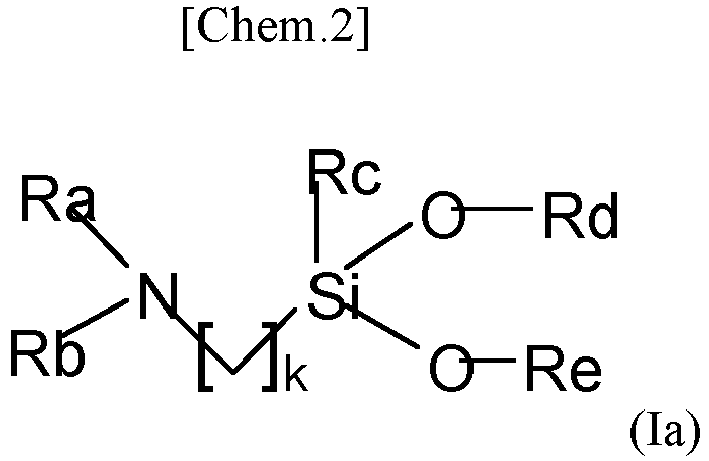
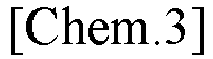

- Ra and Rb, which may be identical or different, represent a hydrogen atom; an alkyl group containing from 1 to 20 carbon atoms, preferably from 1 to 10 carbon atoms; a cycloalkyl group containing from 3 to 20 carbon atoms; an aryl group containing from 6 to 12 carbon atoms; an aminoalkyl group containing from 1 to 20 carbon atoms; a hydroxyalkyl group containing from 1 to 20 carbon atoms; an alkoxy group containing from 1 to 10 carbon atoms; an alkylcarbonyl group containing from 1 to 10 carbon atoms, preferably methylcarbonyl (i.e. acetyl);
- Rc represents a hydrogen atom; an alkyl group containing from 1 to 20 carbon atoms, preferably a methyl; an alkoxy group containing from 1 to 10 carbon atoms, preferably an ethoxy group; or an alkylaryl group containing from 7 to 12 carbon atoms;
- Rd and Re, which may be identical or different, represent an alkyl group containing from 1 to 20 carbon atoms, preferably an ethyl;
- k denotes an integer ranging from 0 to 20, preferably ranging from 0 to 3;
- Rf represents a hydrogen atom; an alkyl group containing from 1 to 20 carbon atoms such as an ethyl group; or a group of formula (II) below:

- Among the alkoxysilanes of formula (Ia), oligomers thereof and/or mixtures thereof, mention may notably be made of 3-aminopropyltriethoxysilane (APTES), 3-aminopropylmethyldiethoxysilane (APMDES) and N-cyclohexylaminomethyltriethoxysilane.
- APTES may be purchased, for example, from the company Dow Corning under the name Xiameter OFS-6011 Silane or from the company Momentive Performance Materials under the name Silsoft A-1100 or from the company Shin-Etsu under the name KBE-903.
- The compounds of formula (Ia) may also denote Dynasylan SIVO 210 or Dynasylan 1505 sold by the company Evonik.
- N-cyclohexylaminomethyltriethoxysilane may be purchased, for example, from the company Wacker under the name Geniosil XL 926.
- Among the alkoxysilanes of formula (Ib), oligomers thereof and/or mixtures thereof, mention may notably be made of tetraethoxysilane (TEOS), methyltriethoxysilane (MTES), dimethyldiethoxysilane (DMDES), diethyldiethoxysilane, dipropyldiethoxysilane, propyltriethoxysilane, isobutyltriethoxysilane, phenyltriethoxysilane, phenylmethyldiethoxysilane, diphenyldiethoxysilane, benzyltriethoxysilane, benzylmethyldiethoxysilane, dibenzyldiethoxysilane, acetoxymethyltriethoxysilane and mixtures thereof.
- TEOS may be purchased, for example, from the company Evonik under the name Dynasylan® A or Dynasylan® A SQ. MTES may be purchased, for example, from the company Evonik under the name Dynasylan® MTES. DMDES may be purchased, for example, from the company Gelest under the reference SID3404.0.
- Preferably, the alkoxysilane(s) chosen from the compounds of formula (I), oligomers thereof and/or mixtures thereof are chosen from 3-aminopropyltriethoxysilane (APTES), 3-aminopropylmethyldiethoxysilane (APMDES), N-cyclohexylaminomethyltriethoxysilane, tetraethoxysilane (TEOS), methyltriethoxysilane (MTES), dimethyldiethoxysilane (DMDES), diethyldiethoxysilane, dipropyldiethoxysilane, propyltriethoxysilane, isobutyltriethoxysilane, phenyltriethoxysilane, phenylmethyldiethoxysilane, diphenyldiethoxysilane, benzyltriethoxysilane, benzylmethyldiethoxysilane, dibenzyldiethoxysilane, acetoxymethyltriethoxysilane and mixtures thereof, more preferentially 3-aminopropyltriethoxysilane (APTES), tetraethoxysilane (TEOS) and mixtures thereof.
- According to a preferred embodiment, the alkoxysilane(s) of formula (I), oligomers thereof and/or mixtures thereof are chosen from the compounds of formula (Ia) below:


- Ra and Rb, which are identical, represent a hydrogen atom;
- Rc represents an alkyl group containing from 1 to 20 carbon atoms, preferably a methyl, or an alkoxy group containing from 1 to 10 carbon atoms, preferably an ethoxy group;
- Rd and Re, which may be identical or different, represent an alkyl group containing from 1 to 20 carbon atoms, preferably an ethyl;
- k denotes an integer ranging from 0 to 20, preferably ranging from 0 to 3.
- Preferentially, Ra and Rb represent a hydrogen atom, Rc represents an ethoxy group, Rd and Re are identical and represent an ethyl and k is equal to 3.
- According to a more preferred embodiment, the alkoxysilane of formula (I), oligomers thereof and/or mixtures thereof, is 3-aminopropyltriethoxysilane (APTES).
- According to another preferred embodiment, the alkoxysilane(s) of formula (I), oligomers thereof and/or mixtures thereof are chosen from the compounds of formula (Ib) below:

- Rc represents an alkoxy group containing from 1 to 10 carbon atoms, preferably an ethoxy group;
- Rd represents an alkyl group containing from 1 to 20 carbon atoms, preferably an ethyl;
- k denotes an integer ranging from 0 to 20, preferably ranging from 0 to 3;
- Rf represents a hydrogen atom or an alkyl group containing from 1 to 20 carbon atoms, such as an ethyl;
- Composition (C) according to the invention may comprise one or more alkoxysilanes of formula (I), oligomers thereof and/or mixtures thereof present in a total amount ranging from 0.1% to 30% by weight, preferably from 0.5% to 25% by weight, better still from 0.5% to 20% by weight, relative to the total weight of the composition.
- The composition according to the invention comprises at least one non-amino silicone chosen from the compounds of formula (III) below:

- R1 independently represents a hydroxyl group or an alkoxy group containing from 1 to 2 carbon atoms;
- R2 independently represents a hydrogen atom; an alkyl group containing from 1 to 20 carbon atoms, optionally substituted with at least one group chosen from a hydroxyl group (OH) or a thiol group, said alkyl group preferably being optionally substituted with at least one hydroxyl group (OH);
- R3 represents a hydrogen atom; a hydroxyl group; an alkyl group containing from 1 to 10 carbon atoms, optionally substituted with at least one group chosen from a hydroxyl group (OH) or a thiol group; a cycloalkyl group containing from 3 to 20 carbon atoms, optionally substituted with at least one group chosen from a hydroxyl group (OH) or a thiol group; an alkoxy group containing from 1 to 2 carbon atoms, optionally substituted with at least one group chosen from a hydroxyl group (OH) or a thiol group; an aryl group containing from 6 to 12 carbon atoms, optionally substituted with at least one group chosen from a hydroxyl group (OH) or a thiol group;
- A represents an alkylene group containing from 1 to 2 carbon atoms;
- X represents a hydrogen atom, an alkyl group containing from 1 to 2 carbon atoms, a group -(R4-O)p- with R4 representing a linear or branched alkylene group containing from 2 to 4 carbon atoms and p denoting an integer ranging from 0 to 3;
- m denotes an integer ranging from 1 to 3, n denotes an integer ranging from 0 to 2 and m+n=3;
- m' denotes an integer ranging from 1 to 3, n' denotes an integer ranging from 0 to 2 and m'+n'=3;
- j denotes an integer ranging from 0 to 1;
- t denotes an integer ranging from 0 to 1;
- y denotes an integer ranging from 0 to 10, z denotes an integer ranging from 0 to 500, with x+z ranging from 0 to 500 and x+y+z≥4; and
- The term "non-amino silicone" means any silicone not comprising any primary, secondary or tertiary amine groups or quaternary ammonium groups.
- According to a preferred embodiment of the present invention, the compound(s) of formula (III) are such that:
- R1 independently represents a hydroxyl group or an alkoxy group containing from 1 to 2 carbon atoms;
- R2 independently represents a hydrogen atom or an alkyl group containing from 1 to 10 carbon atoms, preferably a methyl;
- R3 represents a hydrogen atom; a hydroxyl group; an alkyl group containing from 1 to 10 carbon atoms; an alkoxy group containing from 1 to 2 carbon atoms or an aryl group containing from 6 to 12 carbon atoms, optionally substituted with a group chosen from a hydroxyl group (OH) or a thiol group;
- X represents a hydrogen atom or an alkyl group containing from 1 to 2 carbon atoms, and p denotes an integer ranging from 0 to 3;
- m' denotes an integer ranging from 1 to 3, n' denotes an integer ranging from 0 to 2 and m'+n'=3;
- m denotes an integer ranging from 1 to 3, n denotes an integer ranging from 0 to 2 and m+n=3;
- j is equal to 0;
- t denotes an integer ranging from 0 to 1; and
- y denotes an integer ranging from 0 to 10, z denotes an integer ranging from 0 to 500, with x+z ranging from 0 to 500 and x+y+z≥4; and
- According to an even more preferred embodiment of the present invention, the compound(s) of formula (III) are such that:
- R1 independently represents a hydroxyl group or an alkoxy group containing from 1 to 2 carbon atoms;
- R2 independently represents an alkyl group containing from 1 to 10 carbon atoms, preferably a methyl;
- m denotes an integer ranging from 1 to 3, n denotes an integer ranging from 0 to 2 and m+n=3;
- j is equal to 0;
- y is equal to 0;
- z denotes an integer ranging from 0 to 500; and
-

- The non-amino silicone(s) of formula (III) that may be used in the context of the invention may be chosen from:
- the compounds of formula (IIIa) below:

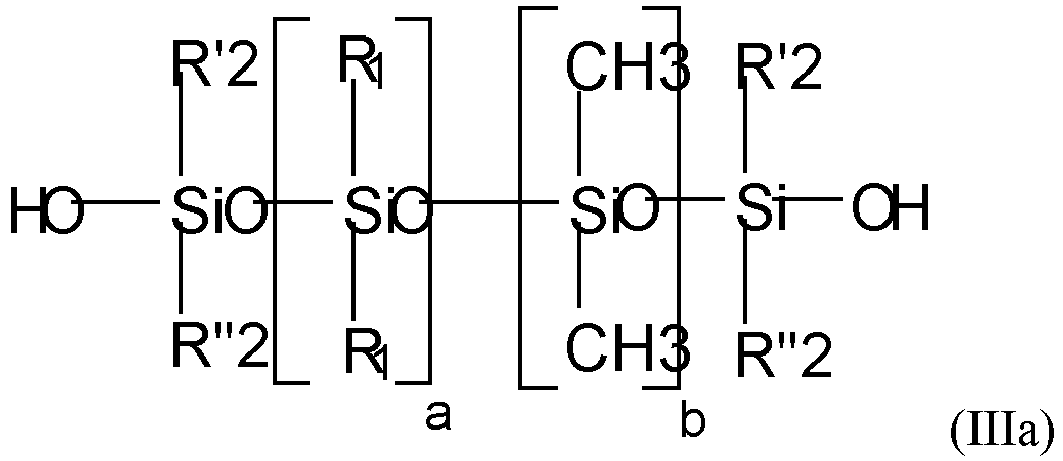
- R1 independently represents a hydroxyl group; an alkyl group containing from 1 to 10 carbon atoms, preferably a methyl; an aryl group containing from 6 to 12 carbon atoms; an alkoxy group containing from 1 to 2 carbon atoms; or a group -O-Si(R'2)3;
- R'2 and R"2 independently represent a hydrogen atom; a hydroxyl group; or an alkyl group containing from 1 to 10 carbon atoms, preferably a methyl;
- a denotes an integer ranging from 0 to 10, b denotes an integer ranging from 0 to 500, with a+b≥4.
- the compounds of formula (IIIb) below:

- R1 represents an alkyl group containing from 1 to 10 carbon atoms, preferably a methyl, or an alkoxy group containing from 1 to 2 carbon atoms;
- R'2 and R"2 independently represent an alkyl group containing from 1 to 10 carbon atoms, preferably containing 1 or 2 carbon atoms;
- R3 represents an alkyl group containing from 1 to 10 carbon atoms, preferably a methyl; an alkoxy group containing from 1 to 2 carbon atoms; or a group -O-Si(R1)3; and
- n denotes an integer ranging from 0 to 10.
- the compounds of formula (IIIc) below:

- R1 represents an alkyl group containing from 1 to 10 carbon atoms, preferably a methyl; an alkoxy group containing from 1 to 2 carbon atoms; or a group -O-X-Si(OR2)3 with X representing an alkylene group containing from 1 to 2 carbon atoms, a group -(O-R4)p- with R4 representing a linear or branched alkylene group containing from 2 to 4 carbon atoms and p denoting an integer ranging from 0 to 3;
- R2, R'2 and R"2 independently represent an alkyl group containing from 1 to 10 carbon atoms, preferably a methyl or ethyl;
- A represents an alkylene group containing from 1 to 2 carbon atoms;
- j denotes an integer ranging from 0 to 1;
- i denotes an integer ranging from 0 to 10, n+i ranging from 0 to 500, with n+i+j≥4;
- the compounds of formula (IIId) below:


- R1 independently represents an alkyl group containing from 1 to 10 carbon atoms, preferably from 1 to 4 carbon atoms, more preferentially a methyl; or an alkoxy group containing from 1 to 2 carbon atoms;
- R2, which may be identical or different, independently represent a hydroxyl group or an alkoxy group containing from 1 to 2 carbon atoms;
- i denotes an integer ranging from 0 to 18, n denotes an integer ranging from 0 to 18 with n+i ranging from 4 to 18.
- and mixtures thereof.
- the compounds of formula (IIIb) below:
- Preferably, the non-amino silicone(s) of formula (IIId) are such that:
- R1 independently represents an alkyl group containing from 1 to 10 carbon atoms, preferably from 1 to 4 carbon atoms, more preferentially a methyl;
- R2 independently represents a hydroxyl group or an alkoxy group containing from 1 to 2 carbon atoms;
- i denotes an integer ranging from 0 to 18, n denotes an integer ranging from 0 to 18 with n+i ranging from 4 to 18.
- More preferentially, the non-amino silicone(s) of formula (III d) are such that:
- R1 independently represents an alkyl group containing from 1 to 4 carbon atoms, more preferentially a methyl;
- R2 independently represents a hydroxyl group;
- i denotes an integer ranging from 0 to 18, n denotes an integer ranging from 0 to 18 with n+i ranging from 4 to 18.
- The term "non-amino silicone" denotes any silicone not comprising any primary, secondary or tertiary amine groups or quaternary ammonium groups.
- Among the non-amino silicones of formula (IIIa), mention may be made of polydimethylsiloxanes (PDMS) bearing hydroxyl end functions, such as the compounds sold by the company Shin-Etsu under the name KF-9701 or X-21-5841, or those sold by the company Sigma-Aldrich under the reference 481939 (Mn ~550, ~25 cSt), 481955 (~65 cSt), or 481963 (~750 cSt).
- Among the non-amino silicones of formula (IIIb), mention may be made of polydimethylsiloxanes (PDMS) bearing tri(methoxy) end functions, such as those sold by the company Power Chemical under the name SiSiB® PF2110, or those sold by the company Shin-Etsu under the name X40-9246, KC-89S or X40-9250. Mention may also be made of polydimethylsiloxanes (PDMS) bearing tri(ethoxy) end functions, such as those sold by the company Power Chemical under the name SiSiB® PF2120.
- Among the non-amino silicones of formula (IIIc), mention may be made of polydimethylsiloxanes (PDMS) bearing tri(ethoxy) end functions, such as those sold by the company Gelest under the name DMS-XT11.
- Among the non-amino silicones of formula (IIId), mention may be made of polydimethylsiloxanes (PDMS) bearing alkoxy end functions, such as those sold by the company Gelest under the reference DMS-XM11 or polydimethylsiloxanes (PDMS) bearing hydroxyl end functions, such as those sold by the company Sigma-Aldrich under the reference 481939 (Mn ~550).
- Preferably, the non-amino silicone(s) that may be used in the context of the invention are chosen from the compounds of formula (IIIa) in which:
- R1 independently represents an alkyl group containing from 1 to 10 carbon atoms, preferably a methyl;
- R'2 and R"2 independently represent a hydroxyl group or an alkyl group containing from 1 to 10 carbon atoms, preferably an alkyl group, more preferentially a methyl;
- b denotes an integer ranging from 0 to 10, a denotes an integer ranging from 0 to 5, with a+b≥4.
- Preferably, the non-amino silicone(s) of formula (III) that may be used in the context of the invention are represented by formula (IV) below:

- Preferably, the non-amino silicone(s) that may be used in the context of the invention have a molecular mass of between 400 and 1800 g/mol.
- The non-amino silicone(s) of formula (IIId) have a weight-average molecular mass of less than or equal to 1500 g/mol.
- Preferably, the non-amino silicone(s) of formula (IIId) have a weight-average molecular mass of less than or equal to 1300 g/mol.
- Preferably, the non-amino silicone(s) of formula (IIId) have a weight-average molecular mass ranging from 460 to 1500 g/mol, more preferentially from 500 to 1300 g/mol.
- Composition (C) according to the invention may comprise one or more non-amino silicones of formula (III) present in a total amount ranging from 0.1% to 30% by weight, preferably from 0.1% to 25% by weight, relative to the total weight of the composition.
- Composition (C) according to the invention comprises an alkoxysilane/non-amino silicone mass ratio ranging from 95/5 to 5/95.
- Preferably, the alkoxysilane/non-amino silicone mass ratio ranges from 90/10 to 10/90, preferentially from 60/40 to 40/60; even more preferentially, the alkoxysilane/non-amino silicone mass ratio is 50/50.
- According to a particular embodiment, the APTES/non-amino silicone mass ratio ranges from 90/10 to 10/90, preferably 50/50.
- According to a particular embodiment, the TEOS/non-amino silicone mass ratio ranges from 90/10 to 10/90, preferably 50/50.
- According to a particular embodiment, the TEOS and APTES/non-amino silicone mass ratio is 50/50 with 25% of TEOS and 25% of APTES.
- According to a particular embodiment, the APTES/non-amino silicone(s) of formula (IIIa) or (IIId) mass ratio ranges from 90/10 to 10/90, preferentially from 80/20 to 20/80, and more preferentially from 70/30 to 30/70.
- According to a particular embodiment, the APTES/non-amino silicone(s) of formula (IV) mass ratio ranges from 90/10 to 10/90, more preferentially from 70/30 to 30/70.
- Composition (C) according to the invention comprises at least one colouring agent chosen from pigments, direct dyes and mixtures thereof.
- Preferably, composition (C) according to the invention comprises one or more pigments.
- The term "pigment" means any pigment that gives colour to keratin materials. Their solubility in water at 25°C and at atmospheric pressure (760 mmHg) is less than 0.05% by weight, and preferably less than 0.01%.
- The pigments that may be used are notably chosen from the organic and/or mineral pigments known in the art, notably those that are described in Kirk-Othmer's Encyclopedia of Chemical Technology and in Ullmann's Encyclopedia of Industrial Chemistry.
- They may be natural, of natural origin, or non-natural.
- These pigments may be in pigment powder or paste form. They may be coated or uncoated.
- The pigments may be chosen, for example, from mineral pigments, organic pigments, lakes, pigments with special effects such as nacres or glitter flakes, and mixtures thereof.
- The pigment may be a mineral pigment. The term "mineral pigment" means any pigment that satisfies the definition in Ullmann's encyclopedia in the chapter on inorganic pigments. Among the mineral pigments that are useful in the present invention, mention may be made of iron oxides, chromium oxides, manganese violet, ultramarine blue, chromium hydrate, ferric blue and titanium oxide.
- The pigment may be an organic pigment. The term "organic pigment" means any pigment that satisfies the definition in Ullmann's encyclopedia in the chapter on organic pigments.
- The organic pigment may notably be chosen from nitroso, nitro, azo, xanthene, pyrene, quinoline, anthraquinone, triphenylmethane, fluorane, phthalocyanine, metal-complex, isoindolinone, isoindoline, quinacridone, perinone, perylene, diketopyrrolopyrrole, indigo, thioindigo, dioxazine, triphenylmethane and quinophthalone compounds.
- In particular, the white or coloured organic pigments may be chosen from carmine, carbon black, aniline black, azo yellow, quinacridone, phthalocyanine blue, the blue pigments codified in the Color Index under the references CI 42090, 69800, 69825, 74100, 74160, the yellow pigments codified in the Color Index under the references CI 11680, 11710, 19140, 20040, 21100, 21108, 47000, 47005, the green pigments codified in the Color Index under the references CI 61565, 61570, 74260, the orange pigments codified in the Color Index under the references CI 11725, 45370, 71105, the red pigments codified in the Color Index under the references CI 12085, 12120, 12370, 12420, 12490, 14700, 15525, 15580, 15620, 15630, 15800, 15850, 15865, 15880, 26100, 45380, 45410, 58000, 73360, 73915, 75470, the pigments obtained by oxidative polymerization of indole or phenol derivatives as described in patent
FR 2 679 771 - Examples that may also be mentioned include pigment pastes of organic pigments, such as the products sold by the company Hoechst under the names:
- Cosmenyl Yellow IOG: Yellow 3 pigment (CI 11710);
- Cosmenyl Yellow G: Yellow 1 pigment (CI 11680);
- Cosmenyl Orange GR: Orange 43 pigment (CI 71105);
- Cosmenyl Red R: Red 4 pigment (CI 12085);
- Cosmenyl Carmine FB: Red 5 pigment (CI 12490);
- Cosmenyl Violet RL: Violet 23 pigment (CI 51319);
- Cosmenyl Blue A2R: Blue 15.1 pigment (CI 74160);
- Cosmenyl Green GG: Green 7 pigment (CI 74260);
- Cosmenyl Black R: Black 7 pigment (CI 77266).
- The pigments in accordance with the invention may also be in the form of composite pigments, as described in patent
EP 1 184 426 . These composite pigments may be composed notably of particles including a mineral core, at least one binder, for attaching the organic pigments to the core, and at least one organic pigment which at least partially covers the core. - The organic pigment may also be a lake. The term "lake" means dyes adsorbed onto insoluble particles, the assembly thus obtained remaining insoluble during use.
- The inorganic substrates onto which the dyes are adsorbed are, for example, alumina, silica, calcium sodium borosilicate, calcium aluminium borosilicate and aluminium.
- Among the dyes, mention may be made of carminic acid. Mention may also be made of the dyes known under the following names: D&C Red 21 (CI 45 380), D&C Orange 5 (CI 45 370), D&C Red 27 (CI 45 410), D&C Orange 10 (CI 45 425), D&C Red 3 (CI 45 430), D&C Red 4 (CI 15 510), D&C Red 33 (CI 17 200), D&C Yellow 5 (CI 19 140), D&C Yellow 6 (CI 15 985), D&C Green (CI 61 570), D&C Yellow 10 (CI 77 002), D&C Green 3 (CI 42 053), D&C Blue 1 (CI 42 090).
- An example of a lake that may be mentioned is the product known under the following name: D&C Red 7 (CI 15 850:1).
- The pigment may also be a pigment with special effects. The term "pigments with special effects" means pigments that generally create a coloured appearance (characterized by a certain shade, a certain vivacity and a certain level of luminance) that is non-uniform and that changes as a function of the conditions of observation (light, temperature, angles of observation, etc.). They thereby differ from coloured pigments, which afford a standard uniform opaque, semi-transparent or transparent shade.
- Several types of pigments with special effects exist: those with a low refractive index, such as fluorescent or photochromic pigments, and those with a higher refractive index, such as nacres, interference pigments or glitter flakes.
- Examples of pigments with special effects that may be mentioned include nacreous pigments such as mica coated with titanium or with bismuth oxychloride, coloured nacreous pigments such as mica coated with titanium and with iron oxides, mica coated with iron oxide, mica coated with titanium and notably with ferric blue or with chromium oxide, mica coated with titanium and with an organic pigment as defined above, and also nacreous pigments based on bismuth oxychloride. Nacreous pigments that may be mentioned include the Cellini nacres sold by BASF (mica-TiO2-lake), Prestige sold by Eckart (mica-TiO2), Prestige Bronze sold by Eckart (mica-Fe2O3), and Colorona sold by Merck (mica-TiO2-Fe2O3).
- Mention may also be made of the gold-coloured nacres sold notably by the company BASF under the name Brilliant gold 212G (Timica), Gold 222C (Cloisonne), Sparkle gold (Timica), Gold 4504 (Chromalite) and Monarch gold 233X (Cloisonne); the bronze nacres sold notably by the company Merck under the name Bronze fine (17384) (Colorona) and Bronze (17353) (Colorona) and by the company BASF under the name Super bronze (Cloisonne); the orange nacres sold notably by the company BASF under the name Orange 363C (Cloisonne) and Orange MCR 101 (Cosmica) and by the company Merck under the name Passion orange (Colorona) and Matte orange (17449) (Microna); the brown nacres sold notably by the company BASF under the name Nu-antique copper 340XB (Cloisonne) and Brown CL4509 (Chromalite); the nacres with a copper tint sold notably by the company BASF under the name Copper 340A (Timica); the nacres with a red tint sold notably by the company Merck under the name Sienna fine (17386) (Colorona); the nacres with a yellow tint sold notably by the company BASF under the name Yellow (4502) (Chromalite); the red nacres with a gold tint sold notably by the company BASF under the name Sunstone G012 (Gemtone); the pink nacres sold notably by the company BASF under the name Tan opale G005 (Gemtone); the black nacres with a gold tint sold notably by the company BASF under the name Nu antique bronze 240 AB (Timica), the blue nacres sold notably by the company Merck under the name Matte blue (17433) (Microna), the white nacres with a silvery tint sold notably by the company Merck under the name Xirona Silver, and the golden-green pink-orange nacres sold notably by the company Merck under the name Indian summer (Xirona), and mixtures thereof.
- Still as examples of nacres, mention may also be made of particles including a borosilicate substrate coated with titanium oxide.
- Particles comprising a glass substrate coated with titanium oxide are notably sold under the name Metashine MC1080RY by the company Toyal.
- Finally, examples of nacres that may also be mentioned include polyethylene terephthalate flakes, notably those sold by the company Meadowbrook Inventions under the name Silver 1P 0.004X0.004 (silver flakes). Multilayer pigments based on synthetic substrates such as alumina, silica, calcium sodium borosilicate or calcium aluminium borosilicate, and aluminium, may also be envisaged.
- The pigments with special effects may also be chosen from reflective particles, i.e. notably from particles whose size, structure, notably the thickness of the layer(s) of which they are made and their physical and chemical nature, and surface state, allow them to reflect incident light. This reflection may, where appropriate, have an intensity sufficient to create at the surface of the composition or of the mixture, when it is applied to the support to be made up, highlight points that are visible to the naked eye, i.e. more luminous points that contrast with their environment by appearing to sparkle.
- The reflective particles may be selected so as not to significantly alter the colouring effect generated by the colouring agents with which they are combined, and more particularly so as to optimize this effect in terms of colour rendition. They may more particularly have a yellow, pink, red, bronze, orange, brown, gold and/or coppery colour or tint.
- These particles may have varied forms and may notably be in platelet or globular form, in particular in spherical form.
- Irrespective of their form, the reflective particles may or may not have a multilayer structure, and, in the case of a multilayer structure, may have, for example, at least one layer of uniform thickness, notably of a reflective material.
- When the reflective particles do not have a multilayer structure, they may be composed, for example, of metal oxides, notably titanium or iron oxides obtained synthetically.
- When the reflective particles have a multilayer structure, they may include, for example, a natural or synthetic substrate, notably a synthetic substrate at least partially coated with at least one layer of a reflective material, notably of at least one metal or metallic material. The substrate may be made of one or more organic and/or mineral materials.
- More particularly, it may be chosen from glasses, ceramics, graphite, metal oxides, aluminas, silicas, silicates, notably aluminosilicates and borosilicates, synthetic mica and mixtures thereof, this list not being limiting.
- The reflective material may include a layer of metal or of a metallic material.
- Reflective particles are notably described in
JP-A-09188830 JP-A-10158450 JP-A-10158541 JP-A-07258460 JP-A-05017710 - Still as an example of reflective particles including a mineral substrate coated with a layer of metal, mention may also be made of particles including a silver-coated borosilicate substrate.
- Particles with a silver-coated glass substrate, in the form of platelets, are sold under the name Microglass Metashine REFSX 2025 PS by the company Toyal. Particles with a glass substrate coated with nickel/chromium/molybdenum alloy are sold under the names Crystal Star GF 550 and GF 2525 by this same company.
- Use may also be made of particles comprising a metal substrate, such as silver, aluminium, iron, chromium, nickel, molybdenum, gold, copper, zinc, tin, magnesium, steel, bronze or titanium, said substrate being coated with at least one layer of at least one metal oxide, such as titanium oxide, aluminium oxide, iron oxide, cerium oxide, chromium oxide, silicon oxides and mixtures thereof.
- Examples that may be mentioned include aluminium powder, bronze powder or copper powder coated with SiO2 sold under the name Visionaire by the company Eckart.
- Mention may also be made of pigments with an interference effect which are not attached to a substrate, such as liquid crystals (Helicones HC from Wacker) or interference holographic glitter flakes (Geometric Pigments or Spectra f/x from Spectratek). Pigments with special effects also comprise fluorescent pigments, whether these are substances that are fluorescent in daylight or that produce an ultraviolet fluorescence, phosphorescent pigments, photochromic pigments, thermochromic pigments and quantum dots, sold, for example, by the company Quantum Dots Corporation.
- The variety of pigments that may be used in the present invention makes it possible to obtain a wide range of colours, and also particular optical effects such as metallic effects or interference effects.
- The size of the pigment used in the composition according to the present invention is generally between 10 nm and 200 µm, preferably between 20 nm and 80 µm and more preferentially between 30 nm and 50 µm.
- The pigments may be dispersed in the composition by means of a dispersant.
- The dispersant serves to protect the dispersed particles against their agglomeration or flocculation. This dispersant may be a surfactant, an oligomer, a polymer or a mixture of several thereof, bearing one or more functionalities with a strong affinity for the surface of the particles to be dispersed. In particular, they may become physically or chemically attached to the surface of the pigments. These dispersants also contain at least one functional group that is compatible with or soluble in the continuous medium. In particular, use is made of esters of 12-hydroxystearic acid, in particular, and of C8 to C20 fatty acids and of polyols such as glycerol or diglycerol, such as poly(12-hydroxystearic acid) stearate with a molecular weight of approximately 750g/mol, such as the product sold under the name Solsperse 21 000 by the company Avecia, polyglyceryl-2 dipolyhydroxystearate (CTFA name) sold under the reference Dehymyls PGPH by the company Henkel, or polyhydroxystearic acid such as the product sold under the reference Arlacel P100 by the company Uniqema, and mixtures thereof.
- As other dispersants that may be used in the compositions of the invention, mention may be made of quaternary ammonium derivatives of polycondensed fatty acids, for instance Solsperse 17 000 sold by the company Avecia, and polydimethylsiloxane/oxypropylene mixtures such as those sold by the company Dow Coming under the references DC2-5185 and DC2-5225 C.
- The pigments used in the composition may be surface-treated with an organic agent.
- Thus, the pigments that have been surface-treated beforehand, which are useful in the context of the invention, are pigments that have totally or partially undergone a surface treatment of chemical, electronic, electrochemical, mechanochemical or mechanical nature, with an organic agent such as those that are described notably in Cosmetics and Toiletries, February 1990, Vol. 105, pages 53-64, before being dispersed in the composition in accordance with the invention. These organic agents may be chosen, for example, from waxes, for example carnauba wax and beeswax; fatty acids, fatty alcohols and derivatives thereof, such as stearic acid, hydroxystearic acid, stearyl alcohol, hydroxystearyl alcohol, lauric acid and derivatives thereof; anionic surfactants; lecithins; sodium, potassium, magnesium, iron, titanium, zinc or aluminium salts of fatty acids, for example aluminium stearate or laurate; metal alkoxides; polyethylene; (meth)acrylic polymers, for example polymethyl methacrylates; polymers and copolymers containing acrylate units; alkanolamines; silicone compounds, for example silicones, notably polydimethylsiloxanes; organofluorine compounds, for example perfluoroalkyl ethers; fluorosilicone compounds.
- The surface-treated pigments that are useful in the composition may also have been treated with a mixture of these compounds and/or may have undergone several surface treatments.
- The surface-treated pigments that are useful in the context of the present invention may be prepared according to surface-treatment techniques that are well known to those skilled in the art, or may be commercially available as is.
- Preferably, the surface-treated pigments are coated with an organic layer.
- The organic agent with which the pigments are treated may be deposited on the pigments by solvent evaporation, chemical reaction between the molecules of the surface agent or creation of a covalent bond between the surface agent and the pigments.
- The surface treatment may thus be performed, for example, by chemical reaction of a surface agent with the surface of the pigments and creation of a covalent bond between the surface agent and the pigments or the fillers. This method is notably described in patent
US 4 578 266 . - An organic agent covalently bonded to the pigments will preferably be used.
- The agent for the surface treatment may represent from 0.1% to 50% by weight of the total weight of the surface-treated pigment, preferably from 0.5% to 30% by weight and even more preferentially from 1% to 20% by weight of the total weight of the surface-treated pigment.
- Preferably, the surface treatments of the pigments are chosen from the following treatments:
- a PEG-silicone treatment, for instance the AQ surface treatment sold by LCW;
- a methicone treatment, for instance the SI surface treatment sold by LCW;
- a dimethicone treatment, for instance the Covasil 3.05 surface treatment sold by LCW;
- a dimethicone/trimethyl siloxysilicate treatment, for instance the Covasil 4.05 surface treatment sold by LCW;
- a magnesium myristate treatment, for instance the MM surface treatment sold by LCW;
- an aluminium dimyristate treatment, such as the MI surface treatment sold by Miyoshi;
- a perfluoropolymethylisopropyl ether treatment, for instance the FHC surface treatment sold by LCW;
- an isostearyl sebacate treatment, for instance the HS surface treatment sold by Miyoshi;
- a perfluoroalkyl phosphate treatment, for instance the PF surface treatment sold by Daito;
- an acrylate/dimethicone copolymer and perfluoroalkyl phosphate treatment, for instance the FSA surface treatment sold by Daito;
- a polymethylhydrosiloxane/perfluoroalkyl phosphate treatment, for instance the FS01 surface treatment sold by Daito;
- an acrylate/dimethicone copolymer treatment, for instance the ASC surface treatment sold by Daito;
- an isopropyl titanium triisostearate treatment, for instance the ITT surface treatment sold by Daito;
- an acrylate copolymer treatment, for instance the APD surface treatment sold by Daito;
- a perfluoroalkyl phosphate/isopropyl titanium triisostearate treatment, for instance the PF + ITT surface treatment sold by Daito.
- According to a particular embodiment of the invention, the dispersant is present with organic or mineral pigments in submicron-sized particulate form in the dye composition.
- The term "submicron" or "submicronic" refers to pigments having a particle size that has been micronized by a micronization method and having a mean particle size of less than a micrometre (µm), in particular between 0.1 and 0.9 µm, and preferably between 0.2 and 0.6 µm.
- According to one embodiment, the dispersant and the pigment(s) are present in an amount (dispersant:pigment) of between 1:4 and 4:1, particularly between 1.5:3.5 and 3.5:1 or better still between 1.75:3 and 3:1.
- The dispersant(s) may therefore have a silicone backbone, such as silicone polyether and dispersants of aminosilicone type other than the alkoxysilanes described previously. Among the suitable dispersants, mention may be made of:
- aminosilicones, i.e. silicones comprising one or more amino groups such as those sold under the names and references: BYK LPX 21879 by BYK, GP-4, GP-6, GP-344, GP-851, GP-965, GP-967 and GP-988-1, sold by Genesee Polymers,
- silicone acrylates such as Tego® RC 902, Tego® RC 922, Tego® RC 1041, and Tego® RC 1043, sold by Evonik,
- polydimethylsiloxane (PDMS) silicones with carboxyl groups such as X- 22162 and X-22370 by Shin-Etsu, epoxy silicones such as GP-29, GP-32, GP-502, GP-504, GP-514, GP-607, GP-682, and GP-695 by Genesee Polymers, or Tego® RC 1401, Tego® RC 1403, Tego® RC 1412 by Evonik.
- According to a particular embodiment, the dispersant(s) are of aminosilicone type other than the alkoxysilanes described previously and are cationic.
- Preferably, the pigment(s) is (are) chosen from mineral, mixed mineral-organic or organic pigments.
- In one variant of the invention, the pigment(s) according to the invention are organic pigments, preferentially organic pigments surface-treated with an organic agent chosen from silicone compounds. In another variant of the invention, the pigment(s) according to the invention are mineral pigments.
- The composition may comprise one or more direct dyes.
- The term "direct dye" means natural and/or synthetic dyes, other than oxidation dyes. These are dyes that will spread superficially on the fibre.
- They may be ionic or nonionic, preferably cationic or nonionic.
- Examples of suitable direct dyes that may be mentioned include azo direct dyes; (poly)methine dyes such as cyanines, hemicyanines and styryls; carbonyl dyes; azine dyes; nitro(hetero)aryl dyes; tri(hetero)arylmethane dyes; porphyrin dyes; phthalocyanine dyes and natural direct dyes, alone or in the form of mixtures.
- The direct dyes are preferably cationic direct dyes. Mention may be made of the hydrazono cationic dyes of formulae (V) and (VI) and the azo cationic dyes (VII) and (VIII) below:
[Chem. 13] Het+-C(Ra)=N-N(Rb)-Ar, Q (V)
[Chem. 14] Het+-N(Ra)-N=C(Rb)-Ar, Q- (VI)
[Chem. 15] Het+-N=N-Ar, Q- (VII)
[Chem. 16] Ar+-N=N-Ar", Q- (VIII)
- in which formulae (V) to (VIII):
- Het+ represents a cationic heteroaryl radical, preferentially bearing an endocyclic cationic charge, such as imidazolium, indolium or pyridinium, which is optionally substituted, preferentially with at least one (C1-C8) alkyl group such as methyl;
- Ar+ represents an aryl radical, such as phenyl or naphthyl, bearing an exocyclic cationic charge, preferentially ammonium, particularly tri(C1-C8)alkylammonium, such as trimethylammonium;
- Ar represents an aryl group, notably phenyl, which is optionally substituted, preferentially with one or more electron-donating groups such as i) optionally substituted (C1-C8)alkyl, ii) optionally substituted (Ci-Cs)alkoxy, iii) (di)(C1-C8)(alkyl)amino optionally substituted on the alkyl group(s) with a hydroxyl group, iv) aryl(C1-C8)alkylamino, v) optionally substituted N-(C1-C8)alkyl-N-aryl(C1-C8)alkylamino or alternatively Ar represents a julolidine group;
- Ar" represents an optionally substituted (hetero)aryl group, such as phenyl or pyrazolyl, which are optionally substituted, preferentially with one or more (C1-C8)alkyl, hydroxyl, (di)(C1-C8)(alkyl)amino, (C1-C8)alkoxy or phenyl groups;
- Ra and Rb, which may be identical or different, represent a hydrogen atom or a (C1-C8)alkyl group, which is optionally substituted, preferentially with a hydroxyl group;
or else the substituent Ra with a substituent of Het+ and/or Rb with a substituent of Ar form, together with the atoms that bear them, a (hetero)cycloalkyl; in particular, Ra and Rb represent a hydrogen atom or a (C1-C4)alkyl group optionally substituted with a hydroxyl group; - Q- represents an organic or mineral anionic counterion, such as a halide or an alkyl sulfate.
- In particular, mention may be made of the azo and hydrazono direct dyes bearing an endocyclic cationic charge of formulae (V) to (VIII) as defined previously, more particularly, the cationic direct dyes bearing an endocyclic cationic charge described in patent applications
WO 95/15144 WO 95/01772 EP 714 954 

- R1 represents a (C1-C4)alkyl group such as methyl;
- R2 and R3 , which may be identical or different, represent a hydrogen atom or a (C1-C4)alkyl group, such as methyl; and
- R4 represents a hydrogen atom or an electron-donating group such as optionally substituted (C1-C8)alkyl, optionally substituted (Ci-Cs)alkoxy, or (di)(C1-C8)(alkyl)amino optionally substituted on the alkyl group(s) with a hydroxyl group; particularly, R4 is a hydrogen atom,
- Z represents a CH group or a nitrogen atom, preferentially CH,
- Q- is an anionic counterion as defined previously, in particular a halide, such as chloride, or an alkyl sulfate, such as methyl sulfate or mesyl.
- In particular, the dyes of formulae (IX) and (X) are chosen from Basic Red 51, Basic Yellow 87 and Basic Orange 31 or derivatives thereof with Q' being an anionic counterion as defined previously, particularly a halide such as chloride, or an alkyl sulfate such as methyl sulfate or mesyl.
- The direct dyes may be chosen from anionic direct dyes. The anionic direct dyes of the invention are dyes commonly referred to as "acid" direct dyes owing to their affinity for alkaline substances. The term "anionic direct dye" means any direct dye including in its structure at least one CO2R or SO3R substituent with R denoting a hydrogen atom or a cation originating from a metal or an amine, or an ammonium ion. The anionic dyes may be chosen from direct nitro acid dyes, azo acid dyes, azine acid dyes, triarylmethane acid dyes, indoamine acid dyes, anthraquinone acid dyes, indigoid dyes and natural acid dyes.
- As acid dyes according to the invention, mention may be made of the dyes of formulae (XI), (XI'), (XII), (XII'), (XIII), (XIII'), (XIV), (XIV), (XV), (XVI), (XVII) and (XVIII) below:
- a) the diaryl anionic azo dyes of formula (XI) or (XI'):


- R7, R8, R9, R10, R'7, R'8, R'9 and R'10 , which may be identical or different, represent a hydrogen atom or a group chosen from:
- alkyl;
- alkoxy, alkylthio;
- hydroxyl, mercapto;
- nitro, nitroso;
- R°-C(X)-X'-, R°-X'-C(X)-, R°-X'-C(X)-X"- with R° representing a hydrogen atom or an alkyl or aryl group; X, X' and X", which may be identical or different, representing an oxygen or sulfur atom, or NR with R representing a hydrogen atom or an alkyl group;
- (O)2S(O-)-, M+ with M+ representing a hydrogen atom or a cationic counterion;
- (O)CO--, M+ with M+ as defined previously;
- R"-S(O)2-, with R" representing a hydrogen atom or an alkyl, aryl, (di)(alkyl)amino or aryl(alkyl)amino group; preferentially a phenylamino or phenyl group;
- R‴-S(O)2-X'- with R‴ representing an optionally substituted alkyl or aryl group, X' as defined previously;
- (di)(alkyl)amino;
- aryl(alkyl)amino optionally substituted with one or more groups chosen from i) nitro; ii) nitroso; iii) (O)2S(O-)-, M+ and iv) alkoxy with M+ as defined previously;
- optionally substituted heteroaryl; preferentially a benzothiazolyl group;
- cycloalkyl; notably cyclohexyl;
- Ar-N=N- with Ar representing an optionally substituted aryl group, preferentially a phenyl optionally substituted with one or more alkyl, (O)2S(O-)-, M+ or phenylamino groups;
- or alternatively two contiguous groups R7 with R8 or R8 with R9 or R9 with R10 together form a fused benzo group A'; and R'7 with R'8 or R'8 with R'9 or R'9 with R'10 together form a fused benzo group B'; with A' and B' optionally substituted with one or more groups chosen from i) nitro; ii) nitroso; iii) (O)2S(O-)-, M+; iv) hydroxyl; v) mercapto; vi) (di)(alkyl)amino; vii) R°-C(X)-X'-; viii) R°-X'-C(X)-; ix) R°-X'-C(X)-X"-; x) Ar-N=N- and xi) optionally substituted aryl(alkyl)amino; with M+, R°, X, X', X" and Ar as defined previously;
- W represents a sigma bond σ, an oxygen or sulfur atom, or a divalent radical i) - NR- with R as defined previously, or ii) methylene -C(Ra)(Rb)- with Ra and Rb, which may be identical or different, representing a hydrogen atom or an aryl group, or alternatively Ra and Rb form, with the carbon atom that bears them, a spiro cycloalkyl; preferentially, W represents a sulfur atom or Ra and Rb together form a cyclohexyl;
- R7, R8, R9, R10, R'7, R'8, R'9 and R'10 , which may be identical or different, represent a hydrogen atom or a group chosen from:
- As examples of dyes of formula (XI), mention may be made of Acid Red 1, Acid Red 4, Acid Red 13, Acid Red 14, Acid Red 18, Acid Red 27, Acid Red 28, Acid Red 32, Acid Red 33, Acid Red 35, Acid Red 37, Acid Red 40, Acid Red 41, Acid Red 42, Acid Red 44, Pigment red 57, Acid Red 68, Acid Red 73, Acid Red 135, Acid Red 138, Acid Red 184, Food Red 1, Food Red 13, Acid Orange 6, Acid Orange 7, Acid Orange 10, Acid Orange 19, Acid Orange 20, Acid Orange 24, Yellow 6, Acid Yellow 9, Acid Yellow 36, Acid Yellow 199, Food Yellow 3, Acid Violet 7, Acid Violet 14, Acid Blue 113, Acid Blue 117, Acid Black 1, Acid Brown 4, Acid Brown 20, Acid Black 26, Acid Black 52, Food Black 1, Food Black 2, Food Yellow 3 or Sunset Yellow;
- and as examples of dyes of formula (XI'), mention may be made of: Acid Red 111, Acid Red 134, Acid yellow 38.
- b) the pyrazolone anionic azo dyes of formulae (XII) and (XII'):


- Rn, R12 and R13, which may be identical or different, represent a hydrogen or halogen atom, an alkyl group or -(O)2S(O-), M+ with M+ as defined previously;
- R14 represents a hydrogen atom, an alkyl group or a group -C(O)O-, M+ with M+ as defined previously;
- R15 represents a hydrogen atom;
- R16 represents an oxo group, in which case R'16 is absent, or alternatively R15 with R16 together form a double bond;
- R17 and R18, which may be identical or different, represent a hydrogen atom, or a group chosen from:
- (O)2S(O-)-, M+ with M+ as defined previously;
- Ar-O-S(O)2- with Ar representing an optionally substituted aryl group; preferentially a phenyl optionally substituted with one or more alkyl groups;
- R19 and R20 together form either a double bond, or a benzo group D', which is optionally substituted;
- R'16, R'19 and R'20, which may be identical or different, represent a hydrogen atom or an alkyl or hydroxyl group;
- R21 represents a hydrogen atom or an alkyl or alkoxy group;
- Ra and Rb, which may be identical or different, are as defined previously, preferentially Ra represents a hydrogen atom and Rb represents an aryl group;
- Y represents either a hydroxyl group or an oxo group;
-

- As examples of dyes of formula (XII), mention may be made of Acid Red 195, Acid Yellow 23, Acid Yellow 27, Acid Yellow 76, and as examples of dyes of formula (XII'), mention may be made of: Acid Yellow 17;
- c) the anthraquinone dyes of formulae (XIII) and (XIII'):


- in which formulae (XIII) and (XIII'):
- - R22, R23, R24, R25, R26 and R27, which may be identical or different, represent a hydrogen or halogen atom, or a group chosen from:
- alkyl;
- hydroxyl, mercapto;
- alkoxy, alkylthio;
- optionally substituted aryloxy or arylthio, preferentially substituted with one or more groups chosen from alkyl and (O)2S(O-)-, M+ with M+ as defined previously;
- aryl(alkyl)amino optionally substituted with one or more groups chosen from alkyl and (O)2S(O-)-, M+ with M+ as defined previously;
- (di)(alkyl)amino;
- (di)(hydroxyalkyl)amino;
- (O)2S(O-)-, M+ with M+ as defined previously;
- - R22, R23, R24, R25, R26 and R27, which may be identical or different, represent a hydrogen or halogen atom, or a group chosen from:
- Z' represents a hydrogen atom or a group NR28R29 with R28 and R29, which may be identical or different, representing a hydrogen atom or a group chosen from:
- alkyl;
- polyhydroxyalkyl such as hydroxyethyl;
- aryl optionally substituted with one or more groups, particularly i) alkyl such as methyl, n-dodecyl, n-butyl; ii) (O)2S(O-)-, M+ with M+ as defined previously; iii) R°-C(X)-X'-, R°-X'-C(X)-, R°-X'-C(X)-X"- with R°, X, X' and X" as defined previously, preferentially R° represents an alkyl group;
- cycloalkyl; notably cyclohexyl;
- Z, represents a group chosen from hydroxyl and NR'28R'29 with R'28 and R'29, which may be identical or different, representing the same atoms or groups as R28 and R29 as defined previously;
- As examples of dyes of formula (XIII), mention may be made of Acid Blue 25, Acid Blue 43, Acid Blue 62, Acid Blue 78, Acid Blue 129, Acid Blue 138, Acid Blue 140, Acid Blue 251, Acid Green 25, Acid Green 41, Acid Violet 42, Acid Violet 43, Mordant Red 3; EXT violet No. 2; and, as an example of a dye of formula (XIII'), mention may be made of: Acid Black 48;
- d) the nitro dyes of formulae (XIV) and (XIV'):


- in which formulae (XIV) and (XIV):
- R30, R31 and R32, which may be identical or different, represent a hydrogen or halogen atom, or a group chosen from:
- alkyl;
- alkoxy optionally substituted with one or more hydroxyl groups, alkylthio optionally substituted with one or more hydroxyl groups;
- hydroxyl, mercapto;
- nitro, nitroso;
- polyhaloalkyl;
- R°-C(X)-X'-, R°-X'-C(X)-, R°-X'-C(X)-X"- with R°, X, X' and X" as defined previously;
- (O)2S(O-)-, M+ with M+ as defined previously;
- (O)CO--, M+ with M+ as defined previously;
- (di)(alkyl)amino;
- (di)(hydroxyalkyl)amino;
- heterocycloalkyl such as piperidino, piperazino or morpholino; in particular, R30, R31 and R32 represent a hydrogen atom;
- Rc and Rd, which may be identical or different, represent a hydrogen atom or an alkyl group;
- W is as defined previously; W particularly represents an -NH- group;
- ALK represents a linear or branched divalent C1-C6 alkylene group; in particular, ALK represents a -CH2-CH2- group;
- n is 1 or 2;
- p represents an integer inclusively between 1 and 5;
- q represents an integer inclusively between 1 and 4;
- u is 0 or 1;
- when n is 1, J represents a nitro or nitroso group; particularly nitro;
- when n is 2, J represents an oxygen or sulfur atom, or a divalent radical -S(O)m- with m representing an integer 1 or 2; preferentially, J represents an -SO2- radical;
- M' represents a hydrogen atom or a cationic counterion;
-

- R30, R31 and R32, which may be identical or different, represent a hydrogen or halogen atom, or a group chosen from:
- As examples of dyes of formula (XIV), mention may be made of Acid Brown 13 and Acid Orange 3; as examples of dyes of formula (XIV), mention may be made of: Acid Yellow 1, the sodium salt of 2,4-dinitro-1-naphthol-7-sulfonic acid, 2-piperidino-5-nitrobenzenesulfonic acid, 2-(4'-N,N-(2"-hydroxyethyl)amino-2'-nitro)anilineethanesulfonic acid, 4-β-hydroxyethylamino-3-nitrobenzenesulfonic acid; EXT D&C Yellow 7;
- e) the triarylmethane dyes of formula (XV):

- in which formula (XV):
- R33, R34, R35 and R36, which may be identical or different, represent a hydrogen atom or a group chosen from alkyl, optionally substituted aryl and optionally substituted arylalkyl; particularly an alkyl and benzyl group optionally substituted with a group (O)mS(O-)-, M+ with M+ and m as defined previously;
- R37, R38, R39, R40, R41, R42, R43 and R44, which may be identical or different, represent a hydrogen atom or a group chosen from:
- alkyl;
- alkoxy, alkylthio;
- (di)(alkyl)amino;
- hydroxyl, mercapto;
- nitro, nitroso;
- R°-C(X)-X'-, R°-X'-C(X)-, R°-X'-C(X)-X"- with R° representing a hydrogen atom or an alkyl or aryl group; X, X' and X", which may be identical or different, representing an oxygen or sulfur atom, or NR with R representing a hydrogen atom or an alkyl group;
- (O)2S(O-)-, M+ with M+ representing a hydrogen atom or a cationic counterion;
- (O)CO--, M+ with M+ as defined previously;
- or alternatively two contiguous groups R41 with R42 or R42 with R43 or R43 with R44 together form a fused benzo group: I'; with I' optionally substituted with one or more groups chosen from i) nitro; ii) nitroso; iii) (O)2S(O-)-, M+; iv) hydroxyl; v) mercapto; vi) (di)(alkyl)amino; vii) R°-C(X)-X'-; viii) R°-X'-C(X)- and ix) R°-X'-C(X)-X"-; with M+, R°, X, X' and X" as defined previously;
- in particular, R37 to R40 represent a hydrogen atom, and R41 to R44, which may be identical or different, represent a hydroxyl group or (O)2S(O-)-, M+; and when R43 with R44 together form a benzo group, it is preferentially substituted with an (O)2S(O-)- group;
- it being understood that at least one of the rings G, H, I or I' comprises at least one sulfonate radical (O)2S(O-)- or a carboxylate radical -C(O)O-; preferentially sulfonate;
- As examples of dyes of formula (XV), mention may be made of: Acid Blue 1; Acid Blue 3; Acid Blue 7, Acid Blue 9; Acid Violet 49; Acid Green 3; Acid Green 5 and Acid Green 50;
- f) the xanthene-based dyes of formula (XVI):


- in which formula (XVI):
- R45, R46, R47 and R48, which may be identical or different, represent a hydrogen or halogen atom;
- R49, R50, R51 and R52, which may be identical or different, represent a hydrogen or halogen atom, or a group chosen from:
- alkyl;
- alkoxy, alkylthio;
- hydroxyl, mercapto;
- nitro, nitroso;
- (O)2S(O-)-, M+ with M+ representing a hydrogen atom or a cationic counterion;
- (O)CO--, M+ with M+ as defined previously;
- - G represents an oxygen or sulfur atom or a group NRe with Re as defined previously; particularly G represents an oxygen atom;
- L represents an alkoxide O-, M+; a thioalkoxide S-, M+ or a group NRf, with Rf representing a hydrogen atom or an alkyl group, and M+ as defined previously; M+ is particularly sodium or potassium;
- L' represents an oxygen or sulfur atom or an ammonium group: N+RfRg, with Rf and Rg, which may be identical or different, representing a hydrogen atom or an optionally substituted alkyl or aryl group; L' particularly represents an oxygen atom or a phenylamino group optionally substituted with one or more alkyl or (O)mS(O-)-, M+ groups with m and M+ as defined previously;
- Q and Q', which may be identical or different, represent an oxygen or sulfur atom; in particular, Q and Q' represent an oxygen atom;
- M+ is as defined previously;
- As examples of dyes of formula (XVI), mention may be made of Acid Yellow 73; Acid Red 51; Acid Red 52; Acid Red 87; Acid Red 92; Acid Red 95; Acid Violet 9;
- g) the indole-based dyes of formula (XVII):
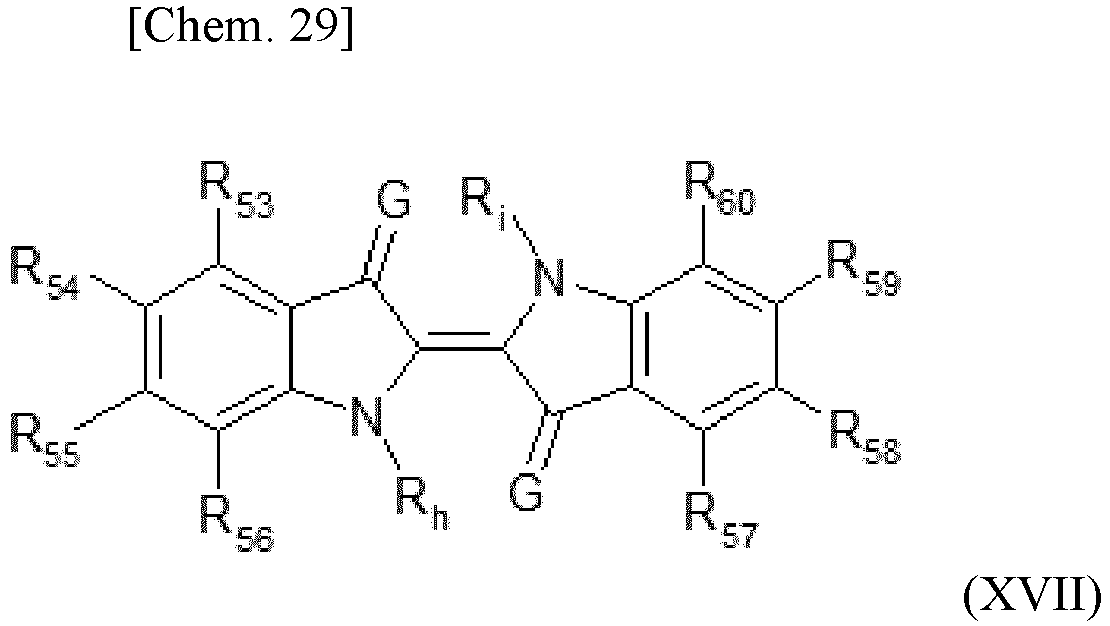
- R53, R54, R55, R56, R57, R58, R59 and R60, which may be identical or different, represent a hydrogen atom or a group chosen from:
- alkyl;
- alkoxy, alkylthio;
- hydroxyl, mercapto;
- nitro, nitroso;
- R°-C(X)-X'-, R°-X'-C(X)-, R°-X'-C(X)-X"- with R° representing a hydrogen atom or an alkyl or aryl group; X, X' and X", which may be identical or different, representing an oxygen or sulfur atom, or NR with R representing a hydrogen atom or an alkyl group;
- (O)2S(O-)-, M+ with M+ representing a hydrogen atom or a cationic counterion;
- (O)CO--, M+ with M+ as defined previously;
- G represents an oxygen or sulfur atom or a group NRe with Re as defined previously; in particular, G represents an oxygen atom;
- Ri and Rh, which may be identical or different, represent a hydrogen atom or an alkyl group; it being understood that formula (XVII) comprises at least one sulfonate radical (O)2S(O-)-, M+ or one carboxylate radical -C(O)O-, M+; preferentially sodium sulfonate.
- As an example of dyes of formula (XVII), mention may be made of: Acid Blue 74.
h) the quinoline-based dyes of formula (XVIII):
- R61 represents a hydrogen or halogen atom or an alkyl group;
- R62, R63 and R64, which may be identical or different, represent a hydrogen atom or a group (O)2S(O-)-, M+ with M+ representing a hydrogen atom or a cationic counterion;
- or alternatively R61 with R62, or R61 with R64, together form a benzo group optionally substituted with one or more groups (O)2S(O-)-, M+ with M+ representing a hydrogen atom or a cationic counterion;
- it being understood that formula (XVIII) comprises at least one sulfonate radical (O)2S(O-)-, M+ preferentially sodium sulfonate.
- As examples of dyes of formula (XVIII), mention may be made of: Acid Yellow 2, Acid Yellow 3 and Acid Yellow 5.
- Among the natural direct dyes that may be used according to the invention, mention may be made of lawsone, juglone, alizarin, purpurin, carminic acid, kermesic acid, purpurogallin, protocatechaldehyde, indigo, isatin, curcumin, spinulosin, apigenidin and orceins. Use may also be made of extracts or decoctions comprising these natural dyes and in particular henna-based poultices or extracts.
- Preferably, the direct dye(s) are chosen from anionic direct dyes.
- The colouring agent(s) may be present in a total amount ranging from 0.001% to 15% by weight and preferably from 0.005% to 10% by weight relative to the total weight of composition (C).
- The pigments may be present in concentrations ranging from 0.05% to 15% by weight, preferably from 0.1% to 10% by weight, relative to the total weight of the composition.
- The direct dye(s) may be present in concentrations ranging from 0.001% to 10% by weight of the total weight of the composition, preferably from 0.005% to 5% by weight.
- Composition (C) according to the invention comprises water. Preferably, water is present in a content ranging from 0.1% to 50% by weight, more preferentially from 0.5% to 30% by weight, relative to the total weight of the composition.
- Composition (C) according to the invention may comprise less than 2% by weight of water relative to the total weight of the dye composition.
- Composition (C) according to the invention may comprise one or more organic solvents.
- Examples of organic solvents that may be mentioned include lower C1-C4 alkanols, such as ethanol and isopropanol; polyols and polyol ethers, for instance 2-butoxyethanol, propylene glycol, propylene glycol monomethyl ether and diethylene glycol monoethyl ether and monomethyl ether, and also aromatic alcohols, for instance benzyl alcohol or phenoxyethanol, and mixtures thereof.
- Preferably, composition (C) comprises one or more organic solvents chosen from C1-C4 lower alkanols, more preferentially ethanol.
- The organic solvents may be present in a total amount inclusively between 0.1% and 20% by weight approximately relative to the total weight of the dye composition, preferably between 0.5% and 15% by weight and more preferentially inclusively between 1% and 15% by weight relative to the total weight of the composition.
- According to a particular embodiment, the organic solvent(s) may be present in a total amount inclusively between 0.5% and 80% by weight relative to the total weight of composition (C), preferably between 1% and 70% by weight, more preferentially inclusively between 5% and 60% and better still between 10% and 50% by weight relative to the total weight of composition (C).
- Composition (C) may also contain any adjuvant or additive usually used.
- Among the additives that may be contained in the composition, mention may be made of reducing agents, thickeners, softeners, antifoams, moisturizers, UV-screening agents, peptizers, solubilizers, fragrances, anionic, cationic, nonionic or amphoteric surfactants, proteins, vitamins, polymers, preserving agents, oils, waxes and mixtures thereof.
- Composition (C) according to the invention may notably be in the form of a suspension, a dispersion, a gel, an emulsion, notably an oil-in-water (O/W) or water-in-oil (W/O) emulsion, or a multiple emulsion (W/O/W or polyol/O/W or O/W/O), in the form of a cream, a mousse, a stick, a dispersion of vesicles, notably of ionic or nonionic lipids, or a two-phase or multi-phase lotion.
- In a preferred embodiment, the cosmetic composition according to the invention is an aqueous and/or aqueous-alcoholic system or a thickened emulsion in water.
- The thickener(s) may be chosen from mineral or organic thickeners. The thickener may be nonionic, cationic, anionic or amphoteric.
- The thickener(s) may notably be chosen from carboxyvinyl polymers such as crosslinked acrylic acid homopolymers (carbomer) such as those sold under the name Carbopol by the company Goodrich, polyacrylates and polymethacrylates such as the products sold under the names Lubrajel or Norgel 25 by the company Guardian or under the name Hispagel by the company Hispano Chimica; polyacrylamides such as the product sold under the name Sepigel 305 by the company SEPPIC; polysaccharides such as alginates, cellulose and derivatives thereof, notably carboxymethylcellulose, hydroxymethylcellulose, hydroxypropylcellulose and microcrystalline cellulose; natural gums such as xanthan gum, guar gum, locust bean gum, acacia gum, scleroglucans, chitin and chitosan derivatives, carrageenans; or clays such as montmorillonite and derivatives, bentones and derivatives, and magnesium aluminium silicates and derivatives (Veegum).
- According to a particular embodiment of the invention, composition (C) comprises at least one thickener chosen from crosslinked acrylic and/or methacrylic acid polymers.
- According to a particular embodiment of the invention, the composition comprises at least one thickener chosen from crosslinked acrylic acid homopolymers.
- The thickener may be present in the composition in a total content ranging from 0.01% to 10% by weight relative to the weight of the composition, preferably from 0.1% to 5% by weight relative to the weight of the composition, preferably from 0.4% to 2% by weight relative to the weight of the composition.
- A person skilled in the art may select the appropriate presentation form, and also the method for preparing it, on the basis of his or her general knowledge, taking into account firstly the nature of the constituents used, notably their solubility in the support, and secondly the intended application of the composition.
- According to a preferred embodiment, composition (C) according to the invention comprises 3-aminopropyltriethoxysilane (APTES), at least one non-amino silicone of formula (III) as described previously, and at least one pigment.
- According to a more preferred embodiment, composition (C) according to the invention comprises 3-aminopropyltriethoxysilane (APTES), at least one non-amino silicone of formula (IIIa) or (IIId)as described previously, and at least one pigment.
- The present invention also relates to the use of composition (C) as described above for the cosmetic treatment of, in particular for dyeing, keratin fibres, in particular human keratin fibres such as the hair.
- The present invention also relates to a process for treating human keratin fibres such as the hair, which consists in extemporaneously mixing, at the time of use, two compositions (A) and (B) and in applying the mixture to the fibres, said mixture comprising an alkoxysilane/non-amino silicone mass ratio ranging from 95/5 to 5/95, with:
- composition (A) comprising at least one alkoxysilane chosen from the compounds of formula (I), oligomers thereof and/or mixtures thereof as described previously;
- composition (B) comprising at least one non-amino silicone chosen from the compounds of formula (III) as described previously; and at least one colouring agent chosen from pigments, direct dyes and mixtures thereof; it being understood that composition (A) and/or composition (B) comprise water.
- Preferably, composition (A) does not comprise at least one non-amino silicone chosen from the compounds of formula (III) and composition (B) does not comprise at least one alkoxysilane chosen from the compounds of formula (I), oligomers thereof and/or mixtures thereof.
- According to a first embodiment, water is present in composition (A). Thus, composition (A) and composition (B) are mixed extemporaneously at the time of use before being applied to the keratin fibres.
- According to a second embodiment, water is present in composition (B). Thus, composition (A) and composition (B) are mixed extemporaneously at the time of use before being applied to the keratin fibres.
- According to a third embodiment, water is present in a composition (D). According to this third embodiment, composition (A), composition (B) and composition (D) are mixed extemporaneously at the time of use before being applied to the keratin fibres.
- According to another particular embodiment, the process of the invention is a process for treating human keratin fibres such as the hair, which consists in extemporaneously mixing, at the time of use, two compositions (A) and (B) and in applying the mixture to the fibres moistened with water, said mixture comprising an alkoxysilane/non-amino silicone mass ratio ranging from 95/5 to 5/95, with:
- composition (A) comprising at least one alkoxysilane chosen from the compounds of formula (I), oligomers thereof and/or mixtures thereof as described previously; and
- composition (B) comprising at least one non-amino silicone chosen from the compounds of formula (III) as described previously; and at least one colouring agent chosen from pigments, direct dyes and mixtures thereof.
- Thus, composition (C) applied to the keratin fibres is obtained by extemporaneous mixing of compositions (A) and (B) or extemporaneous mixing of compositions (A), (B) and (D).
- Preferably, the alkoxysilane of formula (I)/non-amino silicone of formula (III) mass ratio ranges from 90/10 to 10/90, preferably from 60/40 to 40/60; more preferentially, the alkoxysilane of formula (I)/non-amino silicone of formula (III) mass ratio is 50/50.
- Preferably, composition (A) and/or composition (B) comprises one or more organic solvents, better still chosen from C1-C4 lower alkanols, more preferentially ethanol.
- The present invention also relates to a process for dyeing keratin fibres, in particular human keratin fibres, preferably the hair, comprising:
- the application to said fibres of a composition comprising:
- a) at least one alkoxysilane chosen from the compounds of formula (I), oligomers thereof and/or mixtures thereof as described previously;
- b) at least one non-amino silicone chosen from the compounds of formula (III) as described previously;
- c) water and
- d) at least one colouring agent chosen from pigments, direct dyes and mixtures thereof as described previously.
- Preferably, the alkoxysilane of formula (I)/non-amino silicone of formula (III) mass ratio ranges from 95/5 to 5/95, better still from 90/10 to 10/90, more preferentially from 60/40 to 40/60; even more preferentially, the alkoxysilane of formula (I)/non-amino silicone of formula (III) mass ratio is 50/50.
- According to a particular embodiment, the present invention also relates to a process for treating human keratin fibres such as the hair, which consists in extemporaneously mixing, at the time of use, two compositions (A) and (B) and in applying said mixture to the fibres, with:
- composition (A) comprising at least one alkoxysilane chosen from the compounds of formula (Ia) as described previously, oligomers thereof and/or mixtures thereof;
- composition (B) comprising at least one non-amino silicone of formula (IIId) as described previously;
- Preferably, composition (A) does not comprise at least one non-amino silicone of formula (IIId) and composition (B) does not comprise at least one alkoxysilane chosen from the compounds of formula (Ia), oligomers thereof and/or mixtures thereof.
- According to a first embodiment, water is present in composition (A). The colouring agent is present in composition (B). Thus, composition (A) and composition (B) are mixed extemporaneously at the time of use before being applied to the keratin fibres.
- According to a second embodiment, water is present in composition (B). The colouring agent is present in composition (A). Thus, composition (A) and composition (B) are mixed extemporaneously at the time of use before being applied to the keratin fibres.
- According to a third embodiment, water and the colouring agent are present in composition (D). Thus, composition (A), composition (B) and composition (D) are mixed extemporaneously at the time of use before being applied to the keratin fibres.
- Preferably, composition (A) comprises water and composition (B) comprises at least one colouring agent chosen from pigments, direct dyes and mixtures thereof.
- According to another particular embodiment, the process of the invention is a process for treating keratin fibres such as the hair, which consists in extemporaneously mixing, at the time of use, two compositions (A) and (B) and in applying the mixture to the fibres moistened with water, with:
- composition (A) comprising at least one alkoxysilane chosen from the compounds of formula (Ia) as described previously, oligomers thereof and/or mixtures thereof;
- composition (B) comprising at least one non-amino silicone of formula (IIId) as described previously;
- Thus, composition (C) applied to the keratin fibres is obtained by extemporaneous mixing of compositions (A) and (B) or extemporaneous mixing of compositions (A), (B) and (D).
- The cosmetic composition described above may be used on wet or dry keratin fibres, and also on any type of fair or dark, natural or dyed, permanent-waved, bleached or relaxed fibres.
- According to a particular embodiment of the invention, the fibres are washed before applying the cosmetic composition (C).
- The application to the fibres may be performed via any standard means, in particular using a comb, a fine brush, a coarse brush, a sponge or with the fingers.
- Preferably, after applying the cosmetic composition (C) to the keratin fibres, there is a waiting time of between 1 minute and 6 hours, in particular between 10 minutes and 5 hours, more particularly between 30 minutes and 4 hours, more preferentially about 1 hour.
- Preferably, after applying the cosmetic composition (C) to the keratin fibres, the fibres are left to dry or are dried, for example at a temperature of greater than or equal to 30°C.
- According to a particular embodiment, the fibres may be dried at a temperature of greater than or equal to 40°C. According to a particular embodiment, the fibres may be dried at a temperature of greater than 40°C and less than 100°C.
- Preferably, if the fibres are dried, they are dried, in addition to a supply of heat, with a flow of air.
- During drying, a mechanical action may be exerted on the locks, such as combing, brushing or running the fingers through. This operation may similarly be performed once the fibres have been dried, naturally or otherwise.
- The drying step may be performed with a drying device such as a hood, a hairdryer, a climazone, etc.
- When the drying step is performed with a hood or a hairdryer, the drying temperature is between 40 and 110°C, preferably between 50 and 90°C.
- After the drying step, a shaping step may be performed, for example with a straightening iron; the temperature for the shaping step is between 110 and 220°C, preferably between 140 and 200°C.
- Once the drying is complete, final rinsing or shampooing may optionally be performed.
- According to a particular variant of the invention, a step of acidic rinsing at a pH of between 1 and 5 may be applied after the step of drying the locks and before the final shampoo wash.
- According to a particular variant of the invention, a care of mask type with a pH of between 1 and 5 may be applied after the step of drying the locks and before the final shampoo wash with a leave-on time of between 1 and 45 minutes, in particular between 5 minutes and 30 minutes and preferably about 15 minutes.
- According to a preferred embodiment, the process of the invention is a process for dyeing keratin fibres, in particular human keratin fibres, preferably the hair, comprising the application to said fibres of a composition (C) comprising:
- a) at least one alkoxysilane chosen from the compounds of formula (I), oligomers thereof and/or mixtures thereof as described previously;
- b) at least one non-amino silicone chosen from the compounds of formula (III) as described previously;
- c) water and
- d) at least one colouring agent chosen from pigments, direct dyes and mixtures thereof as described previously; and
- followed by a drying step as defined previously and optionally followed by a step of rinsing at acidic pH as defined previously and/or a shampoo wash;
- said dyeing process may be repeated several times, it being understood that each new application of composition (C) is performed after an interval ranging from 1 minute to several weeks.
- Preferably, the alkoxysilane(s) chosen from the compounds of formula (I), oligomers thereof and/or a mixture thereof and the non-amino silicone(s) of formula (III) included in composition (C) are identical or different in each step of repetition of the dyeing process.
- According to another preferred embodiment, the process is a process for dyeing keratin fibres, in particular human keratin fibres, preferably the hair, comprising:
- 1) the application to said fibres of a composition (E) comprising at least one colouring agent chosen from pigments, direct dyes and mixtures thereof as described previously; and
- 2) the application to said fibres of a composition (F) comprising:
- a) at least one alkoxysilane chosen from the compounds of formula (I), oligomers thereof and/or mixtures thereof as described previously;
- b) at least one non-amino silicone chosen from the compounds of formula (III) as described previously;
- c) at least water; and
- Preferably, composition (E) is a pigmented composition, which is preferably aqueous, aqueous-alcoholic, alcoholic or anhydrous, in spray, mascara, pen, roll-on or pad form. Such products are sold, for example, by L'Oreal Paris under the name Magic Retouch or by Garnier under the name Express Retouch.
- Step 2, i.e. the step of applying composition (F) above, may be repeated several times.
- According to a particular embodiment, the process is a process for dyeing keratin fibres, in particular human keratin fibres, preferably the hair, comprising the application to fibres moistened with water of a composition (C) comprising:
- a) at least one alkoxysilane chosen from the compounds of formula (I), oligomers thereof and/or mixtures thereof as described previously;
- b) at least one non-amino silicone chosen from the compounds of formula (III) as described previously;
- c) at least one colouring agent chosen from pigments, direct dyes and mixtures thereof as described previously; and
- The present invention also relates to a device for treating human keratin fibres such as the hair, comprising two compartments containing:
- in a first compartment (C1), a composition (A) comprising at least one alkoxysilane chosen from the compounds of formula (I), oligomers thereof and/or mixtures thereof as described previously;
- in a second compartment (C2), a composition (B) comprising at least one non-amino silicone chosen from the compounds of formula (III) as described previously; and at least one colouring agent chosen from a pigment, a direct dye and mixtures thereof;
- According to a particular embodiment, the treating device according to the invention is a device for treating human keratin fibres such as the hair, comprising two compartments containing:
- in a first compartment (C1), a composition (A) comprising at least one alkoxysilane chosen from the compounds of formula (I), oligomers thereof and/or mixtures thereof as described previously; and at least one colouring agent chosen from pigments, direct dyes and mixtures thereof;
- in a second compartment (C2), a composition (B) comprising at least one non-amino silicone chosen from the compounds of formula (III) as described previously and at least one colouring agent chosen from pigments, direct dyes and mixtures thereof;
- According to a particular embodiment, the treating device a device for treating human keratin fibres such as the hair, comprising three compartments containing:
- in a first compartment (C1), a composition (A) comprising at least one alkoxysilane chosen from the compounds of formula (I), oligomers thereof and/or mixtures thereof as described previously; and at least one colouring agent chosen from pigments, direct dyes and mixtures thereof;
- in a second compartment (C2), a composition (B) comprising at least one non-amino silicone chosen from the compounds of formula (III) as described previously; and at least one colouring agent chosen from pigments, direct dyes and mixtures thereof; and
- in a third compartment (C3), a composition (D) comprising water;
- According to a particular embodiment, the treating device according to the invention is a device for treating keratin fibres such as the hair, comprising two compartments containing:
- in a first compartment (C1), a composition (A) comprising at least one alkoxysilane chosen from the compounds of formula (Ia), oligomers thereof and/or mixtures thereof as described previously;
- in a second compartment (C2), a composition (B) comprising at least one non-amino silicone of formula (III d) as described previously;
- it being understood that composition (A) and/or composition (B) comprise water, and
- it being understood that composition (A) and/or composition (B) comprise at least one colouring agent chosen from pigments, direct dyes and mixtures thereof.
- According to a particular embodiment, the treating device is a device for treating keratin fibres such as the hair, comprising at least three compartments containing:
- in a first compartment (C1), a composition (A) comprising at least one alkoxysilane chosen from the compounds of formula (Ia), oligomers thereof and/or mixtures thereof as described previously;
- in a second compartment (C2), a composition (B) comprising at least one non-amino silicone of formula (III d) as described previously; and
- in a third compartment (C3), a composition (D) comprising water;
- The present invention will now be described more specifically by means of examples, which do not in any way limit the scope of the invention. However, the examples make it possible to support specific features, variants and preferred embodiments of the invention.
- Solution 1 (i.e. solution of 3-aminopropyltriethoxysilane (APTES)) is prepared according to the process below:
- pure APTES (APTES Sil soft A-1100 sold by the company Momentive Performance Materials) is mixed with an aqueous solution brought to pH=1 by adding HCl, then a solution of ethanol is added and said mixture is placed on a VWR brand magnetic stirrer (rotation speed 500 rpm) for 24 hours at room temperature.
- The alcoholic solution 2 (i.e. alcoholic solution of non-amino silicone) is prepared according to the process below:
- the poly dimethylsiloxane (PDMS) compound bearing hydroxyl end functions (PDMS reference 481939 sold by the company Sigma-Aldrich) is diluted in an ethanol solution in which the pigment (iron oxide sold by the company Sun Chemical under the name SunPuro Red Iron Oxide®) is dispersed.
- Solution 1 is mixed with solution 2 and said mixture is applied to the keratin fibres.
- The various compounds are present in the amounts below in g and also the mass ratio in the final APTES/PDMS mixture.
[Tables 1] Chemical name Composition A Composition B Solution 1 3-Aminopropyltriethoxysilane (APTES) 2 0.3 Ethanol 0.89 0.13 Water 0.12 0.02 Solution 2 Polydimethylsiloxanes (PDMS) bearing hydroxyl end functions 1 2.7 Pigment (iron oxide sold by the company Sun Chemical under the name SunPuro Red Iron Oxide®) 0.3 0.3 Ethanol 7.70 8.55 APTES/PDMS ratio 67/33 10/90 - The cosmetic compositions (mixture of solution 1 and of solution 2 in the various ratios) are applied to locks of dry natural hair containing 90% white hairs, at a rate of 1 g of composition per gram of lock.
- The locks of hair are then combed and dried with a hairdryer.
- The hair is dyed uniformly and intensely.
- Next, the locks of hair thus dyed are then subjected to a test of several repeated shampoo washes so as to evaluate the fastness (persistence) of the colouring obtained with respect to shampoo washing.
- Shampoo wash protocol:
- The locks are washed with standard shampoo (Garnier Ultra Doux) respectively at T=0 (i.e. immediately after the application of the dye composition to the keratin fibres).
- The locks of hair are then rinsed, combed and dried with a hairdryer.
- The next shampoo wash is then performed on the locks obtained after the application of the hairdryer.
- The persistence of the colour of the locks was evaluated in the CIE L*a*b* system, using a Minolta Spectrophotometer CM3600D colorimeter (illuminant D65, angle 10°, specular component included).
- In this L*a*b* system, L* represents the intensity of the colour, a* indicates the green/red colour axis and b* the blue/yellow colour axis.
- The persistence of the colouring is evaluated by the colour difference ΔE between the dyed locks before shampooing, then after having undergone 1 and 5 shampoo washes according to the protocol described above. The lower the value of ΔE, the more persistent the colour with respect to shampoo washing.
- The ΔE value is calculated according to the following equation:

- In this equation, L*a*b* represent the values measured after dyeing the hair and after having undergone shampoo washes, and L0*a0*b0* represent the values measured after dyeing the hair but before shampoo washing.
[Tables 2] Compositions Number of shampoo washes L* a* b* ΔE Composition A 0 34.1 30.39 20.2 0 1 32.14 30.86 20.38 2.02 5 37.19 27.08 18.43 4.86 Composition B 0 45.35 30.3 25.66 0 1 42.22 31.21 26.72 3.43 5 48.49 26.92 23.41 5.13 - The locks of hair dyed with composition A according to the invention or composition B according to the invention and washed with one or five shampoo washes have low ΔE values.
- Thus, the coloured coating of the keratin fibres using the compositions according to the invention shows good persistence with respect to shampoo washing. Specifically, the locks of hair dyed with the compositions according to the invention and washed with one or five shampoo washes show good persistence of the colour.
- Solution 1 (i.e. solution of 3-aminopropyltriethoxysilane (APTES)) is prepared according to the process below:
- 15 g of APTES (APTES Sil soft A-1100 sold by the company Momentive Performance Materials) are mixed with 1.83 g of HCl (37% solution, Carlo Erba), and the solution is made up to 100 g with water. The solution is placed on a VWR brand magnetic stirrer (rotation speed 500 rpm) for 2 hours at room temperature.
- The alcoholic solution 2 (i.e. alcoholic solution of non-amino silicone) is prepared according to the process below:
- the polydimethylsiloxane (PDMS) compound bearing hydroxyl end functions (PDMS reference 481939 sold by the company Sigma-Aldrich) is diluted in an ethanol solution in which the pigment (iron oxide sold by the company Sun Chemical under the name SunPuro Red Iron Oxide®) is dispersed.
- The various compounds are present in the amounts below in g and also the mass ratio in the final APTES/PDMS mixture.
[Tables 3] Chemical name Composition C Compositi on D Composition E Composition F Composition G Composition H Solution 1 18 13 10 7 2 10 Solution 2 Polydimethyl siloxanes (PDMS) bearing hydroxyl end functions 0.3 1 1.5 2 2.7 1.5 Pigment (iron oxide sold by the company Sun Chemical under the name 0.3 0.3 0.3 0.3 0.3 - SunPuro Red Iron Oxide®) Pigment (D&C Red 7 sold by the company LCW Sensient under the name Unipure Red LC 3079) - - - - - 0.3 Ethanol 7.35 7.70 7.95 8.20 8.55 7.95 APTES/PDMS ratio 90/10 67/33 50/50 33/67 10/90 50/50 - The cosmetic compositions (mixture of solution 1 and of solution 2 in the various ratios) are applied to locks of dry natural hair containing 90% white hairs, at a rate of 1 g of composition per gram of lock.
- The locks of hair are then combed and dried with a hairdryer.
- The hair is dyed uniformly and intensely.
- Next, the locks of hair thus dyed are then subjected to a test of several repeated shampoo washes so as to evaluate the fastness (persistence) of the colouring obtained with respect to shampoo washing.
- The shampoo wash protocol is identical to that described in Example 1.
- The persistence of the colour of the locks was evaluated in the CIE L*a*b* system, using a Minolta Spectrophotometer CM3600D colorimeter (illuminant D65, angle 10°, specular component included), as explained in Example 1.
[Tables 4] Compositions Number of shampoo washes L* a* b* ΔE Composition C 0 30.74 34.93 23.92 0 1 27.09 32.43 20.11 5.84 5 30.12 34.17 21.41 2.69 Composition D 0 32.06 33.08 22.32 0 1 30.05 31.9 20.67 2.86 5 31.12 32.6 20.82 1.83 Composition E 0 33.96 34.29 24.22 0 1 32.11 34.15 23.22 2.11 5 31.64 32.88 21.30 3.99 Composition F 0 27.85 34.26 23.09 0 1 27.14 33.29 21.1 2.32 5 29.9 32.57 20.6 3.64 Composition G 0 30.69 32.9 22.75 0 1 30.42 34.88 23.62 2.18 5 32.11 35.31 24.15 3.13 Composition H 0 27.36 41.51 59.1 0 1 26.66 40.91 59.2 0.93 5 26.65 39.88 58.4 1.91 - The locks of hair dyed with compositions C to H according to the invention and washed with one or five shampoo washes have low ΔE values.
- Thus, the coloured coating of the keratin fibres using the compositions according to the invention shows good persistence with respect to shampoo washing. Specifically, the locks of hair dyed with the compositions according to the invention and washed with one or five shampoo washes show good persistence of the colour.
- Solution 1 (i.e. solution of tetraethoxysilane (TEOS)) is prepared according to the process below:
- pure TEOS (reference 86578 sold by the company Sigma-Aldrich) is mixed with an aqueous solution of pH=1 by adding HCl, then an ethanol solution is added and said mixture is placed on a VWR brand magnetic stirrer (rotation speed 500 rpm) for 24 hours at room temperature.
- The alcoholic solution 2 (i.e. alcoholic solution of non-amino silicone) is prepared according to the process below:
- the polydimethylsiloxane (PDMS) compound bearing hydroxyl end functions (reference 481939 sold by the company Sigma-Aldrich) is diluted in an ethanol solution in which the pigment (iron oxide sold by the company Sun Chemical under the name SunPuro Red Iron Oxide®) is dispersed.
- Solution 1 is mixed with solution 2 and said mixture is applied to the keratin fibres.
- The various compounds are present in the amounts below in g and also the mass ratio in the final TEOS/PDMS mixture.
[Tables 5] Chemical name Composition I Composition J Composition K Composition L Composition M Solution 1 Tetraethox ysilane (TEOS) 2.7 2 1.5 1 0.3 Ethanol 1.19 0.89 0.66 0.44 0.13 Water 0.16 0.12 0.09 0.06 0.02 Solution 2 Polydimeth ylsiloxanes (PDMS) bearing hydroxyl end functions 0.3 1 1.5 2 2.7 Pigment 0.3 0.3 0.3 0.3 0.3 Ethanol 7.35 7.70 7.95 8.20 8.55 TEOS/PDMS ratio 90/10 67/33 50/50 33/67 10/90 - The cosmetic compositions (mixture of solution 1 and of solution 2 in the various ratios) are applied to locks of dry natural hair containing 90% white hairs, at a rate of 1 g of composition per gram of lock.
- The locks of hair are then combed and dried with a hairdryer.
- The hair is dyed uniformly and intensely.
- Next, the locks of hair thus dyed are then subjected to a test of several repeated shampoo washes so as to evaluate the fastness (persistence) of the colouring obtained with respect to shampoo washing.
- The shampoo wash protocol is identical to that described in Example 1.
- The persistence of the colour of the locks was evaluated in the CIE L*a*b* system, using a Minolta Spectrophotometer CM3600D colorimeter (illuminant D65, angle 10°, specular component included), as explained in Example 1.
[Tables 6] Compositions Number of shampoo washes L* a* b* ΔE Composition I 0 34.58 30.32 22.48 0 1 40.16 28.86 22.15 5.78 5 41.02 26.27 20.21 7.94 Composition J 0 38.46 31.99 23.46 0 1 37.69 32.61 25.15 1.96 5 45.99 26.58 20.58 9.71 Composition K 0 35.53 34.78 26.1 0 1 38.51 31.64 23.84 4.88 5 42.14 25.88 19.95 12.68 Composition L 0 36.26 33.02 23.18 0 1 35.35 33.1 24.73 1.80 5 40.91 26.7 19.99 8.47 Composition M 0 37.1 30.75 21.61 0 1 38.25 32.96 25.12 4.30 5 40.6 26.52 20.99 5.53 - The locks of hair dyed with compositions I to M according to the invention and washed with one or five shampoo washes have low ΔE values.
- Thus, the coloured coating of the keratin fibres using the compositions according to the invention shows good persistence with respect to shampoo washing. Specifically, the locks of hair dyed with the compositions according to the invention and washed with one or five shampoo washes show good persistence of the colour.
- Solution 1 (i.e. solution of tetraethoxysilane (TEOS) and of 3-aminopropyltriethoxysilane (APTES)) is prepared according to the process below:
- pure TEOS (reference 86578 sold by the company Sigma-Aldrich) and APTES (APTES Silsoft A-1100 sold by the company Momentive Performance Materials) are mixed with an aqueous solution at pH=1 by adding HCl, then an ethanol solution is added and said mixture is placed on a VWR brand magnetic stirrer (rotation speed 500 rpm) for 24 hours at room temperature.
- The alcoholic solution 2 (i.e. alcoholic solution of non-amino silicone) is prepared according to the process below:
- the polydimethylsiloxane (PDMS) compound bearing hydroxyl end functions (reference 481939 sold by the company Sigma-Aldrich) is diluted in an ethanol solution in which the pigment (iron oxide sold by the company Sun Chemical under the name SunPuro Red Iron Oxide®) is dispersed.
- Solution 1 is mixed with solution 2 and said mixture is applied to the keratin fibres.
- The various compounds are present in the amounts below in g and also the mass ratio in the final TEOS-APTES/PDMS mixture.
[Tables 7] Chemical name Composition N Solution 1 Tetraethoxysilane (TEOS) 0.75 3-Aminopropyltriethoxysilane (APTES) 0.75 Ethanol 0.66 Water 0.09 Solution 2 Polydimethylsiloxanes (PDMS) bearing hydroxyl end functions 1.5 Pigment 0.3 Ethanol 7.95 TEOS-APTES/PDMS ratio 25+25/50 - The cosmetic composition (mixture of solution 1 and of solution 2 in the various ratios) is applied to locks of dry natural hair containing 90% white hairs, at a rate of 1 g of composition per gram of lock.
- The locks of hair are then combed and dried with a hairdryer.
- The hair is dyed uniformly and intensely.
- Next, the locks of hair thus dyed are then subjected to a test of several repeated shampoo washes so as to evaluate the fastness (persistence) of the colouring obtained with respect to shampoo washing.
- The shampoo wash protocol is identical to that described in Example 1.
- The persistence of the colour of the locks was evaluated in the CIE L*a*b* system, using a Minolta Spectrophotometer CM3600D colorimeter (illuminant D65, angle 10°, specular component included), as explained in Example 1.
[Tables 8] Compositions Number of shampoo washes L* a* b* ΔE Composition N 0 33.31 32.87 21.4 0 1 34.49 32.76 24.03 2.88 5 37.09 31.45 22.96 4.33 - The locks of hair dyed with composition N according to the invention and washed with one or five shampoo washes have low ΔE values.
- Thus, the coloured coating of the keratin fibres using a composition according to the invention shows good persistence with respect to shampoo washing. Specifically, the locks of hair dyed with the composition according to the invention and washed with one or five shampoo washes show good persistence of the colour.
- Solution 1 (i.e. solution of 3-aminopropyltriethoxysilane (APTES)) is prepared according to the process below:
- 15 g of APTES (APTES Sil soft A-1100 sold by the company Momentive Performance Materials) are mixed with 1.83 g of HCl and the solution is made up to 100 g with water. The solution is placed on a VWR brand magnetic stirrer (rotation speed 500 rpm) for 2 hours at room temperature.
- The alcoholic solution 2 (i.e. alcoholic solution of non-amino silicone) is prepared according to the process below:
- the polydimethylsiloxane (PDMS) compound bearing hydroxyl end functions (reference 481939 sold by the company Sigma-Aldrich) is diluted in an ethanol solution in which the pigment (iron oxide sold by the company Sun Chemical under the name SunPuro Red Iron Oxide®) and tetraethoxysilane (TEOS, 86578 sold by the company Sigma-Aldrich) are dispersed.
- The various compounds are present in the amounts below in g and also the mass ratio in the final APTES-TEOS/PDMS mixture.
[Tables 9] Chemical name Composition O Solution 1 3-Aminopropyltriethoxysilane (APTES) 0.75 Ethanol 0.66 Water 0.09 Solution 2 Polydimethylsiloxanes (PDMS) bearing hydroxyl end functions 1.5 Tetraethoxysilane (TEOS) 0.75 Pigment 0.3 Ethanol 7.95 TEOS-APTES/PDMS ratio 25+25/50 - Protocol:
- The cosmetic composition (mixture of solution 1 and of solution 2 in the various ratios) is applied to locks of dry natural hair containing 90% white hairs, at a rate of 1 g of composition per gram of lock.
- The locks of hair are then combed and dried with a hairdryer.
- The hair is dyed uniformly and intensely.
- Next, the locks of hair thus dyed are then subjected to a test of several repeated shampoo washes so as to evaluate the fastness (persistence) of the colouring obtained with respect to shampoo washing.
- The shampoo wash protocol is identical to that described in Example 1.
- The persistence of the colour of the locks was evaluated in the CIE L*a*b* system, using a Minolta Spectrophotometer CM3600D colorimeter (illuminant D65, angle 10°, specular component included), as explained in Example 1.
[Tables 10] Compositions Number of shampoo washes L* a* b* ΔE Composition O 0 27.61 34.69 22.17 0 1 28.46 32.41 20.8 2.79 5 30.70 32.92 21.3 3.67 - The locks of hair dyed with composition O according to the invention and washed with one or five shampoo washes have low ΔE values.
- Thus, the coloured coating of the keratin fibres using a composition according to the invention shows good persistence with respect to shampoo washing. Specifically, the locks of hair dyed with the composition according to the invention and washed with one or five shampoo washes show good persistence of the colour.
- Comparative composition Q: A polydimethylsiloxane (PDMS) compound bearing hydroxyl end functions (reference 481939 sold by the company Sigma-Aldrich) is diluted in an ethanol solution in which the pigment (iron oxide sold by the company Sun Chemical under the name SunPuro Red Iron Oxide®) and APTES (APTES Silsoft A-1100 sold by the company Momentive Performance Materials) are dispersed.
- The APTES is not hydrolysed, comparative composition Q does not comprise any water.
- The various compounds are present in the amounts below in g and also the mass ratio in the final APTES/PDMS mixture.
[Tables 11] Chemical name Composition Q (comparative) Polydimethylsiloxanes (PDMS) bearing hydroxyl end functions 1.5 Pigment 0.3 3-Aminopropyltriethoxysilane (APTES) 1.5 Ethanol 7.95 APTES/PDMS ratio 50/50 - Comparative composition Q is applied to locks of dry natural hair containing 90% white hairs, at a rate of 1 g of composition per gram of lock.
- The locks of hair are then combed and dried with a hairdryer.
- Next, the locks of hair thus dyed are then subjected to a test of several repeated shampoo washes so as to evaluate the fastness (persistence) of the colouring obtained with respect to shampoo washing.
- The shampoo wash protocol is identical to that described in Example 1.
- The persistence of the colour of the locks was evaluated in the CIE L*a*b* system, using a Minolta Spectrophotometer CM3600D colorimeter (illuminant D65, angle 10°, specular component included), as explained in Example 1.
[Tables 12] Compositions Number of shampoo washes L* a* b* ΔE Composition Q (comparative) 0 30.85 35.63 24.12 0 1 31.77 33.47 22.46 2.88 5 36.14 30.75 22.58 7.36 Composition E (invention) 0 33.96 34.29 24.22 0 1 32.11 34.15 23.22 2.11 5 31.64 32.88 21.30 3.99 - The locks of hair dyed with composition E according to the invention and washed with one or five shampoo washes have lower ΔE values than the locks of hair dyed with comparative composition Q.
- Thus, the coloured coating of the keratin fibres using a composition according to the invention shows good persistence with respect to shampoo washing.
Claims (16)
- Composition (C) for treating keratin fibres, notably human keratin fibres such as the hair, comprising:a) at least one alkoxysilane chosen from the compounds of formula (I) below, oligomers thereof and/or mixtures thereof:
R1 xSi(OR2)(4-x) (I)
in which:- R1 represents an alkoxy group containing from 1 to 10 carbon atoms, a linear or branched, saturated or unsaturated, cyclic or acyclic C1 to C22, notably C1 to C20, hydrocarbon-based radical, which may be substituted with at least one group chosen from a hydroxyl group (OH); a thiol group; an amino group NH2; an alkylamino group NHR in which R denotes a linear or branched alkyl radical containing from 1 to 20 carbon atoms, notably from 1 to 10 carbon atoms; an alkoxy group containing from 1 to 10 carbon atoms; a cycloalkyl containing from 3 to 40 carbon atoms; an aryl containing from 6 to 30 carbon atoms; R1 possibly being interrupted with at least one heteroatom chosen from O, S, NH or a carbonyl group (CO);- R2 represents a hydrogen atom or an alkyl group containing from 1 to 20 carbon atoms, preferably from 2 to 6 carbon atoms;- x denotes an integer ranging from 1 to 3;b) at least one non-amino silicone chosen from the compounds of formula (III) below: - R1 independently represents a hydroxyl group or an alkoxy group containing from 1 to 2 carbon atoms;- R2 independently represents a hydrogen atom; an alkyl group containing from 1 to 20 carbon atoms, optionally substituted with at least one group chosen from a hydroxyl group (OH) or a thiol group, said alkyl group preferably being optionally substituted with at least one hydroxyl group (OH);- R3 represents a hydrogen atom; a hydroxyl group; an alkyl group containing from 1 to 10 carbon atoms, optionally substituted with at least one group chosen from a hydroxyl group (OH) or a thiol group; a cycloalkyl group containing from 3 to 20 carbon atoms, optionally substituted with at least one group chosen from a hydroxyl group (OH) or a thiol group; an alkoxy group containing from 1 to 2 carbon atoms, optionally substituted with at least one group chosen from a hydroxyl group (OH) or a thiol group; an aryl group containing from 6 to 12 carbon atoms, optionally substituted with at least one group chosen from a hydroxyl group (OH) or a thiol group;- A represents an alkylene group containing from 1 to 2 carbon atoms;- X represents a hydrogen atom, an alkyl group containing from 1 to 2 carbon atoms, a group -(R4-O)p- with R4 representing a linear or branched alkylene group containing from 2 to 4 carbon atoms and p denoting an integer ranging from 0 to 3;- m denotes an integer ranging from 1 to 3, n is an integer ranging from 0 to 2 and m+n=3;- m' denotes an integer ranging from 1 to 3, n' is an integer ranging from 0 to 2 and m'+n'=3;- j denotes an integer ranging from 0 to 1;- t denotes an integer ranging from 0 to 1;- y denotes an integer ranging from 0 to 10, z denotes an integer ranging from 0 to 500, with x+z ranging from 0 to 500 and x+y+z≥4; andit being understood that if X represents a hydrogen atom, then t=0 and if p=0, then t=1;c) water; andd) at least one colouring agent chosen from pigments, direct dyes and mixtures thereof;said composition being such that the alkoxysilane/non-amino silicone mass ratio ranges from 95/5 to 5/95.
 - Composition according to Claim 1, characterized in that the alkoxysilane(s) of formula (I), oligomers thereof and/or mixtures thereof are chosen from the compounds of formulae (Ia) and (Ib) below, alone or as a mixture:
 in which:- Ra and Rb, which may be identical or different, represent a hydrogen atom; an alkyl group containing from 1 to 20 carbon atoms, preferably from 1 to 10 carbon atoms; a cycloalkyl group containing from 3 to 20 carbon atoms; an aryl group containing from 6 to 12 carbon atoms; an aminoalkyl group containing from 1 to 20 carbon atoms; a hydroxyalkyl group containing from 1 to 20 carbon atoms; an alkoxy group containing from 1 to 10 carbon atoms; an alkylcarbonyl group containing from 1 to 10 carbon atoms, preferably methylcarbonyl (i.e. acetyl);- Rc represents a hydrogen atom; an alkyl group containing from 1 to 20 carbon atoms, preferably a methyl; an alkoxy group containing from 1 to 10 carbon atoms, preferably an ethoxy group; or an alkylaryl group containing from 7 to 12 carbon atoms;- Rd and Re, which may be identical or different, represent an alkyl group containing from 1 to 20 carbon atoms, preferably an ethyl;- k denotes an integer ranging from 0 to 20, preferably ranging from 0 to 3;- Rf represents a hydrogen atom; an alkyl group containing from 1 to 20 carbon atoms such as an ethyl group; or a group of formula (II) below:
 in which Rn represents a hydroxyl group (OH); an alkyl group containing from 1 to 20 carbon atoms, preferably a methyl.
 - Composition according to either one of the preceding claims, characterized in that the alkoxysilane(s) chosen from the compounds of formula (I), oligomers thereof and/or mixtures thereof, are chosen from 3-aminopropyltriethoxysilane (APTES), 3-aminopropylmethyldiethoxysilane (APMDES), N-cyclohexylaminomethyltriethoxysilane, tetraethoxysilane (TEOS), methyltriethoxysilane (MTES), dimethyldiethoxysilane (DMDES), diethyldiethoxysilane, dipropyldiethoxysilane, propyltriethoxysilane, isobutyltriethoxysilane, phenyltriethoxysilane, phenylmethyldiethoxysilane, diphenyldiethoxysilane, benzyltriethoxysilane, benzylmethyldiethoxysilane, dibenzyldiethoxysilane, acetoxymethyltriethoxysilane and mixtures thereof, preferably 3-aminopropyltriethoxysilane (APTES), tetraethoxysilane (TEOS) and mixtures thereof.
- Composition according to any one of the preceding claims, characterized in that the alkoxysilane(s) of formula (I), oligomers thereof and/or mixtures thereof are present in a total amount ranging from 0.1% to 30% by weight, preferably from 0.5% to 25% by weight, better still from 0.5% to 20% by weight, relative to the total weight of the composition.
- Composition according to any one of the preceding claims, characterized in that the compounds of formula (III) are such that:- R1 independently represents a hydroxyl group or an alkoxy group containing from 1 to 2 carbon atoms;- R2 independently represents a hydrogen atom or an alkyl group containing from 1 to 10 carbon atoms, preferably a methyl;- R3 represents a hydrogen atom; a hydroxyl group; an alkyl group containing from 1 to 10 carbon atoms; an alkoxy group containing from 1 to 2 carbon atoms or an aryl group containing from 6 to 12 carbon atoms, optionally substituted with a group chosen from a hydroxyl group (OH) or a thiol group;- X represents a hydrogen atom or an alkyl group containing from 1 to 2 carbon atoms, and p denotes an integer ranging from 0 to 3;- m' denotes an integer ranging from 1 to 3, n' denotes an integer ranging from 0 to 2 and m'+n'=3;- m denotes an integer ranging from 1 to 3, n denotes an integer ranging from 0 to 2 and m+n=3;- j is equal to 0;- t denotes an integer ranging from 0 to 1; and- y denotes an integer ranging from 0 to 10, z denotes an integer ranging from 0 to 500, with x+z ranging from 0 to 500 and x+y+z≥4; andit being understood that if X represents a hydrogen atom, then t=0 and if p=0, then t=1.
- Composition according to any one of the preceding claims, characterized in that the non-amino silicone(s) are chosen from the compounds of formula (IIIa) below:
 - R1 independently represents a hydroxyl group; an alkyl group containing from 1 to 10 carbon atoms, preferably a methyl; an aryl group containing from 6 to 12 carbon atoms; an alkoxy group containing from 1 to 2 carbon atoms; or a group -O-Si(R'2)3;- R'2 and R"2 independently represent a hydrogen atom; a hydroxyl group; or an alkyl group containing from 1 to 10 carbon atoms, preferably a methyl;- a denotes an integer ranging from 0 to 10, b denotes an integer ranging from 0 to 500, with a+b≥4.
 - Composition according to Claim 6, characterized in that the non-amino silicone(s) of formula (IIIa) are such that:- R1 independently represents an alkyl group containing from 1 to 10 carbon atoms, preferably a methyl;- R'2 and R"2 independently represent a hydroxyl group or an alkyl group containing from 1 to 10 carbon atoms, preferably an alkyl group, more preferentially a methyl;- b denotes an integer ranging from 0 to 10, a denotes an integer ranging from 0 to 5, with a+b≥4.
- Composition according to any one of the preceding claims, characterized in that the non-amino silicone(s) of formula (III) are present in a total amount ranging from 0.1% to 30% by weight, preferably from 0.1% to 25% by weight, relative to the total weight of the composition.
- Composition according to any one of the preceding claims, characterized in that the alkoxysilane/non-amino silicone mass ratio ranges from 90/10 to 10/90, preferentially from 60/40 to 40/60; even more preferentially, the alkoxysilane/non-amino silicone mass ratio is 50/50.
- Composition according to any one of the preceding claims, characterized in that composition (C) comprises one or more organic solvents chosen from C1-C4 lower alkanols, more preferentially ethanol.
- Use of the composition as defined in any one of Claims 1 to 10, for the cosmetic treatment, in particular dyeing, of keratin fibres, in particular human keratin fibres such as the hair.
- Device for treating human keratin fibres such as the hair, comprising two compartments containing:- in a first compartment (C1), a composition (A) comprising at least one alkoxysilane chosen from the compounds of formula (I), oligomers thereof and/or mixtures thereof as defined in any one of Claims 1 to 4;- in a second compartment (C2), a composition (B) comprising at least one non-amino silicone chosen from the compounds of formula (III) as defined in any one of Claims 1 and 5 to 8; and at least one colouring agent chosen from pigments, direct dyes and mixtures thereof;it being understood that composition (A) and/or composition (B) comprise water, and the mixing of the compositions of compartments (C1) and (C2) gives an alkoxysilane/non-amino silicone mass ratio ranging from 95/5 to 5/95.
- Process for treating human keratin fibres such as the hair, which consists in extemporaneously mixing, at the time of use, two compositions (A) and (B) and in applying the mixture to the fibres, said mixture comprising an alkoxysilane/non-amino silicone mass ratio ranging from 95/5 to 5/95, with:- composition (A) comprising at least one alkoxysilane chosen from the compounds of formula (I), oligomers thereof and/or mixtures thereof as defined in any one of Claims 1 to 4;- composition (B) comprising at least one non-amino silicone chosen from the compounds of formula (III) as defined in any one of Claims 1 and 5 to 8; and at least one colouring agent chosen from pigments, direct dyes and mixtures thereof;it being understood that composition (A) and/or composition (B) comprise water.
- Process according to Claim 13, characterized in that the alkoxysilane/non-amino silicone mass ratio ranges from 90/10 to 10/90, preferably from 60/40 to 40/60; more preferentially, the alkoxysilane/non-amino silicone mass ratio is 50/50.
- Process for dyeing keratin fibres, in particular human keratin fibres, preferably the hair, comprising:- the application to said fibres of a composition comprising:a) at least one alkoxysilane chosen from the compounds of formula (I), oligomers thereof and/or mixtures thereof as defined in any one of Claims 1 to 4;b) at least one non-amino silicone chosen from the compounds of formula (III) as defined in any one of Claims 1 and 5 to 8;c) water andd) at least one colouring agent chosen from pigments, direct dyes and mixtures thereof.
- Dyeing process according to Claim 15, characterized in that the alkoxysilane/non-amino silicone mass ratio ranges from 95/5 to 5/95, preferably from 90/10 to 10/90, more preferentially from 60/40 to 40/60; even more preferentially, the alkoxysilane/non-amino silicone mass ratio is 50/50.
Applications Claiming Priority (3)
| Application Number | Priority Date | Filing Date | Title |
|---|---|---|---|
| FR1906824A FR3097439B1 (en) | 2019-06-24 | 2019-06-24 | Composition comprising at least one alkoxysilane, at least one non-aminated silicone and water, the alkoxysilane / non-aminated silicone mass ratio varying from 95: 5 to 5: 95 |
| FR2004110A FR3109528B1 (en) | 2020-04-24 | 2020-04-24 | Composition comprising at least one alkoxysilane of formula (I), at least one non-amino silicone of formula (II) having a weight-average molecular mass less than or equal to 1500 g/mol and at least one coloring agent |
| PCT/EP2020/067484 WO2020260273A1 (en) | 2019-06-24 | 2020-06-23 | Composition comprising at least one alkoxysilane, at least one non-amino silicone and water, the alkoxysilane/non-amino silicone mass ratio ranging from 95/5 to 5/95 |
Publications (3)
| Publication Number | Publication Date |
|---|---|
| EP3986366A1 EP3986366A1 (en) | 2022-04-27 |
| EP3986366C0 EP3986366C0 (en) | 2024-09-11 |
| EP3986366B1 true EP3986366B1 (en) | 2024-09-11 |
Family
ID=71108644
Family Applications (1)
| Application Number | Title | Priority Date | Filing Date |
|---|---|---|---|
| EP20733816.1A Active EP3986366B1 (en) | 2019-06-24 | 2020-06-23 | Composition comprising at least one alkoxysilane, at least one non-amino silicone and water, the alkoxysilane/non-amino silicone mass ratio ranging from 95/5 to 5/95 |
Country Status (3)
| Country | Link |
|---|---|
| EP (1) | EP3986366B1 (en) |
| ES (1) | ES2995497T3 (en) |
| WO (1) | WO2020260273A1 (en) |
Families Citing this family (1)
| Publication number | Priority date | Publication date | Assignee | Title |
|---|---|---|---|---|
| FR3112951B1 (en) * | 2020-07-30 | 2024-03-29 | Oreal | Composition comprising at least one aminated silicone, at least one non-aminated silicone and at least one coloring agent |
Citations (3)
| Publication number | Priority date | Publication date | Assignee | Title |
|---|---|---|---|---|
| US20100083446A1 (en) | 2008-09-30 | 2010-04-08 | Brun Gaelle | Cosmetic composition comprising at least one organosilicon compound comprising at least one basic function, at least one hydrophobic film-forming polymer, at least one pigment and at least one volatile solvent |
| WO2013068979A2 (en) | 2011-11-09 | 2013-05-16 | L'oreal | Cosmetic composition comprising at least one alkoxysilane |
| JP2016216423A (en) | 2015-05-25 | 2016-12-22 | 三好化成株式会社 | Makeup cosmetics with no whitening, containing powder for cosmetics with surface treatment and pigment-grade titanium oxide |
Family Cites Families (16)
| Publication number | Priority date | Publication date | Assignee | Title |
|---|---|---|---|---|
| US4578266A (en) | 1983-07-29 | 1986-03-25 | Revlon, Inc. | Silicone-based cosmetic products containing pigment |
| GB2186889A (en) * | 1986-02-26 | 1987-08-26 | Dow Corning | Colouring keratinous material |
| JPH0517710A (en) | 1991-07-08 | 1993-01-26 | Kansai Paint Co Ltd | Metallic paint and method for coating therewith |
| FR2679771A1 (en) | 1991-08-01 | 1993-02-05 | Oreal | USE FOR TEMPORARY DYING OF KERATINIC FIBERS OF AN INSOLUBLE PIGMENT OBTAINED BY OXIDIZING POLYMERIZATION OF INDOLIC DERIVATIVES. |
| TW311089B (en) | 1993-07-05 | 1997-07-21 | Ciba Sc Holding Ag | |
| TW325998B (en) | 1993-11-30 | 1998-02-01 | Ciba Sc Holding Ag | Dyeing keratin-containing fibers |
| JP3573481B2 (en) | 1994-03-22 | 2004-10-06 | 帝人化成株式会社 | Resin composition |
| EP0714954B1 (en) | 1994-11-03 | 2002-09-25 | Ciba SC Holding AG | Cationic imidazoleazodyestuffs |
| JPH09188830A (en) | 1996-01-05 | 1997-07-22 | Nisshin Steel Co Ltd | High glitter metallic pigment |
| JPH10158541A (en) | 1996-11-27 | 1998-06-16 | Nisshin Steel Co Ltd | Dark silver metallic pigment with excellent weather resistance and glitter |
| JPH10158450A (en) | 1996-11-28 | 1998-06-16 | Shin Etsu Polymer Co Ltd | Polyvinyl chloride resin composition for food packaging |
| US7022752B2 (en) | 2000-09-01 | 2006-04-04 | Toda Kogyo Corporation | Composite particles, process for producing the same, and pigment, paint and resin composition using the same |
| FR2910297A1 (en) * | 2006-12-20 | 2008-06-27 | Oreal | COMPOSITION COMPRISING AN X COMPOUND AND A Y COMPOUND WHICH IS AT LEAST ONE OF SILCONE, AND A DIRECT HYDROPHILIC COLOR |
| FR2910275B1 (en) * | 2006-12-20 | 2010-06-04 | Oreal | USE OF A SILICONE IN A HAIR FORMING COMPOSITION COMPRISING AN ALCOXYSILANE CONTAINING A SOLUBILIZING FUNCTIONAL GROUP |
| FR2936414B1 (en) * | 2008-09-30 | 2012-11-30 | Oreal | COSMETIC COMPOSITION COMPRISING AN ORGANIC COMPOUND OF THE SILICON COMPRISING AT LEAST ONE BASIC FUNCTION, A HYDROPHOBIC FILMOGENIC POLYMER, A PIGMENT AND A VOLATILE SOLVENT |
| US20160166479A1 (en) * | 2014-12-16 | 2016-06-16 | L'oreal | Use of trialkoxysilane derivatives to modify the appearance of emulsion-type cosmetic compositions |
-
2020
- 2020-06-23 WO PCT/EP2020/067484 patent/WO2020260273A1/en not_active Ceased
- 2020-06-23 ES ES20733816T patent/ES2995497T3/en active Active
- 2020-06-23 EP EP20733816.1A patent/EP3986366B1/en active Active
Patent Citations (3)
| Publication number | Priority date | Publication date | Assignee | Title |
|---|---|---|---|---|
| US20100083446A1 (en) | 2008-09-30 | 2010-04-08 | Brun Gaelle | Cosmetic composition comprising at least one organosilicon compound comprising at least one basic function, at least one hydrophobic film-forming polymer, at least one pigment and at least one volatile solvent |
| WO2013068979A2 (en) | 2011-11-09 | 2013-05-16 | L'oreal | Cosmetic composition comprising at least one alkoxysilane |
| JP2016216423A (en) | 2015-05-25 | 2016-12-22 | 三好化成株式会社 | Makeup cosmetics with no whitening, containing powder for cosmetics with surface treatment and pigment-grade titanium oxide |
Non-Patent Citations (1)
| Title |
|---|
| ANONYMOUS: "Category:Sericite", WIKIMEDIA COMMONS, 3 March 2024 (2024-03-03), XP093286415, Retrieved from the Internet <URL:https://commons.wikimedia.org/w/index.php?title=Category:Sericite&oldid=857548769> |
Also Published As
| Publication number | Publication date |
|---|---|
| EP3986366C0 (en) | 2024-09-11 |
| ES2995497T3 (en) | 2025-02-10 |
| WO2020260273A1 (en) | 2020-12-30 |
| EP3986366A1 (en) | 2022-04-27 |
Similar Documents
| Publication | Publication Date | Title |
|---|---|---|
| US20230172830A1 (en) | Composition comprising at least one alkoxysilane of formula (i), at least one alkoxysilane of formula (ii), at least one nonamino silicone, and optionally pigments and/or direct dyes | |
| US20220331228A1 (en) | Anhydrous composition comprising at least one amino silicone, at least one alkoxysilane and at least one coloring agent | |
| ES2871069T3 (en) | Coloring composition based on copolymers derived from the polymerization of at least one monomer of crotonic acid or derived from crotonic acid and of at least one thickening polymer carrying a unit or units of (meth) acrylic acid, and process for the coloring of keratin fibers using the same | |
| WO2023187157A1 (en) | Hair dyeing process comprising the application of a composition c comprising a metal compound | |
| FR3117842A1 (en) | Composition comprising at least one alkoxysilane, at least one polyoxyalkylene and at least one coloring agent | |
| FR3097439A1 (en) | Composition comprising at least one alkoxysilane, at least one non-aminated silicone and water, the alkoxysilane / non-aminated silicone mass ratio varying from 95: 5 to 5: 95 | |
| US12016946B2 (en) | Process for the treatment of keratin fibers employing a composition comprising at least one alkoxysilane of formula (I), at least one non amino silicone of formula (II) having a weight-average molecular weight of less than or equal to 1500 g/mol and at least one coloring agent | |
| US12268771B2 (en) | Composition comprising at least one amino silicone, at least one non-amino silicone and at least one colouring agent | |
| ES2995497T3 (en) | Composition comprising at least one alkoxysilane, at least one non-amino silicone and water, the alkoxysilane/non-amino silicone mass ratio ranging from 95/5 to 5/95 | |
| EP4076377B1 (en) | Hair dyeing process using at least one silicone comprising at least one carboxylic acid anhydride group, at least one amino silicone and at least one pigment and/or direct dye | |
| WO2021214055A1 (en) | Composition comprising at least one alkoxysilane of formula (i), at least one non amino silicone of formula (ii) and at least one coloring agent | |
| WO2021136788A1 (en) | Process for treating keratin fibres, comprising the application of a composition comprising a particular compound comprising at least two tetrazoles groups | |
| JP2024528226A (en) | Compositions comprising at least one silicone of formula (I), at least one silicone of formula (II), and at least one colorant | |
| WO2021214053A1 (en) | Process for densifying keratin fibers, based on silicone, an alkoxysilane and a coloring agent | |
| WO2025133305A1 (en) | Process for dyeing hair keratin fibers comprising the application of a composition comprising a (poly)carbodiimide compound and a colouring agent and the application of a composition comprising an acid | |
| WO2025132074A1 (en) | Composition for treating keratin fibres comprising at least one copolymer containing acetoacetate functions, at least one c6-c16 hydrocarbon compound and at least two different oxygen-containing hydrocarbon compounds | |
| US20250339357A1 (en) | Process for dyeing the hair comprising the application of a composition a comprising two alkoxysilanes, and the application of a composition b comprising a film-forming polymer | |
| FR3117860A1 (en) | Composition comprising at least one silicone of formula (I), at least one silicone of formula (II), at least one metal compound and at least one coloring agent | |
| FR3117843A1 (en) | Process for dyeing keratin fibers using at least one metallic compound | |
| WO2026003339A1 (en) | Process for dyeing hair keratin fibres comprising the application of at least two reducing agents followed by a (poly)carbodiimide compound, a particular polymer and a colouring agent | |
| FR3117861A1 (en) | Composition comprising at least one silicone of formula (I), at least one silicone of formula (II) and at least one coloring agent | |
| FR3109528A1 (en) | Composition comprising at least one alkoxysilane of formula (I), at least one non-amino silicone of formula (II) having an average molecular mass of less than or equal to 1500 g / mol and at least one coloring agent |
Legal Events
| Date | Code | Title | Description |
|---|---|---|---|
| STAA | Information on the status of an ep patent application or granted ep patent |
Free format text: STATUS: UNKNOWN |
|
| STAA | Information on the status of an ep patent application or granted ep patent |
Free format text: STATUS: THE INTERNATIONAL PUBLICATION HAS BEEN MADE |
|
| PUAI | Public reference made under article 153(3) epc to a published international application that has entered the european phase |
Free format text: ORIGINAL CODE: 0009012 |
|
| STAA | Information on the status of an ep patent application or granted ep patent |
Free format text: STATUS: REQUEST FOR EXAMINATION WAS MADE |
|
| 17P | Request for examination filed |
Effective date: 20220124 |
|
| AK | Designated contracting states |
Kind code of ref document: A1 Designated state(s): AL AT BE BG CH CY CZ DE DK EE ES FI FR GB GR HR HU IE IS IT LI LT LU LV MC MK MT NL NO PL PT RO RS SE SI SK SM TR |
|
| DAV | Request for validation of the european patent (deleted) | ||
| DAX | Request for extension of the european patent (deleted) | ||
| RAP3 | Party data changed (applicant data changed or rights of an application transferred) |
Owner name: L'OREAL |
|
| GRAP | Despatch of communication of intention to grant a patent |
Free format text: ORIGINAL CODE: EPIDOSNIGR1 |
|
| STAA | Information on the status of an ep patent application or granted ep patent |
Free format text: STATUS: GRANT OF PATENT IS INTENDED |
|
| INTG | Intention to grant announced |
Effective date: 20231019 |
|
| GRAJ | Information related to disapproval of communication of intention to grant by the applicant or resumption of examination proceedings by the epo deleted |
Free format text: ORIGINAL CODE: EPIDOSDIGR1 |
|
| STAA | Information on the status of an ep patent application or granted ep patent |
Free format text: STATUS: REQUEST FOR EXAMINATION WAS MADE |
|
| INTC | Intention to grant announced (deleted) | ||
| GRAP | Despatch of communication of intention to grant a patent |
Free format text: ORIGINAL CODE: EPIDOSNIGR1 |
|
| STAA | Information on the status of an ep patent application or granted ep patent |
Free format text: STATUS: GRANT OF PATENT IS INTENDED |
|
| INTG | Intention to grant announced |
Effective date: 20240429 |
|
| GRAS | Grant fee paid |
Free format text: ORIGINAL CODE: EPIDOSNIGR3 |
|
| GRAA | (expected) grant |
Free format text: ORIGINAL CODE: 0009210 |
|
| STAA | Information on the status of an ep patent application or granted ep patent |
Free format text: STATUS: THE PATENT HAS BEEN GRANTED |
|
| AK | Designated contracting states |
Kind code of ref document: B1 Designated state(s): AL AT BE BG CH CY CZ DE DK EE ES FI FR GB GR HR HU IE IS IT LI LT LU LV MC MK MT NL NO PL PT RO RS SE SI SK SM TR |
|
| REG | Reference to a national code |
Ref country code: GB Ref legal event code: FG4D |
|
| REG | Reference to a national code |
Ref country code: CH Ref legal event code: EP |
|
| REG | Reference to a national code |
Ref country code: DE Ref legal event code: R096 Ref document number: 602020037537 Country of ref document: DE |
|
| REG | Reference to a national code |
Ref country code: IE Ref legal event code: FG4D |
|
| U01 | Request for unitary effect filed |
Effective date: 20241011 |
|
| U07 | Unitary effect registered |
Designated state(s): AT BE BG DE DK EE FI FR IT LT LU LV MT NL PT RO SE SI Effective date: 20241029 |
|
| PG25 | Lapsed in a contracting state [announced via postgrant information from national office to epo] |
Ref country code: NO Free format text: LAPSE BECAUSE OF FAILURE TO SUBMIT A TRANSLATION OF THE DESCRIPTION OR TO PAY THE FEE WITHIN THE PRESCRIBED TIME-LIMIT Effective date: 20241211 |
|
| PG25 | Lapsed in a contracting state [announced via postgrant information from national office to epo] |
Ref country code: GR Free format text: LAPSE BECAUSE OF FAILURE TO SUBMIT A TRANSLATION OF THE DESCRIPTION OR TO PAY THE FEE WITHIN THE PRESCRIBED TIME-LIMIT Effective date: 20241212 |
|
| PG25 | Lapsed in a contracting state [announced via postgrant information from national office to epo] |
Ref country code: HR Free format text: LAPSE BECAUSE OF FAILURE TO SUBMIT A TRANSLATION OF THE DESCRIPTION OR TO PAY THE FEE WITHIN THE PRESCRIBED TIME-LIMIT Effective date: 20240911 |
|
| PG25 | Lapsed in a contracting state [announced via postgrant information from national office to epo] |
Ref country code: RS Free format text: LAPSE BECAUSE OF FAILURE TO SUBMIT A TRANSLATION OF THE DESCRIPTION OR TO PAY THE FEE WITHIN THE PRESCRIBED TIME-LIMIT Effective date: 20241211 |
|
| PG25 | Lapsed in a contracting state [announced via postgrant information from national office to epo] |
Ref country code: RS Free format text: LAPSE BECAUSE OF FAILURE TO SUBMIT A TRANSLATION OF THE DESCRIPTION OR TO PAY THE FEE WITHIN THE PRESCRIBED TIME-LIMIT Effective date: 20241211 Ref country code: NO Free format text: LAPSE BECAUSE OF FAILURE TO SUBMIT A TRANSLATION OF THE DESCRIPTION OR TO PAY THE FEE WITHIN THE PRESCRIBED TIME-LIMIT Effective date: 20241211 Ref country code: HR Free format text: LAPSE BECAUSE OF FAILURE TO SUBMIT A TRANSLATION OF THE DESCRIPTION OR TO PAY THE FEE WITHIN THE PRESCRIBED TIME-LIMIT Effective date: 20240911 Ref country code: GR Free format text: LAPSE BECAUSE OF FAILURE TO SUBMIT A TRANSLATION OF THE DESCRIPTION OR TO PAY THE FEE WITHIN THE PRESCRIBED TIME-LIMIT Effective date: 20241212 |
|
| REG | Reference to a national code |
Ref country code: ES Ref legal event code: FG2A Ref document number: 2995497 Country of ref document: ES Kind code of ref document: T3 Effective date: 20250210 |
|
| PG25 | Lapsed in a contracting state [announced via postgrant information from national office to epo] |
Ref country code: IS Free format text: LAPSE BECAUSE OF FAILURE TO SUBMIT A TRANSLATION OF THE DESCRIPTION OR TO PAY THE FEE WITHIN THE PRESCRIBED TIME-LIMIT Effective date: 20250111 |
|
| PG25 | Lapsed in a contracting state [announced via postgrant information from national office to epo] |
Ref country code: SM Free format text: LAPSE BECAUSE OF FAILURE TO SUBMIT A TRANSLATION OF THE DESCRIPTION OR TO PAY THE FEE WITHIN THE PRESCRIBED TIME-LIMIT Effective date: 20240911 |
|
| PG25 | Lapsed in a contracting state [announced via postgrant information from national office to epo] |
Ref country code: PL Free format text: LAPSE BECAUSE OF FAILURE TO SUBMIT A TRANSLATION OF THE DESCRIPTION OR TO PAY THE FEE WITHIN THE PRESCRIBED TIME-LIMIT Effective date: 20240911 Ref country code: CZ Free format text: LAPSE BECAUSE OF FAILURE TO SUBMIT A TRANSLATION OF THE DESCRIPTION OR TO PAY THE FEE WITHIN THE PRESCRIBED TIME-LIMIT Effective date: 20240911 |
|
| PG25 | Lapsed in a contracting state [announced via postgrant information from national office to epo] |
Ref country code: SK Free format text: LAPSE BECAUSE OF FAILURE TO SUBMIT A TRANSLATION OF THE DESCRIPTION OR TO PAY THE FEE WITHIN THE PRESCRIBED TIME-LIMIT Effective date: 20240911 |
|
| PLBI | Opposition filed |
Free format text: ORIGINAL CODE: 0009260 |
|
| U20 | Renewal fee for the european patent with unitary effect paid |
Year of fee payment: 6 Effective date: 20250509 |
|
| PLAX | Notice of opposition and request to file observation + time limit sent |
Free format text: ORIGINAL CODE: EPIDOSNOBS2 |
|
| 26 | Opposition filed |
Opponent name: HENKEL AG & CO. KGAA Effective date: 20250604 |
|
| PGFP | Annual fee paid to national office [announced via postgrant information from national office to epo] |
Ref country code: ES Payment date: 20250703 Year of fee payment: 6 |
|
| PLBB | Reply of patent proprietor to notice(s) of opposition received |
Free format text: ORIGINAL CODE: EPIDOSNOBS3 |
|
| REG | Reference to a national code |
Ref country code: CH Ref legal event code: H13 Free format text: ST27 STATUS EVENT CODE: U-0-0-H10-H13 (AS PROVIDED BY THE NATIONAL OFFICE) Effective date: 20260127 |
|
| PG25 | Lapsed in a contracting state [announced via postgrant information from national office to epo] |
Ref country code: MC Free format text: LAPSE BECAUSE OF FAILURE TO SUBMIT A TRANSLATION OF THE DESCRIPTION OR TO PAY THE FEE WITHIN THE PRESCRIBED TIME-LIMIT Effective date: 20240911 |
|
| PG25 | Lapsed in a contracting state [announced via postgrant information from national office to epo] |
Ref country code: IE Free format text: LAPSE BECAUSE OF NON-PAYMENT OF DUE FEES Effective date: 20250623 |
|
| PG25 | Lapsed in a contracting state [announced via postgrant information from national office to epo] |
Ref country code: CH Free format text: LAPSE BECAUSE OF NON-PAYMENT OF DUE FEES Effective date: 20250630 |
|
| U20 | Renewal fee for the european patent with unitary effect paid |
Year of fee payment: 7 Effective date: 20260507 |
|
| PGFP | Annual fee paid to national office [announced via postgrant information from national office to epo] |
Ref country code: GB Payment date: 20260409 Year of fee payment: 7 |
|
| PG25 | Lapsed in a contracting state [announced via postgrant information from national office to epo] |
Ref country code: CY Free format text: LAPSE BECAUSE OF FAILURE TO SUBMIT A TRANSLATION OF THE DESCRIPTION OR TO PAY THE FEE WITHIN THE PRESCRIBED TIME-LIMIT Effective date: 20240911 |