EP3985915A1 - Key exchange system, communication device, key exchange method, and program - Google Patents
Key exchange system, communication device, key exchange method, and program Download PDFInfo
- Publication number
- EP3985915A1 EP3985915A1 EP20839597.0A EP20839597A EP3985915A1 EP 3985915 A1 EP3985915 A1 EP 3985915A1 EP 20839597 A EP20839597 A EP 20839597A EP 3985915 A1 EP3985915 A1 EP 3985915A1
- Authority
- EP
- European Patent Office
- Prior art keywords
- key
- communication apparatus
- short
- term
- communication
- Prior art date
- Legal status (The legal status is an assumption and is not a legal conclusion. Google has not performed a legal analysis and makes no representation as to the accuracy of the status listed.)
- Granted
Links
Images




Classifications
-
- H—ELECTRICITY
- H04—ELECTRIC COMMUNICATION TECHNIQUE
- H04L—TRANSMISSION OF DIGITAL INFORMATION, e.g. TELEGRAPHIC COMMUNICATION
- H04L9/00—Cryptographic mechanisms or cryptographic arrangements for secret or secure communications; Network security protocols
- H04L9/08—Key distribution or management, e.g. generation, sharing or updating, of cryptographic keys or passwords
- H04L9/0816—Key establishment, i.e. cryptographic processes or cryptographic protocols whereby a shared secret becomes available to two or more parties, for subsequent use
- H04L9/085—Secret sharing or secret splitting, e.g. threshold schemes
-
- H—ELECTRICITY
- H04—ELECTRIC COMMUNICATION TECHNIQUE
- H04L—TRANSMISSION OF DIGITAL INFORMATION, e.g. TELEGRAPHIC COMMUNICATION
- H04L9/00—Cryptographic mechanisms or cryptographic arrangements for secret or secure communications; Network security protocols
- H04L9/08—Key distribution or management, e.g. generation, sharing or updating, of cryptographic keys or passwords
- H04L9/0816—Key establishment, i.e. cryptographic processes or cryptographic protocols whereby a shared secret becomes available to two or more parties, for subsequent use
- H04L9/0819—Key transport or distribution, i.e. key establishment techniques where one party creates or otherwise obtains a secret value, and securely transfers it to the other(s)
- H04L9/0825—Key transport or distribution, i.e. key establishment techniques where one party creates or otherwise obtains a secret value, and securely transfers it to the other(s) using asymmetric-key encryption or public key infrastructure [PKI], e.g. key signature or public key certificates
-
- H—ELECTRICITY
- H04—ELECTRIC COMMUNICATION TECHNIQUE
- H04L—TRANSMISSION OF DIGITAL INFORMATION, e.g. TELEGRAPHIC COMMUNICATION
- H04L9/00—Cryptographic mechanisms or cryptographic arrangements for secret or secure communications; Network security protocols
- H04L9/08—Key distribution or management, e.g. generation, sharing or updating, of cryptographic keys or passwords
- H04L9/0816—Key establishment, i.e. cryptographic processes or cryptographic protocols whereby a shared secret becomes available to two or more parties, for subsequent use
- H04L9/0819—Key transport or distribution, i.e. key establishment techniques where one party creates or otherwise obtains a secret value, and securely transfers it to the other(s)
- H04L9/083—Key transport or distribution, i.e. key establishment techniques where one party creates or otherwise obtains a secret value, and securely transfers it to the other(s) involving central third party, e.g. key distribution center [KDC] or trusted third party [TTP]
-
- H—ELECTRICITY
- H04—ELECTRIC COMMUNICATION TECHNIQUE
- H04L—TRANSMISSION OF DIGITAL INFORMATION, e.g. TELEGRAPHIC COMMUNICATION
- H04L9/00—Cryptographic mechanisms or cryptographic arrangements for secret or secure communications; Network security protocols
- H04L9/08—Key distribution or management, e.g. generation, sharing or updating, of cryptographic keys or passwords
- H04L9/0816—Key establishment, i.e. cryptographic processes or cryptographic protocols whereby a shared secret becomes available to two or more parties, for subsequent use
- H04L9/0838—Key agreement, i.e. key establishment technique in which a shared key is derived by parties as a function of information contributed by, or associated with, each of these
- H04L9/0847—Key agreement, i.e. key establishment technique in which a shared key is derived by parties as a function of information contributed by, or associated with, each of these involving identity based encryption [IBE] schemes
-
- H—ELECTRICITY
- H04—ELECTRIC COMMUNICATION TECHNIQUE
- H04L—TRANSMISSION OF DIGITAL INFORMATION, e.g. TELEGRAPHIC COMMUNICATION
- H04L9/00—Cryptographic mechanisms or cryptographic arrangements for secret or secure communications; Network security protocols
- H04L9/08—Key distribution or management, e.g. generation, sharing or updating, of cryptographic keys or passwords
- H04L9/0861—Generation of secret information including derivation or calculation of cryptographic keys or passwords
-
- H—ELECTRICITY
- H04—ELECTRIC COMMUNICATION TECHNIQUE
- H04L—TRANSMISSION OF DIGITAL INFORMATION, e.g. TELEGRAPHIC COMMUNICATION
- H04L9/00—Cryptographic mechanisms or cryptographic arrangements for secret or secure communications; Network security protocols
- H04L9/30—Public key, i.e. encryption algorithm being computationally infeasible to invert or user's encryption keys not requiring secrecy
- H04L9/3066—Public key, i.e. encryption algorithm being computationally infeasible to invert or user's encryption keys not requiring secrecy involving algebraic varieties, e.g. elliptic or hyper-elliptic curves
- H04L9/3073—Public key, i.e. encryption algorithm being computationally infeasible to invert or user's encryption keys not requiring secrecy involving algebraic varieties, e.g. elliptic or hyper-elliptic curves involving pairings, e.g. identity based encryption [IBE], bilinear mappings or bilinear pairings, e.g. Weil or Tate pairing
-
- H—ELECTRICITY
- H04—ELECTRIC COMMUNICATION TECHNIQUE
- H04L—TRANSMISSION OF DIGITAL INFORMATION, e.g. TELEGRAPHIC COMMUNICATION
- H04L9/00—Cryptographic mechanisms or cryptographic arrangements for secret or secure communications; Network security protocols
- H04L9/32—Cryptographic mechanisms or cryptographic arrangements for secret or secure communications; Network security protocols including means for verifying the identity or authority of a user of the system or for message authentication, e.g. authorization, entity authentication, data integrity or data verification, non-repudiation, key authentication or verification of credentials
- H04L9/3236—Cryptographic mechanisms or cryptographic arrangements for secret or secure communications; Network security protocols including means for verifying the identity or authority of a user of the system or for message authentication, e.g. authorization, entity authentication, data integrity or data verification, non-repudiation, key authentication or verification of credentials using cryptographic hash functions
- H04L9/3242—Cryptographic mechanisms or cryptographic arrangements for secret or secure communications; Network security protocols including means for verifying the identity or authority of a user of the system or for message authentication, e.g. authorization, entity authentication, data integrity or data verification, non-repudiation, key authentication or verification of credentials using cryptographic hash functions involving keyed hash functions, e.g. message authentication codes [MACs], CBC-MAC or HMAC
Definitions
- the present invention relates to a key exchange system, a communication apparatus, a key exchange method, and a program.
- IoT Internet of Things
- An authenticated key exchange protocol is a protocol in which a common key (a shared key) is mutually generated upon successful authentication, and encrypted communication can be executed with the shared key.
- an authenticated key exchange protocol using ID-based encryption has been known.
- id-eCK model As a model of safety that needs to be satisfied by an authenticated key exchange protocol using ID-based encryption, a model referred to as an id-eCK model has been known, which is also known as a model that requires extremely high safety.
- the authenticated key exchange protocol using ID-based encryption is generally implemented by using a bilinear group in an elliptic curve on a finite field.
- a bilinear group is also referred to as a pairing group, and can be classified into a symmetric pairing group and an asymmetric pairing group.
- an asymmetric pairing group is often used from the viewpoints of efficiency and safety.
- FSU Flujioka-Suzuki-Ustaoglu
- ISO/IEC International Organization for Standardization/International Electrotechnical Commission
- Non-patent document 1 Fujioka, Hoshino, Kobayashi, Suzuki, Ustaoglu, Yoneyama, "id-eCK Secure ID-Based Authenticated Key Exchange on Symmetric and Asymmetric Pairing", IEICE TRANSACTIONS on Fundamentals of Electronics, Communications and Computer Sciences Vol.E96-A No.6 pp.1139-1155, 2013
- pairing operations need to be executed for four times.
- the pairing operation has a high calculation cost; therefore, in the case where devices having limited calculation resources such as IoT devices execute key exchange by FSU, in some case, the key exchange takes a long time.
- an embodiment of the present invention has been devised, and has an object to reduce the calculation cost of an authenticated key exchange protocol using ID-based encryption.
- a key exchange system is a key exchange system in which a shared key is generated for executing encrypted communication between a communication apparatus and another communication apparatus from among a plurality of communication apparatuses according to an authenticated key exchange protocol using ID-based encryption, wherein the communication apparatus from among the plurality of communication apparatuses includes a first generation unit configured to generate a short-term private key by using a private key of the communication apparatus; a second generation unit configured to generate a short-term public key of the communication apparatus by using the short-term private key; a third generation unit configured to generate private information on the communication apparatus by using the short-term private key, a short-term public key generated by said another communication apparatus, and public information generated by the communication apparatus and said another communication apparatus or public information generated by a key delivering center; and a fourth generation unit configured to generate the shared key for executing encrypted communication with said another communication apparatus by executing a pairing operation using the private key of the communication apparatus and the private information.
- the calculation cost of the authenticated key exchange protocol using ID-based encryption can be reduced.
- a key exchange system 1 in which by reducing the number of pairing operations, the calculation cost is reduced in an authenticated key exchange protocol using ID-based encryption.
- FIG. 1 is a diagram illustrating an example of an overall configuration of the key exchange system 1 in the embodiment according to the present invention.
- the key exchange system 1 in the embodiment according to the present invention includes a key issuing apparatus 10 and multiple communication apparatuses 20. Also, the key issuing apparatus 10 and the communication apparatuses 20 are communicably connected via a communication network N such as the Internet.
- the key issuing apparatus 10 is a computer or computer system that functions as a KGC (Key Generation Center).
- the key issuing apparatus 10 generates in advance a master public key by using a master private key, and makes the master public key public. Also, in the case of receiving the identifier of a communication apparatus 20, the key issuing apparatus 10 generates a user private key from the identifier, and then, delivers the user private key to the communication apparatus 20 corresponding to the identifier.
- any identifier can be used as the identifier of the communication apparatus 20.
- the manufacturing number, IP (Internet Protocol) address, physical address, or the like that is specific to the communication apparatus 20 can be used as the identifier.
- IP Internet Protocol
- the user ID of the communication apparatus 20 the name of the user of the communication apparatus 20, the email address of the user of the communication apparatus 20, or the like may be used as the identifier.
- the communication apparatuses 20 are, for example, various types of IoT devices including various sensor devices, embedded devices, wearable devices, digital household appliances, monitoring cameras, lighting devices, medical devices, industrial devices, and the like.
- the communication apparatus 20 executes authentication (i.e., verification of the validity) with another communication apparatus 20 by an authenticated key exchange protocol using ID-based encryption, using the user private key delivered from the key issuing apparatus 10, to exchange (generate) keys (shared keys) for encrypted communication.
- the devices will be referred to as the "communication apparatus 20A", “communication apparatus 20B", and so on.
- an IoT device is assumed as the communication apparatus 20, and the communication apparatus 20 has limited calculation resources (i.e., the performance of a processor and the capacity of a memory are limited compared to those of a general computer and the like).
- the communication apparatus 20 is not limited as such, and the embodiment of the present invention can be applied to the communication apparatus 20 other than an IoT device (e.g., a personal computer (PC), a server device, a smartphone, a tablet, etc.) in substantially the same way.
- an IoT device e.g., a personal computer (PC), a server device, a smartphone, a tablet, etc.
- the configuration of the key exchange system 1 illustrated in FIG. 1 is merely an example, and a different configuration may be adopted.
- a terminal to transmit the identifier of each communication apparatus 20 to the key issuing apparatus 10 may be included in the key exchange system 1.
- FIG. 2 is a diagram illustrating an example of a hardware configuration of the key issuing apparatus 10 in the embodiment according to the present invention.
- the key issuing apparatus 10 in the embodiment according to the present invention includes an input device 11, a display device 12, a RAM (Random Access Memory) 13, a ROM (Read-Only Memory) 14, a processor 15, an external I/F 16, a communication I/F 17, and an auxiliary storage device 18. These hardware components are communicably connected via a bus 19.
- the input device 11 is, for example, a keyboard, a mouse, a touch panel, or the like, and used by the user for inputting various operations.
- the display device 12 is, for example, a display or the like, and is used for displaying various processing results and the like for the user. Note that the key issuing apparatus 10 may or may not include at least one of the input device 11 and the display device 12.
- the RAM 13 is a volatile semiconductor memory to temporarily hold programs and data.
- the ROM 14 is a non-volatile semiconductor memory that can hold programs and data even when the a power is turned off.
- the processor 15 is, for example, a CPU (central processing unit) or the like, and is an arithmetic/logic device to read programs and data from the ROM 14 or the auxiliary storage device 18 onto the RAM 13, to execute processing.
- the external I/F 16 is an interface with an external device.
- the external device includes a recording medium 16a or the like.
- a recording medium 16a a CD (Compact Disc), a DVD (Digital Versatile Disk), an SD memory card (Secure Digital Memory Card), a USB (Universal Serial Bus) memory card, and the like may be enumerated.
- the recording medium 16a may record one or more programs that implement functions of the key issuing apparatus 10.
- the communication I/F 17 is an interface for connecting the key issuing apparatus 10 to the communication network N.
- the key issuing apparatus 10 can execute data communication with the communication apparatus 20 via the communication I/F 17.
- the auxiliary storage device 18 is a non-volatile storage device such as an HDD (hard disk drive), an SSD (solid state drive), or the like.
- the auxiliary storage device 18 stores one or more programs that implement the functions of the key issuing apparatus 10.
- the key issuing apparatus 10 in the embodiment according to the present invention can implement a key issuance process and the like that will be described later.
- FIG. 2 illustrates the case where the key issuing apparatus 10 in the embodiment according to the present invention is implemented by a single apparatus (computer), it is not limited as such.
- the key issuing apparatus 10 in the embodiment according to the present invention may be implemented by multiple apparatuses (computers).
- the single device (computer) may include multiple processors 15 and multiple memories (e.g., RAMs 13, ROMs 14, auxiliary storage devices 18, etc.).
- FIG. 3 is a diagram illustrating an example of a hardware configuration of the communication apparatus 20 in the embodiment according to the present invention.
- the communication apparatus 20 in the embodiment according to the present invention includes a processor 21, a memory device 22, and a communication I/F 23. These hardware components are communicably connected via a bus 24.
- the processor 21 is, for example, an MPU (Micro Processing Unit), a CPU, or the like, and is an arithmetic/logic device that reads programs and data from the memory device 22, to execute processing.
- MPU Micro Processing Unit
- CPU Central Processing Unit
- the memory device 22 is, for example, a RAM, a ROM, a flash memory, or the like, to store various items of data and programs.
- the memory device 22 stores one or more programs that implement the functions of the communication apparatus 20 in the embodiment according to the present invention.
- the communication I/F 23 is an interface for connecting the communication apparatus 20 to the communication network N.
- the communication apparatus 20 can execute data communication with the other communication apparatuses 20, the key issuing apparatus 10, and the like via the communication I/F 23.
- the communication apparatus 20 in the embodiment according to the present invention can implement a key exchange process and the like that will be described later.
- FIG. 4 is a diagram illustrating an example of a functional configuration of the key exchange system 1 in the embodiment according to the present invention.
- the key issuing apparatus 10 in the embodiment according to the present invention includes a communication unit 101 and a key issuance processing unit 102. These units are implemented by one or more programs installed in the key issuing apparatus 10 that causes the processor 15 to execute processing.
- the key issuing apparatus 10 in the embodiment according to the present invention also includes a storage unit 103.
- the storage unit 103 can be implemented by using, for example, the auxiliary storage device 18 or the like. Note that the storage unit 103 may be implemented by using a storage device or the like connected to the key issuing apparatus 10 via the communication network N.
- the communication unit 101 executes various communications with the communication apparatus 20 and the like.
- the key issuance processing unit 102 generates a user private key from the identifier, and then, delivers the user private key to the communication apparatus 20 corresponding to the identifier.
- the storage unit 103 stores various items of data (e.g., master public keys, master private keys, etc.).
- the communication apparatus 20 in the embodiment according to the present invention includes a communication unit 201 and a key exchange processing unit 202.
- the communication unit 201 executes various types of communication with another communication apparatus 20, the key issuing apparatus 10, and the like.
- the key exchange processing unit 202 executes authentication with another communication apparatus 20 by the authenticated key exchange protocol using ID-based encryption, using the user private key delivered from the key issuing apparatus 10, to exchange the shared keys.
- the storage unit 203 stores various items of data (e.g., a user private key, etc.)
- FIG. 5 is a flow chart illustrating an example of a key issuance process (Application Example 1) in the embodiment according to the present invention.
- a case of issuing a user private key D A and a user private key D B will be described.
- the key issuance processing unit 102 receives the identifier ID A of the communication apparatus 20A and the identifier ID B of the communication apparatus 20B.
- the identifier of each of the communication apparatuses 20 may be transmitted, for example, from the communication apparatus 20, may be transmitted from a terminal or the like connected to the key issuing apparatus 10 via the communication network N, or may be input on the input device 11 included in the key issuing apparatus 10.
- i B when generating a private key D B , i B may be generated on the communication apparatus 20 and made public to the key issuing apparatus 10, or i B may be generated on the key issuing apparatus 10. Note that although it is convenient to generate i A and i B on the communication apparatus 20A and the communication apparatus 20B, respectively, for example, in the case where the calculation resources of the communication apparatus 20 are limited and considerable calculation resources are required for the calculation of H 1 , it is favorable to generate i A and i B on the key issuing apparatus 10.
- the key issuance processing unit 102 delivers the user private key D A to the communication apparatus 20A, and delivers the user private key D B to the communication apparatus 20B.
- the key issuance processing unit 102 may deliver the user private keys by any method. For example, in response to a request for delivering the user private key from the communication apparatus 20, the key issuance processing unit 102 may cause the communication unit 101 to transmit a corresponding user private key to the communication apparatus 20, so as to deliver the user private key.
- the user private key may be recorded on a recording medium or the like, and then, delivered to the communication apparatus 20. In this way, each communication apparatus 20 can obtain a user private key used for exchanging (generating) shared keys with another communication apparatus 20.
- FIG. 6 is a sequence chart illustrating an example of a key exchange process (Application Example 1) in the embodiment according to the present invention.
- Application Example 1 a key exchange process for executing authentication between the communication apparatuses 20 by an authenticated key exchange protocol using ID-based encryption to exchange shared keys.
- FIG. 6 is a sequence chart illustrating an example of a key exchange process (Application Example 1) in the embodiment according to the present invention.
- shared keys are exchanged (generated) between the communication apparatus 20A and the communication apparatus 20B.
- the short-term private key x B and the short-term public key X B are stored in the storage unit 203 of the communication apparatus 20B.
- the communication unit 201 of the communication apparatus 20A transmits the identifier ID A and the short-term public key X A to the communication apparatus 20B.
- the communication unit 201 of the communication apparatus 20B transmits the identifier ID B and the short-term public key X B to the communication apparatus 20A.
- Step S205 the key exchange processing unit 202 of the communication apparatus 20A deletes the short-term private key x A generated at Step S201 described above from the storage unit 203.
- Step S206 the key exchange processing unit 202 of the communication apparatus 20B deletes the short-term private key x B generated at Step S202 described above from the storage unit 203.
- the short-term private key x A and the short-term private key x B are deleted at Step S205 and Step S206 described above, respectively, in order to prevent the short-term private keys from leaking out before receiving the identifier and the short-term public key from the other communication apparatus 20.
- the communication apparatus 20A after the communication apparatus 20A has transmitted the identifier ID A and the short-term public key X A to the communication apparatus 20B, it may take some time until the communication apparatus 20A receives the identifier ID B and the short-term public key X B from the communication apparatus 20B.
- the communication apparatus 20A deletes the short-term private key x A after having transmitted the identifier ID A and the short-term public key X A to the communication apparatus 20B.
- the reason for deleting the short-term private key x B is the same.
- d A and d B described above may be generated by the communication apparatuses 20, or may be generated by the key issuing apparatus 10.
- the generation may be implemented such that the communication apparatus 20A generates d A and d B , and the communication apparatus 20B generates d A and d B ; or the key issuing apparatus 10 generates d A and d B and makes these public to the communication apparatus 20A and the communication apparatus 20B.
- the generation may be implemented such that the communication apparatus 20A generates d A and makes it public, and the communication apparatus 20B generates d B and makes it public.
- timing to generate the public information d A and d B may be any timing as long as it is after the generation of the short-term public keys X A and X B and before the generation of the shared value ⁇ that will be described later.
- sid ID A ⁇ ID B ⁇ X A ⁇ X B
- sid needs to be the same between the communication apparatus 20A and the communication apparatus 20B; therefore, for example, an arrangement may be made in advance to define ID A as the sender and ID B as the receiver when executing encrypted communication, to have the same sid; or ID A , ID B , X A , and X B may be sorted in alphabetic order, and concatenated, to have the same sid.
- a master public key Z may be added, or the protocol or the algorithm name may be added.
- the shared key K is shared between the communication apparatus 20A and the communication apparatus 20B. Therefore, by using this shared key K, encrypted communication can be executed between the communication apparatus 20A and the communication apparatus 20B.
- FIG. 7 is a sequence chart illustrating an example of a key exchange process (Application Example 2) in the embodiment according to the present invention.
- a case will be described in which shared keys are exchanged (generated) between the communication apparatus 20A and the communication apparatus 20B.
- Step S301 to Step S311 in FIG. 7 are substantially the same as Step S201 to Step S211 in FIG. 6 , respectively, the description is omitted.
- the shared key K is shared between the communication apparatus 20A and the communication apparatus 20B. Therefore, by using this shared key K, encrypted communication can be executed between the communication apparatus 20A and the communication apparatus 20B.
- Application Example 3 a case will be described in which a key is generated by using a mask generation function (MGF) as the key derivation function, and then, the MAC (Message Authentication Code) value of this key is verified, to confirm whether the same key K is generated between the communication apparatuses 20.
- MMF mask generation function
- MAC Message Authentication Code
- FIG. 8 is a sequence chart illustrating an example of a key exchange process (Application Example 3) in the embodiment according to the present invention.
- a case will be described in which shared keys are exchanged (generated) between the communication apparatus 20A and the communication apparatus 20B.
- Step S401 to Step S415 in FIG. 8 are substantially the same as Step S201 to Step S215 in FIG. 6 , respectively, the descriptions are omitted.
- the key exchange processing unit 202 of the communication apparatus 20A generates three keys key A , key B , and SK by the mask generation function using the shared key K generated at Step S414 as the seed.
- MGF1 is a mask generation function that takes as input a seed (K in the above) and a mask length n, to output a mask.
- Application Example 3 for example, by dividing the mask having the mask length n into three equal sections, key A , key B , and SK are generated.
- the mask is divided at 256-bit boundaries, to generate a 256-bit key key A , a 256-bit key key B , and a 256-bit key SK.
- the key SK is the key used for encrypted communication between the communication apparatus 20A and the communication apparatus 20B.
- the key exchange processing unit 202 of the communication apparatus 20B generates three keys key A , key B , and SK by the mask generation function using the shared key K generated at Step S415 as the seed.
- the key exchange processing unit 202 of the communication apparatus 20A calculates a MAC value mac A of sid as follows, by using the key key A generated at Step S416 described above.
- mac A MAC key A sid where MAC is a MAC function.
- the key exchange processing unit 202 of the communication apparatus 20B calculates a MAC value mac B of sid as follows, by using the key key B generated at Step S417 described above.
- mac B MAC key B , sid
- Step S420 the communication unit 201 of the communication apparatus 20A transmits the MAC value mac A to the communication apparatus 20B.
- the communication unit 201 of the communication apparatus 20B transmits the MAC value mac B .
- the key exchange processing unit 202 of the communication apparatus 20A calculates a MAC value mac B ' of sid as follows, by using the key key B generated at Step S416 described above.
- mac B ′ MAC key B , sid
- the key exchange processing unit 202 of the communication apparatus 20B calculates a MAC value mac A ' of sid as follows, by using the key key A generated at Step S417 described above.
- mac A ′ MAC key A , sid
- the same shared key K and the same key SK are shared between the communication apparatus 20A and the communication apparatus 20B. Therefore, for example, by using the key SK (i.e., the key SK as the shared key), encrypted communication can be executed between the communication apparatus 20A and the communication apparatus 20B.
- the shared key K may be used as the key for encrypted communication.
- the communication apparatus 20A and the communication apparatus 20B use sid to calculate the MAC values, it is not limited as such; instead of sid or together with sid, the MAC values may be calculated by using any predetermined information between the communication apparatus 20A and the communication apparatus 20B.
- the MAC values may be calculated by using a string that concatenates messages exchanged between the communication apparatus 20A and the communication apparatus 20B in a predetermined order (as a specific example, a string in which M 1 and M 2 are concatenated in this order where M 1 and M 2 are the exchanged messages); or the MAC values may be calculated by using a string in which a predetermined number of a predetermined character is arranged (as a specific example, a string "00...0" in which 0's are arranged in a predetermined number).
- the communication apparatus 20A and the communication apparatus 20B may calculate the same key denoted as "key” by the key derivation function using the shared key K, and then, by using this key "key", the communication apparatus 20A and the communication apparatus 20B calculate MAC values from different messages (e.g., messages transmitted by themselves, the identifiers of their own, etc.).
- messages e.g., messages transmitted by themselves, the identifiers of their own, etc.
- Application Example 4 an authenticated key exchange protocol using ID-based encryption on a symmetric pairing group will be described. Note that although a protocol on a symmetric pairing group by itself is not practical at present from the viewpoints of efficiency and safety, a protocol on a symmetric pairing group is important when considering extensions of a protocol on an asymmetric pairing group.
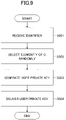
- FIG. 9 is a flow chart illustrating an example of a key issuance process (Application Example 4) in the embodiment according to the present invention.
- a case of issuing a user private key D A and a user private key D B will be described.
- the key issuance processing unit 102 receives the identifier ID A of the communication apparatus 20A and the identifier ID B of the communication apparatus 20B.
- the identifier of each of the communication apparatuses 20 may be transmitted, for example, from the communication apparatus 20, may be transmitted from a terminal or the like connected to the key issuing apparatus 10 via the communication network N, or may be input on the input device 11 included in the key issuing apparatus 10.
- the key issuance processing unit 102 randomly selects Y ⁇ G (Step S502).
- i A and i B may be generated on the communication apparatus 20, or may be generated on the key issuing apparatus 10.
- i A may be generated on the communication apparatus 20 and made public to the key issuing apparatus 10, or i A may be generated on the key issuing apparatus 10.
- i B when generating a private key D B , i B may be generated on the communication apparatus 20 and made public to the key issuing apparatus 10, or i B may be generated on the key issuing apparatus 10. Note that although it is convenient to generate i A and i B on the communication apparatus 20A and the communication apparatus 20B, respectively, for example, in the case where the calculation resources of the communication apparatus 20 are limited and considerable calculation resources are required for the calculation of H 1 , it is favorable to generate i A and i B on the key issuing apparatus 10.
- the key issuance processing unit 102 delivers the user private key D A to the communication apparatus 20A, and delivers the user private key D B to the communication apparatus 20B.
- the key issuance processing unit 102 may deliver the user private keys by any method. For example, in response to a request for delivering the user private key from the communication apparatus 20, the key issuance processing unit 102 may cause the communication unit 101 to transmit a corresponding user private key to the communication apparatus 20, so as to deliver the user private key.
- the user private key may be recorded on a recording medium or the like, and then, delivered to the communication apparatus 20. In this way, each communication apparatus 20 can obtain a user private key used for exchanging (generating) shared keys with another communication apparatus 20.
- FIG. 10 is a sequence chart illustrating an example of a key exchange process (Application Example 4) in the embodiment according to the present invention.
- a key exchange process for executing authentication between the communication apparatuses 20 by the authenticated key exchange protocol using ID-based encryption, to exchange shared keys.
- FIG. 10 is a sequence chart illustrating an example of a key exchange process (Application Example 4) in the embodiment according to the present invention.
- shared keys are exchanged (generated) between the communication apparatus 20A and the communication apparatus 20B.
- Step S603 to Step S609 coming next are substantially the same as Step S203 to Step S209 in FIG. 6 , respectively, the description is omitted.
- the shared key K is shared between the communication apparatus 20A and the communication apparatus 20B. Therefore, by using this shared key K, encrypted communication can be executed between the communication apparatus 20A and the communication apparatus 20B.
- the protocol is designed so that the techniques of the CMQV protocol that is safe in the eCK model in a normal authenticated key exchange can be applied to the authenticated key exchange protocol using ID-based encryption.
- the eCK model is a safety model in a normal authenticated key exchange, and is a model as the basis of the id-eCK model.
- CMQV is a protocol that can execute key exchange by executing the calculation of a power only once.
- the id-eCK model is an eCK model in a normal authenticated key exchange to which authenticated key exchange using ID-based encryption is naturally applied. Therefore, if the core structure of the CMQV protocol can be implemented by an authenticated key exchange protocol using ID-based encryption, a safe protocol can be implemented in the id-eCK model with which key exchange can be performed with a single pairing operation.
- CMQB protocol For details of the CMQB protocol, see, for example, Section 3 and the like of B Ustaoglu, "Obtaining a secure and efficient key agreement protocol from (H)MQV and NAXOS", Designs, Codes and Cryptography, March 2008, Volume 46, Issue 3, pp. 329-342 .
- CMQV is naturally converted into authenticated key exchange using ID-based encryption on an asymmetric pairing group
- the core structure of the CMQV protocol cannot be reproduced.
- the protocol is designed so that the core structure of the CMQV protocol can be implemented by the authenticated key exchange using ID-based encryption.
- the protocol is implemented with which key exchange can be executed in a single pairing operation, and safety in the id-eCK model is secured.
- each of the communication apparatuses 20 can execute key exchange in approximately a quarter of the time. Therefore, according to the embodiment of the present invention, for example, the authenticated key exchange protocol using ID-based encryption can be executed at high speed even on an IoT device having limited calculation resources.
Landscapes
- Engineering & Computer Science (AREA)
- Computer Security & Cryptography (AREA)
- Computer Networks & Wireless Communication (AREA)
- Signal Processing (AREA)
- Theoretical Computer Science (AREA)
- Power Engineering (AREA)
- Algebra (AREA)
- General Physics & Mathematics (AREA)
- Mathematical Analysis (AREA)
- Mathematical Optimization (AREA)
- Mathematical Physics (AREA)
- Pure & Applied Mathematics (AREA)
- Physics & Mathematics (AREA)
- Computing Systems (AREA)
- Mobile Radio Communication Systems (AREA)
Abstract
Description
- The present invention relates to a key exchange system, a communication apparatus, a key exchange method, and a program.
- In recent years, with the widespread use of IoT (Internet of Things) devices, highly important communications have come to be executed on IoT devices. Therefore, authentication techniques to verify whether the respective devices are valid devices upon communication have become important also in the field of IoT devices.
- Although passwords, digital certificates, and the like have been known conventionally as authentication techniques for IoT devices, in recent years, introduction of an authenticated key exchange protocol having even higher safety is desired. An authenticated key exchange protocol is a protocol in which a common key (a shared key) is mutually generated upon successful authentication, and encrypted communication can be executed with the shared key. As one of such authenticated key exchange protocols, an authenticated key exchange protocol using ID-based encryption has been known.
- As a model of safety that needs to be satisfied by an authenticated key exchange protocol using ID-based encryption, a model referred to as an id-eCK model has been known, which is also known as a model that requires extremely high safety.
- Also, the authenticated key exchange protocol using ID-based encryption is generally implemented by using a bilinear group in an elliptic curve on a finite field. Such a bilinear group is also referred to as a pairing group, and can be classified into a symmetric pairing group and an asymmetric pairing group. At present, in the case of using a pairing group in cryptography, an asymmetric pairing group is often used from the viewpoints of efficiency and safety. As an authenticated key exchange protocol using ID-based encryption implemented on an asymmetric pairing group, FSU (Fujioka-Suzuki-Ustaoglu) that has been standardized by ISO/IEC (International Organization for Standardization/International Electrotechnical Commission) has been known (see Non-Patent Document 1) .
- [Non-patent document 1] Fujioka, Hoshino, Kobayashi, Suzuki, Ustaoglu, Yoneyama, "id-eCK Secure ID-Based Authenticated Key Exchange on Symmetric and Asymmetric Pairing", IEICE TRANSACTIONS on Fundamentals of Electronics, Communications and Computer Sciences Vol.E96-A No.6 pp.1139-1155, 2013
- However, in FSU, operations in a group referred to as pairing operations need to be executed for four times. In general, the pairing operation has a high calculation cost; therefore, in the case where devices having limited calculation resources such as IoT devices execute key exchange by FSU, in some case, the key exchange takes a long time.
- In view of the above, an embodiment of the present invention has been devised, and has an object to reduce the calculation cost of an authenticated key exchange protocol using ID-based encryption.
- In order to achieve the object described above, a key exchange system according to an embodiment of the present invention is a key exchange system in which a shared key is generated for executing encrypted communication between a communication apparatus and another communication apparatus from among a plurality of communication apparatuses according to an authenticated key exchange protocol using ID-based encryption, wherein the communication apparatus from among the plurality of communication apparatuses includes a first generation unit configured to generate a short-term private key by using a private key of the communication apparatus; a second generation unit configured to generate a short-term public key of the communication apparatus by using the short-term private key; a third generation unit configured to generate private information on the communication apparatus by using the short-term private key, a short-term public key generated by said another communication apparatus, and public information generated by the communication apparatus and said another communication apparatus or public information generated by a key delivering center; and a fourth generation unit configured to generate the shared key for executing encrypted communication with said another communication apparatus by executing a pairing operation using the private key of the communication apparatus and the private information.
- The calculation cost of the authenticated key exchange protocol using ID-based encryption can be reduced.
-
-
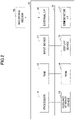
FIG. 1 is a diagram illustrating an example of an overall configuration of a key exchange system in an embodiment according to the present invention; -
FIG. 2 is a diagram illustrating an example of a hardware configuration of a key issuing apparatus in the embodiment according to the present invention; -
FIG. 3 is a diagram illustrating an example of a hardware configuration of a communication apparatus in the embodiment according to the present invention; -
FIG. 4 is a diagram illustrating an example of a functional configuration of the key exchange system in the embodiment according to the present invention; -
FIG. 5 is a flow chart illustrating an example of a key issuance process (Application Example 1) in the embodiment according to the present invention; -
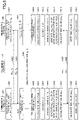
FIG. 6 is a sequence chart illustrating an example of a key exchange process (Application Example 1) in the embodiment according to the present invention; -
FIG. 7 is a sequence chart illustrating an example of a key exchange process (Application Example 2) in the embodiment according to the present invention; -
FIG. 8 is a sequence chart illustrating an example of a key exchange process (Application Example 3) in the embodiment according to the present invention; -
FIG. 9 is a flow chart illustrating an example of a key issuance process (Application Example 4) in the embodiment according to the present invention; and -
FIG. 10 is a sequence chart illustrating an example of a key exchange process (Application Example 4) in the embodiment according to the present invention. - In the following, an embodiment according to the present invention will be described. In the embodiment according to the present invention, a
key exchange system 1 will be described, in which by reducing the number of pairing operations, the calculation cost is reduced in an authenticated key exchange protocol using ID-based encryption. - First, an overall configuration of the
key exchange system 1 in the embodiment according to the present invention will be described with reference toFIG. 1. FIG. 1 is a diagram illustrating an example of an overall configuration of thekey exchange system 1 in the embodiment according to the present invention. - As illustrated in
FIG. 1 , thekey exchange system 1 in the embodiment according to the present invention includes a key issuingapparatus 10 andmultiple communication apparatuses 20. Also, the key issuingapparatus 10 and thecommunication apparatuses 20 are communicably connected via a communication network N such as the Internet. - The key issuing
apparatus 10 is a computer or computer system that functions as a KGC (Key Generation Center). The key issuingapparatus 10 generates in advance a master public key by using a master private key, and makes the master public key public. Also, in the case of receiving the identifier of acommunication apparatus 20, the key issuingapparatus 10 generates a user private key from the identifier, and then, delivers the user private key to thecommunication apparatus 20 corresponding to the identifier. - Note that any identifier can be used as the identifier of the
communication apparatus 20. For example, the manufacturing number, IP (Internet Protocol) address, physical address, or the like that is specific to thecommunication apparatus 20 can be used as the identifier. Other than these, for example, the user ID of thecommunication apparatus 20, the name of the user of thecommunication apparatus 20, the email address of the user of thecommunication apparatus 20, or the like may be used as the identifier. - The
communication apparatuses 20 are, for example, various types of IoT devices including various sensor devices, embedded devices, wearable devices, digital household appliances, monitoring cameras, lighting devices, medical devices, industrial devices, and the like. Thecommunication apparatus 20 executes authentication (i.e., verification of the validity) with anothercommunication apparatus 20 by an authenticated key exchange protocol using ID-based encryption, using the user private key delivered from the key issuingapparatus 10, to exchange (generate) keys (shared keys) for encrypted communication. In the following, in the case of distinguishing themultiple communication apparatuses 20, the devices will be referred to as the "communication apparatus 20A", "communication apparatus 20B", and so on. - Note that in the embodiment according to the present invention, an IoT device is assumed as the
communication apparatus 20, and thecommunication apparatus 20 has limited calculation resources (i.e., the performance of a processor and the capacity of a memory are limited compared to those of a general computer and the like). However, thecommunication apparatus 20 is not limited as such, and the embodiment of the present invention can be applied to thecommunication apparatus 20 other than an IoT device (e.g., a personal computer (PC), a server device, a smartphone, a tablet, etc.) in substantially the same way. - Further, the configuration of the
key exchange system 1 illustrated inFIG. 1 is merely an example, and a different configuration may be adopted. For example, a terminal to transmit the identifier of eachcommunication apparatus 20 to the key issuingapparatus 10 may be included in thekey exchange system 1. - Next, a hardware configuration of the key issuing
apparatus 10 and thecommunication apparatus 20 in the embodiment according to the present invention will be described. - <<Key issuing
apparatus 10>> - In the following, the hardware configuration of the key issuing
apparatus 10 in the embodiment according to the present invention will be described with reference toFIG. 2. FIG. 2 is a diagram illustrating an example of a hardware configuration of the key issuingapparatus 10 in the embodiment according to the present invention. - As illustrated in
FIG. 2 , the key issuingapparatus 10 in the embodiment according to the present invention includes aninput device 11, adisplay device 12, a RAM (Random Access Memory) 13, a ROM (Read-Only Memory) 14, aprocessor 15, an external I/F 16, a communication I/F 17, and anauxiliary storage device 18. These hardware components are communicably connected via abus 19. - The
input device 11 is, for example, a keyboard, a mouse, a touch panel, or the like, and used by the user for inputting various operations. Thedisplay device 12 is, for example, a display or the like, and is used for displaying various processing results and the like for the user. Note that the key issuingapparatus 10 may or may not include at least one of theinput device 11 and thedisplay device 12. - The
RAM 13 is a volatile semiconductor memory to temporarily hold programs and data. TheROM 14 is a non-volatile semiconductor memory that can hold programs and data even when the a power is turned off. Theprocessor 15 is, for example, a CPU (central processing unit) or the like, and is an arithmetic/logic device to read programs and data from theROM 14 or theauxiliary storage device 18 onto theRAM 13, to execute processing. - The external I/
F 16 is an interface with an external device. The external device includes arecording medium 16a or the like. As therecording medium 16a, a CD (Compact Disc), a DVD (Digital Versatile Disk), an SD memory card (Secure Digital Memory Card), a USB (Universal Serial Bus) memory card, and the like may be enumerated. Note that therecording medium 16a may record one or more programs that implement functions of thekey issuing apparatus 10. - The communication I/
F 17 is an interface for connecting thekey issuing apparatus 10 to the communication network N. Thekey issuing apparatus 10 can execute data communication with thecommunication apparatus 20 via the communication I/F 17. - The
auxiliary storage device 18 is a non-volatile storage device such as an HDD (hard disk drive), an SSD (solid state drive), or the like. Theauxiliary storage device 18 stores one or more programs that implement the functions of thekey issuing apparatus 10. - By having the hardware configuration illustrated in
FIG. 2 , thekey issuing apparatus 10 in the embodiment according to the present invention can implement a key issuance process and the like that will be described later. Note that althoughFIG. 2 illustrates the case where thekey issuing apparatus 10 in the embodiment according to the present invention is implemented by a single apparatus (computer), it is not limited as such. Thekey issuing apparatus 10 in the embodiment according to the present invention may be implemented by multiple apparatuses (computers). Also, the single device (computer) may includemultiple processors 15 and multiple memories (e.g.,RAMs 13,ROMs 14,auxiliary storage devices 18, etc.). - In the following, the hardware configuration of the
communication apparatus 20 in the embodiment according to the present invention will be described with reference toFIG. 3. FIG. 3 is a diagram illustrating an example of a hardware configuration of thecommunication apparatus 20 in the embodiment according to the present invention. - As illustrated in
FIG. 3 , thecommunication apparatus 20 in the embodiment according to the present invention includes aprocessor 21, amemory device 22, and a communication I/F 23. These hardware components are communicably connected via abus 24. - The
processor 21 is, for example, an MPU (Micro Processing Unit), a CPU, or the like, and is an arithmetic/logic device that reads programs and data from thememory device 22, to execute processing. - The
memory device 22 is, for example, a RAM, a ROM, a flash memory, or the like, to store various items of data and programs. Thememory device 22 stores one or more programs that implement the functions of thecommunication apparatus 20 in the embodiment according to the present invention. - The communication I/
F 23 is an interface for connecting thecommunication apparatus 20 to the communication network N. Thecommunication apparatus 20 can execute data communication with theother communication apparatuses 20, thekey issuing apparatus 10, and the like via the communication I/F 23. - By having the hardware configuration illustrated in
FIG. 3 , thecommunication apparatus 20 in the embodiment according to the present invention can implement a key exchange process and the like that will be described later. - Next, a functional configuration of the
key exchange system 1 in the embodiment according to the present invention will be described with reference toFIG. 4. FIG. 4 is a diagram illustrating an example of a functional configuration of thekey exchange system 1 in the embodiment according to the present invention. - <<
Key issuing apparatus 10>> - As illustrated in
FIG. 4 , thekey issuing apparatus 10 in the embodiment according to the present invention includes acommunication unit 101 and a keyissuance processing unit 102. These units are implemented by one or more programs installed in thekey issuing apparatus 10 that causes theprocessor 15 to execute processing. - The
key issuing apparatus 10 in the embodiment according to the present invention also includes astorage unit 103. Thestorage unit 103 can be implemented by using, for example, theauxiliary storage device 18 or the like. Note that thestorage unit 103 may be implemented by using a storage device or the like connected to thekey issuing apparatus 10 via the communication network N. - The
communication unit 101 executes various communications with thecommunication apparatus 20 and the like. In the case of receiving the identifier of acommunication apparatus 20, the keyissuance processing unit 102 generates a user private key from the identifier, and then, delivers the user private key to thecommunication apparatus 20 corresponding to the identifier. Thestorage unit 103 stores various items of data (e.g., master public keys, master private keys, etc.). - As illustrated in
FIG. 4 , thecommunication apparatus 20 in the embodiment according to the present invention includes acommunication unit 201 and a keyexchange processing unit 202. - The
communication unit 201 executes various types of communication with anothercommunication apparatus 20, thekey issuing apparatus 10, and the like. The keyexchange processing unit 202 executes authentication with anothercommunication apparatus 20 by the authenticated key exchange protocol using ID-based encryption, using the user private key delivered from thekey issuing apparatus 10, to exchange the shared keys. Thestorage unit 203 stores various items of data (e.g., a user private key, etc.) - Next, processing executed on the
key exchange system 1 in the embodiment according to the present invention will be described in detail. Note that in the following Application Examples 1 to 3, authenticated key exchange protocols using ID-based encryption on an asymmetric pairing group will be described, and in Application Example 4, an authenticated key exchange protocol using ID-based encryption on a symmetric pairing group will be described. - In the following, Application Example 1 will be described.
- First, symbols used in Application example 1 are defined as follows. Note that in Application Examples 2 and 3, substantially the same symbols as defined in Application Example 1 will be used.
-
- IDA: the identifier of the
communication apparatus 20A - IDB: the identifier of the
communication apparatus 20B - DA: the user private key of the
communication apparatus 20A - DB: the user private key of the
communication apparatus 20B - k: a security parameter
- p, q: prime numbers satisfying p ≠ q
- G1: a subgroup of a group E(Fp) on an elliptic curve
- E1 where the elliptic curve E1 is on a finite field Fp
- G2: a subgroup of a group on an elliptic curve E2 where the elliptic curve E2 is on a k-th extension field of the finite field Fp, and the group is formulated as follows:
- g1: a generator of G1
- g2: a generator of G2
- Zq: cosets modulo q
- z∈Zq: a master private key
- Z=zg1: a master public key
- H1: a function to generate elements on Zq from a string (e.g., an octet string)
- H2: a function to generate elements on Zq from a string
- H3: a function to generate elements on Zq from a string
- H: a key derivation function
- K: a shared key
- e: a pairing operation defined on G1×G2
- Here, among the symbols defined as described above, all but the master private key z and the user private keys DA and DB are public information. Note that G1 and G2 may be reversed. Also, in the case of inputting an element of a group or an element of Zq into a function, it is assumed that a string representing the element is input into the function.
- First, a key issuance process for generating a user private key (Application Example 1) will be described with reference to
FIG. 5. FIG. 5 is a flow chart illustrating an example of a key issuance process (Application Example 1) in the embodiment according to the present invention. In the following, as an example, a case of issuing a user private key DA and a user private key DB will be described. - At Step S101, the key
issuance processing unit 102 receives the identifier IDA of thecommunication apparatus 20A and the identifier IDB of thecommunication apparatus 20B. The identifier of each of thecommunication apparatuses 20 may be transmitted, for example, from thecommunication apparatus 20, may be transmitted from a terminal or the like connected to thekey issuing apparatus 10 via the communication network N, or may be input on theinput device 11 included in thekey issuing apparatus 10. - Next, at Step S102, the key
issuance processing unit 102 generates user private keys DA and DB by the following formulas:

communication apparatuses 20, or may be generated on thekey issuing apparatus 10. In other words, for example, when generating a user private key DA, iA may be generated on thecommunication apparatus 20 and made public to thekey issuing apparatus 10, or iA may be generated on thekey issuing apparatus 10. Similarly, for example, when generating a private key DB, iB may be generated on thecommunication apparatus 20 and made public to thekey issuing apparatus 10, or iB may be generated on thekey issuing apparatus 10. Note that although it is convenient to generate iA and iB on thecommunication apparatus 20A and thecommunication apparatus 20B, respectively, for example, in the case where the calculation resources of thecommunication apparatus 20 are limited and considerable calculation resources are required for the calculation of H1, it is favorable to generate iA and iB on thekey issuing apparatus 10. - Next, at Step S103, the key
issuance processing unit 102 delivers the user private key DA to thecommunication apparatus 20A, and delivers the user private key DB to thecommunication apparatus 20B. Note that the keyissuance processing unit 102 may deliver the user private keys by any method. For example, in response to a request for delivering the user private key from thecommunication apparatus 20, the keyissuance processing unit 102 may cause thecommunication unit 101 to transmit a corresponding user private key to thecommunication apparatus 20, so as to deliver the user private key. Alternatively, the user private key may be recorded on a recording medium or the like, and then, delivered to thecommunication apparatus 20. In this way, eachcommunication apparatus 20 can obtain a user private key used for exchanging (generating) shared keys with anothercommunication apparatus 20. - Next, a key exchange process (Application Example 1) for executing authentication between the
communication apparatuses 20 by an authenticated key exchange protocol using ID-based encryption to exchange shared keys will be described with reference toFIG. 6. FIG. 6 is a sequence chart illustrating an example of a key exchange process (Application Example 1) in the embodiment according to the present invention. In the following, as an example, a case will be described in which shared keys are exchanged (generated) between thecommunication apparatus 20A and thecommunication apparatus 20B. - The key
exchange processing unit 202 of thecommunication apparatus 20A randomly selects rA∈Zq, and then, generates a short-term private key as follows,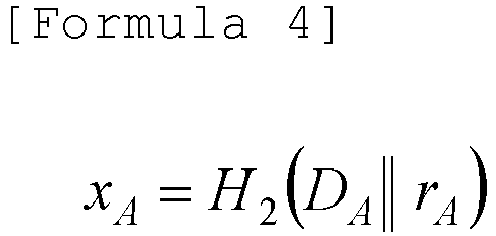
and at Step S201, generates a short-term public key XA=xA (z+iB)g1. Note that the short-term private key xA and the short-term public key XA are stored in thestorage unit 203 of thecommunication apparatus 20A. - Similarly, the key
exchange processing unit 202 of thecommunication apparatus 20B randomly selects rB∈Zq, and then, generates a short-term private key as follows,

storage unit 203 of thecommunication apparatus 20B. - Next, at Step S203, the
communication unit 201 of thecommunication apparatus 20A transmits the identifier IDA and the short-term public key XA to thecommunication apparatus 20B. Similarly, at Step S204, thecommunication unit 201 of thecommunication apparatus 20B transmits the identifier IDB and the short-term public key XB to thecommunication apparatus 20A. By these steps, the identifiers and the short-term public keys are exchanged between thecommunication apparatuses 20. - Next, at Step S205, the key
exchange processing unit 202 of thecommunication apparatus 20A deletes the short-term private key xA generated at Step S201 described above from thestorage unit 203. Similarly, at Step S206, the keyexchange processing unit 202 of thecommunication apparatus 20B deletes the short-term private key xB generated at Step S202 described above from thestorage unit 203. - Note that the short-term private key xA and the short-term private key xB are deleted at Step S205 and Step S206 described above, respectively, in order to prevent the short-term private keys from leaking out before receiving the identifier and the short-term public key from the
other communication apparatus 20. In other words, for example, after thecommunication apparatus 20A has transmitted the identifier IDA and the short-term public key XA to thecommunication apparatus 20B, it may take some time until thecommunication apparatus 20A receives the identifier IDB and the short-term public key XB from thecommunication apparatus 20B. Therefore, in order to prevent a leak of the short-term private key xA during this time, thecommunication apparatus 20A deletes the short-term private key xA after having transmitted the identifier IDA and the short-term public key XA to thecommunication apparatus 20B. The reason for deleting the short-term private key xB is the same. - Next, at Step S207, the key
exchange processing unit 202 of thecommunication apparatus 20 or thekey issuing apparatus 102 of thekey issuing apparatus 10 generates public information dA and dB as follows:


communication apparatuses 20, or may be generated by thekey issuing apparatus 10. In other words, for example, the generation may be implemented such that thecommunication apparatus 20A generates dA and dB, and thecommunication apparatus 20B generates dA and dB; or thekey issuing apparatus 10 generates dA and dB and makes these public to thecommunication apparatus 20A and thecommunication apparatus 20B. Alternatively, for example, the generation may be implemented such that thecommunication apparatus 20A generates dA and makes it public, and thecommunication apparatus 20B generates dB and makes it public. Note that although it is convenient to generate dA and dB on thecommunication apparatus 20A and thecommunication apparatus 20B, respectively, for example, in the case where the calculation resources of thecommunication apparatus 20 are limited and considerable calculation resources are required for the calculation of H3, it is favorable to generate dA and dB on thekey issuing apparatus 10. - Note that the timing to generate the public information dA and dB may be any timing as long as it is after the generation of the short-term public keys XA and XB and before the generation of the shared value σ that will be described later.
- Next, at Step S208, the key
exchange processing unit 202 of thecommunication apparatus 20A generates again a short-term private key as follows:

storage unit 203 of thecommunication apparatus 20A. - Similarly, at Step S209, the key
exchange processing unit 202 of thecommunication apparatus 20B generates again a short-term private key as follows:

storage unit 203 of thecommunication apparatus 20B. - Next, at Step S210, the key
exchange processing unit 202 of thecommunication apparatus 20A calculates a shared value σ as follows:


exchange processing unit 202 of thecommunication apparatus 20B calculates a shared value σ as follows:


exchange processing unit 202 of thecommunication apparatus 20A calculates sid as follows, where sid means the session ID.
- Similarly, at Step S213, the key
exchange processing unit 202 of thecommunication apparatus 20B calculates sid as follows:
communication apparatus 20A and thecommunication apparatus 20B; therefore, for example, an arrangement may be made in advance to define IDA as the sender and IDB as the receiver when executing encrypted communication, to have the same sid; or IDA, IDB, XA, and XB may be sorted in alphabetic order, and concatenated, to have the same sid. Also, at this time, in addition to IDA, IDB, XA, and XB, for example, a master public key Z may be added, or the protocol or the algorithm name may be added. - Finally, at Step S214, the key
exchange processing unit 202 of thecommunication apparatus 20A generates a shared key K as follows:

storage unit 203 of thecommunication apparatus 20A. - Similarly, at Step S215, the key
exchange processing unit 202 of thecommunication apparatus 20B generates a shared key K as follows:

storage unit 203 of thecommunication apparatus 20B. - In this way, the shared key K is shared between the
communication apparatus 20A and thecommunication apparatus 20B. Therefore, by using this shared key K, encrypted communication can be executed between thecommunication apparatus 20A and thecommunication apparatus 20B. - In the following, Application Example 2 will be described. Any one of IDA, IDB, XA, and XB is public information, and hence, sid as a concatenation of these strings is also public information. Thereupon, in Application Example 2, a case will be described in which a shared key K is generated without using sid. Note that as the key issuance process is substantially the same as in Application Example 1, the description is omitted. Also, as for the symbols, substantially the same symbols as defined in Application Example 1 will be used.
- A key exchange process (Application Example 2) for executing authentication between the
communication apparatuses 20 by an authenticated key exchange protocol using ID-based encryption, to exchange shared keys will be described with reference toFIG. 7. FIG. 7 is a sequence chart illustrating an example of a key exchange process (Application Example 2) in the embodiment according to the present invention. In the following, as an example, a case will be described in which shared keys are exchanged (generated) between thecommunication apparatus 20A and thecommunication apparatus 20B. - As Step S301 to Step S311 in
FIG. 7 are substantially the same as Step S201 to Step S211 inFIG. 6 , respectively, the description is omitted. - At Step S312, the key
exchange processing unit 202 of thecommunication apparatus 20A generates a shared key K as follows:

storage unit 203 of thecommunication apparatus 20A. - Similarly, at Step S313, the key
exchange processing unit 202 of thecommunication apparatus 20B generates a shared key K as follows:
storage unit 203 of thecommunication apparatus 20B. - In this way, the shared key K is shared between the
communication apparatus 20A and thecommunication apparatus 20B. Therefore, by using this shared key K, encrypted communication can be executed between thecommunication apparatus 20A and thecommunication apparatus 20B. - In the following, Application Example 3 will be described. In Application Example 3, a case will be described in which a key is generated by using a mask generation function (MGF) as the key derivation function, and then, the MAC (Message Authentication Code) value of this key is verified, to confirm whether the same key K is generated between the
communication apparatuses 20. Note that as the key issuance process is substantially the same as in Application Example 1, the description is omitted. Also, as for the symbols, substantially the same symbols as defined in Application Example 1 will be used. - A key exchange process (Application Example 3) for executing authentication between the
communication apparatuses 20 by an authenticated key exchange protocol using ID-based encryption, to exchange shared keys will be described with reference toFIG. 8. FIG. 8 is a sequence chart illustrating an example of a key exchange process (Application Example 3) in the embodiment according to the present invention. In the following, as an example, a case will be described in which shared keys are exchanged (generated) between thecommunication apparatus 20A and thecommunication apparatus 20B. - As Step S401 to Step S415 in
FIG. 8 are substantially the same as Step S201 to Step S215 inFIG. 6 , respectively, the descriptions are omitted. - At Step S416, the key
exchange processing unit 202 of thecommunication apparatus 20A generates three keys keyA, keyB, and SK by the mask generation function using the shared key K generated at Step S414 as the seed. In other words, the keyexchange processing unit 202 generates the keys keyA, keyB, and SK as follows:

communication apparatus 20A and thecommunication apparatus 20B. - Similarly, at Step S417, the key
exchange processing unit 202 of thecommunication apparatus 20B generates three keys keyA, keyB, and SK by the mask generation function using the shared key K generated at Step S415 as the seed. In other words, the keyexchange processing unit 202 generates the keys keyA, keyB, and SK as follows:

- As described above, in Application Example 3, for example, by dividing the mask (i.e., output of MGF1) having a mask length n into three equal sections, keyA, keyB, and SK are generated. For example, in the case of n=768, the mask is divided at 256-bit boundaries, to generate a 256-bit key keyA, a 256-bit key keyB, and a 256-bit key SK.
- Next, at Step S418, the key
exchange processing unit 202 of thecommunication apparatus 20A calculates a MAC value macA of sid as follows, by using the key keyA generated at Step S416 described above.
- Similarly, at Step S419, the key
exchange processing unit 202 of thecommunication apparatus 20B calculates a MAC value macB of sid as follows, by using the key keyB generated at Step S417 described above.
- Next, at Step S420, the
communication unit 201 of thecommunication apparatus 20A transmits the MAC value macA to thecommunication apparatus 20B. Similarly, at Step S421, thecommunication unit 201 of thecommunication apparatus 20B transmits the MAC value macB. - Next, at Step S422, the key
exchange processing unit 202 of thecommunication apparatus 20A calculates a MAC value macB' of sid as follows, by using the key keyB generated at Step S416 described above.
- Similarly, at Step S423, the key
exchange processing unit 202 of thecommunication apparatus 20B calculates a MAC value macA' of sid as follows, by using the key keyA generated at Step S417 described above.
- Finally, at Step S424, the key
exchange processing unit 202 of thecommunication apparatus 20A verifies whether the MAC value macB transmitted from thecommunication apparatus 20B at Step S421 described above is equal to the MAC value macB' generated at Step S422 described above. If this verification is successful (i.e., if macB = macB'), it is guaranteed that the same shared key K and the same key SK are generated between thecommunication apparatus 20A and thecommunication apparatus 20B. - Similarly, at Step S425, the key
exchange processing unit 202 of thecommunication apparatus 20B verifies whether the MAC value macA transmitted from thecommunication apparatus 20B at Step S420 described above is equal to the MAC value macA' generated at Step S423 described above. If this verification is successful (i.e., if macB = macB'), it is guaranteed that the same shared key K and the same key SK are generated between thecommunication apparatus 20A and thecommunication apparatus 20B. - In this way, the same shared key K and the same key SK are shared between the
communication apparatus 20A and thecommunication apparatus 20B. Therefore, for example, by using the key SK (i.e., the key SK as the shared key), encrypted communication can be executed between thecommunication apparatus 20A and thecommunication apparatus 20B. However, as in Application Example 1 and Application Example 2, for example, the shared key K may be used as the key for encrypted communication. - Note that at Step S418 to Step S419 and Step S422 to Step S423 described above, although the
communication apparatus 20A and thecommunication apparatus 20B use sid to calculate the MAC values, it is not limited as such; instead of sid or together with sid, the MAC values may be calculated by using any predetermined information between thecommunication apparatus 20A and thecommunication apparatus 20B. For example, the MAC values may be calculated by using a string that concatenates messages exchanged between thecommunication apparatus 20A and thecommunication apparatus 20B in a predetermined order (as a specific example, a string in which M1 and M2 are concatenated in this order where M1 and M2 are the exchanged messages); or the MAC values may be calculated by using a string in which a predetermined number of a predetermined character is arranged (as a specific example, a string "00...0" in which 0's are arranged in a predetermined number). - Also, as another example of a method of verifying whether the
communication apparatus 20A and thecommunication apparatus 20B generate the same shared key K, for example, thecommunication apparatus 20A and thecommunication apparatus 20B may calculate the same key denoted as "key" by the key derivation function using the shared key K, and then, by using this key "key", thecommunication apparatus 20A and thecommunication apparatus 20B calculate MAC values from different messages (e.g., messages transmitted by themselves, the identifiers of their own, etc.). - In the following, Application Example 4 will be described. In Application Example 4, an authenticated key exchange protocol using ID-based encryption on a symmetric pairing group will be described. Note that although a protocol on a symmetric pairing group by itself is not practical at present from the viewpoints of efficiency and safety, a protocol on a symmetric pairing group is important when considering extensions of a protocol on an asymmetric pairing group.
- First, symbols used in Application example 4 are defined as follows:
-
- IDA:
- the identifier of the
communication apparatus 20A - IDB:
- the identifier of the
communication apparatus 20B - DA:
- the user private key of the
communication apparatus 20A - DB:
- the user private key of the
communication apparatus 20B - k:
- a security parameter
- p, q:
- prime numbers satisfying p ≠ q
- G:
- a subgroup of a group E(Fp) on an elliptic curve
- E1
- where the elliptic curve E1 is on a finite field Fp
- g:
- a generator of G
- Zq:
- cosets modulo q
- z∈Zq:
- a master private key
- Z=zg:
- a master public key
- H1:
- a function to generate elements on Zq from a string (e.g., an octet string)
- H2:
- a function to generate elements on Zq from a string
- H3:
- a function to generate elements on Zq from a string
- H:
- a key derivation function
- K:
- a shared key
- e:
- a pairing operation defined on G×G
- First, a key issuance process for generating a user private key (Application Example 4) will be described with reference to
FIG. 9. FIG. 9 is a flow chart illustrating an example of a key issuance process (Application Example 4) in the embodiment according to the present invention. In the following, as an example, a case of issuing a user private key DA and a user private key DB will be described. - At Step S501, the key
issuance processing unit 102 receives the identifier IDA of thecommunication apparatus 20A and the identifier IDB of thecommunication apparatus 20B. The identifier of each of thecommunication apparatuses 20 may be transmitted, for example, from thecommunication apparatus 20, may be transmitted from a terminal or the like connected to thekey issuing apparatus 10 via the communication network N, or may be input on theinput device 11 included in thekey issuing apparatus 10. - Next, the key
issuance processing unit 102 randomly selects Y∈G (Step S502). Next, at Step S503, the keyissuance processing unit 102 generates user private keys DA and DB by the following formulas:


communication apparatus 20, or may be generated on thekey issuing apparatus 10. In other words, for example, when generating a user private key DA, iA may be generated on thecommunication apparatus 20 and made public to thekey issuing apparatus 10, or iA may be generated on thekey issuing apparatus 10. Similarly, for example, when generating a private key DB, iB may be generated on thecommunication apparatus 20 and made public to thekey issuing apparatus 10, or iB may be generated on thekey issuing apparatus 10. Note that although it is convenient to generate iA and iB on thecommunication apparatus 20A and thecommunication apparatus 20B, respectively, for example, in the case where the calculation resources of thecommunication apparatus 20 are limited and considerable calculation resources are required for the calculation of H1, it is favorable to generate iA and iB on thekey issuing apparatus 10. - Next, at Step S504, the key
issuance processing unit 102 delivers the user private key DA to thecommunication apparatus 20A, and delivers the user private key DB to thecommunication apparatus 20B. Note that the keyissuance processing unit 102 may deliver the user private keys by any method. For example, in response to a request for delivering the user private key from thecommunication apparatus 20, the keyissuance processing unit 102 may cause thecommunication unit 101 to transmit a corresponding user private key to thecommunication apparatus 20, so as to deliver the user private key. Alternatively, the user private key may be recorded on a recording medium or the like, and then, delivered to thecommunication apparatus 20. In this way, eachcommunication apparatus 20 can obtain a user private key used for exchanging (generating) shared keys with anothercommunication apparatus 20. - Next, a key exchange process (Application Example 4) for executing authentication between the
communication apparatuses 20 by the authenticated key exchange protocol using ID-based encryption, to exchange shared keys will be described with reference toFIG. 10. FIG. 10 is a sequence chart illustrating an example of a key exchange process (Application Example 4) in the embodiment according to the present invention. In the following, as an example, a case will be described in which shared keys are exchanged (generated) between thecommunication apparatus 20A and thecommunication apparatus 20B. - At Step S601, the key
exchange processing unit 202 of thecommunication apparatus 20A randomly selects rA∈Zq, and then, generates a short-term private key as follows,

storage unit 203 of thecommunication apparatus 20A. - Similarly, at Step S602, the key
exchange processing unit 202 of thecommunication apparatus 20B randomly selects rB∈Zq, and then, generates a short-term private key as follows,

storage unit 203 of thecommunication apparatus 20B. - As Step S603 to Step S609 coming next are substantially the same as Step S203 to Step S209 in
FIG. 6 , respectively, the description is omitted. - At Step S610, the key
exchange processing unit 202 of thecommunication apparatus 20A calculates a shared value σ as follows:


exchange processing unit 202 of thecommunication apparatus 20B calculates a shared value σ as follows:


FIG. 6 , respectively, the descriptions are omitted. - In this way, the shared key K is shared between the
communication apparatus 20A and thecommunication apparatus 20B. Therefore, by using this shared key K, encrypted communication can be executed between thecommunication apparatus 20A and thecommunication apparatus 20B. - As described above, in Application Examples 1 to 4 of the embodiment of the present invention, the protocol is designed so that the techniques of the CMQV protocol that is safe in the eCK model in a normal authenticated key exchange can be applied to the authenticated key exchange protocol using ID-based encryption. Note that the eCK model is a safety model in a normal authenticated key exchange, and is a model as the basis of the id-eCK model.
- Meanwhile, in a normal authenticated key exchange, pairing operations are not required, and calculation of a power on a cyclic group in a normal authenticated key exchange can be considered as corresponding to pairing operations in the authenticated key exchange protocol using ID-based encryption. Also, CMQV is a protocol that can execute key exchange by executing the calculation of a power only once. Further, the id-eCK model is an eCK model in a normal authenticated key exchange to which authenticated key exchange using ID-based encryption is naturally applied. Therefore, if the core structure of the CMQV protocol can be implemented by an authenticated key exchange protocol using ID-based encryption, a safe protocol can be implemented in the id-eCK model with which key exchange can be performed with a single pairing operation. Note that for details of the CMQB protocol, see, for example, Section 3 and the like of B Ustaoglu, "Obtaining a secure and efficient key agreement protocol from (H)MQV and NAXOS", Designs, Codes and Cryptography, March 2008, Volume 46, Issue 3, pp. 329-342.
- However, if CMQV is naturally converted into authenticated key exchange using ID-based encryption on an asymmetric pairing group, the core structure of the CMQV protocol cannot be reproduced. In contrast, in Application Examples 1 to 4 of the embodiment of the present invention, by using the structure of the McCullagh-Barreto key exchange protocol, the protocol is designed so that the core structure of the CMQV protocol can be implemented by the authenticated key exchange using ID-based encryption. By this design, in Application Examples 1 to 4 of the embodiment of the present invention, the protocol is implemented with which key exchange can be executed in a single pairing operation, and safety in the id-eCK model is secured. Note that for details of the McCullagh-Barreto key exchange protocol, see a reference, for example, by Zhaohui Cheng, Liqun Chen, "On Security Proof of McCullagh-Barreto's Key Agreement Protocol and its Variants", Cryptology ePrint Archive, Report 2005/201, 2005.
- Note that focusing only on the number of pairing operations, in the embodiment according to the present invention, shared keys K (or keys SK) can be exchanged by executing the pairing operation only once on each of the
communication apparatuses 20. In contrast, as described above, for example, in FSU, pairing operations need to be executed for four times. Therefore, in the embodiment according to the present invention, compared to the conventional techniques, each of thecommunication apparatuses 20 can execute key exchange in approximately a quarter of the time. Therefore, according to the embodiment of the present invention, for example, the authenticated key exchange protocol using ID-based encryption can be executed at high speed even on an IoT device having limited calculation resources. - The present invention is not limited to the embodiment specifically disclosed as above, and various alterations and variations can be made without deviating from the scope of the claims.
- The present application is based on a base application No.
2019-132060, filed on July 17, 2019, in Japan -
- 1
- key exchange system
- 10
- key issuing apparatus
- 20
- communication apparatus
- 101
- communication unit
- 102
- key issuance processing unit
- 103
- storage unit
- 201
- communication unit
- 202
- key exchange processing unit
- 203
- storage unit

Claims (6)
- A key exchange system in which a shared key is generated for executing encrypted communication between a communication apparatus and another communication apparatus from among a plurality of communication apparatuses according to an authenticated key exchange protocol using ID-based encryption, wherein the communication apparatus from among the plurality of communication apparatuses includesa first generation unit configured to generate a short-term private key by using a private key of the communication apparatus,a second generation unit configured to generate a short-term public key of the communication apparatus by using the short-term private key,a third generation unit configured to generate private information on the communication apparatus by using the short-term private key, a short-term public key generated by said another communication apparatus, and public information generated by the communication apparatus and said another communication apparatus or public information generated by a key delivering center, anda fourth generation unit configured to generate the shared key for executing encrypted communication with said another communication apparatus by executing a pairing operation using the private key of the communication apparatus and the private information.
- The key exchange system as claimed in claim 1, wherein the communication apparatus from among the plurality of communication apparatuses further includesa fifth generation unit configured to generate a key denoted as "key" from the shared key by a mask generation function,a calculation unit configured to calculate a MAC value of the key "key", anda verification unit configured to verify the MAC value calculated by the calculation unit and a MAC value calculated by said another communication apparatus.
- The key exchange system as claimed in claim 1 or 2, wherein the public information generated by the communication apparatus and said another communication apparatus, or the public information generated by the key delivering center includesa first output value corresponding to an output value of a predetermined function taking as input the short-term public key of the communication apparatus, an identifier of the communication apparatus, and an identifier of said another communication apparatus; anda second output value corresponding to a second output value of the predetermined function taking as input the short-term public key of said another communication apparatus, the identifier of the communication apparatus, and the identifier of said another communication apparatus.
- A communication apparatus that generates a shared key for executing encrypted communication with another communication apparatus according to an authenticated key exchange protocol using ID-based encryption, the communication apparatus comprising:a first generation unit configured to generate a short-term private key by using a private key of the communication apparatus;a second generation unit configured to generate a short-term public key of the communication apparatus by using the short-term private key;a third generation unit configured to generate private information on the communication apparatus by using the short-term private key, a short-term public key generated by said another communication apparatus, and public information generated by the communication apparatus and said another communication apparatus or public information generated by a key delivering center; anda fourth generation unit configured to generate the shared key for executing encrypted communication with said another communication apparatus by executing a pairing operation using the private key of the communication apparatus and the private information.
- A key exchange method of generating a shared key for executing encrypted communication between a communication apparatus and another communication apparatus from among a plurality of communication apparatuses according to an authenticated key exchange protocol using ID-based encryption, the method being executed by the communication apparatus from among the plurality of communication apparatuses, comprising:a first generation step of generating a short-term private key by using a private key of the communication apparatus;a second generation step of generating a short-term public key of the communication apparatus by using the short-term private key;a third generation step of generating private information on the communication apparatus by using the short-term private key, a short-term public key generated by said another communication apparatus, and public information generated by the communication apparatus and said another communication apparatus or public information generated by a key delivering center; anda fourth generation step of generating the shared key for executing encrypted communication with said another communication apparatus by executing a pairing operation using the private key of the communication apparatus and the private information.
- A program for causing a computer to function as respective units in the communication apparatus as claimed in claim 4.
Applications Claiming Priority (2)
| Application Number | Priority Date | Filing Date | Title |
|---|---|---|---|
| JP2019132060A JP7377487B2 (en) | 2019-07-17 | 2019-07-17 | Key exchange system, communication device, key exchange method and program |
| PCT/JP2020/027712 WO2021010444A1 (en) | 2019-07-17 | 2020-07-16 | Key exchange system, communication device, key exchange method, and program |
Publications (3)
| Publication Number | Publication Date |
|---|---|
| EP3985915A1 true EP3985915A1 (en) | 2022-04-20 |
| EP3985915A4 EP3985915A4 (en) | 2023-06-28 |
| EP3985915B1 EP3985915B1 (en) | 2026-04-15 |
Family
ID=74209886
Family Applications (1)
| Application Number | Title | Priority Date | Filing Date |
|---|---|---|---|
| EP20839597.0A Active EP3985915B1 (en) | 2019-07-17 | 2020-07-16 | Key exchange system, communication device, key exchange method, and program |
Country Status (5)
| Country | Link |
|---|---|
| US (1) | US11902428B2 (en) |
| EP (1) | EP3985915B1 (en) |
| JP (1) | JP7377487B2 (en) |
| CN (1) | CN114128209B (en) |
| WO (1) | WO2021010444A1 (en) |
Families Citing this family (3)
| Publication number | Priority date | Publication date | Assignee | Title |
|---|---|---|---|---|
| DE102022000638B9 (en) * | 2022-02-22 | 2023-11-23 | Mercedes-Benz Group AG | Method for securely negotiating symmetrical keys between two participants in a communication |
| JP7640049B2 (en) | 2022-03-16 | 2025-03-05 | 日本電信電話株式会社 | AUTHENTICATION KEY EXCHANGE SYSTEM, DEVICE, AUTHENTICATION KEY EXCHANGE METHOD, AND PROGRAM |
| WO2024042584A1 (en) * | 2022-08-22 | 2024-02-29 | 日本電信電話株式会社 | Communication system and communication method |
Family Cites Families (8)
| Publication number | Priority date | Publication date | Assignee | Title |
|---|---|---|---|---|
| US7284127B2 (en) * | 2002-10-24 | 2007-10-16 | Telefonktiebolaget Lm Ericsson (Publ) | Secure communications |
| CN1859090B (en) * | 2005-12-30 | 2010-05-05 | 上海交通大学 | An identity-based cryptographic method and system |
| JP5457848B2 (en) * | 2010-01-18 | 2014-04-02 | 日本電信電話株式会社 | ID-based authentication key exchange system, authentication key exchange method, authentication key exchange apparatus, program thereof, and recording medium |
| CA2855099C (en) * | 2013-06-27 | 2016-05-17 | Infosec Global Inc. | Key agreement protocol for generating a shared secret key for use by a pair of entities in a data communication system |
| CN104270249B (en) * | 2014-09-23 | 2017-10-17 | 电子科技大学 | It is a kind of from the label decryption method without certificate environment to identity-based environment |
| JP6808609B2 (en) * | 2017-12-01 | 2021-01-06 | 日本電信電話株式会社 | Server devices, communication devices, key sharing systems, key sharing methods, and programs |
| JP6908537B2 (en) | 2018-01-31 | 2021-07-28 | 積水化学工業株式会社 | Drainage member |
| CN109818744B (en) * | 2019-02-27 | 2022-11-18 | 矩阵元技术(深圳)有限公司 | Shared secret key generation method and device, computer equipment and storage medium |
-
2019
- 2019-07-17 JP JP2019132060A patent/JP7377487B2/en active Active
-
2020
- 2020-07-16 CN CN202080051106.8A patent/CN114128209B/en active Active
- 2020-07-16 WO PCT/JP2020/027712 patent/WO2021010444A1/en not_active Ceased
- 2020-07-16 EP EP20839597.0A patent/EP3985915B1/en active Active
- 2020-07-16 US US17/626,443 patent/US11902428B2/en active Active
Also Published As
| Publication number | Publication date |
|---|---|
| EP3985915A4 (en) | 2023-06-28 |
| US20220303124A1 (en) | 2022-09-22 |
| JP7377487B2 (en) | 2023-11-10 |
| WO2021010444A1 (en) | 2021-01-21 |
| CN114128209B (en) | 2024-05-24 |
| CN114128209A (en) | 2022-03-01 |
| EP3985915B1 (en) | 2026-04-15 |
| US11902428B2 (en) | 2024-02-13 |
| JP2021019223A (en) | 2021-02-15 |
Similar Documents
| Publication | Publication Date | Title |
|---|---|---|
| US11210658B2 (en) | Constructing a distributed ledger transaction on a cold hardware wallet | |
| US12531743B2 (en) | Computer-implemented system and method for transferring access to digital resource | |
| CN109818744B (en) | Shared secret key generation method and device, computer equipment and storage medium | |
| US12609815B2 (en) | Computer implemented method and system for encrypting data | |
| US20200195446A1 (en) | System and method for ensuring forward & backward secrecy using physically unclonable functions | |
| EP4150879A1 (en) | Constructing a distributed ledger transaction on a cold hardware wallet | |
| US11375369B2 (en) | Message authentication method and communication method of communication network system, and communication network system | |
| EP3985915B1 (en) | Key exchange system, communication device, key exchange method, and program | |
| Li et al. | Towards smart card based mutual authentication schemes in cloud computing | |
| CN114553590A (en) | Data transmission method and related equipment | |
| Hodowu et al. | An enhancement of data security in cloud computing with an implementation of a two-level cryptographic technique, using AES and ECC algorithm | |
| CN111859424A (en) | Data encryption method, system, terminal and storage medium of physical management platform | |
| EP3817323A1 (en) | Encryption processing system, encryption processing method, and program | |
| CN108880807A (en) | Private key signature process method, apparatus, equipment and medium | |
| CN118233095B (en) | Sensitive information protection method and system | |
| CN117353899A (en) | Hybrid encryption method, device and storage medium | |
| Wei et al. | Secure control protocol for universal serial bus mass storage devices | |
| Somaiya et al. | Implementation and evaluation of EMAES–A hybrid encryption algorithm for sharing multimedia files with more security and speed | |
| US20070014398A1 (en) | Generating a secret key from an asymmetric private key | |
| Amin et al. | Anonymity preserving secure hash function based authentication scheme for consumer USB mass storage device | |
| CN110912683B (en) | Password storage method and device and password verification method and device | |
| US20260046616A1 (en) | System and method for secure communication between a device and an application server | |
| JP7298686B2 (en) | Key exchange system, communication device and program | |
| EP3836482B1 (en) | Authentication authorization system, information processing device, device, authentication authorization method, and program | |
| Song et al. | A novel multiserver authentication protocol with multifactors for cloud service |
Legal Events
| Date | Code | Title | Description |
|---|---|---|---|
| STAA | Information on the status of an ep patent application or granted ep patent |
Free format text: STATUS: THE INTERNATIONAL PUBLICATION HAS BEEN MADE |
|
| PUAI | Public reference made under article 153(3) epc to a published international application that has entered the european phase |
Free format text: ORIGINAL CODE: 0009012 |
|
| STAA | Information on the status of an ep patent application or granted ep patent |
Free format text: STATUS: REQUEST FOR EXAMINATION WAS MADE |
|
| 17P | Request for examination filed |
Effective date: 20220104 |
|
| AK | Designated contracting states |
Kind code of ref document: A1 Designated state(s): AL AT BE BG CH CY CZ DE DK EE ES FI FR GB GR HR HU IE IS IT LI LT LU LV MC MK MT NL NO PL PT RO RS SE SI SK SM TR |
|
| DAV | Request for validation of the european patent (deleted) | ||
| DAX | Request for extension of the european patent (deleted) | ||
| A4 | Supplementary search report drawn up and despatched |
Effective date: 20230601 |
|
| RIC1 | Information provided on ipc code assigned before grant |
Ipc: H04L 9/30 20060101ALI20230525BHEP Ipc: H04L 9/08 20060101AFI20230525BHEP |
|
| RAP3 | Party data changed (applicant data changed or rights of an application transferred) |
Owner name: NTT, INC. |
|
| GRAP | Despatch of communication of intention to grant a patent |
Free format text: ORIGINAL CODE: EPIDOSNIGR1 |
|
| STAA | Information on the status of an ep patent application or granted ep patent |
Free format text: STATUS: GRANT OF PATENT IS INTENDED |
|
| INTG | Intention to grant announced |
Effective date: 20251125 |
|
| GRAS | Grant fee paid |
Free format text: ORIGINAL CODE: EPIDOSNIGR3 |
|
| GRAA | (expected) grant |
Free format text: ORIGINAL CODE: 0009210 |
|
| STAA | Information on the status of an ep patent application or granted ep patent |
Free format text: STATUS: THE PATENT HAS BEEN GRANTED |
|
| AK | Designated contracting states |
Kind code of ref document: B1 Designated state(s): AL AT BE BG CH CY CZ DE DK EE ES FI FR GB GR HR HU IE IS IT LI LT LU LV MC MK MT NL NO PL PT RO RS SE SI SK SM TR |
|
| REG | Reference to a national code |
Ref country code: CH Ref legal event code: F10 Free format text: ST27 STATUS EVENT CODE: U-0-0-F10-F00 (AS PROVIDED BY THE NATIONAL OFFICE) Effective date: 20260415 |
|
| REG | Reference to a national code |
Ref country code: DE Ref legal event code: R096 Ref document number: 602020070488 Country of ref document: DE |