EP3985774B1 - Electrolyte for lithium secondary battery and lithium secondary battery comprising the same - Google Patents
Electrolyte for lithium secondary battery and lithium secondary battery comprising the same Download PDFInfo
- Publication number
- EP3985774B1 EP3985774B1 EP21177364.3A EP21177364A EP3985774B1 EP 3985774 B1 EP3985774 B1 EP 3985774B1 EP 21177364 A EP21177364 A EP 21177364A EP 3985774 B1 EP3985774 B1 EP 3985774B1
- Authority
- EP
- European Patent Office
- Prior art keywords
- electrolyte
- negative electrode
- positive electrode
- secondary battery
- lithium secondary
- Prior art date
- Legal status (The legal status is an assumption and is not a legal conclusion. Google has not performed a legal analysis and makes no representation as to the accuracy of the status listed.)
- Active
Links
Images

Classifications
-
- H—ELECTRICITY
- H01—ELECTRIC ELEMENTS
- H01M—PROCESSES OR MEANS, e.g. BATTERIES, FOR THE DIRECT CONVERSION OF CHEMICAL ENERGY INTO ELECTRICAL ENERGY
- H01M10/00—Secondary cells; Manufacture thereof
- H01M10/05—Accumulators with non-aqueous electrolyte
- H01M10/052—Li-accumulators
- H01M10/0525—Rocking-chair batteries, i.e. batteries with lithium insertion or intercalation in both electrodes; Lithium-ion batteries
-
- C—CHEMISTRY; METALLURGY
- C07—ORGANIC CHEMISTRY
- C07C—ACYCLIC OR CARBOCYCLIC COMPOUNDS
- C07C381/00—Compounds containing carbon and sulfur and having functional groups not covered by groups C07C301/00 - C07C337/00
-
- C—CHEMISTRY; METALLURGY
- C07—ORGANIC CHEMISTRY
- C07F—ACYCLIC, CARBOCYCLIC OR HETEROCYCLIC COMPOUNDS CONTAINING ELEMENTS OTHER THAN CARBON, HYDROGEN, HALOGEN, OXYGEN, NITROGEN, SULFUR, SELENIUM OR TELLURIUM
- C07F5/00—Compounds containing elements of Groups 3 or 13 of the Periodic Table
- C07F5/02—Boron compounds
- C07F5/04—Esters of boric acids
-
- H—ELECTRICITY
- H01—ELECTRIC ELEMENTS
- H01M—PROCESSES OR MEANS, e.g. BATTERIES, FOR THE DIRECT CONVERSION OF CHEMICAL ENERGY INTO ELECTRICAL ENERGY
- H01M10/00—Secondary cells; Manufacture thereof
- H01M10/05—Accumulators with non-aqueous electrolyte
- H01M10/052—Li-accumulators
-
- H—ELECTRICITY
- H01—ELECTRIC ELEMENTS
- H01M—PROCESSES OR MEANS, e.g. BATTERIES, FOR THE DIRECT CONVERSION OF CHEMICAL ENERGY INTO ELECTRICAL ENERGY
- H01M10/00—Secondary cells; Manufacture thereof
- H01M10/05—Accumulators with non-aqueous electrolyte
- H01M10/056—Accumulators with non-aqueous electrolyte characterised by the materials used as electrolytes, e.g. mixed inorganic/organic electrolytes
- H01M10/0564—Accumulators with non-aqueous electrolyte characterised by the materials used as electrolytes, e.g. mixed inorganic/organic electrolytes the electrolyte being constituted of organic materials only
- H01M10/0566—Liquid materials
- H01M10/0567—Liquid materials characterised by the additives
-
- H—ELECTRICITY
- H01—ELECTRIC ELEMENTS
- H01M—PROCESSES OR MEANS, e.g. BATTERIES, FOR THE DIRECT CONVERSION OF CHEMICAL ENERGY INTO ELECTRICAL ENERGY
- H01M10/00—Secondary cells; Manufacture thereof
- H01M10/05—Accumulators with non-aqueous electrolyte
- H01M10/056—Accumulators with non-aqueous electrolyte characterised by the materials used as electrolytes, e.g. mixed inorganic/organic electrolytes
- H01M10/0564—Accumulators with non-aqueous electrolyte characterised by the materials used as electrolytes, e.g. mixed inorganic/organic electrolytes the electrolyte being constituted of organic materials only
- H01M10/0566—Liquid materials
- H01M10/0569—Liquid materials characterised by the solvents
-
- H—ELECTRICITY
- H01—ELECTRIC ELEMENTS
- H01M—PROCESSES OR MEANS, e.g. BATTERIES, FOR THE DIRECT CONVERSION OF CHEMICAL ENERGY INTO ELECTRICAL ENERGY
- H01M10/00—Secondary cells; Manufacture thereof
- H01M10/42—Methods or arrangements for servicing or maintenance of secondary cells or secondary half-cells
- H01M10/4235—Safety or regulating additives or arrangements in electrodes, separators or electrolyte
-
- H—ELECTRICITY
- H01—ELECTRIC ELEMENTS
- H01M—PROCESSES OR MEANS, e.g. BATTERIES, FOR THE DIRECT CONVERSION OF CHEMICAL ENERGY INTO ELECTRICAL ENERGY
- H01M4/00—Electrodes
- H01M4/02—Electrodes composed of, or comprising, active material
- H01M4/36—Selection of substances as active materials, active masses, active liquids
- H01M4/48—Selection of substances as active materials, active masses, active liquids of inorganic oxides or hydroxides
- H01M4/50—Selection of substances as active materials, active masses, active liquids of inorganic oxides or hydroxides of manganese
- H01M4/505—Selection of substances as active materials, active masses, active liquids of inorganic oxides or hydroxides of manganese of mixed oxides or hydroxides containing manganese for inserting or intercalating light metals, e.g. LiMn2O4 or LiMn2OxFy
-
- H—ELECTRICITY
- H01—ELECTRIC ELEMENTS
- H01M—PROCESSES OR MEANS, e.g. BATTERIES, FOR THE DIRECT CONVERSION OF CHEMICAL ENERGY INTO ELECTRICAL ENERGY
- H01M4/00—Electrodes
- H01M4/02—Electrodes composed of, or comprising, active material
- H01M4/36—Selection of substances as active materials, active masses, active liquids
- H01M4/58—Selection of substances as active materials, active masses, active liquids of inorganic compounds other than oxides or hydroxides, e.g. sulfides, selenides, tellurides, halogenides or LiCoFy; of polyanionic structures, e.g. phosphates, silicates or borates
- H01M4/583—Carbonaceous material, e.g. graphite-intercalation compounds or CFx
- H01M4/587—Carbonaceous material, e.g. graphite-intercalation compounds or CFx for inserting or intercalating light metals
-
- H—ELECTRICITY
- H01—ELECTRIC ELEMENTS
- H01M—PROCESSES OR MEANS, e.g. BATTERIES, FOR THE DIRECT CONVERSION OF CHEMICAL ENERGY INTO ELECTRICAL ENERGY
- H01M10/00—Secondary cells; Manufacture thereof
- H01M10/05—Accumulators with non-aqueous electrolyte
- H01M10/056—Accumulators with non-aqueous electrolyte characterised by the materials used as electrolytes, e.g. mixed inorganic/organic electrolytes
- H01M10/0564—Accumulators with non-aqueous electrolyte characterised by the materials used as electrolytes, e.g. mixed inorganic/organic electrolytes the electrolyte being constituted of organic materials only
- H01M10/0566—Liquid materials
- H01M10/0568—Liquid materials characterised by the solutes
-
- H—ELECTRICITY
- H01—ELECTRIC ELEMENTS
- H01M—PROCESSES OR MEANS, e.g. BATTERIES, FOR THE DIRECT CONVERSION OF CHEMICAL ENERGY INTO ELECTRICAL ENERGY
- H01M2300/00—Electrolytes
- H01M2300/0017—Non-aqueous electrolytes
- H01M2300/0025—Organic electrolyte
-
- H—ELECTRICITY
- H01—ELECTRIC ELEMENTS
- H01M—PROCESSES OR MEANS, e.g. BATTERIES, FOR THE DIRECT CONVERSION OF CHEMICAL ENERGY INTO ELECTRICAL ENERGY
- H01M4/00—Electrodes
- H01M4/02—Electrodes composed of, or comprising, active material
- H01M4/36—Selection of substances as active materials, active masses, active liquids
- H01M4/38—Selection of substances as active materials, active masses, active liquids of elements or alloys
- H01M4/386—Silicon or alloys based on silicon
-
- H—ELECTRICITY
- H01—ELECTRIC ELEMENTS
- H01M—PROCESSES OR MEANS, e.g. BATTERIES, FOR THE DIRECT CONVERSION OF CHEMICAL ENERGY INTO ELECTRICAL ENERGY
- H01M4/00—Electrodes
- H01M4/02—Electrodes composed of, or comprising, active material
- H01M4/36—Selection of substances as active materials, active masses, active liquids
- H01M4/48—Selection of substances as active materials, active masses, active liquids of inorganic oxides or hydroxides
- H01M4/52—Selection of substances as active materials, active masses, active liquids of inorganic oxides or hydroxides of nickel, cobalt or iron
- H01M4/525—Selection of substances as active materials, active masses, active liquids of inorganic oxides or hydroxides of nickel, cobalt or iron of mixed oxides or hydroxides containing iron, cobalt or nickel for inserting or intercalating light metals, e.g. LiNiO2, LiCoO2 or LiCoOxFy
-
- Y—GENERAL TAGGING OF NEW TECHNOLOGICAL DEVELOPMENTS; GENERAL TAGGING OF CROSS-SECTIONAL TECHNOLOGIES SPANNING OVER SEVERAL SECTIONS OF THE IPC; TECHNICAL SUBJECTS COVERED BY FORMER USPC CROSS-REFERENCE ART COLLECTIONS [XRACs] AND DIGESTS
- Y02—TECHNOLOGIES OR APPLICATIONS FOR MITIGATION OR ADAPTATION AGAINST CLIMATE CHANGE
- Y02E—REDUCTION OF GREENHOUSE GAS [GHG] EMISSIONS, RELATED TO ENERGY GENERATION, TRANSMISSION OR DISTRIBUTION
- Y02E60/00—Enabling technologies; Technologies with a potential or indirect contribution to GHG emissions mitigation
- Y02E60/10—Energy storage using batteries
Definitions
- the present disclosure relates to an electrolyte for a lithium secondary battery and a lithium secondary battery comprising the same.
- a lithium secondary battery is an energy storage system comprising a positive electrode for supplying lithium ions on charge, a negative electrode for receiving lithium ions, an electrolyte serving as a lithium ion transmission mediator, and a separator for separating the positive electrode and the negative electrode, wherein electric energy is generated and stored as chemical potentials change with intercalation/deintercalation in the positive and the negative electrode.
- Such lithium secondary batteries have been used mainly in mobile electronic devices and are now rapidly expanding their use as an energy storage system to electric vehicles (EVs) and hybrid electric vehicles (HEVs) that have been successfully commercialized therewith.
- EVs electric vehicles
- HEVs hybrid electric vehicles
- the capacity of the positive electrode can be increased by increasing the content of Ni or by raising a charge voltage.
- the charge/discharge performance rapidly degrades because the residual lithium components (Li 2 CO 3 and LiOH) on the positive electrode promote degradation of the electrolyte and increase interfacial reactivity with the electrolyte, thus accelerating the degeneration rate.
- CN 108 091 933 B and CN 111 129 587 A disclose non-aqueous electrolyte compositions for lithium secondary batteries, comprising a lithium salt dissolved in an organic solvent, to which a fluorosulfonate compound, such as fluorosulfonyloxybenzene or pyrazole fluorosulfonate, is added.
- a fluorosulfonate compound such as fluorosulfonyloxybenzene or pyrazole fluorosulfonate
- CN 104 752 765 B and WO 2016/060038 A1 describe non-aqueous electrolytic solutions for lithium secondary batteries, comprising a lithium salt dissolved in an organic solvent, and a naphthalene derivative as additive, like 1,4-dimethoxy-naphthalene-7-sulfonic acid lithium salt or 1-ethoxysulfonyl-4,8-diisopropyl-naphthalene.
- the present disclosure provides an electrolyte for a lithium secondary battery, which can improve high-temperature lifetime characteristics in a lithium secondary battery, and a lithium secondary battery comprising the same.
- An electrolyte for a lithium secondary battery comprises a lithium salt, a solvent, and a functional additive, wherein the functional additive comprises naphthalen-1-yl sulfurofluoridate, represented by the following formula 1, as a first negative electrode film additive:
- the first negative electrode film additive may be used in a total amount of 0.5-1.0 wt%, based on the weight of the electrolyte.
- the functional additive may further comprise lithium difluoro(oxalato)borate, represented by the following formula 2, as a positive electrode film additive:
- the positive electrode film additive may be used in an amount of 0.5-1.0 wt%, based on the total weight of the electrolyte.
- the functional additive may further comprise vinylene carbonate (VC) as a second negative electrode film additive.
- VC vinylene carbonate
- the second negative electrode film additive may be used in an amount of 0.5-3.0 wt%, based on the total weight of the electrolyte.
- the lithium salt may be at least one compound selected from the group consisting of LiPF 6 , LiBF 4 , LiClO 4 , LiCl, LiBr, LiI, LiB 10 Cl 10 , LiCF 3 SO 3 , LiCF 3 CO 2 , LiAsF 6 , LiSbF 6 , LiAlCl 4 , CH 3 SO 3 Li, CF 3 SO 3 Li, LiN (SO 2 C 2 F 5 ) 2 , Li(CF 3 SO 2 ) 2 N, LiC 4 F 9 SO 3 , LiB(C 6 H 5 ) 4 , Li(SO 2 F) 2 N (LiFSI), and (CF 3 SO 2 ) 2 NLi.
- LiPF 6 LiBF 4 , LiClO 4 , LiCl, LiBr, LiI, LiB 10 Cl 10 , LiCF 3 SO 3 , LiCF 3 CO 2 , LiAsF 6 , LiSbF 6 , LiAlCl 4 , CH 3 SO 3 Li, CF 3 SO
- the solvent may be at least one substance selected from the group consisting of a carbonate-based solvent, an ester-based solvent, and a ketone-based solvent.
- a lithium secondary battery according to one form of the present disclosure comprises the electrolyte described above.
- the lithium secondary battery may further comprise a positive electrode containing a positive electrode active material composed of Ni, Co, and Mn; a negative electrode containing at least one negative electrode active material selected from a carbon (C)-based material and silicon (Si)-based material; and a separator interposed between the positive electrode and the negative electrode.
- the positive electrode may contain Ni at a content of 80 wt% or more.
- An electrolyte for a lithium secondary battery comprises a lithium salt, a solvent, and a functional additive.
- the lithium salt may be at least one compound selected from the group consisting of LiPF 6 , LiBF 4 , LiClO 4 , LiCl, LiBr, LiI, LiB 10 Cl 10 , LiCF 3 SO 3 , LiCF 3 CO 2 , LiAsF 6 , LiSbF 6 , LiAlCl 4 , CH 3 SO 3 Li, CF 3 SO 3 Li, LiN (SO 2 C 2 F 5 ) 2 , Li (CF 3 SO 2 ) 2 N, LiC 4 F 9 SO 3 , LiB(C 6 H 5 ) 4 , Li (SO 2 F) 2 N (LiFSI), and (CF 3 SO 2 ) 2 NLi.
- LiPF 6 LiBF 4 , LiClO 4 , LiCl, LiBr, LiI, LiB 10 Cl 10 , LiCF 3 SO 3 , LiCF 3 CO 2 , LiAsF 6 , LiSbF 6 , LiAlCl 4 , CH 3 SO 3 Li, CF 3 SO
- the lithium salt may exist at a total concentration of 0.1-1.2 moles in the electrolyte.
- the solvent may be at least one substance selected from the group consisting of a carbonate-based solvent, an ester-based solvent, an ether-based solvent, and a ketone-based solvent.
- examples of the carbonate-based solvent include dimethyl carbonate (DMC), diethyl carbonate (DEC), dipropyl carbonate (DPC), methylpropyl carbonate (MPC), ethylpropyl carbonate (EPC), ethylmethyl carbonate (EMC), ethylene carbonate (EC), propylene carbonate (PC), butylene carbonate (BC), fluoroethylene carbonate (FEC), and vinylene carbonate (VC).
- the ester-based solvent may be exemplified by ⁇ -butyrolactone (GBL), n-methyl acetate, n-ethyl acetate, n-propyl acetate, etc.
- ether-based solvent dibutyl ether may be used, but without limitations thereto.
- the solvent may further comprise an aromatic hydrocarbon solvent.
- aromatic carbohydrate solvent examples include benzene, fluorobenzene, bromobenzene, chlorobenzene, cyclohexyl benzene, isopropyl benzene, n-butylbenzene, octyl benzene, toluene, xylene, and mesitylene, which may be used alone or in combination.
- the functional additive used in the electrolyte according to one form of the present disclosure may employ naphthalen-1-yl sulfurofluoridate (hereinafter referred to as "S3"), represented by the following formula 1, as a first negative electrode film additive
- naphthalen-1-yl sulfurofluoridate (S3) which serves as the first negative electrode film additive, stabilize the negative electrode by forming a film protective of the surface of the negative electrode material, and may be preferably added in an amount of 0.5-1.0 wt%, based on the total weight of the electrolyte.
- the first negative electrode film additive When added in an amount less than 0.5 wt%, the first negative electrode film additive contributes only little effect because it cannot sufficiently form a surface protecting film on the surface of the negative electrode active material. More than 1.0 wt% of the first negative electrode film additive causes the excessive formation of a surface protecting layer, increasing a cell resistance, which results in a decreased lifetime.
- the functional additive may further comprise a positive electrode film additive functioning to form a film on a positive electrode active material.
- a positive electrode film additive lithium difluoro(oxalato)borate (hereinafter referred to as "LiFOB”), represented by the following formula 2, may be used:
- the positive electrode film additive which is lithium difluoro(oxalato)borate (LiFOB), plays a role in stabilizing the positive electrode by forming a protecting film on the surface of the positive electrode active material.
- the positive electrode film additive inhibits the oxidative degradation of S3, which is the first negative electrode film additive, contributing to the formation of a film superb in thermal stability.
- the positive electrode film additive may be preferably added in an amount of 0.5-1.0 wt%, based on the total weight of the electrolyte.
- the positive electrode film additive When added in an amount less than 0.5 wt%, the positive electrode film additive contributes only little effect because it cannot sufficiently form a surface protecting film on the surface of the positive electrode active material. More than 1.0 wt% of the positive electrode film additive causes the excessive formation of a surface protecting layer, increasing a cell resistance, which results in a decreased lifetime.
- FIG. 1 is a view showing an event that occurs in an electrolyte to which the first negative electrode film additive and the positive electrode film additive according to one form of the present disclosure are added together.
- the first negative electrode film additive S3 may be subjected to oxidative degradation on the positive electrode to produce sulfuric acid, with the resultant continuous degradation of the cell. However, as shown in FIG. 1 , when added together with the first negative electrode film additive, the positive electrode film additive is decomposed on the surface of the positive electrode, prior to the first negative electrode film additive S3, to form stable CEI, thereby inhibiting the degradation of the cell.
- the functional additive may further comprise a second negative electrode film additive functioning to form a film on a negative electrode in addition to the first negative electrode film additive.
- a second negative electrode film additive functioning to form a film on a negative electrode in addition to the first negative electrode film additive.
- vinylene carbonate hereinafter referred to "VC"
- VC vinylene carbonate
- the second negative electrode film additive may be preferably added in an amount of 0.5-3.0 wt%, based on the weight of the electrolyte. More preferably, the second negative electrode film additive may be added in an amount of 1.5-2.5 wt%.
- the second negative electrode film additive reduces long-term lifetime characteristics of the cell.
- the amount of the second negative electrode film additive excessively forms a surface protecting layer causes increased cell resistance, resulting in a reduction in battery output.
- the present disclosure provides a lithium secondary battery comprising the electrolyte described above, a positive electrode, a negative electrode, and a separator.
- the positive electrode includes an NCM-based positive electrode active material composed of Ni, Co, and Mn.
- the positive electrode active material in the positive electrode according to one form is composed only of an NCM-based positive electrode active material containing 80 wt% or more of Ni.
- the negative electrode includes at least one substance selected from carbon (C) - and silicon (Si)-based negative electrode active materials.
- the carbon (C)-based negative electrode active material may be at least one material selected from the group consisting of artificial graphite, natural graphite, graphitized carbon fibers, graphitized mesocarbon microbeads, fullerene, and amorphous carbon.
- the silicon (Si)-based negative electrode active material may include a silicon oxide, a silicon particle, and a silicon alloy particle.
- the corresponding active material is mixed with a conductive material, a binder, and a solvent to prepare an electrode slurry.
- This electrode slurry is applied directly on a current collector and dried to manufacture the positive electrode or the negative electrode.
- the current collector may be formed of aluminum (Al), but with no limitations thereto. Such electrode manufacturing methods are well known in the art and thus a detailed description is not given thereof.
- the binder acts to well aggregate active material particles each other or strongly attach them to a current collector.
- the binder include, but are not limited to, polyvinyl alcohol, carboxymethyl cellulose, hydroxypropyl cellulose, diacetyl cellulose, polyvinyl chloride, carboxylated polyvinyl chloride, polyvinyl fluoride, ethylene oxide-bearing polymers, polyvinyl pyrrolidone, polyurethane, polytetrafluoroethylene, polyvinylidene fluoride, polyethylene, polypropylene, styrene butadiene rubber, acrylated styrene butadiene rubber, an epoxy resin, and nylon.
- the conductive material is used to confer conductivity on the electrodes. So long as it is of electron conductivity without causing a chemical change in the battery, any conductive material is available.
- the conductive material include natural graphite, artificial graphite, carbon black, acetylene black, Ketjenblack, carbon fibers, and metal particles or fibers such as copper, nickel, aluminum, silver, etc.
- at least one conductive material such as a polyphenylene derivative may be further used.
- the separator inhibits the formation of a short circuit between the positive electrode and the negative electrode while providing migration channels of lithium ions.
- This separator may well-known one, for example, a polyolefinic membrane such as polypropylene, polyethylene, polyethylene/polypropylene, polyethylene/polypropylene/polyethylene, polypropylene/polyethylene/polypropylene, etc., or a multiple membrane, microporous film, woven fabric, or non-woven fabric thereof.
- a porous polyolefin film coated with highly stable resin may be used.
- the cycles were performed under the conditions of cut-off: 2.7 - 4.35V, C-rate 1C, and temperature: 45°C.
- 0.5M LiPF 6 + 0.5 LiFSI was used as a lithium salt and a mixture of ethylene carbonate (EC): ethylmethyl carbonate (EMC): diethyl carbonate (DEC) at a volume ratio of 25:45:30.
- the positive electrode was made of NCM811 while the negative electrode was a graphite electrode.
- TABLE 1 No. Additive Initial cell resistance (%) High temp. lifetime (%) @100cyc VC LiPO 2 F 2 S3 LiFOB 1 Comparative Example 1.0 - - - 100 77.4 2 Comparative Example - - 0.2 - 97 76.2 3 Example - - 0.5 - 98 89.9 4 Example - - 1.0 - 103 81.2 6 Comparative Example 1.0 0.5 - - 102 89.9 7 Example 1.0 - 0.5 - 102 90.5 8 Example 1.0 - 0.5 0.5 101 91.4
- No.2 to which the first negative electrode film additive according to the present disclosure was added in an amount less than the lower limit of the amount range suggested herein was inferior in terms of high-temperature lifetime compared to No. 1.
- the high-temperature lifetime was further improved in No. 7, where the typical functional additive VC and the first negative electrode film additive according to the present disclosure were added, compared to No. 6, where the typical functional additive VC and the conventional negative electrode film additive LiPO 2 F 2 were added in the same amounts.
- the electrolyte can form CEI on the surface of a negative electrode active material to inhibit the degradation of the cell, thereby improving the lifetime of the lithium secondary battery.
- the electrolyte guarantees lifetime stability at high temperatures and high voltages, contributing to an improvement of commercial value in the battery.
Landscapes
- Chemical & Material Sciences (AREA)
- General Chemical & Material Sciences (AREA)
- Chemical Kinetics & Catalysis (AREA)
- Electrochemistry (AREA)
- Engineering & Computer Science (AREA)
- Inorganic Chemistry (AREA)
- Manufacturing & Machinery (AREA)
- Organic Chemistry (AREA)
- Physics & Mathematics (AREA)
- Condensed Matter Physics & Semiconductors (AREA)
- General Physics & Mathematics (AREA)
- Materials Engineering (AREA)
- Secondary Cells (AREA)
- Battery Electrode And Active Subsutance (AREA)
Description
- The present disclosure relates to an electrolyte for a lithium secondary battery and a lithium secondary battery comprising the same.
- The statements in this section merely provide background information related to the present disclosure and may not constitute prior art.
- A lithium secondary battery is an energy storage system comprising a positive electrode for supplying lithium ions on charge, a negative electrode for receiving lithium ions, an electrolyte serving as a lithium ion transmission mediator, and a separator for separating the positive electrode and the negative electrode, wherein electric energy is generated and stored as chemical potentials change with intercalation/deintercalation in the positive and the negative electrode.
- Such lithium secondary batteries have been used mainly in mobile electronic devices and are now rapidly expanding their use as an energy storage system to electric vehicles (EVs) and hybrid electric vehicles (HEVs) that have been successfully commercialized therewith.
- In order to increase driving ranges of EVs, studies have been focused on the increase of energy density in lithium secondary batteries. An improvement of high capacity in the positive electrode makes it possible to increase an energy density in a lithium secondary battery.
- Particularly, energy density in a battery depends greatly on characteristics of the positive and the negative electrode. Accordingly, a suitable electrolyte is desired for the electrodes to exhibit excellent electrochemical performance.
- When a layered nickel (Ni)-rich LiNi1-x-yCoxMnyO2 (NCM; 1-x-y≥0.6) oxide is used as a high-capacity positive electrode active material, the capacity of the positive electrode can be increased by increasing the content of Ni or by raising a charge voltage. However, the charge/discharge performance rapidly degrades because the residual lithium components (Li2CO3 and LiOH) on the positive electrode promote degradation of the electrolyte and increase interfacial reactivity with the electrolyte, thus accelerating the degeneration rate.
- Therefore, positive electrode-electrode and interface control techniques are very important.
- The description given in the related art is only to understand the background of the present disclosure, but should not be recognized as a prior art already known to a person skilled in the art.
-
CN 108 091 933 B andCN 111 129 587 A disclose non-aqueous electrolyte compositions for lithium secondary batteries, comprising a lithium salt dissolved in an organic solvent, to which a fluorosulfonate compound, such as fluorosulfonyloxybenzene or pyrazole fluorosulfonate, is added. -
CN 104 752 765 B andWO 2016/060038 A1 describe non-aqueous electrolytic solutions for lithium secondary batteries, comprising a lithium salt dissolved in an organic solvent, and a naphthalene derivative as additive, like 1,4-dimethoxy-naphthalene-7-sulfonic acid lithium salt or 1-ethoxysulfonyl-4,8-diisopropyl-naphthalene. - The present disclosure provides an electrolyte for a lithium secondary battery, which can improve high-temperature lifetime characteristics in a lithium secondary battery, and a lithium secondary battery comprising the same.
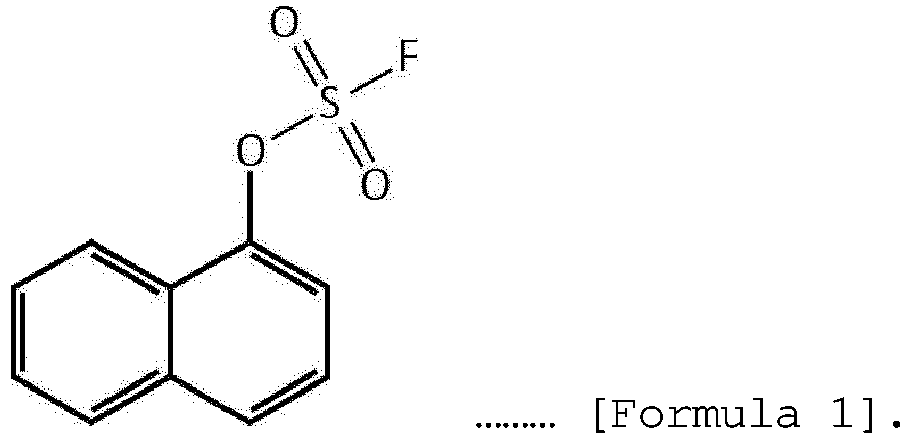
- An electrolyte for a lithium secondary battery according to one form of the present disclosure comprises a lithium salt, a solvent, and a functional additive, wherein the functional additive comprises naphthalen-1-yl sulfurofluoridate, represented by the following formula 1, as a first negative electrode film additive:

- The first negative electrode film additive may be used in a total amount of 0.5-1.0 wt%, based on the weight of the electrolyte.
- The functional additive may further comprise lithium difluoro(oxalato)borate, represented by the following formula 2, as a positive electrode film additive:

- The positive electrode film additive may be used in an amount of 0.5-1.0 wt%, based on the total weight of the electrolyte.
- The functional additive may further comprise vinylene carbonate (VC) as a second negative electrode film additive.
- The second negative electrode film additive may be used in an amount of 0.5-3.0 wt%, based on the total weight of the electrolyte.
- The lithium salt may be at least one compound selected from the group consisting of LiPF6, LiBF4, LiClO4, LiCl, LiBr, LiI, LiB10Cl10, LiCF3SO3, LiCF3CO2, LiAsF6, LiSbF6, LiAlCl4, CH3SO3Li, CF3SO3Li, LiN (SO2C2F5)2, Li(CF3SO2)2N, LiC4F9SO3, LiB(C6H5)4, Li(SO2F)2N (LiFSI), and (CF3SO2)2NLi.
- The solvent may be at least one substance selected from the group consisting of a carbonate-based solvent, an ester-based solvent, and a ketone-based solvent.
- A lithium secondary battery according to one form of the present disclosure comprises the electrolyte described above. The lithium secondary battery may further comprise a positive electrode containing a positive electrode active material composed of Ni, Co, and Mn; a negative electrode containing at least one negative electrode active material selected from a carbon (C)-based material and silicon (Si)-based material; and a separator interposed between the positive electrode and the negative electrode.
- The positive electrode may contain Ni at a content of 80 wt% or more.
- Further areas of applicability will become apparent from the description provided herein. It should be understood that the description and specific examples are intended for purposes of illustration only and are not intended to limit the scope of the present disclosure.
- In order that the disclosure may be well understood, there will now be described various forms thereof, given by way of example, reference being made to the accompanying drawings, in which:
-
FIG. 1 is a view showing an event that occurs in an electrolyte to which the first negative electrode film additive and the positive electrode film additive according to one form of the present disclosure are added together; and -
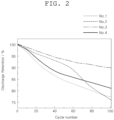
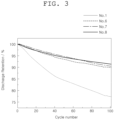
FIGs. 2 and3 are graphs showing charge/discharge test results in Examples and Comparative Examples, respectively. - The drawings described herein are for illustration purposes only and are not intended to limit the scope of the present disclosure in any way.
- The following description is merely exemplary in nature and is not intended to limit the present disclosure, application, or uses. It should be understood that throughout the drawings, corresponding reference numerals indicate like or corresponding parts and features.
- An electrolyte for a lithium secondary battery according to one form of the present disclosure comprises a lithium salt, a solvent, and a functional additive.
- The lithium salt may be at least one compound selected from the group consisting of LiPF6, LiBF4, LiClO4, LiCl, LiBr, LiI, LiB10Cl10, LiCF3SO3, LiCF3CO2, LiAsF6, LiSbF6, LiAlCl4, CH3SO3Li, CF3SO3Li, LiN (SO2C2F5) 2, Li (CF3SO2)2N, LiC4F9SO3, LiB(C6H5)4, Li (SO2F)2N (LiFSI), and (CF3SO2)2NLi.
- The lithium salt may exist at a total concentration of 0.1-1.2 moles in the electrolyte.
- The solvent may be at least one substance selected from the group consisting of a carbonate-based solvent, an ester-based solvent, an ether-based solvent, and a ketone-based solvent.
- In this regard, examples of the carbonate-based solvent include dimethyl carbonate (DMC), diethyl carbonate (DEC), dipropyl carbonate (DPC), methylpropyl carbonate (MPC), ethylpropyl carbonate (EPC), ethylmethyl carbonate (EMC), ethylene carbonate (EC), propylene carbonate (PC), butylene carbonate (BC), fluoroethylene carbonate (FEC), and vinylene carbonate (VC). The ester-based solvent may be exemplified by γ-butyrolactone (GBL), n-methyl acetate, n-ethyl acetate, n-propyl acetate, etc. As the ether-based solvent, dibutyl ether may be used, but without limitations thereto.
- In addition, the solvent may further comprise an aromatic hydrocarbon solvent. Examples of the aromatic carbohydrate solvent include benzene, fluorobenzene, bromobenzene, chlorobenzene, cyclohexyl benzene, isopropyl benzene, n-butylbenzene, octyl benzene, toluene, xylene, and mesitylene, which may be used alone or in combination.
- The functional additive used in the electrolyte according to one form of the present disclosure may employ naphthalen-1-yl sulfurofluoridate (hereinafter referred to as "S3"), represented by the following formula 1, as a first negative electrode film additive

- In this regard, naphthalen-1-yl sulfurofluoridate (S3), which serves as the first negative electrode film additive, stabilize the negative electrode by forming a film protective of the surface of the negative electrode material, and may be preferably added in an amount of 0.5-1.0 wt%, based on the total weight of the electrolyte.
- When added in an amount less than 0.5 wt%, the first negative electrode film additive contributes only little effect because it cannot sufficiently form a surface protecting film on the surface of the negative electrode active material. More than 1.0 wt% of the first negative electrode film additive causes the excessive formation of a surface protecting layer, increasing a cell resistance, which results in a decreased lifetime.
- Meanwhile, the functional additive may further comprise a positive electrode film additive functioning to form a film on a positive electrode active material. As the positive electrode film additive, lithium difluoro(oxalato)borate (hereinafter referred to as "LiFOB"), represented by the following formula 2, may be used:

- The positive electrode film additive, which is lithium difluoro(oxalato)borate (LiFOB), plays a role in stabilizing the positive electrode by forming a protecting film on the surface of the positive electrode active material. In addition, the positive electrode film additive inhibits the oxidative degradation of S3, which is the first negative electrode film additive, contributing to the formation of a film superb in thermal stability.
- The positive electrode film additive may be preferably added in an amount of 0.5-1.0 wt%, based on the total weight of the electrolyte.
- When added in an amount less than 0.5 wt%, the positive electrode film additive contributes only little effect because it cannot sufficiently form a surface protecting film on the surface of the positive electrode active material. More than 1.0 wt% of the positive electrode film additive causes the excessive formation of a surface protecting layer, increasing a cell resistance, which results in a decreased lifetime.
-
FIG. 1 is a view showing an event that occurs in an electrolyte to which the first negative electrode film additive and the positive electrode film additive according to one form of the present disclosure are added together. - The first negative electrode film additive S3 may be subjected to oxidative degradation on the positive electrode to produce sulfuric acid, with the resultant continuous degradation of the cell. However, as shown in
FIG. 1 , when added together with the first negative electrode film additive, the positive electrode film additive is decomposed on the surface of the positive electrode, prior to the first negative electrode film additive S3, to form stable CEI, thereby inhibiting the degradation of the cell. - Meanwhile, the functional additive may further comprise a second negative electrode film additive functioning to form a film on a negative electrode in addition to the first negative electrode film additive. For example, vinylene carbonate (hereinafter referred to "VC") may be used as the second negative electrode film additive.
- The second negative electrode film additive may be preferably added in an amount of 0.5-3.0 wt%, based on the weight of the electrolyte. More preferably, the second negative electrode film additive may be added in an amount of 1.5-2.5 wt%.
- Less than 0.5 wt% of the second negative electrode film additive reduces long-term lifetime characteristics of the cell. When exceeding 3.0 wt%, the amount of the second negative electrode film additive excessively forms a surface protecting layer causes increased cell resistance, resulting in a reduction in battery output.
- According to one form thereof, the present disclosure provides a lithium secondary battery comprising the electrolyte described above, a positive electrode, a negative electrode, and a separator.
- The positive electrode includes an NCM-based positive electrode active material composed of Ni, Co, and Mn. Particularly, the positive electrode active material in the positive electrode according to one form is composed only of an NCM-based positive electrode active material containing 80 wt% or more of Ni.
- The negative electrode includes at least one substance selected from carbon (C) - and silicon (Si)-based negative electrode active materials.
- The carbon (C)-based negative electrode active material may be at least one material selected from the group consisting of artificial graphite, natural graphite, graphitized carbon fibers, graphitized mesocarbon microbeads, fullerene, and amorphous carbon.
- The silicon (Si)-based negative electrode active material may include a silicon oxide, a silicon particle, and a silicon alloy particle.
- For the positive electrode and the negative electrode, the corresponding active material is mixed with a conductive material, a binder, and a solvent to prepare an electrode slurry. This electrode slurry is applied directly on a current collector and dried to manufacture the positive electrode or the negative electrode. In this regard, the current collector may be formed of aluminum (Al), but with no limitations thereto. Such electrode manufacturing methods are well known in the art and thus a detailed description is not given thereof.
- The binder acts to well aggregate active material particles each other or strongly attach them to a current collector. Examples of the binder include, but are not limited to, polyvinyl alcohol, carboxymethyl cellulose, hydroxypropyl cellulose, diacetyl cellulose, polyvinyl chloride, carboxylated polyvinyl chloride, polyvinyl fluoride, ethylene oxide-bearing polymers, polyvinyl pyrrolidone, polyurethane, polytetrafluoroethylene, polyvinylidene fluoride, polyethylene, polypropylene, styrene butadiene rubber, acrylated styrene butadiene rubber, an epoxy resin, and nylon.
- The conductive material is used to confer conductivity on the electrodes. So long as it is of electron conductivity without causing a chemical change in the battery, any conductive material is available. Examples of the conductive material include natural graphite, artificial graphite, carbon black, acetylene black, Ketjenblack, carbon fibers, and metal particles or fibers such as copper, nickel, aluminum, silver, etc. In addition, at least one conductive material such as a polyphenylene derivative may be further used.
- The separator inhibits the formation of a short circuit between the positive electrode and the negative electrode while providing migration channels of lithium ions. This separator may well-known one, for example, a polyolefinic membrane such as polypropylene, polyethylene, polyethylene/polypropylene, polyethylene/polypropylene/polyethylene, polypropylene/polyethylene/polypropylene, etc., or a multiple membrane, microporous film, woven fabric, or non-woven fabric thereof. Alternatively, a porous polyolefin film coated with highly stable resin may be used.
- Hereinafter, the present disclosure is explained with reference to Examples and Comparative Examples.
- To examine cell resistance and high-temperature lifetime characteristics according to amounts and types of functional additives used in an electrolyte, a measurement was made of initial cell resistance and discharge retention after 100 cycles at a high temperature (45°C) while types of functional additives were changed as shown in Table 1, below. The results are summarized in Table 1 and depicted in
FIGs. 1 and2 . - In this regard, the cycles were performed under the conditions of cut-off: 2.7 - 4.35V, C-rate 1C, and temperature: 45°C. For preparing electrolytes, 0.5M LiPF6 + 0.5 LiFSI was used as a lithium salt and a mixture of ethylene carbonate (EC): ethylmethyl carbonate (EMC): diethyl carbonate (DEC) at a volume ratio of 25:45:30.
- The positive electrode was made of NCM811 while the negative electrode was a graphite electrode.
TABLE 1 No. Additive Initial cell resistance (%) High temp. lifetime (%) @100cyc VC LiPO2F2 S3 LiFOB 1 Comparative Example 1.0 - - - 100 77.4 2 Comparative Example - - 0.2 - 97 76.2 3 Example - - 0.5 - 98 89.9 4 Example - - 1.0 - 103 81.2 6 Comparative Example 1.0 0.5 - - 102 89.9 7 Example 1.0 - 0.5 - 102 90.5 8 Example 1.0 - 0.5 0.5 101 91.4 - First, as shown in Table 1 and
FIG. 2 , an improvement in high-temperature lifetime was observed in Nos. 3 and 4 where the negative electrode film additive according to the present disclosure was added within the amount range suggested herein, compared to No. 1 where the typical functional additive VC was used. - Meanwhile, No.2 to which the first negative electrode film additive according to the present disclosure was added in an amount less than the lower limit of the amount range suggested herein was inferior in terms of high-temperature lifetime compared to No. 1.
- As can be understood from the data of Table 1 and
FIG. 3 , the high-temperature lifetime was further improved in No. 7, where the typical functional additive VC and the first negative electrode film additive according to the present disclosure were added, compared to No. 6, where the typical functional additive VC and the conventional negative electrode film additive LiPO2F2 were added in the same amounts. - Particularly, the highest improvement of high-temperature lifetime was detected in No. 8 where the typical functional additive VC was used together with a combination of the first negative electrode film additive and the positive electrode film additive.
- As described hitherto, according to various forms of the present disclosure, the electrolyte can form CEI on the surface of a negative electrode active material to inhibit the degradation of the cell, thereby improving the lifetime of the lithium secondary battery.
- Furthermore, the electrolyte guarantees lifetime stability at high temperatures and high voltages, contributing to an improvement of commercial value in the battery.
- It should be understood that the above-described forms are illustrative but not restrictive in all aspects. The scope of the present disclosure is defined by the scope of the attached claims, rather than the detailed description.
Claims (11)
- An electrolyte for a lithium secondary battery, the electrolyte comprising:a lithium salt;a solvent; anda functional additive, wherein the functional additive comprises naphthalen-1-yl sulfurofluoridate, represented by the following formula 1:
- The electrolyte of claim 1, wherein the naphthalen-1-yl sulfurofluoridate is added in an amount of 0.5-1.0 wt%, based on a total weight of the electrolyte.
- The electrolyte of claim 1, wherein the functional additive further comprises lithium difluoro(oxalato)borate, represented by the following formula 2:

- The electrolyte of claim 3, wherein the lithium difluoro(oxalato)borate is added in an amount of 0.5-1.0 wt%, based on a total weight of the electrolyte.
- The electrolyte of claim 1, wherein the functional additive further comprises vinylene carbonate (VC).
- The electrolyte of claim 5, wherein the vinylene carbonate (VC) is added in an amount of 0.5 - 3.0 wt%, based on a total weight of the electrolyte.
- The electrolyte of claim 1, wherein the lithium salt is at least one compound selected from a group consisting of: LiPF6, LiBF4, LiClO4, LiCl, LiBr, LiI, LiB10Cl10, LiCF3SO3, LiCF3CO2, LiAsF6, LiSbF6, LiAlCl4, CH3SO3Li, CF3SO3Li, LiN (SO2C2F5) 2, Li (CF3SO2)2N, LiC4F9SO3, LiB (C6H5)4, Li (SO2F)2N (LiFSI), and (CF3SO2)2NLi.
- The electrolyte of claim 1, wherein the solvent is at least one substance selected from a group consisting of: a carbonate-based solvent, an ester-based solvent, an ether-based solvent, and a ketone-based solvent.
- A lithium secondary battery, comprising an electrolyte comprised of:a lithium salt;a solvent; anda functional additive, wherein the functional additive comprises naphthalen-1-yl sulfurofluoridate, represented by the following formula 1:

- The lithium secondary battery of claim 9, further comprising:a positive electrode containing a positive electrode active material composed of Ni, Co, and Mn;a negative electrode containing at least one negative electrode active material selected from a carbon (C)-based material and silicon (Si)-based material; anda separator interposed between the positive electrode and the negative electrode.
- The lithium secondary battery of claim 10, wherein the positive electrode contains Ni at a content of 80 wt% or more.
Applications Claiming Priority (1)
| Application Number | Priority Date | Filing Date | Title |
|---|---|---|---|
| KR1020200132095A KR20220048804A (en) | 2020-10-13 | 2020-10-13 | Electrolyte solution for lithium secondary battery and Lithium secondary battery comprising the same |
Publications (2)
| Publication Number | Publication Date |
|---|---|
| EP3985774A1 EP3985774A1 (en) | 2022-04-20 |
| EP3985774B1 true EP3985774B1 (en) | 2023-04-05 |
Family
ID=76250187
Family Applications (1)
| Application Number | Title | Priority Date | Filing Date |
|---|---|---|---|
| EP21177364.3A Active EP3985774B1 (en) | 2020-10-13 | 2021-06-02 | Electrolyte for lithium secondary battery and lithium secondary battery comprising the same |
Country Status (4)
| Country | Link |
|---|---|
| US (1) | US11830979B2 (en) |
| EP (1) | EP3985774B1 (en) |
| KR (1) | KR20220048804A (en) |
| CN (1) | CN114361585A (en) |
Families Citing this family (2)
| Publication number | Priority date | Publication date | Assignee | Title |
|---|---|---|---|---|
| KR102806982B1 (en) * | 2021-10-07 | 2025-05-15 | 한국전자통신연구원 | Electrolyte composition and lithium Battery including the same |
| CN121035359B (en) * | 2025-10-30 | 2026-02-17 | 广州天赐高新材料股份有限公司 | Electrolyte and Lithium Iron Phosphate Battery |
Family Cites Families (7)
| Publication number | Priority date | Publication date | Assignee | Title |
|---|---|---|---|---|
| CN104752765B (en) * | 2013-12-30 | 2017-01-25 | 比亚迪股份有限公司 | Nonaqueous electrolyte additive and nonaqueous electrolyte containing the additive |
| JP6760843B2 (en) * | 2014-10-16 | 2020-09-23 | 株式会社Adeka | Non-aqueous electrolyte and non-aqueous electrolyte secondary batteries |
| CN108091933B (en) * | 2017-12-12 | 2019-11-12 | 石家庄圣泰化工有限公司 | Application of the fluosulfonic acid ester type compound in battery electrolyte |
| KR20190092149A (en) | 2018-01-30 | 2019-08-07 | 파낙스 이텍(주) | Electrolyte for secondary battery and secondary battery containing the same |
| KR20200005369A (en) | 2018-07-06 | 2020-01-15 | 삼성에스디아이 주식회사 | Electrolyte for rechargeable lithium battery and rechargeable lithium battery |
| CN114846669A (en) * | 2019-12-17 | 2022-08-02 | 三菱化学株式会社 | Nonaqueous electrolyte solution and energy device |
| CN111129587B (en) * | 2019-12-20 | 2021-12-03 | 杉杉新材料(衢州)有限公司 | Non-aqueous electrolyte for lithium ion battery and lithium ion battery thereof |
-
2020
- 2020-10-13 KR KR1020200132095A patent/KR20220048804A/en active Pending
-
2021
- 2021-06-02 EP EP21177364.3A patent/EP3985774B1/en active Active
- 2021-06-04 US US17/339,328 patent/US11830979B2/en active Active
- 2021-06-25 CN CN202110709894.1A patent/CN114361585A/en active Pending
Also Published As
| Publication number | Publication date |
|---|---|
| US20220115696A1 (en) | 2022-04-14 |
| CN114361585A (en) | 2022-04-15 |
| KR20220048804A (en) | 2022-04-20 |
| US11830979B2 (en) | 2023-11-28 |
| EP3985774A1 (en) | 2022-04-20 |
Similar Documents
| Publication | Publication Date | Title |
|---|---|---|
| KR102722091B1 (en) | Lithium secondary battery | |
| US12412929B2 (en) | Electrolyte solution for a lithium secondary battery and a lithium secondary battery including same | |
| US11830979B2 (en) | Electrolyte for lithium secondary battery and lithium secondary battery comprising same | |
| KR102922363B1 (en) | Electrolyte solution for lithium secondary battery and Lithium secondary battery comprising the same | |
| US12438193B2 (en) | Electrolyte solution for a lithium secondary battery and a lithium secondary battery including same | |
| US11646448B2 (en) | Electrolyte for lithium secondary battery and lithium secondary battery comprising same | |
| US11764404B2 (en) | Electrolyte for lithium secondary battery and lithium secondary battery comprising same | |
| KR102922365B1 (en) | Electrolyte solution for lithium secondary battery and Lithium secondary battery comprising the same | |
| KR102845705B1 (en) | Electrolyte solution for lithium secondary battery and Lithium secondary battery comprising the same | |
| KR102845704B1 (en) | Electrolyte solution for lithium secondary battery and Lithium secondary battery comprising the same | |
| KR20240061946A (en) | Electrolyte solution for lithium secondary battery and Lithium secondary battery comprising the same | |
| KR20230132384A (en) | Electrolyte additive for secondary battery, non-aqueous electrolyte for lithium secondary battery comprising the same and lithium secondary battery | |
| KR20230101255A (en) | Electrolyte solution for lithium secondary battery and Lithium secondary battery comprising the same | |
| KR20220056578A (en) | Electrolyte solution for lithium secondary battery and Lithium secondary battery comprising the same | |
| KR102931335B1 (en) | Electrolyte solution for lithium secondary battery and Lithium secondary battery comprising the same | |
| KR102845706B1 (en) | Electrolyte solution for lithium secondary battery and Lithium secondary battery comprising the same | |
| KR102939173B1 (en) | Electrolyte solution for lithium secondary battery and Lithium secondary battery comprising the same | |
| KR20230133603A (en) | Electrolyte solution for lithium secondary battery and Lithium secondary battery comprising the same | |
| US20210151796A1 (en) | Electrolytic Solution for Lithium Secondary Batteries and Lithium Secondary Battery Including the Same | |
| KR20240061927A (en) | Electrolyte solution for lithium secondary battery and Lithium secondary battery comprising the same | |
| KR20240071832A (en) | Electrolyte solution for lithium secondary battery and Lithium secondary battery comprising the same | |
| KR20230133602A (en) | Electrolyte solution for lithium secondary battery and Lithium secondary battery comprising the same | |
| KR20240060147A (en) | Electrolyte solution for lithium secondary battery and Lithium secondary battery comprising the same | |
| KR20240061928A (en) | Electrolyte solution for lithium secondary battery and Lithium secondary battery comprising the same | |
| KR20240060146A (en) | Electrolyte solution for lithium secondary battery and Lithium secondary battery comprising the same |
Legal Events
| Date | Code | Title | Description |
|---|---|---|---|
| PUAI | Public reference made under article 153(3) epc to a published international application that has entered the european phase |
Free format text: ORIGINAL CODE: 0009012 |
|
| STAA | Information on the status of an ep patent application or granted ep patent |
Free format text: STATUS: THE APPLICATION HAS BEEN PUBLISHED |
|
| AK | Designated contracting states |
Kind code of ref document: A1 Designated state(s): AL AT BE BG CH CY CZ DE DK EE ES FI FR GB GR HR HU IE IS IT LI LT LU LV MC MK MT NL NO PL PT RO RS SE SI SK SM TR |
|
| STAA | Information on the status of an ep patent application or granted ep patent |
Free format text: STATUS: REQUEST FOR EXAMINATION WAS MADE |
|
| 17P | Request for examination filed |
Effective date: 20220426 |
|
| RBV | Designated contracting states (corrected) |
Designated state(s): AL AT BE BG CH CY CZ DE DK EE ES FI FR GB GR HR HU IE IS IT LI LT LU LV MC MK MT NL NO PL PT RO RS SE SI SK SM TR |
|
| GRAP | Despatch of communication of intention to grant a patent |
Free format text: ORIGINAL CODE: EPIDOSNIGR1 |
|
| STAA | Information on the status of an ep patent application or granted ep patent |
Free format text: STATUS: GRANT OF PATENT IS INTENDED |
|
| RIC1 | Information provided on ipc code assigned before grant |
Ipc: H01M 10/0568 20100101ALN20221005BHEP Ipc: H01M 4/587 20100101ALN20221005BHEP Ipc: H01M 4/38 20060101ALN20221005BHEP Ipc: H01M 4/505 20100101ALI20221005BHEP Ipc: H01M 10/0525 20100101ALI20221005BHEP Ipc: H01M 10/0567 20100101AFI20221005BHEP |
|
| INTG | Intention to grant announced |
Effective date: 20221019 |
|
| GRAS | Grant fee paid |
Free format text: ORIGINAL CODE: EPIDOSNIGR3 |
|
| GRAA | (expected) grant |
Free format text: ORIGINAL CODE: 0009210 |
|
| STAA | Information on the status of an ep patent application or granted ep patent |
Free format text: STATUS: THE PATENT HAS BEEN GRANTED |
|
| AK | Designated contracting states |
Kind code of ref document: B1 Designated state(s): AL AT BE BG CH CY CZ DE DK EE ES FI FR GB GR HR HU IE IS IT LI LT LU LV MC MK MT NL NO PL PT RO RS SE SI SK SM TR |
|
| REG | Reference to a national code |
Ref country code: GB Ref legal event code: FG4D |
|
| REG | Reference to a national code |
Ref country code: CH Ref legal event code: EP |
|
| REG | Reference to a national code |
Ref country code: AT Ref legal event code: REF Ref document number: 1558936 Country of ref document: AT Kind code of ref document: T Effective date: 20230415 |
|
| REG | Reference to a national code |
Ref country code: DE Ref legal event code: R096 Ref document number: 602021001802 Country of ref document: DE |
|
| REG | Reference to a national code |
Ref country code: IE Ref legal event code: FG4D |
|
| REG | Reference to a national code |
Ref country code: LT Ref legal event code: MG9D |
|
| REG | Reference to a national code |
Ref country code: NL Ref legal event code: MP Effective date: 20230405 |
|
| REG | Reference to a national code |
Ref country code: AT Ref legal event code: MK05 Ref document number: 1558936 Country of ref document: AT Kind code of ref document: T Effective date: 20230405 |
|
| PG25 | Lapsed in a contracting state [announced via postgrant information from national office to epo] |
Ref country code: NL Free format text: LAPSE BECAUSE OF FAILURE TO SUBMIT A TRANSLATION OF THE DESCRIPTION OR TO PAY THE FEE WITHIN THE PRESCRIBED TIME-LIMIT Effective date: 20230405 |
|
| PG25 | Lapsed in a contracting state [announced via postgrant information from national office to epo] |
Ref country code: SE Free format text: LAPSE BECAUSE OF FAILURE TO SUBMIT A TRANSLATION OF THE DESCRIPTION OR TO PAY THE FEE WITHIN THE PRESCRIBED TIME-LIMIT Effective date: 20230405 Ref country code: PT Free format text: LAPSE BECAUSE OF FAILURE TO SUBMIT A TRANSLATION OF THE DESCRIPTION OR TO PAY THE FEE WITHIN THE PRESCRIBED TIME-LIMIT Effective date: 20230807 Ref country code: NO Free format text: LAPSE BECAUSE OF FAILURE TO SUBMIT A TRANSLATION OF THE DESCRIPTION OR TO PAY THE FEE WITHIN THE PRESCRIBED TIME-LIMIT Effective date: 20230705 Ref country code: ES Free format text: LAPSE BECAUSE OF FAILURE TO SUBMIT A TRANSLATION OF THE DESCRIPTION OR TO PAY THE FEE WITHIN THE PRESCRIBED TIME-LIMIT Effective date: 20230405 Ref country code: AT Free format text: LAPSE BECAUSE OF FAILURE TO SUBMIT A TRANSLATION OF THE DESCRIPTION OR TO PAY THE FEE WITHIN THE PRESCRIBED TIME-LIMIT Effective date: 20230405 |
|
| PG25 | Lapsed in a contracting state [announced via postgrant information from national office to epo] |
Ref country code: RS Free format text: LAPSE BECAUSE OF FAILURE TO SUBMIT A TRANSLATION OF THE DESCRIPTION OR TO PAY THE FEE WITHIN THE PRESCRIBED TIME-LIMIT Effective date: 20230405 Ref country code: PL Free format text: LAPSE BECAUSE OF FAILURE TO SUBMIT A TRANSLATION OF THE DESCRIPTION OR TO PAY THE FEE WITHIN THE PRESCRIBED TIME-LIMIT Effective date: 20230405 Ref country code: LV Free format text: LAPSE BECAUSE OF FAILURE TO SUBMIT A TRANSLATION OF THE DESCRIPTION OR TO PAY THE FEE WITHIN THE PRESCRIBED TIME-LIMIT Effective date: 20230405 Ref country code: LT Free format text: LAPSE BECAUSE OF FAILURE TO SUBMIT A TRANSLATION OF THE DESCRIPTION OR TO PAY THE FEE WITHIN THE PRESCRIBED TIME-LIMIT Effective date: 20230405 Ref country code: IS Free format text: LAPSE BECAUSE OF FAILURE TO SUBMIT A TRANSLATION OF THE DESCRIPTION OR TO PAY THE FEE WITHIN THE PRESCRIBED TIME-LIMIT Effective date: 20230805 Ref country code: HR Free format text: LAPSE BECAUSE OF FAILURE TO SUBMIT A TRANSLATION OF THE DESCRIPTION OR TO PAY THE FEE WITHIN THE PRESCRIBED TIME-LIMIT Effective date: 20230405 Ref country code: GR Free format text: LAPSE BECAUSE OF FAILURE TO SUBMIT A TRANSLATION OF THE DESCRIPTION OR TO PAY THE FEE WITHIN THE PRESCRIBED TIME-LIMIT Effective date: 20230706 Ref country code: AL Free format text: LAPSE BECAUSE OF FAILURE TO SUBMIT A TRANSLATION OF THE DESCRIPTION OR TO PAY THE FEE WITHIN THE PRESCRIBED TIME-LIMIT Effective date: 20230405 |
|
| PG25 | Lapsed in a contracting state [announced via postgrant information from national office to epo] |
Ref country code: FI Free format text: LAPSE BECAUSE OF FAILURE TO SUBMIT A TRANSLATION OF THE DESCRIPTION OR TO PAY THE FEE WITHIN THE PRESCRIBED TIME-LIMIT Effective date: 20230405 |
|
| REG | Reference to a national code |
Ref country code: DE Ref legal event code: R097 Ref document number: 602021001802 Country of ref document: DE |
|
| PG25 | Lapsed in a contracting state [announced via postgrant information from national office to epo] |
Ref country code: SK Free format text: LAPSE BECAUSE OF FAILURE TO SUBMIT A TRANSLATION OF THE DESCRIPTION OR TO PAY THE FEE WITHIN THE PRESCRIBED TIME-LIMIT Effective date: 20230405 |
|
| PG25 | Lapsed in a contracting state [announced via postgrant information from national office to epo] |
Ref country code: MC Free format text: LAPSE BECAUSE OF FAILURE TO SUBMIT A TRANSLATION OF THE DESCRIPTION OR TO PAY THE FEE WITHIN THE PRESCRIBED TIME-LIMIT Effective date: 20230405 |
|
| PG25 | Lapsed in a contracting state [announced via postgrant information from national office to epo] |
Ref country code: SM Free format text: LAPSE BECAUSE OF FAILURE TO SUBMIT A TRANSLATION OF THE DESCRIPTION OR TO PAY THE FEE WITHIN THE PRESCRIBED TIME-LIMIT Effective date: 20230405 Ref country code: SK Free format text: LAPSE BECAUSE OF FAILURE TO SUBMIT A TRANSLATION OF THE DESCRIPTION OR TO PAY THE FEE WITHIN THE PRESCRIBED TIME-LIMIT Effective date: 20230405 Ref country code: RO Free format text: LAPSE BECAUSE OF FAILURE TO SUBMIT A TRANSLATION OF THE DESCRIPTION OR TO PAY THE FEE WITHIN THE PRESCRIBED TIME-LIMIT Effective date: 20230405 Ref country code: MC Free format text: LAPSE BECAUSE OF FAILURE TO SUBMIT A TRANSLATION OF THE DESCRIPTION OR TO PAY THE FEE WITHIN THE PRESCRIBED TIME-LIMIT Effective date: 20230405 Ref country code: EE Free format text: LAPSE BECAUSE OF FAILURE TO SUBMIT A TRANSLATION OF THE DESCRIPTION OR TO PAY THE FEE WITHIN THE PRESCRIBED TIME-LIMIT Effective date: 20230405 Ref country code: DK Free format text: LAPSE BECAUSE OF FAILURE TO SUBMIT A TRANSLATION OF THE DESCRIPTION OR TO PAY THE FEE WITHIN THE PRESCRIBED TIME-LIMIT Effective date: 20230405 Ref country code: CZ Free format text: LAPSE BECAUSE OF FAILURE TO SUBMIT A TRANSLATION OF THE DESCRIPTION OR TO PAY THE FEE WITHIN THE PRESCRIBED TIME-LIMIT Effective date: 20230405 |
|
| PLBE | No opposition filed within time limit |
Free format text: ORIGINAL CODE: 0009261 |
|
| STAA | Information on the status of an ep patent application or granted ep patent |
Free format text: STATUS: NO OPPOSITION FILED WITHIN TIME LIMIT |
|
| REG | Reference to a national code |
Ref country code: BE Ref legal event code: MM Effective date: 20230630 |
|
| PG25 | Lapsed in a contracting state [announced via postgrant information from national office to epo] |
Ref country code: LU Free format text: LAPSE BECAUSE OF NON-PAYMENT OF DUE FEES Effective date: 20230602 |
|
| 26N | No opposition filed |
Effective date: 20240108 |
|
| REG | Reference to a national code |
Ref country code: IE Ref legal event code: MM4A |
|
| PG25 | Lapsed in a contracting state [announced via postgrant information from national office to epo] |
Ref country code: LU Free format text: LAPSE BECAUSE OF NON-PAYMENT OF DUE FEES Effective date: 20230602 |
|
| PG25 | Lapsed in a contracting state [announced via postgrant information from national office to epo] |
Ref country code: IE Free format text: LAPSE BECAUSE OF NON-PAYMENT OF DUE FEES Effective date: 20230602 |
|
| PG25 | Lapsed in a contracting state [announced via postgrant information from national office to epo] |
Ref country code: IE Free format text: LAPSE BECAUSE OF NON-PAYMENT OF DUE FEES Effective date: 20230602 |
|
| PG25 | Lapsed in a contracting state [announced via postgrant information from national office to epo] |
Ref country code: SI Free format text: LAPSE BECAUSE OF FAILURE TO SUBMIT A TRANSLATION OF THE DESCRIPTION OR TO PAY THE FEE WITHIN THE PRESCRIBED TIME-LIMIT Effective date: 20230405 |
|
| PG25 | Lapsed in a contracting state [announced via postgrant information from national office to epo] |
Ref country code: SI Free format text: LAPSE BECAUSE OF FAILURE TO SUBMIT A TRANSLATION OF THE DESCRIPTION OR TO PAY THE FEE WITHIN THE PRESCRIBED TIME-LIMIT Effective date: 20230405 Ref country code: IT Free format text: LAPSE BECAUSE OF FAILURE TO SUBMIT A TRANSLATION OF THE DESCRIPTION OR TO PAY THE FEE WITHIN THE PRESCRIBED TIME-LIMIT Effective date: 20230405 Ref country code: BE Free format text: LAPSE BECAUSE OF NON-PAYMENT OF DUE FEES Effective date: 20230630 |
|
| PG25 | Lapsed in a contracting state [announced via postgrant information from national office to epo] |
Ref country code: BG Free format text: LAPSE BECAUSE OF FAILURE TO SUBMIT A TRANSLATION OF THE DESCRIPTION OR TO PAY THE FEE WITHIN THE PRESCRIBED TIME-LIMIT Effective date: 20230405 |
|
| P01 | Opt-out of the competence of the unified patent court (upc) registered |
Free format text: CASE NUMBER: UPC_APP_119172/2023 Effective date: 20230510 |
|
| PG25 | Lapsed in a contracting state [announced via postgrant information from national office to epo] |
Ref country code: BG Free format text: LAPSE BECAUSE OF FAILURE TO SUBMIT A TRANSLATION OF THE DESCRIPTION OR TO PAY THE FEE WITHIN THE PRESCRIBED TIME-LIMIT Effective date: 20230405 |
|
| REG | Reference to a national code |
Ref country code: CH Ref legal event code: PL |
|
| PG25 | Lapsed in a contracting state [announced via postgrant information from national office to epo] |
Ref country code: CH Free format text: LAPSE BECAUSE OF NON-PAYMENT OF DUE FEES Effective date: 20240630 |
|
| PGFP | Annual fee paid to national office [announced via postgrant information from national office to epo] |
Ref country code: DE Payment date: 20250520 Year of fee payment: 5 |
|
| PGFP | Annual fee paid to national office [announced via postgrant information from national office to epo] |
Ref country code: GB Payment date: 20250520 Year of fee payment: 5 |
|
| PGFP | Annual fee paid to national office [announced via postgrant information from national office to epo] |
Ref country code: FR Payment date: 20250521 Year of fee payment: 5 |
|
| PG25 | Lapsed in a contracting state [announced via postgrant information from national office to epo] |
Ref country code: CY Free format text: LAPSE BECAUSE OF FAILURE TO SUBMIT A TRANSLATION OF THE DESCRIPTION OR TO PAY THE FEE WITHIN THE PRESCRIBED TIME-LIMIT; INVALID AB INITIO Effective date: 20210602 |
|
| PG25 | Lapsed in a contracting state [announced via postgrant information from national office to epo] |
Ref country code: HU Free format text: LAPSE BECAUSE OF FAILURE TO SUBMIT A TRANSLATION OF THE DESCRIPTION OR TO PAY THE FEE WITHIN THE PRESCRIBED TIME-LIMIT; INVALID AB INITIO Effective date: 20210602 |
|
| PG25 | Lapsed in a contracting state [announced via postgrant information from national office to epo] |
Ref country code: TR Free format text: LAPSE BECAUSE OF FAILURE TO SUBMIT A TRANSLATION OF THE DESCRIPTION OR TO PAY THE FEE WITHIN THE PRESCRIBED TIME-LIMIT Effective date: 20230405 |