EP3985755A1 - Negative electrode, electrochemical device, and electronic device - Google Patents
Negative electrode, electrochemical device, and electronic device Download PDFInfo
- Publication number
- EP3985755A1 EP3985755A1 EP21165302.7A EP21165302A EP3985755A1 EP 3985755 A1 EP3985755 A1 EP 3985755A1 EP 21165302 A EP21165302 A EP 21165302A EP 3985755 A1 EP3985755 A1 EP 3985755A1
- Authority
- EP
- European Patent Office
- Prior art keywords
- active substance
- porous material
- negative electrode
- electrochemical device
- particle size
- Prior art date
- Legal status (The legal status is an assumption and is not a legal conclusion. Google has not performed a legal analysis and makes no representation as to the accuracy of the status listed.)
- Pending
Links
- 239000013543 active substance Substances 0.000 claims abstract description 129
- 239000002245 particle Substances 0.000 claims description 85
- 239000011148 porous material Substances 0.000 claims description 69
- 150000001875 compounds Chemical class 0.000 claims description 33
- 239000003792 electrolyte Substances 0.000 claims description 27
- OKTJSMMVPCPJKN-UHFFFAOYSA-N Carbon Chemical compound [C] OKTJSMMVPCPJKN-UHFFFAOYSA-N 0.000 claims description 26
- 125000004122 cyclic group Chemical group 0.000 claims description 9
- 229910002804 graphite Inorganic materials 0.000 claims description 9
- 239000010439 graphite Substances 0.000 claims description 9
- 239000002931 mesocarbon microbead Substances 0.000 claims description 7
- QAOWNCQODCNURD-UHFFFAOYSA-L Sulfate Chemical compound [O-]S([O-])(=O)=O QAOWNCQODCNURD-UHFFFAOYSA-L 0.000 claims description 6
- LSNNMFCWUKXFEE-UHFFFAOYSA-N Sulfurous acid Chemical compound OS(O)=O LSNNMFCWUKXFEE-UHFFFAOYSA-N 0.000 claims description 6
- JXLHNMVSKXFWAO-UHFFFAOYSA-N azane;7-fluoro-2,1,3-benzoxadiazole-4-sulfonic acid Chemical compound N.OS(=O)(=O)C1=CC=C(F)C2=NON=C12 JXLHNMVSKXFWAO-UHFFFAOYSA-N 0.000 claims description 6
- 239000000919 ceramic Substances 0.000 claims description 5
- 229910052799 carbon Inorganic materials 0.000 claims description 4
- HPTYUNKZVDYXLP-UHFFFAOYSA-N aluminum;trihydroxy(trihydroxysilyloxy)silane;hydrate Chemical compound O.[Al].[Al].O[Si](O)(O)O[Si](O)(O)O HPTYUNKZVDYXLP-UHFFFAOYSA-N 0.000 claims description 3
- 229910052621 halloysite Inorganic materials 0.000 claims description 3
- 125000000325 methylidene group Chemical group [H]C([H])=* 0.000 claims description 3
- 239000002071 nanotube Substances 0.000 claims description 3
- 239000002210 silicon-based material Substances 0.000 claims description 3
- WHXSMMKQMYFTQS-UHFFFAOYSA-N Lithium Chemical compound [Li] WHXSMMKQMYFTQS-UHFFFAOYSA-N 0.000 abstract description 57
- 229910052744 lithium Inorganic materials 0.000 abstract description 57
- 238000007747 plating Methods 0.000 abstract description 52
- 239000010410 layer Substances 0.000 description 63
- HBBGRARXTFLTSG-UHFFFAOYSA-N Lithium ion Chemical compound [Li+] HBBGRARXTFLTSG-UHFFFAOYSA-N 0.000 description 30
- 229910001416 lithium ion Inorganic materials 0.000 description 30
- -1 polytetrafluoroethylene Polymers 0.000 description 24
- 238000012360 testing method Methods 0.000 description 19
- 238000000034 method Methods 0.000 description 15
- 239000011230 binding agent Substances 0.000 description 12
- 230000000052 comparative effect Effects 0.000 description 9
- 239000002033 PVDF binder Substances 0.000 description 8
- 229920002981 polyvinylidene fluoride Polymers 0.000 description 8
- 238000002360 preparation method Methods 0.000 description 7
- 239000006258 conductive agent Substances 0.000 description 6
- 230000002687 intercalation Effects 0.000 description 6
- 238000009830 intercalation Methods 0.000 description 6
- 239000007784 solid electrolyte Substances 0.000 description 6
- 239000004698 Polyethylene Substances 0.000 description 5
- 238000004458 analytical method Methods 0.000 description 5
- 230000000694 effects Effects 0.000 description 5
- 230000014759 maintenance of location Effects 0.000 description 5
- 239000000463 material Substances 0.000 description 5
- 239000012528 membrane Substances 0.000 description 5
- 229910052751 metal Inorganic materials 0.000 description 5
- 239000002184 metal Substances 0.000 description 5
- 229920000573 polyethylene Polymers 0.000 description 5
- 238000001179 sorption measurement Methods 0.000 description 5
- OIFBSDVPJOWBCH-UHFFFAOYSA-N Diethyl carbonate Chemical compound CCOC(=O)OCC OIFBSDVPJOWBCH-UHFFFAOYSA-N 0.000 description 4
- KMTRUDSVKNLOMY-UHFFFAOYSA-N Ethylene carbonate Chemical compound O=C1OCCO1 KMTRUDSVKNLOMY-UHFFFAOYSA-N 0.000 description 4
- 229910001290 LiPF6 Inorganic materials 0.000 description 4
- SECXISVLQFMRJM-UHFFFAOYSA-N N-Methylpyrrolidone Chemical compound CN1CCCC1=O SECXISVLQFMRJM-UHFFFAOYSA-N 0.000 description 4
- 210000001787 dendrite Anatomy 0.000 description 4
- 239000011267 electrode slurry Substances 0.000 description 4
- 230000006870 function Effects 0.000 description 4
- 239000007789 gas Substances 0.000 description 4
- 150000002500 ions Chemical class 0.000 description 4
- VNWKTOKETHGBQD-UHFFFAOYSA-N methane Chemical compound C VNWKTOKETHGBQD-UHFFFAOYSA-N 0.000 description 4
- RUOJZAUFBMNUDX-UHFFFAOYSA-N propylene carbonate Chemical compound CC1COC(=O)O1 RUOJZAUFBMNUDX-UHFFFAOYSA-N 0.000 description 4
- 239000000243 solution Substances 0.000 description 4
- 229920003048 styrene butadiene rubber Polymers 0.000 description 4
- WEVYAHXRMPXWCK-UHFFFAOYSA-N Acetonitrile Chemical compound CC#N WEVYAHXRMPXWCK-UHFFFAOYSA-N 0.000 description 3
- XEKOWRVHYACXOJ-UHFFFAOYSA-N Ethyl acetate Chemical compound CCOC(C)=O XEKOWRVHYACXOJ-UHFFFAOYSA-N 0.000 description 3
- ZMXDDKWLCZADIW-UHFFFAOYSA-N N,N-Dimethylformamide Chemical compound CN(C)C=O ZMXDDKWLCZADIW-UHFFFAOYSA-N 0.000 description 3
- VYPSYNLAJGMNEJ-UHFFFAOYSA-N Silicium dioxide Chemical compound O=[Si]=O VYPSYNLAJGMNEJ-UHFFFAOYSA-N 0.000 description 3
- DPXJVFZANSGRMM-UHFFFAOYSA-N acetic acid;2,3,4,5,6-pentahydroxyhexanal;sodium Chemical compound [Na].CC(O)=O.OCC(O)C(O)C(O)C(O)C=O DPXJVFZANSGRMM-UHFFFAOYSA-N 0.000 description 3
- 239000002156 adsorbate Substances 0.000 description 3
- 239000001768 carboxy methyl cellulose Substances 0.000 description 3
- 238000001035 drying Methods 0.000 description 3
- 238000011156 evaluation Methods 0.000 description 3
- 229910003002 lithium salt Inorganic materials 0.000 description 3
- 159000000002 lithium salts Chemical class 0.000 description 3
- 239000003960 organic solvent Substances 0.000 description 3
- TWNQGVIAIRXVLR-UHFFFAOYSA-N oxo(oxoalumanyloxy)alumane Chemical compound O=[Al]O[Al]=O TWNQGVIAIRXVLR-UHFFFAOYSA-N 0.000 description 3
- 239000002985 plastic film Substances 0.000 description 3
- 229920006255 plastic film Polymers 0.000 description 3
- 229920001343 polytetrafluoroethylene Polymers 0.000 description 3
- 239000004810 polytetrafluoroethylene Substances 0.000 description 3
- 235000019812 sodium carboxymethyl cellulose Nutrition 0.000 description 3
- 229920001027 sodium carboxymethylcellulose Polymers 0.000 description 3
- XOLBLPGZBRYERU-UHFFFAOYSA-N tin dioxide Chemical compound O=[Sn]=O XOLBLPGZBRYERU-UHFFFAOYSA-N 0.000 description 3
- ZZXUZKXVROWEIF-UHFFFAOYSA-N 1,2-butylene carbonate Chemical compound CCC1COC(=O)O1 ZZXUZKXVROWEIF-UHFFFAOYSA-N 0.000 description 2
- BJWMSGRKJIOCNR-UHFFFAOYSA-N 4-ethenyl-1,3-dioxolan-2-one Chemical compound C=CC1COC(=O)O1 BJWMSGRKJIOCNR-UHFFFAOYSA-N 0.000 description 2
- SBLRHMKNNHXPHG-UHFFFAOYSA-N 4-fluoro-1,3-dioxolan-2-one Chemical compound FC1COC(=O)O1 SBLRHMKNNHXPHG-UHFFFAOYSA-N 0.000 description 2
- OZJPLYNZGCXSJM-UHFFFAOYSA-N 5-valerolactone Chemical compound O=C1CCCCO1 OZJPLYNZGCXSJM-UHFFFAOYSA-N 0.000 description 2
- IJGRMHOSHXDMSA-UHFFFAOYSA-N Atomic nitrogen Chemical compound N#N IJGRMHOSHXDMSA-UHFFFAOYSA-N 0.000 description 2
- 238000012935 Averaging Methods 0.000 description 2
- 229920000049 Carbon (fiber) Polymers 0.000 description 2
- RYGMFSIKBFXOCR-UHFFFAOYSA-N Copper Chemical compound [Cu] RYGMFSIKBFXOCR-UHFFFAOYSA-N 0.000 description 2
- 229920000089 Cyclic olefin copolymer Polymers 0.000 description 2
- XTHFKEDIFFGKHM-UHFFFAOYSA-N Dimethoxyethane Chemical compound COCCOC XTHFKEDIFFGKHM-UHFFFAOYSA-N 0.000 description 2
- IAZDPXIOMUYVGZ-UHFFFAOYSA-N Dimethylsulphoxide Chemical compound CS(C)=O IAZDPXIOMUYVGZ-UHFFFAOYSA-N 0.000 description 2
- ZHNUHDYFZUAESO-UHFFFAOYSA-N Formamide Chemical compound NC=O ZHNUHDYFZUAESO-UHFFFAOYSA-N 0.000 description 2
- 239000004743 Polypropylene Substances 0.000 description 2
- 239000004372 Polyvinyl alcohol Substances 0.000 description 2
- WYURNTSHIVDZCO-UHFFFAOYSA-N Tetrahydrofuran Chemical compound C1CCOC1 WYURNTSHIVDZCO-UHFFFAOYSA-N 0.000 description 2
- 239000003125 aqueous solvent Substances 0.000 description 2
- 229910021383 artificial graphite Inorganic materials 0.000 description 2
- TZCXTZWJZNENPQ-UHFFFAOYSA-L barium sulfate Chemical compound [Ba+2].[O-]S([O-])(=O)=O TZCXTZWJZNENPQ-UHFFFAOYSA-L 0.000 description 2
- 230000005540 biological transmission Effects 0.000 description 2
- 230000015572 biosynthetic process Effects 0.000 description 2
- 239000004917 carbon fiber Substances 0.000 description 2
- 229910021393 carbon nanotube Inorganic materials 0.000 description 2
- 239000002041 carbon nanotube Substances 0.000 description 2
- CETPSERCERDGAM-UHFFFAOYSA-N ceric oxide Chemical compound O=[Ce]=O CETPSERCERDGAM-UHFFFAOYSA-N 0.000 description 2
- 229910000422 cerium(IV) oxide Inorganic materials 0.000 description 2
- 239000011889 copper foil Substances 0.000 description 2
- 230000006866 deterioration Effects 0.000 description 2
- VUPKGFBOKBGHFZ-UHFFFAOYSA-N dipropyl carbonate Chemical compound CCCOC(=O)OCCC VUPKGFBOKBGHFZ-UHFFFAOYSA-N 0.000 description 2
- 229920001971 elastomer Polymers 0.000 description 2
- RTZKZFJDLAIYFH-UHFFFAOYSA-N ether Substances CCOCC RTZKZFJDLAIYFH-UHFFFAOYSA-N 0.000 description 2
- FKRCODPIKNYEAC-UHFFFAOYSA-N ethyl propionate Chemical compound CCOC(=O)CC FKRCODPIKNYEAC-UHFFFAOYSA-N 0.000 description 2
- CYEDOLFRAIXARV-UHFFFAOYSA-N ethyl propyl carbonate Chemical compound CCCOC(=O)OCC CYEDOLFRAIXARV-UHFFFAOYSA-N 0.000 description 2
- 239000011888 foil Substances 0.000 description 2
- 229910021389 graphene Inorganic materials 0.000 description 2
- 239000010954 inorganic particle Substances 0.000 description 2
- 239000003273 ketjen black Substances 0.000 description 2
- 229910000625 lithium cobalt oxide Inorganic materials 0.000 description 2
- BFZPBUKRYWOWDV-UHFFFAOYSA-N lithium;oxido(oxo)cobalt Chemical compound [Li+].[O-][Co]=O BFZPBUKRYWOWDV-UHFFFAOYSA-N 0.000 description 2
- 239000000395 magnesium oxide Substances 0.000 description 2
- CPLXHLVBOLITMK-UHFFFAOYSA-N magnesium oxide Inorganic materials [Mg]=O CPLXHLVBOLITMK-UHFFFAOYSA-N 0.000 description 2
- AXZKOIWUVFPNLO-UHFFFAOYSA-N magnesium;oxygen(2-) Chemical compound [O-2].[Mg+2] AXZKOIWUVFPNLO-UHFFFAOYSA-N 0.000 description 2
- QSHDDOUJBYECFT-UHFFFAOYSA-N mercury Chemical compound [Hg] QSHDDOUJBYECFT-UHFFFAOYSA-N 0.000 description 2
- 229910052753 mercury Inorganic materials 0.000 description 2
- TZIHFWKZFHZASV-UHFFFAOYSA-N methyl formate Chemical compound COC=O TZIHFWKZFHZASV-UHFFFAOYSA-N 0.000 description 2
- KKQAVHGECIBFRQ-UHFFFAOYSA-N methyl propyl carbonate Chemical compound CCCOC(=O)OC KKQAVHGECIBFRQ-UHFFFAOYSA-N 0.000 description 2
- 229910000480 nickel oxide Inorganic materials 0.000 description 2
- SIWVEOZUMHYXCS-UHFFFAOYSA-N oxo(oxoyttriooxy)yttrium Chemical compound O=[Y]O[Y]=O SIWVEOZUMHYXCS-UHFFFAOYSA-N 0.000 description 2
- RVTZCBVAJQQJTK-UHFFFAOYSA-N oxygen(2-);zirconium(4+) Chemical compound [O-2].[O-2].[Zr+4] RVTZCBVAJQQJTK-UHFFFAOYSA-N 0.000 description 2
- 238000004806 packaging method and process Methods 0.000 description 2
- 229920002239 polyacrylonitrile Polymers 0.000 description 2
- 229920001155 polypropylene Polymers 0.000 description 2
- 239000004814 polyurethane Substances 0.000 description 2
- 229920002635 polyurethane Polymers 0.000 description 2
- 229920002451 polyvinyl alcohol Polymers 0.000 description 2
- 229920000131 polyvinylidene Polymers 0.000 description 2
- 229920000036 polyvinylpyrrolidone Polymers 0.000 description 2
- 239000001267 polyvinylpyrrolidone Substances 0.000 description 2
- 235000013855 polyvinylpyrrolidone Nutrition 0.000 description 2
- YKYONYBAUNKHLG-UHFFFAOYSA-N propyl acetate Chemical compound CCCOC(C)=O YKYONYBAUNKHLG-UHFFFAOYSA-N 0.000 description 2
- 239000005060 rubber Substances 0.000 description 2
- XLYOFNOQVPJJNP-UHFFFAOYSA-N water Chemical compound O XLYOFNOQVPJJNP-UHFFFAOYSA-N 0.000 description 2
- 238000004804 winding Methods 0.000 description 2
- 229910001928 zirconium oxide Inorganic materials 0.000 description 2
- PAPBSGBWRJIAAV-UHFFFAOYSA-N ε-Caprolactone Chemical compound O=C1CCCCCO1 PAPBSGBWRJIAAV-UHFFFAOYSA-N 0.000 description 2
- JYVXNLLUYHCIIH-UHFFFAOYSA-N (+/-)-mevalonolactone Natural products CC1(O)CCOC(=O)C1 JYVXNLLUYHCIIH-UHFFFAOYSA-N 0.000 description 1
- LZDKZFUFMNSQCJ-UHFFFAOYSA-N 1,2-diethoxyethane Chemical compound CCOCCOCC LZDKZFUFMNSQCJ-UHFFFAOYSA-N 0.000 description 1
- CYSGHNMQYZDMIA-UHFFFAOYSA-N 1,3-Dimethyl-2-imidazolidinon Chemical compound CN1CCN(C)C1=O CYSGHNMQYZDMIA-UHFFFAOYSA-N 0.000 description 1
- DURPTKYDGMDSBL-UHFFFAOYSA-N 1-butoxybutane Chemical compound CCCCOCCCC DURPTKYDGMDSBL-UHFFFAOYSA-N 0.000 description 1
- UHOPWFKONJYLCF-UHFFFAOYSA-N 2-(2-sulfanylethyl)isoindole-1,3-dione Chemical compound C1=CC=C2C(=O)N(CCS)C(=O)C2=C1 UHOPWFKONJYLCF-UHFFFAOYSA-N 0.000 description 1
- YEVQZPWSVWZAOB-UHFFFAOYSA-N 2-(bromomethyl)-1-iodo-4-(trifluoromethyl)benzene Chemical compound FC(F)(F)C1=CC=C(I)C(CBr)=C1 YEVQZPWSVWZAOB-UHFFFAOYSA-N 0.000 description 1
- XYLOFRFPOPXJOQ-UHFFFAOYSA-N 2-[4-[2-(2,3-dihydro-1H-inden-2-ylamino)pyrimidin-5-yl]-3-(piperazine-1-carbonyl)pyrazol-1-yl]-1-(2,4,6,7-tetrahydrotriazolo[4,5-c]pyridin-5-yl)ethanone Chemical compound O=C(Cn1cc(c(n1)C(=O)N1CCNCC1)-c1cnc(NC2Cc3ccccc3C2)nc1)N1CCc2n[nH]nc2C1 XYLOFRFPOPXJOQ-UHFFFAOYSA-N 0.000 description 1
- JWUJQDFVADABEY-UHFFFAOYSA-N 2-methyltetrahydrofuran Chemical compound CC1CCCO1 JWUJQDFVADABEY-UHFFFAOYSA-N 0.000 description 1
- PPDFQRAASCRJAH-UHFFFAOYSA-N 2-methylthiolane 1,1-dioxide Chemical compound CC1CCCS1(=O)=O PPDFQRAASCRJAH-UHFFFAOYSA-N 0.000 description 1
- VUZHZBFVQSUQDP-UHFFFAOYSA-N 4,4,5,5-tetrafluoro-1,3-dioxolan-2-one Chemical compound FC1(F)OC(=O)OC1(F)F VUZHZBFVQSUQDP-UHFFFAOYSA-N 0.000 description 1
- CRJXZTRTJWAKMU-UHFFFAOYSA-N 4,4,5-trifluoro-1,3-dioxolan-2-one Chemical compound FC1OC(=O)OC1(F)F CRJXZTRTJWAKMU-UHFFFAOYSA-N 0.000 description 1
- YWBGDZJPAROAIO-UHFFFAOYSA-N 4,4,5-trifluoro-5-methyl-1,3-dioxolan-2-one Chemical compound CC1(F)OC(=O)OC1(F)F YWBGDZJPAROAIO-UHFFFAOYSA-N 0.000 description 1
- ZTTYKFSKZIRTDP-UHFFFAOYSA-N 4,4-difluoro-1,3-dioxolan-2-one Chemical compound FC1(F)COC(=O)O1 ZTTYKFSKZIRTDP-UHFFFAOYSA-N 0.000 description 1
- DSMUTQTWFHVVGQ-UHFFFAOYSA-N 4,5-difluoro-1,3-dioxolan-2-one Chemical compound FC1OC(=O)OC1F DSMUTQTWFHVVGQ-UHFFFAOYSA-N 0.000 description 1
- AQJSPWIJMNBRJR-UHFFFAOYSA-N 4,5-difluoro-4-methyl-1,3-dioxolan-2-one Chemical compound CC1(F)OC(=O)OC1F AQJSPWIJMNBRJR-UHFFFAOYSA-N 0.000 description 1
- GKZFQPGIDVGTLZ-UHFFFAOYSA-N 4-(trifluoromethyl)-1,3-dioxolan-2-one Chemical compound FC(F)(F)C1COC(=O)O1 GKZFQPGIDVGTLZ-UHFFFAOYSA-N 0.000 description 1
- PYKQXOJJRYRIHH-UHFFFAOYSA-N 4-fluoro-4-methyl-1,3-dioxolan-2-one Chemical compound CC1(F)COC(=O)O1 PYKQXOJJRYRIHH-UHFFFAOYSA-N 0.000 description 1
- LECKFEZRJJNBNI-UHFFFAOYSA-N 4-fluoro-5-methyl-1,3-dioxolan-2-one Chemical compound CC1OC(=O)OC1F LECKFEZRJJNBNI-UHFFFAOYSA-N 0.000 description 1
- WXNUAYPPBQAQLR-UHFFFAOYSA-N B([O-])(F)F.[Li+] Chemical compound B([O-])(F)F.[Li+] WXNUAYPPBQAQLR-UHFFFAOYSA-N 0.000 description 1
- ODINCKMPIJJUCX-UHFFFAOYSA-N Calcium oxide Chemical compound [Ca]=O ODINCKMPIJJUCX-UHFFFAOYSA-N 0.000 description 1
- 229910015044 LiB Inorganic materials 0.000 description 1
- 229910013188 LiBOB Inorganic materials 0.000 description 1
- 229910013375 LiC Inorganic materials 0.000 description 1
- 229910000552 LiCF3SO3 Inorganic materials 0.000 description 1
- 229910013406 LiN(SO2CF3)2 Inorganic materials 0.000 description 1
- 229910012576 LiSiF6 Inorganic materials 0.000 description 1
- 229910000572 Lithium Nickel Cobalt Manganese Oxide (NCM) Inorganic materials 0.000 description 1
- RJUFJBKOKNCXHH-UHFFFAOYSA-N Methyl propionate Chemical compound CCC(=O)OC RJUFJBKOKNCXHH-UHFFFAOYSA-N 0.000 description 1
- PXHVJJICTQNCMI-UHFFFAOYSA-N Nickel Chemical compound [Ni] PXHVJJICTQNCMI-UHFFFAOYSA-N 0.000 description 1
- 229910019142 PO4 Inorganic materials 0.000 description 1
- 229920002319 Poly(methyl acrylate) Polymers 0.000 description 1
- 239000004952 Polyamide Substances 0.000 description 1
- 239000004642 Polyimide Substances 0.000 description 1
- XBDQKXXYIPTUBI-UHFFFAOYSA-M Propionate Chemical compound CCC([O-])=O XBDQKXXYIPTUBI-UHFFFAOYSA-M 0.000 description 1
- JYVXNLLUYHCIIH-ZCFIWIBFSA-N R-mevalonolactone, (-)- Chemical compound C[C@@]1(O)CCOC(=O)C1 JYVXNLLUYHCIIH-ZCFIWIBFSA-N 0.000 description 1
- 229910000676 Si alloy Inorganic materials 0.000 description 1
- XUIMIQQOPSSXEZ-UHFFFAOYSA-N Silicon Chemical compound [Si] XUIMIQQOPSSXEZ-UHFFFAOYSA-N 0.000 description 1
- 229910001128 Sn alloy Inorganic materials 0.000 description 1
- 229920002125 Sokalan® Polymers 0.000 description 1
- GWEVSGVZZGPLCZ-UHFFFAOYSA-N Titan oxide Chemical compound O=[Ti]=O GWEVSGVZZGPLCZ-UHFFFAOYSA-N 0.000 description 1
- 239000004699 Ultra-high molecular weight polyethylene Substances 0.000 description 1
- XLOMVQKBTHCTTD-UHFFFAOYSA-N Zinc monoxide Chemical compound [Zn]=O XLOMVQKBTHCTTD-UHFFFAOYSA-N 0.000 description 1
- FBDMTTNVIIVBKI-UHFFFAOYSA-N [O-2].[Mn+2].[Co+2].[Ni+2].[Li+] Chemical compound [O-2].[Mn+2].[Co+2].[Ni+2].[Li+] FBDMTTNVIIVBKI-UHFFFAOYSA-N 0.000 description 1
- KXKVLQRXCPHEJC-UHFFFAOYSA-N acetic acid trimethyl ester Natural products COC(C)=O KXKVLQRXCPHEJC-UHFFFAOYSA-N 0.000 description 1
- 239000011149 active material Substances 0.000 description 1
- 229910052782 aluminium Inorganic materials 0.000 description 1
- XAGFODPZIPBFFR-UHFFFAOYSA-N aluminium Chemical compound [Al] XAGFODPZIPBFFR-UHFFFAOYSA-N 0.000 description 1
- WNROFYMDJYEPJX-UHFFFAOYSA-K aluminium hydroxide Chemical compound [OH-].[OH-].[OH-].[Al+3] WNROFYMDJYEPJX-UHFFFAOYSA-K 0.000 description 1
- NDPGDHBNXZOBJS-UHFFFAOYSA-N aluminum lithium cobalt(2+) nickel(2+) oxygen(2-) Chemical compound [Li+].[O--].[O--].[O--].[O--].[Al+3].[Co++].[Ni++] NDPGDHBNXZOBJS-UHFFFAOYSA-N 0.000 description 1
- 239000004760 aramid Substances 0.000 description 1
- 229920003235 aromatic polyamide Polymers 0.000 description 1
- 229910001593 boehmite Inorganic materials 0.000 description 1
- AXCZMVOFGPJBDE-UHFFFAOYSA-L calcium dihydroxide Chemical compound [OH-].[OH-].[Ca+2] AXCZMVOFGPJBDE-UHFFFAOYSA-L 0.000 description 1
- 239000000920 calcium hydroxide Substances 0.000 description 1
- 229910001861 calcium hydroxide Inorganic materials 0.000 description 1
- 239000003990 capacitor Substances 0.000 description 1
- 229910052681 coesite Inorganic materials 0.000 description 1
- 229920001577 copolymer Polymers 0.000 description 1
- 229910052906 cristobalite Inorganic materials 0.000 description 1
- 238000007872 degassing Methods 0.000 description 1
- 230000018044 dehydration Effects 0.000 description 1
- 238000006297 dehydration reaction Methods 0.000 description 1
- 239000008367 deionised water Substances 0.000 description 1
- 229910021641 deionized water Inorganic materials 0.000 description 1
- 238000003795 desorption Methods 0.000 description 1
- SBZXBUIDTXKZTM-UHFFFAOYSA-N diglyme Chemical compound COCCOCCOC SBZXBUIDTXKZTM-UHFFFAOYSA-N 0.000 description 1
- IEJIGPNLZYLLBP-UHFFFAOYSA-N dimethyl carbonate Chemical compound COC(=O)OC IEJIGPNLZYLLBP-UHFFFAOYSA-N 0.000 description 1
- SNQXJPARXFUULZ-UHFFFAOYSA-N dioxolane Chemical compound C1COOC1 SNQXJPARXFUULZ-UHFFFAOYSA-N 0.000 description 1
- 238000012983 electrochemical energy storage Methods 0.000 description 1
- KLKFAASOGCDTDT-UHFFFAOYSA-N ethoxymethoxyethane Chemical compound CCOCOCC KLKFAASOGCDTDT-UHFFFAOYSA-N 0.000 description 1
- JBTWLSYIZRCDFO-UHFFFAOYSA-N ethyl methyl carbonate Chemical compound CCOC(=O)OC JBTWLSYIZRCDFO-UHFFFAOYSA-N 0.000 description 1
- 230000002349 favourable effect Effects 0.000 description 1
- 238000005755 formation reaction Methods 0.000 description 1
- YEJRWHAVMIAJKC-UHFFFAOYSA-N gamma-butyrolactone Natural products O=C1CCCO1 YEJRWHAVMIAJKC-UHFFFAOYSA-N 0.000 description 1
- 239000011245 gel electrolyte Substances 0.000 description 1
- CJNBYAVZURUTKZ-UHFFFAOYSA-N hafnium(iv) oxide Chemical compound O=[Hf]=O CJNBYAVZURUTKZ-UHFFFAOYSA-N 0.000 description 1
- 229910021385 hard carbon Inorganic materials 0.000 description 1
- 229920001903 high density polyethylene Polymers 0.000 description 1
- 239000004700 high-density polyethylene Substances 0.000 description 1
- FAHBNUUHRFUEAI-UHFFFAOYSA-M hydroxidooxidoaluminium Chemical compound O[Al]=O FAHBNUUHRFUEAI-UHFFFAOYSA-M 0.000 description 1
- 230000008595 infiltration Effects 0.000 description 1
- 238000001764 infiltration Methods 0.000 description 1
- 238000002347 injection Methods 0.000 description 1
- 239000007924 injection Substances 0.000 description 1
- 238000002955 isolation Methods 0.000 description 1
- 239000007788 liquid Substances 0.000 description 1
- 239000004973 liquid crystal related substance Substances 0.000 description 1
- 229910001540 lithium hexafluoroarsenate(V) Inorganic materials 0.000 description 1
- GELKBWJHTRAYNV-UHFFFAOYSA-K lithium iron phosphate Chemical compound [Li+].[Fe+2].[O-]P([O-])([O-])=O GELKBWJHTRAYNV-UHFFFAOYSA-K 0.000 description 1
- FRMOHNDAXZZWQI-UHFFFAOYSA-N lithium manganese(2+) nickel(2+) oxygen(2-) Chemical compound [O-2].[Mn+2].[Ni+2].[Li+] FRMOHNDAXZZWQI-UHFFFAOYSA-N 0.000 description 1
- MHCFAGZWMAWTNR-UHFFFAOYSA-M lithium perchlorate Chemical compound [Li+].[O-]Cl(=O)(=O)=O MHCFAGZWMAWTNR-UHFFFAOYSA-M 0.000 description 1
- 229910001486 lithium perchlorate Inorganic materials 0.000 description 1
- 229910001496 lithium tetrafluoroborate Inorganic materials 0.000 description 1
- QSZMZKBZAYQGRS-UHFFFAOYSA-N lithium;bis(trifluoromethylsulfonyl)azanide Chemical compound [Li+].FC(F)(F)S(=O)(=O)[N-]S(=O)(=O)C(F)(F)F QSZMZKBZAYQGRS-UHFFFAOYSA-N 0.000 description 1
- 229920001684 low density polyethylene Polymers 0.000 description 1
- 239000004702 low-density polyethylene Substances 0.000 description 1
- VTHJTEIRLNZDEV-UHFFFAOYSA-L magnesium dihydroxide Chemical compound [OH-].[OH-].[Mg+2] VTHJTEIRLNZDEV-UHFFFAOYSA-L 0.000 description 1
- 239000000347 magnesium hydroxide Substances 0.000 description 1
- 229910001862 magnesium hydroxide Inorganic materials 0.000 description 1
- LBSANEJBGMCTBH-UHFFFAOYSA-N manganate Chemical compound [O-][Mn]([O-])(=O)=O LBSANEJBGMCTBH-UHFFFAOYSA-N 0.000 description 1
- CXHHBNMLPJOKQD-UHFFFAOYSA-M methyl carbonate Chemical compound COC([O-])=O CXHHBNMLPJOKQD-UHFFFAOYSA-M 0.000 description 1
- 229940017219 methyl propionate Drugs 0.000 description 1
- 229940057061 mevalonolactone Drugs 0.000 description 1
- 229910021382 natural graphite Inorganic materials 0.000 description 1
- 229910052757 nitrogen Inorganic materials 0.000 description 1
- 239000011356 non-aqueous organic solvent Substances 0.000 description 1
- 230000003647 oxidation Effects 0.000 description 1
- 238000007254 oxidation reaction Methods 0.000 description 1
- 239000011224 oxide ceramic Substances 0.000 description 1
- 229910052574 oxide ceramic Inorganic materials 0.000 description 1
- GNRSAWUEBMWBQH-UHFFFAOYSA-N oxonickel Chemical compound [Ni]=O GNRSAWUEBMWBQH-UHFFFAOYSA-N 0.000 description 1
- 238000011056 performance test Methods 0.000 description 1
- 239000010452 phosphate Substances 0.000 description 1
- 229920003229 poly(methyl methacrylate) Polymers 0.000 description 1
- 229920000058 polyacrylate Polymers 0.000 description 1
- 239000004584 polyacrylic acid Substances 0.000 description 1
- 229920002647 polyamide Polymers 0.000 description 1
- 239000005020 polyethylene terephthalate Substances 0.000 description 1
- 229920000139 polyethylene terephthalate Polymers 0.000 description 1
- 229920001721 polyimide Polymers 0.000 description 1
- 239000004926 polymethyl methacrylate Substances 0.000 description 1
- 229920001289 polyvinyl ether Polymers 0.000 description 1
- 238000003825 pressing Methods 0.000 description 1
- 238000001878 scanning electron micrograph Methods 0.000 description 1
- 238000007789 sealing Methods 0.000 description 1
- 229910052710 silicon Inorganic materials 0.000 description 1
- 239000010703 silicon Substances 0.000 description 1
- HBMJWWWQQXIZIP-UHFFFAOYSA-N silicon carbide Chemical compound [Si+]#[C-] HBMJWWWQQXIZIP-UHFFFAOYSA-N 0.000 description 1
- 239000000377 silicon dioxide Substances 0.000 description 1
- 229910052814 silicon oxide Inorganic materials 0.000 description 1
- 239000002356 single layer Substances 0.000 description 1
- 229910052682 stishovite Inorganic materials 0.000 description 1
- 238000003860 storage Methods 0.000 description 1
- 239000000126 substance Substances 0.000 description 1
- HXJUTPCZVOIRIF-UHFFFAOYSA-N sulfolane Chemical compound O=S1(=O)CCCC1 HXJUTPCZVOIRIF-UHFFFAOYSA-N 0.000 description 1
- AKEJUJNQAAGONA-UHFFFAOYSA-N sulfur trioxide Inorganic materials O=S(=O)=O AKEJUJNQAAGONA-UHFFFAOYSA-N 0.000 description 1
- WMOVHXAZOJBABW-UHFFFAOYSA-N tert-butyl acetate Chemical compound CC(=O)OC(C)(C)C WMOVHXAZOJBABW-UHFFFAOYSA-N 0.000 description 1
- 238000010998 test method Methods 0.000 description 1
- ZUHZGEOKBKGPSW-UHFFFAOYSA-N tetraglyme Chemical compound COCCOCCOCCOCCOC ZUHZGEOKBKGPSW-UHFFFAOYSA-N 0.000 description 1
- YLQBMQCUIZJEEH-UHFFFAOYSA-N tetrahydrofuran Natural products C=1C=COC=1 YLQBMQCUIZJEEH-UHFFFAOYSA-N 0.000 description 1
- 229910001887 tin oxide Inorganic materials 0.000 description 1
- 229910052905 tridymite Inorganic materials 0.000 description 1
- DQWPFSLDHJDLRL-UHFFFAOYSA-N triethyl phosphate Chemical compound CCOP(=O)(OCC)OCC DQWPFSLDHJDLRL-UHFFFAOYSA-N 0.000 description 1
- WVLBCYQITXONBZ-UHFFFAOYSA-N trimethyl phosphate Chemical compound COP(=O)(OC)OC WVLBCYQITXONBZ-UHFFFAOYSA-N 0.000 description 1
- 238000009966 trimming Methods 0.000 description 1
- 229920000785 ultra high molecular weight polyethylene Polymers 0.000 description 1
- 238000005303 weighing Methods 0.000 description 1
Images

Classifications
-
- H—ELECTRICITY
- H01—ELECTRIC ELEMENTS
- H01M—PROCESSES OR MEANS, e.g. BATTERIES, FOR THE DIRECT CONVERSION OF CHEMICAL ENERGY INTO ELECTRICAL ENERGY
- H01M4/00—Electrodes
- H01M4/02—Electrodes composed of, or comprising, active material
- H01M4/13—Electrodes for accumulators with non-aqueous electrolyte, e.g. for lithium-accumulators; Processes of manufacture thereof
-
- H—ELECTRICITY
- H01—ELECTRIC ELEMENTS
- H01M—PROCESSES OR MEANS, e.g. BATTERIES, FOR THE DIRECT CONVERSION OF CHEMICAL ENERGY INTO ELECTRICAL ENERGY
- H01M4/00—Electrodes
- H01M4/02—Electrodes composed of, or comprising, active material
- H01M4/36—Selection of substances as active materials, active masses, active liquids
- H01M4/38—Selection of substances as active materials, active masses, active liquids of elements or alloys
- H01M4/386—Silicon or alloys based on silicon
-
- H—ELECTRICITY
- H01—ELECTRIC ELEMENTS
- H01M—PROCESSES OR MEANS, e.g. BATTERIES, FOR THE DIRECT CONVERSION OF CHEMICAL ENERGY INTO ELECTRICAL ENERGY
- H01M4/00—Electrodes
- H01M4/02—Electrodes composed of, or comprising, active material
- H01M4/36—Selection of substances as active materials, active masses, active liquids
- H01M4/362—Composites
-
- H—ELECTRICITY
- H01—ELECTRIC ELEMENTS
- H01M—PROCESSES OR MEANS, e.g. BATTERIES, FOR THE DIRECT CONVERSION OF CHEMICAL ENERGY INTO ELECTRICAL ENERGY
- H01M10/00—Secondary cells; Manufacture thereof
- H01M10/05—Accumulators with non-aqueous electrolyte
- H01M10/052—Li-accumulators
- H01M10/0525—Rocking-chair batteries, i.e. batteries with lithium insertion or intercalation in both electrodes; Lithium-ion batteries
-
- H—ELECTRICITY
- H01—ELECTRIC ELEMENTS
- H01M—PROCESSES OR MEANS, e.g. BATTERIES, FOR THE DIRECT CONVERSION OF CHEMICAL ENERGY INTO ELECTRICAL ENERGY
- H01M10/00—Secondary cells; Manufacture thereof
- H01M10/05—Accumulators with non-aqueous electrolyte
- H01M10/056—Accumulators with non-aqueous electrolyte characterised by the materials used as electrolytes, e.g. mixed inorganic/organic electrolytes
-
- H—ELECTRICITY
- H01—ELECTRIC ELEMENTS
- H01M—PROCESSES OR MEANS, e.g. BATTERIES, FOR THE DIRECT CONVERSION OF CHEMICAL ENERGY INTO ELECTRICAL ENERGY
- H01M10/00—Secondary cells; Manufacture thereof
- H01M10/05—Accumulators with non-aqueous electrolyte
- H01M10/056—Accumulators with non-aqueous electrolyte characterised by the materials used as electrolytes, e.g. mixed inorganic/organic electrolytes
- H01M10/0561—Accumulators with non-aqueous electrolyte characterised by the materials used as electrolytes, e.g. mixed inorganic/organic electrolytes the electrolyte being constituted of inorganic materials only
- H01M10/0562—Solid materials
-
- H—ELECTRICITY
- H01—ELECTRIC ELEMENTS
- H01M—PROCESSES OR MEANS, e.g. BATTERIES, FOR THE DIRECT CONVERSION OF CHEMICAL ENERGY INTO ELECTRICAL ENERGY
- H01M10/00—Secondary cells; Manufacture thereof
- H01M10/05—Accumulators with non-aqueous electrolyte
- H01M10/056—Accumulators with non-aqueous electrolyte characterised by the materials used as electrolytes, e.g. mixed inorganic/organic electrolytes
- H01M10/0564—Accumulators with non-aqueous electrolyte characterised by the materials used as electrolytes, e.g. mixed inorganic/organic electrolytes the electrolyte being constituted of organic materials only
- H01M10/0566—Liquid materials
-
- H—ELECTRICITY
- H01—ELECTRIC ELEMENTS
- H01M—PROCESSES OR MEANS, e.g. BATTERIES, FOR THE DIRECT CONVERSION OF CHEMICAL ENERGY INTO ELECTRICAL ENERGY
- H01M10/00—Secondary cells; Manufacture thereof
- H01M10/05—Accumulators with non-aqueous electrolyte
- H01M10/056—Accumulators with non-aqueous electrolyte characterised by the materials used as electrolytes, e.g. mixed inorganic/organic electrolytes
- H01M10/0564—Accumulators with non-aqueous electrolyte characterised by the materials used as electrolytes, e.g. mixed inorganic/organic electrolytes the electrolyte being constituted of organic materials only
- H01M10/0566—Liquid materials
- H01M10/0567—Liquid materials characterised by the additives
-
- H—ELECTRICITY
- H01—ELECTRIC ELEMENTS
- H01M—PROCESSES OR MEANS, e.g. BATTERIES, FOR THE DIRECT CONVERSION OF CHEMICAL ENERGY INTO ELECTRICAL ENERGY
- H01M10/00—Secondary cells; Manufacture thereof
- H01M10/42—Methods or arrangements for servicing or maintenance of secondary cells or secondary half-cells
- H01M10/4235—Safety or regulating additives or arrangements in electrodes, separators or electrolyte
-
- H—ELECTRICITY
- H01—ELECTRIC ELEMENTS
- H01M—PROCESSES OR MEANS, e.g. BATTERIES, FOR THE DIRECT CONVERSION OF CHEMICAL ENERGY INTO ELECTRICAL ENERGY
- H01M4/00—Electrodes
- H01M4/02—Electrodes composed of, or comprising, active material
- H01M4/62—Selection of inactive substances as ingredients for active masses, e.g. binders, fillers
- H01M4/624—Electric conductive fillers
- H01M4/625—Carbon or graphite
-
- H—ELECTRICITY
- H01—ELECTRIC ELEMENTS
- H01M—PROCESSES OR MEANS, e.g. BATTERIES, FOR THE DIRECT CONVERSION OF CHEMICAL ENERGY INTO ELECTRICAL ENERGY
- H01M4/00—Electrodes
- H01M4/02—Electrodes composed of, or comprising, active material
- H01M4/64—Carriers or collectors
- H01M4/66—Selection of materials
- H01M4/664—Ceramic materials
-
- H—ELECTRICITY
- H01—ELECTRIC ELEMENTS
- H01M—PROCESSES OR MEANS, e.g. BATTERIES, FOR THE DIRECT CONVERSION OF CHEMICAL ENERGY INTO ELECTRICAL ENERGY
- H01M4/00—Electrodes
- H01M4/02—Electrodes composed of, or comprising, active material
- H01M2004/021—Physical characteristics, e.g. porosity, surface area
-
- H—ELECTRICITY
- H01—ELECTRIC ELEMENTS
- H01M—PROCESSES OR MEANS, e.g. BATTERIES, FOR THE DIRECT CONVERSION OF CHEMICAL ENERGY INTO ELECTRICAL ENERGY
- H01M4/00—Electrodes
- H01M4/02—Electrodes composed of, or comprising, active material
- H01M2004/026—Electrodes composed of, or comprising, active material characterised by the polarity
- H01M2004/027—Negative electrodes
-
- H—ELECTRICITY
- H01—ELECTRIC ELEMENTS
- H01M—PROCESSES OR MEANS, e.g. BATTERIES, FOR THE DIRECT CONVERSION OF CHEMICAL ENERGY INTO ELECTRICAL ENERGY
- H01M2300/00—Electrolytes
- H01M2300/0017—Non-aqueous electrolytes
- H01M2300/0065—Solid electrolytes
- H01M2300/0068—Solid electrolytes inorganic
-
- Y—GENERAL TAGGING OF NEW TECHNOLOGICAL DEVELOPMENTS; GENERAL TAGGING OF CROSS-SECTIONAL TECHNOLOGIES SPANNING OVER SEVERAL SECTIONS OF THE IPC; TECHNICAL SUBJECTS COVERED BY FORMER USPC CROSS-REFERENCE ART COLLECTIONS [XRACs] AND DIGESTS
- Y02—TECHNOLOGIES OR APPLICATIONS FOR MITIGATION OR ADAPTATION AGAINST CLIMATE CHANGE
- Y02E—REDUCTION OF GREENHOUSE GAS [GHG] EMISSIONS, RELATED TO ENERGY GENERATION, TRANSMISSION OR DISTRIBUTION
- Y02E60/00—Enabling technologies; Technologies with a potential or indirect contribution to GHG emissions mitigation
- Y02E60/10—Energy storage using batteries
Definitions
- This application relates to the field of electrochemical energy storage, and in particular, to a negative electrode, an electrochemical device, and an electronic device.
- lithium-ion batteries for example, lithium-ion batteries
- people have increasingly higher requirements for fast charging performance and safety performance of electrochemical devices.
- lithium ions are intercalated in negative electrodes of the electrochemical devices. If lithium ions are not intercalated in time, lithium plating may occur on the surfaces of the negative electrodes, and even lithium dendrites may be generated. The generated lithium dendrites may penetrate the separator, causing a risk of short-circuit. Therefore, there is a need to further improve the fast charging performance and safety performance of the electrochemical device.
- Embodiments of this application improve fast charging performance and safety performance of an electrochemical device by increasing an ionic conductivity of an active substance layer.
- An embodiment of the application provides a negative electrode, including a current collector and an active substance layer.
- the active substance layer is arranged on the current collector, where an ionic conductivity of the active substance layer is 0.01 S/m to 1 S/m.
- a porosity of the active substance layer is 20% to 40%, and in some embodiments, the porosity of the active substance layer is 25% to 35%.
- the active substance layer includes an active substance and a porous material.
- a ratio of an average particle size of the active substance to that of the porous material is less than or equal to 0.8, and in some embodiments, the ratio of the average particle size of the active substance to that of the porous material is less than or equal to 0.6.
- the active substance layer includes an active substance and a porous material.
- a ratio of an average particle size of the active substance to that of the porous material is 1.3 to 3.8, and in some embodiments, the ratio of the average particle size of the active substance to that of the porous material is 1.5 to 2.5.
- an average particle size of the active substance is 15 ⁇ m to 70 ⁇ m, and in some embodiments, the average particle size of the active substance is 15 ⁇ m to 30 ⁇ m. In some embodiments, an average particle size of the porous material is less than 100 ⁇ m, and in some embodiments, the average particle size of the porous material is less than or equal to 85 ⁇ m.
- the porous material includes at least one of porous ceramics, activated carbon, meso-carbon microbeads (MCMB), conductive carbon, or Halloysite nanotubes.
- the active substance includes graphite and/or a silicon-based material. In some embodiments, the content of the porous material is 0.5% to 20% of the active substance layer by mass. In some embodiments, a specific surface area of the porous material is greater than 1.5 m 2 /g.
- Another embodiment of this application provides an electrochemical device, including any one of the above-mentioned negative electrodes.
- the electrochemical device further includes an electrolyte, where the electrolyte includes a compound containing a sulfur-oxygen double bond.
- the compound containing a sulfur-oxygen double bond includes at least one of cyclic sulfate, chain sulfate, chain sulphonate, cyclic sulphonate, chain sulfite, or cyclic sulfite.
- the compound containing a sulfur-oxygen double bond includes at least one of the following compounds represented by formula 1:
- the compound represented by formula 1 is selected from at least one of the following compounds: and
- An embodiment of this application further provides an electronic device, including any one of the above-mentioned electrochemical devices.
- the ionic conductivity of the active substance layer is defined as 0.01 S/m to 1 S/m, so that the electrochemical device can meet requirements for fast charging, and meanwhile, substantially no lithium plating or only slight lithium plating occurs on a surface of the negative electrode of the electrochemical device in a fast-charging condition, thus avoiding a risk of short-circuit caused by lithium plating, and ensuring the safety performance of the electrochemical device in the fast-charging condition.
- FIG. 1 shows a sectional view of a negative electrode 10 according to an embodiment of this application.
- the negative electrode 10 includes a current collector 100 and an active substance layer 101 arranged on the current collector 100.
- the active substance layer 101 in FIG. 1 is shown as being located on two sides of the current collector 100, which is merely an example and not for limitation.
- the active substance layer 101 may alternatively be arranged only on one side of the current collector 100.
- an ionic conductivity of the active substance layer 101 is 0.01 S/m to 1 S/m. If the ionic conductivity of the active substance layer 101 is too small, for example, less than 0.01 S/m, in a fast-charging condition of an electrochemical device, lithium plating is easy to occur on a surface of the negative electrode 10, and even lithium dendrites may be formed. The lithium dendrites may penetrate a separator, causing a risk of short-circuit.
- the ionic conductivity of the active substance layer 101 is defined as 0.01 S/m to 1 S/m, so that the electrochemical device formed with the negative electrode 10 can meet requirements for fast charging, and meanwhile, substantially no lithium plating or only slight lithium plating occurs on the surface of the negative electrode 10 of the electrochemical device in a fast-charging condition, thus avoiding the risk of short-circuit caused by lithium plating, and ensuring safety performance of the electrochemical device in the fast-charging condition.
- a porosity of the active substance layer 101 is 20% to 40%. If the porosity of the active substance layer 101 is too small, for example, less than 20%, it will not be able to provide sufficient permeation channels for the electrolyte, reducing an intercalation rate of lithium ions, so that fast charging performance of the electrochemical device is affected, and lithium plating is easy to occur on the surface of the negative electrode 10. If the porosity of the active substance layer 101 is too large, a volumetric energy density of the electrochemical device may be affected. In some embodiments, a porosity of the active substance layer 101 is 25% to 35%. The porosity of the active substance layer 101 is set as 25% to 35%, so that influence to the volumetric energy density of the electrochemical device can be minimized while satisfying fast intercalation of lithium ions.
- the active substance layer 101 may include an active substance and a porous material.
- the active substance may include graphite and/or a silicon-based material.
- the active substance includes, but is not limited to, at least one of artificial graphite, natural graphite, hard carbon, silicon alloy, tin alloy, or pure silicon.
- the porous material may include, but is not limited to, at least one of porous ceramics, activated carbon, meso-carbon microbeads (MCMB), conductive carbon, or Halloysite nanotubes.
- a ratio of an average particle size of the active substance to that of the porous material is less than or equal to 0.8. In some embodiments, a ratio of an average particle size of the active substance to that of the porous material is 1.3 to 3.8. In some embodiments, when an average particle size of the active substance is less than that of the porous material, a ratio of the average particle size of the active substance to that of the porous material is less than or equal to 0.6.
- Particles having a certain particle size difference are prone to form a close-stacked structure, that is, in such case, large particles of the active substance are prone to be filled with the porous material in small particles, so that the contact area is indirectly expanded, and more excellent ionic conductivity and lithium plating status are achieved.
- the ratio of the particle size of the active substance to that of the porous material is further increased, the particle size of the porous material is too small, the porous material is prone to be agglomerated and fully buried by the particles of the active substance.
- the function of providing porechannels cannot be achieved, resulting in reduction of the ionic conductivity and deterioration of lithium plating status.
- Respective particle sizes R of the particles of the active substance or the porous material from three SEM pictures were solved, arithmetic averaging was performed on the obtained particle sizes of the 30 (10 ⁇ 3) particles of the active substance or the porous material, so as to obtain an average particle size of the particles of the active substance or the porous material.
- an average particle size of the active substance is 15 ⁇ m to 70 ⁇ m. If the particle size of the active substance is too small, for example, less than 15 ⁇ m, a specific surface area of the active substance is large, and excessive electrolyte will be consumed. If the particle size of the active substance is too large, for example, greater than 70 ⁇ m, it is unfavorable to an increase of a compacted density of the negative electrode 10, thereby affecting a volumetric energy density of the electrochemical device.
- an average particle size of the porous material is less than 100 ⁇ m. If the particle size of the porous material is too large, it is unfavorable to an increase of a compacted density of the negative electrode 10, thereby affecting the volumetric energy density of the electrochemical device.
- mass content of the porous material in the active substance layer 101 is 0.5% to 20%. If the mass content of the porous material in the active substance layer 101 is too low, for example, lower than 0.5%, an effect of improving permeation channels of the electrolyte through the porous material to improve an intercalation rate of lithium ions is limited. If the mass content of the porous material in the active substance layer 101 is too high, for example, higher than 20%, content of the active substance in the active substance layer 101 is affected, which is unfavorable to the volumetric energy density of the electrochemical device.
- a specific surface area of the porous material is greater than 1.5 m 2 /g. If the specific surface area of the porous material is too small, for example, lower than 1.5 m 2 /g, an effect of improving permeation channels of the electrolyte may be weakened, which is also unfavorable to the increase of the volumetric energy density of the electrochemical device.
- the current collector 100 may use at least one of a copper foil, a nickel foil, or a carbon-based current collector, or certainly, may use other negative current collectors commonly used in the art. In some embodiments, the current collector 100 may be 1 ⁇ m to 200 ⁇ m in thickness.
- the active substance layer 101 may further include a conductive agent.
- the conductive agent in the active substance layer 101 may include at least one of conductive carbon black, Ketjen black, laminated graphite, graphene, carbon nanotubes, or carbon fiber. It should be understood that the foregoing disclosed materials are merely examples, and the active substance layer 101 may use any other suitable material.
- the active substance layer 101 may further include a binder.
- the binder in the active substance layer 101 may include at least one of polyvinylidene fluoride, a polyvinylidene fluoride-fluorinated olefin copolymer, polyvinylpyrrolidone, polyacrylonitrile, polymethyl acrylate, polytetrafluoroethylene, sodium carboxymethyl cellulose, styrene-butadiene rubber, polyurethane, fluorinated rubber, or polyvinyl alcohol.
- a mass ratio of the active substance to the porous material to the conductive agent to the binder in the active substance layer 101 may be 72 to 98.5:0.5 to 20:0 to 3:1 to 5.
- a compacted density of the active substance layer 101 is 1.0 g/cc to 1.90 g/cc. If the compacted density of the active substance layer 101 is too small, for example, less than 1.0 g/cc, it is unfavorable to the volumetric energy density of the electrochemical device. If the compacted density of the active substance layer 101 is too large, for example, greater than 1.90 g/cc, it is unfavorable to permeation of the electrolyte.
- this application further provides an electrochemical device, including the above-mentioned negative electrode 10.
- the electrochemical device further includes an electrolyte, where the electrolyte includes a compound containing a sulfur-oxygen double bond.
- the compound containing a sulfur-oxygen double bond includes at least one of cyclic sulfate, chain sulfate, chain sulphonate, cyclic sulphonate, chain sulfite, or cyclic sulfite.
- the compound containing a sulfur-oxygen double bond in the electrolyte can form a full solid electrolyte membrane with high ion conduction on a surface of the negative electrode 10, thereby further increasing the ionic conductivity and improving fast charging performance and safety performance of the electrochemical device.
- the compound containing a sulfur-oxygen double bond includes at least one of the following compounds represented by formula 1: where W is selected from or L is selected from a single bond or methylene; m is an integer ranging from 1 to 4; n is an integer ranging from 0 to 2; and p is an integer ranging from 0 to 6.
- the compound represented by formula 1 is selected from at least one of the following compounds: and
- S is a specific surface area of the negative electrode 10 in m 2 /g.
- y is too large, for example, y ⁇ 100/S is greater than 3.6, the solid electrolyte membrane formed on the surface of the negative electrode 10 by the compound containing a sulfur-oxygen double bond is too thick, which is unfavorable to transmission of lithium ions, resulting in reduction of the fast charging performance and safety performance of the electrochemical device.
- the electrochemical device includes a lithium-ion battery. However, this application is not limited to this.
- the electrochemical device may further include an electrolyte.
- the electrolyte may be one or more of a gel electrolyte, a solid electrolyte, and the above-mentioned electrolyte.
- the electrolyte may further include a lithium salt and a non-aqueous solvent.
- the lithium salt may be selected from one or more of LiPF 6 , LiBF 4 , LiAsF 6 , LiClO 4 , LiB(C 6 H 5 ) 4 , LiCH 3 SO 3 , LiCF 3 SO 3 , LiN(SO 2 CF 3 ) 2 , LiC(SO 2 CF 3 ) 3 , LiSiF 6 , LiBOB, or lithium difluoroborate.
- LiPF6 is used as the lithium salt because LiPF6 can provide high ionic conductivity and improve a cycle characteristic.
- the non-aqueous solvent may be selected from a carbonate compound, a carboxylate compound, an ether compound, any other organic solvent, or a combination thereof.
- the carbonate compound may be selected from a linear carbonate compound, a cyclic carbonate compound, a fluorocarbonate compound, or a combination thereof.
- the linear carbonate compound may be selected from diethyl carbonate (DEC), dimethyl carbonate (DMC), dipropyl carbonate (DPC), methyl propyl carbonate (MPC), ethyl propyl carbonate (EPC), ethyl methyl carbonate (MEC), or a combination thereof.
- DEC diethyl carbonate
- DMC dimethyl carbonate
- DPC dipropyl carbonate
- MEC methyl propyl carbonate
- EPC ethyl propyl carbonate
- MEC ethyl methyl carbonate
- An example of the cyclic carbonate compound is ethylene carbonate (EC), propylene carbonate (PC), butylene carbonate (BC), vinyl ethylene carbonate (VEC), or a combination thereof.
- the fluorocarbonate compound may be selected from fluoroethylene carbonate (FEC), 1,2-difluoroethylene carbonate, 1,1-difluoroethylene carbonate, 1,1,2-trifluoroethylene carbonate, 1,1,2,2-tetrafluoroethylene carbonate, 1-fluoro-2-methylethylene carbonate, 1-fluoro-l-methylethylene carbonate, 1,2 -difluoro-1-methylethylene carbonate, 1,1,2-trifluoro-2-methylethylene carbonate, trifluoromethylethylene carbonate, or a combination thereof.
- FEC fluoroethylene carbonate
- 1,2-difluoroethylene carbonate 1,1-difluoroethylene carbonate
- 1,1,2-trifluoroethylene carbonate 1,1,2,2-tetrafluoroethylene carbonate
- 1-fluoro-2-methylethylene carbonate 1-fluoro-l-methylethylene carbonate
- 1,2 -difluoro-1-methylethylene carbonate 1,1,2-trifluoro-2-methylethylene carbonate
- the carboxylate compound may be selected from methyl acetate, ethyl acetate, n-propyl acetate, tert-butyl acetate, methyl propionate, ethyl propionate, propyl propionate, ⁇ -butyrolactone ester, caprolactone, valerolactone, mevalonolactone, caprolactone, methyl formate, or a combination thereof.
- the ether compound may be selected from dibutyl ether, tetraglyme, diglyme, 1,2-dimethoxyethane, 1,2-diethoxyethane, ethoxymethoxyethane, 2-methyltetrahydrofuran, tetrahydrofuran, or a combination thereof.
- Any other organic solvent may be selected from dimethyl sulfoxide, 1,2-dioxolane, sulfolane, methyl sulfolane, 1,3-dimethyl-2-imidazolidinone, N-methyl -2-pyrrolidone, formamide, dimethylformamide, acetonitrile, trimethyl phosphate, triethyl phosphate, trioctyl phosphate, phosphate ester, or a combination thereof.
- the electrochemical device may include the negative electrode 10, a separator 11, and a positive electrode 12, where the separator 11 is arranged between the positive electrode 12 and the negative electrode 10.
- the separator 11 may include at least one of polyethylene, polypropylene, polyvinylidene fluoride, polyethylene terephthalate, polyimide, or aramid.
- polyethylene includes at least one of high-density polyethylene, low-density polyethylene, or ultra-high-molecular-weight polyethylene.
- polyethylene and polypropylene have a good effect on preventing short-circuit, and can enhance stability of a battery through the shutdown effect.
- thickness of a separator 11 ranges from about 5 ⁇ m to 500 ⁇ m.
- the surface of the separator 11 may further include a porous layer.
- the porous layer is arranged on at least one surface of the separator 11 and includes inorganic particles and a binder, where the inorganic particles are selected from at least one of aluminum oxide (Al 2 O 3 ), silicon oxide (SiO 2 , magnesium oxide (MgO), titanium oxide (TiO 2 ), hafnium oxide (HfO 2 ), tin oxide (SnO 2 ), cerium dioxide (CeO 2 ), nickel oxide (NiO), zinc oxide (ZnO), calcium oxide (CaO), zirconium oxide (ZrO 2 ), yttrium oxide (Y 2 O 3 ), silicon carbide (SiC), boehmite, aluminum hydroxide, magnesium hydroxide, calcium hydroxide, or barium sulfate.
- a pore diameter of the separator 11 ranges from about 0.01 ⁇ m to 1 ⁇ m.
- the binder of the porous layer is selected from at least one of polyvinylidene fluoride, a vinylidene fluoride-hexafluoropropylene copolymer, polyamide, polyacrylonitrile, polyacrylate, polyacrylic acid, sodium carboxymethylcellulose, polyvinylpyrrolidone, polyvinyl ether, polymethyl methacrylate, polytetrafluoroethylene, or polyhexafluoropropylene.
- the porous layer on the surface of the separator 11 can improve heat resistance, oxidation resistance, and electrolyte infiltration performance of the separator 11, and enhance adhesion between the separator 11 and the electrode plate.
- the positive electrode 12 may include a current collector 120 and an active substance layer 121 arranged on the current collector 120. It should be understood that the active substance layer 121 in FIG. 2 is shown as being located on two sides of the current collector 120, which is merely an example. The active substance layer 121 may be arranged only on one side of the current collector 120.
- the current collector 120 of the positive electrode 12 may use an Al foil, or may use other current collectors commonly used in the art. In some embodiments, the current collector 120 may be 1 ⁇ m to 200 ⁇ m in thickness.
- the active substance layer 121 may include an active substance, a conductive agent, and a binder.
- the active substance in the active substance layer 121 may include at least one of lithium cobalt oxide, lithium manganate oxide, lithium iron phosphate, lithium nickel cobalt manganese oxide, lithium nickel cobalt aluminum oxide, or lithium nickel manganese oxide.
- the conductive agent in the active substance layer 121 may include at least one of conductive carbon black, Ketjen black, laminated graphite, graphene, carbon nanotubes, or carbon fiber.
- the binder in the active substance layer 121 may include at least one of polyvinylidene fluoride, a polyvinylidene fluoride-fluorinated olefin copolymer, polytetrafluoroethylene, sodium carboxymethyl cellulose, styrene-butadiene rubber, polyurethane, fluorinated rubber, or polyvinyl alcohol.
- a mass ratio of the active substance to the conductive agent to the binder in the active substance layer 121 may be 92 to 98.5:0.5 to 3:1 to 5. It should be understood that the above description is merely an example, and the active substance layer 121 may use any other suitable materials, thicknesses and mass ratios.
- an electrode assembly of the electrochemical device is a winding type electrode assembly or a stacked type electrode assembly.
- a lithium-ion battery is used as an example.
- a positive electrode, a separator, and a negative electrode are wound or stacked in sequence to form an electrode assembly, the electrode assembly is then packaged in an aluminum-plastic film, followed by injection of an electrolyte, formation, and packaging, so that the lithium-ion battery is prepared. Then, the prepared lithium-ion battery is subjected to performance tests.
- An embodiment of this application further provides an electronic device, including the foregoing electrochemical device.
- the electronic device according to this embodiment of this application is not particularly limited, and may be any known electronic device used in the prior art.
- the electronic device may include, but is not limited to: notebook computers, pen-input computers, mobile computers, e-book players, portable phones, portable fax machines, portable copiers, portable printers, head-mounted stereo headsets, video recorders, liquid crystal display televisions, portable cleaners, portable CD players, mini discs, transceivers, electronic notebooks, calculators, memory cards, portable recorders, radios, backup power supplies, motors, automobiles, motorcycles, assisted bicycles, bicycles, lighting apparatuses, toys, game machines, clocks, electric tools, flashlights, cameras, large household storage batteries or lithium-ion capacitors.
- Lithium-ion batteries are used for illustration.
- a positive electrode Preparation of a positive electrode: A positive active substance lithium cobalt oxide, a conductive agent-conductive carbon black, and a binder polyvinylidene fluoride (PVDF) were dispersed in N-methylpyrrolidone (NMP) solution at a weight ratio of 97.6:1.1:1.3, to form a positive electrode slurry. An aluminum foil was used as a positive current collector, the positive current collector was coated with the positive electrode slurry with a thickness of 50 ⁇ m, followed by drying, cold pressing, and slitting, to obtain the positive electrode.
- NMP N-methylpyrrolidone
- Preparation of a negative electrode A negative active substance artificial graphite, a porous material meso-carbon microbeads, and a binder styrene-butadiene rubber were dispersed in deionized water at a weight ratio of 98.2:0.5:1.3, to form a negative electrode slurry.
- a copper foil with a thickness of 10 ⁇ m was used as a negative current collector, and the negative current collector was coated with the negative electrode slurry with a thickness of 60 ⁇ m, followed by drying, to obtain a negative active substance layer, which was then slitted to obtain the negative electrode.
- PE Polyethylene
- PVDF binder polyvinylidene fluoride
- Preparation of an electrolyte In an environment with a water content less than 10 ppm, lithium hexafluorophosphate and a non-aqueous organic solvent (a weight ratio of ethylene carbonate (EC) to propylene carbonate (PC) to diethyl carbonate (DEC) was equal to 1:1:1) were mixed to prepare a basic electrolyte, where a concentration of LiPF6 was 1.15 mol/L. In addition, in some examples, a certain amount of the compound represented by formula 1 may be added into the basic electrolyte.
- EC ethylene carbonate
- PC propylene carbonate
- DEC diethyl carbonate
- Preparation of a lithium-ion battery The positive electrode, the separator, and the negative electrode were stacked in sequence, so that the separator was placed between the positive electrode and the negative electrode for isolation, and winding was performed to obtain an electrode assembly.
- the electrode assembly was arranged in an outer packaging aluminum-plastic film, and was dehydrated at a temperature of 80°C. After that, the above-mentioned electrolyte was injected and packaged, followed by processes such as formation, degassing, and trimming, so that the lithium-ion battery was obtained.
- Respective particle sizes R of the particles of the active substance from three SEM images was solved, and arithmetic averaging was performed to the particle sizes of the 30 (10 ⁇ 3) particles of the active substance, obtaining an average particle size D1 of the particles of the active substance.
- An average particle size D2 of the porous material was tested by using the same method as was used for testing the average particle size of the active substance.
- the method for testing porosity of the electrode was performed by using a mercury intrusion porosimeter, specifically including:
- a method for converting the porosity X of the electrode plate into a porosity V of the active substance layer was as follows: 10 portions were randomly selected on a surface of the electrode, and an average thickness of the electrode was measured as H.
- the active substance layer on the surface of the electrode was washed with an organic solvent, 10 portions were randomly selected on the surface of the current collector, and an average thickness of the current collector was measured as h.
- Porosity V of the active substance layer porosity X of the electrode ⁇ H / H ⁇ h .
- the lithium-ion battery was charged to a voltage of 4.45 V with a constant current of 1 C, then was charged to a current of 0.05 C with a constant voltage of 4.45 V, followed by recording initial charge capacity; further, and the lithium-ion battery was discharged to a voltage of 3.0 V at a constant current of 1 C so as to obtain discharge capacity, namely initial discharge capacity.
- the initial discharge capacity/initial charge capacity was the initial coulombic efficiency.
- the lithium-ion battery was charged to a voltage of 4.45 V with a constant current of 0.2 C, then was charged to a current of 0.05 C with a constant voltage of 4.45 V, and further was discharged to a voltage of 3.0 V with a constant current 0.2 C, to obtain initial charge capacity, namely battery capacity.
- Volumetric energy density Wh / L battery capacity mAh ⁇ discharge platform mV / thickness mm / width mm / length mm .
- the prepared lithium-ion battery was charged at a high rate of 1 C and charged to achieve 100% of SOC.
- the battery was disassembled and the negative electrode surface was observed. It was defined as severe lithium plating if there was a dark gray metal layer in more than 50% of the area, it was defined as medium lithium plating if there was a light gray metal layer in 10% to 50% of the area, it was defined as slight lithium plating if there was a light gray metal layer in 5% to 10% of the area, and it was defined as no lithium plating if there was a light gray metal layer below in 5% of the area or there was no light gray metal layer.
- adsorbate gas N2
- N2 adsorbate gas
- adsorption partial pressure was directly obtained by controlling a balance pressure in the sample tube, and adsorption capacity of a partial pressure point was obtained through a gas state equation; adsorption isotherm was obtained by gradually inputting the adsorbate gas to increase an adsorption balance pressure; and desorption isotherm was obtained by gradually extracting the adsorbate gas to reduce the adsorption balance pressure.
- Table 1 shows parameters and evaluation results of Examples 1 to 6 and Comparative Example 1, where Examples 2 to 6 and Comparative Example 1 were different from Example 1 only in the preparation of the negative electrode.
- Table 1 Active substance Porous material Binder Porosity Ionic conductivity (S/m) Initial coulombic efficiency Lithium plating Energy density Wh/L Secondary artificial grained graphite Average particle size ⁇ m Specific surface area m 2 /g Meso-carbon microbead Average particle size ⁇ m Specific surface area m 2 /g Styrene-butadiene rubber Example 1 98.2% 17 1.3 0.5% 15 2.5 1.3% 23% 0.01 92.00% Medium 720 Example 2 97.7% 17 1.3 1.0% 15 2.5 1.3% 25% 0.015 91.20% Slight 714 Example 3 97.2% 17 1.3 1.5% 15 2.5 1.3% 28% 0.025 91.40% Slight 715 Example 4 94.7% 17 1.3 4% 15 2.5 1.3% 32% 0.035 90.80% No lithium plating 711 Example 5 88.7% 17 1.3 10%
- FIG. 3 shows a lithium plating test result of Comparative Example 1
- FIG. 4 shows a lithium plating test result of Example 1
- FIG. 5 shows a lithium plating test result of Example 2.
- Example 7 to 19 in which the ratio of the average particle size of the active substance to that of the porous material was less than or equal to 0.8 or was 1.3 to 3.8, had improved ionic conductivity and lithium plating status. This was because an increase of the particle size difference between the active substance and the porous material was favorable to expanding the contact area between the two, and a function of the porous material in conducting the lithium ions to the active substance was fully achieved. Further, by comparing Examples 7 to 8 with Examples 9 to 12, it could be seen that when the ratio of the average particle size of the active substance to that of the porous material was less than or equal to 0.6, the lithium-ion battery had excellent ionic conductivity and lithium plating status.
- Particles having a certain particle size difference were prone to form a close-stacked structure, especially, large particles of the active material graphite were prone to be filled by the porous substance in small particles, so that the contact area between the two was indirectly expanded, and more excellent ionic conductivity and lithium plating status were achieved.
- the ratio of the particle size of graphite to that of the porous material was further increased, the particle size of the porous material was too small, and the porous material is prone to be agglomerated and fully buried by the particles of the active substance, so that the function of providing pore channels cannot be fully achieved, resulting in the reduction of the ionic conductivity and the deterioration of lithium plating status.
- Table 3 shows parameters and evaluation results of Examples 7, and Examples 20 to 24, where the compound represented by formula 1-1 was added in the electrolyte in Examples 20 to 24.
- Table 3 Compound of formula 1-1 content y Specific surface area S of electrode m 2 /g y ⁇ 100/S Ionic conductivity x S/m Initial coulombic efficiency Lithium plating Capacity retention rate (300cls)
- Example 7 0 0.705 0 0.015 91% Slight 83%
- Example 20 0.5% 0.705 0.709 0.02 91% Slight 83.6%
- Example 22 2% 0.705 2.837 0.033 94%
- Example 23 2.5% 0.705 3.546 0.029 96%
- No lithium plating 90% Example 24 3% 0.705 4.255 0.022 91% Slight 83%
Landscapes
- Chemical & Material Sciences (AREA)
- General Chemical & Material Sciences (AREA)
- Chemical Kinetics & Catalysis (AREA)
- Electrochemistry (AREA)
- Engineering & Computer Science (AREA)
- Manufacturing & Machinery (AREA)
- Materials Engineering (AREA)
- Inorganic Chemistry (AREA)
- General Physics & Mathematics (AREA)
- Condensed Matter Physics & Semiconductors (AREA)
- Physics & Mathematics (AREA)
- Ceramic Engineering (AREA)
- Composite Materials (AREA)
- Secondary Cells (AREA)
- Battery Electrode And Active Subsutance (AREA)
Abstract
A negative electrode includes a current collector and an active substance layer arranged on the current collector, and an ionic conductivity of the active substance layer is 0.01 S/m to 1 S/m. The ionic conductivity of the active substance layer is defined as 0.01 S/m to 1 S/m, so that the electrochemical device can meet requirements for fast charging, and meanwhile, lithium plating on a surface of the negative electrode of the electrochemical device can be inhibited in a fast-charging condition, ensuring safety performance of the electrochemical device.
Description
- This application relates to the field of electrochemical energy storage, and in particular, to a negative electrode, an electrochemical device, and an electronic device.
- As the demand for electrochemical devices (for example, lithium-ion batteries) increases, people have increasingly higher requirements for fast charging performance and safety performance of electrochemical devices. During charging, lithium ions are intercalated in negative electrodes of the electrochemical devices. If lithium ions are not intercalated in time, lithium plating may occur on the surfaces of the negative electrodes, and even lithium dendrites may be generated. The generated lithium dendrites may penetrate the separator, causing a risk of short-circuit. Therefore, there is a need to further improve the fast charging performance and safety performance of the electrochemical device.
- Embodiments of this application improve fast charging performance and safety performance of an electrochemical device by increasing an ionic conductivity of an active substance layer.
- An embodiment of the application provides a negative electrode, including a current collector and an active substance layer. The active substance layer is arranged on the current collector, where an ionic conductivity of the active substance layer is 0.01 S/m to 1 S/m.
- In some embodiments, a porosity of the active substance layer is 20% to 40%, and in some embodiments, the porosity of the active substance layer is 25% to 35%.
- In some embodiments, the active substance layer includes an active substance and a porous material. A ratio of an average particle size of the active substance to that of the porous material is less than or equal to 0.8, and in some embodiments, the ratio of the average particle size of the active substance to that of the porous material is less than or equal to 0.6.
- In some embodiments, the active substance layer includes an active substance and a porous material. A ratio of an average particle size of the active substance to that of the porous material is 1.3 to 3.8, and in some embodiments, the ratio of the average particle size of the active substance to that of the porous material is 1.5 to 2.5.
- In some embodiments, an average particle size of the active substance is 15 µm to 70 µm, and in some embodiments, the average particle size of the active substance is 15 µm to 30 µm. In some embodiments, an average particle size of the porous material is less than 100 µm, and in some embodiments, the average particle size of the porous material is less than or equal to 85 µm. In some embodiments, the porous material includes at least one of porous ceramics, activated carbon, meso-carbon microbeads (MCMB), conductive carbon, or Halloysite nanotubes. In some embodiments, the active substance includes graphite and/or a silicon-based material. In some embodiments, the content of the porous material is 0.5% to 20% of the active substance layer by mass. In some embodiments, a specific surface area of the porous material is greater than 1.5 m2/g.
- Another embodiment of this application provides an electrochemical device, including any one of the above-mentioned negative electrodes.
- In some embodiments, the electrochemical device further includes an electrolyte, where the electrolyte includes a compound containing a sulfur-oxygen double bond.
- In some embodiments, the compound containing a sulfur-oxygen double bond includes at least one of cyclic sulfate, chain sulfate, chain sulphonate, cyclic sulphonate, chain sulfite, or cyclic sulfite.
- In some embodiments, the compound containing a sulfur-oxygen double bond includes at least one of the following compounds represented by formula 1:

- where W is selected from
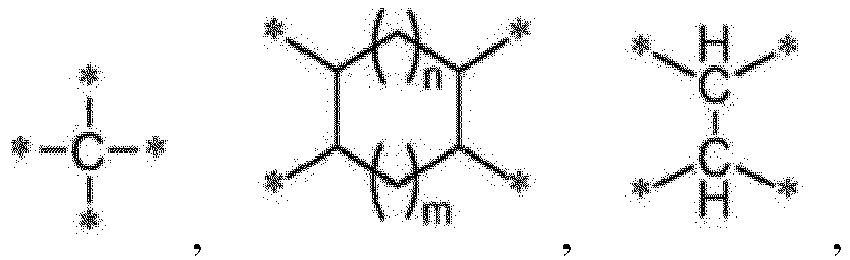

- L is selected from a single bond or methylene;
- m is an integer ranging from 1 to 4;
- n is an integer ranging from 0 to 2; and
- p is an integer ranging from 0 to 6.
- In some embodiments, the compound represented by formula 1 is selected from at least one of the following compounds:


- In some embodiments, 1.4 ≤ y×100/S ≤ 3.6; y is a mass percentage of the compound containing a sulfur-oxygen double bond in the electrolyte, and S is a specific surface area of the negative electrode in m2/g.
- An embodiment of this application further provides an electronic device, including any one of the above-mentioned electrochemical devices.
- According to the embodiments of this application, the ionic conductivity of the active substance layer is defined as 0.01 S/m to 1 S/m, so that the electrochemical device can meet requirements for fast charging, and meanwhile, substantially no lithium plating or only slight lithium plating occurs on a surface of the negative electrode of the electrochemical device in a fast-charging condition, thus avoiding a risk of short-circuit caused by lithium plating, and ensuring the safety performance of the electrochemical device in the fast-charging condition.
-
-
FIG. 1 shows a sectional view of a negative electrode according to an embodiment of this application. -
FIG. 2 shows a sectional view of an electrode assembly of an electrochemical device according to an embodiment of this application. -
FIG. 3 shows a lithium plating test result of Comparative Example 1. -
FIG. 4 shows a lithium plating test result of Example 1. -
FIG. 5 shows a lithium plating test result of Example 2. - The following embodiments may enable those skilled in the art to understand this application more comprehensively, but do not limit this application in any way.
-
FIG. 1 shows a sectional view of anegative electrode 10 according to an embodiment of this application. Thenegative electrode 10 includes acurrent collector 100 and anactive substance layer 101 arranged on thecurrent collector 100. It should be understood that theactive substance layer 101 inFIG. 1 is shown as being located on two sides of thecurrent collector 100, which is merely an example and not for limitation. Theactive substance layer 101 may alternatively be arranged only on one side of thecurrent collector 100. - In some embodiments, an ionic conductivity of the
active substance layer 101 is 0.01 S/m to 1 S/m. If the ionic conductivity of theactive substance layer 101 is too small, for example, less than 0.01 S/m, in a fast-charging condition of an electrochemical device, lithium plating is easy to occur on a surface of thenegative electrode 10, and even lithium dendrites may be formed. The lithium dendrites may penetrate a separator, causing a risk of short-circuit. The ionic conductivity of theactive substance layer 101 is defined as 0.01 S/m to 1 S/m, so that the electrochemical device formed with thenegative electrode 10 can meet requirements for fast charging, and meanwhile, substantially no lithium plating or only slight lithium plating occurs on the surface of thenegative electrode 10 of the electrochemical device in a fast-charging condition, thus avoiding the risk of short-circuit caused by lithium plating, and ensuring safety performance of the electrochemical device in the fast-charging condition. - In some embodiments, a porosity of the
active substance layer 101 is 20% to 40%. If the porosity of theactive substance layer 101 is too small, for example, less than 20%, it will not be able to provide sufficient permeation channels for the electrolyte, reducing an intercalation rate of lithium ions, so that fast charging performance of the electrochemical device is affected, and lithium plating is easy to occur on the surface of thenegative electrode 10. If the porosity of theactive substance layer 101 is too large, a volumetric energy density of the electrochemical device may be affected. In some embodiments, a porosity of theactive substance layer 101 is 25% to 35%. The porosity of theactive substance layer 101 is set as 25% to 35%, so that influence to the volumetric energy density of the electrochemical device can be minimized while satisfying fast intercalation of lithium ions. - In some embodiments, the
active substance layer 101 may include an active substance and a porous material. In some embodiments, the active substance may include graphite and/or a silicon-based material. In some embodiments, the active substance includes, but is not limited to, at least one of artificial graphite, natural graphite, hard carbon, silicon alloy, tin alloy, or pure silicon. In some embodiments, the porous material may include, but is not limited to, at least one of porous ceramics, activated carbon, meso-carbon microbeads (MCMB), conductive carbon, or Halloysite nanotubes. - In some embodiments, a ratio of an average particle size of the active substance to that of the porous material is less than or equal to 0.8. In some embodiments, a ratio of an average particle size of the active substance to that of the porous material is 1.3 to 3.8. In some embodiments, when an average particle size of the active substance is less than that of the porous material, a ratio of the average particle size of the active substance to that of the porous material is less than or equal to 0.6. This is because in a process of particle stacking, particles having a certain particle size difference are prone to form a close-stacked structure, and especially, large particles of the porous material are prone to be filled and surrounded by the active substance in small particles, so that a contact area is indirectly expanded, and more excellent ionic conductivity and lithium plating status are achieved. Similarly, when a particle size of the active substance is greater than that of the porous material, the ratio of the particle size of the active substance to that of the porous material is 1.5 to 2.5. Particles having a certain particle size difference are prone to form a close-stacked structure, that is, in such case, large particles of the active substance are prone to be filled with the porous material in small particles, so that the contact area is indirectly expanded, and more excellent ionic conductivity and lithium plating status are achieved. When the ratio of the particle size of the active substance to that of the porous material is further increased, the particle size of the porous material is too small, the porous material is prone to be agglomerated and fully buried by the particles of the active substance. Thus, the function of providing porechannels cannot be achieved, resulting in reduction of the ionic conductivity and deterioration of lithium plating status.
- In some embodiments, an average particle size of the active substance and an average particle size of the porous material are obtained through statistical average particle sizes acquired from electron microscope pictures. Specific steps may be included as follows:
A sample was spread on a sample test stage; pictures of the sample were taken through a scanning electron microscope; image analysis software was used to randomly select 10 particles of the active substance or the porous material from SEM pictures, and respective areas of these particles of the active substance or the porous material were solved; next, by assuming that the particles of the active substance or the porous material were spherical, respective particle sizes R (diameters) were solved through the following formula:
R=2×(S/π)1/2, where S is the respective areas of the particles of the active substance or the porous material. - Respective particle sizes R of the particles of the active substance or the porous material from three SEM pictures were solved, arithmetic averaging was performed on the obtained particle sizes of the 30 (10×3) particles of the active substance or the porous material, so as to obtain an average particle size of the particles of the active substance or the porous material.
- In some embodiments, an average particle size of the active substance is 15 µm to 70 µm. If the particle size of the active substance is too small, for example, less than 15 µm, a specific surface area of the active substance is large, and excessive electrolyte will be consumed. If the particle size of the active substance is too large, for example, greater than 70 µm, it is unfavorable to an increase of a compacted density of the
negative electrode 10, thereby affecting a volumetric energy density of the electrochemical device. - In some embodiments, an average particle size of the porous material is less than 100 µm. If the particle size of the porous material is too large, it is unfavorable to an increase of a compacted density of the
negative electrode 10, thereby affecting the volumetric energy density of the electrochemical device. - In some embodiments, mass content of the porous material in the
active substance layer 101 is 0.5% to 20%. If the mass content of the porous material in theactive substance layer 101 is too low, for example, lower than 0.5%, an effect of improving permeation channels of the electrolyte through the porous material to improve an intercalation rate of lithium ions is limited. If the mass content of the porous material in theactive substance layer 101 is too high, for example, higher than 20%, content of the active substance in theactive substance layer 101 is affected, which is unfavorable to the volumetric energy density of the electrochemical device. - In some embodiments, a specific surface area of the porous material is greater than 1.5 m2/g. If the specific surface area of the porous material is too small, for example, lower than 1.5 m2/g, an effect of improving permeation channels of the electrolyte may be weakened, which is also unfavorable to the increase of the volumetric energy density of the electrochemical device.
- In some embodiments, the
current collector 100 may use at least one of a copper foil, a nickel foil, or a carbon-based current collector, or certainly, may use other negative current collectors commonly used in the art. In some embodiments, thecurrent collector 100 may be 1 µm to 200 µm in thickness. - In some embodiments, the
active substance layer 101 may further include a conductive agent. The conductive agent in theactive substance layer 101 may include at least one of conductive carbon black, Ketjen black, laminated graphite, graphene, carbon nanotubes, or carbon fiber. It should be understood that the foregoing disclosed materials are merely examples, and theactive substance layer 101 may use any other suitable material. In some embodiments, theactive substance layer 101 may further include a binder. In some embodiments, the binder in theactive substance layer 101 may include at least one of polyvinylidene fluoride, a polyvinylidene fluoride-fluorinated olefin copolymer, polyvinylpyrrolidone, polyacrylonitrile, polymethyl acrylate, polytetrafluoroethylene, sodium carboxymethyl cellulose, styrene-butadiene rubber, polyurethane, fluorinated rubber, or polyvinyl alcohol. In some embodiments, a mass ratio of the active substance to the porous material to the conductive agent to the binder in theactive substance layer 101 may be 72 to 98.5:0.5 to 20:0 to 3:1 to 5. It should be understood that the foregoing description is merely an example, and any other suitable mass ratio may be used. In some embodiments, a compacted density of theactive substance layer 101 is 1.0 g/cc to 1.90 g/cc. If the compacted density of theactive substance layer 101 is too small, for example, less than 1.0 g/cc, it is unfavorable to the volumetric energy density of the electrochemical device. If the compacted density of theactive substance layer 101 is too large, for example, greater than 1.90 g/cc, it is unfavorable to permeation of the electrolyte. - In some embodiments, this application further provides an electrochemical device, including the above-mentioned
negative electrode 10. - In some embodiments, the electrochemical device further includes an electrolyte, where the electrolyte includes a compound containing a sulfur-oxygen double bond. In some embodiments, the compound containing a sulfur-oxygen double bond includes at least one of cyclic sulfate, chain sulfate, chain sulphonate, cyclic sulphonate, chain sulfite, or cyclic sulfite. The compound containing a sulfur-oxygen double bond in the electrolyte can form a full solid electrolyte membrane with high ion conduction on a surface of the
negative electrode 10, thereby further increasing the ionic conductivity and improving fast charging performance and safety performance of the electrochemical device. - In some embodiments, the compound containing a sulfur-oxygen double bond includes at least one of the following compounds represented by formula 1:


- In some embodiments, 1.4 ≤ y×100/S ≤ 3.6; y is a mass percentage of the compound containing a sulfur-oxygen double bond in the electrolyte, and S is a specific surface area of the
negative electrode 10 in m2/g. When the relationship 1.4 ≤ y×100/S ≤ 3.6 is satisfied, an ionic conductivity of thenegative electrode 10 and an initial coulombic efficiency of the electrochemical device can be significantly improved, and lithium plating performance and a capacity retention ratio can be improved. If y is too small, for example, y×100/S is less than 1.4, an effect of the compound containing a sulfur-oxygen double bond in increasing the ionic conductivity is limited. If y is too large, for example, y×100/S is greater than 3.6, the solid electrolyte membrane formed on the surface of thenegative electrode 10 by the compound containing a sulfur-oxygen double bond is too thick, which is unfavorable to transmission of lithium ions, resulting in reduction of the fast charging performance and safety performance of the electrochemical device. - In some embodiments, the electrochemical device includes a lithium-ion battery. However, this application is not limited to this. In some embodiments, the electrochemical device may further include an electrolyte. The electrolyte may be one or more of a gel electrolyte, a solid electrolyte, and the above-mentioned electrolyte. In some embodiments, the electrolyte may further include a lithium salt and a non-aqueous solvent. The lithium salt may be selected from one or more of LiPF6, LiBF4, LiAsF6, LiClO4, LiB(C6H5)4, LiCH3SO3, LiCF3SO3, LiN(SO2CF3)2, LiC(SO2CF3)3, LiSiF6, LiBOB, or lithium difluoroborate. For example, LiPF6 is used as the lithium salt because LiPF6 can provide high ionic conductivity and improve a cycle characteristic.
- The non-aqueous solvent may be selected from a carbonate compound, a carboxylate compound, an ether compound, any other organic solvent, or a combination thereof.
- The carbonate compound may be selected from a linear carbonate compound, a cyclic carbonate compound, a fluorocarbonate compound, or a combination thereof.
- The linear carbonate compound may be selected from diethyl carbonate (DEC), dimethyl carbonate (DMC), dipropyl carbonate (DPC), methyl propyl carbonate (MPC), ethyl propyl carbonate (EPC), ethyl methyl carbonate (MEC), or a combination thereof. An example of the cyclic carbonate compound is ethylene carbonate (EC), propylene carbonate (PC), butylene carbonate (BC), vinyl ethylene carbonate (VEC), or a combination thereof. The fluorocarbonate compound may be selected from fluoroethylene carbonate (FEC), 1,2-difluoroethylene carbonate, 1,1-difluoroethylene carbonate, 1,1,2-trifluoroethylene carbonate, 1,1,2,2-tetrafluoroethylene carbonate, 1-fluoro-2-methylethylene carbonate, 1-fluoro-l-methylethylene carbonate, 1,2 -difluoro-1-methylethylene carbonate, 1,1,2-trifluoro-2-methylethylene carbonate, trifluoromethylethylene carbonate, or a combination thereof.
- The carboxylate compound may be selected from methyl acetate, ethyl acetate, n-propyl acetate, tert-butyl acetate, methyl propionate, ethyl propionate, propyl propionate, γ-butyrolactone ester, caprolactone, valerolactone, mevalonolactone, caprolactone, methyl formate, or a combination thereof.
- The ether compound may be selected from dibutyl ether, tetraglyme, diglyme, 1,2-dimethoxyethane, 1,2-diethoxyethane, ethoxymethoxyethane, 2-methyltetrahydrofuran, tetrahydrofuran, or a combination thereof.
- Any other organic solvent may be selected from dimethyl sulfoxide, 1,2-dioxolane, sulfolane, methyl sulfolane, 1,3-dimethyl-2-imidazolidinone, N-methyl -2-pyrrolidone, formamide, dimethylformamide, acetonitrile, trimethyl phosphate, triethyl phosphate, trioctyl phosphate, phosphate ester, or a combination thereof.
- In some embodiments, as shown in
FIG. 2 , the electrochemical device may include thenegative electrode 10, aseparator 11, and apositive electrode 12, where theseparator 11 is arranged between thepositive electrode 12 and thenegative electrode 10. In some embodiments, theseparator 11 may include at least one of polyethylene, polypropylene, polyvinylidene fluoride, polyethylene terephthalate, polyimide, or aramid. For example, polyethylene includes at least one of high-density polyethylene, low-density polyethylene, or ultra-high-molecular-weight polyethylene. Particularly, polyethylene and polypropylene have a good effect on preventing short-circuit, and can enhance stability of a battery through the shutdown effect. In some embodiments, thickness of aseparator 11 ranges from about 5 µm to 500 µm. - In some embodiments, the surface of the
separator 11 may further include a porous layer. The porous layer is arranged on at least one surface of theseparator 11 and includes inorganic particles and a binder, where the inorganic particles are selected from at least one of aluminum oxide (Al2O3), silicon oxide (SiO2, magnesium oxide (MgO), titanium oxide (TiO2), hafnium oxide (HfO2), tin oxide (SnO2), cerium dioxide (CeO2), nickel oxide (NiO), zinc oxide (ZnO), calcium oxide (CaO), zirconium oxide (ZrO2), yttrium oxide (Y2O3), silicon carbide (SiC), boehmite, aluminum hydroxide, magnesium hydroxide, calcium hydroxide, or barium sulfate. In some embodiments, a pore diameter of theseparator 11 ranges from about 0.01 µm to 1 µm. The binder of the porous layer is selected from at least one of polyvinylidene fluoride, a vinylidene fluoride-hexafluoropropylene copolymer, polyamide, polyacrylonitrile, polyacrylate, polyacrylic acid, sodium carboxymethylcellulose, polyvinylpyrrolidone, polyvinyl ether, polymethyl methacrylate, polytetrafluoroethylene, or polyhexafluoropropylene. The porous layer on the surface of theseparator 11 can improve heat resistance, oxidation resistance, and electrolyte infiltration performance of theseparator 11, and enhance adhesion between theseparator 11 and the electrode plate. - In some embodiments, the
positive electrode 12 may include acurrent collector 120 and anactive substance layer 121 arranged on thecurrent collector 120. It should be understood that theactive substance layer 121 inFIG. 2 is shown as being located on two sides of thecurrent collector 120, which is merely an example. Theactive substance layer 121 may be arranged only on one side of thecurrent collector 120. Thecurrent collector 120 of thepositive electrode 12 may use an Al foil, or may use other current collectors commonly used in the art. In some embodiments, thecurrent collector 120 may be 1 µm to 200 µm in thickness. - In some embodiments, the
active substance layer 121 may include an active substance, a conductive agent, and a binder. In some embodiments, the active substance in theactive substance layer 121 may include at least one of lithium cobalt oxide, lithium manganate oxide, lithium iron phosphate, lithium nickel cobalt manganese oxide, lithium nickel cobalt aluminum oxide, or lithium nickel manganese oxide. In some embodiments, the conductive agent in theactive substance layer 121 may include at least one of conductive carbon black, Ketjen black, laminated graphite, graphene, carbon nanotubes, or carbon fiber. In some embodiments, the binder in theactive substance layer 121 may include at least one of polyvinylidene fluoride, a polyvinylidene fluoride-fluorinated olefin copolymer, polytetrafluoroethylene, sodium carboxymethyl cellulose, styrene-butadiene rubber, polyurethane, fluorinated rubber, or polyvinyl alcohol. In some embodiments, a mass ratio of the active substance to the conductive agent to the binder in theactive substance layer 121 may be 92 to 98.5:0.5 to 3:1 to 5. It should be understood that the above description is merely an example, and theactive substance layer 121 may use any other suitable materials, thicknesses and mass ratios. - In some embodiments of this application, an electrode assembly of the electrochemical device is a winding type electrode assembly or a stacked type electrode assembly.
- In some embodiments of this application, a lithium-ion battery is used as an example. A positive electrode, a separator, and a negative electrode are wound or stacked in sequence to form an electrode assembly, the electrode assembly is then packaged in an aluminum-plastic film, followed by injection of an electrolyte, formation, and packaging, so that the lithium-ion battery is prepared. Then, the prepared lithium-ion battery is subjected to performance tests.
- Those skilled in the art will understand that the method for preparing the electrochemical device (for example, the lithium-ion battery) described above is merely an example. Without departing from the content of the disclosure of this application, other methods commonly used in the art may be used.
- An embodiment of this application further provides an electronic device, including the foregoing electrochemical device. The electronic device according to this embodiment of this application is not particularly limited, and may be any known electronic device used in the prior art. In some embodiments, the electronic device may include, but is not limited to: notebook computers, pen-input computers, mobile computers, e-book players, portable phones, portable fax machines, portable copiers, portable printers, head-mounted stereo headsets, video recorders, liquid crystal display televisions, portable cleaners, portable CD players, mini discs, transceivers, electronic notebooks, calculators, memory cards, portable recorders, radios, backup power supplies, motors, automobiles, motorcycles, assisted bicycles, bicycles, lighting apparatuses, toys, game machines, clocks, electric tools, flashlights, cameras, large household storage batteries or lithium-ion capacitors.
- Some specific examples and comparative examples are listed below to better illustrate this application. Lithium-ion batteries are used for illustration.
- Preparation of a positive electrode: A positive active substance lithium cobalt oxide, a conductive agent-conductive carbon black, and a binder polyvinylidene fluoride (PVDF) were dispersed in N-methylpyrrolidone (NMP) solution at a weight ratio of 97.6:1.1:1.3, to form a positive electrode slurry. An aluminum foil was used as a positive current collector, the positive current collector was coated with the positive electrode slurry with a thickness of 50 µm, followed by drying, cold pressing, and slitting, to obtain the positive electrode.
- Preparation of a negative electrode: A negative active substance artificial graphite, a porous material meso-carbon microbeads, and a binder styrene-butadiene rubber were dispersed in deionized water at a weight ratio of 98.2:0.5:1.3, to form a negative electrode slurry. A copper foil with a thickness of 10 µm was used as a negative current collector, and the negative current collector was coated with the negative electrode slurry with a thickness of 60 µm, followed by drying, to obtain a negative active substance layer, which was then slitted to obtain the negative electrode.
- Preparation of a separator: Polyethylene (PE) with a thickness of 8 µm was used as a base material of the separator, two sides of the base material of the separator were coated with aluminum oxide ceramic layers 2 µm in thickness, and finally, the two sides coated with the ceramic layers were respectively coated with 2.5 mg of binder polyvinylidene fluoride (PVDF), followed by drying.
- Preparation of an electrolyte: In an environment with a water content less than 10 ppm, lithium hexafluorophosphate and a non-aqueous organic solvent (a weight ratio of ethylene carbonate (EC) to propylene carbonate (PC) to diethyl carbonate (DEC) was equal to 1:1:1) were mixed to prepare a basic electrolyte, where a concentration of LiPF6 was 1.15 mol/L. In addition, in some examples, a certain amount of the compound represented by formula 1 may be added into the basic electrolyte. Preparation of a lithium-ion battery: The positive electrode, the separator, and the negative electrode were stacked in sequence, so that the separator was placed between the positive electrode and the negative electrode for isolation, and winding was performed to obtain an electrode assembly. The electrode assembly was arranged in an outer packaging aluminum-plastic film, and was dehydrated at a temperature of 80°C. After that, the above-mentioned electrolyte was injected and packaged, followed by processes such as formation, degassing, and trimming, so that the lithium-ion battery was obtained.
- Parameters for other examples and comparative examples were changed based on steps of Example 1. The specific parameter changes were shown in the table below. The following describes methods for testing various parameters of this application.
-
- (1) An aluminum-plastic film, an electrode, and a separator were baked at a temperature of 60°C for 4 hours before use.
- (2) A die of a dimension 23×35×2 mm was prepared.
- (3) A manufactured electrode was sheared, by ceramic scissors, into a piece larger than the die in dimension, the piece was cut on the die, and the die-cut electrode was taken out with tweezers for use.
- (4) The electrode was used to prepare a single-layer symmetrical battery.
- (5) The symmetrical battery was placed in an electrochemical workstation and subjected to an EIS test, where a frequency was set as 0.5 Hz to 200 kHz, and a disturbance voltage was set as 10 mV.
- (6) An ion resistance Rion of the electrode was calculated through an intersection point of two straight lines of EIS.
- (7)

- A sample was spread on a sample test stage; pictures of the sample were taken by using a scanning electron microscope; image analysis software was used to randomly select 10 particles of an active substance from SEM pictures, respective areas of these particles of the active substance were solved; next, by assuming that the particles of the active substance were spherical, respective particle sizes R (diameters) were solved through the following formula:
R=2×(S/π)1/2, where S is the respective areas of the particles of the active substance. - Respective particle sizes R of the particles of the active substance from three SEM images was solved, and arithmetic averaging was performed to the particle sizes of the 30 (10×3) particles of the active substance, obtaining an average particle size D1 of the particles of the active substance.
- An average particle size D2 of the porous material was tested by using the same method as was used for testing the average particle size of the active substance.
- The method for testing porosity of the electrode was performed by using a mercury intrusion porosimeter, specifically including:
- (1) An electrode whose surface on one side was fully covered with the active substance layer was used as a sample.
- (2) A density and a porosity of the sample were predicted, and a suitable dilatometer was chosen.
- (3) The sample was first baked in an oven for 2 hours for dehydration, and the sample was weighed before analysis.
- (4) The sample was placed in the dilatometer, followed by sealing and weighing, to obtain a weight of the sample and the dilatometer.
- (5) The dilatometer was mounted in a low-pressure workstation, and low-pressure analysis was performed after low-pressure documents were edited.
- (6) After the low-pressure analysis was completed, the dilatometer was taken out to weigh, which was a weight of the sample, the dilatometer, and mercury.
- (7) The dilatometer was mounted in a high-pressure workstation, and after the dilatometer was fixed, a high-pressure chamber head was screwed in until it reached the bottom, with bubbles exhausted.
- (8) High-pressure analysis was performed, releasing or tightening a blowoff valve by following instructions.
- (9) After the high-pressure analysis was completed, the dilatometer was taken out and cleaned and the test was finished.
- In this way, a porosity X of the electrode plate was obtained.
- A method for converting the porosity X of the electrode plate into a porosity V of the active substance layer was as follows:
10 portions were randomly selected on a surface of the electrode, and an average thickness of the electrode was measured as H. - The active substance layer on the surface of the electrode was washed with an organic solvent, 10 portions were randomly selected on the surface of the current collector, and an average thickness of the current collector was measured as h.

- At 25°C, the lithium-ion battery was charged to a voltage of 4.45 V with a constant current of 1 C, then was charged to a current of 0.05 C with a constant voltage of 4.45 V, followed by recording initial charge capacity; further, and the lithium-ion battery was discharged to a voltage of 3.0 V at a constant current of 1 C so as to obtain discharge capacity, namely initial discharge capacity. The initial discharge capacity/initial charge capacity was the initial coulombic efficiency.
- The above steps were repeated 300 times, the 300th discharge capacity was recorded, and the 300th discharge capacity/initial discharge capacity was the capacity retention rate after the 300th cycle.
- At 25°C, the lithium-ion battery was charged to a voltage of 4.45 V with a constant current of 0.2 C, then was charged to a current of 0.05 C with a constant voltage of 4.45 V, and further was discharged to a voltage of 3.0 V with a constant current 0.2 C, to obtain initial charge capacity, namely battery capacity.

- The prepared lithium-ion battery was charged at a high rate of 1 C and charged to achieve 100% of SOC. The battery was disassembled and the negative electrode surface was observed. It was defined as severe lithium plating if there was a dark gray metal layer in more than 50% of the area, it was defined as medium lithium plating if there was a light gray metal layer in 10% to 50% of the area, it was defined as slight lithium plating if there was a light gray metal layer in 5% to 10% of the area, and it was defined as no lithium plating if there was a light gray metal layer below in 5% of the area or there was no light gray metal layer.
- Under a low temperature (liquid nitrogen bath) condition, a certain amount of adsorbate gas (N2) was introduced into a sample tube, an adsorption partial pressure was directly obtained by controlling a balance pressure in the sample tube, and adsorption capacity of a partial pressure point was obtained through a gas state equation; adsorption isotherm was obtained by gradually inputting the adsorbate gas to increase an adsorption balance pressure; and desorption isotherm was obtained by gradually extracting the adsorbate gas to reduce the adsorption balance pressure.
- Table 1 shows parameters and evaluation results of Examples 1 to 6 and Comparative Example 1, where Examples 2 to 6 and Comparative Example 1 were different from Example 1 only in the preparation of the negative electrode.
Table 1 Active substance Porous material Binder Porosity Ionic conductivity (S/m) Initial coulombic efficiency Lithium plating Energy density Wh/L Secondary artificial grained graphite Average particle size µm Specific surface area m2/g Meso-carbon microbead Average particle size µm Specific surface area m2/g Styrene-butadiene rubber Example 1 98.2% 17 1.3 0.5% 15 2.5 1.3% 23% 0.01 92.00% Medium 720 Example 2 97.7% 17 1.3 1.0% 15 2.5 1.3% 25% 0.015 91.20% Slight 714 Example 3 97.2% 17 1.3 1.5% 15 2.5 1.3% 28% 0.025 91.40% Slight 715 Example 4 94.7% 17 1.3 4% 15 2.5 1.3% 32% 0.035 90.80% No lithium plating 711 Example 5 88.7% 17 1.3 10% 15 2.5 1.3% 35% 0.039 89.00% No lithium plating 697 Example 6 78.7% 17 1.3 20% 15 2.5 1.3% 39% 0.042 88.20% No lithium plating 690 Comparative Example 1 98.7% 17 1.3 / 1.3% 20% 0.008 92.40% Severe 723 - By comparing Examples 1 to 6 with Comparative Example 1, it could be seen that Examples 1 to 6 with ionic conductivity above 0.01 S/m had better lithium plating performance than Comparative Example 1 with lower ionic conductivity, and the safety performance of the electrochemical device was significantly improved. In addition, when the ionic conductivity was increased to above 0.015 S/m (as in Examples 2 to 6), there was no lithium plating or only slight lithium plating, so that the safety performance of the electrochemical device could be ensured in the condition of high-rate charging.
FIG. 3 shows a lithium plating test result of Comparative Example 1,FIG. 4 shows a lithium plating test result of Example 1, andFIG. 5 shows a lithium plating test result of Example 2. - In addition, when the porosity of the active substance layer of the negative electrode was in a range of 23% to 40%, both the initial coulombic efficiency and the ionic conductivity of the lithium-ion battery were excellent, and the initial coulombic efficiency was above 90%.
- This was because the adding of the porous material provided more permeation channels for the electrolyte in a longitudinal direction of the active substance layer, ensuring that lithium ions might be intercalated from the lateral side. Compared with the intercalation performed only from a parallel surface of the electrode, the intercalation rate of lithium ions was greatly increased, fast intercalation of the lithium ions on a condition of high-rate charging was guaranteed, lithium plating was avoided, and the fast charging performance and safety performance of the lithium-ion battery were significantly improved. Table 2 shows parameters and evaluation results of Examples 7 to 19, where Examples 7 to 19 were different from Example 1 only in the preparation of the negative electrode.
Table 2 Active substance graphite Porous material D1/D2 Compacted density g/cc Ionic conductivity S/m Specific surface area of negative electrode m2/g Porosity of negative active substance layer Initial coulombic efficiency Lithium plating Average particle size D1 /µm Average particle size D2 /µm Example 7 17 21.3 0.8 1.76 0.015 0.705 20% 91% Slight Example 8 17 25 0.68 1.76 0.018 0.742 23% 91.6% Slight Example 9 17 30 0.57 1.76 0.028 0.964 30% 91.2% No lithium plating Example 10 17 43 0.4 1.76 0.034 1.004 31% 90.5% No lithium plating Example 11 17 57 0.3 1.76 0.039 1.092 32% 90.3% No lithium plating Example 12 17 85 0.2 1.76 0.040 1.103 32% 89.1% No lithium plating Example 13 19 5 3.8 1.76 0.02 0.709 28% 91.3% Slight Example 14 19 5.4 3.5 1.76 0.022 0.871 28% 91.3% Slight Example 15 19 6 3.0 1.76 0.025 0.890 30% 91.3% Slight Example 16 19 7.6 2.5 1.76 0.03 0.900 32% 91.1% No lithium plating Example 17 19 8 2.38 1.76 0.04 1.020 35% 91% No lithium plating Example 18 19 12 1.58 1.76 0.045 1.030 37% 91% No lithium plating Example 19 19 14.5 1.31 1.76 0.02 0.890 30% 90.8% Slight - By comparing Example 1 with Examples 7 to 19, it could be seen that Examples 7 to 19, in which the ratio of the average particle size of the active substance to that of the porous material was less than or equal to 0.8 or was 1.3 to 3.8, had improved ionic conductivity and lithium plating status. This was because an increase of the particle size difference between the active substance and the porous material was favorable to expanding the contact area between the two, and a function of the porous material in conducting the lithium ions to the active substance was fully achieved. Further, by comparing Examples 7 to 8 with Examples 9 to 12, it could be seen that when the ratio of the average particle size of the active substance to that of the porous material was less than or equal to 0.6, the lithium-ion battery had excellent ionic conductivity and lithium plating status. This was because in the process of particle stacking, particles having a certain particle size difference were prone to form a close-stacked structure, especially, large particles of the porous material were prone to be filled and surrounded by the active substance graphite in small particles. Thus, the contact area between the porous material and the active substance was indirectly expanded, and more excellent ionic conductivity and lithium plating status were achieved. Similarly, by comparing Examples 13 to 15 with Examples 16 to 18, it could be seen that when the ratio of the particle size of the active substance graphite to that of the porous material was 1.5 to 2.5, the lithium-ion battery had excellent ionic conductivity and lithium plating status. Particles having a certain particle size difference were prone to form a close-stacked structure, especially, large particles of the active material graphite were prone to be filled by the porous substance in small particles, so that the contact area between the two was indirectly expanded, and more excellent ionic conductivity and lithium plating status were achieved. When the ratio of the particle size of graphite to that of the porous material was further increased, the particle size of the porous material was too small, and the porous material is prone to be agglomerated and fully buried by the particles of the active substance, so that the function of providing pore channels cannot be fully achieved, resulting in the reduction of the ionic conductivity and the deterioration of lithium plating status. Table 3 shows parameters and evaluation results of Examples 7, and Examples 20 to 24, where the compound represented by formula 1-1 was added in the electrolyte in Examples 20 to 24.
Table 3 Compound of formula 1-1 content y Specific surface area S of electrode m2/g y×100/S Ionic conductivity x S/m Initial coulombic efficiency Lithium plating Capacity retention rate (300cls) Example 7 0 0.705 0 0.015 91% Slight 83% Example 20 0.5% 0.705 0.709 0.02 91% Slight 83.6% Example 21 1% 0.705 1.418 0.027 93% No lithium plating 88% Example 22 2% 0.705 2.837 0.033 94% No lithium plating 88% Example 23 2.5% 0.705 3.546 0.029 96% No lithium plating 90% Example 24 3% 0.705 4.255 0.022 91% Slight 83% - When the content of the compound represented by formula 1 and the specific surface area of the electrode satisfied the relationship 1.4 ≤ y×100/S ≤ 3.6, the ionic conductivity and the initial coulombic efficiency of the lithium-ion battery could be significantly improved, and the lithium plating performance and the capacity retention ratio could be improved. An appropriate amount of compound represented by formula 1 could further form a full solid electrolyte membrane with high ion conduction on the surface of the electrode, thereby further increasing the ionic conductivity and improving the fast charging performance and safety performance. When y×100/S < 1.4, the content of the compound represented by formula 1 was too small, so that the solid electrolyte membrane with high ion conduction could not be formed sufficiently. When the compound of formula 1 was excessive in content, for example, y×100/S > 3.6, the formed solid electrolyte membrane was too thick, which was unfavorable to transmission of the lithium ions, resulting in the reduction of the safety performance in fast charging.
- The above descriptions are only preferred embodiments of this application and explanations of the applied technical principles. Those skilled in the art should understand that the scope of disclosure involved in this application is not limited to the technical solutions formed by the specific combination of the above technical features, and should also cover other technical solutions formed by any combination of the above technical features or their equivalent features. For example, the technical solution formed by replacement between the above features and the technical features having similar functions disclosed in this application.
Claims (14)
- A negative electrode, comprising:a current collector; andan active substance layer arranged on the current collector,characterized in that,an ionic conductivity of the active substance layer is 0.01 S/m to 1 S/m.
- The negative electrode according to claim 1, wherein a porosity of the active substance layer is 20% to 40%.
- The negative electrode according to claim 1, wherein the active substance layer comprises an active substance and a porous material, and a ratio of an average particle size of the active substance to that of the porous material is less than or equal to 0.8.
- The negative electrode according to claim 3, wherein the ratio of the average particle size of the active substance to that of the porous material is less than or equal to 0.6.
- The negative electrode according to claim 1, wherein the active substance layer comprises an active substance and a porous material, and a ratio of an average particle size of the active substance to that of the porous material is 1.3 to 3.8.
- The negative electrode according to claim 5, wherein the ratio of the average particle size of the active substance to that of the porous material is 1.5 to 2.5.
- The negative electrode according to any one of claims 3 to 6, wherein the negative electrode satisfies at least one of the following conditions:an average particle size of the active substance is 15 µm to 70 µm;the active substance comprises graphite and/or a silicon-based material;an average particle size of the porous material is less than 100 µm;the porous material comprises at least one of porous ceramics, activated carbon, meso-carbon microbeads, conductive carbon, or Halloysite nanotubes;the content of the porous material is 0.5% to 20% of the active substance layer by mass; anda specific surface area of the porous material is greater than 1.5 m2/g.
- An electrochemical device, characterized in that, the electrochemical device comprises the negative electrode according to any one of claims 1 to 7.
- The electrochemical device according to claim 8, further comprising an electrolyte, wherein the electrolyte comprises a compound containing a sulfur-oxygen double bond.
- The electrochemical device according to claim 9, wherein the compound containing a sulfur-oxygen double bond comprises at least one of cyclic sulfate, chain sulfate, chain sulphonate, cyclic sulphonate, chain sulfite, or cyclic sulfite.
- The electrochemical device according to claim 9, wherein the compound containing a sulfur-oxygen double bond comprises at least one of the following compounds represented by formula 1:


m is an integer ranging from 1 to 4;
n is an integer ranging from 0 to 2; and
p is an integer ranging from 0 to 6. - The electrochemical device according to claim 11, wherein the compound represented by formula 1 is selected from at least one of the following compounds:


- The electrochemical device according to claim 9, wherein 1.4 ≤ y×100/S ≤ 3.6; y is a mass percentage of the compound containing a sulfur-oxygen double bond in the electrolyte, and S is a specific surface area of the negative electrode in m2/g.
- An electronic device, characterized in that, the electronic device comprises the electrochemical device according to any one of claims 8 to 13.
Applications Claiming Priority (1)
| Application Number | Priority Date | Filing Date | Title |
|---|---|---|---|
| CN202011101054.9A CN112151748B (en) | 2020-10-15 | 2020-10-15 | Anodes, Electrochemical Devices and Electronic Devices |
Publications (1)
| Publication Number | Publication Date |
|---|---|
| EP3985755A1 true EP3985755A1 (en) | 2022-04-20 |
Family
ID=73951787
Family Applications (1)
| Application Number | Title | Priority Date | Filing Date |
|---|---|---|---|
| EP21165302.7A Pending EP3985755A1 (en) | 2020-10-15 | 2021-03-26 | Negative electrode, electrochemical device, and electronic device |
Country Status (3)
| Country | Link |
|---|---|
| US (1) | US11784306B2 (en) |
| EP (1) | EP3985755A1 (en) |
| CN (2) | CN112151748B (en) |
Families Citing this family (4)
| Publication number | Priority date | Publication date | Assignee | Title |
|---|---|---|---|---|
| CN114122494A (en) * | 2020-08-31 | 2022-03-01 | 深圳新宙邦科技股份有限公司 | Lithium ion battery |
| CN113066956B (en) * | 2021-03-17 | 2022-06-10 | 宁德新能源科技有限公司 | Electrochemical device and electronic device |
| CN113078293B (en) * | 2021-03-24 | 2023-03-24 | 宁德新能源科技有限公司 | Electrochemical device and electronic device |
| CN118335966B (en) * | 2023-01-12 | 2025-11-04 | 宁德时代新能源科技股份有限公司 | Positive electrode sheet, electrode assembly, battery cell, battery and electrical equipment |
Citations (4)
| Publication number | Priority date | Publication date | Assignee | Title |
|---|---|---|---|---|
| US20130045419A1 (en) * | 2011-08-15 | 2013-02-21 | Hee-Joon Chun | Negative active material for rechargeable lithium battery, negative electrode including the same and method of preparing the same, and rechargeable lithium battery including the same |
| US20160359196A1 (en) * | 2015-06-08 | 2016-12-08 | Sk Innovation Co., Ltd. | Electrolyte for Lithium Secondary Battery and Lithium Secondary Battery Containing the Same |
| KR20190066867A (en) * | 2017-12-06 | 2019-06-14 | 주식회사 엘지화학 | Negative electrode active material, negative electrode including the negative electrode active material, and lithium secondary battery including the same |
| KR20200073801A (en) * | 2018-12-14 | 2020-06-24 | 주식회사 엘지화학 | Negative electrode and lithium secondary battery comprising the negative electrode |
Family Cites Families (8)
| Publication number | Priority date | Publication date | Assignee | Title |
|---|---|---|---|---|
| JP5351228B2 (en) * | 2011-09-07 | 2013-11-27 | 富士シリシア化学株式会社 | Silica-carbon composite porous body and method for producing the same |
| CN104752671A (en) * | 2015-03-09 | 2015-07-01 | 芜湖迈特电子科技有限公司 | Quick charging back clip mobile battery |
| EP3370293B1 (en) * | 2015-10-26 | 2020-01-01 | Hitachi, Ltd. | Lithium ion secondary battery and method for producing lithium ion secondary battery |
| KR20190082819A (en) * | 2016-11-23 | 2019-07-10 | 쥐알에스티 인터내셔널 리미티드 | Anode slurry for secondary battery |
| KR102425510B1 (en) * | 2017-06-02 | 2022-07-25 | 삼성에스디아이 주식회사 | Electrode for rechargeable lithium battery, and rechargeable lithium battery including same |
| CN107946576B (en) * | 2017-11-21 | 2020-05-19 | 中航锂电(洛阳)有限公司 | High-rate graphite negative electrode material, preparation method thereof and lithium ion battery |
| CN110265625B (en) * | 2018-11-12 | 2020-12-04 | 宁德时代新能源科技股份有限公司 | Negative pole piece and lithium ion secondary battery |
| CN110690436B (en) | 2019-10-18 | 2021-06-01 | 湖北亿纬动力有限公司 | Negative electrode material, preparation method thereof, prepared negative electrode plate and lithium ion battery |
-
2020
- 2020-10-15 CN CN202011101054.9A patent/CN112151748B/en active Active
- 2020-10-15 CN CN202111191985.7A patent/CN114373901A/en active Pending
-
2021
- 2021-03-26 EP EP21165302.7A patent/EP3985755A1/en active Pending
- 2021-03-29 US US17/215,484 patent/US11784306B2/en active Active
Patent Citations (4)
| Publication number | Priority date | Publication date | Assignee | Title |
|---|---|---|---|---|
| US20130045419A1 (en) * | 2011-08-15 | 2013-02-21 | Hee-Joon Chun | Negative active material for rechargeable lithium battery, negative electrode including the same and method of preparing the same, and rechargeable lithium battery including the same |
| US20160359196A1 (en) * | 2015-06-08 | 2016-12-08 | Sk Innovation Co., Ltd. | Electrolyte for Lithium Secondary Battery and Lithium Secondary Battery Containing the Same |
| KR20190066867A (en) * | 2017-12-06 | 2019-06-14 | 주식회사 엘지화학 | Negative electrode active material, negative electrode including the negative electrode active material, and lithium secondary battery including the same |
| KR20200073801A (en) * | 2018-12-14 | 2020-06-24 | 주식회사 엘지화학 | Negative electrode and lithium secondary battery comprising the negative electrode |
Non-Patent Citations (1)
| Title |
|---|
| HUANG XI ET AL: "Synthesis of Porous Si/C Composite Nanosheets from Vermiculite with a Hierarchical Structure as a High-Performance Anode for Lithium-Ion Battery", APPLIED MATERIALS & INTERFACES, vol. 11, no. 30, 16 July 2019 (2019-07-16), US, pages 26854 - 26862, XP055835120, ISSN: 1944-8244, DOI: 10.1021/acsami.9b06976 * |
Also Published As
| Publication number | Publication date |
|---|---|
| CN112151748B (en) | 2021-11-02 |
| CN112151748A (en) | 2020-12-29 |
| US11784306B2 (en) | 2023-10-10 |
| CN114373901A (en) | 2022-04-19 |
| US20220123288A1 (en) | 2022-04-21 |
Similar Documents
| Publication | Publication Date | Title |
|---|---|---|
| EP3844830B1 (en) | Cathode and electrochemical device | |
| CN113097431B (en) | Electrochemical device and electronic device | |
| US12283658B2 (en) | Electrochemical apparatus, preparation method thereof, and electronic apparatus | |
| US7682751B2 (en) | Lithium ion secondary battery and charging method therefor, and charge or charge/discharge control system for lithium ion secondary battery | |
| US11784306B2 (en) | Negative electrode, electrochemical device, and electronic device | |
| WO2022206196A1 (en) | Electrochemical device and electronic device | |
| US20110177369A1 (en) | Electrode for lithium ion secondary battery and lithium ion secondary battery | |
| US20230238519A1 (en) | Electrode plate, electrochemical apparatus, and electronic apparatus | |
| US20230335712A1 (en) | Negative electrode plate, electrochemical device containing same, and electronic device | |
| EP3961750A1 (en) | Electrode plate, electrochemical apparatus, and electronic apparatus | |
| EP4089762B1 (en) | Positive electrode plate, and electrochemical device and electronic device containing positive electrode plate | |
| KR102530195B1 (en) | Method for manufacturing negative electrode for secondary battery | |
| EP4064384A1 (en) | Negative electrode plate, electrochemical device, and electronic device | |
| KR102542291B1 (en) | Method for manufacturing negative electrode for secondary battery | |
| JP6607388B2 (en) | Positive electrode for lithium ion secondary battery and method for producing the same | |
| EP4191725A1 (en) | Electrochemical device and electronic device | |
| KR20150133167A (en) | Anode active material for lithium secondary battery and Lithium secondary battery comprising the same | |
| WO2012049723A1 (en) | Nonaqueous electrolyte secondary battery | |
| EP4203089A1 (en) | Electrode plate, electrochemical apparatus, and electronic apparatus | |
| EP4738453A1 (en) | Electrode assembly, electrochemical device and electric device | |
| KR20190066867A (en) | Negative electrode active material, negative electrode including the negative electrode active material, and lithium secondary battery including the same | |
| EP4398372A1 (en) | Nonaqueous electrolyte secondary battery | |
| US20240297307A1 (en) | Electrode and preparation method thereof, electrochemical apparatus, and electronic apparatus | |
| EP4084127B1 (en) | Electrochemical device and electronic equipment | |
| US20250260014A1 (en) | Electrochemical device and electronic device |
Legal Events
| Date | Code | Title | Description |
|---|---|---|---|
| PUAI | Public reference made under article 153(3) epc to a published international application that has entered the european phase |
Free format text: ORIGINAL CODE: 0009012 |
|
| STAA | Information on the status of an ep patent application or granted ep patent |
Free format text: STATUS: REQUEST FOR EXAMINATION WAS MADE |
|
| 17P | Request for examination filed |
Effective date: 20210326 |
|
| AK | Designated contracting states |
Kind code of ref document: A1 Designated state(s): AL AT BE BG CH CY CZ DE DK EE ES FI FR GB GR HR HU IE IS IT LI LT LU LV MC MK MT NL NO PL PT RO RS SE SI SK SM TR |