EP3985081B1 - Isophthalonitrile compounds, luminescent material, and luminescent element including same - Google Patents
Isophthalonitrile compounds, luminescent material, and luminescent element including same Download PDFInfo
- Publication number
- EP3985081B1 EP3985081B1 EP20823145.6A EP20823145A EP3985081B1 EP 3985081 B1 EP3985081 B1 EP 3985081B1 EP 20823145 A EP20823145 A EP 20823145A EP 3985081 B1 EP3985081 B1 EP 3985081B1
- Authority
- EP
- European Patent Office
- Prior art keywords
- luminescent
- layer
- derivative
- compounds
- compound
- Prior art date
- Legal status (The legal status is an assumption and is not a legal conclusion. Google has not performed a legal analysis and makes no representation as to the accuracy of the status listed.)
- Active
Links
Images



Classifications
-
- C—CHEMISTRY; METALLURGY
- C07—ORGANIC CHEMISTRY
- C07D—HETEROCYCLIC COMPOUNDS
- C07D209/00—Heterocyclic compounds containing five-membered rings, condensed with other rings, with one nitrogen atom as the only ring hetero atom
- C07D209/56—Ring systems containing three or more rings
- C07D209/80—[b, c]- or [b, d]-condensed
- C07D209/82—Carbazoles; Hydrogenated carbazoles
- C07D209/86—Carbazoles; Hydrogenated carbazoles with only hydrogen atoms, hydrocarbon or substituted hydrocarbon radicals, directly attached to carbon atoms of the ring system
-
- C—CHEMISTRY; METALLURGY
- C07—ORGANIC CHEMISTRY
- C07D—HETEROCYCLIC COMPOUNDS
- C07D403/00—Heterocyclic compounds containing two or more hetero rings, having nitrogen atoms as the only ring hetero atoms, not provided for by group C07D401/00
- C07D403/02—Heterocyclic compounds containing two or more hetero rings, having nitrogen atoms as the only ring hetero atoms, not provided for by group C07D401/00 containing two hetero rings
- C07D403/04—Heterocyclic compounds containing two or more hetero rings, having nitrogen atoms as the only ring hetero atoms, not provided for by group C07D401/00 containing two hetero rings directly linked by a ring-member-to-ring-member bond
-
- C—CHEMISTRY; METALLURGY
- C07—ORGANIC CHEMISTRY
- C07D—HETEROCYCLIC COMPOUNDS
- C07D403/00—Heterocyclic compounds containing two or more hetero rings, having nitrogen atoms as the only ring hetero atoms, not provided for by group C07D401/00
- C07D403/02—Heterocyclic compounds containing two or more hetero rings, having nitrogen atoms as the only ring hetero atoms, not provided for by group C07D401/00 containing two hetero rings
- C07D403/10—Heterocyclic compounds containing two or more hetero rings, having nitrogen atoms as the only ring hetero atoms, not provided for by group C07D401/00 containing two hetero rings linked by a carbon chain containing aromatic rings
-
- C—CHEMISTRY; METALLURGY
- C09—DYES; PAINTS; POLISHES; NATURAL RESINS; ADHESIVES; COMPOSITIONS NOT OTHERWISE PROVIDED FOR; APPLICATIONS OF MATERIALS NOT OTHERWISE PROVIDED FOR
- C09K—MATERIALS FOR MISCELLANEOUS APPLICATIONS, NOT PROVIDED FOR ELSEWHERE
- C09K11/00—Luminescent materials, e.g. electroluminescent or chemiluminescent
- C09K11/06—Luminescent materials, e.g. electroluminescent or chemiluminescent containing organic luminescent materials
-
- H—ELECTRICITY
- H10—SEMICONDUCTOR DEVICES; ELECTRIC SOLID-STATE DEVICES NOT OTHERWISE PROVIDED FOR
- H10K—ORGANIC ELECTRIC SOLID-STATE DEVICES
- H10K50/00—Organic light-emitting devices
-
- H—ELECTRICITY
- H10—SEMICONDUCTOR DEVICES; ELECTRIC SOLID-STATE DEVICES NOT OTHERWISE PROVIDED FOR
- H10K—ORGANIC ELECTRIC SOLID-STATE DEVICES
- H10K50/00—Organic light-emitting devices
- H10K50/10—OLEDs or polymer light-emitting diodes [PLED]
- H10K50/11—OLEDs or polymer light-emitting diodes [PLED] characterised by the electroluminescent [EL] layers
-
- H—ELECTRICITY
- H10—SEMICONDUCTOR DEVICES; ELECTRIC SOLID-STATE DEVICES NOT OTHERWISE PROVIDED FOR
- H10K—ORGANIC ELECTRIC SOLID-STATE DEVICES
- H10K85/00—Organic materials used in the body or electrodes of devices covered by this subclass
- H10K85/60—Organic compounds having low molecular weight
- H10K85/649—Aromatic compounds comprising a hetero atom
- H10K85/657—Polycyclic condensed heteroaromatic hydrocarbons
- H10K85/6572—Polycyclic condensed heteroaromatic hydrocarbons comprising only nitrogen in the heteroaromatic polycondensed ring system, e.g. phenanthroline or carbazole
-
- C—CHEMISTRY; METALLURGY
- C09—DYES; PAINTS; POLISHES; NATURAL RESINS; ADHESIVES; COMPOSITIONS NOT OTHERWISE PROVIDED FOR; APPLICATIONS OF MATERIALS NOT OTHERWISE PROVIDED FOR
- C09K—MATERIALS FOR MISCELLANEOUS APPLICATIONS, NOT PROVIDED FOR ELSEWHERE
- C09K2211/00—Chemical nature of organic luminescent or tenebrescent compounds
- C09K2211/10—Non-macromolecular compounds
- C09K2211/1003—Carbocyclic compounds
- C09K2211/1007—Non-condensed systems
-
- C—CHEMISTRY; METALLURGY
- C09—DYES; PAINTS; POLISHES; NATURAL RESINS; ADHESIVES; COMPOSITIONS NOT OTHERWISE PROVIDED FOR; APPLICATIONS OF MATERIALS NOT OTHERWISE PROVIDED FOR
- C09K—MATERIALS FOR MISCELLANEOUS APPLICATIONS, NOT PROVIDED FOR ELSEWHERE
- C09K2211/00—Chemical nature of organic luminescent or tenebrescent compounds
- C09K2211/10—Non-macromolecular compounds
- C09K2211/1018—Heterocyclic compounds
- C09K2211/1025—Heterocyclic compounds characterised by ligands
- C09K2211/1029—Heterocyclic compounds characterised by ligands containing one nitrogen atom as the heteroatom
Definitions
- the present invention relates to an isophthalonitrile compound, a luminescent material and a luminescent element using the same.
- the present invention relates to an isophthalonitrile compound in which the chirality based on a spiral structure is stable and luminescent characteristics are excellent, a luminescent material and a luminescent element using the same.
- the present invention claims priority on the basis of Japanese Patent Application No. 2019-111304 filed in Japan on June 14, 2019 .
- Patent Document 1 discloses a compound of formula (A).
- At least one of R 11 to R 15 is a cyano group, at least one of R 11 to R 15 is a group of formula (A1), and the remaining groups of R 11 to R 15 are a hydrogen atom or a substituent.
- R 21 to R 28 are each independently a hydrogen atom or a substituent.
- R 25 and R 26 may form together a single bond, and
- R 27 and R 28 may form together a substituted or unsubstituted benzene ring with carbon atoms to which R 27 and R 28 are bonded.
- Patent Document 2 discloses a compound of formula (B).
- R 11 to R 15 are each independently a hydrogen atom or a substituent.
- One of R 11 to R 15 is a cyano group.
- One to three of R 11 to R 15 are an aryl group Ar which may be substituted with an alkyl group or an aryl group (although a benzene ring constituting the former aryl group may be condensed with a ring which may contain an oxygen atom or a sulfur atom in addition to carbon atoms as a ring-constituting atom, the benzene ring is not condensed with a ring containing a hetero atom other than an oxygen atom or a sulfur atom as a ring-constituting atom).
- R 11 to R 15 Ar may be identical to or different from each other.
- One to three of R 11 to R 15 are a donor group D (provided that a group corresponding to Ar is excluded).
- the group D may be identical to or different from each other.
- the aims of the present invention are to provide an isophthalonitrile compound having excellent luminescent characteristics, a luminescent material and a luminescent element using the same.
- a luminescent material containing at least one selected from the compounds of formula (II-2) or formula (II-3) .
- a luminescent element containing the luminescent material of the second aspect.
- the isophthalonitrile compound according to the present invention is useful as a luminescent material.
- the luminescent element containing the luminescent material according to the present invention can realize excellent luminescent efficiency.
- the isophthalonitrile compound according to the present invention is a compound of formula (II-2) or formula (II-3):
- the isophthalonitrile compound according to the present invention may be obtained by performing known synthesis reactions (such as a coupling reaction or substitution reaction) in combination. Purification of synthesized compounds may be carried out by purification using column chromatography, adsorption purification using silica gel, activated carbon, activated clay, or recrystallization or crystallization using a solvent. Compound identification may be performed by NMR analysis.
- the compound according to the present invention may be obtained as follows, for example.
- the isophthalonitrile compounds according to the present invention may be used as a luminescent material.
- the luminescent material according to the present invention can provide a luminescent element such as an organic photoluminescence element or an organic electroluminescence element.
- the isophthalonitrile compound according to the present invention has a function of assisting the emission of another luminescent material (host material), and therefore the compound may be doped with other luminescent materials.
- the organic photoluminescent element according to the present invention is formed by providing a luminescent layer containing a luminescent material according to the present invention on a substrate.
- the luminescent layer may be formed by conducting a coating method such as spin coating, a printing method such as an ink-jet printing method, a vapor deposition method.
- the organic electroluminescent element according to the present invention is formed by providing organic layers between an anode and a cathode.
- organic layers in the present invention refers to layers located between an anode and a cathode, the layers being substantially composed of organic substances, and the layers may include inorganic substances provided that the performance of the luminescent element according to the present invention is not impaired.
- the structure of one embodiment of an organic electroluminescent element according to the present invention is composed of a substrate, an anode, a hole injection layer, a hole transport layer, an electron-blocking layer, a luminescent layer, a hole-blocking layer, an electron-transporting layer, and a cathode, which are provided in this order, and an electron injection layer may be further provided between the electron-transporting layer and the cathode.
- an anode, a hole transport layer, a luminescent layer, an electron-transporting layer, an electron injection layer, and a cathode may be provided on a substrate in this order, alternatively, or an anode, a hole transport layer, a luminescent layer, an electron-transporting layer, and a cathode may be provided on a substrate in this order.
- the luminescent material according to the present invention may be doped not only in a light-luminescent layer, but also in a hole injection layer, a hole transport layer, an electron-blocking layer, a hole-blocking layer, an electron-transporting layer, or an electron injection layer.
- the substrate is to be a support of the luminescent element, and a silicon plate, a quartz plate, a glass plate, a metal plate, a metal foil, a resin film, or a resin sheet is used.
- a glass plate, or a transparent plate of synthetic resin such as polyester, polymethacrylate, polycarbonate, or polysulfone is preferred.
- synthetic resin substrate it is necessary to pay attention to the gas barrier property.
- the luminescent element may be deteriorated by the outside air passing through the substrate. Therefore, it is preferable to ensure the gas barrier properties on either one or both sides of the synthetic resin substrate provided with a dense silicon oxide film.
- An anode is provided on the substrate.
- a material having a high work function is generally used to form the anode.
- the anode material include: metals such as aluminum, gold, silver, nickel, palladium, and platinum; metal oxides such as indium oxide, tin oxide, ITO, zinc oxide, In 2 O 3 -ZnO, and IGZO; metal halides such as copper iodide, carbon black, and conductive polymers such as poly (3-methylthiophene), polypyrrole, and polyaniline.
- the anode is usually formed using a sputtering method, or a vacuum deposition method.
- the fine particles are dispersed in a suitable binder resin solution, and then applied on a substrate to form an anode.
- the conductive polymer may be subjected to electrolytic polymerization to form a thin film directly on a substrate, or may be applied on a substrate to form an anode.
- the anode may also be formed by laminating at least two substances different from each other.
- the thickness of the anode varies depending on the required transparency. In the case where transparency is required, the transmittance of visible light is usually at least 60%, and preferably at least 80%. In this case, the thickness is usually from 10 to 1000 nm, and preferably from 10 to 200 nm. In the case where the anode may be opaque, the thickness of the anode may be approximately the same as that of the substrate. It is preferable that the sheet resistance of the anode be at least several hundred ⁇ /square.
- a porphyrin compound such as copper phthalocyanine, a naphthalene diamine derivative, a star-burst type triphenylamine derivative, a trimer or a tetramer of triphenylamin such as an arylamine compound having a structure in which at least three triphenylamin structures are bonded with single bonds or divalent groups free from hetero atoms in a molecule thereof, an acceptor heterocyclic compound such as hexacyano azatriphenylene or a coating type polymer material may be used.
- These materials may be subjected to deposition or a known method such as a spin coating method or an inkjet method to form a thin film.
- the hole transport material used in the hole transport layer provided as needed exhibit a high hole injection efficiency from an anode and realize transportation of the injected holes efficiently.
- a small ionization potential, high transparency to visible light, high hole mobility, excellent stability, and suppressed generation of impurities which become traps during manufacture or use are preferable.
- the heat resistance of the element be high. Therefore, a material having a value of 70°C or more as Tg is desirable.
- a triazole derivative, an oxadiazole derivative, an imidazole derivative, a carbazole derivative, an indolocarbazole derivative, a polyarylalkane derivative, a pyrazoline derivative, a pyrazolone derivative, a phenylenediamine derivative, an arylamine derivative, an amino-substituted chalcone derivative, an oxazole derivative, a styryl anthracene derivative, a fluorenone derivatives, a hydrazone derivative, a stilbene derivative, a silazane derivative, an aniline copolymer, an electroconductive high-molecular oligomer may be used.
- a compound having a m-carbazolylphenyl group a benzidine derivative such as N, N'-diphenyl-N, N'-di(m-tolyl)-benzidine (hereinafter abbreviated as TPD), N, N'-diphenyl-N, N'-di( ⁇ -naphthyl)-benzidine (hereinafter abbreviated as NPD), N, N, N', N'- tetrabiphenylbenzidine, or 1,1-bis[(di-4-tolylamino)phenyl]cyclohexane (hereinafter abbreviated as TAPC), various triphenylamine trimers or tetramers, or a carbazole derivative may be used.
- TPD N, N'-diphenyl-N, N'-di(m-tolyl)-benzidine
- NPD N, N'-diphenyl-N, N'-di( ⁇ -nap
- the hole transport layer may be a film of a single layer structure, or may be a film of a laminated structure.
- a coating type polymer material such as poly(3,4-ethylenedioxythiophene) (hereinafter abbreviated as PEDOT) / poly(styrenesulfonate) (hereinafter, abbreviated as PSS) may be used. These materials may be subjected to deposition or another known method such as a spin coating method or an inkjet method to form a thin film.
- the hole injection layer or the hole transport layer materials in which tris-bromophenyl amine hexachloro antimony is P-doped to materials commonly used in the layer, or polymer compounds having the structure of the PD as the partial structure thereof may be used.
- a carbazole derivative such as CBP, TCTA, mCP may be used.
- a compound having an electron blocking action such as a carbazole derivative such as 4,4',4"-tri(N-carbazolyl) triphenylamine (hereinafter abbreviated as TCTA), 9,9-bis[4-(carbazol-9-yl) phenyl] fluorene, 1,3-bis(carbazol-9-yl) benzene (hereinafter abbreviated as mCP), or 2,2-bis(4-carbazol-9-yl-phenyl) adamantane (hereinafter, abbreviated as Ad-Cz), or a compound having a triphenylsilyl group and a triarylamine structure, such as 9-[4-(carbazol-9-yl) phenyl]-9-[4- (triphenylsilyl) phenyl]-9H-fluorene may be used.
- TCTA carbazole derivative
- mCP 1,3-bis(carbazol-9-yl) benzene
- the electron-blocking layer may be a film having a single layer structure, or may be a film having a laminated structure.
- the materials may be subjected to deposition or another known method such as a spin coating method or an inkjet method to form a thin film.
- a luminescent layer is a layer configured to exhibit light-emission by generating excitons due to recombination of holes and electrons respectively injected from an anode or a cathode.
- the luminescent layer may be formed using a luminescent material according to the present invention alone, or may be formed by doping the luminescent material according to the present invention to a host material.
- Examples of the host material include: metal complexes of quinolinol derivatives such as tris (8-hydroxyquinoline) aluminum (hereinafter abbreviated as Alq3); anthracene derivatives, bisstyrylbenzene derivatives, pyrene derivatives, oxazole derivatives, polyparaphenylene vinylene derivatives, compounds having a bipyridyl group and an ortho-terphenyl structure, mCP, thiazole derivatives, benzimidazole derivatives, and polydialkylfluorene derivatives.
- the luminescent layer may contain a known dopant.
- Examples of the dopant include quinacridone, coumarin, rubrene, anthracene, perylene and derivatives thereof, benzopyran derivatives, rhodamine derivatives, and aminostyryl derivatives.
- a phosphorescent material such as a green phosphorescent material such as Ir(ppy)3, a blue phosphorescent material such as FIrpic, or FIr6, or a red phosphorescent material such as Btp2Ir (acac) may also be used.
- One of the materials may be used alone, or at least two thereof may be used in combination.
- the luminescent layer may be a film of a single layer structure, or may be a film of a laminated structure. The materials may be subjected to deposition or another known method such as a spin coating method or an inkjet method to form a thin-film.
- the lower limit of the amount of the luminescent material according to the present invention which may be contained in the luminescent layer is preferably 0.1% by mass and more preferably 1% by mass, and the upper limit thereof is preferably 50% by mass, more preferably 20% by mass, and even more preferably 10% by mass.
- a compound having a hole-blocking action such as a compound having both a bipyridyl group and an ortho-terphenyl structure, a phenanthroline derivative such as bathocuproine (hereinafter abbreviated as BCP), a metal complex of quinolinol derivative such as aluminum (III) bis (2-methyl-8 quinolinate)-4-phenylphenolate (hereinafter, abbreviated as BAlq), various rare earth complexes, an oxazole derivative, a triazole derivative, or a triazine derivative may be used. These materials may also serve as materials of the electron-transporting layer.
- the hole-blocking layer may be a film of a single layer structure, or may be a film of a laminated structure.
- the materials may be subjected to deposition or another known method such as a spin coating method or an inkjet method to form a thin-film.
- various other metal complexes such as Alq3 or BAlq
- various other metal complexes triazole derivatives, triazine derivatives, oxadiazole derivatives, thiadiazole derivatives, carbodiimide derivatives, quinoxaline derivatives, phenanthroline derivatives, or silole derivatives may be used in the electron-transporting layer which is provided as needed.
- One of the materials may be used alone, or at least two thereof may be used in combination.
- the electron-transporting layer may be a film of a single layer structure, or may be a film of a laminated structure.
- the materials may be subjected to deposition or another known method such as a spin coating method or an inkjet method to form a thin-film.
- alkali metal salts such as lithium fluoride or cesium fluoride
- alkaline earth metal salts such as magnesium fluoride
- metal oxides such as aluminum oxide
- the materials may not be contained in a preferred selection of an electron-transporting layer and a cathode.
- a material in which a metal such as cesium is n-doped to a material commonly used in the layer may be used.
- a material having a low work function is generally used in the cathode.
- the cathode material include sodium, an alloy of sodium and potassium, lithium, tin, magnesium, a mixture of magnesium and copper, a mixture of magnesium and aluminum, a mixture of magnesium and indium, a mixture of aluminum and aluminum oxide, indium, calcium, aluminum, silver, a mixture of lithium and aluminum, an alloy of magnesium and silver, an alloy of magnesium and indium, and an alloy of aluminum and magnesium. It is possible to obtain a transparent or semi-transparent cathode by using a transparent conductive material.
- the thickness of the cathode is usually 10 to 5000 nm, and preferably 50 to 200 nm.
- the sheet resistance of the cathode is preferably at least several hundred ⁇ /square.
- a layer of metal having a high work function and being stable against the atmosphere is preferably laminated thereon, because the stability of the element is improved.
- a cathode interface layer may be provided between the cathode and an adjacent organic layer (such as an electron-transporting layer or an electron injection layer) to improve the contact therebetween.
- organic layer such as an electron-transporting layer or an electron injection layer
- a material used in the cathode interface layer include aromatic diamine compounds, quinacridone compounds, naphthacene derivatives, organic silicon compounds, organic phosphorus compounds, compounds containing a N-phenyl carbazole skeleton, and N- vinylcarbazole polymer.
- the luminescent element according to the present invention may also be applied in any of a single element, an element having a structure in which components thereof are arranged in an array configuration, and an element having a structure in which an anode and a cathode are arranged in the X-Y matrix configuration.
- Organic photoluminescence elements and organic electroluminescent elements were prepared using the luminescent materials according to the present invention to evaluate the luminescent characteristics.
- the luminescent characteristics were evaluated using SourceMeter (manufactured by Keithley Instruments: 2400 series), a spectroradiometer (manufactured by Konica Minolta Inc.: CS-2000), a fluorescence spectrophotometer (manufactured by JASCO Corporation: FP-8600), and a 100 mm ⁇ integrating sphere (manufactured by JASCO Corporation: ILF-835).
- SourceMeter manufactured by Keithley Instruments: 2400 series
- a spectroradiometer manufactured by Konica Minolta Inc.: CS-2000
- a fluorescence spectrophotometer manufactured by JASCO Corporation: FP-8600
- a 100 mm ⁇ integrating sphere manufactured by JASCO Corporation: ILF-835
- 3,6-Di-t-butylcarbazole (2.92 g, 10.4 mmol) was put into a 200 mL three-necked flask in which the atmosphere was replaced with nitrogen, followed by dissolving in 30 mL of dehydrated tetrahydrofuran. Then, 60% sodium hydride (0.56 g, 14.0 mmol) was added thereto while conducting cooling with ice water, followed by stirring the mixture at room temperature for 0.5 hours.
- the crude product was purified by silica gel column chromatography (eluent: n-hexane/benzene) to obtain a crude purified product.
- the crude purified product was washed with ethyl acetate and filtered, and then the solvent was distilled off to obtain 1.21 g of the target compound as a light yellowish-white solid at a yield of 51.0%.
- the resultant organic layer was dried with magnesium sulfate, filtered, and concentrated with a rotary evaporator.
- a HAT-CN dipyrazino[2,3-F:2',3'-H]quinoxaline-2,3,6,7,10,11-hexacarbonitrile
- a TAPC di-[4-(N,N-ditolyl-amino)-phenyl]cyclohexane
- a CCP (1,4-bis(carbazolyl)benzene) layer having a thickness of 10 nm
- a mCP (1,3-bis(N-carbazolyl)benzene) layer having a thickness of 10 nm
- a luminescent layer having a thickness of 20 nm
- a PPF (2,8-bis(diphenylphosphine oxide)dibenzofuran) layer having a thickness of 10 nm
- a B3PyPBM (1,3-bis(3,5-dipyrid-3-yl-phenyl
- an 8-hydroxy quinolinato lithium film having a thickness of 1 nm, and an aluminum film having a thickness of 100 nm were laminated in this order by a vacuum deposition method to form a cathode, and thus an organic electroluminescence element was obtained.
- BCz-2PIN, BCz-IN-I, or BCz-IN-II was used as a doping material of the luminescent layer.
- concentration of the doping material was set to be 20% by weight (in PPF).
- the characteristics of the organic electroluminescent element were measured.
- the voltage - current density - luminescent intensity characteristics are shown in FIG. 2 .
- black marks indicate current density
- white marks indicate luminescent intensity.
- the current density - external quantum efficiency characteristics are shown in FIG. 3 .
- Other results are shown in Table 1.
- an 8-hydroxy quinolinato lithium film having a thickness of 1 nm, and an aluminum film having a thickness of 100 nm were laminated in this order by a vacuum deposition method to form a cathode, and thus an organic electroluminescence element was obtained.
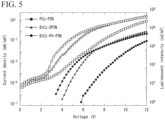
- Ph-BiCz-PIN, BiCz-2PIN, or PCz-PIN was used as a doping material of the luminescent layer.
- the concentration of the doping material was set to be 20% by weight (in PPF).
- the characteristics of the organic electroluminescent element were measured.
- the voltage - current density - luminescent intensity characteristics are shown in FIG. 5 .
- black marks indicate current density
- white marks indicate luminescent intensity.
- the current density - external quantum efficiency characteristics are shown in FIG. 6 .
- Other results are shown in Table 2.
- a luminescent material containing the compound according to the present invention exhibited high luminescent characteristics.
- the isophthalonitrile compound according to the present invention is useful as a luminescent material.
- the luminescent element containing the luminescent material according to the present invention can achieve excellent luminescent efficiency.
Landscapes
- Chemical & Material Sciences (AREA)
- Organic Chemistry (AREA)
- Engineering & Computer Science (AREA)
- Materials Engineering (AREA)
- Physics & Mathematics (AREA)
- Optics & Photonics (AREA)
- Spectroscopy & Molecular Physics (AREA)
- Electroluminescent Light Sources (AREA)
- Plural Heterocyclic Compounds (AREA)
- Indole Compounds (AREA)
Applications Claiming Priority (2)
| Application Number | Priority Date | Filing Date | Title |
|---|---|---|---|
| JP2019111304 | 2019-06-14 | ||
| PCT/JP2020/022547 WO2020250851A1 (ja) | 2019-06-14 | 2020-06-08 | イソフタロニトリル化合物、発光材料およびそれを用いた発光素子 |
Publications (3)
| Publication Number | Publication Date |
|---|---|
| EP3985081A1 EP3985081A1 (en) | 2022-04-20 |
| EP3985081A4 EP3985081A4 (en) | 2024-01-24 |
| EP3985081B1 true EP3985081B1 (en) | 2025-03-12 |
Family
ID=73781216
Family Applications (1)
| Application Number | Title | Priority Date | Filing Date |
|---|---|---|---|
| EP20823145.6A Active EP3985081B1 (en) | 2019-06-14 | 2020-06-08 | Isophthalonitrile compounds, luminescent material, and luminescent element including same |
Country Status (7)
| Country | Link |
|---|---|
| US (1) | US12497363B2 (https=) |
| EP (1) | EP3985081B1 (https=) |
| JP (1) | JP7386486B2 (https=) |
| KR (1) | KR102671951B1 (https=) |
| CN (1) | CN113939501B (https=) |
| TW (1) | TWI741639B (https=) |
| WO (1) | WO2020250851A1 (https=) |
Families Citing this family (1)
| Publication number | Priority date | Publication date | Assignee | Title |
|---|---|---|---|---|
| EP3848352A4 (en) * | 2018-09-05 | 2022-06-01 | Kyushu University, National University Corporation | BENZONITRILE DERIVATIVE, LIGHT EMITTING MATERIAL AND LIGHT EMITTING ELEMENT THEREOF |
Family Cites Families (16)
| Publication number | Priority date | Publication date | Assignee | Title |
|---|---|---|---|---|
| KR20090089073A (ko) * | 2008-02-18 | 2009-08-21 | 삼성모바일디스플레이주식회사 | 실란일아민계 화합물 및 이를 포함한 유기막을 구비한 유기발광 소자 |
| JP2014135466A (ja) | 2012-04-09 | 2014-07-24 | Kyushu Univ | 有機発光素子ならびにそれに用いる発光材料および化合物 |
| JP2016516085A (ja) | 2013-03-22 | 2016-06-02 | メルク パテント ゲーエムベーハー | 電子素子のための材料 |
| US10461261B2 (en) * | 2013-07-16 | 2019-10-29 | Kyushu University, National University Corporation | Compound, light emitting material, and organic light emitting device |
| KR101783650B1 (ko) | 2014-06-24 | 2017-10-23 | 제일모직주식회사 | 화합물, 이를 포함하는 유기광전자소자 및 표시장치 |
| KR101929860B1 (ko) * | 2015-05-15 | 2018-12-17 | 삼성에스디아이 주식회사 | 유기광전자소자 및 표시장치 |
| CN108264478B (zh) | 2016-12-30 | 2020-09-22 | 昆山国显光电有限公司 | 载流子传输材料及载流子传输层及有机发光器件 |
| WO2018237389A1 (en) * | 2017-06-23 | 2018-12-27 | Kyulux Inc. | Composition of matter for use in organic light-emitting diodes |
| JP7267563B2 (ja) | 2017-06-27 | 2023-05-02 | 株式会社Kyulux | 発光材料、化合物、遅延蛍光体および発光素子 |
| WO2019004254A1 (ja) | 2017-06-27 | 2019-01-03 | 株式会社Kyulux | 発光材料、化合物、遅延蛍光体および発光素子 |
| CN107652225B (zh) * | 2017-09-29 | 2020-09-29 | 中节能万润股份有限公司 | 一种以氰基苯为核心的化合物及其在oled器件上的应用 |
| KR102072922B1 (ko) * | 2017-10-30 | 2020-02-10 | 주식회사 엘지화학 | 헤테로고리 화합물 및 이를 포함하는 유기 발광 소자 |
| KR102160860B1 (ko) * | 2017-11-28 | 2020-10-06 | 주식회사 엘지화학 | 화합물 및 이를 포함하는 유기 발광 소자 |
| JP2019111304A (ja) | 2017-12-25 | 2019-07-11 | 光敏 栢島 | 端部硬化型可撓性帯状体着脱式接続具 |
| WO2019195104A1 (en) | 2018-04-02 | 2019-10-10 | Kyulux, Inc. | Composition of matter for use in organic light-emitting diodes |
| KR102743332B1 (ko) * | 2018-12-19 | 2024-12-18 | 삼성디스플레이 주식회사 | 유기 발광 소자 및 이를 포함하는 표시 장치 |
-
2020
- 2020-06-08 US US17/616,127 patent/US12497363B2/en active Active
- 2020-06-08 JP JP2021526078A patent/JP7386486B2/ja active Active
- 2020-06-08 WO PCT/JP2020/022547 patent/WO2020250851A1/ja not_active Ceased
- 2020-06-08 TW TW109119133A patent/TWI741639B/zh active
- 2020-06-08 KR KR1020217038904A patent/KR102671951B1/ko active Active
- 2020-06-08 CN CN202080041797.3A patent/CN113939501B/zh active Active
- 2020-06-08 EP EP20823145.6A patent/EP3985081B1/en active Active
Also Published As
| Publication number | Publication date |
|---|---|
| US12497363B2 (en) | 2025-12-16 |
| KR20220004707A (ko) | 2022-01-11 |
| TWI741639B (zh) | 2021-10-01 |
| KR102671951B1 (ko) | 2024-06-03 |
| TW202106666A (zh) | 2021-02-16 |
| JPWO2020250851A1 (https=) | 2020-12-17 |
| CN113939501A (zh) | 2022-01-14 |
| JP7386486B2 (ja) | 2023-11-27 |
| CN113939501B (zh) | 2024-10-22 |
| EP3985081A1 (en) | 2022-04-20 |
| US20220242822A1 (en) | 2022-08-04 |
| WO2020250851A1 (ja) | 2020-12-17 |
| EP3985081A4 (en) | 2024-01-24 |
Similar Documents
| Publication | Publication Date | Title |
|---|---|---|
| CN111647009B (zh) | 含硼类化合物及其电子器件 | |
| EP2541635B1 (en) | Organic electroluminescent element | |
| KR102201097B1 (ko) | 유기발광소자용 화합물 및 이를 포함하는 유기 발광 소자 | |
| JP6219452B2 (ja) | トリフェニレンシランホスト | |
| KR102005723B1 (ko) | 유기 전계 발광 소자 | |
| CN102754237B (zh) | 有机电致发光元件 | |
| KR101449227B1 (ko) | 유기 발광 소자 | |
| EP2388842B1 (en) | Organic electroluminescent element | |
| CN102598344B (zh) | 有机场致发光元件 | |
| KR102656066B1 (ko) | 신규한 아민 화합물 및 이를 포함하는 유기 발광 소자 | |
| CN112996796A (zh) | 新型硼化合物及包括该新型硼化物的有机发光元件 | |
| EP2589591A1 (en) | Compound with carbazole ring structure and organic electroluminescent element | |
| EP3054496B1 (en) | Material for organic electroluminescent element and organic electroluminescent element using the same | |
| KR20110113469A (ko) | 이형고리 화합물 및 이를 포함하는 유기전계발광소자 | |
| KR102309065B1 (ko) | 유기발광소자용 화합물 및 이를 포함하는 유기 발광 소자 | |
| KR101821808B1 (ko) | 유기전계발광소자용 화합물 및 그를 포함하는 유기전계발광소자 | |
| KR20170057796A (ko) | 유기전계발광소자용 화합물 및 그를 포함하는 유기전계발광소자 | |
| KR20110111093A (ko) | 스피로 화합물 및 이를 포함하는 유기전계발광소자 | |
| EP3125326A1 (en) | Organic-electroluminescent-element material and organic electroluminescent elements using same | |
| KR20170060836A (ko) | 유기전계발광소자용 화합물 및 그를 포함하는 유기전계발광소자 | |
| KR20160029962A (ko) | 유기전계발광소자용 화합물 및 그를 포함하는 유기전계발광소자 | |
| KR20110111094A (ko) | 축합방향족 화합물 및 이를 포함하는 유기전계발광소자 | |
| US10468608B2 (en) | Organic-electroluminescent-element material, and organic electroluminescent element using same | |
| CN106008420A (zh) | 化合物及包含所述化合物的有机发光装置 | |
| TWI795042B (zh) | 含硼化合物、發光材料及使用其之發光元件 |
Legal Events
| Date | Code | Title | Description |
|---|---|---|---|
| STAA | Information on the status of an ep patent application or granted ep patent |
Free format text: STATUS: THE INTERNATIONAL PUBLICATION HAS BEEN MADE |
|
| STAA | Information on the status of an ep patent application or granted ep patent |
Free format text: STATUS: REQUEST FOR EXAMINATION WAS MADE |
|
| 17P | Request for examination filed |
Effective date: 20211115 |
|
| AK | Designated contracting states |
Kind code of ref document: A1 Designated state(s): AL AT BE BG CH CY CZ DE DK EE ES FI FR GB GR HR HU IE IS IT LI LT LU LV MC MK MT NL NO PL PT RO RS SE SI SK SM TR |
|
| PUAI | Public reference made under article 153(3) epc to a published international application that has entered the european phase |
Free format text: ORIGINAL CODE: 0009012 |
|
| DAV | Request for validation of the european patent (deleted) | ||
| DAX | Request for extension of the european patent (deleted) | ||
| RIC1 | Information provided on ipc code assigned before grant |
Ipc: H10K 85/60 20230101ALI20230801BHEP Ipc: C07D 209/86 20060101ALI20230801BHEP Ipc: C09K 11/06 20060101AFI20230801BHEP |
|
| RIC1 | Information provided on ipc code assigned before grant |
Ipc: H10K 85/60 20230101ALI20230919BHEP Ipc: C07D 209/86 20060101ALI20230919BHEP Ipc: C09K 11/06 20060101AFI20230919BHEP |
|
| RAP3 | Party data changed (applicant data changed or rights of an application transferred) |
Owner name: NIPPON SODA CO., LTD. Owner name: KYUSHU UNIVERSITY, NATIONAL UNIVERSITY CORPORATION |
|
| A4 | Supplementary search report drawn up and despatched |
Effective date: 20240104 |
|
| RIC1 | Information provided on ipc code assigned before grant |
Ipc: H10K 85/60 20230101ALI20231221BHEP Ipc: C07D 209/86 20060101ALI20231221BHEP Ipc: C09K 11/06 20060101AFI20231221BHEP |
|
| GRAP | Despatch of communication of intention to grant a patent |
Free format text: ORIGINAL CODE: EPIDOSNIGR1 |
|
| STAA | Information on the status of an ep patent application or granted ep patent |
Free format text: STATUS: GRANT OF PATENT IS INTENDED |
|
| INTG | Intention to grant announced |
Effective date: 20241115 |
|
| GRAS | Grant fee paid |
Free format text: ORIGINAL CODE: EPIDOSNIGR3 |
|
| GRAA | (expected) grant |
Free format text: ORIGINAL CODE: 0009210 |
|
| STAA | Information on the status of an ep patent application or granted ep patent |
Free format text: STATUS: THE PATENT HAS BEEN GRANTED |
|
| AK | Designated contracting states |
Kind code of ref document: B1 Designated state(s): AL AT BE BG CH CY CZ DE DK EE ES FI FR GB GR HR HU IE IS IT LI LT LU LV MC MK MT NL NO PL PT RO RS SE SI SK SM TR |
|
| P01 | Opt-out of the competence of the unified patent court (upc) registered |
Free format text: CASE NUMBER: APP_5396/2025 Effective date: 20250131 |
|
| REG | Reference to a national code |
Ref country code: GB Ref legal event code: FG4D |
|
| REG | Reference to a national code |
Ref country code: CH Ref legal event code: EP |
|
| REG | Reference to a national code |
Ref country code: DE Ref legal event code: R096 Ref document number: 602020047674 Country of ref document: DE |
|
| REG | Reference to a national code |
Ref country code: IE Ref legal event code: FG4D |
|
| PG25 | Lapsed in a contracting state [announced via postgrant information from national office to epo] |
Ref country code: RS Free format text: LAPSE BECAUSE OF FAILURE TO SUBMIT A TRANSLATION OF THE DESCRIPTION OR TO PAY THE FEE WITHIN THE PRESCRIBED TIME-LIMIT Effective date: 20250612 |
|
| PG25 | Lapsed in a contracting state [announced via postgrant information from national office to epo] |
Ref country code: FI Free format text: LAPSE BECAUSE OF FAILURE TO SUBMIT A TRANSLATION OF THE DESCRIPTION OR TO PAY THE FEE WITHIN THE PRESCRIBED TIME-LIMIT Effective date: 20250312 |
|
| PGFP | Annual fee paid to national office [announced via postgrant information from national office to epo] |
Ref country code: DE Payment date: 20250523 Year of fee payment: 6 |
|
| PG25 | Lapsed in a contracting state [announced via postgrant information from national office to epo] |
Ref country code: ES Free format text: LAPSE BECAUSE OF FAILURE TO SUBMIT A TRANSLATION OF THE DESCRIPTION OR TO PAY THE FEE WITHIN THE PRESCRIBED TIME-LIMIT Effective date: 20250312 |
|
| PGFP | Annual fee paid to national office [announced via postgrant information from national office to epo] |
Ref country code: GB Payment date: 20250523 Year of fee payment: 6 |
|
| REG | Reference to a national code |
Ref country code: LT Ref legal event code: MG9D |
|
| PG25 | Lapsed in a contracting state [announced via postgrant information from national office to epo] |
Ref country code: NO Free format text: LAPSE BECAUSE OF FAILURE TO SUBMIT A TRANSLATION OF THE DESCRIPTION OR TO PAY THE FEE WITHIN THE PRESCRIBED TIME-LIMIT Effective date: 20250612 |
|
| PG25 | Lapsed in a contracting state [announced via postgrant information from national office to epo] |
Ref country code: HR Free format text: LAPSE BECAUSE OF FAILURE TO SUBMIT A TRANSLATION OF THE DESCRIPTION OR TO PAY THE FEE WITHIN THE PRESCRIBED TIME-LIMIT Effective date: 20250312 |
|
| REG | Reference to a national code |
Ref country code: NL Ref legal event code: MP Effective date: 20250312 |
|
| PG25 | Lapsed in a contracting state [announced via postgrant information from national office to epo] |
Ref country code: LV Free format text: LAPSE BECAUSE OF FAILURE TO SUBMIT A TRANSLATION OF THE DESCRIPTION OR TO PAY THE FEE WITHIN THE PRESCRIBED TIME-LIMIT Effective date: 20250312 |
|
| PGFP | Annual fee paid to national office [announced via postgrant information from national office to epo] |
Ref country code: FR Payment date: 20250523 Year of fee payment: 6 |
|
| PG25 | Lapsed in a contracting state [announced via postgrant information from national office to epo] |
Ref country code: BG Free format text: LAPSE BECAUSE OF FAILURE TO SUBMIT A TRANSLATION OF THE DESCRIPTION OR TO PAY THE FEE WITHIN THE PRESCRIBED TIME-LIMIT Effective date: 20250312 Ref country code: GR Free format text: LAPSE BECAUSE OF FAILURE TO SUBMIT A TRANSLATION OF THE DESCRIPTION OR TO PAY THE FEE WITHIN THE PRESCRIBED TIME-LIMIT Effective date: 20250613 |
|
| REG | Reference to a national code |
Ref country code: AT Ref legal event code: MK05 Ref document number: 1775027 Country of ref document: AT Kind code of ref document: T Effective date: 20250312 |
|
| PG25 | Lapsed in a contracting state [announced via postgrant information from national office to epo] |
Ref country code: NL Free format text: LAPSE BECAUSE OF FAILURE TO SUBMIT A TRANSLATION OF THE DESCRIPTION OR TO PAY THE FEE WITHIN THE PRESCRIBED TIME-LIMIT Effective date: 20250312 |
|
| PG25 | Lapsed in a contracting state [announced via postgrant information from national office to epo] |
Ref country code: SE Free format text: LAPSE BECAUSE OF FAILURE TO SUBMIT A TRANSLATION OF THE DESCRIPTION OR TO PAY THE FEE WITHIN THE PRESCRIBED TIME-LIMIT Effective date: 20250312 |
|
| PG25 | Lapsed in a contracting state [announced via postgrant information from national office to epo] |
Ref country code: SM Free format text: LAPSE BECAUSE OF FAILURE TO SUBMIT A TRANSLATION OF THE DESCRIPTION OR TO PAY THE FEE WITHIN THE PRESCRIBED TIME-LIMIT Effective date: 20250312 |
|
| PG25 | Lapsed in a contracting state [announced via postgrant information from national office to epo] |
Ref country code: PT Free format text: LAPSE BECAUSE OF FAILURE TO SUBMIT A TRANSLATION OF THE DESCRIPTION OR TO PAY THE FEE WITHIN THE PRESCRIBED TIME-LIMIT Effective date: 20250714 |
|
| PG25 | Lapsed in a contracting state [announced via postgrant information from national office to epo] |
Ref country code: PL Free format text: LAPSE BECAUSE OF FAILURE TO SUBMIT A TRANSLATION OF THE DESCRIPTION OR TO PAY THE FEE WITHIN THE PRESCRIBED TIME-LIMIT Effective date: 20250312 Ref country code: IT Free format text: LAPSE BECAUSE OF FAILURE TO SUBMIT A TRANSLATION OF THE DESCRIPTION OR TO PAY THE FEE WITHIN THE PRESCRIBED TIME-LIMIT Effective date: 20250312 |
|
| PG25 | Lapsed in a contracting state [announced via postgrant information from national office to epo] |
Ref country code: AT Free format text: LAPSE BECAUSE OF FAILURE TO SUBMIT A TRANSLATION OF THE DESCRIPTION OR TO PAY THE FEE WITHIN THE PRESCRIBED TIME-LIMIT Effective date: 20250312 |
|
| PG25 | Lapsed in a contracting state [announced via postgrant information from national office to epo] |
Ref country code: CZ Free format text: LAPSE BECAUSE OF FAILURE TO SUBMIT A TRANSLATION OF THE DESCRIPTION OR TO PAY THE FEE WITHIN THE PRESCRIBED TIME-LIMIT Effective date: 20250312 Ref country code: EE Free format text: LAPSE BECAUSE OF FAILURE TO SUBMIT A TRANSLATION OF THE DESCRIPTION OR TO PAY THE FEE WITHIN THE PRESCRIBED TIME-LIMIT Effective date: 20250312 |
|
| PG25 | Lapsed in a contracting state [announced via postgrant information from national office to epo] |
Ref country code: RO Free format text: LAPSE BECAUSE OF FAILURE TO SUBMIT A TRANSLATION OF THE DESCRIPTION OR TO PAY THE FEE WITHIN THE PRESCRIBED TIME-LIMIT Effective date: 20250312 |
|
| PG25 | Lapsed in a contracting state [announced via postgrant information from national office to epo] |
Ref country code: SK Free format text: LAPSE BECAUSE OF FAILURE TO SUBMIT A TRANSLATION OF THE DESCRIPTION OR TO PAY THE FEE WITHIN THE PRESCRIBED TIME-LIMIT Effective date: 20250312 |
|
| PG25 | Lapsed in a contracting state [announced via postgrant information from national office to epo] |
Ref country code: IS Free format text: LAPSE BECAUSE OF FAILURE TO SUBMIT A TRANSLATION OF THE DESCRIPTION OR TO PAY THE FEE WITHIN THE PRESCRIBED TIME-LIMIT Effective date: 20250712 |
|
| REG | Reference to a national code |
Ref country code: DE Ref legal event code: R097 Ref document number: 602020047674 Country of ref document: DE |
|
| PG25 | Lapsed in a contracting state [announced via postgrant information from national office to epo] |
Ref country code: DK Free format text: LAPSE BECAUSE OF FAILURE TO SUBMIT A TRANSLATION OF THE DESCRIPTION OR TO PAY THE FEE WITHIN THE PRESCRIBED TIME-LIMIT Effective date: 20250312 |
|
| PLBE | No opposition filed within time limit |
Free format text: ORIGINAL CODE: 0009261 |
|
| STAA | Information on the status of an ep patent application or granted ep patent |
Free format text: STATUS: NO OPPOSITION FILED WITHIN TIME LIMIT |
|
| REG | Reference to a national code |
Ref country code: CH Ref legal event code: L10 Free format text: ST27 STATUS EVENT CODE: U-0-0-L10-L00 (AS PROVIDED BY THE NATIONAL OFFICE) Effective date: 20260121 |
|
| REG | Reference to a national code |
Ref country code: CH Ref legal event code: H13 Free format text: ST27 STATUS EVENT CODE: U-0-0-H10-H13 (AS PROVIDED BY THE NATIONAL OFFICE) Effective date: 20260127 |
|
| PG25 | Lapsed in a contracting state [announced via postgrant information from national office to epo] |
Ref country code: MC Free format text: LAPSE BECAUSE OF FAILURE TO SUBMIT A TRANSLATION OF THE DESCRIPTION OR TO PAY THE FEE WITHIN THE PRESCRIBED TIME-LIMIT Effective date: 20250312 |
|
| PG25 | Lapsed in a contracting state [announced via postgrant information from national office to epo] |
Ref country code: LU Free format text: LAPSE BECAUSE OF NON-PAYMENT OF DUE FEES Effective date: 20250608 |
|
| 26N | No opposition filed |
Effective date: 20251215 |
|
| REG | Reference to a national code |
Ref country code: BE Ref legal event code: MM Effective date: 20250630 |
|
| PG25 | Lapsed in a contracting state [announced via postgrant information from national office to epo] |
Ref country code: IE Free format text: LAPSE BECAUSE OF NON-PAYMENT OF DUE FEES Effective date: 20250608 |
|
| PG25 | Lapsed in a contracting state [announced via postgrant information from national office to epo] |
Ref country code: BE Free format text: LAPSE BECAUSE OF NON-PAYMENT OF DUE FEES Effective date: 20250630 |