EP3984904A1 - A non-reclosable container system - Google Patents
A non-reclosable container system Download PDFInfo
- Publication number
- EP3984904A1 EP3984904A1 EP20202188.7A EP20202188A EP3984904A1 EP 3984904 A1 EP3984904 A1 EP 3984904A1 EP 20202188 A EP20202188 A EP 20202188A EP 3984904 A1 EP3984904 A1 EP 3984904A1
- Authority
- EP
- European Patent Office
- Prior art keywords
- container
- container system
- cap
- single use
- reclosable
- Prior art date
- Legal status (The legal status is an assumption and is not a legal conclusion. Google has not performed a legal analysis and makes no representation as to the accuracy of the status listed.)
- Withdrawn
Links
Images



Classifications
-
- B—PERFORMING OPERATIONS; TRANSPORTING
- B65—CONVEYING; PACKING; STORING; HANDLING THIN OR FILAMENTARY MATERIAL
- B65D—CONTAINERS FOR STORAGE OR TRANSPORT OF ARTICLES OR MATERIALS, e.g. BAGS, BARRELS, BOTTLES, BOXES, CANS, CARTONS, CRATES, DRUMS, JARS, TANKS, HOPPERS, FORWARDING CONTAINERS; ACCESSORIES, CLOSURES, OR FITTINGS THEREFOR; PACKAGING ELEMENTS; PACKAGES
- B65D41/00—Caps, e.g. crown caps or crown seals, i.e. members having parts arranged for engagement with the external periphery of a neck or wall defining a pouring opening or discharge aperture; Protective cap-like covers for closure members, e.g. decorative covers of metal foil or paper
- B65D41/32—Caps or cap-like covers with lines of weakness, tearing-strips, tags, or like opening or removal devices, e.g. to facilitate formation of pouring openings
- B65D41/34—Threaded or like caps or cap-like covers provided with tamper elements formed in, or attached to, the closure skirt
- B65D41/3404—Threaded or like caps or cap-like covers provided with tamper elements formed in, or attached to, the closure skirt with ratchet-and-pawl mechanism between the container and the closure skirt or the tamper element
-
- B—PERFORMING OPERATIONS; TRANSPORTING
- B65—CONVEYING; PACKING; STORING; HANDLING THIN OR FILAMENTARY MATERIAL
- B65D—CONTAINERS FOR STORAGE OR TRANSPORT OF ARTICLES OR MATERIALS, e.g. BAGS, BARRELS, BOTTLES, BOXES, CANS, CARTONS, CRATES, DRUMS, JARS, TANKS, HOPPERS, FORWARDING CONTAINERS; ACCESSORIES, CLOSURES, OR FITTINGS THEREFOR; PACKAGING ELEMENTS; PACKAGES
- B65D51/00—Closures not otherwise provided for
- B65D51/24—Closures not otherwise provided for combined or co-operating with auxiliary devices for non-closing purposes
- B65D51/32—Closures not otherwise provided for combined or co-operating with auxiliary devices for non-closing purposes with brushes or rods for applying or stirring contents
-
- B—PERFORMING OPERATIONS; TRANSPORTING
- B65—CONVEYING; PACKING; STORING; HANDLING THIN OR FILAMENTARY MATERIAL
- B65D—CONTAINERS FOR STORAGE OR TRANSPORT OF ARTICLES OR MATERIALS, e.g. BAGS, BARRELS, BOTTLES, BOXES, CANS, CARTONS, CRATES, DRUMS, JARS, TANKS, HOPPERS, FORWARDING CONTAINERS; ACCESSORIES, CLOSURES, OR FITTINGS THEREFOR; PACKAGING ELEMENTS; PACKAGES
- B65D55/00—Accessories for container closures not otherwise provided for
- B65D55/02—Locking devices; Means for discouraging or indicating unauthorised opening or removal of closure
- B65D55/022—Locking devices; Means for discouraging or indicating unauthorised opening or removal of closure with ratchet effect between relatively rotating parts
-
- B—PERFORMING OPERATIONS; TRANSPORTING
- B65—CONVEYING; PACKING; STORING; HANDLING THIN OR FILAMENTARY MATERIAL
- B65D—CONTAINERS FOR STORAGE OR TRANSPORT OF ARTICLES OR MATERIALS, e.g. BAGS, BARRELS, BOTTLES, BOXES, CANS, CARTONS, CRATES, DRUMS, JARS, TANKS, HOPPERS, FORWARDING CONTAINERS; ACCESSORIES, CLOSURES, OR FITTINGS THEREFOR; PACKAGING ELEMENTS; PACKAGES
- B65D2255/00—Locking devices
- B65D2255/20—Locking devices with coacting elements, e.g. ratchet and pawl, formed integrally in the container and closure or dispensing device, e.g. spout, for permanently preventing removal of the latter
Definitions
- the present invention relates to a single use, non-reclosable container system for receiving a pharmaceutical or cosmetic composition destined for human beings.
- the packaging plays a crucial role for the producer, but also for the consumer to ensure that the composition is delivered in the same high quality as it was packaged. Exposure of the composition to the environment can cause degradation of the composition by light, air, etc. or contamination of the composition with any type of pathogens, like bacteria or virus. Consequently, a degraded or contaminated composition can cause a severe health risk and is therefore not safe for the consumer.
- producers usually add preservatives to the compositions. However, preservatives have the risk to cause unwanted side-effects to the human body, so that an increasing number of consumers prefer compositions with as little preservatives as possible, and possibly even without.
- the packaging should prevent the composition from exposure to the environment prior to its use to avoid degradation or contamination of the composition. Once such packaging has been opened and the composition is exposed to the environment, the composition needs to be quickly consumed, since the degradation or contamination process has started.
- Single-dosage form packages provide only enough composition for a single use. They are usually soft or comprise perforated lines so that the consumer can easily open the package. However, soft packages due to their soft haptic are often associated with minor quality products, and so for premium products, a hard shell package is often preferred.
- packages should be easy to use.
- Packages, especially for cosmetic products, such as mascaras or lip gloss usually comprise an applicator to ensure convenient and easy distribution of the composition on the face of the consumer.
- the invention presented herein relates to a single use, non-reclosable container system for receiving a pharmaceutical or cosmetic composition destined for human beings.
- the container system comprises a container defining an interior volume for receiving the pharmaceutical or cosmetic composition and having a first threaded portion, a cap having a second threaded portion, the first and second threaded portions being configured such that they are matingly engagable, and an anti-rotation lock.
- the anti-rotation lock is configured such that the first and second threaded portions are rotatable relative to one another in an opening direction to release the cap from the container, but are prevented from being rotatable relative to one another in a closing direction, whereby the closing direction is opposite to the opening direction.
- a single use, non-reclosable container system is a container system which, once it has been closed by the producer and opened by a consumer, cannot be closed again without any additional means. In other words, the consumer cannot mount the cap onto the container again, once the cap has been released from the container.
- Its foolproof use is advantageous in that no preservatives need to be added to the composition to otherwise slow down degradation of the composition once the container has been opened.
- the risk of withdrawing a contaminated composition from the container is minimized as the design of the container is for single use only. Hence, it protects the health of the consumer from using a degraded or contaminated composition.
- the anti-rotation lock is a two-part anti-rotation lock, wherein the two parts are force-fitted or form-fitted to one another in a locked state.
- the locked state denotes the state of the container system when it is closed.
- the anti-rotation lock includes a toothed gearwheel provided on the container and having a plurality of wedge-shaped teeth, and at least one protrusion provided on the cap, which is engagable with the toothed gearwheel.
- the toothed gear wheel is press-fitted onto the container and extends circumferentially around the container. This press-fit ensures that the toothed gear wheel is fixedly attached to the container and cannot be separated therefrom without applying excessive force thereon.
- the toothed gear wheel is of the spur gear type.
- the teeth of a spur gear are not symmetrical in that one flank of a tooth is orthogonal and the opposite flank is inclined.
- a length of at least one of the plurality of wedge-shaped teeth corresponds to a length of the at least one protrusion.
- two protrusions are provided on the cap.
- a cap having two protrusions offers increased safety as it withstands a higher rotational force.
- the cap includes a cylindrical element with an interior surface and an exterior surface, and wherein the two protrusions are diametrically arranged on the interior surface of the cylindrical element.
- the cap comprises an applicator.
- the applicator serves the purpose to facilitate application of the composition inside the container.
- the applicator is a brush or a sponge for applying the composition on the eye lash, eye brow or lips of a human being. Therefore, the brush or the sponge can to some extent absorb or adsorb the composition inside the container and helps to more easily distribute the composition onto the eye lash, eye brow or lips in a uniform manner.
- the applicator rests inside the container. Consequently, the applicator is already immersed into the composition and thus ready to use once the cap has been removed from the container. In addition, the applicator is protected from dirt, dust or any other type of contamination.
- the container system is at least partially made of a thermoplastic material.
- the container system may be produced by using a 3D printer thus allowing almost any shape and geometry for the cap, the container and the anti-rotation lock.
- the container system may be produced by using a moulding process.
- Thermoplastic materials preferably be used for the container system may be selected from the group consisting of acrylonitrile butadiene styrene (ABS) polymer, polylactic acid (PLA), acrylonitrile styrene acrylate (ASA) polymer and polycarbonate (PC).
- ABS acrylonitrile butadiene styrene
- PLA polylactic acid
- ASA acrylonitrile styrene acrylate
- PC polycarbonate
- the thermoplastic materials may additionally contain additives. These thermoplastic materials exhibit excellent stiffness at room temperature (20 °C), thereby preventing premature failure of the anti-rotation lock. They also impart a premium haptic feeling to the consumer.
- a seal is provided inside the cap for hermetically sealing the container system.
- the seal extends the shelf life of the composition inside the container system.
- the container system 1 of the present invention is configured to receive a pharmaceutical or cosmetic composition.
- the technical design of the container system 1 is for single use only in that it cannot be reclosed once opened. It therefore prevents multiple use. It goes without saying that the container system 1 may be reclosed using additional means, such as a tape, which, however, is in contrast to the intended use of the container system 1.
- the container system 1 includes a container 40 having an interior volume 44 for receiving the pharmaceutical or cosmetic composition, a cap 10 for closing the container 40 and an anti-rotation lock 20, 50 which prevents reclosure of the container 40.
- the container 40 and the cap 10 may have a size and shape convenient and suitable for storing a pharmaceutical or cosmetic composition in an amount sufficient for single use. This amount, of course, depends on the type of use and the type of pharmaceutical or cosmetic composition contained in the container system 1.
- the container system 1 may preferably be made, at least in part, of a thermoplastic material, and may be manufactured using a 3D printer or a moulding process.
- the longitudinal direction extends along a symmetry axis of the container system 1, or absent any such symmetry axis, along an axis which may be used to indicate or measure the liquid level (level of the pharmaceutical or cosmetic composition) within the interior volume 44 of the container 40.
- the circumferential direction extends around the periphery of the container system 1.
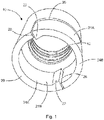
- Fig. 1 is a bottom perspective cutaway view of the cap 10 included in the container system 1 according to a preferred embodiment of the invention. It is a cutaway view as the cap 10 at its upper end is closed, but shown open in Fig. 1 .
- the cap 10 has preferably a cylindrical shape and includes a preferably rigid threaded portion 12 with a preferably female screw thread.
- the cap 10 further includes a preferably cylindrical element 20 (first part 20 of an anti-rotation lock 20, 50 as will be explained below with respect to Fig. 4 ), which, in the assembled state of the container system 1 ( Fig. 4 ), is arranged below the threaded portion 12.
- the cylindrical element 20 is preferably flexible and has an exterior surface 21A and an interior surface 21B.
- Preferably two protrusions 22 (nose portions) are projecting radially inwardly from the interior surface 21B of the cylindrical element 20.
- the two protrusions 22 are preferably wedge-shaped and are arranged diametrically opposite to one another.
- the part (portion) of the cap 10 which includes the threaded portion 12 and the part (portion) of the cap 10 which includes the cylindrical element 20 may be formed integrally as a one-piece unit, or may be formed separately and may be connected using known connecting means.
- the cylindrical element 20 has preferably two jaws 24A, 24B, with each jaw 24A, 24B extending approximately around half the circumference of the cylindrical element 20 (radian measure of approximately ⁇ ).
- the jaws 24A, 24B are configured such that they may be compressed to an extent which is sufficient for moving the protrusions 22 radially outwardly.
- longitudinal slots 26 are provided to separate the two jaws 24A, 24B from one another, and a circumferential slot 28 is provided to separate, in part, the jaws 24A, 24B from the threaded portion 12. Both the longitudinal slots 26 and the circumferential slot 28 impart flexibility to the cylindrical element 20, and thus the jaws 24a, 24B.
- the protrusions 22 are located directly adjacent the longitudinal slots 26. In case the protrusions 22 are wedge-shaped, the orthogonal side surface of each wedge-shaped protrusion 22 terminates at the longitudinal slot 26.
- Fig. 2 shows the container 40 of the container system 1 according to a preferred embodiment of the invention.
- the container 40 defines an interior volume 44 for receiving the pharmaceutical or cosmetic composition.
- the container 40 is preferably cylindrical.
- the container 40 has at its upper end and preferably on its outer surface a threaded portion 42, preferably a male screw thread, which is configured such that it can matingly engage the threaded portion 12 of the cap 10.
- a threaded portion 42 preferably a male screw thread
- a second part 50 of an anti-rotation lock 20, 50 is shown.
- the second part 50 of the anti-rotation lock 20, 50 is preferably press-fitted onto the container 40 of Fig. 2 . Once press-fitted onto the container 40, the second part 50 of the anti-rotation lock 20, 50 can no longer be removed from the container 40 or be twisted in any direction.
- the second part 50 of the anti-rotation lock 20, 50 is preferably cylindrical and extends preferably from the bottom of the container 40 to just below the threaded portion 42 of the container 40.
- the second part 50 of the anti-rotation lock 20, 50 according to a preferred embodiment of the invention has a toothed gearwheel structure 60, preferably of the spur gear type, on its outer surface.
- a multiplicity of teeth 62 are arranged circumferentially around the second part 50 of the anti-rotation lock 20, 50.
- all teeth 62 of the gear wheel 60 have the same size and shape.
- each tooth 62 is preferably non-symmetrical relative to an axis which extends in a radial direction, in that one flank 62B of each tooth 62 extends in a radial direction whereas the opposite flank 62A of each tooth 62 extends at an oblique angle relative to the first flank 62B.
- the oblique angle is preferably selected such that it extends along or parallel to a tangent of the cylindrical surface of the container 40.
- the interior volume 44 for receiving the pharmaceutical or cosmetic composition may be defined by the second part 50 of the anti-rotation lock 20, 50.
- the second part 50 of the anti-rotation lock 20, 50 and the container 40 are integrally made.
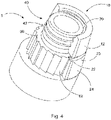
- Fig. 4 shows an assembled view of the container system 1 according to a preferred embodiment of the invention.
- the cap 10 is screwed onto the container 40 by engaging the threaded portion 12 of the cap 10 and the threaded portion 42 of the container 40.
- Fig. 4 clearly shows the locked state of the anti-rotation lock 20, 50.
- the protrusions 22 provided on the interior surface 21B of the cylindrical element 20 engage in a form-fitting manner respective teeth 62 of the gear wheel 60.
- the protrusions 22 may engage in a force-fitting manner suitably shaped structure provided on the outer surface of the container 40.
- each protrusion 22 equals the length of each tooth 62 of the gearwheel 60.
- the jaws 24A, 24B of the cylindrical element 20 of the cap 10 are pressed radially inwardly such that the protrusions 22 disengage from the respective teeth 62 of the gear wheel 60, as a result of which the cap 10 can be rotated in an opening direction and be taken off the container 40.
- the cap 10 cannot be screwed onto the container 40 again as the protrusions 22 will abut onto the orthogonal flank 62B of the respective teeth 62 of the gearwheel 60.
- the teeth 62 of the gear wheel 60 resist movement of the protrusions 22 of the cylindrical element 20 in the closing direction.
- the teeth 62 of the gearwheel 60 are shaped such that rotation of the cylindrical element, and hence of the cap 10 is allowed only in the opening direction, but not in the opposite closing direction.
- the opening and closing directions are defined by the type of thread used for the threaded portion 12 of the cap 10 and the threaded portion 42 of the container 40.
- a seal 70 may be seated next to and above the uppermost pitch of the threaded portion 12 of the cap 10, which, when the cap 10 is mounted onto the container 40, hermetically seals the container system 1.
- an applicator 80 may be provided, such as a brush or a sponge (82) or the like.
- the applicator 80 may be fixedly attached to the inner surface of the closed top side of the cap 10 and may extend in a longitudinal direction beyond the lower end of the cylindrical element 20.
- the length of the applicator 80 may be such that it rests inside the interior volume 44 of the container 40 and is immersed within the composition received therein.
- applicators 80 may be provided.
- an applicator 80 may be fixedly attached to a surface, preferably the bottom surface, of the interior volume 44 of the container 40 and may extend longitudinally beyond the threaded portion 42 of the container 40.
- the applicator 80 itself may be provided with an annular seal around the applicator tip.
Landscapes
- Engineering & Computer Science (AREA)
- Mechanical Engineering (AREA)
- Closures For Containers (AREA)
Abstract
The presented invention relates to a single use, non-reclosable container system 1 for receiving a pharmaceutical or cosmetic composition destined for human beings. The container system 1 comprises a container 40 defining an interior volume 44 for receiving the pharmaceutical or cosmetic composition and having a first threaded portion 42 and a cap 10 having a second threaded portion 12. The first and second threaded portions 42, 12 are configured such that they can matingly engage with one another. In addition, the container system 1 comprises an anti-rotation lock 20, 50. The anti-rotation lock 20, 50 is configured such that the first and second threaded portions 42, 12 are rotatable relative to one another in an opening direction to release the cap 10 from the container 40, but are prevented from being rotatable relative to one another in a closing direction, wherein the closing direction is opposite to the opening direction.
Description
- The present invention relates to a single use, non-reclosable container system for receiving a pharmaceutical or cosmetic composition destined for human beings.
- Various packages for pharmaceutical or cosmetic compositions are known, which mainly serve the purpose to protect, store and distribute a composition.
- In case of pharmaceutical and cosmetic compositions, the packaging plays a crucial role for the producer, but also for the consumer to ensure that the composition is delivered in the same high quality as it was packaged. Exposure of the composition to the environment can cause degradation of the composition by light, air, etc. or contamination of the composition with any type of pathogens, like bacteria or virus. Consequently, a degraded or contaminated composition can cause a severe health risk and is therefore not safe for the consumer. To minimize the risk of degraded or contaminated compositions, producers usually add preservatives to the compositions. However, preservatives have the risk to cause unwanted side-effects to the human body, so that an increasing number of consumers prefer compositions with as little preservatives as possible, and possibly even without. However, the omission of preservatives imposes relatively strict requirements on the packaging as the packaging should prevent the composition from exposure to the environment prior to its use to avoid degradation or contamination of the composition. Once such packaging has been opened and the composition is exposed to the environment, the composition needs to be quickly consumed, since the degradation or contamination process has started.
- To overcome this shortcoming and use the compositions more efficiently, single-dosage form packages have been provided. Single-dosage form packages provide only enough composition for a single use. They are usually soft or comprise perforated lines so that the consumer can easily open the package. However, soft packages due to their soft haptic are often associated with minor quality products, and so for premium products, a hard shell package is often preferred.
- In addition, modern packages should be easy to use. Packages, especially for cosmetic products, such as mascaras or lip gloss usually comprise an applicator to ensure convenient and easy distribution of the composition on the face of the consumer.
- It is therefore an object of the present invention to minimize or even eliminate the disadvantages of prior art packages. In particular, it is an object of the present invention to provide an easy-to-use package or container system for receiving pharmaceutical or cosmetic compositions destined for human beings with no need of adding preservatives to the composition.
- This object is solved by the subject-matter of
claim 1. Optional or preferred features of the invention are subject of dependent claims 2 to 13. - The invention presented herein relates to a single use, non-reclosable container system for receiving a pharmaceutical or cosmetic composition destined for human beings. The container system comprises a container defining an interior volume for receiving the pharmaceutical or cosmetic composition and having a first threaded portion, a cap having a second threaded portion, the first and second threaded portions being configured such that they are matingly engagable, and an anti-rotation lock. The anti-rotation lock is configured such that the first and second threaded portions are rotatable relative to one another in an opening direction to release the cap from the container, but are prevented from being rotatable relative to one another in a closing direction, whereby the closing direction is opposite to the opening direction.
- A single use, non-reclosable container system is a container system which, once it has been closed by the producer and opened by a consumer, cannot be closed again without any additional means. In other words, the consumer cannot mount the cap onto the container again, once the cap has been released from the container. Its foolproof use is advantageous in that no preservatives need to be added to the composition to otherwise slow down degradation of the composition once the container has been opened. In addition, the risk of withdrawing a contaminated composition from the container is minimized as the design of the container is for single use only. Hence, it protects the health of the consumer from using a degraded or contaminated composition.
- Preferably, the anti-rotation lock is a two-part anti-rotation lock, wherein the two parts are force-fitted or form-fitted to one another in a locked state. The locked state denotes the state of the container system when it is closed.
- Preferably, the anti-rotation lock includes a toothed gearwheel provided on the container and having a plurality of wedge-shaped teeth, and at least one protrusion provided on the cap, which is engagable with the toothed gearwheel.
- Preferably, the toothed gear wheel is press-fitted onto the container and extends circumferentially around the container. This press-fit ensures that the toothed gear wheel is fixedly attached to the container and cannot be separated therefrom without applying excessive force thereon.
- Preferably, the toothed gear wheel is of the spur gear type. The teeth of a spur gear are not symmetrical in that one flank of a tooth is orthogonal and the opposite flank is inclined.
- Preferably, a length of at least one of the plurality of wedge-shaped teeth corresponds to a length of the at least one protrusion.
- Preferably, two protrusions are provided on the cap. A cap having two protrusions offers increased safety as it withstands a higher rotational force.
- Preferably, the cap includes a cylindrical element with an interior surface and an exterior surface, and wherein the two protrusions are diametrically arranged on the interior surface of the cylindrical element.
- Preferably, the cap comprises an applicator. The applicator serves the purpose to facilitate application of the composition inside the container.
- Preferably, the applicator is a brush or a sponge for applying the composition on the eye lash, eye brow or lips of a human being. Therefore, the brush or the sponge can to some extent absorb or adsorb the composition inside the container and helps to more easily distribute the composition onto the eye lash, eye brow or lips in a uniform manner.
- Preferably, when the cap is mounted onto the container, the applicator rests inside the container. Consequently, the applicator is already immersed into the composition and thus ready to use once the cap has been removed from the container. In addition, the applicator is protected from dirt, dust or any other type of contamination.
- Preferably, the container system is at least partially made of a thermoplastic material. Hence, the container system may be produced by using a 3D printer thus allowing almost any shape and geometry for the cap, the container and the anti-rotation lock. Alternatively, the container system may be produced by using a moulding process. Thermoplastic materials preferably be used for the container system may be selected from the group consisting of acrylonitrile butadiene styrene (ABS) polymer, polylactic acid (PLA), acrylonitrile styrene acrylate (ASA) polymer and polycarbonate (PC). The thermoplastic materials may additionally contain additives. These thermoplastic materials exhibit excellent stiffness at room temperature (20 °C), thereby preventing premature failure of the anti-rotation lock. They also impart a premium haptic feeling to the consumer.
- Preferably, a seal is provided inside the cap for hermetically sealing the container system. The seal extends the shelf life of the composition inside the container system.
-
- Fig. 1
- presents a bottom perspective cutaway view of a cap of a container system according to a preferred embodiment of the invention;
- Fig. 2
- presents a perspective view of a container of a container system according to a preferred embodiment of the invention;
- Fig. 3
- presents a perspective view of an anti-rotation lock mounted onto the container of
Fig. 3 ; - Fig. 4
- presents a perspective view of an assembled container system according to a preferred embodiment of the invention; and
- Fig. 5
- shows a cap of a container system according to another preferred embodiment of the invention with an applicator located therein.
- The invention will now be described by way of example using a preferred embodiment of the invention. The figures shall be understood to be schematic, and hence no real-world absolute or relative dimensions can be derived therefrom. Identical or similar elements in the figures having a similar or same technical effect may be denoted by identical reference signs.
- The
container system 1 of the present invention is configured to receive a pharmaceutical or cosmetic composition. The technical design of thecontainer system 1 is for single use only in that it cannot be reclosed once opened. It therefore prevents multiple use. It goes without saying that thecontainer system 1 may be reclosed using additional means, such as a tape, which, however, is in contrast to the intended use of thecontainer system 1. - To this end, the
container system 1 includes acontainer 40 having aninterior volume 44 for receiving the pharmaceutical or cosmetic composition, acap 10 for closing thecontainer 40 and ananti-rotation lock container 40. - The
container 40 and thecap 10 may have a size and shape convenient and suitable for storing a pharmaceutical or cosmetic composition in an amount sufficient for single use. This amount, of course, depends on the type of use and the type of pharmaceutical or cosmetic composition contained in thecontainer system 1. - The
container system 1 may preferably be made, at least in part, of a thermoplastic material, and may be manufactured using a 3D printer or a moulding process. - In the description below, the longitudinal direction extends along a symmetry axis of the
container system 1, or absent any such symmetry axis, along an axis which may be used to indicate or measure the liquid level (level of the pharmaceutical or cosmetic composition) within theinterior volume 44 of thecontainer 40. The circumferential direction extends around the periphery of thecontainer system 1. -
Fig. 1 is a bottom perspective cutaway view of thecap 10 included in thecontainer system 1 according to a preferred embodiment of the invention. It is a cutaway view as thecap 10 at its upper end is closed, but shown open inFig. 1 . - The
cap 10 has preferably a cylindrical shape and includes a preferably rigid threadedportion 12 with a preferably female screw thread. Thecap 10 further includes a preferably cylindrical element 20 (first part 20 of ananti-rotation lock Fig. 4 ), which, in the assembled state of the container system 1 (Fig. 4 ), is arranged below the threadedportion 12. Thecylindrical element 20 is preferably flexible and has anexterior surface 21A and aninterior surface 21B. Preferably two protrusions 22 (nose portions) are projecting radially inwardly from theinterior surface 21B of thecylindrical element 20. The twoprotrusions 22 are preferably wedge-shaped and are arranged diametrically opposite to one another. - The part (portion) of the
cap 10 which includes the threadedportion 12 and the part (portion) of thecap 10 which includes thecylindrical element 20 may be formed integrally as a one-piece unit, or may be formed separately and may be connected using known connecting means. - The
cylindrical element 20 has preferably twojaws jaw jaws protrusions 22 radially outwardly. To this end,longitudinal slots 26 are provided to separate the twojaws circumferential slot 28 is provided to separate, in part, thejaws portion 12. Both thelongitudinal slots 26 and thecircumferential slot 28 impart flexibility to thecylindrical element 20, and thus thejaws 24a, 24B. - The
protrusions 22 are located directly adjacent thelongitudinal slots 26. In case theprotrusions 22 are wedge-shaped, the orthogonal side surface of each wedge-shapedprotrusion 22 terminates at thelongitudinal slot 26. -
Fig. 2 shows thecontainer 40 of thecontainer system 1 according to a preferred embodiment of the invention. Thecontainer 40 defines aninterior volume 44 for receiving the pharmaceutical or cosmetic composition. Thecontainer 40 is preferably cylindrical. Thecontainer 40 has at its upper end and preferably on its outer surface a threadedportion 42, preferably a male screw thread, which is configured such that it can matingly engage the threadedportion 12 of thecap 10. Although not shown inFig. 2 , the bottom of thecontainer 40 which defines the bottom of theinterior volume 44 is closed. - In
Fig. 3 , asecond part 50 of ananti-rotation lock second part 50 of theanti-rotation lock container 40 ofFig. 2 . Once press-fitted onto thecontainer 40, thesecond part 50 of theanti-rotation lock container 40 or be twisted in any direction. - The
second part 50 of theanti-rotation lock container 40 to just below the threadedportion 42 of thecontainer 40. Thesecond part 50 of theanti-rotation lock toothed gearwheel structure 60, preferably of the spur gear type, on its outer surface. A multiplicity ofteeth 62 are arranged circumferentially around thesecond part 50 of theanti-rotation lock teeth 62 of thegear wheel 60 have the same size and shape. The shape of eachtooth 62 is preferably non-symmetrical relative to an axis which extends in a radial direction, in that oneflank 62B of eachtooth 62 extends in a radial direction whereas theopposite flank 62A of eachtooth 62 extends at an oblique angle relative to thefirst flank 62B. The oblique angle is preferably selected such that it extends along or parallel to a tangent of the cylindrical surface of thecontainer 40. - In an alternative embodiment of the invention, the
interior volume 44 for receiving the pharmaceutical or cosmetic composition may be defined by thesecond part 50 of theanti-rotation lock second part 50 of theanti-rotation lock container 40 are integrally made. -
Fig. 4 shows an assembled view of thecontainer system 1 according to a preferred embodiment of the invention. InFig. 4 , thecap 10 is screwed onto thecontainer 40 by engaging the threadedportion 12 of thecap 10 and the threadedportion 42 of thecontainer 40.Fig. 4 clearly shows the locked state of theanti-rotation lock protrusions 22 provided on theinterior surface 21B of thecylindrical element 20 engage in a form-fitting mannerrespective teeth 62 of thegear wheel 60. Alternatively, theprotrusions 22 may engage in a force-fitting manner suitably shaped structure provided on the outer surface of thecontainer 40. - Preferably, the length (in longitudinal direction) of each
protrusion 22 equals the length of eachtooth 62 of thegearwheel 60. - In order to release the
cap 10 from thecontainer 40, thejaws cylindrical element 20 of thecap 10 are pressed radially inwardly such that theprotrusions 22 disengage from therespective teeth 62 of thegear wheel 60, as a result of which thecap 10 can be rotated in an opening direction and be taken off thecontainer 40. However, once thecap 10 has been released from thecontainer 40, thecap 10 cannot be screwed onto thecontainer 40 again as theprotrusions 22 will abut onto theorthogonal flank 62B of therespective teeth 62 of thegearwheel 60. In other words, theteeth 62 of thegear wheel 60 resist movement of theprotrusions 22 of thecylindrical element 20 in the closing direction. Theteeth 62 of thegearwheel 60 are shaped such that rotation of the cylindrical element, and hence of thecap 10 is allowed only in the opening direction, but not in the opposite closing direction. The opening and closing directions are defined by the type of thread used for the threadedportion 12 of thecap 10 and the threadedportion 42 of thecontainer 40. - A
seal 70 may be seated next to and above the uppermost pitch of the threadedportion 12 of thecap 10, which, when thecap 10 is mounted onto thecontainer 40, hermetically seals thecontainer system 1. - As shown in
Fig. 5 , anapplicator 80 may be provided, such as a brush or a sponge (82) or the like. Theapplicator 80 may be fixedly attached to the inner surface of the closed top side of thecap 10 and may extend in a longitudinal direction beyond the lower end of thecylindrical element 20. The length of theapplicator 80 may be such that it rests inside theinterior volume 44 of thecontainer 40 and is immersed within the composition received therein. - Other types of
applicators 80 may be provided. Alternatively, anapplicator 80 may be fixedly attached to a surface, preferably the bottom surface, of theinterior volume 44 of thecontainer 40 and may extend longitudinally beyond the threadedportion 42 of thecontainer 40. In such a case, theapplicator 80 itself may be provided with an annular seal around the applicator tip.
Claims (13)
- A single use, non-reclosable container system (1) for receiving a pharmaceutical or cosmetic composition destined for human beings, the container system (1) comprising:- a container (40) defining an interior volume (44) for receiving the pharmaceutical or cosmetic composition and having a first threaded portion (42),- a cap (10) having a second threaded portion (12), the first and second threaded portions being (42, 12) configured such that they are matingly engagable, and- an anti-rotation lock (20, 50) configured such that the first and second threaded portions (42, 12) are rotatable relative to one another in an opening direction to release the cap (10) from the container (40), but are prevented from being rotatable relative to one another in a closing direction, the closing direction being opposite to the opening direction.
- The single use, non-reclosable container system (1) according to claim 1, wherein the anti-rotation lock (20, 50) is a two-part anti-rotation lock, wherein the two parts (20, 50) are force-fitted or form-fitted to one another in a locked state.
- The single use, non-reclosable container system (1) according to claim 1 or 2, wherein the anti-rotation lock (20, 50) includes a toothed gearwheel (60) provided on the container (40) and having a plurality of wedge-shaped teeth (62), and at least one protrusion (22) provided on the cap (10) which is engagable with the toothed gearwheel (60).
- The single use, non-reclosable container system (1) according to claim 3, wherein the toothed gearwheel (60) is press-fitted onto the container (40) and extends circumferentially around the container (40).
- The single use, non-reclosable container system (1) according to claim 3 or 4, wherein the toothed gearwheel (60) is of the spur gear type.
- The single use, non-reclosable container system (1) according to any one of claims 3 to 5, wherein a length of at least one of the plurality of wedge-shaped teeth (62) corresponds to a length of the at least one protrusion (22).
- The single use, non-reclosable container system (1) according to any one of claims 3 to 6, wherein two protrusions (22) are provided on the cap (10).
- The single use, non-reclosable container system (1) according to claim 7, wherein the cap (10) includes a cylindrical element (20) with an interior surface (21B) and an exterior surface (21A), and wherein the two protrusions (22) are diametrically arranged on the interior surface (21B) of the cylindrical element (20).
- The single use, non-reclosable container system (1) according to any one of the preceding claims, wherein the cap (10) comprises an applicator (80).
- The single use, non-reclosable container system (1) according to claim 9, wherein the applicator (80) is a brush or a sponge for applying a substance on the eye lash or eye brow of a human being.
- The single use, non-reclosable container system (1) according to claim 9 or 10, wherein, when the cap (10) is mounted onto the container (40), the applicator (80) rests inside the container (40).
- The single use, non-reclosable container system (1) according to any one of the preceding claims, wherein the container system (1) is at least partially made of a thermoplastic material.
- The single use, non-reclosable container system (1) according to any one of the preceding claims, wherein a seal (70) is provided inside the cap (10) for hermetically sealing the container (40).
Priority Applications (1)
| Application Number | Priority Date | Filing Date | Title |
|---|---|---|---|
| EP20202188.7A EP3984904A1 (en) | 2020-10-16 | 2020-10-16 | A non-reclosable container system |
Applications Claiming Priority (1)
| Application Number | Priority Date | Filing Date | Title |
|---|---|---|---|
| EP20202188.7A EP3984904A1 (en) | 2020-10-16 | 2020-10-16 | A non-reclosable container system |
Publications (1)
| Publication Number | Publication Date |
|---|---|
| EP3984904A1 true EP3984904A1 (en) | 2022-04-20 |
Family
ID=73037691
Family Applications (1)
| Application Number | Title | Priority Date | Filing Date |
|---|---|---|---|
| EP20202188.7A Withdrawn EP3984904A1 (en) | 2020-10-16 | 2020-10-16 | A non-reclosable container system |
Country Status (1)
| Country | Link |
|---|---|
| EP (1) | EP3984904A1 (en) |
Citations (3)
| Publication number | Priority date | Publication date | Assignee | Title |
|---|---|---|---|---|
| US4378073A (en) * | 1981-07-01 | 1983-03-29 | Sunbeam Plastics Corporation | Tamper indicating closure |
| FR2656282A1 (en) * | 1989-12-22 | 1991-06-28 | Applic Plastiques Ste Bour | Container with a stopper locked at the end of screwing |
| DE4318311A1 (en) * | 1993-06-02 | 1994-12-08 | Berlinger & Co Ag | Safety screw-on closure for a container |
-
2020
- 2020-10-16 EP EP20202188.7A patent/EP3984904A1/en not_active Withdrawn
Patent Citations (3)
| Publication number | Priority date | Publication date | Assignee | Title |
|---|---|---|---|---|
| US4378073A (en) * | 1981-07-01 | 1983-03-29 | Sunbeam Plastics Corporation | Tamper indicating closure |
| FR2656282A1 (en) * | 1989-12-22 | 1991-06-28 | Applic Plastiques Ste Bour | Container with a stopper locked at the end of screwing |
| DE4318311A1 (en) * | 1993-06-02 | 1994-12-08 | Berlinger & Co Ag | Safety screw-on closure for a container |
Similar Documents
| Publication | Publication Date | Title |
|---|---|---|
| JP5258789B2 (en) | Container and lid assembly | |
| US7537406B2 (en) | Device for storing and dispensing cosmetic compositions | |
| EP0163470A2 (en) | A tamper evident closure | |
| BR0313992A (en) | Sealed containers and methods for manufacturing and filling them | |
| WO2010114100A1 (en) | Container for two-component medicament | |
| CA1220762A (en) | Stick dispenser | |
| TWI572534B (en) | Improved container and method for manufacturing the same | |
| JPS62235082A (en) | opening/closing frequency meter | |
| US12208946B2 (en) | Childproof jar | |
| BR112018070058B1 (en) | CLOSING CAPSULE FOR CLOSING A CONTAINER, SYSTEM COMPRISING A CAPSULE AND METHOD FOR OPENING A CONTAINER | |
| CN103492279A (en) | Package of oral care implements and method of using the same | |
| US12207724B2 (en) | Device for packaging and dispensing a product having an improved sealing between two containers | |
| CN101918056A (en) | Sealing ring and its application | |
| BRPI0608496A2 (en) | packaging for extemporaneous products | |
| EP3056449B1 (en) | Packaging container with applicator | |
| US20210163195A1 (en) | Device for packaging two products separately | |
| EP4064928A1 (en) | Packaging with integrated collet | |
| JP6700676B2 (en) | Rotary feeding container | |
| JP2021172426A (en) | Refill body and double container | |
| JP2002240847A (en) | Roll-on vessel | |
| US20170332767A1 (en) | Bottle for a cosmetic product, and applicator assembly comprising a bottle of this kind and an applicator for said cosmetic product | |
| US20180000227A1 (en) | Applicator assembly for a cosmetic product | |
| US5253761A (en) | Reservoir for capsule for oral administration | |
| US12137788B2 (en) | Device for packaging and dispensing a product having inclined elastically deformable teeth | |
| JP2024094143A (en) | Container, container with cap, plug mechanism, and plug mechanism with cap |
Legal Events
| Date | Code | Title | Description |
|---|---|---|---|
| PUAI | Public reference made under article 153(3) epc to a published international application that has entered the european phase |
Free format text: ORIGINAL CODE: 0009012 |
|
| STAA | Information on the status of an ep patent application or granted ep patent |
Free format text: STATUS: THE APPLICATION HAS BEEN PUBLISHED |
|
| AK | Designated contracting states |
Kind code of ref document: A1 Designated state(s): AL AT BE BG CH CY CZ DE DK EE ES FI FR GB GR HR HU IE IS IT LI LT LU LV MC MK MT NL NO PL PT RO RS SE SI SK SM TR |
|
| STAA | Information on the status of an ep patent application or granted ep patent |
Free format text: STATUS: THE APPLICATION IS DEEMED TO BE WITHDRAWN |
|
| 18D | Application deemed to be withdrawn |
Effective date: 20221021 |