EP3984793B1 - Temperature control system for electric vehicles - Google Patents
Temperature control system for electric vehicles Download PDFInfo
- Publication number
- EP3984793B1 EP3984793B1 EP20202295.0A EP20202295A EP3984793B1 EP 3984793 B1 EP3984793 B1 EP 3984793B1 EP 20202295 A EP20202295 A EP 20202295A EP 3984793 B1 EP3984793 B1 EP 3984793B1
- Authority
- EP
- European Patent Office
- Prior art keywords
- heat exchanger
- threshold value
- control system
- period
- thermal control
- Prior art date
- Legal status (The legal status is an assumption and is not a legal conclusion. Google has not performed a legal analysis and makes no representation as to the accuracy of the status listed.)
- Active
Links
Images

Classifications
-
- H—ELECTRICITY
- H01—ELECTRIC ELEMENTS
- H01M—PROCESSES OR MEANS, e.g. BATTERIES, FOR THE DIRECT CONVERSION OF CHEMICAL ENERGY INTO ELECTRICAL ENERGY
- H01M10/00—Secondary cells; Manufacture thereof
- H01M10/60—Heating or cooling; Temperature control
- H01M10/61—Types of temperature control
- H01M10/613—Cooling or keeping cold
-
- B—PERFORMING OPERATIONS; TRANSPORTING
- B60—VEHICLES IN GENERAL
- B60H—ARRANGEMENTS OF HEATING, COOLING, VENTILATING OR OTHER AIR-TREATING DEVICES SPECIALLY ADAPTED FOR PASSENGER OR GOODS SPACES OF VEHICLES
- B60H1/00—Heating, cooling or ventilating devices
- B60H1/00271—HVAC devices specially adapted for particular vehicle parts or components and being connected to the vehicle HVAC unit
- B60H1/00278—HVAC devices specially adapted for particular vehicle parts or components and being connected to the vehicle HVAC unit for the battery
-
- B—PERFORMING OPERATIONS; TRANSPORTING
- B60—VEHICLES IN GENERAL
- B60H—ARRANGEMENTS OF HEATING, COOLING, VENTILATING OR OTHER AIR-TREATING DEVICES SPECIALLY ADAPTED FOR PASSENGER OR GOODS SPACES OF VEHICLES
- B60H1/00—Heating, cooling or ventilating devices
- B60H1/32—Cooling devices
- B60H1/3204—Cooling devices using compression
- B60H1/3228—Cooling devices using compression characterised by refrigerant circuit configurations
- B60H1/32284—Cooling devices using compression characterised by refrigerant circuit configurations comprising two or more secondary circuits, e.g. at evaporator and condenser side
-
- B—PERFORMING OPERATIONS; TRANSPORTING
- B60—VEHICLES IN GENERAL
- B60H—ARRANGEMENTS OF HEATING, COOLING, VENTILATING OR OTHER AIR-TREATING DEVICES SPECIALLY ADAPTED FOR PASSENGER OR GOODS SPACES OF VEHICLES
- B60H1/00—Heating, cooling or ventilating devices
- B60H1/00642—Control systems or circuits; Control members or indication devices for heating, cooling or ventilating devices
- B60H1/00814—Control systems or circuits characterised by their output, for controlling particular components of the heating, cooling or ventilating installation
- B60H1/00878—Control systems or circuits characterised by their output, for controlling particular components of the heating, cooling or ventilating installation the components being temperature regulating devices
- B60H1/00899—Controlling the flow of liquid in a heat pump system
-
- B—PERFORMING OPERATIONS; TRANSPORTING
- B60—VEHICLES IN GENERAL
- B60H—ARRANGEMENTS OF HEATING, COOLING, VENTILATING OR OTHER AIR-TREATING DEVICES SPECIALLY ADAPTED FOR PASSENGER OR GOODS SPACES OF VEHICLES
- B60H1/00—Heating, cooling or ventilating devices
- B60H1/32—Cooling devices
- B60H1/3204—Cooling devices using compression
- B60H1/3205—Control means therefor
- B60H1/321—Control means therefor for preventing the freezing of a heat exchanger
-
- B—PERFORMING OPERATIONS; TRANSPORTING
- B60—VEHICLES IN GENERAL
- B60H—ARRANGEMENTS OF HEATING, COOLING, VENTILATING OR OTHER AIR-TREATING DEVICES SPECIALLY ADAPTED FOR PASSENGER OR GOODS SPACES OF VEHICLES
- B60H1/00—Heating, cooling or ventilating devices
- B60H1/32—Cooling devices
- B60H1/3204—Cooling devices using compression
- B60H1/3227—Cooling devices using compression characterised by the arrangement or the type of heat exchanger, e.g. condenser, evaporator
-
- F—MECHANICAL ENGINEERING; LIGHTING; HEATING; WEAPONS; BLASTING
- F28—HEAT EXCHANGE IN GENERAL
- F28D—HEAT-EXCHANGE APPARATUS, NOT PROVIDED FOR IN ANOTHER SUBCLASS, IN WHICH THE HEAT-EXCHANGE MEDIA DO NOT COME INTO DIRECT CONTACT
- F28D1/00—Heat-exchange apparatus having stationary conduit assemblies for one heat-exchange medium only, the media being in contact with different sides of the conduit wall, in which the other heat-exchange medium is a large body of fluid, e.g. domestic or motor car radiators
- F28D1/02—Heat-exchange apparatus having stationary conduit assemblies for one heat-exchange medium only, the media being in contact with different sides of the conduit wall, in which the other heat-exchange medium is a large body of fluid, e.g. domestic or motor car radiators with heat-exchange conduits immersed in the body of fluid
- F28D1/04—Heat-exchange apparatus having stationary conduit assemblies for one heat-exchange medium only, the media being in contact with different sides of the conduit wall, in which the other heat-exchange medium is a large body of fluid, e.g. domestic or motor car radiators with heat-exchange conduits immersed in the body of fluid with tubular conduits
- F28D1/053—Heat-exchange apparatus having stationary conduit assemblies for one heat-exchange medium only, the media being in contact with different sides of the conduit wall, in which the other heat-exchange medium is a large body of fluid, e.g. domestic or motor car radiators with heat-exchange conduits immersed in the body of fluid with tubular conduits the conduits being straight
- F28D1/05316—Assemblies of conduits connected to common headers, e.g. core type radiators
-
- F—MECHANICAL ENGINEERING; LIGHTING; HEATING; WEAPONS; BLASTING
- F28—HEAT EXCHANGE IN GENERAL
- F28F—DETAILS OF HEAT-EXCHANGE AND HEAT-TRANSFER APPARATUS, OF GENERAL APPLICATION
- F28F17/00—Removing ice or water from heat-exchange apparatus
-
- F—MECHANICAL ENGINEERING; LIGHTING; HEATING; WEAPONS; BLASTING
- F28—HEAT EXCHANGE IN GENERAL
- F28G—CLEANING OF INTERNAL OR EXTERNAL SURFACES OF HEAT-EXCHANGE OR HEAT-TRANSFER CONDUITS, e.g. WATER TUBES OR BOILERS
- F28G7/00—Cleaning by vibration or pressure waves
-
- H—ELECTRICITY
- H01—ELECTRIC ELEMENTS
- H01M—PROCESSES OR MEANS, e.g. BATTERIES, FOR THE DIRECT CONVERSION OF CHEMICAL ENERGY INTO ELECTRICAL ENERGY
- H01M10/00—Secondary cells; Manufacture thereof
- H01M10/60—Heating or cooling; Temperature control
- H01M10/62—Heating or cooling; Temperature control specially adapted for specific applications
- H01M10/625—Vehicles
-
- H—ELECTRICITY
- H01—ELECTRIC ELEMENTS
- H01M—PROCESSES OR MEANS, e.g. BATTERIES, FOR THE DIRECT CONVERSION OF CHEMICAL ENERGY INTO ELECTRICAL ENERGY
- H01M10/00—Secondary cells; Manufacture thereof
- H01M10/60—Heating or cooling; Temperature control
- H01M10/63—Control systems
- H01M10/637—Control systems characterised by the use of reversible temperature-sensitive devices, e.g. NTC, PTC or bimetal devices; characterised by control of the internal current flowing through the cells, e.g. by switching
-
- H—ELECTRICITY
- H01—ELECTRIC ELEMENTS
- H01M—PROCESSES OR MEANS, e.g. BATTERIES, FOR THE DIRECT CONVERSION OF CHEMICAL ENERGY INTO ELECTRICAL ENERGY
- H01M10/00—Secondary cells; Manufacture thereof
- H01M10/60—Heating or cooling; Temperature control
- H01M10/65—Means for temperature control structurally associated with the cells
-
- B—PERFORMING OPERATIONS; TRANSPORTING
- B60—VEHICLES IN GENERAL
- B60H—ARRANGEMENTS OF HEATING, COOLING, VENTILATING OR OTHER AIR-TREATING DEVICES SPECIALLY ADAPTED FOR PASSENGER OR GOODS SPACES OF VEHICLES
- B60H1/00—Heating, cooling or ventilating devices
- B60H1/00271—HVAC devices specially adapted for particular vehicle parts or components and being connected to the vehicle HVAC unit
- B60H2001/00307—Component temperature regulation using a liquid flow
-
- B—PERFORMING OPERATIONS; TRANSPORTING
- B60—VEHICLES IN GENERAL
- B60H—ARRANGEMENTS OF HEATING, COOLING, VENTILATING OR OTHER AIR-TREATING DEVICES SPECIALLY ADAPTED FOR PASSENGER OR GOODS SPACES OF VEHICLES
- B60H1/00—Heating, cooling or ventilating devices
- B60H1/00642—Control systems or circuits; Control members or indication devices for heating, cooling or ventilating devices
- B60H1/00814—Control systems or circuits characterised by their output, for controlling particular components of the heating, cooling or ventilating installation
- B60H1/00878—Control systems or circuits characterised by their output, for controlling particular components of the heating, cooling or ventilating installation the components being temperature regulating devices
- B60H2001/00961—Control systems or circuits characterised by their output, for controlling particular components of the heating, cooling or ventilating installation the components being temperature regulating devices comprising means for defrosting outside heat exchangers
-
- B—PERFORMING OPERATIONS; TRANSPORTING
- B60—VEHICLES IN GENERAL
- B60H—ARRANGEMENTS OF HEATING, COOLING, VENTILATING OR OTHER AIR-TREATING DEVICES SPECIALLY ADAPTED FOR PASSENGER OR GOODS SPACES OF VEHICLES
- B60H1/00—Heating, cooling or ventilating devices
- B60H1/32—Cooling devices
- B60H2001/3236—Cooling devices information from a variable is obtained
- B60H2001/3255—Cooling devices information from a variable is obtained related to temperature
-
- F—MECHANICAL ENGINEERING; LIGHTING; HEATING; WEAPONS; BLASTING
- F28—HEAT EXCHANGE IN GENERAL
- F28D—HEAT-EXCHANGE APPARATUS, NOT PROVIDED FOR IN ANOTHER SUBCLASS, IN WHICH THE HEAT-EXCHANGE MEDIA DO NOT COME INTO DIRECT CONTACT
- F28D21/00—Heat-exchange apparatus not covered by any of the groups F28D1/00 - F28D20/00
- F28D2021/0019—Other heat exchangers for particular applications; Heat exchange systems not otherwise provided for
- F28D2021/0043—Other heat exchangers for particular applications; Heat exchange systems not otherwise provided for for fuel cells
-
- F—MECHANICAL ENGINEERING; LIGHTING; HEATING; WEAPONS; BLASTING
- F28—HEAT EXCHANGE IN GENERAL
- F28D—HEAT-EXCHANGE APPARATUS, NOT PROVIDED FOR IN ANOTHER SUBCLASS, IN WHICH THE HEAT-EXCHANGE MEDIA DO NOT COME INTO DIRECT CONTACT
- F28D21/00—Heat-exchange apparatus not covered by any of the groups F28D1/00 - F28D20/00
- F28D2021/0019—Other heat exchangers for particular applications; Heat exchange systems not otherwise provided for
- F28D2021/008—Other heat exchangers for particular applications; Heat exchange systems not otherwise provided for for vehicles
-
- Y—GENERAL TAGGING OF NEW TECHNOLOGICAL DEVELOPMENTS; GENERAL TAGGING OF CROSS-SECTIONAL TECHNOLOGIES SPANNING OVER SEVERAL SECTIONS OF THE IPC; TECHNICAL SUBJECTS COVERED BY FORMER USPC CROSS-REFERENCE ART COLLECTIONS [XRACs] AND DIGESTS
- Y02—TECHNOLOGIES OR APPLICATIONS FOR MITIGATION OR ADAPTATION AGAINST CLIMATE CHANGE
- Y02E—REDUCTION OF GREENHOUSE GAS [GHG] EMISSIONS, RELATED TO ENERGY GENERATION, TRANSMISSION OR DISTRIBUTION
- Y02E60/00—Enabling technologies; Technologies with a potential or indirect contribution to GHG emissions mitigation
- Y02E60/10—Energy storage using batteries
Definitions
- the invention relates to a thermal control system for an electric vehicle comprising:
- the invention also relates to an electric vehicle comprising such a temperature control system.
- thermocontrol system wherein at least one of the first and second heat exchangers is provided with a vibration device for the releasing of ice formed on the at least one heat exchanger.
- the vibration device can be of a relatively compact design that can be coupled to the main heat exchanger and/or to the heat exchanger of the battery, for effective transfer of mechanical energy and obviates the need for a redesign of the circuits of the heat exchange medium.
- the removal of ice by the vibration device according to the invention allows effective use of a heat pump in colder climates and results in an energy saving of up to 20% (WLTC at 0°C) and an extended driving range.
- the vibration device comprises an ultrasonic transducer that is placed on the first heat exchanger and that is adapted to generate sonic waves along an outer surface of the heat exchanger, which outer surface forms an interface with an ice layer, for melting ice, such as by causing cavitation bubbles, at the interface layer.
- the ultrasonic waves that are generated by the transducer can travel along the interface layer where they can cause a phase change of the ice at the interface, such that the ice is easily released from the heat exchanger without the need for melting of all the ice. This provides a large energy saving.
- the ultrasound generates cavitation bubbles at the interface layer which results in high shear forces and stress expelling the ice from the surface.
- the vibrations and shocks from driving assist in the removal of ice from the heat exchanger surface.
- the ultrasonic waves cause increased turbulence in the heating medium and result in an increase in heat transfer.
- the ultrasonic transducer my operate at frequencies between 20 kHz and 5 MHz.
- a further embodiment of a thermal control system comprises a control unit connected to a temperature sensor for measuring an ambient temperature, which control unit switches on the ultrasonic transducer when the sensor measures an ambient temperature below a predetermined threshold value.
- the controller may be adapted to
- the transducer is operated for de-icing of the heat exchanger at low temperatures, such as -15 0 C and lower, while in a mid-temperature range (e.g. -15 0 C-5 0 C) and a high temperature range (above 5 0 C), the transducer is operated to provide increased heat transfer in the heat exchanger.
- the on and off periods may be between 300 s and 600 s, while for temperatures above the upper threshold value the on period can be set between 50 s and 150 s and the off period between 5 and 10 times the on period.
- the transducer may be coupled to the heat exchanger via a connector body that conducts ultrasonic vibrations to the heat exchanger at frequencies between 20 kHz and 100 kHz, preferably between 30 kHz and 50 kHz.
- the connector body may comprise a metal bar which extends across the width of the heat exchanger and has a mass that is adapted to match the resonant frequency of the heat exchanger to the transducer.
- Figure 1 shows a thermal control system 1 for a battery powered electric vehicle, having a high voltage battery 2 that powers the drive train and the on-board electric devices of the vehicle.
- the system 1 comprises a medium temperature circuit 5 connected to a medium temperature radiator 6, forming a heat pump for transfer of heat from the ambient 4 for heating of the battery 2 via a heat exchanger 3 at low temperatures.
- a cold circuit 8 is provided for cooling of the battery 2 at operational temperatures above 5 0 C and a hot circuit 9 is connected to a high temperature radiator 10 for transfer of heat to the ambient 4 for cooling of the cabin and for cooling of the battery 2 at higher operational temperatures.
- the hot circuit 9 comprises a heating, ventilation and air conditioning (HVAC) heat exchanger 12 in the cabin, a high voltage coolant heater (HVCH) 13 that is powered by the battery 2 and a water condenser 14.
- HVAC heating, ventilation and air conditioning
- HVCH high voltage coolant heater
- the cold circuit 8 comprises a chiller evaporator 18 that connects to the heat exchanger 3 of the battery 2.
- the hot circuit 9 and cold circuit 8 are thermally coupled via a compression/expansion circuit 15.
- the chiller evaporator 18 is placed in parallel with a HVAC evaporator 17 that is connected to the water condenser 14 via a compressor 16.
- the medium temperature circuit 5 cools the electric drive (ED) components 19 such as stator, rotor and inverter, and connects to the chiller evaporator 18.
- ED electric drive
- the radiator 6 of the medium temperature circuit 5 is provided with an ultrasonic transducer 20 that is connected to a controller 21 for switching on and off the transducer 20, based on the ambient temperature that is measured by a temperature sensor 22.
- a similar transducer 23 is attached to the heat exchanger 3 of the battery 2.
- the controller 21 may provide power to the transducers 20, 23 of for instance 35W at a resonant frequency of the ultrasonic transducers of 40 kHz.
- the battery 2 is heated via the HVCH unit 13 and by the heating medium at ambient temperature that is supplied from the medium temperature radiator 6 to the chiller/evaporator 18 and that is transported subsequently via water condenser 18 and HVCH unit to the battery 2.
- the controller 21 at temperatures below -15 0 C, activates the ultrasonic transducers 6, 23 to be in a constant on state, such that ultrasonic waves on the outer surfaces of the radiators 6, 23 are generated for ice removal. At temperatures between -15 0 C and +5 0 C, the controller 21 alternatingly switches on the transducers 6, 23 for 500s and switches the transducers off for 500s. At ambient temperatures above +5 0 C the controller 21 alternatingly switches on the transducers for 100s and switches them off for 900s in order to improve heat transfer by the heating medium by turbulence generated in the heating medium by the sonic waves.
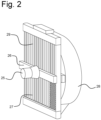
- FIG. 2 shows a perspective view of an ultrasonic transducer 25 that is connected to a bar 26 forming a mechanical interface coupling the transducer 25 to the outer surface 29 of the radiator 27.
- the bar 26 is of such a thickness that the resonant frequency of the radiator 27 is matched with the frequency of the transducer 25.
- a heat pump can effectively be used in battery driven electric vehicles in colder climates instead of an electric heater, so that up to 20% energy savings (WLTC at 0°C) and a total battery capacity saving of 1kWh can be achieved.
Landscapes
- Engineering & Computer Science (AREA)
- Mechanical Engineering (AREA)
- Physics & Mathematics (AREA)
- Thermal Sciences (AREA)
- Chemical & Material Sciences (AREA)
- Chemical Kinetics & Catalysis (AREA)
- General Chemical & Material Sciences (AREA)
- Electrochemistry (AREA)
- Manufacturing & Machinery (AREA)
- General Engineering & Computer Science (AREA)
- Automation & Control Theory (AREA)
- Combustion & Propulsion (AREA)
- Electric Propulsion And Braking For Vehicles (AREA)
- Air-Conditioning For Vehicles (AREA)
Description
- 0001 The invention relates to a thermal control system for an electric vehicle comprising:
- a high voltage battery,
- a first heat exchanger adapted to be in contact with the ambient for circulating a heat exchange medium in thermal contact with the ambient,
- a second heat exchanger in thermal contact with the battery, and
- a heat transport system for transporting the heat exchange medium from the first heat exchanger to an evaporator/condenser assembly that is in thermal contact with the second heat exchanger for transfer of heat to the battery, and transporting the heat exchange medium back to the first heat exchanger.
- 0002 The invention also relates to an electric vehicle comprising such a temperature control system.
- 0003 For battery powered electric vehicles (BEV) at lower temperatures, both the cabin and the battery need to be heated. The required heating power is provided by the high voltage battery pack of the vehicle and reduces the range for driving. The use of a heat pump for transporting heat from the ambient air to the cabin and battery provides an energy-effective way of heating. At temperatures below 50C, ice formation on the main heat exchanger reduces the air flow through the heat exchanger and reduces the heat exchanger's effectiveness. In order to de-ice the heat exchanger, the heat pump flow can be reversed for heating of the heat exchanger, but this results in a relatively complex system and relatively high energy use. Document
WO2014/143621A1 discloses a thermal control system for an electric vehicle, having a refrigerant diversion loop to defrost an external heat exchanger. - 0004 It is an object of the present invention to provide a thermal control system in which ice formation on the heat exchanger can be reduced, which is of a relatively simple and compact design and which has a relatively low power consumption.
- 0005 Hereto a thermal control system according to the invention is provided wherein at least one of the first and second heat exchangers is provided with a vibration device for the releasing of ice formed on the at least one heat exchanger.
- 0006 The vibration device can be of a relatively compact design that can be coupled to the main heat exchanger and/or to the heat exchanger of the battery, for effective transfer of mechanical energy and obviates the need for a redesign of the circuits of the heat exchange medium. The removal of ice by the vibration device according to the invention allows effective use of a heat pump in colder climates and results in an energy saving of up to 20% (WLTC at 0°C) and an extended driving range.
- 0007 In an embodiment of a thermal control system according to the invention, the vibration device comprises an ultrasonic transducer that is placed on the first heat exchanger and that is adapted to generate sonic waves along an outer surface of the heat exchanger, which outer surface forms an interface with an ice layer, for melting ice, such as by causing cavitation bubbles, at the interface layer.
- 0008 The ultrasonic waves that are generated by the transducer can travel along the interface layer where they can cause a phase change of the ice at the interface, such that the ice is easily released from the heat exchanger without the need for melting of all the ice. This provides a large energy saving. The ultrasound generates cavitation bubbles at the interface layer which results in high shear forces and stress expelling the ice from the surface. When the vehicle is moving, the vibrations and shocks from driving assist in the removal of ice from the heat exchanger surface. In case of laminar flow through the heat exchanger at low Reynolds numbers, that occur for instance in low flow conditions, it was found that the ultrasonic waves cause increased turbulence in the heating medium and result in an increase in heat transfer.
- 0009 The ultrasonic transducer my operate at frequencies between 20 kHz and 5 MHz.
- 0010 A further embodiment of a thermal control system according to the invention comprises a control unit connected to a temperature sensor for measuring an ambient temperature, which control unit switches on the ultrasonic transducer when the sensor measures an ambient temperature below a predetermined threshold value. The controller may be adapted to
- switch on the ultrasonic transducer continuously when the temperature sensor measures a temperature below a lower threshold value,
- switch the ultrasonic transducer on and off with on and off periods of substantially similar duration when the temperature sensor measures a temperature below an upper threshold value and above the lower threshold value, and
- switch the ultrasonic transducer on and off with an on period which is smaller than half the off period when the temperature sensor measures a temperature above the upper threshold value.
- 0011 In this way, the transducer is operated for de-icing of the heat exchanger at low temperatures, such as -150C and lower, while in a mid-temperature range (e.g. -150C-50C) and a high temperature range (above 50C), the transducer is operated to provide increased heat transfer in the heat exchanger. For temperatures between the lower threshold value and the high threshold value the on and off periods may be between 300 s and 600 s, while for temperatures above the upper threshold value the on period can be set between 50 s and 150 s and the off period between 5 and 10 times the on period.
- 0012 The transducer may be coupled to the heat exchanger via a connector body that conducts ultrasonic vibrations to the heat exchanger at frequencies between 20 kHz and 100 kHz, preferably between 30 kHz and 50 kHz. The connector body may comprise a metal bar which extends across the width of the heat exchanger and has a mass that is adapted to match the resonant frequency of the heat exchanger to the transducer.
- 0013 An embodiment of a thermal control system for an electric vehicle according to the invention will, by way of non-limiting example, be described in detail with reference to the accompanying drawings. In the drawings:
- 0014
Fig. 1 depicts a schematic lay out of the thermal control system according to the present invention, and - 0015
Fig. 2 depicts a perspective view of an ultrasonic transducer mounted on the outer surface of a radiator. - 0016
Figure 1 shows athermal control system 1 for a battery powered electric vehicle, having a high voltage battery 2 that powers the drive train and the on-board electric devices of the vehicle. Thesystem 1 comprises a medium temperature circuit 5 connected to a medium temperature radiator 6, forming a heat pump for transfer of heat from the ambient 4 for heating of the battery 2 via aheat exchanger 3 at low temperatures. - 0017 A
cold circuit 8 is provided for cooling of the battery 2 at operational temperatures above 50C and ahot circuit 9 is connected to ahigh temperature radiator 10 for transfer of heat to the ambient 4 for cooling of the cabin and for cooling of the battery 2 at higher operational temperatures. - 0018 The
hot circuit 9 comprises a heating, ventilation and air conditioning (HVAC)heat exchanger 12 in the cabin, a high voltage coolant heater (HVCH) 13 that is powered by the battery 2 and awater condenser 14. Thecold circuit 8 comprises achiller evaporator 18 that connects to theheat exchanger 3 of the battery 2. Thehot circuit 9 andcold circuit 8 are thermally coupled via a compression/expansion circuit 15. Thechiller evaporator 18 is placed in parallel with aHVAC evaporator 17 that is connected to thewater condenser 14 via acompressor 16. The medium temperature circuit 5 cools the electric drive (ED)components 19 such as stator, rotor and inverter, and connects to thechiller evaporator 18. - 0019 The radiator 6 of the medium temperature circuit 5 is provided with an
ultrasonic transducer 20 that is connected to acontroller 21 for switching on and off thetransducer 20, based on the ambient temperature that is measured by atemperature sensor 22. Asimilar transducer 23 is attached to theheat exchanger 3 of the battery 2. Thecontroller 21 may provide power to thetransducers - 0020 At temperatures below 50C, the battery 2 is heated via the
HVCH unit 13 and by the heating medium at ambient temperature that is supplied from the medium temperature radiator 6 to the chiller/evaporator 18 and that is transported subsequently viawater condenser 18 and HVCH unit to the battery 2. - 0021 The
controller 21 at temperatures below -150C, activates theultrasonic transducers 6, 23 to be in a constant on state, such that ultrasonic waves on the outer surfaces of theradiators 6, 23 are generated for ice removal. At temperatures between -150C and +50C, thecontroller 21 alternatingly switches on thetransducers 6, 23 for 500s and switches the transducers off for 500s. At ambient temperatures above +50C thecontroller 21 alternatingly switches on the transducers for 100s and switches them off for 900s in order to improve heat transfer by the heating medium by turbulence generated in the heating medium by the sonic waves. - 0022
Fig. 2 shows a perspective view of anultrasonic transducer 25 that is connected to abar 26 forming a mechanical interface coupling thetransducer 25 to theouter surface 29 of theradiator 27. Thebar 26 is of such a thickness that the resonant frequency of theradiator 27 is matched with the frequency of thetransducer 25. Instead of on theouter surface 29, it is possible to mount thetransducer 25 on a circumferential side surface of theradiator 27. The removal of ice from theradiator surface 29 warrants an unrestricted flow of air drawn through the radiator by thefan 28. - 0023 By use of the
ultrasonic transducer 25, a heat pump can effectively be used in battery driven electric vehicles in colder climates instead of an electric heater, so that up to 20% energy savings (WLTC at 0°C) and a total battery capacity saving of 1kWh can be achieved. - 0024 While the invention has been described with reference to exemplary embodiments, it will be understood by those skilled in the art that various changes may be made and equivalents may be substituted for elements thereof without departing from the scope of the invention. The controller disclosed can include a special purpose computer (which could include one or more processors and/or memory) programmed to perform the required steps. In addition, many modifications may be made to adapt a particular situation or material to the teachings of the invention without departing from the essential scope thereof. Therefore, it is intended that the invention not be limited to the particular or preferred embodiments disclosed, but that the invention will include all embodiments falling within the scope of the appended claims.
Claims (8)
- Thermal control system (1) for an electric vehicle comprising:- a high voltage battery (2),- a first heat exchanger (6) adapted to be in contact with the ambient (4) for circulating a heat exchange medium in thermal contact with the ambient,- a second heat exchanger (3) in thermal contact with the battery (2),- a heat transport system (5) for transporting the heat exchange medium from the first heat exchanger (6) to an evaporator/condenser assembly (15,18) that is in thermal contact with the second heat exchanger (3) for transfer of heat to the battery (2) and for transporting the heat exchange medium back to the first heat exchanger (6), characterized in thatat least one of the first and second heat exchangers (3,6) being provided with a vibration device (20,23, 27) for the releasing of ice formed on the at least one heat exchanger (3,6).
- Thermal control system (1) according to claim 1, the vibration device comprising an ultrasonic transducer (25) that is placed on the first and/or second heat exchanger (3,6,27) and that is adapted to generate sonic waves along an outer surface (29) of the heat exchanger (3,6, 27), the outer surface (29) forming an interface with an ice layer, for melting ice at the interface layer.
- Thermal control system (1) according to claim 2, the ultrasonic transducer (25) operating at a frequency between 20 kHz and 5 MHz.
- Thermal control system (1) according to claim 2 or 3, comprising a control unit (21) connected to a temperature sensor (22) for measuring an ambient temperature, the control unit (21) switching on the ultrasonic transducer (25) when the temperature sensor (22) measures an ambient temperature below a predetermined threshold value.
- Thermal control system (1) according to claim 4, the control unit (21) being adapted to:- switching on the ultrasonic transducer (25) continuously when the temperature sensor (22) measures a temperature below a lower threshold value,- switching the ultrasonic transducer (25) on and off with on and off periods of substantially similar duration when the temperature sensor (22) measures a temperature below an upper threshold value and above the lower threshold value, and- switching the ultrasonic transducer (25) on and off with an on period which is smaller than half the off period when the temperature sensor (22) measures a temperature above the upper threshold value.
- The thermal control system (1) according to claim 5, at temperatures between the lower threshold value and the middle threshold value, the on and off period being between 300s and 600s, at temperatures between the middle threshold value and the upper threshold value the on and off period being between 300s and 600s and at temperatures above the upper threshold value the on period being between 50 and 150 s and the off period is between 5 and 10 times the on period .
- Thermal control system (1) according to any of claims 2-6, wherein the transducer (25) is coupled to the heat exchanger (27) via a connector body (26) that conducts ultrasonic vibrations to the heat exchanger (27) at frequencies between 20 and 100 kHz, preferably between 30 and 50 kHz.
- Electric vehicle comprising a thermal control system (1) according to any of the preceding claims.
Priority Applications (3)
| Application Number | Priority Date | Filing Date | Title |
|---|---|---|---|
| EP20202295.0A EP3984793B1 (en) | 2020-10-16 | 2020-10-16 | Temperature control system for electric vehicles |
| US17/500,134 US11701945B2 (en) | 2020-10-16 | 2021-10-13 | Temperature control system for electric vehicles |
| CN202111201532.8A CN114388928B (en) | 2020-10-16 | 2021-10-15 | Temperature control system for electric vehicles |
Applications Claiming Priority (1)
| Application Number | Priority Date | Filing Date | Title |
|---|---|---|---|
| EP20202295.0A EP3984793B1 (en) | 2020-10-16 | 2020-10-16 | Temperature control system for electric vehicles |
Publications (2)
| Publication Number | Publication Date |
|---|---|
| EP3984793A1 EP3984793A1 (en) | 2022-04-20 |
| EP3984793B1 true EP3984793B1 (en) | 2023-11-22 |
Family
ID=73037694
Family Applications (1)
| Application Number | Title | Priority Date | Filing Date |
|---|---|---|---|
| EP20202295.0A Active EP3984793B1 (en) | 2020-10-16 | 2020-10-16 | Temperature control system for electric vehicles |
Country Status (3)
| Country | Link |
|---|---|
| US (1) | US11701945B2 (en) |
| EP (1) | EP3984793B1 (en) |
| CN (1) | CN114388928B (en) |
Families Citing this family (1)
| Publication number | Priority date | Publication date | Assignee | Title |
|---|---|---|---|---|
| JP7701806B2 (en) * | 2021-06-08 | 2025-07-02 | 株式会社Subaru | Battery temperature control device |
Family Cites Families (12)
| Publication number | Priority date | Publication date | Assignee | Title |
|---|---|---|---|---|
| JPS6265291A (en) | 1985-09-18 | 1987-03-24 | Seiko Epson Corp | semiconductor storage device |
| JPH06265291A (en) * | 1992-03-05 | 1994-09-20 | Nippondenso Co Ltd | Defrosting device for heat exchanger |
| US20050061473A1 (en) | 2003-09-22 | 2005-03-24 | Coolhead Technologies, Inc. | Flexible heat exchangers |
| CN2937957Y (en) | 2005-08-20 | 2007-08-22 | 李汉清 | High efficient refrigeration device and complete energy saving attachment for the device |
| JP2007120933A (en) * | 2005-10-25 | 2007-05-17 | Takashi Makino | Heat exchanger |
| US8217554B2 (en) * | 2008-05-28 | 2012-07-10 | Fbs, Inc. | Ultrasonic vibration system and method for removing/avoiding unwanted build-up on structures |
| JP5446524B2 (en) * | 2009-07-08 | 2014-03-19 | 株式会社デンソー | Air conditioner for vehicles |
| US9879891B2 (en) | 2011-02-17 | 2018-01-30 | Mahle International Gmbh | Unitary heat pump air conditioner having a compressed vapor diversion loop |
| EP2972019B1 (en) * | 2013-03-12 | 2018-05-30 | MAHLE International GmbH | A unitary heat pump air conditioner having a compressed vapor diversion loop |
| CN104180556B (en) * | 2013-05-22 | 2017-05-31 | 杭州三花研究院有限公司 | A kind of heat pump type air conditioning system |
| US10514191B2 (en) | 2015-01-15 | 2019-12-24 | Ford Global Technologies, Llc | De-icing control in a vapor compression heat pump system |
| CN108955320B (en) * | 2018-09-25 | 2023-12-19 | 江苏远卓设备制造有限公司 | Anti-freezing plate type heat exchanger |
-
2020
- 2020-10-16 EP EP20202295.0A patent/EP3984793B1/en active Active
-
2021
- 2021-10-13 US US17/500,134 patent/US11701945B2/en active Active
- 2021-10-15 CN CN202111201532.8A patent/CN114388928B/en active Active
Also Published As
| Publication number | Publication date |
|---|---|
| US20220118817A1 (en) | 2022-04-21 |
| CN114388928B (en) | 2024-01-30 |
| EP3984793A1 (en) | 2022-04-20 |
| CN114388928A (en) | 2022-04-22 |
| US11701945B2 (en) | 2023-07-18 |
Similar Documents
| Publication | Publication Date | Title |
|---|---|---|
| JP5788774B2 (en) | Cooling system | |
| CN103270377B (en) | Heat-exchange system | |
| CN111546851A (en) | Heat pump auxiliary coolant loop heat exchanger defrost system for motor vehicle | |
| KR20170083399A (en) | Cooling Unit Using Ice Thermal Storage | |
| CN109849616A (en) | Thermal management system of electric automobile | |
| EP2079635B1 (en) | Cooling device for installation in an aircraft | |
| KR20170004811A (en) | Vehicle air conditioning system and method for controlling the vehicle air conditioning system for the temperature control of a vehicle battery | |
| US20100101242A1 (en) | System and method for cooling air conditioning system electronics | |
| EP3984793B1 (en) | Temperature control system for electric vehicles | |
| CN112302778A (en) | Thermal management device and management method for a hybrid electric vehicle | |
| CN103025550A (en) | Heating/air conditioning equipment with externally adjacent condenser and evaporator for heating the external evaporator | |
| CN114643833A (en) | Thermal management system and vehicle | |
| CN216592312U (en) | Semiconductor refrigeration device and system for refrigerated and insulated compartment | |
| CN110774858A (en) | A vehicle auxiliary cooling and heating system and vehicle | |
| JP6414029B2 (en) | Internal temperature controller | |
| JPH0544961A (en) | Air-conditioner | |
| CN201706620U (en) | Electric heater | |
| JP2019108024A (en) | Waste heat utilization system for vehicle | |
| JP7313867B2 (en) | Cooling structure, electrical unit having the same, and outdoor unit | |
| EP2394830B1 (en) | Cooling medium circuit for vehicle | |
| CN223559447U (en) | Vehicle thermal management system and vehicle | |
| CN224065753U (en) | A TEC-based semiconductor high-speed chiller/water system | |
| JPH08327288A (en) | Heat exchanger | |
| EP4209368B1 (en) | Heatsink for power electronics cooling | |
| JP2007320393A (en) | On-vehicle air conditioner and driving method thereof |
Legal Events
| Date | Code | Title | Description |
|---|---|---|---|
| PUAI | Public reference made under article 153(3) epc to a published international application that has entered the european phase |
Free format text: ORIGINAL CODE: 0009012 |
|
| STAA | Information on the status of an ep patent application or granted ep patent |
Free format text: STATUS: THE APPLICATION HAS BEEN PUBLISHED |
|
| AK | Designated contracting states |
Kind code of ref document: A1 Designated state(s): AL AT BE BG CH CY CZ DE DK EE ES FI FR GB GR HR HU IE IS IT LI LT LU LV MC MK MT NL NO PL PT RO RS SE SI SK SM TR |
|
| STAA | Information on the status of an ep patent application or granted ep patent |
Free format text: STATUS: REQUEST FOR EXAMINATION WAS MADE |
|
| 17P | Request for examination filed |
Effective date: 20221019 |
|
| RBV | Designated contracting states (corrected) |
Designated state(s): AL AT BE BG CH CY CZ DE DK EE ES FI FR GB GR HR HU IE IS IT LI LT LU LV MC MK MT NL NO PL PT RO RS SE SI SK SM TR |
|
| GRAP | Despatch of communication of intention to grant a patent |
Free format text: ORIGINAL CODE: EPIDOSNIGR1 |
|
| STAA | Information on the status of an ep patent application or granted ep patent |
Free format text: STATUS: GRANT OF PATENT IS INTENDED |
|
| RIC1 | Information provided on ipc code assigned before grant |
Ipc: F28D 21/00 20060101ALI20230428BHEP Ipc: F28D 1/053 20060101ALI20230428BHEP Ipc: F28G 7/00 20060101ALI20230428BHEP Ipc: F28F 17/00 20060101ALI20230428BHEP Ipc: B60H 1/32 20060101ALI20230428BHEP Ipc: B60H 1/00 20060101AFI20230428BHEP |
|
| INTG | Intention to grant announced |
Effective date: 20230526 |
|
| GRAS | Grant fee paid |
Free format text: ORIGINAL CODE: EPIDOSNIGR3 |
|
| GRAA | (expected) grant |
Free format text: ORIGINAL CODE: 0009210 |
|
| STAA | Information on the status of an ep patent application or granted ep patent |
Free format text: STATUS: THE PATENT HAS BEEN GRANTED |
|
| P01 | Opt-out of the competence of the unified patent court (upc) registered |
Effective date: 20230926 |
|
| AK | Designated contracting states |
Kind code of ref document: B1 Designated state(s): AL AT BE BG CH CY CZ DE DK EE ES FI FR GB GR HR HU IE IS IT LI LT LU LV MC MK MT NL NO PL PT RO RS SE SI SK SM TR |
|
| REG | Reference to a national code |
Ref country code: GB Ref legal event code: FG4D |
|
| REG | Reference to a national code |
Ref country code: CH Ref legal event code: EP |
|
| REG | Reference to a national code |
Ref country code: DE Ref legal event code: R096 Ref document number: 602020021408 Country of ref document: DE |
|
| REG | Reference to a national code |
Ref country code: IE Ref legal event code: FG4D |
|
| REG | Reference to a national code |
Ref country code: LT Ref legal event code: MG9D |
|
| REG | Reference to a national code |
Ref country code: NL Ref legal event code: MP Effective date: 20231122 |
|
| PG25 | Lapsed in a contracting state [announced via postgrant information from national office to epo] |
Ref country code: GR Free format text: LAPSE BECAUSE OF FAILURE TO SUBMIT A TRANSLATION OF THE DESCRIPTION OR TO PAY THE FEE WITHIN THE PRESCRIBED TIME-LIMIT Effective date: 20240223 |
|
| PG25 | Lapsed in a contracting state [announced via postgrant information from national office to epo] |
Ref country code: IS Free format text: LAPSE BECAUSE OF FAILURE TO SUBMIT A TRANSLATION OF THE DESCRIPTION OR TO PAY THE FEE WITHIN THE PRESCRIBED TIME-LIMIT Effective date: 20240322 |
|
| PG25 | Lapsed in a contracting state [announced via postgrant information from national office to epo] |
Ref country code: LT Free format text: LAPSE BECAUSE OF FAILURE TO SUBMIT A TRANSLATION OF THE DESCRIPTION OR TO PAY THE FEE WITHIN THE PRESCRIBED TIME-LIMIT Effective date: 20231122 |
|
| REG | Reference to a national code |
Ref country code: AT Ref legal event code: MK05 Ref document number: 1633514 Country of ref document: AT Kind code of ref document: T Effective date: 20231122 |
|
| PG25 | Lapsed in a contracting state [announced via postgrant information from national office to epo] |
Ref country code: NL Free format text: LAPSE BECAUSE OF FAILURE TO SUBMIT A TRANSLATION OF THE DESCRIPTION OR TO PAY THE FEE WITHIN THE PRESCRIBED TIME-LIMIT Effective date: 20231122 |
|
| PG25 | Lapsed in a contracting state [announced via postgrant information from national office to epo] |
Ref country code: AT Free format text: LAPSE BECAUSE OF FAILURE TO SUBMIT A TRANSLATION OF THE DESCRIPTION OR TO PAY THE FEE WITHIN THE PRESCRIBED TIME-LIMIT Effective date: 20231122 |
|
| PG25 | Lapsed in a contracting state [announced via postgrant information from national office to epo] |
Ref country code: ES Free format text: LAPSE BECAUSE OF FAILURE TO SUBMIT A TRANSLATION OF THE DESCRIPTION OR TO PAY THE FEE WITHIN THE PRESCRIBED TIME-LIMIT Effective date: 20231122 |
|
| PG25 | Lapsed in a contracting state [announced via postgrant information from national office to epo] |
Ref country code: NL Free format text: LAPSE BECAUSE OF FAILURE TO SUBMIT A TRANSLATION OF THE DESCRIPTION OR TO PAY THE FEE WITHIN THE PRESCRIBED TIME-LIMIT Effective date: 20231122 Ref country code: LT Free format text: LAPSE BECAUSE OF FAILURE TO SUBMIT A TRANSLATION OF THE DESCRIPTION OR TO PAY THE FEE WITHIN THE PRESCRIBED TIME-LIMIT Effective date: 20231122 Ref country code: IS Free format text: LAPSE BECAUSE OF FAILURE TO SUBMIT A TRANSLATION OF THE DESCRIPTION OR TO PAY THE FEE WITHIN THE PRESCRIBED TIME-LIMIT Effective date: 20240322 Ref country code: GR Free format text: LAPSE BECAUSE OF FAILURE TO SUBMIT A TRANSLATION OF THE DESCRIPTION OR TO PAY THE FEE WITHIN THE PRESCRIBED TIME-LIMIT Effective date: 20240223 Ref country code: ES Free format text: LAPSE BECAUSE OF FAILURE TO SUBMIT A TRANSLATION OF THE DESCRIPTION OR TO PAY THE FEE WITHIN THE PRESCRIBED TIME-LIMIT Effective date: 20231122 Ref country code: BG Free format text: LAPSE BECAUSE OF FAILURE TO SUBMIT A TRANSLATION OF THE DESCRIPTION OR TO PAY THE FEE WITHIN THE PRESCRIBED TIME-LIMIT Effective date: 20240222 Ref country code: AT Free format text: LAPSE BECAUSE OF FAILURE TO SUBMIT A TRANSLATION OF THE DESCRIPTION OR TO PAY THE FEE WITHIN THE PRESCRIBED TIME-LIMIT Effective date: 20231122 Ref country code: PT Free format text: LAPSE BECAUSE OF FAILURE TO SUBMIT A TRANSLATION OF THE DESCRIPTION OR TO PAY THE FEE WITHIN THE PRESCRIBED TIME-LIMIT Effective date: 20240322 |
|
| PG25 | Lapsed in a contracting state [announced via postgrant information from national office to epo] |
Ref country code: SE Free format text: LAPSE BECAUSE OF FAILURE TO SUBMIT A TRANSLATION OF THE DESCRIPTION OR TO PAY THE FEE WITHIN THE PRESCRIBED TIME-LIMIT Effective date: 20231122 Ref country code: RS Free format text: LAPSE BECAUSE OF FAILURE TO SUBMIT A TRANSLATION OF THE DESCRIPTION OR TO PAY THE FEE WITHIN THE PRESCRIBED TIME-LIMIT Effective date: 20231122 Ref country code: PL Free format text: LAPSE BECAUSE OF FAILURE TO SUBMIT A TRANSLATION OF THE DESCRIPTION OR TO PAY THE FEE WITHIN THE PRESCRIBED TIME-LIMIT Effective date: 20231122 Ref country code: NO Free format text: LAPSE BECAUSE OF FAILURE TO SUBMIT A TRANSLATION OF THE DESCRIPTION OR TO PAY THE FEE WITHIN THE PRESCRIBED TIME-LIMIT Effective date: 20240222 Ref country code: LV Free format text: LAPSE BECAUSE OF FAILURE TO SUBMIT A TRANSLATION OF THE DESCRIPTION OR TO PAY THE FEE WITHIN THE PRESCRIBED TIME-LIMIT Effective date: 20231122 Ref country code: HR Free format text: LAPSE BECAUSE OF FAILURE TO SUBMIT A TRANSLATION OF THE DESCRIPTION OR TO PAY THE FEE WITHIN THE PRESCRIBED TIME-LIMIT Effective date: 20231122 |
|
| PG25 | Lapsed in a contracting state [announced via postgrant information from national office to epo] |
Ref country code: DK Free format text: LAPSE BECAUSE OF FAILURE TO SUBMIT A TRANSLATION OF THE DESCRIPTION OR TO PAY THE FEE WITHIN THE PRESCRIBED TIME-LIMIT Effective date: 20231122 |
|
| PG25 | Lapsed in a contracting state [announced via postgrant information from national office to epo] |
Ref country code: CZ Free format text: LAPSE BECAUSE OF FAILURE TO SUBMIT A TRANSLATION OF THE DESCRIPTION OR TO PAY THE FEE WITHIN THE PRESCRIBED TIME-LIMIT Effective date: 20231122 |
|
| PG25 | Lapsed in a contracting state [announced via postgrant information from national office to epo] |
Ref country code: SK Free format text: LAPSE BECAUSE OF FAILURE TO SUBMIT A TRANSLATION OF THE DESCRIPTION OR TO PAY THE FEE WITHIN THE PRESCRIBED TIME-LIMIT Effective date: 20231122 |
|
| PG25 | Lapsed in a contracting state [announced via postgrant information from national office to epo] |
Ref country code: SM Free format text: LAPSE BECAUSE OF FAILURE TO SUBMIT A TRANSLATION OF THE DESCRIPTION OR TO PAY THE FEE WITHIN THE PRESCRIBED TIME-LIMIT Effective date: 20231122 Ref country code: SK Free format text: LAPSE BECAUSE OF FAILURE TO SUBMIT A TRANSLATION OF THE DESCRIPTION OR TO PAY THE FEE WITHIN THE PRESCRIBED TIME-LIMIT Effective date: 20231122 Ref country code: RO Free format text: LAPSE BECAUSE OF FAILURE TO SUBMIT A TRANSLATION OF THE DESCRIPTION OR TO PAY THE FEE WITHIN THE PRESCRIBED TIME-LIMIT Effective date: 20231122 Ref country code: IT Free format text: LAPSE BECAUSE OF FAILURE TO SUBMIT A TRANSLATION OF THE DESCRIPTION OR TO PAY THE FEE WITHIN THE PRESCRIBED TIME-LIMIT Effective date: 20231122 Ref country code: EE Free format text: LAPSE BECAUSE OF FAILURE TO SUBMIT A TRANSLATION OF THE DESCRIPTION OR TO PAY THE FEE WITHIN THE PRESCRIBED TIME-LIMIT Effective date: 20231122 Ref country code: DK Free format text: LAPSE BECAUSE OF FAILURE TO SUBMIT A TRANSLATION OF THE DESCRIPTION OR TO PAY THE FEE WITHIN THE PRESCRIBED TIME-LIMIT Effective date: 20231122 Ref country code: CZ Free format text: LAPSE BECAUSE OF FAILURE TO SUBMIT A TRANSLATION OF THE DESCRIPTION OR TO PAY THE FEE WITHIN THE PRESCRIBED TIME-LIMIT Effective date: 20231122 |
|
| REG | Reference to a national code |
Ref country code: DE Ref legal event code: R097 Ref document number: 602020021408 Country of ref document: DE |
|
| PLBE | No opposition filed within time limit |
Free format text: ORIGINAL CODE: 0009261 |
|
| STAA | Information on the status of an ep patent application or granted ep patent |
Free format text: STATUS: NO OPPOSITION FILED WITHIN TIME LIMIT |
|
| PG25 | Lapsed in a contracting state [announced via postgrant information from national office to epo] |
Ref country code: SI Free format text: LAPSE BECAUSE OF FAILURE TO SUBMIT A TRANSLATION OF THE DESCRIPTION OR TO PAY THE FEE WITHIN THE PRESCRIBED TIME-LIMIT Effective date: 20231122 |
|
| 26N | No opposition filed |
Effective date: 20240823 |
|
| PG25 | Lapsed in a contracting state [announced via postgrant information from national office to epo] |
Ref country code: SI Free format text: LAPSE BECAUSE OF FAILURE TO SUBMIT A TRANSLATION OF THE DESCRIPTION OR TO PAY THE FEE WITHIN THE PRESCRIBED TIME-LIMIT Effective date: 20231122 |
|
| REG | Reference to a national code |
Ref country code: CH Ref legal event code: PL |
|
| PG25 | Lapsed in a contracting state [announced via postgrant information from national office to epo] |
Ref country code: MC Free format text: LAPSE BECAUSE OF FAILURE TO SUBMIT A TRANSLATION OF THE DESCRIPTION OR TO PAY THE FEE WITHIN THE PRESCRIBED TIME-LIMIT Effective date: 20231122 |
|
| PG25 | Lapsed in a contracting state [announced via postgrant information from national office to epo] |
Ref country code: BE Free format text: LAPSE BECAUSE OF NON-PAYMENT OF DUE FEES Effective date: 20241031 Ref country code: LU Free format text: LAPSE BECAUSE OF NON-PAYMENT OF DUE FEES Effective date: 20241016 |
|
| PG25 | Lapsed in a contracting state [announced via postgrant information from national office to epo] |
Ref country code: CH Free format text: LAPSE BECAUSE OF NON-PAYMENT OF DUE FEES Effective date: 20241031 |
|
| REG | Reference to a national code |
Ref country code: BE Ref legal event code: MM Effective date: 20241031 |
|
| PG25 | Lapsed in a contracting state [announced via postgrant information from national office to epo] |
Ref country code: FI Free format text: LAPSE BECAUSE OF FAILURE TO SUBMIT A TRANSLATION OF THE DESCRIPTION OR TO PAY THE FEE WITHIN THE PRESCRIBED TIME-LIMIT Effective date: 20231122 |
|
| PGFP | Annual fee paid to national office [announced via postgrant information from national office to epo] |
Ref country code: GB Payment date: 20250923 Year of fee payment: 6 |
|
| PGFP | Annual fee paid to national office [announced via postgrant information from national office to epo] |
Ref country code: FR Payment date: 20250924 Year of fee payment: 6 |
|
| PG25 | Lapsed in a contracting state [announced via postgrant information from national office to epo] |
Ref country code: IE Free format text: LAPSE BECAUSE OF NON-PAYMENT OF DUE FEES Effective date: 20241016 |
|
| PGFP | Annual fee paid to national office [announced via postgrant information from national office to epo] |
Ref country code: DE Payment date: 20250923 Year of fee payment: 6 |
|
| PG25 | Lapsed in a contracting state [announced via postgrant information from national office to epo] |
Ref country code: CY Free format text: LAPSE BECAUSE OF FAILURE TO SUBMIT A TRANSLATION OF THE DESCRIPTION OR TO PAY THE FEE WITHIN THE PRESCRIBED TIME-LIMIT; INVALID AB INITIO Effective date: 20201016 |
|
| PG25 | Lapsed in a contracting state [announced via postgrant information from national office to epo] |
Ref country code: HU Free format text: LAPSE BECAUSE OF FAILURE TO SUBMIT A TRANSLATION OF THE DESCRIPTION OR TO PAY THE FEE WITHIN THE PRESCRIBED TIME-LIMIT; INVALID AB INITIO Effective date: 20201016 |