EP3983662B1 - Method of operating piston engine and control system for piston engine - Google Patents
Method of operating piston engine and control system for piston engine Download PDFInfo
- Publication number
- EP3983662B1 EP3983662B1 EP19734840.2A EP19734840A EP3983662B1 EP 3983662 B1 EP3983662 B1 EP 3983662B1 EP 19734840 A EP19734840 A EP 19734840A EP 3983662 B1 EP3983662 B1 EP 3983662B1
- Authority
- EP
- European Patent Office
- Prior art keywords
- control signal
- fuel
- engine
- limit value
- gaseous
- Prior art date
- Legal status (The legal status is an assumption and is not a legal conclusion. Google has not performed a legal analysis and makes no representation as to the accuracy of the status listed.)
- Active
Links
Images
Classifications
-
- F—MECHANICAL ENGINEERING; LIGHTING; HEATING; WEAPONS; BLASTING
- F02—COMBUSTION ENGINES; HOT-GAS OR COMBUSTION-PRODUCT ENGINE PLANTS
- F02D—CONTROLLING COMBUSTION ENGINES
- F02D19/00—Controlling engines characterised by their use of non-liquid fuels, pluralities of fuels, or non-fuel substances added to the combustible mixtures
- F02D19/06—Controlling engines characterised by their use of non-liquid fuels, pluralities of fuels, or non-fuel substances added to the combustible mixtures peculiar to engines working with pluralities of fuels, e.g. alternatively with light and heavy fuel oil, other than engines indifferent to the fuel consumed
- F02D19/08—Controlling engines characterised by their use of non-liquid fuels, pluralities of fuels, or non-fuel substances added to the combustible mixtures peculiar to engines working with pluralities of fuels, e.g. alternatively with light and heavy fuel oil, other than engines indifferent to the fuel consumed simultaneously using pluralities of fuels
- F02D19/10—Controlling engines characterised by their use of non-liquid fuels, pluralities of fuels, or non-fuel substances added to the combustible mixtures peculiar to engines working with pluralities of fuels, e.g. alternatively with light and heavy fuel oil, other than engines indifferent to the fuel consumed simultaneously using pluralities of fuels peculiar to compression-ignition engines in which the main fuel is gaseous
-
- F—MECHANICAL ENGINEERING; LIGHTING; HEATING; WEAPONS; BLASTING
- F02—COMBUSTION ENGINES; HOT-GAS OR COMBUSTION-PRODUCT ENGINE PLANTS
- F02D—CONTROLLING COMBUSTION ENGINES
- F02D19/00—Controlling engines characterised by their use of non-liquid fuels, pluralities of fuels, or non-fuel substances added to the combustible mixtures
- F02D19/06—Controlling engines characterised by their use of non-liquid fuels, pluralities of fuels, or non-fuel substances added to the combustible mixtures peculiar to engines working with pluralities of fuels, e.g. alternatively with light and heavy fuel oil, other than engines indifferent to the fuel consumed
- F02D19/08—Controlling engines characterised by their use of non-liquid fuels, pluralities of fuels, or non-fuel substances added to the combustible mixtures peculiar to engines working with pluralities of fuels, e.g. alternatively with light and heavy fuel oil, other than engines indifferent to the fuel consumed simultaneously using pluralities of fuels
- F02D19/10—Controlling engines characterised by their use of non-liquid fuels, pluralities of fuels, or non-fuel substances added to the combustible mixtures peculiar to engines working with pluralities of fuels, e.g. alternatively with light and heavy fuel oil, other than engines indifferent to the fuel consumed simultaneously using pluralities of fuels peculiar to compression-ignition engines in which the main fuel is gaseous
- F02D19/105—Controlling engines characterised by their use of non-liquid fuels, pluralities of fuels, or non-fuel substances added to the combustible mixtures peculiar to engines working with pluralities of fuels, e.g. alternatively with light and heavy fuel oil, other than engines indifferent to the fuel consumed simultaneously using pluralities of fuels peculiar to compression-ignition engines in which the main fuel is gaseous operating in a special mode, e.g. in a liquid fuel only mode for starting
-
- F—MECHANICAL ENGINEERING; LIGHTING; HEATING; WEAPONS; BLASTING
- F02—COMBUSTION ENGINES; HOT-GAS OR COMBUSTION-PRODUCT ENGINE PLANTS
- F02D—CONTROLLING COMBUSTION ENGINES
- F02D19/00—Controlling engines characterised by their use of non-liquid fuels, pluralities of fuels, or non-fuel substances added to the combustible mixtures
- F02D19/06—Controlling engines characterised by their use of non-liquid fuels, pluralities of fuels, or non-fuel substances added to the combustible mixtures peculiar to engines working with pluralities of fuels, e.g. alternatively with light and heavy fuel oil, other than engines indifferent to the fuel consumed
- F02D19/08—Controlling engines characterised by their use of non-liquid fuels, pluralities of fuels, or non-fuel substances added to the combustible mixtures peculiar to engines working with pluralities of fuels, e.g. alternatively with light and heavy fuel oil, other than engines indifferent to the fuel consumed simultaneously using pluralities of fuels
- F02D19/081—Adjusting the fuel composition or mixing ratio; Transitioning from one fuel to the other
-
- F—MECHANICAL ENGINEERING; LIGHTING; HEATING; WEAPONS; BLASTING
- F02—COMBUSTION ENGINES; HOT-GAS OR COMBUSTION-PRODUCT ENGINE PLANTS
- F02D—CONTROLLING COMBUSTION ENGINES
- F02D29/00—Controlling engines, such controlling being peculiar to the devices driven thereby, the devices being other than parts or accessories essential to engine operation, e.g. controlling of engines by signals external thereto
- F02D29/06—Controlling engines, such controlling being peculiar to the devices driven thereby, the devices being other than parts or accessories essential to engine operation, e.g. controlling of engines by signals external thereto peculiar to engines driving electric generators
-
- F—MECHANICAL ENGINEERING; LIGHTING; HEATING; WEAPONS; BLASTING
- F02—COMBUSTION ENGINES; HOT-GAS OR COMBUSTION-PRODUCT ENGINE PLANTS
- F02D—CONTROLLING COMBUSTION ENGINES
- F02D31/00—Use of speed-sensing governors to control combustion engines, not otherwise provided for
- F02D31/001—Electric control of rotation speed
- F02D31/007—Electric control of rotation speed controlling fuel supply
-
- F—MECHANICAL ENGINEERING; LIGHTING; HEATING; WEAPONS; BLASTING
- F02—COMBUSTION ENGINES; HOT-GAS OR COMBUSTION-PRODUCT ENGINE PLANTS
- F02D—CONTROLLING COMBUSTION ENGINES
- F02D35/00—Controlling engines, dependent on conditions exterior or interior to engines, not otherwise provided for
- F02D35/02—Controlling engines, dependent on conditions exterior or interior to engines, not otherwise provided for on interior conditions
- F02D35/023—Controlling engines, dependent on conditions exterior or interior to engines, not otherwise provided for on interior conditions by determining the cylinder pressure
-
- F—MECHANICAL ENGINEERING; LIGHTING; HEATING; WEAPONS; BLASTING
- F02—COMBUSTION ENGINES; HOT-GAS OR COMBUSTION-PRODUCT ENGINE PLANTS
- F02D—CONTROLLING COMBUSTION ENGINES
- F02D35/00—Controlling engines, dependent on conditions exterior or interior to engines, not otherwise provided for
- F02D35/02—Controlling engines, dependent on conditions exterior or interior to engines, not otherwise provided for on interior conditions
- F02D35/027—Controlling engines, dependent on conditions exterior or interior to engines, not otherwise provided for on interior conditions using knock sensors
-
- F—MECHANICAL ENGINEERING; LIGHTING; HEATING; WEAPONS; BLASTING
- F02—COMBUSTION ENGINES; HOT-GAS OR COMBUSTION-PRODUCT ENGINE PLANTS
- F02D—CONTROLLING COMBUSTION ENGINES
- F02D41/00—Electrical control of supply of combustible mixture or its constituents
- F02D41/0025—Controlling engines characterised by use of non-liquid fuels, pluralities of fuels, or non-fuel substances added to the combustible mixtures
- F02D41/0027—Controlling engines characterised by use of non-liquid fuels, pluralities of fuels, or non-fuel substances added to the combustible mixtures the fuel being gaseous
-
- F—MECHANICAL ENGINEERING; LIGHTING; HEATING; WEAPONS; BLASTING
- F02—COMBUSTION ENGINES; HOT-GAS OR COMBUSTION-PRODUCT ENGINE PLANTS
- F02D—CONTROLLING COMBUSTION ENGINES
- F02D41/00—Electrical control of supply of combustible mixture or its constituents
- F02D41/02—Circuit arrangements for generating control signals
- F02D41/04—Introducing corrections for particular operating conditions
- F02D41/10—Introducing corrections for particular operating conditions for acceleration
-
- F—MECHANICAL ENGINEERING; LIGHTING; HEATING; WEAPONS; BLASTING
- F02—COMBUSTION ENGINES; HOT-GAS OR COMBUSTION-PRODUCT ENGINE PLANTS
- F02D—CONTROLLING COMBUSTION ENGINES
- F02D41/00—Electrical control of supply of combustible mixture or its constituents
- F02D41/30—Controlling fuel injection
- F02D41/38—Controlling fuel injection of the high pressure type
- F02D41/40—Controlling fuel injection of the high pressure type with means for controlling injection timing or duration
- F02D41/402—Multiple injections
-
- F—MECHANICAL ENGINEERING; LIGHTING; HEATING; WEAPONS; BLASTING
- F02—COMBUSTION ENGINES; HOT-GAS OR COMBUSTION-PRODUCT ENGINE PLANTS
- F02D—CONTROLLING COMBUSTION ENGINES
- F02D13/00—Controlling the engine output power by varying inlet or exhaust valve operating characteristics, e.g. timing
- F02D13/02—Controlling the engine output power by varying inlet or exhaust valve operating characteristics, e.g. timing during engine operation
- F02D13/0203—Variable control of intake and exhaust valves
-
- F—MECHANICAL ENGINEERING; LIGHTING; HEATING; WEAPONS; BLASTING
- F02—COMBUSTION ENGINES; HOT-GAS OR COMBUSTION-PRODUCT ENGINE PLANTS
- F02D—CONTROLLING COMBUSTION ENGINES
- F02D19/00—Controlling engines characterised by their use of non-liquid fuels, pluralities of fuels, or non-fuel substances added to the combustible mixtures
- F02D19/06—Controlling engines characterised by their use of non-liquid fuels, pluralities of fuels, or non-fuel substances added to the combustible mixtures peculiar to engines working with pluralities of fuels, e.g. alternatively with light and heavy fuel oil, other than engines indifferent to the fuel consumed
- F02D19/0639—Controlling engines characterised by their use of non-liquid fuels, pluralities of fuels, or non-fuel substances added to the combustible mixtures peculiar to engines working with pluralities of fuels, e.g. alternatively with light and heavy fuel oil, other than engines indifferent to the fuel consumed characterised by the type of fuels
- F02D19/0649—Liquid fuels having different boiling temperatures, volatilities, densities, viscosities, cetane or octane numbers
- F02D19/0657—Heavy or light fuel oils; Fuels characterised by their impurities such as sulfur content or differences in grade, e.g. for ships
-
- F—MECHANICAL ENGINEERING; LIGHTING; HEATING; WEAPONS; BLASTING
- F02—COMBUSTION ENGINES; HOT-GAS OR COMBUSTION-PRODUCT ENGINE PLANTS
- F02D—CONTROLLING COMBUSTION ENGINES
- F02D2200/00—Input parameters for engine control
- F02D2200/02—Input parameters for engine control the parameters being related to the engine
- F02D2200/04—Engine intake system parameters
- F02D2200/0406—Intake manifold pressure
-
- F—MECHANICAL ENGINEERING; LIGHTING; HEATING; WEAPONS; BLASTING
- F02—COMBUSTION ENGINES; HOT-GAS OR COMBUSTION-PRODUCT ENGINE PLANTS
- F02D—CONTROLLING COMBUSTION ENGINES
- F02D41/00—Electrical control of supply of combustible mixture or its constituents
- F02D41/0002—Controlling intake air
- F02D41/0007—Controlling intake air for control of turbo-charged or super-charged engines
-
- F—MECHANICAL ENGINEERING; LIGHTING; HEATING; WEAPONS; BLASTING
- F02—COMBUSTION ENGINES; HOT-GAS OR COMBUSTION-PRODUCT ENGINE PLANTS
- F02D—CONTROLLING COMBUSTION ENGINES
- F02D41/00—Electrical control of supply of combustible mixture or its constituents
- F02D41/0025—Controlling engines characterised by use of non-liquid fuels, pluralities of fuels, or non-fuel substances added to the combustible mixtures
-
- Y—GENERAL TAGGING OF NEW TECHNOLOGICAL DEVELOPMENTS; GENERAL TAGGING OF CROSS-SECTIONAL TECHNOLOGIES SPANNING OVER SEVERAL SECTIONS OF THE IPC; TECHNICAL SUBJECTS COVERED BY FORMER USPC CROSS-REFERENCE ART COLLECTIONS [XRACs] AND DIGESTS
- Y02—TECHNOLOGIES OR APPLICATIONS FOR MITIGATION OR ADAPTATION AGAINST CLIMATE CHANGE
- Y02T—CLIMATE CHANGE MITIGATION TECHNOLOGIES RELATED TO TRANSPORTATION
- Y02T10/00—Road transport of goods or passengers
- Y02T10/10—Internal combustion engine [ICE] based vehicles
- Y02T10/30—Use of alternative fuels, e.g. biofuels
-
- Y—GENERAL TAGGING OF NEW TECHNOLOGICAL DEVELOPMENTS; GENERAL TAGGING OF CROSS-SECTIONAL TECHNOLOGIES SPANNING OVER SEVERAL SECTIONS OF THE IPC; TECHNICAL SUBJECTS COVERED BY FORMER USPC CROSS-REFERENCE ART COLLECTIONS [XRACs] AND DIGESTS
- Y02—TECHNOLOGIES OR APPLICATIONS FOR MITIGATION OR ADAPTATION AGAINST CLIMATE CHANGE
- Y02T—CLIMATE CHANGE MITIGATION TECHNOLOGIES RELATED TO TRANSPORTATION
- Y02T10/00—Road transport of goods or passengers
- Y02T10/10—Internal combustion engine [ICE] based vehicles
- Y02T10/40—Engine management systems
Definitions
- the present invention relates to a method of operating a piston engine in a transient state using a gaseous main fuel and a liquid pilot fuel in accordance with claim 1.
- the invention also concerns a control system for a piston engine as defined in the other independent claim.
- a possibility to operate a piston engine using a gaseous fuel, such as natural gas, provides many advantages, for instance in the form of lower emissions compared to many liquid fuels.
- Gaseous fuels usually need an ignition source, which is in most cases either a spark plug or pilot fuel.
- the gaseous main fuel is ignited by utilizing liquid pilot fuel, which is injected into the cylinders of the engine either directly or via a prechamber.
- the gaseous fuel is introduced into the intake duct and flows through the intake ports into the cylinders during the intake stroke.
- the liquid pilot fuel is injected by means of pilot fuel injectors at the end of the compression stroke.
- the pilot fuel is self-ignited, and the ignition of the pilot fuel triggers combustion of the gaseous main fuel.
- the air/fuel mixture is often a lean mixture comprising more air than is needed for the complete combustion of both the gaseous fuel and the liquid pilot fuel.
- the fuel amount increases faster than the air amount, which leads to a rich air/fuel mixture.
- the rich mixture can lead to auto-ignition of the fuel or to too fast combustion speed thus causing knocking.
- US 2013/325295 A1 and US 2014/366839 A1 disclose dual fuel engines operating on a gaseous fuel as main fuel being ignited by liquid pilot fuel injection.
- the amount of liquid fuel is increased instead, thereby substituting for the gaseous fuel, while at the same time the required load demand is reached.
- An object of the present invention is to provide an improved method of operating a piston engine in a transient state using a gaseous main fuel that is introduced into the main combustion chamber of a cylinder of the engine during an intake stroke and a liquid pilot fuel that is introduced into the main combustion chamber or into a prechamber as one or more injection events taking place during a compression stroke for igniting the gaseous main fuel.
- the characterizing features of the method according to the invention are given in of claim 1.
- Another object of the invention is to provide an improved control system for a piston engine. The characterizing features of the control system are given in the other independent claim.
- the method according to the invention comprises the steps of
- the control system according to the invention is configured to operate the engine in a transient state in accordance with the method defined above.
- a piston engine according to the invention comprises a control system defined above.
- the output power is thus primarily controlled by adjusting the amount of the gaseous fuel introduced into combustion chambers.
- the amount of the gaseous fuel introduced into the cylinders is limited to a limit value. The difference between the fuel demand and the amount of gaseous fuel that can be introduced into the cylinders is determined and used as an input for controlling additional liquid fuel injection.
- an engine can respond to rapidly increasing load while auto ignition or too fast combustion speed of the gaseous fuel can be avoided.
- By injecting the additional liquid fuel during the combustion stroke a limitation in the gas supply can be compensated without affecting the start of combustion.
- a first variable or a set of first variables indicative of the operation of the engine is measured or calculated, and the first limit value is determined based on the value of at least one first variable.
- the first variable used for determining the first limit value is chosen so that the first limit value reflects a limit above which knocking risk increases.
- the first variables include at least one variable from the group of charge air pressure, engine load, engine speed and air/fuel ratio. Also a combination of two or more variables could be used to determine the first limit value.
- a value from a look-up table is used as an additional input for generating the third control signal.
- the additional liquid fuel injection can thus have a basic level, which can be retrieved from a look-up table, and a variable portion, which is based on the difference between the first control signal and the first limit value.
- the third control signal is capped to a second limit value, in case the duration of the additional liquid fuel injection reaches an upper limit determined for the duration of the additional liquid fuel injection.
- the second limit value can be used, for instance, to prevent smoke.
- the upper limit for the duration of the additional liquid fuel injection is determined based on an allowable air/fuel ratio, maximum speed of the engine or maximum load of the engine.
- a decrease rate of the third control signal is determined and compared to a third limit value, and in case the decrease rate exceeds the limit value, the decrease rate of the third control signal is capped to the third limit value.
- the pressure in at least one cylinder of the engine is monitored, and in case a measured peak pressure exceeds a predetermined value, the amount of the gaseous fuel introduced into the cylinders is decreased from the level determined by the first control signal or the second control signal.
- one or more variables indicative of knocking is monitored, and in case knocking is detected, the amount of the gaseous fuel introduced into the cylinders is decreased from the level determined by the first control signal or the second control signal.
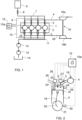
- Figure 1 shows schematically pilot fuel and gaseous fuel injection systems of a piston engine 1.
- Figure 2 shows one of the cylinders 2 of the engine 1 of figure 1 .
- the engine 1 is a large internal combustion engine, such as a main or an auxiliary engine of a ship or an engine that is used at a power plant for producing electricity.
- the rated power of the engine 1 is at least 150 kW per cylinder and the cylinder bore is at least 150 mm.
- four cylinders 2 that are arranged in line are shown, but the engine 1 can comprise any reasonable number of cylinders 2 that are arranged, for instance, in line or in a V-configuration.
- the engine 1 of figure 1 is a dual-fuel engine that can be operated at least in a gaseous fuel mode using a gaseous main fuel and a liquid pilot fuel.
- the gaseous fuel can be, for instance, natural gas, biogas, liquefied petroleum gas or ethane.
- the liquid pilot fuel can be, for instance, light fuel oil (LFO), marine diesel oil (MDO) or biodiesel.
- LFO light fuel oil
- MDO marine diesel oil
- the engine 1 can possibly also be operated in a liquid fuel mode using only liquid fuel, such as LFO or MDO.
- the engine 1 could also be a multi-fuel engine, which can be operated using two or more different types of liquid fuels and/or gaseous fuels.
- the engine 1 could be a tri-fuel engine that can be operated in a gaseous fuel mode using gaseous main fuel and liquid pilot fuel, and in two different liquid fuel modes, for instance in a first liquid fuel mode using heavy fuel oil or other fuel containing mainly residual fuel oil and in a second liquid fuel mode using light fuel oil or other fuel containing mainly distillate fuel oil.
- the engine 1 is connected to a turbocharger 16 comprising a compressor 16a and a turbine 16b for pressurizing the intake air of the engine 1.
- the engine 1 could also be provided with two or more turbochargers connected in series and/or in parallel.
- the engine 1 is provided with separate fuel injection systems for the gaseous fuel and the pilot fuel.
- the gaseous fuel is stored in a gas tank 6, from which it is supplied via a gas line 7 into the cylinders 2 of the engine 1.
- the gas line 7 is provided with a main gas valve 8 for controlling the supply of the gaseous main fuel into the gas line 7.
- the main gas valve 8 can be closed for example when the engine 1 is operated in a liquid fuel mode.
- Each cylinder 2 of the engine 1 is provided with an own gas admission valve 3.
- the gas admission valves 3 are individually controllable.
- a first control line 9 connects the gas admission valves 3 to a control unit 10, which controls the opening and closing of the gas admission valves 3.
- Each gas admission valves 3 is opened and closed by means of an actuator, such as a solenoid or a step motor.
- the gas admission valves 3 are arranged to introduce the gaseous fuel into an intake duct 4 of the engine 1.
- Each gas admission valve 3 is located close to the intake valves of the respective cylinder 2.
- the engine 1 could also comprise additional gas admission valves for introducing part of the gaseous fuel into prechambers.
- the gaseous fuel is introduced into the intake duct 4 during the intake stroke.
- the air/fuel mixture is preferably a lean mixture comprising more air than is needed for the complete combustion of both the gaseous fuel and the liquid pilot fuel.
- figure 1 shows only a simplified example of a fuel injection system for gaseous main fuel.
- the fuel injection system can comprise many additional components not shown in the figures, for instance different valves, filters etc.
- the fuel injection system for the liquid pilot fuel comprises an own pilot fuel injector 5 for each cylinder 2 of the engine 1.
- the pilot fuel injector 5 can be arranged to inject the fuel either directly into a main combustion chamber 23, as shown in figure 2 , or into a prechamber.
- the pilot fuel injectors 5 are individually controllable.
- the pilot fuel injectors 5 can be, for instance, electrically actuated.
- a second control line 15 connects the pilot fuel injectors 5 to the control unit 10, which controls the opening and closing of the pilot fuel injectors 5.
- Each pilot fuel injector 5 comprises a valve needle, which can be lifted for injecting fuel through the pilot fuel injector 5.
- the pilot fuel injection system is a common rail fuel injection system comprising a fuel rail 11 for storing pressurized fuel. All the pilot fuel injectors 5 are connected to the same fuel rail 11.
- a low-pressure pump 12 supplies fuel from a liquid fuel tank 14 to a high-pressure pump 13, which raises the pressure of the pilot fuel to a level that is suitable for direct fuel injection and supplies it into the fuel rail 11, from which the fuel is supplied to the pilot fuel injectors 5.
- the fuel injection pressure can be in the range of 800 to 3000 bar.
- each pilot fuel injector 5 could be provided with an own fuel accumulator, or the pilot fuel injection system could comprise two or more fuel rails 11, each serving two or more pilot fuel injectors 5.
- the fuel injection system of figure 1 can also be used for injecting liquid fuel into the cylinders 2 of the engine 1 in other situations.
- the pilot fuel injection system could also be used when the engine 1 is operated in a liquid fuel mode using only liquid fuel.
- the pilot fuel injectors 5 would function also as main fuel injectors. It is also possible that only parts of the fuel injection system of figure 1 are used as part of a fuel injection system for liquid main fuel. For instance, additional fuel injectors could be connected to the fuel rail 11 of figure 1 for injecting liquid main fuel. In the gaseous fuel mode, the liquid pilot fuel would be injected by the pilot fuel injectors 5, and in a liquid fuel mode the liquid fuel would be injected by main fuel injectors. In both operating modes, the same low-pressure pump 12 and high-pressure pump 13 would be used.
- the pilot fuel injectors 5 and the main fuel injectors could be integrated in fuel injector units. The pilot fuel is injected into the cylinders 2 of the engine 1 via the pilot fuel injectors 5 during the compression stroke when the piston is close to top dead center.
- the engine 1 can be provided with at least one additional fuel injection system, for instance for injecting liquid main fuel into the cylinders 2 of the engine 1.
- the additional fuel injection system could be a common rail system or a fuel injection system having an own fuel injection pump for each cylinder 2 of the engine 1.
- FIG. 2 shows schematically one cylinder 2 of the engine 1 of figure 1 .
- Each cylinder 2 of the engine 1 is provided with a piston 18, which is configured to move in a reciprocating manner within the cylinder 2.
- the piston 18 is connected via a connecting rod 19 to a crankshaft 20.
- a flywheel 21 is attached to one end of the crankshaft 20.
- the piston 18 delimits a main combustion chamber 23.
- Each cylinder 2 of the engine 1 is provided with at least one intake valve 24.
- Each cylinder 2 can be provided for example with two intake valves 24.
- the intake valves 24 are used for opening and closing fluid communication between the intake duct (intake receiver) 4 and the main combustion chamber 23.
- Each cylinder 2 of the engine 1 is provided with at least one exhaust valve 25.
- Each cylinder 2 of the engine can be provided for example with two exhaust valves 25.
- the exhaust valves 25 are used for opening and closing fluid communication between the combustion chamber 23 and an exhaust duct 26.
- the intake valves 24 are connected to intake valve actuating means 27.
- the intake valve actuating means 27 are used for opening and closing the intake valves 24.
- the intake valve actuating means 27 can be configured to allow variable intake valve timing. The crank angle at which the intake valves 24 are opened and/or closed can thus be varied.
- the intake valve actuating means 27 can be implemented in many alternative ways.
- the intake valve actuating means 27 can comprise an electrical, hydraulic or mechanical actuator.
- the intake valve actuating means 27 could also be any combination of electrical, hydraulic and/or mechanical means.
- the intake valves 24 can be opened by means of a camshaft.
- the closing force for closing the intake valves 24 can be created by means of one or more springs, such as helical springs and/or air springs.
- the closing of the intake valves 24 can be delayed by means of a hydraulic system.
- both the opening and closing timing could be determined by means of an electrical actuator, such as a solenoid.
- the intake valves 24 could be both opened and closed hydraulically.
- the intake valve actuating means 27 are connected to the control unit 10, which is configured to transmit a control signal to the intake valve actuating means 27 for determining the opening and/or closing timing of the intake valves 24.
- the exhaust valves 25 are connected to similar actuating means 28 as the intake valves 24.
- the exhaust valves 25 could also be provided with different actuating means.
- the actuating means 28 of the exhaust valves 25 allow variable valve timing.
- the exhaust valve actuating means 28 are connected to the control 10 unit which is configured to transmit a control signal to the exhaust valve actuating means 28 for determining the opening and/or closing timing of the exhaust valves 25.
- both the intake valves 24 and the exhaust valves 25 could be cam-controlled.
- the valve timings could be either variable or fixed.
- the gas admission valves 3 and the pilot fuel injectors 5 are connected to the control unit 10.
- the injection timings and durations of both the pilot fuel injection and the main fuel injection can thus be individually controlled in each cylinder 2 of the engine 1.
- Each cylinder 2 of the engine 1 is provided with a cylinder pressure sensor 29.
- the cylinder pressure sensor 29 is arranged to measure pressure in the cylinder 2.
- the engine 1 is provided with data processing means, such as the control unit 10, which receives measurement data from the cylinder pressure sensors 29.
- the engine 1 further comprises a crank angle sensor 30 or other means for determining the angular position of the crankshaft 20.
- the crank angle sensor 30 monitors the angular position of the flywheel 21. On the basis of the angular position of the flywheel 21, the position of the piston 18 in each cylinder 2 can be determined.
- the control unit 10 also receives measurement data from the crank angle sensor 30. The cylinder pressure can thus be determined in respect of crank angle.
- intake valves 24 of each cylinder 2 of the engine 1 open at the end of the exhaust stroke.
- the control unit 10 transmits a control signal via the first control line 9 to the gas admission valve 3 for opening the gas admission valve 3.
- the gas admission valve 3 opens and the valve 3 is kept open for a certain period of time for allowing the gaseous fuel to flow into the intake duct 4 and further into the cylinder 3.
- the gas admission valve 3 is closed. Also the intake valves 24 are closed, and during the compression stroke following the intake stroke, the air/fuel mixture in the cylinder 2 is compressed.
- the control unit 10 transmits a control signal via the second control line 15 to the pilot fuel injector 5 for opening the pilot fuel injector 5 and for injecting liquid pilot fuel into the cylinder 2.
- the valve needle of the pilot fuel injector 5 is lifted for a short period of time and pilot fuel is injected into the cylinder 2.
- the pilot fuel is self-ignited.
- the amount of the pilot fuel is relatively small.
- the combustion of the pilot fuel can release, for instance, less than five percent of the heat released by the combustion in the cylinder 2.
- the combustion of the pilot fuel ignites also the mixture of air and the gaseous main fuel.
- the exhaust valves 25 open. During the exhaust stroke, the exhaust gases flow out of the cylinder 2, and a new engine cycle begins.
- the engine is operated in a transient state using a gaseous main fuel that is introduced into the main combustion chamber 23 of a cylinder 2 of the engine 1 during an intake stroke and a liquid pilot fuel that is introduced into the main combustion chamber 23 or into a prechamber as one or more injection events taking place during a compression stroke for igniting the gaseous main fuel.
- gas supply system suitable for use in the method according to the invention has been described above. However, the system does not need to be identical to the system of figures 1 and 2 .
- part of the gaseous fuel can be introduced into prechambers, in case the engine 1 is provided with prechambers.
- liquid pilot fuel is introduced into the main combustion chambers 23 and/or into prechambers.
- a liquid fuel injection system described above can be used for injecting the liquid fuel.
- the liquid pilot fuel is injected during the compression stroke.
- the pilot fuel injection can be divided into one or more injection events.
- the pilot fuel injection can take place for example in the range 50-20 degrees before top dead center.
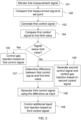
- a first measurement signal indicative of the engine output power or engine speed is monitored 101.
- the first measurement signal is compared to a set point 102.
- the first measurement signal is a speed signal
- it is compared to the desired engine speed.
- a speed signal as the first measurement signal is suitable for many different applications, for instance for engine generator sets where the aim is to keep the rotation speed of the engine and the generator constant.
- a speed signal for example a signal indicative of the electrical power produced by a generator that is driven by the engine could be monitored and compared to a set point.
- a first control signal for controlling the amount of the gaseous main fuel is generated 103.
- the engine 1 can comprise a PID controller 10a, which can be part of the control unit 10.
- the PID controller 10a can receive the first measurement signal and the set point.
- the first control signal can be generated by the PID controller 10a based on the difference between the first measurement signal and the set point.
- the first control signal is compared to a first limit value 104.
- the first limit value is indicative of the maximum amount of gaseous fuel that can be introduced into the cylinders of the engine without a significant knocking risk. If the first control signal is below the first limit value, the knocking risk is low.
- the first limit value does not have to be constant, but it can be a changing limit value.
- the first limit value can be determined based on the value of one or more first variables, which are measured or calculated.
- the first variables can include charge air pressure, engine load, engine speed and air/fuel ratio. For instance, the charge air pressure of the engine can be monitored, and based on the charge air pressure, the first limit value can be determined.
- a higher charge air pressure allows more gaseous main fuel to be introduced into the cylinders of the engine without a knocking risk, and the first limit value could thus increase as the charge air pressure increases.
- the first limit value is determined based on the air/fuel ratio, the mass of the injected fuel and the mass of the air introduced into the cylinders are calculated, and the first limit value is determined so that a minimum allowed air/fuel ratio is achieved.
- the first limit value could also be determined based on a combination of two or more first variables. For instance, both the charge air pressure and the engine load or engine speed could be monitored, and the first limit value could be determined based on the charge air pressure and the engine load or engine speed.
- the amount of the gaseous main fuel is controlled based on the first control signal 105.
- the knocking risk is low.
- the output power of the engine can thus be controlled based on the first control signal, such as the output signal of the PID controller 10a.
- first control signal is above the first limit value
- a second control signal capped to the first limit value is generated and the amount of the gaseous main fuel is controlled based on the second control signal 106.
- the first control signal such as the output signal of the PID controller 10a, is therefore not used to directly control the amount of the gaseous main fuel. The amount of the gaseous main fuel is thus not increased as much as the output signal of the PID controller 10a indicates.
- the difference between the first control signal and the first limit value is determined 107, the difference between the first control signal and the first limit value is used as an input for generating a third control signal 108, and additional liquid fuel injection into the cylinders 2 during a combustion stroke is controlled based on the third control signal 109.
- the second control signal has been capped to the first limit value, the amount of the gaseous main fuel introduced into the cylinders of the engine is not sufficient for meeting the power demand.
- the effect of inadequate supply of the gaseous main fuel is compensated by injecting liquid fuel into the cylinders. Because the additional liquid fuel injection is carried out during the combustion stroke, the pilot fuel injection does not have to be changed, and the start of the combustion is thus not affected.
- the additional liquid fuel injection can take place, for example, in the range of 0-25 degrees after top dead center.
- the third control signal could be based on the difference between the first control signal and the first limit value. However, this is not necessary, but a value from a look-up table can be used as an additional input for generating the third control signal.
- the additional liquid fuel injection can thus have a basic level that is determined using a look-up table, and the difference between the first limit value and the first measurement signal can determine a variable portion of the additional liquid fuel injection.
- the look-up table can comprise different basic levels of additional liquid fuel injection for different speed/load combinations.
- An upper limit can be determined for the duration of the additional liquid fuel injection.
- the upper limit can be used for example to prevent smoke.
- the third control signal can be capped to a second limit value.
- the upper limit for the duration of the additional liquid fuel injection can be determined, for example, based on an allowable air/fuel ratio, maximum speed of the engine or maximum load of the engine.
- the decrease rate of the third control signal can have a limit value.
- the decrease rate of the third control signal can be determined and compared to a third limit value, and in case the decrease rate exceeds the limit value, the decrease rate of the third value can be capped to the third limit value.
- the amount of the gaseous fuel can be further controlled based on the cylinder pressures.
- the cylinder pressures can be monitored and in case a measured peak pressure in one or more cylinders exceeds a predetermined value, the amount of the gaseous fuel introduced into the cylinders can be decreased from the level determined by the first control signal or the second control signal.
Landscapes
- Engineering & Computer Science (AREA)
- Chemical & Material Sciences (AREA)
- Combustion & Propulsion (AREA)
- Mechanical Engineering (AREA)
- General Engineering & Computer Science (AREA)
- Oil, Petroleum & Natural Gas (AREA)
- Output Control And Ontrol Of Special Type Engine (AREA)
- Electrical Control Of Air Or Fuel Supplied To Internal-Combustion Engine (AREA)
Description
- The present invention relates to a method of operating a piston engine in a transient state using a gaseous main fuel and a liquid pilot fuel in accordance with
claim 1. The invention also concerns a control system for a piston engine as defined in the other independent claim. - A possibility to operate a piston engine using a gaseous fuel, such as natural gas, provides many advantages, for instance in the form of lower emissions compared to many liquid fuels. Gaseous fuels usually need an ignition source, which is in most cases either a spark plug or pilot fuel. In dual-fuel engines, the gaseous main fuel is ignited by utilizing liquid pilot fuel, which is injected into the cylinders of the engine either directly or via a prechamber. The gaseous fuel is introduced into the intake duct and flows through the intake ports into the cylinders during the intake stroke. The liquid pilot fuel is injected by means of pilot fuel injectors at the end of the compression stroke. The pilot fuel is self-ignited, and the ignition of the pilot fuel triggers combustion of the gaseous main fuel. The air/fuel mixture is often a lean mixture comprising more air than is needed for the complete combustion of both the gaseous fuel and the liquid pilot fuel. In transient situations, where engine load is rapidly increasing, typically the fuel amount increases faster than the air amount, which leads to a rich air/fuel mixture. The rich mixture can lead to auto-ignition of the fuel or to too fast combustion speed thus causing knocking.
-
US 2013/325295 A1 andUS 2014/366839 A1 disclose dual fuel engines operating on a gaseous fuel as main fuel being ignited by liquid pilot fuel injection. In order to reduce the risk of knocking during a transient engine operation, namely during acceleration, by unduly increasing the amount of gaseous fuel, the amount of liquid fuel is increased instead, thereby substituting for the gaseous fuel, while at the same time the required load demand is reached. - An object of the present invention is to provide an improved method of operating a piston engine in a transient state using a gaseous main fuel that is introduced into the main combustion chamber of a cylinder of the engine during an intake stroke and a liquid pilot fuel that is introduced into the main combustion chamber or into a prechamber as one or more injection events taking place during a compression stroke for igniting the gaseous main fuel. The characterizing features of the method according to the invention are given in of
claim 1. Another object of the invention is to provide an improved control system for a piston engine. The characterizing features of the control system are given in the other independent claim. - The method according to the invention comprises the steps of
- monitoring a first measurement signal indicative of the engine output power or engine speed,
- comparing the first measurement signal to a set point,
- based on the comparison between the first measurement signal and the set point, generating a first control signal for controlling the amount of the gaseous main fuel, and
- comparing the first control signal to a first limit value,
- in case the first control signal is below the first limit value,
- the amount of the gaseous main fuel introduced into the cylinders is controlled based on the first control signal, and
- in case the first control signal is above the first limit value,
- a second control signal capped to the first limit value is generated and the amount of the gaseous main fuel introduced into the cylinders is controlled based on the second control signal,
- the difference between the first control signal and the first limit value is determined,
- the difference between the first control signal and the first limit value is used as an input for generating a third control signal, and
- additional liquid fuel injection into the cylinders during a combustion stroke is controlled based on the third control signal.
- The control system according to the invention is configured to operate the engine in a transient state in accordance with the method defined above.
- A piston engine according to the invention comprises a control system defined above.
- In the method according to the invention, the output power is thus primarily controlled by adjusting the amount of the gaseous fuel introduced into combustion chambers. However, if the fuel demand of the engine is greater than an allowable amount of gaseous fuel, the amount of the gaseous fuel introduced into the cylinders is limited to a limit value. The difference between the fuel demand and the amount of gaseous fuel that can be introduced into the cylinders is determined and used as an input for controlling additional liquid fuel injection.
- With the method and control system according to the invention, an engine can respond to rapidly increasing load while auto ignition or too fast combustion speed of the gaseous fuel can be avoided. By injecting the additional liquid fuel during the combustion stroke, a limitation in the gas supply can be compensated without affecting the start of combustion.
- According to an embodiment of the invention, a first variable or a set of first variables indicative of the operation of the engine is measured or calculated, and the first limit value is determined based on the value of at least one first variable. The first variable used for determining the first limit value is chosen so that the first limit value reflects a limit above which knocking risk increases.
- According to an embodiment of the invention, the first variables include at least one variable from the group of charge air pressure, engine load, engine speed and air/fuel ratio. Also a combination of two or more variables could be used to determine the first limit value.
- According to an embodiment of the invention, a value from a look-up table is used as an additional input for generating the third control signal. The additional liquid fuel injection can thus have a basic level, which can be retrieved from a look-up table, and a variable portion, which is based on the difference between the first control signal and the first limit value.
- According to an embodiment of the invention, the third control signal is capped to a second limit value, in case the duration of the additional liquid fuel injection reaches an upper limit determined for the duration of the additional liquid fuel injection. The second limit value can be used, for instance, to prevent smoke.
- According to an embodiment of the invention, the upper limit for the duration of the additional liquid fuel injection is determined based on an allowable air/fuel ratio, maximum speed of the engine or maximum load of the engine.
- According to an embodiment of the invention, a decrease rate of the third control signal is determined and compared to a third limit value, and in case the decrease rate exceeds the limit value, the decrease rate of the third control signal is capped to the third limit value. By preventing too rapid decrease of the additional liquid fuel injection, it is ensured that the liquid fuel injection is not terminated too early and the supply of the gaseous fuel can meet the fuel demand.
- According to an embodiment of the invention, the pressure in at least one cylinder of the engine is monitored, and in case a measured peak pressure exceeds a predetermined value, the amount of the gaseous fuel introduced into the cylinders is decreased from the level determined by the first control signal or the second control signal.
- According to an embodiment of the invention, one or more variables indicative of knocking is monitored, and in case knocking is detected, the amount of the gaseous fuel introduced into the cylinders is decreased from the level determined by the first control signal or the second control signal.
- Embodiments of the invention are described below in more detail with reference to the accompanying drawings, in which
-
Fig. 1 shows schematically a simplified view of the pilot fuel and main fuel injection systems of a piston engine, -
Fig. 2 shows schematically one cylinder of the engine offigure 1 , and -
Fig. 3 shows the method according to an embodiment of the invention as a flowchart. -
Figure 1 shows schematically pilot fuel and gaseous fuel injection systems of apiston engine 1.Figure 2 shows one of thecylinders 2 of theengine 1 offigure 1 . Theengine 1 is a large internal combustion engine, such as a main or an auxiliary engine of a ship or an engine that is used at a power plant for producing electricity. The rated power of theengine 1 is at least 150 kW per cylinder and the cylinder bore is at least 150 mm. Infigure 1 , fourcylinders 2 that are arranged in line are shown, but theengine 1 can comprise any reasonable number ofcylinders 2 that are arranged, for instance, in line or in a V-configuration. Theengine 1 offigure 1 is a dual-fuel engine that can be operated at least in a gaseous fuel mode using a gaseous main fuel and a liquid pilot fuel. The gaseous fuel can be, for instance, natural gas, biogas, liquefied petroleum gas or ethane. The liquid pilot fuel can be, for instance, light fuel oil (LFO), marine diesel oil (MDO) or biodiesel. Theengine 1 can possibly also be operated in a liquid fuel mode using only liquid fuel, such as LFO or MDO. Theengine 1 could also be a multi-fuel engine, which can be operated using two or more different types of liquid fuels and/or gaseous fuels. For instance, theengine 1 could be a tri-fuel engine that can be operated in a gaseous fuel mode using gaseous main fuel and liquid pilot fuel, and in two different liquid fuel modes, for instance in a first liquid fuel mode using heavy fuel oil or other fuel containing mainly residual fuel oil and in a second liquid fuel mode using light fuel oil or other fuel containing mainly distillate fuel oil. - The
engine 1 is connected to aturbocharger 16 comprising acompressor 16a and aturbine 16b for pressurizing the intake air of theengine 1. Theengine 1 could also be provided with two or more turbochargers connected in series and/or in parallel. - The
engine 1 is provided with separate fuel injection systems for the gaseous fuel and the pilot fuel. The gaseous fuel is stored in a gas tank 6, from which it is supplied via agas line 7 into thecylinders 2 of theengine 1. Thegas line 7 is provided with amain gas valve 8 for controlling the supply of the gaseous main fuel into thegas line 7. Themain gas valve 8 can be closed for example when theengine 1 is operated in a liquid fuel mode. Eachcylinder 2 of theengine 1 is provided with an owngas admission valve 3. Thegas admission valves 3 are individually controllable. Afirst control line 9 connects thegas admission valves 3 to acontrol unit 10, which controls the opening and closing of thegas admission valves 3. Eachgas admission valves 3 is opened and closed by means of an actuator, such as a solenoid or a step motor. Thegas admission valves 3 are arranged to introduce the gaseous fuel into anintake duct 4 of theengine 1. Eachgas admission valve 3 is located close to the intake valves of therespective cylinder 2. Theengine 1 could also comprise additional gas admission valves for introducing part of the gaseous fuel into prechambers. The gaseous fuel is introduced into theintake duct 4 during the intake stroke. When the intake valves of acylinder 2 are open, the gaseous fuel flows into thecylinder 2 forming an air/fuel mixture. The air/fuel mixture is preferably a lean mixture comprising more air than is needed for the complete combustion of both the gaseous fuel and the liquid pilot fuel. It should be noted thatfigure 1 shows only a simplified example of a fuel injection system for gaseous main fuel. The fuel injection system can comprise many additional components not shown in the figures, for instance different valves, filters etc. - The fuel injection system for the liquid pilot fuel comprises an own
pilot fuel injector 5 for eachcylinder 2 of theengine 1. Thepilot fuel injector 5 can be arranged to inject the fuel either directly into amain combustion chamber 23, as shown infigure 2 , or into a prechamber. Thepilot fuel injectors 5 are individually controllable. Thepilot fuel injectors 5 can be, for instance, electrically actuated. Asecond control line 15 connects thepilot fuel injectors 5 to thecontrol unit 10, which controls the opening and closing of thepilot fuel injectors 5. Eachpilot fuel injector 5 comprises a valve needle, which can be lifted for injecting fuel through thepilot fuel injector 5. - In the embodiment of
figure 1 , the pilot fuel injection system is a common rail fuel injection system comprising afuel rail 11 for storing pressurized fuel. All thepilot fuel injectors 5 are connected to thesame fuel rail 11. A low-pressure pump 12 supplies fuel from aliquid fuel tank 14 to a high-pressure pump 13, which raises the pressure of the pilot fuel to a level that is suitable for direct fuel injection and supplies it into thefuel rail 11, from which the fuel is supplied to thepilot fuel injectors 5. The fuel injection pressure can be in the range of 800 to 3000 bar. Instead of asingle fuel rail 11, eachpilot fuel injector 5 could be provided with an own fuel accumulator, or the pilot fuel injection system could comprise two or more fuel rails 11, each serving two or morepilot fuel injectors 5. In addition to the use as a pilot fuel injection system, the fuel injection system offigure 1 can also be used for injecting liquid fuel into thecylinders 2 of theengine 1 in other situations. - The pilot fuel injection system could also be used when the
engine 1 is operated in a liquid fuel mode using only liquid fuel. In that case, thepilot fuel injectors 5 would function also as main fuel injectors. It is also possible that only parts of the fuel injection system offigure 1 are used as part of a fuel injection system for liquid main fuel. For instance, additional fuel injectors could be connected to thefuel rail 11 offigure 1 for injecting liquid main fuel. In the gaseous fuel mode, the liquid pilot fuel would be injected by thepilot fuel injectors 5, and in a liquid fuel mode the liquid fuel would be injected by main fuel injectors. In both operating modes, the same low-pressure pump 12 and high-pressure pump 13 would be used. Thepilot fuel injectors 5 and the main fuel injectors could be integrated in fuel injector units. The pilot fuel is injected into thecylinders 2 of theengine 1 via thepilot fuel injectors 5 during the compression stroke when the piston is close to top dead center. - In addition to the fuel injection systems shown in
figure 1 , theengine 1 can be provided with at least one additional fuel injection system, for instance for injecting liquid main fuel into thecylinders 2 of theengine 1. The additional fuel injection system could be a common rail system or a fuel injection system having an own fuel injection pump for eachcylinder 2 of theengine 1. -
Figure 2 shows schematically onecylinder 2 of theengine 1 offigure 1 . Eachcylinder 2 of theengine 1 is provided with apiston 18, which is configured to move in a reciprocating manner within thecylinder 2. Thepiston 18 is connected via a connectingrod 19 to acrankshaft 20. Aflywheel 21 is attached to one end of thecrankshaft 20. Together with the walls of thecylinder 2 and acylinder head 22, thepiston 18 delimits amain combustion chamber 23. Eachcylinder 2 of theengine 1 is provided with at least oneintake valve 24. Eachcylinder 2 can be provided for example with twointake valves 24. Theintake valves 24 are used for opening and closing fluid communication between the intake duct (intake receiver) 4 and themain combustion chamber 23. Eachcylinder 2 of theengine 1 is provided with at least oneexhaust valve 25. Eachcylinder 2 of the engine can be provided for example with twoexhaust valves 25. Theexhaust valves 25 are used for opening and closing fluid communication between thecombustion chamber 23 and anexhaust duct 26. - The
intake valves 24 are connected to intake valve actuating means 27. The intake valve actuating means 27 are used for opening and closing theintake valves 24. The intake valve actuating means 27 can be configured to allow variable intake valve timing. The crank angle at which theintake valves 24 are opened and/or closed can thus be varied. The intake valve actuating means 27 can be implemented in many alternative ways. The intake valve actuating means 27 can comprise an electrical, hydraulic or mechanical actuator. The intake valve actuating means 27 could also be any combination of electrical, hydraulic and/or mechanical means. For instance, theintake valves 24 can be opened by means of a camshaft. The closing force for closing theintake valves 24 can be created by means of one or more springs, such as helical springs and/or air springs. The closing of theintake valves 24 can be delayed by means of a hydraulic system. Alternatively, both the opening and closing timing could be determined by means of an electrical actuator, such as a solenoid. Alternatively, theintake valves 24 could be both opened and closed hydraulically. The intake valve actuating means 27 are connected to thecontrol unit 10, which is configured to transmit a control signal to the intake valve actuating means 27 for determining the opening and/or closing timing of theintake valves 24. - In the embodiment of
figure 2 , theexhaust valves 25 are connected to similar actuating means 28 as theintake valves 24. However, theexhaust valves 25 could also be provided with different actuating means. For instance, it is not necessary that the actuating means 28 of theexhaust valves 25 allow variable valve timing. In the embodiment offigure 2 , also the exhaust valve actuating means 28 are connected to thecontrol 10 unit which is configured to transmit a control signal to the exhaust valve actuating means 28 for determining the opening and/or closing timing of theexhaust valves 25. Instead of the arrangements described above, both theintake valves 24 and theexhaust valves 25 could be cam-controlled. The valve timings could be either variable or fixed. - The
gas admission valves 3 and thepilot fuel injectors 5 are connected to thecontrol unit 10. The injection timings and durations of both the pilot fuel injection and the main fuel injection can thus be individually controlled in eachcylinder 2 of theengine 1. - Each
cylinder 2 of theengine 1 is provided with acylinder pressure sensor 29. Thecylinder pressure sensor 29 is arranged to measure pressure in thecylinder 2. Theengine 1 is provided with data processing means, such as thecontrol unit 10, which receives measurement data from thecylinder pressure sensors 29. Theengine 1 further comprises acrank angle sensor 30 or other means for determining the angular position of thecrankshaft 20. In the embodiment offigure 2 , thecrank angle sensor 30 monitors the angular position of theflywheel 21. On the basis of the angular position of theflywheel 21, the position of thepiston 18 in eachcylinder 2 can be determined. In addition to the pressure measurement data, thecontrol unit 10 also receives measurement data from thecrank angle sensor 30. The cylinder pressure can thus be determined in respect of crank angle. - During normal steady-state operation of the
engine 1 in the gaseous fuel mode,intake valves 24 of eachcylinder 2 of theengine 1 open at the end of the exhaust stroke. At the beginning of the intake stroke, thecontrol unit 10 transmits a control signal via thefirst control line 9 to thegas admission valve 3 for opening thegas admission valve 3. Thegas admission valve 3 opens and thevalve 3 is kept open for a certain period of time for allowing the gaseous fuel to flow into theintake duct 4 and further into thecylinder 3. Before the end of the intake stroke, thegas admission valve 3 is closed. Also theintake valves 24 are closed, and during the compression stroke following the intake stroke, the air/fuel mixture in thecylinder 2 is compressed. As thepiston 18 in thecylinder 2 approaches top dead center, thecontrol unit 10 transmits a control signal via thesecond control line 15 to thepilot fuel injector 5 for opening thepilot fuel injector 5 and for injecting liquid pilot fuel into thecylinder 2. The valve needle of thepilot fuel injector 5 is lifted for a short period of time and pilot fuel is injected into thecylinder 2. After a certain ignition lag, the pilot fuel is self-ignited. The amount of the pilot fuel is relatively small. The combustion of the pilot fuel can release, for instance, less than five percent of the heat released by the combustion in thecylinder 2. The combustion of the pilot fuel ignites also the mixture of air and the gaseous main fuel. When thepiston 18 is close to bottom dead center, theexhaust valves 25 open. During the exhaust stroke, the exhaust gases flow out of thecylinder 2, and a new engine cycle begins. - In steady-state operation the
engine 1 is operated using a lean air/fuel mixture. In transient situations, where the engine load rapidly increases, the supply of fuel into the cylinders needs to be increased. Theturbocharger 16 cannot immediately respond to the increased load, and therefore the air/fuel mixture becomes richer. This can lead to auto ignition or too fast combustion of the gaseous fuel thus causing knocking. The present invention addresses this problem. - In the method according to the invention, the engine is operated in a transient state using a gaseous main fuel that is introduced into the
main combustion chamber 23 of acylinder 2 of theengine 1 during an intake stroke and a liquid pilot fuel that is introduced into themain combustion chamber 23 or into a prechamber as one or more injection events taking place during a compression stroke for igniting the gaseous main fuel. - One example of a gas supply system suitable for use in the method according to the invention has been described above. However, the system does not need to be identical to the system of
figures 1 and 2 . In addition to the gas supply into themain combustion chambers 23, part of the gaseous fuel can be introduced into prechambers, in case theengine 1 is provided with prechambers. - For igniting the gaseous main fuel, liquid pilot fuel is introduced into the
main combustion chambers 23 and/or into prechambers. A liquid fuel injection system described above can be used for injecting the liquid fuel. The liquid pilot fuel is injected during the compression stroke. The pilot fuel injection can be divided into one or more injection events. The pilot fuel injection can take place for example in the range 50-20 degrees before top dead center. - The steps of the method according to the present invention are shown in
figure 3 . In a first step of the method, a first measurement signal indicative of the engine output power or engine speed is monitored 101. The first measurement signal is compared to aset point 102. For instance, if the first measurement signal is a speed signal, it is compared to the desired engine speed. The use of a speed signal as the first measurement signal is suitable for many different applications, for instance for engine generator sets where the aim is to keep the rotation speed of the engine and the generator constant. Instead of a speed signal, for example a signal indicative of the electrical power produced by a generator that is driven by the engine could be monitored and compared to a set point. - Based on the comparison between the first measurement signal and the set point, a first control signal for controlling the amount of the gaseous main fuel is generated 103. The
engine 1 can comprise aPID controller 10a, which can be part of thecontrol unit 10. ThePID controller 10a can receive the first measurement signal and the set point. The first control signal can be generated by thePID controller 10a based on the difference between the first measurement signal and the set point. - The first control signal is compared to a
first limit value 104. The first limit value is indicative of the maximum amount of gaseous fuel that can be introduced into the cylinders of the engine without a significant knocking risk. If the first control signal is below the first limit value, the knocking risk is low. The first limit value does not have to be constant, but it can be a changing limit value. The first limit value can be determined based on the value of one or more first variables, which are measured or calculated. The first variables can include charge air pressure, engine load, engine speed and air/fuel ratio. For instance, the charge air pressure of the engine can be monitored, and based on the charge air pressure, the first limit value can be determined. A higher charge air pressure allows more gaseous main fuel to be introduced into the cylinders of the engine without a knocking risk, and the first limit value could thus increase as the charge air pressure increases. If the first limit value is determined based on the air/fuel ratio, the mass of the injected fuel and the mass of the air introduced into the cylinders are calculated, and the first limit value is determined so that a minimum allowed air/fuel ratio is achieved. The first limit value could also be determined based on a combination of two or more first variables. For instance, both the charge air pressure and the engine load or engine speed could be monitored, and the first limit value could be determined based on the charge air pressure and the engine load or engine speed. - If the first control signal is below the first limit value, the amount of the gaseous main fuel is controlled based on the
first control signal 105. When the first control signal is below the first limit value, the knocking risk is low. The output power of the engine can thus be controlled based on the first control signal, such as the output signal of thePID controller 10a. - If the first control signal is above the first limit value, a second control signal capped to the first limit value is generated and the amount of the gaseous main fuel is controlled based on the
second control signal 106. When the first control signal is above the first limit value, it is an indication that the knocking risk increases if the amount of the gaseous fuel introduced into the cylinders is increased on the basis of the first control signal. The first control signal, such as the output signal of thePID controller 10a, is therefore not used to directly control the amount of the gaseous main fuel. The amount of the gaseous main fuel is thus not increased as much as the output signal of thePID controller 10a indicates. - If the amount of the gaseous main fuel introduced into the cylinders does not equal the fuel demand, the speed of the engine drops if the effect of the limited supply of the gaseous main fuel is not compensated. Therefore, the difference between the first control signal and the first limit value is determined 107, the difference between the first control signal and the first limit value is used as an input for generating a
third control signal 108, and additional liquid fuel injection into thecylinders 2 during a combustion stroke is controlled based on thethird control signal 109. Because the second control signal has been capped to the first limit value, the amount of the gaseous main fuel introduced into the cylinders of the engine is not sufficient for meeting the power demand. The effect of inadequate supply of the gaseous main fuel is compensated by injecting liquid fuel into the cylinders. Because the additional liquid fuel injection is carried out during the combustion stroke, the pilot fuel injection does not have to be changed, and the start of the combustion is thus not affected. The additional liquid fuel injection can take place, for example, in the range of 0-25 degrees after top dead center. - The third control signal could be based on the difference between the first control signal and the first limit value. However, this is not necessary, but a value from a look-up table can be used as an additional input for generating the third control signal. The additional liquid fuel injection can thus have a basic level that is determined using a look-up table, and the difference between the first limit value and the first measurement signal can determine a variable portion of the additional liquid fuel injection. The look-up table can comprise different basic levels of additional liquid fuel injection for different speed/load combinations.
- An upper limit can be determined for the duration of the additional liquid fuel injection. The upper limit can be used for example to prevent smoke. In case the duration of the additional liquid fuel injection reaches the upper limit, the third control signal can be capped to a second limit value. The upper limit for the duration of the additional liquid fuel injection can be determined, for example, based on an allowable air/fuel ratio, maximum speed of the engine or maximum load of the engine.
- Also the decrease rate of the third control signal can have a limit value. The decrease rate of the third control signal can be determined and compared to a third limit value, and in case the decrease rate exceeds the limit value, the decrease rate of the third value can be capped to the third limit value. By preventing too rapid decreasing of the additional liquid fuel injection, it is ensured that the additional liquid fuel injection is not terminated too early and the supply of the gaseous main fuel can meet the fuel demand.
- The amount of the gaseous fuel can be further controlled based on the cylinder pressures. The cylinder pressures can be monitored and in case a measured peak pressure in one or more cylinders exceeds a predetermined value, the amount of the gaseous fuel introduced into the cylinders can be decreased from the level determined by the first control signal or the second control signal.
- The amount of the gaseous fuel can be further controlled based on detected knocking. One or more variables indicative of knocking can be monitored, and in case knocking is detected, the amount of the gaseous fuel introduced into the cylinders can be decreased from the level determined by the first control signal or the second control signal. Knocking can be detected for example by monitoring cylinder pressures.
- It will be appreciated by a person skilled in the art that the invention is not limited to the embodiments described above, but may vary within the scope of the appended claims.
Claims (11)
- A method of operating a piston engine (1) in a transient state using a gaseous main fuel that is introduced into the main combustion chamber (23) of a cylinder (2) of the engine (1) during an intake stroke and a liquid pilot fuel that is introduced into the main combustion chamber (23) or into a prechamber as one or more injection events taking place during a compression stroke for igniting the gaseous main fuel, the method comprising the steps of- monitoring a first measurement signal indicative of the engine output power or engine speed (101),- comparing the first measurement signal to a set point (102),- based on the comparison between the first measurement signal and the set point, generating a first control signal for controlling the amount of the gaseous main fuel (103), and- comparing the first control signal to a first limit value (104),whereinin case the first control signal is below the first limit value,- the amount of the gaseous main fuel introduced into the cylinders (2) is controlled based on the first control signal (105), andin case the first control signal is above the first limit value,- a second control signal capped to the first limit value is generated and the amount of the gaseous main fuel introduced into the cylinders (2) is controlled based on the second control signal (106),- the difference between the first control signal and the first limit value is determined (107),- the difference between the first control signal and the first limit value is used as an input for generating a third control signal (108), and- additional liquid fuel injection into the cylinders (2) during a combustion stroke is controlled based on the third control signal (109).
- A method according to claim 1, wherein a first variable or a set of first variables indicative of the operation of the engine (1) is measured or calculated, and the first limit value is determined based on the value of at least one first variable.
- A method according to claim 2, wherein the first variables include at least one variable from the group of charge air pressure, engine load, engine speed and air/fuel ratio.
- A method according to any of the preceding claims, wherein a value from a look-up table is used as an additional input for generating the third control signal.
- A method according to any of the preceding claims, wherein the third control signal is capped to a second limit value, in case the duration of the additional liquid fuel injection reaches an upper limit determined for the duration of the additional liquid fuel injection.
- A method according to claim 5, wherein the upper limit for the duration of the additional liquid fuel injection is determined based on an allowable air/fuel ratio, maximum speed of the engine or maximum load of the engine.
- A method according to any of the preceding claims, wherein a decrease rate of the third control signal is determined and compared to a third limit value, and in case the decrease rate exceeds the limit value, the decrease rate of the third control signal is capped to the third limit value.
- A method according to any of the preceding claims, wherein the pressure in at least one cylinder (2) of the engine is monitored, and in case a measured peak pressure exceeds a predetermined value, the amount of the gaseous fuel introduced into the cylinders (2) is decreased from the level determined by the first control signal or the second control signal.
- A method according to any of the preceding claims, wherein one or more variables indicative of knocking is monitored, and in case knocking is detected, the amount of the gaseous fuel introduced into the cylinders (2) is decreased from the level determined by the first control signal or the second control signal.
- A control system for a piston engine (1), wherein the control system is configured to operate the engine (1) in a transient state in accordance with any of the preceding claims.
- A piston engine (1) comprising a control system according to claim 10.
Applications Claiming Priority (1)
| Application Number | Priority Date | Filing Date | Title |
|---|---|---|---|
| PCT/FI2019/050461 WO2020249845A1 (en) | 2019-06-14 | 2019-06-14 | Method of operating piston engine and control system for piston engine |
Publications (2)
| Publication Number | Publication Date |
|---|---|
| EP3983662A1 EP3983662A1 (en) | 2022-04-20 |
| EP3983662B1 true EP3983662B1 (en) | 2024-09-25 |
Family
ID=67137969
Family Applications (1)
| Application Number | Title | Priority Date | Filing Date |
|---|---|---|---|
| EP19734840.2A Active EP3983662B1 (en) | 2019-06-14 | 2019-06-14 | Method of operating piston engine and control system for piston engine |
Country Status (4)
| Country | Link |
|---|---|
| EP (1) | EP3983662B1 (en) |
| KR (1) | KR102603855B1 (en) |
| CN (1) | CN114207263B (en) |
| WO (1) | WO2020249845A1 (en) |
Families Citing this family (3)
| Publication number | Priority date | Publication date | Assignee | Title |
|---|---|---|---|---|
| JP7329488B2 (en) * | 2019-11-15 | 2023-08-18 | エムエーエヌ・エナジー・ソリューションズ・フィリアル・アフ・エムエーエヌ・エナジー・ソリューションズ・エスイー・ティスクランド | Crosshead large low speed turbocharged two stroke uniflow scavenging internal combustion engine and method of operating same |
| JP2025018642A (en) * | 2023-07-27 | 2025-02-06 | ヤンマーホールディングス株式会社 | Engine equipment |
| WO2025147727A1 (en) * | 2024-01-12 | 2025-07-17 | Innio Jenbacher Gmbh & Co Og | Internal combustion engine |
Citations (1)
| Publication number | Priority date | Publication date | Assignee | Title |
|---|---|---|---|---|
| US20140366839A1 (en) * | 2013-06-17 | 2014-12-18 | Caterpillar Motoren GmbH & Co. KG. | Transient Event Fuel Apportionment for Multi Fuel Engine System |
Family Cites Families (13)
| Publication number | Priority date | Publication date | Assignee | Title |
|---|---|---|---|---|
| US6202601B1 (en) * | 2000-02-11 | 2001-03-20 | Westport Research Inc. | Method and apparatus for dual fuel injection into an internal combustion engine |
| WO2011153069A1 (en) * | 2010-06-01 | 2011-12-08 | Cummins Intellectual Properties, Inc. | Control system for dual fuel engines |
| EP2633170A1 (en) * | 2010-10-29 | 2013-09-04 | AFV Alternative Fuel Vehicle | Dual fuel engine system |
| US8706386B2 (en) * | 2011-06-30 | 2014-04-22 | Ford Global Technologies, Llc | Method for controlling fuel injection for a dual fuel engine |
| US9249744B2 (en) * | 2012-05-31 | 2016-02-02 | General Electric Company | Method for operating an engine |
| JP6089640B2 (en) * | 2012-11-30 | 2017-03-08 | いすゞ自動車株式会社 | Natural gas engine and method of operating natural gas engine |
| JP6324152B2 (en) * | 2014-03-26 | 2018-05-16 | 大阪瓦斯株式会社 | Engine system and control method thereof |
| FI126701B (en) * | 2014-05-09 | 2017-04-13 | Waertsilae Finland Oy | Procedure for controlling an engine using two fuels |
| DE102014017124B4 (en) * | 2014-11-20 | 2024-11-07 | Man Energy Solutions Se | Method and control device for operating a motor |
| KR20170141785A (en) * | 2015-05-05 | 2017-12-26 | 바르실라 핀랜드 오이 | A method of operating an internal combustion piston engine, a control system for controlling the operation of an internal combustion piston engine, and an internal combustion piston engine |
| DK3121428T3 (en) * | 2015-05-19 | 2019-10-14 | Winterthur Gas & Diesel Ag | Process for operating a large diesel engine, using this method and large diesel engine |
| CN109983213B (en) * | 2016-11-17 | 2021-08-17 | 瓦锡兰芬兰有限公司 | Method and piston engine for operating a piston engine in gas mode |
| EP3336339A1 (en) * | 2016-12-15 | 2018-06-20 | Caterpillar Motoren GmbH & Co. KG | Controlling a dual-fuel internal combustion engine operated at least partly on gaseous fuel |
-
2019
- 2019-06-14 EP EP19734840.2A patent/EP3983662B1/en active Active
- 2019-06-14 WO PCT/FI2019/050461 patent/WO2020249845A1/en not_active Ceased
- 2019-06-14 CN CN201980099086.9A patent/CN114207263B/en active Active
- 2019-06-14 KR KR1020227001386A patent/KR102603855B1/en active Active
Patent Citations (1)
| Publication number | Priority date | Publication date | Assignee | Title |
|---|---|---|---|---|
| US20140366839A1 (en) * | 2013-06-17 | 2014-12-18 | Caterpillar Motoren GmbH & Co. KG. | Transient Event Fuel Apportionment for Multi Fuel Engine System |
Also Published As
| Publication number | Publication date |
|---|---|
| CN114207263B (en) | 2023-11-24 |
| KR20220019293A (en) | 2022-02-16 |
| CN114207263A (en) | 2022-03-18 |
| WO2020249845A1 (en) | 2020-12-17 |
| EP3983662A1 (en) | 2022-04-20 |
| KR102603855B1 (en) | 2023-11-21 |
Similar Documents
| Publication | Publication Date | Title |
|---|---|---|
| JP5583825B2 (en) | Internal combustion engine with variable fuel injection profile | |
| US10450975B2 (en) | Skip-fire fuel injection system and method | |
| EP3542043B1 (en) | Method for operating piston engine in gas mode and piston engine | |
| US5771857A (en) | Direct injected gas engine with variable gas pressure control apparatus and method of operation | |
| KR101698113B1 (en) | Gas engine driving system and ship | |
| US10774773B2 (en) | Autonomous operation of electronically controlled internal combustion engines on a variety of fuels and/or other variabilities using ion current and/or other combustion sensors | |
| US8991358B2 (en) | Reactivity controlled compression ignition engine with exhaust gas recirculation | |
| JP2004504530A (en) | Method and apparatus for delivering multiple fuel injections to cylinders of an internal combustion engine | |
| US20140032084A1 (en) | Temperature-Controlled Combustion System and Method | |
| EP3983662B1 (en) | Method of operating piston engine and control system for piston engine | |
| KR102893002B1 (en) | A method for operating a large diesel engine and a large diesel engine | |
| EP3394411B1 (en) | Method for operating piston engine and piston engine | |
| EP3755897B1 (en) | Method of operating piston engine and piston engine | |
| EP2067954A1 (en) | Pre-combustion chamber engine having combustion-initiated starting | |
| EP3049661B1 (en) | Method for operating piston engine and piston engine | |
| US20260063090A1 (en) | Apparatus and method for operating an internal combustion engine with multiple combustion modes | |
| EP3336339A1 (en) | Controlling a dual-fuel internal combustion engine operated at least partly on gaseous fuel | |
| EP3205861B1 (en) | Method for operating multi-cylinder piston engine and multi-cylinder piston engine | |
| EP2910756A1 (en) | Cylinder balanced operation of internal combustion engines | |
| WO2019056018A1 (en) | Variable compression ratio engines |
Legal Events
| Date | Code | Title | Description |
|---|---|---|---|
| STAA | Information on the status of an ep patent application or granted ep patent |
Free format text: STATUS: UNKNOWN |
|
| STAA | Information on the status of an ep patent application or granted ep patent |
Free format text: STATUS: THE INTERNATIONAL PUBLICATION HAS BEEN MADE |
|
| PUAI | Public reference made under article 153(3) epc to a published international application that has entered the european phase |
Free format text: ORIGINAL CODE: 0009012 |
|
| STAA | Information on the status of an ep patent application or granted ep patent |
Free format text: STATUS: REQUEST FOR EXAMINATION WAS MADE |
|
| 17P | Request for examination filed |
Effective date: 20220112 |
|
| AK | Designated contracting states |
Kind code of ref document: A1 Designated state(s): AL AT BE BG CH CY CZ DE DK EE ES FI FR GB GR HR HU IE IS IT LI LT LU LV MC MK MT NL NO PL PT RO RS SE SI SK SM TR |
|
| DAV | Request for validation of the european patent (deleted) | ||
| DAX | Request for extension of the european patent (deleted) | ||
| GRAP | Despatch of communication of intention to grant a patent |
Free format text: ORIGINAL CODE: EPIDOSNIGR1 |
|
| STAA | Information on the status of an ep patent application or granted ep patent |
Free format text: STATUS: GRANT OF PATENT IS INTENDED |
|
| INTG | Intention to grant announced |
Effective date: 20240426 |
|
| GRAS | Grant fee paid |
Free format text: ORIGINAL CODE: EPIDOSNIGR3 |
|
| GRAA | (expected) grant |
Free format text: ORIGINAL CODE: 0009210 |
|
| STAA | Information on the status of an ep patent application or granted ep patent |
Free format text: STATUS: THE PATENT HAS BEEN GRANTED |
|
| AK | Designated contracting states |
Kind code of ref document: B1 Designated state(s): AL AT BE BG CH CY CZ DE DK EE ES FI FR GB GR HR HU IE IS IT LI LT LU LV MC MK MT NL NO PL PT RO RS SE SI SK SM TR |
|
| REG | Reference to a national code |
Ref country code: GB Ref legal event code: FG4D |
|
| REG | Reference to a national code |
Ref country code: CH Ref legal event code: EP |
|
| REG | Reference to a national code |
Ref country code: DE Ref legal event code: R096 Ref document number: 602019059427 Country of ref document: DE |
|
| REG | Reference to a national code |
Ref country code: IE Ref legal event code: FG4D |
|
| REG | Reference to a national code |
Ref country code: LT Ref legal event code: MG9D |
|
| PG25 | Lapsed in a contracting state [announced via postgrant information from national office to epo] |
Ref country code: NO Free format text: LAPSE BECAUSE OF FAILURE TO SUBMIT A TRANSLATION OF THE DESCRIPTION OR TO PAY THE FEE WITHIN THE PRESCRIBED TIME-LIMIT Effective date: 20241225 |
|
| PG25 | Lapsed in a contracting state [announced via postgrant information from national office to epo] |
Ref country code: GR Free format text: LAPSE BECAUSE OF FAILURE TO SUBMIT A TRANSLATION OF THE DESCRIPTION OR TO PAY THE FEE WITHIN THE PRESCRIBED TIME-LIMIT Effective date: 20241226 Ref country code: FI Free format text: LAPSE BECAUSE OF FAILURE TO SUBMIT A TRANSLATION OF THE DESCRIPTION OR TO PAY THE FEE WITHIN THE PRESCRIBED TIME-LIMIT Effective date: 20240925 |
|
| PG25 | Lapsed in a contracting state [announced via postgrant information from national office to epo] |
Ref country code: BG Free format text: LAPSE BECAUSE OF FAILURE TO SUBMIT A TRANSLATION OF THE DESCRIPTION OR TO PAY THE FEE WITHIN THE PRESCRIBED TIME-LIMIT Effective date: 20240925 |
|
| PG25 | Lapsed in a contracting state [announced via postgrant information from national office to epo] |
Ref country code: LV Free format text: LAPSE BECAUSE OF FAILURE TO SUBMIT A TRANSLATION OF THE DESCRIPTION OR TO PAY THE FEE WITHIN THE PRESCRIBED TIME-LIMIT Effective date: 20240925 |
|
| PG25 | Lapsed in a contracting state [announced via postgrant information from national office to epo] |
Ref country code: RS Free format text: LAPSE BECAUSE OF FAILURE TO SUBMIT A TRANSLATION OF THE DESCRIPTION OR TO PAY THE FEE WITHIN THE PRESCRIBED TIME-LIMIT Effective date: 20241225 |
|
| REG | Reference to a national code |
Ref country code: NL Ref legal event code: MP Effective date: 20240925 |
|
| PG25 | Lapsed in a contracting state [announced via postgrant information from national office to epo] |
Ref country code: RS Free format text: LAPSE BECAUSE OF FAILURE TO SUBMIT A TRANSLATION OF THE DESCRIPTION OR TO PAY THE FEE WITHIN THE PRESCRIBED TIME-LIMIT Effective date: 20241225 Ref country code: NO Free format text: LAPSE BECAUSE OF FAILURE TO SUBMIT A TRANSLATION OF THE DESCRIPTION OR TO PAY THE FEE WITHIN THE PRESCRIBED TIME-LIMIT Effective date: 20241225 Ref country code: LV Free format text: LAPSE BECAUSE OF FAILURE TO SUBMIT A TRANSLATION OF THE DESCRIPTION OR TO PAY THE FEE WITHIN THE PRESCRIBED TIME-LIMIT Effective date: 20240925 Ref country code: GR Free format text: LAPSE BECAUSE OF FAILURE TO SUBMIT A TRANSLATION OF THE DESCRIPTION OR TO PAY THE FEE WITHIN THE PRESCRIBED TIME-LIMIT Effective date: 20241226 Ref country code: FI Free format text: LAPSE BECAUSE OF FAILURE TO SUBMIT A TRANSLATION OF THE DESCRIPTION OR TO PAY THE FEE WITHIN THE PRESCRIBED TIME-LIMIT Effective date: 20240925 Ref country code: BG Free format text: LAPSE BECAUSE OF FAILURE TO SUBMIT A TRANSLATION OF THE DESCRIPTION OR TO PAY THE FEE WITHIN THE PRESCRIBED TIME-LIMIT Effective date: 20240925 |
|
| PG25 | Lapsed in a contracting state [announced via postgrant information from national office to epo] |
Ref country code: NL Free format text: LAPSE BECAUSE OF FAILURE TO SUBMIT A TRANSLATION OF THE DESCRIPTION OR TO PAY THE FEE WITHIN THE PRESCRIBED TIME-LIMIT Effective date: 20240925 |
|
| PG25 | Lapsed in a contracting state [announced via postgrant information from national office to epo] |
Ref country code: IS Free format text: LAPSE BECAUSE OF FAILURE TO SUBMIT A TRANSLATION OF THE DESCRIPTION OR TO PAY THE FEE WITHIN THE PRESCRIBED TIME-LIMIT Effective date: 20250125 Ref country code: PT Free format text: LAPSE BECAUSE OF FAILURE TO SUBMIT A TRANSLATION OF THE DESCRIPTION OR TO PAY THE FEE WITHIN THE PRESCRIBED TIME-LIMIT Effective date: 20250127 |
|
| PG25 | Lapsed in a contracting state [announced via postgrant information from national office to epo] |
Ref country code: RO Free format text: LAPSE BECAUSE OF FAILURE TO SUBMIT A TRANSLATION OF THE DESCRIPTION OR TO PAY THE FEE WITHIN THE PRESCRIBED TIME-LIMIT Effective date: 20240925 Ref country code: SM Free format text: LAPSE BECAUSE OF FAILURE TO SUBMIT A TRANSLATION OF THE DESCRIPTION OR TO PAY THE FEE WITHIN THE PRESCRIBED TIME-LIMIT Effective date: 20240925 |
|
| PG25 | Lapsed in a contracting state [announced via postgrant information from national office to epo] |
Ref country code: ES Free format text: LAPSE BECAUSE OF FAILURE TO SUBMIT A TRANSLATION OF THE DESCRIPTION OR TO PAY THE FEE WITHIN THE PRESCRIBED TIME-LIMIT Effective date: 20240925 |
|
| PG25 | Lapsed in a contracting state [announced via postgrant information from national office to epo] |
Ref country code: EE Free format text: LAPSE BECAUSE OF FAILURE TO SUBMIT A TRANSLATION OF THE DESCRIPTION OR TO PAY THE FEE WITHIN THE PRESCRIBED TIME-LIMIT Effective date: 20240925 |
|
| PG25 | Lapsed in a contracting state [announced via postgrant information from national office to epo] |
Ref country code: CZ Free format text: LAPSE BECAUSE OF FAILURE TO SUBMIT A TRANSLATION OF THE DESCRIPTION OR TO PAY THE FEE WITHIN THE PRESCRIBED TIME-LIMIT Effective date: 20240925 Ref country code: PL Free format text: LAPSE BECAUSE OF FAILURE TO SUBMIT A TRANSLATION OF THE DESCRIPTION OR TO PAY THE FEE WITHIN THE PRESCRIBED TIME-LIMIT Effective date: 20240925 |
|
| PG25 | Lapsed in a contracting state [announced via postgrant information from national office to epo] |
Ref country code: IT Free format text: LAPSE BECAUSE OF FAILURE TO SUBMIT A TRANSLATION OF THE DESCRIPTION OR TO PAY THE FEE WITHIN THE PRESCRIBED TIME-LIMIT Effective date: 20240925 Ref country code: SK Free format text: LAPSE BECAUSE OF FAILURE TO SUBMIT A TRANSLATION OF THE DESCRIPTION OR TO PAY THE FEE WITHIN THE PRESCRIBED TIME-LIMIT Effective date: 20240925 |
|
| REG | Reference to a national code |
Ref country code: DE Ref legal event code: R097 Ref document number: 602019059427 Country of ref document: DE |
|
| PGFP | Annual fee paid to national office [announced via postgrant information from national office to epo] |
Ref country code: DE Payment date: 20250618 Year of fee payment: 7 |
|
| PG25 | Lapsed in a contracting state [announced via postgrant information from national office to epo] |
Ref country code: DK Free format text: LAPSE BECAUSE OF FAILURE TO SUBMIT A TRANSLATION OF THE DESCRIPTION OR TO PAY THE FEE WITHIN THE PRESCRIBED TIME-LIMIT Effective date: 20240925 |
|
| PGFP | Annual fee paid to national office [announced via postgrant information from national office to epo] |
Ref country code: BE Payment date: 20250618 Year of fee payment: 7 |
|
| PGFP | Annual fee paid to national office [announced via postgrant information from national office to epo] |
Ref country code: AT Payment date: 20250620 Year of fee payment: 7 |
|
| PLBE | No opposition filed within time limit |
Free format text: ORIGINAL CODE: 0009261 |
|
| STAA | Information on the status of an ep patent application or granted ep patent |
Free format text: STATUS: NO OPPOSITION FILED WITHIN TIME LIMIT |
|
| 26N | No opposition filed |
Effective date: 20250626 |
|
| PG25 | Lapsed in a contracting state [announced via postgrant information from national office to epo] |
Ref country code: SE Free format text: LAPSE BECAUSE OF FAILURE TO SUBMIT A TRANSLATION OF THE DESCRIPTION OR TO PAY THE FEE WITHIN THE PRESCRIBED TIME-LIMIT Effective date: 20240925 |
|
| REG | Reference to a national code |
Ref country code: AT Ref legal event code: UEP Ref document number: 1726811 Country of ref document: AT Kind code of ref document: T Effective date: 20240925 |
|
| PG25 | Lapsed in a contracting state [announced via postgrant information from national office to epo] |
Ref country code: HR Free format text: LAPSE BECAUSE OF FAILURE TO SUBMIT A TRANSLATION OF THE DESCRIPTION OR TO PAY THE FEE WITHIN THE PRESCRIBED TIME-LIMIT Effective date: 20240925 |
|
| REG | Reference to a national code |
Ref country code: CH Ref legal event code: H13 Free format text: ST27 STATUS EVENT CODE: U-0-0-H10-H13 (AS PROVIDED BY THE NATIONAL OFFICE) Effective date: 20260127 |
|
| PG25 | Lapsed in a contracting state [announced via postgrant information from national office to epo] |
Ref country code: MC Free format text: LAPSE BECAUSE OF FAILURE TO SUBMIT A TRANSLATION OF THE DESCRIPTION OR TO PAY THE FEE WITHIN THE PRESCRIBED TIME-LIMIT Effective date: 20240925 |
|
| PG25 | Lapsed in a contracting state [announced via postgrant information from national office to epo] |
Ref country code: LU Free format text: LAPSE BECAUSE OF NON-PAYMENT OF DUE FEES Effective date: 20250614 |
|
| GBPC | Gb: european patent ceased through non-payment of renewal fee |
Effective date: 20250614 |
|
| PG25 | Lapsed in a contracting state [announced via postgrant information from national office to epo] |
Ref country code: GB Free format text: LAPSE BECAUSE OF NON-PAYMENT OF DUE FEES Effective date: 20250614 |
|
| PG25 | Lapsed in a contracting state [announced via postgrant information from national office to epo] |
Ref country code: IE Free format text: LAPSE BECAUSE OF NON-PAYMENT OF DUE FEES Effective date: 20250614 |
|
| PG25 | Lapsed in a contracting state [announced via postgrant information from national office to epo] |
Ref country code: FR Free format text: LAPSE BECAUSE OF NON-PAYMENT OF DUE FEES Effective date: 20250630 |
|
| PG25 | Lapsed in a contracting state [announced via postgrant information from national office to epo] |
Ref country code: CH Free format text: LAPSE BECAUSE OF NON-PAYMENT OF DUE FEES Effective date: 20250630 |