EP3983660B1 - Connecting rod assembly - Google Patents
Connecting rod assembly Download PDFInfo
- Publication number
- EP3983660B1 EP3983660B1 EP20747502.1A EP20747502A EP3983660B1 EP 3983660 B1 EP3983660 B1 EP 3983660B1 EP 20747502 A EP20747502 A EP 20747502A EP 3983660 B1 EP3983660 B1 EP 3983660B1
- Authority
- EP
- European Patent Office
- Prior art keywords
- connecting rod
- notch
- wrist pin
- small end
- piston
- Prior art date
- Legal status (The legal status is an assumption and is not a legal conclusion. Google has not performed a legal analysis and makes no representation as to the accuracy of the status listed.)
- Active
Links
Images



Classifications
-
- F—MECHANICAL ENGINEERING; LIGHTING; HEATING; WEAPONS; BLASTING
- F16—ENGINEERING ELEMENTS AND UNITS; GENERAL MEASURES FOR PRODUCING AND MAINTAINING EFFECTIVE FUNCTIONING OF MACHINES OR INSTALLATIONS; THERMAL INSULATION IN GENERAL
- F16C—SHAFTS; FLEXIBLE SHAFTS; ELEMENTS OR CRANKSHAFT MECHANISMS; ROTARY BODIES OTHER THAN GEARING ELEMENTS; BEARINGS
- F16C7/00—Connecting-rods or like links pivoted at both ends; Construction of connecting-rod heads
- F16C7/06—Adjustable connecting-rods
-
- F—MECHANICAL ENGINEERING; LIGHTING; HEATING; WEAPONS; BLASTING
- F02—COMBUSTION ENGINES; HOT-GAS OR COMBUSTION-PRODUCT ENGINE PLANTS
- F02B—INTERNAL-COMBUSTION PISTON ENGINES; COMBUSTION ENGINES IN GENERAL
- F02B75/00—Other engines
- F02B75/32—Engines characterised by connections between pistons and main shafts and not specific to preceding main groups
-
- F—MECHANICAL ENGINEERING; LIGHTING; HEATING; WEAPONS; BLASTING
- F16—ENGINEERING ELEMENTS AND UNITS; GENERAL MEASURES FOR PRODUCING AND MAINTAINING EFFECTIVE FUNCTIONING OF MACHINES OR INSTALLATIONS; THERMAL INSULATION IN GENERAL
- F16J—PISTONS; CYLINDERS; SEALINGS
- F16J1/00—Pistons; Trunk pistons; Plungers
- F16J1/10—Connection to driving members
- F16J1/14—Connection to driving members with connecting-rods, i.e. pivotal connections
- F16J1/16—Connection to driving members with connecting-rods, i.e. pivotal connections with gudgeon-pin; Gudgeon-pins
-
- F—MECHANICAL ENGINEERING; LIGHTING; HEATING; WEAPONS; BLASTING
- F16—ENGINEERING ELEMENTS AND UNITS; GENERAL MEASURES FOR PRODUCING AND MAINTAINING EFFECTIVE FUNCTIONING OF MACHINES OR INSTALLATIONS; THERMAL INSULATION IN GENERAL
- F16J—PISTONS; CYLINDERS; SEALINGS
- F16J7/00—Piston-rods
-
- F—MECHANICAL ENGINEERING; LIGHTING; HEATING; WEAPONS; BLASTING
- F02—COMBUSTION ENGINES; HOT-GAS OR COMBUSTION-PRODUCT ENGINE PLANTS
- F02B—INTERNAL-COMBUSTION PISTON ENGINES; COMBUSTION ENGINES IN GENERAL
- F02B75/00—Other engines
- F02B75/28—Engines with two or more pistons reciprocating within same cylinder or within essentially coaxial cylinders
- F02B75/282—Engines with two or more pistons reciprocating within same cylinder or within essentially coaxial cylinders the pistons having equal strokes
-
- F—MECHANICAL ENGINEERING; LIGHTING; HEATING; WEAPONS; BLASTING
- F16—ENGINEERING ELEMENTS AND UNITS; GENERAL MEASURES FOR PRODUCING AND MAINTAINING EFFECTIVE FUNCTIONING OF MACHINES OR INSTALLATIONS; THERMAL INSULATION IN GENERAL
- F16C—SHAFTS; FLEXIBLE SHAFTS; ELEMENTS OR CRANKSHAFT MECHANISMS; ROTARY BODIES OTHER THAN GEARING ELEMENTS; BEARINGS
- F16C2360/00—Engines or pumps
- F16C2360/22—Internal combustion engines
Definitions
- NAMC MOBILITY CONSORTIUM
- the field of the invention relates to connecting rod construction. More specifically, the invention relates to connecting rod assemblies for use in internal combustion engines.
- Connecting rod twist can shorten the lifetime of the engine by causing excessive wear on piston and cylinder bore surfaces, as well as by causing the early failure of a connecting rod bearing.
- the large end and the small end of the connecting rod will lie in the same plane, that is to say that axes through the center of the bores of the large and small ends of the connecting rod will be parallel.
- DE3516506A1 discloses a multipart connecting rod forming the connecting member between a crankshaft of a large diesel engine and a trunk piston has a first point of separation in the area of the crankpin bearing.
- a second point of separation occurs in the area of the connecting rod, the upper part carrying the small end of this being connected to the bottom part of this by a screw connection.
- the second point of separation of the connecting rod also lies close to the transition from the connecting rod to the small end.
- the two connecting rod parts are joined by way of a connecting nut, which acts with an upper inside thread on an outside thread of a flange on the upper connecting rod part and with a lower inside thread, separated from the upper by a web, acts on the outside thread of a bottom flange on the lower connecting rod part.
- a connecting rod assembly for an internal combustion engine that includes features for customization of the length of the connecting rod, while controlling connecting rod twist, is shown and described herein. Specifically, the present invention provides a connecting rod assembly in accordance with the claims which follow.
- the connecting rod assemblies described herein achieve both capabilities by attaching a connecting rod with a flat interfacing surface on the small end to a notch with a complementary flat interfacing surface on a wrist pin. Between the small end of the connecting rod and the wrist pin, one or more shims can be inserted to adjust the length of the connecting rod. The placement of one or more shims between flat surfaces distributes loads along the inserted shim or shims evenly and avoids fretting wear that can occur when a shim is inserted between curved surfaces.
- the wrist pin notch and the small end of the connecting rod can also have features that limit the connecting rod's twist, including flat sides on the connecting rod small end that engage in a transition fit with sides of the notch on the wrist pin.
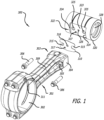
- FIG. 1 shows this type of connecting rod assembly 300 in an exploded view, with a connecting rod 301, a shim 310, and a wrist pin 320 (also known as a gudgeon pin).
- the connecting rod assembly 300 shown in FIG. 1 includes a connecting rod 301 with a large end 302 configured to connect to a crankshaft, a small end 303 with a flat (i.e., planar) top (e.g., 308 in FIGS. 3 and 4A ) and flat (i.e., planar) sides 304.
- a connecting rod 301 with a large end 302 configured to connect to a crankshaft
- a small end 303 with a flat (i.e., planar) top (e.g., 308 in FIGS. 3 and 4A ) and flat (i.e., planar) sides 304.
- the openings 305 accommodate threaded fasteners 306 with which the connecting rod 301 is attached to the wrist pin 320.
- a longitudinal drilling provides an oil channel 309 to conduct a flow of oil from an opening 311 in the large end of the connecting rod to the wrist pin 320.
- the shim 310 also includes an opening 317 to accommodate an orienting dowel pin.
- the shim 310 can be placed between the connecting rod 301 and the wrist pin 320.
- Use of one or more shims in the connecting rod assembly 300 is optional and allows for the customization of the connecting rod length.
- the wrist pin 320 has a cylindrical construction that includes a notch 322 with a flat (i.e., planar) floor 323 and flat (i.e., planar) sides 324.
- the wrist pin 320 has an oil flow opening 326 that allows for oil to pass into a reservoir 328 in the wrist pin 320, as well as openings 325 for receiving threaded fasteners and an opening 327 for an orienting dowel pin in the notch floor 323.
- the small end 303 of the connecting rod 301 comprises a flat seating surface that is dimensioned to fit within the wrist pin notch 322, with the sides 304 flush against the wrist pin notch sides 324.
- the depth of the wrist pin notch allows for a tight fit (e.g., a transition fit) between the small end 303 of the connecting rod and the notch 322 with or without a shim 310 between the small end 303 and notch floor 323.
- FIG. 1 shows one shim 310
- a connecting rod assembly may have more than one shim, as needed, to adjust the length of the connecting rod.
- conventional connecting rods with bores at the small end (e.g., pin end bore) and the large end (e.g., crank end bore) there are commercial instruments that measure the parallelism between axes through the bores to determine bend and twist.
- the connecting rods described herein do not have the conventional small end bore, so in an assembled connecting rod assembly 300, an axis through the bore of the large end 302 and at least one axis through the wrist pin 320 are compared to determine twist.
- FIG. 2 shows an assembled connecting rod assembly 300 from the wrist pin 320 end of the assembly.
- the large end 302 of the connecting rod 301 has an axis A B through the center of its bore.
- the wrist pin 320 has at least one axis A W determined with respect to one or more journals, a journal being a portion of the outer surface of the wrist pin that slides along a bearing surface in the piston body.
- the axes of will be parallel.
- FIG. 2 shows the large end axis A B , the wrist pin axis A W , and the angle ⁇ between these axes.
- the angle ⁇ between the axes is the twist in the connecting rod assembly 300. Twist, or the angle ⁇ , in the connecting rod assembly can vary from 0 degrees to 0.2°, such as from 0 degrees to 0.1°.
- the fit between the connecting rod's small end 303 and the wrist pin notch 323 can be a transition fit or a location transition fit, including a tight fit or a fixed fit. That is to say that a small amount of force may be exerted to fit the wrist pin to the small end.
- the fit between the small end 303 and the wrist pin notch 323 can be a similar fit for which a rubber mallet can be used to connect the connecting rod to the wrist pin.
- the nature of the fit between the wrist pin notch and the connecting rod small end yields an angle ⁇ , or twist, of 0.2° or less, preferably 0.1° or less.
- a shim 310 for use with the connecting rod assembly 300 described herein can be any suitable thickness to obtain a desired adjustment of the length of the connecting rod or to enable a prescribed piston-to-piston clearance while adjusting crank lead between a pair of pistons in a cylinder of an opposed-piston engine.
- One or more shims can compensate for cumulative machining variances (i.e. tolerance stack up) in an engine.
- a shim can have a thickness ranging from 200 ⁇ m (0.2mm) to 800 ⁇ m (0.8mm), and more than one shim can be inserted between the small end of a connecting rod and a wrist pin to achieve a desired positional adjustment of a piston used with the connecting rod assembly.
- a shim has a thickness of 0.5mm.
- FIG. 3 shows the wrist pin 320 and small end 303 of the connecting rod 301 of a connecting rod assembly 300, separated.
- the small end 303 of the connecting rod 301 is shown with a dowel pin 307 protruding from a seating surface 308.
- a flat side surface 304 is also visible in FIG. 3 , and there is a corresponding flat side surface on the opposing side of the connecting rod.
- the wrist pin 320 is shown with the wrist pin notch 322 oriented upwardly in the drawing.
- the wrist pin 320 has a generally cylindrical construction into which the notch 322 is formed.
- the wrist pin notch 322 has a flat seating surface 323 with securing openings 325 that receive threaded fasteners, an oil opening 326, and an orientation opening 327 (i.e., a poka-yoke feature) that receives the dowel pin 307 protruding from the flat surface 308 of the small end 303 of the connecting rod 301.
- the orientation opening 327 and the dowel pin 307 ensure correct placement of the wrist pin with respect to the connecting rod.
- the notch 322 has sides 324 that are flat and which complement the flat side surfaces 304 of the connecting rod small end.
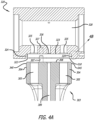
- FIG. 4A is an exploded view of the wrist pin and small end shown in FIG. 3 with a shim 310 between the wrist pin 320 and small end 303.
- This view is a sectional view along a midline of the connecting rod assembly.
- FIG. 4 shows the shim 310 between the flat seating surface 323 of the wrist pin notch 322 and the seating surface 308 of the connecting rod.
- the small end 303 of the connecting rod is shown with the seating surface 308, flat side surfaces 304, openings 305 that accommodate connecting pins (e.g., threaded fasteners), and an oil channel 309.
- Chamfers 345 may be provided at the edges where the flat sides 304 meet the seating surface 308 of the small end 303 that accommodate any radius in the transition between the wrist pin notch flat seating surface 323 and sides 324.
- the flat floor 323 and flat sides 324 of the wrist pin notch 322 align with and receive the corresponding flat sides 304 and seating surface 308 of the small end 303 so that there is a transition fit between the small end 303 and the wrist pin notch 322 that limits the twist in the connecting rod assembly 300.
- the securing openings 325 align with the openings 305 on the small end 303.
- An oil opening 326 on the wrist pin 320 aligns with the connecting rod's oil channel 309.
- the orientation opening 327 into which the dowel pin 307 fits, is shown in dashed lines in this view, as the orientation opening 327 is off-centered with respect to the midline along which this view is taken.
- the shim 310 is shown with the dowel pin 307 passing through an opening (317 in FIG. 1 ) to align the shim 310 to both the wrist pin 320 and the connecting rod.
- the wrist pin notch sides 324 and the connecting rod flat side surfaces 304 are dimensioned to minimize twist in the connecting rod assembly that results from fitting the small end of the connecting rod into the notch.
- the depth of the wrist pin notch 322, that is to say the height of the notch side walls 324, is sufficient to maintain the small end of the connecting rod in place to limit twist to the desired level, such as 0.2° or less, while allowing for sufficient depth of the securing openings 325 to accommodate threads that mate with threads on fasteners (the connecting pins 306 in FIG. 1 ) without compromising the structural soundness of the reservoir 328 that may be present in the wrist pin 320.
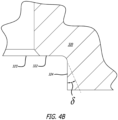
- FIG. 4B illustrates a preferred tolerance in deviation from perfectly perpendicular with respect to the sidewall 324 of the wristpin notch 322 shown in FIG. 4A .
- the deviation tolerance is expressed as an angle ⁇ .
- the angle ⁇ is 0°, then the sidewall 324 is flat, that is straight and vertical with respect to the midline section taken in FIG. 4A , and perpendicular to the floor 323 of the wristpin notch 322.
- the angle ⁇ is greater than 0°, the sidewall 324 is positioned such that the opening of the wrist pin notch 322 is wider than the wrist pin notch floor 323.
- the angle ⁇ can range from 0° to 0.10°, preferably from 0° to 0.05°.
- the sidewalls 324 of the wrist pin notch are parallel, however, variation in the wrist pin notch sidewalls 324 can differ while being within the tolerance preferred range, so that the value of ⁇ on one sidewall can be greater than or less than that of the opposite sidewall.
- the fit between the wrist pin notch 322 and the features of the small end of the connecting rod 303 can limit twist to a value between 0.2° and 0.1°; alternatively, or additionally, the fit between the wrist pin notch 322 and small end 303 can limit twist in the connecting rod assembly to 0.1° +/-0.01°.
- the configuration of the connecting rod assembly can vary with alterations to the wrist pin or the connecting rod.
- the depth of the wrist pin notch side walls can increase when the wrist pin is solid, instead of having an opening through its core (e.g., reservoir 328), as shown in FIG. 4A .
- the materials used for the connecting rod assembly may also alter the exact configuration of the components so that the relative dimensions of the wrist pin notch and the seating surface and side flats on the small end of the connecting rod may change. In any case, the transition fit between the small end and the wrist pin notch will be present in a connecting rod assembly to limit the amount of twist in the assembly.
- Connecting rod assemblies such as those shown in FIGS. 1-4B can allow for optimization of a constant piston-to-piston distance in an opposed-piston engine with crank phasing.
- An internal combustion, opposed-piston engine with two crankshafts, as described below, can benefit by having a means for adjusting the distance between pistons at minimum volume (e.g., top dead center equivalent in opposed-piston engines) while varying crank lead in the engine, such as when optimizing engine configuration, as well as once crank lead has been optimized and fixed.
- FIG. 5 a two-stroke cycle, opposed-piston engine 49 is shown as an example of an internal combustion engine with which the invention may be used.
- the engine 49 includes a ported cylinder 50.
- the engine 49 may have one ported cylinder, two ported cylinders, three ported cylinders, or four or more ported cylinders; all possibilities are represented by the cylinder 50.
- the cylinder 50 includes a bore 52 and longitudinally displaced exhaust and intake ports 54 and 56, machined or formed in a sidewall of the cylinder near respective ends thereof.
- Each of the exhaust and intake ports includes one or more circumferential arrays of openings in which adjacent openings are separated by a solid portion of the cylinder sidewall.
- One or more injection nozzles 100 are secured in threaded holes that open through the sidewall of the cylinder 50, between the intake and exhaust ports.
- Two pistons 60, 62 are slidably disposed in the bore 52 of the cylinder with their end surfaces 61, 63 in opposition to each other.
- the piston 62 is referred to as the "intake” piston because of its proximity to, and control of, the intake port 56.
- the piston 60 is referred to as the “exhaust” piston because of its proximity to, and control of, the exhaust port 54.
- the engine includes two rotatable crankshafts 71 and 72 that are disposed in a generally parallel relationship and positioned outside of respective intake and exhaust ends of the cylinder.
- the intake piston 62 is coupled to the crankshaft 72 (referred to as the "intake crankshaft”), which is disposed along an intake end of the engine 49 where cylinder intake ports are positioned; and, the exhaust piston 60 is coupled to the crankshaft 71 (referred to as the “exhaust crankshaft”), which is disposed along an exhaust end of the engine 49 where cylinder exhaust ports are positioned.
- intake crankshaft referred to as the "intake crankshaft”
- exhaust crankshaft the crankshaft 71
- all exhaust pistons are coupled to the exhaust crankshaft and all intake pistons to the intake crankshaft.
- Each of the pistons 60 and 62 is coupled to its associated crankshaft by a wrist pin 74 and a connecting rod 76 (e.g., a connecting rod assembly 300 in FIG. 1 , optionally including a shim 310).
- a connecting rod 76 e.g., a connecting rod assembly 300 in FIG. 1 , optionally including a shim 310.
- a combustion chamber is defined in the bore 52 between the end surfaces 61 and 63 of the pistons. Fuel is injected directly into the combustion chamber through the at least one fuel injector nozzle 100.
- Each of the pistons 60, 62 reciprocates in the bore 52 between a bottom center (BC) position near a respective end of the cylinder 50 where the piston is at its outermost position with respect to the cylinder, and a top center (TC) position where the piston is at its innermost position with respect to the cylinder.
- BC bottom center
- TC top center
- the piston's end surface is positioned between a respective end of the cylinder, and its associated port, which opens the port for the passage of gas.
- the port is closed.
- each piston moves into the bore 52, away from BC, toward its TC position.
- the pistons As the pistons approach their TC positions, air is compressed in a combustion chamber formed between the end surfaces of the pistons. Fuel is injected into the combustion chamber. In response to the pressure and temperature of the compressed air, the fuel ignites and combustion follows, driving the pistons apart in a power stroke. During a power stroke, the opposed pistons move away from their respective TC positions. While moving from TC, the pistons keep their associated ports closed until they approach their respective BC positions. In some instances, the pistons may move in phase so that the exhaust and intake ports 54, 56 open and close in unison. However, one piston may lead the other in phase, in which case the intake and exhaust ports have different opening and closing times. In such cases, the combustion chamber may be formed when the pistons in a cylinder achieve minimum volume; that is to say when the piston crown end surfaces are closest together. Minimum volume may occur when one or both pistons in a cylinder are not at TC position.
- a phase difference is introduced in piston movements to drive the process of uniflow scavenging in which pressurized charge air entering a cylinder through the intake port pushes the products of combustion (exhaust gas) out of the cylinder through the exhaust port.
- the replacement of exhaust gas by charge air in the cylinder is "scavenging.”
- the scavenging process is uniflow because gas movement through the cylinder is in one direction: intake-to-exhaust.
- the movement of the exhaust piston 60 may be advanced with respect to the movement of the intake piston 62. In this respect, the exhaust piston is said to "lead" the intake piston in phase.
- exhaust gas flows out of the cylinder before inflow of pressurized charge air begins (this interval is referred to as "blow down"), and pressurized charge air continues to flow into the cylinder after the outflow of exhaust gas ceases. Between these events, both ports are open (this is when scavenging occurs). Scavenging ends when the exhaust port 54 closes. Now, having no exit, the charge air that continues to flow into the cylinder 50 between time of closure of the exhaust port 54 and the time of closure of the intake port 56 is caught in the cylinder 50, and is retained therein when the intake port 56 closes. This retained portion of charge air retained in the cylinder by the last port closure is referred to as "trapped air", and it is this trapped air that is compressed during the compression stroke.
- crank angle The rotational position of a crankshaft with respect to a piston coupled to it is called the crank angle (CA).
- a piston phase difference is established by advancing the rotational position of the exhaust crankshaft 71 relative to the intake crankshaft 72 by some fixed amount. This causes the exhaust piston 60 to lead the intake piston 62 by a corresponding amount throughout the operational cycle.
- phase lead is maintained as the crankshafts rotate.
- phased crankshafts refers to the two crankshafts of an opposed-piston engine constructed as per FIG. 5 , in which the rotational movement of one crankshaft leads the rotational movement of the other crankshaft by a fixed number of degrees throughout the cycle of engine operation. This lead is referred to as "crank lead”.
- crank lead the rotational movement of the crankshafts may be phased
- the optimal combustion chamber configuration may require tailoring the position of one or both of the pistons to account for effects of tolerance stack up from cylinder block to piston wrist pin.
- One way to tailor the position of a piston is to use the connecting rod assemblies described herein.
- connecting rod assemblies are used that can both allow for an adjustable connecting rod length and minimized connecting rod twist.
- FIGS. 1-4B show this type of connecting rod assembly 300, with a connecting rod 301 and a wrist pin 320 (also known as a gudgeon pin), as well as a shim 310 that can be used to adjust connecting rod length.
- a connecting rod 301 and a wrist pin 320 also known as a gudgeon pin
- shim 310 can be used to adjust connecting rod length.
- connecting rod assembly in which the small end of the connecting rod includes a flat seating surface and sides that interface with a notch in a wrist pin to control twist in the assembly including one or more shims between the flat seating surface of the connecting rod and the wrist pin notch.
Landscapes
- Engineering & Computer Science (AREA)
- General Engineering & Computer Science (AREA)
- Mechanical Engineering (AREA)
- Chemical & Material Sciences (AREA)
- Combustion & Propulsion (AREA)
- Shafts, Cranks, Connecting Bars, And Related Bearings (AREA)
- Pistons, Piston Rings, And Cylinders (AREA)
Description
- This invention was made with government support under NAMC Project Agreement No.: 69-201502 awarded by the NATIONAL ADVANCED MOBILITY CONSORTIUM (NAMC), INC. The government has certain rights in the invention.
- The field of the invention relates to connecting rod construction. More specifically, the invention relates to connecting rod assemblies for use in internal combustion engines.
- Twist in connecting rods, and in the pistons attached to those connecting rods, is undesirable in a piston-driven internal combustion engine while operating. Connecting rod twist can shorten the lifetime of the engine by causing excessive wear on piston and cylinder bore surfaces, as well as by causing the early failure of a connecting rod bearing. In a connecting rod with no twist, the large end and the small end of the connecting rod will lie in the same plane, that is to say that axes through the center of the bores of the large and small ends of the connecting rod will be parallel.
- In an internal combustion engine, it can be desirable to customize the length of the connecting rod in a simple manner. While adjusting the length of the connecting rod, it is desirable to minimize twist in the connecting rod.
- For example, in an opposed-piston engine with two crankshafts, it may be desirable to have the ability to easily adjust the piston-to-piston clearance, so that when tuning the engine for optimal crank lead, a desired piston-to-piston clearance can be achieved. To optimize the combustion performance of an opposed-piston engine, the crank lead between a pair of pistons in a cylinder can be adjusted, and during this adjustment, the piston-to-piston clearance may need to be maintained to provide a desired combustion chamber configuration as well as to avoid collision of the pistons.
US3903753A discloses a composite piston rod for reciprocating engines, and more particularly for internal combustion reciprocating engines, especially high-powered Diesel engines.DE3516506A1 discloses a multipart connecting rod forming the connecting member between a crankshaft of a large diesel engine and a trunk piston has a first point of separation in the area of the crankpin bearing. A second point of separation occurs in the area of the connecting rod, the upper part carrying the small end of this being connected to the bottom part of this by a screw connection. The second point of separation of the connecting rod also lies close to the transition from the connecting rod to the small end. The two connecting rod parts are joined by way of a connecting nut, which acts with an upper inside thread on an outside thread of a flange on the upper connecting rod part and with a lower inside thread, separated from the upper by a web, acts on the outside thread of a bottom flange on the lower connecting rod part. Both outside threads have a different pitch. As a result of these different thread pitches, which nevertheless turn in the same direction, when the connecting nut is tightened both connecting rod parts are moved towards one another until both come to bear on one another with their end bearing surfaces. Finally means are also provided in the area of the second point of separation for centring of the two connecting rod parts and securing them against torsion. - A connecting rod assembly for an internal combustion engine that includes features for customization of the length of the connecting rod, while controlling connecting rod twist, is shown and described herein. Specifically, the present invention provides a connecting rod assembly in accordance with the claims which follow.
- The connecting rod assemblies described herein achieve both capabilities by attaching a connecting rod with a flat interfacing surface on the small end to a notch with a complementary flat interfacing surface on a wrist pin. Between the small end of the connecting rod and the wrist pin, one or more shims can be inserted to adjust the length of the connecting rod. The placement of one or more shims between flat surfaces distributes loads along the inserted shim or shims evenly and avoids fretting wear that can occur when a shim is inserted between curved surfaces. The wrist pin notch and the small end of the connecting rod can also have features that limit the connecting rod's twist, including flat sides on the connecting rod small end that engage in a transition fit with sides of the notch on the wrist pin.
-
-
FIG. 1 shows an exploded view of a connecting rod-wrist pin assembly with twist control. -
FIG. 2 shows a twist angle based on the wrist pin and a large end of the connecting rod. -
FIG. 3 shows a wrist pin and a small end of the connecting rod with twist control features. -
FIG. 4A shows an exploded view of the wrist pin and small end with a shim between the wrist pin and small end, taken as a section along a common midline. -
FIG. 4B shows an enlarged portion of the wrist pin notch side illustrating the variation tolerance of the angle of the side. -
FIG. 5 is a schematic drawing of an opposed-piston engine showing use of the connecting rod-wrist pin assembly of the invention to adjust piston-to-piston clearance. - In some internal combustion engines, connecting rod assemblies are used that can both allow for an adjustable connecting rod length and minimized connecting rod twist.
FIG. 1 shows this type of connectingrod assembly 300 in an exploded view, with a connectingrod 301, ashim 310, and a wrist pin 320 (also known as a gudgeon pin). - The
connecting rod assembly 300 shown inFIG. 1 includes a connectingrod 301 with alarge end 302 configured to connect to a crankshaft, asmall end 303 with a flat (i.e., planar) top (e.g., 308 inFIGS. 3 and4A ) and flat (i.e., planar)sides 304. In thesmall end 303, there areopenings 305 adjacent to the connectingrod sides 304. Theopenings 305 accommodate threadedfasteners 306 with which the connectingrod 301 is attached to thewrist pin 320. A longitudinal drilling provides anoil channel 309 to conduct a flow of oil from an opening 311 in the large end of the connecting rod to thewrist pin 320. There is ashim 310 shown inFIG. 1 withnotches 315 that accommodate the threadedfasteners 306, and anoil flow opening 316 that allows oil flowing through theoil channel 309 to flow to thewrist pin 320. Theshim 310 also includes an opening 317 to accommodate an orienting dowel pin. Theshim 310 can be placed between the connectingrod 301 and thewrist pin 320. Use of one or more shims in theconnecting rod assembly 300 is optional and allows for the customization of the connecting rod length. Thewrist pin 320 has a cylindrical construction that includes anotch 322 with a flat (i.e., planar)floor 323 and flat (i.e., planar)sides 324. Additionally, thewrist pin 320 has an oil flow opening 326 that allows for oil to pass into areservoir 328 in thewrist pin 320, as well asopenings 325 for receiving threaded fasteners and anopening 327 for an orienting dowel pin in thenotch floor 323. - The
small end 303 of the connectingrod 301 comprises a flat seating surface that is dimensioned to fit within thewrist pin notch 322, with thesides 304 flush against the wristpin notch sides 324. The depth of the wrist pin notch allows for a tight fit (e.g., a transition fit) between thesmall end 303 of the connecting rod and thenotch 322 with or without ashim 310 between thesmall end 303 andnotch floor 323. ThoughFIG. 1 shows oneshim 310, a connecting rod assembly may have more than one shim, as needed, to adjust the length of the connecting rod. - A transition fit between the
small end 303 of the connectingrod 301 and thewrist pin notch 323 restricts or resists torsional movement or twist of the connectingrod 301 along its length. For conventional connecting rods with bores at the small end (e.g., pin end bore) and the large end (e.g., crank end bore), there are commercial instruments that measure the parallelism between axes through the bores to determine bend and twist. The connecting rods described herein do not have the conventional small end bore, so in an assembledconnecting rod assembly 300, an axis through the bore of thelarge end 302 and at least one axis through thewrist pin 320 are compared to determine twist.FIG. 2 shows an assembledconnecting rod assembly 300 from thewrist pin 320 end of the assembly. Thelarge end 302 of the connectingrod 301 has an axis AB through the center of its bore. Thewrist pin 320 has at least one axis AW determined with respect to one or more journals, a journal being a portion of the outer surface of the wrist pin that slides along a bearing surface in the piston body. In a wrist pin with more than one journal (e.g. biaxial bearing), the axes of will be parallel.FIG. 2 shows the large end axis AB, the wrist pin axis AW, and the angle θ between these axes. The angle θ between the axes is the twist in theconnecting rod assembly 300. Twist, or the angle θ, in the connecting rod assembly can vary from 0 degrees to 0.2°, such as from 0 degrees to 0.1°. - The fit between the connecting rod's
small end 303 and thewrist pin notch 323 can be a transition fit or a location transition fit, including a tight fit or a fixed fit. That is to say that a small amount of force may be exerted to fit the wrist pin to the small end. Alternatively, the fit between thesmall end 303 and thewrist pin notch 323 can be a similar fit for which a rubber mallet can be used to connect the connecting rod to the wrist pin. In any case, the nature of the fit between the wrist pin notch and the connecting rod small end yields an angle θ, or twist, of 0.2° or less, preferably 0.1° or less. - A
shim 310 for use with the connectingrod assembly 300 described herein can be any suitable thickness to obtain a desired adjustment of the length of the connecting rod or to enable a prescribed piston-to-piston clearance while adjusting crank lead between a pair of pistons in a cylinder of an opposed-piston engine. One or more shims can compensate for cumulative machining variances (i.e. tolerance stack up) in an engine. A shim can have a thickness ranging from 200µm (0.2mm) to 800 µm (0.8mm), and more than one shim can be inserted between the small end of a connecting rod and a wrist pin to achieve a desired positional adjustment of a piston used with the connecting rod assembly. Preferably, a shim has a thickness of 0.5mm. -
FIG. 3 shows thewrist pin 320 andsmall end 303 of the connectingrod 301 of a connectingrod assembly 300, separated. Thesmall end 303 of the connectingrod 301 is shown with adowel pin 307 protruding from aseating surface 308. Aflat side surface 304 is also visible inFIG. 3 , and there is a corresponding flat side surface on the opposing side of the connecting rod. Thewrist pin 320 is shown with thewrist pin notch 322 oriented upwardly in the drawing. Thewrist pin 320 has a generally cylindrical construction into which thenotch 322 is formed. Thewrist pin notch 322 has aflat seating surface 323 with securingopenings 325 that receive threaded fasteners, anoil opening 326, and an orientation opening 327 (i.e., a poka-yoke feature) that receives thedowel pin 307 protruding from theflat surface 308 of thesmall end 303 of the connectingrod 301. Theorientation opening 327 and thedowel pin 307 ensure correct placement of the wrist pin with respect to the connecting rod. Thenotch 322 hassides 324 that are flat and which complement the flat side surfaces 304 of the connecting rod small end. -
FIG. 4A is an exploded view of the wrist pin and small end shown inFIG. 3 with ashim 310 between thewrist pin 320 andsmall end 303. This view is a sectional view along a midline of the connecting rod assembly. In addition to thewrist pin 320 and thesmall end 303 of the connecting rod illustrated inFIG. 3 ,FIG. 4 shows theshim 310 between theflat seating surface 323 of thewrist pin notch 322 and theseating surface 308 of the connecting rod. Thesmall end 303 of the connecting rod is shown with theseating surface 308, flat side surfaces 304,openings 305 that accommodate connecting pins (e.g., threaded fasteners), and anoil channel 309.Chamfers 345 may be provided at the edges where theflat sides 304 meet theseating surface 308 of thesmall end 303 that accommodate any radius in the transition between the wrist pin notchflat seating surface 323 and sides 324. As perFIG. 4 , theflat floor 323 andflat sides 324 of thewrist pin notch 322 align with and receive the correspondingflat sides 304 andseating surface 308 of thesmall end 303 so that there is a transition fit between thesmall end 303 and thewrist pin notch 322 that limits the twist in the connectingrod assembly 300. Further, the securingopenings 325 align with theopenings 305 on thesmall end 303. Anoil opening 326 on thewrist pin 320 aligns with the connecting rod'soil channel 309. Theorientation opening 327, into which thedowel pin 307 fits, is shown in dashed lines in this view, as the orientation opening 327 is off-centered with respect to the midline along which this view is taken. Theshim 310 is shown with thedowel pin 307 passing through an opening (317 inFIG. 1 ) to align theshim 310 to both thewrist pin 320 and the connecting rod. - The wrist pin notch sides 324 and the connecting rod flat side surfaces 304 are dimensioned to minimize twist in the connecting rod assembly that results from fitting the small end of the connecting rod into the notch. The depth of the
wrist pin notch 322, that is to say the height of thenotch side walls 324, is sufficient to maintain the small end of the connecting rod in place to limit twist to the desired level, such as 0.2° or less, while allowing for sufficient depth of the securingopenings 325 to accommodate threads that mate with threads on fasteners (the connectingpins 306 inFIG. 1 ) without compromising the structural soundness of thereservoir 328 that may be present in thewrist pin 320. -
FIG. 4B illustrates a preferred tolerance in deviation from perfectly perpendicular with respect to thesidewall 324 of thewristpin notch 322 shown inFIG. 4A . The deviation tolerance is expressed as an angle δ. When the angle δ is 0°, then thesidewall 324 is flat, that is straight and vertical with respect to the midline section taken inFIG. 4A , and perpendicular to thefloor 323 of thewristpin notch 322. When the angle δ is greater than 0°, thesidewall 324 is positioned such that the opening of thewrist pin notch 322 is wider than the wristpin notch floor 323. The angle δ can range from 0° to 0.10°, preferably from 0° to 0.05°. Preferably, thesidewalls 324 of the wrist pin notch are parallel, however, variation in the wrist pin notch sidewalls 324 can differ while being within the tolerance preferred range, so that the value of δ on one sidewall can be greater than or less than that of the opposite sidewall. In some implementations, the fit between thewrist pin notch 322 and the features of the small end of the connectingrod 303 can limit twist to a value between 0.2° and 0.1°; alternatively, or additionally, the fit between thewrist pin notch 322 andsmall end 303 can limit twist in the connecting rod assembly to 0.1° +/-0.01°. - The configuration of the connecting rod assembly can vary with alterations to the wrist pin or the connecting rod. The depth of the wrist pin notch side walls can increase when the wrist pin is solid, instead of having an opening through its core (e.g., reservoir 328), as shown in
FIG. 4A . The materials used for the connecting rod assembly may also alter the exact configuration of the components so that the relative dimensions of the wrist pin notch and the seating surface and side flats on the small end of the connecting rod may change. In any case, the transition fit between the small end and the wrist pin notch will be present in a connecting rod assembly to limit the amount of twist in the assembly. - Connecting rod assemblies such as those shown in
FIGS. 1-4B can allow for optimization of a constant piston-to-piston distance in an opposed-piston engine with crank phasing. An internal combustion, opposed-piston engine with two crankshafts, as described below, can benefit by having a means for adjusting the distance between pistons at minimum volume (e.g., top dead center equivalent in opposed-piston engines) while varying crank lead in the engine, such as when optimizing engine configuration, as well as once crank lead has been optimized and fixed. - In
FIG. 5 a two-stroke cycle, opposed-piston engine 49 is shown as an example of an internal combustion engine with which the invention may be used. Theengine 49 includes a portedcylinder 50. Theengine 49 may have one ported cylinder, two ported cylinders, three ported cylinders, or four or more ported cylinders; all possibilities are represented by thecylinder 50. Thecylinder 50 includes abore 52 and longitudinally displaced exhaust andintake ports - One or
more injection nozzles 100 are secured in threaded holes that open through the sidewall of thecylinder 50, between the intake and exhaust ports. Twopistons bore 52 of the cylinder with their end surfaces 61, 63 in opposition to each other. For convenience, thepiston 62 is referred to as the "intake" piston because of its proximity to, and control of, theintake port 56. Similarly, thepiston 60 is referred to as the "exhaust" piston because of its proximity to, and control of, theexhaust port 54. The engine includes tworotatable crankshafts intake piston 62 is coupled to the crankshaft 72 (referred to as the "intake crankshaft"), which is disposed along an intake end of theengine 49 where cylinder intake ports are positioned; and, theexhaust piston 60 is coupled to the crankshaft 71 (referred to as the "exhaust crankshaft"), which is disposed along an exhaust end of theengine 49 where cylinder exhaust ports are positioned. In uniflow-scavenged, opposed-piston engines with a two or more cylinders, all exhaust pistons are coupled to the exhaust crankshaft and all intake pistons to the intake crankshaft. - Each of the
pistons wrist pin 74 and a connecting rod 76 (e.g., a connectingrod assembly 300 inFIG. 1 , optionally including a shim 310). When thepistons cylinder 50 are at or near respective top center locations (e.g., top dead center equivalent locations or minimum volume locations), a combustion chamber is defined in thebore 52 between the end surfaces 61 and 63 of the pistons. Fuel is injected directly into the combustion chamber through the at least onefuel injector nozzle 100. - Operation of the opposed-
piston engine 49 is well understood. Each of thepistons bore 52 between a bottom center (BC) position near a respective end of thecylinder 50 where the piston is at its outermost position with respect to the cylinder, and a top center (TC) position where the piston is at its innermost position with respect to the cylinder. At the bottom center position, the piston's end surface is positioned between a respective end of the cylinder, and its associated port, which opens the port for the passage of gas. As the piston moves away from bottom center, toward the top center position, the port is closed. During a compression stroke each piston moves into thebore 52, away from BC, toward its TC position. As the pistons approach their TC positions, air is compressed in a combustion chamber formed between the end surfaces of the pistons. Fuel is injected into the combustion chamber. In response to the pressure and temperature of the compressed air, the fuel ignites and combustion follows, driving the pistons apart in a power stroke. During a power stroke, the opposed pistons move away from their respective TC positions. While moving from TC, the pistons keep their associated ports closed until they approach their respective BC positions. In some instances, the pistons may move in phase so that the exhaust andintake ports - In some instances, a phase difference is introduced in piston movements to drive the process of uniflow scavenging in which pressurized charge air entering a cylinder through the intake port pushes the products of combustion (exhaust gas) out of the cylinder through the exhaust port. The replacement of exhaust gas by charge air in the cylinder is "scavenging." The scavenging process is uniflow because gas movement through the cylinder is in one direction: intake-to-exhaust. In order to optimize the uniflow scavenging process, the movement of the
exhaust piston 60 may be advanced with respect to the movement of theintake piston 62. In this respect, the exhaust piston is said to "lead" the intake piston in phase. Thus, exhaust gas flows out of the cylinder before inflow of pressurized charge air begins (this interval is referred to as "blow down"), and pressurized charge air continues to flow into the cylinder after the outflow of exhaust gas ceases. Between these events, both ports are open (this is when scavenging occurs). Scavenging ends when theexhaust port 54 closes. Now, having no exit, the charge air that continues to flow into thecylinder 50 between time of closure of theexhaust port 54 and the time of closure of theintake port 56 is caught in thecylinder 50, and is retained therein when theintake port 56 closes. This retained portion of charge air retained in the cylinder by the last port closure is referred to as "trapped air", and it is this trapped air that is compressed during the compression stroke. - Movement of the pistons in response to combustion is coupled to the
crankshafts piston engine 49 is constructed for uniflow scavenging, a piston phase difference is established by advancing the rotational position of theexhaust crankshaft 71 relative to theintake crankshaft 72 by some fixed amount. This causes theexhaust piston 60 to lead theintake piston 62 by a corresponding amount throughout the operational cycle. During engine operation, the phase lead is maintained as the crankshafts rotate. More broadly, the term "phased crankshafts" refers to the two crankshafts of an opposed-piston engine constructed as perFIG. 5 , in which the rotational movement of one crankshaft leads the rotational movement of the other crankshaft by a fixed number of degrees throughout the cycle of engine operation. This lead is referred to as "crank lead". Though the rotational movement of the crankshafts may be phased, the optimal combustion chamber configuration may require tailoring the position of one or both of the pistons to account for effects of tolerance stack up from cylinder block to piston wrist pin. One way to tailor the position of a piston is to use the connecting rod assemblies described herein. - Thus, in some opposed-piston engines, connecting rod assemblies are used that can both allow for an adjustable connecting rod length and minimized connecting rod twist.
FIGS. 1-4B show this type of connectingrod assembly 300, with a connectingrod 301 and a wrist pin 320 (also known as a gudgeon pin), as well as ashim 310 that can be used to adjust connecting rod length. By using the connecting rod assemblies described herein, piston to piston distance in an opposed-piston engine can be set in an uncomplicated manner while minimizing connecting rod twist to accommodate different crankshaft phasing or crank offsets. - The scope of patent protection afforded the novel apparatus, systems, and methods described and illustrated herein comprises a connecting rod assembly in which the small end of the connecting rod includes a flat seating surface and sides that interface with a notch in a wrist pin to control twist in the assembly including one or more shims between the flat seating surface of the connecting rod and the wrist pin notch.
Claims (8)
- A connecting rod assembly (300) comprising:a connecting rod (301) with a large end (302) and a small end (303);a piston wrist pin (320); and,fasteners (306) to connect the connecting rod to the piston wrist pin;wherein, the piston wrist pin comprises a notch (322) and the small end comprises a flat seating surface (308) dimensioned to fit into the notch;characterised in that the connecting rod assembly further comprises:
at least one shim (310) between the notch and the flat seating surface of the small end. - The connecting rod assembly (300) of claim 1, wherein the fit between the notch and the small end is a transition fit.
- The connecting rod assembly (300) of claim 1, wherein the fit between the notch and the small end limits twist in the assembly to 0.2° or less.
- The connecting rod assembly (300) of claim 1, wherein the notch comprises a first pair of flat side surfaces (324) and the small end comprises a second pair of flat side surfaces (304), the first pair of flat side surfaces dimensioned to fit with the second pair of flat side surfaces to limit twist in the connecting rod assembly when the small end is seated in the notch.
- The connecting rod assembly (300) of claim 4, wherein the fit between the notch and the small end is a transition fit and further wherein a deviation in the first pair of flat side surfaces from perfectly perpendicular with respect to a flat floor of the notch ranges from 0° to 0.10°.
- The connecting rod assembly (300) of claim 5, wherein the fit between the notch and the small end limits twist in the assembly to 0.2° or less.
- The connecting rod assembly (300) of claim 1, further comprising an orientation feature (327) in the wrist pin and a dowel pin (307).
- The connecting rod assembly of claim 1, wherein the shim has a thickness of 0.5 mm.
Applications Claiming Priority (2)
| Application Number | Priority Date | Filing Date | Title |
|---|---|---|---|
| US16/438,949 US11629751B2 (en) | 2019-06-12 | 2019-06-12 | Connecting rod assembly |
| PCT/US2020/036080 WO2020251829A1 (en) | 2019-06-12 | 2020-06-04 | Connecting rod assembly |
Publications (3)
| Publication Number | Publication Date |
|---|---|
| EP3983660A1 EP3983660A1 (en) | 2022-04-20 |
| EP3983660C0 EP3983660C0 (en) | 2023-08-02 |
| EP3983660B1 true EP3983660B1 (en) | 2023-08-02 |
Family
ID=71846448
Family Applications (1)
| Application Number | Title | Priority Date | Filing Date |
|---|---|---|---|
| EP20747502.1A Active EP3983660B1 (en) | 2019-06-12 | 2020-06-04 | Connecting rod assembly |
Country Status (3)
| Country | Link |
|---|---|
| US (1) | US11629751B2 (en) |
| EP (1) | EP3983660B1 (en) |
| WO (1) | WO2020251829A1 (en) |
Families Citing this family (1)
| Publication number | Priority date | Publication date | Assignee | Title |
|---|---|---|---|---|
| US11959412B2 (en) * | 2021-05-04 | 2024-04-16 | Cummins Inc. | Pistons and piston assemblies for internal combustion engines |
Family Cites Families (16)
| Publication number | Priority date | Publication date | Assignee | Title |
|---|---|---|---|---|
| US2027035A (en) * | 1930-01-23 | 1936-01-07 | Cooper Bessemer Corp | Wrist pin bearing construction |
| US2757990A (en) | 1952-12-15 | 1956-08-07 | Napier & Son Ltd | Bearing and journal assemblies |
| US3204617A (en) * | 1963-12-09 | 1965-09-07 | Continental Aviat & Eng Corp | Piston assembly |
| US3762389A (en) | 1972-06-26 | 1973-10-02 | Gen Motors Corp | Rocking piston bearing |
| GB1411527A (en) | 1973-02-15 | 1975-10-29 | Agfa Gevaert | Liquid electrophotographic developers |
| DE3516506A1 (en) * | 1985-05-08 | 1986-11-13 | M.A.N.- B & W Diesel GmbH, 8900 Augsburg | Multipart connecting rod for a large diesel engine |
| US4691590A (en) | 1986-01-06 | 1987-09-08 | Tecumseh Products Company | Connecting rod design with voids |
| US6112642A (en) | 1998-10-06 | 2000-09-05 | Caterpillar Inc. | Method and apparatus for making a two piece unitary piston |
| US6282983B1 (en) * | 2000-03-06 | 2001-09-04 | Mark M. Evans | Connecting rod structure and attachment to wrist pin |
| US9175725B2 (en) | 2013-02-25 | 2015-11-03 | Achates Power, Inc. | Rocking journal bearings for two-stroke cycle engines |
| US9038593B1 (en) | 2013-11-08 | 2015-05-26 | Achates Power, Inc. | Lubricating configuration for maintaining wristpin oil pressure in a two-stroke cycle, opposed-piston engine |
| US10077800B2 (en) | 2014-05-09 | 2018-09-18 | Westinghouse Air Brake Technologies Corporation | Radially configured oil-free compressor |
| US10100928B2 (en) | 2014-07-22 | 2018-10-16 | Spx Flow, Inc. | Floating piston |
| US10415738B2 (en) | 2015-05-31 | 2019-09-17 | Roddie, Inc. | Cable pulling system and components therefor |
| US9841049B2 (en) | 2015-06-05 | 2017-12-12 | Achates Power, Inc. | Load transfer point offset of rocking journal wristpins in uniflow-scavenged, opposed-piston engines with phased crankshafts |
| US9926867B1 (en) * | 2016-12-06 | 2018-03-27 | Achates Power, Inc. | Maintaining EGR flow in a uniflow-scavenged, two-stroke cycle, opposed-piston engine |
-
2019
- 2019-06-12 US US16/438,949 patent/US11629751B2/en active Active
-
2020
- 2020-06-04 WO PCT/US2020/036080 patent/WO2020251829A1/en not_active Ceased
- 2020-06-04 EP EP20747502.1A patent/EP3983660B1/en active Active
Also Published As
| Publication number | Publication date |
|---|---|
| WO2020251829A1 (en) | 2020-12-17 |
| US20200392982A1 (en) | 2020-12-17 |
| EP3983660C0 (en) | 2023-08-02 |
| US11629751B2 (en) | 2023-04-18 |
| EP3983660A1 (en) | 2022-04-20 |
Similar Documents
| Publication | Publication Date | Title |
|---|---|---|
| CN103097686B (en) | The piston structure of opposed piston engine | |
| US6089195A (en) | Adiabatic, two-stroke cycle engine having novel combustion chamber | |
| EP0303649B1 (en) | Rocking-piston machine | |
| US6279520B1 (en) | Adiabatic, two-stroke cycle engine having novel scavenge compressor arrangement | |
| US7234423B2 (en) | Internal combustion engine | |
| EP2409004B1 (en) | Variable travel valve apparatus for an internal combustion engine | |
| EP2530261B1 (en) | Valve apparatus for an internal combustion engine | |
| US7578268B2 (en) | Air intake porting for a two stroke engine | |
| WO2016022423A2 (en) | Opposed-piston engine structure with a split cylinder block | |
| US20180371986A1 (en) | Connecting rod for an internal combustion engine with variable compression | |
| US20230340924A1 (en) | Multi-part piston construction for an opposed-piston engine | |
| EP3983660B1 (en) | Connecting rod assembly | |
| CN111033009A (en) | Piston assembly with opposed injection zones for opposed-piston engine | |
| US12510015B2 (en) | Piston bearing assembly for an opposed-piston engine | |
| US20190186353A1 (en) | Connecting rod for internal combustion engine with eccentrical element adjustment arrangement for adjusting an effective connecting rod length | |
| KR20210090155A (en) | Apparatus and method for positioning a connecting rod relative to one or more components underlying a cylinder of an engine block. | |
| KR20200109369A (en) | Internal combustion engine | |
| US12442328B2 (en) | Piston with a biaxial bearing for an opposed-piston engine | |
| US10746023B2 (en) | Block structure and fastening features for opposed-piston four-stroke engines | |
| US10598089B1 (en) | Opposed piston engine with parallel combustion chambers | |
| EP3061959A1 (en) | Piston crown and corresponding port geometry | |
| EP4453401A1 (en) | Piston, crank drive and reciprocating internal combustion engine | |
| CA2762950C (en) | Valve apparatus for an internal combustion engine | |
| GB2612358A (en) | Piston for an internal combustion chamber provided with a piston bowl | |
| BR102020007153A2 (en) | GUIDES CENTRALIZED IN THE HEAD AND BODY OF THE CONNECTING ROD USED IN COMBUSTION ENGINES. |
Legal Events
| Date | Code | Title | Description |
|---|---|---|---|
| STAA | Information on the status of an ep patent application or granted ep patent |
Free format text: STATUS: UNKNOWN |
|
| STAA | Information on the status of an ep patent application or granted ep patent |
Free format text: STATUS: THE INTERNATIONAL PUBLICATION HAS BEEN MADE |
|
| PUAI | Public reference made under article 153(3) epc to a published international application that has entered the european phase |
Free format text: ORIGINAL CODE: 0009012 |
|
| STAA | Information on the status of an ep patent application or granted ep patent |
Free format text: STATUS: REQUEST FOR EXAMINATION WAS MADE |
|
| 17P | Request for examination filed |
Effective date: 20220111 |
|
| AK | Designated contracting states |
Kind code of ref document: A1 Designated state(s): AL AT BE BG CH CY CZ DE DK EE ES FI FR GB GR HR HU IE IS IT LI LT LU LV MC MK MT NL NO PL PT RO RS SE SI SK SM TR |
|
| DAV | Request for validation of the european patent (deleted) | ||
| DAX | Request for extension of the european patent (deleted) | ||
| GRAP | Despatch of communication of intention to grant a patent |
Free format text: ORIGINAL CODE: EPIDOSNIGR1 |
|
| STAA | Information on the status of an ep patent application or granted ep patent |
Free format text: STATUS: GRANT OF PATENT IS INTENDED |
|
| INTG | Intention to grant announced |
Effective date: 20230207 |
|
| GRAS | Grant fee paid |
Free format text: ORIGINAL CODE: EPIDOSNIGR3 |
|
| GRAA | (expected) grant |
Free format text: ORIGINAL CODE: 0009210 |
|
| STAA | Information on the status of an ep patent application or granted ep patent |
Free format text: STATUS: THE PATENT HAS BEEN GRANTED |
|
| AK | Designated contracting states |
Kind code of ref document: B1 Designated state(s): AL AT BE BG CH CY CZ DE DK EE ES FI FR GB GR HR HU IE IS IT LI LT LU LV MC MK MT NL NO PL PT RO RS SE SI SK SM TR |
|
| REG | Reference to a national code |
Ref country code: GB Ref legal event code: FG4D |
|
| REG | Reference to a national code |
Ref country code: CH Ref legal event code: EP |
|
| REG | Reference to a national code |
Ref country code: DE Ref legal event code: R096 Ref document number: 602020015058 Country of ref document: DE |
|
| REG | Reference to a national code |
Ref country code: IE Ref legal event code: FG4D |
|
| U01 | Request for unitary effect filed |
Effective date: 20230830 |
|
| U07 | Unitary effect registered |
Designated state(s): AT BE BG DE DK EE FI FR IT LT LU LV MT NL PT SE SI Effective date: 20230906 |
|
| PG25 | Lapsed in a contracting state [announced via postgrant information from national office to epo] |
Ref country code: GR Free format text: LAPSE BECAUSE OF FAILURE TO SUBMIT A TRANSLATION OF THE DESCRIPTION OR TO PAY THE FEE WITHIN THE PRESCRIBED TIME-LIMIT Effective date: 20231103 |
|
| PG25 | Lapsed in a contracting state [announced via postgrant information from national office to epo] |
Ref country code: IS Free format text: LAPSE BECAUSE OF FAILURE TO SUBMIT A TRANSLATION OF THE DESCRIPTION OR TO PAY THE FEE WITHIN THE PRESCRIBED TIME-LIMIT Effective date: 20231202 |
|
| PG25 | Lapsed in a contracting state [announced via postgrant information from national office to epo] |
Ref country code: RS Free format text: LAPSE BECAUSE OF FAILURE TO SUBMIT A TRANSLATION OF THE DESCRIPTION OR TO PAY THE FEE WITHIN THE PRESCRIBED TIME-LIMIT Effective date: 20230802 Ref country code: NO Free format text: LAPSE BECAUSE OF FAILURE TO SUBMIT A TRANSLATION OF THE DESCRIPTION OR TO PAY THE FEE WITHIN THE PRESCRIBED TIME-LIMIT Effective date: 20231102 Ref country code: IS Free format text: LAPSE BECAUSE OF FAILURE TO SUBMIT A TRANSLATION OF THE DESCRIPTION OR TO PAY THE FEE WITHIN THE PRESCRIBED TIME-LIMIT Effective date: 20231202 Ref country code: HR Free format text: LAPSE BECAUSE OF FAILURE TO SUBMIT A TRANSLATION OF THE DESCRIPTION OR TO PAY THE FEE WITHIN THE PRESCRIBED TIME-LIMIT Effective date: 20230802 Ref country code: GR Free format text: LAPSE BECAUSE OF FAILURE TO SUBMIT A TRANSLATION OF THE DESCRIPTION OR TO PAY THE FEE WITHIN THE PRESCRIBED TIME-LIMIT Effective date: 20231103 |
|
| PG25 | Lapsed in a contracting state [announced via postgrant information from national office to epo] |
Ref country code: PL Free format text: LAPSE BECAUSE OF FAILURE TO SUBMIT A TRANSLATION OF THE DESCRIPTION OR TO PAY THE FEE WITHIN THE PRESCRIBED TIME-LIMIT Effective date: 20230802 |
|
| PG25 | Lapsed in a contracting state [announced via postgrant information from national office to epo] |
Ref country code: ES Free format text: LAPSE BECAUSE OF FAILURE TO SUBMIT A TRANSLATION OF THE DESCRIPTION OR TO PAY THE FEE WITHIN THE PRESCRIBED TIME-LIMIT Effective date: 20230802 |
|
| PG25 | Lapsed in a contracting state [announced via postgrant information from national office to epo] |
Ref country code: SM Free format text: LAPSE BECAUSE OF FAILURE TO SUBMIT A TRANSLATION OF THE DESCRIPTION OR TO PAY THE FEE WITHIN THE PRESCRIBED TIME-LIMIT Effective date: 20230802 Ref country code: RO Free format text: LAPSE BECAUSE OF FAILURE TO SUBMIT A TRANSLATION OF THE DESCRIPTION OR TO PAY THE FEE WITHIN THE PRESCRIBED TIME-LIMIT Effective date: 20230802 Ref country code: ES Free format text: LAPSE BECAUSE OF FAILURE TO SUBMIT A TRANSLATION OF THE DESCRIPTION OR TO PAY THE FEE WITHIN THE PRESCRIBED TIME-LIMIT Effective date: 20230802 Ref country code: CZ Free format text: LAPSE BECAUSE OF FAILURE TO SUBMIT A TRANSLATION OF THE DESCRIPTION OR TO PAY THE FEE WITHIN THE PRESCRIBED TIME-LIMIT Effective date: 20230802 Ref country code: SK Free format text: LAPSE BECAUSE OF FAILURE TO SUBMIT A TRANSLATION OF THE DESCRIPTION OR TO PAY THE FEE WITHIN THE PRESCRIBED TIME-LIMIT Effective date: 20230802 |
|
| REG | Reference to a national code |
Ref country code: DE Ref legal event code: R097 Ref document number: 602020015058 Country of ref document: DE |
|
| PLBE | No opposition filed within time limit |
Free format text: ORIGINAL CODE: 0009261 |
|
| STAA | Information on the status of an ep patent application or granted ep patent |
Free format text: STATUS: NO OPPOSITION FILED WITHIN TIME LIMIT |
|
| 26N | No opposition filed |
Effective date: 20240503 |
|
| U20 | Renewal fee for the european patent with unitary effect paid |
Year of fee payment: 5 Effective date: 20240627 |
|
| PG25 | Lapsed in a contracting state [announced via postgrant information from national office to epo] |
Ref country code: MC Free format text: LAPSE BECAUSE OF FAILURE TO SUBMIT A TRANSLATION OF THE DESCRIPTION OR TO PAY THE FEE WITHIN THE PRESCRIBED TIME-LIMIT Effective date: 20230802 |
|
| REG | Reference to a national code |
Ref country code: CH Ref legal event code: PL |
|
| GBPC | Gb: european patent ceased through non-payment of renewal fee |
Effective date: 20240604 |
|
| PG25 | Lapsed in a contracting state [announced via postgrant information from national office to epo] |
Ref country code: IE Free format text: LAPSE BECAUSE OF NON-PAYMENT OF DUE FEES Effective date: 20240604 |
|
| PG25 | Lapsed in a contracting state [announced via postgrant information from national office to epo] |
Ref country code: CH Free format text: LAPSE BECAUSE OF NON-PAYMENT OF DUE FEES Effective date: 20240630 |
|
| PG25 | Lapsed in a contracting state [announced via postgrant information from national office to epo] |
Ref country code: GB Free format text: LAPSE BECAUSE OF NON-PAYMENT OF DUE FEES Effective date: 20240604 |
|
| U20 | Renewal fee for the european patent with unitary effect paid |
Year of fee payment: 6 Effective date: 20250628 |
|
| PG25 | Lapsed in a contracting state [announced via postgrant information from national office to epo] |
Ref country code: CY Free format text: LAPSE BECAUSE OF FAILURE TO SUBMIT A TRANSLATION OF THE DESCRIPTION OR TO PAY THE FEE WITHIN THE PRESCRIBED TIME-LIMIT; INVALID AB INITIO Effective date: 20200604 |
|
| PG25 | Lapsed in a contracting state [announced via postgrant information from national office to epo] |
Ref country code: HU Free format text: LAPSE BECAUSE OF FAILURE TO SUBMIT A TRANSLATION OF THE DESCRIPTION OR TO PAY THE FEE WITHIN THE PRESCRIBED TIME-LIMIT; INVALID AB INITIO Effective date: 20200604 |