EP3982446A1 - Battery electrolytic solution and lithium ion battery - Google Patents
Battery electrolytic solution and lithium ion battery Download PDFInfo
- Publication number
- EP3982446A1 EP3982446A1 EP20819563.6A EP20819563A EP3982446A1 EP 3982446 A1 EP3982446 A1 EP 3982446A1 EP 20819563 A EP20819563 A EP 20819563A EP 3982446 A1 EP3982446 A1 EP 3982446A1
- Authority
- EP
- European Patent Office
- Prior art keywords
- group
- electrolytic solution
- nanodiamond
- battery electrolytic
- solution according
- Prior art date
- Legal status (The legal status is an assumption and is not a legal conclusion. Google has not performed a legal analysis and makes no representation as to the accuracy of the status listed.)
- Withdrawn
Links
- 239000008151 electrolyte solution Substances 0.000 title claims abstract description 157
- HBBGRARXTFLTSG-UHFFFAOYSA-N Lithium ion Chemical compound [Li+] HBBGRARXTFLTSG-UHFFFAOYSA-N 0.000 title claims description 13
- 229910001416 lithium ion Inorganic materials 0.000 title claims description 13
- 239000002245 particle Substances 0.000 claims abstract description 158
- 239000002113 nanodiamond Substances 0.000 claims abstract description 110
- 239000000463 material Substances 0.000 claims abstract description 57
- 229910021392 nanocarbon Inorganic materials 0.000 claims abstract description 53
- 239000002612 dispersion medium Substances 0.000 claims abstract description 42
- OKTJSMMVPCPJKN-UHFFFAOYSA-N Carbon Chemical compound [C] OKTJSMMVPCPJKN-UHFFFAOYSA-N 0.000 claims abstract description 40
- 229910052799 carbon Inorganic materials 0.000 claims abstract description 35
- 239000003792 electrolyte Substances 0.000 claims abstract description 19
- 229910021389 graphene Inorganic materials 0.000 claims abstract description 10
- XMWRBQBLMFGWIX-UHFFFAOYSA-N C60 fullerene Chemical compound C12=C3C(C4=C56)=C7C8=C5C5=C9C%10=C6C6=C4C1=C1C4=C6C6=C%10C%10=C9C9=C%11C5=C8C5=C8C7=C3C3=C7C2=C1C1=C2C4=C6C4=C%10C6=C9C9=C%11C5=C5C8=C3C3=C7C1=C1C2=C4C6=C2C9=C5C3=C12 XMWRBQBLMFGWIX-UHFFFAOYSA-N 0.000 claims abstract description 5
- 229910003481 amorphous carbon Inorganic materials 0.000 claims abstract description 5
- 239000006229 carbon black Substances 0.000 claims abstract description 5
- 239000002041 carbon nanotube Substances 0.000 claims abstract description 5
- 229910021393 carbon nanotube Inorganic materials 0.000 claims abstract description 5
- 229910003472 fullerene Inorganic materials 0.000 claims abstract description 5
- 239000002116 nanohorn Substances 0.000 claims abstract description 5
- -1 polybutylene Polymers 0.000 claims description 75
- 125000001931 aliphatic group Chemical group 0.000 claims description 51
- 125000000962 organic group Chemical group 0.000 claims description 32
- 239000002270 dispersing agent Substances 0.000 claims description 24
- 125000002887 hydroxy group Chemical group [H]O* 0.000 claims description 23
- 125000004435 hydrogen atom Chemical group [H]* 0.000 claims description 21
- 229910052710 silicon Inorganic materials 0.000 claims description 20
- 238000010521 absorption reaction Methods 0.000 claims description 19
- XUIMIQQOPSSXEZ-UHFFFAOYSA-N Silicon Chemical group [Si] XUIMIQQOPSSXEZ-UHFFFAOYSA-N 0.000 claims description 18
- 125000003827 glycol group Chemical group 0.000 claims description 17
- 239000011164 primary particle Substances 0.000 claims description 13
- 238000001460 carbon-13 nuclear magnetic resonance spectrum Methods 0.000 claims description 12
- YEJRWHAVMIAJKC-UHFFFAOYSA-N 4-Butyrolactone Chemical compound O=C1CCCO1 YEJRWHAVMIAJKC-UHFFFAOYSA-N 0.000 claims description 11
- 229910001496 lithium tetrafluoroborate Inorganic materials 0.000 claims description 9
- OIFBSDVPJOWBCH-UHFFFAOYSA-N Diethyl carbonate Chemical compound CCOC(=O)OCC OIFBSDVPJOWBCH-UHFFFAOYSA-N 0.000 claims description 8
- 238000001157 Fourier transform infrared spectrum Methods 0.000 claims description 8
- 229920001223 polyethylene glycol Polymers 0.000 claims description 8
- 229920001451 polypropylene glycol Polymers 0.000 claims description 8
- 229910001290 LiPF6 Inorganic materials 0.000 claims description 7
- 239000002202 Polyethylene glycol Substances 0.000 claims description 7
- 150000001412 amines Chemical class 0.000 claims description 7
- IEJIGPNLZYLLBP-UHFFFAOYSA-N dimethyl carbonate Chemical compound COC(=O)OC IEJIGPNLZYLLBP-UHFFFAOYSA-N 0.000 claims description 7
- JBTWLSYIZRCDFO-UHFFFAOYSA-N ethyl methyl carbonate Chemical compound CCOC(=O)OC JBTWLSYIZRCDFO-UHFFFAOYSA-N 0.000 claims description 7
- KMTRUDSVKNLOMY-UHFFFAOYSA-N Ethylene carbonate Chemical compound O=C1OCCO1 KMTRUDSVKNLOMY-UHFFFAOYSA-N 0.000 claims description 6
- 229910013426 LiN(SO2F)2 Inorganic materials 0.000 claims description 5
- 229920001748 polybutylene Polymers 0.000 claims description 5
- RUOJZAUFBMNUDX-UHFFFAOYSA-N propylene carbonate Chemical compound CC1COC(=O)O1 RUOJZAUFBMNUDX-UHFFFAOYSA-N 0.000 claims description 5
- 229910013406 LiN(SO2CF3)2 Inorganic materials 0.000 claims description 4
- QSZMZKBZAYQGRS-UHFFFAOYSA-N lithium;bis(trifluoromethylsulfonyl)azanide Chemical compound [Li+].FC(F)(F)S(=O)(=O)[N-]S(=O)(=O)C(F)(F)F QSZMZKBZAYQGRS-UHFFFAOYSA-N 0.000 claims description 4
- 125000000217 alkyl group Chemical group 0.000 description 31
- 238000000034 method Methods 0.000 description 30
- MCMNRKCIXSYSNV-UHFFFAOYSA-N Zirconium dioxide Chemical compound O=[Zr]=O MCMNRKCIXSYSNV-UHFFFAOYSA-N 0.000 description 28
- 239000000470 constituent Substances 0.000 description 24
- 125000004430 oxygen atom Chemical group O* 0.000 description 24
- 150000001875 compounds Chemical class 0.000 description 22
- 239000006087 Silane Coupling Agent Substances 0.000 description 20
- 150000002430 hydrocarbons Chemical group 0.000 description 20
- 239000006185 dispersion Substances 0.000 description 18
- 238000006243 chemical reaction Methods 0.000 description 17
- 125000004432 carbon atom Chemical group C* 0.000 description 16
- 238000005474 detonation Methods 0.000 description 16
- 239000007789 gas Substances 0.000 description 15
- 239000012948 isocyanate Substances 0.000 description 15
- 125000000623 heterocyclic group Chemical group 0.000 description 14
- 239000002904 solvent Substances 0.000 description 14
- ZWEHNKRNPOVVGH-UHFFFAOYSA-N 2-Butanone Chemical compound CCC(C)=O ZWEHNKRNPOVVGH-UHFFFAOYSA-N 0.000 description 13
- LFQSCWFLJHTTHZ-UHFFFAOYSA-N Ethanol Chemical compound CCO LFQSCWFLJHTTHZ-UHFFFAOYSA-N 0.000 description 13
- JUJWROOIHBZHMG-UHFFFAOYSA-N Pyridine Chemical group C1=CC=NC=C1 JUJWROOIHBZHMG-UHFFFAOYSA-N 0.000 description 13
- WYURNTSHIVDZCO-UHFFFAOYSA-N Tetrahydrofuran Chemical compound C1CCOC1 WYURNTSHIVDZCO-UHFFFAOYSA-N 0.000 description 13
- 125000000524 functional group Chemical group 0.000 description 13
- 239000007787 solid Substances 0.000 description 13
- 239000000243 solution Substances 0.000 description 13
- OKKJLVBELUTLKV-UHFFFAOYSA-N Methanol Chemical compound OC OKKJLVBELUTLKV-UHFFFAOYSA-N 0.000 description 12
- ZMANZCXQSJIPKH-UHFFFAOYSA-N Triethylamine Chemical compound CCN(CC)CC ZMANZCXQSJIPKH-UHFFFAOYSA-N 0.000 description 12
- 239000003054 catalyst Substances 0.000 description 12
- 150000005678 chain carbonates Chemical class 0.000 description 12
- VLKZOEOYAKHREP-UHFFFAOYSA-N n-Hexane Chemical compound CCCCCC VLKZOEOYAKHREP-UHFFFAOYSA-N 0.000 description 12
- 239000000843 powder Substances 0.000 description 12
- CTKINSOISVBQLD-UHFFFAOYSA-N Glycidol Chemical group OCC1CO1 CTKINSOISVBQLD-UHFFFAOYSA-N 0.000 description 11
- 125000003342 alkenyl group Chemical group 0.000 description 11
- 125000002947 alkylene group Chemical group 0.000 description 11
- 125000000304 alkynyl group Chemical group 0.000 description 11
- 238000005119 centrifugation Methods 0.000 description 11
- 238000001816 cooling Methods 0.000 description 11
- 125000001495 ethyl group Chemical group [H]C([H])([H])C([H])([H])* 0.000 description 11
- 125000005647 linker group Chemical group 0.000 description 11
- 238000006116 polymerization reaction Methods 0.000 description 11
- 239000000047 product Substances 0.000 description 11
- 229910000077 silane Inorganic materials 0.000 description 11
- IJGRMHOSHXDMSA-UHFFFAOYSA-N Atomic nitrogen Chemical compound N#N IJGRMHOSHXDMSA-UHFFFAOYSA-N 0.000 description 10
- YXFVVABEGXRONW-UHFFFAOYSA-N Toluene Chemical compound CC1=CC=CC=C1 YXFVVABEGXRONW-UHFFFAOYSA-N 0.000 description 10
- 150000001721 carbon Chemical group 0.000 description 10
- 150000001732 carboxylic acid derivatives Chemical class 0.000 description 10
- 239000006228 supernatant Substances 0.000 description 10
- 125000000391 vinyl group Chemical group [H]C([*])=C([H])[H] 0.000 description 10
- 125000003903 2-propenyl group Chemical group [H]C([*])([H])C([H])=C([H])[H] 0.000 description 9
- 125000002534 ethynyl group Chemical group [H]C#C* 0.000 description 9
- 125000001449 isopropyl group Chemical group [H]C([H])([H])C([H])(*)C([H])([H])[H] 0.000 description 9
- 125000002496 methyl group Chemical group [H]C([H])([H])* 0.000 description 9
- 239000000203 mixture Substances 0.000 description 9
- 125000001436 propyl group Chemical group [H]C([*])([H])C([H])([H])C([H])([H])[H] 0.000 description 9
- 125000002568 propynyl group Chemical group [*]C#CC([H])([H])[H] 0.000 description 9
- 239000002002 slurry Substances 0.000 description 9
- 238000009210 therapy by ultrasound Methods 0.000 description 9
- XLYOFNOQVPJJNP-UHFFFAOYSA-N water Substances O XLYOFNOQVPJJNP-UHFFFAOYSA-N 0.000 description 9
- 239000012298 atmosphere Substances 0.000 description 8
- 150000004292 cyclic ethers Chemical class 0.000 description 8
- RTZKZFJDLAIYFH-UHFFFAOYSA-N ether Substances CCOCC RTZKZFJDLAIYFH-UHFFFAOYSA-N 0.000 description 8
- 125000005702 oxyalkylene group Chemical group 0.000 description 8
- 239000002244 precipitate Substances 0.000 description 8
- 230000008569 process Effects 0.000 description 8
- 238000010438 heat treatment Methods 0.000 description 7
- 239000001257 hydrogen Substances 0.000 description 7
- 229910052739 hydrogen Inorganic materials 0.000 description 7
- 229910052757 nitrogen Inorganic materials 0.000 description 7
- 238000007151 ring opening polymerisation reaction Methods 0.000 description 7
- 229920006395 saturated elastomer Polymers 0.000 description 7
- YLQBMQCUIZJEEH-UHFFFAOYSA-N tetrahydrofuran Natural products C=1C=COC=1 YLQBMQCUIZJEEH-UHFFFAOYSA-N 0.000 description 7
- UFHFLCQGNIYNRP-UHFFFAOYSA-N Hydrogen Chemical compound [H][H] UFHFLCQGNIYNRP-UHFFFAOYSA-N 0.000 description 6
- WHXSMMKQMYFTQS-UHFFFAOYSA-N Lithium Chemical compound [Li] WHXSMMKQMYFTQS-UHFFFAOYSA-N 0.000 description 6
- ZMXDDKWLCZADIW-UHFFFAOYSA-N N,N-Dimethylformamide Chemical compound CN(C)C=O ZMXDDKWLCZADIW-UHFFFAOYSA-N 0.000 description 6
- 150000001346 alkyl aryl ethers Chemical class 0.000 description 6
- 125000003277 amino group Chemical group 0.000 description 6
- 125000004429 atom Chemical group 0.000 description 6
- 239000011324 bead Substances 0.000 description 6
- 230000015572 biosynthetic process Effects 0.000 description 6
- 125000000484 butyl group Chemical group [H]C([*])([H])C([H])([H])C([H])([H])C([H])([H])[H] 0.000 description 6
- 125000003178 carboxy group Chemical group [H]OC(*)=O 0.000 description 6
- 150000005676 cyclic carbonates Chemical class 0.000 description 6
- 125000001153 fluoro group Chemical group F* 0.000 description 6
- 229910052744 lithium Inorganic materials 0.000 description 6
- UMJSCPRVCHMLSP-UHFFFAOYSA-N pyridine Natural products COC1=CC=CN=C1 UMJSCPRVCHMLSP-UHFFFAOYSA-N 0.000 description 6
- NTIZESTWPVYFNL-UHFFFAOYSA-N Methyl isobutyl ketone Chemical compound CC(C)CC(C)=O NTIZESTWPVYFNL-UHFFFAOYSA-N 0.000 description 5
- 125000002723 alicyclic group Chemical group 0.000 description 5
- 125000005370 alkoxysilyl group Chemical group 0.000 description 5
- 125000003368 amide group Chemical group 0.000 description 5
- 125000002915 carbonyl group Chemical group [*:2]C([*:1])=O 0.000 description 5
- 238000010908 decantation Methods 0.000 description 5
- 210000001787 dendrite Anatomy 0.000 description 5
- 238000001035 drying Methods 0.000 description 5
- 230000001771 impaired effect Effects 0.000 description 5
- 239000002609 medium Substances 0.000 description 5
- 238000003756 stirring Methods 0.000 description 5
- 125000001424 substituent group Chemical group 0.000 description 5
- 238000002411 thermogravimetry Methods 0.000 description 5
- VEXZGXHMUGYJMC-UHFFFAOYSA-N Hydrochloric acid Chemical compound Cl VEXZGXHMUGYJMC-UHFFFAOYSA-N 0.000 description 4
- UIHCLUNTQKBZGK-UHFFFAOYSA-N Methyl isobutyl ketone Natural products CCC(C)C(C)=O UIHCLUNTQKBZGK-UHFFFAOYSA-N 0.000 description 4
- 230000002776 aggregation Effects 0.000 description 4
- 238000004220 aggregation Methods 0.000 description 4
- 239000003125 aqueous solvent Substances 0.000 description 4
- QVGXLLKOCUKJST-UHFFFAOYSA-N atomic oxygen Chemical compound [O] QVGXLLKOCUKJST-UHFFFAOYSA-N 0.000 description 4
- 238000010296 bead milling Methods 0.000 description 4
- 239000012043 crude product Substances 0.000 description 4
- 125000002704 decyl group Chemical group [H]C([H])([H])C([H])([H])C([H])([H])C([H])([H])C([H])([H])C([H])([H])C([H])([H])C([H])([H])C([H])([H])C([H])([H])* 0.000 description 4
- 238000007599 discharging Methods 0.000 description 4
- 230000000694 effects Effects 0.000 description 4
- 239000002360 explosive Substances 0.000 description 4
- 125000005842 heteroatom Chemical group 0.000 description 4
- 125000004051 hexyl group Chemical group [H]C([H])([H])C([H])([H])C([H])([H])C([H])([H])C([H])([H])C([H])([H])* 0.000 description 4
- 238000005984 hydrogenation reaction Methods 0.000 description 4
- 239000010410 layer Substances 0.000 description 4
- 239000007788 liquid Substances 0.000 description 4
- 230000004048 modification Effects 0.000 description 4
- 238000012986 modification Methods 0.000 description 4
- 239000003960 organic solvent Substances 0.000 description 4
- 230000003647 oxidation Effects 0.000 description 4
- 238000007254 oxidation reaction Methods 0.000 description 4
- 229910052760 oxygen Inorganic materials 0.000 description 4
- 239000001301 oxygen Substances 0.000 description 4
- ACVYVLVWPXVTIT-UHFFFAOYSA-N phosphinic acid Chemical group O[PH2]=O ACVYVLVWPXVTIT-UHFFFAOYSA-N 0.000 description 4
- 125000005372 silanol group Chemical group 0.000 description 4
- HXJUTPCZVOIRIF-UHFFFAOYSA-N sulfolane Chemical compound O=S1(=O)CCCC1 HXJUTPCZVOIRIF-UHFFFAOYSA-N 0.000 description 4
- RIOQSEWOXXDEQQ-UHFFFAOYSA-N triphenylphosphine Chemical compound C1=CC=CC=C1P(C=1C=CC=CC=1)C1=CC=CC=C1 RIOQSEWOXXDEQQ-UHFFFAOYSA-N 0.000 description 4
- QTBSBXVTEAMEQO-UHFFFAOYSA-N Acetic acid Chemical compound CC(O)=O QTBSBXVTEAMEQO-UHFFFAOYSA-N 0.000 description 3
- UHOVQNZJYSORNB-UHFFFAOYSA-N Benzene Chemical compound C1=CC=CC=C1 UHOVQNZJYSORNB-UHFFFAOYSA-N 0.000 description 3
- YMWUJEATGCHHMB-UHFFFAOYSA-N Dichloromethane Chemical compound ClCCl YMWUJEATGCHHMB-UHFFFAOYSA-N 0.000 description 3
- XEKOWRVHYACXOJ-UHFFFAOYSA-N Ethyl acetate Chemical compound CCOC(C)=O XEKOWRVHYACXOJ-UHFFFAOYSA-N 0.000 description 3
- 238000010306 acid treatment Methods 0.000 description 3
- 125000002029 aromatic hydrocarbon group Chemical group 0.000 description 3
- 125000003917 carbamoyl group Chemical group [H]N([H])C(*)=O 0.000 description 3
- 210000004027 cell Anatomy 0.000 description 3
- 239000002131 composite material Substances 0.000 description 3
- 238000009833 condensation Methods 0.000 description 3
- 230000005494 condensation Effects 0.000 description 3
- 230000018044 dehydration Effects 0.000 description 3
- 238000006297 dehydration reaction Methods 0.000 description 3
- 238000004821 distillation Methods 0.000 description 3
- 238000002296 dynamic light scattering Methods 0.000 description 3
- 125000000816 ethylene group Chemical group [H]C([H])([*:1])C([H])([H])[*:2] 0.000 description 3
- 229930195733 hydrocarbon Natural products 0.000 description 3
- 125000000959 isobutyl group Chemical group [H]C([H])([H])C([H])(C([H])([H])[H])C([H])([H])* 0.000 description 3
- 229910003002 lithium salt Inorganic materials 0.000 description 3
- 159000000002 lithium salts Chemical class 0.000 description 3
- 230000014759 maintenance of location Effects 0.000 description 3
- 238000005259 measurement Methods 0.000 description 3
- 125000004433 nitrogen atom Chemical group N* 0.000 description 3
- 125000002347 octyl group Chemical group [H]C([*])([H])C([H])([H])C([H])([H])C([H])([H])C([H])([H])C([H])([H])C([H])([H])C([H])([H])[H] 0.000 description 3
- 125000001147 pentyl group Chemical group C(CCCC)* 0.000 description 3
- 229920001515 polyalkylene glycol Polymers 0.000 description 3
- 125000004805 propylene group Chemical group [H]C([H])([H])C([H])([*:1])C([H])([H])[*:2] 0.000 description 3
- 239000002994 raw material Substances 0.000 description 3
- 238000010992 reflux Methods 0.000 description 3
- 125000002914 sec-butyl group Chemical group [H]C([H])([H])C([H])([H])C([H])(*)C([H])([H])[H] 0.000 description 3
- 239000000126 substance Substances 0.000 description 3
- 150000003457 sulfones Chemical class 0.000 description 3
- 125000000999 tert-butyl group Chemical group [H]C([H])([H])C(*)(C([H])([H])[H])C([H])([H])[H] 0.000 description 3
- 125000002813 thiocarbonyl group Chemical group *C(*)=S 0.000 description 3
- 125000003396 thiol group Chemical group [H]S* 0.000 description 3
- 238000005406 washing Methods 0.000 description 3
- 230000004580 weight loss Effects 0.000 description 3
- RCWLMXNMFUDVNK-UHFFFAOYSA-N 1,1,1,2,2-pentafluoro-2-methylsulfonylethane Chemical compound CS(=O)(=O)C(F)(F)C(F)(F)F RCWLMXNMFUDVNK-UHFFFAOYSA-N 0.000 description 2
- RYHBNJHYFVUHQT-UHFFFAOYSA-N 1,4-Dioxane Chemical compound C1COCCO1 RYHBNJHYFVUHQT-UHFFFAOYSA-N 0.000 description 2
- FCEHBMOGCRZNNI-UHFFFAOYSA-N 1-benzothiophene Chemical group C1=CC=C2SC=CC2=C1 FCEHBMOGCRZNNI-UHFFFAOYSA-N 0.000 description 2
- 125000004973 1-butenyl group Chemical group C(=CCC)* 0.000 description 2
- 238000001644 13C nuclear magnetic resonance spectroscopy Methods 0.000 description 2
- KZMGYPLQYOPHEL-UHFFFAOYSA-N Boron trifluoride etherate Chemical compound FB(F)F.CCOCC KZMGYPLQYOPHEL-UHFFFAOYSA-N 0.000 description 2
- KXDHJXZQYSOELW-UHFFFAOYSA-N Carbamic acid Chemical group NC(O)=O KXDHJXZQYSOELW-UHFFFAOYSA-N 0.000 description 2
- 239000004215 Carbon black (E152) Substances 0.000 description 2
- HEDRZPFGACZZDS-UHFFFAOYSA-N Chloroform Chemical compound ClC(Cl)Cl HEDRZPFGACZZDS-UHFFFAOYSA-N 0.000 description 2
- IAZDPXIOMUYVGZ-WFGJKAKNSA-N Dimethyl sulfoxide Chemical compound [2H]C([2H])([2H])S(=O)C([2H])([2H])[2H] IAZDPXIOMUYVGZ-WFGJKAKNSA-N 0.000 description 2
- IAZDPXIOMUYVGZ-UHFFFAOYSA-N Dimethylsulphoxide Chemical compound CS(C)=O IAZDPXIOMUYVGZ-UHFFFAOYSA-N 0.000 description 2
- XEEYBQQBJWHFJM-UHFFFAOYSA-N Iron Chemical compound [Fe] XEEYBQQBJWHFJM-UHFFFAOYSA-N 0.000 description 2
- LRHPLDYGYMQRHN-UHFFFAOYSA-N N-Butanol Chemical compound CCCCO LRHPLDYGYMQRHN-UHFFFAOYSA-N 0.000 description 2
- IMNFDUFMRHMDMM-UHFFFAOYSA-N N-Heptane Chemical compound CCCCCCC IMNFDUFMRHMDMM-UHFFFAOYSA-N 0.000 description 2
- NBIIXXVUZAFLBC-UHFFFAOYSA-N Phosphoric acid Chemical compound OP(O)(O)=O NBIIXXVUZAFLBC-UHFFFAOYSA-N 0.000 description 2
- 239000004698 Polyethylene Substances 0.000 description 2
- 229910018557 Si O Inorganic materials 0.000 description 2
- QAOWNCQODCNURD-UHFFFAOYSA-N Sulfuric acid Chemical compound OS(O)(=O)=O QAOWNCQODCNURD-UHFFFAOYSA-N 0.000 description 2
- 230000002378 acidificating effect Effects 0.000 description 2
- 125000002252 acyl group Chemical group 0.000 description 2
- 238000007792 addition Methods 0.000 description 2
- 230000004520 agglutination Effects 0.000 description 2
- 150000001338 aliphatic hydrocarbons Chemical class 0.000 description 2
- 238000004458 analytical method Methods 0.000 description 2
- 125000003710 aryl alkyl group Chemical group 0.000 description 2
- MVPPADPHJFYWMZ-UHFFFAOYSA-N chlorobenzene Chemical compound ClC1=CC=CC=C1 MVPPADPHJFYWMZ-UHFFFAOYSA-N 0.000 description 2
- 238000004455 differential thermal analysis Methods 0.000 description 2
- 229910001873 dinitrogen Inorganic materials 0.000 description 2
- 238000009826 distribution Methods 0.000 description 2
- 125000003438 dodecyl group Chemical group [H]C([H])([H])C([H])([H])C([H])([H])C([H])([H])C([H])([H])C([H])([H])C([H])([H])C([H])([H])C([H])([H])C([H])([H])C([H])([H])C([H])([H])* 0.000 description 2
- 150000002148 esters Chemical class 0.000 description 2
- 238000011156 evaluation Methods 0.000 description 2
- 229910052731 fluorine Inorganic materials 0.000 description 2
- JBFHTYHTHYHCDJ-UHFFFAOYSA-N gamma-caprolactone Chemical compound CCC1CCC(=O)O1 JBFHTYHTHYHCDJ-UHFFFAOYSA-N 0.000 description 2
- GAEKPEKOJKCEMS-UHFFFAOYSA-N gamma-valerolactone Chemical compound CC1CCC(=O)O1 GAEKPEKOJKCEMS-UHFFFAOYSA-N 0.000 description 2
- 238000005227 gel permeation chromatography Methods 0.000 description 2
- 125000003187 heptyl group Chemical group [H]C([*])([H])C([H])([H])C([H])([H])C([H])([H])C([H])([H])C([H])([H])C([H])([H])[H] 0.000 description 2
- ZSIAUFGUXNUGDI-UHFFFAOYSA-N hexan-1-ol Chemical compound CCCCCCO ZSIAUFGUXNUGDI-UHFFFAOYSA-N 0.000 description 2
- CZWLNMOIEMTDJY-UHFFFAOYSA-N hexyl(trimethoxy)silane Chemical compound CCCCCC[Si](OC)(OC)OC CZWLNMOIEMTDJY-UHFFFAOYSA-N 0.000 description 2
- 239000005457 ice water Substances 0.000 description 2
- 239000011261 inert gas Substances 0.000 description 2
- 238000004519 manufacturing process Methods 0.000 description 2
- 239000012528 membrane Substances 0.000 description 2
- 239000002931 mesocarbon microbead Substances 0.000 description 2
- HAMGRBXTJNITHG-UHFFFAOYSA-N methyl isocyanate Chemical compound CN=C=O HAMGRBXTJNITHG-UHFFFAOYSA-N 0.000 description 2
- UAEPNZWRGJTJPN-UHFFFAOYSA-N methylcyclohexane Chemical compound CC1CCCCC1 UAEPNZWRGJTJPN-UHFFFAOYSA-N 0.000 description 2
- PSHKMPUSSFXUIA-UHFFFAOYSA-N n,n-dimethylpyridin-2-amine Chemical compound CN(C)C1=CC=CC=N1 PSHKMPUSSFXUIA-UHFFFAOYSA-N 0.000 description 2
- HNHVTXYLRVGMHD-UHFFFAOYSA-N n-butyl isocyanate Chemical compound CCCCN=C=O HNHVTXYLRVGMHD-UHFFFAOYSA-N 0.000 description 2
- 239000002105 nanoparticle Substances 0.000 description 2
- 125000003566 oxetanyl group Chemical group 0.000 description 2
- 229920001610 polycaprolactone Polymers 0.000 description 2
- 239000004632 polycaprolactone Substances 0.000 description 2
- 239000011541 reaction mixture Substances 0.000 description 2
- 230000035484 reaction time Effects 0.000 description 2
- 239000011347 resin Substances 0.000 description 2
- 229920005989 resin Polymers 0.000 description 2
- 230000000630 rising effect Effects 0.000 description 2
- 239000011163 secondary particle Substances 0.000 description 2
- LIVNPJMFVYWSIS-UHFFFAOYSA-N silicon monoxide Inorganic materials [Si-]#[O+] LIVNPJMFVYWSIS-UHFFFAOYSA-N 0.000 description 2
- 239000002356 single layer Substances 0.000 description 2
- 239000004071 soot Substances 0.000 description 2
- HHVIBTZHLRERCL-UHFFFAOYSA-N sulfonyldimethane Chemical compound CS(C)(=O)=O HHVIBTZHLRERCL-UHFFFAOYSA-N 0.000 description 2
- 229910052717 sulfur Inorganic materials 0.000 description 2
- 125000004434 sulfur atom Chemical group 0.000 description 2
- 238000012360 testing method Methods 0.000 description 2
- VZGDMQKNWNREIO-UHFFFAOYSA-N tetrachloromethane Chemical compound ClC(Cl)(Cl)Cl VZGDMQKNWNREIO-UHFFFAOYSA-N 0.000 description 2
- 125000000008 (C1-C10) alkyl group Chemical group 0.000 description 1
- 125000003837 (C1-C20) alkyl group Chemical group 0.000 description 1
- 125000004178 (C1-C4) alkyl group Chemical group 0.000 description 1
- 125000006649 (C2-C20) alkynyl group Chemical group 0.000 description 1
- 125000006656 (C2-C4) alkenyl group Chemical group 0.000 description 1
- 125000006650 (C2-C4) alkynyl group Chemical group 0.000 description 1
- 125000006652 (C3-C12) cycloalkyl group Chemical group 0.000 description 1
- GETTZEONDQJALK-UHFFFAOYSA-N (trifluoromethyl)benzene Chemical compound FC(F)(F)C1=CC=CC=C1 GETTZEONDQJALK-UHFFFAOYSA-N 0.000 description 1
- UIUJTRZXBNWJDL-UHFFFAOYSA-N 1,1,1,2,2-pentafluoro-2-(1,1,2,2,2-pentafluoroethylsulfonyl)ethane Chemical compound FC(F)(F)C(F)(F)S(=O)(=O)C(F)(F)C(F)(F)F UIUJTRZXBNWJDL-UHFFFAOYSA-N 0.000 description 1
- HGQHVEDIXCKVKW-UHFFFAOYSA-N 1,1,1-trifluoro-2-(2,2,2-trifluoroethylsulfonyl)ethane Chemical compound FC(F)(F)CS(=O)(=O)CC(F)(F)F HGQHVEDIXCKVKW-UHFFFAOYSA-N 0.000 description 1
- UIFYSCAAYYIATA-UHFFFAOYSA-N 1,1,1-trifluoro-2-methylsulfonylethane Chemical compound CS(=O)(=O)CC(F)(F)F UIFYSCAAYYIATA-UHFFFAOYSA-N 0.000 description 1
- SCYULBFZEHDVBN-UHFFFAOYSA-N 1,1-Dichloroethane Chemical compound CC(Cl)Cl SCYULBFZEHDVBN-UHFFFAOYSA-N 0.000 description 1
- PGGBMUDDLYWKJB-UHFFFAOYSA-N 1,1-difluoro-2-methylsulfonylethane Chemical compound CS(=O)(=O)CC(F)F PGGBMUDDLYWKJB-UHFFFAOYSA-N 0.000 description 1
- UGUHFDPGDQDVGX-UHFFFAOYSA-N 1,2,3-thiadiazole Chemical group C1=CSN=N1 UGUHFDPGDQDVGX-UHFFFAOYSA-N 0.000 description 1
- ZZXUZKXVROWEIF-UHFFFAOYSA-N 1,2-butylene carbonate Chemical compound CCC1COC(=O)O1 ZZXUZKXVROWEIF-UHFFFAOYSA-N 0.000 description 1
- 125000005654 1,2-cyclohexylene group Chemical group [H]C1([H])C([H])([H])C([H])([H])C([H])([*:2])C([H])([*:1])C1([H])[H] 0.000 description 1
- 125000005837 1,2-cyclopentylene group Chemical group [H]C1([H])C([H])([H])C([H])([*:1])C([H])([*:2])C1([H])[H] 0.000 description 1
- 125000005655 1,3-cyclohexylene group Chemical group [H]C1([H])C([H])([H])C([H])([*:1])C([H])([H])C([H])([*:2])C1([H])[H] 0.000 description 1
- 125000005838 1,3-cyclopentylene group Chemical group [H]C1([H])C([H])([H])C([H])([*:2])C([H])([H])C1([H])[*:1] 0.000 description 1
- VDFVNEFVBPFDSB-UHFFFAOYSA-N 1,3-dioxane Chemical compound C1COCOC1 VDFVNEFVBPFDSB-UHFFFAOYSA-N 0.000 description 1
- 125000004955 1,4-cyclohexylene group Chemical group [H]C1([H])C([H])([H])C([H])([*:1])C([H])([H])C([H])([H])C1([H])[*:2] 0.000 description 1
- FLBAYUMRQUHISI-UHFFFAOYSA-N 1,8-naphthyridine Chemical group N1=CC=CC2=CC=CN=C21 FLBAYUMRQUHISI-UHFFFAOYSA-N 0.000 description 1
- NXLPSSFZYLWOBC-UHFFFAOYSA-N 1-(1,1,2,2,2-pentafluoroethylsulfonyl)butane Chemical compound CCCCS(=O)(=O)C(F)(F)C(F)(F)F NXLPSSFZYLWOBC-UHFFFAOYSA-N 0.000 description 1
- VJMVGHJOTNSBRR-UHFFFAOYSA-N 1-(1,1,2,2,2-pentafluoroethylsulfonyl)propane Chemical compound CCCS(=O)(=O)C(F)(F)C(F)(F)F VJMVGHJOTNSBRR-UHFFFAOYSA-N 0.000 description 1
- IDWSLTXNLODXGS-UHFFFAOYSA-N 1-(2,2,2-trifluoroethylsulfonyl)butane Chemical compound CCCCS(=O)(=O)CC(F)(F)F IDWSLTXNLODXGS-UHFFFAOYSA-N 0.000 description 1
- YLBIIQRCQVIDIA-UHFFFAOYSA-N 1-(2,2,2-trifluoroethylsulfonyl)propane Chemical compound CCCS(=O)(=O)CC(F)(F)F YLBIIQRCQVIDIA-UHFFFAOYSA-N 0.000 description 1
- QYCGBAJADAGLLK-UHFFFAOYSA-N 1-(cyclohepten-1-yl)cycloheptene Chemical group C1CCCCC=C1C1=CCCCCC1 QYCGBAJADAGLLK-UHFFFAOYSA-N 0.000 description 1
- KJOAGPMVZVZSFG-UHFFFAOYSA-N 1-(difluoromethylsulfonyl)ethane Chemical compound CCS(=O)(=O)C(F)F KJOAGPMVZVZSFG-UHFFFAOYSA-N 0.000 description 1
- KOBABXWQUVMEOA-UHFFFAOYSA-N 1-(difluoromethylsulfonyl)propane Chemical compound CCCS(=O)(=O)C(F)F KOBABXWQUVMEOA-UHFFFAOYSA-N 0.000 description 1
- MASSZLINROTYNX-UHFFFAOYSA-N 1-(fluoromethylsulfonyl)ethane Chemical compound CCS(=O)(=O)CF MASSZLINROTYNX-UHFFFAOYSA-N 0.000 description 1
- PEDNTXZUBPDUKF-UHFFFAOYSA-N 1-(fluoromethylsulfonyl)propane Chemical compound CCCS(=O)(=O)CF PEDNTXZUBPDUKF-UHFFFAOYSA-N 0.000 description 1
- APIVKWBLJRMUDK-UHFFFAOYSA-N 1-(trifluoromethylsulfonyl)ethane Chemical compound CCS(=O)(=O)C(F)(F)F APIVKWBLJRMUDK-UHFFFAOYSA-N 0.000 description 1
- RCRISPHPHNEDMH-UHFFFAOYSA-N 1-(trifluoromethylsulfonyl)propane Chemical compound CCCS(=O)(=O)C(F)(F)F RCRISPHPHNEDMH-UHFFFAOYSA-N 0.000 description 1
- IANQTJSKSUMEQM-UHFFFAOYSA-N 1-benzofuran Chemical group C1=CC=C2OC=CC2=C1 IANQTJSKSUMEQM-UHFFFAOYSA-N 0.000 description 1
- XHRXNMCTHWMKSM-UHFFFAOYSA-N 1-ethylsulfonyl-1,1,2,2,2-pentafluoroethane Chemical compound CCS(=O)(=O)C(F)(F)C(F)(F)F XHRXNMCTHWMKSM-UHFFFAOYSA-N 0.000 description 1
- PVSJGAIWOIMZFG-UHFFFAOYSA-N 1-ethylsulfonylbutane Chemical compound CCCCS(=O)(=O)CC PVSJGAIWOIMZFG-UHFFFAOYSA-N 0.000 description 1
- MBDUIEKYVPVZJH-UHFFFAOYSA-N 1-ethylsulfonylethane Chemical compound CCS(=O)(=O)CC MBDUIEKYVPVZJH-UHFFFAOYSA-N 0.000 description 1
- URDYJNJREUFXGD-UHFFFAOYSA-N 1-ethylsulfonylpropane Chemical compound CCCS(=O)(=O)CC URDYJNJREUFXGD-UHFFFAOYSA-N 0.000 description 1
- DQVHWQVQDKWNQA-UHFFFAOYSA-N 1-fluoro-2-methylsulfonylethane Chemical compound CS(=O)(=O)CCF DQVHWQVQDKWNQA-UHFFFAOYSA-N 0.000 description 1
- QRXUXNUNFHPWLQ-UHFFFAOYSA-N 1-methylsulfonylbutane Chemical compound CCCCS(C)(=O)=O QRXUXNUNFHPWLQ-UHFFFAOYSA-N 0.000 description 1
- YBJCDTIWNDBNTM-UHFFFAOYSA-N 1-methylsulfonylethane Chemical compound CCS(C)(=O)=O YBJCDTIWNDBNTM-UHFFFAOYSA-N 0.000 description 1
- QAPSIUMUNHNUPW-UHFFFAOYSA-N 1-methylsulfonylpropane Chemical compound CCCS(C)(=O)=O QAPSIUMUNHNUPW-UHFFFAOYSA-N 0.000 description 1
- 125000006023 1-pentenyl group Chemical group 0.000 description 1
- 125000006017 1-propenyl group Chemical group 0.000 description 1
- JEXYCADTAFPULN-UHFFFAOYSA-N 1-propylsulfonylpropane Chemical compound CCCS(=O)(=O)CCC JEXYCADTAFPULN-UHFFFAOYSA-N 0.000 description 1
- ZZAQDAFNDLRFTK-UHFFFAOYSA-N 2,2-difluorobutyl hydrogen carbonate Chemical compound CCC(F)(F)COC(O)=O ZZAQDAFNDLRFTK-UHFFFAOYSA-N 0.000 description 1
- VGKKQOMMALQKIC-UHFFFAOYSA-N 2,2-difluoroethyl fluoromethyl carbonate Chemical compound FCOC(=O)OCC(F)F VGKKQOMMALQKIC-UHFFFAOYSA-N 0.000 description 1
- QOARFWDBTJVWJG-UHFFFAOYSA-N 2,2-difluoroethyl methyl carbonate Chemical compound COC(=O)OCC(F)F QOARFWDBTJVWJG-UHFFFAOYSA-N 0.000 description 1
- NUCTUOMXYACBHH-UHFFFAOYSA-N 2,2-difluorothiolane 1,1-dioxide Chemical compound FC1(F)CCCS1(=O)=O NUCTUOMXYACBHH-UHFFFAOYSA-N 0.000 description 1
- BKFKDZFZSHPKKG-UHFFFAOYSA-N 2,3-difluorothiolane 1,1-dioxide Chemical compound FC1CCS(=O)(=O)C1F BKFKDZFZSHPKKG-UHFFFAOYSA-N 0.000 description 1
- UXVMNJQJTOTCCR-UHFFFAOYSA-N 2,4-difluorothiolane 1,1-dioxide Chemical compound FC1CC(F)S(=O)(=O)C1 UXVMNJQJTOTCCR-UHFFFAOYSA-N 0.000 description 1
- VZCZHBQGFMYPOR-UHFFFAOYSA-N 2,5-difluorothiolane 1,1-dioxide Chemical compound FC1CCC(F)S1(=O)=O VZCZHBQGFMYPOR-UHFFFAOYSA-N 0.000 description 1
- XHZUPPTWFZYUBI-UHFFFAOYSA-N 2-(1,1,2,2,2-pentafluoroethylsulfonyl)propane Chemical compound CC(C)S(=O)(=O)C(F)(F)C(F)(F)F XHZUPPTWFZYUBI-UHFFFAOYSA-N 0.000 description 1
- STPOGGOOSJUPHZ-UHFFFAOYSA-N 2-(2,2,2-trifluoroethylsulfonyl)propane Chemical compound CC(C)S(=O)(=O)CC(F)(F)F STPOGGOOSJUPHZ-UHFFFAOYSA-N 0.000 description 1
- YJJCFPHPARFZAA-UHFFFAOYSA-N 2-(difluoromethyl)thiolane 1,1-dioxide Chemical compound FC(F)C1CCCS1(=O)=O YJJCFPHPARFZAA-UHFFFAOYSA-N 0.000 description 1
- DTSUVYMMTAIMJN-UHFFFAOYSA-N 2-(difluoromethylsulfonyl)propane Chemical compound CC(C)S(=O)(=O)C(F)F DTSUVYMMTAIMJN-UHFFFAOYSA-N 0.000 description 1
- ZIMPASVGMYBFHR-UHFFFAOYSA-N 2-(fluoromethyl)thiolane 1,1-dioxide Chemical compound FCC1CCCS1(=O)=O ZIMPASVGMYBFHR-UHFFFAOYSA-N 0.000 description 1
- FAODSSJNWVLADV-UHFFFAOYSA-N 2-(fluoromethylsulfonyl)propane Chemical compound CC(C)S(=O)(=O)CF FAODSSJNWVLADV-UHFFFAOYSA-N 0.000 description 1
- OXMUZGMRNCQLDQ-UHFFFAOYSA-N 2-(trifluoromethyl)thiolane 1,1-dioxide Chemical compound FC(F)(F)C1CCCS1(=O)=O OXMUZGMRNCQLDQ-UHFFFAOYSA-N 0.000 description 1
- UPXMMKAMIKNCSS-UHFFFAOYSA-N 2-(trifluoromethylsulfonyl)propane Chemical compound CC(C)S(=O)(=O)C(F)(F)F UPXMMKAMIKNCSS-UHFFFAOYSA-N 0.000 description 1
- UXGVMFHEKMGWMA-UHFFFAOYSA-N 2-benzofuran Chemical group C1=CC=CC2=COC=C21 UXGVMFHEKMGWMA-UHFFFAOYSA-N 0.000 description 1
- 125000004974 2-butenyl group Chemical group C(C=CC)* 0.000 description 1
- WXLNPGXFNVIVBR-UHFFFAOYSA-N 2-ethylsulfonyl-1,1,1-trifluoroethane Chemical compound CCS(=O)(=O)CC(F)(F)F WXLNPGXFNVIVBR-UHFFFAOYSA-N 0.000 description 1
- INLAPHKWYICSSF-UHFFFAOYSA-N 2-ethylsulfonyl-2-methylpropane Chemical compound CCS(=O)(=O)C(C)(C)C INLAPHKWYICSSF-UHFFFAOYSA-N 0.000 description 1
- RDKKQZIFDSEMNU-UHFFFAOYSA-N 2-ethylsulfonylpropane Chemical compound CCS(=O)(=O)C(C)C RDKKQZIFDSEMNU-UHFFFAOYSA-N 0.000 description 1
- BDXJUKUKMGNSMH-UHFFFAOYSA-N 2-fluoro-2-methylthiolane 1,1-dioxide Chemical compound CC1(F)CCCS1(=O)=O BDXJUKUKMGNSMH-UHFFFAOYSA-N 0.000 description 1
- PDCFCCAAJHIXDF-UHFFFAOYSA-N 2-fluoro-3-(trifluoromethyl)thiolane 1,1-dioxide Chemical compound FC1C(C(F)(F)F)CCS1(=O)=O PDCFCCAAJHIXDF-UHFFFAOYSA-N 0.000 description 1
- DSQASZSKQKJCTO-UHFFFAOYSA-N 2-fluoro-3-methylthiolane 1,1-dioxide Chemical compound CC1CCS(=O)(=O)C1F DSQASZSKQKJCTO-UHFFFAOYSA-N 0.000 description 1
- RVJWRLUJGTZVCH-UHFFFAOYSA-N 2-fluoro-4-(trifluoromethyl)thiolane 1,1-dioxide Chemical compound FC1CC(C(F)(F)F)CS1(=O)=O RVJWRLUJGTZVCH-UHFFFAOYSA-N 0.000 description 1
- SKNCXCCQXUFFHL-UHFFFAOYSA-N 2-fluoro-4-methylthiolane 1,1-dioxide Chemical compound CC1CC(F)S(=O)(=O)C1 SKNCXCCQXUFFHL-UHFFFAOYSA-N 0.000 description 1
- WYHBXOBXEBCDNU-UHFFFAOYSA-N 2-fluoro-5-methylthiolane 1,1-dioxide Chemical compound CC1CCC(F)S1(=O)=O WYHBXOBXEBCDNU-UHFFFAOYSA-N 0.000 description 1
- YCFMATXINRTPOR-UHFFFAOYSA-N 2-fluorobutyl hydrogen carbonate Chemical compound CCC(F)COC(O)=O YCFMATXINRTPOR-UHFFFAOYSA-N 0.000 description 1
- XVUMEEAIPCCPHI-UHFFFAOYSA-N 2-fluoroethyl fluoromethyl carbonate Chemical compound FCCOC(=O)OCF XVUMEEAIPCCPHI-UHFFFAOYSA-N 0.000 description 1
- NOLGJZJMWUDWQW-UHFFFAOYSA-N 2-fluoroethyl methyl carbonate Chemical compound COC(=O)OCCF NOLGJZJMWUDWQW-UHFFFAOYSA-N 0.000 description 1
- UUYIDULCVMFNNU-UHFFFAOYSA-N 2-fluorothiolane 1,1-dioxide Chemical compound FC1CCCS1(=O)=O UUYIDULCVMFNNU-UHFFFAOYSA-N 0.000 description 1
- HDGHQFQMWUTHKL-UHFFFAOYSA-N 2-methyl-1,3-dioxane Chemical compound CC1OCCCO1 HDGHQFQMWUTHKL-UHFFFAOYSA-N 0.000 description 1
- HLUWLDIIWQWCEH-UHFFFAOYSA-N 2-methyl-2-(1,1,2,2,2-pentafluoroethylsulfonyl)propane Chemical compound CC(C)(C)S(=O)(=O)C(F)(F)C(F)(F)F HLUWLDIIWQWCEH-UHFFFAOYSA-N 0.000 description 1
- LBJHRZBIKGWMSR-UHFFFAOYSA-N 2-methyl-2-(2,2,2-trifluoroethylsulfonyl)propane Chemical compound CC(C)(C)S(=O)(=O)CC(F)(F)F LBJHRZBIKGWMSR-UHFFFAOYSA-N 0.000 description 1
- HLEIMSOLPXIGIS-UHFFFAOYSA-N 2-methyl-2-methylsulfonylpropane Chemical compound CC(C)(C)S(C)(=O)=O HLEIMSOLPXIGIS-UHFFFAOYSA-N 0.000 description 1
- VTWYQAQIXXAXOR-UHFFFAOYSA-N 2-methylsulfonylpropane Chemical compound CC(C)S(C)(=O)=O VTWYQAQIXXAXOR-UHFFFAOYSA-N 0.000 description 1
- JWUJQDFVADABEY-UHFFFAOYSA-N 2-methyltetrahydrofuran Chemical compound CC1CCCO1 JWUJQDFVADABEY-UHFFFAOYSA-N 0.000 description 1
- PPDFQRAASCRJAH-UHFFFAOYSA-N 2-methylthiolane 1,1-dioxide Chemical compound CC1CCCS1(=O)=O PPDFQRAASCRJAH-UHFFFAOYSA-N 0.000 description 1
- 125000006024 2-pentenyl group Chemical group 0.000 description 1
- 125000000094 2-phenylethyl group Chemical group [H]C1=C([H])C([H])=C(C([H])=C1[H])C([H])([H])C([H])([H])* 0.000 description 1
- ZDULHUHNYHJYKA-UHFFFAOYSA-N 2-propan-2-ylsulfonylpropane Chemical compound CC(C)S(=O)(=O)C(C)C ZDULHUHNYHJYKA-UHFFFAOYSA-N 0.000 description 1
- LJZOTWHYNFQPJO-UHFFFAOYSA-N 3,4-difluorothiolane 1,1-dioxide Chemical compound FC1CS(=O)(=O)CC1F LJZOTWHYNFQPJO-UHFFFAOYSA-N 0.000 description 1
- VHTJTYLUNHHVNM-UHFFFAOYSA-N 3-(difluoromethyl)thiolane 1,1-dioxide Chemical compound FC(F)C1CCS(=O)(=O)C1 VHTJTYLUNHHVNM-UHFFFAOYSA-N 0.000 description 1
- IAASUCASTAHOGI-UHFFFAOYSA-N 3-(fluoromethyl)thiolane 1,1-dioxide Chemical compound FCC1CCS(=O)(=O)C1 IAASUCASTAHOGI-UHFFFAOYSA-N 0.000 description 1
- AKISNWJWIMXFSM-UHFFFAOYSA-N 3-(trifluoromethyl)thiolane 1,1-dioxide Chemical compound FC(F)(F)C1CCS(=O)(=O)C1 AKISNWJWIMXFSM-UHFFFAOYSA-N 0.000 description 1
- 125000004975 3-butenyl group Chemical group C(CC=C)* 0.000 description 1
- NEDYUVXCGCOVTO-UHFFFAOYSA-N 3-fluoro-2-methylthiolane 1,1-dioxide Chemical compound CC1C(F)CCS1(=O)=O NEDYUVXCGCOVTO-UHFFFAOYSA-N 0.000 description 1
- SYJOZICNLNPOLP-UHFFFAOYSA-N 3-fluoro-3-(trifluoromethyl)thiolane 1,1-dioxide Chemical compound FC(F)(F)C1(F)CCS(=O)(=O)C1 SYJOZICNLNPOLP-UHFFFAOYSA-N 0.000 description 1
- ZWLZOBROCMVHNZ-UHFFFAOYSA-N 3-fluoro-3-methylthiolane 1,1-dioxide Chemical compound CC1(F)CCS(=O)(=O)C1 ZWLZOBROCMVHNZ-UHFFFAOYSA-N 0.000 description 1
- DDZFWAMBKZMVOP-UHFFFAOYSA-N 3-fluoro-4-(trifluoromethyl)thiolane 1,1-dioxide Chemical compound FC1CS(=O)(=O)CC1C(F)(F)F DDZFWAMBKZMVOP-UHFFFAOYSA-N 0.000 description 1
- HABICGNLGUGATD-UHFFFAOYSA-N 3-fluoro-4-methylthiolane 1,1-dioxide Chemical compound CC1CS(=O)(=O)CC1F HABICGNLGUGATD-UHFFFAOYSA-N 0.000 description 1
- XJGPLRYWAYTWSQ-UHFFFAOYSA-N 3-fluorothiolane 1,1-dioxide Chemical compound FC1CCS(=O)(=O)C1 XJGPLRYWAYTWSQ-UHFFFAOYSA-N 0.000 description 1
- FMGBDYLOANULLW-UHFFFAOYSA-N 3-isocyanatopropyl(trimethoxy)silane Chemical compound CO[Si](OC)(OC)CCCN=C=O FMGBDYLOANULLW-UHFFFAOYSA-N 0.000 description 1
- LJPCNSSTRWGCMZ-UHFFFAOYSA-N 3-methyloxolane Chemical compound CC1CCOC1 LJPCNSSTRWGCMZ-UHFFFAOYSA-N 0.000 description 1
- CMJLMPKFQPJDKP-UHFFFAOYSA-N 3-methylthiolane 1,1-dioxide Chemical compound CC1CCS(=O)(=O)C1 CMJLMPKFQPJDKP-UHFFFAOYSA-N 0.000 description 1
- PXFCWUCTAJIKBQ-UHFFFAOYSA-N 4-fluoro-2-methylthiolane 1,1-dioxide Chemical compound CC1CC(F)CS1(=O)=O PXFCWUCTAJIKBQ-UHFFFAOYSA-N 0.000 description 1
- INCCMBMMWVKEGJ-UHFFFAOYSA-N 4-methyl-1,3-dioxane Chemical compound CC1CCOCO1 INCCMBMMWVKEGJ-UHFFFAOYSA-N 0.000 description 1
- ZSCDRSWJZRRPGN-UHFFFAOYSA-N 4-oxahomoadamantan-5-one Chemical group C1C(C2)C(=O)OC3CC1CC2C3 ZSCDRSWJZRRPGN-UHFFFAOYSA-N 0.000 description 1
- 125000006043 5-hexenyl group Chemical group 0.000 description 1
- ZCYVEMRRCGMTRW-UHFFFAOYSA-N 7553-56-2 Chemical group [I] ZCYVEMRRCGMTRW-UHFFFAOYSA-N 0.000 description 1
- KDCGOANMDULRCW-UHFFFAOYSA-N 7H-purine Chemical group N1=CNC2=NC=NC2=C1 KDCGOANMDULRCW-UHFFFAOYSA-N 0.000 description 1
- WKBOTKDWSSQWDR-UHFFFAOYSA-N Bromine atom Chemical group [Br] WKBOTKDWSSQWDR-UHFFFAOYSA-N 0.000 description 1
- DKPFZGUDAPQIHT-UHFFFAOYSA-N Butyl acetate Natural products CCCCOC(C)=O DKPFZGUDAPQIHT-UHFFFAOYSA-N 0.000 description 1
- 125000006374 C2-C10 alkenyl group Chemical group 0.000 description 1
- 125000003358 C2-C20 alkenyl group Chemical group 0.000 description 1
- 125000000041 C6-C10 aryl group Chemical group 0.000 description 1
- 125000005915 C6-C14 aryl group Chemical group 0.000 description 1
- XDTMQSROBMDMFD-UHFFFAOYSA-N Cyclohexane Chemical compound C1CCCCC1 XDTMQSROBMDMFD-UHFFFAOYSA-N 0.000 description 1
- ZAFNJMIOTHYJRJ-UHFFFAOYSA-N Diisopropyl ether Chemical compound CC(C)OC(C)C ZAFNJMIOTHYJRJ-UHFFFAOYSA-N 0.000 description 1
- XTHFKEDIFFGKHM-UHFFFAOYSA-N Dimethoxyethane Chemical compound COCCOC XTHFKEDIFFGKHM-UHFFFAOYSA-N 0.000 description 1
- VQTUBCCKSQIDNK-UHFFFAOYSA-N Isobutene Chemical group CC(C)=C VQTUBCCKSQIDNK-UHFFFAOYSA-N 0.000 description 1
- 229910007549 Li2SiF6 Inorganic materials 0.000 description 1
- 229910013098 LiBF2 Inorganic materials 0.000 description 1
- 229910013115 LiBFn Inorganic materials 0.000 description 1
- 229910013833 LiOSO2 Inorganic materials 0.000 description 1
- 229910013884 LiPF3 Inorganic materials 0.000 description 1
- 229910012227 LiPFn Inorganic materials 0.000 description 1
- YNAVUWVOSKDBBP-UHFFFAOYSA-N Morpholine Chemical group C1COCCN1 YNAVUWVOSKDBBP-UHFFFAOYSA-N 0.000 description 1
- FXHOOIRPVKKKFG-UHFFFAOYSA-N N,N-Dimethylacetamide Chemical compound CN(C)C(C)=O FXHOOIRPVKKKFG-UHFFFAOYSA-N 0.000 description 1
- SECXISVLQFMRJM-UHFFFAOYSA-N N-Methylpyrrolidone Chemical compound CN1CCCC1=O SECXISVLQFMRJM-UHFFFAOYSA-N 0.000 description 1
- GRYLNZFGIOXLOG-UHFFFAOYSA-N Nitric acid Chemical compound O[N+]([O-])=O GRYLNZFGIOXLOG-UHFFFAOYSA-N 0.000 description 1
- CTQNGGLPUBDAKN-UHFFFAOYSA-N O-Xylene Chemical compound CC1=CC=CC=C1C CTQNGGLPUBDAKN-UHFFFAOYSA-N 0.000 description 1
- 239000004793 Polystyrene Substances 0.000 description 1
- CVQUWLDCFXOXEN-UHFFFAOYSA-N Pyran-4-one Chemical group O=C1C=COC=C1 CVQUWLDCFXOXEN-UHFFFAOYSA-N 0.000 description 1
- RWRDLPDLKQPQOW-UHFFFAOYSA-N Pyrrolidine Chemical group C1CCNC1 RWRDLPDLKQPQOW-UHFFFAOYSA-N 0.000 description 1
- DHXVGJBLRPWPCS-UHFFFAOYSA-N Tetrahydropyran Chemical group C1CCOCC1 DHXVGJBLRPWPCS-UHFFFAOYSA-N 0.000 description 1
- FZWLAAWBMGSTSO-UHFFFAOYSA-N Thiazole Chemical group C1=CSC=N1 FZWLAAWBMGSTSO-UHFFFAOYSA-N 0.000 description 1
- YTPLMLYBLZKORZ-UHFFFAOYSA-N Thiophene Chemical group C=1C=CSC=1 YTPLMLYBLZKORZ-UHFFFAOYSA-N 0.000 description 1
- 238000005411 Van der Waals force Methods 0.000 description 1
- VYGUBTIWNBFFMQ-UHFFFAOYSA-N [N+](#[C-])N1C(=O)NC=2NC(=O)NC2C1=O Chemical group [N+](#[C-])N1C(=O)NC=2NC(=O)NC2C1=O VYGUBTIWNBFFMQ-UHFFFAOYSA-N 0.000 description 1
- 239000002253 acid Substances 0.000 description 1
- 125000000641 acridinyl group Chemical group C1(=CC=CC2=NC3=CC=CC=C3C=C12)* 0.000 description 1
- 230000009471 action Effects 0.000 description 1
- 239000011149 active material Substances 0.000 description 1
- 150000001263 acyl chlorides Chemical class 0.000 description 1
- 125000004442 acylamino group Chemical group 0.000 description 1
- 125000004423 acyloxy group Chemical group 0.000 description 1
- 239000000654 additive Substances 0.000 description 1
- 230000000996 additive effect Effects 0.000 description 1
- 125000005090 alkenylcarbonyl group Chemical group 0.000 description 1
- 125000003302 alkenyloxy group Chemical group 0.000 description 1
- 125000005092 alkenyloxycarbonyl group Chemical group 0.000 description 1
- 125000005108 alkenylthio group Chemical group 0.000 description 1
- 125000003545 alkoxy group Chemical group 0.000 description 1
- 125000004453 alkoxycarbonyl group Chemical group 0.000 description 1
- 125000004414 alkyl thio group Chemical group 0.000 description 1
- 125000005133 alkynyloxy group Chemical group 0.000 description 1
- PNEYBMLMFCGWSK-UHFFFAOYSA-N aluminium oxide Inorganic materials [O-2].[O-2].[O-2].[Al+3].[Al+3] PNEYBMLMFCGWSK-UHFFFAOYSA-N 0.000 description 1
- 229910000147 aluminium phosphate Inorganic materials 0.000 description 1
- 230000003064 anti-oxidating effect Effects 0.000 description 1
- 150000004945 aromatic hydrocarbons Chemical class 0.000 description 1
- 125000005098 aryl alkoxy carbonyl group Chemical group 0.000 description 1
- 125000005099 aryl alkyl carbonyl group Chemical group 0.000 description 1
- 125000004659 aryl alkyl thio group Chemical group 0.000 description 1
- 125000002102 aryl alkyloxo group Chemical group 0.000 description 1
- 125000005129 aryl carbonyl group Chemical group 0.000 description 1
- 125000005161 aryl oxy carbonyl group Chemical group 0.000 description 1
- 125000005110 aryl thio group Chemical group 0.000 description 1
- 125000004104 aryloxy group Chemical group 0.000 description 1
- 125000001797 benzyl group Chemical group [H]C1=C([H])C([H])=C(C([H])=C1[H])C([H])([H])* 0.000 description 1
- WLLOZRDOFANZMZ-UHFFFAOYSA-N bis(2,2,2-trifluoroethyl) carbonate Chemical compound FC(F)(F)COC(=O)OCC(F)(F)F WLLOZRDOFANZMZ-UHFFFAOYSA-N 0.000 description 1
- UYFISINJOLGYBJ-UHFFFAOYSA-N bis(2,2-difluoroethyl) carbonate Chemical compound FC(F)COC(=O)OCC(F)F UYFISINJOLGYBJ-UHFFFAOYSA-N 0.000 description 1
- YZWIIIGEQKTIMS-UHFFFAOYSA-N bis(2-fluoroethyl) carbonate Chemical compound FCCOC(=O)OCCF YZWIIIGEQKTIMS-UHFFFAOYSA-N 0.000 description 1
- GUQJDWWGHRDAQN-UHFFFAOYSA-N bis(difluoromethyl) carbonate Chemical compound FC(F)OC(=O)OC(F)F GUQJDWWGHRDAQN-UHFFFAOYSA-N 0.000 description 1
- IQFAIEKYIVKGST-UHFFFAOYSA-N bis(fluoromethyl) carbonate Chemical compound FCOC(=O)OCF IQFAIEKYIVKGST-UHFFFAOYSA-N 0.000 description 1
- LVYPNDZTRXRBNM-UHFFFAOYSA-N bis(trifluoromethyl) carbonate Chemical compound FC(F)(F)OC(=O)OC(F)(F)F LVYPNDZTRXRBNM-UHFFFAOYSA-N 0.000 description 1
- RSYNHXZMASRGMC-UHFFFAOYSA-N butan-2-yl hydrogen carbonate Chemical compound CCC(C)OC(O)=O RSYNHXZMASRGMC-UHFFFAOYSA-N 0.000 description 1
- DISYGAAFCMVRKW-UHFFFAOYSA-N butyl ethyl carbonate Chemical compound CCCCOC(=O)OCC DISYGAAFCMVRKW-UHFFFAOYSA-N 0.000 description 1
- FWBMVXOCTXTBAD-UHFFFAOYSA-N butyl methyl carbonate Chemical compound CCCCOC(=O)OC FWBMVXOCTXTBAD-UHFFFAOYSA-N 0.000 description 1
- 125000005587 carbonate group Chemical group 0.000 description 1
- 239000003093 cationic surfactant Substances 0.000 description 1
- 150000001768 cations Chemical class 0.000 description 1
- 230000008859 change Effects 0.000 description 1
- 239000007810 chemical reaction solvent Substances 0.000 description 1
- 229910052801 chlorine Inorganic materials 0.000 description 1
- 125000001309 chloro group Chemical group Cl* 0.000 description 1
- VZWXIQHBIQLMPN-UHFFFAOYSA-N chromane Chemical group C1=CC=C2CCCOC2=C1 VZWXIQHBIQLMPN-UHFFFAOYSA-N 0.000 description 1
- OTAFHZMPRISVEM-UHFFFAOYSA-N chromone Chemical group C1=CC=C2C(=O)C=COC2=C1 OTAFHZMPRISVEM-UHFFFAOYSA-N 0.000 description 1
- 125000000490 cinnamyl group Chemical group C(C=CC1=CC=CC=C1)* 0.000 description 1
- 238000004140 cleaning Methods 0.000 description 1
- 239000000084 colloidal system Substances 0.000 description 1
- 238000004891 communication Methods 0.000 description 1
- 239000013078 crystal Substances 0.000 description 1
- 238000002425 crystallisation Methods 0.000 description 1
- 230000008025 crystallization Effects 0.000 description 1
- 125000004122 cyclic group Chemical group 0.000 description 1
- 125000000392 cycloalkenyl group Chemical group 0.000 description 1
- 125000000753 cycloalkyl group Chemical group 0.000 description 1
- 125000002993 cycloalkylene group Chemical group 0.000 description 1
- 125000001995 cyclobutyl group Chemical group [H]C1([H])C([H])([H])C([H])(*)C1([H])[H] 0.000 description 1
- 125000000596 cyclohexenyl group Chemical group C1(=CCCCC1)* 0.000 description 1
- 125000000113 cyclohexyl group Chemical group [H]C1([H])C([H])([H])C([H])([H])C([H])(*)C([H])([H])C1([H])[H] 0.000 description 1
- 125000004210 cyclohexylmethyl group Chemical group [H]C([H])(*)C1([H])C([H])([H])C([H])([H])C([H])([H])C([H])([H])C1([H])[H] 0.000 description 1
- 125000001511 cyclopentyl group Chemical group [H]C1([H])C([H])([H])C([H])([H])C([H])(*)C1([H])[H] 0.000 description 1
- 125000001559 cyclopropyl group Chemical group [H]C1([H])C([H])([H])C1([H])* 0.000 description 1
- 125000005070 decynyl group Chemical group [H]C([H])([H])C([H])([H])C([H])([H])C([H])([H])C([H])([H])C([H])([H])C([H])([H])C([H])([H])C#C* 0.000 description 1
- 238000010586 diagram Methods 0.000 description 1
- 125000004663 dialkyl amino group Chemical group 0.000 description 1
- 238000000502 dialysis Methods 0.000 description 1
- 229910003460 diamond Inorganic materials 0.000 description 1
- 239000010432 diamond Substances 0.000 description 1
- VILAVOFMIJHSJA-UHFFFAOYSA-N dicarbon monoxide Chemical compound [C]=C=O VILAVOFMIJHSJA-UHFFFAOYSA-N 0.000 description 1
- OOGHPPJXMDJTDO-UHFFFAOYSA-N difluoro(methylsulfonyl)methane Chemical compound CS(=O)(=O)C(F)F OOGHPPJXMDJTDO-UHFFFAOYSA-N 0.000 description 1
- CSANCJZZMDBNPU-UHFFFAOYSA-N difluoromethyl 2-fluoroethyl carbonate Chemical compound FCCOC(=O)OC(F)F CSANCJZZMDBNPU-UHFFFAOYSA-N 0.000 description 1
- VWCDXEKXDIWXKI-UHFFFAOYSA-N difluoromethyl ethyl carbonate Chemical compound CCOC(=O)OC(F)F VWCDXEKXDIWXKI-UHFFFAOYSA-N 0.000 description 1
- VDGKFLGYHYBDQC-UHFFFAOYSA-N difluoromethyl methyl carbonate Chemical compound COC(=O)OC(F)F VDGKFLGYHYBDQC-UHFFFAOYSA-N 0.000 description 1
- JMPVESVJOFYWTB-UHFFFAOYSA-N dipropan-2-yl carbonate Chemical compound CC(C)OC(=O)OC(C)C JMPVESVJOFYWTB-UHFFFAOYSA-N 0.000 description 1
- VUPKGFBOKBGHFZ-UHFFFAOYSA-N dipropyl carbonate Chemical compound CCCOC(=O)OCCC VUPKGFBOKBGHFZ-UHFFFAOYSA-N 0.000 description 1
- BWLSGGIBIVPZOO-UHFFFAOYSA-N dithiane 1,1,2,2-tetraoxide Chemical compound O=S1(=O)CCCCS1(=O)=O BWLSGGIBIVPZOO-UHFFFAOYSA-N 0.000 description 1
- LNSIGFWHUVVKQM-UHFFFAOYSA-N dithiocane 1,1,2,2-tetraoxide Chemical compound O=S1(=O)CCCCCCS1(=O)=O LNSIGFWHUVVKQM-UHFFFAOYSA-N 0.000 description 1
- GRNYWRNYVTVFCG-UHFFFAOYSA-N dithiolane 1,1,2,2-tetraoxide Chemical compound O=S1(=O)CCCS1(=O)=O GRNYWRNYVTVFCG-UHFFFAOYSA-N 0.000 description 1
- 238000000921 elemental analysis Methods 0.000 description 1
- 238000005516 engineering process Methods 0.000 description 1
- 125000004185 ester group Chemical group 0.000 description 1
- NIQAXIMIQJNOKY-UHFFFAOYSA-N ethyl 2,2,2-trifluoroethyl carbonate Chemical compound CCOC(=O)OCC(F)(F)F NIQAXIMIQJNOKY-UHFFFAOYSA-N 0.000 description 1
- RZTHZKJOZZSSOV-UHFFFAOYSA-N ethyl 2-methylpropyl carbonate Chemical compound CCOC(=O)OCC(C)C RZTHZKJOZZSSOV-UHFFFAOYSA-N 0.000 description 1
- UHHPUKUEMKPCII-UHFFFAOYSA-N ethyl fluoromethyl carbonate Chemical compound CCOC(=O)OCF UHHPUKUEMKPCII-UHFFFAOYSA-N 0.000 description 1
- WUDNUHPRLBTKOJ-UHFFFAOYSA-N ethyl isocyanate Chemical compound CCN=C=O WUDNUHPRLBTKOJ-UHFFFAOYSA-N 0.000 description 1
- ZPBVUMUIOIGYRV-UHFFFAOYSA-N ethyl trifluoromethyl carbonate Chemical compound CCOC(=O)OC(F)(F)F ZPBVUMUIOIGYRV-UHFFFAOYSA-N 0.000 description 1
- 238000001704 evaporation Methods 0.000 description 1
- 230000008020 evaporation Effects 0.000 description 1
- KFXGXNSOGZKZMS-UHFFFAOYSA-N fluoro(methylsulfonyl)methane Chemical compound CS(=O)(=O)CF KFXGXNSOGZKZMS-UHFFFAOYSA-N 0.000 description 1
- PIQRQRGUYXRTJJ-UHFFFAOYSA-N fluoromethyl methyl carbonate Chemical compound COC(=O)OCF PIQRQRGUYXRTJJ-UHFFFAOYSA-N 0.000 description 1
- 239000011521 glass Substances 0.000 description 1
- 150000008282 halocarbons Chemical class 0.000 description 1
- 125000005843 halogen group Chemical group 0.000 description 1
- ARGGOKUVIPUXPJ-UHFFFAOYSA-N hexahydro-2h-3,5-methanocyclopenta[b]furan-2-one Chemical group C1C2C3OC(=O)C2CC1C3 ARGGOKUVIPUXPJ-UHFFFAOYSA-N 0.000 description 1
- FUZZWVXGSFPDMH-UHFFFAOYSA-N hexanoic acid Chemical compound CCCCCC(O)=O FUZZWVXGSFPDMH-UHFFFAOYSA-N 0.000 description 1
- ANJPRQPHZGHVQB-UHFFFAOYSA-N hexyl isocyanate Chemical compound CCCCCCN=C=O ANJPRQPHZGHVQB-UHFFFAOYSA-N 0.000 description 1
- CBOIHMRHGLHBPB-UHFFFAOYSA-N hydroxymethyl Chemical compound O[CH2] CBOIHMRHGLHBPB-UHFFFAOYSA-N 0.000 description 1
- 125000002883 imidazolyl group Chemical group 0.000 description 1
- 125000003387 indolinyl group Chemical group N1(CCC2=CC=CC=C12)* 0.000 description 1
- 125000001041 indolyl group Chemical group 0.000 description 1
- 239000003112 inhibitor Substances 0.000 description 1
- 230000010354 integration Effects 0.000 description 1
- 230000003993 interaction Effects 0.000 description 1
- 229910052740 iodine Inorganic materials 0.000 description 1
- 229910052742 iron Inorganic materials 0.000 description 1
- HEBMCVBCEDMUOF-UHFFFAOYSA-N isochromane Chemical group C1=CC=C2COCCC2=C1 HEBMCVBCEDMUOF-UHFFFAOYSA-N 0.000 description 1
- IQPQWNKOIGAROB-UHFFFAOYSA-N isocyanate group Chemical group [N-]=C=O IQPQWNKOIGAROB-UHFFFAOYSA-N 0.000 description 1
- VKSCZTWQDPUHIK-UHFFFAOYSA-N isocyanic acid;trimethoxy(propyl)silane Chemical compound N=C=O.CCC[Si](OC)(OC)OC VKSCZTWQDPUHIK-UHFFFAOYSA-N 0.000 description 1
- 125000000555 isopropenyl group Chemical group [H]\C([H])=C(\*)C([H])([H])[H] 0.000 description 1
- ZLTPDFXIESTBQG-UHFFFAOYSA-N isothiazole Chemical group C=1C=NSC=1 ZLTPDFXIESTBQG-UHFFFAOYSA-N 0.000 description 1
- 125000000842 isoxazolyl group Chemical group 0.000 description 1
- 150000002576 ketones Chemical class 0.000 description 1
- 229910001540 lithium hexafluoroarsenate(V) Inorganic materials 0.000 description 1
- 229910001500 lithium hexafluoroborate Inorganic materials 0.000 description 1
- MHCFAGZWMAWTNR-UHFFFAOYSA-M lithium perchlorate Chemical compound [Li+].[O-]Cl(=O)(=O)=O MHCFAGZWMAWTNR-UHFFFAOYSA-M 0.000 description 1
- 229910001486 lithium perchlorate Inorganic materials 0.000 description 1
- 229920002521 macromolecule Polymers 0.000 description 1
- 229910052751 metal Inorganic materials 0.000 description 1
- 239000002184 metal Substances 0.000 description 1
- 125000005394 methallyl group Chemical group 0.000 description 1
- GBPVMEKUJUKTBA-UHFFFAOYSA-N methyl 2,2,2-trifluoroethyl carbonate Chemical compound COC(=O)OCC(F)(F)F GBPVMEKUJUKTBA-UHFFFAOYSA-N 0.000 description 1
- PDOXCFPUGNQQSW-UHFFFAOYSA-N methyl 2-methylpropyl carbonate Chemical compound COC(=O)OCC(C)C PDOXCFPUGNQQSW-UHFFFAOYSA-N 0.000 description 1
- YSYBYIDPNZPQLJ-UHFFFAOYSA-N methyl trifluoromethyl carbonate Chemical compound COC(=O)OC(F)(F)F YSYBYIDPNZPQLJ-UHFFFAOYSA-N 0.000 description 1
- GYNNXHKOJHMOHS-UHFFFAOYSA-N methyl-cycloheptane Natural products CC1CCCCCC1 GYNNXHKOJHMOHS-UHFFFAOYSA-N 0.000 description 1
- 125000001570 methylene group Chemical group [H]C([H])([*:1])[*:2] 0.000 description 1
- 239000012982 microporous membrane Substances 0.000 description 1
- 238000003801 milling Methods 0.000 description 1
- 239000011259 mixed solution Substances 0.000 description 1
- 239000012046 mixed solvent Substances 0.000 description 1
- 125000001421 myristyl group Chemical group [H]C([*])([H])C([H])([H])C([H])([H])C([H])([H])C([H])([H])C([H])([H])C([H])([H])C([H])([H])C([H])([H])C([H])([H])C([H])([H])C([H])([H])C([H])([H])C([H])([H])[H] 0.000 description 1
- 125000001624 naphthyl group Chemical group 0.000 description 1
- 229910017604 nitric acid Inorganic materials 0.000 description 1
- 239000012299 nitrogen atmosphere Substances 0.000 description 1
- 125000001400 nonyl group Chemical group [H]C([*])([H])C([H])([H])C([H])([H])C([H])([H])C([H])([H])C([H])([H])C([H])([H])C([H])([H])C([H])([H])[H] 0.000 description 1
- TVMXDCGIABBOFY-UHFFFAOYSA-N octane Chemical compound CCCCCCCC TVMXDCGIABBOFY-UHFFFAOYSA-N 0.000 description 1
- 125000001117 oleyl group Chemical group [H]C([*])([H])C([H])([H])C([H])([H])C([H])([H])C([H])([H])C([H])([H])C([H])([H])C([H])([H])/C([H])=C([H])\C([H])([H])C([H])([H])C([H])([H])C([H])([H])C([H])([H])C([H])([H])C([H])([H])C([H])([H])[H] 0.000 description 1
- 125000002971 oxazolyl group Chemical group 0.000 description 1
- 125000000466 oxiranyl group Chemical group 0.000 description 1
- 125000004043 oxo group Chemical group O=* 0.000 description 1
- YYSONLHJONEUMT-UHFFFAOYSA-N pentan-3-yl hydrogen carbonate Chemical compound CCC(CC)OC(O)=O YYSONLHJONEUMT-UHFFFAOYSA-N 0.000 description 1
- XGISHOFUAFNYQF-UHFFFAOYSA-N pentanoyl chloride Chemical compound CCCCC(Cl)=O XGISHOFUAFNYQF-UHFFFAOYSA-N 0.000 description 1
- 125000005010 perfluoroalkyl group Chemical group 0.000 description 1
- 125000001997 phenyl group Chemical group [H]C1=C([H])C([H])=C(*)C([H])=C1[H] 0.000 description 1
- UEZVMMHDMIWARA-UHFFFAOYSA-M phosphonate Chemical compound [O-]P(=O)=O UEZVMMHDMIWARA-UHFFFAOYSA-M 0.000 description 1
- ABLZXFCXXLZCGV-UHFFFAOYSA-N phosphonic acid group Chemical group P(O)(O)=O ABLZXFCXXLZCGV-UHFFFAOYSA-N 0.000 description 1
- 125000004193 piperazinyl group Chemical group 0.000 description 1
- 125000003386 piperidinyl group Chemical group 0.000 description 1
- 239000002798 polar solvent Substances 0.000 description 1
- 229920000573 polyethylene Polymers 0.000 description 1
- 229920002223 polystyrene Polymers 0.000 description 1
- 238000001556 precipitation Methods 0.000 description 1
- 230000001737 promoting effect Effects 0.000 description 1
- YSXQKGSCQVYVQV-UHFFFAOYSA-N propan-2-yl propyl carbonate Chemical compound CCCOC(=O)OC(C)C YSXQKGSCQVYVQV-UHFFFAOYSA-N 0.000 description 1
- 125000003373 pyrazinyl group Chemical group 0.000 description 1
- 125000003226 pyrazolyl group Chemical group 0.000 description 1
- PBMFSQRYOILNGV-UHFFFAOYSA-N pyridazine Chemical group C1=CC=NN=C1 PBMFSQRYOILNGV-UHFFFAOYSA-N 0.000 description 1
- 125000000714 pyrimidinyl group Chemical group 0.000 description 1
- 125000000168 pyrrolyl group Chemical group 0.000 description 1
- 125000002294 quinazolinyl group Chemical group N1=C(N=CC2=CC=CC=C12)* 0.000 description 1
- 125000002943 quinolinyl group Chemical group N1=C(C=CC2=CC=CC=C12)* 0.000 description 1
- 239000012925 reference material Substances 0.000 description 1
- 238000007790 scraping Methods 0.000 description 1
- 238000007789 sealing Methods 0.000 description 1
- 238000010008 shearing Methods 0.000 description 1
- 238000001228 spectrum Methods 0.000 description 1
- 125000004079 stearyl group Chemical group [H]C([*])([H])C([H])([H])C([H])([H])C([H])([H])C([H])([H])C([H])([H])C([H])([H])C([H])([H])C([H])([H])C([H])([H])C([H])([H])C([H])([H])C([H])([H])C([H])([H])C([H])([H])C([H])([H])C([H])([H])C([H])([H])[H] 0.000 description 1
- 125000005504 styryl group Chemical group 0.000 description 1
- 238000006467 substitution reaction Methods 0.000 description 1
- 125000000472 sulfonyl group Chemical group *S(*)(=O)=O 0.000 description 1
- AKEJUJNQAAGONA-UHFFFAOYSA-N sulfur trioxide Inorganic materials O=S(=O)=O AKEJUJNQAAGONA-UHFFFAOYSA-N 0.000 description 1
- 230000001629 suppression Effects 0.000 description 1
- 238000004381 surface treatment Methods 0.000 description 1
- 238000003786 synthesis reaction Methods 0.000 description 1
- FSZKWHBYBSGMJD-UHFFFAOYSA-N tert-butyl ethyl carbonate Chemical compound CCOC(=O)OC(C)(C)C FSZKWHBYBSGMJD-UHFFFAOYSA-N 0.000 description 1
- QRKULNUXBVSTBL-UHFFFAOYSA-N tert-butyl methyl carbonate Chemical compound COC(=O)OC(C)(C)C QRKULNUXBVSTBL-UHFFFAOYSA-N 0.000 description 1
- 150000003512 tertiary amines Chemical class 0.000 description 1
- 125000000383 tetramethylene group Chemical group [H]C([H])([*:1])C([H])([H])C([H])([H])C([H])([H])[*:2] 0.000 description 1
- CZDYPVPMEAXLPK-UHFFFAOYSA-N tetramethylsilane Chemical compound C[Si](C)(C)C CZDYPVPMEAXLPK-UHFFFAOYSA-N 0.000 description 1
- 238000002076 thermal analysis method Methods 0.000 description 1
- CFRVORMUGQWQNZ-UHFFFAOYSA-N thiepane 1,1-dioxide Chemical compound O=S1(=O)CCCCCC1 CFRVORMUGQWQNZ-UHFFFAOYSA-N 0.000 description 1
- FCFMKFHUNDYKEG-UHFFFAOYSA-N thietane 1,1-dioxide Chemical compound O=S1(=O)CCC1 FCFMKFHUNDYKEG-UHFFFAOYSA-N 0.000 description 1
- VNXUJPCYZSNXDG-UHFFFAOYSA-N thiopyran-4-one Chemical group O=C1C=CSC=C1 VNXUJPCYZSNXDG-UHFFFAOYSA-N 0.000 description 1
- 125000003944 tolyl group Chemical group 0.000 description 1
- 125000001425 triazolyl group Chemical group 0.000 description 1
- ARUIMKUOHIINGI-UHFFFAOYSA-N trifluoro(methylsulfonyl)methane Chemical compound CS(=O)(=O)C(F)(F)F ARUIMKUOHIINGI-UHFFFAOYSA-N 0.000 description 1
- 230000001960 triggered effect Effects 0.000 description 1
- 125000003258 trimethylene group Chemical group [H]C([H])([*:2])C([H])([H])C([H])([H])[*:1] 0.000 description 1
- 229920002554 vinyl polymer Polymers 0.000 description 1
- 239000008096 xylene Substances 0.000 description 1
- PAPBSGBWRJIAAV-UHFFFAOYSA-N ε-Caprolactone Chemical compound O=C1CCCCCO1 PAPBSGBWRJIAAV-UHFFFAOYSA-N 0.000 description 1
Images
Classifications
-
- H—ELECTRICITY
- H01—ELECTRIC ELEMENTS
- H01M—PROCESSES OR MEANS, e.g. BATTERIES, FOR THE DIRECT CONVERSION OF CHEMICAL ENERGY INTO ELECTRICAL ENERGY
- H01M10/00—Secondary cells; Manufacture thereof
- H01M10/05—Accumulators with non-aqueous electrolyte
- H01M10/056—Accumulators with non-aqueous electrolyte characterised by the materials used as electrolytes, e.g. mixed inorganic/organic electrolytes
-
- H—ELECTRICITY
- H01—ELECTRIC ELEMENTS
- H01M—PROCESSES OR MEANS, e.g. BATTERIES, FOR THE DIRECT CONVERSION OF CHEMICAL ENERGY INTO ELECTRICAL ENERGY
- H01M10/00—Secondary cells; Manufacture thereof
- H01M10/05—Accumulators with non-aqueous electrolyte
- H01M10/056—Accumulators with non-aqueous electrolyte characterised by the materials used as electrolytes, e.g. mixed inorganic/organic electrolytes
- H01M10/0564—Accumulators with non-aqueous electrolyte characterised by the materials used as electrolytes, e.g. mixed inorganic/organic electrolytes the electrolyte being constituted of organic materials only
- H01M10/0566—Liquid materials
- H01M10/0568—Liquid materials characterised by the solutes
-
- C—CHEMISTRY; METALLURGY
- C01—INORGANIC CHEMISTRY
- C01B—NON-METALLIC ELEMENTS; COMPOUNDS THEREOF; METALLOIDS OR COMPOUNDS THEREOF NOT COVERED BY SUBCLASS C01C
- C01B32/00—Carbon; Compounds thereof
- C01B32/15—Nano-sized carbon materials
-
- C—CHEMISTRY; METALLURGY
- C01—INORGANIC CHEMISTRY
- C01B—NON-METALLIC ELEMENTS; COMPOUNDS THEREOF; METALLOIDS OR COMPOUNDS THEREOF NOT COVERED BY SUBCLASS C01C
- C01B32/00—Carbon; Compounds thereof
- C01B32/25—Diamond
- C01B32/28—After-treatment, e.g. purification, irradiation, separation or recovery
-
- H—ELECTRICITY
- H01—ELECTRIC ELEMENTS
- H01M—PROCESSES OR MEANS, e.g. BATTERIES, FOR THE DIRECT CONVERSION OF CHEMICAL ENERGY INTO ELECTRICAL ENERGY
- H01M10/00—Secondary cells; Manufacture thereof
- H01M10/05—Accumulators with non-aqueous electrolyte
- H01M10/052—Li-accumulators
-
- H—ELECTRICITY
- H01—ELECTRIC ELEMENTS
- H01M—PROCESSES OR MEANS, e.g. BATTERIES, FOR THE DIRECT CONVERSION OF CHEMICAL ENERGY INTO ELECTRICAL ENERGY
- H01M10/00—Secondary cells; Manufacture thereof
- H01M10/05—Accumulators with non-aqueous electrolyte
- H01M10/052—Li-accumulators
- H01M10/0525—Rocking-chair batteries, i.e. batteries with lithium insertion or intercalation in both electrodes; Lithium-ion batteries
-
- H—ELECTRICITY
- H01—ELECTRIC ELEMENTS
- H01M—PROCESSES OR MEANS, e.g. BATTERIES, FOR THE DIRECT CONVERSION OF CHEMICAL ENERGY INTO ELECTRICAL ENERGY
- H01M10/00—Secondary cells; Manufacture thereof
- H01M10/05—Accumulators with non-aqueous electrolyte
- H01M10/056—Accumulators with non-aqueous electrolyte characterised by the materials used as electrolytes, e.g. mixed inorganic/organic electrolytes
- H01M10/0564—Accumulators with non-aqueous electrolyte characterised by the materials used as electrolytes, e.g. mixed inorganic/organic electrolytes the electrolyte being constituted of organic materials only
- H01M10/0566—Liquid materials
- H01M10/0567—Liquid materials characterised by the additives
-
- H—ELECTRICITY
- H01—ELECTRIC ELEMENTS
- H01M—PROCESSES OR MEANS, e.g. BATTERIES, FOR THE DIRECT CONVERSION OF CHEMICAL ENERGY INTO ELECTRICAL ENERGY
- H01M10/00—Secondary cells; Manufacture thereof
- H01M10/05—Accumulators with non-aqueous electrolyte
- H01M10/056—Accumulators with non-aqueous electrolyte characterised by the materials used as electrolytes, e.g. mixed inorganic/organic electrolytes
- H01M10/0564—Accumulators with non-aqueous electrolyte characterised by the materials used as electrolytes, e.g. mixed inorganic/organic electrolytes the electrolyte being constituted of organic materials only
- H01M10/0566—Liquid materials
- H01M10/0569—Liquid materials characterised by the solvents
-
- H—ELECTRICITY
- H01—ELECTRIC ELEMENTS
- H01M—PROCESSES OR MEANS, e.g. BATTERIES, FOR THE DIRECT CONVERSION OF CHEMICAL ENERGY INTO ELECTRICAL ENERGY
- H01M6/00—Primary cells; Manufacture thereof
- H01M6/14—Cells with non-aqueous electrolyte
- H01M6/16—Cells with non-aqueous electrolyte with organic electrolyte
-
- C—CHEMISTRY; METALLURGY
- C01—INORGANIC CHEMISTRY
- C01P—INDEXING SCHEME RELATING TO STRUCTURAL AND PHYSICAL ASPECTS OF SOLID INORGANIC COMPOUNDS
- C01P2002/00—Crystal-structural characteristics
- C01P2002/80—Crystal-structural characteristics defined by measured data other than those specified in group C01P2002/70
- C01P2002/82—Crystal-structural characteristics defined by measured data other than those specified in group C01P2002/70 by IR- or Raman-data
-
- C—CHEMISTRY; METALLURGY
- C01—INORGANIC CHEMISTRY
- C01P—INDEXING SCHEME RELATING TO STRUCTURAL AND PHYSICAL ASPECTS OF SOLID INORGANIC COMPOUNDS
- C01P2002/00—Crystal-structural characteristics
- C01P2002/80—Crystal-structural characteristics defined by measured data other than those specified in group C01P2002/70
- C01P2002/86—Crystal-structural characteristics defined by measured data other than those specified in group C01P2002/70 by NMR- or ESR-data
-
- C—CHEMISTRY; METALLURGY
- C01—INORGANIC CHEMISTRY
- C01P—INDEXING SCHEME RELATING TO STRUCTURAL AND PHYSICAL ASPECTS OF SOLID INORGANIC COMPOUNDS
- C01P2004/00—Particle morphology
- C01P2004/60—Particles characterised by their size
- C01P2004/64—Nanometer sized, i.e. from 1-100 nanometer
-
- H—ELECTRICITY
- H01—ELECTRIC ELEMENTS
- H01M—PROCESSES OR MEANS, e.g. BATTERIES, FOR THE DIRECT CONVERSION OF CHEMICAL ENERGY INTO ELECTRICAL ENERGY
- H01M2300/00—Electrolytes
- H01M2300/0017—Non-aqueous electrolytes
- H01M2300/002—Inorganic electrolyte
- H01M2300/0022—Room temperature molten salts
-
- H—ELECTRICITY
- H01—ELECTRIC ELEMENTS
- H01M—PROCESSES OR MEANS, e.g. BATTERIES, FOR THE DIRECT CONVERSION OF CHEMICAL ENERGY INTO ELECTRICAL ENERGY
- H01M2300/00—Electrolytes
- H01M2300/0017—Non-aqueous electrolytes
- H01M2300/0025—Organic electrolyte
-
- H—ELECTRICITY
- H01—ELECTRIC ELEMENTS
- H01M—PROCESSES OR MEANS, e.g. BATTERIES, FOR THE DIRECT CONVERSION OF CHEMICAL ENERGY INTO ELECTRICAL ENERGY
- H01M2300/00—Electrolytes
- H01M2300/0017—Non-aqueous electrolytes
- H01M2300/0025—Organic electrolyte
- H01M2300/0028—Organic electrolyte characterised by the solvent
-
- Y—GENERAL TAGGING OF NEW TECHNOLOGICAL DEVELOPMENTS; GENERAL TAGGING OF CROSS-SECTIONAL TECHNOLOGIES SPANNING OVER SEVERAL SECTIONS OF THE IPC; TECHNICAL SUBJECTS COVERED BY FORMER USPC CROSS-REFERENCE ART COLLECTIONS [XRACs] AND DIGESTS
- Y02—TECHNOLOGIES OR APPLICATIONS FOR MITIGATION OR ADAPTATION AGAINST CLIMATE CHANGE
- Y02E—REDUCTION OF GREENHOUSE GAS [GHG] EMISSIONS, RELATED TO ENERGY GENERATION, TRANSMISSION OR DISTRIBUTION
- Y02E60/00—Enabling technologies; Technologies with a potential or indirect contribution to GHG emissions mitigation
- Y02E60/10—Energy storage using batteries
Definitions
- the present disclosure relates to a battery electrolytic solution and a lithium ion battery. More specifically, the present disclosure relates to a battery electrolytic solution in which a nanocarbon material is dispersed and a lithium ion battery employing the battery electrolytic solution.
- the present application claims priority from the Japanese Patent Application No. 2019-105066, filed in Japan on June 5, 2019 , the contents of which are incorporated herein by reference.
- Nano-sized fine substances are known to have novel characteristics that cannot be achieved in a bulk state.
- nanodiamond particles i.e., nano-sized diamond particles
- nanodiamond particles typically have large proportions of surface atoms, a sum of van der Waals forces that can act between surface atoms of adjacent particles is strong, and aggregation tends to occur.
- Coulomb interaction between crystalline surfaces of adjacent crystals may contribute to agglutination, which is a phenomenon where particles form a significantly firm cluster.
- nanodiamond particles it was extremely difficult to disperse nanodiamond particles to be in a state of primary particles in an organic solvent or in a resin. Therefore, the surface of nanodiamond particles is modified so as to impart dispersibility to the nanodiamond particles to suppress aggregation.
- Non-Patent Literature 1 describes that when charging and discharging are performed using LiPF 6 as an electrolyte, a mixture of equal parts ethylene carbonate and diethyl carbonate as a solvent, and an electrolytic solution in which an organic modified nanodiamond is dispersed, a smooth layer of lithium grew on the electrodes.
- Non-Patent Literature 1 Xin-Bing, Chang et al., Nature Communications, 8, 337-345: 2017 .
- Non-Patent Literature 1 the dispersed particle size of nanodiamond in the electrolytic solution in which a nanodiamond is dispersed is larger than the holes in a separator commonly used in lithium ion batteries. As a result, the amount of nanodiamond that can pass through the separator is considered to be low. As such, the effect of the electrolytic solution in which a nanodiamond is dispersed according to Non-Patent Literature 1 is considered limited. Therefore, an electrolytic solution in which a nanocarbon material is highly dispersed is desirable.
- an object of the present disclosure is to provide a battery electrolytic solution in which a nanocarbon material is highly dispersed and a lithium ion battery employing the battery electrolytic solution.
- the present disclosure provides a battery electrolytic solution containing a dispersion medium, an electrolyte dissolved in the dispersion medium, and a nanocarbon material dispersed with an average dispersed particle size of 500 nm or less in the dispersion medium.
- the battery electrolytic solution preferably contains the nanocarbon material in an amount from 10 to 100000 mass ppm.
- the nanocarbon material contained in the battery electrolytic solution is preferably at least one selected from the group consisting of a nanodiamond, a fullerene, a graphene, a graphene oxide, a nanographite, a carbon nanotube, a carbon nanofilament, an onion-like carbon, a diamond-like carbon, an amorphous carbon, a carbon black, a carbon nanohorn, and a carbon nanocoil.
- the nanocarbon material contained in the battery electrolytic solution is preferably a nanodiamond particle having a primary particle size of 10 nm or less.
- the nanocarbon material contained in the battery electrolytic solution is preferably a surface-modified nanodiamond, the surface-modified nanodiamond containing a nanodiamond particle and a surface-modifying group having a polyoxyalkylene chain that surface-modifies the nanodiamond particle.
- the polyoxyalkylene chain is preferably at least one selected from the group consisting of a polyethylene glycol chain, a polypropylene glycol chain, and a polybutylene glycol chain.
- the surface-modified nanodiamond preferably has a structure in which a terminal of the polyoxyalkylene chain ends with an aliphatic hydrocarbon group.
- the surface-modifying group preferably contains a silicon atom.
- the nanocarbon material contained in the battery electrolytic solution is preferably a surface-modified nanodiamond, the surface-modified nanodiamond containing a nanodiamond particle and a surface-modifying group that surface-modifies the nanodiamond particle, the polyglycerin chain containing at least one hydroxyl group of which hydrogen atom is substituted by a monovalent organic group.
- the surface-modified nanodiamond may have an absorption peak from around 1510 to 1540 cm -1 and an absorption peak from around 1700 to 1730 cm -1 in an FT-IR spectrum.
- the surface-modified nanodiamond may have an absorption peak from around 1730 to 1750 cm -1 in an FT-IR spectrum.
- the surface-modified nanodiamond may have a peak from around 5 to 45 ppm, a peak from around 60 to 85 ppm, and a peak from around 140 to 200 ppm in a 13 C-NMR spectrum.
- the battery electrolytic solution preferably contains a nanodiamond particle as a nanocarbon material and a dispersant having a mass average molecular weight of 500 or greater and an amine value of 15 mg KOH/g or greater.
- the dispersion medium contained in the battery electrolytic solution is preferably at least one selected from the group consisting of ethylene carbonate, propylene carbonate, ⁇ -butyrolactone, dimethyl carbonate, diethyl carbonate, and ethyl methyl carbonate.
- the electrolyte contained in the battery electrolytic solution is preferably at least one selected from the group consisting of LiPF 6 , LiBF 4 , LiN(SO 2 CF 3 ) 2 , LiNCF 3 SO 3 , and LiN(SO 2 F) 2 .
- the present disclosure provides a lithium ion battery employing the battery electrolytic solution.
- the battery electrolytic solution according to the present disclosure can provide a battery electrolytic solution in which a nanocarbon material is highly dispersed. Furthermore, even when the lithium ion battery according to the present disclosure undergoes repeated charging and discharging or is overcharged, a smooth layer of lithium can be formed, suppressing the formation of dendrites and preventing piercing of the separator by dendrites.
- a battery electrolytic solution according to an embodiment of the present disclosure contains at least a dispersion medium, an electrolyte dissolved in the dispersion medium, and a nanocarbon material dispersed in the dispersion medium.
- An average dispersed particle size (D50, median size) of the nanocarbon material contained in the battery electrolytic solution is 500 nm or less, preferably 400 nm or less, more preferably 300 nm or less, even more preferably 200 nm or less, and particularly preferably 150 nm or less.
- a lower limit of the average dispersed particle size is, for example, 5 nm or greater, preferably 10 nm or greater.
- the average dispersed particle size can be measured using a dynamic light scattering method,
- the nanocarbon material preferably is a particle having a primary particle size of 10 nm or less such as from 1 to 10 nm, preferably 8 nm or less such as from 2 to 8 nm, and more preferably 6 nm or less such as from 4 to 6 nm.
- the nanocarbon material examples include a known or commonly used nanocarbon material, such as a nanodiamond, a fullerene, a graphene, a graphene oxide, a nanographite, a carbon nanotube, a carbon nanofilament, an onion-like carbon, a diamond-like carbon, an amorphous carbon, a carbon black, a carbon nanohorn, and a carbon nanocoil.
- a nanodiamond nanodiamond particles
- One of the nanocarbon materials listed above may be used, or two or more thereof may be used. Note that “nanodiamond” may be referred to as "ND" hereinafter.
- the nanodiamond particles are not particularly limited, and known or commonly used nanodiamond particles can be used.
- the ND particles may be ND particles that have been surface-modified (surface-modified ND), or may be ND particles that have not been surface-modified. Note that the ND particles that have not been surface-modified have hydroxyl groups (-OH) on the surfaces.
- One type of the ND particles may be used, or two or more types may be used.
- Examples of a compound or a functional group that surface-modifies ND particles in the surface-modified ND include a silane compound, a carboxyl group (-COOH), a phosphonate ion or phosphonic acid residue, a surface-modifying group having a vinyl group at a terminal, an amide group, a cation of a cationic surfactant, a group containing a polyoxyalkylene chain, a group containing a polyglycerin chain, and a silane compound.
- a group containing a polyoxyalkylene chain (polyoxyalkylene chain-containing surface-modifying group) and a group containing a polyglycerin chain (polyglycerin chain-containing surface-modifying group) are preferable from the viewpoint of achieving superior dispersibility in the battery electrolytic solution.
- One of the surface-modifying compounds or functional groups listed above may be used, or two or more thereof may be used.
- a surface-modified ND containing an ND particle and the polyoxyalkylene chain-containing surface-modifying group that surface-modifies the ND particle may be referred to as "polyoxyalkylene chain surface-modified ND”.
- a surface-modified ND containing an ND particle and the polyglycerin chain-containing surface-modifying group that surface modifies the ND particle may be referred to as "polyglycerin chain surface-modified ND”.
- the surface-modified ND may have zirconia attached (bonded) thereto.
- the surface-modified ND with zirconia attached thereto may be referred to as "surface-modified nanodiamond composite". That is, the surface-modified ND composite contains the surface-modified ND and zirconia that is attached to the surface-modified ND.
- the attached state of zirconia may be physical attachment (bonding, adhesion, or the like), may be chemical attachment (covalent bonding with the ND particle or the surface-modifying group, bonding by intermolecular forces, hydrogen bonding, ionic bonding, or the like), or may be both. Only one type of zirconia may be used, or two or more types of zirconia may be used.
- the ND particle constituting the surface-modified ND preferably contains a primary particle of the nanodiamond.
- a secondary particle in which several to dozens of the primary particles aggregated may be included.
- detonation ND i.e., ND produced by detonation method
- high temperature and high pressure method ND i.e., ND produced by a high temperature and high pressure method
- a detonation ND is preferred.
- the detonation ND mentioned above includes air-cooling detonation ND (i.e., ND produced by an air-cooling detonation method) and water-cooling detonation ND (i.e., ND produced by a water-cooling detonation method).
- air-cooling detonation ND i.e., ND produced by an air-cooling detonation method
- water-cooling detonation ND i.e., ND produced by a water-cooling detonation method.
- the air-cooling detonation ND is preferred from the viewpoint of obtaining smaller primary particles compared to the case of the water-cooling detonation ND
- polyoxyalkylene chain in the polyoxyalkylene chain-containing surface-modifying group examples include a polyethylene glycol chain, a polypropylene glycol chain, a polytetramethylene glycol chain, and a polybutylene glycol chain.
- a polyethylene glycol chain, a polypropylene glycol chain, and a polybutylene glycol chain are preferable.
- the polyoxyalkylene chain may be composed of only one oxyalkylene, or may be composed of two or more oxyalkylenes.
- the polyoxyalkylene chain composed of two or more oxyalkylenes include a polyethylene glycol-polypropylene glycol chain.
- the bonding form of the two or more oxyalkylenes may be a random, alternating, or block form.
- the polyoxyalkylene chain-containing surface-modifying group preferably has a structure in which a terminal of the polyoxyalkylene chain ends with an aliphatic hydrocarbon group. More specifically, the hydrogen atom in the hydroxyl group at one of the terminals of the polyoxyalkylene chain is preferably substituted with an aliphatic hydrocarbon group.
- the aliphatic hydrocarbon group with which the terminal of the polyoxyalkylene chain is ended is preferably an aliphatic hydrocarbon group having from 1 to 10 carbon atoms, more preferably an aliphatic hydrocarbon group having from 1 to 6 carbon atoms.
- Examples of the aliphatic hydrocarbon group having from 1 to 10 carbon atoms include linear or branched alkyl groups, such as a methyl group, an ethyl group, a propyl group, an isopropyl group, a butyl group, an isobutyl group, an s-butyl group, a t-butyl group, a pentyl group, a hexyl group, a heptyl group, an octyl group, a 2-ethylhexyl group, and a decyl group; linear or branched alkenyl groups, such as vinyl and allyl groups; and alkynyl groups, such as an ethynyl group and a propynyl group.
- the linear or branched alkyl groups are preferred.
- the polyoxyalkylene chain has a number average molecular weight of, as a polyoxyalkylene, preferably 100 or more such as from 100 to 50000, more preferably 200 or more such as from 200 to 20000, further preferably 500 or more such as from 1000 to 10000, and particularly preferably 1000 or more such as from 1000 to 6000.
- the average degree of polymerization (number average degree of polymerization) of the polyoxyalkylene chain is preferably from 2 to 50, more preferably from 4 to 45, even more preferably from 6 to 40.
- the average degree of polymerization is 2 or more, the steric hindrance between the surface-modifying groups is sufficient, and dispersion in the dispersion medium is facilitated.
- n is 50 or less, the surface-modifying groups are kept from being entangled, and dispersion in the dispersion medium is facilitated.
- properties as a nanodiamond material are less likely to be impaired.
- the polyoxyalkylene chain-containing surface-modifying group preferably contains a silicon atom.
- the silicon atom contained in the surface-modifying group is preferably present between the polyoxyalkylene chain and the surface-modified ND particle.
- the silicon atom is preferably present as a Si-O bond in the surface-modifying group.
- the polyoxyalkylene chain surface-modified ND preferably has a structure in which the silicon atom in the surface-modifying group is bonded to the ND particle with an oxygen atom interposed therebetween.
- the polyoxyalkylene chain-containing surface-modifying group is preferably at least one selected from the group consisting of a group represented by Formula (1) below, a group represented by Formula (2) below, and a group represented by Formula (3) below.
- the bonds indicated by wavy lines in Formulas (1) to (3) below bond to the surfaces of the nanodiamond particles.
- R 1 represents a hydrogen atom or an aliphatic hydrocarbon group.
- the aliphatic hydrocarbon group mentioned above is preferably an aliphatic hydrocarbon group having from 1 to 10 carbon atoms, more preferably an aliphatic hydrocarbon group having from 1 to 6 carbon atoms.
- Examples of the aliphatic hydrocarbon group having from 1 to 10 carbons include a linear or branched alkyl group, such as a methyl group, an ethyl group, a propyl group, an isopropyl group, a butyl group, an isobutyl group, an s-butyl group, a t-butyl group, a pentyl group, a hexyl group, a heptyl group, an octyl group, a 2-ethylhexyl group, and a decyl group; a linear or branched alkenyl group, such as a vinyl group and an allyl group; and a alkynyl group, such as an ethynyl group and a propynyl group.
- the linear or branched alkyl groups are preferred.
- R 2 represents an alkylene group, and is preferably an alkylene group having from 1 to 4 carbon atoms.
- alkylene group having from 1 to 4 carbon atoms include an ethylene group, an isopropylene group, an isobutylene group, and a tetramethylene group. Above all, an ethylene group and an isopropylene group are preferred.
- a plurality of R 2 may each be identical or different. In the case of a plurality of R 2 being different, the bonded form of the oxyalkylene chains (-O- 2 ) mentioned above may be a random, alternating, or block form.
- n represents an average degree of polymerization (number average degree of polymerization) of the oxyalkylene chains (-O-R 2 ), and has a value of 2 or greater.
- n is preferably from 2 to 50, more preferably from 4 to 45, even more preferably from 6 to 40.
- n is 2 or greater, the steric hindrance between the surface-modifying groups is sufficient, and dispersion in the dispersion medium is facilitated.
- n is 50 or less, the surface-modifying groups are kept from being entangled, and dispersion in the dispersion medium is facilitated.
- properties as a nanodiamond material are less likely to be impaired.
- X represents a single bond or a linking group (a divalent group having one or more atoms).
- the linking group include a divalent hydrocarbon group, a urethane bond, a carbonyl group, an ether bond, an ester bound, a carbonate group, an amide group, and a group in which one or more of the groups and bonds are linked.
- Examples of the divalent hydrocarbon group include a linear or branched alkylene group having from 1 to 18 carbon atoms and a divalent alicyclic hydrocarbon group.
- Examples of the linear or branched alkylene group having from 1 to 18 carbon atoms include a methylene group, a methylmethylene group, a dimethylmethylene group, an ethylene group, a propylene group, and a trimethylene group.
- divalent alicyclic hydrocarbon group examples include cycloalkylene groups (including a cycloalkylidene group), such as a 1,2-cyclopentylene group, a 1,3-cyclopentylene group, a cyclopentylidene group, a 1,2-cyclohexylene group, a 1,3-cyclohexylene group, a 1,4-cyclohexylene group, and a cyclohexylidene group.
- the number of carbon atoms in the divalent hydrocarbon group is preferably from 1 to 10, more preferably from 2 to 6.
- the linking group in X mentioned above preferably includes, in particular, a urethane bond, and more preferably a group in which a urethane bond is linked to a divalent hydrocarbon group (in particular, a linear or branched alkylene group).
- the silicon atom and the divalent hydrocarbon group (in particular, the linear or branched alkylene group) in X in Formulas (1) to (3) are preferably directly bonded.
- R 3 and R 4 which may be identical or different, each represent a hydrogen atom, an aliphatic hydrocarbon group having from 1 to 3 carbon atoms, or a group represented by Formula (a) below.
- the aliphatic hydrocarbon group having from 1 to 3 carbons include: a linear or branched alkyl group, such as a methyl group, an ethyl group, a propyl group, and an isopropyl group; a linear or branched alkenyl group, such as a vinyl group and an allyl group; and an alkynyl group, such as an ethynyl group and a propynyl group.
- the linear or branched alkyl groups are preferred. It is noted that R 3 in Formula (2) is also the same as R 3 in Formula (1).
- R A represents [-X-(O-R 2 )n-OR 1 ].
- X, R 1 , R 2 , and n in R A are each the same as those illustrated and described in Formulas (1) to (3) mentioned above, and preferred aspects thereof are also the same.
- the bonded form in the case of having two or more of (O-R 2 ) is also as described above. It is noted that the bond extending left from the silicon atom bonds to an oxygen atom. The bond indicated by a wavy line in Formula (a) bonds to the surface of the nanodiamond particle.
- R 5 and R 6 which may be identical or different, each represent a hydrogen atom or an aliphatic hydrocarbon group having from 1 to 3 carbon atoms.
- the aliphatic hydrocarbon group having from 1 to 3 carbons include: a linear or branched alkyl group, such as a methyl group, an ethyl group, a propyl group, and an isopropyl group; a linear or branched alkenyl group, such as a vinyl group and an allyl group; and an alkynyl group, such as an ethynyl group and a propynyl group.
- the linear or branched alkyl groups are preferred.
- 1 and m which may be identical or different, each represent an integer of 0 or more.
- the order of bonding the constituent unit indicated by 1 and the constituent unit indicated by m is not particularly limited. More specifically, the silicon atom in Formula (a) to be bonded to an oxygen atom in Formula (1) or (2) may be a silicon atom in the constituent unit indicated by 1, or may be a silicon atom in the constituent unit indicated by m.
- the oxygen atom in Formula (a) to be bonded to R 6 in Formula (a) may be an oxygen atom in the constituent unit indicated by 1, or may be an oxygen atom in the constituent unit indicated by m.
- the method of bonding the constituent unit indicated by 1 and the constituent unit indicated by m may be any of random, alternating, and block.
- the polyoxyalkylene chain-containing surface-modified ND has multiple R 1 to R 6 , X, 1, m, or n
- the multiple R 1 to R 6 , X, 1, m, and n may be identical or different from each other.
- the structure in which R 3 and R 4 are a hydrogen atom indicates a structure in which, for example, an unreacted alkoxysilyl group in the polyoxyalkylene chain-containing surface-modifying group bonded to the ND particle is hydrolyzed.
- the structure in which R 3 and R 4 are an aliphatic hydrocarbon group having from 1 to 3 carbons indicates a structure in which, for example, an unreacted alkoxysilyl group remains in the polyoxyalkylene chain-containing surface-modifying group bonded to the ND particle.
- R 3 and R 4 are a group represented by Formula (a) above indicates a structure resulted from, for example, a reaction between an unreacted alkoxysilyl group in the polyoxyalkylene chain-containing surface-modifying group bonded to the ND particle and an alkoxysilyl group in another polyoxyalkylene chain-containing surface-modifying group bonded to an unreacted polyoxyalkylene chain-containing silane coupling agent, to be described later, and/or the ND particle by dehydration condensation.
- the surface-modified ND containing the polyoxyalkylene chain-containing surface-modifying group can be produced, for example, through modifying in which ND particles are reacted with a polyoxyalkylene chain-containing silane coupling agent.
- the ND particles that are reacted with the silane coupling agent preferably have hydroxyl groups at the surfaces. It is noted that ND particles that are not surface-modified typically have hydroxyl groups (-OH) at the surfaces.
- ND particles only one type of ND particles may be used, or two or more types of ND particles may be used.
- the polyoxyalkylene chain-containing silane coupling agent is preferably a compound represented by Formula (1') below.
- One of the polyoxyalkylene chain-containing silane coupling agent described above may be used, or two or more thereof may be used.
- R 1 , R 2 , X, and n are each the same as those illustrated and described in Formulas (1) to (3) mentioned above, and the preferred aspects thereof are also the same.
- the multiple R 1 , R 2 , X, and n may be identical or different.
- R 7 which may be identical or different, represents an aliphatic hydrocarbon group having from 1 to 3 carbon atoms.
- the aliphatic hydrocarbon group having from 1 to 3 carbons include: a linear or branched alkyl group, such as a methyl group, an ethyl group, a propyl group, and an isopropyl group; a linear or branched alkenyl group, such as a vinyl group and an allyl group; and an alkynyl group, such as an ethynyl group and a propynyl group.
- the linear or branched alkyl groups are preferred.
- the modifying mentioned above is preferably performed in a solvent.
- the solvent include those listed and described later as the dispersion medium and other organic solvents.
- the organic solvents include: aliphatic hydrocarbons (especially, linear saturated aliphatic hydrocarbons), such as hexane, heptane, and octane; aromatic hydrocarbons, such as benzene, toluene, and xylene; alicyclic hydrocarbons, such as cyclohexane and methylcyclohexane; aprotic polar solvents, such as dimethylformamide (DMF), dimethylacetamide, N-methylpyrrolidone, and dimethyl sulfoxide; halogenated hydrocarbons, such as chloroform, dichloromethane, dichloroethane, carbon tetrachloride, chlorobenzene, and trifluoromethylbenzene; chain or cyclic ethers, such as diethyl ether, diisoprop
- a cyclic ether e.g., THF
- a chain ketone e.g., MEK, MIBK
- One of the solvents listed above may be used, or two or more thereof may be used.
- the modifying mentioned above is performed in such a way that a mixed solution containing a dried nanodiamond, a silane coupling agent, and a solvent is stirred in a reaction vessel.
- ND particle aggregates (agglutinates), with ND particles agglutinated to form secondary particles, are included in the ND particles
- the reaction between the polyoxyalkylene chain-containing silane coupling agent and the ND particles may be developed while disintegrating or dispersing the ND particles.
- the ND particle aggregates can be disintegrated into primary particles, the surfaces of the ND primary particles can be modified, and the dispersibility of the ND particles can be improved.
- Examples of the method for disintegrating or dispersing the ND particles include methods that process the ND particles using a high shearing mixer, a high shear mixer, a homomixer, a ball mill, a bead mill, a high pressure homogenizer, an ultrasonic homogenizer, a colloid mill, or a jet mill.
- a disintegrating medium such as zirconia beads for example
- zirconia beads as a disintegrating medium also, as a result, makes it possible to obtain a surface-modified ND composite with zirconia attached thereto or a battery electrolytic solution containing zirconia.
- the ultrasonic treatment produces cavitation (microbubbles), and the jet blast produced at the time of breakage of the cavitation provides the disintegrating medium with a significantly great kinetic energy. Then, the disintegrating medium collides with the ND aggregates and gives impact energy to release the MD particles from the ND aggregates (disintegration).
- the silane coupling agent then acts on the dissociated ND particles, and bonds thereto.
- the ND particles includes ND agglutinates formed by agglutination of the ND particles
- the ND agglutinates can be disintegrated to form primary particles, the surface of the ND primary particles can be modified, and surface-modified NDs having excellent dispersibility can be obtained.
- the diameter of the disintegration medium (such as zirconia beads for example) is, for example, from 15 to 500 ⁇ m, preferably from 15 to 300 ⁇ m, and particularly preferably from 15 to 100 ⁇ m.
- the ratio of the ND particles to the silane coupling agent (former:latter, ratio by mass) supplied for the reaction is, for example, 2:1 to 1:80. Furthermore, the concentration of the ND particles in the solvent is, for example, from 0.5 to 10% by mass, and the concentration of the silane coupling agent in the solvent is, for example, from 5 to 60% by mass.
- the reaction time for the ND particles and the silane coupling agent is, for example, from 4 to 20 hours. Furthermore, the reaction is preferably developed while heat generated is removed with the use of ice water or the like.
- the polyglycerin chain-containing surface-modifying group preferably contains a polyglycerin chain in which a hydrogen atom in at least one hydroxyl group is substituted by a monovalent organic group.
- the polyglycerin chain in the polyglycerin chain-containing surface-modifying group may directly bind to the ND particle or may bind to the ND particle via a divalent group. Examples of the divalent group include divalent groups listed as Y in Formula (4-2) to be described below.
- Examples of the monovalent organic group include a substituted or unsubstituted hydrocarbon group (a monovalent hydrocarbon group), a substituted or unsubstituted heterocyclic group (a monovalent heterocyclic group), a group in which two or more of the aforementioned groups are bonded, and a group in which an aforementioned group is bonded with a linking group.
- the bonded group may be directly bonded or may be bonded via a linking group.
- linking group examples include an amino group, an ether bond, an ester bond, a phosphinic acid group, a sulfide bond, a carbonyl group, an organic group-substituted amide group, an organic group-substituted urethane bond, an organic group-substituted imide bond, a thiocarbonyl group, a siloxane bond, and a group in which two or more of those listed above are bonded.
- the linking group is a group that attaches to an oxygen atom derived from a hydroxyl group at a terminal of a polyglycerin chain, and examples thereof include a group that binds to the oxygen atom to form an ester group and a group that binds to the oxygen atom to form a urethane bond (such as a carbamoyl group).
- hydrocarbon group of the monovalent organic group examples include, for example, an aliphatic hydrocarbon group, an alicyclic hydrocarbon group, an aromatic hydrocarbon group, and a group in which two or more of those listed above are bonded.
- Examples of the aliphatic hydrocarbon group include an alkyl group, an alkenyl group, and an alkynyl group.
- Examples of the alkyl group include a C 1-20 alkyl group such as a methyl group, an ethyl group, a propyl group, an isopropyl group, a butyl group, a hexyl group, an octyl group, an isooctyl group, a decyl group, and a dodecyl group, preferably a C 1-10 alkyl group, and more preferably a C 1-4 alkyl group.
- alkenyl group examples include a C 2-20 alkenyl group such as a vinyl group, an allyl group, a methallyl group, a 1-propenyl group, an isopropenyl group, a 1-butenyl group, a 2-butenyl group, a 3-butenyl group, a 1-pentenyl group, a 2-pentenyl group, a 3-pentenyl group, a 4-pentenyl group, and a 5-hexenyl group, preferably a C 2-10 alkenyl group, and more preferably a C 2-4 alkenyl group.
- a C 2-20 alkenyl group such as a vinyl group, an allyl group, a methallyl group, a 1-propenyl group, an isopropenyl group, a 1-butenyl group, a 2-butenyl group, a 3-butenyl group, a 1-pentenyl group, a 2-pentenyl group,
- alkynyl group examples include a C 2-20 alkynyl group such as an ethynyl group and a propynyl group, preferably a C 2-10 alkynyl group, and more preferably a C 2-4 alkynyl group.
- Examples of the alicyclic hydrocarbon group include: a C 3-12 cycloalkyl group, such as a cyclopropyl group, a cyclobutyl group, a cyclopentyl group, a cyclohexyl group, and a cyclododecyl group; a C 3-12 cycloalkenyl group, such as a cyclohexenyl group; and a C 4-15 crosslinked cyclic hydrocarbon group, such as a bicycloheptanyl group and a bicycloheptenyl group.
- a C 3-12 cycloalkyl group such as a cyclopropyl group, a cyclobutyl group, a cyclopentyl group, a cyclohexyl group, and a cyclododecyl group
- a C 3-12 cycloalkenyl group such as a cyclohexenyl group
- aromatic hydrocarbon group examples include a C 6-14 aryl group, such as a phenyl group and a naphthyl group (especially, a C 6-10 aryl group).
- heterocycle forming the above heterocyclic group examples include an aromatic heterocycle and a non-aromatic heterocycle.
- examples of such a heterocycle include a 3 to 10-membered ring (preferably a 4 to 6-membered ring) having a carbon atom and at least one heteroatom (for example, oxygen atom, sulfur atom, and nitrogen atom) as atoms constituting the ring, and a condensed ring thereof.
- heterocycle containing an oxygen atom as a heteroatom for example, a 3-membered ring, such as an oxirane ring; a 4-membered ring, such as an oxetane ring; a 5-membered ring, such as a furan ring, a tetrahydrofuran ring, an oxazole ring, an isoxazole ring, and a ⁇ -butyrolactone ring; a 6-membered ring, such as a 4-oxo-4H-pyran ring, a tetrahydropyran ring, and a morpholine ring; a condensed ring, such as a benzofuran ring, an isobenzofuran ring, a 4-oxo-4H-chromene ring, a chroman ring, and an isochroman ring; and a crosslinked ring, such as a 3-oxatricyclo
- examples of the group in which an aliphatic hydrocarbon group and an alicyclic hydrocarbon group are bonded include a cyclohexylmethyl group and a methylcyclohexyl group.
- examples of the group in which an aliphatic hydrocarbon group and an aromatic hydrocarbon group are bonded include a C 7-18 aralkyl group (especially, a C 7-10 aralkyl group), such as a benzyl group and a phenethyl group; a C 6-10 aryl-C 2-6 alkenyl group, such as a cinnamyl group; a C 1-4 alkyl-substituted aryl group, such as a tolyl group; and a C 2-4 alkenyl-substituted aryl group, such as a styryl group.
- Examples of the group in which two or more of the aforementioned monovalent hydrocarbon group and/or the aforementioned monovalent heterocyclic group are bonded via a linking group include a group in which the aforementioned monovalent hydrocarbon group and/or the aforementioned monovalent heterocyclic group is bonded with an alkoxy group, an alkenyloxy group, an alkynyloxy group, an aryloxy group, an aralkyloxy group, an acyloxy group, an alkylthio group, an alkenylthio group, an arylthio group, an aralkylthio group, an acyl group, an alkenylcarbonyl group, an arylcarbonyl group, an aralkylcarbonyl group, an alkoxycarbonyl group, an alkenyloxycarbonyl group, an aryloxycarbonyl group, an aralkyloxycarbonyl group, a dialkylamino group, an acylamino group, an oxet
- the monovalent organic group may have a substituent.
- substituents include: a halogen atom, such as a fluorine atom, a chlorine atom, a bromine atom, and an iodine atom; a hydroxyl group; a mercapto group; a carboxy group; an amino group; and an oxo group.
- the monovalent organic group is preferably a group represented by Formula (4-1) below. -X 1 -R 8 (4-1)
- R 8 represents a monovalent organic group, and an atom that binds to X 1 is a carbon atom.
- Examples of the monovalent organic group of R 8 include a substituted or unsubstituted hydrocarbon group (a monovalent hydrocarbon group), a substituted or unsubstituted heterocyclic group (a monovalent heterocyclic group), and a group in which two or more of the aforementioned groups are bonded.
- the bonded group may be directly bonded or may be bonded via a linking group.
- linking group examples include an amino group, an ether bond, an ester bond, a phosphinic acid group, a sulfide bond, a carbonyl group, an organic group-substituted amide group, an organic group-substituted urethane bond, an organic group-substituted imide bond, a thiocarbonyl group, a siloxane bond, and a group in which two or more of those listed above are bonded.
- each of the monovalent hydrocarbon group, the monovalent heterocyclic group, and the group in which two or more of the aforementioned groups are bonded examples include those listed and described as the monovalent organic group in the polyglycerin chain-containing surface-modifying group (a monovalent organic group bonded to an oxygen atom derived from a hydroxyl group at a terminal of a polyglycerin chain).
- R 8 described above is preferably a substituted or unsubstituted hydrocarbon group, more preferably an alkyl group, even more preferably an alkyl group having from 1 to 18 carbons, further preferably an alkyl group having from 1 to 6 carbons, still further preferably an alkyl group having from 1 to 4 carbons, and particularly preferably an ethyl group and a butyl group.
- R 8 s in the groups represented by Formula (4-1) above may be identical or different from each other.
- the polyglycerin chain-containing surface-modifying group in which a hydrogen atom in at least one hydroxyl group in a polyglycerin chain is substituted by a monovalent organic group preferably has a polyglycerin chain represented by Formula (4-2) below.
- the polyglycerin chain includes a polyglycerin chain having a linear chain structure, a branched chain structure, and a cyclic structure. -Y-(C 3 H 6 O 2 )p-(C 3 H 5 O 2 R 9 )q-OR 10 (4-2)
- the [C 3 H 5 O 2 R 9 ] indicated by "q" in Formula (4-2) above has at least one of the structures represented by Formulas (8) to (10) below.
- p and q each represent an average degree of polymerization (number average degree of polymerization) of the repeating units in parentheses.
- P is a value of 0 or greater
- q is a value of 0 or greater
- p + q is a value of 1 or greater.
- R 10 is a hydrogen atom
- q represents a value greater than 0.
- the value of p + q is preferably from 1 to 100, more preferably from 2 to 40, and even more preferably from 3 to 30.
- the value of p + q is 1 or greater, the steric hindrance between the surface-modifying groups is sufficient, and dispersion in the dispersion medium is facilitated.
- the surface-modifying groups are kept from being entangled, and dispersion in the dispersion medium is facilitated. In addition, properties as a nanodiamond material are less likely to be impaired.
- the value of [q/(p + q)] is preferably 0.6 or greater, such as from 0.8 to 1.0.
- the average degree of polymerization is defined as the number of glycidol units constituting a polyglycerin chain bonded to one surface functional group of the raw material nanodiamond.
- the number of surface functional groups of the raw material nanodiamond can be determined by carrying out elemental analysis or acid number measurement of the raw material nanodiamond, or by the two techniques in combination.
- R 9 represents a monovalent organic group, and preferably represents a group represented by Formula (4-1) above.
- Examples of the monovalent organic group of R 9 include those listed and described as the monovalent organic group in the polyglycerin chain-containing surface-modifying group (a monovalent organic group bonded to an oxygen atom derived from a hydroxyl group at a terminal of a polyglycerin chain).
- [-OR 10 ] represents a terminal of a polyglycerin chain
- R 10 represents a hydrogen atom or a monovalent organic group, preferably represents a group represented by Formula (4-1) above.
- R 10 is a monovalent organic group
- the multiple R 10 s in Formula (4-2) above is preferably the same.
- the monovalent organic group of R 10 include those listed and described as the monovalent organic group in the polyglycerin chain-containing surface-modifying group (a monovalent organic group bonded to an oxygen atom derived from a hydroxyl group at a terminal of a polyglycerin chain).
- Y represents a single bond or a divalent group, and a bond extending from Y to the left binds to the ND particle.
- divalent hydrocarbon group examples include a residue in which one hydrogen atom is removed from the monovalent hydrocarbon group.
- the divalent group may have a substituent. Examples of the substituent include those listed and described as the substituent that the monovalent organic group may have.
- the binding order of the constituent unit indicated by "p” and the constituent unit indicated by “q” is not particularly limited. That is, the oxygen atom that binds to Y in Formula (4-2) may be an oxygen atom in the constituent unit indicated by "p", or may be an oxygen atom in the constituent unit indicated by "q”. Similarly, the carbon atom in Formula (4-2) that binds to OR 10 in Formula (4-2) may be a carbon atom in the constituent unit indicated by "p", or may be a carbon atom in the constituent unit indicated by "q”.
- the method of binding the constituent unit indicated by "p" and the constituent unit indicated by “q” may be any of random, alternating, and block.
- the multiple R 9 s may be identical or different from each other.
- the binding form of the constituent unit indicated by "q” may be a random, alternating, or block form.
- a mass ratio of ND to polyglycerin chain-containing surface-modifying group in the polyglycerin chain surface-modified ND is not particularly limited, but is preferably from 0.5 to 1.0, and more preferably from 0.6 to 0.8.
- the mass ratio is 0.5 or greater, especially 0.6 or greater, properties as a nanodiamond material are less likely to be impaired.
- the mass ratio is 1.0 or less, especially 0.8 or less, the degree of modification of the polyglycerin chain-containing surface-modifying group is sufficient, and dispersibility in the battery electrolytic solution is superior.
- the mass ratio can be determined based on a weight loss rate as measured by a thermogravimetric analysis, with the weight loss being considered as the mass of the polyglycerin chain-containing surface-modifying group.
- the polyglycerin chain-containing surface-modified ND preferably has an absorption peak from around 1510 to 1540 cm -1 and an absorption peak from around 1700 to 1730 cm -1 in the FT-IR spectrum.
- the absorption peak may vary slightly depending on the R 8 in Formula (4-1) above.
- the polyglycerin chain-containing surface-modified ND preferably has an absorption peak from around 1730 to 1750 cm -1 in the FT-IR spectrum.
- the absorption peak may vary slightly depending on the R 8 in Formula (4-1) above.
- the polyglycerin chain-containing surface-modified ND preferably has a peak from around 140 to 200 ppm in the 13 C-NMR spectrum.
- the polyglycerin chain-containing surface-modified ND preferably has a peak from around 60 to 85 ppm in the 13 C-NMR spectrum. This peak is inferred to be a peak originating from polyglycerin.
- the polyglycerin chain-containing surface-modified ND preferably has a peak from around 5 to 45 ppm in the 13 C-NMR spectrum.
- the polyglycerin chain-containing surface-modified ND having such a peak is inferred to be a polyglycerin chain-containing surface-modified ND in which R in Formula (4-1) contains a monovalent aliphatic hydrocarbon group. This peak may vary slightly depending on the R 8 in Formula (4-1) above.
- a median size (D50) of the polyglycerin chain-containing surface-modified ND, when being dispersed in at least one electrolytic solution, is preferably from 5 to 100 nm, more preferably from 5 to 80 nm, and even more preferably from 5 to 50 nm, in order to achieve a 0.1 mass% content ratio of surface-modified ND.
- D50 median size of the polyglycerin chain-containing surface-modified ND
- the polyglycerin chain-containing surface-modified ND can be obtained by ring-opening polymerization of glycidol directly on the ND particles.
- the ND particles naturally have carboxyl groups and hydroxyl groups formed in the production process, and the surfaces of the NDs can be modified with polyglycerin chains by reacting these functional groups with glycidol.
- the reaction between the ND particles and glycidol can be carried out, for example, by adding glycidol and a catalyst to the ND particles in an inert gas atmosphere and heating to 50 to 100°C.
- An acidic catalyst or a basic catalyst can be used as the catalyst.
- the acidic catalyst include boron trifluoride etherate, acetic acid, and phosphoric acid.
- Examples of the basic catalyst include triethylamine, pyridine, dimethylaminopyridine, and triphenylphosphine.
- the polyglycerin chain-containing surface-modified ND can also be obtained by ring-opening polymerization of glycidol on ND particles in which a functional group containing active hydrogen is introduced to the surfaces.
- the functional group containing active hydrogen is not particularly limited, and examples thereof include an amino group, a hydroxyl group, a carboxyl group, a mercapto group (a thiol group), and a phosphinic acid group.
- a method for introducing the functional group containing active hydrogen to ND particles can be referred to, for example, JP 2012-82103 A and JP 2010-248023 A .
- the ring-opening polymerization of glycidol on ND particles in which a functional group containing active hydrogen is introduced to the surfaces can be performed in the same manner as in the ring-opening polymerization of glycidol on ND particles described above.
- the surface-modifying group in which a hydrogen atom of a hydroxyl group in at least one polyglycerin chain is substituted by a monovalent organic group can be obtained, for example, by reacting an alcohol, an isocyanate ester, or a carboxylic acid chloride with the polyglycerin chain surface-modified ND obtained by ring-opening polymerization of glycidol as described above.
- the compounds to be used in the reaction can be selected as appropriate according to the type of the desired surface modifying group.
- One of an alcohol, an isocyanate ester, and a carboxylic acid chloride may be used, or two or more thereof may be used.
- the polyglycerin chain-containing surface-modified ND can be obtained by reacting the surface-modified ND to which a polyglycerin chain has been introduced and the alcohol to cause dehydration condensation and form an ether bond.
- the polyglycerin chain-containing surface-modified ND can be obtained by reacting the surface-modified ND to which a polyglycerin chain has been introduced and the isocyanate ester to add the isocyanate group in the isocyanate ester and the aforementioned hydroxyl group and form a urethane bond (carbamoyl group).
- the polyglycerin chain-containing surface-modified ND can be obtained by reacting the surface-modified ND to which a polyglycerin chain has been introduced and the carboxylic acid chloride and form an ester bond.
- the alcohol, the isocyanate ester, and the carboxylic acid chloride can be selected as appropriate according to the polyglycerin chain-containing surface-modified ND to be obtained.
- An organic group bonded to the hydroxyl group in the alcohol, an organic group on the nitrogen atom in the isocyanate ester, and an organic group bonded to the carbonyl group in the carboxylic acid chloride each corresponds to R 8 in Formula (4-1) above, and examples thereof include the monovalent organic groups listed and described as R 8 above.
- the alcohol is preferably a C 1-18 alcohol, more preferably ethanol, n-butanol, and n-hexanol.
- the isocyanate ester is preferably an alkyl isocyanate, more preferably a C 1-18 alkyl isocyanate, and even more preferably ethyl isocyanate, n-butyl isocyanate, and n-hexyl isocyanate.
- the carboxylic acid chloride is preferably an acyl chloride, and from the number of carbons in the acyl group, it is preferably a C 1-19 alkyl, and more preferably valeryl chloride.
- a reaction with the alcohol, the isocyanate ester, or the carboxylic acid chloride may be performed in a solvent.
- the solvent include the organic solvents described above.
- the reaction can be performed, for example, by adding a catalyst to the ND particles in an inert gas atmosphere and stirring at room temperature.
- the catalyst is preferably a basic catalyst.
- the basic catalyst include a tertiary amine such as triethylamine, pyridine, dimethylaminopyridine, and triphenylphosphine. Note that when the basic catalyst is a liquid, the basic catalyst may be used as the reaction solvent.
- a ratio of the polyglycerin chain surface-modified ND particles to be subjected to a reaction to the alcohol, the isocyanate ester, and/or the carboxylic acid chloride is, for example, from 2:1 to 1:80. Furthermore, a concentration of the polyglycerin chain surface-modified ND particles in the solvent is, for example, from 0.5 to 10 mass%, and a concentration of the isocyanate ester in the solvent is, for example, from 5 to 60 mass%.
- a reaction time between the polyglycerin chain surface-modified ND particles and the alcohol, the isocyanate ester, and/or the carboxylic acid chloride is, for example, from 4 to 24 hours.
- a known or commonly used electrolyte that can be used in a battery electrolytic solution can be used as the electrolyte.
- the electrolyte is preferably an electrolyte that can be used in a non-aqueous electrolytic solution, and a lithium salt is preferable.
- lithium salt examples include LiPF 6 , LiBF 4 , LiNCF 3 SO 3 , LiN(SO 2 F) 2 , LiClO 4 , LiAsF 6 , Li 2 SiF 6 , LiOSO 2 C k F (2k+1) (k being an integer from 1 to 8), LiN(SO 2 C k F (2k+1) ) 2 (k being an integer from 1 to 8), LiPF n (C k F (2k+1) ) (6-n) (n being an integer from 1 to 5, k being an integer from 1 to 8), LiBF n C k F (2k+1) (n being an integer from 1 to 3, k being an integer from 1 to 8), LiB(C 2 O 4 ) 2 (lithium bisoxalylborate), LiBF 2 (C 2 O 4 ) (lithium difluorooxalylborate), LiPF 3 (C 2 O 4 ) (lithium trifluorooxalylphosphate), LiC(SO 2 R I )(SO)
- R I to R VII all or independently represent a perfluoroalkyl group having from 1 to 8 carbons.
- LiPF 6 , LiBF 4 , LiN(SO 2 CF 3 ) 2 , LiNCF 3 SO 3 , and LiN(SO 2 F) 2 are preferable.
- One of the electrolytes may be used, or two or more thereof may be used.
- the dispersion medium functions as a solvent for the electrolyte and a dispersion medium for the nanocarbon material in the battery electrolytic solution.
- a known or commonly used solvent that can be used in a battery electrolytic solution can be used as the dispersion medium.
- the dispersion medium is preferably a non-aqueous solvent, and examples thereof include a carbonate compound such as a saturated cyclic carbonate and a chain carbonate, a cyclic carboxylate ester, a cyclic ether, and a sulfone compound.
- One of the dispersion media may be used, or two or more thereof may be used.
- saturated cyclic carbonate examples include those containing an alkylene group having from 2 to 4 carbons, preferably a saturated cyclic carbonate having from 2 to 3 carbons.
- saturated cyclic carbonate examples include ethylene carbonate, propylene carbonate, and butylene carbonate.
- Examples of the chain carbonate include those having from 3 to 7 carbons, preferably a chain carbonate having from 3 to 5 carbons.
- Examples of the chain carbonate include dimethyl carbonate, diethyl carbonate, di-n-propyl carbonate, diisopropyl carbonate, n-propyl isopropyl carbonate, ethyl methyl carbonate, methyl-n-propyl carbonate, n-butyl methyl carbonate, isobutyl methyl carbonate, t-butyl methyl carbonate, ethyl-n-propyl carbonate, n-butyl ethyl carbonate, isobutyl ethyl carbonate and t-butyl ethyl carbonate.
- chain carbonate examples include a chain carbonate having a fluorine atom (hereinafter, also referred to as "fluorinated chain carbonate").
- a number of fluorine atoms contained in the fluorinated chain carbonate is 1 or more.
- An upper limit of the number of fluorine atoms is, for example, 6, preferably 4.
- the fluorinated chain carbonate has multiple fluorine atoms, the multiple fluorine atoms may bind to the same carbon atom or may bind to different carbon atoms.
- the fluorinated chain carbonate include a fluorinated dimethyl carbonate derivative, a fluorinated ethyl methyl carbonate derivative, and a fluorinated diethyl carbonate derivative.
- fluorinated dimethyl carbonate derivative examples include fluoromethyl methyl carbonate, difluoromethyl methyl carbonate, trifluoromethyl methyl carbonate, bis(fluoromethyl) carbonate, bis(difluoromethyl) carbonate, and bis(trifluoromethyl) carbonate.
- fluorinated ethyl methyl carbonate derivative examples include 2-fluoroethyl methyl carbonate, ethyl fluoromethyl carbonate, 2,2-difluoroethyl methyl carbonate, 2-fluoroethyl fluoromethyl carbonate, ethyl difluoromethyl carbonate, 2,2,2-trifluoroethyl methyl carbonate, 2,2-difluoroethyl fluoromethyl carbonate, 2-fluoroethyl difluoromethyl carbonate, and ethyl trifluoromethyl carbonate.
- fluorinated diethyl carbonate derivative examples include ethyl-(2-fluoroethyl) carbonate, ethyl-(2,2-difluoroethyl) carbonate, bis(2-fluoroethyl) carbonate, ethyl-(2,2,2-trifluoroethyl) carbonate, 2,2-difluoroethyl-2'-fluoroethyl carbonate, bis(2,2-difluoroethyl) carbonate, 2,2,2-trifluoroethyl-2'-fluoroethyl carbonate, 2,2,2-trifluoroethyl-2',2'-difluoroethyl carbonate, and bis(2,2,2-trifluoroethyl) carbonate.
- cyclic carboxylate ester examples include a cyclic carboxylate ester having from 3 to 12 carbons, preferably a cyclic carboxylate ester having from 3 to 10 carbons, more preferably a cyclic carboxylate ester having from 3 to 8 carbons.
- examples of the cyclic carboxylate ester include ⁇ -butyrolactone, ⁇ -valerolactone, ⁇ -caprolactone, and epsilon-caprolactone.
- Examples of the cyclic ether include a cyclic ether having from 3 to 6 carbons, preferably a cyclic ether having from 3 to 5 carbons.
- Examples of the cyclic ether include tetrahydrofuran, 2-methyltetrahydrofuran, 3-methyltetrahydrofuran, 1,3-dioxane, 2-methyl-1,3-dioxane, 4-methyl-1,3-dioxane, 1,4-dioxane, and fluorinated compounds thereof.
- the sulfone compound examples include a cyclic sulfone and a chain sulfone.
- a number of carbons in the cyclic sulfone is, for example, from 3 to 6, preferably from 3 to 5.
- a number of carbons in the chain sulfone is, for example, from 2 to 6, preferably from 2 to 5.
- a number of sulfonyl groups in one molecule of the sulfone compound is not particularly limited, but is typically 1 or 2.
- cyclic sulfone examples include a monosulfone compound such as a trimethylenesulfone, a tetramethylenesulfone, and a hexamethylenesulfone; and a disulfone compound such as a trimethylenedisulfone, a tetramethylenedisulfone, and a hexamethylenedisulfone.
- Examples of the tetramethylenesulfone (a sulfolane) include a sulfolane, 2-methylsulfolane, 3-methylsulfolane, 2-fluorosulfolane, 3-fluorosulfolane, 2,2-difluorosulfolane, 2,3-difluorosulfolane, 2,4-difluorosulfolane, 2,5-difluorosulfolane, 3,4-difluorosulfolane, 2-fluoro-3-methylsulfolane, 2-fluoro-2-methylsulfolane, 3-fluoro-3-methylsulfolane, 3-fluoro-2-methylsulfolane, 4-fluoro-3-methylsulfolane, 4-fluoro-2-methylsulfolane, 5-fluoro-3-methylsulfolane, 5-fluoro-2-methylsulfolane, 2-fluoromethylsulfolane, 3-fluoromethylsulfo
- chain sulfone examples include dimethyl sulfone, ethyl methyl sulfone, diethyl sulfone, n-propyl methyl sulfone, n-propyl ethyl sulfone, di-n-propyl sulfone, isopropyl methyl sulfone, isopropyl ethyl sulfone, diisopropyl sulfone, n-butyl methyl sulfone, n-butyl ethyl sulfone, t-butyl methyl sulfone, t-butyl ethyl sulfone, monofluoromethyl methyl sulfone, difluoromethyl methyl sulfone, trifluoromethyl methyl sulfone, monofluoroethyl methyl sulfone, difluoroethyl methyl sul
- a saturated cyclic carbonate, a chain carbonate, and a cyclic carboxylate ester are preferable, and ethylene carbonate, propylene carbonate, ⁇ -butyrolactone, dimethyl carbonate, diethyl carbonate, and ethyl methyl carbonate are more preferable, from the viewpoint of achieving superior dispersibility of the nanocarbon material.
- the battery electrolytic solution may further contain a dispersant.
- the battery electrolytic solution preferably contains a dispersant (sometimes referred to as "dispersant [A]") having a mass average molecular weight of 500 or greater and an amine value of 15 mg KOH/g or greater.
- a dispersant sometimes referred to as "dispersant [A]”
- One of the dispersion media may be used, or two or more thereof may be used.
- the mass average molecular weight of the dispersant (A) is 500 or greater, preferably 650 or greater, and more preferably 950 or greater. Furthermore, the mass average molecular weight is preferably 20000 or less, more preferably 10000 or less. Note that the mass average molecular weight in the present specification is a molecular weight measured by gel permeation chromatography (GPC) and calibrated with a polystyrene standard.
- the amine value of the dispersant (A) is 15 mg KOH/g or greater, preferably 18 mg KOH/g or greater, more preferably 20 mg KOH/g or greater, and even more preferably 30 mg KOH/g or greater. Furthermore, the amine value is preferably 100 mg KOH/g or less, more preferably 90 mg KOH/g or less, and even more preferably 60 mg KOH/g or less.
- the dispersant (A) is preferably a compound having a structure derived from a polyalkylene glycol monoalkyl ether, especially a structure derived from polyethylene glycol monoalkyl ether or a structure derived from polypropylene glycol monoalkyl ether, a compound having a carbamate structure, and a compound having a structure derived from polycaprolactone.
- One of the compounds may be contained, or two or more thereof may be contained.
- one compound alone may have one or two or more of the structures described above.
- a commercially available product can be used as the dispersant (A).
- Examples of the commercially available product as the dispersant (A) include a product under the trade name "DISPERBYK-2008", a product under the trade name “BYK-9076”, a product under the trade name “BYK-9077”, and a product under the trade name "ANTI-TERRA-U”, all available from BYK-Chemie GmbH.
- the nanocarbon material is preferably a surface-modified ND having a silane compound bonded to the surface.
- the silane compound preferably has a hydrolyzable group and an aliphatic hydrocarbon group.
- the silane compound used for surface modification of the ND particles may be only one type, or may be two or more types.
- the silane compound preferably contains at least a compound represented by Formula (11-1) below.
- R 11 , R 12 , and R 13 all or independently represent an aliphatic hydrocarbon group having from 1 to 3 carbons.
- R 14 represents an aliphatic hydrocarbon group having one or more carbons.
- Examples of the aliphatic hydrocarbon group having from 1 to 3 carbons as R 11 , R 12 , and R 13 include: a linear or branched alkyl group, such as a methyl group, an ethyl group, a propyl group, and an isopropyl group; a linear or branched alkenyl group, such as a vinyl group and an allyl group; and an alkynyl group, such as an ethynyl group and a propynyl group.
- the linear or branched alkyl groups are preferred.
- R 14 is preferably an aliphatic hydrocarbon group having one or more carbons, and examples thereof include: a linear or branched alkyl group, such as a methyl group, an ethyl group, a propyl group, an isopropyl group, a butyl group, an isobutyl group, an s-butyl group, a t-butyl group, a pentyl group, a hexyl group, an n-octyl group, a 2-ethylhexyl group, a nonyl group, an isononyl group, a decyl group, an isodecyl group, a lauryl group, a myristyl group, an isomyristyl group, a butyloctyl group, an isocetyl group, a hexyldecyl group, a stearyl group, an isostearyl group, an octy
- R 14 is preferably an aliphatic hydrocarbon group having 4 or more carbons, particularly preferably an aliphatic hydrocarbon group having 6 or more carbons, from the viewpoint of achieving greater steric hindrance to obtain an excellent aggregation suppressing effect and impart higher dispersibility.
- the upper limit of the number of carbons of the aliphatic hydrocarbon group is, for example, 25, and is preferably 20, and more preferably 12.
- the aliphatic hydrocarbon group is preferably a linear or branched alkyl group or alkenyl group, particularly preferably a linear or branched alkyl group.
- R 14 is an aliphatic hydrocarbon group having 4 or more carbons
- miscibility to an organic dispersion medium is exhibited, and a larger steric hindrance can be obtained, resulting in an excellent aggregation suppression effect.
- the groups containing an oxygen atom exhibit miscibility to the dispersion medium, and therefore miscibility to the dispersion medium is excellent, and even better dispersibility in the battery electrolytic solution can be exhibited.
- examples of the ND particles surface-modified by a silane compound include ND particles having a structure in which the surface is modified by a group represented by Formula (11) below.
- R 14 represents an aliphatic hydrocarbon group having one or more carbons.
- R 11 ' and R 12 ' both or independently represent a hydrogen atom, an aliphatic hydrocarbon group having from 1 to 3 carbons, or a group represented by Formula (b) below.
- the bond indicated by a wavy line in the formula bonds to the surface of the nanodiamond particles.
- R 14 represents an aliphatic hydrocarbon group having one or more carbons.
- R 13 and R 15 both or independently represent a hydrogen atom or an aliphatic hydrocarbon group having from 1 to 3 carbons.
- r and s both or independently represent an integer of 0 or more. Note that the bond extending to the left from the silicon atom bonds to an oxygen atom. In addition, the bond marked by a wavy line binds to the surface of a nanodiamond particle.
- the R 14 in Formula (11) corresponds to the R 14 in Formula (11-1).
- Examples of the aliphatic hydrocarbon group having from 1 to 3 carbons as R 11 ', R 12 ', R 13 , and R 15 in Formula (11) above include: a linear or branched alkyl group, such as a methyl group, an ethyl group, a propyl group, and an isopropyl group; a linear or branched alkenyl group, such as a vinyl group and an allyl group; and an alkynyl group, such as an ethynyl group and a propynyl group.
- the linear or branched alkyl groups are preferred.
- each a number of constituent units represented by the content in brackets both or independently represent an integer of 0 or more.
- the bonding method of two or more constituent units may be any of random, alternating, or block.
- the silane compound surface-modified ND particles may have, in addition to a group represented by Formula (11) above, another functional group, such as a group represented by Formula (11') below or another surface functional group such as an amino group, a hydroxyl group, and a carboxyl group.
- Another functional group such as a group represented by Formula (11') below or another surface functional group such as an amino group, a hydroxyl group, and a carboxyl group.
- the above other functional groups may be only one type or may be two or more types.
- R 11 ' and R 14 are the same as those described above.
- the bond indicated by a wavy line in the formula bonds to the surface of the ND particles.
- the hydrolyzable alkoxysilyl groups such as the OR 11 group, the OR 12 group, and the OR 13 group of the compound in Formula (11-1), are easily hydrolyzed to form silanol groups. Therefore, for example, one of the silanol groups undergoes dehydration condensation with a hydroxyl group present on the surface of the ND particle and forms a covalent bond, while the other silanol groups of the silane compound can condense and form a siloxane bond (Si-O-Si) with the remaining two silanol groups.
- the compound can impart, to the ND particles, miscibility to the dispersion medium, and superb dispersibility in the battery electrolytic solution can be exhibited.
- the battery electrolytic solution may contain only the electrolyte, the nanocarbon material, and the dispersion medium. Furthermore, the battery electrolytic solution may additionally contain a dispersant, and may further contain, within a range in which the effects described above are not impaired, a known or commonly used additive for a battery electrolytic solution such as an overcharge inhibitor.
- a content ratio of the nanocarbon material in the battery electrolytic solution is, for example, from 1 to 100000 mass ppm, preferably from 10 to 10000 mass ppm, and more preferably from 100 to 1000 mass ppm.
- the battery electrolytic solution has an outstanding dispersibility of nanocarbon material at a content ratio within such a range.
- a content ratio of the electrolyte in the battery electrolytic solution is, for example, from 5 to 30 mass%, preferably from 8 to 18 mass%, and more preferably from 10 to 15 mass%. When the content ratio is within such a range, conductivity is appropriate.
- a content ratio of the dispersion medium in the battery electrolytic solution is, for example, from 75 to 94 mass%. Furthermore, a content ratio of the non-aqueous solvent with respect to the total amount of the dispersion medium is, for example, 60 mass% or greater, preferably 70 mass% or greater, even more preferably 80 mass% or greater, and particularly preferably 90 mass% or greater.
- a content ratio of the dispersant, such as the dispersant (A), in the battery electrolytic solution per 100 parts by mass of the total amount of the nanocarbon material is, for example, from 0.1 to 10000 parts by mass, preferably from 10 to 1000 parts by mass, and more preferably from 50 to 500 parts by mass. When the content ratio of the dispersant is within such a range, dispersibility of nanocarbon material in the battery electrolytic solution is superior.
- the battery electrolytic solution has a haze value of preferably 5 or less, more preferably 3 or less, even more preferably 1 or less. Since the battery electrolytic solution has excellent dispersibility of nanocarbon material, it is possible to obtain an electrolytic solution having such a haze value.
- the haze value can be measured according to JIS K 7136.
- a viscosity at 25°C of the battery electrolytic solution is preferably from 0.1 to 100 mPa ⁇ s, more preferably from 0.5 to 50 mPa ⁇ s, and even more preferably from 1.0 to 30 mPa ⁇ s.
- a rotor and a rotational speed of the rotor at the time of measuring the viscosity are selected as appropriate based on the measured values.
- the viscosity can be measured using, for example, an EMS viscometer (trade name "EMS 1000", available from Kyoto Electronics Co., Ltd.).
- the battery electrolytic solution may be an electrolytic solution for either a primary battery or a secondary battery.
- the battery electrolytic solution is preferably an electrolytic solution for a secondary battery because, as a result of excellent dispersibility of nanocarbon material, the nanocarbon material freely moves between the cathode and the anode through the holes in the separator, forming a smooth layer of metal on an electrode or an active material during charging and discharging.
- the battery electrolytic solution is preferably an electrolytic solution for a lithium ion battery because the battery electrolytic solution has outstanding dispersibility in an electrolytic solution for a lithium ion battery.
- a shape of the battery is not particularly limited, and may be, for example, a cylindrical shape, a square shape, a laminate shape, a coin shape, or a shape of a large size.
- the battery electrolytic solution described above a battery electrolytic solution in which a nanocarbon material is highly dispersed can be provided.
- the battery electrolytic solution can be applied to a battery, especially a lithium ion battery, for practical use.
- the nanocarbon material can freely move between the cathode and the anode through the holes in the separator.
- the battery electrolytic solution is used in a battery, such as a lithium ion secondary battery, in which dendrites tend to form as a result of repeated charging and discharging or overcharging, a smooth layer of lithium can be formed, suppressing the formation of dendrites and preventing piercing of the separator by dendrites. Therefore, by using the battery electrolytic solution described above, it is not necessary to use a separator with a high strength, and the options for separator that can be used are expanded.
- ND by a detonation method was performed.
- a molded explosive attached with an electric detonator was placed inside a pressure-resistant vessel for detonation, and the vessel was sealed.
- the vessel was made of iron and had a capacity of 15 m 3 .
- As the explosive 0.50 kg of a mixture of TNT and RDX was used.
- the mass ratio of the TNT and RDX (TNT/RDX) in the explosive was 50/50.
- the electric detonator was then triggered to detonate the explosive in the vessel (formation of ND by detonation method).
- the container and its interior were left standing for 24 hours at room temperature, and were thereby cooled.
- the ND crude product was recovered by scraping with a spatula the ND crude product (including soot and aggregates of the ND particles produced by the detonation method described above) deposited on the inner wall of the container.
- the ND crude product formed by performing the formation described above multiple times was then subjected to an acid treatment. Specifically, 6 L of 10 mass% hydrochloric acid was added to 200 g of the ND crude product to prepare a slurry, and the slurry was subjected to a heating treatment for 1 hour under reflux at the normal pressure condition. The heating temperature in this acid treatment was from 85 to 100°C. Next, after cooling, the solid (containing the ND agglutinates and soot) was washed with water by decantation. The solid was repeatedly washed with water by decantation until the pH of the precipitation solution reached 2 from the low pH side.
- An oxidation treatment was then performed. Specifically, 6 L of a 98 mass% sulfuric acid and 1 L of a 69 mass% nitric acid were added to the precipitate solution (containing ND agglutinates) prepared through decantation after the acid treatment to prepare a slurry. Then, the slurry was heated under reflux for 48 hours at the normal pressure condition. The heating temperature in this oxidation treatment was from 140 to 160°C. Next, after cooling, the solid (containing the ND agglutinates) was washed with water by decantation. The initial supernatant liquid from the water washing was colored, and therefore washing of the solid content with water by decantation was repeated until the supernatant liquid became visually clear.
- the precipitate solution (solution containing ND agglutinates) obtained through the water-washing treatment described above was subjected to drying to obtain a dry powder (ND agglutinates). Evaporation to dryness performed with the use of an evaporator was employed as a technique for the drying treatment in the drying.
- the ND particles and the polyoxyalkylene chain-containing silane coupling agent were reacted.
- the mixture was initially gray; however, the particle diameter gradually became smaller, and the dispersion state became better. Finally, the mixture became a uniform, black liquid. This is thought to be because ND particles were sequentially released (disintegrated) from the ND agglutinates, the polyoxyalkylene chain-containing silane coupling agent acted on the dissociated ND particles and bonded to the ND particles, and the surface-modified ND particles were dispersed and stabilized in the toluene solvent.
- methyl ethyl ketone was distilled off from the obtained dispersion by distillation under reduced pressure using an evaporator, and the resulting product was allowed to stand in a vacuum dryer for 24 hours at 100°C to obtain a dry solid content.
- An EC:DEC (1:1 v/v%) (available from Kishida Chemical Co., Ltd.) in which 1M of LiBF 4 was dissolved was added to the dry solid content in a manner that the ND content in the vial reached 0.05 mass%; then, stirring for 30 minutes using an ultrasonic cleaner was performed, resulting in a transparent ND-dispersed electrolytic solution.
- the obtained electrolytic solution was subjected to centrifugation under the condition of 6900 x g for 15 minutes to obtain a supernatant (transparent ND-dispersed electrolytic solution).
- the median size (particle size D50) of the surface-modified ND particles obtained in this process was 150 nm.
- ND particles and an alkyl chain-containing silane coupling agent (hexyltrimethoxysilane) were reacted by ultrasonic treatment for 15 hours in the same manner as in Example 1, except that, during the reaction of ND particles and silane coupling agent, 1.2 g of hexyltrimethoxysilane was used instead of 8 g of the polyoxyalkylene chain-containing silane coupling agent used in the Example 1 and 15 cc of methyl isobutyl ketone was used instead of 15 cc of methyl ethyl ketone.
- an alkyl chain-containing silane coupling agent hexyltrimethoxysilane
- the median size (particle size D50) of the surface-modified ND particles obtained in this process was 25 nm.
- the ND dispersion was mixed with 15 cc of a separately prepared methyl isobutyl ketone in which a dispersant "BYK-9077" (available from BYK Japan KK) having a mass of 100 times the mass of ND solid content was dissolved; then, the methyl isobutyl ketone was distilled off by distillation under reduced pressure using an evaporator, and the resulting product was allowed to stand in a vacuum dryer for 24 hours at 100°C to obtain a dry solid content.
- a dispersant "BYK-9077" available from BYK Japan KK
- An EC:DEC (1:1 v/v%) (available from Kishida Chemical Co., Ltd.) in which 1M of LiBF4 was dissolved was added to the dry solid content in a manner that the ND content in the vial reached 0.05 mass%; then, stirring for 30 minutes using an ultrasonic cleaner was performed, resulting in a transparent ND-dispersed electrolytic solution.
- the transparent ND-dispersed electrolytic solution was allowed to stand for 20 days, and the resulting supernatant was subjected to centrifugation under the condition of 6900 x g for 15 minutes to obtain a supernatant (transparent ND-dispersed electrolytic solution).
- the median size (particle size D50) of the surface-modified ND particles obtained in this process was 35.8 nm.
- Example 1 4.5 g of the dry powder (ND agglutinates) obtained via the drying in Example 1 was allowed to stand inside a furnace core tube of a gas atmosphere furnace (trade name "Gas Atmosphere Tube Furnace KTF045N1", available from Koyo Thermo Systems Co., Ltd.), and nitrogen gas was continuously passed through the furnace core tube at a flow rate of 1 L/min for 30 minutes. Then, the flowing gas was switched from nitrogen to a mixed gas of oxygen and nitrogen, and the mixed gas was continuously passed through the furnace core tube at a flow rate of 1 L/min. The oxygen concentration in the mixed gas is 4 vol.%. After switching to the mixed gas, the temperature inside the furnace was raised to a temperature set for heating of 400°C.
- the temperature was raised at a rate of 10°C/min to 380°C, a temperature 20°C lower than the temperature set for heating, and then at a rate of 1°C/min from 380°C to 400°C. Then, the oxygen oxidation treatment was carried out on the ND powder in the furnace while the temperature condition inside the furnace was maintained at 400°C. The duration of the treatment was 3 hours.
- a hydrogenation process was performed using the gas atmosphere furnace described above. Specifically, the ND powder that had undergone the oxygen oxidation process was placed inside the gas atmosphere furnace, and nitrogen gas was continuously passed through the gas atmosphere furnace at a flow rate of 1 L/minute for 30 minutes. Then, the flowing gas was switched from nitrogen to a mixed gas of hydrogen and nitrogen, and the mixed gas was continuously passed through the furnace core tube at a flow rate of 1 L/minute. The hydrogen concentration in the mixed gas was 2 vol.%. After switching to the mixed gas, the temperature inside the furnace was raised to a temperature set for heating of 600°C. The temperature rising rate was 10°C/minute. Then, hydrogenation treatment was carried out on the ND powder in the furnace while the temperature inside the furnace was maintained at 600°C. The duration of the treatment was 5 hours. An ND powder that had undergone hydrogenation treatment was produced as described above.
- the disintegration was then performed. Specifically, first, 0.9 g of the ND powder that had undergone hydrogenation treatment and 29.1 ml of pure water were added to a 50 ml sample bottle and mixed to obtain approximately 30 ml of a slurry. After adjusting the pH to 4 with IN hydrochloric acid, the slurry was subjected to an ultrasonic treatment. In the ultrasonic treatment, the slurry was subjected to ultrasonic irradiation for 2 hours using an ultrasonic irradiator (trade name "Ultrasonic Cleaner AS-3", available from AS ONE Corporation).
- bead milling was performed using a bead milling apparatus (trade name "Parallel 4-Tube Sand Grinder Model LSG-4U-2L", available from Aimex Co., Ltd.). Specifically, 30 ml of the slurry after the ultrasonic irradiation and zirconia beads with a diameter of 30 ⁇ m were charged in a 100-ml vessel (available from Aimex Co., Ltd.), which was the mill vessel, and the vessel was sealed. Then, the apparatus was operated to perform bead milling. In this bead milling, the amount of zirconia beads that were charged was, for example, 33 volume% of the capacity of the mill vessel, the rotational speed of the mill vessel was 2570 rpm, and the duration of the milling was 2 hours.
- a bead milling apparatus trade name "Parallel 4-Tube Sand Grinder Model LSG-4U-2L", available from Aimex Co., Ltd.
- the slurry having undergone the disintegration step as described above was subjected to centrifugation treatment (classification operation) using a centrifuge.
- the centrifugal force in this centrifugation treatment was 20000 x g, and the duration of the centrifugation was 10 minutes.
- 10 ml of supernatant of the ND-containing solution that had been subjected to this centrifugation treatment was collected.
- an ND dispersion in which nanodiamond was dispersed in pure water was obtained.
- This nanodiamond dispersion had a solid content concentration of 2.1 mass% and a pH of 5.40.
- the median size (particle size D50) of the ND dispersion obtained as described above was 35.8 nm.
- the ND particle aqueous dispersion obtained above was dried using an evaporator, and a black dry powder was obtained.
- the resulting dry powder (100 mg) was added to 12 mL of glycidol placed in a glass reactor, ultrasonicated in an ultrasonic cleaner (trade name "BRANSON 2510", available from Marshall Scientific LLC.) at room temperature for 2 hours, and dissolved. This solution was allowed to react at 140°C for 20 hours while it was being stirred under a nitrogen atmosphere.
- the reaction mixture was cooled; then, after 120 mL of methanol was added, the reaction mixture was ultrasonicated and then centrifuged at 50400 x g for 2 hours, resulting in a precipitate.
- Pyridine was added to the PG-ND gray powder, and the concentration was adjusted to 4 g/L based on the mass of the ND particles, resulting in a PG-ND particle pyridine dispersion.
- 4 g of methyl isocyanate was added to 20 ml of the resulted PG-ND particle pyridine dispersion, and the mixture was stirred at room temperature for 30 minutes. Then, 40 ml of hexane was added, and the mixture was centrifuged at 20000 ⁇ g for 10 minutes to obtain a precipitate. After this cleaning was repeated three times to remove pyridine, the product was allowed to stand in a vacuum dryer for 24 hours at 100°C to obtain a dry solid content.
- An EC:DEC (1:1 v/v%) (available from Kishida Chemical Co., Ltd.) in which 1M of LiBF 4 was dissolved was added to the dry solid content in a manner that the ND content in the vial reached 0.05 mass%; then, stirring for 30 minutes using an ultrasonic cleaner was performed, resulting in a transparent ND-dispersed electrolytic solution.
- the obtained electrolytic solution was subjected to centrifugation under the condition of 6900 ⁇ g for 15 minutes to obtain a supernatant (transparent ND-dispersed electrolytic solution).
- the median size (particle size D50) of the surface-modified nanodiamond particles obtained in this process was 60.3 nm, and the mass ratio [ND/polyglycerin chain-containing surface-modifying group] determined by a thermogravimetric analysis was 0.60.
- a transparent ND-dispersed electrolytic solution was obtained by stirring with an ultrasonic cleaner for 30 minutes in the same manner as in Example 3 except for, during the modification in Example 3, 4 g of butyl isocyanate was used instead of 4 g of methyl isocyanate and an EC:DEC (1:1 v/v%) (available from Kishida Chemical Co., Ltd.) in which 1M of LiBF 6 was dissolved was used instead of the EC:DEC (1:1 v/v%) (available from Kishida Chemical Co., Ltd.) in which 1M of LiBF 4 was dissolved.
- the obtained electrolytic solution was subjected to centrifugation under the condition of 6900 ⁇ g for 15 minutes to obtain a supernatant (transparent ND-dispersed electrolytic solution).
- the median size (particle size D50) of the surface-modified nanodiamond particles obtained in this process was 78.8 nm, and the mass ratio [ND/polyglycerin chain-containing surface-modified group] determined by a thermogravimetric analysis was 0.74.
- a sample (approximately 3 mg) was heated in an air atmosphere at a temperature rising rate of 20°C/minute using a TG/DTA (thermogravimetric-differential thermal analysis) device (trade name "EXSTAR6300", available from SII Technology), and the weight loss was measured.
- TG/DTA thermogravimetric-differential thermal analysis
- the surface-modified nanodiamond obtained in Example 4 was subjected to a 13 C-NMR analysis. Specifically, the dry powder of the surface-modified nanodiamond and the hydrophilic ND particles modified with polyglycerin (PG-ND) obtained in Example 4 were dispersed in deuterated DMSO (0.3% tetramethylsilane) using an ultrasonic cleaner, and then the 13 C-NMR spectrum was measured using a Brucker AVANCE (600 MHz). Note that the measurement was performed at 25°C, and the number of integrations was 200000 times.
- PG-ND hydrophilic ND particles modified with polyglycerin
- Example 4 The 13 C-NMR spectrum of the surface-modified nanodiamond produced in Example 4 is shown in FIG. 1 .
- Example 4 a peak from around 13 to 14 ppm and a peak b from around 19 to 20 ppm and from around 31 to 32 ppm were observed. These peaks were originated from the hydroxyl groups on the polyglycerin chain being ended with an alkyl chain.
- the surface-modified nanodiamond (dry solid content) obtained in Example 4 was added to 50 g of a solution (1M) in which LiPF 6 was dissolved in a mixed solvent (EC:EMC, 3:7 v/v%) (available from Kishida Chemical Co., Ltd.) in a manner that the component concentration of nanodiamond was 500 ppm, resulting in an electrolytic solution. Furthermore, as a comparison, an electrolytic solution in which no nanodiamond was added to the solution was prepared. In a single-layer laminate cell for evaluation, NMC111 was used in the cathode while a graphitized MCMB was used in the anode.
- the initial capacity of the NMC cathode was 150 mAh/g grade (initial efficiency 85%), and the initial capacity of the MCMB anode was 340 mAh/g grade (initial efficiency 93%).
- the test cells used had a cathode punched into a standard size of 30 mm x 50 mm and an anode punched into a standard size of 32 mm ⁇ 52 mm, both electrodes vacuum-dried at 170°C for 10 hours. The dried electrodes were oriented towards each other sandwiching a PE microporous membrane separator vacuum dried under 70°C for 3 hours, and the product was inserted into an Al laminate. After each of the electrolytic solutions for evaluation was injected, vacuum sealing was performed.
- Appendix 2 The battery electrolytic solution according to Appendix 1, containing the nanocarbon material in an amount from 10 to 100000 mass ppm, preferably from 10 to 10000 mass ppm, and more preferably from 100 to 1000 mass ppm.
- Appendix 3 The battery electrolytic solution according to Appendix 1 or 2, wherein the nanocarbon material is at least one selected from the group consisting of a nanodiamond, a fullerene, a graphene, a graphene oxide, a nanographite, a carbon nanotube, a carbon nanofilament, an onion-like carbon, a diamond-like carbon, an amorphous carbon, a carbon black, a carbon nanohorn, and a carbon nanocoil.
- the nanocarbon material is at least one selected from the group consisting of a nanodiamond, a fullerene, a graphene, a graphene oxide, a nanographite, a carbon nanotube, a carbon nanofilament, an onion-like carbon, a diamond-like carbon, an amorphous carbon, a carbon black, a carbon nanohorn, and a carbon nanocoil.
- Appendix 4 The battery electrolytic solution according to any one of Appendices 1 to 3, wherein the nanocarbon material contains a nanodiamond particle.
- Appendix 5 The battery electrolytic solution according to any one of Appendices 1 to 4, wherein the nanocarbon material is a nanodiamond particle having a primary particle size of 10 nm or less such as from 1 to 10 nm, preferably 8 nm or less such as from 2 to 8 nm, and more preferably 6 nm or less such as from 4 to 6 nm.
- the nanocarbon material is a nanodiamond particle having a primary particle size of 10 nm or less such as from 1 to 10 nm, preferably 8 nm or less such as from 2 to 8 nm, and more preferably 6 nm or less such as from 4 to 6 nm.
- Appendix 6 The battery electrolytic solution according to any one of Appendices 1 to 5, wherein the nanocarbon material is a surface-modified nanodiamond, the surface-modified nanodiamond containing a nanodiamond particle and a surface-modifying group having a polyoxyalkylene chain that surface-modifies the nanodiamond particle.
- Appendix 7 The battery electrolytic solution according to Appendix 6, wherein the polyoxyalkylene chain is at least one selected from the group consisting of a polyethylene glycol chain, a polypropylene glycol chain, and a polybutylene glycol chain.
- Appendix 8 The battery electrolytic solution according to Appendix 6 or 7, wherein the surface-modified nanodiamond has a structure in which a terminal of the polyoxyalkylene chain ends with an aliphatic hydrocarbon group.
- Appendix 9 The battery electrolytic solution according to Appendix 8, wherein the aliphatic hydrocarbon group is an aliphatic hydrocarbon group having from 1 to 10 carbons, more preferably an aliphatic hydrocarbon group having from 1 to 6 carbons.
- Appendix 10 The battery electrolytic solution according to Appendix 8 or 9, wherein the aliphatic hydrocarbon group is a linear or branched alkyl group.
- Appendix 11 The battery electrolytic solution according to any one of Appendices 6 to 10, wherein the polyoxyalkylene chain has a number average molecular weight of, as a polyoxyalkylene, 100 or more such as from 100 to 50000, preferably 200 or more such as from 200 to 20000, more preferably 500 or more such as from 1000 to 10000, and further preferably 1000 or more such as from 1000 to 6000.
- Appendix 12 The battery electrolytic solution according to any one of Appendices 6 to 11, wherein an average degree of polymerization of the polyoxyalkylene chain is from 2 to 50, preferably from 4 to 45, and more preferably from 6 to 40.
- Appendix 14 The battery electrolytic solution according to Appendix 13, wherein the silicon atom is present between the polyoxyalkylene chain and the surface-modified nanodiamond particle.
- Appendix 15 The battery electrolytic solution according to Appendix 13 or 14, wherein the silicon atom is present as a Si-O bond in the surface-modifying group.
- Appendix 16 The battery electrolytic solution according to any one of Appendices 13 to 15, wherein the surface-modified nanodiamond has a structure in which the silicon atom in the surface-modifying group is bonded to the nanodiamond particle with an oxygen atom interposed therebetween.
- Appendix 17 The battery electrolytic solution according to any one of Appendices 13 to 16, wherein the silicon atom and the polyoxyalkylene chain are bonded via a urethane bond in the surface-modifying group.
- Appendix 21 The battery electrolytic solution according to any one of Appendices 1 to 20, wherein the nanocarbon material is a surface-modified nanodiamond, the surface-modified nanodiamond containing a nanodiamond particle and a surface-modifying group having a polyglycerin chain that surface-modifies the nanodiamond particle, the polyglycerin chain containing at least one hydroxyl group of which hydrogen atom is substituted by a monovalent organic group.
- [Appendix 23] The battery electrolytic solution according to Appendix 21 or 22, wherein the surface-modifying group is a polyglycerin chain-containing surface-modifying group represented by Formula (4-2): -Y-(C 3 H 6 O 2 )p-(C 3 H 5 O 2 R 9 )q-OR 10 (4-2) where in Formula (4-2), p and q each represent an average degree of polymerization of a repeating unit in parentheses, a value for p is 0 or greater, a value for q is 0 or greater, and a value for p + q is 1 or greater, preferably from 1 to 100, more preferably from 2 to 40, and even more preferably from 3 to 30; R 9 represents a monovalent organic group; [-OR 10 ] represents a terminal of a polyglycerin chain, and R 10 represents a hydrogen atom or a monovalent organic group; in a case where R 10 is a hydrogen atom, q represents a value greater than 0; Y represents a single
- Appendix 25 The battery electrolytic solution according to any one of Appendices 21 to 24, wherein a mass ratio of nanodiamond particle to a surface-modifying group in the surface-modified nanodiamond, or a nanodiamond particle/surface-modifying group, is from 0.5 to 1.0, preferably from 0.6 to 0.8.
- Appendix 26 The battery electrolytic solution according to any one of Appendices 21 to 25, wherein the surface-modified nanodiamond has an absorption peak from around 1510 to 1540 cm -1 and an absorption peak from around 1700 to 1730 cm -1 in an FT-IR spectrum.
- Appendix 27 The battery electrolytic solution according to any one of Appendices 21 to 25, wherein the surface-modified nanodiamond has an absorption peak from around 1730 to 1750 cm -1 in an FT-IR spectrum.
- Appendix 28 The battery electrolytic solution according to any one of Appendices 21 to 27, wherein the surface-modified nanodiamond has a peak from around 60 to 85 ppm in a 13 C-NMR spectrum.
- Appendix 29 The battery electrolytic solution according to any one of Appendices 21 to 28, wherein the surface-modified nanodiamond has a peak from around 140 to 200 ppm in a 13 C-NMR spectrum.
- Appendix 30 The battery electrolytic solution according to any one of Appendices 21 to 29, wherein the surface-modified nanodiamond has a peak from around 5 to 45 ppm in a 13 C-NMR spectrum.
- a median size when the surface-modified nanodiamond is dispersed in at least one organic dispersion medium having a Hildebrand solubility parameter ( ⁇ ) of 10 (cal/cm 3 ) 1/2 or less to make a content ratio of 0.1 mass%, is from 5 to 100 nm, preferably from 5 to 80 nm, more preferably from 5 to 50 nm.
- Appendix 32 The battery electrolytic solution according to any one of Appendices 4 to 31, wherein the nanodiamond particle includes a nanodiamond obtained by a detonation method, preferably a nanodiamond obtained by an air-cooling detonation method.
- Appendix 33 The battery electrolytic solution according to any one of Appendices 1 to 32, wherein the nanocarbon material contains a nanodiamond particle and a dispersant.
- Appendix 34 The battery electrolytic solution according to Appendix 33, wherein a mass average molecular weight of the dispersant is 500 or greater, preferably 650 or greater, and more preferably 950 or greater.
- Appendix 35 The battery electrolytic solution according to Appendix 33 or 34, wherein the mass average molecular weight of the dispersant is 20000 or less, preferably 10000 or less.
- Appendix 36 The battery electrolytic solution according to any one of Appendices 33 to 35, wherein an amine value of the dispersant is 15 mg KOH/g or greater, preferably 18 mg KOH/g or greater, more preferably 20 mg KOH/g or greater, and even more preferably 30 mg KOH/g or greater.
- Appendix 37 The battery electrolytic solution according to any one of Appendices 33 to 36, wherein an amine value of the dispersant is 100 mg KOH/g or less, more preferably 90 mg KOH/g or less, and even more preferably 60 mg KOH/g or less.
- Appendix 38 The battery electrolytic solution according to any one of Appendices 33 to 37, wherein the dispersant contains a compound having a structure derived from a polyalkylene glycol monoalkyl ether, especially a structure derived from polyethylene glycol monoalkyl ether or a structure derived from polypropylene glycol monoalkyl ether, a compound having a carbamate structure, or a compound having a structure derived from polycaprolactone.
- the dispersant contains a compound having a structure derived from a polyalkylene glycol monoalkyl ether, especially a structure derived from polyethylene glycol monoalkyl ether or a structure derived from polypropylene glycol monoalkyl ether, a compound having a carbamate structure, or a compound having a structure derived from polycaprolactone.
- the dispersion medium is a non-aqueous solvent, preferably at least one selected from the group consisting of a carbonate compound, a cyclic carboxylate ester, a cyclic ether, and a sulfone compound, more preferably at least one selected from the group consisting of a saturated cyclic carbonate, a chain carbonate, and a cyclic carboxylate ester, even more preferably at least one selected from the group consisting of ethylene carbonate, propylene carbonate, ⁇ -butyrolactone, dimethyl carbonate, diethyl carbonate, and ethyl methyl carbonate.
- the dispersion medium is a non-aqueous solvent, preferably at least one selected from the group consisting of a carbonate compound, a cyclic carboxylate ester, a cyclic ether, and a sulfone compound, more preferably at least one selected from the group consisting of a saturated cyclic carbonate, a chain carbonate, and a
- electrolyte is an electrolyte that can be used in a non-aqueous electrolytic solution, preferably a lithium salt, and more preferably at least one selected from the group consisting of LiPF 6 , LiBF 4 , LiN(SO 2 CF 3 ) 2 , LiNCF 3 SO 3 , and LiN(SO 2 F) 2 .
- Appendix 42 The battery electrolytic solution according to any one of Appendices 1 to 41, wherein a content ratio of the electrolyte in the battery electrolytic solution is from 5 to 30 mass%, preferably from 8 to 18 mass%, and more preferably from 10 to 15 mass%.
- Appendix 43 The battery electrolytic solution according to any one of Appendices 1 to 42, wherein a content ratio of the dispersion medium in the battery electrolytic solution is from 75 to 94 mass%.
- Appendix 44 The battery electrolytic solution according to any one of Appendices 1 to 43, wherein a content ratio of the non-aqueous solvent in a total amount of the dispersion medium is 60 mass% or greater, preferably 70 mass% or greater, even more preferably 80 mass% or greater, and further preferably 90 mass% or greater.
- Appendix 45 The battery electrolytic solution according to any one of Appendices 1 to 44, having a haze value of 5 or less, preferably 3 or less, and more preferably 1 or less.
- Appendix 46 The battery electrolytic solution according to any one of Appendices 1 to 45, having a viscosity at 25°C from 0.1 to 100 mPa ⁇ s, preferably from 0.5 to 50 mPa ⁇ s, and more preferably from 1.0 to 30 mPa ⁇ s.
- Appendix 47 A lithium ion battery employing the battery electrolytic solution according to any one of Appendices 1 to 46.
Landscapes
- Chemical & Material Sciences (AREA)
- Engineering & Computer Science (AREA)
- Manufacturing & Machinery (AREA)
- General Chemical & Material Sciences (AREA)
- Electrochemistry (AREA)
- Chemical Kinetics & Catalysis (AREA)
- Inorganic Chemistry (AREA)
- Physics & Mathematics (AREA)
- General Physics & Mathematics (AREA)
- Condensed Matter Physics & Semiconductors (AREA)
- Organic Chemistry (AREA)
- Materials Engineering (AREA)
- Life Sciences & Earth Sciences (AREA)
- General Life Sciences & Earth Sciences (AREA)
- Geology (AREA)
- Nanotechnology (AREA)
- Carbon And Carbon Compounds (AREA)
- Battery Electrode And Active Subsutance (AREA)
Abstract
Description
- The present disclosure relates to a battery electrolytic solution and a lithium ion battery. More specifically, the present disclosure relates to a battery electrolytic solution in which a nanocarbon material is dispersed and a lithium ion battery employing the battery electrolytic solution. The present application claims priority from the
Japanese Patent Application No. 2019-105066, filed in Japan on June 5, 2019 - Nano-sized fine substances are known to have novel characteristics that cannot be achieved in a bulk state. For example, nanodiamond particles (i.e., nano-sized diamond particles) exhibit mechanical strength, a high refractive index, thermal conductivity, insulating properties, antioxidation properties, and an action of promoting the crystallization of resins, and the like. However, nanodiamond particles typically have large proportions of surface atoms, a sum of van der Waals forces that can act between surface atoms of adjacent particles is strong, and aggregation tends to occur. In addition, in the case of nanodiamond particles, Coulomb interaction between crystalline surfaces of adjacent crystals may contribute to agglutination, which is a phenomenon where particles form a significantly firm cluster. Thus, it was extremely difficult to disperse nanodiamond particles to be in a state of primary particles in an organic solvent or in a resin. Therefore, the surface of nanodiamond particles is modified so as to impart dispersibility to the nanodiamond particles to suppress aggregation.
- In recent years, there have been reports about nanodiamond particles being used in electrolytic solutions. For example, Non-Patent Literature 1 describes that when charging and discharging are performed using LiPF6 as an electrolyte, a mixture of equal parts ethylene carbonate and diethyl carbonate as a solvent, and an electrolytic solution in which an organic modified nanodiamond is dispersed, a smooth layer of lithium grew on the electrodes.
- Non-Patent Literature 1: Xin-Bing, Chang et al., Nature Communications, 8, 337-345: 2017.
- However, according to Non-Patent Literature 1, the dispersed particle size of nanodiamond in the electrolytic solution in which a nanodiamond is dispersed is larger than the holes in a separator commonly used in lithium ion batteries. As a result, the amount of nanodiamond that can pass through the separator is considered to be low. As such, the effect of the electrolytic solution in which a nanodiamond is dispersed according to Non-Patent Literature 1 is considered limited. Therefore, an electrolytic solution in which a nanocarbon material is highly dispersed is desirable.
- In light of this, an object of the present disclosure is to provide a battery electrolytic solution in which a nanocarbon material is highly dispersed and a lithium ion battery employing the battery electrolytic solution.
- The present disclosure provides a battery electrolytic solution containing a dispersion medium, an electrolyte dissolved in the dispersion medium, and a nanocarbon material dispersed with an average dispersed particle size of 500 nm or less in the dispersion medium.
- The battery electrolytic solution preferably contains the nanocarbon material in an amount from 10 to 100000 mass ppm.
- The nanocarbon material contained in the battery electrolytic solution is preferably at least one selected from the group consisting of a nanodiamond, a fullerene, a graphene, a graphene oxide, a nanographite, a carbon nanotube, a carbon nanofilament, an onion-like carbon, a diamond-like carbon, an amorphous carbon, a carbon black, a carbon nanohorn, and a carbon nanocoil.
- The nanocarbon material contained in the battery electrolytic solution is preferably a nanodiamond particle having a primary particle size of 10 nm or less.
- The nanocarbon material contained in the battery electrolytic solution is preferably a surface-modified nanodiamond, the surface-modified nanodiamond containing a nanodiamond particle and a surface-modifying group having a polyoxyalkylene chain that surface-modifies the nanodiamond particle.
- The polyoxyalkylene chain is preferably at least one selected from the group consisting of a polyethylene glycol chain, a polypropylene glycol chain, and a polybutylene glycol chain.
- The surface-modified nanodiamond preferably has a structure in which a terminal of the polyoxyalkylene chain ends with an aliphatic hydrocarbon group.
- The surface-modifying group preferably contains a silicon atom.
- Furthermore, the nanocarbon material contained in the battery electrolytic solution is preferably a surface-modified nanodiamond, the surface-modified nanodiamond containing a nanodiamond particle and a surface-modifying group that surface-modifies the nanodiamond particle, the polyglycerin chain containing at least one hydroxyl group of which hydrogen atom is substituted by a monovalent organic group.
- The surface-modified nanodiamond may have an absorption peak from around 1510 to 1540 cm-1 and an absorption peak from around 1700 to 1730 cm-1 in an FT-IR spectrum.
- The surface-modified nanodiamond may have an absorption peak from around 1730 to 1750 cm-1 in an FT-IR spectrum.
- The surface-modified nanodiamond may have a peak from around 5 to 45 ppm, a peak from around 60 to 85 ppm, and a peak from around 140 to 200 ppm in a 13C-NMR spectrum.
- Furthermore, the battery electrolytic solution preferably contains a nanodiamond particle as a nanocarbon material and a dispersant having a mass average molecular weight of 500 or greater and an amine value of 15 mg KOH/g or greater.
- The dispersion medium contained in the battery electrolytic solution is preferably at least one selected from the group consisting of ethylene carbonate, propylene carbonate, γ-butyrolactone, dimethyl carbonate, diethyl carbonate, and ethyl methyl carbonate.
- The electrolyte contained in the battery electrolytic solution is preferably at least one selected from the group consisting of LiPF6, LiBF4, LiN(SO2CF3)2, LiNCF3SO3, and LiN(SO2F)2.
- Furthermore, the present disclosure provides a lithium ion battery employing the battery electrolytic solution.
- The battery electrolytic solution according to the present disclosure can provide a battery electrolytic solution in which a nanocarbon material is highly dispersed. Furthermore, even when the lithium ion battery according to the present disclosure undergoes repeated charging and discharging or is overcharged, a smooth layer of lithium can be formed, suppressing the formation of dendrites and preventing piercing of the separator by dendrites.
-
-
FIG. 1 is a diagram illustrating a 13C-NMR spectrum of a surface-modified nanodiamond produced in Example 4. -
FIG. 2 is a plotted graph of capacity retention versus cycle number of a battery employing an electrolytic solution in which a surface-modified nanodiamond is dispersed, the battery produced in Example 5. -
FIG. 3 is a plotted graph of capacity retention versus cycle number of a battery employing an electrolytic solution in which a surface-modified nanodiamond is not added, the battery produced in Example 5. - A battery electrolytic solution according to an embodiment of the present disclosure contains at least a dispersion medium, an electrolyte dissolved in the dispersion medium, and a nanocarbon material dispersed in the dispersion medium.
- An average dispersed particle size (D50, median size) of the nanocarbon material contained in the battery electrolytic solution is 500 nm or less, preferably 400 nm or less, more preferably 300 nm or less, even more preferably 200 nm or less, and particularly preferably 150 nm or less. A lower limit of the average dispersed particle size is, for example, 5 nm or greater, preferably 10 nm or greater. The average dispersed particle size can be measured using a dynamic light scattering method,
- The nanocarbon material preferably is a particle having a primary particle size of 10 nm or less such as from 1 to 10 nm, preferably 8 nm or less such as from 2 to 8 nm, and more preferably 6 nm or less such as from 4 to 6 nm.
- Examples of the nanocarbon material include a known or commonly used nanocarbon material, such as a nanodiamond, a fullerene, a graphene, a graphene oxide, a nanographite, a carbon nanotube, a carbon nanofilament, an onion-like carbon, a diamond-like carbon, an amorphous carbon, a carbon black, a carbon nanohorn, and a carbon nanocoil. Among the nanocarbon materials listed above, a nanodiamond (nanodiamond particles) is preferable. One of the nanocarbon materials listed above may be used, or two or more thereof may be used. Note that "nanodiamond" may be referred to as "ND" hereinafter.
- The nanodiamond particles (ND particles) are not particularly limited, and known or commonly used nanodiamond particles can be used. The ND particles may be ND particles that have been surface-modified (surface-modified ND), or may be ND particles that have not been surface-modified. Note that the ND particles that have not been surface-modified have hydroxyl groups (-OH) on the surfaces. One type of the ND particles may be used, or two or more types may be used.
- Examples of a compound or a functional group that surface-modifies ND particles in the surface-modified ND include a silane compound, a carboxyl group (-COOH), a phosphonate ion or phosphonic acid residue, a surface-modifying group having a vinyl group at a terminal, an amide group, a cation of a cationic surfactant, a group containing a polyoxyalkylene chain, a group containing a polyglycerin chain, and a silane compound. Among the surface-modifying compounds or functional groups listed above, a group containing a polyoxyalkylene chain (polyoxyalkylene chain-containing surface-modifying group) and a group containing a polyglycerin chain (polyglycerin chain-containing surface-modifying group) are preferable from the viewpoint of achieving superior dispersibility in the battery electrolytic solution. One of the surface-modifying compounds or functional groups listed above may be used, or two or more thereof may be used.
- Note that a surface-modified ND containing an ND particle and the polyoxyalkylene chain-containing surface-modifying group that surface-modifies the ND particle may be referred to as "polyoxyalkylene chain surface-modified ND". Furthermore, a surface-modified ND containing an ND particle and the polyglycerin chain-containing surface-modifying group that surface modifies the ND particle may be referred to as "polyglycerin chain surface-modified ND".
- The surface-modified ND may have zirconia attached (bonded) thereto. The surface-modified ND with zirconia attached thereto may be referred to as "surface-modified nanodiamond composite". That is, the surface-modified ND composite contains the surface-modified ND and zirconia that is attached to the surface-modified ND. Note that the attached state of zirconia may be physical attachment (bonding, adhesion, or the like), may be chemical attachment (covalent bonding with the ND particle or the surface-modifying group, bonding by intermolecular forces, hydrogen bonding, ionic bonding, or the like), or may be both. Only one type of zirconia may be used, or two or more types of zirconia may be used.
- The ND particle constituting the surface-modified ND preferably contains a primary particle of the nanodiamond. In addition, a secondary particle in which several to dozens of the primary particles aggregated may be included.
- As the ND particles mentioned above, for example, detonation ND (i.e., ND produced by detonation method) and high temperature and high pressure method ND (i.e., ND produced by a high temperature and high pressure method) can be used. Above all, from the viewpoint of superior dispersibility in the battery electrolytic solution, i.e., from the viewpoint of making the particle size of the primary particle in a single-digit nanometer range, a detonation ND is preferred.
- The detonation ND mentioned above includes air-cooling detonation ND (i.e., ND produced by an air-cooling detonation method) and water-cooling detonation ND (i.e., ND produced by a water-cooling detonation method). Above all, the air-cooling detonation ND is preferred from the viewpoint of obtaining smaller primary particles compared to the case of the water-cooling detonation ND
- Examples of the polyoxyalkylene chain in the polyoxyalkylene chain-containing surface-modifying group include a polyethylene glycol chain, a polypropylene glycol chain, a polytetramethylene glycol chain, and a polybutylene glycol chain. Among these, a polyethylene glycol chain, a polypropylene glycol chain, and a polybutylene glycol chain are preferable. Furthermore, in each polyoxyalkylene chain-containing surface-modifying group, the polyoxyalkylene chain may be composed of only one oxyalkylene, or may be composed of two or more oxyalkylenes. Examples of the polyoxyalkylene chain composed of two or more oxyalkylenes include a polyethylene glycol-polypropylene glycol chain. In a case where the polyoxyalkylene chain is composed of two or more oxyalkylenes, the bonding form of the two or more oxyalkylenes may be a random, alternating, or block form.
- The polyoxyalkylene chain-containing surface-modifying group preferably has a structure in which a terminal of the polyoxyalkylene chain ends with an aliphatic hydrocarbon group. More specifically, the hydrogen atom in the hydroxyl group at one of the terminals of the polyoxyalkylene chain is preferably substituted with an aliphatic hydrocarbon group.
- The aliphatic hydrocarbon group with which the terminal of the polyoxyalkylene chain is ended is preferably an aliphatic hydrocarbon group having from 1 to 10 carbon atoms, more preferably an aliphatic hydrocarbon group having from 1 to 6 carbon atoms. Examples of the aliphatic hydrocarbon group having from 1 to 10 carbon atoms include linear or branched alkyl groups, such as a methyl group, an ethyl group, a propyl group, an isopropyl group, a butyl group, an isobutyl group, an s-butyl group, a t-butyl group, a pentyl group, a hexyl group, a heptyl group, an octyl group, a 2-ethylhexyl group, and a decyl group; linear or branched alkenyl groups, such as vinyl and allyl groups; and alkynyl groups, such as an ethynyl group and a propynyl group. Among the groups, the linear or branched alkyl groups are preferred.
- The polyoxyalkylene chain has a number average molecular weight of, as a polyoxyalkylene, preferably 100 or more such as from 100 to 50000, more preferably 200 or more such as from 200 to 20000, further preferably 500 or more such as from 1000 to 10000, and particularly preferably 1000 or more such as from 1000 to 6000.
- The average degree of polymerization (number average degree of polymerization) of the polyoxyalkylene chain is preferably from 2 to 50, more preferably from 4 to 45, even more preferably from 6 to 40. When the average degree of polymerization is 2 or more, the steric hindrance between the surface-modifying groups is sufficient, and dispersion in the dispersion medium is facilitated. When n is 50 or less, the surface-modifying groups are kept from being entangled, and dispersion in the dispersion medium is facilitated. In addition, properties as a nanodiamond material are less likely to be impaired.
- The polyoxyalkylene chain-containing surface-modifying group preferably contains a silicon atom. The silicon atom contained in the surface-modifying group is preferably present between the polyoxyalkylene chain and the surface-modified ND particle. The silicon atom is preferably present as a Si-O bond in the surface-modifying group. The polyoxyalkylene chain surface-modified ND preferably has a structure in which the silicon atom in the surface-modifying group is bonded to the ND particle with an oxygen atom interposed therebetween.
- The polyoxyalkylene chain-containing surface-modifying group is preferably at least one selected from the group consisting of a group represented by Formula (1) below, a group represented by Formula (2) below, and a group represented by Formula (3) below. The bonds indicated by wavy lines in Formulas (1) to (3) below bond to the surfaces of the nanodiamond particles.

- In Formulas (1) to (3) mentioned above, R1 represents a hydrogen atom or an aliphatic hydrocarbon group. The aliphatic hydrocarbon group mentioned above is preferably an aliphatic hydrocarbon group having from 1 to 10 carbon atoms, more preferably an aliphatic hydrocarbon group having from 1 to 6 carbon atoms. Examples of the aliphatic hydrocarbon group having from 1 to 10 carbons include a linear or branched alkyl group, such as a methyl group, an ethyl group, a propyl group, an isopropyl group, a butyl group, an isobutyl group, an s-butyl group, a t-butyl group, a pentyl group, a hexyl group, a heptyl group, an octyl group, a 2-ethylhexyl group, and a decyl group; a linear or branched alkenyl group, such as a vinyl group and an allyl group; and a alkynyl group, such as an ethynyl group and a propynyl group. Among the groups, the linear or branched alkyl groups are preferred.
- In Formulas (1) to (3) mentioned above, R2 represents an alkylene group, and is preferably an alkylene group having from 1 to 4 carbon atoms. Examples of the alkylene group having from 1 to 4 carbon atoms include an ethylene group, an isopropylene group, an isobutylene group, and a tetramethylene group. Above all, an ethylene group and an isopropylene group are preferred. A plurality of R2 may each be identical or different. In the case of a plurality of R2 being different, the bonded form of the oxyalkylene chains (-O-2) mentioned above may be a random, alternating, or block form.
- In Formulas (1) to (3) above, n represents an average degree of polymerization (number average degree of polymerization) of the oxyalkylene chains (-O-R2), and has a value of 2 or greater. n is preferably from 2 to 50, more preferably from 4 to 45, even more preferably from 6 to 40. When n is 2 or greater, the steric hindrance between the surface-modifying groups is sufficient, and dispersion in the dispersion medium is facilitated. When n is 50 or less, the surface-modifying groups are kept from being entangled, and dispersion in the dispersion medium is facilitated. In addition, properties as a nanodiamond material are less likely to be impaired.
- In Formulas (1) to (3) mentioned above, X represents a single bond or a linking group (a divalent group having one or more atoms). Examples of the linking group include a divalent hydrocarbon group, a urethane bond, a carbonyl group, an ether bond, an ester bound, a carbonate group, an amide group, and a group in which one or more of the groups and bonds are linked.
- Examples of the divalent hydrocarbon group include a linear or branched alkylene group having from 1 to 18 carbon atoms and a divalent alicyclic hydrocarbon group. Examples of the linear or branched alkylene group having from 1 to 18 carbon atoms include a methylene group, a methylmethylene group, a dimethylmethylene group, an ethylene group, a propylene group, and a trimethylene group. Examples of the divalent alicyclic hydrocarbon group include cycloalkylene groups (including a cycloalkylidene group), such as a 1,2-cyclopentylene group, a 1,3-cyclopentylene group, a cyclopentylidene group, a 1,2-cyclohexylene group, a 1,3-cyclohexylene group, a 1,4-cyclohexylene group, and a cyclohexylidene group. The number of carbon atoms in the divalent hydrocarbon group is preferably from 1 to 10, more preferably from 2 to 6.
- The linking group in X mentioned above preferably includes, in particular, a urethane bond, and more preferably a group in which a urethane bond is linked to a divalent hydrocarbon group (in particular, a linear or branched alkylene group). Furthermore, the silicon atom and the divalent hydrocarbon group (in particular, the linear or branched alkylene group) in X in Formulas (1) to (3) are preferably directly bonded. Specifically, X is preferably -(CH2)k-NH-C(=O)- (C at the left end and C at the right end are bonded respectively to the silicon atom and to O in the polyoxyalkylene chain). It is noted that in the formulas mentioned above, k represents an integer from 1 to 18, and is preferably an integer from 1 to 6, more preferably an integer from 1 to 3.
- In Formula (1) mentioned above, R3 and R4, which may be identical or different, each represent a hydrogen atom, an aliphatic hydrocarbon group having from 1 to 3 carbon atoms, or a group represented by Formula (a) below. Examples of the aliphatic hydrocarbon group having from 1 to 3 carbons include: a linear or branched alkyl group, such as a methyl group, an ethyl group, a propyl group, and an isopropyl group; a linear or branched alkenyl group, such as a vinyl group and an allyl group; and an alkynyl group, such as an ethynyl group and a propynyl group. Among the groups, the linear or branched alkyl groups are preferred. It is noted that R3 in Formula (2) is also the same as R3 in Formula (1).

- In Formula (a) mentioned above, RA represents [-X-(O-R2)n-OR1]. X, R1, R2, and n in RA are each the same as those illustrated and described in Formulas (1) to (3) mentioned above, and preferred aspects thereof are also the same. Furthermore, the bonded form in the case of having two or more of (O-R2) is also as described above. It is noted that the bond extending left from the silicon atom bonds to an oxygen atom. The bond indicated by a wavy line in Formula (a) bonds to the surface of the nanodiamond particle.
- In Formula (a) mentioned above, R5 and R6, which may be identical or different, each represent a hydrogen atom or an aliphatic hydrocarbon group having from 1 to 3 carbon atoms. Examples of the aliphatic hydrocarbon group having from 1 to 3 carbons include: a linear or branched alkyl group, such as a methyl group, an ethyl group, a propyl group, and an isopropyl group; a linear or branched alkenyl group, such as a vinyl group and an allyl group; and an alkynyl group, such as an ethynyl group and a propynyl group. Among the groups, the linear or branched alkyl groups are preferred.
- In Formula (a) mentioned above, 1 and m, which may be identical or different, each represent an integer of 0 or more. The order of bonding the constituent unit indicated by 1 and the constituent unit indicated by m is not particularly limited. More specifically, the silicon atom in Formula (a) to be bonded to an oxygen atom in Formula (1) or (2) may be a silicon atom in the constituent unit indicated by 1, or may be a silicon atom in the constituent unit indicated by m. Similarly, the oxygen atom in Formula (a) to be bonded to R6 in Formula (a) may be an oxygen atom in the constituent unit indicated by 1, or may be an oxygen atom in the constituent unit indicated by m. In addition, in a case where one of 1 and m is an integer of 1 or more while the other is an integer of 2 or more, the method of bonding the constituent unit indicated by 1 and the constituent unit indicated by m may be any of random, alternating, and block.
- In a case where the polyoxyalkylene chain-containing surface-modified ND has multiple R1 to R6, X, 1, m, or n, the multiple R1 to R6, X, 1, m, and n may be identical or different from each other.
- Note that in Formulas (1) and (2) above, the structure in which R3 and R4 are a hydrogen atom indicates a structure in which, for example, an unreacted alkoxysilyl group in the polyoxyalkylene chain-containing surface-modifying group bonded to the ND particle is hydrolyzed. In addition, the structure in which R3 and R4 are an aliphatic hydrocarbon group having from 1 to 3 carbons indicates a structure in which, for example, an unreacted alkoxysilyl group remains in the polyoxyalkylene chain-containing surface-modifying group bonded to the ND particle. In addition, the structure in which R3 and R4 are a group represented by Formula (a) above indicates a structure resulted from, for example, a reaction between an unreacted alkoxysilyl group in the polyoxyalkylene chain-containing surface-modifying group bonded to the ND particle and an alkoxysilyl group in another polyoxyalkylene chain-containing surface-modifying group bonded to an unreacted polyoxyalkylene chain-containing silane coupling agent, to be described later, and/or the ND particle by dehydration condensation.
- The surface-modified ND containing the polyoxyalkylene chain-containing surface-modifying group can be produced, for example, through modifying in which ND particles are reacted with a polyoxyalkylene chain-containing silane coupling agent.
- The ND particles that are reacted with the silane coupling agent preferably have hydroxyl groups at the surfaces. It is noted that ND particles that are not surface-modified typically have hydroxyl groups (-OH) at the surfaces. For the ND particles, only one type of ND particles may be used, or two or more types of ND particles may be used.
- The polyoxyalkylene chain-containing silane coupling agent is preferably a compound represented by Formula (1') below. One of the polyoxyalkylene chain-containing silane coupling agent described above may be used, or two or more thereof may be used.
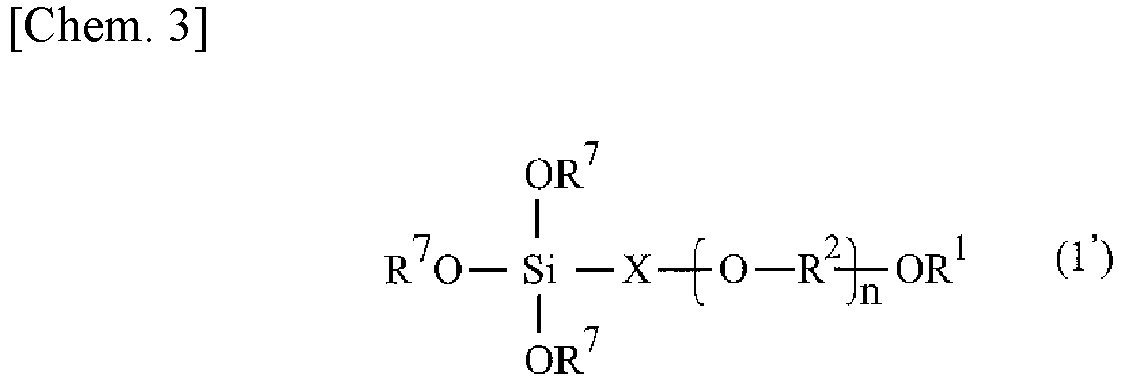
- In Formula (1') mentioned above, R1, R2, X, and n are each the same as those illustrated and described in Formulas (1) to (3) mentioned above, and the preferred aspects thereof are also the same. In the case of using two or more of the compounds represented by Formula (1'), the multiple R1, R2, X, and n may be identical or different.
- In Formula (1') mentioned above, R7, which may be identical or different, represents an aliphatic hydrocarbon group having from 1 to 3 carbon atoms. Examples of the aliphatic hydrocarbon group having from 1 to 3 carbons include: a linear or branched alkyl group, such as a methyl group, an ethyl group, a propyl group, and an isopropyl group; a linear or branched alkenyl group, such as a vinyl group and an allyl group; and an alkynyl group, such as an ethynyl group and a propynyl group. Among the groups, the linear or branched alkyl groups are preferred.
- The modifying mentioned above is preferably performed in a solvent. Examples of the solvent include those listed and described later as the dispersion medium and other organic solvents. Examples of the organic solvents include: aliphatic hydrocarbons (especially, linear saturated aliphatic hydrocarbons), such as hexane, heptane, and octane; aromatic hydrocarbons, such as benzene, toluene, and xylene; alicyclic hydrocarbons, such as cyclohexane and methylcyclohexane; aprotic polar solvents, such as dimethylformamide (DMF), dimethylacetamide, N-methylpyrrolidone, and dimethyl sulfoxide; halogenated hydrocarbons, such as chloroform, dichloromethane, dichloroethane, carbon tetrachloride, chlorobenzene, and trifluoromethylbenzene; chain or cyclic ethers, such as diethyl ether, diisopropyl ether, dimethoxyethane, tetrahydrofuran (THF), and dioxane; and esters, such as ethyl acetate and butyl acetate. Among these solvents, a cyclic ether (e.g., THF) and a chain ketone (e.g., MEK, MIBK) are preferred. One of the solvents listed above may be used, or two or more thereof may be used.
- The modifying mentioned above is performed in such a way that a mixed solution containing a dried nanodiamond, a silane coupling agent, and a solvent is stirred in a reaction vessel.
- In the modifying mentioned above, in a case where ND particle aggregates (agglutinates), with ND particles agglutinated to form secondary particles, are included in the ND particles, the reaction between the polyoxyalkylene chain-containing silane coupling agent and the ND particles may be developed while disintegrating or dispersing the ND particles. Thus, the ND particle aggregates can be disintegrated into primary particles, the surfaces of the ND primary particles can be modified, and the dispersibility of the ND particles can be improved.
- Examples of the method for disintegrating or dispersing the ND particles include methods that process the ND particles using a high shearing mixer, a high shear mixer, a homomixer, a ball mill, a bead mill, a high pressure homogenizer, an ultrasonic homogenizer, a colloid mill, or a jet mill. Among these, implementing an ultrasonic treatment in the presence of a disintegrating medium (such as zirconia beads for example) is preferred. Note that the use of zirconia beads as a disintegrating medium also, as a result, makes it possible to obtain a surface-modified ND composite with zirconia attached thereto or a battery electrolytic solution containing zirconia. The ultrasonic treatment produces cavitation (microbubbles), and the jet blast produced at the time of breakage of the cavitation provides the disintegrating medium with a significantly great kinetic energy. Then, the disintegrating medium collides with the ND aggregates and gives impact energy to release the MD particles from the ND aggregates (disintegration). The silane coupling agent then acts on the dissociated ND particles, and bonds thereto. In a case where the ND particles includes ND agglutinates formed by agglutination of the ND particles, the ND agglutinates can be disintegrated to form primary particles, the surface of the ND primary particles can be modified, and surface-modified NDs having excellent dispersibility can be obtained.
- The diameter of the disintegration medium (such as zirconia beads for example) is, for example, from 15 to 500 µm, preferably from 15 to 300 µm, and particularly preferably from 15 to 100 µm.
- The ratio of the ND particles to the silane coupling agent (former:latter, ratio by mass) supplied for the reaction is, for example, 2:1 to 1:80. Furthermore, the concentration of the ND particles in the solvent is, for example, from 0.5 to 10% by mass, and the concentration of the silane coupling agent in the solvent is, for example, from 5 to 60% by mass.
- The reaction time for the ND particles and the silane coupling agent is, for example, from 4 to 20 hours. Furthermore, the reaction is preferably developed while heat generated is removed with the use of ice water or the like.
- The polyglycerin chain-containing surface-modifying group preferably contains a polyglycerin chain in which a hydrogen atom in at least one hydroxyl group is substituted by a monovalent organic group. The polyglycerin chain in the polyglycerin chain-containing surface-modifying group may directly bind to the ND particle or may bind to the ND particle via a divalent group. Examples of the divalent group include divalent groups listed as Y in Formula (4-2) to be described below.
- Examples of the monovalent organic group include a substituted or unsubstituted hydrocarbon group (a monovalent hydrocarbon group), a substituted or unsubstituted heterocyclic group (a monovalent heterocyclic group), a group in which two or more of the aforementioned groups are bonded, and a group in which an aforementioned group is bonded with a linking group. The bonded group may be directly bonded or may be bonded via a linking group. Examples of the linking group include an amino group, an ether bond, an ester bond, a phosphinic acid group, a sulfide bond, a carbonyl group, an organic group-substituted amide group, an organic group-substituted urethane bond, an organic group-substituted imide bond, a thiocarbonyl group, a siloxane bond, and a group in which two or more of those listed above are bonded. Furthermore, the linking group is a group that attaches to an oxygen atom derived from a hydroxyl group at a terminal of a polyglycerin chain, and examples thereof include a group that binds to the oxygen atom to form an ester group and a group that binds to the oxygen atom to form a urethane bond (such as a carbamoyl group).
- Examples of the hydrocarbon group of the monovalent organic group include, for example, an aliphatic hydrocarbon group, an alicyclic hydrocarbon group, an aromatic hydrocarbon group, and a group in which two or more of those listed above are bonded.
- Examples of the aliphatic hydrocarbon group include an alkyl group, an alkenyl group, and an alkynyl group. Examples of the alkyl group include a C1-20 alkyl group such as a methyl group, an ethyl group, a propyl group, an isopropyl group, a butyl group, a hexyl group, an octyl group, an isooctyl group, a decyl group, and a dodecyl group, preferably a C1-10 alkyl group, and more preferably a C1-4 alkyl group. Examples of the alkenyl group include a C2-20 alkenyl group such as a vinyl group, an allyl group, a methallyl group, a 1-propenyl group, an isopropenyl group, a 1-butenyl group, a 2-butenyl group, a 3-butenyl group, a 1-pentenyl group, a 2-pentenyl group, a 3-pentenyl group, a 4-pentenyl group, and a 5-hexenyl group, preferably a C2-10 alkenyl group, and more preferably a C2-4 alkenyl group. Examples of the alkynyl group include a C2-20 alkynyl group such as an ethynyl group and a propynyl group, preferably a C2-10 alkynyl group, and more preferably a C2-4 alkynyl group.
- Examples of the alicyclic hydrocarbon group include: a C3-12 cycloalkyl group, such as a cyclopropyl group, a cyclobutyl group, a cyclopentyl group, a cyclohexyl group, and a cyclododecyl group; a C3-12 cycloalkenyl group, such as a cyclohexenyl group; and a C4-15 crosslinked cyclic hydrocarbon group, such as a bicycloheptanyl group and a bicycloheptenyl group.
- Examples of the aromatic hydrocarbon group include a C6-14 aryl group, such as a phenyl group and a naphthyl group (especially, a C6-10 aryl group).
- Examples of the heterocycle forming the above heterocyclic group include an aromatic heterocycle and a non-aromatic heterocycle. Examples of such a heterocycle include a 3 to 10-membered ring (preferably a 4 to 6-membered ring) having a carbon atom and at least one heteroatom (for example, oxygen atom, sulfur atom, and nitrogen atom) as atoms constituting the ring, and a condensed ring thereof. Specific examples thereof include a heterocycle containing an oxygen atom as a heteroatom (for example, a 3-membered ring, such as an oxirane ring; a 4-membered ring, such as an oxetane ring; a 5-membered ring, such as a furan ring, a tetrahydrofuran ring, an oxazole ring, an isoxazole ring, and a γ-butyrolactone ring; a 6-membered ring, such as a 4-oxo-4H-pyran ring, a tetrahydropyran ring, and a morpholine ring; a condensed ring, such as a benzofuran ring, an isobenzofuran ring, a 4-oxo-4H-chromene ring, a chroman ring, and an isochroman ring; and a crosslinked ring, such as a 3-oxatricyclo[4.3.1.14,8]undecan-2-one ring and a 3-oxatricyclo[4.2.1.04,8]nonan-2-one ring), a heterocycle containing a sulfur atom as a heteroatom (for example, a 5-membered ring, such as a thiophene ring, a thiazole ring, an isothiazole ring, and a thiadiazole ring; a 6-membered ring, such as a 4-oxo-4H-thiopyran ring; and a condensed ring, such as a benzothiophene ring), and a heterocycle containing a nitrogen atom as a heteroatom (for example, a 5-membered ring, such as a pyrrole ring, a pyrrolidine ring, a pyrazole ring, an imidazole ring, and a triazole ring; a 6-membered ring, such as an isocyanuric ring, a pyridine ring, a pyridazine ring, a pyrimidine ring, a pyrazine ring, a piperidine ring, and a piperazine ring; and a condensed ring, such as an indole ring, an indoline ring, a quinoline ring, an acridine ring, a naphthyridine ring, a quinazoline ring, and a purine ring).
- Furthermore, examples of the group in which an aliphatic hydrocarbon group and an alicyclic hydrocarbon group are bonded include a cyclohexylmethyl group and a methylcyclohexyl group. Examples of the group in which an aliphatic hydrocarbon group and an aromatic hydrocarbon group are bonded include a C7-18 aralkyl group (especially, a C7-10 aralkyl group), such as a benzyl group and a phenethyl group; a C6-10 aryl-C2-6 alkenyl group, such as a cinnamyl group; a C1-4 alkyl-substituted aryl group, such as a tolyl group; and a C2-4 alkenyl-substituted aryl group, such as a styryl group.
- Examples of the group in which two or more of the aforementioned monovalent hydrocarbon group and/or the aforementioned monovalent heterocyclic group are bonded via a linking group include a group in which the aforementioned monovalent hydrocarbon group and/or the aforementioned monovalent heterocyclic group is bonded with an alkoxy group, an alkenyloxy group, an alkynyloxy group, an aryloxy group, an aralkyloxy group, an acyloxy group, an alkylthio group, an alkenylthio group, an arylthio group, an aralkylthio group, an acyl group, an alkenylcarbonyl group, an arylcarbonyl group, an aralkylcarbonyl group, an alkoxycarbonyl group, an alkenyloxycarbonyl group, an aryloxycarbonyl group, an aralkyloxycarbonyl group, a dialkylamino group, an acylamino group, an oxetanyl group-containing group, or a carbamoyl group, or, a group in which the aforementioned monovalent hydrocarbon group and/or the aforementioned monovalent heterocyclic group is bonded with two or more of the groups listed above.
- The monovalent organic group may have a substituent. Examples of the substituent include: a halogen atom, such as a fluorine atom, a chlorine atom, a bromine atom, and an iodine atom; a hydroxyl group; a mercapto group; a carboxy group; an amino group; and an oxo group.
- The monovalent organic group is preferably a group represented by Formula (4-1) below.
-X1-R8 (4-1)
- In Formula (4-1) above, X1 represents a single bond, -C(=O)-, or -C(=O)-NH-. R8 represents a monovalent organic group, and an atom that binds to X1 is a carbon atom.
- Examples of the monovalent organic group of R8 include a substituted or unsubstituted hydrocarbon group (a monovalent hydrocarbon group), a substituted or unsubstituted heterocyclic group (a monovalent heterocyclic group), and a group in which two or more of the aforementioned groups are bonded. The bonded group may be directly bonded or may be bonded via a linking group. Examples of the linking group include an amino group, an ether bond, an ester bond, a phosphinic acid group, a sulfide bond, a carbonyl group, an organic group-substituted amide group, an organic group-substituted urethane bond, an organic group-substituted imide bond, a thiocarbonyl group, a siloxane bond, and a group in which two or more of those listed above are bonded. Examples of each of the monovalent hydrocarbon group, the monovalent heterocyclic group, and the group in which two or more of the aforementioned groups are bonded include those listed and described as the monovalent organic group in the polyglycerin chain-containing surface-modifying group (a monovalent organic group bonded to an oxygen atom derived from a hydroxyl group at a terminal of a polyglycerin chain).
- Among these, R8 described above is preferably a substituted or unsubstituted hydrocarbon group, more preferably an alkyl group, even more preferably an alkyl group having from 1 to 18 carbons, further preferably an alkyl group having from 1 to 6 carbons, still further preferably an alkyl group having from 1 to 4 carbons, and particularly preferably an ethyl group and a butyl group. When there are multiple groups represented by Formula (4-1) above contained in the polyglycerin chain-containing surface-modifying group, R8s in the groups represented by Formula (4-1) above may be identical or different from each other.
- The polyglycerin chain-containing surface-modifying group in which a hydrogen atom in at least one hydroxyl group in a polyglycerin chain is substituted by a monovalent organic group preferably has a polyglycerin chain represented by Formula (4-2) below. Note that the polyglycerin chain includes a polyglycerin chain having a linear chain structure, a branched chain structure, and a cyclic structure.
-Y-(C3H6O2)p-(C3H5O2R9)q-OR10 (4-2)
- The [C3H6O2] indicated by "p" in Formula (4-2) above has at least one of the structures represented by Formulas (5) to (7) below.
-OCH2-CHOH-CH2- (5)
-OCH(CH2OH)-CH2- (6)
-OCH2-CH(CH2OH)- (7)
- The [C3H5O2R9] indicated by "q" in Formula (4-2) above has at least one of the structures represented by Formulas (8) to (10) below.
-OCH2-CH(OR9)-CH2- (8)
-OCH(CH2OR9)-CH2- (9)
-OCH2-CH(CH2OR9)- (10)
- In Formula (4-2) above, p and q each represent an average degree of polymerization (number average degree of polymerization) of the repeating units in parentheses. P is a value of 0 or greater, q is a value of 0 or greater, and p + q is a value of 1 or greater. However, when R10 is a hydrogen atom, q represents a value greater than 0. The value of p + q is preferably from 1 to 100, more preferably from 2 to 40, and even more preferably from 3 to 30. When the value of p + q is 1 or greater, the steric hindrance between the surface-modifying groups is sufficient, and dispersion in the dispersion medium is facilitated. When the value of p + q is 50 or less, the surface-modifying groups are kept from being entangled, and dispersion in the dispersion medium is facilitated. In addition, properties as a nanodiamond material are less likely to be impaired. Note that the value of [q/(p + q)] is preferably 0.6 or greater, such as from 0.8 to 1.0.
- Note that the average degree of polymerization is defined as the number of glycidol units constituting a polyglycerin chain bonded to one surface functional group of the raw material nanodiamond. The number of surface functional groups of the raw material nanodiamond can be determined by carrying out elemental analysis or acid number measurement of the raw material nanodiamond, or by the two techniques in combination.
- In Formula (4-2), R9 represents a monovalent organic group, and preferably represents a group represented by Formula (4-1) above. Examples of the monovalent organic group of R9 include those listed and described as the monovalent organic group in the polyglycerin chain-containing surface-modifying group (a monovalent organic group bonded to an oxygen atom derived from a hydroxyl group at a terminal of a polyglycerin chain).
- In Formula (4-2) above, [-OR10] represents a terminal of a polyglycerin chain, while R10 represents a hydrogen atom or a monovalent organic group, preferably represents a group represented by Formula (4-1) above. When R10 is a monovalent organic group, the multiple R10s in Formula (4-2) above is preferably the same. Examples of the monovalent organic group of R10 include those listed and described as the monovalent organic group in the polyglycerin chain-containing surface-modifying group (a monovalent organic group bonded to an oxygen atom derived from a hydroxyl group at a terminal of a polyglycerin chain).
- In Formula (4-2), Y represents a single bond or a divalent group, and a bond extending from Y to the left binds to the ND particle. Examples of the divalent group include an amino group (-NH-), an ether bond (-O-), an ester bond (-C(=O)O-), a phosphinic acid group (-PH(=O)O-), a sulfide bond (-S-), a carbonyl group (-C(=O)-), an amide group (-C(=O)-NH-), a urethane bond (-NH-C(=O)-O-), an imide bond (-C(=O)-NH-C(=O)-), a thiocarbonyl group (-C(=S)-), a siloxane bond (-Si-O-), a divalent hydrocarbon group, and a group in which two or more of those listed above are bonded. Examples of the divalent hydrocarbon group include a residue in which one hydrogen atom is removed from the monovalent hydrocarbon group. Furthermore, the divalent group may have a substituent. Examples of the substituent include those listed and described as the substituent that the monovalent organic group may have.
- Among these, Y described above is preferably a single bond, -NH-, -O-,-C(=O)O-, -PH(=O)O-, and -S-, and more preferably a single bond.
- In Formula (4-2) above, the binding order of the constituent unit indicated by "p" and the constituent unit indicated by "q" is not particularly limited. That is, the oxygen atom that binds to Y in Formula (4-2) may be an oxygen atom in the constituent unit indicated by "p", or may be an oxygen atom in the constituent unit indicated by "q". Similarly, the carbon atom in Formula (4-2) that binds to OR10 in Formula (4-2) may be a carbon atom in the constituent unit indicated by "p", or may be a carbon atom in the constituent unit indicated by "q". In a case where one of p and q has a value of 1 or greater while the other has a value of 2 or greater, the method of binding the constituent unit indicated by "p" and the constituent unit indicated by "q" may be any of random, alternating, and block. When there are multiple constituent units indicated by "q", the multiple R9s may be identical or different from each other. In a case where the multiple R9s are different from each other, the binding form of the constituent unit indicated by "q" may be a random, alternating, or block form.
- A mass ratio of ND to polyglycerin chain-containing surface-modifying group in the polyglycerin chain surface-modified ND [ND/polyglycerin chain-containing surface-modifying group] is not particularly limited, but is preferably from 0.5 to 1.0, and more preferably from 0.6 to 0.8. When the mass ratio is 0.5 or greater, especially 0.6 or greater, properties as a nanodiamond material are less likely to be impaired. When the mass ratio is 1.0 or less, especially 0.8 or less, the degree of modification of the polyglycerin chain-containing surface-modifying group is sufficient, and dispersibility in the battery electrolytic solution is superior. The mass ratio can be determined based on a weight loss rate as measured by a thermogravimetric analysis, with the weight loss being considered as the mass of the polyglycerin chain-containing surface-modifying group.
- As a first aspect, the polyglycerin chain-containing surface-modified ND preferably has an absorption peak from around 1510 to 1540 cm-1 and an absorption peak from around 1700 to 1730 cm-1 in the FT-IR spectrum. The polyglycerin chain-containing surface-modified ND having such an absorption peak is inferred to be a surface-modified ND represented by Formula (4-1) above in which X1 is -C(=O)-NH-. The absorption peak from around 1510 to 1540 cm-1 is inferred to be a peak originating from the N-H stretching vibration while the absorption peak from around 1700 to 1730 cm-1 is inferred to be a peak originating from the C=O stretching vibration. The absorption peak may vary slightly depending on the R8 in Formula (4-1) above.
- Furthermore, as a second aspect, the polyglycerin chain-containing surface-modified ND preferably has an absorption peak from around 1730 to 1750 cm-1 in the FT-IR spectrum. The polyglycerin chain-containing surface-modified ND having such an absorption peak is inferred to be a surface-modified ND in which X1 in Formula (4-1) is -C(=O)-. An intense, sharp absorption peak from around 1730 to 1750 cm-1 is inferred to be a peak originating from the C=O stretching vibration. The absorption peak may vary slightly depending on the R8 in Formula (4-1) above.
- The polyglycerin chain-containing surface-modified ND preferably has a peak from around 140 to 200 ppm in the 13C-NMR spectrum. The polyglycerin chain-containing surface-modified ND having such a peak is inferred to be a polyglycerin chain-containing surface-modified ND in which X1 in Formula (4-1) contains a carbonyl carbon such as -C(=O)- or -C(=O)-NH-. Furthermore, the polyglycerin chain-containing surface-modified ND preferably has a peak from around 60 to 85 ppm in the 13C-NMR spectrum. This peak is inferred to be a peak originating from polyglycerin. Furthermore, the polyglycerin chain-containing surface-modified ND preferably has a peak from around 5 to 45 ppm in the 13C-NMR spectrum. The polyglycerin chain-containing surface-modified ND having such a peak is inferred to be a polyglycerin chain-containing surface-modified ND in which R in Formula (4-1) contains a monovalent aliphatic hydrocarbon group. This peak may vary slightly depending on the R8 in Formula (4-1) above.
- A median size (D50) of the polyglycerin chain-containing surface-modified ND, when being dispersed in at least one electrolytic solution, is preferably from 5 to 100 nm, more preferably from 5 to 80 nm, and even more preferably from 5 to 50 nm, in order to achieve a 0.1 mass% content ratio of surface-modified ND. When the median size is within such a range, dispersibility in an electrolytic solution is superior.
- The polyglycerin chain-containing surface-modified ND can be obtained by ring-opening polymerization of glycidol directly on the ND particles. The ND particles naturally have carboxyl groups and hydroxyl groups formed in the production process, and the surfaces of the NDs can be modified with polyglycerin chains by reacting these functional groups with glycidol.
- The reaction between the ND particles and glycidol (ring-opening polymerization) can be carried out, for example, by adding glycidol and a catalyst to the ND particles in an inert gas atmosphere and heating to 50 to 100°C. An acidic catalyst or a basic catalyst can be used as the catalyst. Examples of the acidic catalyst include boron trifluoride etherate, acetic acid, and phosphoric acid. Examples of the basic catalyst include triethylamine, pyridine, dimethylaminopyridine, and triphenylphosphine.
- Conditions of ring-opening polymerization of glycidol can be referred to: S. R. Sandler et al., J. Polym. Sci., Polym. Chem. Ed., Vol. 4, 1253 (1966); E. J. Vanderberg, J. Polym. Sci., Polym. Chem. Ed., vol. 23, 915 (1985); and G. R. Newcome et al., Dendritic Macromolecules: Concepts, Syntheses, Perspectives, VCH, Weinheim (1996).
- The polyglycerin chain-containing surface-modified ND can also be obtained by ring-opening polymerization of glycidol on ND particles in which a functional group containing active hydrogen is introduced to the surfaces. The functional group containing active hydrogen is not particularly limited, and examples thereof include an amino group, a hydroxyl group, a carboxyl group, a mercapto group (a thiol group), and a phosphinic acid group. A method for introducing the functional group containing active hydrogen to ND particles can be referred to, for example,
JP 2012-82103 A JP 2010-248023 A - The surface-modifying group in which a hydrogen atom of a hydroxyl group in at least one polyglycerin chain is substituted by a monovalent organic group can be obtained, for example, by reacting an alcohol, an isocyanate ester, or a carboxylic acid chloride with the polyglycerin chain surface-modified ND obtained by ring-opening polymerization of glycidol as described above. The compounds to be used in the reaction can be selected as appropriate according to the type of the desired surface modifying group. One of an alcohol, an isocyanate ester, and a carboxylic acid chloride may be used, or two or more thereof may be used.
- When an alcohol is used, the polyglycerin chain-containing surface-modified ND can be obtained by reacting the surface-modified ND to which a polyglycerin chain has been introduced and the alcohol to cause dehydration condensation and form an ether bond. When an isocyanate ester is used, the polyglycerin chain-containing surface-modified ND can be obtained by reacting the surface-modified ND to which a polyglycerin chain has been introduced and the isocyanate ester to add the isocyanate group in the isocyanate ester and the aforementioned hydroxyl group and form a urethane bond (carbamoyl group). Furthermore, when a carboxylic acid chloride is used, the polyglycerin chain-containing surface-modified ND can be obtained by reacting the surface-modified ND to which a polyglycerin chain has been introduced and the carboxylic acid chloride and form an ester bond.
- The alcohol, the isocyanate ester, and the carboxylic acid chloride can be selected as appropriate according to the polyglycerin chain-containing surface-modified ND to be obtained. An organic group bonded to the hydroxyl group in the alcohol, an organic group on the nitrogen atom in the isocyanate ester, and an organic group bonded to the carbonyl group in the carboxylic acid chloride each corresponds to R8 in Formula (4-1) above, and examples thereof include the monovalent organic groups listed and described as R8 above.
- Among these, the alcohol is preferably a C1-18 alcohol, more preferably ethanol, n-butanol, and n-hexanol.
- Among these, the isocyanate ester is preferably an alkyl isocyanate, more preferably a C1-18 alkyl isocyanate, and even more preferably ethyl isocyanate, n-butyl isocyanate, and n-hexyl isocyanate.
- Among these, the carboxylic acid chloride is preferably an acyl chloride, and from the number of carbons in the acyl group, it is preferably a C1-19 alkyl, and more preferably valeryl chloride.
- A reaction with the alcohol, the isocyanate ester, or the carboxylic acid chloride may be performed in a solvent. Examples of the solvent include the organic solvents described above. The reaction can be performed, for example, by adding a catalyst to the ND particles in an inert gas atmosphere and stirring at room temperature. The catalyst is preferably a basic catalyst. Examples of the basic catalyst include a tertiary amine such as triethylamine, pyridine, dimethylaminopyridine, and triphenylphosphine. Note that when the basic catalyst is a liquid, the basic catalyst may be used as the reaction solvent.
- A ratio of the polyglycerin chain surface-modified ND particles to be subjected to a reaction to the alcohol, the isocyanate ester, and/or the carboxylic acid chloride (former:latter, mass ratio) is, for example, from 2:1 to 1:80. Furthermore, a concentration of the polyglycerin chain surface-modified ND particles in the solvent is, for example, from 0.5 to 10 mass%, and a concentration of the isocyanate ester in the solvent is, for example, from 5 to 60 mass%.
- A reaction time between the polyglycerin chain surface-modified ND particles and the alcohol, the isocyanate ester, and/or the carboxylic acid chloride is, for example, from 4 to 24 hours.
- A known or commonly used electrolyte that can be used in a battery electrolytic solution can be used as the electrolyte. The electrolyte is preferably an electrolyte that can be used in a non-aqueous electrolytic solution, and a lithium salt is preferable. Examples of the lithium salt include LiPF6, LiBF4, LiNCF3SO3, LiN(SO2F)2, LiClO4, LiAsF6, Li2SiF6, LiOSO2CkF(2k+1) (k being an integer from 1 to 8), LiN(SO2CkF(2k+1))2 (k being an integer from 1 to 8), LiPFn(CkF(2k+1))(6-n) (n being an integer from 1 to 5, k being an integer from 1 to 8), LiBFnCkF(2k+1) (n being an integer from 1 to 3, k being an integer from 1 to 8), LiB(C2O4)2 (lithium bisoxalylborate), LiBF2(C2O4) (lithium difluorooxalylborate), LiPF3(C2O4) (lithium trifluorooxalylphosphate), LiC(SO2RI)(SO2RII)(SO2RIII), LiN(SO2ORIV)(SO2ORV), and LiN(SO2RVI)(SO2ORVII). Note that in the formulas above, RI to RVII all or independently represent a perfluoroalkyl group having from 1 to 8 carbons. Among these, from the viewpoint of achieving superior dispersibility of the nanocarbon material, LiPF6, LiBF4, LiN(SO2CF3)2, LiNCF3SO3, and LiN(SO2F)2 are preferable. One of the electrolytes may be used, or two or more thereof may be used.
- The dispersion medium functions as a solvent for the electrolyte and a dispersion medium for the nanocarbon material in the battery electrolytic solution. A known or commonly used solvent that can be used in a battery electrolytic solution can be used as the dispersion medium. The dispersion medium is preferably a non-aqueous solvent, and examples thereof include a carbonate compound such as a saturated cyclic carbonate and a chain carbonate, a cyclic carboxylate ester, a cyclic ether, and a sulfone compound. One of the dispersion media may be used, or two or more thereof may be used.
- Examples of the saturated cyclic carbonate include those containing an alkylene group having from 2 to 4 carbons, preferably a saturated cyclic carbonate having from 2 to 3 carbons. Examples of the saturated cyclic carbonate include ethylene carbonate, propylene carbonate, and butylene carbonate.
- Examples of the chain carbonate include those having from 3 to 7 carbons, preferably a chain carbonate having from 3 to 5 carbons. Examples of the chain carbonate include dimethyl carbonate, diethyl carbonate, di-n-propyl carbonate, diisopropyl carbonate, n-propyl isopropyl carbonate, ethyl methyl carbonate, methyl-n-propyl carbonate, n-butyl methyl carbonate, isobutyl methyl carbonate, t-butyl methyl carbonate, ethyl-n-propyl carbonate, n-butyl ethyl carbonate, isobutyl ethyl carbonate and t-butyl ethyl carbonate.
- Additional examples of the chain carbonate include a chain carbonate having a fluorine atom (hereinafter, also referred to as "fluorinated chain carbonate"). A number of fluorine atoms contained in the fluorinated chain carbonate is 1 or more. An upper limit of the number of fluorine atoms is, for example, 6, preferably 4. When the fluorinated chain carbonate has multiple fluorine atoms, the multiple fluorine atoms may bind to the same carbon atom or may bind to different carbon atoms. Examples of the fluorinated chain carbonate include a fluorinated dimethyl carbonate derivative, a fluorinated ethyl methyl carbonate derivative, and a fluorinated diethyl carbonate derivative.
- Examples of the fluorinated dimethyl carbonate derivative include fluoromethyl methyl carbonate, difluoromethyl methyl carbonate, trifluoromethyl methyl carbonate, bis(fluoromethyl) carbonate, bis(difluoromethyl) carbonate, and bis(trifluoromethyl) carbonate.
- Examples of the fluorinated ethyl methyl carbonate derivative include 2-fluoroethyl methyl carbonate, ethyl fluoromethyl carbonate, 2,2-difluoroethyl methyl carbonate, 2-fluoroethyl fluoromethyl carbonate, ethyl difluoromethyl carbonate, 2,2,2-trifluoroethyl methyl carbonate, 2,2-difluoroethyl fluoromethyl carbonate, 2-fluoroethyl difluoromethyl carbonate, and ethyl trifluoromethyl carbonate.
- Examples of the fluorinated diethyl carbonate derivative include ethyl-(2-fluoroethyl) carbonate, ethyl-(2,2-difluoroethyl) carbonate, bis(2-fluoroethyl) carbonate, ethyl-(2,2,2-trifluoroethyl) carbonate, 2,2-difluoroethyl-2'-fluoroethyl carbonate, bis(2,2-difluoroethyl) carbonate, 2,2,2-trifluoroethyl-2'-fluoroethyl carbonate, 2,2,2-trifluoroethyl-2',2'-difluoroethyl carbonate, and bis(2,2,2-trifluoroethyl) carbonate.
- Examples of the cyclic carboxylate ester include a cyclic carboxylate ester having from 3 to 12 carbons, preferably a cyclic carboxylate ester having from 3 to 10 carbons, more preferably a cyclic carboxylate ester having from 3 to 8 carbons. Examples of the cyclic carboxylate ester include γ-butyrolactone, γ-valerolactone, γ-caprolactone, and epsilon-caprolactone.
- Examples of the cyclic ether include a cyclic ether having from 3 to 6 carbons, preferably a cyclic ether having from 3 to 5 carbons. Examples of the cyclic ether include tetrahydrofuran, 2-methyltetrahydrofuran, 3-methyltetrahydrofuran, 1,3-dioxane, 2-methyl-1,3-dioxane, 4-methyl-1,3-dioxane, 1,4-dioxane, and fluorinated compounds thereof.
- Examples of the sulfone compound include a cyclic sulfone and a chain sulfone. A number of carbons in the cyclic sulfone is, for example, from 3 to 6, preferably from 3 to 5. A number of carbons in the chain sulfone is, for example, from 2 to 6, preferably from 2 to 5. Furthermore, a number of sulfonyl groups in one molecule of the sulfone compound is not particularly limited, but is typically 1 or 2.
- Examples of the cyclic sulfone include a monosulfone compound such as a trimethylenesulfone, a tetramethylenesulfone, and a hexamethylenesulfone; and
a disulfone compound such as a trimethylenedisulfone, a tetramethylenedisulfone, and a hexamethylenedisulfone. - Examples of the tetramethylenesulfone (a sulfolane) include a sulfolane, 2-methylsulfolane, 3-methylsulfolane, 2-fluorosulfolane, 3-fluorosulfolane, 2,2-difluorosulfolane, 2,3-difluorosulfolane, 2,4-difluorosulfolane, 2,5-difluorosulfolane, 3,4-difluorosulfolane, 2-fluoro-3-methylsulfolane, 2-fluoro-2-methylsulfolane, 3-fluoro-3-methylsulfolane, 3-fluoro-2-methylsulfolane, 4-fluoro-3-methylsulfolane, 4-fluoro-2-methylsulfolane, 5-fluoro-3-methylsulfolane, 5-fluoro-2-methylsulfolane, 2-fluoromethylsulfolane, 3-fluoromethylsulfolane, 2-difluoromethylsulfolane, 3-difluoromethylsulfolane, 2-trifluoromethylsulfolane, 3-trifluoromethylsulfolane, 2-fluoro-3-(trifluoromethyl)sulfolane, 3-fluoro-3-(trifluoromethyl)sulfolane, 4-fluoro-3-(trifluoromethyl)sulfolane, and 5-fluoro-3-(trifluoromethyl)sulfolane.
- Examples of the chain sulfone include dimethyl sulfone, ethyl methyl sulfone, diethyl sulfone, n-propyl methyl sulfone, n-propyl ethyl sulfone, di-n-propyl sulfone, isopropyl methyl sulfone, isopropyl ethyl sulfone, diisopropyl sulfone, n-butyl methyl sulfone, n-butyl ethyl sulfone, t-butyl methyl sulfone, t-butyl ethyl sulfone, monofluoromethyl methyl sulfone, difluoromethyl methyl sulfone, trifluoromethyl methyl sulfone, monofluoroethyl methyl sulfone, difluoroethyl methyl sulfone, trifluoroethyl methyl sulfone, pentafluoroethyl methyl sulfone, ethyl monofluoromethyl sulfone, ethyl difluoromethyl sulfone, ethyl trifluoromethyl sulfone, perfluoroethyl methyl sulfone, ethyl trifluoroethyl sulfone, ethyl pentafluoroethyl sulfone, di(trifluoroethyl) sulfone, perfluorodiethyl sulfone, fluoromethyl-n-propyl sulfone, difluoromethyl-n-propyl sulfone, trifluoromethyl-n-propyl sulfone, fluoromethyl isopropyl sulfone, difluoromethyl isopropyl sulfone, trifluoromethyl isopropyl sulfone, trifluoroethyl-n-propyl sulfone, trifluoroethyl isopropyl sulfone, pentafluoroethyl-n-propyl sulfone, pentafluoroethyl isopropyl sulfone, trifluoroethyl-n-butyl sulfone, trifluoroethyl-t-butyl sulfone, pentafluoroethyl-n-butyl sulfone, and pentafluoroethyl-t-butyl sulfone.
- Among the dispersion media listed above, a saturated cyclic carbonate, a chain carbonate, and a cyclic carboxylate ester are preferable, and ethylene carbonate, propylene carbonate, γ-butyrolactone, dimethyl carbonate, diethyl carbonate, and ethyl methyl carbonate are more preferable, from the viewpoint of achieving superior dispersibility of the nanocarbon material.
- The battery electrolytic solution may further contain a dispersant. In particular, when the nanocarbon material is ND, the battery electrolytic solution preferably contains a dispersant (sometimes referred to as "dispersant [A]") having a mass average molecular weight of 500 or greater and an amine value of 15 mg KOH/g or greater. By using such a dispersant, the dispersibility of ND particles in the battery electrolytic solution is outstanding. One of the dispersion media may be used, or two or more thereof may be used.
- The mass average molecular weight of the dispersant (A) is 500 or greater, preferably 650 or greater, and more preferably 950 or greater. Furthermore, the mass average molecular weight is preferably 20000 or less, more preferably 10000 or less. Note that the mass average molecular weight in the present specification is a molecular weight measured by gel permeation chromatography (GPC) and calibrated with a polystyrene standard.
- The amine value of the dispersant (A) is 15 mg KOH/g or greater, preferably 18 mg KOH/g or greater, more preferably 20 mg KOH/g or greater, and even more preferably 30 mg KOH/g or greater. Furthermore, the amine value is preferably 100 mg KOH/g or less, more preferably 90 mg KOH/g or less, and even more preferably 60 mg KOH/g or less.
- Among these, the dispersant (A) is preferably a compound having a structure derived from a polyalkylene glycol monoalkyl ether, especially a structure derived from polyethylene glycol monoalkyl ether or a structure derived from polypropylene glycol monoalkyl ether, a compound having a carbamate structure, and a compound having a structure derived from polycaprolactone. One of the compounds may be contained, or two or more thereof may be contained. Furthermore, one compound alone may have one or two or more of the structures described above.
- A commercially available product can be used as the dispersant (A). Examples of the commercially available product as the dispersant (A) include a product under the trade name "DISPERBYK-2008", a product under the trade name "BYK-9076", a product under the trade name "BYK-9077", and a product under the trade name "ANTI-TERRA-U", all available from BYK-Chemie GmbH.
- When the dispersant (A) is used, the nanocarbon material is preferably a surface-modified ND having a silane compound bonded to the surface.
- The silane compound preferably has a hydrolyzable group and an aliphatic hydrocarbon group. The silane compound used for surface modification of the ND particles may be only one type, or may be two or more types.
- Among these, the silane compound preferably contains at least a compound represented by Formula (11-1) below.

- In Formula (11-1), R11, R12, and R13 all or independently represent an aliphatic hydrocarbon group having from 1 to 3 carbons. R14 represents an aliphatic hydrocarbon group having one or more carbons.
- Examples of the aliphatic hydrocarbon group having from 1 to 3 carbons as R11, R12, and R13 include: a linear or branched alkyl group, such as a methyl group, an ethyl group, a propyl group, and an isopropyl group; a linear or branched alkenyl group, such as a vinyl group and an allyl group; and an alkynyl group, such as an ethynyl group and a propynyl group. Among the groups, the linear or branched alkyl groups are preferred.
- R14 is preferably an aliphatic hydrocarbon group having one or more carbons, and examples thereof include: a linear or branched alkyl group, such as a methyl group, an ethyl group, a propyl group, an isopropyl group, a butyl group, an isobutyl group, an s-butyl group, a t-butyl group, a pentyl group, a hexyl group, an n-octyl group, a 2-ethylhexyl group, a nonyl group, an isononyl group, a decyl group, an isodecyl group, a lauryl group, a myristyl group, an isomyristyl group, a butyloctyl group, an isocetyl group, a hexyldecyl group, a stearyl group, an isostearyl group, an octyldecyl group, an octyldodecyl group, and an isobehenyl group; a linear or branched alkenyl group, such as a vinyl group, an allyl group, a 1-butenyl group, a 7-octenyl group, an 8-nonenyl group, a 9-decenyl group, a 11-dodecenyl group, and an oleyl group; and a linear or branched alkynyl group, such as an ethynyl group, a propynyl group, a decynyl group, a pentadecynyl group, and an octadecynyl group.
- Among these, R14 is preferably an aliphatic hydrocarbon group having 4 or more carbons, particularly preferably an aliphatic hydrocarbon group having 6 or more carbons, from the viewpoint of achieving greater steric hindrance to obtain an excellent aggregation suppressing effect and impart higher dispersibility. Note that the upper limit of the number of carbons of the aliphatic hydrocarbon group is, for example, 25, and is preferably 20, and more preferably 12. Furthermore, the aliphatic hydrocarbon group is preferably a linear or branched alkyl group or alkenyl group, particularly preferably a linear or branched alkyl group.
- When R14 is an aliphatic hydrocarbon group having 4 or more carbons, miscibility to an organic dispersion medium is exhibited, and a larger steric hindrance can be obtained, resulting in an excellent aggregation suppression effect. Furthermore, the groups containing an oxygen atom (the OR11' group and the OR12' group in Formula [11]) exhibit miscibility to the dispersion medium, and therefore miscibility to the dispersion medium is excellent, and even better dispersibility in the battery electrolytic solution can be exhibited.
- Therefore, examples of the ND particles surface-modified by a silane compound (silane compound surface-modified ND particles) include ND particles having a structure in which the surface is modified by a group represented by Formula (11) below.

- In Formula (11), R14 represents an aliphatic hydrocarbon group having one or more carbons. R11' and R12' both or independently represent a hydrogen atom, an aliphatic hydrocarbon group having from 1 to 3 carbons, or a group represented by Formula (b) below. The bond indicated by a wavy line in the formula bonds to the surface of the nanodiamond particles.


- In Formula (b), R14 represents an aliphatic hydrocarbon group having one or more carbons. R13 and R15 both or independently represent a hydrogen atom or an aliphatic hydrocarbon group having from 1 to 3 carbons. r and s both or independently represent an integer of 0 or more. Note that the bond extending to the left from the silicon atom bonds to an oxygen atom. In addition, the bond marked by a wavy line binds to the surface of a nanodiamond particle. The R14 in Formula (11) corresponds to the R14 in Formula (11-1).
- Examples of the aliphatic hydrocarbon group having from 1 to 3 carbons as R11', R12', R13, and R15 in Formula (11) above include: a linear or branched alkyl group, such as a methyl group, an ethyl group, a propyl group, and an isopropyl group; a linear or branched alkenyl group, such as a vinyl group and an allyl group; and an alkynyl group, such as an ethynyl group and a propynyl group. Among the groups, the linear or branched alkyl groups are preferred.
- r and s, each a number of constituent units represented by the content in brackets, both or independently represent an integer of 0 or more. In a case where r and s are each 2 or more, the bonding method of two or more constituent units may be any of random, alternating, or block.
- The silane compound surface-modified ND particles may have, in addition to a group represented by Formula (11) above, another functional group, such as a group represented by Formula (11') below or another surface functional group such as an amino group, a hydroxyl group, and a carboxyl group. The above other functional groups may be only one type or may be two or more types.

- In Formula (11') above, R11' and R14 are the same as those described above. The bond indicated by a wavy line in the formula bonds to the surface of the ND particles.
- In a case where a silane compound, especially a compound represented by Formula (11-1) above, is used as the compound that performs a surface treatment, the hydrolyzable alkoxysilyl groups, such as the OR11 group, the OR12 group, and the OR13 group of the compound in Formula (11-1), are easily hydrolyzed to form silanol groups. Therefore, for example, one of the silanol groups undergoes dehydration condensation with a hydroxyl group present on the surface of the ND particle and forms a covalent bond, while the other silanol groups of the silane compound can condense and form a siloxane bond (Si-O-Si) with the remaining two silanol groups. Thus, the compound can impart, to the ND particles, miscibility to the dispersion medium, and superb dispersibility in the battery electrolytic solution can be exhibited.
- The battery electrolytic solution may contain only the electrolyte, the nanocarbon material, and the dispersion medium. Furthermore, the battery electrolytic solution may additionally contain a dispersant, and may further contain, within a range in which the effects described above are not impaired, a known or commonly used additive for a battery electrolytic solution such as an overcharge inhibitor.
- A content ratio of the nanocarbon material in the battery electrolytic solution is, for example, from 1 to 100000 mass ppm, preferably from 10 to 10000 mass ppm, and more preferably from 100 to 1000 mass ppm. The battery electrolytic solution has an outstanding dispersibility of nanocarbon material at a content ratio within such a range.
- A content ratio of the electrolyte in the battery electrolytic solution is, for example, from 5 to 30 mass%, preferably from 8 to 18 mass%, and more preferably from 10 to 15 mass%. When the content ratio is within such a range, conductivity is appropriate.
- A content ratio of the dispersion medium in the battery electrolytic solution is, for example, from 75 to 94 mass%. Furthermore, a content ratio of the non-aqueous solvent with respect to the total amount of the dispersion medium is, for example, 60 mass% or greater, preferably 70 mass% or greater, even more preferably 80 mass% or greater, and particularly preferably 90 mass% or greater.
- A content ratio of the dispersant, such as the dispersant (A), in the battery electrolytic solution per 100 parts by mass of the total amount of the nanocarbon material is, for example, from 0.1 to 10000 parts by mass, preferably from 10 to 1000 parts by mass, and more preferably from 50 to 500 parts by mass. When the content ratio of the dispersant is within such a range, dispersibility of nanocarbon material in the battery electrolytic solution is superior.
- The battery electrolytic solution has a haze value of preferably 5 or less, more preferably 3 or less, even more preferably 1 or less. Since the battery electrolytic solution has excellent dispersibility of nanocarbon material, it is possible to obtain an electrolytic solution having such a haze value. The haze value can be measured according to JIS K 7136.
- A viscosity at 25°C of the battery electrolytic solution is preferably from 0.1 to 100 mPa·s, more preferably from 0.5 to 50 mPa·s, and even more preferably from 1.0 to 30 mPa·s. A rotor and a rotational speed of the rotor at the time of measuring the viscosity are selected as appropriate based on the measured values. The viscosity can be measured using, for example, an EMS viscometer (trade name "EMS 1000", available from Kyoto Electronics Co., Ltd.).
- The battery electrolytic solution may be an electrolytic solution for either a primary battery or a secondary battery. Of these, the battery electrolytic solution is preferably an electrolytic solution for a secondary battery because, as a result of excellent dispersibility of nanocarbon material, the nanocarbon material freely moves between the cathode and the anode through the holes in the separator, forming a smooth layer of metal on an electrode or an active material during charging and discharging. In particular, the battery electrolytic solution is preferably an electrolytic solution for a lithium ion battery because the battery electrolytic solution has outstanding dispersibility in an electrolytic solution for a lithium ion battery. Note that a shape of the battery is not particularly limited, and may be, for example, a cylindrical shape, a square shape, a laminate shape, a coin shape, or a shape of a large size.
- According to the battery electrolytic solution described above, a battery electrolytic solution in which a nanocarbon material is highly dispersed can be provided. Thus, the battery electrolytic solution can be applied to a battery, especially a lithium ion battery, for practical use. Furthermore, when the battery electrolytic solution is used in a battery provided with a separator, the nanocarbon material can freely move between the cathode and the anode through the holes in the separator. Furthermore, even when the battery electrolytic solution is used in a battery, such as a lithium ion secondary battery, in which dendrites tend to form as a result of repeated charging and discharging or overcharging, a smooth layer of lithium can be formed, suppressing the formation of dendrites and preventing piercing of the separator by dendrites. Therefore, by using the battery electrolytic solution described above, it is not necessary to use a separator with a high strength, and the options for separator that can be used are expanded.
- Each aspect disclosed in the present specification can be combined with any other feature disclosed herein. The configurations, combinations thereof, and the like in each embodiment of the present invention are examples, and various configurational additions, omissions, substitutions, and other changes may be made as appropriate without departing from the spirit of the present invention. Furthermore, inventions according to the present invention are not limited by the embodiments or the following examples, but are limited only by the claims.
- An embodiment of the present invention will be described in further detail below based on examples.
- Surface-modified ND particles and an electrolytic solution were produced through the following processes.
- First, the formation of ND by a detonation method was performed. In the present formation, first, a molded explosive attached with an electric detonator was placed inside a pressure-resistant vessel for detonation, and the vessel was sealed. The vessel was made of iron and had a capacity of 15 m3. As the explosive, 0.50 kg of a mixture of TNT and RDX was used. The mass ratio of the TNT and RDX (TNT/RDX) in the explosive was 50/50. The electric detonator was then triggered to detonate the explosive in the vessel (formation of ND by detonation method). Subsequently, the container and its interior were left standing for 24 hours at room temperature, and were thereby cooled. After this cooling, the ND crude product was recovered by scraping with a spatula the ND crude product (including soot and aggregates of the ND particles produced by the detonation method described above) deposited on the inner wall of the container.
- The ND crude product formed by performing the formation described above multiple times was then subjected to an acid treatment. Specifically, 6 L of 10 mass% hydrochloric acid was added to 200 g of the ND crude product to prepare a slurry, and the slurry was subjected to a heating treatment for 1 hour under reflux at the normal pressure condition. The heating temperature in this acid treatment was from 85 to 100°C. Next, after cooling, the solid (containing the ND agglutinates and soot) was washed with water by decantation. The solid was repeatedly washed with water by decantation until the pH of the precipitation solution reached 2 from the low pH side.
- An oxidation treatment was then performed. Specifically, 6 L of a 98 mass% sulfuric acid and 1 L of a 69 mass% nitric acid were added to the precipitate solution (containing ND agglutinates) prepared through decantation after the acid treatment to prepare a slurry. Then, the slurry was heated under reflux for 48 hours at the normal pressure condition. The heating temperature in this oxidation treatment was from 140 to 160°C. Next, after cooling, the solid (containing the ND agglutinates) was washed with water by decantation. The initial supernatant liquid from the water washing was colored, and therefore washing of the solid content with water by decantation was repeated until the supernatant liquid became visually clear.
- Next, the precipitate solution (solution containing ND agglutinates) obtained through the water-washing treatment described above was subjected to drying to obtain a dry powder (ND agglutinates). Evaporation to dryness performed with the use of an evaporator was employed as a technique for the drying treatment in the drying.
- Next, 10 mmol of a polyalkylene glycol (trade name "UNIOX M-1000", from NOF Corporation) was dissolved in 100 mL of THF, and 60 mmol of triethylamine was slowly added to the solution. Furthermore, 10 mmol of isocyanate propyltrimethoxysilane (3-(Trimethoxysilyl) propyl isocyanate) (from Tokyo Chemical Industry Co., Ltd.) was added thereto, and with a reflux tube attached thereto, the mixture was reacted under the condition of 80°C for 48 hours. After completion of the reaction, the THF was distilled off by distillation under reduced pressure with an evaporator, and furthermore, the triethylamine was completely removed by still standing at 110°C for 24 hours in a vacuum dryer to obtain a polyoxyalkylene chain-containing silane coupling agent ([(MeO)3SiC3H6NHC (=O)-PEG], terminal: aliphatic hydrocarbon group, and number average molecular weight as polyoxyalkylene: 1000).
- 0.30 g of the ND agglutinates obtained through the drying mentioned above was weighed and placed into a reaction vessel; then, 15 cc of methyl ethyl ketone, 8 g of the polyoxyalkylene chain-containing silane coupling agent, and 15 g of zirconia balls (trade name: "YTZ", diameter: 30 µm, available from Tosoh Corporation) were added to the reaction vessel. After the addition, ultrasonic treatment was performed for 15 hours using an ultrasonic dispersing machine (model "UH-600S", available from SMT Co., Ltd.) under cooling in ice water, during which a tip of an oscillator of the ultrasonic dispersing machine was immersed in the solution in the reaction vessel. Thus, the ND particles and the polyoxyalkylene chain-containing silane coupling agent were reacted. The mixture was initially gray; however, the particle diameter gradually became smaller, and the dispersion state became better. Finally, the mixture became a uniform, black liquid. This is thought to be because ND particles were sequentially released (disintegrated) from the ND agglutinates, the polyoxyalkylene chain-containing silane coupling agent acted on the dissociated ND particles and bonded to the ND particles, and the surface-modified ND particles were dispersed and stabilized in the toluene solvent. To the obtained dispersion, an equal volume of a mixture of toluene and hexane having a volume ratio of 1:2 (toluene:hexane) was added, and then centrifugation was performed at 13000 x g for 15 minutes to remove the supernatant. 15 cc of methyl ethyl ketone was added to the obtained precipitate, and ultrasonic treatment was performed again for 30 minutes using an ultrasonic dispersing machine (model "UH-600S", available from SMT Co., Ltd.), during which a tip of an oscillator of the ultrasonic dispersing machine was immersed in the solution in the reaction vessel, resulting in a dispersion from which the unreacted silane coupling agent was removed. Next, methyl ethyl ketone was distilled off from the obtained dispersion by distillation under reduced pressure using an evaporator, and the resulting product was allowed to stand in a vacuum dryer for 24 hours at 100°C to obtain a dry solid content. An EC:DEC (1:1 v/v%) (available from Kishida Chemical Co., Ltd.) in which 1M of LiBF4 was dissolved was added to the dry solid content in a manner that the ND content in the vial reached 0.05 mass%; then, stirring for 30 minutes using an ultrasonic cleaner was performed, resulting in a transparent ND-dispersed electrolytic solution. The obtained electrolytic solution was subjected to centrifugation under the condition of 6900 x g for 15 minutes to obtain a supernatant (transparent ND-dispersed electrolytic solution). The median size (particle size D50) of the surface-modified ND particles obtained in this process was 150 nm.
- ND particles and an alkyl chain-containing silane coupling agent (hexyltrimethoxysilane) were reacted by ultrasonic treatment for 15 hours in the same manner as in Example 1, except that, during the reaction of ND particles and silane coupling agent, 1.2 g of hexyltrimethoxysilane was used instead of 8 g of the polyoxyalkylene chain-containing silane coupling agent used in the Example 1 and 15 cc of methyl isobutyl ketone was used instead of 15 cc of methyl ethyl ketone. After 15 hours of ultrasonic treatment, methanol of twice the volume as the obtained product was added, and the resulting mixture was subjected to centrifugation under the condition of 13000 x g for 15 minutes to remove the supernatant. 15 cc of methyl isobutyl ketone was added to the obtained precipitate, and ultrasonic treatment was performed again for 30 minutes using an ultrasonic dispersing machine (model "UH-600S", available from SMT Co., Ltd.), during which a tip of an oscillator of the ultrasonic dispersing machine was immersed in the solution in the reaction vessel, resulting in a dispersion from which the unreacted silane coupling agent was removed. The median size (particle size D50) of the surface-modified ND particles obtained in this process was 25 nm. Next, the ND dispersion was mixed with 15 cc of a separately prepared methyl isobutyl ketone in which a dispersant "BYK-9077" (available from BYK Japan KK) having a mass of 100 times the mass of ND solid content was dissolved; then, the methyl isobutyl ketone was distilled off by distillation under reduced pressure using an evaporator, and the resulting product was allowed to stand in a vacuum dryer for 24 hours at 100°C to obtain a dry solid content. An EC:DEC (1:1 v/v%) (available from Kishida Chemical Co., Ltd.) in which 1M of LiBF4 was dissolved was added to the dry solid content in a manner that the ND content in the vial reached 0.05 mass%; then, stirring for 30 minutes using an ultrasonic cleaner was performed, resulting in a transparent ND-dispersed electrolytic solution. The transparent ND-dispersed electrolytic solution was allowed to stand for 20 days, and the resulting supernatant was subjected to centrifugation under the condition of 6900 x g for 15 minutes to obtain a supernatant (transparent ND-dispersed electrolytic solution). The median size (particle size D50) of the surface-modified ND particles obtained in this process was 35.8 nm.
- 4.5 g of the dry powder (ND agglutinates) obtained via the drying in Example 1 was allowed to stand inside a furnace core tube of a gas atmosphere furnace (trade name "Gas Atmosphere Tube Furnace KTF045N1", available from Koyo Thermo Systems Co., Ltd.), and nitrogen gas was continuously passed through the furnace core tube at a flow rate of 1 L/min for 30 minutes. Then, the flowing gas was switched from nitrogen to a mixed gas of oxygen and nitrogen, and the mixed gas was continuously passed through the furnace core tube at a flow rate of 1 L/min. The oxygen concentration in the mixed gas is 4 vol.%. After switching to the mixed gas, the temperature inside the furnace was raised to a temperature set for heating of 400°C. The temperature was raised at a rate of 10°C/min to 380°C, a
temperature 20°C lower than the temperature set for heating, and then at a rate of 1°C/min from 380°C to 400°C. Then, the oxygen oxidation treatment was carried out on the ND powder in the furnace while the temperature condition inside the furnace was maintained at 400°C. The duration of the treatment was 3 hours. - Next, a hydrogenation process was performed using the gas atmosphere furnace described above. Specifically, the ND powder that had undergone the oxygen oxidation process was placed inside the gas atmosphere furnace, and nitrogen gas was continuously passed through the gas atmosphere furnace at a flow rate of 1 L/minute for 30 minutes. Then, the flowing gas was switched from nitrogen to a mixed gas of hydrogen and nitrogen, and the mixed gas was continuously passed through the furnace core tube at a flow rate of 1 L/minute. The hydrogen concentration in the mixed gas was 2 vol.%. After switching to the mixed gas, the temperature inside the furnace was raised to a temperature set for heating of 600°C. The temperature rising rate was 10°C/minute. Then, hydrogenation treatment was carried out on the ND powder in the furnace while the temperature inside the furnace was maintained at 600°C. The duration of the treatment was 5 hours. An ND powder that had undergone hydrogenation treatment was produced as described above.
- The disintegration was then performed. Specifically, first, 0.9 g of the ND powder that had undergone hydrogenation treatment and 29.1 ml of pure water were added to a 50 ml sample bottle and mixed to obtain approximately 30 ml of a slurry. After adjusting the pH to 4 with IN hydrochloric acid, the slurry was subjected to an ultrasonic treatment. In the ultrasonic treatment, the slurry was subjected to ultrasonic irradiation for 2 hours using an ultrasonic irradiator (trade name "Ultrasonic Cleaner AS-3", available from AS ONE Corporation). Thereafter, bead milling was performed using a bead milling apparatus (trade name "Parallel 4-Tube Sand Grinder Model LSG-4U-2L", available from Aimex Co., Ltd.). Specifically, 30 ml of the slurry after the ultrasonic irradiation and zirconia beads with a diameter of 30 µm were charged in a 100-ml vessel (available from Aimex Co., Ltd.), which was the mill vessel, and the vessel was sealed. Then, the apparatus was operated to perform bead milling. In this bead milling, the amount of zirconia beads that were charged was, for example, 33 volume% of the capacity of the mill vessel, the rotational speed of the mill vessel was 2570 rpm, and the duration of the milling was 2 hours.
- Next, the slurry having undergone the disintegration step as described above was subjected to centrifugation treatment (classification operation) using a centrifuge. The centrifugal force in this centrifugation treatment was 20000 x g, and the duration of the centrifugation was 10 minutes. Next, 10 ml of supernatant of the ND-containing solution that had been subjected to this centrifugation treatment was collected. In this manner, an ND dispersion in which nanodiamond was dispersed in pure water was obtained. This nanodiamond dispersion had a solid content concentration of 2.1 mass% and a pH of 5.40. The median size (particle size D50) of the ND dispersion obtained as described above was 35.8 nm.
- The ND particle aqueous dispersion obtained above was dried using an evaporator, and a black dry powder was obtained. The resulting dry powder (100 mg) was added to 12 mL of glycidol placed in a glass reactor, ultrasonicated in an ultrasonic cleaner (trade name "BRANSON 2510", available from Marshall Scientific LLC.) at room temperature for 2 hours, and dissolved. This solution was allowed to react at 140°C for 20 hours while it was being stirred under a nitrogen atmosphere. The reaction mixture was cooled; then, after 120 mL of methanol was added, the reaction mixture was ultrasonicated and then centrifuged at 50400 x g for 2 hours, resulting in a precipitate. To this precipitate, 120 mL of methanol was added, and ultrasonification-centrifugation was repeated five times in the same manner. Finally, the precipitate was dialyzed with pure water using a dialysis membrane (Spectra/Prodialysis membrane, MWCO of 12 to 14 kDa) to replace the residual methanol with water and was lyophilized, resulting in hydrophilic ND particles modified with polyglycerin (PG-ND particles) as a gray powder. The ratio of ND particle to surface-modifying group measured by a TG-DTA thermal analysis, or ND particle:surface-modifying group, was 1:0.7.
- Pyridine was added to the PG-ND gray powder, and the concentration was adjusted to 4 g/L based on the mass of the ND particles, resulting in a PG-ND particle pyridine dispersion. 4 g of methyl isocyanate was added to 20 ml of the resulted PG-ND particle pyridine dispersion, and the mixture was stirred at room temperature for 30 minutes. Then, 40 ml of hexane was added, and the mixture was centrifuged at 20000 × g for 10 minutes to obtain a precipitate. After this cleaning was repeated three times to remove pyridine, the product was allowed to stand in a vacuum dryer for 24 hours at 100°C to obtain a dry solid content. An EC:DEC (1:1 v/v%) (available from Kishida Chemical Co., Ltd.) in which 1M of LiBF4 was dissolved was added to the dry solid content in a manner that the ND content in the vial reached 0.05 mass%; then, stirring for 30 minutes using an ultrasonic cleaner was performed, resulting in a transparent ND-dispersed electrolytic solution. The obtained electrolytic solution was subjected to centrifugation under the condition of 6900 × g for 15 minutes to obtain a supernatant (transparent ND-dispersed electrolytic solution). The median size (particle size D50) of the surface-modified nanodiamond particles obtained in this process was 60.3 nm, and the mass ratio [ND/polyglycerin chain-containing surface-modifying group] determined by a thermogravimetric analysis was 0.60.
- A transparent ND-dispersed electrolytic solution was obtained by stirring with an ultrasonic cleaner for 30 minutes in the same manner as in Example 3 except for, during the modification in Example 3, 4 g of butyl isocyanate was used instead of 4 g of methyl isocyanate and an EC:DEC (1:1 v/v%) (available from Kishida Chemical Co., Ltd.) in which 1M of LiBF6 was dissolved was used instead of the EC:DEC (1:1 v/v%) (available from Kishida Chemical Co., Ltd.) in which 1M of LiBF4 was dissolved. The obtained electrolytic solution was subjected to centrifugation under the condition of 6900 × g for 15 minutes to obtain a supernatant (transparent ND-dispersed electrolytic solution). The median size (particle size D50) of the surface-modified nanodiamond particles obtained in this process was 78.8 nm, and the mass ratio [ND/polyglycerin chain-containing surface-modified group] determined by a thermogravimetric analysis was 0.74.
- The median sizes (particle sizes D50) of ND particles in the ND-dispersed electrolytic solutions of the examples, obtained as described above, were measured from the nanodiamond particle size distributions obtained by a dynamic light scattering method. Specifically, the nanodiamond particle size distributions were measured by a dynamic light scattering method (non-contact backscattering method) with the use of an instrument (trade name "Zetasizer Nano ZS") available from Malvern Panalytical Ltd.
- A sample (approximately 3 mg) was heated in an air atmosphere at a temperature rising rate of 20°C/minute using a TG/DTA (thermogravimetric-differential thermal analysis) device (trade name "EXSTAR6300", available from SII Technology), and the weight loss was measured. Alumina was used as the reference material.
- The surface-modified nanodiamond obtained in Example 4 was subjected to a 13C-NMR analysis. Specifically, the dry powder of the surface-modified nanodiamond and the hydrophilic ND particles modified with polyglycerin (PG-ND) obtained in Example 4 were dispersed in deuterated DMSO (0.3% tetramethylsilane) using an ultrasonic cleaner, and then the 13C-NMR spectrum was measured using a Brucker AVANCE (600 MHz). Note that the measurement was performed at 25°C, and the number of integrations was 200000 times.
- The 13C-NMR spectrum of the surface-modified nanodiamond produced in Example 4 is shown in
FIG. 1 . In Example 4, a peak from around 13 to 14 ppm and a peak b from around 19 to 20 ppm and from around 31 to 32 ppm were observed. These peaks were originated from the hydroxyl groups on the polyglycerin chain being ended with an alkyl chain. In addition, a peak d originating from the C=O groups due to the hydroxyl groups on the polyglycerin chain being ended with alkyl isocyanate was observed from around 155 to 157 ppm. Meanwhile, only peaks from around 58 to 82 ppm originating from polyglycerin chain and from around 24 to 38 ppm originating from nanodiamond were observed in the 13C-NMR spectrum of the hydrophilic ND particles modified with polyglycerin (PG-ND particles). - The surface-modified nanodiamond (dry solid content) obtained in Example 4 was added to 50 g of a solution (1M) in which LiPF6 was dissolved in a mixed solvent (EC:EMC, 3:7 v/v%) (available from Kishida Chemical Co., Ltd.) in a manner that the component concentration of nanodiamond was 500 ppm, resulting in an electrolytic solution. Furthermore, as a comparison, an electrolytic solution in which no nanodiamond was added to the solution was prepared. In a single-layer laminate cell for evaluation, NMC111 was used in the cathode while a graphitized MCMB was used in the anode. The initial capacity of the NMC cathode was 150 mAh/g grade (initial efficiency 85%), and the initial capacity of the MCMB anode was 340 mAh/g grade (initial efficiency 93%). The test cells used had a cathode punched into a standard size of 30 mm x 50 mm and an anode punched into a standard size of 32 mm × 52 mm, both electrodes vacuum-dried at 170°C for 10 hours. The dried electrodes were oriented towards each other sandwiching a PE microporous membrane separator vacuum dried under 70°C for 3 hours, and the product was inserted into an Al laminate. After each of the electrolytic solutions for evaluation was injected, vacuum sealing was performed. For the single-layer laminate cells produced in this manner, comparison of capacity change was performed while the measurement rate was gradually increased from a baseline of 0°C and an anode load factor of 90% (charging voltage of 4.3 V). Plotted graphs of capacity retention versus cycle number are shown in
FIGS. 2 and3 . As shown inFIG. 2 , the battery employing the ND-dispersed electrolytic solution maintained a capacity of 50% after 220 cycles of test. Meanwhile, as shown inFIG. 3 , the capacity of the battery without ND added was reduced to 36%. - Variations of the invention according to the present invention will be described below.
- [Appendix 1] A battery electrolytic solution containing a dispersion medium, an electrolyte dissolved in the dispersion medium, and a nanocarbon material dispersed in the dispersion medium with an average dispersed particle size of 500 nm or less, preferably 400 nm or less, more preferably 300 nm or less, more preferably 200 nm or less, and particularly preferably 150 nm or less.
- [Appendix 2] The battery electrolytic solution according to Appendix 1, containing the nanocarbon material in an amount from 10 to 100000 mass ppm, preferably from 10 to 10000 mass ppm, and more preferably from 100 to 1000 mass ppm.
- [Appendix 3] The battery electrolytic solution according to
Appendix 1 or 2, wherein the nanocarbon material is at least one selected from the group consisting of a nanodiamond, a fullerene, a graphene, a graphene oxide, a nanographite, a carbon nanotube, a carbon nanofilament, an onion-like carbon, a diamond-like carbon, an amorphous carbon, a carbon black, a carbon nanohorn, and a carbon nanocoil. - [Appendix 4] The battery electrolytic solution according to any one of Appendices 1 to 3, wherein the nanocarbon material contains a nanodiamond particle.
- [Appendix 5] The battery electrolytic solution according to any one of Appendices 1 to 4, wherein the nanocarbon material is a nanodiamond particle having a primary particle size of 10 nm or less such as from 1 to 10 nm, preferably 8 nm or less such as from 2 to 8 nm, and more preferably 6 nm or less such as from 4 to 6 nm.
- [Appendix 6] The battery electrolytic solution according to any one of Appendices 1 to 5, wherein the nanocarbon material is a surface-modified nanodiamond, the surface-modified nanodiamond containing a nanodiamond particle and a surface-modifying group having a polyoxyalkylene chain that surface-modifies the nanodiamond particle.
- [Appendix 7] The battery electrolytic solution according to Appendix 6, wherein the polyoxyalkylene chain is at least one selected from the group consisting of a polyethylene glycol chain, a polypropylene glycol chain, and a polybutylene glycol chain.
- [Appendix 8] The battery electrolytic solution according to Appendix 6 or 7, wherein the surface-modified nanodiamond has a structure in which a terminal of the polyoxyalkylene chain ends with an aliphatic hydrocarbon group.
- [Appendix 9] The battery electrolytic solution according to
Appendix 8, wherein the aliphatic hydrocarbon group is an aliphatic hydrocarbon group having from 1 to 10 carbons, more preferably an aliphatic hydrocarbon group having from 1 to 6 carbons. - [Appendix 10] The battery electrolytic solution according to
Appendix 8 or 9, wherein the aliphatic hydrocarbon group is a linear or branched alkyl group. - [Appendix 11] The battery electrolytic solution according to any one of Appendices 6 to 10, wherein the polyoxyalkylene chain has a number average molecular weight of, as a polyoxyalkylene, 100 or more such as from 100 to 50000, preferably 200 or more such as from 200 to 20000, more preferably 500 or more such as from 1000 to 10000, and further preferably 1000 or more such as from 1000 to 6000.
- [Appendix 12] The battery electrolytic solution according to any one of Appendices 6 to 11, wherein an average degree of polymerization of the polyoxyalkylene chain is from 2 to 50, preferably from 4 to 45, and more preferably from 6 to 40.
- [Appendix 13] The battery electrolytic solution according to any one of Appendices 6 to 12, wherein the surface-modifying group contains a silicon atom.
- [Appendix 14] The battery electrolytic solution according to Appendix 13, wherein the silicon atom is present between the polyoxyalkylene chain and the surface-modified nanodiamond particle.
- [Appendix 15] The battery electrolytic solution according to Appendix 13 or 14, wherein the silicon atom is present as a Si-O bond in the surface-modifying group.
- [Appendix 16] The battery electrolytic solution according to any one of Appendices 13 to 15, wherein the surface-modified nanodiamond has a structure in which the silicon atom in the surface-modifying group is bonded to the nanodiamond particle with an oxygen atom interposed therebetween.
- [Appendix 17] The battery electrolytic solution according to any one of Appendices 13 to 16, wherein the silicon atom and the polyoxyalkylene chain are bonded via a urethane bond in the surface-modifying group.
- [Appendix 18] The battery electrolytic solution according to any one of Appendices 6 to 17, wherein the surface-modifying group is at least one selected from the group consisting of a group represented by Formula (1), a group represented by Formula (2), and a group represented by Formula (3):


- [Appendix 19] The battery electrolytic solution according to Appendix 18, wherein X contains a urethane bond.
- [Appendix 20] The battery electrolytic solution according to Appendix 19, wherein X is a group in which a divalent hydrocarbon group, especially a straight or branched alkylene group, is bonded with a urethane bond, preferably a group represented by -(CH2)k-NH-C(=O)- in which C at a left end binds to a silicon atom while C at a right end binds to O in the polyoxyalkylene chain, and k represents an integer from 1 to 18, preferably an integer from 1 to 6, more preferably from 1 to 3.
- [Appendix 21] The battery electrolytic solution according to any one of Appendices 1 to 20, wherein the nanocarbon material is a surface-modified nanodiamond, the surface-modified nanodiamond containing a nanodiamond particle and a surface-modifying group having a polyglycerin chain that surface-modifies the nanodiamond particle, the polyglycerin chain containing at least one hydroxyl group of which hydrogen atom is substituted by a monovalent organic group.
- [Appendix 22] The battery electrolytic solution according to Appendix 21, wherein the monovalent organic group is a group represented by Formula (4-1):
-X1-R8 (4-1)
where in Formula (4-1), X1 represents a single bond, -C(=O)-, or -C(=O)-NH-; and R8 represents a monovalent organic group, preferably a substituted or unsubstituted hydrocarbon group, more preferably an alkyl group, more preferably an alkyl group having from 1 to 18 carbons, even more preferably an alkyl group having from 1 to 6 carbons, further preferably an alkyl group having from 1 to 4 carbons, and particularly preferably an ethyl group and a butyl group, while the atom binds to X1 is a carbon atom. - [Appendix 23] The battery electrolytic solution according to Appendix 21 or 22, wherein the surface-modifying group is a polyglycerin chain-containing surface-modifying group represented by Formula (4-2):
-Y-(C3H6O2)p-(C3H5O2R9)q-OR10 (4-2)
where in Formula (4-2), p and q each represent an average degree of polymerization of a repeating unit in parentheses, a value for p is 0 or greater, a value for q is 0 or greater, and a value for p + q is 1 or greater, preferably from 1 to 100, more preferably from 2 to 40, and even more preferably from 3 to 30; R9 represents a monovalent organic group; [-OR10] represents a terminal of a polyglycerin chain, and R10 represents a hydrogen atom or a monovalent organic group; in a case where R10 is a hydrogen atom, q represents a value greater than 0; Y represents a single bond or a divalent group, preferably a single bond, -NH-, -O-, -C(=O)O-, -PH(=O)O-, or -S-, more preferably a single bond, and a bond extending from Y to left binds to the nanodiamond particle; and an oxygen atom that binds to Y in Formula (4-2) may be an oxygen atom in the constituent unit indicated by "p", or may be an oxygen atom in a constituent unit indicated by "q", while a carbon atom in Formula (4-2) that binds to OR10 in Formula (4-2) may be a carbon atom in a constituent unit indicated by "p", or may be a carbon atom in the constituent unit indicated by "q". - [Appendix 24] The battery electrolytic solution according to Appendix 23, wherein [q/(p + q)] in Formula (4-2) is 0.6 or greater, preferably from 0.8 to 1.0.
- [Appendix 25] The battery electrolytic solution according to any one of Appendices 21 to 24, wherein a mass ratio of nanodiamond particle to a surface-modifying group in the surface-modified nanodiamond, or a nanodiamond particle/surface-modifying group, is from 0.5 to 1.0, preferably from 0.6 to 0.8.
- [Appendix 26] The battery electrolytic solution according to any one of Appendices 21 to 25, wherein the surface-modified nanodiamond has an absorption peak from around 1510 to 1540 cm-1 and an absorption peak from around 1700 to 1730 cm-1 in an FT-IR spectrum.
- [Appendix 27] The battery electrolytic solution according to any one of Appendices 21 to 25, wherein the surface-modified nanodiamond has an absorption peak from around 1730 to 1750 cm-1 in an FT-IR spectrum.
- [Appendix 28] The battery electrolytic solution according to any one of Appendices 21 to 27, wherein the surface-modified nanodiamond has a peak from around 60 to 85 ppm in a 13C-NMR spectrum.
- [Appendix 29] The battery electrolytic solution according to any one of Appendices 21 to 28, wherein the surface-modified nanodiamond has a peak from around 140 to 200 ppm in a 13C-NMR spectrum.
- [Appendix 30] The battery electrolytic solution according to any one of Appendices 21 to 29, wherein the surface-modified nanodiamond has a peak from around 5 to 45 ppm in a 13C-NMR spectrum.
- [Appendix 31] The battery electrolytic solution according to any one of Appendices 21 to 30, wherein a median size, when the surface-modified nanodiamond is dispersed in at least one organic dispersion medium having a Hildebrand solubility parameter (δ) of 10 (cal/cm3)1/2 or less to make a content ratio of 0.1 mass%, is from 5 to 100 nm, preferably from 5 to 80 nm, more preferably from 5 to 50 nm.
- [Appendix 32] The battery electrolytic solution according to any one of Appendices 4 to 31, wherein the nanodiamond particle includes a nanodiamond obtained by a detonation method, preferably a nanodiamond obtained by an air-cooling detonation method.
- [Appendix 33] The battery electrolytic solution according to any one of Appendices 1 to 32, wherein the nanocarbon material contains a nanodiamond particle and a dispersant.
- [Appendix 34] The battery electrolytic solution according to Appendix 33, wherein a mass average molecular weight of the dispersant is 500 or greater, preferably 650 or greater, and more preferably 950 or greater.
- [Appendix 35] The battery electrolytic solution according to Appendix 33 or 34, wherein the mass average molecular weight of the dispersant is 20000 or less, preferably 10000 or less.
- [Appendix 36] The battery electrolytic solution according to any one of Appendices 33 to 35, wherein an amine value of the dispersant is 15 mg KOH/g or greater, preferably 18 mg KOH/g or greater, more preferably 20 mg KOH/g or greater, and even more preferably 30 mg KOH/g or greater.
- [Appendix 37] The battery electrolytic solution according to any one of Appendices 33 to 36, wherein an amine value of the dispersant is 100 mg KOH/g or less, more preferably 90 mg KOH/g or less, and even more preferably 60 mg KOH/g or less.
- [Appendix 38] The battery electrolytic solution according to any one of Appendices 33 to 37, wherein the dispersant contains a compound having a structure derived from a polyalkylene glycol monoalkyl ether, especially a structure derived from polyethylene glycol monoalkyl ether or a structure derived from polypropylene glycol monoalkyl ether, a compound having a carbamate structure, or a compound having a structure derived from polycaprolactone.
- [Appendix 39] The battery electrolytic solution according to any one of Appendices 33 to 38, wherein a content ratio of the dispersant in the battery electrolytic solution per 100 parts by mass of a total amount of the nanocarbon material is from 0.1 to 10000 parts by mass, preferably from 10 to 1000 parts by mass, and more preferably from 50 to 500 parts by mass.
- [Appendix 40] The battery electrolytic solution according to any one of Appendices 1 to 39, wherein the dispersion medium is a non-aqueous solvent, preferably at least one selected from the group consisting of a carbonate compound, a cyclic carboxylate ester, a cyclic ether, and a sulfone compound, more preferably at least one selected from the group consisting of a saturated cyclic carbonate, a chain carbonate, and a cyclic carboxylate ester, even more preferably at least one selected from the group consisting of ethylene carbonate, propylene carbonate, γ-butyrolactone, dimethyl carbonate, diethyl carbonate, and ethyl methyl carbonate.
- [Appendix 41] The battery electrolytic solution according to any one of Appendices 1 to 40, wherein the electrolyte is an electrolyte that can be used in a non-aqueous electrolytic solution, preferably a lithium salt, and more preferably at least one selected from the group consisting of LiPF6, LiBF4, LiN(SO2CF3)2, LiNCF3SO3, and LiN(SO2F)2.
- [Appendix 42] The battery electrolytic solution according to any one of Appendices 1 to 41, wherein a content ratio of the electrolyte in the battery electrolytic solution is from 5 to 30 mass%, preferably from 8 to 18 mass%, and more preferably from 10 to 15 mass%.
- [Appendix 43] The battery electrolytic solution according to any one of Appendices 1 to 42, wherein a content ratio of the dispersion medium in the battery electrolytic solution is from 75 to 94 mass%.
- [Appendix 44] The battery electrolytic solution according to any one of Appendices 1 to 43, wherein a content ratio of the non-aqueous solvent in a total amount of the dispersion medium is 60 mass% or greater, preferably 70 mass% or greater, even more preferably 80 mass% or greater, and further preferably 90 mass% or greater.
- [Appendix 45] The battery electrolytic solution according to any one of Appendices 1 to 44, having a haze value of 5 or less, preferably 3 or less, and more preferably 1 or less.
- [Appendix 46] The battery electrolytic solution according to any one of Appendices 1 to 45, having a viscosity at 25°C from 0.1 to 100 mPa·s, preferably from 0.5 to 50 mPa·s, and more preferably from 1.0 to 30 mPa·s.
- [Appendix 47] A lithium ion battery employing the battery electrolytic solution according to any one of Appendices 1 to 46.
Claims (16)
- A battery electrolytic solution comprising a dispersion medium, an electrolyte dissolved in the dispersion medium, and a nanocarbon material dispersed with an average dispersed particle size of 500 nm or less in the dispersion medium.
- The battery electrolytic solution according to claim 1, containing the nanocarbon material in an amount from 10 to 100000 mass ppm.
- The battery electrolytic solution according to claim 1 or 2, wherein the nanocarbon material is at least one selected from the group consisting of a nanodiamond, a fullerene, a graphene, a graphene oxide, a nanographite, a carbon nanotube, a carbon nanofilament, an onion-like carbon, a diamond-like carbon, an amorphous carbon, a carbon black, a carbon nanohorn, and a carbon nanocoil.
- The battery electrolytic solution according to any one of claims 1 to 3, wherein the nanocarbon material is a nanodiamond particle having a primary particle size of 10 nm or less.
- The battery electrolytic solution according to any one of claims 1 to 4, wherein the nanocarbon material is a surface-modified nanodiamond, the surface-modified nanodiamond containing a nanodiamond particle and a surface-modifying group having a polyoxyalkylene chain that surface-modifies the nanodiamond particle.
- The battery electrolytic solution according to claim 5, wherein the polyoxyalkylene chain is at least one selected from the group consisting of a polyethylene glycol chain, a polypropylene glycol chain, and a polybutylene glycol chain.
- The battery electrolytic solution according to claim 5 or 6, wherein the surface-modified nanodiamond has a structure in which a terminal of the polyoxyalkylene chain ends with an aliphatic hydrocarbon group.
- The battery electrolytic solution according to any one of claims 5 to 7, wherein the surface-modifying group contains a silicon atom.
- The battery electrolytic solution according to claim 8, wherein the nanocarbon material is a surface-modified nanodiamond, the surface-modified nanodiamond containing a nanodiamond particle and a surface-modifying group having a polyglycerin chain that surface-modifies the nanodiamond particle, the polyglycerin chain containing at least one hydroxyl group of which hydrogen atom is substituted by a monovalent organic group.
- The battery electrolytic solution according to claim 9, wherein the surface-modified nanodiamond has an absorption peak from around 1510 to 1540 cm-1 and an absorption peak from around 1700 to 1730 cm-1 in an FT-IR spectrum.
- The battery electrolytic solution according to claim 9, wherein the surface-modified nanodiamond has an absorption peak from around 1730 to 1750 cm-1 in an FT-IR spectrum.
- The battery electrolytic solution according to any one of claims 9 to 11, wherein the surface-modified nanodiamond has a peak approximately from 60 to 85 ppm and a peak from around 140 to 200 ppm in a 13C-NMR spectrum.
- The battery electrolytic solution according to any one of claims 1 to 4, containing a nanodiamond particle as the nanocarbon material and a dispersant having a mass average molecular weight of 500 or greater and an amine value of 15 mg KOH/g or greater.
- The battery electrolytic solution according to any one of claims 1 to 13, wherein the dispersion medium is at least one selected from the group consisting of ethylene carbonate, propylene carbonate, γ-butyrolactone, dimethyl carbonate, diethyl carbonate, and ethyl methyl carbonate.
- The battery electrolytic solution according to any one of claims 1 to 14, wherein the electrolyte is at least one selected from the group consisting of LiPF6, LiBF4, LiN(SO2CF3)2, LiNCF3SO3, and LiN(SO2F)2.
- A lithium ion battery employing the battery electrolytic solution according to any one of claims 1 to 15.
Applications Claiming Priority (2)
| Application Number | Priority Date | Filing Date | Title |
|---|---|---|---|
| JP2019105066 | 2019-06-05 | ||
| PCT/JP2020/021926 WO2020246501A1 (en) | 2019-06-05 | 2020-06-03 | Battery electrolytic solution and lithium ion battery |
Publications (2)
| Publication Number | Publication Date |
|---|---|
| EP3982446A1 true EP3982446A1 (en) | 2022-04-13 |
| EP3982446A4 EP3982446A4 (en) | 2023-07-05 |
Family
ID=73653204
Family Applications (1)
| Application Number | Title | Priority Date | Filing Date |
|---|---|---|---|
| EP20819563.6A Withdrawn EP3982446A4 (en) | 2019-06-05 | 2020-06-03 | BATTERY ELECTROLYTE SOLUTION AND LITHIUM-ION BATTERY |
Country Status (7)
| Country | Link |
|---|---|
| US (1) | US20220263134A1 (en) |
| EP (1) | EP3982446A4 (en) |
| JP (1) | JPWO2020246501A1 (en) |
| KR (1) | KR20220015470A (en) |
| CN (1) | CN113924678A (en) |
| TW (1) | TWI729840B (en) |
| WO (1) | WO2020246501A1 (en) |
Families Citing this family (4)
| Publication number | Priority date | Publication date | Assignee | Title |
|---|---|---|---|---|
| CN114156482B (en) * | 2021-12-02 | 2023-11-17 | 吉林大学 | Preparation method of nano-diamond electrolyte and nano-diamond solid electrolyte interface |
| EP4488229A4 (en) * | 2022-02-28 | 2026-04-15 | Daicel Corp | SURFACE MODIFIED MICROPARTICLES AND METHOD FOR THEM TO BE MADE |
| CN114583261B (en) * | 2022-03-10 | 2023-11-10 | 山东天润新能源材料有限公司 | Preparation method of sodium ion secondary battery electrolyte containing graphene oxide |
| CN115395001A (en) * | 2022-10-11 | 2022-11-25 | 吉林大学 | Method for effectively improving performance of sodium ion battery |
Family Cites Families (23)
| Publication number | Priority date | Publication date | Assignee | Title |
|---|---|---|---|---|
| JP2000340233A (en) * | 1999-05-26 | 2000-12-08 | Tokai Carbon Co Ltd | Lead-acid battery additives |
| CN1440087A (en) * | 2003-03-03 | 2003-09-03 | 王祥西 | Lead-acid battery nano carbon activating agent |
| TW200810175A (en) * | 2006-08-11 | 2008-02-16 | Advanced Nanopower Inc | Electrolyte containing carbon nano tube |
| JP2008074639A (en) * | 2006-09-19 | 2008-04-03 | Toppan Printing Co Ltd | Sulfonic acid group-introduced amorphous carbon-containing composition |
| JP5211775B2 (en) * | 2008-03-14 | 2013-06-12 | 株式会社豊田中央研究所 | Slurry secondary battery |
| US8486562B2 (en) * | 2009-02-25 | 2013-07-16 | Applied Materials, Inc. | Thin film electrochemical energy storage device with three-dimensional anodic structure |
| TW201034276A (en) * | 2009-02-09 | 2010-09-16 | Applied Materials Inc | Mesoporous carbon material for energy storage |
| JP5275088B2 (en) * | 2009-03-03 | 2013-08-28 | 株式会社ダイセル | Surface-modified nanodiamond and method for producing the same |
| JP5399118B2 (en) | 2009-04-13 | 2014-01-29 | 株式会社ダイセル | Surface-modified nanodiamond and method for producing the same |
| CN101924198B (en) * | 2010-06-12 | 2011-12-07 | 河北金力新能源材料科技有限公司 | Preparation method of positive pole material of lithium ion battery |
| JP5614643B2 (en) | 2010-10-12 | 2014-10-29 | 国立大学法人滋賀医科大学 | Size-controlled surface-modified nanodiamond |
| CN104218256A (en) * | 2013-05-29 | 2014-12-17 | 中国科学院苏州纳米技术与纳米仿生研究所 | Lithium ion battery high voltage electrolyte additive, electrolyte, preparation method of electrolyte, and lithium ion secondary battery |
| JP6337776B2 (en) * | 2013-08-14 | 2018-06-06 | 三菱ケミカル株式会社 | Film containing vinylidene fluoride resin, laminated film, and laminate |
| CN104701029A (en) * | 2015-01-06 | 2015-06-10 | 宁波南车新能源科技有限公司 | Inorganic nanoparticle containing organic electrolyte solution of super capacitor |
| JP2018526531A (en) * | 2015-07-06 | 2018-09-13 | カルボデオン リミティド オサケユイチア | Metal coating and manufacturing method thereof |
| WO2017203763A1 (en) * | 2016-05-23 | 2017-11-30 | 株式会社ダイセル | Nano-diamond organic solvent dispersion production method and nano-diamond organic solvent dispersion |
| EP3467846B1 (en) * | 2016-05-23 | 2020-06-03 | FUJIFILM Corporation | Solid electrolyte composition, solid electrolyte-containing sheet as well as method for manufacturing the same, and all-solid-state secondary battery as well as method for manufacturing the same |
| JP6879759B2 (en) * | 2017-02-09 | 2021-06-02 | 株式会社日本触媒 | Zirconia electrolyte and its manufacturing method |
| KR102535555B1 (en) * | 2017-04-07 | 2023-05-23 | 주식회사 다이셀 | Surface-modified nanodiamonds, surface-modified nanodiamond dispersions, and resin dispersions |
| CN110740971A (en) * | 2017-06-19 | 2020-01-31 | 株式会社大赛璐 | Surface-modified nanodiamond, dispersion liquid containing surface-modified nanodiamond, and resin dispersion |
| CN107482251A (en) * | 2017-07-21 | 2017-12-15 | 昆山正国新能源动力电池有限公司 | High Temperature Lithium Cell electrolyte and preparation method thereof |
| US10873107B2 (en) * | 2017-08-01 | 2020-12-22 | Drexel University | Additives for suppressing dendritic growth in batteries |
| JP6983643B2 (en) | 2017-12-12 | 2021-12-17 | 三菱重工機械システム株式会社 | Control method of parallel type mechanical parking device and parallel type mechanical parking device |
-
2020
- 2020-06-03 JP JP2021524878A patent/JPWO2020246501A1/ja not_active Ceased
- 2020-06-03 WO PCT/JP2020/021926 patent/WO2020246501A1/en not_active Ceased
- 2020-06-03 EP EP20819563.6A patent/EP3982446A4/en not_active Withdrawn
- 2020-06-03 CN CN202080041626.0A patent/CN113924678A/en active Pending
- 2020-06-03 KR KR1020217043298A patent/KR20220015470A/en active Pending
- 2020-06-03 US US17/612,021 patent/US20220263134A1/en not_active Abandoned
- 2020-06-05 TW TW109118958A patent/TWI729840B/en not_active IP Right Cessation
Also Published As
| Publication number | Publication date |
|---|---|
| TWI729840B (en) | 2021-06-01 |
| TW202105819A (en) | 2021-02-01 |
| WO2020246501A1 (en) | 2020-12-10 |
| JPWO2020246501A1 (en) | 2020-12-10 |
| KR20220015470A (en) | 2022-02-08 |
| EP3982446A4 (en) | 2023-07-05 |
| CN113924678A (en) | 2022-01-11 |
| US20220263134A1 (en) | 2022-08-18 |
Similar Documents
| Publication | Publication Date | Title |
|---|---|---|
| US20220263134A1 (en) | Battery electrolytic solution and lithium ion battery | |
| US12534374B2 (en) | Surface-modified nanodiamond and method for producing surface-modified nanodiamond | |
| JP2019528552A (en) | Non-aqueous electrolyte composition containing silyl oxalate | |
| KR20140026633A (en) | Method for producing carbon material for lithium ion secondary batteries, carbon material for lithium ion secondary batteries, negative electrode active material for lithium ion secondary batteries, composition, carbon composite material for negative electrodes of lithium ion secondary batteries, negative electrode mixture for lithium ion secondary batteries, negative electrode for lithium ion secondary batteries, and lithium ion secondary battery | |
| JP2016507452A (en) | Method for making lithium transition metal olivines using water / cosolvent mixtures | |
| KR101445019B1 (en) | Anode active material, method for preparing the same, and secondary battery using the anode active material | |
| US12441619B2 (en) | Surface-modified nanodiamonds and method for producing surface-modified nano carbon particles | |
| WO2021002385A1 (en) | Lithium-ion secondary cell | |
| KR20150097728A (en) | Co-solvent assisted microwave-solvothermal process for making olivine lithium transition metal phosphate electrode materials | |
| US12351464B2 (en) | Nanodiamond dispersion composition | |
| EP3322007A1 (en) | Negative electrode active substance for lithium ion secondary battery and method for producing same | |
| EP4239040A1 (en) | Nanodiamond-dispersed composition | |
| KR20150035740A (en) | Low-cost method for making lithium transition metal olivines with high energy density | |
| EP4296227A1 (en) | Nano carbon material dispersion composition | |
| WO2015184597A1 (en) | Solid polymer electrolyte and compound used for thereof | |
| JP2003187866A (en) | Lithium secondary battery | |
| JP5301322B2 (en) | Phosphonium group-containing gel-like nanocomposite, method for producing the same, and ion conductor | |
| JP2024027659A (en) | Electrolyte for lithium metal batteries, lithium metal batteries, and electrical equipment | |
| TW202300450A (en) | Dispersion and coating composition containing lithium metal phosphate | |
| JP7861297B2 (en) | Dispersion and coating composition containing lithium metal phosphate | |
| CN114902446A (en) | Slurry containing low-oxygen-type nano-silicon particles, negative electrode active material, negative electrode, and lithium ion secondary battery |
Legal Events
| Date | Code | Title | Description |
|---|---|---|---|
| STAA | Information on the status of an ep patent application or granted ep patent |
Free format text: STATUS: THE INTERNATIONAL PUBLICATION HAS BEEN MADE |
|
| PUAI | Public reference made under article 153(3) epc to a published international application that has entered the european phase |
Free format text: ORIGINAL CODE: 0009012 |
|
| STAA | Information on the status of an ep patent application or granted ep patent |
Free format text: STATUS: REQUEST FOR EXAMINATION WAS MADE |
|
| 17P | Request for examination filed |
Effective date: 20211118 |
|
| AK | Designated contracting states |
Kind code of ref document: A1 Designated state(s): AL AT BE BG CH CY CZ DE DK EE ES FI FR GB GR HR HU IE IS IT LI LT LU LV MC MK MT NL NO PL PT RO RS SE SI SK SM TR |
|
| DAV | Request for validation of the european patent (deleted) | ||
| DAX | Request for extension of the european patent (deleted) | ||
| A4 | Supplementary search report drawn up and despatched |
Effective date: 20230607 |
|
| RIC1 | Information provided on ipc code assigned before grant |
Ipc: H01M 10/0525 20100101ALI20230601BHEP Ipc: C01B 32/15 20170101ALI20230601BHEP Ipc: C01B 32/28 20170101ALI20230601BHEP Ipc: H01M 10/0569 20100101ALI20230601BHEP Ipc: H01M 10/0568 20100101ALI20230601BHEP Ipc: H01M 10/0567 20100101ALI20230601BHEP Ipc: H01M 10/052 20100101ALI20230601BHEP Ipc: H01M 6/16 20060101AFI20230601BHEP |
|
| STAA | Information on the status of an ep patent application or granted ep patent |
Free format text: STATUS: THE APPLICATION HAS BEEN WITHDRAWN |
|
| 18W | Application withdrawn |
Effective date: 20241009 |