EP3981767A1 - Phenylpyrrolidinone formyl peptide 2 receptor agonists - Google Patents
Phenylpyrrolidinone formyl peptide 2 receptor agonists Download PDFInfo
- Publication number
- EP3981767A1 EP3981767A1 EP21207176.5A EP21207176A EP3981767A1 EP 3981767 A1 EP3981767 A1 EP 3981767A1 EP 21207176 A EP21207176 A EP 21207176A EP 3981767 A1 EP3981767 A1 EP 3981767A1
- Authority
- EP
- European Patent Office
- Prior art keywords
- alkyl
- halo
- hydrogen
- alkoxy
- substituted
- Prior art date
- Legal status (The legal status is an assumption and is not a legal conclusion. Google has not performed a legal analysis and makes no representation as to the accuracy of the status listed.)
- Granted
Links
Classifications
-
- C—CHEMISTRY; METALLURGY
- C07—ORGANIC CHEMISTRY
- C07D—HETEROCYCLIC COMPOUNDS
- C07D207/00—Heterocyclic compounds containing five-membered rings not condensed with other rings, with one nitrogen atom as the only ring hetero atom
- C07D207/02—Heterocyclic compounds containing five-membered rings not condensed with other rings, with one nitrogen atom as the only ring hetero atom with only hydrogen or carbon atoms directly attached to the ring nitrogen atom
- C07D207/18—Heterocyclic compounds containing five-membered rings not condensed with other rings, with one nitrogen atom as the only ring hetero atom with only hydrogen or carbon atoms directly attached to the ring nitrogen atom having one double bond between ring members or between a ring member and a non-ring member
- C07D207/22—Heterocyclic compounds containing five-membered rings not condensed with other rings, with one nitrogen atom as the only ring hetero atom with only hydrogen or carbon atoms directly attached to the ring nitrogen atom having one double bond between ring members or between a ring member and a non-ring member with hetero atoms or with carbon atoms having three bonds to hetero atoms with at the most one bond to halogen, e.g. ester or nitrile radicals, directly attached to ring carbon atoms
- C07D207/24—Oxygen or sulfur atoms
- C07D207/26—2-Pyrrolidones
- C07D207/273—2-Pyrrolidones with hetero atoms or with carbon atoms having three bonds to hetero atoms with at the most one bond to halogen, e.g. ester or nitrile radicals, directly attached to other ring carbon atoms
- C07D207/277—Carbon atoms having three bonds to hetero atoms with at the most one bond to halogen, e.g. ester or nitrile radicals
-
- C—CHEMISTRY; METALLURGY
- C07—ORGANIC CHEMISTRY
- C07D—HETEROCYCLIC COMPOUNDS
- C07D207/00—Heterocyclic compounds containing five-membered rings not condensed with other rings, with one nitrogen atom as the only ring hetero atom
- C07D207/02—Heterocyclic compounds containing five-membered rings not condensed with other rings, with one nitrogen atom as the only ring hetero atom with only hydrogen or carbon atoms directly attached to the ring nitrogen atom
- C07D207/04—Heterocyclic compounds containing five-membered rings not condensed with other rings, with one nitrogen atom as the only ring hetero atom with only hydrogen or carbon atoms directly attached to the ring nitrogen atom having no double bonds between ring members or between ring members and non-ring members
- C07D207/10—Heterocyclic compounds containing five-membered rings not condensed with other rings, with one nitrogen atom as the only ring hetero atom with only hydrogen or carbon atoms directly attached to the ring nitrogen atom having no double bonds between ring members or between ring members and non-ring members with hetero atoms or with carbon atoms having three bonds to hetero atoms with at the most one bond to halogen, e.g. ester or nitrile radicals, directly attached to ring carbon atoms
- C07D207/14—Nitrogen atoms not forming part of a nitro radical
-
- A—HUMAN NECESSITIES
- A61—MEDICAL OR VETERINARY SCIENCE; HYGIENE
- A61K—PREPARATIONS FOR MEDICAL, DENTAL OR TOILETRY PURPOSES
- A61K31/00—Medicinal preparations containing organic active ingredients
- A61K31/33—Heterocyclic compounds
- A61K31/395—Heterocyclic compounds having nitrogen as a ring hetero atom, e.g. guanethidine or rifamycins
- A61K31/40—Heterocyclic compounds having nitrogen as a ring hetero atom, e.g. guanethidine or rifamycins having five-membered rings with one nitrogen as the only ring hetero atom, e.g. sulpiride, succinimide, tolmetin, buflomedil
- A61K31/4015—Heterocyclic compounds having nitrogen as a ring hetero atom, e.g. guanethidine or rifamycins having five-membered rings with one nitrogen as the only ring hetero atom, e.g. sulpiride, succinimide, tolmetin, buflomedil having oxo groups directly attached to the heterocyclic ring, e.g. piracetam, ethosuximide
-
- A—HUMAN NECESSITIES
- A61—MEDICAL OR VETERINARY SCIENCE; HYGIENE
- A61K—PREPARATIONS FOR MEDICAL, DENTAL OR TOILETRY PURPOSES
- A61K31/00—Medicinal preparations containing organic active ingredients
- A61K31/33—Heterocyclic compounds
- A61K31/395—Heterocyclic compounds having nitrogen as a ring hetero atom, e.g. guanethidine or rifamycins
- A61K31/435—Heterocyclic compounds having nitrogen as a ring hetero atom, e.g. guanethidine or rifamycins having six-membered rings with one nitrogen as the only ring hetero atom
- A61K31/44—Non condensed pyridines; Hydrogenated derivatives thereof
- A61K31/4427—Non condensed pyridines; Hydrogenated derivatives thereof containing further heterocyclic ring systems
- A61K31/4439—Non condensed pyridines; Hydrogenated derivatives thereof containing further heterocyclic ring systems containing a five-membered ring with nitrogen as a ring hetero atom, e.g. omeprazole
-
- A—HUMAN NECESSITIES
- A61—MEDICAL OR VETERINARY SCIENCE; HYGIENE
- A61K—PREPARATIONS FOR MEDICAL, DENTAL OR TOILETRY PURPOSES
- A61K31/00—Medicinal preparations containing organic active ingredients
- A61K31/33—Heterocyclic compounds
- A61K31/395—Heterocyclic compounds having nitrogen as a ring hetero atom, e.g. guanethidine or rifamycins
- A61K31/495—Heterocyclic compounds having nitrogen as a ring hetero atom, e.g. guanethidine or rifamycins having six-membered rings with two or more nitrogen atoms as the only ring heteroatoms, e.g. piperazine or tetrazines
- A61K31/4965—Non-condensed pyrazines
- A61K31/497—Non-condensed pyrazines containing further heterocyclic rings
-
- A—HUMAN NECESSITIES
- A61—MEDICAL OR VETERINARY SCIENCE; HYGIENE
- A61K—PREPARATIONS FOR MEDICAL, DENTAL OR TOILETRY PURPOSES
- A61K31/00—Medicinal preparations containing organic active ingredients
- A61K31/66—Phosphorus compounds
- A61K31/675—Phosphorus compounds having nitrogen as a ring hetero atom, e.g. pyridoxal phosphate
-
- A—HUMAN NECESSITIES
- A61—MEDICAL OR VETERINARY SCIENCE; HYGIENE
- A61P—SPECIFIC THERAPEUTIC ACTIVITY OF CHEMICAL COMPOUNDS OR MEDICINAL PREPARATIONS
- A61P9/00—Drugs for disorders of the cardiovascular system
-
- A—HUMAN NECESSITIES
- A61—MEDICAL OR VETERINARY SCIENCE; HYGIENE
- A61P—SPECIFIC THERAPEUTIC ACTIVITY OF CHEMICAL COMPOUNDS OR MEDICINAL PREPARATIONS
- A61P9/00—Drugs for disorders of the cardiovascular system
- A61P9/04—Inotropic agents, i.e. stimulants of cardiac contraction; Drugs for heart failure
-
- A—HUMAN NECESSITIES
- A61—MEDICAL OR VETERINARY SCIENCE; HYGIENE
- A61P—SPECIFIC THERAPEUTIC ACTIVITY OF CHEMICAL COMPOUNDS OR MEDICINAL PREPARATIONS
- A61P9/00—Drugs for disorders of the cardiovascular system
- A61P9/10—Drugs for disorders of the cardiovascular system for treating ischaemic or atherosclerotic diseases, e.g. antianginal drugs, coronary vasodilators, drugs for myocardial infarction, retinopathy, cerebrovascula insufficiency, renal arteriosclerosis
-
- C—CHEMISTRY; METALLURGY
- C07—ORGANIC CHEMISTRY
- C07D—HETEROCYCLIC COMPOUNDS
- C07D401/00—Heterocyclic compounds containing two or more hetero rings, having nitrogen atoms as the only ring hetero atoms, at least one ring being a six-membered ring with only one nitrogen atom
- C07D401/02—Heterocyclic compounds containing two or more hetero rings, having nitrogen atoms as the only ring hetero atoms, at least one ring being a six-membered ring with only one nitrogen atom containing two hetero rings
- C07D401/10—Heterocyclic compounds containing two or more hetero rings, having nitrogen atoms as the only ring hetero atoms, at least one ring being a six-membered ring with only one nitrogen atom containing two hetero rings linked by a carbon chain containing aromatic rings
-
- C—CHEMISTRY; METALLURGY
- C07—ORGANIC CHEMISTRY
- C07D—HETEROCYCLIC COMPOUNDS
- C07D401/00—Heterocyclic compounds containing two or more hetero rings, having nitrogen atoms as the only ring hetero atoms, at least one ring being a six-membered ring with only one nitrogen atom
- C07D401/02—Heterocyclic compounds containing two or more hetero rings, having nitrogen atoms as the only ring hetero atoms, at least one ring being a six-membered ring with only one nitrogen atom containing two hetero rings
- C07D401/12—Heterocyclic compounds containing two or more hetero rings, having nitrogen atoms as the only ring hetero atoms, at least one ring being a six-membered ring with only one nitrogen atom containing two hetero rings linked by a chain containing hetero atoms as chain links
-
- C—CHEMISTRY; METALLURGY
- C07—ORGANIC CHEMISTRY
- C07D—HETEROCYCLIC COMPOUNDS
- C07D403/00—Heterocyclic compounds containing two or more hetero rings, having nitrogen atoms as the only ring hetero atoms, not provided for by group C07D401/00
- C07D403/02—Heterocyclic compounds containing two or more hetero rings, having nitrogen atoms as the only ring hetero atoms, not provided for by group C07D401/00 containing two hetero rings
- C07D403/10—Heterocyclic compounds containing two or more hetero rings, having nitrogen atoms as the only ring hetero atoms, not provided for by group C07D401/00 containing two hetero rings linked by a carbon chain containing aromatic rings
-
- C—CHEMISTRY; METALLURGY
- C07—ORGANIC CHEMISTRY
- C07D—HETEROCYCLIC COMPOUNDS
- C07D403/00—Heterocyclic compounds containing two or more hetero rings, having nitrogen atoms as the only ring hetero atoms, not provided for by group C07D401/00
- C07D403/02—Heterocyclic compounds containing two or more hetero rings, having nitrogen atoms as the only ring hetero atoms, not provided for by group C07D401/00 containing two hetero rings
- C07D403/12—Heterocyclic compounds containing two or more hetero rings, having nitrogen atoms as the only ring hetero atoms, not provided for by group C07D401/00 containing two hetero rings linked by a chain containing hetero atoms as chain links
-
- C—CHEMISTRY; METALLURGY
- C07—ORGANIC CHEMISTRY
- C07D—HETEROCYCLIC COMPOUNDS
- C07D405/00—Heterocyclic compounds containing both one or more hetero rings having oxygen atoms as the only ring hetero atoms, and one or more rings having nitrogen as the only ring hetero atom
- C07D405/02—Heterocyclic compounds containing both one or more hetero rings having oxygen atoms as the only ring hetero atoms, and one or more rings having nitrogen as the only ring hetero atom containing two hetero rings
- C07D405/10—Heterocyclic compounds containing both one or more hetero rings having oxygen atoms as the only ring hetero atoms, and one or more rings having nitrogen as the only ring hetero atom containing two hetero rings linked by a carbon chain containing aromatic rings
-
- C—CHEMISTRY; METALLURGY
- C07—ORGANIC CHEMISTRY
- C07D—HETEROCYCLIC COMPOUNDS
- C07D409/00—Heterocyclic compounds containing two or more hetero rings, at least one ring having sulfur atoms as the only ring hetero atoms
- C07D409/02—Heterocyclic compounds containing two or more hetero rings, at least one ring having sulfur atoms as the only ring hetero atoms containing two hetero rings
- C07D409/12—Heterocyclic compounds containing two or more hetero rings, at least one ring having sulfur atoms as the only ring hetero atoms containing two hetero rings linked by a chain containing hetero atoms as chain links
-
- C—CHEMISTRY; METALLURGY
- C07—ORGANIC CHEMISTRY
- C07D—HETEROCYCLIC COMPOUNDS
- C07D413/00—Heterocyclic compounds containing two or more hetero rings, at least one ring having nitrogen and oxygen atoms as the only ring hetero atoms
- C07D413/02—Heterocyclic compounds containing two or more hetero rings, at least one ring having nitrogen and oxygen atoms as the only ring hetero atoms containing two hetero rings
- C07D413/10—Heterocyclic compounds containing two or more hetero rings, at least one ring having nitrogen and oxygen atoms as the only ring hetero atoms containing two hetero rings linked by a carbon chain containing aromatic rings
-
- C—CHEMISTRY; METALLURGY
- C07—ORGANIC CHEMISTRY
- C07D—HETEROCYCLIC COMPOUNDS
- C07D413/00—Heterocyclic compounds containing two or more hetero rings, at least one ring having nitrogen and oxygen atoms as the only ring hetero atoms
- C07D413/14—Heterocyclic compounds containing two or more hetero rings, at least one ring having nitrogen and oxygen atoms as the only ring hetero atoms containing three or more hetero rings
-
- C—CHEMISTRY; METALLURGY
- C07—ORGANIC CHEMISTRY
- C07D—HETEROCYCLIC COMPOUNDS
- C07D417/00—Heterocyclic compounds containing two or more hetero rings, at least one ring having nitrogen and sulfur atoms as the only ring hetero atoms, not provided for by group C07D415/00
- C07D417/02—Heterocyclic compounds containing two or more hetero rings, at least one ring having nitrogen and sulfur atoms as the only ring hetero atoms, not provided for by group C07D415/00 containing two hetero rings
- C07D417/10—Heterocyclic compounds containing two or more hetero rings, at least one ring having nitrogen and sulfur atoms as the only ring hetero atoms, not provided for by group C07D415/00 containing two hetero rings linked by a carbon chain containing aromatic rings
-
- C—CHEMISTRY; METALLURGY
- C07—ORGANIC CHEMISTRY
- C07F—ACYCLIC, CARBOCYCLIC OR HETEROCYCLIC COMPOUNDS CONTAINING ELEMENTS OTHER THAN CARBON, HYDROGEN, HALOGEN, OXYGEN, NITROGEN, SULFUR, SELENIUM OR TELLURIUM
- C07F9/00—Compounds containing elements of Groups 5 or 15 of the Periodic Table
- C07F9/02—Phosphorus compounds
- C07F9/28—Phosphorus compounds with one or more P—C bonds
- C07F9/30—Phosphinic acids [R2P(=O)(OH)]; Thiophosphinic acids ; [R2P(=X1)(X2H) (X1, X2 are each independently O, S or Se)]
- C07F9/304—Aromatic acids (P-C aromatic linkage)
-
- C—CHEMISTRY; METALLURGY
- C07—ORGANIC CHEMISTRY
- C07F—ACYCLIC, CARBOCYCLIC OR HETEROCYCLIC COMPOUNDS CONTAINING ELEMENTS OTHER THAN CARBON, HYDROGEN, HALOGEN, OXYGEN, NITROGEN, SULFUR, SELENIUM OR TELLURIUM
- C07F9/00—Compounds containing elements of Groups 5 or 15 of the Periodic Table
- C07F9/02—Phosphorus compounds
- C07F9/547—Heterocyclic compounds, e.g. containing phosphorus as a ring hetero atom
- C07F9/553—Heterocyclic compounds, e.g. containing phosphorus as a ring hetero atom having one nitrogen atom as the only ring hetero atom
- C07F9/572—Five-membered rings
-
- C—CHEMISTRY; METALLURGY
- C07—ORGANIC CHEMISTRY
- C07F—ACYCLIC, CARBOCYCLIC OR HETEROCYCLIC COMPOUNDS CONTAINING ELEMENTS OTHER THAN CARBON, HYDROGEN, HALOGEN, OXYGEN, NITROGEN, SULFUR, SELENIUM OR TELLURIUM
- C07F9/00—Compounds containing elements of Groups 5 or 15 of the Periodic Table
- C07F9/02—Phosphorus compounds
- C07F9/547—Heterocyclic compounds, e.g. containing phosphorus as a ring hetero atom
- C07F9/553—Heterocyclic compounds, e.g. containing phosphorus as a ring hetero atom having one nitrogen atom as the only ring hetero atom
- C07F9/572—Five-membered rings
- C07F9/5728—Five-membered rings condensed with carbocyclic rings or carbocyclic ring systems
-
- C—CHEMISTRY; METALLURGY
- C07—ORGANIC CHEMISTRY
- C07F—ACYCLIC, CARBOCYCLIC OR HETEROCYCLIC COMPOUNDS CONTAINING ELEMENTS OTHER THAN CARBON, HYDROGEN, HALOGEN, OXYGEN, NITROGEN, SULFUR, SELENIUM OR TELLURIUM
- C07F9/00—Compounds containing elements of Groups 5 or 15 of the Periodic Table
- C07F9/02—Phosphorus compounds
- C07F9/547—Heterocyclic compounds, e.g. containing phosphorus as a ring hetero atom
- C07F9/6558—Heterocyclic compounds, e.g. containing phosphorus as a ring hetero atom containing at least two different or differently substituted hetero rings neither condensed among themselves nor condensed with a common carbocyclic ring or ring system
- C07F9/65583—Heterocyclic compounds, e.g. containing phosphorus as a ring hetero atom containing at least two different or differently substituted hetero rings neither condensed among themselves nor condensed with a common carbocyclic ring or ring system each of the hetero rings containing nitrogen as ring hetero atom
-
- C—CHEMISTRY; METALLURGY
- C07—ORGANIC CHEMISTRY
- C07F—ACYCLIC, CARBOCYCLIC OR HETEROCYCLIC COMPOUNDS CONTAINING ELEMENTS OTHER THAN CARBON, HYDROGEN, HALOGEN, OXYGEN, NITROGEN, SULFUR, SELENIUM OR TELLURIUM
- C07F9/00—Compounds containing elements of Groups 5 or 15 of the Periodic Table
- C07F9/02—Phosphorus compounds
- C07F9/547—Heterocyclic compounds, e.g. containing phosphorus as a ring hetero atom
- C07F9/6558—Heterocyclic compounds, e.g. containing phosphorus as a ring hetero atom containing at least two different or differently substituted hetero rings neither condensed among themselves nor condensed with a common carbocyclic ring or ring system
- C07F9/65586—Heterocyclic compounds, e.g. containing phosphorus as a ring hetero atom containing at least two different or differently substituted hetero rings neither condensed among themselves nor condensed with a common carbocyclic ring or ring system at least one of the hetero rings does not contain nitrogen as ring hetero atom
Definitions
- the present invention relates to novel pyrrolidinone compounds, which are formyl peptide 2 (FPR2) receptor agonists and/or formyl peptide 1 (FPR1) receptor agonists, compositions containing them, and methods of using them, for example, for the treatment of atherosclerosis, heart failure, chronic obstructive pulmonary disease (COPD), and related diseases.
- FPR2 formyl peptide 2
- FPR1 formyl peptide 1
- Formyl peptide receptor 2 belongs to a small group of seventransmembrane domain, G protein-coupled receptors that are expressed in multiple human tissues including immune cells and are known to be important in host defense and inflammation. FPR2 shares significant sequence homology with FPR1 and FPR3 ( Journal of Autoimmunity 85, 2017, 64-77 ). Collectively, these receptors bind a number of structurally diverse agonists, including N-formyl and nonformyl peptides which act as chemo attractants and activate phagocytes. The endogenous peptide Annexin A1 and its N-terminal fragments are examples of ligands that bind human FPR1 and FPR2.
- Fatty acids such as eicosanoid, lipoxin A4, which belongs to a class of small pro-resolution mediators (SPMs), has also been identified as an agonist for FPR2 ( Ye RD., et al., Pharmacol. Rev., 2009, 61, 119-61 ).
- SPMs small pro-resolution mediators
- FPR2 pro-resolution ligands such as lipoxin A 4 and Annexin A1
- Endogenous FPR2 pro-resolution ligands have been reported to trigger a wide array of cytoplasmatic cascades such as Gi coupling, Ca 2+ mobilization and ⁇ -arrestin recruitment.
- FPR2 regulates both innate and adaptive immune systems including neutrophils, macrophages, T-, and B-cells.
- neutrophils FPR2 ligands modulate movement, cytotoxicity and life span.
- agonism of FPR2 prevents apoptosis and enhances efferocytosis.
- Ischaemia-reperfusion (I/R) injury is a common feature of several diseases associated with high morbidity and mortality, such as myocardial infarction and stroke.
- Non-productive wound healing associated with cardiomyocyte death and pathological remodeling resulting from ischemia-reperfusion injury leads to scar formation, fibrosis, and progressive loss of heart function.
- FPR2 modulation is proposed to enhance myocardial wound healing post injury and diminish adverse myocardial remodeling ( Kain V., et al., J. Mol. Cell. Cardiol., 2015, 84, 24-35 ).
- FPR2 pro-resolution agonists in the central nervous system, may be useful therapeutics for the treatment of a variety of clinical I/R conditions, including stroke in brain ( Gavins FN., Trends Pharmacol. Sci., 2010, 31, 266-76 ) and I/R induced spinal cord injury ( Liu ZQ ., et al., Int. J. Clin. Exp. Med., 2015, 8, 12826-33 ).
- FPR2 agonists also have been shown to be beneficial in preclinical models of chronic inflammatory human diseases, including: infectious diseases, psoriasis, dermatitis, inflammatory bowel syndrome, Crohn's disease, occular inflammation, sepsis, pain, metabolic/diabetes diseases, cancer, COPD, asthma and allergic diseases, cystic fibrosis, acute lung injury and fibrosis, rheumatoid arthritis and other joint diseases, Alzheimer's disease, kidney fibrosis, and organ transplantation ( Romano M., et al., Eur. J. Pharmacol., 2015, 5, 49-63 , Perrett, M., et al., Trends in Pharm. Sci., 2015, 36, 737-755 ).
- the present invention provides novel pyrrolidinone, and their analogues thereof, which are useful as FPR2 agonists, including stereoisomers, tautomers, pharmaceutically acceptable salts, or solvates thereof.
- the present invention also provides processes and intermediates for making the compounds of the present invention or stereoisomers, tautomers, pharmaceutically acceptable salts, or solvates thereof.
- the present invention also provides pharmaceutical compositions comprising a pharmaceutically acceptable carrier and at least one of the compounds of the present invention or stereoisomers, tautomers, pharmaceutically acceptable salts, or solvates thereof.
- the compounds of the invention may be used in therapy.
- the compounds of the invention may be used in the treatment and/or prophylaxis of multiple diseases or disorders associated with FPR2, such as inflammatory diseases, heart diseases, chronic airway diseases, cancers, septicemia, allergic symptoms, HIV retrovirus infection, circulatory disorders, neuroinflammation, nervous disorders, pains, prion diseases, amyloidosis, and immune disorders.
- diseases or disorders associated with FPR2 such as inflammatory diseases, heart diseases, chronic airway diseases, cancers, septicemia, allergic symptoms, HIV retrovirus infection, circulatory disorders, neuroinflammation, nervous disorders, pains, prion diseases, amyloidosis, and immune disorders.
- the heart diseases are selected from the group consisting of angina pectoris, unstable angina, myocardial infarction, acute coronary disease, cardiac iatrogenic damage, and heart failure including, but not limited to, acute heart failure, chronic heart failure of ischemic and non-ischemic origin, systolic heart failure, diastolic heart failure, heart failure with reduced ejection fraction (HF R EF), and heart failure with preserved ejection fraction (HF P EF).
- angina pectoris unstable angina
- myocardial infarction acute coronary disease
- cardiac iatrogenic damage and heart failure including, but not limited to, acute heart failure, chronic heart failure of ischemic and non-ischemic origin, systolic heart failure, diastolic heart failure, heart failure with reduced ejection fraction (HF R EF), and heart failure with preserved ejection fraction (HF P EF).
- the compounds of the invention can be used alone, in combination with other compounds of the present invention, or in combination with one or more other agent(s).
- the invention encompasses compounds of Formula (I), which are formyl peptide 2 (FPR2) receptor agonists and/or formyl peptide 1 (FPR1) receptor agonists, compositions containing them, and methods of using them, for example, in the treatment of atherosclerosis, heart failure, chronic obstructive pulmonary disease (COPD), and related diseases.
- FPR2 formyl peptide 2
- FPR1 formyl peptide 1
- One aspect of the invention is a compound of Formula (I): wherein:
- Another aspect of the invention is a compound of Formula (I) where Ar 1 is phenyl substituted with 1 halo, haloalkyl or haloalkoxy substituent in the 4-position and 0-2 additional halo or haloalkyl substituents.
- Another aspect of the invention is a compound of Formula (I) where Ar 2 is phenyl substituted with 0 substituents, 1 alkyl or cycloalkyl substituent, or 2 fluoro substituents.
- Another aspect of the invention is a compound of Formula (I) where Ar 2 is phenyl substituted with 0 substituents or 2 fluoro substituents.
- Another aspect of the invention is a compound of Formula (I) where Ar 3 is phenyl substituted with 1-2 substituents selected from cyano, halo, hydroxyalkyl, alkoxyalkyl, (R 1 R 2 N)alkyl, (alkyl) 2 (O)P, (alkyl)(O)(NR 1 )S, alkylSO 2 , and alkylSO 2 NH.
- Ar 3 is phenyl substituted with 1-2 substituents selected from cyano, halo, hydroxyalkyl, alkoxyalkyl, (R 1 R 2 N)alkyl, (alkyl) 2 (O)P, (alkyl)(O)(NR 1 )S, alkylSO 2 , and alkylSO 2 NH.
- Another aspect of the invention is a compound of Formula (I) where R 1 is hydrogen and R 2 is hydrogen.
- Another aspect of the invention is a compound of Formula (II): or a pharmaceutically acceptable salt thereof, wherein:
- Another aspect of the invention is a compound of Formula (III): or a pharmaceutically acceptable salt thereof, wherein:
- Another aspect of the invention is a compound of Formula (II) or (III), or a pharmaceutically acceptable salt thereof, wherein:
- Another aspect of the invention is a compound of Formula (IV): or a pharmaceutically acceptable salt thereof, wherein:
- Another aspect of the invention is a compound of Formula (V): or a pharmaceutically acceptable salt thereof, wherein:
- Another aspect of the invention is a compound of Formula (V), or a pharmaceutically acceptable salt thereof, wherein:
- Another aspect of the invention is a compound of Formula (VI): or a pharmaceutically acceptable salt thereof, wherein:
- Another aspect of the invention is a compound of Formula (VII): or a pharmaceutically acceptable salt thereof, wherein:
- Another aspect of the invention is a compound of Formula (VIII): or a pharmaceutically acceptable salt thereof, wherein:
- Another aspect of the invention is a compound of Formula (IX): or a pharmaceutically acceptable salt thereof, wherein:
- Another aspect of the invention is a compound of Formula (II), (III), (IV), (VII), or (IX), or a pharmaceutically acceptable salt thereof, wherein:
- Another aspect of the invention is a compound of formula (II), (III), (IV), (VII), or (IX), or a pharmaceutically acceptable salt thereof, wherein:
- Another aspect of the invention is a compound selected from the group consisting of
- any instance of a variable substituent including Ar 1 , Ar 2 , Ar 3 , R 1a , R 1b , R 2a , R 3a , R 4a , R 4b , R 5a , R 5b , R 1 , R 2 can be used independently with the scope of any other instance of a variable substituent.
- the invention includes combinations of the different aspects.
- R 4a , R 4b , R 5a , R 5b are all hydrogen;
- Ar 1 is phenyl, pyridinyl, or pyrazinyl, each substituted with 1R 1a and 1-2 R 1b ;
- R 1a is hydrogen or halo;
- R 1b is halo, C 1-2 haloalkyl, or C 1-2 alkoxy;
- Ar 2 is phenyl substituted with 1-4 R 2a ;
- R 2a is hydrogen, halo, C 1-4 alkyl, C 1-4 hydroxyalkyl, C 1-4 haloalkyl, C 3-6 cycloalkyl, C 1-4 alkoxy, or C 1-4 haloalkoxy;
- Ar 3 is phenyl, pyrazolyl, pyridinyl, or pyrimidinyl, each substituted with 1-4 R 3a ;
- R 3a is
- R 4a , R 4b , R 5a , R 5b are all hydrogen;
- Ar 1 is phenyl substituted with 1R 1a and 1-2 R 1b ;
- R 1a is hydrogen or halo;
- R 1b is halo, C 1-2 haloalkyl, or C 1-2 alkoxy;
- Ar 2 is phenyl substituted with 1-4 R 2a ;
- R 2a is hydrogen, halo, C 1-4 alkyl, C 1-4 hydroxyalkyl, C 1-4 haloalkyl, C 3-6 cycloalkyl, C 1-4 alkoxy, or C 1-4 haloalkoxy;
- Ar 3 is pyrazolyl substituted with 1-4 R 3a ;
- R 3a is halo, hydroxyalkyl, alkoxyalkyl, (C 1-2 alkyl) 2 (O)P, (C 1-2 alkoxy) 2
- R 4a , R 4b , R 5a , R 5b are all hydrogen;
- Ar 1 is phenyl substituted with 1R 1a and 1-2 R 1b ;
- R 1a is hydrogen or halo;
- R 1b is halo, C 1-2 haloalkyl, or C 1-2 alkoxy;
- Ar 2 is phenyl substituted with 1-4 R 2a ;
- R 2a is hydrogen, halo, C 1-4 alkyl, C 1-4 hydroxyalkyl, C 1-4 haloalkyl, C 3-6 cycloalkyl, C 1-4 alkoxy, or C 1-4 haloalkoxy;
- Ar 3 is pyrimidinyl substituted with 1-4 R 3a ;
- R 3a is halo, hydroxyalkyl, alkoxyalkyl, (C 1-2 alkyl) 2 (O)P, (C 1-2 alkoxy)
- R 4a , R 4b , R 5a , R 5b are all hydrogen;
- Ar 1 is phenyl substituted with 1R 1a and 1-2 R 1b ;
- R 1a is hydrogen or halo;
- R 1b is halo, C 1-2 haloalkyl, or C 1-2 alkoxy;
- Ar 2 is phenyl substituted with 1-4 R 2a ;
- R 2a is hydrogen, halo, C 1-4 alkyl, C 1-4 hydroxyalkyl, C 1-4 haloalkyl, C 3-6 cycloalkyl, C 1-4 alkoxy, or C 1-4 haloalkoxy;
- Ar 3 is phenyl, pyrazolyl, pyridinyl, or pyrimidinyl, each substituted with 1-4 R 3a ;
- R 3a is halo, hydroxyalkyl, alkoxyalkyl, (
- R 4a , R 4b , R 5a , R 5b are all hydrogen;
- Ar 1 is pyridinyl substituted with 1R 1a and 1-2 R 1b ;
- R 1a is hydrogen or halo;
- R 1b is halo, C 1-2 haloalkyl, or C 1-2 alkoxy;
- Ar 2 is phenyl substituted with 1-4 R 2a ;
- R 2a is hydrogen, halo, C 1-4 alkyl, C 1-4 hydroxyalkyl, C 1-4 haloalkyl, C 3-6 cycloalkyl, C 1-4 alkoxy, or C 1-4 haloalkoxy;
- Ar 3 is phenyl substituted with 1-4 R 3a ;
- R 3a is halo, hydroxyalkyl, alkoxyalkyl, (C 1-2 alkyl) 2 (O)P, (C 1-2 alkoxy)
- R 4a , R 4b , R 5a , R 5b are all hydrogen;
- Ar 1 is pyridinyl substituted with 1R 1a and 1-2 R 1b ;
- R 1a is hydrogen or halo;
- R 1b is halo, C 1-2 haloalkyl, or C 1-2 alkoxy;
- Ar 2 is phenyl substituted with 1-4 R 2a ;
- R 2a is hydrogen, halo, C 1-4 alkyl, C 1-4 hydroxyalkyl, C 1-4 haloalkyl, C 3-6 cycloalkyl, C 1-4 alkoxy, or C 1-4 haloalkoxy;
- Ar 3 is pyrazolyl substituted with 1-4 R 3a ;
- R 3a is halo, hydroxyalkyl, alkoxyalkyl, (C 1-2 alkyl) 2 (O)P, (C 1-2 alkoxy
- R 4a , R 4b , R 5a , R 5b are all hydrogen;
- Ar 1 is pyridinyl substituted with 1R 1a and 1-2 R 1b ;
- R 1a is hydrogen or halo;
- R 1b is halo, C 1-2 haloalkyl, or C 1-2 alkoxy;
- Ar 2 is phenyl substituted with 1-4 R 2a ;
- R 2a is hydrogen, halo, C 1-4 alkyl, C 1-4 hydroxyalkyl, C 1-4 haloalkyl, C 3-6 cycloalkyl, C 1-4 alkoxy, or C 1-4 haloalkoxy;
- Ar 3 is pyridinyl substituted with 1-4 R 3a ;
- R 3a is halo, hydroxyalkyl, alkoxyalkyl, (C 1-2 alkyl) 2 (O)P, (C 1-2 alk
- R 4a , R 4b , R 5a , R 5b are all hydrogen;
- Ar 1 is pyridinyl substituted with 1R 1a and 1-2 R 1b ;
- R 1a is hydrogen or halo;
- R 1b is halo, C 1-2 haloalkyl, or C 1-2 alkoxy;
- Ar 2 is phenyl substituted with 1-4 R 2a ;
- R 2a is hydrogen, halo, C 1-4 alkyl, C 1-4 hydroxyalkyl, C 1-4 haloalkyl, C 3-6 cycloalkyl, C 1-4 alkoxy, or C 1-4 haloalkoxy;
- Ar 3 is pyrimidinyl substituted with 1-4 R 3a ;
- R 3a is halo, hydroxyalkyl, alkoxyalkyl, (C 1-2 alkyl) 2 (O)P, (C 1-2 alk
- R 4a , R 4b , R 5a , R 5b are all hydrogen;
- Ar 1 is pyrazinyl substituted with 1R 1a and 1-2 R 1b ;
- R 1a is hydrogen or halo;
- R 1b is halo, C 1-2 haloalkyl, or C 1-2 alkoxy;
- Ar 2 is phenyl substituted with 1-4 R 2a ;
- R 2a is hydrogen, halo, C 1-4 alkyl, C 1-4 hydroxyalkyl, C 1-4 haloalkyl, C 3-6 cycloalkyl, C 1-4 alkoxy, or C 1-4 haloalkoxy;
- Ar 3 is phenyl substituted with 1-4 R 3a ;
- R 3a is halo, hydroxyalkyl, alkoxyalkyl, (C 1-2 alkyl) 2 (O)P, (C 1-2 alkoxy)
- R 4a , R 4b , R 5a , R 5b are all hydrogen;
- Ar 1 is pyrazinyl substituted with 1R 1a and 1-2 R 1b ;
- R 1a is hydrogen or halo;
- R 1b is halo, C 1-2 haloalkyl, or C 1-2 alkoxy;
- Ar 2 is phenyl substituted with 1-4 R 2a ;
- R 2a is hydrogen, halo, C 1-4 alkyl, C 1-4 hydroxyalkyl, C 1-4 haloalkyl, C 3-6 cycloalkyl, C 1-4 alkoxy, or C 1-4 haloalkoxy;
- Ar 3 is pyrazolyl substituted with 1-4 R 3a ;
- R 3a is halo, hydroxyalkyl, alkoxyalkyl, (C 1-2 alkyl) 2 (O)P, (C 1-2 alkoxy
- R 4a , R 4b , R 5a , R 5b are all hydrogen;
- Ar 1 is pyrazinyl substituted with 1R 1a and 1-2 R 1b ;
- R 1a is hydrogen or halo;
- R 1b is halo, C 1-2 haloalkyl, or C 1-2 alkoxy;
- Ar 2 is phenyl substituted with 1-4 R 2a ;
- R 2a is hydrogen, halo, C 1-4 alkyl, C 1-4 hydroxyalkyl, C 1-4 haloalkyl, C 3-6 cycloalkyl, C 1-4 alkoxy, or C 1-4 haloalkoxy;
- Ar 3 is pyridinyl substituted with 1-4 R 3a ;
- R 3a is halo, hydroxyalkyl, alkoxyalkyl, (C 1-2 alkyl) 2 (O)P, (C 1-2 alk
- R 4a , R 4b , R 5a , R 5b are all hydrogen;
- Ar 1 is pyrazinyl substituted with 1R 1a and 1-2 R 1b ;
- R 1a is hydrogen or halo;
- R 1b is halo, C 1-2 haloalkyl, or C 1-2 alkoxy;
- Ar 2 is phenyl substituted with 1-4 R 2a ;
- R 2a is hydrogen, halo, C 1-4 alkyl, C 1-4 hydroxyalkyl, C 1-4 haloalkyl, C 3-6 cycloalkyl, C 1-4 alkoxy, or C 1-4 haloalkoxy;
- Ar 3 is pyrimidinyl substituted with 1-4 R 3a ;
- R 3a is halo, hydroxyalkyl, alkoxyalkyl, (C 1-2 alkyl) 2 (O)P, (C 1-2 alk
- R 4a is methyl, R 4b is methyl; or R 4a is hydrogen, R 4b is hydroxymethyl; or R 4a and R 4b are taken together to form a cyclopropyl; R 5a and R 5b are all hydrogen; Ar 1 is phenyl, pyridinyl, or pyrazinyl, each substituted with 1R 1a and 1-2 R 1b ; R 1a is hydrogen or halo; R 1b is halo, C 1-2 haloalkyl, or C 1-2 alkoxy; Ar 2 is phenyl substituted with 1-4 R 2a ; R 2a is hydrogen, halo, C 1-4 alkyl, C 1-4 hydroxyalkyl, C 1-4 haloalkyl, C 3-6 cycloalkyl, C 1-4 alkoxy, or C 1-4 haloalkoxy; Ar 3 is phen
- R 4a is methyl, R 4b is methyl; or R 4a is hydrogen, R 4b is hydroxymethyl; or R 4a and R 4b are taken together to form a cyclopropyl; R 5a and R 5b are all hydrogen; Ar 1 is phenyl substituted with 1R 1a and 1-2 R 1b ; R 1a is hydrogen or halo; R 1b is halo, C 1-2 haloalkyl, or C 1-2 alkoxy; Ar 2 is phenyl substituted with 1-4 R 2a ; R 2a is hydrogen, halo, C 1-4 alkyl, C 1-4 hydroxyalkyl, C 1-4 haloalkyl, C 3-6 cycloalkyl, C 1-4 alkoxy, or C 1-4 haloalkoxy; Ar 3 is pyrazolyl substituted with 1-4 R 3a ; R 3a is
- R 4a is methyl, R 4b is methyl; R 4a is hydrogen, R 4b is hydroxymethyl; or R 4a and R 4b are taken together to form a cyclopropyl; R 5a and R 5b are all hydrogen; Ar 1 is phenyl substituted with 1R 1a and 1-2 R 1b ; R 1a is hydrogen or halo; R 1b is halo, C 1-2 haloalkyl, or C 1-2 alkoxy; Ar 2 is phenyl substituted with 1-4 R 2a ; R 2a is hydrogen, halo, C 1-4 alkyl, C 1-4 hydroxyalkyl, C 1-4 haloalkyl, C 3-6 cycloalkyl, C 1-4 alkoxy, or C 1-4 haloalkoxy; Ar 3 is pyrimidinyl substituted with 1-4 R 3a ; R 3a is
- R 4a is methyl, R 4b is methyl; R 4a is hydrogen, R 4b is hydroxymethyl; or R 4a and R 4b are taken together to form a cyclopropyl; R 5a and R 5b are all hydrogen; Ar 1 is phenyl substituted with 1R 1a and 1-2 R 1b ; R 1a is hydrogen or halo; R 1b is halo, C 1-2 haloalkyl, or C 1-2 alkoxy; Ar 2 is phenyl substituted with 1-4 R 2a ; R 2a is hydrogen, halo, C 1-4 alkyl, C 1-4 hydroxyalkyl, C 1-4 haloalkyl, C 3-6 cycloalkyl, C 1-4 alkoxy, or C 1-4 haloalkoxy; Ar 3 is phenyl, pyrazolyl, pyridinyl, or
- R 4a is methyl, R 4b is methyl; R 4a is hydrogen, R 4b is hydroxymethyl; or R 4a and R 4b are taken together to form a cyclopropyl; R 5a and R 5b are all hydrogen; Ar 1 is pyridinyl substituted with 1R 1a and 1-2 R 1b ; R 1a is hydrogen or halo; R 1b is halo, C 1-2 haloalkyl, or C 1-2 alkoxy; Ar 2 is phenyl substituted with 1-4 R 2a ; R 2a is hydrogen, halo, C 1-4 alkyl, C 1-4 hydroxyalkyl, C 1-4 haloalkyl, C 3-6 cycloalkyl, C 1-4 alkoxy, or C 1-4 haloalkoxy; Ar 3 is phenyl substituted with 1-4 R 3a ; R 3a is
- R 4a is methyl, R 4b is methyl; R 4a is hydrogen, R 4b is hydroxymethyl; or R 4a and R 4b are taken together to form a cyclopropyl; R 5a and R 5b are all hydrogen; Ar 1 is pyridinyl substituted with 1R 1a and 1-2 R 1b ; R 1a is hydrogen or halo; R 1b is halo, C 1-2 haloalkyl, or C 1-2 alkoxy; Ar 2 is phenyl substituted with 1-4 R 2a ; R 2a is hydrogen, halo, C 1-4 alkyl, C 1-4 hydroxyalkyl, C 1-4 haloalkyl, C 3-6 cycloalkyl, C 1-4 alkoxy, or C 1-4 haloalkoxy; Ar 3 is pyrazolyl substituted with 1-4 R 3a ; R 3a
- R 4a is methyl, R 4b is methyl; R 4a is hydrogen, R 4b is hydroxymethyl; or R 4a and R 4b are taken together to form a cyclopropyl; R 5a and R 5b are all hydrogen; Ar 1 is pyridinyl substituted with 1R 1a and 1-2 R 1b ; R 1a is hydrogen or halo; R 1b is halo, C 1-2 haloalkyl, or C 1-2 alkoxy; Ar 2 is phenyl substituted with 1-4 R 2a ; R 2a is hydrogen, halo, C 1-4 alkyl, C 1-4 hydroxyalkyl, C 1-4 haloalkyl, C 3-6 cycloalkyl, C 1-4 alkoxy, or C 1-4 haloalkoxy; Ar 3 is pyridinyl substituted with 1-4 R 3a ; R 3
- R 4a is methyl, R 4b is methyl; R 4a is hydrogen, R 4b is hydroxymethyl; or R 4a and R 4b are taken together to form a cyclopropyl; R 5a and R 5b are all hydrogen; Ar 1 is pyridinyl substituted with 1R 1a and 1-2 R 1b ; R 1a is hydrogen or halo; R 1b is halo, C 1-2 haloalkyl, or C 1-2 alkoxy; Ar 2 is phenyl substituted with 1-4 R 2a ; R 2a is hydrogen, halo, C 1-4 alkyl, C 1-4 hydroxyalkyl, C 1-4 haloalkyl, C 3-6 cycloalkyl, C 1-4 alkoxy, or C 1-4 haloalkoxy; Ar 3 is pyrimidinyl substituted with 1-4 R 3a ; R 3
- R 4a is methyl, R 4b is methyl; R 4a is hydrogen, R 4b is hydroxymethyl; or R 4a and R 4b are taken together to form a cyclopropyl; R 5a and R 5b are all hydrogen; Ar 1 is pyrazinyl substituted with 1R 1a and 1-2 R 1b ; R 1a is hydrogen or halo; R 1b is halo, C 1-2 haloalkyl, or C 1-2 alkoxy; Ar 2 is phenyl substituted with 1-4 R 2a ; R 2a is hydrogen, halo, C 1-4 alkyl, C 1-4 hydroxyalkyl, C 1-4 haloalkyl, C 3-6 cycloalkyl, C 1-4 alkoxy, or C 1-4 haloalkoxy; Ar 3 is phenyl substituted with 1-4 R 3a ; R 3a is
- R 4a is methyl, R 4b is methyl; R 4a is hydrogen, R 4b is hydroxymethyl; or R 4a and R 4b are taken together to form a cyclopropyl; R 5a and R 5b are all hydrogen; Ar 1 is pyrazinyl substituted with 1R 1a and 1-2 R 1b ; R 1a is hydrogen or halo; R 1b is halo, C 1-2 haloalkyl, or C 1-2 alkoxy; Ar 2 is phenyl substituted with 1-4 R 2a ; R 2a is hydrogen, halo, C 1-4 alkyl, C 1-4 hydroxyalkyl, C 1-4 haloalkyl, C 3-6 cycloalkyl, C 1-4 alkoxy, or C 1-4 haloalkoxy; Ar 3 is pyrazolyl substituted with 1-4 R 3a ; R 3a
- R 4a is methyl, R 4b is methyl; R 4a is hydrogen, R 4b is hydroxymethyl; or R 4a and R 4b are taken together to form a cyclopropyl; R 5a and R 5b are all hydrogen; Ar 1 is pyrazinyl substituted with 1R 1a and 1-2 R 1b ; R 1a is hydrogen or halo; R 1b is halo, C 1-2 haloalkyl, or C 1-2 alkoxy; Ar 2 is phenyl substituted with 1-4 R 2a ; R 2a is hydrogen, halo, C 1-4 alkyl, C 1-4 hydroxyalkyl, C 1-4 haloalkyl, C 3-6 cycloalkyl, C 1-4 alkoxy, or C 1-4 haloalkoxy; Ar 3 is pyridinyl substituted with 1-4 R 3a ; R 3
- R 4a is methyl, R 4b is methyl; R 4a is hydrogen, R 4b is hydroxymethyl; or R 4a and R 4b are taken together to form a cyclopropyl; R 5a and R 5b are all hydrogen; Ar 1 is pyrazinyl substituted with 1R 1a and 1-2 R 1b ; R 1a is hydrogen or halo; R 1b is halo, C 1-2 haloalkyl, or C 1-2 alkoxy; Ar 2 is phenyl substituted with 1-4 R 2a ; R 2a is hydrogen, halo, C 1-4 alkyl, C 1-4 hydroxyalkyl, C 1-4 haloalkyl, C 3-6 cycloalkyl, C 1-4 alkoxy, or C 1-4 haloalkoxy; Ar 3 is pyrimidinyl substituted with 1-4 R 3a ; R 3
- R 4a and R 4b are all hydrogen;
- R 5a is hydrogen, R 5b is methyl or hydroxymehtyl;
- Ar 1 is phenyl, pyridinyl, or pyrazinyl, each substituted with 1R 1a and 1-2 R 1b ;
- R 1a is hydrogen or halo;
- R 1b is halo, C 1-2 haloalkyl, or C 1-2 alkoxy;
- Ar 2 is phenyl substituted with 1-4 R 2a ;
- R 2a is hydrogen, halo, C 1-4 alkyl, C 1-4 hydroxyalkyl, C 1-4 haloalkyl, C 3-6 cycloalkyl, C 1-4 alkoxy, or C 1-4 haloalkoxy;
- Ar 3 is phenyl, pyrazolyl, pyridinyl, or pyrimidinyl, each substituted with 1-4
- R 4a and R 4b are all hydrogen;
- R 5a is hydrogen, R 5b is methyl or hydroxymehtyl;
- Ar 1 is phenyl substituted with 1R 1a and 1-2 R 1b ;
- R 1a is hydrogen or halo;
- R 1b is halo, C 1-2 haloalkyl, or C 1-2 alkoxy;
- Ar 2 is phenyl substituted with 1-4 R 2a ;
- R 2a is hydrogen, halo, C 1-4 alkyl, C 1-4 hydroxyalkyl, C 1-4 haloalkyl, C 3-6 cycloalkyl, C 1-4 alkoxy, or C 1-4 haloalkoxy;
- Ar 3 is pyrazolyl substituted with 1-4 R 3a ;
- R 3a is halo, hydroxyalkyl, alkoxyalkyl, (C 1-2 alkyl) 2 (O)P
- R 4a and R 4b are all hydrogen;
- R 5a is hydrogen, R 5b is methyl or hydroxymehtyl;
- Ar 1 is phenyl substituted with 1R 1a and 1-2 R 1b ;
- R 1a is hydrogen or halo;
- R 1b is halo, C 1-2 haloalkyl, or C 1-2 alkoxy;
- Ar 2 is phenyl substituted with 1-4 R 2a ;
- R 2a is hydrogen, halo, C 1-4 alkyl, C 1-4 hydroxyalkyl, C 1-4 haloalkyl, C 3-6 cycloalkyl, C 1-4 alkoxy, or C 1-4 haloalkoxy;
- Ar 3 is pyrimidinyl substituted with 1-4 R 3a ;
- R 3a is halo, hydroxyalkyl, alkoxyalkyl, (C 1-2 alkyl) 2 (O)
- R 4a and R 4b are all hydrogen;
- R 5a is hydrogen, R 5b is methyl or hydroxymehtyl;
- Ar 1 is phenyl substituted with 1R 1a and 1-2 R 1b ;
- R 1a is hydrogen or halo;
- R 1b is halo, C 1-2 haloalkyl, or C 1-2 alkoxy;
- Ar 2 is phenyl substituted with 1-4 R 2a ;
- R 2a is hydrogen, halo, C 1-4 alkyl, C 1-4 hydroxyalkyl, C 1 - 4 haloalkyl, C 3-6 cycloalkyl, C 1-4 alkoxy, or C 1-4 haloalkoxy;
- Ar 3 is phenyl, pyrazolyl, pyridinyl, or pyrimidinyl, each substituted with 1-4 R 3a ;
- R 3a is halo, hydroxy
- R 4a and R 4b are all hydrogen;
- R 5a is hydrogen, R 5b is methyl or hydroxymehtyl;
- Ar 1 is pyridinyl substituted with 1R 1a and 1-2 R 1b ;
- R 1a is hydrogen or halo;
- R 1b is halo, C 1-2 haloalkyl, or C 1-2 alkoxy;
- Ar 2 is phenyl substituted with 1-4 R 2a ;
- R 2a is hydrogen, halo, C 1-4 alkyl, C 1-4 hydroxyalkyl, C 1-4 haloalkyl, C 3-6 cycloalkyl, C 1-4 alkoxy, or C 1-4 haloalkoxy;
- Ar 3 is phenyl substituted with 1-4 R 3a ;
- R 3a is halo, hydroxyalkyl, alkoxyalkyl, (C 1-2 alkyl) 2 (O)
- R 4a and R 4b are all hydrogen;
- R 5a is hydrogen, R 5b is methyl or hydroxymehtyl;
- Ar 1 is pyridinyl substituted with 1R 1a and 1-2 R 1b ;
- R 1a is hydrogen or halo;
- R 1b is halo, C 1-2 haloalkyl, or C 1-2 alkoxy;
- Ar 2 is phenyl substituted with 1-4 R 2a ;
- R 2a is hydrogen, halo, C 1-4 alkyl, C 1-4 hydroxyalkyl, C 1-4 haloalkyl, C 3-6 cycloalkyl, C 1-4 alkoxy, or C 1-4 haloalkoxy;
- Ar 3 is pyrazolyl substituted with 1-4 R 3a ;
- R 3a is halo, hydroxyalkyl, alkoxyalkyl, (C 1-2 alkyl) 2 (O)
- R 4a and R 4b are all hydrogen;
- R 5a is hydrogen, R 5b is methyl or hydroxymehtyl;
- Ar 1 is pyridinyl substituted with 1R 1a and 1-2 R 1b ;
- R 1a is hydrogen or halo;
- R 1b is halo, C 1-2 haloalkyl, or C 1-2 alkoxy;
- Ar 2 is phenyl substituted with 1-4 R 2a ;
- R 2a is hydrogen, halo, C 1-4 alkyl, C 1-4 hydroxyalkyl, C 1-4 haloalkyl, C 3-6 cycloalkyl, C 1-4 alkoxy, or C 1-4 haloalkoxy;
- Ar 3 is pyridinyl substituted with 1-4 R 3a ;
- R 3a is halo, hydroxyalkyl, alkoxyalkyl, (C 1-2 alkyl) 2 (
- R 4a and R 4b are all hydrogen;
- R 5a is hydrogen, R 5b is methyl or hydroxymehtyl;
- Ar 1 is pyridinyl substituted with 1R 1a and 1-2 R 1b ;
- R 1a is hydrogen or halo;
- R 1b is halo, C 1-2 haloalkyl, or C 1-2 alkoxy;
- Ar 2 is phenyl substituted with 1-4 R 2a ;
- R 2a is hydrogen, halo, C 1-4 alkyl, C 1-4 hydroxyalkyl, C 1-4 haloalkyl, C 3-6 cycloalkyl, C 1-4 alkoxy, or C 1-4 haloalkoxy;
- Ar 3 is pyrimidinyl substituted with 1-4 R 3a ;
- R 3a is halo, hydroxyalkyl, alkoxyalkyl, (C 1-2 alkyl) 2 (
- R 4a and R 4b are all hydrogen;
- R 5a is hydrogen, R 5b is methyl or hydroxymehtyl;
- Ar 1 is pyrazinyl substituted with 1R 1a and 1-2 R 1b ;
- R 1a is hydrogen or halo;
- R 1b is halo, C 1-2 haloalkyl, or C 1-2 alkoxy;
- Ar 2 is phenyl substituted with 1-4 R 2a ;
- R 2a is hydrogen, halo, C 1-4 alkyl, C 1-4 hydroxyalkyl, C 1-4 haloalkyl, C 3-6 cycloalkyl, C 1-4 alkoxy, or C 1-4 haloalkoxy;
- Ar 3 is phenyl substituted with 1-4 R 3a ;
- R 3a is halo, hydroxyalkyl, alkoxyalkyl, (C 1-2 alkyl) 2 (O)
- R 4a and R 4b are all hydrogen;
- R 5a is hydrogen, R 5b is methyl or hydroxymehtyl;
- Ar 1 is pyrazinyl substituted with 1R 1a and 1-2 R 1b ;
- R 1a is hydrogen or halo;
- R 1b is halo, C 1-2 haloalkyl, or C 1-2 alkoxy;
- Ar 2 is phenyl substituted with 1-4 R 2a ;
- R 2a is hydrogen, halo, C 1-4 alkyl, C 1-4 hydroxyalkyl, C 1-4 haloalkyl, C 3-6 cycloalkyl, C 1-4 alkoxy, or C 1-4 haloalkoxy;
- Ar 3 is pyrazolyl substituted with 1-4 R 3a ;
- R 3a is halo, hydroxyalkyl, alkoxyalkyl, (C 1-2 alkyl) 2 (O)
- R 4a and R 4b are all hydrogen;
- R 5a is hydrogen, R 5b is methyl or hydroxymehtyl;
- Ar 1 is pyrazinyl substituted with 1R 1a and 1-2 R 1b ;
- R 1a is hydrogen or halo;
- R 1b is halo, C 1-2 haloalkyl, or C 1-2 alkoxy;
- Ar 2 is phenyl substituted with 1-4 R 2a ;
- R 2a is hydrogen, halo, C 1-4 alkyl, C 1-4 hydroxyalkyl, C 1-4 haloalkyl, C 3-6 cycloalkyl, C 1-4 alkoxy, or C 1-4 haloalkoxy;
- Ar 3 is pyridinyl substituted with 1-4 R 3a ;
- R 3a is halo, hydroxyalkyl, alkoxyalkyl, (C 1-2 alkyl) 2 (
- R 4a and R 4b are all hydrogen;
- R 5a is hydrogen, R 5b is methyl or hydroxymehtyl;
- Ar 1 is pyrazinyl substituted with 1R 1a and 1-2 R 1b ;
- R 1a is hydrogen or halo;
- R 1b is halo, C 1-2 haloalkyl, or C 1-2 alkoxy;
- Ar 2 is phenyl substituted with 1-4 R 2a ;
- R 2a is hydrogen, halo, C 1-4 alkyl, C 1-4 hydroxyalkyl, C 1-4 haloalkyl, C 3-6 cycloalkyl, C 1-4 alkoxy, or C 1-4 haloalkoxy;
- Ar 3 is pyrimidinyl substituted with 1-4 R 3a ;
- R 3a is halo, hydroxyalkyl, alkoxyalkyl, (C 1-2 alkyl) 2 (
- R 4a is methyl; R 4b is methyl; R 4a is hydrogen; R 4b is hydroxymethyl; or R 4a and R 4b are taken together to form a cyclopropyl;
- R 5a is hydrogen, R 5b is methyl or hydroxymehtyl;
- R 5a is hydrogen;
- R 5b is hydrogen; or
- R 4a , R 4b , R 5a , R 5b are all hydrogen;
- Ar 1 is phenyl substituted with 1R 1a and 1-2 R 1b ;
- R 1a is hydrogen, or F;
- R 1b is F, Cl, or CF 3 ;
- Ar 2 is phenyl substituted with 1-2 R 2a ;
- R 2a is hydrogen, F, Cl, isopropyl, CF 3 CF 3 , cyclopropyl;
- Ar 3 is phenyl or pyridinyl, each substituted with 1-2 R 3a
- Alkyl means a straight or branched alkyl group composed of 1 to 6 carbons.
- Alkenyl means a straight or branched alkyl group composed of 2 to 6 carbons with at least one double bond.
- Alkynyl means a straight or branched alkyl group composed of 2 to 6 carbons with at least one triple bond.
- Cycloalkyl means a monocyclic ring system composed of 3 to 7 carbons. Terms with a hydrocarbon moiety (e.g. alkoxy) include straight and branched isomers for the hydrocarbon portion.
- Hydrocarbon moiety e.g. alkoxy
- Halo includes fluoro, chloro, bromo, and iodo.
- Haloalkyl and haloalkoxy include all halogenated isomers from monohalo to perhalo.
- Aryl means a monocyclic or bicyclic aromatic hydrocarbon groups having 6 to 12 carbon atoms, or a bicyclic fused ring system wherein one or both of the rings is aromatic. Bicyclic fused ring systems consist of a phenyl group fused to a four- to seven-membered aromatic or non-aromatic carbocyclic ring. Representative examples of aryl groups include but are not limited to phenyl, indanyl, indenyl, naphthyl, and tetrahydronaphthyl.
- Heteroaryl means a 5 to 7 membered monocyclic or 8 to 11 membered bicyclic aromatic ring system with 1-5 heteroatoms independently selected from nitrogen, oxygen, and sulfur. Where a bonding attachment location is not specified, the bonding may be attached at any appropriate location as understood by practitioners in the art. Combinations of substituents and bonding patterns are only those that result in stable compounds as understood by practitioners in the art. Parenthetic and multiparenthetic terms are intended to clarify bonding relationships to those skilled in the art. For example, a term such as ((R)alkyl) means an alkyl substituent further substituted with the substituent R.
- the invention includes all pharmaceutically acceptable salt forms of the compounds.
- Pharmaceutically acceptable salts are those in which the counter ions do not contribute significantly to the physiological activity or toxicity of the compounds and as such function as pharmacological equivalents. These salts can be made according to common organic techniques employing commercially available reagents. Some anionic salt forms include acetate, acistrate, besylate, bromide, chloride, citrate, fumarate, glucouronate, hydrobromide, hydrochloride, hydroiodide, iodide, lactate, maleate, mesylate, nitrate, pamoate, phosphate, succinate, sulfate, tartrate, tosylate, and xinofoate.
- Some cationic salt forms include ammonium, aluminum, benzathine, bismuth, calcium, choline, diethylamine, diethanolamine, lithium, magnesium, meglumine, 4-phenylcyclohexylamine, piperazine, potassium, sodium, tromethamine, and zinc.
- the invention includes all stereoisomeric forms of the compounds including enantiomers and diastereomers. Methods of making and separating stereoisomers are known in the art.
- the invention includes all tautomeric forms of the compounds.
- the invention includes atropisomers and rotational isomers.
- the invention is intended to include all isotopes of atoms occurring in the compounds.
- Isotopes include those atoms having the same atomic number but different mass numbers.
- isotopes of hydrogen include deuterium and tritium.
- Isotopes of carbon include 13 C and 14 C.
- Isotopically-labeled compounds of the invention can generally be prepared by conventional techniques known to those skilled in the art or by processes analogous to those described herein, using an appropriate isotopically-labeled reagent in place of the non-labeled reagent otherwise employed. Such compounds may have a variety of potential uses, for example as standards and reagents in determining biological activity. In the case of stable isotopes, such compounds may have the potential to favorably modify biological, pharmacological, or pharmacokinetic properties.
- FPRs N-formyl peptide receptors
- FPRs are a family of chemo attractant receptors that facilitate leukocyte response during inflammation.
- FPRs belong to the seven-transmembrane G protein-coupled receptor superfamily and are linked to inhibitory G-proteins (Gi).
- Gi inhibitory G-proteins
- Three family members (FPR1, FPR2 and FPR3) have been identified in humans and are predominantly found in myeloid cells with varied distribution and have also been reported in multiple organs and tissues. After agonist binding, the FPRs activate a multitude of physiological pathways, such as intra cellular signaling transduction, Ca 2+ mobilization and transcription.
- the family interacts with a diverse set of ligands that includes proteins, polypeptides and fatty acid metabolites which activate both pro-inflammatory and pro-resolution downstream responses.
- FPR2 and FPR1 Cyclic Adenosine Monophosphate (cAMP) Assays were used to measure the activity of the compounds in this patent.
- FPR2 and FPR1 Cyclic Adenosine Monophosphate (cAMP) Assays A mixture of forskolin (5 ⁇ M final for FPR2 or 10 ⁇ M final for FPR1) and IBMX (200 ⁇ M final) were added to 384-well Proxiplates (Perkin-Elmer) pre-dotted with test compounds in DMSO (1% final) at final concentrations in the range of 0.020 nM to 100 ⁇ M.
- Chinese Hamster Ovary cells (CHO) overexpressing human FPR1 or human FPR2 receptors were cultured in F-12 (Ham's) medium supplemented with 10% qualified FBS, 250 ⁇ g/ml zeocin and 300 ⁇ g/ml hygromycin (Life Technologies).
- Reactions were initiated by adding 2,000 human FPR2 cells per well or 4,000 human FPR1 cells per well in Dulbecco's PBS (with calcium and magnesium) (Life Technologies) supplemented with 0.1% BSA (Perkin-Elmer). The reaction mixtures were incubated for 30 min at room temperature. The level of intracellular cAMP was determined using the HTRF HiRange cAMP assay reagent kit (Cisbio) according to manufacturer's instruction. Solutions of cryptate conjugated anti-cAMP and d2 flurorophore-labelled cAMP were made in a supplied lysis buffer separately. Upon completion of the reaction, the cells were lysed with equal volume of the d2-cAMP solution and anti-cAMP solution.
- time-resolved fluorescence intensity was measured using the Envision (Perkin-Elmer) at 400 nm excitation and dual emission at 590 nm and 665 nm.
- a calibration curve was constructed with an external cAMP standard at concentrations ranging from 1 ⁇ M to 0.1 pM by plotting the fluorescent intensity ratio from 665 nm emission to the intensity from the 590 nm emission against cAMP concentrations.
- the potency and activity of a compound to inhibit cAMP production was then determined by fitting to a 4-parametric logistic equation from a plot of cAMP level versus compound concentrations.
- the compounds of the present invention may be administered to mammals, preferably humans, for the treatment of a variety of conditions and disorders associated with the FPR2 receptor such as Behcet's disease, Sweet disease, systemic lupus erythematosus (SLE), Wegener's granulomatosis, virus infection, diabetes, amputations, cancers, bacterial infection, physical external injuries, physical disorders including exposure to radiation, vasoconstriction, anaphylactic reactions, allergic reactions, rhinitis, shocks (endotoxic, hemorrhagic, traumatic, splanchnic ischemia, and circulatory shocks), rheumatoid arthritis, gout, psoriasis, benign prostatic hyperplasia, myocardial ischemia, myocardial infarction, heart failure, brain injuries, pulmonary diseases, COPD, COAD, COLD, acute lung injury, acute respiratory distress syndrome, chronic bronchitis, pulmonary emphysema, asthma (allergic asthma and
- subject refers to any human or other mammalian species that could potentially benefit from treatment with a FPR2 and/or FPR1 agonist as understood by practioners in this field. Some subjects include human beings of any age with risk factors for cardiovascular disease. Common risk factors include age, sex, weight, family history, sleep apnea, alcohol or tobacco use, physical inactivity arrthymia or signs of insulin resistance such as acanthosis nigricans, hypertension, dyslipidemia, or polycystic ovary syndrome (PCOS).
- PCOS polycystic ovary syndrome
- patient means a person suitable for therapy as determined by practitioners in the field.
- Treating” or “treatment” cover the treatment of a patient or subject as understood by practitioners in this field.
- Preventing” or “prevention” cover the preventive treatment (i.e., prophylaxis and/or risk reduction) of a subclinical disease-state in a patient or subject aimed at reducing the probability of the occurrence of a clinical disease-state as understood by practitioners in this field.
- Patients are selected for preventative therapy based on factors that are known to increase risk of suffering a clinical disease state compared to the general population.
- “Therapeutically effective amount” means an amount of a compound that is effective as understood by practitioners in this field.
- compositions comprising a therapeutically effective amount of a compound of Formulae (I)-(IX) in combination with a pharmaceutical carrier.
- compositions comprising a therapeutically effective amount of a compound of Formulae (I)-(IX) in combination with at least one other therapeutic agent and a pharmaceutical carrier.
- “Pharmaceutical composition” means a composition comprising a compound of the invention in combination with at least one additional pharmaceutically acceptable carrier.
- a “pharmaceutically acceptable carrier” refers to media generally accepted in the art for the delivery of biologically active agents to animals, in particular, mammals, including, i.e., adjuvant, excipient or vehicle, such as diluents, preserving agents, fillers, flow regulating agents, disintegrating agents, wetting agents, emulsifying agents, suspending agents, sweetening agents, flavoring agents, perfuming agents, anti-bacterial agents, anti-fungal agents, lubricating agents and dispensing agents, depending on the nature of the mode of administration and dosage forms.
- Pharmaceutically acceptable carriers are formulated according to a number of factors well within the purview of those of ordinary skill in the art. These include, without limitation: the type and nature of the active agent being formulated; the subject to which the agent-containing composition is to be administered; the intended route of administration of the composition; and the therapeutic indication being targeted. Pharmaceutically acceptable carriers include both aqueous and non-aqueous liquid media, as well as a variety of solid and semi-solid dosage forms. Such carriers can include a number of different ingredients and additives in addition to the active agent, such additional ingredients being included in the formulation for a variety of reasons, e.g., stabilization of the active agent, binders, etc., well known to those of ordinary skill in the art.
- one active ingredient may be enteric coated.
- enteric coating one of the active ingredients it is possible not only to minimize the contact between the combined active ingredients, but also, it is possible to control the release of one of these components in the gastrointestinal tract such that one of these components is not released in the stomach but rather is released in the intestines.
- One of the active ingredients may also be coated with a material that affects a sustained-release throughout the gastrointestinal tract and also serves to minimize physical contact between the combined active ingredients.
- the sustained-released component can be additionally enteric coated such that the release of this component occurs only in the intestine.
- Still another approach would involve the formulation of a combination product in which the one component is coated with a sustained and/or enteric release polymer, and the other component is also coated with a polymer such as a low viscosity grade of hydroxypropyl methylcellulose (HPMC) or other appropriate materials as known in the art, in order to further separate the active components.
- HPMC hydroxypropyl methylcellulose
- the polymer coating serves to form an additional barrier to interaction with the other component.
- Another aspect of the invention is a method for treating heart disease comprising administering a therapeutically effective amount of a compound of Formula (I) to a patient.
- Another aspect of the invention is a method for treating heart disease wherein the heart disease is selected from the group consisting of angina pectoris, unstable angina, myocardial infarction, heart failure, acute coronary disease, acute heart failure, chronic heart failure, and cardiac iatrogenic damage.
- the heart disease is selected from the group consisting of angina pectoris, unstable angina, myocardial infarction, heart failure, acute coronary disease, acute heart failure, chronic heart failure, and cardiac iatrogenic damage.
- treatment or prophylaxis of heart failure may involve treatment or prophylaxis of a cardiovascular event as well.
- Treatment or prophylaxis as referred to herein may refer to treatment or prophylaxis of certain negative symptoms or conditions associated with or arising as a result of a cardiovascular event.
- treatment or prophylaxis may involve reducing or preventing negative changes in fractional shortening, heart weight, lung weight, myocyte cross sectional area, pressure overload induced cardiac fibrosis, stress induced cellular senescence, and/or cardiac hypertrophy properties, or any combination thereof, associated with or arising as a result of a cardiovascular event.
- Treatment may be administered in preparation for or in response to a cardiovascular event to alleviate negative effects.
- Prevention may involve a pro-active or prophylactic type of treatment to prevent the cardiovascular event or to reduce the onset of negative effects of a cardiovascular event.
- the present invention provides the use of compounds of Formulae (I)-(IX) or a pharmaceutically acceptable salt thereof for the preparation of a pharmaceutical composition for the treatment or prophylaxis of heart failure, for example, heart failure results from hypertension, an ischemic heart disease, a non-ischemic heart disease, exposure to a cardiotoxic compound, myocarditis, Kawasaki's disease, Type I and Type II diabetes, thyroid disease, viral infection, gingivitis, drug abuse, alcohol abuse, pericarditis, atherosclerosis, vascular disease, hypertrophic cardiomyopathy, dilated cardiomyopathy, myocardial infarction, atrial fibrosis, left ventricular systolic dysfunction, left ventricular diastolic dysfunction, coronary bypass surgery, pacemaker implantation surgery, starvation, an eating disorder, muscular dystrophies, and a genetic defect.
- the heart failure to be treated is diastolic heart failure, heart failure with reduced ejection fraction (HF R EF), heart failure with preserved ejection fraction (HF P EF), acute heart failure, and chronic heart failure of ischemic and non-ischemic origin.
- HF R EF heart failure with reduced ejection fraction
- HF P EF heart failure with preserved ejection fraction
- acute heart failure and chronic heart failure of ischemic and non-ischemic origin.
- the present invention provides the use of compounds of Formulae (I)-(IX) to treat systolic and/or diastolic dysfunction, wherein the compound is administered in a therapeutically effective amount to increase the ability of the cardiac muscle cells to contract and relax thereby increasing the filling and emptying of both the right and left ventricles, preferably, the left ventricle.
- the present invention provides the use of compounds of Formulae (I)-(IX) to treat heart failure wherein the compound is administered in a therapeutically effective amount to increase ejection fraction in the left ventricle.
- the present invention provides the use of compounds of Formulae (I)-(IX) to treat heart failure wherein the compound is administered in a therapeutically effective amount to reduce fibrosis in heart tissue.
- Another aspect of the invention is a method for treating heart disease wherein the treatment is post myocardial infarction.
- Another aspect of the invention is a method for treating dermatological diseases including, but not limited to, rosacea, rosacea fulminans, sunburn, psoriasis, menopause-associated hot flashes, flushing and redness associated with hot flashes, erythema associated with hot flashes, hot flashes resulting from orchiectomyatopic dermatitis, treatment of redness and itch from insect bites, photoaging, seborrheic dermatitis, acne, allergic dermatitis, telangiectasia (dilations of previously existing small blood vessels) of the face, angioectasias, rhinophyma (hypertrophy of the nose with follicular dilation), acne-like skin eruptions (may ooze or crust), burning or stinging sensation, erythema of the skin, cutaneous hyperactivity with dilation of blood vessels of the skin, Lyell's syndrome, Stevens-Johnson syndrome, local itching and discomfort associated with hemorrhoids, hemorrhoids
- Another aspect of the invention is a method for treating heart disease comprising administering a therapeutically effective amount of a compound of Formula (I) to a patient in conjuction with other therapeutic agents.
- the compounds of this invention can be administered by any suitable means, for example, orally, such as tablets, capsules (each of which includes sustained release or timed release formulations), pills, powders, granules, elixirs, tinctures, suspensions (including nanosuspensions, microsuspensions, spray-dried dispersions), syrups, and emulsions; sublingually; bucally; parenterally, such as by subcutaneous, intravenous, intramuscular, or intrastemal injection, or infusion techniques (e.g., as sterile injectable aqueous or non-aqueous solutions or suspensions); nasally, including administration to the nasal membranes, such as by inhalation spray; topically, such as in the form of a cream or ointment; or rectally such as in the form of suppositories. They can be administered alone, but generally will be administered with a pharmaceutical carrier selected on the basis of the chosen route of administration and standard pharmaceutical practice.
- the dosage regimen for the compounds of the present invention will, of course, vary depending upon known factors, such as the pharmacodynamic characteristics of the particular agent and its mode and route of administration; the species, age, sex, health, medical condition, and weight of the recipient; the nature and extent of the symptoms; the kind of concurrent treatment; the frequency of treatment; the route of administration, the renal and hepatic function of the patient, and the effect desired.
- the daily oral dosage of each active ingredient when used for the indicated effects, will range between about 0.01 to about 5000 mg per day, preferably between about 0.1 to about 1000 mg per day, and most preferably between about 0.1 to about 250 mg per day.
- the most preferred doses will range from about 0.01 to about 10 mg/kg/minute during a constant rate infusion.
- Compounds of this invention may be administered in a single daily dose, or the total daily dosage may be administered in divided doses of two, three, or four times daily.
- Dosage forms (pharmaceutical compositions) suitable for administration may contain from about 1 milligram to about 2000 milligrams of active ingredient per dosage unit. In these pharmaceutical compositions the active ingredient will ordinarily be present in an amount of about 0.1-95% by weight based on the total weight of the composition.
- a typical capsule for oral administration contains at least one of the compounds of the present invention (250 mg), lactose (75 mg), and magnesium stearate (15 mg). The mixture is passed through a 60 mesh sieve and packed into a No. 1 gelatin capsule.
- a typical injectable preparation is produced by aseptically placing at least one of the compounds of the present invention (250 mg) into a vial, aseptically freeze-drying and sealing. For use, the contents of the vial are mixed with 2 mL of physiological saline, to produce an injectable preparation.
- the compounds of the present invention may be employed in combination with other suitable therapeutic agents useful in the treatment of the aforementioned diseases or disorders including: anti-atherosclerotic agents, anti-dyslipidemic agents, anti-diabetic agents, anti-hyperglycemic agents, anti-hyperinsulinemic agents, anti-thrombotic agents, anti-retinopathic agents, anti-neuropathic agents, anti-nephropathic agents, anti-ischemic agents, anti-hypertensive agents, anti-obesity agents, anti-hyperlipidemic agents, anti-hypertriglyceridemic agents, anti-hypercholesterolemic agents, anti-restenotic agents, anti-pancreatic agents, lipid lowering agents, anorectic agents, memory enhancing agents, anti-dementia agents, cognition promoting agents, appetite suppressants, agents for treating heart failure, agents for treating peripheral arterial disease, agents for treating malignant tumors, and anti-inflammatory agents.
- suitable therapeutic agents useful in the treatment of the aforementioned diseases
- the compounds of the invention may be used with at least one of the following heart failure agents selected from loop diuretics, Angiotensin converting enzyme (ACE) inhibitors, Angiotensin II receptor blockers (ARBs), angiotensin receptor-neprilysin inhibitors (ARNI), beta blockers, mineralocorticoid receptor antagonists, nitroxyl donors, RXFP1 agonists, APJ agonists and cardiotonic agents.
- ACE Angiotensin converting enzyme
- ARBs Angiotensin II receptor blockers
- ARNI angiotensin receptor-neprilysin inhibitors
- beta blockers beta blockers
- mineralocorticoid receptor antagonists nitroxyl donors
- RXFP1 agonists APJ agonists
- cardiotonic agents selected from loop diuretics, Angiotensin converting enzyme (ACE) inhibitors, Angiotensin II receptor blockers (ARBs), angiotensin receptor-neprilysin inhibitor
- agents include, but are not limited to furosemide, bumetanide, torsemide, sacubitrial-valsartan, thiazide diruetics, captopril, enalapril, lisinopril, carvedilol, metopolol, bisoprolol, serelaxin, spironolactone, eplerenone, ivabradine, candesartan, eprosartan, irbestarain, losartan, olmesartan, telmisartan, and valsartan.
- the compounds of the present invention may be employed in combination with at least one of the following therapeutic agents in treating atherosclerosis: anti-hyperlipidemic agents, plasma HDL-raising agents, anti-hypercholesterolemic agents, cholesterol biosynthesis inhibitors (such as HMG CoA reductase inhibitors), LXR agonist, probucol, raloxifene, nicotinic acid, niacinamide, cholesterol absorption inhibitors, bile acid sequestrants (such as anion exchange resins, or quaternary amines (e.g., cholestyramine or colestipol)), low density lipoprotein receptor inducers, clofibrate, fenofibrate, benzofibrate, cipofibrate, gemfibrizol, vitamin B 6 , vitamin B 12 , anti-oxidant vitamins, ⁇ -blockers, anti-diabetes agents, angiotensin II antagonists, angiotensin converting enzyme inhibitors, platelet
- the compounds of the present invention may be employed in combination at least one of the following therapeutic agents in treating cholesterol biosynthesis inhibitor, particularly an HMG-CoA reductase inhibitor.
- suitable HMG-CoA reductase inhibitors include, but are not limited to, lovastatin, simvastatin, pravastatin, fluvastatin, atorvastatin, and rosuvastatin.
- the compounds of the invention may be used in combination with at least one of the following anti-diabetic agents depending on the desired target therapy.
- anti-diabetic agents include, but are not limited to, sulfonylureas (such as chlorpropamide, tolbutamide, acetohexamide, tolazamide, glyburide, gliclazide, glynase, glimepiride, and glipizide), biguanides (such as metformin), thiazolidinediones (such as ciglitazone, pioglitazone, troglitazone, and rosiglitazone), and related insulin sensitizers, such as selective and non-selective activators of PPAR ⁇ , PPAR ⁇ and PPAR ⁇ ; dehydroepiandrosterone (also referred to as DHEA or its
- the compounds of the invention may be used in combination with at least one of the following anti-obesity agents selected from phenylpropanolamine, phentermine, diethylpropion, mazindol, fenfluramine, dexfenfluramine, phentiramine, ⁇ 3 -adrenoreceptor agonist agents; sibutramine, gastrointestinal lipase inhibitors (such as orlistat), and leptins.
- anti-obesity agents selected from phenylpropanolamine, phentermine, diethylpropion, mazindol, fenfluramine, dexfenfluramine, phentiramine, ⁇ 3 -adrenoreceptor agonist agents
- sibutramine such as orlistat
- gastrointestinal lipase inhibitors such as orlistat
- agents used in treating obesity or obesity-related disorders include neuropeptide Y, enterostatin, cholecytokinin, bombesin, amylin, histamine H 3 receptors, dopamine D 2 receptor modulators, melanocyte stimulating hormone, corticotrophin releasing factor, galanin and gamma amino butyric acid (GABA).
- GABA gamma amino butyric acid
- the compounds of the present invention are also useful as standard or reference compounds, for example as a quality standard or control, in tests or assays involving the FPR2.
- Such compounds may be provided in a commercial kit, for example, for use in pharmaceutical research involving FPR2 activity.
- a compound of the present invention could be used as a reference in an assay to compare its known activity to a compound with an unknown activity. This would ensure the experimenter that the assay was being performed properly and provide a basis for comparison, especially if the test compound was a derivative of the reference compound.
- compounds according to the present invention could be used to test their effectiveness.
- the compounds of the present invention may also be used in diagnostic assays involving FPR2.
- the present invention also encompasses an article of manufacture.
- article of manufacture is intended to include, but not be limited to, kits and packages.
- the article of manufacture of the present invention comprises: (a) a first container; (b) a pharmaceutical composition located within the first container, wherein the composition, comprises a first therapeutic agent, comprising a compound of the present invention or a pharmaceutically acceptable salt form thereof; and, (c) a package insert stating that the pharmaceutical composition can be used for the treatment of dyslipidemias and the sequelae thereof.
- the package insert states that the pharmaceutical composition can be used in combination (as defined previously) with a second therapeutic agent for the treatment of dyslipidemias and the sequelae thereof.
- the article of manufacture can further comprise: (d) a second container, wherein components (a) and (b) are located within the second container and component (c) is located within or outside of the second container.
- Located within the first and second containers means that the respective container holds the item within its boundaries.
- the first container is a receptacle used to hold a pharmaceutical composition. This container can be for manufacturing, storing, shipping, and/or individual/bulk selling.
- First container is intended to cover a bottle, jar, vial, flask, syringe, tube (e.g., for a cream preparation), or any other container used to manufacture, hold, store, or distribute a pharmaceutical product.
- the second container is one used to hold the first container and, optionally, the package insert.
- Examples of the second container include, but are not limited to, boxes (e.g., cardboard or plastic), crates, cartons, bags (e.g., paper or plastic bags), pouches, and sacks.
- the package insert can be physically attached to the outside of the first container via tape, glue, staple, or another method of attachment, or it can rest inside the second container without any physical means of attachment to the first container.
- the package insert is located on the outside of the second container. When located on the outside of the second container, it is preferable that the package insert is physically attached via tape, glue, staple, or another method of attachment. Alternatively, it can be adjacent to or touching the outside of the second container without being physically attached.
- the package insert is a label, tag, marker, etc.
- the package insert specifically recites the indications for which the pharmaceutical composition has been approved.
- the package insert may be made of any material on which a person can read information contained therein or thereon.
- the package insert is a printable material (e.g. , paper, plastic, cardboard, foil, adhesive-backed paper or plastic, etc.) on which the desired information has been formed ( e.g. , printed or applied).
- the disclosed compounds can be made by various methods known in the art including those of the following schemes and in the specific embodiments section.
- the structure numbering and variable numbering shown in the synthetic schemes are distinct from and should not be confused with the structure or variable numbering in the claims or the rest of the specification.
- the variables in the schemes are meant only to illustrate how to make some of the compounds of this invention.
- 1-Arylpyrrolidinone compounds of this invention wherein rings A, B and C are substituted phenyl rings can be prepared by the general route shown in Scheme 1, starting from a suitably protected 3-aminopyrrolidin-2-one 1a, where PG is a protecting group such as Boc or Cbz. 1a can be prepared with methods known to one skilled in the art.
- the ureas If can be obtained by treatment of the deprotected 3-aminopyrrolidinone intermediate with 4-nitrophenylchloroformate to form the carbamate, followed by condensation with an appropriately substituted aniline 1j.
- rings A, B or C are heteroaryl rings, such as pyridine, pyrimidine, thiazole, etc.
- additional compounds of this invention wherein rings A, B or C are heteroaryl rings, such as pyridine, pyrimidine, thiazole, etc., can also be prepared using the methods outlined in Scheme 1 by substituting the appropriate heteroaryl iodide or bromide for 1b, heteroarylboronic acid or boronate for 1d and heteroaryl amine, isocyanate or p-nitrophenylcarbamate for 1e. Racemic compounds were separated using either chiral HPLC or SFC to provide single enantiomers.
- compounds of this invention can be prepared from intermediate 1c by first deprotecting the amine and forming the urea linkage to ring A using the conditions described above for the conversion of 1e to If to provide compounds 2a.
- Compound 2a can then be coupled with an appropriate boronic acid or boronate under Pd-catalysis conditions as shown in Scheme 1 for the transformation of 1c to 1e.
- Racemic compounds can be separated using either chiral HPLC or SFC to provide single enantiomers.
- compounds of this invention can be prepared from intermediate 2a by conversion to boronate 3a using iridium/Pd-catalyzed C-H borylation according to the methods of Suzuki and Miyaura followed by coupling of the resulting pinacolatoboron species with aryl or heteroaryl halides using palladium or copper catalyzed processes to provide compounds If. Racemic compounds can be separated using either chiral HPLC or SFC to provide single enantiomers.
- compounds of this invention can be prepared by brominating amine 4a to give intermediate 4b. Subsequent amide coupling with 2,4-dibromo-butyryl chloride under basic conditions such as potassium phosphate in acetronitrile, followed by aqueous ammonia mediated ring closure can give lactam 1c. Intermediate 1c can be converted into final products using the reactions shown in Schemes 1-3. Racemic compounds can be separated using either chiral HPLC or SFC to provide single enantiomers.
- compounds of this invention with substituted lactams can be prepared from intermediate 5a.
- Copper or Pd-catalyzed coupling of 5a to a substituted iodobenzene or bromobenzene 1b or other suitable halo aryl or heteroaryl compound in a suitable solvent such as butanol or dioxane or toluene, in the presence of a base such as potassium carbonate or cesium carbonate and a suitable ligand such as N,N'-dimethylethylenediamine, or Xanthphos can afford 1-phenylpyrrolidinones 5b.
- Reverse phase preparative HPLC was carried out using C18 columns with UV 220 nm or prep LCMS detection eluting with gradients of Solvent A (90% water, 10% MeOH, 0.1% TFA) and Solvent B (10% water, 90% MeOH, 0.1% TFA) or with gradients of Solvent A (95% water, 5% Acn, 0.1% TFA) and Solvent B (5% water, 95% ACN, 0.1% TFA) or with gradients of Solvent A (95% water, 2% Acn, 0.1% HCOOH) and Solvent B (98% Acn, 2% water, 0.1% HCOOH) or with gradients of Solvent A (95% water, 5% Acn, 10 mM NH 4 OAc) and Solvent B (98% ACN, 2% water, 10 mM NH 4 OAc) or with gradients of Solvent A (98% water, 2% Acn, 0.1% NH 4 OH) and Solvent B (98% Acn, 2% water, 0.1% NH 4 OH).
- Method C Ascentis Express C18, 2.1 x 50 mm, 2.7- ⁇ m particles; Solvent A: 95% water, 5% Acn, 0.05% TFA; Solvent B: 95% Acn, 5% water, 0.1% TFA; Temperature: 50 °C; Gradient: 0-100% B over 3 minutes, then a 1-minute hold at 100% B; Flow: 1.1 mL/min.
- Method D Ascentis Express C18, 2.1 x 50 mm, 2.7- ⁇ m particles; Solvent A: 95% water, 5% Acn with 10 mM ammonium acetate; Solvent B: 95% Acn, 5% water with 10 mM ammonium acetate; Temperature: 50 °C; Gradient: 0-100% B over 3 minutes, then a 1-minute hold at 100% B; Flow: 1.1 mL/min.
- Method E Column-Kinetex C18, 75 x 3 mm, 2.6- ⁇ m particles; Solvent A: 98% water, 2% Acn with 10 mM ammonium acetate; Solvent B: 98% Acn, 2% water with 10 mM ammonium acetate; Temperature: 25 °C; Gradient: 20-100% B over 4 minutes, then a 0.6-minute hold at 100% B; Flow: 1.0 mL/min; then, Gradient: 100-20% B over 0.4 minutes; Flow: 1.5 mL/min, UV 220 nm.
- Phenyl chloroformate (20 mL, 160 mmol) was added slowly to a solution of 4-chloro-2-fluoroaniline (19 mL, 170 mmol) and pyridine (35 mL, 430 mmol) in DCM (250 mL) at 0 °C.
- the reaction mixture was gradually warmed to rt and stirred for 12 h.
- the reaction mixture was quenched with water.
- the mixture was extracted with DCM (3 x 200 mL).
- the combined organic layers were washed with 0.5 N HCl and 10% sodium bicarbonate, dried over sodium sulfate, and concentrated in vacuo.
- Phenyl chloroformate (4.5 mL, 36 mmol) was added slowly to a solution of 2-fluoro-4-(trifluoromethyl) aniline (8.0 g, 45 mmol) and pyridine (9.0 mL, 110 mmol) in DCM (80 mL) at 0 °C.
- the reaction mixture was gradually warmed to rt and stirred for 3 h.
- the reaction mixture was quenched with water and the mixture was extracted with DCM (3 x 200 mL).
- the combined organic layers were washed with 0.5 N HCl and 10% sodium bicarbonate, dried over sodium sulfate, and concentrated in vacuo. The solid was stirred in pet.
- Example 109 1-(4-Chloro-2-fluorophenyl)-3-(1-(2'-(dimethylphosphoryl)-2,3-difluoro-[1,1'-biphenyl]-4-yl)-5-methyl-2-oxopyrrolidin-3-yl)urea
- Example 112 1-(4-Chloro-2-fluorophenyl)-3-((3R,5S)-1-(2'-(dimethylphosphoryl)-2,3-difluoro-[1,1'-biphenyl]-4-yl)-5-(hydroxymethyl)-2-oxopyrrolidin-3-yl)urea
Landscapes
- Chemical & Material Sciences (AREA)
- Organic Chemistry (AREA)
- Health & Medical Sciences (AREA)
- Life Sciences & Earth Sciences (AREA)
- General Health & Medical Sciences (AREA)
- Animal Behavior & Ethology (AREA)
- Pharmacology & Pharmacy (AREA)
- Public Health (AREA)
- Veterinary Medicine (AREA)
- Medicinal Chemistry (AREA)
- Biochemistry (AREA)
- Molecular Biology (AREA)
- Epidemiology (AREA)
- Bioinformatics & Cheminformatics (AREA)
- Engineering & Computer Science (AREA)
- Cardiology (AREA)
- Heart & Thoracic Surgery (AREA)
- Chemical Kinetics & Catalysis (AREA)
- General Chemical & Material Sciences (AREA)
- Nuclear Medicine, Radiotherapy & Molecular Imaging (AREA)
- Vascular Medicine (AREA)
- Urology & Nephrology (AREA)
- Hospice & Palliative Care (AREA)
- Pharmaceuticals Containing Other Organic And Inorganic Compounds (AREA)
- Medicines That Contain Protein Lipid Enzymes And Other Medicines (AREA)
- Peptides Or Proteins (AREA)
- Organic Low-Molecular-Weight Compounds And Preparation Thereof (AREA)
- Acyclic And Carbocyclic Compounds In Medicinal Compositions (AREA)
- Pyrrole Compounds (AREA)
- Plural Heterocyclic Compounds (AREA)
Abstract
Description
- The present invention relates to novel pyrrolidinone compounds, which are formyl peptide 2 (FPR2) receptor agonists and/or formyl peptide 1 (FPR1) receptor agonists, compositions containing them, and methods of using them, for example, for the treatment of atherosclerosis, heart failure, chronic obstructive pulmonary disease (COPD), and related diseases.
- Formyl peptide receptor 2 (FPR2) belongs to a small group of seventransmembrane domain, G protein-coupled receptors that are expressed in multiple human tissues including immune cells and are known to be important in host defense and inflammation. FPR2 shares significant sequence homology with FPR1 and FPR3 (Journal of Autoimmunity 85, 2017, 64-77). Collectively, these receptors bind a number of structurally diverse agonists, including N-formyl and nonformyl peptides which act as chemo attractants and activate phagocytes. The endogenous peptide Annexin A1 and its N-terminal fragments are examples of ligands that bind human FPR1 and FPR2. Fatty acids such as eicosanoid, lipoxin A4, which belongs to a class of small pro-resolution mediators (SPMs), has also been identified as an agonist for FPR2 (Ye RD., et al., Pharmacol. Rev., 2009, 61, 119-61).
- Endogenous FPR2 pro-resolution ligands, such as lipoxin A4 and Annexin A1, have been reported to trigger a wide array of cytoplasmatic cascades such as Gi coupling, Ca2+ mobilization and β-arrestin recruitment. (Int J Mol Sci. 2013 April; 14(4): 7193-7230). FPR2 regulates both innate and adaptive immune systems including neutrophils, macrophages, T-, and B-cells. In neutrophils, FPR2 ligands modulate movement, cytotoxicity and life span. In macrophages, agonism of FPR2 prevents apoptosis and enhances efferocytosis. (Chandrasekharan JA, Sharma-Walia N,. J. Inflamm. Res., 2015, 8, 181-92). The initiation of resolution of inflammation by FPR2 agonism is responsible for enhancing anti-fibrotic wound healing and returning of the injured tissue to homeostasis (Romano M., et al., Eur. J. Pharmacol., 2015, 5, 49-63).
- Chronic inflammation is part of the pathway of pathogenesis of many human diseases and stimulation of resolution pathways with FPR2 agonists may have both protective and reparative effects. Ischaemia-reperfusion (I/R) injury is a common feature of several diseases associated with high morbidity and mortality, such as myocardial infarction and stroke. Non-productive wound healing associated with cardiomyocyte death and pathological remodeling resulting from ischemia-reperfusion injury leads to scar formation, fibrosis, and progressive loss of heart function. FPR2 modulation is proposed to enhance myocardial wound healing post injury and diminish adverse myocardial remodeling (Kain V., et al., J. Mol. Cell. Cardiol., 2015, 84, 24-35). In addition, FPR2 pro-resolution agonists, in the central nervous system, may be useful therapeutics for the treatment of a variety of clinical I/R conditions, including stroke in brain (Gavins FN., Trends Pharmacol. Sci., 2010, 31, 266-76) and I/R induced spinal cord injury (Liu ZQ ., et al., Int. J. Clin. Exp. Med., 2015, 8, 12826-33).
- In addition to beneficial effects of targeting the FPR2 receptor with novel pro-resolution agonists for treatment of I/R induced injury therapeutic, utility of these ligands can also be applied to other diseases. In the cardiovascular system both the FPR2 receptor and its pro-resolution agonists were found to be responsible for atherogenic-plaque stabilization and healing (Petri MH., et al., Cardiovasc. Res., 2015, 105, 65-74; and Fredman G., et al., Sci. Trans. Med., 2015, 7(275);275ra20). FPR2 agonists also have been shown to be beneficial in preclinical models of chronic inflammatory human diseases, including: infectious diseases, psoriasis, dermatitis, inflammatory bowel syndrome, Crohn's disease, occular inflammation, sepsis, pain, metabolic/diabetes diseases, cancer, COPD, asthma and allergic diseases, cystic fibrosis, acute lung injury and fibrosis, rheumatoid arthritis and other joint diseases, Alzheimer's disease, kidney fibrosis, and organ transplantation (Romano M., et al., Eur. J. Pharmacol., 2015, 5, 49-63, Perrett, M., et al., Trends in Pharm. Sci., 2015, 36, 737-755).
- The present invention provides novel pyrrolidinone, and their analogues thereof, which are useful as FPR2 agonists, including stereoisomers, tautomers, pharmaceutically acceptable salts, or solvates thereof.
- The present invention also provides processes and intermediates for making the compounds of the present invention or stereoisomers, tautomers, pharmaceutically acceptable salts, or solvates thereof.
- The present invention also provides pharmaceutical compositions comprising a pharmaceutically acceptable carrier and at least one of the compounds of the present invention or stereoisomers, tautomers, pharmaceutically acceptable salts, or solvates thereof.
- The compounds of the invention may be used in therapy.
- The compounds of the invention may be used in the treatment and/or prophylaxis of multiple diseases or disorders associated with FPR2, such as inflammatory diseases, heart diseases, chronic airway diseases, cancers, septicemia, allergic symptoms, HIV retrovirus infection, circulatory disorders, neuroinflammation, nervous disorders, pains, prion diseases, amyloidosis, and immune disorders. The heart diseases are selected from the group consisting of angina pectoris, unstable angina, myocardial infarction, acute coronary disease, cardiac iatrogenic damage, and heart failure including, but not limited to, acute heart failure, chronic heart failure of ischemic and non-ischemic origin, systolic heart failure, diastolic heart failure, heart failure with reduced ejection fraction (HFREF), and heart failure with preserved ejection fraction (HFPEF).
- The compounds of the invention can be used alone, in combination with other compounds of the present invention, or in combination with one or more other agent(s).
- Other features and advantages of the invention will be apparent from the following detailed description and claims.
- The invention encompasses compounds of Formula (I), which are formyl peptide 2 (FPR2) receptor agonists and/or formyl peptide 1 (FPR1) receptor agonists, compositions containing them, and methods of using them, for example, in the treatment of atherosclerosis, heart failure, chronic obstructive pulmonary disease (COPD), and related diseases.
- One aspect of the invention is a compound of Formula (I):

- Ar1 is phenyl, pyridinyl, or pyridazinyl and is substituted with 1 halo, haloalkyl or haloalkoxy substituent in the 4-position and 0-2 additional halo or haloalkyl substituents;
- Ar2 is phenyl or pyridinyl substituted with 0-2 substituents selected from cyano, fluoro, alkyl, haloalkyl, cycloalkyl, alkoxy, and haloalkoxy;
- Ar3 is phenyl or pyridinyl and is substituted with 0-2 substituents selected from cyano, halo, hydroxyalkyl, alkoxyalkyl, (R1R2N)alkyl, (alkyl)2(O)P, (alkyl)(O)(NR1)S, alkylSO2, and alkylSO2NH;
- R1 is hydrogen or alkyl; and
- R2 is hydrogen or alkyl; or (R1)(R2)N taken together is azetidinyl, pyrrolidinyl, piperidinyl, piperazinyl, or morpholinyl and is substituted with 0-3 substituents selected from fluoro and alkyl; or a pharmaceutically acceptable salt thereof.
- Another aspect of the invention is a compound of Formula (I) where Ar1 is phenyl substituted with 1 halo, haloalkyl or haloalkoxy substituent in the 4-position and 0-2 additional halo or haloalkyl substituents.
- Another aspect of the invention is a compound of Formula (I) where Ar2 is phenyl substituted with 0 substituents, 1 alkyl or cycloalkyl substituent, or 2 fluoro substituents.
- Another aspect of the invention is a compound of Formula (I) where Ar2 is phenyl substituted with 0 substituents or 2 fluoro substituents.
- Another aspect of the invention is a compound of Formula (I) where Ar3 is phenyl substituted with 1-2 substituents selected from cyano, halo, hydroxyalkyl, alkoxyalkyl, (R1R2N)alkyl, (alkyl)2(O)P, (alkyl)(O)(NR1)S, alkylSO2, and alkylSO2NH.
- Another aspect of the invention is a compound of Formula (I) where R1 is hydrogen and R2 is hydrogen.
- Another aspect of the invention is a compound of Formula (II):

- Ar1 is aryl substituted with 1-2 R1a and 1-2 R1b or monocyclic heteroaryl with 1-3 heteroatoms selected from nitrogen, oxygen, and sulfur, and substituted with 1-2 R1a and 1-2 R1b;
- Ar2 is aryl substituted with 1-4 R2a or 6-membered heteroaryl with 1-2 nitrogen atoms, and substituted with 1-4 R2a;
- Ar3 is aryl substituted with 1-4 R3a or monocyclic heteroaryl with 1-3 heteroatoms selected from nitrogen, oxygen, and sulfur, and substituted with 1-4 R3a;
- R1a is hydrogen or halo;
- R1b is halo, haloalkyl, alkoxy, or haloalkoxy;
- R2a is hydrogen, cyano, halo, alkyl, hydroxyalkyl, haloalkyl, cycloalkyl, alkoxy, or haloalkoxy; alternatively, two adjacent R2a groups are taken together with the carbon atoms to which they are attached to form a heterocycle with 1-4 heteroatoms selected from nitrogen, oxygen, and sulfur;
- R3a is cyano, halo, alkyl, alkoxy, hydroxyalkyl, alkoxyalkyl, haloalkyl, (R1R2N)alkyl, R1R2N, alkylC(O)(R2)Nalkyl, (alkyl)2(O)P, (alkoxy)2(O)P, (alkoxy)(alkyl)(O)P, (alkyl)(O)(NR1)S, alkylSO2, or alkylSO2NH; alternatively, two adjacent R3a groups are taken together with the carbon atoms to which they are attached to form a heterocycle with1-4 heteroatoms selected from nitrogen, oxygen, and sulfur;
- R4a or R4b is independently hydrogen, alkyl, alkoxy, hydroxylalkyl, alkoxyalkyl, or haloalkoxy; alternatively, R4a and R4b together with the carbon atom they are both attached to form a C3-6 cycloalkyl;
- R5a or R5b is independently hydrogen, alkyl, hydroxylalkyl, alkoxyalkyl or haloalkoxyl;
- R1 is hydrogen or alkyl; and
- R2 is hydrogen or alkyl; or R1R2N taken together is azetidinyl, oxazolyl pyrrolidinyl, piperidinyl, piperazinyl, or morpholinyl, and is substituted with 0-3 substituents selected from halo, alkyl, and oxo.
- Another aspect of the invention is a compound of Formula (III):

- Ar1 is phenyl substituted with 1-2 R1a and 1-2 R1b or 6-membered heteroaryl with 1-3 nitrogen atoms and substituted with 1R1a and 1-2 R1b;
- Ar3 is phenyl substituted with 1-3 R3a or 5- to 6-membered heteroaryl with 1-3 nitrogen atoms and substituted with 1-3 R3a;
- R1a is hydrogen or halo;
- R1b is halo, C1-4 haloalkyl, C1-4 alkoxy, or C1-4 haloalkoxy;
- R2a is hydrogen, halo, C1-4alkyl, C1-4hydroxyalkyl, C1-4haloalkyl, C3-6 cycloalkyl, C1-4 alkoxy, or C1-4haloalkoxy;
- R3a is cyano, halo, C1-4 alkyl, C1-4 hydroxyalkyl, C1-4 alkoxyalkyl, C1-4 haloalkyl, (R1R2N)C1-4 alkyl, R1R2N, C1-4 alkylC(O)(R2)NC1-4 alkyl, (C1-4alkyl)2(O)P, (C1-4 alkoxy)2(O)P, (C1-4alkoxy)(C1-4 alkyl)(O)P, C1-4 alkylSO2, or C1-4 alkylSO2NH;
- R1R2N taken together is oxazolyl or pyrrolidinyl and is substituted with 0-3 substituents selected from halo, alkyl, and oxo;
- R4a or R4b is independently hydrogen, C1-4 alkyl, or C1-4 hydroxylalkyl; alternatively, R4a and R4b together with the carbon atom they are both attached to form a C3-6 cycloalkyl; and
- R5a or R5b is independently hydrogen, C1-4 alkyl, C1-4 hydroxylalkyl, or C1-4 alkoxyalkyl.
- Another aspect of the invention is a compound of Formula (II) or (III), or a pharmaceutically acceptable salt thereof, wherein:
- Ar1 is phenyl substituted with 1-2 R1a and 1-2 R1b, pyridinyl substituted with 1 R1a and 1-2 R1b, or pyrazinyl substituted with 1R1a and 1-2 R1b; and
- Ar3 is phenyl substituted with 1-3 R3a, pyrazolyl substituted with 1-3 R3a, pyridinyl substituted with 1-3 R3a, or pyrimidinyl substituted with 1-3 R3a.
- Another aspect of the invention is a compound of Formula (IV):

- Ar1 is phenyl substituted with 1-2 R1a and 1-2 R1b, pyridinyl substituted with 1 R1a and 1-2 R1b, or pyrazinyl substituted with 1 R1a and 1-2 R1b;
- R1a is hydrogen or halo;
- R1b is halo, C1-4 haloalkyl, C1-4 alkoxy, or C1-4 haloalkoxy;
- R2a is hydrogen, halo, C1-4alkyl, C1-4hydroxyalkyl, C1-4haloalkyl, C3-6 cycloalkyl, C1-4 alkoxy, or C1-4haloalkoxy;
- R3a is cyano, halo, C1-3 alkyl, C1-3 hydroxyalkyl, C1-3 alkoxyalkyl, C1-3 haloalkyl, R1R2N, (C1-3 alkyl)2(O)P, (C1-3 alkoxy)2(O)P, (C1-3 alkoxy)(C1-3 alkyl)(O)P, C1-3 alkylSO2, or C1-3 alkylSO2NH;
- R4a or R4b is independently hydrogen, C1-3 alkyl, or C1-3 hydroxylalkyl; alternatively, R4a and R4b together with the carbon atom they are both attached to form a C3-6 cycloalkyl; and
- R5a or R5b is independently hydrogen, C1-3 alkyl, C1-3 hydroxylalkyl, or C1-3 alkoxyalkyl.
- Another aspect of the invention is a compound of Formula (V):

- R1a is hydrogen or F;
- R1b is halo, C1-2 haloalkyl, or C1-2 alkoxy;
- R2a is hydrogen, halo, C1-3 alkyl, C1-3 haloalkyl, or C3-6 cycloalkyl;
- R3a is halo, hydroxyalkyl, alkoxyalkyl, (C1-2 alkyl)2(O)P, (C1-2 alkoxy)2(O)P, (C1-2 alkoxy)(C1-2 alkyl)(O)P, C1-2 alkylSO2, or C1-2 alkylSO2NH; and
- R3a' is halo.
- Another aspect of the invention is a compound of Formula (V), or a pharmaceutically acceptable salt thereof, wherein:
- R1a is hydrogen or F;
- R1b is F, Cl, or CF3;
- R2a is hydrogen, F, Cl, isopropyl, CF3, or cyclopropyl;
- R3a is (CH3)2(O)P, (CH3CH2)2(O)P, (CH3CH2O)(CH3)(O)P, CH3SO2, or CH3SO2NH; and
- R3a' is F.
- Another aspect of the invention is a compound of Formula (VI):

- R1a is hydrogen or halo;
- R1b is halo, C1-2 haloalkyl, or C1-2 alkoxy;
- R2a is hydrogen, halo, C1-3 alkyl, or C3-6 cycloalkyl;
- R3a is (C1-2 alkyl)2(O)P, (C1-2 alkoxy)2(O)P, (C1-2 alkoxy)(C1-2 alkyl)(O)P, C1-2 alkylSO2, or C1-2 alkylSO2NH.
- Another aspect of the invention is a compound of Formula (VII):

- Ar3 is pyrazolyl substituted with 1-3 R3a, pyridinyl substituted with 1-3 R3a, or pyrimidinyl substituted with 1-3 R3a;
- R1a is hydrogen or halo;
- R1b is halo, C1-4 haloalkyl, C1-4 alkoxy, or C1-4 haloalkoxy;
- R2a is hydrogen, halo, C1-4alkyl, C1-4hydroxyalkyl, C1-4haloalkyl, C3-6 cycloalkyl, C1-4 alkoxy, or C1-4haloalkoxy;
- R3a is cyano, halo, C1-4 alkyl, C1-4 hydroxyalkyl, C1-4 alkoxyalkyl, (R1R2N)C1-4 alkyl, R1R2N- , (C1-4alkyl)2(O)P, (C1-4alkoxy)2(O)P, (C1-4alkoxy)(C1-4 alkyl)(O)P, C1-4 alkylSO2, or C1-4 alkylSO2NH;
- R1 is hydrogen or alkyl;
- R2 is hydrogen or alkyl; or R1R2N taken together is oxazolyl or pyrrolidinyl, and is substituted with 0-3 substituents selected from halo, alkyl, or oxo;
- R4a or R4b is independently hydrogen, C1-4 alkyl, C1-4 alkoxy, C1-4 alkoxyalkyl, or C1-4 haloalkoxy; R4a and R4b together with the carbon atom to which they are both attached form a C3-6 cycloalkyl; and
- R5a or R5b is independently hydrogen, C1-4 alkyl, C1-4 alkoxy, C1-4 alkoxyalkyl, or C1-4 haloalkoxy.
- Another aspect of the invention is a compound of Formula (VIII):

- R1a is hydrogen or halo;
- R1b is halo, C1-2 haloalkyl, or C1-2 alkoxy;
- R2a is hydrogen, halo, C1-3 alkyl, or C3-6 cycloalkyl;
- R3a is (C1-2 alkyl)2(O)P, (C1-2 alkoxy)2(O)P, (C1-2 alkoxy)(C1-2 alkyl)(O)P, C1-2 alkylSO2, or C1-2 alkylSO2NH; and
- R5a or R5b is independently hydrogen or C1-2 alkyl.
- Another aspect of the invention is a compound of Formula (IX):

- R1a is hydrogen or halo;
- R1b is halo, C1-2 haloalkyl, or C1-2 alkoxy;
- R2a is hydrogen, halo, C1-2 haloalkyl, C1-3 alkyl, or C3-6 cycloalkyl;
- Ar3 is
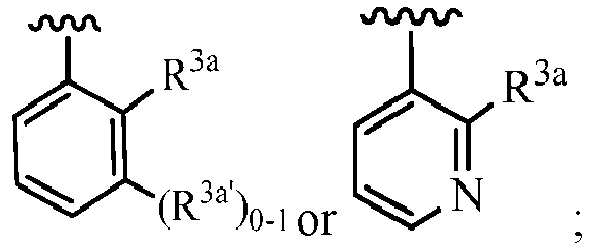
- R3a is (C1-2 alkyl)2(O)P, (C1-2 alkoxy)(C1-2 alkyl)(O)P, or C1-2 alkylSO2NH;
- R3a' is halo;
- R4a or R4b is independently hydrogen, C1-2 alkyl, or C1-2 hydroxyalkyl; or R4a and R4b together with the carbon atom to which they are both attached form a C3-6 cycloalkyl; and
- R5a or R5b is independently hydrogen, C1-2 alkyl, C1-2 hydroxyalkyl, or C1-2 alkoxyalkyl.
- Another aspect of the invention is a compound of Formula (II), (III), (IV), (VII), or (IX), or a pharmaceutically acceptable salt thereof, wherein:
- R4a is hydrogen;
- R4b is hydrogen;
- R5a is C1-2 alkyl, C1-2 hydroxylalkyl, or C1-2 alkoxyalkyl; and
- R5b is hydrogen.
- Another aspect of the invention is a compound of formula (II), (III), (IV), (VII), or (IX), or a pharmaceutically acceptable salt thereof, wherein:
- R4a is C1-2 alkyl;
- R4b is C1-2 alkyl; or R4a and R4b are taken together to form a cyclopropyl;
- R5a is hydrogen; and
- R5b is hydrogen.
- Another aspect of the invention is a compound selected from the group consisting of


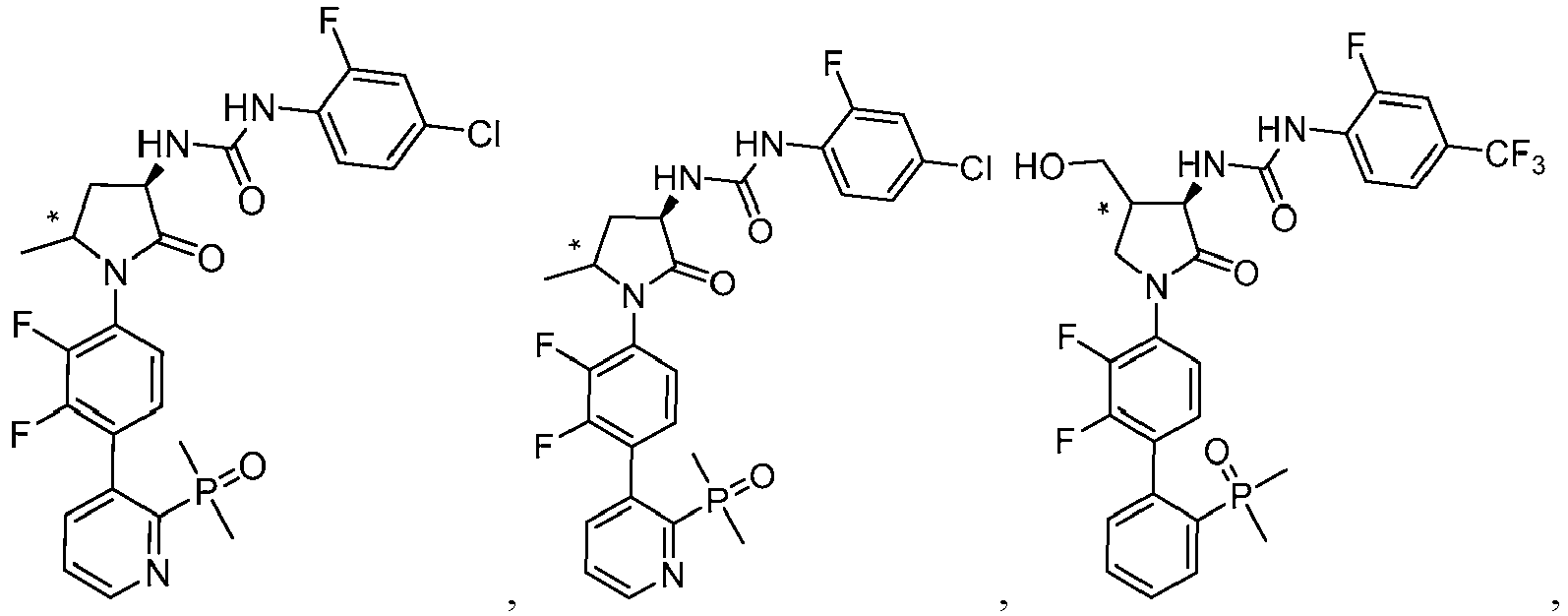

- For a compound of Formula (I), (II), (III), (IV), (V), (VI), (VII), (VIII), or (IX), the scope of any instance of a variable substituent, including Ar1, Ar2, Ar3, R1a, R1b, R2a, R3a, R4a, R4b, R5a, R5b, R1, R2 can be used independently with the scope of any other instance of a variable substituent. As such, the invention includes combinations of the different aspects.
- In one non-limiting embodiment, for a compound of Formula (II), (III), (IV), (VII), or (IX), R4a, R4b, R5a, R5b are all hydrogen; Ar1 is phenyl, pyridinyl, or pyrazinyl, each substituted with 1R1a and 1-2 R1b; R1a is hydrogen or halo; R1b is halo, C1-2 haloalkyl, or C1-2 alkoxy; Ar2 is phenyl substituted with 1-4 R2a; R2a is hydrogen, halo, C1-4 alkyl, C1-4hydroxyalkyl, C1-4 haloalkyl, C3-6 cycloalkyl, C1-4 alkoxy, or C1-4haloalkoxy; Ar3 is phenyl, pyrazolyl, pyridinyl, or pyrimidinyl, each substituted with 1-4 R3a; R3a is halo, hydroxyalkyl, alkoxyalkyl, (C1-2 alkyl)2(O)P, (C1-2 alkoxy)2(O)P, (C1-2 alkoxy)(C1-2 alkyl)(O)P, C1-2 alkylSO2, or C1-2 alkylSO2NH.
- In another non-limiting embodiment, for a compound of Formula (II), (III), (IV), (VII), or (IX), R4a, R4b, R5a, R5b are all hydrogen; Ar1 is phenyl substituted with 1R1a and 1-2 R1b; R1a is hydrogen or halo; R1b is halo, C1-2 haloalkyl, or C1-2 alkoxy; Ar2 is phenyl substituted with 1-4 R2a; R2a is hydrogen, halo, C1-4 alkyl, C1-4 hydroxyalkyl, C1-4 haloalkyl, C3-6 cycloalkyl, C1-4 alkoxy, or C1-4haloalkoxy; Ar3 is pyrazolyl substituted with 1-4 R3a; R3a is halo, hydroxyalkyl, alkoxyalkyl, (C1-2 alkyl)2(O)P, (C1-2 alkoxy)2(O)P, (C1-2 alkoxy)(C1-2 alkyl)(O)P, C1-2 alkylSO2, or C1-2 alkylSO2NH.
- In another non-limiting embodiment, for a compound of Formula (II), (III), (IV), (VII), or (IX), R4a, R4b, R5a, R5b are all hydrogen; Ar1 is phenyl substituted with 1R1a and 1-2 R1b; R1a is hydrogen or halo; R1b is halo, C1-2 haloalkyl, or C1-2 alkoxy; Ar2 is phenyl substituted with 1-4 R2a; R2a is hydrogen, halo, C1-4 alkyl, C1-4 hydroxyalkyl, C1-4 haloalkyl, C3-6 cycloalkyl, C1-4 alkoxy, or C1-4haloalkoxy; Ar3 is pyrimidinyl substituted with 1-4 R3a; R3a is halo, hydroxyalkyl, alkoxyalkyl, (C1-2 alkyl)2(O)P, (C1-2 alkoxy)2(O)P, (C1-2 alkoxy)(C1-2 alkyl)(O)P, C1-2 alkylSO2, or C1-2 alkylSO2NH.
- In another non-limiting embodiment, for a compound of Formula (II), (III), (IV), (VII), or (IX), R4a, R4b, R5a, R5b are all hydrogen; Ar1 is phenyl substituted with 1R1a and 1-2 R1b; R1a is hydrogen or halo; R1b is halo, C1-2 haloalkyl, or C1-2 alkoxy; Ar2 is phenyl substituted with 1-4 R2a; R2a is hydrogen, halo, C1-4 alkyl, C1-4 hydroxyalkyl, C1-4 haloalkyl, C3-6 cycloalkyl, C1-4 alkoxy, or C1-4haloalkoxy; Ar3 is phenyl, pyrazolyl, pyridinyl, or pyrimidinyl, each substituted with 1-4 R3a; R3a is halo, hydroxyalkyl, alkoxyalkyl, (C1-2 alkyl)2(O)P, (C1-2 alkoxy)2(O)P, (C1-2 alkoxy)(C1-2 alkyl)(O)P, C1-2 alkylSO2, or C1-2 alkylSO2NH.
- In another non-limiting embodiment, for a compound of Formula (II), (III), (IV), (VII), or (IX), R4a, R4b, R5a, R5b are all hydrogen; Ar1 is pyridinyl substituted with 1R1a and 1-2 R1b; R1a is hydrogen or halo; R1b is halo, C1-2 haloalkyl, or C1-2 alkoxy; Ar2 is phenyl substituted with 1-4 R2a; R2a is hydrogen, halo, C1-4 alkyl, C1-4 hydroxyalkyl, C1-4 haloalkyl, C3-6 cycloalkyl, C1-4 alkoxy, or C1-4haloalkoxy; Ar3 is phenyl substituted with 1-4 R3a; R3a is halo, hydroxyalkyl, alkoxyalkyl, (C1-2 alkyl)2(O)P, (C1-2 alkoxy)2(O)P, (C1-2 alkoxy)(C1-2 alkyl)(O)P, C1-2 alkylSO2, or C1-2 alkylSO2NH.
- In another non-limiting embodiment, for a compound of Formula (II), (III), (IV), (VII), or (IX), R4a, R4b, R5a, R5b are all hydrogen; Ar1 is pyridinyl substituted with 1R1a and 1-2 R1b; R1a is hydrogen or halo; R1b is halo, C1-2 haloalkyl, or C1-2 alkoxy; Ar2 is phenyl substituted with 1-4 R2a; R2a is hydrogen, halo, C1-4 alkyl, C1-4 hydroxyalkyl, C1-4 haloalkyl, C3-6 cycloalkyl, C1-4 alkoxy, or C1-4haloalkoxy; Ar3 is pyrazolyl substituted with 1-4 R3a; R3a is halo, hydroxyalkyl, alkoxyalkyl, (C1-2 alkyl)2(O)P, (C1-2 alkoxy)2(O)P, (C1-2 alkoxy)(C1-2 alkyl)(O)P, C1-2 alkylSO2, or C1-2 alkylSO2NH.
- In another non-limiting embodiment, for a compound of Formula (II), (III), (IV), (VII), or (IX), R4a, R4b, R5a, R5b are all hydrogen; Ar1 is pyridinyl substituted with 1R1a and 1-2 R1b; R1a is hydrogen or halo; R1b is halo, C1-2 haloalkyl, or C1-2 alkoxy; Ar2 is phenyl substituted with 1-4 R2a; R2a is hydrogen, halo, C1-4 alkyl, C1-4 hydroxyalkyl, C1-4 haloalkyl, C3-6 cycloalkyl, C1-4 alkoxy, or C1-4haloalkoxy; Ar3 is pyridinyl substituted with 1-4 R3a; R3a is halo, hydroxyalkyl, alkoxyalkyl, (C1-2 alkyl)2(O)P, (C1-2 alkoxy)2(O)P, (C1-2 alkoxy)(C1-2 alkyl)(O)P, C1-2 alkylSO2, or C1-2 alkylSO2NH.
- In another non-limiting embodiment, for a compound of Formula (II), (III), (IV), (VII), or (IX), R4a, R4b, R5a, R5b are all hydrogen; Ar1 is pyridinyl substituted with 1R1a and 1-2 R1b; R1a is hydrogen or halo; R1b is halo, C1-2 haloalkyl, or C1-2 alkoxy; Ar2 is phenyl substituted with 1-4 R2a; R2a is hydrogen, halo, C1-4 alkyl, C1-4 hydroxyalkyl, C1-4 haloalkyl, C3-6 cycloalkyl, C1-4 alkoxy, or C1-4haloalkoxy; Ar3 is pyrimidinyl substituted with 1-4 R3a; R3a is halo, hydroxyalkyl, alkoxyalkyl, (C1-2 alkyl)2(O)P, (C1-2 alkoxy)2(O)P, (C1-2 alkoxy)(C1-2 alkyl)(O)P, C1-2 alkylSO2, or C1-2 alkylSO2NH.
- In another non-limiting embodiment, for a compound of Formula (II), (III), (IV), (VII), or (IX), R4a, R4b, R5a, R5b are all hydrogen; Ar1 is pyrazinyl substituted with 1R1a and 1-2 R1b; R1a is hydrogen or halo; R1b is halo, C1-2 haloalkyl, or C1-2 alkoxy; Ar2 is phenyl substituted with 1-4 R2a; R2a is hydrogen, halo, C1-4 alkyl, C1-4 hydroxyalkyl, C1-4 haloalkyl, C3-6 cycloalkyl, C1-4 alkoxy, or C1-4haloalkoxy; Ar3 is phenyl substituted with 1-4 R3a; R3a is halo, hydroxyalkyl, alkoxyalkyl, (C1-2 alkyl)2(O)P, (C1-2 alkoxy)2(O)P, (C1-2 alkoxy)(C1-2 alkyl)(O)P, C1-2 alkylSO2, or C1-2 alkylSO2NH.
- In another non-limiting embodiment, for a compound of Formula (II), (III), (IV), (VII), or (IX), R4a, R4b, R5a, R5b are all hydrogen; Ar1 is pyrazinyl substituted with 1R1a and 1-2 R1b; R1a is hydrogen or halo; R1b is halo, C1-2 haloalkyl, or C1-2 alkoxy; Ar2 is phenyl substituted with 1-4 R2a; R2a is hydrogen, halo, C1-4 alkyl, C1-4 hydroxyalkyl, C1-4 haloalkyl, C3-6 cycloalkyl, C1-4 alkoxy, or C1-4haloalkoxy; Ar3 is pyrazolyl substituted with 1-4 R3a; R3a is halo, hydroxyalkyl, alkoxyalkyl, (C1-2 alkyl)2(O)P, (C1-2 alkoxy)2(O)P, (C1-2 alkoxy)(C1-2 alkyl)(O)P, C1-2 alkylSO2, or C1-2 alkylSO2NH.
- In another non-limiting embodiment, for a compound of Formula (II), (III), (IV), (VII), or (IX), R4a, R4b, R5a, R5b are all hydrogen; Ar1 is pyrazinyl substituted with 1R1a and 1-2 R1b; R1a is hydrogen or halo; R1b is halo, C1-2 haloalkyl, or C1-2 alkoxy; Ar2 is phenyl substituted with 1-4 R2a; R2a is hydrogen, halo, C1-4 alkyl, C1-4 hydroxyalkyl, C1-4 haloalkyl, C3-6 cycloalkyl, C1-4 alkoxy, or C1-4haloalkoxy; Ar3 is pyridinyl substituted with 1-4 R3a; R3a is halo, hydroxyalkyl, alkoxyalkyl, (C1-2 alkyl)2(O)P, (C1-2 alkoxy)2(O)P, (C1-2 alkoxy)(C1-2 alkyl)(O)P, C1-2 alkylSO2, or C1-2 alkylSO2NH.
- In another non-limiting embodiment, for a compound of Formula (II), (III), (IV), (VII), or (IX), R4a, R4b, R5a, R5b are all hydrogen; Ar1 is pyrazinyl substituted with 1R1a and 1-2 R1b; R1a is hydrogen or halo; R1b is halo, C1-2 haloalkyl, or C1-2 alkoxy; Ar2 is phenyl substituted with 1-4 R2a; R2a is hydrogen, halo, C1-4 alkyl, C1-4 hydroxyalkyl, C1-4 haloalkyl, C3-6 cycloalkyl, C1-4 alkoxy, or C1-4 haloalkoxy; Ar3 is pyrimidinyl substituted with 1-4 R3a; R3a is halo, hydroxyalkyl, alkoxyalkyl, (C1-2 alkyl)2(O)P, (C1-2 alkoxy)2(O)P, (C1-2 alkoxy)(C1-2 alkyl)(O)P, C1-2 alkylSO2, or C1-2 alkylSO2NH.
- In one non-limiting embodiment, for a compound of Formula (II), (III), (IV), (VII), or (IX), R4a is methyl, R4b is methyl; or R4a is hydrogen, R4b is hydroxymethyl; or R4a and R4b are taken together to form a cyclopropyl; R5a and R5b are all hydrogen; Ar1 is phenyl, pyridinyl, or pyrazinyl, each substituted with 1R1a and 1-2 R1b; R1a is hydrogen or halo; R1b is halo, C1-2 haloalkyl, or C1-2 alkoxy; Ar2 is phenyl substituted with 1-4 R2a; R2a is hydrogen, halo, C1-4 alkyl, C1-4hydroxyalkyl, C1-4haloalkyl, C3-6 cycloalkyl, C1-4 alkoxy, or C1-4haloalkoxy; Ar3 is phenyl, pyrazolyl, pyridinyl, or pyrimidinyl, each substituted with 1-4 R3a; R3a is halo, hydroxyalkyl, alkoxyalkyl, (C1-2 alkyl)2(O)P, (C1-2 alkoxy)2(O)P, (C1-2 alkoxy)(C1-2 alkyl)(O)P, C1-2 alkylSO2, or C1-2 alkylSO2NH.
- In another non-limiting embodiment, for a compound of Formula (II), (III), (IV), (VII), or (IX), R4a is methyl, R4b is methyl; or R4a is hydrogen, R4b is hydroxymethyl; or R4a and R4b are taken together to form a cyclopropyl; R5a and R5b are all hydrogen; Ar1 is phenyl substituted with 1R1a and 1-2 R1b; R1a is hydrogen or halo; R1b is halo, C1-2 haloalkyl, or C1-2 alkoxy; Ar2 is phenyl substituted with 1-4 R2a; R2a is hydrogen, halo, C1-4 alkyl, C1-4 hydroxyalkyl, C1-4 haloalkyl, C3-6 cycloalkyl, C1-4 alkoxy, or C1-4 haloalkoxy; Ar3 is pyrazolyl substituted with 1-4 R3a; R3a is halo, hydroxyalkyl, alkoxyalkyl, (C1-2 alkyl)2(O)P, (C1-2 alkoxy)2(O)P, (C1-2 alkoxy)(C1-2 alkyl)(O)P, C1-2 alkylSO2, or C1-2 alkylSO2NH.
- In another non-limiting embodiment, for a compound of Formula (II), (III), (IV), (VII), or (IX), R4a is methyl, R4b is methyl; R4a is hydrogen, R4b is hydroxymethyl; or R4a and R4b are taken together to form a cyclopropyl; R5a and R5b are all hydrogen; Ar1 is phenyl substituted with 1R1a and 1-2 R1b; R1a is hydrogen or halo; R1b is halo, C1-2 haloalkyl, or C1-2 alkoxy; Ar2 is phenyl substituted with 1-4 R2a; R2a is hydrogen, halo, C1-4 alkyl, C1-4 hydroxyalkyl, C1-4 haloalkyl, C3-6 cycloalkyl, C1-4 alkoxy, or C1-4 haloalkoxy; Ar3 is pyrimidinyl substituted with 1-4 R3a; R3a is halo, hydroxyalkyl, alkoxyalkyl, (C1-2 alkyl)2(O)P, (C1-2 alkoxy)2(O)P, (C1-2 alkoxy)(C1-2 alkyl)(O)P, C1-2 alkylSO2, or C1-2 alkylSO2NH.
- In another non-limiting embodiment, for a compound of Formula (II), (III), (IV), (VII), or (IX), R4a is methyl, R4b is methyl; R4a is hydrogen, R4b is hydroxymethyl; or R4a and R4b are taken together to form a cyclopropyl; R5a and R5b are all hydrogen; Ar1 is phenyl substituted with 1R1a and 1-2 R1b; R1a is hydrogen or halo; R1b is halo, C1-2 haloalkyl, or C1-2 alkoxy; Ar2 is phenyl substituted with 1-4 R2a; R2a is hydrogen, halo, C1-4 alkyl, C1-4 hydroxyalkyl, C1-4 haloalkyl, C3-6 cycloalkyl, C1-4 alkoxy, or C1-4 haloalkoxy; Ar3 is phenyl, pyrazolyl, pyridinyl, or pyrimidinyl, each substituted with 1-4 R3a; R3a is halo, hydroxyalkyl, alkoxyalkyl, (C1-2 alkyl)2(O)P, (C1-2 alkoxy)2(O)P, (C1-2 alkoxy)(C1-2 alkyl)(O)P, C1-2 alkylSO2, or C1-2 alkylSO2NH.
- In another non-limiting embodiment, for a compound of Formula (II), (III), (IV), (VII), or (IX), R4a is methyl, R4b is methyl; R4a is hydrogen, R4b is hydroxymethyl; or R4a and R4b are taken together to form a cyclopropyl; R5a and R5b are all hydrogen; Ar1 is pyridinyl substituted with 1R1a and 1-2 R1b; R1a is hydrogen or halo; R1b is halo, C1-2 haloalkyl, or C1-2 alkoxy; Ar2 is phenyl substituted with 1-4 R2a; R2a is hydrogen, halo, C1-4 alkyl, C1-4 hydroxyalkyl, C1-4 haloalkyl, C3-6 cycloalkyl, C1-4 alkoxy, or C1-4 haloalkoxy; Ar3 is phenyl substituted with 1-4 R3a; R3a is halo, hydroxyalkyl, alkoxyalkyl, (C1-2 alkyl)2(O)P, (C1-2 alkoxy)2(O)P, (C1-2 alkoxy)(C1-2 alkyl)(O)P, C1-2 alkylSO2, or C1-2 alkylSO2NH.
- In another non-limiting embodiment, for a compound of Formula (II), (III), (IV), (VII), or (IX), R4a is methyl, R4b is methyl; R4a is hydrogen, R4b is hydroxymethyl; or R4a and R4b are taken together to form a cyclopropyl; R5a and R5b are all hydrogen; Ar1 is pyridinyl substituted with 1R1a and 1-2 R1b; R1a is hydrogen or halo; R1b is halo, C1-2 haloalkyl, or C1-2 alkoxy; Ar2 is phenyl substituted with 1-4 R2a; R2a is hydrogen, halo, C1-4 alkyl, C1-4 hydroxyalkyl, C1-4 haloalkyl, C3-6 cycloalkyl, C1-4 alkoxy, or C1-4 haloalkoxy; Ar3 is pyrazolyl substituted with 1-4 R3a; R3a is halo, hydroxyalkyl, alkoxyalkyl, (C1-2 alkyl)2(O)P, (C1-2 alkoxy)2(O)P, (C1-2 alkoxy)(C1-2 alkyl)(O)P, C1-2 alkylSO2, or C1-2 alkylSO2NH.
- In another non-limiting embodiment, for a compound of Formula (II), (III), (IV), (VII), or (IX), R4a is methyl, R4b is methyl; R4a is hydrogen, R4b is hydroxymethyl; or R4a and R4b are taken together to form a cyclopropyl; R5a and R5b are all hydrogen; Ar1 is pyridinyl substituted with 1R1a and 1-2 R1b; R1a is hydrogen or halo; R1b is halo, C1-2 haloalkyl, or C1-2 alkoxy; Ar2 is phenyl substituted with 1-4 R2a; R2a is hydrogen, halo, C1-4 alkyl, C1-4 hydroxyalkyl, C1-4 haloalkyl, C3-6 cycloalkyl, C1-4 alkoxy, or C1-4 haloalkoxy; Ar3 is pyridinyl substituted with 1-4 R3a; R3a is halo, hydroxyalkyl, alkoxyalkyl, (C1-2 alkyl)2(O)P, (C1-2 alkoxy)2(O)P, (C1-2 alkoxy)(C1-2 alkyl)(O)P, C1-2 alkylSO2, or C1-2 alkylSO2NH.
- In another non-limiting embodiment, for a compound of Formula (II), (III), (IV), (VII), or (IX), R4a is methyl, R4b is methyl; R4a is hydrogen, R4b is hydroxymethyl; or R4a and R4b are taken together to form a cyclopropyl; R5a and R5b are all hydrogen; Ar1 is pyridinyl substituted with 1R1a and 1-2 R1b; R1a is hydrogen or halo; R1b is halo, C1-2 haloalkyl, or C1-2 alkoxy; Ar2 is phenyl substituted with 1-4 R2a; R2a is hydrogen, halo, C1-4alkyl, C1-4 hydroxyalkyl, C1-4 haloalkyl, C3-6 cycloalkyl, C1-4 alkoxy, or C1-4 haloalkoxy; Ar3 is pyrimidinyl substituted with 1-4 R3a; R3a is halo, hydroxyalkyl, alkoxyalkyl, (C1-2 alkyl)2(O)P, (C1-2 alkoxy)2(O)P, (C1-2 alkoxy)(C1-2 alkyl)(O)P, C1-2 alkylSO2, or C1-2 alkylSO2NH.
- In another non-limiting embodiment, for a compound of Formula (II), (III), (IV), (VII), or (IX), R4a is methyl, R4b is methyl; R4a is hydrogen, R4b is hydroxymethyl; or R4a and R4b are taken together to form a cyclopropyl; R5a and R5b are all hydrogen; Ar1 is pyrazinyl substituted with 1R1a and 1-2 R1b; R1a is hydrogen or halo; R1b is halo, C1-2 haloalkyl, or C1-2 alkoxy; Ar2 is phenyl substituted with 1-4 R2a; R2a is hydrogen, halo, C1-4alkyl, C1-4 hydroxyalkyl, C1-4 haloalkyl, C3-6 cycloalkyl, C1-4 alkoxy, or C1-4 haloalkoxy; Ar3 is phenyl substituted with 1-4 R3a; R3a is halo, hydroxyalkyl, alkoxyalkyl, (C1-2 alkyl)2(O)P, (C1-2 alkoxy)2(O)P, (C1-2 alkoxy)(C1-2 alkyl)(O)P, C1-2 alkylSO2, or C1-2 alkylSO2NH.
- In another non-limiting embodiment, for a compound of Formula (II), (III), (IV), (VII), or (IX), R4a is methyl, R4b is methyl; R4a is hydrogen, R4b is hydroxymethyl; or R4a and R4b are taken together to form a cyclopropyl; R5a and R5b are all hydrogen; Ar1 is pyrazinyl substituted with 1R1a and 1-2 R1b; R1a is hydrogen or halo; R1b is halo, C1-2 haloalkyl, or C1-2 alkoxy; Ar2 is phenyl substituted with 1-4 R2a; R2a is hydrogen, halo, C1-4alkyl, C1-4 hydroxyalkyl, C1-4 haloalkyl, C3-6 cycloalkyl, C1-4 alkoxy, or C1-4 haloalkoxy; Ar3 is pyrazolyl substituted with 1-4 R3a; R3a is halo, hydroxyalkyl, alkoxyalkyl, (C1-2 alkyl)2(O)P, (C1-2 alkoxy)2(O)P, (C1-2 alkoxy)(C1-2 alkyl)(O)P, C1-2 alkylSO2, or C1-2 alkylSO2NH.
- In another non-limiting embodiment, for a compound of Formula (II), (III), (IV), (VII), or (IX), R4a is methyl, R4b is methyl; R4a is hydrogen, R4b is hydroxymethyl; or R4a and R4b are taken together to form a cyclopropyl; R5a and R5b are all hydrogen; Ar1 is pyrazinyl substituted with 1R1a and 1-2 R1b; R1a is hydrogen or halo; R1b is halo, C1-2 haloalkyl, or C1-2 alkoxy; Ar2 is phenyl substituted with 1-4 R2a; R2a is hydrogen, halo, C1-4alkyl, C1-4 hydroxyalkyl, C1-4 haloalkyl, C3-6 cycloalkyl, C1-4 alkoxy, or C1-4 haloalkoxy; Ar3 is pyridinyl substituted with 1-4 R3a; R3a is halo, hydroxyalkyl, alkoxyalkyl, (C1-2 alkyl)2(O)P, (C1-2 alkoxy)2(O)P, (C1-2 alkoxy)(C1-2 alkyl)(O)P, C1-2 alkylSO2, or C1-2 alkylSO2NH.
- In another non-limiting embodiment, for a compound of Formula (II), (III), (IV), (VII), or (IX), R4a is methyl, R4b is methyl; R4a is hydrogen, R4b is hydroxymethyl; or R4a and R4b are taken together to form a cyclopropyl; R5a and R5b are all hydrogen; Ar1 is pyrazinyl substituted with 1R1a and 1-2 R1b; R1a is hydrogen or halo; R1b is halo, C1-2 haloalkyl, or C1-2 alkoxy; Ar2 is phenyl substituted with 1-4 R2a; R2a is hydrogen, halo, C1-4alkyl, C1-4 hydroxyalkyl, C1-4 haloalkyl, C3-6 cycloalkyl, C1-4 alkoxy, or C1-4 haloalkoxy; Ar3 is pyrimidinyl substituted with 1-4 R3a; R3a is halo, hydroxyalkyl, alkoxyalkyl, (C1-2 alkyl)2(O)P, (C1-2 alkoxy)2(O)P, (C1-2 alkoxy)(C1-2 alkyl)(O)P, C1-2 alkylSO2, or C1-2 alkylSO2NH.
- In one non-limiting embodiment, for a compound of Formula (II), (III), (IV), (VII), or (IX), R4a and R4b are all hydrogen; R5a is hydrogen, R5b is methyl or hydroxymehtyl; Ar1 is phenyl, pyridinyl, or pyrazinyl, each substituted with 1R1a and 1-2 R1b; R1a is hydrogen or halo; R1b is halo, C1-2 haloalkyl, or C1-2 alkoxy; Ar2 is phenyl substituted with 1-4 R2a; R2a is hydrogen, halo, C1-4 alkyl, C1-4 hydroxyalkyl, C1-4 haloalkyl, C3-6 cycloalkyl, C1-4 alkoxy, or C1-4 haloalkoxy; Ar3 is phenyl, pyrazolyl, pyridinyl, or pyrimidinyl, each substituted with 1-4 R3a; R3a is halo, hydroxyalkyl, alkoxyalkyl, (C1-2 alkyl)2(O)P, (C1-2 alkoxy)2(O)P, (C1-2 alkoxy)(C1-2 alkyl)(O)P, C1-2 alkylSO2, or C1-2 alkylSO2NH.
- In another non-limiting embodiment, for a compound of Formula (II), (III), (IV), (VII), or (IX), R4a and R4b are all hydrogen; R5a is hydrogen, R5b is methyl or hydroxymehtyl; Ar1 is phenyl substituted with 1R1a and 1-2 R1b; R1a is hydrogen or halo; R1b is halo, C1-2 haloalkyl, or C1-2 alkoxy; Ar2 is phenyl substituted with 1-4 R2a; R2a is hydrogen, halo, C1-4 alkyl, C1-4 hydroxyalkyl, C1-4 haloalkyl, C3-6 cycloalkyl, C1-4 alkoxy, or C1-4 haloalkoxy; Ar3 is pyrazolyl substituted with 1-4 R3a; R3a is halo, hydroxyalkyl, alkoxyalkyl, (C1-2 alkyl)2(O)P, (C1-2 alkoxy)2(O)P, (C1-2 alkoxy)(C1-2 alkyl)(O)P, C1-2 alkylSO2, or C1-2 alkylSO2NH.
- In another non-limiting embodiment, for a compound of Formula (II), (III), (IV), (VII), or (IX), R4a and R4b are all hydrogen; R5a is hydrogen, R5b is methyl or hydroxymehtyl; Ar1 is phenyl substituted with 1R1a and 1-2 R1b; R1a is hydrogen or halo; R1b is halo, C1-2 haloalkyl, or C1-2 alkoxy; Ar2 is phenyl substituted with 1-4 R2a; R2a is hydrogen, halo, C1-4 alkyl, C1-4 hydroxyalkyl, C1-4 haloalkyl, C3-6 cycloalkyl, C1-4 alkoxy, or C1-4 haloalkoxy; Ar3 is pyrimidinyl substituted with 1-4 R3a; R3a is halo, hydroxyalkyl, alkoxyalkyl, (C1-2 alkyl)2(O)P, (C1-2 alkoxy)2(O)P, (C1-2 alkoxy)(C1-2 alkyl)(O)P, C1-2 alkylSO2, or C1-2 alkylSO2NH.
- In another non-limiting embodiment, for a compound of Formula (II), (III), (IV), (VII), or (IX), R4a and R4b are all hydrogen; R5a is hydrogen, R5b is methyl or hydroxymehtyl; Ar1 is phenyl substituted with 1R1a and 1-2 R1b; R1a is hydrogen or halo; R1b is halo, C1-2 haloalkyl, or C1-2 alkoxy; Ar2 is phenyl substituted with 1-4 R2a; R2a is hydrogen, halo, C1-4 alkyl, C1-4 hydroxyalkyl, C1-4 haloalkyl, C3-6 cycloalkyl, C1-4 alkoxy, or C1-4 haloalkoxy; Ar3 is phenyl, pyrazolyl, pyridinyl, or pyrimidinyl, each substituted with 1-4 R3a; R3a is halo, hydroxyalkyl, alkoxyalkyl, (C1-2 alkyl)2(O)P, (C1-2 alkoxy)2(O)P, (C1-2 alkoxy)(C1-2 alkyl)(O)P, C1-2 alkylSO2, or C1-2 alkylSO2NH.
- In another non-limiting embodiment, for a compound of Formula (II), (III), (IV), (VII), or (IX), R4a and R4b are all hydrogen; R5a is hydrogen, R5b is methyl or hydroxymehtyl; Ar1 is pyridinyl substituted with 1R1a and 1-2 R1b; R1a is hydrogen or halo; R1b is halo, C1-2 haloalkyl, or C1-2 alkoxy; Ar2 is phenyl substituted with 1-4 R2a; R2a is hydrogen, halo, C1-4 alkyl, C1-4 hydroxyalkyl, C1-4 haloalkyl, C3-6 cycloalkyl, C1-4 alkoxy, or C1-4haloalkoxy; Ar3 is phenyl substituted with 1-4 R3a; R3a is halo, hydroxyalkyl, alkoxyalkyl, (C1-2 alkyl)2(O)P, (C1-2 alkoxy)2(O)P, (C1-2 alkoxy)(C1-2 alkyl)(O)P, C1-2 alkylSO2, or C1-2 alkylSO2NH.
- In another non-limiting embodiment, for a compound of Formula (II), (III), (IV), (VII), or (IX), R4a and R4b are all hydrogen; R5a is hydrogen, R5b is methyl or hydroxymehtyl; Ar1 is pyridinyl substituted with 1R1a and 1-2 R1b; R1a is hydrogen or halo; R1b is halo, C1-2 haloalkyl, or C1-2 alkoxy; Ar2 is phenyl substituted with 1-4 R2a; R2a is hydrogen, halo, C1-4 alkyl, C1-4 hydroxyalkyl, C1-4 haloalkyl, C3-6 cycloalkyl, C1-4 alkoxy, or C1-4 haloalkoxy; Ar3 is pyrazolyl substituted with 1-4 R3a; R3a is halo, hydroxyalkyl, alkoxyalkyl, (C1-2 alkyl)2(O)P, (C1-2 alkoxy)2(O)P, (C1-2 alkoxy)(C1-2 alkyl)(O)P, C1-2 alkylSO2, or C1-2 alkylSO2NH.
- In another non-limiting embodiment, for a compound of Formula (II), (III), (IV), (VII), or (IX), R4a and R4b are all hydrogen; R5a is hydrogen, R5b is methyl or hydroxymehtyl; Ar1 is pyridinyl substituted with 1R1a and 1-2 R1b; R1a is hydrogen or halo; R1b is halo, C1-2 haloalkyl, or C1-2 alkoxy; Ar2 is phenyl substituted with 1-4 R2a; R2a is hydrogen, halo, C1-4 alkyl, C1-4 hydroxyalkyl, C1-4 haloalkyl, C3-6 cycloalkyl, C1-4 alkoxy, or C1-4 haloalkoxy; Ar3 is pyridinyl substituted with 1-4 R3a; R3a is halo, hydroxyalkyl, alkoxyalkyl, (C1-2 alkyl)2(O)P, (C1-2 alkoxy)2(O)P, (C1-2 alkoxy)(C1-2 alkyl)(O)P, C1-2 alkylSO2, or C1-2 alkylSO2NH.
- In another non-limiting embodiment, for a compound of Formula (II), (III), (IV), (VII), or (IX), R4a and R4b are all hydrogen; R5a is hydrogen, R5b is methyl or hydroxymehtyl; Ar1 is pyridinyl substituted with 1R1a and 1-2 R1b; R1a is hydrogen or halo; R1b is halo, C1-2 haloalkyl, or C1-2 alkoxy; Ar2 is phenyl substituted with 1-4 R2a; R2a is hydrogen, halo, C1-4 alkyl, C1-4hydroxyalkyl, C1-4 haloalkyl, C3-6 cycloalkyl, C1-4 alkoxy, or C1-4 haloalkoxy; Ar3 is pyrimidinyl substituted with 1-4 R3a; R3a is halo, hydroxyalkyl, alkoxyalkyl, (C1-2 alkyl)2(O)P, (C1-2 alkoxy)2(O)P, (C1-2 alkoxy)(C1-2 alkyl)(O)P, C1-2 alkylSO2, or C1-2 alkylSO2NH.
- In another non-limiting embodiment, for a compound of Formula (II), (III), (IV), (VII), or (IX), R4a and R4b are all hydrogen; R5a is hydrogen, R5b is methyl or hydroxymehtyl; Ar1 is pyrazinyl substituted with 1R1a and 1-2 R1b; R1a is hydrogen or halo; R1b is halo, C1-2 haloalkyl, or C1-2 alkoxy; Ar2 is phenyl substituted with 1-4 R2a; R2a is hydrogen, halo, C1-4 alkyl, C1-4 hydroxyalkyl, C1-4 haloalkyl, C3-6 cycloalkyl, C1-4 alkoxy, or C1-4 haloalkoxy; Ar3 is phenyl substituted with 1-4 R3a; R3a is halo, hydroxyalkyl, alkoxyalkyl, (C1-2 alkyl)2(O)P, (C1-2 alkoxy)2(O)P, (C1-2 alkoxy)(C1-2 alkyl)(O)P, C1-2 alkylSO2, or C1-2 alkylSO2NH.
- In another non-limiting embodiment, for a compound of Formula (II), (III), (IV), (VII), or (IX), R4a and R4b are all hydrogen; R5a is hydrogen, R5b is methyl or hydroxymehtyl; Ar1 is pyrazinyl substituted with 1R1a and 1-2 R1b; R1a is hydrogen or halo; R1b is halo, C1-2 haloalkyl, or C1-2 alkoxy; Ar2 is phenyl substituted with 1-4 R2a; R2a is hydrogen, halo, C1-4 alkyl, C1-4 hydroxyalkyl, C1-4 haloalkyl, C3-6 cycloalkyl, C1-4 alkoxy, or C1-4 haloalkoxy; Ar3 is pyrazolyl substituted with 1-4 R3a; R3a is halo, hydroxyalkyl, alkoxyalkyl, (C1-2 alkyl)2(O)P, (C1-2 alkoxy)2(O)P, (C1-2 alkoxy)(C1-2 alkyl)(O)P, C1-2 alkylSO2, or C1-2 alkylSO2NH.
- In another non-limiting embodiment, for a compound of Formula (II), (III), (IV), (VII), or (IX), R4a and R4b are all hydrogen; R5a is hydrogen, R5b is methyl or hydroxymehtyl; Ar1 is pyrazinyl substituted with 1R1a and 1-2 R1b; R1a is hydrogen or halo; R1b is halo, C1-2 haloalkyl, or C1-2 alkoxy; Ar2 is phenyl substituted with 1-4 R2a; R2a is hydrogen, halo, C1-4 alkyl, C1-4 hydroxyalkyl, C1-4 haloalkyl, C3-6 cycloalkyl, C1-4 alkoxy, or C1-4 haloalkoxy; Ar3 is pyridinyl substituted with 1-4 R3a; R3a is halo, hydroxyalkyl, alkoxyalkyl, (C1-2 alkyl)2(O)P, (C1-2 alkoxy)2(O)P, (C1-2 alkoxy)(C1-2 alkyl)(O)P, C1-2 alkylSO2, or C1-2 alkylSO2NH.
- In another non-limiting embodiment, for a compound of Formula (II), (III), (IV), (VII), or (IX), R4a and R4b are all hydrogen; R5a is hydrogen, R5b is methyl or hydroxymehtyl; Ar1 is pyrazinyl substituted with 1R1a and 1-2 R1b; R1a is hydrogen or halo; R1b is halo, C1-2 haloalkyl, or C1-2 alkoxy; Ar2 is phenyl substituted with 1-4 R2a; R2a is hydrogen, halo, C1-4 alkyl, C1-4hydroxyalkyl, C1-4 haloalkyl, C3-6 cycloalkyl, C1-4 alkoxy, or C1-4 haloalkoxy; Ar3 is pyrimidinyl substituted with 1-4 R3a; R3a is halo, hydroxyalkyl, alkoxyalkyl, (C1-2 alkyl)2(O)P, (C1-2 alkoxy)2(O)P, (C1-2 alkoxy)(C1-2 alkyl)(O)P, C1-2 alkylSO2, or C1-2 alkylSO2NH.
- In one preferred embodiment, for a compound of Formula (II), (III), (IV), or (VII), or (IX), R4a is methyl; R4b is methyl; R4a is hydrogen; R4b is hydroxymethyl; or R4a and R4b are taken together to form a cyclopropyl; R5a is hydrogen, R5b is methyl or hydroxymehtyl; R5a is hydrogen; R5b is hydrogen; or R4a, R4b, R5a, R5b are all hydrogen; Ar1 is phenyl substituted with 1R1a and 1-2 R1b; R1a is hydrogen, or F; R1b is F, Cl, or CF3; Ar2 is phenyl substituted with 1-2 R2a; R2a is hydrogen, F, Cl, isopropyl, CF3 CF3, cyclopropyl; Ar3 is phenyl or pyridinyl, each substituted with 1-2 R3a; R3a is F, (CH3)2(O)P, (CH3CH2)2(O)P, (CH3CH2O)(CH3)(O)P, CH3SO2, or CH3SO2NH.
- Unless specified otherwise, these terms have the following meanings. "Alkyl" means a straight or branched alkyl group composed of 1 to 6 carbons. "Alkenyl" means a straight or branched alkyl group composed of 2 to 6 carbons with at least one double bond. "Alkynyl" means a straight or branched alkyl group composed of 2 to 6 carbons with at least one triple bond. "Cycloalkyl" means a monocyclic ring system composed of 3 to 7 carbons. Terms with a hydrocarbon moiety (e.g. alkoxy) include straight and branched isomers for the hydrocarbon portion. "Halo" includes fluoro, chloro, bromo, and iodo. "Haloalkyl" and "haloalkoxy" include all halogenated isomers from monohalo to perhalo. "Aryl" means a monocyclic or bicyclic aromatic hydrocarbon groups having 6 to 12 carbon atoms, or a bicyclic fused ring system wherein one or both of the rings is aromatic. Bicyclic fused ring systems consist of a phenyl group fused to a four- to seven-membered aromatic or non-aromatic carbocyclic ring. Representative examples of aryl groups include but are not limited to phenyl, indanyl, indenyl, naphthyl, and tetrahydronaphthyl. "Heteroaryl" means a 5 to 7 membered monocyclic or 8 to 11 membered bicyclic aromatic ring system with 1-5 heteroatoms independently selected from nitrogen, oxygen, and sulfur. Where a bonding attachment location is not specified, the bonding may be attached at any appropriate location as understood by practitioners in the art. Combinations of substituents and bonding patterns are only those that result in stable compounds as understood by practitioners in the art. Parenthetic and multiparenthetic terms are intended to clarify bonding relationships to those skilled in the art. For example, a term such as ((R)alkyl) means an alkyl substituent further substituted with the substituent R.
- The invention includes all pharmaceutically acceptable salt forms of the compounds. Pharmaceutically acceptable salts are those in which the counter ions do not contribute significantly to the physiological activity or toxicity of the compounds and as such function as pharmacological equivalents. These salts can be made according to common organic techniques employing commercially available reagents. Some anionic salt forms include acetate, acistrate, besylate, bromide, chloride, citrate, fumarate, glucouronate, hydrobromide, hydrochloride, hydroiodide, iodide, lactate, maleate, mesylate, nitrate, pamoate, phosphate, succinate, sulfate, tartrate, tosylate, and xinofoate. Some cationic salt forms include ammonium, aluminum, benzathine, bismuth, calcium, choline, diethylamine, diethanolamine, lithium, magnesium, meglumine, 4-phenylcyclohexylamine, piperazine, potassium, sodium, tromethamine, and zinc.
- Some of the compounds of the invention exist in stereoisomeric forms including the structure below with the indicated carbon. The invention includes all stereoisomeric forms of the compounds including enantiomers and diastereomers. Methods of making and separating stereoisomers are known in the art. The invention includes all tautomeric forms of the compounds. The invention includes atropisomers and rotational isomers.
- The invention is intended to include all isotopes of atoms occurring in the compounds. Isotopes include those atoms having the same atomic number but different mass numbers. By way of general example and without limitation, isotopes of hydrogen include deuterium and tritium. Isotopes of carbon include 13C and 14C. Isotopically-labeled compounds of the invention can generally be prepared by conventional techniques known to those skilled in the art or by processes analogous to those described herein, using an appropriate isotopically-labeled reagent in place of the non-labeled reagent otherwise employed. Such compounds may have a variety of potential uses, for example as standards and reagents in determining biological activity. In the case of stable isotopes, such compounds may have the potential to favorably modify biological, pharmacological, or pharmacokinetic properties.
- N-formyl peptide receptors (FPRs) are a family of chemo attractant receptors that facilitate leukocyte response during inflammation. FPRs belong to the seven-transmembrane G protein-coupled receptor superfamily and are linked to inhibitory G-proteins (Gi). Three family members (FPR1, FPR2 and FPR3) have been identified in humans and are predominantly found in myeloid cells with varied distribution and have also been reported in multiple organs and tissues. After agonist binding, the FPRs activate a multitude of physiological pathways, such as intra cellular signaling transduction, Ca2+ mobilization and transcription. The family interacts with a diverse set of ligands that includes proteins, polypeptides and fatty acid metabolites which activate both pro-inflammatory and pro-resolution downstream responses. FPR2 and FPR1 Cyclic Adenosine Monophosphate (cAMP) Assays were used to measure the activity of the compounds in this patent.
- FPR2 and FPR1 Cyclic Adenosine Monophosphate (cAMP) Assays. A mixture of forskolin (5 µM final for FPR2 or 10 µM final for FPR1) and IBMX (200 µM final) were added to 384-well Proxiplates (Perkin-Elmer) pre-dotted with test compounds in DMSO (1% final) at final concentrations in the range of 0.020 nM to 100 µM. Chinese Hamster Ovary cells (CHO) overexpressing human FPR1 or human FPR2 receptors were cultured in F-12 (Ham's) medium supplemented with 10% qualified FBS, 250 µg/ml zeocin and 300 µg/ml hygromycin (Life Technologies). Reactions were initiated by adding 2,000 human FPR2 cells per well or 4,000 human FPR1 cells per well in Dulbecco's PBS (with calcium and magnesium) (Life Technologies) supplemented with 0.1% BSA (Perkin-Elmer). The reaction mixtures were incubated for 30 min at room temperature. The level of intracellular cAMP was determined using the HTRF HiRange cAMP assay reagent kit (Cisbio) according to manufacturer's instruction. Solutions of cryptate conjugated anti-cAMP and d2 flurorophore-labelled cAMP were made in a supplied lysis buffer separately. Upon completion of the reaction, the cells were lysed with equal volume of the d2-cAMP solution and anti-cAMP solution. After a 1-h room temperature incubation, time-resolved fluorescence intensity was measured using the Envision (Perkin-Elmer) at 400 nm excitation and dual emission at 590 nm and 665 nm. A calibration curve was constructed with an external cAMP standard at concentrations ranging from 1 µM to 0.1 pM by plotting the fluorescent intensity ratio from 665 nm emission to the intensity from the 590 nm emission against cAMP concentrations. The potency and activity of a compound to inhibit cAMP production was then determined by fitting to a 4-parametric logistic equation from a plot of cAMP level versus compound concentrations.
- The examples disclosed below were tested in the FPR2 and FPR1 cAMP assay described above and found having FPR2 and/or FPR1 agonist activity. Table 1 below lists EC50 values in the FPR2 and FPR1 cAMP assays measured for the following examples.
Table 1 Example hFPR2 cAMP2 hFPR1 cAMP EC50 (µM) EC50 (µM) 1 0.00043 0.20 2 0.0042 0.36 3 0.0011 0.22 4 0.00093 1.7 5 0.00068 0.23 6 0.0010 0.19 7 0.0021 0.14 8 0.0020 0.061 9 0.0021 0.031 10 0.0022 0.13 11 0.0026 0.29 12 0.0025 0.45 13 0.0065 2.5 14 0.0072 0.60 15 0.010 1.5 16 0.012 0.12 17 0.016 4.1 18 0.020 2.1 19 0.022 0.078 20 0.024 >10 21 0.031 0.39 22 0.033 1.5 23 0.0082 0.70 24 0.022 1.4 25 0.00053 0.26 26 0.00055 0.047 27 0.00050 0.11 28 0.0098 0.55 29 0.0070 0.19 30 0.00022 0.083 31 0.0040 0.43 32 0.00091 0.25 33 0.0011 0.47 34 0.0041 0.026 35 0.0086 0.052 36 0.0047 0.069 37 0.00140 0.17 38 0.0035 0.042 39 0.00058 0.057 40 0.0046 0.050 41 0.0036 0.50 42 0.0010 0.22 43 0.0033 0.12 44 0.043 0.45 45 0.0030 0.14 46 0.0048 0.093 47 0.0028 0.064 48 0.0037 0.11 49 0.0056 3.4 50 0.014 0.64 51 0.0082 1.3 52 0.010 1.1 53 0.0078 2.7 54 0.0055 0.90 55 0.022 >10 56 0.0075 7.7 57 0.00095 1.0 58 0.0063 0.61 59 0.0017 0.14 60 0.0037 0.12 61 0.023 0.37 62 0.031 0.72 63 0.00567 4.4 64 0.0088 2.9 65 0.0012 2.6 66 0.0049 0.58 67 0.00248 1.3 68 0.00053 0.15 69 0.022 5.0 70 0.000077 0.020 71 0.0021 1.28 72 0.00061 0.054 73 0.00089 0.17 74 0.0022 0.14 75 0.0034 1.18 76 0.0041 2.1 77 0.0012 0.079 78 0.0012 0.045 79 0.039 >10 80 0.0014 0.086 81 0.00052 0.027 82 0.0025 0.78 83 0.00041 0.00099 84 0.0060 0.28 85 0.00062 0.0051 86 0.00085 0.021 87 0.0016 0.0012 88 0.0053 0.0049 89 0.0044 0.025 90 0.0051 1.4 91 0.0057 0.20 92 0.0083 0.22 93 0.012 0.78 94 0.0018 0.012 95 0.032 0.20 96 0.0029 0.075 97 0.0072 0.11 98 0.0029 0.27 99 0.00079 0.24 100 0.0020 0.092 101 0.00066 0.0011 102 0.0017 0.57 103 0.00057 0.35 104 0.0052 0.049 105 0.0069 0.071 106 0.0031 0.0035 107 0.011 0.0058 108 0.0014 0.053 109 0.00044 0.39 110 0.0011 0.64 111 0.030 0.54 112 0.00027 0.39 113 0.00039 0.59 114 0.00086 0.27 115 0.0012 0.055 116 0.00121 0.89 117 0.013 0.084 118 0.017 0.32 119 0.014 0.19 120 0.00078 0.16 121 0.00030 0.0050 122 0.00081 0.61 123 0.0015 0.24 124 0.00079 0.76 125 0.00099 0.18 126 0.012 >10 127 0.018 0.92 128 0.0010 0.024 129 0.0024 0.019 130 0.0057 3.0 131 0.0012 0.061 132 0.00048 0.028 133 0.15 >5 134 0.0025 1500 135 0.0029 720 - The compounds of the present invention may be administered to mammals, preferably humans, for the treatment of a variety of conditions and disorders associated with the FPR2 receptor such as Behcet's disease, Sweet disease, systemic lupus erythematosus (SLE), Wegener's granulomatosis, virus infection, diabetes, amputations, cancers, bacterial infection, physical external injuries, physical disorders including exposure to radiation, vasoconstriction, anaphylactic reactions, allergic reactions, rhinitis, shocks (endotoxic, hemorrhagic, traumatic, splanchnic ischemia, and circulatory shocks), rheumatoid arthritis, gout, psoriasis, benign prostatic hyperplasia, myocardial ischemia, myocardial infarction, heart failure, brain injuries, pulmonary diseases, COPD, COAD, COLD, acute lung injury, acute respiratory distress syndrome, chronic bronchitis, pulmonary emphysema, asthma (allergic asthma and non-allergic asthma), cystic fibrosis, kidney fibrosis, nephropathy, renal glomerular diseases, ulcerative colitis, IBD, Crohn's disease, periodontitis, pains, Alzheimer's disease, AIDS, uveitic glaucoma, conjunctivitis, Sjoegren's syndrome, rhinitis, atherosclerosis, neuroinflammatory diseases including multiple sclerosis, stroke, sepsis, and the like.
- Unless otherwise specified, the following terms have the stated meanings. The term "subject" refers to any human or other mammalian species that could potentially benefit from treatment with a FPR2 and/or FPR1 agonist as understood by practioners in this field. Some subjects include human beings of any age with risk factors for cardiovascular disease. Common risk factors include age, sex, weight, family history, sleep apnea, alcohol or tobacco use, physical inactivity arrthymia or signs of insulin resistance such as acanthosis nigricans, hypertension, dyslipidemia, or polycystic ovary syndrome (PCOS). The term "patient" means a person suitable for therapy as determined by practitioners in the field. "Treating" or "treatment" cover the treatment of a patient or subject as understood by practitioners in this field. "Preventing" or "prevention" cover the preventive treatment (i.e., prophylaxis and/or risk reduction) of a subclinical disease-state in a patient or subject aimed at reducing the probability of the occurrence of a clinical disease-state as understood by practitioners in this field. Patients are selected for preventative therapy based on factors that are known to increase risk of suffering a clinical disease state compared to the general population. "Therapeutically effective amount" means an amount of a compound that is effective as understood by practitioners in this field.
- Another aspect of the invention are pharmaceutical compositions comprising a therapeutically effective amount of a compound of Formulae (I)-(IX) in combination with a pharmaceutical carrier.
- Another aspect of the invention are pharmaceutical compositions comprising a therapeutically effective amount of a compound of Formulae (I)-(IX) in combination with at least one other therapeutic agent and a pharmaceutical carrier.
- "Pharmaceutical composition" means a composition comprising a compound of the invention in combination with at least one additional pharmaceutically acceptable carrier. A "pharmaceutically acceptable carrier" refers to media generally accepted in the art for the delivery of biologically active agents to animals, in particular, mammals, including, i.e., adjuvant, excipient or vehicle, such as diluents, preserving agents, fillers, flow regulating agents, disintegrating agents, wetting agents, emulsifying agents, suspending agents, sweetening agents, flavoring agents, perfuming agents, anti-bacterial agents, anti-fungal agents, lubricating agents and dispensing agents, depending on the nature of the mode of administration and dosage forms.
- Pharmaceutically acceptable carriers are formulated according to a number of factors well within the purview of those of ordinary skill in the art. These include, without limitation: the type and nature of the active agent being formulated; the subject to which the agent-containing composition is to be administered; the intended route of administration of the composition; and the therapeutic indication being targeted. Pharmaceutically acceptable carriers include both aqueous and non-aqueous liquid media, as well as a variety of solid and semi-solid dosage forms. Such carriers can include a number of different ingredients and additives in addition to the active agent, such additional ingredients being included in the formulation for a variety of reasons, e.g., stabilization of the active agent, binders, etc., well known to those of ordinary skill in the art. Descriptions of suitable pharmaceutically acceptable carriers, and factors involved in their selection, are found in a variety of readily available sources such as, for example, Allen, L.V., Jr. et al., Remington: The Science and Practice of Pharmacy (2 Volumes), 22nd Edition, Pharmaceutical Press (2012).
- Particularly when provided as a single dosage unit, the potential exists for a chemical interaction between the combined active ingredients. For this reason, when the compound of the present invention and a second therapeutic agent are combined in a single dosage unit they are formulated such that although the active ingredients are combined in a single dosage unit, the physical contact between the active ingredients is minimized (that is, reduced). For example, one active ingredient may be enteric coated. By enteric coating one of the active ingredients, it is possible not only to minimize the contact between the combined active ingredients, but also, it is possible to control the release of one of these components in the gastrointestinal tract such that one of these components is not released in the stomach but rather is released in the intestines. One of the active ingredients may also be coated with a material that affects a sustained-release throughout the gastrointestinal tract and also serves to minimize physical contact between the combined active ingredients. Furthermore, the sustained-released component can be additionally enteric coated such that the release of this component occurs only in the intestine. Still another approach would involve the formulation of a combination product in which the one component is coated with a sustained and/or enteric release polymer, and the other component is also coated with a polymer such as a low viscosity grade of hydroxypropyl methylcellulose (HPMC) or other appropriate materials as known in the art, in order to further separate the active components. The polymer coating serves to form an additional barrier to interaction with the other component.
- Another aspect of the invention is a method for treating heart disease comprising administering a therapeutically effective amount of a compound of Formula (I) to a patient.
- Another aspect of the invention is a method for treating heart disease wherein the heart disease is selected from the group consisting of angina pectoris, unstable angina, myocardial infarction, heart failure, acute coronary disease, acute heart failure, chronic heart failure, and cardiac iatrogenic damage.
- It will be understood that treatment or prophylaxis of heart failure may involve treatment or prophylaxis of a cardiovascular event as well. Treatment or prophylaxis as referred to herein may refer to treatment or prophylaxis of certain negative symptoms or conditions associated with or arising as a result of a cardiovascular event. By way of example, treatment or prophylaxis may involve reducing or preventing negative changes in fractional shortening, heart weight, lung weight, myocyte cross sectional area, pressure overload induced cardiac fibrosis, stress induced cellular senescence, and/or cardiac hypertrophy properties, or any combination thereof, associated with or arising as a result of a cardiovascular event. Treatment may be administered in preparation for or in response to a cardiovascular event to alleviate negative effects. Prevention may involve a pro-active or prophylactic type of treatment to prevent the cardiovascular event or to reduce the onset of negative effects of a cardiovascular event.
- In one embodiment, the present invention provides the use of compounds of Formulae (I)-(IX) or a pharmaceutically acceptable salt thereof for the preparation of a pharmaceutical composition for the treatment or prophylaxis of heart failure, for example, heart failure results from hypertension, an ischemic heart disease, a non-ischemic heart disease, exposure to a cardiotoxic compound, myocarditis, Kawasaki's disease, Type I and Type II diabetes, thyroid disease, viral infection, gingivitis, drug abuse, alcohol abuse, pericarditis, atherosclerosis, vascular disease, hypertrophic cardiomyopathy, dilated cardiomyopathy, myocardial infarction, atrial fibrosis, left ventricular systolic dysfunction, left ventricular diastolic dysfunction, coronary bypass surgery, pacemaker implantation surgery, starvation, an eating disorder, muscular dystrophies, and a genetic defect. Preferably, the heart failure to be treated is diastolic heart failure, heart failure with reduced ejection fraction (HFREF), heart failure with preserved ejection fraction (HFPEF), acute heart failure, and chronic heart failure of ischemic and non-ischemic origin.
- In one embodiment, the present invention provides the use of compounds of Formulae (I)-(IX) to treat systolic and/or diastolic dysfunction, wherein the compound is administered in a therapeutically effective amount to increase the ability of the cardiac muscle cells to contract and relax thereby increasing the filling and emptying of both the right and left ventricles, preferably, the left ventricle.
- In another embodiment, the present invention provides the use of compounds of Formulae (I)-(IX) to treat heart failure wherein the compound is administered in a therapeutically effective amount to increase ejection fraction in the left ventricle.
- In still another embodiment, the present invention provides the use of compounds of Formulae (I)-(IX) to treat heart failure wherein the compound is administered in a therapeutically effective amount to reduce fibrosis in heart tissue.
- Another aspect of the invention is a method for treating heart disease wherein the treatment is post myocardial infarction.
- Another aspect of the invention is a method for treating dermatological diseases including, but not limited to, rosacea, rosacea fulminans, sunburn, psoriasis, menopause-associated hot flashes, flushing and redness associated with hot flashes, erythema associated with hot flashes, hot flashes resulting from orchiectomyatopic dermatitis, treatment of redness and itch from insect bites, photoaging, seborrheic dermatitis, acne, allergic dermatitis, telangiectasia (dilations of previously existing small blood vessels) of the face, angioectasias, rhinophyma (hypertrophy of the nose with follicular dilation), acne-like skin eruptions (may ooze or crust), burning or stinging sensation, erythema of the skin, cutaneous hyperactivity with dilation of blood vessels of the skin, Lyell's syndrome, Stevens-Johnson syndrome, local itching and discomfort associated with hemorrhoids, hemorrhoids, erythema multiforme minor, erythema multiforme major, erythema nodosum, eye puffiness, urticaria, pruritis, purpura, varicose veins, contact dermatitis, atopic dermatitis, nummular dermatitis, generalized exfoliative dermatitis, stasis dermatitis, lichen simplex chronicus, perioral dermatitis, pseudofolliculitis barbae, granuloma annulare, actinic keratosis, basal cell carcinoma, squamous cell carcinoma, eczema, dermal wound healing, hypertrophic scars, keloids, burns, rosacea, atopic dermatitis, acne, psoriasis, seborrheic dermatitis, actinic keratoses, basal cell carcinoma, squamous cell carcinoma, melanoma, viral warts, photoaging, photodamage, melasma, post-inflammatory hyperpigmentation, other disorders of pigmentation, and alopecia (scarring and non-scarring forms). The compounds below would be expected to have therapeutic effects in many different types of skin disease, but have been exemplified by demonstrating accelerated wound healing activity.
- Another aspect of the invention is a method for treating heart disease comprising administering a therapeutically effective amount of a compound of Formula (I) to a patient in conjuction with other therapeutic agents.
- The compounds of this invention can be administered by any suitable means, for example, orally, such as tablets, capsules (each of which includes sustained release or timed release formulations), pills, powders, granules, elixirs, tinctures, suspensions (including nanosuspensions, microsuspensions, spray-dried dispersions), syrups, and emulsions; sublingually; bucally; parenterally, such as by subcutaneous, intravenous, intramuscular, or intrastemal injection, or infusion techniques (e.g., as sterile injectable aqueous or non-aqueous solutions or suspensions); nasally, including administration to the nasal membranes, such as by inhalation spray; topically, such as in the form of a cream or ointment; or rectally such as in the form of suppositories. They can be administered alone, but generally will be administered with a pharmaceutical carrier selected on the basis of the chosen route of administration and standard pharmaceutical practice.
- The dosage regimen for the compounds of the present invention will, of course, vary depending upon known factors, such as the pharmacodynamic characteristics of the particular agent and its mode and route of administration; the species, age, sex, health, medical condition, and weight of the recipient; the nature and extent of the symptoms; the kind of concurrent treatment; the frequency of treatment; the route of administration, the renal and hepatic function of the patient, and the effect desired.
- By way of general guidance, the daily oral dosage of each active ingredient, when used for the indicated effects, will range between about 0.01 to about 5000 mg per day, preferably between about 0.1 to about 1000 mg per day, and most preferably between about 0.1 to about 250 mg per day. Intravenously, the most preferred doses will range from about 0.01 to about 10 mg/kg/minute during a constant rate infusion. Compounds of this invention may be administered in a single daily dose, or the total daily dosage may be administered in divided doses of two, three, or four times daily.
- Dosage forms (pharmaceutical compositions) suitable for administration may contain from about 1 milligram to about 2000 milligrams of active ingredient per dosage unit. In these pharmaceutical compositions the active ingredient will ordinarily be present in an amount of about 0.1-95% by weight based on the total weight of the composition. A typical capsule for oral administration contains at least one of the compounds of the present invention (250 mg), lactose (75 mg), and magnesium stearate (15 mg). The mixture is passed through a 60 mesh sieve and packed into a No. 1 gelatin capsule. A typical injectable preparation is produced by aseptically placing at least one of the compounds of the present invention (250 mg) into a vial, aseptically freeze-drying and sealing. For use, the contents of the vial are mixed with 2 mL of physiological saline, to produce an injectable preparation.
- The compounds of the present invention may be employed in combination with other suitable therapeutic agents useful in the treatment of the aforementioned diseases or disorders including: anti-atherosclerotic agents, anti-dyslipidemic agents, anti-diabetic agents, anti-hyperglycemic agents, anti-hyperinsulinemic agents, anti-thrombotic agents, anti-retinopathic agents, anti-neuropathic agents, anti-nephropathic agents, anti-ischemic agents, anti-hypertensive agents, anti-obesity agents, anti-hyperlipidemic agents, anti-hypertriglyceridemic agents, anti-hypercholesterolemic agents, anti-restenotic agents, anti-pancreatic agents, lipid lowering agents, anorectic agents, memory enhancing agents, anti-dementia agents, cognition promoting agents, appetite suppressants, agents for treating heart failure, agents for treating peripheral arterial disease, agents for treating malignant tumors, and anti-inflammatory agents.
- The compounds of the invention may be used with at least one of the following heart failure agents selected from loop diuretics, Angiotensin converting enzyme (ACE) inhibitors, Angiotensin II receptor blockers (ARBs), angiotensin receptor-neprilysin inhibitors (ARNI), beta blockers, mineralocorticoid receptor antagonists, nitroxyl donors, RXFP1 agonists, APJ agonists and cardiotonic agents. These agents include, but are not limited to furosemide, bumetanide, torsemide, sacubitrial-valsartan, thiazide diruetics, captopril, enalapril, lisinopril, carvedilol, metopolol, bisoprolol, serelaxin, spironolactone, eplerenone, ivabradine, candesartan, eprosartan, irbestarain, losartan, olmesartan, telmisartan, and valsartan.
- The compounds of the present invention may be employed in combination with at least one of the following therapeutic agents in treating atherosclerosis: anti-hyperlipidemic agents, plasma HDL-raising agents, anti-hypercholesterolemic agents, cholesterol biosynthesis inhibitors (such as HMG CoA reductase inhibitors), LXR agonist, probucol, raloxifene, nicotinic acid, niacinamide, cholesterol absorption inhibitors, bile acid sequestrants (such as anion exchange resins, or quaternary amines (e.g., cholestyramine or colestipol)), low density lipoprotein receptor inducers, clofibrate, fenofibrate, benzofibrate, cipofibrate, gemfibrizol, vitamin B6, vitamin B12, anti-oxidant vitamins, β-blockers, anti-diabetes agents, angiotensin II antagonists, angiotensin converting enzyme inhibitors, platelet aggregation inhibitors, fibrinogen receptor antagonists, aspirin and fibric acid derivatives.
- The compounds of the present invention may be employed in combination at least one of the following therapeutic agents in treating cholesterol biosynthesis inhibitor, particularly an HMG-CoA reductase inhibitor. Examples of suitable HMG-CoA reductase inhibitors include, but are not limited to, lovastatin, simvastatin, pravastatin, fluvastatin, atorvastatin, and rosuvastatin.
- The compounds of the invention may be used in combination with at least one of the following anti-diabetic agents depending on the desired target therapy. Studies indicate that diabetes and hyperlipidemia modulation can be further improved by the addition of a second agent to the therapeutic regimen. Examples of anti-diabetic agents include, but are not limited to, sulfonylureas (such as chlorpropamide, tolbutamide, acetohexamide, tolazamide, glyburide, gliclazide, glynase, glimepiride, and glipizide), biguanides (such as metformin), thiazolidinediones (such as ciglitazone, pioglitazone, troglitazone, and rosiglitazone), and related insulin sensitizers, such as selective and non-selective activators of PPARα, PPARβ and PPARγ; dehydroepiandrosterone (also referred to as DHEA or its conjugated sulphate ester, DHEA-SO4); anti-glucocorticoids; TNFa inhibitors; dipeptidyl peptidase IV (DPP4) inhibitor (such as sitagliptin, saxagliptin), GLP-1 agonists or analogs (such as exenatide), α-glucosidase inhibitors (such as acarbose, miglitol, and voglibose), pramlintide (a synthetic analog of the human hormone amylin), other insulin secretagogues (such as repaglinide, gliquidone, and nateglinide), insulin, as well as the therapeutic agents discussed above for treating atherosclerosis.
- The compounds of the invention may be used in combination with at least one of the following anti-obesity agents selected from phenylpropanolamine, phentermine, diethylpropion, mazindol, fenfluramine, dexfenfluramine, phentiramine, β3-adrenoreceptor agonist agents; sibutramine, gastrointestinal lipase inhibitors (such as orlistat), and leptins. Other agents used in treating obesity or obesity-related disorders include neuropeptide Y, enterostatin, cholecytokinin, bombesin, amylin, histamine H3 receptors, dopamine D2 receptor modulators, melanocyte stimulating hormone, corticotrophin releasing factor, galanin and gamma amino butyric acid (GABA).
- The compounds of the present invention are also useful as standard or reference compounds, for example as a quality standard or control, in tests or assays involving the FPR2. Such compounds may be provided in a commercial kit, for example, for use in pharmaceutical research involving FPR2 activity. For example, a compound of the present invention could be used as a reference in an assay to compare its known activity to a compound with an unknown activity. This would ensure the experimenter that the assay was being performed properly and provide a basis for comparison, especially if the test compound was a derivative of the reference compound. When developing new assays or protocols, compounds according to the present invention could be used to test their effectiveness. The compounds of the present invention may also be used in diagnostic assays involving FPR2.
- The present invention also encompasses an article of manufacture. As used herein, article of manufacture is intended to include, but not be limited to, kits and packages. The article of manufacture of the present invention, comprises: (a) a first container; (b) a pharmaceutical composition located within the first container, wherein the composition, comprises a first therapeutic agent, comprising a compound of the present invention or a pharmaceutically acceptable salt form thereof; and, (c) a package insert stating that the pharmaceutical composition can be used for the treatment of dyslipidemias and the sequelae thereof. In another embodiment, the package insert states that the pharmaceutical composition can be used in combination (as defined previously) with a second therapeutic agent for the treatment of dyslipidemias and the sequelae thereof. The article of manufacture can further comprise: (d) a second container, wherein components (a) and (b) are located within the second container and component (c) is located within or outside of the second container. Located within the first and second containers means that the respective container holds the item within its boundaries. The first container is a receptacle used to hold a pharmaceutical composition. This container can be for manufacturing, storing, shipping, and/or individual/bulk selling. First container is intended to cover a bottle, jar, vial, flask, syringe, tube (e.g., for a cream preparation), or any other container used to manufacture, hold, store, or distribute a pharmaceutical product. The second container is one used to hold the first container and, optionally, the package insert. Examples of the second container include, but are not limited to, boxes (e.g., cardboard or plastic), crates, cartons, bags (e.g., paper or plastic bags), pouches, and sacks. The package insert can be physically attached to the outside of the first container via tape, glue, staple, or another method of attachment, or it can rest inside the second container without any physical means of attachment to the first container. Alternatively, the package insert is located on the outside of the second container. When located on the outside of the second container, it is preferable that the package insert is physically attached via tape, glue, staple, or another method of attachment. Alternatively, it can be adjacent to or touching the outside of the second container without being physically attached. The package insert is a label, tag, marker, etc. that recites information relating to the pharmaceutical composition located within the first container. The information recited will usually be determined by the regulatory agency governing the area in which the article of manufacture is to be sold (e.g., the United States Food and Drug Administration). Preferably, the package insert specifically recites the indications for which the pharmaceutical composition has been approved. The package insert may be made of any material on which a person can read information contained therein or thereon. Preferably, the package insert is a printable material (e.g., paper, plastic, cardboard, foil, adhesive-backed paper or plastic, etc.) on which the desired information has been formed (e.g., printed or applied).
- Abbreviations as used herein, are defined as follows: "1x" for once, "2x" for twice, "3x" for thrice, "°C" for degrees Celsius, "aq" for aqueous, "Col" for column, "eq" for equivalent or equivalents, "g" for gram or grams, "mg" for milligram or milligrams, "L" for liter or liters, "mL" for milliliter or milliliters, "µL" for microliter or microliters, "N" for normal, "M" for molar, "nM" for nanomolar, "mol" for mole or moles, "mmol" for millimole or millimoles, "min" for minute or minutes, "h" for hour or hours, "rt" for room temperature, "RT" for retention time, "ON" for overnight, "atm" for atmosphere, "psi" for pounds per square inch, "conc." for concentrate, "aq" for "aqueous", "sat" or "sat'd " for saturated, "MW" for molecular weight, "mw" or "µwave" for microwave, "mp" for melting point, "Wt" for weight, "MS" or "Mass Spec" for mass spectrometry, "ESI" for electrospray ionization mass spectroscopy, "HR" for high resolution, "HRMS" for high resolution mass spectrometry, "LCMS" for liquid chromatography mass spectrometry, "HPLC" for high pressure liquid chromatography, "RP HPLC" for reverse phase HPLC, "TLC" or "tlc" for thin layer chromatography, "NMR" for nuclear magnetic resonance spectroscopy, "nOe" for nuclear Overhauser effect spectroscopy, "1H" for proton, "δ" for delta, "s" for singlet, "d" for doublet, "t" for triplet, "q" for quartet, "m" for multiplet, "br" for broad, "Hz" for hertz, and "α", "β", "R", "S", "E", and "Z" are stereochemical designations familiar to one skilled in the art.
Ac acetic AcOH acetic acid Acn (or MeCN) acetonitrile BINAP 2,2'-bis(diphenylphosphmo)-1,1'-binaphthyl BISPIN ais(pinacolato)diboron Bn benzyl Boc tert-butyl carbonyl Boc2O di-tert-butyl dicarbonate Bu butyl dba as in (Pd2(dba)3) dibenzylideneacetone DCM dichloromethane DEAD diethyl azodicarboxylate DIAD diisopropyl azodicarboxylate DIEA diisopropylethylamine DMAP 4-dimethylaminopyridine DME dimethoxyethane DMF dimethylformamide DMSO dimethyl sulfoxide dppf 1,1'-bis(diphenylphosphino)ferrocene Et ethyl EtOH ethanol EtOAc ethyl acetate HATU 2-(7-Aza-1H-benzotriazole-1-yl)-1,1,3,3-tetramet hyluronium hexafluorophosphate HBTU 2-(1H-Benzotriazole-1-yl)-1,1,3,3-tetramethyluro nium hexafluorophosphate i-Bu isobutyl i-Pr isopropyl LAH lithium aluminum hydride Me methyl MeOH methanol NBS N-bromosuccinimide NMM N-methylmorpholine NMP N-Methylpyrrolidone Pet petroleum Ph phenyl Pr propyl rt room temperature t-Bu tert-butyl TBDMS-Cl t-butyldimethylchlorosilane TEA triethylamine TFA trifluoroacetic acid THF tetrahydrofuran Ts tosyl Xantphos 4,5-Bis(diphenylphosphino)-9,9-dimethylxanthene - The disclosed compounds can be made by various methods known in the art including those of the following schemes and in the specific embodiments section. The structure numbering and variable numbering shown in the synthetic schemes are distinct from and should not be confused with the structure or variable numbering in the claims or the rest of the specification. The variables in the schemes are meant only to illustrate how to make some of the compounds of this invention.
- The disclosure is not limited to the foregoing illustrative examples and the examples should be considered in all respects as illustrative and not restrictive, and all changes which come within the meaning and range of equivalency of the claims are therefore intended to be embraced.
- A consideration in the planning of any synthetic route in this field is the choice of the protecting group used for protection of the reactive functional groups present in the compounds described in this invention. An authoritative account describing the many alternatives to the trained practitioner is Greene, T.W. et al., Protecting Groups in Organic Synthesis, 4th Edition, Wiley (2007)).
- Compounds having the general Formula (I): wherein A, B, C, Rx, Ry, and Rz are defined above as Ar1, Ar2 and Ar3, (R2a)1-4, (R3a)1-4, and (R1a)1-2, (R1b)1-2, respectively, can be prepared by the following one or more of the synthetic Schemes.

- 1-Arylpyrrolidinone compounds of this invention wherein rings A, B and C are substituted phenyl rings can be prepared by the general route shown in Scheme 1, starting from a suitably protected 3-aminopyrrolidin-2-one 1a, where PG is a protecting group such as Boc or Cbz. 1a can be prepared with methods known to one skilled in the art. Copper or Pd-catalyzed coupling of 1a to a substituted iodobenzene or bromobenzene 1b or other suitable halo aryl or heteroaryl compound in a suitable solvent such as butanol or dioxane or toluene, in the presence of a base such as potassium carbonate or cesium carbonate and a suitable ligand such as N,N'-dimethylethylenediamine, or xanthphos can afford 1-phenylpyrrolidinones 1c. Additional methods for this transformation include other variations of Ullmann, Goldberg, and Buchwald copper-catalyzed amidation or Buchwald Pd-catalyzed amidation depending on the nature of ring B, using methods known to one skilled in the art for these types of couplings (see for example Yin & Buchwald Organic Lett. 2000, 2, 1101; Klapers et al. JACS, 2001, 123, 7727; Klapars et al. JACS, 2002, 124, 7421; Yin & Buchwald JACS. 2002, 124, 6043; Kiyomor, Madoux & Buchwald, Tet. Lett., 1999, 40, 2657). Subsequent palladium-catalyzed coupling of 1c to a suitably substituted phenyl boronic acid 1d, or analogous boronate or trifluoroborate reagent, can provide the biaryl compound 1e. Removal of the Boc or Cbz protecting group from 1e, followed by condensation of the resulting free amine with a suitably substituted phenyl isocyanate, 1g or phenylcarbamate 1h can provide ureas 1f. Suitable isocyanates or 4-nitrophenylcarbamates are either commercially available or can be readily obtained from the corresponding aniline by methods known to one skilled in the art. Alternately, the ureas If can be obtained by treatment of the deprotected 3-aminopyrrolidinone intermediate with 4-nitrophenylchloroformate to form the carbamate, followed by condensation with an appropriately substituted aniline 1j. It will also be recognized by one skilled in the art that additional compounds of this invention wherein rings A, B or C are heteroaryl rings, such as pyridine, pyrimidine, thiazole, etc., can also be prepared using the methods outlined in Scheme 1 by substituting the appropriate heteroaryl iodide or bromide for 1b, heteroarylboronic acid or boronate for 1d and heteroaryl amine, isocyanate or p-nitrophenylcarbamate for 1e. Racemic compounds were separated using either chiral HPLC or SFC to provide single enantiomers.

- Alternatively as described in Scheme 2, compounds of this invention can be prepared from intermediate 1c by first deprotecting the amine and forming the urea linkage to ring A using the conditions described above for the conversion of 1e to If to provide compounds 2a. Compound 2a can then be coupled with an appropriate boronic acid or boronate under Pd-catalysis conditions as shown in Scheme 1 for the transformation of 1c to 1e. Racemic compounds can be separated using either chiral HPLC or SFC to provide single enantiomers.
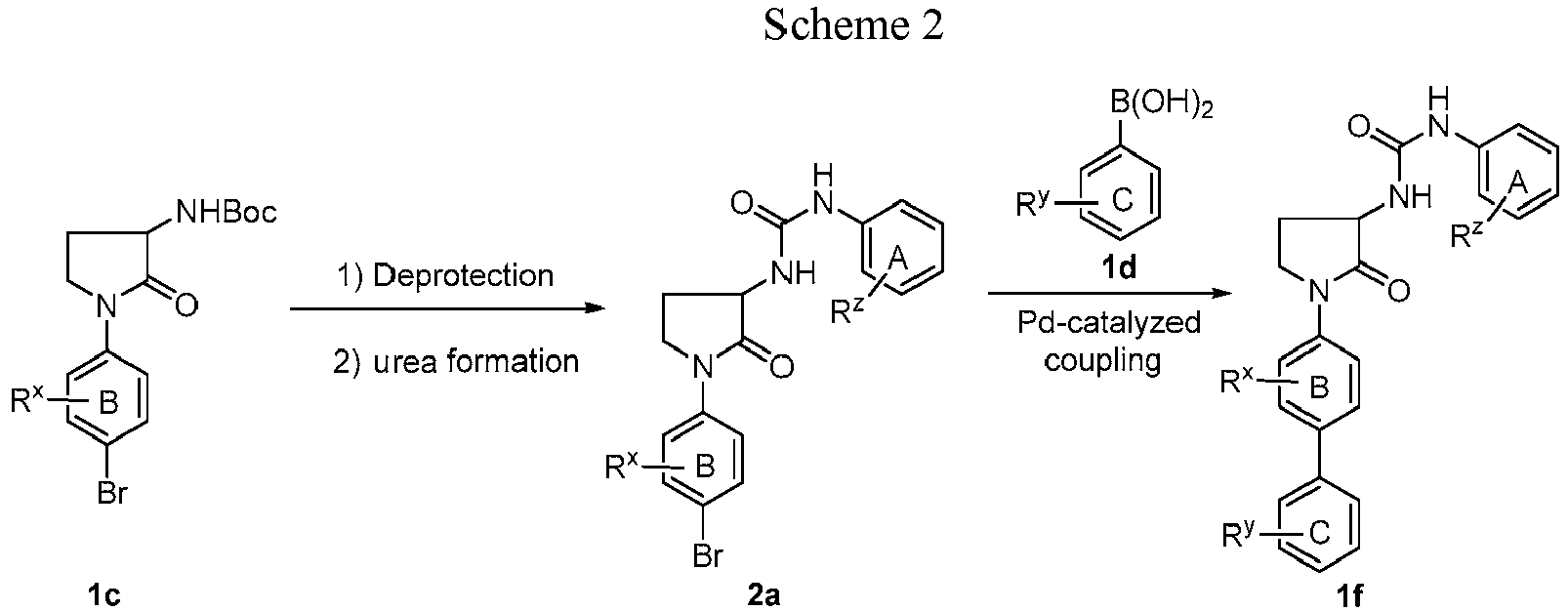
- Additionally as shown in Scheme 3, compounds of this invention can be prepared from intermediate 2a by conversion to boronate 3a using iridium/Pd-catalyzed C-H borylation according to the methods of Suzuki and Miyaura followed by coupling of the resulting pinacolatoboron species with aryl or heteroaryl halides using palladium or copper catalyzed processes to provide compounds If. Racemic compounds can be separated using either chiral HPLC or SFC to provide single enantiomers.
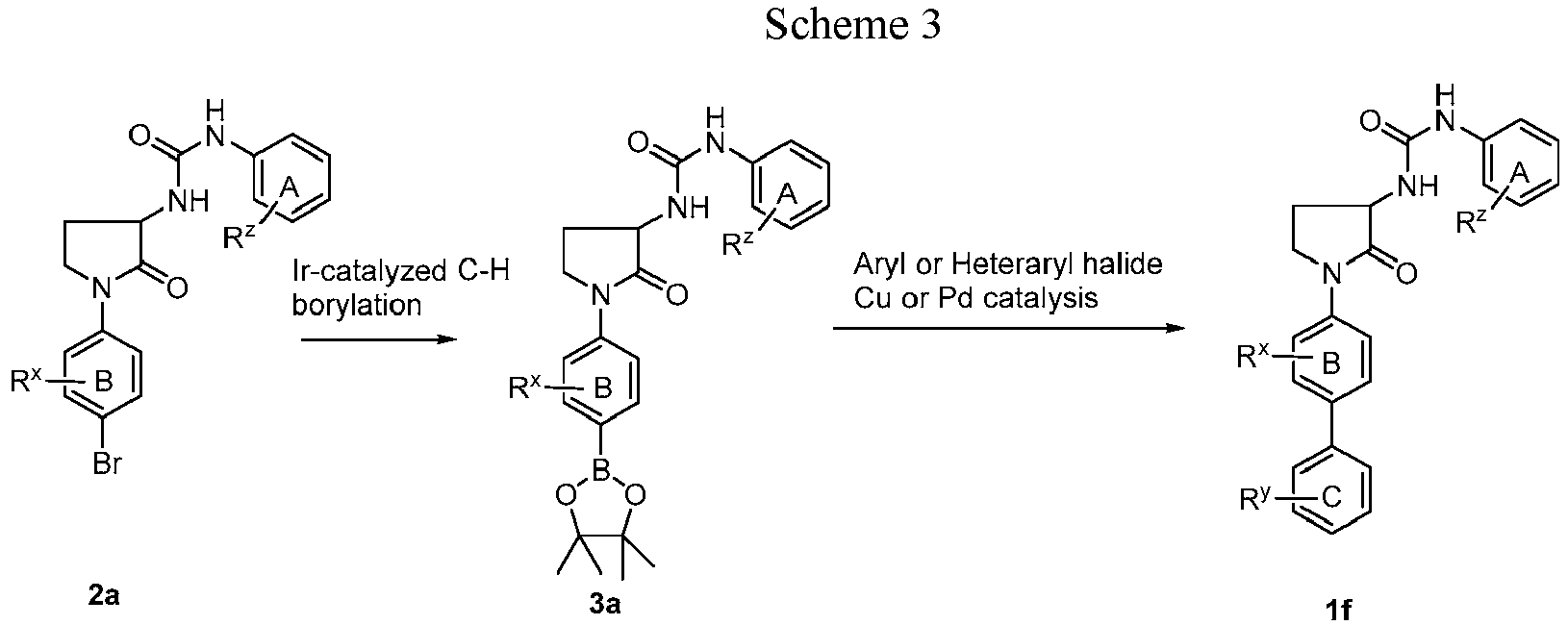
- Alternatively as described in Scheme 4, compounds of this invention can be prepared by brominating amine 4a to give intermediate 4b. Subsequent amide coupling with 2,4-dibromo-butyryl chloride under basic conditions such as potassium phosphate in acetronitrile, followed by aqueous ammonia mediated ring closure can give lactam 1c. Intermediate 1c can be converted into final products using the reactions shown in Schemes 1-3. Racemic compounds can be separated using either chiral HPLC or SFC to provide single enantiomers.

- As described in Scheme 5, compounds of this invention with substituted lactams can be prepared from intermediate 5a. Copper or Pd-catalyzed coupling of 5a to a substituted iodobenzene or bromobenzene 1b or other suitable halo aryl or heteroaryl compound in a suitable solvent such as butanol or dioxane or toluene, in the presence of a base such as potassium carbonate or cesium carbonate and a suitable ligand such as N,N'-dimethylethylenediamine, or Xanthphos can afford 1-phenylpyrrolidinones 5b. Additional methods for this transformation include other variations of Ullmann, and Buchwald copper-catalyzed amidation or Buchwald Pd-catalyzed amidation depending on the nature of ring B, using methods known to one skilled in the art for these types of couplings. Subsequent preparation of a lithium lactam enolate and treatment with an azide such as trisyl azide can yield intermediate 5c (see for example J. Org. Chem. 2003, 68, 7219-7233). Reduction of azide to amine followed by protection of amine can give intermediate 5d. Chemistry described in previous schemes can used to convert this intermediate into compounds claimed in this patent. Racemic compounds can be separated using either chiral HPLC or SFC to provide single enantiomers.

- Compounds of the invention can also be synthesized using the route shown in Scheme 6. Palladium catalyzed borylation of intermediate 1c gives intermediate 6a. Palladium mediated coupling of a suitiably substituted aryl halides such as 6b can give biaryl lactam 1e. Chemistry described in previous schemes can used to convert this intermediate into compounds claimed in this patent. Racemic compounds can be separated using either chiral HPLC or SFC to provide single enantiomers.

- Other features of the invention will become apparent in the course of the following descriptions of exemplary embodiments that are given for illustration of the invention and are not intended to be limiting thereof.
- The following methods were used in the exemplified Examples, except where noted otherwise. Purification of intermediates and final products was carried out via either normal or reverse phase chromatography. Normal phase chromatography was carried out using prepacked SiO2 cartridges eluting with either gradients of hexanes and ethyl acetate or DCM and MeOH unless otherwise indicated. Reverse phase preparative HPLC was carried out using C18 columns with UV 220 nm or prep LCMS detection eluting with gradients of Solvent A (90% water, 10% MeOH, 0.1% TFA) and Solvent B (10% water, 90% MeOH, 0.1% TFA) or with gradients of Solvent A (95% water, 5% Acn, 0.1% TFA) and Solvent B (5% water, 95% ACN, 0.1% TFA) or with gradients of Solvent A (95% water, 2% Acn, 0.1% HCOOH) and Solvent B (98% Acn, 2% water, 0.1% HCOOH) or with gradients of Solvent A (95% water, 5% Acn, 10 mM NH4OAc) and Solvent B (98% ACN, 2% water, 10 mM NH4OAc) or with gradients of Solvent A (98% water, 2% Acn, 0.1% NH4OH) and Solvent B (98% Acn, 2% water, 0.1% NH4OH).
- LC/MS Methods Employed in Characterization of Examples. Reverse phase analytical HPLC/MS was performed on a Waters Acquity system coupled with a Waters MICROMASS® ZQ Mass Spectrometer.
- Method A: Linear gradient of 0 to 100% B over 3 min, with 0.75 min hold time at 100% B;
- UV visualization at 220 nm
- Column: Waters BEH C18 2.1 x 50 mm
- Flow rate: 1.0 mL/min
- Solvent A: 0.1% TFA, 95% water, 5% Acn
- Solvent B: 0.1% TFA, 5% water, 95% Acn
- Method B: Linear gradient of 0 to 100% B over 3 min, with 0.75 min hold time at 100% B;
- UV visualization at 220 nm
- Column: Waters BEH C18 2.1 x 50 mm
- Flow rate: 1.0 mL/min
- Solvent A: 10 mM ammonium acetate, 95% water, 5% Acn
- Solvent B: 10 mM ammonium acetate, 5% water, 95% Acn
- Method C: Ascentis Express C18, 2.1 x 50 mm, 2.7-µm particles; Solvent A: 95% water, 5% Acn, 0.05% TFA; Solvent B: 95% Acn, 5% water, 0.1% TFA; Temperature: 50 °C; Gradient: 0-100% B over 3 minutes, then a 1-minute hold at 100% B; Flow: 1.1 mL/min.
- Method D: Ascentis Express C18, 2.1 x 50 mm, 2.7-µm particles; Solvent A: 95% water, 5% Acn with 10 mM ammonium acetate; Solvent B: 95% Acn, 5% water with 10 mM ammonium acetate; Temperature: 50 °C; Gradient: 0-100% B over 3 minutes, then a 1-minute hold at 100% B; Flow: 1.1 mL/min.
- Method E: Column-Kinetex C18, 75 x 3 mm, 2.6-µm particles; Solvent A: 98% water, 2% Acn with 10 mM ammonium acetate; Solvent B: 98% Acn, 2% water with 10 mM ammonium acetate; Temperature: 25 °C; Gradient: 20-100% B over 4 minutes, then a 0.6-minute hold at 100% B; Flow: 1.0 mL/min; then, Gradient: 100-20% B over 0.4 minutes; Flow: 1.5 mL/min, UV 220 nm.
-
- Method I: Chiralpak AD-H, 250 x 4.6 mm, 5.0-µm particles; % CO2: 60%, % Co solvent: 40% {0.2%DEA IN IPA:Acn (1:1)}, Total Flow: 4.0g/min, Back Pressure: 100bars, Temperature : 25°C, UV: 218 nm.
- Method II: Chiralpak OD-H, 250 x 4.6 mm, 5.0-µm particles; % CO2: 60%, % Co solvent: 40% {0.2% DEA IN IPA:Acn (1:1)}, Total Flow: 4.0g/min, Back Pressure: 104 bars, Temperature : 24.9°C, UV: 287 nm.
- Method III: Chiralpak OJ-H, 250 x 4.6 mm, 5.0-µm particles; % CO2: 60%, % Co solvent: 30%(0.3% DEA in Methanol), Total Flow: 4.0g/min, Back Pressure: 101 bars, Temperature : 23.6°C, UV: 272 nm.
- Method IV: Chiralpak AS-H, 250 x 4.6 mm, 5.0-µm particles; % CO2: 60%, % Co solvent: 40%(0.3% DEA in Methanol), Total Flow: 4.0g/min, Back Pressure: 102 bars, Temperature : 25.4°C, UV: 272 nm.
- Method V: Chiralcel OJ-H, 250 x 4.6 mm, 5.0-µm particles; % CO2: 60%, % Co solvent: 40%(0.2% DEA in Methanol), Total Flow: 4.0g/min, Back Pressure: 102 bars, Temperature : 24.6°C, UV: 272 nm.
- Method VI: Luxcellulose-2, 250 x 4.6 mm, 5.0-µm particles; % CO2: 60%, % Co solvent: 35%(0.2% DEA in Methanol), Total Flow: 3.0 g/min, Back Pressure: 101 bars, Temperature : 23.6°C, UV: 260 nm.
- Method VII: Chiralcel AS-H, 250 x 4.6 mm, 5.0-µm particles; % CO2: 60%, % Co solvent: 40%(0.2% DEA in Methanol), Total Flow: 4.0 g/min, Back Pressure: 101 bars, Temperature : 24.4°C, UV: 270 nm.
- Method VIII: Chiralpak IC, 250 x 4.6 mm, 5.0-µm particles; % CO2: 60%, % Co solvent: 40%(0.2% DEA in Methanol), Total Flow: 4.0 g/min, Back Pressure: 101 bars, Temperature : 24.4°C, UV: 270 nm.
- Method IX: Column: chiralpak IF (250 X 4.6mm), 5 micron, mobile phase: 0.2% DEA in ethanol, FLOW:1.0ml\min.
- Method X: Column: LUX AMYLOSE 2 (250 X 4.6mm), 5 micron, mobile phase: 0.2% DEA in n-hexane:ethanol:5:95, FLOW: 1.0ml\min.
- Method XI: Column: CHIRALCEL OD-H (250 X 4.6mm), 5 micron, mobile phase: 0.2% DEA in n-hexane:ethanol:70:30, FLOW:1.0ml\min.
- Method XII: Column: CHIRAL PAK ID 250 X 4.6mm), 5 micron, mobile phase: 0.1% DEA in Methanol, FLOW: 1.0ml/min.
- NMR Employed in Characterization of Examples. 1H NMR spectra were obtained with Bruker or JEOL® Fourier transform spectrometers operating at frequencies as follows: 1H NMR: 400 MHz (Bruker or JEOL®) or 500 MHz (Bruker or JEOL®). 13C NMR: 100 MHz (Bruker or JEOL®). Spectra data are reported in the format: chemical shift (multiplicity, coupling constants, and number of hydrogens). Chemical shifts are specified in ppm downfield of a tetramethylsilane internal standard (δ units, tetramethylsilane = 0 ppm) and/or referenced to solvent peaks, which in 1H NMR spectra appear at 2.49 ppm for CD2HSOCD3, 3.30 ppm for CD2HOD, 1.94 for CD3CN, and 7.24 ppm for CHCl3, and which in 13C NMR spectra appear at 39.7 ppm for CD3SOCD3, 49.0 ppm for CD3OD, and 77.0 ppm for CDCl3. All 13C NMR spectra were proton decoupled.
-

- To a stirred solution of hexamethyldisilazane (11 mL, 523 mmol) in CH3CN (100 mL) at rt was added a solution of DL-2,4-diaminobutyric acid dihydrochloride (10 g, 52 mmol) in Acn (100 mL). The resulting reaction mixture was heated to reflux for 40 h. Then, the crude reaction mixture was poured into ice cold MeOH (400 mL), stirred at rt for 30 min and evaporated under reduced pressure. The resulting solid was dissolved in CH2Cl2 (700 mL), and the insoluble residue was removed by filtration under vacuum. Then, the filtrate was concentrated under reduced pressure to give 3-aminopyrrolidin-2-one (4.1 g, 41 mmol, 78% yield) as a yellow solid. 1H NMR (400MHz, DMSO-d6): δ 7.59 (br. s., 2H), 3.23-3.10 (m, 1H), 3.09 - 3.03 (m, 2H), 2.23-2.22 (m, 1H), 1.70 - 1.57 (m, 1H).
-

- To a stirred solution of 3-aminopyrrolidin-2-one (4.0 g, 40 mmol) in methanoltriethylamine (130 mL, 9:1) under argon atmosphere at rt, was added Boc-anhydride (9.6 mL, 41 mmol). The reaction mixture was stirred at rt overnight followed by heating toreflux for two hours. Then, the reaction mixture was cooled to rt and concentrated under reduced pressure. Ether (50 mL) was added to the crude residue and the solid was filtered through Buchner funnel to yield Intermediate 2 (4.0 g, 20 mmol, 50% yield) as brown solid. 1H NMR (400MHz, DMSO-d6): δ 7.69 (br. s., 1H), 6.99 (d, J=8.0 Hz, 1H), 4.06 - 3.96 (m, 1H), 3.19 - 3.10 (m, 2H), 2.29 - 2.19 (m, 1H), 1.89 - 1.76 (m, 1H), 1.35 (s, 9H).
-

- To a stirred solution of Intermediate 2 (1.0 g, 5.0 mmol) in 1,4-dioxane (10 mL), were added 1,4-dibromo-2,3-difluorobenzene (1.6 g, 6.0 mmol), and Cs2CO3 (3.3 g, 10 mmol). The reaction mixture was purged with nitrogen for 5 min and charged with Xantphos (0.29 g, 0.50 mmol) and Pd2(dba)3 (0.23 g, 0.25 mmol). The reaction mixture was again purged with nitrogen for 3 min and heated at 120°C for 16 h. The reaction mixture was cooled, filtered through a Celite pad, and the filtrate was concentrated under reduced pressure. The crude product was purified using column chromatography (pet. ether-EtOAc) to yield Intermediate 3 (1.1 g, 2.8 mmol, 47% yield) as brown solid. MS(ESI) m/z: 391.2 (M+H)+. 1H NMR (400MHz, DMSO-d6) δ 7.61-7.59 (m, 1H), 7.35 - 7.28 (m, 2H), 4.39 - 4.28 (m, 1H), 3.82 - 3.64 (m, 2H), 2.42 - 2.31 (m, 1H), 2.10 - 1.97 (m, 1H), 1.40 (s, 9H).
-

- To a solution of Intermediate 3 (1.1 g, 2.1 mmol) in 1.4-dioxane-water (11 mL, 10:1) at rt, were added (2-(methylsulfonamido)phenyl)boronic acid (0.45 g, 2.1 mmol), and potassium phosphate, tribasic (0.74 g, 4.2 mmol). The reaction mixture was purged with nitrogen for 5 min and charged with PdCl2(dppf)-CH2Cl2 (0.17 g, 0.21 mmol). The reaction mixture was again purged with nitrogen for 3 min and heated at 80 °C for 16 h. The reaction mixture was cooled and filtered through a Celite pad, and the filtrate was concentrated under reduced pressure. The crude product was purified via column chromatography (pet. ether-EtOAc) to give Intermediate 4 (0.44 g, 0.91 mmol, 43% yield) as brown solid. MS(ESI) m/z: 482.2 [M+H]+; 1H NMR (400MHz, DMSO-d6) δ 9.13 (s, 1H), 7.53 - 7.44 (m, 2H), 7.38 - 7.29 (m, 4H), 7.24 - 7.17 (m, 1H), 4.36-4.31 (m, 1H), 3.86 - 3.69 (m, 2H), 2.90 (s, 3H), 2.41-2.37 (m, 1H), 2.10 - 2.02 (m, 1H), 1.41 (s, 9H).
-

- To an ice cooled solution of Intermediate 4 (440 mg, 0.91 mmol) in 1,4-dioxane (1 mL), was added 4 N HCl in 1,4-dioxane (4.6 mL, 1 mmol), and the reaction mixture was stirred at rt for 2 h. The solvent was evaporated under reduced pressure. The gummy solid was triturated with diethyl ether (20 ml x 2) and dried to yield Intermediate 5 (350 mg, 0.84 mmol, 92% yield) as a brown solid.
- MS(ESI) m/z: 418.2 [M+H]+; 1H NMR (400MHz, DMSO-d6) δ 9.18 (s, 1H), 8.71 (br. s., 3H), 7.55 - 7.47 (m, 2H), 7.45 - 7.24 (m, 4H), 4.33 - 4.25 (m, 1H), 3.97 - 3.85 (m, 2H), 2.89 (s, 3H), 2.64 - 2.54 (m, 1H), 2.30 - 2.17 (m, 1H).
-

- 1-Propanephosphonic anhydride (50% in EtOAc, 210 mL, 340 mmol) was added to a solution of Boc-D-2,4-diaminobutyric acid (50 g, 230 mmol) and TEA (96 mL, 690 mmol) in DCM (1500 mL) at 0 °C. The reaction mixture was stirred at rt overnight under nitrogen. The reaction mixture was concentrated in vacuo, and the crude product was purified by column chromatography (MeOH/DCM). The product was recrystallized with EtOAc/pet. ether to obtain Intermediate 6 (32 g, 70 mmol, 70 % yield) as a white solid. MS(ESI) m/z: 201.2 (M+H)+. 1H NMR (400 MHz, DMSO-d6) δ = 7.69 (s, 1H), 6.99 (br. d., J= 9.0 Hz, 1H), 4.01 (q, J= 9.0 Hz, 1H), 3.17 - 3.09 (m, 2H), 2.28 - 2.19 (m, 1H), 1.90 - 1.75 (m, 1H), 1.39 (s, 9H).
-

- A reaction mixture of Intermediate 6 (20 g, 100 mmol), 2,3-difluoro-1,4-dibromobenzene (14 g, 110 mmol), potassium phosphate tribasic (32 g, 150 mmol), and cuprous iodide (7.6 g, 40 mmol) in 1,4-dioxane (250 mL) was purged with nitrogen for 5 min. N,N'-Dimethylethylenediamine (5.5 mL, 50 mmol) was added, and the reaction mixture was heated in a pressure tube at 65 °C for 12 h. The reaction mixture was diluted with EtOAc, filtered through Celite, and concentrated under reduced pressure. The crude product was purified by column chromatography (35% EtOAc in pet ether) and recrystallized (EtOAc/pet ether) to obtain Intermediate 7 (18 g, 39 mmol, 39% yield) as a white solid. MS(ESI) m/z: 439.0 (M+H)+. 1H NMR (400 MHz, CDCl3) δ = 7.54 (ddd, J = 8.5, 6.3, 2.3 Hz, 1H), 7.09 (ddd, J= 8.5, 6.3, 2.3 Hz, 1H), 5.16 (br. s., 1H), 4.41 - 4.30 (m, 1H), 3.87 (m, 1H), 3.79 - 3.69 (m, 1H), 2.85 - 2.73 (m, 1H), 2.17 - 2.05 (m, 1H), 1.48 (m, 9H).
-

- In a pressure tube, a reaction mixture of 1-bromo-2-iodobenzene (2.3 mL, 18 mmol), potassium phosphate tribasic (5.6 g, 27 mmol) and Xantphos (0.61 g, 1.1 mmol) in DMF (40 mL) was degassed with argon for 3 min. Dimethylphosphine oxide (1.7 g, 21 mmol), and PdOAc2 (0.20 g, 0.88 mmol) were added. The mixture was degassed with argon, sealed and heated for 16 h at 110 °C. The reaction mixture was cooled to rt, filtered through Celite and concentrated under reduced pressure. The crude product was purified by column chromatography (CHCl3/MeOH) to give Intermediate 8 (2.1 g, 9.0 mmol, 51% yield). MS(ESI) m/z: 233.0 (M+H)+. 1H NMR (300 MHz, DMSO-d6) δ = 7.97 (ddd, J= 11.9, 7.8, 2.0 Hz, 1H), 7.76 (ddd, J= 7.8, 3.9, 1.2 Hz, 1H), 7.65 - 7.44 (m, 2H), 1.83 (d, J = 13.5 Hz, 6H).
-

- A reaction mixture of Intermediate 7 (15 g, 38 mmol), Intermediate 8 (11 g, 46 mmol), bispin (24 g, 96 mmol), and K3PO4 (24 g, 115 mmol) in 1,4-dioxane (250 mL) was purged with argon for 5 min. PdCl2(dppf)-CH2Cl2 adduct (3.1 g, 3.8 mmol) was added and the mixture was again purged with argon and then stirred in a pressure tube at 105 °C for 24 h. The reaction mixture was diluted with EtOAc, filtered through Celite, and concentrated under reduced pressure. The crude product was purified via column chromatography (5% MeOH in CHCl3) to give Intermediate 9 (9.0 g, 19 mmol, 51% yield). MS(ESI) m/z: 465.4 (M+H)+. 1H NMR (400 MHz, DMSO-d6) δ = 7.92 (ddd, J= 12.8, 7.6, 1.3 Hz, 1H), 7.70 - 7.49 (m, 2H), 7.41 - 7.23 (m, 4H), 4.54 - 4.23 (m, 1H), 3.87 - 3.70 (m, 2H), 2.44 - 2.37 (m, 1H), 2.21 - 2.00 (m, 1H), 1.51 (br. d., J = 13.1 Hz, 6H), 1.42 (s, 9H).
-

- HCl (4 M in 1,4-dioxane, 200 mL, 800 mmol) was added to a stirred solution of Intermediate 9 (34 g, 73 mmol) in 1,4-dioxane (500 mL) at rt. The reaction mixture was stirred for 3 h and concentrated under reduced pressure to yield Intermediate 10 (28 g, 70 mmol, 95% yield), which was used in the next synthetic step without further purification. MS(ESI) m/z: 365.2 (M+H)+. 1H NMR (400 MHz, DMSO-d6) δ = 8.62 (br. s., 3H), 7.95 - 7.81 (m, 1H), 7.68 - 7.57 (m, 2H), 7.39 - 7.32 (m, 2H), 7.31 - 7.24 (m, 1H), 4.33 - 4.19 (m, 1H), 3.94 - 3.84 (m, 2H), 2.61 - 2.53 (m, 1H), 2.25 - 2.15 (m, 1H), 1.53 (d, J = 13.1 Hz, 6H).
-

- Phenyl chloroformate (20 mL, 160 mmol) was added slowly to a solution of 4-chloro-2-fluoroaniline (19 mL, 170 mmol) and pyridine (35 mL, 430 mmol) in DCM (250 mL) at 0 °C. The reaction mixture was gradually warmed to rt and stirred for 12 h. The reaction mixture was quenched with water. The mixture was extracted with DCM (3 x 200 mL). The combined organic layers were washed with 0.5 N HCl and 10% sodium bicarbonate, dried over sodium sulfate, and concentrated in vacuo. The solid was stirred in pet ether (100 mL) for 15 min, filtered and dried to get Intermediate 11 (36 g, 40 mmol, 78% yield). 1H NMR (300MHz, CHLOROFORM-d) δ = 10.22 - 9.99 (m, 1H), 7.73 (br. t., J= 8.7 Hz, 1H), 7.52 (dd, J= 10.7, 2.1 Hz, 1H), 7.47 - 7.38 (m, 2H), 7.34 - 7.18 (m, 4H).
-

- Phenyl chloroformate (4.5 mL, 36 mmol) was added slowly to a solution of 2-fluoro-4-(trifluoromethyl) aniline (8.0 g, 45 mmol) and pyridine (9.0 mL, 110 mmol) in DCM (80 mL) at 0 °C. The reaction mixture was gradually warmed to rt and stirred for 3 h. The reaction mixture was quenched with water and the mixture was extracted with DCM (3 x 200 mL). The combined organic layers were washed with 0.5 N HCl and 10% sodium bicarbonate, dried over sodium sulfate, and concentrated in vacuo. The solid was stirred in pet. ether (100 mL) for 15 min, filtered and dried to give Intermediate 11 (9.0 g, 30 mmol, 67% yield). MS(ESI) m/z: 317.2 (M+NH4)+. 1H NMR (300MHz, CHLOROFORM-d) δ = 10.43 (s, 1H), 8.04 (br. t., J= 8.1 Hz, 1H), 7.75 (br. d., J= 10.9 Hz, 1H), 7.60 (br. d., J = 8.6 Hz, 1H), 7.52 - 7.38 (m, 2H), 7.36 - 7.21 (m, 3H).
-

- HCl (4 M in dioxane, 32 mL, 130 mmol) was added dropwise to a solution of Intermediate 7 (10 g, 26 mmol) in DCE (300 mL) at 0 °C. The reaction mixture was stirred for 2 h at rt and concentrated under reduced pressure. The crude intermediate was dissolved in 1,4-dioxane (300 mL) and cooled to 0 °C. DIEA (22 mL, 130 mmol) was added dropwise over a period of 10 min, Intermediate 12 (6.9 g, 23 mmol) was added, and the mixture was stirred for 12 h at rt. The reaction mixture was filtered through Celite, and the filter plug was washed with EtOAc. The filtrate was dried over sodium sulfate and concentrated under reduced pressure. The crude product was purified by column chromatography (2% MeOH:DCM) to yield Intermediate 13(12 g, 24 mmol, 95% yield). MS(ESI) m/z: 496.0 (M+H)+.
-

- A solution of Intermediate 13 (12 g, 24 mmol) and bispin (18 g, 73 mmol) in 1,4-dioxane (120 mL) was degassed with argon for 5 min. PdCl2(dppf)-CH2Cl2 (4.0 g, 4.8 mmol) was added, and the reaction mixture was slowly heated to 110 °C and stirred for 16 h. The mixture was filtered through Celite, and the plug was washed with EtOAc. The filtrate was dried over sodium sulfate and concentrated under reduced pressure to give Intermediate 14 (13 g, 24 mmol, 99% yield). MS(ESI) m/z: 544.2 (M+H)+.
-
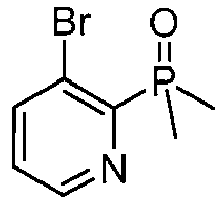
- To a stirred solution of 3-bromo-2-iodopyridine (5.0 g, 18 mmol) in DMF (5 mL), were added dimethylphosphine oxide (1.7 g, 21 mmol), and K3PO4 (4.1 g, 19 mmol). The reaction mixture was purged with nitrogen for 5 min and charged with Xantphos (1.0 g, 1.8 mmol) and Pd(OAc)2 (0.20 g, 0.88 mmol). The reaction mixture was again purged with nitrogen for 3 min and heated at 100 °C for 9 hours. The reaction mixture was filtered through Celite and concentrated under reduced pressure. The crude material was purified by column chromatography (5% MeOH-CHCl3) to give Intermediate 15 (2.7 g, 12 mmol, 66 % yield) as a brown liquid. MS(ESI) m/z: 234.1 [M+H]+. 1H NMR (400 MHz, DMSO-d6) δ = 8.72 (d, J= 4.8 Hz, 1H), 8.23-8.20 (m, 1 H), 7.53 - 7.49 (m, 1 H), 1.66 (d, J= 13.6 Hz, 6H).
-

- To a stirred solution of 1-bromo-3-fluoro-2-iodobenzene (2.0 g, 6.7 mmol) in 1,4-dioxane (15 mL), were added dimethylphosphine oxide (0.62 g, 8.0 mmol), and K3PO4 (1.6 g, 7.3 mmol). The reaction mixture was purged with nitrogen for 5 min and charged with Xantphos (0.39 g, 0.67 mmol) and Pd2(dba)3 (0.30 g, 0.33 mmol). The reaction mixture was again purged with nitrogen for 3 min and heated at 100 °C for 9 h. The reaction mixture was filtered through Celite and concentrated under reduced pressure. The crude material was purified by column chromatography (0-100% EtOAc-Hexane, followed by 3% MeOH-CHCl3) to give Intermediate 16 (0.33 g, 1.3 mmol, 20% yield) as a yellow solid. MS(ESI) m/z: 250.9 [M+H]+. 1H NMR (400 MHz, DMSO-d6) δ = 7.63 (d, J= 8.0 Hz, 1H), 7.52 (td, J= 8.0, 6.0 Hz, 1H), 7.43 - 7.28 (m, 1H), 1.87 (d, J= 16.6 Hz, 3H), 1.86 (d, J= 16.6 Hz, 3H).
-
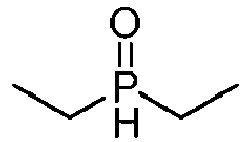
- To a stirred solution of 2M ethylmagnesium bromide (330 mL, 650 mmol) in THF at rt, was added diethyl phosphonate (30 g, 220 mmol) and the mixture was stirred for additional 2 hours. Then, a cold solution of K2CO3 (90 g, 650 mmol) in water (120 mL) was added and the reaction mixture was filtered through a Celite pad. The filtrate was concentrated under reduced pressure and azeotroped with toluene (20 mL x 3). The crude material was diluted with DCM (100 mL), filtered through a cotton bed and concentrated under reduced pressure to give Intermediate 17 (12 g, 110 mmol, 52% yield) as a yellowish liquid. MS(ESI) m/z: 107.2 [M+H]+.
-

- To a stirred solution of 1-bromo-2-iodobenzene (10 g, 35.3 mmol) in DMF (50 mL), were added diethylphosphine oxide (4.5 g, 42 mmol), and K3PO4 (15 g, 71 mmol). The reaction mixture was purged with nitrogen for 5 min and charged with Xantphos (1.0 g, 1.8 mmol) and palladium (II) acetate (0.40 g, 1.8 mmol). The reaction mixture was again purged with nitrogen for 3 min, heated to 100 °C and stirred for 16 h. The reaction mixture was cooled, filtered through a Celite pad, and the filtrate was concentrated under reduced pressure. The crude product was purified by column chromatography (MeOH-EtOAc) to yield the Intermediate 18 (3.2 g, 12 mmol, 35% yield) as a yellowish liquid. MS(ESI) m/z: 263.2 [M+H]+. 1H NMR (400MHz, DMSO-d6) δ = 8.05 - 7.94 (m, 1H), 7.79 - 7.68 (m, 2H), 7.64 - 7.48 (m, 1H), 2.26 - 2.03 (m, 4H), 0.93 (td, J= 17.4, 7.7 Hz, 6H).
-
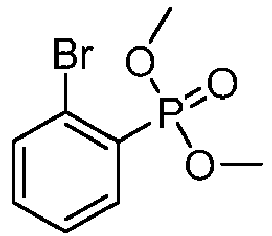
- To a stirred solution of 2-bromophenyl trifluoromethanesulfonate (2.0 g, 6.6 mmol) in toluene (100 mL), were added dimethyl phosphonate (1.1 g, 9.8 mmol), and DIEA (1.7 mL, 9.8 mmol). The reaction mixture was purged with nitrogen for 5 min and charged with 1,3-bis(diphenylphosphino)propane (0.14 g, 0.33 mmol) and palladium (II) acetate (0.04 g, 0.17 mmol). The reaction mixture was again purged with nitrogen for 3 min and heated at 110 °C for 16 h. The reaction mixture was cooled and filtered through a Celite pad, and the filtrate was concentrated under reduced pressure. The product was purified by flash chromatography (5-10% MeOH in chloroform) to yield Intermediate 19 (1.2 g, 3.6 mmol, 55% yield) as a colorless liquid. MS(ESI) m/z: 267.1 [M+H]+. 1H NMR (400MHz, CDCl3) δ = 8.02 - 8.00 (m, 1 H) 7.70 - 7.69 (m, 1 H) 7.43 - 7.41 (m, 2 H) 3.83 - 3.73 (m, 6 H).
-

- To a stirred solution of 1-bromo-2-iodobenzene (1.0 g, 3.5 mmol) in DMF (5 mL), were added diethyl methylphosphonite (0.58 g, 4.2 mmol), and K3PO4 (2.3 g, 11 mmol). The reaction mixture was purged with nitrogen for 5 min and charged with Xantphos (0.21 g, 0.35 mmol) and palladium (II) acetate (0.040 g, 0.18 mmol). The reaction mixture was again purged with nitrogen for 3 min and heated at 110 °C for 16 h. The reaction mixture was cooled, filtered through Celite pad and the filtrate was concentrated under reduced pressure. The crude product was purified by flash chromatography (pet. ether-EtOAc) to yield the Intermediate 20 (0.35 g, 1.3 mmol, 38% yield) as a brown liquid. MS(ESI) m/z: 263.1 [M+H]+. 1H NMR (400MHz, CDCl3) δ = 8.18 - 8.13 (m, 1 H) 7.67 - 7.65 (m, 1 H) 7.64 - 7.38 (m, 2 H) 4.07- 4.03 (m, 1 H) 3.85 - 3.80 (m, 1 H) 1.86 (d, J= 15.0 Hz, 3H), 1.32 (t, J= 7.2 Hz, 3H).
-

- To an ice cooled solution of 3-cyclopropyl-2-fluoroaniline (0.85 g, 5.6 mmol) in DMF (11 mL) under argon atmosphere at rt, was added NBS (1.0 g, 5.6 mmol). The reaction mixture was gradually warmed to rt over 3 h and quenched with aqueous Na2S2O3 (10 mL). The biphasic mixture was extracted with EtOAc (30 mL x 2). The combined organic layer was washed with brine (15 mL x 2), dried over Na2SO4, concentrated under reduced pressure and purified through flash column chromatography (25% EtOAc-Pet.ether) to yield Intermediate 21 (1.2 g, 5.0 mmol, 89% yield) as an orange liquid. 1H NMR (400 MHz, CDCl3) δ = 7.11 (d, J= 8.5 Hz, 1H), 6.51 (t, J= 8.8 Hz, 1H), 3.67 (br s, 2H), 1.80 (tt, J= 8.6, 5.7 Hz, 1H), 1.07 - 0.82 (m, 4H).
-

- To a stirred solution of Intermediate 21 (1.1 g, 4.8 mmol) in Acn (10 mL) at 0 °C under nitrogen was added K3PO4 (1.0 g, 4.8 mmol). The resulting mixture was treated with 2,4-dibromobutanoyl chloride (0.60 mL, 4.5 mmol) and stirred for 2 h. Then, K2CO3 (2.0 g, 14 mmol) was added, and the mixture was stirred for 16 h. The solid was filtered through a Celite pad and the pad was washed with Acn (15 mL x 2). The filtrate was partially evaporated, ammonia (aq, 10 mL, 460 mmol) was added, and the mixture was stirred at 40 °C for 16 h. The mixture was extracted with EtOAc (20 mL x 3) and washed with brine (20 mL). The combined organics were dried over Na2SO4 and evaporated to give crude 3-amino-1-(4-bromo-3-cyclopropyl-2-fluorophenyl)pyrrolidin-2-one (1.0 g, 3.2 mmol, 67% yield), which was used in next step without further purification.
- To a stirred solution of 3-amino-1-(4-bromo-3-cyclopropyl-2-fluorophenyl)pyrrolidin-2-one in DCM (15 mL) under argon atmosphere at rt, were added TEA (0.98 mL, 7.0 mmol) and (Boc)2O (0.90 mL, 3.9 mmol). The reaction mixture was stirred at rt for 6 hours. Then, the reaction mixture was quenched with aqueous saturated NH4Cl (20 mL) and extracted with EtOAc (20 mL x 3). The combined organic layers were washed with brine (20 mL), dried over Na2SO4, concentrated under reduced pressure and purified via flash chromatography (20% EtOAc-pet. ether) to give Intermediate 22 (1.0 g, 2.4 mmol, 69 % yield) as a yellowish gummy solid. MS(ESI) m/z: 413.1 [M+H]+. 1H NMR (400 MHz, CDCl3) δ = 7.38 (dd, J= 8.5, 1.5 Hz, 1H), 7.14 - 7.09 (m, 1H), 5.18 (br. s., 1H), 4.37 - 4.33 (m, 1H), 3.86 - 3.74 (m, 1H), 3.69 - 3.62 (m, 1H), 2.79 - 2.75 (m, 1H), 2.15-2.01 (m, 1H), 1.80 (tt, J= 8.6, 5.7 Hz, 1H), 1.48 (s, 9H), 1.14 - 1.01 (m, 2H), 0.91 - 0.84 (m, 2H).
-

- To a solution of Intermediate 22 (0.50 g, 1.2 mmol) in 1,4-dioxane (10 mL) at rt, were added (2-bromophenyl)dimethylphosphine oxide (0.42 g, 1.8 mmol), 4,4,4',4',5,5,5',5'-octamethyl-2,2'-bi(1,3,2-dioxaborolane) (0.92 g, 3.6 mmol), and K2CO3 (0.42 g, 3.0 mmol). The reaction mixture was purged with nitrogen for 5 min and then charged with PdCl2(dppf).DCM (0.090 g, 0.12 mmol). The reaction mixture was again purged with nitrogen for 3 min and heated at 100 °C for 16 h. The reaction mixture was cooled and filtered through a Celite pad, and the filtrate was concentrated under reduced pressure. The crude intermediate was purified by flash chromatography (MeOH-CHCl3) to yield Intermediate 23 (0.30 g, 0.62 mmol, 51% yield) as an orange solid. MS(ESI) m/z: 487.1 [M+H]+. 1H NMR (400 MHz, CDCl3) δ = 8.25 - 8.10 (m, 1H), 7.62 - 7.48 (m, 2H), 7.33 - 7.21 (m, 2H), 7.07 - 6.95 (m, 1H), 5.26 - 5.10 (m, 1H), 4.48 - 4.27 (m, 1H), 3.93 - 3.79 (m, 1H), 3.79 - 3.67 (m, 1H), 2.88 - 2.74 (m, 1H), 2.20 - 2.01 (m, 1H), 1.54 - 1.37 (m, 16H), 1.04 - 0.85 (m, 2H), 0.73 - 0.68 (m, 2H).
-

- To an ice cooled solution of Intermediate 23(0.33 g, 0.68 mmol) in 1,4-dioxane (1 mL) under argon atmosphere at rt, was added 4M HCl in 1,4-dioxane (3.0 ml, 12 mmol) and the mixture was stirred at rt for 2 h. The solvent was evaporated under reduced pressure to obtain a gummy solid. The crude product was triturated with pet. ether (10 mL x 2) and dried to give Intermediate 24 (0.26 mg, 0.67 mmol, 99% yield) as a brown gummy solid. MS(ESI) m/z: 387.1 [M+H]+.
-

- To a stirred solution of 4-bromo-2-fluoro-3-(trifluoromethyl)aniline (0.70 g, 2.7 mmol) in Acn (10 mL) at 0 °C under nitrogen was added K3PO4 (0.58 g, 2.7 mmol). The resulting mixture was treated with 2,4-dibromobutanoyl chloride (0.29 mL, 2.2 mmol) and stirred for 2 h. Then, K2CO3 (1.1 g, 8.1 mmol) was added, and the reaction mixure was stirred for 16 h. The mixture was filtered through a Celite pad, and the pad was washed with Acn (15 mL x 2). The filtrate was partially evaporated and ammonia (aq) (10 mL, 462 mmol) was added. The mixture was stirred at 40 °C for 16 h and then extracted with EtOAc (20 mL x 3). The combined organics were washed with brine (20 mL), dried over Na2SO4 and evaporated to give crude 3-amino-1-(4-bromo-2-fluoro-3-(trifluoromethyl)phenyl)pyrrolidin-2-one (0.88 g, 2.6 mmol, 95 % yield), which was used in the next step without any further purification.
- To a stirred solution of crude 3-amino-1-(4-bromo-3-fluoro-2-(trifluoromethyl)phenyl)pyrrolidin-2-one in DCM (15 mL) under argon atmosphere at rt, were added TEA (3.7 mL, 26 mmol) and (Boc)2O (3.4 mL, 15 mmol). The reaction mixture was stirred at rt for 6 hours and then quenched with aqueous saturated NH4Cl (20 mL) and extracted with EtOAc (20 mL x 3). The combined organic layers were washed with brine (20 mL), dried over Na2SO4, concentrated under reduced pressure and purified via column chromatography (30% EtOAc-pet. ether) to yield Intermediate 25 (4.8 g, 11 mmol, 82% yield) as a yellowish gummy solid. MS(ESI) m/z: 442.8 [M+H]+. 1H NMR (300 MHz, CDCl3) δ = 7.82 (t, J= 7.8 Hz, 1H), 7.02 (br. d., J= 8.7 Hz, 1H), 5.23 - 5.05 (m, 1H), 4.43 - 4.23 (m, 1H), 3.80 - 3.53 (m, 2H), 2.89 - 2.68 (m, 1H), 2.21 - 2.03 (m, 1H), 1.47 (s, 9H).
-

- To a solution of Intermediate 25 (0.60 g, 1.4 mmol) in 1,4-dioxane (10 mL) at rt, were added (2-bromophenyl)dimethylphosphine oxide (0.41 mg, 1.8 mmol), 4,4,4',4',5,5,5',5'-octamethyl-2,2'-bi(1,3,2-dioxaborolane) (0.52 g, 2.0 mmol), and, K2CO3 (0.56 mg, 4.1 mmol). The reaction mixture was purged with nitrogen for 5 min and then charged with PdCl2(dppf).DCM (56 mg, 0.070 mmol). The reaction mixture was again purged with nitrogen for 3 min and heated at 100 °C for 16 h. The reaction mixture was cooled, filtered through a Celite pad and the filtrate was concentrated under reduced pressure. The crude product was purified by column chromatography (EtOAc/Pet. Ether) to give the Intermediate 26 (0.30 g, 0.58 mmol, 43% yield) as an orange solid. MS(ESI) m/z: 515.1
-

- To an ice cooled solution of Intermediate 26 (0.30 g, 0.58 mmol) in 1,4-dioxane (5 mL) under argon atmosphere at rt, was added 4M HCl in 1,4-dioxane (5 mL) and stirred at rt for 2 h. The solvent was evaporated under reduced pressure. The solid was triturated with pet. ether (10 ml x 2) and dried to give the Intermediate 27 (0.20 g, 0.48 mmol, 83% yield) as a brown gummy solid. MS(ESI) m/z: 415.1 [M+H]+.
-

- To a solution of (S)-5-(hydroxymethyl)pyrrolidin-2-one (1.0 g, 8.7 mmol) in 1,4-dioxane (15 mL) at rt, were added 1,4-dibromo-2,3-difluorobenzene (2.4 g, 8.7 mmol), K3PO4 (3.7 g, 17 mmol) and, N,N'-dimethylethylenediamine (0.15 g, 1.7 mmol). The reaction mixture was purged with nitrogen for 5 min and then charged with copper (I) iodide (0.17 g, 0.87 mmol). The reaction mixture was again purged with nitrogen for 3 min and heated at 95 °C for 12 h. The reaction mixture was cooled, filtered through a Celite pad and the filtrate was concentrated under reduced pressure. The crude compound was purified by column chromatography (3% MeOH-CHCl3) to yield Intermediate 28 (0.80 g, 2.6 mmol, 30% yield) as a yellowish solid. MS(ESI) m/z: 305.9 [M+H]+. 1H NMR (400 MHz, DMSO-d6) δ = 7.59 (ddd, J= 8.8, 7.0, 2.3 Hz, 1H), 7.24 (ddd, J= 9.0, 7.0, 2.0 Hz, 1H), 4.80 (t, J= 5.0 Hz, 1H), 4.20 - 4.04 (m, 1H), 3.37 (dd, J= 5.0, 4.0 Hz, 2H), 2.56 - 2.45 (m, 1H), 2.43 - 2.35 (m, 1H), 2.25 - 2.18 (m, 1H), 2.07 - 1.95 (m, 1H).
-

- To a stirred solution of Intermediate 28 (0.80 g, 2.6 mmol) in DCM (10 mL) under argon atmosphere at rt, were added TEA (0.55 mL, 3.9 mmol) and tert-butyldimethylsilyl chloride(0.43 g, 2.9 mmol). The reaction mixture was stirred at rt for 16 h. The reaction mixture was quenched with aqueous saturated NH4Cl (20 mL) and extracted with DCM (20 mL x 2). The combined organic layers were washed with brine (20 mL), dried over Na2SO4, concentrated under reduced pressure. The crude product was purified via column chromatography (15% EtOAc-Pet. ether) to give Intermediate 29 (0.85 g, 2.0 mmol, 77% yield) as a white solid. MS(ESI) m/z: 420.2 [M+H]+. 1H NMR (400 MHz, CDCl3) δ = 7.35 (m, 1H), 7.15 - 7.05 (m, 1H), 4.24 - 4.17 (m, 1H), 3.62 - 3.49 (m, 2H), 2.69 - 2.63 (m, 1H), 2.54 - 2.50 (m, 1H), 2.41 - 2.26 (m, 1H), 2.14 - 2.03 (m, 1H), 0.84 (s, 9H), -0.02 (s, 3H), -0.05 (s, 3H).
-

- To a stirred solution of Intermediate 29 (1.0 g, 2.4 mmol) in THF (20 mL) at -78 °C, lithium diisopropylamide (1.8 mL, 3.6 mmol) was added and stirring was continued for 30 min. Then, a solution of 2,4,6-triisopropylbenzenesulfonyl azide (1.0 g, 3.3 mmol) in THF (5 mL) was cannulated into the mixture and the mixture was stirred for 4 h. Then, the reaction mixture was quenched with saturated aqueous NaHCO3 (2 mL) and gradually warmed to rt. The reaction mixture was diluted with EtOAc (40 mL), washed with H2O (10 mL x 2) and brine (20 mL), dried over Na2SO4, and concentrated under reduced pressure. The crude residue was purified by column chromatography (15% EtOAc-Pet ether, 40 g column) to yield Intermediate 30 (0.85 g, 1.8 mmol, 77% yield) as an orange solid. MS(ESI) m/z: 461.1 [M+H]+. 1H NMR (400 MHz, DMSO-d6) δ = 7.65 (ddd, J= 9.0, 7.0, 2.0 Hz, 1H), 7.36 - 7.28 (m, 1H), 4.72 - 4.64 (m, 1H), 4.33 - 4.24 (m, 1H), 3.63 - 3.52 (m, 2H), 2.48 - 2.28 (m, 1H), 2.14 (dt, J= 13.3, 8.7 Hz, 1H), 0.91 - 0.66 (m, 9H), - 0.06 (s, 3H), -0.08 (s, 3H).
-

- To a stirred solution Intermediate 30 (0.85 g, 1.8 mmol) in THF (8 mL) were added triphenylphosphine (0.73 g, 2.8 mmol) and H2O (0.8 mL). The reaction mixture was stirred at rt for 3 h and heated at 65 °C for 6 h. The solvent was evaporated under reduced pressure and used for the next step without further purification. To a stirred solution of crude (5S)-3-amino-1-(4-bromo-2,3-difluoropheny1)-5-(((tert-butyldimethylsilyl)oxy)methyl)pyrrolidin-2-one in DCM (5 mL) under argon atmosphere at rt, were added Boc-anhydride (0.84 mL, 3.6 mmol) and TEA (0.75 mL, 5.4 mmol. The reaction mixture was stirred at rt for 2 h. Then, the reaction mixture was quenched with aqueous saturated NH4Cl (15 mL) and extracted with CHCl3 (20 mL x 2). The combined organic layers were washed with brine (15 mL), dried over Na2SO4, concentrated under reduced pressure. The crude product was purified via column chromatography (15% EtOAc-Pet. ether) to give Intermediate 31 (0.80 g, 1.5 mmol, 83% yield) as a white solid. MS(ESI) m/z: 535.2 [M+H]+. 1H NMR (400 MHz, CDCl3) δ = 7.41 - 7.32 (m, 1H), 7.15 - 7.01 (m, 1H), 5.02 - 5.22 (m, 1H), 4.73 - 4.61 (m, 1H), 4.52 - 4.43 (m, 1H), 4.21 - 4.10 (m, 1H), 3.61 - 3.52 (m, 1H), 2.63 - 2.51 (m, 1H), 2.35 - 2.31 (m, 1H), 1.43 (s, 9H), 0.84 (s, 9H), -0.06 (s, 3H), -0.08 (s, 3H).
-

- To a stirred solution of Intermediate 31 (0.80 g, 1.49 mmol) in 1,4-dioxane (10 mL), were added (2-bromophenyl)dimethylphosphine oxide (0.52 g, 2.2 mmol), bis(pinacolato)diboron (1.1 g, 4.5 mmol), and K2CO3 (0.42 mg, 3.0 mmol). The reaction mixture was purged with argon for 5 min and charged with PdCl2(dppf)-CH2Cl2 adduct (0.13 mg, 0.15 mmol). The reaction mixture was again purged with nitrogen for 3 min and heated at 100 °C for 12 h. The reaction mixture was cooled, filtered through a Celite pad and the filtrate was concentrated under reduced pressure. The crude product was purified by column chromatography (MeOH/CHCl3) to yield Intermediate 32 (0.40 g, 0.66 mmol, 44% yield) as a brown solid. MS(ESI) m/z: 609.3 [M+H]+. 1H NMR (400 MHz, DMSO-d6) δ = 8.01 - 7.97 (m, 1H), 7.85 - 7.81 (m, 1H), 7.80 - 7.64 (m, 2H), 7.59 - 7.27 (m, 3H), 4.66 - 4.56 (m, 1H), 4.42 - 4.33 (m, 1H), 3.76 - 3.55 (m, 2H), 2.46 - 2.28 (m, 2H), 1.54 - 1.39 (m, 15H), 0.84 (s, 9H), 0.06 (s, 3H), -0.08 (s, 3H).
-

- To an ice cooled solution of Intermediate 32 (0.40 g, 0.66 mmol) in 1,4-dioxane (1 mL) under argon atmosphere at rt, was added 4M HCl in 1,4-dioxane (2.5 mL, 10 mmol) and stirred at rt for two h. The solvent was evaporated under reduced pressure and the gummy solid was further triturated with EtOAc (10 ml x 2) and dried to give Intermediate 33 (0.22 g, 0.56 mmol, 85% yield) as a brown solid. MS(ESI) m/z: 395.1 [M+H]+. 1H NMR (400 MHz, DMSO-d6) δ = 7.97 - 7.88 (m, 1H), 7.82 - 7.72 (m, 1H), 7.69 - 7.47 (m, 2H), 7.43 - 7.25 (m, 2H), 4.35 - 4.29 (m, 2H), 4.11 - 3.86 (m, 4H), 3.55 - 3.34 (m, 2H), 2.48 - 2.27 (m, 2H), 1.52 (br d, J= 13.1 Hz, 6H).
-

- To a solution of racemic 5-methylpyrrolidin-2-one (1.0 g, 10 mmol) in 1,4-dioxane (10 mL) at rt, were added 1,4-dibromo-2,3-difluorobenzene (3.3 g, 12 mmol), K3PO4 (4.3 g, 20 mmol) and N,N'-dimethylethylenediamine (0.18 g, 2.0 mmol). The reaction mixture was purged with nitrogen for 5 min and then charged with copper (I) iodide (0.19 g, 1.0 mmol). The reaction mixture was again purged with nitrogen for 3 min and heated at 80 °C for 6 h. The reaction mixture was cooled, filtered through a Celite pad and the filtrate was concentrated under reduced pressure. The crude product was purified by column chromatography (pet. ether-EtOAc) to give Intermediate 34 (0.90 g, 3.1 mmol, 31% yield) as brown liquid. MS(ESI) m/z: 291.0 [M+H]+. 1H NMR (400MHz, CDC13) δ = 7.38 - 7.01 (m, 1 H), 6.99 - 6.96 (m, 1 H), 4.24 - 4.20 (m, 1H), 2.62-2.51 (m, 2 H), 2.50-2.38 (m, 1 H), 1.81-1.76 (m, 1 H), 1.17 (d, J=6.4Hz, 3H).
-
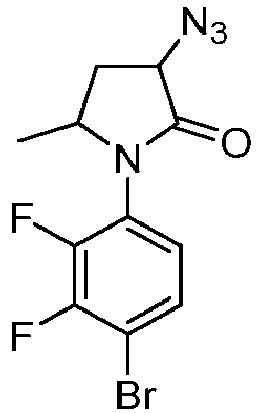
- To a stirred solution of Intermediate 34 (0.20 g, 0.69 mmol) in THF (3 mL) at -78 °C, lithium diisopropylamide (0.69 mL, 1.4 mmol) was added and stirring was continued for 40 min. Then, a solution of 2,4,6-triisopropylbenzenesulfonyl azide (0.26 g, 0.83 mmol) in THF (2 mL) was cannulated into the mixture and the mixture was stirred for 4 h. The mixture was then quenched with saturated aqueous NH4Cl (10 mL), gradually warmed to rt and extracted with EtOAc (20 mL x 2). The combined organic layers were washed with brine (15 mL), dried over Na2SO4, and concentrated under reduced pressure. The crude residue was purified by column chromatography (12% EtOAc-Pet ether) to yield Intermediate 35 (0.10 g, 0.21 mmol, 31% yield) as an orange solid. MS(ESI) m/z: 331.1 [M+H]+. 1H NMR (400MHz, CDCl3) δ = 7.40 - 7.36 (m, 1 H), 7.04 - 6.98 (m, 1 H), 4.36 - 4.31 (m, 1H), 4.26 - 4.21 (m, 1H), 2.32 - 2.26 (m, 1 H), 2.14 - 2.043 (m, 1 H), 1.16 (d, J= 6.4 Hz, 3 H).
-

- To a stirred solution 3-azido-1-(4-bromo-2,3-difluorophenyl)-5-methylpyrrolidin-2-one (1.5 g, 4.5 mmol) in THF (21 mL) were added triphenylphosphine (2.4 g, 9.1 mmol) and water (3 mL). The reaction mixture was stirred at rt for 30 min and heated to 65 °C for 6 h. The solvent was evaporated under reduced pressure and the crude product used for the next step without further purification.
- To a stirred solution of crude 3-amino-1-(4-bromo-2,3-difluorophenyl)-5-methylpyrrolidin-2-one in DCM (20 mL) under argon atmosphere at rt, were added TEA (0.82 mL, 5.9 mmol) and Boc-anhydride (1.4 mL, 5.9 mmol). The reaction mixture was stirred at rt for 2 h. Then, the reaction mixture was quenched with aqueous saturated NH4Cl (25 mL) and extracted with CHCl3 (30 mL x 2). The combined organic layers were washed with brine (25 mL), dried over Na2SO4, and concentrated under reduced pressure. The crude product was purified via column chromatography (50% EtOAc-Pet. ether) to give Intermediate 36 (1.3 g, 3.2 mmol, 82% yield) as a brown solid. MS(ESI) m/z: 405.2 [M+H]+. 1H NMR (400MHz, CDCl3) δ = 7.39 - 7.26 (m, 1 H), 7.0 - 6.99 (m, 1 H), 5.29 - 5.07 (m, 1H), 4.58 - 4.31 (m, 1 H), 4.30 - 4.13 (m, 1 H), 2.51 - 2.04 (m, 1 H), 1.81 -1.76 (m, 1 H), 1.45 (s, 9 H), 1.30 - 1.15 (m, 3 H). (Mixture of diastereomers)
-

- To a stirred solution of Intermediate 36 (1.0 g, 2.5 mmol) in 1,4-dioxane (15 mL), were added (2-bromophenyl)dimethylphosphine oxide (0.58 g, 2.5 mmol), bis(pinacolato)diboron (1.9 g, 7.4 mmol) and K2CO3 (1.0 g, 7.4 mmol). The reaction mixture was purged with nitrogen for 5 min and charged with PdCl2(dppf).CH2Cl2 adduct (0.20 g, 0.25 mmol). The reaction mixture was again purged with nitrogen for 3 min and heated at 110 °C for 15 h. The mixture was cooled, filtered through a Celite pad and the filtrate was concentrated under reduced pressure. The crude compound was purified by flash chromatography (MeOH/CDCl3) to give Intermediate 37 (0.70 g, 1.5 mmol, 59% yield) as a brown solid. MS(ESI) m/z: 479.2 [M+H]+. 1H NMR (400MHz, CDCl3) δ = 7.78-7.73 (m, 1H), 7.62 - 7.51 (m, 3H), 7.37 - 7.28 (m, 1H), 7.23 - 7.18 (m, 1H), 5.31-5.11 (m, 1H), 4.59 - 4.24 (m, 2H), 2.58-2.32 (m, 1H), 1.77 - 1.74 (m, 3H), 1.65 - 1.49 (m, 13H), 1.30 - 1.23 (m, 3H). (Mixture of diastereomers)
-

- To an ice cooled solution of Intermediate 37 (0.70 g, 1.5 mmol) in 1,4-dioxane (5 mL) under argon atmosphere, was added 4M HCl (7.3 mL, 29 mmol) in 1,4-dioxane and stirred at rt for 2 h. The solvent was evaporated under reduced pressure to give Intermediate 38 (0.50 g, 1.2 mmol, 82% yield) as brown liquid. MS(ESI) m/z: 379.2 [M+H]+. 1H NMR (400MHz, CDCl3) δ = 7.78 - 7.73 (m, 1H), 7.62 - 7.51 (m, 3H), 7.37 - 7.28 (m, 1H), 7.23 - 7.18 (m, 1H), 5.38 - 4.98 (m, 3H), 4.59 - 4.42 (m, 2H), 2.58-2.29 (m, 1H), 1.71 - 1.63 (m, 3H), 1.55 - 1.49 (m, 4H), 1.30 - 1.23 (m, 3H).
-

- To a stirred solution of Intermediate 5 (50 mg, 0.12 mmol), in DCE (2 mL) under nitrogen at rt, DIPEA (0.084 mL, 0.48 mmol), and 1-chloro-4-isocyanatobenzene (22.0 mg, 0.144 mmol) were added sequentially. The resulting reaction mixture was stirred at rt for 4 h. The reaction mixture was quenched with water and extracted with EtOAc. The organic layer was washed with ice cold water, brine, dried over Na2SO4, and concentrated under reduced pressure. The crude compound was purified by reverse phase chromatography followed by chiral HPLC to Example 1 (16 mg, 0.028 mmol, 24%). RT = 1.732 min, 94.2%, (Method C); MS(ESI) m/z: 535.1 [M+H]+; 1H NMR (400MHz, DMSO-d6): δ 9.17 (s, 1H), 8.87 (s, 1H), 7.96 (s, 1H), 7.58 -7.29 (m, 10H), 4.64 - 4.48 (m, 1H), 3.96 -3.82 (m, 1H), 3.81 - 3.66 (m, 1H), 2.74 (s, 3H), 2.59 - 2.55 (m, 1H), 2.20-2.07 (m, 1H).
-

- DIEA (61 mL, 350 mmol) was added to a solution of Intermediate 10 (28 g, 70 mmol) in DCE (560 mL) slowly at 0 °C. After stirring for 2 min, Intermediate 11 (17 g, 63 mmol) was added, and the reaction mixture was slowly heated to 50 °C and stirred for 12 h. The reaction mixture was concentrated under reduced pressure, and the crude product was purified via column chromatography (5% MeOH in DCM). The product was purified by prep HPLC, washed with water, and dried to obtain Example 25 (29 g, 54 mmol, 78% yield) as a white solid.
-

- DIEA (5.5 mL, 6.2 mmol) was added to a solution of Intermediate 10 (2.5 g, 6.2 mmol) in DCE (70 mL) slowly at 0 °C. After stirring for 2 min, Intermediate 12 (1.7 g, 5.6 mmol) was added, and the reaction mixture was slowly heated to 50 °C and stirred for 8 h. The reaction mixture was concentrated under reduced pressure and the crude product was purified via column chromatography (6.5% MeOH in DCM). The product was purified by prep HPLC, washed with water, and dried to obtain Example 57 (2.2 g, 3.9 mmol, 62% yield) as a white solid.
-

- To a solution of Intermediate 14 (13 g, 24 mmol) and Intermediate 15 (5.6 g, 24 mmol) in 1,4 dioxane (260 mL) and water (26 mL), were added potassium phosphate (10 g, 48 mmol) and PdCl2(dppf)-CH2Cl2 (2.0 g, 2.4 mmol). The reaction mixture was stirred for 30 min, slowly raised to 110 °C and stirred for 12 h. The mixture was filtered through Celite, and the plug was washed with EtOAc. The filtrate was dried over sodium sulfate and concentrated under reduced pressure. The crude compound was purified via column chromatography (2% MeOH in DCM) to yield Example 73 (9.1 g, 16 mmol, 66% yield).
-

- To an ice cooled suspension of Intermediate 24 (0.13 g, 0.34 mmol) in DMF (2 mL) under argon atmosphere at rt, were added DIEA (0.18 mL, 1.0 mmol) and Intermediate 12 (0.12 g, 0.41 mmol). Then, the resulting solution was heated at 50 °C for 2 hours. The reaction mixture was concentrated under reduced pressure and the crude product was purified by reverse phase chromatography followed by chiral HPLC to give Example 89 (0.07 g, 0.12 mmol, 33% yield).
-

- To an ice cooled suspension of Intermediate 27 (0.080 g, 0.18 mmol) in DCE (2 mL) under argon atmosphere at rt, were added DIEA (0.06 mL, 0.36 mmol) and Intermediate 11 (0.060 g, 0.21 mmol). Then, the resulting solution was heated at 50 °C for 2 h. The reaction mixture was concentrated under reduced pressure, and the crude product was purified by reverse phase chromatography followed by chiral HPLC to yield Example 91 (0.060 g, 0.11 mmol, 60% yield) as a white solid.
-

- To an ice cooled suspension of Intermediate 38 (0.20 g, 0.48 mmol) in DCE (10 mL) under argon atmosphere at rt, were added DIEA (0.34 mL, 1.9 mmol) and Intermediate 11 (73 mg, 0.25 mmol). Then, the resulting solution was heated at 50 °C for 3 h. The reaction mixture was concentrated under reduced pressure and the crude product was purified by reverse phase chromatography followed by chiral HPLC to yield Example 109 (0.02 g, 0.04 mmol, 8.3% yield) as a white solid.
-

- To an ice cooled suspension of Intermediate 22 (0.11 g, 0.28 mmol) in DMF (2 mL) under argon atmosphere at rt, were added DIEA (0.15 mL, 0.84 mmol) and Intermediate 11 (0.11 g, 0.42 mmol). Then, the resulting solution was heated at 50 °C for 3 h. The reaction mixture was concentrated under reduced pressure and the crude product was purified by reverse phase chromatography followed by chiral HPLC to yield Example 112 (0.05 g, 0.08 mmol, 29% yield).
- The following Examples in Table 1 were made by using the same procedure as shown above in Examples 1, 25, 57, 73, 89, 91, 109, and 112.
Ex Structure LCMS (M+H) + HPLC Method, RT (min.) & Purity 1H NMR 2 
490.1 Method D, RT = 1.75 min, 99.3% 1H NMR (400MHz, DMSO-d6) δ = 8.64 (d, J=2.2 Hz, 1H), 8.16 (t, J=8.8 Hz, 1H), 7.63 (d, J=7.6 Hz, 1H), 7.54 - 7.32 (m, 4H), 7.31 - 7.08 (m, 4H), 5.16 (t, J=5.5 Hz, 1H), 4.63 - 4.48 (m, 1H), 4.35 (d, J=5.4 Hz, 2H), 3.97 - 3.85 (m, 1H), 3.84 - 3.74 (m, 1H), 2.65 - 2.56 (m, 1H), 2.16 - 2.03 (m, 1H). 3 
472.1 Method D, RT = 1.89 min, 98.9% 1H NMR (400MHz, DMSO-d6) δ = 8.86 (s, 1H), 7.63 (d, J=7.6 Hz, 1H), 7.54 - 7.34 (m, 5H), 7.34 - 7.14 (m, 4H), 6.72 (d, J=7.3 Hz, 1H), 5.16 (t, J=5.4 Hz, 1H), 4.55 (dt, J=10.1, 8.1 Hz, 1H), 4.35 (d, J=5.4 Hz, 2H), 3.95 - 3.83 (m, 1H), 3.83 - 3.72 (m, 1H), 2.60 - 2.54 (m, 1H), 2.19 - 2.06 (m, 1H). 4 
588.2 (M+N H4)+ Method D, RT = 1.66 min, 95.2% 1H NMR (400MHz, DMSO-d6) δ = 9.18 (s, 1H), 8.21 (s, 1H), 7.97 (s, 1H), 7.60 - 7.45 (m, 2H), 7.45 - 7.31 (m, 4H), 7.26 - 7.20 (m, 1H), 7.03 - 6.97 (m, 1H), 4.60-4.52 (m, 1H), 3.98 - 3.82 (m, 2H), 3.79 - 3.73 (m, 1H), 2.87 (s, 3H), 2.18 - 2.06 (m, 1H). 5 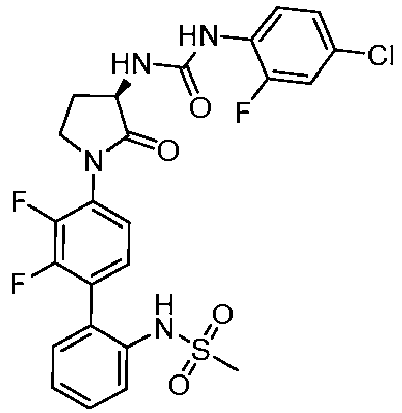
553.1 Method C, RT = 1.79 min, 96.8% 1H NMR (400MHz, DMSO-d6) δ = 9.18 (s, 1H), 8.65 (d, J=2.2 Hz, 1H), 8.16 (t, J=8.9 Hz, 1H), 7.56 - 7.29 (m, 6H), 7.29 - 7.13 (m, 3H), 4.64 - 4.48 (m, 1H), 3.96 - 3.87 (m, 1H),3.78-3.74 (m, 1H), 2.74 (s, 3H), 2.62 - 2.56 (m, 1H), 2.13 - 2.01 (m,1H). 6 
569.1 Method C, RT = 1.86 min, 97.2% 1H NMR (400MHz, DMSO-d6) δ = 9.16 (s, 1H), 7.96 (s, 1H), 7.70 - 7.56 (m, 4H), 7.55 -7.45 (m, 2H), 7.44 - 7.30 (m, 3H), 7.28 - 7.20 (m, 1H), 6.86 (d, J=7.6 Hz, 1H), 4.60-4.54 (m, 1H), 3.96 - 3.86 (m, 1H), 3.77-3.75 (m, 1H), 2.74 (s, 3H),2.61 - 2.54 (m, 1H), 2.21 - 2.06 (m, 1H). 7 
538.2 Method D, RT = 1.75 min, 95.9% 1H NMR (400MHz, DMSO-d6) δ = 8.65 (s, 1H), 8.23 - 8.05 (m, 2H), 7.91 - 7.68 (m, 2H), 7.51(d, J=7.3 Hz, 1H), 7.46 - 7.35 (m, 2H), 7.35 - 7.25 (m, 1H), 7.20-7.18 (m, 2H), 4.63 - 4.48(m, 1H), 3.94-3.87 (m, 1H), 3.83 - 3.69 (m, 1H), 3.05 (s, 3H), 2.63 - 2.54 (m, 1H), 2.10-2.05 (m, 1H). 8 
467.2 Method D, RT = 1.85 min, 100% 1H NMR (400MHz, DMSO-d6) δ = 8.88 (s, 1H), 8.05 (d, J=8.1 Hz, 1H), 7.96 - 7.85 (m, 1H), 7.79 - 7.63 (m, 2H), 7.59 - 7.49 (m, 1H), 7.49 - 7.37 (m, 3H), 7.30 (d, J=8.8 Hz, 2H), 6.75 (d, J=7.6 Hz, 1H), 4.63 - 4.51 (m, 1H), 3.98 - 3.87 (m, 1H), 3.87 - 3.73 (m, 1H), 2.58 (br. s., 1H), 2.18 - 2.11 (m, 1H). 9 
485.1 Method D, RT = 1.91 min, 96.8% 1H NMR (400MHz, DMSO-d6) δ = 8.65 (s, 1H), 8.15 (t, J=8.9 Hz, 1H), 8.04 (d, J=7.9 Hz, 1H),7.94 - 7.83 (m, 1H), 7.78 - 7.60 (m, 2H), 7.57 - 7.49 (m, 1H), 7.48 - 7.34 (m, 2H), 7.20 (d, J=7.6Hz, 2H), 4.64 - 4.52 (m, 1H), 3.98 - 3.88 (m, 1H), 3.86 - 3.76 (m, 1H), 2.65 - 2.55 (m, 1H), 2.18-2.00 (m, 1H). 10 
520.1 Method D, RT = 1.69 min, 99.1% 1H NMR (400MHz, DMSO-d6) δ = 8.88 (s, 1H), 8.15 (dd, J=7.7, 1.3 Hz, 1H), 7.89 - 7.71 (m, 2H),7.52 (dd, J=7.3, 1.5 Hz, 1H), 7.49 - 7.37 (m, 3H), 7.36 - 7.22 (m, 3H), 6.74 (d, J=7.6 Hz, 1H),4.62 - 4.49 (m, 1H), 3.97 - 3.85 (m, 1H), 3.84 - 3.73 (m, 1H), 3.06 (s, 3H), 2.60 - 2.54 (m, 1H),2.19 - 2.07 (m, 1H). 11 
554.2 Method D, RT = 1.81 min, 97.1% 1H NMR (400MHz, DMSO-d6) δ = 9.18 (s, 1H), 8.15 (dd, J=7.8, 1.5 Hz, 1H), 7.90 - 7.72 (m, 2H),7.70 - 7.55 (m, 4H), 7.52 (dd, J=7.5, 1.3 Hz, 1H), 7.42 (t, J=7.6 Hz, 1H), 7.36 - 7.25 (m, 1H),6.86 (d, J=7.3 Hz, 1H), 4.65 - 4.50 (m, 1H), 4.00 - 3.86 (m, 1H), 3.81-3.77 (m, 1H), 3.06 (s, 3H), 2.62 - 2.54 (m, 1H), 2.16-2.11 (m, 1H). 12 
485.2 Method D, RT = 1.50 min, 96.9% 1H NMR (400MHz, DMSO-d6) δ = 8.94 (s, 1H), 7.62 (s, 1H), 7.49 - 7.34 (m, 7H), 7.31 - 7.23 (m, 2H), 6.81 (d, J=7.3 Hz, 1H), 4.61 - 4.50 (m, 1H), 4.16 (q, J=6.8 Hz, 1H), 3.92 - 3.84 (m, 1H), 3.79 - 3.74 (m, 1H), 3.60 - 3.20 (m, 2H), 2.61 - 2.54 (m, 1H), 2.17 - 2.07 (m, 1H), 1.35 (d, J=6.6 Hz, 3H). 13 
554.1 Method D, RT = 1.67 min, 100% 1H NMR (400MHz, DMSO-d6) δ = 9.40 (s, 1H), 9,15 (s, 1H), 8.77 (d, J=7.1 Hz, 1H), 8.17 (d, J=2.2 Hz, 1H), 7.98 (dd, J=10.3, 2.2 Hz, 1H), 7.52 - 7.42 (m, 2H), 7.41 - 7.27 (m, 3H), 7.20 (t, J=7.1 Hz, 1H), 4.68 - 4.55 (m, 1H), 3.95-3.81 (m, 2H), 2.86 (s, 3H), 2.60 - 2.55 (m, 1H), 2.28 - 2.14 (m,1H). 14 
533.2 Method C, RT = 2.07 min, 99.2% 1H NMR (400MHz, DMSO-d6) δ = 9.19 (s, 1H), 8.96 (br. s., 1H), 7.75 (d, J=8.8 Hz, 2H),7.65 - 7.56 (m, 4H), 7.45 (d, J=8.8 Hz, 2H), 7.41 - 7.27 (m, 4H), 6.81 (d, J=7.6 Hz, 1H), 4.58 - 4.49 (m, 1H), 3.89-3.79(m, 2H), 2.73 (s, 3H), 2.51-2.50 (m,1H), 2.10 - 2.01 (m, 1H). 15 
537.2 Method D, RT = 1.54 min, 99.7% 1H NMR (400MHz, DMSO-d6) δ = 9.71 (s, 1H), 9.13 (s, 1H), 8.83 (s, 1H), 8.38 (s, 1H), 7.55 (d, J=7.6 Hz, 1H), 7.51 - 7.45 (m, 2H), 7.41 - 7.31 (m, 3H), 7.24 - 7.17 (m,1H), 4.58 - 4.49 (m, 1H), 3.89-3.79 (m, 2H), 2.88 (s, 3H), 2.51-2.50 (m,1H), 2.20 - 2.10 (m, 1H). 16 
460.1 Method D, RT = 2.00 min, 92.1% 1H NMR (400MHz, DMSO-d6) δ = 8.88 (s, 1H), 7.62 - 7.50 (m, 2H), 7.50 - 7.42 (m, 3H), 7.42 - 7.33 (m, 3H), 7.33 - 7.22 (m, 2H), 6.75 (d, J=7.3 Hz, 1H), 4.65 - 4.49 (m, 1H), 3.97 - 3.84 (m, 1H), 3.84 - 3.70 (m, 1H), 2.61 - 2.53 (m, 1H), 2.21 - 2.04 (m, 1H). 17 
536.1 Method D, RT = 1.66 min, 99.7% 1H NMR (400MHz, DMSO-d6) δ = 9.43 (s, 1H), 9.15 (br. s., 1H), 8.23 (d, J=2.7 Hz, 1H), 8.05 (d, J=7.8 Hz, 1H),7.80 (dd, J=8.8, 2.7 Hz, 1H), 7.57 (d, J=8.8 Hz, 1H), 7.50 - 7.44 (m, 2H), 7.40 - 7.27 (m, 3H),7.20 (t, J=7.1 Hz, 1H), 4.63 - 4.54 (m, 1H), 3.95-3.81 (m, 2H), 2.86 (s, 3H), 2.60 - 2.55 (m, 1H), 2.21 - 2.11 (m, 1H). 18 
571.2 Method D, RT = 1.68 min, 100% 1H NMR (400MHz, DMSO-d6) δ = 10.13 (s, 1H), 9.12 (br. s., 1H), 9.05 (s, 1H), 8.73 (s, 1H), 7.89 (d, J=7.6 Hz,1H), 7.52 - 7.46 (m, 2H), 7.41 - 7.31 (m, 3H), 7.25 - 7.16 (m, 1H), 4.66 - 4.60 (m, 1H), 3.95-3.81 (m, 2H),2.60 - 2.55 (m, 1H), 2.88 (s, 3H), 2.24 - 2.13 (m, 1H). 19 
461.1 Method D, RT = 1.73 min, 96.8% 1H NMR (400MHz, DMSO-d6) δ = 8.88 (s, 1H), 8.38 (d, J=46 Hz, 1H), 8.16 (t, J=7.9 Hz, 1H), 7.56 (t, J=6.2 Hz, 1H), 7.53 - 7.35 (m, 4H), 7.30 (d, J=9.0 Hz, 2H), 6.74 (d, J=7.3 Hz, 1H), 4.64 - 4.49 (m, 1H), 3.96 - 3.85 (m, 1H), 3.84 - 3.73 (m, 1H), 2.61 - 2.54 (m, 1H), 2.21 - 2.01 (m, 1H). 20 
534.2 Method D, RT = 1.63 min, 98.8% 1H NMR (400MHz, DMSO-d6) δ = 9.43 (s, 1H), 8.95 (s, 1H), 8.71 (d, J=2.2 Hz, 1H), 8.19 (dd, J=8.7, 1.8 Hz, 1H), 7.88 - 7.71 (m, 3H), 7.52 (d, J=8.8 Hz, 2H), 7.47 - 7.28 (m, 4H), 6.99 (d, J=7.3 Hz, 1H), 4.64 - 4.54 (m, 1H), 3.99 - 3.78 (m, 2H), 2.74 (s, 3H), 2.50-2.46 (m, 1H) 2.15 - 2.02 (m, 1H). 21 
478.1 Method D, RT = 2.05 min, 100% 1H NMR (400MHz, DMSO-d6) δ = 8.65 (d, J=2.2 Hz, 1H), 8.16 (t, J=8.9 Hz, 1H), 7.61 - 7.50 (m, 2H), 7.50 - 7.32 (m, 5H), 7.27 - 7.14 (m, 2H), 4.64 - 4.50 (m, 1H), 3.98 - 3.85 (m, 1H), 3.84 - 3.75 (m, 1H), 2.64 - 2.55 (m, 1H), 2.17 - 2.01 (m, 1H). 22 
485.2 Method D, RT = 1.55 min, 100% 1H NMR (400MHz, DMSO-d6) δ = 8.97 (s, 1H), 7.61 (s, 1H), 7.53 - 7.33 (m, 7H), 7.33 - 7.22 (m, 2H), 6.84 (d, J=7.3 Hz, 1H), 4.55 (m, 1H), 4.14 (q, J=6.8 Hz, 1H), 3.91 - 3.84 (m, 1H), 3.78 - 3.73 (m, 1H), 2.64 - 2.55 (m, 1H), 2.12 (m, 1H), 1.34 (d, J=6.6 Hz, 3H). 23 
554.2 Method D, RT = 1.46 min, 94.8% 1H NMR (400MHz, DMSO-d6) δ = 8.83 (br. s., 1H), 8.63 (br. s., 1H), 8.16 (t, J = 8.9 Hz, 1H), 8.08 (br. s., 1H), 7.47 - 7.32 (m, 2H), 7.32 - 7.10 (m, 4H), 6.65 (br. s., 1H), 4.64 - 4.48 (m, 1H), 3.92 - 3.82 (m, 1H), 3.75 (t, J = 8.7 Hz, 1H), 2.95 (br. s., 3H), 2.63 - 2.54 (m, 1H), 2.21 - 1.96 (m, 1H). 24 
521.1 Method D, RT = 1.62 min, 99.7% 1H NMR (400MHz, DMSO-d6) δ 9.47 (s, 1H), 8.25 (d, J=2.7 Hz, 1H), 8.15 (d, J=7.6 Hz, 1H), 8.01 - 7.89 (m, 1H), 7.88 - 7.72 (m, 3H), 7.65 (d, J=9.3 Hz, 1H), 7.55 - 7.46 (m, 1H), 7.43 (t, J=7.2 Hz, 1H), 7.31 (t, J=7.0 Hz, 1H), 4.67 - 4.56 (m, 1H), 3.97 - 3.87 (m, 1H), 3.85 - 3.77 (m, 1H), 3.06 (s, 3H), 2.63 - 2.55 (m, 1H), 2.20 - 2.10 (m, 1H). 25 
536.2 Method D, RT = 1.476 min, 98.6% 1H NMR (400 MHz, DMSO-d6) δ = 8.64 (br. s., 1H), 8.16 (t, J= 9.0 Hz, 1H), 7.97 - 7.84 (m, 1H), 7.69 - 7.57 (m, 2H), 7.43 (dd, J = 11.0, 2.5 Hz, 1H), 7.40 - 7.32 (m, 2H), 7.32 - 7.23 (m, 1H), 7.23 - 7.12 (m, 2H), 4.56 (dt, J = 9.9, 8.1 Hz, 1H), 3.95 - 3.85 (m, 1H), 3.78 (br. t., J = 8.8 Hz, 1H), 2.63 - 2.54 (m, 1H), 2.14 - 1.99 (m, 1H), 1.52 (br. d., J = 13.1 Hz, 6H). 26 
557.2 Method D, RT = 1.89 min, 99.7% 1H NMR (400MHz, DMSO-d6) δ = 8.95 (br. s., 1H), 8.63 (d, J = 2.2 Hz, 1H), 8.17 (t, J = 8.9 Hz, 1H), 7.52 - 7.24 (m, 7H), 7.23 - 7.13 (m, 2H), 7.12 (s, 1H), 4.63 - 4.47 (m, 1H), 3.82 (td, J = 9.5, 6.5 Hz, 1H), 3.71 - 3.59 (m, 1H), 2.86 (s, 3H), 2.63 - 2.56 (m, 1H), 2.17 - 2.04 (m, 1H), 2.01 - 1.95 (m, 1H), 1.04 - 0.83 (m, 2H), 0.80 - 0.58 (m, 2H). 27 
559.2 Method D, RT = 1.868 min, 99.6% 1H NMR (400MHz, DMSO-d6) δ = 9.01 (s, 1H), 8.62 (d, J = 2.0 Hz, 1H), 8.17 (t, J = 8.9 Hz, 1H), 7.55 (d, J = 2.0 Hz, 1H), 7.48 - 7.32 (m, 6H), 7.32 - 7.26 (m, 1H), 7.25 - 7.12 (m, 2H), 4.60 - 4.50 (m, 1H), 3.82 - 3.71 (m, 1H), 3.56 (t, J = 9.3 Hz, 1H), 3.06 - 3.02 (m, 1H) 2.81 (s, 3H), 2.65 - 2.56 (m, 1H), 2.12 - 2.02 (m, 1H), 1.31 - 1.13 (m, 6H). 28 
464.1 Method D, RT = 1.732 min, 98.6% 1H NMR (400MHz, DMSO-d6) δ = 8.62 (d, J = 2.2 Hz, 1H), 8.15 (t, J = 8.9 Hz, 1H), 7.84 (d, J = 2.4Hz, 1H), 7.80 - 7.68 (m, 1H), 7.49 - 7.28 (m, 2H), 7.24 - 7.06 (m, 2H), 6.73 - 6.61 (m, 1H), 4.63- 4.46 (m, 1H), 3.94 (s, 3H), 3.91 - 3.78 (m, 1H), 3.78 - 3.67 (m, 1H), 2.64 - 2.53 (m, 1H), 2.16 - 2.01 (m, 1H). 29 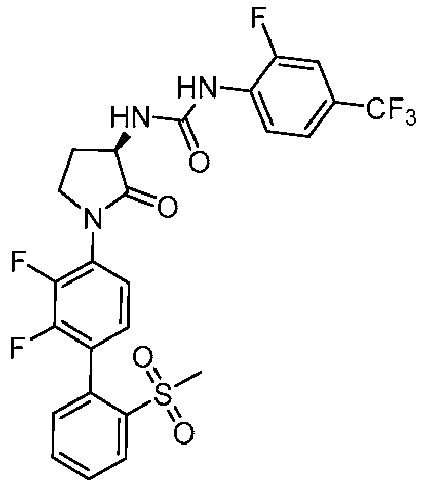
572.2 Method C, RT = 1.887 min, 100% 1H NMR (400MHz, DMSO-d6) δ = 8.93 ( s, 1H), 8.41 (t, J = 8.4 Hz, 1H), 8.15 (dd, J = 7.9, 1.3 Hz, 1H), 7.90 - 7.72 (m, 2H), 7.66 (dd, J = 11.5, 1.7 Hz, 1H), 7.51 (dd, J = 7.5, 1.3 Hz, 2H), 7.46 - 7.37 (m, 1H), 7.37 - 7.21 (m, 2H), 4.65 - 4.51 (m, 1H), 4.00 - 3.87 (m, 1H), 3.81 (t, J = 8.8 Hz, 1H), 3.06 (s, 3H), 2.65 - 2.56 (m, 1H), 2.20 - 2.02 (m, 1H). 30 
580.1 Method C, RT = 1.632 min, 98.7% 1H NMR (400MHz, DMSO-d6) δ = 8.65 (s, 1H), 8.14 (t, J = 8.8 Hz, 1H), 8.01 - 7.87 (m, 1H), 7.72 - 7.57 (m, 2H), 7.48 - 7.36 (m, 2H), 7.29 (m, 2H), 7.23 - 7.16 (m, 1H), 7.10 (d, J = 7.6 Hz, 1H), 4.70 - 4.58 (m, 1H), 4.39 - 4.27 (m, 1H), 3.51 - 3.43 (m, 1H), 3.39 - 3.35 (m, 1H), 3.24 (s, 3H), 2.46 - 2.44 (m, 1H), 2.34 - 2.26 (m, 1H), 1.61 - 1.40 (m, 6H) 31 
524.2 Method D, RT = 1.719min, 99.2% 1H NMR (400MHz, DMSO-d6) δ = 8.93 (d, J = 2.4 Hz, 1H), 8.41 (t, J = 8.2 Hz, 1H), 7.72 - 7.58 (m, 2H), 7.55 - 7.31 (m, 5H), 7.30 - 7.17 (m, 2H), 5.16 (t, J = 5.5 Hz, 1H), 4.64 - 4.53 (m, 1H), 4.35 (d, J = 5.6 Hz, 2H), 3.97 - 3.84 (m, 1H), 3.80 (t, J = 8.7 Hz, 1H), 2.61 (dd, J = 19.4, 6.7 Hz, 1H), 2.15 - 2.03 (m, 1H). 32 
535.2 Method C, RT = 1.550 min, 100% 1H NMR (400MHz, DMSO-d6) δ = 9.11 (br. s., 1H), 8.63 (d, J = 2.4 Hz, 1H), 8.16 (t, J = 8.9 Hz, 1H), 7.56 (t, J = 8.2 Hz, 1H), 7.50 - 7.28 (m, 7H), 7.24 - 7.12 (m, 2H), 4.60 - 4.50 (m, 1H), 3.92 - 3.82 (m, 1H), 3.74 (t, J = 8.4 Hz, 1H), 2.86 (s, 3H), 2.60 (dd, J = 12.0, 8.1 Hz, 1H), 2.14 - 2.03 (m, 1H). 33 
587.2 Method C, RT = 1.726 min, 98.1% 1H NMR (400MHz, DMSO-d6) δ = 9.12 (br. s., 1H), 8.93 (d, J = 2.9 Hz, 1H), 8.41 (t, J = 8.3 Hz, 1H), 7.66 (d, J = 11.7 Hz, 1H), 7.56 - 7.43 (m, 3H), 7.43 - 7.27 (m, 4H), 7.23 (t, J = 7.1 Hz, 1H), 4.66 - 4.54 (m, 1H), 4.00 - 3.86 (m, 1H), 3.78 (t, J = 9.2 Hz, 1H), 2.91 (s, 3H), 2.66 - 2.57 (m, 1H), 2.16 - 2.04 (m, 1H). 34 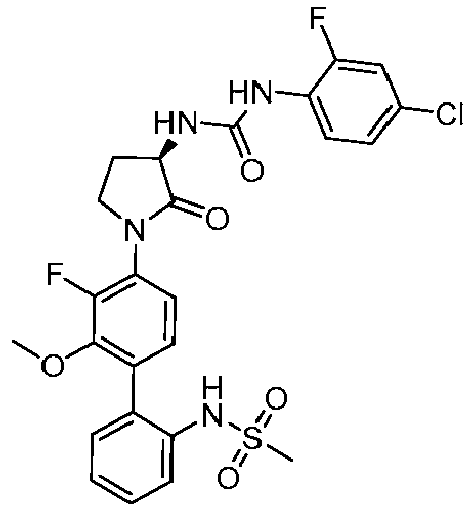
565.2 Method C, RT = 1.606 min, 96.7% 1H NMR (400MHz, DMSO-d6) δ = 8.78 (s, 1H), 8.63 (d, J = 2.7 Hz, 1H), 8.16 (t, J = 8.9 Hz, 1H), 7.53 - 7.46 (m, 1H), 7.46 - 7.36 (m, 2H), 7.34 - 7.15 (m, 5H), 7.11 (dd, J = 8.4, 1.6 Hz, 1H), 4.60 - 4.49 (m, 1H), 3.94 - 3.80 (m, 1H), 3.74 - 3.72 (m, 1H), 3.66 (s, 3H), 2.90 (s, 3H), 2.63 - 2.54 (m, 1H), 2.12 - 2.01 (m, 1H). 35 
502.1 Method D, RT = 1.634 min, 93.3% 1H NMR (400MHz, DMSO-d6) δ = 8.63 (d, J = 2.2 Hz, 1H), 8.21 - 8.10 (m, 1H), 7.59 (d, J = 7.1 Hz, 1H), 7.50 - 7.35 (m, 2H), 7.33 (t, J = 8.1 Hz, 1H), 7.28 - 7.12 (m, 4H), 7.06 (dd, J = 8.1, 1.7 Hz, 1H), 5.06 (t, J = 5.5 Hz, 1H), 4.59 - 4.48 (m, 1H), 4.33 - 4.29 (m, 2H), 3.94 - 3.81 (m, 1H), 3.75 (t, J = 8.8 Hz, 1H), 3.55 (s, 3H), 2.59 (dd, J = 12.2, 7.3 Hz, 1H), 2.14 - 1.98 (m, 1H). 36 
565.1 Method D, RT = 1.669 min, 100% 1H NMR (400MHz, DMSO-d6) δ = 8.68 (s, 1H), 8.37 (s, 1H), 8.16 (t, J = 8.9 Hz, 1H), 7.56 - 7.37 (m, 3H), 7.35 - 7.15 (m, 5H), 7.15 - 7.05 (m, 1H), 4.59 - 4.49 (m, 1H), 3.87 (s, 3H), 3.79 (dd, J = 9.7, 6.5 Hz, 1H), 3.69 (t, J = 8.6 Hz, 1H), 2.88 (s, 3H), 2.59 (dd, J = 11.7, 7.3 Hz, 1H), 2.13 - 1.96 (m, 1H). 37 
593.2 Method C, RT = 1.902min, 97.5% 1H NMR (400MHz, DMSO-d6) δ = 8.97 (br. s., 1H), 8.49 - 8.30 (m, 2H), 7.65 (d, J = 11.7 Hz, 1H), 7.55 (d, J = 2.0 Hz, 1H), 7.52 (d, J = 9.0 Hz, 1H), 7.48 - 7.22 (m, 7H), 4.59 - 4.52 (m, 1H), 3.83 - 3.77 (m, 1H), 3.57 - 3.55 (m, 1H), 3.06 - 3.02 (m, 1H), 2.87 (s, 3H), 2.66 - 2.58 (m, 1H), 2.14 - 2.01 (m, 1H), 1.31 - 1.13 (m, 6H). 38 
496.2 Method C, RT = 1.863 min, 92.2% 1H NMR (400MHz, DMSO-d6) δ = 8.67 (s, 1H), 8.38 (s, 1H), 8.17 (m, 1H), 7.59 (d, J = 7.3 Hz, 1H), 7.49 - 7.30 (m, 4H), 7.30 - 7.11 (m, 4H), 4.61 - 4.50 (m, 1H), 4.43 (s, 2H), 3.91 (s, 1H), 3.81 - 3.76 (m, 1H), 3.59 - 3.56 (m, 1H), 3.04 - 3.01 (m, 1H), 2.64 - 2.55 (m, 1H), 2.14 - 2.03 (m, 1H), 1.31 - 1.13 (m, 6H). 39 
602.1 Method C, RT = 1.731 min, 92.6% 1H NMR (400MHz, DMSO-d6) δ = 8.92 (br. s., 1H), 8.41 (t, J = 8.4 Hz, 1H), 8.15 (d, J = 7.8 Hz, 1H), 7.91 - 7.76 (m, 2H), 7.66 (br. d., J = 12.0 Hz, 1H), 7.57 - 7.47 (m, 2H), 7.43 - 7.29 (m, 2H), 7.25 (br. d., J = 6.8 Hz, 1H), 5.13 (br. d., J = 1.7 Hz, 1H), 4.78 - 4.65 (m, 1H), 4.27 - 4.13 (m, 1H), 3.54 - 3.42 (m, 2H), 3.06 (s, 3H), 2.57 - 2.24 (m, 1H), 2.35 - 2.31 (m, 1H). 40 
544.2 Method D, RT = 1.851 min, 100% 1H NMR (400MHz, DMSO-d6) δ = 8.63 (d, J = 2.0 Hz, 1H), 8.17 (t, J = 8.9 Hz, 1H), 8.12 (dd, J = 7.9, 1.1 Hz, 1H), 7.82 - 7.75 (m, 1H), 7.73 - 7.64 (m, 1H), 7.54 - 7.36 (m, 3H), 7.34 - 7.25 (m, 2H), 7.23 - 7.09 (m, 2H), 4.57 - 4.52 (m, 1H), 3.84 - 3.74 (m, 1H), 3.59 (t, J = 90 Hz, 1H), 3.06 - 3.02 (m, 1H), 2.82 (s, 3H), 2.65 - 2.56 (m, 1H), 2.13 - 2.00 (m, 1H), 1.31 - 1.06 (m, 6H). 41 
506.1 Method D, RT = 1.825 min, 97.2% 1H NMR (400MHz, DMSO-d6) δ = 9.15 (s, 1H), 7.78 - 7.50 (m, 5H), 7.50 - 7.43 (m, 1H), 7.43 - 7.31 (m, 2H), 7.30 - 7.16 (m, 2H), 6.85 (d, J = 7.3 Hz, 1H), 5.16 (t, J = 5.4 Hz, 1H), 4.65 - 4.52 (m, 1H), 4.35 (d, J = 5.4 Hz, 2H), 3.99 - 3.83 (m, 1H), 3.83 - 3.72 (m, 1H), 2.64 - 2.53 (m, 1H), 2.20 - 2.05 (m, 1H). 42 
568.1 Method C, RT = 1.598 min, 98.9% 1H NMR (400MHz, DMSO-d6) δ = 8.61 (br. s., 1H), 8.22 - 8.07 (m, 2H), 7.88 - 7.73 (m, 2H), 7.58 - 7.49 (m, 1H), 7.45 - 7.25 (m, 3H), 7.23 - 7.15 (m, 1H), 7.09 (d, J = 7.1 Hz, 1H), 4.76 - 4.64 (m, 1H), 4.24 - 4.13 (m, 1H), 3.99 - 3.87 (m, 1H), 3.49 - 3.45 (m, 2H), 3.05 (s, 3H), 2.57 - 2.55 (m, 1H), 2.26 -2.21 (m, 1H). 43 
591.2 Method C, RT = 2.008 min, 100% 1H NMR (400MHz, DMSO-d6) δ = 9.08 - 8.82 (m, 2H), 8.42 (t, J = 8.3 Hz, 1H), 7.71 - 7.61 (m, 1H), 7.52 (d, J = 8.3 Hz, 1H), 7.48 - 7.36 (m, 2H), 7.36 - 7.20 (m, 5H), 7.12 (s, 1H), 4.65 - 4.52 (m, 1H), 3.83 (td, J = 9.2, 6.1 Hz, 1H), 3.66 (t, J = 9.2 Hz, 1H), 2.86 (s, 3H), 2.67 - 2.58 (m, 1H), 2.19 - 2.03 (m, 1H), 2.00 - 1.90 (m, 1H), 1.04 - 0.83 (m, 2H), 0.79 - 0.62 (m, 2H). 44 
545.2 Method C, RT = 1.776 min, 100% 1H NMR (400MHz, DMSO-d6) δ = 8.63 (s, 1H), 8.33 (d, J = 7.8 Hz, 1H), 8.15 (t, J = 8.9 Hz, 1H), 7.51 (s, 1H), 7.49 - 7.30 (m, 6H), 7.25 - 7.15 (m, 2H), 4.98 (m, 1H), 4.61 - 4.51 (m, 1H), 3.89 (td, J = 9.5, 6.6 Hz, 1H), 3.77 (t, J = 8.7 Hz, 1H), 2.58 (dd, J = 13.6, 5.7 Hz, 1H), 2.16 - 2.01 (m, 1H), 1.85 (s, 3H), 1.38 (d, J = 7.1 Hz, 3H). 45 
542.2 Method C, RT = 1.778 min, 100% 1H NMR (400MHz, DMSO-d6) δ = 8.63 (s, 1H), 8.17 (t, J = 8.9 Hz, 1H), 7.98 (dd, J = 12.8, 7.7 Hz, 1H), 7.68 - 7.59 (m, 1H), 7.59 - 7.47 (m, 2H), 7.45 - 7.26 (m, 4H), 7.25 - 7.13 (m, 2H), 4.60 - 4.49 (m, 1H), 3.80 (d, J = 6.1 Hz, 1H), 3.61 - 3.52 (m, 1H), 3.07 - 2.99 (m, 1H), 2.59 - 2.55 (m, 1H), 2.28 - 1.99 (m, 1H), 1.33 (d, J = 13.4 Hz, 6H), 1.23 - 1.10 (m, 6H). 46 
577.2 Method C, RT = 1.716 min, 100% 1H NMR (400MHz, DMSO-d6) δ = 8.64 (d, J = 2.4 Hz, 1H), 8.16 (t, J = 8.9 Hz, 1H), 7.93 (dd, J = 12.3, 8.2 Hz, 1H), 7.61 (t, J = 7.5 Hz, 1H), 7.54 (t, J = 7.5 Hz, 1H), 7.42 (dd, J = 11.2, 2.4 Hz, 1H), 7.39 - 7.32 (m, 1H), 7.32 - 7.24 (m, 2H), 7.24 - 7.06 (m, 3H), 4.63 - 4.50 (m, 1H), 3.83 (td, J = 9.6, 6.7 Hz, 1H), 3.67 (t, J = 8.8 Hz, 1H), 2.65 - 2.56 (m, 1H), 2.16 - 2.05 (m, 1H), 2.00 - 1.90 (m, 1H), 1.34 (d, J = 13.2 Hz, 3H), 1.33 (d, J = 13.2 Hz, 3H), 0.98 - 0.84 (m, 2H), 0.82 - 0.65 (m, 2H). 47 
560.2 Method C, RT = 1.760 min, 100% 1H NMR (400MHz, DMSO-d6) δ = 8.80 (br. s., 1H), 8.62 (s, 1H), 8.25 - 8.05 (m, 2H), 7.68 - 7.51 (m, 2H), 7.51 - 7.35 (m, 2H), 7.31 - 7.10 (m, 3H), 6.93 - 6.91 (m, 1H), 4.59 - 4.50 (m, 1H), 3.77 (d, J = 6.4 Hz, 1H), 3.56 (d, J = 8.3 Hz, 1H), 3.10 (s, 3H), 3.04 - 2.98 (m, 1H), 2.65 - 2.62 (m, 1H), 2.18 - 1.96 (m, 1H), 1.39 - 1.15 (m, 6H). 48 
558.2 Method C, RT = 1.861 min, 100% 1H NMR (400MHz, DMSO-d6) δ = 10.5 (br. s., 1H), 8.64 (d, J = 2.7 Hz, 1H), 8.31 - 8.04 (m, 2H), 7.71 (dd, J = 7.6, 1.7 Hz, 1H), 7.47 - 7.35 (m, 2H), 7.35 - 7.27 (m, 1H), 7.26 - 7.14 (m, 3H), 7.10 (br. s., 1H), 4.64 - 4.50 (m, 1H), 3.81 (td, J = 9.6, 6.5 Hz, 1H), 3.65 (t, J = 9.0 Hz, 1H), 3.20 (s, 3H), 2.66 - 2.57 (m, 1H), 2.15 - 2.02 (m, 1H), 2.01 - 1.88 (m, 1H), 1.03 - 0.83 (m, 2H), 0.78 - 0.55 (m, 2H). 49 
519.1 Method C, RT = 1.469 min, 100% 1H NMR (400MHz, DMSO-d6) δ = 9.45 (s, 1H), 8.25 (d, J = 2.7 Hz, 1H), 8.00 - 7.87 (m, 2H), 7.82 (dd, J = 9.0, 2.7 Hz, 1H), 7.71 - 7.54 (m, 3H), 7.44 - 7.31 (m, 2H), 7.31 - 7.22 (m, 1H), 4.66 - 4.56 (m, 1H), 4.01 - 3.85 (m, 1H), 3.84 - 3.76 (m, 1H), 2.59-2.86 (m, 1H), 2.21 - 2.11 (m, 1H), 1.52 (d, J = 13.2 Hz, 6H). 50 
503.2 Method D, RT = 1.498 min, 100% 1H NMR (400MHz, DMSO-d6) δ = 8.64 (d, J = 1.7 Hz, 1H), 8.20 - 8.08 (m, 1H), 7.62 (s, 1H), 7.53 - 7.28 (m, 6H), 7.25 - 7.16 (m, 2H), 4.62 - 4.49 (m, 1H), 4.17 (q, J = 6.6 Hz, 1H), 3.94 - 3.85 (m, 1H), 3.82 - 3.72 (m, 1H), 3.34 (br. s., 2H), 2.65 - 2.55 (m, 1H), 2.13 - 2.02 (m, 1H), 1.35 (d, J = 6.6 Hz, 3H). 51 
568.2 Method C, RT = 1.709 min, 100% 1H NMR (400MHz, DMSO-d6) δ = 8.99 (s, 1H), 7.99 - 7.86 (m, 1H), 7.73 - 7.57 (m, 2H), 7.57 - 7.44 (m, 2H), 7.42 - 7.32 (m, 2H), 7.32 - 7.14 (m, 3H), 6.81 (d, J = 7.3 Hz, 1H), 4.61 - 4.49 (m, 1H), 3.94 - 3.84 (m, 1H), 3.83 - 3.71 (m, 1H), 2.61 - 2.53 (m, 1H), 2.18 - 2.05 (m, 1H), 1.52 (d, J = 13.2 Hz, 6H). 52 
538.1 Method D, RT = 1.774 min, 100% 1H NMR (400MHz, DMSO-d6) δ = 8.61 (d, J = 2.2 Hz, 1H), 8.23 - 8.04 (m, 2H), 7.87 - 7.63 (m, 2H), 7.49 (dd, J = 7.5, 1.1 Hz, 1H), 7.42 (dd, J = 11.1, 2.3 Hz, 1H), 7.35 (d, J = 9.0 Hz, 2H), 7.24 - 7.11 (m, 2H), 4.63 - 4.50 (m, 1H), 3.83 - 3.75 (m, 1H), 3.75 - 3.67 (m, 1H), 3.05 (s, 3H), 2.63-2.55 (m, 1H), 2.19 - 2.08 (m, 1H). 53 
536.1 Method C, RT = 1.594 min, 100% 1H NMR (400MHz, DMSO-d6) δ = 8.65 - 8.57 (m, 1H), 8.19 - 8.12 (m, 1H), 7.96 - 7.86 (m, 1H), 7.69 - 7.56 (m, 2H), 7.46 - 7.37 (m, 4H), 7.24 - 7.17 (m, 2H), 4.64 - 4.53 (m, 1H), 3.84 - 3.67 (m, 2H), 2.66 - 2.57 (m, 1H), 2.19 - 2.06 (m, 1H), 1.52 (d, J = 13.2 Hz, 6H). 54 
516.2 Method C, RT = 1.485 min, 98.5% 1H NMR (400MHz, DMSO-d6) δ = 8.49 (s, 1H), 8.14 (dd, J = 7.8, 1.5 Hz, 1H), 7.91 - 7.71 (m, 2H), 7.51 (dd, J = 7.8, 1.5 Hz, 1H), 7.41 (t, J = 7.8 Hz, 1H), 7.38 - 7.22 (m, 3H), 6.92 - 6.74 (m, 2H), 6.56 (d, J = 7.3 Hz, 1H), 4.56 - 4.50 (m, 1H), 3.99 - 3.83 (m, 1H), 3.83 - 3.75 (m, 1H), 3.71 (s, 3H), 3.06 (s, 3H), 2.61 - 2.54 (m, 1H), 2.20 - 2.01 (m, 1H). 55 
571.2 Method C, RT = 1.589 min, 100% 1H NMR (400MHz, DMSO-d6) δ = 9.86 (s, 1H), 9.13 (d, J = 6.8 Hz, 1H), 8.49 (s, 1H), 8.22 (dd, J = 10.4, 1.8 Hz, 1H), 8.00 - 7.84 (m, 1H), 7.72 - 7.56 (m, 2H), 7.46 - 7.30 (m, 2H), 7.27 (t, J = 7.8 Hz, 1H), 4.74 - 4.61 (m, 1H), 4.00 - 3.87 (m, 1H), 3.86 - 3.78 (m, 1H), 2.66 - 2.56 (m, 1H), 2.30 - 2.17 (m, 1H), 1.52 (d, J = 13.2 Hz, 6H). 56 
537.2 Method C, RT = 1.475 min, 100% 1H NMR (400MHz, DMSO-d6) δ = 9.44 (s, 1H), 8.68 (d, J = 6.8 Hz, 1H), 8.19 (s, 1H), 8.05 (dd, J = 10.0, 2.2 Hz, 1H), 7.98 - 7.88 (m, 1H), 7.67-7.40 (m, 2H), 7.47 - 7.31 (m, 2H), 7.29 - 7.21 (m, 1H), 4.70 - 4.62 (m, 1H), 3.98 - 3.84 (m, 1H), 3.84 - 3.74 (m, 1H), 2.63 - 2.55 (m, 1H), 2.27 - 2.13 (m, 1H), 1.52 (d, J = 13.2 Hz, 6H). 57 
570.2 Method C, RT = 1.728min, 100% 1H NMR (400MHz, DMSO-d6) δ = 8.93 (d, J = 2.0 Hz, 1H), 8.41 (t, J = 8.6 Hz, 1H), 7.98 - 7.85 (m, 1H), 7.72 - 7.55 (m, 3H), 7.51 (d, J = 8.3 Hz, 1H), 7.42 - 7.30 (m, 3H), 7.30 - 7.22 (m, 1H), 4.65 - 4.54 (m, 1H), 3.96 - 3.85 (m, 1H), 3.79-3.45 (m, 1H), 2.65 - 2.57 (m, 1H), 2.16 - 2.02 (m, 1H), 1.52 (d, J = 13.2 Hz, 6H). 58 
537.2 Method C, RT = 1.671 min, 100% 1H NMR (400MHz, DMSO-d6) δ = 8.75 (br. s., 1H), 8.19 (d, J = 8.1 Hz, 1H), 8.14 (t, J = 8.9 Hz, 1H), 7.78 - 7.67 (m, 2H), 7.46 - 7.23 (m, 5H), 7.23 - 7.16 (m, 1H), 4.61 - 4.50 (m, 1H), 4.27 (br. s., 1H), 3.96 - 3.85 (m, 1H), 3.82 - 3.75 (m, 1H), 2.93 - 2.89 (m, 3H), 2.62 - 2.54 (m, 1H), 2.15 - 2.04 (m, 1H). 59 
537.2 Method C, RT = 1.672 min, 100% 1H NMR (400MHz, DMSO-d6) δ = 8.76 (br. s., 1H), 8.26 - 8.06 (m, 2H), 7.81 - 7.64 (m, 2H), 7.51 - 7.29 (m, 5H), 7.20 (ddd, J = 9.0, 2.4, 1.3 Hz, 1H), 4.56 (dd, J = 17.9, 8.3 Hz, 1H), 4.28 (br. s., 1H), 3.92 - 3.90 (m, 1H), 3.79 (t, J = 8.3 Hz, 1H), 2.93 - 2.89 (m, 3H), 2.64 - 2.53 (m, 1H), 2.16 - 2.01 (m, 1H). 60 
576.3 Method C, RT = 2.041 min, 100% 1H NMR (400MHz, DMSO-d6) δ = 8.91 (d, J = 2.9 Hz, 1H), 8.43 (t, J = 8.6 Hz, 1H), 7.98 (dd, J = 12.7, 7.8 Hz, 1H), 7.71 - 7.60 (m, 2H), 7.60 - 7.47 (m, 3H), 7.37 (dd, J = 7.0, 3.5 Hz, 1H), 7.35 - 7.23 (m, 3H), 4.63 - 4.51 (m, 1H), 3.86 - 3.74 (m, 1H), 3.58 (t, J = 8.7 Hz, 1H), 3.09 - 2.99 (m, 1H), 2.66 - 2.56 (m, 1H), 2.17 - 2.02 (m, 1H), 1.34 (d, J = 13.2 Hz, 6H), 1.18 (d, J = 6.8 Hz, 3H), 1.20 (d, J = 6.8 Hz, 3H). 61 
543.2 Method C, RT = 1.774 min, 99.7% 1H NMR (400MHz, DMSO-d6) δ = 9.44 (s, 1H), 8.67 (d, J = 5.9 Hz, 1H), 8.19 (d, J = 2.2 Hz, 1H), 8.04 (dd, J = 10.1,2.2 Hz, 1H), 8.01 - 7.91 (m, 1H), 7.68 - 7.59 (m, 1H), 7.59 - 7.48 (m, 2H), 7.37 (dd, J = 6.4, 4.2 Hz, 1H), 7.31 (d, J = 1.0 Hz, 2H), 4.60- 4.55 (m, 1H), 3.83 - 3.75 (m, 1H), 3.64 - 3.59 (m, 1H), 3.13 - 3.05 (m, 1H), 2.63 - 2.54 (m, 1H), 2.29 - 2.20 (m, 1H), 1.34 (d, J = 13.2 Hz, 6H), 1.19 (d, J = 6.8 Hz, 3H), 1.20 (d, J = 6.8 Hz, 3H). 62 
524.2 Method C, RT = 1.607 min, 99.6% 1H NMR (400MHz, DMSO-d6) δ = 9.74 (br. s., 1H), 8.90 (d, J = 1.5 Hz, 1H), 8.41 (d, J = 1.2 Hz, 1H), 7.98 - 7.89 (m, 1H), 7.67 - 7.43 (m, 3H), 7.41 - 7.20 (m, 3H), 7.13 (d, J = 1.7 Hz, 1H), 4.64 - 4.54 (m, 1H), 3.83 (td, J = 9.5, 6.7 Hz, 1H), 3.73 - 3.65 (m, 1H), 2.65 - 2.56 (m, 1H), 2.24 - 2.13 (m, 1H), 2.03 - 1.93 (m, 1H), 1.34 (d, J = 13.2 Hz, 6H), 1.02 - 0.82 (m, 2H), 0.80 - 0.65 (m, 2H). 63 
520.2 Method C, RT = 1.517min, 100% 1H NMR (400MHz, DMSO-d6) δ = 9.83 (br. s., 1H), 8.90 (s, 1H), 8.41 (d, J = 1.5 Hz, 1H), 7.99 - 7.85 (m, 1H), 7.73 - 7.53 (m, 3H), 7.51 - 7.30 (m, 2H), 7.30 - 7.20 (m, 1H), 4.67 - 4.55 (m, 1H), 3.95 - 3.87 (m, 1H), 3.80-3.77 (m, 1H), 2.64 - 2.56 (m, 1H), 2.28 - 2.00 (m, 1H), 1.52 (d, J = 13.2 Hz, 6H). 64 
553.3 Method C, RT = 1.742min, 100% 1H NMR (400MHz, DMSO-d6) δ = 9.79 (s, 1H), 8.59 (s, 1H), 8.08 (dd, J = 8.8, 2.2 Hz, 2H), 7.96 -7.86 (m, 1H), 7.79 (d, J = 8.8 Hz, 1H), 7.72 - 7.55 (m, 2H), 7.45 - 7.31 (m, 2H), 7.31 - 7.23 (m, 1H), 4.70 - 4.59 (m, 1H), 3.98 - 3.84 (m, 1H), 3.84 - 3.74 (m, 1H), 2.65 - 2.55 (m, 1H), 2.28 - 2.08 (m, 1H), 1.53 (d, J = 13.2 Hz, 6H). 65 
514.3 Method C, RT = 1.496 min, 97.9% 1H NMR (400MHz, DMSO-d6) δ = 8.48 (s, 1H), 7.98 - 7.88 (m, 1H), 7.72 - 7.52 (m, 2H), 7.43 - 7.19 (m, 5H), 6.88 - 6.77 (m, 2H), 6.55 (d, J =7.3 Hz, 1H), 4.58 - 4.49 (m, 1H), 3.93 - 3.83 (m, 1H), 3.77-3.74 (m, 1H), 3.71 (s, 3H), 2.60 - 2.54 (m, 1H), 2.23 - 1.99 (m, 1H), 1.52 (d, J = 13.2 Hz, 6H). 66 
571.2 Method C, RT = 1.815 min, 96.2% 1H NMR (400MHz, DMSO-d6) δ = 8.41 (t, J = 8.2 Hz, 1H), 8.18 (br. s., 1H), 7.80 - 7.69 (m, 2H), 7.67 (d, J = 10.0 Hz, 1H), 7.52 (d, J = 8.6 Hz, 1H), 7.46 - 7.29 (m, 4H), 7.29 - 7.06 (m, 1H), 4.65 - 4.53 (m, 1H), 3.98 - 3.86 (m, 1H), 3.80 (t, J = 8.9 Hz, 1H), 2.93 - 2.89 (m, 3H), 2.64 - 2.55 (m, 1H), 2.16 - 2.04 (m, 1H). 67 
565.2 Method C, RT = 1.804 min, 100% 1H NMR (400MHz, DMSO-d6) δ = 9.45 (s, 1H), 8.69 (d, J = 6.4 Hz, 1H), 8.19 (s, 1H), 8.05 (d, J = 10.3 Hz, 1H), 7.89 (dd, J = 11.5, 7.3 Hz, 1H), 7.64 (quin, J = 7.8 Hz, 2H), 7.48 - 7.26 (m, 2H), 7.17 (t, J = 7.9 Hz, 1H), 4.70 - 4.59 (m, 1H), 3.96 - 3.85 (m, 1H), 3.85 - 3.74 (m, 1H), 2.63 - 2.54 (m, 1H), 2.29 - 2.11 (m, 1H), 1.80 - 1.60 (m, 4H), 0.93 - 0.88 (m, 6H). 68 
598.2 Method C, RT = 2.038 min, 100% 1H NMR (400MHz, DMSO-d6) δ = 8.91 (br. s., 1H), 8.41 (t, J = 8.6 Hz, 1H), 7.97 - 7.83 (m, 1H), 7.75 - 7.56 (m, 3H), 7.51 (d, J = 8.8 Hz, 1H), 7.42 - 7.23 (m, 3H), 7.22 - 7.11 (m, 1H), 4.63 - 4.51 (m, 1H), 3.96 - 3.87 (m, 1H), 3.81-3.76 (m, 1H), 2.64 - 2.56 (m, 1H), 2.17 - 2.02 (m, 1H), 1.80 - 1.60 (m, 4H), 0.93 - 0.88 (m, 6H). 69 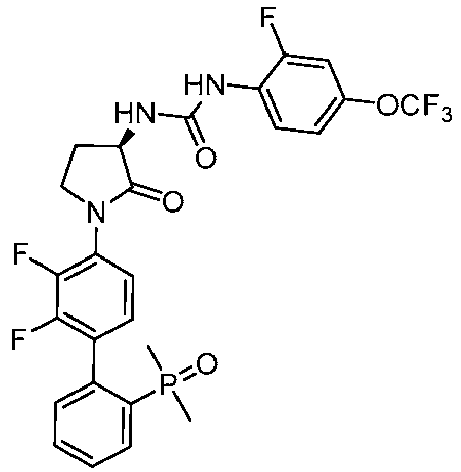
586.2 Method C, RT = 1.903 min, 100% 1H NMR (400MHz, DMSO-d6) δ = 8.70 (s, 1H), 8.22 (t, J = 9.2 Hz, 1H), 7.92 (dd, J = 12.5, 7.8 Hz, 1H), 7.73 - 7.55 (m, 2H), 7.49 - 7.30 (m, 3H), 7.30 - 7.23 (m, 1H), 7.23 - 7.09 (m, 2H), 4.63 - 4.52 (m, 1H), 4.00 - 3.84 (m, 1H), 3.80-3.75 (m, 1H), 2.64 - 2.56 (m, 1H), 2.18 - 2.01 (m, 1H), 1.52 (d, J = 13.2 Hz, 6H). 70 
554.2 Method C, RT = 1.663 min, 99.2% 1H NMR (400MHz, DMSO-d6) δ = 8.63 (d, J = 5.4 Hz, 1H), 8.16 (t, J = 8.9 Hz, 1H), 7.79 - 7.68 (m, 1H), 7.52 - 7.36 (m, 2H), 7.35 - 7.24 (m, 1H), 7.24 - 7.08 (m, 4H), 4.61 - 4.50 (m, 1H), 3.94 - 3.82 (m, 1H), 3.79 - 3.67 (m, 1H), 2.59 (dd, J = 12.7, 7.6 Hz, 1H), 2.13 - 2.01 (m, 1H), 1.86 - 1.59 (m, 6H) 71 
532.3 Method D, RT = 1.383 min, 98.9% 1H NMR (400MHz, DMSO-d6) δ = 8.24 (s, 1H), 7.92 (dd, J = 12.2, 8.1 Hz, 1H), 7.84 (t, J = 9.3 Hz, 1H), 7.74 - 7.55 (m, 2H), 7.37 (d, J = 6.8 Hz, 2H), 7.30 - 7.22 (m, 1H), 6.97 (d, J=7.1 Hz, 1H), 6.87 (dd, J = 12.2, 2.6 Hz, 1H), 6.72 (dd, J = 8.9, 1.8 Hz, 1H), 4.61 - 4.48 (m, 1H), 3.95 - 3.84 (m, 1H), 3.82 - 3.59 (m, 1H), 3.74 (s, 3H), 2.62 - 2.55 (m, 1H), 2.15 - 2.02 (m, 1H), 1.52 (d, J = 13.2 Hz, 6H). 72 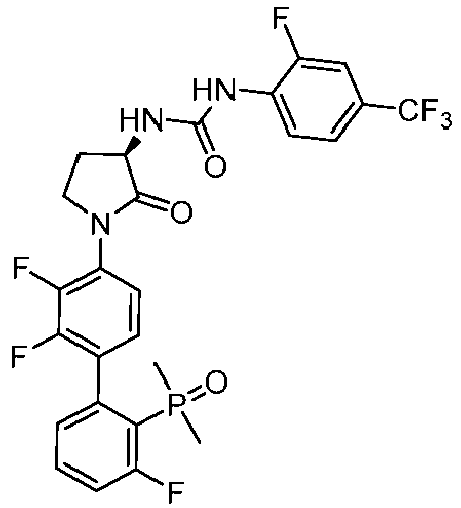
588.2 Method C, RT = 1.794 min, 100% 1H NMR (400MHz, DMSO-d6) δ = 8.95 (dd, J = 8.2, 2.5 Hz, 1H), 8.41 (t, J = 8.2 Hz, 1H), 7.76 - 7.65 (m, 2H), 7.53 - 7.43 (m, 2H), 7.38 - 7.28 (m, 2H), 7.23 - 7.16 (m, 2H), 4.62 - 4.54 (m, 1H), 3.94 - 3.83 (m, 1H), 3.81 - 3.70 (m, 1H), 2.64 - 2.53 (m, 1H), 2.16 - 2.02 (m, 1H), 1.76 - 1.64 (m, 6H). 73 
588.2 (M+N H4)+ Method D, RT = 1.647 min, 100% 1H NMR (400MHz, DMSO-d6) δ = 8.94 (d, J = 2.9 Hz, 1H), 8.84 (d, J = 4.2 Hz, 1H), 8.42 (t, J = 8.3 Hz, 1H), 7.87-7.86 (m, 1H), 7.73 - 7.62 (m, 2H), 7.52 (d, J = 8.6 Hz, 1H), 7.43 - 7.25 (m, 3H), 4.65 - 4.52 (m, 1H), 3.98 - 3.86 (m, 1H), 3.82 - 3.70 (m, 1H), 2.64 - 2.56 (m, 1H), 2.16 - 2.04 (m, 1H), 1.62 (d, J = 13.2 Hz, 6H). 74 
554.2 (M+N H4)+ Method D, RT = 1.498 min, 100% 1H NMR (400MHz, DMSO-d6) δ = 8.84 (br d, J = 4.2 Hz, 1H), 8.64 (s, 1H), 8.15 (t, J = 8.9 Hz, 1H), 7.86 (dd, J = 3.5, 7.5 Hz, 1H), 7.70 - 7.61 (m, 1H), 7.42 (dd, J = 2.4, 11.0 Hz, 1H), 7.37 (br d, J = 8.1 Hz, 1H), 7.32 - 7.24 (m, 1H), 7.20 (br d, J = 7.6 Hz, 2H), 4.62 - 4.50 (m, 1H), 3.95 - 3.84 (m, 1H), 3.82 - 3.71 (m, 1H), 2.64 - 2.56 (m, 1H), 2.13 - 2.00 (m, 1H), 1.62 (d, J = 13.4 Hz, 6H). 75 
564.2 Method C, RT = 1.723 min, 99.9% 1H NMR (400MHz, DMSO-d6) δ = 8.62 (d, J = 2.4 Hz, 1H), 8.16 (t, J = 8.9 Hz, 1H), 7.87 (ddd, J= 11.6, 7.5, 1.7 Hz, 1H), 7.70 - 7.53 (m, 2H), 7.43 (dd, J = 11.0, 2.4 Hz, 1H), 7.36 (ddd, J = 7.5, 3.6, 1.6 Hz, 1H), 7.33 - 7.26 (m, 2H), 7.23-7.16 (m, 2H), 4.64 - 4.50 (m, 1H), 3.84-3.74 (m, 1H), 3.73 - 3.63 (m, 1H), 2.66-2.57 (m, 1H), 2.19 - 2.01 (m, 1H), 1.71 (m, 4H), 0.93 - 0.88 (m, 6H). 76 
570.2 Method C, RT = 1.867 min, 98.9% 1H NMR (400MHz, DMSO-d6) δ = 8.91 (d, J = 2.9 Hz, 1H), 8.41 (m, 1H), 7.91 (ddd, J = 13.0, 7.6, 1.2 Hz, 1H), 7.73-7.56 (m, 3H), 7.52 (d, J = 9.5 Hz, 1H), 7.46 - 7.38 (m, 3H), 7.35 (d, J = 7.1 Hz, 1H), 4.68 - 4.55 (m, 1H), 3.85 - 3.76 (m, 1H), 3.74 - 3.66 (m, 1H), 2.67 - 2.59 (m, 1H), 2.21 - 2.10 (m, 1H), 1.49 (d, J = 13.5 Hz, 6H). 77 
586.2 Method C, RT = 1.781 min, 99.8% 1H NMR (400MHz, DMSO-d6) δ = 8.95 (t, J = 3.2 Hz, 1H), 8.42 (t, J = 8.2 Hz, 1H), 8.01 - 7.90 (m, 1H), 7.70 - 7.58 (m, 3H), 7.55 - 7.47 (m, 2H), 7.39 - 7.21 (m, 3H), 4.63 - 4.53 (m, 1H), 3.97 - 3.85 (m, 1H), 3.82 - 3.70 (m, 1H), 2.64 - 2.55 (m, 1H), 2.17 - 2.03 (m, 1H), 1.48 (d, J = 12.8 Hz, 3H), 1.46 (d, J = 12.8 Hz, 3H). 78 
568.1 Method C, RT = 1.691 min, 99.8% 1H NMR (400MHz, DMSO-d6) δ = 8.65 (dd, J = 6.1, 2.4 Hz, 1H), 8.17 (t, J = 8.9 Hz, 1H), 7.98 - 7.88 (m, 1H), 7.70 - 7.57 (m, 2H), 7.54 - 7.39 (m, 3H), 7.29 (td, J = 3.5, 7.1 Hz, 1H), 7.24 - 7.13 (m, 2H), 4.63 - 4.49 (m, 1H), 3.87 - 3.76 (m, 1H), 3.73 - 3.64 (m, 1H), 2.66 - 2.57 (m, 1H), 2.16 - 2.01 (m, 1H), 1.52 - 1.44 (m, 6H). 79 
500.1 Method C, RT = 1.763 min, 100% 1H NMR (400MHz, DMSO-d 6 ) δ = 8.73 (s, 1H), 8.63 (d, J = 2.2 Hz, 1H), 8.33 (s, 1H), 8.15 (t, J = 8.8 Hz, 1H), 7.90 (s, 1H), 7.70 (t, J = 7.2 Hz, 1H), 7.48 - 7.33 (m, 2H), 7.29 - 7.11 (m, 2H), 4.55 (dd, J = 18.1, 8.6 Hz, 1H), 3.92 - 3.84 (m, 1H), 3.81 - 3.72 (m, 1H), 2.61 (m, 1H), 2.12 - 2.00 (m, 1H). 80 
602.1 Method C, RT = 1.821 min, 99.5% 1H NMR (400MHz, DMSO-d6) δ = 8.94 (dd, J = 5.9, 2.9 Hz, 1H), 8.42 (m, 1H), 7.99 - 7.89 (m, 1H), 7.72 - 7.55 (m, 3H), 7.54 - 7.44 (m, 3H), 7.35 (dd, J = 7.1, 2.9 Hz, 1H), 7.32 - 7.24 (m, 1H), 4.65 - 4.53 (m, 1H), 3.87 - 3.78 (m, 1H), 3.74 - 3.67 (m, 1H), 2.63 (dt, J = 6.4, 5.1 Hz, 1H), 2.17 - 2.03 (m, 1H), 1.50 - 1.45 (m, 6H). 81 
552.2 Method D, RT = 2.358 min, 99.7% 1H NMR (400MHz, DMSO-d6) δ = 8.64 (br. s., 1H), 8.15 (t, J = 8.8 Hz, 1H), 7.94 (dd, J = 12.5, 1.5 Hz, 1H), 7.69 - 7.58 (m, 2H), 7.55 - 7.48 (m, 1H), 7.42 (dd, J = 11.3, 2.3 Hz, 1H), 7.32 (d, J = 7.8 Hz, 1H), 7.30 - 7.26 (m, 1H), 7.22 - 7.16 (m, 2H), 4.56 (s, 1H), 3.96 - 3.83 (m, 1H), 3.83 - 3.70 (m, 1H), 2.61 - 2.57 (m, 1H), 2.13 - 2.01 (m, 1H), 1.48 (d, J = 12.8 Hz, 3H), 1.46 (d, J = 12.8 Hz, 3H). 82 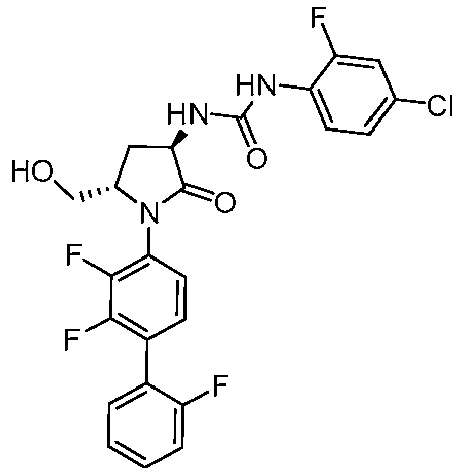
508.1 Method C, RT = 1.834 min, 100% 1H NMR (400MHz, DMSO-d6) δ = 8.63 (d, J = 1.0 Hz, 1H), 8.15 (t, J = 8.8 Hz, 1H), 7.63 - 7.50 (m, 2H), 7.50 - 7.29 (m, 5H), 7.24 - 7.15 (m, 1H), 7.11 (d, J = 7.3 Hz, 1H), 5.10 (t, J = 4.9 Hz, 1H), 4.81-4.62 (m, 1H), 4.29 - 4.12 (m, 1H), 3.49-3.47 (m, 2H), 2.55 - 2.52 (m, 1H), 2.31-2.21 (m, 1H). 83 
586.2 Method C, RT = 2.031 min, 100% 1H NMR (400MHz, DMSO-d6) δ = 8.66 (d, J = 2.5 Hz, 1H), 8.15 (t, J = 8.8 Hz, 1H), 7.89 - 7.80 (m, 1H), 7.75 (t, J = 7.8 Hz, 1H), 7.63 - 7.53 (m, 2H), 7.43 (dd, J = 11.3, 2.3 Hz, 1H), 7.31 - 7.13 (m, 4H), 4.62 - 4.50 (m, 1H), 3.97 - 3.94 (m, 1H), 3.81 - 3.73 (m, 1H), 2.63 - 2.55 (m, 1H), 2.17 - 2.05 (m, 1H), 1.54 (d, J = 13.6 Hz, 3H), 1.52 (d, J = 13.6 Hz, 3H). 84 
555.2 (M+N H4)+ Method C, RT = 1.369 min, 92.6% 1H NMR (400MHz, DMSO-d6) δ = 9.47 (s, 1H), 8.97 (d, J = 5.6 Hz, 1H), 8.66 (d, J = 2.4 Hz, 1H), 8.15 (t, J = 8.9 Hz, 1H), 7.48 - 7.34 (m, 3H), 7.25 - 7.17 (m, 2H), 4.62 - 4.54 (m, 1H), 3.96 - 3.85 (m, 1H), 3.78 (t, J = 8.6 Hz, 1H), 2.63 - 2.54 (m, 1H), 2.15 - 2.04 (m, 1H), 1.69 (d, J = 13.7 Hz, 6H). 85 
570.2 Method C, RT = 1.722 min, 100% 1H NMR (400MHz, DMSO-d6) δ = 8.68-8.58 (m, 1H), 8.15 (t, J = 8.8 Hz, 1H), 7.76 - 7.65 (m, 1H), 7.52 - 7.35 (m, 3H), 7.25 - 7.15 (m, 3H), 7.13 - 7.06 (m, 1H), 4.59 - 4.48 (m, 1H), 3.91 - 3.81 (m, 1H), 3.78 - 3.67 (m, 1H), 2.55 - 2.52 (m, 1H), 2.13 - 2.01 (m, 1H), 1.73 - 1.61 (m, 6H). 86 
604.1 Method C, RT = 1.834 min, 100% 1H NMR (400MHz, DMSO-d6) δ = 8.98-8.91 (m, 1H), 8.45 - 8.38 (m, 1H), 7.76-7.62 (m, 2H), 7.52 (br. d., J = 9.3 Hz, 1H), 7.48 - 7.40 (m, 2H), 7.36 - 7.30 (m, 1H), 7.24 - 7.18 (m, 1H), 7.11 (d, J = 6.6 Hz, 1H), 4.62 - 4.52 (m, 1H), 3.92 - 3.83 (m, 1H), 3.78 - 3.70 (m, 1H), 2.64 - 2.56 (m, 1H), 2.14 - 2.06 (m, 1H), 1.72 - 1.64 (m, 6H). 87 
602.2 Method C, RT = 1.795 min, 100% 1H NMR (400MHz, DMSO-d6) δ = 8.65 (dd, J = 1.7, 8.8 Hz, 1H), 8.15 (t, J = 8.9 Hz, 1H), 7.88 (dd, J = 7.3, 12.7 Hz, 1H), 7.70 - 7.53 (m, 3H), 7.43 (dd, J = 2.4, 11.0 Hz, 1H), 7.38 - 7.30 (m, 2H), 7.24-7.10 (m, 2H), 4.61 - 4.52 (m, 1H), 3.96-3.85 (m, 1H), 3.81 - 3.71 (m, 1H), 2.61-2.54 (m, 1H), 2.17 - 2.03 (m, 1H), 1.64-1.48 (m, 6H). 88 
636.2 Method C, RT = 1.919 min, 100% 1H NMR (400MHz, DMSO-d6) δ = 8.94 (dd, J = 2.9, 8.6 Hz, 1H), 8.41 (m, 1H), 7.92 - 7.82 (m, 1H), 7.71 - 7.54 (m, 4H), 7.51 (d, J = 8.8 Hz, 1H), 7.39 - 7.31 (m, 3H), 4.63 - 4.53 (m, 1H), 3.96 - 3.87 (m, 1H), 3.81 - 3.73 (m, 1H), 2.63 - 2.57 (m, 1H), 2.18 - 2.06 (m, 1H), 1.61 - 1.50 (m, 6H). 89 
592.2 Method C, RT = 1.872 min, 100% 1H NMR (400MHz, DMSO-d6) δ = 8.96-8.89 (m, 1H), 8.41 (t, J = 8.3 Hz, 1H), 8.03 - 7.93 (m, 1H), 7.71 - 7.49 (m, 4H), 7.39 - 7.26 (m, 3H), 7.14 - 7.07 (m, 1H), 4.58 - 4.49 (m, 1H), 3.87 - 3.78 (m, 1H), 3.74 - 3.67 (m, 1H), 2.63 - 2.54 (m, 1H), 2.13 - 2.02 (m, 1H), 1.60 - 1.50 (m, 1H), 1.45 (d, J = 13.4 Hz, 3H), 1.42 (d, J = 13.4 Hz, 3H), 0.79 - 0.72 (m, 1H), 0.71 - 0.61 (m, 3H). 90 
614.2 Method C, RT = 1.768 min, 99.7% 1H NMR (400MHz, DMSO-d6) δ = 8.94 (d, J = 2.0 Hz, 1H), 8.40 (t, J = 8.3 Hz, 1H), 8.01 - 7.89 (m, 1H), 7.72 - 7.58 (m, 3H), 7.51 (m, 1H), 7.40 (m, 1H), 7.34-7.18 (m, 3H), 4.71 - 4.58 (m, 1H), 4.33 (m, 1H), 3.48 (dd, J = 10.5, 3.9 Hz, 1H), 3.40 - 3.36 (m, 1H), 3.24 (s, 3H), 2.49-2.44 (m, 1H), 2.37 - 2.23 (m, 1H), 1.62-1.36 (m, 6H). 91 
586.2 Method C, RT = 1.778 min, 99.8% 1H NMR (400MHz, DMSO-d6) δ = 8.71-8.59 (m, 1H), 8.22 - 8.12 (m, 1H), 7.93-7.90 (m, 1H), 7.83 - 7.75 (m, 1H), 7.70-7.58 (m, 2H), 7.48 - 7.33 (m, 3H), 7.24-7.14 (m, 2H), 4.62 (d, J = 1.2 Hz, 1H), 3.96 - 3.84 (m, 1H), 3.81 - 3.71 (m, 1H), 2.65 - 2.58 (m, 1H), 2.10 - 2.04 (m, 1H), 1.67 - 1.33 (m, 6H). 92 
620.2 Method C, RT = 1.911 min, 100% 1H NMR (400MHz, DMSO-d6) δ = 9.00-8.89 (m, 1H), 8.47 - 8.37 (m, 1H), 7.95-7.86 (m, 1H), 7.83 - 7.74 (m, 1H), 7.71-7.60 (m, 3H), 7.55 - 7.48 (m, 1H), 7.45-7.36 (m, 2H), 7.35 - 7.32 (m, 1H), 4.75-4.43 (m, 1H), 3.96 - 3.84 (m, 1H), 3.81-3.71 (m, 1H), 2.66 - 2.58 (m, 1H), 2.10-2.04 (m, 1H), 1.60 - 1.48 (m, 6H). 93 
589.2 (M+N H4)+ Method C, RT = 1.532 min, 94.1% 1H NMR (400MHz, DMSO-d6) δ = 9.47 (s, 1H), 9.03 - 8.85 (m, 2H), 8.42 (t, J = 8.2 Hz, 1H), 7.67 (br. d., J = 11.5 Hz, 1H), 7.53 (s, 1H), 7.48 - 7.30 (m, 3H), 4.60 (td, J = 10.2, 8.0 Hz, 1H), 4.01-3.87 (m, 1H), 3.79 (br. t., J = 8.8 Hz, 1H), 2.65 - 2.55 (m, 1H), 2.18 - 2.04 (m, 1H), 1.69 (d, J = 13.7 Hz, 6H). 94 
620.2 Method C, RT = 1.932 min, 100% 1H NMR (400MHz, DMSO-d6) δ = 8.95 (d, J = 3.2 Hz, 1H), 8.41 (t, J = 8.4 Hz, 1H), 7.90 - 7.80 (m, 1H), 7.76 (t, J = 7.9 Hz, 1H), 7.67 (dd, J = 1.8, 11.6 Hz, 1H), 7.63 - 7.55 (m, 2H), 7.52 (d, J = 9.0 Hz, 1H), 7.34 (d, J = 7.1 Hz, 1H), 7.29 - 7.19 (m, 2H), 4.64 - 4.55 (m, 1H), 3.96 - 3.87 (m, 1H), 3.83 - 3.74 (m, 1H), 2.99 - 2.87 (m, 1H), 2.64 - 2.56 (m, 1H), 2.16 - 2.06 (m, 1H), 1.60 - 1.48 (m, 6H). 95 
568.2 Method C, RT = 1.608 min, 99% 1H NMR (400MHz, DMSO-d6) δ = 8.65 (br. s., 1H), 8.16 (t, J = 8.8 Hz, 1H), 7.98 - 7.87 (m, 1H), 7.74 - 7.57 (m, 3H), 7.43 (dd, J = 11.2,2.4 Hz, 1H), 7.32 - 7.10 (m, 4H), 6.59 (t, J = 52.4 Hz, 1H), 4.60 - 4.50 (m, 1H), 3.95 - 3.85 (m, 1H), 3.81 - 3.71 (m, 1H), 2.62 - 2.55 (m, 1H), 2.17 - 2.03 (m, 1H), 1.50 (d, J = 13.2 Hz, 3H), 1.44 (d, J = 13.2 Hz, 3H). 96 
532.2 Method C, RT = 1.813 min, 100% 1H NMR (400MHz, DMSO-d6) δ = 8.64 (d, J = 1.5 Hz, 1H), 8.16 (m, 1H), 8.04-7.92 (m, 1H), 7.69 - 7.54 (m, 2H), 7.43 (dd, J = 11.1, 2.3 Hz, 1H), 7.36 - 7.26 (m, 2H), 7.24 - 7.13 (m, 3H), 4.59 - 4.45 (m, 1H), 3.89 - 3.78 (m, 1H), 3.69 - 3.55 (m, 1H), 2.62 - 2.54 (m, 1H), 2.12 (m, 3H), 2.10 - 1.99 (m, 1H), 1.45 (br. d., J = 13.4 Hz, 3H), 1.36 (br. d., J =13.4 Hz, 3H). 97 
585.2 Method C, RT = 1.809 min, 100% 1H NMR (400MHz, DMSO-d6) δ = 8.95 (d, J = 2.7 Hz, 1H), 8.42 (t, J = 8.4 Hz, 1H), 8.02 - 7.84 (m, 1H), 7.81 - 7.74 (m, 1H), 7.70 - 7.62 (m, 2H), 7.57 (d, J = 7.6 Hz, 1H), 7.54 - 7.48 (m, 1H), 7.46 (dd, J = 6.8, 1.7 Hz, 1H), 7.42 (dd, J = 7.2, 1.7 Hz, 1H), 7.40 - 7.32 (m, 1H), 4.68 - 4.56 (m, 1H), 4.45 (s, 2H), 4.00 - 3.88 (m, 1H), 3.85 - 3.77 (m, 1H), 2.66 - 2.56 (m, 1H), 2.18 - 2.05 (m, 1H). 98 
586.2 Method C, RT = 1.764 min, 99.9% 1H NMR (400MHz, DMSO-d6) δ = 8.93 (br. s., 1H), 8.42 (m, 1H), 7.94 - 7.90 (m, 1H), 7.71 - 7.57 (m, 3H), 7.56 - 7.49 (m, 1H), 7.49 - 7.41 (m, 1H), 7.41 - 7.26 (m, 3H), 4.67 - 4.53 (m, 1H), 3.88 - 3.79 (m, 1H), 3.76 - 3.66 (m, 1H), 2.67 - 2.56 (m, 1H), 2.20 - 2.05 (m, 1H), 1.57 - 1.48 (m, 6H). 99 
552.2 Method C, RT = 1.595 min, 99.7% 1H NMR (400MHz, DMSO-d6) δ = 8.64 (br. s., 1H), 8.17 (t, J = 8.9 Hz, 1H), 7.95 - 7.90 (m, 1H), 7.71 - 7.57 (m, 2H), 7.50 - 7.30 (m, 4H), 7.25 - 7.09 (m, 2H), 4.65 - 4.49 (m, 1H), 3.82 (dt, J = 9.4, 6.4 Hz, 1H), 3.74 - 3.61 (m, 1H), 2.66 - 2.56 (m, 1H), 2.15 - 2.03 (m, 1H), 1.57 - 1.48 (m, 6H). 100 
599.2 Method C, RT = 1.857 min, 100% 1H NMR (400MHz, DMSO-d6) δ = 8.93 (d, J = 2.7 Hz, 1H), 8.85 (dd, J = 4.6, 1.2 Hz, 1H), 8.42 (m, 1H), 7.86 - 8.82 (m, 1H), 7.70 - 7.60 (m, 2H), 7.55 - 7.47 (m, 1H), 7.42 - 7.29 (m, 2H), 7.24 - 7.16 (m, 1H), 4.64 - 4.52 (m, 1H), 3.96 - 3.87 (m, 1H), 3.81 - 3.73 (m, 1H), 2.65 - 2.58 (m, 1H), 2.16 - 1.81 (m, 5H), 1.02 - 0.85 (m, 6H). 101 
583.1 (M+N H4)+ Method C, RT = 1.746 min, 100% 1H NMR (400MHz, DMSO-d6) δ = 8.69-8.56 (m, 1H), 8.15 (t, J = 8.9 Hz, 1H), 8.04 - 7.91 (m, 1H), 7.76 - 7.59 (m, 2H), 7.49 - 7.32 (m, 3H), 7.29 - 7.10 (m, 3H), 4.62 - 4.51 (m, 1H), 3.97 - 3.61 (m, 4H), 2.57 - 2.52 (m, 1H), 2.14 - 2.01 (m, 1H), 1.44 (d, J = 14.4 Hz, 3H), 1.12 (t, J = 7.1 Hz, 3H). 102 
598.2 Method C, RT = 1.965 min, 100% 1H NMR (400MHz, DMSO-d6) δ = 8.96 (d, J = 2.7 Hz, 1H), 8.46 (t, J = 8.3 Hz, 1H), 7.97 - 7.86 (m, 1H), 7.72 - 7.57 (m, 3H), 7.53 (d, J = 8.8 Hz, 1H), 7.42 - 7.30 (m, 2H), 7.30 - 7.22 (m, 2H), 4.65 (d, J = 9.0 Hz, 1H), 3.88 (br. d., J = 9.3 Hz, 1H), 3.45 (br. d., J = 9.3 Hz, 1H), 1.53 (d, J = 13.2 Hz, 6H), 1.22 (s, 3H), 1.06 (s, 3H). 103 
581.2 (M+N H4)+ Method C, RT = 1.965 min, 100% 1H NMR (400MHz, DMSO-d6) δ = 8.68 (d, J = 1.5 Hz, 1H), 8.22 (t, J = 9.0 Hz, 1H), 7.97 - 7.86 (m, 1H), 7.70 - 7.56 (m, 2H), 7.45 (dd, J = 11.2, 2.4 Hz, 1H), 7.41 - 7.29 (m, 2H), 7.29 - 7.17 (m, 2H), 7.12 (d, J = 9.0 Hz, 1H), 4.62 (d, J = 9.0 Hz, 1H), 3.86 (br. d., J = 9.3 Hz, 1H), 3.45 (br. d., J = 9.3 Hz, 1H), 1.54 (d, J = 13.2 Hz, 6H), 1.21 (s, 3H), 1.05 (s, 3H). 104 
600.2 Method C, RT = 1.871 min, 100% 1H NMR (400MHz, DMSO-d6) δ = 8.98-8.86 (m, 1H), 8.41 (t, J = 8.68 Hz, 1H), 8.02 - 7.92 (m, 1H), 7.77 - 7.60 (m, 3H), 7.56 - 7.48 (m, 1H), 7.46 - 7.30 (m, 3H), 7.28 - 7.18 (m, 1H), 4.65 - 4.51 (m, 1H), 3.98 - 3.81 (m, 2H), 3.81 - 3.73 (m, 1H), 3.73 - 3.61 (m, 1H), 2.65 - 2.54 (m, 1H), 2.17 - 2.02 (m, 1H), 1.44 (d, J = 14.67 Hz, 3H), 1.12 (t, J = 7.1 Hz, 3H). 105 
600.2 Method C, RT = 1.871 min, 100% 1H NMR (400MHz, DMSO-d6) δ = 9.02-8.90 (m, 1H), 8.41 (t, J = 8.3 Hz, 1H), 8.05 - 7.92 (m, 1H), 7.76 - 7.60 (m, 3H), 7.51 (dd, J = 8.7, 1.1 Hz, 1H), 7.46 - 7.31 (m, 3H), 7.28 - 7.15 (m, 1H), 4.65 - 4.53 (m, 1H), 3.97 - 3.74 (m, 3H), 3.74 - 3.60 (m, 1H), 2.65 - 2.56 (m, 1H), 2.18 - 2.02 (m, 1H), 1.45 (d, J = 14.43 Hz, 3H), 1.12 (t, J = 7.1 Hz, 3H). 106 
580.1 Method C, RT = 1.763 min, 94.7% 1H NMR (400MHz, DMSO-d6) δ = 8.65 (d, J = 2.5 Hz, 1 H) 8.15 (t, J = 8.9 Hz, 1 H), 7.96 - 7.88 (m, 1 H), 7.67 - 7.64 (m, 2 H), 7.51 (d, J = 8.6 Hz, 1 H), 7.37 - 7.47 (m, 2 H), 7.27 (d, J = 8.8 Hz, 1 H), 7.16-7.23 (m, 2 H), 4.47 - 4.64 (m, 1 H), 3.90-4.01 (m, 1H), 3.82 - 3.90 (m, 1 H), 2.54-2.62 (m, 1 H), 2.01 - 2.15 (m, 1 H), 1.53 (d, J = 13.2 Hz, 6 H). 107 
568.1 Method C, RT = 1.662 min, 100% 1H NMR (400MHz, DMSO-d6) δ = 8.74 (d, J = 1.71 Hz, 1 H), 8.11 (t, J = 8.93 Hz, 1 H), 7.89 - 8.01 (m, 1 H), 7.57-7.71 (m, 3 H), 7.40 - 7.40 (m, 1 H), 7.34-7.48 (m, 1 H), 7.32 (d, J = 8.31 Hz, 1 H), 7.25 - 7.14 (m, 2 H), 7.04 (t, J = 52.4 Hz, 1H) 4.41 - 4.55 (m, 1 H), 3.89 - 4.01 (m, 1 H), 3.64 - 3.71 (m, 1 H), 2.56 - 2.52 (m, 1 H), 2.18 - 2.31 (m, 1 H), 1.30 - 1.63 (m, 6 H). 108 
602.1 Method C, RT = 1.892 min, 100% 1H NMR (400MHz, DMSO-d6) δ = 8.93 (d, J = 2.5 Hz, 1 H), 8.41 (t, J = 8.4 Hz, 1 H), 8.0 - 7.87 (m, 1 H), 7.77 - 7.71 (m, 1 H), 7.69 - 7.59 (m, 2 H), 7.55 - 7.49 (m, 1 H), 7.48 - 7.42 (m, 1 H), 7.41 - 7.27 (m, 2 H), 7.23 - 7.13 (m, 1 H), 4.65 - 4.54 (m, 1 H), 3.97 - 3.86 (m, 1 H), 3.82 - 3.71 (m, 1 H), 3.51 (s, 3H), 3.49 (s, 3H), 2.65 - 2.56 (m, 1 H), 2.18 - 2.02 (m, 1 H). 109 
550.2 Method C, RT = 1.650 min, 100% 1H NMR (400MHz, DMSO-d6) δ = 8.63 (d, J = 2.0 Hz, 1 H), 8.14 (t, J = 8.9 Hz, 1 H), 7.99 - 7.84 (m, 1 H), 7.72 - 7.55 (m, 2 H), 7.37 - 7.50 (m, 2 H), 7.35 - 7.25 (m, 2 H), 7.23 - 7.17 (m, 1 H), 7.14 (d, J = 7.1 Hz, 1 H), 4.70 - 4.58 (m, 1 H), 4.36-4.23 (m, 1 H), 2.36 - 2.25 (m, 2 H), 1.46 (d, J = 12.4 Hz, 6H), 1.19 (d, J = 6.4 Hz, 3 H). 110 
599.2 Method C, RT = 1.851 min, 100% 1H NMR (400MHz, DMSO-d6) δ = 8.96 (d, J = 3.18 Hz, 1 H), 8.84 (m, 1 H), 8.46 (t, J = 8.2 Hz, 1 H), 7.87 (m, 1H), 7.63-7.72 (m, 2 H), 7.52 (d, J = 9.5 Hz, 1 H), 7.19 - 7.39 (m, 3 H), 4.65 (d, J = 9.1 Hz, 1 H), 3.88 (d, J = 9.2 Hz, 1 H), 3.45 (d, J = 9.2 Hz, 1 H), 1.63 (d, J = 13.2 Hz, 6H), 1.23 (s, 3 H), 1.07 (s, 3 H). 111 
566.2 Method C, RT = 1.404 min, 100% 1H NMR (400MHz, DMSO-d6) δ = 8.63 (s, 1H), 8.17 (t, J = 8.8 Hz, 1H), 8.00-7.88 (m, 1H), 7.70 - 7.58 (m, 2H), 7.49-7.36 (m, 2H), 7.33 - 7.13 (m, 4H), 4.93 (t, J = 5.0 Hz, 1H), 4.68 - 4.56 (m, 1H), 4.25 - 4.12 (m, 1H), 3.44 (br. t., J = 4.0 Hz, 2H), 2.67 - 2.61 (m, 1H), 1.98 - 1.85 (m, 1H), 1.64 - 1.42 (m, 6H). 112 
566.2 Method C, RT = 1.425 min, 100% 1H NMR (400MHz, DMSO-d6) δ = 8.61 (s, 1H), 8.14 (t, J = 8.9 Hz, 1H), 7.98-7.87 (m, 1H), 7.71 - 7.56 (m, 2H), 7.46-7.36 (m, 2H), 7.36 - 7.24 (m, 2H), 7.22-7.15 (m, 1H), 7.09 (d, J = 7.6 Hz, 1H), 5.15 - 5.05 (m, 1H), 4.76 - 4.63 (m, 1H), 4.24 - 4.11 (m, 1H), 3.47 (br. d., J = 3.9 Hz, 2H), 2.53 (br. s., 1H), 2.29 - 2.20 (m, 1H), 1.60 - 1.41 (m, 6H). 113 
565.2 Method C, RT = 1.719 min, 100% 1H NMR (400MHz, DMSO-d6) δ = 8.84 (d, J = 4.9 Hz, 1 H), 8.68 (d, J = 2.5 Hz, 1 H), 8.22 (t, J=8.9 Hz, 1 H), 7.87 (ddd, J = 7.8, 4.4, 1.5 Hz, 1 H), 7.67 (ddd, J = 7.8, 4.9, 2.5 Hz, 1 H), 7.44 (dd, J = 11.3, 2.5 Hz, 1 H), 7.26 - 7.38 (m, 2 H), 7.21 (ddd, J = 8.9, 2.5, 1.1 Hz, 1 H), 7.00-7.16 (m, 1 H), 4.62 (d, J = 9.1 Hz, 1 H), 3.86 (d, J = 9.1 Hz, 1 H), 3.44 (d, J = 9.1 Hz, 1 H), 1.63 (d, J = 13.7 Hz, 6 H), 1.19 - 1.28 (m, 3 H), 1.05 (s, 3 H). 114 
600.2 Method D, RT = 1.577 min, 100% 1H NMR (400MHz, DMSO-d6) δ = 9.06-8.51 (br. s., 1H), 8.45 - 8.36 (m, 1 H), 8.00 - 7.87 (m, 1 H), 7.71 - 7.57 (m, 3 H), 7.51 (dd, J = 9.17, 1.10 Hz, 1 H), 7.44-7.11 (m, 4 H), 4.78 - 4.61 (m, 1 H), 4.26 - 4.21 (m, 1 H), 3.50- 3.40 (m, 3 H), 2.61 - 2.53 (m, 1 H), 2.33 - 2.22 (m, 1 H), 1.44 - 1.55 (m, 6 H). 115 
584.2 Method D, RT = 1.805 min, 100% 1H NMR (400MHz, DMSO-d6) δ = 8.97-8.85 (m, 1 H), 8.46 - 8.34 (m, 1 H), 7.99-7.89 (m, 1 H), 7.70 - 7.57 (m, 3 H), 7.52 (br. d., J = 8.6 Hz, 1 H), 7.46 - 7.17 (m, 4 H), 4.71 - 4.57 (m, 1 H), 4.34 - 4.15 (m, 1 H), 2.37 - 2.30 (m, 1 H), 1.75 - 1.62 (m, 1 H), 1.59 - 1.39 (m, 6 H), 1.19 (d, J = 6.4 Hz, 3 H). 116 
584.2 Method D, RT = 1.802 min, 100% 1H NMR (400MHz, DMSO-d6) δ = 8.92 (d, J = 2.7 Hz, 1 H), 8.40 (t, J = 8.3 Hz, 1 H), 7.97 - 7.89 (m, 1 H), 7.71 - 7.58 (m, 3 H), 7.51 (d, J = 8.8 Hz, 1 H), 7.40 (m, 1 H), 7.36 - 7.25 (m, 3 H), 4.66 (td, J = 9.2, 7.3 Hz, 1 H), 4.35 - 4.24 (m, 1 H), 2.38-2.24 (m, 2 H), 1.63 - 1.41 (m, 6 H), 1.20 (d, J = 6.4 Hz, 3 H). 117 
558.2 Method C, RT = 1.711 min, 99.4% 1H NMR (400MHz, DMSO-d6) δ = 8.65 (br. s., 1 H), 8.18 (t, J = 8.9 Hz, 1 H), 7.96 (m, 1 H), 7.69 - 7.53 (m, 2 H), 7.43 (dd, J = 12.5, 2.5 Hz, 1 H), 7.37 - 7.26 (m, 2 H), 7.25 - 7.10 (m, 3 H), 4.57 (dt, J = 10.3, 8.1 Hz, 1 H), 3.95 - 3.65 (m, 2 H), 2.66 - 2.55 (m, 1 H), 2.14 - 2.03 (m, 1H), 1.80 - 1.69 (m, 1 H), 1.51 - 1.30 (m, 6 H), 0.98 - 0.83 (m, 2 H), 0.67 - 0.43 (m, 2 H). 118 
491 Method C, RT = 1.921 min, 99.3% 1H NMR (400MHz, DMSO-d6) δ = 8.63 (d, J = 2.1 Hz, 1 H), 8.29 (dd, J = 5.0, 2.1 Hz, 1 H), 8.15 (t, J = 8.8 Hz, 1 H), 7.78 (dd, J = 7.3, 2.1 Hz, 1 H), 7.47 - 7.36 (m, 2 H), 7.35 - 7.28 (m, 1 H), 7.25 - 7.05 (m, 3 H), 4.62 - 4.48 (m, 1 H), 3.95 - 3.84 (m, 1 H), 3.89 (s, 3H), 3.83 - 3.71 (m, 1 H), 2.63 - 2.52 (m, 1 H), 2.14 - 2.03 (m, 1H). 119 
545.1 Method C, RT = 1.737 min, 100% 1H NMR (400MHz, DMSO-d6) δ = 8.64 (d, J = 2.0 Hz, 1H), 8.19 - 8.05 (m, 1H), 7.63 - 7.52 (m, 2H), 7.50 - 7.35 (m, 4H), 7.27 - 7.13 (m, 3H), 4.55 (td, J = 10.5, 8.0 Hz, 1H), 4.30 (t, J = 7.9 Hz, 2H), 3.96 - 3.81 (m, 3H), 3.81 - 3.72 (m, 1H), 2.61 - 2.54 (m, 1H), 2.13 - 2.02 (m, 1H). 120 
585.0 Method E, RT = 2.500 min, 99.9% 1H NMR (400MHz, DMSO-d6) δ = 8.93 (d, J = 2.7 Hz, 1H), 8.85 (d, J = 4.7 Hz, 1H), 8.40 (t, J = 8.2 Hz, 1H), 7.90 (m, 1H), 7.72 - 7.63 (m, 2H), 7.51 (m, 1H), 7.37 - 7.28 (m, 3H), 4.67 (m, 1H), 4.30 (m, 1H), 2.46 - 2.23 (m, 2H), 1.62 (d, J = 13.2 Hz, 6H), 1.19 (d, J = 5.2 Hz, 3H). 121 
551.2 Method C, RT = 1.596 min, 90.1% 1H NMR (400MHz, DMSO-d6) δ = 8.85 (d, J = 4.9 Hz, 1H), 8.69 - 8.60 (m, 1H), 8.20 - 8.09 (m, 1H), 7.91 (dd, J = 6.7, 4.9 Hz, 1H), 7.68 (m, 1H), 7.43 (dd, J = 11.0, 2.5 Hz, 1H), 7.37 - 7.30 (m, 1H), 7.29-7.18 (m, 3H), 4.69 - 4.50 (m, 1H), 4.34-4.10 (m, 1H), 2.86 - 2.76 (m, 1H), 1.65-1.62 (m, 1H), 1.63 (d, J = 13.4 Hz, 3H), 1.62 (d, J = 13.4 Hz, 3H), 1.12 (d, J = 6.1 Hz, 3H). 122 
551.2 Method C, RT = 1.592 min, 92.5% 1H NMR (400MHz, DMSO-d6) δ = 8.85 (d, J = 4.2 Hz, 1 H), 8.65 (s, 1 H), 8.15 (t, J = 8.9 Hz, 1 H), 7.90 (m, 1 H), 7.68 (m, 1 H), 7.42 (dd, J = 11.1, 2.3 Hz, 1 H), 7.36 - 7.31 (m, 2 H), 7.22 - 7.14 (m, 2 H), 4.70 - 4.59 (m, 1 H), 4.34 - 4.26 (m, 1 H), 2.37 - 2.27 (m, 2 H), 1.62 (d, J = 13.5 Hz, 6 H), 1.12 (d, J = 6.1 Hz, 3H). 123 
618.2 (M+N H4)+ Method C, RT = 1.502 min, 100% 1H NMR (400MHz, DMSO-d6) δ = 8.91 (d, J = 2.7 Hz, 1H), 8.85 (d, J = 4.6 Hz, 1H), 8.41 (t, J = 8.6 Hz, 1H), 7.89 (dd, J = 7.5, 4.0 Hz, 1H), 7.70 - 7.63 (m, 2H), 7.51 (br. d., J = 8.6 Hz, 1H), 7.34 (t, J = 6.4 Hz, 2H), 7.25 (d, J = 7.3 Hz, 1H), 5.12 (t, J = 4.9 Hz, 1H), 4.77 - 4.66 (m, 1H), 4.19 (br. d., J = 8.3 Hz, 1H), 3.49-3.43 (m, 2H), 2.62 - 2.53 (m, 1H), 2.33-2.22 (m, 1H), 1.63 (d, J = 13.4 Hz, 3H), 1.62 (d, J = 13.4 Hz, 3H). 124 
600.2 Method C, RT = 1.577 min, 100% 1H NMR (400MHz, DMSO-d6) δ = 9.19 (br. s., 1H), 8.45 (t, J = 8.4 Hz, 1H), 7.96 - 7.86 (m, 1H), 7.70 - 7.58 (m, 3H), 7.52 (d, J = 8.4 Hz, 1H), 7.42 - 7.33 (m, 2H), 7.31 - 7.22 (m, 2H), 4.87 (t, J = 8.1 Hz, 1H), 4.18 - 4.07 (m, 1H), 3.71 (br. d., J = 8.8 Hz, 1H), 3.64 - 3.58 (m, 1H), 3.4-3.2 (m, 2H), 2.85 - 2.72 (m, 1H), 1.52 (br. d., J = 13.2 Hz, 6H). 125 
583.2 (M+N H4)+ Method D, RT = 1.442 min, 100% 1H NMR (400MHz, DMSO-d6) δ = 8.70-8.63 (m, 1H), 8.13 (t, J = 8.6 Hz, 1H), 7.97 - 7.86 (m, 1H), 7.71 - 7.58 (m, 2H), 7.45 - 7.35 (m, 3H), 7.29 - 7.17 (m, 3H), 4.37 (dd, J = 10.0, 8.3 Hz, 1H), 3.88-3.81 (m, 1H), 3.76 - 3.66 (m, 1H), 3.61 (dd, J = 11.0, 6.6 Hz, 2H), 2.66 - 2.56 (m, 1H), 1.53 (br. d., J = 13.2 Hz, 6H). 126 
583.2 (M+N H4)+ Method D, RT = 1.482 min, 94.5% 1H NMR (400MHz, DMSO-d6) δ = 8.90 (s, 1H), 8.19 (t, J = 8.9 Hz, 1H), 7.98 - 7.86 (m, 1H), 7.69 - 7.59 (m, 2H), 7.43 (dd, J = 11.2, 2.4 Hz, 1H), 7.40 - 7.34 (m, 2H), 7.30 - 7.24 (m, 1H), 7.23 - 7.18 (m, 1H), 7.12 (d, J = 7.8 Hz, 1H), 4.85 (t, J = 8.1 Hz, 1H), 4.17 - 4.07 (m, 1H), 3.71 (br. d., J = 9.5 Hz, 1H), 3.60 (br. dd., J = 9.5, 3.2 Hz, 2H), 2.76 - 2.70 (m, 1H), 1.52 (br. d., J = 13.2 Hz, 6H). 127 
583.2 (M+N H4)+ Method D, RT = 1.490 min, 96.5% 1H NMR (400MHz, DMSO-d6) δ = 8.91 (s, 1H), 8.20 (t, J = 9.1 Hz, 1H), 7.98 - 7.86 (m, 1H), 7.71 - 7.61 (m, 2H), 7.43 (dd, J = 11.0, 2.5 Hz, 1H), 7.40 - 7.34 (m, 2H), 7.30 - 7.24 (m, 1H), 7.21 - 7.16 (m, 1H), 7.13 (d, J = 8.0 Hz, 1H), 4.86 (t, J = 8.2 Hz, 1H), 4.16 - 4.08 (m, 1H), 3.72 (br. d., J = 9.3 Hz, 1H), 3.60 (br. dd., J = 9.3, 3.2 Hz, 2H), 2.76 - 2.71 (m, 1H), 1.53 (br. d., J = 13.2 Hz, 6H). 128 
585.0 Method E, RT = 2,517 min, 99.7% 1H NMR (400MHz, DMSO-d6) δ = 8.93 (br. s., 1H), 8.84 (d, J = 3.9 Hz, 1H), 8.41 (t, J = 8.1 Hz, 1H), 7.93 - 7.88 (m, 1H), 7.74 - 7.61 (m, 2H), 7.51 (br. d., J = 8.3 Hz, 1H), 7.44 - 7.21 (m, 3H), 4.70 - 4.52 (m, 1H), 4.22 (br. d., J = 9.5 Hz, 1H), 2.85 - 2.78 (m, 1H), 2.57 - 2.52 (m, 1H), 1.63 (d, J = 13.4 Hz, 3H), 1.61 (d, J = 13.4 Hz, 3H), 1.13 (d, J = 6.4 Hz, 3H). 129 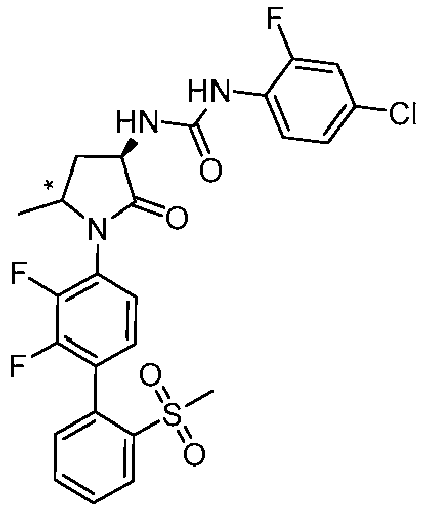
552.1 Method D, RT = 1.831 min, 100% 1H NMR (400MHz, DMSO-d6) δ = 8.71 - 8.55 (m, 1H), 8.21 - 8.09 (m, 2H), 7.91 - 7.73 (m, 2H), 7.61 - 7.50 (m, 1H), 7.42 (dd, J = 11.2,2.0 Hz, 1H), 7.37 - 7.24 (m, 2H), 7.24 - 7.11 (m, 2H), 4.70 - 4.52 (m, 1H), 4.39 - 4.13 (m, 1H), 3.06 (s, 3H), 2.38 - 2.23 (m, 2H), 1.12 (d, J = 6.1 Hz, 3H). 130 
548.2 Method C, RT = 1.578 min, 99.6% 1H NMR (400MHz, DMSO-d6) δ = 9.73 - 9.50 (m, 1H), 8.95 (d, J = 1.2 Hz, 1H), 8.44 (d, J = 1.5 Hz, 1H), 7.97 - 7.85 (m, 1H), 7.71 - 7.56 (m, 2H), 7.43 - 7.31 (m, 3H), 7.30 - 7.21 (m, 1H), 4.67 (d, J = 9.0 Hz, 1H), 3.89 - 3.82 (m, 1H), 3.47 (br. d., J = 9.5 Hz, 1H), 1.53 (d, J = 13.2 Hz, 6H), 1.23 (s, 3H), 1.07 (s, 3H). 131 
669.4 Method D, RT = 1.764 min, 100% 1H NMR (400 MHz, DMSO-d6) δ = 8.93 (d, J = 2.0 Hz, 1H), 8.40 (t, J = 8.6 Hz, 1H), 7.94 (dd, J = 12.6, 7.5 Hz, 1H), 7.73 - 7.57 (m, 3H), 7.50 (br. d., J = 8.6 Hz, 1H), 7.41 - 7.17 (m, 4H), 4.78 - 4.66 (m, 1H), 4.47 - 4.28 (m, 1H), 3.32 - 3.20 (m, 2H), 3.29 - 3.07 (m, 2H), 2.56 - 2.48 (m, 2H), 2.46 - 2.17 (m, 6H), 1.51 (br. d., J = 13.2 Hz, 6H). 132 
579.2 (M+N H4)+ Method D, RT = 1.736 min, 100% 1H NMR (400 MHz, DMSO-d6) δ = 8.61 - 8.54 (m, 1H), 8.14 (t, J = 8.8 Hz, 1H), 7.96 - 7.88 (m, 1H), 7.68 - 7.59 (m, 2H), 7.44 (dd, J = 11.1, 2.6 Hz, 1H), 7.41 - 7.35 (m, 2H), 7.30 - 7.24 (m, 1H), 7.22 - 7.18 (m, 1H), 7.09 - 7.01 (m, 1H), 4.78 - 4.67 (m, 1H), 4.16 - 4.05 (m, 1H), 3.62 - 3.53 (m, 1H), 1.52 (br. d., J = 13.2 Hz, 6H), 0.90 - 0.71 (m, 4H). 133 
524.1 Method E, RT = 1.518 min, 98.9% 1H NMR (400 MHz, DMSO-d6) δ = 8.99 (s, 1H), 7.92 (m, 1H), 7.52 - 7.72 (m, 2H), 7.33 - 7.41 (m, 2H), 7.21 - 7.29 (m, 1H), 7.04 (m, 2H), 6.73 (d, J= 7.5 Hz, 1H), 4.53 (m, 1H), 3.83 - 3.95 (m, 1H), 3.71 - 3.81 (m, 1H), 2.60 - 2.54 (m, 1H), 2.04 - 2.19 (m, 1H), 1.52 (br. d., J=13.2 Hz, 6H). 134 
518.1 Method D, RT = 1.511 min, 99.1% 135 
524.1 Method D, RT = 1.496 min, 95.0% - It will be evident to one skilled in the art that the present disclosure is not limited to the foregoing illustrative examples, and that it can be embodied in other specific forms without departing from the essential attributes thereof. It is therefore desired that the examples be considered in all respects as illustrative and not restrictive, reference being made to the appended claims, rather than to the foregoing examples, and all changes which come within the meaning and range of equivalency of the claims are therefore intended to be embraced therein.
Claims (24)
- A compound of Formula (II):
 Ar1 is aryl substituted with 1-2 R1a and 1-2 R1b or monocyclic heteroaryl with 1-3 heteroatoms selected from nitrogen, oxygen, and sulfur, and substituted with 1-2 R1a and 1-2 R1b;Ar2 is aryl substituted with 1-4 R2a or 6-membered heteroaryl with 1-2 nitrogen atoms, and substituted with 1-4 R2a;Ar3 is aryl substituted with 1-4 R3a or monocyclic heteroaryl with 1-3 heteroatoms selected from nitrogen, oxygen, and sulfur, and substituted with 1-4 R3a;R1a is hydrogen or halo;R1b is halo, haloalkyl, alkoxy, or haloalkoxy;R2a is hydrogen, cyano, halo, alkyl, hydroxyalkyl, haloalkyl, cycloalkyl, alkoxy, or haloalkoxy; alternatively, two adjacent R2a groups are taken together with the carbon atoms to which they are attached to form a heterocycle with 1-4 heteroatoms selected from nitrogen, oxygen, and sulfur;R3a is cyano, halo, alkyl, alkoxy, hydroxyalkyl, alkoxyalkyl, haloalkyl, (R1R2N)alkyl, R1R2N, alkylC(O)(R2)Nalkyl, (alkyl)2(O)P, (alkoxy)2(O)P, (alkoxy)(alkyl)(O)P, (alkyl)(O)(NR1)S, alkylSO2, or alkylSO2NH; alternatively, two adjacent R3a groups are taken together with the carbon atoms to which they are attached to form a heterocycle with 1-4 heteroatoms selected from nitrogen, oxygen, and sulfur;R4a or R4b is independently hydrogen, alkyl, alkoxy, hydroxylalkyl, alkoxyalkyl, or haloalkoxy; alternatively, R4a and R4b together with the carbon atom they are both attached to form a C3-6 cycloalkyl;R5a or R5b is independently hydrogen, alkyl, hydroxylalkyl, alkoxyalkyl or haloalkoxyl;R1 is hydrogen or alkyl; andR2 is hydrogen or alkyl; or R1R2N taken together is azetidinyl, oxazolyl pyrrolidinyl, piperidinyl, piperazinyl, or morpholinyl, and is substituted with 0-3 substituents selected from halo, alkyl, and oxo.
 - The compound of claim 1, having Formula (III):
 Ar1 is phenyl substituted with 1-2 R1a and 1-2 R1b or 6-membered heteroaryl with 1-3 nitrogen atoms and substituted with 1R1a and 1-2 R1b;Ar3 is phenyl substituted with 1-3 R3a or 5- to 6-membered heteroaryl with 1-3 nitrogen atoms and substituted with 1-3 R3a;R1a is hydrogen or halo;R1b is halo, C1-4haloalkyl, C1-4 alkoxy, or C1-4haloalkoxy;R2a is hydrogen, halo, C1-4 alkyl, C1-4hydroxyalkyl, C1-4haloalkyl, C3-6 cycloalkyl, C1-4 alkoxy, or C1-4haloalkoxy;R3A is cyano, halo, C1-4 alkyl, C1-4 hydroxyalkyl, C1-4 alkoxyalkyl, C1-4 haloalkyl, (R1R2N)C1-4 alkyl, R1R2N, C1-4 alkylC(O)(R2)NC1-4 alkyl, (C1-4 alkyl)2(O)P, (C1-4 alkoxy)2(O)P, (C1-4 alkoxy)(C1-4 alkyl)(O)P, C1-4 alkylSO2, or C1-4 alkylSO2NH;R1R2N taken together is oxazolyl or pyrrolidinyl and is substituted with 0-3 substituents selected from halo, alkyl, and oxo;R4a or R4b is independently hydrogen, C1-4 alkyl, or C1-4 hydroxylalkyl; alternatively, R4a and R4b together with the carbon atom they are both attached to form a C3-6 cycloalkyl; andR5a or R5b is independently hydrogen, C1-4 alkyl, C1-4 hydroxylalkyl, or C1-4 alkoxyalkyl.
 - The compound of claim 2, or a pharmaceutically acceptable salt thereof, wherein:Ar1 is phenyl substituted with 1-2 R1a and 1-2 R1b, pyridinyl substituted with 1 R1a and 1-2 R1b, or pyrazinyl substituted with 1R1a and 1-2 R1b; andAr3 is phenyl substituted with 1-3 R3a, pyrazolyl substituted with 1-3 R3a, pyridinyl substituted with 1-3 R3a, or pyrimidinyl substituted with 1-3 R3a.
- The compound of claim 2 or 3, having Formula (IV):
 Ar1 is phenyl substituted with 1-2 R1a and 1-2 R1b, pyridinyl substituted with 1 R1a and 1-2 R1b, or pyrazinyl substituted with 1 R1a and 1-2 R1b;R1a is hydrogen or halo;R1b is halo, C1-4haloalkyl, C1-4 alkoxy, or C1-4haloalkoxy;R2a is hydrogen, halo, C1-4 alkyl, C1-4 hydroxyalkyl, C1-4haloalkyl, C3-6 cycloalkyl, C1-4 alkoxy, or C1-4haloalkoxy;R3a is cyano, halo, C1-3 alkyl, C1-3 hydroxyalkyl, C1-3 alkoxyalkyl, C1-3 haloalkyl, R1R2N, (C1-3 alkyl)2(O)P, (C1-3 alkoxy)2(O)P, (C1-3 alkoxy)(C1-3 alkyl)(O)P, C1-3 alkylSO2, or C1-3 alkylSO2NH;R4a or R4b is independently hydrogen, C1-3 alkyl, or C1-3 hydroxylalkyl; alternatively, R4a and R4b together with the carbon atom they are both attached to form a C3-6 cycloalkyl; andR5a or R5b is independently hydrogen, C1-3 alkyl, C1-3 hydroxylalkyl, or C1-3 alkoxyalkyl.
 - The compound of claim 4, having Formula (V):
 R1a is hydrogen or F;R1b is halo, C1-2 haloalkyl, or C1-2 alkoxy;R2a is hydrogen, halo, C1-3 alkyl, C1-3 haloalkyl, or C3-6 cycloalkyl;R3a is halo, hydroxyalkyl, alkoxyalkyl, (C1-2 alkyl)2(O)P, (C1-2 alkoxy)2(O)P, (C1-2 alkoxy)(C1-2 alkyl)(O)P, C1-2 alkylSO2, or C1-2 alkylSO2NH; andR3a' is halo.
 - The compound of claim 5, or a pharmaceutically acceptable salt thereof, wherein:R1a is hydrogen or F;R1b is F, Cl, or CF3;R2a is hydrogen, F, Cl, isopropyl, CF3, or cyclopropyl;R3a is (CH3)2(O)P, (CH3CH2)2(O)P, (CH3CH2O)(CH3)(O)P, CH3SO2, or CH3SO2NH; andR3a' is F.
- The compound of claim 4, having Formula (VI):
 R1a is hydrogen or halo;R1b is halo, C1-2 haloalkyl, or C1-2 alkoxy;R2a is hydrogen, halo, C1-3 alkyl, or C3-6 cycloalkyl;R3a is (C1-2 alkyl)2(O)P, (C1-2 alkoxy)2(O)P, (C1-2 alkoxy)(C1-2 alkyl)(O)P, C1-2 alkylSO2, or C1-2 alkylSO2NH.
 - The compound of claim 2 or 3, having Formula (VII):
 Ar3 is pyrazolyl substituted with 1-3 R3a, pyridinyl substituted with 1-3 R3a, or pyrimidinyl substituted with 1-3 R3a;R1a is hydrogen or halo;R1b is halo, C1-4haloalkyl, C1-4 alkoxy, or C1-4haloalkoxy;R2a is hydrogen, halo, C1-4 alkyl, C1-4 hydroxyalkyl, C1-4haloalkyl, C3-6 cycloalkyl, C1-4 alkoxy, or C1-4haloalkoxy;R3A is cyano, halo, C1-4 alkyl, C1-4 hydroxyalkyl, C1-4 alkoxyalkyl, (R1R2N)C1-4 alkyl, R1R2N- , (C1-4 alkyl)2(O)P, (C1-4 alkoxy)2(O)P, (C1-4 alkoxy)(C1-4 alkyl)(O)P, C1-4 alkylSO2, or C1-4 alkylSO2NH;R1 is hydrogen or alkyl;R2 is hydrogen or alkyl; or R1R2N taken together is oxazolyl or pyrrolidinyl, and is substituted with 0-3 substituents selected from halo, alkyl, or oxo;R4a or R4b is independently hydrogen, C1-4 alkyl, C1-4 alkoxy, C1-4 alkoxyalkyl, or C1-4 haloalkoxy; R4a and R4b together with the carbon atom they are both attached to form a C3-6 cycloalkyl; andR5a or R5b is independently hydrogen, C1-4 alkyl, C1-4 alkoxy, C1-4 alkoxyalkyl, or C1-4 haloalkoxy.
 - The compound of claim 8, having Formula (VIII):
 R1a is hydrogen or halo;R1b is halo, C1-2 haloalkyl, or C1-2 alkoxy;R2a is hydrogen, halo, C1-3 alkyl, or C3-6 cycloalkyl;R3a is (C1-2 alkyl)2(O)P, (C1-2 alkoxy)2(O)P, (C1-2 alkoxy)(C1-2 alkyl)(O)P, C1-2 alkylSO2, or C1-2 alkylSO2NH; andR5a or R5b is independently hydrogen or C1-2 alkyl.
 - The compound of claim 1, having Formula (IX):
 R1a is hydrogen or halo;R1b is halo, C1-2 haloalkyl, or C1-2 alkoxy;R2a is hydrogen, halo, C1-2 haloalkyl, C1-3 alkyl, or C3-6 cycloalkyl;Ar3 is
 R3a' is halo;R4a or R4b is independently hydrogen, C1-2 alkyl, or C1-2hydroxyalkyl; or R4a and R4b together with the carbon atom to which they are both attached form a C3-6 cycloalkyl; andR5a or R5b is independently hydrogen, C1-2 alkyl, C1-2 hydroxyalkyl, or C1-2 alkoxyalkyl.
 - The compound of claim 4, or a pharmaceutically acceptable salt thereof, wherein:R4a is hydrogen;R4b is hydrogen;R5a is C1-2 alkyl, C1-2 hydroxylalkyl, or C1-2 alkoxyalkyl; andR5b is hydrogen.
- The compound of claim 4, or a pharmaceutically acceptable salt thereof, wherein:R4a is C1-2 alkyl;R4b is C1-2 alkyl;R5a is hydrogen; andR5b is hydrogen.
- A compound according to claim 1 of Formula (I):
 Ar1 is phenyl, pyridinyl, or pyridazinyl and is substituted with 1 halo, haloalkyl or haloalkoxy substituent in the 4-position and 0-2 additional halo or haloalkyl substituents;Ar2 is phenyl or pyridinyl and is substituted with 0-2 substituents selected from cyano, fluoro, alkyl, haloalkyl, cycloalkyl, alkoxy, and haloalkoxy;Ar3 is phenyl or pyridinyl and is substituted with 0-2 substituents selected from cyano, halo, hydroxyalkyl, alkoxyalkyl, (R1R2N)alkyl, (alkyl)2(O)P, (alkyl)(O)(NR1)S, alkylSO2, and alkylSO2NH;R1 is hydrogen or alkyl; andR2 is hydrogen or alkyl;or (R1)(R2)N taken together is azetidinyl, pyrrolidinyl, piperidinyl, piperazinyl, or morpholinyl and is substituted with 0-3 substituents selected from halo and alkyl;or a pharmaceutically acceptable salt thereof.
 - A compound of claim 13 where Ar1 is phenyl substituted with 1 halo, haloalkyl or haloalkoxy substituent in the 4-position and 0-2 additional halo or haloalkyl substituents.
- A compound of claim 13 where Ar2 is phenyl substituted with 0 substituents, 1 alkyl or cycloalkyl substituent, or 1-2 fluoro substituents.
- A compound of claim 13 where Ar3 is phenyl substituted with 1-2 substituents selected from cyano, halo, hydroxyalkyl, alkoxyalkyl, (R1R2N)alkyl, (alkyl)2(O)P, (alkyl)(O)(NR1)S, alkylSO2, and alkylSO2NH.
- A compound of claim 13 where R1 is hydrogen and R2 is hydrogen.
- A compound of claim 13 selected from the group consisting of


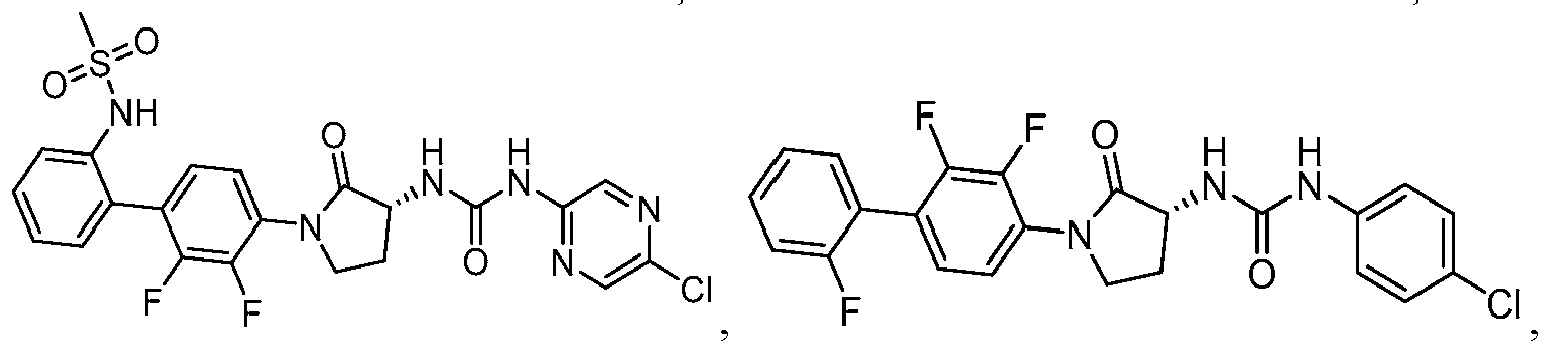


- A compound according to claim 1 which is selected from the group consisting of


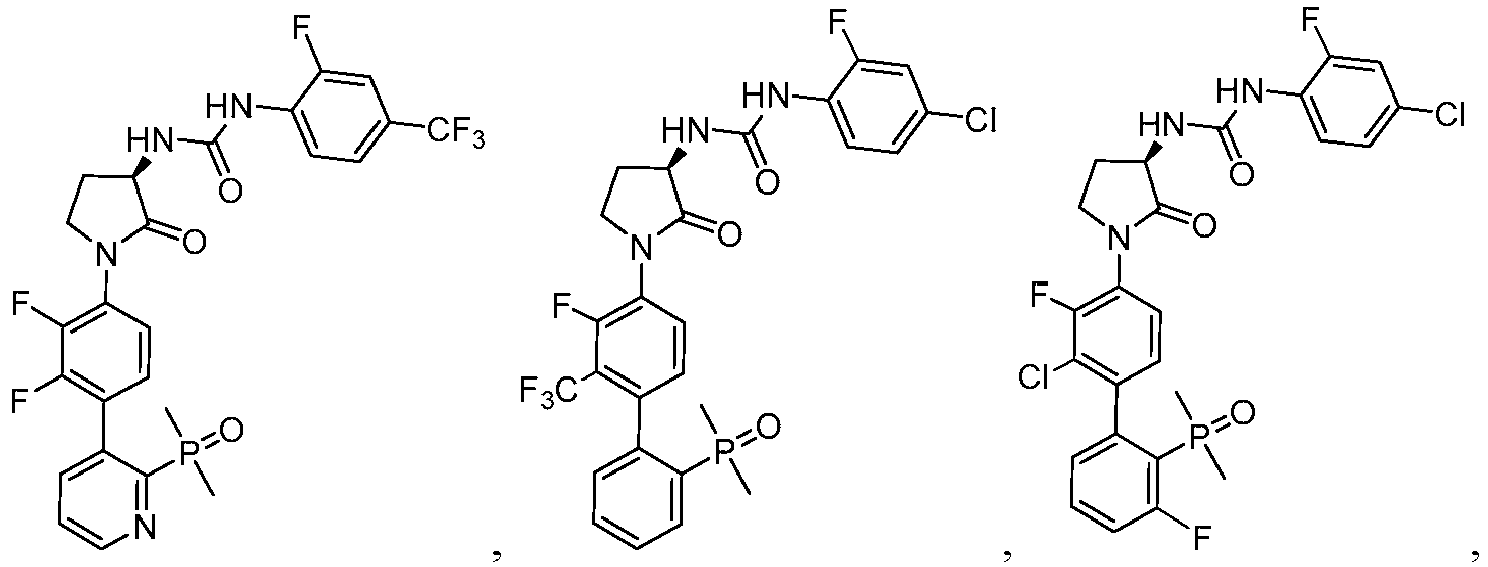


- A composition comprising a compound of any one of claims 1-19, or a pharmaceutically acceptable salt thereof, and a pharmaceutically acceptable carrier, diluent, or excipient.
- A compound according to any one of claims 1-19 or composition according to claim 20 for use in therapy.
- A compound according to any one of claims 1-24 or a pharmaceutical acceptable salt thereof for use in treating heart disease in a patient in need thereof.
- The compound or a pharmaceutical acceptable salt thereof for use according to claim 22 wherein the heart disease is selected from the group consisting of angina pectoris, unstable angina, myocardial infarction, heart failure, acute coronary disease, acute heart failure, chronic heart failure, and cardiac iatrogenic damage.
- The compound or a pharmaceutically acceptable salt thereof for use according to claim 23 wherein the heart failure is selected from the group consisting of congestive heart failure, systolic heart failure, diastolic heart failure, heart failure with reduced ejection fraction (HFREF), heart failure with preserved ejection fraction (HFPEF), acute heart failure, chronic heart failure of ischemic and non-ischemic origin.
Applications Claiming Priority (3)
| Application Number | Priority Date | Filing Date | Title |
|---|---|---|---|
| US201862638556P | 2018-03-05 | 2018-03-05 | |
| EP19711769.0A EP3762380B1 (en) | 2018-03-05 | 2019-03-04 | Phenylpyrrolidinone formyl peptide 2 receptor agonists |
| PCT/US2019/020493 WO2019173182A1 (en) | 2018-03-05 | 2019-03-04 | Phenylpyrrolidinone formyl peptide 2 receptor agonists |
Related Parent Applications (2)
| Application Number | Title | Priority Date | Filing Date |
|---|---|---|---|
| EP19711769.0A Division EP3762380B1 (en) | 2018-03-05 | 2019-03-04 | Phenylpyrrolidinone formyl peptide 2 receptor agonists |
| EP19711769.0A Division-Into EP3762380B1 (en) | 2018-03-05 | 2019-03-04 | Phenylpyrrolidinone formyl peptide 2 receptor agonists |
Publications (2)
| Publication Number | Publication Date |
|---|---|
| EP3981767A1 true EP3981767A1 (en) | 2022-04-13 |
| EP3981767B1 EP3981767B1 (en) | 2025-12-31 |
Family
ID=65812419
Family Applications (2)
| Application Number | Title | Priority Date | Filing Date |
|---|---|---|---|
| EP19711769.0A Active EP3762380B1 (en) | 2018-03-05 | 2019-03-04 | Phenylpyrrolidinone formyl peptide 2 receptor agonists |
| EP21207176.5A Active EP3981767B1 (en) | 2018-03-05 | 2019-03-04 | Phenylpyrrolidinone formyl peptide-2 receptor agonists |
Family Applications Before (1)
| Application Number | Title | Priority Date | Filing Date |
|---|---|---|---|
| EP19711769.0A Active EP3762380B1 (en) | 2018-03-05 | 2019-03-04 | Phenylpyrrolidinone formyl peptide 2 receptor agonists |
Country Status (30)
| Country | Link |
|---|---|
| US (3) | US10676431B2 (en) |
| EP (2) | EP3762380B1 (en) |
| JP (1) | JP7155276B2 (en) |
| KR (1) | KR102803660B1 (en) |
| CN (1) | CN111868052B (en) |
| AR (1) | AR114429A1 (en) |
| AU (1) | AU2019232704B2 (en) |
| BR (1) | BR112020017744A2 (en) |
| CA (1) | CA3092927A1 (en) |
| CL (1) | CL2020002224A1 (en) |
| CY (1) | CY1124985T1 (en) |
| DK (1) | DK3762380T3 (en) |
| EA (1) | EA202092094A1 (en) |
| ES (2) | ES3061495T3 (en) |
| HR (1) | HRP20220118T1 (en) |
| HU (1) | HUE058044T2 (en) |
| IL (1) | IL277044B2 (en) |
| LT (1) | LT3762380T (en) |
| MX (1) | MX2020009000A (en) |
| MY (1) | MY204384A (en) |
| PE (1) | PE20210046A1 (en) |
| PL (1) | PL3762380T3 (en) |
| PT (1) | PT3762380T (en) |
| RS (1) | RS62833B1 (en) |
| SG (1) | SG11202008504SA (en) |
| SI (1) | SI3762380T1 (en) |
| SM (1) | SMT202200067T1 (en) |
| TW (1) | TWI804585B (en) |
| WO (1) | WO2019173182A1 (en) |
| ZA (1) | ZA202006115B (en) |
Families Citing this family (22)
| Publication number | Priority date | Publication date | Assignee | Title |
|---|---|---|---|---|
| KR20180081528A (en) * | 2015-11-24 | 2018-07-16 | 브리스톨-마이어스 스큅 컴퍼니 | Targeting formyl-peptide receptor 2 / lyxin A 4 receptor (FPR2 / ALX) for the treatment of heart disease |
| JP7094989B2 (en) | 2017-06-09 | 2022-07-04 | ブリストル-マイヤーズ スクイブ カンパニー | Cyclopropylurea formylpeptide 2 receptor and formylpeptide 1 receptor agonist |
| WO2018227065A1 (en) * | 2017-06-09 | 2018-12-13 | Bristol-Myers Squibb Company | Piperidinone formyl peptide 2 receptor and formyl peptide 1 receptor agonists |
| KR102615095B1 (en) * | 2017-06-09 | 2023-12-15 | 브리스톨-마이어스 스큅 컴퍼니 | Piperidinone formyl peptide 2 receptor agonist |
| EP3634956B1 (en) | 2017-06-09 | 2021-04-07 | Bristol-Myers Squibb Company | Aryl heterocyclic piperidinone formyl peptide 2 receptor and formyl peptide 1 receptor agonists |
| WO2019173188A1 (en) | 2018-03-05 | 2019-09-12 | Arcus Biosciences, Inc. | Arginase inhibitors |
| WO2019173182A1 (en) | 2018-03-05 | 2019-09-12 | Bristol-Myers Squibb Company | Phenylpyrrolidinone formyl peptide 2 receptor agonists |
| CN113166134B (en) | 2018-11-26 | 2024-06-14 | 百时美施贵宝公司 | Pyrrolidone derivatives as formyl peptide 2 receptor agonists |
| JP7494224B2 (en) * | 2019-06-18 | 2024-06-03 | ブリストル-マイヤーズ スクイブ カンパニー | Biaryldialkylphosphine oxide FPR2 agonists |
| ES2986512T3 (en) | 2020-07-09 | 2024-11-11 | Bristol Myers Squibb Co | Formyl pyrazolone peptide receptor 2 agonists |
| EP4178946A1 (en) * | 2020-07-09 | 2023-05-17 | Bristol-Myers Squibb Company | Oxopyrrolidine fpr2 agonists |
| WO2022035923A1 (en) * | 2020-08-12 | 2022-02-17 | Bristol-Myers Squibb Company | Oxopyrrolidine urea fpr2 agonists |
| JP7830488B2 (en) * | 2021-01-21 | 2026-03-16 | ベイジン・ティアンタン・ホスピタル | FPR1 modulator and how to use it |
| JP7717816B2 (en) * | 2021-01-21 | 2025-08-04 | バイオフロント セラピューティクス (ベイジン) カンパニー リミテッド | Modulators of FPR1 and methods of using same |
| EP4074317A1 (en) | 2021-04-14 | 2022-10-19 | Bayer AG | Phosphorus derivatives as novel sos1 inhibitors |
| IL322597A (en) | 2021-12-15 | 2025-10-01 | Adama Agan Ltd | Compounds useful for the preparation of various agrochemicals and markers thereof |
| US20250205164A1 (en) | 2022-05-27 | 2025-06-26 | Asahi Group Holdings, Ltd. | Fpr2 agonist containing outer membrane vesicles derived from lactic acid bacterium |
| CN120112538A (en) | 2022-10-13 | 2025-06-06 | 拜耳公司 | SOS1 inhibitors |
| KR20250172674A (en) * | 2023-04-18 | 2025-12-09 | 브리스톨-마이어스 스큅 컴퍼니 | Pyrrolidinone urea FPR2 agonist |
| WO2024220453A1 (en) * | 2023-04-18 | 2024-10-24 | Bristol-Myers Squibb Company | Pyrrolidinone urea fpr2 agonists |
| KR20250172673A (en) * | 2023-04-18 | 2025-12-09 | 브리스톨-마이어스 스큅 컴퍼니 | Carbocyclic phenylpyrrolidinone urea FPR2 agonist |
| UY41082A (en) | 2024-03-28 | 2025-08-29 | Pi Industries Ltd | CONDENSED BICYCLIC COMPOUNDS AND THEIR USE AS PEST CONTROL AGENTS |
Citations (2)
| Publication number | Priority date | Publication date | Assignee | Title |
|---|---|---|---|---|
| WO2006063113A2 (en) * | 2004-12-07 | 2006-06-15 | Portola Pharmaceuticals, Inc. | Ureas as factor xa inhibitors |
| WO2017100390A1 (en) * | 2015-12-10 | 2017-06-15 | Bristol-Myers Squibb Company | Piperidinone formyl peptide 2 receptor and formyl peptide 1 receptor agonists |
Family Cites Families (47)
| Publication number | Priority date | Publication date | Assignee | Title |
|---|---|---|---|---|
| US5202344A (en) | 1990-12-11 | 1993-04-13 | G. D. Searle & Co. | N-substituted lactams useful as cholecystokinin antagonists |
| HUT75808A (en) | 1994-06-02 | 1997-05-28 | Zeneca Ltd | Substituted pyrrolidones, thiazolidones and oxazolidones as herbicides and process for their preparation |
| TW200508224A (en) | 2003-02-12 | 2005-03-01 | Bristol Myers Squibb Co | Cyclic derivatives as modulators of chemokine receptor activity |
| US7163937B2 (en) | 2003-08-21 | 2007-01-16 | Bristol-Myers Squibb Company | Cyclic derivatives as modulators of chemokine receptor activity |
| TWI354664B (en) * | 2003-08-21 | 2011-12-21 | Bristol Myers Squibb Co | Cyclic derivatives as modulators of chemokine rece |
| WO2005047899A2 (en) | 2003-11-07 | 2005-05-26 | Acadia Pharmaceuticals Inc. | Use of the lipoxin receptor, fprl1, as a tool for identifying compounds effective in the treatment of pain and inflammation |
| WO2006063293A2 (en) | 2004-12-07 | 2006-06-15 | Portola Pharmaceuticals, Inc. | THIOUREAS AS FACTOR Xa INHIBITORS |
| US20070123508A1 (en) | 2005-05-27 | 2007-05-31 | Roger Olsson | PAR2-modulating compounds and their use |
| EP1896461A2 (en) | 2005-06-30 | 2008-03-12 | Amgen Inc. | Bis-aryl kinase inhibitors and their use in the treatment of inflammation, angiogenesis and cancer |
| TW200831080A (en) | 2006-12-15 | 2008-08-01 | Irm Llc | Compounds and compositions as inhibitors of cannabinoid receptor 1 activity |
| AR069650A1 (en) | 2007-12-14 | 2010-02-10 | Actelion Pharmaceuticals Ltd | DERIVATIVES OF AMINOPIRAZOL AS NON-PEPTIDIC AGONISTS OF THE HUMAN ALX RECEPTOR |
| BRPI0821115A8 (en) | 2007-12-18 | 2017-12-26 | Actelion Pharmaceuticals Ltd | AMINOTRIAZOLE DERIVATIVE COMPOUND, DRUG, PHARMACEUTICAL COMPOSITION AND USE OF THE COMPOUND |
| AU2008345225A1 (en) | 2007-12-21 | 2009-07-09 | University Of Rochester | Method for altering the lifespan of eukaryotic organisms |
| USRE49686E1 (en) | 2008-09-19 | 2023-10-10 | Takeda Pharmaceutical Company Limited | Nitrogen-containing heterocyclic compound and use of same |
| WO2010094678A1 (en) | 2009-02-23 | 2010-08-26 | F. Hoffmann-La Roche Ag | Novel ortho-aminoamides for the treatment of cancer |
| GB0910003D0 (en) | 2009-06-11 | 2009-07-22 | Univ Leuven Kath | Novel compounds for the treatment of neurodegenerative diseases |
| CA2760887A1 (en) | 2009-06-12 | 2010-12-16 | Actelion Pharmaceuticals Ltd | Oxazole and thiazole derivatives as alx receptor agonists |
| EP2585054A1 (en) | 2010-06-24 | 2013-05-01 | Allergan, Inc. | Derivatives of cycloalkyl- and cycloalkenyl-1,2-dicarboxylic acid compounds having formyl peptide receptor like-1 (fprl-1) agonist or antagonist activity |
| WO2012066488A2 (en) | 2010-11-17 | 2012-05-24 | Actelion Pharmaceuticals Ltd | Bridged spiro[2.4]heptane ester derivatives |
| AU2011336973A1 (en) | 2010-12-03 | 2013-07-11 | Allergan, Inc. | Pharmaceutical compositions comprising 3,4- dihydroisoquinolin-2(1 H)-yl-3-phenylurea derivatives having formyl peptide receptor like-1 (FPRL-1) agonist or antagonist activity |
| EP2648724B1 (en) | 2010-12-07 | 2016-09-21 | Actelion Pharmaceuticals Ltd. | Hydroxylated aminotriazole derivatives as alx receptor agonists |
| PL2649068T3 (en) | 2010-12-07 | 2015-03-31 | Idorsia Pharmaceuticals Ltd | Oxazolyl-methylether derivatives as alx receptor agonists |
| WO2012109544A1 (en) | 2011-02-11 | 2012-08-16 | Allergan, Inc. | Novel 1-(1-oxo-1,2,3,4-tetrahydroisoquinolin-7-yl)urea derivatives as n-formyl peptide receptor like-1 (fprl-1) receptor modulators |
| US8653299B2 (en) | 2011-03-17 | 2014-02-18 | Allergan, Inc. | Dihydronaphthalene and naphthalene derivatives as N-formyl peptide receptor like-1 (FPRL-1) receptor modulators |
| NZ618795A (en) | 2011-05-13 | 2015-07-31 | Array Biopharma Inc | Pyrrolidinyl urea, pyrrolidinyl thiourea and pyrrolidinyl guanidine compounds as trka kinase inhibitors |
| HUE040145T2 (en) | 2011-10-26 | 2019-02-28 | Allergan Inc | Amide derivatives of N-urea substituted amino acids as formyl peptide-like receptor 1 (FPRL1) receptor modulators |
| US8492556B2 (en) * | 2011-11-10 | 2013-07-23 | Allergan, Inc. | 2,5-Dioxoimidazolidin-1-yl-3-phenylurea derivatives as formyl peptide receptor like-1 (FPRL-1) receptor modulators |
| US8541577B2 (en) | 2011-11-10 | 2013-09-24 | Allergan, Inc. | Aryl urea derivatives as N-formyl peptide receptors like-1 (FPRL-1) receptor modulators |
| SG11201406629VA (en) | 2012-04-16 | 2014-11-27 | Allergan Inc | (2-ureidoacetamido)alkyl derivatives as formyl peptide receptor 2 modulators |
| ME02990B (en) | 2012-11-13 | 2018-10-20 | Array Biopharma Inc | N-Pyrrolidinyl, N'-pyrazolyl-urea, thiourea, guanidine and cyanoguanidine compounds as kinase race inhibitors |
| WO2014078372A1 (en) | 2012-11-13 | 2014-05-22 | Array Biopharma Inc. | Pyrrolidinyl urea, thiourea, guanidine and cyanoguanidine compounds as trka kinase inhibitors |
| US9828360B2 (en) | 2012-11-13 | 2017-11-28 | Array Biopharma Inc. | Pyrrolidinyl urea, thiourea, guanidine and cyanoguanidine compounds as TrkA kinase inhibitors |
| KR102313757B1 (en) | 2013-07-16 | 2021-10-18 | 알러간, 인코포레이티드 | Derivatives of n-urea substituted amino acids as formyl peptide receptor modulators |
| AR097279A1 (en) | 2013-08-09 | 2016-03-02 | Actelion Pharmaceuticals Ltd | DERIVATIVES OF BENZIMIDAZOLIL-METIL UREA AS ALX RECEIVER AGONISTS |
| EP3305763B1 (en) * | 2013-11-28 | 2019-07-24 | Kyorin Pharmaceutical Co., Ltd. | Deuterated or isotopically labeled urea derivatives or pharmacologically acceptable salts thereof useful as fprl-1 agonists |
| AU2014357342B2 (en) | 2013-12-03 | 2019-01-17 | Fmc Corporation | Pyrrolidinones as herbicides |
| CN106459013B (en) | 2014-05-15 | 2019-10-25 | 阵列生物制药公司 | Compounds and uses thereof as TRKA kinase inhibitors |
| EP3247692B1 (en) | 2015-01-23 | 2022-09-07 | GVK Biosciences Private Limited | Inhibitors of trka kinase |
| WO2016189877A1 (en) | 2015-05-27 | 2016-12-01 | Kyorin Pharmaceutical Co., Ltd. | Urea derivative or pharmacologically acceptable salt thereof |
| AU2016266190A1 (en) | 2015-05-27 | 2018-01-18 | Kyorin Pharmaceutical Co., Ltd. | Urea derivative or pharmacologically acceptable salt thereof |
| KR20180081528A (en) | 2015-11-24 | 2018-07-16 | 브리스톨-마이어스 스큅 컴퍼니 | Targeting formyl-peptide receptor 2 / lyxin A 4 receptor (FPR2 / ALX) for the treatment of heart disease |
| CA3026983A1 (en) | 2016-06-08 | 2017-12-14 | Glaxosmithkline Intellectual Property Development Limited | Chemical compounds |
| EP3634956B1 (en) | 2017-06-09 | 2021-04-07 | Bristol-Myers Squibb Company | Aryl heterocyclic piperidinone formyl peptide 2 receptor and formyl peptide 1 receptor agonists |
| KR102615095B1 (en) | 2017-06-09 | 2023-12-15 | 브리스톨-마이어스 스큅 컴퍼니 | Piperidinone formyl peptide 2 receptor agonist |
| JP7094989B2 (en) | 2017-06-09 | 2022-07-04 | ブリストル-マイヤーズ スクイブ カンパニー | Cyclopropylurea formylpeptide 2 receptor and formylpeptide 1 receptor agonist |
| WO2018227065A1 (en) | 2017-06-09 | 2018-12-13 | Bristol-Myers Squibb Company | Piperidinone formyl peptide 2 receptor and formyl peptide 1 receptor agonists |
| WO2019173182A1 (en) | 2018-03-05 | 2019-09-12 | Bristol-Myers Squibb Company | Phenylpyrrolidinone formyl peptide 2 receptor agonists |
-
2019
- 2019-03-04 WO PCT/US2019/020493 patent/WO2019173182A1/en not_active Ceased
- 2019-03-04 BR BR112020017744-0A patent/BR112020017744A2/en active Search and Examination
- 2019-03-04 CN CN201980017438.1A patent/CN111868052B/en active Active
- 2019-03-04 PL PL19711769T patent/PL3762380T3/en unknown
- 2019-03-04 SI SI201930151T patent/SI3762380T1/en unknown
- 2019-03-04 HR HRP20220118TT patent/HRP20220118T1/en unknown
- 2019-03-04 TW TW108107094A patent/TWI804585B/en active
- 2019-03-04 SG SG11202008504SA patent/SG11202008504SA/en unknown
- 2019-03-04 MX MX2020009000A patent/MX2020009000A/en unknown
- 2019-03-04 US US16/291,209 patent/US10676431B2/en active Active
- 2019-03-04 MY MYPI2020004526A patent/MY204384A/en unknown
- 2019-03-04 IL IL277044A patent/IL277044B2/en unknown
- 2019-03-04 CA CA3092927A patent/CA3092927A1/en active Pending
- 2019-03-04 HU HUE19711769A patent/HUE058044T2/en unknown
- 2019-03-04 RS RS20220063A patent/RS62833B1/en unknown
- 2019-03-04 SM SM20220067T patent/SMT202200067T1/en unknown
- 2019-03-04 EP EP19711769.0A patent/EP3762380B1/en active Active
- 2019-03-04 ES ES21207176T patent/ES3061495T3/en active Active
- 2019-03-04 EP EP21207176.5A patent/EP3981767B1/en active Active
- 2019-03-04 KR KR1020207028222A patent/KR102803660B1/en active Active
- 2019-03-04 ES ES19711769T patent/ES2904483T3/en active Active
- 2019-03-04 JP JP2020546499A patent/JP7155276B2/en active Active
- 2019-03-04 PE PE2020001309A patent/PE20210046A1/en unknown
- 2019-03-04 EA EA202092094A patent/EA202092094A1/en unknown
- 2019-03-04 DK DK19711769.0T patent/DK3762380T3/en active
- 2019-03-04 PT PT197117690T patent/PT3762380T/en unknown
- 2019-03-04 AU AU2019232704A patent/AU2019232704B2/en active Active
- 2019-03-04 LT LTEPPCT/US2019/020493T patent/LT3762380T/en unknown
- 2019-03-06 AR ARP190100548A patent/AR114429A1/en unknown
-
2020
- 2020-04-24 US US16/858,319 patent/US11117861B2/en active Active
- 2020-08-28 CL CL2020002224A patent/CL2020002224A1/en unknown
- 2020-10-02 ZA ZA2020/06115A patent/ZA202006115B/en unknown
-
2021
- 2021-08-12 US US17/400,421 patent/US11708327B2/en active Active
-
2022
- 2022-02-11 CY CY20221100123T patent/CY1124985T1/en unknown
Patent Citations (2)
| Publication number | Priority date | Publication date | Assignee | Title |
|---|---|---|---|---|
| WO2006063113A2 (en) * | 2004-12-07 | 2006-06-15 | Portola Pharmaceuticals, Inc. | Ureas as factor xa inhibitors |
| WO2017100390A1 (en) * | 2015-12-10 | 2017-06-15 | Bristol-Myers Squibb Company | Piperidinone formyl peptide 2 receptor and formyl peptide 1 receptor agonists |
Non-Patent Citations (18)
| Title |
|---|
| ALLEN, L.V., JR. ET AL.: "Remington: The Science and Practice of Pharmacy", vol. 2, 2012, PHARMACEUTICAL PRESS |
| CHANDRASEKHARAN JASHARMA-WALIA N, J. INFLAMM. RES., vol. 8, 2015, pages 181 - 92 |
| FREDMAN G. ET AL., SCI. TRANS. MED., vol. 7, no. 275, 2015, pages 275 - 20 |
| GAVINS FN., TRENDS PHARMACOL. SCI., vol. 31, 2010, pages 266 - 76 |
| GREENE, T.W. ET AL.: "Protecting Groups in Organic Synthesis", 2007, WILEY |
| INT J MOL SCI, vol. 14, no. 4, April 2013 (2013-04-01), pages 7193 - 7230 |
| J. ORG. CHEM., vol. 68, 2003, pages 7219 - 7233 |
| JOURNAL OF AUTOIMMUNITY, vol. 85, 2017, pages 64 - 77 |
| KAIN V. ET AL., J. MOL. CELL. CARDIOL., vol. 84, 2015, pages 24 - 35 |
| KIYOMORMADOUXBUCHWALD, TET. LETT., vol. 40, 1999, pages 2657 |
| KLAPARS ET AL., JACS, vol. 124, 2002, pages 6043 |
| KLAPERS, JACS, vol. 123, 2001, pages 7727 |
| LIU ZQ . ET AL., INT. J. CLIN. EXP. MED., vol. 8, 2015, pages 12826 - 33 |
| PERRETT, M. ET AL., TRENDS IN PHARM. SCI., vol. 36, 2015, pages 737 - 755 |
| PETRI MH. ET AL., CARDIOVASC. RES., vol. 105, 2015, pages 65 - 74 |
| ROMANO M. ET AL., EUR. J. PHARMACOL., vol. 5, 2015, pages 49 - 63 |
| YE RD. ET AL., PHARMACOL. REV., vol. 61, 2009, pages 119 - 61 |
| YINBUCHWALD, ORGANIC LETT, vol. 2, 2000, pages 1101 |
Also Published As
Similar Documents
| Publication | Publication Date | Title |
|---|---|---|
| US11708327B2 (en) | Phenylpyrrolidinone formyl peptide 2 receptor agonists | |
| EP3414227B1 (en) | Piperidinone formyl peptide 2 receptor and formyl peptide 1 receptor agonists | |
| KR102623473B1 (en) | Piperidinone formyl peptide 2 receptor and formyl peptide 1 receptor agonist | |
| EP3986903B1 (en) | Biaryl dialkyl phosphine oxide fpr2 agonists | |
| EP4196471A1 (en) | Oxopyrrolidine urea fpr2 agonists | |
| HK40071411A (en) | Phenylpyrrolidinone formyl peptide 2 receptor agonists | |
| US20230348426A1 (en) | Oxopyrrolidine fpr2 agonists | |
| HK40035056B (en) | Phenylpyrrolidinone formyl peptide 2 receptor agonists | |
| HK40035056A (en) | Phenylpyrrolidinone formyl peptide 2 receptor agonists | |
| EA043110B1 (en) | PHENYLPYRROLIDINONE FORMYL PEPTIDE RECEPTOR 2 AGONISTS |
Legal Events
| Date | Code | Title | Description |
|---|---|---|---|
| PUAI | Public reference made under article 153(3) epc to a published international application that has entered the european phase |
Free format text: ORIGINAL CODE: 0009012 |
|
| STAA | Information on the status of an ep patent application or granted ep patent |
Free format text: STATUS: REQUEST FOR EXAMINATION WAS MADE |
|
| 17P | Request for examination filed |
Effective date: 20211109 |
|
| AC | Divisional application: reference to earlier application |
Ref document number: 3762380 Country of ref document: EP Kind code of ref document: P |
|
| AK | Designated contracting states |
Kind code of ref document: A1 Designated state(s): AL AT BE BG CH CY CZ DE DK EE ES FI FR GB GR HR HU IE IS IT LI LT LU LV MC MK MT NL NO PL PT RO RS SE SI SK SM TR |
|
| REG | Reference to a national code |
Ref country code: HK Ref legal event code: DE Ref document number: 40071411 Country of ref document: HK |
|
| STAA | Information on the status of an ep patent application or granted ep patent |
Free format text: STATUS: EXAMINATION IS IN PROGRESS |
|
| 17Q | First examination report despatched |
Effective date: 20240320 |
|
| GRAP | Despatch of communication of intention to grant a patent |
Free format text: ORIGINAL CODE: EPIDOSNIGR1 |
|
| STAA | Information on the status of an ep patent application or granted ep patent |
Free format text: STATUS: GRANT OF PATENT IS INTENDED |
|
| INTG | Intention to grant announced |
Effective date: 20250723 |
|
| GRAS | Grant fee paid |
Free format text: ORIGINAL CODE: EPIDOSNIGR3 |
|
| GRAA | (expected) grant |
Free format text: ORIGINAL CODE: 0009210 |
|
| STAA | Information on the status of an ep patent application or granted ep patent |
Free format text: STATUS: THE PATENT HAS BEEN GRANTED |
|
| AC | Divisional application: reference to earlier application |
Ref document number: 3762380 Country of ref document: EP Kind code of ref document: P |
|
| AK | Designated contracting states |
Kind code of ref document: B1 Designated state(s): AL AT BE BG CH CY CZ DE DK EE ES FI FR GB GR HR HU IE IS IT LI LT LU LV MC MK MT NL NO PL PT RO RS SE SI SK SM TR |
|
| P01 | Opt-out of the competence of the unified patent court (upc) registered |
Free format text: CASE NUMBER: UPC_APP_0014434_3981767/2025 Effective date: 20251124 |
|
| REG | Reference to a national code |
Ref country code: CH Ref legal event code: F10 Free format text: ST27 STATUS EVENT CODE: U-0-0-F10-F00 (AS PROVIDED BY THE NATIONAL OFFICE) Effective date: 20251231 Ref country code: GB Ref legal event code: FG4D |
|
| REG | Reference to a national code |
Ref country code: DE Ref legal event code: R096 Ref document number: 602019080009 Country of ref document: DE |
|
| REG | Reference to a national code |
Ref country code: IE Ref legal event code: FG4D |
|
| REG | Reference to a national code |
Ref country code: ES Ref legal event code: FG2A Ref document number: 3061495 Country of ref document: ES Kind code of ref document: T3 Effective date: 20260406 |
|
| PGFP | Annual fee paid to national office [announced via postgrant information from national office to epo] |
Ref country code: GB Payment date: 20260202 Year of fee payment: 8 |
|
| REG | Reference to a national code |
Ref country code: LT Ref legal event code: MG9D |
|
| PG25 | Lapsed in a contracting state [announced via postgrant information from national office to epo] |
Ref country code: NO Free format text: LAPSE BECAUSE OF FAILURE TO SUBMIT A TRANSLATION OF THE DESCRIPTION OR TO PAY THE FEE WITHIN THE PRESCRIBED TIME-LIMIT Effective date: 20260331 |
|
| PGFP | Annual fee paid to national office [announced via postgrant information from national office to epo] |
Ref country code: DE Payment date: 20260204 Year of fee payment: 8 |
|
| PG25 | Lapsed in a contracting state [announced via postgrant information from national office to epo] |
Ref country code: HR Free format text: LAPSE BECAUSE OF FAILURE TO SUBMIT A TRANSLATION OF THE DESCRIPTION OR TO PAY THE FEE WITHIN THE PRESCRIBED TIME-LIMIT Effective date: 20251231 Ref country code: FI Free format text: LAPSE BECAUSE OF FAILURE TO SUBMIT A TRANSLATION OF THE DESCRIPTION OR TO PAY THE FEE WITHIN THE PRESCRIBED TIME-LIMIT Effective date: 20251231 |
|
| PGFP | Annual fee paid to national office [announced via postgrant information from national office to epo] |
Ref country code: IT Payment date: 20260220 Year of fee payment: 8 |
|
| PG25 | Lapsed in a contracting state [announced via postgrant information from national office to epo] |
Ref country code: RS Free format text: LAPSE BECAUSE OF FAILURE TO SUBMIT A TRANSLATION OF THE DESCRIPTION OR TO PAY THE FEE WITHIN THE PRESCRIBED TIME-LIMIT Effective date: 20260331 |
|
| PGFP | Annual fee paid to national office [announced via postgrant information from national office to epo] |
Ref country code: FR Payment date: 20260209 Year of fee payment: 8 |
|
| PG25 | Lapsed in a contracting state [announced via postgrant information from national office to epo] |
Ref country code: LV Free format text: LAPSE BECAUSE OF FAILURE TO SUBMIT A TRANSLATION OF THE DESCRIPTION OR TO PAY THE FEE WITHIN THE PRESCRIBED TIME-LIMIT Effective date: 20251231 |
|
| PG25 | Lapsed in a contracting state [announced via postgrant information from national office to epo] |
Ref country code: BG Free format text: LAPSE BECAUSE OF FAILURE TO SUBMIT A TRANSLATION OF THE DESCRIPTION OR TO PAY THE FEE WITHIN THE PRESCRIBED TIME-LIMIT Effective date: 20251231 |
|
| REG | Reference to a national code |
Ref country code: NL Ref legal event code: MP Effective date: 20251231 |
|
| REG | Reference to a national code |
Ref country code: AT Ref legal event code: MK05 Ref document number: 1873170 Country of ref document: AT Kind code of ref document: T Effective date: 20251231 |
|
| PG25 | Lapsed in a contracting state [announced via postgrant information from national office to epo] |
Ref country code: NL Free format text: LAPSE BECAUSE OF FAILURE TO SUBMIT A TRANSLATION OF THE DESCRIPTION OR TO PAY THE FEE WITHIN THE PRESCRIBED TIME-LIMIT Effective date: 20251231 |
|
| PG25 | Lapsed in a contracting state [announced via postgrant information from national office to epo] |
Ref country code: LT Free format text: LAPSE BECAUSE OF FAILURE TO SUBMIT A TRANSLATION OF THE DESCRIPTION OR TO PAY THE FEE WITHIN THE PRESCRIBED TIME-LIMIT Effective date: 20251231 |
|
| PG25 | Lapsed in a contracting state [announced via postgrant information from national office to epo] |
Ref country code: SM Free format text: LAPSE BECAUSE OF FAILURE TO SUBMIT A TRANSLATION OF THE DESCRIPTION OR TO PAY THE FEE WITHIN THE PRESCRIBED TIME-LIMIT Effective date: 20251231 |
|
| PGFP | Annual fee paid to national office [announced via postgrant information from national office to epo] |
Ref country code: ES Payment date: 20260414 Year of fee payment: 8 |
|
| PG25 | Lapsed in a contracting state [announced via postgrant information from national office to epo] |
Ref country code: PL Free format text: LAPSE BECAUSE OF FAILURE TO SUBMIT A TRANSLATION OF THE DESCRIPTION OR TO PAY THE FEE WITHIN THE PRESCRIBED TIME-LIMIT Effective date: 20251231 |
|
| PG25 | Lapsed in a contracting state [announced via postgrant information from national office to epo] |
Ref country code: AT Free format text: LAPSE BECAUSE OF FAILURE TO SUBMIT A TRANSLATION OF THE DESCRIPTION OR TO PAY THE FEE WITHIN THE PRESCRIBED TIME-LIMIT Effective date: 20251231 |
|
| PG25 | Lapsed in a contracting state [announced via postgrant information from national office to epo] |
Ref country code: EE Free format text: LAPSE BECAUSE OF FAILURE TO SUBMIT A TRANSLATION OF THE DESCRIPTION OR TO PAY THE FEE WITHIN THE PRESCRIBED TIME-LIMIT Effective date: 20251231 |
|
| PG25 | Lapsed in a contracting state [announced via postgrant information from national office to epo] |
Ref country code: IS Free format text: LAPSE BECAUSE OF FAILURE TO SUBMIT A TRANSLATION OF THE DESCRIPTION OR TO PAY THE FEE WITHIN THE PRESCRIBED TIME-LIMIT Effective date: 20260430 Ref country code: PT Free format text: LAPSE BECAUSE OF FAILURE TO SUBMIT A TRANSLATION OF THE DESCRIPTION OR TO PAY THE FEE WITHIN THE PRESCRIBED TIME-LIMIT Effective date: 20260430 |
|
| PG25 | Lapsed in a contracting state [announced via postgrant information from national office to epo] |
Ref country code: CZ Free format text: LAPSE BECAUSE OF FAILURE TO SUBMIT A TRANSLATION OF THE DESCRIPTION OR TO PAY THE FEE WITHIN THE PRESCRIBED TIME-LIMIT Effective date: 20251231 |
|
| PG25 | Lapsed in a contracting state [announced via postgrant information from national office to epo] |
Ref country code: SK Free format text: LAPSE BECAUSE OF FAILURE TO SUBMIT A TRANSLATION OF THE DESCRIPTION OR TO PAY THE FEE WITHIN THE PRESCRIBED TIME-LIMIT Effective date: 20251231 |
|
| PG25 | Lapsed in a contracting state [announced via postgrant information from national office to epo] |
Ref country code: SE Free format text: LAPSE BECAUSE OF FAILURE TO SUBMIT A TRANSLATION OF THE DESCRIPTION OR TO PAY THE FEE WITHIN THE PRESCRIBED TIME-LIMIT Effective date: 20251231 |