EP3980722B1 - Determining aircraft flight paths - Google Patents
Determining aircraft flight paths Download PDFInfo
- Publication number
- EP3980722B1 EP3980722B1 EP20740070.6A EP20740070A EP3980722B1 EP 3980722 B1 EP3980722 B1 EP 3980722B1 EP 20740070 A EP20740070 A EP 20740070A EP 3980722 B1 EP3980722 B1 EP 3980722B1
- Authority
- EP
- European Patent Office
- Prior art keywords
- aircraft
- distance
- destination
- airport
- data point
- Prior art date
- Legal status (The legal status is an assumption and is not a legal conclusion. Google has not performed a legal analysis and makes no representation as to the accuracy of the status listed.)
- Active
Links
Images



Classifications
-
- G—PHYSICS
- G01—MEASURING; TESTING
- G01C—MEASURING DISTANCES, LEVELS OR BEARINGS; SURVEYING; NAVIGATION; GYROSCOPIC INSTRUMENTS; PHOTOGRAMMETRY OR VIDEOGRAMMETRY
- G01C21/00—Navigation; Navigational instruments not provided for in groups G01C1/00 - G01C19/00
- G01C21/20—Instruments for performing navigational calculations
-
- G—PHYSICS
- G08—SIGNALLING
- G08G—TRAFFIC CONTROL SYSTEMS
- G08G5/00—Traffic control systems for aircraft
- G08G5/20—Arrangements for acquiring, generating, sharing or displaying traffic information
- G08G5/22—Arrangements for acquiring, generating, sharing or displaying traffic information located on the ground
-
- G—PHYSICS
- G08—SIGNALLING
- G08G—TRAFFIC CONTROL SYSTEMS
- G08G5/00—Traffic control systems for aircraft
- G08G5/50—Navigation or guidance aids
- G08G5/56—Navigation or guidance aids for two or more aircraft
Definitions
- a method comprising: receiving a destination airport for an aircraft; determining whether visibility at the destination airport is below a threshold visibility; in response to a determination that the visibility at the destination airport is below a threshold visibility, notifying the aircraft of the visibility at the destination airport; determining whether ceiling at the destination airport is below a threshold ceiling; in response to a determination that the ceiling at the destination airport is below the threshold ceiling, notifying the aircraft of the ceiling at the destination airport; determining a phase of flight for the aircraft; and in response to determining the phase of flight for the aircraft, providing the aircraft with at least one notification based on the phase of flight for the aircraft.
- an inferred destination airport algorithm that infers a destination airport from a plurality of airports within a predefined distance (e.g., 50 nmi) from the aircraft's current position by calculating a probability for each airport in the plurality of airports.
- a calculated probability for an airport represents the likelihood that the pilot intends to land at that airport.
- the inferred destination algorithm can select an airport from the plurality of airports having the highest probability as the inferred destination airport.
- This disclosure relates generally to methods, systems and computer-readable media for determining an aircraft flight path and elements thereof such as a destination or an origin of an aircraft by: obtaining data comprising a plurality of data points for the flight of an aircraft over a sector, each data point being indicative of a position of the aircraft at a corresponding time; determining the destination or the origin of the aircraft based on the plurality of data points.
- the data may be multilateration data and the data points may be multilateration data points.
- the destination or origin of the aircraft may be determined based on the times and positions of the aircraft over time according to data such as the multilateration data, including the latitude, longitude and altitude of the aircraft over a sector at corresponding times.
- a computer-implemented method of determining a destination of an aircraft comprising: obtaining data comprising a plurality of data points for the flight of an aircraft over a sector, each data point being indicative of a position of the aircraft including its latitude, longitude and altitude at a corresponding time; determining, based on the data: i) a last data point for the sector that comprises a position of the aircraft and a time for the last-received data point of the aircraft over the sector, ii) a top of descent data point that comprises a position of the aircraft and a time at which the aircraft reached a top of descent, iii) a rate of descent of the aircraft, and iv) an extrapolation distance using the rate of descent of the aircraft and the surface distance travelled by the aircraft between the top of decent data point and the last data point, the extrapolation distance being a surface distance for the aircraft to travel to reach ground; and if the altitude of the aircraft at the
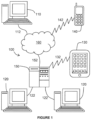
- Figure 1 illustrates an example computer system on which a method embodying an aspect of the invention operates.
- the computer system includes a server 150 to which one or more computer terminals 120 are connected through wired connections 122.
- the computer terminals 120 are shown as desktop computers. However, the computer terminals may be other devices such as laptop computers, smart phones or tablet computers.
- the wired connections 122 may be through Ethernet connections of a local area network.
- the computer terminals 120 may be connected to the server through wireless connections or through connections that have wired and wireless portions.
- Figure 1 shows a tablet computer 130 connected to the server 150 through a wireless connection 132.
- the server 150 is shown as connected to the internet 160 through wired connection 152.
- a computer terminal 110 is connected to the internet 160 through wired connection 112.
- the computer terminal 110 is shown in Figure 1 as a desktop computer purely as an example.
- a further example is a cellular phone 140 that is connected to the internet 160 through a wireless connection 142.
- the cellular phone 140 may be a smart phone.
- the server 150 is shown in a local area network with computer terminals 120 directly connected to the server 150 through wired connections 122.
- the server 150 may be located in a cloud-computing environment.
- the server 150 may be a virtual server running on a virtual machine on a physical server.
- the virtual servers may be scaled up, scaled down, or moved around between physical servers.
- a transponder is an electronic device that transmits information about the aircraft in response to interrogation by a radiofrequency signal.
- transponder There is more than one type of transponder, including a mode-s transponder and an ADSB transponder. These transponders have different capabilities.
- a mode-s transponder does not transmit any GPS-linked position data when interrogated by radar.
- the multilateration (MLAT) technique is used to identify the location of mode-s transponder aircraft. For this, a radio signal is transmitted from the radar station to aircraft equipped with a mode-S transponder. The transponder then transmits a radio signal back to the original transmitter station. The time separation from the original transmission by the radar station to receiving the relayed radio signal is measured. This technique is named the Time Difference of Arrival (TDOA) method. With the time delay known from several receiver stations, the aircraft position can be calculated.
- TDOA Time Difference of Arrival
- the MLAT technique currently requires 4 ADSB receivers to be within range and line of sight of the aircraft. This limitation can result in the loss of aircraft position data bellow an altitude of approximately 4,000ft.
- Flightradar24 which provides a websocket JSON data feed with a five second update with fields as set out in Table 1 below: TABLE 1 # name description 1 aircraft_id mode-S address in hexadecimal 2 latitude floating point degrees 3 longitude floating point degrees 4 track true track (over ground) in integer degrees, 0-359 5 altitude in feet 6 speed ground speed in knots 7 squawk octal format, e.g. 7700 for general emergencies 8 radar_id radar identifier number2 9 type ICAO equipment code, e.g. B733 10 registration text in hyphenated format, e.g.
- LN-ABC 11 last_update sample time in seconds since midnight 1 Jan 1970 UTC / GMT 12 origin departure airport's IATA code, e.g. KKN4 13 destination arrival airport's IATA code 14 flight flight number, e.g. DY311 15 onground indication of flight status, 1 for on ground or else 0 in flight 16 vspeed vertical speed in feet per minute 17 callsign e.g. NAX11S
- Figure 2 is a graph of a 'sector' of the flight of an aircraft, plotting altitude against time.
- the graph shows altitude against time defined between certain points - F, TOC, TOD and L - that are used in the techniques of this disclosure to determine further details of a sector.
- the 500ft altitude buffer takes account of reading errors and multilateration accuracy errors preventing incorrect TOC point identification. More than one point can exist that fulfils the TOC criteria, however the first valid TOC point is used as following points represent step climbs of the aircraft due to fuel burn off and optimum flight level changes.
- a different definition of TOC is used, whereby the 10-minute time frame is replaced by a variable time frame, the length of which depending on the flight time, defined as the time between F and L. For example, if the time between F and L is greater than 30 minutes a 10 minute time frame is used, but if the time difference is between 20 and 30 minutes a 5 minute time frame is used, and if the time difference is less than 20 minutes then a 3 minute time frame is used.
- a 10 minute time frame is used, but if the time difference is between 20 and 30 minutes a 5 minute time frame is used, and if the time difference is less than 20 minutes then a 3 minute time frame is used.
- Either definition, or indeed another definition as will be apparent to the skilled reader, may be used with the techniques of this disclosure.
- the TOD point is defined as the altitude point, A_TOD after which all proceeding altitudes are less than A_TOD with a consistently negative vertical speed. Once the altitude has decreased by greater than 1,000ft below A_TOC the position of the TOD can be established. Only one value of TOD can exist, with following valid point representing stepped descents due to air traffic control (ATC) restrictions. In some embodiments an additional rule is applied in case TOC is undefined: the TOD point is defined as the altitude point A_TOD after which all proceeding altitudes are less than ATOD with a consistently negative vertical speed. Once the altitude has decreased by greater than 1,000ft below the highest altitude reached during the sector the position of the TOD can be established. Either definition, or indeed another definition as will be apparent to the skilled reader, may be used with the techniques of this disclosure.
- a sector is the flight path that takes place between the first, F, reported position of an aircraft and the last recorded position, L, between the origin and destination airports. For calculation, it is assumed that the aircraft will always have positive vertical speed from F to TOC and negative vertical speed from TOD to L.
- the Haversine formula can be used to calculate the great-circle distance between two points of latitude and longitude on the earth's surface.
- ⁇ latitude in radians
- ⁇ longitude in radians
- R the earth's mean radius in kilometres (6371 km)
- c atan2 ⁇ a , ⁇ 1 ⁇ a
- a sin 2 ⁇ 2 ⁇ ⁇ 1 / 2 + cos ⁇ 1 ⁇ cos ⁇ 2 + sin 2 ⁇ 2 ⁇ ⁇ 1 / 2
- atan2 is the two-argument arctangent defined for arguments x and y as the angle (in radians) in the Euclidean plane between the positive x
- FlightRadar24 websocket feed and ADS-B exchange TCP connection provides the origin and destination fields together with the on ground or in air indicator (Flightradar24 field 15) and squawk. These four sources of information allow for identification of each flight sector. However, due to a lack of data or coverage some of these fields may be omitted resulting in unreliable flight sector information. To eliminate any erroneous results the raw data fields of latitude, longitude and altitude will be taken from FlightRadar24 and ADS-B exchange. The aircraft location microservice will then interpret this raw data to establish each flight sector with its associated F, TOC, TOD and L points.
- both feeds provide for an aircraft the current aircraft location (latitude, longitude) and altitude.
- the data received from both feeds is stored, along with the time at which the data was obtained.
- the use of two separate data feeds will generate two independent sets of values for each sector which will differ depending on MLAT coverage of each feed.
- the most accurate values of F, TOC, TOD and L will need to be determined so that any interpretation techniques employed in airport identification are as accurate as possible.
- L is defined as the last received data point every 5 seconds, with L-1 and L-2 the two previous recorded points. If there is a period of no new data for 20 minutes, any further data points received after L are designated as point n, n+1, n+2... and so on.
- n For a new point, n, recorded at a time greater than 20 minutes after L, the time separation between L and n is compared to the great circle distance between the two points to logically determine if the new point n is generated from a new sector.
- a buffer of 30% for the time taken is used to take account of airway routing or ATC track deviation resulting in time discrepancies.
- L and n are both points on the same sector for the aircraft.
- L can be set to n, indicating that these new data point is the last received data point of the same sector. Otherwise the new point n is treated as a new point in a new sector for the aircraft, i.e. set as a first received point F for the new sector.
- each flight sector is identifiable making it possible to identify the origin and destination airports.
- the most accurate values of L, TOC, TOD and F are established from both the Flightradar24 and ADSB data feeds according to the following: In the case of the first reported position, F, most accurate value of F is the earliest recorded point which possess the lowest altitude. In some embodiments, if the earliest F is not the same as the lowest F, and only one of the two (or more, in the case of more than two feeds) F values is below 3000ft, then the one below 3000ft is picked; otherwise the earliest F is picked.
- the most accurate value of L is the latest recorded point which possess the lowest altitude. In some embodiments, if the latest L is not the same as the lowest L, and only one of the two (or more, in the case of more than two feeds) L values is below 3000ft, then the one below 3000ft is picked; otherwise the earliest L is picked.
- the most accurate TOC point is one which has been recorded the earliest or, if one value of TOC is greater than the other by more than 1,000ft then this point is selected.
- TOD the altitude of the most accurate value of TOD
- TOD will have the highest number of data samples either side of the TOD point.
- a timestamp is not provided and so it is necessary to apply a timestamp based on the time at which the feed is accessed (e.g. every 5 seconds).
- the ADSBE data feed does not time stamp. This means that FR24 data and ADSBE data are not synced.
- the data points can be synced. This is started by collecting data in a 1 minute batch (up to 24 samples, 12 from each source) and running a plausibility check on the recorded data.
- the new sample is discarded. If the distance/time for an ADSBE sample compared with the last sample from FR24 suggests a speed equal to more than five times the cruising speed, then the sample is discarded. Once this check has been performed, bad data is discarded and the data feeds can be supplied to airport identification algorithms.
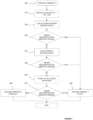
- Figure 3 is a flowchart illustrating an example process for determining origin and destination airports for an aircraft's flight on a sector based on values of F, L, TOD and TOC, the values of F, L, TOD and TOC including the latitude and longitude positions, altitudes of the aircraft at F, L, TOD and TOC and the times at which the aircraft is/was at the points F, L, TOD and TOC.
- F, L, TOD and TOC values are obtained from both FR24 and ADSBE data feeds, an estimated most accurate version each value is selected according to the techniques set out above.
- the process of determining origin and destination airports is performed for each aircraft within a group of one or more aircraft, each aircraft being denoted by a respective index j.
- the process begins at step 200 for each aircraft j of the group of one or more aircraft.
- step 210 values of F, L TOC and TOD are obtained for aircraft j. Further details of how these values are obtained are set out below.
- a first sub-process for determining the origin and destination airports is performed, the first sub-process being a low altitude airport identification process, of which further details are set out below.
- step 230 the process advances to step 240 at which a second sub-process for determining the origin and destination airports is performed, the second sub-process being a flight profile interpolation process, of which further details are set out below.
- step 250 If the origin and destination airports for aircraft j are not known at step 250, then the process advances to step 260 at which a third sub-process for determining the origin and destination airports is performed, the third sub-process being a flight path lateral deviation process, of which further details are set out below.
- step 280 the aircraft j is excluded from the list of aircraft for which the origin and destination airports are known.
- step 290 the aircraft j is included in the list of aircraft for which the origin and destination airports are known.
- an attempt to determine the origin airport is as follows: Firstly, if the altitude in feet of point F (i.e. A_F) is recorded at ⁇ 3,000ft and one airport lies within the distance in nautical miles given by the expression (A_F/1000*3)+3 of point F's latitude and longitude position (i.e. lat_F, long_F, the distance determined by great circle) then this airport is designated as the origin airport.
- A_F the altitude in feet of point F
- lat_F, long_F the distance determined by great circle
- check steps may be omitted, reordered or replaced.
- an attempt to determine the destination airport is as follows: Firstly, if the altitude in feet of point L (i.e. A_L) is recorded at ⁇ 3,000ft and one airport lies within the distance in nautical miles given by the expression (A_L/1000*3)+3 of point L's latitude and longitude position (i.e. lat_L, long_L, the distance determined by great circle) then this airport is designated as the destination airport.
- the flight profile interpolation process 240 uses interpolation of recorded data to predict a future and historical flight path of an aircraft.
- the interpolation process may be viewed as an extrapolation.
- To determine the origin airport according to this process an initial check is made to confirm that F and TOC have defined values. If either are not defined, then this process to determine the origin airport is not performed, since it requires these values.
- a further check is made to see if the altitude at data point F from either of the FR24 or ADSBE data feeds for the sector is greater than 10,000 feet. If they are both greater than 10,000 feet then this process to determine the origin airport is not performed.
- the below method is performed without using data of the feed for which F has an altitude greater than 10,000 feet. This is because it would generate ambiguous results by the interpolation method. Also, if the origin airport has already been determined according to the low-altitude airport identification process then the interpolation process to determine the origin airport is not performed.
- the process proceeds by determining if the change in altitude over the first 5 minutes from point F was less than 2,500 feet. If it is less than 2,500 feet then the distance travelled by the aircraft using the FR24 data feed points between point F and point TOC is calculated. This may be as the great circle distance between the points of latitude and longitude. Then the proportional distance that would have been travelled to reach an altitude of F from the ground (0 feet altitude) is calculated. This distance is termed distance_origin_FR24. If the change in altitude over the first 5 minutes was greater than 2,500ft, then a check is made as to whether the TOC altitude from the FR24 feed is greater than double the F altitude from the FR24 feed.
- either region contains only one airport and the origin is not previously known then it is set as the origin airport. If the FR24 feed indicates the origin already (possibly obtained from pre-filed flight plan data) and the one airport in either list is not equal to the origin airport from the FR24 feed and the one airport in either list is the same as the destination airport of the previous flight of the aircraft, then the origin of the flight is set equal to the one airport.
- a further check is made to see if the altitude at data point L from either of the FR24 or ADSBE data feeds for the sector is greater than 10,000 feet. If they are both greater than 10,000 feet then this process to determine the destination airport is not performed. If one is greater than 10,000 feet and the other is less than 10,000 feet, then the below method is performed without using data of the feed for which L has an altitude greater than 10,000 feet. This is because it would generate ambiguous results by the interpolation method.
- the interpolation process to determine the destination airport is not performed.
- the process proceeds by determining if the change in altitude in the preceding 5 minutes from point L was less than 2,500 feet. If it is less than 2,500 feet then the distance travelled by the aircraft using the FR24 data feed points between point L and point TOD is calculated. This may be as the great circle distance between the points of latitude and longitude. Then the proportional distance that would have been travelled to reach an altitude of L from the ground (0 feet altitude) is calculated. This distance is termed distance_destination_FR24.
- the track deviation (Left/Right of track) to the TOC-TOD intercept line is determined for both points F and L.
- the airport origin and destination of an aircraft it is possible to determine (estimate) the time of arrival of the aircraft at its destination and the time of departure of the aircraft from its origin.
- the time taken for the aircraft to fly from the origin airport to point F can be estimated based on determining the great circle distance between the latitude and longitude of point F and the latitude and longitude of the origin airport, and the cruise speed of the aircraft (which may be known in advance).
- the estimated time of departure is obtained by subtracting the estimated time to fly from the origin airport to point F from the time of point F.
- the time of arrival can be estimated: the time taken for the aircraft to fly to the destination airport from point L can be estimated based on determining the great circle distance between the latitude and longitude of point L and the latitude and longitude of the destination airport, and the cruise speed of the aircraft.
- the estimated time of arrival is obtained by adding the estimated time to fly to the destination airport from point L to the time of point F.
- Figure 4 is a flowchart illustrating a method 1000 of sending charter requests to operators of aircraft, wherein the operators may be predicted, based on the techniques of this disclosure, to have an aircraft in position at the necessary time to potentially fulfil a charter request.
- a charter request is received.
- the charter request includes information relating to the cargo size, for example total weight, total volume, the dimensions and the like.
- the charter request may also include information on the number of individual items in the cargo, for example the number of individual pallets, as well as size information for each item such as the weight, volume and dimensions of each item in the cargo.
- the charter request may include information on the cargo type, for example whether the cargo contains dangerous or restricted goods.
- the charter request may include information on the cargo type, for example whether the cargo contains dangerous or restricted goods.
- the charter request includes information on the destination airport for the cargo and the Required Estimated Arrival Time (RETA).
- the charter request includes information on the departure airport for the cargo and may include information of the current location of the cargo.
- the method then proceeds to step 1020.
- Step 1020 checks whether an operator's aircraft j is 'active'.
- the status of an aircraft, whether it is active or not, may be included on the database information. For example an operator's aircraft may be considered 'active' by default when uploaded onto the database. An operator can specify that an aircraft is unavailable for requests due to technical or operational reasons. The aircraft is then given an 'inactive' status.
- step 1030 If aircraft j is active the method proceeds to step 1030. If aircraft j is found to be inactive the method returns to step 1020 for aircraft j+1 of the set of aircraft.
- the set of aircraft may be all aircraft included on the database, or a subset of the database aircraft.
- Step 1030 checks whether aircraft j meets the 'packing' criteria of the charter request, i.e. whether the cargo might be accommodated within the aircraft.
- the database information may contain details of the dimensions of the hold of the aircraft, the maximum payload of the aircraft, the capacity of the aircraft, the size of the doors on the aircraft, any restrictions on the type of cargo allowed to be carried on the aircraft and the like.
- the aircraft j is able to carry the requested cargo. For example the dimensions of each item of the cargo may be compared with the size of the doors on the aircraft. If any item in the cargo is larger than the aircraft door then the aircraft will be unable to carry the cargo. Such a check may be performed for each dimension of each item of cargo.
- the method returns to step 1020 for aircraft j+1.
- a charter request is not sent to an operator of an aircraft in respect of that aircraft if it is predicted, based on known cargo carrying capabilities of the aircraft, that it will not be able to accommodate the cargo. If it is determined that aircraft j is able to carry the requested cargo the method proceeds to step 1040.
- Step 1040 checks whether aircraft j can reach the destination airport before the RETA.
- the database information may contain information including the cruising speed, ferry range, max range, permitted airports or jurisdictions in which the aircraft can operate and the like. This information is then used in conjunction with data such as the aircraft's current location, live data feeds, historical flight data and the like to identify if aircraft that can reach the destination airport by the RETA. For example the method may identify, based on live data feeds, an airport to which the aircraft is due to land, and estimate the landing time of the aircraft. The method can then calculate based on, for example, the aircrafts speed information, or historical flight times, whether the plane can travel from the airport at which the plane is due to land to the destination airport before the RETA.
- This check may incorporate any or all of the above-described techniques for determining a destination or origin airport for an aircraft. Based on a current location of an aircraft, a destination airport and the known cruise speed, the arrival time at that airport and possible availability for charter from that time onwards, may be determined for that aircraft. If it is determined that aircraft j is unable to reach the destination airport before the RETA the method returns to step 1020 for aircraft j+1. If it is determined that aircraft j is able to reach the destination airport before the RETA the method proceeds to step 1050.
- step 1050 the charter request is sent to the operator.
- the method then returns to step 1020 for aircraft j+1. In this way the method loops over the available aircraft. Alternatively the checks for the aircraft may proceed in parallel. If the operator has more than one aircraft, the charter request is indicated for the specific aircraft that the method has identified as a suitable aircraft to execute the charter request.
- the method therefore sends the charter request to each operator that is estimated to be able to carry the cargo and able to reach the destination airport before the RETA.
- Each operator that receives the request is then able to accept or reject the charter request as desired.
- the sending of the charter request to the operator may be performed electronically using any technique familiar to the skilled reader.
- the charter request may be sent to the operator via email or the charter request may appear on a website to which the operator has access.
- the aircraft may be suitable for charter. If the aircraft is not configured as a passenger carrying aircraft (or if it is but the cargo cannot be accommodated in the passenger carrying area of the aircraft), then it is determined if the total volume of the cargo is less than the volume of the aircraft's cargo hold. If it is, then each item of the cargo is checked that it meets door dimension requirements and that each item meets hold dimension requirements. If so, then the aircraft may be suitable for charter.
- the time for loading cargo is set as 45 minutes although in other embodiments the time for loading cargo may be a variable that is a function of the cargo, the aircraft, or both. Distances are calculated as great circles.
- a software module may reside in random access memory (RAM), flash memory, read-only memory (ROM), programmable read-only memory (PROM), erasable programmable read-only memory (EPROM), electrically erasable programmable read-only memory (EEPROM), registers, hard disk, a removable disk, a compact disc read-only memory (CD-ROM), or any other form of storage medium known in the art.
- An exemplary storage medium is coupled to the processor such that the processor can read information from, and write information to, the storage medium.
- the storage medium may be integral to the processor.
- the processor and the storage medium may reside in an application-specific integrated circuit (ASIC).
- the ASIC may reside in a computing device or a user terminal.
- the processor and the storage medium may reside as discrete components in a computing device or user terminal.
Landscapes
- Engineering & Computer Science (AREA)
- Physics & Mathematics (AREA)
- General Physics & Mathematics (AREA)
- Radar, Positioning & Navigation (AREA)
- Remote Sensing (AREA)
- Aviation & Aerospace Engineering (AREA)
- Automation & Control Theory (AREA)
- Traffic Control Systems (AREA)
Description
- This disclosure relates to the field of determining characteristics of an aircraft's flight and to processes and apparatuses that make use of the results of such determinations.
- It would be desirable to determine characteristics of an aircraft's flight including in particular a origin and/or destination airport. For many aircraft, including the types of aircraft that are typically used in air cargo charters, it can be difficult to determine which aircraft and which operators might be capable of fulfilling a charter request.
- In
US 2018/0075757 A1 , there is described a method comprising: receiving a destination airport for an aircraft; determining whether visibility at the destination airport is below a threshold visibility; in response to a determination that the visibility at the destination airport is below a threshold visibility, notifying the aircraft of the visibility at the destination airport; determining whether ceiling at the destination airport is below a threshold ceiling; in response to a determination that the ceiling at the destination airport is below the threshold ceiling, notifying the aircraft of the ceiling at the destination airport; determining a phase of flight for the aircraft; and in response to determining the phase of flight for the aircraft, providing the aircraft with at least one notification based on the phase of flight for the aircraft. In one example there is described an inferred destination airport algorithm that infers a destination airport from a plurality of airports within a predefined distance (e.g., 50 nmi) from the aircraft's current position by calculating a probability for each airport in the plurality of airports. A calculated probability for an airport represents the likelihood that the pilot intends to land at that airport. Upon generating a plurality of probabilities corresponding to the plurality of airports, the inferred destination algorithm can select an airport from the plurality of airports having the highest probability as the inferred destination airport. - This disclosure relates generally to methods, systems and computer-readable media for determining an aircraft flight path and elements thereof such as a destination or an origin of an aircraft by: obtaining data comprising a plurality of data points for the flight of an aircraft over a sector, each data point being indicative of a position of the aircraft at a corresponding time; determining the destination or the origin of the aircraft based on the plurality of data points. The data may be multilateration data and the data points may be multilateration data points. The destination or origin of the aircraft may be determined based on the times and positions of the aircraft over time according to data such as the multilateration data, including the latitude, longitude and altitude of the aircraft over a sector at corresponding times.
- According to a first aspect of this disclosure, there is provided a computer-implemented method of determining a destination of an aircraft, the method comprising: obtaining data comprising a plurality of data points for the flight of an aircraft over a sector, each data point being indicative of a position of the aircraft including its latitude, longitude and altitude at a corresponding time; determining, based on the data: i) a last data point for the sector that comprises a position of the aircraft and a time for the last-received data point of the aircraft over the sector, ii) a top of descent data point that comprises a position of the aircraft and a time at which the aircraft reached a top of descent, iii) a rate of descent of the aircraft, and iv) an extrapolation distance using the rate of descent of the aircraft and the surface distance travelled by the aircraft between the top of decent data point and the last data point, the extrapolation distance being a surface distance for the aircraft to travel to reach ground; and if the altitude of the aircraft at the last data point for the sector is below an altitude threshold, identifying one or more airports within the extrapolation distance from the position of the aircraft at the last data point for the sector and determining the destination of the aircraft based on the identified one or more airports within the extrapolation distance.
- According to a further aspect of this disclosure there is provided a system comprising a memory and one or more processors configured to carry out a method according to any of the above-described methods.
- According to a further aspect of this disclosure, there is provided a computer-readable medium having instructions stored thereon that, when executed by one or more processors, cause the one or more processors to carry out a method according to any of the above-described method. Preferably, the computer-readable medium is a non-transitory computer-readable medium.
- Preferred embodiments are set out in the dependent claims.
- This summary is not intended to identify essential subject-matter, nor is it intended to be used in isolation to determine the scope of the claimed subject-matter.
- The details of one or more examples are set forth in the accompanying drawings and the description below. Other features, objects, and advantages will be apparent from the description and drawings, and from the claims.
- The invention will be described in more detail by way of example with reference to the accompanying drawings, in which:
-
Figure 1 illustrates an example computer system on which a method embodying an aspect of the invention operates; -
Figure 2 illustrates an altitude-time profile for an aircraft and identifies key points in the profile that may help in determining details of the aircraft's flight including destination and origin airports; -
Figure 3 is a flowchart illustrating a process of determining origin and destination airports for each aircraft in a group of one or more aircraft; - Figure 4 is a flowchart illustrating a process by which the information on the aircraft's flight including destination and origin airports may be used, the process being determination as to whether an aircraft is capable or available to potentially fulfil a charter request; and
-
Figure 5 is a graph of payload and range depicting the variation of an aircraft's range as a function of payload. -
Figure 1 illustrates an example computer system on which a method embodying an aspect of the invention operates. The computer system includes aserver 150 to which one ormore computer terminals 120 are connected throughwired connections 122. Thecomputer terminals 120 are shown as desktop computers. However, the computer terminals may be other devices such as laptop computers, smart phones or tablet computers. Thewired connections 122 may be through Ethernet connections of a local area network. As an alternative to wired connections, thecomputer terminals 120 may be connected to the server through wireless connections or through connections that have wired and wireless portions. For example,Figure 1 shows atablet computer 130 connected to theserver 150 through awireless connection 132. Theserver 150 is shown as connected to theinternet 160 throughwired connection 152. This allows other computer terminals that are not in a close enough geographic proximity for direct wired or wireless connection to theserver 150 to be connected to theserver 150. For example, inFigure 1 , acomputer terminal 110 is connected to theinternet 160 throughwired connection 112. Thecomputer terminal 110 is shown inFigure 1 as a desktop computer purely as an example. A further example is acellular phone 140 that is connected to theinternet 160 through awireless connection 142. Thecellular phone 140 may be a smart phone. - The
server 150 is shown in a local area network withcomputer terminals 120 directly connected to theserver 150 throughwired connections 122. Alternatively, theserver 150 may be located in a cloud-computing environment. In such cases, theserver 150 may be a virtual server running on a virtual machine on a physical server. There may be multiple virtual servers running on virtual machines on a server. According to resource requirements and availabilities, the virtual servers may be scaled up, scaled down, or moved around between physical servers. - Almost all aircraft include at least one transponder. A transponder is an electronic device that transmits information about the aircraft in response to interrogation by a radiofrequency signal. There is more than one type of transponder, including a mode-s transponder and an ADSB transponder. These transponders have different capabilities.
- Many aircraft only possess a mode-s transponder. Unlike an ADSB transponder, a mode-s transponder does not transmit any GPS-linked position data when interrogated by radar. With the lack of position data, the multilateration (MLAT) technique is used to identify the location of mode-s transponder aircraft. For this, a radio signal is transmitted from the radar station to aircraft equipped with a mode-S transponder. The transponder then transmits a radio signal back to the original transmitter station. The time separation from the original transmission by the radar station to receiving the relayed radio signal is measured. This technique is named the Time Difference of Arrival (TDOA) method. With the time delay known from several receiver stations, the aircraft position can be calculated.
- The MLAT technique currently requires 4 ADSB receivers to be within range and line of sight of the aircraft. This limitation can result in the loss of aircraft position data bellow an altitude of approximately 4,000ft.
- Data feeds of location data for aircraft are available. One example is Flightradar24, which provides a websocket JSON data feed with a five second update with fields as set out in Table 1 below:
TABLE 1 # name description 1 aircraft_id mode-S address in hexadecimal 2 latitude floating point degrees 3 longitude floating point degrees 4 track true track (over ground) in integer degrees, 0-359 5 altitude in feet 6 speed ground speed in knots 7 squawk octal format, e.g. 7700 for general emergencies 8 radar_id radar identifier number2 9 type ICAO equipment code, e.g. B733 10 registration text in hyphenated format, e.g. LN-ABC 11 last_update sample time in seconds since midnight 1 Jan 1970 UTC / GMT12 origin departure airport's IATA code, e.g. KKN4 13 destination arrival airport's IATA code 14 flight flight number, e.g. DY311 15 onground indication of flight status, 1 for on ground or else 0 in flight 16 vspeed vertical speed in feet per minute 17 callsign e.g. NAX11S - An example JSON object for a single flight is provided as a reference:
 "171e09e" : [ "a96c96",
    40.593,
    -73.4894,
    10,
    4000,
    244,
    13089,
    254,
    "B752",
    "N706TW",
    1372636803,
    "SEA",
    "JFK",
    "DL1154",
    0,
    0,
    "DAL1154",
    0


The FlightRadar24 websocket feed and ADS-B exchange TCP connection provides the origin and destination fields together with the on ground or in air indicator (Flightradar24 field 15) and squawk. These four sources of information allow for identification of each flight sector. However, due to a lack of data or coverage some of these fields may be omitted resulting in unreliable flight sector information. To eliminate any erroneous results the raw data fields of latitude, longitude and altitude will be taken from FlightRadar24 and ADS-B exchange. The aircraft location microservice will then interpret this raw data to establish each flight sector with its associated F, TOC, TOD and L points.
In the case of the first reported position, F, most accurate value of F is the earliest recorded point which possess the lowest altitude. In some embodiments, if the earliest F is not the same as the lowest F, and only one of the two (or more, in the case of more than two feeds) F values is below 3000ft, then the one below 3000ft is picked; otherwise the earliest F is picked.
Firstly, if the altitude in feet of point F (i.e. A_F) is recorded at ≤ 3,000ft and one airport lies within the distance in nautical miles given by the expression (A_F/1000*3)+3 of point F's latitude and longitude position (i.e. lat_F, long_F, the distance determined by great circle) then this airport is designated as the origin airport.
- i) If one of the airports is the aircraft's previous destination then this airport is set as the origin airport.
- ii) If one of the airports is the aircraft's designated home base then this airport is set as the origin airport.
- iii) If one of the airports is the aircraft's designated engineering base then this airport is set as the origin airport.
- iv) If the aircraft has flown to one of the airports in the past then this airport is set as the origin airport.
Firstly, if the altitude in feet of point L (i.e. A_L) is recorded at ≤ 3,000ft and one airport lies within the distance in nautical miles given by the expression (A_L/1000*3)+3 of point L's latitude and longitude position (i.e. lat_L, long_L, the distance determined by great circle) then this airport is designated as the destination airport.
- i) If one of the airports is the aircraft's designated home base then this airport is set as the destination airport.
- ii) If one of the airports is the aircraft's designated engineering base then this airport is set as the destination airport.
- iii) If the aircraft has flown to one of the airports in the past then this airport is set as the destination airport.
- iv) If point L lies within a 2 nautical mile lateral deviation of the or an extended runway centreline of one airport then this airport is set as the destination airport. The extended runway centreline is the line (i.e. great circle) across the earth's surface (and all latitude and longitude points on that line) extending from the airport or specifically the or a runway of the airport in the direction in which the runway lies. In other embodiments a 0.5
nautical miles 1 nautical mile threshold is used. - v) If more than one extended runway centreline lies within 2 nm of point L's latitude and longitude position then check if the 'track' of the aircraft of point Land L-1 (wherein L-1 is a data point immediately preceding L) lies within 30 degrees of the runway direction of one of these airports. The track indicates the direction of travel of the aircraft. The track is the bearing between the latitude and longitude positions at L and the latitude and longitude positions at L-1, the last-but-one data point received for the sector, relative to true north.. vi) If the aircraft track of L and L-1 lies within 30 degrees of the runway direction of more than one airport then check if the aircraft's direction of travel lies within 60 degrees of the bearing of the airport's location from the aircraft relative to true north. If the aircraft's direction of travel lies within 60 degrees of the bearing from the aircraft to only one airport's location then set this airport as the destination airport. In other embodiments a 45 degree threshold is used.
- i) If one of the airports is the aircraft's designated home base then this airport is set as the destination airport.
- ii) If one of the airports is the aircraft's designated engineering base then this airport is set as the destination airport.
- iii) If the aircraft has flown to one of the airports in the past then this airport is set as the destination airport.


| Availability level of | Description | TDA | |
| 1 | Aircraft currently located at departure airport | 0 | |
| 2 | Aircraft currently located at another airport or home base airport | Flight time from current airport to departure airport +90 minutes (aircraft preparation time) | |
| 3 | Aircraft currently flying to departure airport | Calculate flight time left | |
| 4 | Aircraft currently flying to another airport | Calculate flight time left + service work (45 min) + time from current airport to departure airport |
Request time 08:00 a.m. RETA 17:00 p.m. UTC, departure airport = London Southend, arrival airport = Warsaw.
- Aircraft 1: Current location Southend, 08:00 a.m.+ 0 < 12:15 p.m. (17:00 p.m. - 4 hours - 45 min). Conclusion: Send request to operator.
- Aircraft 2: Current location Manchester, 08:00 a.m.+ 20 min 60 min = 09:20 a.m. < 12:15 p.m. (17:00 p.m. - 4 hours - 45 min). Conclusion: Send request to operator.
- Aircraft 3: Currently flying to Southend (2 hours left), 08:00 a.m.+ 2 hours = 10:00 a.m. < 12:15 p.m. (17:00 p.m. - 4 hours - 45 min). Conclusion: Send request to operator.
- Aircraft 4: Currently flying to Paris (3 hours left), 08:00 a.m.+ 3 hours + 45 min + 1 hour = 12:45 p.m. > 12:15 p.m. (17:00 p.m. - 4 hours - 45 min). Conclusion: Don't send request to operator.
Claims (15)
- A computer-implemented method of determining a destination of an aircraft, the method comprising:obtaining data comprising a plurality of data points for the flight of an aircraft over a sector, each data point being indicative of a position of the aircraft including its latitude, longitude and altitude at a corresponding time;determining (210), based on the data: i) a last data point (L) for the sector that comprises a position of the aircraft and a time for the last-received data point of the aircraft over the sector, ii) a top of descent data point (TOD) that comprises a position of the aircraft and a time at which the aircraft reached a top of descent, iii) a rate of descent of the aircraft, and iv) an extrapolation distance using the rate of descent of the aircraft and the surface distance travelled by the aircraft between the top of decent data point and the last data point, the extrapolation distance being a surface distance for the aircraft to travel to reach ground; andin response to the altitude of the aircraft at the last data point for the sector being below an altitude threshold, identifying one or more airports within the extrapolation distance from the position of the aircraft at the last data point for the sector and determining (220) the destination of the aircraft based on the identified one or more airports within the extrapolation distance.
- The method of claim 1, wherein determining the destination of the aircraft based on the identified one or more airports comprises:
in response to identifying a plurality of airports within the extrapolation distance from the position of the aircraft at the last data point for the sector, selecting a destination airport from the plurality of airports based on one or more of:i) historic flight data of the aircraft, whether an airport within the plurality of airports is indicated to be a home base or engineering base of the aircraft,ii) a distance between the aircraft position at the last data point and an extended runway centreline of an airport within the identified plurality of airports,iii) a comparison between a direction of travel of the aircraft and a runway direction of an airport, andiv) a comparison between a direction of travel of the aircraft and a bearing from the aircraft to an airport within the identified plurality of airports. - The method of claim 1 or claim 2, comprising:determining, based on the data, a top of climb data point (TOC) that comprises a position of the aircraft and a time at which the aircraft reached a top of climb; andselecting a destination airport from the plurality of identified airports based on a position of the aircraft at the last data point and a line between the positions of the aircraft at the top of climb and top of descent data points.
- The method of any of claims 1 to 3, wherein obtaining data comprising a plurality of data points for the flight of an aircraft over a sector comprises identifying a break in data points for the aircraft and processing the data points either side of the break to predict if the aircraft has begun a new sector following the break in data points.
- The method of claim 4, wherein predicting if the aircraft has begun a new sector comprises comparing a distance between the position of the aircraft before the break and the position of the aircraft after the break with a distance based on the duration of the break and the aircraft's cruise speed, the distance between the positions of the aircraft before and after the break being preferably calculated as the great circle distance between the latitudes and longitudes of the aircraft before and after the break.
- The method of claim 5, wherein a new sector is predicted not to have begun in response to determining based on the comparison that the distance between the position of the aircraft before the break and the position of the aircraft after the break is too large for the aircraft to have landed during the break.
- The method of any of claims 1 to 6, further comprising estimating for the aircraft a time of arrival at the destination based on calculating the distance between the destination airport and the position of the aircraft at the last-received point, and further based on the cruise speed of the aircraft.
- The method of claim 8, wherein the distance between the destination airport and the position of the aircraft at the last-received point is calculated based on the great circle distance between the destination airport and the position of the aircraft at the last-received point.
- The method of claim 1, further comprising determining an origin of the aircraft by:determining (210), based on the data: i) a first data point (F) for the sector that comprises a position of the aircraft and a time for the first-received data point of the aircraft over the sector, ii) a top of climb data point (TOC) that comprises a position of the aircraft and a time at which the aircraft reached a top of climb, iii) a rate of climb of the aircraft, and iv) a second extrapolation distance using the rate of climb of the aircraft and the surface distance travelled by the aircraft between the top of climb data point and the first data point for the aircraft over the sector, the second extrapolation distance being a surface distance for the aircraft to have travelled from ground to the position of the first data point; andin response to the altitude of the aircraft at the first data point for the sector being below an altitude threshold, identifying one or more airports within the second extrapolation distance from the first data point and determining (220) the origin of the aircraft based on the identified one or more airports within the second extrapolation distance.
- A computer-implemented method comprising:receiving an aircraft charter request, the aircraft charter request including source and destination information, details of a cargo, and a required time of arrival;determining, for one or more aircraft, whether the aircraft can be used as a charter aircraft for the aircraft charter request based on a location of the aircraft, a speed of the aircraft and a destination of the aircraft, the destination of the aircraft being determined by a method according to any of claims 1 to 8;in response to determining that the aircraft can be used as a charter aircraft for the aircraft charter request, transmitting the aircraft charter request to an operator of the aircraft.
- The method of claim 10, wherein the method further comprises obtaining information of the carrying capacity of the one or more aircraft and wherein determining whether an aircraft can be used as a charter aircraft for the aircraft charter request comprises comparing one or more dimensions of the cargo and/or a weight of the cargo with the information of the carrying capacity obtained for the aircraft.
- A system comprising:a memory for storing data obtained by the system; andone or more processors configured to:obtain data comprising a plurality of data points for the flight of an aircraft over a sector, each data point being indicative of a position of the aircraft including its latitude, longitude and altitude at a corresponding time;determine, based on the data: i) a last data point for the sector that comprises a position of the aircraft and a time for the last-received data point of the aircraft over the sector, ii) a top of descent data point that comprises a position of the aircraft and a time at which the aircraft reached a top of descent, iii) a rate of descent of the aircraft, and iv) an extrapolation distance using the rate of descent of the aircraft and the surface distance travelled by the aircraft between the top of decent data point and the last data point, the extrapolation distance being a surface distance for the aircraft to travel to reach ground; andin response to the altitude of the aircraft at the last data point for the sector being below an altitude threshold, identify one or more airports within the extrapolation distance from the position of the aircraft at the last data point for the sector and determine the destination of the aircraft based on the identified one or more airports within the extrapolation distance.
- A system comprising:a memory for storing data obtained by the system; andone or more processors configured to:receive an aircraft charter request, the aircraft charter request including source and destination information, details of a cargo, and a required time of arrival;determine, for one or more aircraft, whether the aircraft can be used as a charter aircraft for the aircraft charter request based on a location of the aircraft, a speed of the aircraft and a destination of the aircraft, the destination of the aircraft being determined by a method according to any of claims 1 to 8; andin response to determining that the aircraft can be used as a charter aircraft for the aircraft charter request, transmit the aircraft charter request to an operator of the aircraft.
- The system of claim 13, further comprising one or both of:a first computer terminal configured to transmit the aircraft charter request to the one or more processors of claim 13; anda second computer terminal configured to receive the aircraft charter request from the one or more processors of claim 13.
- A computer-readable medium having instructions stored thereon that, when executed by one or more processors, cause the one or more processors to carry out a method according to any of claims 1 to 11.
Applications Claiming Priority (2)
| Application Number | Priority Date | Filing Date | Title |
|---|---|---|---|
| GBGB1907977.1A GB201907977D0 (en) | 2019-06-04 | 2019-06-04 | Determining aircraft flight paths |
| PCT/GB2020/051357 WO2020245594A1 (en) | 2019-06-04 | 2020-06-04 | Determining aircraft flight paths |
Publications (3)
| Publication Number | Publication Date |
|---|---|
| EP3980722A1 EP3980722A1 (en) | 2022-04-13 |
| EP3980722B1 true EP3980722B1 (en) | 2024-08-28 |
| EP3980722C0 EP3980722C0 (en) | 2024-08-28 |
Family
ID=67385934
Family Applications (1)
| Application Number | Title | Priority Date | Filing Date |
|---|---|---|---|
| EP20740070.6A Active EP3980722B1 (en) | 2019-06-04 | 2020-06-04 | Determining aircraft flight paths |
Country Status (3)
| Country | Link |
|---|---|
| EP (1) | EP3980722B1 (en) |
| GB (1) | GB201907977D0 (en) |
| WO (1) | WO2020245594A1 (en) |
Families Citing this family (1)
| Publication number | Priority date | Publication date | Assignee | Title |
|---|---|---|---|---|
| CN116222566B (en) * | 2022-12-16 | 2025-11-28 | 航天科工仿真技术有限责任公司 | Aircraft flight trajectory calculation method, system and electronic equipment |
Citations (1)
| Publication number | Priority date | Publication date | Assignee | Title |
|---|---|---|---|---|
| US20030060940A1 (en) * | 2001-06-19 | 2003-03-27 | Humbard John Jay | Flight management system and method for providing navigational reference to emergency landing locations |
Family Cites Families (1)
| Publication number | Priority date | Publication date | Assignee | Title |
|---|---|---|---|---|
| US10891867B2 (en) * | 2016-09-15 | 2021-01-12 | The Mitre Corporation | Digital copilot |
-
2019
- 2019-06-04 GB GBGB1907977.1A patent/GB201907977D0/en not_active Ceased
-
2020
- 2020-06-04 WO PCT/GB2020/051357 patent/WO2020245594A1/en not_active Ceased
- 2020-06-04 EP EP20740070.6A patent/EP3980722B1/en active Active
Patent Citations (1)
| Publication number | Priority date | Publication date | Assignee | Title |
|---|---|---|---|---|
| US20030060940A1 (en) * | 2001-06-19 | 2003-03-27 | Humbard John Jay | Flight management system and method for providing navigational reference to emergency landing locations |
Also Published As
| Publication number | Publication date |
|---|---|
| GB201907977D0 (en) | 2019-07-17 |
| EP3980722C0 (en) | 2024-08-28 |
| EP3980722A1 (en) | 2022-04-13 |
| WO2020245594A1 (en) | 2020-12-10 |
Similar Documents
| Publication | Publication Date | Title |
|---|---|---|
| US7206698B2 (en) | Ground operations and imminent landing runway selection | |
| US7587278B2 (en) | Ground operations and advanced runway awareness and advisory system | |
| US10467913B1 (en) | Flight assistant | |
| JP3751021B2 (en) | Aircraft location and identification system | |
| AU763833B2 (en) | TCAS display and system for intra-formation control with vertical speed indicator | |
| US6542810B2 (en) | Multisource target correlation | |
| US20180366010A1 (en) | System for producing a flight plan | |
| Ostroumov et al. | Triple probability density distribution model in the task of aviation risk assessment | |
| US20040030465A1 (en) | Ground operations and imminent landing runway selection | |
| US9696407B1 (en) | Backup navigation position determination using surveillance information | |
| US20150253142A1 (en) | Semi-autonomous route compliance navigation system and method | |
| EP1508131B1 (en) | System for landing runway selection | |
| US20220066044A1 (en) | Systems and methods for collecting, processing, and providing geographic information about interference with a global navigation satellite system | |
| AU2023219248A1 (en) | Vessel movement prediction | |
| JP2018188122A (en) | System and method for determining load capability | |
| Vinogradov et al. | Reducing safe UAV separation distances with U2U communication and new Remote ID formats | |
| EP3980722B1 (en) | Determining aircraft flight paths | |
| US11156461B1 (en) | System and method for optimizing hold and divert operations | |
| US20150247914A1 (en) | Method and device for estimating a distance | |
| US20080252511A1 (en) | Method for Automatically Selecting Radionavigation Beacons | |
| EP4718105A1 (en) | Determining a position and an integrity of the position of a vehicle and an integrity of the position of neighboring vehicles using radar and ads-b data | |
| US12525132B2 (en) | Detection and reporting of aircraft diversion events | |
| US20260087932A1 (en) | Determining a position and an integrity of the position of a vehicle and an integrity of the position of neighboring vehicles using radar and ads-b data | |
| Eftekari | Preliminary Assessment of Surveillance Alternatives for Upper Class E Traffic Management (ETM) | |
| US20250078666A1 (en) | Conflict management systems and methods using airspace partitions |
Legal Events
| Date | Code | Title | Description |
|---|---|---|---|
| STAA | Information on the status of an ep patent application or granted ep patent |
Free format text: STATUS: UNKNOWN |
|
| STAA | Information on the status of an ep patent application or granted ep patent |
Free format text: STATUS: THE INTERNATIONAL PUBLICATION HAS BEEN MADE |
|
| PUAI | Public reference made under article 153(3) epc to a published international application that has entered the european phase |
Free format text: ORIGINAL CODE: 0009012 |
|
| STAA | Information on the status of an ep patent application or granted ep patent |
Free format text: STATUS: REQUEST FOR EXAMINATION WAS MADE |
|
| 17P | Request for examination filed |
Effective date: 20220104 |
|
| AK | Designated contracting states |
Kind code of ref document: A1 Designated state(s): AL AT BE BG CH CY CZ DE DK EE ES FI FR GB GR HR HU IE IS IT LI LT LU LV MC MK MT NL NO PL PT RO RS SE SI SK SM TR |
|
| DAV | Request for validation of the european patent (deleted) | ||
| DAX | Request for extension of the european patent (deleted) | ||
| GRAP | Despatch of communication of intention to grant a patent |
Free format text: ORIGINAL CODE: EPIDOSNIGR1 |
|
| STAA | Information on the status of an ep patent application or granted ep patent |
Free format text: STATUS: GRANT OF PATENT IS INTENDED |
|
| INTG | Intention to grant announced |
Effective date: 20231208 |
|
| GRAJ | Information related to disapproval of communication of intention to grant by the applicant or resumption of examination proceedings by the epo deleted |
Free format text: ORIGINAL CODE: EPIDOSDIGR1 |
|
| STAA | Information on the status of an ep patent application or granted ep patent |
Free format text: STATUS: REQUEST FOR EXAMINATION WAS MADE |
|
| INTC | Intention to grant announced (deleted) | ||
| GRAP | Despatch of communication of intention to grant a patent |
Free format text: ORIGINAL CODE: EPIDOSNIGR1 |
|
| STAA | Information on the status of an ep patent application or granted ep patent |
Free format text: STATUS: GRANT OF PATENT IS INTENDED |
|
| INTG | Intention to grant announced |
Effective date: 20240315 |
|
| GRAS | Grant fee paid |
Free format text: ORIGINAL CODE: EPIDOSNIGR3 |
|
| GRAA | (expected) grant |
Free format text: ORIGINAL CODE: 0009210 |
|
| STAA | Information on the status of an ep patent application or granted ep patent |
Free format text: STATUS: THE PATENT HAS BEEN GRANTED |
|
| AK | Designated contracting states |
Kind code of ref document: B1 Designated state(s): AL AT BE BG CH CY CZ DE DK EE ES FI FR GB GR HR HU IE IS IT LI LT LU LV MC MK MT NL NO PL PT RO RS SE SI SK SM TR |
|
| REG | Reference to a national code |
Ref country code: CH Ref legal event code: EP |
|
| REG | Reference to a national code |
Ref country code: DE Ref legal event code: R096 Ref document number: 602020036665 Country of ref document: DE |
|
| REG | Reference to a national code |
Ref country code: IE Ref legal event code: FG4D |
|
| U01 | Request for unitary effect filed |
Effective date: 20240828 |
|
| U07 | Unitary effect registered |
Designated state(s): AT BE BG DE DK EE FI FR IT LT LU LV MT NL PT RO SE SI Effective date: 20240906 |
|
| PG25 | Lapsed in a contracting state [announced via postgrant information from national office to epo] |
Ref country code: NO Free format text: LAPSE BECAUSE OF FAILURE TO SUBMIT A TRANSLATION OF THE DESCRIPTION OR TO PAY THE FEE WITHIN THE PRESCRIBED TIME-LIMIT Effective date: 20241128 |
|
| PG25 | Lapsed in a contracting state [announced via postgrant information from national office to epo] |
Ref country code: PL Free format text: LAPSE BECAUSE OF FAILURE TO SUBMIT A TRANSLATION OF THE DESCRIPTION OR TO PAY THE FEE WITHIN THE PRESCRIBED TIME-LIMIT Effective date: 20240828 Ref country code: GR Free format text: LAPSE BECAUSE OF FAILURE TO SUBMIT A TRANSLATION OF THE DESCRIPTION OR TO PAY THE FEE WITHIN THE PRESCRIBED TIME-LIMIT Effective date: 20241129 |
|
| PG25 | Lapsed in a contracting state [announced via postgrant information from national office to epo] |
Ref country code: IS Free format text: LAPSE BECAUSE OF FAILURE TO SUBMIT A TRANSLATION OF THE DESCRIPTION OR TO PAY THE FEE WITHIN THE PRESCRIBED TIME-LIMIT Effective date: 20241228 |
|
| PG25 | Lapsed in a contracting state [announced via postgrant information from national office to epo] |
Ref country code: HR Free format text: LAPSE BECAUSE OF FAILURE TO SUBMIT A TRANSLATION OF THE DESCRIPTION OR TO PAY THE FEE WITHIN THE PRESCRIBED TIME-LIMIT Effective date: 20240828 |
|
| PG25 | Lapsed in a contracting state [announced via postgrant information from national office to epo] |
Ref country code: ES Free format text: LAPSE BECAUSE OF FAILURE TO SUBMIT A TRANSLATION OF THE DESCRIPTION OR TO PAY THE FEE WITHIN THE PRESCRIBED TIME-LIMIT Effective date: 20240828 Ref country code: RS Free format text: LAPSE BECAUSE OF FAILURE TO SUBMIT A TRANSLATION OF THE DESCRIPTION OR TO PAY THE FEE WITHIN THE PRESCRIBED TIME-LIMIT Effective date: 20241128 |
|
| PG25 | Lapsed in a contracting state [announced via postgrant information from national office to epo] |
Ref country code: RS Free format text: LAPSE BECAUSE OF FAILURE TO SUBMIT A TRANSLATION OF THE DESCRIPTION OR TO PAY THE FEE WITHIN THE PRESCRIBED TIME-LIMIT Effective date: 20241128 Ref country code: PL Free format text: LAPSE BECAUSE OF FAILURE TO SUBMIT A TRANSLATION OF THE DESCRIPTION OR TO PAY THE FEE WITHIN THE PRESCRIBED TIME-LIMIT Effective date: 20240828 Ref country code: NO Free format text: LAPSE BECAUSE OF FAILURE TO SUBMIT A TRANSLATION OF THE DESCRIPTION OR TO PAY THE FEE WITHIN THE PRESCRIBED TIME-LIMIT Effective date: 20241128 Ref country code: IS Free format text: LAPSE BECAUSE OF FAILURE TO SUBMIT A TRANSLATION OF THE DESCRIPTION OR TO PAY THE FEE WITHIN THE PRESCRIBED TIME-LIMIT Effective date: 20241228 Ref country code: HR Free format text: LAPSE BECAUSE OF FAILURE TO SUBMIT A TRANSLATION OF THE DESCRIPTION OR TO PAY THE FEE WITHIN THE PRESCRIBED TIME-LIMIT Effective date: 20240828 Ref country code: GR Free format text: LAPSE BECAUSE OF FAILURE TO SUBMIT A TRANSLATION OF THE DESCRIPTION OR TO PAY THE FEE WITHIN THE PRESCRIBED TIME-LIMIT Effective date: 20241129 Ref country code: ES Free format text: LAPSE BECAUSE OF FAILURE TO SUBMIT A TRANSLATION OF THE DESCRIPTION OR TO PAY THE FEE WITHIN THE PRESCRIBED TIME-LIMIT Effective date: 20240828 |
|
| PG25 | Lapsed in a contracting state [announced via postgrant information from national office to epo] |
Ref country code: SM Free format text: LAPSE BECAUSE OF FAILURE TO SUBMIT A TRANSLATION OF THE DESCRIPTION OR TO PAY THE FEE WITHIN THE PRESCRIBED TIME-LIMIT Effective date: 20240828 |
|
| RAP2 | Party data changed (patent owner data changed or rights of a patent transferred) |
Owner name: AERIOS LIMITED |
|
| U1K | Transfer of rights of the unitary patent after the registration of the unitary effect |
Owner name: AERIOS LIMITED; GB |
|
| REG | Reference to a national code |
Ref country code: GB Ref legal event code: 732E Free format text: REGISTERED BETWEEN 20250327 AND 20250402 |
|
| PG25 | Lapsed in a contracting state [announced via postgrant information from national office to epo] |
Ref country code: CZ Free format text: LAPSE BECAUSE OF FAILURE TO SUBMIT A TRANSLATION OF THE DESCRIPTION OR TO PAY THE FEE WITHIN THE PRESCRIBED TIME-LIMIT Effective date: 20240828 |
|
| PG25 | Lapsed in a contracting state [announced via postgrant information from national office to epo] |
Ref country code: SK Free format text: LAPSE BECAUSE OF FAILURE TO SUBMIT A TRANSLATION OF THE DESCRIPTION OR TO PAY THE FEE WITHIN THE PRESCRIBED TIME-LIMIT Effective date: 20240828 |
|
| PLBE | No opposition filed within time limit |
Free format text: ORIGINAL CODE: 0009261 |
|
| STAA | Information on the status of an ep patent application or granted ep patent |
Free format text: STATUS: NO OPPOSITION FILED WITHIN TIME LIMIT |
|
| PGFP | Annual fee paid to national office [announced via postgrant information from national office to epo] |
Ref country code: GB Payment date: 20250623 Year of fee payment: 6 |
|
| U20 | Renewal fee for the european patent with unitary effect paid |
Year of fee payment: 6 Effective date: 20250623 |
|
| 26N | No opposition filed |
Effective date: 20250530 |
|
| REG | Reference to a national code |
Ref country code: CH Ref legal event code: H13 Free format text: ST27 STATUS EVENT CODE: U-0-0-H10-H13 (AS PROVIDED BY THE NATIONAL OFFICE) Effective date: 20260127 |
|
| PG25 | Lapsed in a contracting state [announced via postgrant information from national office to epo] |
Ref country code: MC Free format text: LAPSE BECAUSE OF FAILURE TO SUBMIT A TRANSLATION OF THE DESCRIPTION OR TO PAY THE FEE WITHIN THE PRESCRIBED TIME-LIMIT Effective date: 20240828 |
|
| PG25 | Lapsed in a contracting state [announced via postgrant information from national office to epo] |
Ref country code: IE Free format text: LAPSE BECAUSE OF NON-PAYMENT OF DUE FEES Effective date: 20250604 |
|
| PG25 | Lapsed in a contracting state [announced via postgrant information from national office to epo] |
Ref country code: CH Free format text: LAPSE BECAUSE OF NON-PAYMENT OF DUE FEES Effective date: 20250630 |