EP3980320B1 - Rotatable element in machine track having thrust washer stack for stepping down relative speeds - Google Patents
Rotatable element in machine track having thrust washer stack for stepping down relative speeds Download PDFInfo
- Publication number
- EP3980320B1 EP3980320B1 EP20731663.9A EP20731663A EP3980320B1 EP 3980320 B1 EP3980320 B1 EP 3980320B1 EP 20731663 A EP20731663 A EP 20731663A EP 3980320 B1 EP3980320 B1 EP 3980320B1
- Authority
- EP
- European Patent Office
- Prior art keywords
- roller
- thrust
- thrust washer
- shaft
- collar
- Prior art date
- Legal status (The legal status is an assumption and is not a legal conclusion. Google has not performed a legal analysis and makes no representation as to the accuracy of the status listed.)
- Active
Links
Images



Classifications
-
- B—PERFORMING OPERATIONS; TRANSPORTING
- B62—LAND VEHICLES FOR TRAVELLING OTHERWISE THAN ON RAILS
- B62D—MOTOR VEHICLES; TRAILERS
- B62D55/00—Endless track vehicles
- B62D55/08—Endless track units; Parts thereof
- B62D55/14—Arrangement, location, or adaptation of rollers
- B62D55/15—Mounting devices, e.g. bushings, axles, bearings, sealings
-
- B—PERFORMING OPERATIONS; TRANSPORTING
- B62—LAND VEHICLES FOR TRAVELLING OTHERWISE THAN ON RAILS
- B62D—MOTOR VEHICLES; TRAILERS
- B62D55/00—Endless track vehicles
- B62D55/08—Endless track units; Parts thereof
- B62D55/092—Endless track units; Parts thereof with lubrication means
-
- B—PERFORMING OPERATIONS; TRANSPORTING
- B62—LAND VEHICLES FOR TRAVELLING OTHERWISE THAN ON RAILS
- B62D—MOTOR VEHICLES; TRAILERS
- B62D55/00—Endless track vehicles
- B62D55/08—Endless track units; Parts thereof
- B62D55/14—Arrangement, location, or adaptation of rollers
-
- F—MECHANICAL ENGINEERING; LIGHTING; HEATING; WEAPONS; BLASTING
- F16—ENGINEERING ELEMENTS AND UNITS; GENERAL MEASURES FOR PRODUCING AND MAINTAINING EFFECTIVE FUNCTIONING OF MACHINES OR INSTALLATIONS; THERMAL INSULATION IN GENERAL
- F16C—SHAFTS; FLEXIBLE SHAFTS; ELEMENTS OR CRANKSHAFT MECHANISMS; ROTARY BODIES OTHER THAN GEARING ELEMENTS; BEARINGS
- F16C17/00—Sliding-contact bearings for exclusively rotary movement
- F16C17/04—Sliding-contact bearings for exclusively rotary movement for axial load only
- F16C17/045—Sliding-contact bearings for exclusively rotary movement for axial load only with grooves in the bearing surface to generate hydrodynamic pressure, e.g. spiral groove thrust bearings
-
- F—MECHANICAL ENGINEERING; LIGHTING; HEATING; WEAPONS; BLASTING
- F16—ENGINEERING ELEMENTS AND UNITS; GENERAL MEASURES FOR PRODUCING AND MAINTAINING EFFECTIVE FUNCTIONING OF MACHINES OR INSTALLATIONS; THERMAL INSULATION IN GENERAL
- F16C—SHAFTS; FLEXIBLE SHAFTS; ELEMENTS OR CRANKSHAFT MECHANISMS; ROTARY BODIES OTHER THAN GEARING ELEMENTS; BEARINGS
- F16C33/00—Parts of bearings; Special methods for making bearings or parts thereof
- F16C33/02—Parts of sliding-contact bearings
- F16C33/04—Brasses; Bushes; Linings
- F16C33/06—Sliding surface mainly made of metal
- F16C33/12—Structural composition; Use of special materials or surface treatments, e.g. for rust-proofing
- F16C33/122—Multilayer structures of sleeves, washers or liners
-
- F—MECHANICAL ENGINEERING; LIGHTING; HEATING; WEAPONS; BLASTING
- F16—ENGINEERING ELEMENTS AND UNITS; GENERAL MEASURES FOR PRODUCING AND MAINTAINING EFFECTIVE FUNCTIONING OF MACHINES OR INSTALLATIONS; THERMAL INSULATION IN GENERAL
- F16C—SHAFTS; FLEXIBLE SHAFTS; ELEMENTS OR CRANKSHAFT MECHANISMS; ROTARY BODIES OTHER THAN GEARING ELEMENTS; BEARINGS
- F16C33/00—Parts of bearings; Special methods for making bearings or parts thereof
- F16C33/72—Sealings
- F16C33/76—Sealings of ball or roller bearings
- F16C33/761—Sealings of ball or roller bearings specifically for bearings with purely axial load
-
- F—MECHANICAL ENGINEERING; LIGHTING; HEATING; WEAPONS; BLASTING
- F16—ENGINEERING ELEMENTS AND UNITS; GENERAL MEASURES FOR PRODUCING AND MAINTAINING EFFECTIVE FUNCTIONING OF MACHINES OR INSTALLATIONS; THERMAL INSULATION IN GENERAL
- F16H—GEARING
- F16H41/00—Rotary fluid gearing of the hydrokinetic type
- F16H41/24—Details
-
- B—PERFORMING OPERATIONS; TRANSPORTING
- B60—VEHICLES IN GENERAL
- B60Y—INDEXING SCHEME RELATING TO ASPECTS CROSS-CUTTING VEHICLE TECHNOLOGY
- B60Y2200/00—Type of vehicle
- B60Y2200/20—Off-Road Vehicles
- B60Y2200/25—Track vehicles
-
- B—PERFORMING OPERATIONS; TRANSPORTING
- B60—VEHICLES IN GENERAL
- B60Y—INDEXING SCHEME RELATING TO ASPECTS CROSS-CUTTING VEHICLE TECHNOLOGY
- B60Y2306/00—Other features of vehicle sub-units
- B60Y2306/03—Lubrication
-
- B—PERFORMING OPERATIONS; TRANSPORTING
- B62—LAND VEHICLES FOR TRAVELLING OTHERWISE THAN ON RAILS
- B62D—MOTOR VEHICLES; TRAILERS
- B62D55/00—Endless track vehicles
- B62D55/08—Endless track units; Parts thereof
- B62D55/088—Endless track units; Parts thereof with means to exclude or remove foreign matter, e.g. sealing means, self-cleaning track links or sprockets, deflector plates or scrapers
- B62D55/0887—Track-articulation sealings against dust, water, mud or the like
Definitions
- the present disclosure relates generally to an undercarriage assembly for machine track, and more particularly to a rotatable track engaging element having thrust washer stacks trapped between thrust surfaces.
- Machine tracks typically include an endless loop of coupled-together track links that extends about rotatable track engaging elements such as one or more idlers, track rollers, carrier rollers, and a drive sprocket.
- rotatable track engaging elements such as one or more idlers, track rollers, carrier rollers, and a drive sprocket.
- Significant engineering efforts over the years have been directed at design of track systems to provide robust support for heavy machines and traction in harsh environments.
- Track-type machines can weigh several million kilograms (pounds), and off highway worksites can have substrates formed of hard and/or uneven materials that subject the equipment to demanding wear conditions, slippery underfoot conditions, high mechanical loads, and corrosive environments. Loads experienced by components in track systems for such machines can have various forms, including bending loads, twisting loads, and thrust loads that are reacted along and between adjacent components, commonly rotating relative to one another.
- track service can require significant machine downtime during which the machine is not operational, and heavy equipment as well as specially trained personnel may be required to properly inspect, repair, replace, or otherwise diagnose and address issues with a machine's track.
- Such downtime can have significant economic consequences, especially in the event of an unplanned field failure.
- Thrust rings and the like can be subjected to high axial loads and relative rotation during operating a track system and can sometimes fail prematurely or degrade in perfomance.
- United States Patent No. 10,046,816 to Johannsen is directed to a cartridge assembly with a flexible thrust ring assembly for a track chain.
- Johannsen proposes a flexible thrust washer having a body with an annular skirt portion that defines a central aperture, with the body having a conical configuration and the outer diameter of the skirt portion being spaced away from the central aperture.
- the body defines at least two slits that separate the annular skirt portion into a plurality of fingers. While Johannsen may work well for a variety of applications, there is always room for improvement and/or alternative strategies.
- an undercarriage assembly in one aspect, includes a roller having a bore formed therein defining a major axis, and a roller shaft extending through the bore to support the roller for rotation about the major axis.
- the undercarriage assembly further includes a seal cavity extending between the roller and the roller shaft and formed in part by a first thrust surface that faces a first axial direction and is fixed relative to the roller, and a second thrust surface that faces a second axial direction opposite to the first axial direction and is fixed relative to the roller shaft.
- a thrust washer stack is trapped between the first thrust surface and the second thrust surface, to react thrust loads between the roller and the roller shaft, and a dynamic seal fluidly seals the thrust washer stack within the seal cavity.
- a rotatable track engaging element for a machine track includes a roller shaft having a first shaft end and a second shaft end, and a roller defining a major axis and being positioned upon the roller shaft.
- the rotatable track engaging element further includes a first shaft support structured to mount to a frame and receiving the first shaft end, and a second shaft support structured to mount to the frame and receiving the second shaft end.
- the rotatable track engaging element further includes a first thrust washer stack positioned upon the roller shaft and including a plurality of thrust washers trapped between the first shaft support and the roller, and a second thrust washer stack positioned upon the roller shaft and including a plurality of thrust washers trapped between the second shaft support and the roller.
- a sealed and lubricated rotatable track engaging element in still another (unclaimed) aspect, includes a roller having a bore formed therein defining a major axis, and a roller shaft extending through the bore to support the roller for rotation about the major axis.
- a first thrust surface is fixed relative to the roller and faces a first axial direction
- a second thrust surface is fixed relative to the roller shaft and faces a second axial direction.
- a seal cavity extends between the roller and the roller shaft and is formed in part by each of the first thrust surface and the second thrust surface, and a thrust washer stack is within the seal cavity and trapped between the first thrust surface and the second thrust surface.
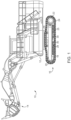
- Machine 10 includes a track-type machine having a machine frame 12, and an implement system 14 coupled to frame 12.
- Frame 12 may be supported on and rotatable relative to a ground-engaging track system 16.
- Track system 16 includes a track roller frame 18, an idler 20, a drive sprocket 22, and a plurality of track rollers 30 mounted to track roller frame 18.
- a plurality of carrier rollers 29 are also mounted to track roller frame 18 in a generally conventional manner.
- a ground-engaging track 24 extends about idler 20, drive sprocket 22, track rollers 30, and carrier rollers 29.
- Machine 10 is shown in the context of a mining machine, namely, a hydraulic mining shovel or the like where implement system 14 includes a hydraulically actuated implement system structured to operate at least primarily at a working face of a mine.
- Machine 10 could alternatively be a rope shovel, such as an electric rope shovel, or a variety of other types of equipment such as a track-type tractor or an excavator.
- certain mining machines such as the illustrated hydraulic mining shovel, may be operated approximately 90% of the time or more at fixed locations at a worksite, such as at a working face to capture, lift, and dump material into mining trucks or another conveyance mechanism, and thus are trammed only a minority of the time.
- Such mining machines typically weigh in excess of 1,000 tons, and despite the relative infrequency of tramming can subject their tracks to extreme wear, loading, and material deformation, for instance. It is generally desirable for tracks in such machines to have a service life in the tens of thousands of hours.
- machine 10, and track system 16 in particular, is structured for an extended service life and operational reliability, especially with respect to managing thrust loads between the various rotatable track engaging elements and track roller frame 18.
- Rotatable track engaging elements can be understood herein to include idler 20, drive sprocket 22, track rollers 30, and carrier rollers 29.
- Enhanced thrust load management can reduce risk of premature failure or necessity for unexpected field service and machine downtime.
- Track roller 30 includes a roller 32 having a bore 34 formed therein defining a major axis 36.
- Roller 32 may be a roller shell having an inner surface 35 and an outer surface 37.
- Outer surface 37 can be contoured to include a raised protrusion or pad 39 that extends circumferentially around major axis 36 and is generally linear in profile.
- Track roller 30 further includes a roller shaft 38 extending through bore 34 to support roller 32 for rotation about major axis 36.
- Roller shaft 38 includes a first shaft end 40 and an opposite second shaft end 42.
- Undercarriage assembly 28, and track roller 30, can further include a first shaft support 66 structured to mount to track roller frame 18 and receiving first shaft end 40, and a second shaft support 67 also structured to mount to track roller frame 18 and receiving second shaft end 42.
- first shaft support 66 and second shaft support 67 include, respectively, a first collar 68 and a second collar 69.
- a pin 70 extends through roller shaft 38 and first collar 68 and fixes roller shaft 38 to first collar 68.
- Another pin (not numbered) analogously fixes roller shaft 38 to second collar 69.
- Each of first shaft support 66 and second shaft support 67 can be received in and mounted to track roller frame 18 according to any suitable strategy.
- First collar 68 and second collar 69 could include multi-piece clamping collars, which can be clamped about first shaft end 40 and second shaft end 42, respectively, and bolted to track roller frame 18, or alternatively could each be a single-piece component.
- Track roller 30 includes a sealed and lubricated rotatable track engaging element, and to this end includes a first seal cavity 44 extending between roller 32 and roller shaft 38, and formed in part by a first thrust surface 46 that faces a first axial direction and is fixed relative to roller 32, and a second thrust surface 48 that faces a second axial direction opposite to the first axial direction and is fixed relative to roller shaft 38.
- An axial direction herein means a direction along major axis 36. Hence, in the illustrated embodiment the first axial direction is an axially inward direction, and the second axial direction is an axially outward direction.
- a first axial direction may be an axially outward direction and a second axial direction may be an axially inward direction.
- first or second as those terms are used herein merely for convenience of description.
- Another seal cavity 45 extends between roller 32 and roller shaft 38 and is formed in part by a first thrust surface 47 that faces a first axial direction and is fixed relative to roller 32, and a second thrust surface 49 that faces a second axial direction opposite to the first axial direction and is fixed relative to roller shaft 38.
- Track roller 30 further includes a first thrust washer stack 50 trapped between first thrust surface 46 and second thrust surface 47, to react thrust loads between roller 32 and roller shaft 38, and a second thrush washer stack 51 trapped between first thrust surface 47 and second thrust surface 49, also to react thrust loads between roller 32 and roller shaft 38.
- a first dynamic seal 56 is held in compression between roller 32 and roller shaft 38 and seals first thrust washer stack 50 within seal cavity 44.
- a second dynamic seal 57 is held in compression between roller 32 and roller shaft 38 and seals second thrust washer stack 51 within seal cavity 45.
- first dynamic seal 56 includes a face seal assembly having a sealing ring 58 and a seal biaser 62
- second dynamic seal 57 includes a face seal assembly including a sealing ring 60 and a seal biaser 64.
- Dynamic seal assemblies 56 and 57 can include metallic face seal assemblies where sealing rings 53 and 60 each include metallic sealing rings.
- Each seal biaser 62 and 64 can include a non-metallic seal biaser in the nature of a toric that is compressed in opposition to an internal bias to urge sealing rings 58 and 60 into contact with one another.
- Lubricating fluid may be positioned in each of seal cavity 44 and seal cavity 45.
- First thrust washer stack 50 includes a first thrust washer 52 in contact with first thrust surface 46, and a second thrust washer 54 in contact with first thrust washer 52 and with second thrust surface 48. At least one of first thrust washer 52 or second thrust washer 54 is free to rotate about major axis 36.
- Second thrust washer stack 51 includes a first thrust washer 53 in contact with first thrust surface 47, and a second thrust washer 55 in contact with second thrust surface 49. At least one of first thrust washer 53 or second thrust washer 55 is free to rotate about major axis 36.
- each of the thrust washers in the respective thrust washer stacks 50 and 51 is free to rotate about major axis 36, the significance of which will be further apparent from the following description.
- First thrust washer stack 50 and second thrust washer stack 51 each include a total of two thrust washers 52 and 54, and 53 and 55, respectively, and the plurality of thrust washers of each of first thrust washer stack 50 and second thrust washer stack 51 may be substantially identical to one another.
- Dynamic seal 56 and dynamic seal 57 fluidly seal thrust washer stacks 50 and 51 within seal cavities 44 and 45, respectively.
- a number of thrust washers greater than two might be used in any individual thrust washer stack, such as three.
- first shaft support 66 and second shaft support 67 may include a first collar 68 and a second collar 69, respectively.
- First thrust washer stack 51 is in contact with at least one of roller 32 or roller shaft 38, and second thrust washer stack 51 is in contact with at least one of roller 32 or roller shaft 38.
- first thrust washer stack 50 is positioned to contact each of roller 32 and first collar 68 to directly react thrust loads between roller 32 and first collar 68.
- Second thrust washer stack 51 is positioned to contact each of roller 32 and second collar 69 to directly react thrust loads between roller 32 and second collar 69.
- One of first thrust surface 46 or second thrust surface 48 is formed on first collar 68, and by analogy one of first thrust surface 47 or second thrust surface 49 is formed on second collar 69.
- thrust surfaces amongst embodiments can vary, in other words whether an axially inward-facing or an axially outward-facing thrust surface is fixed relative to a roller versus fixed relative to a roller shaft can be varied, as well as whether thrust surfaces are formed directly upon target components such as a roller or a collar or instead upon intervening components.
- Track roller 130 includes a roller 132 that can be a roller shell, having an outer surface 137 and a protrusion or pad 139.
- a thrust washer stack 150 is trapped between thrust surfaces (not numbered) on roller 132 and a shaft support 166, and fluidly sealed within track roller 130 by way of a dynamic seal 156, which can be a metal face seal assembly generally analogous to that described in connection with track roller 30 above.
- Shaft support 166 could be structured differently from shaft support 66 in undercarriage assembly 28, and an outer profile of roller 132 formed by outer surface 137 can likewise be different.
- pad 139 has a rounded outer contour, in profile extending generally left to right in the illustration of Fig. 3 .
- the rounded outer contour can be adapted for supporting and distributing heavy machine loads between pad 139 and an associated track rail and potentially providing sacrificial wear material.
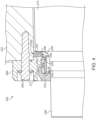
- a rotatable track engaging element or track roller 230 according to yet another embodiment, and including a roller 232 and a roller shaft 238.
- Roller shaft 238 includes an enlarged center section 274 that is positioned radially inward of roller 232.
- Track roller 230 also includes a clamped collar 268 that is bolted to roller 232 by way of a plurality of bolts, one of which is shown at numeral 269.
- a seal cavity 244 extends between roller 232 and roller shaft 238 and is formed in part by a first thrust surface 246 and a second thrust surface 248.
- first thrust surface 246 could be understood to face a first axial direction that is an axially inward direction
- second thrust surface 248 could be understood to face a second axial direction that is an axially outward direction.
- axially inward can be understood to mean an axial direction toward an axial center point of a line segment formed by an axis within a physical object, whereas “axially outward” is an opposite direction.
- First thrust surface 246 is fixed relative to roller 238 by way of clamped collar 268, and second thrust surface 248 is formed on and thus fixed relative to roller shaft 238.
- a thrust washer stack 250 is trapped between first thrust surface 246 and second thrust surface 248, and fluidly sealed within seal cavity 244 by way of a dynamic seal 256.
- Collar 268 also includes a seal carrier 245, and a track roller 230 includes a second collar 276 that includes another seal carrier 277.
- Components of dynamic seal 256 which can include a metal face seal assembly, are held in compression between first seal carrier 245 and second seal carrier 277. It should also be appreciated that although only part of track roller 230 is illustrated in Fig. 4 , an opposite part or end of track roller 230 would have a mirror-image configuration. Track roller 230 might be used in certain track-type track machines, whereas track roller 30 and track roller 130 might be used in certain mining machines, although the present disclosure is not thereby limited.
- Idler 330 can include a roller 332 positioned upon and rotatable about a roller shaft 338.
- Roller 332 also includes an idler hub 378, and an idler rim 380, and a web 382 connecting between idler hub 378 and idler rim 380.
- Idler 330 also includes a first thrust washer stack 350 trapped between roller shaft 33 8 and a first collar 368 bolted to roller 332.
- a first thrust surface 346 is formed on collar 368, and a second thrust surface 348 is formed on roller shaft 338.
- Another thrust washer stack 351 may be analogously configured.
- Thrust washer stack 350 includes a first thrush washer 352 in contact with first thrust surface 346, and a second thrush washer 353 in contact with second thrust surface 348.
- first thrust surface 346 faces a first axial direction that is an axially inward direction
- second thrust surface 348 faces a second axial direction that is an axially outward direction.
- roller 32 can rotate around roller shaft 38 and support a weight of machine 10, in combination with other track rollers in track system 16, as track 24 is moved about the plurality of rotatable track engaging elements. Turning machine 10, tramming across a slope, or tramming over uneven ground, can cause side or thrust loads to be transmitted between track 24 and roller 32. Roller 32 can be urged axially relative to roller shaft 38, transmitting thrust loads to thrust washer stacks 50 or 51. Thrust washer stacks 50 or 51, depending on the direction of the thrust load, can transmit the loads to shaft supports 66 or 67, and to track roller frame 18.
- roller 32 may be rotating about major axis 36.
- Contact between thrust surfaces 46 or 47 and first or inner thrust washers 52 or 55 causes thrust washers 52 or 55 to rotate along with roller 32.
- Contact between second or outer thrust washers 54 or 53 and shaft supports 66 or 67 imparts a tendency for thrust washers 54 or 53 to remain stationary, with thrust washers 52 or 55 thus rotating, respectively, relative to thrust washers 54 or 53. It has been observed in earlier track systems employing only a single thrust washer that a speed differential between a rotating roller and a stationary shaft support, or intervening components, could result in wear rates greater than desired, transferring material, wearing away material, deforming the thrust washers, and potentially causing problems such as seal failure or track performance degradation.
- the thrust washer could be expected to rotate at a speed approximately 50% of the speed difference between the rotating component and the stationary component.
- an intervening single thrust washer could be expected to rotate at a fractional speed of rotation of the roller of approximately 50 RPM given a tendency for that intervening thrust washer to fictionally interact with each of the components that it contacts.
- the thrust washer is induced to rotate by the roller and rotation is resisted by the shaft support, so the thrust rotates at about half the relative speed of rotation between the roller and the shaft support.
- Wear rate generally, is observed to be a function of pressure times velocity. Accordingly, with very heavy machines and large thrust loads, i.e. high pressure, coupled with relatively high velocities can produce wear rates greater than optimal, and ultimately lead to performance degradation or failure.
- a maximum relative speed differential can be less than in known single thrust washer designs.
- a roller in a track roller according to the present disclosure might rotate at 100 RPM with an associated shaft support at 0 RPM.
- An inner thrust washer adjacent to the rotating roller might be expected to rotate at a fractional speed of rotation of the roller of about 66 RPM, with the thrust washer adjacent to the shaft support rotated at a second fractional speed of rotation of the roller that is less than the first fractional speed of rotation and equal to about 33 RPM, given the tendencies for the respective thrust washers to frictionally interact with the components that they contact.
- the maximum relative speed differential among any of the rotating roller, stationary support, or intervening two washers could be expected to be at least theoretically about 33 RPM.
- wear rate is based on pressure times velocity
- an observed wear rate in a theoretical example according to the present disclosure can be expected to be significantly less based on a difference of a max 33 RPM relative speed differential versus a max 50 RPM relative speed differential in a single thrust washer design.
- the actual speeds and relative speeds might differ, however, the foregoing theoretical application is expected to be generally applicable, and across multiple embodiments.
Landscapes
- Engineering & Computer Science (AREA)
- Mechanical Engineering (AREA)
- General Engineering & Computer Science (AREA)
- Chemical & Material Sciences (AREA)
- Combustion & Propulsion (AREA)
- Transportation (AREA)
- Physics & Mathematics (AREA)
- Fluid Mechanics (AREA)
- Rolling Contact Bearings (AREA)
- Mechanical Sealing (AREA)
- Sliding-Contact Bearings (AREA)
Description
- The present disclosure relates generally to an undercarriage assembly for machine track, and more particularly to a rotatable track engaging element having thrust washer stacks trapped between thrust surfaces.
- Ground-engaging tracks are used in many different machines operated in off-highway environments across the globe. Machine tracks typically include an endless loop of coupled-together track links that extends about rotatable track engaging elements such as one or more idlers, track rollers, carrier rollers, and a drive sprocket. Significant engineering efforts over the years have been directed at design of track systems to provide robust support for heavy machines and traction in harsh environments. Track-type machines can weigh several million kilograms (pounds), and off highway worksites can have substrates formed of hard and/or uneven materials that subject the equipment to demanding wear conditions, slippery underfoot conditions, high mechanical loads, and corrosive environments. Loads experienced by components in track systems for such machines can have various forms, including bending loads, twisting loads, and thrust loads that are reacted along and between adjacent components, commonly rotating relative to one another.
- In the case of large mining and material production machines, such as track-type tractors configured for production dozing, track service can require significant machine downtime during which the machine is not operational, and heavy equipment as well as specially trained personnel may be required to properly inspect, repair, replace, or otherwise diagnose and address issues with a machine's track. Such downtime can have significant economic consequences, especially in the event of an unplanned field failure. Thrust rings and the like can be subjected to high axial loads and relative rotation during operating a track system and can sometimes fail prematurely or degrade in perfomance.
United States Patent No. 10,046,816 to Johannsen -
US 2015/274228 discloses the preamble of claim 1. - In one aspect, an undercarriage assembly includes a roller having a bore formed therein defining a major axis, and a roller shaft extending through the bore to support the roller for rotation about the major axis. The undercarriage assembly further includes a seal cavity extending between the roller and the roller shaft and formed in part by a first thrust surface that faces a first axial direction and is fixed relative to the roller, and a second thrust surface that faces a second axial direction opposite to the first axial direction and is fixed relative to the roller shaft. A thrust washer stack is trapped between the first thrust surface and the second thrust surface, to react thrust loads between the roller and the roller shaft, and a dynamic seal fluidly seals the thrust washer stack within the seal cavity.
- In another (unclaimed) aspect, a rotatable track engaging element for a machine track includes a roller shaft having a first shaft end and a second shaft end, and a roller defining a major axis and being positioned upon the roller shaft. The rotatable track engaging element further includes a first shaft support structured to mount to a frame and receiving the first shaft end, and a second shaft support structured to mount to the frame and receiving the second shaft end. The rotatable track engaging element further includes a first thrust washer stack positioned upon the roller shaft and including a plurality of thrust washers trapped between the first shaft support and the roller, and a second thrust washer stack positioned upon the roller shaft and including a plurality of thrust washers trapped between the second shaft support and the roller.
- In still another (unclaimed) aspect, a sealed and lubricated rotatable track engaging element includes a roller having a bore formed therein defining a major axis, and a roller shaft extending through the bore to support the roller for rotation about the major axis. A first thrust surface is fixed relative to the roller and faces a first axial direction, and a second thrust surface is fixed relative to the roller shaft and faces a second axial direction. A seal cavity extends between the roller and the roller shaft and is formed in part by each of the first thrust surface and the second thrust surface, and a thrust washer stack is within the seal cavity and trapped between the first thrust surface and the second thrust surface.
-
-
Fig. 1 is a side diagrammatic view of a machine, according to one embodiment; -
Fig. 2 is a sectioned side diagrammatic view of an undercarriage assembly, according to one embodiment; -
Fig. 3 is a sectioned side diagrammatic view of a rotatable track engaging element, according to one embodiment; -
Fig. 4 is a partially sectioned side diagrammatic view of a portion of a rotatable track engaging element, according to another embodiment; and -
Fig. 5 is a sectioned side diagrammatic view of a rotatable track engaging element, according to yet another embodiment. - Referring to
Fig. 1 , there is shown amachine 10, according to one embodiment.Machine 10 includes a track-type machine having amachine frame 12, and animplement system 14 coupled toframe 12.Frame 12 may be supported on and rotatable relative to a ground-engaging track system 16.Track system 16 includes atrack roller frame 18, anidler 20, adrive sprocket 22, and a plurality oftrack rollers 30 mounted totrack roller frame 18. A plurality ofcarrier rollers 29 are also mounted totrack roller frame 18 in a generally conventional manner. A ground-engaging track 24 extends aboutidler 20, drivesprocket 22,track rollers 30, andcarrier rollers 29.Machine 10 is shown in the context of a mining machine, namely, a hydraulic mining shovel or the like whereimplement system 14 includes a hydraulically actuated implement system structured to operate at least primarily at a working face of a mine.Machine 10 could alternatively be a rope shovel, such as an electric rope shovel, or a variety of other types of equipment such as a track-type tractor or an excavator. Those skilled in the art will appreciate that certain mining machines, such as the illustrated hydraulic mining shovel, may be operated approximately 90% of the time or more at fixed locations at a worksite, such as at a working face to capture, lift, and dump material into mining trucks or another conveyance mechanism, and thus are trammed only a minority of the time. Such mining machines typically weigh in excess of 1,000 tons, and despite the relative infrequency of tramming can subject their tracks to extreme wear, loading, and material deformation, for instance. It is generally desirable for tracks in such machines to have a service life in the tens of thousands of hours. As discussed herein,machine 10, andtrack system 16 in particular, is structured for an extended service life and operational reliability, especially with respect to managing thrust loads between the various rotatable track engaging elements andtrack roller frame 18. Rotatable track engaging elements can be understood herein to includeidler 20,drive sprocket 22,track rollers 30, andcarrier rollers 29. Enhanced thrust load management can reduce risk of premature failure or necessity for unexpected field service and machine downtime. - Referring also now to
Fig. 2 , there is shown anundercarriage assembly 28 including a rotatable track engaging element in the context of one oftrack rollers 30 andtrack roller frame 18. Discussion herein oftrack roller 30, hereinafter referred to in the singular, should be understood to refer by way of analogy to any of thetrack rollers 30 that might be used in ground-engaging track system 60.Track roller 30 includes aroller 32 having abore 34 formed therein defining amajor axis 36.Roller 32 may be a roller shell having an inner surface 35 and anouter surface 37.Outer surface 37 can be contoured to include a raised protrusion orpad 39 that extends circumferentially aroundmajor axis 36 and is generally linear in profile.Outer surface 37 at locations adjacent topad 39 can contact track rails formed bytrack shoes 25 in track 24, withpad 39 fitted between the rails within a track guiding space. Alternatively,pad 39 can contact a single center track rail, or still another pattern of contact betweentrack roller 30 and track 24 might be used.Track roller 30 further includes aroller shaft 38 extending throughbore 34 to supportroller 32 for rotation aboutmajor axis 36.Roller shaft 38 includes afirst shaft end 40 and an oppositesecond shaft end 42.Undercarriage assembly 28, andtrack roller 30, can further include afirst shaft support 66 structured to mount to trackroller frame 18 and receivingfirst shaft end 40, and asecond shaft support 67 also structured to mount totrack roller frame 18 and receivingsecond shaft end 42. In the illustrated embodimentfirst shaft support 66 andsecond shaft support 67 include, respectively, a first collar 68 and asecond collar 69. Apin 70 extends throughroller shaft 38 and first collar 68 andfixes roller shaft 38 to first collar 68. Another pin (not numbered) analogously fixesroller shaft 38 tosecond collar 69. Each of first shaft support 66 andsecond shaft support 67 can be received in and mounted totrack roller frame 18 according to any suitable strategy. First collar 68 andsecond collar 69 could include multi-piece clamping collars, which can be clamped aboutfirst shaft end 40 andsecond shaft end 42, respectively, and bolted to trackroller frame 18, or alternatively could each be a single-piece component. -
Track roller 30 includes a sealed and lubricated rotatable track engaging element, and to this end includes afirst seal cavity 44 extending betweenroller 32 androller shaft 38, and formed in part by afirst thrust surface 46 that faces a first axial direction and is fixed relative toroller 32, and asecond thrust surface 48 that faces a second axial direction opposite to the first axial direction and is fixed relative toroller shaft 38. An axial direction herein means a direction alongmajor axis 36. Hence, in the illustrated embodiment the first axial direction is an axially inward direction, and the second axial direction is an axially outward direction. In other embodiments, and for other parts oftrack roller 30, a first axial direction may be an axially outward direction and a second axial direction may be an axially inward direction. No limitation is intended by use of the terms "first" or "second" as those terms are used herein merely for convenience of description. Anotherseal cavity 45 extends betweenroller 32 androller shaft 38 and is formed in part by afirst thrust surface 47 that faces a first axial direction and is fixed relative toroller 32, and a second thrust surface 49 that faces a second axial direction opposite to the first axial direction and is fixed relative toroller shaft 38. -
Track roller 30 further includes a first thrust washer stack 50 trapped betweenfirst thrust surface 46 andsecond thrust surface 47, to react thrust loads betweenroller 32 androller shaft 38, and a secondthrush washer stack 51 trapped betweenfirst thrust surface 47 and second thrust surface 49, also to react thrust loads betweenroller 32 androller shaft 38. A firstdynamic seal 56 is held in compression betweenroller 32 androller shaft 38 and seals first thrust washer stack 50 withinseal cavity 44. A seconddynamic seal 57 is held in compression betweenroller 32 androller shaft 38 and seals secondthrust washer stack 51 withinseal cavity 45. In a practical implementation strategy, firstdynamic seal 56 includes a face seal assembly having a sealingring 58 and aseal biaser 62, and seconddynamic seal 57 includes a face seal assembly including a sealingring 60 and a seal biaser 64.Dynamic seal assemblies seal biaser 62 and 64 can include a non-metallic seal biaser in the nature of a toric that is compressed in opposition to an internal bias to urge sealing rings 58 and 60 into contact with one another. Lubricating fluid may be positioned in each ofseal cavity 44 andseal cavity 45. For reasons that will be apparent from the following description, implementing thrust washer stacks 50 and 51 intrack roller 30 and analogous configurations in other embodiments, can be expected to reduce a risk of seal failure caused by excessive thrust washer wear and avoid or delay development of other problems. - First thrust washer stack 50 includes a first thrust washer 52 in contact with
first thrust surface 46, and a second thrust washer 54 in contact with first thrust washer 52 and withsecond thrust surface 48. At least one of first thrust washer 52 or second thrust washer 54 is free to rotate aboutmajor axis 36. Secondthrust washer stack 51 includes afirst thrust washer 53 in contact withfirst thrust surface 47, and asecond thrust washer 55 in contact with second thrust surface 49. At least one offirst thrust washer 53 orsecond thrust washer 55 is free to rotate aboutmajor axis 36. In a practical implementation strategy applicable to all embodiments contemplated herein, each of the thrust washers in the respective thrust washer stacks 50 and 51 is free to rotate aboutmajor axis 36, the significance of which will be further apparent from the following description. First thrust washer stack 50 and secondthrust washer stack 51 each include a total of twothrust washers thrust washer stack 51 may be substantially identical to one another.Dynamic seal 56 anddynamic seal 57 fluidly seal thrust washer stacks 50 and 51 withinseal cavities first shaft support 66 andsecond shaft support 67 may include a first collar 68 and asecond collar 69, respectively. Firstthrust washer stack 51 is in contact with at least one ofroller 32 orroller shaft 38, and secondthrust washer stack 51 is in contact with at least one ofroller 32 orroller shaft 38. In the embodiment ofFig. 2 , first thrust washer stack 50 is positioned to contact each ofroller 32 and first collar 68 to directly react thrust loads betweenroller 32 and first collar 68. Secondthrust washer stack 51 is positioned to contact each ofroller 32 andsecond collar 69 to directly react thrust loads betweenroller 32 andsecond collar 69. One offirst thrust surface 46 orsecond thrust surface 48 is formed on first collar 68, and by analogy one offirst thrust surface 47 or second thrust surface 49 is formed onsecond collar 69. It will be appreciated that the locations of thrust surfaces amongst embodiments can vary, in other words whether an axially inward-facing or an axially outward-facing thrust surface is fixed relative to a roller versus fixed relative to a roller shaft can be varied, as well as whether thrust surfaces are formed directly upon target components such as a roller or a collar or instead upon intervening components. - Referring now to
Fig. 3 , there is shown atrack roller 130 according to another design and having various similarities with the embodiment ofFig. 2 , but certain differences.Track roller 130 includes aroller 132 that can be a roller shell, having anouter surface 137 and a protrusion orpad 139. Athrust washer stack 150 is trapped between thrust surfaces (not numbered) onroller 132 and ashaft support 166, and fluidly sealed withintrack roller 130 by way of adynamic seal 156, which can be a metal face seal assembly generally analogous to that described in connection withtrack roller 30 above.Shaft support 166 could be structured differently fromshaft support 66 inundercarriage assembly 28, and an outer profile ofroller 132 formed byouter surface 137 can likewise be different. It can be noted thatpad 139 has a rounded outer contour, in profile extending generally left to right in the illustration ofFig. 3 . The rounded outer contour can be adapted for supporting and distributing heavy machine loads betweenpad 139 and an associated track rail and potentially providing sacrificial wear material. - Referring now to
Fig. 4 , there is shown a rotatable track engaging element ortrack roller 230 according to yet another embodiment, and including aroller 232 and aroller shaft 238.Roller shaft 238 includes anenlarged center section 274 that is positioned radially inward ofroller 232.Track roller 230 also includes a clampedcollar 268 that is bolted toroller 232 by way of a plurality of bolts, one of which is shown atnumeral 269. Aseal cavity 244 extends betweenroller 232 androller shaft 238 and is formed in part by afirst thrust surface 246 and asecond thrust surface 248. It can be noted that intrack roller 230first thrust surface 246 could be understood to face a first axial direction that is an axially inward direction, whereassecond thrust surface 248 could be understood to face a second axial direction that is an axially outward direction. As used herein, the term "axially inward" can be understood to mean an axial direction toward an axial center point of a line segment formed by an axis within a physical object, whereas "axially outward" is an opposite direction.First thrust surface 246 is fixed relative toroller 238 by way of clampedcollar 268, andsecond thrust surface 248 is formed on and thus fixed relative toroller shaft 238. Athrust washer stack 250 is trapped betweenfirst thrust surface 246 andsecond thrust surface 248, and fluidly sealed withinseal cavity 244 by way of adynamic seal 256.Collar 268 also includes aseal carrier 245, and atrack roller 230 includes asecond collar 276 that includes anotherseal carrier 277. Components ofdynamic seal 256, which can include a metal face seal assembly, are held in compression betweenfirst seal carrier 245 andsecond seal carrier 277. It should also be appreciated that although only part oftrack roller 230 is illustrated inFig. 4 , an opposite part or end oftrack roller 230 would have a mirror-image configuration.Track roller 230 might be used in certain track-type track machines, whereastrack roller 30 andtrack roller 130 might be used in certain mining machines, although the present disclosure is not thereby limited. - Referring now to
Fig. 5 , there is shown a rotatable track engaging element or idler 330 according to another embodiment. Idler 330 can include aroller 332 positioned upon and rotatable about aroller shaft 338.Roller 332 also includes anidler hub 378, and anidler rim 380, and aweb 382 connecting betweenidler hub 378 andidler rim 380. Idler 330 also includes a firstthrust washer stack 350 trapped between roller shaft 33 8 and afirst collar 368 bolted toroller 332. Afirst thrust surface 346 is formed oncollar 368, and asecond thrust surface 348 is formed onroller shaft 338. Adynamic seal 356 supported in part bycollar 368 and asecond collar 376, fluidly seals thrustwasher stack 350 withinidler 330. Anotherthrust washer stack 351 may be analogously configured.Thrust washer stack 350 includes afirst thrush washer 352 in contact withfirst thrust surface 346, and asecond thrush washer 353 in contact withsecond thrust surface 348. Inidler 330,first thrust surface 346 faces a first axial direction that is an axially inward direction, andsecond thrust surface 348 faces a second axial direction that is an axially outward direction. - Referring to the drawings generally, but returning to the embodiment of
Fig. 2 for descriptive purposes, whenundercarriage assembly 28 is operatedroller 32 can rotate aroundroller shaft 38 and support a weight ofmachine 10, in combination with other track rollers intrack system 16, as track 24 is moved about the plurality of rotatable track engaging elements. Turningmachine 10, tramming across a slope, or tramming over uneven ground, can cause side or thrust loads to be transmitted between track 24 androller 32.Roller 32 can be urged axially relative toroller shaft 38, transmitting thrust loads to thrust washer stacks 50 or 51. Thrust washer stacks 50 or 51, depending on the direction of the thrust load, can transmit the loads to shaft supports 66 or 67, and to trackroller frame 18. - During transmitting of thrust loads,
roller 32 may be rotating aboutmajor axis 36. Contact between thrust surfaces 46 or 47 and first orinner thrust washers 52 or 55 causes thrustwashers 52 or 55 to rotate along withroller 32. Contact between second orouter thrust washers 54 or 53 and shaft supports 66 or 67 imparts a tendency forthrust washers 54 or 53 to remain stationary, withthrust washers 52 or 55 thus rotating, respectively, relative to thrustwashers 54 or 53. It has been observed in earlier track systems employing only a single thrust washer that a speed differential between a rotating roller and a stationary shaft support, or intervening components, could result in wear rates greater than desired, transferring material, wearing away material, deforming the thrust washers, and potentially causing problems such as seal failure or track performance degradation. - In a theoretical example, with a rotating component, a stationary component, and a single thrust washer between the rotating component and the stationary component, the thrust washer could be expected to rotate at a speed approximately 50% of the speed difference between the rotating component and the stationary component. For example, if a roller in a track roller were rotated at 100 RPM, with the stationary shaft support at 0 RPM, an intervening single thrust washer could be expected to rotate at a fractional speed of rotation of the roller of approximately 50 RPM given a tendency for that intervening thrust washer to fictionally interact with each of the components that it contacts. In other words, the thrust washer is induced to rotate by the roller and rotation is resisted by the shaft support, so the thrust rotates at about half the relative speed of rotation between the roller and the shaft support. Wear rate, generally, is observed to be a function of pressure times velocity. Accordingly, with very heavy machines and large thrust loads, i.e. high pressure, coupled with relatively high velocities can produce wear rates greater than optimal, and ultimately lead to performance degradation or failure.
- According to the present disclosure, with multiple intervening thrust washers a maximum relative speed differential can be less than in known single thrust washer designs. For example, a roller in a track roller according to the present disclosure might rotate at 100 RPM with an associated shaft support at 0 RPM. An inner thrust washer adjacent to the rotating roller might be expected to rotate at a fractional speed of rotation of the roller of about 66 RPM, with the thrust washer adjacent to the shaft support rotated at a second fractional speed of rotation of the roller that is less than the first fractional speed of rotation and equal to about 33 RPM, given the tendencies for the respective thrust washers to frictionally interact with the components that they contact. In this example according to the present disclosure, the maximum relative speed differential among any of the rotating roller, stationary support, or intervening two washers could be expected to be at least theoretically about 33 RPM. Recalling that wear rate is based on pressure times velocity, an observed wear rate in a theoretical example according to the present disclosure can be expected to be significantly less based on a difference of a max 33 RPM relative speed differential versus a max 50 RPM relative speed differential in a single thrust washer design. In a real world application the actual speeds and relative speeds might differ, however, the foregoing theoretical application is expected to be generally applicable, and across multiple embodiments.
- The present description is for illustrative purposes only, and should not be construed to narrow the breadth of the present disclosure in any way. For instance, while the foregoing discussion focuses on applications where one component rotates and the other is fixed, this relationship might be reversed. Further, each of two components, e.g. a roller and roller shaft, might be rotatable relative to the other in certain applications. Other aspects, features and advantages will be apparent upon an examination of the attached drawings and appended claims. As used herein, the articles "a" and "an" are intended to include one or more items, and may be used interchangeably with "one or more." Where only one item is intended, the term "one" or similar language is used. Also, as used herein, the terms "has," "have," "having," or the like are intended to be open-ended terms. Further, the phrase "based on" is intended to mean "based, at least in part, on" unless explicitly stated otherwise.
Claims (8)
- An undercarriage assembly (28) comprising:a roller (32,132,232,332) having a bore (34) formed therein defining a major axis;a roller shaft (38,138,238,338) extending through the bore (34) to support the roller (32,132,232,332) for rotation about the major axis (36);a seal cavity (44,45,244) extending between the roller (32,132,232,332) and the roller shaft (38,138,238,338) and formed in part by a first thrust surface (46,47,246,346) that faces a first axial direction and is fixed relative to the roller (32,132,232,332), and a second thrust surface (48,49,248,348) that faces a second axial direction opposite to the first axial direction and is fixed relative to the roller shaft (38,138,238,338);a thrust washer stack (50,51,150,250,350,351) trapped between the first thrust surface (46,47,246,346) and the second thrust surface (48,49,248,348), to react thrust loads between the roller (32,132,232,332) and the roller shaft (38,138,238,338); anda dynamic seal (56,57,156,256,356) fluidly sealing the thrust washer stack (50,51,150,250,350,351) within the seal cavity (44,45,244),characterised in that the thrust washer stack (50,51,150,250,350,351) includes a first thrust washer (52,252,352) in contact with the first thrust surface (46,47,246,346), and a second thrust washer (54,253,353) in contact with the first thrust washer (52,252,352) and with the second thrust surface (48,49,248,348), and each of the first thrust washer (52,252,352) and the second thrust washer (54,253,353) is free to rotate about the major axis;wherein contact between the first thrust surface (46,47,246,346) and the first thrust washer (52,252,352) causes the first thrust washer (52,252,352) to rotate with the roller (32) and contact between the second thrust washer (54,253,353) and the second thrust surface (48,49,248,348) cause the second thrust washer (54,253,353) to remain stationary, with the first thrust washer (52,252,352) rotating, respectively, relative to the second thrust washer (54,253,353).
- The undercarriage assembly (28) of claim 1 wherein:the dynamic seal (56,57,156,256,356) includes a face seal assembly including a sealing ring (58,60) and a seal biaser (62,64); andthe undercarriage assembly (28) further comprising a collar (68,69,268,368), and one of the first thrust surface (46,47,246,346) or the second thrust surface (48,49,248,348) is formed on the collar (68,69,268,368).
- The undercarriage assembly (28) of claim 1 or 2 wherein:the roller (332) includes an idler hub (378) and an idler rim (380); andthe first axial direction is an axially inward direction and the second axial direction is an axially outward direction.
- The undercarriage assembly (28) of claim 1 or 2 further comprising an idler (20) and a drive sprocket (22), and the roller (32,132,232) includes a roller shell in a track roller (30); and
the first axial direction is an axially outward direction and the second axial direction is an axially inward direction. - The undercarriage assembly (28) of any one of the preceding claims further comprising:a first shaft support (66,67,166) structured to mount to a frame (12) and receiving a first shaft end (40) of the roller shaft (38,138,238,338);a second shaft support (66,67,166) structured to mount to the frame (12) and receiving a second shaft end (42) of the roller shaft (38,138,238,338);a first thrust washer stack (50,51,150,250,350,351) positioned upon the roller shaft (38,138,238,338) and including a plurality of thrust washers trapped between the first shaft support (66,67,166) and the roller (32,132,232,332); anda second thrust washer stack (50,51,150,250,350,351) positioned upon the roller shaft (38,138,238,338) and including a plurality of thrust washers trapped between the second shaft support (66,67,166) and the roller (32,132,232,332).
- The undercarriage assembly (28) of claim 5 wherein:the first shaft support (66,67,166) includes a first collar (68,69,268,276,368,376) and the second shaft support (66,67,166) includes a second collar (68,69,268,368);the first thrust washer stack (50,51,150,250,350,351) is positioned to contact each of the roller (32,132,232,332) and the first collar (68,69,268,368) to directly react thrust loads between the roller (32,132,232,332) and the first collar (68,69,268,276,368,376);the second thrust washer stack (50,51,150,250,350,351) is positioned to contact each of the roller (32,132,232,332) and the second collar (68,69,268,368) to directly react thrust loads between the roller (32,132,232,332) and the second collar (68,69,268,368); andthe thrust washers of each of the first thrust washer stack (50,51,150,250,350,351) and the second thrust washer stack (50,51,150,250,350,351) are substantially identical to one another.
- The undercarriage assembly (28) of claim 6 further comprising a pin (70) fixing the collar (68,69) to the roller shaft (38,138);
the roller (32,132) includes a first seal carrier (72) and the collar (68,69) includes a second seal carrier (72). - The undercarriage assembly (28) of any of the preceding claims wherein:the first thrust washer (52,55,253,353) contacts the roller (32,132,232,332) to rotate at a first fractional speed of a speed of rotation of the roller (32,132,232,332); andthe second thrust washer (53,54,252,352) contacts the first thrust washer (52,55,253,353) and the collar (68,69,268,368) to rotate at a second fractional speed of the speed of rotation of the roller (32,132,232,332) that is less than the first fractional speed.
Applications Claiming Priority (2)
| Application Number | Priority Date | Filing Date | Title |
|---|---|---|---|
| US16/436,209 US11654983B2 (en) | 2019-06-10 | 2019-06-10 | Rotatable element in machine track having thrust washer stack for stepping down relative speeds |
| PCT/US2020/033346 WO2020251726A1 (en) | 2019-06-10 | 2020-05-18 | Rotatable element in machine track having thrust washer stack for stepping down relative speeds |
Publications (2)
| Publication Number | Publication Date |
|---|---|
| EP3980320A1 EP3980320A1 (en) | 2022-04-13 |
| EP3980320B1 true EP3980320B1 (en) | 2024-06-26 |
Family
ID=71069970
Family Applications (1)
| Application Number | Title | Priority Date | Filing Date |
|---|---|---|---|
| EP20731663.9A Active EP3980320B1 (en) | 2019-06-10 | 2020-05-18 | Rotatable element in machine track having thrust washer stack for stepping down relative speeds |
Country Status (8)
| Country | Link |
|---|---|
| US (1) | US11654983B2 (en) |
| EP (1) | EP3980320B1 (en) |
| KR (1) | KR102655563B1 (en) |
| CN (1) | CN114096459B (en) |
| AU (1) | AU2020291379B2 (en) |
| PE (1) | PE20220322A1 (en) |
| WO (1) | WO2020251726A1 (en) |
| ZA (1) | ZA202110096B (en) |
Families Citing this family (3)
| Publication number | Priority date | Publication date | Assignee | Title |
|---|---|---|---|---|
| US12049265B2 (en) * | 2020-12-21 | 2024-07-30 | Caterpillar Inc. | Roller assembly for ground-engaging track system |
| US11999420B2 (en) | 2021-03-26 | 2024-06-04 | Caterpillar Inc. | Track roller for undercarriage system having inverted seal, and roller rim for same |
| CN119821534A (en) * | 2025-01-20 | 2025-04-15 | 太原重工股份有限公司 | Electric shovel tension wheel device and electric shovel crawler device |
Family Cites Families (26)
| Publication number | Priority date | Publication date | Assignee | Title |
|---|---|---|---|---|
| US2931451A (en) | 1958-02-17 | 1960-04-05 | James E Hancock | Tractor trailer coupling and power transmission therethrough |
| BE633625A (en) | 1962-06-15 | |||
| US3420584A (en) | 1966-03-18 | 1969-01-07 | Allis Chalmers Mfg Co | Track roller seal |
| US3463560A (en) * | 1967-10-23 | 1969-08-26 | Caterpillar Tractor Co | Self-contained,sealed and lubricated hinge joint |
| FR2209348A5 (en) | 1972-12-05 | 1974-06-28 | Evans Peter | |
| US3910128A (en) * | 1974-06-13 | 1975-10-07 | Caterpillar Tractor Co | Track roller having resilient mounted treads and threaded-on retainers |
| US4209205A (en) * | 1977-12-20 | 1980-06-24 | Caterpillar Tractor Co. | Inspection of track assemblies |
| DE2927206A1 (en) | 1979-07-05 | 1981-01-22 | Viehmann & Co Intertrac | Track vehicle tread roller - has covers fitted to roller body by resilient securing ring fitted in circular groove of body |
| DE3622671C1 (en) | 1986-07-05 | 1987-08-27 | Ford Werke Ag | Thrust washer arrangement, especially for planet gears in a planet carrier |
| JPH0721489U (en) * | 1993-09-24 | 1995-04-18 | 株式会社小松製作所 | Idler support device for tracked vehicle |
| US5755495A (en) * | 1996-09-13 | 1998-05-26 | Industrial Fluid Technologies, Inc. | Bearing for snowmobile track |
| GB2416815B (en) * | 2003-05-02 | 2007-02-28 | Komatsu Mfg Co Ltd | Bearing seal and swing device |
| US20100007205A1 (en) * | 2008-07-14 | 2010-01-14 | Caterpillar Inc. | Self-lubricated track roller assembly and machine using same |
| US9115809B2 (en) * | 2009-02-16 | 2015-08-25 | Caterpillar Inc. | Pin joint assembly |
| US8474554B2 (en) * | 2009-03-24 | 2013-07-02 | Howe And Howe Technologies, Inc. | Fast tracked ground vehicle |
| JP5398350B2 (en) * | 2009-05-21 | 2014-01-29 | 株式会社小松製作所 | Rolling wheels for crawler type vehicles |
| US8231184B2 (en) * | 2009-11-24 | 2012-07-31 | Deere & Company | Crawler track roller with internal spherical spacers |
| US8894537B2 (en) | 2011-01-03 | 2014-11-25 | Hamilton Sundstrand Corporation | Anti-rotation for thrust washers in planetary gear system |
| JP5552558B1 (en) * | 2013-06-17 | 2014-07-16 | 株式会社小松製作所 | Rolling wheels for crawler type vehicles |
| CN103832496B (en) * | 2014-03-25 | 2016-08-17 | 恒天九五重工有限公司 | A kind of crawler belt guides the rail clamping device of anticreep |
| US20160176455A1 (en) * | 2014-12-19 | 2016-06-23 | Caterpillar Inc. | Track-Type Machine Idler Yoke Assembly |
| US20170050687A1 (en) * | 2015-08-20 | 2017-02-23 | Caterpillar Inc. | Track Roller Stationary Collar |
| US10023251B2 (en) | 2016-06-24 | 2018-07-17 | Caterpillar Inc. | Track roller assembly and method |
| US10046816B2 (en) | 2016-07-07 | 2018-08-14 | Caterpillar Inc. | Cartridge assembly with a flexible thrust ring assembly for a track chain |
| US9988111B2 (en) * | 2016-08-04 | 2018-06-05 | Caterpillar Inc. | Swing arm idler rise height adjustment |
| CN109319005A (en) * | 2018-12-05 | 2019-02-12 | 山东帝盟重工机械有限公司 | A crawler excavator chassis assembly |
-
2019
- 2019-06-10 US US16/436,209 patent/US11654983B2/en active Active
-
2020
- 2020-05-18 CN CN202080041186.9A patent/CN114096459B/en active Active
- 2020-05-18 EP EP20731663.9A patent/EP3980320B1/en active Active
- 2020-05-18 AU AU2020291379A patent/AU2020291379B2/en active Active
- 2020-05-18 KR KR1020227000418A patent/KR102655563B1/en active Active
- 2020-05-18 WO PCT/US2020/033346 patent/WO2020251726A1/en not_active Ceased
- 2020-05-18 PE PE2021001948A patent/PE20220322A1/en unknown
-
2021
- 2021-12-07 ZA ZA2021/10096A patent/ZA202110096B/en unknown
Also Published As
| Publication number | Publication date |
|---|---|
| PE20220322A1 (en) | 2022-03-14 |
| BR112021024340A2 (en) | 2022-02-15 |
| CA3142123A1 (en) | 2020-12-17 |
| KR20220016985A (en) | 2022-02-10 |
| EP3980320A1 (en) | 2022-04-13 |
| KR102655563B1 (en) | 2024-04-09 |
| US20200386271A1 (en) | 2020-12-10 |
| US11654983B2 (en) | 2023-05-23 |
| CN114096459A (en) | 2022-02-25 |
| CN114096459B (en) | 2024-11-12 |
| AU2020291379A1 (en) | 2022-01-20 |
| WO2020251726A1 (en) | 2020-12-17 |
| AU2020291379B2 (en) | 2023-08-31 |
| ZA202110096B (en) | 2023-07-26 |
Similar Documents
| Publication | Publication Date | Title |
|---|---|---|
| EP3980320B1 (en) | Rotatable element in machine track having thrust washer stack for stepping down relative speeds | |
| US9745005B2 (en) | Roller assembly for a track-type machine | |
| US20230115301A1 (en) | Sleeve bearing having a flared end | |
| EP3921219B1 (en) | Track joint assembly in machine track having pin stop for cartridge pin retention | |
| US11745810B2 (en) | Cantilevered track roller in ground-engaging track system and roller shell for same | |
| CA3142123C (en) | Rotatable element in machine track having thrust washer stack for stepping down relative speeds | |
| US12049266B2 (en) | Press fit roller collar | |
| BR112021024340B1 (en) | ASSEMBLY OF UNDERCARRIAGE, ROTATING TRACK COUPLING ELEMENT FOR A MACHINE TRACK AND SEALED AND LUBRICATED ROTATING TRACK COUPLING ELEMENT | |
| EP4313742B1 (en) | Track roller for undercarriage system having inverted seal, and roller rim for same | |
| US11919584B2 (en) | Flip-flop track rollers | |
| US11613316B2 (en) | Flip-flop track idlers |
Legal Events
| Date | Code | Title | Description |
|---|---|---|---|
| STAA | Information on the status of an ep patent application or granted ep patent |
Free format text: STATUS: UNKNOWN |
|
| STAA | Information on the status of an ep patent application or granted ep patent |
Free format text: STATUS: THE INTERNATIONAL PUBLICATION HAS BEEN MADE |
|
| PUAI | Public reference made under article 153(3) epc to a published international application that has entered the european phase |
Free format text: ORIGINAL CODE: 0009012 |
|
| STAA | Information on the status of an ep patent application or granted ep patent |
Free format text: STATUS: REQUEST FOR EXAMINATION WAS MADE |
|
| 17P | Request for examination filed |
Effective date: 20211112 |
|
| AK | Designated contracting states |
Kind code of ref document: A1 Designated state(s): AL AT BE BG CH CY CZ DE DK EE ES FI FR GB GR HR HU IE IS IT LI LT LU LV MC MK MT NL NO PL PT RO RS SE SI SK SM TR |
|
| DAV | Request for validation of the european patent (deleted) | ||
| DAX | Request for extension of the european patent (deleted) | ||
| GRAP | Despatch of communication of intention to grant a patent |
Free format text: ORIGINAL CODE: EPIDOSNIGR1 |
|
| STAA | Information on the status of an ep patent application or granted ep patent |
Free format text: STATUS: GRANT OF PATENT IS INTENDED |
|
| INTG | Intention to grant announced |
Effective date: 20231219 |
|
| GRAS | Grant fee paid |
Free format text: ORIGINAL CODE: EPIDOSNIGR3 |
|
| GRAA | (expected) grant |
Free format text: ORIGINAL CODE: 0009210 |
|
| STAA | Information on the status of an ep patent application or granted ep patent |
Free format text: STATUS: THE PATENT HAS BEEN GRANTED |
|
| AK | Designated contracting states |
Kind code of ref document: B1 Designated state(s): AL AT BE BG CH CY CZ DE DK EE ES FI FR GB GR HR HU IE IS IT LI LT LU LV MC MK MT NL NO PL PT RO RS SE SI SK SM TR |
|
| REG | Reference to a national code |
Ref country code: GB Ref legal event code: FG4D |
|
| REG | Reference to a national code |
Ref country code: CH Ref legal event code: EP |
|
| REG | Reference to a national code |
Ref country code: DE Ref legal event code: R096 Ref document number: 602020032986 Country of ref document: DE |
|
| PG25 | Lapsed in a contracting state [announced via postgrant information from national office to epo] |
Ref country code: BG Free format text: LAPSE BECAUSE OF FAILURE TO SUBMIT A TRANSLATION OF THE DESCRIPTION OR TO PAY THE FEE WITHIN THE PRESCRIBED TIME-LIMIT Effective date: 20240626 |
|
| PG25 | Lapsed in a contracting state [announced via postgrant information from national office to epo] |
Ref country code: FI Free format text: LAPSE BECAUSE OF FAILURE TO SUBMIT A TRANSLATION OF THE DESCRIPTION OR TO PAY THE FEE WITHIN THE PRESCRIBED TIME-LIMIT Effective date: 20240626 Ref country code: HR Free format text: LAPSE BECAUSE OF FAILURE TO SUBMIT A TRANSLATION OF THE DESCRIPTION OR TO PAY THE FEE WITHIN THE PRESCRIBED TIME-LIMIT Effective date: 20240626 |
|
| REG | Reference to a national code |
Ref country code: LT Ref legal event code: MG9D |
|
| PG25 | Lapsed in a contracting state [announced via postgrant information from national office to epo] |
Ref country code: GR Free format text: LAPSE BECAUSE OF FAILURE TO SUBMIT A TRANSLATION OF THE DESCRIPTION OR TO PAY THE FEE WITHIN THE PRESCRIBED TIME-LIMIT Effective date: 20240927 |
|
| PG25 | Lapsed in a contracting state [announced via postgrant information from national office to epo] |
Ref country code: LV Free format text: LAPSE BECAUSE OF FAILURE TO SUBMIT A TRANSLATION OF THE DESCRIPTION OR TO PAY THE FEE WITHIN THE PRESCRIBED TIME-LIMIT Effective date: 20240626 |
|
| REG | Reference to a national code |
Ref country code: NL Ref legal event code: MP Effective date: 20240626 |
|
| PG25 | Lapsed in a contracting state [announced via postgrant information from national office to epo] |
Ref country code: NO Free format text: LAPSE BECAUSE OF FAILURE TO SUBMIT A TRANSLATION OF THE DESCRIPTION OR TO PAY THE FEE WITHIN THE PRESCRIBED TIME-LIMIT Effective date: 20240926 Ref country code: LV Free format text: LAPSE BECAUSE OF FAILURE TO SUBMIT A TRANSLATION OF THE DESCRIPTION OR TO PAY THE FEE WITHIN THE PRESCRIBED TIME-LIMIT Effective date: 20240626 Ref country code: HR Free format text: LAPSE BECAUSE OF FAILURE TO SUBMIT A TRANSLATION OF THE DESCRIPTION OR TO PAY THE FEE WITHIN THE PRESCRIBED TIME-LIMIT Effective date: 20240626 Ref country code: GR Free format text: LAPSE BECAUSE OF FAILURE TO SUBMIT A TRANSLATION OF THE DESCRIPTION OR TO PAY THE FEE WITHIN THE PRESCRIBED TIME-LIMIT Effective date: 20240927 Ref country code: FI Free format text: LAPSE BECAUSE OF FAILURE TO SUBMIT A TRANSLATION OF THE DESCRIPTION OR TO PAY THE FEE WITHIN THE PRESCRIBED TIME-LIMIT Effective date: 20240626 Ref country code: BG Free format text: LAPSE BECAUSE OF FAILURE TO SUBMIT A TRANSLATION OF THE DESCRIPTION OR TO PAY THE FEE WITHIN THE PRESCRIBED TIME-LIMIT Effective date: 20240626 Ref country code: RS Free format text: LAPSE BECAUSE OF FAILURE TO SUBMIT A TRANSLATION OF THE DESCRIPTION OR TO PAY THE FEE WITHIN THE PRESCRIBED TIME-LIMIT Effective date: 20240926 |
|
| PG25 | Lapsed in a contracting state [announced via postgrant information from national office to epo] |
Ref country code: NL Free format text: LAPSE BECAUSE OF FAILURE TO SUBMIT A TRANSLATION OF THE DESCRIPTION OR TO PAY THE FEE WITHIN THE PRESCRIBED TIME-LIMIT Effective date: 20240626 |
|
| REG | Reference to a national code |
Ref country code: AT Ref legal event code: MK05 Ref document number: 1697503 Country of ref document: AT Kind code of ref document: T Effective date: 20240626 |
|
| PG25 | Lapsed in a contracting state [announced via postgrant information from national office to epo] |
Ref country code: NL Free format text: LAPSE BECAUSE OF FAILURE TO SUBMIT A TRANSLATION OF THE DESCRIPTION OR TO PAY THE FEE WITHIN THE PRESCRIBED TIME-LIMIT Effective date: 20240626 |
|
| PG25 | Lapsed in a contracting state [announced via postgrant information from national office to epo] |
Ref country code: PT Free format text: LAPSE BECAUSE OF FAILURE TO SUBMIT A TRANSLATION OF THE DESCRIPTION OR TO PAY THE FEE WITHIN THE PRESCRIBED TIME-LIMIT Effective date: 20241028 |
|
| PG25 | Lapsed in a contracting state [announced via postgrant information from national office to epo] |
Ref country code: PT Free format text: LAPSE BECAUSE OF FAILURE TO SUBMIT A TRANSLATION OF THE DESCRIPTION OR TO PAY THE FEE WITHIN THE PRESCRIBED TIME-LIMIT Effective date: 20241028 |
|
| PG25 | Lapsed in a contracting state [announced via postgrant information from national office to epo] |
Ref country code: PL Free format text: LAPSE BECAUSE OF FAILURE TO SUBMIT A TRANSLATION OF THE DESCRIPTION OR TO PAY THE FEE WITHIN THE PRESCRIBED TIME-LIMIT Effective date: 20240626 |
|
| PG25 | Lapsed in a contracting state [announced via postgrant information from national office to epo] |
Ref country code: EE Free format text: LAPSE BECAUSE OF FAILURE TO SUBMIT A TRANSLATION OF THE DESCRIPTION OR TO PAY THE FEE WITHIN THE PRESCRIBED TIME-LIMIT Effective date: 20240626 |
|
| PG25 | Lapsed in a contracting state [announced via postgrant information from national office to epo] |
Ref country code: AT Free format text: LAPSE BECAUSE OF FAILURE TO SUBMIT A TRANSLATION OF THE DESCRIPTION OR TO PAY THE FEE WITHIN THE PRESCRIBED TIME-LIMIT Effective date: 20240626 Ref country code: IS Free format text: LAPSE BECAUSE OF FAILURE TO SUBMIT A TRANSLATION OF THE DESCRIPTION OR TO PAY THE FEE WITHIN THE PRESCRIBED TIME-LIMIT Effective date: 20241026 |
|
| PG25 | Lapsed in a contracting state [announced via postgrant information from national office to epo] |
Ref country code: CZ Free format text: LAPSE BECAUSE OF FAILURE TO SUBMIT A TRANSLATION OF THE DESCRIPTION OR TO PAY THE FEE WITHIN THE PRESCRIBED TIME-LIMIT Effective date: 20240626 |
|
| PG25 | Lapsed in a contracting state [announced via postgrant information from national office to epo] |
Ref country code: RO Free format text: LAPSE BECAUSE OF FAILURE TO SUBMIT A TRANSLATION OF THE DESCRIPTION OR TO PAY THE FEE WITHIN THE PRESCRIBED TIME-LIMIT Effective date: 20240626 Ref country code: SK Free format text: LAPSE BECAUSE OF FAILURE TO SUBMIT A TRANSLATION OF THE DESCRIPTION OR TO PAY THE FEE WITHIN THE PRESCRIBED TIME-LIMIT Effective date: 20240626 |
|
| PG25 | Lapsed in a contracting state [announced via postgrant information from national office to epo] |
Ref country code: ES Free format text: LAPSE BECAUSE OF FAILURE TO SUBMIT A TRANSLATION OF THE DESCRIPTION OR TO PAY THE FEE WITHIN THE PRESCRIBED TIME-LIMIT Effective date: 20240626 Ref country code: SM Free format text: LAPSE BECAUSE OF FAILURE TO SUBMIT A TRANSLATION OF THE DESCRIPTION OR TO PAY THE FEE WITHIN THE PRESCRIBED TIME-LIMIT Effective date: 20240626 |
|
| PG25 | Lapsed in a contracting state [announced via postgrant information from national office to epo] |
Ref country code: SM Free format text: LAPSE BECAUSE OF FAILURE TO SUBMIT A TRANSLATION OF THE DESCRIPTION OR TO PAY THE FEE WITHIN THE PRESCRIBED TIME-LIMIT Effective date: 20240626 Ref country code: SK Free format text: LAPSE BECAUSE OF FAILURE TO SUBMIT A TRANSLATION OF THE DESCRIPTION OR TO PAY THE FEE WITHIN THE PRESCRIBED TIME-LIMIT Effective date: 20240626 Ref country code: RO Free format text: LAPSE BECAUSE OF FAILURE TO SUBMIT A TRANSLATION OF THE DESCRIPTION OR TO PAY THE FEE WITHIN THE PRESCRIBED TIME-LIMIT Effective date: 20240626 Ref country code: PL Free format text: LAPSE BECAUSE OF FAILURE TO SUBMIT A TRANSLATION OF THE DESCRIPTION OR TO PAY THE FEE WITHIN THE PRESCRIBED TIME-LIMIT Effective date: 20240626 Ref country code: IS Free format text: LAPSE BECAUSE OF FAILURE TO SUBMIT A TRANSLATION OF THE DESCRIPTION OR TO PAY THE FEE WITHIN THE PRESCRIBED TIME-LIMIT Effective date: 20241026 Ref country code: ES Free format text: LAPSE BECAUSE OF FAILURE TO SUBMIT A TRANSLATION OF THE DESCRIPTION OR TO PAY THE FEE WITHIN THE PRESCRIBED TIME-LIMIT Effective date: 20240626 Ref country code: EE Free format text: LAPSE BECAUSE OF FAILURE TO SUBMIT A TRANSLATION OF THE DESCRIPTION OR TO PAY THE FEE WITHIN THE PRESCRIBED TIME-LIMIT Effective date: 20240626 Ref country code: CZ Free format text: LAPSE BECAUSE OF FAILURE TO SUBMIT A TRANSLATION OF THE DESCRIPTION OR TO PAY THE FEE WITHIN THE PRESCRIBED TIME-LIMIT Effective date: 20240626 Ref country code: AT Free format text: LAPSE BECAUSE OF FAILURE TO SUBMIT A TRANSLATION OF THE DESCRIPTION OR TO PAY THE FEE WITHIN THE PRESCRIBED TIME-LIMIT Effective date: 20240626 |
|
| REG | Reference to a national code |
Ref country code: DE Ref legal event code: R097 Ref document number: 602020032986 Country of ref document: DE |
|
| PG25 | Lapsed in a contracting state [announced via postgrant information from national office to epo] |
Ref country code: DK Free format text: LAPSE BECAUSE OF FAILURE TO SUBMIT A TRANSLATION OF THE DESCRIPTION OR TO PAY THE FEE WITHIN THE PRESCRIBED TIME-LIMIT Effective date: 20240626 |
|
| PLBE | No opposition filed within time limit |
Free format text: ORIGINAL CODE: 0009261 |
|
| STAA | Information on the status of an ep patent application or granted ep patent |
Free format text: STATUS: NO OPPOSITION FILED WITHIN TIME LIMIT |
|
| 26N | No opposition filed |
Effective date: 20250327 |
|
| PGFP | Annual fee paid to national office [announced via postgrant information from national office to epo] |
Ref country code: IT Payment date: 20250423 Year of fee payment: 6 |
|
| PGFP | Annual fee paid to national office [announced via postgrant information from national office to epo] |
Ref country code: TR Payment date: 20250428 Year of fee payment: 6 |
|
| PG25 | Lapsed in a contracting state [announced via postgrant information from national office to epo] |
Ref country code: SE Free format text: LAPSE BECAUSE OF FAILURE TO SUBMIT A TRANSLATION OF THE DESCRIPTION OR TO PAY THE FEE WITHIN THE PRESCRIBED TIME-LIMIT Effective date: 20240626 |
|
| REG | Reference to a national code |
Ref country code: DE Ref legal event code: R119 Ref document number: 602020032986 Country of ref document: DE |
|
| REG | Reference to a national code |
Ref country code: CH Ref legal event code: H13 Free format text: ST27 STATUS EVENT CODE: U-0-0-H10-H13 (AS PROVIDED BY THE NATIONAL OFFICE) Effective date: 20251223 |
|
| PG25 | Lapsed in a contracting state [announced via postgrant information from national office to epo] |
Ref country code: LU Free format text: LAPSE BECAUSE OF NON-PAYMENT OF DUE FEES Effective date: 20250518 |
|
| PG25 | Lapsed in a contracting state [announced via postgrant information from national office to epo] |
Ref country code: CH Free format text: LAPSE BECAUSE OF NON-PAYMENT OF DUE FEES Effective date: 20250531 |
|
| GBPC | Gb: european patent ceased through non-payment of renewal fee |
Effective date: 20250518 |
|
| REG | Reference to a national code |
Ref country code: BE Ref legal event code: MM Effective date: 20250531 |
|
| PG25 | Lapsed in a contracting state [announced via postgrant information from national office to epo] |
Ref country code: MC Free format text: LAPSE BECAUSE OF FAILURE TO SUBMIT A TRANSLATION OF THE DESCRIPTION OR TO PAY THE FEE WITHIN THE PRESCRIBED TIME-LIMIT Effective date: 20240626 |
|
| PG25 | Lapsed in a contracting state [announced via postgrant information from national office to epo] |
Ref country code: GB Free format text: LAPSE BECAUSE OF NON-PAYMENT OF DUE FEES Effective date: 20250518 |
|
| PG25 | Lapsed in a contracting state [announced via postgrant information from national office to epo] |
Ref country code: IE Free format text: LAPSE BECAUSE OF NON-PAYMENT OF DUE FEES Effective date: 20250518 Ref country code: DE Free format text: LAPSE BECAUSE OF NON-PAYMENT OF DUE FEES Effective date: 20251202 |
|
| PG25 | Lapsed in a contracting state [announced via postgrant information from national office to epo] |
Ref country code: BE Free format text: LAPSE BECAUSE OF NON-PAYMENT OF DUE FEES Effective date: 20250531 |
|
| PG25 | Lapsed in a contracting state [announced via postgrant information from national office to epo] |
Ref country code: FR Free format text: LAPSE BECAUSE OF NON-PAYMENT OF DUE FEES Effective date: 20250531 |