EP3979530B1 - Polar code retransmission method and device - Google Patents
Polar code retransmission method and device Download PDFInfo
- Publication number
- EP3979530B1 EP3979530B1 EP20832093.7A EP20832093A EP3979530B1 EP 3979530 B1 EP3979530 B1 EP 3979530B1 EP 20832093 A EP20832093 A EP 20832093A EP 3979530 B1 EP3979530 B1 EP 3979530B1
- Authority
- EP
- European Patent Office
- Prior art keywords
- code word
- information bit
- information
- encoded bits
- code
- Prior art date
- Legal status (The legal status is an assumption and is not a legal conclusion. Google has not performed a legal analysis and makes no representation as to the accuracy of the status listed.)
- Active
Links
Images


Classifications
-
- H—ELECTRICITY
- H04—ELECTRIC COMMUNICATION TECHNIQUE
- H04L—TRANSMISSION OF DIGITAL INFORMATION, e.g. TELEGRAPHIC COMMUNICATION
- H04L1/00—Arrangements for detecting or preventing errors in the information received
- H04L1/004—Arrangements for detecting or preventing errors in the information received by using forward error control
- H04L1/0056—Systems characterized by the type of code used
- H04L1/0057—Block codes
-
- H—ELECTRICITY
- H04—ELECTRIC COMMUNICATION TECHNIQUE
- H04L—TRANSMISSION OF DIGITAL INFORMATION, e.g. TELEGRAPHIC COMMUNICATION
- H04L1/00—Arrangements for detecting or preventing errors in the information received
- H04L1/004—Arrangements for detecting or preventing errors in the information received by using forward error control
- H04L1/0045—Arrangements at the receiver end
- H04L1/0052—Realisations of complexity reduction techniques, e.g. pipelining or use of look-up tables
-
- H—ELECTRICITY
- H04—ELECTRIC COMMUNICATION TECHNIQUE
- H04L—TRANSMISSION OF DIGITAL INFORMATION, e.g. TELEGRAPHIC COMMUNICATION
- H04L1/00—Arrangements for detecting or preventing errors in the information received
- H04L1/12—Arrangements for detecting or preventing errors in the information received by using return channel
- H04L1/16—Arrangements for detecting or preventing errors in the information received by using return channel in which the return channel carries supervisory signals, e.g. repetition request signals
- H04L1/18—Automatic repetition systems, e.g. Van Duuren systems
- H04L1/1812—Hybrid protocols; Hybrid automatic repeat request [HARQ]
-
- H—ELECTRICITY
- H04—ELECTRIC COMMUNICATION TECHNIQUE
- H04L—TRANSMISSION OF DIGITAL INFORMATION, e.g. TELEGRAPHIC COMMUNICATION
- H04L1/00—Arrangements for detecting or preventing errors in the information received
- H04L1/12—Arrangements for detecting or preventing errors in the information received by using return channel
- H04L1/16—Arrangements for detecting or preventing errors in the information received by using return channel in which the return channel carries supervisory signals, e.g. repetition request signals
- H04L1/18—Automatic repetition systems, e.g. Van Duuren systems
- H04L1/1812—Hybrid protocols; Hybrid automatic repeat request [HARQ]
- H04L1/1819—Hybrid protocols; Hybrid automatic repeat request [HARQ] with retransmission of additional or different redundancy
-
- H—ELECTRICITY
- H04—ELECTRIC COMMUNICATION TECHNIQUE
- H04L—TRANSMISSION OF DIGITAL INFORMATION, e.g. TELEGRAPHIC COMMUNICATION
- H04L1/00—Arrangements for detecting or preventing errors in the information received
- H04L1/004—Arrangements for detecting or preventing errors in the information received by using forward error control
- H04L1/0056—Systems characterized by the type of code used
- H04L1/0067—Rate matching
- H04L1/0068—Rate matching by puncturing
-
- H—ELECTRICITY
- H04—ELECTRIC COMMUNICATION TECHNIQUE
- H04L—TRANSMISSION OF DIGITAL INFORMATION, e.g. TELEGRAPHIC COMMUNICATION
- H04L1/00—Arrangements for detecting or preventing errors in the information received
- H04L1/12—Arrangements for detecting or preventing errors in the information received by using return channel
- H04L1/16—Arrangements for detecting or preventing errors in the information received by using return channel in which the return channel carries supervisory signals, e.g. repetition request signals
- H04L1/18—Automatic repetition systems, e.g. Van Duuren systems
- H04L1/1829—Arrangements specially adapted for the receiver end
- H04L1/1835—Buffer management
- H04L1/1845—Combining techniques, e.g. code combining
Definitions
- Embodiments of this application relate to the field of communication technologies, and in particular, to a polar code retransmission method and apparatus.
- channel encoding plays an important role in ensuring reliable data transmission.
- channel encoding is usually performed by using a turbo code, a low density parity check (low density parity check, LDPC) code, and a polar code.
- the polar code proposed by Professor Arikan is a good code that is theoretically proved to be capable of reaching a Shannon capacity and has relatively low encoding and decoding complexity, and therefore is increasingly widely applied.
- hybrid automatic repeat request a hybrid automatic repeat request (hybrid automatic repeat request, HARQ) protocol
- FEC forward error correction
- ARQ automatic repeat request
- a polar code using the HARQ technology requires rate compatibility, that is, a code rate for encoding may be flexibly configured by changing a code length, and a to-be-sent bit may be flexibly selected depending on an expected code rate.
- the HARQ polar code is more efficient than a polar code with a fixed code rate that is designed for a worst channel.
- a length of the polar code proposed by Professor Arikan needs to meet a condition of being an integer power of 2, which brings severe challenges to compatibility in code lengths and code rates.
- a code word the same as that transmitted last time is transmitted during each retransmission, and a receive end adds up code words received in a plurality of times for decoding.
- the HARQ solution does not have an encoding gain though achieving a signal-to-noise ratio gain, and therefore has a relatively low throughput.
- a HARQ polar code transmission solution based on an extended generator matrix is proposed in a conventional technology.
- a transmit end uses the extended generator matrix to generate code words whose code rates are continuously reduced for transmission, and a receive end combines code words received in a plurality of times into a long code for decoding, to obtain a relatively large encoding gain.
- a throughput is relatively low because a same information bit is retransmitted each time.
- HUAWEI ET AL "HARQ scheme for polar codes", 3GPP DRAFT; R1-1613301 HARQ SCHEME FOR POLAR CODES, 3GPP, MOBILE COMPETENCE CENTRE; 650; ROUTE DES LUCIOLES; F-06921 SOPHIA-ANTIPOLIS CEDEX; FRANCE, vol. RAN WG1, no. Reno, USA,; 20161114 - 20161118 19 November 2016 (2016-11-19 ), summarizes the IF-HARQ method and discusses IR-HARQ scheme and its performance.
- WO 2018/201481 A1 discloses a method and a device for IR-HARQ retransmission.
- WO 2019/095190 A1 discloses a reduced overhead error detection code design for decoding.
- this application provides a polar code retransmission method according to claim 1, a polar code retransmission apparatus according to claim 8 and a computer-readable storage medium according to claim 15, to achieve an encoding gain in a HARQ polar code retransmission process and improve a throughput.
- a polar code retransmission method is provided.
- the method is performed by a transmit end, an encoding device, a chip, or a logic circuit.
- the method includes the following steps: Based on offline generated construction parameters used to generate polar codes in a plurality of transmissions, information bits in the transmissions are encoded to generate polar codes. A new information bit may be added during each retransmission. An information bit transmitted last time and a new information bit are encoded based on a construction parameter corresponding to a current transmission. After encoding, a different part in a current polar code from a polar code transmitted last time is transmitted.
- a decoding device After receiving to-be-decoded information transmitted in several times, a decoding device performs combination, and decodes a combined code word. In this way, a code word characteristic of a polar code can be used to achieve an encoding gain in HARQ. Compared with an existing polar code HARQ solution, a part of information bits can be added during retransmission, thereby improving a system throughput.
- polar code encoding is performed on K first to-be-encoded bits based on a first construction parameter to obtain a first code word, where the first construction parameter includes a first information bit position set, elements in the first information bit position set are used to indicate positions of the K first to-be-encoded bits, and K is a positive integer.
- the first code word is sent to a decoding device. Information used to indicate that decoding of the first code word fails is received from the decoding device.
- Polar code encoding is performed on the K first to-be-encoded bits and K' second to-be-encoded bits based on a second construction parameter to obtain a second code word, where K' is a positive integer, the second construction parameter includes a second information bit position set, elements in the second information bit position set are used to indicate positions of the K first to-be-encoded bits and positions of the K' second to-be-encoded bits, an element that is in the second information bit position set and that is used to indicate a position of a first to-be-encoded bit is a sum of N and an element that is in the first information bit position set and that is used to indicate the position of the first to-be-encoded bit, N is a length of a mother code obtained through encoding during initial transmission, and N is an integer power of 2.
- a subcode in the second code word other than the first code word is sent to the decoding device.
- a code word characteristic of a polar code can be used to achieve an encoding gain in HARQ.
- a part of information bits can be added during retransmission, thereby improving a system throughput.
- the first to-be-encoded bits include a first information bit and a first check bit, and the first check bit is used to check the first information bit.
- the decoding device may perform check based on the check bit, to determine whether an information bit obtained through decoding is correct.
- the second to-be-encoded bits include a second information bit.
- the second to-be-encoded bits include the second information bit and a second check bit, and the second check bit is used to check the first information bit and/or the second information bit.
- the second check bit is used to check the second information bit, and the second check bit is added, because the second information bit is located ahead, effects of early stopping and path screening may be achieved by checking the second information bit by using the second check bit.
- the second to-be-encoded bits are different from the first to-be-encoded bits. Apart of information bits are added during retransmission, so that a system throughput can be improved.
- the second to-be-encoded bits include a part of bits in the first to-be-encoded bits, and the part of bits are located at the first one or more of positions in the first information bit position set that are arranged in ascending order of reliability.
- a part that is in the second to-be-encoded bits and that are the same as a part of bits in the first to-be-encoded bits may be used as a known bit, and in a process of further decoding the first to-be-decoded information behind, a part of first information bits that is copied into the second to-be-encoded bits during encoding does not need to be decoded again, and is directly used as a frozen bit.
- a signal-to-noise ratio is relatively low, a code rate may be further reduced, thereby improving a throughput.
- the first code word is a subcode of the second code word.
- a polar code retransmission method is provided.
- the method is performed by a receive end, a decoding device, a chip, or a logic circuit.
- the method includes the following steps: receiving first to-be-decoded information from an encoding device; when failing to decode the first to-be-decoded information, sending, to the encoding device, information used to indicate that decoding of the first to-be-decoded information fails; receiving second to-be-decoded information from the encoding device; and decoding the first to-be-decoded information and the second to-be-decoded information.
- a code word characteristic of a polar code can be used to achieve an encoding gain in HARQ.
- a part of information bits can be added during retransmission, thereby improving a system throughput.
- an information bit obtained through decoding is checked by using first check information.
- the decoding device may perform check based on a check bit, to determine whether an information bit obtained through decoding is correct.
- a first information bit obtained by decoding the first to-be-decoded information is checked by using first check information, and the first information bit and/or a second information bit obtained by decoding the second to-be-decoded information are/is checked by using second check information.
- second check bit is added, because the second information bit is located ahead, effects of early stopping and path screening may be achieved by checking the second information bit by using the second check bit.
- the second to-be-decoded information and the first to-be-decoded information are one piece of total to-be-decoded information
- the decoding device decodes the total to-be-decoded information
- the second to-be-decoded information is decoded ahead of the first to-be-decoded information.
- Second information bits obtained by decoding the second to-be-decoded information are first checked, and if the check succeeds, a copied bit in the second information bits is used as a known bit, to further decode the first to-be-decoded information behind.
- the copied bit is an information bit that is the same as a part of first information bits and that is placed at a newly added information bit position during encoding.
- to-be-decoded information corresponding to the second to-be-encoded bits is ahead of to-be-decoded information corresponding to the first to-be-encoded bits, and the decoding device performs check bit by bit.
- a part that is in the second to-be-encoded bits and that are the same as a part of bits in the first to-be-encoded bits may be used as a known bit when successfully checked, and in a process of further decoding the first to-be-decoded information behind, a part of first information bits that is copied into the second to-be-encoded bits during encoding does not need to be decoded again, and is directly used as a frozen bit for decoding.
- a signal-to-noise ratio is relatively low, a code rate may be further reduced, thereby improving a throughput.
- a polar code retransmission apparatus has functions of implementing the method according to any one of the first aspect and the possible designs of the first aspect.
- the functions may be implemented by hardware, or may be implemented by hardware executing corresponding software.
- the hardware or the software includes one or more modules corresponding to the foregoing functions.
- the polar code retransmission apparatus when some or all of the functions are implemented by hardware, includes: an input interface circuit, configured to obtain K first to-be-encoded bits and K' second to-be-encoded bits; a logic circuit, configured to perform the method in any one of the first aspect and the possible designs of the first aspect; and an output interface circuit, configured to output a first code word obtained after encoding, and a subcode in a second code word obtained after encoding other than the first code word.
- the polar code retransmission apparatus may be a chip or an integrated circuit.
- the polar code retransmission apparatus when some or all of the functions are implemented by software, includes: a memory, configured to store a program; and a processor, configured to execute the program stored in the memory. When the program is executed, the polar code retransmission apparatus may implement the method in any one of the first aspect and the possible designs of the first aspect.
- the memory may be a physically independent unit, or may be integrated with the processor.
- the polar code retransmission apparatus when some or all of the functions are implemented by software, includes a processor.
- a memory configured to store a program is located outside the polar code retransmission apparatus.
- the processor is connected to the memory by using a circuit/wire, and is configured to read and execute the program stored in the memory.
- a polar code retransmission apparatus has functions of implementing the method in any one of the second aspect and the possible designs of the second aspect.
- the functions may be implemented by hardware, or may be implemented by hardware executing corresponding software.
- the hardware or the software includes one or more modules corresponding to the foregoing functions.
- the polar code retransmission apparatus when some or all of the functions are implemented by hardware, includes: an input interface circuit, configured to obtain first to-be-decoded information and second to-be-decoded information; a logic circuit, configured to perform behavior of the decoding device in any one of the second aspect and the possible designs of the second aspect; and an output interface circuit, configured to output a decoding result.
- the polar code retransmission apparatus may be a chip or an integrated circuit.
- the polar code retransmission apparatus when some or all of the functions are implemented by software, includes: a memory, configured to store a program; and a processor, configured to execute the program stored in the memory. When the program is executed, the polar code retransmission apparatus may implement the method in any one of the first aspect and the possible designs of the first aspect.
- the memory may be a physically independent unit, or may be integrated with the processor.
- the polar code retransmission apparatus when some or all of the functions are implemented by software, includes a processor.
- a memory configured to store a program is located outside the polar code retransmission apparatus.
- the processor is connected to the memory by using a circuit/wire, and is configured to read and execute the program stored in the memory.
- a wireless communication system includes an encoding device and a decoding device.
- the encoding device performs the method in the first aspect or the possible designs, and/or the decoding device performs the method in the second aspect or the possible designs.
- a computer storage medium configured to store a computer program.
- the computer program includes instructions used to perform the method in any one of the first aspect, the second aspect, the possible implementations of the first aspect, or the possible implementations of the second aspect.
- a computer program product including instructions is provided.
- the computer program product runs on a computer, the computer is enabled to perform the methods in the foregoing aspects.
- Embodiments of this application provide a polar code retransmission method and apparatus, to add a new information bit in each retransmission process during HARQ polar code transmission, and jointly encode a new information bit and a previously transmitted information bit, thereby improving a system throughput.
- the method and the apparatus are based on a same technical concept. Because a problem-resolving principle of the method is similar to that of the apparatus, mutual reference may be made to implementations of the apparatus and the method. Repeated parts are not described in detail again.
- the term "and/or" describes an association relationship between associated objects and indicates that three relationships may exist. For example, A and/or B may indicate the following three cases: Only A exists, both A and B exist, and only B exists.
- a polar code retransmission method provided in the embodiments of this application may be applied to a fifth generation (5th generation, 5G) communication system or various future communication systems.
- 5G fifth generation
- the most typical three communication scenarios of the 5G communication system include enhanced mobile broadband (enhanced mobile broadband, eMBB), massive machine-type communications (massive machine-type communications, mMTC), and ultra-reliable low-latency communication (ultra-reliable low-latency communication, URLLC).
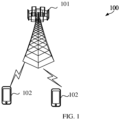
- the embodiments of this application may be applied to a wireless communication system 100, including a network device 101 and a terminal 102.
- the network device 101 is a transmit end
- the terminal 102 is a receive end.
- the network device 101 is a receive end.
- the transmit end may also be referred to as an encoding device
- the receive end may also be referred to as a decoding device.
- the network device may be a base station, or may be a device integrating a base station and a base station controller, or may be another device having a similar communication function.
- the network device 101 is a device that has a wireless transceiver function or a chip that may be disposed in the device.
- the device includes but is not limited to: an evolved NodeB (evolved NodeB, eNB), a radio network controller (radio network controller, RNC), a NodeB (NodeB, NB), a base station controller (base station controller, BSC), a base transceiver station (base transceiver station, BTS), a home base station (for example, a home evolved NodeB or a home NodeB, HNB), a baseband unit (baseband unit, BBU), an access point (access point, AP) in a wireless fidelity (wireless fidelity, Wi-Fi) system, a wireless relay node, a wireless backhaul node, a transmission point (transmission and reception point, TRP or transmission point, TP), or the like.
- an evolved NodeB evolved NodeB
- RNC radio network controller
- NodeB NodeB
- the device may alternatively be a gNB or a transmission point (TRP or TP) in a 5G (for example, NR) system, or one antenna panel or one group (including a plurality of antenna panels) of antenna panels of a base station in a 5G system.
- the device may alternatively be a network node, for example, a baseband unit (BBU) or a distributed unit (distributed unit, DU), that constitutes a gNB or a transmission point.
- BBU baseband unit
- DU distributed unit
- the gNB may include a centralized unit (centralized unit, CU) and a DU.
- the gNB may further include a radio frequency unit (radio unit, RU).
- the CU implements some functions of the gNB
- the DU implements some functions of the gNB.
- the CU implements functions of a radio resource control (radio resource control, RRC) layer and a packet data convergence protocol (packet data convergence protocol, PDCP) layer
- the DU implements functions of a radio link control (radio link control, RLC) layer, a media access control (media access control, MAC) layer, and a physical (physical, PHY) layer.
- RRC radio resource control
- PDCP packet data convergence protocol
- the DU implements functions of a radio link control (radio link control, RLC) layer, a media access control (media access control, MAC) layer, and a physical (physical, PHY) layer.
- the network device may be a CU node, a DU node, or a device including a CU node and a DU node.
- the CU may be allocated as a network device in a radio access network (RAN), or the CU may be allocated as a network device in a core network (CN). This is not limited herein.
- the terminal may also be referred to as user equipment (user equipment, UE), an access terminal, a subscriber unit, a subscriber station, a mobile station, a mobile console, a remote station, a remote terminal, a mobile device, a user terminal, a terminal, a wireless communication device, a user agent, or a user apparatus.
- user equipment user equipment
- UE user equipment
- an access terminal a subscriber unit, a subscriber station, a mobile station, a mobile console, a remote station, a remote terminal, a mobile device, a user terminal, a terminal, a wireless communication device, a user agent, or a user apparatus.
- the terminal in the embodiments of this application may be a mobile phone (mobile phone), a tablet (Pad), a computer having a wireless transceiver function, a virtual reality (virtual reality, VR) terminal, an augmented reality (augmented reality, AR) terminal, a wireless terminal in industrial control (industrial control), a wireless terminal in self driving (self driving), a wireless terminal in telemedicine (telemedicine), a wireless terminal in a smart grid (smart grid), a wireless terminal in transportation safety (transportation safety), a wireless terminal in a smart city (smart city), a wireless terminal in a smart home (smart home), or the like.
- An application scenario is not limited in the embodiments of this application.
- a terminal having a wireless transceiver function and a chip that may be disposed in the terminal are collectively referred to as a terminal.
- An encoding policy of the polar code is to transmit information useful to a user through a noiseless channel, and transmit agreed information through a pure noisy channel, or transmit no information through a pure noisy channel.
- the polar code is also a linear block code.
- F 2 ⁇ log 2 N is defined as a Kronecker (Kronecker) product of log 2 N matrices F 2 .
- the matrix F 2 1 0 1 1 .
- one part of bits in u 1 N are used to carry information, and are referred to as a set of information bits, where a set of indexes of the bits is denoted as A; and another part of bits are set to a fixed value pre-agreed upon between a receive end and a transmit end, and are referred to as a set of fixed bits or a set of frozen bits (frozen bits), where a set of indexes of the bits is indicated by a complementary set A c of A.
- G N (A) is a sub-matrix obtained from rows corresponding to the indexes in the set A in G N
- G N (A C ) is a sub-matrix obtained from rows corresponding to the indexes in the set A c in G N
- u A represents a set of information bits whose quantity is K in u 1 N
- u A represents a set of information bits in u 1 N
- u A represents a row vector of a length K , that is,
- K
- represents a quantity of elements in the set
- K represents an information block size
- G N ( A ) represents a submatrix obtained based on rows that are in G N and that correspond to indexes in the set A
- G N (A) is a K ⁇ N matrix.
- a construction process of the polar code is a selection process of the set A, which determines performance of the polar code.
- the construction process of the polar code is usually as follows: It is determined, based on the mother code length N, that there are N polarized channels in total, corresponding to N rows of the encoding matrix respectively. Reliability of the polarized channels is calculated. Indexes of first K polarized channels with relatively high reliability are used as elements of the set , and indexes corresponding to remaining (N-K) polarized channels are used as elements of the constant bit index set A c .
- the set A determines positions of the information bits, and the set A c determines positions of the fixed bits.
- a generator matrix of the polar code is a lower triangular matrix with a highly recursive structure.
- a generator matrix of a polar code of a length N is G N
- the method designed in this application utilizes the recursive characteristic of the polar code, and also uses a PW offline construction algorithm to obtain a nesting characteristic of a sequence Q 1 N max , as described in (III).
- Sorting of the reliability of the split sub-channels calculated based on the PW offline construction algorithm meets the following relationships: Inference 1: Sorting of subscripts (N+1 to 2N) of the second half split sub-channels of a polar code of a code length 2 N is equal to sorting of subscripts of split sub-channels of a polar code of a code length N plus N
- sequence numbers 0 to N-1 are equivalent to sequence numbers 1 to N, which are merely expressed in different manners.
- Q 1 2 N is used to construct a polar code of C ( K 2 ,2 N ).
- the first ( K 2 ) th elements in the sequence Q 1 2 N are selected to transmit information. Elements that meet the conditions are put into a set A 2 .
- a quantity of elements that are in A 2 and that are located within a range of N + 1 to 2 N is counted, which is denoted as K 1 , and the corresponding elements are put into a set A 1 ′ .
- Q 1 N is used to construct a polar code of C ( K 1 , N ), and a set of split sub-channels of the polar code that are used to transmit information bits is A 1 .
- Each element in A 1 is added with N to obtain an updated subscript set, which is denoted as A 1 " .
- inference 2 can be derived.
- Inference 2 The set A 1 ′ of subscripts of the split sub-channels of the second half ( N + 1 to 2 N ) of the code word C ( K 2 ,2 N ) that are used to place information bits is consistent with the updated set A 1 " of subscripts of the split sub-channels of the code word C ( K 1 , N ) that are used to transmit information.
- T max 4.
- the transmit end performs retransmission.
- Each of the four transmissions has a same code word length. Lengths of new code words constructed in the four transmissions are respectively N 1 , N 2 , N 3 , and N 4 .
- a series of code words whose code rates are continuously reduced are designed.
- polar code parameters designed for the four transmissions are C ( K 1 , N 1 ,A 1 ), C ( K 2 , N 2 ,A 2 ), C ( K 3 , N 3 ,A 3 ), and C ( K 4 , N 4 , A 4 ).
- the equivalent polar codes C ( K 2 , N 2 , A 2 ), C ( K 3 , N 3 , A 3 ), and C ( K 4 , N 4 , A 4 ) for retransmissions are constructed.
- the transmit end is allowed to jointly encode a new information bit and a previously transmitted information bit during each retransmission, and quantities of new information bits in retransmissions are respectively K 2 - K 1 , K 3 - K 2 , and K 4 - K 3 .
- the four constructed polar code words have the following two important properties, which are respectively the following (1) and (2).
- a 1 , A 2 , A 3 , and A 4 are all information bit position sets obtained by using the PW offline construction algorithm.
- the code words C ( K 1 , N 1 , A 1 ), C ( K 2 , N 2 , A 2 ), C ( K 3 , N 3 , A 3 ), and C ( K 4 , N 4 , A 4 ) are standard polar codes based on the PW construction algorithm. In other words, when jointly decoding code words transmitted in several times, the receive end always decodes a complete standard polar code based on the PW construction algorithm.
- Table 1 Method nested code word construction method
- Input a sequence Q 1 4 N 1 constructed by using the PW algorithm and an information bit position set A 1 (A 1 ⁇ ⁇ 1,2, ⁇ , N 1 ⁇ , and
- K 1 ) of the polar code C ( K 1 , N 1 ,A 1 ) based on the PW construction algorithm
- Output code rates R 2 , R 3 , and R 4 of equivalent polar codes for transmissions, and information bit position sets A 2 , A 3 , and A 4 of the equivalent polar codes for the transmissions 1.
- the construction parameter includes an information bit position set. For example, information bit position sets of polar codes generated in the four transmissions are respectively A 1 , A 2 , A 3 , and A 4 . Code rates R 1 , R 2 , R 3 , and R 4 of the four transmissions may also be determined.
- the encoding device may be a terminal, and the decoding device is a network device.
- the encoding device is a network device, and the decoding device is a terminal.
- the method embodiment shown in FIG. 2 is an encoding and decoding method for any two adjacent transmissions. For example, when decoding of initially transmitted data fails, retransmission is performed for the first time. Alternatively, when decoding of data retransmitted the first time fails, retransmission is performed for the second time. Alternatively, when decoding of data retransmitted the second time fails, retransmission is performed for the third time.
- a retransmission system may specify a maximum quantity of retransmissions. When the maximum quantity of retransmissions has not been reached, the encoding device may further encode and retransmit data. If the maximum quantity of retransmissions is reached, the encoding device may send the initially transmitted data to the decoding device. Alternatively, the decoding device notifies that decoding fails and ends the procedure.
- the encoding device performs polar code encoding on K first to-be-encoded bits based on a first construction parameter to obtain a first code word.
- the K first to-be-encoded bits include an information bit and a check bit, which are denoted herein as a first information bit and a first check bit.
- a total quantity of the first information bit and the first check bit is K.
- K is a positive integer.
- the first check bit is used to check the first information bit.
- the construction parameter is a parameter used in an encoding process.
- the construction parameter includes an information bit position set A.
- the information bit position set A is used to indicate a position of an information bit.
- the information bit position set may be used to indicate a position of a to-be-encoded bit.
- the construction parameter may further include a quantity of to-be-encoded bits or a code length of a polar code.
- the first construction parameter in step S201 includes a first information bit position set, and elements in the first information bit position set are used to indicate positions of the K first to-be-encoded bits.
- a parameter N is a length of a mother code obtained through encoding during initial transmission, and N is an integer power of 2.
- a length of a mother code obtained after encoding the K first to-be-encoded bits is N, and N is an integer power of 2.
- a length of the first code word is less than or equal to N, and the first code word may be a code word obtained after rate matching is performed on the mother code.
- the first code word is data retransmitted the first time
- a length of a mother code obtained after encoding the K first to-be-encoded bits is 2N
- a length of the first code word is less than or equal to 2N.
- the first code word may be a code word obtained after rate matching is performed on the mother code.
- the first code word is data retransmitted the second time
- a length of a mother code obtained after encoding the K first to-be-encoded bits is 3N
- a length of the first code word is less than or equal to 3N.
- the first code word may be a code word obtained after rate matching is performed on the mother code.
- the encoding device sends the first code word to the decoding device.
- the decoding device receives to-be-decoded information from the encoding device, which is denoted as first to-be-decoded information.
- the to-be-decoded information may be a log-likelihood ratio.
- S203 The decoding device decodes the first to-be-decoded information.
- the decoding device decodes the first to-be-decoded information, and checks, by using the first check bit, an information bit obtained through decoding. If the check succeeds, it indicates that decoding succeeds or transmission succeeds. If the check fails, it indicates that decoding fails or transmission fails.
- the decoding device When failing to decode the first to-be-decoded information, the decoding device sends, to the encoding device, information used to indicate that decoding of the first to-be-decoded information fails.
- the encoding device receives, from the decoding device, the information used to indicate that decoding of the first to-be-decoded information fails.
- an indication message is returned.
- the information used to indicate that decoding of the first to-be-decoded information fails is negative acknowledgment (negative acknowledgment, NACK) information.
- the decoding device when successfully decoding the first to-be-decoded information, the decoding device returns, to the encoding device, information used to indicate decoding of the first to-be-decoded information succeeds, for example, an acknowledgment (acknowledgment, ACK) response message.
- an acknowledgment acknowledgement
- the encoding device After receiving the information used to indicate that decoding of the first to-be-decoded information fails, the encoding device performs retransmission. In this application, the encoding device adds a new information bit in a retransmission process.
- the K first to-be-encoded bits are carried in the last transmission, and the K first to-be-encoded bits and the K' second to-be-encoded bits are re-encoded during retransmission.
- the second to-be-encoded bits are different from the first to-be-encoded bits, or in other words, an information bit in the second to-be-encoded bits is different from the information bit in the first to-be-encoded bits. In this way, a new information bit can be transmitted, reducing redundancy in retransmission.
- the second to-be-encoded bits include a part of bits in the first to-be-encoded bits, and in an encoding process of the last transmission, the part of bits are located at the first one or more of positions in the first information bit position set that are arranged in ascending order of reliability.
- the encoding device obtains an offline stored construction parameter, determines a construction parameter that needs to be used for encoding in a current retransmission, which is denoted as a second construction parameter.
- the second construction parameter includes a second information bit position set, and elements in the second information bit position set are used to indicate positions of the K first to-be-encoded bits and positions of the K' second to-be-encoded bits.
- an element that is in the second information bit position set and that is used to indicate a position of a first to-be-encoded bit is a sum of N and an element that is in the first information bit position set and that is used to indicate the position of the first to-be-encoded bit.
- N is a length of a mother code obtained after encoding during initial transmission
- N is an integer power of 2.
- the encoding device re-encodes the K first to-be-encoded bits and the K' second to-be-encoded bits based on the second construction parameter, to obtain the second code word.
- the first code word is a subcode of the second code word.
- the second to-be-encoded bits may include only information bits.
- the second to-be-encoded bits may include an information bit and a check bit, which are denoted as a second information bit and a second check bit.
- the second check bit may be used to check the first information bit and/or the second information bit.
- the encoding device sends a subcode in the second code word other than the first code word to the decoding device.
- the decoding device receives second to-be-decoded information from the encoding device.
- the encoding device may transmit a subcode in the second code word other than the first code word this time.
- the decoding device After receiving the second to-be-decoded information from the retransmission, the decoding device decodes the first to-be-decoded information and the second to-be-decoded information.
- the encoding device jointly encodes the K first to-be-encoded bits and the K' second to-be-encoded bits, and performs polar code encoding in a normal encoding manner. Therefore, the decoding device may jointly decode the first to-be-decoded information received last time and the second to-be-decoded information received this time. For example, decoding is performed in combination with log-likelihood ratios received in the two times to obtain information bits.
- the second to-be-encoded bits may or may not include a check bit. Therefore, the decoding device needs to determine a check relationship during decoding. If the second to-be-encoded bits do not include a check bit, the decoding device uses the first check bit to check the information bit transmitted last time, which does not cause a large loss to decoding performance because a quantity of first information bits transmitted last time is much more than a quantity of second information bits transmitted this time. If the second to-be-encoded bits include a check bit, the decoding device uses the first check bit to check the first information bit transmitted last time, and may further use the second check bit to check the first information bit and/or the second information bit transmitted this time.
- the decoding device may further return decoding failure information to the encoding device. After receiving the decoding failure information, the encoding device further performs retransmission.
- a retransmission method is the same as that described above.
- the HARQ system may have a maximum quantity of retransmissions. Based on the maximum quantity of retransmissions, the encoding device and the decoding device perform polar code retransmission based on the foregoing method.
- the first transmission means that to-be-sent data is initially transmitted, rather than retransmitted.
- a polar code C ( K 1 , N 1 , A 1 ) with an optimal code rate R 1 K 1 / N 1 used for transmission, K 1 is a quantity of to-be-encoded bits, N 1 is a length of a code word obtained through encoding, and A 1 is an information bit position set.
- Code rates of equivalent polar codes for subsequent retransmissions are determined based on the nested code word construction method shown in Table 1, to obtain information bit position sets A 2 , A 3 , and A 4 in the retransmissions.
- 3(c) are a schematic diagram of encoding and decoding for the first transmission and the second transmission.
- a transmit end is an encoding device
- a receive end is a decoding device.
- FIG. 3(a) is a schematic diagram of encoding in the first transmission.
- the encoding in the first transmission includes K 1 - m information bits.
- the encoding device first performs check encoding on the K 1 - m information bits to generate m check bits, for example, performs cyclic redundancy check (cyclic redundancy check, CRC) check encoding to generate m CRC check bits.
- CRC cyclic redundancy check
- the m generated check bits are added behind the K 1 - m information bits, which are sent to a polar code encoder for encoding.
- a code word obtained after encoding is C ( K 1 , N 1 , A 1 ), which is sent to a channel for sending.
- a 1 is an information bit position set of a polar code transmitted the first time. Positions of the information bits, frozen bits, and the check bits are shown in FIG. 3(a) .
- the transmit end is represented by TX, and a code word transmitted the first time is represented by Tx1.
- the receive end decodes received to-be-decoded information (for example, a log-likelihood ratio) by using a cyclic redundancy check aided successive cancellation list (cyclic redundancy check aided successive cancellation list, CA-SCL) decoder, and performs CRC check on information bits obtained through decoding. If the CRC check succeeds, it indicates that decoding succeeds or transmission succeeds this time, and the receive end returns an acknowledgment (ACK) response. If the CRC check fails, the receive end discards the received data and returns NACK information. The transmit end receives the NACK information, and performs retransmission.
- a cyclic redundancy check aided successive cancellation list cyclic redundancy check aided successive cancellation list, CA-SCL
- the following describes a process of encoding and decoding during retransmission.
- FIG. 3(b) is a schematic diagram of encoding in the second transmission, that is, the first retransmission.
- the transmit end adds each element in the information bit position set A 1 of the polar code transmitted the first time with N 1 to obtain an updated subscript set, which is denoted as A 1 ′ .
- new information bits are placed in a set A 2 ⁇ A 1 ′ , whose size is K 2 - K 1 bits.
- information bits of a part of N 1 + 1 to 2 N 1 in the second transmission are the same as the information bits in the first transmission.
- a 2 is a construction parameter for encoding in the second transmission, and is a position set of the information bits and the check bits in the first transmission and the information bits newly added in the second transmission.
- a code word C ( K 2 , N 2 , A 2 ) is obtained after polar code encoding is performed based on A 2 .
- a length of the code word C ( K 2 , N 2 , A 2 ) is 2N 1 .
- the second half of the code word C ( K 2 , N 2 , A 2 ) is the same as the code word C ( K 1 , N 1 , A 1 ).
- the transmit end needs to transmit only the first half (0 to Ni-1) of the code word C ( K 2 , N 2 , A 2 ) .
- Both a code word length of the second transmission and a code word length of the first transmission are N 1 , and a code word transmitted the second time is a newly added part corresponding to Tx2. It can be learned that the polar code obtained in this encoding manner meets the nesting property.
- Retransmission is performed based on a code rate and an information bit position set of an equivalent polar code determined for subsequent retransmission by using the nested code word construction method shown in Table 1, so that the receive end may combine log-likelihood ratios received from the two transmissions ( Tx 1 and Tx 2) to form to-be-decoded information corresponding to the polar code C ( K 2 , N 2 , A 2 ) and perform CA-SCL decoding.
- the CRC check bits check only the information bits transmitted the first time, and do not check the newly transmitted information bits. Therefore, the receive end needs to determine a check relationship during decoding.
- the CRC check bits check only the information bits transmitted the first time during decoding for the second transmission, this does not cause a large loss to decoding performance, because a quantity of the information bits in the first transmission is much more than a quantity of the new information bits in the second transmission.
- Code words of the four transmissions are respectively a code word C ( K 1 , N 1 , A 1 ) , a code word C ( K 2 , N 2 , A 2 ) , a code word C ( K 3 , N 3 ,A 3 ) , and a code word C ( K 4 , N 4 , A 4 ) .
- FIG. 4 is a schematic diagram of a solution for four polar code HARQ transmissions. Because the code word C ( K 1 , N 1 , A 1 ) is a subcode of C ( K 2 , N 2 , A 2 ) , C ( K 2 , N 2 , A 2 ) includes all code word bits in C ( K 1 , N 1 , A 1 ). When the first transmission fails, the transmit end needs to retransmit only a different part in C ( K 2 , N 2 , A 2 ) from the code word C ( K 1 , N 1 ,A 1 ) , that is, C ( K 2 , N 2 , A 2 )- C ( K 1 , N 1 , A 1 ).
- the receive end needs to combine the code word in the second transmission and the code word in the first transmission to form the polar code C ( K 2 , N 2 , A 2 ) for decoding. If the second transmission fails, a different part in C ( K 3 , N 3 , A 3 ) from the code word C ( K 2 , N 2 , A 2 ), that is, C ( K 3 , N 3 , A 3 )- C ( K 2 , N 2 , A 2 ), is transmitted the third time. The receive end combines all the code words received from the three transmissions to form the polar code C ( K 3 , N 3 , A 3 ) for decoding.
- the receive end combines all the code words received from the four transmissions to form the polar code C ( K 4 , N 4 , A 4 ) for decoding.
- a case is considered as follows: The code word C ( K 3 , N 3 , A 3 ) obtained after the third transmission is equivalent to puncturing the first 1/4 part of a code word C ( K 3 , N 3 , A 3 ) of a length N 4 . The puncturing is removing the first 1/4 part. A 3' is obtained by adding each element in A 3 with N 1 . In this case, a code rate is K 3 / N 4 .
- Another case is considered as follows: C ( K 4 , N 4 , A 4 )- C ( K 3 , N 3 , A 3 ) rather than C ( K 3 , N 3 , A 3 )- C ( K 2 , N 2 , A 2 ) is transmitted in the third transmission.
- the code word is also equivalent to puncturing a code word of the length N 4 (puncturing a part of the first 1/4 to 1/2), but this code word of the length N 4 is C ( K 4 , N 4 , A 4 ) with a code rate K 4 / N 4 that is higher than that in the case considered above. Therefore, in the third transmission, the part of C ( K 4 , N 4 , A 4 )- C ( K 3 , N 3 , A 3 ) may be transmitted, which is a solution with a higher code rate.
- the receive end combines, into a code word for joint decoding, to-be-decoded information received this time and to-be-decoded information that is previously received but fails to be decoded, and checks information bits obtained after decoding.
- a retransmitted code word may include a new information bit different from an information bit transmitted last time, and may also include a check bit for checking the new information bit.
- FIG. 5 shows that an information bit and a check bit are carried in four transmissions.
- the longest code word shown in FIG. 5 is a code word obtained through encoding in the fourth transmission. Hierarchically, a part shown in 3N 1 to 4N 1 -1 in FIG. 5 is transmitted the first time.
- the decoding device After receiving to-be-decoded information of the first transmission, the decoding device performs decoding, and checks, by using a check bit, an information bit obtained through decoding. When the check fails, decoding failure information is returned to the transmit end. After receiving the decoding failure information, the encoding device performs re-encoding based on a construction parameter to obtain a code word shown in 2N 1 to 4N 1 -1, and adds a new information bit and a check bit to a part of 2N 1 to 3N 1 -1. In FIG. 5 , an arrow indicates a check relationship, and a check bit is used to check an information bit pointed by the arrow.
- the decoding device After receiving to-be-decoded information from retransmission (that is, the second transmission), the decoding device jointly decodes the to-be-decoded information and the to-be-decoded information received in the first time, and checks, by using two groups of check bits, information bits obtained through decoding, to obtain a check result. When the check result is decoding failure, decoding failure information is returned to the encoding device.
- the encoding device After receiving the decoding failure information, the encoding device performs re-encoding based on a construction parameter to obtain a code word shown in N 1 -1 to 4N 1 -1, and adds a new information bit and a check bit to a part of N 1 to 2N 1 -1.
- an arrow indicates a check relationship, and a check bit is used to check an information bit pointed by the arrow.
- the third transmission only a part different from those in the previous two transmissions, that is, a code word of the part of N 1 to 2N 1 -1, is transmitted.
- the decoding device After receiving to-be-decoded information from retransmission (that is, the third transmission), the decoding device jointly decodes the to-be-decoded information and the to-be-decoded information received in the first time and the second time, and checks, by using three groups of check bits, information bits obtained through decoding, to obtain a check result. When the check result is decoding failure, decoding failure information is returned to the encoding device. After receiving the decoding failure information, the encoding device performs re-encoding based on a construction parameter to obtain a code word shown in 0 to 4N 1 -1, and adds a new information bit and a check bit to a part of 0 to N 1 -1. In FIG.
- an arrow indicates a check relationship, and a check bit is used to check an information bit pointed by the arrow.
- the decoding device After receiving to-be-decoded information from retransmission (that is, the fourth transmission), the decoding device jointly decodes the to-be-decoded information and the to-be-decoded information received in the first time, the second time, and the third time, and checks, by using four groups of check bits, information bits obtained through decoding, to obtain a check result. If the system limits the maximum quantity of transmissions to 4, it is determined that decoding fails when the check fails.
- a new check bit is added in each retransmission.
- no check bit may be transmitted, and only a new information bit is transmitted.
- newly transmitted valid information bits are reduced.
- a plurality of retransmissions are performed, and a quantity of newly added information bits is less than that in the first transmission, it may be considered that no new check bit is used, or it may be considered that no new information bit is added in retransmission (and certainly, no new check bit is used).
- the new information bit in each retransmission is an information bit different from an information bit in one or more previous transmissions.
- another possible implementation is further provided. That is, a part of bits (decoded as copied bits) in information bits in one or more previous transmissions are placed at a part of positions of information bits in each retransmission, and new information bits different from the information bits in the one or more previous transmissions are placed at another part of positions.
- the encoding device performs CRC encoding on the copied bits and the new information bits together, then performs polar code encoding, and retransmits a code word obtained after encoding. As shown in FIG. 6 , two transmissions are used as an example. The longest code word shown in FIG.
- 6 is a code word obtained through encoding in the second transmission.
- an information bit on a sub-channel with relatively low reliability in the last transmission is placed at an information bit position of a part of 0 to Ni-1, and a new information bit is placed at another information bit position, and a new check bit may also be placed, or no new check bit may be placed.
- encoding is performed based on a construction parameter to generate a code word of a length 2N 1 . Only a subcode of the part of 0 to N 1 -1 is transmitted during retransmission.
- the decoding device first checks bits in the part of 0 to N 1 -1.
- the copied bit in the part of 0 to Ni-1 may be used as a known bit for decoding a part of Ni-1 to 2N 1 -1. In this way, when the decoding device performs decoding, to-be-decoded information corresponding to the second to-be-encoded bits is ahead of to-be-decoded information corresponding to the first to-be-encoded bits, and the decoding device performs check bit by bit.
- a copied bit in the second to-be-encoded bits may be used as a known bit when successfully checked, and in a process of further decoding the first to-be-decoded information behind, a part of first information bits that is copied into the second to-be-encoded bits during encoding does not need to be decoded again, and is directly used as a frozen bit.
- a code rate may be further reduced, thereby improving a throughput.
- an embodiment of this application further provides a polar code retransmission apparatus 700.
- the polar code retransmission apparatus 700 may be configured to perform operations performed by the encoding device or the decoding device in the foregoing method embodiment.
- the polar code retransmission apparatus 700 includes a processing unit 701, a sending unit 702, and a receiving unit 703.
- the processing unit 701 is configured to perform polar code encoding on K first to-be-encoded bits based on a first construction parameter to obtain a first code word, where the first construction parameter includes a first information bit position set, elements in the first information bit position set are used to indicate positions of the K first to-be-encoded bits, and K is a positive integer.
- the sending unit 702 is configured to send the first code word to a decoding device.
- the receiving unit 703 is configured to receive, from the decoding device, information used to indicate that decoding of the first code word fails.
- the processing unit 701 is further configured to perform polar code encoding on the K first to-be-encoded bits and K' second to-be-encoded bits based on a second construction parameter to obtain a second code word, where K' is a positive integer, the second construction parameter includes a second information bit position set, elements in the second information bit position set are used to indicate positions of the K first to-be-encoded bits and positions of the K' second to-be-encoded bits, an element that is in the second information bit position set and that is used to indicate a position of a first to-be-encoded bit is a sum of N and an element that is in the first information bit position set and that is used to indicate the position of the first to-be-encoded bit, N is a length of a mother code obtained through encoding during initial transmission, and N is an integer power of 2.
- the sending unit 702 is further configured to send a subcode in the second code word other than the first code word to the decoding device.
- the first to-be-encoded bits include a first information bit and a first check bit, and the first check bit is used to check the first information bit.
- the second to-be-encoded bits include a second information bit.
- the second to-be-encoded bits include the second information bit and a second check bit, and the second check bit is used to check the first information bit and/or the second information bit.
- the second to-be-encoded bits are different from the first to-be-encoded bits.
- the second to-be-encoded bits include a part of bits in the first to-be-encoded bits, and the part of bits are located at the first one or more of positions in the first information bit position set that are arranged in ascending order of reliability.
- the first code word is a subcode of the second code word.
- the receiving unit 703 is configured to receive first to-be-decoded information from an encoding device.
- the processing unit 701 is configured to decode the first to-be-decoded information.
- the sending unit 702 is configured to: when the processing unit fails to decode the first to-be-decoded information, send, to the encoding device, information used to indicate that decoding of the first to-be-decoded information fails.
- the receiving unit 703 is configured to receive second to-be-decoded information from the encoding device.
- the processing unit 701 is further configured to decode the first to-be-decoded information and the second to-be-decoded information.
- the processing unit 701 is further configured to check, by using first check information, an information bit obtained through decoding.
- the processing unit 701 is further configured to check, by using first check information, a first information bit obtained by decoding the first to-be-decoded information, and check, by using second check information, the first information bit and/or a second information bit obtained by decoding the second to-be-decoded information.
- the processing unit 701 is further configured to: check second information bits obtained by decoding the second to-be-decoded information, and if the check succeeds, use a part of the second information bits that is the same as a first information bit as a known bit; and decode the first to-be-decoded information based on the known bits.
- an embodiment of this application further provides a polar code retransmission apparatus 800.
- the polar code retransmission apparatus 800 is configured to perform operations performed by the encoding device or the decoding device in the foregoing method embodiment.
- the polar code retransmission method in the foregoing embodiment may be partially or entirely implemented by hardware or software.
- the polar code retransmission apparatus 800 includes an input interface circuit 801, a logic circuit 802, and an output interface circuit 803.
- the input interface circuit 801 is configured to obtain K first to-be-encoded bits and K' second to-be-encoded bits.
- the logic circuit 802 is configured to perform the method performed by the encoding device in the foregoing method embodiment. For details, refer to the description in the foregoing method embodiment. Details are not described herein again.
- the output interface circuit 803 is configured to output a first code word obtained after encoding, and a subcode in a second code word obtained after encoding other than the first code word.
- the input interface circuit 801 is configured to obtain first to-be-decoded information and second to-be-decoded information.
- the logic circuit 802 is configured to perform the method performed by the decoding device in the foregoing method embodiment. For details, refer to the description in the foregoing method embodiment. Details are not described herein again.
- the output interface circuit 803 is configured to output a decoding result.
- the polar code transmission apparatus 800 may be a chip or an integrated circuit.
- the polar code retransmission apparatus 800 includes: a memory 901, configured to store a program; and a processor 902, configured to execute the program stored in the memory 901.
- the program is executed, the polar code retransmission apparatus 800 is enabled to implement the polar code retransmission method provided in the foregoing embodiments.
- the memory 901 may be a physically independent unit.
- the memory 901 is integrated with the processor 902.
- the polar code retransmission apparatus 800 may alternatively include only a processor 902.
- a memory 901 configured to store a program is located outside the polar code retransmission apparatus 1800.
- the processor 902 is connected to the memory 901 by using a circuit/wire, and is configured to read and execute the program stored in the memory 901.
- An embodiment of this application provides a computer storage medium, configured to store a computer program.
- the computer program includes instructions for performing the polar code retransmission method.
- An embodiment of this application provides a computer program product including instructions.
- the computer program product runs on a computer, the computer is enabled to perform the polar code retransmission methods.
- this application may be provided as a method, a system, or a computer program product. Therefore, this application may use a form of hardware only embodiments, software only embodiments, or embodiments with a combination of software and hardware. In addition, this application may use a form of a computer program product that is implemented on one or more computer-usable storage media (including but not limited to a disk memory, a CD-ROM, an optical memory, and the like) that include computer-usable program code.
- a computer-usable storage media including but not limited to a disk memory, a CD-ROM, an optical memory, and the like
- These computer program instructions may be provided for a general-purpose computer, a dedicated computer, an embedded processor, or a processor of another programmable data processing device to generate a machine, so that the instructions executed by the computer or the processor of the another programmable data processing device generate an apparatus for implementing a specific function in one or more procedures in the flowcharts and/or in one or more blocks in the block diagrams.
- These computer program instructions may alternatively be stored in a computer-readable memory that can indicate a computer or another programmable data processing device to work in a specific manner, so that the instructions stored in the computer-readable memory generate an artifact that includes an instruction apparatus.
- the instruction apparatus implements a specific function in one or more procedures in the flowcharts and/or in one or more blocks in the block diagrams.
- These computer program instructions may alternatively be loaded onto the computer or the another programmable data processing device, so that a series of operations and steps are performed on the computer or the another programmable device, to generate computer-implemented processing. Therefore, the instructions executed on the computer or the another programmable device provide steps for implementing a specific function in one or more procedures in the flowcharts and/or in one or more blocks in the block diagrams.
Landscapes
- Engineering & Computer Science (AREA)
- Computer Networks & Wireless Communication (AREA)
- Signal Processing (AREA)
- Detection And Prevention Of Errors In Transmission (AREA)
Description
- Embodiments of this application relate to the field of communication technologies, and in particular, to a polar code retransmission method and apparatus.
- As the most basic radio access technology, channel encoding plays an important role in ensuring reliable data transmission. In an existing wireless communication system, channel encoding is usually performed by using a turbo code, a low density parity check (low density parity check, LDPC) code, and a polar code. The polar code proposed by Professor Arikan is a good code that is theoretically proved to be capable of reaching a Shannon capacity and has relatively low encoding and decoding complexity, and therefore is increasingly widely applied.
- Generally, for a delay-insensitive time-varying channel, an adaptive transmission method - a hybrid automatic repeat request (hybrid automatic repeat request, HARQ) protocol needs to be used, which is a technology that combines forward error correction (forward error correction, FEC) and an automatic repeat request (automatic repeat request, ARQ) protocol to implement reliable communication and improve a system throughput. Compared with a polar code with a fixed code rate, a polar code using the HARQ technology requires rate compatibility, that is, a code rate for encoding may be flexibly configured by changing a code length, and a to-be-sent bit may be flexibly selected depending on an expected code rate. Therefore, when the channel dynamically changes, the HARQ polar code is more efficient than a polar code with a fixed code rate that is designed for a worst channel. However, a length of the polar code proposed by Professor Arikan needs to meet a condition of being an integer power of 2, which brings severe challenges to compatibility in code lengths and code rates.
- In an existing HARQ solution, a code word the same as that transmitted last time is transmitted during each retransmission, and a receive end adds up code words received in a plurality of times for decoding. The HARQ solution does not have an encoding gain though achieving a signal-to-noise ratio gain, and therefore has a relatively low throughput. Based on this, a HARQ polar code transmission solution based on an extended generator matrix is proposed in a conventional technology. A transmit end uses the extended generator matrix to generate code words whose code rates are continuously reduced for transmission, and a receive end combines code words received in a plurality of times into a long code for decoding, to obtain a relatively large encoding gain. However, in the solution, when a real physical channel has a relatively high signal-to-noise ratio, a throughput is relatively low because a same information bit is retransmitted each time.
- HUAWEI ET AL: "HARQ scheme for polar codes", 3GPP DRAFT; R1-1613301 HARQ SCHEME FOR POLAR CODES, 3GPP, MOBILE COMPETENCE CENTRE; 650; ROUTE DES LUCIOLES; F-06921 SOPHIA-ANTIPOLIS CEDEX; FRANCE, vol. RAN WG1, no. Reno, USA,; 20161114 - 20161118 19 November 2016 (2016-11-19), summarizes the IF-HARQ method and discusses IR-HARQ scheme and its performance.
-
WO 2018/201481 A1 discloses a method and a device for IR-HARQ retransmission. -
WO 2019/095190 A1 discloses a reduced overhead error detection code design for decoding. - In order to solve the above-mentioned problems, this application provides a polar code retransmission method according to
claim 1, a polar code retransmission apparatus according to claim 8 and a computer-readable storage medium according to claim 15, to achieve an encoding gain in a HARQ polar code retransmission process and improve a throughput. - Specific technical solutions provided in the embodiments of this application are as follows.
- According to a first aspect, a polar code retransmission method is provided. The method is performed by a transmit end, an encoding device, a chip, or a logic circuit. The method includes the following steps: Based on offline generated construction parameters used to generate polar codes in a plurality of transmissions, information bits in the transmissions are encoded to generate polar codes. A new information bit may be added during each retransmission. An information bit transmitted last time and a new information bit are encoded based on a construction parameter corresponding to a current transmission. After encoding, a different part in a current polar code from a polar code transmitted last time is transmitted. In this way, after receiving to-be-decoded information transmitted in several times, a decoding device performs combination, and decodes a combined code word. In this way, a code word characteristic of a polar code can be used to achieve an encoding gain in HARQ. Compared with an existing polar code HARQ solution, a part of information bits can be added during retransmission, thereby improving a system throughput.
- In a possible design, polar code encoding is performed on K first to-be-encoded bits based on a first construction parameter to obtain a first code word, where the first construction parameter includes a first information bit position set, elements in the first information bit position set are used to indicate positions of the K first to-be-encoded bits, and K is a positive integer. The first code word is sent to a decoding device. Information used to indicate that decoding of the first code word fails is received from the decoding device. Polar code encoding is performed on the K first to-be-encoded bits and K' second to-be-encoded bits based on a second construction parameter to obtain a second code word, where K' is a positive integer, the second construction parameter includes a second information bit position set, elements in the second information bit position set are used to indicate positions of the K first to-be-encoded bits and positions of the K' second to-be-encoded bits, an element that is in the second information bit position set and that is used to indicate a position of a first to-be-encoded bit is a sum of N and an element that is in the first information bit position set and that is used to indicate the position of the first to-be-encoded bit, N is a length of a mother code obtained through encoding during initial transmission, and N is an integer power of 2. A subcode in the second code word other than the first code word is sent to the decoding device. In this way, a code word characteristic of a polar code can be used to achieve an encoding gain in HARQ. Compared with an existing polar code HARQ solution, a part of information bits can be added during retransmission, thereby improving a system throughput.
- In a possible design, the first to-be-encoded bits include a first information bit and a first check bit, and the first check bit is used to check the first information bit. In this way, the decoding device may perform check based on the check bit, to determine whether an information bit obtained through decoding is correct.
- In a possible design, the second to-be-encoded bits include a second information bit. Alternatively, the second to-be-encoded bits include the second information bit and a second check bit, and the second check bit is used to check the first information bit and/or the second information bit. When the second check bit is used to check the second information bit, and the second check bit is added, because the second information bit is located ahead, effects of early stopping and path screening may be achieved by checking the second information bit by using the second check bit.
- In a possible design, the second to-be-encoded bits are different from the first to-be-encoded bits. Apart of information bits are added during retransmission, so that a system throughput can be improved.
- In a possible design, the second to-be-encoded bits include a part of bits in the first to-be-encoded bits, and the part of bits are located at the first one or more of positions in the first information bit position set that are arranged in ascending order of reliability. In this way, when the decoding device performs decoding, to-be-decoded information corresponding to the second to-be-encoded bits is ahead of to-be-decoded information corresponding to the first to-be-encoded bits, and the decoding device performs check bit by bit. If information bits obtained by decoding the to-be-decoded information corresponding to the second to-be-encoded bits are successfully checked, a part that is in the second to-be-encoded bits and that are the same as a part of bits in the first to-be-encoded bits may be used as a known bit, and in a process of further decoding the first to-be-decoded information behind, a part of first information bits that is copied into the second to-be-encoded bits during encoding does not need to be decoded again, and is directly used as a frozen bit. When a signal-to-noise ratio is relatively low, a code rate may be further reduced, thereby improving a throughput.
- In a possible design, the first code word is a subcode of the second code word.
- According to a second aspect, a polar code retransmission method is provided. The method is performed by a receive end, a decoding device, a chip, or a logic circuit. The method includes the following steps: receiving first to-be-decoded information from an encoding device; when failing to decode the first to-be-decoded information, sending, to the encoding device, information used to indicate that decoding of the first to-be-decoded information fails; receiving second to-be-decoded information from the encoding device; and decoding the first to-be-decoded information and the second to-be-decoded information. In this way, a code word characteristic of a polar code can be used to achieve an encoding gain in HARQ. Compared with an existing polar code HARQ solution, a part of information bits can be added during retransmission, thereby improving a system throughput.
- In a possible design, an information bit obtained through decoding is checked by using first check information. In this way, the decoding device may perform check based on a check bit, to determine whether an information bit obtained through decoding is correct.
- In a possible design, a first information bit obtained by decoding the first to-be-decoded information is checked by using first check information, and the first information bit and/or a second information bit obtained by decoding the second to-be-decoded information are/is checked by using second check information. When a second check bit is added, because the second information bit is located ahead, effects of early stopping and path screening may be achieved by checking the second information bit by using the second check bit.
- In a possible design, the second to-be-decoded information and the first to-be-decoded information are one piece of total to-be-decoded information, the decoding device decodes the total to-be-decoded information, and the second to-be-decoded information is decoded ahead of the first to-be-decoded information. Second information bits obtained by decoding the second to-be-decoded information are first checked, and if the check succeeds, a copied bit in the second information bits is used as a known bit, to further decode the first to-be-decoded information behind. The copied bit is an information bit that is the same as a part of first information bits and that is placed at a newly added information bit position during encoding. In this way, when the decoding device performs decoding, to-be-decoded information corresponding to the second to-be-encoded bits is ahead of to-be-decoded information corresponding to the first to-be-encoded bits, and the decoding device performs check bit by bit. If information bits obtained by decoding the to-be-decoded information corresponding to the second to-be-encoded bits are successfully checked, a part that is in the second to-be-encoded bits and that are the same as a part of bits in the first to-be-encoded bits may be used as a known bit when successfully checked, and in a process of further decoding the first to-be-decoded information behind, a part of first information bits that is copied into the second to-be-encoded bits during encoding does not need to be decoded again, and is directly used as a frozen bit for decoding. When a signal-to-noise ratio is relatively low, a code rate may be further reduced, thereby improving a throughput.
- According to a third aspect, a polar code retransmission apparatus is provided, and the apparatus has functions of implementing the method according to any one of the first aspect and the possible designs of the first aspect. The functions may be implemented by hardware, or may be implemented by hardware executing corresponding software. The hardware or the software includes one or more modules corresponding to the foregoing functions.
- In a possible design, when some or all of the functions are implemented by hardware, the polar code retransmission apparatus includes: an input interface circuit, configured to obtain K first to-be-encoded bits and K' second to-be-encoded bits; a logic circuit, configured to perform the method in any one of the first aspect and the possible designs of the first aspect; and an output interface circuit, configured to output a first code word obtained after encoding, and a subcode in a second code word obtained after encoding other than the first code word.
- Optionally, the polar code retransmission apparatus may be a chip or an integrated circuit.
- In a possible design, when some or all of the functions are implemented by software, the polar code retransmission apparatus includes: a memory, configured to store a program; and a processor, configured to execute the program stored in the memory. When the program is executed, the polar code retransmission apparatus may implement the method in any one of the first aspect and the possible designs of the first aspect.
- Optionally, the memory may be a physically independent unit, or may be integrated with the processor.
- In a possible design, when some or all of the functions are implemented by software, the polar code retransmission apparatus includes a processor. A memory configured to store a program is located outside the polar code retransmission apparatus. The processor is connected to the memory by using a circuit/wire, and is configured to read and execute the program stored in the memory.
- According to a fourth aspect, a polar code retransmission apparatus is provided. The apparatus has functions of implementing the method in any one of the second aspect and the possible designs of the second aspect. The functions may be implemented by hardware, or may be implemented by hardware executing corresponding software. The hardware or the software includes one or more modules corresponding to the foregoing functions.
- In a possible design, when some or all of the functions are implemented by hardware, the polar code retransmission apparatus includes: an input interface circuit, configured to obtain first to-be-decoded information and second to-be-decoded information; a logic circuit, configured to perform behavior of the decoding device in any one of the second aspect and the possible designs of the second aspect; and an output interface circuit, configured to output a decoding result.
- Optionally, the polar code retransmission apparatus may be a chip or an integrated circuit.
- In a possible design, when some or all of the functions are implemented by software, the polar code retransmission apparatus includes: a memory, configured to store a program; and a processor, configured to execute the program stored in the memory. When the program is executed, the polar code retransmission apparatus may implement the method in any one of the first aspect and the possible designs of the first aspect.
- Optionally, the memory may be a physically independent unit, or may be integrated with the processor.
- In a possible design, when some or all of the functions are implemented by software, the polar code retransmission apparatus includes a processor. A memory configured to store a program is located outside the polar code retransmission apparatus. The processor is connected to the memory by using a circuit/wire, and is configured to read and execute the program stored in the memory.
- According to a fifth aspect, a wireless communication system is provided. The system includes an encoding device and a decoding device. The encoding device performs the method in the first aspect or the possible designs, and/or the decoding device performs the method in the second aspect or the possible designs.
- According to a sixth aspect, a computer storage medium is provided, configured to store a computer program. The computer program includes instructions used to perform the method in any one of the first aspect, the second aspect, the possible implementations of the first aspect, or the possible implementations of the second aspect.
- According to a seventh aspect, a computer program product including instructions is provided. When the computer program product runs on a computer, the computer is enabled to perform the methods in the foregoing aspects.
-
-
FIG. 1 is a schematic diagram of an architecture of a wireless communication system according to an embodiment of this application; -
FIG. 2 is a first schematic flowchart of a polar code retransmission method according to an embodiment of this application; -
FIG. 3(a) to FIG. 3(c) are a second schematic flowchart of a polar code retransmission method according to an embodiment of this application; -
FIG. 4 is a schematic flowchart of four transmissions according to an embodiment of this application; -
FIG. 5 is a schematic diagram of information bit distribution of four transmissions according to an embodiment of this application; -
FIG. 6 is a schematic diagram of information bit distribution of two retransmissions according to an embodiment of this application; -
FIG. 7 is a first schematic diagram of a structure of a polar code retransmission apparatus according to an embodiment of this application; -
FIG. 8 is a second schematic diagram of a structure of a polar code retransmission apparatus according to an embodiment of this application; -
FIG. 9 is a third schematic diagram of a structure of a polar code retransmission apparatus according to an embodiment of this application; and -
FIG. 10 is a fourth schematic diagram of a structure of a polar code retransmission apparatus according to an embodiment of this application. - Embodiments of this application provide a polar code retransmission method and apparatus, to add a new information bit in each retransmission process during HARQ polar code transmission, and jointly encode a new information bit and a previously transmitted information bit, thereby improving a system throughput. The method and the apparatus are based on a same technical concept. Because a problem-resolving principle of the method is similar to that of the apparatus, mutual reference may be made to implementations of the apparatus and the method. Repeated parts are not described in detail again. In descriptions of the embodiments of this application, the term "and/or" describes an association relationship between associated objects and indicates that three relationships may exist. For example, A and/or B may indicate the following three cases: Only A exists, both A and B exist, and only B exists. The character "/" usually indicates an "or" relationship between the associated objects. In this application, "at least one" means one or more, and "a plurality of" means two or more. In addition, it should be understood that in the descriptions of this application, terms such as "first" and "second" are merely used for distinguishing and description, but should not be understood as indicating or implying relative importance, or should not be understood as indicating or implying a sequence.
- The following describes in detail the embodiments of this application with reference to the accompanying drawings.
- A polar code retransmission method provided in the embodiments of this application may be applied to a fifth generation (5th generation, 5G) communication system or various future communication systems. Specifically, for example, the most typical three communication scenarios of the 5G communication system include enhanced mobile broadband (enhanced mobile broadband, eMBB), massive machine-type communications (massive machine-type communications, mMTC), and ultra-reliable low-latency communication (ultra-reliable low-latency communication, URLLC).
- As shown in
FIG. 1 , the embodiments of this application may be applied to awireless communication system 100, including anetwork device 101 and a terminal 102. When thenetwork device 101 is a transmit end, the terminal 102 is a receive end. When the terminal 102 is a transmit end, thenetwork device 101 is a receive end. The transmit end may also be referred to as an encoding device, and the receive end may also be referred to as a decoding device. The network device may be a base station, or may be a device integrating a base station and a base station controller, or may be another device having a similar communication function. - The
network device 101 is a device that has a wireless transceiver function or a chip that may be disposed in the device. The device includes but is not limited to: an evolved NodeB (evolved NodeB, eNB), a radio network controller (radio network controller, RNC), a NodeB (NodeB, NB), a base station controller (base station controller, BSC), a base transceiver station (base transceiver station, BTS), a home base station (for example, a home evolved NodeB or a home NodeB, HNB), a baseband unit (baseband unit, BBU), an access point (access point, AP) in a wireless fidelity (wireless fidelity, Wi-Fi) system, a wireless relay node, a wireless backhaul node, a transmission point (transmission and reception point, TRP or transmission point, TP), or the like. The device may alternatively be a gNB or a transmission point (TRP or TP) in a 5G (for example, NR) system, or one antenna panel or one group (including a plurality of antenna panels) of antenna panels of a base station in a 5G system. The device may alternatively be a network node, for example, a baseband unit (BBU) or a distributed unit (distributed unit, DU), that constitutes a gNB or a transmission point. - In some deployments, the gNB may include a centralized unit (centralized unit, CU) and a DU. The gNB may further include a radio frequency unit (radio unit, RU). The CU implements some functions of the gNB, and the DU implements some functions of the gNB. For example, the CU implements functions of a radio resource control (radio resource control, RRC) layer and a packet data convergence protocol (packet data convergence protocol, PDCP) layer, and the DU implements functions of a radio link control (radio link control, RLC) layer, a media access control (media access control, MAC) layer, and a physical (physical, PHY) layer. Information at the RRC layer eventually becomes information at the PHY layer (in other words, information sent through the PHY layer), or is converted from information at the PHY layer. Therefore, in this architecture, higher layer signaling, for example, RRC layer signaling or PDCP layer signaling, may also be considered as being sent by the DU or sent by the DU and the RU. It may be understood that the network device may be a CU node, a DU node, or a device including a CU node and a DU node. In addition, the CU may be allocated as a network device in a radio access network (RAN), or the CU may be allocated as a network device in a core network (CN). This is not limited herein.
- The terminal may also be referred to as user equipment (user equipment, UE), an access terminal, a subscriber unit, a subscriber station, a mobile station, a mobile console, a remote station, a remote terminal, a mobile device, a user terminal, a terminal, a wireless communication device, a user agent, or a user apparatus. The terminal in the embodiments of this application may be a mobile phone (mobile phone), a tablet (Pad), a computer having a wireless transceiver function, a virtual reality (virtual reality, VR) terminal, an augmented reality (augmented reality, AR) terminal, a wireless terminal in industrial control (industrial control), a wireless terminal in self driving (self driving), a wireless terminal in telemedicine (telemedicine), a wireless terminal in a smart grid (smart grid), a wireless terminal in transportation safety (transportation safety), a wireless terminal in a smart city (smart city), a wireless terminal in a smart home (smart home), or the like. An application scenario is not limited in the embodiments of this application. In this application, a terminal having a wireless transceiver function and a chip that may be disposed in the terminal are collectively referred to as a terminal.
- For ease of understanding the embodiments of this application, the following briefly describes a polar code and some characteristics of the polar code, and a design idea of this application follows the description.
- An encoding policy of the polar code is to transmit information useful to a user through a noiseless channel, and transmit agreed information through a pure noisy channel, or transmit no information through a pure noisy channel. The polar code is also a linear block code. An encoding matrix of the polar code is GN , and an encoding process is


- In a process of encoding the polar code, one part of bits in


C represents a set of fixed bits whose quantity is (N-K) in


- A construction process of the polar code is a selection process of the set A, which determines performance of the polar code. The construction process of the polar code is usually as follows: It is determined, based on the mother code length N, that there are N polarized channels in total, corresponding to N rows of the encoding matrix respectively. Reliability of the polarized channels is calculated. Indexes of first K polarized channels with relatively high reliability are used as elements of the set , and indexes corresponding to remaining (N-K) polarized channels are used as elements of the constant bit index set Ac. The set A determines positions of the information bits, and the set Ac determines positions of the fixed bits.
- A generator matrix of the polar code is a lower triangular matrix with a highly recursive structure. A generator matrix of a polar code of a length N is GN , and a generator matrix G2N of a polar code of a
length 2N may be obtained based on GN , that is,
bit sequence 
length 2N to obtain polar codes (cN,···,c 1) and


length 2N are a polar subcode of the length N. - The method designed in this application utilizes the recursive characteristic of the polar code, and also uses a PW offline construction algorithm to obtain a nesting characteristic of a sequence

- It is a nesting characteristic of a sequence


- Reliability of split sub-channels is recorded in a weight sequence


sequence 
- Sorting of the reliability of the split sub-channels calculated based on the PW offline construction algorithm meets the following relationships:
Inference 1: Sorting of subscripts (N+1 to 2N) of the second half split sub-channels of a polar code of acode length 2N is equal to sorting of subscripts of split sub-channels of a polar code of a code length N plus N - In this application,
sequence numbers 0 to N-1 are equivalent tosequence numbers 1 to N, which are merely expressed in different manners.
sequence 
set 


inference 1, inference 2 can be derived. - Inference 2: The
set 
set 
- It is assumed that a maximum quantity of transmissions of a HARQ system is T max = 4. When the last transmission fails, the transmit end performs retransmission. Each of the four transmissions has a same code word length. Lengths of new code words constructed in the four transmissions are respectively N1, N2, N3, and N4. N 4 = 4N 1, N 3 = 3N 1, and N 2 = 2N 1. In this application, a series of code words whose code rates are continuously reduced are designed. It is assumed that polar code parameters designed for the four transmissions are C(K 1,N 1,A1), C(K 2,N 2,A2), C(K 3,N 3,A3), and C(K 4,N 4 ,A4). Starting from the polar code C(K 1,N 1,A1) with an optimal code rate during initial transmission based on the recursive characteristic of the polar code, the equivalent polar codes C(K 2,N 2 ,A2), C(K 3,N 3 ,A3), and C(K 4,N 4 ,A4) for retransmissions are constructed. In this construction manner, the transmit end is allowed to jointly encode a new information bit and a previously transmitted information bit during each retransmission, and quantities of new information bits in retransmissions are respectively K 2 - K 1, K 3 - K 2, and K 4 - K 3. The four constructed polar code words have the following two important properties, which are respectively the following (1) and (2).
- C(K 1,N 1 ,A1) ⊂ C(K 2,N 2 ,A2) ⊂ C(K 3,N 3,A3) ⊂ C(K 4,N 4,A4), that is, the code word C(K 1,N 1,A1) is a subcode of C(K 2,N 2 ,A2), the code word C(K 2,N 2 ,A2) is a subcode of C(K 3,N 3 ,A3), and C(K 3,N 3 ,A3) is a subcode of C(K 4,N 4 ,A4). In this way, during transmission, the transmit end needs to retransmit only a different part in a code word constructed in a current transmission from a code word constructed in a previous transmission. If each transmission has a same code word length, N 4 = 4N 1, N 3 = 3N 1, and N 2 = 2N 1, the first transmission has a code word length of N1, the second transmission has a code word length of N2-N1, the third transmission has a code word length of N3-N2, and the fourth transmission has a code word length of N4-N3.
- (2) A1, A2, A3, and A4 are all information bit position sets obtained by using the PW offline construction algorithm.
- The code words C(K 1,N 1 ,A1), C(K 2,N 2 ,A2), C(K 3,N 3 ,A3), and C(K 4,N 4 ,A4) are standard polar codes based on the PW construction algorithm. In other words, when jointly decoding code words transmitted in several times, the receive end always decodes a complete standard polar code based on the PW construction algorithm.
- To obtain polar codes meeting the properties (1) and (2), a code rate of a polar code in each transmission needs to be properly designed.
- Known condition: The first transmission is performed by using the polar code C(K 1,N 1 ,A1) with the optimal code rate R 1 = K 1/N 1. It is assumed that a maximum quantity of transmissions of a HARQ system is T max = 4, each transmission has a same code word length, N 4 = 4N 1 , N 3 = 3N 1, and N 2 = 2N 1 .
- Parameters to be solved: A code rate of an equivalent polar code for the second transmission is R 2 = K 2/N 2, a code rate of an equivalent polar code for the third transmission is R 3 = K 3/N 3, and a code rate of an equivalent polar code for the fourth transmission is R 4 = K 4/N 4.
- Based on inference 2, parameter design is performed in this application by using a method shown in the following Table 1.
Table 1 Method: nested code word construction method Input: a sequence 
Output: code rates R 2, R 3, and R 4 of equivalent polar codes for transmissions, and information bit position sets A2, A3, and A4 of the equivalent polar codes for the transmissions 1. update subscripts of elements in the information bit position set A1, that is, each element in A1 is added 3N, A; with 3N1, to obtain an updated subscript set, which is denoted as 2. collect statistics on positions at which elements in 
sequence 
1 }, where a variable index indicates a maximum value of elements in the set P, that is, index = max{p 1,p 2,···, p K1 }3. count_2 = 0, count_3 = 0, count_4 = 0 4. for i = 1:1:index do 5. if 

6. count_2 + + 7. else 8. if 

9. count_3++ 10. else 11. if 

12. count_4++ 13. end for 14. K 2 = K 1 + count_2 , K 3 = K 2 + count_3, and K 4 = K 3 + count_4 15. construct the information bit position sets A2, A3, and A4 of the polar codes C(K 2,N 2 ,A2), C(K 3,N 3 ,A3), and C(K 4,N 4 ,A4) by using the PW algorithm - Based on the foregoing description, in the embodiments of this application, a construction parameter of a HARQ polar code is designed. For example, when a maximum quantity of transmissions of a HARQ system is T max = 4, according to the foregoing method, construction parameters used to generate polar codes during the four transmissions are determined. The construction parameter includes an information bit position set. For example, information bit position sets of polar codes generated in the four transmissions are respectively A1, A2, A3, and A4. Code rates R1, R2, R3, and R4 of the four transmissions may also be determined.
- The idea of the embodiments of this application is as follows: Based on offline generated construction parameters used to generate polar codes in a plurality of transmissions, information bits in the transmissions are encoded to generate polar codes. A new information bit may be added during each retransmission. An information bit transmitted last time and a new information bit are encoded based on a construction parameter corresponding to a current transmission. After encoding, a different part in a current polar code from a polar code transmitted last time is transmitted. After receiving to-be-decoded information transmitted in several times, a decoding device performs combination, and decodes a combined code word. In this way, a code word characteristic of a polar code can be used to achieve an encoding gain in HARQ. Compared with an existing polar code HARQ solution, a part of information bits can be added during retransmission, thereby improving a system throughput. Certainly, the construction parameter may alternatively be generated online.
- Based on the foregoing description, a polar code retransmission method provided in the embodiments of this application is described below in detail.
- As shown in
FIG. 2 , a procedure of the polar code retransmission method provided in the embodiments of this application is described as follows. The following method is performed by an encoding device and a decoding device. The encoding device may be a terminal, and the decoding device is a network device. Alternatively, the encoding device is a network device, and the decoding device is a terminal. - After the encoding device performs initial transmission, if decoding of the decoding device fails, the encoding device performs retransmission. The method embodiment shown in
FIG. 2 is an encoding and decoding method for any two adjacent transmissions. For example, when decoding of initially transmitted data fails, retransmission is performed for the first time. Alternatively, when decoding of data retransmitted the first time fails, retransmission is performed for the second time. Alternatively, when decoding of data retransmitted the second time fails, retransmission is performed for the third time. A retransmission system may specify a maximum quantity of retransmissions. When the maximum quantity of retransmissions has not been reached, the encoding device may further encode and retransmit data. If the maximum quantity of retransmissions is reached, the encoding device may send the initially transmitted data to the decoding device. Alternatively, the decoding device notifies that decoding fails and ends the procedure. - S201: The encoding device performs polar code encoding on K first to-be-encoded bits based on a first construction parameter to obtain a first code word.
- The K first to-be-encoded bits include an information bit and a check bit, which are denoted herein as a first information bit and a first check bit. A total quantity of the first information bit and the first check bit is K. K is a positive integer. The first check bit is used to check the first information bit.
- The construction parameter is a parameter used in an encoding process. For example, the construction parameter includes an information bit position set A. Based on the foregoing (I), the information bit position set A is used to indicate a position of an information bit. In this application, the information bit position set may be used to indicate a position of a to-be-encoded bit.
- The construction parameter may further include a quantity of to-be-encoded bits or a code length of a polar code.
- The first construction parameter in step S201 includes a first information bit position set, and elements in the first information bit position set are used to indicate positions of the K first to-be-encoded bits.
- In the following description, a parameter N is a length of a mother code obtained through encoding during initial transmission, and N is an integer power of 2.
- For example, if the first code word is initially transmitted data, a length of a mother code obtained after encoding the K first to-be-encoded bits is N, and N is an integer power of 2. A length of the first code word is less than or equal to N, and the first code word may be a code word obtained after rate matching is performed on the mother code.
- For another example, if the first code word is data retransmitted the first time, a length of a mother code obtained after encoding the K first to-be-encoded bits is 2N, and a length of the first code word is less than or equal to 2N. When the length of the first code word is less than 2N, the first code word may be a code word obtained after rate matching is performed on the mother code.
- For another example, if the first code word is data retransmitted the second time, a length of a mother code obtained after encoding the K first to-be-encoded bits is 3N, and a length of the first code word is less than or equal to 3N. When the length of the first code word is less than 3N, the first code word may be a code word obtained after rate matching is performed on the mother code.
- S202: The encoding device sends the first code word to the decoding device. The decoding device receives to-be-decoded information from the encoding device, which is denoted as first to-be-decoded information.
- For example, the to-be-decoded information may be a log-likelihood ratio.
- S203: The decoding device decodes the first to-be-decoded information.
- The decoding device decodes the first to-be-decoded information, and checks, by using the first check bit, an information bit obtained through decoding. If the check succeeds, it indicates that decoding succeeds or transmission succeeds. If the check fails, it indicates that decoding fails or transmission fails.
- S204: When failing to decode the first to-be-decoded information, the decoding device sends, to the encoding device, information used to indicate that decoding of the first to-be-decoded information fails. The encoding device receives, from the decoding device, the information used to indicate that decoding of the first to-be-decoded information fails.
- When decoding fails, an indication message is returned. For example, the information used to indicate that decoding of the first to-be-decoded information fails is negative acknowledgment (negative acknowledgment, NACK) information.
- On the contrary, when successfully decoding the first to-be-decoded information, the decoding device returns, to the encoding device, information used to indicate decoding of the first to-be-decoded information succeeds, for example, an acknowledgment (acknowledgment, ACK) response message.
- S205: After receiving the information used to indicate that decoding of the first to-be-decoded information fails, the encoding device re-encodes the K first to-be-encoded bits and K' second to-be-encoded bits to obtain a second code word.
- After receiving the information used to indicate that decoding of the first to-be-decoded information fails, the encoding device performs retransmission. In this application, the encoding device adds a new information bit in a retransmission process. The K first to-be-encoded bits are carried in the last transmission, and the K first to-be-encoded bits and the K' second to-be-encoded bits are re-encoded during retransmission.
- The second to-be-encoded bits are different from the first to-be-encoded bits, or in other words, an information bit in the second to-be-encoded bits is different from the information bit in the first to-be-encoded bits. In this way, a new information bit can be transmitted, reducing redundancy in retransmission.
- The second to-be-encoded bits include a part of bits in the first to-be-encoded bits, and in an encoding process of the last transmission, the part of bits are located at the first one or more of positions in the first information bit position set that are arranged in ascending order of reliability.
- The encoding device obtains an offline stored construction parameter, determines a construction parameter that needs to be used for encoding in a current retransmission, which is denoted as a second construction parameter. The second construction parameter includes a second information bit position set, and elements in the second information bit position set are used to indicate positions of the K first to-be-encoded bits and positions of the K' second to-be-encoded bits. Based on the foregoing description of the nesting characteristic, an element that is in the second information bit position set and that is used to indicate a position of a first to-be-encoded bit is a sum of N and an element that is in the first information bit position set and that is used to indicate the position of the first to-be-encoded bit. Herein, N is a length of a mother code obtained after encoding during initial transmission, and N is an integer power of 2.
- The encoding device re-encodes the K first to-be-encoded bits and the K' second to-be-encoded bits based on the second construction parameter, to obtain the second code word. Actually, the first code word is a subcode of the second code word.
- The second to-be-encoded bits may include only information bits.
- Alternatively, the second to-be-encoded bits may include an information bit and a check bit, which are denoted as a second information bit and a second check bit.
- The second check bit may be used to check the first information bit and/or the second information bit.
- S206: The encoding device sends a subcode in the second code word other than the first code word to the decoding device. The decoding device receives second to-be-decoded information from the encoding device.
- Because the first code word has been transmitted last time, the encoding device may transmit a subcode in the second code word other than the first code word this time.
- S207: After receiving the second to-be-decoded information from the retransmission, the decoding device decodes the first to-be-decoded information and the second to-be-decoded information.
- On an encoding side, the encoding device jointly encodes the K first to-be-encoded bits and the K' second to-be-encoded bits, and performs polar code encoding in a normal encoding manner. Therefore, the decoding device may jointly decode the first to-be-decoded information received last time and the second to-be-decoded information received this time. For example, decoding is performed in combination with log-likelihood ratios received in the two times to obtain information bits.
- In an encoding process, the second to-be-encoded bits may or may not include a check bit. Therefore, the decoding device needs to determine a check relationship during decoding. If the second to-be-encoded bits do not include a check bit, the decoding device uses the first check bit to check the information bit transmitted last time, which does not cause a large loss to decoding performance because a quantity of first information bits transmitted last time is much more than a quantity of second information bits transmitted this time. If the second to-be-encoded bits include a check bit, the decoding device uses the first check bit to check the first information bit transmitted last time, and may further use the second check bit to check the first information bit and/or the second information bit transmitted this time. Based on two check results of the check, if the check succeeds, it indicates that decoding succeeds; otherwise, decoding fails. When the second check bit is used to check only the second information bit, and the second check bit is added, because the second information bit is located ahead, effects of early stopping and path screening may be achieved by checking the second information bit by using the second check bit.
- When decoding fails, when determining that the maximum quantity of retransmissions is not reached, the decoding device may further return decoding failure information to the encoding device. After receiving the decoding failure information, the encoding device further performs retransmission. A retransmission method is the same as that described above.
- The foregoing described embodiment illustrates a process of two adjacent transmissions. In an actual application, the HARQ system may have a maximum quantity of retransmissions. Based on the maximum quantity of retransmissions, the encoding device and the decoding device perform polar code retransmission based on the foregoing method.
- The polar code retransmission method in this application is further described below in detail with reference to a specific application scenario.
- As shown in
FIG. 3(a) to FIG. 3(c) , the following describes a process of encoding and decoding during the first transmission. The first transmission means that to-be-sent data is initially transmitted, rather than retransmitted. - For example, the maximum quantity of transmissions of the HARQ system is T max = 4. In the first transmission, a polar code C(K 1,N 1 ,A1) with an optimal code rate R 1 = K 1/N 1 used for transmission, K1 is a quantity of to-be-encoded bits, N1 is a length of a code word obtained through encoding, and A1 is an information bit position set. Code rates of equivalent polar codes for subsequent retransmissions are determined based on the nested code word construction method shown in Table 1, to obtain information bit position sets A2, A3, and A4 in the retransmissions.
FIG. 3(a) to FIG. 3(c) are a schematic diagram of encoding and decoding for the first transmission and the second transmission. InFIG. 3(a) to FIG. 3(c) , a transmit end is an encoding device, and a receive end is a decoding device. - In the first transmission, a polar code with an optimal code rate that matches a current channel state is used, and the code rate is K 1/N 1.
FIG. 3(a) is a schematic diagram of encoding in the first transmission. The encoding in the first transmission includes K 1 - m information bits. The encoding device first performs check encoding on the K 1 - m information bits to generate m check bits, for example, performs cyclic redundancy check (cyclic redundancy check, CRC) check encoding to generate m CRC check bits. The m generated check bits are added behind the K 1 - m information bits, which are sent to a polar code encoder for encoding. A code word obtained after encoding is C(K 1,N 1 ,A1), which is sent to a channel for sending. A1 is an information bit position set of a polar code transmitted the first time. Positions of the information bits, frozen bits, and the check bits are shown inFIG. 3(a) . The transmit end is represented by TX, and a code word transmitted the first time is represented by Tx1. - The receive end decodes received to-be-decoded information (for example, a log-likelihood ratio) by using a cyclic redundancy check aided successive cancellation list (cyclic redundancy check aided successive cancellation list, CA-SCL) decoder, and performs CRC check on information bits obtained through decoding. If the CRC check succeeds, it indicates that decoding succeeds or transmission succeeds this time, and the receive end returns an acknowledgment (ACK) response. If the CRC check fails, the receive end discards the received data and returns NACK information. The transmit end receives the NACK information, and performs retransmission.
- The following describes a process of encoding and decoding during retransmission.
-
FIG. 3(b) is a schematic diagram of encoding in the second transmission, that is, the first retransmission. The transmit end adds each element in the information bit position set A1 of the polar code transmitted the first time with N 1 to obtain an updated subscript set, which is denoted as

- Retransmission is performed based on a code rate and an information bit position set of an equivalent polar code determined for subsequent retransmission by using the nested code word construction method shown in Table 1, so that the receive end may combine log-likelihood ratios received from the two transmissions (Tx1 and Tx2) to form to-be-decoded information corresponding to the polar code C(K 2,N 2 ,A2) and perform CA-SCL decoding. It should be noted that, in this embodiment, the CRC check bits check only the information bits transmitted the first time, and do not check the newly transmitted information bits. Therefore, the receive end needs to determine a check relationship during decoding. Although the CRC check bits check only the information bits transmitted the first time during decoding for the second transmission, this does not cause a large loss to decoding performance, because a quantity of the information bits in the first transmission is much more than a quantity of the new information bits in the second transmission.
- The encoding and decoding processes of the first transmission and the second transmission shown in
FIG. 3(a) to FIG. 3(c) are actually similar to encoding and decoding methods of the third transmission and the fourth transmission. The following describes a process of the following four transmissions by usingFIG. 4 . Code words of the four transmissions are respectively a code word C(K 1,N 1 ,A1) , a code word C(K 2,N 2 ,A2) , a code word C(K 3,N 3,A3), and a code word C(K 4,N 4 ,A4) . -
FIG. 4 is a schematic diagram of a solution for four polar code HARQ transmissions. Because the code word C(K 1,N 1 ,A1) is a subcode of C(K 2,N 2 ,A2) , C(K 2,N 2 ,A2) includes all code word bits in C(K 1,N 1 ,A1). When the first transmission fails, the transmit end needs to retransmit only a different part in C(K 2,N 2 ,A2) from the code word C(K 1,N 1,A1) , that is, C(K 2,N 2 ,A2)-C(K 1,N 1 ,A1). During decoding, the receive end needs to combine the code word in the second transmission and the code word in the first transmission to form the polar code C(K 2,N 2 ,A2) for decoding. If the second transmission fails, a different part in C(K 3,N 3 ,A3) from the code word C(K 2,N 2 ,A2), that is, C(K 3,N 3 ,A3)-C(K 2,N 2 ,A2), is transmitted the third time. The receive end combines all the code words received from the three transmissions to form the polar code C(K 3,N 3 ,A3) for decoding. If the third transmission fails, a different part in C(K 4,N 4 ,A4) from the code word C(K 3,N 3 ,A3), that is, C(K 4,N 4 ,A4)-C(K 3,N 3 ,A3), is transmitted the fourth time. The receive end combines all the code words received from the four transmissions to form the polar code C(K 4,N 4 ,A4) for decoding. - A case is considered as follows: The code word C(K 3,N 3 ,A3) obtained after the third transmission is equivalent to puncturing the first 1/4 part of a code word C(K 3,N 3 ,A3) of a length N 4 . The puncturing is removing the first 1/4 part. A3' is obtained by adding each element in A3 with N 1. In this case, a code rate is K 3/N 4. Another case is considered as follows: C(K 4,N 4 ,A4)-C(K 3,N 3 ,A3) rather than C(K 3,N 3 ,A3)-C(K 2,N 2 ,A2) is transmitted in the third transmission. In this case, the code word is also equivalent to puncturing a code word of the length N4 (puncturing a part of the first 1/4 to 1/2), but this code word of the length N 4 is C(K 4,N 4 ,A4) with a code rate K 4/N 4 that is higher than that in the case considered above. Therefore, in the third transmission, the part of C(K 4,N 4 ,A4)-C(K 3,N 3 ,A3) may be transmitted, which is a solution with a higher code rate.
- The receive end combines, into a code word for joint decoding, to-be-decoded information received this time and to-be-decoded information that is previously received but fails to be decoded, and checks information bits obtained after decoding. In this embodiment of this application, a retransmitted code word may include a new information bit different from an information bit transmitted last time, and may also include a check bit for checking the new information bit.
FIG. 5 shows that an information bit and a check bit are carried in four transmissions. The longest code word shown inFIG. 5 is a code word obtained through encoding in the fourth transmission. Hierarchically, a part shown in 3N1 to 4N1-1 inFIG. 5 is transmitted the first time. After receiving to-be-decoded information of the first transmission, the decoding device performs decoding, and checks, by using a check bit, an information bit obtained through decoding. When the check fails, decoding failure information is returned to the transmit end. After receiving the decoding failure information, the encoding device performs re-encoding based on a construction parameter to obtain a code word shown in 2N1 to 4N1-1, and adds a new information bit and a check bit to a part of 2N1 to 3N1-1. InFIG. 5 , an arrow indicates a check relationship, and a check bit is used to check an information bit pointed by the arrow. In the second transmission, only a part different from that in the first transmission, that is, a code word of the part of 2N1 to 3N1-1, is transmitted. After receiving to-be-decoded information from retransmission (that is, the second transmission), the decoding device jointly decodes the to-be-decoded information and the to-be-decoded information received in the first time, and checks, by using two groups of check bits, information bits obtained through decoding, to obtain a check result. When the check result is decoding failure, decoding failure information is returned to the encoding device. After receiving the decoding failure information, the encoding device performs re-encoding based on a construction parameter to obtain a code word shown in N1-1 to 4N1-1, and adds a new information bit and a check bit to a part of N1 to 2N1-1. InFIG. 5 , an arrow indicates a check relationship, and a check bit is used to check an information bit pointed by the arrow. In the third transmission, only a part different from those in the previous two transmissions, that is, a code word of the part of N1 to 2N1-1, is transmitted. After receiving to-be-decoded information from retransmission (that is, the third transmission), the decoding device jointly decodes the to-be-decoded information and the to-be-decoded information received in the first time and the second time, and checks, by using three groups of check bits, information bits obtained through decoding, to obtain a check result. When the check result is decoding failure, decoding failure information is returned to the encoding device. After receiving the decoding failure information, the encoding device performs re-encoding based on a construction parameter to obtain a code word shown in 0 to 4N1-1, and adds a new information bit and a check bit to a part of 0 to N1-1. InFIG. 5 , an arrow indicates a check relationship, and a check bit is used to check an information bit pointed by the arrow. In the fourth transmission, only a part different from those in the previous three transmissions, that is, a code word of the part of 0 to N1-1, is transmitted. After receiving to-be-decoded information from retransmission (that is, the fourth transmission), the decoding device jointly decodes the to-be-decoded information and the to-be-decoded information received in the first time, the second time, and the third time, and checks, by using four groups of check bits, information bits obtained through decoding, to obtain a check result. If the system limits the maximum quantity of transmissions to 4, it is determined that decoding fails when the check fails. If the system limits the maximum quantity of transmissions to be greater than 4, when the check fails, decoding failure information is further returned to the encoding device, and re-encoding and decoding are performed based on a method similar to above. A quantity of retransmissions to which the method provided in this application may be applied is not limited. - In the example shown in
FIG. 5 , a new check bit is added in each retransmission. Certainly, no check bit may be transmitted, and only a new information bit is transmitted. As the new check bit is added, newly transmitted valid information bits are reduced. When a plurality of retransmissions are performed, and a quantity of newly added information bits is less than that in the first transmission, it may be considered that no new check bit is used, or it may be considered that no new information bit is added in retransmission (and certainly, no new check bit is used). - In the foregoing example, the new information bit in each retransmission is an information bit different from an information bit in one or more previous transmissions. In this embodiment of this application, another possible implementation is further provided. That is, a part of bits (decoded as copied bits) in information bits in one or more previous transmissions are placed at a part of positions of information bits in each retransmission, and new information bits different from the information bits in the one or more previous transmissions are placed at another part of positions. The encoding device performs CRC encoding on the copied bits and the new information bits together, then performs polar code encoding, and retransmits a code word obtained after encoding. As shown in
FIG. 6 , two transmissions are used as an example. The longest code word shown inFIG. 6 is a code word obtained through encoding in the second transmission. During retransmission, an information bit on a sub-channel with relatively low reliability in the last transmission is placed at an information bit position of a part of 0 to Ni-1, and a new information bit is placed at another information bit position, and a new check bit may also be placed, or no new check bit may be placed. After the copied information bit in the last transmission, the new information bit, and the new check bit are placed, encoding is performed based on a construction parameter to generate a code word of alength 2N1. Only a subcode of the part of 0 to N1-1 is transmitted during retransmission. During decoding, the decoding device first checks bits in the part of 0 to N1-1. If the check on the bits in the part of 0 to Ni-1 succeeds, the copied bit in the part of 0 to Ni-1 may be used as a known bit for decoding a part of Ni-1 to 2N1-1. In this way, when the decoding device performs decoding, to-be-decoded information corresponding to the second to-be-encoded bits is ahead of to-be-decoded information corresponding to the first to-be-encoded bits, and the decoding device performs check bit by bit. If information bits obtained by decoding the to-be-decoded information corresponding to the second to-be-encoded bits are successfully checked, a copied bit in the second to-be-encoded bits may be used as a known bit when successfully checked, and in a process of further decoding the first to-be-decoded information behind, a part of first information bits that is copied into the second to-be-encoded bits during encoding does not need to be decoded again, and is directly used as a frozen bit. When a signal-to-noise ratio is relatively low, a code rate may be further reduced, thereby improving a throughput. - Based on a same technical concept, as shown in
FIG. 7 , an embodiment of this application further provides a polarcode retransmission apparatus 700. The polarcode retransmission apparatus 700 may be configured to perform operations performed by the encoding device or the decoding device in the foregoing method embodiment. The polarcode retransmission apparatus 700 includes aprocessing unit 701, a sendingunit 702, and a receivingunit 703. - When operations performed by the encoding device in the foregoing method embodiment are performed:
- The
processing unit 701 is configured to perform polar code encoding on K first to-be-encoded bits based on a first construction parameter to obtain a first code word, where the first construction parameter includes a first information bit position set, elements in the first information bit position set are used to indicate positions of the K first to-be-encoded bits, and K is a positive integer. - The sending
unit 702 is configured to send the first code word to a decoding device. - The receiving
unit 703 is configured to receive, from the decoding device, information used to indicate that decoding of the first code word fails. - The
processing unit 701 is further configured to perform polar code encoding on the K first to-be-encoded bits and K' second to-be-encoded bits based on a second construction parameter to obtain a second code word, where K' is a positive integer, the second construction parameter includes a second information bit position set, elements in the second information bit position set are used to indicate positions of the K first to-be-encoded bits and positions of the K' second to-be-encoded bits, an element that is in the second information bit position set and that is used to indicate a position of a first to-be-encoded bit is a sum of N and an element that is in the first information bit position set and that is used to indicate the position of the first to-be-encoded bit, N is a length of a mother code obtained through encoding during initial transmission, and N is an integer power of 2. - The sending
unit 702 is further configured to send a subcode in the second code word other than the first code word to the decoding device. - Optionally, the first to-be-encoded bits include a first information bit and a first check bit, and the first check bit is used to check the first information bit.
- Optionally, the second to-be-encoded bits include a second information bit.
- Alternatively, the second to-be-encoded bits include the second information bit and a second check bit, and the second check bit is used to check the first information bit and/or the second information bit.
- Optionally, the second to-be-encoded bits are different from the first to-be-encoded bits.
- Optionally, the second to-be-encoded bits include a part of bits in the first to-be-encoded bits, and the part of bits are located at the first one or more of positions in the first information bit position set that are arranged in ascending order of reliability.
- Optionally, the first code word is a subcode of the second code word.
- When operations performed by the decoding device in the foregoing method embodiment are performed:
- The receiving
unit 703 is configured to receive first to-be-decoded information from an encoding device. - The
processing unit 701 is configured to decode the first to-be-decoded information. - The sending
unit 702 is configured to: when the processing unit fails to decode the first to-be-decoded information, send, to the encoding device, information used to indicate that decoding of the first to-be-decoded information fails. - The receiving
unit 703 is configured to receive second to-be-decoded information from the encoding device. - The
processing unit 701 is further configured to decode the first to-be-decoded information and the second to-be-decoded information. - Optionally, the
processing unit 701 is further configured to check, by using first check information, an information bit obtained through decoding. - Optionally, the
processing unit 701 is further configured to check, by using first check information, a first information bit obtained by decoding the first to-be-decoded information, and check, by using second check information, the first information bit and/or a second information bit obtained by decoding the second to-be-decoded information. - Optionally, the
processing unit 701 is further configured to: check second information bits obtained by decoding the second to-be-decoded information, and if the check succeeds, use a part of the second information bits that is the same as a first information bit as a known bit; and decode the first to-be-decoded information based on the known bits. - Based on a same technical concept, as shown in
FIG. 8 , an embodiment of this application further provides a polarcode retransmission apparatus 800. The polarcode retransmission apparatus 800 is configured to perform operations performed by the encoding device or the decoding device in the foregoing method embodiment. The polar code retransmission method in the foregoing embodiment may be partially or entirely implemented by hardware or software. When the polar code retransmission method is implemented by hardware, the polarcode retransmission apparatus 800 includes aninput interface circuit 801, alogic circuit 802, and anoutput interface circuit 803. - When operations performed by the encoding device in the foregoing method embodiment are performed: The
input interface circuit 801 is configured to obtain K first to-be-encoded bits and K' second to-be-encoded bits. Thelogic circuit 802 is configured to perform the method performed by the encoding device in the foregoing method embodiment. For details, refer to the description in the foregoing method embodiment. Details are not described herein again. Theoutput interface circuit 803 is configured to output a first code word obtained after encoding, and a subcode in a second code word obtained after encoding other than the first code word. - When operations performed by the decoding device in the foregoing method embodiment are performed: The
input interface circuit 801 is configured to obtain first to-be-decoded information and second to-be-decoded information. Thelogic circuit 802 is configured to perform the method performed by the decoding device in the foregoing method embodiment. For details, refer to the description in the foregoing method embodiment. Details are not described herein again. Theoutput interface circuit 803 is configured to output a decoding result. - Optionally, during specific implementation, the polar
code transmission apparatus 800 may be a chip or an integrated circuit. - Optionally, when some or all steps of the polar code retransmission method in the foregoing embodiments are implemented by software, as shown in
FIG. 9 , the polarcode retransmission apparatus 800 includes: amemory 901, configured to store a program; and aprocessor 902, configured to execute the program stored in thememory 901. When the program is executed, the polarcode retransmission apparatus 800 is enabled to implement the polar code retransmission method provided in the foregoing embodiments. - Optionally, the
memory 901 may be a physically independent unit. Alternatively, as shown inFIG. 10 , thememory 901 is integrated with theprocessor 902. - Optionally, when some or all steps of the method in the foregoing embodiments are implemented by software, the polar
code retransmission apparatus 800 may alternatively include only aprocessor 902. Amemory 901 configured to store a program is located outside the polar code retransmission apparatus 1800. Theprocessor 902 is connected to thememory 901 by using a circuit/wire, and is configured to read and execute the program stored in thememory 901. - An embodiment of this application provides a computer storage medium, configured to store a computer program. The computer program includes instructions for performing the polar code retransmission method.
- An embodiment of this application provides a computer program product including instructions. When the computer program product runs on a computer, the computer is enabled to perform the polar code retransmission methods.
- A person skilled in the art should understand that the embodiments of this application may be provided as a method, a system, or a computer program product. Therefore, this application may use a form of hardware only embodiments, software only embodiments, or embodiments with a combination of software and hardware. In addition, this application may use a form of a computer program product that is implemented on one or more computer-usable storage media (including but not limited to a disk memory, a CD-ROM, an optical memory, and the like) that include computer-usable program code.
- This application is described with reference to the flowcharts and/or block diagrams of the method, the device (system), and the computer program product according to the embodiments of this application. It should be understood that computer program instructions may be used to implement each procedure and/or each block in the flowcharts and/or the block diagrams and a combination of a procedure and/or a block in the flowcharts and/or the block diagrams. These computer program instructions may be provided for a general-purpose computer, a dedicated computer, an embedded processor, or a processor of another programmable data processing device to generate a machine, so that the instructions executed by the computer or the processor of the another programmable data processing device generate an apparatus for implementing a specific function in one or more procedures in the flowcharts and/or in one or more blocks in the block diagrams.
- These computer program instructions may alternatively be stored in a computer-readable memory that can indicate a computer or another programmable data processing device to work in a specific manner, so that the instructions stored in the computer-readable memory generate an artifact that includes an instruction apparatus. The instruction apparatus implements a specific function in one or more procedures in the flowcharts and/or in one or more blocks in the block diagrams.
- These computer program instructions may alternatively be loaded onto the computer or the another programmable data processing device, so that a series of operations and steps are performed on the computer or the another programmable device, to generate computer-implemented processing. Therefore, the instructions executed on the computer or the another programmable device provide steps for implementing a specific function in one or more procedures in the flowcharts and/or in one or more blocks in the block diagrams.
- Obviously, persons skilled in the art can make various modifications and variations to the embodiments of this application. In this way, this application is also intended to cover these modifications and variations of the embodiments of this application provided that they fall within the scope of protection defined by the following claims.
Claims (15)
- A polar code retransmission method, comprising:performing (201), by an encoding device, polar code encoding on K first to-be-encoded bits based on a first construction parameter to obtain a first code word, wherein the first construction parameter comprises a first information bit position set, elements in the first information bit position set are used to indicate positions of the K first to-be-encoded bits, and K is a positive integer;sending (202), by the encoding device, the first code word to a decoding device;receiving (204), by the encoding device, from the decoding device, information used to indicate that decoding of the first code word fails;wherein the method further comprises:performing (205), by the encoding device, polar code encoding on the K first to-be-encoded bits and new second to-be-encoded bits based on a second construction parameter to obtain a second code word, wherein the second code word comprises the first code word, wherein K' is a positive integer, the second construction parameter comprises a second information bit position set, elements in the second information bit position set are used to indicate positions of the K first to-be-encoded bits and positions of the K' second to-be-encoded bits, an element that is in the second information bit position set and that is used to indicate a position of a first to-be-encoded bit is a sum of N and an element that is in the first information bit position set and that is used to indicate the position of the first to-be-encoded bit, N is a length of a mother code obtained through encoding during initial transmission, and N is an integer power of 2; andsending (206), by the encoding device, a different part of the second code word other than the first code word to the decoding device.
- The method according to claim 1, wherein the first to-be-encoded bits comprise a first information bit and a first check bit, and the first check bit is used to check the first information bit.
- The method according to claim 1 or 2, wherein the second to-be-encoded bits comprise a second information bit; or
the second to-be-encoded bits comprise the second information bit and a second check bit, and the second check bit is used to check the first information bit and/or the second information bit. - The method according to any one of claims 1 to 3, wherein the second to-be-encoded bits are different from the first to-be-encoded bits.
- The method according to any one of claims 1 to 3, wherein the second to-be-encoded bits comprise a part of bits in the first to-be-encoded bits, and the part of bits are located at the first one or more of positions in the first information bit position set that are arranged in ascending order of reliability.
- The method according to any one of claims 1 to 5, wherein the first code word is a sub code word of the second code word.
- The method according to any one of claims 1 to 6, wherein the encoding device is a network device or a terminal or a chip.
- A polar code retransmission apparatus (700), comprising:a processing unit (701), configured to perform polar code encoding on K first to-be-encoded bits based on a first construction parameter to obtain a first code word, wherein the first construction parameter comprises a first information bit position set, elements in the first information bit position set are used to indicate positions of the K first to-be-encoded bits, and K is a positive integer;a sending unit (702), configured to send the first code word to a decoding device; anda receiving unit (703), configured to receive, from the decoding device, information used to indicate that decoding of the first code word fails, whereinthe processing unit (701) is further configured to perform polar code encoding on the K first to-be-encoded bits and new K' second to-be-encoded bits based on a second construction parameter to obtain a second code word. wherein the second code word comprises the first code word, wherein K' is a positive integer, the second construction parameter comprises a second information bit position set, elements in the second information bit position set are used to indicate positions of the K first to-be-encoded bits and positions of the K' second to-be-encoded bits, an element that is in the second information bit position set and that is used to indicate a position of a first to-be-encoded bit is a sum of N and an element that is in the first information bit position set and that is used to indicate the position of the first to-be-encoded bit, N is a length of a mother code obtained through encoding during initial transmission, and N is an integer power of 2; andthe sending unit (702) is further configured to send a different part of the second code word other than the first code word to the decoding device.
- The apparatus (700) according to claim 8, wherein the first to-be-encoded bits comprise a first information bit and a first check bit, and the first check bit is used to check the first information bit.
- The apparatus (700) according to claim 8 or 9, wherein the second to-be-encoded bits comprise a second information bit; or
the second to-be-encoded bits comprise the second information bit and a second check bit, and the second check bit is used to check the first information bit and/or the second information bit. - The apparatus (700) according to any one of claims 8 to 10, wherein the second to-be-encoded bits are different from the first to-be-encoded bits.
- The apparatus (700) according to any one of claims 8 to 10, wherein the second to-be-encoded bits comprise a part of bits in the first to-be-encoded bits, and the part of bits are located at the first one or more of positions in the first information bit position set that are arranged in ascending order of reliability.
- The apparatus (700) according to any one of claims 8 to 12, wherein the first code word is a sub code word of the second code word.
- The apparatus (700) according to any one of claims 8 to 13, wherein the apparatus (700) is a network device or a terminal or a chip.
- A computer-readable storage medium, wherein the computer-readable storage medium stores computer-readable instructions, which, when executed by a computer of an encoding device, cause the encoding device to perform the method according to any one of claims 1 to 6.
Applications Claiming Priority (2)
| Application Number | Priority Date | Filing Date | Title |
|---|---|---|---|
| CN201910580513.7A CN112152754B (en) | 2019-06-28 | 2019-06-28 | Method and device for retransmitting polarization code |
| PCT/CN2020/093771 WO2020259222A1 (en) | 2019-06-28 | 2020-06-01 | Polar code retransmission method and device |
Publications (3)
| Publication Number | Publication Date |
|---|---|
| EP3979530A1 EP3979530A1 (en) | 2022-04-06 |
| EP3979530A4 EP3979530A4 (en) | 2022-07-27 |
| EP3979530B1 true EP3979530B1 (en) | 2024-08-21 |
Family
ID=73891797
Family Applications (1)
| Application Number | Title | Priority Date | Filing Date |
|---|---|---|---|
| EP20832093.7A Active EP3979530B1 (en) | 2019-06-28 | 2020-06-01 | Polar code retransmission method and device |
Country Status (4)
| Country | Link |
|---|---|
| US (1) | US12009920B2 (en) |
| EP (1) | EP3979530B1 (en) |
| CN (1) | CN112152754B (en) |
| WO (1) | WO2020259222A1 (en) |
Families Citing this family (10)
| Publication number | Priority date | Publication date | Assignee | Title |
|---|---|---|---|---|
| JP2022007503A (en) * | 2020-06-26 | 2022-01-13 | 富士通株式会社 | Receiving device and decoding method |
| CN115225200A (en) * | 2021-04-21 | 2022-10-21 | 华为技术有限公司 | Method and device for data processing |
| CN116266775B (en) * | 2021-12-15 | 2025-09-26 | 中国电信股份有限公司 | Method, receiving device, transmitting device and communication system for implementing HARQ |
| CN116980070A (en) * | 2022-04-15 | 2023-10-31 | 华为技术有限公司 | An encoding method and device |
| CN117200940A (en) * | 2022-05-26 | 2023-12-08 | 华为技术有限公司 | An information transmission method and device |
| JP2026500918A (en) * | 2022-12-06 | 2026-01-09 | ホアウェイ・テクノロジーズ・カンパニー・リミテッド | Method, system, and apparatus for joint error correction coding of self-decodable and combined payloads |
| EP4648316A1 (en) * | 2023-01-02 | 2025-11-12 | LG Electronics Inc. | Method, communication device, processing device, and storage medium for performing encoding, and method and communication device for performing decoding |
| CN119995778A (en) * | 2023-11-10 | 2025-05-13 | 华为技术有限公司 | Communication method and device |
| US20250167917A1 (en) * | 2023-11-22 | 2025-05-22 | Qualcomm Incorporated | Polar code scheme selection based on receiver decoding capability |
| CN119945465B (en) * | 2024-12-03 | 2025-10-31 | 杭州电子科技大学 | Polarization code coding and decoding method and system for key bit secondary coding based on early stop criterion |
Family Cites Families (17)
| Publication number | Priority date | Publication date | Assignee | Title |
|---|---|---|---|---|
| US9191256B2 (en) * | 2012-12-03 | 2015-11-17 | Digital PowerRadio, LLC | Systems and methods for advanced iterative decoding and channel estimation of concatenated coding systems |
| CN104079370B (en) * | 2013-03-27 | 2018-05-04 | 华为技术有限公司 | Channel coding method and device |
| RU2665918C1 (en) * | 2014-03-21 | 2018-09-04 | Хуавэй Текнолоджиз Ко., Лтд. | Method and device for polar code retransmittion |
| US10461779B2 (en) * | 2015-08-12 | 2019-10-29 | Telefonaktiebolaget Lm Ericsson (Publ) | Rate-compatible polar codes |
| CN105227189B (en) * | 2015-09-24 | 2019-01-01 | 电子科技大学 | It is segmented the polarization code coding/decoding method of CRC auxiliary |
| WO2017156792A1 (en) * | 2016-03-18 | 2017-09-21 | Qualcomm Incorporated | Transmission of new data in a hybrid automatic repeat request (harq) retransmission with polar coded transmissions |
| CN108886438B (en) * | 2016-04-08 | 2022-03-18 | 苹果公司 | Polarization code for HARQ transmission |
| CN107819545B (en) * | 2016-09-12 | 2020-02-14 | 华为技术有限公司 | Retransmission method and device of polarization code |
| US10756853B2 (en) * | 2016-10-21 | 2020-08-25 | Huawei Technologies Co., Ltd. | Method and device for incremental redundancy hybrid automatic repeat request (IR-HARQ) re-transmission |
| WO2018126433A1 (en) * | 2017-01-06 | 2018-07-12 | Qualcomm Incorporated | Techniques for hybrid chase combining and incremental redundancy harq with polar codes |
| CN110999149B (en) * | 2017-05-05 | 2021-06-15 | 华为技术有限公司 | Method and equipment for incremental redundancy hybrid automatic repeat request (IR-HARQ) retransmission |
| CN107612561B (en) * | 2017-09-30 | 2021-02-02 | 武汉虹信科技发展有限责任公司 | Encoding and decoding method and device |
| WO2019095190A1 (en) * | 2017-11-16 | 2019-05-23 | Qualcomm Incorporated | Reduced overhead error detection code design for decoding a codeword |
| CN108092742B (en) * | 2017-12-17 | 2019-11-22 | 华中科技大学 | A Communication Method Based on Polar Code |
| WO2019191944A1 (en) * | 2018-04-04 | 2019-10-10 | Qualcomm Incorporated | Polar coded harq scheme over time-varying channel |
| US10312948B1 (en) * | 2018-04-30 | 2019-06-04 | Polaran Yazilim Bilisim Danismanlik Ithalat Ihracat Sanayi Ticaret Limited Sirketi | Method and system for retransmitting data using systematic polar coding |
| CN109639395B (en) * | 2018-12-06 | 2021-02-02 | 东南大学 | Receiving method suitable for polar code coding incremental code length retransmission scheme |
-
2019
- 2019-06-28 CN CN201910580513.7A patent/CN112152754B/en active Active
-
2020
- 2020-06-01 WO PCT/CN2020/093771 patent/WO2020259222A1/en not_active Ceased
- 2020-06-01 EP EP20832093.7A patent/EP3979530B1/en active Active
-
2021
- 2021-12-27 US US17/562,743 patent/US12009920B2/en active Active
Also Published As
| Publication number | Publication date |
|---|---|
| CN112152754A (en) | 2020-12-29 |
| CN112152754B (en) | 2021-12-28 |
| US20220123862A1 (en) | 2022-04-21 |
| US12009920B2 (en) | 2024-06-11 |
| EP3979530A1 (en) | 2022-04-06 |
| WO2020259222A1 (en) | 2020-12-30 |
| EP3979530A4 (en) | 2022-07-27 |
Similar Documents
| Publication | Publication Date | Title |
|---|---|---|
| US12009920B2 (en) | Polar code retransmission method and apparatus | |
| US8543867B2 (en) | Transmission of acknowledgement and negative acknowledgement in a wireless communication system | |
| US10931405B2 (en) | Relaying method and device and destination with feedback in an OMAMRC system | |
| US12519515B2 (en) | Data processing method and apparatus | |
| CN102971979A (en) | System and method for transmitting and receiving acknowledgement information | |
| US11695435B2 (en) | Data transmission method, apparatus, and system | |
| CN108347295B (en) | Data transmission method and device | |
| EP3610594B1 (en) | Method and device for incremental redundancy hybrid automatic repeat request (ir-harq) re-transmission | |
| EP3651394A1 (en) | Harq framing and retransmission | |
| US12149347B2 (en) | Permutated extension and shortened low density parity check codes for hybrid automatic repeat request | |
| US12166576B2 (en) | Information processing device and information processing method | |
| US11184117B2 (en) | Encoding system for incremental redundancy for hybrid ARQ for wireless networks | |
| WO2023273948A1 (en) | Methods for sending data and receiving data and communication apparatus | |
| US11539470B2 (en) | Re-transmission control method, radio terminal, and radio base station | |
| KR102591143B1 (en) | Method and apparatus for data retransmission in communication system | |
| US11239957B2 (en) | Data processing method and data processing apparatus | |
| CN108512633A (en) | A kind of data transmission method and device | |
| WO2025208745A9 (en) | Method apparatus, and system for hybrid automatic repeat request | |
| WO2024239338A1 (en) | Apparatuses and methods for retransmissions using window-based cross-block check blocks | |
| US20230327800A1 (en) | Information processing device and decoding method | |
| WO2025162036A1 (en) | Coding method and device | |
| CN120017209A (en) | A method, device, system, storage medium and program product for communication | |
| WO2025195606A1 (en) | Resource-efficient hybrid automatic repeat request transmission | |
| KR20190080701A (en) | Method for transmitting and receiving data in wireless communication system and apparatus for the same |
Legal Events
| Date | Code | Title | Description |
|---|---|---|---|
| STAA | Information on the status of an ep patent application or granted ep patent |
Free format text: STATUS: THE INTERNATIONAL PUBLICATION HAS BEEN MADE |
|
| PUAI | Public reference made under article 153(3) epc to a published international application that has entered the european phase |
Free format text: ORIGINAL CODE: 0009012 |
|
| STAA | Information on the status of an ep patent application or granted ep patent |
Free format text: STATUS: REQUEST FOR EXAMINATION WAS MADE |
|
| 17P | Request for examination filed |
Effective date: 20211227 |
|
| AK | Designated contracting states |
Kind code of ref document: A1 Designated state(s): AL AT BE BG CH CY CZ DE DK EE ES FI FR GB GR HR HU IE IS IT LI LT LU LV MC MK MT NL NO PL PT RO RS SE SI SK SM TR |
|
| A4 | Supplementary search report drawn up and despatched |
Effective date: 20220629 |
|
| RIC1 | Information provided on ipc code assigned before grant |
Ipc: H04L 1/18 20060101ALI20220623BHEP Ipc: H04L 1/00 20060101AFI20220623BHEP |
|
| DAV | Request for validation of the european patent (deleted) | ||
| DAX | Request for extension of the european patent (deleted) | ||
| GRAP | Despatch of communication of intention to grant a patent |
Free format text: ORIGINAL CODE: EPIDOSNIGR1 |
|
| STAA | Information on the status of an ep patent application or granted ep patent |
Free format text: STATUS: GRANT OF PATENT IS INTENDED |
|
| RIC1 | Information provided on ipc code assigned before grant |
Ipc: H04L 1/1829 20230101ALN20240319BHEP Ipc: H04L 1/1812 20230101ALI20240319BHEP Ipc: H04L 1/00 20060101AFI20240319BHEP |
|
| INTG | Intention to grant announced |
Effective date: 20240409 |
|
| RIC1 | Information provided on ipc code assigned before grant |
Ipc: H04L 1/1829 20230101ALN20240322BHEP Ipc: H04L 1/1812 20230101ALI20240322BHEP Ipc: H04L 1/00 20060101AFI20240322BHEP |
|
| GRAS | Grant fee paid |
Free format text: ORIGINAL CODE: EPIDOSNIGR3 |
|
| GRAA | (expected) grant |
Free format text: ORIGINAL CODE: 0009210 |
|
| STAA | Information on the status of an ep patent application or granted ep patent |
Free format text: STATUS: THE PATENT HAS BEEN GRANTED |
|
| AK | Designated contracting states |
Kind code of ref document: B1 Designated state(s): AL AT BE BG CH CY CZ DE DK EE ES FI FR GB GR HR HU IE IS IT LI LT LU LV MC MK MT NL NO PL PT RO RS SE SI SK SM TR |
|
| REG | Reference to a national code |
Ref country code: GB Ref legal event code: FG4D |
|
| REG | Reference to a national code |
Ref country code: CH Ref legal event code: EP |
|
| REG | Reference to a national code |
Ref country code: IE Ref legal event code: FG4D |
|
| REG | Reference to a national code |
Ref country code: DE Ref legal event code: R096 Ref document number: 602020036371 Country of ref document: DE |
|
| REG | Reference to a national code |
Ref country code: LT Ref legal event code: MG9D |
|
| REG | Reference to a national code |
Ref country code: NL Ref legal event code: MP Effective date: 20240821 |
|
| PG25 | Lapsed in a contracting state [announced via postgrant information from national office to epo] |
Ref country code: NO Free format text: LAPSE BECAUSE OF FAILURE TO SUBMIT A TRANSLATION OF THE DESCRIPTION OR TO PAY THE FEE WITHIN THE PRESCRIBED TIME-LIMIT Effective date: 20241121 |
|
| REG | Reference to a national code |
Ref country code: AT Ref legal event code: MK05 Ref document number: 1716566 Country of ref document: AT Kind code of ref document: T Effective date: 20240821 |
|
| PG25 | Lapsed in a contracting state [announced via postgrant information from national office to epo] |
Ref country code: FI Free format text: LAPSE BECAUSE OF FAILURE TO SUBMIT A TRANSLATION OF THE DESCRIPTION OR TO PAY THE FEE WITHIN THE PRESCRIBED TIME-LIMIT Effective date: 20240821 Ref country code: NL Free format text: LAPSE BECAUSE OF FAILURE TO SUBMIT A TRANSLATION OF THE DESCRIPTION OR TO PAY THE FEE WITHIN THE PRESCRIBED TIME-LIMIT Effective date: 20240821 Ref country code: PL Free format text: LAPSE BECAUSE OF FAILURE TO SUBMIT A TRANSLATION OF THE DESCRIPTION OR TO PAY THE FEE WITHIN THE PRESCRIBED TIME-LIMIT Effective date: 20240821 Ref country code: GR Free format text: LAPSE BECAUSE OF FAILURE TO SUBMIT A TRANSLATION OF THE DESCRIPTION OR TO PAY THE FEE WITHIN THE PRESCRIBED TIME-LIMIT Effective date: 20241122 Ref country code: PT Free format text: LAPSE BECAUSE OF FAILURE TO SUBMIT A TRANSLATION OF THE DESCRIPTION OR TO PAY THE FEE WITHIN THE PRESCRIBED TIME-LIMIT Effective date: 20241223 |
|
| PG25 | Lapsed in a contracting state [announced via postgrant information from national office to epo] |
Ref country code: BG Free format text: LAPSE BECAUSE OF FAILURE TO SUBMIT A TRANSLATION OF THE DESCRIPTION OR TO PAY THE FEE WITHIN THE PRESCRIBED TIME-LIMIT Effective date: 20240821 |
|
| PG25 | Lapsed in a contracting state [announced via postgrant information from national office to epo] |
Ref country code: LV Free format text: LAPSE BECAUSE OF FAILURE TO SUBMIT A TRANSLATION OF THE DESCRIPTION OR TO PAY THE FEE WITHIN THE PRESCRIBED TIME-LIMIT Effective date: 20240821 |
|
| PG25 | Lapsed in a contracting state [announced via postgrant information from national office to epo] |
Ref country code: AT Free format text: LAPSE BECAUSE OF FAILURE TO SUBMIT A TRANSLATION OF THE DESCRIPTION OR TO PAY THE FEE WITHIN THE PRESCRIBED TIME-LIMIT Effective date: 20240821 Ref country code: IS Free format text: LAPSE BECAUSE OF FAILURE TO SUBMIT A TRANSLATION OF THE DESCRIPTION OR TO PAY THE FEE WITHIN THE PRESCRIBED TIME-LIMIT Effective date: 20241221 |
|
| PG25 | Lapsed in a contracting state [announced via postgrant information from national office to epo] |
Ref country code: HR Free format text: LAPSE BECAUSE OF FAILURE TO SUBMIT A TRANSLATION OF THE DESCRIPTION OR TO PAY THE FEE WITHIN THE PRESCRIBED TIME-LIMIT Effective date: 20240821 |
|
| PG25 | Lapsed in a contracting state [announced via postgrant information from national office to epo] |
Ref country code: RS Free format text: LAPSE BECAUSE OF FAILURE TO SUBMIT A TRANSLATION OF THE DESCRIPTION OR TO PAY THE FEE WITHIN THE PRESCRIBED TIME-LIMIT Effective date: 20241121 Ref country code: ES Free format text: LAPSE BECAUSE OF FAILURE TO SUBMIT A TRANSLATION OF THE DESCRIPTION OR TO PAY THE FEE WITHIN THE PRESCRIBED TIME-LIMIT Effective date: 20240821 |
|
| PG25 | Lapsed in a contracting state [announced via postgrant information from national office to epo] |
Ref country code: RS Free format text: LAPSE BECAUSE OF FAILURE TO SUBMIT A TRANSLATION OF THE DESCRIPTION OR TO PAY THE FEE WITHIN THE PRESCRIBED TIME-LIMIT Effective date: 20241121 Ref country code: PT Free format text: LAPSE BECAUSE OF FAILURE TO SUBMIT A TRANSLATION OF THE DESCRIPTION OR TO PAY THE FEE WITHIN THE PRESCRIBED TIME-LIMIT Effective date: 20241223 Ref country code: PL Free format text: LAPSE BECAUSE OF FAILURE TO SUBMIT A TRANSLATION OF THE DESCRIPTION OR TO PAY THE FEE WITHIN THE PRESCRIBED TIME-LIMIT Effective date: 20240821 Ref country code: NO Free format text: LAPSE BECAUSE OF FAILURE TO SUBMIT A TRANSLATION OF THE DESCRIPTION OR TO PAY THE FEE WITHIN THE PRESCRIBED TIME-LIMIT Effective date: 20241121 Ref country code: NL Free format text: LAPSE BECAUSE OF FAILURE TO SUBMIT A TRANSLATION OF THE DESCRIPTION OR TO PAY THE FEE WITHIN THE PRESCRIBED TIME-LIMIT Effective date: 20240821 Ref country code: LV Free format text: LAPSE BECAUSE OF FAILURE TO SUBMIT A TRANSLATION OF THE DESCRIPTION OR TO PAY THE FEE WITHIN THE PRESCRIBED TIME-LIMIT Effective date: 20240821 Ref country code: IS Free format text: LAPSE BECAUSE OF FAILURE TO SUBMIT A TRANSLATION OF THE DESCRIPTION OR TO PAY THE FEE WITHIN THE PRESCRIBED TIME-LIMIT Effective date: 20241221 Ref country code: HR Free format text: LAPSE BECAUSE OF FAILURE TO SUBMIT A TRANSLATION OF THE DESCRIPTION OR TO PAY THE FEE WITHIN THE PRESCRIBED TIME-LIMIT Effective date: 20240821 Ref country code: GR Free format text: LAPSE BECAUSE OF FAILURE TO SUBMIT A TRANSLATION OF THE DESCRIPTION OR TO PAY THE FEE WITHIN THE PRESCRIBED TIME-LIMIT Effective date: 20241122 Ref country code: FI Free format text: LAPSE BECAUSE OF FAILURE TO SUBMIT A TRANSLATION OF THE DESCRIPTION OR TO PAY THE FEE WITHIN THE PRESCRIBED TIME-LIMIT Effective date: 20240821 Ref country code: ES Free format text: LAPSE BECAUSE OF FAILURE TO SUBMIT A TRANSLATION OF THE DESCRIPTION OR TO PAY THE FEE WITHIN THE PRESCRIBED TIME-LIMIT Effective date: 20240821 Ref country code: BG Free format text: LAPSE BECAUSE OF FAILURE TO SUBMIT A TRANSLATION OF THE DESCRIPTION OR TO PAY THE FEE WITHIN THE PRESCRIBED TIME-LIMIT Effective date: 20240821 Ref country code: AT Free format text: LAPSE BECAUSE OF FAILURE TO SUBMIT A TRANSLATION OF THE DESCRIPTION OR TO PAY THE FEE WITHIN THE PRESCRIBED TIME-LIMIT Effective date: 20240821 |
|
| PG25 | Lapsed in a contracting state [announced via postgrant information from national office to epo] |
Ref country code: RO Free format text: LAPSE BECAUSE OF FAILURE TO SUBMIT A TRANSLATION OF THE DESCRIPTION OR TO PAY THE FEE WITHIN THE PRESCRIBED TIME-LIMIT Effective date: 20240821 Ref country code: SM Free format text: LAPSE BECAUSE OF FAILURE TO SUBMIT A TRANSLATION OF THE DESCRIPTION OR TO PAY THE FEE WITHIN THE PRESCRIBED TIME-LIMIT Effective date: 20240821 Ref country code: DK Free format text: LAPSE BECAUSE OF FAILURE TO SUBMIT A TRANSLATION OF THE DESCRIPTION OR TO PAY THE FEE WITHIN THE PRESCRIBED TIME-LIMIT Effective date: 20240821 |
|
| PG25 | Lapsed in a contracting state [announced via postgrant information from national office to epo] |
Ref country code: EE Free format text: LAPSE BECAUSE OF FAILURE TO SUBMIT A TRANSLATION OF THE DESCRIPTION OR TO PAY THE FEE WITHIN THE PRESCRIBED TIME-LIMIT Effective date: 20240821 |
|
| PG25 | Lapsed in a contracting state [announced via postgrant information from national office to epo] |
Ref country code: CZ Free format text: LAPSE BECAUSE OF FAILURE TO SUBMIT A TRANSLATION OF THE DESCRIPTION OR TO PAY THE FEE WITHIN THE PRESCRIBED TIME-LIMIT Effective date: 20240821 |
|
| PG25 | Lapsed in a contracting state [announced via postgrant information from national office to epo] |
Ref country code: IT Free format text: LAPSE BECAUSE OF FAILURE TO SUBMIT A TRANSLATION OF THE DESCRIPTION OR TO PAY THE FEE WITHIN THE PRESCRIBED TIME-LIMIT Effective date: 20240821 Ref country code: SK Free format text: LAPSE BECAUSE OF FAILURE TO SUBMIT A TRANSLATION OF THE DESCRIPTION OR TO PAY THE FEE WITHIN THE PRESCRIBED TIME-LIMIT Effective date: 20240821 |
|
| REG | Reference to a national code |
Ref country code: DE Ref legal event code: R097 Ref document number: 602020036371 Country of ref document: DE |
|
| PLBE | No opposition filed within time limit |
Free format text: ORIGINAL CODE: 0009261 |
|
| STAA | Information on the status of an ep patent application or granted ep patent |
Free format text: STATUS: NO OPPOSITION FILED WITHIN TIME LIMIT |
|
| PGFP | Annual fee paid to national office [announced via postgrant information from national office to epo] |
Ref country code: GB Payment date: 20250501 Year of fee payment: 6 |
|
| 26N | No opposition filed |
Effective date: 20250522 |
|
| PG25 | Lapsed in a contracting state [announced via postgrant information from national office to epo] |
Ref country code: SE Free format text: LAPSE BECAUSE OF FAILURE TO SUBMIT A TRANSLATION OF THE DESCRIPTION OR TO PAY THE FEE WITHIN THE PRESCRIBED TIME-LIMIT Effective date: 20240821 |
|
| REG | Reference to a national code |
Ref country code: DE Ref legal event code: R119 Ref document number: 602020036371 Country of ref document: DE |
|
| REG | Reference to a national code |
Ref country code: CH Ref legal event code: H13 Free format text: ST27 STATUS EVENT CODE: U-0-0-H10-H13 (AS PROVIDED BY THE NATIONAL OFFICE) Effective date: 20260127 |
|
| PG25 | Lapsed in a contracting state [announced via postgrant information from national office to epo] |
Ref country code: MC Free format text: LAPSE BECAUSE OF FAILURE TO SUBMIT A TRANSLATION OF THE DESCRIPTION OR TO PAY THE FEE WITHIN THE PRESCRIBED TIME-LIMIT Effective date: 20240821 |
|
| PG25 | Lapsed in a contracting state [announced via postgrant information from national office to epo] |
Ref country code: LU Free format text: LAPSE BECAUSE OF NON-PAYMENT OF DUE FEES Effective date: 20250601 |
|
| REG | Reference to a national code |
Ref country code: BE Ref legal event code: MM Effective date: 20250630 |
|
| PG25 | Lapsed in a contracting state [announced via postgrant information from national office to epo] |
Ref country code: IE Free format text: LAPSE BECAUSE OF NON-PAYMENT OF DUE FEES Effective date: 20250601 Ref country code: DE Free format text: LAPSE BECAUSE OF NON-PAYMENT OF DUE FEES Effective date: 20260101 |
|
| PG25 | Lapsed in a contracting state [announced via postgrant information from national office to epo] |
Ref country code: BE Free format text: LAPSE BECAUSE OF NON-PAYMENT OF DUE FEES Effective date: 20250630 |
|
| PG25 | Lapsed in a contracting state [announced via postgrant information from national office to epo] |
Ref country code: FR Free format text: LAPSE BECAUSE OF NON-PAYMENT OF DUE FEES Effective date: 20250630 |
|
| PG25 | Lapsed in a contracting state [announced via postgrant information from national office to epo] |
Ref country code: CH Free format text: LAPSE BECAUSE OF NON-PAYMENT OF DUE FEES Effective date: 20250630 |