EP3979177A1 - Verification method, information processing device, and verification program - Google Patents
Verification method, information processing device, and verification program Download PDFInfo
- Publication number
- EP3979177A1 EP3979177A1 EP19930397.5A EP19930397A EP3979177A1 EP 3979177 A1 EP3979177 A1 EP 3979177A1 EP 19930397 A EP19930397 A EP 19930397A EP 3979177 A1 EP3979177 A1 EP 3979177A1
- Authority
- EP
- European Patent Office
- Prior art keywords
- data
- verified
- verification
- axis
- attribute values
- Prior art date
- Legal status (The legal status is an assumption and is not a legal conclusion. Google has not performed a legal analysis and makes no representation as to the accuracy of the status listed.)
- Withdrawn
Links
Images





Classifications
-
- G—PHYSICS
- G06—COMPUTING OR CALCULATING; COUNTING
- G06F—ELECTRIC DIGITAL DATA PROCESSING
- G06F16/00—Information retrieval; Database structures therefor; File system structures therefor
- G06F16/20—Information retrieval; Database structures therefor; File system structures therefor of structured data, e.g. relational data
- G06F16/23—Updating
- G06F16/2365—Ensuring data consistency and integrity
-
- G—PHYSICS
- G06—COMPUTING OR CALCULATING; COUNTING
- G06F—ELECTRIC DIGITAL DATA PROCESSING
- G06F16/00—Information retrieval; Database structures therefor; File system structures therefor
- G06F16/80—Information retrieval; Database structures therefor; File system structures therefor of semi-structured data, e.g. markup language structured data such as SGML, XML or HTML
- G06F16/84—Mapping; Conversion
-
- G—PHYSICS
- G06—COMPUTING OR CALCULATING; COUNTING
- G06Q—INFORMATION AND COMMUNICATION TECHNOLOGY [ICT] SPECIALLY ADAPTED FOR ADMINISTRATIVE, COMMERCIAL, FINANCIAL, MANAGERIAL OR SUPERVISORY PURPOSES; SYSTEMS OR METHODS SPECIALLY ADAPTED FOR ADMINISTRATIVE, COMMERCIAL, FINANCIAL, MANAGERIAL OR SUPERVISORY PURPOSES, NOT OTHERWISE PROVIDED FOR
- G06Q40/00—Finance; Insurance; Tax strategies; Processing of corporate or income taxes
Definitions
- the present invention relates to a verification method, and the like.
- XBRL extensible business reporting language
- XML extensible markup language
- the financial statements to be submitted need to conform to a Dimension specification, which is an extended specification used to represent data with a plurality of axes, such as a two-dimensional table.
- a financial supervisory authority that has received submission of financial statements verifies the financial statements on the basis of the specification called the Dimension specification.
- FIG. 12 is a diagram illustrating a reference example of a financial statement conforming to the Deminsion specification.
- axes of "region” and "business” are defined for account titles (hereinafter referred to as titles) of "sales amount", “cost of sales", and "gross profit”.
- titles are defined as values that the axis may take.
- On the axis of "business”, “hardware”, “software”, and “total” are defined as values that the axis may take.
- Examples of the related art include as follows: Japanese Laid-open Patent Publication No. 2001-306370 ; and Japanese Laid-open Patent Publication No. 5-134859 .
- the default means a value used in a case where no value is specified on an axis.
- the axis is "product type”
- "all products” is used as a default value. That is, in a case where the title is "sales amount”, a sales amount of "North America” and a sales amount of "all products” of "North America” have the same meaning.
- the present invention aims to improve verification accuracy.
- a verification method of one aspect is a verification method executed by a computer, the verification method including processing including: acquiring, when XBRL data is received, data of an optional title from the XBRL data as data to be verified; specifying, with reference to definition information of the XBRL data, attribute values assigned to data of the same title as the data to be verified; and verifying validity of the data to be verified by using an algorithm that determines that the data to be verified is valid in a case where the specified attribute values are associated with or not associated with the data to be verified, and determines that the data to be verified is not valid in a case where attribute values other than the specified attribute values are associated with the data to be verified, in which the computer executes processing of determining that the data to be verified is not valid in a case where the specified attribute values include attribute values of a predetermined type, and none of the attribute values of the predetermined type is associated with the data to be verified.
- verification accuracy may be improved.
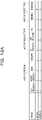
- FIGs. 13A and 13B are diagrams illustrating the reference example of the verification by the bit operation.
- FIGs. 13A and 13B a case will be described where the verification of a combination of an axis and a value on the axis in a case where account titles (hereinafter abbreviated as "titles") are "sales” and "assets" is performed.
- bit strings are generated considering all combinations of axes and values on the axes for "sales” and “assets” as the titles.
- “all regions”, “North America”, “Asia”, and “Europe” are values on an axis of "region”.
- All products”, “home appliances”, and “PC” are values on an axis of "product type”.
- “Tangible” and “intangible” are values on an axis of "asset type”.
- a bit value of "1" is set in a case where a combination of an axis and a value is possible for a title.
- a bit value of "0” is set in a case where a combination of an axis and a value is not possible for a title.
- the bit value of "1” is set for values of the axis of "region” and values of the axis of "product type” for the title of "sales”.
- the bit value of "1” is set for values of the axis of "region” and values of the axis of "asset type” for the title of "Assets”. Note that all combinations of axes and values for titles and possible combinations of axes and values for titles are defined in advance in definition information by using the Dimension specification.
- an information processing apparatus uses a bit operation to verify whether or not a combination of values to be verified is valid on the assumption of the bit strings of the possible combinations of the axes and the values for the titles illustrated in FIG. 13A .
- the information processing apparatus performs an AND operation of the bit string of the possible combinations of the axes and the values in the case where the title is "sales" and the bit string for verification of "region: North America, others unspecified", and outputs an AND result.
- the AND result matches the query bit
- the information processing apparatus determines that the combination is valid.
- the AND result matches the query bit, it is determined that the combination of the values to be verified is a valid combination.
- the information processing apparatus performs an AND operation of the bit string of the possible combinations of the axes and the values in the case where the title is "sales" and the bit string for verification of "region: tangible, others unspecified", and outputs an AND result.
- the AND result matches the query bit
- the information processing apparatus determines that the combination is valid.
- the AND result does not match the query bit, it is determined that the combination of the values to be verified is not a valid combination.
- the information processing apparatus performs an AND operation of the bit string of the possible combinations of the axes and the values in the case where the title is "assets" and the bit string for verification of "region: all regions, others unspecified", and outputs an AND result.
- the AND result matches the query bit
- the information processing apparatus determines that the combination is valid.
- the AND result matches the query bit, it is determined that the combination of the values to be verified is a valid combination.
- a value on the axis of "asset type” needs to be verified from the possible combinations of the axes and the values in the case where the title is “assets” indicated in FIG. 13B .
- the value on the axis of "asset type” needs to be included in the combination of the values to be verified.
- the value on the axis of "asset type” is not included in the combination of the values to be verified. Nevertheless, the AND result matches the query bit, and it is determined that the combination of the values to be verified is a valid combination.
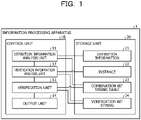
- FIG. 1 is a functional block diagram illustrating a configuration of the information processing apparatus according to an embodiment.
- the information processing apparatus 1 performs verification based on the Dimension specification by a bit operation.
- the information processing apparatus 1 determines whether or not specification of a value on an axis may be omitted on the basis of possible combinations of axes and values on the axes for a title defined in advance by the Dimension specification.
- the information processing apparatus 1 adds a discrimination bit to each of a bit string (combination bit string) of the possible combinations of the axes and the values on the axes and a bit string for verification (verification bit string), and performs verification by using the combination bit string and the verification bit string that are obtained by the addition.
- the bit string for verification is an example of data to be verified.
- the bit string of the possible combinations of the axes and the values on the axes is an example of combination data.
- the information processing apparatus 1 includes a control unit 10 and a storage unit 20.
- the control unit 10 includes an internal memory for storing a program prescribing various processing procedures and control data, and executes various types of processing by using the program and the control data.
- the control unit 10 corresponds to, for example, an integrated circuit such as an application specific integrated circuit (ASIC) or a field programmable gate array (FPGA) or an electronic circuit such as a central processing unit (CPU) or a micro processing unit (MPU).
- the control unit 10 includes a definition information analysis unit 11, a verification information analysis unit 12, a verification unit 13, and an output unit 14.
- the verification information analysis unit 12 is an example of an acquisition unit.
- the verification unit 13 is an example of a specification unit and a verification unit.
- the storage unit 20 corresponds to, for example, a storage device such as a non-volatile semiconductor memory element such as a flash memory or Ferroelectric Random Access Memory (FRAM) (registered trademark).
- the storage unit 20 includes definition information 21, an instance 22, a combination bit string table 23, and a verification bit string 24.
- the definition information 21 is information regarding a definition body of an XBRL element.
- the definition information 21 is information that defines information needed for electronically representing financial information, such as an account title name and axis information of the XBRL element.
- the definition information 21 is included in an XBRL taxonomy.
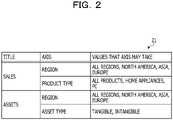
- FIG. 2 is a diagram illustrating an example of the definition information. As illustrated in FIG. 2 , the definition information 21 stores a title, an axis, and values that the axis may take in association with each other.
- all regions which is the value that the axes of "region” may take
- all products which is the value that the axis of "product type” may take
- a default value that the axis may take is not defined.
- the instance 22 is a document indicating XBRL data describing financial information.
- the financial information is described according to a rule defined in the XBRL taxonomy.
- FIG. 3 is a diagram illustrating an example of the instance.
- the instance includes, for example, a company identifier, a date for a value, axis information as information associated with a value of a title, and the like.
- the information associated with the value of the title is called "context".
- the context represents data of the XBRL element by Identifier, Period, Segment, and Scenario.
- the XBRL element may be interpreted by Identifier, Period, Segment, and Scenario.
- a value of "tangible” is set on the axis of "asset type”.
- a value of "North America" is set on the axis of "region”.
- the combination bit string table 23 stores, for each title, a bit string of possible combinations of axes and values on the axes.
- the combination bit string is a bit string considering all combinations of axes and values of the axis for all axes defined in the definition information 21.
- the combination bit string has a bit indicating whether omission is possible or not possible for each axis. Note that the combination bit string table 23 is generated by the definition information analysis unit 11.
- FIG. 4 is a diagram illustrating an example of the combination bit string table according to the embodiment.
- the combination bit string table 23 associates, for each title, information for a value on an axis with information indicating whether omission for an axis is possible.
- the information for a value on an axis is information indicating whether or not the value on the axis is specified in a title, and is represented by a bit.
- “1" is set in a case where a value on an axis is specified in a title
- "0" is set in a case where a value on an axis is not specified in a title.
- Whether omission for an axis is possible is information indicating whether the axis has a default value or indicating that the axis is not specified in a title, and is represented by a bit.
- "1" is set in a case where an axis has a default value or the axis is not set in a title
- "0" is set in a case where an axis is set in a title and the axis does not have a default value
- region In “region” omittable, "1" indicating that the axis of "region” has a default value is stored.
- product type In “product type” omittable, “1” indicating that the axis of "product type” is not set in the title is stored.
- assert type In “asset type” omittable, "0” indicating that the axis of "asset type” is set in the title and the axis does not have a default value is stored.
- the verification bit string 24 is a bit string used for verification of whether or not a combination of values to be verified is valid for a title to be verified.
- the verification bit string 24 has a bit indicating that specification is omitted for an axis having a value not to be verified. Note that the verification bit string 24 is generated by the verification information analysis unit 12.
- FIG. 5 is a diagram illustrating an example of the verification bit string according to the embodiment.
- the verification bit string 24 associates, for a title, information for a value on an axis with information indicating whether omission for an axis is possible.
- the information for a value on an axis is information indicating whether or not the value on the axis is specified in a combination of values to be verified, and is represented by a bit.
- “1” is set in a case where a value on an axis is specified in a combination of values to be verified
- "0" is set in a case where a value on an axis is not specified in a combination of values to be verified.
- Whether omission for an axis is possible is information indicating that specification is omitted for an axis having a value not specified in a combination of values to be verified, and is represented by a bit.
- “1” is set in a case where specification is omitted
- "0" is set in a case where specification is not omitted.
- the definition information analysis unit 11 analyzes the definition information 21 and generates the combination bit string table 23.
- the definition information analysis unit 11 refers to the definition information 21 to acquire all combinations of axes and values on the axis, and saves the combinations in a list.
- the definition information analysis unit 11 adds an item of omittable for each axis to an end of the list.
- the definition information analysis unit 11 uses the list to generate combination bit strings based on all titles.
- the definition information analysis unit 11 performs the following processing for each title.
- the definition information analysis unit 11 refers to the definition information 21 and sets a combination part of the list corresponding to a combination of an axis based on a title and a value on the axis to "1", to generate a combination bit string.
- the definition information analysis unit 11 sets an omittable bit for this axis to "1". Moreover, in a case where a default value is specified on an axis based on a title, the definition information analysis unit 11 sets an omittable bit for this axis to "1". Note that, in a case where a default value is not specified on an axis based on a title, the definition information analysis unit 11 leaves an omittable bit for this axis as "0". Then, the definition information analysis unit 11 adds a combination bit string for each title to the combination bit string table 23.
- the verification information analysis unit 12 analyzes verification information to be verified to generate the verification bit string 24.
- the verification information analysis unit 12 when receiving the instance 22 which is XBRL data to be verified, acquires, from the instance 22, data of an optional title as data to be verified. The verification information analysis unit 12 generates the verification bit string 24 from the data to be verified. As an example, the verification information analysis unit 12 acquires an axis desired to be verified from the data to be verified, and checks whether or not a plurality of values is specified on the same axis. In a case where a plurality of values is not specified on the same axis, the verification information analysis unit 12 sets a combination part of the list corresponding to a combination of the axis desired to be verified and a value on the axis to "1", and generates the verification bit string 24.
- the verification information analysis unit 12 sets "1" in an item of omittable in the verification bit string 24 for an axis not to be verified, for example, an axis not specified in the data to be verified. Note that the verification information analysis unit 12 leaves an omittable bit for this axis as "0" for the axis desired to be verified, for example, the axis specified in the data to be verified.
- the verification unit 13 verifies verification information to be verified.
- the verification unit 13 acquires a combination bit string of a title to be verified from the combination bit string table 23.
- the verification unit 13 performs an AND operation of the verification bit string 24 and the acquired combination bit string. Then, in a case where an AND result matches the verification bit string 24, the verification unit 13 determines that the verification information is valid. In a case where the AND result does not match the verification bit string 24, the verification unit 13 determines that the verification information is not valid.
- the verification unit 13 refers to the definition information 21 to specify an axis and a value on the axis (corresponding to a combination bit string) assigned to data of the same title as data to be verified (corresponding to the verification bit string 24).
- the verification unit 13 determines that the data to be verified is valid in a case where the specified axis and value on the axis are specified or not specified in the data to be verified, and determines that the data to be verified is not valid in a case where an axis and value on the axis other than the specified axis and value on the axis are specified in the data to be verified.
- the verification unit 13 determines that the data to be verified is not valid in a case where the specified axis and value on the axis include an axis of a predetermined type and a value on the axis, and neither the axis of the predetermined type nor the value on the axis is specified in the data to be verified.
- the predetermined type means, for example, a type indicating an axis having no default (axis of asset type) indicated in FIG. 5 .
- the output unit 14 outputs a verification result of verification information to be verified.
- the output unit 14 outputs, to a monitor, the verification bit string 24, a combination bit string of a title to be verified, and a verification result.
- FIG. 6 is a diagram illustrating an example of verification processing according to the embodiment.
- a title is "assets” and verification of the combinations of the values to be verified in P1 to P3 indicated in FIG. 5 is performed.
- a bit string indicated by a reference sign b0 in FIG. 6 is a combination bit string in a case where the title is "assets".
- the combination bit string b0 "1" indicating that values on the axis of "region" are specified in the title is set.
- “1” indicating that values on the axis of "asset type" are specified in the title is set.
- an omittable bit of "region” is set to “1” indicating that the axis of "region” has a default value ("all ranges”).
- An omittable bit of "product type” is set to “1” indicating that the axis of “product type” is not set in the title.
- An omittable bit of "asset type” is set to "0” indicating that the axis of "asset type” is set in the title and the axis does not have a default value.
- the combination of the values to be verified in P1 is "region: all regions, others unspecified".
- a bit string indicated by a reference sign b1 in FIG. 6 is the verification bit string 24 of the combination of the values to be verified in P1.
- a query bit "1" is set in a bit for "all regions" in the verification bit string 24. In “region” omittable, "0" indicating that specification is not omitted is set. In “product type” omittable, “1” indicating that specification is omitted is set. In “asset type” omittable, "1” indicating that specification is omitted is set.
- the verification unit 13 performs an AND operation of a verification bit string 24 (b1) and the combination bit string b0. Then, in a case where an AND result a1 matches the verification bit string 24 (b1), the verification unit 13 determines that the combination of the values to be verified in P1 is valid. In a case where the AND result a1 does not match the verification bit string 24 (b1), the verification unit 13 determines that the combination of the values to be verified in P1 is not valid.
- the AND result a1 does not match the verification bit string 24 (b1), it is determined that the combination of the values to be verified in P1 is not valid.
- the verification unit 13 may determine that verification determined to be valid conventionally is not valid.
- the combination of the values to be verified in P2 is "unspecified".
- a bit string indicated by a reference sign b2 in FIG. 6 is the verification bit string 24 of the combination of the values to be verified in P2.
- "region” omittable, “product type” omittable, and “asset type” omittable in the verification bit string 24 "1" indicating that specification is omitted is set.
- the verification unit 13 performs an AND operation of a verification bit string 24 (b2) and the combination bit string b0. Then, in a case where an AND result a2 matches the verification bit string 24 (b2), the verification unit 13 determines that the combination of the values to be verified in P2 is valid. In a case where the AND result a2 does not match the verification bit string 24 (b2), the verification unit 13 determines that the combination of the values to be verified in P2 is not valid.
- the AND result a2 does not match the verification bit string 24 (b2), it is determined that the combination of the values to be verified in P2 is not valid.
- the verification unit 13 may determine that verification determined to be valid conventionally is not valid.
- the combination of the values to be verified in P3 is "region: North America, asset type: tangible".
- a bit string indicated by a reference sign b3 in FIG. 6 is the verification bit string 24 of the combination of the values to be verified in P3.
- a query bit "1" is set in a bit for "North America” in the verification bit string 24.
- a query bit "1” is set in a bit for "tangible”.
- region omittable
- "0" indicating that specification is not omitted is set.
- product type omittable
- "1" indicating that specification is omitted is set.
- assert type omittable, "0” indicating that specification is not omitted is set.
- the verification unit 13 performs an AND operation of a verification bit string 24 (b3) and the combination bit string b0. Then, in a case where an AND result a3 matches the verification bit string 24 (b3), the verification unit 13 determines that the combination of the values to be verified in P3 is valid. In a case where the AND result a3 does not match the verification bit string 24 (b3), the verification unit 13 determines that the combination of the values to be verified in P3 is not valid. Here, since the AND result a3 matches the verification bit string 24 (b3), it is determined that the combination of the values to be verified in P3 is valid.
- FIG. 7 is a diagram illustrating an example of a main flowchart of the verification processing according to the embodiment.
- Step S11 when a definition body (definition information 21) of an XBRL element is input (Step S11), the definition information analysis unit 11 executes definition information analysis processing (Step S12). Note that a flowchart of the definition information analysis processing will be described later.
- Step S13 the verification information analysis unit 12 executes verification information analysis processing. Note that a flowchart of the verification information analysis processing will be described later.
- the verification unit 13 executes the verification processing (Step S14). Note that the flowchart of the verification processing will be described later,
- Step S15 the output unit 14 outputs a result of the verification processing.
- FIG. 8 is a diagram illustrating an example of the flowchart of the definition information analysis processing according to the embodiment.
- the definition information analysis unit 11 acquires all combinations of axes and values on the axes existing in a definition link of the definition information 21, and saves the combinations in a list for generating the verification bit string 24 (Step S21). In addition, the definition information analysis unit 11 adds an omittable bit for each axis to an end of the list (Step S22).
- the definition information analysis unit 11 acquires combinations of axes and values on the axes associated with all titles (Step S23).
- the definition information analysis unit 11 selects one title from all the titles (Step S24A).
- the definition information analysis unit 11 generates a bit string in which an index of the list corresponding to a combination of an axis and a value on the axis associated with the selected title is set to "1" (Step S24).
- the definition information analysis unit 11 determines whether or not there is an axis that is not associated with (not specified in) the selected title (Step S25). In a case where it is determined that there is an axis that is not associated with (not specified in) the selected title (Step S25; Yes), the definition information analysis unit 11 sets an omittable bit for the axis in the bit string to "1" (Step S26). Then, the definition information analysis unit 11 proceeds to Step S27.
- Step S25 the definition information analysis unit 11 proceeds to Step S27.
- Step S27 the definition information analysis unit 11 determines whether or not a default value is specified on the axis associated with the selected title (Step S27). In a case where it is determined that a default value is specified on the axis associated with the selected title (Step S27; Yes), the definition information analysis unit 11 sets an omittable bit for the axis in the bit string to "1" (Step S28). Then, the definition information analysis unit 11 proceeds to Step S29.
- Step S27 in a case where it is determined that a default value is not specified on the axis associated with the selected title (Step S27; No), the definition information analysis unit 11 proceeds to Step S29.
- Step S29 the definition information analysis unit 11 adds the bit string to the combination bit string table 23 (Step S29).
- Step S30 determines whether or not all the titles have been selected. In a case where it is determined that all the titles have not been selected (Step S30; No), the definition information analysis unit 11 proceeds to Step S24A to select the next title.
- Step S30 the definition information analysis unit 11 ends the definition information analysis processing.
- FIG. 9 is a diagram illustrating an example of the flowchart of the verification information analysis processing according to the embodiment.
- the verification information analysis unit 12 receives a combination of a title, an axis, and a value on the axis, which are desired to be verified (Step S41). For example, the verification information analysis unit 12 receives a combination of values to be verified.
- the verification information analysis unit 12 determines, for the received combination, whether or not a plurality of values is specified on the same axis (Step S42). In a case where it is determined that a plurality of values is specified on the same axis (Step S42; Yes), the verification information analysis unit 12 determines that the combination of the values to be verified is not valid (Step S43). Then, the verification information analysis unit 12 ends the verification information analysis processing.
- the verification information analysis unit 12 generates the verification bit string 24 in which an index of the list corresponding to the combination of the axis and the value on the axis is set to "1" (Step S44).
- the verification information analysis unit 12 sets an omittable bit in the verification bit string 24 to "1" for an axis not specified in the received combination (Step S45). Then, the verification information analysis unit 12 ends the verification information analysis processing.
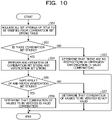
- FIG. 10 is a diagram illustrating an example of the flowchart of the verification processing according to the embodiment.
- the verification unit 13 acquires all bit strings of the title to be verified from the combination bit string table 23 (Step S51).
- the reason for acquiring all the bit strings is that, depending on a title to be verified, even the same title may have a plurality of combination bit strings.
- the verification unit 13 determines whether or not there is a combination bit string (Step S52). In a case where it is determined that there is no combination bit string (Step S52; No), the verification unit 13 determines that there are no restrictions by the Dimension specification, and determines that the combination of the values to be verified is a valid combination (Step S53). Then, the verification unit 13 ends the verification processing.
- Step S52 the verification unit 13 performs an AND operation of the combination bit string and the verification bit string 24 (Step S54). Then, the verification unit 13 determines whether or not a result of the AND operation matches the verification bit string 24 (Step S55).
- the verification unit 13 determines that the combination of the values to be verified is a valid combination (Step S56). Then, the verification unit 13 ends the verification processing.
- the verification unit 13 determines that the combination of the values to be verified is not a valid combination (Step S57). Then, the verification unit 13 ends the verification processing.
- the information processing apparatus 1 may perform verification based on the Dimension specification of an instance 22 having a large size at high speed while improving accuracy of the verification.
- the instance 22 reported by using the Dimension specification has increased in size, for example, several hundred megabytes (MB) to several gigabytes (GB).
- MB megabytes
- GB gigabytes
- a financial supervisory authority or the like that has received submission of the instance 22 needs to verify the instance 22 having a large size, submission of which has been received.
- the information processing apparatus 1 may verify combinations of Dimensions of a large number of numerical values in the instance 22 without referring to an XBRL taxonomy (definition information 21).
- the information processing apparatus 1 may reliably assign data of the instance 22 at high speed to a table definition in the XBRL taxonomy (definition information 21).
- the XBRL taxonomy (definition information 21) has a specification for defining a table called a table link base. In a matrix of a header part of each table, a title name, a value that a Dimension may take, and the like are specified.
- the information processing apparatus 1 When the information processing apparatus 1 generates the verification bit string 24 of the instance 22 at the time of verification, it is possible to assign data to each table by using the generated verification bit string 24 thereafter. For example, the information processing apparatus 1 may search the instance 22 for data satisfying the Dimension by using the verification bit string 24 for each table, and assign the data to each table.
- the information processing apparatus 1 when receiving XBRL data, acquires data of an optional title from the XBRL data as data to be verified.
- the information processing apparatus 1 specifies, with reference to definition information of the XBRL data, attribute values assigned to data of the same title as the data to be verified.
- the information processing apparatus 1 verifies validity of the data to be verified by using an algorithm that determines that the data to be verified is valid in a case where the specified attribute values are associated with or not associated with the data to be verified, and determines that the data to be verified is not valid in a case where attribute values other than the specified attribute values are associated with the data to be verified.
- the information processing apparatus 1 determines that the data to be verified is not valid in a case where the specified attribute values include attribute values of a predetermined type, and none of the attribute values of the predetermined type is associated with the data to be verified. According to such a configuration, the information processing apparatus 1 may improve verification accuracy.
- the information processing apparatus 1 acquires data to be verified that imparts verification information that indicates verification is performed to attribute values to be verified of the optional title, and also imparts, as attribute values, information that indicates that omission is not performed to an axis that has an attribute to be verified and information that indicates that omission is performed to an axis of an attribute value not to be verified.
- the information processing apparatus 1 acquires combination data that imparts combination information that indicates a combination of an axis based on the optional title and an attribute value on the axis, and also imparts, as an attribute value, information that indicates whether or not omission is possible to the axis based on the optional title.
- the information processing apparatus 1 collates the data to be verified with the combination data by corresponding attribute values, and determines that the data to be verified is not valid in a case where any of the attribute values are not associated with each other. According to such a configuration, the information processing apparatus 1 may improve the verification accuracy by using, for the verification, the information that indicates whether or not omission is possible for the axis.
- the information processing apparatus 1 performs a bit operation to collate corresponding attribute values with each other. According to such a configuration, the information processing apparatus 1 may perform the verification with high accuracy and at high speed.
- each illustrated component of the information processing apparatus 1 does not necessarily have to be physically configured as illustrated in the drawings.
- specific aspects of separation and integration of the information processing apparatus 1 are not limited to the illustrated ones, and all or a part of the information processing apparatus 1 may be functionally or physically separated and integrated in an optional unit according to various loads, use states, or the like.
- the verification unit 13 and the output unit 14 may be integrated as one unit.
- the definition information analysis unit 11 may be separated into a first definition information analysis unit that generates a combination part of an axis and a value on the axis in a combination bit string, and a second definition information analysis unit that generates an omittable bit part in the combination bit string.
- the verification information analysis unit 12 may be separated into a first verification information analysis unit that generates a combination part of an axis and a value on the axis in the verification bit string 24, and a second verification information analysis unit that generates an omittable bit part in the verification bit string 24.
- the storage unit 20 such as the definition information 21, the instance 22, the combination bit string table 23, and the verification bit string 24 may be connected via a network as an external device of the information processing apparatus 1.
- FIG. 11 is a diagram illustrating an example of the computer that executes the verification program.
- a computer 200 includes a central processing unit (CPU) 203 that executes various types of arithmetic processing, an input device 215 that receives data input from a user, and a display control unit 207 that controls a display device 209. Furthermore, the computer 200 includes a drive device 213 that reads a program or the like from a storage medium, and a communication control unit 217 that exchanges data with another computer via a network. Furthermore, the computer 200 includes a memory 201 that temporarily stores various types of information and a hard disk drive (HDD) 205. In addition, the memory 201, the CPU 203, the HDD 205, the display control unit 207, the drive device 213, the input device 215, and the communication control unit 217 are connected by a bus 219.
- the drive device 213 is, for example, a device for a removable disk 211.
- the HDD 205 stores a verification program 205a and verification processing related information 205b.
- the CPU 203 reads the verification program 205a and develops the verification program 205a in the memory 201.
- the verification program 205a functions as a verification process.
- the verification process corresponds to each functional unit of the control unit 10.
- the verification processing related information 205b corresponds to the definition information 21, the instance 22, the combination bit string table 23, and the verification bit string 24.
- the verification program 205a does not necessarily need to be stored in the HDD 205 from the beginning.
- the program is stored in a "portable physical medium" such as a flexible disk (FD), a compact disk read only memory (CD-ROM), a digital versatile disk (DVD), a magnetooptical disk, or an integrated circuit (IC) card, which is inserted into the computer 200. Then, the computer 200 may read the verification program 205a from these media and execute the verification program 205a.
- FD flexible disk
- CD-ROM compact disk read only memory
- DVD digital versatile disk
- IC integrated circuit
Landscapes
- Engineering & Computer Science (AREA)
- Theoretical Computer Science (AREA)
- Physics & Mathematics (AREA)
- General Physics & Mathematics (AREA)
- Data Mining & Analysis (AREA)
- Databases & Information Systems (AREA)
- General Engineering & Computer Science (AREA)
- Business, Economics & Management (AREA)
- Computer Security & Cryptography (AREA)
- Accounting & Taxation (AREA)
- Development Economics (AREA)
- Economics (AREA)
- Finance (AREA)
- Marketing (AREA)
- Strategic Management (AREA)
- Technology Law (AREA)
- General Business, Economics & Management (AREA)
- Debugging And Monitoring (AREA)
- Financial Or Insurance-Related Operations Such As Payment And Settlement (AREA)
Abstract
Description
- The present invention relates to a verification method, and the like.
- For example, it is obligatory to submit financial statements that use extensible business reporting language (XBRL) to financial supervisory authorities. The XBRL is language developed on the basis of extensible markup language (XML) as data description language for facilitating preparation, distribution, and use of business reports.
- The financial statements to be submitted need to conform to a Dimension specification, which is an extended specification used to represent data with a plurality of axes, such as a two-dimensional table. Thus, a financial supervisory authority that has received submission of financial statements verifies the financial statements on the basis of the specification called the Dimension specification.
- In the Dimension specification, a combination of an axis and a value specified on the axis is defined in advance. This combination represents a possible value as data.
FIG. 12 is a diagram illustrating a reference example of a financial statement conforming to the Deminsion specification. In the financial statement illustrated inFIG. 12 , axes of "region" and "business" are defined for account titles (hereinafter referred to as titles) of "sales amount", "cost of sales", and "gross profit". On the axis of "region", "North America", "Europe", "Asia", and "total" are defined as values that the axis may take. On the axis of "business", "hardware", "software", and "total" are defined as values that the axis may take. - In addition, in the verification based on the Dimension specification, in a case where there is a combination that is not included in definitions or a combination that is prohibited by the definitions, it is determined that the data is not valid data. Here, for example, in a case where the title is "sales amount", it is determined that a combination of "North America" on the axis of "region" and "hardware" on the axis of "business" is valid data. On the other hand, for example, in a case where the title is "sales amount", it is determined that a combination of "Africa" on the axis of "region" and "middleware" on the axis of "business" is not valid data. This is because "Africa" is not defined as a value that the axis of "region" may take. This is because "middleware" is not defined as a value that the axis of "business" may take.
- Examples of the related art include as follows:
Japanese Laid-open Patent Publication No. 2001-306370 Japanese Laid-open Patent Publication No. 5-134859 - In such a Dimension specification, there is a concept of default. The default means a value used in a case where no value is specified on an axis. For example, in a case where the axis is "product type", "all products" is used as a default value. That is, in a case where the title is "sales amount", a sales amount of "North America" and a sales amount of "all products" of "North America" have the same meaning. On the other hand, in the case of an axis for which a default value is not specified, it is needed to always specify a value for this axis.
- Therefore, when verification based on the Dimension specification is performed, there is a problem that it is difficult to correctly perform the verification only by a simple combination of an axis and a value on the axis. Note that a similar problem may occur other than the verification based on the Dimension specification.
- In one aspect, the present invention aims to improve verification accuracy.
- A verification method of one aspect is a verification method executed by a computer, the verification method including processing including: acquiring, when XBRL data is received, data of an optional title from the XBRL data as data to be verified; specifying, with reference to definition information of the XBRL data, attribute values assigned to data of the same title as the data to be verified; and verifying validity of the data to be verified by using an algorithm that determines that the data to be verified is valid in a case where the specified attribute values are associated with or not associated with the data to be verified, and determines that the data to be verified is not valid in a case where attribute values other than the specified attribute values are associated with the data to be verified, in which the computer executes processing of determining that the data to be verified is not valid in a case where the specified attribute values include attribute values of a predetermined type, and none of the attribute values of the predetermined type is associated with the data to be verified.
- According to one aspect, verification accuracy may be improved.
-
-
FIG. 1 is a functional block diagram illustrating a configuration of an information processing apparatus according to an embodiment; -
FIG. 2 is a diagram illustrating an example of definition information; -
FIG. 3 is a diagram illustrating an example of an instance; -
FIG. 4 is a diagram illustrating an example of a combination bit string table according to the embodiment; -
FIG. 5 is a diagram illustrating an example of a verification bit string according to the embodiment; -
FIG. 6 is a diagram illustrating an example of verification processing according to the embodiment; -
FIG. 7 is a diagram illustrating an example of a main flowchart of the verification processing according to the embodiment; -
FIG. 8 is a diagram illustrating an example of a flowchart of definition information analysis processing according to the embodiment; -
FIG. 9 is a diagram illustrating an example of a flowchart of verification information analysis processing according to the embodiment; -
FIG. 10 is a diagram illustrating an example of a flowchart of the verification processing according to the embodiment; -
FIG. 11 is a diagram illustrating an example of a computer that executes a verification program; -
FIG. 12 is a diagram illustrating a reference example of a financial statement conforming to a Deminsion specification; -
FIG. 13A is a diagram illustrating a reference example of verification by a bit operation; and -
FIG. 13B is a diagram illustrating the reference example of the verification by the bit operation. - Hereinafter, embodiments of a verification method, an information processing apparatus, and a verification program disclosed in the present application will be described in detail with reference to the drawings. Note that the embodiments do not limit the present invention.
- First, a reference example in a case where verification of a combination of an axis and a value on the axis is performed by using a bit operation when verification based on a Dimension specification is performed will be described with reference to
FIGs. 13A and13B .FIGs. 13A and13B are diagrams illustrating the reference example of the verification by the bit operation. InFIGs. 13A and13B , a case will be described where the verification of a combination of an axis and a value on the axis in a case where account titles (hereinafter abbreviated as "titles") are "sales" and "assets" is performed. - As illustrated in
FIG. 13A , bit strings are generated considering all combinations of axes and values on the axes for "sales" and "assets" as the titles. Here, "all regions", "North America", "Asia", and "Europe" are values on an axis of "region". "All products", "home appliances", and "PC" are values on an axis of "product type". "Tangible" and "intangible" are values on an axis of "asset type". - A bit value of "1" is set in a case where a combination of an axis and a value is possible for a title. A bit value of "0" is set in a case where a combination of an axis and a value is not possible for a title. Here, the bit value of "1" is set for values of the axis of "region" and values of the axis of "product type" for the title of "sales". The bit value of "1" is set for values of the axis of "region" and values of the axis of "asset type" for the title of "Assets". Note that all combinations of axes and values for titles and possible combinations of axes and values for titles are defined in advance in definition information by using the Dimension specification.
- Under such circumstances, an information processing apparatus uses a bit operation to verify whether or not a combination of values to be verified is valid on the assumption of the bit strings of the possible combinations of the axes and the values for the titles illustrated in
FIG. 13A . - As illustrated in an upper part of
FIG. 13B , it is assumed that a combination of values to be verified in a case where the title is "sales" is "region: North America, others unspecified". "Region: North America, others unspecified" means a case where a value on the axis of "region" is specified as "North America" and values on other axes are not specified. In such a case, a bit for "North America" in a bit string for verification is set to "1" as a query bit. For example, in the bit string for verification, only bits of values to be verified are set to "1". - Then, the information processing apparatus performs an AND operation of the bit string of the possible combinations of the axes and the values in the case where the title is "sales" and the bit string for verification of "region: North America, others unspecified", and outputs an AND result. When the AND result matches the query bit, the information processing apparatus determines that the combination is valid. Here, since the AND result matches the query bit, it is determined that the combination of the values to be verified is a valid combination.
- As illustrated in a middle part of
FIG. 13B , it is assumed that a combination of values to be verified in a case where the title is "sales" is "assets: tangible, others unspecified". "Assets: tangible, others unspecified" means a case where a value on the axis of "asset type" is specified as "tangible" and values on other axes are not specified. In such a case, a bit for "tangible" in a bit string for verification is set to "1" as a query bit. - Then, the information processing apparatus performs an AND operation of the bit string of the possible combinations of the axes and the values in the case where the title is "sales" and the bit string for verification of "region: tangible, others unspecified", and outputs an AND result. When the AND result matches the query bit, the information processing apparatus determines that the combination is valid. Here, since the AND result does not match the query bit, it is determined that the combination of the values to be verified is not a valid combination.
- As illustrated in a lower part of
FIG. 13B , it is assumed that a combination of values to be verified in a case where the title is "assets" is "region: all regions, others unspecified". "Region: all regions, others unspecified" means a case where a value on the axis of "region" is specified as "all regions" and values on other axes are not specified. In such a case, a bit for "all regions" in a bit string for verification is set to "1" as a query bit. - Then, the information processing apparatus performs an AND operation of the bit string of the possible combinations of the axes and the values in the case where the title is "assets" and the bit string for verification of "region: all regions, others unspecified", and outputs an AND result. When the AND result matches the query bit, the information processing apparatus determines that the combination is valid. Here, since the AND result matches the query bit, it is determined that the combination of the values to be verified is a valid combination.
- However, in the case where the title is "assets", a value on the axis of "asset type" needs to be verified from the possible combinations of the axes and the values in the case where the title is "assets" indicated in
FIG. 13B . For example, the value on the axis of "asset type" needs to be included in the combination of the values to be verified. However, in the case of the lower part ofFIG. 13B , the value on the axis of "asset type" is not included in the combination of the values to be verified. Nevertheless, the AND result matches the query bit, and it is determined that the combination of the values to be verified is a valid combination. - This is because, since the Dimension specification does not define a default value on the axis of "asset type", in a case where a combination of values when the title is "assets" is to be verified, it is always needed to specify a nondefault value on the axis of "asset type" in a bit string for verification. However, even though the value on the axis of "asset type" is not specified in the bit string for verification, the result is valid. For example, since the Dimension specification has a concept of default, in the case of an axis that does not have a default for a value, it may be erroneously determined that the combination is valid as in the lower part of
FIG. 13B . Thus, when verification based on the Dimension specification is performed, it is difficult to correctly perform the verification only by a simple combination of an axis and a value on the axis. - Therefore, in the following, an
information processing apparatus 1 that executes a verification method that improves verification accuracy when verification based on the Dimension specification is performed by a bit operation will be described. - [Configuration of Information Processing Apparatus According to Embodiment]
-
FIG. 1 is a functional block diagram illustrating a configuration of the information processing apparatus according to an embodiment. As illustrated inFIG. 1 , theinformation processing apparatus 1 performs verification based on the Dimension specification by a bit operation. Theinformation processing apparatus 1 determines whether or not specification of a value on an axis may be omitted on the basis of possible combinations of axes and values on the axes for a title defined in advance by the Dimension specification. Then, theinformation processing apparatus 1 adds a discrimination bit to each of a bit string (combination bit string) of the possible combinations of the axes and the values on the axes and a bit string for verification (verification bit string), and performs verification by using the combination bit string and the verification bit string that are obtained by the addition. Note that the bit string for verification is an example of data to be verified. The bit string of the possible combinations of the axes and the values on the axes is an example of combination data. - The
information processing apparatus 1 includes a control unit 10 and a storage unit 20. - The control unit 10 includes an internal memory for storing a program prescribing various processing procedures and control data, and executes various types of processing by using the program and the control data. In addition, the control unit 10 corresponds to, for example, an integrated circuit such as an application specific integrated circuit (ASIC) or a field programmable gate array (FPGA) or an electronic circuit such as a central processing unit (CPU) or a micro processing unit (MPU). Moreover, the control unit 10 includes a definition
information analysis unit 11, a verificationinformation analysis unit 12, averification unit 13, and an output unit 14. Note that the verificationinformation analysis unit 12 is an example of an acquisition unit. Theverification unit 13 is an example of a specification unit and a verification unit. - The storage unit 20 corresponds to, for example, a storage device such as a non-volatile semiconductor memory element such as a flash memory or Ferroelectric Random Access Memory (FRAM) (registered trademark). In addition, the storage unit 20 includes
definition information 21, aninstance 22, a combination bit string table 23, and averification bit string 24. - The
definition information 21 is information regarding a definition body of an XBRL element. Thedefinition information 21 is information that defines information needed for electronically representing financial information, such as an account title name and axis information of the XBRL element. Thedefinition information 21 is included in an XBRL taxonomy. -
FIG. 2 is a diagram illustrating an example of the definition information. As illustrated inFIG. 2 , thedefinition information 21 stores a title, an axis, and values that the axis may take in association with each other. - As an example, in a case where the title is "sales", "region" and "product type" are included as the axes. In a case where the axis is "region", "all regions", "North America", "Asia", and "Europe" are included as the values that the axis may take. In a case where the axis is "product type", "all products", "home appliances", and "PC" are included as the values that the axis may take. Furthermore, in a case where the title is "assets", "region" and "asset type" are included as the axes. In a case where the axis is "region", "all regions", "North America", "Asia", and "Europe" are included as the values that the axis may take. In a case where the axis is "asset type", "tangible" and "intangible" are included as the values that the axis may take.
- Here, "all regions", which is the value that the axes of "region" may take, and "all products", which is the value that the axis of "product type" may take, are default values that the axes may take. Note that, in the axis of "asset type", a default value that the axis may take is not defined.
- Returning to
FIG. 1 , theinstance 22 is a document indicating XBRL data describing financial information. The financial information is described according to a rule defined in the XBRL taxonomy. -
FIG. 3 is a diagram illustrating an example of the instance. As illustrated inFIG. 3 , the instance includes, for example, a company identifier, a date for a value, axis information as information associated with a value of a title, and the like. The information associated with the value of the title is called "context". The context represents data of the XBRL element by Identifier, Period, Segment, and Scenario. For example, the XBRL element may be interpreted by Identifier, Period, Segment, and Scenario. As an example, a value of "tangible" is set on the axis of "asset type". A value of "North America" is set on the axis of "region". - Returning to
FIG. 1 , the combination bit string table 23 stores, for each title, a bit string of possible combinations of axes and values on the axes. The combination bit string is a bit string considering all combinations of axes and values of the axis for all axes defined in thedefinition information 21. In addition, the combination bit string has a bit indicating whether omission is possible or not possible for each axis. Note that the combination bit string table 23 is generated by the definitioninformation analysis unit 11. - Here, an example of the combination bit string table 23 according to the embodiment will be described with reference to
FIG. 4. FIG. 4 is a diagram illustrating an example of the combination bit string table according to the embodiment. As illustrated inFIG. 4 , the combination bit string table 23 associates, for each title, information for a value on an axis with information indicating whether omission for an axis is possible. - The information for a value on an axis is information indicating whether or not the value on the axis is specified in a title, and is represented by a bit. As an example, "1" is set in a case where a value on an axis is specified in a title, and "0" is set in a case where a value on an axis is not specified in a title. Whether omission for an axis is possible is information indicating whether the axis has a default value or indicating that the axis is not specified in a title, and is represented by a bit. As an example, "1" is set in a case where an axis has a default value or the axis is not set in a title, and "0" is set in a case where an axis is set in a title and the axis does not have a default value.
- As an example, in a case where the title is "sales", in each of values on an axis of "region", which are "all regions", "North America", "Asia", and "Europe", "1" indicating that the value on the axis is specified in the title is stored. In each of values on an axis of "product type", which are "all products", "home appliances", and "PC", "1" indicating that the value on the axis is specified in the title is stored. In each of values on an axis of "asset type", which are "tangible" and "intangible", "0" indicating that the value on the axis is not specified in the title is stored. In "region" omittable, "1" indicating that the axis of "region" has a default value is stored. In "product type" omittable, "1" indicating that the axis of "product type" has a default value is stored. In "asset type" omittable, "1" indicating that the axis of "asset type" is not set in the title is stored.
- As another example, in a case where the title is "assets", in each of values on the axis of "region", which are "all regions", "North America", "Asia", and "Europe", "1" indicating that the value on the axis is specified in the title is stored. In each of values on the axis of "product type", which are "all products", "home appliances", and "PC", "0" indicating that the value on the axis is not specified in the title is stored. In each of values on the axis of "asset type", which are "tangible" and "intangible", "1" indicating that the value on the axis is specified in the title is stored. In "region" omittable, "1" indicating that the axis of "region" has a default value is stored. In "product type" omittable, "1" indicating that the axis of "product type" is not set in the title is stored. In "asset type" omittable, "0" indicating that the axis of "asset type" is set in the title and the axis does not have a default value is stored.
- Returning to
FIG. 1 , theverification bit string 24 is a bit string used for verification of whether or not a combination of values to be verified is valid for a title to be verified. In addition, theverification bit string 24 has a bit indicating that specification is omitted for an axis having a value not to be verified. Note that theverification bit string 24 is generated by the verificationinformation analysis unit 12. - Here, an example of the
verification bit string 24 according to the embodiment will be described with reference toFIG. 5. FIG. 5 is a diagram illustrating an example of the verification bit string according to the embodiment. As illustrated inFIG. 5 , theverification bit string 24 associates, for a title, information for a value on an axis with information indicating whether omission for an axis is possible. - The information for a value on an axis is information indicating whether or not the value on the axis is specified in a combination of values to be verified, and is represented by a bit. As an example, "1" is set in a case where a value on an axis is specified in a combination of values to be verified, and "0" is set in a case where a value on an axis is not specified in a combination of values to be verified. Whether omission for an axis is possible is information indicating that specification is omitted for an axis having a value not specified in a combination of values to be verified, and is represented by a bit. As an example, "1" is set in a case where specification is omitted, and "0" is set in a case where specification is not omitted.
- As an example (P1), a combination of values to be verified in a case where the title is "assets" is "region: all regions, others unspecified". "Region: all regions, others unspecified" means a case where a value on the axis of "region" is specified as "all regions" and values on other axes are not specified. In such a case, "1" as a query bit is stored in a bit for "all regions" of the
verification bit string 24. In addition, in "product type" omittable in theverification bit string 24, "1" indicating that specification is omitted is stored. In addition, in "asset type" omittable in theverification bit string 24, "1" indicating that specification is omitted is stored. Note that, in "region" omittable in theverification bit string 24, "0" indicating that specification is not omitted is stored. - As another example (P2), a combination of values to be verified in a case where the title is "assets" is "region: unspecified". "Region: unspecified" means a case where values on all axes are not specified. In such a case, "0" indicating that there is no query is stored in bits for the values on all the axes of the
verification bit string 24. In addition, in "region" omittable in theverification bit string 24, "1" indicating that specification is omitted is stored. In "product type" omittable in theverification bit string 24, "1" indicating that specification is omitted is stored. In addition, in "asset type" omittable in theverification bit string 24, "1" indicating that specification is omitted is stored. - As another example (P3), a combination of values to be verified in a case where the title is "assets" is "region: North America, asset type: tangible". "Region: North America, asset type: tangible" means a case where a value on the axis of "region" is specified as "North America" and a value on "asset type" is specified as "tangible". In such a case, "1" as a query bit is stored in a bit for "North America" of the
verification bit string 24. "1" as a query bit is stored in a bit for "tangible" of theverification bit string 24. In addition, in "product type" omittable in theverification bit string 24, "1" indicating that specification is omitted is stored. Note that, in "region" omittable in theverification bit string 24, "0" indicating that specification is not omitted is stored. In "asset type" omittable in theverification bit string 24, "0" indicating that specification is not omitted is stored. - Returning to
FIG. 1 , the definitioninformation analysis unit 11 analyzes thedefinition information 21 and generates the combination bit string table 23. - For example, the definition
information analysis unit 11 refers to thedefinition information 21 to acquire all combinations of axes and values on the axis, and saves the combinations in a list. The definitioninformation analysis unit 11 adds an item of omittable for each axis to an end of the list. The definitioninformation analysis unit 11 uses the list to generate combination bit strings based on all titles. As an example, the definitioninformation analysis unit 11 performs the following processing for each title. The definitioninformation analysis unit 11 refers to thedefinition information 21 and sets a combination part of the list corresponding to a combination of an axis based on a title and a value on the axis to "1", to generate a combination bit string. In addition, in a case where there is an axis that is not based on a title, for example, an axis that is not specified in a title, the definitioninformation analysis unit 11 sets an omittable bit for this axis to "1". Moreover, in a case where a default value is specified on an axis based on a title, the definitioninformation analysis unit 11 sets an omittable bit for this axis to "1". Note that, in a case where a default value is not specified on an axis based on a title, the definitioninformation analysis unit 11 leaves an omittable bit for this axis as "0". Then, the definitioninformation analysis unit 11 adds a combination bit string for each title to the combination bit string table 23. - The verification
information analysis unit 12 analyzes verification information to be verified to generate theverification bit string 24. - For example, when receiving the
instance 22 which is XBRL data to be verified, the verificationinformation analysis unit 12 acquires, from theinstance 22, data of an optional title as data to be verified. The verificationinformation analysis unit 12 generates theverification bit string 24 from the data to be verified. As an example, the verificationinformation analysis unit 12 acquires an axis desired to be verified from the data to be verified, and checks whether or not a plurality of values is specified on the same axis. In a case where a plurality of values is not specified on the same axis, the verificationinformation analysis unit 12 sets a combination part of the list corresponding to a combination of the axis desired to be verified and a value on the axis to "1", and generates theverification bit string 24. In addition, the verificationinformation analysis unit 12 sets "1" in an item of omittable in theverification bit string 24 for an axis not to be verified, for example, an axis not specified in the data to be verified. Note that the verificationinformation analysis unit 12 leaves an omittable bit for this axis as "0" for the axis desired to be verified, for example, the axis specified in the data to be verified. - The
verification unit 13 verifies verification information to be verified. - For example, the
verification unit 13 acquires a combination bit string of a title to be verified from the combination bit string table 23. Theverification unit 13 performs an AND operation of theverification bit string 24 and the acquired combination bit string. Then, in a case where an AND result matches theverification bit string 24, theverification unit 13 determines that the verification information is valid. In a case where the AND result does not match theverification bit string 24, theverification unit 13 determines that the verification information is not valid. - For example, the
verification unit 13 refers to thedefinition information 21 to specify an axis and a value on the axis (corresponding to a combination bit string) assigned to data of the same title as data to be verified (corresponding to the verification bit string 24). Theverification unit 13 determines that the data to be verified is valid in a case where the specified axis and value on the axis are specified or not specified in the data to be verified, and determines that the data to be verified is not valid in a case where an axis and value on the axis other than the specified axis and value on the axis are specified in the data to be verified. Then, theverification unit 13 determines that the data to be verified is not valid in a case where the specified axis and value on the axis include an axis of a predetermined type and a value on the axis, and neither the axis of the predetermined type nor the value on the axis is specified in the data to be verified. Here, the predetermined type means, for example, a type indicating an axis having no default (axis of asset type) indicated inFIG. 5 . - The output unit 14 outputs a verification result of verification information to be verified. For example, the output unit 14 outputs, to a monitor, the
verification bit string 24, a combination bit string of a title to be verified, and a verification result. -
FIG. 6 is a diagram illustrating an example of verification processing according to the embodiment. InFIG. 6 , a case will be described where a title is "assets" and verification of the combinations of the values to be verified in P1 to P3 indicated inFIG. 5 is performed. A bit string indicated by a reference sign b0 inFIG. 6 is a combination bit string in a case where the title is "assets". In the combination bit string b0, "1" indicating that values on the axis of "region" are specified in the title is set. "1" indicating that values on the axis of "asset type" are specified in the title is set. In addition, an omittable bit of "region" is set to "1" indicating that the axis of "region" has a default value ("all ranges"). An omittable bit of "product type" is set to "1" indicating that the axis of "product type" is not set in the title. An omittable bit of "asset type" is set to "0" indicating that the axis of "asset type" is set in the title and the axis does not have a default value. - Under such circumstances, verification of the combination of the values to be verified in P1 will be described. The combination of the values to be verified in P1 is "region: all regions, others unspecified". Here, a bit string indicated by a reference sign b1 in
FIG. 6 is theverification bit string 24 of the combination of the values to be verified in P1. A query bit "1" is set in a bit for "all regions" in theverification bit string 24. In "region" omittable, "0" indicating that specification is not omitted is set. In "product type" omittable, "1" indicating that specification is omitted is set. In "asset type" omittable, "1" indicating that specification is omitted is set. - For example, the
verification unit 13 performs an AND operation of a verification bit string 24 (b1) and the combination bit string b0. Then, in a case where an AND result a1 matches the verification bit string 24 (b1), theverification unit 13 determines that the combination of the values to be verified in P1 is valid. In a case where the AND result a1 does not match the verification bit string 24 (b1), theverification unit 13 determines that the combination of the values to be verified in P1 is not valid. Here, since the AND result a1 does not match the verification bit string 24 (b1), it is determined that the combination of the values to be verified in P1 is not valid. For example, in a case where the title is "assets", a value on the axis of "asset type" that does not have a default value has to be specified. However, since the value on the axis of "asset type" is not specified in the combination of the values to be verified in P1, it is determined that the combination of the values to be verified in P1 is not valid. With this configuration, since an AND result does not match a verification bit by addition of an omittable bit for each axis to the combination bit string and theverification bit string 24, theverification unit 13 may determine that verification determined to be valid conventionally is not valid. - Next, verification of the combination of the values to be verified in P2 will be described. The combination of the values to be verified in P2 is "unspecified". Here, a bit string indicated by a reference sign b2 in
FIG. 6 is theverification bit string 24 of the combination of the values to be verified in P2. In each of "region" omittable, "product type" omittable, and "asset type" omittable in theverification bit string 24, "1" indicating that specification is omitted is set. - For example, the
verification unit 13 performs an AND operation of a verification bit string 24 (b2) and the combination bit string b0. Then, in a case where an AND result a2 matches the verification bit string 24 (b2), theverification unit 13 determines that the combination of the values to be verified in P2 is valid. In a case where the AND result a2 does not match the verification bit string 24 (b2), theverification unit 13 determines that the combination of the values to be verified in P2 is not valid. Here, since the AND result a2 does not match the verification bit string 24 (b2), it is determined that the combination of the values to be verified in P2 is not valid. For example, in a case where the title is "assets", a value on the axis of "asset type" that does not have a default value has to be specified. However, since the value on the axis of "asset type" is not specified in the combination of the values to be verified in P2, it is determined that the combination of the values to be verified in P2 is not valid. With this configuration, since an AND result does not match a verification bit by addition of an omittable bit for each axis to the combination bit string and theverification bit string 24, theverification unit 13 may determine that verification determined to be valid conventionally is not valid. - Next, verification of the combination of the values to be verified in P3 will be described. The combination of the values to be verified in P3 is "region: North America, asset type: tangible". Here, a bit string indicated by a reference sign b3 in
FIG. 6 is theverification bit string 24 of the combination of the values to be verified in P3. A query bit "1" is set in a bit for "North America" in theverification bit string 24. A query bit "1" is set in a bit for "tangible". In "region" omittable, "0" indicating that specification is not omitted is set. In "product type" omittable, "1" indicating that specification is omitted is set. In "asset type" omittable, "0" indicating that specification is not omitted is set. - For example, the
verification unit 13 performs an AND operation of a verification bit string 24 (b3) and the combination bit string b0. Then, in a case where an AND result a3 matches the verification bit string 24 (b3), theverification unit 13 determines that the combination of the values to be verified in P3 is valid. In a case where the AND result a3 does not match the verification bit string 24 (b3), theverification unit 13 determines that the combination of the values to be verified in P3 is not valid. Here, since the AND result a3 matches the verification bit string 24 (b3), it is determined that the combination of the values to be verified in P3 is valid. For example, since an axis and a value on the axis of the combination indicated by the combination bit string b0 are specified or not specified in the combination of the values to be verified in P3, it is determined that the combination of the values to be verified in P3 is valid. - Here, a flowchart of the verification processing according to the embodiment will be described with reference to
FIGs. 7 to 10 .FIG. 7 is a diagram illustrating an example of a main flowchart of the verification processing according to the embodiment. - As illustrated in
FIG. 7 , when a definition body (definition information 21) of an XBRL element is input (Step S11), the definitioninformation analysis unit 11 executes definition information analysis processing (Step S12). Note that a flowchart of the definition information analysis processing will be described later. - Then, the verification
information analysis unit 12 executes verification information analysis processing (Step S13). Note that a flowchart of the verification information analysis processing will be described later. - Then, the
verification unit 13 executes the verification processing (Step S14). Note that the flowchart of the verification processing will be described later, - Then, the output unit 14 outputs a result of the verification processing (Step S15).
-
FIG. 8 is a diagram illustrating an example of the flowchart of the definition information analysis processing according to the embodiment. - As illustrated in
FIG. 8 , the definitioninformation analysis unit 11 acquires all combinations of axes and values on the axes existing in a definition link of thedefinition information 21, and saves the combinations in a list for generating the verification bit string 24 (Step S21). In addition, the definitioninformation analysis unit 11 adds an omittable bit for each axis to an end of the list (Step S22). - Then, the definition
information analysis unit 11 acquires combinations of axes and values on the axes associated with all titles (Step S23). - Then, the definition
information analysis unit 11 selects one title from all the titles (Step S24A). The definitioninformation analysis unit 11 generates a bit string in which an index of the list corresponding to a combination of an axis and a value on the axis associated with the selected title is set to "1" (Step S24). - Then, the definition
information analysis unit 11 determines whether or not there is an axis that is not associated with (not specified in) the selected title (Step S25). In a case where it is determined that there is an axis that is not associated with (not specified in) the selected title (Step S25; Yes), the definitioninformation analysis unit 11 sets an omittable bit for the axis in the bit string to "1" (Step S26). Then, the definitioninformation analysis unit 11 proceeds to Step S27. - On the other hand, in a case where it is determined that there is no axis that is not associated with (not specified in) the selected title (Step S25; No), the definition
information analysis unit 11 proceeds to Step S27. - In Step S27, the definition
information analysis unit 11 determines whether or not a default value is specified on the axis associated with the selected title (Step S27). In a case where it is determined that a default value is specified on the axis associated with the selected title (Step S27; Yes), the definitioninformation analysis unit 11 sets an omittable bit for the axis in the bit string to "1" (Step S28). Then, the definitioninformation analysis unit 11 proceeds to Step S29. - On the other hand, in a case where it is determined that a default value is not specified on the axis associated with the selected title (Step S27; No), the definition
information analysis unit 11 proceeds to Step S29. - In Step S29, the definition
information analysis unit 11 adds the bit string to the combination bit string table 23 (Step S29). - Then, the definition
information analysis unit 11 determines whether or not all the titles have been selected (Step S30). In a case where it is determined that all the titles have not been selected (Step S30; No), the definitioninformation analysis unit 11 proceeds to Step S24A to select the next title. - On the other hand, in a case where it is determined that all the titles have been selected (Step S30; Yes), the definition
information analysis unit 11 ends the definition information analysis processing. -
FIG. 9 is a diagram illustrating an example of the flowchart of the verification information analysis processing according to the embodiment. - As illustrated in
FIG. 9 , the verificationinformation analysis unit 12 receives a combination of a title, an axis, and a value on the axis, which are desired to be verified (Step S41). For example, the verificationinformation analysis unit 12 receives a combination of values to be verified. - Then, the verification
information analysis unit 12 determines, for the received combination, whether or not a plurality of values is specified on the same axis (Step S42). In a case where it is determined that a plurality of values is specified on the same axis (Step S42; Yes), the verificationinformation analysis unit 12 determines that the combination of the values to be verified is not valid (Step S43). Then, the verificationinformation analysis unit 12 ends the verification information analysis processing. - On the other hand, in a case where it is determined that a plurality of values is not specified on the same axis (Step S42; No), the verification
information analysis unit 12 generates theverification bit string 24 in which an index of the list corresponding to the combination of the axis and the value on the axis is set to "1" (Step S44). - In addition, the verification
information analysis unit 12 sets an omittable bit in theverification bit string 24 to "1" for an axis not specified in the received combination (Step S45). Then, the verificationinformation analysis unit 12 ends the verification information analysis processing. -
FIG. 10 is a diagram illustrating an example of the flowchart of the verification processing according to the embodiment. - As illustrated in
FIG. 10 , theverification unit 13 acquires all bit strings of the title to be verified from the combination bit string table 23 (Step S51). The reason for acquiring all the bit strings is that, depending on a title to be verified, even the same title may have a plurality of combination bit strings. - The
verification unit 13 determines whether or not there is a combination bit string (Step S52). In a case where it is determined that there is no combination bit string (Step S52; No), theverification unit 13 determines that there are no restrictions by the Dimension specification, and determines that the combination of the values to be verified is a valid combination (Step S53). Then, theverification unit 13 ends the verification processing. - On the other hand, in a case where it is determined that there is a combination bit string (Step S52; Yes), the
verification unit 13 performs an AND operation of the combination bit string and the verification bit string 24 (Step S54). Then, theverification unit 13 determines whether or not a result of the AND operation matches the verification bit string 24 (Step S55). - In a case where it is determined that the result of the AND operation matches the verification bit string 24 (Step S55; Yes), the
verification unit 13 determines that the combination of the values to be verified is a valid combination (Step S56). Then, theverification unit 13 ends the verification processing. - On the other hand, in a case where it is determined that the result of the AND operation does not match the verification bit string 24 (Step S55; No), the
verification unit 13 determines that the combination of the values to be verified is not a valid combination (Step S57). Then, theverification unit 13 ends the verification processing. - With this configuration, the
information processing apparatus 1 may perform verification based on the Dimension specification of aninstance 22 having a large size at high speed while improving accuracy of the verification. For example, in recent years, theinstance 22 reported by using the Dimension specification has increased in size, for example, several hundred megabytes (MB) to several gigabytes (GB). Thus, a financial supervisory authority or the like that has received submission of theinstance 22 needs to verify theinstance 22 having a large size, submission of which has been received. In such a case, theinformation processing apparatus 1 may verify combinations of Dimensions of a large number of numerical values in theinstance 22 without referring to an XBRL taxonomy (definition information 21). - Furthermore, the
information processing apparatus 1 may reliably assign data of theinstance 22 at high speed to a table definition in the XBRL taxonomy (definition information 21). For example, the XBRL taxonomy (definition information 21) has a specification for defining a table called a table link base. In a matrix of a header part of each table, a title name, a value that a Dimension may take, and the like are specified. When theinformation processing apparatus 1 generates theverification bit string 24 of theinstance 22 at the time of verification, it is possible to assign data to each table by using the generatedverification bit string 24 thereafter. For example, theinformation processing apparatus 1 may search theinstance 22 for data satisfying the Dimension by using theverification bit string 24 for each table, and assign the data to each table. - According to the embodiment described above, when receiving XBRL data, the
information processing apparatus 1 acquires data of an optional title from the XBRL data as data to be verified. Theinformation processing apparatus 1 specifies, with reference to definition information of the XBRL data, attribute values assigned to data of the same title as the data to be verified. Theinformation processing apparatus 1 verifies validity of the data to be verified by using an algorithm that determines that the data to be verified is valid in a case where the specified attribute values are associated with or not associated with the data to be verified, and determines that the data to be verified is not valid in a case where attribute values other than the specified attribute values are associated with the data to be verified. Then, theinformation processing apparatus 1 determines that the data to be verified is not valid in a case where the specified attribute values include attribute values of a predetermined type, and none of the attribute values of the predetermined type is associated with the data to be verified. According to such a configuration, theinformation processing apparatus 1 may improve verification accuracy. - Furthermore, according to the embodiment described above, the
information processing apparatus 1 acquires data to be verified that imparts verification information that indicates verification is performed to attribute values to be verified of the optional title, and also imparts, as attribute values, information that indicates that omission is not performed to an axis that has an attribute to be verified and information that indicates that omission is performed to an axis of an attribute value not to be verified. Theinformation processing apparatus 1 acquires combination data that imparts combination information that indicates a combination of an axis based on the optional title and an attribute value on the axis, and also imparts, as an attribute value, information that indicates whether or not omission is possible to the axis based on the optional title. Theinformation processing apparatus 1 collates the data to be verified with the combination data by corresponding attribute values, and determines that the data to be verified is not valid in a case where any of the attribute values are not associated with each other. According to such a configuration, theinformation processing apparatus 1 may improve the verification accuracy by using, for the verification, the information that indicates whether or not omission is possible for the axis. - Furthermore, the
information processing apparatus 1 performs a bit operation to collate corresponding attribute values with each other. According to such a configuration, theinformation processing apparatus 1 may perform the verification with high accuracy and at high speed. - Note that each illustrated component of the
information processing apparatus 1 does not necessarily have to be physically configured as illustrated in the drawings. For example, specific aspects of separation and integration of theinformation processing apparatus 1 are not limited to the illustrated ones, and all or a part of theinformation processing apparatus 1 may be functionally or physically separated and integrated in an optional unit according to various loads, use states, or the like. For example, theverification unit 13 and the output unit 14 may be integrated as one unit. On the other hand, the definitioninformation analysis unit 11 may be separated into a first definition information analysis unit that generates a combination part of an axis and a value on the axis in a combination bit string, and a second definition information analysis unit that generates an omittable bit part in the combination bit string. Similarly, the verificationinformation analysis unit 12 may be separated into a first verification information analysis unit that generates a combination part of an axis and a value on the axis in theverification bit string 24, and a second verification information analysis unit that generates an omittable bit part in theverification bit string 24. Furthermore, the storage unit 20 such as thedefinition information 21, theinstance 22, the combination bit string table 23, and theverification bit string 24 may be connected via a network as an external device of theinformation processing apparatus 1. - Furthermore, various types of processing described in the embodiments described above may be implemented by executing a program prepared in advance on a computer such as a personal computer or a workstation. Thus, in the following, an example of a computer that executes a verification program implementing functions similar to those of the
information processing apparatus 1 illustrated inFIG. 1 will be described.FIG. 11 is a diagram illustrating an example of the computer that executes the verification program. - As illustrated in
FIG. 11 , acomputer 200 includes a central processing unit (CPU) 203 that executes various types of arithmetic processing, aninput device 215 that receives data input from a user, and adisplay control unit 207 that controls adisplay device 209. Furthermore, thecomputer 200 includes adrive device 213 that reads a program or the like from a storage medium, and acommunication control unit 217 that exchanges data with another computer via a network. Furthermore, thecomputer 200 includes amemory 201 that temporarily stores various types of information and a hard disk drive (HDD) 205. In addition, thememory 201, theCPU 203, theHDD 205, thedisplay control unit 207, thedrive device 213, theinput device 215, and thecommunication control unit 217 are connected by abus 219. - The
drive device 213 is, for example, a device for aremovable disk 211. TheHDD 205 stores averification program 205a and verification processing relatedinformation 205b. - The
CPU 203 reads theverification program 205a and develops theverification program 205a in thememory 201. Theverification program 205a functions as a verification process. - For example, the verification process corresponds to each functional unit of the control unit 10. The verification processing related
information 205b corresponds to thedefinition information 21, theinstance 22, the combination bit string table 23, and theverification bit string 24. - Note that the
verification program 205a does not necessarily need to be stored in theHDD 205 from the beginning. For example, the program is stored in a "portable physical medium" such as a flexible disk (FD), a compact disk read only memory (CD-ROM), a digital versatile disk (DVD), a magnetooptical disk, or an integrated circuit (IC) card, which is inserted into thecomputer 200. Then, thecomputer 200 may read theverification program 205a from these media and execute theverification program 205a. -
- 1
- Information processing apparatus
- 10
- Control unit
- 11
- Definition information analysis unit
- 12
- Verification information analysis unit
- 13
- Verification unit
- 14
- Output unit
- 20
- Storage unit
- 21
- Definition information
-
- 22
- Instance
- 23
- Combination bit string table
- 24
- Verification bit string
-
-
Japanese Laid-open Patent Publication No. 2001-306370 -
Japanese Laid-open Patent Publication No. 5-134859
Claims (5)
- A verification method executed by a computer, the verification method comprising processing including:acquiring, when XBRL data is received, data of an optional title from the XBRL data as target data to be verified;specifying, with reference to definition information of the XBRL data, attribute values assigned to data of the same title as the target data; andverifying validity of the target data by using an algorithm that determines that the target data is valid in a case where the specified attribute values are associated with or not associated with the target data, and determines that the target data is not valid in a case where attribute values other than the specified attribute values are associated with the target data,wherein the computer executes processing of determining that the target data is not valid in a case where the specified attribute values include attribute values of a predetermined type, and none of the attribute values of the predetermined type is associated with the target data.
- The verification method according to claim 1, whereinin the processing of acquiring, data to be verified that imparts verification information that indicates verification is performed to attribute values to be verified of the optional title, and also imparts, as attribute values, information that indicates that omission is not performed to an axis that has an attribute to be verified and information that indicates that omission is performed to an axis of an attribute value not to be verified is acquired,in the processing of specifying, combination data that imparts combination information that indicates a combination of an axis based on the optional title and an attribute value on the axis, and also imparts, as an attribute value, information that indicates whether or not omission is possible to the axis based on the optional title is acquired, andin the processing of determining, the data to be verified is collated with the combination data by corresponding attribute values, and it is determined that the data to be verified is not valid in a case where any of the attribute values are not associated with each other.
- The verification method according to claim 2, wherein
in the processing of determining, a bit operation is performed to collate corresponding attribute values with each other. - An information processing apparatus comprising:an acquisition unit that acquires, when XBRL data is received, data of an optional title from the XBRL data as data to be verified;a specification unit that specifies, with reference to definition information of the XBRL data, attribute values assigned to data of the same title as the data to be verified acquired by the acquisition unit; anda verification unit that verifies validity of the data to be verified by using an algorithm that determines that the data to be verified is valid in a case where the attribute values specified by the specification unit are associated with or not associated with the data to be verified, and determines that the data to be verified is not valid in a case where attribute values other than the specified attribute values are associated with the data to be verified,wherein the verification unitdetermines that the data to be verified is not valid in a case where the attribute values specified by the specification unit include attribute values of a predetermined type, and none of the attribute values of the predetermined type is associated with the data to be verified.
- A verification program comprising instructions which, when the program is executed by a computer, cause the computer to carry out processing, the processing comprising:acquiring, in response that XBRL data is received, data of an optional title from the XBRL data as data to be verified;specifying, with reference to definition information of the XBRL data, attribute values assigned to data of the same title as the data to be verified; andverifying validity of the data to be verified by using an algorithm that determines that the data to be verified is valid in a case where the specified attribute values are associated with or not associated with the data to be verified, and determines that the data to be verified is not valid in a case where attribute values other than the specified attribute values are associated with the data to be verified,wherein the computer executes processing of determining that the data to be verified is not valid in a case where the specified attribute values include attribute values of a predetermined type, and none of the attribute values of the predetermined type is associated with the data to be verified.
Applications Claiming Priority (1)
| Application Number | Priority Date | Filing Date | Title |
|---|---|---|---|
| PCT/JP2019/021888 WO2020240873A1 (en) | 2019-05-31 | 2019-05-31 | Verification method, information processing device, and verification program |
Publications (2)
| Publication Number | Publication Date |
|---|---|
| EP3979177A1 true EP3979177A1 (en) | 2022-04-06 |
| EP3979177A4 EP3979177A4 (en) | 2022-06-15 |
Family
ID=73552301
Family Applications (1)
| Application Number | Title | Priority Date | Filing Date |
|---|---|---|---|
| EP19930397.5A Withdrawn EP3979177A4 (en) | 2019-05-31 | 2019-05-31 | VERIFICATION PROCESS, INFORMATION PROCESSING SYSTEM AND VERIFICATION PROGRAM |
Country Status (4)
| Country | Link |
|---|---|
| US (1) | US12019614B2 (en) |
| EP (1) | EP3979177A4 (en) |
| JP (1) | JP7140284B2 (en) |
| WO (1) | WO2020240873A1 (en) |
Families Citing this family (1)
| Publication number | Priority date | Publication date | Assignee | Title |
|---|---|---|---|---|
| CN113515489A (en) * | 2021-03-12 | 2021-10-19 | 中电建电力检修工程有限公司 | Method and system for checking direction observation result |
Family Cites Families (15)
| Publication number | Priority date | Publication date | Assignee | Title |
|---|---|---|---|---|
| JPH05134859A (en) | 1991-11-14 | 1993-06-01 | Nec Corp | Software development support system for picture definition |
| JP2001306370A (en) | 2000-04-22 | 2001-11-02 | Goichi Murui | Compression technique of file record (including data base) |
| US20060242181A1 (en) * | 2005-04-22 | 2006-10-26 | Business Objects | Apparatus and method for transforming XBRL data into database schema |
| US20070130032A1 (en) * | 2005-12-07 | 2007-06-07 | Microsoft Corporation | Dimension validation rules |
| JP2008134864A (en) * | 2006-11-29 | 2008-06-12 | Hitachi Ltd | Financial information verification method and system |
| JP2010146109A (en) | 2008-12-16 | 2010-07-01 | Internet Disclosure Co Ltd | Xbrl data verification/creation system and xbrl data verification/creation program |
| US8645234B2 (en) * | 2009-08-27 | 2014-02-04 | Oracle International Corporation | General ledger chart of accounts combination editing request response |
| WO2011133713A2 (en) * | 2010-04-20 | 2011-10-27 | Xbrl Cloud, Inc. | Xbrl service system and method |
| US8539006B2 (en) * | 2010-11-01 | 2013-09-17 | Microsoft Corporation | Logical chart of accounts with hashing |
| US8898104B2 (en) * | 2011-07-26 | 2014-11-25 | International Business Machines Corporation | Auto-mapping between source and target models using statistical and ontology techniques |
| CN102355461B (en) * | 2011-09-29 | 2014-05-28 | 广州中浩控制技术有限公司 | XBRL (Extensible Business Reporting Language) credible data storage method and credible data storage system |
| WO2016132550A1 (en) * | 2015-02-20 | 2016-08-25 | 富士通株式会社 | Extraction program, extraction device, and extraction method |
| US10585877B1 (en) * | 2015-09-29 | 2020-03-10 | James Casazza | System and method for achieving high quality data integrity |
| JP6712046B2 (en) | 2016-03-11 | 2020-06-17 | 富士通株式会社 | Extraction program, extraction device, and extraction method |
| WO2018096686A1 (en) * | 2016-11-28 | 2018-05-31 | 富士通株式会社 | Verification program, verification device, verification method, index generation program, index generation device, and index generation method |
-
2019
- 2019-05-31 WO PCT/JP2019/021888 patent/WO2020240873A1/en not_active Ceased
- 2019-05-31 JP JP2021522607A patent/JP7140284B2/en active Active
- 2019-05-31 EP EP19930397.5A patent/EP3979177A4/en not_active Withdrawn
-
2021
- 2021-10-15 US US17/502,216 patent/US12019614B2/en active Active
Also Published As
| Publication number | Publication date |
|---|---|
| WO2020240873A1 (en) | 2020-12-03 |
| US12019614B2 (en) | 2024-06-25 |
| JP7140284B2 (en) | 2022-09-21 |
| JPWO2020240873A1 (en) | 2021-12-16 |
| US20220035791A1 (en) | 2022-02-03 |
| EP3979177A4 (en) | 2022-06-15 |
Similar Documents
| Publication | Publication Date | Title |
|---|---|---|
| AU2021273576B2 (en) | Model integration tool | |
| US11625366B1 (en) | System, method, and computer program for automatic parser creation | |
| US12248455B1 (en) | Systems and methods for generic data parsing applications | |
| CN113711221A (en) | Efficient chained record access | |
| CN108073681A (en) | Retrieve device, search method and search program | |
| CN110362476A (en) | Verification method, device, computer equipment and the storage medium of data conversion tools | |
| US10497067B2 (en) | System for perfoming an extraction process on input data containing XBRL files using a combination of extraction criteria | |
| JPWO2019123703A1 (en) | Data analysis support device, data analysis support method and data analysis support program | |
| US20050234887A1 (en) | Code retrieval method and code retrieval apparatus | |
| JP7015320B2 (en) | Data analysis support device, data analysis support method and data analysis support program | |
| US7814334B2 (en) | Method and apparatus for changing and adding activation keys for functions of digital content without having to change and recompile the digital content | |
| JP6120607B2 (en) | Requirement detection apparatus and requirement detection program | |
| EP3979177A1 (en) | Verification method, information processing device, and verification program | |
| KR20130098713A (en) | Apparatus and method for standardizing uninsured benefits code | |
| JP5900212B2 (en) | Test data generation apparatus, program, and method | |
| JP6900956B2 (en) | Verification program, verification device, verification method, index generation program, index generation device and index generation method | |
| JP2013161182A (en) | Test item generation device and test item generation method | |
| RU2794162C1 (en) | Verification method, information processing device and long-term computer readable storage medium for storing verification program | |
| JP7607851B1 (en) | Design support device, design support method, and design support program | |
| US20220253529A1 (en) | Information processing apparatus, information processing method, and computer readable medium | |
| JP4387324B2 (en) | Property conversion device | |
| CN121188096A (en) | Verification methods, devices, equipment, storage media, and software products for bank statements. | |
| Al-Hajjaji et al. | Validating Partial Configurations of Product Lines | |
| US20090210380A1 (en) | Data search system, method and program | |
| CN118277255A (en) | Data verification method, device, computer equipment, storage medium and computer program product |
Legal Events
| Date | Code | Title | Description |
|---|---|---|---|
| STAA | Information on the status of an ep patent application or granted ep patent |
Free format text: STATUS: THE INTERNATIONAL PUBLICATION HAS BEEN MADE |
|
| PUAI | Public reference made under article 153(3) epc to a published international application that has entered the european phase |
Free format text: ORIGINAL CODE: 0009012 |
|
| STAA | Information on the status of an ep patent application or granted ep patent |
Free format text: STATUS: REQUEST FOR EXAMINATION WAS MADE |
|
| 17P | Request for examination filed |
Effective date: 20211025 |
|
| AK | Designated contracting states |
Kind code of ref document: A1 Designated state(s): AL AT BE BG CH CY CZ DE DK EE ES FI FR GB GR HR HU IE IS IT LI LT LU LV MC MK MT NL NO PL PT RO RS SE SI SK SM TR |
|
| A4 | Supplementary search report drawn up and despatched |
Effective date: 20220512 |
|
| RIC1 | Information provided on ipc code assigned before grant |
Ipc: G06F 16/84 20190101ALI20220506BHEP Ipc: G06Q 40/00 20120101AFI20220506BHEP |
|
| DAV | Request for validation of the european patent (deleted) | ||
| DAX | Request for extension of the european patent (deleted) | ||
| STAA | Information on the status of an ep patent application or granted ep patent |
Free format text: STATUS: EXAMINATION IS IN PROGRESS |
|
| 17Q | First examination report despatched |
Effective date: 20240216 |
|
| GRAP | Despatch of communication of intention to grant a patent |
Free format text: ORIGINAL CODE: EPIDOSNIGR1 |
|
| STAA | Information on the status of an ep patent application or granted ep patent |
Free format text: STATUS: GRANT OF PATENT IS INTENDED |
|
| INTG | Intention to grant announced |
Effective date: 20250708 |
|
| STAA | Information on the status of an ep patent application or granted ep patent |
Free format text: STATUS: THE APPLICATION IS DEEMED TO BE WITHDRAWN |
|
| 18D | Application deemed to be withdrawn |
Effective date: 20251111 |