EP3979154A1 - Method for evaluating an energy efficiency of a site - Google Patents
Method for evaluating an energy efficiency of a site Download PDFInfo
- Publication number
- EP3979154A1 EP3979154A1 EP20200081.6A EP20200081A EP3979154A1 EP 3979154 A1 EP3979154 A1 EP 3979154A1 EP 20200081 A EP20200081 A EP 20200081A EP 3979154 A1 EP3979154 A1 EP 3979154A1
- Authority
- EP
- European Patent Office
- Prior art keywords
- energy consumption
- data
- scenario
- series
- time
- Prior art date
- Legal status (The legal status is an assumption and is not a legal conclusion. Google has not performed a legal analysis and makes no representation as to the accuracy of the status listed.)
- Granted
Links
Images


Classifications
-
- G—PHYSICS
- G05—CONTROLLING; REGULATING
- G05B—CONTROL OR REGULATING SYSTEMS IN GENERAL; FUNCTIONAL ELEMENTS OF SUCH SYSTEMS; MONITORING OR TESTING ARRANGEMENTS FOR SUCH SYSTEMS OR ELEMENTS
- G05B19/00—Program-control systems
- G05B19/02—Program-control systems electric
- G05B19/04—Program control other than numerical control, i.e. in sequence controllers or logic controllers
- G05B19/042—Program control other than numerical control, i.e. in sequence controllers or logic controllers using digital processors
-
- G—PHYSICS
- G06—COMPUTING OR CALCULATING; COUNTING
- G06Q—INFORMATION AND COMMUNICATION TECHNOLOGY [ICT] SPECIALLY ADAPTED FOR ADMINISTRATIVE, COMMERCIAL, FINANCIAL, MANAGERIAL OR SUPERVISORY PURPOSES; SYSTEMS OR METHODS SPECIALLY ADAPTED FOR ADMINISTRATIVE, COMMERCIAL, FINANCIAL, MANAGERIAL OR SUPERVISORY PURPOSES, NOT OTHERWISE PROVIDED FOR
- G06Q10/00—Administration; Management
- G06Q10/04—Forecasting or optimisation specially adapted for administrative or management purposes, e.g. linear programming or "cutting stock problem"
-
- G—PHYSICS
- G06—COMPUTING OR CALCULATING; COUNTING
- G06Q—INFORMATION AND COMMUNICATION TECHNOLOGY [ICT] SPECIALLY ADAPTED FOR ADMINISTRATIVE, COMMERCIAL, FINANCIAL, MANAGERIAL OR SUPERVISORY PURPOSES; SYSTEMS OR METHODS SPECIALLY ADAPTED FOR ADMINISTRATIVE, COMMERCIAL, FINANCIAL, MANAGERIAL OR SUPERVISORY PURPOSES, NOT OTHERWISE PROVIDED FOR
- G06Q50/00—Information and communication technology [ICT] specially adapted for implementation of business processes of specific business sectors, e.g. utilities or tourism
- G06Q50/06—Energy or water supply
-
- G—PHYSICS
- G05—CONTROLLING; REGULATING
- G05B—CONTROL OR REGULATING SYSTEMS IN GENERAL; FUNCTIONAL ELEMENTS OF SUCH SYSTEMS; MONITORING OR TESTING ARRANGEMENTS FOR SUCH SYSTEMS OR ELEMENTS
- G05B2219/00—Program-control systems
- G05B2219/20—Pc systems
- G05B2219/26—Pc applications
- G05B2219/2639—Energy management, use maximum of cheap power, keep peak load low
-
- Y—GENERAL TAGGING OF NEW TECHNOLOGICAL DEVELOPMENTS; GENERAL TAGGING OF CROSS-SECTIONAL TECHNOLOGIES SPANNING OVER SEVERAL SECTIONS OF THE IPC; TECHNICAL SUBJECTS COVERED BY FORMER USPC CROSS-REFERENCE ART COLLECTIONS [XRACs] AND DIGESTS
- Y02—TECHNOLOGIES OR APPLICATIONS FOR MITIGATION OR ADAPTATION AGAINST CLIMATE CHANGE
- Y02P—CLIMATE CHANGE MITIGATION TECHNOLOGIES IN THE PRODUCTION OR PROCESSING OF GOODS
- Y02P80/00—Climate change mitigation technologies for sector-wide applications
- Y02P80/10—Efficient use of energy, e.g. using compressed air or pressurized fluid as energy carrier
-
- Y—GENERAL TAGGING OF NEW TECHNOLOGICAL DEVELOPMENTS; GENERAL TAGGING OF CROSS-SECTIONAL TECHNOLOGIES SPANNING OVER SEVERAL SECTIONS OF THE IPC; TECHNICAL SUBJECTS COVERED BY FORMER USPC CROSS-REFERENCE ART COLLECTIONS [XRACs] AND DIGESTS
- Y02—TECHNOLOGIES OR APPLICATIONS FOR MITIGATION OR ADAPTATION AGAINST CLIMATE CHANGE
- Y02P—CLIMATE CHANGE MITIGATION TECHNOLOGIES IN THE PRODUCTION OR PROCESSING OF GOODS
- Y02P90/00—Enabling technologies with a potential contribution to greenhouse gas [GHG] emissions mitigation
- Y02P90/80—Management or planning
- Y02P90/82—Energy audits or management systems therefor
Definitions
- the invention relates to the field of evaluating an energy efficiency, particularly for industrial or commercial sites.
- the invention further relates to a system, and to a use.
- One aspect relates to a method for evaluating an energy efficiency of a second energy consumption scenario.
- the method comprises the steps of:
- a site may be an industrial or commercial site, which may run processes, buildings, and/or further consumers in the site.
- the site may comprise one or more energy consumption scenarios.
- Each of the energy consumption scenarios may comprise a plurality of data, particularly a time-series of energy data of at least one device.
- the device may be a machine for any purpose that is run on the site, e.g. a motor, a heater, a cooler, a computing machine, and/or any energy-consuming device.
- the device may have one or more - or none - built-in energy-sensors, a plurality of devices may be collected and their energy consumption may be measured and/or obtained in a collective way.
- some devices may provide detailed information - possibly even of their parts and/or components -, other "dumb" devices may only be measured at a common source.
- the plurality of devices may be organized as disjunctive or overlapping subsets, they may be organized, e.g., as a tree and/or in another topology.
- the energy consumption scenarios may be obtained by an energy management system (EMS).
- EMS energy management system
- Some sites may have installed an EMS at least for a part of their devices, thus having "historic” and/or current energy consumption time-series readily available, e.g. as measurement data of electrical (or other) load, possibly either aggregated or distributed into individual load-profile for sub-units.
- Measurement data may comprise energy data of equipment such as battery, photovoltaic, heating, ventilation, air-conditioning, and/or may others.
- An EMS may have set-points.
- Each first energy consumption scenario may comprise a quality measure of this first energy consumption scenario.
- the quality measure may be provided in an automated and/or a manual way.
- the quality measure may comprise any value suited for evaluation, e.g. ⁇ A; B; ... ⁇ , ⁇ 1; 2; ... ⁇ , ⁇ "good”; "average”; “bad”; ... ⁇ , and/or further values.
- the quality measure may comprise an energy consumption, for instance based on a sum of energy consumptions of the devices involved in a scenario for the duration of the scenario.
- the quality measure may comprise one or more attributes, e.g., an energy-steering sequence (e.g. in an "app"), a comment and/or other informal and/or natural-language part.
- the first energy consumption scenario may use a set of labelled example time-series or patterns.
- the same first energy consumption scenarios may represent a class of operation modes, where identical classes specify examples that show the same kind of efficiency or inefficiency.
- the first energy consumption scenarios may be limited to the worst ("inefficient") or the best (“best practice”) operation modes.
- the second energy consumption scenario may be considered as "examples”
- the second energy consumption scenario may be considered as "real-life probes”.
- the second time-series may be shorter than the first time-series or may, at max, have the same time duration as the first time-series.
- the second time-series may have been recorded for a longer time duration, but in this case it may be fragmented into a time-series that is shorter as the first time-series it is to compare with.
- the first and second time-series may have essentially the same temporal resolution, or may be adapted to the same temporal resolution.
- the comparing may relate to a time-series of only one device, e.g. comparing a day- and-night scenario of the second time-series with one of the first time-series, or comparing a frequent on-off-switching, which may have been classified as inefficient.
- the comparing may relate to a time-series of several devices, e.g. to a heater and a cooler. Running these devices together, e.g. in the same room, may have been classified as inefficient.
- the comparing may comprise a time-series of input-devices and/or sensors, e.g. reflecting environment data such as temperature, angle of the sun, wind, etc.
- the quality measure of the first energy consumption scenario may be output, possibly including one or more attributes.
- both a quantitative and a qualitative basis may be provided for fast improvements on the energy efficiency of the site or parts of it. This may even serve as a basis for an "intelligent" steering of the site's power consumption. At least in some cases, large datasets that are recorded "standardly” by several EMS, may be used systematically to exploit flexibilities to realize improvements in operation of equipment.
- the data being similar means a deviation of each data of the first time-series of energy consumption data to the data of the second time-series of energy consumption data of less than 1 %, of less than 5 %, of less than 10 %, of less than 20 %, or of less than 40%.
- This may be applied to one data, a set of data - e.g. to a "sliding window" of several values - and/or to a correlation of data. This may advantageously serve as a basis for targeted comparing of the data, thus improving the trust in the method's correctness.
- the data being similar means that a trained artificial neural net, ANN, as described below outputs the data of the second time-series of energy consumption data being part of the data of the first time-series of energy consumption data.
- the ANN or a part of it, may be called “Pattern Detector”.
- the "Pattern Detector” is piece of software and/or hardware that is configured to be trained for detecting occurrences of a pattern.
- the pattern may come from a collection of first energy consumption scenarios, which may be stored in an "Operation Database".
- Within a time-series where by occurrence a sub-series of the input time series is meant such that this sub-series is classified into the same quality measure - e.g. class - as the other examples by a suitable classifier, e.g. a recurrent neural network.
- the quality measure comprises an energy consumption class, a quality estimation and/or a measurement result of the energy consumed in this scenario.
- each first energy consumption scenario comprises a quality measure of this first energy consumption scenario.
- the quality measure may be provided in an automated and/or a manual way.
- the quality measure may comprise any value suited for evaluation, e.g. ⁇ 1; 2; ... ⁇ , ⁇ "good”; "average”; “bad”; ... ⁇ , and/or further values.
- the quality measure may comprise an energy consumption, for instance based on a sum of energy consumptions of the devices involved in a scenario for the duration of the scenario.
- second energy consumption scenarios of essentially the same quality measure are aggregated.
- this may comprise some deviations, e.g. a deviation of 10 %, 20 %, or others.
- This aggregation advantageously may help to provide the user with an intuitive understanding how far from an optimum - or, how close it - the behaviour of the considered subsystem is.
- the quality measure is attributed.
- the quality measure may be attributed, for instance, with a comment, a recommendation, a hint, a statement, or the like.
- the uses may this way get an insight why the examples of this class showcase inefficiency and what can be done to improve operation.
- This may advantageously be a basis to propose an improvement in cases when, e.g., the energy consumption sum of the at least one device of the first energy consumption scenario is better than of the second energy consumption scenario. On this basis, for example device settings may be changed.
- the at least one device comprises a machine driven by electrical, mechanical, chemical, and/or further energy sources.
- a machine driven by electrical, mechanical, chemical, and/or further energy sources examples may be a heater, a cooler, a motor, a computing machine, a loader, a compressor, a pressure-driven device, a device driven by heat energy and/or chemical means such as gas and/or another combustible material, and/or solar energy as an energy source.
- This may contribute to get an overall survey of the "real" energy consumption of a site. Furthermore, this may help to achieve a substantial improvement of the energy consumption.
- the first energy consumption scenario and the second energy consumption scenario comprise energy consumption data of at least two devices.
- the two devices may be selected manually or automatically, e.g. by an ANN or by a correlation-computing device. This may help to discover apparent and/or hidden correlations, for instance between a heater and a cooler, which may lead to a worsened energy consumption when, e.g., run in parallel in the same room.
- the first energy consumption scenario and the second energy consumption scenario comprise input-data. This may contribute to compare the reaction of several sub-systems. This may, for instance, be a basis to detect that on a rapid temperature-change - or other changes -, some sub-systems may react more energy-efficient than others.
- the input-data comprise environment data, schedule data, production cycle data, and/or other data to influence at least one device of a scenario.
- Examples may comprise, e.g., weather data, like temperature, sun, rain, humidity, and/or further environment data (e.g. dust).
- This may include production schedules. Some of them with dedicated length, which may influence the length of an energy consumption scenario. This may include schedules at all, e.g. day/night. Further, it may include data from a Manufacturing Execution System, production cycle data - like: inputting material #1, etc. - and/or many others. This may increase the comparability of scenarios.
- the method comprises a further step: If the second time-series of input-data is similar to more than one first time-series of input-data, namely to a primary and a secondary time-series of input-data of a primary and a secondary energy consumption scenario, outputting the quality measure of the primary and the secondary energy consumption scenario.
- This may lead to an automatic or semi-automatic improvement of the energy consumption, because it makes apparent if there is a more efficient method for the use of energy. For attributed quality measures, this increase the acceptance, because reasons for the improvements may be provided this way.
- An aspect relates to a system for evaluating an energy efficiency of an energy consumption scenario, which is configured to execute a method as described above and/or below.
- An aspect relates to an artificial neural net, ANN, which is configured to:
- An aspect relates to a use of a system as described above and/or below for evaluating an energy efficiency of an energy consumption scenario and/or of a site running a plurality of energy consumption scenarios.
- Fig. 1a schematically shows an obtaining of a first energy consumption scenario 10 and Fig. 1b an obtaining of a second energy consumption scenario 20 according to an embodiment.
- the first energy consumption scenario 10 comprises a first time-series of energy consumption data 14 of device B and device C and input-data 12 of an input A.
- the data - although shown in an "analogue" way - comprise time-series of digital data, whose values have been obtained from a time t 0 to a time t 1 .
- the first energy consumption scenario 10 comprises a quality measure 18, namely "5".
- the quality measure 18 may have been obtained automatically and/or manually, e.g. by an energy assessment.
- the second energy consumption scenario 20 of Fig. 1b has been obtained from a time t 2 to a time t 3 , after the obtaining of the first energy consumption scenario 10.
- the second energy consumption scenario 20 comprises a second time-series of energy consumption data 24 of device B and device C and input-data 22 of an input A.
- the second energy consumption scenario 20 has a shorter duration than the first energy consumption scenario 10.
- this is compared to the first energy consumption scenario 10, i.e. to the first time-series of energy consumption data 14 of device B and device C and input-data 12 of an input A.
- the second time-series of energy consumption data 24 is similar to the first time-series of energy consumption data 14,
- the quality measure 18, i.e. "5", of the first energy consumption scenario 10 is output.
- the comparison of energy consumption scenario 20 may be done with a plurality of first energy consumption scenarios 10. This may, e.g., be used for studying different "reactions" of devices of the site, possibly depending on a variety of factors. In cases when the quality measure 18 is attributed with a comment or a hint, this may be used for systematic improvements of the energy consumption of the site.
- Fig. 2 schematically shows a workflow according to an embodiment.
- a plurality of first energy consumption scenarios 10 (see Fig. 1 ) is stored. After obtaining a second energy consumption scenario 20, this is compared by a Pattern Detector 30 to the first energy consumption scenario 10. After a successful match of the second energy consumption scenario 20 to a first energy consumption scenarios 10 of the Operation Database, the Pattern 32 or scenario matched is output, along with a quality measure, i.e. in the case shown with a class.
- the matched Patterns 32 with the same class may be aggregated 34, and, based on this, Recommendations 36 for improving the energy consumption may be output.
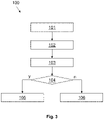
- Fig. 3 depicts a flow diagram 100 according to an embodiment.
- a first energy consumption scenario 10 (see Fig. 1 ) is obtained, which comprises a first time-series of energy consumption data 14 of at least one device, and a quality measure 18 of the first energy consumption scenario 10.
- a second energy consumption scenario 20 is obtained, which comprises a second time-series of energy consumption data 24.
- the second energy consumption scenario 20 may have the same or a shorter duration than the first energy consumption scenario 10.
- the second time-series of energy consumption data 24 to the first time-series of energy consumption data 14 are compared (see Fig. 2 ). In cases when the second time-series of energy consumption data 24 is found similar to the first time-series of energy consumption data 14, the quality measure 18 of the first energy consumption scenario 10 is output.
Landscapes
- Engineering & Computer Science (AREA)
- Business, Economics & Management (AREA)
- Economics (AREA)
- General Physics & Mathematics (AREA)
- Physics & Mathematics (AREA)
- Strategic Management (AREA)
- Human Resources & Organizations (AREA)
- Health & Medical Sciences (AREA)
- Theoretical Computer Science (AREA)
- Tourism & Hospitality (AREA)
- General Business, Economics & Management (AREA)
- Marketing (AREA)
- Automation & Control Theory (AREA)
- Operations Research (AREA)
- Quality & Reliability (AREA)
- Entrepreneurship & Innovation (AREA)
- Game Theory and Decision Science (AREA)
- Development Economics (AREA)
- Public Health (AREA)
- Water Supply & Treatment (AREA)
- General Health & Medical Sciences (AREA)
- Primary Health Care (AREA)
- Management, Administration, Business Operations System, And Electronic Commerce (AREA)
- Supply And Distribution Of Alternating Current (AREA)
- Testing Of Devices, Machine Parts, Or Other Structures Thereof (AREA)
Abstract
Description
- The invention relates to the field of evaluating an energy efficiency, particularly for industrial or commercial sites. The invention further relates to a system, and to a use.
- In many cases, industrial or commercial sites uses enormous amount of energy to run their processes, buildings, and/or further consumers in their sites. Analysing a site to find energy optimization potential of the site and/or their equipment operation typically requires a deep understanding of the site and may become a time-consuming manual process. On the one hand, data from different data sources, stored in different databases, need to be combined for an analysis of the site's energy consumption. On the other hand, energy optimization of the site requires, at least in some cases, a physical model suitable for an optimization of at least a part of the site. Due to the high complexity and the interdisciplinary nature, obtaining an accurate physical model may be an inherently difficult task.
- It is therefore an objective of the invention to provide an improved method for evaluating an energy efficiency of an energy consumption scenario. This objective is achieved by the subject-matter of the independent claims. Further embodiments are evident from the dependent patent claims and the following description.
- One aspect relates to a method for evaluating an energy efficiency of a second energy consumption scenario. The method comprises the steps of:
- Obtaining a first energy consumption scenario, which comprises a first time-series of energy consumption data of at least one device, and a quality measure of the first energy consumption scenario;
- obtaining the second energy consumption scenario, which comprises a second time-series of energy consumption data, wherein the second energy consumption scenario has a same or a shorter duration than the first energy consumption scenario; comparing the second time-series of energy consumption data to the first time-series of energy consumption data; and
- if the second time-series of energy consumption data is similar to the first time-series of energy consumption data, outputting the quality measure of the first energy consumption scenario.
- A site may be an industrial or commercial site, which may run processes, buildings, and/or further consumers in the site. The site may comprise one or more energy consumption scenarios. Each of the energy consumption scenarios may comprise a plurality of data, particularly a time-series of energy data of at least one device.
The device may be a machine for any purpose that is run on the site, e.g. a motor, a heater, a cooler, a computing machine, and/or any energy-consuming device. The device may have one or more - or none - built-in energy-sensors, a plurality of devices may be collected and their energy consumption may be measured and/or obtained in a collective way. In other words, some devices may provide detailed information - possibly even of their parts and/or components -, other "dumb" devices may only be measured at a common source. The plurality of devices may be organized as disjunctive or overlapping subsets, they may be organized, e.g., as a tree and/or in another topology. The energy consumption scenarios may be obtained by an energy management system (EMS). Some sites may have installed an EMS at least for a part of their devices, thus having "historic" and/or current energy consumption time-series readily available, e.g. as measurement data of electrical (or other) load, possibly either aggregated or distributed into individual load-profile for sub-units. Measurement data may comprise energy data of equipment such as battery, photovoltaic, heating, ventilation, air-conditioning, and/or may others. An EMS may have set-points. - Each first energy consumption scenario may comprise a quality measure of this first energy consumption scenario. The quality measure may be provided in an automated and/or a manual way. The quality measure may comprise any value suited for evaluation, e.g. {A; B; ... }, {1; 2; ... }, { "good"; "average"; "bad"; ... }, and/or further values. The quality measure may comprise an energy consumption, for instance based on a sum of energy consumptions of the devices involved in a scenario for the duration of the scenario. The quality measure may comprise one or more attributes, e.g., an energy-steering sequence (e.g. in an "app"), a comment and/or other informal and/or natural-language part. The first energy consumption scenario may use a set of labelled example time-series or patterns. The same first energy consumption scenarios may represent a class of operation modes, where identical classes specify examples that show the same kind of efficiency or inefficiency. The first energy consumption scenarios may be limited to the worst ("inefficient") or the best ("best practice") operation modes.
- While the first energy consumption scenario may be considered as "examples", the second energy consumption scenario may be considered as "real-life probes". The second time-series may be shorter than the first time-series or may, at max, have the same time duration as the first time-series. The second time-series may have been recorded for a longer time duration, but in this case it may be fragmented into a time-series that is shorter as the first time-series it is to compare with. The first and second time-series may have essentially the same temporal resolution, or may be adapted to the same temporal resolution.
- The comparing may relate to a time-series of only one device, e.g. comparing a day- and-night scenario of the second time-series with one of the first time-series, or comparing a frequent on-off-switching, which may have been classified as inefficient. The comparing may relate to a time-series of several devices, e.g. to a heater and a cooler. Running these devices together, e.g. in the same room, may have been classified as inefficient. The comparing may comprise a time-series of input-devices and/or sensors, e.g. reflecting environment data such as temperature, angle of the sun, wind, etc.
- When the comparing comes to the result that the second time-series of energy consumption data is similar to (at least one of) the first time-series of energy consumption data, the quality measure of the first energy consumption scenario may be output, possibly including one or more attributes.
- This may advantageously lead to a significantly improved method for evaluating an energy efficiency of an energy consumption scenario. Moreover, both a quantitative and a qualitative basis may be provided for fast improvements on the energy efficiency of the site or parts of it. This may even serve as a basis for an "intelligent" steering of the site's power consumption. At least in some cases, large datasets that are recorded "standardly" by several EMS, may be used systematically to exploit flexibilities to realize improvements in operation of equipment.
- In various embodiments, the data being similar means a deviation of each data of the first time-series of energy consumption data to the data of the second time-series of energy consumption data of less than 1 %, of less than 5 %, of less than 10 %, of less than 20 %, or of less than 40%. This may be applied to one data, a set of data - e.g. to a "sliding window" of several values - and/or to a correlation of data. This may advantageously serve as a basis for targeted comparing of the data, thus improving the trust in the method's correctness.
- In various embodiments, the data being similar means that a trained artificial neural net, ANN, as described below outputs the data of the second time-series of energy consumption data being part of the data of the first time-series of energy consumption data. The ANN, or a part of it, may be called "Pattern Detector". The "Pattern Detector" is piece of software and/or hardware that is configured to be trained for detecting occurrences of a pattern. The pattern may come from a collection of first energy consumption scenarios, which may be stored in an "Operation Database". Within a time-series, where by occurrence a sub-series of the input time series is meant such that this sub-series is classified into the same quality measure - e.g. class - as the other examples by a suitable classifier, e.g. a recurrent neural network.
- In various embodiments, the quality measure comprises an energy consumption class, a quality estimation and/or a measurement result of the energy consumed in this scenario. Accordingly, each first energy consumption scenario comprises a quality measure of this first energy consumption scenario. The quality measure may be provided in an automated and/or a manual way. The quality measure may comprise any value suited for evaluation, e.g. {1; 2; ... }, { "good"; "average"; "bad"; ... }, and/or further values. The quality measure may comprise an energy consumption, for instance based on a sum of energy consumptions of the devices involved in a scenario for the duration of the scenario.
- In some embodiments, second energy consumption scenarios of essentially the same quality measure are aggregated. Depending on the definition of the "same" quality measure (or class), this may comprise some deviations, e.g. a deviation of 10 %, 20 %, or others. This aggregation advantageously may help to provide the user with an intuitive understanding how far from an optimum - or, how close it - the behaviour of the considered subsystem is.
- In various embodiments, the quality measure is attributed. The quality measure may be attributed, for instance, with a comment, a recommendation, a hint, a statement, or the like. The uses may this way get an insight why the examples of this class showcase inefficiency and what can be done to improve operation. This may advantageously be a basis to propose an improvement in cases when, e.g., the energy consumption sum of the at least one device of the first energy consumption scenario is better than of the second energy consumption scenario. On this basis, for example device settings may be changed.
- In various embodiments, the at least one device comprises a machine driven by electrical, mechanical, chemical, and/or further energy sources. Examples may be a heater, a cooler, a motor, a computing machine, a loader, a compressor, a pressure-driven device, a device driven by heat energy and/or chemical means such as gas and/or another combustible material, and/or solar energy as an energy source. This may contribute to get an overall survey of the "real" energy consumption of a site. Furthermore, this may help to achieve a substantial improvement of the energy consumption.
- In some embodiments, the first energy consumption scenario and the second energy consumption scenario comprise energy consumption data of at least two devices. The two devices may be selected manually or automatically, e.g. by an ANN or by a correlation-computing device. This may help to discover apparent and/or hidden correlations, for instance between a heater and a cooler, which may lead to a worsened energy consumption when, e.g., run in parallel in the same room.
- In various embodiments, the first energy consumption scenario and the second energy consumption scenario comprise input-data. This may contribute to compare the reaction of several sub-systems. This may, for instance, be a basis to detect that on a rapid temperature-change - or other changes -, some sub-systems may react more energy-efficient than others.
- In some embodiments, the input-data comprise environment data, schedule data, production cycle data, and/or other data to influence at least one device of a scenario. Examples may comprise, e.g., weather data, like temperature, sun, rain, humidity, and/or further environment data (e.g. dust). This may include production schedules. Some of them with dedicated length, which may influence the length of an energy consumption scenario. This may include schedules at all, e.g. day/night. Further, it may include data from a Manufacturing Execution System, production cycle data - like: inputting
material # 1, etc. - and/or many others. This may increase the comparability of scenarios. - In some embodiments, the method comprises a further step: If the second time-series of input-data is similar to more than one first time-series of input-data, namely to a primary and a secondary time-series of input-data of a primary and a secondary energy consumption scenario, outputting the quality measure of the primary and the secondary energy consumption scenario. This may lead to an automatic or semi-automatic improvement of the energy consumption, because it makes apparent if there is a more efficient method for the use of energy. For attributed quality measures, this increase the acceptance, because reasons for the improvements may be provided this way.
- An aspect relates to a system for evaluating an energy efficiency of an energy consumption scenario, which is configured to execute a method as described above and/or below.
- An aspect relates to an artificial neural net, ANN, which is configured to:
- in a first learning phase, obtaining a plurality of first energy consumption scenarios, which each comprise a first time-series of energy consumption data of at least one device, and a quality measure of the first energy consumption scenario;
- in a second learning phase, obtaining a plurality of second energy consumption scenarios, which each comprise a second time-series of energy consumption data of at least one device, and a similarity assessment of each second energy consumption scenario to each first energy consumption scenario;
- in a third learning phase, analyzing the similarity assessments, by the ANN;
- in a productive phase, applying, by the ANN, the similarity assessments to a newly obtained second energy consumption scenario; and
- if a similarity assessment of the newly obtained second energy consumption scenario is greater than a predefined value - i.e. on a successful match -, outputting the quality measure for the energy efficiency of the scenario.
- An aspect relates to a use of a system as described above and/or below for evaluating an energy efficiency of an energy consumption scenario and/or of a site running a plurality of energy consumption scenarios.
- For further clarification, the invention is described by means of embodiments shown in the figures. These embodiments are to be considered as examples only, but not as limiting.
- The drawings depict:
-
Fig. 1a and 1b schematically an obtaining of a first and a second energy consumption scenario according to an embodiment; -
Fig. 2 schematically a workflow according to an embodiment; -
Fig. 3 a flow diagram according to an embodiment. -
Fig. 1a schematically shows an obtaining of a firstenergy consumption scenario 10 andFig. 1b an obtaining of a secondenergy consumption scenario 20 according to an embodiment. In the example shown, the firstenergy consumption scenario 10 comprises a first time-series ofenergy consumption data 14 of device B and device C and input-data 12 of an input A. The data - although shown in an "analogue" way - comprise time-series of digital data, whose values have been obtained from a time t0 to a time t1. In addition, the firstenergy consumption scenario 10 comprises aquality measure 18, namely "5". Thequality measure 18 may have been obtained automatically and/or manually, e.g. by an energy assessment. - The second
energy consumption scenario 20 ofFig. 1b has been obtained from a time t2 to a time t3, after the obtaining of the firstenergy consumption scenario 10. The secondenergy consumption scenario 20 comprises a second time-series ofenergy consumption data 24 of device B and device C and input-data 22 of an input A. As can be seen from these figures, the secondenergy consumption scenario 20 has a shorter duration than the firstenergy consumption scenario 10. After obtaining the secondenergy consumption scenario 20, this is compared to the firstenergy consumption scenario 10, i.e. to the first time-series ofenergy consumption data 14 of device B and device C and input-data 12 of an input A. In the case shown, the second time-series ofenergy consumption data 24 is similar to the first time-series ofenergy consumption data 14, Thus, thequality measure 18, i.e. "5", of the firstenergy consumption scenario 10 is output. The comparison ofenergy consumption scenario 20 may be done with a plurality of firstenergy consumption scenarios 10. This may, e.g., be used for studying different "reactions" of devices of the site, possibly depending on a variety of factors. In cases when thequality measure 18 is attributed with a comment or a hint, this may be used for systematic improvements of the energy consumption of the site. -
Fig. 2 schematically shows a workflow according to an embodiment. In an Operation Database, a plurality of first energy consumption scenarios 10 (seeFig. 1 ) is stored. After obtaining a secondenergy consumption scenario 20, this is compared by aPattern Detector 30 to the firstenergy consumption scenario 10. After a successful match of the secondenergy consumption scenario 20 to a firstenergy consumption scenarios 10 of the Operation Database, thePattern 32 or scenario matched is output, along with a quality measure, i.e. in the case shown with a class. The matchedPatterns 32 with the same class may be aggregated 34, and, based on this,Recommendations 36 for improving the energy consumption may be output. -
Fig. 3 depicts a flow diagram 100 according to an embodiment. In astep 101, a first energy consumption scenario 10 (seeFig. 1 ) is obtained, which comprises a first time-series ofenergy consumption data 14 of at least one device, and aquality measure 18 of the firstenergy consumption scenario 10. In astep 102, a secondenergy consumption scenario 20 is obtained, which comprises a second time-series ofenergy consumption data 24. The secondenergy consumption scenario 20 may have the same or a shorter duration than the firstenergy consumption scenario 10. In astep 103, the second time-series ofenergy consumption data 24 to the first time-series ofenergy consumption data 14 are compared (seeFig. 2 ). In cases when the second time-series ofenergy consumption data 24 is found similar to the first time-series ofenergy consumption data 14, thequality measure 18 of the firstenergy consumption scenario 10 is output. -
- 10
- first energy consumption scenario
- 12
- input-data
- 14
- consumption data
- 18
- quality measure
- 20
- second energy consumption scenario
- 22
- input-data
- 24
- consumption data
- 30
- Pattern Detector
- 32
- matched Patterns
- 34
- aggregated classes
- 36
- Recommendations
- 100
- flow diagram
- 101-106
- steps
Claims (15)
- A method for evaluating an energy efficiency of a second energy consumption scenario (20), the method comprising the steps of:obtaining a first energy consumption scenario (10), which comprises a first time-series of energy consumption data (14) of at least one device, and a quality measure (18) of the first energy consumption scenario (10);obtaining the second energy consumption scenario (20), which comprises a second time-series of energy consumption data (24),wherein the second energy consumption scenario (20) has a same or a shorter duration than the first energy consumption scenario (10);comparing the second time-series of energy consumption data (24) to the first time-series of energy consumption data (14); andif the second time-series of energy consumption data (24) is similar to the first time-series of energy consumption data (14), outputting the quality measure (18) of the first energy consumption scenario (10).
- The method of claim 1,
wherein the data being similar means a deviation of each data of the first time-series of energy consumption data (14) to the data of the second time-series of energy consumption data (24) of less than 1 %, of less than 5 %, of less than 10 %, of less than 20 %, or of less than 40%. - The method of claim 1,
wherein the data being similar means that a trained artificial neural net, ANN, according to claim 13 outputs the data of the second time-series of energy consumption data (24) being part of the data of the first time-series of energy consumption data (14). - The method of any one of the preceding claims,
wherein the quality measure (18) comprises an energy consumption class, a quality estimation and/or a measurement result of the energy consumed in this scenario. - The method of claim 4,
wherein second energy consumption scenarios (20) of essentially the same quality measure (18) are aggregated. - The method of any one of the preceding claims,
wherein the quality measure (18) is attributed. - The method of any one of the preceding claims,
wherein the at least one device comprises a machine driven by electrical, mechanical, chemical, and/or further energy sources. - The method of any one of the preceding claims,
wherein the first energy consumption scenario (10) and the second energy consumption scenario (20) comprise energy consumption data (14, 24) of at least two devices. - The method of any one of the preceding claims,
wherein the first energy consumption scenario (10) and the second energy consumption scenario (20) comprise input-data (12, 22). - The method of claim 9,
wherein the input-data (12, 22) comprise environment data, schedule data, production cycle data, and/or other data to influence at least one device of a scenario. - The method of any one of the preceding claims,
wherein, if the second time-series of input-data (22) is similar to more than one first time-series of input-data (12), namely to a primary and a secondary time-series of input-data of a primary and a secondary energy consumption scenario,
outputting the quality measure (18) of the primary and the secondary energy consumption scenario. - A system for evaluating an energy efficiency of an energy consumption scenario (10, 20), which is configured to execute a method according to any one of the preceding claims.
- An artificial neural net, ANN, which is configured to:in a first learning phase, obtaining a plurality of first energy consumption scenarios (10), which each comprise a first time-series of energy consumption data (14) of at least one device, and a quality measure (18) of the first energy consumption scenario (10);in a second learning phase, obtaining a plurality of second energy consumption scenarios (20), which each comprise a second time-series of energy consumption data (24) of at least one device, and a similarity assessment of each second energy consumption scenario (20) to each first energy consumption scenario (10);in a third learning phase, analyzing the similarity assessments, by the ANN;in a productive phase, applying, by the ANN, the similarity assessments to a newly obtained second energy consumption scenario (20); andif a similarity assessment of the newly obtained second energy consumption scenario (20) is greater than a predefined value, outputting the quality measure (18) for the energy efficiency of the scenario.
- A non-transitory computer-readable storage medium having a program stored therein, which, when executed on a processor instructs the processor to perform a method according to any one of the claims 1 - 11.
- Use of a system according to claim 12 for evaluating an energy efficiency of an energy consumption scenario and/or of a site running a plurality of energy consumption scenarios.
Priority Applications (6)
| Application Number | Priority Date | Filing Date | Title |
|---|---|---|---|
| EP20200081.6A EP3979154B1 (en) | 2020-10-05 | 2020-10-05 | Method for evaluating an energy efficiency of a site |
| JP2023520528A JP7494390B2 (en) | 2020-10-05 | 2021-09-28 | Methods for assessing the energy efficiency of a site |
| PCT/EP2021/076578 WO2022073798A1 (en) | 2020-10-05 | 2021-09-28 | Method for evaluating an energy efficiency of a site |
| CA3193864A CA3193864A1 (en) | 2020-10-05 | 2021-09-28 | Method for evaluating an energy efficiency of a site |
| CN202180068404.2A CN116324835A (en) | 2020-10-05 | 2021-09-28 | Method for assessing the energy efficiency of a site |
| US18/193,863 US20230236563A1 (en) | 2020-10-05 | 2023-03-31 | Method for Evaluating an Energy Efficiency of a Site |
Applications Claiming Priority (1)
| Application Number | Priority Date | Filing Date | Title |
|---|---|---|---|
| EP20200081.6A EP3979154B1 (en) | 2020-10-05 | 2020-10-05 | Method for evaluating an energy efficiency of a site |
Publications (2)
| Publication Number | Publication Date |
|---|---|
| EP3979154A1 true EP3979154A1 (en) | 2022-04-06 |
| EP3979154B1 EP3979154B1 (en) | 2026-04-01 |
Family
ID=72752335
Family Applications (1)
| Application Number | Title | Priority Date | Filing Date |
|---|---|---|---|
| EP20200081.6A Active EP3979154B1 (en) | 2020-10-05 | 2020-10-05 | Method for evaluating an energy efficiency of a site |
Country Status (6)
| Country | Link |
|---|---|
| US (1) | US20230236563A1 (en) |
| EP (1) | EP3979154B1 (en) |
| JP (1) | JP7494390B2 (en) |
| CN (1) | CN116324835A (en) |
| CA (1) | CA3193864A1 (en) |
| WO (1) | WO2022073798A1 (en) |
Families Citing this family (1)
| Publication number | Priority date | Publication date | Assignee | Title |
|---|---|---|---|---|
| CN117436848B (en) * | 2023-12-21 | 2024-03-08 | 山东康吉诺技术有限公司 | Motor energy consumption monitoring method based on artificial intelligence |
Citations (1)
| Publication number | Priority date | Publication date | Assignee | Title |
|---|---|---|---|---|
| EP3576029A1 (en) * | 2018-05-31 | 2019-12-04 | IMEC vzw | Method and device for determining energy system operating scenarios |
Family Cites Families (9)
| Publication number | Priority date | Publication date | Assignee | Title |
|---|---|---|---|---|
| US6996508B1 (en) * | 2001-12-03 | 2006-02-07 | The Texas A&M University System | System and method for remote retrofit identification of energy consumption systems and components |
| NZ590350A (en) * | 2008-06-12 | 2012-08-31 | Metro Power Company Pty Ltd | Estimating emission levels and efficiency of an energy-consiming site using plural models |
| JP2012018589A (en) * | 2010-07-09 | 2012-01-26 | Yokogawa Electric Corp | Apparatus data display device and apparatus data display method |
| JP6019566B2 (en) * | 2011-11-17 | 2016-11-02 | ソニー株式会社 | Power management apparatus and power management method |
| CA2856887C (en) * | 2011-11-28 | 2021-06-15 | Expanergy, Llc | Energy search engine with autonomous control |
| US10515308B2 (en) * | 2015-10-30 | 2019-12-24 | Global Design Corporation Ltd. | System, method and cloud-based platform for predicting energy consumption |
| US11514527B2 (en) * | 2017-07-27 | 2022-11-29 | The Hartford Steam Boiler Inspection And Insurance Company | Computer systems and computer-implemented methods utilizing sensor-driven dynamically adjustable feedback loops to manage equipment based risk on an asset specific level of energy data usage |
| EP3511879A1 (en) * | 2018-01-12 | 2019-07-17 | Siemens Aktiengesellschaft | Method for monitoring and controlling the energy cost for the production of a product lot |
| JP7283105B2 (en) * | 2018-02-16 | 2023-05-30 | 富士電機株式会社 | Analysis device and analysis method |
-
2020
- 2020-10-05 EP EP20200081.6A patent/EP3979154B1/en active Active
-
2021
- 2021-09-28 WO PCT/EP2021/076578 patent/WO2022073798A1/en not_active Ceased
- 2021-09-28 CA CA3193864A patent/CA3193864A1/en active Pending
- 2021-09-28 JP JP2023520528A patent/JP7494390B2/en active Active
- 2021-09-28 CN CN202180068404.2A patent/CN116324835A/en active Pending
-
2023
- 2023-03-31 US US18/193,863 patent/US20230236563A1/en active Pending
Patent Citations (1)
| Publication number | Priority date | Publication date | Assignee | Title |
|---|---|---|---|---|
| EP3576029A1 (en) * | 2018-05-31 | 2019-12-04 | IMEC vzw | Method and device for determining energy system operating scenarios |
Also Published As
| Publication number | Publication date |
|---|---|
| JP7494390B2 (en) | 2024-06-03 |
| CN116324835A (en) | 2023-06-23 |
| US20230236563A1 (en) | 2023-07-27 |
| JP2023544778A (en) | 2023-10-25 |
| CA3193864A1 (en) | 2022-04-14 |
| WO2022073798A1 (en) | 2022-04-14 |
| EP3979154B1 (en) | 2026-04-01 |
Similar Documents
| Publication | Publication Date | Title |
|---|---|---|
| US20220350297A1 (en) | Heuristic method of automated and learning control, and building automation systems thereof | |
| Amasyali et al. | A review of data-driven building energy consumption prediction studies | |
| Miller | What's in the box?! Towards explainable machine learning applied to non-residential building smart meter classification | |
| US20150377935A1 (en) | Signal identification methods and systems | |
| US20200241516A1 (en) | Devices, methods, and systems for a distributed rule based automated fault detection | |
| TWI838182B (en) | Estimating system and estimating method for energy saving and emission reduction of power-consumption device | |
| CN116466672A (en) | Data center machine room parameter regulation and control method based on artificial intelligence and related device | |
| CN118963153A (en) | A coal mine energy optimization control method and system | |
| CN118229107B (en) | A method and system for evaluating energy consumption of public institutions | |
| EP3979154B1 (en) | Method for evaluating an energy efficiency of a site | |
| CN119939700A (en) | A green building information integrated management method and system based on BIM | |
| Gao et al. | Using data mining in optimisation of building energy consumption and thermal comfort management | |
| Chen et al. | Technique of feature extraction based on interpretation analysis for multilabel learning in nonintrusive load monitoring with multiappliance circumstances | |
| KR102447048B1 (en) | Energy simulation model generation apparatus and method | |
| Dey et al. | Automated terminal unit performance analysis employing x-RBF neural network and associated energy optimisation–A case study based approach | |
| CN119816848A (en) | Root cause analysis of chemical processes and yield prediction modeling methods using it | |
| CN120706704A (en) | Building carbon emission monitoring system based on BIM | |
| Harris et al. | Scout: An impact analysis tool for building energy-efficiency technologies | |
| Balaji et al. | Enhancing Predictive Accuracy with Machine Learning and IoT Integration in Energy Management | |
| Virgili et al. | Black-box model for estimating efficiency curves in DC-DC converters for energy storage systems | |
| CN116739532B (en) | Energy project management method, system, terminal equipment and storage medium | |
| CN118539511B (en) | Grid control method and device for wind power grid connection | |
| Crowe et al. | From theory to practice: lessons learned from an advanced M&V commercial pilot | |
| Kim | A practical method for short-term voltage stability assessment under multiple and large uncertainties in load models and renewable generation | |
| Badri et al. | DiggiTwin: End-to-end use of digital twins to realize a climate-neutral building stock |
Legal Events
| Date | Code | Title | Description |
|---|---|---|---|
| PUAI | Public reference made under article 153(3) epc to a published international application that has entered the european phase |
Free format text: ORIGINAL CODE: 0009012 |
|
| STAA | Information on the status of an ep patent application or granted ep patent |
Free format text: STATUS: THE APPLICATION HAS BEEN PUBLISHED |
|
| AK | Designated contracting states |
Kind code of ref document: A1 Designated state(s): AL AT BE BG CH CY CZ DE DK EE ES FI FR GB GR HR HU IE IS IT LI LT LU LV MC MK MT NL NO PL PT RO RS SE SI SK SM TR |
|
| STAA | Information on the status of an ep patent application or granted ep patent |
Free format text: STATUS: REQUEST FOR EXAMINATION WAS MADE |
|
| 17P | Request for examination filed |
Effective date: 20220829 |
|
| RBV | Designated contracting states (corrected) |
Designated state(s): AL AT BE BG CH CY CZ DE DK EE ES FI FR GB GR HR HU IE IS IT LI LT LU LV MC MK MT NL NO PL PT RO RS SE SI SK SM TR |
|
| GRAP | Despatch of communication of intention to grant a patent |
Free format text: ORIGINAL CODE: EPIDOSNIGR1 |
|
| STAA | Information on the status of an ep patent application or granted ep patent |
Free format text: STATUS: GRANT OF PATENT IS INTENDED |
|
| INTG | Intention to grant announced |
Effective date: 20251212 |
|
| GRAS | Grant fee paid |
Free format text: ORIGINAL CODE: EPIDOSNIGR3 |
|
| GRAA | (expected) grant |
Free format text: ORIGINAL CODE: 0009210 |
|
| STAA | Information on the status of an ep patent application or granted ep patent |
Free format text: STATUS: THE PATENT HAS BEEN GRANTED |
|
| AK | Designated contracting states |
Kind code of ref document: B1 Designated state(s): AL AT BE BG CH CY CZ DE DK EE ES FI FR GB GR HR HU IE IS IT LI LT LU LV MC MK MT NL NO PL PT RO RS SE SI SK SM TR |
|
| REG | Reference to a national code |
Ref country code: CH Ref legal event code: F10 Free format text: ST27 STATUS EVENT CODE: U-0-0-F10-F00 (AS PROVIDED BY THE NATIONAL OFFICE) Effective date: 20260401 Ref country code: GB Ref legal event code: FG4D |
|
| REG | Reference to a national code |
Ref country code: DE Ref legal event code: R096 Ref document number: 602020069502 Country of ref document: DE |
|
| REG | Reference to a national code |
Ref country code: IE Ref legal event code: FG4D |