EP3978492A1 - Bicyclic compound as rip-1 kinase inhibitor and application thereof - Google Patents
Bicyclic compound as rip-1 kinase inhibitor and application thereof Download PDFInfo
- Publication number
- EP3978492A1 EP3978492A1 EP20814764.5A EP20814764A EP3978492A1 EP 3978492 A1 EP3978492 A1 EP 3978492A1 EP 20814764 A EP20814764 A EP 20814764A EP 3978492 A1 EP3978492 A1 EP 3978492A1
- Authority
- EP
- European Patent Office
- Prior art keywords
- compound
- added
- mmol
- mixture
- synthesis
- Prior art date
- Legal status (The legal status is an assumption and is not a legal conclusion. Google has not performed a legal analysis and makes no representation as to the accuracy of the status listed.)
- Granted
Links
Classifications
-
- C—CHEMISTRY; METALLURGY
- C07—ORGANIC CHEMISTRY
- C07D—HETEROCYCLIC COMPOUNDS
- C07D498/00—Heterocyclic compounds containing in the condensed system at least one hetero ring having nitrogen and oxygen atoms as the only ring hetero atoms
- C07D498/02—Heterocyclic compounds containing in the condensed system at least one hetero ring having nitrogen and oxygen atoms as the only ring hetero atoms in which the condensed system contains two hetero rings
- C07D498/04—Ortho-condensed systems
-
- A—HUMAN NECESSITIES
- A61—MEDICAL OR VETERINARY SCIENCE; HYGIENE
- A61K—PREPARATIONS FOR MEDICAL, DENTAL OR TOILETRY PURPOSES
- A61K31/00—Medicinal preparations containing organic active ingredients
- A61K31/33—Heterocyclic compounds
- A61K31/395—Heterocyclic compounds having nitrogen as a ring hetero atom, e.g. guanethidine or rifamycins
- A61K31/55—Heterocyclic compounds having nitrogen as a ring hetero atom, e.g. guanethidine or rifamycins having seven-membered rings, e.g. azelastine, pentylenetetrazole
- A61K31/551—Heterocyclic compounds having nitrogen as a ring hetero atom, e.g. guanethidine or rifamycins having seven-membered rings, e.g. azelastine, pentylenetetrazole having two nitrogen atoms, e.g. dilazep
-
- A—HUMAN NECESSITIES
- A61—MEDICAL OR VETERINARY SCIENCE; HYGIENE
- A61K—PREPARATIONS FOR MEDICAL, DENTAL OR TOILETRY PURPOSES
- A61K31/00—Medicinal preparations containing organic active ingredients
- A61K31/33—Heterocyclic compounds
- A61K31/395—Heterocyclic compounds having nitrogen as a ring hetero atom, e.g. guanethidine or rifamycins
- A61K31/55—Heterocyclic compounds having nitrogen as a ring hetero atom, e.g. guanethidine or rifamycins having seven-membered rings, e.g. azelastine, pentylenetetrazole
- A61K31/553—Heterocyclic compounds having nitrogen as a ring hetero atom, e.g. guanethidine or rifamycins having seven-membered rings, e.g. azelastine, pentylenetetrazole having at least one nitrogen and one oxygen as ring hetero atoms, e.g. loxapine, staurosporine
-
- A—HUMAN NECESSITIES
- A61—MEDICAL OR VETERINARY SCIENCE; HYGIENE
- A61P—SPECIFIC THERAPEUTIC ACTIVITY OF CHEMICAL COMPOUNDS OR MEDICINAL PREPARATIONS
- A61P29/00—Non-central analgesic, antipyretic or antiinflammatory agents, e.g. antirheumatic agents; Non-steroidal antiinflammatory drugs [NSAID]
-
- C—CHEMISTRY; METALLURGY
- C07—ORGANIC CHEMISTRY
- C07D—HETEROCYCLIC COMPOUNDS
- C07D403/00—Heterocyclic compounds containing two or more hetero rings, having nitrogen atoms as the only ring hetero atoms, not provided for by group C07D401/00
- C07D403/02—Heterocyclic compounds containing two or more hetero rings, having nitrogen atoms as the only ring hetero atoms, not provided for by group C07D401/00 containing two hetero rings
- C07D403/12—Heterocyclic compounds containing two or more hetero rings, having nitrogen atoms as the only ring hetero atoms, not provided for by group C07D401/00 containing two hetero rings linked by a chain containing hetero atoms as chain links
-
- C—CHEMISTRY; METALLURGY
- C07—ORGANIC CHEMISTRY
- C07D—HETEROCYCLIC COMPOUNDS
- C07D413/00—Heterocyclic compounds containing two or more hetero rings, at least one ring having nitrogen and oxygen atoms as the only ring hetero atoms
- C07D413/02—Heterocyclic compounds containing two or more hetero rings, at least one ring having nitrogen and oxygen atoms as the only ring hetero atoms containing two hetero rings
- C07D413/12—Heterocyclic compounds containing two or more hetero rings, at least one ring having nitrogen and oxygen atoms as the only ring hetero atoms containing two hetero rings linked by a chain containing hetero atoms as chain links
-
- C—CHEMISTRY; METALLURGY
- C07—ORGANIC CHEMISTRY
- C07D—HETEROCYCLIC COMPOUNDS
- C07D519/00—Heterocyclic compounds containing more than one system of two or more relevant hetero rings condensed among themselves or condensed with a common carbocyclic ring system not provided for in groups C07D453/00 or C07D455/00
Definitions
- the present disclosure relates to a compound represented by formula (I), or an isomer or pharmaceutically acceptable salt thereof, and use thereof in the manufacture of a medicament for treating diseases related to RIP-1 (receptor-interacting protein) kinase.
- RIP-1 receptor-interacting protein
- RIP1 is a critical upstream kinase that regulates cell necrosis and apoptosis. RIP1 is also involved in a variety of inflammatory signaling pathways, and can be stimulated by TNF and TLR family ligands to trigger an inflammatory response ( Weinlich, R. Nat. Rev. Mol. Cell. Biol. 2017, 18, 127 ; Pasparakis M. et al. Nature 2015, 517, 311 ; Berger, S.B. Cell Death Discovery, 2016, 2, e16056 ). RIP1 drives a variety of inflammatory signaling pathways [Fas ligand, TNF-related apoptosis inducing ligand (TRAIL), TLR3 and TLR4] through TNF receptor 1 ( Lukens J. R., et al. Nature, 2013, 498, 224 ). Inhibiting the activity of RIP1 can be used as a treatment for many inflammatory diseases.
- the present disclosure provides a compound of formula (I), or an isomer or pharmaceutically acceptable salt thereof, wherein
- the present disclosure provides a compound of formula (I), or an isomer or pharmaceutically acceptable salt thereof, wherein
- R 1 is selected from H and CH 3 , wherein the CH 3 is optionally substituted with 1, 2 or 3 R b , and other variables are as defined herein.
- R 1 is selected from H, CH 3 , and CD 3 , and other variables are as defined herein.
- R 1 is selected from H and CH 3 , and other variables are as defined herein.
- R 1t , R 2t , R 3t , and R 4t are each independently selected from H, F, Cl, Br, I, OH, CN, NH 2 , and CH 3 , wherein the CH 3 is optionally substituted with 1, 2 or 3 R c , and other variables are as defined herein.
- R 1t , R 2t , R 3t , and R 4t are each independently selected from H, F, Cl, Br, I, OH, CN, NH 2 , and CH 3 , and other variables are as defined herein.
- R 1e is each independently selected from H, F, Cl, Br, I, OH, CN, NH 2 , and CH 3 , and other variables are as defined herein.
- R 2e is selected from H and CH 3 , and other variables are as defined herein.
- R 2 is each independently selected from H, F, Cl, Br, I, OH, NH 2 , CN, CH 3 , and OCH 3 , wherein the CH 3 and OCH 3 are optionally substituted with 1, 2 or 3 R f , and other variables are as defined herein.
- R 2 is each independently selected from H, F, Cl, Br, I, OH, NH 2 , CN, CH 3 , OCH 3 , CF 3 , and OCF 3 , and other variables are as defined herein.
- R 2 is each independently selected from H, F, Cl, Br, I, OH, NH 2 , and CN, and other variables are as defined herein. wherein the are optionally substituted with 1, 2 or 3 halogen or C 1-3 alkyl, and other variables are as defined herein.
- the above-mentioned Ring A is selected from and
- the above-mentioned Ring A is pyrrolyl, imidazolyl, pyrazolyl, furyl, thienyl, oxazolyl, isoxazolyl, thiazolyl, 1,2,3-triazolyl, 1,2,4-triazolyl, or 1,3,4-thiadiazolyl, wherein the pyrrolyl, imidazolyl, pyrazolyl, furyl, thienyl, oxazolyl, isoxazolyl, thiazolyl, 1,2,3-triazolyl, 1,2,4-triazolyl, or 1,3,4-thiadiazolyl is optionally substituted with C 1-3 alkyl, and other variables are as defined herein.
- the above-mentioned L is selected from L is selected from single bond, -CH 2 -, and -O-, and other variables are as defined herein.
- the above-mentioned L is selected from L is selected from single bond and -CH 2 -, and other variables are as defined herein.
- the above-mentioned Ring B is phenyl or pyridyl, and other variables are as defined herein.
- the present disclosure also includes some embodiments that are obtained by combining any of the above-mentioned variables.
- the above-mentioned compound is selected from wherein
- the above-mentioned compound is selected from wherein
- the above-mentioned compound is selected from or an isomer or pharmaceutically acceptable salt thereof.
- the present disclosure also provides the use of the above-mentioned compound, or the isomer or pharmaceutically acceptable salt thereof, in the manufacture of a medicament for treating diseases related to RIP-1 kinase.
- the compound of the present disclosure has a good inhibitory effect on the programmed cell necrosis (Necroptosis) of U937 cells induced by TNF ⁇ /QVD-OPh, and has achieved a good effect of inhibiting the decrease of body temperature of mice in a model of TNF-driven systemic inflammatory response syndrome.
- pharmaceutically acceptable is used herein in terms of those compounds, materials, compositions, and/or dosage forms, which are suitable for use in contact with human and animal tissues within the scope of reliable medical judgment, with no excessive toxicity, irritation, allergic reaction or other problems or complications, commensurate with a reasonable benefit/risk ratio.
- pharmaceutically acceptable salt means a salt of compounds disclosed herein that is prepared by reacting the compound having a specific substituent disclosed herein with a relatively non-toxic acid or base.
- a base addition salt can be obtained by bringing the neutral form of the compound into contact with a sufficient amount of base in a pure solution or a suitable inert solvent.
- the pharmaceutically acceptable base addition salt includes a salt of sodium, potassium, calcium, ammonium, organic amine or magnesium or similar salts.
- an acid addition salt can be obtained by bringing the neutral form of the compound into contact with a sufficient amount of acid in a pure solution or a suitable inert solvent.
- the pharmaceutically acceptable acid addition salt examples include an inorganic acid salt, wherein the inorganic acid includes, for example, hydrochloric acid, hydrobromic acid, nitric acid, carbonic acid, bicarbonate, phosphoric acid, monohydrogen phosphate, dihydrogen phosphate, sulfuric acid, hydrogen sulfate, hydroiodic acid, phosphorous acid, and the like; and an organic acid salt, wherein the organic acid includes, for example, acetic acid, propionic acid, isobutyric acid, maleic acid, malonic acid, benzoic acid, succinic acid, suberic acid, fumaric acid, lactic acid, mandelic acid, phthalic acid, benzenesulfonic acid, p-toluenesulfonic acid, citric acid, tartaric acid, and methanesulfonic acid, and the like; and an salt of amino acid (such as arginine and the like), and a salt of an organic acid such as glucuronic acid and the
- the pharmaceutically acceptable salt disclosed herein can be prepared from the parent compound that contains an acidic or basic moiety by conventional chemical methods. Generally, such salt can be prepared by reacting the free acid or base form of the compound with a stoichiometric amount of an appropriate base or acid in water or an organic solvent or a mixture thereof.
- the term “isomer” is intended to include geometric isomers, cis- or trans- isomers, stereoisomers, enantiomers, optical isomers, diastereomers, and tautomers.
- Compounds disclosed herein may be present in a specific geometric or stereoisomeric form.
- the present disclosure contemplates all such compounds, including cis and trans isomers, (-)- and (+)-enantiomers, (R)- and (S)-enantiomers, diastereoisomer, (D)-isomer, (L)-isomer, and a racemic mixture and other mixtures, for example, a mixture enriched in enantiomer or diastereoisomer, all of which are encompassed within the scope disclosed herein.
- the substituent such as alkyl may have an additional asymmetric carbon atom. All these isomers and mixtures thereof are encompassed within the scope disclosed herein.
- the term “enantiomer” or “optical isomer” means stereoisomers that are in a mirrored relationship with each other.
- cis-trans isomer or “geometric isomer” is produced by the inability of a double bond or a single bond between ring-forming carbon atoms to rotate freely.
- diastereomer means a stereoisomer in which two or more chiral centers of are contained in a molecule and is in a non-mirrored relationship between molecules.
- a wedged solid bond and a wedged dashed bond indicate the absolute configuration of a stereocenter; a straight solid bond and a straight dashed bond ( ) indicate the relative configuration of a stereocenter; a wavy line indicates a wedged solid bond or a wedged dashed bond or a wavy line indicates a straight solid bond and a straight dashed bond
- the compound having following formula (A) means that the compound is present as a single isomer of formula (A-1) or formula (A-2) or as a mixture of two isomers of formula (A-1) and formula (A-2); and the compound having following formula (B) means that the compound is present as a single isomer of formula (B-1) or formula (B-2) or
- tautomer or “tautomeric form” means that different functional groups are in dynamic equilibrium at room temperature and can be rapidly converted into each other. If tautomers are possible (as in solution), a chemical equilibrium of tautomers can be achieved.
- proton tautomers also known as prototropic tautomers
- Valence tautomers include interconversions by recombination of some bonding electrons.
- keto-enol tautomerization is interconversion between two tautomers pentane-2, 4-dione and 4-hydroxypent-3-en-2-one.
- the term “enriched in one isomer”, “isomer enriched”, “enriched in one enantiomer” or “enantiomeric enriched” means that the content of one isomer or enantiomer is less than 100%, and the content of the isomer or enantiomer is 60% or more, or 70% or more, or 80% or more, or 90% or more, or 95% or more, or 96% or more, or 97% or more, 98% or more, 99% or more, 99.5% or more, 99.6% or more, 99.7% or more, 99.8% or more, or 99.9% or more.
- the term “isomer excess” or “enantiomeric excess” means the difference between the relative percentages of two isomers or two enantiomers. For example, if one isomer or enantiomer is present in an amount of 90% and the other isomer or enantiomer is present in an amount of 10%, the isomer or enantiomeric excess (ee value) is 80%.
- Optically active (R)- and (S)-isomer, or D and L isomer can be prepared using chiral synthesis or chiral reagents or other conventional techniques. If one kind of enantiomer of certain compound disclosed herein is to be obtained, the pure desired enantiomer can be obtained by asymmetric synthesis or derivative action of chiral auxiliary followed by separating the resulting diastereomeric mixture and cleaving the auxiliary group.
- the compound when the molecule contains a basic functional group (such as amino) or an acidic functional group (such as carboxyl), the compound reacts with an appropriate optically active acid or base to form a salt of the diastereomeric isomer which is then subjected to diastereomeric resolution through the conventional method in the art to afford the pure enantiomer.
- the enantiomer and the diastereoisomer are generally isolated through chromatography which uses a chiral stationary phase and optionally combines with a chemical derivative method (for example, carbamate generated from amine).
- Compounds disclosed herein may contain an unnatural proportion of atomic isotopes at one or more of the atoms that make up the compounds.
- a compound may be labeled with a radioisotope such as tritium ( 3 H), iodine-125 ( 125 I) or C-14( 14 C).
- a radioisotope such as tritium ( 3 H), iodine-125 ( 125 I) or C-14( 14 C).
- hydrogen can be replaced by heavy hydrogen to form a deuterated drug.
- the bond between deuterium and carbon is stronger than that between ordinary hydrogen and carbon.
- deuterated drugs have advantages of reduced toxic side effects, increased drug stability, enhanced efficacy, and prolonged biological half-life of drugs. All changes in the isotopic composition of compounds disclosed herein, regardless of radioactivity, are included within the scope of the present disclosure.
- substituted means one or more than one hydrogen atom(s) on a specific atom are substituted by a substituent, including deuterium and hydrogen variants, as long as the valence of the specific atom is normal and the substituted compound is stable.
- it means two hydrogen atoms are substituted.
- Positions on an aromatic ring cannot be substituted by oxo.
- optionally substituted means an atom can be substituted by a substituent or not, unless otherwise specified, the species and number of the substituent may be arbitrary as long as being chemically achievable.
- variable such as R
- the definition of the variable at each occurrence is independent.
- the group can be optionally substituted by up to two R, wherein the definition of R at each occurrence is independent.
- a combination of the substituent and/or the variant thereof is allowed only when the combination results in a stable compound.
- linking group When the number of a linking group is 0, such as -(CRR) 0 -, it means that the linking group is a single bond.
- one of the variables is a single bond, it means that the two groups linked by the single bond are connected directly.
- L in A-L-Z represents a single bond
- the structure of A-L-Z is actually A-Z.
- an enumerated substituent does not indicate the atom through which the enumerated substituent is linked to the substituted group
- such substituent can be bonded through any of its atoms.
- a pyridyl group as a substituent may be linked to the substituted group through any one of carbon atoms on the pyridine ring.
- the -M-W- can be linked to the ring A and the ring B in the same direction as the reading order from left to right to constitute or can be linked to the ring A and the ring B in the reverse direction as the reading order from left to right to constitute
- a combination of the linking groups, substituents and/or variants thereof is allowed only when such combination can result in a stable compound.
- halo or halogen by itself or as part of another substituent represents a fluorine, chlorine, bromine or iodine atom.
- C 1-3 alkoxy refers to an alkyl group containing 1 to 3 carbon atoms and attached to the remainder of a molecule by an oxygen atom.
- the C 1-3 alkoxy group includes C 1-2 , C 2-3 , C 3 , C 2 alkoxy groups, and the like.
- Examples of C 1-3 alkoxy groups include, but are not limited to, methoxy, ethoxy, propoxy (including n-propoxy and isopropoxy), and the like.
- C 1-3 alkyl is used to indicate a linear or branched saturated hydrocarbon group consisting of 1 to 3 carbon atoms.
- the C 1-3 alkyl group includes C 1-2 and C 2-3 alkyl groups and the like. It may be monovalent (e.g., methyl), divalent (e.g., methylene) or multivalent (e.g., methenyl).
- Examples of C 1-3 alkyl groups include, but are not limited to, methyl (Me), ethyl (Et), propyl (including n-propyl and isopropyl), and the like.
- 5- to 6-membered heteroaromatic ring and “5-to 6-membered heteroaryl” may be used interchangeably.
- the term “5- to 6-membered heteroaryl” means a monocyclic group having a conjugated pi electron system and consisting of 5 to 6 ring atoms, of which 1, 2, 3 or 4 ring atoms are heteroatoms independently selected from O, S and N, and the remainder atoms are carbon atoms, wherein the nitrogen atom is optionally quaternized and the nitrogen and sulfur heteroatoms are optionally oxidized (i.e., NO and S(O) p , p is 1 or 2).
- the 5- to 6-membered heteroaryl group may be attached to the remainder of a molecule by a heteroatom or a carbon atom.
- the 5- to 6-membered heteroaryl group includes 5-membered and 6-membered heteroaryl groups.
- Examples of the 5- to 6-membered heteroaryl group include, but are not limited to, pyrrolyl (including N-pyrrolyl, 2-pyrrolyl, 3-pyrrolyl, and the like), pyrazolyl (including 2-pyrazolyl and 3-pyrazolyl, and the like), imidazolyl (including N-imidazolyl, 2-imidazolyl, 4-imidazolyl, and 5-imidazolyl, and the like), oxazolyl (including 2-oxazolyl, 4-oxazolyl, and 5-oxazolyl, and the like), triazolyl (1H-1,2,3-triazolyl, 2H-1,2,3-triazolyl, 1H-1,2,4-triazolyl and 4
- Cn-n+m or Cn-Cn+m includes any one of n to n+m carbons.
- C 1-12 includes C 1 , C 2 , C 3 , C 4 , C 5 , C 6 , C 7 , C 8 , C 9 , C 10 , C 11 , and C 12 .
- Cn-n+m or Cn-Cn+m also includes any range of n to n+m.
- C 1-12 includes C 1-3 , C 1-6 , C 1-9 , C 3-6 , C 3-9 , C 3-12 , C 6-9 , C 6-12 , C 9-12 , and the like.
- the n-membered to n+m-membered ring means that the number of atoms on the ring is n to n+m.
- 3- to 12-membered ring includes 3-membered ring, 4-membered ring, 5-membered ring, 6-membered ring, 7-membered ring, 8-membered ring, 9-membered ring, 10-membered ring, 11-membered ring, and 12-membered ring.
- the n-membered to n+m-membered ring also means that the number of atoms on the ring includes any range from n to n+m.
- 3- to 12-membered ring includes 3- to 6-membered ring, 3- to 9-membered ring, 5- to 6-membered ring, 5- to 7-membered ring, 6- to 7-membered ring, 6- to 8-membered ring, and 6- to 10-membered ring, and the like.
- leaving group refers to a functional group or atom which can be replaced by another functional group or atom through a substitution reaction (such as affinity substitution reaction).
- representative leaving groups include triflate; chlorine, bromine and iodine; sulfonate group, such as mesylate, tosylate, p-bromobenzenesulfonate, p-toluenesulfonate and the like; acyloxy, such as acetoxy, trifluoroacetoxy and the like.
- protecting group includes, but is not limited to "amino protecting group", “hydroxy protecting group” or “thio protecting group”.
- amino protecting group refers to a protecting group suitable for blocking the side reaction on the nitrogen of an amino.
- Representative amino protecting groups include, but are not limited to: formyl; acyl, such as alkanoyl (e.g., acetyl, trichloroacetyl or trifluoroacetyl); alkoxycarbonyl, such as tert-butoxycarbonyl (Boc); arylmethoxycarbonyl such as benzyloxycarbonyl (Cbz) and 9-fluorenylmethoxycarbonyl (Fmoc); arylmethyl such as benzyl (Bn), trityl (Tr), 1, 1-bis-(4'-methoxyphenyl)methyl; silyl such as trimethylsilyl (TMS) and tert-butyldimethylsilyl
- hydroxy protecting group refers to a protecting group suitable for blocking the side reaction on hydroxy.
- Representative hydroxy protecting groups include, but are not limited to: alkyl such as methyl, ethyl and tert-butyl; acyl such as alkanoyl (e.g., acetyl); arylmethyl such as benzyl (Bn), p-methoxybenzyl (PMB), 9-fluorenylmethyl (Fm), and diphenylmethyl (benzhydryl, DPM); silyl such as trimethylsilyl (TMS) and tert-butyl dimethyl silyl (TBS) and the like.
- alkyl such as methyl, ethyl and tert-butyl
- acyl such as alkanoyl (e.g., acetyl)
- arylmethyl such as benzyl (Bn), p-methoxybenzyl (PMB), 9-fluorenylmethyl (
- the absolute configuration can be confirmed by conventional techniques in the art, such as single crystal X-Ray diffraction (SXRD).
- SXRD single crystal X-Ray diffraction
- the diffraction intensity data of the cultivated single crystal is collected using a Bruker D8 venture diffractometer with a light source of CuK ⁇ radiation in a scanning mode of ⁇ / ⁇ scan; after collecting the relevant data, the crystal structure is further analyzed by the direct method (Shelxs97) to confirm the absolute configuration.
- Solvents used in the present disclosure are commercially available.
- Step 1 synthesis of compound BB-1-3
- BB-1-1 (2.60 g, 17.31 mmol, 1.00 eq) and solvent EtOH (11.25 mL) and isopropyl ether (37.50 mL).
- BB-1-2 (2.59 g, 17.83 mmol, 1.03 eq) was slowly added under stirring, and the reaction solution was stirred at 20 °C for 12 hours. The reaction solution was filtered, and the resulting filter cake was washed with isopropyl ether (30 mL ⁇ 3) to give compound BB-1-3.
- BB-2-1 (2.5 g, 15.51 mmol, 2.94 mL, 1 eq) in dichloromethane (40 mL) was added methanol (4.97 g, 155.13 mmol, 6.28 mL, 10 eq) at 23 °C.
- TMSCHN 2 (2 M, 9.31 mL, 1.2 eq) was then added and the mixture was stirred for another 2 hours.
- 0.1 mL of glacial acetic acid was added to the reaction solution, and the reaction solution was concentrated under reduced pressure to give BB-2-2.
- BB-1-2 (2.07 g, 14.27 mmol, 1 eq)
- ethanol 10 mL
- isopropyl ether 20 mL
- BB-2-3 2.5 g, 14.27 mmol, 1 eq
- BB-2-4 0.5 g, 1.82 mmol, 1 eq
- molecular sieves 4 ⁇ , 0.05 g
- xylene 15 mL
- the microwave tube was sealed and the reaction was stirred in a microwave reactor at 150 °C for 4 hours.
- a target signal appeared by LCMS monitoring.
- 30 mL of acetonitrile was added to the reaction solution, and the mixture was filtered. The filtrate was concentrated under reduced pressure to give BB-2-5.
- LCMS m/z 257.1 [M+H] + .
- BB-3-2 (20.00 g, 97.46 mmol, 1.00 eq) was dissolved in DMF (50 mL) and the solution was added dropwise to a suspension of NaH (8.19 g, 204.67 mmol, 60% purity, 2.10 eq) in DMF (150 mL).
- Compound BB-3-1 (13.75 g, 97.46 mmol, 10.26 mL, 1.00 eq) was then added dropwise.
- the reaction solution was stirred at 20 °C for 16 hours. Ethyl acetate (200 mL) and water (200 mL) were then added to the reaction solution, and the aqueous phase was adjusted to a pH of about 1 with hydrochloric acid.
- Step 4 synthesis of compound BB-4-5
- Step 5 synthesis of compound BB-4-6
- Step 6 synthesis of compound BB-4 .
- Step 1 synthesis of compound BB-5-1
- BB-7-2 (7 g, 26.05 mmol, 1 eq) in ethanol (200 mL) was added hydroxylamine hydrochloride (1.81 g, 26.05 mmol, 1 eq), and the mixture was reacted at 80 °C for 12 hours.
- LCMS analysis the raw materials were completely consumed, and a target signal appeared.
- the reaction solution was concentrated under reduced pressure to give BB-7-3 .
- BB-8-2 (0.3 g, 1.38 mmol, 1 eq) was dissolved in tetrahydrofuran (12 mL) and water (4 mL), and lithium hydroxide monohydrate (173.85 mg, 4.14 mmol, 3 eq) was added. The reaction was stirred at 25°C for 12 hours. By LCMS monitoring, the raw materials were completely consumed, and a target signal peak appeared. Ethyl acetate (10 mL) was added to the reaction solution, and the aqueous phase was adjusted to a pH of 3-4 with 1 M hydrochloric acid. Solid precipitated. The mixture was filtered to give BB-8 .
- Step 1 synthesis of compound BB-10-1
- Reference example 11 Fragment BB-11A, BB-11B
- Step 3 synthesis of compound BB-11-4.
- BB-11-3 (4 g, 22.70 mmol, 1 eq ) in ethanol (50 mL) was added ethyl 2-ethoxy-2-iminoacetate (16.47 g, 113.50 mmol, 5 eq ) , and the mixture was reacted at 85°C for 12 hours.
- the reaction solution was concentrated under reduced pressure to give a crude product.
- LCMS m/z 276.2 [M+1] + .
- BB-11-4 (1.3 g, 4.72 mmol, 1 eq) was added to phosphorous oxychloride (30 mL) at 25°C, and the mixture was reacted at 120°C for 3 hours.
- the reaction solution was cooled to room temperature, and then slowly poured into warm water (150 mL).
- the mixture was adjusted to a pH of 7 ⁇ 8 with saturated sodium bicarbonate, and then extracted with ethyl acetate (100 mL ⁇ 2).
- the organic phases were combined, washed with saturated brine, dried over anhydrous sodium sulfate, and filtered. The filtrate was concentrated under reduced pressure to give a crude product.
- Step 5 synthesis of compound BB-11A and BB-11B
- the compound BB-11 was analyzed by supercritical fluid chromatography (Chiralcel AD-3 3 ⁇ m, 0.46cm id x 15mL; Mobile phase: A for SFC CO 2 and B for MeOH(0.05%IPAm); Gradient: B in A from 10% to 40% in 6 minutes; Flow rate: 4.0mL/min; Wavelength: 220nm), and it was shown that retention times of BB-11A and BB-11B were 2.217 min and 2.427 min, respectively.
- BB-11A and BB-11B were obtained by separation upon supercritical fluid chromatography (Column: DAICEL CHIRALPAK AD (250mm ⁇ 50mm, 10 ⁇ m); Mobile phase: [0.1%NH 3 H 2 O MEOH]; MeOH%: 30%-30%, 2.56min).
- the compound BB-11A was analyzed by supercritical fluid chromatography (Chiralcel AD-3 3 ⁇ m, 0.46cm id ⁇ 15mL; Mobile phase: A for supercritical carbon dioxide, B for methanol (containing 0.05% IPAm); Gradient: B from 10% to 40% in 6 minutes; Flow rate: 4.0mL/min; Wavelength: 220nm), and it was shown that retention time of BB-11A was 2.235 min, and retention time of BB-11B was 2.439 min.
- Reference example 12 Fragment BB-12
- Step 1 synthesis of compound BB-12 .
- Step 1 synthesis of compound BB-13-1
- BB-13-1 (0.08 g, 301.10 ⁇ mol, 1 eq ) was dissolved in tetrahydrofuran (6 mL) and water (2 mL), and lithium hydroxide monohydrate (37.90 mg, 903.29 ⁇ mol, 3 eq ) was added. The mixture was reacted at 25°C for 12 hours. By LCMS monitoring, the raw materials were completely consumed, and a target signal peak appeared. 5 mL of ethyl acetate was added to the reaction solution. The aqueous phase was adjusted to a pH of about 6 with 1 M hydrochloric acid, and lyophilized to give BB-13 .
- the crude product was purified by silica gel column, and then separated by SFC (Chiralcel OJ-3, 3 ⁇ m, 0.46cm id x 5cm L; Mobile phase: A for supercritical carbon dioxide, B for methanol (containing 0.05% IPAm); Gradient: B from 10% to 40% in 5 minutes; Flow rate: 4.0mL/min; Wavelength h: 220nm) to give compound WX001 .
- reaction solution was directly purified by preparative HPLC (Column: Phenomenex Luna C18 150mm ⁇ 30mm ⁇ 5 ⁇ m; Mobile phase: [water (0.05%HCl)-ACN]; acetonitrile%: 20%-50%, 12min) to give compound WX006 .
- reaction solution was directly purified by preparative HPLC (Column: Phenomenex Luna C18 150mm ⁇ 30mm ⁇ 5 ⁇ m; Mobile phase: [water (0.05%HCl)-ACN]; acetonitrile%: 20%-50%, 12min) to give compound WX007 .
- reaction solution was directly purified by preparative HPLC (Column: Phenomenex Luna C18 150mm ⁇ 30mm ⁇ 5 ⁇ m; Mobile phase: [water (0.05%HCl)-ACN]; acetonitrile%: 20%-50%, 12min) to give compound WX008 .
- reaction solution was directly purified by preparative HPLC (Column: Phenomenex Luna C18 150mm ⁇ 30mm ⁇ 5 ⁇ m; Mobile phase: [water (0.05%HCl)-ACN]; acetonitrile%: 20%-50%, 12min) to give compound WX009 .
- reaction solution was directly purified by preparative HPLC (Column: Phenomenex Luna C18 150mm ⁇ 30mm ⁇ 5 ⁇ m; Mobile phase: [water (0.05%HCl)-ACN]; acetonitrile%: 20%-50%, 12min) to give compound WX010 .
- reaction solution was directly purified by preparative HPLC (Column: Phenomenex Luna C18 150mm ⁇ 30mm ⁇ 5 ⁇ m; Mobile phase: [water (0.05%HCl)-ACN]; acetonitrile%: 20%-50%, 12min) to give compound WX011 .
- reaction solution was directly purified by preparative HPLC (Column: Phenomenex Luna C18 150mm ⁇ 30mm ⁇ 5 ⁇ m; Mobile phase: [water (0.05%HCl)-ACN]; acetonitrile%: 20%-50%, 12min) to give compound WX012 .
- LCMS m/z 396.2 [M+H] + .
- LiOH ⁇ H 2 O (245.59 mg, 5.85 mmol, 3 eq ) was added to a solution of BB-11B (501.93 mg, 1.95 mmol, 1 eq ) in tetrahydrofuran (9 mL) and water (3 mL), and the mixture was reacted at 25 °C for 2 hours.
- Water (10 mL) and ethyl acetate (10 mL) were added to the reaction solution, and the layers were separated.
- the aqueous phase was extracted with ethyl acetate (10 mL ⁇ 2).
- the resulting aqueous phase was adjusted to a pH of 5-6 with 1 M HCl, and extracted with ethyl acetate (10 mL ⁇ 2).
- N,N-diisopropylethylamine (23.16 mg, 179.20 ⁇ mol, 31.21 ⁇ L, 2.5 eq) and WX013-1 (24.65 mg, 107.52 ⁇ mol, 1.5 eq ) were added to a solution of BB-1 (15 mg, 71.68 ⁇ mol, 1 eq ) in DMF (1.5 mL), and propylphosphonic anhydride (T 3 P, 68.42 mg, 107.52 ⁇ mol, 63.94 ⁇ L, 50% purity, 1.5 eq ) was then added. The mixture was reacted at 25 °C for 1 hour. The reaction solution was filtered, and the filtrate was collected.
- WX014-1 was dissolved in a solution of THF (100 mL) and MeOH (100 mL), and the reaction flask was placed in an ice water bath (0°C). Trimethylsilyl diazomethane (2 M, 47.89 mL, 2.1 eq) was added to the flask, and the mixture was allowed to warm to 25°C and stirred for 2 hours. Glacial acetic acid was added dropwise until the reaction solution turned pale yellow. The reaction solution was concentrated under reduced pressure to give compound WX014-2 .
- Triphenylphosphine (14.30 g, 54.53 mmol, 1.2 eq) and imidazole (3.71 g, 54.53 mmol, 1.2 eq) were dissolved in dichloromethane (120 mL) at 25°C, and I 2 (13.84 g, 54.53 mmol, 10.98 mL, 1.2 eq) was slowly added to the above mixture solution.
- the mixture solution was stirred for 10 minutes, and a solution of WX014-2 in DCM (80 mL) was added to the above solution. The mixture was reacted at 25°C for 12 hours.
- the reaction solution was filtered, and the filtrate was concentrated under reduced pressure to give a crude product.
- 1,2-Dibromoethane (82.12 mg, 437.12 ⁇ mol, 32.98 ⁇ L, 0.3 eq) was added to zinc powder (285.83 mg, 4.37 mmol, 3 eq) in DMF (2 mL). The mixture was stirred at 60°C for 30 minutes, and then cooled to room temperature (25°C). Trimethylchlorosilane (9.50 mg, 87.42 ⁇ mol, 11.10 ⁇ L, 0.06 eq) was added into the reaction flask, and the mixture was stirred at 25°C for 30 minutes.
- LiOH ⁇ H 2 O (219.33 mg, 5.23 mmol, 3 eq) was added to a solution of WX014-4 in tetrahydrofuran (15 mL) and water (15 mL), and the mixture was reacted at 25°C for 2 hours. 10 mL of Water and 10 mL of ethyl acetate were added to the reaction solution, and the layers were separated. The aqueous phase was extracted with ethyl acetate (10 mL ⁇ 2). The resulting aqueous phase was adjusted to a pH of 5 ⁇ 6 with 1 M HCl, and extracted with ethyl acetate (10 mL ⁇ 2).
- Propylphosphonic anhydride (895.80 mg, 1.41 mmol, 837.20 ⁇ L, 50% purity, 1.5 eq) was added to a solution of N,N-diisopropylethylamine (303.22 mg, 2.35 mmol, 408.65 ⁇ L, 2.5 eq) and WX014-5 in DMF (20 mL), and the mixture was reacted at 25°C for 2 hours. Water (15 mL) and ethyl acetate (15 mL) were added to the reaction solution, and the layers were separated. The aqueous phase was extracted with ethyl acetate (15 mL ⁇ 2).
- Lawsson's reagent (77.70 mg, 192.12 ⁇ mol, 1.5 eq) was added to a solution of WX014-6 (40 mg, 128.08 ⁇ mol, 1 eq) in toluene (5 mL) at 20°C, and the mixture was reacted at 70°C for 12 hours.
- the reaction solution was concentrated under reduced pressure to give a crude product.
- LCMS m/z 273.1 [M-56+1] + .
- aqueous phase was extracted with ethyl acetate (5 mL ⁇ 2).
- the organic phases were combined, washed with saturated brine, dried over anhydrous sodium sulfate, and filtered. The filtrate was concentrated under reduced pressure to give a crude product.
- the crude product was purified by preparative HPLC (Column: Phenomenex Luna C18 150mm ⁇ 30mm ⁇ 5 ⁇ m; Mobile phase: [water (0.05%HCl)-ACN]; acetonitrile%: 20%-50%, 12min) to give WX014 .
- LCMS m/z 414.2 [M+1] + .
- BB-3 (20 mg, 96.02 ⁇ mol, 1.1 eq) and DIPEA (23.69 mg, 183.32 ⁇ mol, 31.93 ⁇ L, 2.1 eq).
- BB-14 21.24 mg, 87.30 ⁇ mol, 1 eq
- T 3 P 55.55 mg, 87.30 ⁇ mol, 51.92 ⁇ L, 50% purity, 1 eq
- the reaction solution was concentrated under reduced pressure to about 5 mL.
- BB-4 200 mg, 955.71 ⁇ mol, 1.1 eq
- DIPEA 235.80 mg, 1.82 mmol, 317.80 ⁇ L, 2.1 eq
- BB-14 210.50 mg, 868.83 ⁇ mol, 1 eq
- T 3 P 552.89 mg, 868.83 ⁇ mol, 516.72 ⁇ L, 50% purity, 1 eq
- the reaction solution was concentrated under reduced pressure to about 5 mL.
- reaction solution was concentrated under reduced pressure to about 5 mL, and the residue was purified by preparative HPLC (Column: Welch Xtimate C18 150 ⁇ 25mm ⁇ 5 ⁇ m; Mobile phase: [water (0.225%FA)-ACN]; acetonitrile%: 35%-65%, 8min) to give compound WX020 .
- BB-4-3 (3.00 g, 10.09 mmol, 1 eq) and N-bromosuccinimide (1.98 g, 11.10 mmol, 1.1eq) were slowly added to DCM (30 mL) at 25°C, and the reaction solution was continuously stirred at 25°C under nitrogen for 12 hours.
- the reaction solution was slowly poured into water (100 mL), and the mixture was extracted with dichloromethane (100 mL ⁇ 2).
- the organic phases were combined and washed successively with water (100 mL) and saturated brine (100 mL) to give an organic phase.
- the organic phase was concentrated under reduced pressure.
- N,N-dimethylformamide (10 mL) at 25°C.
- WX023-2 (1.80 g, 5.03 mmol, 1 eq)
- iodomethane (5.71 g, 40.23 mmol, 2.50 mL, 8.01 eq)
- cesium carbonate (3.60g, 11.06 mmol, 2.2 eq) were then slowly added.
- the reaction solution was continuously stirred at 25°C under nitrogen for 1 hour.
- the reaction solution was slowly poured into water (100 mL), and the mixture was extracted with ethyl acetate (100 mL ⁇ 2).
- the organic phases were combined and washed successively with water (100 mL) and saturated brine (100 mL).
- N,N-dimethylformamide 200 mL
- WX024-4 (17 g, 50.54 mmol, 1 eq)
- cesium carbonate 49.40 g, 151.63 mmol, 3 eq
- iodomethane 21.52 g, 151.63 mmol, 9.44 mL, 3 eq
- Water 300 mL was added to the reaction solution, and the mixture was extracted with ethyl acetate (300mL ⁇ 2). The organic phases were combined, washed with saturated brine (100 mL ⁇ 2), and concentrated under reduced pressure.
- N,N-dimethylformamide 5 mL.
- WX024-7 (245 mg, 809.18 ⁇ mol, 1 eq , HCl), BB-8 (164.42 mg, 809.18 ⁇ mol, 1 eq), HATU (461.51 mg, 1.21 mmol, 1.5 eq) and DIPEA (313.74 mg, 2.43 mmol, 422.83 ⁇ L, 3 eq) were then slowly added, and the mixture was continuously stirred at 25 °C for 2 hours.
- the reaction solution was poured into water (20 mL), and the mixture was extracted with ethyl acetate (20 mL ⁇ 2).
- aqueous phase was adjusted to a pH of 5 ⁇ 6 with 1 M HCl, and extracted with ethyl acetate (150 mL ⁇ 2). The organic phases were combined, washed with saturated brine, dried over anhydrous sodium sulfate, and filtered. The filtrate was concentrated under reduced pressure to give compound WX025-2.
- LCMS m/z 328.1 [M+1] + .
- T 3 P (20.87 g, 32.79 mmol, 19.50 mL, 50% purity, 1.5 eq) was added to a solution of DIPEA (7.06 g, 54.66 mmol, 9.52 mL, 2.5 eq) and WX025-3 (6.5 g, 21.86 mmol, 1 eq) in N,N-dimethylformamide (200 mL), and the mixture was reacted at 25 °C for 3 hours. Water (200 mL) was added to the reaction solution in an ice bath, and the mixture was extracted with ethyl acetate (200mL ⁇ 2). The organic phases were combined, washed with saturated brine, dried over anhydrous sodium sulfate, and filtered.
- DIPEA 7.06 g, 54.66 mmol, 9.52 mL, 2.5 eq
- WX025-3 6.5 g, 21.86 mmol, 1 eq
- Iodomethane (384.21 mg, 2.71 mmol, 168.51 ⁇ L, 1.05 eq) was added to a solution of WX025-4 (0.72 g, 2.58 mmol, 1 eq) and cesium carbonate (1.01 g, 3.09 mmol, 1.2 eq) in tetrahydrofuran (14 mL), and the mixture was reacted at 20 °C for 12 hours. Water (25 mL) and ethyl acetate (25 mL) were added to the reaction solution, and the layers were separated. The aqueous phase was extracted with ethyl acetate (25 mL ⁇ 2).
- DIPEA (77.82 mg, 602.10 ⁇ mol, 104.87 ⁇ L, 3 eq) and T 3 P (127.72 mg, 401.40 ⁇ mol, 119.36 ⁇ L, 2 eq) were added to a solution of WX025-7 (42 mg, 200.70 ⁇ mol, 1 eq) and BB-8 (61.17 mg, 301.05 ⁇ mol, 1.5 eq) in N,N-dimethylformamide (3 mL), and the mixture was reacted at 25°C for 2 hours. Water (5 mL) and ethyl acetate (5 mL) were added to the reaction solution, and the layers were separated.
- reaction solution was purified by HPLC (Column: Phenomenex Luna C18 150mm ⁇ 30mm ⁇ 5 ⁇ m; Mobile phase: [water (0.05%HCl)-ACN]; acetonitrile%: 20%-50%, 12min) to give compound WX026 .
- reaction solution was poured into a mixed solution of saturated ammonium chloride (200 mL) and ethyl acetate (200 mL), and the layers were separated.
- the aqueous phase was extracted with ethyl acetate (200 mL).
- the organic phases were combined, washed with saturated brine (50 mL ⁇ 2), and concentrated under reduced pressure to give a crude product.
- N,N-dimethylformamide (1 mL).
- WX028-6 (30 mg, 122.33 ⁇ mol, 1 eq)
- BB-4 54.02 mg, 122.33 ⁇ mol, 1 eq
- T 3 P 116.77 mg, 183.50 ⁇ mol, 109.13 ⁇ L, 50% purity, 1.5 eq
- DIPEA 116.77 mg, 183.50 ⁇ mol, 109.13 ⁇ L, 50% purity, 1.5 eq
- DIPEA 47.43 mg, 366.99 ⁇ mol, 63.92 ⁇ L, 3 eq
- reaction solution was separated by preparative HPLC (Column: Xtimate C18 100 ⁇ 30 mm ⁇ 3 ⁇ m; Mobile phase: [water (0.225%FA)-ACN]; acetonitrile%: 35%-65%, 8min) to give a racemate of compound WX028, which was then resolved by chiral SFC (Column: DAICEL CHIRALCEL OD (250mm ⁇ 30mm, 10 ⁇ m); Mobile phase: [Neu-ETOH]; ethanol %: 45%-45%, min) to give the active isomer WX028 .
- N,N-dimethylacetamide (5 mL) at 25°C, and WX029-3 (15.03 mg, 67.94 umol, 1.5 eq ), T 3 P (43.23 mg, 67.94 ⁇ mol, 40.41 ⁇ L, 50% purity, 1.5 eq), BB-4 (15.03 mg, 67.94 ⁇ mol, 1.5 eq ) and DIPEA (17.56 mg, 135.87 ⁇ mol, 23.67 ⁇ L, 3 eq) were then slowly added. The reaction solution was continuously stirred under nitrogen for 2 hours. The reaction solution was slowly poured into water (100 mL), and the mixture was extracted with ethyl acetate (100 mL ⁇ 2).
- N,N-dimethylacetamide 5 mL
- WX030-3 15.84 mg, 67.94 ⁇ mol, 1.5 eq
- T 3 P 43.23 mg, 67.94 ⁇ mol, 40.41 ⁇ L, 50% purity, 1.5 eq
- BB-4 15.84 mg, 67.94 ⁇ mol, 1.5 eq
- DIPEA 17.56 mg, 135.87 ⁇ mol, 23.67 ⁇ L, 3 eq
- the reaction solution was slowly poured into water (100 mL), and the mixture was extracted with ethyl acetate (100 mL ⁇ 2). The organic phases were combined, washed successively with water (100 mL) and saturated brine (100 mL), and concentrated under reduced pressure to give a crude product.
- the crude product was seperated by preparative HPLC (Column: Xtimate C18 100 ⁇ 30 mm ⁇ 3 ⁇ m; Mobile phase: [water (0.225% FA)- ACN]; acetonitrile%: 35%-65%, 8min) to give a product WX030 .
- N,N-dimethylformamide (1 mL).
- WX031-3 (18.03 mg, 81.53 ⁇ mol, 1.2 eq)
- BB-4 (30 mg, 67.94 ⁇ mol, 1 eq)
- DIPEA 26.34 mg, 203.82 ⁇ mol, 35.50 ⁇ L, 3 eq
- T 3 P 64.85 mg, 101.91 ⁇ mol, 60.61 ⁇ L, 50% purity, 1.5 eq
- reaction solution was directly separated by HPLC (Column: Xtimate C18 100 ⁇ 30mm ⁇ 3 ⁇ m; Mobile phase: [water (0.225%FA)-ACN]; acetonitrile%: 40%-70%, 8min) to give compound WX031.
- N,N-dimethylformamide (1 mL).
- WX032-3 (15.50 mg, 67.94 ⁇ mol, 1 eq)
- BB-4 (30 mg, 67.94 ⁇ mol, 1 eq )
- DIPEA 26.34 mg, 203.82 ⁇ mol, 35.50 ⁇ L, 3 eq
- T 3 P 64.85 mg, 101.91 ⁇ mol, 60.61 ⁇ L, 50% purity, 1.5 eq
- reaction solution was directly seperated by HPLC (Column: Xtimate C18 100 ⁇ 30mm ⁇ 3 ⁇ m; Mobile phase: [water (0.225%FA)-ACN]; acetonitrile%: 35%-65%, 8min) to give compound WX032 .
- N,N-dimethylformamide (1 mL).
- WX033-3 (17.71 mg, 81.53 ⁇ mol, 1.2 eq)
- BB-4 (30 mg, 67.94 ⁇ mol, 1 eq)
- DIPEA 26.34 mg, 203.82 ⁇ mol, 35.50 ⁇ L, 3 eq
- T 3 P 64.85 mg, 101.91 ⁇ mol, 60.61 ⁇ L, 50% purity, 1.5 eq
- reaction solution was directly seperated by HPLC (Column: Xtimate C18 100 ⁇ 30mm ⁇ 3 ⁇ m; Mobile phase: [water (0.225%FA)-ACN]; acetonitrile%: 37%-67%, 8min) to give compound WX033 .
- Step 1 synthesis of compound WX034-2 .
- Step 3 synthesis of compound WX034 .
- N,N-dimethylformamide (1 mL).
- WX034-3 (19.50 mg, 81.53 ⁇ mol, 1.2 eq)
- BB-4 (30 mg, 67.94 ⁇ mol, 1 eq)
- DIPEA 26.34 mg, 203.82 ⁇ mol, 35.50 ⁇ L, 3 eq
- T 3 P 64.85 mg, 101.91 ⁇ mol, 60.61 ⁇ L, 50% purity, 1.5 eq
- reaction solution was directly seperated by HPLC (Column: Xtimate C18 100 ⁇ 30mm ⁇ 3 ⁇ m; Mobile phase: [water (0.225%FA)-ACN]; acetonitrile%: 37%-67%, 8min) to give compound WX034 .
- N,N-dimethylformamide (1 mL).
- WX035-3 (17.71 mg, 81.53 ⁇ mol, 1.2 eq)
- BB-4 (30 mg, 67.94 ⁇ mol, 1 eq)
- DIPEA 26.34 mg, 203.82 ⁇ mol, 35.50 ⁇ L, 3 eq
- T 3 P 64.85 mg, 101.91 ⁇ mol, 60.61 ⁇ L, 50% purity, 1.5 eq
- reaction solution was directly seperated by HPLC (Column: Xtimate C18 100 ⁇ 30mm ⁇ 3 ⁇ m; Mobile phase: [water (0.225%FA)-ACN]; acetonitrile%: 37%-67%, 8min) to give compound WX035.
- Step 3 synthesis of compound WX036.
- N,N-dimethylformamide (1 mL).
- WX038-3 23.41 mg, 81.53 ⁇ mol, 1.2 eq
- BB-4 (30 mg, 67.94 ⁇ mol, 1 eq)
- DIPEA 26.34 mg, 203.82 ⁇ mol, 35.50 ⁇ L, 3 eq
- T 3 P 64.85 mg, 101.91 ⁇ mol, 60.61 ⁇ L, 50% purity, 1.5 eq
- reaction solution was directly seperated by HPLC (Column: Xtimate C18 100 ⁇ 30mm ⁇ 3 ⁇ m; Mobile phase: [water (0.225%FA)-ACN]; acetonitrile%: 40%-70%, 8min) to give compound WX038.
- N,N-dimethylformamide 200 mL
- WX040-4 (17 g, 50.54 mmol, 1 eq)
- cesium carbonate 49.40 g, 151.63 mmol, 3 eq
- iodomethane 21.52 g, 151.63 mmol, 9.44 mL, 3 eq
- Water 300 mL was added to the reaction solution, and the mixture was extracted with ethyl acetate (300mL ⁇ 2).
- N,N-dimethylformamide 5 mL.
- WX040-7 200 mg, 567.53 ⁇ mol, 1 eq
- NH 4 Cl 91.07 mg, 1.70 mmol, 3 eq
- HATU 647.37 mg, 1.70 mmol, 253.15 ⁇ L, 3.00 eq
- DIPEA 366.75 mg, 2.84 mmol, 494.27 ⁇ L, 5 eq
- reaction solution was directly seperated by HPLC (Column: Xtimate C18 100 ⁇ 30mm ⁇ 3 ⁇ m; Mobile phase: [water (0.225%FA)-ACN]; acetonitrile%: 30%-60%, 8min) to give compound WX040-8.
- reaction solution was directly seperated by HPLC (Column: Phenomenex Gemini-NX 80 ⁇ 30mm ⁇ 3 ⁇ m; Mobile phase: [water (10mM NH 4 HCO 3 )-ACN]; acetonitrile%: 28%-58%, 9min) to give compound WX040.
- L929 cell complete medium EMEM+10% horse serum (volume ratio) + 1% double antibiotics (volume ratio)
- AUC 0-last represents the area under the plasma concentration-time curve from zero time point to the last detectable concentration time point; C max represents the peak concentration; T max represents the time to reach the peak; T 1/2 represents the half-life; CL represents the clearance rate; T last represents the last quantifiable time point; p.o. represents per os; i.v. represents intravenous injection; and F% represents oral bioavailability.
- the compound of the present disclosure has good pharmacokinetic properties, in vivo exposure, and bioavailability.
- Assay example 4 In vivo efficacy study in mouse model of tumor necrosis factor (TNF-a) induced systemic inflammatory response syndrome (SIRS)
- TNF-a tumor necrosis factor
- SIRS systemic inflammatory response syndrome
- mice The results of assay of the compound of the present disclosure were shown in Table 4.
- Table 4 Body temperature and survival rate of mice Groups Number of animals in each group Decrease in mouse body temperature (°C) 4-hour survival rate of animals 1 hour 2 hours 3 hours 4 hours TNF- ⁇ + zVAD+ vehicle 5 2.94 9.02 - - 0% after 2 hours TNF- ⁇ + zVAD + WX009(10 mpk) 5 0.94 1.2 1.42 1.52 100 %
- the compound of the present disclosure shows a very good protective effect in the mouse model of inhibiting systemic inflammatory response syndrome (SIRS) induced by TNF- ⁇ /zVAD, wherein the decrease in body temperature of mice was significantly reduced, and the survival rate of animals was increased from 0% to 100%.
- SIRS systemic inflammatory response syndrome
- MEM minimum essential medium
- FBS Fetal Bovine Serum
- penicillin-G 100 U/mL penicillin-G
- streptomycin 100 U/mL penicillin-G
- the conditions for cell culture were 37 ⁇ 1°C, 5% CO 2 and saturated humidity.
- trypsin 0.05%, w/v
- EDTA 0.02%, w/v
- digestion solution was added to digest the cells for seeding.
- the cells were seeded in BD Falcon's Transwell-96-well plate at a seeding density of 1 ⁇ 10 5 cells/cm 2 .
- the cells were cultured in a carbon dioxide incubator for 22 days and then used for transport assay.
- liquid chromatography tandem mass spectrometry (LC/MS/MS) was used to semi-quantitatively analyze the peak area ratio of the assay compound and the control substances fenoterol, propranolol and digoxin to the internal standard in the starting solution, the receiving solution, and the supernatant of the dosing well.
- the compound of the present disclosure is a compound with high permeability and has low efflux rate.
- the plasma samples of the assay compound and warfarin were added to the dosing end of each dialysis well, and blank dialysis buffer was added to the corresponding receiving end of the dialysis well.
- the dialysis plate was then sealed with a breathable membrane, placed in a wet 5% CO 2 incubator, and incubated with shaking at 100 rpm at 37°C for 4 hours. After the dialysis was over, 50 ⁇ L of dialyzed buffer sample and dialyzed plasma sample were pipetted to a new sample receiving plate.
- the corresponding volume of the corresponding blank plasma or buffer solution was added to the samples, so that the final volume in each sample well was 100 ⁇ L, wherein the volume ratio of plasma:dialysis buffer was 1:1.
- the compound of the present disclosure has a reasonable plasma protein binding rate in human, rat, and mouse, and the drug in unbound state in human plasma is 5.7%.
- Plasma samples were collected respectively from animals in the intravenous group and gavage group at 0.083, 0.25, 0.5, 1.0, 2.0, 4.0, 6.0, 8.0, 24 hours after administration.
- the blood concentration was determined by LC-MS/MS method.
- Relevant pharmacokinetic parameters were calculated by WinNonlin TM Version 6.3 (Pharsight, Mountain View, CA) pharmacokinetic software using non-compartmental model and linear logarithmic trapezoidal method.
- AUC 0-last represents the area under the plasma concentration-time curve from zero time point to the last detectable concentration time point; C max represents the peak concentration; T max represents the time to reach the peak; T 1/2 represents the half-life; CL represents the clearance rate; Vd ss represents apparent volume of distribution; p.o. represents per os; i.v. represents intravenous injection; and F% represents oral bioavailability.
- the compounds of the present disclosure have better pharmacokinetic properties and higher in vivo exposure in dogs. Especially, the half-life of the compounds of the present disclosure reaches about 5 hours which is relatively ideal.
- the purpose of this assay was to detect the in vitro inhibitory activity of WX009 on a variety of kinases.
- the kinases used in this assay included 413 kinases, and the activity detection method was provided by Eurofins Pharma Discovery Service. A method of detecting 33 P radiolabeled kinase activity was used for the assay.
- the concentration of WX009 was 1 ⁇ M, and the concentration of ATP was 10 ⁇ M.
- the assay results were shown in Table 8. Table 8 Results of kinase profile assay of WX009 Inhibition rate Number of kinases Name of kinases > 80% 1 RIP1 50-79% 1 LIMK2 ⁇ 50% 411 All other kinases
- the compound of the present disclosure has highly specific kinase selectivity, and almost only has highly active inhibitory effect on RIP1. Therefore, the compound of the present disclosure has a lower risk of off-targeting to other kinase targets.
Landscapes
- Chemical & Material Sciences (AREA)
- Organic Chemistry (AREA)
- Health & Medical Sciences (AREA)
- Life Sciences & Earth Sciences (AREA)
- Veterinary Medicine (AREA)
- Public Health (AREA)
- General Health & Medical Sciences (AREA)
- Medicinal Chemistry (AREA)
- Animal Behavior & Ethology (AREA)
- Pharmacology & Pharmacy (AREA)
- Epidemiology (AREA)
- Nuclear Medicine, Radiotherapy & Molecular Imaging (AREA)
- General Chemical & Material Sciences (AREA)
- Chemical Kinetics & Catalysis (AREA)
- Rheumatology (AREA)
- Pain & Pain Management (AREA)
- Pharmaceuticals Containing Other Organic And Inorganic Compounds (AREA)
- Plural Heterocyclic Compounds (AREA)
- Nitrogen And Oxygen Or Sulfur-Condensed Heterocyclic Ring Systems (AREA)
- Nitrogen Condensed Heterocyclic Rings (AREA)
Abstract
Description
- This application claims the priority of:
-
CN201910471672.3, filed on May 31, 2019 -
CN201911089490.6, filed on November 08, 2019 -
CN202010432710.7, filed on May 20, 2020 - The present disclosure relates to a compound represented by formula (I), or an isomer or pharmaceutically acceptable salt thereof, and use thereof in the manufacture of a medicament for treating diseases related to RIP-1 (receptor-interacting protein) kinase.
- RIP1 is a critical upstream kinase that regulates cell necrosis and apoptosis. RIP1 is also involved in a variety of inflammatory signaling pathways, and can be stimulated by TNF and TLR family ligands to trigger an inflammatory response (Weinlich, R. Nat. Rev. Mol. Cell. Biol. 2017, 18, 127; Pasparakis M. et al. Nature 2015, 517, 311; Berger, S.B. Cell Death Discovery, 2016, 2, e16056). RIP1 drives a variety of inflammatory signaling pathways [Fas ligand, TNF-related apoptosis inducing ligand (TRAIL), TLR3 and TLR4] through TNF receptor 1 (Lukens J. R., et al. Nature, 2013, 498, 224). Inhibiting the activity of RIP1 can be used as a treatment for many inflammatory diseases.
- The present disclosure provides a compound of formula (I), or an isomer or pharmaceutically acceptable salt thereof,

- T1 is selected from N and CR1t;
- T2 is selected from N and CR2t;
- T3 is selected from N and CR3t;
- T4 is selected from N and CR4t;
- E1 is selected from C(R1e)2, O, C(=O), S, and NR2e;
- Ring A is selected from 1,2,4-triazolyl, 1,2,3-triazolyl, imidazolyl, isoxazolyl, 1,3,4-oxadiazolyl,


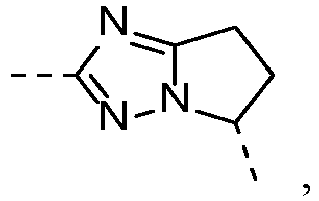

- Ring B is selected from phenyl and

- L is selected from single bond, O, C(=O), S, NH, and C1-3 alkyl, wherein the C1-3 alkyl is optionally substituted with 1, 2 or 3 Ra;
- R1 is selected from H and C1-3 alkyl, wherein the C1-3 alkyl is optionally substituted with 1, 2 or 3 Rb;
- R1t, R2t, R3t, and R4t are each independently selected from H, F, Cl, Br, I, OH, CN, NH2, C1-3 alkyl, COOH, and -C(=O)NH2, wherein the C1-3 alkyl is optionally substituted with 1, 2 or 3 Rc;
- R1e is each independently selected from H, F, Cl, Br, I, OH, CN, NH2, and C1-3 alkyl, wherein the C1-3 alkyl is optionally substituted with 1, 2 or 3 Rd;
- R2e is selected from H and C1-3 alkyl, wherein the C1-3 alkyl is optionally substituted with 1, 2 or 3 Re;
- R2 is each independently selected from H, F, Cl, Br, I, OH, NH2, CN, C1-3 alkyl, and C1-3 alkoxy, wherein the C1-3 alkyl and C1-3 alkoxy are optionally substituted with 1, 2 or 3 Rf;
- n is 1, 2, 3, 4, or 5;
- Ra, Rb, Rc, Rd, Re, and Rf are each independently selected from F, Cl, Br, I, OH, CN, NH2, and D.
- The present disclosure provides a compound of formula (I), or an isomer or pharmaceutically acceptable salt thereof,

- T1 is selected from N and CR1t;
- T2 is selected from N and CR2t;
- T3 is selected from N and CR3t;
- T4 is selected from N and CR4t;
- E1 is selected from C(R1e)2, O, C(=O), S, and NR2e;
- Ring A is selected from 1,2,4-triazolyl, 1,2,3-triazolyl, imidazolyl, isoxazolyl, 1,3,4-oxadiazolyl, and


- Ring B is phenyl;
- L is selected from single bond, O, C(=O), S, NH, and C1-3 alkyl, wherein the C1-3 alkyl is optionally substituted with 1, 2 or 3 Ra;
- R1 is selected from H and C1-3 alkyl, wherein the C1-3 alkyl is optionally substituted with 1, 2 or 3 Rb;
- R1t, R2t, R3t, and R4t are each independently selected from H, F, Cl, Br, I, OH, CN, NH2, and C1-3 alkyl, wherein the C1-3 alkyl is optionally substituted with 1, 2 or 3 Rc;
- R1e is each independently selected from H, F, Cl, Br, I, OH, CN, NH2, and C1-3 alkyl, wherein the C1-3 alkyl is optionally substituted with 1, 2 or 3 Rd;
- R2e is selected from H and C1-3 alkyl, wherein the C1-3 alkyl is optionally substituted with 1, 2 or 3 Re;
- R2 is each independently selected from H, F, Cl, Br, I, OH, NH2, CN, and C1-3 alkyl, wherein the C1-3 alkyl is optionally substituted with 1, 2 or 3 Rf;
- n is 1, 2, 3, 4, or 5;
- Ra, Rb, Rc, Rd, Re, and Rf are each independently selected from F, Cl, Br, I, OH, CN, NH2, and D.
- The present disclosure provides a compound of formula (I), or an isomer or pharmaceutically acceptable salt thereof,

- T1 is N or CR1t;
- T2 is N or CR2t;
- T3 is N or CR3t;
- T4 is N or CR4t;
- E1 is C(R1e)2, O, C(=O), S, or NR2e;
- Ring A is 5-membered heteroaryl optionally substituted with C1-3 alkyl;
- Ring B is phenyl or 6-membered heteroaryl;
- L is O, C(=O), S, NH, or C1-3 alkyl, wherein the C1-3 alkyl is optionally substituted with 1, 2 or 3 Ra;
- R1 is selected from H and C1-3 alkyl, wherein the C1-3 alkyl is optionally substituted with 1, 2 or 3 Rb;
- R1t, R2t, R3t, and R4t are each independently selected from H, F, Cl, Br, I, OH, CN, NH2, and C1-3 alkyl, wherein the C1-3 alkyl is optionally substituted with 1, 2 or 3 Rc;
- R1e is each independently selected from H, F, Cl, Br, I, OH, CN, NH2, and C1-3 alkyl, wherein the C1-3 alkyl is optionally substituted with 1, 2 or 3 Rd;
- R2e is selected from H and C1-3 alkyl, wherein the C1-3 alkyl is optionally substituted with 1, 2 or 3 Re;
- R2 is each independently selected from H, F, Cl, Br, I, OH, NH2, CN, and C1-3 alkyl, wherein the C1-3 alkyl is optionally substituted with 1, 2 or 3 Rf;
- n is 1, 2, 3, 4, or 5;
- Ra, Rb, Rc, Rd, Re, and Rf are each independently selected from F, Cl, Br, I, OH, CN, and NH2.
- In some embodiments disclosed herein, the above-mentioned R1 is selected from H and CH3, wherein the CH3 is optionally substituted with 1, 2 or 3 Rb, and other variables are as defined herein.
- In some embodiments disclosed herein, the above-mentioned R1 is selected from H, CH3, and CD3, and other variables are as defined herein.
- In some embodiments disclosed herein, the above-mentioned R1 is selected from H and CH3, and other variables are as defined herein.
- In some embodiments disclosed herein, the above-mentioned R1t, R2t, R3t, and R4t are each independently selected from H, F, Cl, Br, I, OH, CN, NH2, CH3, COOH, and -C(=O)NH2, wherein the CH3 is optionally substituted with 1, 2 or 3 Rc, and other variables are as defined herein.
- In some embodiments disclosed herein, the above-mentioned R1t, R2t, R3t, and R4t are each independently selected from H, F, Cl, Br, I, OH, CN, NH2, and CH3, wherein the CH3 is optionally substituted with 1, 2 or 3 Rc, and other variables are as defined herein.
- In some embodiments disclosed herein, the above-mentioned R1t, R2t, R3t, and R4t are each independently selected from H, F, Cl, Br, I, OH, CN, NH2, and CH3, and other variables are as defined herein.
- In some embodiments disclosed herein, the above-mentioned R1e is each independently selected from H, F, Cl, Br, I, OH, CN, NH2, and CH3, and other variables are as defined herein.
- In some embodiments disclosed herein, the above-mentioned R2e is selected from H and CH3, and other variables are as defined herein.
- In some embodiments disclosed herein, the above-mentioned E1 is CH2, O, C(=O), S, or NH, and other variables are as defined herein.
- In some embodiments disclosed herein, the above-mentioned R2 is each independently selected from H, F, Cl, Br, I, OH, NH2, CN, CH3, and OCH3, wherein the CH3 and OCH3 are optionally substituted with 1, 2 or 3 Rf, and other variables are as defined herein.
- In some embodiments disclosed herein, the above-mentioned R2 is each independently selected from H, F, Cl, Br, I, OH, NH2, CN, CH3, OCH3, CF3, and OCF3, and other variables are as defined herein.
- In some embodiments disclosed herein, the above-mentioned R2 is each independently selected from H, F, Cl, Br, I, OH, NH2, and CN, and other variables are as defined herein.


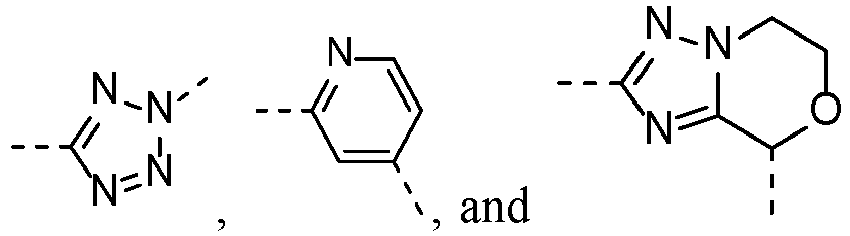
- In some embodiments disclosed herein, the above-mentioned Ring A is selected from


- In some embodiments disclosed herein, the above-mentioned Ring A is pyrrolyl, imidazolyl, pyrazolyl, furyl, thienyl, oxazolyl, isoxazolyl, thiazolyl, 1,2,3-triazolyl, 1,2,4-triazolyl, or 1,3,4-thiadiazolyl, wherein the pyrrolyl, imidazolyl, pyrazolyl, furyl, thienyl, oxazolyl, isoxazolyl, thiazolyl, 1,2,3-triazolyl, 1,2,4-triazolyl, or 1,3,4-thiadiazolyl is optionally substituted with C1-3 alkyl, and other variables are as defined herein.
- In some embodiments disclosed herein, the above-mentioned L is selected from L is selected from single bond, -CH2-, and -O-, and other variables are as defined herein.
- In some embodiments disclosed herein, the above-mentioned L is selected from L is selected from single bond and -CH2-, and other variables are as defined herein.
- In some embodiments disclosed herein, the above-mentioned Ring A is

- In some embodiments disclosed herein, the above-mentioned Ring B is phenyl or pyridyl, and other variables are as defined herein.
- The present disclosure also includes some embodiments that are obtained by combining any of the above-mentioned variables.
- In some embodiments disclosed herein, the above-mentioned compound is selected from


- n, T1, T2, T3, R1, R2, and R are as defined herein;
- the carbon atom with "∗" is a chiral carbon atom, which exists in the form of a single (R) or (S) enantiomer or a mixture enriched in one enantiomer;
- or an isomer or pharmaceutically acceptable salt thereof.
- In some embodiments disclosed herein, the above-mentioned compound is selected from

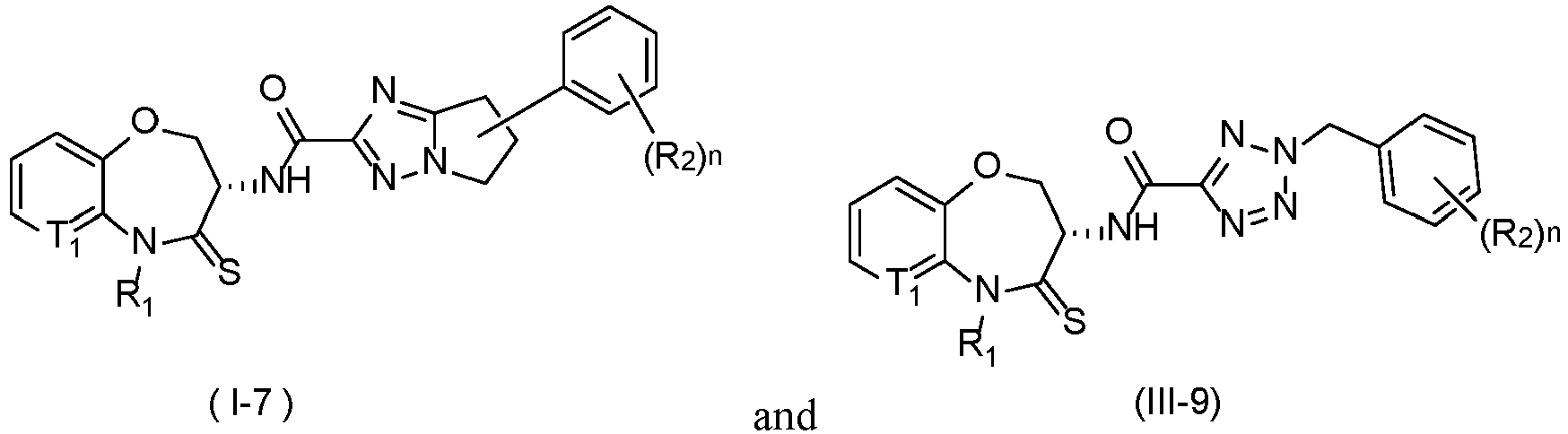
- n, T1, T2, T3, R1, R2, and R are as defined herein;
- or an isomer or pharmaceutically acceptable salt thereof.
- The present disclosure also provides compounds of the formulae below, or isomers or pharmaceutically acceptable salts thereof:





- In some embodiments disclosed herein, the above-mentioned compound is selected from



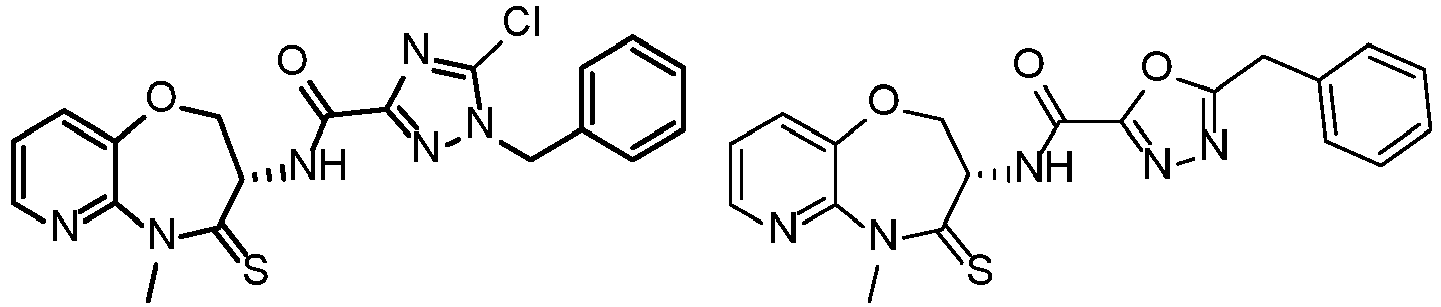


- The present disclosure also provides the use of the above-mentioned compound, or the isomer or pharmaceutically acceptable salt thereof, in the manufacture of a medicament for treating diseases related to RIP-1 kinase.
- As a novel RIP-1 kinase inhibitor, the compound of the present disclosure has a good inhibitory effect on the programmed cell necrosis (Necroptosis) of U937 cells induced by TNFα/QVD-OPh, and has achieved a good effect of inhibiting the decrease of body temperature of mice in a model of TNF-driven systemic inflammatory response syndrome.
- Unless otherwise specified, the following terms and phrases used herein are intended to have the following meanings. A specific term or phrase should not be considered indefinite or unclear in the absence of a particular definition, but should be understood in the conventional sense. When a trade name appears herein, it is intended to refer to its corresponding commodity or active ingredient thereof.
- The term "pharmaceutically acceptable" is used herein in terms of those compounds, materials, compositions, and/or dosage forms, which are suitable for use in contact with human and animal tissues within the scope of reliable medical judgment, with no excessive toxicity, irritation, allergic reaction or other problems or complications, commensurate with a reasonable benefit/risk ratio.
- The term "pharmaceutically acceptable salt" means a salt of compounds disclosed herein that is prepared by reacting the compound having a specific substituent disclosed herein with a relatively non-toxic acid or base. When compounds disclosed herein contain a relatively acidic functional group, a base addition salt can be obtained by bringing the neutral form of the compound into contact with a sufficient amount of base in a pure solution or a suitable inert solvent. The pharmaceutically acceptable base addition salt includes a salt of sodium, potassium, calcium, ammonium, organic amine or magnesium or similar salts. When compounds disclosed herein contain a relatively basic functional group, an acid addition salt can be obtained by bringing the neutral form of the compound into contact with a sufficient amount of acid in a pure solution or a suitable inert solvent. Examples of the pharmaceutically acceptable acid addition salt include an inorganic acid salt, wherein the inorganic acid includes, for example, hydrochloric acid, hydrobromic acid, nitric acid, carbonic acid, bicarbonate, phosphoric acid, monohydrogen phosphate, dihydrogen phosphate, sulfuric acid, hydrogen sulfate, hydroiodic acid, phosphorous acid, and the like; and an organic acid salt, wherein the organic acid includes, for example, acetic acid, propionic acid, isobutyric acid, maleic acid, malonic acid, benzoic acid, succinic acid, suberic acid, fumaric acid, lactic acid, mandelic acid, phthalic acid, benzenesulfonic acid, p-toluenesulfonic acid, citric acid, tartaric acid, and methanesulfonic acid, and the like; and an salt of amino acid (such as arginine and the like), and a salt of an organic acid such as glucuronic acid and the like. Certain specific compounds disclosed herein contain both basic and acidic functional groups and can be converted to any base or acid addition salt.
- The pharmaceutically acceptable salt disclosed herein can be prepared from the parent compound that contains an acidic or basic moiety by conventional chemical methods. Generally, such salt can be prepared by reacting the free acid or base form of the compound with a stoichiometric amount of an appropriate base or acid in water or an organic solvent or a mixture thereof.
- Unless otherwise specified, the term "isomer" is intended to include geometric isomers, cis- or trans- isomers, stereoisomers, enantiomers, optical isomers, diastereomers, and tautomers.
- Compounds disclosed herein may be present in a specific geometric or stereoisomeric form. The present disclosure contemplates all such compounds, including cis and trans isomers, (-)- and (+)-enantiomers, (R)- and (S)-enantiomers, diastereoisomer, (D)-isomer, (L)-isomer, and a racemic mixture and other mixtures, for example, a mixture enriched in enantiomer or diastereoisomer, all of which are encompassed within the scope disclosed herein. The substituent such as alkyl may have an additional asymmetric carbon atom. All these isomers and mixtures thereof are encompassed within the scope disclosed herein.
- Unless otherwise specified, the term "enantiomer" or "optical isomer" means stereoisomers that are in a mirrored relationship with each other.
- Unless otherwise specified, the term "cis-trans isomer" or "geometric isomer" is produced by the inability of a double bond or a single bond between ring-forming carbon atoms to rotate freely.
- Unless otherwise specified, the term "diastereomer" means a stereoisomer in which two or more chiral centers of are contained in a molecule and is in a non-mirrored relationship between molecules.
- Unless otherwise specified, "(D)" or "(+)" means dextroisomer, "(L)" or "(-)" means levoisomer, and "(DL)" or "(±)" means racemate.
- Unless otherwise specified, a wedged solid bond



- Unless otherwise specified, when a double bond structure such as a carbon-carbon double bond, a carbon-nitrogen double bond, and a nitrogen-nitrogen double bond is present in a compound, and each atom on the double bond is attached to two different substituents (in the double bond containing a nitrogen atom, a pair of lone pair electrons on the nitrogen atom is considered as one of the substituents to which it is attached), the compound represents (Z) isomer, (E) isomer, or a mixture of two isomers of the compound, if the atoms on the double bond in the compound are attached to their substituents by a wavy line


- Compounds disclosed herein may be present in a particular form. Unless otherwise specified, the terms "tautomer" or "tautomeric form" means that different functional groups are in dynamic equilibrium at room temperature and can be rapidly converted into each other. If tautomers are possible (as in solution), a chemical equilibrium of tautomers can be achieved. For example, proton tautomers (also known as prototropic tautomers) include interconversions by proton transfer, such as keto-enol isomerization and imine-enamine isomerization. Valence tautomers include interconversions by recombination of some bonding electrons. A specific example of keto-enol tautomerization is interconversion between two tautomers pentane-2, 4-dione and 4-hydroxypent-3-en-2-one.
- Unless otherwise specified, the term "enriched in one isomer", "isomer enriched", "enriched in one enantiomer" or "enantiomeric enriched" means that the content of one isomer or enantiomer is less than 100%, and the content of the isomer or enantiomer is 60% or more, or 70% or more, or 80% or more, or 90% or more, or 95% or more, or 96% or more, or 97% or more, 98% or more, 99% or more, 99.5% or more, 99.6% or more, 99.7% or more, 99.8% or more, or 99.9% or more.
- Unless otherwise specified, the term "isomer excess" or "enantiomeric excess" means the difference between the relative percentages of two isomers or two enantiomers. For example, if one isomer or enantiomer is present in an amount of 90% and the other isomer or enantiomer is present in an amount of 10%, the isomer or enantiomeric excess (ee value) is 80%.
- Optically active (R)- and (S)-isomer, or D and L isomer can be prepared using chiral synthesis or chiral reagents or other conventional techniques. If one kind of enantiomer of certain compound disclosed herein is to be obtained, the pure desired enantiomer can be obtained by asymmetric synthesis or derivative action of chiral auxiliary followed by separating the resulting diastereomeric mixture and cleaving the auxiliary group. Alternatively, when the molecule contains a basic functional group (such as amino) or an acidic functional group (such as carboxyl), the compound reacts with an appropriate optically active acid or base to form a salt of the diastereomeric isomer which is then subjected to diastereomeric resolution through the conventional method in the art to afford the pure enantiomer. In addition, the enantiomer and the diastereoisomer are generally isolated through chromatography which uses a chiral stationary phase and optionally combines with a chemical derivative method (for example, carbamate generated from amine).
- Compounds disclosed herein may contain an unnatural proportion of atomic isotopes at one or more of the atoms that make up the compounds. For example, a compound may be labeled with a radioisotope such as tritium (3H), iodine-125 (125I) or C-14(14C). For another example, hydrogen can be replaced by heavy hydrogen to form a deuterated drug. The bond between deuterium and carbon is stronger than that between ordinary hydrogen and carbon. Compared with undeuterated drugs, deuterated drugs have advantages of reduced toxic side effects, increased drug stability, enhanced efficacy, and prolonged biological half-life of drugs. All changes in the isotopic composition of compounds disclosed herein, regardless of radioactivity, are included within the scope of the present disclosure.
- The term "optional" or "optionally" means that the subsequent event or condition may occur but not requisite, that the term includes the instance in which the event or condition occurs and the instance in which the event or condition does not occur.
- The term "substituted" means one or more than one hydrogen atom(s) on a specific atom are substituted by a substituent, including deuterium and hydrogen variants, as long as the valence of the specific atom is normal and the substituted compound is stable. When the substituent is oxo (i.e., =O), it means two hydrogen atoms are substituted. Positions on an aromatic ring cannot be substituted by oxo. The term "optionally substituted" means an atom can be substituted by a substituent or not, unless otherwise specified, the species and number of the substituent may be arbitrary as long as being chemically achievable.
- When any variable (such as R) occurs in the constitution or structure of the compound more than once, the definition of the variable at each occurrence is independent. Thus, for example, if a group is substituted by 0 to 2 R, the group can be optionally substituted by up to two R, wherein the definition of R at each occurrence is independent. Moreover, a combination of the substituent and/or the variant thereof is allowed only when the combination results in a stable compound.
- When the number of a linking group is 0, such as -(CRR)0-, it means that the linking group is a single bond.
- When one of the variables is a single bond, it means that the two groups linked by the single bond are connected directly. For example, when L in A-L-Z represents a single bond, the structure of A-L-Z is actually A-Z.
- When a substituent is vacant, it means that the substituent does not exist. For example, when X is vacant in A-X, the structure of A-X is actually A.
- When an enumerated substituent does not indicate the atom through which the enumerated substituent is linked to the substituted group, such substituent can be bonded through any of its atoms. For example, a pyridyl group as a substituent may be linked to the substituted group through any one of carbon atoms on the pyridine ring.


- Unless otherwise specified, the term "halo" or "halogen" by itself or as part of another substituent represents a fluorine, chlorine, bromine or iodine atom.
- Unless otherwise specified, the term "C1-3 alkoxy" refers to an alkyl group containing 1 to 3 carbon atoms and attached to the remainder of a molecule by an oxygen atom. The C1-3 alkoxy group includes C1-2, C2-3, C3, C2 alkoxy groups, and the like. Examples of C1-3 alkoxy groups include, but are not limited to, methoxy, ethoxy, propoxy (including n-propoxy and isopropoxy), and the like.
- Unless otherwise specified, the term "C1-3 alkyl" is used to indicate a linear or branched saturated hydrocarbon group consisting of 1 to 3 carbon atoms. The C1-3 alkyl group includes C1-2 and C2-3 alkyl groups and the like. It may be monovalent (e.g., methyl), divalent (e.g., methylene) or multivalent (e.g., methenyl). Examples of C1-3 alkyl groups include, but are not limited to, methyl (Me), ethyl (Et), propyl (including n-propyl and isopropyl), and the like.
- Unless otherwise specified, the terms "5- to 6-membered heteroaromatic ring" and "5-to 6-membered heteroaryl" may be used interchangeably. The term "5- to 6-membered heteroaryl" means a monocyclic group having a conjugated pi electron system and consisting of 5 to 6 ring atoms, of which 1, 2, 3 or 4 ring atoms are heteroatoms independently selected from O, S and N, and the remainder atoms are carbon atoms, wherein the nitrogen atom is optionally quaternized and the nitrogen and sulfur heteroatoms are optionally oxidized (i.e., NO and S(O)p, p is 1 or 2). The 5- to 6-membered heteroaryl group may be attached to the remainder of a molecule by a heteroatom or a carbon atom. The 5- to 6-membered heteroaryl group includes 5-membered and 6-membered heteroaryl groups. Examples of the 5- to 6-membered heteroaryl group include, but are not limited to, pyrrolyl (including N-pyrrolyl, 2-pyrrolyl, 3-pyrrolyl, and the like), pyrazolyl (including 2-pyrazolyl and 3-pyrazolyl, and the like), imidazolyl (including N-imidazolyl, 2-imidazolyl, 4-imidazolyl, and 5-imidazolyl, and the like), oxazolyl (including 2-oxazolyl, 4-oxazolyl, and 5-oxazolyl, and the like), triazolyl (1H-1,2,3-triazolyl, 2H-1,2,3-triazolyl, 1H-1,2,4-triazolyl and 4H-1,2,4-triazolyl, and the like), tetrazolyl, isoxazolyl (3-isoxazolyl, 4-isoxazolyl and 5-isoxazolyl, and the like), thiazolyl (including 2-thiazolyl, 4-thiazolyl and 5-thiazolyl, and the like), furyl (including 2-furyl and 3-furyl, and the like), thienyl (including 2-thienyl and 3-thienyl, and the like), pyridyl (including 2-pyridyl, 3-pyridyl and 4-pyridyl, and the like), pyrazinyl or pyrimidinyl (including 2-pyrimidinyl and 4-pyrimidinyl, and the like).
- Unless otherwise specified, Cn-n+m or Cn-Cn+m includes any one of n to n+m carbons. For example, C1-12 includes C1, C2, C3, C4, C5, C6, C7, C8, C9, C10, C11, and C12. Cn-n+m or Cn-Cn+m also includes any range of n to n+m. For example, C1-12 includes C1-3, C1-6, C1-9, C3-6, C3-9, C3-12, C6-9, C6-12, C9-12, and the like. Similarly, the n-membered to n+m-membered ring means that the number of atoms on the ring is n to n+m. For example, 3- to 12-membered ring includes 3-membered ring, 4-membered ring, 5-membered ring, 6-membered ring, 7-membered ring, 8-membered ring, 9-membered ring, 10-membered ring, 11-membered ring, and 12-membered ring. The n-membered to n+m-membered ring also means that the number of atoms on the ring includes any range from n to n+m. For example, 3- to 12-membered ring includes 3- to 6-membered ring, 3- to 9-membered ring, 5- to 6-membered ring, 5- to 7-membered ring, 6- to 7-membered ring, 6- to 8-membered ring, and 6- to 10-membered ring, and the like.
- The term "leaving group" refers to a functional group or atom which can be replaced by another functional group or atom through a substitution reaction (such as affinity substitution reaction). For example, representative leaving groups include triflate; chlorine, bromine and iodine; sulfonate group, such as mesylate, tosylate, p-bromobenzenesulfonate, p-toluenesulfonate and the like; acyloxy, such as acetoxy, trifluoroacetoxy and the like.
- The term "protecting group" includes, but is not limited to "amino protecting group", "hydroxy protecting group" or "thio protecting group". The term "amino protecting group" refers to a protecting group suitable for blocking the side reaction on the nitrogen of an amino. Representative amino protecting groups include, but are not limited to: formyl; acyl, such as alkanoyl (e.g., acetyl, trichloroacetyl or trifluoroacetyl); alkoxycarbonyl, such as tert-butoxycarbonyl (Boc); arylmethoxycarbonyl such as benzyloxycarbonyl (Cbz) and 9-fluorenylmethoxycarbonyl (Fmoc); arylmethyl such as benzyl (Bn), trityl (Tr), 1, 1-bis-(4'-methoxyphenyl)methyl; silyl such as trimethylsilyl (TMS) and tert-butyldimethylsilyl (TBS) and the like. The term "hydroxy protecting group" refers to a protecting group suitable for blocking the side reaction on hydroxy. Representative hydroxy protecting groups include, but are not limited to: alkyl such as methyl, ethyl and tert-butyl; acyl such as alkanoyl (e.g., acetyl); arylmethyl such as benzyl (Bn), p-methoxybenzyl (PMB), 9-fluorenylmethyl (Fm), and diphenylmethyl (benzhydryl, DPM); silyl such as trimethylsilyl (TMS) and tert-butyl dimethyl silyl (TBS) and the like.
- The structures of compounds disclosed herein can be confirmed by conventional methods well known to those skilled in the art. If the present disclosure relates to an absolute configuration of a compound, the absolute configuration can be confirmed by conventional techniques in the art, such as single crystal X-Ray diffraction (SXRD). In the single crystal X-Ray diffraction (SXRD), the diffraction intensity data of the cultivated single crystal is collected using a Bruker D8 venture diffractometer with a light source of CuKα radiation in a scanning mode of ϕ/ω scan; after collecting the relevant data, the crystal structure is further analyzed by the direct method (Shelxs97) to confirm the absolute configuration.
- Compounds disclosed herein can be prepared by a variety of synthetic methods well known to those skilled in the art, including the following enumerated embodiment, the embodiment formed by the following enumerated embodiment in combination with other chemical synthesis methods, and equivalent replacement well known to those skilled in the art. Alternative embodiments include, but are not limited to the embodiment disclosed herein.
- Solvents used in the present disclosure are commercially available.
- The following abbreviations are used in the present disclosure: aq represents aqueous; NaNO2 represents sodium nitrate; H2SO4 represents sulfuric acid; CuCl2 represents copper chloride; LiOH•H2O represents lithium hydroxide monohydrate; NaBH3CN represents sodium cyanoborohydride; HCl/EtOAc represents a solution of hydrochloric acid in ethyl acetate; HCl represents hydrochloric acid; CO2 represents carbon dioxide; ACN represents acetonitrile; FA represents formic acid; H2O represents water; NH3H2O represents ammonia; Na2SO4 represents sodium sulfate; MgSO4 represents magnesium sulfate; NCS represents N-chlorosuccinimide; NH4HCO3 represents ammonium bicarbonate; Pd/C represents palladium on carbon; psi represents pressure unit; MeCN represents acetonitrile; TsOH•H2O represents p-toluenesulfonic acid monohydrate; Pd(dppf)Cl2 represents [1,1'-bis(diphenylphosphino)ferrocene]palladium dichloride; Neu represents neutral; HPLC represents high performance liquid chromatography; HATU represents O-(7-azabenzotriazol-1-yl)-N,N,N',N'-tetramethyluronium hexafluorophosphate; K2CO3 represents potassium carbonate; EDC represents N-(3-dimethylaminopropyl)-N'-ethylcarbodiimide hydrochloride; m-CPBA represents 3-chloroperoxybenzoic acid; eq represents equivalent or equivalence; T3P represents propylphosphonic anhydride; CDI represents carbonyl diimidazole; DCM represents dichloromethane; PE represents petroleum ether; DIAD represents diisopropyl azodicarboxylate; DMF represents N,N-dimethylformamide; DMSO represents dimethyl sulfoxide; EtOAc represents ethyl acetate; EtOH represents ethanol; MeOH represents methanol; CBz represents benzyloxycarbonyl, which is an amino protecting group; BOC represents tert-butoxycarbonyl, which is an amino protecting group; HOAc represents acetic acid; NaCNBH3 represents sodium cyanoborohydride; r.t. represents room temperature; O/N represents overnight; THF represents tetrahydrofuran; Boc2O represents di-tert-butyl dicarbonate; TFA represents trifluoroacetic acid; SOCl2 represents thionyl chloride; CS2 represents carbon disulfide; TsOH represents p-toluenesulfonic acid; NFSI represents N-fluoro-N-(phenylsulfonyl)benzenesulfonamide; n-Bu4NF represents tetrabutylammonium fluoride; iPrOH represents 2-propanol; mp represents melting point; LDA represents lithium diisopropylamide; IPAm represents isopropylamine; DIPEA represents N,N-diisopropylethylamine; Xantphos represents 4,5-bis(diphenylphosphino)-9,9-dimethylxanthene; t-Bu Xphos represents 2-di-tert-butylphosphino-2',4',6'-triisopropylbiphenyl; DPPP represents 1,3-bis(diphenylphosphino)propane; Et3SiH represents triethylsilane; DMAP represents 4-dimethylaminopyridine; Py represents pyridine; DPBS represents Dulbecco's phosphate buffer; TNF-α represents tumor necrosis factor; IC50 represents half maximal inhibitory concentration; mg represents milligrams, kg represents kilograms; and HEPES represents N-2-hydroxyethylpiperazine-N-2-ethane sulfonic acid buffer.
- Compounds are named according to general naming principles in the art or by ChemDraw® software, and commercially available compounds are named with their vendor directory names.
- The present disclosure is described in detail below by means of examples. However, it is not intended that these examples have any disadvantageous limitations to the present disclosure. The present disclosure has been described in detail herein, and embodiments are also disclosed herein. It will be apparent to those skilled in the art that various changes and modifications may be made to the embodiments disclosed herein without departing from the spirit and scope disclosed herein.
- Reference example 1: Fragment BB-1

- Route for synthesis:

- To a pre-dried 100 mL flask were added BB-1-1 (2.60 g, 17.31 mmol, 1.00 eq) and solvent EtOH (11.25 mL) and isopropyl ether (37.50 mL). BB-1-2 (2.59 g, 17.83 mmol, 1.03 eq) was slowly added under stirring, and the reaction solution was stirred at 20 °C for 12 hours. The reaction solution was filtered, and the resulting filter cake was washed with isopropyl ether (30 mL ∗ 3) to give compound BB-1-3. 1H NMR (400MHz, DMSO-d 6) δ = 9.95 (s, 1H), 9.90 (s, 1H), 7.39 - 7.08 (m, 6H), 4.21 - 4.19 (m, 2H), 3.82 (s, 2H), 1.27 - 1.23 (m, 3H); LCMS m/z = 250.1 [M+H]+.
- To a pre-dried 250 mL flask were added compound BB-1-3 (7.00 g, 28.08 mmol, 1.00 eq) and xylene (100.00 mL). A Dean-Stark trap was installed. The reaction system was reacted at 180 °C for 10 h. 100 mL of isopropyl ether was added to the reaction system and the mixture was stirred for 30 minutes in an ice-water bath. The reaction system was filtered, and the resulting filter cake was washed with 50 mL of n-hexane to give compound BB-1-4. 1H NMR (400MHz, DMSO-d 6) δ = 14.44 (br s, 1H), 7.42 - 7.14 (m, 4H), 4.29 (q, J = 6.5 Hz, 2H), 4.13 (br s, 2H), 1.28 (br t, J = 7.0 Hz, 3H); LCMS m/z = 232.2 [M+H]+.
- To a thumb bottle were added compound BB-1-4 (4.10 g, 17.73 mmol, 1.00 eq), tetrahydrofuran (1.00 mL) and water (200.00 µL), and lithium hydroxide monohydrate (1.74 g, 41.49 mmol, 2.34 eq) was then added. The solution was stirred at 20°C for 12 hours. The solvent was removed under reduced pressure. 25 mL of IN aqueous hydrochloric acid solution was added dropwise with stirring until the pH of the system reached 2. Compound BB-1 was obtained after suction filtration. LCMS m/z = 202.1 [M-H]-.
- Reference example 2: Fragment BB-2

- Route for synthesis:

- To a solution of BB-2-1 (2.5 g, 15.51 mmol, 2.94 mL, 1 eq) in dichloromethane (40 mL) was added methanol (4.97 g, 155.13 mmol, 6.28 mL, 10 eq) at 23 °C. TMSCHN2 (2 M, 9.31 mL, 1.2 eq) was then added and the mixture was stirred for another 2 hours. The raw materials were completetly consumed by TLC (petroleum ether:ethyl acetate = 5:1) monitoring. 0.1 mL of glacial acetic acid was added to the reaction solution, and the reaction solution was concentrated under reduced pressure to give BB-2-2.
- To a solution of BB-2-2 (3 g, 17.12 mmol, 1 eq) in methanol (30 mL) was added hydrazine hydrate (3.21 g, 51.37 mmol, 3.12 mL, 80% purity, 3 eq), and the mixture was then stirred in an oil bath at 70 °C for 2 hours. By LCMS monitoring, the raw materials were completely consumed, and a target signal appeared. The reaction solution was concentrated under reduced pressure to remove the solvent, and 50 mL of ethyl acetate was added. The mixture was washed with 30 mL of saturated brine. The organic phase was dried over anhydrous sodium sulfate, and filtered, and the filtrate was concentrated under reduced pressure to give BB-2-3. 1H NMR (400 MHz, DMSO-d 6) δ = 9.25 (br s, 1 H), 7.66 - 7.74 (m, 2 H), 7.45 - 7.65 (m, 2 H), 4.24 (s, 2 H), 3.43 (s, 2 H); LCMS m/z = 176.1 [M+H]+.
- To a pre-dried three-necked bottle were added BB-1-2 (2.07 g, 14.27 mmol, 1 eq), ethanol (10 mL), and isopropyl ether (20 mL), and BB-2-3 (2.5 g, 14.27 mmol, 1 eq) was then added. The mixture was reacted at 25 °C for 5 hours. By LCMS monitoring, the raw materials were completely consumed, and a target signal appeared. The reaction solution was filtered, and the filter cake was washed with 50 mL petroleum ether to give BB-2-4. LCMS m/z = 275.2 [M+H]+.
- To a microwave tube were added BB-2-4 (0.5 g, 1.82 mmol, 1 eq), molecular sieves (4Å, 0.05 g) and xylene (15 mL). The microwave tube was sealed and the reaction was stirred in a microwave reactor at 150 °C for 4 hours. A target signal appeared by LCMS monitoring. 30 mL of acetonitrile was added to the reaction solution, and the mixture was filtered. The filtrate was concentrated under reduced pressure to give BB-2-5. LCMS m/z = 257.1 [M+H]+.
- To a solution of BB-2-5 (1 g, 3.90 mmol, 1 eq) in tetrahydrofuran (50 mL) was added a solution of lithium hydroxide monohydrate (654.96 mg, 15.61 mmol, 4 eq) in water (15 mL) at 21 °C, and the mixture was then stirred for another 12 hours. By LCMS monitoring, the raw materials were completely consumed, and a target signal appeared. 15 mL of water was added to the reaction solution, and the mixture was extracted with ethyl acetate (30 mL). The resulting aqueous phase was adjusted to a pH of about 3 with 2 N aqueous hydrochloric acid solution, and lyophilized to give BB-2. LCMS m/z = 227.0 [M-H]-.
- Reference example 3: Fragment BB-3

- Route for synthesis:

- BB-3-2 (20.00 g, 97.46 mmol, 1.00 eq) was dissolved in DMF (50 mL) and the solution was added dropwise to a suspension of NaH (8.19 g, 204.67 mmol, 60% purity, 2.10 eq) in DMF (150 mL). Compound BB-3-1 (13.75 g, 97.46 mmol, 10.26 mL, 1.00 eq) was then added dropwise. The reaction solution was stirred at 20 °C for 16 hours. Ethyl acetate (200 mL) and water (200 mL) were then added to the reaction solution, and the aqueous phase was adjusted to a pH of about 1 with hydrochloric acid. The mixture was extracted with ethyl acetate (200 mL). The organic phase was dried over anhydrous magnesium sulfate, and filtered, and the filtrate was concentrated under reduced pressure to give compound BB-3-3. LCMS m/z = 227.1 [M-100+H]+.
- A solution of compound BB-3-3 (20.00 g, 61.29 mmol, 1.00 eq) and wet Pd/C (5.00 g, 5% purity) in methanol (200.00 mL) was stirred at 20 °C under hydrogen atmosphere (15 psi) for 5 hours. After the completion of the reaction, the reaction solution was filtered, and the filtrate was concentrated under reduced pressure to give compound BB-3-4. LCMS m/z = 297.1 [M+H]+.
- To a solution of compound BB-3-4 (10.00 g, 33.75 mmol, 1.00 eq) and N,N-diisopropylethylamine (4.36 g, 33.75 mmol, 5.89 mL, 1.00 eq) in DMSO (100.00 mL) was added HATU (12.83 g, 33.75 mmol, 1.00 eq). The reaction was stirred at 20°C for 2 hours. After the completion of the reaction, water (200 mL) and ethyl acetate (200 mL) were added to the reaction solution, and the layers were separated. The organic phase was concentrated under reduced pressure to give a crude product. The crude product was purified by silica gel column chromatography (petroleum ether:ethyl acetate = 10: 1 ~ 1:1) to give compound BB-3-5. LCMS m/z = 223.1 [M-56+H]+.
- To a dry 250 mL three-necked flask were added compound BB-3-5 (6.00 g, 21.56mmol, 1.00 eq), DMF (60.00 mL) and cesium carbonate (10.54 g, 32.34 mmol, 1.50 eq), and iodomethane (3.06 g, 21.56 mmol, 1.34 mL, 1.00 eq) was then added dropwise. The internal temperature was controlled below 20 °C. The reaction was stirred at 16 °C for 16 hours. After the completion of the reaction, water (100 mL) and ethyl acetate (100 mL) were added to the system, and the layers were separated. The organic phase was washed with saturated brine (100 mL ∗ 2), dried over magnesium sulfate, and filtered. The filtrate was concentrated under reduced pressure to give compound BB-3-6. LCMS m/z = 237.1 [M-56+H]+.
- To a solution of phosphorus pentasulfide (760.35 mg, 3.42 mmol, 363.80 µL, 5 eq) in THF (10 mL) was added sodium carbonate (362.57 mg, 3.42 mmol, 5 eq) at 20 °C, and the mixture was stirred for another 0.5 hours. BB-3-6 (0.2 g, 684.16 µmol, 1 eq) was then added, and the reaction solution was placed in an oil bath at 70 °C and stirred for 9.5 hours. A target signal appeared by LCMS monitoring. 20 mL of ethyl acetate was added to the reaction solution, and the mixture was filtered. The resulting filtrate was concentrated under reduced pressure to give compound BB-3-7. LCMS m/z = 253.1 [M-56+H]+.
- To BB-3-7 (630.84 mg, 2.05 mmol, 1 eq) was added a solution of hydrochloric acid in ethyl acetate (4 M, 20.00 mL, 39.11 eq), and the mixture was stirred at 23°C for 1 hour. By LCMS monitoring, the raw materials were completely consumed, and a target signal appeared. The reaction solution was concentrated under reduced pressure to give a crude product, and 30 mL of saturated aqueous sodium bicarbonate solution was then added. The mixture was extracted with ethyl acetate (15 mL ∗ 3). The organic phases were combined, dried over anhydrous sodium sulfate, and filtered. The filtrate was concentrated under reduced pressure to give compound BB-3. 1H NMR (400 MHz, CDCl3) δ = 7.21 - 7.32 (m, 3 H), 7.15 - 7.19 (m, 1 H), 4.40 (dd, J = 9.92, 6.62 Hz, 1 H), 4.10 (dd, J = 11.36, 9.81 Hz, 1 H), 3.77 - 3.94 (m, 4 H); LCMS m/z = 209.1 [M+H]+.
- Reference example 4: Fragment BB-4

- Route for synthesis:

- To a solution of BB-3-2 (13.13 g, 63.98 mmol, 1 eq) in DMF (100 mL) was added NaH (5.12 g, 127.96 mmol, 60% purity, 2 eq) at 0 °C, and the mixture was stirred for another 1 hour. BB-4-1 (10 g, 70.38 mmol, 1.1 eq) was then added, and the mixture was stirred at 28 °C for 9 hours. A target signal appeared by LCMS monitoring. The reaction solution was added to 1000 mL of water, and the mixture was extracted with ethyl acetate (300 mL ∗ 4). The resulting aqueous phase was adjusted to a pH of about 5 with 2 N hydrochloric acid, and then extracted with ethyl acetate (300 mL ∗ 5). The organic phases were combined, dried over anhydrous sodium sulfate, and filtered. The filtrate was concentrated under reduced pressure to give compound BB-4-2. LCMS m/z = 326.0 [M-H]-.
- To a solution of BB-4-2 (20.00 g, 61.11 mmol, 1 eq) in methanol (200 mL) was added wet Pd/C (10 g, 30.55 mmol, 5 % purity) at 23 °C. The mixture was stirred under hydrogen atmosphere (15 psi) for 10 hours. By LCMS monitoring, the raw materials were completely consumed, and a target signal appeared. The reaction solution was filtered, and the resulting filtrate was concentrated under reduced pressure to give compound BB-4-3. LCMS m/z = 298.1 [M+H]+.
- To a solution of BB-4-3 (16.00 g, 53.82 mmol, 1 eq) in ethyl acetate (400 mL) were added N,N-diisopropylethylamine (20.87 g, 161.45 mmol, 28.12 mL, 3 eq) and tri-n-butyl phosphoric anhydride (68.49 g, 107.63 mmol, 64.01 mL, 50% purity in ethyl acetate, 2 eq) at 23°C. The mixture was stirred for another 2 hours. By LCMS monitoring, the raw materials were completely consumed, and a target signal appeared. The reaction solution was washed with saturated brine (200 mL ∗ 2). The organic phase was dried over anhydrous sodium sulfate, and filtered, and the filtrate was concentrated under reduced pressure to give a crude product. The crude product was purified by silica gel column chromatography (petroleum ether:ethyl acetate = 10: 1 ~ 1:1) to give compound BB-4-4. LCMS m/z = 224.1 [M-56+H]+.
- To a solution of BB-4-4 (1 g, 3.58 mmol, 1 eq) in DMF (30 mL) were added cesium carbonate (1.40 g, 4.30 mmol, 1.2 eq) and iodomethane (609.86 mg, 4.30 mmol, 267.48 µL, 1.2 eq) at 20 °C. The mixture was stirred for another 1 hour. By LCMS monitoring, the raw materials were completely consumed, and a target signal appeared. The reaction solution was added to 100 mL of water, and the mixture was extracted with ethyl acetate (30 mL ∗ 5). The organic phases were combined and washed with 50 mL of saturated brine. The organic phase was dried over anhydrous sodium sulfate, and filtered, and the filtrate was concentrated under reduced pressure to give compound BB-4-5. LCMS m/z = 238.1 [M-56+H]+.
- To a solution of phosphorus pentasulfide (3.79 g, 17.05 mmol, 10 eq) in THF (30 mL) was added sodium carbonate (1.81 g, 17.05 mmol, 10 eq) at 20 °C, and the mixture was stirred for another 0.5 hours. BB-4-5 (0.5 g, 1.70 mmol, 1 eq) was then added, and the reaction solution was placed in an oil bath at 70 °C and stirred for 9.5 hours. The raw materials were substantially consumed by LCMS monitoring, and a target signal appeared. The reaction solution was filtered to give a filtrate. 50 mL of ethyl acetate was added to the filtrate and the mixture was washed with 30 mL of saturated brine. The organic phase was dried over anhydrous sodium sulfate, and filtered, and the filtrate was concentrated under reduced pressure to give a crude product. The crude product was purified by silica gel column chromatography (petroleum ether:ethyl acetate = 10: 1 ~ 1:1) to give compound BB-4-6. LCMS m/z = 310.3 [M+H]+.
- To BB-4-6 (0.6 g, 1.94 mmol, 1 eq) was added a solution of hydrochloric acid in ethyl acetate (4 M, 20 mL, 41.25 eq), and the mixture was stirred at 23 °C for 1 hour. By LCMS monitoring, the raw materials were completely consumed, and a target signal appeared. The reaction solution was concentrated under reduced pressure to give a crude product, and 30 mL of saturated sodium bicarbonate solution was added. The mixture was extracted with ethyl acetate (20 mL ∗ 3). The organic phases were combined, dried over anhydrous sodium sulfate, and filtered. The filtrate was concentrated under reduced pressure to give compound BB-4. LCMS m/z = 210.1 [M+H]+.
- Reference example 5: Fragment BB-5
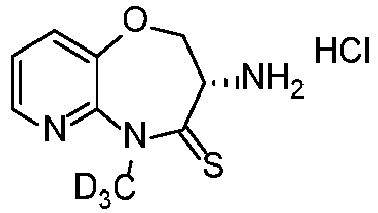
- Route for synthesis:
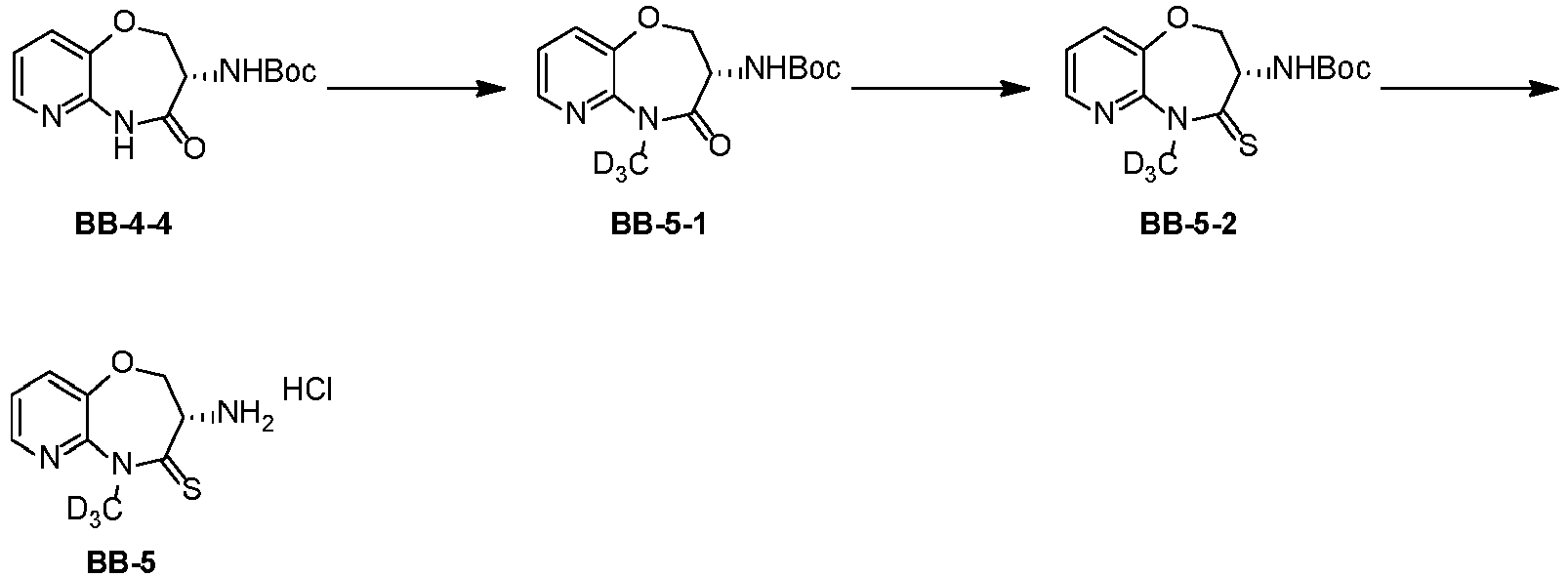
- To a solution of BB-4-4 (0.1 g, 358.05 µmol, 1 eq) in tetrahydrofuran (5 mL) were added deuterated iodomethane (101.64 mg, 716.10 µmol, 43.62 µL, 2 eq) and cesium carbonate (349.98 mg, 1.07 mmol, 3 eq) at 25°C, and the mixture was stirred for another 2 hours. Ethyl acetate (20 mL) was added to the reaction solution, and the mixture was then washed with saturated brine (10 mL), and filtered. The filtrate was concentrated under reduced pressure to give a crude product. The crude product was purified by slurrying with methyl tert-butyl ether (5 mL) to give compound BB-5-1. LCMS m/z = 297.2 [M+H]+.
- To a solution of phosphorus pentasulfide (2.25 g, 10.12 mmol, 1.08 mL, 10 eq) in THF (10 mL) was added sodium carbonate (1.07 g, 10.12 mmol, 10 eq) at 30 °C, and the mixture was stirred for 0.5 hours. BB-5-1(0.3 g, 1.01 mmol, 1 eq) was then added, and the reaction solution was stirred in an oil bath at 70 °C for 10 hours. Ethyl acetate (20 mL) was added to the reaction solution. The mixture was filtered through Celite, and the filtrate was concentrated under reduced pressure to give a crude product. The crude product was purified by column chromatography (petroleum ether:ethyl acetate = 10: 1 ~ 1:1) to give compound BB-5-2. LCMS m/z = 312.9 [M+H]+.
- HCl/EtOAc (4 M, 5.69 mL, 59.27 eq) was added to BB-5-2 (0.12 g, 384.12 µmol, 1 eq) at 28°C, and the mixture was stirred for 1 hour. The reaction solution was concentrated under reduced pressure to give compound BB-5. LCMS m/z = 213.1 [M+H]+.
- Reference example 6: Fragment BB-6

- Route for synthesis:

- To a solution of BB-6-1 (2 g, 14.27 mmol, 1 eq) and CS2CO3 (5.11 g, 15.70 mmol, 1.1 eq) in DMF (20 mL) was added benzyl bromide (2.44 g, 14.27 mmol, 1.70 mL, 1 eq) at 25 °C, and the mixture was stirred for another 3 hours. By LCMS monitoring, the raw materials were completely consumed, and a target MS appeared. The reaction solution was added to water (100 mL), and the mixture was extracted with ethyl acetate (30 mL∗5). The organic phase was dried over anhydrous sodium sulfate, and filtered, and the filtrate was concentrated under reduced pressure. The crude product was purified by flash silica gel column chromatography (petroleum ether:ethyl acetate = 10:1 ~ 1:1) to give BB-6-2. 1H NMR (400 MHz, CDCl3) δ = 7.58 (d, J = 1.00 Hz, 1 H), 7.55 (s, 1 H), 7.33 - 7.40 (m, 3 H), 7.14 - 7.20 (m, 2 H), 5.13 (s, 2 H), 4.34 (q, J = 7.20 Hz, 2 H), 1.36 (t, J = 7.20 Hz, 3 H); LCMS m/z = 231.1 [M+1]+.
- To a solution of BB-6-2 (1.50 g, 6.51 mmol, 1 eq) in tetrahydrofuran (26 mL) was added a solution of lithium hydroxide monohydrate (2.19 g, 52.11 mmol, 8 eq) in water (26 mL) at 28°C, and the mixture was stirred for another 12 hours. By LCMS monitoring, the raw materials were completely consumed, and a target MS appeared. The reaction solution was concentrated under reduced pressure. After removing the solvent, water (20 mL) was added, and the mixture was adjusted to a pH of about 2 with 2 N hydrochloric acid. The precipitated solid was then filtered to give BB-6. 1H NMR (400 MHz, DMSO-d 6) δ = 7.87 (d, J = 2.20 Hz, 2 H), 7.27 - 7.43 (m, 5 H), 5.24 (s, 2 H); LCMS m/z = 201.1 [M-1]-.
- Reference example 7: Fragment BB-7

- Route for synthesis:

- To a solution of BB-7-1 (5 g, 29.65 mmol, 1 eq) in toluene (70 mL) was added diethyl oxalate (4.77 g, 32.62 mmol, 4.45 mL, 1.1 eq) and sodium ethoxide (2.62 g, 38.55 mmol, 1.3 eq) at 0 °C, and the mixture was reacted at 20 °C for 12 hours. By LCMS analysis, the raw materials were completely consumed, and a target signal appeared. The reaction solution was concentrated under reduced pressure, diluted with ethyl acetate (200 mL), and washed with saturated brine (200 mL). The organic phase was dried over anhydrous sodium sulfate, and filtered, and the filtrate was concentrated under reduced pressure to give a crude product, which was directly used in the next step without purification. Compound BB-7-2 was obtained. 1H NMR (400 MHz, CDCl3) δ = 6.87 - 7.19 (m, 4 H), 5.78 (br s, 1 H), 4.04 (br s, 2 H), 2.92 - 3.44 (m, 2 H), 1.18 (br s, 3 H); LCMS m/z = 269.1[M+1]+.
- To a solution of BB-7-2 (7 g, 26.05 mmol, 1 eq) in ethanol (200 mL) was added hydroxylamine hydrochloride (1.81 g, 26.05 mmol, 1 eq), and the mixture was reacted at 80 °C for 12 hours. By LCMS analysis, the raw materials were completely consumed, and a target signal appeared. The reaction solution was concentrated under reduced pressure to give BB-7-3. 1H NMR (400 MHz, CDCl3) δ = 7.33 (m, 2 H); 7.20 (m, 2 H), 6.35 (s, 1 H), 4.41 - 4.47 (m, 2 H), 4.13 (q, J = 7.20 Hz, 2 H), 1.30 - 1.33 (t, 3 H); LCMS m/z = 266.1[M+1]+.
- To a solution of BB-7-3 (4 g, 15.06 mmol, 1 eq) in ethanol (100 mL) was added Pd/C (4 g, 5% purity), and the mixture was reacted at 30°C under H2 atmosphere (30 psi) for 12 hours. By LCMS analysis, the raw materials were completely consumed, and a target signal appeared. The reaction solution was filtered through Celite, and the filtrate was concentrated under reduced pressure to give a crude product. The crude product was purified by silica gel column chromatography (dichloromethane:methanol = 10:1) to give compound BB-7-4. LCMS m/z = 232.1[M+1]+.
- To a solution of BB-7-4 (0.5 g, 2.16 mmol, 1 eq) in tetrahydrofuran (15 mL) and water (5 mL) was added lithium hydroxide monohydrate (453.17 mg, 10.80 mmol, 5 eq), and the mixture was reacted at 30°C for 2 hours. The raw materials were completely consumed and a new spot appeared by TLC (petroleum ether:ethyl acetate = 5:1) monitoring. The reaction solution was concentrated under reduced pressure to remove the organic solvent, and 2 M hydrochloric acid solution was added to adjust pH to about 2. A white solid precipitated. The mixture was filtered, and the filter cake was collected to give BB-7. 1H NMR (400 MHz, DMSO-d 6) δ = 7.24 - 7.41 (m, 5 H), 6.57 (s, 1 H), 4.22 (s, 2 H).
- Reference example 8: Fragment BB-8

- Route for synthesis:

- To a solution of BB-8-1(2 g, 15.74 mmol, 1 eq) in DMF (32 mL) were added cesium carbonate (6.67 g, 20.46 mmol, 1.3 eq) and benzyl bromide (3.23 g, 18.88 mmol, 2.24 mL, 1.2 eq), and the mixture was stirred at 20°C for 2 hours. By LCMS monitoring, the raw materials were completely consumed, and a target signal appeared. Water (30 mL) and ethyl acetate (30 mL) were added to the reaction solution, and the layers were separated. The organic phase was washed with saturated brine, dried over anhydrous sodium sulfate, and filtered. The filtrate was concentrated under reduced pressure to give a crude product. The crude product was purified by flash silica gel column chromatography (petroleum ether:ethyl acetate = 10:1-3:1) to give BB-8-2. 1H NMR (400 MHz, CDCl3) δ = 8.11 (s, 1 H), 7.34 - 7.43 (m, 3 H), 7.27 - 7.33 (m, 2 H), 5.43 (s, 2 H), 4.00 (s, 3 H); LCMS m/z = 218.1 [M+1]+.
- BB-8-2 (0.3 g, 1.38 mmol, 1 eq) was dissolved in tetrahydrofuran (12 mL) and water (4 mL), and lithium hydroxide monohydrate (173.85 mg, 4.14 mmol, 3 eq) was added. The reaction was stirred at 25°C for 12 hours. By LCMS monitoring, the raw materials were completely consumed, and a target signal peak appeared. Ethyl acetate (10 mL) was added to the reaction solution, and the aqueous phase was adjusted to a pH of 3-4 with 1 M hydrochloric acid. Solid precipitated. The mixture was filtered to give BB-8. 1H NMR (400 MHz, DMSO-d 6) δ=13.25 (br s, 1 H), 8.78 (s, 1 H), 7.27 - 7.40 (m, 5 H), 5.47 (s, 2 H); LCMS m/z = 204.1 [M+1]+.
- Reference example 9: Fragment BB-9

- Route for synthesis:

- NaNO2 (662.86 mg, 9.60 mmol, 1.5 eq) was added to a solution of BB-9-1 (1 g, 6.40 mmol, 1 eq) in H2SO4 (1 M, 12.80 mL, 2 eq) and water (10 mL) at 0°C, and the mixture was stirred at 0 °C for 0.5 hours. CuCl2 (1.72 g, 12.80 mmol, 2 eq) was dissolved in concentrated hydrochloric acid (15 mL), and the solution was added to the above mixture. The obtained mixture was stirred at 0 °C for 1.5 hours. By LCMS monitoring, the raw materials were completely consumed, and a target signal peak appeared. Ethyl acetate (10 mL) was added to the reaction solution, and the aqueous phase was extracted with ethyl acetate (15 mL∗2). The organic phase was washed with saturated brine, dried over anhydrous sodium sulfate, and filtered. The filtrate was concentrated under reduced pressure. The crude product was purified by flash silica gel column chromatography (petroleum ether:ethyl acetate = 10: 1 ~ 1:2) to give BB-9-2. 1H NMR (400 MHz, CDCl3) = 4.46 (q, J = 21.60 Hz, 2 H), 1.38 (t, J = 14.40 Hz, 3 H); LCMS m/z = 176.0 [M+1]+.
- To a solution of BB-9-2 (760.78 mg, 4.33 mmol, 1 eq) in DMF (5 mL) was added cesium carbonate (1.84 g, 5.63 mmol, 1.3 eq) and 3-cyanobenzyl bromide (889.31 mg, 5.20 mmol, 617.58 µL, 1.2 eq), and the reaction was stirred at 20°C for 2 hours. By LCMS monitoring, the raw materials were completely consumed, and a target signal peak appeared. Water (10 mL) was added to the reaction solution, and the mixture was extracted with ethyl acetate (10 mL∗2). The organic phase was washed with saturated brine, dried over anhydrous sodium sulfate, and filtered. The filtrate was concentrated under reduced pressure, and the crude product was purified by flash silica gel column chromatography (petroleum ether:ethyl acetate = 20:1 ~ 2:1) to give BB-9-3. LCMS m/z = 291.0 [M+1]+.
- BB-9-3 (0.08 g, 301.10 µmol, 1 eq) was dissolved in tetrahydrofuran (6 mL) and water (2 mL), and lithium hydroxide monohydrate (37.90 mg, 903.29 µmol, 3 eq) was added. The mixture was reacted at 2°C for 12 hours. By LCMS monitoring, the raw materials were completely consumed, and a target signal peak appeared. Ethyl acetate (5 mL) was added to the reaction solution. The aqueous phase was adjusted to a pH of about 6 with 1 M hydrochloric acid, and lyophilized to give BB-9. LCMS m/z = 263.1 [M+1]+.
- Reference example 10: Fragment BB-10

- Route for synthesis:

- To a solution of BB-1-1 (3 g, 19.98 mmol, 1 eq) in dichloromethane (90 mL) was added triethylamine (6.06 g, 59.93 mmol, 8.34 mL, 3 eq). Ethyl chlorooxoacetate (3.55 g, 25.97 mmol, 2.91 mL, 1.3 eq) was added, and the mixture was stirred at 25 °C for 5 hours. By LCMS analysis, the raw materials were completely consumed, and a target signal appeared. The reaction solution was quenched by adding water (60 mL) and extracted with dichloromethane (60 mL∗3). The organic phase was dried over anhydrous sodium sulfate, and filtered, and the filtrate was concentrated under reduced pressure. The crude product was purified by flash silica gel column chromatography (petroleum ether:ethyl acetate = 5:1-1:1) to give BB-10-1. 1H NMR (400 MHz, DMSO-d 6) δ = 10.73 (br s, 1 H), 10.30 (br s, 1 H), 7.22 - 7.34 (m, 5 H), 4.26 (q, J = 7.00 Hz, 2 H), 3.51 (s, 2 H), 1.27 (t, J = 7.10 Hz, 3 H); LCMS m/z = 251.1[M+1]+.
- To a solution of BB-10-1 (529.69 mg, 2.12 mmol, 1 eq) in acetonitrile (15 mL) was added phosphorus oxychloride (486.82 mg, 3.17 mmol, 295.04 µL, 1.5 eq). The reaction was stirred at 90°C for 2 hours. The reaction solution was added to saturated sodium bicarbonate solution (20 mL), and the mixture was stirred vigorously for 5 minutes. The mixture was extracted twice with ethyl acetate (20 mL). The organic phases were combined, washed with saturated brine, dried over anhydrous sodium sulfate, and filtered. The filtrate was concentrated under reduced pressure to give BB-10. 1H NMR (400MHz, CDCl3) δ = 7.23 - 7.10 (m, 5H), 4.36 - 4.29 (m, 2H), 4.12 (s, 2H), 1.34 - 1.23 (m, 3H); LCMS m/z = 233.1[M+1]+.
- Reference example 11: Fragment BB-11A, BB-11B

- Route for synthesis:

- To a solution of BB-11-1 (5 g, 26.01 mmol, 1 eq) in glacial acetic acid (39 mL) and tetrahydrofuran (150 mL) was added tert-butyl carbazate (17.19 g, 130.07 mmol, 5 eq), and the mixture was reacted at 55°C for 12 hours. The mixture was cooled to room temperature (25°C), and NaBH3CN (8.17 g, 130.07 mmol, 5 eq) was added in batches. The mixture was heated to 55°C, and reacted for another 12 hours. The reaction solution was cooled to room temperature, and saturated sodium bicarbonate solution was added to the reaction solution to adjust pH to 7~8. The mixture was extracted with ethyl acetate (150 mL∗2). The organic phases were combined, washed with saturated brine, dried over anhydrous sodium sulfate, and filtered. The filtrate was concentrated under reduced pressure to give BB-11-2. LCMS m/z = 221.1 [M-56+1]+.
- 11-2 (7 g, 25.33 mmol, 1 eq) was added to HCl/EtOAc (4 M, 60 mL), and the mixture was reacted at 25°C for 2 hours. The reaction solution was concentrated under reduced pressure to give a crude product. To the crude product was added saturated sodium bicarbonate solution to adjust pH to 7~8. The mixture was extracted with ethyl acetate (50 mL∗2). The organic phases were combined, washed with saturated brine, dried over anhydrous sodium sulfate, and filtered. The filtrate was concentrated under reduced pressure to give crude product BB-11-3. LCMS m/z = 177.1 [M+1]+.
- To a solution of BB-11-3 (4 g, 22.70 mmol, 1 eq) in ethanol (50 mL) was added ethyl 2-ethoxy-2-iminoacetate (16.47 g, 113.50 mmol, 5 eq), and the mixture was reacted at 85°C for 12 hours. The reaction solution was concentrated under reduced pressure to give a crude product. The crude product was purified by column chromatography (dichloromethane:methanol = 10:0 to 5:1) to give BB-11-4. LCMS m/z = 276.2 [M+1]+.
- BB-11-4 (1.3 g, 4.72 mmol, 1 eq) was added to phosphorous oxychloride (30 mL) at 25°C, and the mixture was reacted at 120°C for 3 hours. The reaction solution was cooled to room temperature, and then slowly poured into warm water (150 mL). The mixture was adjusted to a pH of 7~8 with saturated sodium bicarbonate, and then extracted with ethyl acetate (100 mL∗2). The organic phases were combined, washed with saturated brine, dried over anhydrous sodium sulfate, and filtered. The filtrate was concentrated under reduced pressure to give a crude product. The crude product was purified by column chromatography (dichloromethane:methanol = 10:0 to 10:1) to give BB-11-5. 1H NMR (400 MHz, DMSO-d 6) δ = 7.34 - 7.43 (m, 3 H), 7.21 - 7.28 (m, 2 H), 5.58 (br t, J = 7.12 Hz, 1 H), 4.27 (br dd, J = 6.80, 5.04 Hz, 2 H), 2.88 - 3.28 (m, 4 H), 1.26 (br t, J = 7.12 Hz, 3 H). LCMS m/z = 258.2 [M+1]+.
- The compound BB-11 was analyzed by supercritical fluid chromatography (Chiralcel AD-3 3µm, 0.46cm id x 15mL; Mobile phase: A for SFC CO2 and B for MeOH(0.05%IPAm); Gradient: B in A from 10% to 40% in 6 minutes; Flow rate: 4.0mL/min; Wavelength: 220nm), and it was shown that retention times of BB-11A and BB-11B were 2.217 min and 2.427 min, respectively. BB-11A and BB-11B were obtained by separation upon supercritical fluid chromatography (Column: DAICEL CHIRALPAK AD (250mm∗50mm, 10µm); Mobile phase: [0.1%NH3H2O MEOH]; MeOH%: 30%-30%, 2.56min). The compound BB-11A was analyzed by supercritical fluid chromatography (Chiralcel AD-3 3µm, 0.46cm id × 15mL; Mobile phase: A for supercritical carbon dioxide, B for methanol (containing 0.05% IPAm); Gradient: B from 10% to 40% in 6 minutes; Flow rate: 4.0mL/min; Wavelength: 220nm), and it was shown that retention time of BB-11A was 2.235 min, and retention time of BB-11B was 2.439 min.
- Reference example 12: Fragment BB-12

- Route for synthesis:

- To a solution of BB-12-1 in ethanol (100 mL) were added I2 (11.40 g, 44.92 mmol, 9.05 mL, 1 eq) and Ag2SO4 (14.01 g, 44.92 mmol, 7.61 mL, 1 eq) at 25°C, and the mixture was stirred for another 12 hours. The reaction solution was filtered through Celite. Water (150 mL) and ethyl acetate (150 mL) were added to the filtrate, and the layers were separated. The aqueous phase was extracted with ethyl acetate (50 mL∗2). The organic phases were combined, washed with saturated brine, dried over anhydrous sodium sulfate, and filtered. The filtrate was concentrated under reduced pressure to give a crude product. The crude product was dissolved in ethyl acetate, and hydrochloric acid/ethyl acetate (4 M) was added. The mixture was stirred at room temperature for 0.5 h, and then filtered. The filter cake was collected. Ethyl acetate (50 mL) was added to the cake, and saturated sodium bicarbonate was added to adjust pH to 8~9. The layers were separated. The aqueous phase was extracted with ethyl acetate (25 mL∗2). The organic phases were combined, washed with saturated brine, dried over anhydrous sodium sulfate, and filtered. The filtrate was concentrated under reduced pressure (water pump, 45°C) to give a crude product, and the crude product was purified by column chromatography (petroleum ether:ethyl acetate = 10:1 ~ 1:1) to give BB-12. 1H NMR (400 MHz, CDCl3) δ = 7.22 (dt, J = 7.68, 2.37 Hz, 1 H), 6.83 (ddd, J = 10.85, 8.22, 2.76 Hz, 1 H), 3.97 (br s, 2 H).
- Reference example 13: Fragment BB-13

- Route for synthesis:

- To a solution of BB-9-2 (760.78 mg, 4.33 mmol, 1 eq) in DMF (5 mL) were added cesium carbonate (1.84 g, 5.63 mmol, 1.3 eq) and benzyl bromide (889.31 mg, 5.20 mmol, 617.58 µL, 1.2 eq), and the reaction was stirred at 20°C for 2 hours. By LCMS monitoring, the raw materials were completely consumed, and a target signal peak appeared. Water (10 mL) was added to the reaction solution, and the mixture was extracted with ethyl acetate (10 mL∗2). The organic phase was washed with saturated brine, dried over anhydrous sodium sulfate, and filtered. The filtrate was concentrated under reduced pressure. The crude product was purified by flash silica gel column chromatography (petroleum ether:ethyl acetate = 20:1~2:1) to give BB-13-1. 1H NMR (400 MHz, CDCl3) δ=7.34 - 7.41 (m, 3 H), 7.29 - 7.34 (m, 2 H), 5.42 (s, 2 H), 4.47 (q, J = 22.40 Hz, 2 H), 1.43 (t, J = 15.60 Hz, 3 H); LCMS m/z = 266.0 [M+1]+.
- BB-13-1 (0.08 g, 301.10 µmol, 1 eq) was dissolved in tetrahydrofuran (6 mL) and water (2 mL), and lithium hydroxide monohydrate (37.90 mg, 903.29 µmol, 3 eq) was added. The mixture was reacted at 25°C for 12 hours. By LCMS monitoring, the raw materials were completely consumed, and a target signal peak appeared. 5 mL of ethyl acetate was added to the reaction solution. The aqueous phase was adjusted to a pH of about 6 with 1 M hydrochloric acid, and lyophilized to give BB-13. 1H NMR (400 MHz, DMSO-d 6) δ = 7.32 - 7.42 (m, 3 H), 7.25 - 7.30 (m, 2 H), 5.48 (s, 2 H); LCMS m/z = 238.1 [M+1]+.
- Example 1: WX001

- Route for synthesis:

- Compound BB-3 (0.58 g, 2.78 mmol, 1 eq), compound BB-1 (849 mg, 4.18 mmol, 1.5 eq), N,N-diisopropylethylamine (1.26 g, 9.75 mmol, 1.70 mL, 3.5 eq) were dissolved in ethyl acetate (10 mL), and then tri-n-butyl phosphoric anhydride (4.43 g, 6.96 mmol, 4.14 mL, 50% purity in ethyl acetate, 2.5 eq) was added dropwise. After the completion of addition, the mixture was stirred at 25°C for 12 hours. 20 mL of water was added to the reaction solution and the mixture was extracted with ethyl acetate (5 mL ∗ 2). The organic phases were combined and washed with saturated brine (10 mL). The organic phase was dried over anhydrous sodium sulfate, and filtered, and the filtrate was concentrated under reduced pressure to give a crude product. The crude product was purified by silica gel column, and then separated by SFC (Chiralcel OJ-3, 3µm, 0.46cm id x 5cm L; Mobile phase: A for supercritical carbon dioxide, B for methanol (containing 0.05% IPAm); Gradient: B from 10% to 40% in 5 minutes; Flow rate: 4.0mL/min; Wavelength h: 220nm) to give compound WX001. 1H NMR (400 MHz, CDCl3) δ = 8.71 (d, J = 7.53 Hz, 1H), 7.20-7.38 (m, 9H), 5.15 - 5.25 (m, 1H), 4.67 (dd, J = 6.53, 9.54 Hz, 1H), 4.29 (dd, J = 9.79, 10.79 Hz, 1H), 4.21 (s, 2H), 3.89 (s, 3H); LCMS m/z = 394.1 [M+H]+. By analyzing with supercritical fluid chromatography (Chiral column: Column: Chiralpak OD -3, 3µm, 0.46cm id x 5cm L; Mobile phase: A: CO2, B: MeOH (0.05% IPAm); Gradient: B/A = 10% - 40% in 3 minutes; Flow rate: 4.0 mL/min; Wavelength: 220nm), ee % was equal to 96.36 %.
- Example 2: WX002

- Route for synthesis:

- To a solution of BB-3 (0.06 g, 288.07 µmol, 1 eq) and BB-2 (131.48 mg, 576.15 µmol, 2 eq) in DMF (10 mL) were added tri-n-butyl phosphoric anhydride (458.30 mg, 720.19 µmol, 428.32 µL, 50 % purity in ethyl acetate, 2.5 eq) and N,N-diisopropylethylamine (111.69 mg, 864.22 µmol, 150.53 µL, 3 eq), and the mixture was stirred at 25°C for 10 hours. By LCMS monitoring, the raw materials were completely consumed, and a target signal appeared. 20 mL of ethyl acetate was added to the reaction solution and the mixture was washed with 15 mL of saturated brine. The organic phase was dried over anhydrous sodium sulfate, and filtered, and the filtrate was concentrated under reduced pressure to give a crude product. The crude product was purified by preparative HPLC (Column: Xtimate C18 150mm∗25mm∗5µm; Mobile phase: [water (10mM NH4HCO3)-ACN]; acetonitrile%: 35%-65%, 10.5min) to give compound WX002. 1H NMR (400 MHz, DMSO-d 6) δ = 8.60 (br d, J = 8.16 Hz, 1 H), 7.69-7.81 (m, 2H), 7.51 - 7.65 (m, 3 H), 7.36 - 7.46 (m, 2 H), 7.25 - 7.33 (m, 1 H), 4.97 (dt, J = 10.58, 7.72 Hz, 1 H), 4.35 - 4.52 (m, 2 H), 4.21 (s, 2 H), 3.79 (s, 3 H); LCMS m/z = 419.1 [M+H]+. By analyzing with supercritical fluid chromatography (Chiral column: Column: Chiralpak OD-3, 3µm, 0.46cm id x 5cm L; Mobile phase: A: CO2, B: MeOH (0.05% IPAm); Gradient: B/A = 10% - 40% in 3 minutes; Flow rate: 4.0 mL/min; Wavelength: 220nm), ee % was equal to 100 %.
- Example 3: WX003

- Route for synthesis:

- To a solution of BB-4 (60 mg, 286.71 µmol, 1 eq) and BB-1 (87.39 mg, 430.07 µmol, 1.5 eq) in DMF (10 mL) were added tri-n-butyl phosphoric anhydride (456.13 mg, 716.78 µmol, 426.29 µL, 50 % purity in ethyl acetate, 2.5 eq) and N,N-diisopropylethylamine (111.16 mg, 860.13 µmol, 149.82 µL, 3 eq), and the mixture was stirred at 25°C for 10 hours. By LCMS monitoring, the raw materials were completely consumed, and a target signal appeared. 30 mL of ethyl acetate was added to the reaction solution and the mixture was washed with 20 mL of saturated brine. The organic phase was dried over anhydrous sodium sulfate, and filtered, and the filtrate was concentrated under reduced pressure to give a crude product. The crude product was purified by preparative HPLC (Column: Xtimate C18 150mm∗25mm∗5µm; Mobile phase: [water (10mM NH4HCO3)-ACN]; acetonitrile%: 35%-65%, 10.5min) to give compound WX003. 1H NMR (400 MHz, DMSO-d 6) δ = 8.63 (br s, 1 H), 8.46 (dd, J = 4.63, 1.54 Hz, 1 H), 7.79 (d, J = 7.94 Hz, 1 H), 7.48 (dd, J = 8.05, 4.74 Hz, 1 H), 7.23 - 7.37 (m, 5 H), 5.01 (dt, J = 10.80, 7.28 Hz, 1 H), 4.43 - 4.72 (m, 2 H), 4.14 (br s, 2 H), 3.80 (s, 3 H); LCMS m/z = 395.2 [M+H]+. By analyzing with supercritical fluid chromatography (Chiral column: Column: Chiralpak OD -3, 3µm, 0.46cm id x 5cm L; Mobile phase: A : CO2, B: MeOH (0.05% IPAm); Gradient: B/A = 10% - 40% in 3 minutes; Flow rate: 4.0 mL/min; Wavelength: 220nm), ee % was equal to 96.3 %.
- Example 4: WX004

- Route for synthesis:

- To a solution of BB-4 (60 mg, 286.71 µmol, 1 eq) and BB-2 (130.86 mg, 573.43 µmol, 2 eq) in DMF (10 mL) were added tri-n-butyl phosphoric anhydride (456.13 mg, 716.78 µmol, 426.29 µL, 50 % purity in ethyl acetate, 2.5 eq) and N,N-diisopropylethylamine (111.16 mg, 860.14 µmol, 149.82 µL, 3 eq), and the mixture was stirred at 25°C for 10 hours. By LCMS monitoring, the raw materials were completely consumed, and a target signal appeared. 30 mL of ethyl acetate was added to the reaction solution and the mixture was washed with 20 mL of saturated brine. The organic phase was dried over anhydrous sodium sulfate, and filtered, and the filtrate was concentrated under reduced pressure to give a crude product. The crude product was purified by preparative HPLC (Column: Xtimate C18 15 mm∗25mm∗5µm; Mobile phase: [water (10mM NH4HCO3)-ACN]; acetonitrile%: 35%-65%, 10.5min) to give compound WX004. 1H NMR (400 MHz, DMSO-d 6) δ = 8.73 (br s, 1 H), 8.46 (d, J = 4.85 Hz, 1 H), 7.69 - 7.86 (m, 3 H), 7.44-7.65 (m, 3 H), 5.01 (dt, J = 11.08, 7.14 Hz, 1 H), 4.48 - 4.68 (m, 2 H), 4.22 (s, 2 H), 3.80 (s, 3 H); LCMS m/z = 420.1 [M+H]+. By analyzing with supercritical fluid chromatography (Chiral column: Column: Chiralpak OD -3, 3µm, 0.46cm id x 5cm L; Mobile phase: A: CO2, B: MeOH (0.05% IPAm); Gradient: B/A = 10% - 40% in 3 minutes; Flow rate: 4.0 mL/min; Wavelength: 220nm), ee % was equal to 100 %.
- Example 5: WX005

- Route for synthesis:

- To a solution of BB-5 (100 mg, 471.06 µmol, 1 eq) and BB-1 (130.86 mg, 573.43 µmol, 1.2 eq) in DMF (10 mL) were added tri-n-butyl phosphoric anhydride (599.53 mg, 942.12 µmol, 560.31 µL, 50 % purity in ethyl acetate, 2.5 eq) and N,N-diisopropylethylamine (182.64 mg, 1.41 mmol, 246.15 µL, 3 eq), and the mixture was stirred at 25°C for 10 hours. By LCMS monitoring, the raw materials were completely consumed, and a target signal appeared. Ethyl acetate (30 mL) was added to the reaction solution, and the mixture was washed with saturated brine (20 mL). The organic phase was dried over anhydrous sodium sulfate, and filtered, and the filtrate was concentrated under reduced pressure to give a crude product. The crude product was purified by preparative HPLC (Column: Phenomenex Luna C18 150mm∗30mm∗5µm; Mobile phase: [water (0.05%HCl)-ACN]; acetonitrile%: 20%-50%, 12min) to give compound WX005. 1H NMR (400 MHz, DMSO-d 6) δ = 8.62 (br s, 1H), 8.46 (dd, J = 1.75, 4.82 Hz, 1H), 7.79 (dd, J = 1.32, 7.89 Hz, 1H), 7.48 (dd, J = 4.82, 7.89 Hz, 1H), 7.20-7.37 (m, 5H), 5.01 (td, J = 7.34, 11.18 Hz, 1H), 4.60 (br s, 1H), 4.49-4.55 (m, 1H), 4.14 (br s, 2H); LCMS m/z = 398.2 [M+H]+. By analyzing with supercritical fluid chromatography (Chiral column: Column: Chiralpak OD -3, 3µm, 0.46cm id x 5cm L; Mobile phase: A: CO2, B: MeOH (0.05% IPAm); Gradient: B/A = 10% - 40% in 3 minutes; Flow rate: 4.0 mL/min; Wavelength: 220nm), ee % was equal to 100 %.
- Example 6: WX006

- Route for synthesis:

- To a solution of BB-4 (10 mg, 47.79 µmol, 1 eq) and BB-1 (11.60 mg, 57.34 µmol, 1.2 eq) in DMF (1 mL) were added tri-n-butyl phosphoric anhydride (60.82 mg, 95.57 µmol, 56.84 µL, 50 % purity in ethyl acetate, 2.5 eq) and N,N-diisopropylethylamine (18.53 mg, 143.36 µmol, 24.97 µL, 3 eq), and the mixture was stirred at 25°C for 10 hours. By LCMS monitoring, the raw materials were completely consumed, and a target signal appeared. The reaction solution was directly purified by preparative HPLC (Column: Phenomenex Luna C18 150mm∗30mm∗5µm; Mobile phase: [water (0.05%HCl)-ACN]; acetonitrile%: 20%-50%, 12min) to give compound WX006. 1H NMR (400 MHz, CDCl3) δ = 9.01 (br s, 1H), 8.34-8.46 (m, 2H), 7.51-7.64 (m, 2H), 7.43 (br s, 3H), 7.28-7.31 (m, 2H), 7.22-7.26 (m, 1H), 5.29 (br s, 2H), 5.20 (br d, J = 7.02 Hz, 1H), 4.58-4.69 (m, 2H), 3.91 (s, 3H); LCMS m/z = 394.2 [M+H]+. By analyzing with supercritical fluid chromatography (Chiral column: Column: Chiralpak OD -3, 3µm, 0.46cm id x 5cm L; Mobile phase: A: CO2, B: MeOH (0.05% IPAm); Gradient: B/A = 10% - 40% in 3 minutes; Flow rate: 4.0 mL/min; Wavelength: 220nm), ee % was equal to 100 %.
- Example 7: WX007
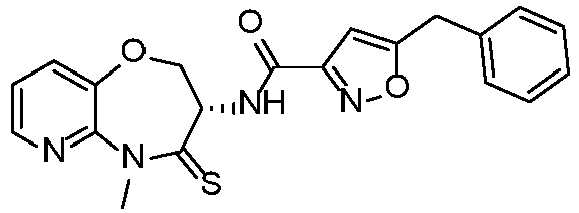
- Route for synthesis:

- To a solution of BB-4 (10 mg, 47.79 µmol, 1 eq) and BB-7 (11.65 mg, 57.35 µmol, 1.2 eq) in DMF (1 mL) were added tri-n-butyl phosphoric anhydride (60.82 mg, 95.57 µmol, 56.84 µL, 50 % purity in ethyl acetate, 2.5 eq) and N,N-diisopropylethylamine (18.53 mg, 143.36 µmol, 24.97 µL, 3 eq), and the mixture was stirred at 25°C for 10 hours. By LCMS monitoring, the raw materials were completely consumed, and a target signal appeared. The reaction solution was directly purified by preparative HPLC (Column: Phenomenex Luna C18 150mm∗30mm∗5µm; Mobile phase: [water (0.05%HCl)-ACN]; acetonitrile%: 20%-50%, 12min) to give compound WX007. 1H NMR (400 MHz, DMSO-d 6) δ = 8.98 (d, J = 8.33 Hz, 1H), 8.46 (dd, J = 1.32, 4.82 Hz, 1H), 7.77 (dd, J = 1.75, 7.89 Hz, 1H), 7.47 (dd, J = 4.60, 8.11 Hz, 1H), 7.22-7.40 (m, 5H), 6.54 (s, 1H), 5.00 (td, J = 7.45, 11.40 Hz, 1H), 4.59-4.70 (m, 1H), 4.48-4.56 (m, 1H), 4.22 (s, 2H), 3.79 (s, 3H); LCMS m/z = 395.1 [M+H]+. By analyzing with supercritical fluid chromatography (Chiral column: Column: Chiralpak OD -3, 3µm, 0.46cm id x 5cm L; Mobile phase: A: CO2, B: MeOH (0.05% IPAm); Gradient: B/A = 10% - 40% in 3 minutes; Flow rate: 4.0 mL/min; Wavelength: 220nm), ee % was equal to 100 %.
- Example 8: WX008

- Route for synthesis:

- To a solution of BB-4 (10 mg, 47.79 µmol, 1 eq) and BB-8 (15.06 mg, 57.35 µmol, 1.2 eq) in DMF (1 mL) were added tri-n-butyl phosphoric anhydride (60.82 mg, 95.57 µmol, 56.84 µL, 50 % purity in ethyl acetate, 2.5 eq) and N,N-diisopropylethylamine (18.53 mg, 143.36 µmol, 24.97 µL, 3 eq), and the mixture was stirred at 25°C for 10 hours. By LCMS monitoring, the raw materials were completely consumed, and a target signal appeared. The reaction solution was directly purified by preparative HPLC (Column: Phenomenex Luna C18 150mm∗30mm∗5µm; Mobile phase: [water (0.05%HCl)-ACN]; acetonitrile%: 20%-50%, 12min) to give compound WX008. 1H NMR (400 MHz, DMSO-d 6) δ = 8.85 (d, J = 7.89 Hz, 1H), 8.46 (d, J = 3.07 Hz, 1H), 7.75-7.89 (m, 3H), 7.61 (d, J = 4.82 Hz, 2H), 7.48 (dd, J = 4.82, 7.89 Hz, 1H), 5.58 (s, 2H), 4.94-5.06 (m, 1H), 4.65 (t, J = 10.74 Hz, 1H), 4.45-4.57 (m, 1H), 3.80 (s, 3H); LCMS m/z = 454.1 [M+H]+. By analyzing with supercritical fluid chromatography (Chiral column: Column: Chiralpak OD -3, 3µm, 0.46cm id x 5cm L; Mobile phase: A: CO2, B: MeOH (0.05% IPAm); Gradient: B/A = 10% - 40% in 3 minutes; Flow rate: 4.0 mL/min; Wavelength: 220nm), ee % was equal to 100 %.
- Example 9: WX009

- Route for synthesis:

- To a solution of BB-4 (10 mg, 47.79 µmol, 1 eq) and BB-9 (11.65 mg, 57.35 µmol, 1.2 eq) in DMF (1 mL) were added tri-n-butyl phosphoric anhydride (60.82 mg, 95.57 µmol, 56.84 µL, 50 % purity in ethyl acetate, 2.5 eq) and N,N-diisopropylethylamine (18.53 mg, 143.36 µmol, 24.97 µL, 3 eq), and the mixture was stirred at 25°C for 10 hours. By LCMS monitoring, the raw materials were completely consumed, and a target signal appeared. The reaction solution was directly purified by preparative HPLC (Column: Phenomenex Luna C18 150mm∗30mm∗5µm; Mobile phase: [water (0.05%HCl)-ACN]; acetonitrile%: 20%-50%, 12min) to give compound WX009. 1H NMR (400 MHz, DMSO-d 6) δ = 8.84 (s, 1H), 8.71 (d, J = 7.89 Hz, 1H), 8.46 (dd, J = 1.53, 4.60 Hz, 1H), 7.79 (dd, J = 1.53, 8.11 Hz, 1H), 7.48 (dd, J = 4.82, 7.89 Hz, 1H), 7.26-7.42 (m, 5H), 5.49 (s, 2H), 4.94-5.08 (m, 1H), 4.48-4.63 (m, 2H), 3.80 (s, 3H); LCMS m/z = 395.1 [M+H]+. By analyzing with supercritical fluid chromatography (Chiral column: Column: Chiralpak OD -3, 3µm, 0.46cm id x 5cm L; Mobile phase: A: CO2, B: MeOH (0.05% IPAm); Gradient: B/A = 10% - 40% in 3 minutes; Flow rate: 4.0 mL/min; Wavelength: 220nm), ee % was equal to 100 %.
- Example 10: WX010

- Route for synthesis:

- To a solution of BB-4 (10 mg, 47.79 µmol, 1 eq) and WX010-1 (11.65 mg, 57.35 µmol, 1.2 eq) in DMF (1 mL) were added tri-n-butyl phosphoric anhydride (60.82 mg, 95.57 µmol, 56.84 µL, 50 % purity in ethyl acetate, 2.5 eq) and N,N-diisopropylethylamine (18.53 mg, 143.36 µmol, 24.97 µL, 3 eq), and the mixture was stirred at 25°C for 10 hours. By LCMS monitoring, the raw materials were completely consumed, and a target signal appeared. The reaction solution was directly purified by preparative HPLC (Column: Phenomenex Luna C18 150mm∗30mm∗5µm; Mobile phase: [water (0.05%HCl)-ACN]; acetonitrile%: 20%-50%, 12min) to give compound WX010. 1H NMR (400 MHz, DMSO-d 6) δ = 8.75 (d, J = 8.33 Hz, 1H), 8.69 (s, 1H), 8.46 (dd, J = 1.53, 4.60 Hz, 1H), 7.79 (dd, J = 1.53, 8.11 Hz, 1H), 7.48 (dd, J = 4.82, 7.89 Hz, 1H), 7.30-7.41 (m, 5H), 5.65 (s, 2H), 4.97-5.10 (m, 1H), 4.58-4.68 (m, 1H), 4.47-4.57 (m, 1H), 3.80 (s, 3H); LCMS m/z = 395.1 [M+H]+. By analyzing with supercritical fluid chromatography (Chiral column: Column: Chiralpak OD -3, 3µm, 0.46cm id x 5cm L; Mobile phase: A: CO2, B: MeOH (0.05% IPAm); Gradient: B/A = 10% - 40% in 3 minutes; Flow rate: 4.0 mL/min; Wavelength: 220nm), ee % was equal to 100 %.
- Example 11: WX011

- Route for synthesis:

- To a solution of BB-4 (10 mg, 47.79 µmol, 1 eq) and BB-13 (14.76 mg, 62.13 µmol, 1.2 eq) in DMF (1 mL) were added tri-n-butyl phosphoric anhydride (60.82 mg, 95.57 µmol, 56.84 µL, 50 % purity in ethyl acetate, 2.5 eq) and N,N-diisopropylethylamine (18.53 mg, 143.36 µmol, 24.97 µL, 3 eq), and the mixture was stirred at 25°C for 10 hours. By LCMS monitoring, the raw materials were completely consumed, and a target signal appeared. The reaction solution was directly purified by preparative HPLC (Column: Phenomenex Luna C18 150mm∗30mm∗5µm; Mobile phase: [water (0.05%HCl)-ACN]; acetonitrile%: 20%-50%, 12min) to give compound WX011. 1H NMR (400 MHz, DMSO- d6 ) δ = 8.83 (d, J = 7.89 Hz, 1H), 8.41-8.49 (m, 1H), 7.77 (dd, J = 1.32, 7.89 Hz, 1H), 7.46 (dd, J = 4.82, 7.89 Hz, 1H), 7.30-7.42 (m, 3H), 7.26 (d, J = 7.02 Hz, 2H), 5.48 (s, 2H), 4.98 (td, J = 7.13, 11.62 Hz, 1H), 4.59-4.67 (m, 1H), 4.49 (dd, J = 6.80, 9.87 Hz, 1H), 3.78 (s, 3H); LCMS m/z = 429.0 [M+H]+. By analyzing with supercritical fluid chromatography (Chiral column: Column: Chiralpak OD -3, 3µm, 0.46cm id x 5cm L; Mobile phase: A: CO2, B: MeOH (0.05% IPAm); Gradient: B/A = 10% - 40% in 3 minutes; Flow rate: 4.0 mL/min; Wavelength: 220nm), ee % was equal to 100 %.
- Example 12: WX012

- Route for synthesis:

- To a solution of BB-4 (15 mg, 71.68 µmol, 1 eq) and BB-10 (33.29 mg, 143.36 µmol, 2 eq) in toluene (3 mL) was added trimethyl aluminum (2 M, 53.76 µL, 1.5 eq), and the mixture was then stirred at 25°C for 1 hour. By LCMS monitoring, the raw materials were completely consumed, and a target signal appeared. The reaction solution was directly purified by preparative HPLC (Column: Phenomenex Luna C18 150mm∗30mm∗5µm; Mobile phase: [water (0.05%HCl)-ACN]; acetonitrile%: 20%-50%, 12min) to give compound WX012. LCMS m/z = 396.2 [M+H]+.
- Example 13: WX013

- Route for synthesis:

- LiOH·H2O (245.59 mg, 5.85 mmol, 3 eq) was added to a solution of BB-11B (501.93 mg, 1.95 mmol, 1 eq) in tetrahydrofuran (9 mL) and water (3 mL), and the mixture was reacted at 25 °C for 2 hours. Water (10 mL) and ethyl acetate (10 mL) were added to the reaction solution, and the layers were separated. The aqueous phase was extracted with ethyl acetate (10 mL∗2). The resulting aqueous phase was adjusted to a pH of 5-6 with 1 M HCl, and extracted with ethyl acetate (10 mL∗2). The organic phases were combined, washed with saturated brine, dried over anhydrous sodium sulfate, and filtered. The filtrate was concentrated under reduced pressure (water pump, 45°C) to give WX013-1. LCMS m/z = 230.2 [M+1]+.1H NMR (400 MHz, DMSO-d 6) δ = 12.75 - 13.57 (m, 1 H), 7.33 -7.44 (m, 3 H), 7.18 - 7.28 (m, 2 H), 5.57 (dd, J = 7.97, 6.21 Hz, 1 H), 3.06 - 3.22 (m, 2 H), 2.94 - 3.03 (m, 1 H), 2.53 - 2.61 (m, 1 H).
- N,N-diisopropylethylamine (23.16 mg, 179.20 µmol, 31.21 µL, 2.5 eq) and WX013-1 (24.65 mg, 107.52 µmol, 1.5 eq) were added to a solution of BB-1 (15 mg, 71.68 µmol, 1 eq) in DMF (1.5 mL), and propylphosphonic anhydride (T3P, 68.42 mg, 107.52 µmol, 63.94 µL, 50% purity, 1.5 eq) was then added. The mixture was reacted at 25 °C for 1 hour. The reaction solution was filtered, and the filtrate was collected. The collected filtrate was purified by preparative HPLC (Column: Phenomenex Luna C18 150mm∗30mm∗5µm; Mobile phase: [water (0.05%HCl)-ACN]; acetonitrile%: 20%-50%, 12min) to give WX013. LCMS m/z = 421.1 [M+1]+.1H NMR(400 MHz, DMSO-d 6) δ = 8.68 (d, J = 8.04 Hz, 1 H), 8.46 (dd, J = 4.72, 1.32 Hz, 1 H), 7.78 (dd, J = 8.04, 1.38 Hz, 1 H), 7.47 (dd, J = 8.04, 4.64Hz, 1 H), 7.32 - 7.43 (m, 3 H), 7.24 (br d, J = 6.65 Hz, 2 H), 5.44 - 5.68 (m, 1 H), 5.00 (dt, J = 11.40, 7.40 Hz, 1 H), 4.42 - 4.68 (m, 2 H), 3.79 (s, 3 H), 2.90 - 3.23 (m, 4 H).
- Example 14: WX014

- Route for synthesis:

- WX014-1 was dissolved in a solution of THF (100 mL) and MeOH (100 mL), and the reaction flask was placed in an ice water bath (0°C). Trimethylsilyl diazomethane (2 M, 47.89 mL, 2.1 eq) was added to the flask, and the mixture was allowed to warm to 25°C and stirred for 2 hours. Glacial acetic acid was added dropwise until the reaction solution turned pale yellow. The reaction solution was concentrated under reduced pressure to give compound WX014-2.
- Triphenylphosphine (14.30 g, 54.53 mmol, 1.2 eq) and imidazole (3.71 g, 54.53 mmol, 1.2 eq) were dissolved in dichloromethane (120 mL) at 25°C, and I2 (13.84 g, 54.53 mmol, 10.98 mL, 1.2 eq) was slowly added to the above mixture solution. The mixture solution was stirred for 10 minutes, and a solution of WX014-2 in DCM (80 mL) was added to the above solution. The mixture was reacted at 25°C for 12 hours. The reaction solution was filtered, and the filtrate was concentrated under reduced pressure to give a crude product. The crude product was purified by column chromatography (petroleum ether:ethyl acetate = 10:1 ~ 1:1) to give WX014-3. LCMS m/z = 244.1 [M-100+1]+.1H NMR (400 MHz, CDCl3) δ = 5.10 (br d, J = 4.82 Hz, 1 H), 4.35 (br d, J = 3.96 Hz, 1 H), 3.77 (s, 3 H), 3.18 (t, J = 7.46 Hz, 2 H), 2.30 - 2.49 (m, 1 H), 2.18 (dq, J = 14.32, 7.22 Hz, 1 H), 1.43 - 1.47 (m, 9 H).
- 1,2-Dibromoethane (82.12 mg, 437.12 µmol, 32.98 µL, 0.3 eq) was added to zinc powder (285.83 mg, 4.37 mmol, 3 eq) in DMF (2 mL). The mixture was stirred at 60°C for 30 minutes, and then cooled to room temperature (25°C). Trimethylchlorosilane (9.50 mg, 87.42 µmol, 11.10 µL, 0.06 eq) was added into the reaction flask, and the mixture was stirred at 25°C for 30 minutes. A solution of WX014-2 in DMF (2 mL) was added to the above solution, and the mixture was reacted at 25°C for 30 minutes, and then allowed to stand for 30 minutes. The upper emulsion was taken out and slowly added to a solution of tris(dibenzylideneacetone)dipalladium (44.08 mg, 48.14 µmol, 0.05 eq), tri-o-methylphenylphosphine (58.61 mg, 192.55 µmol, 0.2 eq), and BB-12 in DMF (2 mL), and the mixture was reacted at 20°C for 1 hour. Water (5 mL) and methyl tert-butyl ether (5 mL) were added to the reaction solution, and the layers were separated. The aqueous phase was extracted with methyl tert-butyl ether (5 mL∗2). The organic phases were combined, washed with saturated brine, dried over anhydrous sodium sulfate, and filtered. The filtrate was concentrated under reduced pressure to give WX014-4. LCMS m/z = 289.1 [M-56+1]+.
- LiOH·H2O (219.33 mg, 5.23 mmol, 3 eq) was added to a solution of WX014-4 in tetrahydrofuran (15 mL) and water (15 mL), and the mixture was reacted at 25°C for 2 hours. 10 mL of Water and 10 mL of ethyl acetate were added to the reaction solution, and the layers were separated. The aqueous phase was extracted with ethyl acetate (10 mL∗2). The resulting aqueous phase was adjusted to a pH of 5~6 with 1 M HCl, and extracted with ethyl acetate (10 mL∗2). The organic phases were combined, washed with saturated brine, dried over anhydrous sodium sulfate, and filtered. The filtrate was concentrated under reduced pressure to give WX014-5. LCMS m/z = 275.1 [M-56+1]+.
- Propylphosphonic anhydride (895.80 mg, 1.41 mmol, 837.20 µL, 50% purity, 1.5 eq) was added to a solution of N,N-diisopropylethylamine (303.22 mg, 2.35 mmol, 408.65 µL, 2.5 eq) and WX014-5 in DMF (20 mL), and the mixture was reacted at 25°C for 2 hours. Water (15 mL) and ethyl acetate (15 mL) were added to the reaction solution, and the layers were separated. The aqueous phase was extracted with ethyl acetate (15 mL∗2). The organic phases were combined, washed with saturated brine, dried over anhydrous sodium sulfate, and filtered. The filtrate was concentrated under reduced pressure to give a crude product. The crude product was purified by column chromatography (petroleum ether:ethyl acetate = 10:1 ~ 1:1) to give WX014-6. 1H NMR (400 MHz, CDCl3) δ = 7.40 (br s, 1 H), 6.76 - 6.87 (m, 2 H), 5.46 (br d, J= 7.46 Hz, 1 H), 4.22 - 4.37 (m, 2 H), 2.88 - 3.03 (m, 1 H), 2.63 - 2.73 (m, 2 H), 1.42 (s, 9 H).
- Lawsson's reagent (77.70 mg, 192.12 µmol, 1.5 eq) was added to a solution of WX014-6 (40 mg, 128.08 µmol, 1 eq) in toluene (5 mL) at 20°C, and the mixture was reacted at 70°C for 12 hours. The reaction solution was concentrated under reduced pressure to give a crude product. The crude product was purified by column chromatography (petroleum ether:ethyl acetate = 10:1 ~ 1:1) to give WX014-7. LCMS m/z = 273.1 [M-56+1]+.
- HCl/EtOAc (4M, 2 mL) was added to a solution of WX014-7 in ethyl acetate (3 mL), and the mixture was reacted at 25°C for 2 hours. The reaction solution was concentrated under reduced pressure (water pump, 40°C) to give a crude product WX014-8. LCMS m/z = 229.2 [M+1]+.
- DIPEA (18.31 mg, 141.66 µmol, 24.67 µL, 2.5 eq) and T3P (54.09 mg, 84.99 µmol, 50.55 µL, 50% purity, 1.5 eq) were added to a solution of WX014-8 (15 mg, 56.66 µmol, 1 eq, HC1) and BB-1 (14.97 mg, 73.66 µmol, 1.3 eq) in DMF (2 mL), and the mixture was reacted at 25 °C for 2 hours. Water (5 mL) and ethyl acetate (5 mL) were added to the reaction solution, and the layers were separated. The aqueous phase was extracted with ethyl acetate (5 mL∗2). The organic phases were combined, washed with saturated brine, dried over anhydrous sodium sulfate, and filtered. The filtrate was concentrated under reduced pressure to give a crude product. The crude product was purified by preparative HPLC (Column: Phenomenex Luna C18 150mm∗30mm∗5µm; Mobile phase: [water (0.05%HCl)-ACN]; acetonitrile%: 20%-50%, 12min) to give WX014. LCMS m/z = 414.2 [M+1]+.1H NMR (400 MHz, CD3OD) δ = 7.21 - 7.37 (m, 5 H), 6.97 - 7.13 (m, 2 H), 4.71 (br d, J= 4.14 Hz, 1 H), 4.18 (br s, 2 H), 2.84 - 2.96 (m, 1 H), 2.64 - 2.83 (m, 2 H), 2.17 (td, J= 11.67, 7.78 Hz, 1 H).
- Example 15: WX015

- Route for synthesis:

- To a round bottom flask containing N,N-dimethylformamide (10 mL) were added BB-3 (20 mg, 96.02 µmol, 1.1 eq) and DIPEA (23.69 mg, 183.32 µmol, 31.93 µL, 2.1 eq). After dissolved, BB-14 (21.24 mg, 87.30 µmol, 1 eq) and T3P (55.55 mg, 87.30 µmol, 51.92 µL, 50% purity, 1 eq) were added, and then the mixture was reacted with stirring at 25°C for 12 hours. LCMS showed that the raw materials were basically consumed. The reaction solution was concentrated under reduced pressure to about 5 mL. HPLC (Column: Welch Xtimate C18 150∗25mm∗5µm; Mobile phase: [water (0.225%FA)-ACN]; acetonitrile%: 35%-65%, 8min) was used for purification to give product WX015. 1H NMR (400MHz, CDCl3) δ= 8.78 (br d, J=7.5 Hz, 1H), 7.43 - 7.35 (m, 5H), 7.35 - 7.26 (m, 4H), 5.82 (s, 2H), 5.21 (td, J=6.9, 11.0 Hz, 1H), 4.71 (dd, J=6.5, 9.5 Hz, 1H), 4.33 - 4.21 (m, 1H), 3.87 (s, 3H); LCMS m/z = 395.1 [M+1]+.
- Example 16: WX016

- Route for synthesis:

- To a round bottom flask was added DMSO (10 mL), and then WX016-1 (1.31 g, 8.44 mmol, 1 eq), K2CO3 (1.40 g, 10.13 mmol, 1.2 eq) and benzyl bromide (1.59 g, 9.29 mmol, 1.10 mL, 1.1 eq) were slowly added. The mixture was continuously stirred at 25°C for 12 hours. After the completion of the reaction, water (50 mL) was added to the reaction solution, and the mixture was extracted twice with ethyl acetate (30 mLx2). The organic phases were combined, washed with saturated brine (5 mLx2), and concentrated under reduce pressure to give a crude product. The crude product was purified by column chromatography (petroleum ether:ethyl acetate = 100:1∼1:1) to give WX016-2. 1H NMR (400MHz, CDCl3) δ = 7.39 - 7.30 (m, 3H), 7.19 (dd, J=1.8, 7.6 Hz, 2H), 5.39 (s, 2H), 4.49 (q, J=7.1 Hz, 2H), 2.43 (s, 3H), 1.44 (t, J=7.1 Hz, 3H); LCMS m/z = 246.1 [M+1]+.
- To a round bottom flask were added THF (7.5 mL) and H2O (2.5 mL), and then WX016-2 (1 g, 4.08 mmol, 1 eq) and LiOH·H2O (513.26 mg, 12.23 mmol, 3 eq) were slowly added. The mixture was reacted with stirring at 25°C for 2 hours. The reaction solution was concentrated under reduced pressure, and 2N hydrochloric acid was added dropwise to adjust pH to acidic. The mixture was filtered to give a filter cake which was the target compound WX016-3. 1H NMR (400MHz, CDCl3) δ = 7.42 - 7.28 (m, 3H), 7.25 - 7.19 (m, 2H), 5.40 (s, 2H), 2.56 (s, 3H); LCMS m/z = 217.9 [M+1]+.
- To a round bottom flask were added N,N-dimethylformamide (1 mL), WX016-3 (80 mg, 368.28 µmol, 1 eq) and BB-4 (77.07 mg, 368.28 µmol, 1 eq), and then T3P (351.54 mg, 552.43 µmol, 328.55 µL, 50% purity, 1.5 eq) and DIPEA(142.79 mg, 1.10 mmol, 192.45 µL, 3 eq) were added. The mixture was continuously stirred at 25°C for 5 hours, and then concentrated to give a crude product. The crude product was purified by preparative HPLC (Column: Welch Xtimate C18 150∗25mm∗5µm; Mobile phase: [water (0.225%FA)-ACN]; acetonitrile%: 35%-65%, 8min) to give compound WX016. 1H NMR (400MHz, CDCl3) δ = 8.72 (br d, J=7.3 Hz, 1H), 8.37 (dd, J=1.4, 4.6 Hz, 1H), 7.56 (dd, J=1.3, 8.0 Hz, 1H), 7.38 - 7.27 (m, 4H), 7.18 (br d, J=6.0 Hz, 2H), 5.36 (s, 2H), 5.23 (td, J=6.8, 11.0 Hz, 1H), 4.78 (dd, J=6.5, 9.5 Hz, 1H), 4.32 (dd, J=9.8, 11.0 Hz, 1H), 3.93 (s, 3H), 2.41 (s, 3H); LCMS m/z = 409.1 [M+1]+.
- Example 17: WX017

- Route for synthesis:
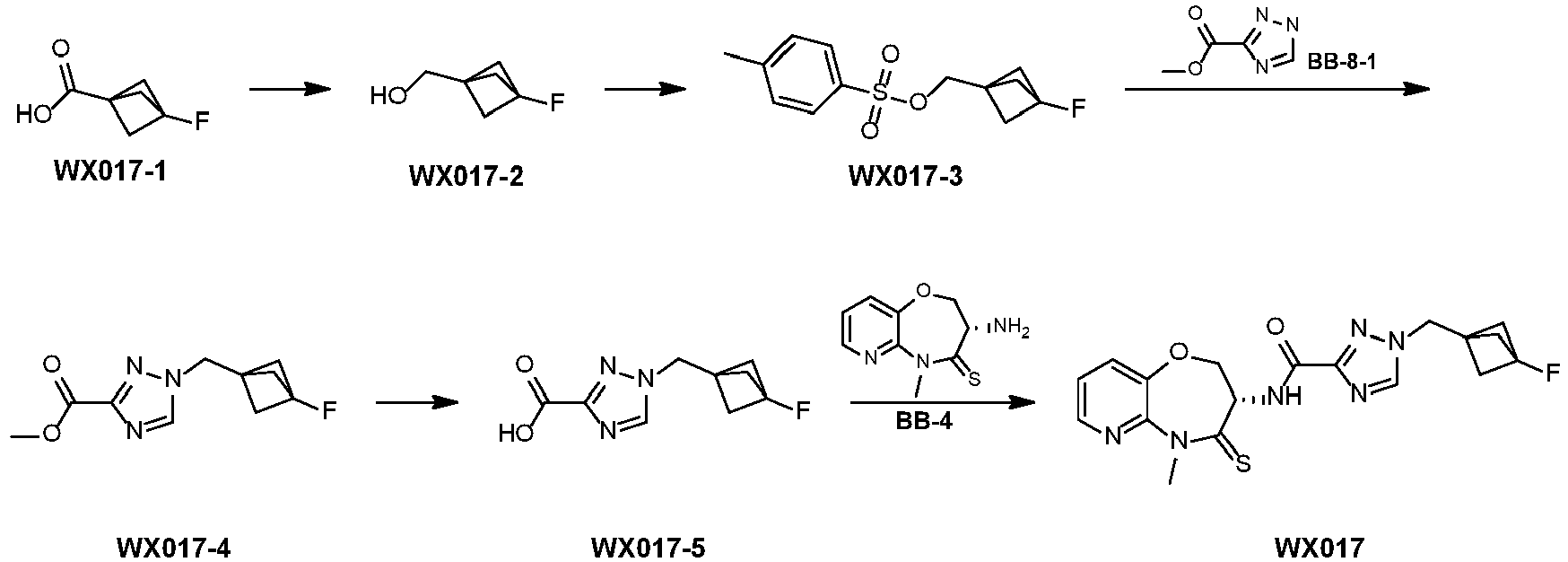
- To a reaction flask were added lithium aluminum hydride (629.99 mg, 16.60 mmol, 2 eq) and THF (5 mL) at 25°C, and then a solution of WX017-1 (1.08 g, 8.30 mmol, 1 eq) in THF (5 mL) was slowly added dropwise. After the completion of addition, the mixture was heated to 35°C, and continuously stirred for 1 hour. The reaction was quenched by adding 6 mL of saturated aqueous Na2SO4 solution. The mixture was filtered, and washed with ethyl acetate (10 mL×3 times). The organic phases were combined, dried over anhydrous MgSO4, and filtered. The filtrate was concentrated under reduced pressure. The crude product was purified by silica gel column chromatography (petroleum ether:ethyl acetate= 100:1∼5:1) to give compound WX017-2. 1H NMR (400MHz, CDCl3) δ = 3.84 (s, 2H), 2.01 (d, J=2.5 Hz, 6H).
- To a reaction flask were added WX017-2, DCM (10 mL), and pyridine (1.40 g, 17.70 mmol, 1.43 mL, 4.11 eq), and then p-toluenesulfonyl chloride (1.23 g, 6.46 mmol, 1.5 eq) was slowly added. The mixture was heated to 40°C and reacted for 24 hours. A new spot (Rf=0.7) appeared by TLC (petroleum ether:ethyl acetate=5:1) monitoring. The reaction solution was directly concentrated under reduced pressure, and the crude product was purified by silica gel column chromatography (petroleum ether:ethyl acetate=100:1~30:1) to give compound WX017-3. 1H NMR (400MHz, CDCl3) δ = 7.78 (d, J=8.3 Hz, 2H), 7.35 (d, J=8.0 Hz, 2H), 4.24 (s, 2H), 2.46 (s, 3H), 1.99 (d, J=2.3 Hz, 6H).
- To an eggplant-shaped bottle, acetonitrile (10 mL), WX017-3 (500 mg, 1.85 mmol, 1.1 eq) and BB-8-1 (213.72 mg, 1.68 mmol, 1 eq) were added at 25°C, and then K2CO3 (278.88 mg, 2.02 mmol, 1.2 eq) was added. The mixture was heated to 70°C and reacted for 48 hours. The reaction solution was concentrated, and the crude product was purified by silica gel column (eluent: petroleum ether:ethyl acetate=100:1∼1:2) to give compound WX017-4. 1H NMR (400MHz, CDCl3) δ = 8.12 (s, 1H), 4.57 (s, 2H), 4.01 (s, 3H), 2.05 (d, J=2.5 Hz, 6H).
- To a round bottom flask containing THF (2 mL) was added WX017-4 (100 mg, 444.01 µmol, 1 eq) at 25°C. After dissolved, a solution of LiOH·H2O (55.90 mg, 1.33 mmol, 3 eq) in MeOH (1 mL) was added aropwise, and the mixture was reacted at 25°C for 5 hours. The mixture was concentrated under reduced pressure and the residue was dissolved in tetrahydrofuran (5 mL). IN dilute hydrochloric acid was added to adjust pH to 4, and toluene (5 mL) was then added. The mixture was mixed well, and the solvent was then evaporated to dryness under reduced pressure to give a crude product of WX017-5, which was directly used in the next step without purification.
- To a reaction flask were added ethyl acetate (10 mL), WX017-5 (207 mg, 588.09 µmol, 1 eq), and BB-4 (143.52 mg, 588.09 µmol, 1 eq) at 25°C. After dissolved, T3P (1.12 g, 1.76 mmol, 1.05 mL, 50% purity, 3 eq) and DIPEA (228.02 mg, 1.76 mmol, 307.30 µL, 3 eq) were added, and the mixture was reacted at 25°C for 8 hours. After the completion of the reaction, ethyl acetate (10 mL) was added. The organic phase was washed with water (10 mL×3 times), followed by saturated brine (10 mL×1 time), and concentrated under reduced pressure to give a crude product. The crude product was purified by preparative HPLC (Column: Welch Xtimate C18 150∗25mm∗5µm; Mobile phase: [water (0.05%NH3H2O)-ACN]; acetonitrile%: 35%-65%, 8min) to give compound WX017. 1H NMR (400MHz, CDCl3) δ = 8.83 (br d, J=6.8 Hz, 1H), 8.37 (dd, J=1.4, 4.6 Hz, 1H), 8.08 (s, 1H), 7.57 (dd, J=1.3, 8.0 Hz, 1H), 7.29 (dd, J=4.8, 8.0 Hz, 1H), 5.20 (td, J=6.7, 11.2 Hz, 1H), 4.80 (dd, J=6.4, 9.4 Hz, 1H), 4.54 (s, 2H), 4.33 (dd, J=9.8, 11.0 Hz, 1H), 3.94 (s, 3H), 2.05 (d, J=2.3 Hz, 6H); LCMS m/z = 403.2 [M+1]+.
- Example 18: WX018

- Route for synthesis:

- To a round bottom flask containing N,N-dimethylformamide (10 mL) were added BB-4 (200 mg, 955.71 µmol, 1.1 eq) and DIPEA (235.80 mg, 1.82 mmol, 317.80 µL, 2.1 eq). After dissolved, BB-14 (210.50 mg, 868.83 µmol, 1 eq) and T3P (552.89 mg, 868.83 µmol, 516.72 µL, 50% purity, 1 eq) were added, and the mixture was then stirred at 25°C for 12 hours. The reaction solution was concentrated under reduced pressure to about 5 mL. HPLC (Column: Welch Xtimate C18 150∗25mm∗5µm; Mobile phase: [water (0.225%FA)-ACN]; acetonitrile%: 35%-65%, 8min) was used for purification to give compound WX018. 1HNMR (400MHz, CDCl3) δ = 8.86 (br d, J=6.8 Hz, 1H), 8.38 (dd, J=1.6, 4.6 Hz, 1H), 7.69 - 7.27 (m, 7H), 5.83 (s, 2H), 5.20 (td, J=6.7, 11.2 Hz, 1H), 4.78 (dd, J=6.3, 9.5 Hz, 1H), 4.33 (dd, J=9.7, 11.2 Hz, 1H), 3.93 (s, 3H); LCMS m/z = 396.1 [M+1]+.
- Example 19: WX019

- Route for synthesis:

- To a round bottom flask containing N,N-dimethylformamide (10 mL) were added BB-15 (156.11mg, 745.97 µmol, 1.1 eq), BB-4 (150 mg, 678.16 µmol, 1 eq), T3P (431.55 mg, 678.16 µmol, 403.32 µL, 50% purity, 1 eq), and DIPEA (184.06 mg, 1.42 mmol, 248.06 µL, 2.1 eq), and then stirring was started. The mixture was reacted with stirring at 25°C for 12 hours. After the completion of the reaction, the reaction solution was concentrated under reduced pressure to about 5 mL. HPLC (Column: Welch Xtimate C18 150∗25mm∗5µm; Mobile phase: [water (0.225%FA)- ACN]; acetonitrile%: 35%-65%, 8min) was used for purification to give product WX019. 1H NMR (400MHz, CDCl3) δ= 8.81 (br d, J=7.3 Hz, 1H), 8.37(dd, J=1.5, 4.8 Hz, 1H), 8.14 (s, 1H), 7.56 (dd, J=1.5, 8.0 Hz, 1H), 7.41 - 7.27 (m, 3H), 7.21 - 7.06 (m, 2H), 5.45 (s, 2H), 5.20(td, J=6.7, 11.2 Hz, 1H), 4.78 (dd, J=6.5, 9.5 Hz, 1H), 4.31 (dd, J=9.5, 11.0 Hz, 1H), 3.93 (s, 3H); 19F NMR (376MHz, CDCl3) δ= -109.59 ~ -130.05 (m, IF); LCMS m/z = 413.1 [M+1]+.
- Example 20: WX020

- Route for synthesis:

- To acetonitrile (15 mL) were added WX020-1 (3 g, 23.60 mmol, 1 eq), 2,6-difluorobenzyl bromide (5.37 g, 25.96 mmol, 1.1 eq), and K2CO3 (3.91 g, 28.32 mmol, 1.2 eq), and then stirring was started. The mixture was reacted at 50°C for 12 hours. After the reaction was completed by TLC monitoring, the reaction solution was filtered to remove K2CO3, and the filter cake was washed three times with ethyl acetate (15 mL). Saturated brine (50 mL) was added to the filtrate, and then an organic phase was obtained after extraction. The aqueous phase was extracted with EA (30 mL) again. The organic phases were combined, and concentrated under reduced pressure to give a crude product. The crude product was purified by silica gel column (eluent: petroleum ether:ethyl acetate = 100:1~100:100) to give compound WX020-2. 1H NMR (400MHz, CDCl3) δ= 8.17 (s, 1H), 7.46 - 7.33 (m, 1H), 7.04-6.91 (m, 2H), 5.51 (s, 2H), 4.13 - 3.85 (m, 3H).
- To a round bottom flask containing THF (30 mL) was added WX020-2 (1 g, 3.95 mmol, 1 eq). After dissolved, a solution of LiOH·H2O (331.43 mg, 7.90 mmol, 2 eq) in H2O (5 mL) was added, and the mixture was reacted with stirring at 20°C for 2 hours. The reaction solution was adjusted to a pH of 6 with 1M diluted hydrochloric acid, and the mixture was then concentrated under reduced pressure to remove the solvent to give a crude product WX020-3; LCMS m/z = 239.9 [M+1]+.
- To a round bottom flask containing N,N-dimethylformamide (10 mL) were added BB-4 (192.49 mg, 919.82 µmol, 1.1 eq), WX020-3 (200 mg, 836.20 µmol, 1 eq), T3P(532.12 mg, 836.20 µmol, 497.31 µL, 50% purity, 1 eq), and DIPEA (226.95 mg, 1.76 mmol, 305.86 µL, 2.1 eq), and the mixture was reacted with stirring at 25°C for 12 hours. The reaction solution was concentrated under reduced pressure to about 5 mL, and the residue was purified by preparative HPLC (Column: Welch Xtimate C18 150∗25mm∗5µm; Mobile phase: [water (0.225%FA)-ACN]; acetonitrile%: 35%-65%, 8min) to give compound WX020. 1H NMR (400MHz, CDCl3) δ = 8.79 (br d, J=7.0 Hz, 1H), 8.36 (dd, J=1.5, 4.8 Hz, 1H), 8.14 (s, 1H), 7.55 (dd, J=1.5, 8.0 Hz, 1H), 7.43 - 7.26 (m, 2H), 6.97 (t, J=7.9 Hz, 2H), 5.49 (s, 2H), 5.19 (td, J=6.7, 11.1 Hz, 1H), 4.77 (dd, J=6.3, 9.5 Hz, 1H), 4.30 (dd, J=9.7, 10.9 Hz, 1H), 3.92 (s, 3H); 19F NMR (376MHz, CDCl3) δ = -104.74 ~ -120.36 (m, IF); LCMS m/z =431.1 [M+1]+.
- Example 21: WX021

- Route for synthesis:

- To a round bottom flask containing DCM (20 mL) was added BB-3-4 (2 g, 6.73mmol, 1 eq), and the mixture was stirred at 40°C. NCS (988.11 mg, 7.40 mmol, 1.1 eq) was slowly added, and then the reaction was continuously stirred at 40°C for 5 hours. The reaction solution was concentrated under reduced pressure to give a crude product. The crude product was purified by silica gel column (eluent: DCM:MeOH=100:1~100:10) to give compound WX021-1. 1H NMR (400MHz, CD3OD) δ= 7.54 (d, J=1.5 Hz, 1H), 7.34 (d, J=1.8 Hz, 1H), 6.95 - 6.77 (m, 1H), 5.49 (s, 2H), 4.70 - 4.60 (m, 2H), 4.53 (br dd, J=4.3, 9.5 Hz, 1H), 4.39 - 4.26 (m, 1H), 1.46 (s, 9H). LCMS m/z = 331.9 [M+1]+.
- To a round bottom flask containing DCM (10 mL) were added WX021-1 (1.60 g, 4.82 mmol, 1 eq), T3P (6.14 g, 9.65 mmol, 5.74 mL, 50% purity, 2 eq), and DIPEA (1.87 g, 14.47 mmol, 2.52 mL, 3 eq), and the mixture was reacted at 20°C for 3 hours. The reaction solution was poured into saturated brine (300 mL), and the layers were separated to give an organic phase. The aqueous phase was extracted twice with ethyl acetate (100 mL). The organic phases were combined and concentrated under reduced pressure to give a crude product. The crude product was purified by silica gel column (petroleum ether:ethyl acetate=100:20~100:100) to give compound WX021-2. 1H NMR(400MHz, CDCl3) δ= 8.22 (br s, 1H), 8.04 (d, J=2.0 Hz, 1H), 7.41(d, J=2.3 Hz, 1H), 5.59 (br s, 1H), 4.71 - 4.46 (m, 2H), 4.23 - 4.05 (m, 1H), 1.46 (s, 9H); LCMS m/z = 257.8 [M-56+1]+.
- To a round bottom flask containing N,N-dimethylacetamide (10 mL) were added WX021-2 (200 mg, 637.48 µmol, 1 eq), iodomethane (1.17 g, 8.24 mmol, 513.16 µL, 12.93 eq), and cesium carbonate (415.41 mg, 1.27 mmol, 2 eq). The mixture was reacted with stirring at 25°C under nitrogen for 1 hour. After the completion of the reaction, the reaction solution was poured into saturated brine (20 mL), and the mixture was extracted three times with ethyl acetate (15 mL). The organic phases were combined and concentrated under reduced pressure to give a crude product. The crude product was dissolved in ethyl acetate (2 mL), and purified by preparative TLC (petroleum ether:ethyl acetate=3:1) to give a product WX021-3. 1H NMR (400MHz, CDCl3) δ= 8.23 (d, J=2.3 Hz, 1H), 7.47 (d, J=2.0 Hz, 1H), 5.55 (br s, 1H), 4.82 - 4.49 (m, 2H), 4.35 - 4.14 (m, 1H), 3.47 (s, 3H), 1.41 (s, 9H).
- To a round bottom flask containing toluene (10 mL) were added WX021-3 (177 mg, 540.02 µmol, 1 eq) and Lawsson's reagent (327.63 mg, 810.04 µmol, 1.5 eq) at 25°C, and the mixture was slowly heated to 110°C and reacted for 12 hours. The reaction solution was poured into saturated brine (100 mL), and the mixture was extracted three times with ethyl acetate (30 mL). The organic phases were combined, and concentrated under reduced pressure to give a crude product. The crude product was purified by preparative TLC (petroleum ether:ethyl acetate =3:1) to give compound WX021-4. LCMS m/z = 287.8 [M-56+1]+.
- To a round bottom flask containing dichloromethane (5 mL) was added WX021-4 (35 mg, 101.80 µmol, 1 eq) at 25°C. Trifluoroacetic acid (174.10 mg, 1.53 mmol, 113.06 µL, 15 eq) was added dropwise with stirring, and the mixture was continuously reacted for 2 hours. The reaction solution was evaporated to dryness under reduced pressure to give a crude product of WX021-5, which was used directly in the next step.
- To a round bottom flask containing N,N-dimethylacetamide (5 mL) were added WX021-5 (20 mg, 82.06 µmol, 1 eq), BB-8 (16.68 mg, 82.06 µmol, 1 eq), T3P (52.22 mg, 82.06 µmol, 48.81 µL, 50% purity, 1 eq), and DIPEA (22.27 mg, 172.33 µmol, 30.02 µL, 2.1 eq), and the mixture was reacted at 25°C for 5 hours. Saturated brine (30 mL) was added, and the mixture was extracted with ethyl acetate (30 mL×3). The organic phase was concentrated under reduced pressure to give a crude product. The crude product was purified by HPLC (formic acid system) (Column: Xtimate C18 100∗30mm∗3µm; Mobile phase [water (0.225%FA)-ACN]; acetonitrile%: 40%-70%, 8min) to give compound WX021. 1H NMR (400MHz, CDCl3) δ= 8.77 (br d, J=7.3 Hz, 1H), 8.32 (d, J=2.3 Hz, 1H), 8.04 (s, 1H), 7.57 (d, J=2.0 Hz, 1H), 7.44 - 7.34 (m, 3H), 7.32 - 7.27 (m, 2H), 5.40 (s, 2H), 5.26 - 5.16 (m, 1H), 4.77 (dd, J=6.3, 9.5 Hz, 1H), 4.39 - 4.27 (m, 1H), 3.90 (s, 3H); LCMS m/z = 429.0 [M+1]+.
- Example 22: WX022

- Route for synthesis:

- To N,N-dimethylacetamide (5 mL) were added WX021-5 (20 mg, 82.06 µmol, 1 eq), BB-15 (18.15 mg, 82.06 µmol, 1 eq), T3P (52.22 mg, 82.06 µmol, 48.81 µL, 50% purity, 1 eq), and DIPEA (22.27 mg, 172.33 µmol, 30.02 µL, 2.1 eq), and the mixture was reacted at 25°C for 5 hours. 30 mL of saturated brine was added, and the mixture was extracted with ethyl acetate (30 mL×3) to give an organic phase. The organic phase was concentrated under reduced pressure to give a crude product. The crude product was purified by preparative HPLC (Column: Xtimate C18 100∗30mm∗3µm; Mobile phase: [water (0.225%FA)-ACN]; acetonitrile%: 42%-72%, 8min) to give compound WX022. 1H NMR (400MHz, CDCl3) δ= 8.77 (br d, J=6.5 Hz, 1H), 8.32 (d, J=2.0 Hz, 1H), 8.14 (s, 1H), 7.57 (d, J=2.3 Hz, 1H), 7.41 - 7.31 (m, 2H), 7.20 - 7.07 (m, 2H), 5.45 (s, 2H), 5.30 - 5.08 (m, 1H), 4.76 (dd, J=6.3, 9.5 Hz, 1H), 4.32 (t, J=10.3 Hz, 1H), 3.93 - 3.87 (m, 1H); 19F NMR (376MHz, CDCl3) δ= -110.66 ~ -127.90 (m, IF); LCMS m/z = 447.1[M+1]+.
- Example 23: WX023
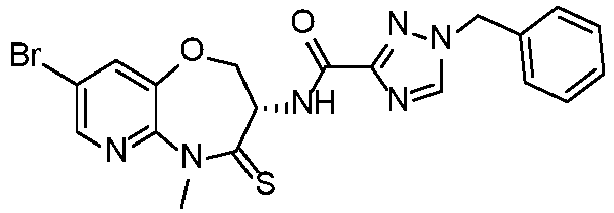
- Route for synthesis:

- BB-4-3 (3.00 g, 10.09 mmol, 1 eq) and N-bromosuccinimide (1.98 g, 11.10 mmol, 1.1eq) were slowly added to DCM (30 mL) at 25°C, and the reaction solution was continuously stirred at 25°C under nitrogen for 12 hours. The reaction solution was slowly poured into water (100 mL), and the mixture was extracted with dichloromethane (100 mL×2). The organic phases were combined and washed successively with water (100 mL) and saturated brine (100 mL) to give an organic phase. The organic phase was concentrated under reduced pressure. The crude product was purified by silica gel column chromatography (dichloromethane:methanol = 100:1∼100:5) to give compound WX023-1.
- To a round bottom flask was added ethyl acetate (100 mL) at 25°C. WX023-1 (5.60 g, 14.89 mmol, 1 eq), T3P (14.21 g, 22.33 mmol, 13.28 mL, 50% purity, 1.5eq) and DIPEA (3.85 g, 29.77 mmol, 5.19 mL, 2 eq) were then slowly added. The reaction solution was continuously stirred at 25°C under nitrogen for 1 hour. The reaction solution was slowly poured into water (200 mL), and the mixture was extracted with ethyl acetate (200 mL×2). The organic phases were combined and washed successively with water (200 mL) and saturated brine (200 mL) to give an organic phase. The organic phase was concentrated under reduced pressure. The crude product was purified by silica gel column chromatography (petroleum ether:ethyl acetate =100:1∼1:1) to give compound WX023-2.
- To a round bottom flask was added N,N-dimethylformamide (10 mL) at 25°C. WX023-2 (1.80 g, 5.03 mmol, 1 eq), iodomethane (5.71 g, 40.23 mmol, 2.50 mL, 8.01 eq) and cesium carbonate (3.60g, 11.06 mmol, 2.2 eq) were then slowly added. The reaction solution was continuously stirred at 25°C under nitrogen for 1 hour. The reaction solution was slowly poured into water (100 mL), and the mixture was extracted with ethyl acetate (100 mL×2). The organic phases were combined and washed successively with water (100 mL) and saturated brine (100 mL). The organic phase was concentrated under reduced pressure to give a crude product. The crude product was purified by silica gel column chromatography (petroleum ether:ethyl acetate=100:1∼3:1) to give compound WX023-3. 1H NMR (400MHz, CDCl3) δ = 8.32 (d, J=2.0 Hz, 1H), 7.61 (d, J=2.3 Hz, 1H), 5.55 (brd, J=4.8 Hz, 1H), 4.79 - 4.44 (m, 2H), 4.34 - 4.11 (m, 1H), 3.46 (s, 3H), 1.40 (s, 9H).
- To a round bottom flask was added toluene (50 mL) at 25°C, and then WX023-3 (1.35 g, 3.63 mmol, 1 eq) and Lawsson's reagent (2.20 g, 5.44 mmol, 1.5eq) were slowly added. The reaction solution was continuously stirred at 110°C under nitrogen for 11 hours. The reaction solution was slowly poured into water (100 mL), and the mixture was extracted with ethyl acetate (100 mL×2). The organic phases were combined and washed successively with water (100 mL) and saturated brine (100 mL). The organic phase was concentrated under reduced pressure to give a crude product. The crude product was purified by silica gel column chromatography (petroleum ether:ethyl acetate=100:1∼1:1) to give compound WX023-4. 1H NMR (400MHz, CDCl3) δ = 8.38 (d, J=2.0 Hz, 1H), 7.65 (d, J=2.3 Hz, 1H), 6.10 (br d, J=7.3 Hz, 1H), 4.81 - 4.67 (m, 1H), 4.58 (dd, J=6.1, 9.4 Hz, 1H), 4.23 (dd, J=9.5, 11.3 Hz, 1H), 3.87 (s, 3H), 1.41 (s, 9H).
- To a round bottom flask was added dichloromethane (40 mL) at 25°C, and then WX023-4 (980 mg, 2.52 mmol, 1 eq) and trifluoroacetic acid (6.16 g, 54.02 mmol, 4, 21.40eq) were slowly added. The reaction solution was continuously stirred at 25 °C under nitrogen for 11 hours. The reaction solution was slowly poured into saturated aqueous sodium bicarbonate solution (100 mL), and the mixture was extracted twice with dichloromethane (100 mL×2). The organic phases were combined and washed successively with water (100 mL) and saturated brine (100 mL). The organic phase was concentrated under reduced pressure to give a crude compound WX023-5, which was used directly in the next step without purification. 1H NMR (400MHz, CDCl3) δ = 8.32 (d, J=2.0 Hz, 1H), 7.59 (d, J=2.3 Hz, 1H), 4.40 (dd, J=6.3, 10.0 Hz, 1H), 4.10 (t, J=10.8 Hz, 1H), 3.88 - 3.71 (m, 4H).
- To a round bottom flask was added N,N-dimethylacetamide (5 mL) at 25°C. WX023-5 (288 mg, 999.43 µmol, 1 eq), T3P (954.00 mg, 1.50 mmol, 891.59 µL, 50% purity, 1.5 eq), BB-8 (406.16 mg, 2.00 mmol, 2 eq) and DIPEA (387.50 mg, 3.00 mmol, 522.24 µL, 3 eq) were then slowly added. The reaction solution was continuously stirred at 25°C under nitrogen for 2 hours. The reaction solution was slowly poured into water (100 mL), and the mixture was extracted with ethyl acetate (100 mL×2). The organic phases were combined and washed successively with water (100 mL) and saturated brine (100 mL). The organic phase was concentrated under reduced pressure to give a crude product. The crude product was purified by preparative HPLC (Column: Xtimate C18 100∗30mm∗3µm; Mobile phase: [water (0.225%FA)-ACN]; acetonitrile%: 42%-72%, 8min) to give compound WX023. 1H NMR (400MHz, CDCl3) δ = 8.77 (br d, J=7.0 Hz, 1H), 8.42 (d, J=2.0 Hz, 1H), 8.04 (s, 1H), 7.71 (d, J=2.0 Hz, 1H), 7.45 - 7.33 (m, 3H), 7.33 - 7.27 (m, 2H), 5.40 (s, 2H), 5.21 (td, J=6.7, 11.3 Hz, 1H), 4.77 (dd, J=6.3, 9.5 Hz, 1H), 4.33 (dd, J=9.8, 11.0 Hz, 1H), 3.90 (s, 3H); LCMS m/z =475.0 [M+1]+.
- Example 24: WX024

- Route for synthesis:

- To a round bottom flask was added THF (100 mL). WX024-1 (10 g, 50.22 mmol, 1 eq), BB-3-2 (11.34 g, 55.24 mmol, 1.1 eq) and cesium carbonate (29.45 g, 90.39 mmol, 1.8 eq) were then slowly added. The mixture was continuously stirred at 65°C for 16 hours. The reaction solution was poured into water (300 mL), and 2 M diluted hydrochloric acid was then added dropwise to adjust pH to 3. The mixture was extracted with ethyl acetate (500 mL×2). The organic phases were combined and washed with saturated brine (50 mL×2). The organic phase was concentrated under reduced pressure to give compound WX024-2. 1H NMR (400MHz, CDCl3) δ= 8.46 (d, J=1.8 Hz, 1H), 8.20 (dd, J=2.0, 8.8 Hz, 1H), 7.12 (d, J=8.8 Hz, 1H), 5.62 (br d, J=8.0 Hz, 1H), 4.83 - 4.61 (m, 2H), 4.45 (dd, J=3.0, 9.3 Hz, 1H), 3.93 (s, 3H), 1.45 (s, 10H).
- To a hydrogenation bottle was added MeOH (300 mL). WX024-2 (25.8 g, 67.13 mmol, 1 eq) and Pd/C (2.6 g, 26.02 mmol, 10% purity) were then slowly added. The atmosphere was replaced three times with argon gas, and the mixture was continuously stirred at 30°C under H2 (40 Psi) atmosphere for 24 hours. A new spot appeared by TLC (petroleum ether:ethyl acetate:acetic acid=1:1:0.1) monitoring. The reaction solution was filtered through Celite, and the filtrate was concentrated under reduced pressure to give compound WX024-3. 1H NMR (400MHz, CDCl3) δ = 7.50 - 7.44 (m, 1H), 7.39 (br s, 1H), 6.70 (d, J=8.5 Hz, 1H), 6.53 (br s, 2H), 6.00 (br d, J=7.5 Hz, 1H), 4.73 (br d, J=7.0 Hz, 1H), 4.43 (br d, J=8.5 Hz, 1H), 4.31 - 4.24 (m, 1H), 3.85 (s, 3H), 1.41 (s, 9H).
- To a round bottom flask was added ethyl acetate (200 mL). WX024-3, T3P (33.67 g, 52.91 mmol, 31.47 mL, 50% purity, 1.5 eq), and DIEA (13.68 g, 105.83 mmol, 18.43 mL, 3 eq) were then slowly added, and the mixture was continuously stirred at 25 °C for 2 hours. The reaction solution was extracted with water (200 mL), and the layers were separated. The aqueous phase was extracted with ethyl acetate (200 mL×2). The organic phases were combined, washed with saturated brine (100 mL×2), and concentrated under reduced pressure. The crude product was purified by silica gel column chromatography (petroleum ether:ethyl acetate=100:1∼1:1) to give compound WX024-4. 1H NMR (400MHz, CDCl3) δ= 8.15 (br s, 1H), 7.80 (dd, J=2.0, 8.5 Hz, 1H), 7.73 (d, J=2.0 Hz, 1H), 7.13 (d, J=8.3 Hz, 1H), 5.62 (br d, J=5.3 Hz, 1H), 4.71 - 4.59 (m, 2H), 4.33 - 4.23 (m, 1H), 3.95 - 3.89 (m, 3H), 1.43 (s, 9H).
- To a round bottom flask was added N,N-dimethylformamide (200 mL). WX024-4 (17 g, 50.54 mmol, 1 eq), cesium carbonate (49.40 g, 151.63 mmol, 3 eq) and iodomethane (21.52 g, 151.63 mmol, 9.44 mL, 3 eq) were then slowly added, and the mixture was continuously stirred at 25 °C for 2 hours. Water (300 mL) was added to the reaction solution, and the mixture was extracted with ethyl acetate (300mL×2). The organic phases were combined, washed with saturated brine (100 mL×2), and concentrated under reduced pressure. The crude product was purified by silica gel column chromatography (petroleum ether:ethyl acetate=100:1∼1:1) to give compound WX024-5. 1H NMR (400MHz, CDCl3) δ= 7.92 - 7.83 (m, 2H), 7.18 (d, J=8.4 Hz, 1H), 5.50 (br d, J=6.1 Hz, 1H), 4.72 - 4.52 (m, 2H), 4.28 - 4.17 (m, 1H), 3.92 (s, 3H), 3.42 (s, 3H), 1.38 (s, 9H).
- To a round bottom flask was added toluene (40 mL). WX024-5 (4.01 g, 11.45 mmol, 1 eq), Lawsson's reagent (5.09 g, 12.59 mmol, 1.1 eq) and Boc2O (10.60 g, 48.55 mmol, 11.15 mL, 4.24 eq) were then slowly added. The mixture was heated to 110°C, and stirred for 12 hours. The reaction solution was slowly poured into saturated brine (30 mL), and the mixture was extracted with ethyl acetate (100mL×2). The organic phases were combined, washed with saturated brine (30 mL×2), and concentrated under reduced pressure to give a crude product. The crude product was purified by silica gel column chromatography (petroleum ether:ethyl acetate=100:1∼1:1) to give compound WX024-6. 1H NMR (400MHz, CDCl3) δ= 7.99 - 7.92 (m, 2H), 7.21 (d, J=8.3 Hz, 1H), 6.02 (br d, J=7.8 Hz, 1H), 4.80 - 4.69 (m, 1H), 4.53 (dd, J=6.3, 9.5 Hz, 1H), 4.22 (dd, J=9.5, 11.3 Hz, 1H), 3.94 (s, 3H), 3.86 (s, 3H), 1.46 - 1.33 (m, 9H).
- To a round bottom flask was added ethyl acetate (10 mL). WX024-6 (500 mg, 1.36 mmol, 1 eq) and HCl/ethyl acetate (4 M, 10 mL, 29.31 eq) were then slowly added, and the mixture was continuously stirred at 25 °C for 2 hours. The reaction solution was concentrated under reduced pressure to give compound WX024-7. 1H NMR (400MHz, CDCl3) δ= 8.04 - 7.89 (m, 2H), 7.28 (br s, 1H), 4.93 (br s, 1H), 4.63 (br s, 1H), 4.44 (br s, 1H), 3.93 (s, 3H), 3.88 - 3.85 (m, 1H), 3.81 (s, 3H).
- To a round bottom flask was added N,N-dimethylformamide (5 mL). WX024-7 (245 mg, 809.18 µmol, 1 eq, HCl), BB-8 (164.42 mg, 809.18 µmol, 1 eq), HATU (461.51 mg, 1.21 mmol, 1.5 eq) and DIPEA (313.74 mg, 2.43 mmol, 422.83 µL, 3 eq) were then slowly added, and the mixture was continuously stirred at 25 °C for 2 hours. The reaction solution was poured into water (20 mL), and the mixture was extracted with ethyl acetate (20 mL×2). The organic phases were combined, washed with saturated brine (5 mL×2), and concentrated under reduced pressure to give a crude product. The crude product was purified by silica gel column chromatography (petroleum ether:ethyl acetate=100:1~1:100) to give compound WX024-8. 1H NMR (400MHz, CDCl3) δ= 8.70 (br d, J=7.3 Hz, 1H), 8.02 - 7.94 (m, 3H), 7.42 - 7.34 (m, 3H), 7.31 - 7.28 (m, 2H), 5.39 (s, 2H), 5.20 (td, J=6.8, 11.0 Hz, 1H), 4.72 (dd, J=6.5, 9.4 Hz, 1H), 4.31 (t, J=10.3 Hz, 1H), 3.95 (s, 3H), 3.89 (s, 3H).
- To a round bottom flask were added THF (4 mL) and H2O (1 mL). WX024-8 (50 mg, 110.74 µmol, 1 eq) and LiOH·H2O (4.65 mg, 110.74 µmol, 12.79 µL, 1 eq) were then slowly added, and the mixture was continuously stirred at 25 °C for 2 hours. The reaction solution was separated by HPLC (Column: Phenomenex Gemini-NX 80∗40mm∗3um; Mobile phase: [water (0.05% NH3·H2O + 10mM NH4HCO3) -ACN]; acetonitrile%:11%-31%, 8min) to give compound WX024. 1H NMR (400MHz, CDCl3) δ= 8.78 (br s, 1H), 8.18 - 7.82 (m, 3H), 7.36 (br s, 5H), 5.64 - 5.32 (m, 2H), 5.26 (br s, 1H), 4.72 (br s, 1H), 4.32 (br s, 1H), 3.86 (br s, 3H); LCMS m/z = 438.1 [M+1]+.
- Example 25: WX025

- Route for synthesis:

- NaH (2.78 g, 69.38 mmol, 60% purity, 2.2 eq) was added to a solution of BB-3-2 (7.12 g, 34.69 mmol, 1.1 eq) in N,N-dimethylformamide (80 mL) at 0°C under nitrogen, and the mixture was reacted for 2 hours. The reaction solution was placed in an ice-water bath, and WX025-1 (5 g, 31.54 mmol, 1 eq) was added to the above solution. The reaction solution was heated to 25°C and reacted for 12 hours. The reaction solution was slowly added to ice water (100 mL), and the mixture was extracted with ethyl acetate (150 mL×2). The aqueous phase was adjusted to a pH of 5~6 with 1 M HCl, and extracted with ethyl acetate (150 mL×2). The organic phases were combined, washed with saturated brine, dried over anhydrous sodium sulfate, and filtered. The filtrate was concentrated under reduced pressure to give compound WX025-2. LCMS m/z = 328.1 [M+1]+.
- Pd/C (3 g, 5% purity) was added to a solution of WX025-2 (9 g, 27.50 mmol, 1 eq) in ethyl acetate (60 mL) and methanol (30 mL). The atmosphere was replaced three times with H2, and the mixture was reacted at 25°C under H2 (15 Psi) atmosphere for 12 hours. The reaction solution was filtered through Celite, and the filtrate was concentrated under reduced pressure to give compound WX025-3. LCMS m/z = 298.1 [M+1]+.
- T3P (20.87 g, 32.79 mmol, 19.50 mL, 50% purity, 1.5 eq) was added to a solution of DIPEA (7.06 g, 54.66 mmol, 9.52 mL, 2.5 eq) and WX025-3 (6.5 g, 21.86 mmol, 1 eq) in N,N-dimethylformamide (200 mL), and the mixture was reacted at 25 °C for 3 hours. Water (200 mL) was added to the reaction solution in an ice bath, and the mixture was extracted with ethyl acetate (200mL×2). The organic phases were combined, washed with saturated brine, dried over anhydrous sodium sulfate, and filtered. The filtrate was concentrated under reduced pressure to give a crude product. The crude product was purified by column chromatography (petroleum ether:ethyl acetate= 10:1∼1:2) to give compound WX025-4. 1H NMR (400 MHz, CDCl3) δ = 8.37 (br s, 1 H), 8.20 - 8.31 (m, 2 H), 6.97 (d, J = 5.70 Hz, 1 H), 5.69 (br d, J = 4.38 Hz, 1 H), 4.54 - 4.71 (m, 2 H), 4.22 - 4.35 (m, 1 H), 1.45 - 1.52 (m, 9 H); LCMS m/z = 280.1[M+1]+.
- Iodomethane (384.21 mg, 2.71 mmol, 168.51 µL, 1.05 eq) was added to a solution of WX025-4 (0.72 g, 2.58 mmol, 1 eq) and cesium carbonate (1.01 g, 3.09 mmol, 1.2 eq) in tetrahydrofuran (14 mL), and the mixture was reacted at 20 °C for 12 hours. Water (25 mL) and ethyl acetate (25 mL) were added to the reaction solution, and the layers were separated. The aqueous phase was extracted with ethyl acetate (25 mL×2). The organic phases were combined, washed with saturated brine, dried over anhydrous sodium sulfate, and filtered. The filtrate was concentrated under reduced pressure to give a crude product. The crude product was purified by column chromatography (dichloromethane:methanol = 10:0~10:1) to give compound WX025-5. 1H NMR (400 MHz, CDCl3) δ = 8.50 (s, 1 H), 8.39 (d, J = 5.27 Hz, 1 H), 7.06 (d, J = 5.40 Hz, 1 H), 5.54 (br d, J = 6.02 Hz, 1 H), 4.56 - 4.73 (m, 2 H), 4.25 - 4.37 (m, 1 H), 3.47 (s, 3 H), 1.41 (s, 9 H); LCMS m/z = 294.1 [M+1]+.
- Lawsson's reagent (110.32 mg, 272.74 µmol, 0.8 eq) was added to a solution of WX025-5 (0.1 g, 340.93 µmol, 1 eq) in toluene (2 mL) at 20°C, and the mixture was reacted at 90°C for 12 hours. Ethyl acetate (5 mL) was added to the reaction solution. The mixture was filtered, and the filtrate was concentrated under reduced pressure to give a crude product. The crude product was purified by column chromatography (petroleum ether:ethyl acetate= 10:1∼1:2) to give compound WX025-6. LCMS m/z = 310.1 [M+1]+.
- HCl/ethyl acetate (3 mL) was added to a solution of WX025-6 (53 mg, 171.31 µmol, 1 eq) in ethyl acetate (3 mL), and the mixture was reacted at 25°C for 2 hours. The reaction solution was concentrated under reduced pressure to give compound WX025-7. LCMS m/z = 210.1 [M+1]+.
- DIPEA (77.82 mg, 602.10 µmol, 104.87 µL, 3 eq) and T3P (127.72 mg, 401.40 µmol, 119.36 µL, 2 eq) were added to a solution of WX025-7 (42 mg, 200.70 µmol, 1 eq) and BB-8 (61.17 mg, 301.05 µmol, 1.5 eq) in N,N-dimethylformamide (3 mL), and the mixture was reacted at 25°C for 2 hours. Water (5 mL) and ethyl acetate (5 mL) were added to the reaction solution, and the layers were separated. The aqueous phase was extracted with ethyl acetate (5 mL×2). The organic phases were combined, washed with saturated brine, dried over anhydrous sodium sulfate, and filtered. The filtrate was concentrated under reduced pressure to give a crude product. The crude product was separated by preparative HPLC (Column: Phenomenex Luna C18 150mm∗30mm∗5µm; Mobile phase: [water (0.05%HCl)-ACN]; acetonitrile%: 20%-50%, 12min) to give compound WX025. 1H NMR (400 MHz, DMSO-d6 ) δ = 8.83 (d, J = 8.16 Hz, 2 H), 8.64 - 8.65 (m, 1 H), 8.67 (d, J = 7.72 Hz, 1 H), 8.54 (d, J = 5.28 Hz, 1 H), 7.26 - 7.42 (m, 6 H), 5.49 (s, 2 H), 5.04 (dt, J = 11.24, 6.84 Hz, 1 H), 4.44 - 4.64 (m, 2 H), 3.83 (s, 3 H); LCMS m/z = 395.2 [M+1]+.
- Example 26: WX026

- Route for synthesis:

- To a solution of WX026-1 (1 g, 4.63 mmol, 1 eq) and phenol (871.27 mg, 9.26 mmol, 814.27 µL, 2 eq) in N,N-dimethylformamide (10 mL) were added potassium carbonate (1.28 g, 9.26 mmol, 2 eq), cuprous bromide (66.40 mg, 462.89 µmol, 14.10 µL, 0.1 eq), and acetylacetone (23.17 mg, 231.45 µmol, 23.77 µL, 0.05 eq), and the mixture was stirred at 90°C for another 10 hours. Water (100 mL) was added to the reaction solution, and the mixture was extracted with ethyl acetate (30 mL×3). The organic phases were combined, dried over anhydrous sodium sulfate, and filtered, and the filtrate was concentrated under reduced pressure to give compound WX026-2. LCMS m/z = 230.2 [M+1]+.
- To a solution of WX026-2 (0.45 g, 1.96 mmol, 1 eq) in tetrahydrofuran (5 mL) was added a solution of LiOH·H2O (164.76 mg, 3.93 mmol, 2 eq) in water (1 mL), and the mixture was stirred at 18°C for 1 hour. Ethyl acetate (20 mL) was added to the reaction solution, and the mixture was adjusted to a pH of 2 with 2 N hydrochloric acid. The organic phase was dried over anhydrous sodium sulfate, filtered, and concentrated under reduced pressure to give compound WX026-3. LCMS m/z = 216.1 [M+1]+.
- To a solution of BB-4 (0.3 g, 679.40 µmol, 1 eq) in N,N-dimethylformamide (2 mL) were added WX026-3 (153.52 mg, 713.37 µmol, 1.05 eq), DIPEA (263.42 mg, 2.04 mmol, 355.01 µL, 3 eq), and T3P (648.52 mg, 1.02 mmol, 606.09 µL, 50% purity, 1.5 eq) at 18°C, and the mixture was stirred for 1 hour. The reaction solution was purified by HPLC (Column: Phenomenex Luna C18 150mm∗30mm∗5µm; Mobile phase: [water (0.05%HCl)-ACN]; acetonitrile%: 20%-50%, 12min) to give compound WX026. 1H NMR (400 MHz, DMSO-d6 ) δ = 8.84 (s, 1H), 8.60 (d, J= 7.89 Hz, 1H), 8.36 (dd, J = 1.32, 4.82 Hz, 1H), 7.70 (dd, J = 1.53, 8.11 Hz, 1H), 7.25-7.46 (m, 5H), 5.49 (s, 2H), 4.85 (td, J = 7.67, 11.40 Hz, 1H), 4.63-4.75 (m, 1H), 4.51 (dd, J = 7.45, 9.65 Hz, 1H), 4.03 (br s, 3H); LCMS m/z = 407.1 [M+1]+.
- Example 27: WX027

- Route for synthesis:

- To a round bottom flask was added N,N-dimethylacetamide (5 mL) at 25°C. BB-4 (20 mg, 45.29 µmol, 1 eq), T3P (43.23 mg, 67.94 µmol, 40.41 µL, 50% purity, 1.5 eq), BB-16 (15.85 mg, 67.94 µmol, 1.5 eq) and DIPEA (17.56 mg, 135.88 µmol, 23.67 µL, 3 eq) were then slowly added, and the reaction solution was continuously stirred at 25 °C under nitrogen for 2 hours. The reaction solution was slowly poured into water (100 mL), and the mixture was extracted with ethyl acetate (100 mL× 2). The organic phases were combined, washed successively with water (100 mL) and saturated brine (100 mL), and concentrated under reduced pressure to give a crude product. The crude product was seperated by preparative HPLC (Column: Xtimate C18 100∗30mm∗3µm; Mobile phase: [water (0.225%FA)-ACN]; acetonitrile%: 42%-72%, 8min) to give compound WX027. 1H NMR (400MHz, CDCl3) δ = 8.78 (br d, J=7.0 Hz, 1H), 8.47 - 8.25 (m, 1H), 8.08 (s, 1H), 7.60 - 7.50 (m, 1H), 7.35 (t, J=7.9 Hz, 1H), 7.32 - 7.26 (m, 2H), 6.96 (t, J=7.4 Hz, 1H), 6.91 (d, J=8.0 Hz, 1H), 5.38 (s, 2H), 5.20 (td, J=6.7, 11.4 Hz, 1H), 4.77 (dd, J=6.3, 9.5 Hz, 1H), 4.38 - 4.23 (m, 1H), 3.92 (s, 3H), 3.84 (s, 3H); LCMS m/z =425.1 [M+1]+.
- Example 28: WX028

- Route for synthesis:

- To a round bottom flask was added MeCN (80 mL), and WX028-1 (4 g, 17.63 mmol, 1 eq) was then slowly added. After dissolved, 2-(2-bromoethoxy)tetrahydropyran (4.42 g, 21.16 mmol, 3.21 mL, 1.2 eq) and DIPEA (2.51 g, 19.40 mmol, 3.38 mL, 1.1 eq) were added, and the mixture was heated to 90 °C and continuously stirred for 3 hours. Water (100 mL) was added to the reaction solution, and the mixture was extracted with ethyl acetate (100mL×2). The organic phases were combined, washed with saturated brine (30 mL×2), and concentrated under reduced pressure to give a crude product. The crude product was purified by silica gel column chromatography (petroleum ether:ethyl acetate=100:1∼1:1) to give compound WX028-2. 1H NMR (400MHz, CDCl3) δ= 4.55 (br s, 1H), 4.34 (t, J=5.3 Hz, 2H), 4.12 - 4.06 (m, 1H), 3.79 (td, J=5.4, 10.8 Hz, 1H), 3.64 - 3.53 (m, 1H), 3.50 - 3.41 (m, 1H), 1.76 - 1.58 (m, 2H), 1.57 - 1.43 (m, 4H).
- To a round bottom flask was added THF (50 mL), and WX028-2 (4.99 g, 14.06 mmol, 1 eq) was then slowly added. The mixture was cooled to -78°C and n-butyllithium (2.5 M, 6.75 mL, 1.2 eq) was added. The mixture was stirred for 1 hour, and benzaldehyde (2.98 g, 28.11 mmol, 2.84 mL, 2 eq) was slowly added. The mixture was stirred at -78°C for 0.5 hours, and then heated to -50°C and stirred for another 0.5 hours. After the completion of the reaction, the reaction solution was poured into a mixed solution of saturated ammonium chloride (200 mL) and ethyl acetate (200 mL), and the layers were separated. The aqueous phase was extracted with ethyl acetate (200 mL). The organic phases were combined, washed with saturated brine (50 mL×2), and concentrated under reduced pressure to give a crude product. The crude product was purified by silica gel column chromatography (petroleum ether:ethyl acetate=100:1∼1:1) to give compound WX028-3. 1H NMR (400MHz, CDCl3) δ= 7.45 - 7.29 (m, 5H), 6.09 (d, J=5.8 Hz, 1H), 4.51 (br s, 1H), 4.34 (ddq, J=3.5, 5.5, 7.2 Hz, 1H), 4.26 - 4.15 (m, 1H), 4.07 - 3.97 (m, 1H), 3.78 - 3.56 (m, 2H), 3.47 (dt, J=5.9, 10.7 Hz, 1H), 1.85 - 1.64 (m, 2H), 1.52 (br d, J=6.3 Hz, 4H).
- To a round bottom flask was added toluene (50 mL). WX028-3 (4.7 g, 12.30 mmol, 1 eq) and TsOH·H2O (3.04 g, 15.98 mmol, 1.3 eq) were then slowly added, and the mixture was continuously stirred at 110°C for 5 hours. Water (50 mL) was added to the reaction solution, and the mixture was extracted with ethyl acetate (50mL×2). The organic phases were combined, washed with saturated brine (20 mL×2), and concentrated under reduced pressure. The crude product was purified by silica gel column chromatography (petroleum ether:ethyl acetate=100:1∼1:1) to give compound WX028-4. 1H NMR (400MHz, CDCl3) δ= 7.45 - 7.34 (m, 5H), 5.87 (s, 1H), 4.33 - 4.27 (m, 2H), 4.19 - 4.06 (m, 2H).
- To an autoclave was added EtOH (20 mL). WX028-4 (500 mg, 1.78 mmol, 1 eq), Pd(dppf)Cl2 (261.21 mg, 356.99 µmol, 0.2 eq) and TEA (1.81 g, 17.85 mmol, 2.48 mL, 10 eq) were then slowly added. The atmosphere was replaced three times with argon gas, and the mixture was continuously stirred at 100°C under CO (1 MPa) atmosphere for 24 hours. Water (50 mL) was added to the reaction solution, and the mixture was extracted with ethyl acetate (50mL×2). The organic phases were combined, washed with saturated brine (10 mL×2), and concentrated under reduced pressure to give a crude product. The crude product was seperated by preparative HPLC (Column: Xtimate C18 100∗30mm∗3µm; Mobile phase: [water (0.225%FA)-ACN]; acetonitrile%: 42%-72%, 8min) to give compound WX028-5. 1H NMR (400MHz, CDCl3) δ = 7.47 - 7.31 (m, 5H), 6.02 - 5.93 (m, 1H), 4.54 - 4.38 (m, 4H), 4.34 - 4.25 (m, 1H), 4.19 - 4.10 (m, 1H), 1.42 (t, J=7.1 Hz, 3H).
- To a round bottom flask were added THF (4 mL) and H2O(1 mL). WX028-5 (260 mg, 951.38 µmol, 1 eq) and LiOH·H2O (119.77 mg, 2.85 mmol, 3 eq) were then slowly added. The mixture was continuously stirred at 25°C for 1 hour. The reaction solution was concentrated to dryness by rotary evaporation under reduced pressure to remove THF. 1 M aqueous HCl solution was added dropwise to adjust pH to 3, and the mixture was filtered to give a product WX028-6. 1H NMR (400MHz, DMSO-d6 ) δ= 7.40 (s, 5H), 6.00 (s, 1H), 4.50 - 4.40 (m, 1H), 4.40 - 4.29 (m, 2H), 4.26 - 4.11 (m, 1H).
- To a round bottom flask was added N,N-dimethylformamide (1 mL). WX028-6 (30 mg, 122.33 µmol, 1 eq), BB-4 (54.02 mg, 122.33 µmol, 1 eq), T3P (116.77 mg, 183.50 µmol, 109.13 µL, 50% purity, 1.5 eq) and DIPEA(47.43 mg, 366.99 µmol, 63.92 µL, 3 eq) were then slowly added, and the mixture was continuously stirred at 25 °C for 2 hours. The reaction solution was separated by preparative HPLC (Column: Xtimate C18 100∗30 mm∗3µm; Mobile phase: [water (0.225%FA)-ACN]; acetonitrile%: 35%-65%, 8min) to give a racemate of compound WX028, which was then resolved by chiral SFC (Column: DAICEL CHIRALCEL OD (250mm∗30mm, 10µm); Mobile phase: [Neu-ETOH]; ethanol %: 45%-45%, min) to give the active isomer WX028. 1H NMR (400MHz, CDCl3) δ= 8.65 (br d, J=7.1 Hz, 1H), 8.37 (br d, J=3.3 Hz, 1H), 7.56 (br d, J=7.8 Hz, 1H), 7.48 - 7.36 (m, 5H), 7.32 - 7.27 (m, 1H), 5.99 (s, 1H), 5.33 - 5.16 (m, 1H), 4.74 (dd, J=6.4, 9.5 Hz, 1H), 4.40 (br d, J=4.3 Hz, 2H), 4.36 - 4.24 (m, 2H), 4.19 - 4.07 (m, 1H), 3.92 (s, 3H); LCMS m/z = 437.1 [M+1]+.
- Example 29: WX029

- Route for synthesis:

- To a round bottom flask was added MeCN (20 mL) at 25°C, and WX029-1 (2.02 g, 15.89 mmol, 1eq), K2CO3 (4.39 g, 31.79 mmol, 2 eq) and 3-fluorobenzyl chloride (2.76 g, 19.07 mmol, 2.28 mL, 1.2 eq) were then slowly added. The reaction solution was continuously stirred at 60°C under nitrogen for 12 hours. The reaction solution was slowly poured into water (100 mL) and the mixture was extracted with ethyl acetate (100 mL× 2). The organic phases were combined, washed successively with water (100 mL) and saturated brine (100 mL), and concentrated under reduced pressure to give a crude product. The crude product was purified by silica gel column chromatography (petroleum ether:ethyl acetate=100:20~100:75) to give compound WX029-2. 1H NMR (400MHz, CDCl3) δ = 8.14 (s, 1H), 7.36 (dt, J=5.9, 8.0 Hz, 1H), 7.11 - 7.03(m, 2H), 6.99 (br d, J=9.0 Hz, 1H), 5.42 (s, 2H), 4.14 - 3.89 (m, 3H).
- To a round bottom flask were added THF (14 mL) and H2O (2 mL) at 25°C, and WX029-2 and LiOH·H2O (642.21 mg, 15.31 mmol, 3 eq) were then slowly added. The reaction solution was continuously stirred at 25°C under nitrogen for 1 hour. The reaction solution was adjusted to a pH of 6~7 with diluted hydrochloric acid (1 M), and the precipitate was filtered and dried to give compound WX029-3.
- To a round bottom flask was added N,N-dimethylacetamide (5 mL) at 25°C, and WX029-3 (15.03 mg, 67.94 umol, 1.5 eq), T3P (43.23 mg, 67.94 µmol, 40.41 µL, 50% purity, 1.5 eq), BB-4 (15.03 mg, 67.94 µmol, 1.5 eq) and DIPEA (17.56 mg, 135.87 µmol, 23.67 µL, 3 eq) were then slowly added. The reaction solution was continuously stirred under nitrogen for 2 hours. The reaction solution was slowly poured into water (100 mL), and the mixture was extracted with ethyl acetate (100 mL× 2). The organic phases were combined, washed successively with water (100 mL) and saturated brine (100 mL), and concentrated under reduced pressure to give a crude product. The crude product was purified by preparative HPLC (Column: Xtimate C18 100∗30 mm∗3µm; Mobile phase: [water (0.225%FA)-ACN]; acetonitrile%: 35%-65%, 8min) to give a product WX029. 1H NMR (400MHz, CDCl3) δ = 8.83 (br d, J=7.0 Hz, 1H), 8.37 (d, J=3.8 Hz, 1H), 8.10 (s, 1H), 7.57 (d, J=8.0 Hz, 1H), 7.40 - 7.27 (m, 2H), 7.15 - 6.87 (m, 3H), 5.40 (s, 2H), 5.29 - 5.07 (m, 1H), 4.79 (dd, J=6.3, 9.3 Hz, 1H), 4.32 (t, J=10.3 Hz, 1H), 3.93 (s, 3H); 19F NMR (376MHz, CDCl3) δ = -111.33 (s, 1F); LCMS m/z =413.0 [M+1]+.
- Example 30: WX030

- Route for synthesis:

- To a round bottom flask was added MeCN (20 mL) at 25°C, and WX030-1 (2.04 g, 16.05 mmol, 1eq), K2CO3 (4.44 g, 32.10 mmol, 2 eq) and 4-methoxybenzyl chloride (3.02 g, 19.26 mmol, 2.62 mL, 1.2 eq) were then slowly added. The reaction solution was continuously stirred at 60°C under nitrogen for 12 hours. The reaction solution was slowly poured into water (100 mL), and the mixture was extracted with ethyl acetate (100 mL× 2). The organic phases were combined, washed successively with water (100 mL) and saturated brine (100 mL), and concentrated under reduced pressure to give a crude product. The crude product was purified by silica gel column chromatography (petroleum ether:ethyl acetate=100:20~100:75) to give compound WX030-2. 1H NMR (400MHz, CDCl3) δ = 8.05 (s, 1H), 7.27 (d, J=8.8 Hz, 2H), 6.98 - 6.87 (m, 2H), 5.43 - 5.26 (m, 2H), 4.03 - 3.97 (m, 3H), 3.82 (s, 3H).
- To a round bottom flask were added THF (14 mL) and H2O (2 mL) at 25°C, and WX030-2 (1.5 g, 6.07 mmol, 1 eq) and LiOH·H2O (763.68 mg, 18.20 mmol, 3 eq) were then slowly added. The reaction solution was continuously stirred at 25°C under nitrogen for 1 hour. The reaction solution was adjusted to a pH of 6∼7 with diluted hydrochloric acid (1 M), and the precipitate was filtered and dried to give compound WX030-3.
- To a round bottom flask was added N,N-dimethylacetamide (5 mL) at 25°C, and WX030-3 (15.84 mg, 67.94 µmol, 1.5 eq), T3P (43.23 mg, 67.94 µmol, 40.41 µL, 50% purity, 1.5 eq), BB-4 (15.84 mg, 67.94 µmol, 1.5 eq) and DIPEA(17.56 mg, 135.87 µmol, 23.67 µL, 3 eq) were then slowly added, and the reaction solution was continuously stirred at 25 °C under nitrogen for 2 hours. The reaction solution was slowly poured into water (100 mL), and the mixture was extracted with ethyl acetate (100 mL× 2). The organic phases were combined, washed successively with water (100 mL) and saturated brine (100 mL), and concentrated under reduced pressure to give a crude product. The crude product was seperated by preparative HPLC (Column: Xtimate C18 100∗30 mm∗3µm; Mobile phase: [water (0.225% FA)- ACN]; acetonitrile%: 35%-65%, 8min) to give a product WX030. 1H NMR (400MHz, CDCl3) δ = 8.80 (br s, 1H), 8.37 (br s, 1H), 7.98 (br s, 1H), 7.56 (brs, 1H), 7.38 - 7.28 (m, 1H), 7.26 (br s, 2H), 6.91 (br s, 2H), 5.41 - 5.10 (m, 3H), 4.78 (br s, 1H), 4.31(br s, 1H), 3.98 - 3.73 (m, 6H); LCMS m/z =425.1 [M+1]+.
- Example 31: WX031

- Route for synthesis:

- To a round bottom flask was added MeCN (20 mL). WX031-1 (1.5 g, 11.80 mmol, 1 eq), K2CO3 (2.45 g, 17.70 mmol, 1.5 eq) and 4-fluorobenzyl chloride (1.88 g, 12.98 mmol, 1.55 mL, 1.1 eq) were then added, and the mixture was continuously stirred at 50 °C for 12 hours. The reaction solution was poured into water (50 mL) and the mixture was extracted with ethyl acetate (50 mL×2). The organic phases were combined, washed with saturated brine (10 mL×2), and concentrated under reduced pressure to give a crude product. The crude product was purified by silica gel column chromatography (petroleum ether:ethyl acetate = 100:1~1:100) to give compound WX031-2. 1H NMR (400MHz, CDCl3) δ= 8.09 (s, 1H), 7.30 (dd, J=5.3, 8.3 Hz, 2H), 7.08 (t, J=8.5 Hz, 2H), 5.39 (s, 2H), 4.00 (s, 3H).
- To a round bottom flask were added THF (8 mL) and H2O (2 mL). WX031-2 (1.06 g, 4.52 mmol, 1 eq) and LiOH·H2O (569.16 mg, 13.56 mmol, 3 eq) were then added, and the mixture was continuously stirred at 25 °C for 2 hours. The reaction solution was concentrated under reduced pressure to remove THF. 1 M diluted hydrochloric acid solution was added dropwise to the reaction solution to adjust pH to less than 3, and the mixture was filtered to give compound WX031-3. 1H NMR (400MHz, DMSO-d6 ) δ= 8.79 (s, 1H), 7.39 (dd, J=5.5, 8.8 Hz, 2H), 7.25 - 7.17 (m, 2H), 5.47 (s, 2H).
- To a round bottom flask was added N,N-dimethylformamide (1 mL). WX031-3 (18.03 mg, 81.53 µmol, 1.2 eq), BB-4 (30 mg, 67.94 µmol, 1 eq), DIPEA (26.34 mg, 203.82 µmol, 35.50 µL, 3 eq) and T3P (64.85 mg, 101.91 µmol, 60.61 µL, 50% purity, 1.5 eq) were then slowly added, and the mixture was continuously stirred at 25 °C for 2 hours. The reaction solution was directly separated by HPLC (Column: Xtimate C18 100∗30mm∗3µm; Mobile phase: [water (0.225%FA)-ACN]; acetonitrile%: 40%-70%, 8min) to give compound WX031. 1H NMR (400MHz, CDCl3) δ= 8.81 (br d, J=7.3 Hz, 1H), 8.37 (dd, J=1.4, 4.6 Hz, 1H), 8.06 (s, 1H), 7.56 (dd, J=1.4, 7.9 Hz, 1H), 7.33 - 7.27 (m, 3H), 7.07 (t, J=8.5 Hz, 2H), 5.37 (s, 2H), 5.20 (td, J=6.7, 11.2 Hz, 1H), 4.78 (dd, J=6.4, 9.4 Hz, 1H), 4.32 (dd, J=9.7, 10.9 Hz, 1H), 3.93 (s, 3H); LCMS m/z = 413.1 [M+1]+.
- Example 32: WX032
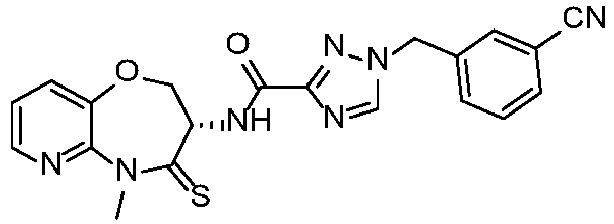
- Route for synthesis:

- To MeCN (20 mL) were added WX032-1 (1.5 g, 11.80 mmol, 1 eq), 3-chloromethyl benzonitrile (1.97 g, 12.98 mmol, 1.72 mL, 1.1 eq) and K2CO3 (2.45 g, 17.70 mmol, 1.5 eq), and the reaction solution was continuously stirred at 50 °C for 12 hours. Water (50 mL) was added to the reaction solution and the mixture was extracted with ethyl acetate (50 mL×2). The organic phases were combined, washed with saturated brine (20 mL×2), and concentrated under reduced pressure to give a crude product. The crude product was purified by silica gel column chromatography (petroleum ether:ethyl acetate=100:1∼1:100) to give compound WX032-2. 1H NMR (400MHz, CDCl3) δ= 8.21 (s, 1H), 7.67 (t, J=4.3 Hz, 1H), 7.58 (s, 1H), 7.52 (d, J=4.8 Hz, 2H), 5.47 (s, 2H), 4.01 (s, 3H).
- To a round bottom flask were added THF (8 mL) and H2O (2 mL). WX032-2 (1.4 g, 5.78 mmol, 1 eq) and LiOH·H2O (727.53 mg, 17.34 mmol, 3 eq) were then added, and the reaction solution was continuously stirred at 25 °C for 2 hours. The reaction solution was concentrated under reduced pressure to remove THF. 1 M diluted hydrochloric acid solution was added dropwise to the reaction solution to adjust pH to less than 3, and the mixture was filtered to give the target compound WX032-3. 1H NMR (400MHz, DMSO-d6 ) δ= 8.83 - 8.80 (m, 1H), 7.86 - 7.80 (m, 2H), 7.68 - 7.57 (m, 2H), 5.59 - 5.52 (m, 2H).
- To a round bottom flask was added N,N-dimethylformamide (1 mL). WX032-3 (15.50 mg, 67.94 µmol, 1 eq), BB-4 (30 mg, 67.94 µmol, 1 eq), DIPEA (26.34 mg, 203.82 µmol, 35.50 µL, 3 eq) and T3P (64.85 mg, 101.91 µmol, 60.61 µL, 50% purity, 1.5 eq) were then slowly added, and the mixture was continuously stirred at 25 °C for 2 hours. The reaction solution was directly seperated by HPLC (Column: Xtimate C18 100∗30mm∗3µm; Mobile phase: [water (0.225%FA)-ACN]; acetonitrile%: 35%-65%, 8min) to give compound WX032. 1H NMR (400MHz, CDCl3) δ= 8.85 (br d, J=7.3 Hz, 1H), 8.37 (d, J=3.3 Hz, 1H), 8.17 (s, 1H), 7.65 (br d, J=2.8 Hz, 1H), 7.60 - 7.55 (m, 2H), 7.53 - 7.47 (m, 2H), 7.29 (dd, J=4.6, 7.9 Hz, 1H), 5.45 (s, 2H), 5.26 - 5.15 (m, 1H), 4.79 (dd, J=6.3, 9.5 Hz, 1H), 4.38 - 4.28 (m, 1H), 3.93 (s, 3H); LCMS m/z = 420.1 [M+1]+.
- Example 33: WX033

- Route for synthesis:

- To a round bottom flask was added MeCN (20 mL). WX033-1(1.5 g, 11.80 mmol, 1 eq), 3-methylbenzyl chloride (1.83 g, 12.98 mmol, 1.72 mL, 1.1 eq) and K2CO3 (2.45 g, 17.70 mmol, 1.5 eq) were added, and the mixture was continuously stirred at 50 °C for 12 hours. Water (50 mL) was added to the reaction solution and the mixture was extracted with ethyl acetate (50 mL×2). The organic phases were combined, washed with saturated brine (10 mL×2), and concentrated under reduced pressure to give a crude product. The crude product was purified by silica gel column chromatography (petroleum ether:ethyl acetate=100:1~1:100) to give compound WX033-2. 1H NMR (400MHz, CDCl3) δ= 8.08 (s, 1H), 7.33 - 7.27 (m, 1H), 7.18 (d, J=7.6 Hz, 1H), 7.10 (br d, J=1.8 Hz, 2H), 5.38 (s, 2H), 4.05 - 3.97 (m, 3H), 2.38 - 2.31 (m, 3H).
- To a round bottom flask were added THF (8 mL) and H2O (2 mL). WX033-2 (1.6 g, 6.92 mmol, 1 eq) and LiOH·H2O (870.95 mg, 20.76 mmol, 3 eq) were then added, and the mixture was continuously stirred at 25 °C for 2 hours. The reaction solution was concentrated under reduced pressure to remove THF. 1 M diluted hydrochloric acid solution was added dropwise to the reaction solution to adjust pH to less than 3, and the mixture was filtered to give compound WX033-3. 1H NMR (400MHz, DMSO-d6 ) δ= 13.28 (br s, 1H), 8.79 (s, 1H), 7.30 - 7.23 (m, 1H), 7.17 - 7.07 (m, 3H), 5.43 (s, 2H), 2.29 (s, 3H).
- To a round bottom flask was added N,N-dimethylformamide (1 mL). WX033-3 (17.71 mg, 81.53 µmol, 1.2 eq), BB-4 (30 mg, 67.94 µmol, 1 eq), DIPEA (26.34 mg, 203.82 µmol, 35.50 µL, 3 eq) and T3P (64.85 mg, 101.91 µmol, 60.61 µL, 50% purity, 1.5 eq) were then slowly added, and the mixture was continuously stirred at 25 °C for 2 hours. The reaction solution was directly seperated by HPLC (Column: Xtimate C18 100∗30mm∗3µm; Mobile phase: [water (0.225%FA)-ACN]; acetonitrile%: 37%-67%, 8min) to give compound WX033. 1H NMR (400MHz, CDCl3) δ = 8.81 (br d, J=7.0 Hz, 1H), 8.37 (d, J=3.3 Hz, 1H), 8.03 (s, 1H), 7.57 (d, J=6.8 Hz, 1H), 7.31 - 7.27 (m, 2H), 7.20 - 7.15 (m, 1H), 7.11 - 7.07 (m, 2H), 5.36 (s, 2H), 5.22 (td, J=6.8, 11.5 Hz, 1H), 4.79 (dd, J=6.4, 9.4 Hz, 1H), 4.36 - 4.27 (m, 1H), 3.93 (s, 3H), 2.34 (s, 3H); LCMS m/z = 409.1 [M+1]+.
- Example 34: WX034

- Route for synthesis:

- To a single-neck bottle was added MeCN (20 mL). 1-Chloromethyl-3,5-difluorobenzene (2.11 g, 12.98 mmol, 573.45 µL, 1.1 eq), WX034-1 (1.5 g, 11.80 mmol, 1 eq) and K2CO3 (2.45 g, 17.70 mmol, 1.5 eq) were then added, and the mixture was continuously stirred at 50 °C for 12 hours. A new spot appeared by TLC (petroleum ether:ethyl acetate=1:2) monitoring. Water (50 mL) was added to the reaction solution and the mixture was extracted with ethyl acetate (50 mL×2). The organic phases were combined, washed with saturated brine (20 mL×2), and concentrated under reduced pressure to give a crude product. The crude product was purified by silica gel column chromatography (petroleum ether:ethyl acetate=100:1~1:100) to give compound WX034-2. 1H NMR (400MHz, CDCl3) δ= 8.22 (s, 1H), 6.92 - 6.77 (m, 3H), 5.50 - 5.38 (m, 2H), 4.11 - 3.99 (m, 3H).
- To a round bottom flask were added THF (8 mL) and H2O (2 mL). WX034-2 (1 g, 3.95 mmol, 1 eq) and LiOH·H2O (497.15 mg, 11.85 mmol, 3 eq) were then added, and the mixture was continuously stirred at 25 °C for 2 hours. The reaction solution was concentrated under reduced pressure to remove THF. 1 M diluted hydrochloric acid solution was added dropwise to the remaining solution to adjust pH to less than 3, and the mixture was filtered to give compound WX034-3. 1H NMR (400MHz, DMSO-d6 ) δ= 8.80 (s, 1H), 7.24 (br t, J=9.4 Hz, 1H), 7.07 (br d, J=6.3 Hz, 2H), 5.52 (s, 2H).
- To a round bottom flask was added N,N-dimethylformamide (1 mL). WX034-3 (19.50 mg, 81.53 µmol, 1.2 eq), BB-4 (30 mg, 67.94 µmol, 1 eq), DIPEA (26.34 mg, 203.82 µmol, 35.50 µL, 3 eq) and T3P (64.85 mg, 101.91 µmol, 60.61 µL, 50% purity, 1.5 eq) were then slowly added, and the mixture was continuously stirred at 25 °C for 2 hours. The reaction solution was directly seperated by HPLC (Column: Xtimate C18 100∗30mm∗3µm; Mobile phase: [water (0.225%FA)-ACN]; acetonitrile%: 37%-67%, 8min) to give compound WX034. 1H NMR (400MHz, CDCl3) δ = 8.85 (br d, J=7.0 Hz, 1H), 8.37 (dd, J=1.5, 4.6 Hz, 1H), 8.16 (s, 1H), 7.57 (dd, J=1.5, 8.0 Hz, 1H), 7.29 (dd, J=4.7, 7.9 Hz, 1H), 6.85 - 6.73 (m, 3H), 5.38 (s, 2H), 5.21 (td, J=6.6, 11.2 Hz, 1H), 4.79 (dd, J=6.4, 9.5 Hz, 1H), 4.33 (dd, J=9.6, 11.0 Hz, 1H), 3.93 (s, 3H); LCMS m/z = 431.1 [M+1]+.
- Example 35: WX035
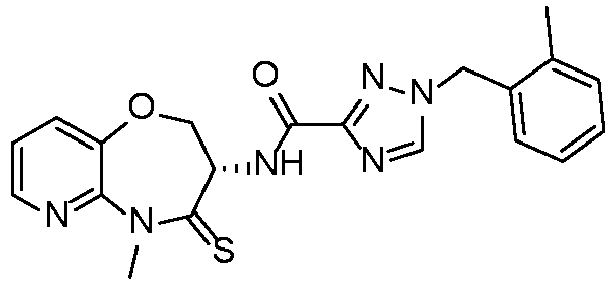
- Route for synthesis:

- To MeCN (20 mL) were added WX035-1 (1.5 g, 11.80 mmol, 1 eq), 1-chloromethyl-2-toluene (1.83 g, 12.98 mmol, 1.72 mL, 1.1 eq) and K2CO3 (2.45 g, 17.70 mmol, 1.5 eq), and the mixture was continuously stirred at 50 °C for 12 hours. Water (50 mL) was added to the reaction solution and the mixture was extracted with ethyl acetate (50 mL×2). The organic phases were combined, washed with saturated brine (20 mL×2), and concentrated under reduced pressure to give a crude product. The crude product was purified by silica gel column chromatography (petroleum ether:ethyl acetate=100:1∼1:100) to give compound WX035-2. 1H NMR (400MHz, CDCl3) δ= 7.89 (s, 1H), 7.36 - 7.29 (m, 1H), 7.26 - 7.16 (m, 3H), 5.42 (s, 2H), 4.00 (s, 3H), 2.27 (s, 3H).
- To a round bottom flask were added THF (8 mL) and H2O (2 mL). WX035-2 (1.6 g, 6.92 mmol, 1 eq) and LiOH·H2O (870.95 mg, 20.76 mmol, 3 eq) were then added, and the mixture was continuously stirred at 25 °C for 2 hours. The reaction solution was concentrated under reduced pressure to remove THF. 1 M diluted hydrochloric acid solution was added dropwise to the remaining solution to adjust pH to less than 3, and the mixture was filtered to give WX035-3. 1H NMR (400MHz, DMSO-d6 ) δ= 13.28 (br s, 1H), 8.79 (s, 1H), 7.30 - 7.23 (m, 1H), 7.17 - 7.07 (m, 3H), 5.43 (s, 2H), 2.29 (s, 3H).
- To a round bottom flask was added N,N-dimethylformamide (1 mL). WX035-3 (17.71 mg, 81.53 µmol, 1.2 eq), BB-4 (30 mg, 67.94 µmol, 1 eq), DIPEA (26.34 mg, 203.82 µmol, 35.50 µL, 3 eq) and T3P (64.85 mg, 101.91 µmol, 60.61 µL, 50% purity, 1.5 eq) were then slowly added, and the mixture was continuously stirred at 25 °C for 2 hours. The reaction solution was directly seperated by HPLC (Column: Xtimate C18 100∗30mm∗3µm; Mobile phase: [water (0.225%FA)-ACN]; acetonitrile%: 37%-67%, 8min) to give compound WX035. 1H NMR (400MHz, CDCl3) δ = 8.81 (br d, J=7.0 Hz, 1H), 8.37 (d, J=4.5 Hz, 1H), 7.86 (s, 1H), 7.57 (d, J=7.8 Hz, 1H), 7.34 - 7.27 (m, 2H), 7.26 - 7.15 (m, 3H), 5.40 (s, 2H), 5.22 (td, J=6.7, 11.2 Hz, 1H), 4.79 (dd, J=6.4, 9.4 Hz, 1H), 4.38 - 4.26 (m, 1H), 3.93 (s, 3H), 2.29 (s, 3H); LCMS m/z = 409.1 [M+1]+.
- Example 36: WX036

- Route for synthesis:

- To a round bottom flask was added MeCN (20 mL) at 25°C. WX036-1 (2.02 g, 15.89 mmol, 1eq), K2CO3 (4.39 g, 31.79 mmol, 2 eq) and 1-chloro-3-chloromethylbenzene (3.07 g, 19.07 mmol, 2.42 mL, 1.2 eq) were then slowly added. The reaction solution was continuously stirred at 60°C under nitrogen for 12 hours. The reaction solution was slowly poured into water (100 mL), and the mixture was extracted with ethyl acetate (100 mL× 2). The organic phases were combined, washed successively with water (100 mL) and saturated brine (100 mL), and concentrated under reduced pressure to give a crude product. The crude product was purified by silica gel column chromatography (petroleum ether:ethyl acetate=100:20~100:75) to give compound WX036-2. 1H NMR (400MHz, CDCl3) δ = 8.15 (s, 1H), 7.35 - 7.26 (m, 3H), 7.17 (d, J=6.8 Hz, 1H), 5.40 (s, 2H), 4.04 - 3.93 (m, 3H).
- To a round bottom flask were added THF (14 mL) and H2O (2 mL) at 25°C. WX036-2 (1.80 g, 7.15 mmol, 1 eq) and LiOH·H2O (900.33 mg, 21.46 mmol, 3 eq) were then slowly added. The reaction solution was continuously stirred at 25°C under nitrogen for 1 hour. The reaction solution was adjusted to a pH of 6~7 with diluted hydrochloric acid (1 M), and the precipitate was filtered to give compound WX036-3.
- To a round bottom flask was added N,N-dimethylacetamide (5 mL) at 25°C. BB-4 (20 mg, 45.29 µmol, 1 eq), T3P (43.23 mg, 67.94 µmol, 40.41 µL, 50% purity, 1.5 eq), WX036-3 (16.14 mg, 67.94 µmol, 1.5 eq) and DIPEA (17.56 mg, 135.87 µmol, 23.67 µL, 3 eq) were then slowly added, and the reaction solution was continuously stirred at 25 °C under nitrogen for 2 hours. The reaction solution was slowly poured into water (100 mL), and the mixture was extracted with ethyl acetate (100 mL× 2). The organic phases were combined, washed successively with water (100 mL) and saturated brine (100 mL), and concentrated under reduced pressure to give a crude product. The crude product was seperated by preparative HPLC (Column: Xtimate C18 100∗30mm∗3µm; Mobile phase: [water (0.225%FA)-ACN]; acetonitrile%: 35%-65%, 8min) to give compound WX036. 1H NMR (400MHz, CDCl3) δ = 8.95 - 8.69 (m, 1H), 8.37 (br d, J=3.1 Hz, 1H), 8.10 (s, 1H), 7.68 - 7.47 (m, 1H), 7.38 - 7.27 (m, 3H), 7.26 - 7.20 (m, 1H), 7.16 (br d, J=7.0 Hz, 1H), 5.38 (s, 2H), 5.26 - 5.10 (m, 1H), 4.79 (dd, J=6.5, 9.4 Hz, 1H), 4.41 - 4.20 (m, 1H), 3.93 (s, 3H); LCMS m/z =429.0 [M+1]+.
- Example 37: WX037

- Route for synthesis:

- To a round bottom flask was added MeCN (20 mL) at 25°C. WX037-1 (2.03 g, 15.97 mmol, 1eq), K2CO3 (4.41 g, 31.94 mmol, 2 eq) and 1-bromo-3-chloromethylbenzene (3.94 g, 19.17 mmol, 241.82 µL, 1.2 eq) were then slowly added. The reaction solution was continuously stirred at 60°C under nitrogen for 12 hours. The reaction solution was slowly poured into water (100 mL), and the mixture was extracted with ethyl acetate (100 mL× 2). The organic phases were combined, washed successively with water (100 mL) and saturated brine (100 mL), and concentrated under reduced pressure to give a crude product. The crude product was purified by silica gel column chromatography (petroleum ether: ethyl acetate=100:20~100:75) to give compound WX037-2. 1H NMR (400MHz, CDCl3) δ = 8.14 (s, 1H), 7.59 - 7.38 (m, 2H), 7.30 - 7.26 (m, 1H), 7.25 - 7.20 (m, 1H), 5.39 (s, 2H), 4.01 (s, 3H).
- To a round bottom flask were added THF (14 mL) and H2O (2 mL) at 25°C. WX037-2 (2.0 g, 6.75 mmol, 1 eq) and LiOH·H2O (850.20 mg, 20.26 mmol, 3 eq) were then slowly added. The reaction solution was continuously stirred at 25°C under nitrogen for 1 hour. The reaction solution was adjusted to a pH of 6~7 with diluted hydrochloric acid (1 M), and the precipitate was filtered to give compound WX037-3.
- To a round bottom flask was added N,N-dimethylacetamide (5 mL) at 25°C. BB-4 (20 mg, 45.29 µmol, 1 eq), T3P (43.23 mg, 67.94 µmol, 40.41 µL, 50% purity, 1.5 eq), WX037-3 (19.16 mg, 67.94 µmol, 1.5 eq) and DIPEA (17.56 mg, 135.87 µmol, 23.67 µL, 3 eq) were then slowly added, and the reaction solution was continuously stirred at 25 °C under nitrogen for 2 hours. The reaction solution was slowly poured into water (100 mL), and the mixture was extracted with ethyl acetate (100 mL× 2). The organic phases were combined, washed successively with water (100 mL) and saturated brine (100 mL), and concentrated under reduced pressure to give a crude product. The crude product was seperated by preparative HPLC (Column: Xtimate C18 100∗30mm∗3µm; Mobile phase: [water (0.225%FA)-ACN]; acetonitrile%: 35%-65%, 8min) to give compound WX037. 1H NMR (400MHz, CDCl3) δ = 8.83 (br d, J=6.4 Hz, 1H), 8.37 (br d, J=4.5 Hz, 1H), 8.10 (s, 1H), 7.66 - 7.27 (m, 4H), 7.25 - 7.15 (m, 2H), 5.37 (s, 2H), 5.26 - 5.06 (m, 1H), 4.79 (br dd, J=6.5, 9.1 Hz, 1H), 4.33 (br t, J=10.3 Hz, 1H), 3.93 (s, 3H); LCMS m/z =474.8 [M+1]+.
- Example 38: WX038

- Route for synthesis:

- To a round bottom flask was added MeCN (20 mL). 1-Chloromethyl-4-trifluoromethoxybenzene (2.73 g, 12.98 mmol, 517.03 µL, 1.1 eq), WX038-1 (1.5 g, 11.80 mmol, 1 eq) and K2CO3 (2.45 g, 17.70 mmol, 1.5 eq) were then added, and the mixture was continuously stirred at 50 °C for 12 hours. Water (50 mL) was added to the reaction solution and the mixture was extracted with ethyl acetate (50 mL×2). The organic phases were combined, washed with saturated brine (20 mL×2), and concentrated under reduced pressure to give a crude product. The crude product was purified by silica gel column chromatography (petroleum ether:ethyl acetate=100:1~1:100) to give compound WX038-2. 1H NMR (400MHz, CDCl3) δ= 8.17 (s, 1H), 7.36 (d, J=8.5 Hz, 2H), 7.27 - 7.23 (m, 2H), 5.50 - 5.40 (m, 2H), 4.08 - 3.96 (m, 3H).
- To a round bottom flask were added THF (16 mL) and H2O (4 mL). WX038-2 (1.9 g, 6.31 mmol, 1 eq) and LiOH·H2O (794.01 mg, 18.92 mmol, 3 eq) were then added, and the mixture was continuously stirred at 25 °C for 2 hours. The reaction solution was concentrated under reduced pressure to remove THF. 1 M diluted hydrochloric acid solution was added dropwise to the remaining solution to adjust pH to less than 3, and the precipitate was filtered to give compound WX038-3. 1H NMR (400MHz, DMSO-d6 ) δ= 8.81 (s, 1H), 7.51 - 7.33 (m, 4H), 5.53 (s, 2H).
- To a round bottom flask was added N,N-dimethylformamide (1 mL). WX038-3 (23.41 mg, 81.53 µmol, 1.2 eq), BB-4 (30 mg, 67.94 µmol, 1 eq), DIPEA (26.34 mg, 203.82 µmol, 35.50 µL, 3 eq) and T3P (64.85 mg, 101.91 µmol, 60.61 µL, 50% purity, 1.5 eq) were then slowly added, and the mixture was continuously stirred at 25 °C for 2 hours. The reaction solution was directly seperated by HPLC (Column: Xtimate C18 100∗30mm∗3µm; Mobile phase: [water (0.225%FA)-ACN]; acetonitrile%: 40%-70%, 8min) to give compound WX038. 1H NMR (400MHz, CDCl3) δ= 8.84 (br d, J=7.3 Hz, 1H), 8.38 (dd, J=1.5, 4.5 Hz, 1H), 8.11 (s, 1H), 7.58 (dd, J=1.5, 8.0 Hz, 1H), 7.34 (d, J=8.8 Hz, 2H), 7.32 - 7.29 (m, 1H), 7.27 (s, 5H), 7.26 - 7.22 (m, 2H), 5.42 (s, 2H), 5.28 - 5.15 (m, 1H), 4.80 (dd, J=6.5, 9.5 Hz, 1H), 4.37 - 4.29 (m, 1H), 3.94 (s, 3H); LCMS m/z = 479.1 [M+1]+.
- Example 39: WX039

- Route for synthesis:

- To a round bottom flask was added MeCN (20 mL) at 25°C. WX039-1 (2.0 g, 15.74 mmol, 1eq), K2CO3 (4.35 g, 31.48 mmol, 2 eq) and 1-chloromethyl-4-methylbenzene (2.66 g, 18.89 mmol, 2.48 mL, 1.2 eq) were then slowly added. The reaction solution was continuously stirred at 60°C under nitrogen for 12 hours. The reaction solution was slowly poured into water (100 mL), and the mixture was extracted with ethyl acetate (100 mL× 2). The organic phases were combined, washed successively with water (100 mL) and saturated brine (100 mL), and concentrated under reduced pressure to give a crude product. The crude product was purified by silica gel column chromatography (petroleum ether:ethyl acetate=100:20~100:75) to give compound WX039-2. 1H NMR (400MHz, CDCl3) δ = 8.04 (s, 1H), 7.23 - 7.17 (m, 4H), 5.37 (s, 2H), 4.00 (s, 3H), 2.47 - 2.25 (m, 3H).
- To a round bottom flask were added THF (14 mL) and H2O (2 mL) at 25°C. WX039-2 (1.5 g, 6.49 mmol, 1 eq) and LiOH·H2O (816.52 mg, 19.46 mmol, 3 eq) were then slowly added. The reaction solution was continuously stirred at 25°C under nitrogen for 1 hour. The reaction solution was adjusted to a pH of 6~7 with diluted hydrochloric acid (1 M), and the precipitate was collected by filtration to give compound WX039-3.
- To N,N-dimethylacetamide (5 mL) were added BB-4 (20 mg, 45.29 µmol, 1 eq), T3P (43.23 mg, 67.94 µmol, 40.41 µL, 50% purity, 1.5 eq), WX039-3 (14.76 mg, 67.94 µmol, 1.5 eq) and DIPEA(17.56 mg, 135.87 µmol, 23.67 µL, 3 eq) at 25°C, and the reaction solution was continuously stirred at 25 °C under nitrogen for 2 hours. The reaction solution was slowly poured into water (100 mL), and the mixture was extracted with ethyl acetate (100 mL× 2). The organic phases were combined, washed successively with water (100 mL) and saturated brine (100 mL), and concentrated under reduced pressure to give a crude product. The crude product was seperated by preparative HPLC (Column: Xtimate C18 100∗30mm∗3µm; Mobile phase: [water (0.225%FA)-ACN]; acetonitrile%: 40%-70%, 8min) to give a product WX039. 1H NMR (400MHz, CDCl3) δ = 8.80 (br d, J=7.3 Hz, 1H), 8.37 (dd, J=1.5, 4.5 Hz, 1H), 8.00 (s, 1H), 7.56 (dd, J=1.5, 7.8 Hz, 1H), 7.28 (dd, J=4.8, 8.0 Hz, 1H), 7.19 (s, 4H), 5.35 (s, 2H), 5.21 (td, J=6.8, 11.0 Hz, 1H), 4.78 (dd, J=6.4, 9.4 Hz, 1H), 4.32 (dd, J=9.7, 11.2 Hz, 1H), 3.93 (s, 3H), 2.63 - 2.13 (m, 3H); LCMS m/z =409.1 [M+1]+.
- Example 40: WX040
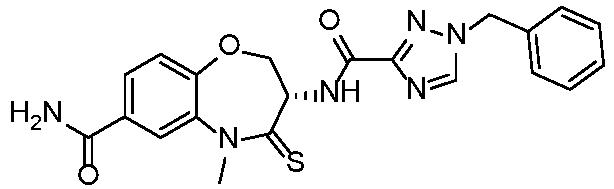
- Route for synthesis:

- To a round bottom flask was added THF (100 mL). WX040-1 (10 g, 50.22 mmol, 1 eq), BB-3-2 (11.34 g, 55.24 mmol, 1.1 eq) and cesium carbonate (29.45 g, 90.39 mmol, 1.8 eq) were then slowly added, and the mixture was continuously stirred at 65 °C for 16 hours. TLC (petroleum ether:ethyl acetate:acetic acid=1:1:0.1) showed that the raw materials were completely consumed. The reaction solution was poured into water (300 mL), and 2 M diluted hydrochloric acid was then added dropwise to adjust pH to 3. The mixture was extracted with ethyl acetate (500 mL×2). The organic phases were combined and washed with saturated brine (50 mL×2). The organic phase was then concentrated under reduced pressure to give WX040-2. 1H NMR (400MHz, CDCl3) δ= 8.46 (d, J=1.8 Hz, 1H), 8.20 (dd, J=2.0, 8.8 Hz, 1H), 7.12 (d, J=8.8 Hz, 1H), 5.62 (br d, J=8.0 Hz, 1H), 4.83 - 4.61 (m, 2H), 4.45 (dd, J=3.0, 9.3 Hz, 1H), 3.93 (s, 3H), 1.45 (s, 10H).
- To a hydrogenation bottle was added MeOH (300 mL). WX040-2 (25.8 g, 67.13 mmol, 1 eq) and Pd/C (2.6 g, 26.02 mmol, 10% purity) were then slowly added. The atmosphere was replaced three times with argon gas, and the mixture was continuously stirred at 30°C under H2 (40Psi) atmosphere for 24 hours. A new spot appeared by TLC (petroleum ether:ethyl acetate:acetic acid=1:1:0.1) monitoring. The reaction solution was filtered through Celite, and the filtrate was concentrated under reduced pressure to give compound WX040-3. 1H NMR (400MHz, CDCl3) δ = 7.50 - 7.44 (m, 1H), 7.39 (br s, 1H), 6.70 (d, J=8.5 Hz, 1H), 6.53 (br s, 2H), 6.00 (br d, J=7.5 Hz, 1H), 4.73 (br d, J=7.0 Hz, 1H), 4.43 (br d, J=8.5 Hz, 1H), 4.31 - 4.24 (m, 1H), 3.85 (s, 3H), 1.41 (s, 9H).
- To a round bottom flask was added ethyl acetate (200 mL). WX040-3 (12.5 g, 35.28 mmol, 1 eq), T3P (33.67 g, 52.91 mmol, 31.47 mL, 50% purity, 1.5 eq) and DIPEA (13.68 g, 105.83 mmol, 18.43 mL, 3 eq) were then slowly added, and the mixture was continuously stirred at 25 °C for 2 hours. Water (200 mL) was added to the reaction solution and the layers were seperated. The aqueous phase was extracted with ethyl acetate (200 mL×2). The organic phases were combined, and washed with saturated brine (100 mL×2), and then the organic phase was concentrated under reduced pressure to give a crude product. The crude product was purified by silica gel column chromatography (petroleum ether:ethyl acetate = 100:1~1:1) to give compound WX040-4. 1H NMR (400MHz, CDCl3) δ= 8.15 (br s, 1H), 7.80 (dd, J=2.0, 8.5 Hz, 1H), 7.73 (d, J=2.0 Hz, 1H), 7.13 (d, J=8.3 Hz, 1H), 5.62 (br d, J=5.3 Hz, 1H), 4.71 - 4.59 (m, 2H), 4.33 - 4.23 (m, 1H), 3.95 - 3.89 (m, 3H), 1.43 (s, 9H).
- To a round bottom flask was added N,N-dimethylformamide (200 mL). WX040-4 (17 g, 50.54 mmol, 1 eq), cesium carbonate (49.40 g, 151.63 mmol, 3 eq) and iodomethane (21.52 g, 151.63 mmol, 9.44 mL, 3 eq) were then slowly added, and the mixture was continuously stirred at 25 °C for 2 hours. Water (300 mL) was added to the reaction solution, and the mixture was extracted with ethyl acetate (300mL×2). The organic phases were combined, and washed with saturated brine (100 mL×2), and the organic phase was then concentrated under reduced pressure to give a crude product. The crude product was purified by silica gel column chromatography (petroleum ether:ethyl acetate=100:1~1:1) to give compound WX040-5. 1H NMR (400MHz, CDCl3) δ= 7.92 - 7.83 (m, 2H), 7.18 (d, J=8.4 Hz, 1H), 5.50 (br d, J=6.1 Hz, 1H), 4.72 - 4.52 (m, 2H), 4.28 - 4.17 (m, 1H), 3.92 (s, 3H), 3.42 (s, 3H), 1.38 (s, 9H).
- To toluene (40 mL) were slowly added WX040-5 (4.01 g, 11.45 mmol, 1 eq), Lawsson's reagent (5.09 g, 12.59 mmol, 1.1 eq) and Boc2O (10.60 g, 48.55 mmol, 11.15 mL, 4.24 eq), and the mixture was heated to 110°C and continuously stirred for 12 hours. The reaction solution was slowly poured into saturated brine (30 mL), and the mixture was extracted with ethyl acetate (100 mL× 2). The organic phases were combined, and washed with saturated brine (30 mL×2), and the organic phase was then concentrated under reduced pressure to give a crude product. The crude product was purified by silica gel column chromatography (petroleum ether:ethyl acetate=100:1~1:1) to give compound WX040-6. 1H NMR (400MHz, CDCl3) δ= 7.99 - 7.92 (m, 2H), 7.21 (d, J=8.3 Hz, 1H), 6.02 (br d, J=7.8 Hz, 1H), 4.80 - 4.69 (m, 1H), 4.53 (dd, J=6.3, 9.5 Hz, 1H), 4.22 (dd, J=9.5, 11.3 Hz, 1H), 3.94 (s, 3H), 3.86 (s, 3H), 1.46 - 1.33 (m, 9H).
- To a round bottom flask were added THF (8 mL) and H2O (2 mL). WX040-6 (800 mg, 2.18 mmol, 1 eq) and LiOH·H2O (183.23 mg, 4.37 mmol, 2 eq) were then slowly added, and the mixture was continuously stirred at 25 °C for 2 hours. Diluted hydrochloric acid solution was added dropwise to the reaction solution to adjust pH to <3, and the precipitate was filtered and collected to give compound WX040-7. 1H NMR (400MHz, CDCl3) δ = 7.89 - 7.79 (m, 1H), 7.25 - 7.20 (m, 1H), 7.02 - 6.95 (m, 1H), 6.17 - 6.02 (m, 1H), 4.88 - 4.74 (m, 1H), 4.56 (dd, J=6.4, 9.7 Hz, 1H), 4.31 - 4.17 (m, 1H), 3.85 (s, 3H), 1.41 (s, 9H).
- To a round bottom flask was added N,N-dimethylformamide (5 mL). WX040-7 (200 mg, 567.53 µmol, 1 eq), NH4Cl (91.07 mg, 1.70 mmol, 3 eq), HATU (647.37 mg, 1.70 mmol, 253.15 µL, 3.00 eq) and DIPEA (366.75 mg, 2.84 mmol, 494.27 µL, 5 eq) were then slowly added, and the mixture was continuously stirred at 25 °C for 2 hours. The reaction solution was directly seperated by HPLC (Column: Xtimate C18 100∗30mm∗3µm; Mobile phase: [water (0.225%FA)-ACN]; acetonitrile%: 30%-60%, 8min) to give compound WX040-8. 1H NMR (400MHz, CDCl3) δ= 7.82 (s, 1H), 7.64 (br d, J=8.3 Hz, 1H), 7.22 (d, J=8.3 Hz, 1H), 6.98 (s, 2H), 5.01 (br s, 1H), 4.86 - 4.66 (m, 1H), 4.52 (dd, J=6.3, 9.5 Hz, 1H), 4.30 - 4.11 (m, 1H), 3.86 (s, 3H), 1.40 (s, 9H).
- To a round bottom flask was added ethyl acetate (10 mL). WX040-8 (40 mg, 113.82 µmol, 1 eq) and HCl/ethyl acetate (4 M, 10.00 mL, 351.42 eq) were then slowly added, and the mixture was continuously stirred at 25 °C for 1 hour. The reaction solution was concentrated under reduced pressure to give compound WX040-9. 1H NMR (400MHz, DMSO-d6 ) δ= 8.16 - 8.04 (m, 2H), 7.91 (d, J=8.5 Hz, 1H), 7.57 (s, 1H), 7.37 (d, J=8.3 Hz, 1H), 4.62 - 4.41 (m, 3H), 3.82 (s, 3H).
- To DMSO (1 mL) were slowly added WX040-9 (30 mg, 119.38 µmol, 1 eq, HCl), BB-8 (24.26 mg, 119.38 µmol, 1 eq), HATU (68.09 mg, 179.07 µmol, 1.5 eq) and DIEA(46.28 mg, 358.13 µmol, 62.38 µL, 3 eq), and the mixture was continuously stirred at 25 °C for 2 hours. The reaction solution was directly seperated by HPLC (Column: Phenomenex Gemini-NX 80∗30mm∗3µm; Mobile phase: [water (10mM NH4HCO3)-ACN]; acetonitrile%: 28%-58%, 9min) to give compound WX040. 1H NMR (400MHz, CDCl3) δ=8.70 (br d, J=7.3 Hz, 1H), 8.04 (s, 1H), 7.69 (s, 1H), 7.39 - 7.36 (m, 1H), 7.31 - 7.28 (m, 7H), 5.39 (s, 2H), 5.20 (td, J=6.8, 11.0 Hz, 1H), 4.72 (dd, J=6.5, 9.4 Hz, 1H), 4.31 (t, J=10.3 Hz, 1H), 3.89 (s, 3H); LCMS m/z = 437.1 [M+1]+.
- Example 41: WX041

- Route for synthesis:

- To a round bottom flask was added MeCN (20 mL) at 25°C. WX041-1 (2.68 g, 21.09 mmol, 1eq), K2CO3 (5.83 g, 42.17 mmol, 2 eq) and 4-(chloromethyl)-trifluoromethylbenzene (4.92 g, 25.30 mmol, 3.73 mL, 1.2 eq) were then slowly added. The reaction solution was continuously stirred at 60°C under nitrogen for 12 hours. The reaction solution was slowly poured into water (100 mL), and the mixture was extracted with ethyl acetate (100 mL× 2). The organic phases were combined, and washed successively with water (100 mL) and saturated brine (100 mL), and the organic phase was then concentrated under reduced pressure to give a crude product. The crude product was purified by silica gel column chromatography (petroleum ether:ethyl acetate=100:20-100:75) to give compound WX041-2. 1H NMR (400MHz, CDCl3) δ = 8.17 (s, 1H), 7.65 (d, J=8.0 Hz, 2H), 7.40 (d, J=8.0 Hz, 2H), 5.49 (s, 2H), 4.08 - 3.91 (m, 3H).
- To a round bottom flask were added THF (20 mL) and H2O (4 mL) at 25°C. WX041-2 (2.40 g, 8.41 mmol, 1 eq) and LiOH·H2O (1.06 g, 25.24 mmol, 3 eq) were slowly added. The reaction solution was continuously stirred at 25°C under nitrogen for 1 hour. The reaction solution was adjusted to a pH of 6~7 with diluted hydrochloric acid (1 M), and the precipitate was filtered and collected to give compound WX041-3.
- To a round bottom flask was added N,N-dimethylacetamide (5 mL) at 25°C. BB-4 (20 mg, 45.29 µmol, 1 eq), T3P (43.23 mg, 67.94 µmol, 40.41 µL, 50% purity, 1.5 eq), WX041-3 (18.42 mg, 67.94 µmol, 1.5 eq) and DIPEA (17.56 mg, 135.87 µmol, 23.67 µL, 3 eq) were slowly added, and the reaction solution was continuously stirred at 25 °C under nitrogen for 2 hours. The reaction solution was slowly poured into water (100 mL), and the mixture was extracted with ethyl acetate (100 mL× 2). The organic phases were combined, and washed successively with water (100 mL) and saturated brine (100 mL), and then the organic phase was concentrated under reduced pressure to give a crude product. The crude product was seperated by preparative HPLC (Column: Phenomenex Gemini-NX 80∗30mm∗3µm; Mobile phase: [water (10mM NH4HCO3)-ACN] to give compound WX041. 1H NMR (400MHz, CDCl3) δ = 8.77 (br d, J=7.5 Hz, 1H), 8.31 (br d, J=3.6 Hz, 1H), 8.07 (s, 1H), 7.65 - 7.45 (m, 3H), 7.33 (br d, J=8.0 Hz, 2H), 7.22 (dd, J=4.8, 7.9 Hz, 1H), 5.40 (s, 2H), 5.23 - 4.97 (m, 1H), 4.72 (dd, J=6.5, 9.4 Hz, 1H), 4.25 (t, J=10.3 Hz, 1H), 3.87 (s, 3H); 19F NMR (377MHz, CDCl3) δ = -43.60 (s, IF); LCMS m/z =463.1 [M+1]+.
- Example 42: WX042

- Route for synthesis:

- To MeCN (20 mL) were added WX042-1 (2 g, 15.74 mmol, 1 eq), 3-chloromethyl anisole (2.46 g, 15.74 mmol, 2.14 mL, 1 eq), and K2CO3 (2.61 g, 18.88 mmol, 1.2 eq), and the mixture was reacted at 50°C for 12 hours. The reaction solution was filtered to remove K2CO3. The filter cake was washed with ethyl acetate (15 mL×3), and the filtrate was washed with saturated brine (50 mL). The organic phase was concentrated under reduced pressure to give a crude product. The crude product was purified by silica gel column chromatography (petroleum ether:ethyl acetate=100:1-100:100) to give compound WX042-2. 1H NMR (400MHz, CDCl3) δ= 8.10 - 8.01 (m, 1H), 7.30 - 7.21 (m, 1H), 6.91 - 6.80 (m, 2H), 6.77 (s, 1H), 5.34 (s, 2H), 3.96 (s, 3H), 3.75 (s, 3H).
- To THF (30 mL) was added WX042-2 (2.5 g, 10.11 mmol, 1 eq). A solution of LiOH·H2O (509.17 mg, 12.13 mmol, 1.2 eq) in H2O (3 mL) was then added. The reaction was stirred at 25°C for 3 hours. TLC (petroleum ether:ethyl acetate=1:1) showed that the raw materials were completely consumed. The reaction solution was adjusted to a pH of 6 with 1M dilute hydrochloric acid, and the mixture was concentrated under reduced pressure to remove the solvent. Toluene (10 mL) was added to the remaining solution and the mixture was concentrated under reduced pressure again to remove toluene to give compound WX042-3. 1H NMR (400MHz, CDCl3) δ= 7.19 (s, 4H), 7.21 - 7.17 (m, 1H), 4.65 (s, 2H), 3.79(s, 3H); LCMS m/z = 233.9 [M+1]+.
- To N,N-dimethylformamide (5 mL) were added BB-4 (94.67 mg, 214.39 µmol, 1 eq), WX042-3 (50 mg, 214.39 µmol, 1 eq), T3P (163.71 mg, 257.26 µmol, 153.00 µL, 50% purity, 1.2 eq), and DIPEA(41.56 mg, 321.58 µmol, 56.01 µL, 1.5 eq), and the mixture was reacted at 25°C for 2 hours. LCMS showed that the raw materials were completely consumed. The reaction solution was concentrated under reduced pressure to about 5 mL. The residue was purified by HPLC (formic acid system) to give compound WX042. 1H NMR (400MHz, CDCl3) δ= 8.81 (br d, J=7.0 Hz, 1H), 8.37(dd, J=1.6, 4.6 Hz, 1H), 8.04 (s, 1H), 7.57 (dd, J=1.6, 7.9 Hz, 1H), 7.33 - 7.27 (m, 2H), 7.00 - 6.69 (m, 3H), 5.36 (s, 2H), 5.22(td, J=6.7, 11.1 Hz, 1H), 4.79 (dd, J=6.3, 9.5 Hz, 1H), 4.32 (dd, J=9.5, 11.0 Hz, 1H), 3.93 (s, 3H), 3.79 (s, 3H).
- Assay steps:
1.1 Reagents Reagent Brand Batch No. RPMI-1640 GIBCO 11875-119 10X DPBS GIBCO 14200-075 Fetal Bovine Serum (FBS) Biowest S1810-500 Pen/Strep (100X) Biowest L0022-100 CellTiter Glo Promega G7571 Q-VD-OPh Hydrate Sigma SML0063-5MG Recombinant human TNF-a Pepotech 300-01A-50 - CULTURPLATE-384 +LID /50W Brand PerkinElmer cat#6007680
- Envision plate reader (Perkin Elmer, Cat#2104-0010)
-
- (1) 1 × DPSB: To 100 mL of 10×DPBS was added 900 mL of deionized water.
- (2) 1640 complete medium: To 89 mL of RPMI-1640 medium were added 10 mL of FBS and 1 mL of penicillin/streptomycin
-
- 1. U937 cells were centrifuged, and then the medium was discarded. The cells were resuspended in 1640 complete medium and counted. The cell concentration was adjusted to 5×10⁵ cells/mL for use, and the cells were arranged according to compounds to be assayed.
- 2. To the prepared resuspension of U937 cells were added QVD-OPh at a final concentration of 25 µM and TNF-α at a final concentration of 100 ng/mL, and then the mixture was mixed gently.
- 3. To a 384-well plate was added 30 µL/well of U937 cells containing 25 µM of QVD-OPh and TNF-α at a final concentration of 100 ng/mL, and blank control wells without QVD-OPh and TNF-α were set up.
- 4. To the dosing group was added 10 µL of the assay compound at 4 times the preset concentration, and to the blank control well was added DMSO at the corresponding concentration.
- 5. The 384-well plate was placed in a 37 °C and 5% CO2 cell incubator for 24 hours.
- 6. After 24 hours, the 384-well plate was taken out and equilibrated at room temperature for 20 minutes.
- 7. 40 µL of CTG was added to each well, and then the plate was shaken on a shaker in the dark for 2 minutes.
- 8. The plate was incubated at room temperature in the dark for 10 minutes, and then read using an Envision plate reader.
- The results of assay of compounds of the present disclosure were shown in Table 1.
Table 1. U937 cell activity assay results of the compounds of the present disclosure Compound No. IC50 of cell assay (nM) Compound No. IC50 of cell assay (nM) WX001 0.5 WX023 29 WX002 1.8 WX024 43 WX003 0.5 WX025 12 WX004 0.3 WX026 5 WX005 2 WX027 20 WX006 9 WX028 4.7 WX007 70 WX029 2.2 WX008 8.1 WX030 15.6 WX009 1.4 WX031 2.4 WX010 47 WX032 5.7 WX011 1.7 WX033 7.6 WX012 12.1 WX034 3.7 WX013 1.8 WX035 4.9 WX014 3.7 WX036 6.4 WX015 5.1 WX037 24 WX016 9.8 WX038 238 WX017 59 WX039 3.4 WX018 1.3 WX040 4.8 WX019 0.6 WX041 86.5 WX020 0.6 WX042 24.8 WX021 13 WX022 20 - It can be seen from the above table that the compounds of the present disclosure show a good inhibitory activity in the cell activity assay of inhibiting TNFα/QVD-OPh-induced programmed cell necrosis (Necroptosis).
-
Reagent name Brand Item No. EMEM medium ATCC 30-2003 Horse serum Gibco 16050130 Double antibiotics (penicillin, streptomycin) Milli pore TMS-AB2-C Recombinant murine tumor necrosis factor alpha (TNF-a) R&D 410-MT-010 Caspase inhibitor (QVD-OPh) R&D OPH001-01M CellTiter Glo fluorescent cells Promega G7573 -
- 1. The cultured L929 cells were digested with trypsin, centrifuged, resuspended in complete culture medium, and then counted. The cell concentration was then diluted to 1×10⁵/mL with complete culture medium.
- 2. The cell suspension was added to a 96-well plate at 100 µL per well and incubated at 37°C and 5% CO2 for 24 h.
- 3. Different concentrations of assay compounds were added to each well, and dimethyl sulfoxide was added to the control group. The plate was incubated at 37°C and 5% CO2 for 1 h.
- 4. To each well were added TNF-α at a final concentration of 50 ng/mL and Q-VD at a final concentration of 50 µM, and the plate was incubated at 37°C and 5% CO2 for 24 h.
- 5. To each well was added 50 µL of CellTiter Glo fluorescent cells, and the plate was shaken in the dark for 10 min.
- 6. The plate was read on the microplate reader.
- The results of assay of compounds of the present disclosure were shown in Table 2.
Table 2. L929 cell activity assay results of the compounds of the present disclosure Compound No. IC50 of cell assay (nM) WX001 1161 WX003 1213 WX005 1311 WX008 47 WX009 103 WX011 11 WX013 14 WX019 51 WX020 29 WX021 445 WX028 65 WX029 184 WX031 174 WX032 255 WX039 64 - It can be seen from the above table that the compounds of the present disclosure show a good inhibitory activity in the mouse L929 cell activity assay of inhibiting TNFα/QVD-OPh-induced programmed cell necrosis (Necroptosis).
- Eight healthy adult C57BL/6 mice (6-9 weeks old, purchased from Shanghai Lingchang Biotechnology Co., Ltd.) were selected, and randomly divided into two groups, 4 mice in each group (n=2, cross blood sampling). One group was given 0.5 mg/kg of the assay compound by intravenous injection, and the other group was given 1 mg/kg of the assay compound by gavage. Plasma samples were collected respectively from animals in the intravenous group and gavage group at 0.083, 0.25, 0.5, 1.0, 2.0, 4.0, 6.0, 8.0, 24 hours after administration. The blood concentration was determined by LC-MS/MS method. Relevant pharmacokinetic parameters were calculated by WinNonlin™ Version 6.3 (Pharsight, Mountain View, CA) pharmacokinetic software using non-compartmental model and linear logarithmic trapezoidal method. AUC0-last represents the area under the plasma concentration-time curve from zero time point to the last detectable concentration time point; Cmax represents the peak concentration; Tmax represents the time to reach the peak; T1/2 represents the half-life; CL represents the clearance rate; Tlast represents the last quantifiable time point; p.o. represents per os; i.v. represents intravenous injection; and F% represents oral bioavailability.
- The results of assay of compounds of the present disclosure were shown in Table 3.
Table 3 Pharmacokinetic properties of the compound Compound WX009 i.v. T1/2 (h) 1.4 Vdss (L/kg) 1.1 CL(mL/min/kg) 9.4 AUC0-last (nM.h) 2210 p.o. Tmax (h) 0.5 Cmax (nM) 1495 AUC0-last (nM.h) 3854 F% 89.1 - The compound of the present disclosure has good pharmacokinetic properties, in vivo exposure, and bioavailability.
- Reagent
Reagent Brand Cat # or Lot Tumor Necrosis Factor (TNF-a) Pepro Tech 315-01A-1MG Caspase inhibitor zVAD GL Biochem (Shanghai) Ltd. GLS180522-01001 -
- 1) Electronic balance: Brand Changzhou Tianzhiping Instrument Equipment Co., Ltd., Model JY20002
- 2) Anal thermometer: Brand PHYSITEMP, model BAT-12
-
- 1) TNF-α: TNF-α was centrifuged quickly (10000 rmp, 30s) before opening the lid. One bottle of TNF-α (1 mg) was dissolved in 1 mL of sterile water to prepare a mother liquor with a concentration of 1 mg/mL. The mother liquor was stored at 4°C and can be stored for one week. 1000 µL of the mother liquor was weighed and added to 5667 µL of sterile water, and then 333 mg of trehalose was added and dissolved to prepare a working solution.
- 2) zVAD: 20 mg of zVAD was weighed and added to 480 µL of DMSO, and the mixture was vortexed, sonicated, and heated at 37°C, and then 15.52 mL of physiological saline was added. A working solution with a concentration of 1.25 mg/mL was prepared.
-
- 1) The mice were reared adaptively for 3 days, and then randomly grouped into cages, 5 mice in each cage. Ear tags were cut.
- 2) Firstly, the mice were given the corresponding compound by gavage according to their body weight, and then injected intraperitoneally with zVAD at a dose of 250 µg per mouse. After the intraperitoneal injection of zVAD, the anal temperature was measured immediately (0 h), and the time was recorded. The time when mice were given zVAD was defined as the 0th hour (0h).
- 3) After 15 minutes, TNF-α was injected through the tail vein at a dose of 200 µL per mouse, and then the anal temperature was measured 15 minutes later (0.5h).
- 4) After 1 h, zVAD was injected intraperitoneally at a dose of 125 µg per mouse, and then the anal temperature was measured immediately (1 h). The anal temperature was measured again at 2 h, 3 h, and 4 h.
- The results of assay of the compound of the present disclosure were shown in Table 4.
Table 4 Body temperature and survival rate of mice Groups Number of animals in each group Decrease in mouse body temperature (°C) 4-hour survival rate of animals 1 hour 2 hours 3 hours 4 hours TNF-α + zVAD+ vehicle 5 2.94 9.02 - - 0% after 2 hours TNF-α + zVAD + WX009(10 mpk) 5 0.94 1.2 1.42 1.52 100 % - The compound of the present disclosure shows a very good protective effect in the mouse model of inhibiting systemic inflammatory response syndrome (SIRS) induced by TNF-α/zVAD, wherein the decrease in body temperature of mice was significantly reduced, and the survival rate of animals was increased from 0% to 100%.
- MEM (minimum essential medium) supplemented with 2 mM L-glutamine, 10% Fetal Bovine Serum (FBS), 100 U/mL penicillin-G and 100 µg/mL streptomycin was used for cell culture. The conditions for cell culture were 37±1°C, 5% CO2 and saturated humidity. When cells were grown to 80-90% confluency, trypsin (0.05%, w/v)/EDTA(0.02%, w/v) digestion solution was added to digest the cells for seeding. The cells were seeded in BD Falcon's Transwell-96-well plate at a seeding density of 1×10⁵ cells/cm2. The cells were cultured in a carbon dioxide incubator for 22 days and then used for transport assay.
- Hank's balanced salt buffer containing 10 mM HEPES (pH 7.40±0.05) was used in this assay as transport buffer. Two-way transport of the assay compound and the positive drug digoxin at a concentration of 2 µM was assayed, each in duplicate. Transport of fenoterol and propranolol from the apical end to the basal end (A-B) was assayed. The concentration of DMSO in the incubation system was controlled below 1%. After the sample was added, the cell plate was incubated at 37±1°C, 5% CO2 and saturated humidity for 120 minutes. All samples were vortexed and then centrifuged at 3220 rpm and 20°C for 20 minutes. The control and assay samples were diluted 1:1 (v:v) with ultrapure water, and then stored at 4°C. Liquid chromatography tandem mass spectrometry (LC/MS/MS) was used for analysis and testing.
- In this assay, liquid chromatography tandem mass spectrometry (LC/MS/MS) was used to semi-quantitatively analyze the peak area ratio of the assay compound and the control substances fenoterol, propranolol and digoxin to the internal standard in the starting solution, the receiving solution, and the supernatant of the dosing well.
- Apparent permeability coefficient (Papp, cm/s), efflux rate and recovery rate were calculated using the following formulae.
- The apparent permeability coefficient (Papp, cm/s) was calculated using the following formula:

wherein dCr/dt is the cumulative concentration of the compound at the receiving end per unit time (µM/s); Vr is the volume of solution at the receiving end (the volumes of solutions at the apical end and the basal end were 0.075 mL and 0.250 mL, respectively); A is the relative surface area of the cell monolayer (0.0804 cm2); C0 is the peak area ratio of the initial concentration (nM) of the assay substance or the control substances at the dosing end. - The efflux rate was calculated using the following formula:

- The recovery rate was calculated using the following formula:

wherein C0 is the initial concentration (nM) of the assay substance at the dosing end or the peak area ratio of the control substances; Vd is the volume at the dosing end (the apical end was 0.075 mL, and the basal end was 0.250 mL); Cd and Cr are peak area ratios of the final concentrations (nM) of the assay substance or the control substances at the dosing end and the receiving end, respectively. - Results of assay
- The results of assay of the compound of the present disclosure were shown in Table 5.
Table 5. Results of Caco-2 cell permeability assay Compound Apparent permeability coefficient (10-6 cm/s) Efflux rate WX009 18.35 0.75 - The compound of the present disclosure is a compound with high permeability and has low efflux rate.
- 796 µL of blank plasma from humans, SD rats and CD-1 mice (plasma purchased from BioreclamationIVT) were weighed, and the assay compound working solution or warfarin working solution was added so that the final concentration of the assay compound and warfarin in the plasma sample was 2 µM. The samples were mixed thoroughly. The final concentration of DMSO in the organic phase was 0.5%. 50 µL of plasma samples of the assay compound and warfarin were pipetted to a sample receiving plate, and the corresponding volume of the corresponding blank plasma or buffer was added immediately, so that the final volume in each sample well was 100 µL, wherein the volume ratio of plasma:dialysis buffer was 1:1. Stop solution was then added to these samples. These samples were used as To samples for determination of recovery and stability. The plasma samples of the assay compound and warfarin were added to the dosing end of each dialysis well, and blank dialysis buffer was added to the corresponding receiving end of the dialysis well. The dialysis plate was then sealed with a breathable membrane, placed in a wet 5% CO2 incubator, and incubated with shaking at 100 rpm at 37°C for 4 hours. After the dialysis was over, 50 µL of dialyzed buffer sample and dialyzed plasma sample were pipetted to a new sample receiving plate. The corresponding volume of the corresponding blank plasma or buffer solution was added to the samples, so that the final volume in each sample well was 100 µL, wherein the volume ratio of plasma:dialysis buffer was 1:1. All samples were subjected to protein precipitation, and then analyzed by LC/MS/MS. Unbound rate (% Unbound), bound rate (% Bound), and recovery rate (% Recovery) of the compound were calculated using the following formulae:


wherein FC is the concentration of the compound at the buffer end of the dialysis plate; TC is the concentration of the compound at the plasma end of the dialysis plate; and T0 is the concentration of the compound in the plasma sample at time zero. - The results of assay of the compound of the present disclosure were shown in Table 6.
Table 6. Results of assay of plasma protein binding rate Compound PPB Unbound (%) WX009 5.7 (human) / 29.7 (rat) / 7.0 (mouse) - The compound of the present disclosure has a reasonable plasma protein binding rate in human, rat, and mouse, and the drug in unbound state in human plasma is 5.7%.
- Four healthy adult beagle dogs were selected and randomly divided into two groups. One group was given the assay compound by intravenous injection, and the other group was given the assay compound by gavage. Plasma samples were collected respectively from animals in the intravenous group and gavage group at 0.083, 0.25, 0.5, 1.0, 2.0, 4.0, 6.0, 8.0, 24 hours after administration. The blood concentration was determined by LC-MS/MS method. Relevant pharmacokinetic parameters were calculated by WinNonlin™ Version 6.3 (Pharsight, Mountain View, CA) pharmacokinetic software using non-compartmental model and linear logarithmic trapezoidal method. AUC0-last represents the area under the plasma concentration-time curve from zero time point to the last detectable concentration time point; Cmax represents the peak concentration; Tmax represents the time to reach the peak; T1/2 represents the half-life; CL represents the clearance rate; Vdss represents apparent volume of distribution; p.o. represents per os; i.v. represents intravenous injection; and F% represents oral bioavailability.
- The results of assay of the compounds of the present disclosure were shown in Table 7.
Table 7. Pharmacokinetic properties of the compounds of the present disclosure Compounds WX009 WX013 Dosing regimen iv=3mpk; po=10mpk iv=1mpk; po=5mpk iv T1/2 (h) 5.5 4.89 Vdss (L/kg) 2.4 2.02 CL(mL/min/kg) 6.2 5.18 AUC0-last (nM.h) 20762 7417 po Tmax (h) 2.0 2935 Cmax (nM) 284 1.50 AUC0-last (nM.h) 23640 27744 F% 34.2% 80.1 % - The compounds of the present disclosure have better pharmacokinetic properties and higher in vivo exposure in dogs. Especially, the half-life of the compounds of the present disclosure reaches about 5 hours which is relatively ideal.
- The purpose of this assay was to detect the in vitro inhibitory activity of WX009 on a variety of kinases. The kinases used in this assay included 413 kinases, and the activity detection method was provided by Eurofins Pharma Discovery Service. A method of detecting 33P radiolabeled kinase activity was used for the assay. The concentration of WX009 was 1 µM, and the concentration of ATP was 10 µM. The assay results were shown in Table 8.
Table 8 Results of kinase profile assay of WX009 Inhibition rate Number of kinases Name of kinases > 80% 1 RIP1 50-79% 1 LIMK2 < 50% 411 All other kinases - Conculusion of assay: The compound of the present disclosure has highly specific kinase selectivity, and almost only has highly active inhibitory effect on RIP1. Therefore, the compound of the present disclosure has a lower risk of off-targeting to other kinase targets.
Claims (17)
- A compound represented by formula (I), or an isomer or pharmaceutically acceptable salt thereof,
 T1 is selected from N and CR1t;T2 is selected from N and CR2t;T3 is selected from N and CR3t;T4 is selected from N and CR4t;E1 is selected from C(R1e)2, O, C(=O), S, and NR2e;Ring A is selected from 1,2,4-triazolyl, 1,2,3-triazolyl, imidazolyl, isoxazolyl, 1,3,4-oxadiazolyl,


 Ring B is selected from phenyl and
 L is selected from single bond, O, C(=O), S, NH, and C1-3 alkyl, wherein the C1-3 alkyl is optionally substituted with 1, 2 or 3 Ra;R1 is selected from H and C1-3 alkyl, wherein the C1-3 alkyl is optionally substituted with 1, 2 or 3 Rb;R1t, R2t, R3t, and R4t are each independently selected from H, F, Cl, Br, I, OH, CN, NH2, C1-3 alkyl, COOH, and -C(=O)NH2, wherein the C1-3 alkyl is optionally substituted with 1, 2 or 3 Rc;R1e is each independently selected from H, F, Cl, Br, I, OH, CN, NH2, and C1-3 alkyl, wherein the C1-3 alkyl is optionally substituted with 1, 2 or 3 Rd;R2e is selected from H and C1-3 alkyl, wherein the C1-3 alkyl is optionally substituted with 1, 2 or 3 Re;R2 is each independently selected from H, F, Cl, Br, I, OH, NH2, CN, C1-3 alkyl, and C1-3 alkoxy, wherein the C1-3 alkyl and C1-3 alkoxy are optionally substituted with 1, 2 or 3 Rf;n is 1, 2, 3, 4, or 5;Ra, Rb, Rc, Rd, Re, and Rf are each independently selected from F, Cl, Br, I, OH, CN, NH2, and D.
 - The compound, or the isomer or pharmaceutically acceptable salt thereof according to claim 1, wherein R1 is selected from H and CH3, wherein the CH3 is optionally substituted with 1, 2 or 3 Rb.
- The compound, or the isomer or pharmaceutically acceptable salt thereof according to claim 2, wherein R1 is selected from H, CH3, and CD3.
- The compound, or the isomer or pharmaceutically acceptable salt thereof according to claim 1, wherein R1t, R2t, R3t, and R4t are each independently selected from H, F, Cl, Br, I, OH, CN, NH2, CH3, COOH, and -C(=O)NH2, wherein the CH3 is optionally substituted with 1, 2 or 3 Rc.
- The compound, or the isomer or pharmaceutically acceptable salt thereof according to claim 4, wherein R1t, R2t, R3t, and R4t are each independently selected from H, F, Cl, Br, I, OH, CN, NH2, and CH3.
- The compound, or the isomer or pharmaceutically acceptable salt thereof according to claim 1, wherein R1e is each independently selected from H, F, Cl, Br, I, OH, CN, NH2, and CH3.
- The compound, or the isomer or pharmaceutically acceptable salt thereof according to claim 1, wherein R2e is selected from H and CH3.
- The compound, or the isomer or pharmaceutically acceptable salt thereof according to claim 1, 6 or 7, wherein E1 is selected from CH2, O, C(=O), S, and NH
- The compound, or the isomer or pharmaceutically acceptable salt thereof according to claim 1, wherein R2 is each independently selected from H, F, Cl, Br, I, OH, NH2, CN, CH3, and OCH3, wherein the CH3 and OCH3 are optionally substituted with 1, 2 or 3 Rf.
- The compound, or the isomer or pharmaceutically acceptable salt thereof according to claim 9, wherein R2 is each independently selected from H, F, Cl, Br, I, OH, NH2, CN, CH3, OCH3, CF3, and OCF3.
- The compound, or the isomer or pharmaceutically acceptable salt thereof according to claim 1, wherein Ring A is selected from
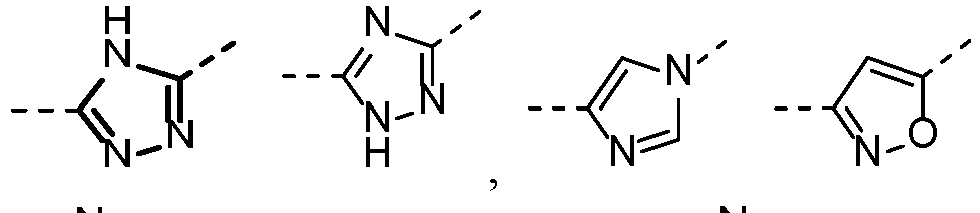


- The compound, or the isomer or pharmaceutically acceptable salt thereof according to claim 1, wherein L is selected from single bond, -CH2- and -O-.
- The compound, or the isomer or pharmaceutically acceptable salt thereof according to any one of claims 1 to 3, 9 or 10, wherein the compound is selected from

 n, T1, T2 and T3 are as defined in claim 1;R1 is as defined in claim 1, 2 or 3;R2 is as defined in claim 1, 9 or 10;R is selected from H and halogen;the carbon atom with "∗" is a chiral carbon atom, which exists in the form of a single (R) or (S) enantiomer or a mixture enriched in one enantiomer.
 - The compound, or the isomer or pharmaceutically acceptable salt thereof according to claim 13, wherein the compound is selected from

 n, T1, T2 and T3 are as defined in claim 1;R1 is as defined in claim 1, 2 or 3;R2 is as defined in claim 1, 9 or 10;R is selected from H and halogen.
 - A compound of the following formula:





- The compound, or the isomer or pharmaceutically acceptable salt thereof according to claim 15, wherein the compound is selected from


- Use of the compound, or the isomer or pharmaceutically acceptable salt thereof according to any one of claims 1 to 16 in the manufacture of a medicament for treating a disease related to RIP-1 kinase.
Applications Claiming Priority (4)
| Application Number | Priority Date | Filing Date | Title |
|---|---|---|---|
| CN201910471672 | 2019-05-31 | ||
| CN201911089490 | 2019-11-08 | ||
| CN202010432710 | 2020-05-20 | ||
| PCT/CN2020/093280 WO2020239074A1 (en) | 2019-05-31 | 2020-05-29 | Bicyclic compound as rip-1 kinase inhibitor and application thereof |
Publications (3)
| Publication Number | Publication Date |
|---|---|
| EP3978492A1 true EP3978492A1 (en) | 2022-04-06 |
| EP3978492A4 EP3978492A4 (en) | 2023-06-28 |
| EP3978492B1 EP3978492B1 (en) | 2025-12-31 |
Family
ID=73553496
Family Applications (1)
| Application Number | Title | Priority Date | Filing Date |
|---|---|---|---|
| EP20814764.5A Active EP3978492B1 (en) | 2019-05-31 | 2020-05-29 | BICYCLICAL COMPOUND AS A RIP-1 KINASE HIBITOR AND ITS USE |
Country Status (11)
| Country | Link |
|---|---|
| US (1) | US12351587B2 (en) |
| EP (1) | EP3978492B1 (en) |
| JP (1) | JP7299350B2 (en) |
| KR (1) | KR102750159B1 (en) |
| CN (1) | CN114008038B (en) |
| AU (1) | AU2020285269B2 (en) |
| BR (1) | BR112021024116A2 (en) |
| CA (1) | CA3142360C (en) |
| SG (1) | SG11202113330VA (en) |
| WO (1) | WO2020239074A1 (en) |
| ZA (1) | ZA202110347B (en) |
Families Citing this family (3)
| Publication number | Priority date | Publication date | Assignee | Title |
|---|---|---|---|---|
| AR121717A1 (en) | 2020-04-02 | 2022-06-29 | Rigel Pharmaceuticals Inc | RIP1K INHIBITORS |
| CN112778291B (en) * | 2021-01-27 | 2023-02-28 | 中国人民解放军海军军医大学 | A kind of thio seven-membered ring derivative and its application |
| CN116947926A (en) * | 2023-07-28 | 2023-10-27 | 安徽昊帆生物有限公司 | Alkyl substituted phosphoric acid cyclic anhydride derivative and synthesis method and application thereof |
Family Cites Families (8)
| Publication number | Priority date | Publication date | Assignee | Title |
|---|---|---|---|---|
| JPH09505597A (en) * | 1993-11-22 | 1997-06-03 | メルク エンド カンパニー インコーポレーテッド | 3-acylaminobenzazepines |
| JP2001517666A (en) | 1997-09-23 | 2001-10-09 | 藤沢薬品工業株式会社 | Thiazole derivatives |
| DE102008022221A1 (en) | 2008-05-06 | 2009-11-12 | Universität des Saarlandes | Inhibitors of human aldosterone synthase CYP11B2 |
| AR079170A1 (en) * | 2009-12-10 | 2011-12-28 | Lilly Co Eli | COMPOSITE OF CICLOPROPIL-BENZAMIDA-IMIDAZO-BENZAZEPINA INHIBITOR OF DIACIL-GLICEROL ACILTRANSFERASA, SALT OF THE SAME, PHARMACEUTICAL COMPOSITION THAT INCLUDES IT, ITS USE TO PREPARE A USEFUL MEDICATION FOR THE TREATMENT OF INTEREST OR COMPENSATION |
| TWI648273B (en) | 2013-02-15 | 2019-01-21 | 英商葛蘭素史克智慧財產發展有限公司 | Heterocyclic amides as kinase inhibitors (III) |
| CN104418866B (en) * | 2013-08-23 | 2018-10-16 | 青岛黄海制药有限责任公司 | Dgat1 inhibitor and its preparation method and application |
| TWI788830B (en) | 2015-07-02 | 2023-01-01 | 瑞士商赫孚孟拉羅股份公司 | Bicyclic lactams and methods of use thereof |
| SG10201913587WA (en) * | 2016-02-05 | 2020-02-27 | Denali Therapeutics Inc | Inhibitors of receptor-interacting protein kinase 1 |
-
2020
- 2020-05-29 BR BR112021024116A patent/BR112021024116A2/en unknown
- 2020-05-29 KR KR1020217043320A patent/KR102750159B1/en active Active
- 2020-05-29 US US17/614,939 patent/US12351587B2/en active Active
- 2020-05-29 WO PCT/CN2020/093280 patent/WO2020239074A1/en not_active Ceased
- 2020-05-29 SG SG11202113330VA patent/SG11202113330VA/en unknown
- 2020-05-29 CN CN202080040268.1A patent/CN114008038B/en active Active
- 2020-05-29 EP EP20814764.5A patent/EP3978492B1/en active Active
- 2020-05-29 AU AU2020285269A patent/AU2020285269B2/en not_active Ceased
- 2020-05-29 JP JP2021571444A patent/JP7299350B2/en active Active
- 2020-05-29 CA CA3142360A patent/CA3142360C/en active Active
-
2021
- 2021-12-13 ZA ZA2021/10347A patent/ZA202110347B/en unknown
Also Published As
| Publication number | Publication date |
|---|---|
| JP2022535794A (en) | 2022-08-10 |
| KR20220016223A (en) | 2022-02-08 |
| JP7299350B2 (en) | 2023-06-27 |
| CA3142360C (en) | 2023-11-14 |
| CN114008038B (en) | 2023-01-24 |
| US12351587B2 (en) | 2025-07-08 |
| SG11202113330VA (en) | 2021-12-30 |
| CA3142360A1 (en) | 2020-12-03 |
| BR112021024116A2 (en) | 2022-01-11 |
| EP3978492B1 (en) | 2025-12-31 |
| AU2020285269B2 (en) | 2022-11-17 |
| US20220242877A1 (en) | 2022-08-04 |
| EP3978492A4 (en) | 2023-06-28 |
| WO2020239074A1 (en) | 2020-12-03 |
| ZA202110347B (en) | 2022-06-29 |
| KR102750159B1 (en) | 2025-01-07 |
| CN114008038A (en) | 2022-02-01 |
| AU2020285269A1 (en) | 2022-01-06 |
Similar Documents
| Publication | Publication Date | Title |
|---|---|---|
| EP4293027A1 (en) | Pyrimidine aromatic ring compounds | |
| EP3719012B1 (en) | N-[4-[(2-amino-4-pyridinyl)oxy]-3-fluorophenyl]-3-(4-fluorophenyl)-1,2,3,4-tetrahydro-2,4-dioxo-5-pyrimidinecarboxamide derivatives as c-met/axl inhibitors for the treatment of tumors | |
| EP3753937B1 (en) | Atr inhibitor and application thereof | |
| CN119977995B (en) | Macrocyclic derivatives and their applications | |
| JP7710223B2 (en) | Substituted pyrrolotriazine compounds and pharmaceutical compositions thereof and their uses | |
| CN116917286B (en) | 6-Carbamate substituted heteroaromatic ring derivatives | |
| EP4393916A1 (en) | Nitrogen-containing heterocyclic derivative inhibitor, and preparation method therefor and use thereof | |
| EP4286378A1 (en) | Pyrimidopyran compound | |
| EP3978492B1 (en) | BICYCLICAL COMPOUND AS A RIP-1 KINASE HIBITOR AND ITS USE | |
| US20240116900A1 (en) | New crystalline forms of a kras g12c inhibitor compound | |
| CN112601746B (en) | Pyrazolopyrimidine derivatives and their use as PI3K inhibitors | |
| EA023238B1 (en) | Substituted indole derivatives for the treatment of immunological disorders | |
| CN111518082B (en) | Aminopyrimidine compound, composition containing aminopyrimidine compound and application of aminopyrimidine compound | |
| CN109111439B (en) | Amide compound, composition containing same and application thereof | |
| EP4741391A1 (en) | Nmt inhibitor, and preparation method therefor and use thereof | |
| KR20250155619A (en) | crystalline form | |
| WO2019228330A1 (en) | Substituted benzo[d]imidazole compound and pharmaceutical composition thereof | |
| RU2800652C2 (en) | Bicyclic compound as rip-1 kinase inhibitor and its use | |
| HK40060645B (en) | Bicyclic compound as rip-1 kinase inhibitor and application thereof | |
| HK40060645A (en) | Bicyclic compound as rip-1 kinase inhibitor and application thereof | |
| WO2023207991A1 (en) | Fused quinazoline compound and use thereof | |
| CN117209538A (en) | A deuterated substance that degrades EGFR and its application in medicine | |
| CN118344348A (en) | Heterocyclic substituted quinazoline and its preparation method and application | |
| HK40039349A (en) | Pyrazolopyrimidine derivative and use thereof as pi3k inhibitor | |
| HK40039349B (en) | Pyrazolopyrimidine derivative and use thereof as pi3k inhibitor |
Legal Events
| Date | Code | Title | Description |
|---|---|---|---|
| STAA | Information on the status of an ep patent application or granted ep patent |
Free format text: STATUS: THE INTERNATIONAL PUBLICATION HAS BEEN MADE |
|
| PUAI | Public reference made under article 153(3) epc to a published international application that has entered the european phase |
Free format text: ORIGINAL CODE: 0009012 |
|
| STAA | Information on the status of an ep patent application or granted ep patent |
Free format text: STATUS: REQUEST FOR EXAMINATION WAS MADE |
|
| 17P | Request for examination filed |
Effective date: 20211222 |
|
| AK | Designated contracting states |
Kind code of ref document: A1 Designated state(s): AL AT BE BG CH CY CZ DE DK EE ES FI FR GB GR HR HU IE IS IT LI LT LU LV MC MK MT NL NO PL PT RO RS SE SI SK SM TR |
|
| DAV | Request for validation of the european patent (deleted) | ||
| DAX | Request for extension of the european patent (deleted) | ||
| REG | Reference to a national code |
Ref legal event code: R079 Free format text: PREVIOUS MAIN CLASS: C07D0403120000 Ipc: C07D0498040000 Ref country code: DE Ref document number: 602020064845 Country of ref document: DE |
|
| A4 | Supplementary search report drawn up and despatched |
Effective date: 20230530 |
|
| RIC1 | Information provided on ipc code assigned before grant |
Ipc: A61K 31/4375 20060101ALI20230523BHEP Ipc: A61P 29/00 20060101ALI20230523BHEP Ipc: C07D 403/12 20060101ALI20230523BHEP Ipc: C07D 519/00 20060101ALI20230523BHEP Ipc: C07D 413/12 20060101ALI20230523BHEP Ipc: C07D 498/04 20060101AFI20230523BHEP |
|
| GRAP | Despatch of communication of intention to grant a patent |
Free format text: ORIGINAL CODE: EPIDOSNIGR1 |
|
| STAA | Information on the status of an ep patent application or granted ep patent |
Free format text: STATUS: GRANT OF PATENT IS INTENDED |
|
| INTG | Intention to grant announced |
Effective date: 20250723 |
|
| GRAS | Grant fee paid |
Free format text: ORIGINAL CODE: EPIDOSNIGR3 |
|
| GRAA | (expected) grant |
Free format text: ORIGINAL CODE: 0009210 |
|
| STAA | Information on the status of an ep patent application or granted ep patent |
Free format text: STATUS: THE PATENT HAS BEEN GRANTED |
|
| AK | Designated contracting states |
Kind code of ref document: B1 Designated state(s): AL AT BE BG CH CY CZ DE DK EE ES FI FR GB GR HR HU IE IS IT LI LT LU LV MC MK MT NL NO PL PT RO RS SE SI SK SM TR |
|
| REG | Reference to a national code |
Ref country code: CH Ref legal event code: F10 Free format text: ST27 STATUS EVENT CODE: U-0-0-F10-F00 (AS PROVIDED BY THE NATIONAL OFFICE) Effective date: 20251231 Ref country code: GB Ref legal event code: FG4D |
|
| REG | Reference to a national code |
Ref country code: DE Ref legal event code: R096 Ref document number: 602020064845 Country of ref document: DE |
|
| REG | Reference to a national code |
Ref country code: IE Ref legal event code: FG4D |
|
| REG | Reference to a national code |
Ref country code: CH Ref legal event code: W10 Free format text: ST27 STATUS EVENT CODE: U-0-0-W10-W00 (AS PROVIDED BY THE NATIONAL OFFICE) Effective date: 20260409 |
|
| REG | Reference to a national code |
Ref country code: LT Ref legal event code: MG9D Ref country code: DE Ref legal event code: R081 Ref document number: 602020064845 Country of ref document: DE Owner name: AFFAMED THERAPEUTICS (HK) LTD., HK Free format text: FORMER OWNER: MEDSHINE DISCOVERY INC., NANJING, JIANGSU, CN |
|
| PG25 | Lapsed in a contracting state [announced via postgrant information from national office to epo] |
Ref country code: NO Free format text: LAPSE BECAUSE OF FAILURE TO SUBMIT A TRANSLATION OF THE DESCRIPTION OR TO PAY THE FEE WITHIN THE PRESCRIBED TIME-LIMIT Effective date: 20260331 |
|
| PG25 | Lapsed in a contracting state [announced via postgrant information from national office to epo] |
Ref country code: HR Free format text: LAPSE BECAUSE OF FAILURE TO SUBMIT A TRANSLATION OF THE DESCRIPTION OR TO PAY THE FEE WITHIN THE PRESCRIBED TIME-LIMIT Effective date: 20251231 Ref country code: FI Free format text: LAPSE BECAUSE OF FAILURE TO SUBMIT A TRANSLATION OF THE DESCRIPTION OR TO PAY THE FEE WITHIN THE PRESCRIBED TIME-LIMIT Effective date: 20251231 |
|
| PG25 | Lapsed in a contracting state [announced via postgrant information from national office to epo] |
Ref country code: RS Free format text: LAPSE BECAUSE OF FAILURE TO SUBMIT A TRANSLATION OF THE DESCRIPTION OR TO PAY THE FEE WITHIN THE PRESCRIBED TIME-LIMIT Effective date: 20260331 |
|
| PG25 | Lapsed in a contracting state [announced via postgrant information from national office to epo] |
Ref country code: LV Free format text: LAPSE BECAUSE OF FAILURE TO SUBMIT A TRANSLATION OF THE DESCRIPTION OR TO PAY THE FEE WITHIN THE PRESCRIBED TIME-LIMIT Effective date: 20251231 |
|
| PG25 | Lapsed in a contracting state [announced via postgrant information from national office to epo] |
Ref country code: BG Free format text: LAPSE BECAUSE OF FAILURE TO SUBMIT A TRANSLATION OF THE DESCRIPTION OR TO PAY THE FEE WITHIN THE PRESCRIBED TIME-LIMIT Effective date: 20251231 |
|
| RAP2 | Party data changed (patent owner data changed or rights of a patent transferred) |
Owner name: AFFAMED THERAPEUTICS (HK) LIMITED |
|
| REG | Reference to a national code |
Ref country code: NL Ref legal event code: MP Effective date: 20251231 |