EP3978460A1 - Chitosan compounds and optical isomer separating agent - Google Patents
Chitosan compounds and optical isomer separating agent Download PDFInfo
- Publication number
- EP3978460A1 EP3978460A1 EP20813510.3A EP20813510A EP3978460A1 EP 3978460 A1 EP3978460 A1 EP 3978460A1 EP 20813510 A EP20813510 A EP 20813510A EP 3978460 A1 EP3978460 A1 EP 3978460A1
- Authority
- EP
- European Patent Office
- Prior art keywords
- group
- chitosan
- formula
- substituent
- phenyl group
- Prior art date
- Legal status (The legal status is an assumption and is not a legal conclusion. Google has not performed a legal analysis and makes no representation as to the accuracy of the status listed.)
- Granted
Links
Images



Classifications
-
- C—CHEMISTRY; METALLURGY
- C07—ORGANIC CHEMISTRY
- C07B—GENERAL METHODS OF ORGANIC CHEMISTRY; APPARATUS THEREFOR
- C07B57/00—Separation of optically-active compounds
-
- C—CHEMISTRY; METALLURGY
- C08—ORGANIC MACROMOLECULAR COMPOUNDS; THEIR PREPARATION OR CHEMICAL WORKING-UP; COMPOSITIONS BASED THEREON
- C08B—POLYSACCHARIDES; DERIVATIVES THEREOF
- C08B37/00—Preparation of polysaccharides not provided for in groups C08B1/00 - C08B35/00; Derivatives thereof
- C08B37/0006—Homoglycans, i.e. polysaccharides having a main chain consisting of one single sugar, e.g. colominic acid
- C08B37/0024—Homoglycans, i.e. polysaccharides having a main chain consisting of one single sugar, e.g. colominic acid beta-D-Glucans; (beta-1,3)-D-Glucans, e.g. paramylon, coriolan, sclerotan, pachyman, callose, scleroglucan, schizophyllan, laminaran, lentinan or curdlan; (beta-1,6)-D-Glucans, e.g. pustulan; (beta-1,4)-D-Glucans; (beta-1,3)(beta-1,4)-D-Glucans, e.g. lichenan; Derivatives thereof
- C08B37/0027—2-Acetamido-2-deoxy-beta-glucans; Derivatives thereof
- C08B37/003—Chitin, i.e. 2-acetamido-2-deoxy-(beta-1,4)-D-glucan or N-acetyl-beta-1,4-D-glucosamine; Chitosan, i.e. deacetylated product of chitin or (beta-1,4)-D-glucosamine; Derivatives thereof
-
- B—PERFORMING OPERATIONS; TRANSPORTING
- B01—PHYSICAL OR CHEMICAL PROCESSES OR APPARATUS IN GENERAL
- B01D—SEPARATION
- B01D15/00—Separating processes involving the treatment of liquids with solid sorbents; Apparatus therefor
- B01D15/08—Selective adsorption, e.g. chromatography
- B01D15/10—Selective adsorption, e.g. chromatography characterised by constructional or operational features
- B01D15/20—Selective adsorption, e.g. chromatography characterised by constructional or operational features relating to the conditioning of the sorbent material
-
- B—PERFORMING OPERATIONS; TRANSPORTING
- B01—PHYSICAL OR CHEMICAL PROCESSES OR APPARATUS IN GENERAL
- B01J—CHEMICAL OR PHYSICAL PROCESSES, e.g. CATALYSIS OR COLLOID CHEMISTRY; THEIR RELEVANT APPARATUS
- B01J20/00—Solid sorbent compositions or filter aid compositions; Sorbents for chromatography; Processes for preparing, regenerating or reactivating thereof
- B01J20/22—Solid sorbent compositions or filter aid compositions; Sorbents for chromatography; Processes for preparing, regenerating or reactivating thereof comprising organic material
- B01J20/24—Naturally occurring macromolecular compounds, e.g. humic acids or their derivatives
-
- B—PERFORMING OPERATIONS; TRANSPORTING
- B01—PHYSICAL OR CHEMICAL PROCESSES OR APPARATUS IN GENERAL
- B01J—CHEMICAL OR PHYSICAL PROCESSES, e.g. CATALYSIS OR COLLOID CHEMISTRY; THEIR RELEVANT APPARATUS
- B01J20/00—Solid sorbent compositions or filter aid compositions; Sorbents for chromatography; Processes for preparing, regenerating or reactivating thereof
- B01J20/281—Sorbents specially adapted for preparative, analytical or investigative chromatography
-
- B—PERFORMING OPERATIONS; TRANSPORTING
- B01—PHYSICAL OR CHEMICAL PROCESSES OR APPARATUS IN GENERAL
- B01J—CHEMICAL OR PHYSICAL PROCESSES, e.g. CATALYSIS OR COLLOID CHEMISTRY; THEIR RELEVANT APPARATUS
- B01J20/00—Solid sorbent compositions or filter aid compositions; Sorbents for chromatography; Processes for preparing, regenerating or reactivating thereof
- B01J20/281—Sorbents specially adapted for preparative, analytical or investigative chromatography
- B01J20/286—Phases chemically bonded to a substrate, e.g. to silica or to polymers
-
- B—PERFORMING OPERATIONS; TRANSPORTING
- B01—PHYSICAL OR CHEMICAL PROCESSES OR APPARATUS IN GENERAL
- B01J—CHEMICAL OR PHYSICAL PROCESSES, e.g. CATALYSIS OR COLLOID CHEMISTRY; THEIR RELEVANT APPARATUS
- B01J20/00—Solid sorbent compositions or filter aid compositions; Sorbents for chromatography; Processes for preparing, regenerating or reactivating thereof
- B01J20/281—Sorbents specially adapted for preparative, analytical or investigative chromatography
- B01J20/29—Chiral phases
-
- B—PERFORMING OPERATIONS; TRANSPORTING
- B01—PHYSICAL OR CHEMICAL PROCESSES OR APPARATUS IN GENERAL
- B01J—CHEMICAL OR PHYSICAL PROCESSES, e.g. CATALYSIS OR COLLOID CHEMISTRY; THEIR RELEVANT APPARATUS
- B01J20/00—Solid sorbent compositions or filter aid compositions; Sorbents for chromatography; Processes for preparing, regenerating or reactivating thereof
- B01J20/281—Sorbents specially adapted for preparative, analytical or investigative chromatography
- B01J20/292—Liquid sorbents
-
- B—PERFORMING OPERATIONS; TRANSPORTING
- B01—PHYSICAL OR CHEMICAL PROCESSES OR APPARATUS IN GENERAL
- B01J—CHEMICAL OR PHYSICAL PROCESSES, e.g. CATALYSIS OR COLLOID CHEMISTRY; THEIR RELEVANT APPARATUS
- B01J20/00—Solid sorbent compositions or filter aid compositions; Sorbents for chromatography; Processes for preparing, regenerating or reactivating thereof
- B01J20/30—Processes for preparing, regenerating, or reactivating
- B01J20/32—Impregnating or coating ; Solid sorbent compositions obtained from processes involving impregnating or coating
- B01J20/3202—Impregnating or coating ; Solid sorbent compositions obtained from processes involving impregnating or coating characterised by the carrier, support or substrate used for impregnation or coating
- B01J20/3204—Inorganic carriers, supports or substrates
-
- B—PERFORMING OPERATIONS; TRANSPORTING
- B01—PHYSICAL OR CHEMICAL PROCESSES OR APPARATUS IN GENERAL
- B01J—CHEMICAL OR PHYSICAL PROCESSES, e.g. CATALYSIS OR COLLOID CHEMISTRY; THEIR RELEVANT APPARATUS
- B01J20/00—Solid sorbent compositions or filter aid compositions; Sorbents for chromatography; Processes for preparing, regenerating or reactivating thereof
- B01J20/30—Processes for preparing, regenerating, or reactivating
- B01J20/32—Impregnating or coating ; Solid sorbent compositions obtained from processes involving impregnating or coating
- B01J20/3231—Impregnating or coating ; Solid sorbent compositions obtained from processes involving impregnating or coating characterised by the coating or impregnating layer
- B01J20/3242—Layers with a functional group, e.g. an affinity material, a ligand, a reactant or a complexing group
- B01J20/3244—Non-macromolecular compounds
- B01J20/3246—Non-macromolecular compounds having a well defined chemical structure
- B01J20/3248—Non-macromolecular compounds having a well defined chemical structure the functional group or the linking, spacer or anchoring group as a whole comprising at least one type of heteroatom selected from a nitrogen, oxygen or sulfur, these atoms not being part of the carrier as such
- B01J20/3255—Non-macromolecular compounds having a well defined chemical structure the functional group or the linking, spacer or anchoring group as a whole comprising at least one type of heteroatom selected from a nitrogen, oxygen or sulfur, these atoms not being part of the carrier as such comprising a cyclic structure containing at least one of the heteroatoms nitrogen, oxygen or sulfur, e.g. heterocyclic or heteroaromatic structures
-
- Y—GENERAL TAGGING OF NEW TECHNOLOGICAL DEVELOPMENTS; GENERAL TAGGING OF CROSS-SECTIONAL TECHNOLOGIES SPANNING OVER SEVERAL SECTIONS OF THE IPC; TECHNICAL SUBJECTS COVERED BY FORMER USPC CROSS-REFERENCE ART COLLECTIONS [XRACs] AND DIGESTS
- Y02—TECHNOLOGIES OR APPLICATIONS FOR MITIGATION OR ADAPTATION AGAINST CLIMATE CHANGE
- Y02P—CLIMATE CHANGE MITIGATION TECHNOLOGIES IN THE PRODUCTION OR PROCESSING OF GOODS
- Y02P20/00—Technologies relating to chemical industry
- Y02P20/50—Improvements relating to the production of bulk chemicals
- Y02P20/54—Improvements relating to the production of bulk chemicals using solvents, e.g. supercritical solvents or ionic liquids
Definitions
- the present disclosure relates to a chitosan compound having a structure in which an amino group at a 2-position of chitosan is substituted with a thiourea group, and a separating agent for an optical isomer, the separating agent having the chitosan compound and a carrier.
- Optical isomers are used as medicines and raw materials for medicines. In such applications in which the optical isomers are used to act on living bodies, typically only one of the optical isomers is used, and extremely high optical purity is required.
- Methods of manufacturing an optical isomer requiring such high optical purity known in the art include a method involving separating one of the optical isomers from a mixture of optical isomers, such as a racemate, by using a column packed with a separating agent for optical isomers, the separating agent having optical resolution ability, in chromatography, such as liquid chromatography, simulated moving bed chromatography, or supercritical fluid chromatography.
- separating agents for optical isomers macromolecules having an optically active site can be used.
- a separating agent for optical isomers is typically constituted of a carrier such as a silica gel, and the macromolecule described above supported on the surface of the carrier.
- the separating agent is packed in a column and used for optical resolution.
- the macromolecule having an optically active site known in the art include polysaccharides and polysaccharide derivatives in which hydroxyl groups in the polysaccharide are substituted with alkyl-substituted phenyl carbamates.
- polysaccharide in addition to cellulose or amylose, chitosan is also known
- Patent Document 1 Patent Document 1 and Non-Patent Literature 1).
- Patent Document 1 JP 63-178101 A
- Non-Patent Literature 1 J. Chromatogr. A 1365 (2014) 86-93
- an object is to provide a separating agent for optical isomers, the separating agent having a novel chitosan compound in which an amino group at 2-position of chitosan is substituted with a thiourea group.
- a separating agent for optical isomers the separating agent having a chitosan compound having been unknown to date in which an amino group at a 2-position of chitosan is substituted with a thiourea group, has excellent optical resolution ability for specific racemates and completed the present invention.
- the present disclosure relates to the following.
- the present disclosure can provide the novel chitosan compound and the separating agent for optical isomers, the separating agent having good separation ability for specific racemates.
- a chitosan compound of the present disclosure has a structure represented by Formula (I) below, into which a thiourea group is introduced at a 2-position of chitosan:
- R is preferably a group represented by Formula (II), and in Formula (II), each R b is preferably independently an unsubstituted phenyl group or a phenyl group having a substituent, and the substituent is preferably an alkyl group having from 1 to 5 carbons.
- examples of the halogen include chlorine, fluorine, or bromine.
- R b is preferably a phenyl group having a substituent, and the substitution position of the substituent is preferably any of 2-position, 3-position, 4-position, or both 3- and 5-positions.
- R b is preferably a 2-substituted phenyl group, a 3-substituted phenyl group, a 4-substituted phenyl group, or a 3,5-substituted phenyl group.
- the substituent in this case is an alkyl group having from 1 to 5 carbons, or a halogen, preferably a methyl group or an ethyl group, and particularly preferably a methyl group.
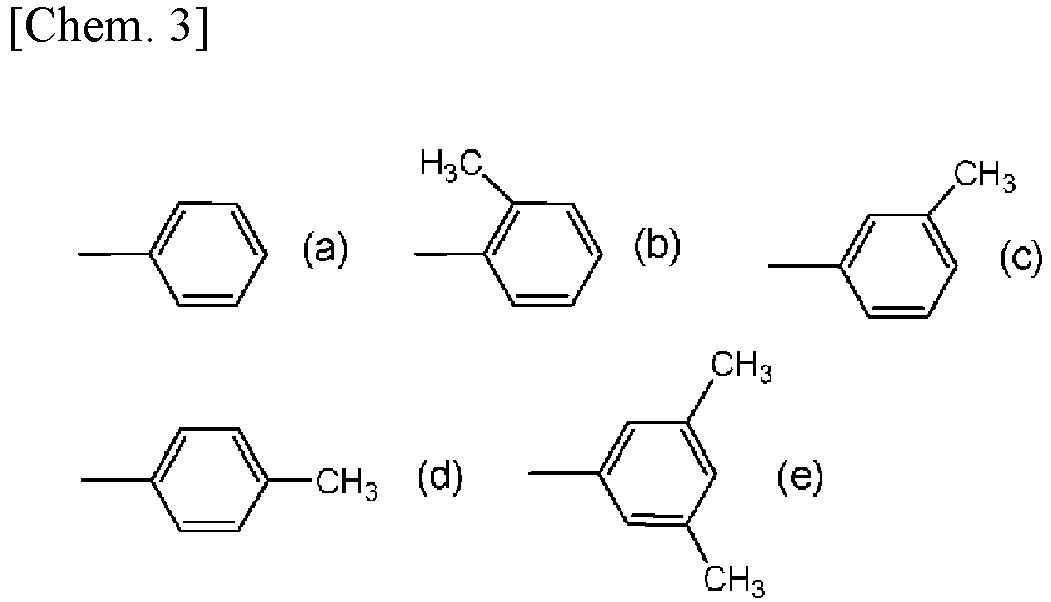
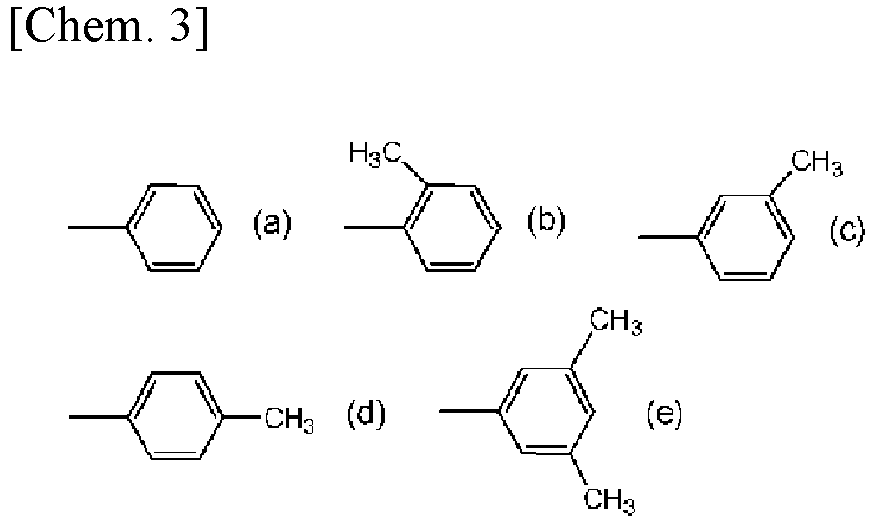
- R b is preferably any of groups represented by Formulas (a) to (e) below and more preferably any of groups represented by Formulas (a), (c), (d), and (e).
- R a is preferably a methyl group, an ethyl group, an n-propyl group, or an isopropyl group, and more preferably an isopropyl group.
- n is preferably 10 or more, and on the other hand, preferably 1000 or less, and more preferably 500 or less.
- Chitosan used in the present disclosure can be typically prepared by deacetylation of chitin (poly- ⁇ 1,4-N-acetylglucosamine) derived from a carapace of a crustacean, such as a crab, shrimp, prawn, and lobster, by treatment, such as alkali treatment or enzymatic treatment.
- chitin poly- ⁇ 1,4-N-acetylglucosamine
- the chitosan according to the present disclosure is not limited to a naturally derived chitosan and may be a chemically synthesized chitosan.
- the chitosan used as a raw material for the chitosan compound according to the present disclosure has a proportion of deacetylated molecules in the glucosamine units constituting the chitin molecule, that is, a degree of deacetylation, in a range preferably from 80 to 100%, more preferably from 90 to 100%, and most preferably a degree of deacetylation of about 100%.
- the degree of deacetylation may be quantified based on a known technique (e.g., colloidal titration method).
- An example of the known technique includes NMR
- a naturally derived chitosan molecule with a large molecular weight composed of many sugar residues may be processed into a chitosan molecule with any molecular weight by hydrolyzation.
- the number average degree of polymerization of the chitosan used in the present disclosure is preferably 5 or higher, more preferably 10 or higher, and although the upper limit is not particularly specified, the number average degree of polymerization is preferably 1000 or lower in terms of ease of handling, more preferably from 5 to 1000, even more preferably from 10 to 1000, and particularly preferably from 10 to 500.
- hydroxyl groups or amino groups of chitosan may remain unreacted or may be substituted with another substituent as long as the effects of the present invention are not impaired.
- Examples of the proportion include an embodiment where about 20% or less of all the hydroxyl groups or amino groups remain unreacted or are substituted with another substituent.
- the deacetylated chitosan is first swelled in a solvent, such as dimethyl sulfoxide (DMSO).
- a solvent such as dimethyl sulfoxide (DMSO).
- DMSO dimethyl sulfoxide
- the temperature of the mixture during swelling include typically from 70 to 85°C and preferably from 75 to 83°C.
- the temperature of the mixture is lowered (typically to 25°C), then lithium chloride is added, and the mixture is stirred.
- the stirring time is typically approximately from 3 to 5 hours and preferably approximately 4 hours.
- Isothiocyanate represented by Formula (IV) is then added to the mixture.
- R a is an alkyl group having from 1 to 5 carbons or an alkyl group having from 3 to 5 carbons and having a branched chain.
- R a is preferably an alkyl group having from 3 to 5 carbons and having a branched chain.
- R a is preferably a methyl group, an ethyl group, an n-propyl group, or an isopropyl group, and more preferably an isopropyl group.
- a group represented by Formula (II) or a group represented by Formula (III) is introduced at a 3-position and a 6-position of the chitosan compound into which the thiourea group is introduced.
- examples include reacting the isocyanate containing R b with the chitosan compound into which the thiourea group is introduced.
- examples include reacting a carboxylic acid, an ester, an acid halide, an acid amide compound, or an aldehyde containing R b with the chitosan compound into which the thiourea group is introduced.
- Examples of the reaction conditions for introducing the group represented by Formula (II) below at a 3-position and a 6-position of the chitosan compound into which the thiourea group is introduced include conditions in which the chitosan compound into which the thiourea group is introduced and DMSO in which lithium chloride is dissolved are heated to typically approximately from 75 to 85°C and preferably from 78 to 83°C, the isocyanate containing R b described above is added to this, and the mixture is continuously stirred for 12 to 24 hours.
- thiourea groups are introduced at 2-positions of the chitosan, and a chitosan compound in which the group represented by Formula (II) or the group represented by Formula (III) are introduced at 3-positions and 6-positions is obtained. Washing or purification of the resulting product may be performed as appropriate.
- each R b is independently an unsubstituted phenyl group, a phenyl group having a substituent, an unsubstituted cyclohexyl group, or a cyclohexyl group having a substituent, and each of the substituent is independently an alkyl group having from 1 to 5 carbons, or a halogen.
- each R b is preferably independently an unsubstituted phenyl group or a phenyl group having a substituent, and the substituent is preferably an alkyl group having from 1 to 5 carbons.
- examples of the halogen include chlorine, fluorine, or bromine.
- the group represented by Formula (II) is preferably introduced into the chitosan compound into which the thiourea group is introduced.
- R b is preferably a phenyl group having a substituent, and the substitution position of the substituent is preferably any of 2-position, 3-position, 4-position, or both 3- and 5-positions.
- R b is preferably a 2-substituted phenyl group, a 3-substituted phenyl group, a 4-substituted phenyl group, or a 3,5-substituted phenyl group.
- the substituent in this case is an alkyl having from 1 to 5 carbons, or a halogen, preferably a methyl group or an ethyl group, and particularly preferably a methyl group.
- R b preferred specific examples include Formulas (a) to (e) described above in the explanation about the chitosan compound, and more preferred example is a group represented by Formula (a), (c), (d), or (e) above.
- the separating agent for optical isomers of the present disclosure have the chitosan compound described above and a carrier.
- the carrier used to support the chitosan compound include a porous organic carrier or a porous inorganic carrier, and preferably include a porous inorganic carrier.
- suitable for a porous organic carrier include macromolecular substances selected from polystyrenes, poly(meth)acrylamides, poly(meth)acrylates, and the like, and examples suitable for a porous inorganic carrier include silica gels, alumina, zirconia, titania, magnesia, glass, kaolin, titanium oxide, silicates, and hydroxyapatite.
- a preferred carrier is a silica gel, alumina, or glass.
- silica gel having a core-shell structure can also be used as the silica gel.
- the carrier described above is surface-treated, and this can prevent excessive adsorption of a substance to be separated to the carrier itself.
- a surface treatment agent include silane coupling agents, such as aminopropylsilane, and titanate-based or aluminate-based coupling agents.
- the average particle diameter of the carrier that can be used in the present disclosure is typically from 0.1 ⁇ m to 1000 ⁇ m and preferably from 1 ⁇ m to 50 ⁇ m.
- the average pore diameter of the carrier is typically from 10 ⁇ to 10000 ⁇ and preferably from 50 ⁇ to 1000 ⁇ .
- the specific surface area of the carrier is typically from 5 to 1000 m 2 /g and preferably from 10 to 500 m 2 /g.
- the average particle diameter of the separating agent for optical isomers of the present disclosure can be measured with an apparatus for measurement using a microscopic image, for example, a Mastersizer 2000E available from Malvern Instruments Ltd.
- the applicable method includes physical adsorption between the chitosan compound and the carrier, chemical bonding with the carrier, chemical bonding between the chitosan compounds, chemical bonding of a third component, light irradiation of the chitosan compound, and radical reactions (see, e.g., JP 06-093002 A ).
- the method of allowing physical adsorption includes a method of dissolving the chitosan compound in a soluble solvent, mixing well with a carrier, distilling away the solvent with an air stream under reduced pressure or warming; and also, a method of dissolving the chitosan compound in a soluble solvent, mixing well with a carrier, and then dispersing the mixture in a solvent in which chitosan is insoluble to diffuse the soluble solvent.
- the separating agent thus obtained is subjected to appropriate treatment, such as heating, solvent addition, or washing, and thus the separation ability can also be improved.
- Examples of the amount of the chitosan compound supported on the carrier in the separating agent for optical isomers of the present disclosure include an embodiment where the amount is from 1 to 100 weight% relative to the carrier, and the amount is preferably from 5 to 50 weight%.
- This supported amount can be determined by thermogravimetric analysis.
- the separating agent for optical isomers of the present disclosure can be packed in a column of a known size by a known method and used as a column for HPLC.
- the flow rate of the HPLC when separating optical isomers by HPLC using a column packed with the separating agent for optical isomers of the present disclosure can be appropriately adjusted and used.
- the flow rate include an embodiment where the linear flow rate is approximately from 0.1 mm/sec to 50 mm/sec, and the linear flow rate is preferably from 0.25 mm/sec to 2 mm/sec. This preferred linear flow rate corresponds to a flow rate of 0.25 mL/min to 2 mL/min for a column with an inner diameter of 0.46 cm.
- the separating agent for optical isomers of the present disclosure can be used as a separating agent for a column not only for HPLC but also for gas chromatography; supercritical fluid chromatography; electrophoresis, particularly for a capillary column for capillary electrochromatography (for CEC), a capillary zone electrophoresis (CZE) method, and a micellar electrokinetic chromatograph (MEKC) method; and for thin layer chromatography.
- CEC capillary electrochromatography
- CZE capillary zone electrophoresis
- MEKC micellar electrokinetic chromatograph
- LiCl lithium chloride
- chitosan-2-isopropylthiourea-3,6-diphenylcarbamate (chitosan compound 2a) was obtained.
- the chitosan compounds 2b to 2f were obtained by the same procedure as above using each isocyanate with R b of the above formula changed as shown in Table 1.
- the yields of chitosan compounds 2a to 2f were from 70 to 80%.
- the 1 H-NMR spectra (500 MHz) were measured using a Brucker-500 Spectrometer (Brucker, USA). The sample (20 mg) was dissolved in DMSO-d 6 (0.5 mL). IR analyses of the chitosan compounds were carried out using a PE FT-IR spectrometer (Spectrum 100) by the potassium bromide tablet method.
- the chitosan compound 2a produced (0.2 g) was completely dissolved in tetrahydrofuran (5 mL), then the solution was applied to a surface of a silica gel (average particle diameter of 7 ⁇ m, average pore diameter of 100 nm) (0.8 g) surface-treated in advance with a silane coupling agent having an aminopropyl group to coat the silica gel with the solution, and separating agent 1 for optical isomerism was obtained.
- the weight ratio of the chitosan compound to the silica gel was 4 of the chitosan compound to 1 of the silica gel.
- Separating agent 1 for optical isomers was packed in a stainless steel column (25 cm x 0.20 cm i.d.) by a slurry method, and column 1 was obtained.
- the number of theoretical plates of column 1 was from 1700 to 2300 when benzene was measured as a target at 25°C by using a hexane/2-propanol (90/10, v/v) mixture as an eluent and setting a flow rate to 0.1 mL/min.
- the elution time of 1,3,5-tri-tert-butylbenzene as a non-retained material was used as the dead time (t 0 ).
- a sample (a solution of a racemate (2 mg/mL (mobile phase)) was injected into the chromatography system using an Intelligent sampler (JASCO AS-2055).
- the chitosan compounds 2b to 2f were also each applied to a surface of a silica gel to coat the surface of the silica gel with each chitosan compound by the same procedure as described above, and separating agents 2 to 6 for optical isomers were obtained. Separating agents 2 to 6 for optical isomers were each packed in a stainless steel column (25 cm x 0.20 cm i.d.) by a slurry method by the same procedure as described above, and columns 2 to 6 were obtained.
- the asymmetry identification ability (separation factor ⁇ value) for the compound shown in the table was calculated from the retention coefficient (k 1 ) as shown below.
- columns 1, 3, 4, and 5 had good separation ability for at least 8 racemates.
- Column 2 showed high separation ability of racemate 12, and column 6 showed high separation ability of racemate 3.
- Columns 3, 4, and 5 produced using a chitosan compound having methyl group-substituted phenylcarbamate groups showed relatively high separation ability of racemates 2, 4, 5, and 11 compared to column 1 produced using a chitosan compound having unsubstituted phenylcarbamate groups.
- Column 5 produced using a chitosan compound having 3,5-dimethylphenylcarbamate groups showed the highest separation ability of racemates 2, 4, 5, and 11.
- the present disclosure provides a chitosan compound having a structure in which some hydroxyl groups of chitosan are substituted with thiourea derivatives, and the separating agent for optical isomers, the separating agent having the chitosan compound and a carrier.
- the separating agent for optical isomers of the present disclosure allows having high separation ability for specific racemates compared to separating agent for optical isomers, the separating agent obtained using a chitosan compound known in the art in which hydroxyl groups are substituted with carbamate derivatives.
Landscapes
- Chemical & Material Sciences (AREA)
- Analytical Chemistry (AREA)
- Organic Chemistry (AREA)
- Chemical Kinetics & Catalysis (AREA)
- Life Sciences & Earth Sciences (AREA)
- Health & Medical Sciences (AREA)
- Medicinal Chemistry (AREA)
- General Health & Medical Sciences (AREA)
- Molecular Biology (AREA)
- Engineering & Computer Science (AREA)
- Biochemistry (AREA)
- Materials Engineering (AREA)
- Polymers & Plastics (AREA)
- Inorganic Chemistry (AREA)
- Polysaccharides And Polysaccharide Derivatives (AREA)
- Solid-Sorbent Or Filter-Aiding Compositions (AREA)
Abstract
Description
- The present disclosure relates to a chitosan compound having a structure in which an amino group at a 2-position of chitosan is substituted with a thiourea group, and a separating agent for an optical isomer, the separating agent having the chitosan compound and a carrier.
- Optical isomers are used as medicines and raw materials for medicines. In such applications in which the optical isomers are used to act on living bodies, typically only one of the optical isomers is used, and extremely high optical purity is required. Methods of manufacturing an optical isomer requiring such high optical purity known in the art include a method involving separating one of the optical isomers from a mixture of optical isomers, such as a racemate, by using a column packed with a separating agent for optical isomers, the separating agent having optical resolution ability, in chromatography, such as liquid chromatography, simulated moving bed chromatography, or supercritical fluid chromatography.
- For separating agents for optical isomers, macromolecules having an optically active site can be used. Such a separating agent for optical isomers is typically constituted of a carrier such as a silica gel, and the macromolecule described above supported on the surface of the carrier. The separating agent is packed in a column and used for optical resolution.
- The macromolecule having an optically active site known in the art include polysaccharides and polysaccharide derivatives in which hydroxyl groups in the polysaccharide are substituted with alkyl-substituted phenyl carbamates. For such a polysaccharide, in addition to cellulose or amylose, chitosan is also known
- (Patent Document 1 and Non-Patent Literature 1).
- Patent Document 1:
JP 63-178101 A - Non-Patent Literature 1: J. Chromatogr. A 1365 (2014) 86-93
- In the separating agent for optical isomers disclosed in Patent Document 1 and Non-Patent Literature 1, a chitosan compound in which hydroxyl groups at 3,6-positions of chitosan are substituted with carbamate groups and an amino group at 2-position is substituted with an urea group is used, but substituents other than a carbamate group and a urea group have not been investigated.
- In the present disclosure, an object is to provide a separating agent for optical isomers, the separating agent having a novel chitosan compound in which an amino group at 2-position of chitosan is substituted with a thiourea group.
- As a result of diligent research to solve the above problem, the present inventors have found that a separating agent for optical isomers, the separating agent having a chitosan compound having been unknown to date in which an amino group at a 2-position of chitosan is substituted with a thiourea group, has excellent optical resolution ability for specific racemates and completed the present invention.
- The present disclosure relates to the following.
- (1) A chitosan compound represented by Formula (I):

- where each R is independently a group represented by Formula (II) or a group represented by Formula (III); Ra is a linear alkyl group having from 1 to 5 carbons or an alkyl group having from 3 to 5 carbons and having a branched chain; and n is an integer of 5 or greater; and


- where each Rb is independently an unsubstituted phenyl group, a phenyl group having a substituent, an unsubstituted cyclohexyl group, or a cyclohexyl group having a substituent, and each of the substituent is independently an alkyl group having from 1 to 5 carbons, or a halogen.
- where each R is independently a group represented by Formula (II) or a group represented by Formula (III); Ra is a linear alkyl group having from 1 to 5 carbons or an alkyl group having from 3 to 5 carbons and having a branched chain; and n is an integer of 5 or greater; and
- (2) The chitosan compound according to (1), wherein the R is a group represented by Formula (II), wherein Rb is an unsubstituted phenyl group or a phenyl group having a substituent, and the substituent is an alkyl group having from 1 to 5 carbons, or a halogen.
- (3) The chitosan compound according to (2), wherein each of the Rb is independently a 2-substituted phenyl group, a 3-substituted phenyl group, a 4-substituted phenyl group, or a 3,5-substituted phenyl group.
- (4) The chitosan compound according to (2), wherein the Rb is any of groups represented by Formulas (a) to (e):
- (5) The chitosan compound according to (2), wherein the Rb is any of groups represented by Formulas (a), (c), (d), and (e):


- (6) The chitosan compound according to any one of (1) to (5), wherein the Ra is an alkyl group having from 3 to 5 carbons and having a branched chain.
- (7) A separating agent for optical isomers, the separating agent having the chitosan compound described in any of (1) to (6) and a carrier.
- (8) The separating agent for optical isomers according to (7), wherein the carrier is a silica gel.
- (9) A method of manufacturing a chitosan compound, the method including:
- reacting a deacetylated chitosan with a compound represented by Formula (IV) to introduce a thiourea group at a 2-position of the chitosan; and
- reacting the chitosan into which the thiourea group is introduced with an isocyanate, a carboxylic acid, an ester, an acid halide, an acid amide compound, or an aldehyde containing Rb to introduce groups represented by Formula (II) or groups represented by Formula (III) at a 3-position and a 6-position of the chitosan:


- wherein, in Formulas (II) and (III), each Rb is independently an unsubstituted phenyl group, a phenyl group having a substituent, an unsubstituted cyclohexyl group, or a cyclohexyl group having a substituent, and each of the substituent is independently an alkyl group having from 1 to 5 carbons, or a halogen; and
- in Formula (IV), Ra is a linear alkyl group having from 1 to 5 carbons or an alkyl group having from 3 to 5 carbons and having a branched chain.
- (10) The method of manufacturing a chitosan compound according to (9), wherein the group introduced at the 3-position and 6-position of the chitosan is a group represented by Formula (II), wherein Rb is an unsubstituted phenyl group or a phenyl group having a substituent, and the substituent is an alkyl group having from 1 to 5 carbons, or a halogen.
- (11) The method of manufacturing a chitosan compound according to (10), wherein the Rb is a 2-substituted phenyl group, a 3-substituted phenyl group, a 4-substituted phenyl group, or a 3,5-substituted phenyl group.
- (12) The method of manufacturing a chitosan compound according to (10), wherein the Rb is any of groups represented by Formulas (a) to (e):

- (13) The method of manufacturing a chitosan compound according to (10), wherein the Rb is any of groups represented by Formulas (a), (c), (d), and (e):

- (14) The method of manufacturing a chitosan compound according to any of (9) to (13), wherein the Ra is an alkyl group having from 3 to 5 carbons and having a branched chain.
- The present disclosure can provide the novel chitosan compound and the separating agent for optical isomers, the separating agent having good separation ability for specific racemates.
-
-
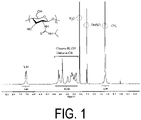
FIG. 1 is a diagram showing a 1H-NMR spectrum of chitosan-2-isopropylthiourea derivative 1 at 80°C in DMSO-d6. -
FIG. 2 is a diagram showing a 1H-NMR spectrum of chitosan-2-isopropylthiourea-3,6-diphenylcarbamate derivative 2a at 80°C in DMSO-d6. -
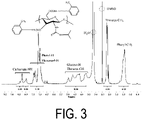
FIG. 3 is a diagram showing a 1H-NMR spectrum of chitosan-2-isopropylthiourea-3,6-di(2-methylphenylcarbamate) derivative 2b at 80°C in DMSO-d6. -
FIG. 4 is a diagram showing a 1H-NMR spectrum of chitosan-2-isopropylthiourea-3,6-di(3-methylphenylcarbamate) derivative 2c at 80°C in DMSO-d6. -
FIG. 5 is a diagram showing a 1H-NMR spectrum of chitosan-2-isopropylthiourea-3,6-di(4-methylphenylcarbamate) derivative 2d at 80°C in DMSO-d6. -
FIG. 6 is a diagram showing a 1H-NMR spectrum of chitosan-2-isopropylthiourea-3,6-di(3,5-dimethylphenylcarbamate) derivative 2e at 80°C in DMSO-d6. -
FIG. 7 is a diagram showing a 1H-NMR spectrum of chitosan-2-isopropylthiourea-3,6-di(cyclohexylcarbamate) derivative 2f at 80°C in DMSO-d6. -
FIG. 8 is a chromatogram obtained during separation of a specific racemate (Rac-2) using a separating agent for optical isomers, the separating agent having been produced using chitosan-2-isopropylthiourea-3,6-di(3,5-dimethylphenylcarbamate) derivative 2e. - Each of the configurations, their combinations, and the like in each embodiment below is an example, and an addition, omission, substitution, and other changes can be made as appropriate without departing from the spirit of the present invention. The present disclosure is not limited by the embodiments and is limited only by the claims.
- A chitosan compound of the present disclosure has a structure represented by Formula (I) below, into which a thiourea group is introduced at a 2-position of chitosan:

- where each R is independently a group represented by Formula (II) or a group represented by Formula (III); Ra is a linear alkyl group having from 1 to 5 carbons or an alkyl group having from 3 to 5 carbons and having a branched chain; and n is an integer of 5 or more; and
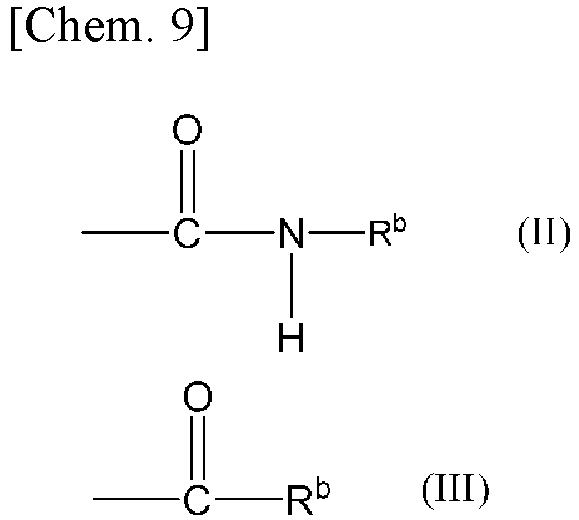
- where each Rb is independently an unsubstituted phenyl group, a phenyl group having a substituent, an unsubstituted cyclohexyl group, or a cyclohexyl group having a substituent, and each of the substituent is independently an alkyl group having from 1 to 5 carbons, or a halogen.
- In Formula (I), R is preferably a group represented by Formula (II), and in Formula (II), each Rb is preferably independently an unsubstituted phenyl group or a phenyl group having a substituent, and the substituent is preferably an alkyl group having from 1 to 5 carbons. In Formulas (II) and (III), examples of the halogen include chlorine, fluorine, or bromine.
- Of the group represented by Formula (II) and the group represented by Formula (III), the group represented by Formula (II) is preferred.
- Furthermore, in Formula (II), Rb is preferably a phenyl group having a substituent, and the substitution position of the substituent is preferably any of 2-position, 3-position, 4-position, or both 3- and 5-positions. Specifically, in Formula (II), Rb is preferably a 2-substituted phenyl group, a 3-substituted phenyl group, a 4-substituted phenyl group, or a 3,5-substituted phenyl group. The substituent in this case is an alkyl group having from 1 to 5 carbons, or a halogen, preferably a methyl group or an ethyl group, and particularly preferably a methyl group.
- In Formula (II), Rb is preferably any of groups represented by Formulas (a) to (e) below and more preferably any of groups represented by Formulas (a), (c), (d), and (e).
- In Formula (I), Ra is preferably a methyl group, an ethyl group, an n-propyl group, or an isopropyl group, and more preferably an isopropyl group. In Formula (I), n is preferably 10 or more, and on the other hand, preferably 1000 or less, and more preferably 500 or less.

- Chitosan used in the present disclosure can be typically prepared by deacetylation of chitin (poly-β1,4-N-acetylglucosamine) derived from a carapace of a crustacean, such as a crab, shrimp, prawn, and lobster, by treatment, such as alkali treatment or enzymatic treatment. The chitosan according to the present disclosure is not limited to a naturally derived chitosan and may be a chemically synthesized chitosan. The chitosan used as a raw material for the chitosan compound according to the present disclosure has a proportion of deacetylated molecules in the glucosamine units constituting the chitin molecule, that is, a degree of deacetylation, in a range preferably from 80 to 100%, more preferably from 90 to 100%, and most preferably a degree of deacetylation of about 100%. The degree of deacetylation may be quantified based on a known technique (e.g., colloidal titration method). An example of the known technique includes NMR
- In addition, a naturally derived chitosan molecule with a large molecular weight composed of many sugar residues may be processed into a chitosan molecule with any molecular weight by hydrolyzation.
- The number average degree of polymerization of the chitosan used in the present disclosure is preferably 5 or higher, more preferably 10 or higher, and although the upper limit is not particularly specified, the number average degree of polymerization is preferably 1000 or lower in terms of ease of handling, more preferably from 5 to 1000, even more preferably from 10 to 1000, and particularly preferably from 10 to 500.
- In the above chitosan compound, some of the hydroxyl groups or amino groups of chitosan may remain unreacted or may be substituted with another substituent as long as the effects of the present invention are not impaired. Examples of the proportion include an embodiment where about 20% or less of all the hydroxyl groups or amino groups remain unreacted or are substituted with another substituent.
- In the method of introducing a thiourea group at a 2-position of chitosan, preferably the deacetylated chitosan is first swelled in a solvent, such as dimethyl sulfoxide (DMSO). Examples of the temperature of the mixture during swelling include typically from 70 to 85°C and preferably from 75 to 83°C.
- Next, the temperature of the mixture is lowered (typically to 25°C), then lithium chloride is added, and the mixture is stirred. The stirring time is typically approximately from 3 to 5 hours and preferably approximately 4 hours.
- Isothiocyanate represented by Formula (IV) is then added to the mixture. Examples of the amount of isothiocyanate added at this time include an amount corresponding to from 2 to 2.5 equivalents and preferably from 2.1 to 2.4 equivalents of amino groups of chitosan.
[Chem. 11]
S=C=N-Ra (IV)
- In Formula (IV), Ra is an alkyl group having from 1 to 5 carbons or an alkyl group having from 3 to 5 carbons and having a branched chain. Ra is preferably an alkyl group having from 3 to 5 carbons and having a branched chain. Ra is preferably a methyl group, an ethyl group, an n-propyl group, or an isopropyl group, and more preferably an isopropyl group.
- After the addition of isothiocyanate, the mixture is continued to be stirred typically at 95 to 105°C and preferably at 100°C for 24 to 36 hours. This produces a chitosan compound into which thiourea groups having Ra are introduced at 2-positions of chitosan.
- Next, a group represented by Formula (II) or a group represented by Formula (III) is introduced at a 3-position and a 6-position of the chitosan compound into which the thiourea group is introduced. To introduce the group represented by Formula (II), examples include reacting the isocyanate containing Rb with the chitosan compound into which the thiourea group is introduced.
- To introduce the group represented by Formula (III), examples include reacting a carboxylic acid, an ester, an acid halide, an acid amide compound, or an aldehyde containing Rb with the chitosan compound into which the thiourea group is introduced.
- Examples of the reaction conditions for introducing the group represented by Formula (II) below at a 3-position and a 6-position of the chitosan compound into which the thiourea group is introduced include conditions in which the chitosan compound into which the thiourea group is introduced and DMSO in which lithium chloride is dissolved are heated to typically approximately from 75 to 85°C and preferably from 78 to 83°C, the isocyanate containing Rb described above is added to this, and the mixture is continuously stirred for 12 to 24 hours.
- In introducing the group represented by Formula (III) below at a 3-position and a 6-position of the chitosan compound into which the thiourea group is introduced, the reaction conditions equivalent to those for introducing the groups represented by Formula (II) can be used.
- Through the reactions described above, thiourea groups are introduced at 2-positions of the chitosan, and a chitosan compound in which the group represented by Formula (II) or the group represented by Formula (III) are introduced at 3-positions and 6-positions is obtained. Washing or purification of the resulting product may be performed as appropriate.


- In Formulas (II) and (III), each Rb is independently an unsubstituted phenyl group, a phenyl group having a substituent, an unsubstituted cyclohexyl group, or a cyclohexyl group having a substituent, and each of the substituent is independently an alkyl group having from 1 to 5 carbons, or a halogen.
- In Formulas (II) and (III), each Rb is preferably independently an unsubstituted phenyl group or a phenyl group having a substituent, and the substituent is preferably an alkyl group having from 1 to 5 carbons. In Formulas (II) and (III), examples of the halogen include chlorine, fluorine, or bromine.
- The group represented by Formula (II) is preferably introduced into the chitosan compound into which the thiourea group is introduced.
- Furthermore, in Formula (II), Rb is preferably a phenyl group having a substituent, and the substitution position of the substituent is preferably any of 2-position, 3-position, 4-position, or both 3- and 5-positions. Specifically, in Formula (II), Rb is preferably a 2-substituted phenyl group, a 3-substituted phenyl group, a 4-substituted phenyl group, or a 3,5-substituted phenyl group.
- The substituent in this case is an alkyl having from 1 to 5 carbons, or a halogen, preferably a methyl group or an ethyl group, and particularly preferably a methyl group.
- In Formula (II), preferred specific examples of Rb include Formulas (a) to (e) described above in the explanation about the chitosan compound, and more preferred example is a group represented by Formula (a), (c), (d), or (e) above.
- The separating agent for optical isomers of the present disclosure have the chitosan compound described above and a carrier. Examples of the carrier used to support the chitosan compound include a porous organic carrier or a porous inorganic carrier, and preferably include a porous inorganic carrier. Examples suitable for a porous organic carrier include macromolecular substances selected from polystyrenes, poly(meth)acrylamides, poly(meth)acrylates, and the like, and examples suitable for a porous inorganic carrier include silica gels, alumina, zirconia, titania, magnesia, glass, kaolin, titanium oxide, silicates, and hydroxyapatite. A preferred carrier is a silica gel, alumina, or glass.
- In addition, a silica gel having a core-shell structure can also be used as the silica gel.
- The carrier described above is surface-treated, and this can prevent excessive adsorption of a substance to be separated to the carrier itself. Examples of a surface treatment agent include silane coupling agents, such as aminopropylsilane, and titanate-based or aluminate-based coupling agents.
- The average particle diameter of the carrier that can be used in the present disclosure is typically from 0.1 µm to 1000 µm and preferably from 1 µm to 50 µm. The average pore diameter of the carrier is typically from 10 Å to 10000 Å and preferably from 50 Å to 1000 Å.
- In addition, the specific surface area of the carrier is typically from 5 to 1000 m2/g and preferably from 10 to 500 m2/g.
- The average particle diameter of the separating agent for optical isomers of the present disclosure can be measured with an apparatus for measurement using a microscopic image, for example, a Mastersizer 2000E available from Malvern Instruments Ltd.
- For the method of allowing the carrier to support the chitosan compound, the applicable method includes physical adsorption between the chitosan compound and the carrier, chemical bonding with the carrier, chemical bonding between the chitosan compounds, chemical bonding of a third component, light irradiation of the chitosan compound, and radical reactions (see, e.g.,
JP 06-093002 A - Examples of the amount of the chitosan compound supported on the carrier in the separating agent for optical isomers of the present disclosure include an embodiment where the amount is from 1 to 100 weight% relative to the carrier, and the amount is preferably from 5 to 50 weight%.
- This supported amount can be determined by thermogravimetric analysis.
- The separating agent for optical isomers of the present disclosure can be packed in a column of a known size by a known method and used as a column for HPLC.
- The flow rate of the HPLC when separating optical isomers by HPLC using a column packed with the separating agent for optical isomers of the present disclosure can be appropriately adjusted and used. Examples of the flow rate include an embodiment where the linear flow rate is approximately from 0.1 mm/sec to 50 mm/sec, and the linear flow rate is preferably from 0.25 mm/sec to 2 mm/sec. This preferred linear flow rate corresponds to a flow rate of 0.25 mL/min to 2 mL/min for a column with an inner diameter of 0.46 cm.
- The separating agent for optical isomers of the present disclosure can be used as a separating agent for a column not only for HPLC but also for gas chromatography; supercritical fluid chromatography; electrophoresis, particularly for a capillary column for capillary electrochromatography (for CEC), a capillary zone electrophoresis (CZE) method, and a micellar electrokinetic chromatograph (MEKC) method; and for thin layer chromatography.
- Hereinafter, the present disclosure will be specifically described with reference to examples. However, the present disclosure is not limited to the embodiments in the following examples.
- 1.0 g (6.2 mmol) of deacetylated chitosan (Energy-Chemical (Shanghai), degree of polymerization of about 50) was dried under vacuum for 4 hours and allowed to swell in dimethyl sulfoxide (DMSO) at 80°C for 24 hours.
- After the temperature was reduced to 25°C, 2.0 g of lithium chloride (LiCl) was added to the above mixture, and the mixture was stirred for 4 hours.
- Isopropyl thioisocyanate (from 2 to 2.5 equivalents of amino groups of chitosan) was then added to the above mixture, and the mixture was continuously stirred at 100°C for 24 to 36 hours. The reaction mixture was filtered and washed using methanol. After drying, chitosan-2-isopropylthiourea derivative 1 was obtained (80% yield).
- The resulting chitosan-2-isopropylthiourea derivative 1 (0.4 g) and LiCl (1.6 g) were dissolved in DMSO (16 mL) at 80°C. Then, phenyl isocyanate (from 2 to 2.5 equivalents of two hydroxyl groups of the chitosan compound) was added to the above solution (80°C), and the mixture was continuously stirred for 12 to 24 hours.
- Outline of the above procedure is as follows. Ra and Rb in the formula are as described above.

- The product was separated into a methanol insoluble fraction or an ethyl acetate soluble fraction and washed with ethanol. After drying, chitosan-2-isopropylthiourea-3,6-diphenylcarbamate (chitosan compound 2a) was obtained.
- The chitosan compounds 2b to 2f were obtained by the same procedure as above using each isocyanate with Rb of the above formula changed as shown in Table 1. The yields of chitosan compounds 2a to 2f were from 70 to 80%.
- 1H-NMR spectra of chitosan compound 1 and chitosan compounds 2a to 2f are shown in
FIGS. 1 to 7 , respectively. - The 1H-NMR spectra (500 MHz) were measured using a Brucker-500 Spectrometer (Brucker, USA). The sample (20 mg) was dissolved in DMSO-d6 (0.5 mL). IR analyses of the chitosan compounds were carried out using a PE FT-IR spectrometer (Spectrum 100) by the potassium bromide tablet method.
- The chitosan compound 2a produced (0.2 g) was completely dissolved in tetrahydrofuran (5 mL), then the solution was applied to a surface of a silica gel (average particle diameter of 7 µm, average pore diameter of 100 nm) (0.8 g) surface-treated in advance with a silane coupling agent having an aminopropyl group to coat the silica gel with the solution, and separating agent 1 for optical isomerism was obtained. The weight ratio of the chitosan compound to the silica gel was 4 of the chitosan compound to 1 of the silica gel.
- Separating agent 1 for optical isomers was packed in a stainless steel column (25 cm x 0.20 cm i.d.) by a slurry method, and column 1 was obtained.
- The number of theoretical plates of column 1 was from 1700 to 2300 when benzene was measured as a target at 25°C by using a hexane/2-propanol (90/10, v/v) mixture as an eluent and setting a flow rate to 0.1 mL/min.
- The elution time of 1,3,5-tri-tert-butylbenzene as a non-retained material was used as the dead time (t0).
- For the HPLC apparatus, a JASCO PU-2089 chromatograph with UV/Vis (Jasco UV-2070) and circular dichroism detector (JASCO CD-2095) was used (ordinary temperature).
- A sample (a solution of a racemate (2 mg/mL (mobile phase)) was injected into the chromatography system using an Intelligent sampler (JASCO AS-2055).
- The chitosan compounds 2b to 2f were also each applied to a surface of a silica gel to coat the surface of the silica gel with each chitosan compound by the same procedure as described above, and separating
agents 2 to 6 for optical isomers were obtained. Separatingagents 2 to 6 for optical isomers were each packed in a stainless steel column (25 cm x 0.20 cm i.d.) by a slurry method by the same procedure as described above, andcolumns 2 to 6 were obtained. - The results obtained by separating racemates 1 to 12 each having the following structure using columns 1 to 6 each under the HPLC conditions shown above are shown in Table 1. In the analysis using each column, eluent (A) of hexane/2-propanol (90/10, v/v) or eluent (B) of hexane/ethanol (90/10, v/v) was used at a flow rate of 0.1 mL/min and a detection wavelength of 254 nm.
- In addition, a chromatogram obtained by separating
racemate 2 usingcolumn 5 is shown inFIG. 8 .

- The asymmetry identification ability (separation factor α value) for the compound shown in the table was calculated from the retention coefficient (k1) as shown below.
- Retention coefficient (k1)

- Separation factor (α)

- From the results in Table 1,
columns Column 2 showed high separation ability of racemate 12, andcolumn 6 showed high separation ability ofracemate 3.Columns racemates Column 5 produced using a chitosan compound having 3,5-dimethylphenylcarbamate groups showed the highest separation ability ofracemates - The chitosan compound having a phenylcarbamate group at the 3-position and 6-position of chitosan, in which some hydrogens of the phenyl groups were substituted with methyl groups serving as electron donating groups, showed good results for the separation of several racemates.
- Results of racemate separation obtained by using a column packed with a separating agent for optical isomers, in which chitosan tris(3,5-dimethylphenylcarbamate) was supported on a silica gel surface-treated with a silane coupling agent having an amino group, the column described in Example 3 of Patent Document 1, are shown in Table 2 below. Note that the designation "chitosan tris(3,5-dimethylphenylcarbamate)" marked by ∗ in Table 2 is probably an error for chitosan 2-(3,5-dimethylphenylurea)-3,6-di(3,5-dimethylphenylcarbamate).
[Table 2] Racemate Example 3 described in JP 63-065989 A Chitosan derivative: chitosan tris(3,5-dimethylphenylcarbamate)∗ k1 α 1 0.30(+) ~1 2 0.22(+) ~1 3 1.73(-) 1.07 4 0.53(-) 1.1 5 1.49(+) 1.15 6 4.90(-) ~1 7 0.65(-) 1.11 - In comparison of the results of separation using columns 1 to 6 above with the results in Table 2,
columns 1, and 3 to 6 had large values of separation factor at least for three racemates. In addition,column 2 produced a better separation result forracemate 6 than the column in Table 2. The results revealed the superiority of the chitosan compound in which an amino group at a 2-position of chitosan was substituted with a group containing a thiourea group. - The present disclosure provides a chitosan compound having a structure in which some hydroxyl groups of chitosan are substituted with thiourea derivatives, and the separating agent for optical isomers, the separating agent having the chitosan compound and a carrier. Using the separating agent for optical isomers of the present disclosure allows having high separation ability for specific racemates compared to separating agent for optical isomers, the separating agent obtained using a chitosan compound known in the art in which hydroxyl groups are substituted with carbamate derivatives.
| Racemate | Column 1 | Column 2 | Column 3 | Column 4 | Column 5 | Column 6 | Eluent | ||||||
 |  |  |  |  |  | ||||||||
| k1 | α | k1 | α | k1 | α | k1 | α | k1 | α | k1 | α | ||
| 1 | 0.38(+) | ~1 | 0.23(+) | ~1 | 0.33 | 1.00 | 0.38(-) | ~1 | 0.36(+) | ~1 | 0.13(+) | 0.00 | A |
| 0.31 | 1.00 | 0.24(+) | ~1 | 0.25(-) | ~1 | 0.38(+) | ~1 | 0.35(+) | ~1 | 0.09(+) | 0.00 | B | |
| 2 | 0.26(+) | 1.42 | 0.20 | 1 | 0.25(+) | 1.61 | 0.30(+) | 1.62 | 0.28(+) | 1.86 | 0.13(+) | 0.00 | A |
| 0.25(+) | 1.35 | 0.20(+) | ~1 | 0.20(+) | 1.37 | 0.30(+) | 1.61 | 0.28(+) | 1.83 | 0.10 | 0.00 | B | |
| 3 | 3.36(-) | 1.10 | 2.14 | 1.00 | 2.70(-) | ~1 | 3.44 | 1.00 | 2.85 | 1.00 | 1.01(-) | 1.07 | A |
| 2.56(-) | 1.20 | 2.12(-) | ~1 | 2.05(-) | 1.09 | 3.40(-) | ~1 | 2.77(-) | ~1 | 0.68(-) | 1.27 | B | |
| 4 | 1.17(-) | 1.18 | 0.62 | 1.00 | 0.85(-) | 1.25 | 1.03(-) | 1.25 | 0.77(-) | 1.38 | 0.29(-) | 0.00 | A |
| 0.84(-) | 1.19 | 0.42(-) | ~1 | 0.62(-) | 1.19 | 1.01(-) | 1.26 | 0.87(-) | 1.39 | 0.19(-) | 0.00 | B | |
| 5 | 1.12(+) | 1.57 | 0.65 | 1.00 | 1.24(-) | 2.25 | 1.45(-) | 1.78 | 1.17(+) | 2.1 | 0.90(-) | 1.47 | A |
| 0.91(-) | 1.38 | 0.69 | 1.00 | 0.79(-) | 1.64 | 1.44(+) | 1.81 | 1.15(+) | 2.08 | 0.62(-) | 1.02 | B | |
| 6 | 1.10(-) | 1.26 | 0.5 | 1.00 | 0.58(-) | ~1 | 0.61(-) | 1.42 | 0.41(+) | ~1 | 0.08 | 0.00 | A |
| 0.70(-) | ~1 | 0.50 | 1.00 | 0.33 | 1 | 0.61(-) | 1.43 | 0.39(+) | ~1 | 0.07 | 0.00 | B | |
| 7 | 0.99(-) | 1.16 | 0.59 | 1 | 0.83(-) | 1.28 | 0.93(-) | 1.2 | 0.75(-) | 1.13 | 0.23(-) | 0.00 | A |
| 0.82(-) | 1.14 | 0.59(-) | ~1 | 0.63(-) | 1.08 | 0.93(-) | 1.19 | 0.72(-) | 1.13 | 0.19 | 0.00 | B | |
| 8 | 0.31(+) | ~1 | 0.19 | 1.00 | 0.33(+) | 1.28 | 0.40(+) | ~1 | 0.41(+) | 1.24 | 0.24(+) | 0.00 | A |
| 0.30(+) | ~1 | 0.19(-) | ~1 | 0.27(+) | 1.3 | 0.40(+) | ~1 | 0.39(+) | 1.24 | 0.19(+) | 0.00 | B | |
| 9 | 5.60(-) | 1.18 | 5.64(-) | 1.13 | 6.96(-) | 1.12 | 5.57(-) | 1.17 | 6.97(-) | 1.63 | 6.68(+) | 0.66 | A |
| 3.71(-) | 1.16 | 5.66(-) | 1.12 | 6.32(-) | ~1 | 5.60(-) | 1.17 | 5.11(-) | 1.07 | 5.08(+) | 0.93 | B | |
| 10 | 1.19(-) | 1.20 | 0.62 | 1.00 | 1-25(-) | 1.48 | 1.32(-) | 1.24 | 1.05(-) | 1.17 | 0.57 | 0.00 | A |
| 1.09(-) | 1.18 | 0.42 | 1.00 | 0.93(-) | 1.47 | 0.88(-) | 1.18 | 0.86(-) | 1.14 | 0.42 | 0.00 | B | |
| 11 | 0.92(-) | 1.30 | 0.51 | 1.00 | 0.73(-) | 1.56 | 0.83(-) | 1.69 | 0.64(+) | 1.70 | 0.38(+) | 0.00 | A |
| 0.60(+) | 1.15 | 0.50 | 1.00 | 0.48(-) | 1.29 | 0.82(+) | 1.70 | 0.48(+) | 1.53 | 0.29 | 0.00 | B | |
| 12 | 4.35(-) | 1.11 | 1.08(+) | 1.18 | 2.83 | 1.00 | 3.6 | 1.00 | 2.07(+) | 1.09 | 1.27(+) | 0.00 | A |
| 1.69(+) | ~1 | 1.10(+) | 1.12 | 1.27(+) | ~1 | 2.36(+) | ~1 | 1.14(+) | ~1 | 0.55 | 0.00 | B | |
| ∗In the table, the symbol in the parenthesis indicates the positive or negative of the optical rotation at 254 nm of the enantiomer eluted first. The descriptions of eluents A and B are as described above. In addition, the structural formula in the table indicates the type of group of Rb. |
Claims (14)
- A chitosan compound represented by Formula (I):
 where each R is independently a group represented by Formula (II) or a group represented by Formula (III); Ra is a linear alkyl group having from 1 to 5 carbons or an alkyl group having from 3 to 5 carbons and having a branched chain; and n is an integer of 5 or greater; and
 where each Rb is independently an unsubstituted phenyl group, a phenyl group having a substituent, an unsubstituted cyclohexyl group, or a cyclohexyl group having a substituent, and each of the substituent is independently an alkyl group having from 1 to 5 carbons, or a halogen.
 - The chitosan compound according to claim 1, wherein the R is a group represented by Formula (II), wherein Rb is an unsubstituted phenyl group or a phenyl group having a substituent, and the substituent is an alkyl group having from 1 to 5 carbons, or a halogen.
- The chitosan compound according to claim 2, wherein the Rb is a 2-substituted phenyl group, a 3-substituted phenyl group, a 4-substituted phenyl group, or a 3,5-substituted phenyl group.
- The chitosan compound according to claim 2, wherein the Rb is any of groups represented by Formulas (a) to (e):
- The chitosan compound according to claim 2, wherein the Rb is any of groups represented by Formulas (a), (c), (d), and (e):

- The chitosan compound according to any one of claims 1 to 5, wherein the Ra is an alkyl group having from 3 to 5 carbons and having a branched chain.
- A separating agent for optical isomers, the separating agent comprising the chitosan compound described in any one of claims 1 to 6 and a carrier.
- The separating agent for optical isomers according to claim 7, wherein the carrier is a silica gel.
- A method of manufacturing a chitosan compound, the method comprising:reacting a deacetylated chitosan with a compound represented by Formula (IV) to introduce a thiourea group at a 2-position of the chitosan; andreacting the chitosan into which the thiourea group is introduced with an isocyanate, a carboxylic acid, an ester, an acid halide, an acid amide compound, or an aldehyde including Rb to introduce a group represented by Formula (II) or a group represented by Formula (III) at a 3-position and a 6-position of the chitosan:
 where, in Formulas (II) and (III), each Rb is independently an unsubstituted phenyl group, a phenyl group having a substituent, an unsubstituted cyclohexyl group, or a cyclohexyl group having a substituent, and each of the substituent is independently an alkyl group having from 1 to 5 carbons, or a halogen; andin Formula (IV), Ra is a linear alkyl group having from 1 to 5 carbons or an alkyl group having from 3 to 5 carbons and having a branched chain.
 - The method of manufacturing a chitosan compound according to claim 9, wherein the group introduced at the 3-position and 6-position of the chitosan is a group represented by Formula (II), wherein Rb is an unsubstituted phenyl group or a phenyl group having a substituent, and the substituent is an alkyl group having from 1 to 5 carbons, or a halogen.
- The method of manufacturing a chitosan compound according to claim 10, wherein the Rb is a 2-substituted phenyl group, a 3-substituted phenyl group, a 4-substituted phenyl group, or a 3,5-substituted phenyl group.
- The method of manufacturing a chitosan compound according to claim 10, wherein the Rb is any of groups represented by Formulas (a) to (e):

- The method of manufacturing a chitosan compound according to claim 10, wherein the Rb is any of groups represented by Formulas (a), (c), (d), and (e):

- The method of manufacturing a chitosan compound according to any one of claims 9 to 13, wherein the Ra is an alkyl group having from 3 to 5 carbons and having a branched chain.
Applications Claiming Priority (2)
| Application Number | Priority Date | Filing Date | Title |
|---|---|---|---|
| CN201910462730.6A CN112010995A (en) | 2019-05-30 | 2019-05-30 | Chitosan derivative and separating agent for optical isomer |
| PCT/JP2020/020894 WO2020241678A1 (en) | 2019-05-30 | 2020-05-27 | Chitosan compounds and optical isomer separating agent |
Publications (3)
| Publication Number | Publication Date |
|---|---|
| EP3978460A1 true EP3978460A1 (en) | 2022-04-06 |
| EP3978460A4 EP3978460A4 (en) | 2022-07-27 |
| EP3978460B1 EP3978460B1 (en) | 2023-05-10 |
Family
ID=73501801
Family Applications (1)
| Application Number | Title | Priority Date | Filing Date |
|---|---|---|---|
| EP20813510.3A Active EP3978460B1 (en) | 2019-05-30 | 2020-05-27 | Chitosan compounds and optical isomer separating agent |
Country Status (5)
| Country | Link |
|---|---|
| US (2) | US20220220226A1 (en) |
| EP (1) | EP3978460B1 (en) |
| JP (1) | JP7428706B2 (en) |
| CN (2) | CN112010995A (en) |
| WO (1) | WO2020241678A1 (en) |
Family Cites Families (13)
| Publication number | Priority date | Publication date | Assignee | Title |
|---|---|---|---|---|
| JPH0813844B2 (en) | 1986-03-20 | 1996-02-14 | ダイセル化学工業株式会社 | Alkyl-substituted phenylcarbamate derivatives of polysaccharides |
| JP3051782B2 (en) | 1992-09-16 | 2000-06-12 | ダイセル化学工業株式会社 | Separating agents comprising alkoxy-substituted aromatic carbamate derivatives of cellulose |
| FR2714671B1 (en) | 1994-01-05 | 1996-03-15 | Conservatoire Nal Arts Metiers | New polysaccharide derivatives and their use for the preparation of stationary chiral phases useful for the separation of isomers of chemical compounds. |
| JP3058009B2 (en) * | 1994-06-14 | 2000-07-04 | 日本製紙株式会社 | Chitosan derivatives, compositions for near-infrared absorbers comprising them and near-infrared absorbers |
| JP3574986B2 (en) * | 1996-01-16 | 2004-10-06 | コニカミノルタホールディングス株式会社 | Solid processing agent for silver halide photographic light-sensitive material and method of processing silver halide photographic light-sensitive material |
| JP2000264902A (en) | 1999-03-15 | 2000-09-26 | Univ Miyazaki | Thiourea derivative of chitosan |
| JP2001215645A (en) * | 2000-02-01 | 2001-08-10 | Konica Corp | Method of developing silver halide photographic sensitive material |
| AUPS213802A0 (en) * | 2002-05-03 | 2002-06-06 | Alchemia Pty Ltd | Disaccharides for drug discovery |
| JP5224264B2 (en) * | 2006-05-09 | 2013-07-03 | 株式会社ダイセル | Method for producing chitosan derivative |
| EP4241767B1 (en) * | 2008-11-10 | 2024-10-23 | Arbutus Biopharma Corporation | Novel lipids and compositions for the delivery of therapeutics |
| NZ630990A (en) * | 2012-03-16 | 2016-04-29 | Merck Patent Gmbh | Aminoacid lipids |
| CN104530413B (en) * | 2014-10-01 | 2017-08-25 | 厦门赛诺邦格生物科技股份有限公司 | A kind of bio-related substance of multiple functionalized H types polyethyleneglycol derivative modification |
| CN108034009A (en) * | 2017-10-20 | 2018-05-15 | 哈尔滨工程大学 | One kind contains more structure functional group chitosan analog derivatives and preparation method |
-
2019
- 2019-05-30 CN CN201910462730.6A patent/CN112010995A/en active Pending
-
2020
- 2020-05-27 US US17/611,647 patent/US20220220226A1/en not_active Abandoned
- 2020-05-27 WO PCT/JP2020/020894 patent/WO2020241678A1/en not_active Ceased
- 2020-05-27 CN CN202080039773.4A patent/CN113891899B/en active Active
- 2020-05-27 EP EP20813510.3A patent/EP3978460B1/en active Active
- 2020-05-27 JP JP2021522807A patent/JP7428706B2/en active Active
-
2025
- 2025-06-24 US US19/246,846 patent/US20250320314A1/en active Pending
Also Published As
| Publication number | Publication date |
|---|---|
| US20250320314A1 (en) | 2025-10-16 |
| EP3978460B1 (en) | 2023-05-10 |
| CN113891899A (en) | 2022-01-04 |
| WO2020241678A1 (en) | 2020-12-03 |
| EP3978460A4 (en) | 2022-07-27 |
| CN112010995A (en) | 2020-12-01 |
| JP7428706B2 (en) | 2024-02-06 |
| CN113891899B (en) | 2022-11-29 |
| JPWO2020241678A1 (en) | 2020-12-03 |
| US20220220226A1 (en) | 2022-07-14 |
Similar Documents
| Publication | Publication Date | Title |
|---|---|---|
| US20070215549A1 (en) | Separating agent for enantiomeric isomers | |
| EP2028487B1 (en) | Filler for optical isomer separation | |
| US20090008329A1 (en) | Separating agent for enantiomeric isomers | |
| EP1881009B1 (en) | Chitosan derivative and method for producing same | |
| EP3978460B1 (en) | Chitosan compounds and optical isomer separating agent | |
| EP2592095B1 (en) | Polysaccharide derivative, method for producing the same, and separating agent | |
| EP1264815B1 (en) | Separating agent for enantiomeric isomers | |
| EP2584354B1 (en) | Resolving agent for optical isomers | |
| EP3296735B1 (en) | Separating agent for optical isomers | |
| EP1637864B1 (en) | Process for producing a separating agent for chromatography | |
| JP4750265B2 (en) | Chitin derivatives containing fluorine in the substituent | |
| EP1623976A1 (en) | Method for separation of optically active dihydroxy- heptenoic acid esters | |
| JP2000297103A (en) | Method for producing chitin derivative | |
| EP2848932B1 (en) | Separating agent for optical isomer | |
| EP1623978B1 (en) | Method for producing ethyl (3r, 5s, 6e)-7-[2-cyclopropyl-4-( 4-fluorophenyl)quinoline-3-yl]-3,5-dihydroxy-6-heptenoate | |
| WO2004099766A1 (en) | Separatory agent for optical isomer | |
| JP2013164294A (en) | Polysaccharide derivative and optical isomer separation filler containing the same | |
| MXPA97006801A (en) | Process for the preparation of depolisacarid derivatives substituted by carbamoilo aromat |
Legal Events
| Date | Code | Title | Description |
|---|---|---|---|
| STAA | Information on the status of an ep patent application or granted ep patent |
Free format text: STATUS: THE INTERNATIONAL PUBLICATION HAS BEEN MADE |
|
| PUAI | Public reference made under article 153(3) epc to a published international application that has entered the european phase |
Free format text: ORIGINAL CODE: 0009012 |
|
| STAA | Information on the status of an ep patent application or granted ep patent |
Free format text: STATUS: REQUEST FOR EXAMINATION WAS MADE |
|
| 17P | Request for examination filed |
Effective date: 20211214 |
|
| AK | Designated contracting states |
Kind code of ref document: A1 Designated state(s): AL AT BE BG CH CY CZ DE DK EE ES FI FR GB GR HR HU IE IS IT LI LT LU LV MC MK MT NL NO PL PT RO RS SE SI SK SM TR |
|
| A4 | Supplementary search report drawn up and despatched |
Effective date: 20220629 |
|
| RIC1 | Information provided on ipc code assigned before grant |
Ipc: C08B 37/08 20060101ALI20220623BHEP Ipc: C07B 57/00 20060101AFI20220623BHEP |
|
| DAV | Request for validation of the european patent (deleted) | ||
| DAX | Request for extension of the european patent (deleted) | ||
| GRAP | Despatch of communication of intention to grant a patent |
Free format text: ORIGINAL CODE: EPIDOSNIGR1 |
|
| STAA | Information on the status of an ep patent application or granted ep patent |
Free format text: STATUS: GRANT OF PATENT IS INTENDED |
|
| RIC1 | Information provided on ipc code assigned before grant |
Ipc: B01J 20/32 20060101ALI20221128BHEP Ipc: B01J 20/286 20060101ALI20221128BHEP Ipc: B01J 20/29 20060101ALI20221128BHEP Ipc: B01J 20/24 20060101ALI20221128BHEP Ipc: C08B 37/08 20060101ALI20221128BHEP Ipc: C07B 57/00 20060101AFI20221128BHEP |
|
| INTG | Intention to grant announced |
Effective date: 20221220 |
|
| GRAS | Grant fee paid |
Free format text: ORIGINAL CODE: EPIDOSNIGR3 |
|
| GRAA | (expected) grant |
Free format text: ORIGINAL CODE: 0009210 |
|
| STAA | Information on the status of an ep patent application or granted ep patent |
Free format text: STATUS: THE PATENT HAS BEEN GRANTED |
|
| AK | Designated contracting states |
Kind code of ref document: B1 Designated state(s): AL AT BE BG CH CY CZ DE DK EE ES FI FR GB GR HR HU IE IS IT LI LT LU LV MC MK MT NL NO PL PT RO RS SE SI SK SM TR |
|
| REG | Reference to a national code |
Ref country code: GB Ref legal event code: FG4D |
|
| REG | Reference to a national code |
Ref country code: AT Ref legal event code: REF Ref document number: 1566541 Country of ref document: AT Kind code of ref document: T Effective date: 20230515 Ref country code: CH Ref legal event code: EP |
|
| REG | Reference to a national code |
Ref country code: DE Ref legal event code: R096 Ref document number: 602020010834 Country of ref document: DE |
|
| REG | Reference to a national code |
Ref country code: IE Ref legal event code: FG4D |
|
| REG | Reference to a national code |
Ref country code: LT Ref legal event code: MG9D |
|
| REG | Reference to a national code |
Ref country code: NL Ref legal event code: MP Effective date: 20230510 |
|
| REG | Reference to a national code |
Ref country code: AT Ref legal event code: MK05 Ref document number: 1566541 Country of ref document: AT Kind code of ref document: T Effective date: 20230510 |
|
| PG25 | Lapsed in a contracting state [announced via postgrant information from national office to epo] |
Ref country code: SE Free format text: LAPSE BECAUSE OF FAILURE TO SUBMIT A TRANSLATION OF THE DESCRIPTION OR TO PAY THE FEE WITHIN THE PRESCRIBED TIME-LIMIT Effective date: 20230510 Ref country code: PT Free format text: LAPSE BECAUSE OF FAILURE TO SUBMIT A TRANSLATION OF THE DESCRIPTION OR TO PAY THE FEE WITHIN THE PRESCRIBED TIME-LIMIT Effective date: 20230911 Ref country code: NO Free format text: LAPSE BECAUSE OF FAILURE TO SUBMIT A TRANSLATION OF THE DESCRIPTION OR TO PAY THE FEE WITHIN THE PRESCRIBED TIME-LIMIT Effective date: 20230810 Ref country code: NL Free format text: LAPSE BECAUSE OF FAILURE TO SUBMIT A TRANSLATION OF THE DESCRIPTION OR TO PAY THE FEE WITHIN THE PRESCRIBED TIME-LIMIT Effective date: 20230510 Ref country code: ES Free format text: LAPSE BECAUSE OF FAILURE TO SUBMIT A TRANSLATION OF THE DESCRIPTION OR TO PAY THE FEE WITHIN THE PRESCRIBED TIME-LIMIT Effective date: 20230510 Ref country code: AT Free format text: LAPSE BECAUSE OF FAILURE TO SUBMIT A TRANSLATION OF THE DESCRIPTION OR TO PAY THE FEE WITHIN THE PRESCRIBED TIME-LIMIT Effective date: 20230510 |
|
| PG25 | Lapsed in a contracting state [announced via postgrant information from national office to epo] |
Ref country code: RS Free format text: LAPSE BECAUSE OF FAILURE TO SUBMIT A TRANSLATION OF THE DESCRIPTION OR TO PAY THE FEE WITHIN THE PRESCRIBED TIME-LIMIT Effective date: 20230510 Ref country code: PL Free format text: LAPSE BECAUSE OF FAILURE TO SUBMIT A TRANSLATION OF THE DESCRIPTION OR TO PAY THE FEE WITHIN THE PRESCRIBED TIME-LIMIT Effective date: 20230510 Ref country code: LV Free format text: LAPSE BECAUSE OF FAILURE TO SUBMIT A TRANSLATION OF THE DESCRIPTION OR TO PAY THE FEE WITHIN THE PRESCRIBED TIME-LIMIT Effective date: 20230510 Ref country code: LT Free format text: LAPSE BECAUSE OF FAILURE TO SUBMIT A TRANSLATION OF THE DESCRIPTION OR TO PAY THE FEE WITHIN THE PRESCRIBED TIME-LIMIT Effective date: 20230510 Ref country code: IS Free format text: LAPSE BECAUSE OF FAILURE TO SUBMIT A TRANSLATION OF THE DESCRIPTION OR TO PAY THE FEE WITHIN THE PRESCRIBED TIME-LIMIT Effective date: 20230910 Ref country code: HR Free format text: LAPSE BECAUSE OF FAILURE TO SUBMIT A TRANSLATION OF THE DESCRIPTION OR TO PAY THE FEE WITHIN THE PRESCRIBED TIME-LIMIT Effective date: 20230510 Ref country code: GR Free format text: LAPSE BECAUSE OF FAILURE TO SUBMIT A TRANSLATION OF THE DESCRIPTION OR TO PAY THE FEE WITHIN THE PRESCRIBED TIME-LIMIT Effective date: 20230811 |
|
| PG25 | Lapsed in a contracting state [announced via postgrant information from national office to epo] |
Ref country code: FI Free format text: LAPSE BECAUSE OF FAILURE TO SUBMIT A TRANSLATION OF THE DESCRIPTION OR TO PAY THE FEE WITHIN THE PRESCRIBED TIME-LIMIT Effective date: 20230510 |
|
| PG25 | Lapsed in a contracting state [announced via postgrant information from national office to epo] |
Ref country code: SK Free format text: LAPSE BECAUSE OF FAILURE TO SUBMIT A TRANSLATION OF THE DESCRIPTION OR TO PAY THE FEE WITHIN THE PRESCRIBED TIME-LIMIT Effective date: 20230510 |
|
| REG | Reference to a national code |
Ref country code: BE Ref legal event code: MM Effective date: 20230531 |
|
| PG25 | Lapsed in a contracting state [announced via postgrant information from national office to epo] |
Ref country code: SM Free format text: LAPSE BECAUSE OF FAILURE TO SUBMIT A TRANSLATION OF THE DESCRIPTION OR TO PAY THE FEE WITHIN THE PRESCRIBED TIME-LIMIT Effective date: 20230510 Ref country code: SK Free format text: LAPSE BECAUSE OF FAILURE TO SUBMIT A TRANSLATION OF THE DESCRIPTION OR TO PAY THE FEE WITHIN THE PRESCRIBED TIME-LIMIT Effective date: 20230510 Ref country code: RO Free format text: LAPSE BECAUSE OF FAILURE TO SUBMIT A TRANSLATION OF THE DESCRIPTION OR TO PAY THE FEE WITHIN THE PRESCRIBED TIME-LIMIT Effective date: 20230510 Ref country code: LU Free format text: LAPSE BECAUSE OF NON-PAYMENT OF DUE FEES Effective date: 20230527 Ref country code: EE Free format text: LAPSE BECAUSE OF FAILURE TO SUBMIT A TRANSLATION OF THE DESCRIPTION OR TO PAY THE FEE WITHIN THE PRESCRIBED TIME-LIMIT Effective date: 20230510 Ref country code: DK Free format text: LAPSE BECAUSE OF FAILURE TO SUBMIT A TRANSLATION OF THE DESCRIPTION OR TO PAY THE FEE WITHIN THE PRESCRIBED TIME-LIMIT Effective date: 20230510 Ref country code: CZ Free format text: LAPSE BECAUSE OF FAILURE TO SUBMIT A TRANSLATION OF THE DESCRIPTION OR TO PAY THE FEE WITHIN THE PRESCRIBED TIME-LIMIT Effective date: 20230510 |
|
| REG | Reference to a national code |
Ref country code: DE Ref legal event code: R097 Ref document number: 602020010834 Country of ref document: DE |
|
| PG25 | Lapsed in a contracting state [announced via postgrant information from national office to epo] |
Ref country code: MC Free format text: LAPSE BECAUSE OF FAILURE TO SUBMIT A TRANSLATION OF THE DESCRIPTION OR TO PAY THE FEE WITHIN THE PRESCRIBED TIME-LIMIT Effective date: 20230510 |
|
| REG | Reference to a national code |
Ref country code: IE Ref legal event code: MM4A |
|
| PG25 | Lapsed in a contracting state [announced via postgrant information from national office to epo] |
Ref country code: MC Free format text: LAPSE BECAUSE OF FAILURE TO SUBMIT A TRANSLATION OF THE DESCRIPTION OR TO PAY THE FEE WITHIN THE PRESCRIBED TIME-LIMIT Effective date: 20230510 |
|
| PLBE | No opposition filed within time limit |
Free format text: ORIGINAL CODE: 0009261 |
|
| STAA | Information on the status of an ep patent application or granted ep patent |
Free format text: STATUS: NO OPPOSITION FILED WITHIN TIME LIMIT |
|
| PG25 | Lapsed in a contracting state [announced via postgrant information from national office to epo] |
Ref country code: IE Free format text: LAPSE BECAUSE OF NON-PAYMENT OF DUE FEES Effective date: 20230527 |
|
| 26N | No opposition filed |
Effective date: 20240213 |
|
| PG25 | Lapsed in a contracting state [announced via postgrant information from national office to epo] |
Ref country code: IE Free format text: LAPSE BECAUSE OF NON-PAYMENT OF DUE FEES Effective date: 20230527 |
|
| PG25 | Lapsed in a contracting state [announced via postgrant information from national office to epo] |
Ref country code: SI Free format text: LAPSE BECAUSE OF FAILURE TO SUBMIT A TRANSLATION OF THE DESCRIPTION OR TO PAY THE FEE WITHIN THE PRESCRIBED TIME-LIMIT Effective date: 20230510 |
|
| PG25 | Lapsed in a contracting state [announced via postgrant information from national office to epo] |
Ref country code: SI Free format text: LAPSE BECAUSE OF FAILURE TO SUBMIT A TRANSLATION OF THE DESCRIPTION OR TO PAY THE FEE WITHIN THE PRESCRIBED TIME-LIMIT Effective date: 20230510 Ref country code: IT Free format text: LAPSE BECAUSE OF FAILURE TO SUBMIT A TRANSLATION OF THE DESCRIPTION OR TO PAY THE FEE WITHIN THE PRESCRIBED TIME-LIMIT Effective date: 20230510 Ref country code: BE Free format text: LAPSE BECAUSE OF NON-PAYMENT OF DUE FEES Effective date: 20230531 |
|
| PG25 | Lapsed in a contracting state [announced via postgrant information from national office to epo] |
Ref country code: BG Free format text: LAPSE BECAUSE OF FAILURE TO SUBMIT A TRANSLATION OF THE DESCRIPTION OR TO PAY THE FEE WITHIN THE PRESCRIBED TIME-LIMIT Effective date: 20230510 |
|
| PG25 | Lapsed in a contracting state [announced via postgrant information from national office to epo] |
Ref country code: BG Free format text: LAPSE BECAUSE OF FAILURE TO SUBMIT A TRANSLATION OF THE DESCRIPTION OR TO PAY THE FEE WITHIN THE PRESCRIBED TIME-LIMIT Effective date: 20230510 |
|
| PGFP | Annual fee paid to national office [announced via postgrant information from national office to epo] |
Ref country code: DE Payment date: 20250521 Year of fee payment: 6 |
|
| PGFP | Annual fee paid to national office [announced via postgrant information from national office to epo] |
Ref country code: GB Payment date: 20250527 Year of fee payment: 6 |
|
| PGFP | Annual fee paid to national office [announced via postgrant information from national office to epo] |
Ref country code: FR Payment date: 20250528 Year of fee payment: 6 |
|
| PGFP | Annual fee paid to national office [announced via postgrant information from national office to epo] |
Ref country code: CH Payment date: 20250601 Year of fee payment: 6 |
|
| PG25 | Lapsed in a contracting state [announced via postgrant information from national office to epo] |
Ref country code: CY Free format text: LAPSE BECAUSE OF FAILURE TO SUBMIT A TRANSLATION OF THE DESCRIPTION OR TO PAY THE FEE WITHIN THE PRESCRIBED TIME-LIMIT; INVALID AB INITIO Effective date: 20200527 |
|
| PG25 | Lapsed in a contracting state [announced via postgrant information from national office to epo] |
Ref country code: HU Free format text: LAPSE BECAUSE OF FAILURE TO SUBMIT A TRANSLATION OF THE DESCRIPTION OR TO PAY THE FEE WITHIN THE PRESCRIBED TIME-LIMIT; INVALID AB INITIO Effective date: 20200527 |
|
| PG25 | Lapsed in a contracting state [announced via postgrant information from national office to epo] |
Ref country code: TR Free format text: LAPSE BECAUSE OF FAILURE TO SUBMIT A TRANSLATION OF THE DESCRIPTION OR TO PAY THE FEE WITHIN THE PRESCRIBED TIME-LIMIT Effective date: 20230510 |