EP3978430A1 - Sodium transition metal polyanion and production method thereof - Google Patents
Sodium transition metal polyanion and production method thereof Download PDFInfo
- Publication number
- EP3978430A1 EP3978430A1 EP20815295.9A EP20815295A EP3978430A1 EP 3978430 A1 EP3978430 A1 EP 3978430A1 EP 20815295 A EP20815295 A EP 20815295A EP 3978430 A1 EP3978430 A1 EP 3978430A1
- Authority
- EP
- European Patent Office
- Prior art keywords
- sodium
- mass
- transition metal
- carbophosphate
- plane
- Prior art date
- Legal status (The legal status is an assumption and is not a legal conclusion. Google has not performed a legal analysis and makes no representation as to the accuracy of the status listed.)
- Pending
Links
Images

Classifications
-
- C—CHEMISTRY; METALLURGY
- C01—INORGANIC CHEMISTRY
- C01B—NON-METALLIC ELEMENTS; COMPOUNDS THEREOF; METALLOIDS OR COMPOUNDS THEREOF NOT COVERED BY SUBCLASS C01C
- C01B25/00—Phosphorus; Compounds thereof
- C01B25/16—Oxyacids of phosphorus; Salts thereof
- C01B25/26—Phosphates
- C01B25/45—Phosphates containing plural metal, or metal and ammonium
-
- C—CHEMISTRY; METALLURGY
- C01—INORGANIC CHEMISTRY
- C01B—NON-METALLIC ELEMENTS; COMPOUNDS THEREOF; METALLOIDS OR COMPOUNDS THEREOF NOT COVERED BY SUBCLASS C01C
- C01B35/00—Boron; Compounds thereof
- C01B35/06—Boron halogen compounds
- C01B35/061—Halides
-
- C—CHEMISTRY; METALLURGY
- C01—INORGANIC CHEMISTRY
- C01D—COMPOUNDS OF ALKALI METALS, i.e. LITHIUM, SODIUM, POTASSIUM, RUBIDIUM, CAESIUM, OR FRANCIUM
- C01D7/00—Carbonates of sodium, potassium or alkali metals in general
-
- H—ELECTRICITY
- H01—ELECTRIC ELEMENTS
- H01M—PROCESSES OR MEANS, e.g. BATTERIES, FOR THE DIRECT CONVERSION OF CHEMICAL ENERGY INTO ELECTRICAL ENERGY
- H01M10/00—Secondary cells; Manufacture thereof
- H01M10/05—Accumulators with non-aqueous electrolyte
- H01M10/054—Accumulators with insertion or intercalation of metals other than lithium, e.g. with magnesium or aluminium
-
- H—ELECTRICITY
- H01—ELECTRIC ELEMENTS
- H01M—PROCESSES OR MEANS, e.g. BATTERIES, FOR THE DIRECT CONVERSION OF CHEMICAL ENERGY INTO ELECTRICAL ENERGY
- H01M4/00—Electrodes
- H01M4/02—Electrodes composed of, or comprising, active material
- H01M4/36—Selection of substances as active materials, active masses, active liquids
- H01M4/58—Selection of substances as active materials, active masses, active liquids of inorganic compounds other than oxides or hydroxides, e.g. sulfides, selenides, tellurides, halogenides or LiCoFy; of polyanionic structures, e.g. phosphates, silicates or borates
- H01M4/5825—Oxygenated metallic salts or polyanionic structures, e.g. borates, phosphates, silicates, olivines
-
- C—CHEMISTRY; METALLURGY
- C01—INORGANIC CHEMISTRY
- C01P—INDEXING SCHEME RELATING TO STRUCTURAL AND PHYSICAL ASPECTS OF SOLID INORGANIC COMPOUNDS
- C01P2002/00—Crystal-structural characteristics
- C01P2002/60—Compounds characterised by their crystallite size
-
- C—CHEMISTRY; METALLURGY
- C01—INORGANIC CHEMISTRY
- C01P—INDEXING SCHEME RELATING TO STRUCTURAL AND PHYSICAL ASPECTS OF SOLID INORGANIC COMPOUNDS
- C01P2002/00—Crystal-structural characteristics
- C01P2002/70—Crystal-structural characteristics defined by measured X-ray, neutron or electron diffraction data
- C01P2002/72—Crystal-structural characteristics defined by measured X-ray, neutron or electron diffraction data by d-values or two theta-values, e.g. as X-ray diagram
-
- H—ELECTRICITY
- H01—ELECTRIC ELEMENTS
- H01M—PROCESSES OR MEANS, e.g. BATTERIES, FOR THE DIRECT CONVERSION OF CHEMICAL ENERGY INTO ELECTRICAL ENERGY
- H01M4/00—Electrodes
- H01M4/02—Electrodes composed of, or comprising, active material
- H01M2004/026—Electrodes composed of, or comprising, active material characterised by the polarity
- H01M2004/028—Positive electrodes
-
- Y—GENERAL TAGGING OF NEW TECHNOLOGICAL DEVELOPMENTS; GENERAL TAGGING OF CROSS-SECTIONAL TECHNOLOGIES SPANNING OVER SEVERAL SECTIONS OF THE IPC; TECHNICAL SUBJECTS COVERED BY FORMER USPC CROSS-REFERENCE ART COLLECTIONS [XRACs] AND DIGESTS
- Y02—TECHNOLOGIES OR APPLICATIONS FOR MITIGATION OR ADAPTATION AGAINST CLIMATE CHANGE
- Y02E—REDUCTION OF GREENHOUSE GAS [GHG] EMISSIONS, RELATED TO ENERGY GENERATION, TRANSMISSION OR DISTRIBUTION
- Y02E60/00—Enabling technologies; Technologies with a potential or indirect contribution to GHG emissions mitigation
- Y02E60/10—Energy storage using batteries
Definitions
- the present disclosure relates to a sodium transition metal polyanion suitable as a cathode active material of a sodium secondary battery, and a method for producing it.
- Sodium secondary batteries which do not use lithium, one of rare metals, attract attention as a post-lithium secondary battery.
- a sodium-containing transition metal polyanion is expected to achieve a high charge and discharge capacity.
- Sidorenkite structure or also called a Bonshtedite structure
- Non-Patent Document 2 and Patent Document 1 disclose electrochemical properties of a sodium-containing manganese carbophosphate (Na 3 MnPO 4 CO 3 ) obtained by hydrothermal method, as a cathode active material of a sodium secondary battery.
- the electrochemical capacity was 120 mAh/g or lower at the initial charge and discharge.
- Patent Document 1 JP-A-2013-520383
- the object of the present disclosure is to provide at least one of a sodium transition metal polyanion suitable as a cathode active material of a sodium secondary battery, and a simple method for producing it.
- a sodium secondary battery with a high capacity which has not been achieved by a conventional technique, can be constituted by using a sodium transition metal polyanion obtained by subjecting a composition containing a sodium source, a transition metal source, a phosphate source, a carbonate source and water, to hydrothermal treatment under specific conditions, as a cathode active material of a sodium secondary battery.
- a sodium transition metal polyanion suitable as a cathode active material of a sodium secondary battery it is possible to provide at least one of a sodium transition metal polyanion suitable as a cathode active material of a sodium secondary battery, and a simple method for producing it.
- the sodium transition metal polyanion according to the present embodiment is a sodium transition metal polyanion represented by the formula Na 3-x MPO 4 CO 3 (M is at least one member selected from the group consisting of Fe, Mn, Ni and Co, and 0 ⁇ x ⁇ 2), preferably a synthetic sodium transition metal polyanion (that is sodium transition metal polyanion which is not naturally occurring).
- M is at least one member selected from the group consisting of Fe, Mn, Ni and Co, preferably at least one member selected from the group consisting of Fe, Mn and Ni, at least either one of Fe and Ni, at least either one of Fe and Mn, at least either one of Mn and Ni, Fe or Mn, Fe, Mn, or Ni.
- the sodium transition metal polyanion represented by the formula Na 3-x MPO 4 CO 3 (M is at least one member selected from the group consisting of Fe, Mn, Ni and Co, and 0 ⁇ x ⁇ 2) may be considered as a carbophosphate represented by the formula Na 3-x MPO 4 CO 3 (M is at least one member selected from the group consisting of Fe, Mn, Ni and Co, and 0 ⁇ x ⁇ 2).
- the polyanion of the present embodiment is a compound containing, as the anion, a phosphate ion (PO 4 3- ) and a carbonate ion (CO 3 2- ), and may be a sodium transition metal polyanion in which a part of such anion is replaced by an oxide ion (O 2- ) (hereinafter also referred to as an "oxygen-replaced sodium transition metal polyanion").
- the polyanion of the present embodiment does not contain at least one anion selected from the group consisting of a chloride ion (Cl - ), a bromide ion (Br), a sulfate ion (SO 4 2- ) and a nitrate ion (NO 3 - ) as impurities, and it is more preferred that the polyanion does not contain a chloride ion.
- the polyanion of the present embodiment has a purity of 90 mass% or higher, and preferably any of 92 mass% or higher, 95 mass% or higher, 97 mass% or higher, and 99 mass% or higher.
- the purity of the polyanion of the present embodiment is the content of the sodium transition metal polyanion represented by the formula Na 3-x MPO 4 CO 3 (hereinafter also referred to as "NaMPC"), determined by X-ray.
- NaMPC sodium transition metal polyanion represented by the formula Na 3-x MPO 4 CO 3
- the purity (NaMPC content) is low. Since it is hard to separate the by-product phase from a once formed sodium transition metal polyanion, it is difficult to increase the purity (NaMPC content) of such conventional
- the polyanion of the present embodiment is a sodium transition metal polyanion having a low content of the by-product phase, that is a synthetic sodium transition metal polyanion having a high purity, more specifically, a sodium transition metal polyanion having the by-product phase reduced to such an extent that sodium ions will readily be deintercalated and intercalated.
- the purity of the polyanion of the present embodiment is 100 mass% or lower, and when the by-product phase is not contained or when the content of the by-product phase is the measurement limit or lower, the purity is 100 mass%, and the polyanion can be considered to be in a NaMPC single phase.
- the polyanion of the present embodiment having both such a purity and the after-described crystallite size, as compared with the conventional sodium transition metal polyanion, intercalation and deintercalation of sodium ions will readily occur.
- the polyanion of the present embodiment is expected to develop high charge and discharge characteristics when used as a cathode active material of a sodium secondary battery.
- the polyanion of the present embodiment may be considered as a sodium transition metal polyanion composition containing sodium transition metal polyanion represented by the formula Na 3-x MPO 4 CO 3 (M is at least one member selected from the group consisting of Fe, Mn, Ni and Co, and 0 ⁇ x ⁇ 2) in an amount of any of 90 mass% or higher, 92 mass% or higher, 95 mass% or higher, 97 mass% or higher, and 99 mass% or higher.
- M is at least one member selected from the group consisting of Fe, Mn, Ni and Co, and 0 ⁇ x ⁇ 2
- the polyanion of the present embodiment may be considered also as a composition containing NaMPC.
- the purity (mass%) of the polyanion of the present embodiment is a value of the NaMPC content determined by X-ray, and is a content of the crystal phase of NaMPC determined by the quantitative analysis of a powder X-ray diffraction (hereinafter also referred to as "XRD") pattern.
- the NaMPC content is a value determined by quantitative analysis of an XRD pattern by the reference intensity ratio (hereinafter also referred to as "RIR") method.
- RIR reference intensity ratio
- the NaMPC content is preferably a value obtained by the RIR method from an XRD pattern measured under the conditions.
- Measurement mode Step scanning Scanning condition : 20°/min Measurement time : 3 seconds 2 ⁇ : 5° to 90°
- the XRD pattern may be measured by using a conventional X-ray diffraction apparatus (for example, SmartLab, manufactured by Rigaku Corporation). Using data processing software (for example, PDXL-2) attached to the X-ray diffraction apparatus, the crystal phase may be identified by Rietveld refinement. After the identification, the NaMPC content can be analyzed by the RIR method.
- a conventional X-ray diffraction apparatus for example, SmartLab, manufactured by Rigaku Corporation
- data processing software for example, PDXL-2
- the crystal phase may be identified by Rietveld refinement. After the identification, the NaMPC content can be analyzed by the RIR method.
- the RIR value employed in the RIR method may be a value in PDF (Powder Diffraction File) of ICDD (International Centre For Diffraction Data).
- PDF Powder Diffraction File
- ICDD International Centre For Diffraction Data
- Na 3 MnPO 4 CO 3 0.78
- Na 3 FePO 4 CO 3 0.81
- Na 3 PO 4 1.27
- Na 2 CO 3 1.44
- PDF No. 01-086-0314 Regarding NaNiPC and NaCoPC, RIR values in PDF No. 01-089-7482 may also be used.
- At least one of an oxide represented by the formula MOx (M is at least one member selected from the group consisting of Co, Ni, Mn and Fe, and x is 1 or higher and 1.33 or lower) and a hydroxide represented by the formula M(OH) y (M is at least one member selected from the group consisting of Co, Ni, Mn and Fe, and y is higher than 0 and 2 or lower) may be mentioned.
- Na 3-x FePO 4 CO 3 (hereinafter also referred to as "NaFePC")
- at least one member selected from the group consisting of FeO 1.5 , FeO 2/3 and Fe(OH) 2 may, for example, be mentioned.
- Na 3-x MnPO 4 CO 3 (hereinafter also referred to as "NaMnPC")
- MnO, MnO 1.5 , MnO 2/3 and Mn(OH) 2 may, for example, be mentioned.
- NiO and Ni(OH) 2 may, for example, be mentioned.
- NaCoPC sodium transition metal polyanion represented by the formula Na 3-x CoPO 4 CO 3
- at least one member selected from the group consisting of CoO 1.5 , CoO 2/3 and Co(OH) 2 may, for example, be mentioned.
- the polyanion of the present embodiment has a crystallite size of 90 ⁇ or longer and 400 ⁇ or shorter, preferably 95 ⁇ or longer and 360 ⁇ or shorter.
- the crystallite size is preferably a size obtained by Williamson-Hall method (hereinafter also referred to as "WH size") obtained from an XRD pattern.
- the WH size is a crystallite size obtained from two or more XRD peaks attributable to the sodium transition metal polyanion (NaMPC) in the XRD pattern.
- NaMPC sodium transition metal polyanion
- the following plotting is conducted. From the obtained plots at a plurality of points by the least-squares method, the following first-order approximation is obtained, and the inverse of the y-intercept of the first-order approximation, is the crystallite size (WH size).
- ⁇ is the half width (°)
- ⁇ is the diffraction angle (°)
- A is the wavelength (nm) of the radiation source
- ⁇ is the random distortion
- ⁇ is the crystallite size ( ⁇ )
- 1/ ⁇ in the first-order approximation is the y-intercept. 2 ⁇ corresponds to the slope of the first-order approximation obtained from plots at a plurality of points by the least-squares method.
- the WH size in the present embodiment is preferably obtained from XRD peaks corresponding to (020) plane, (220) plane and (002) plane in an XRD pattern. Specifically, with respect to XRD peaks corresponding to the (020) plane, the (220) plane and (002) plane, the above plotting is conducted. From the obtained plots at the three points by the least-squares method, the above first-order approximation is obtained, and the inverse of the y-intercept of the first-order approximation, is taken as the crystallite size.
- 2 ⁇ of the main peak group of NaFePC may be the following values.
- 2 ⁇ of the main peak group of NaMnPC may be the following values.
- 2 ⁇ of the main peak group of NaNiPC may be the following values.
- 2 ⁇ of the main peak group of NaCoPC may be the following values.
- the crystallite size of NaFePC is preferably 150 ⁇ or longer and 400 ⁇ or shorter, more preferably 170 ⁇ or longer and 360 ⁇ or shorter. In another embodiment, the crystallite size of NaFePC is preferably 170 ⁇ or longer, 250 ⁇ or longer, 270 ⁇ or longer, or 300 ⁇ or longer, and 400 ⁇ or shorter, 370 ⁇ or shorter, 350 ⁇ or shorter, 330 ⁇ or shorter, or 320 ⁇ or shorter.
- the crystallite size of NaMnPC is preferably 90 ⁇ or longer and 200 ⁇ or shorter, more preferably 90 ⁇ or longer and 180 ⁇ or shorter. In another embodiment, the crystallite size of NaMnPC is preferably 95 ⁇ or longer, 100 ⁇ or longer, 120 ⁇ or longer, or 140 ⁇ or longer, and 190 ⁇ or shorter, 175 ⁇ or shorter, or 160 ⁇ or shorter.
- the crystallite size of NaNiPC is preferably 95 ⁇ or longer and 300 ⁇ or shorter, more preferably 100 ⁇ or longer and 250 ⁇ or shorter. In another embodiment, the crystallite size of NaNiPC is preferably 100 ⁇ or longer, 110 ⁇ or longer, or 150 ⁇ or longer, and 250 ⁇ or shorter, 230 ⁇ or shorter, or 220 ⁇ or shorter.
- the crystallite size of NaCoPC is preferably 150 ⁇ or longer and 400 ⁇ or shorter, more preferably 180 ⁇ or longer and 370 ⁇ or shorter. In another embodiment, the crystallite size of NaCoPC is preferably 200 ⁇ or longer, 210 ⁇ or longer, or 220 ⁇ or longer, and 380 ⁇ or shorter, 300 ⁇ or shorter, or 250 ⁇ or shorter.
- the polyanion of the present embodiment preferably has either a Bonshtedite structure or a Sidorenkite structure, or a Sidorenkite structure.
- the Sidorenkite structure is a structure having the vertices of octahedrons each composed of one transition metal atom and six oxygen atoms, shared with tetrahedrons each composed of one phosphorus atom and four oxygen atoms, and having the polyhedrons connected.
- the polyanion of the present embodiment preferably belongs to a monoclinic crystal system. Further, it is preferred that the space group of the monocyclic crystal system belongs to at least one of P21/m and P21, more preferably to P21/m.
- the monoclinic crystal system is a crystal system such that the lattice constants a, b and c are different from one another, both ⁇ and ⁇ are 90°, and, ⁇ is an angle other than 90°.
- the polyanion of the present embodiment preferably has lattice constants a of 8.800 ⁇ or longer and 9.050 ⁇ or shorter, b of 6.570 ⁇ or longer and 6.780 ⁇ or shorter, c of 5.100 ⁇ or longer and 5.190 ⁇ or shorter, ⁇ of 90.00°, ⁇ of 90.00°, and ⁇ of 89.00° or more and 90.50° or less.
- More preferred lattice constants may be a of 8.820 ⁇ or longer and 9.030 ⁇ or shorter, b of 6.580 ⁇ or longer and 6.770 ⁇ or shorter, c of 5.110 ⁇ or longer and 5.180 ⁇ or shorter, ⁇ of 90.00°, ⁇ of 90.00°, and ⁇ of 89.10° or more and 90.20° or less.
- NaFePC has lattice constants a of 8.930 ⁇ or longer and 8.985 ⁇ or shorter, preferably 8.940 ⁇ or longer and 8.975 ⁇ or shorter, more preferably 8.959 ⁇ or longer and 8.970 ⁇ or shorter, b of 6.600 ⁇ or longer and 6.655 ⁇ or shorter, preferably 6.610 ⁇ or longer and 6.645 ⁇ or shorter, more preferably 6.615 ⁇ or longer and 6.635 ⁇ or shorter, c of 5.125 ⁇ or longer and 5.175 ⁇ or shorter, preferably 5.135 ⁇ or longer and 5.165 ⁇ or shorter, more preferably 5.145 ⁇ or longer and 5.159 ⁇ or shorter, ⁇ of 90.00°, ⁇ of 90.00°, ⁇ of 89.30° or more and 89.80° or less, preferably 89.50° or more and 89.70° or less.
- NaMnPC has lattice constants a of 8.960 ⁇ or longer and 9.050 ⁇ or shorter, preferably 8.970 ⁇ or longer and 9.030 ⁇ or shorter, more preferably 8.981 ⁇ or longer and 9.030 ⁇ or shorter, further preferably 9.000 ⁇ or longer and 9.025 ⁇ or shorter, b of 6.705 ⁇ or longer and 6.780 ⁇ or shorter, preferably 6.715 ⁇ or longer and 6.775 ⁇ or shorter, more preferably 6.729 ⁇ or longer and 6.770 ⁇ or shorter, further preferably 6.745 ⁇ or longer and 6.765 ⁇ or shorter, c of 5.135 ⁇ or longer and 5.190 ⁇ or shorter, preferably 5.145 ⁇ or longer and 5.180 ⁇ or shorter, more preferably 5.150 ⁇ or longer and 5.180 ⁇ or shorter, ⁇ of 90.00°, ⁇ of 90.00°, ⁇ of 89.90° or longer and 90.50° or shorter, preferably 90.10° or longer and
- NaNiPC has lattice constants a of 8.800 ⁇ or longer and 8.940 ⁇ or shorter, preferably 8.815 ⁇ or longer and 8.930 ⁇ or shorter, more preferably 8.885 ⁇ or longer and 8.930 ⁇ or shorter, further preferably 8.900 ⁇ or longer and 8.925 ⁇ or shorter, b of 6.570 ⁇ or longer and 6.660 ⁇ or shorter, preferably 6.580 ⁇ or longer and 6.650 ⁇ or shorter, more preferably 6.625 ⁇ or longer and 6.645 ⁇ or shorter, c of 5.100 ⁇ or longer and 5.180 ⁇ or shorter, preferably 5.110 ⁇ or longer and 5.170 ⁇ or shorter, more preferably 5.129 ⁇ or longer and 5.165 ⁇ or shorter, further preferably 5.131 ⁇ or longer and 5.160 ⁇ or shorter, ⁇ of 90.00°, ⁇ of 90.00°, ⁇ of 89.00° or more and 89.40° or less, preferably 89.10° or more and 89.30°
- NaCoPC has lattice constants a of 8.875 ⁇ or longer and 8.940 ⁇ or shorter, preferably 8.880 ⁇ or longer and 8.930 ⁇ or shorter, more preferably 8.885 ⁇ or longer and 8.930 ⁇ or shorter, further preferably 8.900 ⁇ or longer and 8.925 ⁇ or shorter, b of 6.605 ⁇ or longer and 6.660 ⁇ or shorter, preferably 6.615 ⁇ or longer and 6.650 ⁇ or shorter, more preferably 6.625 ⁇ or longer and 6.645 ⁇ or shorter, c of 5.125 ⁇ or longer and 5.175 ⁇ or shorter, preferably 5.130 ⁇ or longer and 5.165 ⁇ or shorter, more preferably 5.135 ⁇ or longer and 5.160 ⁇ or shorter, further preferably 5.140 ⁇ or longer and 5.149 ⁇ or shorter, ⁇ of 90°, ⁇ of 90°, ⁇ of 89.20° or more and 89.65° or less, preferably 89.30° or more and 89.
- the crystallite size (WH size) and the crystallite size may be obtained with respect to the XRD pattern measured and identified in the same manner as the purity. Further, in a case where the purity of the polyanion of the present embodiment is less than 100 mass%, they may be obtained from the XRD peaks attributable to NaMnPC.
- the polyanion of the present embodiment may be in any optional form, such as a powder, granules or a molded product, and is preferably in a powder form.
- the polyanion is a sodium transition metal carbophosphate, and may be a sodium transition metal carbophosphate represented by the formula Na 3-x MPO 4 CO 3 (M is at least one member selected from the group consisting of Fe, Mn, Ni and Co, and 0 ⁇ x ⁇ 2).
- the polyanion may be a sodium transition metal carbophosphate with a content of a sodium transition metal carbophosphate represented by the formula Na 3-x MPO 4 CO 3 (M is at least one member selected from the group consisting of Fe, Mn, Ni and Co, and 0 ⁇ x ⁇ 2) being 90 mass% or higher and 100 mass% or lower.
- M is at least one member selected from the group consisting of Fe, Mn, Ni and Co, and 0 ⁇ x ⁇ 2
- the polyanion may be a sodium transition metal polyanion with a content of a sodium transition metal carbophosphate represented by the formula Na 3-x MPO 4 CO 3 (M is at least one member selected from the group consisting of Fe, Mn, Ni and Co, and 0 ⁇ x ⁇ 2) being 90 mass% or higher and 100 mass% or lower.
- M is at least one member selected from the group consisting of Fe, Mn, Ni and Co, and 0 ⁇ x ⁇ 2
- the polyanion may be a sodium transition metal polyanion which contains a sodium transition metal carbophosphate represented by the formula Na 3-x MPO 4 CO 3 (M is at least one member selected from the group consisting of Fe, Mn, Ni and Co, and 0 ⁇ x ⁇ 2) and having a crystallite size of 90 ⁇ or longer and 400 ⁇ or shorter, and has a content of the sodium transition rare metal carbophosphate of preferably 90 mass% or higher, more preferably 98 mass% or higher.
- M is at least one member selected from the group consisting of Fe, Mn, Ni and Co, and 0 ⁇ x ⁇ 2
- the method for producing the polyanion of the present embodiment is a production method comprising a step of subjecting a composition containing a sodium source, a transition metal source, a phosphate source, a carbonate source and water to hydrothermal treatment, and wherein the hydrothermal treatment temperature is 140°C or higher and 280°C or lower, and the pH of the composition is 7.5 or higher.
- the sodium transition metal polyanion can be crystallized while formation of the by-product phase is suppressed.
- the sodium source is at least one of sodium and a compound containing sodium, preferably a water-soluble sodium salt.
- the water-soluble sodium salt may be at least one member selected from the group consisting of sodium fluoride, sodium chloride, sodium phosphate, disodium hydrogenphosphate, sodium dihydrogen phosphate, sodium sulfite, sodium sulfate, sodium hydrogen carbonate and sodium carbonate, preferably at least one member selected from the group consisting of sodium phosphate, disodium hydrogenphosphate, sodium dihydrogen phosphate, sodium sulfite, sodium sulfate, sodium hydrogen carbonate and sodium carbonate, more preferably at least one member selected from the group consisting of sodium phosphate, disodium hydrogenphosphate, sodium sulfate, sodium hydrogen carbonate and sodium carbonate.
- the raw material composition preferably contains two or more types of water-soluble sodium salts, so that the hydrothermal temperature range at which the sodium transition metal polyanion of the present embodiment can be crystallized tends to be wide, and the sodium transition metal polyanion of the present embodiment tends to be crystallized even at a relatively high temperature.
- the water-soluble sodium salt may be at least one member selected from the group consisting of sodium fluoride, sodium chloride, sodium phosphate, disodium hydrogen phosphate, sodium dihydrogen phosphate, sodium sulfite, sodium sulfate, sodium hydrogen carbonate and sodium carbonate.
- the raw material composition preferably contains at least two members selected from the group consisting of sodium phosphate, disodium hydrogen phosphate, sodium dihydrogen phosphate, sodium sulfite, sodium sulfate, sodium hydrogen carbonate and sodium carbonate.
- the transition metal source is a compound containing at least one member selected from the group consisting of iron (Fe), manganese (Mn), nickel (Ni) and cobalt (Co), preferably a compound containing at least one member selected from the group consisting of iron, manganese and nickel, more preferably a compound containing at least one of iron and manganese.
- the transition metal source is preferably at least one member selected from the group consisting of an oxide, a hydroxide, an oxyhydroxide, a sulfite, a sulfate, a phosphate, a carbonate, a nitrate, a chloride and an acetate, containing at least one member selected from the group consisting of iron, manganese, nickel and cobalt, more preferably at least one of a sulfate, a phosphate and a carbonate, further preferably a sulfate.
- the transition metal contained in the transition metal source is at least one member selected from the group consisting of iron, manganese, nickel and cobalt, preferably at least one member selected from the group consisting of iron, manganese and nickel, more preferably at least one of iron and manganese.
- the transition metal source containing iron (hereinafter also referred to as "iron source”) is preferably at least one member selected from the group consisting of iron(II) oxide, iron(III) oxide, iron hydroxide, iron oxyhydroxide, iron sulfate, iron phosphate, iron carbonate, iron nitrate, iron chloride and iron acetate, more preferably at least one member selected from the group consisting of iron sulfate, iron phosphate, iron chloride and iron carbonate.
- the transition metal source containing manganese (hereinafter also referred to as "manganese source”) is preferably at least one member selected from the group consisting of manganese oxide, manganese dioxide, trimanganese tetroxide, manganese hydroxide, manganese oxyhydroxide, manganese sulfate, manganese phosphate, manganese carbonate, manganese nitrate, manganese chloride and manganese acetate, more preferably at least one member selected from the group consisting of manganese sulfate, manganese phosphate, manganese carbonate and manganese chloride.
- the transition metal source containing nickel (hereinafter also referred to as “nickel source”) is preferably at least one member selected from the group consisting of nickel oxide, nickel hydroxide, nickel oxyhydroxide, nickel sulfate, nickel nitrate, nickel chloride and nickel acetate, more preferably at least one of nickel sulfate and nickel chloride.
- the transition metal source containing cobalt (hereinafter also referred to as "cobalt source”) is preferably at least one member selected from the group consisting of cobalt(II) oxide, cobalt(III) oxide, cobalt hydroxide, cobalt oxyhydroxide, cobalt sulfate, cobalt nitrate, cobalt chloride and cobalt acetate, more preferably at least one of cobalt sulfate and cobalt chloride.
- the phosphate source may be a compound containing a phosphate ion (PO 4 3- ), and is preferably at least one member selected from the group consisting of an alkali metal phosphate, a transition metal phosphate, iron phosphate, manganese phosphate, nickel phosphate, cobalt phosphate, phosphoric acid, sodium phosphate, sodium dihydrogen phosphate and disodium hydrogen phosphate, more preferably at least one member selected from the group consisting of iron phosphate, manganese phosphate, nickel phosphate, cobalt phosphate, phosphoric acid, sodium phosphate and disodium hydrogen phosphate.
- a phosphate ion PO 4 3-
- the carbonate source may be a compound containing a carbonate ion (CO 3 2- ) and is preferably at least one member selected from the group consisting of an alkali metal carbonate, a transition metal carbonate, iron carbonate, manganese carbonate, nickel carbonate, cobalt carbonate, sodium carbonate and sodium hydrogen carbonate, more preferably at least one member selected from the group consisting of iron carbonate, manganese carbonate, nickel carbonate, cobalt carbonate, sodium carbonate and sodium hydrogen carbonate.
- a carbonate ion CO 3 2-
- Water may, for example, be pure water, deionized water, or water contained as water of hydration or water of constitution, constituting the raw material hydrate such as the transition metal source, or an aqueous solution.
- the raw material composition may contain additives, in addition to the raw materials such as the sodium source, the transition metal source, the phosphate source and the carbonate source, and water.
- the additive is preferably at least one member selected from the group consisting of oxalic acid, ascorbic acid, sulfurous acid, sodium sulfite, thiosulfuric acid, sodium thiosulfate, sodium monohydrogensulfide, hydrazine and sodium hypochlorite, more preferably at least one member selected from the group consisting of ascorbic acid, sulfurous acid, sodium sulfite, thiosulfuric acid, sodium thiosulfate, sodium monohydrogensulfide and sodium hypochlorite.
- the raw material composition may be obtained by mixing the raw materials, water and as the case requires, additives, by an optional method.
- the atmosphere in which the raw materials are mixed is optional, and may, for example, be at least one member selected from the group consisting of an oxidizing atmosphere in which oxygen gas is present, such as air atmosphere, a reducing atmosphere and an inert atmosphere, and is preferably an oxidizing atmosphere in which oxygen gas is present.
- the atmosphere in which the raw materials are mixed is particularly preferably air atmosphere.
- the hydrothermal treatment temperature is 140°C or higher and 280°C or lower.
- the hydrothermal treatment temperature is a temperature at which the raw material composition is subjected to hydrothermal treatment.
- the hydrothermal treatment temperature is 140°C or higher, the crystallite size tends to be large.
- the hydrothermal treatment temperature is preferably 150°C or higher and 250°C or lower, more preferably 160°C or higher and 230°C or lower, further preferably 170°C or higher and 220°C or lower, still more preferably 180°C or higher and less than 220°C.
- the pH of the raw material composition is 7.5 or higher, preferably 10.0 or higher.
- the pH of the raw material composition is preferably 7.5 or higher and 12.5 or lower, more preferably 10.5 or higher and 11.5 or lower.
- the pH of the raw material composition is a value of the raw material composition at a point when the hydrothermal treatment is started, and the pH value may change during the hydrothermal treatment.
- the pH of the raw material composition containing the iron source is preferably 8.0 or higher and 12.0 or lower, more preferably 9.5 or higher and 12.0 or lower, further preferably 10.5 or higher and 11.5 or lower.
- the pH of the raw material composition containing the manganese source is preferably 8.5 or higher and 12.5 or lower, more preferably 10.0 or higher and 12.5 or lower, further preferably 10.5 or higher and 11.5 or lower.
- the pH of the raw material composition containing the nickel source is preferably 7.5 or higher and 12.5 or lower, more preferably 8.0 or higher and 12.0 or lower, further preferably 9.5 or higher and 11.0 or lower.
- the pH of the raw material composition containing the cobalt source is preferably 8.5 or higher and 12.5 or lower, more preferably 10.5 or higher and 11.5 or lower.
- the hydrothermal treatment is carried out preferably in a state where the raw material composition is packed in a reactor.
- the reactor may, for example, be a sealed pressure-resistant container having the inner surface covered with a fluororesin.
- the hydrothermal treatment reaction time depends on the reaction temperature.
- the reaction temperature is preferably 4 hours or longer and 100 hours or shorter, more preferably 10 hours or longer and 50 hours or shorter, more preferably 10 hours or longer and 30 hours or shorter.
- the production method of the present embodiment may contain at least one member selected from the group consisting of a washing step, a separation step and a drying step.
- the washing step is a step of removing water-soluble impurities from the sodium transition metal polyanion obtained by the hydrothermal treatment step.
- the washing method is optional and may, for example, be a treatment of dispersing the sodium transition metal polyanion in a sufficient amount of pure water. This treatment may be conducted several times.
- the separation step is a step of separating the sodium transition metal polyanion and the solvent.
- the separation method is optional and may, for example, be at least one method selected from the group consisting of centrifugal separation, filtration and filter press.
- the drying step is a step of removing moisture adsorbed in the sodium transition metal polyanion.
- the drying method is optional and may, for example, be treatment in air or in vacuum at 80°C or higher and 120°C or lower for 1 hour or longer and 10 hours or shorter, and is preferably treatment in vacuum.
- the polyanion of the present embodiment may be used for an adsorbent, an ion exchanger, a hydrogen ion conductor, a solid electrolyte and a battery material, since intercalation and deintercalation of sodium ions (Na + ) will readily proceed.
- the polyanion of the present embodiment is used preferably as a cathode active material, particularly a cathode active material of a sodium secondary battery.
- the polyanion of the present embodiment When used as a cathode active material of a sodium secondary battery, it may be formed into a cathode mixture containing the polyanion of the present embodiment and as the case requires, at least one of a binder and an electrically conductive material, and the resulting cathode mixture is used as a cathode.
- a binder and an electrically conductive material known ones may be used.
- a sodium secondary battery having a cathode containing the polyanion of the present embodiment has a high charge and discharge capacity as compared with a conventional sodium secondary battery.
- a sodium secondary battery is a secondary battery having a cathode, an anode and an electrolyte.
- the sodium secondary battery in the present embodiment is characterized by having, as the cathode, a cathode containing the polyanion of the present embodiment, and may have, as the anode and the electrolyte, optional ones.
- the anode may be made of a material having sodium intercalation/deintercalation capability, which may be conventionally used by those skilled in the art, and may, for example, be platinum, a carbon material, a material forming an alloy with sodium, a sodium-containing transition metal oxide, or a sodium-containing polyanion material.
- the electrolyte may be at least one of an electrolytic solution and a solid electrolyte which may be conventionally used by those skilled in the art.
- the electrolytic solution may, for example, be an organic electrolytic solution having a sodium salt and various additives dissolved in an organic solvent.
- the solid electrolyte may, for example, be a sodium ion conductive solid electrolyte.
- the crystal phase of each of the products obtained in Examples and Comparative Examples was measured by powder X-ray diffraction.
- the powder X-ray diffraction was conducted using an X-ray diffraction apparatus (apparatus name: SmartLab, manufactured by Rigaku Corporation) under the following conditions.
- composition of the sample was measured by using an inductively coupled plasma spectrometer (apparatus name: ICP-AES manufactured by PerkinElmer Japan Co., Ltd.).
- a sample was deposited on a carbon tape, followed by gold sputtering, and the carbon tape was set on a brass holder, and the sample was observed by a scanning electron microscope (apparatus name: JSM-IT100, manufactured by JEOL Ltd.) with 10,000 magnifications.
- the sodium transition metal polyanion and an electrically conductive binder (trade name: TAB-2, manufactured by Hohsen Corp.) were weighed in a mass ratio of 2:1 and mixed in an agate mortar to obtain a cathode mixture.
- the obtained cathode mixture was placed on a SUS mesh (SUS316) having a diameter of 8 mm, and uniaxially pressed under 1 ton/cm 2 to obtain cathode mixture pellets.
- the cathode mixture pellets were vacuum dried at 150°C for 2 hours to obtain a cathode.
- a sodium secondary battery comprising three electrode electrochemical cells having the following structure was prepared.
- Test electrode cathode
- Counter electrode platinum (Pt) plate
- Reference electrode saturated calomel electrode
- the prepared sodium secondary battery was subjected to constant current charge and discharge test.
- the evaluation conditions are as follows. Temperature : room temperature (24.5 ⁇ 2.5°C that is 22 to 27°C) Electrode potential : -2.18 to 2.02V (saturated calomel reference electrode) Current value : constant at 1 mA/cm 2 Number of charge and discharge : 10 cycles
- Such electrode potential vs. the saturated calomel reference electrode corresponds to 0.76 to 4.98V vs. the sodium electrode.
- Iron(II) sulfate heptahydrate (FeSO 4 ⁇ 7H 2 O), sodium phosphate dodecahydrate (Na 3 PO 4 ⁇ 12H 2 O) and anhydrous sodium carbonate (Na 2 CO 3 ) were ground and mixed, and pure water was added to the mixture to obtain a composition having the following composition and having a pH of 11.0.
- Sodium phosphate dodecahydrate 18.7 mass%
- Anhydrous sodium carbonate : 5.2 mass% Pure water the rest
- the composition was packed and sealed in a Teflon (registered trademark) resin container with a lid in an air atmosphere, the container was placed in a constant temperature oven, and hydrothermal treatment was applied under the following conditions.
- Hydrothermal treatment temperature 180°C
- Hydrothermal treatment time 16 hours
- Hydrothermal treatment pressure under autogenous pressure
- the product cooled to room temperature was mixed with pure water in a sufficient amount and stirred to be washed, and subjected to suction filtration using a filter paper with a pore size of 0.2 ⁇ m to obtain sodium iron carbophosphate in this Example.
- Example 1-1 Sodium iron carbophosphate in this Example was obtained in the same manner as in Example 1-1 except that the raw material composition had the following composition and had a pH of 11.0 and that the hydrothermal treatment time was 72 hours.
- Iron(II) sulfate heptahydrate 14.1 mass%
- Sodium phosphate dodecahydrate 14.6 mass%
- Anhydrous sodium carbonate : 6.7 mass% Pure water : the rest
- Na 3 FePO 4 CO 3 as the sodium iron carbophosphate in this Example is a compound having a monoclinic crystal system, having a Bonshtedite structure and belonging to the space group P21/m, and the main XRD peaks were as follows.
- Example 1-1 Sodium iron carbophosphate in this Example was obtained in the same manner as in Example 1-1 except that the raw material composition had the following composition and had a pH of 11.0 and that the hydrothermal treatment time was 6 hours.
- Iron(II) sulfate heptahydrate 13.6 mass%
- Sodium phosphate dodecahydrate 18.7 mass%
- Anhydrous sodium carbonate : 5.2 mass% Pure water : the rest
- Na 3 FePO 4 CO 3 as the sodium iron carbophosphate in this Example is a compound having a monoclinic crystal system, having a Bonshtedite structure and belonging to the space group P21/m, and the main XRD peaks were as follows.
- Example 1-1 Sodium iron carbophosphate in this Example was obtained in the same manner as in Example 1-1 except that the raw material composition had the following composition and had a pH of 11.0 and that the hydrothermal treatment time was 48 hours.
- Iron(II) sulfate heptahydrate 15.5 mass%
- Sodium phosphate dodecahydrate 21.4 mass%
- Anhydrous sodium carbonate 5.9 mass% Pure water : the rest
- Na 3 FePO 4 CO 3 as the sodium iron carbophosphate in this Example is a compound having a monoclinic crystal system, having a Bonshtedite structure and belonging to the space group P21/m, and the main XRD peaks were as follows.
- Example 1-1 Sodium iron carbophosphate in this Example was obtained in the same manner as in Example 1-1 except that the raw material composition had the following composition and had a pH of 11.0 and that the hydrothermal treatment temperature was 160°C. Iron(II) sulfate heptahydrate : 14.0 mass% Sodium phosphate dodecahydrate: 19.2 mass% Anhydrous sodium carbonate 6.7 mass% Pure water the rest
- Na 3 FePO 4 CO 3 as the sodium iron carbophosphate in this Example is a compound having a monoclinic crystal system, having a Bonshtedite structure and belonging to the space group P21/m, and the main XRD peaks were as follows.
- Example 2 Sodium iron carbophosphate in this Example was obtained in the same manner as in Example 1-5 except that the hydrothermal treatment temperature was 220°C. Iron(II) sulfate heptahydrate : 14.0 mass% Sodium phosphate dodecahydrate: 19.2 mass% Anhydrous sodium carbonate : 6.7 mass% Pure water : the rest
- Na 3 FePO 4 CO 3 as the sodium iron carbophosphate in this Example is a compound having a monoclinic crystal system, having a Bonshtedite structure and belonging to the space group P21/m, and the main XRD peaks were as follows.
- Example 2 Sodium iron carbophosphate in this Example was obtained in the same manner as in Example 1-5 except that the raw material composition had the following composition and had a pH of 11.0 and that the hydrothermal treatment temperature was 220°C. Iron(II) sulfate heptahydrate : 14.1 mass% Sodium phosphate dodecahydrate: 19.5 mass% Anhydrous sodium carbonate : 5.4 mass% Pure water : the rest
- Na 3 FePO 4 CO 3 as the sodium iron carbophosphate in this Example is a compound having a monoclinic crystal system, having a Bonshtedite structure and belonging to the space group P21/m, and the main XRD peaks were as follows.
- Example 2 Sodium iron carbophosphate in this Example was obtained in the same manner as in Example 1-5 except that the hydrothermal treatment temperature was 220°C. Iron(II) sulfate heptahydrate : 14.0 mass% Sodium phosphate dodecahydrate: 19.2 mass% Anhydrous sodium carbonate : 6.7 mass% Pure water : the rest
- the sodium iron carbophosphate in this Example had a NaFePC purity of 100 mass%.
- NaFePC as the sodium iron carbophosphate in this Example is a compound having a monoclinic crystal system, having a Bonshtedite structure and belonging to the space group P21/m, and the main XRD peaks were as follows.
- Example 2 Sodium iron carbophosphate in this Example was obtained in the same manner as in Example 1-8 except that the hydrothermal treatment time was 96 hours.
- Iron(II) sulfate heptahydrate 14.0 mass%
- Sodium phosphate dodecahydrate 19.2 mass%
- Anhydrous sodium carbonate 6.7 mass% Pure water : the rest
- NaFePC as the sodium iron carbophosphate in this Example is a compound having a monoclinic crystal system, having a Bonshtedite structure and belonging to the space group P21/m, and the main XRD peaks were as follows.
- the sodium transition metal polyanion having a NaFePC single phase is crystalized even when the hydrothermal treatment temperature is 180°C or higher in the production method in these Examples.
- the precipitate in this Comparative Example was an amorphous substance containing Na 3 Fe 3 (PO 4 ) 4 , and no NaFePC was obtained.
- Manganese sulfate pentahydrate (MnSO 4 ⁇ 5H 2 O), sodium phosphate dodecahydrate (Na 3 PO 4 ⁇ 12H 2 O) and anhydrous sodium carbonate (Na 2 CO 3 ) were ground and mixed, and pure water was added to the mixture to obtain a composition having the following composition and having a pH of 11.0.
- Manganese sulfate pentahydrate 12.0 mass%
- Sodium phosphate dodecahydrate 18.9 mass%
- the composition was packed and sealed in a Teflon (registered trademark) resin container with a lid, the container was placed in a constant temperature oven, and hydrothermal treatment was applied under the following conditions.
- Hydrothermal treatment temperature 180°C Hydrothermal treatment time 72 hours Hydrothermal treatment pressure under autogenous pressure
- the product cooled to room temperature was mixed with pure water in a sufficient amount and stirred to be washed, and subjected to suction filtration using a filter paper with a pore size of 0.2 ⁇ m to obtain sodium manganese carbophosphate in this Example.
- the sodium manganese carbophosphate in this Example was dried in vacuum at 110°C for 4 hours and ground in a mortar.
- the sodium manganese carbophosphate in this Example had a NaMnPC purity of 100 mass%, and no crystallized product other than NaMnPC was confirmed in its XRD pattern.
- NaMnPC as the sodium manganese carbophosphate in this Example is a compound having a monoclinic crystal system, having a Sidorenkite structure isomorphic to a Bonshtedite structure and belonging to the space group P21/m, and the main XRD peaks were as follows.
- Example Sodium manganese carbophosphate in this Example was obtained in the same manner as in Example 2-1 except that the raw material composition had the following composition and had a pH of 11.0, that the hydrothermal treatment temperature was 200°C, and that the hydrothermal treatment time was 16 hours.
- Manganese sulfate pentahydrate 12.3 mass%
- Sodium phosphate dodecahydrate 19.4 mass%
- Anhydrous sodium carbonate : 5.4 mass% Pure water : the rest
- the sodium manganese carbophosphate in this Example had a NaMnPC purity of 98 mass%, and the by-product phase was Mn(OH) 2 .
- NaMnPC as the sodium manganese carbophosphate in this Example is a compound having a monoclinic crystal system, having a Sidorenkite structure and belonging to the space group P21/m, and the main XRD peaks were as follows.
- Example 2 Sodium manganese carbophosphate in this Example was obtained in the same manner as in Example 2-2 except that the raw material composition had the following composition and had a pH of 11.0 and that the hydrothermal treatment time was 24 hours.
- Manganese sulfate pentahydrate 13.1 mass%
- Sodium phosphate dodecahydrate 20.6 mass%
- Anhydrous sodium carbonate : 5.7 mass% Pure water : the rest
- the sodium manganese carbophosphate in this Example had a NaMnPC purity of 100 mass%, and no crystalized product other than NaMnPC was confirmed in its XRD pattern, and no by-product phase was contained.
- NaMnPC as the sodium manganese carbophosphate in this Example is a compound having a monoclinic crystal system, having a Sidorenkite structure and belonging to the space group P21/m, and the main XRD peaks were as follows.
- Example Sodium manganese carbophosphate in this Example was obtained in the same manner as in Example 2-1 except that the raw material composition had the following composition and had a pH of 11.0 and that the hydrothermal treatment time was 16 hours.
- Manganese sulfate pentahydrate 12.4 mass%
- Sodium phosphate dodecahydrate 19.6 mass%
- the sodium manganese carbophosphate in this Example had a NaMnPC purity of 100 mass%, and no crystalized product other than NaMnPC was confirmed in its XRD pattern, and no by-product phase was contained.
- NaMnPC as the sodium manganese carbophosphate in this Example is a compound having a monoclinic crystal system, having a Sidorenkite structure and belonging to the space group P21/m, and the main XRD peaks were as follows.
- Example 2 Sodium manganese carbophosphate in this Example was obtained in the same manner as in Example 2-4 except that the raw material composition had the following composition and had a pH of 11.0.
- Manganese sulfate pentahydrate 12.3 mass%
- Sodium phosphate dodecahydrate 19.3 mass%
- Anhydrous sodium carbonate 8.1 mass% Pure water : the rest
- the sodium manganese carbophosphate in this Example had a NaMnPC purity of 99 mass%, and the by-product phase was Mn(OH) 2 .
- NaMnPC as the sodium manganese carbophosphate in this Example is a compound having a monoclinic crystal system, having a Sidorenkite structure and belonging to the space group P21/m, and the main XRD peaks were as follows.
- a sodium secondary battery having the sodium manganese carbophosphate in this Example as the cathode active material was prepared, and the charge and discharge capacity was measured and as a result, the discharge capacity at the 10th cycle was 96 mAh/g, and accordingly it is found that the sodium transition metal polyanion in this Example can be used as a cathode active material of a sodium secondary battery.
- Example 2-1 Sodium manganese carbophosphate in this Example was obtained in the same manner as in Example 2-1 except that the raw material composition had the following composition and had a pH of 11.0.
- Manganese sulfate pentahydrate 12.0 mass%
- Sodium phosphate dodecahydrate 19.0 mass%
- Anhydrous sodium carbonate 9.7 mass% Pure water : the rest
- the sodium manganese carbophosphate in this Example had a NaMnPC purity of 98 mass%, and the by-product phase was Mn(OH) 2 .
- NaMnPC as the sodium manganese carbophosphate in this Example is a compound having a monoclinic crystal system, having a Sidorenkite structure and belonging to the space group P21/m, and the main XRD peaks were as follows.
- Example Sodium manganese carbophosphate in this Example was obtained in the same manner as in Example 2-1 except that the raw material composition had the following composition and had a pH of 11.0 and that the hydrothermal treatment temperature was 160°C.
- Manganese sulfate pentahydrate 12.6 mass%
- Sodium phosphate dodecahydrate 19.9 mass%
- Anhydrous sodium carbonate 5.5 mass% Pure water : the rest
- the sodium manganese carbophosphate in this Example had a NaMnPC purity of 100 mass%, and no crystalized product other than NaMnPC was confirmed in its XRD pattern, and no by-product phase was contained.
- NaMnPC as the sodium manganese carbophosphate in this Example is a compound having a monoclinic crystal system, having a Sidorenkite structure and belonging to the space group P21/m, and the main XRD peaks were as follows.
- Sodium manganese carbophosphate in this Example was obtained in the same manner as in Example 2-7 except that the hydrothermal treatment temperature was 220°C.
- the sodium manganese carbophosphate in this Example had a NaMnPC purity of 93 mass%, and the by-product phase was Mn(OH) 2 .
- NaMnPC as the sodium manganese carbophosphate in this Example is a compound having a monoclinic crystal system, having a Sidorenkite structure and belonging to the space group P21/m, and the main XRD peaks were as follows.
- Sodium manganese carbophosphate in this Example was obtained in the same manner as in Example 2-7 except that the hydrothermal treatment temperature was 200°C.
- the sodium manganese carbophosphate in this Example had a NaMnPC purity of 100 mass%, no crystalized product other than NaMnPC was confirmed in its XRD pattern, and no by-product phase was contained.
- NaMnPC as the sodium manganese carbophosphate in this Example is a compound having a monoclinic crystal system, having a Sidorenkite structure and belonging to the space group P21/m, and the main XRD peaks were as follows.
- Nickel sulfate hexahydrate (NiSO 4 ⁇ 6H 2 O), sodium phosphate dodecahydrate (Na 3 PO 4 ⁇ 12H 2 O), anhydrous sodium carbonate (Na 2 CO 3 ) and anhydrous sodium sulfite (Na 2 SO 3 ) were ground and mixed, and pure water was added to the mixture to obtain a composition having the following composition and having a pH of 11.0.
- nickel sulfate hexahydrate 13.7 mass%
- Sodium phosphate dodecahydrate 19.6 mass%
- Anhydrous sodium carbonate : 5.4 mass% Pure water the rest
- the composition was packed and sealed in a Teflon (registered trademark) resin container with a lid, the container was placed in a constant temperature oven, and hydrothermal treatment was applied under the following conditions.
- Hydrothermal treatment temperature 180°C
- Hydrothermal treatment time 16 hours
- Hydrothermal treatment pressure under autogenous pressure
- the product cooled to room temperature was mixed with pure water in a sufficient amount and stirred to be washed, and subjected to suction filtration using a filter paper with a pore size of 0.2 ⁇ m to obtain sodium nickel carbophosphate in this Example.
- NaNiPC as the sodium nickel carbophosphate in this Example is a compound having a monoclinic crystal system, having a structure isomorphic to a Bonshtedite structure and belonging to the space group P21/m, and the main XRD peaks were as follows.
- Example 3-1 Sodium nickel carbophosphate in this Example was obtained in the same manner as in Example 3-1 except that the raw material composition had the following composition.
- Nickel sulfate hexahydrate 13.7 mass%
- Sodium phosphate dodecahydrate 19.6 mass%
- Anhydrous sodium carbonate : 5.4 mass% Pure water : the rest
- NaNiPC as the sodium nickel carbophosphate in this Example is a compound having a monoclinic crystal system, having a structure isomorphic to a Bonshtedite structure and belonging to the space group P21/m, and the main XRD peaks were as follows.
- Example 3-1 Sodium nickel carbophosphate in this Example was obtained in the same manner as in Example 3-1 except that the raw material composition had the following composition.
- Nickel sulfate hexahydrate 13.1 mass%
- Sodium phosphate dodecahydrate 18.7 mass%
- Anhydrous sodium carbonate 9.6 mass%
- Pure water the rest
- NaNiPC as the sodium nickel carbophosphate in this Example is a compound having a monoclinic crystal system, having a structure isomorphic to a Bonshtedite structure and belonging to the space group P21/m, and the main XRD peaks were as follows.
- Example 3-1 Sodium nickel carbophosphate in this Example was obtained in the same manner as in Example 3-1 except that the raw material composition had the following composition and that the hydrothermal treatment time was 72 hours.
- Nickel sulfate hexahydrate 13.2 mass%
- Sodium phosphate dodecahydrate 18.8 mass%
- Anhydrous sodium carbonate 9.1 mass% Pure water : the rest
- NaNiPC as the sodium nickel carbophosphate in this Example is a compound having a monoclinic crystal system, having a structure isomorphic to a Bonshtedite structure and belonging to the space group P21/m, and the main XRD peaks were as follows.
- Example 3-1 Sodium nickel carbophosphate in this Example was obtained in the same manner as in Example 3-1 except that the raw material composition had the following composition and had a pH of 11.0 and that the hydrothermal treatment temperature was 160°C.
- Nickel sulfate hexahydrate 12.5 mass%
- Sodium phosphate dodecahydrate 18.0 mass%
- Anhydrous sodium carbonate : 7.5 mass%
- Anhydrous sodium sulfite 5.9 mass% Pure water : the rest
- NaNiPC as the sodium nickel carbophosphate in this Example is a compound having a monoclinic crystal system, having a structure isomorphic to a Bonshtedite structure and belonging to the space group P21/m, and the main XRD peaks were as follows.
- Example 3-1 Sodium nickel carbophosphate in this Example was obtained in the same manner as in Example 3-1 except that the raw material composition had the following composition and had a pH of 11.0 and that the hydrothermal treatment temperature was 200°C.
- Nickel sulfate hexahydrate 12.7 mass%
- Sodium phosphate dodecahydrate 18.2 mass%
- Anhydrous sodium carbonate 7.6 mass%
- Anhydrous sodium sulfite 4.5 mass% Pure water : the rest
- NaNiPC as the sodium nickel carbophosphate in this Example is a compound having a monoclinic crystal system, having a structure isomorphic to a Bonshtedite structure and belonging to the space group P21/m, and the main XRD peaks were as follows.
- Example 3-1 Sodium nickel carbophosphate in this Example was obtained in the same manner as in Example 3-1 except that the raw material composition had the following composition and had a pH of 11.0 and that the hydrothermal treatment temperature was 220°C.
- Nickel sulfate hexahydrate 13.5 mass%
- Sodium phosphate dodecahydrate 19.3 mass%
- Anhydrous sodium carbonate 6.7 mass% Pure water : the rest
- the sodium nickel carbophosphate in this Example had a NaNiPC purity of 97 mass%, and the by-product phase was Ni(OH) 2 .
- NaNiPC as the sodium nickel carbophosphate in this Example is a compound having a monoclinic crystal system, having a structure isomorphic to a Bonshtedite structure and belonging to the space group P21/m, and the main XRD peaks were as follows.
- the obtained crystalized product was a composite phase 97 mass% of which was occupied with Ni 1.94 O 2 (OH) 2 , and no NaNiPC was obtained.
- Cobalt sulfate heptahydrate (CoSO 4 ⁇ 7H 2 O), sodium phosphate dodecahydrate (Na 3 PO 4 ⁇ 12H 2 O) and anhydrous sodium carbonate (Na 2 CO 3 ) were ground and mixed, and pure water was added to the mixture to obtain a composition having the following composition and having a pH of 11.0.
- Cobalt sulfate heptahydrate 14.4 mass%
- Sodium phosphate dodecahydrate 19.4 mass%
- Anhydrous sodium carbonate : 5.4 mass% Pure water : the rest
- the composition was packed and sealed in a Teflon (registered trademark) resin container with a lid, the container was placed in a constant temperature oven, and hydrothermal treatment was applied under the following conditions.
- Hydrothermal treatment temperature 180°C
- Hydrothermal treatment time 16 hours
- Hydrothermal treatment pressure under autogenous pressure
- the product cooled to room temperature was mixed with pure water in a sufficient amount and stirred to be washed, and subjected to suction filtration using a filter paper with a pore size of 0.2 ⁇ m to obtain sodium cobalt carbophosphate in this Example.
- the sodium cobalt carbophosphate in this Example was dried in vacuum at 110°C for 4 hours and ground in a mortar.
- the sodium cobalt carbophosphate in this Example had a NaCoPC purity of 100 mass%, and no crystallized product other than NaCoPC was confirmed in its XRD pattern.
- NaCoPC as the sodium cobalt carbophosphate in this Example is a compound having a monoclinic crystal system, having a structure isomorphic to a Bonshtedite structure and belonging to the space group P21/m, and the main XRD peaks were as follows.
- Example 4-1 Sodium cobalt carbophosphate in this Example was obtained in the same manner as in Example 4-1 except that the raw material composition had the following composition and had a pH of 11.0.
- Cobalt sulfate heptahydrate 13.5 mass%
- Sodium phosphate dodecahydrate 22.9 mass%
- Anhydrous sodium carbonate : 6.3 mass% Pure water : the rest
- the sodium cobalt carbophosphate in this Example had a NaCoPC purity of 100 mass%, and no crystalized product other than NaCoPC was confirmed in its XRD pattern.
- NaCoPC as the sodium cobalt carbophosphate in this Example is a compound having a monoclinic crystal system, having a structure isomorphic to a Bonshtedite structure and belonging to the space group P21/m, and the main XRD peaks were as follows.
- Example 4-1 Sodium cobalt carbophosphate in this Example was obtained in the same manner as in Example 4-1 except that the raw material composition had the following composition and had a pH of 11.0.
- Cobalt sulfate heptahydrate 16.4 mass%
- Sodium phosphate dodecahydrate 22.1 mass%
- Anhydrous sodium carbonate 6.1 mass% Pure water : the rest
- the sodium cobalt carbophosphate in this Example had a NaCoPC purity of 100 mass%, and no crystalized product other than NaCoPC was confirmed in its XRD pattern.
- NaCoPC as the sodium cobalt carbophosphate in this Example is a compound having a monoclinic crystal system, having a structure isomorphic to a Bonshtedite structure and belonging to the space group P21/m, and the main XRD peaks were as follows.
- Example 4-1 Sodium cobalt carbophosphate in this Example was obtained in the same manner as in Example 4-1 except that the raw material composition had the following composition and had a pH of 11.0.
- Cobalt sulfate heptahydrate 18.0 mass%
- Sodium phosphate dodecahydrate 24.4 mass%
- Anhydrous sodium carbonate 6.8 mass% Pure water : the rest
- the sodium cobalt carbophosphate in this Example had a NaCoPC purity of 100 mass%, and no crystalized product other than NaCoPC was confirmed in its XRD pattern.
- NaCoPC as the sodium cobalt carbophosphate in this Example is a compound having a monoclinic crystal system, having a structure isomorphic to a Bonshtedite structure and belonging to the space group P21/m, and the main XRD peaks were as follows.
- Example 4-1 Sodium cobalt carbophosphate in this Example was obtained in the same manner as in Example 4-1 except that the raw material composition had the following composition and had a pH of 11.0 and that the hydrothermal treatment time was 48 hours.
- Cobalt sulfate heptahydrate 14.4 mass%
- Sodium phosphate dodecahydrate 19.4 mass%
- Anhydrous sodium carbonate : 5.4 mass% Pure water : the rest
- the sodium cobalt carbophosphate in this Example had a NaCoPC purity of 100 mass%, and no crystalized product other than NaCoPC was confirmed in its XRD pattern.
- NaCoPC as the sodium cobalt carbophosphate in this Example is a compound having a monoclinic crystal system, having a structure isomorphic to a Bonshtedite structure and belonging to the space group P21/m, and the main XRD peaks were as follows.
- Example 4-1 Sodium cobalt carbophosphate in this Example was obtained in the same manner as in Example 4-1 except that the raw material composition had the following composition and had a pH of 11.0 and that the hydrothermal treatment time was 48 hours.
- Cobalt sulfate heptahydrate 16.4 mass%
- Sodium phosphate dodecahydrate 22.1 mass%
- Anhydrous sodium carbonate 6.1 mass% Pure water : the rest
- the sodium cobalt carbophosphate in this Example had a NaCoPC purity of 100 mass%, and no crystalized product other than NaCoPC was confirmed in its XRD pattern.
- NaCoPC as the sodium cobalt carbophosphate in this Example is a compound having a monoclinic crystal system, having a structure isomorphic to a Bonshtedite structure and belonging to the space group P21/m, and the main XRD peaks were as follows.
- the sodium transition metal polyanion of the present embodiment is applicable to a cathode active material of a sodium secondary battery.
Landscapes
- Chemical & Material Sciences (AREA)
- Organic Chemistry (AREA)
- Inorganic Chemistry (AREA)
- Engineering & Computer Science (AREA)
- Materials Engineering (AREA)
- Chemical Kinetics & Catalysis (AREA)
- Electrochemistry (AREA)
- General Chemical & Material Sciences (AREA)
- Crystallography & Structural Chemistry (AREA)
- Manufacturing & Machinery (AREA)
- Battery Electrode And Active Subsutance (AREA)
Abstract
Description
- The present disclosure relates to a sodium transition metal polyanion suitable as a cathode active material of a sodium secondary battery, and a method for producing it.
- Sodium secondary batteries, which do not use lithium, one of rare metals, attract attention as a post-lithium secondary battery. A transition metal oxide, or a sodium and transition metal-containing material containing a counter anion, such as a polyanion or a fluoride ion, and sodium, has been studied, as a cathode active material of a sodium secondary battery. Among sodium and transition metal-containing compounds, a sodium-containing transition metal polyanion is expected to achieve a high charge and discharge capacity.
- Non-Patent Document 1 reports that a sodium-containing transition metal carbophosphate (Na3MPO4CO3, M=Fe, Mn, Ni, Co or the like) having a Sidorenkite structure (or also called a Bonshtedite structure) may function as a sodium ion electrode material.
- Non-Patent Document 2 and Patent Document 1 disclose electrochemical properties of a sodium-containing manganese carbophosphate (Na3MnPO4CO3) obtained by hydrothermal method, as a cathode active material of a sodium secondary battery. The electrochemical capacity was 120 mAh/g or lower at the initial charge and discharge.
- Patent Document 1:
JP-A-2013-520383 -
- Non-Patent Document 1: H. Chen et al., Journal of the American Chemical Society, 134, 19619-19627 (2012)
- Non-Patent Document 2: H. Chen et al., Chemistry of Materials, 25, 2777-2786 (2013)
- The object of the present disclosure is to provide at least one of a sodium transition metal polyanion suitable as a cathode active material of a sodium secondary battery, and a simple method for producing it.
- The present inventors have conducted extensive studies on the sodium transition metal polyanion and as a result, found that a sodium secondary battery with a high capacity, which has not been achieved by a conventional technique, can be constituted by using a sodium transition metal polyanion obtained by subjecting a composition containing a sodium source, a transition metal source, a phosphate source, a carbonate source and water, to hydrothermal treatment under specific conditions, as a cathode active material of a sodium secondary battery.
- That is, the summary of the present disclosure is as follows.
- [1] A sodium transition metal polyanion, which has a purity of 90 mass% or higher, has a crystallite size of 90 Å or longer and 400 Å or shorter, and is represented by the formula Na3-xMPO4CO3 (M is at least one member selected from the group consisting of Fe, Mn, Ni and Co, and 0≦x≦2).
- [2] The sodium transition metal polyanion according to the above [1], which has lattice constants a of 8.800 Å or longer and 9.050 Å or shorter, b of 6.570 Å or longer and 6.780 Å or shorter, and c of 5.100 Å or longer and 5.190 Å or shorter.
- [3] The sodium transition metal polyanion according to the above [1] or [2], wherein M in the formula Na3-xMPO4CO3 is at least one of Fe and Mn.
- [4] A method for producing the sodium transition metal polyanion as defined in any one of the above [1] to [3], which comprises a step of subjecting a composition containing a sodium source, a transition metal source, a phosphate source, a carbonate source and water to hydrothermal treatment, and wherein the hydrothermal treatment temperature is 140°C or higher and 280°C or lower, and the pH of the composition is 7.5 or higher.
- [5] The method for producing the sodium transition metal polyanion according to the above [4], wherein the hydrothermal treatment temperature is 150°C or higher and 250°C or lower, and the pH of the composition is 9.0 or higher and 12.0 or lower.
- [6] The method for producing the sodium transition metal polyanion according to the above [4] or [5], wherein the transition metal source is at least one member selected from the group consisting of an oxide, a hydroxide, an oxyhydroxide, a sulfite, a sulfate, a nitrate, a chloride, an acetate, a bromide and a fluoride, containing at least one member selected from the group consisting of iron, manganese, nickel and cobalt.
- [7] A cathode active material containing the sodium transition metal polyanion as defined in any one of the above [1] to [3].
- [8] A sodium secondary battery comprising a cathode active material containing the sodium transition metal polyanion as defined in any one of the above [1] to [3].
- According to the present disclosure, it is possible to provide at least one of a sodium transition metal polyanion suitable as a cathode active material of a sodium secondary battery, and a simple method for producing it.
-
-
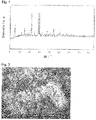
Fig. 1 is a powder X-ray diffraction pattern of the sodium iron carbophosphate in Example 1-2. -
Fig. 2 is a SEM photograph of the sodium iron carbophosphate in Example 1-2. -
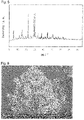
Fig. 3 is a powder X-ray diffraction pattern of the sodium manganese carbophosphate in Example 2-1. -
Fig. 4 is a SEM photograph of the sodium manganese carbophosphate in Example 2-1. -
Fig. 5 is a powder X-ray diffraction pattern of the sodium nickel carbophosphate in Example 3-3. -
Fig. 6 is a SEM photograph of the sodium nickel carbophosphate in Example 3-3. -
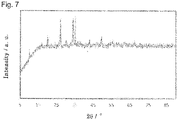
Fig. 7 is a powder X-ray diffraction pattern of the sodium cobalt carbophosphate in Example 4-3. -
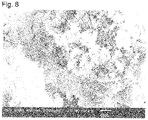
Fig. 8 is a SEM photograph of the sodium cobalt carbophosphate in Example 4-3. - Now, preferred embodiments of the sodium transition metal polyanion of the present disclosure will be described.
- The sodium transition metal polyanion according to the present embodiment (hereinafter also referred to as "the polyanion of the present embodiment") is a sodium transition metal polyanion represented by the formula Na3-xMPO4CO3 (M is at least one member selected from the group consisting of Fe, Mn, Ni and Co, and 0≦x≦2), preferably a synthetic sodium transition metal polyanion (that is sodium transition metal polyanion which is not naturally occurring). In the formula, M is at least one member selected from the group consisting of Fe, Mn, Ni and Co, preferably at least one member selected from the group consisting of Fe, Mn and Ni, at least either one of Fe and Ni, at least either one of Fe and Mn, at least either one of Mn and Ni, Fe or Mn, Fe, Mn, or Ni.
- The sodium transition metal polyanion represented by the formula Na3-xMPO4CO3 (M is at least one member selected from the group consisting of Fe, Mn, Ni and Co, and 0≦x≦2) may be considered as a carbophosphate represented by the formula Na3-xMPO4CO3 (M is at least one member selected from the group consisting of Fe, Mn, Ni and Co, and 0≦x≦2).
- The polyanion of the present embodiment is a compound containing, as the anion, a phosphate ion (PO4 3-) and a carbonate ion (CO3 2-), and may be a sodium transition metal polyanion in which a part of such anion is replaced by an oxide ion (O2-) (hereinafter also referred to as an "oxygen-replaced sodium transition metal polyanion").
- It is preferred that the polyanion of the present embodiment does not contain at least one anion selected from the group consisting of a chloride ion (Cl-), a bromide ion (Br), a sulfate ion (SO4 2-) and a nitrate ion (NO3 -) as impurities, and it is more preferred that the polyanion does not contain a chloride ion.
- The polyanion of the present embodiment has a purity of 90 mass% or higher, and preferably any of 92 mass% or higher, 95 mass% or higher, 97 mass% or higher, and 99 mass% or higher. The purity of the polyanion of the present embodiment is the content of the sodium transition metal polyanion represented by the formula Na3-xMPO4CO3 (hereinafter also referred to as "NaMPC"), determined by X-ray. A synthetic sodium transition metal polyanion artificially synthetized, obtainable by the conventional production method, and a natural sodium transition metal polyanion naturally occurring, form with a large amount of crystal phases other than NaMPC (hereinafter also referred to as "by-product phase"). Thus, the purity (NaMPC content) is low. Since it is hard to separate the by-product phase from a once formed sodium transition metal polyanion, it is difficult to increase the purity (NaMPC content) of such conventional sodium transition metal polyanions.
- On the other hand, the polyanion of the present embodiment is a sodium transition metal polyanion having a low content of the by-product phase, that is a synthetic sodium transition metal polyanion having a high purity, more specifically, a sodium transition metal polyanion having the by-product phase reduced to such an extent that sodium ions will readily be deintercalated and intercalated. The purity of the polyanion of the present embodiment is 100 mass% or lower, and when the by-product phase is not contained or when the content of the by-product phase is the measurement limit or lower, the purity is 100 mass%, and the polyanion can be considered to be in a NaMPC single phase. By the polyanion of the present embodiment having both such a purity and the after-described crystallite size, as compared with the conventional sodium transition metal polyanion, intercalation and deintercalation of sodium ions will readily occur. Thus, the polyanion of the present embodiment is expected to develop high charge and discharge characteristics when used as a cathode active material of a sodium secondary battery.
- According to another embodiment, the polyanion of the present embodiment may be considered as a sodium transition metal polyanion composition containing sodium transition metal polyanion represented by the formula Na3-xMPO4CO3 (M is at least one member selected from the group consisting of Fe, Mn, Ni and Co, and 0≦x≦2) in an amount of any of 90 mass% or higher, 92 mass% or higher, 95 mass% or higher, 97 mass% or higher, and 99 mass% or higher. In a case where the purity is less than 100 mass%, the polyanion of the present embodiment may be considered also as a composition containing NaMPC.
- The purity (mass%) of the polyanion of the present embodiment is a value of the NaMPC content determined by X-ray, and is a content of the crystal phase of NaMPC determined by the quantitative analysis of a powder X-ray diffraction (hereinafter also referred to as "XRD") pattern. The NaMPC content is a value determined by quantitative analysis of an XRD pattern by the reference intensity ratio (hereinafter also referred to as "RIR") method. As the XRD measurement conditions in the present embodiment, the following conditions may be mentioned, and the NaMPC content is preferably a value obtained by the RIR method from an XRD pattern measured under the conditions.
Radiation source : CuKα rays (λ=1.5405 Å) Measurement mode : Step scanning Scanning condition : 20°/min Measurement time : 3 seconds 2θ : 5° to 90° - The XRD pattern may be measured by using a conventional X-ray diffraction apparatus (for example, SmartLab, manufactured by Rigaku Corporation). Using data processing software (for example, PDXL-2) attached to the X-ray diffraction apparatus, the crystal phase may be identified by Rietveld refinement. After the identification, the NaMPC content can be analyzed by the RIR method.
- The RIR value employed in the RIR method (that is, the XRD intensity ratio when the substance to be measured and the reference substance are equivalent), may be a value in PDF (Powder Diffraction File) of ICDD (International Centre For Diffraction Data). As the main RIR values, the following may be mentioned.
Na3MnPO4CO3 : 0.78 (PDF No. 01-084-0023) Na3FePO4CO3 : 0.81 (PDF No. 01-089-7482) Na3PO4 : 1.27 (PDF No. 01-072-7303) Na2CO3 : 1.44 (PDF No. 01-086-0314) - As the by-product phase contained in the polyanion of the present embodiment, at least one of an oxide represented by the formula MOx (M is at least one member selected from the group consisting of Co, Ni, Mn and Fe, and x is 1 or higher and 1.33 or lower) and a hydroxide represented by the formula M(OH)y (M is at least one member selected from the group consisting of Co, Ni, Mn and Fe, and y is higher than 0 and 2 or lower) may be mentioned.
- In the present embodiment, as the by-product phase of the sodium transition metal polyanion represented by the formula Na3-xFePO4CO3 (hereinafter also referred to as "NaFePC"), at least one member selected from the group consisting of FeO1.5, FeO2/3 and Fe(OH)2 may, for example, be mentioned.
- In the present embodiment, as the by-product phase of the sodium transition metal polyanion represented by the formula Na3-xMnPO4CO3 (hereinafter also referred to as "NaMnPC"), at least one member selected from the group consisting of MnO, MnO1.5, MnO2/3 and Mn(OH)2 may, for example, be mentioned.
- In the present embodiment, as the by-product phase of the sodium transition metal polyanion represented by the formula Na3-xNiPO4CO3 (hereinafter also referred to as "NaNiPC"), at least one of NiO and Ni(OH)2 may, for example, be mentioned.
- In the present embodiment, as the by-product phase of the sodium transition metal polyanion represented by the formula Na3-xCoPO4CO3 (hereinafter also referred to as "NaCoPC"), at least one member selected from the group consisting of CoO1.5, CoO2/3 and Co(OH)2 may, for example, be mentioned.
- The polyanion of the present embodiment has a crystallite size of 90 Å or longer and 400 Å or shorter, preferably 95 Å or longer and 360 Å or shorter. By the polyanion of the present embodiment having a purity of 90 mass% or higher and having a crystallite size within such a range, intercalation and deintercalation of sodium ions will efficiently proceed, and with such a polyanion, the resulting cathode active material of a sodium secondary battery is expected to achieve a high charge and discharge capacity.
- In the present embodiment, the crystallite size is preferably a size obtained by Williamson-Hall method (hereinafter also referred to as "WH size") obtained from an XRD pattern. The WH size is a crystallite size obtained from two or more XRD peaks attributable to the sodium transition metal polyanion (NaMPC) in the XRD pattern. Specifically, with respect to two or more, preferably two or more and four or less, more preferably three, XRD peaks attributable to the sodium transition metal polyanion (NaMPC), the following plotting is conducted. From the obtained plots at a plurality of points by the least-squares method, the following first-order approximation is obtained, and the inverse of the y-intercept of the first-order approximation, is the crystallite size (WH size).
-


-

- In these formulae, β is the half width (°), θ is the diffraction angle (°), A is the wavelength (nm) of the radiation source, η is the random distortion, and ε is the crystallite size (Å), and, 1/ε in the first-order approximation is the y-intercept. 2η corresponds to the slope of the first-order approximation obtained from plots at a plurality of points by the least-squares method.
- The WH size in the present embodiment is preferably obtained from XRD peaks corresponding to (020) plane, (220) plane and (002) plane in an XRD pattern. Specifically, with respect to XRD peaks corresponding to the (020) plane, the (220) plane and (002) plane, the above plotting is conducted. From the obtained plots at the three points by the least-squares method, the above first-order approximation is obtained, and the inverse of the y-intercept of the first-order approximation, is taken as the crystallite size.
- XRD peaks corresponding to the (020) plane, (121) plane and (202) plane (hereinafter also referred to as "main peak group") of the polyanion of the present embodiment when CuKa rays (λ=1.5405Å) are used as a radiation source, may be at the following 2θ.
-
- (020) plane: 2θ=26.39° to 27.06°
- (220) plane: 2θ=33.19° to 33.88°
- (002) plane: 2θ=34.59° to 34.99°
- In the present embodiment, 2θ of the main peak group of NaFePC may be the following values.
-
- (020) plane: 2θ=26.86° to 26.94°
- (220) plane: 2θ=33.56° to 33.69°
- (002) plane: 2θ=34.76° to 34.86°
- In the present embodiment, 2θ of the main peak group of NaMnPC may be the following values.
-
- (020) plane: 2θ=26.39° to 26.47°
- (220) plane: 2θ=33.19° to 33.29°
- (002) plane: 2θ=34.59° to 34.77°
- In the present embodiment, 2θ of the main peak group of NaNiPC may be the following values.
-
- (020) plane: 2θ=26.91° to 27.06°
- (220) plane: 2θ=33.68° to 33.88°
- (002) plane: 2θ=34.84° to 34.99°
- In the present embodiment, 2θ of the main peak group of NaCoPC may be the following values.
-
- (020) plane: 2θ=26.88° to 26.94°
- (221) plane: 2θ=33.63° to 33.69°
- (002) plane: 2θ=34.84° to 34.88°
- In the present embodiment, the crystallite size of NaFePC is preferably 150 Å or longer and 400 Å or shorter, more preferably 170 Å or longer and 360 Å or shorter. In another embodiment, the crystallite size of NaFePC is preferably 170 Å or longer, 250 Å or longer, 270 Å or longer, or 300 Å or longer, and 400 Å or shorter, 370 Å or shorter, 350 Å or shorter, 330 Å or shorter, or 320 Å or shorter.
- In the present embodiment, the crystallite size of NaMnPC is preferably 90 Å or longer and 200 Å or shorter, more preferably 90 Å or longer and 180 Å or shorter. In another embodiment, the crystallite size of NaMnPC is preferably 95 Å or longer, 100 Å or longer, 120 Å or longer, or 140 Å or longer, and 190 Å or shorter, 175 Å or shorter, or 160 Å or shorter.
- In the present embodiment, the crystallite size of NaNiPC is preferably 95 Å or longer and 300 Å or shorter, more preferably 100 Å or longer and 250 Å or shorter. In another embodiment, the crystallite size of NaNiPC is preferably 100 Å or longer, 110 Å or longer, or 150 Å or longer, and 250 Å or shorter, 230 Å or shorter, or 220 Å or shorter.
- In the present embodiment, the crystallite size of NaCoPC is preferably 150 Å or longer and 400 Å or shorter, more preferably 180 Å or longer and 370 Å or shorter. In another embodiment, the crystallite size of NaCoPC is preferably 200 Å or longer, 210 Å or longer, or 220 Å or longer, and 380 Å or shorter, 300 Å or shorter, or 250 Å or shorter.
- The polyanion of the present embodiment preferably has either a Bonshtedite structure or a Sidorenkite structure, or a Sidorenkite structure. The Sidorenkite structure is a structure having the vertices of octahedrons each composed of one transition metal atom and six oxygen atoms, shared with tetrahedrons each composed of one phosphorus atom and four oxygen atoms, and having the polyhedrons connected.
- The polyanion of the present embodiment preferably belongs to a monoclinic crystal system. Further, it is preferred that the space group of the monocyclic crystal system belongs to at least one of P21/m and P21, more preferably to P21/m. The monoclinic crystal system is a crystal system such that the lattice constants a, b and c are different from one another, both α and γ are 90°, and, β is an angle other than 90°.
- The polyanion of the present embodiment preferably has lattice constants a of 8.800 Å or longer and 9.050 Å or shorter, b of 6.570 Å or longer and 6.780 Å or shorter, c of 5.100 Å or longer and 5.190 Å or shorter, α of 90.00°, γ of 90.00°, and β of 89.00° or more and 90.50° or less. More preferred lattice constants may be a of 8.820 Å or longer and 9.030 Å or shorter, b of 6.580 Å or longer and 6.770 Å or shorter, c of 5.110 Å or longer and 5.180 Å or shorter, α of 90.00°, γ of 90.00°, and β of 89.10° or more and 90.20° or less.
- In the present embodiment, NaFePC has lattice constants a of 8.930 Å or longer and 8.985 Å or shorter, preferably 8.940 Å or longer and 8.975 Å or shorter, more preferably 8.959 Å or longer and 8.970 Å or shorter, b of 6.600 Å or longer and 6.655 Å or shorter, preferably 6.610 Å or longer and 6.645 Å or shorter, more preferably 6.615 Å or longer and 6.635 Å or shorter, c of 5.125 Å or longer and 5.175 Å or shorter, preferably 5.135 Å or longer and 5.165 Å or shorter, more preferably 5.145 Å or longer and 5.159 Å or shorter, α of 90.00°, γ of 90.00°, β of 89.30° or more and 89.80° or less, preferably 89.50° or more and 89.70° or less.
- In the present embodiment, NaMnPC has lattice constants a of 8.960 Å or longer and 9.050 Å or shorter, preferably 8.970 Å or longer and 9.030 Å or shorter, more preferably 8.981 Å or longer and 9.030 Å or shorter, further preferably 9.000 Å or longer and 9.025 Å or shorter, b of 6.705 Å or longer and 6.780 Å or shorter, preferably 6.715 Å or longer and 6.775 Å or shorter, more preferably 6.729 Å or longer and 6.770 Å or shorter, further preferably 6.745 Å or longer and 6.765 Å or shorter, c of 5.135 Å or longer and 5.190 Å or shorter, preferably 5.145 Å or longer and 5.180 Å or shorter, more preferably 5.150 Å or longer and 5.180 Å or shorter, α of 90.00°, γ of 90.00°, β of 89.90° or longer and 90.50° or shorter, preferably 90.10° or longer and 90.20°, more preferably 90.14° or longer and °90.20 or shorter.
- In the present embodiment, NaNiPC has lattice constants a of 8.800 Å or longer and 8.940 Å or shorter, preferably 8.815 Å or longer and 8.930 Å or shorter, more preferably 8.885 Å or longer and 8.930 Å or shorter, further preferably 8.900 Å or longer and 8.925 Å or shorter, b of 6.570 Å or longer and 6.660 Å or shorter, preferably 6.580 Å or longer and 6.650 Å or shorter, more preferably 6.625 Å or longer and 6.645 Å or shorter, c of 5.100 Å or longer and 5.180 Å or shorter, preferably 5.110 Å or longer and 5.170 Å or shorter, more preferably 5.129 Å or longer and 5.165 Å or shorter, further preferably 5.131 Å or longer and 5.160 Å or shorter, α of 90.00°, γ of 90.00°, β of 89.00° or more and 89.40° or less, preferably 89.10° or more and 89.30° or less, more preferably 89.15° or more and 89.29° or less, further preferably 89.15° or more and 89.25° or less.
- In the present embodiment, NaCoPC has lattice constants a of 8.875 Å or longer and 8.940 Å or shorter, preferably 8.880 Å or longer and 8.930 Å or shorter, more preferably 8.885 Å or longer and 8.930 Å or shorter, further preferably 8.900 Å or longer and 8.925 Å or shorter, b of 6.605 Å or longer and 6.660 Å or shorter, preferably 6.615 Å or longer and 6.650 Å or shorter, more preferably 6.625 Å or longer and 6.645 Å or shorter, c of 5.125 Å or longer and 5.175 Å or shorter, preferably 5.130 Å or longer and 5.165 Å or shorter, more preferably 5.135 Å or longer and 5.160 Å or shorter, further preferably 5.140 Å or longer and 5.149 Å or shorter, α of 90°, γ of 90°, β of 89.20° or more and 89.65° or less, preferably 89.30° or more and 89.55° or less, more preferably 89.35° or more and 89.52° or less, further preferably 89.35° or more and 89.48° or less.
- The crystallite size (WH size) and the crystallite size may be obtained with respect to the XRD pattern measured and identified in the same manner as the purity. Further, in a case where the purity of the polyanion of the present embodiment is less than 100 mass%, they may be obtained from the XRD peaks attributable to NaMnPC.
- The polyanion of the present embodiment may be in any optional form, such as a powder, granules or a molded product, and is preferably in a powder form.
- In another embodiment, the polyanion is a sodium transition metal carbophosphate, and may be a sodium transition metal carbophosphate represented by the formula Na3-xMPO4CO3 (M is at least one member selected from the group consisting of Fe, Mn, Ni and Co, and 0≦x≦2).
- In another embodiment, the polyanion may be a sodium transition metal carbophosphate with a content of a sodium transition metal carbophosphate represented by the formula Na3-xMPO4CO3 (M is at least one member selected from the group consisting of Fe, Mn, Ni and Co, and 0≦x≦2) being 90 mass% or higher and 100 mass% or lower.
- In another embodiment, the polyanion may be a sodium transition metal polyanion with a content of a sodium transition metal carbophosphate represented by the formula Na3-xMPO4CO3 (M is at least one member selected from the group consisting of Fe, Mn, Ni and Co, and 0≦x≦2) being 90 mass% or higher and 100 mass% or lower.
- In still another embodiment, the polyanion may be a sodium transition metal polyanion which contains a sodium transition metal carbophosphate represented by the formula Na3-xMPO4CO3 (M is at least one member selected from the group consisting of Fe, Mn, Ni and Co, and 0≦x≦2) and having a crystallite size of 90 Å or longer and 400 Å or shorter, and has a content of the sodium transition rare metal carbophosphate of preferably 90 mass% or higher, more preferably 98 mass% or higher.
- Now, the method for producing the polyanion of the present embodiment will be described.
- The method for producing the polyanion of the present embodiment is a production method comprising a step of subjecting a composition containing a sodium source, a transition metal source, a phosphate source, a carbonate source and water to hydrothermal treatment, and wherein the hydrothermal treatment temperature is 140°C or higher and 280°C or lower, and the pH of the composition is 7.5 or higher.
- By the step of subjecting a composition containing a sodium source, a transition metal source, a phosphate source, a carbonate source and water (hereinafter also referred to as "raw material composition") to hydrothermal treatment (hereinafter also referred to as "hydrothermal treatment step"), the sodium transition metal polyanion can be crystallized while formation of the by-product phase is suppressed.
- The sodium source is at least one of sodium and a compound containing sodium, preferably a water-soluble sodium salt. The water-soluble sodium salt may be at least one member selected from the group consisting of sodium fluoride, sodium chloride, sodium phosphate, disodium hydrogenphosphate, sodium dihydrogen phosphate, sodium sulfite, sodium sulfate, sodium hydrogen carbonate and sodium carbonate, preferably at least one member selected from the group consisting of sodium phosphate, disodium hydrogenphosphate, sodium dihydrogen phosphate, sodium sulfite, sodium sulfate, sodium hydrogen carbonate and sodium carbonate, more preferably at least one member selected from the group consisting of sodium phosphate, disodium hydrogenphosphate, sodium sulfate, sodium hydrogen carbonate and sodium carbonate. The raw material composition preferably contains two or more types of water-soluble sodium salts, so that the hydrothermal temperature range at which the sodium transition metal polyanion of the present embodiment can be crystallized tends to be wide, and the sodium transition metal polyanion of the present embodiment tends to be crystallized even at a relatively high temperature. The water-soluble sodium salt may be at least one member selected from the group consisting of sodium fluoride, sodium chloride, sodium phosphate, disodium hydrogen phosphate, sodium dihydrogen phosphate, sodium sulfite, sodium sulfate, sodium hydrogen carbonate and sodium carbonate. The raw material composition preferably contains at least two members selected from the group consisting of sodium phosphate, disodium hydrogen phosphate, sodium dihydrogen phosphate, sodium sulfite, sodium sulfate, sodium hydrogen carbonate and sodium carbonate.
- The transition metal source is a compound containing at least one member selected from the group consisting of iron (Fe), manganese (Mn), nickel (Ni) and cobalt (Co), preferably a compound containing at least one member selected from the group consisting of iron, manganese and nickel, more preferably a compound containing at least one of iron and manganese. The transition metal source is preferably at least one member selected from the group consisting of an oxide, a hydroxide, an oxyhydroxide, a sulfite, a sulfate, a phosphate, a carbonate, a nitrate, a chloride and an acetate, containing at least one member selected from the group consisting of iron, manganese, nickel and cobalt, more preferably at least one of a sulfate, a phosphate and a carbonate, further preferably a sulfate.
- The transition metal contained in the transition metal source is at least one member selected from the group consisting of iron, manganese, nickel and cobalt, preferably at least one member selected from the group consisting of iron, manganese and nickel, more preferably at least one of iron and manganese.
- The transition metal source containing iron (hereinafter also referred to as "iron source") is preferably at least one member selected from the group consisting of iron(II) oxide, iron(III) oxide, iron hydroxide, iron oxyhydroxide, iron sulfate, iron phosphate, iron carbonate, iron nitrate, iron chloride and iron acetate, more preferably at least one member selected from the group consisting of iron sulfate, iron phosphate, iron chloride and iron carbonate.
- The transition metal source containing manganese (hereinafter also referred to as "manganese source") is preferably at least one member selected from the group consisting of manganese oxide, manganese dioxide, trimanganese tetroxide, manganese hydroxide, manganese oxyhydroxide, manganese sulfate, manganese phosphate, manganese carbonate, manganese nitrate, manganese chloride and manganese acetate, more preferably at least one member selected from the group consisting of manganese sulfate, manganese phosphate, manganese carbonate and manganese chloride.
- The transition metal source containing nickel (hereinafter also referred to as "nickel source") is preferably at least one member selected from the group consisting of nickel oxide, nickel hydroxide, nickel oxyhydroxide, nickel sulfate, nickel nitrate, nickel chloride and nickel acetate, more preferably at least one of nickel sulfate and nickel chloride.
- The transition metal source containing cobalt (hereinafter also referred to as "cobalt source") is preferably at least one member selected from the group consisting of cobalt(II) oxide, cobalt(III) oxide, cobalt hydroxide, cobalt oxyhydroxide, cobalt sulfate, cobalt nitrate, cobalt chloride and cobalt acetate, more preferably at least one of cobalt sulfate and cobalt chloride.
- The phosphate source may be a compound containing a phosphate ion (PO4 3-), and is preferably at least one member selected from the group consisting of an alkali metal phosphate, a transition metal phosphate, iron phosphate, manganese phosphate, nickel phosphate, cobalt phosphate, phosphoric acid, sodium phosphate, sodium dihydrogen phosphate and disodium hydrogen phosphate, more preferably at least one member selected from the group consisting of iron phosphate, manganese phosphate, nickel phosphate, cobalt phosphate, phosphoric acid, sodium phosphate and disodium hydrogen phosphate.
- The carbonate source may be a compound containing a carbonate ion (CO3 2-) and is preferably at least one member selected from the group consisting of an alkali metal carbonate, a transition metal carbonate, iron carbonate, manganese carbonate, nickel carbonate, cobalt carbonate, sodium carbonate and sodium hydrogen carbonate, more preferably at least one member selected from the group consisting of iron carbonate, manganese carbonate, nickel carbonate, cobalt carbonate, sodium carbonate and sodium hydrogen carbonate.
- Water may, for example, be pure water, deionized water, or water contained as water of hydration or water of constitution, constituting the raw material hydrate such as the transition metal source, or an aqueous solution.
- The raw material composition may contain additives, in addition to the raw materials such as the sodium source, the transition metal source, the phosphate source and the carbonate source, and water. The additive is preferably at least one member selected from the group consisting of oxalic acid, ascorbic acid, sulfurous acid, sodium sulfite, thiosulfuric acid, sodium thiosulfate, sodium monohydrogensulfide, hydrazine and sodium hypochlorite, more preferably at least one member selected from the group consisting of ascorbic acid, sulfurous acid, sodium sulfite, thiosulfuric acid, sodium thiosulfate, sodium monohydrogensulfide and sodium hypochlorite.
- The raw material composition may be obtained by mixing the raw materials, water and as the case requires, additives, by an optional method. The atmosphere in which the raw materials are mixed is optional, and may, for example, be at least one member selected from the group consisting of an oxidizing atmosphere in which oxygen gas is present, such as air atmosphere, a reducing atmosphere and an inert atmosphere, and is preferably an oxidizing atmosphere in which oxygen gas is present. In view of simplicity, the atmosphere in which the raw materials are mixed is particularly preferably air atmosphere.
- In the present embodiment, the hydrothermal treatment temperature is 140°C or higher and 280°C or lower. The hydrothermal treatment temperature is a temperature at which the raw material composition is subjected to hydrothermal treatment. When the hydrothermal treatment temperature is 140°C or higher, the crystallite size tends to be large.
- In the present embodiment, in a case where the raw material composition is subjected to hydrothermal treatment, the hydrothermal treatment temperature is preferably 150°C or higher and 250°C or lower, more preferably 160°C or higher and 230°C or lower, further preferably 170°C or higher and 220°C or lower, still more preferably 180°C or higher and less than 220°C.
- In the present embodiment, the pH of the raw material composition is 7.5 or higher, preferably 10.0 or higher. In crystallization at a hydrothermal treatment temperature of 150°C or higher, the pH of the raw material composition is preferably 7.5 or higher and 12.5 or lower, more preferably 10.5 or higher and 11.5 or lower. The pH of the raw material composition is a value of the raw material composition at a point when the hydrothermal treatment is started, and the pH value may change during the hydrothermal treatment.
- In the present embodiment, the pH of the raw material composition containing the iron source is preferably 8.0 or higher and 12.0 or lower, more preferably 9.5 or higher and 12.0 or lower, further preferably 10.5 or higher and 11.5 or lower.
- In the present embodiment, the pH of the raw material composition containing the manganese source is preferably 8.5 or higher and 12.5 or lower, more preferably 10.0 or higher and 12.5 or lower, further preferably 10.5 or higher and 11.5 or lower.
- In the present embodiment, the pH of the raw material composition containing the nickel source is preferably 7.5 or higher and 12.5 or lower, more preferably 8.0 or higher and 12.0 or lower, further preferably 9.5 or higher and 11.0 or lower.
- In the present embodiment, the pH of the raw material composition containing the cobalt source is preferably 8.5 or higher and 12.5 or lower, more preferably 10.5 or higher and 11.5 or lower.
- In the hydrothermal treatment step in the present embodiment, the hydrothermal treatment is carried out preferably in a state where the raw material composition is packed in a reactor. The reactor may, for example, be a sealed pressure-resistant container having the inner surface covered with a fluororesin.
- In the present embodiment, the hydrothermal treatment reaction time depends on the reaction temperature. The reaction temperature is preferably 4 hours or longer and 100 hours or shorter, more preferably 10 hours or longer and 50 hours or shorter, more preferably 10 hours or longer and 30 hours or shorter.
- The production method of the present embodiment may contain at least one member selected from the group consisting of a washing step, a separation step and a drying step.
- The washing step is a step of removing water-soluble impurities from the sodium transition metal polyanion obtained by the hydrothermal treatment step. The washing method is optional and may, for example, be a treatment of dispersing the sodium transition metal polyanion in a sufficient amount of pure water. This treatment may be conducted several times.
- The separation step is a step of separating the sodium transition metal polyanion and the solvent. The separation method is optional and may, for example, be at least one method selected from the group consisting of centrifugal separation, filtration and filter press.
- The drying step is a step of removing moisture adsorbed in the sodium transition metal polyanion. The drying method is optional and may, for example, be treatment in air or in vacuum at 80°C or higher and 120°C or lower for 1 hour or longer and 10 hours or shorter, and is preferably treatment in vacuum.
- The polyanion of the present embodiment may be used for an adsorbent, an ion exchanger, a hydrogen ion conductor, a solid electrolyte and a battery material, since intercalation and deintercalation of sodium ions (Na+) will readily proceed. The polyanion of the present embodiment is used preferably as a cathode active material, particularly a cathode active material of a sodium secondary battery.
- When the polyanion of the present embodiment is used as a cathode active material of a sodium secondary battery, it may be formed into a cathode mixture containing the polyanion of the present embodiment and as the case requires, at least one of a binder and an electrically conductive material, and the resulting cathode mixture is used as a cathode. As the binder and the electrically conductive material, known ones may be used.
- A sodium secondary battery having a cathode containing the polyanion of the present embodiment has a high charge and discharge capacity as compared with a conventional sodium secondary battery.
- A sodium secondary battery is a secondary battery having a cathode, an anode and an electrolyte. The sodium secondary battery in the present embodiment is characterized by having, as the cathode, a cathode containing the polyanion of the present embodiment, and may have, as the anode and the electrolyte, optional ones.
- The anode may be made of a material having sodium intercalation/deintercalation capability, which may be conventionally used by those skilled in the art, and may, for example, be platinum, a carbon material, a material forming an alloy with sodium, a sodium-containing transition metal oxide, or a sodium-containing polyanion material.
- The electrolyte may be at least one of an electrolytic solution and a solid electrolyte which may be conventionally used by those skilled in the art.
- The electrolytic solution may, for example, be an organic electrolytic solution having a sodium salt and various additives dissolved in an organic solvent. The solid electrolyte may, for example, be a sodium ion conductive solid electrolyte.
- Now, the present embodiment will be described in further detail with reference to Examples. However, it should be understood that the present embodiment is by no means restricted to such specific Examples.
- The crystal phase of each of the products obtained in Examples and Comparative Examples was measured by powder X-ray diffraction. The powder X-ray diffraction was conducted using an X-ray diffraction apparatus (apparatus name: SmartLab, manufactured by Rigaku Corporation) under the following conditions.
Radiation source :CuKα rays (λ=1.5405 Å) Measurement mode :Step scanning Scanning condition :20°/min Measurement time :3 seconds Measurement range :2θ = 5° to 90° - The composition of the sample was measured by using an inductively coupled plasma spectrometer (apparatus name: ICP-AES manufactured by PerkinElmer Japan Co., Ltd.).
- A sample was deposited on a carbon tape, followed by gold sputtering, and the carbon tape was set on a brass holder, and the sample was observed by a scanning electron microscope (apparatus name: JSM-IT100, manufactured by JEOL Ltd.) with 10,000 magnifications.
- The sodium transition metal polyanion and an electrically conductive binder (trade name: TAB-2, manufactured by Hohsen Corp.) were weighed in a mass ratio of 2:1 and mixed in an agate mortar to obtain a cathode mixture. The obtained cathode mixture was placed on a SUS mesh (SUS316) having a diameter of 8 mm, and uniaxially pressed under 1 ton/cm2 to obtain cathode mixture pellets. The cathode mixture pellets were vacuum dried at 150°C for 2 hours to obtain a cathode.
- Using the obtained cathode, a sodium secondary battery comprising three electrode electrochemical cells having the following structure was prepared.
Test electrode : cathode Counter electrode : platinum (Pt) plate Reference electrode : saturated calomel electrode Electrolytic solution : (electrolyte) NaPF6 1 mol/dm3 (solvent) ethylene carbonate (EC):dimethyl carbonate (DMC)=1:1 (volume ratio) - The prepared sodium secondary battery was subjected to constant current charge and discharge test. The evaluation conditions are as follows.
Temperature : room temperature (24.5±2.5°C that is 22 to 27°C) Electrode potential : -2.18 to 2.02V (saturated calomel reference electrode) Current value : constant at 1 mA/cm2 Number of charge and discharge : 10 cycles - Such electrode potential vs. the saturated calomel reference electrode corresponds to 0.76 to 4.98V vs. the sodium electrode.
- Iron(II) sulfate heptahydrate (FeSO4·7H2O), sodium phosphate dodecahydrate (Na3PO4·12H2O) and anhydrous sodium carbonate (Na2CO3) were ground and mixed, and pure water was added to the mixture to obtain a composition having the following composition and having a pH of 11.0.
Iron(II) sulfate heptahydrate : 13.6 mass% Sodium phosphate dodecahydrate: 18.7 mass% Anhydrous sodium carbonate : 5.2 mass% Pure water : the rest - The composition was packed and sealed in a Teflon (registered trademark) resin container with a lid in an air atmosphere, the container was placed in a constant temperature oven, and hydrothermal treatment was applied under the following conditions.
Hydrothermal treatment temperature : 180°C Hydrothermal treatment time : 16 hours Hydrothermal treatment pressure : under autogenous pressure - After the hydrothermal treatment, the product cooled to room temperature was mixed with pure water in a sufficient amount and stirred to be washed, and subjected to suction filtration using a filter paper with a pore size of 0.2 µm to obtain sodium iron carbophosphate in this Example.
- The sodium iron carbophosphate in this Example was dried in vacuum at 110°C for 4 hours and ground in a mortar. The sodium iron carbophosphate in this Example had a Na3FePO4CO3 purity of 100 mass%, and no crystallized product other than Na3FePO4CO3 was confirmed in its XRD pattern. Na3FePO4CO3 as the sodium iron carbophosphate in this Example is a compound having a monoclinic crystal system, having a Bonshtedite structure and belonging to the space group P21/m, and the main XRD peaks were as follows.
(020) plane: 2θ=26.86° (relative intensity=81) (220) plane: 2θ=33.57° (relative intensity=78) (002) plane: 2θ=34.80° (relative intensity=100) - Sodium iron carbophosphate in this Example was obtained in the same manner as in Example 1-1 except that the raw material composition had the following composition and had a pH of 11.0 and that the hydrothermal treatment time was 72 hours.
Iron(II) sulfate heptahydrate : 14.1 mass% Sodium phosphate dodecahydrate: 14.6 mass% Anhydrous sodium carbonate : 6.7 mass% Pure water : the rest - The sodium iron carbophosphate in this Example had a Na3FePO4CO3 purity of 100 mass%, and no crystallized product other than Na3FePO4CO3 was confirmed in its XRD pattern. Na3FePO4CO3 as the sodium iron carbophosphate in this Example is a compound having a monoclinic crystal system, having a Bonshtedite structure and belonging to the space group P21/m, and the main XRD peaks were as follows.
- (020) plane: 2θ=26.89° (relative intensity=96)
- (220) plane: 2θ=33.64° (relative intensity=93)
- (002) plane: 2θ=34.80° (relative intensity=100)
- Sodium iron carbophosphate in this Example was obtained in the same manner as in Example 1-1 except that the raw material composition had the following composition and had a pH of 11.0 and that the hydrothermal treatment time was 6 hours.
Iron(II) sulfate heptahydrate : 13.6 mass% Sodium phosphate dodecahydrate: 18.7 mass% Anhydrous sodium carbonate : 5.2 mass% Pure water : the rest - The sodium iron carbophosphate in this Example had a Na3FePO4CO3 purity of 100 mass%, and no crystallized product other than Na3FePO4CO3 was confirmed in its XRD pattern. Na3FePO4CO3 as the sodium iron carbophosphate in this Example is a compound having a monoclinic crystal system, having a Bonshtedite structure and belonging to the space group P21/m, and the main XRD peaks were as follows.
- (020) plane: 2θ=26.87° (relative intensity=72)
- (220) plane: 2θ=33.56° (relative intensity=82)
- (002) plane: 2θ=34.80° (relative intensity=100)
- Sodium iron carbophosphate in this Example was obtained in the same manner as in Example 1-1 except that the raw material composition had the following composition and had a pH of 11.0 and that the hydrothermal treatment time was 48 hours.
Iron(II) sulfate heptahydrate : 15.5 mass% Sodium phosphate dodecahydrate: 21.4 mass% Anhydrous sodium carbonate : 5.9 mass% Pure water : the rest - The sodium iron carbophosphate in this Example had a Na3FePO4CO3 purity of 100 mass%, and no crystallized product other than Na3FePO4CO3 was confirmed in its XRD pattern. Na3FePO4CO3 as the sodium iron carbophosphate in this Example is a compound having a monoclinic crystal system, having a Bonshtedite structure and belonging to the space group P21/m, and the main XRD peaks were as follows.
- (020) plane: 2θ=26.90° (relative intensity=100)
- (220) plane: 2θ=33.62° (relative intensity=93)
- (002) plane: 2θ=34.80° (relative intensity=85)
- Sodium iron carbophosphate in this Example was obtained in the same manner as in Example 1-1 except that the raw material composition had the following composition and had a pH of 11.0 and that the hydrothermal treatment temperature was 160°C.
Iron(II) sulfate heptahydrate : 14.0 mass% Sodium phosphate dodecahydrate: 19.2 mass% Anhydrous sodium carbonate 6.7 mass% Pure water the rest - The sodium iron carbophosphate in this Example had a Na3FePO4CO3 purity of 100 mass%, and no crystallized product other than Na3FePO4CO3 was confirmed in its XRD pattern. Na3FePO4CO3 as the sodium iron carbophosphate in this Example is a compound having a monoclinic crystal system, having a Bonshtedite structure and belonging to the space group P21/m, and the main XRD peaks were as follows.
- (020) plane: 2θ=26.93° (relative intensity=100)
- (220) plane: 2θ=33.68° (relative intensity=91)
- (002) plane: 2θ=34.80° (relative intensity=87)
- Sodium iron carbophosphate in this Example was obtained in the same manner as in Example 1-5 except that the hydrothermal treatment temperature was 220°C.
Iron(II) sulfate heptahydrate : 14.0 mass% Sodium phosphate dodecahydrate: 19.2 mass% Anhydrous sodium carbonate : 6.7 mass% Pure water : the rest - The sodium iron carbophosphate in this Example had a Na3FePO4CO3 purity of 100 mass%, and no crystallized product other than Na3FePO4CO3 was confirmed in its XRD pattern. Na3FePO4CO3 as the sodium iron carbophosphate in this Example is a compound having a monoclinic crystal system, having a Bonshtedite structure and belonging to the space group P21/m, and the main XRD peaks were as follows.
- (020) plane: 2θ=26.93° (relative intensity=100)
- (220) plane: 2θ=33.67° (relative intensity=88)
- (002) plane: 2θ=34.80° (relative intensity=84)
- Sodium iron carbophosphate in this Example was obtained in the same manner as in Example 1-5 except that the raw material composition had the following composition and had a pH of 11.0 and that the hydrothermal treatment temperature was 220°C.
Iron(II) sulfate heptahydrate : 14.1 mass% Sodium phosphate dodecahydrate: 19.5 mass% Anhydrous sodium carbonate : 5.4 mass% Pure water : the rest - The sodium iron carbophosphate in this Example had a NaFePC purity of 100 mass%, and no crystalized product other than NaFePC was confirmed in its XRD pattern. Na3FePO4CO3 as the sodium iron carbophosphate in this Example is a compound having a monoclinic crystal system, having a Bonshtedite structure and belonging to the space group P21/m, and the main XRD peaks were as follows.
- (020) plane: 2θ=26.92° (relative intensity=100)
- (220) plane: 2θ=33.65° (relative intensity=98)
- (002) plane: 2θ=34.80° (relative intensity=95)
- Sodium iron carbophosphate in this Example was obtained in the same manner as in Example 1-5 except that the hydrothermal treatment temperature was 220°C.
Iron(II) sulfate heptahydrate : 14.0 mass% Sodium phosphate dodecahydrate: 19.2 mass% Anhydrous sodium carbonate : 6.7 mass% Pure water : the rest - The sodium iron carbophosphate in this Example had a NaFePC purity of 100 mass%. NaFePC as the sodium iron carbophosphate in this Example is a compound having a monoclinic crystal system, having a Bonshtedite structure and belonging to the space group P21/m, and the main XRD peaks were as follows.
- (020) plane: 2θ=26.94° (relative intensity=100)
- (220) plane: 2θ=33.69° (relative intensity=92)
- (002) plane: 2θ=34.80° (relative intensity=91)
- Sodium iron carbophosphate in this Example was obtained in the same manner as in Example 1-8 except that the hydrothermal treatment time was 96 hours.
Iron(II) sulfate heptahydrate : 14.0 mass% Sodium phosphate dodecahydrate: 19.2 mass% Anhydrous sodium carbonate : 6.7 mass% Pure water : the rest - The sodium iron carbophosphate in this Example had a NaFePC purity of 100 mass%, and no crystalized product other than NaFePC was confirmed in its XRD pattern. NaFePC as the sodium iron carbophosphate in this Example is a compound having a monoclinic crystal system, having a Bonshtedite structure and belonging to the space group P21/m, and the main XRD peaks were as follows.
- (020) plane: 2θ=26.92° (relative intensity=100)
- (220) plane: 2θ=33.67° (relative intensity=93)
- (002) plane: 2θ=34.80° (relative intensity=94)
- It is found that the sodium transition metal polyanion having a NaFePC single phase is crystalized even when the hydrothermal treatment temperature is 180°C or higher in the production method in these Examples.
- A precipitate in this Comparative Example was obtained in the same manner as in Example 1-1 except that the raw material composition had the following composition and had a pH of 11.0 and that the hydrothermal treatment temperature was 120°C.
Iron(II) sulfate heptahydrate 14.1 mass% Sodium phosphate dodecahydrate: 19.5 mass% Anhydrous sodium carbonate : 5.4 mass% Pure water : the rest - The precipitate in this Comparative Example was an amorphous substance containing Na3Fe3(PO4)4, and no NaFePC was obtained.
- Manganese sulfate pentahydrate (MnSO4·5H2O), sodium phosphate dodecahydrate (Na3PO4·12H2O) and anhydrous sodium carbonate (Na2CO3) were ground and mixed, and pure water was added to the mixture to obtain a composition having the following composition and having a pH of 11.0.
Manganese sulfate pentahydrate : 12.0 mass% Sodium phosphate dodecahydrate: 18.9 mass% Anhydrous sodium carbonate : 5.2 mass% Pure water : the rest - The composition was packed and sealed in a Teflon (registered trademark) resin container with a lid, the container was placed in a constant temperature oven, and hydrothermal treatment was applied under the following conditions.
Hydrothermal treatment temperature : 180°C Hydrothermal treatment time 72 hours Hydrothermal treatment pressure under autogenous pressure - After the hydrothermal treatment, the product cooled to room temperature was mixed with pure water in a sufficient amount and stirred to be washed, and subjected to suction filtration using a filter paper with a pore size of 0.2 µm to obtain sodium manganese carbophosphate in this Example.
- The sodium manganese carbophosphate in this Example was dried in vacuum at 110°C for 4 hours and ground in a mortar. The sodium manganese carbophosphate in this Example had a NaMnPC purity of 100 mass%, and no crystallized product other than NaMnPC was confirmed in its XRD pattern. NaMnPC as the sodium manganese carbophosphate in this Example is a compound having a monoclinic crystal system, having a Sidorenkite structure isomorphic to a Bonshtedite structure and belonging to the space group P21/m, and the main XRD peaks were as follows.
- (020) plane: 2θ=26.44° (relative intensity=100)
- (220) plane: 2θ=33.25° (relative intensity=100)
- (002) plane: 2θ=34.68° (relative intensity=72)
- Sodium manganese carbophosphate in this Example was obtained in the same manner as in Example 2-1 except that the raw material composition had the following composition and had a pH of 11.0, that the hydrothermal treatment temperature was 200°C, and that the hydrothermal treatment time was 16 hours.
Manganese sulfate pentahydrate : 12.3 mass% Sodium phosphate dodecahydrate: 19.4 mass% Anhydrous sodium carbonate : 5.4 mass% Pure water : the rest - The sodium manganese carbophosphate in this Example had a NaMnPC purity of 98 mass%, and the by-product phase was Mn(OH)2. NaMnPC as the sodium manganese carbophosphate in this Example is a compound having a monoclinic crystal system, having a Sidorenkite structure and belonging to the space group P21/m, and the main XRD peaks were as follows.
- (020) plane: 2θ=26.39° (relative intensity=100)
- (220) plane: 2θ=33.19° (relative intensity=96)
- (002) plane: 2θ=34.63° (relative intensity=64)
- Sodium manganese carbophosphate in this Example was obtained in the same manner as in Example 2-2 except that the raw material composition had the following composition and had a pH of 11.0 and that the hydrothermal treatment time was 24 hours.
Manganese sulfate pentahydrate : 13.1 mass% Sodium phosphate dodecahydrate: 20.6 mass% Anhydrous sodium carbonate : 5.7 mass% Pure water : the rest - The sodium manganese carbophosphate in this Example had a NaMnPC purity of 100 mass%, and no crystalized product other than NaMnPC was confirmed in its XRD pattern, and no by-product phase was contained. NaMnPC as the sodium manganese carbophosphate in this Example is a compound having a monoclinic crystal system, having a Sidorenkite structure and belonging to the space group P21/m, and the main XRD peaks were as follows.
- (020) plane: 2θ=26.47° (relative intensity=94)
- (220) plane: 2θ=33.28° (relative intensity=100)
- (002) plane: 2θ=34.72° (relative intensity=69)
- Sodium manganese carbophosphate in this Example was obtained in the same manner as in Example 2-1 except that the raw material composition had the following composition and had a pH of 11.0 and that the hydrothermal treatment time was 16 hours.
Manganese sulfate pentahydrate : 12.4 mass% Sodium phosphate dodecahydrate: 19.6 mass% Anhydrous sodium carbonate 6.8 mass% Pure water the rest - The sodium manganese carbophosphate in this Example had a NaMnPC purity of 100 mass%, and no crystalized product other than NaMnPC was confirmed in its XRD pattern, and no by-product phase was contained. NaMnPC as the sodium manganese carbophosphate in this Example is a compound having a monoclinic crystal system, having a Sidorenkite structure and belonging to the space group P21/m, and the main XRD peaks were as follows.
- (020) plane: 2θ=26.42° (relative intensity=97)
- (220) plane: 2θ=33.21° (relative intensity=100)
- (002) plane: 2θ=34.73° (relative intensity=60)
- Sodium manganese carbophosphate in this Example was obtained in the same manner as in Example 2-4 except that the raw material composition had the following composition and had a pH of 11.0.
Manganese sulfate pentahydrate : 12.3 mass% Sodium phosphate dodecahydrate: 19.3 mass% Anhydrous sodium carbonate : 8.1 mass% Pure water : the rest - The sodium manganese carbophosphate in this Example had a NaMnPC purity of 99 mass%, and the by-product phase was Mn(OH)2. NaMnPC as the sodium manganese carbophosphate in this Example is a compound having a monoclinic crystal system, having a Sidorenkite structure and belonging to the space group P21/m, and the main XRD peaks were as follows.
- (020) plane: 2θ=26.45° (relative intensity=100)
- (220) plane: 2θ=33.29° (relative intensity=87)
- (002) plane: 2θ=34.77° (relative intensity=56)
- A sodium secondary battery having the sodium manganese carbophosphate in this Example as the cathode active material was prepared, and the charge and discharge capacity was measured and as a result, the discharge capacity at the 10th cycle was 96 mAh/g, and accordingly it is found that the sodium transition metal polyanion in this Example can be used as a cathode active material of a sodium secondary battery.
- Sodium manganese carbophosphate in this Example was obtained in the same manner as in Example 2-1 except that the raw material composition had the following composition and had a pH of 11.0.
Manganese sulfate pentahydrate : 12.0 mass% Sodium phosphate dodecahydrate: 19.0 mass% Anhydrous sodium carbonate : 9.7 mass% Pure water : the rest - The sodium manganese carbophosphate in this Example had a NaMnPC purity of 98 mass%, and the by-product phase was Mn(OH)2. NaMnPC as the sodium manganese carbophosphate in this Example is a compound having a monoclinic crystal system, having a Sidorenkite structure and belonging to the space group P21/m, and the main XRD peaks were as follows.
- (020) plane: 2θ=26.41° (relative intensity=100)
- (220) plane: 2θ=33.26° (relative intensity=78)
- (002) plane: 2θ=34.64° (relative intensity=40)
- Sodium manganese carbophosphate in this Example was obtained in the same manner as in Example 2-1 except that the raw material composition had the following composition and had a pH of 11.0 and that the hydrothermal treatment temperature was 160°C.
Manganese sulfate pentahydrate : 12.6 mass% Sodium phosphate dodecahydrate: 19.9 mass% Anhydrous sodium carbonate : 5.5 mass% Pure water : the rest - The sodium manganese carbophosphate in this Example had a NaMnPC purity of 100 mass%, and no crystalized product other than NaMnPC was confirmed in its XRD pattern, and no by-product phase was contained. NaMnPC as the sodium manganese carbophosphate in this Example is a compound having a monoclinic crystal system, having a Sidorenkite structure and belonging to the space group P21/m, and the main XRD peaks were as follows.
- (020) plane: 2θ=26.42° (relative intensity=100)
- (220) plane: 2θ=33.21° (relative intensity=95)
- (002) plane: 2θ=34.59° (relative intensity=54)
- Sodium manganese carbophosphate in this Example was obtained in the same manner as in Example 2-7 except that the hydrothermal treatment temperature was 220°C.
- The sodium manganese carbophosphate in this Example had a NaMnPC purity of 93 mass%, and the by-product phase was Mn(OH)2. NaMnPC as the sodium manganese carbophosphate in this Example is a compound having a monoclinic crystal system, having a Sidorenkite structure and belonging to the space group P21/m, and the main XRD peaks were as follows.
- (020) plane: 2θ=26.43° (relative intensity=100)
- (220) plane: 2θ=33.23° (relative intensity=97)
- (002) plane: 2θ=34.76° (relative intensity=64)
- Sodium manganese carbophosphate in this Example was obtained in the same manner as in Example 2-7 except that the hydrothermal treatment temperature was 200°C.
- The sodium manganese carbophosphate in this Example had a NaMnPC purity of 100 mass%, no crystalized product other than NaMnPC was confirmed in its XRD pattern, and no by-product phase was contained. NaMnPC as the sodium manganese carbophosphate in this Example is a compound having a monoclinic crystal system, having a Sidorenkite structure and belonging to the space group P21/m, and the main XRD peaks were as follows.
- (020) plane: 2θ=26.42° (relative intensity=100)
- (220) plane: 2θ=33.20° (relative intensity=100)
- (002) plane: 2θ=34.72° (relative intensity=61)
- Nickel sulfate hexahydrate (NiSO4·6H2O), sodium phosphate dodecahydrate (Na3PO4·12H2O), anhydrous sodium carbonate (Na2CO3) and anhydrous sodium sulfite (Na2SO3) were ground and mixed, and pure water was added to the mixture to obtain a composition having the following composition and having a pH of 11.0.
nickel sulfate hexahydrate : 13.7 mass% Sodium phosphate dodecahydrate: 19.6 mass% Anhydrous sodium carbonate : 5.4 mass% Pure water : the rest - The composition was packed and sealed in a Teflon (registered trademark) resin container with a lid, the container was placed in a constant temperature oven, and hydrothermal treatment was applied under the following conditions.
Hydrothermal treatment temperature : 180°C Hydrothermal treatment time : 16 hours Hydrothermal treatment pressure : under autogenous pressure - After the hydrothermal treatment, the product cooled to room temperature was mixed with pure water in a sufficient amount and stirred to be washed, and subjected to suction filtration using a filter paper with a pore size of 0.2 µm to obtain sodium nickel carbophosphate in this Example.
- The sodium nickel carbophosphate in this Example was dried in vacuum at 110°C for 4 hours and ground in a mortar. The sodium nickel carbophosphate in this Example had a NaNiPC purity of 100 mass%, and no crystallized product other than NaNiPC was confirmed in its XRD pattern. NaNiPC as the sodium nickel carbophosphate in this Example is a compound having a monoclinic crystal system, having a structure isomorphic to a Bonshtedite structure and belonging to the space group P21/m, and the main XRD peaks were as follows.
- (020) plane: 2θ=26.91° (relative intensity=96)
- (220) plane: 2θ=33.68° (relative intensity=100)
- (002) plane: 2θ=34.89° (relative intensity=88)
- Sodium nickel carbophosphate in this Example was obtained in the same manner as in Example 3-1 except that the raw material composition had the following composition.
Nickel sulfate hexahydrate : 13.7 mass% Sodium phosphate dodecahydrate: 19.6 mass% Anhydrous sodium carbonate : 5.4 mass% Pure water : the rest - The sodium nickel carbophosphate in this Example had a NaNiPC purity of 100 mass%, and no crystallized product other than NaNiPC was confirmed in its XRD pattern. NaNiPC as the sodium nickel carbophosphate in this Example is a compound having a monoclinic crystal system, having a structure isomorphic to a Bonshtedite structure and belonging to the space group P21/m, and the main XRD peaks were as follows.
- (020) plane: 2θ=26.99° (relative intensity=100)
- (220) plane: 2θ=33.80° (relative intensity=90)
- (002) plane: 2θ=34.95° (relative intensity=88)
- Sodium nickel carbophosphate in this Example was obtained in the same manner as in Example 3-1 except that the raw material composition had the following composition.
Nickel sulfate hexahydrate : 13.1 mass% Sodium phosphate dodecahydrate: 18.7 mass% Anhydrous sodium carbonate : 9.6 mass% Pure water : the rest - The sodium nickel carbophosphate in this Example had a NaNiPC purity of 100 mass%, and no crystallized product other than NaNiPC was confirmed in its XRD pattern. NaNiPC as the sodium nickel carbophosphate in this Example is a compound having a monoclinic crystal system, having a structure isomorphic to a Bonshtedite structure and belonging to the space group P21/m, and the main XRD peaks were as follows.
- (020) plane: 2θ=27.00° (relative intensity=99)
- (220) plane: 2θ=33.82° (relative intensity=95)
- (002) plane: 2θ=34.96° (relative intensity=100)
- Sodium nickel carbophosphate in this Example was obtained in the same manner as in Example 3-1 except that the raw material composition had the following composition and that the hydrothermal treatment time was 72 hours.
Nickel sulfate hexahydrate : 13.2 mass% Sodium phosphate dodecahydrate: 18.8 mass% Anhydrous sodium carbonate : 9.1 mass% Pure water : the rest - The sodium nickel carbophosphate in this Example had a NaNiPC purity of 100 mass%, and no crystallized product other than NaNiPC was confirmed in its XRD pattern. NaNiPC as the sodium nickel carbophosphate in this Example is a compound having a monoclinic crystal system, having a structure isomorphic to a Bonshtedite structure and belonging to the space group P21/m, and the main XRD peaks were as follows.
- (020) plane: 2θ=27.06° (relative intensity=100)
- (220) plane: 2θ=33.87° (relative intensity=90)
- (002) plane: 2θ=34.99° (relative intensity=92)
- Sodium nickel carbophosphate in this Example was obtained in the same manner as in Example 3-1 except that the raw material composition had the following composition and had a pH of 11.0 and that the hydrothermal treatment temperature was 160°C.
Nickel sulfate hexahydrate : 12.5 mass% Sodium phosphate dodecahydrate: 18.0 mass% Anhydrous sodium carbonate : 7.5 mass% Anhydrous sodium sulfite : 5.9 mass% Pure water : the rest - The sodium nickel carbophosphate in this Example had a NaNiPC purity of 100 mass%, and no crystallized product other than NaNiPC was confirmed in its XRD pattern. NaNiPC as the sodium nickel carbophosphate in this Example is a compound having a monoclinic crystal system, having a structure isomorphic to a Bonshtedite structure and belonging to the space group P21/m, and the main XRD peaks were as follows.
- (020) plane: 2θ=26.94° (relative intensity=90)
- (220) plane: 2θ=33.70° (relative intensity=100)
- (002) plane: 2θ=34.84° (relative intensity=89)
- Sodium nickel carbophosphate in this Example was obtained in the same manner as in Example 3-1 except that the raw material composition had the following composition and had a pH of 11.0 and that the hydrothermal treatment temperature was 200°C.
Nickel sulfate hexahydrate : 12.7 mass% Sodium phosphate dodecahydrate: 18.2 mass% Anhydrous sodium carbonate : 7.6 mass% Anhydrous sodium sulfite : 4.5 mass% Pure water : the rest - The sodium nickel carbophosphate in this Example had a NaNiPC purity of 100 mass%, and no crystallized product other than NaNiPC was confirmed in its XRD pattern. NaNiPC as the sodium nickel carbophosphate in this Example is a compound having a monoclinic crystal system, having a structure isomorphic to a Bonshtedite structure and belonging to the space group P21/m, and the main XRD peaks were as follows.
- (020) plane: 2θ=27.03° (relative intensity=100)
- (220) plane: 2θ=33.83° (relative intensity=83)
- (002) plane: 2θ=34.96° (relative intensity=89)
- Sodium nickel carbophosphate in this Example was obtained in the same manner as in Example 3-1 except that the raw material composition had the following composition and had a pH of 11.0 and that the hydrothermal treatment temperature was 220°C.
Nickel sulfate hexahydrate : 13.5 mass% Sodium phosphate dodecahydrate: 19.3 mass% Anhydrous sodium carbonate : 6.7 mass% Pure water : the rest - The sodium nickel carbophosphate in this Example had a NaNiPC purity of 97 mass%, and the by-product phase was Ni(OH)2. NaNiPC as the sodium nickel carbophosphate in this Example is a compound having a monoclinic crystal system, having a structure isomorphic to a Bonshtedite structure and belonging to the space group P21/m, and the main XRD peaks were as follows.
- (020) plane: 2θ=27.06° (relative intensity=100)
- (220) plane: 2θ=33.88° (relative intensity=83)
- (002) plane: 2θ=34.98° (relative intensity=88)
- Crystallized product of this Comparative Example was obtained in the same manner as in Example 3-1 except that anhydrous disodium hydrogen phosphate (Na2HPO4) was used, the raw material composition had the following composition and a pH of 7.0.
Nickel sulfate hexahydrate : 14.6 mass% Sodium phosphate dodecahydrate : 10.4 mass% Anhydrous disodium hydrogen phosphate : 3.9 mass% Anhydrous sodium carbonate : 5.8 mass% Pure water : the rest - The obtained crystalized product was a composite phase 97 mass% of which was occupied with Ni1.94O2(OH)2, and no NaNiPC was obtained.
- Cobalt sulfate heptahydrate (CoSO4·7H2O), sodium phosphate dodecahydrate (Na3PO4·12H2O) and anhydrous sodium carbonate (Na2CO3) were ground and mixed, and pure water was added to the mixture to obtain a composition having the following composition and having a pH of 11.0.
Cobalt sulfate heptahydrate : 14.4 mass% Sodium phosphate dodecahydrate: 19.4 mass% Anhydrous sodium carbonate : 5.4 mass% Pure water : the rest - The composition was packed and sealed in a Teflon (registered trademark) resin container with a lid, the container was placed in a constant temperature oven, and hydrothermal treatment was applied under the following conditions.
Hydrothermal treatment temperature : 180°C Hydrothermal treatment time : 16 hours Hydrothermal treatment pressure : under autogenous pressure - After the hydrothermal treatment, the product cooled to room temperature was mixed with pure water in a sufficient amount and stirred to be washed, and subjected to suction filtration using a filter paper with a pore size of 0.2 µm to obtain sodium cobalt carbophosphate in this Example.
- The sodium cobalt carbophosphate in this Example was dried in vacuum at 110°C for 4 hours and ground in a mortar. The sodium cobalt carbophosphate in this Example had a NaCoPC purity of 100 mass%, and no crystallized product other than NaCoPC was confirmed in its XRD pattern. NaCoPC as the sodium cobalt carbophosphate in this Example is a compound having a monoclinic crystal system, having a structure isomorphic to a Bonshtedite structure and belonging to the space group P21/m, and the main XRD peaks were as follows.
- (020) plane: 2θ=26.88° (relative intensity=89)
- (220) plane: 2θ=33.63° (relative intensity=94)
- (002) plane: 2θ=34.85° (relative intensity=100)
- Sodium cobalt carbophosphate in this Example was obtained in the same manner as in Example 4-1 except that the raw material composition had the following composition and had a pH of 11.0.
Cobalt sulfate heptahydrate : 13.5 mass% Sodium phosphate dodecahydrate: 22.9 mass% Anhydrous sodium carbonate : 6.3 mass% Pure water : the rest - The sodium cobalt carbophosphate in this Example had a NaCoPC purity of 100 mass%, and no crystalized product other than NaCoPC was confirmed in its XRD pattern. NaCoPC as the sodium cobalt carbophosphate in this Example is a compound having a monoclinic crystal system, having a structure isomorphic to a Bonshtedite structure and belonging to the space group P21/m, and the main XRD peaks were as follows.
- (020) plane: 2θ=26.93° (relative intensity=94)
- (220) plane: 2θ=33.69° (relative intensity=100)
- (002) plane: 2θ=34.87° (relative intensity=99)
- Sodium cobalt carbophosphate in this Example was obtained in the same manner as in Example 4-1 except that the raw material composition had the following composition and had a pH of 11.0.
Cobalt sulfate heptahydrate : 16.4 mass% Sodium phosphate dodecahydrate: 22.1 mass% Anhydrous sodium carbonate : 6.1 mass% Pure water : the rest - The sodium cobalt carbophosphate in this Example had a NaCoPC purity of 100 mass%, and no crystalized product other than NaCoPC was confirmed in its XRD pattern. NaCoPC as the sodium cobalt carbophosphate in this Example is a compound having a monoclinic crystal system, having a structure isomorphic to a Bonshtedite structure and belonging to the space group P21/m, and the main XRD peaks were as follows.
- (020) plane: 2θ=26.88° (relative intensity=78)
- (220) plane: 2θ=33.64° (relative intensity=84)
- (002) plane: 2θ=34.84° (relative intensity=100)
- Sodium cobalt carbophosphate in this Example was obtained in the same manner as in Example 4-1 except that the raw material composition had the following composition and had a pH of 11.0.
Cobalt sulfate heptahydrate : 18.0 mass% Sodium phosphate dodecahydrate: 24.4 mass% Anhydrous sodium carbonate : 6.8 mass% Pure water : the rest - The sodium cobalt carbophosphate in this Example had a NaCoPC purity of 100 mass%, and no crystalized product other than NaCoPC was confirmed in its XRD pattern. NaCoPC as the sodium cobalt carbophosphate in this Example is a compound having a monoclinic crystal system, having a structure isomorphic to a Bonshtedite structure and belonging to the space group P21/m, and the main XRD peaks were as follows.
- (020) plane: 2θ=26.91° (relative intensity=59)
- (220) plane: 2θ=33.65° (relative intensity=65)
- (002) plane: 2θ=34.84° (relative intensity=100)
- Sodium cobalt carbophosphate in this Example was obtained in the same manner as in Example 4-1 except that the raw material composition had the following composition and had a pH of 11.0 and that the hydrothermal treatment time was 48 hours.
Cobalt sulfate heptahydrate : 14.4 mass% Sodium phosphate dodecahydrate: 19.4 mass% Anhydrous sodium carbonate : 5.4 mass% Pure water : the rest - The sodium cobalt carbophosphate in this Example had a NaCoPC purity of 100 mass%, and no crystalized product other than NaCoPC was confirmed in its XRD pattern. NaCoPC as the sodium cobalt carbophosphate in this Example is a compound having a monoclinic crystal system, having a structure isomorphic to a Bonshtedite structure and belonging to the space group P21/m, and the main XRD peaks were as follows.
- (020) plane: 2θ=26.94° (relative intensity=90)
- (220) plane: 2θ=33.68° (relative intensity=96)
- (002) plane: 2θ=34.86° (relative intensity=100)
- Sodium cobalt carbophosphate in this Example was obtained in the same manner as in Example 4-1 except that the raw material composition had the following composition and had a pH of 11.0 and that the hydrothermal treatment time was 48 hours.
Cobalt sulfate heptahydrate : 16.4 mass% Sodium phosphate dodecahydrate: 22.1 mass% Anhydrous sodium carbonate : 6.1 mass% Pure water : the rest - The sodium cobalt carbophosphate in this Example had a NaCoPC purity of 100 mass%, and no crystalized product other than NaCoPC was confirmed in its XRD pattern. NaCoPC as the sodium cobalt carbophosphate in this Example is a compound having a monoclinic crystal system, having a structure isomorphic to a Bonshtedite structure and belonging to the space group P21/m, and the main XRD peaks were as follows.
- (020) plane: 2θ=26.93° (relative intensity=92)
- (220) plane: 2θ=33.66° (relative intensity=92)
- (002) plane: 2θ=34.88° (relative intensity=100)
- The sodium transition metal polyanion of the present embodiment is applicable to a cathode active material of a sodium secondary battery.
- The entire disclosure of
Japanese Patent Application No. 2019-098308 filed on May 27, 2019
| Purity (mass%) | WH size (A) | Lattice constants | ||||
| a (Å) | b (Å) | c (Å) | β (° ) | |||
| Example 1-1 | 100 | 270 | 8.953 | 6.633 | 5.152 | 89.583 |
| Example 1-2 | 100 | 326 | 8.950 | 6.623 | 5.149 | 89.548 |
| Example 1-3 | 100 | 176 | 8.953 | 6.634 | 5.151 | 89.630 |
| Example 1-4 | 100 | 322 | 8.960 | 6.626 | 5.154 | 89.536 |
| Example 1-5 | 100 | 274 | 8.959 | 6.626 | 5.152 | 89.548 |
| Example 1-6 | 100 | 312 | 8.961 | 6.627 | 5.154 | 89.524 |
| Example 1-7 | 100 | 284 | 8.961 | 6.627 | 5.154 | 89.524 |
| Example 1-8 | 100 | 337 | 8.964 | 6.629 | 5.155 | 89.536 |
| Example 1-9 | 100 | 352 | 8.964 | 6.629 | 5.155 | 89.536 |
| Purity (mass%) | WH size (Å) | Lattice constants | ||||
| a (Å) | b (Å) | c (Å) | β (° ) | |||
| Example 2-1 | 100 | 172 | 9.003 | 6.745 | 5.166 | 90.160 |
| Example 2-2 | 98 | 151 | 9.003 | 6.745 | 5.166 | 90.160 |
| Example 2-3 | 100 | 145 | 8.981 | 6.729 | 5.154 | 90.160 |
| Example 2-4 | 100 | 115 | 9.017 | 6.761 | 5.175 | 90.167 |
| Example 2-5 | 99 | 98 | 9.017 | 6.761 | 5.176 | 90.167 |
| Example 2-6 | 98 | 177 | 9.017 | 6.761 | 5.176 | 90.167 |
| Example 2-7 | 100 | 116 | 9.017 | 6.761 | 5.176 | 90.167 |
| Example 2-8 | 93 | 178 | 9.017 | 6.761 | 5.176 | 90.167 |
| Example 2-9 | 100 | 139 | 9.017 | 6.761 | 5.176 | 90.167 |
| Purity (mass%) | WH size (A) | Lattice constants | ||||
| a (Å) | b (Å) | c (Å) | β (° ) | |||
| Example 3-1 | 100 | 107 | 8.833 | 6.613 | 5.147 | 89.287 |
| Example 3-2 | 100 | 152 | 8.919 | 6.639 | 5.157 | 89.159 |
| Example 3-3 | 100 | 158 | 8.848 | 6.607 | 5.135 | 89.224 |
| Example 3-4 | 100 | 221 | 8.836 | 6.591 | 5.129 | 89.222 |
| Example 3-5 | 100 | 115 | 8.888 | 6.628 | 5.150 | 89.157 |
| Example 3-6 | 100 | 154 | 8.843 | 6.595 | 5.132 | 89.216 |
| Example 3-7 | 97 | 210 | 8.836 | 6.595 | 5.132 | 89.213 |
| Purity (mass%) | WH size (Å) | Lattice constants | ||||
| a (Å) | b (Å) | c (Å) | β (° ) | |||
| Example 4-1 | 100 | 220 | 8.903 | 6.637 | 5.148 | 89.510 |
| Example 4-2 | 100 | 202 | 8.903 | 6.637 | 5.140 | 89.510 |
| Example 4-3 | 100 | 219 | 8.888 | 6.627 | 5.146 | 89.393 |
| Example 4-4 | 100 | 273 | 8.888 | 6.627 | 5.146 | 89.393 |
| Example 4-5 | 100 | 353 | 8.888 | 6.627 | 5.146 | 89.393 |
| Example 4-6 | 100 | 247 | 8.921 | 6.641 | 5.153 | 89.448 |
Claims (8)
- A sodium transition metal polyanion, which has a purity of 90 mass% or higher, has a crystallite size of 90 Å or longer and 400 Å or shorter, and is represented by the formula Na3-xMPO4CO3 (M is at least one member selected from the group consisting of Fe, Mn, Ni and Co, and 0≦x≦2).
- The sodium transition metal polyanion according to Claim 1, which has lattice constants a of 8.800 Å or longer and 9.050 Å or shorter, b of 6.570 Å or longer and 6.780 Å or shorter, and c of 5.100 Å or longer and 5.190 Å or shorter.
- The sodium transition metal polyanion according to Claim 1 or 2, wherein M is at least one of Fe and Mn.
- A method for producing the sodium transition metal polyanion as defined in any one of Claims 1 to 3, which comprises a step of subjecting a composition containing a sodium source, a transition metal source, a phosphate source, a carbonate source and water to hydrothermal treatment, and wherein the hydrothermal treatment temperature is 140°C or higher and 280°C or lower, and the pH of the composition is 7.5 or higher.
- The method for producing the sodium transition metal polyanion according to Claim 4, wherein the hydrothermal treatment temperature is 150°C or higher and 250°C or lower, and the pH of the composition is 9.0 or higher and 12.0 or lower.
- The method for producing the sodium transition metal polyanion according to Claim 4 or 5, wherein the transition metal source is at least one member selected from the group consisting of an oxide, a hydroxide, an oxyhydroxide, a sulfite, a sulfate, a nitrate, a chloride, an acetate, a bromide and a fluoride, containing at least one member selected from the group consisting of Fe, Mn, Ni and Co.
- A cathode active material containing the sodium transition metal polyanion as defined in any one of Claims 1 to 3.
- A sodium secondary battery comprising a cathode active material containing the sodium transition metal polyanion as defined in any one of Claims 1 to 3.
Applications Claiming Priority (2)
| Application Number | Priority Date | Filing Date | Title |
|---|---|---|---|
| JP2019098308 | 2019-05-27 | ||
| PCT/JP2020/020985 WO2020241711A1 (en) | 2019-05-27 | 2020-05-27 | Sodium transition metal polyanion and production method thereof |
Publications (2)
| Publication Number | Publication Date |
|---|---|
| EP3978430A1 true EP3978430A1 (en) | 2022-04-06 |
| EP3978430A4 EP3978430A4 (en) | 2023-06-28 |
Family
ID=73553820
Family Applications (1)
| Application Number | Title | Priority Date | Filing Date |
|---|---|---|---|
| EP20815295.9A Pending EP3978430A4 (en) | 2019-05-27 | 2020-05-27 | Sodium transition metal polyanion and production method thereof |
Country Status (5)
| Country | Link |
|---|---|
| US (1) | US20220212933A1 (en) |
| EP (1) | EP3978430A4 (en) |
| JP (1) | JPWO2020241711A1 (en) |
| CN (1) | CN113891851A (en) |
| WO (1) | WO2020241711A1 (en) |
Families Citing this family (2)
| Publication number | Priority date | Publication date | Assignee | Title |
|---|---|---|---|---|
| JP7699049B2 (en) * | 2019-05-27 | 2025-06-26 | 国立大学法人九州大学 | Aqueous sodium ion secondary battery |
| CN117525648B (en) * | 2023-10-17 | 2026-02-13 | 漳州明德工贸有限公司 | A method for preparing polyanion cathodes for sodium-ion batteries from waste lithium-ion battery ternary materials |
Family Cites Families (7)
| Publication number | Priority date | Publication date | Assignee | Title |
|---|---|---|---|---|
| KR100939647B1 (en) * | 2009-01-22 | 2010-02-03 | 한화석유화학 주식회사 | Anion-deficient non-stoichiometric lithium transition metal polyacid compound as electrode active material, method for preparing the same, and electrochemical device using the same |
| KR20130040777A (en) * | 2010-02-22 | 2013-04-24 | 메사추세츠 인스티튜트 오브 테크놀로지 | Carbophosphates and related compounds |
| US10090516B2 (en) * | 2012-04-24 | 2018-10-02 | National University Of Singapore | Electrode material and method of synthesizing |
| JP6427921B2 (en) * | 2013-06-28 | 2018-11-28 | 日亜化学工業株式会社 | Cathode active material for non-aqueous secondary battery and method for producing the same |
| US20210206792A1 (en) * | 2015-11-19 | 2021-07-08 | Qatar Foundation For Education, Science And Community Development | Complex transition metal phosphonates |
| US10695725B2 (en) * | 2016-03-03 | 2020-06-30 | Enlighten Innovations Inc. | Intercalation membrane |
| JP6793629B2 (en) | 2017-12-08 | 2020-12-02 | 中外炉工業株式会社 | Vertical drop type powder heating device |
-
2020
- 2020-05-27 US US17/613,380 patent/US20220212933A1/en not_active Abandoned
- 2020-05-27 WO PCT/JP2020/020985 patent/WO2020241711A1/en not_active Ceased
- 2020-05-27 JP JP2021522831A patent/JPWO2020241711A1/ja active Pending
- 2020-05-27 EP EP20815295.9A patent/EP3978430A4/en active Pending
- 2020-05-27 CN CN202080038631.6A patent/CN113891851A/en active Pending
Also Published As
| Publication number | Publication date |
|---|---|
| US20220212933A1 (en) | 2022-07-07 |
| JPWO2020241711A1 (en) | 2020-12-03 |
| CN113891851A (en) | 2022-01-04 |
| EP3978430A4 (en) | 2023-06-28 |
| WO2020241711A1 (en) | 2020-12-03 |
Similar Documents
| Publication | Publication Date | Title |
|---|---|---|
| KR101369658B1 (en) | Li-Ni COMPOSITE OXIDE PARTICLE POWDER FOR RECHARGEABLE BATTERY WITH NONAQUEOUS ELECTROLYTE, PROCESS FOR PRODUCING THE Li-Ni COMPOSITE OXIDE PARTICLE POWDER, AND RECHARGEABLE BATTERY WITH NONAQUEOUS ELECTROLYTE | |
| Thackeray et al. | Electrochemical extraction of lithium from LiMn2O4 | |
| US6337132B1 (en) | Layered rock salt-type oxide particle powder and process for producing the same | |
| KR100898236B1 (en) | Ferrous phosphate hydrous salt crystal, method for preparing the same, and method for producing lithium iron-phosphorus composite oxide | |
| US4312930A (en) | MnO2 Derived from LiMn2 O4 | |
| EP1964944B1 (en) | Electrolytic manganese dioxide, and method for its production and its application | |
| EP2910528B1 (en) | Li-Ni COMPLEX OXIDE PARTICLE POWDER AND NON-AQUEOUS ELECTROLYTE SECONDARY BATTERY | |
| EP2471976B1 (en) | Electrolytic manganese dioxide, method for producing same, and use of same | |
| EP3978429A1 (en) | Aqueous sodium ion secondary battery | |
| WO2012111766A1 (en) | Electrolytic manganese dioxide and method for producing same, and method for producing lithium-manganese complex oxide | |
| US11165064B2 (en) | Li-substituted layered spinel cathode materials for sodium ion batteries | |
| CA2172939A1 (en) | Process for preparing lithium intercalation compounds | |
| JP2025075097A (en) | Spinel-type lithium manganese oxide, its manufacturing method and its use | |
| EP3955347A1 (en) | Precursor, method for manufacturing precursor, positive electrode material, method for manufacturing positive electrode material, and lithium-ion secondary cell | |
| US20220212933A1 (en) | Sodium transition metal polyanion and production method thereof | |
| EP2784847A1 (en) | Surface modified lithiated H2V3O8 | |
| EP4269359A1 (en) | Spinel-type lithium manganese, method for producing same, and use of same | |
| EP4169879A1 (en) | Method for producing positive electrode active material for non-aqueous electrolyte secondary battery | |
| US20130207032A1 (en) | Lithium iron silicate cathode material and its production | |
| WO2021177337A1 (en) | Sodium transition metal polyanion | |
| WO2021177338A1 (en) | Sodium transition metal polyanion | |
| JP2022541157A (en) | Lithium-rich transition metal deficient spinels for fast charge/discharge lithium-ion battery materials | |
| KR20240039145A (en) | Method for producing positive electrode active material for lithium secondary battery and method for producing positive electrode for lithium secondary battery | |
| EP2829515B1 (en) | Manganomanganic oxide and process for producing same | |
| CN114212764A (en) | Phosphate anode material precursor, preparation method and application thereof |
Legal Events
| Date | Code | Title | Description |
|---|---|---|---|
| STAA | Information on the status of an ep patent application or granted ep patent |
Free format text: STATUS: THE INTERNATIONAL PUBLICATION HAS BEEN MADE |
|
| PUAI | Public reference made under article 153(3) epc to a published international application that has entered the european phase |
Free format text: ORIGINAL CODE: 0009012 |
|
| STAA | Information on the status of an ep patent application or granted ep patent |
Free format text: STATUS: REQUEST FOR EXAMINATION WAS MADE |
|
| 17P | Request for examination filed |
Effective date: 20211125 |
|
| AK | Designated contracting states |
Kind code of ref document: A1 Designated state(s): AL AT BE BG CH CY CZ DE DK EE ES FI FR GB GR HR HU IE IS IT LI LT LU LV MC MK MT NL NO PL PT RO RS SE SI SK SM TR |
|
| DAV | Request for validation of the european patent (deleted) | ||
| DAX | Request for extension of the european patent (deleted) | ||
| A4 | Supplementary search report drawn up and despatched |
Effective date: 20230531 |
|
| RIC1 | Information provided on ipc code assigned before grant |
Ipc: H01M 4/02 20060101ALI20230524BHEP Ipc: C01B 35/06 20060101ALI20230524BHEP Ipc: H01M 10/054 20100101ALI20230524BHEP Ipc: H01M 4/58 20100101ALI20230524BHEP Ipc: C01B 25/45 20060101AFI20230524BHEP |
|
| STAA | Information on the status of an ep patent application or granted ep patent |
Free format text: STATUS: EXAMINATION IS IN PROGRESS |
|
| 17Q | First examination report despatched |
Effective date: 20251114 |