EP3975486A1 - Evpn packet forwarding method, system, storage medium, and terminal - Google Patents
Evpn packet forwarding method, system, storage medium, and terminal Download PDFInfo
- Publication number
- EP3975486A1 EP3975486A1 EP20843511.5A EP20843511A EP3975486A1 EP 3975486 A1 EP3975486 A1 EP 3975486A1 EP 20843511 A EP20843511 A EP 20843511A EP 3975486 A1 EP3975486 A1 EP 3975486A1
- Authority
- EP
- European Patent Office
- Prior art keywords
- esi
- message
- label
- evpn
- header information
- Prior art date
- Legal status (The legal status is an assumption and is not a legal conclusion. Google has not performed a legal analysis and makes no representation as to the accuracy of the status listed.)
- Granted
Links
Images



Classifications
-
- H—ELECTRICITY
- H04—ELECTRIC COMMUNICATION TECHNIQUE
- H04L—TRANSMISSION OF DIGITAL INFORMATION, e.g. TELEGRAPHIC COMMUNICATION
- H04L12/00—Data switching networks
- H04L12/28—Data switching networks characterised by path configuration, e.g. LAN [Local Area Networks] or WAN [Wide Area Networks]
- H04L12/46—Interconnection of networks
- H04L12/4633—Interconnection of networks using encapsulation techniques, e.g. tunneling
-
- H—ELECTRICITY
- H04—ELECTRIC COMMUNICATION TECHNIQUE
- H04L—TRANSMISSION OF DIGITAL INFORMATION, e.g. TELEGRAPHIC COMMUNICATION
- H04L45/00—Routing or path finding of packets in data switching networks
- H04L45/50—Routing or path finding of packets in data switching networks using label swapping, e.g. multi-protocol label switch [MPLS]
-
- H—ELECTRICITY
- H04—ELECTRIC COMMUNICATION TECHNIQUE
- H04L—TRANSMISSION OF DIGITAL INFORMATION, e.g. TELEGRAPHIC COMMUNICATION
- H04L12/00—Data switching networks
- H04L12/28—Data switching networks characterised by path configuration, e.g. LAN [Local Area Networks] or WAN [Wide Area Networks]
- H04L12/46—Interconnection of networks
-
- H—ELECTRICITY
- H04—ELECTRIC COMMUNICATION TECHNIQUE
- H04L—TRANSMISSION OF DIGITAL INFORMATION, e.g. TELEGRAPHIC COMMUNICATION
- H04L12/00—Data switching networks
- H04L12/28—Data switching networks characterised by path configuration, e.g. LAN [Local Area Networks] or WAN [Wide Area Networks]
- H04L12/46—Interconnection of networks
- H04L12/4641—Virtual LANs, VLANs, e.g. virtual private networks [VPN]
-
- H—ELECTRICITY
- H04—ELECTRIC COMMUNICATION TECHNIQUE
- H04L—TRANSMISSION OF DIGITAL INFORMATION, e.g. TELEGRAPHIC COMMUNICATION
- H04L12/00—Data switching networks
- H04L12/28—Data switching networks characterised by path configuration, e.g. LAN [Local Area Networks] or WAN [Wide Area Networks]
- H04L12/46—Interconnection of networks
- H04L12/4641—Virtual LANs, VLANs, e.g. virtual private networks [VPN]
- H04L12/4645—Details on frame tagging
-
- H—ELECTRICITY
- H04—ELECTRIC COMMUNICATION TECHNIQUE
- H04L—TRANSMISSION OF DIGITAL INFORMATION, e.g. TELEGRAPHIC COMMUNICATION
- H04L12/00—Data switching networks
- H04L12/28—Data switching networks characterised by path configuration, e.g. LAN [Local Area Networks] or WAN [Wide Area Networks]
- H04L12/46—Interconnection of networks
- H04L12/4641—Virtual LANs, VLANs, e.g. virtual private networks [VPN]
- H04L12/4645—Details on frame tagging
- H04L12/465—Details on frame tagging wherein a single frame includes a plurality of VLAN tags
-
- H—ELECTRICITY
- H04—ELECTRIC COMMUNICATION TECHNIQUE
- H04L—TRANSMISSION OF DIGITAL INFORMATION, e.g. TELEGRAPHIC COMMUNICATION
- H04L45/00—Routing or path finding of packets in data switching networks
- H04L45/66—Layer 2 routing, e.g. in Ethernet based MAN's
-
- H—ELECTRICITY
- H04—ELECTRIC COMMUNICATION TECHNIQUE
- H04L—TRANSMISSION OF DIGITAL INFORMATION, e.g. TELEGRAPHIC COMMUNICATION
- H04L45/00—Routing or path finding of packets in data switching networks
- H04L45/74—Address processing for routing
-
- H—ELECTRICITY
- H04—ELECTRIC COMMUNICATION TECHNIQUE
- H04L—TRANSMISSION OF DIGITAL INFORMATION, e.g. TELEGRAPHIC COMMUNICATION
- H04L2212/00—Encapsulation of packets
Definitions
- Embodiments of the present disclosure relate to, but are not limited to, the technical field of network communication, and in particular to a method and a system for Ethernet virtual private network (EVPN) message forwarding, and a computer-readable storage medium and a terminal device.
- EVPN Ethernet virtual private network
- EVPN is a two-layer virtual private network (VPN) technique.
- the core convergence layer of the control plane of EVPN transfers media access control (MAC) and routing information through the multiprotocol border gateway protocol (MP-BGP), and forwarding entries do not depend on data plane learning.
- the concept of Ethernet segment (ES) is introduced into EVPN.
- ES Ethernet segment
- An ES is identified by a unique Ethernet segment identifier (ESI).
- EVPN supports three forms of message encapsulation, i.e. Multi-Protocol Label Switching (MPLS) EVPN, Provider Backbone Bridge (PBB) EVPN and Virtual Extensible Local Area Network (VXLAN) EVPN.
- MPLS Multi-Protocol Label Switching
- PBB Provider Backbone Bridge
- VXLAN Virtual Extensible Local Area Network
- a multi-homing access mode is introduced into EVPN, while redundant links are introduced into the multi-homing access mode, and as a result, a loop exists in the network.
- a provider edge device PE1 receives a message from a customer edge device CE1, the message returns to CE1 after being forwarded by the provider edge device PE1 and the provider edge device PE2, and as a result, a loop is formed, directly resulting in a broadcast storm.
- non-DF non-designated forwarder
- BUM unknown-unicast and multicast
- the present disclosure provides a method and a system for EVPN message forwarding, and a computer-readable storage medium and a terminal device, to at least solve the problem of looping in the same ES in EVPN.
- the method for EVPN message forwarding may include:
- the system for EVPN message forwarding may include a label processing module, a service processing module, and a message processing module.
- the label processing module is configured to read an Ethernet segment identifier (ESI) label from a message in response to the message containing the ESI label after receiving the message from an upstream device, and obtaining a port for an Ethernet segment (ES) corresponding to the ESI label according to the ESI label.
- ESI Ethernet segment identifier
- the service processing module is configured to read an egress port for the message.
- the message processing module is configured to discard the message in response to the port for the Ethernet segment (ES) corresponding to the ESI label obtained according to the ESI label being the same as the egress port for the message.
- ES Ethernet segment
- a computer-readable storage medium which stores computer-executable instructions.
- the instructions when executed by a processor, cause the processor to implement the aforementioned method for EVPN message forwarding .
- the terminal device may include: a memory configured to store computer-executable instructions; and a processor configured to execute the computer-executable instructions to implement the aforementioned method for EVPN message forwarding.
- a memory configured to store computer-executable instructions
- a processor configured to execute the computer-executable instructions to implement the aforementioned method for EVPN message forwarding.
- an ESI label is introduced into MPLS EVPN.
- the ESI label is carried in an Ethernet Auto-Discovery per Ethernet Segment (Ethernet AD per ES) route, and a corresponding ESI is learned from a table forwarding table corresponding to the ESI label.
- Ethernet AD per ES Ethernet Auto-Discovery per Ethernet Segment
- a corresponding ESI is learned from a table forwarding table corresponding to the ESI label.
- the ESI label solution defined by RFC7432 will lead to two layers of private network labels nested in a BUM message, that is, a label stack structure is formed, which is very common in MPLS encapsulation.
- a label stack structure is formed, which is very common in MPLS encapsulation.
- VNI VXLAN network identifier
- a method for EVPN message forwarding is provided and applicable to VXLAN EVPN. As shown in FIG. 2 , the method includes steps S210 to S230.
- ESI Ethernet segment identifier
- ESI label is read from the message, and a port for an Ethernet segment (ES) corresponding to the ESI label is obtained according to the ESI label.
- the upstream device may be a customer edge (CE) device or a provider edge (PE) device; and the message is a BUM message.
- CE customer edge
- PE provider edge
- an egress port for the message is read.
- the egress port for the message may be obtained by looking up in a MAC forwarding table.
- the message is discarded if the port for the ES corresponding to the ESI label obtained according to the ESI label is the same as the egress port for the message.
- the method according to the present disclosure includes: the ESI label from the message is read if the message contains the ESI label after the message is received from the upstream device, and a port connected to the ES corresponding to the ESI label is obtained according to the ESI label; the egress port for the message is read; and the message is discarded if the port for the ES corresponding to the ESI label obtained according to the ESI label is the same as the egress port for the message.
- the method of the present disclosure can solve the problem of looping in the same ES in EVPN.
- the method further includes: encapsulating an ESI label into the received message after a message is received from the CE device if an access circuit is a non-designated forwarder (non-DF).
- the AC is an independent link or circuit connected with the CE and the PE; an interface of the AC may be a physical interface or a logic interface; and attributes of the AC include encapsulation type, maximum transmission unit (MTU) and interface parameters of a specific link type.
- the step of encapsulating an ESI label into the received message includes: adding an ESI flag field and an ESI label value field into header information of the received message, where the ESI flag field is configured to mark whether the ESI label is encapsulated in the header information or not.
- the step of adding an ESI flag field and an ESI label value field into header information of the received message includes: taking one of a plurality of bits in a reserved field of the header information of the message as the ESI flag field, and taking all or part of the plurality of bits other than the one bit taken as the ESI flag field in the reserved field as the ESI label value field; determining that no ESI label is encapsulated in the header information of the message if the value of the ESI flag field is 0; and determining that the content of the ESI label value field is valid if the value of the ESI flag field is 1.
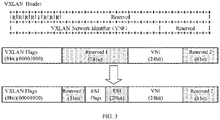
- FIG. 3 a schematic diagram of encapsulating the ESI label in a VXLAN EVPN message is provided.
- the step of reading the ESI label from the message if the message contains the ESI label includes: reading the header information of the message; and judging whether the ESI label is encapsulated in the header information according to the ESI flag field contained in the header information, and reading the ESI label value from the ESI label value field contained in the header information in response to a judgment result that the ESI label is encapsulated in the header information.
- the embodiment of the present disclosure achieves split horizon at an EVPN access, solving the problem of looping in the same ES in EVPN.
- an upstream device (PE1) and a downstream device (PE2) need to be configured in the present application example:
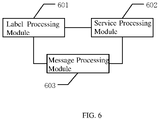
- the message arrives at PE2. Since the AC for access of CE1 to PE2 is configured as a DF, a BUM message can be received and forwarded. According to the ESI label in the message, it is identified that the connected ES port is the same as the message egress port obtained by service forwarding, the message is discarded, preventing the message sent by CE1 from returning to CE1, and thereby split horizon at a VXLAN EVPN access is achieved. According to an embodiment of the present disclosure a system for EVPN message forwarding is further provided. As shown in FIG. 6 , the system includes a label processing module 601, a service processing module 602 and a message processing module 603.
- the label processing module 601 is configured to read an Ethernet segment identifier (ESI) label from a message if the message contains the ESI label after the message is received from an upstream device, and to obtain a port for an Ethernet segment (ES) corresponding to the ESI label according to the ESI label.
- the upstream device may be a customer edge (CE) device or a provider edge (PE) device, and the message is a BUM message.
- CE customer edge
- PE provider edge
- the service processing module 602 is configured to read an egress port for the message.
- the message processing module 603 is configured to discard the message if the port for the ES corresponding to the ESI label obtained according to the ESI label is the same as the egress port for the message.
- the upstream device includes an upstream customer edge (CE) device; and the label processing module 601 is further configured to encapsulate the ESI label into the received message when an access circuit is a non-designated forwarder (non-DF) after the message is received from the upstream customer edge (CE) device.
- the AC is an independent link or circuit connected with the CE and the PE; an AC interface may be a physical interface or a logic interface; and AC attributes include encapsulation type, maximum transmission unit (MTU) and interface parameters of a specific link type.
- the label processing module 601 is configured to encapsulate an ESI label into the received message in a following way: adding an ESI flag field and an ESI label value field into header information of the received message, where the ESI flag field is configured to mark whether the ESI label is encapsulated in the header information or not.
- the label processing module 601 is configured to add an ESI flag field and an ESI label value field into header information of the received message in a following way: taking one of a plurality of bits in a reserved field of the header information of the message as the ESI flag field, and taking all or part of the plurality of bits other than the one bit taken as the ESI flag field in the reserved field as the ESI label value field; determining that no ESI label is encapsulated in the header information of the message if the value of the ESI flag field is 0; and determining that the content of the ESI label value field is valid if the value of the ESI flag field is 1.
- FIG. 3 a schematic diagram of encapsulating an ESI label in a VXLAN EVPN message is provided.
- the label processing module 601 is configured to read an Ethernet segment identifier (ESI) label from the message if the message contains the ESI label, including: reading the header information of the message; and judging whether the ESI label is encapsulated in the header information according to the ESI flag field contained in the header information, and reading the ESI label value from the ESI label value field contained in the header information in response to a judgment result that the ESI label is encapsulated in the header information.
- ESI Ethernet segment identifier
- split horizon at an EVPN access is achieved, and therefore the problem of looping in the same ES in EVPN is solved.
- a computer-readable-and-writable storage medium stores computer-executable instructions which, when executed by a processor, cause the processor to implement the method for EVPN message forwarding as described in the above embodiments.
- the terminal device includes a memory and a processor.
- the memory is configured to store computer-executable instructions.
- the processor us configured for execute the computer-executable instructions to implement the method for EVPN message forwarding as described in the above embodiments.
- all or some of the steps in the method and the functional modules/units in the system and the device disclosed above may be implemented as software, firmware, hardware and an appropriate combination thereof.
- the division between the functional modules/units mentioned in the above description does not necessarily correspond to the division of physical components.
- a physical component may have multiple functions, or a function or a step may be cooperatively executed by multiple physical components.
- Some or all of the components may be implemented as software executed by a processor (such as a digital signal processor or a microprocessor), hardware or an integrated circuit (such as an application-specific integrated circuit).
- Such software may be distributed on computer-readable media, which may include computer storage media (or non-transitory media) and communication media (or transitory media).
- computer storage media include volatile and nonvolatile, removable and non-removable media implemented in any method or technology for storing information (such as computer-readable instructions, data structures, program modules or other data).
- Computer storage media include but are not limited to random access memories (RAMs), read-only memories (ROMs), electrically erasable programmable read-only memories (EEPROM), flash memories or other memory technologies, portable compact disc read-only memories (CD-ROMs), digital versatile discs (DVDs) or other optical disk storages, magnetic cassettes, magnetic tapes, magnetic disk storages or other magnetic storage devices or any other media that can be used to store desired information and can be accessed by computers.
- RAMs random access memories
- ROMs read-only memories
- EEPROM electrically erasable programmable read-only memories
- CD-ROMs compact disc read-only memories
- DVDs digital versatile discs
- communication media typically contain computer-readable instructions, data structures, program modules or other data in a modulated data signal such as carriers or other transmission mechanisms, and can include any information delivery media.
Landscapes
- Engineering & Computer Science (AREA)
- Computer Networks & Wireless Communication (AREA)
- Signal Processing (AREA)
- Computer Security & Cryptography (AREA)
- Data Exchanges In Wide-Area Networks (AREA)
- Small-Scale Networks (AREA)
Abstract
Description
- The present application claims priority to
Chinese Patent Application No. 201910671346.7 filed to the CNIPA on July 24, 2019 - Embodiments of the present disclosure relate to, but are not limited to, the technical field of network communication, and in particular to a method and a system for Ethernet virtual private network (EVPN) message forwarding, and a computer-readable storage medium and a terminal device.
- EVPN is a two-layer virtual private network (VPN) technique.
- The core convergence layer of the control plane of EVPN transfers media access control (MAC) and routing information through the multiprotocol border gateway protocol (MP-BGP), and forwarding entries do not depend on data plane learning. The concept of Ethernet segment (ES) is introduced into EVPN. In an EVPN network, when customer edge (CE) devices are connected to one or more provider edge (PE) devices through a set of Ethernet links, this set of Ethernet links are an Ethernet segment (ES). An ES is identified by a unique Ethernet segment identifier (ESI). EVPN supports three forms of message encapsulation, i.e. Multi-Protocol Label Switching (MPLS) EVPN, Provider Backbone Bridge (PBB) EVPN and Virtual Extensible Local Area Network (VXLAN) EVPN.
- In order to increase reliability, a multi-homing access mode is introduced into EVPN, while redundant links are introduced into the multi-homing access mode, and as a result, a loop exists in the network. As shown in
FIG. 1 , a provider edge device PE1 receives a message from a customer edge device CE1, the message returns to CE1 after being forwarded by the provider edge device PE1 and the provider edge device PE2, and as a result, a loop is formed, directly resulting in a broadcast storm. In Request For Comments 7432 (RFC7432), a non-designated forwarder (non-DF) is only limited from forwarding broadcast, unknown-unicast and multicast (BUM) messages to an Ethernet segment, but not limited from receiving (or receiving and forwarding) BUM messages from the ES. Such a DF filtering rule can deal with the situation of "repeated packet filtering", but cannot address the situation of looping in the same ES. - The present disclosure provides a method and a system for EVPN message forwarding, and a computer-readable storage medium and a terminal device, to at least solve the problem of looping in the same ES in EVPN.
- According to an embodiment of the present disclosure provided is a method for message forwarding for Ethernet Virtual Private Network (EVPN). The method for EVPN message forwarding may include:
- reading an Ethernet segment identifier (ESI) label from a message in response to the message containing the ESI label after receiving the message from an upstream device, and obtaining a port for an Ethernet segment (ES) corresponding to the ESI label according to the ESI label;
- reading an egress port for the message; and
- discarding the message in response to the port for the Ethernet segment (ES) corresponding to the ESI label obtained according to the ESI label being the same as the egress port for the message.
- According to another embodiment of the present disclosure, further provided is a system for message forwarding for Ethernet Virtual Private Network (EVPN). The system for EVPN message forwarding may include a label processing module, a service processing module, and a message processing module.
- The label processing module is configured to read an Ethernet segment identifier (ESI) label from a message in response to the message containing the ESI label after receiving the message from an upstream device, and obtaining a port for an Ethernet segment (ES) corresponding to the ESI label according to the ESI label.
- The service processing module is configured to read an egress port for the message.
- The message processing module is configured to discard the message in response to the port for the Ethernet segment (ES) corresponding to the ESI label obtained according to the ESI label being the same as the egress port for the message.
- According to yet another embodiment of the present disclosure further provided is a computer-readable storage medium, which stores computer-executable instructions. The instructions, when executed by a processor, cause the processor to implement the aforementioned method for EVPN message forwarding .
- According to yet another embodiment of the present disclosure further provided is a terminal device for message forwarding for Ethernet Virtual Private Network (EVPN). The terminal device may include: a memory configured to store computer-executable instructions; and a processor configured to execute the computer-executable instructions to implement the aforementioned method for EVPN message forwarding.
- The drawings are provided for a further understanding of the technical schemes of the present disclosure, and constitute a part of the description. The drawings and the embodiments of the present disclosure are intended to explain the technical schemes of the present disclosure, and do not constitute a limitation on the technical schemes of the present disclosure.
-
FIG. 1 is a schematic diagram of a situation of looping in the same ES occurring in EVPN in the existing art; -
FIG. 2 is a schematic flowchart of a method for EVPN message forwarding according to an embodiment of the present disclosure; -
FIG. 3 is a schematic diagram of encapsulating an ESI label into a VXLAN EVPN message according to an embodiment of the application; -
FIG. 4 is a schematic flowchart of a processing flow of a VXLAN EVPN upper loop chip according to an embodiment of this application; -
FIG. 5 is a schematic flowchart of VXLAN EVPN lower loop chip processing according to an embodiment of this application; and -
FIG. 6 is a block diagram of a system for EVPN message forwarding according to an embodiment of the present disclosure. - Embodiments of the present disclosure will be described hereinafter with reference to the drawings.
- The steps shown in the flowcharts in the drawings may be executed in a computer system containing a set of computer-executable instructions. Moreover, although logical orders are shown in the flowcharts, in some cases, the steps shown or described may be executed in orders different from those herein.
- In the existing art, in order to solve the problem of looping, an ESI label is introduced into MPLS EVPN. The ESI label is carried in an Ethernet Auto-Discovery per Ethernet Segment (Ethernet AD per ES) route, and a corresponding ESI is learned from a table forwarding table corresponding to the ESI label. When a non-DF node forwards a BUM copy, if an ESI on an egress access circuit (AC) for the BUM copy is the same as that learned through the ESI label, the copy will be discarded. Each copy is separately subject to a DF filtering decision. Thus, by introducing the ESI label, the ability of the non-DF to receive and forward a BUM packet of the CE is kept, and moreover, the problem of looping in the same ES is avoided as well.
- The ESI label solution defined by RFC7432 will lead to two layers of private network labels nested in a BUM message, that is, a label stack structure is formed, which is very common in MPLS encapsulation. However, because a VXLAN network identifier (VNI) label stack structure is not defined in VXLAN encapsulation, the usage of the ESI label in MPLS EVPN cannot be directly applied in VXLAN EVPN. For VXLAN EVPN, the problem of looping in the same ES has to be solved.
- According to an embodiment of the present disclosure, a method for EVPN message forwarding is provided and applicable to VXLAN EVPN. As shown in
FIG. 2 , the method includes steps S210 to S230. - At S210, after a message is received from an upstream device, if the message contains an Ethernet segment identifier (ESI) label, the ESI label is read from the message, and a port for an Ethernet segment (ES) corresponding to the ESI label is obtained according to the ESI label.
- The upstream device may be a customer edge (CE) device or a provider edge (PE) device; and the message is a BUM message.
- At S220, an egress port for the message is read.
- The egress port for the message may be obtained by looking up in a MAC forwarding table.
- At S230, the message is discarded if the port for the ES corresponding to the ESI label obtained according to the ESI label is the same as the egress port for the message.
- Compared with the existing art, the method according to the present disclosure includes: the ESI label from the message is read if the message contains the ESI label after the message is received from the upstream device, and a port connected to the ES corresponding to the ESI label is obtained according to the ESI label; the egress port for the message is read; and the message is discarded if the port for the ES corresponding to the ESI label obtained according to the ESI label is the same as the egress port for the message. The method of the present disclosure can solve the problem of looping in the same ES in EVPN.
- In an embodiment of the present disclosure, if the upstream device includes an upstream customer edge (CE) device, the method further includes: encapsulating an ESI label into the received message after a message is received from the CE device if an access circuit is a non-designated forwarder (non-DF). The AC is an independent link or circuit connected with the CE and the PE; an interface of the AC may be a physical interface or a logic interface; and attributes of the AC include encapsulation type, maximum transmission unit (MTU) and interface parameters of a specific link type.
- In the embodiment of the present disclosure, the step of encapsulating an ESI label into the received message includes: adding an ESI flag field and an ESI label value field into header information of the received message, where the ESI flag field is configured to mark whether the ESI label is encapsulated in the header information or not.
- In the embodiment of the present disclosure, the step of adding an ESI flag field and an ESI label value field into header information of the received message includes: taking one of a plurality of bits in a reserved field of the header information of the message as the ESI flag field, and taking all or part of the plurality of bits other than the one bit taken as the ESI flag field in the reserved field as the ESI label value field; determining that no ESI label is encapsulated in the header information of the message if the value of the ESI flag field is 0; and determining that the content of the ESI label value field is valid if the value of the ESI flag field is 1. In
FIG. 3 , a schematic diagram of encapsulating the ESI label in a VXLAN EVPN message is provided. - In the embodiment of the present disclosure, the step of reading the ESI label from the message if the message contains the ESI label includes: reading the header information of the message; and judging whether the ESI label is encapsulated in the header information according to the ESI flag field contained in the header information, and reading the ESI label value from the ESI label value field contained in the header information in response to a judgment result that the ESI label is encapsulated in the header information.
- The embodiment of the present disclosure achieves split horizon at an EVPN access, solving the problem of looping in the same ES in EVPN.
- An application example is given below to illustrate the embodiment of the present disclosure.
- Taking VXLAN EVPN as an example, based on a network connection architecture shown in
FIG. 1 , an upstream device (PE1) and a downstream device (PE2) need to be configured in the present application example: - 1. A configuration flow of an upper loop chip of the PE1 is shown as
FIG. 4 , and the meanings of the symbols appearing inFIG. 4 are explained as follows:- MF.NHI0_Index: next hop index in a descriptor; EGR_NHI0_TABLE_MPLS: next hop table of egress encapsulation; MF.DVP: destination virtual port in the descriptor; EGR_NHI0.DVP: destination virtual port (multicast) corresponding to the next hop of egress encapsulation; evlan_entry_vxlan: vxlan egress encapsulation Hash table; VNI: virtual network identifier; SD_TAG ACTION: service delimiter action; EGR_DVP_ATTRIBUTE: egress destination virtual port attribute table; DVP_ESI_INDEX: destination virtual port ESI label index; DVP_LEAF_INDEX: destination virtual port LEAF label index; EGR_ESI_ENCAP_LABEL: ESI label of egress encapsulation; EGR_SVP_ESI_INDEX_TABLE: egress encapsulated ESI label index table; EGR_LEAF_ENCAP_LABEL: egress encapsulated LEAF label.
- An AC for access of CE1 to PE1 is configured as a non-DF. 1 bit of DF/Non-DF and an encapsulated ESI label index svp_esi_encap_index[4:0] are configured based on a source virtual port (SVP). After a DF flag is acquired, 1 bit of descriptor MF.esi_present (this descriptor is used to identify whether an ESI label needs to be encapsulated, and only if a forwarding result is a BUM message and the SVP is Non-DF can MF.esi_present be set) is generated according to the forwarding result (unicast or BUM), and the descriptor is stored into a memory management unit (MMU) cache and brought to a downlink.
- An ESI label value is determined by the source virtual port and the destination virtual port together. An encapsulated ESI label DVP index dvp_esi_ecap_index[28:24] is configured based on the DVP. By combining the encapsulated ESI label index of the destination virtual port with the encapsulated ESI label index of the source virtual port, a final index for searching the ESI label value is calculated, that is, svp_esi_encap_index[4:0] is searched out according to the SVP and dvp_esi_ecap_index[28:24] is searched out according to the DVP. {Esi_label_vld[20:20], esi_label[19:0]} is then searched out using {svp_esi_encap_index, dvp_esi_ecap_index} as an index, and the BUM message sent from PE1 to PE2 carries this ESI label.
- 2. A configuration flow of a lower loop chip of the PE2 is shown as
FIG. 5 , and the meanings of the symbols appearing inFIG. 5 are explained as follows:- MY_STATION_TCAM: MY STATION TCAM table; L3_TUNNEL IP: layer-3 Internet Protocol (IP) tunnel Hash table; mpls_entry_vxlan: VXLAN view label entry; SVP: source virtual port; VFI: virtual forwarding instance; L2 ENTRY: L2 MAC table; Esi port: ESI port; svp network: svp split-horizon network number; dvp network: dvp split-horizon network number.
- An AC for access of CE1 to PE2 is configured as a DF. The DF is responsible for forwarding a BUM message into an ES, while the non-DF cannot forward a BUM message into the ES. The SVP, mpls_entry_vxlan view, KEY:VNI or VNI+SIP, RESULT:SVP of a lower loop are configured at an MPLS module. Physical port numbers, mpls_entry_mpls view, KEY:ESI and RESULT:ESI_SGLP corresponding to ESI labels are configured at the MPLS.
- On each device, each ESI label only corresponds to one of the physical port numbers (including Trunk ports), and a port of PE2 which is connected to CE1 is the physical port number of PE2 which corresponds to the ESI label. A next hop corresponding to the DVP is configured, and an egress port corresponding to the next hop is the port of PE2 which is connected to CE1.
- 3. VXLAN EVPN upper and lower loop message forwarding flow:
A BUM message is sent from CE1 to PE1, and since the AC is a non-DF, an ESI label has been encapsulated in the message received by PE1 and forwarded to PE2. - The message arrives at PE2. Since the AC for access of CE1 to PE2 is configured as a DF, a BUM message can be received and forwarded. According to the ESI label in the message, it is identified that the connected ES port is the same as the message egress port obtained by service forwarding, the message is discarded, preventing the message sent by CE1 from returning to CE1, and thereby split horizon at a VXLAN EVPN access is achieved. According to an embodiment of the present disclosure a system for EVPN message forwarding is further provided. As shown in
FIG. 6 , the system includes alabel processing module 601, aservice processing module 602 and amessage processing module 603. Thelabel processing module 601 is configured to read an Ethernet segment identifier (ESI) label from a message if the message contains the ESI label after the message is received from an upstream device, and to obtain a port for an Ethernet segment (ES) corresponding to the ESI label according to the ESI label. The upstream device may be a customer edge (CE) device or a provider edge (PE) device, and the message is a BUM message. Theservice processing module 602 is configured to read an egress port for the message. Themessage processing module 603 is configured to discard the message if the port for the ES corresponding to the ESI label obtained according to the ESI label is the same as the egress port for the message. - In an embodiment, the upstream device includes an upstream customer edge (CE) device; and the
label processing module 601 is further configured to encapsulate the ESI label into the received message when an access circuit is a non-designated forwarder (non-DF) after the message is received from the upstream customer edge (CE) device. The AC is an independent link or circuit connected with the CE and the PE; an AC interface may be a physical interface or a logic interface; and AC attributes include encapsulation type, maximum transmission unit (MTU) and interface parameters of a specific link type. - In an embodiment, the
label processing module 601 is configured to encapsulate an ESI label into the received message in a following way: adding an ESI flag field and an ESI label value field into header information of the received message, where the ESI flag field is configured to mark whether the ESI label is encapsulated in the header information or not. - In an embodiment, the
label processing module 601 is configured to add an ESI flag field and an ESI label value field into header information of the received message in a following way: taking one of a plurality of bits in a reserved field of the header information of the message as the ESI flag field, and taking all or part of the plurality of bits other than the one bit taken as the ESI flag field in the reserved field as the ESI label value field; determining that no ESI label is encapsulated in the header information of the message if the value of the ESI flag field is 0; and determining that the content of the ESI label value field is valid if the value of the ESI flag field is 1. InFIG. 3 , a schematic diagram of encapsulating an ESI label in a VXLAN EVPN message is provided. - In an embodiment, the
label processing module 601 is configured to read an Ethernet segment identifier (ESI) label from the message if the message contains the ESI label, including: reading the header information of the message; and judging whether the ESI label is encapsulated in the header information according to the ESI flag field contained in the header information, and reading the ESI label value from the ESI label value field contained in the header information in response to a judgment result that the ESI label is encapsulated in the header information. - According to the embodiments of the present disclosure split horizon at an EVPN access is achieved, and therefore the problem of looping in the same ES in EVPN is solved.
- According to an embodiment of the present disclosure, a computer-readable-and-writable storage medium is further provided. The computer-readable-and-writable storage medium stores computer-executable instructions which, when executed by a processor, cause the processor to implement the method for EVPN message forwarding as described in the above embodiments.
- According to an embodiment of the present disclosure further provides a terminal device for EVPN message forwarding is further provided. The terminal device includes a memory and a processor. The memory is configured to store computer-executable instructions. The processor us configured for execute the computer-executable instructions to implement the method for EVPN message forwarding as described in the above embodiments.
- It can be understood by those having ordinary skill in the art that, all or some of the steps in the method and the functional modules/units in the system and the device disclosed above may be implemented as software, firmware, hardware and an appropriate combination thereof. In the hardware implementation, the division between the functional modules/units mentioned in the above description does not necessarily correspond to the division of physical components. For example, a physical component may have multiple functions, or a function or a step may be cooperatively executed by multiple physical components. Some or all of the components may be implemented as software executed by a processor (such as a digital signal processor or a microprocessor), hardware or an integrated circuit (such as an application-specific integrated circuit). Such software may be distributed on computer-readable media, which may include computer storage media (or non-transitory media) and communication media (or transitory media). As well-known to those having ordinary skill in the art, the term "computer storage media" include volatile and nonvolatile, removable and non-removable media implemented in any method or technology for storing information (such as computer-readable instructions, data structures, program modules or other data). Computer storage media include but are not limited to random access memories (RAMs), read-only memories (ROMs), electrically erasable programmable read-only memories (EEPROM), flash memories or other memory technologies, portable compact disc read-only memories (CD-ROMs), digital versatile discs (DVDs) or other optical disk storages, magnetic cassettes, magnetic tapes, magnetic disk storages or other magnetic storage devices or any other media that can be used to store desired information and can be accessed by computers. Furthermore, it is well-known to those having ordinary skill in the art that communication media typically contain computer-readable instructions, data structures, program modules or other data in a modulated data signal such as carriers or other transmission mechanisms, and can include any information delivery media.
Claims (10)
- A method for message forwarding for Ethernet Virtual Private Network, EVPN, comprising:reading an Ethernet segment identifier, ESI, label from a message in response to the message containing the ESI label after receiving the message from an upstream device, and obtaining a port for an Ethernet segment, ES, corresponding to the ESI label according to the ESI label;reading an egress port for the message; anddiscarding the message in response to the port for the ES corresponding to the ESI label obtained according to the ESI label being the same as the egress port for the message.
- The method for message forwarding for EVPN of claim 1, in response to the upstream device comprising an upstream customer edge, CE, device, further comprising:
encapsulating the ESI label into the received message in response to an access circuit being a non-Designated Forwarder, non-DF, after the message is received from the upstream CE device. - The method for message forwarding for EVPN of claim 2, wherein encapsulating the ESI label into the received message comprises:
adding an ESI flag field and an ESI label value field into header information of the received message, the ESI flag field being configured for marking whether the ESI label is encapsulated in the header information or not. - The method for message forwarding for EVPN of claim 3, wherein adding an ESI flag field and an ESI label value field into header information of the received message comprises:
taking one of a plurality of bits in a reserved field of the header information of the message as the ESI flag field, and taking all or part of the plurality of bits other than the one bit taken as the ESI flag field in the reserved field as the ESI label value field; determining that no ESI label is encapsulated in the header information of the message in response to the value of the ESI flag field being 0; and determining that a content of the ESI label value field is valid in response to the value of the ESI flag field being 1. - The method for message forwarding for EVPN of one of claims 1 to 4, wherein reading an Ethernet segment identifier, ESI, label from a message in response to the message containing the ESI label comprises:reading the header information of the message; andjudging whether the ESI label is encapsulated in the header information according to the ESI flag field contained in the header information, and reading the ESI label value from the ESI label value field contained in the header information in response to a judgment result that the ESI label is encapsulated in the header information.
- A system for message forwarding for Ethernet Virtual Private Network, EVPN, comprising:a label processing module, configured to read an Ethernet segment identifier (ESI) label from a message in response to the message containing the ESI label after receiving the message from an upstream device, and obtaining a port for an ES corresponding to the ESI label according to the ESI label;a service processing module, configured to read an egress port for the message; anda message processing module, configured to discard the message in response to the port for the ES corresponding to the ESI label obtained according to the ESI label being the same as the egress port for the message.
- The system for message forwarding for EVPN of claim 6, wherein the upstream device comprises an upstream Customer Edge, CE, device;the label processing module is further configured to encapsulate the ESI label into the received message in response to an access circuit being a non-designated forwarder (non-DF) after the message is received from the CE device; andthe label processing module is configured to encapsulate the ESI label into the received message in a following way:
adding an ESI flag field and an ESI label value field into header information of the received message, the ESI flag field being configured to mark whether the ESI label is encapsulated in the header information or not. - The system for message forwarding for EVPN of claim 7, wherein
the label processing module is configured to add an ESI flag field and an ESI label value field into header information of the received message in a following way:taking one of a plurality of bits in a reserved field of the header information of the message as the ESI flag field, and taking all or part of the plurality of bits other than the one bit taken as the ESI flag field in the reserved field as the ESI label value field;determining that no ESI label is encapsulated in the header information of the message in response to the value of the ESI flag field being 0; and determining that a content of the ESI label value field is valid in response to the value of the ESI flag field being 1. - A computer-readable-and-writable storage medium, storing computer-executable instructions which, when executed by a processor, cause the processor to perform the method for message forwarding for Ethernet Virtual Private Network, EVPN, of one of claims 1 to 5.
- A terminal device for message forwarding for Ethernet Virtual Private Network, EVPN, comprising:a memory, configured to store computer-executable instructions; anda processor, configured to execute the computer-executable instructions to perform the method for message forwarding for EVPN of one of claims 1 to 5.
Applications Claiming Priority (2)
| Application Number | Priority Date | Filing Date | Title |
|---|---|---|---|
| CN201910671346.7A CN112311643B (en) | 2019-07-24 | 2019-07-24 | EVPN message forwarding method, system, storage medium and terminal |
| PCT/CN2020/103964 WO2021013233A1 (en) | 2019-07-24 | 2020-07-24 | Evpn packet forwarding method, system, storage medium, and terminal |
Publications (3)
| Publication Number | Publication Date |
|---|---|
| EP3975486A1 true EP3975486A1 (en) | 2022-03-30 |
| EP3975486A4 EP3975486A4 (en) | 2022-08-31 |
| EP3975486B1 EP3975486B1 (en) | 2025-09-10 |
Family
ID=74193337
Family Applications (1)
| Application Number | Title | Priority Date | Filing Date |
|---|---|---|---|
| EP20843511.5A Active EP3975486B1 (en) | 2019-07-24 | 2020-07-24 | Evpn packet forwarding method, system, storage medium, and terminal |
Country Status (6)
| Country | Link |
|---|---|
| US (1) | US12206576B2 (en) |
| EP (1) | EP3975486B1 (en) |
| JP (1) | JP2022537296A (en) |
| KR (1) | KR102756697B1 (en) |
| CN (1) | CN112311643B (en) |
| WO (1) | WO2021013233A1 (en) |
Families Citing this family (6)
| Publication number | Priority date | Publication date | Assignee | Title |
|---|---|---|---|---|
| CN113765806B (en) * | 2021-09-02 | 2022-09-02 | 烽火通信科技股份有限公司 | MAC address learning method, device, equipment and readable storage medium |
| CN113992573B (en) * | 2021-10-26 | 2023-03-31 | 新华三信息安全技术有限公司 | Method and device for forwarding BUM (building information management) flow, PE (provider edge) equipment and storage medium |
| CN116827862B (en) * | 2022-03-22 | 2025-11-07 | 中兴通讯股份有限公司 | Route issuing method and device, storage medium and electronic device |
| CN114679405B (en) * | 2022-04-12 | 2023-07-25 | 烽火通信科技股份有限公司 | SRv6 message forwarding method, storage medium, electronic equipment and device |
| CN117640505A (en) * | 2022-08-09 | 2024-03-01 | 中兴通讯股份有限公司 | A data message processing method, device, storage medium and electronic device |
| CN118573512A (en) * | 2023-02-28 | 2024-08-30 | 中兴通讯股份有限公司 | Message transmission method, device, equipment and medium of EVPN |
Family Cites Families (19)
| Publication number | Priority date | Publication date | Assignee | Title |
|---|---|---|---|---|
| US8767731B2 (en) * | 2010-05-19 | 2014-07-01 | Alcatel Lucent | Method and apparatus for MPLS label allocation for a BGP MAC-VPN |
| CN105099846B (en) * | 2014-04-30 | 2018-10-19 | 华为技术有限公司 | The method and supplier edge device of data message transmission |
| US9794180B2 (en) * | 2014-07-18 | 2017-10-17 | Cisco Technology, Inc. | Reducing transient packet duplication and improving split-horizon filtering |
| CN104135420B (en) * | 2014-07-31 | 2017-12-29 | 华为技术有限公司 | A kind of method, equipment and the system of message forwarding |
| US9781029B2 (en) | 2016-02-04 | 2017-10-03 | Cisco Technology, Inc. | Loop detection and prevention |
| US10110470B2 (en) * | 2016-09-14 | 2018-10-23 | Juniper Networks, Inc. | Preventing data traffic loops associated with designated forwarder selection |
| CN108075956B (en) | 2016-11-16 | 2020-05-22 | 新华三技术有限公司 | Data processing method and device |
| CN108259291B (en) * | 2016-12-29 | 2021-01-29 | 华为技术有限公司 | VXLAN message processing method, device and system |
| CN112929273A (en) * | 2017-03-14 | 2021-06-08 | 华为技术有限公司 | Method, equipment and system for processing route |
| US10841216B1 (en) * | 2017-03-29 | 2020-11-17 | Juniper Networks, Inc. | Local-bias forwarding of L2 multicast, unknown unicast, and broadcast traffic for an ethernet VPN |
| CN108696414A (en) * | 2017-04-05 | 2018-10-23 | 中兴通讯股份有限公司 | Return cut-in method, device and more home nodes more |
| US10333836B2 (en) * | 2017-04-13 | 2019-06-25 | Cisco Technology, Inc. | Convergence for EVPN multi-homed networks |
| US10382332B2 (en) * | 2017-05-12 | 2019-08-13 | Juniper Networks, Inc. | Route signaling and convergence in EVPN of port extenders |
| US10432420B2 (en) * | 2017-07-28 | 2019-10-01 | Cisco Technology, Inc. | Methods, devices, and computer-readable media for preventing broadcast loops during a site merge |
| CN109861926B (en) * | 2017-11-30 | 2023-02-07 | 中兴通讯股份有限公司 | Message sending and processing method, device, node, processing system and medium |
| CN108259303B (en) * | 2017-12-25 | 2020-12-04 | 新华三技术有限公司 | Message forwarding method and device |
| CN112422307B (en) * | 2019-08-22 | 2022-06-14 | 华为技术有限公司 | Method, equipment and system for EVPN and VPLS coexistence dual-activity |
| US11057295B1 (en) * | 2020-01-07 | 2021-07-06 | Juniper Networks, Inc. | Loop avoidance and egress link protection with ethernet virtual private network (EVPN) fast reroute (FRR) |
| US11558281B2 (en) * | 2021-03-31 | 2023-01-17 | Arista Networks, Inc. | Shared ethernet segment identifier label allocation for ethernet virtual private network multihoming |
-
2019
- 2019-07-24 CN CN201910671346.7A patent/CN112311643B/en active Active
-
2020
- 2020-07-24 US US17/618,293 patent/US12206576B2/en active Active
- 2020-07-24 KR KR1020217041598A patent/KR102756697B1/en active Active
- 2020-07-24 WO PCT/CN2020/103964 patent/WO2021013233A1/en not_active Ceased
- 2020-07-24 JP JP2021574895A patent/JP2022537296A/en active Pending
- 2020-07-24 EP EP20843511.5A patent/EP3975486B1/en active Active
Also Published As
| Publication number | Publication date |
|---|---|
| US20220368628A1 (en) | 2022-11-17 |
| WO2021013233A1 (en) | 2021-01-28 |
| CN112311643B (en) | 2023-04-18 |
| KR102756697B1 (en) | 2025-01-21 |
| KR20220007742A (en) | 2022-01-18 |
| EP3975486B1 (en) | 2025-09-10 |
| EP3975486A4 (en) | 2022-08-31 |
| US12206576B2 (en) | 2025-01-21 |
| JP2022537296A (en) | 2022-08-25 |
| CN112311643A (en) | 2021-02-02 |
Similar Documents
| Publication | Publication Date | Title |
|---|---|---|
| US12206576B2 (en) | EVPN packet forwarding method, system, storage medium, and terminal | |
| US12368669B2 (en) | Packet sending method, device, and system | |
| US9628390B2 (en) | Load balancing pseudowire encapsulated IPTV channels over aggregated links | |
| RU2493677C2 (en) | Method and router for implementing mirroring | |
| WO2019128621A1 (en) | Method for bearing multicast virtual private network and device | |
| US20090135833A1 (en) | Ingress node and egress node with improved packet transfer rate on multi-protocol label switching (MPLS) network, and method of improving packet transfer rate in MPLS network system | |
| US11252100B2 (en) | Apparatus, system, and method for providing node protection across label-switched paths that share labels | |
| US11924094B2 (en) | Virtual circuit-based data packet processing method and forwarding table entry construction method | |
| US12483496B2 (en) | Loop detection method and apparatus | |
| US12537760B2 (en) | Packet forwarding method and apparatus, network device, and storage medium | |
| CN110417655B (en) | Method and device for forwarding data message | |
| CN102546855B (en) | MAC Address recovery method and PE equipment in VPLS network | |
| WO2022121466A1 (en) | Data processing method and device for ethernet virtual private network, and storage medium | |
| US8015320B2 (en) | Load distribution and redundancy using tree aggregation | |
| EP4020903B1 (en) | Method and apparatus for preventing traffic bypassing | |
| CN114760248B (en) | Message transmission method, equipment and system | |
| US12034634B2 (en) | Information processing method, node, and computer-readable storage medium | |
| CN115037677A (en) | Method and device for protecting frr scene | |
| CN109672617A (en) | A kind of method, apparatus and storage medium of MPLS stratification pretection switch | |
| CN120768857A (en) | Service forwarding method, device, system and computer program product | |
| CN113938354A (en) | Routing information updating method and device, electronic equipment and computer readable medium |
Legal Events
| Date | Code | Title | Description |
|---|---|---|---|
| STAA | Information on the status of an ep patent application or granted ep patent |
Free format text: STATUS: THE INTERNATIONAL PUBLICATION HAS BEEN MADE |
|
| PUAI | Public reference made under article 153(3) epc to a published international application that has entered the european phase |
Free format text: ORIGINAL CODE: 0009012 |
|
| STAA | Information on the status of an ep patent application or granted ep patent |
Free format text: STATUS: REQUEST FOR EXAMINATION WAS MADE |
|
| 17P | Request for examination filed |
Effective date: 20211221 |
|
| AK | Designated contracting states |
Kind code of ref document: A1 Designated state(s): AL AT BE BG CH CY CZ DE DK EE ES FI FR GB GR HR HU IE IS IT LI LT LU LV MC MK MT NL NO PL PT RO RS SE SI SK SM TR |
|
| A4 | Supplementary search report drawn up and despatched |
Effective date: 20220801 |
|
| RIC1 | Information provided on ipc code assigned before grant |
Ipc: H04L 45/00 20220101ALI20220726BHEP Ipc: H04L 45/02 20220101ALI20220726BHEP Ipc: H04L 45/50 20220101ALI20220726BHEP Ipc: H04L 12/46 20060101AFI20220726BHEP |
|
| DAV | Request for validation of the european patent (deleted) | ||
| DAX | Request for extension of the european patent (deleted) | ||
| RAP1 | Party data changed (applicant data changed or rights of an application transferred) |
Owner name: SANECHIPS TECHNOLOGY CO., LTD. |
|
| STAA | Information on the status of an ep patent application or granted ep patent |
Free format text: STATUS: EXAMINATION IS IN PROGRESS |
|
| 17Q | First examination report despatched |
Effective date: 20240104 |
|
| REG | Reference to a national code |
Ref legal event code: R079 Free format text: PREVIOUS MAIN CLASS: H04L0012460000 Ref country code: DE Ref document number: 602020058660 Country of ref document: DE Ipc: H04L0045740000 |
|
| GRAP | Despatch of communication of intention to grant a patent |
Free format text: ORIGINAL CODE: EPIDOSNIGR1 |
|
| STAA | Information on the status of an ep patent application or granted ep patent |
Free format text: STATUS: GRANT OF PATENT IS INTENDED |
|
| RIC1 | Information provided on ipc code assigned before grant |
Ipc: H04L 45/00 20220101ALI20250523BHEP Ipc: H04L 45/50 20220101ALI20250523BHEP Ipc: H04L 12/46 20060101ALI20250523BHEP Ipc: H04L 45/74 20220101AFI20250523BHEP |
|
| INTG | Intention to grant announced |
Effective date: 20250605 |
|
| GRAS | Grant fee paid |
Free format text: ORIGINAL CODE: EPIDOSNIGR3 |
|
| GRAA | (expected) grant |
Free format text: ORIGINAL CODE: 0009210 |
|
| STAA | Information on the status of an ep patent application or granted ep patent |
Free format text: STATUS: THE PATENT HAS BEEN GRANTED |
|
| AK | Designated contracting states |
Kind code of ref document: B1 Designated state(s): AL AT BE BG CH CY CZ DE DK EE ES FI FR GB GR HR HU IE IS IT LI LT LU LV MC MK MT NL NO PL PT RO RS SE SI SK SM TR |
|
| REG | Reference to a national code |
Ref country code: GB Ref legal event code: FG4D |
|
| REG | Reference to a national code |
Ref country code: CH Ref legal event code: EP |
|
| REG | Reference to a national code |
Ref country code: DE Ref legal event code: R096 Ref document number: 602020058660 Country of ref document: DE |
|
| REG | Reference to a national code |
Ref country code: IE Ref legal event code: FG4D |
|
| PG25 | Lapsed in a contracting state [announced via postgrant information from national office to epo] |
Ref country code: NO Free format text: LAPSE BECAUSE OF FAILURE TO SUBMIT A TRANSLATION OF THE DESCRIPTION OR TO PAY THE FEE WITHIN THE PRESCRIBED TIME-LIMIT Effective date: 20251210 |
|
| REG | Reference to a national code |
Ref country code: LT Ref legal event code: MG9D |
|
| PG25 | Lapsed in a contracting state [announced via postgrant information from national office to epo] |
Ref country code: FI Free format text: LAPSE BECAUSE OF FAILURE TO SUBMIT A TRANSLATION OF THE DESCRIPTION OR TO PAY THE FEE WITHIN THE PRESCRIBED TIME-LIMIT Effective date: 20250910 |
|
| REG | Reference to a national code |
Ref country code: NL Ref legal event code: MP Effective date: 20250910 |
|
| PG25 | Lapsed in a contracting state [announced via postgrant information from national office to epo] |
Ref country code: HR Free format text: LAPSE BECAUSE OF FAILURE TO SUBMIT A TRANSLATION OF THE DESCRIPTION OR TO PAY THE FEE WITHIN THE PRESCRIBED TIME-LIMIT Effective date: 20250910 |
|
| PG25 | Lapsed in a contracting state [announced via postgrant information from national office to epo] |
Ref country code: GR Free format text: LAPSE BECAUSE OF FAILURE TO SUBMIT A TRANSLATION OF THE DESCRIPTION OR TO PAY THE FEE WITHIN THE PRESCRIBED TIME-LIMIT Effective date: 20251211 |
|
| PG25 | Lapsed in a contracting state [announced via postgrant information from national office to epo] |
Ref country code: SE Free format text: LAPSE BECAUSE OF FAILURE TO SUBMIT A TRANSLATION OF THE DESCRIPTION OR TO PAY THE FEE WITHIN THE PRESCRIBED TIME-LIMIT Effective date: 20250910 |
|
| PG25 | Lapsed in a contracting state [announced via postgrant information from national office to epo] |
Ref country code: LV Free format text: LAPSE BECAUSE OF FAILURE TO SUBMIT A TRANSLATION OF THE DESCRIPTION OR TO PAY THE FEE WITHIN THE PRESCRIBED TIME-LIMIT Effective date: 20250910 |
|
| PG25 | Lapsed in a contracting state [announced via postgrant information from national office to epo] |
Ref country code: PL Free format text: LAPSE BECAUSE OF FAILURE TO SUBMIT A TRANSLATION OF THE DESCRIPTION OR TO PAY THE FEE WITHIN THE PRESCRIBED TIME-LIMIT Effective date: 20250910 Ref country code: BG Free format text: LAPSE BECAUSE OF FAILURE TO SUBMIT A TRANSLATION OF THE DESCRIPTION OR TO PAY THE FEE WITHIN THE PRESCRIBED TIME-LIMIT Effective date: 20250910 |
|
| PG25 | Lapsed in a contracting state [announced via postgrant information from national office to epo] |
Ref country code: RS Free format text: LAPSE BECAUSE OF FAILURE TO SUBMIT A TRANSLATION OF THE DESCRIPTION OR TO PAY THE FEE WITHIN THE PRESCRIBED TIME-LIMIT Effective date: 20251210 |
|
| PG25 | Lapsed in a contracting state [announced via postgrant information from national office to epo] |
Ref country code: ES Free format text: LAPSE BECAUSE OF FAILURE TO SUBMIT A TRANSLATION OF THE DESCRIPTION OR TO PAY THE FEE WITHIN THE PRESCRIBED TIME-LIMIT Effective date: 20250910 |
|
| REG | Reference to a national code |
Ref country code: AT Ref legal event code: MK05 Ref document number: 1837140 Country of ref document: AT Kind code of ref document: T Effective date: 20250910 |
|
| PG25 | Lapsed in a contracting state [announced via postgrant information from national office to epo] |
Ref country code: NL Free format text: LAPSE BECAUSE OF FAILURE TO SUBMIT A TRANSLATION OF THE DESCRIPTION OR TO PAY THE FEE WITHIN THE PRESCRIBED TIME-LIMIT Effective date: 20250910 |
|
| PG25 | Lapsed in a contracting state [announced via postgrant information from national office to epo] |
Ref country code: SM Free format text: LAPSE BECAUSE OF FAILURE TO SUBMIT A TRANSLATION OF THE DESCRIPTION OR TO PAY THE FEE WITHIN THE PRESCRIBED TIME-LIMIT Effective date: 20250910 |
|
| PG25 | Lapsed in a contracting state [announced via postgrant information from national office to epo] |
Ref country code: AT Free format text: LAPSE BECAUSE OF FAILURE TO SUBMIT A TRANSLATION OF THE DESCRIPTION OR TO PAY THE FEE WITHIN THE PRESCRIBED TIME-LIMIT Effective date: 20250910 |
|
| PG25 | Lapsed in a contracting state [announced via postgrant information from national office to epo] |
Ref country code: IT Free format text: LAPSE BECAUSE OF FAILURE TO SUBMIT A TRANSLATION OF THE DESCRIPTION OR TO PAY THE FEE WITHIN THE PRESCRIBED TIME-LIMIT Effective date: 20250910 |
|
| PG25 | Lapsed in a contracting state [announced via postgrant information from national office to epo] |
Ref country code: IS Free format text: LAPSE BECAUSE OF FAILURE TO SUBMIT A TRANSLATION OF THE DESCRIPTION OR TO PAY THE FEE WITHIN THE PRESCRIBED TIME-LIMIT Effective date: 20260110 |
|
| PG25 | Lapsed in a contracting state [announced via postgrant information from national office to epo] |
Ref country code: CZ Free format text: LAPSE BECAUSE OF FAILURE TO SUBMIT A TRANSLATION OF THE DESCRIPTION OR TO PAY THE FEE WITHIN THE PRESCRIBED TIME-LIMIT Effective date: 20250910 Ref country code: PT Free format text: LAPSE BECAUSE OF FAILURE TO SUBMIT A TRANSLATION OF THE DESCRIPTION OR TO PAY THE FEE WITHIN THE PRESCRIBED TIME-LIMIT Effective date: 20260112 |
|
| PG25 | Lapsed in a contracting state [announced via postgrant information from national office to epo] |
Ref country code: SK Free format text: LAPSE BECAUSE OF FAILURE TO SUBMIT A TRANSLATION OF THE DESCRIPTION OR TO PAY THE FEE WITHIN THE PRESCRIBED TIME-LIMIT Effective date: 20250910 Ref country code: EE Free format text: LAPSE BECAUSE OF FAILURE TO SUBMIT A TRANSLATION OF THE DESCRIPTION OR TO PAY THE FEE WITHIN THE PRESCRIBED TIME-LIMIT Effective date: 20250910 |