EP3975485A1 - Information processing device, information processing system, notification method, and information processing program - Google Patents
Information processing device, information processing system, notification method, and information processing program Download PDFInfo
- Publication number
- EP3975485A1 EP3975485A1 EP20810283.0A EP20810283A EP3975485A1 EP 3975485 A1 EP3975485 A1 EP 3975485A1 EP 20810283 A EP20810283 A EP 20810283A EP 3975485 A1 EP3975485 A1 EP 3975485A1
- Authority
- EP
- European Patent Office
- Prior art keywords
- communication
- unit
- abnormality
- statistical information
- information processing
- Prior art date
- Legal status (The legal status is an assumption and is not a legal conclusion. Google has not performed a legal analysis and makes no representation as to the accuracy of the status listed.)
- Pending
Links
Images



Classifications
-
- H—ELECTRICITY
- H04—ELECTRIC COMMUNICATION TECHNIQUE
- H04L—TRANSMISSION OF DIGITAL INFORMATION, e.g. TELEGRAPHIC COMMUNICATION
- H04L43/00—Arrangements for monitoring or testing data switching networks
- H04L43/08—Monitoring or testing based on specific metrics, e.g. QoS, energy consumption or environmental parameters
- H04L43/0823—Errors, e.g. transmission errors
-
- H—ELECTRICITY
- H04—ELECTRIC COMMUNICATION TECHNIQUE
- H04L—TRANSMISSION OF DIGITAL INFORMATION, e.g. TELEGRAPHIC COMMUNICATION
- H04L69/00—Network arrangements, protocols or services independent of the application payload and not provided for in the other groups of this subclass
- H04L69/40—Network arrangements, protocols or services independent of the application payload and not provided for in the other groups of this subclass for recovering from a failure of a protocol instance or entity, e.g. service redundancy protocols, protocol state redundancy or protocol service redirection
-
- G—PHYSICS
- G06—COMPUTING OR CALCULATING; COUNTING
- G06F—ELECTRIC DIGITAL DATA PROCESSING
- G06F11/00—Error detection; Error correction; Monitoring
- G06F11/07—Responding to the occurrence of a fault, e.g. fault tolerance
- G06F11/0703—Error or fault processing not based on redundancy, i.e. by taking additional measures to deal with the error or fault not making use of redundancy in operation, in hardware, or in data representation
- G06F11/0706—Error or fault processing not based on redundancy, i.e. by taking additional measures to deal with the error or fault not making use of redundancy in operation, in hardware, or in data representation the processing taking place on a specific hardware platform or in a specific software environment
- G06F11/0709—Error or fault processing not based on redundancy, i.e. by taking additional measures to deal with the error or fault not making use of redundancy in operation, in hardware, or in data representation the processing taking place on a specific hardware platform or in a specific software environment in a distributed system consisting of a plurality of standalone computer nodes, e.g. clusters, client-server systems
-
- G—PHYSICS
- G06—COMPUTING OR CALCULATING; COUNTING
- G06F—ELECTRIC DIGITAL DATA PROCESSING
- G06F11/00—Error detection; Error correction; Monitoring
- G06F11/07—Responding to the occurrence of a fault, e.g. fault tolerance
- G06F11/0703—Error or fault processing not based on redundancy, i.e. by taking additional measures to deal with the error or fault not making use of redundancy in operation, in hardware, or in data representation
- G06F11/0751—Error or fault detection not based on redundancy
- G06F11/0754—Error or fault detection not based on redundancy by exceeding limits
- G06F11/076—Error or fault detection not based on redundancy by exceeding limits by exceeding a count or rate limit, e.g. word- or bit count limit
-
- H—ELECTRICITY
- H04—ELECTRIC COMMUNICATION TECHNIQUE
- H04L—TRANSMISSION OF DIGITAL INFORMATION, e.g. TELEGRAPHIC COMMUNICATION
- H04L41/00—Arrangements for maintenance, administration or management of data switching networks, e.g. of packet switching networks
- H04L41/06—Management of faults, events, alarms or notifications
- H04L41/0654—Management of faults, events, alarms or notifications using network fault recovery
-
- H—ELECTRICITY
- H04—ELECTRIC COMMUNICATION TECHNIQUE
- H04L—TRANSMISSION OF DIGITAL INFORMATION, e.g. TELEGRAPHIC COMMUNICATION
- H04L41/00—Arrangements for maintenance, administration or management of data switching networks, e.g. of packet switching networks
- H04L41/06—Management of faults, events, alarms or notifications
- H04L41/0686—Additional information in the notification, e.g. enhancement of specific meta-data
-
- G—PHYSICS
- G06—COMPUTING OR CALCULATING; COUNTING
- G06F—ELECTRIC DIGITAL DATA PROCESSING
- G06F2201/00—Indexing scheme relating to error detection, to error correction, and to monitoring
- G06F2201/81—Threshold
Definitions
- the present invention relates to an information processing device, an information processing system, a notification method, and an information processing program.
- Patent literature 1 discloses a method of suppressing a delay in establishing communication processing in a network system including a master device and a slave device.
- Patent literature 2 discloses a development support device for a programmable controller (PLC) system that can shorten the time required for investigating the cause of a communication abnormality when the communication abnormality occurs.
- PLC programmable controller
- communication quality may be degraded or communication may be suddenly interrupted due to deterioration of a cable connecting devices, noise caused by an influence of peripheral devices, or the like.
- communication is suddenly interrupted in a field network, it takes a lot of time to identify the cause or restore the network.
- a redundancy measure such as duplication of devices by hot standby or making a network topology ring-shaped can be taken, or cables with excellent environmental resistance that can reduce the influence of noise can be used.
- a redundancy measure such as duplication of devices by hot standby or making a network topology ring-shaped can be taken, or cables with excellent environmental resistance that can reduce the influence of noise can be used.
- the above-mentioned measures require significant changes to the system and are technically challenging, it is desirable to monitor the communication quality of the network system periodically without changing the current system or equipment.
- One aspect of the present invention has been made in consideration of the above problems, and an object of the present invention is to reduce a burden on the user when monitoring the communication quality of a network system.
- the present invention adopts the following configuration to solve the above-mentioned problems.
- an information processing device includes: a statistical information acquisition unit that acquires statistical information about communication with another machine connected by a cable; an abnormality determination unit that determines an abnormality in the communication with reference to the statistical information acquired by the statistical information acquisition unit; and an abnormality notification unit that notifies a master device of a determination result from the abnormality determination unit, when the determination result indicates that the communication is abnormal.
- the information processing system is an information processing system that includes a master device and a slave device connected to the master device by a cable.
- the slave device includes: a statistical information acquisition unit that acquires statistical information about communication with the master device via a network; an abnormality determination unit that determines an abnormality in the communication with reference to the statistical information acquired by the statistical information acquisition unit; and an abnormality notification unit that notifies the master device of a determination result from the abnormality determination unit, when the determination result indicates that the communication is abnormal.
- a notification method is a notification method executed in an information processing device.
- the notification method includes: a statistical information acquisition step of acquiring statistical information about communication with another machine connected by a cable; an abnormality determination step of determining an abnormality in the communication with reference to the statistical information acquired in the statistical information acquisition step; and an abnormality notification step of notifying a master device of a determination result from the abnormality determination step, when the determination result indicates that the communication is abnormal.
- the burden on the user for monitoring the communication quality of a network system can be reduced.
- An information processing device is a device that functions as a slave device in a network system that performs, for example, distributed processing or the like, and is, for example, an input/output device, a sensor controller, or the like.
- the information processing device acquires statistical information about communication with another machine connected by a cable, and determines a communication abnormality with reference to the statistical information.
- the information processing device is configured to transmit, when the result of the determination indicates that the communication is abnormal, information indicating the location and type of the abnormality toward a master device side of the network system.
- the communication abnormality means, for example, a state in which frames cannot be transmitted or received normally or a state in which the transmitted or received frames are defective due to deterioration of the cable connecting the devices or noise caused by the influences of peripheral devices.
- the frame is a data format used in data link layer protocol such as EtherCAT or the like.
- the user can take appropriate measures such as changing the cable used for the connection with another machine to a cable having improved environmental performance such as noise resistance or the like.
- the burden on the user for monitoring the communication quality of the network system can be reduced.
- FIG. 1 schematically illustrates an example of a hardware configuration of an information processing system 1 according to the present embodiment.
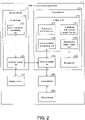
- FIG. 2 is a functional block diagram of the information processing system 1 shown in FIG. 1 .
- the information processing system 1 includes a master device 10, a plurality of slave devices (information processing devices) 20a, 20b, and 20c, and a display device 30.
- each device is daisychained by cables.
- the network system constituted by the information processing system 1 is an EtherCAT (registered trademark) standard network system, but the present invention is not limited thereto.
- the network system may also be, for example, a network system based on standards such as Mechatronic Link (registered trademark), EtherNet/IP, CC-Link (registered trademark), or the like.
- the network system constituted by the information processing system 1 may be, for example, a field network system constituted by a group of manufacturing devices in a factory.
- the master device may be, for example, a device such as a programmable logic controller (PLC) or the like.
- PLC programmable logic controller
- slave devices 20a, 20b, and 20c any one of them may be referred to simply as slave device 20.
- the master device 10 in the information processing system 1 shown in FIGS. 1 and 2 , three slave devices 20 are connected to the master device 10, but one or two, or four or more slave devices 20 may also be connected to the master device 10.
- the master device 10 includes a control unit 110 and a communication unit 120.
- the control unit 110 is a control device that controls the entire master device 10 and also functions as a communication control unit 111.
- control unit 110 includes a central processing unit (CPU), a random access memory (RAM), a read only memory (ROM), and the like, and controls each component according to information processing. Additionally, the same applies to a control unit 210 described later.
- CPU central processing unit
- RAM random access memory
- ROM read only memory
- the communication control unit 111 performs control relating to the control of communication processing performed by the communication unit 120.
- the communication unit 120 performs communication processing with the slave device 20, the display device 30, and the like.
- the master device 10 may include a memory (storage unit) which is not shown.
- the slave device 20 includes the control unit 210, a communication unit 220, and a storage unit 230.
- the control unit 210 is a control device that controls the entire slave device 20 and also functions as a statistical information acquisition unit 211, an abnormality determination unit 212, an abnormality notification unit 213, and a communication processing unit 214.
- the statistical information acquisition unit 211 acquires statistical information about communication with another machine connected by a cable.
- the statistical information may include information that is referred to as "statistics" in EtherNet.
- the abnormality determination unit 212 determines whether or not there is a communication abnormality with reference to the statistical information.
- the abnormality notification unit 213 notifies the device on the master device 10 side of the determination result.
- the communication processing unit 214 performs control relating to the control of communication processing performed by the communication unit 220.
- the communication unit 220 performs communication processing with the master device 10 and other slave devices 20.
- the storage unit 230 is a storage device that stores various information such as statistical information or the like.
- the display device 30 is a device provided with a display capable of displaying a moving image, or the display itself, such as a personal computer or the like.
- the master device 10 may be configured to include the display device 30, or the display device 30 may be configured to be arranged outside the information processing system 1.
- the information processing system 1 shown in FIGS. 1 and 2 has, but is not limited to, a daisy chain type configuration, and may have, for example, a ring topology type configuration.
- FIG. 3 is a flowchart illustrating an example of processing procedures in the slave device 20.
- the slave device 20 repeatedly executes the processing based on the flowchart in FIG. 3 in parallel with normal control operations that should be processed by the slave device 20.
- the processing procedure described below is only an example, and each processing may be changed as much as possible.
- steps may be omitted, replaced, and added as appropriate according to the embodiment.
- step S101 the control unit 210 determines whether or not a predetermined unit time has elapsed since the statistical information acquisition unit 211 acquired previous statistical information. If the control unit 210 determines that the predetermined unit time has elapsed, processing of step S102 is subsequently executed, and if the control unit 210 determines that the predetermined unit time has not elapsed, the determination processing in step S101 is continued. Further, for example, if the statistical information acquisition unit 211 has not yet acquired statistical information since the slave device 20 was started, that is, if the determination processing in step S101 is performed for the first time, the processing of step S102 may be subsequently performed. In addition, the statistical information may be stored in the storage unit 230 at any time after the result of communication is reflected by the control unit 210.
- the statistical information acquisition unit 211 acquires as statistical information, for example, a total number of link-off counts since the slave device 20 was started.
- the link-off count means the number of times that the frames meant to be received by the device are not received.
- the statistical information acquisition unit 211 calculates the link-off count in the latest unit time by subtracting the total number of link-off counts obtained in the previous time from the total number of link-off counts obtained this time in step S102.
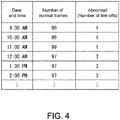
- FIG. 4 illustrates an example of a table in which the number of frames received normally and the link-off count are aggregated on an hourly basis. For example, the row with the date and time "10:00 AM" indicates that the slave device 20 normally received 99 frames in one hour from 10:00 AM and one frame could not be received normally.
- the first threshold value is not limited to a specific value, and may be, for example, 1. If the value of ⁇ is equal to or less than the first threshold value, the abnormality determination unit 212 determines that an abnormality has occurred in the cable, and the abnormality notification unit 213 subsequently executes processing of step S104. If the value of ⁇ is greater than the first threshold value, the abnormality determination unit 212 determines that no abnormality has occurred in the cable and the control unit 210 subsequently executes processing of step S105.
- the abnormality notification unit 213 transmits, to the master device 10, information indicating that an abnormality has occurred in the communication due to an abnormality in the cable via another slave device 20 as appropriate.
- the master device 10 transmits the received information to the display device 30.
- the control unit 210 updates the information stored in the storage unit 230, that is, the information indicating the total number of link-off counts and the link-off count in the last unit time. Specifically, the control unit 210 overwrites the total number of link-off counts obtained in the previous time with the total number of link-off counts obtained by the statistical information acquisition unit 211 in the last time. In addition, the control unit 210 overwrites the link-off count in the previous unit time with the link-off count in the last unit time.
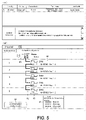
- FIG. 5 illustrates an example of a screen displayed by the display device 30, which displays information about the communication.
- the item “Criticality” indicates the amount or urgency of a problem indicated by a target information.
- the item “Source” is information indicating in which network the communication abnormality occurred.
- the item “Source details” is information indicating which device the communication abnormality is related to in the network in which the communication abnormality has occurred.
- the item “Event name” is information indicating the type of the communication abnormality.
- the item “Event code” is information for uniquely identifying an event about the communication abnormality.
- the item “Detailed information” is information corresponding to the currently selected event, and indicates the details of the event, special notes, measures recommended to the user, or the like.
- an object 40 indicates the master device 10.
- An object 41 indicates the slave device 20.
- An object 42 indicates the cable connecting each device.
- a text 43 is information for uniquely identifying the corresponding slave device 20.
- An object 44 indicates a state of the corresponding cable depending on the difference in the display mode of the object 42 such as the color or the like.
- the cable connecting the slave device 20 of "E002" and the slave device 20 of "E003" is in a state of "Warning".
- Normal means that there is no communication abnormality caused by a target cable.
- Warning indicates that the number of times of a communication abnormality detected in the target cable is equal to or less than a predetermined number of times. In addition, the predetermined number of times may be, for example, once or several times.
- Abnormal indicates that the number of times of a communication abnormality detected in the target cable is greater than the predetermined number of times.
- a button 45 is, for example, a button for displaying a screen shown in (A) of FIG. 5 . According to a screen example shown in (B) of FIG. 5 , the information indicating in which cable the communication abnormality has occurred is displayed in a visually easy-to-understand manner, so that the user can easily grasp the information.
- the abnormality determination unit 212 determines the communication abnormality with reference to the statistical information about the link-off count, thereby eliminating the need for a user operation on the master device 10 for obtaining the information indicating the presence or absence of the communication abnormality each time.
- the abnormality notification unit 213 transmits, to the master device 10 side, information indicating that an abnormality has occurred in the communication due to a cable abnormality, thereby enabling centralized management of the information indicating the communication abnormality in the master device 10. Because the location of the communication abnormality caused by the faulty cable is automatically detected and notified, the burden on the user for monitoring the communication quality of the network system can be reduced.
- FIG. 6 is a flowchart illustrating an example of processing procedures of the slave device 20.
- the slave device 20 repeatedly executes the processing based on the flowchart in FIG. 6 in parallel with the normal control operations that should be processed by the slave device 20.
- step S101 the control unit 210 performs the same processing as in operation example 1. Moreover, if the control unit 210 determines that a predetermined unit time has elapsed since the statistical information acquisition unit 211 acquired the previous statistical information, or if, for example, the determination processing in step S101 is performed for the first time after the slave device 20 is started, the processing of step S202 is subsequently performed.
- the statistical information acquisition unit 211 acquires as statistical information, for example, the total number of invalid frames since the slave device 20 was started.
- the invalid frame is, for example, a frame corresponding to any of the following, and a frame having any abnormality.
- the statistical information acquisition unit 211 calculates the number of invalid frames in the latest unit time by subtracting the total number of invalid frames obtained in the previous time from the total number of invalid frames obtained this time in step S202.
- the number of invalid frames in the latest unit time can also be referred to as an increase in the number from the number of invalid frames obtained in the previous time.
- the first invalid frame that occurred in each unit time may not be counted in the increase number as it is considered to be unreliable.
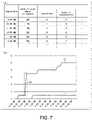
- (A) of FIG. 7 shows an example of a table in which the number of normally received frames, the link-off count, and the number of invalid frames are aggregated on an hourly basis.
- the row with the date and time "2:00 PM" indicates that the slave device 20 received 100 frames in one hour from 2:00 PM, and one of those frames was an invalid frame.
- the link-off and the reception of the invalid frame can be regarded as an abnormal frame reception.
- (A) of FIG. 7 shows that the statistical information includes the number of normal frames which is the number of normal frame receptions, and the number of abnormal frames which is the number of abnormal frame receptions.
- the abnormality determination unit 212 determines whether or not the value of the Poisson distribution formula, which uses an increase in the number of the invalid frames as a random variable value and uses a time average of the total number of the invalid frames as a parameter, is equal to or less than a second threshold value.
- the parameter ⁇ is a value calculated by dividing the total number of the invalid frames by a cumulative operating time. That is, ⁇ is a time average of the total number of the invalid frames.
- a value k corresponding to a random variable X is an increase in the number of the invalid frames.
- e is the base of natural logarithms.
- the second threshold value is not limited to a specific value, and may be, for example, 0.25. Additionally, the value of the Poisson distribution formula equal to or less than 0.25 means that the probability of occurrence of an event is a low probability, which is equal to or less than 25%.
- the abnormality determination unit 212 determines that a communication abnormality due to the influence of noise has occurred, and the abnormality notification unit 213 subsequently executes processing of step S204. If the value of ⁇ is greater than the second threshold value, the abnormality determination unit 212 determines that no communication abnormality due to the influence of noise has occurred, and the control unit 210 subsequently executes processing of step S205.
- the abnormality notification unit 213 transmits, to the master device 10, information indicating that an abnormality has occurred in the communication due to the influence of noise via another slave device 20 as appropriate.
- the master device 10 transmits the received information to the display device 30.
- the control unit 210 updates the information stored in the storage unit 230, that is, the information indicating the cumulative operating time and the information indicating the total number of the invalid frames. With respect to the latter, specifically, the control unit 210 overwrites the previous total number of the invalid frames with the total number of the invalid frames obtained by the statistical information acquisition unit 211 in the last time.
- the abnormality determination unit 212 determines the communication abnormality with reference to the statistical information about the invalid frames, thereby eliminating the need for a user operation on the master device 10 for obtaining the information indicating the presence or absence of the communication abnormality each time.
- the abnormality notification unit 213 transmits, to the master device 10 side, information indicating that an abnormality has occurred in the communication due to the influence of noise, thereby enabling centralized management of the information indicating the communication abnormality in the master device 10. Because the location of the communication abnormality caused by the influence of noise is automatically detected and notified, the burden on the user for monitoring the communication quality of the network system can be reduced.
- (B) of FIG. 7 is a graph corresponding to the table in (A) of FIG. 7 .
- line 50 corresponds to the total number of link-off counts
- line 51 corresponds to the total number of the invalid frames.
- (A) of FIG. 7 and a location 53 in (B) of FIG. 7 show that the link-off occurred six times in one hour from 11:00 AM. It is considered that many link-offs occurred temporarily due to an abnormality in the cable or an influence of sudden noise. The steps based on the flowchart in FIG. 6 also contribute to the understanding of the user that the link-offs were caused by the influence of noise.
- the statistical information does not need to include the total number of the invalid frames of all the types described in step S202, and may include the total number of the invalid frames of at least one type.
- the statistical information includes the number of short frames and the number of frames over the maximum length, that is, the number of frames having a length that exceeds the maximum length.
- the abnormality determination unit 212 may be configured to determine that the communication is abnormal due to noise, when the value of the Poisson distribution formula, which uses an increase in the number of the short frames and the frames over the maximum length as a random variable value and uses a time average of the total number of the short frames and the frames over the maximum length as a parameter, is equal to or less than the second threshold value.
- the abnormality determination unit 212 may determine that the communication is abnormal when the number of the abnormal frames in a unit time exceeds a predetermined threshold value. Accordingly, the presence or absence of a communication abnormality can be determined based on the number of the abnormal frames in a unit time.
- the presence or absence of an abnormality in the cable or the like may be determined based on the value of the Poisson distribution using the link-off count, or the influence of noise may be determined based on the number of the invalid frames in a unit time or the ratio thereof.
- the present invention is not limited to a configuration in which the statistical information is stored in the slave device 20, and may also adopt a configuration in which the master device 10 acquires and stores the statistical information from the slave device 20.
- the control unit 110 of the master device 10 may include the statistical information acquisition unit 211 and the abnormality determination unit 212 and perform the same processing.
- a second embodiment of the present invention is described. It should be noted that, for convenience of description, the members having the same functions as the members described in the above embodiment are designated by the same reference signs, and duplicated description of the matters already described is not repeated.
- description is given on a first configuration in which the user sets a desired first threshold value. After that, description is given on a second configuration in which the user sets a desired second threshold value.
- a slave device (information processing device) 20 has a configuration in which the control unit 210 further includes a first user input acquisition unit and a first threshold value setting unit from the configuration shown in FIG. 2 .
- the first user input acquisition unit acquires a user input related to setting of the first threshold value.
- the first threshold value setting unit sets the first threshold value with reference to the user input acquired by the first user input acquisition unit.
- the slave device 20 sets the first threshold value in the following steps.
- the first threshold value can be set to a value desired by the user.
- the first threshold values set in each slave device 20 may be different from each other, and the same applies to the second threshold value.
- the control unit 210 of the slave device 20 according to the second configuration further includes a second user input acquisition unit and a second threshold value setting unit from the configuration shown in FIG. 2 .
- the second user input acquisition unit acquires a user input related to setting of the second threshold value.
- the second threshold value setting unit sets the second threshold value with reference to the user input acquired by the second user input acquisition unit.
- the procedures for setting the second threshold value by the slave device 20 according to the second configuration are the same as the procedures for setting the first threshold value by the slave device 20 according to the first configuration except that the "first threshold value” is replaced with the “second threshold value”, the "first user input acquisition unit” is replaced with the “second user input acquisition unit”, and the "first threshold value setting unit” is replaced with the "second threshold value setting unit”.
- the second threshold value can be set to a value desired by the user.
- control unit 210 further includes the first user input acquisition unit, the first threshold value setting unit, the second user input acquisition unit, and the second threshold value setting unit from the configuration shown in FIG. 2 .
- the information processing device 20 (20a, 20b, 20c) includes: the statistical information acquisition unit 211 that acquires statistical information about communication with another machine connected by a cable; the abnormality determination unit 212 that determines an abnormality in the communication with reference to the statistical information acquired by the statistical information acquisition unit 211; and the abnormality notification unit 213 that notifies the master device 10 of a determination result from the abnormality determination unit 212, when the determination result indicates that the communication is abnormal.
- the above configuration does not require a user operation on the master device 10 for obtaining information indicating the presence or absence of a communication abnormality each time.
- the master device 10 can centrally manage the information indicating the communication abnormality that has occurred in the network system. Therefore, according to the above configuration, the burden on the user for monitoring the communication quality of the network system can be reduced.
- the statistical information may include a number of normal frames which is a number of normal frame receptions, and a number of abnormal frames which is a number of abnormal frame receptions. According to this configuration, it is possible to determine the communication abnormality with reference to the number of normal frames and the number of abnormal frames.
- the abnormality determination unit 212 may determine that the communication is abnormal when the number of abnormal frames within a predetermined unit time exceeds a predetermined threshold value. According to this configuration, the presence or absence of a communication abnormality can be determined based on the number of invalid frames within a predetermined unit time.
- the statistical information includes the link-off count, and when a ratio of a link-off count in a unit time immediately before one unit time to a link-off count in the one unit time is equal to or less than the first threshold value, the abnormality determination unit 212 determines that the communication is abnormal due to a cable abnormality. According to this configuration, a communication abnormality due to the faulty cable can be detected.
- the information processing device 20 may include a first user input acquisition unit for acquiring a user input related to setting of the first threshold value, and a first threshold value setting unit for setting the first threshold value with reference to the user input acquired by the first user input acquisition unit.
- the first threshold value can be set to a value desired by the user.
- the statistical information includes a number of short frames and a number of frames over a maximum length.
- the abnormality determination unit 212 may determine that the communication is abnormal due to noise, when a value of a Poisson distribution formula is less than a second threshold value with an increase in the number of short frames and the number of frames over the maximum length being a random variable value, and a time average of a total number of the number of short frames and the number of frames over the maximum length being a parameter. According to this configuration, a communication abnormality due to noise can be detected.
- the information processing device 20 may include a second user input acquisition unit for acquiring a user input related to setting of the second threshold value, and a second threshold value setting unit for setting the second threshold value with reference to the user input acquired by the second user input acquisition unit.
- the second threshold value can be set to a value desired by the user.
- the information processing system 1 includes the master device 10 and the slave devices 20 (20a, 20b, 20c) connected to the master device 10 by a cable.
- the slave device 20 includes: the statistical information acquisition unit 211 that acquires statistical information about the communication with the master device 10 via a network; the abnormality determination unit 212 that determines an abnormality in the communication with reference to the statistical information acquired by the statistical information acquisition unit 211; and the abnormality notification unit 213 that notifies the master device 10 of a determination result from the abnormality determination unit 212, when the determination result indicates that the communication is abnormal.
- the above configuration does not require an operation on the master device 10 for obtaining information indicating the presence or absence of a communication abnormality each time. Therefore, according to the above configuration, the burden on the user for monitoring the communication quality of the network system can be reduced.
- a notification method is a notification method executed in the information processing device 20.
- the notification method includes: a statistical information acquisition step of acquiring statistical information about communication with another machine connected by a cable; an abnormality determination step of determining an abnormality in the communication with reference to the statistical information acquired in the statistical information acquisition step; and an abnormality notification step of notifying the master device 10 of a determination result from the abnormality determination step, when the determination result indicates that the communication is abnormal. According to this configuration, the burden on the user for monitoring the communication quality of the network system can be reduced.
- an information processing program is an information processing program for causing a computer to function as the information processing device 20 described in any one of the above.
- the information processing program causes the computer to function as the statistical information acquisition unit 211, the abnormality determination unit 212, and the abnormality notification unit 213. According to this configuration, the same effect as that of the information processing device 20 according to one aspect of the present invention can be obtained.
- control blocks of the slave device 20 (in particular, the statistical information acquisition unit 211, the abnormality determination unit 212, the abnormality notification unit 213, and the communication processing unit 214) and the control blocks of the master device 10 (in particular, the communication control unit 111) may be implemented by a logic circuit (hardware) formed in an integrated circuit (an IC chip) or the like, or may be implemented by software.
- the slave device 20 or the master device 10 includes a computer that executes instructions of a program being software that implements each function.
- This computer includes, for example, one or more processors and a computer-readable recording medium that stores the program.
- the processor reads the program from the recording medium and executes the program, and thereby the object of the present invention is achieved.
- the processor may be, for example, a central processing unit (CPU).
- the recording medium may be a "non-temporary tangible medium", such as a read only memory (ROM), as well as a tape, a disk, a card, a semiconductor memory, a programmable logic circuit, or the like.
- the recording medium may further include a random access memory (RAM) or the like that deploys the above program.
- the above program may be supplied to the computer via any transmission medium capable of transmitting the program (communication network, broadcast wave, or the like).
- one aspect of the present invention may also be implemented in a form of a data signal embedded in a carrier wave, in which the above program is embodied by electronic transmission.
Landscapes
- Engineering & Computer Science (AREA)
- Signal Processing (AREA)
- Computer Networks & Wireless Communication (AREA)
- Theoretical Computer Science (AREA)
- General Engineering & Computer Science (AREA)
- Quality & Reliability (AREA)
- Physics & Mathematics (AREA)
- General Physics & Mathematics (AREA)
- Environmental & Geological Engineering (AREA)
- Computer Security & Cryptography (AREA)
- Computer Hardware Design (AREA)
- Small-Scale Networks (AREA)
- Maintenance And Management Of Digital Transmission (AREA)
Abstract
Description
- The present invention relates to an information processing device, an information processing system, a notification method, and an information processing program.
- A network system constituted of a master device and a slave device is used as an industrial network system, and techniques related to the network system are known.
Patent literature 1 discloses a method of suppressing a delay in establishing communication processing in a network system including a master device and a slave device. In addition,Patent literature 2 discloses a development support device for a programmable controller (PLC) system that can shorten the time required for investigating the cause of a communication abnormality when the communication abnormality occurs. -
- Patent literature 1:
Japanese Patent Application Laid-Open No. 2016-195329 (published on November 17, 2016 - Patent literature 2:
Japanese Patent Application Laid-Open No. 2008-181572 (published on August 7, 2008 - In the network system as described above, communication quality may be degraded or communication may be suddenly interrupted due to deterioration of a cable connecting devices, noise caused by an influence of peripheral devices, or the like. In particular, when communication is suddenly interrupted in a field network, it takes a lot of time to identify the cause or restore the network.
- In order to address the above problems, a redundancy measure such as duplication of devices by hot standby or making a network topology ring-shaped can be taken, or cables with excellent environmental resistance that can reduce the influence of noise can be used. However, because the above-mentioned measures require significant changes to the system and are technically challenging, it is desirable to monitor the communication quality of the network system periodically without changing the current system or equipment.
- On the other hand, when the communication quality of the network system is periodically monitored, for example, there is a problem that it takes time and effort for a user to operate a program in the master device to check for abnormalities.
- One aspect of the present invention has been made in consideration of the above problems, and an object of the present invention is to reduce a burden on the user when monitoring the communication quality of a network system.
- The present invention adopts the following configuration to solve the above-mentioned problems.
- That is, an information processing device according to one aspect of the present invention includes: a statistical information acquisition unit that acquires statistical information about communication with another machine connected by a cable; an abnormality determination unit that determines an abnormality in the communication with reference to the statistical information acquired by the statistical information acquisition unit; and an abnormality notification unit that notifies a master device of a determination result from the abnormality determination unit, when the determination result indicates that the communication is abnormal.
- In addition, the information processing system according to one aspect of the present invention is an information processing system that includes a master device and a slave device connected to the master device by a cable. The slave device includes: a statistical information acquisition unit that acquires statistical information about communication with the master device via a network; an abnormality determination unit that determines an abnormality in the communication with reference to the statistical information acquired by the statistical information acquisition unit; and an abnormality notification unit that notifies the master device of a determination result from the abnormality determination unit, when the determination result indicates that the communication is abnormal.
- Besides, a notification method according to one aspect of the present invention is a notification method executed in an information processing device. The notification method includes: a statistical information acquisition step of acquiring statistical information about communication with another machine connected by a cable; an abnormality determination step of determining an abnormality in the communication with reference to the statistical information acquired in the statistical information acquisition step; and an abnormality notification step of notifying a master device of a determination result from the abnormality determination step, when the determination result indicates that the communication is abnormal.
- According to one aspect of the present invention, the burden on the user for monitoring the communication quality of a network system can be reduced.
-
-
FIG. 1 schematically illustrates an example of an information processing system according toEmbodiment 1. -
FIG. 2 illustrates an example of a functional block diagram of the information processing system according toEmbodiment 1. -
FIG. 3 illustrates an example of processing procedures in the information processing device according toEmbodiment 1. -
FIG. 4 illustrates an example of a table showing statistical information according toEmbodiment 1. -
FIG. 5 illustrates an example of a display screen in a display device according toEmbodiment 1. -
FIG. 6 illustrates an example of processing procedures in the information processing device according toEmbodiment 1. -
FIG. 7 illustrates an example of a table and a graph showing statistical information according toEmbodiment 1. - Hereinafter, an embodiment according to one aspect of the present invention (hereinafter, also referred to as "the present embodiment") is described with reference to the drawings.
- An information processing device according to the present embodiment is a device that functions as a slave device in a network system that performs, for example, distributed processing or the like, and is, for example, an input/output device, a sensor controller, or the like.
- The information processing device acquires statistical information about communication with another machine connected by a cable, and determines a communication abnormality with reference to the statistical information. The information processing device is configured to transmit, when the result of the determination indicates that the communication is abnormal, information indicating the location and type of the abnormality toward a master device side of the network system. Here, the communication abnormality means, for example, a state in which frames cannot be transmitted or received normally or a state in which the transmitted or received frames are defective due to deterioration of the cable connecting the devices or noise caused by the influences of peripheral devices. In addition, the frame is a data format used in data link layer protocol such as EtherCAT or the like.
- With the configuration described above, for example, by confirming the information transmitted to the master device when the communication abnormality is detected, the user can take appropriate measures such as changing the cable used for the connection with another machine to a cable having improved environmental performance such as noise resistance or the like. In addition, the burden on the user for monitoring the communication quality of the network system can be reduced.
- Next, an example of a hardware configuration of the information processing system according to the present embodiment is described with reference to
FIGS. 1 and2 .FIG. 1 schematically illustrates an example of a hardware configuration of aninformation processing system 1 according to the present embodiment. In addition,FIG. 2 is a functional block diagram of theinformation processing system 1 shown inFIG. 1 . - As shown in
FIGS. 1 and2 , theinformation processing system 1 according to the present embodiment includes amaster device 10, a plurality of slave devices (information processing devices) 20a, 20b, and 20c, and adisplay device 30. In addition, each device is daisychained by cables. - Moreover, in the present specification, a case is described in which the network system constituted by the
information processing system 1 is an EtherCAT (registered trademark) standard network system, but the present invention is not limited thereto. The network system may also be, for example, a network system based on standards such as Mechatronic Link (registered trademark), EtherNet/IP, CC-Link (registered trademark), or the like. In addition, the network system constituted by theinformation processing system 1 may be, for example, a field network system constituted by a group of manufacturing devices in a factory. Additionally, the master device may be, for example, a device such as a programmable logic controller (PLC) or the like. Besides, in the following description, if there is no particular distinction among theslave devices information processing system 1 shown inFIGS. 1 and2 , three slave devices 20 are connected to themaster device 10, but one or two, or four or more slave devices 20 may also be connected to themaster device 10. - The
master device 10 includes acontrol unit 110 and acommunication unit 120. Thecontrol unit 110 is a control device that controls theentire master device 10 and also functions as acommunication control unit 111. - In addition, the
control unit 110 includes a central processing unit (CPU), a random access memory (RAM), a read only memory (ROM), and the like, and controls each component according to information processing. Additionally, the same applies to acontrol unit 210 described later. - The
communication control unit 111 performs control relating to the control of communication processing performed by thecommunication unit 120. Thecommunication unit 120 performs communication processing with the slave device 20, thedisplay device 30, and the like. In addition, themaster device 10 may include a memory (storage unit) which is not shown. - The slave device 20 includes the
control unit 210, acommunication unit 220, and astorage unit 230. Thecontrol unit 210 is a control device that controls the entire slave device 20 and also functions as a statisticalinformation acquisition unit 211, anabnormality determination unit 212, anabnormality notification unit 213, and acommunication processing unit 214. - The statistical
information acquisition unit 211 acquires statistical information about communication with another machine connected by a cable. Here, the statistical information may include information that is referred to as "statistics" in EtherNet. In addition, a detailed example of the statistical information is described later. Theabnormality determination unit 212 determines whether or not there is a communication abnormality with reference to the statistical information. When a determination result obtained by theabnormality determination unit 212 indicates that the communication is abnormal, theabnormality notification unit 213 notifies the device on themaster device 10 side of the determination result. Thecommunication processing unit 214 performs control relating to the control of communication processing performed by thecommunication unit 220. - The
communication unit 220 performs communication processing with themaster device 10 and other slave devices 20. Thestorage unit 230 is a storage device that stores various information such as statistical information or the like. Thedisplay device 30 is a device provided with a display capable of displaying a moving image, or the display itself, such as a personal computer or the like. Moreover, as another aspect, themaster device 10 may be configured to include thedisplay device 30, or thedisplay device 30 may be configured to be arranged outside theinformation processing system 1. In addition, theinformation processing system 1 shown inFIGS. 1 and2 has, but is not limited to, a daisy chain type configuration, and may have, for example, a ring topology type configuration. - Next, a first operation example of the
information processing system 1 is described with reference toFIG. 3. FIG. 3 is a flowchart illustrating an example of processing procedures in the slave device 20. In addition, the slave device 20 repeatedly executes the processing based on the flowchart inFIG. 3 in parallel with normal control operations that should be processed by the slave device 20. Note that, the processing procedure described below is only an example, and each processing may be changed as much as possible. In addition, with respect to the processing procedures described below, steps may be omitted, replaced, and added as appropriate according to the embodiment. - In step S101, the
control unit 210 determines whether or not a predetermined unit time has elapsed since the statisticalinformation acquisition unit 211 acquired previous statistical information. If thecontrol unit 210 determines that the predetermined unit time has elapsed, processing of step S102 is subsequently executed, and if thecontrol unit 210 determines that the predetermined unit time has not elapsed, the determination processing in step S101 is continued. Further, for example, if the statisticalinformation acquisition unit 211 has not yet acquired statistical information since the slave device 20 was started, that is, if the determination processing in step S101 is performed for the first time, the processing of step S102 may be subsequently performed. In addition, the statistical information may be stored in thestorage unit 230 at any time after the result of communication is reflected by thecontrol unit 210. - In the next step S102, the statistical
information acquisition unit 211 acquires as statistical information, for example, a total number of link-off counts since the slave device 20 was started. Here, the link-off count means the number of times that the frames meant to be received by the device are not received. In addition, the statisticalinformation acquisition unit 211 calculates the link-off count in the latest unit time by subtracting the total number of link-off counts obtained in the previous time from the total number of link-off counts obtained this time in step S102. -
FIG. 4 illustrates an example of a table in which the number of frames received normally and the link-off count are aggregated on an hourly basis. For example, the row with the date and time "10:00 AM" indicates that the slave device 20 normally received 99 frames in one hour from 10:00 AM and one frame could not be received normally. - In the next step S103, the
abnormality determination unit 212 determines whether a ratio of, with respect to the link-off count in a unit time, the link-off count in a unit time immediately before the above unit time is equal to or less than a first threshold value. Assuming that the latest unit time is T and the immediately preceding unit time is T-1, the value of the above ratio is expressed by the following formula.
- In addition, the first threshold value is not limited to a specific value, and may be, for example, 1. If the value of α is equal to or less than the first threshold value, the
abnormality determination unit 212 determines that an abnormality has occurred in the cable, and theabnormality notification unit 213 subsequently executes processing of step S104. If the value of α is greater than the first threshold value, theabnormality determination unit 212 determines that no abnormality has occurred in the cable and thecontrol unit 210 subsequently executes processing of step S105. - In the next step S104, the
abnormality notification unit 213 transmits, to themaster device 10, information indicating that an abnormality has occurred in the communication due to an abnormality in the cable via another slave device 20 as appropriate. In addition, themaster device 10 transmits the received information to thedisplay device 30. - In the next step S105, the
control unit 210 updates the information stored in thestorage unit 230, that is, the information indicating the total number of link-off counts and the link-off count in the last unit time. Specifically, thecontrol unit 210 overwrites the total number of link-off counts obtained in the previous time with the total number of link-off counts obtained by the statisticalinformation acquisition unit 211 in the last time. In addition, thecontrol unit 210 overwrites the link-off count in the previous unit time with the link-off count in the last unit time. - Next, a display example of information indicating a communication abnormality is described with reference to
FIG. 5. FIG. 5 illustrates an example of a screen displayed by thedisplay device 30, which displays information about the communication. - In (A) of
FIG. 5 , the item "Criticality" indicates the amount or urgency of a problem indicated by a target information. The item "Source" is information indicating in which network the communication abnormality occurred. The item "Source details" is information indicating which device the communication abnormality is related to in the network in which the communication abnormality has occurred. The item "Event name" is information indicating the type of the communication abnormality. The item "Event code" is information for uniquely identifying an event about the communication abnormality. In addition, the item "Detailed information" is information corresponding to the currently selected event, and indicates the details of the event, special notes, measures recommended to the user, or the like. - In addition, in (B) of
FIG. 5 , themaster device 10, the slave device 20, and cables connecting each device are illustrated. Specifically, anobject 40 indicates themaster device 10. Anobject 41 indicates the slave device 20. Anobject 42 indicates the cable connecting each device. In addition, atext 43 is information for uniquely identifying the corresponding slave device 20. Anobject 44 indicates a state of the corresponding cable depending on the difference in the display mode of theobject 42 such as the color or the like. As a specific example, the cable connecting the slave device 20 of "E002" and the slave device 20 of "E003" is in a state of "Warning". - In the
object 44, "Normal" means that there is no communication abnormality caused by a target cable. "Warning" indicates that the number of times of a communication abnormality detected in the target cable is equal to or less than a predetermined number of times. In addition, the predetermined number of times may be, for example, once or several times. "Abnormal" indicates that the number of times of a communication abnormality detected in the target cable is greater than the predetermined number of times. Abutton 45 is, for example, a button for displaying a screen shown in (A) ofFIG. 5 . According to a screen example shown in (B) ofFIG. 5 , the information indicating in which cable the communication abnormality has occurred is displayed in a visually easy-to-understand manner, so that the user can easily grasp the information. - As described above, in the present embodiment, in step S103, the
abnormality determination unit 212 determines the communication abnormality with reference to the statistical information about the link-off count, thereby eliminating the need for a user operation on themaster device 10 for obtaining the information indicating the presence or absence of the communication abnormality each time. In addition, in step S104, theabnormality notification unit 213 transmits, to themaster device 10 side, information indicating that an abnormality has occurred in the communication due to a cable abnormality, thereby enabling centralized management of the information indicating the communication abnormality in themaster device 10. Because the location of the communication abnormality caused by the faulty cable is automatically detected and notified, the burden on the user for monitoring the communication quality of the network system can be reduced. - Next, a second operation example of the
information processing system 1 is described with reference toFIGS. 6 and7 .FIG. 6 is a flowchart illustrating an example of processing procedures of the slave device 20. In addition, the slave device 20 repeatedly executes the processing based on the flowchart inFIG. 6 in parallel with the normal control operations that should be processed by the slave device 20. - In step S101, the
control unit 210 performs the same processing as in operation example 1. Moreover, if thecontrol unit 210 determines that a predetermined unit time has elapsed since the statisticalinformation acquisition unit 211 acquired the previous statistical information, or if, for example, the determination processing in step S101 is performed for the first time after the slave device 20 is started, the processing of step S202 is subsequently performed. - In the next step S202, the statistical
information acquisition unit 211 acquires as statistical information, for example, the total number of invalid frames since the slave device 20 was started. Here, the invalid frame is, for example, a frame corresponding to any of the following, and a frame having any abnormality. - Abnormality related to data link layer
- FCS Check Sum mismatch
- Incorrect Start Frame Delimiter
- Presence or absence of Preamble
- Abnormality related to physical layer
- Abnormality in Manchester code
- Abnormality in 4B/5B code
- Short frame
- Frame exceeding maximum length
- In addition, the statistical
information acquisition unit 211 calculates the number of invalid frames in the latest unit time by subtracting the total number of invalid frames obtained in the previous time from the total number of invalid frames obtained this time in step S202. Here, the number of invalid frames in the latest unit time can also be referred to as an increase in the number from the number of invalid frames obtained in the previous time. However, the first invalid frame that occurred in each unit time may not be counted in the increase number as it is considered to be unreliable. - (A) of
FIG. 7 shows an example of a table in which the number of normally received frames, the link-off count, and the number of invalid frames are aggregated on an hourly basis. For example, the row with the date and time "2:00 PM" indicates that the slave device 20 received 100 frames in one hour from 2:00 PM, and one of those frames was an invalid frame. In addition, the link-off and the reception of the invalid frame can be regarded as an abnormal frame reception. In other words, (A) ofFIG. 7 shows that the statistical information includes the number of normal frames which is the number of normal frame receptions, and the number of abnormal frames which is the number of abnormal frame receptions. - In the next step S203, the
abnormality determination unit 212 determines whether or not the value of the Poisson distribution formula, which uses an increase in the number of the invalid frames as a random variable value and uses a time average of the total number of the invalid frames as a parameter, is equal to or less than a second threshold value. In addition, the Poisson distribution formula is as follows.
- Here, the parameter λ is a value calculated by dividing the total number of the invalid frames by a cumulative operating time. That is, λ is a time average of the total number of the invalid frames. A value k corresponding to a random variable X is an increase in the number of the invalid frames. e is the base of natural logarithms. In addition, the second threshold value is not limited to a specific value, and may be, for example, 0.25. Additionally, the value of the Poisson distribution formula equal to or less than 0.25 means that the probability of occurrence of an event is a low probability, which is equal to or less than 25%.
- If the value of β of the Poisson distribution formula is equal to or less than the second threshold value, the
abnormality determination unit 212 determines that a communication abnormality due to the influence of noise has occurred, and theabnormality notification unit 213 subsequently executes processing of step S204. If the value of β is greater than the second threshold value, theabnormality determination unit 212 determines that no communication abnormality due to the influence of noise has occurred, and thecontrol unit 210 subsequently executes processing of step S205. - In the next step S204, the
abnormality notification unit 213 transmits, to themaster device 10, information indicating that an abnormality has occurred in the communication due to the influence of noise via another slave device 20 as appropriate. In addition, themaster device 10 transmits the received information to thedisplay device 30. - In the next step S205, the
control unit 210 updates the information stored in thestorage unit 230, that is, the information indicating the cumulative operating time and the information indicating the total number of the invalid frames. With respect to the latter, specifically, thecontrol unit 210 overwrites the previous total number of the invalid frames with the total number of the invalid frames obtained by the statisticalinformation acquisition unit 211 in the last time. - As described above, in the present embodiment, in step S203, the
abnormality determination unit 212 determines the communication abnormality with reference to the statistical information about the invalid frames, thereby eliminating the need for a user operation on themaster device 10 for obtaining the information indicating the presence or absence of the communication abnormality each time. In addition, in step S204, theabnormality notification unit 213 transmits, to themaster device 10 side, information indicating that an abnormality has occurred in the communication due to the influence of noise, thereby enabling centralized management of the information indicating the communication abnormality in themaster device 10. Because the location of the communication abnormality caused by the influence of noise is automatically detected and notified, the burden on the user for monitoring the communication quality of the network system can be reduced. - In addition, (B) of
FIG. 7 is a graph corresponding to the table in (A) ofFIG. 7 . In the above graph,line 50 corresponds to the total number of link-off counts, andline 51 corresponds to the total number of the invalid frames. (A) ofFIG. 7 and alocation 53 in (B) ofFIG. 7 show that the link-off occurred six times in one hour from 11:00 AM. It is considered that many link-offs occurred temporarily due to an abnormality in the cable or an influence of sudden noise. The steps based on the flowchart inFIG. 6 also contribute to the understanding of the user that the link-offs were caused by the influence of noise. - With respect to operation example 2, the statistical information does not need to include the total number of the invalid frames of all the types described in step S202, and may include the total number of the invalid frames of at least one type. For example, the statistical information includes the number of short frames and the number of frames over the maximum length, that is, the number of frames having a length that exceeds the maximum length. The
abnormality determination unit 212 may be configured to determine that the communication is abnormal due to noise, when the value of the Poisson distribution formula, which uses an increase in the number of the short frames and the frames over the maximum length as a random variable value and uses a time average of the total number of the short frames and the frames over the maximum length as a parameter, is equal to or less than the second threshold value. - In addition, with respect to the determination processing in step S203, the
abnormality determination unit 212 may determine that the communication is abnormal when the number of the abnormal frames in a unit time exceeds a predetermined threshold value. Accordingly, the presence or absence of a communication abnormality can be determined based on the number of the abnormal frames in a unit time. - In addition, in operation example 1 described above, an example has been described in which determination on the abnormality in the cable is made based on the ratio of the number of occurrences of the communication abnormality (the link-off count) in continuous unit times, and in operation example 2, an example has been described in which determination on the influence of noise is made based on the value of the Poisson distribution which uses the increase number of the communication abnormality (the increase number of the invalid frames) as the random variable value. The above description does not mean that the presence or absence of the abnormality in the cable or the like is required to be determined by the number of occurrences of the communication abnormality in a unit time or the ratio thereof. Also, the above description does not mean that the presence or absence of the abnormality due to the influence of noise is required to be determined based on the value of the Poisson distribution.
- For example, the presence or absence of an abnormality in the cable or the like may be determined based on the value of the Poisson distribution using the link-off count, or the influence of noise may be determined based on the number of the invalid frames in a unit time or the ratio thereof.
- In addition, the present invention is not limited to a configuration in which the statistical information is stored in the slave device 20, and may also adopt a configuration in which the
master device 10 acquires and stores the statistical information from the slave device 20. In the latter configuration, thecontrol unit 110 of themaster device 10 may include the statisticalinformation acquisition unit 211 and theabnormality determination unit 212 and perform the same processing. - A second embodiment of the present invention is described. It should be noted that, for convenience of description, the members having the same functions as the members described in the above embodiment are designated by the same reference signs, and duplicated description of the matters already described is not repeated. In the present embodiment, description is given on a first configuration in which the user sets a desired first threshold value. After that, description is given on a second configuration in which the user sets a desired second threshold value.
- A slave device (information processing device) 20 according to the first configuration has a configuration in which the
control unit 210 further includes a first user input acquisition unit and a first threshold value setting unit from the configuration shown inFIG. 2 . The first user input acquisition unit acquires a user input related to setting of the first threshold value. The first threshold value setting unit sets the first threshold value with reference to the user input acquired by the first user input acquisition unit. - The slave device 20 according to the first configuration sets the first threshold value in the following steps.
- (1) The first user input acquisition unit acquires information indicating the first threshold value to be set, which is input by the user. Moreover, the source of the information may be the slave device 20 or the
master device 10. In other words, the user may input the information to the target slave device 20 or to themaster device 10. In the latter case, the first user input acquisition unit acquires the information via thecommunication unit 220.
Further, the information input by the user is not limited to an absolute value of the first threshold value, and may also be a coefficient that sets a magnification from the current first threshold value or a magnification from an automatically calculated first threshold value. In the above case, for example, when the input coefficient is less than 1, it becomes difficult to detect a communication abnormality in the slave device 20. In particular, when the coefficient is 0, it is substantially impossible to detect a communication abnormality. In addition, when the input coefficient is greater than 1, the communication abnormality can be easily detected in the slave device 20. - (2) The first threshold value setting unit updates the information stored in the
storage unit 230 that indicates the first threshold value with the information obtained by the first user input acquisition unit in (1). - According to the first configuration, the first threshold value can be set to a value desired by the user. Moreover, the first threshold values set in each slave device 20 may be different from each other, and the same applies to the second threshold value.
- Next, description is given on the second configuration in which the user sets the desired second threshold value. The
control unit 210 of the slave device 20 according to the second configuration further includes a second user input acquisition unit and a second threshold value setting unit from the configuration shown inFIG. 2 . The second user input acquisition unit acquires a user input related to setting of the second threshold value. The second threshold value setting unit sets the second threshold value with reference to the user input acquired by the second user input acquisition unit. - In addition, the procedures for setting the second threshold value by the slave device 20 according to the second configuration are the same as the procedures for setting the first threshold value by the slave device 20 according to the first configuration except that the "first threshold value" is replaced with the "second threshold value", the "first user input acquisition unit" is replaced with the "second user input acquisition unit", and the "first threshold value setting unit" is replaced with the "second threshold value setting unit". According to the second configuration, the second threshold value can be set to a value desired by the user.
- In addition, the configuration may be such that the user can set the desired first threshold value and the second threshold value at the same time. In this configuration, the
control unit 210 further includes the first user input acquisition unit, the first threshold value setting unit, the second user input acquisition unit, and the second threshold value setting unit from the configuration shown inFIG. 2 . - The information processing device 20 (20a, 20b, 20c) according to one aspect of the present invention includes: the statistical
information acquisition unit 211 that acquires statistical information about communication with another machine connected by a cable; theabnormality determination unit 212 that determines an abnormality in the communication with reference to the statistical information acquired by the statisticalinformation acquisition unit 211; and theabnormality notification unit 213 that notifies themaster device 10 of a determination result from theabnormality determination unit 212, when the determination result indicates that the communication is abnormal. The above configuration does not require a user operation on themaster device 10 for obtaining information indicating the presence or absence of a communication abnormality each time. In addition, themaster device 10 can centrally manage the information indicating the communication abnormality that has occurred in the network system. Therefore, according to the above configuration, the burden on the user for monitoring the communication quality of the network system can be reduced. - In the information processing device 20 according to the above aspect, the statistical information may include a number of normal frames which is a number of normal frame receptions, and a number of abnormal frames which is a number of abnormal frame receptions. According to this configuration, it is possible to determine the communication abnormality with reference to the number of normal frames and the number of abnormal frames.
- In the information processing device 20 according to the above aspect, the
abnormality determination unit 212 may determine that the communication is abnormal when the number of abnormal frames within a predetermined unit time exceeds a predetermined threshold value. According to this configuration, the presence or absence of a communication abnormality can be determined based on the number of invalid frames within a predetermined unit time. - In the information processing device 20 according to the above aspect, the statistical information includes the link-off count, and when a ratio of a link-off count in a unit time immediately before one unit time to a link-off count in the one unit time is equal to or less than the first threshold value, the
abnormality determination unit 212 determines that the communication is abnormal due to a cable abnormality. According to this configuration, a communication abnormality due to the faulty cable can be detected. - The information processing device 20 according to the above aspect may include a first user input acquisition unit for acquiring a user input related to setting of the first threshold value, and a first threshold value setting unit for setting the first threshold value with reference to the user input acquired by the first user input acquisition unit. According to this configuration, the first threshold value can be set to a value desired by the user.
- In the information processing device 20 according to the above aspect, the statistical information includes a number of short frames and a number of frames over a maximum length. The
abnormality determination unit 212 may determine that the communication is abnormal due to noise, when a value of a Poisson distribution formula is less than a second threshold value with an increase in the number of short frames and the number of frames over the maximum length being a random variable value, and a time average of a total number of the number of short frames and the number of frames over the maximum length being a parameter. According to this configuration, a communication abnormality due to noise can be detected. - The information processing device 20 according to the above aspect may include a second user input acquisition unit for acquiring a user input related to setting of the second threshold value, and a second threshold value setting unit for setting the second threshold value with reference to the user input acquired by the second user input acquisition unit. According to this configuration, the second threshold value can be set to a value desired by the user.
- In addition, the
information processing system 1 according to one aspect of the present invention includes themaster device 10 and the slave devices 20 (20a, 20b, 20c) connected to themaster device 10 by a cable. The slave device 20 includes: the statisticalinformation acquisition unit 211 that acquires statistical information about the communication with themaster device 10 via a network; theabnormality determination unit 212 that determines an abnormality in the communication with reference to the statistical information acquired by the statisticalinformation acquisition unit 211; and theabnormality notification unit 213 that notifies themaster device 10 of a determination result from theabnormality determination unit 212, when the determination result indicates that the communication is abnormal. The above configuration does not require an operation on themaster device 10 for obtaining information indicating the presence or absence of a communication abnormality each time. Therefore, according to the above configuration, the burden on the user for monitoring the communication quality of the network system can be reduced. - In addition, a notification method according to one aspect of the present invention is a notification method executed in the information processing device 20. The notification method includes: a statistical information acquisition step of acquiring statistical information about communication with another machine connected by a cable; an abnormality determination step of determining an abnormality in the communication with reference to the statistical information acquired in the statistical information acquisition step; and an abnormality notification step of notifying the
master device 10 of a determination result from the abnormality determination step, when the determination result indicates that the communication is abnormal. According to this configuration, the burden on the user for monitoring the communication quality of the network system can be reduced. - Further, an information processing program according to one aspect of the present invention is an information processing program for causing a computer to function as the information processing device 20 described in any one of the above. The information processing program causes the computer to function as the statistical
information acquisition unit 211, theabnormality determination unit 212, and theabnormality notification unit 213. According to this configuration, the same effect as that of the information processing device 20 according to one aspect of the present invention can be obtained. - The control blocks of the slave device 20 (in particular, the statistical
information acquisition unit 211, theabnormality determination unit 212, theabnormality notification unit 213, and the communication processing unit 214) and the control blocks of the master device 10 (in particular, the communication control unit 111) may be implemented by a logic circuit (hardware) formed in an integrated circuit (an IC chip) or the like, or may be implemented by software. - In the latter case, the slave device 20 or the
master device 10 includes a computer that executes instructions of a program being software that implements each function. This computer includes, for example, one or more processors and a computer-readable recording medium that stores the program. Besides, in the computer, the processor reads the program from the recording medium and executes the program, and thereby the object of the present invention is achieved. The processor may be, for example, a central processing unit (CPU). The recording medium may be a "non-temporary tangible medium", such as a read only memory (ROM), as well as a tape, a disk, a card, a semiconductor memory, a programmable logic circuit, or the like. In addition, the recording medium may further include a random access memory (RAM) or the like that deploys the above program. Additionally, the above program may be supplied to the computer via any transmission medium capable of transmitting the program (communication network, broadcast wave, or the like). Further, one aspect of the present invention may also be implemented in a form of a data signal embedded in a carrier wave, in which the above program is embodied by electronic transmission. - The present invention is not limited to the above-described embodiments, various modifications can be made within the scope of the claims, and embodiments obtained by appropriately combining the technical means respectively disclosed in different embodiments are also included in the technical scope of the present invention.
-
- 1
- information processing system
- 10
- master device
- 20, 20a, 20b, 20c
- slave device (information processing device)
- 30
- display device
- 110,210
- control unit
- 111
- communication control unit
- 120,220
- communication unit
- 211
- statistical information acquisition unit
- 212
- abnormality determination unit
- 213
- abnormality notification unit
- 214
- communication processing unit
- 230
- storage unit
Claims (10)
- An information processing device comprising:a statistical information acquisition unit that acquires statistical information about communication with another machine connected by a cable;an abnormality determination unit that determines an abnormality in the communication with reference to the statistical information acquired by the statistical information acquisition unit; andan abnormality notification unit that notifies a master device of a determination result from the abnormality determination unit, when the determination result indicates that the communication is abnormal.
- The information processing device according to claim 1, wherein the statistical information comprises:a number of normal frames which is a number of normal frame receptions; anda number of abnormal frames which is a number of abnormal frame receptions.
- The information processing device according to claim 2, wherein the abnormality determination unit determines that the communication is abnormal when the number of abnormal frames within a predetermined unit time exceeds a predetermined threshold value.
- The information processing device according to any one of claims 1 to 3, wherein the statistical information comprises a link-off count, and
the abnormality determination unit determines that the communication is abnormal due to a cable abnormality when a ratio of a link-off count in a unit time immediately before one unit time to a link-off count in the one unit time is equal to or less than a first threshold value. - The information processing device according to claim 4, comprising:a first user input acquisition unit for acquiring a user input related to setting of the first threshold value; anda first threshold value setting unit for setting the first threshold value with reference to the user input acquired by the first user input acquisition unit.
- The information processing device according to any one of claims 1 to 5, wherein the statistical information comprises a number of short frames and a number of frames over a maximum length, and
the abnormality determination unit determines that the communication is abnormal due to noise, when a value of a Poisson distribution formula is equal to or less than a second threshold value with an increase in the number of short frames and the number of frames over the maximum length being a random variable value, and a time average of a total number of the number of short frames and the number of frames over the maximum length being a parameter. - The information processing device according to claim 6, comprising:a second user input acquisition unit for acquiring a user input related to setting of the second threshold value; anda second threshold value setting unit for setting the second threshold value with reference to the user input acquired by the second user input acquisition unit.
- An information processing system comprising a master device and a slave device connected to the master device by a cable,
wherein the slave device comprises:a statistical information acquisition unit that acquires statistical information about communication with the master device via a network;an abnormality determination unit that determines an abnormality in the communication with reference to the statistical information acquired by the statistical information acquisition unit; andan abnormality notification unit that notifies the master device of a determination result from the abnormality determination unit, when the determination result indicates that the communication is abnormal. - A notification method executed in an information processing device, comprising:a statistical information acquisition step of acquiring statistical information about communication with another machine connected by a cable;an abnormality determination step of determining an abnormality in the communication with reference to the statistical information acquired in the statistical information acquisition step; andan abnormality notification step of notifying a master device of a determination result from the abnormality determination step, when the determination result indicates that the communication is abnormal.
- An information processing program for causing a computer to function as the information processing device according to any one of claims 1 to 7, the information processing program being used to cause a computer to function as the statistical information acquisition unit, the abnormality determination unit, and the abnormality notification unit.
Applications Claiming Priority (2)
| Application Number | Priority Date | Filing Date | Title |
|---|---|---|---|
| JP2019097081A JP7423906B2 (en) | 2019-05-23 | 2019-05-23 | Information processing device, information processing system, notification method, and information processing program |
| PCT/JP2020/009867 WO2020235178A1 (en) | 2019-05-23 | 2020-03-06 | Information processing device, information processing system, notification method, and information processing program |
Publications (2)
| Publication Number | Publication Date |
|---|---|
| EP3975485A1 true EP3975485A1 (en) | 2022-03-30 |
| EP3975485A4 EP3975485A4 (en) | 2023-07-05 |
Family
ID=73454777
Family Applications (1)
| Application Number | Title | Priority Date | Filing Date |
|---|---|---|---|
| EP20810283.0A Pending EP3975485A4 (en) | 2019-05-23 | 2020-03-06 | Information processing device, information processing system, notification method, and information processing program |
Country Status (5)
| Country | Link |
|---|---|
| US (1) | US11870670B2 (en) |
| EP (1) | EP3975485A4 (en) |
| JP (1) | JP7423906B2 (en) |
| CN (1) | CN113692723B (en) |
| WO (1) | WO2020235178A1 (en) |
Families Citing this family (4)
| Publication number | Priority date | Publication date | Assignee | Title |
|---|---|---|---|---|
| JP7423906B2 (en) * | 2019-05-23 | 2024-01-30 | オムロン株式会社 | Information processing device, information processing system, notification method, and information processing program |
| JP7636661B2 (en) | 2021-01-20 | 2025-02-27 | オムロン株式会社 | Slave device, communication cable evaluation system, and communication cable evaluation method |
| JP7622460B2 (en) * | 2021-02-10 | 2025-01-28 | オムロン株式会社 | Slave device, control method thereof, and communication anomaly location identification system |
| US12597939B2 (en) * | 2022-12-20 | 2026-04-07 | Skyworks Solutions, Inc. | Current drive mode digital-to-analog converter prefilter for reduced pulse width modulation control drive |
Family Cites Families (12)
| Publication number | Priority date | Publication date | Assignee | Title |
|---|---|---|---|---|
| US7444186B2 (en) | 2005-03-01 | 2008-10-28 | Omron Corporation | Programmable controller system |
| JP4986155B2 (en) * | 2007-10-15 | 2012-07-25 | 横河電機株式会社 | Communication quality diagnostic device |
| US8862944B2 (en) | 2010-06-24 | 2014-10-14 | International Business Machines Corporation | Isolation of faulty links in a transmission medium |
| CN102325062A (en) | 2011-09-20 | 2012-01-18 | 北京神州绿盟信息安全科技股份有限公司 | Abnormal login detecting method and device |
| JP6179354B2 (en) * | 2013-10-31 | 2017-08-16 | 富士通株式会社 | Analysis program, analysis method, and analysis apparatus |
| CN104980961A (en) * | 2014-04-01 | 2015-10-14 | 中兴通讯股份有限公司 | Method and device for detecting and processing mobile communication network abnormity |
| JP6511921B2 (en) | 2015-03-31 | 2019-05-15 | オムロン株式会社 | Master device and setting method of master device |
| JP6512037B2 (en) * | 2015-08-31 | 2019-05-15 | 沖電気工業株式会社 | Wireless communication device, method and program |
| JP6161849B1 (en) | 2016-06-01 | 2017-07-12 | 三菱電機株式会社 | Monitoring device and monitoring method |
| JP6615718B2 (en) * | 2016-08-18 | 2019-12-04 | 株式会社東芝 | COMMUNICATION DEVICE, COMMUNICATION SYSTEM, AND COMMUNICATION METHOD |
| JP6939085B2 (en) * | 2017-05-23 | 2021-09-22 | オムロン株式会社 | Communication equipment and communication system |
| JP7423906B2 (en) * | 2019-05-23 | 2024-01-30 | オムロン株式会社 | Information processing device, information processing system, notification method, and information processing program |
-
2019
- 2019-05-23 JP JP2019097081A patent/JP7423906B2/en active Active
-
2020
- 2020-03-06 CN CN202080028925.0A patent/CN113692723B/en active Active
- 2020-03-06 WO PCT/JP2020/009867 patent/WO2020235178A1/en not_active Ceased
- 2020-03-06 US US17/605,244 patent/US11870670B2/en active Active
- 2020-03-06 EP EP20810283.0A patent/EP3975485A4/en active Pending
Also Published As
| Publication number | Publication date |
|---|---|
| CN113692723A (en) | 2021-11-23 |
| JP7423906B2 (en) | 2024-01-30 |
| EP3975485A4 (en) | 2023-07-05 |
| JP2020191591A (en) | 2020-11-26 |
| CN113692723B (en) | 2023-01-17 |
| US11870670B2 (en) | 2024-01-09 |
| WO2020235178A1 (en) | 2020-11-26 |
| US20220217066A1 (en) | 2022-07-07 |
Similar Documents
| Publication | Publication Date | Title |
|---|---|---|
| EP3975485A1 (en) | Information processing device, information processing system, notification method, and information processing program | |
| US8850092B2 (en) | Input module for an industrial controller | |
| DE102015108315B4 (en) | SHORT CIRCUIT FAULT DETECTION IN A CONTROLLER AREA NETWORK | |
| DE102018122766B4 (en) | System for detecting, isolating, and mitigating specific external sensor-based faults in a serial bus for low-voltage serial communication networks | |
| EP3270543A1 (en) | Information processing apparatus, information processing program, and information processing method | |
| DE102020132573A1 (en) | DETECTION AND CORRECTION OF ERRORS IN THE CONTROLLER AREA NETWORK | |
| US10516592B2 (en) | Communication system, bus load monitoring device, and bus load monitoring method | |
| JP2017058751A (en) | Information processor, log acquisition method and log acquisition program | |
| CN102460321A (en) | Method and device for fault monitoring of an overall system with a plurality of devices | |
| EP2000868B1 (en) | Method of acquiring status information of I/O units | |
| EP4120634A1 (en) | Information processing device, master device, information processing system, notification method, and information processing program | |
| US20070294361A1 (en) | Method and Automation System for Operation and/or Observing at Least One Field Device | |
| JP2008052315A (en) | Fieldbus communication diagnostic device and fieldbus communication diagnostic method | |
| DE102023115224A1 (en) | DEVICES AND METHODS FOR NON-INFRUITIVE REPLACEMENT OF SIMPLEX I/O COMPONENTS | |
| DE102014114783A1 (en) | METHOD AND DEVICE FOR ISOLATING AN ERROR IN A CONTROLLER AREA NETWORK | |
| JP7673584B2 (en) | COMMUNICATION SYSTEM, COMMUNICATION CONTROL METHOD, AND COMMUNICATION CONTROL PROGRAM | |
| JP7636661B2 (en) | Slave device, communication cable evaluation system, and communication cable evaluation method | |
| JP2002344453A (en) | Communication error monitor system, slave unit and network configurator | |
| JPS63280537A (en) | Failure status reporting method | |
| DE102014112102B4 (en) | Method for monitoring a controller area network for fault detection | |
| US20250337525A1 (en) | Estimating device | |
| JP2757455B2 (en) | Transmission line switching device | |
| JP7622460B2 (en) | Slave device, control method thereof, and communication anomaly location identification system | |
| CN117061316A (en) | Device and method for identifying equipment communication failure in communication network | |
| EP2432141B1 (en) | Method for monitoring the operation of a communication network |
Legal Events
| Date | Code | Title | Description |
|---|---|---|---|
| STAA | Information on the status of an ep patent application or granted ep patent |
Free format text: STATUS: THE INTERNATIONAL PUBLICATION HAS BEEN MADE |
|
| PUAI | Public reference made under article 153(3) epc to a published international application that has entered the european phase |
Free format text: ORIGINAL CODE: 0009012 |
|
| STAA | Information on the status of an ep patent application or granted ep patent |
Free format text: STATUS: REQUEST FOR EXAMINATION WAS MADE |
|
| 17P | Request for examination filed |
Effective date: 20211007 |
|
| AK | Designated contracting states |
Kind code of ref document: A1 Designated state(s): AL AT BE BG CH CY CZ DE DK EE ES FI FR GB GR HR HU IE IS IT LI LT LU LV MC MK MT NL NO PL PT RO RS SE SI SK SM TR |
|
| DAV | Request for validation of the european patent (deleted) | ||
| DAX | Request for extension of the european patent (deleted) | ||
| A4 | Supplementary search report drawn up and despatched |
Effective date: 20230605 |
|
| RIC1 | Information provided on ipc code assigned before grant |
Ipc: G06F 11/07 20060101ALI20230530BHEP Ipc: H04L 69/40 20220101ALI20230530BHEP Ipc: H04L 12/28 20060101AFI20230530BHEP |