EP3975313A1 - Accessory, power management ic and communication system - Google Patents
Accessory, power management ic and communication system Download PDFInfo
- Publication number
- EP3975313A1 EP3975313A1 EP20808814.6A EP20808814A EP3975313A1 EP 3975313 A1 EP3975313 A1 EP 3975313A1 EP 20808814 A EP20808814 A EP 20808814A EP 3975313 A1 EP3975313 A1 EP 3975313A1
- Authority
- EP
- European Patent Office
- Prior art keywords
- requested
- accessory
- charging
- signal
- voltage level
- Prior art date
- Legal status (The legal status is an assumption and is not a legal conclusion. Google has not performed a legal analysis and makes no representation as to the accuracy of the status listed.)
- Pending
Links
Images









Classifications
-
- H—ELECTRICITY
- H01—ELECTRIC ELEMENTS
- H01M—PROCESSES OR MEANS, e.g. BATTERIES, FOR THE DIRECT CONVERSION OF CHEMICAL ENERGY INTO ELECTRICAL ENERGY
- H01M10/00—Secondary cells; Manufacture thereof
- H01M10/42—Methods or arrangements for servicing or maintenance of secondary cells or secondary half-cells
- H01M10/425—Structural combination with electronic components, e.g. electronic circuits integrated to the outside of the casing
-
- G—PHYSICS
- G06—COMPUTING OR CALCULATING; COUNTING
- G06F—ELECTRIC DIGITAL DATA PROCESSING
- G06F1/00—Details not covered by groups G06F3/00 - G06F13/00 and G06F21/00
- G06F1/26—Power supply means, e.g. regulation thereof
- G06F1/32—Means for saving power
- G06F1/3203—Power management, i.e. event-based initiation of a power-saving mode
- G06F1/3206—Monitoring of events, devices or parameters that trigger a change in power modality
- G06F1/3212—Monitoring battery levels, e.g. power saving mode being initiated when battery voltage goes below a certain level
-
- G—PHYSICS
- G06—COMPUTING OR CALCULATING; COUNTING
- G06F—ELECTRIC DIGITAL DATA PROCESSING
- G06F1/00—Details not covered by groups G06F3/00 - G06F13/00 and G06F21/00
- G06F1/26—Power supply means, e.g. regulation thereof
- G06F1/32—Means for saving power
- G06F1/3203—Power management, i.e. event-based initiation of a power-saving mode
- G06F1/3234—Power saving characterised by the action undertaken
- G06F1/3246—Power saving characterised by the action undertaken by software initiated power-off
-
- G—PHYSICS
- G06—COMPUTING OR CALCULATING; COUNTING
- G06F—ELECTRIC DIGITAL DATA PROCESSING
- G06F1/00—Details not covered by groups G06F3/00 - G06F13/00 and G06F21/00
- G06F1/26—Power supply means, e.g. regulation thereof
- G06F1/32—Means for saving power
- G06F1/3203—Power management, i.e. event-based initiation of a power-saving mode
- G06F1/3234—Power saving characterised by the action undertaken
- G06F1/3296—Power saving characterised by the action undertaken by lowering the supply or operating voltage
-
- H—ELECTRICITY
- H01—ELECTRIC ELEMENTS
- H01M—PROCESSES OR MEANS, e.g. BATTERIES, FOR THE DIRECT CONVERSION OF CHEMICAL ENERGY INTO ELECTRICAL ENERGY
- H01M10/00—Secondary cells; Manufacture thereof
- H01M10/42—Methods or arrangements for servicing or maintenance of secondary cells or secondary half-cells
- H01M10/48—Accumulators combined with arrangements for measuring, testing or indicating the condition of cells, e.g. the level or density of the electrolyte
-
- H—ELECTRICITY
- H01—ELECTRIC ELEMENTS
- H01M—PROCESSES OR MEANS, e.g. BATTERIES, FOR THE DIRECT CONVERSION OF CHEMICAL ENERGY INTO ELECTRICAL ENERGY
- H01M50/00—Constructional details or processes of manufacture of the non-active parts of electrochemical cells other than fuel cells, e.g. hybrid cells
- H01M50/20—Mountings; Secondary casings or frames; Racks, modules or packs; Suspension devices; Shock absorbers; Transport or carrying devices; Holders
- H01M50/247—Mountings; Secondary casings or frames; Racks, modules or packs; Suspension devices; Shock absorbers; Transport or carrying devices; Holders specially adapted for portable devices, e.g. mobile phones, computers, hand tools or pacemakers
-
- H—ELECTRICITY
- H02—GENERATION; CONVERSION OR DISTRIBUTION OF ELECTRIC POWER
- H02J—ELECTRIC POWER NETWORKS; CIRCUIT ARRANGEMENTS OR SYSTEMS FOR SUPPLYING OR DISTRIBUTING ELECTRIC POWER; SYSTEMS FOR STORING ELECTRIC ENERGY
- H02J7/00—Circuit arrangements for charging or discharging batteries or for supplying loads from batteries
- H02J7/34—Parallel operation in networks using both storage and other DC sources, e.g. providing buffering
- H02J7/342—The other DC source being a battery actively interacting with the first one, i.e. battery to battery charging
-
- H—ELECTRICITY
- H02—GENERATION; CONVERSION OR DISTRIBUTION OF ELECTRIC POWER
- H02J—ELECTRIC POWER NETWORKS; CIRCUIT ARRANGEMENTS OR SYSTEMS FOR SUPPLYING OR DISTRIBUTING ELECTRIC POWER; SYSTEMS FOR STORING ELECTRIC ENERGY
- H02J7/00—Circuit arrangements for charging or discharging batteries or for supplying loads from batteries
- H02J7/40—Circuit arrangements for charging or discharging batteries or for supplying loads from batteries characterised by the exchange of charge or discharge related data
- H02J7/42—Circuit arrangements for charging or discharging batteries or for supplying loads from batteries characterised by the exchange of charge or discharge related data with electronic devices having internal batteries, e.g. mobile phones
-
- H—ELECTRICITY
- H02—GENERATION; CONVERSION OR DISTRIBUTION OF ELECTRIC POWER
- H02J—ELECTRIC POWER NETWORKS; CIRCUIT ARRANGEMENTS OR SYSTEMS FOR SUPPLYING OR DISTRIBUTING ELECTRIC POWER; SYSTEMS FOR STORING ELECTRIC ENERGY
- H02J7/00—Circuit arrangements for charging or discharging batteries or for supplying loads from batteries
- H02J7/80—Circuit arrangements for charging or discharging batteries or for supplying loads from batteries including monitoring or indicating arrangements
-
- H—ELECTRICITY
- H01—ELECTRIC ELEMENTS
- H01M—PROCESSES OR MEANS, e.g. BATTERIES, FOR THE DIRECT CONVERSION OF CHEMICAL ENERGY INTO ELECTRICAL ENERGY
- H01M10/00—Secondary cells; Manufacture thereof
- H01M10/42—Methods or arrangements for servicing or maintenance of secondary cells or secondary half-cells
- H01M10/425—Structural combination with electronic components, e.g. electronic circuits integrated to the outside of the casing
- H01M2010/4271—Battery management systems including electronic circuits, e.g. control of current or voltage to keep battery in healthy state, cell balancing
-
- H—ELECTRICITY
- H01—ELECTRIC ELEMENTS
- H01M—PROCESSES OR MEANS, e.g. BATTERIES, FOR THE DIRECT CONVERSION OF CHEMICAL ENERGY INTO ELECTRICAL ENERGY
- H01M10/00—Secondary cells; Manufacture thereof
- H01M10/42—Methods or arrangements for servicing or maintenance of secondary cells or secondary half-cells
- H01M10/425—Structural combination with electronic components, e.g. electronic circuits integrated to the outside of the casing
- H01M2010/4278—Systems for data transfer from batteries, e.g. transfer of battery parameters to a controller, data transferred between battery controller and main controller
-
- H—ELECTRICITY
- H01—ELECTRIC ELEMENTS
- H01M—PROCESSES OR MEANS, e.g. BATTERIES, FOR THE DIRECT CONVERSION OF CHEMICAL ENERGY INTO ELECTRICAL ENERGY
- H01M2220/00—Batteries for particular applications
- H01M2220/30—Batteries in portable systems, e.g. mobile phone, laptop
Definitions
- the present disclosure relates to an accessory for transmitting and receiving signals to and from a case, a power management IC included in the accessory, and a communication system including the accessory.
- Charging and communication operations are performed between a case (e.g., a docking station) and an accessory such as a pair of wireless earphones.
- a case e.g., a docking station
- an accessory such as a pair of wireless earphones.
- a configuration in which two connection lines (a charging line and a GND line) are used for connection is used as a configuration for connecting the case to the accessory.
- a system disclosed, for example, in PTL 1 exercises on-off control over an enable signal outputted from a driver of a case with respect to a power supply terminal of an accessory that is connected to the case with two connection lines, and establishes communication depending on whether or not the enable signal is superimposed on an outputted communication signal.
- the technology disclosed in PTL 1 requires the use of a separation circuit for separating the enable signal from the communication signal on which the enable signal is superimposed. Therefore, the technology disclosed in PTL 1 has a problem where circuitry is complicated.
- the present technology has an objective to provide an accessory, a power management IC, and a communication system that are capable of allowing the use of simplified circuitry.
- An accessory is connectable to a case with a charging line and a GND line.
- the charging line transmits and receives a charging signal.
- the GND line is set to a reference voltage.
- the accessory includes a requested-operation determination circuit. Based on a voltage level of the charging signal and on a duration time of the voltage level, the requested-operation determination circuit determines one operation requested of the accessory.
- a power management IC is included in an accessory, connected to a case with a charging line and a GND line, and provided with a requested-operation determination circuit.
- the accessory operates on electric power.
- the case is capable of supplying the electric power.
- the charging line transmits and receives a charging signal.
- the GND line is set to a reference voltage. Based on a voltage level of the charging signal and on a duration time of the voltage level, the requested-operation determination circuit determines one operation requested of the accessory.
- a communication system includes a case and an accessory.
- the case is capable of supplying electric power.
- the accessory is connectable to the case with a charging line and a GND line.
- the charging line transmits and receives a charging signal.
- the GND line is set to a reference voltage.
- the accessory includes a requested-operation determination circuit. Based on a voltage level of the charging signal and on a duration time of the voltage level, the requested-operation determination circuit determines one operation requested of the accessory.
- a communication system includes a case, an accessory, and a power management IC.
- the case is capable of supplying electric power.
- the accessory operates on electric power.
- the power management IC is included in the accessory and connected to the case with a charging line and a GND line.
- the charging line transmits and receives a charging signal.
- the GND line is set to a reference voltage.
- the power management IC includes a requested-operation determination circuit. Based on a voltage level of the charging signal and on a duration time of the voltage level, the requested-operation determination circuit determines one operation requested of the accessory.
- a communication system 1 includes an accessory 2 and a case 4.
- the accessory 2 operates on electric power.
- the case 4 is capable of supplying the electric power.
- the accessory 2 and the case 4 are connected with two connection lines (a charging line 6 and a GND line 8).
- the charging line 6 is formed by bringing terminals (charging terminals (Vin)) individually formed on the accessory 2 and the case 4 into contact, and used to transmit and receive a charging signal.
- the GND line 8 is formed by bringing terminals (GND terminals (GND)) individually formed on the accessory 2 and the case 4 into contact, as is the case with the charging line 6, and set to a reference voltage (e.g., 0 V).
- a reference voltage e.g., 0 V
- the accessory 2 includes a power management unit (PMU) 10, an accessory battery 20, and a signal processing circuit 30.
- PMU power management unit
- the accessory 2 is, for example, a pair of wireless earphones that acquires audio data (sound data) from, for instance, music reproduction equipment through Bluetooth (registered trademark) or other wireless communication, and outputs a sound based on the sound data.
- audio data sound data
- Bluetooth registered trademark
- the PMU 10 includes a regulator 11, a reception path 12, a transmission path 13, a register 14, and a requested-operation determination circuit 15.
- the regulator 11 receives a command signal inputted from the requested-operation determination circuit 15, and outputs the command signal to the signal processing circuit 30. Further, the regulator 11 includes a DC-DC converter and an LDO (Low Drop Out).
- the DC-DC converter is a circuit that switches input power with a switching element at a relatively high speed, and rectifies and smooths the switched input power to obtain DC power having a desired voltage. Further, the DC-DC converter has a wider input voltage variation range than the LDO.
- the LDO is a series regulator that controls the amount of voltage drop in a transistor element to obtain DC power having a desired voltage. Further, the LDO has a narrower input voltage variation range than the DC-DC converter, and provides highly efficient voltage conversion in a case where an input voltage is slightly higher than an output voltage.
- the reception path 12 is connected to the signal processing circuit 30 and to the charging terminal that is connected to the charging line 6.
- reception path 12 connects a signal transmission route from the charging terminal to the signal processing circuit 30.
- the reception route connection signal is a command signal that connects the signal transmission route from the charging terminal to the signal processing circuit 30.
- reception path 12 blocks the signal transmission route from the charging terminal to the signal processing circuit 30.
- the reception route blocking signal is a command signal that blocks the signal transmission route from the charging terminal to the signal processing circuit 30.
- the transmission path 13 is connected to the charging terminal and the signal processing circuit 30.
- the transmission path 13 and the signal processing circuit 30 are connected by using, for example, a UART (Universal Asynchronous Receiver Transmitter).
- UART Universal Asynchronous Receiver Transmitter
- the transmission route connection signal is a command signal that connects the signal transmission route from the signal processing circuit 30 to the charging terminal.
- TxOFF signal a transmission route blocking signal
- the reception route blocking signal is a command signal that blocks the signal transmission route from the signal processing circuit 30 to the charging terminal.
- the register 14 is connected to the signal processing circuit 30 by using, for example, an I2C (Inter-Integrated Circuit).
- I2C Inter-Integrated Circuit
- the register 14 inputs, to the signal processing circuit 30, the transmission route connection signal or the transmission route blocking signal to be inputted to the transmission path 13.
- the requested-operation determination circuit 15 determines (identifies) one operation requested of the accessory 2.
- Operations that can be requested of the accessory 2 include a recovery operation and a communication operation.
- the recovery operation recovers the signal processing circuit 30 from a sleep state.
- the communication operation provides one-way communication from the case 4 to the requested-operation determination circuit 15 and two-way communication (one-way communication and two-way communication) between the signal processing circuit 30 and the case 4.
- the operations that can be requested of the accessory 2 include a charging operation, an initialization operation, and a sleep operation.
- the charging operation charges the accessory battery 20.
- the initialization operation initializes (resets) the system of the accessory 2.
- the sleep operation switches the running signal processing circuit 30 into the sleep state.
- the communication between the accessory 2 and the case 4 may include, for example, a communication for indicating the remaining capacity (remaining battery level) of a later-described case battery 40 by using a blinking or steadily glowing LED.
- the requested-operation determination circuit 15 may be configured as depicted, for example, in FIG. 2 .
- the configuration depicted in FIG. 2 indicates, as an example, that the requested-operation determination circuit 15 includes a first determination section 15a, a first counter processing section 15b, a second determination section 15c, a second counter processing section 15d, a third determination section 15e, and a third counter processing section 15f.
- the first determination section 15a determines whether the voltage level of the inputted charging signal is higher than the reference voltage and lower than a preset first threshold voltage. In a case where the voltage level of the inputted charging signal is higher than the reference voltage and lower than a preset first threshold voltage, the first determination section 15a outputs the charging signal to the first counter processing section 15b. Meanwhile, in a case where the voltage level of the inputted charging signal is higher than the reference voltage and not lower than the first threshold voltage, the first determination section 15a allows the charging signal to flow to a ground terminal.
- the first counter processing section 15b determines whether or not the voltage level of the charging signal has remained higher than the reference voltage and lower than the first threshold voltage for a preset first threshold period (e.g., several milliseconds). If it is not determined that the voltage level of the charging signal has remained higher than the reference voltage and lower than the first threshold voltage for the first threshold period, the first determination section 15a concludes that the one operation requested of the accessory 2 is the recovery operation. Meanwhile, if it is determined that the voltage level of the charging signal has remained higher than the reference voltage and lower than the first threshold voltage for the first threshold period, the first determination section 15a concludes that the one operation requested of the accessory 2 is the communication operation.
- a preset first threshold period e.g., several milliseconds
- the first determination section 15a determines that the one operation requested of the accessory 2 is the sleep operation.
- the second determination section 15c determines whether the voltage level of the inputted charging signal is not lower than the first threshold voltage and is lower than a second threshold voltage that is preset to be higher than the first threshold voltage. In a case where the voltage level of the inputted charging signal is not lower than the first threshold voltage and is lower than the second threshold voltage, the second determination section 15c outputs the charging signal to the second counter processing section 15d. Meanwhile, in a case where the voltage level of the inputted charging signal is not lower than the second threshold voltage, the second determination section 15c allows the charging signal to flow to the ground terminal.
- the second counter processing section 15d determines whether or not the voltage level of the charging signal has remained higher than the first threshold voltage and lower than the second threshold voltage for a preset second threshold period (e.g., several milliseconds). It should be noted that the second threshold period may be equal to the first threshold period. If it is not determined that the voltage level of the charging signal has remained higher than the first threshold voltage and lower than the second threshold voltage for the second threshold period, the second determination section 15c continues with determination. Meanwhile, if it is determined that the voltage level of the charging signal has remained higher than the first threshold voltage and lower than the second threshold voltage for the second threshold period, the second determination section 15c concludes that the one operation requested of the accessory 2 is the charging operation.
- a preset second threshold period e.g., several milliseconds
- the third determination section 15e determines whether the voltage level of the inputted charging signal is not lower than the second threshold voltage. In a case where the voltage level of the inputted charging signal is not lower than the second threshold voltage, the third determination section 15e outputs the charging signal to the third counter processing section 15f.
- the third counter processing section 15f determines whether or not the voltage level of the charging signal has remained higher than the second threshold voltage for a preset third threshold period (e.g., several milliseconds). It should be noted that the third threshold period may be equal, for example, to the first threshold period. If it is not determined that the voltage level of the charging signal has remained higher than the second threshold voltage for the third threshold period, the third determination section 15e continues with determination. Meanwhile, if it is determined that the voltage level of the charging signal has remained higher than the second threshold voltage for the third threshold period, the third determination section 15e concludes that the one operation requested of the accessory 2 is the initialization operation.
- a preset third threshold period e.g., several milliseconds. It should be noted that the third threshold period may be equal, for example, to the first threshold period. If it is not determined that the voltage level of the charging signal has remained higher than the second threshold voltage for the third threshold period, the third determination section 15e continues with determination. Meanwhile, if it is determined that the voltage level of
- the requested-operation determination circuit 15 performs processes (I) to (V) below.
- the requested-operation determination circuit 15 determines that the one operation requested of the accessory 2 is the recovery operation.
- the requested-operation determination circuit 15 When it is determined that the one operation requested of the accessory 2 is the recovery operation, the requested-operation determination circuit 15 outputs a command signal (system recovery signal) for causing the signal processing circuit 30 to switch into a standby state. Additionally, the requested-operation determination circuit 15 outputs a command signal (power ON signal) to the regulator 11 in order to supply electric power to the signal processing circuit 30.
- a command signal system recovery signal
- a command signal power ON signal
- the requested-operation determination circuit 15 determines that the one operation requested of the accessory 2 is the communication operation.
- the requested-operation determination circuit 15 When it is determined that the one operation requested of the accessory 2 is the communication operation, the requested-operation determination circuit 15 outputs the reception route connection signal to the reception path 12.
- the requested-operation determination circuit 15 outputs the reception route blocking signal to the reception path 12. Additionally, the requested-operation determination circuit 15 outputs a command signal to the register 14 in order to input the transmission route connection signal to the signal processing circuit 30.
- the requested-operation determination circuit 15 outputs a command signal to the register 14 in order to input the transmission route blocking signal to the signal processing circuit 30.
- the requested-operation determination circuit 15 determines that the one operation requested of the accessory 2 is the charging operation.
- the requested-operation determination circuit 15 When it is determined that the one operation requested of the accessory 2 is the charging operation, the requested-operation determination circuit 15 outputs the charging signal to the accessory battery 20.
- the requested-operation determination circuit 15 determines that the one operation requested of the accessory 2 is the initialization operation.
- the requested-operation determination circuit 15 When it is determined that the one operation requested of the accessory 2 is the initialization operation, the requested-operation determination circuit 15 outputs a command signal to the regulator 11, the reception path 12, the transmission path 13, the register 14, and the signal processing circuit 30 in order to initialize their states.
- the requested-operation determination circuit 15 determines that the one operation requested of the accessory 2 is the sleep operation.
- the requested-operation determination circuit 15 When it is determined that the one operation requested of the accessory 2 is the sleep operation, the requested-operation determination circuit 15 outputs a command signal (power OFF signal) to the regulator 11 in order to shut off the power supply to the signal processing circuit 30.
- the accessory battery 20 is, for example, a rechargeable lithium-ion battery.
- the charging signal is supplied to the accessory battery 20 through the requested-operation determination circuit 15. Further, the accessory battery 20 supplies power to the PMU 10 and the signal processing circuit 30.
- the signal processing circuit 30 receives a signal input from the requested-operation determination circuit 15 and the regulator 11. Further, the signal processing circuit 30 inputs and outputs signals to and from the register 14.
- the signal processing circuit 30 in the sleep state receives an input of the system recovery signal from the requested-operation determination circuit 15, and upon receiving power supplied from the regulator 11, the signal processing circuit 30 switches into the standby state. Additionally, when the power supply is shut off from the regulator 11, the signal processing circuit 30 in the standby state switches into the sleep state.
- the signal processing circuit 30 upon receiving, from the register 14, an input of a command signal for inputting the transmission route connection signal to the signal processing circuit 30, the signal processing circuit 30 outputs the transmission route connection signal to the transmission path 13. Additionally, upon receiving, from the register 14, an input of a command signal for inputting the transmission route blocking signal to the signal processing circuit 30, the signal processing circuit 30 outputs the transmission route blocking signal to the transmission path 13.
- the case 4 functions as a docking station capable of docking the accessory 2. Further, the case 4 includes a case battery 40 and a signal control section 50.
- the case battery 40 which is, for example, a rechargeable lithium-ion battery, outputs the charging signal to the accessory 2 through the charging line 6. Therefore, the case 4 is able to supply power to the accessory 2. It should be noted that the case battery 40 can be charged by supplying power from the outside, for example, through a common power outlet.
- the signal control section 50 controls the voltage level of the charging signal to be outputted to the accessory 2 through the charging line 6 and the duration time of the voltage level. Control exercised over the charging signal by the signal control section 50 is based on the one operation requested of the accessory 2.
- the state where the signal transmission route from the charging terminal to the signal processing circuit 30 is blocked and the state where the signal transmission route from the signal processing circuit 30 to the charging terminal is blocked may be referred to as the "OFF" state.
- the state where the signal transmission route from the charging terminal to the signal processing circuit 30 is connected and the state where the signal transmission route from the signal processing circuit 30 to the charging terminal is connected may be referred to as the "ON" state.
- the accessory 2 and the case 4 are connected with the charging line 6 and the GND line 8 in order, for example, to charge the accessory battery 20.
- the charging signal outputted from the case 4 is inputted to the requested-operation determination circuit 15 through the charging line 6 as depicted in FIG. 3 .
- the charging signal outputted from the case 4 and inputted to the requested-operation determination circuit 15 is indicated by the reference sign S1 in FIG. 3 .
- the requested-operation determination circuit 15 Upon receiving an input of the charging signal S1, the requested-operation determination circuit 15 detects the voltage level of the charging signal S1 and measures the duration time of the voltage level of the charging signal S1. Then, upon detecting that the voltage level of the charging signal S1 is higher than the reference voltage and lower than the first threshold voltage as indicated at time "t1" in FIG. 4 , the requested-operation determination circuit 15 determines that the one operation requested of the accessory 2 is the recovery operation.
- the requested-operation determination circuit 15 When it is determined that the one operation requested of the accessory 2 is the recovery operation, the requested-operation determination circuit 15 outputs the system recovery signal to the signal processing circuit 30 as depicted in FIG. 3 . Additionally, the requested-operation determination circuit 15 outputs the power ON signal to the regulator 11 as depicted in FIG. 3 .
- the regulator 11 upon receiving an input of the power ON signal, the regulator 11 supplies power to the signal processing circuit 30 as depicted in FIG. 3 .
- the signal processing circuit 30 Upon receiving an input of the system recovery signal and receiving the power supplied from the regulator 11, the signal processing circuit 30 switches from the sleep state to the standby state.
- the signal processing circuit 30 When the power is supplied to the signal processing circuit 30 for a predetermined period of time after the signal processing circuit 30 switched from the sleep state to the standby state, the signal processing circuit 30 achieves recovery and becomes operative.
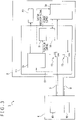
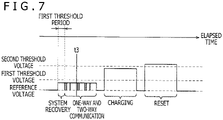
- the requested-operation determination circuit 15 determines that the one operation requested of the accessory 2 is the communication operation. It should be noted that the communication operation in FIG. 5 is depicted as "one-way and two-way communication.”
- the requested-operation determination circuit 15 When it is determined that the one operation requested of the accessory 2 is the communication operation, the requested-operation determination circuit 15 outputs the reception route connection signal (RxON signal) to the reception path 12 as depicted in FIG. 6 .
- the reception path 12 Upon receiving an input of the reception route connection signal, the reception path 12 connects (turns ON) the signal transmission route from the charging terminal to the signal processing circuit 30.
- the reception path 12 continuously connects the signal transmission route from the charging terminal to the signal processing circuit 30. Then, as depicted in FIG. 8 , the charging signal S1 is inputted from the case 4 to the signal processing circuit 30.
- the signal processing circuit 30 Upon receiving an input of the charging signal S1, the signal processing circuit 30 performs processing based on the voltage level (e.g., an instantaneous change in the voltage level and the time of instantaneous change in the voltage level).
- the processing performed based on the voltage level by the signal processing circuit 30 is, for example, a process of indicating the remaining capacity (remaining battery level) of the accessory battery 20 by using a blinking or steadily glowing LED.
- the requested-operation determination circuit 15 outputs the reception route blocking signal (RxOFF signal) to the reception path 12 as depicted in FIG. 9 .
- the reception path 12 blocks (turns OFF) the signal transmission route from the charging terminal to the signal processing circuit 30.
- the requested-operation determination circuit 15 outputs a command signal to the register 14 in order to input the transmission route connection signal to the signal processing circuit 30.
- the register 14 Upon receiving an input of the command signal, the register 14 outputs, to the signal processing circuit 30, the transmission route connection signal to be inputted to the transmission path 13.
- the signal processing circuit 30 Upon receiving an input of the transmission route connection signal from the register 14, the signal processing circuit 30 outputs the transmission route connection signal to the transmission path 13.
- the transmission path 13 Upon receiving an input of the transmission route connection signal, the transmission path 13 connects (turns ON) the signal transmission route from the signal processing circuit 30 to the charging terminal.
- the case 4 communicates with the requested-operation determination circuit 15, and the signal processing circuit 30 communicates with the case 4.
- the reception path 12 continuously blocks the signal transmission route from the charging terminal to the signal processing circuit 30. Then, when the communication signal outputted from the signal processing circuit 30 is inputted to the case 4, the requested-operation determination circuit 15 outputs a command signal to the register 14 in order to input the transmission route blocking signal to the signal processing circuit 30.
- the register 14 Upon receiving an input of the command signal, the register 14 outputs the transmission route blocking signal (TxOFF signal) to the transmission path 13 through the signal processing circuit 30.
- TxOFF signal transmission route blocking signal
- the transmission path 13 blocks (turns OFF) the signal transmission route from the signal processing circuit 30 to the charging terminal as depicted in FIG. 11 .
- the requested-operation determination circuit 15 determines that the one operation requested of the accessory 2 is the sleep operation.
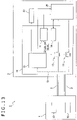
- the requested-operation determination circuit 15 When it is determined that the one operation requested of the accessory 2 is the sleep operation, the requested-operation determination circuit 15 outputs the power OFF signal to the regulator 11 as depicted in FIG. 13 .
- the regulator 11 Upon receiving an input of the power OFF signal, the regulator 11 shuts off the power supply to the signal processing circuit 30 as depicted in FIG. 13 .
- the requested-operation determination circuit 15 determines that the one operation requested of the accessory 2 is the charging operation.
- the requested-operation determination circuit 15 supplies the charging signal to the accessory battery 20 as depicted in FIG. 15 .
- the accessory battery 20 Upon receiving the supplied charging signal, the accessory battery 20 is charged based on the voltage level of the charging signal.
- the requested-operation determination circuit 15 determines that the one operation requested of the accessory 2 is the initialization operation.
- the requested-operation determination circuit 15 When it is determined that the one operation requested of the accessory 2 is the initialization operation, the requested-operation determination circuit 15 outputs a command signal to the regulator 11, the reception path 12, the transmission path 13, the register 14, and the signal processing circuit 30 in order to initialize their states.
- the accessory 2 and the communication system 1 according to the first embodiment are able to determine the one operation requested of the accessory 2 according to the voltage level of the charging signal inputted from the case 4 and to the duration time of the voltage level. Consequently, the one operation requested of the accessory 2 can be determined without requiring a configuration including, for example, a separation circuit for signal separation. This allows the use of simplified circuitry. Further, as the configuration including, for example, the separation circuit for signal separation is not required, it is not necessary to operate, for example, the separation circuit. As a result, an increase in the amount of power consumption can be suppressed.
- an operation determination method used by the accessory 2 and the communication system 1 according to the first embodiment makes it possible to determine the one operation requested of the accessory 2 according to the voltage level of the charging signal and to the duration time of the voltage level. Consequently, the one operation requested of the accessory 2 can be determined without requiring the configuration including, for example, the separation circuit for signal separation. This allows the use of simplified circuitry. Further, as the configuration including, for example, the separation circuit for signal separation is not required, it is not necessary to operate, for example, the separation circuit. As a result, an increase in the amount of power consumption can be suppressed.
- the accessory 2 is a pair of wireless earphones.
- the accessory 2 is not limited to wireless earphones.
- the accessory 2 may be, for example, a wireless microphone for recording sounds or a pair of VR (Virtual Reality) goggles for outputting video images.
- the accessory 2 may be, for example, a clock or a sensor for detecting biological information (pulse, heart rate, blood pressure, etc.).
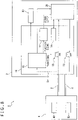
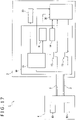
- a communication system 1 includes an accessory 2, a case 4, and a power management IC 60.
- the accessory 2 includes an accessory battery 20 and a signal processing circuit 30.
- the accessory battery 20 is, for example, a rechargeable lithium-ion battery.
- the charging signal is supplied to the accessory battery 20 through a requested-operation determination circuit 15. Further, the accessory battery 20 supplies power to the power management IC 60 and the signal processing circuit 30.
- the power management IC 60 is able to selectively use either power supplied from the accessory battery 20 or power supplied from the case 4 by the charging signal. Therefore, in a case, for example, where the accessory battery 20 is dead, the power management IC 60 is able to operate on the power supplied from the case 4 by the charging signal. Further, even in a state where the accessory battery 20 is not to be charged, the power management IC 60 is able to operate on the power supplied from the case 4 by the charging signal.
- the configuration of the signal processing circuit 30 is similar to that of the signal processing circuit 30 in the first embodiment, which has been described earlier, and will not be redundantly described.
- the power management IC 60 is included in the accessory 2, and connected to the case 4 with a charging line 6 and a GND line 8.
- the power management IC 60 includes a regulator 11, a reception path 12, a transmission path 13, a register 14, and the requested-operation determination circuit 15.
- the regulator 11 Upon receiving a command signal inputted from the requested-operation determination circuit 15, the regulator 11 outputs the command signal to the signal processing circuit 30. Further, the regulator 11 includes a DC-DC converter and an LDO.
- the reception path 12 is connected to the signal processing circuit 30 and to a charging terminal that is connected to the charging line 6. Further, when the reception route connection signal is inputted from the requested-operation determination circuit 15, the reception path 12 connects a signal transmission route from the charging terminal to the signal processing circuit 30. Further, when the reception route blocking signal is inputted from the requested-operation determination circuit 15, the reception path 12 blocks the signal transmission route from the charging terminal to the signal processing circuit 30.
- the transmission path 13 is connected to the charging terminal and the signal processing circuit 30.
- the transmission path 13 and the signal processing circuit 30 are connected by using, for example, a UART. Further, when the transmission route connection signal is inputted from the signal processing circuit 30, the transmission path 13 connects the signal transmission route from the signal processing circuit 30 to the charging terminal. Further, when the transmission route blocking signal is inputted from the signal processing circuit 30, the transmission path 13 blocks the signal transmission route from the signal processing circuit 30 to the charging terminal.
- the register 14 is connected to the signal processing circuit 30 by using, for example, an I2C.
- the register 14 inputs, to the signal processing circuit 30, the transmission route connection signal or the transmission route blocking signal to be inputted to the transmission path 13.
- the requested-operation determination circuit 15 determines (identifies) one operation requested of the accessory 2.
- the case 4 functions as a docking station capable of docking the accessory 2. Further, the case 4 includes a case battery 40 and a signal control section 50.
- the case battery 40 which is, for example, a rechargeable lithium-ion battery, outputs the charging signal to the power management IC 60 through the charging line 6. Therefore, the case 4 is able to supply power to the power management IC 60.
- the signal control section 50 controls the voltage level of the charging signal to be outputted to the power management IC 60 through the charging line 6 and the duration time of the voltage level. Control exercised over the charging signal by the signal control section 50 is based on the one operation requested of the accessory 2.
- the accessory 2 and the case 4 are connected in order, for example, to charge the accessory battery 20.
- the charging signal outputted from the case 4 is inputted to the requested-operation determination circuit 15 through the charging line 6.
- the requested-operation determination circuit 15 detects the voltage level of the charging signal and measures the duration time of the voltage level of the charging signal. Then, upon detecting that the voltage level of the charging signal is higher than the reference voltage and lower than the first threshold voltage, the requested-operation determination circuit 15 determines that the one operation requested of the accessory 2 is the recovery operation.
- the requested-operation determination circuit 15 When it is determined that the one operation requested of the accessory 2 is the recovery operation, the requested-operation determination circuit 15 outputs a system recovery signal to the signal processing circuit 30. Additionally, the requested-operation determination circuit 15 outputs a power ON signal to the regulator 11.
- the regulator 11 supplies power to the signal processing circuit 30.
- the signal processing circuit 30 switches from the sleep state to the standby state.
- the signal processing circuit 30 achieves recovery and becomes operative.
- the requested-operation determination circuit 15 determines that the one operation requested of the accessory 2 is the communication operation.
- the requested-operation determination circuit 15 When it is determined that the one operation requested of the accessory 2 is the communication operation, the requested-operation determination circuit 15 outputs the reception route connection signal to the reception path 12. Upon receiving an input of the reception route connection signal, the reception path 12 connects the signal transmission route from the charging terminal to the signal processing circuit 30.
- the reception path 12 continuously connects the signal transmission route from the charging terminal to the signal processing circuit 30.
- the signal processing circuit 30 Upon receiving an input of the charging signal, the signal processing circuit 30 performs processing based on the voltage level.
- the requested-operation determination circuit 15 outputs the reception route blocking signal to the reception path 12.
- the reception path 12 blocks the signal transmission route from the charging terminal to the signal processing circuit 30.
- the requested-operation determination circuit 15 outputs a command signal to the register 14 in order to input the transmission route connection signal to the signal processing circuit 30.
- the register 14 Upon receiving an input of the command signal, the register 14 outputs, to the signal processing circuit 30, the transmission route connection signal to be inputted to the transmission path 13.
- the signal processing circuit 30 outputs the transmission route connection signal to the transmission path 13.
- the transmission path 13 connects the signal transmission route from the signal processing circuit 30 to the charging terminal.
- the case 4 communicates with the requested-operation determination circuit 15, and the signal processing circuit 30 communicates with the case 4.
- the reception path 12 continuously blocks the signal transmission route from the charging terminal to the signal processing circuit 30. Then, when the communication signal outputted from the signal processing circuit 30 is inputted to the case 4, the requested-operation determination circuit 15 outputs a command signal to the register 14 in order to input the transmission route blocking signal to the signal processing circuit 30.
- the register 14 Upon receiving an input of the command signal, the register 14 outputs the transmission route blocking signal to the transmission path 13 through the signal processing circuit 30. Upon receiving an input of the transmission route blocking signal, the transmission path 13 blocks the signal transmission route from the signal processing circuit 30 to the charging terminal.
- the requested-operation determination circuit 15 determines that the one operation requested of the accessory 2 is the sleep operation.
- the requested-operation determination circuit 15 When it is determined that the one operation requested of the accessory 2 is the sleep operation, the requested-operation determination circuit 15 outputs the power OFF signal to the regulator 11. Upon receiving an input of the power OFF signal, the regulator 11 shuts off the power supply to the signal processing circuit 30.
- the requested-operation determination circuit 15 determines that the one operation requested of the accessory 2 is the charging operation.
- the requested-operation determination circuit 15 supplies the charging signal to the accessory battery 20.
- the accessory battery 20 is charged based on the voltage level of the charging signal.
- the requested-operation determination circuit 15 determines that the one operation requested of the accessory 2 is the initialization operation.
- the requested-operation determination circuit 15 When it is determined that the one operation requested of the accessory 2 is the initialization operation, the requested-operation determination circuit 15 outputs a command signal to the regulator 11, the reception path 12, the transmission path 13, the register 14, and the signal processing circuit 30 in order to initialize their states.
- the power management IC 60 and the communication system 1 according to the second embodiment are able to determine the one operation requested of the accessory 2 according to the voltage level of the charging signal inputted from the case 4 and to the duration time of the voltage level. Consequently, the one operation requested of the accessory 2 can be determined without requiring a configuration including, for example, a separation circuit for signal separation. This allows the use of simplified circuitry. Further, as the configuration including, for example, the separation circuit for signal separation is not required, it is not necessary to operate, for example, the separation circuit. As a result, an increase in the amount of power consumption can be suppressed.
- an operation determination method used by the power management IC 60 and the communication system 1 according to the second embodiment makes it possible to determine the one operation requested of the accessory 2 according to the voltage level of the charging signal and to the duration time of the voltage level. Consequently, the one operation requested of the accessory 2 can be determined without requiring the configuration including, for example, the separation circuit for signal separation. This allows the use of simplified circuitry. Further, as the configuration including, for example, the separation circuit for signal separation is not required, it is not necessary to operate, for example, the separation circuit. As a result, an increase in the amount of power consumption can be suppressed.
- the second embodiment assumes that the accessory 2 and the case 4 are connected with the charging line 6 and the GND line 8.
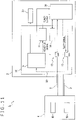
- the form of connection between the accessory 2 and the case 4 is not limited to such a configuration. More specifically, as depicted, for example, in FIG. 18 , a switch 70 may be externally attached to the middle of the charging line 6. The switch 70 branches the charging line 6 into two lines for connecting to the accessory 2.
- the switch 70 When the voltage level of the charging signal is higher than the reference voltage and lower than the first threshold voltage, the switch 70 inputs the charging signal to the first determination section 15a (see FIG. 2 ). Meanwhile, when the voltage level of the charging signal is higher than the first threshold voltage, the switch 70 inputs the charging signal to the third determination section 15e (see FIG. 2 ).
- the second determination section 15c and the second counter processing section 15d may be removed from the requested-operation determination circuit 15. This makes it possible to simplify the configuration of the requested-operation determination circuit 15.
- the accessory, the power management IC, and the communication system according to the present disclosure do not need to include all the components described in conjunction with the foregoing embodiments, and may conversely include some other components. It should be noted that advantages described in this specification are merely illustrative and not restrictive. The present technology can additionally provide advantages other than those described in this specification.
Landscapes
- Engineering & Computer Science (AREA)
- Theoretical Computer Science (AREA)
- Chemical & Material Sciences (AREA)
- General Chemical & Material Sciences (AREA)
- Electrochemistry (AREA)
- Chemical Kinetics & Catalysis (AREA)
- Power Engineering (AREA)
- General Physics & Mathematics (AREA)
- General Engineering & Computer Science (AREA)
- Physics & Mathematics (AREA)
- Manufacturing & Machinery (AREA)
- Microelectronics & Electronic Packaging (AREA)
- Computer Hardware Design (AREA)
- Biophysics (AREA)
- Life Sciences & Earth Sciences (AREA)
- Charge And Discharge Circuits For Batteries Or The Like (AREA)
- Secondary Cells (AREA)
- Power Sources (AREA)
Abstract
Description
- The present disclosure relates to an accessory for transmitting and receiving signals to and from a case, a power management IC included in the accessory, and a communication system including the accessory.
- Charging and communication operations are performed between a case (e.g., a docking station) and an accessory such as a pair of wireless earphones. A configuration in which two connection lines (a charging line and a GND line) are used for connection is used as a configuration for connecting the case to the accessory.
- A system disclosed, for example, in
PTL 1 exercises on-off control over an enable signal outputted from a driver of a case with respect to a power supply terminal of an accessory that is connected to the case with two connection lines, and establishes communication depending on whether or not the enable signal is superimposed on an outputted communication signal. -
- However, the technology disclosed in
PTL 1 requires the use of a separation circuit for separating the enable signal from the communication signal on which the enable signal is superimposed. Therefore, the technology disclosed inPTL 1 has a problem where circuitry is complicated. - In order to address the above problem, the present technology has an objective to provide an accessory, a power management IC, and a communication system that are capable of allowing the use of simplified circuitry.
- An accessory according to an aspect of the present technology is connectable to a case with a charging line and a GND line. The charging line transmits and receives a charging signal. The GND line is set to a reference voltage. The accessory includes a requested-operation determination circuit. Based on a voltage level of the charging signal and on a duration time of the voltage level, the requested-operation determination circuit determines one operation requested of the accessory.
- A power management IC according to another aspect of the present technology is included in an accessory, connected to a case with a charging line and a GND line, and provided with a requested-operation determination circuit. The accessory operates on electric power. The case is capable of supplying the electric power. The charging line transmits and receives a charging signal. The GND line is set to a reference voltage. Based on a voltage level of the charging signal and on a duration time of the voltage level, the requested-operation determination circuit determines one operation requested of the accessory.
- A communication system according to still another aspect of the present technology includes a case and an accessory. The case is capable of supplying electric power. The accessory is connectable to the case with a charging line and a GND line. The charging line transmits and receives a charging signal. The GND line is set to a reference voltage. The accessory includes a requested-operation determination circuit. Based on a voltage level of the charging signal and on a duration time of the voltage level, the requested-operation determination circuit determines one operation requested of the accessory.
- A communication system according to yet another aspect of the present technology includes a case, an accessory, and a power management IC. The case is capable of supplying electric power. The accessory operates on electric power. The power management IC is included in the accessory and connected to the case with a charging line and a GND line. The charging line transmits and receives a charging signal. The GND line is set to a reference voltage. Further, the power management IC includes a requested-operation determination circuit. Based on a voltage level of the charging signal and on a duration time of the voltage level, the requested-operation determination circuit determines one operation requested of the accessory.
-
- [
FIG. 1 ]
FIG. 1 is a diagram illustrating a configuration of a communication system according to a first embodiment. - [
FIG. 2 ]
FIG. 2 is a diagram illustrating a configuration example of a requested-operation determination circuit. - [
FIG. 3 ]
FIG. 3 is a diagram illustrating operations performed by the communication system. - [
FIG. 4 ]
FIG. 4 is a timing diagram illustrating operations performed by the communication system. - [
FIG. 5 ]
FIG. 5 is a timing diagram illustrating operations performed by the communication system. - [
FIG. 6 ]
FIG. 6 is a diagram illustrating operations performed by the communication system. - [
FIG. 7 ]
FIG. 7 is a timing diagram illustrating operations performed by the communication system. - [
FIG. 8 ]
FIG. 8 is a diagram illustrating operations performed by the communication system. - [
FIG. 9 ]
FIG. 9 is a diagram illustrating operations performed by the communication system. - [
FIG. 10 ]
FIG. 10 is a timing diagram illustrating operations performed by the communication system. - [
FIG. 11 ]
FIG. 11 is a diagram illustrating operations performed by the communication system. - [
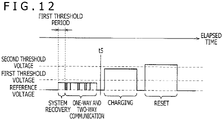
FIG. 12 ]
FIG. 12 is a timing diagram illustrating operations performed by the communication system. - [
FIG. 13 ]
FIG. 13 is a diagram illustrating operations performed by the communication system. - [
FIG. 14 ]
FIG. 14 is a timing diagram illustrating operations performed by the communication system. - [
FIG. 15 ]
FIG. 15 is a diagram illustrating operations performed by the communication system. - [
FIG. 16 ]
FIG. 16 is a timing diagram illustrating operations performed by the communication system. - [
FIG. 17 ]
FIG. 17 is a diagram illustrating a configuration of a communication system according to a second embodiment. - [
FIG. 18 ]
FIG. 18 is a diagram illustrating a modification of the second embodiment. - Embodiments of the present technology will now be described with reference to the accompanying drawings. Identical or similar portions in the accompanying drawings are designated by identical or similar reference signs and will not be redundantly described. The accompanying drawings are schematic and may depict a situation different from reality. The embodiments described below illustrate equipment and methods for embodying the technical idea of the present technology. The technical idea of the present technology is not specifically limited to the equipment and methods illustrated in conjunction with the embodiments described below. The technical idea of the present technology may be modified variously within the technical scope described in the appended claims.
- As depicted in
FIG. 1 , acommunication system 1 includes anaccessory 2 and acase 4. Theaccessory 2 operates on electric power. Thecase 4 is capable of supplying the electric power. - The
accessory 2 and thecase 4 are connected with two connection lines (acharging line 6 and a GND line 8). - The charging
line 6 is formed by bringing terminals (charging terminals (Vin)) individually formed on theaccessory 2 and thecase 4 into contact, and used to transmit and receive a charging signal. - The
GND line 8 is formed by bringing terminals (GND terminals (GND)) individually formed on theaccessory 2 and thecase 4 into contact, as is the case with the chargingline 6, and set to a reference voltage (e.g., 0 V). - The
accessory 2 includes a power management unit (PMU) 10, anaccessory battery 20, and asignal processing circuit 30. - The first embodiment is described below with reference to a case where the
accessory 2 is, for example, a pair of wireless earphones that acquires audio data (sound data) from, for instance, music reproduction equipment through Bluetooth (registered trademark) or other wireless communication, and outputs a sound based on the sound data. - The
PMU 10 includes aregulator 11, areception path 12, atransmission path 13, aregister 14, and a requested-operation determination circuit 15. - The
regulator 11 receives a command signal inputted from the requested-operation determination circuit 15, and outputs the command signal to thesignal processing circuit 30. Further, theregulator 11 includes a DC-DC converter and an LDO (Low Drop Out). - The DC-DC converter is a circuit that switches input power with a switching element at a relatively high speed, and rectifies and smooths the switched input power to obtain DC power having a desired voltage. Further, the DC-DC converter has a wider input voltage variation range than the LDO.
- The LDO is a series regulator that controls the amount of voltage drop in a transistor element to obtain DC power having a desired voltage. Further, the LDO has a narrower input voltage variation range than the DC-DC converter, and provides highly efficient voltage conversion in a case where an input voltage is slightly higher than an output voltage.
- The
reception path 12 is connected to thesignal processing circuit 30 and to the charging terminal that is connected to thecharging line 6. - Further, when a reception route connection signal (RxON signal) is inputted from the requested-
operation determination circuit 15, thereception path 12 connects a signal transmission route from the charging terminal to thesignal processing circuit 30. The reception route connection signal is a command signal that connects the signal transmission route from the charging terminal to thesignal processing circuit 30. - Further, when a reception route blocking signal (RxOFF signal) is inputted from the requested-
operation determination circuit 15, thereception path 12 blocks the signal transmission route from the charging terminal to thesignal processing circuit 30. The reception route blocking signal is a command signal that blocks the signal transmission route from the charging terminal to thesignal processing circuit 30. - The
transmission path 13 is connected to the charging terminal and thesignal processing circuit 30. Thetransmission path 13 and thesignal processing circuit 30 are connected by using, for example, a UART (Universal Asynchronous Receiver Transmitter). - Further, when a transmission route connection signal (TxON signal) is inputted from the
signal processing circuit 30, thetransmission path 13 connects a signal transmission route from thesignal processing circuit 30 to the charging terminal. The transmission route connection signal is a command signal that connects the signal transmission route from thesignal processing circuit 30 to the charging terminal. - Further, when a transmission route blocking signal (TxOFF signal) is inputted from the
signal processing circuit 30, thetransmission path 13 blocks the signal transmission route from thesignal processing circuit 30 to the charging terminal. The reception route blocking signal is a command signal that blocks the signal transmission route from thesignal processing circuit 30 to the charging terminal. - The
register 14 is connected to thesignal processing circuit 30 by using, for example, an I2C (Inter-Integrated Circuit). - Further, based on the command signal inputted from the requested-
operation determination circuit 15, theregister 14 inputs, to thesignal processing circuit 30, the transmission route connection signal or the transmission route blocking signal to be inputted to thetransmission path 13. - Based on the voltage level of the charging signal inputted from the
case 4 through the chargingline 6 and on the duration time of the voltage level of the charging signal, the requested-operation determination circuit 15 determines (identifies) one operation requested of theaccessory 2. - Operations that can be requested of the
accessory 2 include a recovery operation and a communication operation. The recovery operation recovers thesignal processing circuit 30 from a sleep state. The communication operation provides one-way communication from thecase 4 to the requested-operation determination circuit 15 and two-way communication (one-way communication and two-way communication) between thesignal processing circuit 30 and thecase 4. Further, the operations that can be requested of theaccessory 2 include a charging operation, an initialization operation, and a sleep operation. The charging operation charges theaccessory battery 20. The initialization operation initializes (resets) the system of theaccessory 2. The sleep operation switches the runningsignal processing circuit 30 into the sleep state. - It should be noted that the communication between the
accessory 2 and thecase 4 may include, for example, a communication for indicating the remaining capacity (remaining battery level) of a later-describedcase battery 40 by using a blinking or steadily glowing LED. - The requested-
operation determination circuit 15 may be configured as depicted, for example, inFIG. 2 . - The configuration depicted in
FIG. 2 indicates, as an example, that the requested-operation determination circuit 15 includes afirst determination section 15a, a firstcounter processing section 15b, asecond determination section 15c, a secondcounter processing section 15d, athird determination section 15e, and a thirdcounter processing section 15f. - Upon receiving an input of the charging signal, the
first determination section 15a determines whether the voltage level of the inputted charging signal is higher than the reference voltage and lower than a preset first threshold voltage. In a case where the voltage level of the inputted charging signal is higher than the reference voltage and lower than a preset first threshold voltage, thefirst determination section 15a outputs the charging signal to the firstcounter processing section 15b. Meanwhile, in a case where the voltage level of the inputted charging signal is higher than the reference voltage and not lower than the first threshold voltage, thefirst determination section 15a allows the charging signal to flow to a ground terminal. - Upon receiving an input of the charging signal, the first
counter processing section 15b determines whether or not the voltage level of the charging signal has remained higher than the reference voltage and lower than the first threshold voltage for a preset first threshold period (e.g., several milliseconds). If it is not determined that the voltage level of the charging signal has remained higher than the reference voltage and lower than the first threshold voltage for the first threshold period, thefirst determination section 15a concludes that the one operation requested of theaccessory 2 is the recovery operation. Meanwhile, if it is determined that the voltage level of the charging signal has remained higher than the reference voltage and lower than the first threshold voltage for the first threshold period, thefirst determination section 15a concludes that the one operation requested of theaccessory 2 is the communication operation. - Further, if the voltage level of the inputted charging signal, which has been higher than the reference voltage, lowers to the reference voltage, the
first determination section 15a determines that the one operation requested of theaccessory 2 is the sleep operation. - Upon receiving an input of the charging signal, the
second determination section 15c determines whether the voltage level of the inputted charging signal is not lower than the first threshold voltage and is lower than a second threshold voltage that is preset to be higher than the first threshold voltage. In a case where the voltage level of the inputted charging signal is not lower than the first threshold voltage and is lower than the second threshold voltage, thesecond determination section 15c outputs the charging signal to the secondcounter processing section 15d. Meanwhile, in a case where the voltage level of the inputted charging signal is not lower than the second threshold voltage, thesecond determination section 15c allows the charging signal to flow to the ground terminal. - Upon receiving an input of the charging signal, the second
counter processing section 15d determines whether or not the voltage level of the charging signal has remained higher than the first threshold voltage and lower than the second threshold voltage for a preset second threshold period (e.g., several milliseconds). It should be noted that the second threshold period may be equal to the first threshold period. If it is not determined that the voltage level of the charging signal has remained higher than the first threshold voltage and lower than the second threshold voltage for the second threshold period, thesecond determination section 15c continues with determination. Meanwhile, if it is determined that the voltage level of the charging signal has remained higher than the first threshold voltage and lower than the second threshold voltage for the second threshold period, thesecond determination section 15c concludes that the one operation requested of theaccessory 2 is the charging operation. - Upon receiving an input of the charging signal, the
third determination section 15e determines whether the voltage level of the inputted charging signal is not lower than the second threshold voltage. In a case where the voltage level of the inputted charging signal is not lower than the second threshold voltage, thethird determination section 15e outputs the charging signal to the thirdcounter processing section 15f. - Upon receiving an input of the charging signal, the third
counter processing section 15f determines whether or not the voltage level of the charging signal has remained higher than the second threshold voltage for a preset third threshold period (e.g., several milliseconds). It should be noted that the third threshold period may be equal, for example, to the first threshold period. If it is not determined that the voltage level of the charging signal has remained higher than the second threshold voltage for the third threshold period, thethird determination section 15e continues with determination. Meanwhile, if it is determined that the voltage level of the charging signal has remained higher than the second threshold voltage for the third threshold period, thethird determination section 15e concludes that the one operation requested of theaccessory 2 is the initialization operation. - Consequently, when determining the one operation requested of the
accessory 2, the requested-operation determination circuit 15 performs processes (I) to (V) below. - Upon detecting that the voltage level of the charging signal is higher than the reference voltage and lower than the first threshold voltage, the requested-
operation determination circuit 15 determines that the one operation requested of theaccessory 2 is the recovery operation. - When it is determined that the one operation requested of the
accessory 2 is the recovery operation, the requested-operation determination circuit 15 outputs a command signal (system recovery signal) for causing thesignal processing circuit 30 to switch into a standby state. Additionally, the requested-operation determination circuit 15 outputs a command signal (power ON signal) to theregulator 11 in order to supply electric power to thesignal processing circuit 30. - In a case where the voltage level of the charging signal has remained higher than the reference voltage and lower than the first threshold voltage for the first threshold period, the requested-
operation determination circuit 15 determines that the one operation requested of theaccessory 2 is the communication operation. - When it is determined that the one operation requested of the
accessory 2 is the communication operation, the requested-operation determination circuit 15 outputs the reception route connection signal to thereception path 12. - Thereafter, when the charging signal is inputted to the
signal processing circuit 30, the requested-operation determination circuit 15 outputs the reception route blocking signal to thereception path 12. Additionally, the requested-operation determination circuit 15 outputs a command signal to theregister 14 in order to input the transmission route connection signal to thesignal processing circuit 30. - Further, when a communication signal outputted from the
signal processing circuit 30 is inputted to thecase 4, the requested-operation determination circuit 15 outputs a command signal to theregister 14 in order to input the transmission route blocking signal to thesignal processing circuit 30. - In a case where the voltage level of the charging signal has remained not lower than the first threshold voltage for the second threshold period, the requested-
operation determination circuit 15 determines that the one operation requested of theaccessory 2 is the charging operation. - When it is determined that the one operation requested of the
accessory 2 is the charging operation, the requested-operation determination circuit 15 outputs the charging signal to theaccessory battery 20. - In a case where the voltage level of the charging signal has remained not lower than the second threshold voltage for the third threshold period, the requested-
operation determination circuit 15 determines that the one operation requested of theaccessory 2 is the initialization operation. - When it is determined that the one operation requested of the
accessory 2 is the initialization operation, the requested-operation determination circuit 15 outputs a command signal to theregulator 11, thereception path 12, thetransmission path 13, theregister 14, and thesignal processing circuit 30 in order to initialize their states. - In a case where the voltage level of the charging signal, which has been higher than the reference voltage, lowers to the reference voltage, the requested-
operation determination circuit 15 determines that the one operation requested of theaccessory 2 is the sleep operation. - When it is determined that the one operation requested of the
accessory 2 is the sleep operation, the requested-operation determination circuit 15 outputs a command signal (power OFF signal) to theregulator 11 in order to shut off the power supply to thesignal processing circuit 30. - The
accessory battery 20 is, for example, a rechargeable lithium-ion battery. The charging signal is supplied to theaccessory battery 20 through the requested-operation determination circuit 15. Further, theaccessory battery 20 supplies power to thePMU 10 and thesignal processing circuit 30. - The
signal processing circuit 30 receives a signal input from the requested-operation determination circuit 15 and theregulator 11. Further, thesignal processing circuit 30 inputs and outputs signals to and from theregister 14. - Further, the
signal processing circuit 30 in the sleep state receives an input of the system recovery signal from the requested-operation determination circuit 15, and upon receiving power supplied from theregulator 11, thesignal processing circuit 30 switches into the standby state. Additionally, when the power supply is shut off from theregulator 11, thesignal processing circuit 30 in the standby state switches into the sleep state. - Further, upon receiving, from the
register 14, an input of a command signal for inputting the transmission route connection signal to thesignal processing circuit 30, thesignal processing circuit 30 outputs the transmission route connection signal to thetransmission path 13. Additionally, upon receiving, from theregister 14, an input of a command signal for inputting the transmission route blocking signal to thesignal processing circuit 30, thesignal processing circuit 30 outputs the transmission route blocking signal to thetransmission path 13. - The
case 4 functions as a docking station capable of docking theaccessory 2. Further, thecase 4 includes acase battery 40 and asignal control section 50. - The
case battery 40, which is, for example, a rechargeable lithium-ion battery, outputs the charging signal to theaccessory 2 through the chargingline 6. Therefore, thecase 4 is able to supply power to theaccessory 2. It should be noted that thecase battery 40 can be charged by supplying power from the outside, for example, through a common power outlet. - The
signal control section 50 controls the voltage level of the charging signal to be outputted to theaccessory 2 through the chargingline 6 and the duration time of the voltage level. Control exercised over the charging signal by thesignal control section 50 is based on the one operation requested of theaccessory 2. - Referring to
FIGS. 1 and2 and based onFIGS. 3 to 16 , operations performed by thecommunication system 1 and effects produced by the operations performed by thecommunication system 1 will now be described. The following description assumes that thecase 4 and theaccessory 2 are not connected, and that thesignal processing circuit 30 is in the sleep state, and further that the signal transmission route from the charging terminal to thesignal processing circuit 30 and the signal transmission route from thesignal processing circuit 30 to the charging terminal are blocked. - It should be noted that, in
FIG. 3 or the like, the state where the signal transmission route from the charging terminal to thesignal processing circuit 30 is blocked and the state where the signal transmission route from thesignal processing circuit 30 to the charging terminal is blocked may be referred to as the "OFF" state. Similarly, the state where the signal transmission route from the charging terminal to thesignal processing circuit 30 is connected and the state where the signal transmission route from thesignal processing circuit 30 to the charging terminal is connected may be referred to as the "ON" state. - In a case where, for example, the remaining power of the
accessory battery 20 is low during the use of theaccessory 2, theaccessory 2 and thecase 4 are connected with the chargingline 6 and theGND line 8 in order, for example, to charge theaccessory battery 20. - When the
accessory 2 and thecase 4 are connected, that is, the charging terminals and the GND terminals formed on theaccessory 2 and thecase 4 are brought into contact with each other, the charging signal outputted from thecase 4 is inputted to the requested-operation determination circuit 15 through the chargingline 6 as depicted inFIG. 3 . It should be noted that the charging signal outputted from thecase 4 and inputted to the requested-operation determination circuit 15 is indicated by the reference sign S1 inFIG. 3 . - Upon receiving an input of the charging signal S1, the requested-
operation determination circuit 15 detects the voltage level of the charging signal S1 and measures the duration time of the voltage level of the charging signal S1. Then, upon detecting that the voltage level of the charging signal S1 is higher than the reference voltage and lower than the first threshold voltage as indicated at time "t1" inFIG. 4 , the requested-operation determination circuit 15 determines that the one operation requested of theaccessory 2 is the recovery operation. - When it is determined that the one operation requested of the
accessory 2 is the recovery operation, the requested-operation determination circuit 15 outputs the system recovery signal to thesignal processing circuit 30 as depicted inFIG. 3 . Additionally, the requested-operation determination circuit 15 outputs the power ON signal to theregulator 11 as depicted inFIG. 3 . - Further, upon receiving an input of the power ON signal, the
regulator 11 supplies power to thesignal processing circuit 30 as depicted inFIG. 3 . - Upon receiving an input of the system recovery signal and receiving the power supplied from the
regulator 11, thesignal processing circuit 30 switches from the sleep state to the standby state. - When the power is supplied to the
signal processing circuit 30 for a predetermined period of time after thesignal processing circuit 30 switched from the sleep state to the standby state, thesignal processing circuit 30 achieves recovery and becomes operative. - Thereafter, when the voltage level of the charging signal S1 has remained higher than the reference voltage and lower than the first threshold voltage for the first threshold period, which ends at time "t2" as indicated in
FIG. 5 , the requested-operation determination circuit 15 determines that the one operation requested of theaccessory 2 is the communication operation. It should be noted that the communication operation inFIG. 5 is depicted as "one-way and two-way communication." - When it is determined that the one operation requested of the
accessory 2 is the communication operation, the requested-operation determination circuit 15 outputs the reception route connection signal (RxON signal) to thereception path 12 as depicted inFIG. 6 . - Upon receiving an input of the reception route connection signal, the
reception path 12 connects (turns ON) the signal transmission route from the charging terminal to thesignal processing circuit 30. - When the voltage level of the charging signal S1 is higher than the reference voltage and lower than the first threshold voltage after time t2 as indicated at time "t3" in
FIG. 7 , thereception path 12 continuously connects the signal transmission route from the charging terminal to thesignal processing circuit 30. Then, as depicted inFIG. 8 , the charging signal S1 is inputted from thecase 4 to thesignal processing circuit 30. - Upon receiving an input of the charging signal S1, the
signal processing circuit 30 performs processing based on the voltage level (e.g., an instantaneous change in the voltage level and the time of instantaneous change in the voltage level). The processing performed based on the voltage level by thesignal processing circuit 30 is, for example, a process of indicating the remaining capacity (remaining battery level) of theaccessory battery 20 by using a blinking or steadily glowing LED. - Further, when the charging signal S1 is inputted to the
signal processing circuit 30, the requested-operation determination circuit 15 outputs the reception route blocking signal (RxOFF signal) to thereception path 12 as depicted inFIG. 9 . Upon receiving an input of the reception route blocking signal, thereception path 12 blocks (turns OFF) the signal transmission route from the charging terminal to thesignal processing circuit 30. - Additionally, the requested-
operation determination circuit 15 outputs a command signal to theregister 14 in order to input the transmission route connection signal to thesignal processing circuit 30. Upon receiving an input of the command signal, theregister 14 outputs, to thesignal processing circuit 30, the transmission route connection signal to be inputted to thetransmission path 13. Upon receiving an input of the transmission route connection signal from theregister 14, thesignal processing circuit 30 outputs the transmission route connection signal to thetransmission path 13. - Upon receiving an input of the transmission route connection signal, the
transmission path 13 connects (turns ON) the signal transmission route from thesignal processing circuit 30 to the charging terminal. - When the
reception path 12 blocks the signal transmission route from the charging terminal to thesignal processing circuit 30 and thetransmission path 13 connects the signal transmission route from thesignal processing circuit 30 to the charging terminal, thecase 4 communicates with the requested-operation determination circuit 15, and thesignal processing circuit 30 communicates with thecase 4. - When the voltage level of the charging signal S1 is higher than the reference voltage and lower than the first threshold voltage after time t3 as indicated at time "t4" in
FIG. 10 , thereception path 12 continuously blocks the signal transmission route from the charging terminal to thesignal processing circuit 30. Then, when the communication signal outputted from thesignal processing circuit 30 is inputted to thecase 4, the requested-operation determination circuit 15 outputs a command signal to theregister 14 in order to input the transmission route blocking signal to thesignal processing circuit 30. - Upon receiving an input of the command signal, the
register 14 outputs the transmission route blocking signal (TxOFF signal) to thetransmission path 13 through thesignal processing circuit 30. - Upon receiving an input of the transmission route blocking signal, the
transmission path 13 blocks (turns OFF) the signal transmission route from thesignal processing circuit 30 to the charging terminal as depicted inFIG. 11 . - When the voltage level of the charging signal S1 lowers to the reference voltage after time t4 as indicated at time "t5" in
FIG. 12 , the requested-operation determination circuit 15 determines that the one operation requested of theaccessory 2 is the sleep operation. - When it is determined that the one operation requested of the
accessory 2 is the sleep operation, the requested-operation determination circuit 15 outputs the power OFF signal to theregulator 11 as depicted inFIG. 13 . - Upon receiving an input of the power OFF signal, the
regulator 11 shuts off the power supply to thesignal processing circuit 30 as depicted inFIG. 13 . - In a case where the voltage level of the charging signal S1 has remained not lower than the first threshold voltage for the second threshold period after time t5 as indicated at time "t6" in
FIG. 14 , the requested-operation determination circuit 15 determines that the one operation requested of theaccessory 2 is the charging operation. - When it is determined that the one operation requested of the
accessory 2 is the charging operation, the requested-operation determination circuit 15 supplies the charging signal to theaccessory battery 20 as depicted inFIG. 15 . - Upon receiving the supplied charging signal, the
accessory battery 20 is charged based on the voltage level of the charging signal. - In a case where the voltage level of the charging signal S1 has remained not lower than the second threshold voltage for the third threshold period after time t6 as indicated at time "t7" in
FIG. 16 , the requested-operation determination circuit 15 determines that the one operation requested of theaccessory 2 is the initialization operation. - When it is determined that the one operation requested of the
accessory 2 is the initialization operation, the requested-operation determination circuit 15 outputs a command signal to theregulator 11, thereception path 12, thetransmission path 13, theregister 14, and thesignal processing circuit 30 in order to initialize their states. - As described above, the
accessory 2 and thecommunication system 1 according to the first embodiment are able to determine the one operation requested of theaccessory 2 according to the voltage level of the charging signal inputted from thecase 4 and to the duration time of the voltage level. Consequently, the one operation requested of theaccessory 2 can be determined without requiring a configuration including, for example, a separation circuit for signal separation. This allows the use of simplified circuitry. Further, as the configuration including, for example, the separation circuit for signal separation is not required, it is not necessary to operate, for example, the separation circuit. As a result, an increase in the amount of power consumption can be suppressed. - Further, as described earlier, an operation determination method used by the
accessory 2 and thecommunication system 1 according to the first embodiment makes it possible to determine the one operation requested of theaccessory 2 according to the voltage level of the charging signal and to the duration time of the voltage level. Consequently, the one operation requested of theaccessory 2 can be determined without requiring the configuration including, for example, the separation circuit for signal separation. This allows the use of simplified circuitry. Further, as the configuration including, for example, the separation circuit for signal separation is not required, it is not necessary to operate, for example, the separation circuit. As a result, an increase in the amount of power consumption can be suppressed. - The first embodiment assumes that the
accessory 2 is a pair of wireless earphones. However, theaccessory 2 is not limited to wireless earphones. Alternatively, theaccessory 2 may be, for example, a wireless microphone for recording sounds or a pair of VR (Virtual Reality) goggles for outputting video images. Further, theaccessory 2 may be, for example, a clock or a sensor for detecting biological information (pulse, heart rate, blood pressure, etc.). - A second embodiment will be described below. However, components similar to those in the first embodiment may not be redundantly described.
- As depicted in
FIG. 17 , acommunication system 1 according to the second embodiment includes anaccessory 2, acase 4, and apower management IC 60. - The
accessory 2 includes anaccessory battery 20 and asignal processing circuit 30. - The
accessory battery 20 is, for example, a rechargeable lithium-ion battery. The charging signal is supplied to theaccessory battery 20 through a requested-operation determination circuit 15. Further, theaccessory battery 20 supplies power to thepower management IC 60 and thesignal processing circuit 30. It should be noted that thepower management IC 60 is able to selectively use either power supplied from theaccessory battery 20 or power supplied from thecase 4 by the charging signal. Therefore, in a case, for example, where theaccessory battery 20 is dead, thepower management IC 60 is able to operate on the power supplied from thecase 4 by the charging signal. Further, even in a state where theaccessory battery 20 is not to be charged, thepower management IC 60 is able to operate on the power supplied from thecase 4 by the charging signal. - The configuration of the
signal processing circuit 30 is similar to that of thesignal processing circuit 30 in the first embodiment, which has been described earlier, and will not be redundantly described. - The
power management IC 60 is included in theaccessory 2, and connected to thecase 4 with acharging line 6 and aGND line 8. - Further, the
power management IC 60 includes aregulator 11, areception path 12, atransmission path 13, aregister 14, and the requested-operation determination circuit 15. - Upon receiving a command signal inputted from the requested-
operation determination circuit 15, theregulator 11 outputs the command signal to thesignal processing circuit 30. Further, theregulator 11 includes a DC-DC converter and an LDO. - The
reception path 12 is connected to thesignal processing circuit 30 and to a charging terminal that is connected to thecharging line 6. Further, when the reception route connection signal is inputted from the requested-operation determination circuit 15, thereception path 12 connects a signal transmission route from the charging terminal to thesignal processing circuit 30. Further, when the reception route blocking signal is inputted from the requested-operation determination circuit 15, thereception path 12 blocks the signal transmission route from the charging terminal to thesignal processing circuit 30. - The
transmission path 13 is connected to the charging terminal and thesignal processing circuit 30. Thetransmission path 13 and thesignal processing circuit 30 are connected by using, for example, a UART. Further, when the transmission route connection signal is inputted from thesignal processing circuit 30, thetransmission path 13 connects the signal transmission route from thesignal processing circuit 30 to the charging terminal. Further, when the transmission route blocking signal is inputted from thesignal processing circuit 30, thetransmission path 13 blocks the signal transmission route from thesignal processing circuit 30 to the charging terminal. - The
register 14 is connected to thesignal processing circuit 30 by using, for example, an I2C. - Further, based on the command signal inputted from the requested-
operation determination circuit 15, theregister 14 inputs, to thesignal processing circuit 30, the transmission route connection signal or the transmission route blocking signal to be inputted to thetransmission path 13. - Based on the voltage level of the charging signal inputted from the
case 4 through the chargingline 6 and on the duration time of the voltage level of the charging signal, the requested-operation determination circuit 15 determines (identifies) one operation requested of theaccessory 2. - Operations that can be requested of the
accessory 2 and processes (I) to (V) that are performed by the requested-operation determination circuit 15 to determine the one operation requested of theaccessory 2 are similar to those described in conjunction with the first embodiment and will not be redundantly described. - The
case 4 functions as a docking station capable of docking theaccessory 2. Further, thecase 4 includes acase battery 40 and asignal control section 50. - The
case battery 40, which is, for example, a rechargeable lithium-ion battery, outputs the charging signal to thepower management IC 60 through the chargingline 6. Therefore, thecase 4 is able to supply power to thepower management IC 60. - The
signal control section 50 controls the voltage level of the charging signal to be outputted to thepower management IC 60 through the chargingline 6 and the duration time of the voltage level. Control exercised over the charging signal by thesignal control section 50 is based on the one operation requested of theaccessory 2. - Referring to
FIGS. 1 to 16 and based onFIG. 17 , operations performed by thecommunication system 1 and effects produced by the operations performed by thecommunication system 1 will now be described. The following description assumes that thecase 4 and theaccessory 2 are not connected, and that thesignal processing circuit 30 is in the sleep state, and further that the signal transmission route from the charging terminal to thesignal processing circuit 30 and the signal transmission route from thesignal processing circuit 30 to the charging terminal are blocked. - In a case where, for example, the remaining power of the
accessory battery 20 is low during the use of theaccessory 2, theaccessory 2 and thecase 4 are connected in order, for example, to charge theaccessory battery 20. - When the
accessory 2 and thecase 4 are connected, the charging signal outputted from thecase 4 is inputted to the requested-operation determination circuit 15 through the chargingline 6. Upon receiving an input of the charging signal, the requested-operation determination circuit 15 detects the voltage level of the charging signal and measures the duration time of the voltage level of the charging signal. Then, upon detecting that the voltage level of the charging signal is higher than the reference voltage and lower than the first threshold voltage, the requested-operation determination circuit 15 determines that the one operation requested of theaccessory 2 is the recovery operation. - When it is determined that the one operation requested of the
accessory 2 is the recovery operation, the requested-operation determination circuit 15 outputs a system recovery signal to thesignal processing circuit 30. Additionally, the requested-operation determination circuit 15 outputs a power ON signal to theregulator 11. - Further, upon receiving an input of the power ON signal, the
regulator 11 supplies power to thesignal processing circuit 30. Upon receiving an input of the system recovery signal and receiving the power supplied from theregulator 11, thesignal processing circuit 30 switches from the sleep state to the standby state. When the power is supplied to thesignal processing circuit 30 for a predetermined period of time after thesignal processing circuit 30 switched from the sleep state to the standby state, thesignal processing circuit 30 achieves recovery and becomes operative. - Thereafter, when the voltage level of the charging signal has remained higher than the reference voltage and lower than the first threshold voltage for the first threshold period, the requested-
operation determination circuit 15 determines that the one operation requested of theaccessory 2 is the communication operation. - When it is determined that the one operation requested of the
accessory 2 is the communication operation, the requested-operation determination circuit 15 outputs the reception route connection signal to thereception path 12. Upon receiving an input of the reception route connection signal, thereception path 12 connects the signal transmission route from the charging terminal to thesignal processing circuit 30. - When the voltage level of the charging signal is higher than the reference voltage and lower than the first threshold voltage, the
reception path 12 continuously connects the signal transmission route from the charging terminal to thesignal processing circuit 30. Upon receiving an input of the charging signal, thesignal processing circuit 30 performs processing based on the voltage level. - Further, when the charging signal is inputted to the
signal processing circuit 30, the requested-operation determination circuit 15 outputs the reception route blocking signal to thereception path 12. Upon receiving an input of the reception route blocking signal, thereception path 12 blocks the signal transmission route from the charging terminal to thesignal processing circuit 30. Additionally, the requested-operation determination circuit 15 outputs a command signal to theregister 14 in order to input the transmission route connection signal to thesignal processing circuit 30. Upon receiving an input of the command signal, theregister 14 outputs, to thesignal processing circuit 30, the transmission route connection signal to be inputted to thetransmission path 13. Upon receiving an input of the transmission route connection signal from theregister 14, thesignal processing circuit 30 outputs the transmission route connection signal to thetransmission path 13. Upon receiving an input of the transmission route connection signal, thetransmission path 13 connects the signal transmission route from thesignal processing circuit 30 to the charging terminal. - When the
reception path 12 blocks the signal transmission route from the charging terminal to thesignal processing circuit 30 and thetransmission path 13 connects the signal transmission route from thesignal processing circuit 30 to the charging terminal, thecase 4 communicates with the requested-operation determination circuit 15, and thesignal processing circuit 30 communicates with thecase 4. - When the voltage level of the charging signal is higher than the reference voltage and lower than the first threshold voltage, the
reception path 12 continuously blocks the signal transmission route from the charging terminal to thesignal processing circuit 30. Then, when the communication signal outputted from thesignal processing circuit 30 is inputted to thecase 4, the requested-operation determination circuit 15 outputs a command signal to theregister 14 in order to input the transmission route blocking signal to thesignal processing circuit 30. - Upon receiving an input of the command signal, the
register 14 outputs the transmission route blocking signal to thetransmission path 13 through thesignal processing circuit 30. Upon receiving an input of the transmission route blocking signal, thetransmission path 13 blocks the signal transmission route from thesignal processing circuit 30 to the charging terminal. - When the voltage level of the charging signal lowers to the reference voltage, the requested-
operation determination circuit 15 determines that the one operation requested of theaccessory 2 is the sleep operation. - When it is determined that the one operation requested of the
accessory 2 is the sleep operation, the requested-operation determination circuit 15 outputs the power OFF signal to theregulator 11. Upon receiving an input of the power OFF signal, theregulator 11 shuts off the power supply to thesignal processing circuit 30. - When the voltage level of the charging signal has remained not lower than the first threshold voltage for the second threshold period, the requested-
operation determination circuit 15 determines that the one operation requested of theaccessory 2 is the charging operation. - When it is determined that the one operation requested of the
accessory 2 is the charging operation, the requested-operation determination circuit 15 supplies the charging signal to theaccessory battery 20. Upon receiving the supplied charging signal, theaccessory battery 20 is charged based on the voltage level of the charging signal. - When the voltage level of the charging signal has remained not lower than the second threshold voltage for the third threshold period, the requested-
operation determination circuit 15 determines that the one operation requested of theaccessory 2 is the initialization operation. - When it is determined that the one operation requested of the
accessory 2 is the initialization operation, the requested-operation determination circuit 15 outputs a command signal to theregulator 11, thereception path 12, thetransmission path 13, theregister 14, and thesignal processing circuit 30 in order to initialize their states. - As described above, the
power management IC 60 and thecommunication system 1 according to the second embodiment are able to determine the one operation requested of theaccessory 2 according to the voltage level of the charging signal inputted from thecase 4 and to the duration time of the voltage level. Consequently, the one operation requested of theaccessory 2 can be determined without requiring a configuration including, for example, a separation circuit for signal separation. This allows the use of simplified circuitry. Further, as the configuration including, for example, the separation circuit for signal separation is not required, it is not necessary to operate, for example, the separation circuit. As a result, an increase in the amount of power consumption can be suppressed. - Further, as described earlier, an operation determination method used by the
power management IC 60 and thecommunication system 1 according to the second embodiment makes it possible to determine the one operation requested of theaccessory 2 according to the voltage level of the charging signal and to the duration time of the voltage level. Consequently, the one operation requested of theaccessory 2 can be determined without requiring the configuration including, for example, the separation circuit for signal separation. This allows the use of simplified circuitry. Further, as the configuration including, for example, the separation circuit for signal separation is not required, it is not necessary to operate, for example, the separation circuit. As a result, an increase in the amount of power consumption can be suppressed. - The second embodiment assumes that the
accessory 2 and thecase 4 are connected with the chargingline 6 and theGND line 8. However, the form of connection between theaccessory 2 and thecase 4 is not limited to such a configuration. More specifically, as depicted, for example, inFIG. 18 , aswitch 70 may be externally attached to the middle of thecharging line 6. Theswitch 70 branches the chargingline 6 into two lines for connecting to theaccessory 2. - When the voltage level of the charging signal is higher than the reference voltage and lower than the first threshold voltage, the
switch 70 inputs the charging signal to thefirst determination section 15a (seeFIG. 2 ). Meanwhile, when the voltage level of the charging signal is higher than the first threshold voltage, theswitch 70 inputs the charging signal to thethird determination section 15e (seeFIG. 2 ). - When the configuration depicted in
FIG. 18 is adopted, thesecond determination section 15c and the secondcounter processing section 15d may be removed from the requested-operation determination circuit 15. This makes it possible to simplify the configuration of the requested-operation determination circuit 15. - While the embodiments of the present technology have been described above, it is to be understood that the present technology is not limited by the statements and drawings included in the present disclosure. It will be obvious from the present disclosure that various alternative embodiments, examples, and operational technologies may be contemplated by those skilled in the art. Further, it is apparent that the present technology also includes, for example, configurations formed as appropriate by using individual components described in conjunction with the foregoing embodiments and modifications and various embodiments other than those described in this specification. Therefore, the technical scope of the present technology is defined only by matters specifying the claimed invention within the scope of the appended claims appropriate based on the above explanation.
- Further, the accessory, the power management IC, and the communication system according to the present disclosure do not need to include all the components described in conjunction with the foregoing embodiments, and may conversely include some other components. It should be noted that advantages described in this specification are merely illustrative and not restrictive. The present technology can additionally provide advantages other than those described in this specification.
- It should be noted that the present technology may adopt the following configurations.
- (1) An accessory that is connectable to a case with a charging line and a GND line, the charging line transmitting and receiving a charging signal, the GND line being set to a reference voltage, the accessory including:
a requested-operation determination circuit that, based on a voltage level of the charging signal and on a duration time of the voltage level, determines one operation requested of the accessory. - (2) The accessory as described in (1) above, further including:
- an accessory battery that is chargeable by the charging signal; and
- a signal processing circuit that is able to process the charging signal inputted from the case and switch into a sleep state,
- in which operations that are capable of being requested of the accessory include an initialization operation, a charging operation, and a communication operation, the initialization operation initializing a system of the accessory, the charging operation charging the accessory battery, the communication operation providing one-way communication from the case to the requested-operation determination circuit and two-way communication between the signal processing circuit and the case,
- when the voltage level has remained higher than the reference voltage and lower than a preset first threshold voltage for a preset first threshold period, the requested-operation determination circuit determines that the one operation is the communication operation,
- when the voltage level has remained not lower than the first threshold voltage for a preset second threshold period, the requested-operation determination circuit determines that the one operation is the charging operation, and,
- when the voltage level has remained not lower than a second threshold voltage for a preset third threshold period, the requested-operation determination circuit determines that the one operation is the initialization operation, the second threshold voltage being set higher than the first threshold voltage.
- (3) The accessory as described in (2) above,
- in which operations that are capable of being requested of the accessory include a recovery operation, the recovery operation recovering the signal processing circuit from the sleep state, and,
- upon detecting that the voltage level is higher than the reference voltage and lower than the preset first threshold voltage, the requested-operation determination circuit determines that the one operation is the recovery operation.
- (4) The accessory as described in (2) or (3) above,
- in which operations that are capable of being requested of the accessory include a sleep operation, the sleep operation switching the running signal processing circuit into the sleep state, and,
- when the voltage level higher than the reference voltage lowers to the reference voltage, the requested-operation determination circuit determines that the requested operation is the sleep operation.
- (5) A power management IC that is included in an accessory and connected to a case with a charging line and a GND line, the accessory operating on electric power, the case being capable of supplying the electric power, the charging line transmitting and receiving a charging signal, the GND line being set to a reference voltage, the power management IC including:
a requested-operation determination circuit that, based on a voltage level of the charging signal and on a duration time of the voltage level, determines one operation requested of the accessory. - (6) The power management IC as described in (5) above,
- in which the accessory includes an accessory battery and a signal processing circuit, the accessory battery being chargeable by the charging signal, the signal processing circuit being able to process the charging signal inputted from the case and switch into a sleep state,
- operations that are capable of being requested of the accessory include an initialization operation, a charging operation, and a communication operation, the initialization operation initializing a system of the accessory, the charging operation charging the accessory battery, the communication operation providing one-way communication from the case to the requested-operation determination circuit and two-way communication between the signal processing circuit and the case,
- when the voltage level has remained higher than the reference voltage and lower than a preset first threshold voltage for a preset first threshold period, the requested-operation determination circuit determines that the one operation is the communication operation,
- when the voltage level has remained not lower than the first threshold voltage for a preset second threshold period, the requested-operation determination circuit determines that the one operation is the charging operation, and,
- when the voltage level has remained not lower than a second threshold voltage for a preset third threshold period, the requested-operation determination circuit determines that the one operation is the initialization operation, the second threshold voltage being set higher than the first threshold voltage.
- (7) The power management IC as described in (6) above,
- in which operations that are capable of being requested of the accessory include a recovery operation, the recovery operation recovering the signal processing circuit from the sleep state, and,
- upon detecting that the voltage level is higher than the reference voltage and lower than the preset first threshold voltage, the requested-operation determination circuit determines that the one operation is the recovery operation.
- (8) The power management IC as described in (6) or (7) above,
- in which operations that are capable of being requested of the accessory include a sleep operation, the sleep operation switching the running signal processing circuit into the sleep state, and,
- when the voltage level higher than the reference voltage lowers to the reference voltage, the requested-operation determination circuit determines that the requested operation is the sleep operation.
- (9) A communication system including:
- a case that is capable of supplying electric power; and
- an accessory that is connectable to the case with a charging line and a GND line, the charging line transmitting and receiving a charging signal, the GND line being set to a reference voltage,
- in which the accessory includes a requested-operation determination circuit that, based on a voltage level of the charging signal and on a duration time of the voltage level, determines one operation requested of the accessory.
- (10) The communication system as described in (9) above,
- in which the accessory includes an accessory battery and a signal processing circuit, the accessory battery being chargeable by the charging signal, the signal processing circuit being able to process the charging signal inputted from the case and switch into a sleep state,
- operations that are capable of being requested of the accessory include an initialization operation, a charging operation, and a communication operation, the initialization operation initializing a system of the accessory, the charging operation charging the accessory battery, the communication operation providing one-way communication from the case to the requested-operation determination circuit and two-way communication between the signal processing circuit and the case,
- when the voltage level has remained higher than the reference voltage and lower than a preset first threshold voltage for a preset first threshold period, the requested-operation determination circuit determines that the one operation is the communication operation,
- when the voltage level has remained not lower than the first threshold voltage for a preset second threshold period, the requested-operation determination circuit determines that the one operation is the charging operation, and,
- when the voltage level has remained not lower than a second threshold voltage for a preset third threshold period, the requested-operation determination circuit determines that the one operation is the initialization operation, the second threshold voltage being set higher than the first threshold voltage.
- (11) The communication system as described in (10) above,
- in which operations that are capable of being requested of the accessory include a recovery operation, the recovery operation recovering the signal processing circuit from the sleep state, and,
- upon detecting that the voltage level is higher than the reference voltage and lower than the preset first threshold voltage, the requested-operation determination circuit determines that the one operation is the recovery operation.
- (12) The communication system as described in (10) or (11) above,
- in which operations that are capable of being requested of the accessory include a sleep operation, the sleep operation switching the running signal processing circuit into the sleep state, and,
- when the voltage level higher than the reference voltage lowers to the reference voltage, the requested-operation determination circuit determines that the requested operation is the sleep operation.
- (13) A communication system including:
- a case that is capable of supplying electric power;
- an accessory that operates on electric power; and
- a power management IC that is included in the accessory and connected to the case with a charging line and a GND line, the charging line transmitting and receiving a charging signal, the GND line being set to a reference voltage,
- in which the power management IC includes a requested-operation determination circuit that, based on a voltage level of the charging signal and on a duration time of the voltage level, determines one operation requested of the accessory.
- (14) The communication system as described in (13) above,
- in which the accessory includes an accessory battery and a signal processing circuit, the accessory battery being chargeable by the charging signal, the signal processing circuit being able to process the charging signal inputted from the case and switch into a sleep state,
- operations that are capable of being requested of the accessory include an initialization operation, a charging operation, and a communication operation, the initialization operation initializing a system of the accessory, the charging operation charging the accessory battery, the communication operation providing one-way communication from the case to the requested-operation determination circuit and two-way communication between the signal processing circuit and the case,
- when the voltage level has remained higher than the reference voltage and lower than a preset first threshold voltage for a preset first threshold period, the requested-operation determination circuit determines that the one operation is the communication operation,
- when the voltage level has remained not lower than the first threshold voltage for a preset second threshold period, the requested-operation determination circuit determines that the one operation is the charging operation, and,
- when the voltage level has remained not lower than a second threshold voltage for a preset third threshold period, the requested-operation determination circuit determines that the one operation is the initialization operation, the second threshold voltage being set higher than the first threshold voltage.
- (15) The communication system as described in (14) above,
- in which operations that are capable of being requested of the accessory include a recovery operation, the recovery operation recovering the signal processing circuit from the sleep state, and,
- upon detecting that the voltage level is higher than the reference voltage and lower than the preset first threshold voltage, the requested-operation determination circuit determines that the one operation is the recovery operation.
- (16) The communication system as described in (14) or (15) above,
- in which operations that are capable of being requested of the accessory include a sleep operation, the sleep operation switching the running signal processing circuit into the sleep state, and,
- when the voltage level higher than the reference voltage lowers to the reference voltage, the requested-operation determination circuit determines that the requested operation is the sleep operation.
- (17) An operation determination method that determines one operation requested of an accessory, the accessory being connectable to a case with a charging line and a GND line, the charging line transmitting and receiving a charging signal, the GND line being set to a reference voltage, the operation determination method including:
based on a voltage level of the charging signal and on a duration time of the voltage level, determining the one operation. - (18) The operation determination method as described in (17) above,
- in which the accessory includes an accessory battery and a signal processing circuit, the accessory battery being chargeable by the charging signal, the signal processing circuit being able to process the charging signal inputted from the case and switch into a sleep state,
- operations that are capable of being requested of the accessory include an initialization operation, a charging operation, and a communication operation, the initialization operation initializing a system of the accessory, the charging operation charging the accessory battery, the communication operation providing one-way communication from the case to the requested-operation determination circuit and two-way communication between the signal processing circuit and the case,
- when the voltage level has remained higher than the reference voltage and lower than a preset first threshold voltage for a preset first threshold period, the operation determination method determines that the one operation is the communication operation,
- when the voltage level has remained not lower than the first threshold voltage for a preset second threshold period, the operation determination method determines that the one operation is the charging operation, and,
- when the voltage level has remained not lower than a second threshold voltage for a preset third threshold period, the operation determination method determines that the one operation is the initialization operation, the second threshold voltage being set higher than the first threshold voltage.
- (19) The operation determination method as described in (18) above,
- in which operations are capable of being requested of the accessory include a recovery operation, the recovery operation recovering the signal processing circuit from the sleep state,
- upon detecting that the voltage level is higher than the reference voltage and lower than the preset first threshold voltage, the operation determination method determines that the one operation is the recovery operation.
- (20) The operation determination method as described in (18) or (19) above,
- in which operations that are capable of being requested of the accessory include a sleep operation, the sleep operation switching the running signal processing circuit into the sleep state,
- when the voltage level higher than the reference voltage lowers to the reference voltage, the operation determination method determines that the requested operation is the sleep operation.
-
- 1:
- Communication system
- 2:
- Accessory
- 4:
- Case
- 6:
- Charging line
- 8:
- GND line
- 10:
- Power management unit (PMU)
- 11:
- Regulator
- 12:
- Reception path
- 13:
- Transmission path
- 14:
- Register
- 15:
- Requested-operation determination circuit
- 15a:
- First determination section
- 15b:
- First counter processing section
- 15c:
- Second determination section
- 15d:
- Second counter processing section
- 15e:
- Third determination section
- 15f:
- Third counter processing section
- 20:
- Accessory battery
- 30:
- Signal processing circuit
- 40:
- Case battery
- 50:
- Signal control section
- 60:
- Power management IC
- 70:
- Switch
Claims (16)
- An accessory that is connectable to a case with a charging line and a GND line, the charging line transmitting and receiving a charging signal, the GND line being set to a reference voltage, the accessory comprising:
a requested-operation determination circuit that, based on a voltage level of the charging signal and on a duration time of the voltage level, determines one operation requested of the accessory. - The accessory according to claim 1, further comprising:an accessory battery that is chargeable by the charging signal; anda signal processing circuit that is able to process the charging signal inputted from the case and switch into a sleep state,wherein operations that are capable of being requested of the accessory include an initialization operation, a charging operation, and a communication operation, the initialization operation initializing a system of the accessory, the charging operation charging the accessory battery, the communication operation providing one-way communication from the case to the requested-operation determination circuit and two-way communication between the signal processing circuit and the case,when the voltage level has remained higher than the reference voltage and lower than a preset first threshold voltage for a preset first threshold period, the requested-operation determination circuit determines that the one operation is the communication operation,when the voltage level has remained not lower than the first threshold voltage for a preset second threshold period, the requested-operation determination circuit determines that the one operation is the charging operation, and,when the voltage level has remained not lower than a second threshold voltage for a preset third threshold period, the requested-operation determination circuit determines that the one operation is the initialization operation, the second threshold voltage being set higher than the first threshold voltage.
- The accessory according to claim 2,wherein operations that are capable of being requested of the accessory include a recovery operation, the recovery operation recovering the signal processing circuit from the sleep state, and,upon detecting that the voltage level is higher than the reference voltage and lower than the preset first threshold voltage, the requested-operation determination circuit determines that the one operation is the recovery operation.
- The accessory according to claim 2,wherein operations that are capable of being requested of the accessory include a sleep operation, the sleep operation switching the running signal processing circuit into the sleep state, and,when the voltage level higher than the reference voltage lowers to the reference voltage, the requested-operation determination circuit determines that the requested operation is the sleep operation.
- A power management IC that is included in an accessory and connected to a case with a charging line and a GND line, the accessory operating on electric power, the case being capable of supplying the electric power, the charging line transmitting and receiving a charging signal, the GND line being set to a reference voltage, the power management IC comprising:
a requested-operation determination circuit that, based on a voltage level of the charging signal and on a duration time of the voltage level, determines one operation requested of the accessory. - The power management IC according to claim 5,wherein the accessory includes an accessory battery and a signal processing circuit, the accessory battery being chargeable by the charging signal, the signal processing circuit being able to process the charging signal inputted from the case and switch into a sleep state,operations that are capable of being requested of the accessory include an initialization operation, a charging operation, and a communication operation, the initialization operation initializing a system of the accessory, the charging operation charging the accessory battery, the communication operation providing one-way communication from the case to the requested-operation determination circuit and two-way communication between the signal processing circuit and the case,when the voltage level has remained higher than the reference voltage and lower than a preset first threshold voltage for a preset first threshold period, the requested-operation determination circuit determines that the one operation is the communication operation,when the voltage level has remained not lower than the first threshold voltage for a preset second threshold period, the requested-operation determination circuit determines that the one operation is the charging operation, and,when the voltage level has remained not lower than a second threshold voltage for a preset third threshold period, the requested-operation determination circuit determines that the one operation is the initialization operation, the second threshold voltage being set higher than the first threshold voltage.
- The power management IC according to claim 6,wherein operations that are capable of being requested of the accessory include a recovery operation, the recovery operation recovering the signal processing circuit from the sleep state, and,upon detecting that the voltage level is higher than the reference voltage and lower than the preset first threshold voltage, the requested-operation determination circuit determines that the one operation is the recovery operation.
- The power management IC according to claim 6,wherein operations that are capable of being requested of the accessory include a sleep operation, the sleep operation switching the running signal processing circuit into the sleep state, and,when the voltage level higher than the reference voltage lowers to the reference voltage, the requested-operation determination circuit determines that the requested operation is the sleep operation.
- A communication system comprising:a case that is capable of supplying electric power; andan accessory that is connectable to the case with a charging line and a GND line, the charging line transmitting and receiving a charging signal, the GND line being set to a reference voltage,wherein the accessory includes a requested-operation determination circuit that, based on a voltage level of the charging signal and on a duration time of the voltage level, determines one operation requested of the accessory.
- The communication system according to claim 9,wherein the accessory includes an accessory battery and a signal processing circuit, the accessory battery being chargeable by the charging signal, the signal processing circuit being able to process the charging signal inputted from the case and switch into a sleep state,operations that are capable of being requested of the accessory include an initialization operation, a charging operation, and a communication operation, the initialization operation initializing a system of the accessory, the charging operation charging the accessory battery, the communication operation providing one-way communication from the case to the requested-operation determination circuit and two-way communication between the signal processing circuit and the case,when the voltage level has remained higher than the reference voltage and lower than a preset first threshold voltage for a preset first threshold period, the requested-operation determination circuit determines that the one operation is the communication operation,when the voltage level has remained not lower than the first threshold voltage for a preset second threshold period, the requested-operation determination circuit determines that the one operation is the charging operation, and,when the voltage level has remained not lower than a second threshold voltage for a preset third threshold period, the requested-operation determination circuit determines that the one operation is the initialization operation, the second threshold voltage being set higher than the first threshold voltage.
- The communication system according to claim 10,wherein operations that are capable of being requested of the accessory include a recovery operation, the recovery operation recovering the signal processing circuit from the sleep state, and,upon detecting that the voltage level is higher than the reference voltage and lower than the preset first threshold voltage, the requested-operation determination circuit determines that the one operation is the recovery operation.
- The communication system according to claim 10,wherein operations that are capable of being requested of the accessory include a sleep operation, the sleep operation switching the running signal processing circuit into the sleep state, and,when the voltage level higher than the reference voltage lowers to the reference voltage, the requested-operation determination circuit determines that the requested operation is the sleep operation.
- A communication system comprising:a case that is capable of supplying electric power;an accessory that operates on electric power; anda power management IC that is included in the accessory and connected to the case with a charging line and a GND line, the charging line transmitting and receiving a charging signal, the GND line being set to a reference voltage,wherein the power management IC includes a requested-operation determination circuit that, based on a voltage level of the charging signal and on a duration time of the voltage level, determines one operation requested of the accessory.
- The communication system according to claim 13,wherein the accessory includes an accessory battery and a signal processing circuit, the accessory battery being chargeable by the charging signal, the signal processing circuit being able to process the charging signal inputted from the case and switch into a sleep state,operations that are capable of being requested of the accessory include an initialization operation, a charging operation, and a communication operation, the initialization operation initializing a system of the accessory, the charging operation charging the accessory battery, the communication operation providing one-way communication from the case to the requested-operation determination circuit and two-way communication between the signal processing circuit and the case,when the voltage level has remained higher than the reference voltage and lower than a preset first threshold voltage for a preset first threshold period, the requested-operation determination circuit determines that the one operation is the communication operation,when the voltage level has remained not lower than the first threshold voltage for a preset second threshold period, the requested-operation determination circuit determines that the one operation is the charging operation, and,when the voltage level has remained not lower than a second threshold voltage for a preset third threshold period, the requested-operation determination circuit determines that the one operation is the initialization operation, the second threshold voltage being set higher than the first threshold voltage.
- The communication system according to claim 14,wherein operations that are capable of being requested of the accessory include a recovery operation, the recovery operation recovering the signal processing circuit from the sleep state, and,upon detecting that the voltage level is higher than the reference voltage and lower than the preset first threshold voltage, the requested-operation determination circuit determines that the one operation is the recovery operation.
- The communication system according to claim 14,wherein operations that are capable of being requested of the accessory include a sleep operation, the sleep operation switching the running signal processing circuit into the sleep state, and,when the voltage level higher than the reference voltage lowers to the reference voltage, the requested-operation determination circuit determines that the requested operation is the sleep operation.
Applications Claiming Priority (2)
| Application Number | Priority Date | Filing Date | Title |
|---|---|---|---|
| JP2019094319 | 2019-05-20 | ||
| PCT/JP2020/011388 WO2020235195A1 (en) | 2019-05-20 | 2020-03-16 | Accessory, power management ic and communication system |
Publications (2)
| Publication Number | Publication Date |
|---|---|
| EP3975313A1 true EP3975313A1 (en) | 2022-03-30 |
| EP3975313A4 EP3975313A4 (en) | 2022-07-06 |
Family
ID=73458585
Family Applications (1)
| Application Number | Title | Priority Date | Filing Date |
|---|---|---|---|
| EP20808814.6A Pending EP3975313A4 (en) | 2019-05-20 | 2020-03-16 | ACCESSORY, ENERGY MANAGEMENT INTEGRATED CIRCUIT AND COMMUNICATION SYSTEM |
Country Status (7)
| Country | Link |
|---|---|
| US (1) | US11860706B2 (en) |
| EP (1) | EP3975313A4 (en) |
| JP (1) | JP7459078B2 (en) |
| KR (1) | KR20220010473A (en) |
| CN (1) | CN113841283B (en) |
| TW (1) | TW202046597A (en) |
| WO (1) | WO2020235195A1 (en) |
Families Citing this family (2)
| Publication number | Priority date | Publication date | Assignee | Title |
|---|---|---|---|---|
| CN115347627A (en) * | 2021-05-14 | 2022-11-15 | 灵动科技(北京)有限公司 | Charging apparatus and method for automatic charging of autonomous mobile robot |
| JP7655279B2 (en) * | 2022-06-21 | 2025-04-02 | トヨタ自動車株式会社 | Control device, control method, and control program |
Family Cites Families (16)
| Publication number | Priority date | Publication date | Assignee | Title |
|---|---|---|---|---|
| JP2006302733A (en) * | 2005-04-22 | 2006-11-02 | Matsushita Electric Ind Co Ltd | Battery pack and connection system thereof |
| JP4525806B2 (en) * | 2008-07-15 | 2010-08-18 | セイコーエプソン株式会社 | Power reception control device, power reception device, and electronic device |
| US8626932B2 (en) * | 2009-09-01 | 2014-01-07 | Apple Inc. | Device-dependent selection between modes for asymmetric serial protocols |
| CN102056051B (en) * | 2009-10-29 | 2014-10-15 | 宏达国际电子股份有限公司 | Electronic device, electronic system and method for processing signals from audio source accessories |
| US8683090B2 (en) * | 2012-04-19 | 2014-03-25 | Apple Inc. | Methods, systems and apparatus for determining whether an accessory includes particular circuitry |
| AU2013200705B2 (en) | 2012-04-25 | 2014-09-04 | Apple Inc. | Techniques for detecting removal of a connector |
| JP6323727B2 (en) | 2013-06-18 | 2018-05-16 | パナソニックIpマネジメント株式会社 | Solar cell power feeder and solar cell system |
| JP6127813B2 (en) * | 2013-07-31 | 2017-05-17 | ソニー株式会社 | Power storage device, power storage system, and method for controlling power storage device |
| TWI578659B (en) | 2014-08-04 | 2017-04-11 | 蘋果公司 | Method for detecting an accessory connected to a docking station and method for transferring data between the accessory and the docking station |
| EP3215862B1 (en) * | 2014-11-04 | 2021-01-06 | CPS Technology Holdings LLC | Scalable modular design of 48-volt li-ion battery management system |
| CN104767260B (en) * | 2015-03-30 | 2017-04-05 | 华为技术有限公司 | Charger, terminal unit and charging system |
| US20170007943A1 (en) | 2015-07-08 | 2017-01-12 | Koch-Glitsch, Lp | Contact tray for a mass transfer column and method involving same |
| US20170195466A1 (en) | 2016-01-02 | 2017-07-06 | Erato (Cayman) Holdings Co., Ltd. | Radiofrequency communication device |
| JP6669969B2 (en) | 2016-10-19 | 2020-03-18 | 富士通クライアントコンピューティング株式会社 | Function expansion device, electronic circuit, electronic system, and power control program |
| KR102723970B1 (en) * | 2016-12-22 | 2024-10-31 | 삼성전자주식회사 | Power managing method and electronic device supporting the same |
| JP6784399B2 (en) | 2017-04-05 | 2020-11-11 | ステディデザイン株式会社 | Battery power supply, shutdown circuit, and shutdown method |
-
2020
- 2020-03-16 US US17/610,838 patent/US11860706B2/en active Active
- 2020-03-16 EP EP20808814.6A patent/EP3975313A4/en active Pending
- 2020-03-16 KR KR1020217033402A patent/KR20220010473A/en active Pending
- 2020-03-16 CN CN202080035204.2A patent/CN113841283B/en active Active
- 2020-03-16 JP JP2021520069A patent/JP7459078B2/en active Active
- 2020-03-16 WO PCT/JP2020/011388 patent/WO2020235195A1/en not_active Ceased
- 2020-04-10 TW TW109112096A patent/TW202046597A/en unknown
Also Published As
| Publication number | Publication date |
|---|---|
| WO2020235195A1 (en) | 2020-11-26 |
| TW202046597A (en) | 2020-12-16 |
| US20220214739A1 (en) | 2022-07-07 |
| CN113841283B (en) | 2025-02-11 |
| US11860706B2 (en) | 2024-01-02 |
| CN113841283A (en) | 2021-12-24 |
| KR20220010473A (en) | 2022-01-25 |
| JPWO2020235195A1 (en) | 2020-11-26 |
| EP3975313A4 (en) | 2022-07-06 |
| JP7459078B2 (en) | 2024-04-01 |
Similar Documents
| Publication | Publication Date | Title |
|---|---|---|
| CN116647010B (en) | Charging and discharging circuits and electronic devices | |
| CN107872083B (en) | Charging system, method and device | |
| KR101592840B1 (en) | High voltage dedicated charging port | |
| TWI523370B (en) | Apparatus and method for providing power through a reverse local data transfer connection | |
| CN105808488B (en) | Electronic device and its power source supplying controlling method | |
| CN201369587Y (en) | Device for assisting to transmit electric power and information among electric devices | |
| CN101727428B (en) | Apparatus and method for controlling USB switching circuit in portable terminal | |
| EP3309924A1 (en) | Terminal and device | |
| US11080581B2 (en) | Intelligent wearable device and power supply method for intelligent wearable device | |
| CN112737028B (en) | Charging conversion equipment and charging control method | |
| CN215474598U (en) | Low-cost small-size miniature electric vehicle battery management system | |
| JP2004171558A (en) | Method and apparatus for a communication hub | |
| CN114172218B (en) | Electronic equipment, charging device, control method and communication system | |
| CN103532190A (en) | System and method for controlling charging of battery of portable terminal | |
| EP3975313A1 (en) | Accessory, power management ic and communication system | |
| US12470251B2 (en) | Mobile devices, mobile systems and operating methods thereof | |
| EP3852221A1 (en) | Detachable bluetooth power supply apparatus | |
| CN109446140B (en) | Micro USB interface integrated multiplexing circuit and electronic equipment | |
| CN115313572B (en) | Wearable device, charge and discharge control method, and storage medium | |
| CN103036276A (en) | Charger, terminal, controller, system and charger recognition method | |
| CN113099333B (en) | Wireless Bluetooth headset, neck-hanging headset and Bluetooth connection method of neck-hanging headset | |
| CN118659504B (en) | Power supply circuit, charging system and electronic equipment | |
| CN213182728U (en) | Uninterrupted power interface circuit | |
| JP2013196179A (en) | Charge control device and electronic apparatus | |
| KR200255509Y1 (en) | Computer |
Legal Events
| Date | Code | Title | Description |
|---|---|---|---|
| STAA | Information on the status of an ep patent application or granted ep patent |
Free format text: STATUS: THE INTERNATIONAL PUBLICATION HAS BEEN MADE |
|
| PUAI | Public reference made under article 153(3) epc to a published international application that has entered the european phase |
Free format text: ORIGINAL CODE: 0009012 |
|
| STAA | Information on the status of an ep patent application or granted ep patent |
Free format text: STATUS: REQUEST FOR EXAMINATION WAS MADE |
|
| 17P | Request for examination filed |
Effective date: 20211213 |
|
| AK | Designated contracting states |
Kind code of ref document: A1 Designated state(s): AL AT BE BG CH CY CZ DE DK EE ES FI FR GB GR HR HU IE IS IT LI LT LU LV MC MK MT NL NO PL PT RO RS SE SI SK SM TR |
|
| A4 | Supplementary search report drawn up and despatched |
Effective date: 20220603 |
|
| RIC1 | Information provided on ipc code assigned before grant |
Ipc: H01M 10/42 20060101ALI20220530BHEP Ipc: H02J 7/10 20060101ALI20220530BHEP Ipc: H02J 7/00 20060101ALI20220530BHEP Ipc: H01M 10/48 20060101ALI20220530BHEP Ipc: H01M 10/44 20060101AFI20220530BHEP |
|
| DAV | Request for validation of the european patent (deleted) | ||
| DAX | Request for extension of the european patent (deleted) | ||
| STAA | Information on the status of an ep patent application or granted ep patent |
Free format text: STATUS: EXAMINATION IS IN PROGRESS |
|
| 17Q | First examination report despatched |
Effective date: 20250526 |