EP3975295A1 - Cobalt-free positive electrode material of lithium ion battery, preparation method therefor, and lithium ion battery - Google Patents
Cobalt-free positive electrode material of lithium ion battery, preparation method therefor, and lithium ion battery Download PDFInfo
- Publication number
- EP3975295A1 EP3975295A1 EP20914734.7A EP20914734A EP3975295A1 EP 3975295 A1 EP3975295 A1 EP 3975295A1 EP 20914734 A EP20914734 A EP 20914734A EP 3975295 A1 EP3975295 A1 EP 3975295A1
- Authority
- EP
- European Patent Office
- Prior art keywords
- cobalt
- cathode material
- lithium ion
- ion battery
- free cathode
- Prior art date
- Legal status (The legal status is an assumption and is not a legal conclusion. Google has not performed a legal analysis and makes no representation as to the accuracy of the status listed.)
- Pending
Links
- HBBGRARXTFLTSG-UHFFFAOYSA-N Lithium ion Chemical compound [Li+] HBBGRARXTFLTSG-UHFFFAOYSA-N 0.000 title claims abstract description 121
- 229910001416 lithium ion Inorganic materials 0.000 title claims abstract description 121
- 238000002360 preparation method Methods 0.000 title description 13
- 239000007774 positive electrode material Substances 0.000 title 1
- 239000010406 cathode material Substances 0.000 claims abstract description 171
- 238000000034 method Methods 0.000 claims abstract description 35
- 229910052782 aluminium Inorganic materials 0.000 claims abstract description 28
- XAGFODPZIPBFFR-UHFFFAOYSA-N aluminium Chemical group [Al] XAGFODPZIPBFFR-UHFFFAOYSA-N 0.000 claims abstract description 26
- 229910052721 tungsten Chemical group 0.000 claims abstract description 20
- 239000013078 crystal Substances 0.000 claims abstract description 18
- WFKWXMTUELFFGS-UHFFFAOYSA-N tungsten Chemical group [W] WFKWXMTUELFFGS-UHFFFAOYSA-N 0.000 claims abstract description 18
- 239000010937 tungsten Chemical group 0.000 claims abstract description 18
- WMFOQBRAJBCJND-UHFFFAOYSA-M Lithium hydroxide Chemical compound [Li+].[OH-] WMFOQBRAJBCJND-UHFFFAOYSA-M 0.000 claims description 47
- 238000006243 chemical reaction Methods 0.000 claims description 47
- 239000002243 precursor Substances 0.000 claims description 41
- 238000002156 mixing Methods 0.000 claims description 36
- 229910005565 NiaMnb Inorganic materials 0.000 claims description 21
- QVGXLLKOCUKJST-UHFFFAOYSA-N atomic oxygen Chemical compound [O] QVGXLLKOCUKJST-UHFFFAOYSA-N 0.000 claims description 20
- 229910052760 oxygen Inorganic materials 0.000 claims description 20
- 239000001301 oxygen Substances 0.000 claims description 20
- 239000000203 mixture Substances 0.000 claims description 16
- 238000010438 heat treatment Methods 0.000 claims description 13
- 239000012298 atmosphere Substances 0.000 claims description 11
- 239000000126 substance Substances 0.000 claims description 7
- 239000012535 impurity Substances 0.000 claims description 6
- 239000003513 alkali Substances 0.000 claims description 4
- 238000001228 spectrum Methods 0.000 claims description 3
- XLYOFNOQVPJJNP-UHFFFAOYSA-N water Substances O XLYOFNOQVPJJNP-UHFFFAOYSA-N 0.000 claims description 3
- 238000012360 testing method Methods 0.000 abstract description 38
- 229910052751 metal Inorganic materials 0.000 abstract description 25
- 239000002184 metal Substances 0.000 abstract description 21
- 229910017052 cobalt Inorganic materials 0.000 abstract description 7
- 239000010941 cobalt Substances 0.000 abstract description 7
- GUTLYIVDDKVIGB-UHFFFAOYSA-N cobalt atom Chemical compound [Co] GUTLYIVDDKVIGB-UHFFFAOYSA-N 0.000 abstract description 7
- 230000001351 cycling effect Effects 0.000 abstract description 7
- 239000011572 manganese Substances 0.000 description 103
- PXHVJJICTQNCMI-UHFFFAOYSA-N nickel Substances [Ni] PXHVJJICTQNCMI-UHFFFAOYSA-N 0.000 description 80
- HEMHJVSKTPXQMS-UHFFFAOYSA-M Sodium hydroxide Chemical compound [OH-].[Na+] HEMHJVSKTPXQMS-UHFFFAOYSA-M 0.000 description 48
- 230000014759 maintenance of location Effects 0.000 description 21
- 229910052759 nickel Inorganic materials 0.000 description 20
- 229910052748 manganese Inorganic materials 0.000 description 18
- 239000002244 precipitate Substances 0.000 description 16
- 239000012266 salt solution Substances 0.000 description 16
- 239000000243 solution Substances 0.000 description 16
- WHXSMMKQMYFTQS-UHFFFAOYSA-N Lithium Chemical compound [Li] WHXSMMKQMYFTQS-UHFFFAOYSA-N 0.000 description 15
- 229910052744 lithium Inorganic materials 0.000 description 15
- 239000002245 particle Substances 0.000 description 14
- PWHULOQIROXLJO-UHFFFAOYSA-N Manganese Chemical compound [Mn] PWHULOQIROXLJO-UHFFFAOYSA-N 0.000 description 13
- 239000000463 material Substances 0.000 description 11
- 239000003792 electrolyte Substances 0.000 description 10
- VHUUQVKOLVNVRT-UHFFFAOYSA-N Ammonium hydroxide Chemical compound [NH4+].[OH-] VHUUQVKOLVNVRT-UHFFFAOYSA-N 0.000 description 8
- 235000011114 ammonium hydroxide Nutrition 0.000 description 8
- SQQMAOCOWKFBNP-UHFFFAOYSA-L manganese(II) sulfate Chemical compound [Mn+2].[O-]S([O-])(=O)=O SQQMAOCOWKFBNP-UHFFFAOYSA-L 0.000 description 8
- 229910000357 manganese(II) sulfate Inorganic materials 0.000 description 8
- LGQLOGILCSXPEA-UHFFFAOYSA-L nickel sulfate Chemical compound [Ni+2].[O-]S([O-])(=O)=O LGQLOGILCSXPEA-UHFFFAOYSA-L 0.000 description 8
- 229910000363 nickel(II) sulfate Inorganic materials 0.000 description 8
- 239000012299 nitrogen atmosphere Substances 0.000 description 8
- 238000003756 stirring Methods 0.000 description 8
- 229910000329 aluminium sulfate Inorganic materials 0.000 description 6
- DIZPMCHEQGEION-UHFFFAOYSA-H aluminium sulfate (anhydrous) Chemical compound [Al+3].[Al+3].[O-]S([O-])(=O)=O.[O-]S([O-])(=O)=O.[O-]S([O-])(=O)=O DIZPMCHEQGEION-UHFFFAOYSA-H 0.000 description 6
- 238000001816 cooling Methods 0.000 description 6
- 230000000694 effects Effects 0.000 description 5
- 150000003467 sulfuric acid derivatives Chemical class 0.000 description 5
- KMTRUDSVKNLOMY-UHFFFAOYSA-N Ethylene carbonate Chemical compound O=C1OCCO1 KMTRUDSVKNLOMY-UHFFFAOYSA-N 0.000 description 4
- IEJIGPNLZYLLBP-UHFFFAOYSA-N dimethyl carbonate Chemical compound COC(=O)OC IEJIGPNLZYLLBP-UHFFFAOYSA-N 0.000 description 4
- 238000007086 side reaction Methods 0.000 description 3
- -1 Hexafluorophosphate Chemical compound 0.000 description 2
- 229910001290 LiPF6 Inorganic materials 0.000 description 2
- 238000004458 analytical method Methods 0.000 description 2
- 230000000052 comparative effect Effects 0.000 description 2
- 238000005516 engineering process Methods 0.000 description 2
- 229910044991 metal oxide Inorganic materials 0.000 description 2
- 150000004706 metal oxides Chemical class 0.000 description 2
- 238000011056 performance test Methods 0.000 description 2
- 239000000047 product Substances 0.000 description 2
- 150000003839 salts Chemical class 0.000 description 2
- 229910009112 xH2O Inorganic materials 0.000 description 2
- 229910018632 Al0.05O2 Inorganic materials 0.000 description 1
- 229910016571 AlcO2 Inorganic materials 0.000 description 1
- 239000003153 chemical reaction reagent Substances 0.000 description 1
- KTVIXTQDYHMGHF-UHFFFAOYSA-L cobalt(2+) sulfate Chemical compound [Co+2].[O-]S([O-])(=O)=O KTVIXTQDYHMGHF-UHFFFAOYSA-L 0.000 description 1
- 238000005056 compaction Methods 0.000 description 1
- 238000007405 data analysis Methods 0.000 description 1
- 230000014509 gene expression Effects 0.000 description 1
- XGZVUEUWXADBQD-UHFFFAOYSA-L lithium carbonate Chemical compound [Li+].[Li+].[O-]C([O-])=O XGZVUEUWXADBQD-UHFFFAOYSA-L 0.000 description 1
- 229910052808 lithium carbonate Inorganic materials 0.000 description 1
- FUJCRWPEOMXPAD-UHFFFAOYSA-N lithium oxide Chemical compound [Li+].[Li+].[O-2] FUJCRWPEOMXPAD-UHFFFAOYSA-N 0.000 description 1
- 229910001947 lithium oxide Inorganic materials 0.000 description 1
- 238000012986 modification Methods 0.000 description 1
- 230000004048 modification Effects 0.000 description 1
- 239000011164 primary particle Substances 0.000 description 1
- 230000009466 transformation Effects 0.000 description 1
Images


Classifications
-
- H—ELECTRICITY
- H01—ELECTRIC ELEMENTS
- H01M—PROCESSES OR MEANS, e.g. BATTERIES, FOR THE DIRECT CONVERSION OF CHEMICAL ENERGY INTO ELECTRICAL ENERGY
- H01M4/00—Electrodes
- H01M4/02—Electrodes composed of, or comprising, active material
- H01M4/36—Selection of substances as active materials, active masses, active liquids
- H01M4/48—Selection of substances as active materials, active masses, active liquids of inorganic oxides or hydroxides
- H01M4/52—Selection of substances as active materials, active masses, active liquids of inorganic oxides or hydroxides of nickel, cobalt or iron
- H01M4/525—Selection of substances as active materials, active masses, active liquids of inorganic oxides or hydroxides of nickel, cobalt or iron of mixed oxides or hydroxides containing iron, cobalt or nickel for inserting or intercalating light metals, e.g. LiNiO2, LiCoO2 or LiCoOxFy
-
- H—ELECTRICITY
- H01—ELECTRIC ELEMENTS
- H01M—PROCESSES OR MEANS, e.g. BATTERIES, FOR THE DIRECT CONVERSION OF CHEMICAL ENERGY INTO ELECTRICAL ENERGY
- H01M4/00—Electrodes
- H01M4/02—Electrodes composed of, or comprising, active material
- H01M4/36—Selection of substances as active materials, active masses, active liquids
- H01M4/362—Composites
-
- C—CHEMISTRY; METALLURGY
- C01—INORGANIC CHEMISTRY
- C01G—COMPOUNDS CONTAINING METALS NOT COVERED BY SUBCLASSES C01D OR C01F
- C01G53/00—Compounds of nickel
- C01G53/40—Complex oxides containing nickel and at least one other metal element
- C01G53/42—Complex oxides containing nickel and at least one other metal element containing alkali metals, e.g. LiNiO2
- C01G53/44—Complex oxides containing nickel and at least one other metal element containing alkali metals, e.g. LiNiO2 containing manganese
- C01G53/50—Complex oxides containing nickel and at least one other metal element containing alkali metals, e.g. LiNiO2 containing manganese of the type (MnO2)n-, e.g. Li(NixMn1-x)O2 or Li(MyNixMn1-x-y)O2
-
- C—CHEMISTRY; METALLURGY
- C01—INORGANIC CHEMISTRY
- C01G—COMPOUNDS CONTAINING METALS NOT COVERED BY SUBCLASSES C01D OR C01F
- C01G53/00—Compounds of nickel
- C01G53/80—Compounds containing nickel, with or without oxygen or hydrogen, and containing one or more other elements
- C01G53/82—Compounds containing nickel, with or without oxygen or hydrogen, and containing two or more other elements
-
- H—ELECTRICITY
- H01—ELECTRIC ELEMENTS
- H01M—PROCESSES OR MEANS, e.g. BATTERIES, FOR THE DIRECT CONVERSION OF CHEMICAL ENERGY INTO ELECTRICAL ENERGY
- H01M4/00—Electrodes
- H01M4/02—Electrodes composed of, or comprising, active material
- H01M4/36—Selection of substances as active materials, active masses, active liquids
- H01M4/48—Selection of substances as active materials, active masses, active liquids of inorganic oxides or hydroxides
- H01M4/485—Selection of substances as active materials, active masses, active liquids of inorganic oxides or hydroxides of mixed oxides or hydroxides for inserting or intercalating light metals, e.g. LiTi2O4 or LiTi2OxFy
-
- H—ELECTRICITY
- H01—ELECTRIC ELEMENTS
- H01M—PROCESSES OR MEANS, e.g. BATTERIES, FOR THE DIRECT CONVERSION OF CHEMICAL ENERGY INTO ELECTRICAL ENERGY
- H01M4/00—Electrodes
- H01M4/02—Electrodes composed of, or comprising, active material
- H01M4/36—Selection of substances as active materials, active masses, active liquids
- H01M4/48—Selection of substances as active materials, active masses, active liquids of inorganic oxides or hydroxides
- H01M4/50—Selection of substances as active materials, active masses, active liquids of inorganic oxides or hydroxides of manganese
- H01M4/505—Selection of substances as active materials, active masses, active liquids of inorganic oxides or hydroxides of manganese of mixed oxides or hydroxides containing manganese for inserting or intercalating light metals, e.g. LiMn2O4 or LiMn2OxFy
-
- H—ELECTRICITY
- H01—ELECTRIC ELEMENTS
- H01M—PROCESSES OR MEANS, e.g. BATTERIES, FOR THE DIRECT CONVERSION OF CHEMICAL ENERGY INTO ELECTRICAL ENERGY
- H01M4/00—Electrodes
- H01M4/02—Electrodes composed of, or comprising, active material
- H01M4/36—Selection of substances as active materials, active masses, active liquids
- H01M4/58—Selection of substances as active materials, active masses, active liquids of inorganic compounds other than oxides or hydroxides, e.g. sulfides, selenides, tellurides, halogenides or LiCoFy; of polyanionic structures, e.g. phosphates, silicates or borates
- H01M4/5825—Oxygenated metallic salts or polyanionic structures, e.g. borates, phosphates, silicates, olivines
-
- C—CHEMISTRY; METALLURGY
- C01—INORGANIC CHEMISTRY
- C01P—INDEXING SCHEME RELATING TO STRUCTURAL AND PHYSICAL ASPECTS OF SOLID INORGANIC COMPOUNDS
- C01P2002/00—Crystal-structural characteristics
- C01P2002/20—Two-dimensional structures
-
- C—CHEMISTRY; METALLURGY
- C01—INORGANIC CHEMISTRY
- C01P—INDEXING SCHEME RELATING TO STRUCTURAL AND PHYSICAL ASPECTS OF SOLID INORGANIC COMPOUNDS
- C01P2002/00—Crystal-structural characteristics
- C01P2002/50—Solid solutions
- C01P2002/52—Solid solutions containing elements as dopants
-
- C—CHEMISTRY; METALLURGY
- C01—INORGANIC CHEMISTRY
- C01P—INDEXING SCHEME RELATING TO STRUCTURAL AND PHYSICAL ASPECTS OF SOLID INORGANIC COMPOUNDS
- C01P2002/00—Crystal-structural characteristics
- C01P2002/50—Solid solutions
- C01P2002/52—Solid solutions containing elements as dopants
- C01P2002/54—Solid solutions containing elements as dopants one element only
-
- C—CHEMISTRY; METALLURGY
- C01—INORGANIC CHEMISTRY
- C01P—INDEXING SCHEME RELATING TO STRUCTURAL AND PHYSICAL ASPECTS OF SOLID INORGANIC COMPOUNDS
- C01P2002/00—Crystal-structural characteristics
- C01P2002/60—Compounds characterised by their crystallite size
-
- C—CHEMISTRY; METALLURGY
- C01—INORGANIC CHEMISTRY
- C01P—INDEXING SCHEME RELATING TO STRUCTURAL AND PHYSICAL ASPECTS OF SOLID INORGANIC COMPOUNDS
- C01P2002/00—Crystal-structural characteristics
- C01P2002/70—Crystal-structural characteristics defined by measured X-ray, neutron or electron diffraction data
- C01P2002/72—Crystal-structural characteristics defined by measured X-ray, neutron or electron diffraction data by d-values or two theta-values, e.g. as X-ray diagram
-
- C—CHEMISTRY; METALLURGY
- C01—INORGANIC CHEMISTRY
- C01P—INDEXING SCHEME RELATING TO STRUCTURAL AND PHYSICAL ASPECTS OF SOLID INORGANIC COMPOUNDS
- C01P2002/00—Crystal-structural characteristics
- C01P2002/70—Crystal-structural characteristics defined by measured X-ray, neutron or electron diffraction data
- C01P2002/74—Crystal-structural characteristics defined by measured X-ray, neutron or electron diffraction data by peak-intensities or a ratio thereof only
-
- C—CHEMISTRY; METALLURGY
- C01—INORGANIC CHEMISTRY
- C01P—INDEXING SCHEME RELATING TO STRUCTURAL AND PHYSICAL ASPECTS OF SOLID INORGANIC COMPOUNDS
- C01P2002/00—Crystal-structural characteristics
- C01P2002/70—Crystal-structural characteristics defined by measured X-ray, neutron or electron diffraction data
- C01P2002/76—Crystal-structural characteristics defined by measured X-ray, neutron or electron diffraction data by a space-group or by other symmetry indications
-
- C—CHEMISTRY; METALLURGY
- C01—INORGANIC CHEMISTRY
- C01P—INDEXING SCHEME RELATING TO STRUCTURAL AND PHYSICAL ASPECTS OF SOLID INORGANIC COMPOUNDS
- C01P2002/00—Crystal-structural characteristics
- C01P2002/80—Crystal-structural characteristics defined by measured data other than those specified in group C01P2002/70
- C01P2002/85—Crystal-structural characteristics defined by measured data other than those specified in group C01P2002/70 by XPS, EDX or EDAX data
-
- C—CHEMISTRY; METALLURGY
- C01—INORGANIC CHEMISTRY
- C01P—INDEXING SCHEME RELATING TO STRUCTURAL AND PHYSICAL ASPECTS OF SOLID INORGANIC COMPOUNDS
- C01P2004/00—Particle morphology
- C01P2004/01—Particle morphology depicted by an image
- C01P2004/03—Particle morphology depicted by an image obtained by SEM
-
- C—CHEMISTRY; METALLURGY
- C01—INORGANIC CHEMISTRY
- C01P—INDEXING SCHEME RELATING TO STRUCTURAL AND PHYSICAL ASPECTS OF SOLID INORGANIC COMPOUNDS
- C01P2004/00—Particle morphology
- C01P2004/51—Particles with a specific particle size distribution
-
- C—CHEMISTRY; METALLURGY
- C01—INORGANIC CHEMISTRY
- C01P—INDEXING SCHEME RELATING TO STRUCTURAL AND PHYSICAL ASPECTS OF SOLID INORGANIC COMPOUNDS
- C01P2004/00—Particle morphology
- C01P2004/60—Particles characterised by their size
- C01P2004/61—Micrometer sized, i.e. from 1-100 micrometer
-
- C—CHEMISTRY; METALLURGY
- C01—INORGANIC CHEMISTRY
- C01P—INDEXING SCHEME RELATING TO STRUCTURAL AND PHYSICAL ASPECTS OF SOLID INORGANIC COMPOUNDS
- C01P2006/00—Physical properties of inorganic compounds
- C01P2006/10—Solid density
-
- C—CHEMISTRY; METALLURGY
- C01—INORGANIC CHEMISTRY
- C01P—INDEXING SCHEME RELATING TO STRUCTURAL AND PHYSICAL ASPECTS OF SOLID INORGANIC COMPOUNDS
- C01P2006/00—Physical properties of inorganic compounds
- C01P2006/11—Powder tap density
-
- C—CHEMISTRY; METALLURGY
- C01—INORGANIC CHEMISTRY
- C01P—INDEXING SCHEME RELATING TO STRUCTURAL AND PHYSICAL ASPECTS OF SOLID INORGANIC COMPOUNDS
- C01P2006/00—Physical properties of inorganic compounds
- C01P2006/12—Surface area
-
- C—CHEMISTRY; METALLURGY
- C01—INORGANIC CHEMISTRY
- C01P—INDEXING SCHEME RELATING TO STRUCTURAL AND PHYSICAL ASPECTS OF SOLID INORGANIC COMPOUNDS
- C01P2006/00—Physical properties of inorganic compounds
- C01P2006/40—Electric properties
-
- C—CHEMISTRY; METALLURGY
- C01—INORGANIC CHEMISTRY
- C01P—INDEXING SCHEME RELATING TO STRUCTURAL AND PHYSICAL ASPECTS OF SOLID INORGANIC COMPOUNDS
- C01P2006/00—Physical properties of inorganic compounds
- C01P2006/80—Compositional purity
-
- C—CHEMISTRY; METALLURGY
- C01—INORGANIC CHEMISTRY
- C01P—INDEXING SCHEME RELATING TO STRUCTURAL AND PHYSICAL ASPECTS OF SOLID INORGANIC COMPOUNDS
- C01P2006/00—Physical properties of inorganic compounds
- C01P2006/80—Compositional purity
- C01P2006/82—Compositional purity water content
-
- H—ELECTRICITY
- H01—ELECTRIC ELEMENTS
- H01M—PROCESSES OR MEANS, e.g. BATTERIES, FOR THE DIRECT CONVERSION OF CHEMICAL ENERGY INTO ELECTRICAL ENERGY
- H01M10/00—Secondary cells; Manufacture thereof
- H01M10/05—Accumulators with non-aqueous electrolyte
- H01M10/052—Li-accumulators
- H01M10/0525—Rocking-chair batteries, i.e. batteries with lithium insertion or intercalation in both electrodes; Lithium-ion batteries
-
- H—ELECTRICITY
- H01—ELECTRIC ELEMENTS
- H01M—PROCESSES OR MEANS, e.g. BATTERIES, FOR THE DIRECT CONVERSION OF CHEMICAL ENERGY INTO ELECTRICAL ENERGY
- H01M4/00—Electrodes
- H01M4/02—Electrodes composed of, or comprising, active material
- H01M2004/021—Physical characteristics, e.g. porosity, surface area
-
- H—ELECTRICITY
- H01—ELECTRIC ELEMENTS
- H01M—PROCESSES OR MEANS, e.g. BATTERIES, FOR THE DIRECT CONVERSION OF CHEMICAL ENERGY INTO ELECTRICAL ENERGY
- H01M4/00—Electrodes
- H01M4/02—Electrodes composed of, or comprising, active material
- H01M2004/026—Electrodes composed of, or comprising, active material characterised by the polarity
- H01M2004/028—Positive electrodes
-
- Y—GENERAL TAGGING OF NEW TECHNOLOGICAL DEVELOPMENTS; GENERAL TAGGING OF CROSS-SECTIONAL TECHNOLOGIES SPANNING OVER SEVERAL SECTIONS OF THE IPC; TECHNICAL SUBJECTS COVERED BY FORMER USPC CROSS-REFERENCE ART COLLECTIONS [XRACs] AND DIGESTS
- Y02—TECHNOLOGIES OR APPLICATIONS FOR MITIGATION OR ADAPTATION AGAINST CLIMATE CHANGE
- Y02E—REDUCTION OF GREENHOUSE GAS [GHG] EMISSIONS, RELATED TO ENERGY GENERATION, TRANSMISSION OR DISTRIBUTION
- Y02E60/00—Enabling technologies; Technologies with a potential or indirect contribution to GHG emissions mitigation
- Y02E60/10—Energy storage using batteries
Definitions
- the disclosure belongs to the technical field of batteries, in particular to a cobalt-free lamellar cathode material for a lithium ion battery, a method for preparing the cobalt-free lamellar cathode material, and the lithium ion battery.
- a ternary cathode material widely used by the lithium ion battery includes three metal elements: Ni, Co and Mn.
- Co is the most expensive and is of most scarcity. Therefore, a conventional ternary cathode material is relatively expensive.
- the present disclosure aims to at least solve one of the technical problems in the related art to a certain extent.
- the material has a relatively low preparation cost or excellent battery performance.
- the present disclosure provides a cobalt-free cathode material for a lithium ion battery.
- a general formula of the cobalt-free cathode material is Li x Ni a Mn b R c O 2 , wherein, 1 ⁇ x ⁇ 1.15, 0.5 ⁇ a ⁇ 0.95, 0.02 ⁇ b ⁇ 0.48, 0 ⁇ c ⁇ 0.05, and R is aluminum or tungsten. Therefore, as the cobalt-free cathode material is free of metal cobalt, the cost of the cathode material can be lowered effectively.
- Aluminum or tungsten in the cobalt-free cathode material can stabilize a crystal structure of the cathode material better, such that the lithium ion battery has excellent rate capability and cycle performance, and furthermore, good cycling stability of the lithium ion battery can be still maintained under a high-temperature and high-pressure testing condition.
- R when R is tungsten, 0.03 ⁇ b ⁇ 0.48, 0 ⁇ c ⁇ 0.02; and when R is aluminum, 0.02 ⁇ b ⁇ 0.45, 1 ⁇ x ⁇ 1.10.
- the cobalt-free cathode material meets at least one of the following conditions: a crystal is of a lamellar structure; a hexagonal system; an R 3 ⁇ m spatial point group; a morphology is monocrystal or polycrystal; and a grain size is 1-15 microns.
- an RXD spectrum of the cobalt-free cathode material, a peak ratio of 1(003) to I(104) is greater than or equal to 1.2.
- the cobalt-free cathode material meets at least one of the following conditions: a specific surface area is 0.15-1.5 m 2 /g; a pH value is less than or equal to 12; a content of residual alkali is 0.05-0.7wt%; a tap density is greater than or equal to 1.3 g/cm 3 ; an apparent density is greater than or equal to 0.9 g/cm 3 ; a water content is less than or equal to 1000ppm; and a content of a magnetic substance impurity is less than or equal to 300ppb.
- the present disclosure provides a method for preparing the cobalt-free cathode material.
- the method for preparing the cobalt-free cathode material includes: mixing lithium hydroxide with a precursor Ni a Mn b R c (OH) 2 uniformly to obtain a pre-mixture, wherein 0.5 ⁇ a ⁇ 0.95, 0.02 ⁇ b ⁇ 0.48, 0 ⁇ c ⁇ 0.05, and R is aluminum or tungsten; and in the oxygen-containing atmosphere, enabling the pre-mixture to react at a predetermined temperature to obtain the cobalt-free cathode material.
- the cost of the cathode material can be lowered effectively.
- Aluminum or tungsten in the cobalt-free cathode material can stabilize a crystal structure of the cathode material better, such that the lithium ion battery has excellent rate capability and cycle performance, and furthermore, good cycling stability of the lithium ion battery can be still maintained under a high-temperature and high-pressure testing condition.
- the predetermined temperature ranges from 700°C to 1000°C and the predetermined time ranges from 10 hours to 20 hours.
- the predetermined temperature is achieved by gradual heating, wherein a heating rate ranges from 1 °C /min to 5 °C /min.
- a concentration of oxygen is greater than or equal to 90%.
- the present disclosure provides a lithium ion battery.
- the lithium ion battery includes the cobalt-free cathode material. Therefore, the lithium ion battery is relatively low in cost and has excellent rate capability and cycle performance, and good cycling stability of the lithium ion battery can be still maintained under a high-temperature and high-pressure testing condition.
- the present disclosure provides a cobalt-free cathode material for a lithium ion battery.
- the general formula of the cobalt-free cathode material is Li x Ni a Mn b R c O 2 , wherein 1 ⁇ x ⁇ 1.15 (for example, x is 1, 1.05, 1.08, 1.10, 1.12 and 1.15), 0.5 ⁇ a ⁇ 0.95 (for example a is 0.5, 0.6, 0.7, 0.8, 0.9 and 0.95), 0.02 ⁇ b ⁇ 0.48 (for example, b is 0.02, 0.03, 0.05, 0.1, 0.15, 0.2, 0.25, 0.3, 0.35, 0.4 and 0.48), 0 ⁇ c ⁇ 0.05 (for example, c is 0.01, 0.02, 0.03, 0.04 and 0.05), and R is aluminum or tungsten.
- the cost of the cathode material can be lowered effectively.
- Aluminum or tungsten in the cobalt-free cathode material can stabilize a crystal structure of the cathode material better, such that the lithium ion battery has excellent rate capability and cycle performance, and furthermore, good cycling stability of the lithium ion battery can be still maintained under a high-temperature and high-pressure testing condition.
- the cobalt-free cathode material meets at least one of the following conditions: a crystal is of a lamellar structure; a hexagonal system; an R 3 ⁇ m spatial point group; a morphology is monocrystal or polycrystal; and a grain size is 1-15 microns (for example, 1 micron, 2 microns, 3 microns, 5 microns, 7 microns, 9 microns, 10 microns, 11 microns, 13 microns or 15 microns).
- the crystal form and the crystal structure can enable the cobalt-free cathode material to have good electric property, such that the lithium ion battery has excellent battery performance such as cycle performance, charge and discharge performance and capacity retention ratio;
- the grain size not only can enable the cobalt-free cathode material to have excellent activity and specific capacity, but also can enable the cobalt-free cathode material to be relatively small in specific surface area, such that a condition that an electrolyte is in contact with the cobalt-free cathode material to generate side reactions can be further prevented; if the grain size is greater than 15 microns, the dimension of the primary particle of the cobalt-free cathode material is oversized, such that the specific capacity and the rate capability of the cobalt-free cathode material can be reduced relatively; if the grain size is smaller than 1 micron, the specific surface area of the cobalt-free cathode material is relatively large, such that the probability that the electrolyte has side reactions will be increased. It should be noted that
- an RXD spectrum of the cobalt-free cathode material a peak ratio of 1(003) to 1(104) is greater than or equal to 1.2 (for example, the peak ratio of 1(003) to 1(104) is 1.2, 1.3, 1.4, 1.5, 1.6, 1.7, 1.8, 1.9 and 2.0). Therefore, the mixed arrangement degree of lithium and nickel in the cobalt-free cathode material (the greater the peak value ratio is, the lower the mixed arrangement degree of lithium and nickel is), such that the excellent electric performance of the cobalt-free cathode material can be further ensured.
- the cobalt-free cathode material meets at least one of the following conditions:
- the specific surface area is 0.15-1.5 m 2 /g (for example, 0.15 m 2 /g, 0.2 m 2 /g, 0.3 m 2 /g, 0.5 m 2 /g, 0.7 m 2 /g, 0.9 m 2 /g, 1.0 m 2 /g, 1.1 m 2 /g, 1.3 m 2 /g and 1.5 m 2 /g).
- the cobalt-free cathode material has good activity, and the probability that the cobalt-free cathode material is in contact with the electrolyte to generate side reactions is small; if the specific surface area is smaller than 0.15 m 2 /g, the activity of the cobalt-free cathode material is relatively small, such that the charge and discharge performance of the lithium ion battery are further affected; if the specific surface area of the cobalt-free cathode material is larger than 0.15 m 2 /g, the risk that the cobalt-free cathode material is reacted with the electrolyte is relatively large, such that the electric performance of the lithium ion battery is further affected.
- the pH value is less than or equal to 12 (for example pH is 12, 11 and 10), and thus, the cobalt-free cathode material is excellent in structural stability.
- the content of residual alkali is 0.05-0.7wt%, for example, 0.05wt%, 0.1wt%, 0.2wt%, 0.3wt%, 0.4wt%, 0.5wt%, 0.6wt% and 0.7wt%. Therefore, the content of the residual alkali (lithium hydroxide and lithium carbonate) of the cobalt-free cathode material is relatively low, such that good rate, specific capacity and cycle performance of the lithium ion are further ensured effectively.
- the tap density is greater than or equal to 1.3 g/cm 3 , for example 1.3 g/cm 3 , 1.4 g/cm 3 , 1.5 g/cm 3 , 1.7 g/cm 3 , 1.9 g/cm 3 , 2.0 g/cm 3 , 2.3 g/cm 3 , 2.5 g/cm 3 and 2.8 g/cm 3 , and the apparent density is greater than or equal to 0.9 g/cm 3 , for example, 0.9 g/cm 3 , 1.0 g/cm 3 , 1.1 g/cm 3 , 1.2 g/cm 3 , 1.4 g/cm 3 , 1.5 g/cm 3 , 1.7 g/cm 3 , 1.9 g/cm 3 , 2.0 g/cm 3 , 2.3 g/cm 3 and 2.5 g/cm 3 .
- the lithium ion battery has excellent specific capacity. If the tap density is less than 1.3 g/cm 3 or the apparent density is less than 0.9 g/cm 3 , the compaction density is low when a battery cell is used, such that the energy density of the lithium ion battery is further relatively low.
- the water content is less than or equal to 1000ppm, and thus, the electric performance of the cobalt-free cathode material can be further improved, such that the specific capacity, the rate and the cycle performance of the lithium ion battery are further improved.
- the content of the magnetic substance impurity is less than or equal to 300ppb, and the electric performance of the cobalt-free cathode material will be affected in presence of the magnetic substance, such that the battery performance of the lithium ion battery is further affected.
- the content of the magnetic substance impurity of the cobalt-free cathode material of the application is lower than 300ppb, such that influence of the magnetic substance impurity on self-discharge of the lithium ion battery can be reduced as far as possible.
- the present disclosure provides a method for preparing the cobalt-free cathode material.
- the method for preparing the cobalt-free cathode material includes:
- lithium hydroxide is mixed with a precursor Ni a Mn b R c (OH) 2 uniformly to obtain a pre-mixture, wherein 0.5 ⁇ a ⁇ 0.95, 0.02 ⁇ b ⁇ 0.48, 0 ⁇ c ⁇ 0.05, and R is aluminum or tungsten.
- the specific preparation method of the precursor Ni a Mn b R c (OH) 2 includes: NiSO 4 ⁇ 6H 2 O, MnSO 4 ⁇ H 2 O and Al 2 (SO 4 ) 3 ⁇ 6H 2 O (or (NH 4 ) 10 W 12 O 4 ⁇ 10H 2 O) are weighed at a stoichiometric ratio and are mixed to prepare a 2 mol/L metal salt solution, and prepare a 4 mol/L sodium hydroxide solution; the metal salt solution, the NaOH solution and ammonia water are added into a reaction kettle protected by an N 2 atmosphere, wherein a system temperature in the reaction kettle is 55°C, the pH is controlled at about 11.3 and a stirring rotating speed is 500 r/min; a precursor Ni a M
- a mixing mass ratio of lithium hydroxide and the precursor Li x Ni a Mn b R c O 2 can be determined by those skilled in the art according to specific values of x, a, b and c in the needed Li x Ni a Mn b R c O 2 , thereby obtaining the cobalt-free cathode material Li x Ni a Mn b R c O 2 with a molar ratio of lithium to nickel to manganese to R (aluminum or tungsten) is x: a: b: c.
- mixing of lithium hydroxide and the precursor Ni a Mn b R c (OH) 2 is carried out in the high speed mixing apparatus, wherein the rotating speed of the mixing apparatus is 800-900 rpm, the mixing time is 5-20 minutes, and a material filling rate in the mixing apparatus is 40-80%. Therefore, lithium hydroxide and the precursor Ni a Mn b R c (OH) 2 are mixed more uniformly to improve the reacting uniformity and sufficiency of lithium hydroxide and the precursor Ni a Mn b R c (OH) 2 .
- S200 a reaction is conducted on the pre-mixture at a predetermined temperature in an oxygen-containing atmosphere to obtain the cobalt-free cathode material.
- lithium hydroxide is melted and generates lithium oxide
- the precursor is dehydrated to generate a metal oxide
- the precursor and the metal oxide are melted integrally to obtain the single phase cobalt-free cathode material Li x Ni a Mn b R c O 2 .
- the predetermined temperature ranges from 700°C to 1000°C (for example 700°C, 750°C, 800°C, 850°C, 900°C, 950°C and 1000°C) and the predetermined time ranges from 10 hours to 20 hours. Therefore, the cobalt-free cathode material Li x Ni a Mn b R c O 2 with needed crystal structure, crystal form and proper grain size can be obtained under the condition. If the temperature is lower than 700°C, the reaction is not full, such that the crystal of the cobalt-free cathode material does not grow intactly, thereby affecting the electric performance of the cobalt-free cathode material. If the temperature is higher than 1000°C, the crystal particle grows too large (the grain size is large), such that the specific capacity and the rate capability of the lithium ion battery are relatively reduced.
- the predetermined temperature is achieved by gradual heating, wherein a heating rate ranges from 1 °C /min to 5 °C /min, for example, 1 °C /min, 2 °C /min, 3 °C /min, 4 °C /min and 5 °C /min. Therefore, the heating rate is relatively slow and mild, such that a condition that the cobalt-free cathode material with needed crystal form and crystal structure is not obtained as a result of too high heating rate can be avoided.
- a concentration of oxygen is greater than or equal to 90%, for example 90%, 92%, 94%, 95%, 98% and 100%. Therefore, generation of the cobalt-free cathode material can be ensured effectively, and conversion from unstable Ni 3+ in the cobalt-free cathode material to stable Ni 2+ is inhibited to ensure the stability of the cobalt-free cathode material.
- the cobalt-free cathode material can be further crushed and screened by a 300-400-mesh sieve to obtain the cobalt-free cathode material with a proper particle size.
- the cost of the cathode material can be lowered effectively.
- Aluminum or tungsten in the cobalt-free cathode material can stabilize a crystal structure of the cathode material better, such that the lithium ion battery has excellent rate capability and cycle performance, and furthermore, good cycling stability of the lithium ion battery can be still maintained under a high-temperature and high-pressure testing condition.
- the present disclosure provides a lithium ion battery.
- the lithium ion battery includes the cobalt-free cathode material. Therefore, the lithium ion battery is relatively low in cost and has excellent rate capability and cycle performance, and good cycling stability of the lithium ion battery can be still maintained under a high-temperature and high-pressure testing condition.
- anode and an electrolyte in the lithium ion battery there is no special requirements on specific materials of an anode and an electrolyte in the lithium ion battery, and those skilled in the art can select the anode and the electrolyte of any one material in the prior art flexibly according to an actual condition.
- a method for preparing the cobalt-free cathode material LiNi 0.92 Mn 0.06 Al 0.02 O 2 includes:
- XRD test is conducted on the obtained cobalt-free cathode material LiNi 0.92 Mn 0.06 Al 0.02 (OH) 2
- a test spectrogram refers to the Fig. 2
- the prepared cobalt-free cathode material is of a lamellar structure, hexagonal system, and has an R 3 ⁇ m spatial point group.
- the I(003)/I(104) ratio is 1.8. It can be known that the mixed arrangement degree of nickel and lithium in the cobalt-free cathode material is relatively low.
- the obtained cobalt-free cathode material, the anode (lithium piece), the electrolyte (the electrolyte includes LiPF6/lithium Hexafluorophosphate) EC (ethylene carbonate)-DMC (dimethyl carbonate) assemble the lithium ion battery, and charge and discharge performance of the lithium ion battery is tested, and a charge and discharge performance test (the voltage range is 3.0 ⁇ 4.3V) result refers to the Fig. 4 (first time charge and discharge curve). It can be seen in combination with the Fig. 4 that at 0.1C discharge rate, the first time specific charge and discharge capacities of the lithium ion battery are 233.3 mAh/g and 212.2 mAh/g respectively, and the first time efficiency is 91%.
- the cycle performance of the lithium ion battery obtained in the (4) is tested at 25°C (the test voltage is 3.0-4.3 V), the cycle curve at 0.5C/1C refers to the Fig. 5 , and it can be seen from the Fig. 5 that the capacity retention ratio of the lithium ion battery after 50 cycles is 98.7%.
- Reasons that the cycle performance of the cathode-free cathode material is excellent are as follows: more elements Mn and Al, which stabilizes the crystal structure of the cathode-free cathode material.
- the cathode-free cathode material LiNi 0.92 Mn 0.06 Al 0.02 O 2 is prepared by adopting method and steps same with those in the example 1, and the difference lies in that the high-temperature reaction temperature is 850°C.
- the lithium ion battery is prepared by taking the prepared cobalt-free cathode material is taken as the cathode, and the first time charge and discharge performance and the cycle performances of the lithium ion battery are tested (the test conditions are as same as those in the example 1), and at 0.1C discharge rate, the first time specific charge and discharge capacities of the lithium ion battery are 228.4 mAh/g and 203.5 mAh/g respectively, and the first time efficiency is 89.1%; and the capacity retention ratio of the lithium ion battery after 50 cycles at 0.5C/1C is 95.6%.
- the cathode-free cathode material LiNi 0.92 Mn 0.06 Al 0.02 O 2 is prepared by adopting method and steps same with those in the example 1, and the difference lies in that the high-temperature reaction temperature is 900°C.
- the lithium ion battery is prepared by taking the prepared cobalt-free cathode material is taken as the cathode, and the first time charge and discharge performance and the cycle performances of the lithium ion battery are tested (the test conditions are as same as those in the example 1), and at 0.1C discharge rate, the first time specific charge and discharge capacities of the lithium ion battery are 215.9 mAh/g and 190.4 mAh/g respectively, and the first time efficiency is 88.2%; and the capacity retention ratio of the lithium ion battery after 50 cycles at 0.5C/1C is 93.8%.
- the cathode-free cathode material LiNi 0.92 Mn 0.06 Al 0.02 O 2 is prepared by adopting method and steps same with those in the example 1, and the difference lies in that the high-temperature reaction temperature is 1000 °C.
- the lithium ion battery is prepared by taking the prepared cobalt-free cathode material is taken as the cathode, and the first time charge and discharge performance and the cycle performances of the lithium ion battery are tested (the test conditions are as same as those in the example 1), and at 0.1C discharge rate, the first time specific charge and discharge capacities of the lithium ion battery are 205.8 mAh/g and 180.1 mAh/g respectively, and the first time efficiency is 87.5%; and the capacity retention ratio of the lithium ion battery after 50 cycles at 0.5C/1C is 90.5%.
- a method for preparing the cobalt-free cathode material LiNi 0.50 Mn 0.45 Al 0.05 (OH) 2 includes:
- the lithium ion battery is prepared by taking the prepared cobalt-free cathode material is taken as the cathode, and the first time charge and discharge performance and the cycle performances of the lithium ion battery are tested (the test conditions are as same as those in the example 1), and at 0.1C discharge rate, the first time specific charge and discharge capacities of the lithium ion battery are 198.8 mAh/g and 171.0 mAh/g respectively, and the first time efficiency is 86.0%; and the capacity retention ratio of the lithium ion battery after 50 cycles at 0.5C/1C is 98.9%.
- the lithium ion battery is prepared by taking the prepared cobalt-free cathode material is taken as the cathode, and the first time charge and discharge performance and the cycle performances of the lithium ion battery are tested (the test conditions are as same as those in the example 1), and at 0.1C discharge rate, the first time specific charge and discharge capacities of the lithium ion battery are 235.2 mAh/g and 215.4 mAh/g respectively, and the first time efficiency is 91.6%; and the capacity retention ratio of the lithium ion battery after 50 cycles at 0.5C/1C is 97.6%.
- the lithium ion battery is prepared by taking the prepared cobalt-free cathode material is taken as the cathode, and the first time charge and discharge performance and the cycle performances of the lithium ion battery are tested (the test conditions are as same as those in the example 1), and at 0.1C discharge rate, the first time specific charge and discharge capacities of the lithium ion battery are 225.7 mAh/g and 201.3 mAh/g respectively, and the first time efficiency is 89.2%; and the capacity retention ratio of the lithium ion battery after 50 cycles at 0.5C/1C is 97.2%.
- a method for preparing the cobalt-free cathode material LiNi 0.92 Mn 0.07 Al 0.01 O 2 includes:
- the cathode-free cathode material LiNi 0.92 Mn 0.07 W 0.01 O 2 is prepared by adopting method and steps same with those in the example 1, and the difference lies in that the high-temperature reaction temperature is 800°C.
- the lithium ion battery is prepared by taking the prepared cobalt-free cathode material is taken as the cathode, and the first time charge and discharge performance and the cycle performances of the lithium ion battery are tested (the test conditions are as same as those in the example 1), and at 0.1C discharge rate, the first time specific charge and discharge capacities of the lithium ion battery are 242.6 mAh/g and 208.7 mAh/g respectively, and the first time efficiency is 86.0%; and the capacity retention ratio of the lithium ion battery after 50 cycles at 0.5C/1C is 98.5%.
- the cathode-free cathode material LiNi 0.92 Mn 0.07 W 0.01 O 2 is prepared by adopting method and steps same with those in the example 1, and the difference lies in that the high-temperature reaction temperature is 850°C.
- the lithium ion battery is prepared by taking the prepared cobalt-free cathode material is taken as the cathode, and the first time charge and discharge performance and the cycle performances of the lithium ion battery are tested (the test conditions are as same as those in the example 1), and at 0.1C discharge rate, the first time specific charge and discharge capacities of the lithium ion battery are 235.6 mAh/g and 201.7 mAh/g respectively, and the first time efficiency is 85.6%; and the capacity retention ratio of the lithium ion battery after 50 cycles at 0.5C/1C is 96.4%.
- the cathode-free cathode material LiNi 0.92 Mn 0.07 W 0.01 O 2 is prepared by adopting method and steps same with those in the example 1, and the difference lies in that the high-temperature reaction temperature is 900°C.
- the lithium ion battery is prepared by taking the prepared cobalt-free cathode material is taken as the cathode, and the first time charge and discharge performance and the cycle performances of the lithium ion battery are tested (the test conditions are as same as those in the example 1), and at 0.1C discharge rate, the first time specific charge and discharge capacities of the lithium ion battery are 219.9 mAh/g and 186.4 mAh/g respectively, and the first time efficiency is 84.8%; and the capacity retention ratio of the lithium ion battery after 50 cycles at 0.5C/1C is 94.2%.
- the cathode-free cathode material LiNi 0.92 Mn 0.07 W 0.01 O 2 is prepared by adopting method and steps same with those in the example 1, and the difference lies in that the high-temperature reaction temperature is 1000 °C.
- the lithium ion battery is prepared by taking the prepared cobalt-free cathode material is taken as the cathode, and the first time charge and discharge performance and the cycle performances of the lithium ion battery are tested (the test conditions are as same as those in the example 1), and at 0.1C discharge rate, the first time specific charge and discharge capacities of the lithium ion battery are 210.4 mAh/g and 175.5 mAh/g respectively, and the first time efficiency is 83.4%; and the capacity retention ratio of the lithium ion battery after 50 cycles at 0.5C/1C is 92.3%.
- a method for preparing the cobalt-free cathode material LiNi 0.50 Mn 0.48 Al 0.02 O 2 includes:
- the lithium ion battery is prepared by taking the prepared cobalt-free cathode material is taken as the cathode, and the first time charge and discharge performance and the cycle performances of the lithium ion battery are tested (the test conditions are as same as those in the example 1), and at 0.1C discharge rate, the first time specific charge and discharge capacities of the lithium ion battery are 203.6 mAh/g and 175.9 mAh/g respectively, and the first time efficiency is 86.4%; and the capacity retention ratio of the lithium ion battery after 50 cycles at 0.5C/1C is 99.4%.
- the steps 1 and 2 are as same as those in the example 9; the step 3 adopts the method as same as that in the example 9, and the difference lies in that the high temperature is 750 °C; and the I(003)/I(004) peak value ratio is equal to 1.2.
- the lithium ion battery is prepared by taking the prepared cobalt-free cathode material is taken as the cathode, and the first time charge and discharge performance and the cycle performances of the lithium ion battery are tested (the test conditions are as same as those in the example 1), and at 0.1C discharge rate, the first time specific charge and discharge capacities of the lithium ion battery are 243.6 mAh/g and 210.0 mAh/g respectively, and the first time efficiency is 86.2%; and the capacity retention ratio of the lithium ion battery after 50 cycles at 0.5C/1C is 97.8%.
- the steps 1 and 2 are as same as those in the example 9; the step 3 adopts the method as same as that in the example 9, and the difference lies in that the high temperature is 720 °C; and the I(003)/I(004) peak value ratio is less than 1.2.
- the lithium ion battery is prepared by taking the prepared cobalt-free cathode material is taken as the cathode, and the first time charge and discharge performance and the cycle performances of the lithium ion battery are tested (the test conditions are as same as those in the example 1), and at 0.1C discharge rate, the first time specific charge and discharge capacities of the lithium ion battery are 239.8 mAh/g and 205.3 mAh/g respectively, and the first time efficiency is 85.6%; and the capacity retention ratio of the lithium ion battery after 50 cycles at 0.5C/1C is 97.1%.
- a method for preparing the cobalt-free cathode material LiNi 0.40 Mn 0.50 Al 0.10 O 2 includes:
- the lithium ion battery is prepared by taking the prepared cobalt-free cathode material is taken as the cathode, and the first time charge and discharge performance and the cycle performances of the lithium ion battery are tested (the test conditions are as same as those in the example 1), and at 0.1C discharge rate, the first time specific charge and discharge capacities of the lithium ion battery are 193.0 mAh/g and 162.7 mAh/g respectively, and the first time efficiency is 84.3%; and the capacity retention ratio of the lithium ion battery after 50 cycles at 0.5C/1C is 99.6%.
- a method for preparing a cobalt-containing cathode material LiNi 0.92 Mn 0.03 Co 0.03 Al 0.02 O 2 includes:
- the lithium ion battery is prepared by taking the prepared cobalt-free cathode material is taken as the cathode, and the first time charge and discharge performance and the cycle performances of the lithium ion battery are tested (the test conditions are as same as those in the example 1), and at 0.1C discharge rate, the first time specific charge and discharge capacities of the lithium ion battery are 235.8 mAh/g and 217.9 mAh/g respectively, and the first time efficiency is 92.4%; and the capacity retention ratio of the lithium ion battery after 50 cycles at 0.5C/1C is 97.2%.
Landscapes
- Chemical & Material Sciences (AREA)
- Chemical Kinetics & Catalysis (AREA)
- Electrochemistry (AREA)
- General Chemical & Material Sciences (AREA)
- Inorganic Chemistry (AREA)
- Organic Chemistry (AREA)
- Engineering & Computer Science (AREA)
- Manufacturing & Machinery (AREA)
- Materials Engineering (AREA)
- Composite Materials (AREA)
- Crystallography & Structural Chemistry (AREA)
- Battery Electrode And Active Subsutance (AREA)
- Secondary Cells (AREA)
- Inorganic Compounds Of Heavy Metals (AREA)
Abstract
Description
- The disclosure belongs to the technical field of batteries, in particular to a cobalt-free lamellar cathode material for a lithium ion battery, a method for preparing the cobalt-free lamellar cathode material, and the lithium ion battery.
- At present, a ternary cathode material widely used by the lithium ion battery includes three metal elements: Ni, Co and Mn. In the three metal elements, Co is the most expensive and is of most scarcity. Therefore, a conventional ternary cathode material is relatively expensive.
- Thus, it is remained to further investigate the cathode material of the lithium ion battery.
- The present disclosure aims to at least solve one of the technical problems in the related art to a certain extent. Thus, it is thereof an objective of the present disclosure to provide a novel cobalt-free cathode material. The material has a relatively low preparation cost or excellent battery performance.
- In one aspect of the present disclosure, the present disclosure provides a cobalt-free cathode material for a lithium ion battery. According to the embodiments of the present disclosure, a general formula of the cobalt-free cathode material is LixNiaMnbRcO2, wherein, 1 ≤x≤1.15, 0.5≤a≤0.95, 0.02≤b≤0.48, 0<c≤0.05, and R is aluminum or tungsten. Therefore, as the cobalt-free cathode material is free of metal cobalt, the cost of the cathode material can be lowered effectively. Aluminum or tungsten in the cobalt-free cathode material can stabilize a crystal structure of the cathode material better, such that the lithium ion battery has excellent rate capability and cycle performance, and furthermore, good cycling stability of the lithium ion battery can be still maintained under a high-temperature and high-pressure testing condition.
- According to the embodiments of the present disclosure, when R is tungsten, 0.03≤b≤ 0.48, 0<c≤0.02; and when R is aluminum, 0.02≤b≤0.45, 1≤x≤1.10.
- According to the embodiments of the present disclosure, the cobalt-free cathode material meets at least one of the following conditions: a crystal is of a lamellar structure; a hexagonal system; an R3̅ m spatial point group; a morphology is monocrystal or polycrystal; and a grain size is 1-15 microns.
- According to the embodiments of the present disclosure, an RXD spectrum of the cobalt-free cathode material, a peak ratio of 1(003) to I(104) is greater than or equal to 1.2.
- According to the embodiments of the present disclosure, the cobalt-free cathode material meets at least one of the following conditions: a specific surface area is 0.15-1.5 m2/g; a pH value is less than or equal to 12; a content of residual alkali is 0.05-0.7wt%; a tap density is greater than or equal to 1.3 g/cm3; an apparent density is greater than or equal to 0.9 g/cm3; a water content is less than or equal to 1000ppm; and a content of a magnetic substance impurity is less than or equal to 300ppb.
- In another aspect of the present disclosure, the present disclosure provides a method for preparing the cobalt-free cathode material. According to the embodiments of the present disclosure, the method for preparing the cobalt-free cathode material includes: mixing lithium hydroxide with a precursor NiaMnbRc(OH)2 uniformly to obtain a pre-mixture, wherein 0.5≤a ≤ 0.95, 0.02 ≤ b ≤ 0.48, 0<c ≤ 0.05, and R is aluminum or tungsten; and in the oxygen-containing atmosphere, enabling the pre-mixture to react at a predetermined temperature to obtain the cobalt-free cathode material. Therefore, as the cobalt-free cathode material prepared by the method is free of metal cobalt, the cost of the cathode material can be lowered effectively. Aluminum or tungsten in the cobalt-free cathode material can stabilize a crystal structure of the cathode material better, such that the lithium ion battery has excellent rate capability and cycle performance, and furthermore, good cycling stability of the lithium ion battery can be still maintained under a high-temperature and high-pressure testing condition.
- According to the embodiments of the present disclosure, the predetermined temperature ranges from 700°C to 1000°C and the predetermined time ranges from 10 hours to 20 hours.
- According to the embodiments of the present disclosure, the predetermined temperature is achieved by gradual heating, wherein a heating rate ranges from 1 °C /min to 5 °C /min.
- According to the embodiments of the present disclosure, in the oxygen-containing atmosphere, a concentration of oxygen is greater than or equal to 90%.
- In yet another aspect of the present disclosure, the present disclosure provides a lithium ion battery. According to the embodiments of the present disclosure, the lithium ion battery includes the cobalt-free cathode material. Therefore, the lithium ion battery is relatively low in cost and has excellent rate capability and cycle performance, and good cycling stability of the lithium ion battery can be still maintained under a high-temperature and high-pressure testing condition.
- The drawings of the description constituting a part of the disclosure are to provide further understanding of the present disclosure. The schematic embodiment and description thereof are used for explaining the present disclosure and do not limit the present disclosure improperly. In the drawings,
-
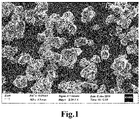
Fig. 1 is a scanning electron microscope picture of the cobalt-free cathode material LiNi0.92Mn0.06Al0.02O2 in the example 1; -
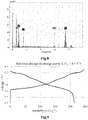
Fig. 2 is an XRD spectrogram of the cobalt-free cathode material LiNi0.92Mn0.06Al0.02O2 in the example 1; -
Fig. 3 is an EDS spectrogram of the cobalt-free cathode material LiNi0.92Mn0.06Al0.02O2 in the example 1; -
Fig. 4 is a first time charge-discharge curve chart of the lithium ion battery in the example 1; -
Fig. 5 is a cycle curve of the lithium ion battery in the example 1; -
Fig. 6 is a scanning electron microscope picture of the cobalt-free cathode material LiNi0.92Mn0.07Al0.01O2 in the example 2; -
Fig. 7 is an XRD spectrogram of the cobalt-free cathode material LiNi0.92Mn0.07Al0.01O2 in the example 2; -
Fig. 8 is an EDS spectrogram of the cobalt-free cathode material LiNi0.92Mn0.07Al0.01O2 in the example 2; -
Fig. 9 is a first time charge-discharge curve chart of the lithium ion battery in the example 2; -
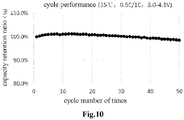
Fig. 10 is a cycle curve of the lithium ion battery in the example 2. - Detail description on the embodiments of the present disclosure will be made below. The embodiments described below are exemplary, and are merely used for explaining the present disclosure and are not construed as limitation to the present disclosure. The embodiments without specific technologies or conditions indicated are carried out according to technologies or conditions described by literature in the field or description of a product. The used reagents or instruments not indicated by manufacturers are conventional products which can be purchased in the market.
- In one aspect of the present disclosure, the present disclosure provides a cobalt-free cathode material for a lithium ion battery. According to the embodiments of the present disclosure, the general formula of the cobalt-free cathode material is LixNiaMnbRcO2, wherein 1 ≤x≤1.15 (for example, x is 1, 1.05, 1.08, 1.10, 1.12 and 1.15), 0.5≤a≤0.95 (for example a is 0.5, 0.6, 0.7, 0.8, 0.9 and 0.95), 0.02≤b≤0.48 (for example, b is 0.02, 0.03, 0.05, 0.1, 0.15, 0.2, 0.25, 0.3, 0.35, 0.4 and 0.48), 0<c≤0.05 (for example, c is 0.01, 0.02, 0.03, 0.04 and 0.05), and R is aluminum or tungsten. Therefore, as the cobalt-free cathode material is free of metal cobalt, the cost of the cathode material can be lowered effectively. Aluminum or tungsten in the cobalt-free cathode material can stabilize a crystal structure of the cathode material better, such that the lithium ion battery has excellent rate capability and cycle performance, and furthermore, good cycling stability of the lithium ion battery can be still maintained under a high-temperature and high-pressure testing condition.
- According to the embodiments of the present disclosure, when R is tungsten, 0.03≤b≤ 0.48, 0<c≤0.02; and when R is aluminum, 0.02≤b≤0.45, 1≤x≤1.10. Therefore, during preparation, it is convenient to prepare LixNiaMnbWcO2 and LixNiaMnbAlcO2.
- According to the embodiments of the present disclosure, the cobalt-free cathode material meets at least one of the following conditions: a crystal is of a lamellar structure; a hexagonal system; an R3̅m spatial point group; a morphology is monocrystal or polycrystal; and a grain size is 1-15 microns (for example, 1 micron, 2 microns, 3 microns, 5 microns, 7 microns, 9 microns, 10 microns, 11 microns, 13 microns or 15 microns). Therefore, the crystal form and the crystal structure can enable the cobalt-free cathode material to have good electric property, such that the lithium ion battery has excellent battery performance such as cycle performance, charge and discharge performance and capacity retention ratio; the grain size not only can enable the cobalt-free cathode material to have excellent activity and specific capacity, but also can enable the cobalt-free cathode material to be relatively small in specific surface area, such that a condition that an electrolyte is in contact with the cobalt-free cathode material to generate side reactions can be further prevented; if the grain size is greater than 15 microns, the dimension of the primary particle of the cobalt-free cathode material is oversized, such that the specific capacity and the rate capability of the cobalt-free cathode material can be reduced relatively; if the grain size is smaller than 1 micron, the specific surface area of the cobalt-free cathode material is relatively large, such that the probability that the electrolyte has side reactions will be increased. It should be noted that the particle size is an average particle size.
- According to the embodiments of the present disclosure, an RXD spectrum of the cobalt-free cathode material, a peak ratio of 1(003) to 1(104) is greater than or equal to 1.2 (for example, the peak ratio of 1(003) to 1(104) is 1.2, 1.3, 1.4, 1.5, 1.6, 1.7, 1.8, 1.9 and 2.0). Therefore, the mixed arrangement degree of lithium and nickel in the cobalt-free cathode material (the greater the peak value ratio is, the lower the mixed arrangement degree of lithium and nickel is), such that the excellent electric performance of the cobalt-free cathode material can be further ensured.
- According to the embodiment of the present disclosure, the cobalt-free cathode material meets at least one of the following conditions:
- The specific surface area is 0.15-1.5 m2/g (for example, 0.15 m2/g, 0.2 m2/g, 0.3 m2/g, 0.5 m2/g, 0.7 m2/g, 0.9 m2/g, 1.0 m2/g, 1.1 m2/g, 1.3 m2/g and 1.5 m2/g). Thus, the cobalt-free cathode material has good activity, and the probability that the cobalt-free cathode material is in contact with the electrolyte to generate side reactions is small; if the specific surface area is smaller than 0.15 m2/g, the activity of the cobalt-free cathode material is relatively small, such that the charge and discharge performance of the lithium ion battery are further affected; if the specific surface area of the cobalt-free cathode material is larger than 0.15 m2/g, the risk that the cobalt-free cathode material is reacted with the electrolyte is relatively large, such that the electric performance of the lithium ion battery is further affected.
- The pH value is less than or equal to 12 (for example pH is 12, 11 and 10), and thus, the cobalt-free cathode material is excellent in structural stability.
- The content of residual alkali is 0.05-0.7wt%, for example, 0.05wt%, 0.1wt%, 0.2wt%, 0.3wt%, 0.4wt%, 0.5wt%, 0.6wt% and 0.7wt%. Therefore, the content of the residual alkali (lithium hydroxide and lithium carbonate) of the cobalt-free cathode material is relatively low, such that good rate, specific capacity and cycle performance of the lithium ion are further ensured effectively.
- The tap density is greater than or equal to 1.3 g/cm3, for example 1.3 g/cm3, 1.4 g/cm3, 1.5 g/cm3, 1.7 g/cm3, 1.9 g/cm3, 2.0 g/cm3, 2.3 g/cm3, 2.5 g/cm3 and 2.8 g/cm3, and the apparent density is greater than or equal to 0.9 g/cm3, for example, 0.9 g/cm3, 1.0 g/cm3, 1.1 g/cm3, 1.2 g/cm3, 1.4 g/cm3, 1.5 g/cm3, 1.7 g/cm3, 1.9 g/cm3, 2.0 g/cm3, 2.3 g/cm3 and 2.5 g/cm3. Therefore, the lithium ion battery has excellent specific capacity. If the tap density is less than 1.3 g/cm3 or the apparent density is less than 0.9 g/cm3, the compaction density is low when a battery cell is used, such that the energy density of the lithium ion battery is further relatively low.
- The water content is less than or equal to 1000ppm, and thus, the electric performance of the cobalt-free cathode material can be further improved, such that the specific capacity, the rate and the cycle performance of the lithium ion battery are further improved.
- The content of the magnetic substance impurity is less than or equal to 300ppb, and the electric performance of the cobalt-free cathode material will be affected in presence of the magnetic substance, such that the battery performance of the lithium ion battery is further affected. However, in the preparation process of the cobalt-free cathode material, it is hard to prevent the magnetic substance impurity from being introduced, and the content of the magnetic substance impurity of the cobalt-free cathode material of the application is lower than 300ppb, such that influence of the magnetic substance impurity on self-discharge of the lithium ion battery can be reduced as far as possible.
- In another aspect of the present disclosure, the present disclosure provides a method for preparing the cobalt-free cathode material. According to the embodiments of the present disclosure, the method for preparing the cobalt-free cathode material includes:
- S100: lithium hydroxide is mixed with a precursor NiaMnbRc(OH)2 uniformly to obtain a pre-mixture, wherein 0.5≤a≤0.95, 0.02≤b≤0.48, 0<c≤0.05, and R is aluminum or tungsten.
- According to the embodiments of the present disclosure, there is no special requirements on the specific preparation method of the precursor NiaMnbRc(OH)2, and those skilled in the art can select the method flexibly according to an actual condition. In some embodiments, the specific preparation method of the precursor NiaMnbRc(OH)2 includes: NiSO4·6H2O, MnSO4·H2O and Al2(SO4)3·6H2O (or (NH4)10W12O4·10H2O) are weighed at a stoichiometric ratio and are mixed to prepare a 2 mol/L metal salt solution, and prepare a 4 mol/L sodium hydroxide solution; the metal salt solution, the NaOH solution and ammonia water are added into a reaction kettle protected by an N2 atmosphere, wherein a system temperature in the reaction kettle is 55°C, the pH is controlled at about 11.3 and a stirring rotating speed is 500 r/min; a precursor NiaMnbRc(OH)2 precipitate is generated; and the precursor NiaMnbRc(OH)2 precipitate is dried to obtain NiaMnbRc(OH)2.
- Further, a mixing mass ratio of lithium hydroxide and the precursor LixNiaMnbRcO2 can be determined by those skilled in the art according to specific values of x, a, b and c in the needed LixNiaMnbRcO2, thereby obtaining the cobalt-free cathode material LixNiaMnbRcO2 with a molar ratio of lithium to nickel to manganese to R (aluminum or tungsten) is x: a: b: c.
- According to the embodiments of the present disclosure, mixing of lithium hydroxide and the precursor NiaMnbRc(OH)2 is carried out in the high speed mixing apparatus, wherein the rotating speed of the mixing apparatus is 800-900 rpm, the mixing time is 5-20 minutes, and a material filling rate in the mixing apparatus is 40-80%. Therefore, lithium hydroxide and the precursor NiaMnbRc(OH)2 are mixed more uniformly to improve the reacting uniformity and sufficiency of lithium hydroxide and the precursor NiaMnbRc(OH)2.
- S200: a reaction is conducted on the pre-mixture at a predetermined temperature in an oxygen-containing atmosphere to obtain the cobalt-free cathode material. In the reaction process, lithium hydroxide is melted and generates lithium oxide, the precursor is dehydrated to generate a metal oxide, in an oxygen-containing environment, the precursor and the metal oxide are melted integrally to obtain the single phase cobalt-free cathode material LixNiaMnbRcO2.
- According to the embodiments of the present disclosure, the predetermined temperature ranges from 700°C to 1000°C (for example 700°C, 750°C, 800°C, 850°C, 900°C, 950°C and 1000°C) and the predetermined time ranges from 10 hours to 20 hours. Therefore, the cobalt-free cathode material LixNiaMnbRcO2 with needed crystal structure, crystal form and proper grain size can be obtained under the condition. If the temperature is lower than 700°C, the reaction is not full, such that the crystal of the cobalt-free cathode material does not grow intactly, thereby affecting the electric performance of the cobalt-free cathode material. If the temperature is higher than 1000°C, the crystal particle grows too large (the grain size is large), such that the specific capacity and the rate capability of the lithium ion battery are relatively reduced.
- According to the embodiments of the present disclosure, the predetermined temperature is achieved by gradual heating, wherein a heating rate ranges from 1 °C /min to 5 °C /min, for example, 1 °C /min, 2 °C /min, 3 °C /min, 4 °C /min and 5 °C /min. Therefore, the heating rate is relatively slow and mild, such that a condition that the cobalt-free cathode material with needed crystal form and crystal structure is not obtained as a result of too high heating rate can be avoided.
- According to the embodiments of the present disclosure, in the oxygen-containing atmosphere, a concentration of oxygen is greater than or equal to 90%, for example 90%, 92%, 94%, 95%, 98% and 100%. Therefore, generation of the cobalt-free cathode material can be ensured effectively, and conversion from unstable Ni3+ in the cobalt-free cathode material to stable Ni2+ is inhibited to ensure the stability of the cobalt-free cathode material.
- According to the embodiments of the present disclosure, after the reaction in the S200 is finished, natural cooling is conducted, and then the cobalt-free cathode material can be further crushed and screened by a 300-400-mesh sieve to obtain the cobalt-free cathode material with a proper particle size.
- According to the embodiments of the present disclosure, as the cobalt-free cathode material prepared by the method is free of metal cobalt, the cost of the cathode material can be lowered effectively. Aluminum or tungsten in the cobalt-free cathode material can stabilize a crystal structure of the cathode material better, such that the lithium ion battery has excellent rate capability and cycle performance, and furthermore, good cycling stability of the lithium ion battery can be still maintained under a high-temperature and high-pressure testing condition.
- In yet another aspect of the present disclosure, the present disclosure provides a lithium ion battery. According to the embodiments of the present disclosure, the lithium ion battery includes the cobalt-free cathode material. Therefore, the lithium ion battery is relatively low in cost and has excellent rate capability and cycle performance, and good cycling stability of the lithium ion battery can be still maintained under a high-temperature and high-pressure testing condition.
- According to the embodiments of the present disclosure, there is no special requirements on specific materials of an anode and an electrolyte in the lithium ion battery, and those skilled in the art can select the anode and the electrolyte of any one material in the prior art flexibly according to an actual condition.
- A method for preparing the cobalt-free cathode material LiNi0.92Mn0.06Al0.02O2 includes:
- S1: the specific preparation method of the precursor Ni0.92Mn0.06Al0.02(OH)2 includes: NiSO4·6H2O, MnSO4·H2O and Al2(SO4)3·6H2O (a molar ratio of nickel to manganese and aluminum is 0.92: 0.06: 0.02) are weighed at a stoichiometric ratio and the sulfates are mixed to prepare a 2 mol/L metal salt solution, and prepare a 4 mol/L sodium hydroxide solution; the metal salt solution, the NaOH solution and ammonia water are added into a reaction kettle protected by an N2 atmosphere, wherein a system temperature in the reaction kettle is 55 °C, the pH is controlled at about 11.3 and a stirring rotating speed is 500 r/min; a precursor Ni0.92Mn0.06Al0.02(OH)2 precipitate is generated; and the precursor Ni0.92Mn0.06Al0.02(OH)2 precipitate is dried to obtain Ni0.92Mn0.06Al0.02(OH)2.
- S2: a step of mixing the precursor Ni0.92Mn0.06Al0.02(OH)2with LiOH: LiOH and Ni0.92Mn0.06Al0.02(OH)2 are weighed respectively at a stoichiometric ratio and are mixed uniformly in the high speed mixing apparatus to obtain a mixture, wherein a molar ratio of lithium to nickel to manganese and aluminum is 1: 0.92: 0.06: 0.02, wherein the rotating speed of the high speed mixing apparatus is 850 rpm, the mixing time is 10 minutes, and the material filling rate in the mixing apparatus is 55%; and
- S3, a step of reaction of the cobalt-free cathode material LiNi0.92Mn0.06Al0.02(OH)2: the pre-mixture is placed in an oxygen atmosphere (an oxygen containing concentration is 95%); a high-temperature reaction is conducted for 10 hours at 750°C (a heating rate is 1-5 °C /min) to synthesize the cobalt-free cathode material LiNi0.92Mn0.06Al0.02(OH)2; then natural cooling is conducted and the cobalt-free cathode material is crushed and screened by a 400-mesh sieve to obtain the cobalt-free cathode material LiNi0.92Mn0.06Al0.02O2 with a proper particle size.
- Test analysis:
- (1) Electron microscope scanning is conducted on the obtained cobalt-free cathode material LiNi0.92Mn0.06Al0.02(OH)2, the scanning electron microscope picture refers to the
Fig. 1 , and it can be known from the scanning electron microscope picture that the prepared cobalt-free cathode material is of monocrystal morphology and the average particle size of the particle is 3-4 microns. - XRD test is conducted on the obtained cobalt-free cathode material LiNi0.92Mn0.06Al0.02(OH)2, a test spectrogram refers to the
Fig. 2 , and it can be known from theFig. 2 that the prepared cobalt-free cathode material is of a lamellar structure, hexagonal system, and has an R3̅m spatial point group. The I(003)/I(104) ratio is 1.8. It can be known that the mixed arrangement degree of nickel and lithium in the cobalt-free cathode material is relatively low. - (3) EDS test is conducted on the obtained cobalt-free cathode material LiNi0.92Mn0.06Al0.02(OH)2, the test spectrogram refers to the
Fig. 3 , and it can be known from theFig. 3 that the prepared cobalt-free cathode material has three metal elements: Ni, Mn and Al (through an ICP test, presence of lithium can be further determined). - (4) The obtained cobalt-free cathode material, the anode (lithium piece), the electrolyte (the electrolyte includes LiPF6/lithium Hexafluorophosphate) EC (ethylene carbonate)-DMC (dimethyl carbonate) assemble the lithium ion battery, and charge and discharge performance of the lithium ion battery is tested, and a charge and discharge performance test (the voltage range is 3.0∼ 4.3V) result refers to the
Fig. 4 (first time charge and discharge curve). It can be seen in combination with theFig. 4 that at 0.1C discharge rate, the first time specific charge and discharge capacities of the lithium ion battery are 233.3 mAh/g and 212.2 mAh/g respectively, and the first time efficiency is 91%. - (5) the cycle performance of the lithium ion battery obtained in the (4) is tested at 25°C (the test voltage is 3.0-4.3 V), the cycle curve at 0.5C/1C refers to the
Fig. 5 , and it can be seen from theFig. 5 that the capacity retention ratio of the lithium ion battery after 50 cycles is 98.7%. Reasons that the cycle performance of the cathode-free cathode material is excellent are as follows: more elements Mn and Al, which stabilizes the crystal structure of the cathode-free cathode material. - The cathode-free cathode material LiNi0.92Mn0.06Al0.02O2 is prepared by adopting method and steps same with those in the example 1, and the difference lies in that the high-temperature reaction temperature is 800°C.
- By adopting conditions same with those in the example 1, the lithium ion battery is prepared by taking the prepared cobalt-free cathode material is taken as the cathode, and the first time charge and discharge performance and the cycle performances of the lithium ion battery are tested (the test conditions are as same as those in the example 1), and at 0.1C discharge rate, the first time specific charge and discharge capacities of the lithium ion battery are 230.8 mAh/g and 207.5 mAh/g respectively, and the first time efficiency is 89.9%; and the capacity retention ratio of the lithium ion battery after 50 cycles at 0.5C/1C is 97.2%.
- The cathode-free cathode material LiNi0.92Mn0.06Al0.02O2 is prepared by adopting method and steps same with those in the example 1, and the difference lies in that the high-temperature reaction temperature is 850°C.
- By adopting conditions same with those in the example 1, the lithium ion battery is prepared by taking the prepared cobalt-free cathode material is taken as the cathode, and the first time charge and discharge performance and the cycle performances of the lithium ion battery are tested (the test conditions are as same as those in the example 1), and at 0.1C discharge rate, the first time specific charge and discharge capacities of the lithium ion battery are 228.4 mAh/g and 203.5 mAh/g respectively, and the first time efficiency is 89.1%; and the capacity retention ratio of the lithium ion battery after 50 cycles at 0.5C/1C is 95.6%.
- The cathode-free cathode material LiNi0.92Mn0.06Al0.02O2 is prepared by adopting method and steps same with those in the example 1, and the difference lies in that the high-temperature reaction temperature is 900°C.
- By adopting conditions same with those in the example 1, the lithium ion battery is prepared by taking the prepared cobalt-free cathode material is taken as the cathode, and the first time charge and discharge performance and the cycle performances of the lithium ion battery are tested (the test conditions are as same as those in the example 1), and at 0.1C discharge rate, the first time specific charge and discharge capacities of the lithium ion battery are 215.9 mAh/g and 190.4 mAh/g respectively, and the first time efficiency is 88.2%; and the capacity retention ratio of the lithium ion battery after 50 cycles at 0.5C/1C is 93.8%.
- The cathode-free cathode material LiNi0.92Mn0.06Al0.02O2 is prepared by adopting method and steps same with those in the example 1, and the difference lies in that the high-temperature reaction temperature is 1000 °C.
- By adopting conditions same with those in the example 1, the lithium ion battery is prepared by taking the prepared cobalt-free cathode material is taken as the cathode, and the first time charge and discharge performance and the cycle performances of the lithium ion battery are tested (the test conditions are as same as those in the example 1), and at 0.1C discharge rate, the first time specific charge and discharge capacities of the lithium ion battery are 205.8 mAh/g and 180.1 mAh/g respectively, and the first time efficiency is 87.5%; and the capacity retention ratio of the lithium ion battery after 50 cycles at 0.5C/1C is 90.5%.
- A method for preparing the cobalt-free cathode material LiNi0.50Mn0.45Al0.05(OH)2 includes:
- S1: the specific preparation method of the precursor Ni0.50Mn0.45Al0.05(OH)2 includes: NiSO4·6H2O, MnSO4·H2O and Al2(SO4)3·6H2O (a molar ratio of nickel to manganese and aluminum is 0.50: 0.45: 0.05) are weighed at a stoichiometric ratio and the sulfates are mixed to prepare a 2 mol/L metal salt solution, and prepare a 4 mol/L sodium hydroxide solution; the metal salt solution, the NaOH solution and ammonia water are added into a reaction kettle protected by an N2 atmosphere, wherein a system temperature in the reaction kettle is 55 °C, the pH is controlled at about 11.0 and a stirring rotating speed is 600 r/min; a precursor Ni0.50Mn0.45Al0.05(OH)2 precipitate is generated; and the precursor Ni0.50Mn0.45Al0.05(OH)2 precipitate is dried to obtain Ni0.50Mn0.45Al0.05(OH)2
- S2: mixing is conducted by adopting the method same with that in the example 1, and the difference lies in that the precursor is Ni0.50Mn0.45Al0.05(OH)2
- S3: the cathode-free cathode material LiNi0.50Mn0.45Al0.05O2 is prepared by adopting method and steps same with those in the example 1, and the difference lies in that the high-temperature reaction temperature is 1000 °C.
- By adopting conditions same with those in the example 1, the lithium ion battery is prepared by taking the prepared cobalt-free cathode material is taken as the cathode, and the first time charge and discharge performance and the cycle performances of the lithium ion battery are tested (the test conditions are as same as those in the example 1), and at 0.1C discharge rate, the first time specific charge and discharge capacities of the lithium ion battery are 198.8 mAh/g and 171.0 mAh/g respectively, and the first time efficiency is 86.0%; and the capacity retention ratio of the lithium ion battery after 50 cycles at 0.5C/1C is 98.9%.
-
- S1: the specific preparation method of the precursor Ni0.95Mn0.02Al0.03(OH)2 includes: NiSO4·6H2O, MnSO4·H2O and Al2(SO4)3·6H2O (a molar ratio of nickel to manganese and aluminum is 0.95: 0.02: 0.03) are weighed at a stoichiometric ratio and the sulfates are mixed to prepare a 2 mol/L metal salt solution, and prepare a 4 mol/L sodium hydroxide solution; the metal salt solution, the NaOH solution and ammonia water are added into a reaction kettle protected by an N2 atmosphere, wherein a system temperature in the reaction kettle is 55 °C, the pH is controlled at about 11.5 and a stirring rotating speed is 400 r/min; a precursor Ni0.95Mn0.02Al0.03(OH)2 precipitate is generated; and the precursor Ni0.95Mn0.02Al0.03(OH)2 precipitate is dried to obtain Ni0.95Mn0.02Al0.03(OH)2.
- S2: mixing is conducted by adopting the method same with that in the example 1, and the difference lies in that the precursor is Ni0.95Mn0.02Al0.03(OH)2
- S3: the cathode-free cathode material LiNi0.95Mn0.02Al0.03O2 is prepared by adopting method and steps same with those in the example 1, and the difference lies in that the high-temperature reaction temperature is 720 °C.
- By adopting conditions same with those in the example 1, the lithium ion battery is prepared by taking the prepared cobalt-free cathode material is taken as the cathode, and the first time charge and discharge performance and the cycle performances of the lithium ion battery are tested (the test conditions are as same as those in the example 1), and at 0.1C discharge rate, the first time specific charge and discharge capacities of the lithium ion battery are 235.2 mAh/g and 215.4 mAh/g respectively, and the first time efficiency is 91.6%; and the capacity retention ratio of the lithium ion battery after 50 cycles at 0.5C/1C is 97.6%.
-
- S1; same with the example 1;
- S2: a step of mixing the precursor Ni0.92Mn0.06Al0.02(OH)2with LiOH: LiOH and Ni0.92Mn0.06Al0.02(OH)2 are weighed respectively at a stoichiometric ratio and are mixed uniformly in the high speed mixing apparatus to obtain a mixture, wherein a molar ratio of lithium to nickel to manganese and aluminum is 1.2: 0.92: 0.06: 0.02, wherein the rotating speed of the high speed mixing apparatus is 850 rpm, the mixing time is 10 minutes, and the material filling rate in the mixing apparatus is 55%;
- S3, a step of reaction of the cobalt-free cathode material Ni0.92Mn0.06Al0.02O2: the pre-mixture is placed in an oxygen atmosphere (an oxygen containing concentration is 95%); a high-temperature reaction is conducted for 10 hours at 760 °C (a heating rate is 1-5 °C /min) to synthesize the cobalt-free cathode material LiNi0.92Mn0.06Al0.02O2; then natural cooling is conducted and the cobalt-free cathode material is crushed and screened by a 400-mesh sieve to obtain the cobalt-free cathode material LiNi0.92Mn0.06Al0.02O2 with a proper particle size.
- By adopting conditions same with those in the example 1, the lithium ion battery is prepared by taking the prepared cobalt-free cathode material is taken as the cathode, and the first time charge and discharge performance and the cycle performances of the lithium ion battery are tested (the test conditions are as same as those in the example 1), and at 0.1C discharge rate, the first time specific charge and discharge capacities of the lithium ion battery are 225.7 mAh/g and 201.3 mAh/g respectively, and the first time efficiency is 89.2%; and the capacity retention ratio of the lithium ion battery after 50 cycles at 0.5C/1C is 97.2%.
- A method for preparing the cobalt-free cathode material LiNi0.92Mn0.07Al0.01O2 includes:
- S1: a specific preparation method for the precursor Ni0.92Mn0.07W0.01(OH)2 includes: NiSO4·6H2O, MnSO4·H2O and (NH4)10W12O4·1-xH2O are weighed at a stoichiometric ratio, wherein x is 10. A molar ratio of nickel to manganese to tungsten is 0.92: 0.07: 0.01. The salts are mixed to prepare a 2 mol/L metal salt solution, and prepare a 4 mol/L sodium hydroxide solution; the metal salt solution, the NaOH solution and ammonia water are added into a reaction kettle protected by an N2 atmosphere, wherein a system temperature in the reaction kettle is 55 °C, the pH is controlled at about 11.3 and a stirring rotating speed is 500 r/min; a precursor Ni0.92Mn0.07Al0.01(OH)2 precipitate is generated; and the precursor Ni0.92Mn0.07Al0.01(OH)2 precipitate is dried to obtain Ni0.92Mn0.07Al0.02(OH)2;
- S2: a step of mixing the precursorNi0.92Mn0.07W0.01(OH)2 with LiOH: LiOH and Ni0.92Mn0.07W0.01(OH)2 are weighed respectively at a stoichiometric ratio and are mixed uniformly in the high speed mixing apparatus to obtain a mixture, wherein a molar ratio of lithium to nickel to manganese and aluminum is 1: 0.92: 0.07: 0.01, wherein the rotating speed of the high speed mixing apparatus is 900 rpm, the mixing time is 10 minutes, and the material filling rate in the mixing apparatus is 60%; and
- S3, a step of reaction of the cobalt-free cathode material Ni0.92Mn0.07W0.01(OH)2 the pre-mixture is placed in an oxygen atmosphere (an oxygen containing concentration is 95%); a high-temperature reaction is conducted for 12 hours at 740°C (a heating rate is 1-5°C/min) to synthesize the cobalt-free cathode material LiNi0.92Mn0.07W0.01O2; then natural cooling is conducted and the cobalt-free cathode material is crushed and screened by a 400-mesh sieve to obtain the cobalt-free cathode material LiNi0.92Mn0.07W0.01O2 with a proper particle size.
- Test analysis:
- (1) Electron microscope scanning is conducted on the obtained cobalt-free cathode material LiNi0.92Mn0.07W0.01O2, the scanning electron microscope picture refers to the
Fig. 6 , and it can be known from the scanning electron microscope picture that the prepared cobalt-free cathode material is of monocrystal morphology and the average particle size of the particle is 2-4 microns. - (2) XRD test is conducted on the obtained cobalt-free cathode material LiNi0.92Mn0.07W0.01O2, a test spectrogram refers to the
Fig. 7 , and it can be known from theFig. 7 that the prepared cobalt-free cathode material is of a lamellar structure, hexagonal system, and has an R3̅m spatial point group. The I(003)/I(104) ratio is 1.9. It can be known that the mixed arrangement degree of nickel and lithium in the cobalt-free cathode material is relatively low. - (3) EDS test is conducted on the obtained cobalt-free cathode material LiNi0.92Mn0.07W0.01O2, the test spectrogram refers to the
Fig. 8 , and it can be known from theFig. 8 that the prepared cobalt-free cathode material has three metal elements: Ni, Mn and W. - (4) The obtained cobalt-free cathode material, the anode (lithium piece), the electrolyte (the electrolyte includes LiPF6/lithium Hexafluorophosphate) EC (ethylene carbonate)-DMC (dimethyl carbonate) assemble the lithium ion battery, and charge and discharge performance of the lithium ion battery is tested, and a charge and discharge performance test (the voltage range is 3.0-4.3V) result refers to the
Fig. 9 (first time charge and discharge curve). It can be seen in combination with theFig. 4 that at 0.1C discharge rate, the first time specific charge and discharge capacities of the lithium ion battery are 246.1 mAh/g and 213.8 mAh/g respectively, and the first time efficiency is 86.8%. - (5) the cycle performance of the lithium ion battery obtained in the (4) is tested at 25 °C (the test voltage is 3.0-4.3 V), the cycle curve at 0.5C/1C refers to the
Fig. 10 , and it can be seen from theFig. 10 that the capacity retention ratio of the lithium ion battery after 50 cycles is 98.5%. Reasons that the cycle performance of the cathode-free cathode material is excellent are as follows: more elements Mn and W, which stabilizes the crystal structure of the cathode-free cathode material. - The cathode-free cathode material LiNi0.92Mn0.07W0.01O2 is prepared by adopting method and steps same with those in the example 1, and the difference lies in that the high-temperature reaction temperature is 800°C.
- By adopting conditions same with those in the example 1, the lithium ion battery is prepared by taking the prepared cobalt-free cathode material is taken as the cathode, and the first time charge and discharge performance and the cycle performances of the lithium ion battery are tested (the test conditions are as same as those in the example 1), and at 0.1C discharge rate, the first time specific charge and discharge capacities of the lithium ion battery are 242.6 mAh/g and 208.7 mAh/g respectively, and the first time efficiency is 86.0%; and the capacity retention ratio of the lithium ion battery after 50 cycles at 0.5C/1C is 98.5%.
- The cathode-free cathode material LiNi0.92Mn0.07W0.01O2 is prepared by adopting method and steps same with those in the example 1, and the difference lies in that the high-temperature reaction temperature is 850°C.
- By adopting conditions same with those in the example 1, the lithium ion battery is prepared by taking the prepared cobalt-free cathode material is taken as the cathode, and the first time charge and discharge performance and the cycle performances of the lithium ion battery are tested (the test conditions are as same as those in the example 1), and at 0.1C discharge rate, the first time specific charge and discharge capacities of the lithium ion battery are 235.6 mAh/g and 201.7 mAh/g respectively, and the first time efficiency is 85.6%; and the capacity retention ratio of the lithium ion battery after 50 cycles at 0.5C/1C is 96.4%.
- The cathode-free cathode material LiNi0.92Mn0.07W0.01O2 is prepared by adopting method and steps same with those in the example 1, and the difference lies in that the high-temperature reaction temperature is 900°C.
- By adopting conditions same with those in the example 1, the lithium ion battery is prepared by taking the prepared cobalt-free cathode material is taken as the cathode, and the first time charge and discharge performance and the cycle performances of the lithium ion battery are tested (the test conditions are as same as those in the example 1), and at 0.1C discharge rate, the first time specific charge and discharge capacities of the lithium ion battery are 219.9 mAh/g and 186.4 mAh/g respectively, and the first time efficiency is 84.8%; and the capacity retention ratio of the lithium ion battery after 50 cycles at 0.5C/1C is 94.2%.
- The cathode-free cathode material LiNi0.92Mn0.07W0.01O2 is prepared by adopting method and steps same with those in the example 1, and the difference lies in that the high-temperature reaction temperature is 1000 °C.
- By adopting conditions same with those in the example 1, the lithium ion battery is prepared by taking the prepared cobalt-free cathode material is taken as the cathode, and the first time charge and discharge performance and the cycle performances of the lithium ion battery are tested (the test conditions are as same as those in the example 1), and at 0.1C discharge rate, the first time specific charge and discharge capacities of the lithium ion battery are 210.4 mAh/g and 175.5 mAh/g respectively, and the first time efficiency is 83.4%; and the capacity retention ratio of the lithium ion battery after 50 cycles at 0.5C/1C is 92.3%.
- A method for preparing the cobalt-free cathode material LiNi0.50Mn0.48Al0.02O2 includes:
- S1: a specific preparation method for the precursor Ni0.50Mn0.48W0.02(OH)2 includes: NiSO4·6H2O, MnSO4·H2O and (NH4)10W12O4·1-xH2O are weighed at a stoichiometric ratio, wherein x is 10. A molar ratio of nickel to manganese to tungsten is 0.50: 0.48: 0.02. The salts are mixed to prepare a 2 mol/L metal salt solution, and prepare a 4 mol/L sodium hydroxide solution; the metal salt solution, the NaOH solution and ammonia water are added into a reaction kettle protected by an N2 atmosphere, wherein a system temperature in the reaction kettle is 55 °C, the pH is controlled at about 11.0 and a stirring rotating speed is 600 r/min; a precursor Ni0.50Mn0.48W0.01(OH)2 precipitate is generated; and the precursor Ni0.50Mn0.48W0.01(OH)2 precipitate is dried to obtain Ni0.50Mn0.48W0.01(OH)2;
- S2: mixing is conducted by adopting the method same with that in the example 1, and the difference lies in that the precursor is Ni0.50Mn0.45Al0.05(OH)2
- S3: the cathode-free cathode material LiNi0.50Mn0.48W0.02O2 is prepared by adopting method and steps same with those in the example 1, and the difference lies in that the high-temperature reaction temperature is 980°C. The I(003)/I(004) peak value ratio is greater than or equal to 1.2.
- By adopting conditions same with those in the example 1, the lithium ion battery is prepared by taking the prepared cobalt-free cathode material is taken as the cathode, and the first time charge and discharge performance and the cycle performances of the lithium ion battery are tested (the test conditions are as same as those in the example 1), and at 0.1C discharge rate, the first time specific charge and discharge capacities of the lithium ion battery are 203.6 mAh/g and 175.9 mAh/g respectively, and the first time efficiency is 86.4%; and the capacity retention ratio of the lithium ion battery after 50 cycles at 0.5C/1C is 99.4%.
- The
steps 1 and 2 are as same as those in the example 9; thestep 3 adopts the method as same as that in the example 9, and the difference lies in that the high temperature is 750 °C; and the I(003)/I(004) peak value ratio is equal to 1.2. - By adopting conditions same with those in the example 1, the lithium ion battery is prepared by taking the prepared cobalt-free cathode material is taken as the cathode, and the first time charge and discharge performance and the cycle performances of the lithium ion battery are tested (the test conditions are as same as those in the example 1), and at 0.1C discharge rate, the first time specific charge and discharge capacities of the lithium ion battery are 243.6 mAh/g and 210.0 mAh/g respectively, and the first time efficiency is 86.2%; and the capacity retention ratio of the lithium ion battery after 50 cycles at 0.5C/1C is 97.8%.
- The
steps 1 and 2 are as same as those in the example 9; thestep 3 adopts the method as same as that in the example 9, and the difference lies in that the high temperature is 720 °C; and the I(003)/I(004) peak value ratio is less than 1.2. - By adopting conditions same with those in the example 1, the lithium ion battery is prepared by taking the prepared cobalt-free cathode material is taken as the cathode, and the first time charge and discharge performance and the cycle performances of the lithium ion battery are tested (the test conditions are as same as those in the example 1), and at 0.1C discharge rate, the first time specific charge and discharge capacities of the lithium ion battery are 239.8 mAh/g and 205.3 mAh/g respectively, and the first time efficiency is 85.6%; and the capacity retention ratio of the lithium ion battery after 50 cycles at 0.5C/1C is 97.1%.
- A method for preparing the cobalt-free cathode material LiNi0.40Mn0.50Al0.10O2 includes:
- S1: the specific preparation method of the precursor Ni0.40Mn0.50Al0.10(OH)2 includes: NiSO4·6H2O, MnSO4·H2O and Al2(SO4)3·6H2O (a molar ratio of nickel to manganese and aluminum is 0.40: 0.50: 0.10) are weighed at a stoichiometric ratio and the sulfates are mixed to prepare a 2 mol/L metal salt solution, and prepare a 4 mol/L sodium hydroxide solution; the metal salt solution, the NaOH solution and ammonia water are added into a reaction kettle protected by an N2 atmosphere, wherein a system temperature in the reaction kettle is 55 °C, the pH is controlled at about 10.5 and a stirring rotating speed is 300 r/min; a precursor Ni0.40Mn0.50Al0.10(OH)2 precipitate is generated; and the precursor Ni0.40Mn0.50Al0.10(OH)2 precipitate is dried to obtain Ni0.40Mn0.50Al0.10(OH)2.
- S2: a step of mixing the precursor Ni0.40Mn0.50Al0.10(OH)2 with LiOH: LiOH and Ni0.40Mn0.50Al0.10(OH)2 are weighed respectively at a stoichiometric ratio and are mixed uniformly in the high speed mixing apparatus to obtain a mixture, wherein a molar ratio of lithium to nickel to manganese and aluminum is 1.2: 0.40: 0.50: 0.1, wherein the rotating speed of the high speed mixing apparatus is 850 rpm, the mixing time is 10 minutes, and the material filling rate in the mixing apparatus is 55%; and
- S3, a step of reaction of the cobalt-free cathode material LiNi0.40Mn0.50Al0.10O2: the pre-mixture is placed in an oxygen atmosphere (an oxygen containing concentration is 95%); a high-temperature reaction is conducted for 10 hours at 1050°C (a heating rate is 1-5°C/min)to synthesize the cobalt-free cathode material LiNi0.40Mn0.50Al0.10O2; then natural cooling is conducted and the cobalt-free cathode material is crushed and screened by a 400-mesh sieve to obtain the cobalt-free cathode material LiNi0.40Mn0.50Al0.10O2 with a proper particle size.
- By adopting conditions same with those in the example 1, the lithium ion battery is prepared by taking the prepared cobalt-free cathode material is taken as the cathode, and the first time charge and discharge performance and the cycle performances of the lithium ion battery are tested (the test conditions are as same as those in the example 1), and at 0.1C discharge rate, the first time specific charge and discharge capacities of the lithium ion battery are 193.0 mAh/g and 162.7 mAh/g respectively, and the first time efficiency is 84.3%; and the capacity retention ratio of the lithium ion battery after 50 cycles at 0.5C/1C is 99.6%.
- A method for preparing a cobalt-containing cathode material LiNi0.92Mn0.03Co0.03Al0.02O2 includes:
- S1: the specific preparation method of the precursor Ni0.92Mn0.03Co0.03Al0.02(OH)2 includes: NiSO4·6H2O, MnSO4·H2O, CoSO4·7H2O and Al2(SO4)3·6H2O (a molar ratio of nickel to manganese to cobalt to aluminum is 0.92: 0.03: 0.03: 0.02) are weighed at a stoichiometric ratio and the sulfates are mixed to prepare a 2 mol/L metal salt solution, and prepare a 4 mol/L sodium hydroxide solution; the metal salt solution, the NaOH solution and ammonia water are added into a reaction kettle protected by an N2 atmosphere, wherein a system temperature in the reaction kettle is 55 °C, the pH is controlled at about 11.1 and a stirring rotating speed is 500 r/min; a precursor Ni0.92Mn0.03Co0.03Al0.02(OH)2 precipitate is generated; and the precursor Ni0.92Mn0.03Co0.03Al0.02(OH)2 precipitate is dried to obtain Ni0.92Mn0.03Co0.03Al0.02(OH)2;
- S2: a step of mixing the precursor Ni0.92Mn0.03Co0.03Al0.02(OH)2 with LiOH: LiOH and Ni0.92Mn0.03Co0.03Al0.02(OH) 2are weighed respectively at a stoichiometric ratio and are mixed uniformly in the high speed mixing apparatus to obtain a mixture, wherein a molar ratio of lithium to nickel to manganese and aluminum is 1: 0.92: 0.03: 0.03: 0.02, wherein the rotating speed of the high speed mixing apparatus is 850 rpm, the mixing time is 10 minutes, and the material filling rate in the mixing apparatus is 55%; and
- S3, a step of reaction of the cobalt-free cathode material Ni0.92Mn0.03Co0.03Al0.02O2: the pre-mixture is placed in an oxygen atmosphere (an oxygen containing concentration is 95%); a high-temperature reaction is conducted for 10 hours at 730°C (a heating rate is 1-5°C/min) to synthesize the cobalt-free cathode material LiNi0.92Mn0.03Co0.03Al0.02O2; then natural cooling is conducted and the cobalt-free cathode material is crushed and screened by a 400-mesh sieve to obtain the cobalt-free cathode material LiNi0.92Mn0.03Co0.03Al0.02O2 with a proper particle size.
- By adopting conditions same with those in the example 1, the lithium ion battery is prepared by taking the prepared cobalt-free cathode material is taken as the cathode, and the first time charge and discharge performance and the cycle performances of the lithium ion battery are tested (the test conditions are as same as those in the example 1), and at 0.1C discharge rate, the first time specific charge and discharge capacities of the lithium ion battery are 235.8 mAh/g and 217.9 mAh/g respectively, and the first time efficiency is 92.4%; and the capacity retention ratio of the lithium ion battery after 50 cycles at 0.5C/1C is 97.2%.
- It can be seen from test data analysis of the examples 1-8 and 9-16 that along with increase of reaction temperature, the specific discharge capacity, the first effect and the capacity retention ratio of the lithium ion battery are reduced gradually, which is primary because of larger and larger size (the particle size is larger and larger) of the cobalt-free cathode material along with increase of the reaction temperature, such that the performance of the lithium ion battery is reduced gradually. However, it can be known from test results of the examples that when the reaction temperature is within a range of 700-1000°C, the prepared cobalt-free cathode material has good electric performance, such that the lithium ion battery has excellent specific discharge capacity, first effect and capacity retention ratio.
- In the description of the present specification, the description with reference to the terms "an embodiment", "some embodiments", "example", "specific example", or "some examples" and the like means that specific features, structures, materials, or features described in connection with the embodiments or examples are included in at least one embodiment or example of the present disclosure. In the description, schematic expressions of the terms do not have to mean same embodiments or exemplary embodiments. Furthermore, specific features, structures, materials or characteristics described can be combined in any one or more embodiments or exemplary embodiments in proper manners. In addition, under a condition without mutual contradiction, those skilled in the art can integrate or combine different embodiments or exemplary embodiments with different embodiments or exemplary embodiments described in the description.
- Although the embodiments of the present have been shown and described above, it can be understood that the embodiments are exemplary and cannot be construed as limitation to the present disclosure. Those skilled in the art can make changes, modification, replacement and transformation on the embodiments within the scope of the present disclosure.
Claims (10)
- A cobalt-free cathode material, wherein that a general formula of the cobalt-free cathode material is LixNiaMnbRcO2, 1≤x≤1.15, 0.5≤a≤0.95, 0.02≤b≤0.48, 0<c≤0.05, and R is aluminum or tungsten.
- The cobalt-free cathode material according to claim 1, wherein,when R is tungsten, 0.03≤b≤0.48, 0<c≤0.02; andwhen R is aluminum, 0.02≤b≤0.45, 1≤x≤1.10.
- The cobalt-free cathode material according to claim 1 or 2, wherein the cobalt-free cathode material meets at least one of following conditions:a crystal is of a lamellar structure;a hexagonal system;an R 3̅m spatial point group;a morphology is monocrystal or polycrystal; anda grain size is 1-15 microns.
- The cobalt-free cathode material according to claim 1 or 2, wherein in an RXD spectrum of the cobalt-free cathode material, a peak ratio of 1(003) to 1(104) is greater than or equal to 1.2.
- The cobalt-free cathode material according to claim 1 or 2, wherein the cobalt-free cathode material meets at least one of following conditions:a specific surface area is 0.15-1.5 m2/g;a pH value is less than or equal to 12;a content of residual alkali is 0.05-0.7wt%;a tap density is greater than or equal to 1.3 g/cm3;an apparent density is greater than or equal to 0.9 g/cm3;a water content is less than or equal to 1000 ppm; anda content of a magnetic substance impurity is less than or equal to 300 ppb.
- A method for preparing the cobalt-free cathode material according to any one of claims 1-5, comprising:mixing lithium hydroxide with a precursor NiaMnbRc(OH)2 uniformly to obtain a pre-mixture, wherein, 0.5≤a≤0.95, 0.02≤b≤0.48, 0<c≤0.05, and R is aluminum or tungsten; andconducting a reaction on the pre-mixture at a predetermined temperature in an oxygen-containing atmosphere to obtain the cobalt-free cathode material.
- The method according to claim 6, wherein the predetermined temperature ranges from 700°C to 1000°C and a time for the reaction ranges from 10 hours to 20 hours.
- The method according to claim 6 or 7, wherein the predetermined temperature is achieved by gradual heating, wherein a heating rate ranges from 1 °C/min to 5 °C /min.
- The method according to claim 6 or 7, wherein in the oxygen-containing atmosphere, a concentration of oxygen is greater than or equal to 90%.
- A lithium ion battery, comprising the cobalt-free cathode material according to any one of claims 1-5.
Applications Claiming Priority (2)
| Application Number | Priority Date | Filing Date | Title |
|---|---|---|---|
| CN202010054679.8A CN111430683A (en) | 2020-01-17 | 2020-01-17 | Cobalt-free cathode material for lithium ion battery and preparation method thereof, and lithium ion battery |
| PCT/CN2020/132909 WO2021143376A1 (en) | 2020-01-17 | 2020-11-30 | Cobalt-free positive electrode material of lithium ion battery, preparation method therefor, and lithium ion battery |
Publications (2)
| Publication Number | Publication Date |
|---|---|
| EP3975295A1 true EP3975295A1 (en) | 2022-03-30 |
| EP3975295A4 EP3975295A4 (en) | 2023-05-03 |
Family
ID=71547016
Family Applications (1)
| Application Number | Title | Priority Date | Filing Date |
|---|---|---|---|
| EP20914734.7A Pending EP3975295A4 (en) | 2020-01-17 | 2020-11-30 | LITHIUM-ION BATTERY COBALT-FREE POSITIVE ELECTRODE MATERIAL, METHOD OF PREPARATION AND LITHIUM-ION BATTERY |
Country Status (6)
| Country | Link |
|---|---|
| US (1) | US20220393166A1 (en) |
| EP (1) | EP3975295A4 (en) |
| JP (1) | JP7475451B2 (en) |
| KR (1) | KR102770807B1 (en) |
| CN (1) | CN111430683A (en) |
| WO (1) | WO2021143376A1 (en) |
Cited By (1)
| Publication number | Priority date | Publication date | Assignee | Title |
|---|---|---|---|---|
| EP4358185A1 (en) * | 2022-10-17 | 2024-04-24 | Samsung SDI Co., Ltd. | Rechargeable lithium battery |
Families Citing this family (19)
| Publication number | Priority date | Publication date | Assignee | Title |
|---|---|---|---|---|
| CN111430683A (en) * | 2020-01-17 | 2020-07-17 | 蜂巢能源科技有限公司 | Cobalt-free cathode material for lithium ion battery and preparation method thereof, and lithium ion battery |
| CN112382734B (en) * | 2020-08-25 | 2021-10-15 | 万向一二三股份公司 | Lithium ion battery positive plate using cobalt-free high-nickel positive electrode material |
| CN112047391A (en) * | 2020-09-03 | 2020-12-08 | 浙江中金格派锂电产业股份有限公司 | Preparation method of single crystal type lithium nickel manganese aluminate anode material |
| CN112582597A (en) * | 2020-11-20 | 2021-03-30 | 昆明理工大学 | Preparation method and modification method of ternary cobalt-free cathode material |
| CN114171735B (en) * | 2021-03-17 | 2024-05-10 | 贵州梅岭电源有限公司 | Nickel-manganese-tungsten lithium ion battery positive electrode material and preparation method thereof |
| CN113363461A (en) * | 2021-06-07 | 2021-09-07 | 四川启睿克科技有限公司 | Bimetallic ion co-doped cobalt-free precursor, positive electrode material and preparation method thereof |
| CN113488634B (en) * | 2021-07-29 | 2022-09-13 | 浙江帕瓦新能源股份有限公司 | Double-layer coated modified high-nickel cobalt-free single crystal ternary cathode material and preparation method thereof |
| CN113745494A (en) * | 2021-07-30 | 2021-12-03 | 格林美股份有限公司 | Preparation method of cobalt-free cathode material |
| CN113675395B (en) * | 2021-08-19 | 2023-05-23 | 蜂巢能源科技有限公司 | Binary positive electrode material, preparation method thereof and lithium ion battery |
| CN113991102B (en) * | 2021-12-29 | 2022-03-22 | 蜂巢能源科技股份有限公司 | Cobalt-free lithium-rich cathode material and preparation method and application thereof |
| CN114682575B (en) * | 2022-05-31 | 2022-08-23 | 宜宾锂宝新材料有限公司 | Method for reducing residual alkali on surface of high-nickel anode material, obtained material and application |
| CN114927698B (en) * | 2022-07-18 | 2023-03-31 | 蜂巢能源科技股份有限公司 | Preparation method of cobalt-free cathode material, cobalt-free cathode material and lithium ion battery |
| CN115231626B (en) * | 2022-07-25 | 2024-01-23 | 西安电子科技大学 | A cobalt-free, high-nickel NMA ternary cathode material and its preparation method |
| CN115198342B (en) * | 2022-08-10 | 2024-06-14 | 中南大学 | Lithium-rich cobalt-free monocrystal material of rapid ion conductor coated metal doping modified material and preparation method thereof |
| KR20240050128A (en) * | 2022-10-11 | 2024-04-18 | 삼성에스디아이 주식회사 | Rechargeable lithium battery |
| KR102809638B1 (en) * | 2022-11-03 | 2025-05-20 | 주식회사 엘지화학 | Positive electrode active material, positive electrode comprising the positive electrode active material and lithium secondary battery comprising the positive electrode |
| KR20240097529A (en) * | 2022-12-20 | 2024-06-27 | 삼성에스디아이 주식회사 | Additive for electrolyte, electrolyte for rechargeable lithium battery, and rechargeable lithium battery including the same |
| KR20240175201A (en) * | 2023-06-12 | 2024-12-19 | 삼성에스디아이 주식회사 | Positive active material, preparation method thereof, positive electrode, and rechargeable lithium batteries |
| KR20250061211A (en) * | 2023-10-27 | 2025-05-08 | 삼성에스디아이 주식회사 | Positive electrode active material, positive electrode and rechargeable lithium batteries |
Family Cites Families (15)
| Publication number | Priority date | Publication date | Assignee | Title |
|---|---|---|---|---|
| JP3653409B2 (en) * | 1999-01-29 | 2005-05-25 | 三洋電機株式会社 | Positive electrode active material for lithium secondary battery and manufacturing method thereof, positive electrode for lithium secondary battery using the positive electrode active material and manufacturing method thereof, lithium secondary battery using the positive electrode and manufacturing method thereof |
| EP1391950B1 (en) * | 2001-04-20 | 2010-08-25 | GS Yuasa Corporation | Anode active matter and production method therefor, non- aqueous electrolyte secondary battery-use anode, and non-aqueous electrolyte secondary battery |
| WO2011067937A1 (en) * | 2009-12-02 | 2011-06-09 | 住友金属鉱山株式会社 | Nickel complex hydroxide particles and nonaqueous electrolyte secondary battery |
| US7931985B1 (en) * | 2010-11-08 | 2011-04-26 | International Battery, Inc. | Water soluble polymer binder for lithium ion battery |
| JP5842596B2 (en) * | 2011-12-22 | 2016-01-13 | 日亜化学工業株式会社 | Positive electrode composition for non-aqueous electrolyte secondary battery and method for producing positive electrode slurry for non-aqueous electrolyte secondary battery |
| CN102723481B (en) * | 2012-07-09 | 2015-11-25 | 华南师范大学 | High-voltage lithium battery cathode material of a kind of micro-tungsten element that adulterates and preparation method thereof |
| CN103456946B (en) * | 2013-09-12 | 2017-07-11 | 湖南立方新能源科技有限责任公司 | Anode material for lithium-ion batteries |
| JP6201277B2 (en) | 2013-09-13 | 2017-09-27 | 住友金属鉱山株式会社 | Cathode active material for non-aqueous electrolyte secondary battery and method for producing the same |
| JP6142929B2 (en) * | 2014-01-31 | 2017-06-07 | 住友金属鉱山株式会社 | Nickel-manganese composite hydroxide particles and production method thereof, positive electrode active material for non-aqueous electrolyte secondary battery, production method thereof, and non-aqueous electrolyte secondary battery |
| JP6318956B2 (en) | 2014-07-31 | 2018-05-09 | 住友金属鉱山株式会社 | Positive electrode active material for non-aqueous electrolyte secondary battery, method for producing the same, and non-aqueous electrolyte secondary battery |
| CN105870408B (en) * | 2016-04-05 | 2019-02-05 | 昆明理工大学 | A kind of lithium ion battery cathode material and preparation method thereof |
| JP6855752B2 (en) * | 2016-10-31 | 2021-04-07 | 住友金属鉱山株式会社 | Nickel-manganese composite hydroxide and its manufacturing method, positive electrode active material for non-aqueous electrolyte secondary battery and its manufacturing method, and non-aqueous electrolyte secondary battery |
| US11121370B2 (en) * | 2017-01-18 | 2021-09-14 | Nano One Materials Corp. | One-pot synthesis for lithium ion battery cathode material precursors |
| CN111430683A (en) * | 2020-01-17 | 2020-07-17 | 蜂巢能源科技有限公司 | Cobalt-free cathode material for lithium ion battery and preparation method thereof, and lithium ion battery |
| CN111916723B (en) * | 2020-07-14 | 2021-08-17 | 蜂巢能源科技有限公司 | Gradient doped cobalt-free cathode material and preparation method thereof, as well as cathode for lithium ion battery and lithium battery |
-
2020
- 2020-01-17 CN CN202010054679.8A patent/CN111430683A/en active Pending
- 2020-11-30 KR KR1020227021088A patent/KR102770807B1/en active Active
- 2020-11-30 WO PCT/CN2020/132909 patent/WO2021143376A1/en not_active Ceased
- 2020-11-30 EP EP20914734.7A patent/EP3975295A4/en active Pending
- 2020-11-30 JP JP2022537256A patent/JP7475451B2/en active Active
- 2020-11-30 US US17/764,565 patent/US20220393166A1/en active Pending
Cited By (1)
| Publication number | Priority date | Publication date | Assignee | Title |
|---|---|---|---|---|
| EP4358185A1 (en) * | 2022-10-17 | 2024-04-24 | Samsung SDI Co., Ltd. | Rechargeable lithium battery |
Also Published As
| Publication number | Publication date |
|---|---|
| KR102770807B1 (en) | 2025-02-19 |
| JP7475451B2 (en) | 2024-04-26 |
| JP2023506527A (en) | 2023-02-16 |
| EP3975295A4 (en) | 2023-05-03 |
| US20220393166A1 (en) | 2022-12-08 |
| WO2021143376A1 (en) | 2021-07-22 |
| KR20220104785A (en) | 2022-07-26 |
| CN111430683A (en) | 2020-07-17 |
Similar Documents
| Publication | Publication Date | Title |
|---|---|---|
| US20220393166A1 (en) | Cobalt-free cathode material for lithium ion battery, method for preparing cobalt-free cathode material and lithium ion battery | |
| EP3996171B1 (en) | W-containing high-nickel ternary positive electrode material and preparation method therefor | |
| CN112750999B (en) | Cathode material, preparation method thereof and lithium ion battery | |
| US12157679B2 (en) | Single-crystal-type multi-element positive electrode material, and preparation method therefor and application thereof | |
| US10074856B2 (en) | Lithium-rich manganese-based positive electrode material and preparation method therefor | |
| EP3975291A1 (en) | Cobalt-free layered positive electrode material, preparation method therefor, and lithium ion battery | |
| JP3653409B2 (en) | Positive electrode active material for lithium secondary battery and manufacturing method thereof, positive electrode for lithium secondary battery using the positive electrode active material and manufacturing method thereof, lithium secondary battery using the positive electrode and manufacturing method thereof | |
| US20220340446A1 (en) | Cobalt-free lamellar cathode material and method for preparing cobalt-free lamellar cathode material, cathode piece and lithium ion battery | |
| US20240150197A1 (en) | Cobalt-free high-nickel positive electrode material, preparation method therefor and use thereof | |
| EP4117084A1 (en) | Recycling method for nickel-cobalt-manganese positive electrode material and waste nickel-cobalt-manganese positive electrode material | |
| CN102280619A (en) | Preparation method of high-tap density spherical three-component anode material precursor | |
| CN110534737B (en) | A kind of high-rate doped nickel-cobalt-manganese ternary material and preparation method thereof | |
| CN115108593B (en) | Preparation method and application of low-voltage high-capacity lithium-rich manganese-based positive electrode material | |
| CN113328090B (en) | High-nickel ternary cathode material and preparation method thereof | |
| US12555817B2 (en) | Lithium ion battery positive electrode material, preparation method therefor, and lithium ion battery | |
| CN115995531A (en) | Positive electrode active material, positive electrode plate, lithium ion battery and application of positive electrode active material and positive electrode plate | |
| US20250083974A1 (en) | Core-shell gradient ternary precursor and preparation method and application thereof | |
| CN115140783A (en) | Ternary positive electrode material precursor and preparation method and application thereof | |
| CN103066271B (en) | High voltage lithium ion battery anode material and preparation method thereof | |
| CN111807425A (en) | A method for preparing high-performance lithium-ion battery ternary cathode material at low ammonia concentration | |
| CN115020699A (en) | Low-cobalt or cobalt-free cathode material and preparation method and application thereof | |
| KR100424635B1 (en) | Positive active material for lithium secondary battery and method of preparing same | |
| US20030047717A1 (en) | Multi-doped nickel oxide cathode material | |
| CN117543004A (en) | Positive electrode material with stable structure, lithium ion battery and preparation method | |
| CN112811474B (en) | A lithium-ion battery nickel-cobalt doped lithium manganate cathode material and its preparation method |
Legal Events
| Date | Code | Title | Description |
|---|---|---|---|
| STAA | Information on the status of an ep patent application or granted ep patent |
Free format text: STATUS: THE INTERNATIONAL PUBLICATION HAS BEEN MADE |
|
| PUAI | Public reference made under article 153(3) epc to a published international application that has entered the european phase |
Free format text: ORIGINAL CODE: 0009012 |
|
| STAA | Information on the status of an ep patent application or granted ep patent |
Free format text: STATUS: REQUEST FOR EXAMINATION WAS MADE |
|
| 17P | Request for examination filed |
Effective date: 20211221 |
|
| AK | Designated contracting states |
Kind code of ref document: A1 Designated state(s): AL AT BE BG CH CY CZ DE DK EE ES FI FR GB GR HR HU IE IS IT LI LT LU LV MC MK MT NL NO PL PT RO RS SE SI SK SM TR |
|
| DAV | Request for validation of the european patent (deleted) | ||
| DAX | Request for extension of the european patent (deleted) | ||
| A4 | Supplementary search report drawn up and despatched |
Effective date: 20230330 |
|
| RIC1 | Information provided on ipc code assigned before grant |
Ipc: C01G 53/00 20060101ALI20230324BHEP Ipc: H01M 4/525 20100101AFI20230324BHEP |