EP3974389A1 - Lithium nickel manganese oxide composite material and preparation method therefor, and lithium ion battery - Google Patents
Lithium nickel manganese oxide composite material and preparation method therefor, and lithium ion battery Download PDFInfo
- Publication number
- EP3974389A1 EP3974389A1 EP20937347.1A EP20937347A EP3974389A1 EP 3974389 A1 EP3974389 A1 EP 3974389A1 EP 20937347 A EP20937347 A EP 20937347A EP 3974389 A1 EP3974389 A1 EP 3974389A1
- Authority
- EP
- European Patent Office
- Prior art keywords
- oxide
- nickel
- manganese
- lithium
- temperature
- Prior art date
- Legal status (The legal status is an assumption and is not a legal conclusion. Google has not performed a legal analysis and makes no representation as to the accuracy of the status listed.)
- Pending
Links
- FRMOHNDAXZZWQI-UHFFFAOYSA-N lithium manganese(2+) nickel(2+) oxygen(2-) Chemical compound [O-2].[Mn+2].[Ni+2].[Li+] FRMOHNDAXZZWQI-UHFFFAOYSA-N 0.000 title claims abstract description 74
- 239000002131 composite material Substances 0.000 title claims abstract description 61
- 238000002360 preparation method Methods 0.000 title claims abstract description 32
- HBBGRARXTFLTSG-UHFFFAOYSA-N Lithium ion Chemical compound [Li+] HBBGRARXTFLTSG-UHFFFAOYSA-N 0.000 title claims abstract description 16
- 229910001416 lithium ion Inorganic materials 0.000 title claims abstract description 11
- 238000000034 method Methods 0.000 claims abstract description 89
- 238000001354 calcination Methods 0.000 claims abstract description 76
- 239000002243 precursor Substances 0.000 claims abstract description 64
- ZAUUZASCMSWKGX-UHFFFAOYSA-N manganese nickel Chemical compound [Mn].[Ni] ZAUUZASCMSWKGX-UHFFFAOYSA-N 0.000 claims abstract description 63
- 239000000463 material Substances 0.000 claims abstract description 58
- WHXSMMKQMYFTQS-UHFFFAOYSA-N Lithium Chemical compound [Li] WHXSMMKQMYFTQS-UHFFFAOYSA-N 0.000 claims abstract description 24
- 229910052744 lithium Inorganic materials 0.000 claims abstract description 24
- 239000007774 positive electrode material Substances 0.000 claims description 36
- 238000002156 mixing Methods 0.000 claims description 29
- 239000011248 coating agent Substances 0.000 claims description 21
- TWNQGVIAIRXVLR-UHFFFAOYSA-N oxo(oxoalumanyloxy)alumane Chemical compound O=[Al]O[Al]=O TWNQGVIAIRXVLR-UHFFFAOYSA-N 0.000 claims description 19
- 238000007873 sieving Methods 0.000 claims description 19
- 238000000576 coating method Methods 0.000 claims description 18
- RVTZCBVAJQQJTK-UHFFFAOYSA-N oxygen(2-);zirconium(4+) Chemical compound [O-2].[O-2].[Zr+4] RVTZCBVAJQQJTK-UHFFFAOYSA-N 0.000 claims description 18
- 229910001928 zirconium oxide Inorganic materials 0.000 claims description 18
- QVGXLLKOCUKJST-UHFFFAOYSA-N atomic oxygen Chemical compound [O] QVGXLLKOCUKJST-UHFFFAOYSA-N 0.000 claims description 16
- 238000006243 chemical reaction Methods 0.000 claims description 16
- 239000001301 oxygen Substances 0.000 claims description 16
- 229910052760 oxygen Inorganic materials 0.000 claims description 16
- 239000013078 crystal Substances 0.000 claims description 14
- PXHVJJICTQNCMI-UHFFFAOYSA-N nickel Substances [Ni] PXHVJJICTQNCMI-UHFFFAOYSA-N 0.000 claims description 13
- 230000003247 decreasing effect Effects 0.000 claims description 11
- 239000011572 manganese Substances 0.000 claims description 11
- 239000000203 mixture Substances 0.000 claims description 9
- 239000002245 particle Substances 0.000 claims description 9
- MRELNEQAGSRDBK-UHFFFAOYSA-N lanthanum(3+);oxygen(2-) Chemical compound [O-2].[O-2].[O-2].[La+3].[La+3] MRELNEQAGSRDBK-UHFFFAOYSA-N 0.000 claims description 8
- 238000000227 grinding Methods 0.000 claims description 5
- 229910000484 niobium oxide Inorganic materials 0.000 claims description 5
- URLJKFSTXLNXLG-UHFFFAOYSA-N niobium(5+);oxygen(2-) Chemical compound [O-2].[O-2].[O-2].[O-2].[O-2].[Nb+5].[Nb+5] URLJKFSTXLNXLG-UHFFFAOYSA-N 0.000 claims description 5
- GWEVSGVZZGPLCZ-UHFFFAOYSA-N Titan oxide Chemical compound O=[Ti]=O GWEVSGVZZGPLCZ-UHFFFAOYSA-N 0.000 claims description 4
- QGLKJKCYBOYXKC-UHFFFAOYSA-N nonaoxidotritungsten Chemical compound O=[W]1(=O)O[W](=O)(=O)O[W](=O)(=O)O1 QGLKJKCYBOYXKC-UHFFFAOYSA-N 0.000 claims description 4
- OGIDPMRJRNCKJF-UHFFFAOYSA-N titanium oxide Inorganic materials [Ti]=O OGIDPMRJRNCKJF-UHFFFAOYSA-N 0.000 claims description 4
- 229910001930 tungsten oxide Inorganic materials 0.000 claims description 4
- 229910000476 molybdenum oxide Inorganic materials 0.000 claims description 3
- PQQKPALAQIIWST-UHFFFAOYSA-N oxomolybdenum Chemical compound [Mo]=O PQQKPALAQIIWST-UHFFFAOYSA-N 0.000 claims description 3
- 239000011247 coating layer Substances 0.000 abstract description 14
- 239000010410 layer Substances 0.000 abstract description 7
- 239000002585 base Substances 0.000 description 15
- 230000009286 beneficial effect Effects 0.000 description 15
- 230000014759 maintenance of location Effects 0.000 description 15
- WMFOQBRAJBCJND-UHFFFAOYSA-M Lithium hydroxide Chemical compound [Li+].[OH-] WMFOQBRAJBCJND-UHFFFAOYSA-M 0.000 description 14
- 239000000047 product Substances 0.000 description 7
- 230000015572 biosynthetic process Effects 0.000 description 3
- 239000010941 cobalt Substances 0.000 description 3
- 229910017052 cobalt Inorganic materials 0.000 description 3
- GUTLYIVDDKVIGB-UHFFFAOYSA-N cobalt atom Chemical compound [Co] GUTLYIVDDKVIGB-UHFFFAOYSA-N 0.000 description 3
- FXOOEXPVBUPUIL-UHFFFAOYSA-J manganese(2+);nickel(2+);tetrahydroxide Chemical compound [OH-].[OH-].[OH-].[OH-].[Mn+2].[Ni+2] FXOOEXPVBUPUIL-UHFFFAOYSA-J 0.000 description 3
- 238000003786 synthesis reaction Methods 0.000 description 3
- 238000011161 development Methods 0.000 description 2
- 238000010586 diagram Methods 0.000 description 2
- 239000008240 homogeneous mixture Substances 0.000 description 2
- 238000000265 homogenisation Methods 0.000 description 2
- 229910000625 lithium cobalt oxide Inorganic materials 0.000 description 2
- BFZPBUKRYWOWDV-UHFFFAOYSA-N lithium;oxido(oxo)cobalt Chemical compound [Li+].[O-][Co]=O BFZPBUKRYWOWDV-UHFFFAOYSA-N 0.000 description 2
- 238000012986 modification Methods 0.000 description 2
- 230000004048 modification Effects 0.000 description 2
- 239000002994 raw material Substances 0.000 description 2
- 238000005245 sintering Methods 0.000 description 2
- 238000003756 stirring Methods 0.000 description 2
- 239000000126 substance Substances 0.000 description 2
- 238000001308 synthesis method Methods 0.000 description 2
- 238000012360 testing method Methods 0.000 description 2
- PWHULOQIROXLJO-UHFFFAOYSA-N Manganese Chemical compound [Mn] PWHULOQIROXLJO-UHFFFAOYSA-N 0.000 description 1
- 239000003513 alkali Substances 0.000 description 1
- 238000000137 annealing Methods 0.000 description 1
- 239000011230 binding agent Substances 0.000 description 1
- 239000006258 conductive agent Substances 0.000 description 1
- 230000008602 contraction Effects 0.000 description 1
- 238000005520 cutting process Methods 0.000 description 1
- 125000004122 cyclic group Chemical group 0.000 description 1
- QHGJSLXSVXVKHZ-UHFFFAOYSA-N dilithium;dioxido(dioxo)manganese Chemical compound [Li+].[Li+].[O-][Mn]([O-])(=O)=O QHGJSLXSVXVKHZ-UHFFFAOYSA-N 0.000 description 1
- 238000007323 disproportionation reaction Methods 0.000 description 1
- 230000000694 effects Effects 0.000 description 1
- 239000003792 electrolyte Substances 0.000 description 1
- 239000012467 final product Substances 0.000 description 1
- 239000007789 gas Substances 0.000 description 1
- 238000010438 heat treatment Methods 0.000 description 1
- 150000002500 ions Chemical class 0.000 description 1
- XGZVUEUWXADBQD-UHFFFAOYSA-L lithium carbonate Chemical compound [Li+].[Li+].[O-]C([O-])=O XGZVUEUWXADBQD-UHFFFAOYSA-L 0.000 description 1
- 229910052808 lithium carbonate Inorganic materials 0.000 description 1
- GELKBWJHTRAYNV-UHFFFAOYSA-K lithium iron phosphate Chemical compound [Li+].[Fe+2].[O-]P([O-])([O-])=O GELKBWJHTRAYNV-UHFFFAOYSA-K 0.000 description 1
- 238000004519 manufacturing process Methods 0.000 description 1
- 229910052751 metal Inorganic materials 0.000 description 1
- 239000002184 metal Substances 0.000 description 1
- 229910052759 nickel Inorganic materials 0.000 description 1
- 239000000843 powder Substances 0.000 description 1
- 238000012545 processing Methods 0.000 description 1
- 238000005096 rolling process Methods 0.000 description 1
- 238000007086 side reaction Methods 0.000 description 1
- 239000002002 slurry Substances 0.000 description 1
- 239000007784 solid electrolyte Substances 0.000 description 1
- 239000002345 surface coating layer Substances 0.000 description 1
- 230000002195 synergetic effect Effects 0.000 description 1
- 238000010998 test method Methods 0.000 description 1
- XLYOFNOQVPJJNP-UHFFFAOYSA-N water Substances O XLYOFNOQVPJJNP-UHFFFAOYSA-N 0.000 description 1
Images
Classifications
-
- C—CHEMISTRY; METALLURGY
- C01—INORGANIC CHEMISTRY
- C01G—COMPOUNDS CONTAINING METALS NOT COVERED BY SUBCLASSES C01D OR C01F
- C01G53/00—Compounds of nickel
- C01G53/40—Complex oxides containing nickel and at least one other metal element
- C01G53/42—Complex oxides containing nickel and at least one other metal element containing alkali metals, e.g. LiNiO2
- C01G53/44—Complex oxides containing nickel and at least one other metal element containing alkali metals, e.g. LiNiO2 containing manganese
-
- C—CHEMISTRY; METALLURGY
- C01—INORGANIC CHEMISTRY
- C01G—COMPOUNDS CONTAINING METALS NOT COVERED BY SUBCLASSES C01D OR C01F
- C01G53/00—Compounds of nickel
- C01G53/40—Complex oxides containing nickel and at least one other metal element
- C01G53/42—Complex oxides containing nickel and at least one other metal element containing alkali metals, e.g. LiNiO2
- C01G53/44—Complex oxides containing nickel and at least one other metal element containing alkali metals, e.g. LiNiO2 containing manganese
- C01G53/50—Complex oxides containing nickel and at least one other metal element containing alkali metals, e.g. LiNiO2 containing manganese of the type (MnO2)n-, e.g. Li(NixMn1-x)O2 or Li(MyNixMn1-x-y)O2
-
- H—ELECTRICITY
- H01—ELECTRIC ELEMENTS
- H01M—PROCESSES OR MEANS, e.g. BATTERIES, FOR THE DIRECT CONVERSION OF CHEMICAL ENERGY INTO ELECTRICAL ENERGY
- H01M10/00—Secondary cells; Manufacture thereof
- H01M10/05—Accumulators with non-aqueous electrolyte
- H01M10/052—Li-accumulators
- H01M10/0525—Rocking-chair batteries, i.e. batteries with lithium insertion or intercalation in both electrodes; Lithium-ion batteries
-
- H—ELECTRICITY
- H01—ELECTRIC ELEMENTS
- H01M—PROCESSES OR MEANS, e.g. BATTERIES, FOR THE DIRECT CONVERSION OF CHEMICAL ENERGY INTO ELECTRICAL ENERGY
- H01M4/00—Electrodes
- H01M4/02—Electrodes composed of, or comprising, active material
- H01M4/36—Selection of substances as active materials, active masses, active liquids
- H01M4/362—Composites
- H01M4/366—Composites as layered products
-
- H—ELECTRICITY
- H01—ELECTRIC ELEMENTS
- H01M—PROCESSES OR MEANS, e.g. BATTERIES, FOR THE DIRECT CONVERSION OF CHEMICAL ENERGY INTO ELECTRICAL ENERGY
- H01M4/00—Electrodes
- H01M4/02—Electrodes composed of, or comprising, active material
- H01M4/36—Selection of substances as active materials, active masses, active liquids
- H01M4/48—Selection of substances as active materials, active masses, active liquids of inorganic oxides or hydroxides
- H01M4/50—Selection of substances as active materials, active masses, active liquids of inorganic oxides or hydroxides of manganese
- H01M4/505—Selection of substances as active materials, active masses, active liquids of inorganic oxides or hydroxides of manganese of mixed oxides or hydroxides containing manganese for inserting or intercalating light metals, e.g. LiMn2O4 or LiMn2OxFy
-
- H—ELECTRICITY
- H01—ELECTRIC ELEMENTS
- H01M—PROCESSES OR MEANS, e.g. BATTERIES, FOR THE DIRECT CONVERSION OF CHEMICAL ENERGY INTO ELECTRICAL ENERGY
- H01M4/00—Electrodes
- H01M4/02—Electrodes composed of, or comprising, active material
- H01M4/36—Selection of substances as active materials, active masses, active liquids
- H01M4/48—Selection of substances as active materials, active masses, active liquids of inorganic oxides or hydroxides
- H01M4/52—Selection of substances as active materials, active masses, active liquids of inorganic oxides or hydroxides of nickel, cobalt or iron
- H01M4/525—Selection of substances as active materials, active masses, active liquids of inorganic oxides or hydroxides of nickel, cobalt or iron of mixed oxides or hydroxides containing iron, cobalt or nickel for inserting or intercalating light metals, e.g. LiNiO2, LiCoO2 or LiCoOxFy
-
- H—ELECTRICITY
- H01—ELECTRIC ELEMENTS
- H01M—PROCESSES OR MEANS, e.g. BATTERIES, FOR THE DIRECT CONVERSION OF CHEMICAL ENERGY INTO ELECTRICAL ENERGY
- H01M4/00—Electrodes
- H01M4/02—Electrodes composed of, or comprising, active material
- H01M4/62—Selection of inactive substances as ingredients for active masses, e.g. binders, fillers
-
- H—ELECTRICITY
- H01—ELECTRIC ELEMENTS
- H01M—PROCESSES OR MEANS, e.g. BATTERIES, FOR THE DIRECT CONVERSION OF CHEMICAL ENERGY INTO ELECTRICAL ENERGY
- H01M4/00—Electrodes
- H01M4/02—Electrodes composed of, or comprising, active material
- H01M4/62—Selection of inactive substances as ingredients for active masses, e.g. binders, fillers
- H01M4/628—Inhibitors, e.g. gassing inhibitors, corrosion inhibitors
-
- C—CHEMISTRY; METALLURGY
- C01—INORGANIC CHEMISTRY
- C01P—INDEXING SCHEME RELATING TO STRUCTURAL AND PHYSICAL ASPECTS OF SOLID INORGANIC COMPOUNDS
- C01P2004/00—Particle morphology
- C01P2004/01—Particle morphology depicted by an image
- C01P2004/03—Particle morphology depicted by an image obtained by SEM
-
- C—CHEMISTRY; METALLURGY
- C01—INORGANIC CHEMISTRY
- C01P—INDEXING SCHEME RELATING TO STRUCTURAL AND PHYSICAL ASPECTS OF SOLID INORGANIC COMPOUNDS
- C01P2004/00—Particle morphology
- C01P2004/80—Particles consisting of a mixture of two or more inorganic phases
- C01P2004/82—Particles consisting of a mixture of two or more inorganic phases two phases having the same anion, e.g. both oxidic phases
- C01P2004/84—Particles consisting of a mixture of two or more inorganic phases two phases having the same anion, e.g. both oxidic phases one phase coated with the other
-
- C—CHEMISTRY; METALLURGY
- C01—INORGANIC CHEMISTRY
- C01P—INDEXING SCHEME RELATING TO STRUCTURAL AND PHYSICAL ASPECTS OF SOLID INORGANIC COMPOUNDS
- C01P2006/00—Physical properties of inorganic compounds
- C01P2006/40—Electric properties
-
- H—ELECTRICITY
- H01—ELECTRIC ELEMENTS
- H01M—PROCESSES OR MEANS, e.g. BATTERIES, FOR THE DIRECT CONVERSION OF CHEMICAL ENERGY INTO ELECTRICAL ENERGY
- H01M4/00—Electrodes
- H01M4/02—Electrodes composed of, or comprising, active material
- H01M2004/026—Electrodes composed of, or comprising, active material characterised by the polarity
- H01M2004/028—Positive electrodes
-
- Y—GENERAL TAGGING OF NEW TECHNOLOGICAL DEVELOPMENTS; GENERAL TAGGING OF CROSS-SECTIONAL TECHNOLOGIES SPANNING OVER SEVERAL SECTIONS OF THE IPC; TECHNICAL SUBJECTS COVERED BY FORMER USPC CROSS-REFERENCE ART COLLECTIONS [XRACs] AND DIGESTS
- Y02—TECHNOLOGIES OR APPLICATIONS FOR MITIGATION OR ADAPTATION AGAINST CLIMATE CHANGE
- Y02E—REDUCTION OF GREENHOUSE GAS [GHG] EMISSIONS, RELATED TO ENERGY GENERATION, TRANSMISSION OR DISTRIBUTION
- Y02E60/00—Enabling technologies; Technologies with a potential or indirect contribution to GHG emissions mitigation
- Y02E60/10—Energy storage using batteries
Definitions
- the disclosure relates to the field of lithium ion batteries, and in particular to a lithium nickel manganese oxide composite material, a preparation method thereof and a lithium ion battery.
- a positive electrode material is one of the three key materials for restricting the rapid development of lithium ion batteries.
- a lithium cobalt oxide positive electrode material has higher working voltage and better rate performance, but its lower actual capacity greatly limits an application of the lithium cobalt oxide positive electrode material.
- An olivine-type lithium iron phosphate positive electrode material has advantages of stable structure, good cycle performance, and low raw material price, but a theoretical capacity is lower.
- a ternary layered positive electrode material fully combines advantages of a lithium manganate, a lithium cobaltate and a lithium nickelate, and has advantages of higher discharge specific capacity, better cycle performance, and lower cost and the like.
- the ternary positive electrode material is already commercialized, for example, NCM523, NCM622, and NCM811, and it meets requirements of a power vehicle to a certain extent.
- cobalt is strategic metal, and its expensive price makes the cost of the ternary positive electrode material NCM higher.
- a cobalt resource is limited, and a business fluctuation of the market is greater. Therefore, the development of a cobalt-free positive electrode material is very necessary.
- positive electrode material homogenization may be affected by a pH of the material. If the pH of the positive electrode material is high, a slurry viscosity is unstable, and the homogenization is difficult, so that the battery processing performance is poor.
- a most common solution method at present is to coat the positive electrode material, namely a layer of a uniform nano-oxide is coated on the surface of the material, but this coating method is basically difficult to form a uniform coating layer on the surface of the material.
- a binding force between a coating substance and the material itself is weaker, and it is very possible that the coating substance falls off during a subsequent treatment process, thereby effective protection is not formed.
- a main purpose of the disclosure is to provide a lithium nickel manganese oxide composite material, a preparation method thereof and a lithium ion battery, as to solve a problem of an existing ternary positive electrode material that a coating layer is easy to fall off, so that the cycle performance of the ion battery is poor.
- one aspect of the disclosure is to provide a preparation method for a lithium nickel manganese oxide composite material, and the preparation method includes: a first calcining process is performed on a nano-oxide and a nickel-manganese precursor, to obtain an oxide-coated nickel-manganese precursor; and a second calcining process is performed on the oxide-coated nickel-manganese precursor and a lithium source material, to obtain the lithium nickel manganese oxide composite material, and a temperature of the first calcining process is lower than a temperature of the second calcining process.
- the preparation method further includes: a first mixing step is performed on the nano-oxide and the nickel-manganese precursor, to obtain a first mixture; preferably, the first mixing step process is mixed for 10-20 min at a rotation speed of 2000-3000 rpm; preferably, the nano-oxide is selected from two or more in a group consisting of an aluminum oxide, a zirconium oxide, a titanium oxide, a niobium oxide, a tungsten oxide, a lanthanum oxide and a molybdenum oxide; and more preferably, a particle size of the nano-oxide is 300-700nm.
- the first calcining process is a temperature programmed process; preferably, the first calcining process includes: in an oxygen atmosphere, a temperature of a first calcining reaction is increased to a first target temperature at a rate of 3-5°C/min, and a holding time is 4-6 h, herein the first target temperature is 300-600°C; and the temperature of the first calcining reaction is decreased to a room temperature, to obtain the oxide-coated nickel-manganese precursor.
- the nickel-manganese precursor is represented by Ni x Mn y (OH) 2 , herein 0.50 ⁇ x ⁇ 0.92, 0.50 ⁇ y ⁇ 0.8, and while the nano-oxide is a mixture of zirconium oxide and aluminum oxide, a weight ratio of the zirconium oxide, the aluminum oxide and the nickel-manganese precursor is (0.001-0.003):(0.001-0.003):1.
- the preparation method further includes: a second mixing step is performed on the oxide-coated nickel-manganese precursor and the lithium source material, to obtain a second mixture; preferably, the second mixing step process is mixed for 10-20 min at a rotation speed of 2000-3000 rpm; preferably, the preparation method further includes: a product of the first calcining process is sieved, to obtain the oxide-coated nickel-manganese precursor, and a sieving aperture of the sieving process is 300-400 meshes.
- the second calcining process is a temperature programmed process; preferably, the second calcining process includes: in an oxygen atmosphere, a temperature of a second calcining reaction is increased to a second target temperature at a rate of 3-5°C/min, and holding time is 8-12 h, herein the second target temperature is 910-950°C; and the temperature of the second calcining reaction is decreased to a room temperature, to obtain the lithium nickel manganese oxide composite material; preferably, the second calcining process further includes: the temperature of the second calcining reaction is decreased to the room temperature, to obtain a second calcined product; and ultracentrifugal grinding and sieving are performed on the product of the second calcining process, herein an sieving aperture of the sieving process is 300-400 meshes, to obtain the lithium nickel manganese oxide composite material in the form of a single crystal.
- a ratio of a mole number of a Li element in the lithium source material to a sum of mole numbers of a Ni element and a Mn element in the oxide-coated nickel-manganese precursor is (1.00-1.05):1.
- Another aspect of the disclosure further provides a lithium nickel manganese oxide composite material, and the lithium nickel manganese oxide composite material is prepared by the above preparation method.
- a coating amount of the nano-oxide is 0.1-0.3%.
- Another aspect of the disclosure further provides a lithium ion battery, including a positive electrode material, and the positive electrode material includes the above lithium nickel manganese oxide composite material.
- the nano-oxide and the nickel-manganese precursor are calcined at a lower temperature, the nano-oxide may be melted, and a denser nano-oxide coating layer is formed on the surface of the nickel-manganese precursor, so the oxide-coated nickel-manganese precursor is obtained; and at a higher temperature, the oxide-coated nickel-manganese precursor and the lithium source material are calcined for the second time, the nano-oxide, a nickel-manganese material and a lithium element may be more deeply combined, thereby a problem that the nano-oxide layer is easy to fall off is solved, and cycle performance of the lithium nickel manganese oxide composite material is greatly improved.
- the disclosure provides a preparation method for a lithium nickel manganese oxide composite material, and the preparation method includes: a first calcining process is performed on a nano-oxide and a nickel-manganese precursor, to obtain an oxide-coated nickel-manganese precursor; and a second calcining process is performed on the oxide-coated nickel-manganese precursor and a lithium source material, to obtain the lithium nickel manganese oxide composite material, and a temperature of the first calcining process is lower than a temperature of the second calcining process.
- the nano-oxide and the nickel-manganese precursor are calcined at a lower temperature, the nano-oxide may be melted, and a denser nano-oxide coating layer is formed on the surface of the nickel-manganese precursor, so the oxide-coated nickel-manganese precursor is obtained. And at a higher temperature, the oxide-coated nickel-manganese precursor and the lithium source material are calcined for the second time, the nano-oxide, a nickel-manganese material and a lithium element may be more deeply combined, thereby the problem that the nano-oxide layer is easy to fall off is solved, and the cycle performance of the lithium nickel manganese oxide composite material is greatly improved.
- the preparation method before the first calcining process is performed, the preparation method further includes: a first mixing step is performed on the nano-oxide and the nickel-manganese precursor, to obtain a first mixture.
- a first mixing step is performed on the nano-oxide and the nickel-manganese precursor, to obtain a first mixture.
- the lithium source material and the nickel-manganese precursor are firstly mixed, it is beneficial to improve mixing uniformity and combination degree of the two materials, and beneficial to improve the uniformity of the oxide coating layer on the oxide-coated nickel-manganese precursor.
- the first mixing step process is mixed for 10-20 min at a rotation speed of 2000-3000 rpm.
- the compactness of the oxide coating layer may be improved by the nano-oxide for coating, thereby it is beneficial to improve comprehensive performance of a battery formed.
- the nano-oxide includes, but is not limited to, two or more in a group consisting of an aluminum oxide, a zirconium oxide, a titanium oxide, a niobium oxide, a tungsten oxide, a lanthanum oxide, and a molybdenum oxide.
- a particle size of the nano-oxide is 300-700 nm.
- the particle size of the nano-oxide includes but is not limited to the above range, and while the particle size of the nano-oxide is larger, the compactness of the oxide coating layer may become poor, it is caused that electrochemical performance of the prepared positive electrode material is poorer; and while the particle size is smaller, a cost of the nano-oxide is higher.
- the above lithium source material may be selected from commonly used types in the field, such as a lithium hydroxide and/or a lithium carbonate.
- the first calcining process is a temperature programmed process; preferably, the first calcining process includes: in an oxygen atmosphere, a temperature of a first calcining reaction is increased to a first target temperature at a rate of 3-5°C/min, and a holding time is 4-6 h, herein the first target temperature is 300-600°C; and the temperature of the first calcining reaction is decreased to a room temperature, to obtain the oxide-coated nickel-manganese precursor.
- the temperature and step time of the first calcining process include but are not limited to the above range, and it is beneficial to further improve the compactness and combination stability of the oxide coating layer on the oxide-coated nickel-manganese precursor through limiting the temperature and step time to the above range.
- the lithium nickel manganese oxide composite material prepared by the above preparation method has advantages of stable structure and good cycle performance and the like.
- the nickel-manganese precursor is represented by Ni x Mn y (OH) 2 , wherein 0.50 ⁇ x ⁇ 0.92, 0.50 ⁇ y ⁇ 0.08, and while the nano-oxide is a mixture of zirconium oxide and aluminum oxide, a weight ratio of the zirconium oxide, the aluminum oxide and the nickel-manganese precursor is (0.001-0.003):(0.001-0.003):1. It is beneficial to further improve the structural stability and binding force of the oxide coating layer through limiting the weight ratio of the zirconium oxide, the aluminum oxide and the nickel-manganese precursor within the above range. Thereby it is beneficial to further improve the cycle performance of the oxide-coated lithium nickel manganese oxide material formed subsequently.
- the combination degree between the oxide layer and the lithium nickel manganese oxide may be improved, thereby it is beneficial to improve the cycle performance of the positive electrode material.
- the above preparation method further includes: a second mixing step is performed on the oxide-coated nickel-manganese precursor and the lithium source material, to obtain a second mixture; before the second calcining is performed, the oxide-coated nickel-manganese precursor and the lithium source material are firstly mixed, it is beneficial to improve the mixing uniformity and combination degree of the two materials, and beneficial to improve the stability of the oxide-coated lithium nickel manganese oxide material.
- the second mixing step process is mixed for 10-20 min at a rotation speed of 2000-3000 rpm.
- the preparation method further includes: a product of the first calcining process is sieved, to obtain the oxide-coated nickel-manganese precursor, and a sieving aperture of the sieving process is 300-400 meshes (38-48 ⁇ m).
- the sieving process is firstly performed on the product of the first calcining process, and it is beneficial to improve the stability of the electrochemical performance of the subsequent lithium nickel manganese oxide composite material.
- the second calcining process is a temperature programmed process; preferably, the second calcining process includes: in an oxygen atmosphere, a temperature of a second calcining reaction is increased to a second target temperature at a rate of 3-5°C/min, and a holding time is 8-12 h, herein the second target temperature is 910-950°C; and the temperature of the second calcining reaction is decreased to the room temperature, to obtain the lithium nickel manganese oxide composite material.
- the temperature and step time of the second calcining process include but are not limited to the above range, and it is beneficial to further improve the cycle performance and electric capacity of the oxide-coated lithium nickel manganese oxide material through limiting the temperature and treatment time within the above range.
- the oxygen atmosphere referred in the disclosure means that an oxygen concentration is greater than 99.99%, and more preferably, a flow rate of the oxygen is 5-10 L/min.
- a ratio of a mole number of a Li element in the lithium source material to a sum of mole numbers of a Ni element and a Mn element in the oxide-coated nickel-manganese precursor is (1.00-1.05):1. It is beneficial to further improve the energy density, electric capacity and structural stability of the positive electrode material through limiting the ratio of the mole number of the Li element in the lithium source material to the sum of the mole numbers of the Ni element and the Mn element in the nickel-manganese precursor within the above range.
- the above preparation method further includes: the temperature of the second calcining reaction is decreased to the room temperature, to obtain a second calcined product; and ultracentrifugal grinding and sieving are performed on the product of the second calcining process, herein an sieving aperture of the sieving process is 300-400 meshes (38-48 ⁇ m), to obtain the lithium nickel manganese oxide composite material in the form of a single crystal.
- an sieving aperture of the sieving process is 300-400 meshes (38-48 ⁇ m), to obtain the lithium nickel manganese oxide composite material in the form of a single crystal.
- the above lithium nickel manganese oxide single crystal material may greatly reduce gas production, and improve the cycle performance during an application process.
- Another aspect of the disclosure provides a lithium nickel manganese oxide composite material, and the lithium nickel manganese oxide composite material is prepared by the above preparation method.
- the nano-oxide and the nickel-manganese precursor are calcined at a lower temperature, the nano-oxide may be melted, and a denser nano-oxide coating layer is formed on the surface of the nickel-manganese precursor, so the oxide-coated nickel-manganese precursor is obtained; and at a higher temperature, the oxide-coated nickel-manganese precursor and the lithium source material are calcined for the second time, the nano-oxide, a nickel-manganese material and a lithium element may be combined in a greater degree, thereby a problem that the nano-oxide layer is easy to fall off is solved, and the cycle performance of the battery using the above lithium nickel manganese oxide composite material as the positive electrode material may be greatly improved.
- a coating amount of the nano-oxide is 0.1-0.3%.
- the nano-oxide plays a better synergistic effect with the lithium element, the nickel element and the manganese element through limiting the coating amount of the nano-oxide within the above range, so that the lithium nickel manganese oxide composite material may have more excellent electrical properties, such as long cycle performance and high capacity.
- Another aspect of the disclosure further provides a lithium ion battery, including a positive electrode material, and the positive electrode material includes the above lithium nickel manganese oxide composite material provided in the disclosure.
- the oxide layer in the lithium nickel manganese oxide composite material prepared by the above method is not easy to fall off, and the cycle performance of the battery may be greatly improved by the lithium nickel manganese oxide composite material as the positive electrode material for preparing the lithium ion battery.
- a synthesis method for a long-cycle lithium nickel manganese oxide NM single crystal positive electrode material includes:
- Calcining stage the box-type atmosphere furnace is used.
- the homogeneous mixture of the base material NMZA and the lithium hydroxide is placed in the box-type atmosphere furnace and calcined in an oxygen atmosphere (a concentration is greater than 99.99%, oxygen flow rate: 5-10 L/min), a temperature is increased to 950°C at a heating rate of 4°C/min, holding time is 10 h. And then the temperature is naturally decreased to the room temperature, an obtained material is subjected to ultracentrifugal grinding and sieving, a sieve is 400 meshes, and finally the lithium nickel manganese oxide single crystal positive electrode material NM is obtained.
- a coating amount of the aluminum oxide is 0.2%
- a coating amount of the zirconium oxide is 0.2%.
- the obtained lithium nickel manganese oxide single crystal positive electrode material NM is mixed with a conductive agent and a binder, and after mixing uniformly, coating, rolling, and cutting are performed, and a button battery is assembled. The electrochemical performance of the positive electrode material is tested.
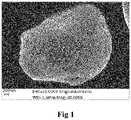
- a Zeiss scanning electron microscope is used to detect the lithium nickel manganese oxide composite material, as shown in Fig. 1 . And it may be seen from Fig. 1 that the surface coating layer of lithium nickel manganese oxide single crystal particles synthesized by the coating method used in the disclosure is more uniform, the coating layer is more uniform in thickness, and a particle size is about 35 ⁇ m.
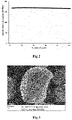
- a charge-discharge test method is used to test the electrochemical performance of the lithium nickel manganese oxide composite material. Test data is shown in Table 1, and an electrochemical performance curve is shown in Fig. 2 . Table 1 0.1C charge capacity (mAh/g) 0.1C discharge capacity (mAh/g) First efficiency (%) 50-cycle retention rate (%) 217.9 187.5 86.0 98.6
- the first discharge capacity of the material is 187.5mAh/g
- the first discharge coulombic efficiency is 86.0%
- the 50-cycle retention rate is 98.6%. It may be seen from the cycle curve that the lithium nickel manganese oxide composite material is used as the positive electrode material, and its cycle performance is good, and there is basically no attenuation after 50 cycles.
- a difference from Embodiment 1 is that a temperature of a first calcining process is 300°C, and a temperature of a second calcining process is 950°C.
- a cycle capacity retention rate of the lithium nickel manganese oxide composite material at 50 cycles is 96.4%, and a discharge capacity is 185.2 Ah/g.
- a difference from Embodiment 1 is that a temperature of a first calcining process is 600°C, and a temperature of a second calcining process is 910°C.
- a cycle capacity retention rate of the lithium nickel manganese oxide composite material at 50 cycles is 95.1%, and a discharge capacity is 183.8 Ah/g.
- a difference from Embodiment 1 is that a temperature of a first calcining process is 700°C.
- a cycle capacity retention rate of the lithium nickel manganese oxide composite material at 50 cycles is 93.4%, and a discharge capacity is 181.6 Ah/g.
- a difference from Embodiment 1 is that a temperature of a second calcining process is 970°C.
- a cycle capacity retention rate of the lithium nickel manganese oxide composite material at 50 cycles is 92.6%, and a discharge capacity is 180.5 Ah/g.
- a difference from Embodiment 1 is that a ratio of a mole number of a Li element in the lithium source material to a sum of mole numbers of a Ni element and a Mn element in the nickel-manganese precursor is 1:1.
- a cycle capacity retention rate of the lithium nickel manganese oxide composite material at 50 cycles is 95.7%, and a discharge capacity is 184.7 Ah/g.
- a difference from Embodiment 1 is that a ratio of a mole number of a Li element in the lithium source material to a sum of mole numbers of a Ni element and a Mn element in the nickel-manganese precursor is 1.05:1.
- a cycle capacity retention rate of the lithium nickel manganese oxide composite material at 50 cycles is 97.2%, and a discharge capacity is 186.3 Ah/g.
- a difference from Embodiment 1 is that a ratio of a mole number of a Li element in the lithium source material to a sum of mole numbers of a Ni element and a Mn element in the nickel-manganese precursor is 1.5:1.
- a cycle capacity retention rate of the lithium nickel manganese oxide composite material at 50 cycles is 92.1%, and a discharge capacity is 181.2 Ah/g.
- Embodiment 1 A difference from Embodiment 1 is that, after a second calcining step, ultracentrifugal grinding and sieving processes are not performed.
- a cycle capacity retention rate of the lithium nickel manganese oxide composite material at 50 cycles is 94.5%, and a discharge capacity is 184.1 Ah/g.
- a difference from Embodiment 1 is that a coating amount of an aluminum oxide is 0.5%, and a coating amount of a zirconium oxide is 0.5%.
- a cycle capacity retention rate of the lithium nickel manganese oxide composite material at 50 cycles is 92.7%, and a discharge capacity is 182.0 Ah/g.
- an oxide coating agent is titanium oxide and niobium oxide.
- a cycle capacity retention rate of the lithium nickel manganese oxide composite material at 50 cycles is 95.8%, and a discharge capacity is 186.4 Ah/g.
- an oxide coating agent is niobium oxide and tungsten oxide.
- a cycle capacity retention rate of the lithium nickel manganese oxide composite material at 50 cycles is 95.2%, and a discharge capacity is 185.9 Ah/g.
- an oxide coating agent is aluminum oxide and lanthanum oxide.
- a cycle capacity retention rate of the lithium nickel manganese oxide composite material at 50 cycles is 94.7%, and a discharge capacity is 184.8 Ah/g.
- a traditional method mainly includes two parts of the content: base synthesis and base coating.
- a main process flow is as follows.
- Raw material mixing LiOH and precursor Ni 0.75 Mn 0.25 (OH) 2 are mixed with a high-speed mixing device, mixing time: 20 min, and rotation speed: 2000 rpm.
- High temperature reaction a mixed material is reacted in an oxygen atmosphere (a concentration is greater than 99.99%, oxygen flow rate: 5-10L/min) in a box-type atmosphere furnace at a high temperature of 930°C for 10 h, and a base material is obtained after being naturally cooled.
- the base material is crushed with a crushing device, an obtained powder material is sieved with a sieve of 400 meshes.
- this step is to uniformly coat the base material with the coating agents zirconium oxide and aluminum oxide
- a specific step of this process is that the zirconium oxide, the aluminum oxide and the base material are added to a mixing device for mixing together in a mass ratio of 0.002:0.002:1, mixing time: 20 min, and rotation speed: 2000 rpm.
- Annealing step the coated material is treated at a high temperature of 500°C for 5 h, and the high temperature step is performed in an oxygen atmosphere (a concentration range is 20-100%), and it is sieved with 400 meshes, to obtain a final product of the lithium nickel manganese oxide single crystal positive electrode material NM.
- the synthesized lithium nickel manganese oxide single crystal positive electrode material has a 50-cycle capacity retention rate of 92.5% and a discharge capacity of 180.7 Ah/g.
- the lithium nickel manganese oxide composite material prepared by the method provided in the disclosure has more excellent cycle performance and electric capacity, and at the same time, the positive electrode material also has a relatively low cost because a cobalt element is not contained.
- Embodiments 1 to 5 it is beneficial to further improve the cycle performance and electric capacity of the lithium nickel manganese oxide composite material through limiting the temperatures of the first sintering step and second sintering step processes within the preferred range of the disclosure.
- Embodiments 1, 6 to 8 it is beneficial to further improve the cycle performance and electric capacity of the lithium nickel manganese oxide composite material through limiting the ratio of the mole number of the Li element in the lithium source material to the sum of the mole numbers of the Ni element and Mn element in the nickel-manganese precursor within the preferred range of the disclosure.
- Embodiments 1, 10 to 13 it is beneficial to improve the cycle performance and electric capacity of the lithium nickel manganese oxide composite material through the preferred coating agent of the disclosure and limiting the coating amount within the preferred range of the disclosure.
Landscapes
- Chemical & Material Sciences (AREA)
- Chemical Kinetics & Catalysis (AREA)
- Electrochemistry (AREA)
- General Chemical & Material Sciences (AREA)
- Inorganic Chemistry (AREA)
- Organic Chemistry (AREA)
- Composite Materials (AREA)
- Engineering & Computer Science (AREA)
- Materials Engineering (AREA)
- Manufacturing & Machinery (AREA)
- Battery Electrode And Active Subsutance (AREA)
- Inorganic Compounds Of Heavy Metals (AREA)
Abstract
Description
- The disclosure relates to the field of lithium ion batteries, and in particular to a lithium nickel manganese oxide composite material, a preparation method thereof and a lithium ion battery.
- A positive electrode material is one of the three key materials for restricting the rapid development of lithium ion batteries. Generally, a lithium cobalt oxide positive electrode material has higher working voltage and better rate performance, but its lower actual capacity greatly limits an application of the lithium cobalt oxide positive electrode material. An olivine-type lithium iron phosphate positive electrode material has advantages of stable structure, good cycle performance, and low raw material price, but a theoretical capacity is lower. A ternary layered positive electrode material (NCM) fully combines advantages of a lithium manganate, a lithium cobaltate and a lithium nickelate, and has advantages of higher discharge specific capacity, better cycle performance, and lower cost and the like. In an existing power market, the ternary positive electrode material is already commercialized, for example, NCM523, NCM622, and NCM811, and it meets requirements of a power vehicle to a certain extent. However, cobalt is strategic metal, and its expensive price makes the cost of the ternary positive electrode material NCM higher. At the same time, a cobalt resource is limited, and a business fluctuation of the market is greater. Therefore, the development of a cobalt-free positive electrode material is very necessary.
- While the positive electrode material is synthesized, a residual alkali content on the surface of the material is high, and it is easy to absorb water, so that a battery is easy to decompose during charge-discharge processes, and a disproportionation reaction may occur at the same time, it is caused that the battery cycle performance is lower; at the same time, during a battery preparation process, positive electrode material homogenization may be affected by a pH of the material. If the pH of the positive electrode material is high, a slurry viscosity is unstable, and the homogenization is difficult, so that the battery processing performance is poor. About this problem, a most common solution method at present is to coat the positive electrode material, namely a layer of a uniform nano-oxide is coated on the surface of the material, but this coating method is basically difficult to form a uniform coating layer on the surface of the material. In addition, a binding force between a coating substance and the material itself is weaker, and it is very possible that the coating substance falls off during a subsequent treatment process, thereby effective protection is not formed.
- In view of the above problems, it is necessary to provide a cobalt-free positive electrode material with a coating layer that is not easy to fall off, and having good battery cycle performance.
- A main purpose of the disclosure is to provide a lithium nickel manganese oxide composite material, a preparation method thereof and a lithium ion battery, as to solve a problem of an existing ternary positive electrode material that a coating layer is easy to fall off, so that the cycle performance of the ion battery is poor.
- In order to achieve the above purpose, one aspect of the disclosure is to provide a preparation method for a lithium nickel manganese oxide composite material, and the preparation method includes: a first calcining process is performed on a nano-oxide and a nickel-manganese precursor, to obtain an oxide-coated nickel-manganese precursor; and a second calcining process is performed on the oxide-coated nickel-manganese precursor and a lithium source material, to obtain the lithium nickel manganese oxide composite material, and a temperature of the first calcining process is lower than a temperature of the second calcining process.
- Further, before the first calcining process is performed, the preparation method further includes: a first mixing step is performed on the nano-oxide and the nickel-manganese precursor, to obtain a first mixture; preferably, the first mixing step process is mixed for 10-20 min at a rotation speed of 2000-3000 rpm; preferably, the nano-oxide is selected from two or more in a group consisting of an aluminum oxide, a zirconium oxide, a titanium oxide, a niobium oxide, a tungsten oxide, a lanthanum oxide and a molybdenum oxide; and more preferably, a particle size of the nano-oxide is 300-700nm.
- Further, the first calcining process is a temperature programmed process; preferably, the first calcining process includes: in an oxygen atmosphere, a temperature of a first calcining reaction is increased to a first target temperature at a rate of 3-5°C/min, and a holding time is 4-6 h, herein the first target temperature is 300-600°C; and the temperature of the first calcining reaction is decreased to a room temperature, to obtain the oxide-coated nickel-manganese precursor.
- Further, the nickel-manganese precursor is represented by NixMny(OH)2, herein 0.50≤x≤0.92, 0.50≤y≤0.8, and while the nano-oxide is a mixture of zirconium oxide and aluminum oxide, a weight ratio of the zirconium oxide, the aluminum oxide and the nickel-manganese precursor is (0.001-0.003):(0.001-0.003):1.
- Further, before the second calcining process is performed, the preparation method further includes: a second mixing step is performed on the oxide-coated nickel-manganese precursor and the lithium source material, to obtain a second mixture; preferably, the second mixing step process is mixed for 10-20 min at a rotation speed of 2000-3000 rpm; preferably, the preparation method further includes: a product of the first calcining process is sieved, to obtain the oxide-coated nickel-manganese precursor, and a sieving aperture of the sieving process is 300-400 meshes.
- Further, the second calcining process is a temperature programmed process; preferably, the second calcining process includes: in an oxygen atmosphere, a temperature of a second calcining reaction is increased to a second target temperature at a rate of 3-5°C/min, and holding time is 8-12 h, herein the second target temperature is 910-950°C; and the temperature of the second calcining reaction is decreased to a room temperature, to obtain the lithium nickel manganese oxide composite material; preferably, the second calcining process further includes: the temperature of the second calcining reaction is decreased to the room temperature, to obtain a second calcined product; and ultracentrifugal grinding and sieving are performed on the product of the second calcining process, herein an sieving aperture of the sieving process is 300-400 meshes, to obtain the lithium nickel manganese oxide composite material in the form of a single crystal.
- Further, a ratio of a mole number of a Li element in the lithium source material to a sum of mole numbers of a Ni element and a Mn element in the oxide-coated nickel-manganese precursor is (1.00-1.05):1.
- Another aspect of the disclosure further provides a lithium nickel manganese oxide composite material, and the lithium nickel manganese oxide composite material is prepared by the above preparation method.
- Further, in the lithium nickel manganese oxide composite material, a coating amount of the nano-oxide is 0.1-0.3%.
- Another aspect of the disclosure further provides a lithium ion battery, including a positive electrode material, and the positive electrode material includes the above lithium nickel manganese oxide composite material.
- By applying the technical scheme of the disclosure, the nano-oxide and the nickel-manganese precursor are calcined at a lower temperature, the nano-oxide may be melted, and a denser nano-oxide coating layer is formed on the surface of the nickel-manganese precursor, so the oxide-coated nickel-manganese precursor is obtained; and at a higher temperature, the oxide-coated nickel-manganese precursor and the lithium source material are calcined for the second time, the nano-oxide, a nickel-manganese material and a lithium element may be more deeply combined, thereby a problem that the nano-oxide layer is easy to fall off is solved, and cycle performance of the lithium nickel manganese oxide composite material is greatly improved.
- Drawings of the description for constituting a part of the disclosure are used to provide further understanding of the disclosure, exemplary embodiments of the disclosure and descriptions thereof are used to explain the disclosure, and do not constitute improper limitation to the disclosure. In the drawings:
-
Fig. 1 shows a scanning electron microscope diagram of a lithium nickel manganese oxide composite material prepared according to Embodiment 1 of the disclosure. -
Fig. 2 shows electrochemical performance of the lithium nickel manganese oxide composite material prepared according to Embodiment 1 of the disclosure. -
Fig. 3 shows a scanning electron microscope diagram of a lithium nickel manganese oxide composite material prepared according to an existing method. - It should be noted that embodiments in the disclosure and features in the embodiments may be combined with each other in the case without conflicting. The disclosure is described in detail below in combination with the embodiments.
- As described in the background, an existing ternary positive electrode material has a problem that a coating layer is easy to fall off, so that cycle performance of a lithium ion battery is poor. In order to solve the above technical problem, the disclosure provides a preparation method for a lithium nickel manganese oxide composite material, and the preparation method includes: a first calcining process is performed on a nano-oxide and a nickel-manganese precursor, to obtain an oxide-coated nickel-manganese precursor; and a second calcining process is performed on the oxide-coated nickel-manganese precursor and a lithium source material, to obtain the lithium nickel manganese oxide composite material, and a temperature of the first calcining process is lower than a temperature of the second calcining process.
- The nano-oxide and the nickel-manganese precursor are calcined at a lower temperature, the nano-oxide may be melted, and a denser nano-oxide coating layer is formed on the surface of the nickel-manganese precursor, so the oxide-coated nickel-manganese precursor is obtained. And at a higher temperature, the oxide-coated nickel-manganese precursor and the lithium source material are calcined for the second time, the nano-oxide, a nickel-manganese material and a lithium element may be more deeply combined, thereby the problem that the nano-oxide layer is easy to fall off is solved, and the cycle performance of the lithium nickel manganese oxide composite material is greatly improved.
- The above first calcining process and second calcining process are both an aerobic calcining process, and it may be achieved by devices and processes commonly used in the field. In a preferred embodiment, before the first calcining process is performed, the preparation method further includes: a first mixing step is performed on the nano-oxide and the nickel-manganese precursor, to obtain a first mixture. Before the first calcining is performed, the lithium source material and the nickel-manganese precursor are firstly mixed, it is beneficial to improve mixing uniformity and combination degree of the two materials, and beneficial to improve the uniformity of the oxide coating layer on the oxide-coated nickel-manganese precursor. In order to further improve the mixing uniformity and combination degree of the two materials, preferably, the first mixing step process is mixed for 10-20 min at a rotation speed of 2000-3000 rpm.
- The compactness of the oxide coating layer may be improved by the nano-oxide for coating, thereby it is beneficial to improve comprehensive performance of a battery formed. In a preferred embodiment, the nano-oxide includes, but is not limited to, two or more in a group consisting of an aluminum oxide, a zirconium oxide, a titanium oxide, a niobium oxide, a tungsten oxide, a lanthanum oxide, and a molybdenum oxide. Preferably, a particle size of the nano-oxide is 300-700 nm. The particle size of the nano-oxide includes but is not limited to the above range, and while the particle size of the nano-oxide is larger, the compactness of the oxide coating layer may become poor, it is caused that electrochemical performance of the prepared positive electrode material is poorer; and while the particle size is smaller, a cost of the nano-oxide is higher.
- The above lithium source material may be selected from commonly used types in the field, such as a lithium hydroxide and/or a lithium carbonate.
- In a preferred embodiment, the first calcining process is a temperature programmed process; preferably, the first calcining process includes: in an oxygen atmosphere, a temperature of a first calcining reaction is increased to a first target temperature at a rate of 3-5°C/min, and a holding time is 4-6 h, herein the first target temperature is 300-600°C; and the temperature of the first calcining reaction is decreased to a room temperature, to obtain the oxide-coated nickel-manganese precursor. The temperature and step time of the first calcining process include but are not limited to the above range, and it is beneficial to further improve the compactness and combination stability of the oxide coating layer on the oxide-coated nickel-manganese precursor through limiting the temperature and step time to the above range.
- The lithium nickel manganese oxide composite material prepared by the above preparation method has advantages of stable structure and good cycle performance and the like. In a preferred embodiment, the nickel-manganese precursor is represented by NixMny(OH)2, wherein 0.50≤x≤0.92, 0.50≤y≤0.08, and while the nano-oxide is a mixture of zirconium oxide and aluminum oxide, a weight ratio of the zirconium oxide, the aluminum oxide and the nickel-manganese precursor is (0.001-0.003):(0.001-0.003):1. It is beneficial to further improve the structural stability and binding force of the oxide coating layer through limiting the weight ratio of the zirconium oxide, the aluminum oxide and the nickel-manganese precursor within the above range. Thereby it is beneficial to further improve the cycle performance of the oxide-coated lithium nickel manganese oxide material formed subsequently.
- Through the second calcining process, the combination degree between the oxide layer and the lithium nickel manganese oxide may be improved, thereby it is beneficial to improve the cycle performance of the positive electrode material. In a preferred embodiment, before the second calcining process is performed, the above preparation method further includes: a second mixing step is performed on the oxide-coated nickel-manganese precursor and the lithium source material, to obtain a second mixture; before the second calcining is performed, the oxide-coated nickel-manganese precursor and the lithium source material are firstly mixed, it is beneficial to improve the mixing uniformity and combination degree of the two materials, and beneficial to improve the stability of the oxide-coated lithium nickel manganese oxide material. In order to further improve the mixing uniformity and combination degree of the two materials, preferably, the second mixing step process is mixed for 10-20 min at a rotation speed of 2000-3000 rpm.
- In a preferred embodiment, the preparation method further includes: a product of the first calcining process is sieved, to obtain the oxide-coated nickel-manganese precursor, and a sieving aperture of the sieving process is 300-400 meshes (38-48µm). Before the second calcining process is performed, the sieving process is firstly performed on the product of the first calcining process, and it is beneficial to improve the stability of the electrochemical performance of the subsequent lithium nickel manganese oxide composite material.
- In a preferred embodiment, the second calcining process is a temperature programmed process; preferably, the second calcining process includes: in an oxygen atmosphere, a temperature of a second calcining reaction is increased to a second target temperature at a rate of 3-5°C/min, and a holding time is 8-12 h, herein the second target temperature is 910-950°C; and the temperature of the second calcining reaction is decreased to the room temperature, to obtain the lithium nickel manganese oxide composite material. The temperature and step time of the second calcining process include but are not limited to the above range, and it is beneficial to further improve the cycle performance and electric capacity of the oxide-coated lithium nickel manganese oxide material through limiting the temperature and treatment time within the above range.
- The oxygen atmosphere referred in the disclosure means that an oxygen concentration is greater than 99.99%, and more preferably, a flow rate of the oxygen is 5-10 L/min.
- In a preferred embodiment, a ratio of a mole number of a Li element in the lithium source material to a sum of mole numbers of a Ni element and a Mn element in the oxide-coated nickel-manganese precursor is (1.00-1.05):1. It is beneficial to further improve the energy density, electric capacity and structural stability of the positive electrode material through limiting the ratio of the mole number of the Li element in the lithium source material to the sum of the mole numbers of the Ni element and the Mn element in the nickel-manganese precursor within the above range.
- In a preferred embodiment, the above preparation method further includes: the temperature of the second calcining reaction is decreased to the room temperature, to obtain a second calcined product; and ultracentrifugal grinding and sieving are performed on the product of the second calcining process, herein an sieving aperture of the sieving process is 300-400 meshes (38-48 µm), to obtain the lithium nickel manganese oxide composite material in the form of a single crystal. During initial charge-discharge processes, the surface of the above single crystal material may fully contact and react with electrolyte, and a stable positive solid electrolyte interface film is formed in an initial cycle. However, contraction and expansion of the later cyclic charge-discharge may not produce a new crystal boundary interface like polycrystalline particles, and a side reaction may not occur. Therefore, the above lithium nickel manganese oxide single crystal material may greatly reduce gas production, and improve the cycle performance during an application process.
- Another aspect of the disclosure provides a lithium nickel manganese oxide composite material, and the lithium nickel manganese oxide composite material is prepared by the above preparation method.
- The nano-oxide and the nickel-manganese precursor are calcined at a lower temperature, the nano-oxide may be melted, and a denser nano-oxide coating layer is formed on the surface of the nickel-manganese precursor, so the oxide-coated nickel-manganese precursor is obtained; and at a higher temperature, the oxide-coated nickel-manganese precursor and the lithium source material are calcined for the second time, the nano-oxide, a nickel-manganese material and a lithium element may be combined in a greater degree, thereby a problem that the nano-oxide layer is easy to fall off is solved, and the cycle performance of the battery using the above lithium nickel manganese oxide composite material as the positive electrode material may be greatly improved.
- In a preferred embodiment, in the lithium nickel manganese oxide composite material, a coating amount of the nano-oxide is 0.1-0.3%. The nano-oxide plays a better synergistic effect with the lithium element, the nickel element and the manganese element through limiting the coating amount of the nano-oxide within the above range, so that the lithium nickel manganese oxide composite material may have more excellent electrical properties, such as long cycle performance and high capacity.
- Another aspect of the disclosure further provides a lithium ion battery, including a positive electrode material, and the positive electrode material includes the above lithium nickel manganese oxide composite material provided in the disclosure.
- The oxide layer in the lithium nickel manganese oxide composite material prepared by the above method is not easy to fall off, and the cycle performance of the battery may be greatly improved by the lithium nickel manganese oxide composite material as the positive electrode material for preparing the lithium ion battery.
- The disclosure is further described in detail below in combination with specific embodiments, and these embodiments should not be interpreted as limiting the scope of protection claimed by the disclosure.
- A synthesis method for a long-cycle lithium nickel manganese oxide NM single crystal positive electrode material, the synthesis method includes:
- (1) Zirconium oxide and aluminum oxide co-coated nickel manganese hydroxide NixMny(OH)2 precursor mixing stage:
A zirconium oxide, an aluminum oxide and a precursor Ni0.75Mn0.25(OH)2 are weighed in a weight ratio of 0.002:0.002:1, uniformly mixed in a high-speed mixing device, herein a stirring speed is 2500rpm, and mixing time is 15 min, and a nickel manganese hydroxide NixMny(OH)2 precursor co-coated with the zirconium oxide and the aluminum oxide is obtained. - (2) Zirconium oxide and aluminum oxide co-coated nickel manganese hydroxide NixMny(OH)2 precursor calcining stage:
The above base material is placed in a box-type atmosphere furnace, in an oxygen atmosphere (a concentration is greater than 99.99%, oxygen flow rate: 5-10L/min). A temperature is increased to 500°C at 4°C/min, and holding time is 5 h, then the base material is obtained by being naturally decreased to a room temperature. The obtained base material is sieved with a sieve of 400 meshes, and the obtained material is marked as NMZA. - (3) Lithium nickel manganese oxide single crystal positive electrode material synthesis stage:
Mixing stage: lithium hydroxide and base material NMZA are mixed at Li/Me=1.03 (Me refers to a sum of mole numbers of a Ni element and a Mn element in the base material) in the high-speed mixing device, herein a stirring speed is 2000 rpm, and mixing time is 10 min, a homogeneous mixture of the base material NMZA and the lithium hydroxide is obtained. - Calcining stage: the box-type atmosphere furnace is used. The homogeneous mixture of the base material NMZA and the lithium hydroxide is placed in the box-type atmosphere furnace and calcined in an oxygen atmosphere (a concentration is greater than 99.99%, oxygen flow rate: 5-10 L/min), a temperature is increased to 950°C at a heating rate of 4°C/min, holding time is 10 h. And then the temperature is naturally decreased to the room temperature, an obtained material is subjected to ultracentrifugal grinding and sieving, a sieve is 400 meshes, and finally the lithium nickel manganese oxide single crystal positive electrode material NM is obtained. Herein in the lithium nickel manganese oxide single crystal positive electrode material NM, a coating amount of the aluminum oxide is 0.2%, and a coating amount of the zirconium oxide is 0.2%.
- Finally, the obtained lithium nickel manganese oxide single crystal positive electrode material NM is mixed with a conductive agent and a binder, and after mixing uniformly, coating, rolling, and cutting are performed, and a button battery is assembled. The electrochemical performance of the positive electrode material is tested.
- A Zeiss scanning electron microscope is used to detect the lithium nickel manganese oxide composite material, as shown in
Fig. 1 . And it may be seen fromFig. 1 that the surface coating layer of lithium nickel manganese oxide single crystal particles synthesized by the coating method used in the disclosure is more uniform, the coating layer is more uniform in thickness, and a particle size is about 35µm. - A charge-discharge test method is used to test the electrochemical performance of the lithium nickel manganese oxide composite material. Test data is shown in Table 1, and an electrochemical performance curve is shown in
Fig. 2 .Table 1 0.1C charge capacity (mAh/g) 0.1C discharge capacity (mAh/g) First efficiency (%) 50-cycle retention rate (%) 217.9 187.5 86.0 98.6 - It may be seen from Table 1 and
Fig. 2 that the first discharge capacity of the material is 187.5mAh/g, the first discharge coulombic efficiency is 86.0%, and the 50-cycle retention rate is 98.6%. It may be seen from the cycle curve that the lithium nickel manganese oxide composite material is used as the positive electrode material, and its cycle performance is good, and there is basically no attenuation after 50 cycles. - A difference from Embodiment 1 is that a temperature of a first calcining process is 300°C, and a temperature of a second calcining process is 950°C.
- A cycle capacity retention rate of the lithium nickel manganese oxide composite material at 50 cycles is 96.4%, and a discharge capacity is 185.2 Ah/g.
- A difference from Embodiment 1 is that a temperature of a first calcining process is 600°C, and a temperature of a second calcining process is 910°C.
- A cycle capacity retention rate of the lithium nickel manganese oxide composite material at 50 cycles is 95.1%, and a discharge capacity is 183.8 Ah/g.
- A difference from Embodiment 1 is that a temperature of a first calcining process is 700°C.
- A cycle capacity retention rate of the lithium nickel manganese oxide composite material at 50 cycles is 93.4%, and a discharge capacity is 181.6 Ah/g.
- A difference from Embodiment 1 is that a temperature of a second calcining process is 970°C.
- A cycle capacity retention rate of the lithium nickel manganese oxide composite material at 50 cycles is 92.6%, and a discharge capacity is 180.5 Ah/g.
- A difference from Embodiment 1 is that a ratio of a mole number of a Li element in the lithium source material to a sum of mole numbers of a Ni element and a Mn element in the nickel-manganese precursor is 1:1.
- A cycle capacity retention rate of the lithium nickel manganese oxide composite material at 50 cycles is 95.7%, and a discharge capacity is 184.7 Ah/g.
- A difference from Embodiment 1 is that a ratio of a mole number of a Li element in the lithium source material to a sum of mole numbers of a Ni element and a Mn element in the nickel-manganese precursor is 1.05:1.
- A cycle capacity retention rate of the lithium nickel manganese oxide composite material at 50 cycles is 97.2%, and a discharge capacity is 186.3 Ah/g.
- A difference from Embodiment 1 is that a ratio of a mole number of a Li element in the lithium source material to a sum of mole numbers of a Ni element and a Mn element in the nickel-manganese precursor is 1.5:1.
- A cycle capacity retention rate of the lithium nickel manganese oxide composite material at 50 cycles is 92.1%, and a discharge capacity is 181.2 Ah/g.
- A difference from Embodiment 1 is that, after a second calcining step, ultracentrifugal grinding and sieving processes are not performed.
- A cycle capacity retention rate of the lithium nickel manganese oxide composite material at 50 cycles is 94.5%, and a discharge capacity is 184.1 Ah/g.
- A difference from Embodiment 1 is that a coating amount of an aluminum oxide is 0.5%, and a coating amount of a zirconium oxide is 0.5%.
- A cycle capacity retention rate of the lithium nickel manganese oxide composite material at 50 cycles is 92.7%, and a discharge capacity is 182.0 Ah/g.
- A difference from Embodiment 1 is that an oxide coating agent is titanium oxide and niobium oxide.
- A cycle capacity retention rate of the lithium nickel manganese oxide composite material at 50 cycles is 95.8%, and a discharge capacity is 186.4 Ah/g.
- A difference from Embodiment 1 is that an oxide coating agent is niobium oxide and tungsten oxide.
- A cycle capacity retention rate of the lithium nickel manganese oxide composite material at 50 cycles is 95.2%, and a discharge capacity is 185.9 Ah/g.
- A difference from Embodiment 1 is that an oxide coating agent is aluminum oxide and lanthanum oxide.
- A cycle capacity retention rate of the lithium nickel manganese oxide composite material at 50 cycles is 94.7%, and a discharge capacity is 184.8 Ah/g.
- A traditional method mainly includes two parts of the content: base synthesis and base coating. A main process flow is as follows.
- Raw material mixing: LiOH and precursor Ni0.75Mn0.25(OH)2 are mixed with a high-speed mixing device, mixing time: 20 min, and rotation speed: 2000 rpm.
- High temperature reaction: a mixed material is reacted in an oxygen atmosphere (a concentration is greater than 99.99%, oxygen flow rate: 5-10L/min) in a box-type atmosphere furnace at a high temperature of 930°C for 10 h, and a base material is obtained after being naturally cooled. The base material is crushed with a crushing device, an obtained powder material is sieved with a sieve of 400 meshes.
- Dry coating: this step is to uniformly coat the base material with the coating agents zirconium oxide and aluminum oxide, a specific step of this process is that the zirconium oxide, the aluminum oxide and the base material are added to a mixing device for mixing together in a mass ratio of 0.002:0.002:1, mixing time: 20 min, and rotation speed: 2000 rpm.
- Annealing step: the coated material is treated at a high temperature of 500°C for 5 h, and the high temperature step is performed in an oxygen atmosphere (a concentration range is 20-100%), and it is sieved with 400 meshes, to obtain a final product of the lithium nickel manganese oxide single crystal positive electrode material NM.
- The synthesized lithium nickel manganese oxide single crystal positive electrode material has a 50-cycle capacity retention rate of 92.5% and a discharge capacity of 180.7 Ah/g.
- It may be seen from the above descriptions that the above embodiments of the disclosure achieve the following technical effects.
- It may be seen by comparing Embodiments 1 to 13 and Contrast Example 1 that the lithium nickel manganese oxide composite material prepared by the method provided in the disclosure has more excellent cycle performance and electric capacity, and at the same time, the positive electrode material also has a relatively low cost because a cobalt element is not contained.
- It may be seen by comparing Embodiments 1 to 5 that it is beneficial to further improve the cycle performance and electric capacity of the lithium nickel manganese oxide composite material through limiting the temperatures of the first sintering step and second sintering step processes within the preferred range of the disclosure.
- It may be seen by comparing Embodiments 1, 6 to 8 that it is beneficial to further improve the cycle performance and electric capacity of the lithium nickel manganese oxide composite material through limiting the ratio of the mole number of the Li element in the lithium source material to the sum of the mole numbers of the Ni element and Mn element in the nickel-manganese precursor within the preferred range of the disclosure.
- It may be seen by comparing
Embodiments 1, 10 to 13 that it is beneficial to improve the cycle performance and electric capacity of the lithium nickel manganese oxide composite material through the preferred coating agent of the disclosure and limiting the coating amount within the preferred range of the disclosure. - It should be noted that terms "first" and "second" and the like in the description and claims of the disclosure are used to distinguish similar objects, and not necessarily used to describe a specific sequence or precedence order. It should be understood that the terms used in this way may be interchanged under appropriate circumstances, so that the implementation modes of the disclosure described herein may be implemented, for example, in a sequence other than those described here.
- The above are only preferred embodiments of the disclosure, and are not used to limit the disclosure. Various modifications and changes may be made to the disclosure by those skilled in the art. Any modifications, equivalent replacements, improvements and the like made within the spirit and principle of the disclosure should be included in a scope of protection of the disclosure.
Claims (10)
- A preparation method for a lithium nickel manganese oxide composite material, the preparation method comprises:performing a first calcining process on a nano-oxide and a nickel-manganese precursor, to obtain an oxide-coated nickel-manganese precursor; andperforming a second calcining process on the oxide-coated nickel-manganese precursor and a lithium source material, to obtain the lithium nickel manganese oxide composite material, and a temperature of the first calcining process is lower than a temperature of the second calcining process.
- The preparation method according to claim 1, wherein before performing the first calcining process, the preparation method further comprises:performing a first mixing step on the nano-oxide and the nickel-manganese precursor, to obtain a first mixture;preferably, the first mixing step process is mixed for 10-20 min at a rotation speed of 2000-3000 rpm;preferably, the nano-oxide is selected from two or more in a group consisting of an aluminum oxide, a zirconium oxide, a titanium oxide, a niobium oxide, a tungsten oxide, a lanthanum oxide and a molybdenum oxide; and more preferably, a particle size of the nano-oxide is 300-700nm.
- The preparation method according to claim 2, wherein the first calcining process is a temperature programmed process;
preferably, the first calcining process comprises:in an oxygen atmosphere, increasing a temperature of a first calcining reaction to a first target temperature at a rate of 3-5°C/min, and a holding time is 4-6 h, wherein the first target temperature is 300-600°C; anddecreasing the temperature of the first calcining reaction to a room temperature, to obtain the oxide-coated nickel-manganese precursor. - The preparation method according to claim 2 or 3, wherein the nickel-manganese precursor is represented by NixMny(OH)2, wherein 0.50≤x≤0.92, 0.50≤y≤0.8, and while the nano-oxide is a mixture of zirconium oxide and aluminum oxide, a weight ratio of the zirconium oxide, the aluminum oxide and the nickel-manganese precursor is (0.001-0.003):(0.001-0.003):1.
- The preparation method according to any one of claims 1 to 4, wherein before performing the second calcining process, the preparation method further comprises:performing a second mixing step on the oxide-coated nickel-manganese precursor and the lithium source material, to obtain a second mixture;preferably, the second mixing step process is mixed for 10-20 min at a rotation speed of 2000-3000 rpm;preferably, the preparation method further comprises: sieving a product of the first calcining process, to obtain the oxide-coated nickel-manganese precursor, and a sieving aperture of the sieving process is 300-400 meshes.
- The preparation method according to claim 5, wherein the second calcining process is a temperature programmed process;
preferably, the second calcining process comprises:in an oxygen atmosphere, increasing a temperature of a second calcining reaction to a second target temperature at a rate of 3-5°C/min, and holding time is 8-12 h, wherein the second target temperature is 910-950°C; anddecreasing the temperature of the second calcining reaction to a room temperature, to obtain the lithium nickel manganese oxide composite material;preferably, the second calcining process further comprises: decreasing the temperature of the second calcining reaction to the room temperature, to obtain a second calcined product; and performing ultracentrifugal grinding and sieving on the product of the second calcining process, wherein an sieving aperture of the sieving process is 300-400 meshes, to obtain the lithium nickel manganese oxide composite material in the form of a single crystal. - The preparation method according to claim 5 or 6, wherein a ratio of a mole number of a Li element in the lithium source material to a sum of mole numbers of a Ni element and a Mn element in the oxide-coated nickel-manganese precursor is (1.00-1.05):1.
- A lithium nickel manganese oxide composite material, wherein the lithium nickel manganese oxide composite material is prepared by the preparation method according to any one of claims 1 to 7.
- The lithium nickel manganese oxide composite material according to claim 8, wherein in the lithium nickel manganese oxide composite material, a coating amount of the nano-oxide is 0.1-0.3%.
- A lithium ion battery, comprising a positive electrode material, wherein the positive electrode material comprises the lithium nickel manganese oxide composite material according to claim 8 or 9.
Applications Claiming Priority (2)
| Application Number | Priority Date | Filing Date | Title |
|---|---|---|---|
| CN202010450693.XA CN111592052B (en) | 2020-05-25 | 2020-05-25 | Lithium nickel manganese oxide composite material, preparation method thereof and lithium ion battery |
| PCT/CN2020/124465 WO2021238050A1 (en) | 2020-05-25 | 2020-10-28 | Lithium nickel manganese oxide composite material and preparation method therefor, and lithium ion battery |
Publications (2)
| Publication Number | Publication Date |
|---|---|
| EP3974389A1 true EP3974389A1 (en) | 2022-03-30 |
| EP3974389A4 EP3974389A4 (en) | 2023-07-26 |
Family
ID=72181559
Family Applications (1)
| Application Number | Title | Priority Date | Filing Date |
|---|---|---|---|
| EP20937347.1A Pending EP3974389A4 (en) | 2020-05-25 | 2020-10-28 | LITHIUM NICKEL MANGANESE COMPOSITE MATERIAL AND PRODUCTION METHOD THEREOF AND LITHIUM ION BATTERY |
Country Status (6)
| Country | Link |
|---|---|
| US (1) | US12215040B2 (en) |
| EP (1) | EP3974389A4 (en) |
| JP (1) | JP7352727B2 (en) |
| KR (1) | KR102729505B1 (en) |
| CN (1) | CN111592052B (en) |
| WO (1) | WO2021238050A1 (en) |
Families Citing this family (23)
| Publication number | Priority date | Publication date | Assignee | Title |
|---|---|---|---|---|
| US11862794B2 (en) | 2020-05-06 | 2024-01-02 | Battelle Memorial Institute | Cost effective synthesis of oxide materials for lithium ion batteries |
| CN111592052B (en) | 2020-05-25 | 2022-04-12 | 蜂巢能源科技股份有限公司 | Lithium nickel manganese oxide composite material, preparation method thereof and lithium ion battery |
| CN112614990A (en) * | 2020-12-11 | 2021-04-06 | 格林美股份有限公司 | Nickel-manganese binary composite positive electrode material and preparation method thereof |
| CN113517425B (en) * | 2021-04-29 | 2022-08-09 | 厦门大学 | Lithium ion battery anode material and preparation method thereof |
| CN113666430A (en) * | 2021-07-30 | 2021-11-19 | 蜂巢能源科技有限公司 | Lithium-rich cathode material, preparation method thereof and lithium ion battery |
| CN113603158A (en) * | 2021-08-06 | 2021-11-05 | 湖南杉杉能源科技有限公司 | Cobalt-free anode material precursor and preparation method thereof |
| CN113725418A (en) * | 2021-09-01 | 2021-11-30 | 中国科学院长春应用化学研究所 | Rare earth oxide coated and modified ternary cathode material for lithium ion battery and preparation method thereof |
| CN114014381B (en) * | 2021-10-29 | 2023-06-16 | 蜂巢能源科技有限公司 | Interface composite modification method of positive electrode material, positive electrode material and application |
| CN114039031A (en) * | 2021-11-02 | 2022-02-11 | 远景动力技术(江苏)有限公司 | Tungsten single-coating anode material and preparation method and application thereof |
| CN114094095B (en) * | 2021-11-09 | 2023-11-28 | 远景动力技术(江苏)有限公司 | Spinel type positive electrode material, preparation method thereof and lithium ion battery positive electrode sheet |
| KR102886213B1 (en) * | 2021-12-07 | 2025-11-13 | 주식회사 엘지에너지솔루션 | Positive electrode active material for sulfide all-solid-state battery |
| CN114122385B (en) * | 2022-01-26 | 2022-04-26 | 瑞浦能源有限公司 | Low-cobalt ternary cathode material for lithium ion battery, preparation method of low-cobalt ternary cathode material, lithium ion battery cathode piece and lithium ion battery |
| CN114551862B (en) * | 2022-02-28 | 2023-11-17 | 宜宾锂宝新材料有限公司 | Cobalt-free binary single crystal material and preparation method thereof |
| CN114613985B (en) * | 2022-03-07 | 2024-07-12 | 宁波容百新能源科技股份有限公司 | High-voltage nickel-manganese material with high single crystal dispersibility and preparation method and application thereof |
| CN114824242B (en) * | 2022-05-10 | 2023-09-15 | 哈尔滨工业大学(威海) | Preparation method of metal oxide coated lithium ion battery anode material |
| CN114843501B (en) * | 2022-05-11 | 2024-09-27 | 宁波容百新能源科技股份有限公司 | Nickel lithium manganate positive electrode material and preparation method and application thereof |
| CN115050946B (en) * | 2022-07-22 | 2023-11-24 | 珠海冠宇电池股份有限公司 | Positive electrode active material, preparation method thereof, positive electrode plate and battery |
| US12077879B2 (en) * | 2022-08-05 | 2024-09-03 | City University Of Hong Kong | Preparation of single-crystal layered cathode materials for lithium- and sodium-ion batteries |
| CN115520911B (en) * | 2022-10-21 | 2024-04-19 | 巴斯夫杉杉电池材料有限公司 | A lithium nickel composite oxide positive electrode material and preparation method thereof |
| KR20240175201A (en) * | 2023-06-12 | 2024-12-19 | 삼성에스디아이 주식회사 | Positive active material, preparation method thereof, positive electrode, and rechargeable lithium batteries |
| CN117239087A (en) * | 2023-09-25 | 2023-12-15 | 巴斯夫杉杉电池材料有限公司 | Modified ternary positive electrode material and preparation method thereof |
| KR102764220B1 (en) * | 2023-10-31 | 2025-02-05 | 삼성에스디아이 주식회사 | Positive active material, preparation method thereof, positive electrode, and rechargeable lithium batteries |
| CN119890287B (en) * | 2025-03-26 | 2025-06-17 | 国联汽车动力电池研究院有限责任公司 | Lithium-rich manganese-based positive electrode material with ultra-large interplanar spacing, and preparation method and application thereof |
Family Cites Families (15)
| Publication number | Priority date | Publication date | Assignee | Title |
|---|---|---|---|---|
| JP2004281163A (en) * | 2003-03-14 | 2004-10-07 | Seimi Chem Co Ltd | Baked container for positive active material powder, positive active material powder, and lithium ion secondary battery |
| US9822015B2 (en) * | 2009-12-07 | 2017-11-21 | Sumitomo Chemical Company, Limited | Method for producing lithium composite metal oxide, lithium composite metal oxide, and nonaqueous electrolyte secondary battery |
| US9543581B2 (en) * | 2010-08-17 | 2017-01-10 | Umicore | Alumina dry-coated cathode material precursors |
| WO2012022624A1 (en) | 2010-08-17 | 2012-02-23 | Umicore | Aluminum dry-coated and heat treated cathode material precursors |
| CN103534843B (en) * | 2012-05-07 | 2017-02-22 | 西奥公司 | Coated particles for lithium battery cathodes |
| CN108110229A (en) * | 2013-01-21 | 2018-06-01 | 宁德新能源科技有限公司 | Alumina-coated is modified the preparation method of lithium nickel cobalt manganese oxygen positive electrode |
| CN103606660A (en) * | 2013-11-06 | 2014-02-26 | 中国科学院化学研究所 | Alumina-coated granules, as well as preparation method and application thereof |
| CN104319386A (en) | 2014-09-19 | 2015-01-28 | 青岛乾运高科新材料股份有限公司 | Lithium ion battery cathode multicomponent material and preparation method thereof |
| CN109891642B (en) | 2016-08-31 | 2022-08-26 | 住友金属矿山株式会社 | Positive electrode active material for nonaqueous electrolyte secondary battery, method for producing same, and nonaqueous electrolyte secondary battery |
| CN107394193B (en) * | 2017-06-30 | 2018-11-06 | 湖南金富力新能源股份有限公司 | Lithium ion battery anode material and preparation method and application thereof |
| WO2019087503A1 (en) | 2017-10-31 | 2019-05-09 | 住友金属鉱山株式会社 | Positive electrode active material for nonaqueous electrolyte secondary batteries, nonaqueous electrolyte secondary battery, and method for producing positive electrode active material for nonaqueous electrolyte secondary batteries |
| CN109811412B (en) * | 2018-12-28 | 2021-06-11 | 广东邦普循环科技有限公司 | Single-crystal-shaped layered lithium nickel manganese oxide positive electrode material and preparation method thereof |
| CN109888208A (en) * | 2019-01-25 | 2019-06-14 | 高点(深圳)科技有限公司 | Lithium-ion battery cathode material and its preparation method and application |
| CN110854370A (en) * | 2019-11-22 | 2020-02-28 | 四川新锂想能源科技有限责任公司 | Preparation method of high nickel cobalt lithium manganate positive electrode material |
| CN111592052B (en) | 2020-05-25 | 2022-04-12 | 蜂巢能源科技股份有限公司 | Lithium nickel manganese oxide composite material, preparation method thereof and lithium ion battery |
-
2020
- 2020-05-25 CN CN202010450693.XA patent/CN111592052B/en active Active
- 2020-10-28 US US17/641,820 patent/US12215040B2/en active Active
- 2020-10-28 KR KR1020227028921A patent/KR102729505B1/en active Active
- 2020-10-28 JP JP2022509706A patent/JP7352727B2/en active Active
- 2020-10-28 EP EP20937347.1A patent/EP3974389A4/en active Pending
- 2020-10-28 WO PCT/CN2020/124465 patent/WO2021238050A1/en not_active Ceased
Also Published As
| Publication number | Publication date |
|---|---|
| KR102729505B1 (en) | 2024-11-13 |
| CN111592052B (en) | 2022-04-12 |
| US20230079339A1 (en) | 2023-03-16 |
| WO2021238050A1 (en) | 2021-12-02 |
| KR20220130768A (en) | 2022-09-27 |
| EP3974389A4 (en) | 2023-07-26 |
| CN111592052A (en) | 2020-08-28 |
| JP7352727B2 (en) | 2023-09-28 |
| JP2022544326A (en) | 2022-10-17 |
| US12215040B2 (en) | 2025-02-04 |
Similar Documents
| Publication | Publication Date | Title |
|---|---|---|
| US12215040B2 (en) | Lithium nickel manganese oxide composite material, preparation method thereof and lithium ion battery | |
| JP2022544326A5 (en) | ||
| JP7369277B2 (en) | Cobalt-free positive electrode material, its manufacturing method and lithium ion battery | |
| EP4002520A1 (en) | Positive electrode material and preparation method therefor, and lithium-ion battery | |
| CN111081987B (en) | Lithium cobaltate cathode material of lithium ion battery with voltage of more than 4.45V and preparation method thereof | |
| CN108172825B (en) | High-voltage high-compaction low-cost lithium cobalt oxide positive electrode material and preparation method thereof | |
| EP4184610B1 (en) | Pre-lithiated lithium ion positive electrode material, preparation method therefor and use thereof | |
| EP4607607A1 (en) | High-capacity long-cycle life low-cobalt single crystal positive electrode material and preparation method therefor | |
| CN109192969B (en) | Ternary nickel-cobalt-manganese composite material, preparation method thereof and lithium ion battery | |
| EP4439721A1 (en) | Nickel cobalt lithium manganese oxide high-nickel single-crystal positive electrode material and preparation method therefor | |
| US20240421296A1 (en) | Sodium-ion cathode material, preparation method and use thereof, sodium-ion battery, sodium-ion battery pack, and device | |
| CN111463411A (en) | High-nickel ternary cathode material with single crystal morphology and preparation method thereof | |
| EP3972017A1 (en) | Cobalt-free layered positive electrode material and preparation method therefor, and lithium-ion battery | |
| CN113782736B (en) | A kind of gradient single crystal cathode material and its preparation method and application | |
| US20260128307A1 (en) | Positive electrode material and preparation method thereof, and lithium-ion battery | |
| EP4024526A1 (en) | Lithium-rich manganese-based positive electrode material for use in lithium-ion battery, preparation method for the material, positive electrode tab, lithium-ion battery, and electric vehicle | |
| CN117185364A (en) | A multi-element polycrystalline cathode material for high-rate lithium or sodium batteries and its preparation method | |
| CN108269998A (en) | A kind of preparation method of polynary positive pole material of lithium ion cell | |
| CN113410438B (en) | Preparation method for uniformly coating metal oxide on surface of lithium battery positive electrode material | |
| CN120824349A (en) | A dual-phase P2-O3 type single crystal sodium ion layered oxide positive electrode material and its preparation method and application | |
| CN113707870A (en) | Cobalt-free cathode material and preparation method and application thereof | |
| CN119560544B (en) | Alkaline earth metal ion doped titanium-based phosphate composite material and preparation method and application thereof | |
| CN114927674B (en) | Lithium cobalt oxide positive electrode material, preparation method and application thereof | |
| CN112919551B (en) | Positive electrode material, preparation method thereof, positive electrode and lithium ion battery | |
| CN121709587A (en) | High-compaction lithium iron phosphate positive electrode material and preparation method thereof |
Legal Events
| Date | Code | Title | Description |
|---|---|---|---|
| STAA | Information on the status of an ep patent application or granted ep patent |
Free format text: STATUS: THE INTERNATIONAL PUBLICATION HAS BEEN MADE |
|
| PUAI | Public reference made under article 153(3) epc to a published international application that has entered the european phase |
Free format text: ORIGINAL CODE: 0009012 |
|
| STAA | Information on the status of an ep patent application or granted ep patent |
Free format text: STATUS: REQUEST FOR EXAMINATION WAS MADE |
|
| 17P | Request for examination filed |
Effective date: 20211221 |
|
| AK | Designated contracting states |
Kind code of ref document: A1 Designated state(s): AL AT BE BG CH CY CZ DE DK EE ES FI FR GB GR HR HU IE IS IT LI LT LU LV MC MK MT NL NO PL PT RO RS SE SI SK SM TR |
|
| A4 | Supplementary search report drawn up and despatched |
Effective date: 20230626 |
|
| RIC1 | Information provided on ipc code assigned before grant |
Ipc: H01M 4/02 20060101ALI20230620BHEP Ipc: H01M 4/62 20060101ALI20230620BHEP Ipc: H01M 4/525 20100101ALI20230620BHEP Ipc: H01M 4/505 20100101ALI20230620BHEP Ipc: H01M 4/36 20060101ALI20230620BHEP Ipc: C01G 53/00 20060101AFI20230620BHEP |
|
| DAV | Request for validation of the european patent (deleted) | ||
| DAX | Request for extension of the european patent (deleted) |