EP3974179A1 - Stain-proof base material - Google Patents
Stain-proof base material Download PDFInfo
- Publication number
- EP3974179A1 EP3974179A1 EP20809288.2A EP20809288A EP3974179A1 EP 3974179 A1 EP3974179 A1 EP 3974179A1 EP 20809288 A EP20809288 A EP 20809288A EP 3974179 A1 EP3974179 A1 EP 3974179A1
- Authority
- EP
- European Patent Office
- Prior art keywords
- independently
- occurrence
- group
- integer
- organic group
- Prior art date
- Legal status (The legal status is an assumption and is not a legal conclusion. Google has not performed a legal analysis and makes no representation as to the accuracy of the status listed.)
- Granted
Links
Classifications
-
- C—CHEMISTRY; METALLURGY
- C09—DYES; PAINTS; POLISHES; NATURAL RESINS; ADHESIVES; COMPOSITIONS NOT OTHERWISE PROVIDED FOR; APPLICATIONS OF MATERIALS NOT OTHERWISE PROVIDED FOR
- C09D—COATING COMPOSITIONS, e.g. PAINTS, VARNISHES OR LACQUERS; FILLING PASTES; CHEMICAL PAINT OR INK REMOVERS; INKS; CORRECTING FLUIDS; WOODSTAINS; PASTES OR SOLIDS FOR COLOURING OR PRINTING; USE OF MATERIALS THEREFOR
- C09D183/00—Coating compositions based on macromolecular compounds obtained by reactions forming in the main chain of the macromolecule a linkage containing silicon, with or without sulfur, nitrogen, oxygen, or carbon only; Coating compositions based on derivatives of such polymers
- C09D183/10—Block or graft copolymers containing polysiloxane sequences
- C09D183/12—Block or graft copolymers containing polysiloxane sequences containing polyether sequences
-
- C—CHEMISTRY; METALLURGY
- C09—DYES; PAINTS; POLISHES; NATURAL RESINS; ADHESIVES; COMPOSITIONS NOT OTHERWISE PROVIDED FOR; APPLICATIONS OF MATERIALS NOT OTHERWISE PROVIDED FOR
- C09D—COATING COMPOSITIONS, e.g. PAINTS, VARNISHES OR LACQUERS; FILLING PASTES; CHEMICAL PAINT OR INK REMOVERS; INKS; CORRECTING FLUIDS; WOODSTAINS; PASTES OR SOLIDS FOR COLOURING OR PRINTING; USE OF MATERIALS THEREFOR
- C09D5/00—Coating compositions, e.g. paints, varnishes or lacquers, characterised by their physical nature or the effects produced; Filling pastes
- C09D5/16—Antifouling paints; Underwater paints
- C09D5/1693—Antifouling paints; Underwater paints as part of a multilayer system
-
- C—CHEMISTRY; METALLURGY
- C03—GLASS; MINERAL OR SLAG WOOL
- C03C—CHEMICAL COMPOSITION OF GLASSES, GLAZES OR VITREOUS ENAMELS; SURFACE TREATMENT OF GLASS; SURFACE TREATMENT OF FIBRES OR FILAMENTS MADE FROM GLASS, MINERALS OR SLAGS; JOINING GLASS TO GLASS OR OTHER MATERIALS
- C03C17/00—Surface treatment of glass, not in the form of fibres or filaments, by coating
- C03C17/34—Surface treatment of glass, not in the form of fibres or filaments, by coating with at least two coatings having different compositions
- C03C17/42—Surface treatment of glass, not in the form of fibres or filaments, by coating with at least two coatings having different compositions at least one coating of an organic material and at least one non-metal coating
-
- C—CHEMISTRY; METALLURGY
- C09—DYES; PAINTS; POLISHES; NATURAL RESINS; ADHESIVES; COMPOSITIONS NOT OTHERWISE PROVIDED FOR; APPLICATIONS OF MATERIALS NOT OTHERWISE PROVIDED FOR
- C09D—COATING COMPOSITIONS, e.g. PAINTS, VARNISHES OR LACQUERS; FILLING PASTES; CHEMICAL PAINT OR INK REMOVERS; INKS; CORRECTING FLUIDS; WOODSTAINS; PASTES OR SOLIDS FOR COLOURING OR PRINTING; USE OF MATERIALS THEREFOR
- C09D183/00—Coating compositions based on macromolecular compounds obtained by reactions forming in the main chain of the macromolecule a linkage containing silicon, with or without sulfur, nitrogen, oxygen, or carbon only; Coating compositions based on derivatives of such polymers
- C09D183/04—Polysiloxanes
- C09D183/08—Polysiloxanes containing silicon bound to organic groups containing atoms other than carbon, hydrogen, and oxygen
-
- C—CHEMISTRY; METALLURGY
- C09—DYES; PAINTS; POLISHES; NATURAL RESINS; ADHESIVES; COMPOSITIONS NOT OTHERWISE PROVIDED FOR; APPLICATIONS OF MATERIALS NOT OTHERWISE PROVIDED FOR
- C09D—COATING COMPOSITIONS, e.g. PAINTS, VARNISHES OR LACQUERS; FILLING PASTES; CHEMICAL PAINT OR INK REMOVERS; INKS; CORRECTING FLUIDS; WOODSTAINS; PASTES OR SOLIDS FOR COLOURING OR PRINTING; USE OF MATERIALS THEREFOR
- C09D5/00—Coating compositions, e.g. paints, varnishes or lacquers, characterised by their physical nature or the effects produced; Filling pastes
- C09D5/002—Priming paints
-
- C—CHEMISTRY; METALLURGY
- C03—GLASS; MINERAL OR SLAG WOOL
- C03C—CHEMICAL COMPOSITION OF GLASSES, GLAZES OR VITREOUS ENAMELS; SURFACE TREATMENT OF GLASS; SURFACE TREATMENT OF FIBRES OR FILAMENTS MADE FROM GLASS, MINERALS OR SLAGS; JOINING GLASS TO GLASS OR OTHER MATERIALS
- C03C2217/00—Coatings on glass
- C03C2217/70—Properties of coatings
-
- C—CHEMISTRY; METALLURGY
- C03—GLASS; MINERAL OR SLAG WOOL
- C03C—CHEMICAL COMPOSITION OF GLASSES, GLAZES OR VITREOUS ENAMELS; SURFACE TREATMENT OF GLASS; SURFACE TREATMENT OF FIBRES OR FILAMENTS MADE FROM GLASS, MINERALS OR SLAGS; JOINING GLASS TO GLASS OR OTHER MATERIALS
- C03C2218/00—Methods for coating glass
- C03C2218/10—Deposition methods
- C03C2218/15—Deposition methods from the vapour phase
- C03C2218/151—Deposition methods from the vapour phase by vacuum evaporation
-
- C—CHEMISTRY; METALLURGY
- C03—GLASS; MINERAL OR SLAG WOOL
- C03C—CHEMICAL COMPOSITION OF GLASSES, GLAZES OR VITREOUS ENAMELS; SURFACE TREATMENT OF GLASS; SURFACE TREATMENT OF FIBRES OR FILAMENTS MADE FROM GLASS, MINERALS OR SLAGS; JOINING GLASS TO GLASS OR OTHER MATERIALS
- C03C2218/00—Methods for coating glass
- C03C2218/10—Deposition methods
- C03C2218/15—Deposition methods from the vapour phase
- C03C2218/154—Deposition methods from the vapour phase by sputtering
-
- C—CHEMISTRY; METALLURGY
- C08—ORGANIC MACROMOLECULAR COMPOUNDS; THEIR PREPARATION OR CHEMICAL WORKING-UP; COMPOSITIONS BASED THEREON
- C08G—MACROMOLECULAR COMPOUNDS OBTAINED OTHERWISE THAN BY REACTIONS ONLY INVOLVING UNSATURATED CARBON-TO-CARBON BONDS
- C08G77/00—Macromolecular compounds obtained by reactions forming a linkage containing silicon with or without sulfur, nitrogen, oxygen or carbon in the main chain of the macromolecule
- C08G77/04—Polysiloxanes
- C08G77/22—Polysiloxanes containing silicon bound to organic groups containing atoms other than carbon, hydrogen and oxygen
- C08G77/24—Polysiloxanes containing silicon bound to organic groups containing atoms other than carbon, hydrogen and oxygen halogen-containing groups
Definitions
- the present disclosure relates to a fluoropolyether group-containing compound.
- Certain types of fluorine-containing silane compounds are known to be capable of providing excellent water-repellency, oil-repellency, antifouling properties, and the like when used in surface treatment of a substrate.
- a layer obtained from a surface-treating agent containing a fluorine-containing silane compound (hereinafter, also referred to as a "surface-treating layer”) is applied as a so-called functional thin film to a large variety of substrates such as glass, plastics, fibers, sanitary articles, and building materials (Patent Literatures 1 and 2) .
- the fluorine-containing silane compound described in Patent Literature 1 or Patent Literature 2 can provide a surface-treating layer having an excellent function, but a surface-treating layer having higher friction durability and chemical resistance is required.
- An object of the present disclosure is to provide an article having a surface-treating layer having higher friction durability and chemical resistance.
- the present disclosure includes the following embodiments.
- An article of the present disclosure comprises a substrate
- the substrate usable in the present disclosure may be composed of any suitable material, for example, glass, resin (which may be natural or synthetic resin such as a commonly used plastic material), metal, ceramics, semiconductors (such as silicon and germanium), fiber (such as woven fabric and nonwoven fabric), fur, leather, wood, pottery, stone, building materials, and sanitary articles.
- resin which may be natural or synthetic resin such as a commonly used plastic material
- metal ceramics
- semiconductors such as silicon and germanium
- fiber such as woven fabric and nonwoven fabric
- fur leather, wood, pottery, stone, building materials, and sanitary articles.
- the material constituting the surface of the substrate may be a material for an optical member, such as glass or a transparent plastic.
- some layer (or film) such as a hard coat layer or an antireflection layer may be formed on the surface (the outermost layer) of the substrate.
- the antireflection layer may be any of a single-layer antireflection layer and a multi-layer antireflection layer.
- Examples of inorganic substances usable in the antireflection layer include SiO 2 , SiO, ZrO 2 , TiO 2 , TiO, Ti 2 O 3 , Ti 2 O 5 , Al 2 O 3 , Ta 2 O 5 , Ta 3 O 5 , Nb 2 O 5 , HfO 2 , Si 3 N 4 , CeO 2 , MgO, Y 2 O 3 , SnO 2 , MgF 2 , and WO 3 .
- One of these inorganic substances may be used singly, or two or more may be used in combination (e.g., as a mixture).
- SiO 2 and/or SiO is preferably used in the outermost layer thereof.
- a part of the surface of the substrate may have a transparent electrode such as a thin film in which indium tin oxide (ITO), indium zinc oxide, or the like is used.
- the substrate may have an insulating layer, an adhesive layer, a protecting layer, a decorated frame layer (I-CON), an atomizing film layer, a hard coating layer, a polarizing film, a phase difference film, a liquid crystal display module, or the like.
- the shape of the substrate is not limited, and may be, for example, in the form of a plate, a film, or the like.
- the surface region of the substrate on which a surface-treating layer is to be formed is at least a part of the substrate surface, and may be suitably determined according to the application, specific specifications, and the like of an article to be produced.
- the substrate may be composed of a material originally having a hydroxyl group.
- the material include glass as well as metal (in particular, base metal) wherein a natural oxidized film or a thermal oxidized film is formed on the surface, ceramics, semiconductors, and the like.
- a pre-treatment may be performed on the substrate to thereby introduce or increase a hydroxyl group on the surface of the substrate. Examples of such a pre-treatment include a plasma treatment (e.g., corona discharge) and ion beam irradiation.
- the plasma treatment can be suitably utilized to not only introduce or increase a hydroxyl group on the substrate surface, but also clean the substrate surface (remove foreign matter and the like).
- Another example of the pre-treatment includes a method wherein a monolayer of a surface adsorbent having a carbon-carbon unsaturated bonding group is formed on the substrate surface by a LB method (a Langmuir-Blodgett method), a chemical adsorption method, or the like beforehand, and thereafter cleaving the unsaturated bond under an atmosphere containing oxygen, nitrogen, or the like.
- the substrate may be that of which at least the surface consists of a material comprising other reactive group such as a silicone compound having one or more Si-H group or alkoxysilane.
- the substrate is glass.
- the glass is preferably sapphire glass, soda-lime glass, alkali aluminosilicate glass, borosilicate glass, alkalifree glass, crystal glass, or quartz glass, particularly preferably chemically strengthened soda-lime glass, chemically strengthened alkali aluminosilicate glass, and chemically bonded borosilicate glass.
- the intermediate layer is located on the substrate.
- the intermediate layer may be formed so as to be in contact with the substrate, or may be formed on the substrate via another layer. In a preferable embodiment, the intermediate layer is formed so as to be in contact with the substrate.
- the intermediate layer contains a composite oxide containing Si, that is, a composite oxide of Si and another metal.
- the composite oxide includes not only a material in which oxides of a plurality of elements including Si constitute a homogeneous phase, a so-called solid solution, but also a material in which oxides of a plurality of elements constitute a heterogeneous phase, and a material in which oxides of a plurality of elements are mixed.
- the concentration of other metals may vary along the thickness direction of the intermediate layer, for example, may have a concentration gradient along the thickness direction of the intermediate layer, or may vary stepwise.
- the composite oxide is constituted of a solid solution constituting a homogeneous phase.
- the metal also encompasses semimetals such as B, Si, Ge, Sb, As, and Te.
- the another metal may be one or more atoms selected from transition metals of Groups 3 to 11 and typical metal elements of Groups 12 to 15 of the periodic table.
- the another metal is preferably a transition metal element of Groups 3 to 11, more preferably a transition metal element of Groups 3 to 7, and further preferably a transition metal element of Groups 4 to 6.
- the another metal is one or more atoms selected from Ta, Nb, Zr, Mo, W, Cr, Hf, Al, Ti and V.
- the another metal is Ta, Nb, W, Mo, Cr or V.
- the another metal is Ta.
- the molar ratio of Si to the another metal is 10:90 to 99.9:0.1 (Si:other metal), preferably 10:90 to 99:1, more preferably 10:90 to 95:5, still more preferably 13:87 to 93:7, particularly preferably 40:60 to 80:20, and for example, may be 50:50 to 99:1, 50:50 to 90:10, or 75:25 to 99:1.
- the molar ratio of Si to the another metal is in such a range, the durability of the surface-treating layer is improved.
- the molar ratio of Si to the another metal in the intermediate layer may be an average value thereof.
- the compositional features of the intermediate layer at the region of 0.1 nm to 10 nm, preferably 0.1 nm to 5 nm, more preferably 0.1 to 3 nm, and further preferably 0.1 to 3 nm, or 0.1 nm to 2 nm from the outermost surface close to the surface-treating layer satisfy the molar ratio mentioned above.
- the compositional features from the outermost surface to a predetermined depth may be an average value of the concentrations from the outermost surface to a predetermined depth.
- the average value of the compositional features from the outermost surface to 2 nm, 3 nm or 5 nm may be the average value of the compositional features measured every predetermined time and sputtered at a constant rate for a predetermined time.
- the compositional features of the intermediate layer may be an average value of concentrations at the depths of 0.1 nm, 1 nm, 2 nm, 3 nm, 5 nm, 6 nm, 9 nm and 10 nm from the outermost surface.
- compositional features of the intermediate layer at the region of 0.1 nm to 10 nm from the outermost surface may be an average value of concentrations at the depths of 0.1 nm, 1 nm, 2 nm, 3 nm, 5 nm, 6 nm, 9 nm and 10 nm from the outermost surface
- compositional features of the intermediate layer at the region of 0.1 nm to 5 nm from the outermost surface may be an average value of concentrations at the depths of 0.1 nm, 1 nm, 2 nm, 3 nm and 5 nm from the outermost surface.
- the thickness of the intermediate layer is not limited, but may be, for example, 1.0 nm or more and 100 nm or less, preferably 2 nm or more and 50 nm or less, and more preferably 2 nm or more and 20 nm or less.
- the thickness of the intermediate layer is 1.0 nm or more, the effect of improving the friction durability and chemical resistance of the surface-treating layer can be more reliably obtained.
- the thickness of the intermediate layer to be 100 nm or less, the transparency of the article can be further increased.
- the method for forming the intermediate layer is not limited, but a method capable of simultaneously depositing Si and another metal is preferable, and for example, sputtering, ion beam assist, vacuum deposition (preferably an electron beam heating method), CVD (chemical vapor deposition), atomic layer deposition, or the like can be used, and sputtering is preferably used.
- a DC (direct current) sputtering method, an AC (alternating current) sputtering method, an RF (high frequency) sputtering method, an RAS (radical assist) sputtering method, or the like can be used as the sputtering method.
- These sputtering methods may be either a two pole sputtering method or a magnetron sputtering method.
- a target containing silicon (Si) or silicon oxide as a main component is used as a silicon target in sputtering. It is desirable that a target containing silicon (Si) as a main component has a certain degree of conductivity so as to enable DC sputtering. Therefore, as the target containing silicon (Si) as a main component, it is preferable to use a target made of polycrystalline silicon or a target obtained by doping single crystal silicon with a known dopant such as phosphorus (P) or boron (B) within a range that does not impair the characteristics of the present invention.
- a known dopant such as phosphorus (P) or boron (B)
- Such a target made of polycrystalline silicon and a target obtained by doping single crystal silicon with phosphorus (P), boron (B), or the like can be used in any of DC sputtering, AC sputtering, RF sputtering, and RAS sputtering.
- a glass substrate is placed in a chamber containing a mixed gas atmosphere of an inert gas and an oxygen gas, and a target is selected as an adhesion layer forming material so as to have a desired compositional features to form a film.
- the kind of the inert gas in the chamber is not particularly limited, and various inert gases such as argon and helium can be used.
- the pressure in the chamber by the mixed gas of the inert gas and the oxygen gas is not limited, it is easy to set the surface roughness of the film to a preferable range by setting the pressure in the chamber to 0.5 Pa or less. This is considered to be due to the following reasons. That is, when the pressure in the chamber by the mixed gas of the inert gas and the oxygen gas is 0.5 Pa or less, the average free path of the film formation molecules is secured, and the film formation molecules reach the substrate with more energy. Therefore, it is considered that the rearrangement of the film formation molecules is promoted and a film having a relatively dense and smooth surface is formed.
- the lower limit value of the pressure in the chamber by the mixed gas of the inert gas and the oxygen gas is not limited, but is preferably 0.1 Pa or more, for example.
- the layer thickness and compositional features of each layer can be adjusted by, for example, adjusting the discharge power, adjusting the film formation time, adjusting the ratio of the mixed gas of the inert gas and the oxygen gas, or the like.
- the durability of the surface-treating layer can be improved.
- durability refers to alkali resistance, hydrolysis resistance, and abrasion resistance.
- the molar ratio of Si to the another metal is 10:90 to 99.9:0.1 (Si:other metal), preferably 10:90 to 99:1, more preferably 10:90 to 95:5, still more preferably 13:87 to 93:7, particularly preferably 40:60 to 80:20, and for example, may be 50:50 to 99:1, 50:50 to 90:10, or 75:25 to 99:1.
- the molar ratio of Si to the another metal is in such a range, the alkali resistance of the surface-treating layer is improved.
- the molar ratio of Si to the another metal is 10:90 to 99.9:0.1 (Si:other metal), preferably 10:90 to 99:1, more preferably 10:90 to 95:5, still more preferably 13:87 to 93:7, particularly preferably 40:60 to 80:20, and for example, may be 50:50 to 99:1, 50:50 to 90:10, or 75:25 to 99:1.
- Si:other metal preferably 10:90 to 99:1, more preferably 10:90 to 95:5, still more preferably 13:87 to 93:7, particularly preferably 40:60 to 80:20, and for example, may be 50:50 to 99:1, 50:50 to 90:10, or 75:25 to 99:1.
- compositional features and ratio of the intermediate layer can be determined by the following surface analysis.
- X-ray photoelectron spectroscopy, timeof-flight secondary ion mass spectrometry, or the like can be used as the surface analysis method.
- XPS X-ray photoelectron spectroscopy
- PHI 5000 VersaProbe II manufactured by ULVAC-PHI, Inc. can be used as an apparatus for performing X-ray photoelectron spectroscopy for measuring the compositional features and ratio of the intermediate layer.
- the measurement conditions of the XPS can be as follows: the X-ray source is 25 W monochromatic AlK ⁇ radiation; the photoelectron detection surface is 1400 ⁇ m ⁇ 300 ⁇ m; the photoelectron detection angle is in the range of 20° to 90° (for example, 20°, 45°, 90°); the pass energy is 23.5 eV; and Ar ions are used as sputtering ions.
- compositional features of the laminate can be determined by observing the peak areas of C1s, O1s, F1s, and Si2p orbitals, and the appropriate orbital of other metals under the above-described apparatus and measurement conditions and calculating the atomic ratio of carbon, oxygen, fluorine, silicon, and other metals.
- suitable orbits of the another metals include 1s orbits for atomic number 5 (B), 2p orbits for atomic numbers 13 to 14 and 21 to 31 (Al to Si and Sc to Ga), 3d orbits for atomic numbers 32 to 33 and 39 to 52 (Ge to As and Y to Te), and 4f orbits for atomic numbers 72 to 83 (Hf to Bi).
- the measurement conditions of the XPS can be as follows: the X-ray source is 25 W monochromatic AlK ⁇ radiation; the photoelectron detection surface is 1400 ⁇ m ⁇ 300 ⁇ m; the photoelectron detection angle is in the range of 20° to 90° (for example, 20°, 45°, 90°); the pass energy is 23.5 eV; and Ar ions are used as sputtering ions.
- the surface layer of the laminate is etched by sputtering with Ar ions to a thickness of 1 to 100 nm in terms of SiO 2 , and the peak areas of O1s and Si2p orbitals, and appropriate orbitals of other metals are observed at the respective etched depths, and the atomic ratios of oxygen, silicon, and other metals are calculated, whereby the compositional features of the interior of the laminate can be determined.
- suitable orbits of the another metals include 1s orbits for atomic number 5 (B), 2p orbits for atomic numbers 13 to 14 and 21 to 31 (Al to Si and Sc to Ga), 3d orbits for atomic numbers 32 to 33 and 39 to 52 (Ge to As and Y to Te), and 4f orbits for atomic numbers 72 to 83 (Hf to Bi).
- the detection depth can be appropriately adjusted. For example, a shallow angle close to 20 degrees allows a detection depth of about 3 nm, while a deep angle close to 90 degrees allows a detection depth of about 10 nm.
- the compositional features of the intermediate layer can be calculated by calculating the amount of Si of the detected substrate from the detected amount of a specific atom in the substrate, for example, a metal atom (for example, Al, Na, K, B, Ca, Mg, or Sn) contained in a trace amount when the substrate is glass, and subtracting the calculated amount from the measurement result.
- a metal atom for example, Al, Na, K, B, Ca, Mg, or Sn
- the surface-treating layer is located directly on the intermediate layer. That is, the surface-treating layer is formed so as to be in contact with the intermediate layer.
- the surface-treating layer can be formed from a surface-treating agent containing a fluorine-containing silane compound.
- the fluorine-containing silane compound may be at least one fluoropolyether group-containing compound represented by the following formula (1) or (2): R F1 ⁇ - X A - R Si ⁇ (1) R Si ⁇ - X A - R F2 - X A - R Si ⁇ (2) wherein
- the term "monovalent organic group”, as used herein, represents a monovalent group containing carbon.
- the monovalent organic group is not limited, and may be a hydrocarbon group or a derivative thereof.
- the derivative of a hydrocarbon group represents a group having one or more of N, O, S, Si, amide, sulfonyl, siloxane, carbonyl, carbonyloxy, and the like at the terminal of the hydrocarbon group or in the molecular chain thereof.
- the "divalent organic group” is not limited, and examples thereof include a divalent group where one hydrogen atom is further removed from a hydrocarbon group.
- the "hydrocarbon group”, as used herein, represents a group which contains carbon and hydrogen and which is obtained by removing one hydrogen atom from a molecule.
- the hydrocarbon group is not limited, and examples thereof include a hydrocarbon group having 1 to 20 carbon atoms, optionally substituted with one or more substituents, such as an aliphatic hydrocarbon group and an aromatic hydrocarbon group.
- the "aliphatic hydrocarbon group” may be either straight, branched, or cyclic, and may be either saturated or unsaturated.
- the hydrocarbon group may contain one or more ring structures.
- the hydrocarbon group may have one or more of N, O, S, Si, amide, sulfonyl, siloxane, carbonyl, carbonyloxy, and the like at the terminal or in the molecular chain thereof.
- the substituent of the "hydrocarbon group”, as used herein, is not limited, and examples thereof include one or more groups selected from a halogen atom, and a C 1-6 alkyl group, a C 2-6 alkenyl group, a C 2-6 alkynyl group, a C 3-10 cycloalkyl group, a C 3-10 unsaturated cycloalkyl group, a 5 to 10-membered heterocyclyl group, a 5 to 10-membered unsaturated heterocyclyl group, a C 6-10 aryl group, and a 5 to 10-membered heteroaryl group each optionally substituted with one or more halogen atoms.
- alkyl group and the phenyl group may be herein unsubstituted or substituted, unless particularly noted.
- Each substituent of such groups is not limited, and examples thereof include one or more groups selected from a halogen atom, a C 1-6 alkyl group, a C 2-6 alkenyl group and a C 2-6 alkynyl group.
- hydrolyzable group represents a group which is able to undergo a hydrolysis reaction, i.e., represents a group that can be removed from the main backbone of a compound by a hydrolysis reaction.
- R F1 is each independently at each occurrence Rf 1 -R F -O q -.
- R F2 is -Rf 2 p -R F -O q -.
- Rf 1 is each independently at each occurrence a C 1-16 alkyl group optionally substituted with one or more fluorine atoms.
- the "C 1-16 alkyl group” may be straight or branched, and is preferably a straight or branched C 1-6 alkyl group, in particular C 1-3 alkyl group, more preferably a straight C 1-6 alkyl group, and in particular C 1-3 alkyl group.
- R f1 is preferably a C 1-16 alkyl group that is substituted with one or more fluorine atoms, more preferably a CF 2 H-C 1-15 perfluoroalkylene group, and further preferably a C 1-16 perfluoroalkyl group.
- the C 1-16 perfluoroalkyl group may be straight or branched, and is preferably a straight or branched C 1-6 perfluoroalkyl group, in particular C 1-3 perfluoroalkyl group, more preferably a straight C 1-6 perfluoroalkyl group, in particular C 1-3 perfluoroalkyl group, and specifically - CF 3 , -CF 2 CF 3 , or -CF 2 CF 2 CF 3 .
- Rf 2 is a C 1-6 alkylene group optionally substituted with one or more fluorine atoms.
- the "C 1-6 alkylene group” may be straight or branched, and is preferably a straight or branched C 1-3 alkylene group, and more preferably a straight C 1-3 alkylene group.
- R f2 is preferably a C 1-6 alkylene group that is substituted with one or more fluorine atoms, more preferably a C 1-6 perfluoroalkylene group, and still more preferably a C 1-3 perfluoroalkylene group.
- the C 1-6 perfluoroalkylene group may be straight or branched, and is preferably a straight or branched C 1-3 perfluoroalkylene group, more preferably a straight C 1-3 perfluoroalkylene group, and specifically -CF 2 -, -CF 2 CF 2 -, or -CF 2 CF 2 CF 2 -.
- p is 0 or 1. In one embodiment, p is 0. In another embodiment, p is 1.
- q is each independently at each occurrence 0 or 1. In one embodiment, q is 0. In another embodiment, q is 1.
- R F is each independently at each occurrence a divalent fluoropolyether group.
- R F is preferably a group represented by the following formula: - (OC 6 F 12 ) a -(OC 5 F 10 ) b -(OC 4 F 8 ) c -(OC 3 R Fa 6 ) d -(OC 2 F 4 ) e -(OCF 2 ) f - wherein
- R Fa is preferably a hydrogen atom or a fluorine atom, and more preferably a fluorine atom.
- a, b, c, d, e and f may preferably each independently be an integer of 0 to 100.
- the sum of a, b, c, d, e and f is preferably 5 or more, and more preferably 10 or more, for example, 15 or more, or 20 or more.
- the sum of a, b, c, d, e and f is preferably 200 or less, and more preferably 100 or less, and still more preferably 60 or less, for example, 50 or less, or 30 or less.
- the repeating units enclosed in parentheses with a, b, c, d, e and f may be linear or branched.
- (OC 6 F 12 )- may be - (OCF 2 CF 2 CF 2 CF 2 CF 2 CF 2 )-, - (OCF(CF 3 )CF 2 CF 2 CF 2 )-, - (OCF 2 CF(CF 3 )CF 2 CF 2 CF 2 )-, - (OCF 2 CF 2 CF(CF 3 )CF 2 CF 2 )-, - (OCF 2 CF 2 CF(CF 3 )CF 2 CF 2 )-, - (OCF 2 CF 2 CF(CF 3 )CF 2 )-, - (OCF 2 CF 2 CF 2 CF(CF 3 )) -, or the like.
- - (OC 5 F 10 )- may be -(OCF 2 CF 2 CF 2 CF 2 CF 2 )-, - (OCF(CF 3 )CF 2 CF 2 CF 2 )-, -(OCF 2 CF(CF 3 )CF 2 CF 2 )-, - (OCF 2 CF 2 CF(CF 3 )CF 2 )-, -(OCF 2 CF 2 CF(CF 3 ))-, or the like.
- - (OC 4 F 8 )- may be -(OCF 2 CF 2 CF 2 CF 2 )-, -(OCF(CF 3 )CF 2 CF 2 )-, - (OCF 2 CF(CF 3 )CF 2 )-, -(OCF 2 CF 2 CF(CF 3 ))-, -(OC(CF 3 ) 2 CF 2 )-, - (OCF 2 C(CF 3 ) 2 )-, -(OCF(CF 3 )CF(CF 3 ))-, -(OCF(C 2 F 5 )CF 2 )-, or - (OCF 2 CF(C 2 F 5 ))-.
- -(OC 3 F 6 )- (that is, in the above formula, R Fa is a fluorine atom) may be any of -(OCF 2 CF 2 CF 2 )-(OCF(CF 3 )CF 2 )-, or -(OCF 2 CF(CF 3 ))-.
- -(OC 2 F 4 )- may be - (OCF 2 CF 2 )- or -(OCF(CF 3 ))-.
- the repeating unit is linear. That is, -(OC 6 F 12 )- is -(OCF 2 CF 2 CF 2 CF 2 CF 2 CF 2 )-, -(OC 5 F 10 )- is - (OCF 2 CF 2 CF 2 CF 2 CF 2 )-, -(OC 4 F 8 )- is -(OCF 2 CF 2 CF 2 CF 2 )-, -(OC 3 F 6 )-is -(OCF 2 CF 2 CF 2 )-, and -(OC 2 F 4 )- is -(OCF 2 CF 2 )-.
- the repeating unit is linear, the lubricity of the surface-treating layer is improved.
- the repeating unit is branched.
- the dynamic friction coefficient of the surface-treating layer can be increased.
- R F is each independently at each occurrence a group represented by any of the following formulae (f1) to (f4): -(OC 3 F 6 ) d - (f1)
- d is preferably an integer of 5 to 200, more preferably 10 to 100, still more preferably 15 to 50, for example 25 to 35.
- the formula (f1) is preferably a group represented by -(OCF 2 CF 2 CF 2 ) d - or - (OCF(CF 3 )CF 2 ) d -, and more preferably a group represented by -(OCF 2 CF 2 CF 2 ) d -.
- e and f are each independently, preferably an integer of 5 or more and 200 or less, and more preferably 10 to 200. Further, the sum of a, b, c, d, e and f is preferably 5 or more, and more preferably 10 or more, for example, 15 or more, or 20 or more.
- the formula (f2) is preferably a group represented by -(OCF 2 CF 2 CF 2 CF 2 ) c -(OCF 2 CF 2 CF 2 ) d -(OCF 2 CF 2 ) e -(OCF 2 ) f -.
- the formula (f2) may be a group represented by -(OC 2 F 4 ) e -(OCF 2 ) f -.
- R 6 is preferably OC 2 F 4 .
- R 7 is preferably a group selected from OC 2 F 4 , OC 3 F 6 , and OC 4 F 8 , or a combination of two or three groups independently selected from these groups, and more preferably a group selected from OC 3 F 6 and OC 4 F 8 .
- Examples of the combination of 2 or 3 groups independently selected from OC 2 F 4 , OC 3 F 6 , and OC 4 F 8 include, but are not limited to, -OC 2 F 4 OC 3 F 6 -, -OC 2 F 4 OC 4 F 8 -, -OC 3 F 6 OC 2 F 4 -, -OC 3 F 6 OC 3 F 6 -, -OC 3 F 6 OC 4 F 8 -, -OC 4 F 8 OC 4 F 8 -, -OC 4 F 8 OC 3 F 6 -, -OC 4 F 8 OC 2 F 4 -, -OC 2 F 4 -, -OC 2 F 4 OC 2 F 4 OC 3 F 6 -, -OC 2 F 4 OC 2 F 4 OC 3 F 6 -, -OC 2 F 4 OC 2 F 4 OC 4 F 8 -, -OC 2 F 4 OC 3 F 6 OC --, - OC 2 F 4 OC 3 F 6 OC 3 F 6 -,
- g is preferably an integer of 3 or more, and more preferably 5 or more. g is preferably an integer of 50 or less.
- OC 2 F 4 , OC 3 F 6 , OC 4 F 8 , OC 5 F 10 , and OC 6 F 12 may be either straight or branched, and are preferably straight.
- the formula (f3) is preferably - (OC 2 F 4 -OC 3 F 6 ) g - or - (OC 2 F 4 -OC 4 F 8 ) g -.
- e is preferably an integer of 1 or more and 100 or less, and more preferably 5 or more and 100 or less.
- the sum of a, b, c, d, e and f is preferably 5 or more, and more preferably 10 or more, such as 10 or more and 100 or less.
- f is preferably an integer of 1 or more and 100 or less, and more preferably 5 or more and 100 or less.
- the sum of a, b, c, d, e and f is preferably 5 or more, and more preferably 10 or more, such as 10 or more and 100 or less.
- R F is a group represented by the formula (f1).
- R F is a group represented by the formula (f2).
- R F is a group represented by the formula (f3).
- R F is a group represented by the formula (f4).
- R F is a group represented by the formula (f5).
- the ratio of e to f in R F (hereinafter, referred to as an "e/f ratio") is 0.1 to 10, preferably 0.2 to 5, more preferably 0.2 to 2, further preferably 0.2 to 1.5 or less, and still more preferably 0.2 to 0.85.
- an e/f ratio of 10 or less the lubricity, friction durability, and chemical resistance (such as durability against artificial sweat) of a surface-treating layer obtained from the compound are further increased.
- the smaller the e/f ratio is the higher the lubricity and the friction durability of the surface-treating layer are.
- an e/f ratio of 0.1 or more the stability of the compound can be further increased. The larger the e/f ratio is, the higher the stability of the compound is.
- the e/f ratio is preferably 0.2 to 0.95, and more preferably 0.2 to 0.9.
- the e/f ratio is preferably 1.0 or more, and more preferably 1.0 to 2.0.
- the number average molecular weight of the R F1 and R F2 moieties is not limited, and is, for example, 500 to 30,000, preferably 1,500 to 30,000, and more preferably 2,000 to 10,000.
- the number average molecular weight of R F1 and R F2 is defined as a value obtained by 19 F-NMR measurement.
- the number average molecular weight of the R F1 and R F2 moieties may be 500 to 30,000, preferably 1,000 to 20,000, more preferably 2,000 to 15,000, and still more preferably 2,000 to 10,000, for example, 3,000 to 6,000.
- the number average molecular weight of the R F1 and R F2 moieties may be 4,000 to 30,000, preferably 5,000 to 10,000, and more preferably 6,000 to 10,000.
- R Si is each independently at each occurrence a monovalent group containing a Si atom to which a hydroxyl group, a hydrolyzable group, a hydrogen atom or a monovalent organic group is bonded, and at least one R Si is a monovalent group containing a Si atom to which a hydroxyl group or a hydrolyzable group is bonded.
- R Si is a monovalent group containing a Si atom to which a hydroxyl group or a hydrolyzable group is bonded.
- R Si is a group represented by the following formula (S1), (S2), (S3), or (S4): - SiR 11 n1 R 12 3-n1 (S2) - SiR a1 k1 R b1 l1 R c1 m1 (S3) - CR d1 k2 R e1 l2 R f1 m2 (S4)
- R 11 is each independently at each occurrence a hydroxyl group or a hydrolyzable group.
- R 11 is preferably, each independently at each occurrence, a hydrolyzable group.
- R h include unsubstituted alkyl groups such as a methyl group, an ethyl group, a propyl group, an isopropyl group, a n-butyl group, and an isobutyl group; and substituted alkyl groups such as a chloromethyl group.
- an alkyl group in particular an unsubstituted alkyl group, is preferable, and a methyl group or an ethyl group is more preferable.
- R h is a methyl group, and in another embodiment, R h is an ethyl group.
- R 12 is each independently at each occurrence a hydrogen atom or a monovalent organic group.
- a monovalent organic group is a monovalent organic group excluding the hydrolyzable group.
- the monovalent organic group is preferably a C 1-20 alkyl group, more preferably a C 1-6 alkyl group, and further preferably a methyl group.
- n1 is an integer of 0 to 3 each independently in each (SiR 11 n1 R 12 3-n1 ) unit.
- R Si is a group represented by the formula (S1) or (S2)
- at least one (SiR 11 n1 R 12 3-n1 ) unit in which n1 is 1 to 3 is present in the terminal R Si ⁇ and R Si ⁇ moieties of the formula (1) and the formula (2) (hereinafter, also simply referred to as "terminal moieties" of the formula (1) and the formula (2)). That is, in such terminal moieties, not all n1 are 0 at the same time.
- at least one Si atom to which the hydroxyl group or the hydrolyzable group is bonded is present.
- n1 is preferably an integer of 1 to 3, more preferably 2 to 3, and further preferably 3, each independently in each (SiR 11 n1 R 12 3-n1 ) unit.
- X 11 is each independently at each occurrence a single bond or a divalent organic group.
- a divalent organic group is preferably a C 1-20 alkylene group.
- Such a C 1-20 alkylene group may be straight or branched, but is preferably straight.
- X 11 is each independently at each occurrence a single bond or a straight C 1-6 alkylene group, preferably a single bond or a straight C 1-3 alkylene group, more preferably a single bond or a straight C 1-2 alkylene group, and still more preferably a straight C 1-2 alkylene group.
- R 13 is each independently at each occurrence a hydrogen atom or a monovalent organic group.
- a monovalent organic group is preferably a C 1-20 alkyl group.
- Such a C 1-20 alkyl group may be straight or branched, but is preferably straight.
- R 13 is each independently at each occurrence hydrogen or a straight C 1-6 alkyl group, preferably a hydrogen atom or a straight C 1-3 alkyl group, and preferably a hydrogen atom or a methyl group.
- t is each independently at each occurrence an integer of 2 to 10.
- t is each independently at each occurrence an integer of 2 to 6.
- R 14 is each independently at each occurrence a hydrogen atom or a halogen atom.
- a halogen atom is preferably an iodine atom, a chlorine atom, or a fluorine atom, and more preferably a fluorine atom.
- R 14 is a hydrogen atom.
- R a1 is each independently at each occurrence -Z 1 -SiR 21 p1 R 22 q1 R 23 r1 .
- Z 1 is each independently at each occurrence an oxygen atom or a divalent organic group.
- the right side of the structure denoted as Z 1 below binds to (SiR 21 p1 R 22 q1 R 23 r1 ).
- Z 1 is a divalent organic group.
- the Z 1 does not contain a siloxane bond with the silicon atom to which the Z 1 binds.
- the Z 1 does not contain a siloxane bond with the silicon atom to which the Z 1 binds.
- (Si-Z 1 -Si does not contain a siloxane bond.
- Z 1 is preferably a C 1-6 alkylene group, - (CH 2 ) z1 -O-(CH 2 ) z2 - (wherein z1 is an integer of 0 to 6; for example, an integer of 1 to 6, and z2 is an integer of 0 to 6; for example, an integer of 1 to 6) or, -(CH 2 ) z3 -phenylene-(CH 2 ) z4 - (wherein z3 is an integer of 0 to 6; for example, an integer of 1 to 6, and z4 is an integer of 0 to 6; for example, an integer of 1 to 6).
- the C 1-6 alkylene group may be straight or branched, but is preferably straight.
- These groups may be substituted with one or more substituents selected from, for example, a fluorine atom, a C 1-6 alkyl group, a C 2-6 alkenyl group, and a C 2-6 alkynyl group, and are preferably unsubstituted.
- Z 1 is a C 1-6 alkylene group or - (CH2) z3 -phenylene- (CH2) z4 -, preferably -phenylene- (CH2) z4 -.
- Z 1 is such a group, light resistance, in particular ultraviolet resistance, can be more increased.
- Z 1 is a C 1-3 alkylene group. In one embodiment, Z 1 may be -CH 2 CH 2 CH 2 -. In another embodiment, Z 1 may be -CH 2 CH 2 -.
- R 21 is each independently at each occurrence -Z 1 '-SiR 21' p1' R 22' q1' R 23' r1' .
- Z 1' is each independently at each occurrence an oxygen atom or a divalent organic group.
- the right side of the structure denoted as Z 1' below binds to (SiR 21' p1' R 22' ql' R 23' r1' ).
- Z 1' is a divalent organic group.
- the Z 1' does not contain a siloxane bond with the silicon atom to which the Z 1' binds.
- the formula (S3) (Si-Z 1' -Si) does not contain a siloxane bond.
- Z 1' is preferably a C 1-6 alkylene group, -(CH z ) z1' -O-(CH 2 ) z2' - (wherein z1' is an integer of 0 to 6; for example, an integer of 1 to 6, and z2' is an integer of 0 to 6; for example, an integer of 1 to 6) or, -(CH 2 ) z3' -phenylene-(CH 2 ) z4' - (wherein z3' is an integer of 0 to 6; for example, an integer of 1 to 6, and z4' is an integer of 0 to 6; for example, an integer of 1 to 6).
- Such a C 1-6 alkylene group may be straight or branched, but is preferably straight. These groups may be substituted with one or more substituents selected from, for example, a fluorine atom, a C 1-6 alkyl group, a C 2-6 alkenyl group, and a C 2-6 alkynyl group, and are preferably unsubstituted.
- Z 1' is a C 1-6 alkylene group or - (CH 2 ) z3' -phenylene- (CH 2 ) z4' -, preferably -phenylene-(CH 2 ) z4' -.
- Z 1' is such a group, light resistance, in particular ultraviolet resistance, can be more increased.
- Z 1' is a C 1-3 alkylene group. In one embodiment, Z 1' may be -CH 2 CH 2 CH 2 -. In another embodiment, Z 1' may be -CH 2 CH 2 -.
- R 21' is each independently at each occurrence -Z 1" -SiR 22" q1" R 23" r1" .
- Z 1" is each independently at each occurrence an oxygen atom or a divalent organic group.
- the right side of the structure denoted as Z 1" below binds to (SiR 22" q1" R 23" r1" ).
- Z 1" is a divalent organic group.
- the Z 1" does not contain a siloxane bond with the silicon atom to which the Z 1" binds.
- the formula (S3) (Si-Z 1" -Si) does not contain a siloxane bond.
- Z 1" is preferably a C 1-6 alkylene group, - (CH 2 ) z1" -O-(CH 2 ) z2" - (wherein z1" is an integer of 0 to 6; for example, an integer of 1 to 6, and z2" is an integer of 0 to 6; for example, an integer of 1 to 6) or, -(CH 2 ) z3" -phenylene-(CH 2 ) z4" - (wherein z3" is an integer of 0 to 6; for example, an integer of 1 to 6, and z4" is an integer of 0 to 6; for example, an integer of 1 to 6).
- Such a C 1-6 alkylene group may be straight or branched, but is preferably straight.
- These groups may be substituted with one or more substituents selected from, for example, a fluorine atom, a C 1-6 alkyl group, a C 2-6 alkenyl group, and a C 2-6 alkynyl group, and are preferably unsubstituted.
- Z 1" is a C 1-6 alkylene group or - (CH 2 ) z3" -phenylene- (CH2) z4" -, preferably -phenylene- (CH2) z4" -.
- Z 1" is such a group, light resistance, in particular ultraviolet resistance, can be more increased.
- Z 1" is a C 1-3 alkylene group. In one embodiment, Z 1" may be -CH 2 CH 2 CH 2 -. In another embodiment, Z 1" may be -CH 2 CH 2 -.
- R 22" is each independently at each occurrence a hydroxyl group or a hydrolyzable group.
- R 22" is preferably, each independently at each occurrence, a hydrolyzable group.
- R h include unsubstituted alkyl groups such as a methyl group, an ethyl group, a propyl group, an isopropyl group, a n-butyl group, and an isobutyl group; and substituted alkyl groups such as a chloromethyl group.
- an alkyl group in particular an unsubstituted alkyl group, is preferable, and a methyl group or an ethyl group is more preferable.
- R h is a methyl group, and in another embodiment, R h is an ethyl group.
- R 23" is each independently at each occurrence a hydrogen atom or a monovalent organic group.
- a monovalent organic group is a monovalent organic group excluding the hydrolyzable group.
- the monovalent organic group is preferably a C 1-20 alkyl group, more preferably a C 1-6 alkyl group, and further preferably a methyl group.
- q1" is each independently at each occurrence an integer of 0 to 3
- r1" is each independently at each occurrence an integer of 0 to 3.
- the total of q1" and r1" is 3 in (SiR 22" q1" R 23" r1" ) unit.
- q1" is preferably an integer of 1 to 3, more preferably 2 to 3, and further preferably 3, each independently in each (SiR 22" q1" R 23" r1" ) unit.
- R 22' is each independently at each occurrence a hydroxyl group or a hydrolyzable group.
- R 22' is preferably, each independently at each occurrence, a hydrolyzable group.
- R h include unsubstituted alkyl groups such as a methyl group, an ethyl group, a propyl group, an isopropyl group, a n-butyl group, and an isobutyl group; and substituted alkyl groups such as a chloromethyl group.
- an alkyl group in particular an unsubstituted alkyl group, is preferable, and a methyl group or an ethyl group is more preferable.
- R h is a methyl group, and in another embodiment, R h is an ethyl group.
- R 23' is each independently at each occurrence a hydrogen atom or a monovalent organic group.
- a monovalent organic group is a monovalent organic group excluding the hydrolyzable group.
- the monovalent organic group is preferably a C 1-20 alkyl group, more preferably a C 1-6 alkyl group, and further preferably a methyl group.
- p1' is each independently at each occurrence an integer 0 to 3
- q1' is each independently at each occurrence an integer of 0 to 3
- r1' is each independently at each occurrence an integer of 0 to 3.
- the total of p', q1' and r1' is 3 in (SiR 21' p1' R 22' q1' R 23' r1' ) unit.
- p1' is 0.
- p1' may be an integer of 1 to 3, an integer of 2 to 3, or 3, each independently in each (SiR21' p1' R 22' q1' R 23' r1' ) unit. In a preferable embodiment, p1' is 3.
- q1' is an integer of 1 to 3, preferably 2 to 3, and more preferably 3, each independently in each (SiR 21' p1' R 22' q1' R 23' r1' ) unit.
- p1' is 0, q1' is an integer of 1 to 3, preferably 2 to 3, and further preferably 3, each independently in each (SiR 21' p1' R 22' q1' R 23' r1' ) unit.
- R 22 is each independently at each occurrence a hydroxyl group or a hydrolyzable group.
- R 22 is preferably, each independently at each occurrence, a hydrolyzable group.
- R h include unsubstituted alkyl groups such as a methyl group, an ethyl group, a propyl group, an isopropyl group, a n-butyl group, and an isobutyl group; and substituted alkyl groups such as a chloromethyl group.
- an alkyl group in particular an unsubstituted alkyl group, is preferable, and a methyl group or an ethyl group is more preferable.
- R h is a methyl group, and in another embodiment, R h is an ethyl group.
- R 23 is each independently at each occurrence a hydrogen atom or a monovalent organic group.
- a monovalent organic group is a monovalent organic group excluding the hydrolyzable group.
- the monovalent organic group is preferably a C 1-20 alkyl group, more preferably a C 1-6 alkyl group, and further preferably a methyl group.
- p1 is each independently at each occurrence an integer of 0 to 3
- q1 is each independently at each occurrence an integer of 0 to 3
- r1 is each independently at each occurrence 0 to 3.
- the total of p, q1 and r1 is 3 in (SiR 21 p1 R 22 q1 R 23 r1 ) unit.
- p1 is 0.
- p1 may be an integer of 1 to 3, an integer of 2 to 3, or 3, each independently in each (SiR 21 p1 R 22 q1 R 23 r1 ) unit. In a preferable embodiment, p1 is 3.
- q1 is an integer of 1 to 3, preferably 2 to 3, and more preferably 3, each independently in each (SiR 21 p1 R 22 q1 R 23 r1 ) unit.
- p1 is 0, q1 is an integer of 1 to 3, preferably 2 to 3, and further preferably 3, each independently in each (SiR 21 p1 R 22 q1 R 23 r1 ) unit.
- R b1 is each independently at each occurrence a hydroxyl group or a hydrolyzable group.
- R b1 is preferably, each independently at each occurrence, a hydrolyzable group.
- R h include unsubstituted alkyl groups such as a methyl group, an ethyl group, a propyl group, an isopropyl group, a n-butyl group, and an isobutyl group; and substituted alkyl groups such as a chloromethyl group.
- an alkyl group in particular an unsubstituted alkyl group, is preferable, and a methyl group or an ethyl group is more preferable.
- R h is a methyl group, and in another embodiment, R h is an ethyl group.
- R c1 is each independently at each occurrence a hydrogen atom or a monovalent organic group.
- a monovalent organic group is a monovalent organic group excluding the hydrolyzable group.
- the monovalent organic group is preferably a C 1-20 alkyl group, more preferably a C 1-6 alkyl group, and further preferably a methyl group.
- k1 is each independently at each occurrence an integer of 0 to 3
- 11 is each independently at each occurrence an integer of 0 to 3
- m1 is each independently at each occurrence 0 to 3.
- the total of p, 11 and m1 is 3 in (SiR a1 k1 R b1 11 R c1 ml ) unit.
- k1 is an integer of 1 to 3, preferably 2 to 3, and more preferably 3, each independently in each (SiR a1 k1 R b1 11 R c1 m1) unit. In a preferable embodiment, k1 is 3.
- R Si is a group represented by the formula (S3), preferably, at least two Si atoms to which a hydroxyl group or a hydrolyzable group is bonded are present in the terminal moieties of the formulae (1) and (2).
- the group represented by formula (S3) has any one of -Z 1 -SiR 22 q1 R 23 r1 (wherein q1 is an integer of 1 to 3, preferably 2 or 3, more preferably 3, and r1 is an integer of 0 to 2.), -Z 1' -SiR 22' q1' R 23' r1' (wherein q1' is an integer of 1 to 3, preferably 2 or 3, more preferably 3, and r1' is an integer of 0 to 2), or - Z 1" -SiR 22" q1" R 23" r1" (wherein q1" is an integer of 1 to 3, preferably 2 or 3, more preferably 3, and r1" is an integer of 0 to 2).
- q1" is an integer of 1 to 3, preferably 2 or 3, more preferably 3.
- R 21 when R 21 is present, in at least one, preferably all R 21 , p1' is 0, and q1' is an integer of 1 to 3, preferably 2 or 3, more preferably 3.
- R a1 when R a1 is present, in at least one, preferably all R a1 , p1 is 0, and q1 is an integer of 1 to 3, preferably 2 or 3, more preferably 3.
- k1 is 2 or 3, preferably 3, p1 is 0, q1 is 2 or 3, preferably 3.
- R d1 is each independently at each occurrence -Z 2 -CR 31 p2 R 32 q2 R 33 r2 .
- Z 2 is each independently at each occurrence a single bond, an oxygen atom or a divalent organic group.
- the right side of the structure denoted as Z 2 below binds to (CR 31 p2 R 32 q2 R 33 r2 ).
- Z 2 is a divalent organic group.
- Z 2 is preferably a C 1-6 alkylene group, -(CH 2 ) z5 -O-(CH 2 ) z6 - (wherein z5 is an integer of 0 to 6; for example, an integer of 1 to 6, and z6 is an integer of 0 to 6; for example, an integer of 1 to 6) or, -(CH 2 ) z7 -phenylene-(CH 2 ) z8 - (wherein z7 is an integer of 0 to 6; for example, an integer of 1 to 6, and z8 is an integer of 0 to 6; for example, an integer of 1 to 6).
- Such a C 1-6 alkylene group may be straight or branched, but is preferably straight.
- These groups may be substituted with one or more substituents selected from, for example, a fluorine atom, a C 1-6 alkyl group, a C 2-6 alkenyl group, and a C 2-6 alkynyl group, and are preferably unsubstituted.
- Z 2 is a C 1-6 alkylene group or - (CH 2 ) z7 -phenylene- (CH 2 ) z8 -, preferably -phenylene-(CH 2 ) z8 -.
- Z 2 is such a group, light resistance, in particular ultraviolet resistance, can be more increased.
- Z 2 is a C 1-3 alkylene group. In one embodiment, Z 2 may be -CH 2 CH 2 CH 2 -. In another embodiment, Z 2 may be -CH 2 CH 2 -.
- R 31 is each independently at each occurrence -Z 2' -CR 32' q2' R 33' r2' .
- Z 2' is each independently at each occurrence a single bond, an oxygen atom or a divalent organic group.
- the right side of the structure denoted as Z 2' below binds to (CR 32' q2' R 33' r2' ).
- Z 2' is preferably a C 1-6 alkylene group, - (CH 2 ) z5' -O-(CH 2 ) z6' - (wherein z5' is an integer of 0 to 6; for example, an integer of 1 to 6, and z6' is an integer of 0 to 6; for example, an integer of 1 to 6) or, - (CH 2 ) z7' -phenylene-(CH 2 ) z8' - (wherein z7' is an integer of 0 to 6; for example, an integer of 1 to 6, and z8' is an integer of 0 to 6; for example, an integer of 1 to 6).
- Such a C 1-6 alkylene group may be straight or branched, but is preferably straight. These groups may be substituted with one or more substituents selected from, for example, a fluorine atom, a C 1-6 alkyl group, a C 2-6 alkenyl group, and a C 2-6 alkynyl group, and are preferably unsubstituted.
- Z 2' is a C 1-6 alkylene group or - (CH 2 ) z7' -phenylene- (CH 2 ) z8' -, preferably -phenylene- (CH 2 ) z8' -.
- Z 2' is such a group, light resistance, in particular ultraviolet resistance, can be more increased.
- Z 2' is a C 1-3 alkylene group. In one embodiment, Z 2' may be -CH 2 CH 2 CH 2 -. In another embodiment, Z 2' may be -CH 2 CH 2 -.
- R 32' is each independently at each occurrence -Z 3 -SiR 34 n2 R 35 3-n2 .
- Z 3 is each independently at each occurrence a single bond, an oxygen atom or a divalent organic group.
- the right side of the structure denoted as Z 3 below binds to (SiR 34' n2 R 35 3-n2 ).
- Z 3 is an oxygen atom.
- Z 3 is a divalent organic group.
- Z 3 is preferably a C 1-6 alkylene group, -(CH 2 ) z5" -O-(CH 2 ) z6" - (wherein z5" is an integer of 0 to 6; for example, an integer of 1 to 6, and z6" is an integer of 0 to 6; for example, an integer of 1 to 6) or, - (CH 2 ) z7" -phenylene-(CH 2 ) z8" - (wherein z7" is an integer of 0 to 6; for example, an integer of 1 to 6, and z8" is an integer of 0 to 6; for example, an integer of 1 to 6).
- Such a C 1-6 alkylene group may be straight or branched, but is preferably straight.
- These groups may be substituted with one or more substituents selected from, for example, a fluorine atom, a C 1-6 alkyl group, a C 2-6 alkenyl group, and a C 2-6 alkynyl group, and are preferably unsubstituted.
- Z 3 is a C 1-6 alkylene group or - (CH 2 ) z7" -phenylene- (CH 2 ) z8" -, preferably -phenylene- (CH 2 ) z8" -.
- light resistance in particular ultraviolet resistance, can be more increased.
- Z 3 is a C 1-3 alkylene group. In one embodiment, Z 3 may be -CH 2 CH 2 CH 2 -. In another embodiment, Z 3 may be -CH 2 CH 2 -.
- R 34 is each independently at each occurrence a hydroxyl group or a hydrolyzable group.
- R 34 is preferably, each independently at each occurrence, a hydrolyzable group.
- R h include unsubstituted alkyl groups such as a methyl group, an ethyl group, a propyl group, an isopropyl group, a n-butyl group, and an isobutyl group; and substituted alkyl groups such as a chloromethyl group.
- an alkyl group in particular an unsubstituted alkyl group, is preferable, and a methyl group or an ethyl group is more preferable.
- R h is a methyl group, and in another embodiment, R h is an ethyl group.
- R 35 is each independently at each occurrence a hydrogen atom or a monovalent organic group.
- a monovalent organic group is a monovalent organic group excluding the hydrolyzable group.
- the monovalent organic group is preferably a C 1-20 alkyl group, more preferably a C 1-6 alkyl group, and further preferably a methyl group.
- n2 is an integer of 0 to 3 each independently in each (SiR 34 n2 R 35 3-n2 ) unit.
- R Si is a group represented by the formula (S4)
- at least one (SiR 34 n2 R 35 3-n2 ) unit in which n2 is 1 to 3 is present in the terminal moieties of the formula (1) and the formula (2). That is, in such terminal moieties, not all n2 are 0 at the same time.
- at least one Si atom to which the hydroxyl group or the hydrolyzable group is bonded is present.
- n2 is preferably an integer of 1 to 3, more preferably 2 to 3, and further preferably 3, each independently in each (SiR 34 n2 R 35 3-n2 ) unit.
- R 33' is each independently at each occurrence a hydrogen atom, a hydroxyl group, or a monovalent organic group.
- a monovalent organic group is a monovalent organic group excluding the hydrolyzable group.
- the monovalent organic group is preferably a C 1-20 alkyl group, more preferably a C 1-6 alkyl group, and further preferably a methyl group.
- R 33' is a hydroxyl group.
- the monovalent organic group is preferably a C 1-20 alkyl group, and more preferably a C 1-6 alkyl group.
- q2' is each independently at each occurrence an integer of 0 to 3
- r2' is each independently at each occurrence an integer of 0 to 3.
- the total of q2' and r2' is 3 in (SiR 32' q2' R 33' r2' ) unit.
- q2' is preferably an integer of 1 to 3, more preferably 2 to 3, and further preferably 3, each independently in each (SiR 32' q2' R 33' r2' ) unit.
- R 32 is each independently at each occurrence -Z 3 -SiR 34 n2 R 35 3-n2 .
- Such -Z 3 -SiR 34 n2 R 35 3-n2 has the same definition as described above in R 32' .
- R 33 is each independently at each occurrence a hydrogen atom, a hydroxyl group, or a monovalent organic group.
- a monovalent organic group is a monovalent organic group excluding the hydrolyzable group.
- the monovalent organic group is preferably a C 1-20 alkyl group, more preferably a C 1-6 alkyl group, and further preferably a methyl group.
- R 33 is a hydroxyl group.
- the monovalent organic group is preferably a C 1-20 alkyl group, and more preferably a C 1-6 alkyl group.
- p2 is each independently at each occurrence an integer of 0 to 3
- q2 is each independently at each occurrence an integer of 0 to 3
- r2 is each independently at each occurrence 0 to 3.
- the total of p2, q2, and r2 is 3 in (CR 31 p2 R 32 q2 R 33 r2 ) unit.
- p2 is 0.
- p2 may be an integer of 1 to 3, an integer of 2 to 3, or 3, each independently in each (CR 31 p2 R 32 q2 R 33 r2 ) unit. In a preferable embodiment, p2 is 3.
- q2 is an integer of 1 to 3, preferably 2 to 3, and more preferably 3, each independently in each (CR 31 p2 R 32 q2 R 33 r2 ) unit.
- p2 is 0, q2 is an integer of 1 to 3, preferably 2 to 3, and further preferably 3, each independently in each (CR 31 p2 R 32 q2 R 33 r2 ) unit.
- R e1 is each independently at each occurrence -Z 3 -SiR 34 n2 R 35 3-n2 .
- Such -Z 3 -SiR 34 n2 R 35 3-n2 has the same definition as described above in R 32' .
- R f1 is each independently at each occurrence a hydrogen atom, a hydroxyl group, or a monovalent organic group.
- a monovalent organic group is a monovalent organic group excluding the hydrolyzable group.
- the monovalent organic group is preferably a C 1-20 alkyl group, more preferably a C 1-6 alkyl group, and further preferably a methyl group.
- R f1 is a hydroxyl group.
- the monovalent organic group is preferably a C 1-20 alkyl group, and more preferably a C 1-6 alkyl group.
- k2 is each independently at each occurrence an integer of 0 to 3
- 12 is each independently at each occurrence an integer of 0 to 3
- m2 is each independently at each occurrence 0 to 3.
- the total of k2, 12, and m2 is 3 in (CR d1 k2 R e1 12 R f1 m2 ) unit.
- R Si is a group represented by the formula (S4)
- n2 is an integer of 1 to 3, preferably 2 or 3, more preferably 3.
- n2 is an integer of 1 to 3, preferably 2 or 3, more preferably 3.
- R e1 when R e1 is present, in at least one, preferably all R e1 , n2 is an integer of 1 to 3, preferably 2 or 3, more preferably 3.
- k2 is 0, 12 is 2 or 3, preferably 3, and n2 is 2 or 3, preferably 3.
- R Si is a group represented by the formula (S2), (S3) or (S4).
- R Si is a group represented by the formula (S1), (S3) or (S4).
- R Si is a group represented by the formula (S3) or (S4).
- R Si is a group represented by the formula (S1).
- R Si is a group represented by the formula (S2).
- R Si is a group represented by the formula (S3).
- R Si is a group represented by the formula (S4).
- X A is interpreted as a linker, connecting a fluoropolyether moiety (R F1 and R F2 ) which mainly provides, e.g., water-repellency and surface lubricity, and a moiety (R Si ) providing binding ability to a substrate. Accordingly, X A may be a single bond or any group as long as the compound represented by the formula (I) or (2) can stably exist.
- ⁇ is an integer of 1 to 9
- ⁇ is an integer of 1 to 9.
- the integers represented by ⁇ and ⁇ may vary depending on the valence of X A .
- the sum of ⁇ and ⁇ is the same as the valence of X A .
- X A is a decavalent organic group
- the sum of ⁇ and ⁇ is 10; for example, a case where ⁇ is 9 and ⁇ is 1, and ⁇ is 5 and ⁇ is 5, or ⁇ is 1 and ⁇ is 9, can be considered.
- ⁇ and ⁇ each are 1.
- ⁇ is an integer of 1 to 9. ⁇ may vary according to the valence of X A . That is, ⁇ is a value obtained by subtracting 1 from the valence of X A .
- Each X A is independently a single bond or a di- to decavalent organic group.
- the di- to decavalent organic group in X A is preferably a di- to octavalent organic group.
- the di- to decavalent organic group is preferably a di- to tetravalent organic group, and more preferably a divalent organic group.
- the di- to decavalent organic group is preferably a tri- to octavalent organic group, and more preferably a tri- to hexavalent organic group.
- X A is a single bond or a divalent organic group, ⁇ is 1, and ⁇ is 1.
- X A is a single bond or a divalent organic group, ⁇ is 1.
- X A is a tri- to hexavalent organic group, ⁇ is 1, and ⁇ is 2 to 5.
- X A is a tri- to hexavalent organic group, and ⁇ is 2 to 5.
- X A is a trivalent organic group, ⁇ is 1, and ⁇ is 2.
- X A is a trivalent organic group, and ⁇ is 2.
- X A is a single bond.
- X A is a divalent organic group.
- examples of X A include a single bond or a divalent organic group represented by the following formula: - (R 51 ) p5 - (X 51 ) q5 - wherein
- R A (typically, hydrogen atoms of R A ) is optionally substituted with one or more substituents selected from a fluorine atom, a C 1-3 alkyl group, and a C 1-3 fluoroalkyl group. In a preferable embodiment, R A is not substituted with these groups.
- X A is each independently - (R 51 ) p5 -(X 51 ) q5 -R 56 -.
- R 56 represents a single bond, -(CH 2 ) t5 -, an o-, m-, or a p-phenylene group, and is preferably - (CH 2 ) t5 -.
- t5 is an integer of 1 to 20, preferably an integer of 2 to 6, and more preferably an integer of 2 to 3.
- R 56 (typically, hydrogen atoms of R 56 ) is optionally substituted with one or more substituents selected from a fluorine atom, a C 1-3 alkyl group, and a C 1-3 fluoroalkyl group. In a preferable embodiment, R 56 is not substituted with these groups.
- X A may each independently be
- X A may each independently be
- X A may each independently be
- X A may each independently be
- X A may each independently be
- -(C v H 2v )- may be straight or branched and may be, for example, -CH 2 CH 2 -, -CH 2 CH 2 CH 2 -, - CH(CH 3 )-, or -CH(CH 3 )CH 2 -.
- the X A group each independently is optionally substituted with one or more substituents selected from a fluorine atom, a C 1-3 alkyl group and a C 1-3 fluoroalkyl group (preferably, C 1-3 perfluoroalkyl group). In one embodiment, X A is unsubstituted.
- each formula of X A binds to R F1 or R F2
- the right side binds to R Si .
- X A may each independently be a group other than an -O-C 1-6 alkylene group.
- examples of the X A group include the following groups:
- X A is each independently a group represented by formula: -(R 16 ) x1 -(CFR 17 ) y1 -(CH 2 ) z1 -.
- x1, y1 and z1 are each independently an integer of 0 to 10, the sum of x1, y1 and z1 is 1 or more, and the occurrence order of the respective repeating units enclosed in parentheses is not limited in the formula.
- R 16 is each independently at each occurrence an oxygen atom, phenylene, carbazolylene, - NR 18 - (wherein R 18 represents a hydrogen atom or an organic group) or a divalent organic group.
- R 18 is an oxygen atom or a divalent polar group.
- the "lower alkyl group” is, for example, an alkyl group having 1 to 6 carbon atoms, such as methyl, ethyl or n-propyl, and these may be substituted with one or more fluorine atoms.
- R 17 is each independently at each occurrence a hydrogen atom, a fluorine atom or a lower fluoroalkyl group, and preferably a fluorine atom.
- the "lower fluoroalkyl group” is, for example, a fluoroalkyl group having 1 to 6 carbon atoms and preferably 1 to 3 carbon atoms, preferably a perfluoroalkyl group having 1 to 3 carbon atoms, more preferably a trifluoromethyl group or pentafluoroethyl group, and further preferably a trifluoromethyl group.
- examples of the X A group include the following group: wherein
- the radical scavenging group is not limited as long as it can capture a radical generated by light irradiation, and, for example, residues of a benzophenone, a benzotriazole, a benzoate, a phenyl salicylate, crotonic acid, a malonate, an organo-acrylate, a hindered amine, a hindered phenol or a triazine, is mentioned.
- the UV absorbing group is not limited as long as it can absorb ultraviolet rays, and, for example, a residue of a benzotriazole, a hydroxybenzophenone, an ester of a substituted and unsubstituted benzoic acid or salicylic acid compound, an acrylate or an alkoxy cinnamate, an oxamide, an oxanilide, a benzoxazinone or a benzoxazole, is mentioned.
- radical scavenging group or UV absorbing group the groups represented by the following formulae are mentioned.
- X A may each independently be a tri- to decavalent organic group.
- examples of the X A group include the following group:
- R 25 is a single bond, a C 1-20 alkylene group, a C 3-20 cycloalkylene group, a C 5-20 arylene group, -R 57 -X 58 -R 59 -, -X 58 -R 59 -, or -R 57 -X 58 -.
- R 57 and R 59 are each independently a single bond, a C 1-20 alkylene group, a C 3-20 cycloalkylene group, or a C 5-20 arylene group.
- X 58 is - O-, -S-, -CO-, -O-CO-, or -COO-.
- R 26 and R 27 are each independently a hydrocarbon or a group having at least one atom selected from N, O and S at the end or in the backbone of a hydrocarbon, preferably including a C 1-6 alkyl group, -R 36 -R 37 -R 36 -, -R 36 -CHR 38 2 -, and the like.
- R 36 is each independently a single bond or an alkyl group having 1 to 6 carbon atoms, preferably an alkyl group having 1 to 6 carbon atoms.
- R 37 is N, O or S, preferably N or O.
- R 38 is -R 45 -R 46 -R 45 -, -R 46 -R 45 - or -R 45 -R 46 -.
- R 45 is each independently an alkyl group having 1 to 6 carbon atoms.
- R 46 is N, O or S, preferably O.
- X A may each independently be a tri- to decavalent organic group.
- the fluoropolyether group-containing compound represented by the formula (1) or the formula (2) is not particularly limited, but may have an average molecular weight of 5 ⁇ 10 2 to 1 ⁇ 10 5 .
- the compound preferably has a number average molecular weight of 2,000 to 32,000, and more preferably 2,500 to 12,000, from the viewpoint of friction durability.
- the "average molecular weight” refers to a number average molecular weight, and the “average molecular weight” is a value obtained by 19 F-NMR measurement.
- the fluorine-containing silane compound in the surface-treating agent used in the present disclosure is the compound represented by the formula (1).
- the fluorine-containing silane compound in the surface-treating agent used in the present disclosure is the compound represented by formula (2).
- the fluorine-containing silane compound in the surface-treating agent used in the present disclosure is the compound represented by formula (1) and the compound represented by formula (2).
- the compound represented by the formula (2) is preferably 0.1 mol% or more and 35 mol% or less based on the total of the compound represented by the formula (1) and the compound represented by the formula (2).
- the lower limit of the content of the compound represented by the formula (2) based on the total of the compound represented by the formula (1) and the compound represented by the formula (2) may be preferably 0.1 mol%, more preferably 0.2 mol%, further preferably 0.5 mol%, and still more preferably 1 mol%, particularly preferably 2 mol%, and especially 5 mol%.
- the upper limit of the content of the compound represented by the formula (2) based on the total of the compound represented by the formula (1) and the compound represented by the formula (2) may be preferably 35 mol%, more preferably 30 mol%, further preferably 20 mol%, and still more preferably 15 mol% or 10 mol%.
- the compound represented by the formula (2) based on the total of the compound represented by the formula (1) and the compound represented by the formula (2) is preferably 0.1 mol% or more and 30 mol% or less, more preferably 0.1 mol% or more and 20 mol% or less, further preferably 0.2 mol% or more and 10 mol% or less, still more preferably 0.5 mol% or more and 10 mol% or less, and particularly preferably 1 mol% or more and 10 mol% or less, for example, 2 mol% or more and 10 mol% or less, or 5 mol% or more and 10 mol% or less.
- friction durability can be more increased.
- the compound represented by the formula (1) or (2) can be obtained, for example, by the methods described in Patent Literature 1, Patent Literature 2 and the like.
- the surface-treating agent used in the present disclosure may include a solvent, a (unreactive) fluoropolyether compound which can be understood as a fluorine-containing oil, preferably a perfluoro(poly)ether compound (hereinafter, collectively referred to as "fluorine-containing oil”), a (unreactive) silicone compound which can be understood as a silicone oil (hereinafter, referred to as "silicone oil”), a catalyst, a surfactant, a polymerization inhibitor, a sensitizer, and the like.
- the solvent examples include aliphatic hydrocarbons such as hexane, cyclohexane, heptane, octane, nonane, decane, undecane, dodecane, and mineral spirits; aromatic hydrocarbons such as benzene, toluene, xylene, naphthalene, and solvent naphtha; esters such as methyl acetate, ethyl acetate, propyl acetate, n-butyl acetate, isopropyl acetate, isobutyl acetate, cellosolve acetate, propylene glycol methyl ether acetate, carbitol acetate, diethyl oxalate, ethyl pyruvate, ethyl 2-hydroxybutyrate, ethyl acetoacetate, amyl acetate, methyl lactate, ethyl lactate, methyl 3-methoxypropionate,
- the fluorine-containing oil is not limited, and examples thereof include a compound (perfluoro(poly)ether compound) represented by the following general formula (3): Rf 5 -(OC 4 F 8 ) a' -(OC 3 F 6 ) b' -(OC 2 F 4 ) c' -(OCF 2 ) d' -Rf 6 ... (3)
- Examples of the perfluoro(poly)ether compound represented by general formula (3) include a compound represented by any of the following general formulae (3a) and (3b) (which may be adopted singly or as a mixture of two or more kinds thereof).
- Rf 5 and Rf 6 are as described above; in formula (3a), b'' is an integer of 1 or more and 100 or less; and, in formula (3b), a'' and b'' are each independently an integer of 0 or more and 30 or less, c'' and d'' are each independently an integer of 1 or more and 300 or less.
- the occurrence order of the respective repeating units enclosed in parentheses provided with a subscript a'', b'', c'', or d'' is not limited in the formulae.
- the fluorine-containing oil may be a compound represented by general formula Rf 3 -F wherein Rf 3 is a C 5-16 perfluoroalkyl group.
- the fluorine-containing oil may be a chlorotrifluoroethylene oligomer.
- the fluorine-containing oil may have an average molecular weight of 500 to 10,000.
- the molecular weight of the fluorine-containing oil may be measured using GPC.
- the fluorine-containing oil may be contained in an amount of, for example, 0 to 50 mass%, preferably 0 to 30 mass%, and more preferably 0 to 5 mass% based on the surface-treating agent.
- the surface-treating agent is substantially free of the fluorine-containing oil. Being substantially free of the fluorine-containing oil means that the fluorine-containing oil is not contained at all, or an extremely small amount of the fluorine-containing oil may be contained.
- the average molecular weight of the fluorine-containing oil may be greater than the average molecular weight of the fluorine-containing silane compound. With such average molecular weights, better friction durability and surface lubricity can be obtained, in the case of forming the surface-treating layer by the vacuum deposition method.
- the average molecular weight of the fluorine-containing oil may be smaller than the average molecular weight of the fluorine-containing silane compound. With such average molecular weights, a cured product having high friction durability and high surface lubricity can be formed while suppressing the deterioration in transparency of the surface-treating layer obtained from the compound.
- the fluorine-containing oil contributes to enhancing surface lubricity of the layer formed by the surface-treating agent.
- the silicone oil may be linear or cyclic silicone oil having 2,000 or less siloxane bonds.
- the linear silicone oil may be so-called straight silicone oil or modified silicone oil.
- the straight silicone oil include dimethyl silicone oil, methyl phenyl silicone oil, and methyl hydrogen silicone oil.
- modified silicone oil include those obtained by modifying straight silicone oil with alkyl, aralkyl, polyether, higher fatty acid ester, fluoroalkyl, amino, epoxy, carboxyl, alcohol, or the like.
- the cyclic silicone oil include cyclic dimethylsiloxane oil.
- the surface-treating agent can include, for example, 0 to 300 parts by mass, preferably 50 to 200 parts by mass of such silicone oil based on a total of 100 parts by mass of the fluorine-containing silane compound (in the case of two or more kinds, the total thereof, much the same is true on the following).
- Silicone oil contributes to increasing the surface lubricity of the surface-treating layer.
- the catalyst examples include acids (such as acetic acid and trifluoroacetic acid), bases (such as ammonia, triethylamine, and diethylamine), and transition metals (such as Ti, Ni, and Sn).
- acids such as acetic acid and trifluoroacetic acid
- bases such as ammonia, triethylamine, and diethylamine
- transition metals such as Ti, Ni, and Sn.
- the catalyst promotes hydrolysis and dehydration condensation of the fluorine-containing silane compound, and promotes formation of the layer to be formed by the surface-treating agent.
- Examples of other components include, in addition to those described above, tetraethoxysilane, methyltrimethoxysilane, 3-aminopropyltrimethoxysilane, 3-glycidoxypropyltrimethoxysilane, and methyltriacetoxysilane.
- the surface-treating agent used in the present disclosure can be formed into a pellet by impregnating a porous material, for example, a porous ceramic material or a metal fiber for example that obtained by solidifying a steel wool, therewith.
- a porous material for example, a porous ceramic material or a metal fiber for example that obtained by solidifying a steel wool, therewith.
- Such pellets can be used in, for example, vacuum deposition.
- the thickness of the surface-treating layer is not limited.
- the thickness of the layer in the case of an optical member is in the range of 1 to 50 nm, 1 to 30 nm, and preferably 1 to 15 nm, from the viewpoint of optical performance, surface lubricity, friction durability, and antifouling properties.
- the surface-treating layer can be formed, for example, by forming a layer of the surface-treating agent on the intermediate layer and post-treating the layer as necessary.
- the layer of the surface-treating agent can be formed by applying the above surface-treating agent on the surface of the intermediate layer such that the composition coats the surface.
- the coating method is not limited. For example, a wet coating method and a dry coating method can be used.
- wet coating method examples include dip coating, spin coating, flow coating, spray coating, roll coating, gravure coating, and similar methods.
- Examples of the dry coating method include deposition (usually, vacuum deposition), sputtering, CVD, and similar methods.
- Specific examples of the deposition method include resistive heating, high-frequency heating using electron beam, microwave or the like, ion beam, and similar methods.
- Specific examples of the CVD method include plasma-CVD, optical CVD, thermal CVD, and similar methods.
- coating by an atmospheric pressure plasma method can be performed.
- the surface-treating agent can be applied to the intermediate layer after being diluted with a solvent.
- the following solvents are preferably used: perfluoroaliphatic hydrocarbons having 5 to 12 carbon atoms (such as perfluorohexane, perfluoromethylcyclohexane, and perfluoro-1,3-dimethylcyclohexane); polyfluoroaromatic hydrocarbons (such as bis(trifluoromethyl)benzene); polyfluoroaliphatic hydrocarbons (such as C 6 F 13 CH 2 CH 3 (such as Asahiklin (registered trademark) AC-6000 manufactured by Asahi Glass Co., Ltd., and 1,1,2,2,3,3,4-heptafluorocyclopentane (such as Zeorora (registered trademark) H manufactured by Zeon Corporation)); alkyl perfluoroalkyl ethers (the perfluoroal
- hydrofluoroether is preferable, and perfluorobutyl methyl ether (C 4 F 9 OCH 3 ) and/or perfluorobutyl ethyl ether (C 4 F 9 OC 2 H 5 ) is particularly preferable.
- the surface-treating agent may be directly subjected to the dry coating method, or may be diluted with the above solvent before being subjected to the dry coating method.
- a layer of the surface-treating agent is preferably formed such that the surface-treating agent coexists in the layer with a catalyst for hydrolysis and dehydrative condensation.
- the surface-treating agent is diluted with a solvent, and then, immediately before application to the intermediate layer, a catalyst may be added to the diluted solution of the surface-treating agent.
- the surface-treating agent to which a catalyst has been added is directly used to a deposition (usually vacuum deposition) treatment, or a pellet-like material may be used to a deposition (usually vacuum deposition) treatment, wherein the pellets is obtained by impregnating a porous body of metal such as iron or copper with the surface-treating agent to which the catalyst has been added.
- the catalyst may be any suitable acid or base.
- the acid catalyst may be, for example, acetic acid, formic acid, or trifluoroacetic acid.
- the base catalyst may be, for example, ammonia or organic amine.
- a layer derived from the surface-treating agent is formed on the intermediate layer surface, and the article of the present disclosure is produced.
- the surface-treating layer thus obtained has high friction durability.
- the layer may have not only high friction durability but also have, depending on the compositional features of the surface-treating agent used, water-repellency, oil-repellency, antifouling properties (e.g., preventing grime such as fingerprints from adhering); waterproof properties (preventing water from entering electronic components and the like), surface lubricity (or lubricity, for example, such as removability by wiping of grim such as fingerprints, and excellent tactile sensations to the fingers), and the like, and may be suitably used as a functional thin film.
- the article of the present disclosure may be an optical material having the surface-treating layer as an outermost layer.
- the article of the present disclosure may be, but is not limited to, an optical member.
- the optical member include lenses of glasses or the like; front surface protective plates, antireflection plates, polarizing plates, and anti-glare plates for displays such as PDPs and LCDs; touch panel sheets for devices such as mobile phones and personal digital assistants; disc surfaces of optical discs such as Blu-ray (registered trademark) discs, DVD discs, CD-Rs, and MOs; optical fibers; and display surfaces of watches and clocks.
- the article of the present disclosure may be medical equipment or a medical material.
- the article of the present disclosure has high chemical resistance and high friction durability by having an intermediate layer containing a composite oxide containing Si on a substrate and a surface-treating layer formed from a surface-treating agent containing a fluorine-containing silane compound thereon.
- the article of the present disclosure can be obtained by forming an intermediate layer containing a composite oxide containing Si on a substrate and forming a surface-treating layer from a surface-treating agent containing a fluorine-containing silane compound thereon.
- the article of the present disclosure can be produced by simultaneously depositing Si and another atom on the substrate.
- the present disclosure further provides a method for producing an article comprising a substrate and a surface-treating layer formed from a surface-treating agent containing a fluorine-containing silane compound formed thereon, the method comprising:
- the article of the present disclosure may be produced by sequentially depositing Si and another atoms on the substrate.
- the article of the present disclosure has been described in detail above.
- the article of the present disclosure, the method for producing the article, and the like are not limited to those exemplified above.
- Gorilla Glass 3 manufactured by Corning Inc. which had been subjected to chemical strengthening and surface polishing with a thickness of 0.5 mm, 71.5 mm ⁇ 149.0 mm was used, and after forming an intermediate layer, a surface-treating layer was formed on the intermediate layer to obtain a glass substrate with a surface-treating layer. Details are as follows.
- the intermediate layer was formed by placing a silicon target and a tantalum target or a niobium target in an RAS or DC-sputtering apparatus, setting sputtering conditions for each example while introducing a mixed gas of argon and oxygen into the chamber, and forming intermediate layers made of composite oxides of silicon and tantalum or niobium in a thickness of 10 to 40 nm at various film formation rate ratios (Si/Ta).
- the formation of the surface-treating layer was conducted using an apparatus capable of performing resistance heating vapor deposition. Specifically, a composition containing a fluorine-containing organosilicon compound was introduced into a heating vessel, the vessel was evacuated with a vacuum pump to distill off the solvent, and the heating vessel was heated to form a surface-treating layer on the intermediate layer.
- a fluorine-containing organosilicon compound compounds having the following structure were used.
- the glass substrate with the surface-treating layer obtained above was each subjected to measurement of the water contact angle, alkali test, and evaluation of friction durability as follows.
- PTFE O-rings 1 cm in diameter were placed on the surfaces of the substrates surface-treated in Examples 3, 4, 7, 10 to 13, and 17 and Comparative Examples 1, 4 to 6, and 10, and 8N NaOH solutions (aqueous alkali solutions) were dropped into the O-rings, the surfaces of the surface-treating layers were brought into contact with the aqueous alkali solutions, and alkali immersion tests were performed. After 20 to 360 minutes of the alkali immersion test, the aqueous alkali solution was wiped off and washed with pure water and ethanol, and then the contact angle with water was measured.
- the static contact angles of water were measured by dropping 2 ⁇ L of a water droplet of pure water on the surfaces of the glass substrates after the alkali immersion test and using a contact-angle meter (automatic contact-angle meter DropMaster701 manufactured by Kyowa Interface Science Co., Ltd.).
- the static contact angle of water after the alkali immersion test was measured at five points. When the measured value of the static contact angle of water was lowered within 360 minutes, the alkali immersion test was stopped on the way.
- Table 2 The relationship between the immersion time and the average value of the contact angles at five points is shown in Table 2 below.
- the sample article on which the surface-treating layer was formed was horizontally disposed, the following friction element was brought into contact with the surface-treating layer (the contact surface was a circle having a 1 cm diameter), a 5N load was applied thereon, and then the friction block was reciprocated at a speed of 40 mm/sec in a state in which the load was applied.
- the friction block was reciprocated up to 3000 times for Examples 1 and 2 and Comparative Example 1, or up to 10,000 times for Examples 3 to 6, 8 to 9, and 11 to 17, and Comparative Examples 2 to 10, and the static contact angle (°) of water was measured for each reciprocation frequency (friction frequency) of 500 or 1,000 times. The test was stopped when the measured value of the static contact angle of water was less than 60°.
- the surfaces (1 cm diameter) of the silicone rubber processed products shown below were covered with cotton soaked in artificial sweat having the compositional features shown below, and the products were used as friction blocks.
- Compositional feature of artificial sweat is a compositional feature of artificial sweat
- Silicone rubber processed product Silicone rubber stopper SR-51 made of Tiger's polymer processed into a cylindrical shape having a diameter of 1 cm and a thickness of 1 cm.
- Friction frequency (times) Static contact angle (°) Example 1
- Example 2 Comparative Example 1 0 117 117 115 500 103 102 96 1000 89 87 76 1500 81 71 58 2000 72 54 40 2500 66 48 - 3000 59 42 -
- Friction frequency (times) Static contact angle (°) Example number 3 4 5 6 8 9 11 12 13 14 15 16 17 0 115 114 113 114 115 114 113 114 113 109 109 110 1000 105 94 109 107 103 109 105 90 109 99 97 105 91 2000 99 80 106 104 100 101 98 78 105 88 89 99 78 3000 95 75 105 102 95 97 89 65 99 81 83 94 63 4000 90 70 103 100 92
- compositional feature of the treated surfaces of the above treated glass substrates was analyzed using an X-ray photoelectron spectrometer (XPS, PHI 5000 VersaProbe II manufactured by ULVAC-PHI, Inc.).
- XPS X-ray photoelectron spectrometer
- the peak areas of C1s, O1s, F1s, Si2p, and Ta4f orbitals were observed by XPS, and the atomic ratios and area ratios of carbon, oxygen, fluorine, silicon, and tantalum were calculated to obtain the compositional features of the treated surface including the surface-treating antifouling layer.
- the results are shown in Table 6 below for Examples 1 and 2 using RAS.
- compositional feature of the treated surfaces of the above treated glass substrates was analyzed using an X-ray photoelectron spectrometer (XPS, PHI 5000 VersaProbe II manufactured by ULVAC-PHI, Inc.).
- XPS X-ray photoelectron spectrometer
- the layers (the surface-treating layer and the intermediate layer) on the substrate were etched gradually in the depth direction by sputtering with Ar ions for a predetermined time, and after each predetermined time, the peak areas of the O1s, Si2p, and Ta4f orbitals were observed by XPS, and the atomic ratio and the area ratio of oxygen and silicon were calculated to obtain the compositional features of the layer on the substrate surface.
- the etching rate in the sputtering was set to 3 nm/min.
- the results of Examples 1 to 7 are shown in Table 7 below.
- the article of the present disclosure can be suitably used in various applications, for example, as an optical member.
Landscapes
- Chemical & Material Sciences (AREA)
- Life Sciences & Earth Sciences (AREA)
- Engineering & Computer Science (AREA)
- Materials Engineering (AREA)
- Organic Chemistry (AREA)
- Chemical Kinetics & Catalysis (AREA)
- Wood Science & Technology (AREA)
- Geochemistry & Mineralogy (AREA)
- General Chemical & Material Sciences (AREA)
- Laminated Bodies (AREA)
- Surface Treatment Of Glass (AREA)
- Materials Applied To Surfaces To Minimize Adherence Of Mist Or Water (AREA)
- Compositions Of Macromolecular Compounds (AREA)
- Polyethers (AREA)
- Surface Treatment Of Optical Elements (AREA)
- Chemical Vapour Deposition (AREA)
- Paints Or Removers (AREA)
- Agricultural Chemicals And Associated Chemicals (AREA)
Abstract
Description
- The present disclosure relates to a fluoropolyether group-containing compound.
- Certain types of fluorine-containing silane compounds are known to be capable of providing excellent water-repellency, oil-repellency, antifouling properties, and the like when used in surface treatment of a substrate. A layer obtained from a surface-treating agent containing a fluorine-containing silane compound (hereinafter, also referred to as a "surface-treating layer") is applied as a so-called functional thin film to a large variety of substrates such as glass, plastics, fibers, sanitary articles, and building materials (Patent Literatures 1 and 2) .
-
- Patent Literature 1:
JP 2014-218639 A - Patent Literature 2:
JP 2017-082194 A - The fluorine-containing silane compound described in Patent Literature 1 or Patent Literature 2 can provide a surface-treating layer having an excellent function, but a surface-treating layer having higher friction durability and chemical resistance is required.
- An object of the present disclosure is to provide an article having a surface-treating layer having higher friction durability and chemical resistance.
- The present disclosure includes the following embodiments.
- [1] An article, comprising:
- a substrate;
- an intermediate layer located on the substrate; and
- a surface-treating layer located directly on the intermediate layer and formed from a surface-treating agent containing a fluorine-containing silane compound,
- wherein
- the intermediate layer comprises a composite oxide containing Si.
- [2] The article according to [1], wherein the composite oxide is a composite oxide of Si and another metal, and the another metal is one or more atoms selected from transition metals of Groups 3 to 11 and typical metal elements of Groups 12 to 15 of the periodic table.
- [3] The article according to [1] or [2], wherein the composite oxide is a composite oxide of Si and another metal, and the another metal is one or more atoms selected from Ta, Nb, Zr, Mo, W, Cr, Hf, Al, Ti, and V.
- [4] The article according to any one of [1] to [3], wherein in the composite oxide, a molar ratio of Si to the another metal is 10:90 to 99.9:0.1.
- [5] The article according to any one of [1] to [4], wherein in the composite oxide, a molar ratio of Si to the another metal is 13:87 to 93:7.
- [6] The article according to any one of [1] to [5], wherein in the composite oxide, a molar ratio of Si to the another metal is 45:55 to 75:25.
- [7] The article according to any one of [1] to [6], wherein the composite oxide is a composite oxide of Si and Ta or a composite oxide of Si and Nb.
- [8] The article according to any one of [1] to [7], wherein the fluorine-containing silane compound is at least one fluoropolyether group-containing compound represented by the following formula (1) or (2):
RF1 α - XA - RSi β (1)
RSiγ - XA - RF2 - XA - RSiγ (2)
wherein- RF1 is each independently at each occurrence Rf1-RF-Oq-;
- RF2 is -Rf2 p-RF-Oq-;
- Rf1 is each independently at each occurrence a C1-16 alkyl group optionally substituted with one or more fluorine atoms;
- Rf2 is a C1-6 alkylene group optionally substituted with one or more fluorine atoms;
- RF is each independently at each occurrence a divalent fluoropolyether group;
- p is 0 or 1;
- q is each independently at each occurrence 0 or 1;
- RSi is each independently at each occurrence a monovalent group containing a Si atom to which a hydroxyl group, a hydrolyzable group, a hydrogen atom or a monovalent organic group is bonded;
- at least one RSi is a monovalent group containing a Si atom to which a hydroxyl group or a hydrolyzable group is bonded;
- XA is each independently a single bond or a di- to decavalent organic group;
- α is an integer of 1 to 9;
- β is an integer of 1 to 9; and
- γ is each independently an integer of 1 to 9.
- [9] The article according to [8], wherein Rf1 is each independently at each occurrence a C1-16 perfluoroalkyl group; and
Rf2 is each independently at each occurrence a C1-6 perfluoroalkylene group. - [10] The article according to [8] or [9], wherein RF is each independently at each occurrence a group represented by formula:
- (OC6F12)a-(OC5F10)b-(OC4F8)c-(OC3RFa 6)d-(OC2F4)e-(OCF2)f-
- wherein RFa is each independently at each occurrence a hydrogen atom, fluorine atom, or a chlorine atom; and
- a, b, c, d, e and f are each independently an integer of 0 to 200, the sum of a, b, c, d, e and f is 1 or more, and the occurrence order of the respective repeating units enclosed in parentheses provided with a, b, c, d, e or f is not limited in the formula.
- [11] The article according to [10], wherein RFa is a fluorine atom.
- [12] The article according to any one of [8] to [11], wherein RF is each independently at each occurrence a group represented by the following formula (f1), (f2) or (f3):
-(OC3F6)d- (f1)
- wherein d is an integer of 1 to 200;
- (OC4F8)c-(OC3F6)d-(OC2F4)e-(OCF2)f- (f2)
- wherein c and d are each independently an integer of 0 to 30;
- e and f are each independently an integer of 1 to 200;
- the sum of c, d, e, and f is an integer of 10 to 200; and
- the occurrence order of the respective repeating units enclosed in parentheses provided with a subscript c, d, e, or f is not limited in the formula; and
- (R6-R7)g- (f3)
- wherein R6 is OCF2 or OC2F4;
- R7 is a group selected from OC2F4, OC3F6, OC4F8, OC5F10, and OC6F12, or is a combination of two or three groups selected from these groups; and
- g is an integer of 2 to 100.
- wherein d is an integer of 1 to 200;
- [13] The article according to any one of [8] to [12], wherein RSi is a group represented by the following formula (S1), (S2), (S3), or (S4):

- SiR11 n1R12 3-n1 (S2)
- SiRa1 k1Rb1 l1Rc1 m1 (S3)
- CRd1 k2Re1 l2Rf1 m2 (S4)
wherein- R11 is each independently at each occurrence a hydroxyl group or a hydrolyzable group;
- R12 is each independently at each occurrence a hydrogen atom or a monovalent organic group;
- n1 is an integer of 0 to 3 each independently in each (SiR11 n1R12 3-n1) unit;
- X11 is each independently at each occurrence a single bond or a divalent organic group;
- R13 is each independently at each occurrence a hydrogen atom or a monovalent organic group;
- t is each independently at each occurrence an integer of 2 to 10;
- R14 is each independently at each occurrence a hydrogen atom or a halogen atom;
- Ra1 is each independently at each occurrence -Z1-SiR21 p1R22 q1R23 r1;
- Z1 is each independently at each occurrence an oxygen atom or a divalent organic group;
- R21 is each independently at each occurrence -Z1'-SiR21' p1'R22' q1'R23' r1';
- R22 is each independently at each occurrence a hydroxyl group or a hydrolyzable group;
- R23 is each independently at each occurrence a hydrogen atom or a monovalent organic group;
- p1 is each independently at each occurrence an integer of 0 to 3;
- q1 is each independently at each occurrence an integer of 0 to 3;
- r1 is each independently at each occurrence an integer of 0 to 3;
- Z1' is each independently at each occurrence an oxygen atom or a divalent organic group;
- R21' is each independently at each occurrence -Z1"-SiR22" q1"R23" r1";
- R22' is each independently at each occurrence a hydroxyl group or a hydrolyzable group;
- R23' is each independently at each occurrence a hydrogen atom or a monovalent organic group;
- p1' is each independently at each occurrence an integer of 0 to 3;
- q1' is each independently at each occurrence an integer of 0 to 3;
- r1' is each independently at each occurrence an integer of 0 to 3;
- Z1" is each independently at each occurrence an oxygen atom or a divalent organic group;
- R22" is each independently at each occurrence a hydroxyl group or a hydrolyzable group;
- R23" is each independently at each occurrence a hydrogen atom or a monovalent organic group;
- q1" is each independently at each occurrence an integer of 0 to 3;
- r1" is each independently at each occurrence an integer of 0 to 3;
- Rb1 is each independently at each occurrence a hydroxyl group or a hydrolyzable group;
- Rc1 is each independently at each occurrence a hydrogen atom or a monovalent organic group;
- k1 is each independently at each occurrence an integer of 0 to 3;
- 11 is each independently at each occurrence an integer of 0 to 3;
- m1 is each independently at each occurrence an integer of 0 to 3;
- Rd1 is each independently at each occurrence -Z2-CR31 p2R32 q2R33 r2 ;
- Z2 is each independently at each occurrence a single bond, an oxygen atom or a divalent organic group;
- R31 is each independently at each occurrence -Z2'-CR32' q2'R33' r2';
- R32 is each independently at each occurrence -Z3-SiR34 n2R35 3-n2;
- R33 is each independently at each occurrence a hydrogen atom, a hydroxyl group, or a monovalent organic group;
- p2 is each independently at each occurrence an integer of 0 to 3;
- q2 is each independently at each occurrence an integer of 0 to 3;
- r2 is each independently at each occurrence an integer of 0 to 3;
- Z2' is each independently at each occurrence a single bond, an oxygen atom or a divalent organic group;
- R32' is each independently at each occurrence -Z3-SiR34 n2R35 3-n2;
- R33' is each independently at each occurrence a hydrogen atom, a hydroxyl group, or a monovalent organic group;
- q2' is each independently at each occurrence an integer of 0 to 3;
- r2' is each independently at each occurrence an integer of 0 to 3;
- Z3 is each independently at each occurrence a single bond, an oxygen atom or a divalent organic group;
- R34 is each independently at each occurrence a hydroxyl group or a hydrolyzable group;
- R35 is each independently at each occurrence a hydrogen atom or a monovalent organic group;
- n2 is each independently at each occurrence an integer of 0 to 3;
- Re1 is each independently at each occurrence -Z3-SiR34 n2R35 3-n2;
- Rf1 is each independently at each occurrence a hydrogen atom, a hydroxyl group, or a monovalent organic group;
- k2 is each independently at each occurrence an integer of 0 to 3;
- 12 is each independently at each occurrence an integer of 0 to 3; and
- m2 is each independently at each occurrence an integer of 0 to 3.
- [14] The article according to any one of [8] to [13], wherein α, β, and γ are 1.
- [15] The article according to any one of [8] to [14], wherein XA is each independently a trivalent organic group;
α is 1 and β is 2, or α is 2 and β is 1; and γ is 2. - [16] The article according to any one of [1] to [15], wherein the substrate is a glass substrate.
- [17] A method for producing an article comprising a substrate and a surface-treating layer formed from a surface-treating agent containing a fluorine-containing silane compound formed thereon, the method comprising:
- simultaneously depositing Si and another metal on the substrate to form an intermediate layer containing a composite oxide containing Si; and
- forming a surface-treating layer directly on the intermediate layer.
- [18] A surface-treating agent for use in production of the article according to any one of [1] to [16].
- According to the present disclosure, it is possible to provide an article having a surface-treating layer having better friction durability and chemical resistance.
- An article of the present disclosure comprises a substrate,
- an intermediate layer located on the substrate, and
- a surface-treating layer located directly on the intermediate layer and formed from a surface-treating agent containing a fluorine-containing silane compound,
- wherein
- the intermediate layer comprises a composite oxide containing Si.
- The substrate usable in the present disclosure may be composed of any suitable material, for example, glass, resin (which may be natural or synthetic resin such as a commonly used plastic material), metal, ceramics, semiconductors (such as silicon and germanium), fiber (such as woven fabric and nonwoven fabric), fur, leather, wood, pottery, stone, building materials, and sanitary articles.
- For example, when the article to be produced is an optical member, the material constituting the surface of the substrate may be a material for an optical member, such as glass or a transparent plastic. When the article to be produced is an optical member, some layer (or film) such as a hard coat layer or an antireflection layer may be formed on the surface (the outermost layer) of the substrate. The antireflection layer may be any of a single-layer antireflection layer and a multi-layer antireflection layer. Examples of inorganic substances usable in the antireflection layer include SiO2, SiO, ZrO2, TiO2, TiO, Ti2O3, Ti2O5, Al2O3, Ta2O5, Ta3O5, Nb2O5, HfO2, Si3N4, CeO2, MgO, Y2O3, SnO2, MgF2, and WO3. One of these inorganic substances may be used singly, or two or more may be used in combination (e.g., as a mixture). In the case of a multi-layer antireflection layer, SiO2 and/or SiO is preferably used in the outermost layer thereof. When the article to be produced is an optical glass component for a touch panel, a part of the surface of the substrate (glass) may have a transparent electrode such as a thin film in which indium tin oxide (ITO), indium zinc oxide, or the like is used. The substrate, according to its specific configuration or the like, may have an insulating layer, an adhesive layer, a protecting layer, a decorated frame layer (I-CON), an atomizing film layer, a hard coating layer, a polarizing film, a phase difference film, a liquid crystal display module, or the like.
- The shape of the substrate is not limited, and may be, for example, in the form of a plate, a film, or the like. The surface region of the substrate on which a surface-treating layer is to be formed is at least a part of the substrate surface, and may be suitably determined according to the application, specific specifications, and the like of an article to be produced.
- In one embodiment, the substrate, or at least the surface portion thereof, may be composed of a material originally having a hydroxyl group. Examples of the material include glass as well as metal (in particular, base metal) wherein a natural oxidized film or a thermal oxidized film is formed on the surface, ceramics, semiconductors, and the like. Alternatively, when the substrate has an insufficient amount of a hydroxyl group or when the substrate originally does not have a hydroxyl group as in resin and the like, a pre-treatment may be performed on the substrate to thereby introduce or increase a hydroxyl group on the surface of the substrate. Examples of such a pre-treatment include a plasma treatment (e.g., corona discharge) and ion beam irradiation. The plasma treatment can be suitably utilized to not only introduce or increase a hydroxyl group on the substrate surface, but also clean the substrate surface (remove foreign matter and the like). Another example of the pre-treatment includes a method wherein a monolayer of a surface adsorbent having a carbon-carbon unsaturated bonding group is formed on the substrate surface by a LB method (a Langmuir-Blodgett method), a chemical adsorption method, or the like beforehand, and thereafter cleaving the unsaturated bond under an atmosphere containing oxygen, nitrogen, or the like.
- In another embodiment, the substrate may be that of which at least the surface consists of a material comprising other reactive group such as a silicone compound having one or more Si-H group or alkoxysilane.
- In a preferable embodiment, the substrate is glass. The glass is preferably sapphire glass, soda-lime glass, alkali aluminosilicate glass, borosilicate glass, alkalifree glass, crystal glass, or quartz glass, particularly preferably chemically strengthened soda-lime glass, chemically strengthened alkali aluminosilicate glass, and chemically bonded borosilicate glass.
- The intermediate layer is located on the substrate.
- The intermediate layer may be formed so as to be in contact with the substrate, or may be formed on the substrate via another layer. In a preferable embodiment, the intermediate layer is formed so as to be in contact with the substrate.
- The intermediate layer contains a composite oxide containing Si, that is, a composite oxide of Si and another metal.
- Here, the composite oxide includes not only a material in which oxides of a plurality of elements including Si constitute a homogeneous phase, a so-called solid solution, but also a material in which oxides of a plurality of elements constitute a heterogeneous phase, and a material in which oxides of a plurality of elements are mixed. For example, the composite oxide may include those having different oxidation states, such as SiOx (x = 1 to 2) and MyOz (y = 1 to 2, z = 1 to 5). Further, the concentration of other metals may vary along the thickness direction of the intermediate layer, for example, may have a concentration gradient along the thickness direction of the intermediate layer, or may vary stepwise. Preferably, the composite oxide is constituted of a solid solution constituting a homogeneous phase.
- Herein, the metal also encompasses semimetals such as B, Si, Ge, Sb, As, and Te.
- The another metal may be one or more atoms selected from transition metals of Groups 3 to 11 and typical metal elements of Groups 12 to 15 of the periodic table. The another metal is preferably a transition metal element of Groups 3 to 11, more preferably a transition metal element of Groups 3 to 7, and further preferably a transition metal element of Groups 4 to 6.
- In one embodiment, the another metal is one or more atoms selected from Ta, Nb, Zr, Mo, W, Cr, Hf, Al, Ti and V.
- In a preferable embodiment, the another metal is Ta, Nb, W, Mo, Cr or V.
- In a further preferable embodiment, the another metal is Ta.
- In one embodiment, the molar ratio of Si to the another metal is 10:90 to 99.9:0.1 (Si:other metal), preferably 10:90 to 99:1, more preferably 10:90 to 95:5, still more preferably 13:87 to 93:7, particularly preferably 40:60 to 80:20, and for example, may be 50:50 to 99:1, 50:50 to 90:10, or 75:25 to 99:1. When the molar ratio of Si to the another metal is in such a range, the durability of the surface-treating layer is improved. When the molar ratio of Si to the another metal varies depending on the depth, the molar ratio of Si to the another metal in the intermediate layer may be an average value thereof.
- In one embodiment, the compositional features of the intermediate layer at the region of 0.1 nm to 10 nm, preferably 0.1 nm to 5 nm, more preferably 0.1 to 3 nm, and further preferably 0.1 to 3 nm, or 0.1 nm to 2 nm from the outermost surface close to the surface-treating layer satisfy the molar ratio mentioned above. By setting the compositional features of the intermediate layer within the range of the molar ratio, the friction durability and the chemical resistance can be more reliably improved.
- In the above embodiment, the compositional features from the outermost surface to a predetermined depth may be an average value of the concentrations from the outermost surface to a predetermined depth. For example, the average value of the compositional features from the outermost surface to 2 nm, 3 nm or 5 nm may be the average value of the compositional features measured every predetermined time and sputtered at a constant rate for a predetermined time. For example, the compositional features of the intermediate layer may be an average value of concentrations at the depths of 0.1 nm, 1 nm, 2 nm, 3 nm, 5 nm, 6 nm, 9 nm and 10 nm from the outermost surface. For example, the compositional features of the intermediate layer at the region of 0.1 nm to 10 nm from the outermost surface may be an average value of concentrations at the depths of 0.1 nm, 1 nm, 2 nm, 3 nm, 5 nm, 6 nm, 9 nm and 10 nm from the outermost surface, and the compositional features of the intermediate layer at the region of 0.1 nm to 5 nm from the outermost surface may be an average value of concentrations at the depths of 0.1 nm, 1 nm, 2 nm, 3 nm and 5 nm from the outermost surface.
- The thickness of the intermediate layer is not limited, but may be, for example, 1.0 nm or more and 100 nm or less, preferably 2 nm or more and 50 nm or less, and more preferably 2 nm or more and 20 nm or less. By setting the thickness of the intermediate layer to be 1.0 nm or more, the effect of improving the friction durability and chemical resistance of the surface-treating layer can be more reliably obtained. Further, by setting the thickness of the intermediate layer to be 100 nm or less, the transparency of the article can be further increased.
- The method for forming the intermediate layer is not limited, but a method capable of simultaneously depositing Si and another metal is preferable, and for example, sputtering, ion beam assist, vacuum deposition (preferably an electron beam heating method), CVD (chemical vapor deposition), atomic layer deposition, or the like can be used, and sputtering is preferably used.
- A DC (direct current) sputtering method, an AC (alternating current) sputtering method, an RF (high frequency) sputtering method, an RAS (radical assist) sputtering method, or the like can be used as the sputtering method. These sputtering methods may be either a two pole sputtering method or a magnetron sputtering method.
- As a silicon target in sputtering, a target containing silicon (Si) or silicon oxide as a main component is used. It is desirable that a target containing silicon (Si) as a main component has a certain degree of conductivity so as to enable DC sputtering. Therefore, as the target containing silicon (Si) as a main component, it is preferable to use a target made of polycrystalline silicon or a target obtained by doping single crystal silicon with a known dopant such as phosphorus (P) or boron (B) within a range that does not impair the characteristics of the present invention. Such a target made of polycrystalline silicon and a target obtained by doping single crystal silicon with phosphorus (P), boron (B), or the like can be used in any of DC sputtering, AC sputtering, RF sputtering, and RAS sputtering.
- When a film is formed by a sputtering method, a glass substrate is placed in a chamber containing a mixed gas atmosphere of an inert gas and an oxygen gas, and a target is selected as an adhesion layer forming material so as to have a desired compositional features to form a film. At this time, the kind of the inert gas in the chamber is not particularly limited, and various inert gases such as argon and helium can be used.
- Although the pressure in the chamber by the mixed gas of the inert gas and the oxygen gas is not limited, it is easy to set the surface roughness of the film to a preferable range by setting the pressure in the chamber to 0.5 Pa or less. This is considered to be due to the following reasons. That is, when the pressure in the chamber by the mixed gas of the inert gas and the oxygen gas is 0.5 Pa or less, the average free path of the film formation molecules is secured, and the film formation molecules reach the substrate with more energy. Therefore, it is considered that the rearrangement of the film formation molecules is promoted and a film having a relatively dense and smooth surface is formed. The lower limit value of the pressure in the chamber by the mixed gas of the inert gas and the oxygen gas is not limited, but is preferably 0.1 Pa or more, for example.
- When the high refractive index layer and the low refractive index layer are formed by the sputtering method, the layer thickness and compositional features of each layer can be adjusted by, for example, adjusting the discharge power, adjusting the film formation time, adjusting the ratio of the mixed gas of the inert gas and the oxygen gas, or the like.
- By providing the intermediate layer, the durability of the surface-treating layer can be improved. The term "durability" refers to alkali resistance, hydrolysis resistance, and abrasion resistance.
- From the viewpoint of alkali resistance, the molar ratio of Si to the another metal is 10:90 to 99.9:0.1 (Si:other metal), preferably 10:90 to 99:1, more preferably 10:90 to 95:5, still more preferably 13:87 to 93:7, particularly preferably 40:60 to 80:20, and for example, may be 50:50 to 99:1, 50:50 to 90:10, or 75:25 to 99:1. When the molar ratio of Si to the another metal is in such a range, the alkali resistance of the surface-treating layer is improved.
- From the viewpoint of abrasion resistance, the molar ratio of Si to the another metal is 10:90 to 99.9:0.1 (Si:other metal), preferably 10:90 to 99:1, more preferably 10:90 to 95:5, still more preferably 13:87 to 93:7, particularly preferably 40:60 to 80:20, and for example, may be 50:50 to 99:1, 50:50 to 90:10, or 75:25 to 99:1. When the molar ratio of Si to the another metal is in such a range, the friction durability of the surface-treating layer is improved.
- The compositional features and ratio of the intermediate layer can be determined by the following surface analysis. X-ray photoelectron spectroscopy, timeof-flight secondary ion mass spectrometry, or the like can be used as the surface analysis method.
- As an apparatus for performing X-ray photoelectron spectroscopy for measuring the compositional features and ratio of the intermediate layer, XPS, PHI 5000 VersaProbe II manufactured by ULVAC-PHI, Inc. can be used. The measurement conditions of the XPS can be as follows: the X-ray source is 25 W monochromatic AlKα radiation; the photoelectron detection surface is 1400 µm × 300 µm; the photoelectron detection angle is in the range of 20° to 90° (for example, 20°, 45°, 90°); the pass energy is 23.5 eV; and Ar ions are used as sputtering ions. The compositional features of the laminate can be determined by observing the peak areas of C1s, O1s, F1s, and Si2p orbitals, and the appropriate orbital of other metals under the above-described apparatus and measurement conditions and calculating the atomic ratio of carbon, oxygen, fluorine, silicon, and other metals. Examples of suitable orbits of the another metals include 1s orbits for atomic number 5 (B), 2p orbits for atomic numbers 13 to 14 and 21 to 31 (Al to Si and Sc to Ga), 3d orbits for atomic numbers 32 to 33 and 39 to 52 (Ge to As and Y to Te), and 4f orbits for atomic numbers 72 to 83 (Hf to Bi).
- It is also possible to analyze the intermediate layer in the depth direction. The measurement conditions of the XPS can be as follows: the X-ray source is 25 W monochromatic AlKα radiation; the photoelectron detection surface is 1400 µm × 300 µm; the photoelectron detection angle is in the range of 20° to 90° (for example, 20°, 45°, 90°); the pass energy is 23.5 eV; and Ar ions are used as sputtering ions. The surface layer of the laminate is etched by sputtering with Ar ions to a thickness of 1 to 100 nm in terms of SiO2, and the peak areas of O1s and Si2p orbitals, and appropriate orbitals of other metals are observed at the respective etched depths, and the atomic ratios of oxygen, silicon, and other metals are calculated, whereby the compositional features of the interior of the laminate can be determined. Examples of suitable orbits of the another metals include 1s orbits for atomic number 5 (B), 2p orbits for atomic numbers 13 to 14 and 21 to 31 (Al to Si and Sc to Ga), 3d orbits for atomic numbers 32 to 33 and 39 to 52 (Ge to As and Y to Te), and 4f orbits for atomic numbers 72 to 83 (Hf to Bi).
- By adjusting the photoelectron detection angle of the XPS analysis, the detection depth can be appropriately adjusted. For example, a shallow angle close to 20 degrees allows a detection depth of about 3 nm, while a deep angle close to 90 degrees allows a detection depth of about 10 nm.
- In the composition analysis by XPS analysis, when Si or the like of the substrate is detected, the compositional features of the intermediate layer can be calculated by calculating the amount of Si of the detected substrate from the detected amount of a specific atom in the substrate, for example, a metal atom (for example, Al, Na, K, B, Ca, Mg, or Sn) contained in a trace amount when the substrate is glass, and subtracting the calculated amount from the measurement result.
- The surface-treating layer is located directly on the intermediate layer. That is, the surface-treating layer is formed so as to be in contact with the intermediate layer.
- The surface-treating layer can be formed from a surface-treating agent containing a fluorine-containing silane compound.
- The fluorine-containing silane compound may be at least one fluoropolyether group-containing compound represented by the following formula (1) or (2):
RF1 α - XA - RSi β (1)
RSi γ - XA - RF2 - XA - RSi γ (2)
wherein - RF1 is each independently at each occurrence Rf1-RF-Oq-;
- RF2 is -Rf2 p-RF-Oq-;
- Rf1 is each independently at each occurrence a C1-16 alkyl group optionally substituted with one or more fluorine atoms;
- Rf2 is a C1-6 alkylene group optionally substituted with one or more fluorine atoms;
- RF is each independently at each occurrence a divalent fluoropolyether group;
- p is 0 or 1;
- q is each independently at each occurrence 0 or 1;
- RSi is each independently at each occurrence a monovalent group containing a Si atom to which a hydroxyl group, a hydrolyzable group, a hydrogen atom or a monovalent organic group is bonded;
- at least one RSi is a monovalent group containing a Si atom to which a hydroxyl group or a hydrolyzable group is bonded;
- XA is each independently a single bond or a di- to decavalent organic group;
- α is an integer of 1 to 9;
- β is an integer of 1 to 9; and
- γ is each independently an integer of 1 to 9.
- The term "monovalent organic group", as used herein, represents a monovalent group containing carbon. The monovalent organic group is not limited, and may be a hydrocarbon group or a derivative thereof. The derivative of a hydrocarbon group represents a group having one or more of N, O, S, Si, amide, sulfonyl, siloxane, carbonyl, carbonyloxy, and the like at the terminal of the hydrocarbon group or in the molecular chain thereof.
- As used herein, the "divalent organic group" is not limited, and examples thereof include a divalent group where one hydrogen atom is further removed from a hydrocarbon group.
- The "hydrocarbon group", as used herein, represents a group which contains carbon and hydrogen and which is obtained by removing one hydrogen atom from a molecule. The hydrocarbon group is not limited, and examples thereof include a hydrocarbon group having 1 to 20 carbon atoms, optionally substituted with one or more substituents, such as an aliphatic hydrocarbon group and an aromatic hydrocarbon group. The "aliphatic hydrocarbon group" may be either straight, branched, or cyclic, and may be either saturated or unsaturated. The hydrocarbon group may contain one or more ring structures. The hydrocarbon group may have one or more of N, O, S, Si, amide, sulfonyl, siloxane, carbonyl, carbonyloxy, and the like at the terminal or in the molecular chain thereof.
- The substituent of the "hydrocarbon group", as used herein, is not limited, and examples thereof include one or more groups selected from a halogen atom, and a C1-6 alkyl group, a C2-6 alkenyl group, a C2-6 alkynyl group, a C3-10 cycloalkyl group, a C3-10 unsaturated cycloalkyl group, a 5 to 10-membered heterocyclyl group, a 5 to 10-membered unsaturated heterocyclyl group, a C6-10 aryl group, and a 5 to 10-membered heteroaryl group each optionally substituted with one or more halogen atoms.
- The alkyl group and the phenyl group may be herein unsubstituted or substituted, unless particularly noted. Each substituent of such groups is not limited, and examples thereof include one or more groups selected from a halogen atom, a C1-6 alkyl group, a C2-6 alkenyl group and a C2-6 alkynyl group.
- The term "hydrolyzable group", as used herein, represents a group which is able to undergo a hydrolysis reaction, i.e., represents a group that can be removed from the main backbone of a compound by a hydrolysis reaction. Examples of the hydrolyzable group include -ORh, -OCORh, - O-N=CRh 2, -NRh 2, -NHRh and halogen (in these formulae, Rh represents a substituted or unsubstituted C1-4 alkyl group).
- In the formula (1), RF1 is each independently at each occurrence Rf1-RF-Oq-.
- In the formula (2), RF2 is -Rf2 p-RF-Oq-.
- In the formula, Rf1 is each independently at each occurrence a C1-16 alkyl group optionally substituted with one or more fluorine atoms.
- In the C1-16 alkyl group that is optionally substituted with one or more fluorine atoms, the "C1-16 alkyl group" may be straight or branched, and is preferably a straight or branched C1-6 alkyl group, in particular C1-3 alkyl group, more preferably a straight C1-6 alkyl group, and in particular C1-3 alkyl group.
- Rf1 is preferably a C1-16 alkyl group that is substituted with one or more fluorine atoms, more preferably a CF2H-C1-15 perfluoroalkylene group, and further preferably a C1-16 perfluoroalkyl group.
- The C1-16 perfluoroalkyl group may be straight or branched, and is preferably a straight or branched C1-6 perfluoroalkyl group, in particular C1-3 perfluoroalkyl group, more preferably a straight C1-6 perfluoroalkyl group, in particular C1-3 perfluoroalkyl group, and specifically - CF3, -CF2CF3, or -CF2CF2CF3.
- In the formula, Rf2 is a C1-6 alkylene group optionally substituted with one or more fluorine atoms.
- In the C1-6 alkylene group that is optionally substituted with one or more fluorine atoms, the "C1-6 alkylene group" may be straight or branched, and is preferably a straight or branched C1-3 alkylene group, and more preferably a straight C1-3 alkylene group.
- Rf2 is preferably a C1-6 alkylene group that is substituted with one or more fluorine atoms, more preferably a C1-6 perfluoroalkylene group, and still more preferably a C1-3 perfluoroalkylene group.
- The C1-6 perfluoroalkylene group may be straight or branched, and is preferably a straight or branched C1-3 perfluoroalkylene group, more preferably a straight C1-3 perfluoroalkylene group, and specifically -CF2-, -CF2CF2-, or -CF2CF2CF2-.
- In the formula, p is 0 or 1. In one embodiment, p is 0. In another embodiment, p is 1.
- In the formula, q is each independently at each occurrence 0 or 1. In one embodiment, q is 0. In another embodiment, q is 1.
- In RF1 and RF2, RF is each independently at each occurrence a divalent fluoropolyether group.
- RF is preferably a group represented by the following formula:
- (OC6F12)a-(OC5F10)b-(OC4F8)c-(OC3RFa 6)d-(OC2F4)e-(OCF2)f-
wherein - RFa is each independently at each occurrence a hydrogen atom, fluorine atom, or a chlorine atom;
- a, b, c, d, e and f are each independently an integer of 0 to 200, and the sum of a, b, c, d, e and f is 1 or more; and the occurrence order of the respective repeating units enclosed in parentheses provided with a, b, c, d, e or f is not limited in the formula.
- RFa is preferably a hydrogen atom or a fluorine atom, and more preferably a fluorine atom.
- a, b, c, d, e and f may preferably each independently be an integer of 0 to 100.
- The sum of a, b, c, d, e and f is preferably 5 or more, and more preferably 10 or more, for example, 15 or more, or 20 or more. The sum of a, b, c, d, e and f is preferably 200 or less, and more preferably 100 or less, and still more preferably 60 or less, for example, 50 or less, or 30 or less.
- The repeating units enclosed in parentheses with a, b, c, d, e and f may be linear or branched.
- Regarding the repeating unit enclosed in parentheses with a, b, c, d, e and f, (OC6F12)- may be - (OCF2CF2CF2CF2CF2CF2)-, - (OCF(CF3)CF2CF2CF2CF2)-, - (OCF2CF(CF3)CF2CF2CF2)-, - (OCF2CF2CF(CF3)CF2CF2)-, - (OCF2CF2CF2CF(CF3)CF2)-, - (OCF2CF2CF2CF2CF(CF3)) -, or the like. - (OC5F10)- may be -(OCF2CF2CF2CF2CF2)-, - (OCF(CF3)CF2CF2CF2)-, -(OCF2CF(CF3)CF2CF2)-, - (OCF2CF2CF(CF3)CF2)-, -(OCF2CF2CF2CF(CF3))-, or the like. - (OC4F8)- may be -(OCF2CF2CF2CF2)-, -(OCF(CF3)CF2CF2)-, - (OCF2CF(CF3)CF2)-, -(OCF2CF2CF(CF3))-, -(OC(CF3)2CF2)-, - (OCF2C(CF3)2)-, -(OCF(CF3)CF(CF3))-, -(OCF(C2F5)CF2)-, or - (OCF2CF(C2F5))-. -(OC3F6)- (that is, in the above formula, RFa is a fluorine atom) may be any of -(OCF2CF2CF2)-(OCF(CF3)CF2)-, or -(OCF2CF(CF3))-. -(OC2F4)- may be - (OCF2CF2)- or -(OCF(CF3))-.
- In one embodiment, the repeating unit is linear. That is, -(OC6F12)- is -(OCF2CF2CF2CF2CF2CF2)-, -(OC5F10)- is - (OCF2CF2CF2CF2CF2)-, -(OC4F8)- is -(OCF2CF2CF2CF2)-, -(OC3F6)-is -(OCF2CF2CF2)-, and -(OC2F4)- is -(OCF2CF2)-. When the repeating unit is linear, the lubricity of the surface-treating layer is improved.
- In one embodiment, the repeating unit is branched. When the repeating unit is branched, the dynamic friction coefficient of the surface-treating layer can be increased.
- In one embodiment, RF is each independently at each occurrence a group represented by any of the following formulae (f1) to (f4):
-(OC3F6)d- (f1)
- wherein d is an integer of 1 to 200;
- (OC4F8)c-(OC3F6)d-(OC2F4)e-(OCF2)f- (f2)
- wherein c and d are each independently an integer of 0 or more and 30 or less, e and f are each independently an integer of 1 or more and 200 or less;
- the sum of c, d, e, and f is 2 or more; and
- the occurrence order of the respective repeating units enclosed in parentheses provided with a subscript c, d, e, or f is not limited in the formula;
- (R6-R7)g- (f3)
- wherein R6 is OCF2 or OC2F4;
- R7 is a group selected from OC2F4, OC3F6, OC4F8, OC5F10, and OC6F12, or a combination of two or three groups independently selected from these groups; and
- g is an integer of 2 to 100;
- (OC6F12)a-(OC5F10)b-(OC4F8)c-(OC3F6)d-(OC2F4)e-(OCF2)f- (f4)
- wherein e is an integer of 1 or more and 200 or less, a, b, c, d, and f are each independently an integer of 0 or more and 200 or less, the sum of a, b, c, d, e and f is at least 1, and the occurrence order of the respective repeating units enclosed in parentheses provided with a, b, c, d, e or f is not limited in the formula; and
- -(OC6F12)a-(OC5F10)b-(OC4F8)c-(OC3F6)d-(OC2F4)e-(OCF2)f-(f5)
- wherein f is an integer of 1 or more and 200 or less, a, b, c, d, and e are each independently an integer of 0 or more and 200 or less, the sum of a, b, c, d, e and f is at least 1, and the occurrence order of the respective repeating units enclosed in parentheses provided with a, b, c, d, e or f is not limited in the formula.
- In the formula (f1), d is preferably an integer of 5 to 200, more preferably 10 to 100, still more preferably 15 to 50, for example 25 to 35. The formula (f1) is preferably a group represented by -(OCF2CF2CF2)d- or - (OCF(CF3)CF2)d-, and more preferably a group represented by -(OCF2CF2CF2)d-.
- In the formula (f2), e and f are each independently, preferably an integer of 5 or more and 200 or less, and more preferably 10 to 200. Further, the sum of a, b, c, d, e and f is preferably 5 or more, and more preferably 10 or more, for example, 15 or more, or 20 or more. In one embodiment, the formula (f2) is preferably a group represented by -(OCF2CF2CF2CF2)c-(OCF2CF2CF2)d-(OCF2CF2)e-(OCF2)f-. In another embodiment, the formula (f2) may be a group represented by -(OC2F4)e-(OCF2)f-.
- In the formula (f3), R6 is preferably OC2F4. In the formula (f3), R7 is preferably a group selected from OC2F4, OC3F6, and OC4F8, or a combination of two or three groups independently selected from these groups, and more preferably a group selected from OC3F6 and OC4F8. Examples of the combination of 2 or 3 groups independently selected from OC2F4, OC3F6, and OC4F8 include, but are not limited to, -OC2F4OC3F6-, -OC2F4OC4F8-, -OC3F6OC2F4-, -OC3F6OC3F6-, - OC3F6OC4F8-, -OC4F8OC4F8-, -OC4F8OC3F6-, -OC4F8OC2F4-, - OC2F4OC2F4OC3F6-, -OC2F4OC2F4OC4F8-, -OC2F4OC3F6OC2F4--, - OC2F4OC3F6OC3F6-, -OC2F4OC4F8OC2F4-, -OC3F6OC2F4OC2F4-, - OC3F6OC2F4OC3F6-, -OC3F6OC3F6OC2F4-, and -OC4F8OC2F4OC2F4-. In the formula (f3), g is preferably an integer of 3 or more, and more preferably 5 or more. g is preferably an integer of 50 or less. In the formula (f3), OC2F4, OC3F6, OC4F8, OC5F10, and OC6F12 may be either straight or branched, and are preferably straight. In this embodiment, the formula (f3) is preferably - (OC2F4-OC3F6)g- or - (OC2F4-OC4F8)g-.
- In the formula (f4), e is preferably an integer of 1 or more and 100 or less, and more preferably 5 or more and 100 or less. The sum of a, b, c, d, e and f is preferably 5 or more, and more preferably 10 or more, such as 10 or more and 100 or less.
- In the formula (f5), f is preferably an integer of 1 or more and 100 or less, and more preferably 5 or more and 100 or less. The sum of a, b, c, d, e and f is preferably 5 or more, and more preferably 10 or more, such as 10 or more and 100 or less.
- In one embodiment, RF is a group represented by the formula (f1).
- In one embodiment, RF is a group represented by the formula (f2).
- In one embodiment, RF is a group represented by the formula (f3).
- In one embodiment, RF is a group represented by the formula (f4).
- In one embodiment, RF is a group represented by the formula (f5).
- The ratio of e to f in RF (hereinafter, referred to as an "e/f ratio") is 0.1 to 10, preferably 0.2 to 5, more preferably 0.2 to 2, further preferably 0.2 to 1.5 or less, and still more preferably 0.2 to 0.85. With an e/f ratio of 10 or less, the lubricity, friction durability, and chemical resistance (such as durability against artificial sweat) of a surface-treating layer obtained from the compound are further increased. The smaller the e/f ratio is, the higher the lubricity and the friction durability of the surface-treating layer are. On the other hand, with an e/f ratio of 0.1 or more, the stability of the compound can be further increased. The larger the e/f ratio is, the higher the stability of the compound is.
- In one embodiment, the e/f ratio is preferably 0.2 to 0.95, and more preferably 0.2 to 0.9.
- In one embodiment, from the viewpoint of heat resistance, the e/f ratio is preferably 1.0 or more, and more preferably 1.0 to 2.0.
- In the fluoropolyether group-containing compound, the number average molecular weight of the RF1 and RF2 moieties is not limited, and is, for example, 500 to 30,000, preferably 1,500 to 30,000, and more preferably 2,000 to 10,000. Herein, the number average molecular weight of RF1 and RF2 is defined as a value obtained by 19F-NMR measurement.
- In another embodiment, the number average molecular weight of the RF1 and RF2 moieties may be 500 to 30,000, preferably 1,000 to 20,000, more preferably 2,000 to 15,000, and still more preferably 2,000 to 10,000, for example, 3,000 to 6,000.
- In another embodiment, the number average molecular weight of the RF1 and RF2 moieties may be 4,000 to 30,000, preferably 5,000 to 10,000, and more preferably 6,000 to 10,000.
- In the above formulae (1) and (2), RSi is each independently at each occurrence a monovalent group containing a Si atom to which a hydroxyl group, a hydrolyzable group, a hydrogen atom or a monovalent organic group is bonded, and at least one RSi is a monovalent group containing a Si atom to which a hydroxyl group or a hydrolyzable group is bonded.
- In a preferable embodiment, RSi is a monovalent group containing a Si atom to which a hydroxyl group or a hydrolyzable group is bonded.
- In a preferable embodiment, RSi is a group represented by the following formula (S1), (S2), (S3), or (S4):

- SiR11 n1R12 3-n1 (S2)
- SiRa1 k1Rb1 l1Rc1 m1 (S3)
- CRd1 k2Re1 l2Rf1 m2 (S4)
- In the above formulae, R11 is each independently at each occurrence a hydroxyl group or a hydrolyzable group.
- R11 is preferably, each independently at each occurrence, a hydrolyzable group.
- R11 is preferably, each independently at each occurrence, - ORh, -OCORh, -O-N=CRh 2, -NRh 2, -NHRh, or halogen, wherein Rh represents a substituted or unsubstituted C1-4 alkyl group, and more preferably -ORh (that is, an alkoxy group). Examples of Rh include unsubstituted alkyl groups such as a methyl group, an ethyl group, a propyl group, an isopropyl group, a n-butyl group, and an isobutyl group; and substituted alkyl groups such as a chloromethyl group. Among such groups, an alkyl group, in particular an unsubstituted alkyl group, is preferable, and a methyl group or an ethyl group is more preferable. In one embodiment, Rh is a methyl group, and in another embodiment, Rh is an ethyl group.
- In the above formulae, R12 is each independently at each occurrence a hydrogen atom or a monovalent organic group. Such a monovalent organic group is a monovalent organic group excluding the hydrolyzable group.
- In R12, the monovalent organic group is preferably a C1-20 alkyl group, more preferably a C1-6 alkyl group, and further preferably a methyl group.
- In the above formulae, n1 is an integer of 0 to 3 each independently in each (SiR11 n1R12 3-n1) unit. However, in a case where RSi is a group represented by the formula (S1) or (S2), at least one (SiR11 n1R12 3-n1) unit in which n1 is 1 to 3 is present in the terminal RSiβ and RSi γ moieties of the formula (1) and the formula (2) (hereinafter, also simply referred to as "terminal moieties" of the formula (1) and the formula (2)). That is, in such terminal moieties, not all n1 are 0 at the same time. In other words, in the terminal moieties of the formula (1) and the formula (2), at least one Si atom to which the hydroxyl group or the hydrolyzable group is bonded is present.
- n1 is preferably an integer of 1 to 3, more preferably 2 to 3, and further preferably 3, each independently in each (SiR11 n1R12 3-n1) unit.
- In the above formulae, X11 is each independently at each occurrence a single bond or a divalent organic group. Such a divalent organic group is preferably a C1-20 alkylene group. Such a C1-20 alkylene group may be straight or branched, but is preferably straight.
- In a preferable embodiment, X11 is each independently at each occurrence a single bond or a straight C1-6 alkylene group, preferably a single bond or a straight C1-3 alkylene group, more preferably a single bond or a straight C1-2 alkylene group, and still more preferably a straight C1-2 alkylene group.
- In the above formula, R13 is each independently at each occurrence a hydrogen atom or a monovalent organic group. Such a monovalent organic group is preferably a C1-20 alkyl group. Such a C1-20 alkyl group may be straight or branched, but is preferably straight.
- In a preferable embodiment, R13 is each independently at each occurrence hydrogen or a straight C1-6 alkyl group, preferably a hydrogen atom or a straight C1-3 alkyl group, and preferably a hydrogen atom or a methyl group.
- In the above formula, t is each independently at each occurrence an integer of 2 to 10.
- In a preferable embodiment, t is each independently at each occurrence an integer of 2 to 6.
- In the above formula, R14 is each independently at each occurrence a hydrogen atom or a halogen atom. Such a halogen atom is preferably an iodine atom, a chlorine atom, or a fluorine atom, and more preferably a fluorine atom. In a preferable embodiment, R14 is a hydrogen atom.
- In the above formulae, Ra1 is each independently at each occurrence -Z1-SiR21 p1R22 q1R23 r1.
- Z1 is each independently at each occurrence an oxygen atom or a divalent organic group. The right side of the structure denoted as Z1 below binds to (SiR21 p1R22 q1R23 r1).
- In a preferable embodiment, Z1 is a divalent organic group.
- In a preferable embodiment, the Z1 does not contain a siloxane bond with the silicon atom to which the Z1 binds. Preferably, in the formula (S3), (Si-Z1-Si does not contain a siloxane bond.
- Z1 is preferably a C1-6 alkylene group, - (CH2)z1-O-(CH2)z2- (wherein z1 is an integer of 0 to 6; for example, an integer of 1 to 6, and z2 is an integer of 0 to 6; for example, an integer of 1 to 6) or, -(CH2)z3-phenylene-(CH2)z4- (wherein z3 is an integer of 0 to 6; for example, an integer of 1 to 6, and z4 is an integer of 0 to 6; for example, an integer of 1 to 6). The C1-6 alkylene group may be straight or branched, but is preferably straight. These groups may be substituted with one or more substituents selected from, for example, a fluorine atom, a C1-6 alkyl group, a C2-6 alkenyl group, and a C2-6 alkynyl group, and are preferably unsubstituted.
- In one embodiment, Z1 is a C1-6 alkylene group or - (CH2) z3-phenylene- (CH2) z4-, preferably -phenylene- (CH2) z4-. When Z1 is such a group, light resistance, in particular ultraviolet resistance, can be more increased.
- In another embodiment, Z1 is a C1-3 alkylene group. In one embodiment, Z1 may be -CH2CH2CH2-. In another embodiment, Z1 may be -CH2CH2-.
- R21 is each independently at each occurrence -Z1'-SiR21' p1'R22' q1'R23' r1'.
- Z1' is each independently at each occurrence an oxygen atom or a divalent organic group. The right side of the structure denoted as Z1' below binds to (SiR21' p1'R22' ql'R23' r1').
- In a preferable embodiment, Z1' is a divalent organic group.
- In a preferable embodiment, the Z1' does not contain a siloxane bond with the silicon atom to which the Z1' binds. Preferably, in the formula (S3), (Si-Z1'-Si) does not contain a siloxane bond.
- Z1' is preferably a C1-6 alkylene group, -(CHz)z1'-O-(CH2)z2'- (wherein z1' is an integer of 0 to 6; for example, an integer of 1 to 6, and z2' is an integer of 0 to 6; for example, an integer of 1 to 6) or, -(CH2)z3'-phenylene-(CH2)z4'- (wherein z3' is an integer of 0 to 6; for example, an integer of 1 to 6, and z4' is an integer of 0 to 6; for example, an integer of 1 to 6). Such a C1-6 alkylene group may be straight or branched, but is preferably straight. These groups may be substituted with one or more substituents selected from, for example, a fluorine atom, a C1-6 alkyl group, a C2-6 alkenyl group, and a C2-6 alkynyl group, and are preferably unsubstituted.
- In one embodiment, Z1' is a C1-6 alkylene group or - (CH2)z3'-phenylene- (CH2)z4'-, preferably -phenylene-(CH2)z4'-. When Z1' is such a group, light resistance, in particular ultraviolet resistance, can be more increased.
- In another embodiment, Z1' is a C1-3 alkylene group. In one embodiment, Z1' may be -CH2CH2CH2-. In another embodiment, Z1' may be -CH2CH2-.
- R21' is each independently at each occurrence -Z1"-SiR22" q1"R23" r1".
- Z1" is each independently at each occurrence an oxygen atom or a divalent organic group. The right side of the structure denoted as Z1" below binds to (SiR22" q1"R23" r1").
- In a preferable embodiment, Z1" is a divalent organic group.
- In a preferable embodiment, the Z1" does not contain a siloxane bond with the silicon atom to which the Z1" binds. Preferably, in the formula (S3), (Si-Z1"-Si) does not contain a siloxane bond.
- Z1" is preferably a C1-6 alkylene group, - (CH2)z1"-O-(CH2)z2"- (wherein z1" is an integer of 0 to 6; for example, an integer of 1 to 6, and z2" is an integer of 0 to 6; for example, an integer of 1 to 6) or, -(CH2)z3"-phenylene-(CH2)z4"- (wherein z3" is an integer of 0 to 6; for example, an integer of 1 to 6, and z4" is an integer of 0 to 6; for example, an integer of 1 to 6). Such a C1-6 alkylene group may be straight or branched, but is preferably straight. These groups may be substituted with one or more substituents selected from, for example, a fluorine atom, a C1-6 alkyl group, a C2-6 alkenyl group, and a C2-6 alkynyl group, and are preferably unsubstituted.
- In one embodiment, Z1" is a C1-6 alkylene group or - (CH2)z3"-phenylene- (CH2) z4"-, preferably -phenylene- (CH2) z4"-. When Z1" is such a group, light resistance, in particular ultraviolet resistance, can be more increased.
- In another embodiment, Z1" is a C1-3 alkylene group. In one embodiment, Z1" may be -CH2CH2CH2-. In another embodiment, Z1" may be -CH2CH2-.
- R22" is each independently at each occurrence a hydroxyl group or a hydrolyzable group.
- R22" is preferably, each independently at each occurrence, a hydrolyzable group.
- R22" is preferably, each independently at each occurrence, - ORh, -OCORh, -O-N=CRh 2, -NRh 2, -NHRh, or halogen, wherein Rh represents a substituted or unsubstituted C1-4 alkyl group, more preferably -ORh (that is, an alkoxy group). Examples of Rh include unsubstituted alkyl groups such as a methyl group, an ethyl group, a propyl group, an isopropyl group, a n-butyl group, and an isobutyl group; and substituted alkyl groups such as a chloromethyl group. Among such groups, an alkyl group, in particular an unsubstituted alkyl group, is preferable, and a methyl group or an ethyl group is more preferable. In one embodiment, Rh is a methyl group, and in another embodiment, Rh is an ethyl group.
- R23" is each independently at each occurrence a hydrogen atom or a monovalent organic group. Such a monovalent organic group is a monovalent organic group excluding the hydrolyzable group.
- In R23", the monovalent organic group is preferably a C1-20 alkyl group, more preferably a C1-6 alkyl group, and further preferably a methyl group.
- q1" is each independently at each occurrence an integer of 0 to 3, and r1" is each independently at each occurrence an integer of 0 to 3. The total of q1" and r1" is 3 in (SiR22" q1"R23" r1") unit.
- q1" is preferably an integer of 1 to 3, more preferably 2 to 3, and further preferably 3, each independently in each (SiR22" q1"R23" r1") unit.
- R22' is each independently at each occurrence a hydroxyl group or a hydrolyzable group.
- R22' is preferably, each independently at each occurrence, a hydrolyzable group.
- R22' is preferably, each independently at each occurrence, - ORh, -OCORh, -O-N=CRh 2, -NRh 2, -NHRh, or halogen, wherein Rh represents a substituted or unsubstituted C1-4 alkyl group, more preferably -ORh (that is, an alkoxy group). Examples of Rh include unsubstituted alkyl groups such as a methyl group, an ethyl group, a propyl group, an isopropyl group, a n-butyl group, and an isobutyl group; and substituted alkyl groups such as a chloromethyl group. Among such groups, an alkyl group, in particular an unsubstituted alkyl group, is preferable, and a methyl group or an ethyl group is more preferable. In one embodiment, Rh is a methyl group, and in another embodiment, Rh is an ethyl group.
- R23' is each independently at each occurrence a hydrogen atom or a monovalent organic group. Such a monovalent organic group is a monovalent organic group excluding the hydrolyzable group.
- In R23', the monovalent organic group is preferably a C1-20 alkyl group, more preferably a C1-6 alkyl group, and further preferably a methyl group.
- p1' is each independently at each occurrence an integer 0 to 3, q1' is each independently at each occurrence an integer of 0 to 3, and r1' is each independently at each occurrence an integer of 0 to 3. The total of p', q1' and r1' is 3 in (SiR21' p1'R22' q1'R23' r1') unit.
- In one embodiment, p1' is 0.
- In one embodiment, p1' may be an integer of 1 to 3, an integer of 2 to 3, or 3, each independently in each (SiR21'p1'R22' q1'R23' r1') unit. In a preferable embodiment, p1' is 3.
- In one embodiment, q1' is an integer of 1 to 3, preferably 2 to 3, and more preferably 3, each independently in each (SiR21' p1'R22' q1'R23' r1') unit.
- In one embodiment, p1' is 0, q1' is an integer of 1 to 3, preferably 2 to 3, and further preferably 3, each independently in each (SiR21' p1'R22' q1'R23' r1') unit.
- R22 is each independently at each occurrence a hydroxyl group or a hydrolyzable group.
- R22 is preferably, each independently at each occurrence, a hydrolyzable group.
- R22 is preferably, each independently at each occurrence, - ORh, -OCORh, -O-N=CRh 2, -NRh 2, -NHRh, or halogen, wherein Rh represents a substituted or unsubstituted C1-4 alkyl group, more preferably -ORh (that is, an alkoxy group). Examples of Rh include unsubstituted alkyl groups such as a methyl group, an ethyl group, a propyl group, an isopropyl group, a n-butyl group, and an isobutyl group; and substituted alkyl groups such as a chloromethyl group. Among such groups, an alkyl group, in particular an unsubstituted alkyl group, is preferable, and a methyl group or an ethyl group is more preferable. In one embodiment, Rh is a methyl group, and in another embodiment, Rh is an ethyl group.
- R23 is each independently at each occurrence a hydrogen atom or a monovalent organic group. Such a monovalent organic group is a monovalent organic group excluding the hydrolyzable group.
- In R23, the monovalent organic group is preferably a C1-20 alkyl group, more preferably a C1-6 alkyl group, and further preferably a methyl group.
- p1 is each independently at each occurrence an integer of 0 to 3, q1 is each independently at each occurrence an integer of 0 to 3, and r1 is each independently at each occurrence 0 to 3. The total of p, q1 and r1 is 3 in (SiR21 p1R22 q1R23 r1) unit.
- In one embodiment, p1 is 0.
- In one embodiment, p1 may be an integer of 1 to 3, an integer of 2 to 3, or 3, each independently in each (SiR21 p1R22 q1R23 r1) unit. In a preferable embodiment, p1 is 3.
- In one embodiment, q1 is an integer of 1 to 3, preferably 2 to 3, and more preferably 3, each independently in each (SiR21 p1R22 q1R23 r1) unit.
- In one embodiment, p1 is 0, q1 is an integer of 1 to 3, preferably 2 to 3, and further preferably 3, each independently in each (SiR21 p1R22 q1R23 r1) unit.
- In the above formulae, Rb1 is each independently at each occurrence a hydroxyl group or a hydrolyzable group.
- Rb1 is preferably, each independently at each occurrence, a hydrolyzable group.
- Rb1 is preferably, each independently at each occurrence, - ORh, -OCORh, -O-N=CRh 2, -NRh 2, -NHRh, or halogen, wherein Rh represents a substituted or unsubstituted C1-4 alkyl group, more preferably -ORh (that is, an alkoxy group). Examples of Rh include unsubstituted alkyl groups such as a methyl group, an ethyl group, a propyl group, an isopropyl group, a n-butyl group, and an isobutyl group; and substituted alkyl groups such as a chloromethyl group. Among such groups, an alkyl group, in particular an unsubstituted alkyl group, is preferable, and a methyl group or an ethyl group is more preferable. In one embodiment, Rh is a methyl group, and in another embodiment, Rh is an ethyl group.
- In the above formula, Rc1 is each independently at each occurrence a hydrogen atom or a monovalent organic group. Such a monovalent organic group is a monovalent organic group excluding the hydrolyzable group.
- In Rc1, the monovalent organic group is preferably a C1-20 alkyl group, more preferably a C1-6 alkyl group, and further preferably a methyl group.
- k1 is each independently at each occurrence an integer of 0 to 3, 11 is each independently at each occurrence an integer of 0 to 3, and m1 is each independently at each occurrence 0 to 3. The total of p, 11 and m1 is 3 in (SiRa1 k1Rb1 11Rc1 ml) unit.
- In one embodiment, k1 is an integer of 1 to 3, preferably 2 to 3, and more preferably 3, each independently in each (SiRa1 k1Rb1 11Rc1m1) unit. In a preferable embodiment, k1 is 3.
- In the formulae (1) and (2), when RSi is a group represented by the formula (S3), preferably, at least two Si atoms to which a hydroxyl group or a hydrolyzable group is bonded are present in the terminal moieties of the formulae (1) and (2).
- In a preferable embodiment, the group represented by formula (S3) has any one of -Z1-SiR22 q1R23 r1 (wherein q1 is an integer of 1 to 3, preferably 2 or 3, more preferably 3, and r1 is an integer of 0 to 2.), -Z1'-SiR22' q1'R23' r1' (wherein q1' is an integer of 1 to 3, preferably 2 or 3, more preferably 3, and r1' is an integer of 0 to 2), or - Z1"-SiR22" q1"R23" r1" (wherein q1" is an integer of 1 to 3, preferably 2 or 3, more preferably 3, and r1" is an integer of 0 to 2).
- In a preferable embodiment, in the formula (S3), when R21' is present, in at least one, preferably all R21', q1" is an integer of 1 to 3, preferably 2 or 3, more preferably 3.
- In a preferable embodiment, in the formula (S3), when R21 is present, in at least one, preferably all R21, p1' is 0, and q1' is an integer of 1 to 3, preferably 2 or 3, more preferably 3.
- In a preferable embodiment, in the formula (S3), when Ra1 is present, in at least one, preferably all Ra1, p1 is 0, and q1 is an integer of 1 to 3, preferably 2 or 3, more preferably 3.
- In a preferable embodiment, in the formula (S3), k1 is 2 or 3, preferably 3, p1 is 0, q1 is 2 or 3, preferably 3.
- Rd1 is each independently at each occurrence -Z2-CR31 p2R32 q2R33 r2.
- Z2 is each independently at each occurrence a single bond, an oxygen atom or a divalent organic group. The right side of the structure denoted as Z2 below binds to (CR31 p2R32 q2R33 r2).
- In a preferable embodiment, Z2 is a divalent organic group.
- Z2 is preferably a C1-6 alkylene group, -(CH2)z5-O-(CH2)z6- (wherein z5 is an integer of 0 to 6; for example, an integer of 1 to 6, and z6 is an integer of 0 to 6; for example, an integer of 1 to 6) or, -(CH2)z7-phenylene-(CH2)z8- (wherein z7 is an integer of 0 to 6; for example, an integer of 1 to 6, and z8 is an integer of 0 to 6; for example, an integer of 1 to 6). Such a C1-6 alkylene group may be straight or branched, but is preferably straight. These groups may be substituted with one or more substituents selected from, for example, a fluorine atom, a C1-6 alkyl group, a C2-6 alkenyl group, and a C2-6 alkynyl group, and are preferably unsubstituted.
- In one embodiment, Z2 is a C1-6 alkylene group or - (CH2) z7-phenylene- (CH2) z8-, preferably -phenylene-(CH2)z8-. When Z2 is such a group, light resistance, in particular ultraviolet resistance, can be more increased.
- In another embodiment, Z2 is a C1-3 alkylene group. In one embodiment, Z2 may be -CH2CH2CH2-. In another embodiment, Z2 may be -CH2CH2-.
- R31 is each independently at each occurrence -Z2'-CR32' q2'R33' r2'.
- Z2' is each independently at each occurrence a single bond, an oxygen atom or a divalent organic group. The right side of the structure denoted as Z2' below binds to (CR32' q2'R33' r2').
- Z2' is preferably a C1-6 alkylene group, - (CH2) z5'-O-(CH2)z6'- (wherein z5' is an integer of 0 to 6; for example, an integer of 1 to 6, and z6' is an integer of 0 to 6; for example, an integer of 1 to 6) or, - (CH2) z7'-phenylene-(CH2) z8'- (wherein z7' is an integer of 0 to 6; for example, an integer of 1 to 6, and z8' is an integer of 0 to 6; for example, an integer of 1 to 6). Such a C1-6 alkylene group may be straight or branched, but is preferably straight. These groups may be substituted with one or more substituents selected from, for example, a fluorine atom, a C1-6 alkyl group, a C2-6 alkenyl group, and a C2-6 alkynyl group, and are preferably unsubstituted.
- In one embodiment, Z2' is a C1-6 alkylene group or - (CH2) z7'-phenylene- (CH2) z8'-, preferably -phenylene- (CH2) z8'-. When Z2' is such a group, light resistance, in particular ultraviolet resistance, can be more increased.
- In another embodiment, Z2' is a C1-3 alkylene group. In one embodiment, Z2' may be -CH2CH2CH2-. In another embodiment, Z2' may be -CH2CH2-.
- R32' is each independently at each occurrence -Z3-SiR34 n2R35 3-n2.
- Z3 is each independently at each occurrence a single bond, an oxygen atom or a divalent organic group. The right side of the structure denoted as Z3 below binds to (SiR34' n2R35 3-n2).
- In one embodiment, Z3 is an oxygen atom.
- In one embodiment, Z3 is a divalent organic group.
- Z3 is preferably a C1-6 alkylene group, -(CH2)z5"-O-(CH2)z6"- (wherein z5" is an integer of 0 to 6; for example, an integer of 1 to 6, and z6" is an integer of 0 to 6; for example, an integer of 1 to 6) or, - (CH2) z7"-phenylene-(CH2)z8"- (wherein z7" is an integer of 0 to 6; for example, an integer of 1 to 6, and z8" is an integer of 0 to 6; for example, an integer of 1 to 6). Such a C1-6 alkylene group may be straight or branched, but is preferably straight. These groups may be substituted with one or more substituents selected from, for example, a fluorine atom, a C1-6 alkyl group, a C2-6 alkenyl group, and a C2-6 alkynyl group, and are preferably unsubstituted.
- In one embodiment, Z3 is a C1-6 alkylene group or - (CH2) z7"-phenylene- (CH2) z8"-, preferably -phenylene- (CH2) z8"-. When Z3 is such a group, light resistance, in particular ultraviolet resistance, can be more increased.
- In another embodiment, Z3 is a C1-3 alkylene group. In one embodiment, Z3 may be -CH2CH2CH2-. In another embodiment, Z3 may be -CH2CH2-.
- R34 is each independently at each occurrence a hydroxyl group or a hydrolyzable group.
- R34 is preferably, each independently at each occurrence, a hydrolyzable group.
- R34 is preferably, each independently at each occurrence, - ORh, -OCORh, -O-N=CRh 2, -NRh 2, -NHRh, or halogen, wherein Rh represents a substituted or unsubstituted C1-4 alkyl group, more preferably -ORh (that is, an alkoxy group). Examples of Rh include unsubstituted alkyl groups such as a methyl group, an ethyl group, a propyl group, an isopropyl group, a n-butyl group, and an isobutyl group; and substituted alkyl groups such as a chloromethyl group. Among such groups, an alkyl group, in particular an unsubstituted alkyl group, is preferable, and a methyl group or an ethyl group is more preferable. In one embodiment, Rh is a methyl group, and in another embodiment, Rh is an ethyl group.
- R35 is each independently at each occurrence a hydrogen atom or a monovalent organic group. Such a monovalent organic group is a monovalent organic group excluding the hydrolyzable group.
- In R35, the monovalent organic group is preferably a C1-20 alkyl group, more preferably a C1-6 alkyl group, and further preferably a methyl group.
- In the above formula, n2 is an integer of 0 to 3 each independently in each (SiR34 n2R35 3-n2) unit. However, in a case where RSi is a group represented by the formula (S4), at least one (SiR34 n2R35 3-n2) unit in which n2 is 1 to 3 is present in the terminal moieties of the formula (1) and the formula (2). That is, in such terminal moieties, not all n2 are 0 at the same time. In other words, in the terminal moieties of the formula (1) and the formula (2), at least one Si atom to which the hydroxyl group or the hydrolyzable group is bonded is present.
- n2 is preferably an integer of 1 to 3, more preferably 2 to 3, and further preferably 3, each independently in each (SiR34 n2R35 3-n2) unit.
- R33' is each independently at each occurrence a hydrogen atom, a hydroxyl group, or a monovalent organic group. Such a monovalent organic group is a monovalent organic group excluding the hydrolyzable group.
- In R33', the monovalent organic group is preferably a C1-20 alkyl group, more preferably a C1-6 alkyl group, and further preferably a methyl group.
- In one embodiment, R33' is a hydroxyl group.
- In another embodiment, in R33', the monovalent organic group is preferably a C1-20 alkyl group, and more preferably a C1-6 alkyl group.
- q2' is each independently at each occurrence an integer of 0 to 3, and r2' is each independently at each occurrence an integer of 0 to 3. The total of q2' and r2' is 3 in (SiR32' q2'R33' r2') unit.
- q2' is preferably an integer of 1 to 3, more preferably 2 to 3, and further preferably 3, each independently in each (SiR32' q2'R33' r2') unit.
- R32 is each independently at each occurrence -Z3-SiR34 n2R35 3-n2. Such -Z3-SiR34 n2R35 3-n2 has the same definition as described above in R32'.
- R33 is each independently at each occurrence a hydrogen atom, a hydroxyl group, or a monovalent organic group. Such a monovalent organic group is a monovalent organic group excluding the hydrolyzable group.
- In R33, the monovalent organic group is preferably a C1-20 alkyl group, more preferably a C1-6 alkyl group, and further preferably a methyl group.
- In one embodiment, R33 is a hydroxyl group.
- In another embodiment, in R33, the monovalent organic group is preferably a C1-20 alkyl group, and more preferably a C1-6 alkyl group.
- p2 is each independently at each occurrence an integer of 0 to 3, q2 is each independently at each occurrence an integer of 0 to 3, and r2 is each independently at each occurrence 0 to 3. The total of p2, q2, and r2 is 3 in (CR31 p2R32 q2R33 r2) unit.
- In one embodiment, p2 is 0.
- In one embodiment, p2 may be an integer of 1 to 3, an integer of 2 to 3, or 3, each independently in each (CR31 p2R32 q2R33 r2) unit. In a preferable embodiment, p2 is 3.
- In one embodiment, q2 is an integer of 1 to 3, preferably 2 to 3, and more preferably 3, each independently in each (CR31 p2R32 q2R33 r2) unit.
- In one embodiment, p2 is 0, q2 is an integer of 1 to 3, preferably 2 to 3, and further preferably 3, each independently in each (CR31 p2R32 q2R33 r2) unit.
- Re1 is each independently at each occurrence -Z3-SiR34 n2R35 3-n2. Such -Z3-SiR34 n2R35 3-n2 has the same definition as described above in R32'.
- Rf1 is each independently at each occurrence a hydrogen atom, a hydroxyl group, or a monovalent organic group. Such a monovalent organic group is a monovalent organic group excluding the hydrolyzable group.
- In Rf1, the monovalent organic group is preferably a C1-20 alkyl group, more preferably a C1-6 alkyl group, and further preferably a methyl group.
- In one embodiment, Rf1 is a hydroxyl group.
- In another embodiment, in Rf1, the monovalent organic group is preferably a C1-20 alkyl group, and more preferably a C1-6 alkyl group.
- k2 is each independently at each occurrence an integer of 0 to 3, 12 is each independently at each occurrence an integer of 0 to 3, and m2 is each independently at each occurrence 0 to 3. The total of k2, 12, and m2 is 3 in (CRd1 k2Re1 12Rf1 m2) unit.
- In one embodiment, when RSi is a group represented by the formula (S4), two or more, for example, 2 to 27, preferably 2 to 9, more preferably 2 to 6, further preferably 2 to 3, particularly preferably 3 (SiR34 n2R35 3-n2) units in which n2 is 1 to 3, preferably 2 or 3, more preferably 3 are present in each terminal moiety of the formula (1) and the formula (2).
- In a preferable embodiment, in the formula (S4), when R32' is present, in at least one, preferably all R32', n2 is an integer of 1 to 3, preferably 2 or 3, more preferably 3.
- In a preferable embodiment, in the formula (S4), when R32 is present, in at least one, preferably all R32, n2 is an integer of 1 to 3, preferably 2 or 3, more preferably 3.
- In a preferable embodiment, in the formula (S4), when Re1 is present, in at least one, preferably all Re1, n2 is an integer of 1 to 3, preferably 2 or 3, more preferably 3.
- In a preferable embodiment, in the formula (S4), k2 is 0, 12 is 2 or 3, preferably 3, and n2 is 2 or 3, preferably 3.
- In one embodiment, RSi is a group represented by the formula (S2), (S3) or (S4).
- In one embodiment, RSi is a group represented by the formula (S1), (S3) or (S4).
- In one embodiment, RSi is a group represented by the formula (S3) or (S4).
- In one embodiment, RSi is a group represented by the formula (S1).
- In one embodiment, RSi is a group represented by the formula (S2).
- In one embodiment, RSi is a group represented by the formula (S3).
- In one embodiment, RSi is a group represented by the formula (S4).
- In the formulae (1) and (2), XA is interpreted as a linker, connecting a fluoropolyether moiety (RF1 and RF2) which mainly provides, e.g., water-repellency and surface lubricity, and a moiety (RSi) providing binding ability to a substrate. Accordingly, XA may be a single bond or any group as long as the compound represented by the formula (I) or (2) can stably exist.
- In the formula (1), α is an integer of 1 to 9, and β is an integer of 1 to 9. The integers represented by α and β may vary depending on the valence of XA. The sum of α and β is the same as the valence of XA. For example, when XA is a decavalent organic group, the sum of α and β is 10; for example, a case where α is 9 and β is 1, and α is 5 and β is 5, or α is 1 and β is 9, can be considered. When XA is a divalent organic group, α and β each are 1.
- In the formula (2), γ is an integer of 1 to 9. γ may vary according to the valence of XA. That is, γ is a value obtained by subtracting 1 from the valence of XA.
- Each XA is independently a single bond or a di- to decavalent organic group.
- The di- to decavalent organic group in XA is preferably a di- to octavalent organic group. In one embodiment, the di- to decavalent organic group is preferably a di- to tetravalent organic group, and more preferably a divalent organic group. In another embodiment, the di- to decavalent organic group is preferably a tri- to octavalent organic group, and more preferably a tri- to hexavalent organic group.
- In one embodiment, XA is a single bond or a divalent organic group, α is 1, and β is 1.
- In one embodiment, XA is a single bond or a divalent organic group, γ is 1.
- In one embodiment, XA is a tri- to hexavalent organic group, α is 1, and β is 2 to 5.
- In one embodiment, XA is a tri- to hexavalent organic group, and γ is 2 to 5.
- In one embodiment, XA is a trivalent organic group, α is 1, and β is 2.
- In one embodiment, XA is a trivalent organic group, and γ is 2.
- When XA is a single bond or a divalent organic group, the formulae (1) and (2) are represented by the following formulae (1') and (2').
RF1 - XA - RSi (1')
RSi - XA - RF2 - XA - RSi (2')
- In one embodiment, XA is a single bond.
- In another embodiment, XA is a divalent organic group.
- In one embodiment, examples of XA include a single bond or a divalent organic group represented by the following formula:
- (R51) p5- (X51) q5-
wherein - R51 represents a single bond, -(CH2)s5-, an o-, m-, or p-phenylene group, and is preferably -(CH2)s5-;
- s5 is an integer of 1 to 20, preferably 1 to 6, more preferably 1 to 3 and still more preferably 1 or 2;
- X51 represents - (X52)15-;
- X52 each independently at each occurrence represents a group selected from the group consisting of -O-, -S-, an o-, m-, or p-phenylene group, -C(O)O-, -Si(RS3)2-, - (Si (R53)2O)m5-Si(R53)2-, -CONR54-, -O-CONR54-, -NR54- and - (CH2)n5-;
- R53 each independently at each occurrence represents a phenyl group, a C1-6 alkyl group or a C1-6 alkoxy group, and is preferably a phenyl group or a C1-6 alkyl group, and more preferably a methyl group;
- R54 each independently at each occurrence represents a hydrogen atom, a phenyl group or a C1-6 alkyl group (preferably a methyl group);
- m5 is each independently at each occurrence an integer of 1 to 100 and preferably an integer of 1 to 20;
- n5 is each independently at each occurrence an integer of 1 to 20, preferably an integer of 1 to 6, and more preferably an integer of 1 to 3;
- 15 is an integer of 1 to 10, preferably an integer of 1 to 5, and more preferably an integer of 1 to 3;
- p5 is 0 or 1; and
- q5 is 0 or 1;
- provided that at least one of p5 and q5 is 1 and the occurrence order of the respective repeating units enclosed in parentheses provided with p5 or q5 is not limited.
- Here, RA (typically, hydrogen atoms of RA) is optionally substituted with one or more substituents selected from a fluorine atom, a C1-3 alkyl group, and a C1-3 fluoroalkyl group. In a preferable embodiment, RA is not substituted with these groups.
- In a preferable embodiment, XA is each independently - (R51)p5-(X51)q5-R56-. R56 represents a single bond, -(CH2)t5-, an o-, m-, or a p-phenylene group, and is preferably - (CH2)t5-. t5 is an integer of 1 to 20, preferably an integer of 2 to 6, and more preferably an integer of 2 to 3. Here, R56 (typically, hydrogen atoms of R56) is optionally substituted with one or more substituents selected from a fluorine atom, a C1-3 alkyl group, and a C1-3 fluoroalkyl group. In a preferable embodiment, R56 is not substituted with these groups.
- Preferably, XA may each independently be
- a single bond,
- an -Xf5-C1-20 alkylene group,
- -Xf5-R51-X53-R52-, or
- -Xf5-X54-R5-,
- wherein R51 and R52 have the same definition as above; and
- X53 represents
- -O-,
- -S-,
- -C(O)O-,
- -CONR54-,
- -O-CONR54-,
- -Si(R53)2-,
- - (Si (R53)2O)m5-Si (R53)2-,
- -O- (CH2) u5- (Si (R53)2O)m5-Si(R53)2-,
- -O- (CH2)u5-Si(R53)2-O-Si(R53)2-CH2CH2-Si(R53)2-O-Si(R53)2-,
- -O-(CH2) u5-Si(OCH3)2OSi(OCH3)2-,
- -CONR54- (CH2) u5- (Si (R53)2O)m5-Si(R53)2-,
- -CONR54-(CH2)u5-N(R54)-, or
- -CONR54-(o-, m- or p-phenylene)-Si(R53)2-,
- (wherein R53, R54, and m5 have the same definition as above, and
- u5 is an integer of 1 to 20, preferably an integer of 2 to 6, and more preferably an integer of 2 to 3);
- X54 represents
- -S-,
- -C(O)O-,
- -CONR54-,
- -O-CONR54-,
- -CONR54-(CH2) u5-(Si (R54)2O)m5-Si(R54)2-,
- -CONR54-(CH2)u5-N(R54)-, or
- -CONR54-(o-, m- or p-phenylene) -Si (R54)2-,
- (wherein each symbol has the same definition as above); and
- Xf5 is a single bond or a perfluoroalkylene group having 1 to 6 carbon atoms, preferably 1 to 4 carbon atoms, and more preferably 1 to 2 carbon atoms, such as a difluoromethylene group.
- More preferably, XA may each independently be
- a single bond,
- an -Xf5-C1-20 alkylene group,
- -Xf5-(CH2)s5-X53-,
- -Xf5-(CH2) s5-X53-(CH2) t5-,
- -xf5-x54-, or
- -Xf5-X54-(CH2) t5-,
- wherein Xf5, X53, X54, s5, and t5 have the same definition as above.
- More preferably, XA may each independently be
- a single bond,
- an -Xf5-C1-20 alkylene group,
- -Xf5-(CH2) s5-X53-(CH2) t5-, or
- -Xf5-X54-(CH2) t5-,
- wherein each symbol has the same definition as above.
- In a preferable embodiment, XA may each independently be
- a single bond,
- an -Xf5-C1-20 alkylene group,
- -Xf5-(CH2) s5-X53-, or
- -Xf5-(CH2) s5-X53-(CH2) t5-,
- wherein
- X53 is -O-, -CONR54-, or -O-CONR54-,
- R54 each independently at each occurrence represents a hydrogen atom, a phenyl group, or a C1-6 alkyl group,
- s5 is an integer of 1 to 20; and
- t5 is an integer of 1 to 20.
- In one embodiment, XA may each independently be
- a single bond,
- an -Xf5-C1-20 alkylene group,
- -Xf5-(CH2) s5-O-(CH2)t5-,
- -Xf5-(CH2) s5-(Si (R53)2O)m5-Si(R53)2-(CH2)t5-,
- -Xf5-(CH2) s5-O-(CH2) u5-(Si (R53)2O)m5-Si(R53)2-(CH2) t5-, or
- -Xf5-(CH2) s5-O-(CH2) t5-Si(R53)2-(CH2)u5-Si(R53)2-(CvH2v)-wherein Xf5, R53, m5, s5, t5, and u5 have the same definition as above, and v5 is an integer of 1 to 20, preferably an integer of 2 to 6, and more preferably an integer of 2 to 3.
- In the above formula, -(CvH2v)- may be straight or branched and may be, for example, -CH2CH2-, -CH2CH2CH2-, - CH(CH3)-, or -CH(CH3)CH2-.
- The XA group each independently is optionally substituted with one or more substituents selected from a fluorine atom, a C1-3 alkyl group and a C1-3 fluoroalkyl group (preferably, C1-3 perfluoroalkyl group). In one embodiment, XA is unsubstituted.
- The left side of each formula of XA binds to RF1 or RF2, and the right side binds to RSi.
- In one embodiment, XA may each independently be a group other than an -O-C1-6 alkylene group.
- In another embodiment, examples of the XA group include the following groups:


- wherein R41 each independently represents a hydrogen atom, a phenyl group, an alkyl group having 1 to 6 carbon atoms or a C1-6 alkoxy group, and preferably a methyl group; and
- D is a group selected from
- -CH2O (CH2) 2-,
- -CH2O (CH2) 3-,
- -CF2O(CH2) 3-,
- - (CH2) 2-,
- - (CH2) 3-,
- - (CH2) 4-,
- -CONH- (CH2) 3-,
- -CON (CH3)- (CH2) 3-, and
- -CON(Ph)-(CH2)3- (wherein Ph stands for phenyl) and
- a group represented by the following formula:

- (wherein R42 each independently represents a hydrogen atom, a C1-6 alkyl group or a C1-6 alkoxy group, preferably a methyl group or a methoxy group, and more preferably a methyl group),
- E is -(CH2)n- (n is an integer of 2 to 6), and
- D binds to RF1 or RF2 of the molecular backbone and E binds to RSi.
- Specific examples of the above-described XA include, for example:
- a single bond,
- -CH2OCH2-,
- -CH2O (CH2) 2-,
- -CH2O(CH2)3-,
- -CH2O (CH2) 6-,
- -CF2-CH2-O-CH2-,
- -CF2-CH2-O-(CH2) 2-,
- -CF2-CH2-O-(CH2)3-,
- -CF2-CH2-O-(CH2) 6-,
- -CH2O (CH2) 3Si(CH3)2OSi(CH3)2(CH2) 2-,
- -CH2O (CH2) 3Si(CH3)2OSi(CH3)2OSi(CH3)2(CH2) 2-,
- -CH2O (CH2) 3Si(CH3)2O(Si (CH3)2O)2Si(CH3)2(CH2) 2-,
- -CH2O (CH2) 3Si(CH3)2O(Si (CH3)2O)3Si(CH3)2(CH2) 2-,
- -CH2O (CH2) 3Si(CH3)2O(Si (CH3)2O)10Si(CH3)2(CH2) 2-,
- -CH2O (CH2) 3Si(CH3)2O(Si (CH3)2O)2OSi(CH3)2(CH2) 2-,
- -CH2OCF2CHFOCF2-,
- -CH2OCF2CHFOCF2CF2-,
- -CH2OCF2CHFOCF2CF2CF2-,
- -CH2OCH2CF2CF2OCF2-,
- -CH2OCH2CF2CF2OCF2CF2-,
- -CH2OCH2CF2CF2OCF2CF2CF2-,
- -CH2OCH2CF2CF2OCF(CF3)CF2OCF2-,
- -CH2OCH2CF2CF2OCF(CF3)CF2OCF2CF2-,
- -CH2OCH2CF2CF2OCF(CF3)CF2OCF2CF2CF2-,
- -CH2OCH2CHFCF2OCF2-,
- -CH2OCH2CHFCF2OCF2CF2-,
- -CH2OCH2CHFCF2OCF2CF2CF2-,
- -CH2OCH2CHFCF2OCF (CF3)CF2OCF2-,
- -CH2OCH2CHFCF2OCF (CF3)CF2OCF2CF2-,
- -CH2OCH2CHFCF2OCF (CF3)CF2OCF2CF2CF2-
- -CH2OCF2CHFOCF2CF2CF2-C(O)NH-CH2-,
- CH2OCH2(CH2) 7CH2Si(OCH3)2OSi(OCH3)2(CH2) 2Si(OCH3)2OSi(OCH3)2(CH2 )2-,
- -CH2OCH2CH2CH2Si(OCH3)2OSi(OCH3)2(CH2) 3-,
- -CH2OCH2CH2CH2Si(OCH2CH3)2OSi(OCH2CH3)2(CH2) 3-,
- -CH2OCH2CH2CH2Si(OCH3)2OSi(OCH3)2(CH2) 2-,
- -CH2OCH2CH2CH2Si(OCH2CH3)2OSi(OCH2CH3)2(CH2) 2-,
- - (CH2) 2-Si(CH3)2-(CH2) 2-,
- -CH2-,
- - (CH2) 2-,
- - (CH2) 3-,
- - (CH2) 4-,
- - (CH2) 5-,
- - (CH2) 6-,
- -CF2-CH2-,
- -CF2-(CH2) 2-,
- -CF2-(CH2) 3-,
- -CF2-(CH2) 4-,
- -CF2-(CH2) 5-,
- -CF2-(CH2) 6-,
- -CO-,
- -CONH-,
- -CONH-CH2-,
- -CONH- (CH2) 2-,
- -CONH- (CH2) 3-,
- -CONH- (CH2) 6-,
- -CF2CONHCH2-,
- -CF2CONH(CH2) 2-,
- -CF2CONH(CH2) 3-,
- -CF2CONH(CH2) 6-,
- -CON(CH3)-(CH2)3-,
- -CON(Ph)-(CH2)3- (wherein Ph means phenyl),
- -CON(CH3)-(CH2)6-,
- -CON(Ph)-(CH2)6- (wherein Ph means phenyl),
- -CF2-CON(CH3)- (CH2) 3-,
- -CF2-CON(Ph)-(CH2)3- (wherein Ph means phenyl),
- -CF2-CON(CH3)- (CH2) 6-,
- -CF2-CON(Ph)-(CH2)6- (wherein Ph means phenyl),
- -CONH- (CH2) 2NH(CH2) 3-,
- -CONH- (CH2) 6NH(CH2) 3-,
- -CH2O-CONH-(CH2) 3-,
- -CH2O-CONH-(CH2) 6-,
- -S-(CH2) 3-,
- - (CH2) 2S(CH2) 3-,
- -CONH- (CH2) 3Si(CH3)2OSi(CH3)2(CH2) 2-,
- -CONH- (CH2) 3Si(CH3)2OSi(CH3)2OSi(CH3)2(CH2) 2-,
- -CONH- (CH2) 3Si(CH3)2O(Si (CH3)2O)2Si(CH3)2(CH2) 2-,
- -CONH- (CH2) 3Si(CH3)2O(Si (CH3)2O)3Si(CH3)2(CH2) 2-,
- -CONH- (CH2) 3Si(CH3)2O(Si (CH3)2O)10Si(CH3)2(CH2) 2-,
- -CONH- (CH2) 3Si(CH3)2O(Si (CH3)2O)2OSi(CH3)2(CH2) 2-,
- -C(O)O-(CH2) 3-,
- -C(O)O-(CH2) 6-,
- -CH2-O-(CH2) 3-Si(CH3)2-(CH2) 2-Si(CH3)2-(CH2) 2-,
- -CH2-O-(CH2) 3-Si(CH3)2-(CH2) 2-Si(CH3)2-CH(CH3)-,
- -CH2-O-(CH2) 3-Si(CH3)2-(CH2) 2-Si(CH3)2-(CH2) 3-,
- -CH2-O-(CH2) 3-Si(CH3)2-(CH2) 2-Si(CH3)2-CH(CH3)-CH2-,
- -OCH2-,
- -O(CH2) 3-,
- -OCFHCF2-, and

- In yet another embodiment, XA is each independently a group represented by formula: -(R16)x1-(CFR17)y1-(CH2)z1-. In the formula, x1, y1 and z1 are each independently an integer of 0 to 10, the sum of x1, y1 and z1 is 1 or more, and the occurrence order of the respective repeating units enclosed in parentheses is not limited in the formula.
- In the above formulae, R16 is each independently at each occurrence an oxygen atom, phenylene, carbazolylene, - NR18- (wherein R18 represents a hydrogen atom or an organic group) or a divalent organic group. Preferably, R18 is an oxygen atom or a divalent polar group.
- Examples of the "divalent polar group" include, but are not limited to, -C(O)-, -C(=NR19)- and -C(O)NR19-(wherein R19 represents a hydrogen atom or a lower alkyl group). The "lower alkyl group" is, for example, an alkyl group having 1 to 6 carbon atoms, such as methyl, ethyl or n-propyl, and these may be substituted with one or more fluorine atoms.
- In the above formulae, R17 is each independently at each occurrence a hydrogen atom, a fluorine atom or a lower fluoroalkyl group, and preferably a fluorine atom. The "lower fluoroalkyl group" is, for example, a fluoroalkyl group having 1 to 6 carbon atoms and preferably 1 to 3 carbon atoms, preferably a perfluoroalkyl group having 1 to 3 carbon atoms, more preferably a trifluoromethyl group or pentafluoroethyl group, and further preferably a trifluoromethyl group.
- In still another embodiment, examples of the XA group include the following group:
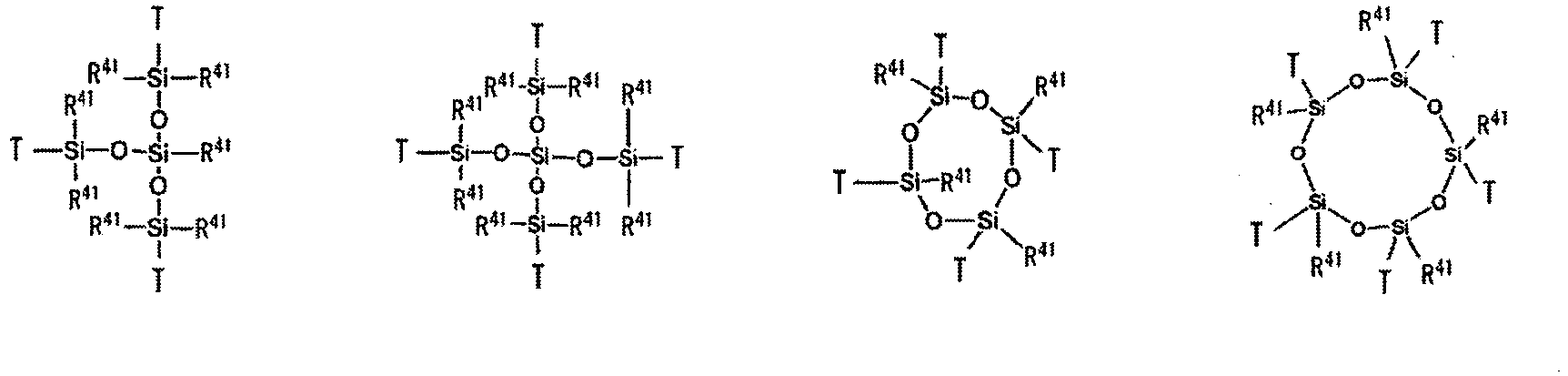


- R41 each independently represents a hydrogen atom, a phenyl group, an alkyl group having 1 to 6 carbon atoms or a C1-6 alkoxy group, and preferably a methyl group;
- in each group X101, some of the groups represented by T are the following groups bonded to RF1 or RF2 of the molecular backbone:
- -CH2O(CH2)2-,
- -CH2O(CH2)3-,
- -CF2O(CH2)3-,
- - (CH2)2-,
- - (CH2)3-,
- - (CH2)4-,
- -CONH- (CH2)3-,
- -CON(CH3)-(CH2)3-, and
- -CON(Ph)-(CH2)3- (wherein Ph stands for phenyl) or a group represented by:

- wherein R42 each independently represents a hydrogen atom, a C1-6 alkyl group or a C1-6 alkoxy group, preferably a methyl group or a methoxy group, and more preferably a methyl group,
- some other of the Ts binds to RSi of the molecular backbone, and the remaining of the Ts, if present, is independently a methyl group, a phenyl group, a C1-6 alkoxy group, or a radical scavenging group or an UV absorbing group.
- The radical scavenging group is not limited as long as it can capture a radical generated by light irradiation, and, for example, residues of a benzophenone, a benzotriazole, a benzoate, a phenyl salicylate, crotonic acid, a malonate, an organo-acrylate, a hindered amine, a hindered phenol or a triazine, is mentioned.
- The UV absorbing group is not limited as long as it can absorb ultraviolet rays, and, for example, a residue of a benzotriazole, a hydroxybenzophenone, an ester of a substituted and unsubstituted benzoic acid or salicylic acid compound, an acrylate or an alkoxy cinnamate, an oxamide, an oxanilide, a benzoxazinone or a benzoxazole, is mentioned.
- In a preferable embodiment, as a preferable radical scavenging group or UV absorbing group, the groups represented by the following formulae are mentioned.

- In this embodiment, XA may each independently be a tri- to decavalent organic group.
- In still another embodiment, examples of the XA group include the following group:

- wherein R25, R26, and R27 are each independently a di-to hexavalent organic group; and
- R25 binds to at least one RF1, and R26 and R27 each bind to at least one RSi.
- In one embodiment, R25 is a single bond, a C1-20 alkylene group, a C3-20 cycloalkylene group, a C5-20 arylene group, -R57-X58-R59-, -X58-R59-, or -R57-X58-. R57 and R59 are each independently a single bond, a C1-20 alkylene group, a C3-20 cycloalkylene group, or a C5-20 arylene group. X58 is - O-, -S-, -CO-, -O-CO-, or -COO-.
- In one embodiment, R26 and R27 are each independently a hydrocarbon or a group having at least one atom selected from N, O and S at the end or in the backbone of a hydrocarbon, preferably including a C1-6 alkyl group, -R36-R37-R36-, -R36-CHR38 2-, and the like. Here, R36 is each independently a single bond or an alkyl group having 1 to 6 carbon atoms, preferably an alkyl group having 1 to 6 carbon atoms. R37 is N, O or S, preferably N or O. R38 is -R45-R46-R45-, -R46-R45- or -R45-R46-. R45 is each independently an alkyl group having 1 to 6 carbon atoms. R46 is N, O or S, preferably O.
- In this embodiment, XA may each independently be a tri- to decavalent organic group.
- The fluoropolyether group-containing compound represented by the formula (1) or the formula (2) is not particularly limited, but may have an average molecular weight of 5 × 10² to 1 × 10⁵. In particular, the compound preferably has a number average molecular weight of 2,000 to 32,000, and more preferably 2,500 to 12,000, from the viewpoint of friction durability. The "average molecular weight" refers to a number average molecular weight, and the "average molecular weight" is a value obtained by 19F-NMR measurement.
- In one embodiment, the fluorine-containing silane compound in the surface-treating agent used in the present disclosure is the compound represented by the formula (1).
- In another embodiment, the fluorine-containing silane compound in the surface-treating agent used in the present disclosure is the compound represented by formula (2).
- In another embodiment, the fluorine-containing silane compound in the surface-treating agent used in the present disclosure is the compound represented by formula (1) and the compound represented by formula (2).
- In the surface-treating agent used in the present disclosure, the compound represented by the formula (2) is preferably 0.1 mol% or more and 35 mol% or less based on the total of the compound represented by the formula (1) and the compound represented by the formula (2). The lower limit of the content of the compound represented by the formula (2) based on the total of the compound represented by the formula (1) and the compound represented by the formula (2) may be preferably 0.1 mol%, more preferably 0.2 mol%, further preferably 0.5 mol%, and still more preferably 1 mol%, particularly preferably 2 mol%, and especially 5 mol%. The upper limit of the content of the compound represented by the formula (2) based on the total of the compound represented by the formula (1) and the compound represented by the formula (2) may be preferably 35 mol%, more preferably 30 mol%, further preferably 20 mol%, and still more preferably 15 mol% or 10 mol%. The compound represented by the formula (2) based on the total of the compound represented by the formula (1) and the compound represented by the formula (2) is preferably 0.1 mol% or more and 30 mol% or less, more preferably 0.1 mol% or more and 20 mol% or less, further preferably 0.2 mol% or more and 10 mol% or less, still more preferably 0.5 mol% or more and 10 mol% or less, and particularly preferably 1 mol% or more and 10 mol% or less, for example, 2 mol% or more and 10 mol% or less, or 5 mol% or more and 10 mol% or less. With the compound represented by the formula (2) being within such a range, friction durability can be more increased.
- The compound represented by the formula (1) or (2) can be obtained, for example, by the methods described in Patent Literature 1, Patent Literature 2 and the like.
- The surface-treating agent used in the present disclosure may include a solvent, a (unreactive) fluoropolyether compound which can be understood as a fluorine-containing oil, preferably a perfluoro(poly)ether compound (hereinafter, collectively referred to as "fluorine-containing oil"), a (unreactive) silicone compound which can be understood as a silicone oil (hereinafter, referred to as "silicone oil"), a catalyst, a surfactant, a polymerization inhibitor, a sensitizer, and the like.
- Examples of the solvent include aliphatic hydrocarbons such as hexane, cyclohexane, heptane, octane, nonane, decane, undecane, dodecane, and mineral spirits; aromatic hydrocarbons such as benzene, toluene, xylene, naphthalene, and solvent naphtha; esters such as methyl acetate, ethyl acetate, propyl acetate, n-butyl acetate, isopropyl acetate, isobutyl acetate, cellosolve acetate, propylene glycol methyl ether acetate, carbitol acetate, diethyl oxalate, ethyl pyruvate, ethyl 2-hydroxybutyrate, ethyl acetoacetate, amyl acetate, methyl lactate, ethyl lactate, methyl 3-methoxypropionate, ethyl 3-methoxypropionate, methyl 2-hydroxyisobutyrate, and ethyl 2-hydroxyisobutyrate; ketones such as acetone, methyl ethyl ketone, methyl isobutyl ketone, 2-hexanone, cyclohexanone, methyl amino ketone, and 2-heptanone; glycol ethers such as ethyl cellosolve, methyl cellosolve, methyl cellosolve acetate, ethyl cellosolve acetate, propylene glycol monomethyl ether, propylene glycol monoethyl ether, propylene glycol monobutyl ether, propylene glycol monomethyl ether acetate, propylene glycol monoethyl ether acetate, propylene glycol monobutyl ether acetate, dipropylene glycol dimethyl ether, and ethylene glycol monoalkyl ether; alcohols such as methanol, ethanol, isopropanol, n-butanol, isobutanol, tert-butanol, sec-butanol, 3-pentanol, octyl alcohol, 3-methyl-3-methoxybutanol, and tert-amyl alcohol; glycols such as ethylene glycol and propylene glycol; cyclic ethers such as tetrahydrofuran, tetrahydropyran, and dioxane; amides such as N,N-dimethylformamide and N,N-dimethylacetamide; ether alcohols such as methyl cellosolve, cellosolve, isopropyl cellosolve, butyl cellosolve, and diethylene glycol monomethyl ether; diethylene glycol monoethyl ether acetate; and fluorine-containing solvents such as 1,1,2-trichloro-1,2,2-trifluoroethane, 1,2-dichloro-1,1,2,2-tetrafluoroethane, dimethyl sulfoxide, 1,1-dichloro-1,2,2,3,3-pentafluoropropane (HCFC 225), Zeorora H, HFE 7100, HFE 7200, and HFE 7300. Alternatively, the solvent may be a mixed solvent of two or more of such solvents.
- The fluorine-containing oil is not limited, and examples thereof include a compound (perfluoro(poly)ether compound) represented by the following general formula (3):
Rf5-(OC4F8)a'-(OC3F6)b'-(OC2F4)c'-(OCF2)d'-Rf6 ... (3)
- wherein Rf5 represents an alkyl group having 1 to 16 carbon atoms optionally substituted with one or more fluorine atoms (preferably, C1-16 perfluoroalkyl group), Rf6 represents an alkyl group having 1 to 16 carbon atoms optionally substituted with one or more fluorine atoms (preferably, C1-16 perfluoroalkyl group), a fluorine atom, or a hydrogen atom, and Rf5 and Rf6 are each independently, more preferably, a C1-3 perfluoroalkyl group; and
- a', b', c' and d' represent the respective four numbers of repeating units in perfluoro(poly)ether constituting a main backbone of the polymer and are mutually independently an integer of 0 or more and 300 or less, the sum of a', b', c' and d' is at least 1, preferably 1 to 300, more preferably 20 to 300, the occurrence order of the respective repeating units enclosed in parentheses provided with a subscript a', b', c' or d' is not limited in the formula, and, among such repeating units, for example, -(OC4F8)- may be any of - (OCF2CF2CF2CF2)-, - (OCF(CF3)CF2CF2)-, - (OCF2CF(CF3)CF2)-, - (OCF2CF2CF(CF3))-, - (OC(CF3)2CF2)-, - (OCF2C(CF3)2)-, - (OCF(CF3)CF(CF3))-, -(OCF(C2F5)CF2)- and - (OCF2CF(C2F5)) - and is preferably - (OCF2CF2CF2CF2)-, - (OC3F6)- may be any of - (OCF2CF2CF2)-, -(OCF(CF3)CF2)- and - (OCF2CF(CF3)) - and is preferably - (OCF2CF2CF2)-, and -(OC2F4)- may be any of - (OCF2CF2)- and -(OCF(CF3))- and is preferably -(OCF2CF2)-.
- Examples of the perfluoro(poly)ether compound represented by general formula (3) include a compound represented by any of the following general formulae (3a) and (3b) (which may be adopted singly or as a mixture of two or more kinds thereof).
Rf5-(OCF2CF2CF2)b"-Rf6 ... (3a)
Rf5-(OCF2CF2CF2CF2)a"-(OCF2CF2CF2)b"-(OCF2CF2)c"- (OCF2)d"-Rf6 ... (3b)
- In such formulae, Rf5 and Rf6 are as described above; in formula (3a), b'' is an integer of 1 or more and 100 or less; and, in formula (3b), a'' and b'' are each independently an integer of 0 or more and 30 or less, c'' and d'' are each independently an integer of 1 or more and 300 or less. The occurrence order of the respective repeating units enclosed in parentheses provided with a subscript a'', b'', c'', or d'' is not limited in the formulae.
- From another viewpoint, the fluorine-containing oil may be a compound represented by general formula Rf3-F wherein Rf3 is a C5-16 perfluoroalkyl group. The fluorine-containing oil may be a chlorotrifluoroethylene oligomer.
- The fluorine-containing oil may have an average molecular weight of 500 to 10,000. The molecular weight of the fluorine-containing oil may be measured using GPC.
- The fluorine-containing oil may be contained in an amount of, for example, 0 to 50 mass%, preferably 0 to 30 mass%, and more preferably 0 to 5 mass% based on the surface-treating agent. In one embodiment, the surface-treating agent is substantially free of the fluorine-containing oil. Being substantially free of the fluorine-containing oil means that the fluorine-containing oil is not contained at all, or an extremely small amount of the fluorine-containing oil may be contained.
- In one embodiment, the average molecular weight of the fluorine-containing oil may be greater than the average molecular weight of the fluorine-containing silane compound. With such average molecular weights, better friction durability and surface lubricity can be obtained, in the case of forming the surface-treating layer by the vacuum deposition method.
- In one embodiment, the average molecular weight of the fluorine-containing oil may be smaller than the average molecular weight of the fluorine-containing silane compound. With such average molecular weights, a cured product having high friction durability and high surface lubricity can be formed while suppressing the deterioration in transparency of the surface-treating layer obtained from the compound.
- The fluorine-containing oil contributes to enhancing surface lubricity of the layer formed by the surface-treating agent.
- For example, the silicone oil may be linear or cyclic silicone oil having 2,000 or less siloxane bonds. The linear silicone oil may be so-called straight silicone oil or modified silicone oil. Examples of the straight silicone oil include dimethyl silicone oil, methyl phenyl silicone oil, and methyl hydrogen silicone oil. Examples of the modified silicone oil include those obtained by modifying straight silicone oil with alkyl, aralkyl, polyether, higher fatty acid ester, fluoroalkyl, amino, epoxy, carboxyl, alcohol, or the like. Examples of the cyclic silicone oil include cyclic dimethylsiloxane oil.
- The surface-treating agent can include, for example, 0 to 300 parts by mass, preferably 50 to 200 parts by mass of such silicone oil based on a total of 100 parts by mass of the fluorine-containing silane compound (in the case of two or more kinds, the total thereof, much the same is true on the following).
- Silicone oil contributes to increasing the surface lubricity of the surface-treating layer.
- Examples of the catalyst include acids (such as acetic acid and trifluoroacetic acid), bases (such as ammonia, triethylamine, and diethylamine), and transition metals (such as Ti, Ni, and Sn).
- The catalyst promotes hydrolysis and dehydration condensation of the fluorine-containing silane compound, and promotes formation of the layer to be formed by the surface-treating agent.
- Examples of other components include, in addition to those described above, tetraethoxysilane, methyltrimethoxysilane, 3-aminopropyltrimethoxysilane, 3-glycidoxypropyltrimethoxysilane, and methyltriacetoxysilane.
- The surface-treating agent used in the present disclosure can be formed into a pellet by impregnating a porous material, for example, a porous ceramic material or a metal fiber for example that obtained by solidifying a steel wool, therewith. Such pellets can be used in, for example, vacuum deposition.
- The thickness of the surface-treating layer is not limited. The thickness of the layer in the case of an optical member is in the range of 1 to 50 nm, 1 to 30 nm, and preferably 1 to 15 nm, from the viewpoint of optical performance, surface lubricity, friction durability, and antifouling properties.
- The surface-treating layer can be formed, for example, by forming a layer of the surface-treating agent on the intermediate layer and post-treating the layer as necessary.
- The layer of the surface-treating agent can be formed by applying the above surface-treating agent on the surface of the intermediate layer such that the composition coats the surface. The coating method is not limited. For example, a wet coating method and a dry coating method can be used.
- Examples of the wet coating method include dip coating, spin coating, flow coating, spray coating, roll coating, gravure coating, and similar methods.
- Examples of the dry coating method include deposition (usually, vacuum deposition), sputtering, CVD, and similar methods. Specific examples of the deposition method (usually, a vacuum deposition method) include resistive heating, high-frequency heating using electron beam, microwave or the like, ion beam, and similar methods. Specific examples of the CVD method include plasma-CVD, optical CVD, thermal CVD, and similar methods.
- Furthermore, coating by an atmospheric pressure plasma method can be performed.
- When using the wet coating method, the surface-treating agent can be applied to the intermediate layer after being diluted with a solvent. From the viewpoint of the stability of the surface-treating agent and the volatility of solvents, the following solvents are preferably used: perfluoroaliphatic hydrocarbons having 5 to 12 carbon atoms (such as perfluorohexane, perfluoromethylcyclohexane, and perfluoro-1,3-dimethylcyclohexane); polyfluoroaromatic hydrocarbons (such as bis(trifluoromethyl)benzene); polyfluoroaliphatic hydrocarbons (such as C6F13CH2CH3 (such as Asahiklin (registered trademark) AC-6000 manufactured by Asahi Glass Co., Ltd., and 1,1,2,2,3,3,4-heptafluorocyclopentane (such as Zeorora (registered trademark) H manufactured by Zeon Corporation)); alkyl perfluoroalkyl ethers (the perfluoroalkyl group and the alkyl group may be linear or branched) such as hydrofluoroether (HFE) (such as perfluoropropylmethyl ether (C3F7OCH3) (such as Novec (trademark) 7000 manufactured by Sumitomo 3M Limited), perfluorobutyl methyl ether (C4F9OCH3) (such as Novec (trademark) 7100 manufactured by Sumitomo 3M Limited), perfluorobutyl ethyl ether (C4F9OC2H5) (such as Novec (trademark) 7200 manufactured by Sumitomo 3M Limited), and perfluorohexyl methyl ether (C2F5CF (OCH3) C3F7) (such as Novec (trademark) 7300 manufactured by Sumitomo 3M Limited), or CF3CH2OCF2CHF2 (such as Asahiklin (registered trademark) AE-3000 manufactured by Asahi Glass Co., Ltd.)). One of these solvents can be used singly, or two or more can be used as a mixture. In particular, hydrofluoroether is preferable, and perfluorobutyl methyl ether (C4F9OCH3) and/or perfluorobutyl ethyl ether (C4F9OC2H5) is particularly preferable.
- When using the dry coating method, the surface-treating agent may be directly subjected to the dry coating method, or may be diluted with the above solvent before being subjected to the dry coating method.
- A layer of the surface-treating agent is preferably formed such that the surface-treating agent coexists in the layer with a catalyst for hydrolysis and dehydrative condensation. Conveniently, in the case of a wet coating method, the surface-treating agent is diluted with a solvent, and then, immediately before application to the intermediate layer, a catalyst may be added to the diluted solution of the surface-treating agent. In the case of a dry coating method, the surface-treating agent to which a catalyst has been added is directly used to a deposition (usually vacuum deposition) treatment, or a pellet-like material may be used to a deposition (usually vacuum deposition) treatment, wherein the pellets is obtained by impregnating a porous body of metal such as iron or copper with the surface-treating agent to which the catalyst has been added.
- The catalyst may be any suitable acid or base. The acid catalyst may be, for example, acetic acid, formic acid, or trifluoroacetic acid. The base catalyst may be, for example, ammonia or organic amine.
- In the above-described manner, a layer derived from the surface-treating agent is formed on the intermediate layer surface, and the article of the present disclosure is produced. The surface-treating layer thus obtained has high friction durability. The layer may have not only high friction durability but also have, depending on the compositional features of the surface-treating agent used, water-repellency, oil-repellency, antifouling properties (e.g., preventing grime such as fingerprints from adhering); waterproof properties (preventing water from entering electronic components and the like), surface lubricity (or lubricity, for example, such as removability by wiping of grim such as fingerprints, and excellent tactile sensations to the fingers), and the like, and may be suitably used as a functional thin film.
- The article of the present disclosure may be an optical material having the surface-treating layer as an outermost layer.
- The article of the present disclosure may be, but is not limited to, an optical member. Examples of the optical member include lenses of glasses or the like; front surface protective plates, antireflection plates, polarizing plates, and anti-glare plates for displays such as PDPs and LCDs; touch panel sheets for devices such as mobile phones and personal digital assistants; disc surfaces of optical discs such as Blu-ray (registered trademark) discs, DVD discs, CD-Rs, and MOs; optical fibers; and display surfaces of watches and clocks.
- The article of the present disclosure may be medical equipment or a medical material.
- The article of the present disclosure has high chemical resistance and high friction durability by having an intermediate layer containing a composite oxide containing Si on a substrate and a surface-treating layer formed from a surface-treating agent containing a fluorine-containing silane compound thereon.
- The article of the present disclosure can be obtained by forming an intermediate layer containing a composite oxide containing Si on a substrate and forming a surface-treating layer from a surface-treating agent containing a fluorine-containing silane compound thereon.
- Typically, the article of the present disclosure can be produced by simultaneously depositing Si and another atom on the substrate.
- Accordingly, the present disclosure further provides a method for producing an article comprising a substrate and a surface-treating layer formed from a surface-treating agent containing a fluorine-containing silane compound formed thereon, the method comprising:
- simultaneously depositing Si and another metal on the substrate to form an intermediate layer containing a composite oxide containing Si; and
- forming a surface-treating layer directly on the intermediate layer.
- The article of the present disclosure may be produced by sequentially depositing Si and another atoms on the substrate.
- The article of the present disclosure has been described in detail above. The article of the present disclosure, the method for producing the article, and the like are not limited to those exemplified above.
- Hereinafter, an article of the present disclosure will be described in Examples, but the present disclosure is not limited to the following Examples. In the Examples, all chemical formulae shown below indicate average compositional features, and the occurrence order of repeating units (such as (CF2CF2CF2O), (CF(CF3)CF2O), (CF2CF2O), and (CF2O)) constituting perfluoropolyether is not limited.
- As the glass substrate, Gorilla Glass 3 (manufactured by Corning Inc.) which had been subjected to chemical strengthening and surface polishing with a thickness of 0.5 mm, 71.5 mm × 149.0 mm was used, and after forming an intermediate layer, a surface-treating layer was formed on the intermediate layer to obtain a glass substrate with a surface-treating layer. Details are as follows.
- The intermediate layer was formed by placing a silicon target and a tantalum target or a niobium target in an RAS or DC-sputtering apparatus, setting sputtering conditions for each example while introducing a mixed gas of argon and oxygen into the chamber, and forming intermediate layers made of composite oxides of silicon and tantalum or niobium in a thickness of 10 to 40 nm at various film formation rate ratios (Si/Ta).
- The formation of the surface-treating layer was conducted using an apparatus capable of performing resistance heating vapor deposition. Specifically, a composition containing a fluorine-containing organosilicon compound was introduced into a heating vessel, the vessel was evacuated with a vacuum pump to distill off the solvent, and the heating vessel was heated to form a surface-treating layer on the intermediate layer. As the fluorine-containing organosilicon compound, compounds having the following structure were used.
- CF3O(CF2CF2O)15(CF2O)16CF2CH2OCH2CH2CH2Si[CH2CH2CH2Si(OCH3)3 ]3
- CF3CF2CF2O(CF2CF2CF2O)25CF2CF2(CH2CH[Si(OCH3)3])3H
- CF3CF2CF2O(CF2CF2CF2O)23CF2CF2CONHCH2CH2CH2Si(OCH3)3
- CF3CF2CF2O(CF2CF2CF2O)23CF2CF2CONHCH2C[CH2CH2CH2Si(OCH3)3]3
- [(CH3O)3SiCH2CH2CH2]3CCH2NHCOCF2O(CF2CF2O)10(CF2O)10CF2CONH CH2C[CH2CH2CH2Si(OCH3)3]3
- [(CH3O)3SiCH2CH2CH2]3CCH2NHCOCF2O(CF2CF2O)8(CF2O)14CF2CONHC H2C[CH2CH2CH2Si(OCH3)3]3
- [(CH3O)3SiCH2CH2CH2]3CCH2NHCOCF2CF2O(CF2CF2CF2O)16CF2CF2CON HCH2C[CH2CH2CH2Si(OCH3)3]3
- CF3CF2CF2O[CF(CF3)CF2O]22CFCONHCH2C[CH2CH2CH2Si(OCH3)3]3
[Table 1] Film formation method Vapor deposition material 1 Vapor deposition material 2 Film thickness of Intermediate layer Film formation rate (Si/Ta) Compound Example 1 RAS Si Ta 40 nm 8/2 A Example 2 RAS Si Ta 40 nm 5/5 A Example 3 DC Si Ta 40 nm 8/2 A Example 4 DC Si Ta 40 nm 5/5 A Example 5 DC Si Ta 40 nm 9/1 A Example 6 DC Si Ta 40 nm 95/5 A Example 7 DC Si Ta 40 nm 1/9 A Example 8 DC Si Ta 20 nm 8/2 A Example 9 DC Si Ta 10 nm 8/2 A Example 10 DC Si Nb 40 nm 8/2 A Example 11 DC Si Ta 40 nm 8/2 B Example 12 DC Si Ta 40 nm 8/2 C Example 13 DC Si Ta 40 nm 8/2 D Example 14 DC Si Ta 40 nm 8/2 E Example 15 DC Si Ta 40 nm 8/2 F Example 16 DC Si Ta 40 nm 8/2 G Example 17 DC Si Ta 40 nm 8/2 H Comparative Example 1 RAS Si - 40 nm - A Comparative Example 2 DC Si - 40 nm - A Comparative Example 3 DC Si - 10 nm - A Comparative Example 4 DC Si - 40 nm - B Comparative Example 5 DC Si - 40 nm - C Comparative Example 6 DC Si - 40 nm - D Comparative Example 7 DC Si - 40 nm - E Comparative Example 8 DC Si - 40 nm - F Comparative Example 9 DC Si - 40 nm - G Comparative Example 10 DC Si - 40 nm - H - The glass substrate with the surface-treating layer obtained above was each subjected to measurement of the water contact angle, alkali test, and evaluation of friction durability as follows.
- PTFE O-rings 1 cm in diameter were placed on the surfaces of the substrates surface-treated in Examples 3, 4, 7, 10 to 13, and 17 and Comparative Examples 1, 4 to 6, and 10, and 8N NaOH solutions (aqueous alkali solutions) were dropped into the O-rings, the surfaces of the surface-treating layers were brought into contact with the aqueous alkali solutions, and alkali immersion tests were performed. After 20 to 360 minutes of the alkali immersion test, the aqueous alkali solution was wiped off and washed with pure water and ethanol, and then the contact angle with water was measured. The static contact angles of water were measured by dropping 2 µL of a water droplet of pure water on the surfaces of the glass substrates after the alkali immersion test and using a contact-angle meter (automatic contact-angle meter DropMaster701 manufactured by Kyowa Interface Science Co., Ltd.). The static contact angle of water after the alkali immersion test was measured at five points. When the measured value of the static contact angle of water was lowered within 360 minutes, the alkali immersion test was stopped on the way. The relationship between the immersion time and the average value of the contact angles at five points is shown in Table 2 below.
[Table 2] Static contact angle of water for alkali immersion test (°) Time (min) 0 20 40 60 90 105 120 150 180 240 300 360 Example 3 115 115 114 113 113 111 110 110 110 92 40 - Example 4 116 116 115 115 114 114 114 114 114 113 113 113 Example 7 115 114 115 113 114 114 113 114 114 114 113 112 Example 10 112 111 112 112 110 111 71 54 53 - - - Example 11 113 112 111 111 110 111 112 57 52 - - - Example 12 112 112 112 113 111 112 110 88 51 52 - - Example 13 114 112 113 112 111 112 110 109 109 110 111 112 Example 17 112 112 111 112 113 108 55 53 - - - - Comparative Example 1 116 114 110 110 96 37 27 - - - - - Comparative Example 4 113 82 52 49 46 - - - - - - - Comparative Example 5 112 82 52 49 49 - - - - - - - Comparative Example 6 113 111 110 61 53 - - - - - - - Comparative Example 10 112 102 64 62 52 - - - - - - - - The sample article on which the surface-treating layer was formed was horizontally disposed, the following friction element was brought into contact with the surface-treating layer (the contact surface was a circle having a 1 cm diameter), a 5N load was applied thereon, and then the friction block was reciprocated at a speed of 40 mm/sec in a state in which the load was applied. The friction block was reciprocated up to 3000 times for Examples 1 and 2 and Comparative Example 1, or up to 10,000 times for Examples 3 to 6, 8 to 9, and 11 to 17, and Comparative Examples 2 to 10, and the static contact angle (°) of water was measured for each reciprocation frequency (friction frequency) of 500 or 1,000 times. The test was stopped when the measured value of the static contact angle of water was less than 60°. The static contact angle of water was measured in the same manner as in the alkali test. The results are shown in Table 3 below for Examples 1 and 2 and Comparative Example 1 using RAS, in Table 4 below for Examples 3 to 6, 8 to 9 and 11 to 17 using DC, and in Table 5 below for Comparative Examples 2 to 10.
- The surfaces (1 cm diameter) of the silicone rubber processed products shown below were covered with cotton soaked in artificial sweat having the compositional features shown below, and the products were used as friction blocks.
- Compositional feature of artificial sweat:
- Anhydrous disodium hydrogen phosphate: 2g
- Sodium chloride: 20 g
- 85% Lactic acid: 2 g
- Histidine hydrochloride: 5 g
- Distilled water: 1 kg
- Silicone rubber processed product:
Silicone rubber stopper SR-51 made of Tiger's polymer processed into a cylindrical shape having a diameter of 1 cm and a thickness of 1 cm.[Table 3] Friction frequency (times) Static contact angle (°) Example 1 Example 2 Comparative Example 1 0 117 117 115 500 103 102 96 1000 89 87 76 1500 81 71 58 2000 72 54 40 2500 66 48 - 3000 59 42 - [Table 4] Friction frequency (times) Static contact angle (°) Example number 3 4 5 6 8 9 11 12 13 14 15 16 17 0 115 114 113 114 115 114 113 114 113 109 109 109 110 1000 105 94 109 107 103 109 105 90 109 99 97 105 91 2000 99 80 106 104 100 101 98 78 105 88 89 99 78 3000 95 75 105 102 95 97 89 65 99 81 83 94 63 4000 90 70 103 100 92 94 83 52 96 74 78 89 51 5000 88 63 101 96 90 91 77 - 91 71 74 85 - 6000 85 57 99 92 87 88 71 - 87 65 67 79 - 7000 83 - 95 90 85 87 64 - 83 55 58 73 - 8000 81 - 93 88 83 85 56 - 79 50 53 68 - 9000 79 - 87 82 80 81 - - 75 - - 60 - 10000 77 - 83 78 78 79 - - 70 - - 54 - [Table 5] Friction number of times (times) Static contact angle (°) Comparative Example number 2 3 4 5 6 7 8 9 10 0 115 115 114 114 114 108 109 109 110 1000 106 103 93 72 103 81 85 100 65 2000 90 92 81 52 94 66 69 91 38 3000 78 78 66 - 83 53 54 85 - 4000 68 69 51 - 77 - - 74 - 5000 60 62 - - 66 - - 63 - 6000 51 53 - - 60 - - 54 - 7000 - 55 - - 53 - - - - - The compositional feature of the treated surfaces of the above treated glass substrates (analyzed in the depth direction) was analyzed using an X-ray photoelectron spectrometer (XPS, PHI 5000 VersaProbe II manufactured by ULVAC-PHI, Inc.). The measurement conditions for XPS analysis were as follows.
- X-ray source : monochromatic AlKα radiation (25 W)
- Photoelectron detection area: 1400 µm × 300 µm
- Photoelectron detection angles: 20 degrees, 45 degrees, 90 degrees
- Path energy : 23.5 eV
- For the glass substrates with the surface-treating layer of Examples 1 and 2, the peak areas of C1s, O1s, F1s, Si2p, and Ta4f orbitals were observed by XPS, and the atomic ratios and area ratios of carbon, oxygen, fluorine, silicon, and tantalum were calculated to obtain the compositional features of the treated surface including the surface-treating antifouling layer. The results are shown in Table 6 below for Examples 1 and 2 using RAS.
[Table 6] Photoelectron detection angle Si/Ta C1s 01s F1s Si2p Ta4f Example 1 20deg 26.79 17.9 54.75 0.51 0.05 10.20 45deg 25.63 19.75 51.53 2.59 0.5 5.18 90deg 23.38 23.38 47.87 4.39 0.98 4.48 Example 2 20deg 26.53 17.42 55.25 0.5 0.3 1.67 45deg 24.99 20.71 51.24 1.92 1.14 1.68 90deg 23.35 23.48 48.16 2.93 2.09 1.40 - The compositional feature of the treated surfaces of the above treated glass substrates (analyzed in the depth direction) was analyzed using an X-ray photoelectron spectrometer (XPS, PHI 5000 VersaProbe II manufactured by ULVAC-PHI, Inc.). The measurement conditions for XPS analysis were as follows.
- X-ray source : monochromatic AlKα radiation (25 W)
- Photoelectron detection area: 1400 µm × 300 µm
- Photoelectron detection angle: 45 degrees
- Path energy : 23.5 eV
- Sputter ion : Ar ion
- For the glass substrate with the surface-treating layer of Examples 1 to 7, the layers (the surface-treating layer and the intermediate layer) on the substrate were etched gradually in the depth direction by sputtering with Ar ions for a predetermined time, and after each predetermined time, the peak areas of the O1s, Si2p, and Ta4f orbitals were observed by XPS, and the atomic ratio and the area ratio of oxygen and silicon were calculated to obtain the compositional features of the layer on the substrate surface. The etching rate in the sputtering was set to 3 nm/min. The results of Examples 1 to 7 are shown in Table 7 below.
[Table 7] sputter time(min) 0 1 2 3 4 5 7 9 11 Example 1 Element concentration (%) O1s 19.67 88.26 65.47 65.03 65.2 65.97 65.24 65.38 65.48 Si2p 2.61 25.38 25.63 25.78 25.37 24.68 25.06 24.99 25.72 Ta4f 0.47 8.34 8.9 9.18 9.43 9.36 9.7 9.63 8.82 Si/Ta 5.55 3,04 2.88 2.81 2.69 2.64 2.56 2.60 2.92 Example 2 Element concetration (%) 01s 19.08 66.63 66.09 64.02 63.91 63.31 63.9 63.8 65 Si2p 1,67 15.71 14.67 15.34 15.56 15.57 15.5 15.56 14.98 Ta4f 1.07 17.66 20.25 20.64 20.53 21.12 20.6 20.65 20.02 Si/Ta 1.58 0.89 0.72 0.74 0.76 0.74 0.75 0.75 0.75 Example 3 Element concentration (%) 01s 22.07 67.38 67.20 67.45 67.57 66.27 64.38 63.73 64.76 Si2p 3.40 24.35 24.83 24.61 23.58 23.13 21.89 21.67 21.48 Ta4f 0.68 7.18 7.97 7.94 7.92 7.69 3.90 1.57 0.91 Si/Ta 5.00 3.39 3.12 3.10 2.98 3.01 5.61 - - Example 4 Element concentration (%) O1s 20.89 68.33 67.24 66.49 65.61 64.35 62.26 63.47 63.89 Si2p 1,89 15.04 14.88 15.40 15.93 15.59 20.27 21.74 21.83 Ta4f 1.17 16.01 17.46 18.12 18.47 18.07 9.49 2.91 1.30 Si/Ta 1.62 0.94 0.85 0.86 0.88 0.89 2.14 - - Example 5 Element concentation (%) O1s 23.04 62.50 64,14 64.62 65.21 66.39 64.13 65.31 66.90 Si2p 3.80 24.60 24.69 25.04 24.43 23.05 24.43 23.85 24.12 Ta4f 0.47 4.81 5.01 4,96 4.87 4.66 4.78 4.89 4.87 Si/Ta 8.09 5.11 4.93 5.08 5,02 4,96 5.11 4.88 4.95 Example 6 Element concetration (%) O1s 24.03 62.50 63.14 64.62 62.21 64.38 63.13 64.31 64.39 Si2p 3.90 32.60 33.60 32.31 34.67 32.45 32.99 32.60 32.60 Ta4f 0.35 3.01 3.26 3.07 3.12 3.17 3.15 3.01 3.01 Si/Ta 11.14 10.83 10.31 10.52 11.11 10.25 10.47 10.83 10.83 Example 7 Element concentration (%) O1s 20.30 64.73 66.32 66.35 64.97 65.08 64.71 65.92 64.40 Si2p 1.01 4.52 5.21 5.03 5.31 4.62 4.91 3.98 4.36 Ta4f 1.17 25.67 28,47 28.62 28.72 27.95 27.12 23.03 24.23 Si/Ta 0.89 0.18 0.18 0.18 0.18 0.17 0.18 0.17 0.18 - From the above analysis results, it was confirmed that Examples in which the Si/Ta ratio was 0.15 to 12.0 (Si:Ta = 13:87 to 93:7) had high alkali resistance and friction durability.
- As understood from the above results, in Examples 1 to 17 in which the intermediate layer made of Si, Ta, and O or the intermediate layer made of Si, Nb, and O was formed between the substrate and the surface-treating layer, it was confirmed that a decrease in the contact angle in the alkali immersion test was suppressed and the alkali durability was excellent as compared with Comparative Examples 1 to 10 in which such an intermediate layer was not formed. Further, it was confirmed that in Examples 1 to 4, a decrease in the contact angle in the abrasion durability test was suppressed, and the friction durability using artificial sweat was excellent.
- The article of the present disclosure can be suitably used in various applications, for example, as an optical member.
Claims (18)
- An article, comprising:a substrate;an intermediate layer located on the substrate; anda surface-treating layer located directly on the intermediate layer and formed from a surface-treating agent containing a fluorine-containing silane compound,whereinthe intermediate layer comprises a composite oxide containing Si.
- The article according to claim 1, wherein the composite oxide is a composite oxide of Si and another metal, and the another metal is one or more atoms selected from transition metals of Groups 3 to 11 and typical metal elements of Groups 12 to 15 of the periodic table.
- The article according to claim 1 or 2, wherein the composite oxide is a composite oxide of Si and another metal, and the another metal is one or more atoms selected from Ta, Nb, Zr, Mo, W, Cr, Hf, Al, Ti, and V.
- The article according to any one of claims 1 to 3, wherein in the composite oxide, a molar ratio of Si to the another metal is 10:90 to 99.9:0.1.
- The article according to any one of claims 1 to 4, wherein in the composite oxide, a molar ratio of Si to the another metal is 13:87 to 93:7.
- The article according to any one of claims 1 to 5, wherein in the composite oxide, a molar ratio of Si to the another metal is 45:55 to 75:25.
- The article according to any one of claims 1 to 6, wherein the composite oxide is a composite oxide of Si and Ta or a composite oxide of Si and Nb.
- The article according to any one of claims 1 to 7, wherein the fluorine-containing silane compound is at least one fluoropolyether group-containing compound represented by the following formula (1) or (2):
RFl α-XA-RSi β (1)
RSi y-XA-RF2-XA-RSi γ (2)
whereinRF1 is each independently at each occurrence Rf1-RF-Oq-;RF2 is -Rf2 p-RF-Oq-;Rf1 is each independently at each occurrence a C1-16 alkyl group optionally substituted with one or more fluorine atoms;Rf2 is a C1-6 alkylene group optionally substituted with one or more fluorine atoms;RF is each independently at each occurrence a divalent fluoropolyether group;p is 0 or 1;q is each independently at each occurrence 0 or 1;RSi is each independently at each occurrence a monovalent group containing a Si atom to which a hydroxyl group, a hydrolyzable group, a hydrogen atom or a monovalent organic group is bonded;at least one RSi is a monovalent group containing a Si atom to which a hydroxyl group or a hydrolyzable group is bonded;XA is each independently a single bond or a di- to decavalent organic group;α is an integer of 1 to 9;β is an integer of 1 to 9; andγ is each independently an integer of 1 to 9. - The article according to claim 8, wherein Rf1 is each independently at each occurrence a C1-16 perfluoroalkyl group; and
Rf2 is each independently at each occurrence a C1-6 perfluoroalkylene group. - The article according to claim 8 or 9, wherein RF is each independently at each occurrence a group represented by formula:
-(OC6F12)a-(OC5F10)b-(OC4F8)c-(OC3RFa 6)d-(OC2F4)e-(OCF2)f-
wherein RFa is each independently at each occurrence a hydrogen atom, fluorine atom, or a chlorine atom; anda, b, c, d, e and f are each independently an integer of 0 to 200, the sum of a, b, c, d, e and f is 1 or more, and the occurrence order of the respective repeating units enclosed in parentheses provided with a, b, c, d, e or f is not limited in the formula. - The article according to claim 10, wherein RFa is a fluorine atom.
- The article according to any one of claims 8 to 11, wherein RF is each independently at each occurrence a group represented by the following formula (f1), (f2) or (f3):
- (OC3F6)d- (f1)
wherein d is an integer of 1 to 200;
-(OC4F8)c-(OC3F6)d-(OC2F4)e-(OCF2)f- (f2)
wherein c and d are each independently an integer of 0 to 30;e and f are each independently an integer of 1 to 200;the sum of c, d, e, and f is an integer of 10 to 200; andthe occurrence order of the respective repeating units enclosed in parentheses provided with a subscript c, d, e, or f is not limited in the formula; and
- (R6-R7)g- (f3)
wherein R6 is OCF2 or OC2F4;R7 is a group selected from OC2F4, OC3F6, OC4F8, OC5F10, and OC6F12, or is a combination of two or three groups selected from these groups; andg is an integer of 2 to 100. - The article according to any one of claims 8 to 12, wherein RSi is a group represented by the following formula (S1), (S2), (S3), or (S4):

- SiR11 n1R12 3-n1 (S2)
- SiRa1 k1Rb1 l1Rc1 m1 ( S3)
- CRd1 k2Re1 l2Rf1 m2 (S4)
whereinR11 is each independently at each occurrence a hydroxyl group or a hydrolyzable group;R12 is each independently at each occurrence a hydrogen atom or a monovalent organic group;n1 is an integer of 0 to 3 each independently in each (SiR11 n1R1z 3-n1) unit;X11 is each independently at each occurrence a single bond or a divalent organic group;R13 is each independently at each occurrence a hydrogen atom or a monovalent organic group;t is each independently at each occurrence an integer of 2 to 10;R14 is each independently at each occurrence a hydrogen atom or a halogen atom;Ra1 is each independently at each occurrence -Z1-SiR21 p1R22 q1R23 r1 ;Z1 is each independently at each occurrence an oxygen atom or a divalent organic group;R21 is each independently at each occurrence -Z1'-SiR21' p1'R22' q1'R23' r1';R22 is each independently at each occurrence a hydroxyl group or a hydrolyzable group;R23 is each independently at each occurrence a hydrogen atom or a monovalent organic group;p1 is each independently at each occurrence an integer of 0 to 3;q1 is each independently at each occurrence an integer of 0 to 3;r1 is each independently at each occurrence an integer of 0 to 3;Z1' is each independently at each occurrence an oxygen atom or a divalent organic group;R21' is each independently at each occurrence -Z1"-SiR22" q1"R23" rl";R22' is each independently at each occurrence a hydroxyl group or a hydrolyzable group;R23' is each independently at each occurrence a hydrogen atom or a monovalent organic group;p1' is each independently at each occurrence an integer of 0 to 3;q1' is each independently at each occurrence an integer of 0 to 3;r1' is each independently at each occurrence an integer of 0 to 3;Z1" is each independently at each occurrence an oxygen atom or a divalent organic group;R22" is each independently at each occurrence a hydroxyl group or a hydrolyzable group;R23" is each independently at each occurrence a hydrogen atom or a monovalent organic group;q1" is each independently at each occurrence an integer of 0 to 3;r1" is each independently at each occurrence an integer of 0 to 3;Rb1 is each independently at each occurrence a hydroxyl group or a hydrolyzable group;Rc1 is each independently at each occurrence a hydrogen atom or a monovalent organic group;k1 is each independently at each occurrence an integer of 0 to 3;11 is each independently at each occurrence an integer of 0 to 3;m1 is each independently at each occurrence an integer of 0 to 3;Rd1 is each independently at each occurrence -Z2-CR31 p2R32 q2R33 r2 ;Z2 is each independently at each occurrence a single bond, an oxygen atom or a divalent organic group;R31 is each independently at each occurrence -Z2'-CR32' q2'R33' r2' ;R32 is each independently at each occurrence -Z3-SiR34 n2R35 3-n2;R33 is each independently at each occurrence a hydrogen atom, a hydroxyl group, or a monovalent organic group;p2 is each independently at each occurrence an integer of 0 to 3;q2 is each independently at each occurrence an integer of 0 to 3;r2 is each independently at each occurrence an integer of 0 to 3;Z2' is each independently at each occurrence a single bond, an oxygen atom or a divalent organic group;R32' is each independently at each occurrence -Z3-SiR34 n2R35 3-n2 ;R33' is each independently at each occurrence a hydrogen atom, a hydroxyl group, or a monovalent organic group;q2' is each independently at each occurrence an integer of 0 to 3;r2' is each independently at each occurrence an integer of 0 to 3;Z3 is each independently at each occurrence a single bond, an oxygen atom or a divalent organic group;R34 is each independently at each occurrence a hydroxyl group or a hydrolyzable group;R35 is each independently at each occurrence a hydrogen atom or a monovalent organic group;n2 is each independently at each occurrence an integer of 0 to 3;Re1 is each independently at each occurrence -Z3-SiR34 n2R35 3-n2 ;Rf1 is each independently at each occurrence a hydrogen atom, a hydroxyl group, or a monovalent organic group;k2 is each independently at each occurrence an integer of 0 to 3;12 is each independently at each occurrence an integer of 0 to 3; andm2 is each independently at each occurrence an integer of 0 to 3. - The article according to any one of claims 8 to 13, wherein α, β, and γ are 1.
- The article according to any one of claims 8 to 13, wherein XA is each independently a trivalent organic group;α is 1 and β is 2, or α is 2 and β is 1; andγ is 2.
- The article according to any one of claims 1 to 15, wherein the substrate is a glass substrate.
- A method for producing an article comprising a substrate and a surface-treating layer formed from a surface-treating agent containing a fluorine-containing silane compound formed thereon, the method comprising:simultaneously depositing Si and another metal on the substrate to form an intermediate layer containing a composite oxide containing Si; andforming a surface-treating layer directly on the intermediate layer.
- A surface-treating agent for use in production of the article according to any one of claims 1 to 16.
Applications Claiming Priority (3)
| Application Number | Priority Date | Filing Date | Title |
|---|---|---|---|
| JP2019096329 | 2019-05-22 | ||
| JP2019159523 | 2019-09-02 | ||
| PCT/JP2020/019653 WO2020235528A1 (en) | 2019-05-22 | 2020-05-18 | Stain-proof base material |
Publications (3)
| Publication Number | Publication Date |
|---|---|
| EP3974179A1 true EP3974179A1 (en) | 2022-03-30 |
| EP3974179A4 EP3974179A4 (en) | 2023-06-07 |
| EP3974179B1 EP3974179B1 (en) | 2025-05-07 |
Family
ID=73458335
Family Applications (1)
| Application Number | Title | Priority Date | Filing Date |
|---|---|---|---|
| EP20809288.2A Active EP3974179B1 (en) | 2019-05-22 | 2020-05-18 | Stain-proof base material |
Country Status (7)
| Country | Link |
|---|---|
| US (1) | US20220081590A1 (en) |
| EP (1) | EP3974179B1 (en) |
| JP (2) | JP6943315B2 (en) |
| KR (1) | KR102640005B1 (en) |
| CN (1) | CN113905883B (en) |
| TW (2) | TWI797450B (en) |
| WO (1) | WO2020235528A1 (en) |
Families Citing this family (8)
| Publication number | Priority date | Publication date | Assignee | Title |
|---|---|---|---|---|
| US20240258115A1 (en) * | 2021-06-09 | 2024-08-01 | Hitachi High-Tech Corporation | Semiconductor manufacturing method and semiconductor manufacturing apparatus |
| JP7706316B2 (en) * | 2021-09-10 | 2025-07-11 | 日東電工株式会社 | LAMINATE, OPTICAL MEMBER WITH LAMINATE, AND IMAGE DISPLAY DEVICE |
| JP7822729B2 (en) * | 2021-09-10 | 2026-03-03 | 日東電工株式会社 | Laminate, optical member with laminate, and image display device |
| JP7706315B2 (en) * | 2021-09-10 | 2025-07-11 | 日東電工株式会社 | LAMINATE, OPTICAL MEMBER WITH LAMINATE, AND IMAGE DISPLAY DEVICE |
| JP7822728B2 (en) * | 2021-09-10 | 2026-03-03 | 日東電工株式会社 | Laminate, optical member with laminate, and image display device |
| CN116239314A (en) * | 2021-12-07 | 2023-06-09 | 大金工业株式会社 | Antifouling Substrate |
| CN118369206A (en) * | 2022-01-18 | 2024-07-19 | 大金工业株式会社 | Anti-fouling items |
| CN117401910A (en) * | 2022-07-08 | 2024-01-16 | 大金工业株式会社 | laminated body |
Family Cites Families (22)
| Publication number | Priority date | Publication date | Assignee | Title |
|---|---|---|---|---|
| US2518116A (en) * | 1946-02-26 | 1950-08-08 | Bete Fog Nozzle Inc | Spiral film spray nozzle |
| JP4034365B2 (en) * | 1995-03-09 | 2008-01-16 | 大日本印刷株式会社 | Ultrafine particle-containing antireflection film, polarizing plate and liquid crystal display device |
| JP3454110B2 (en) * | 1996-11-18 | 2003-10-06 | 日本板硝子株式会社 | Water repellent glass |
| US6770321B2 (en) * | 2002-01-25 | 2004-08-03 | Afg Industries, Inc. | Method of making transparent articles utilizing protective layers for optical coatings |
| JP2004021550A (en) | 2002-06-14 | 2004-01-22 | Sony Corp | Touch panel, display, anti-reflection film, and method for producing these |
| US6991826B2 (en) * | 2004-04-20 | 2006-01-31 | 3M Innovative Properties Company | Antisoiling coatings for antireflective substrates |
| US7323514B2 (en) * | 2004-12-30 | 2008-01-29 | 3M Innovative Properties Company | Low refractive index fluoropolymer coating compositions for use in antireflective polymer films |
| US20070141114A1 (en) | 2005-12-15 | 2007-06-21 | Essilor International Compagnie Generale D'optique | Article coated with an ultra high hydrophobic film and process for obtaining same |
| JP2010173294A (en) * | 2009-02-02 | 2010-08-12 | Konica Minolta Holdings Inc | Stain-proof laminated body |
| JP2012035411A (en) * | 2010-08-03 | 2012-02-23 | Nsk Ltd | Surface modified structure |
| US8760978B2 (en) * | 2011-12-05 | 2014-06-24 | HGST Netherlands B.V. | Magnetic recording head and system having optical waveguide core and/or cladding of an alloyed oxide material |
| KR101743851B1 (en) * | 2012-11-05 | 2017-06-05 | 다이킨 고교 가부시키가이샤 | Silane compound containing perfluoro(poly)ether group |
| DE112014000955T5 (en) | 2013-02-22 | 2015-11-05 | Asahi Glass Company, Limited | Optical component |
| US10213993B2 (en) * | 2013-12-19 | 2019-02-26 | 3M Innovative Properties Company | Multilayer composite article |
| JP5835512B2 (en) * | 2014-04-30 | 2015-12-24 | ダイキン工業株式会社 | Perfluoro (poly) ether group-containing silane compound |
| JP6274083B2 (en) * | 2014-11-17 | 2018-02-07 | 信越化学工業株式会社 | Water- and oil-repellent treatment agent having heat resistance, method for producing the same, and article |
| EP3225646B1 (en) * | 2014-11-28 | 2020-06-03 | Daikin Industries, Ltd. | Modified fluorooxymethylene group-containing perfluoropolyether |
| CN107614257A (en) * | 2015-05-22 | 2018-01-19 | 大金工业株式会社 | The manufacture method of article with surface-treated layer |
| WO2017022437A1 (en) | 2015-07-31 | 2017-02-09 | ダイキン工業株式会社 | Silane compound containing perfluoro(poly)ether group |
| CN106680905A (en) * | 2015-11-05 | 2017-05-17 | 大金工业株式会社 | Article with surface treatment layer |
| FR3051000B1 (en) * | 2016-05-09 | 2018-06-01 | Corporation De L'ecole Polytechnique De Montreal | ARTICLE COMPRISING A LOW ORGANIC-INORGANIC COATING OF REFRACTION INDEX OBTAINED BY AN OBLIQUE ANGLE DEPOSITION |
| KR102290403B1 (en) * | 2016-09-23 | 2021-08-18 | 다이킨 고교 가부시키가이샤 | Novel compound having isocyanuric skeleton and composition in which said compound is included |
-
2020
- 2020-05-18 JP JP2020086414A patent/JP6943315B2/en active Active
- 2020-05-18 EP EP20809288.2A patent/EP3974179B1/en active Active
- 2020-05-18 CN CN202080037342.4A patent/CN113905883B/en active Active
- 2020-05-18 KR KR1020217037834A patent/KR102640005B1/en active Active
- 2020-05-18 WO PCT/JP2020/019653 patent/WO2020235528A1/en not_active Ceased
- 2020-05-21 TW TW109116944A patent/TWI797450B/en active
- 2020-05-21 TW TW112107157A patent/TWI887611B/en active
-
2021
- 2021-05-20 JP JP2021085229A patent/JP7744567B2/en active Active
- 2021-11-19 US US17/455,809 patent/US20220081590A1/en active Pending
Also Published As
| Publication number | Publication date |
|---|---|
| JP2021039329A (en) | 2021-03-11 |
| JP2021121503A (en) | 2021-08-26 |
| JP6943315B2 (en) | 2021-09-29 |
| CN113905883A (en) | 2022-01-07 |
| EP3974179B1 (en) | 2025-05-07 |
| TW202330435A (en) | 2023-08-01 |
| EP3974179A4 (en) | 2023-06-07 |
| KR20220005501A (en) | 2022-01-13 |
| KR102640005B1 (en) | 2024-02-27 |
| TWI797450B (en) | 2023-04-01 |
| JP7744567B2 (en) | 2025-09-26 |
| TWI887611B (en) | 2025-06-21 |
| US20220081590A1 (en) | 2022-03-17 |
| TW202104132A (en) | 2021-02-01 |
| WO2020235528A1 (en) | 2020-11-26 |
| CN113905883B (en) | 2024-01-05 |
Similar Documents
| Publication | Publication Date | Title |
|---|---|---|
| EP3974179B1 (en) | Stain-proof base material | |
| KR102569913B1 (en) | surface treatment agent | |
| TW201627311A (en) | Surface treating agent | |
| JP6927373B2 (en) | Surface treatment agent | |
| EP4008696A1 (en) | Surface treatment agent | |
| WO2023074410A1 (en) | Surface treatment agent | |
| WO2018047695A1 (en) | Composition containing perfluoro(poly)ether group-containing silane compound | |
| EP3995554A1 (en) | Surface treatment agent | |
| JP7116352B1 (en) | Surface treatment agent | |
| JP7473851B2 (en) | Antifouling articles | |
| EP4282841A1 (en) | Surface treatment agent | |
| KR20240035557A (en) | surface treatment agent | |
| KR20240014574A (en) | surface treatment agent |
Legal Events
| Date | Code | Title | Description |
|---|---|---|---|
| STAA | Information on the status of an ep patent application or granted ep patent |
Free format text: STATUS: THE INTERNATIONAL PUBLICATION HAS BEEN MADE |
|
| PUAI | Public reference made under article 153(3) epc to a published international application that has entered the european phase |
Free format text: ORIGINAL CODE: 0009012 |
|
| STAA | Information on the status of an ep patent application or granted ep patent |
Free format text: STATUS: REQUEST FOR EXAMINATION WAS MADE |
|
| 17P | Request for examination filed |
Effective date: 20211125 |
|
| AK | Designated contracting states |
Kind code of ref document: A1 Designated state(s): AL AT BE BG CH CY CZ DE DK EE ES FI FR GB GR HR HU IE IS IT LI LT LU LV MC MK MT NL NO PL PT RO RS SE SI SK SM TR |
|
| DAV | Request for validation of the european patent (deleted) | ||
| DAX | Request for extension of the european patent (deleted) | ||
| RAP3 | Party data changed (applicant data changed or rights of an application transferred) |
Owner name: DAIKIN INDUSTRIES, LTD. |
|
| A4 | Supplementary search report drawn up and despatched |
Effective date: 20230508 |
|
| RIC1 | Information provided on ipc code assigned before grant |
Ipc: C09K 3/18 20060101ALI20230428BHEP Ipc: C03C 17/42 20060101ALI20230428BHEP Ipc: B32B 27/30 20060101ALI20230428BHEP Ipc: B32B 27/00 20060101ALI20230428BHEP Ipc: B32B 17/06 20060101ALI20230428BHEP Ipc: B32B 9/00 20060101AFI20230428BHEP |
|
| P01 | Opt-out of the competence of the unified patent court (upc) registered |
Effective date: 20230525 |
|
| STAA | Information on the status of an ep patent application or granted ep patent |
Free format text: STATUS: EXAMINATION IS IN PROGRESS |
|
| 17Q | First examination report despatched |
Effective date: 20240118 |
|
| GRAP | Despatch of communication of intention to grant a patent |
Free format text: ORIGINAL CODE: EPIDOSNIGR1 |
|
| STAA | Information on the status of an ep patent application or granted ep patent |
Free format text: STATUS: GRANT OF PATENT IS INTENDED |
|
| INTG | Intention to grant announced |
Effective date: 20240823 |
|
| GRAJ | Information related to disapproval of communication of intention to grant by the applicant or resumption of examination proceedings by the epo deleted |
Free format text: ORIGINAL CODE: EPIDOSDIGR1 |
|
| STAA | Information on the status of an ep patent application or granted ep patent |
Free format text: STATUS: EXAMINATION IS IN PROGRESS |
|
| INTC | Intention to grant announced (deleted) | ||
| GRAP | Despatch of communication of intention to grant a patent |
Free format text: ORIGINAL CODE: EPIDOSNIGR1 |
|
| STAA | Information on the status of an ep patent application or granted ep patent |
Free format text: STATUS: GRANT OF PATENT IS INTENDED |
|
| INTG | Intention to grant announced |
Effective date: 20250130 |
|
| GRAS | Grant fee paid |
Free format text: ORIGINAL CODE: EPIDOSNIGR3 |
|
| GRAA | (expected) grant |
Free format text: ORIGINAL CODE: 0009210 |
|
| STAA | Information on the status of an ep patent application or granted ep patent |
Free format text: STATUS: THE PATENT HAS BEEN GRANTED |
|
| AK | Designated contracting states |
Kind code of ref document: B1 Designated state(s): AL AT BE BG CH CY CZ DE DK EE ES FI FR GB GR HR HU IE IS IT LI LT LU LV MC MK MT NL NO PL PT RO RS SE SI SK SM TR |
|
| REG | Reference to a national code |
Ref country code: GB Ref legal event code: FG4D |
|
| REG | Reference to a national code |
Ref country code: CH Ref legal event code: EP |
|
| REG | Reference to a national code |
Ref country code: DE Ref legal event code: R096 Ref document number: 602020050975 Country of ref document: DE |
|
| REG | Reference to a national code |
Ref country code: IE Ref legal event code: FG4D |
|
| REG | Reference to a national code |
Ref country code: NL Ref legal event code: MP Effective date: 20250507 |
|
| PG25 | Lapsed in a contracting state [announced via postgrant information from national office to epo] |
Ref country code: PT Free format text: LAPSE BECAUSE OF FAILURE TO SUBMIT A TRANSLATION OF THE DESCRIPTION OR TO PAY THE FEE WITHIN THE PRESCRIBED TIME-LIMIT Effective date: 20250908 Ref country code: FI Free format text: LAPSE BECAUSE OF FAILURE TO SUBMIT A TRANSLATION OF THE DESCRIPTION OR TO PAY THE FEE WITHIN THE PRESCRIBED TIME-LIMIT Effective date: 20250507 Ref country code: ES Free format text: LAPSE BECAUSE OF FAILURE TO SUBMIT A TRANSLATION OF THE DESCRIPTION OR TO PAY THE FEE WITHIN THE PRESCRIBED TIME-LIMIT Effective date: 20250507 |
|
| REG | Reference to a national code |
Ref country code: LT Ref legal event code: MG9D |
|
| PG25 | Lapsed in a contracting state [announced via postgrant information from national office to epo] |
Ref country code: GR Free format text: LAPSE BECAUSE OF FAILURE TO SUBMIT A TRANSLATION OF THE DESCRIPTION OR TO PAY THE FEE WITHIN THE PRESCRIBED TIME-LIMIT Effective date: 20250808 Ref country code: NO Free format text: LAPSE BECAUSE OF FAILURE TO SUBMIT A TRANSLATION OF THE DESCRIPTION OR TO PAY THE FEE WITHIN THE PRESCRIBED TIME-LIMIT Effective date: 20250807 |
|
| PG25 | Lapsed in a contracting state [announced via postgrant information from national office to epo] |
Ref country code: NL Free format text: LAPSE BECAUSE OF FAILURE TO SUBMIT A TRANSLATION OF THE DESCRIPTION OR TO PAY THE FEE WITHIN THE PRESCRIBED TIME-LIMIT Effective date: 20250507 Ref country code: PL Free format text: LAPSE BECAUSE OF FAILURE TO SUBMIT A TRANSLATION OF THE DESCRIPTION OR TO PAY THE FEE WITHIN THE PRESCRIBED TIME-LIMIT Effective date: 20250507 |
|
| REG | Reference to a national code |
Ref country code: AT Ref legal event code: MK05 Ref document number: 1792044 Country of ref document: AT Kind code of ref document: T Effective date: 20250507 |
|
| PG25 | Lapsed in a contracting state [announced via postgrant information from national office to epo] |
Ref country code: BG Free format text: LAPSE BECAUSE OF FAILURE TO SUBMIT A TRANSLATION OF THE DESCRIPTION OR TO PAY THE FEE WITHIN THE PRESCRIBED TIME-LIMIT Effective date: 20250507 |
|
| PG25 | Lapsed in a contracting state [announced via postgrant information from national office to epo] |
Ref country code: HR Free format text: LAPSE BECAUSE OF FAILURE TO SUBMIT A TRANSLATION OF THE DESCRIPTION OR TO PAY THE FEE WITHIN THE PRESCRIBED TIME-LIMIT Effective date: 20250507 |
|
| PG25 | Lapsed in a contracting state [announced via postgrant information from national office to epo] |
Ref country code: AT Free format text: LAPSE BECAUSE OF FAILURE TO SUBMIT A TRANSLATION OF THE DESCRIPTION OR TO PAY THE FEE WITHIN THE PRESCRIBED TIME-LIMIT Effective date: 20250507 |
|
| PG25 | Lapsed in a contracting state [announced via postgrant information from national office to epo] |
Ref country code: RS Free format text: LAPSE BECAUSE OF FAILURE TO SUBMIT A TRANSLATION OF THE DESCRIPTION OR TO PAY THE FEE WITHIN THE PRESCRIBED TIME-LIMIT Effective date: 20250807 |
|
| PG25 | Lapsed in a contracting state [announced via postgrant information from national office to epo] |
Ref country code: IS Free format text: LAPSE BECAUSE OF FAILURE TO SUBMIT A TRANSLATION OF THE DESCRIPTION OR TO PAY THE FEE WITHIN THE PRESCRIBED TIME-LIMIT Effective date: 20250907 |
|
| PG25 | Lapsed in a contracting state [announced via postgrant information from national office to epo] |
Ref country code: LV Free format text: LAPSE BECAUSE OF FAILURE TO SUBMIT A TRANSLATION OF THE DESCRIPTION OR TO PAY THE FEE WITHIN THE PRESCRIBED TIME-LIMIT Effective date: 20250507 |
|
| REG | Reference to a national code |
Ref country code: CH Ref legal event code: H13 Free format text: ST27 STATUS EVENT CODE: U-0-0-H10-H13 (AS PROVIDED BY THE NATIONAL OFFICE) Effective date: 20251223 |
|
| PG25 | Lapsed in a contracting state [announced via postgrant information from national office to epo] |
Ref country code: SM Free format text: LAPSE BECAUSE OF FAILURE TO SUBMIT A TRANSLATION OF THE DESCRIPTION OR TO PAY THE FEE WITHIN THE PRESCRIBED TIME-LIMIT Effective date: 20250507 Ref country code: DK Free format text: LAPSE BECAUSE OF FAILURE TO SUBMIT A TRANSLATION OF THE DESCRIPTION OR TO PAY THE FEE WITHIN THE PRESCRIBED TIME-LIMIT Effective date: 20250507 |
|
| PG25 | Lapsed in a contracting state [announced via postgrant information from national office to epo] |
Ref country code: LU Free format text: LAPSE BECAUSE OF NON-PAYMENT OF DUE FEES Effective date: 20250518 |
|
| PG25 | Lapsed in a contracting state [announced via postgrant information from national office to epo] |
Ref country code: CH Free format text: LAPSE BECAUSE OF NON-PAYMENT OF DUE FEES Effective date: 20250531 |
|
| PG25 | Lapsed in a contracting state [announced via postgrant information from national office to epo] |
Ref country code: CZ Free format text: LAPSE BECAUSE OF FAILURE TO SUBMIT A TRANSLATION OF THE DESCRIPTION OR TO PAY THE FEE WITHIN THE PRESCRIBED TIME-LIMIT Effective date: 20250507 |
|
| PG25 | Lapsed in a contracting state [announced via postgrant information from national office to epo] |
Ref country code: EE Free format text: LAPSE BECAUSE OF FAILURE TO SUBMIT A TRANSLATION OF THE DESCRIPTION OR TO PAY THE FEE WITHIN THE PRESCRIBED TIME-LIMIT Effective date: 20250507 |
|
| PG25 | Lapsed in a contracting state [announced via postgrant information from national office to epo] |
Ref country code: RO Free format text: LAPSE BECAUSE OF FAILURE TO SUBMIT A TRANSLATION OF THE DESCRIPTION OR TO PAY THE FEE WITHIN THE PRESCRIBED TIME-LIMIT Effective date: 20250507 Ref country code: SK Free format text: LAPSE BECAUSE OF FAILURE TO SUBMIT A TRANSLATION OF THE DESCRIPTION OR TO PAY THE FEE WITHIN THE PRESCRIBED TIME-LIMIT Effective date: 20250507 |
|
| REG | Reference to a national code |
Ref country code: BE Ref legal event code: MM Effective date: 20250531 |
|
| REG | Reference to a national code |
Ref country code: DE Ref legal event code: R097 Ref document number: 602020050975 Country of ref document: DE |
|
| PG25 | Lapsed in a contracting state [announced via postgrant information from national office to epo] |
Ref country code: MC Free format text: LAPSE BECAUSE OF FAILURE TO SUBMIT A TRANSLATION OF THE DESCRIPTION OR TO PAY THE FEE WITHIN THE PRESCRIBED TIME-LIMIT Effective date: 20250507 |
|
| PLBE | No opposition filed within time limit |
Free format text: ORIGINAL CODE: 0009261 |
|
| STAA | Information on the status of an ep patent application or granted ep patent |
Free format text: STATUS: NO OPPOSITION FILED WITHIN TIME LIMIT |
|
| REG | Reference to a national code |
Ref country code: CH Ref legal event code: L10 Free format text: ST27 STATUS EVENT CODE: U-0-0-L10-L00 (AS PROVIDED BY THE NATIONAL OFFICE) Effective date: 20260318 |
|
| PGFP | Annual fee paid to national office [announced via postgrant information from national office to epo] |
Ref country code: GB Payment date: 20260323 Year of fee payment: 7 |
|
| PG25 | Lapsed in a contracting state [announced via postgrant information from national office to epo] |
Ref country code: IE Free format text: LAPSE BECAUSE OF NON-PAYMENT OF DUE FEES Effective date: 20250518 |
|
| 26N | No opposition filed |
Effective date: 20260210 |
|
| PG25 | Lapsed in a contracting state [announced via postgrant information from national office to epo] |
Ref country code: BE Free format text: LAPSE BECAUSE OF NON-PAYMENT OF DUE FEES Effective date: 20250531 |
|
| PG25 | Lapsed in a contracting state [announced via postgrant information from national office to epo] |
Ref country code: LT Free format text: LAPSE BECAUSE OF FAILURE TO SUBMIT A TRANSLATION OF THE DESCRIPTION OR TO PAY THE FEE WITHIN THE PRESCRIBED TIME-LIMIT Effective date: 20250507 |
|
| PGFP | Annual fee paid to national office [announced via postgrant information from national office to epo] |
Ref country code: IT Payment date: 20260422 Year of fee payment: 7 |
|
| PGFP | Annual fee paid to national office [announced via postgrant information from national office to epo] |
Ref country code: DE Payment date: 20260402 Year of fee payment: 7 |
|
| PGFP | Annual fee paid to national office [announced via postgrant information from national office to epo] |
Ref country code: FR Payment date: 20260401 Year of fee payment: 7 |
|
| PG25 | Lapsed in a contracting state [announced via postgrant information from national office to epo] |
Ref country code: CY Free format text: LAPSE BECAUSE OF FAILURE TO SUBMIT A TRANSLATION OF THE DESCRIPTION OR TO PAY THE FEE WITHIN THE PRESCRIBED TIME-LIMIT Effective date: 20250507 Ref country code: SE Free format text: LAPSE BECAUSE OF FAILURE TO SUBMIT A TRANSLATION OF THE DESCRIPTION OR TO PAY THE FEE WITHIN THE PRESCRIBED TIME-LIMIT Effective date: 20250507 |