EP3973158B1 - Agencement de turbomachines d'aeronautique comprenant une pompe de lubrification entrainee par deux engrenages obliques - Google Patents
Agencement de turbomachines d'aeronautique comprenant une pompe de lubrification entrainee par deux engrenages obliques Download PDFInfo
- Publication number
- EP3973158B1 EP3973158B1 EP20742342.7A EP20742342A EP3973158B1 EP 3973158 B1 EP3973158 B1 EP 3973158B1 EP 20742342 A EP20742342 A EP 20742342A EP 3973158 B1 EP3973158 B1 EP 3973158B1
- Authority
- EP
- European Patent Office
- Prior art keywords
- shaft
- turbine
- pump
- arrangement according
- engine
- Prior art date
- Legal status (The legal status is an assumption and is not a legal conclusion. Google has not performed a legal analysis and makes no representation as to the accuracy of the status listed.)
- Active
Links
Images


Classifications
-
- F—MECHANICAL ENGINEERING; LIGHTING; HEATING; WEAPONS; BLASTING
- F01—MACHINES OR ENGINES IN GENERAL; ENGINE PLANTS IN GENERAL; STEAM ENGINES
- F01D—NON-POSITIVE DISPLACEMENT MACHINES OR ENGINES, e.g. STEAM TURBINES
- F01D25/00—Component parts, details, or accessories, not provided for in, or of interest apart from, other groups
- F01D25/18—Lubricating arrangements
- F01D25/20—Lubricating arrangements using lubrication pumps
-
- F—MECHANICAL ENGINEERING; LIGHTING; HEATING; WEAPONS; BLASTING
- F02—COMBUSTION ENGINES; HOT-GAS OR COMBUSTION-PRODUCT ENGINE PLANTS
- F02C—GAS-TURBINE PLANTS; AIR INTAKES FOR JET-PROPULSION PLANTS; CONTROLLING FUEL SUPPLY IN AIR-BREATHING JET-PROPULSION PLANTS
- F02C7/00—Features, components parts, details or accessories, not provided for in, or of interest apart form groups F02C1/00 - F02C6/00; Air intakes for jet-propulsion plants
- F02C7/06—Arrangements of bearings; Lubricating
-
- F—MECHANICAL ENGINEERING; LIGHTING; HEATING; WEAPONS; BLASTING
- F02—COMBUSTION ENGINES; HOT-GAS OR COMBUSTION-PRODUCT ENGINE PLANTS
- F02C—GAS-TURBINE PLANTS; AIR INTAKES FOR JET-PROPULSION PLANTS; CONTROLLING FUEL SUPPLY IN AIR-BREATHING JET-PROPULSION PLANTS
- F02C7/00—Features, components parts, details or accessories, not provided for in, or of interest apart form groups F02C1/00 - F02C6/00; Air intakes for jet-propulsion plants
- F02C7/32—Arrangement, mounting, or driving, of auxiliaries
-
- F—MECHANICAL ENGINEERING; LIGHTING; HEATING; WEAPONS; BLASTING
- F02—COMBUSTION ENGINES; HOT-GAS OR COMBUSTION-PRODUCT ENGINE PLANTS
- F02C—GAS-TURBINE PLANTS; AIR INTAKES FOR JET-PROPULSION PLANTS; CONTROLLING FUEL SUPPLY IN AIR-BREATHING JET-PROPULSION PLANTS
- F02C7/00—Features, components parts, details or accessories, not provided for in, or of interest apart form groups F02C1/00 - F02C6/00; Air intakes for jet-propulsion plants
- F02C7/36—Power transmission arrangements between the different shafts of the gas turbine plant, or between the gas-turbine plant and the power user
-
- F—MECHANICAL ENGINEERING; LIGHTING; HEATING; WEAPONS; BLASTING
- F05—INDEXING SCHEMES RELATING TO ENGINES OR PUMPS IN VARIOUS SUBCLASSES OF CLASSES F01-F04
- F05D—INDEXING SCHEME FOR ASPECTS RELATING TO NON-POSITIVE-DISPLACEMENT MACHINES OR ENGINES, GAS-TURBINES OR JET-PROPULSION PLANTS
- F05D2220/00—Application
- F05D2220/30—Application in turbines
- F05D2220/32—Application in turbines in gas turbines
- F05D2220/323—Application in turbines in gas turbines for aircraft propulsion, e.g. jet engines
-
- F—MECHANICAL ENGINEERING; LIGHTING; HEATING; WEAPONS; BLASTING
- F05—INDEXING SCHEMES RELATING TO ENGINES OR PUMPS IN VARIOUS SUBCLASSES OF CLASSES F01-F04
- F05D—INDEXING SCHEME FOR ASPECTS RELATING TO NON-POSITIVE-DISPLACEMENT MACHINES OR ENGINES, GAS-TURBINES OR JET-PROPULSION PLANTS
- F05D2260/00—Function
- F05D2260/40—Transmission of power
-
- F—MECHANICAL ENGINEERING; LIGHTING; HEATING; WEAPONS; BLASTING
- F05—INDEXING SCHEMES RELATING TO ENGINES OR PUMPS IN VARIOUS SUBCLASSES OF CLASSES F01-F04
- F05D—INDEXING SCHEME FOR ASPECTS RELATING TO NON-POSITIVE-DISPLACEMENT MACHINES OR ENGINES, GAS-TURBINES OR JET-PROPULSION PLANTS
- F05D2260/00—Function
- F05D2260/50—Kinematic linkage, i.e. transmission of position
- F05D2260/53—Kinematic linkage, i.e. transmission of position using gears
- F05D2260/532—Kinematic linkage, i.e. transmission of position using gears of the bevelled or angled type
-
- F—MECHANICAL ENGINEERING; LIGHTING; HEATING; WEAPONS; BLASTING
- F05—INDEXING SCHEMES RELATING TO ENGINES OR PUMPS IN VARIOUS SUBCLASSES OF CLASSES F01-F04
- F05D—INDEXING SCHEME FOR ASPECTS RELATING TO NON-POSITIVE-DISPLACEMENT MACHINES OR ENGINES, GAS-TURBINES OR JET-PROPULSION PLANTS
- F05D2260/00—Function
- F05D2260/98—Lubrication
-
- Y—GENERAL TAGGING OF NEW TECHNOLOGICAL DEVELOPMENTS; GENERAL TAGGING OF CROSS-SECTIONAL TECHNOLOGIES SPANNING OVER SEVERAL SECTIONS OF THE IPC; TECHNICAL SUBJECTS COVERED BY FORMER USPC CROSS-REFERENCE ART COLLECTIONS [XRACs] AND DIGESTS
- Y02—TECHNOLOGIES OR APPLICATIONS FOR MITIGATION OR ADAPTATION AGAINST CLIMATE CHANGE
- Y02T—CLIMATE CHANGE MITIGATION TECHNOLOGIES RELATED TO TRANSPORTATION
- Y02T50/00—Aeronautics or air transport
- Y02T50/60—Efficient propulsion technologies, e.g. for aircraft
Definitions
- the subject of the present invention is an aeronautical turbomachine arrangement comprising a lubrication pump driven by two oblique gears.
- This pump is used to inject oil into equipment to be lubricated, such as a speed reducer, located for example between two rotating bodies carrying blades of the turbomachine.
- a speed reducer located for example between two rotating bodies carrying blades of the turbomachine.
- a particularly envisaged application, without being exclusive, is such an arrangement in a turbine engine with an upstream fan, in which the reducer connects the shaft of the fan to a shaft of a low pressure body, and the pump is a pump of a auxiliary lubrication circuit, driven by one of these shafts.
- the equipment considered here must be lubricated under all circumstances when the machine is running to avoid damage to it, but certain special circumstances may prevent the pump responsible for lubrication from functioning properly. This may be the case if the rotating body driving the pump rotates in the opposite direction to the usual direction, then pushing the oil back into the supply tank, while the reducer remains driven. This can occur under conditions of free rotation ("windmilling") of the rotating bodies of the engine, for example on the ground under the effect of the wind, where the fan can rotate in the opposite direction to the normal direction.
- windmilling free rotation
- the subject of the invention is an improvement of such arrangements, which makes it possible to maintain the lubrication of the equipment even in the event of reversal of the direction of rotation of the rotating body which drives the pump.
- the means more specifically constituting the invention make it possible to propose a simple and compact arrangement, in particular avoiding having to duplicate the pump or other constituents of the arrangement to make it suitable for supplying the equipment regardless of the direction of rotation of the rotating body.
- the arrangement further comprises a single pump, driven by a single transmission, provided with only of a mechanism absorbing the inversions of drive direction, so that the movement exerted on the pump is always in the same direction. Another advantage is that a great freedom of arrangement of the arrangement in the free, often cramped, space of the turbomachine is made possible.
- US 2016/0222975 A1 describes a device for rotating a lubricating pump by means of a shaft which can rotate in both directions, by means of a transmission device different from that of the invention.
- US 2017/00151672 A1 describes a device for driving a gearbox of auxiliary equipment of a turbomachine by a rotating body at the inlet of the turbomachine.
- the invention thus relates to an aeronautical turbomachine arrangement comprising a body rotating around an axis and carrying blades, equipment to be lubricated and a lubricant circuit for the equipment comprising a pump , and a drive transmission connecting the rotating body of the turbomachine to the pump, characterized in that the transmission comprises a first rotating shaft connected to the pump, two pinions with axes of rotation parallel to the first shaft, and connected to the first shaft by two freewheels with identical sliding directions of rotation, and a toothed wheel meshing with each of the pinions by forming two oblique gears and driven by a second rotating shaft, connected to the rotating body by a transmission.
- the second rotating shaft can make any angle with the axis of the rotating body. This angle will often be right or close to the right angle, but it can be arbitrary, including zero.
- a configuration in which the invention can particularly be applied is characterized in that the equipment is a rotation speed reducer, the reducer being placed between the fan and a low pressure body of the turbomachine, and the rotating body driving the pump is the fan body.
- Another general aspect of the invention relates to the layout possibilities offered by the transmission device comprising the second rotating shaft, driving the toothed wheel and advantageously extending as far as the teeth belonging to the rotating drive body.
- This second shaft can be perpendicular to the axis of the rotating body, which makes it possible to offset the pump arrangement by any distance in the radial direction of the turbomachine; it can also be inclined in the direction of the axis of the rotating body, which also makes it possible to offset the arrangement by any axial distance in the turbomachine.
- An interesting possibility may consist, as we have seen, in making the arrangement adjacent to a bearing which is itself adjacent to the equipment; another interesting possibility consists of making the arrangement adjacent to the oil sump to reduce or eliminate dry runs of the pump; it is even possible to make the pump inside the oil tank.
- Another aspect of the invention is a turbomachine comprising equipment according to the above.
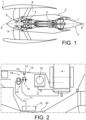
- a turbomachine comprises, in an annular nacelle 1, a stator 2 also annular, and a rotor 3 rotating in a central recess of the stator 2, this rotor 3 comprising a low pressure body 4 and a high pressure body 5 concentric.
- the axis around which the rotor 3 rotates, and all the rotating bodies, including the fan 6, which compose it, is referenced by XX.
- the low-pressure body 4 is extended by a fan 6 upstream of the turbomachine and the gas flow passing through it.
- the turbomachine comprises compressors, a combustion chamber and turbines, which are conventional elements on which we will not return, downstream of the fan 6.
- the embodiment shown comprises a main primary stream 7, extending around the rotor 3 and surrounded by the stator 2, and a secondary stream 8 surrounding the stator 2 and surrounded by the nacelle 1, and the fan 6 extends in front of the primary stream 7 as in front of secondary vein 8; but this configuration is not necessary to implement the invention.
- a speed reducer 9 connects the rotations of the low pressure body 4 to those of the fan 6, and it must be permanently lubricated as soon as it is no longer stopped.
- a lubrication circuit represented summarily at the figure 2 , and which comprises a supply oil tank 10, a lubrication conduit 11 originating from the oil tank 10, extending as far as the reducer 9 and comprising a pump 12, which it passes through, responsible for ensuring the circulation of the oil towards the reducer 9.
- the oil tank 10 is advantageously placed below the reducer 9 (at a normal orientation of the turbomachine) in a casing 40 of the turbomachine secured to the stator 17.
- Pump 12 is a gear pump. It is driven by external gears 13 from a toothing 14 depending on a fan shaft 15, driven by the fan 6 and connected to the reducer 9.
- the external gear 13 is preferably unique between the fan shaft 15 and a second shaft 28 described below.
- the low-pressure body 4 is also connected to the reducer 9.
- the pump 12 can be adjacent to a bearing 16 used to support the fan shaft 15 by a cylindrical surface 17 of the stator 2, without this being essential.
- the transmission 18 making it possible to drive the pump 12 from the teeth 14 also comprises a double gear 19 which will be described by means of the picture 3 .
- This double gear 19 comprises a toothed wheel 20 meshing by two opposite portions of teeth with two pinions 21 and 22 which are coaxial along a shaft, called first shaft 23, for driving the pump 12 and more precisely a drive pinion 24 located inside a casing 25 of the pump 12.
- the pinions 21 and 22 are identical and supported by the first shaft 23 via freewheels, respectively 26 and 27, whose directions of sliding rotation are identical.
- the toothed wheel 20 is connected to the external gear 13 by the second shaft 28, which drives it.
- the first shaft 23 and the second shaft 28 are perpendicular, and the pinions 21 and 22, as well as the toothed wheel 20 have bevel teeth and form gears 29 and 30 at right angles. Gears 29 and 30 could be replaced by other right angle gears, with other forms of toothing.
- the assembly is supported by a yoke 31 which contains the toothed wheel 20 and the pinions 21 and 22 in its central space 32, and supports the first shaft 23 by bearings 33 and 34, and the second shaft 28 by a bearing 35, these bearings can be plain bearings with an anti-wear coating, for example.
- the yoke 31 and the casing 25 are fixed to the stator of the turbomachine by means that are not shown.
- the device is extremely simple and compact, and that it involves the duplication of an extremely small number of parts to ensure the permanence of the oil flow in the right direction, whatever the direction of rotation of the rotating body which drives the pump 12, here the fan shaft 15.
- the choice of bevel teeth for the toothed wheel 20 and the pinions 21 and 22 increases the robustness and compactness of the device.
- FIG. 5 illustrates another possible embodiment of the invention.
- the second shaft 28 was a shaft extending in the radial direction of the turbomachine and of short length, in order to place the arrangement comprising essentially the pump 12 and the double gear 19 close to the bearing 16.
- the shaft 28 could be replaced by a shaft 38 of oblique direction, therefore provided with an inclination in the direction of the axis XX, which would also make it possible to offset the pump 12 in the axial direction, with the immediately visible advantage that the lubrication duct connecting the oil tank 10 to the reducer 9 would be shortened.
- the pump 12 is at an intermediate radius to the oil tank 10 on the one hand, the bearing 16 and the reducer 9 on the other hand, and its axial position, offset towards the rear of the turbomachine compared to the previous embodiment, is close to that of the oil tank 10.
- FIG. 6 Another construction to consider is that of the figure 6 , where the second short shaft 28 of the first embodiment and the second shaft 38 of medium length of the second embodiment are replaced by a second long shaft 41, in order to place the arrangement composed of the pump 12 and the double gear 19 adjacent to the oil tank 10.
- the shaft 41 may or may not be perpendicular to the axis XX.
- This arrangement makes it possible to reduce or even eliminate the portion of the lubrication conduit 11 upstream of the pump 12, and therefore the durations during which the pump 12 risks working empty, if this portion of the lubrication conduit is emptied.
- first shaft 23 which drives the pump 12, to be directly driven by one or the other of the freewheels 26 and 27, nor for the axes of the freewheels 26 and 27 are aligned with each other or with the axis of the pinion 24: transmissions, such as speed reducers, could be added to the embodiments described so far to adjust the speed of rotation of the pinion 24 according to that one or the other of the freewheels 26 and 27, or to give greater freedom of arrangement of the constituents of the arrangement.
- the arrangement of the first shaft 23 common to the pinion 24 and to each of the freewheels 26 and 27 certainly has the advantage of simplicity.
- the pinions, now 121 and 122 have different diameters and numbers of teeth, the toothed wheel 120 which drives them is inclined with respect to the first shaft 23 unchanged, the second shaft 128 is inclined accordingly, and the yoke 131 can be modified according to these other construction differences.
- the rest of the device can remain unchanged.
- This alternative embodiment has the advantage of being able to drive the drive pinion 24 at different speeds depending on that of the second shaft 128 according to the direction of rotation of the fan shaft 15, which corresponds to situations where lubrication needs may be different.
Landscapes
- Engineering & Computer Science (AREA)
- Chemical & Material Sciences (AREA)
- Combustion & Propulsion (AREA)
- Mechanical Engineering (AREA)
- General Engineering & Computer Science (AREA)
- General Details Of Gearings (AREA)
- Gear Transmission (AREA)
- Structures Of Non-Positive Displacement Pumps (AREA)
Description
- Le sujet de l'invention présente est un agencement de turbomachine d'aéronautique comprenant une pompe de lubrification entraînée par deux engrenages obliques.
- Cette pompe sert à injecter de l'huile dans un équipement à lubrifier, tel qu'un réducteur de vitesse, situé par exemple entre deux corps tournants, porteurs d'aubes, de la turbomachine. Une application particulièrement envisagée, sans être exclusive, est un tel agencement dans une turbomachine à soufflante amont, dans lequel le réducteur relie l'arbre de la soufflante à un arbre d'un corps basse pression, et la pompe est une pompe d'un circuit auxiliaire de lubrification, entraînée par l'un de ces arbres.
- Les équipements considérés ici doivent être lubrifiés en toutes circonstances quand la machine fonctionne pour éviter leur endommagement, mais certaines circonstances particulières peuvent empêcher le bon fonctionnement de la pompe responsable de la lubrification. Cela peut être le cas si le corps tournant entraînant la pompe tourne dans un sens inverse du sens habituel, en refoulant alors l'huile dans la bâche d'alimentation, tandis que le réducteur reste entraîné. Cela peut se produire dans des conditions de rotation libre (« windmilling ») des corps tournants du moteur, par exemple au sol sous l'effet du vent, où la soufflante peut tourner en sens inverse du sens normal.
- Le sujet de l'invention est un perfectionnement de tels agencements, qui permet de maintenir la lubrification de l'équipement même en cas d'inversion du sens de rotation du corps tournant qui entraîne la pompe.
- Les moyens plus spécialement constitutifs de l'invention permettent de proposer un agencement simple et compact, en évitant notamment de devoir dupliquer la pompe ou d'autres constituants de l'agencement pour le rendre apte à alimenter l'équipement quel que soit le sens de rotation du corps tournant. L'agencement comprend encore une pompe unique, entraînée par une transmission unique, dotée seulement d'un mécanisme absorbant les inversions de sens d'entraînement, de manière que le mouvement exercé sur la pompe soit toujours dans le même sens. Un autre avantage est qu'une grande liberté d'aménagement de l'agencement dans l'espace libre, souvent exigu, de la turbomachine est rendue possible.
-
US 2016/0222975 A1 décrit un dispositif de mise en rotation d'une pompe de lubrification par un arbre pouvant tourner dans les deux sens, au moyen d'un dispositif de transmission différent de celui de l'invention. -
US 2017/00151672 A1 - Sous une forme générale, l'invention est ainsi relative à un agencement de turbomachine d'aéronautique comprenant un corps tournant autour d'un axe et porteurs d'aubes, un équipement à lubrifier et un circuit de lubrifiant de l'équipement comprenant une pompe, et une transmission d'entraînement reliant le corps tournant de la turbomachine à la pompe, caractérisé en ce que la transmission comprend un premier arbre tournant relié à la pompe, deux pignons d'axes de rotation parallèle au premier arbre, et reliés au premier arbre par deux roues libres de sens de rotation glissante identiques, et une roue dentée engrenant avec chacun des pignons en formant deux engrenages obliques et entraînée par un second arbre tournant, connecté au corps tournant par une transmission.
- La seule portion de l'agencement qui est donc dédoublée est le pignon muni d'une roue libre, tout le reste de la transmission étant actif dans les deux sens de rotation du corps tournant.
- Le second arbre tournant peut faire un angle quelconque avec l'axe du corps tournant. Cet angle sera souvent droit ou proche de l'angle droit, mais il pourra être quelconque, y compris nul.
- Une configuration dans laquelle l'invention pourra particulièrement être appliquée est caractérisée en ce que l'équipement est un réducteur de vitesse de rotation, le réducteur étant placé entre de soufflante et un corps basse pression de la turbomachine, et le corps tournant entraînant la pompe est le corps de soufflante.
- Selon certaines caractéristiques optionnelles et avantageuses de l'invention :
- les pignons sont tous deux portés par le premier arbre, et donc coaxiaux à lui, par l'intermédiaire des roues libres ;
- l'équipement est un réducteur de vitesse de rotation, et le circuit de lubrification comprend encore une bâche à huile d'alimentation, et un conduit de lubrification originaire de la bâche à huile, s'étendant jusqu'à l'équipement et qui traverse la pompe ;
- les angles des engrenages obliques sont tous deux droits ;
- la pompe est adjacente à un roulement servant de support à un arbre porteur d'une denture reliée à des engrenages entraînant la pompe ;
- les pignons sont coniques, et la roue dentée a aussi une denture conique ;
- le corps tournant porte une denture reliée au second arbre par un engrenage unique ;
- l'agencement comprend une chape enveloppant le pignon et ladite roue dentée, la chape étant munie de deux paliers de support du premier arbre et d'un palier de support du second arbre.
- Un autre aspect général de l'invention concerne les possibilités d'agencement offertes par le dispositif de transmission comprenant le second arbre tournant, entraînant la roue dentée et s'étendant avantageusement jusqu'à la denture appartenant au corps tournant d'entraînement. Ce second arbre peut être perpendiculaire à l'axe du corps tournant, ce qui permet de déporter l'agencement de pompe d'une distance quelconque dans la direction radiale de la turbomachine ; il peut aussi être incliné dans la direction de l'axe du corps tournant, ce qui permet aussi de déporter l'agencement d'une distance axiale quelconque dans la turbomachine.
- Il devient ainsi possible de placer l'agencement au mieux des possibilités d'aménagement dans les volumes vides proches de l'équipement à lubrifier. Une possibilité intéressante peut consister, comme on l'a vu, à rendre l'agencement adjacent à un roulement lui-même adjacent à l'équipement ; une autre possibilité intéressante consiste à rendre l'agencement adjacent à la bâche à huile pour réduire ou éliminer les fonctionnements à vide de la pompe ; il est même possible de rendre la pompe intérieure à la bâche à huile.
- Un autre aspect de l'invention est une turbomachine comprenant un équipement selon ce qui précède.
- Les différents aspects, caractéristiques et avantages de l'invention seront maintenant décrits plus en détail au moyen des figures suivantes, qui illustrent une réalisation préférée de celle-là, donnée à titre purement illustratif :
-
Figure 1 est une vue générale d'une turbomachine, indiquant une position possible de l'invention ; -
Figure 2 représente une réalisation de l'invention en général ; -
Figure 3 une vue de détail de l'extrémité de l'agencement et de la pompe ; -
Figure 4 une coupe réalisée à travers ladite portion ; -
Figure 5 une deuxième réalisation de l'invention ; -
Figure 6 une troisième réalisation de l'invention ; -
Figure 7 une quatrième réalisation de l'invention. - On se reporte à la
figure 1 . - Une turbomachine comprend, dans une nacelle 1 annulaire, un stator 2 aussi annulaire, et un rotor 3 tournant dans un évidement central du stator 2, ce rotor 3 comprenant un corps basse pression 4 et un corps haute pression 5 concentriques. On référence par X-X l'axe autour duquel tourne le rotor 3, et tous les corps tournants, y compris la soufflante 6, qui le composent. Le corps basse pression 4 est prolongé par une soufflante 6 à l'amont de la turbomachine et de l'écoulement des gaz qui la traverse. La turbomachine comprend des compresseurs, une chambre de combustion et des turbines, qui sont des éléments classiques sur lesquels on ne reviendra pas, en aval de la soufflante 6. La réalisation représentée comprend une veine primaire 7 principale, s'étendant autour du rotor 3 et entourée par le stator 2, et une veine secondaire 8 entourant le stator 2 et entourée par la nacelle 1, et la soufflante 6 s'étend devant la veine primaire 7 comme devant la veine secondaire 8 ; mais cette configuration n'est pas nécessaire pour implanter l'invention.
- Un réducteur 9 de vitesse relie les rotations du corps basse pression 4 à celles de la soufflante 6, et il doit être lubrifié en permanence dès qu'il n'est plus à l'arrêt. On dispose donc un circuit de lubrification, représenté sommairement à la
figure 2 , et qui comprend une bâche à huile 10 d'alimentation, un conduit de lubrification 11 originaire de la bâche à huile 10, s'étendant jusqu'au réducteur 9 et comprenant une pompe 12, qu'il traverse, chargée d'assurer la circulation de l'huile vers le réducteur 9. La bâche à huile 10 est avantageusement placée en contrebas du réducteur 9 (à une orientation normale de la turbomachine) dans un carter 40 de la turbomachine solidaire du stator 17. Cette disposition permet à l'huile d'être dirigée du réducteur 9 vers la bâche à huile 10 par force de gravité et d'être ensuite renvoyée dans le réducteur 9 par le dispositif selon l'invention dès que la soufflante 6 n'est pas à l'arrêt. La lubrification est ainsi continûment assurée. La pompe 12 est une pompe à engrenages. Elle est entraînée par des engrenages extérieurs 13 à partir d'une denture 14 dépendant d'un arbre de soufflante 15, entraîné par la soufflante 6 et connecté au réducteur 9. L'engrenage extérieur 13 est de préférence unique entre l'arbre de soufflante 15 et un second arbre 28 décrit ci-dessous. Le corps basse pression 4 est aussi connecté au réducteur 9. La pompe 12 peut être adjacente à un roulement 16 servant au support de l'arbre de soufflante 15 par une portée cylindrique 17 du stator 2, sans que cela soit essentiel. - La transmission 18 permettant d'entraîner la pompe 12 à partir de la denture 14 comprend encore un double engrenage 19 qu'on va décrire au moyen de la
figure 3 . - Ce double engrenage 19 comprend une roue dentée 20 engrenant par deux portions opposées de denture avec deux pignons 21 et 22 qui sont coaxiaux le long d'un arbre, dit premier arbre 23, d'entraînement de la pompe 12 et plus précisément d'un pignon d'attaque 24 situé à l'intérieur d'un carter 25 de la pompe 12. Les pignons 21 et 22 sont identiques et soutenus par le premier arbre 23 par l'intermédiaire de roues libres, respectivement 26 et 27, dont les sens de rotation glissante sont identiques. La roue dentée 20 est reliée à l'engrenage extérieur 13 par le second arbre 28, qui l'entraîne. Le premier arbre 23 et le second arbre 28 sont perpendiculaires, et les pignons 21 et 22, ainsi que la roue dentée 20 sont à denture conique et forment des engrenages 29 et 30 à angle droit. Les engrenages 29 et 30 pourraient être remplacés par d'autres engrenages à angle droit, avec d'autres formes de denture. L'ensemble est soutenu par une chape 31 qui contient la roue dentée 20 et les pignons 21 et 22 dans son espace central 32, et soutient le premier arbre 23 par des paliers 33 et 34, et le second arbre 28 par un palier 35, ces paliers pouvant être des paliers lisses à revêtement anti-usure par exemple. La chape 31 et le carter 25 sont fixés au stator de la turbomachine par des moyens non représentés.
- Comme les sens de rotation glissante des roues libres 26 et 27 sont identiques, on voit que le premier arbre 23 est entraîné dans un sens par l'engrenage 29 quand le second arbre 28 et la roue dentée 20 tournent dans un sens, et qu'il est entraîné dans le même sens par l'autre engrenage 30 quand le second arbre 28 et la roue dentée 20 tournent dans le sens contraire. Les sens des mouvements du pignon d'attaque 24 et d'autre pignon 36 à l'intérieur de la pompe 12 sont donc toujours identiques, et l'huile est entraînée toujours dans le même sens par le conduit 11, qui débouche à l'intérieur du carter 25 devant l'engrenage 37 formé par ces deux pignons 24 et 36. On voit donc que le dispositif est extrêmement simple et compact, et qu'il implique la duplication d'un nombre extrêmement réduit de pièces pour assurer la permanence de l'écoulement d'huile dans le bon sens, quel que soit le sens de rotation du corps tournant qui entraîne la pompe 12, ici l'arbre de soufflante 15. Le choix des dentures coniques pour la roue dentée 20 et les pignons 21 et 22 accroît la robustesse et la compacité du dispositif.
- La
figure 5 illustre une autre réalisation possible de l'invention. Dans la réalisation précédente, le second arbre 28 était un arbre s'étendant en direction radiale de la turbomachine et de longueur courte, afin de placer l'agencement comprenant essentiellement la pompe 12 et le double engrenage 19 près du roulement 16. Cela n'est pas nécessairement avantageux, et l'arbre 28 pourrait être remplacé par un arbre 38 de direction oblique, donc pourvu d'une inclinaison dans la direction de l'axe X-X, qui permettrait de déporter aussi la pompe 12 dans la direction axiale, avec l'avantage immédiatement visible que le conduit de lubrification reliant la bâche à huile 10 au réducteur 9 serait raccourci. Dans la réalisation représentée ici, la pompe 12 est à un rayon intermédiaire à la bâche à huile 10 d'une part, le roulement 16 et le réducteur 9 d'autre part, et sa position axiale, déportée vers l'arrière de la turbomachine par rapport à la réalisation précédente, est proche de celle de la bâche à huile 10. - Une autre construction à considérer est celle de la
figure 6 , où le second arbre 28 court de la première réalisation et le second arbre 38 de longueur moyenne de la deuxième réalisation sont remplacés par un second arbre 41 long, afin de placer l'agencement composé de la pompe 12 et du double engrenage 19 adjacent à la bâche à huile 10. L'arbre 41 peut être perpendiculaire ou non à l'axe X-X. Dans une variante de réalisation qui est représentée ici, il sera même possible de placer la pompe 12 à l'intérieur de la bâche à huile, éventuellement modifiée d'après le contour 42 pour pouvoir la contenir. Cette disposition permet de réduire ou même de supprimer la portion du conduit de lubrification 11 en amont de la pompe 12, et donc les durées pendant lesquelles la pompe 12 risque de travailler à vide, si cette portion du conduit de lubrification s'est vidée. - D'une façon plus générale, il est donc possible d'ajuster à la fois la longueur et l'inclinaison de l'arbre de transmission du mouvement au double engrenage 19, afin de placer celui-ci et la pompe 12 à l'endroit le plus approprié. Il peut alors devenir possible et intéressant de modifier d'autres aménagements environnants concernant, par exemple, la soufflante 6 en exploitant le déplacement de la pompe 12.
- Quelques autres possibilités de construction vont maintenant être explicitées. Il n'est tout d'abord pas nécessaire que le premier arbre 23, qui entraîne la pompe 12, soit directement entraîné par l'une ou l'autre des roues libres 26 et 27, ni que les axes des roues libres 26 et 27 soient alignés entre eux ou avec l'axe du pignon d'attaque 24 : des transmissions, telles des réducteurs de vitesse, pourraient être ajoutées aux réalisations décrites jusqu'ici pour ajuster la vitesse de rotation du pignon d'attaque 24 en fonction de celle de l'une ou l'autre des roues libres 26 et 27, ou pour donner une plus grande liberté de disposition des constituants de l'agencement. La disposition du premier arbre 23 commun au pignon d'attaque 24 et à chacune des roues libres 26 et 27 a certes l'avantage de la simplicité.
- On abordera maintenant une autre variante possible de réalisation de l'invention, d'après laquelle les engrenages coniques 29 et 30 à angles droit sont remplacés, d'après la
figure 7 , par d'autres engrenages coniques 129 et 130, dont les valeurs α et β sont différentes. Les constituants modifiés par rapport aux réalisations précédentes portent ici les mêmes références augmentées de 100. α et β sont aussi les angles entre l'axe de rotation du second arbre 128 et les axes de rotation des pignons 121 et 122 ; ici, α > β et α + β = 180°. Dans cette construction, les pignons, maintenant 121 et 122, ont des diamètres et des nombres de dents différents, la roue dentée 120 qui les entraîne est inclinée par rapport au premier arbre 23 inchangé, le second arbre 128 est incliné en conséquence, et la chape 131 peut être modifiée en fonction de ces autres différences de construction. Le reste du dispositif peut rester inchangé. Cette variante de réalisation a l'avantage de pouvoir entraîner le pignon d'attaque 24 à des vitesses différentes en fonction de celle du second arbre 128 d'après le sens de rotation de l'arbre de soufflante 15, qui correspond à des situations où les besoins de lubrification peuvent être différents.
Claims (12)
- Agencement de turbomachine d'aéronautique comprenant un corps tournant autour d'un axe et porteur d'aubes, un équipement (9) à lubrifier et un circuit (10, 11, 12) de lubrifiant de l'équipement comprenant une pompe (12), et une transmission d'entraînement reliant le corps tournant (15) de la turbomachine à la pompe, caractérisé en ce que la transmission comprend un premier arbre (23) tournant relié à la pompe, deux pignons (21, 22), d'axes de rotation parallèles au premier arbre, et reliés au premier arbre par deux roues libres (26, 27) de sens de rotation glissante identiques, et une roue dentée (20) engrenant avec chacun des pignons en formant deux engrenages obliques, et entraînée par un second arbre tournant (28, 38, 41), connecté au corps tournant par une transmission.
- Agencement de turbomachine selon la revendication 1, caractérisé en ce que l'équipement (9) est un réducteur de vitesse de rotation, et ledit corps tournant (15, 6) est un corps de soufflante (6) de la turbomachine, le réducteur étant placé entre le corps de soufflante et un corps basse pression (4) de la turbomachine.
- Agencement de turbomachine selon l'une quelconque des revendications 1 ou 2, caractérisé en ce que le circuit de lubrification comprend encore une bâche à huile (10) d'alimentation, et un conduit de lubrification (11) originaire de la bâche à huile (10), s'étendant jusqu'à l'équipement (9) et qui traverse la pompe (12).
- Agencement de turbomachine selon l'une quelconque des revendications 1 à 3, caractérisé en ce que la pompe (12) est adjacente à un roulement (16) servant de support audit corps tournant (15).
- Agencement de turbomachine selon la revendication 4, caractérisé en ce que le corps tournant (15) porte une denture (14) reliée au second arbre (28) par un engrenage (13) unique.
- Agencement de turbomachine selon l'une quelconque des revendications 1 à 5, caractérisé en ce qu'il comprend une chape (31) enveloppant les pignons et ladite roue dentée, et munie de deux paliers de support du premier arbre et d'un palier de support du second arbre.
- Agencement de turbomachine selon l'une quelconque des revendications 1 à 6, caractérisé en ce que les pignons sont tous deux portés par le premier arbre, et coaxiaux au premier arbre, par l'intermédiaire des roues libres.
- Agencement de turbomachine selon l'une quelconque des revendications 1 à 7, caractérisé en ce que les engrenages obliques sont tous deux à angle droit.
- Agencement de turbomachine selon l'une quelconque des revendications 1 à 8, caractérisé en ce que le second arbre (28) est perpendiculaire audit axe du corps tournant (15).
- Agencement de turbomachine selon l'une quelconque des revendications 1 à 8, caractérisé en ce que le second arbre (38) est incliné en direction dudit axe du corps tournant (15).
- Agencement de turbomachine selon la revendication 3, caractérisé en ce que la pompe (12) est adjacente ou intérieure à la bâche à huile (10, 42).
- Turbomachine, caractérisée en ce qu'elle comprend un agencement conforme à l'une quelconque des revendications précédentes.
Applications Claiming Priority (2)
| Application Number | Priority Date | Filing Date | Title |
|---|---|---|---|
| FR1907397A FR3098240B1 (fr) | 2019-07-03 | 2019-07-03 | Agencement de turbomachines d’aeronautique comprenant une pompe de lubrification entrainee par deux engrenages d’angle droit |
| PCT/FR2020/051028 WO2021001609A1 (fr) | 2019-07-03 | 2020-06-16 | Agencement de turbomachines d'aeronautique comprenant une pompe de lubrification entrainee par deux engrenages obliques |
Publications (2)
| Publication Number | Publication Date |
|---|---|
| EP3973158A1 EP3973158A1 (fr) | 2022-03-30 |
| EP3973158B1 true EP3973158B1 (fr) | 2023-03-29 |
Family
ID=67875742
Family Applications (1)
| Application Number | Title | Priority Date | Filing Date |
|---|---|---|---|
| EP20742342.7A Active EP3973158B1 (fr) | 2019-07-03 | 2020-06-16 | Agencement de turbomachines d'aeronautique comprenant une pompe de lubrification entrainee par deux engrenages obliques |
Country Status (5)
| Country | Link |
|---|---|
| US (1) | US11852079B2 (fr) |
| EP (1) | EP3973158B1 (fr) |
| CN (1) | CN114127397B (fr) |
| FR (1) | FR3098240B1 (fr) |
| WO (1) | WO2021001609A1 (fr) |
Cited By (1)
| Publication number | Priority date | Publication date | Assignee | Title |
|---|---|---|---|---|
| US20250341177A1 (en) * | 2022-05-23 | 2025-11-06 | Safran Aero Boosters | Polygonal profile coupling of pumps in a lubrication assembly |
Families Citing this family (2)
| Publication number | Priority date | Publication date | Assignee | Title |
|---|---|---|---|---|
| FR3098240B1 (fr) * | 2019-07-03 | 2021-07-16 | Safran Aircraft Engines | Agencement de turbomachines d’aeronautique comprenant une pompe de lubrification entrainee par deux engrenages d’angle droit |
| US12291102B2 (en) * | 2023-01-17 | 2025-05-06 | Dana Belgium N.V. | Pump assembly in a transmission and pump assembly operating method |
Family Cites Families (17)
| Publication number | Priority date | Publication date | Assignee | Title |
|---|---|---|---|---|
| GB1559879A (en) * | 1976-08-14 | 1980-01-30 | Rolls Royce | Bevel gearing |
| US5472383A (en) * | 1993-12-27 | 1995-12-05 | United Technologies Corporation | Lubrication system for a planetary gear train |
| US5845483A (en) * | 1996-04-10 | 1998-12-08 | General Electric Company | Windmill engine starting system with fluid driven motor and pump |
| JP2002286112A (ja) * | 2001-03-26 | 2002-10-03 | Yasushi Watabe | 往復運動の定方向回転運動への変換装置 |
| US9097186B2 (en) * | 2012-01-29 | 2015-08-04 | United Technologies Corporation | Bevel gear arrangement for axial accessory gearbox |
| US8702373B1 (en) * | 2013-07-15 | 2014-04-22 | United Technologies Corporation | Lubrication of journal bearing during clockwise and counter-clockwise rotation |
| WO2015060912A2 (fr) * | 2013-09-19 | 2015-04-30 | United Technologies Corporation | Pompe de moulinet à deux directions pour turboréacteur à engrenages |
| FR3020410B1 (fr) * | 2014-04-29 | 2021-09-17 | Snecma | Turbomachine d'aeronef a prelevement de puissance mecanique ameliore |
| FR3026787B1 (fr) * | 2014-10-07 | 2019-04-19 | Safran Transmission Systems | Transmission spinale compacte |
| KR101684512B1 (ko) * | 2015-05-13 | 2016-12-08 | 현대자동차 주식회사 | 차량용 자동변속기의 유성기어트레인 |
| US11022043B2 (en) * | 2015-10-05 | 2021-06-01 | Safran Aircraft Engines | Turbine engine with fan and reduction of speed on the shaft of the power turbine |
| US11203949B2 (en) * | 2016-08-11 | 2021-12-21 | General Electric Company | Mechanically driven air vehicle thermal management device |
| CN107314082A (zh) * | 2017-08-14 | 2017-11-03 | 潘智成 | 一种双向输入单向输出齿轮机构 |
| FR3075879B1 (fr) * | 2017-12-22 | 2019-11-15 | Safran Aircraft Engines | Ensemble d'arbres pour une turbomachine d'aeronef |
| FR3086343B1 (fr) * | 2018-09-24 | 2020-09-04 | Safran Aircraft Engines | Turbomachine a reducteur pour un aeronef |
| FR3098240B1 (fr) * | 2019-07-03 | 2021-07-16 | Safran Aircraft Engines | Agencement de turbomachines d’aeronautique comprenant une pompe de lubrification entrainee par deux engrenages d’angle droit |
| US11530617B2 (en) * | 2020-10-26 | 2022-12-20 | Antheon Research, Inc. | Gas turbine propulsion system |
-
2019
- 2019-07-03 FR FR1907397A patent/FR3098240B1/fr not_active Expired - Fee Related
-
2020
- 2020-06-16 CN CN202080051704.5A patent/CN114127397B/zh active Active
- 2020-06-16 US US17/624,113 patent/US11852079B2/en active Active
- 2020-06-16 EP EP20742342.7A patent/EP3973158B1/fr active Active
- 2020-06-16 WO PCT/FR2020/051028 patent/WO2021001609A1/fr not_active Ceased
Cited By (1)
| Publication number | Priority date | Publication date | Assignee | Title |
|---|---|---|---|---|
| US20250341177A1 (en) * | 2022-05-23 | 2025-11-06 | Safran Aero Boosters | Polygonal profile coupling of pumps in a lubrication assembly |
Also Published As
| Publication number | Publication date |
|---|---|
| EP3973158A1 (fr) | 2022-03-30 |
| US11852079B2 (en) | 2023-12-26 |
| CN114127397B (zh) | 2025-02-25 |
| WO2021001609A1 (fr) | 2021-01-07 |
| FR3098240A1 (fr) | 2021-01-08 |
| FR3098240B1 (fr) | 2021-07-16 |
| US20220364517A1 (en) | 2022-11-17 |
| CN114127397A (zh) | 2022-03-01 |
Similar Documents
| Publication | Publication Date | Title |
|---|---|---|
| CA2946710C (fr) | Turbomachine d'aeronef a prelevement de puissance mecanique ameliore | |
| EP3973158B1 (fr) | Agencement de turbomachines d'aeronautique comprenant une pompe de lubrification entrainee par deux engrenages obliques | |
| EP3137740B1 (fr) | Assemblage pour turbomachine d'aeronef et son procede de montage | |
| CA2938385C (fr) | Turbomachine equipee d'un groupe de lubrification | |
| EP3726097B1 (fr) | Reducteur mecanique de turbomachine d'aeronef | |
| EP3956555B1 (fr) | Reducteur de vitesse d'une turbomachine | |
| EP1701019A1 (fr) | Turbomoteur à double corps avec des moyens de prise de mouvement sur les rotors basse pression et haute pression, module de prise de mouvement pour le turbomoteur et procédé de montage du turbomoteur | |
| EP3119995B1 (fr) | Relais d'accessoires pour moteur à turbine à gaz | |
| EP3247924B1 (fr) | Intégration d'une pompe en fût de pignon | |
| CA2968251A1 (fr) | Palier lisse auto-centrant | |
| EP3601747B1 (fr) | Relais d'accessoires pour moteur a turbine a gaz | |
| EP4127417B1 (fr) | Ensemble pour turbomachine d'aéronef comportant un système amelioré de lubrification d'un réducteur d'entrainement de soufflante | |
| FR3109963A1 (fr) | Module de lubrification d’un reducteur de soufflante de turbomachine en phase d’autorotation de la soufflante | |
| EP4242489A1 (fr) | Reducteur mecanique de turbomachine d'aeronef | |
| WO2022049342A1 (fr) | Assemblage pour turbomachine d'aéronef, comprenant des moyens de rétention axiale et radiale de soufflante | |
| FR3153866A1 (fr) | Reducteur mecanique de vitesse a barbotage d’huile | |
| FR3001496A1 (fr) | Dispositif de lubrification d'un palier d'un arbre tournant d'une turbomachine | |
| WO2025176957A1 (fr) | Dispositif d'alimentation en huile pour un reducteur mecanique d'une turbomachine d'aeronef | |
| FR3098258A1 (fr) | Pompe à engrenages basculante pour turbomachine, incorporable à un circuit de lubrification de moteur d’aéronef | |
| FR3097269A1 (fr) | Integration d’un reservoir d’huile a un reducteur mecanique de turbomachine d’aeronef |
Legal Events
| Date | Code | Title | Description |
|---|---|---|---|
| STAA | Information on the status of an ep patent application or granted ep patent |
Free format text: STATUS: UNKNOWN |
|
| STAA | Information on the status of an ep patent application or granted ep patent |
Free format text: STATUS: THE INTERNATIONAL PUBLICATION HAS BEEN MADE |
|
| PUAI | Public reference made under article 153(3) epc to a published international application that has entered the european phase |
Free format text: ORIGINAL CODE: 0009012 |
|
| STAA | Information on the status of an ep patent application or granted ep patent |
Free format text: STATUS: REQUEST FOR EXAMINATION WAS MADE |
|
| 17P | Request for examination filed |
Effective date: 20211224 |
|
| AK | Designated contracting states |
Kind code of ref document: A1 Designated state(s): AL AT BE BG CH CY CZ DE DK EE ES FI FR GB GR HR HU IE IS IT LI LT LU LV MC MK MT NL NO PL PT RO RS SE SI SK SM TR |
|
| DAV | Request for validation of the european patent (deleted) | ||
| DAX | Request for extension of the european patent (deleted) | ||
| GRAP | Despatch of communication of intention to grant a patent |
Free format text: ORIGINAL CODE: EPIDOSNIGR1 |
|
| STAA | Information on the status of an ep patent application or granted ep patent |
Free format text: STATUS: GRANT OF PATENT IS INTENDED |
|
| GRAS | Grant fee paid |
Free format text: ORIGINAL CODE: EPIDOSNIGR3 |
|
| INTG | Intention to grant announced |
Effective date: 20230124 |
|
| GRAA | (expected) grant |
Free format text: ORIGINAL CODE: 0009210 |
|
| STAA | Information on the status of an ep patent application or granted ep patent |
Free format text: STATUS: THE PATENT HAS BEEN GRANTED |
|
| AK | Designated contracting states |
Kind code of ref document: B1 Designated state(s): AL AT BE BG CH CY CZ DE DK EE ES FI FR GB GR HR HU IE IS IT LI LT LU LV MC MK MT NL NO PL PT RO RS SE SI SK SM TR |
|
| REG | Reference to a national code |
Ref country code: CH Ref legal event code: EP |
|
| REG | Reference to a national code |
Ref country code: DE Ref legal event code: R096 Ref document number: 602020009278 Country of ref document: DE |
|
| REG | Reference to a national code |
Ref country code: AT Ref legal event code: REF Ref document number: 1556814 Country of ref document: AT Kind code of ref document: T Effective date: 20230415 |
|
| REG | Reference to a national code |
Ref country code: IE Ref legal event code: FG4D Free format text: LANGUAGE OF EP DOCUMENT: FRENCH |
|
| REG | Reference to a national code |
Ref country code: LT Ref legal event code: MG9D |
|
| PG25 | Lapsed in a contracting state [announced via postgrant information from national office to epo] |
Ref country code: RS Free format text: LAPSE BECAUSE OF FAILURE TO SUBMIT A TRANSLATION OF THE DESCRIPTION OR TO PAY THE FEE WITHIN THE PRESCRIBED TIME-LIMIT Effective date: 20230329 Ref country code: NO Free format text: LAPSE BECAUSE OF FAILURE TO SUBMIT A TRANSLATION OF THE DESCRIPTION OR TO PAY THE FEE WITHIN THE PRESCRIBED TIME-LIMIT Effective date: 20230629 Ref country code: LV Free format text: LAPSE BECAUSE OF FAILURE TO SUBMIT A TRANSLATION OF THE DESCRIPTION OR TO PAY THE FEE WITHIN THE PRESCRIBED TIME-LIMIT Effective date: 20230329 Ref country code: LT Free format text: LAPSE BECAUSE OF FAILURE TO SUBMIT A TRANSLATION OF THE DESCRIPTION OR TO PAY THE FEE WITHIN THE PRESCRIBED TIME-LIMIT Effective date: 20230329 Ref country code: HR Free format text: LAPSE BECAUSE OF FAILURE TO SUBMIT A TRANSLATION OF THE DESCRIPTION OR TO PAY THE FEE WITHIN THE PRESCRIBED TIME-LIMIT Effective date: 20230329 |
|
| REG | Reference to a national code |
Ref country code: NL Ref legal event code: MP Effective date: 20230329 |
|
| REG | Reference to a national code |
Ref country code: AT Ref legal event code: MK05 Ref document number: 1556814 Country of ref document: AT Kind code of ref document: T Effective date: 20230329 |
|
| PG25 | Lapsed in a contracting state [announced via postgrant information from national office to epo] |
Ref country code: SE Free format text: LAPSE BECAUSE OF FAILURE TO SUBMIT A TRANSLATION OF THE DESCRIPTION OR TO PAY THE FEE WITHIN THE PRESCRIBED TIME-LIMIT Effective date: 20230329 Ref country code: NL Free format text: LAPSE BECAUSE OF FAILURE TO SUBMIT A TRANSLATION OF THE DESCRIPTION OR TO PAY THE FEE WITHIN THE PRESCRIBED TIME-LIMIT Effective date: 20230329 Ref country code: GR Free format text: LAPSE BECAUSE OF FAILURE TO SUBMIT A TRANSLATION OF THE DESCRIPTION OR TO PAY THE FEE WITHIN THE PRESCRIBED TIME-LIMIT Effective date: 20230630 Ref country code: FI Free format text: LAPSE BECAUSE OF FAILURE TO SUBMIT A TRANSLATION OF THE DESCRIPTION OR TO PAY THE FEE WITHIN THE PRESCRIBED TIME-LIMIT Effective date: 20230329 |
|
| PG25 | Lapsed in a contracting state [announced via postgrant information from national office to epo] |
Ref country code: SM Free format text: LAPSE BECAUSE OF FAILURE TO SUBMIT A TRANSLATION OF THE DESCRIPTION OR TO PAY THE FEE WITHIN THE PRESCRIBED TIME-LIMIT Effective date: 20230329 Ref country code: RO Free format text: LAPSE BECAUSE OF FAILURE TO SUBMIT A TRANSLATION OF THE DESCRIPTION OR TO PAY THE FEE WITHIN THE PRESCRIBED TIME-LIMIT Effective date: 20230329 Ref country code: PT Free format text: LAPSE BECAUSE OF FAILURE TO SUBMIT A TRANSLATION OF THE DESCRIPTION OR TO PAY THE FEE WITHIN THE PRESCRIBED TIME-LIMIT Effective date: 20230731 Ref country code: ES Free format text: LAPSE BECAUSE OF FAILURE TO SUBMIT A TRANSLATION OF THE DESCRIPTION OR TO PAY THE FEE WITHIN THE PRESCRIBED TIME-LIMIT Effective date: 20230329 Ref country code: EE Free format text: LAPSE BECAUSE OF FAILURE TO SUBMIT A TRANSLATION OF THE DESCRIPTION OR TO PAY THE FEE WITHIN THE PRESCRIBED TIME-LIMIT Effective date: 20230329 Ref country code: AT Free format text: LAPSE BECAUSE OF FAILURE TO SUBMIT A TRANSLATION OF THE DESCRIPTION OR TO PAY THE FEE WITHIN THE PRESCRIBED TIME-LIMIT Effective date: 20230329 |
|
| PG25 | Lapsed in a contracting state [announced via postgrant information from national office to epo] |
Ref country code: SK Free format text: LAPSE BECAUSE OF FAILURE TO SUBMIT A TRANSLATION OF THE DESCRIPTION OR TO PAY THE FEE WITHIN THE PRESCRIBED TIME-LIMIT Effective date: 20230329 Ref country code: PL Free format text: LAPSE BECAUSE OF FAILURE TO SUBMIT A TRANSLATION OF THE DESCRIPTION OR TO PAY THE FEE WITHIN THE PRESCRIBED TIME-LIMIT Effective date: 20230329 Ref country code: IS Free format text: LAPSE BECAUSE OF FAILURE TO SUBMIT A TRANSLATION OF THE DESCRIPTION OR TO PAY THE FEE WITHIN THE PRESCRIBED TIME-LIMIT Effective date: 20230729 |
|
| REG | Reference to a national code |
Ref country code: DE Ref legal event code: R097 Ref document number: 602020009278 Country of ref document: DE |
|
| PG25 | Lapsed in a contracting state [announced via postgrant information from national office to epo] |
Ref country code: MC Free format text: LAPSE BECAUSE OF FAILURE TO SUBMIT A TRANSLATION OF THE DESCRIPTION OR TO PAY THE FEE WITHIN THE PRESCRIBED TIME-LIMIT Effective date: 20230329 |
|
| PG25 | Lapsed in a contracting state [announced via postgrant information from national office to epo] |
Ref country code: MC Free format text: LAPSE BECAUSE OF FAILURE TO SUBMIT A TRANSLATION OF THE DESCRIPTION OR TO PAY THE FEE WITHIN THE PRESCRIBED TIME-LIMIT Effective date: 20230329 Ref country code: DK Free format text: LAPSE BECAUSE OF FAILURE TO SUBMIT A TRANSLATION OF THE DESCRIPTION OR TO PAY THE FEE WITHIN THE PRESCRIBED TIME-LIMIT Effective date: 20230329 Ref country code: CZ Free format text: LAPSE BECAUSE OF FAILURE TO SUBMIT A TRANSLATION OF THE DESCRIPTION OR TO PAY THE FEE WITHIN THE PRESCRIBED TIME-LIMIT Effective date: 20230329 |
|
| REG | Reference to a national code |
Ref country code: CH Ref legal event code: PL |
|
| PLBE | No opposition filed within time limit |
Free format text: ORIGINAL CODE: 0009261 |
|
| STAA | Information on the status of an ep patent application or granted ep patent |
Free format text: STATUS: NO OPPOSITION FILED WITHIN TIME LIMIT |
|
| REG | Reference to a national code |
Ref country code: BE Ref legal event code: MM Effective date: 20230630 |
|
| PG25 | Lapsed in a contracting state [announced via postgrant information from national office to epo] |
Ref country code: LU Free format text: LAPSE BECAUSE OF NON-PAYMENT OF DUE FEES Effective date: 20230616 |
|
| 26N | No opposition filed |
Effective date: 20240103 |
|
| REG | Reference to a national code |
Ref country code: IE Ref legal event code: MM4A |
|
| PG25 | Lapsed in a contracting state [announced via postgrant information from national office to epo] |
Ref country code: LU Free format text: LAPSE BECAUSE OF NON-PAYMENT OF DUE FEES Effective date: 20230616 |
|
| PG25 | Lapsed in a contracting state [announced via postgrant information from national office to epo] |
Ref country code: IE Free format text: LAPSE BECAUSE OF NON-PAYMENT OF DUE FEES Effective date: 20230616 |
|
| PG25 | Lapsed in a contracting state [announced via postgrant information from national office to epo] |
Ref country code: IE Free format text: LAPSE BECAUSE OF NON-PAYMENT OF DUE FEES Effective date: 20230616 Ref country code: CH Free format text: LAPSE BECAUSE OF NON-PAYMENT OF DUE FEES Effective date: 20230630 |
|
| PG25 | Lapsed in a contracting state [announced via postgrant information from national office to epo] |
Ref country code: SI Free format text: LAPSE BECAUSE OF FAILURE TO SUBMIT A TRANSLATION OF THE DESCRIPTION OR TO PAY THE FEE WITHIN THE PRESCRIBED TIME-LIMIT Effective date: 20230329 |
|
| PG25 | Lapsed in a contracting state [announced via postgrant information from national office to epo] |
Ref country code: SI Free format text: LAPSE BECAUSE OF FAILURE TO SUBMIT A TRANSLATION OF THE DESCRIPTION OR TO PAY THE FEE WITHIN THE PRESCRIBED TIME-LIMIT Effective date: 20230329 Ref country code: IT Free format text: LAPSE BECAUSE OF FAILURE TO SUBMIT A TRANSLATION OF THE DESCRIPTION OR TO PAY THE FEE WITHIN THE PRESCRIBED TIME-LIMIT Effective date: 20230329 Ref country code: BE Free format text: LAPSE BECAUSE OF NON-PAYMENT OF DUE FEES Effective date: 20230630 |
|
| PG25 | Lapsed in a contracting state [announced via postgrant information from national office to epo] |
Ref country code: BG Free format text: LAPSE BECAUSE OF FAILURE TO SUBMIT A TRANSLATION OF THE DESCRIPTION OR TO PAY THE FEE WITHIN THE PRESCRIBED TIME-LIMIT Effective date: 20230329 |
|
| PG25 | Lapsed in a contracting state [announced via postgrant information from national office to epo] |
Ref country code: BG Free format text: LAPSE BECAUSE OF FAILURE TO SUBMIT A TRANSLATION OF THE DESCRIPTION OR TO PAY THE FEE WITHIN THE PRESCRIBED TIME-LIMIT Effective date: 20230329 |
|
| PGFP | Annual fee paid to national office [announced via postgrant information from national office to epo] |
Ref country code: DE Payment date: 20250618 Year of fee payment: 6 |
|
| PGFP | Annual fee paid to national office [announced via postgrant information from national office to epo] |
Ref country code: GB Payment date: 20250625 Year of fee payment: 6 |
|
| PGFP | Annual fee paid to national office [announced via postgrant information from national office to epo] |
Ref country code: FR Payment date: 20250620 Year of fee payment: 6 |
|
| PG25 | Lapsed in a contracting state [announced via postgrant information from national office to epo] |
Ref country code: CY Free format text: LAPSE BECAUSE OF FAILURE TO SUBMIT A TRANSLATION OF THE DESCRIPTION OR TO PAY THE FEE WITHIN THE PRESCRIBED TIME-LIMIT; INVALID AB INITIO Effective date: 20200616 |
|
| PG25 | Lapsed in a contracting state [announced via postgrant information from national office to epo] |
Ref country code: HU Free format text: LAPSE BECAUSE OF FAILURE TO SUBMIT A TRANSLATION OF THE DESCRIPTION OR TO PAY THE FEE WITHIN THE PRESCRIBED TIME-LIMIT; INVALID AB INITIO Effective date: 20200616 |
|
| PG25 | Lapsed in a contracting state [announced via postgrant information from national office to epo] |
Ref country code: TR Free format text: LAPSE BECAUSE OF FAILURE TO SUBMIT A TRANSLATION OF THE DESCRIPTION OR TO PAY THE FEE WITHIN THE PRESCRIBED TIME-LIMIT Effective date: 20230329 |