EP3972961B1 - Method for preparation of carsalam - Google Patents
Method for preparation of carsalam Download PDFInfo
- Publication number
- EP3972961B1 EP3972961B1 EP20725719.7A EP20725719A EP3972961B1 EP 3972961 B1 EP3972961 B1 EP 3972961B1 EP 20725719 A EP20725719 A EP 20725719A EP 3972961 B1 EP3972961 B1 EP 3972961B1
- Authority
- EP
- European Patent Office
- Prior art keywords
- reac1
- reac2
- formula
- compound
- reaction mixture
- Prior art date
- Legal status (The legal status is an assumption and is not a legal conclusion. Google has not performed a legal analysis and makes no representation as to the accuracy of the status listed.)
- Active
Links
Classifications
-
- C—CHEMISTRY; METALLURGY
- C07—ORGANIC CHEMISTRY
- C07D—HETEROCYCLIC COMPOUNDS
- C07D265/00—Heterocyclic compounds containing six-membered rings having one nitrogen atom and one oxygen atom as the only ring hetero atoms
- C07D265/04—1,3-Oxazines; Hydrogenated 1,3-oxazines
- C07D265/12—1,3-Oxazines; Hydrogenated 1,3-oxazines condensed with carbocyclic rings or ring systems
- C07D265/14—1,3-Oxazines; Hydrogenated 1,3-oxazines condensed with carbocyclic rings or ring systems condensed with one six-membered ring
- C07D265/24—1,3-Oxazines; Hydrogenated 1,3-oxazines condensed with carbocyclic rings or ring systems condensed with one six-membered ring with hetero atoms directly attached in positions 2 and 4
- C07D265/26—Two oxygen atoms, e.g. isatoic anhydride
-
- C—CHEMISTRY; METALLURGY
- C07—ORGANIC CHEMISTRY
- C07D—HETEROCYCLIC COMPOUNDS
- C07D265/00—Heterocyclic compounds containing six-membered rings having one nitrogen atom and one oxygen atom as the only ring hetero atoms
- C07D265/04—1,3-Oxazines; Hydrogenated 1,3-oxazines
- C07D265/12—1,3-Oxazines; Hydrogenated 1,3-oxazines condensed with carbocyclic rings or ring systems
- C07D265/14—1,3-Oxazines; Hydrogenated 1,3-oxazines condensed with carbocyclic rings or ring systems condensed with one six-membered ring
- C07D265/20—1,3-Oxazines; Hydrogenated 1,3-oxazines condensed with carbocyclic rings or ring systems condensed with one six-membered ring with hetero atoms directly attached in position 4
Definitions
- the invention discloses a method for preparation of Carsalam by a reaction of salicylamide with diethyl carbonate in the presence of an alkali ethoxide.
- Carsalam is known as an analgesic.
- WO 00/46182 A1 discloses in example 1 the preparation of Carsalam from salicylamide with ethyl chloroformate in the solvents pyridine and acetonitrile and with a yield of 85%.
- Ethyl chloroformate is a highly toxic chemical whose use is regulated for example in China and poses therefore a risk to the environment, especially to workers during production. Furthermore it is sensitive to moisture and reacts with water which requires respective measures when handling it.
- BOGISCH "Ueber Carbonylsalicylamid", CHEMIKER-ZEITUNG, CHEMISCHE APPARATUR, vol. 13, no. 66, 1889, page 1078 , indicated the preparation of carsalam by the reaction of salicylamide with ethyl chloroformate.
- diethyl carbonate provides for high yields, high purity, no need of the solvents pyridine or acetonitrile; furthermore diethyl carbonate is not toxic, its use is not regulated as in the case of ethyl chloroformate, and diethyl carbonate is not sensitive to moisture, it does not react with water, all this makes its handling easier and safer for the environment.
- Subject of the invention is a method for the preparation of compound of formula (3) with two subsequent reactions REAC1 and REAC2;
- the three substances salicylamide, diethyl carbonate and alkali ethoxide can be mixed for REAC1 in any sequence; preferably, for REAC1 diethyl carbonate and salicylamide are mixed first, then the alkali ethoxide is added to the mixture.
- the molar amount of alkali ethoxide in REAC1 is from 1 to 2 fold, more preferably from 1 to 1.75 fold, even more preferably from 1 to 1.5 fold, especially from 1.1 to 1.5 fold, more especially from 1.2 to 1.4 fold, of the molar amount of salicylamide.
- the alkali ethoxide is used in REAC1 in form of a solution in ethanol; more preferably with a concentration of from 10 to 25 wt%, even more preferably of from 15 to 25 wt%, especially of from 18 to 22 wt%, more especially of from 19 to 22 wt%, of ethoxide based on the weight of the solution.
- the molar amount of diethyl carbonate in REAC1 is from 1 to 5 fold, more preferably from 1 to 4 fold, even more preferably from 2 to 4 fold, especially from 2.5 to 3.5 fold, of the molar amount of salicylamide.
- REAC1 is done at a reaction temperature TEMP1 of from 20 to 160°C, more preferably of from 40 to 140°C, even more preferably of from 60 to 120°C, especially of from 60 to 100°C, more especially of from 70 to 90°C, even more especially of from 75 to 85°C.
- TEMP1 reaction temperature of from 20 to 160°C, more preferably of from 40 to 140°C, even more preferably of from 60 to 120°C, especially of from 60 to 100°C, more especially of from 70 to 90°C, even more especially of from 75 to 85°C.
- reaction time TIME1 of REAC1 is from 30 min to 8 h, more preferably of from 1 to 6 h, even more preferably of from 1 to 4 h, especially of from 1 to 3 h, more especially of from 1.5 to 2.5 h.
- REAC1 can be done at ambient pressure or at elevated pressure, preferably the pressure is adjusted in such a way that the desired reaction temperature can be set in view of the vapor pressure of the reaction mixture.
- the alkali ethoxide is NaOEt and X is Na.
- the molar amount of the Bronsted acid in REAC2 is from 1 to 2 fold, more preferably from 1.01 to 1.8 fold, even more preferably from 1.05 to 1.6 fold, especially from 1.05 to 1.4 fold, more especially from 1.1 to 1.2 fold, of the molar amount of alkali ethoxide.
- the Bronsted acid protonates compound of formula (3-X), therefore the pKa of the Bronsted acid is lower than the pKa of compound of formula (3-X).
- the Bronsted acid is selected from the group consisting ofHCl, H 2 SO 4 , HNO 3 , HClO 4 , HBr and H 3 PO 4 ;
- the Bronsted acid preferably used in form of an aqueous solution.
- the HCl is preferably used in form of an aqueous solution with a concentration of from 3 to 12.6 M, more preferably of from 5 to 12.6 M, even more preferably of from 7 to 12.6 M, especially of from 9 to 12.6 M, more especially of from 11 to 12.6 M; even more especially of from 11.5 to 12.6 M.
- the HCL is HCl conc.
- the HCl is used in form of an aqueous solution with a concentration of 12 M.
- HCl which can be used in form of an aqueous solution
- concentration in wt% of HCl based on the total weight of the aqueous HCl solution such as from 10 to about 38 wt%, from 16 to about 38 wt%, from 22 to about 38 wt%, from 28 to 38 wt%, 33 to 38 wt%.
- compound of formula (3-X) and the Bronsted acid can be mixed in any way, preferably, the Bronsted acid is added to compound of formula (3-X), more preferably, the Bronsted acid is added to the reaction mixture from REAC1 containing compound of formula (3-X).
- REAC2 is done at a reaction temperature TEMP2 of from 20 to 100°C, more preferably of from 30 to 100°C, even more preferably of from 30 to 90°C, especially of from 30 to 80°C, more especially of from 30 to 70°C, even more especially of from 30 to 60°C, in particular of from 40 to 60 °C, more in particular of from 45 to 55 °C.
- TEMP2 reaction temperature of from 20 to 100°C, more preferably of from 30 to 100°C, even more preferably of from 30 to 90°C, especially of from 30 to 80°C, more especially of from 30 to 70°C, even more especially of from 30 to 60°C, in particular of from 40 to 60 °C, more in particular of from 45 to 55 °C.
- reaction time TIME2 of REAC2 is from 0.5 to 4 h, more preferably of from 0.5 to 2 h, even more preferably of from 0.5 to 1.5 h.
- REAC2 can be done at ambient pressure or at elevated pressure, preferably the pressure is adjusted in such a way that the desired reaction temperature can be set in view of the vapor pressure of the reaction mixture.
- the reaction mixture obtained from REAC1 can be mixed with water; the amount of water can be from 0.1 to 1.5 fold, preferably from 0.3 to 1.2 fold, more preferably from 0.3 to 0.9 fold, even more preferably from 0.4 to 0.8 fold, especially from 0.5 to 0.7 fold, of the combined weights of salicylamide, diethyl carbonate and alkali ethoxide.
- the addition of water is done at TEMP2.
- the water is added to the reaction mixture obtained from REAC1.
- the reaction mixture is cooled in a cooling COOL3 to a temperature TEMP3 of from -20 to 10 °C, more preferably of from -10 to 5 °C, even more preferably of from -5 to 5 °C, in particular to 0 °C.
- a temperature TEMP3 of from -20 to 10 °C, more preferably of from -10 to 5 °C, even more preferably of from -5 to 5 °C, in particular to 0 °C.
- COOL3 is done before an isolation of compound of formula (3) from the reaction mixture obtained from REAC2.
- Compound of formula (3) may be isolated after REAC2 or after a COOL3 by standard methods known to the skilled person, such as filtration and subsequent drying.
- the filter cake obtained by filtration may be washed by ethanol, water or by both; any drying may be done under vacuum and/or elevated temperature, such as vacuum and at a temperature of from 40 to 60 °C.
- the method comprises
- compound of formula (3-X) is not isolated between REAC1 and a mixing of the reaction mixture obtained from REAC1 with water.
- compound of formula (3-X) is not isolated between a mixing of the reaction mixture obtained from REAC1 with water and REAC2.
- compound of formula (3-X) is not isolated between REAC1 and REAC2.
- compound of formula (3) is not isolated between REAC2 and a COOL3.
- REAC1, REAC2, a mixing of the reaction mixture obtained from REAC1 with water and a COOL3 are done in one and the same reaction vessel without transfer of any reaction mixture from this reaction vessel to any other reaction vessel and without any intermediate isolation of compound of formula (3-X) and with isolation of compound of formula (3) only after REAC2 or only after a COOL3, if a COOL3 is done.
- the reaction mixture after REAC1 is a suspension of the alkali salt of Carsalam.
- the reaction mixture after a mixing of the reaction mixture obtained from REAC1 with water is a solution of the alkali salt of Carsalam.
- the reaction mixture after REAC2 is a suspension of Carsalam.
- the reaction mixture after a COOL3 is a suspension of Carsalam.
- a peak whose peak area in the chromatogram of a sample is a maximum of 1.5 times the area of a corresponding interfering peak in the blank chromatogram, is not integrated. Report the area% of specified impurities, any single unspecified impurity and the purity of Carsalam. Reporting limit 0.05%area.
Landscapes
- Chemical & Material Sciences (AREA)
- Organic Chemistry (AREA)
- Organic Low-Molecular-Weight Compounds And Preparation Thereof (AREA)
- Pharmaceuticals Containing Other Organic And Inorganic Compounds (AREA)
- Low-Molecular Organic Synthesis Reactions Using Catalysts (AREA)
- Peptides Or Proteins (AREA)
- Medicines That Contain Protein Lipid Enzymes And Other Medicines (AREA)
Description
- The invention discloses a method for preparation of Carsalam by a reaction of salicylamide with diethyl carbonate in the presence of an alkali ethoxide.
- Carsalam is known as an analgesic.
-
WO 00/46182 A1 - Ethyl chloroformate is a highly toxic chemical whose use is regulated for example in China and poses therefore a risk to the environment, especially to workers during production. Furthermore it is sensitive to moisture and reacts with water which requires respective measures when handling it.
- The use of the two solvents pyridine and acetonitrile adds costs to a process, as the solvents must either be discarded in some way or they must be recycled, both again creates costs.
- There was a need for a method for preparation of Carsalam with high yield and high purity, but with less disadvantages then the one disclosed in
WO 00/46182 A1 - EINHORN ALFRED ET AL "Zur Kenntnis des Carbonylsalicylamide", BERICHTE DER DEUTSCHEN CHEMISCHEN GESELLSCHAFT, WILEY-VCH VERLAG GMBH, vol. 35, (1902), pages 3653-3656, describes the reaction of salicylamide with diphenyl carbonate.
- STEPHEN W. KING ET AL: "Intramolecular Ureide and Amide Group Participation in Reactions of Carbonate Diesters", JOURNAL OF THE AMERICAN CHEMICAL SOCIETY, vol. 114, no. 27, (1992), pages 10715-10721, 02 describes the reaction of salicylamide with p-nitrophenyl chloroformate in the presence of pyridine.
- A. BOGISCH: "Ueber Carbonylsalicylamid", CHEMIKER-ZEITUNG, CHEMISCHE APPARATUR, vol. 13, no. 66, 1889, page 1078, indicated the preparation of carsalam by the reaction of salicylamide with ethyl chloroformate.
- Unexpectedly it was found that the use of diethyl carbonate provides for high yields, high purity, no need of the solvents pyridine or acetonitrile; furthermore diethyl carbonate is not toxic, its use is not regulated as in the case of ethyl chloroformate, and diethyl carbonate is not sensitive to moisture, it does not react with water, all this makes its handling easier and safer for the environment.
-
- Carsalam
- compound of formula (3)
- Salicylamide
-
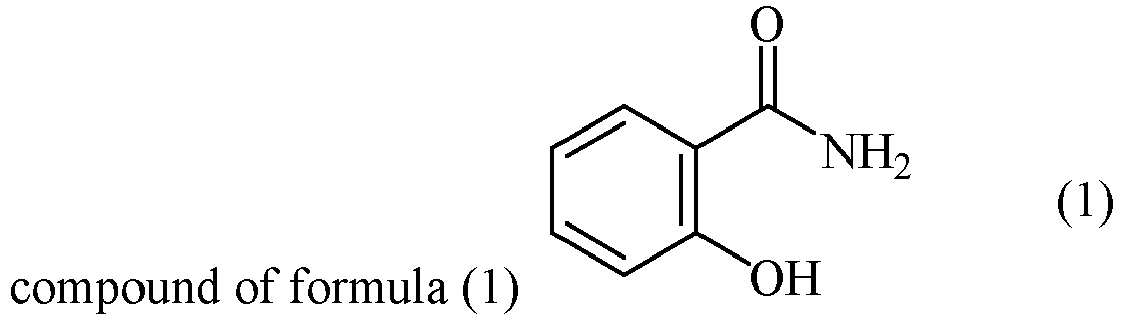
- Subject of the invention is a method for the preparation of compound of formula (3)

- in the first reaction REAC1 salicylamide is reacted with diethylcarbonate in the presence of an alkali ethoxide to provide compound of formula (3-X)

- in the second reaction REAC2 compound of formula (3-X) obtained from REAC1 is reacted with a Bronsted acid to provide compound of formula (3);
- Xis Na or K;
- the alkali ethoxide is NaOEt or KOEt.
- The three substances salicylamide, diethyl carbonate and alkali ethoxide can be mixed for REAC1 in any sequence;
preferably, for REAC1 diethyl carbonate and salicylamide are mixed first, then the alkali ethoxide is added to the mixture. - Preferably, the molar amount of alkali ethoxide in REAC1 is from 1 to 2 fold, more preferably from 1 to 1.75 fold, even more preferably from 1 to 1.5 fold, especially from 1.1 to 1.5 fold, more especially from 1.2 to 1.4 fold, of the molar amount of salicylamide.
- Preferably, the alkali ethoxide is used in REAC1 in form of a solution in ethanol; more preferably with a concentration of from 10 to 25 wt%, even more preferably of from 15 to 25 wt%, especially of from 18 to 22 wt%, more especially of from 19 to 22 wt%, of ethoxide based on the weight of the solution.
- Preferably, the molar amount of diethyl carbonate in REAC1 is from 1 to 5 fold, more preferably from 1 to 4 fold, even more preferably from 2 to 4 fold, especially from 2.5 to 3.5 fold, of the molar amount of salicylamide.
- Preferably, REAC1 is done at a reaction temperature TEMP1 of from 20 to 160°C, more preferably of from 40 to 140°C, even more preferably of from 60 to 120°C, especially of from 60 to 100°C, more especially of from 70 to 90°C, even more especially of from 75 to 85°C.
- Preferably, the reaction time TIME1 of REAC1 is from 30 min to 8 h, more preferably of from 1 to 6 h, even more preferably of from 1 to 4 h, especially of from 1 to 3 h, more especially of from 1.5 to 2.5 h.
- REAC1 can be done at ambient pressure or at elevated pressure, preferably the pressure is adjusted in such a way that the desired reaction temperature can be set in view of the vapor pressure of the reaction mixture.
- Preferably, the alkali ethoxide is NaOEt and X is Na.
- Preferably, the molar amount of the Bronsted acid in REAC2 is from 1 to 2 fold, more preferably from 1.01 to 1.8 fold, even more preferably from 1.05 to 1.6 fold, especially from 1.05 to 1.4 fold, more especially from 1.1 to 1.2 fold, of the molar amount of alkali ethoxide.
- The Bronsted acid protonates compound of formula (3-X), therefore the pKa of the Bronsted acid is lower than the pKa of compound of formula (3-X).
- Preferably, the Bronsted acid is selected from the group consisting ofHCl, H2SO4, HNO3, HClO4, HBr and H3PO4;
- more preferably the Bronsted acid is selected from the group consisting of HCl, H2SO4, and H3PO4;
- even more preferably the Bronsted acid is HCl.
- The Bronsted acid preferably used in form of an aqueous solution.
- In case of the Bronsted acid being HCl, the HCl is preferably used in form of an aqueous solution with a concentration of from 3 to 12.6 M, more preferably of from 5 to 12.6 M, even more preferably of from 7 to 12.6 M, especially of from 9 to 12.6 M, more especially of from 11 to 12.6 M; even more especially of from 11.5 to 12.6 M. In one embodiment, the HCL is HCl conc. In another embodiment, the HCl is used in form of an aqueous solution with a concentration of 12 M.
- Another way to characterize the HCl which can be used in form of an aqueous solution is the concentration in wt% of HCl based on the total weight of the aqueous HCl solution, such as from 10 to about 38 wt%, from 16 to about 38 wt%, from 22 to about 38 wt%, from 28 to 38 wt%, 33 to 38 wt%.
- The skilled person is aware of the concentrations of aqueous HCl available on the market; even the highest concentration available on the market may be used in REAC2.
- For REAC2, compound of formula (3-X) and the Bronsted acid can be mixed in any way, preferably, the Bronsted acid is added to compound of formula (3-X), more preferably, the Bronsted acid is added to the reaction mixture from REAC1 containing compound of formula (3-X).
- Preferably, REAC2 is done at a reaction temperature TEMP2 of from 20 to 100°C, more preferably of from 30 to 100°C, even more preferably of from 30 to 90°C, especially of from 30 to 80°C, more especially of from 30 to 70°C, even more especially of from 30 to 60°C, in particular of from 40 to 60 °C, more in particular of from 45 to 55 °C.
- Preferably, the reaction time TIME2 of REAC2 is from 0.5 to 4 h, more preferably of from 0.5 to 2 h, even more preferably of from 0.5 to 1.5 h.
- REAC2 can be done at ambient pressure or at elevated pressure, preferably the pressure is adjusted in such a way that the desired reaction temperature can be set in view of the vapor pressure of the reaction mixture.
- Between REAC1 and REAC2, the reaction mixture obtained from REAC1 can be mixed with water;
the amount of water can be from 0.1 to 1.5 fold, preferably from 0.3 to 1.2 fold, more preferably from 0.3 to 0.9 fold, even more preferably from 0.4 to 0.8 fold, especially from 0.5 to 0.7 fold, of the combined weights of salicylamide, diethyl carbonate and alkali ethoxide. - Preferably, the addition of water is done at TEMP2.
- Preferably, the water is added to the reaction mixture obtained from REAC1.
- Preferably, after REAC2 the reaction mixture is cooled in a cooling COOL3 to a temperature TEMP3 of from -20 to 10 °C, more preferably of from -10 to 5 °C, even more preferably of from -5 to 5 °C, in particular to 0 °C.
- COOL3 is done before an isolation of compound of formula (3) from the reaction mixture obtained from REAC2.
- Compound of formula (3) may be isolated after REAC2 or after a COOL3 by standard methods known to the skilled person, such as filtration and subsequent drying. The filter cake obtained by filtration may be washed by ethanol, water or by both; any drying may be done under vacuum and/or elevated temperature, such as vacuum and at a temperature of from 40 to 60 °C.
- In one embodiment, the method comprises
- REAC1,
- REAC2, and
- COOL3;
- REAC1,
- the mixing of the reaction mixture obtained from REAC1 with water
- REAC2, and
- COOL3.
- Preferably, compound of formula (3-X) is not isolated between REAC1 and a mixing of the reaction mixture obtained from REAC1 with water.
- Preferably, compound of formula (3-X) is not isolated between a mixing of the reaction mixture obtained from REAC1 with water and REAC2.
- Preferably, compound of formula (3-X) is not isolated between REAC1 and REAC2. Preferably, compound of formula (3) is not isolated between REAC2 and a COOL3. Preferably, there is no isolation of compound of formula (3-X) and no isolation of compound of formula (3) between REAC1 and a COOL3.
- Preferably, REAC1, REAC2, a mixing of the reaction mixture obtained from REAC1 with water and a COOL3 are done in one and the same reaction vessel without transfer of any reaction mixture from this reaction vessel to any other reaction vessel and without any intermediate isolation of compound of formula (3-X) and with isolation of compound of formula (3) only after REAC2 or only after a COOL3, if a COOL3 is done.
- Preferably, the reaction mixture after REAC1 is a suspension of the alkali salt of Carsalam. Preferably, the reaction mixture after a mixing of the reaction mixture obtained from REAC1 with water is a solution of the alkali salt of Carsalam.
- Preferably, the reaction mixture after REAC2 is a suspension of Carsalam.
- Preferably, the reaction mixture after a COOL3 is a suspension of Carsalam.
-
- eq.
- equivalent, eq, molar equivalent if not stated otherwise
-
Diethyl carbonate Acros (Thermo Fisher Scientific), 99% Salicylamide Macklin Inc., Shanghai, China, 99% -
Instrument Waters Arc_2489 or equivalent Column YMC basic, 250 * 4.6 mm * 3 micro meter or equivalent Flow 0.8 mL/min Injection volume 5 microL Needle wash Acetonitrile Column temperature 25°C Sample temperature 4 °C Wavelength 230 nm Run Time 40 min 10 M potassium hydroxide solution Weigh 5.6± 0.5g potassium hydroxide in a flask, then add 10 mL pure water in it, stir the solution until the solid dissolved completely, place it at room temperature until it cool down. Eluent A 20 mM KH2PO4 pH 6.8 e.g. Dissolve 2.72± 0.2 g KH2PO4 in 1000 mL water, adjust pH to 6.8 with 10 M potassium hydroxide solution Eluent B Acetonitrile Gradient T(min) A(%) B(%) 0.0 90 10 5.0 80 20 15.0 75 25 25.0 30 70 30.0 30 70 30.1 90 10 40.0 90 10 -
Sample 24.0 ± 2.0 mg Add into a 50 mL of volumetric flask, add blank to dissolve, solubilize, dilute to the mark with blank, mix well. Specified impurity and each single unspecified impurity 
peak areaX : area of individual peak in the sample solution peak areatotal : total area of all peaks in the sample solution Carsalam Purity Calculate the purity of Carsalam by subtracting the sum of impurities from 100 Carsalam %area = 100 - sum of impurities (in %area) Remark: peaks ≥ 0.05 %area will be integrated. A peak, whose peak area in the chromatogram of a sample is a maximum of 1.5 times the area of a corresponding interfering peak in the blank chromatogram, is not integrated. Report the area% of specified impurities, any single unspecified impurity and the purity of Carsalam. Reporting limit 0.05%area. - To a 1.5 L reactor, 253 g diethyl carbonate (2.15 mol, 3.0 eq.) and 100 g salicylamide (0.715 mol, 1.0 eq.) were charged. The mixture was a suspension and was stirred for 15 min. Then 309 g 20 wt% EtONa/EtOH (0.93 mol, 1.3 eq.) were charged to the reactor. The reaction mixture become a clear solution. The reaction mixture was heated to 80 °C and stirred at 80 °C for 2 h. A white precipitate was observed. The reaction mixture was cooled to 50 °C. 387 g water were added and the reaction mixture was stirred for about 15 min until it became a clear solution. 109 g 12 M HCl (1.07 mol, 1.5 eq.) were then added dropwise to the reactor in 1 h, a precipitate formed when the 12 M HCl was charged. The reaction mixture was cooled to 0 °C in 2 h. The suspension was filtered providing a filter cake. 231 g ethanol were added to the reactor and stirred for 15 min, and the filter cake was washed with this ethanol from the reactor. Then the cake was washed with 515 g water and 231 g ethanol, the cake was dried under vaccum (10 kPa) at 50 °C for 5 h. 107 g Carsalam as a white crystalline product were obtained.
Yield 90 % HPLC purity > 99.9 %. 1H NMR (400 MHz, DMSO) delta 7.95 (dd, J= 8.0, 1.4 Hz, 1H), 7.80 (td, J= 8.1, 1.7 Hz, 1H), 7.46 - 7.36 (m, 2H).
Claims (16)
- A method for the preparation of compound of formula (3)
 with two subsequent reactions REAC1 and REAC2;in the first reaction REAC1 salicylamide is reacted with diethylcarbonate in the presence of an alkali ethoxide to provide compound of formula (3-X)
 in the second reaction REAC2 compound of formula (3-X) obtained from REAC1 is reacted with a Bronsted acid to provide compound of formula (3);Xis Na or K;the alkali ethoxide is NaOEt or KOEt.
 - Method according to claim 1, wherein
for REAC1 diethyl carbonate and salicylamide are mixed first, then the alkali ethoxide is added to the mixture. - Method according to claim 1 or 2, wherein
the molar amount of alkali ethoxide in REAC1 is from 1 to 2 fold of the molar amount of salicylamide. - Method according to one or more of claims 1 to 3, wherein
the molar amount of diethyl carbonate in REAC1 is from 1 to 5 fold of the molar amount of salicylamide. - Method according to one or more of claims 1 to 4, wherein
the alkali ethoxide is NaOEt and X is Na. - Method according to one or more of claims 1 to 5, wherein
the molar amount of the Bronsted acid in REAC2 is from 1 to 2 fold of the molar amount of alkali ethoxide. - Method according to one or more of claims 1 to 6, wherein
the pKa of the Bronsted acid is lower than the pKa of compound of formula (3-X). - Method according to one or more of claims 1 to 7, wherein
the Bronsted acid is selected from the group consisting ofHCl, H2SO4, HNO3, HClO4, HBr and H3PO4. - Method according to one or more of claims 1 to 8, wherein
the Bronsted acid preferably used in form of an aqueous solution. - Method according to one or more of claims 1 to 9, wherein
for REAC2, the Bronsted acid is added to compound of formula (3-X). - Method according to one or more of claims 1 to 10, wherein
between REAC1 and REAC2, the reaction mixture obtained from REAC1 is mixed with water. - Method according to claim 11, wherein
the amount of water is from 0.1 to 1.5 fold of the combined weights of salicylamide, diethyl carbonate and alkali ethoxide. - Method according to claim 11 or 12, wherein
the water is added to the reaction mixture obtained from REAC1. - Method according to one or more of claims 1 to 13, wherein
after REAC2 the reaction mixture is cooled in a cooling COOL3 to a temperature TEMP3 of from -20 to 10 °C before an isolation of compound of formula (3) from the reaction mixture obtained from REAC2. - Method according to one or more of claims 1 to 14, wherein
compound of formula (3-X) is not isolated between REAC1 and REAC2. - Method according to claims 14 or 15, wherein
compound of formula (3) is not isolated between REAC2 and COOL3.
Applications Claiming Priority (3)
| Application Number | Priority Date | Filing Date | Title |
|---|---|---|---|
| CN2019087542 | 2019-05-20 | ||
| EP19180140 | 2019-06-14 | ||
| PCT/EP2020/063843 WO2020234245A1 (en) | 2019-05-20 | 2020-05-18 | Method for preparation of carsalam |
Publications (3)
| Publication Number | Publication Date |
|---|---|
| EP3972961A1 EP3972961A1 (en) | 2022-03-30 |
| EP3972961B1 true EP3972961B1 (en) | 2023-07-05 |
| EP3972961C0 EP3972961C0 (en) | 2023-07-05 |
Family
ID=70682853
Family Applications (1)
| Application Number | Title | Priority Date | Filing Date |
|---|---|---|---|
| EP20725719.7A Active EP3972961B1 (en) | 2019-05-20 | 2020-05-18 | Method for preparation of carsalam |
Country Status (12)
| Country | Link |
|---|---|
| US (1) | US12304892B2 (en) |
| EP (1) | EP3972961B1 (en) |
| JP (1) | JP7105386B2 (en) |
| KR (1) | KR102566591B1 (en) |
| CN (1) | CN113795482A (en) |
| AU (1) | AU2020277650B2 (en) |
| BR (1) | BR112021023195A2 (en) |
| CA (1) | CA3141383A1 (en) |
| ES (1) | ES2952567T3 (en) |
| IL (1) | IL287941B (en) |
| MX (1) | MX2021013946A (en) |
| WO (1) | WO2020234245A1 (en) |
Families Citing this family (1)
| Publication number | Priority date | Publication date | Assignee | Title |
|---|---|---|---|---|
| CN117776954B (en) * | 2023-12-22 | 2025-10-28 | 合肥立方制药股份有限公司 | A preparation method of high-purity 8-(2-hydroxybenzamido) sodium octanoate |
Family Cites Families (6)
| Publication number | Priority date | Publication date | Assignee | Title |
|---|---|---|---|---|
| GB1069367A (en) * | 1964-10-01 | 1967-05-17 | Aspro Nicholas Ltd | Improvements in or relating to the production of 1:3-benzoxazine-2:4-dione |
| ATE309197T1 (en) | 1999-02-05 | 2005-11-15 | Emisphere Tech Inc | METHOD FOR PRODUCING ALKYLATED SALICYLAMIDES |
| GB0427603D0 (en) | 2004-12-16 | 2005-01-19 | Novartis Ag | Organic compounds |
| MA41169A (en) | 2014-12-17 | 2017-10-24 | Acraf | WIDE-SPECTRUM ANTIBACTERIAL COMPOUNDS |
| CN104974060A (en) * | 2015-04-24 | 2015-10-14 | 上海楷树化学科技有限公司 | Method for preparing sodium, 8-(2-hydroxybenzamido)octanoate |
| CN108689876B (en) | 2018-06-28 | 2020-11-27 | 苏州东南药业股份有限公司 | Preparation method of sodium 8- (2-hydroxybenzamido) caprylate |
-
2020
- 2020-05-18 CN CN202080031434.1A patent/CN113795482A/en active Pending
- 2020-05-18 CA CA3141383A patent/CA3141383A1/en active Pending
- 2020-05-18 JP JP2021569342A patent/JP7105386B2/en active Active
- 2020-05-18 EP EP20725719.7A patent/EP3972961B1/en active Active
- 2020-05-18 BR BR112021023195A patent/BR112021023195A2/en unknown
- 2020-05-18 ES ES20725719T patent/ES2952567T3/en active Active
- 2020-05-18 KR KR1020217034247A patent/KR102566591B1/en active Active
- 2020-05-18 WO PCT/EP2020/063843 patent/WO2020234245A1/en not_active Ceased
- 2020-05-18 AU AU2020277650A patent/AU2020277650B2/en active Active
- 2020-05-18 US US17/603,107 patent/US12304892B2/en active Active
- 2020-05-18 MX MX2021013946A patent/MX2021013946A/en unknown
-
2021
- 2021-11-09 IL IL287941A patent/IL287941B/en unknown
Also Published As
| Publication number | Publication date |
|---|---|
| BR112021023195A8 (en) | 2021-12-28 |
| AU2020277650A1 (en) | 2022-01-20 |
| AU2020277650B2 (en) | 2025-03-13 |
| JP2022526861A (en) | 2022-05-26 |
| ES2952567T3 (en) | 2023-11-02 |
| US20220194906A1 (en) | 2022-06-23 |
| US12304892B2 (en) | 2025-05-20 |
| KR102566591B1 (en) | 2023-08-11 |
| EP3972961C0 (en) | 2023-07-05 |
| JP7105386B2 (en) | 2022-07-22 |
| WO2020234245A1 (en) | 2020-11-26 |
| BR112021023195A2 (en) | 2022-02-15 |
| EP3972961A1 (en) | 2022-03-30 |
| IL287941A (en) | 2022-01-01 |
| IL287941B (en) | 2022-03-01 |
| KR20220010476A (en) | 2022-01-25 |
| CA3141383A1 (en) | 2020-11-26 |
| CN113795482A (en) | 2021-12-14 |
| MX2021013946A (en) | 2022-01-04 |
Similar Documents
| Publication | Publication Date | Title |
|---|---|---|
| US10435417B2 (en) | Preparation of high-purity gadobutrol | |
| US9606089B2 (en) | Methods for detecting and reducing impurities of Lapatinib and salts thereof | |
| JPS6383079A (en) | Manufacture of 2-chloro-5-chloromethlthiazole | |
| EP2623496A1 (en) | Method for producing 3,5-bis(fluoralkyl)-pyrazol-4-carboxylic acid derivatives and 3,5-bis(fluoralkyl)-pyrazoles | |
| JP6149104B2 (en) | Method for preparing triazole compound | |
| US12304892B2 (en) | Method for preparation of Carsalam | |
| US6884888B2 (en) | Process for the production of N-[3-(3-cyanopyrazolo[1,5-a] pyrimidin-7-yl) phenyl]-N-ethylacetamide (zaleplon) | |
| AU2012317424B2 (en) | Crystal of 5-hydroxy-1h-imidazole-4-carboxamide 3/4 hydrate, method for producing the same and crystal of 5-hydroxy-1h-imidazole-4-carboxamide hydrate | |
| US6303792B1 (en) | Process for crystallizing N-(4-trifluoromethylphenyl)-5-methylisoxazole-4-carboxamide | |
| US9388203B2 (en) | Pharmaceutical process and intermediates | |
| US7141693B2 (en) | Process for producing β-oxonitrile compound or alkali metal salt thereof | |
| DE3303815C2 (en) | ||
| EP0203400B1 (en) | Preparation of 4(5)-hydroxymethyl-5(4)-methylimidazole | |
| SU727634A1 (en) | Method of preparing n-(2-aza-2-nitroalkyl) amides | |
| HK40061629A (en) | Method for preparation of carsalam | |
| US5071982A (en) | Process for producing a 4,6-bis(difluoromethoxy)-2-alkylthiopyrimidine | |
| US6653488B2 (en) | Process for producing benzopyran carboxamide | |
| ITMI20011379A1 (en) | PROCEDURE FOR THE PREPARATION OF SODIUM DIVALPROATE | |
| JPS6277371A (en) | Fluorine-containing pyrazole derivative | |
| NO327534B1 (en) | Process for the preparation of salts of cyanobenzylamine | |
| CN107011235A (en) | The method for preparing levo-oxiracetam crystal formation III |
Legal Events
| Date | Code | Title | Description |
|---|---|---|---|
| STAA | Information on the status of an ep patent application or granted ep patent |
Free format text: STATUS: UNKNOWN |
|
| STAA | Information on the status of an ep patent application or granted ep patent |
Free format text: STATUS: THE INTERNATIONAL PUBLICATION HAS BEEN MADE |
|
| PUAI | Public reference made under article 153(3) epc to a published international application that has entered the european phase |
Free format text: ORIGINAL CODE: 0009012 |
|
| STAA | Information on the status of an ep patent application or granted ep patent |
Free format text: STATUS: REQUEST FOR EXAMINATION WAS MADE |
|
| 17P | Request for examination filed |
Effective date: 20211220 |
|
| AK | Designated contracting states |
Kind code of ref document: A1 Designated state(s): AL AT BE BG CH CY CZ DE DK EE ES FI FR GB GR HR HU IE IS IT LI LT LU LV MC MK MT NL NO PL PT RO RS SE SI SK SM TR |
|
| DAV | Request for validation of the european patent (deleted) | ||
| DAX | Request for extension of the european patent (deleted) | ||
| REG | Reference to a national code |
Ref country code: DE Ref legal event code: R079 Ref country code: DE Ref legal event code: R079 Ref document number: 602020013337 Country of ref document: DE Free format text: PREVIOUS MAIN CLASS: C07D0265220000 Ipc: C07D0265260000 |
|
| GRAP | Despatch of communication of intention to grant a patent |
Free format text: ORIGINAL CODE: EPIDOSNIGR1 |
|
| STAA | Information on the status of an ep patent application or granted ep patent |
Free format text: STATUS: GRANT OF PATENT IS INTENDED |
|
| RIC1 | Information provided on ipc code assigned before grant |
Ipc: C07D 265/26 20060101AFI20220906BHEP |
|
| INTG | Intention to grant announced |
Effective date: 20220927 |
|
| RAP3 | Party data changed (applicant data changed or rights of an application transferred) |
Owner name: LONZA GUANGZHOU PHARMACEUTICAL LTD. |
|
| GRAJ | Information related to disapproval of communication of intention to grant by the applicant or resumption of examination proceedings by the epo deleted |
Free format text: ORIGINAL CODE: EPIDOSDIGR1 |
|
| STAA | Information on the status of an ep patent application or granted ep patent |
Free format text: STATUS: REQUEST FOR EXAMINATION WAS MADE |
|
| INTC | Intention to grant announced (deleted) | ||
| GRAP | Despatch of communication of intention to grant a patent |
Free format text: ORIGINAL CODE: EPIDOSNIGR1 |
|
| STAA | Information on the status of an ep patent application or granted ep patent |
Free format text: STATUS: GRANT OF PATENT IS INTENDED |
|
| GRAS | Grant fee paid |
Free format text: ORIGINAL CODE: EPIDOSNIGR3 |
|
| INTG | Intention to grant announced |
Effective date: 20230306 |
|
| GRAA | (expected) grant |
Free format text: ORIGINAL CODE: 0009210 |
|
| STAA | Information on the status of an ep patent application or granted ep patent |
Free format text: STATUS: THE PATENT HAS BEEN GRANTED |
|
| AK | Designated contracting states |
Kind code of ref document: B1 Designated state(s): AL AT BE BG CH CY CZ DE DK EE ES FI FR GB GR HR HU IE IS IT LI LT LU LV MC MK MT NL NO PL PT RO RS SE SI SK SM TR |
|
| REG | Reference to a national code |
Ref country code: CH Ref legal event code: EP |
|
| REG | Reference to a national code |
Ref country code: AT Ref legal event code: REF Ref document number: 1584751 Country of ref document: AT Kind code of ref document: T Effective date: 20230715 |
|
| REG | Reference to a national code |
Ref country code: DE Ref legal event code: R096 Ref document number: 602020013337 Country of ref document: DE |
|
| REG | Reference to a national code |
Ref country code: IE Ref legal event code: FG4D |
|
| U01 | Request for unitary effect filed |
Effective date: 20230705 |
|
| U07 | Unitary effect registered |
Designated state(s): AT BE BG DE DK EE FI FR IT LT LU LV MT NL PT SE SI Effective date: 20230714 |
|
| REG | Reference to a national code |
Ref country code: LT Ref legal event code: MG9D |
|
| REG | Reference to a national code |
Ref country code: ES Ref legal event code: FG2A Ref document number: 2952567 Country of ref document: ES Kind code of ref document: T3 Effective date: 20231102 |
|
| PG25 | Lapsed in a contracting state [announced via postgrant information from national office to epo] |
Ref country code: GR Free format text: LAPSE BECAUSE OF FAILURE TO SUBMIT A TRANSLATION OF THE DESCRIPTION OR TO PAY THE FEE WITHIN THE PRESCRIBED TIME-LIMIT Effective date: 20231006 |
|
| PG25 | Lapsed in a contracting state [announced via postgrant information from national office to epo] |
Ref country code: IS Free format text: LAPSE BECAUSE OF FAILURE TO SUBMIT A TRANSLATION OF THE DESCRIPTION OR TO PAY THE FEE WITHIN THE PRESCRIBED TIME-LIMIT Effective date: 20231105 |
|
| PG25 | Lapsed in a contracting state [announced via postgrant information from national office to epo] |
Ref country code: RS Free format text: LAPSE BECAUSE OF FAILURE TO SUBMIT A TRANSLATION OF THE DESCRIPTION OR TO PAY THE FEE WITHIN THE PRESCRIBED TIME-LIMIT Effective date: 20230705 Ref country code: NO Free format text: LAPSE BECAUSE OF FAILURE TO SUBMIT A TRANSLATION OF THE DESCRIPTION OR TO PAY THE FEE WITHIN THE PRESCRIBED TIME-LIMIT Effective date: 20231005 Ref country code: IS Free format text: LAPSE BECAUSE OF FAILURE TO SUBMIT A TRANSLATION OF THE DESCRIPTION OR TO PAY THE FEE WITHIN THE PRESCRIBED TIME-LIMIT Effective date: 20231105 Ref country code: HR Free format text: LAPSE BECAUSE OF FAILURE TO SUBMIT A TRANSLATION OF THE DESCRIPTION OR TO PAY THE FEE WITHIN THE PRESCRIBED TIME-LIMIT Effective date: 20230705 Ref country code: GR Free format text: LAPSE BECAUSE OF FAILURE TO SUBMIT A TRANSLATION OF THE DESCRIPTION OR TO PAY THE FEE WITHIN THE PRESCRIBED TIME-LIMIT Effective date: 20231006 |
|
| PG25 | Lapsed in a contracting state [announced via postgrant information from national office to epo] |
Ref country code: PL Free format text: LAPSE BECAUSE OF FAILURE TO SUBMIT A TRANSLATION OF THE DESCRIPTION OR TO PAY THE FEE WITHIN THE PRESCRIBED TIME-LIMIT Effective date: 20230705 |
|
| REG | Reference to a national code |
Ref country code: DE Ref legal event code: R097 Ref document number: 602020013337 Country of ref document: DE |
|
| PG25 | Lapsed in a contracting state [announced via postgrant information from national office to epo] |
Ref country code: SM Free format text: LAPSE BECAUSE OF FAILURE TO SUBMIT A TRANSLATION OF THE DESCRIPTION OR TO PAY THE FEE WITHIN THE PRESCRIBED TIME-LIMIT Effective date: 20230705 Ref country code: RO Free format text: LAPSE BECAUSE OF FAILURE TO SUBMIT A TRANSLATION OF THE DESCRIPTION OR TO PAY THE FEE WITHIN THE PRESCRIBED TIME-LIMIT Effective date: 20230705 Ref country code: CZ Free format text: LAPSE BECAUSE OF FAILURE TO SUBMIT A TRANSLATION OF THE DESCRIPTION OR TO PAY THE FEE WITHIN THE PRESCRIBED TIME-LIMIT Effective date: 20230705 Ref country code: SK Free format text: LAPSE BECAUSE OF FAILURE TO SUBMIT A TRANSLATION OF THE DESCRIPTION OR TO PAY THE FEE WITHIN THE PRESCRIBED TIME-LIMIT Effective date: 20230705 |
|
| PLBE | No opposition filed within time limit |
Free format text: ORIGINAL CODE: 0009261 |
|
| STAA | Information on the status of an ep patent application or granted ep patent |
Free format text: STATUS: NO OPPOSITION FILED WITHIN TIME LIMIT |
|
| 26N | No opposition filed |
Effective date: 20240408 |
|
| U20 | Renewal fee for the european patent with unitary effect paid |
Year of fee payment: 5 Effective date: 20240527 |
|
| PG25 | Lapsed in a contracting state [announced via postgrant information from national office to epo] |
Ref country code: MC Free format text: LAPSE BECAUSE OF FAILURE TO SUBMIT A TRANSLATION OF THE DESCRIPTION OR TO PAY THE FEE WITHIN THE PRESCRIBED TIME-LIMIT Effective date: 20230705 |
|
| PG25 | Lapsed in a contracting state [announced via postgrant information from national office to epo] |
Ref country code: MC Free format text: LAPSE BECAUSE OF FAILURE TO SUBMIT A TRANSLATION OF THE DESCRIPTION OR TO PAY THE FEE WITHIN THE PRESCRIBED TIME-LIMIT Effective date: 20230705 |
|
| PG25 | Lapsed in a contracting state [announced via postgrant information from national office to epo] |
Ref country code: IE Free format text: LAPSE BECAUSE OF NON-PAYMENT OF DUE FEES Effective date: 20240518 |
|
| U20 | Renewal fee for the european patent with unitary effect paid |
Year of fee payment: 6 Effective date: 20250526 |
|
| PGFP | Annual fee paid to national office [announced via postgrant information from national office to epo] |
Ref country code: GB Payment date: 20250520 Year of fee payment: 6 Ref country code: ES Payment date: 20250611 Year of fee payment: 6 |
|
| PGFP | Annual fee paid to national office [announced via postgrant information from national office to epo] |
Ref country code: CH Payment date: 20250601 Year of fee payment: 6 |
|
| PG25 | Lapsed in a contracting state [announced via postgrant information from national office to epo] |
Ref country code: CY Free format text: LAPSE BECAUSE OF FAILURE TO SUBMIT A TRANSLATION OF THE DESCRIPTION OR TO PAY THE FEE WITHIN THE PRESCRIBED TIME-LIMIT; INVALID AB INITIO Effective date: 20200518 |
|
| PG25 | Lapsed in a contracting state [announced via postgrant information from national office to epo] |
Ref country code: HU Free format text: LAPSE BECAUSE OF FAILURE TO SUBMIT A TRANSLATION OF THE DESCRIPTION OR TO PAY THE FEE WITHIN THE PRESCRIBED TIME-LIMIT; INVALID AB INITIO Effective date: 20200518 |