EP3971158A1 - Method for preparing cannabidiol compound - Google Patents
Method for preparing cannabidiol compound Download PDFInfo
- Publication number
- EP3971158A1 EP3971158A1 EP20809416.9A EP20809416A EP3971158A1 EP 3971158 A1 EP3971158 A1 EP 3971158A1 EP 20809416 A EP20809416 A EP 20809416A EP 3971158 A1 EP3971158 A1 EP 3971158A1
- Authority
- EP
- European Patent Office
- Prior art keywords
- group
- substituted
- acid
- unsubstituted
- compound
- Prior art date
- Legal status (The legal status is an assumption and is not a legal conclusion. Google has not performed a legal analysis and makes no representation as to the accuracy of the status listed.)
- Pending
Links
- QHMBSVQNZZTUGM-UHFFFAOYSA-N Trans-Cannabidiol Natural products OC1=CC(CCCCC)=CC(O)=C1C1C(C(C)=C)CCC(C)=C1 QHMBSVQNZZTUGM-UHFFFAOYSA-N 0.000 title claims abstract description 64
- 229950011318 cannabidiol Drugs 0.000 title claims abstract description 64
- ZTGXAWYVTLUPDT-UHFFFAOYSA-N cannabidiol Natural products OC1=CC(CCCCC)=CC(O)=C1C1C(C(C)=C)CC=C(C)C1 ZTGXAWYVTLUPDT-UHFFFAOYSA-N 0.000 title claims abstract description 64
- PCXRACLQFPRCBB-ZWKOTPCHSA-N dihydrocannabidiol Natural products OC1=CC(CCCCC)=CC(O)=C1[C@H]1[C@H](C(C)C)CCC(C)=C1 PCXRACLQFPRCBB-ZWKOTPCHSA-N 0.000 title claims abstract description 64
- 238000000034 method Methods 0.000 title claims abstract description 61
- -1 cannabidiol compound Chemical class 0.000 title claims description 51
- 238000006243 chemical reaction Methods 0.000 claims abstract description 92
- QHMBSVQNZZTUGM-ZWKOTPCHSA-N cannabidiol Chemical compound OC1=CC(CCCCC)=CC(O)=C1[C@H]1[C@H](C(C)=C)CCC(C)=C1 QHMBSVQNZZTUGM-ZWKOTPCHSA-N 0.000 claims abstract description 63
- YXFVVABEGXRONW-UHFFFAOYSA-N Toluene Chemical compound CC1=CC=CC=C1 YXFVVABEGXRONW-UHFFFAOYSA-N 0.000 claims description 141
- YMWUJEATGCHHMB-UHFFFAOYSA-N Dichloromethane Chemical compound ClCCl YMWUJEATGCHHMB-UHFFFAOYSA-N 0.000 claims description 132
- IAZDPXIOMUYVGZ-UHFFFAOYSA-N Dimethylsulphoxide Chemical compound CS(C)=O IAZDPXIOMUYVGZ-UHFFFAOYSA-N 0.000 claims description 131
- IMNFDUFMRHMDMM-UHFFFAOYSA-N N-Heptane Chemical compound CCCCCCC IMNFDUFMRHMDMM-UHFFFAOYSA-N 0.000 claims description 123
- KWYUFKZDYYNOTN-UHFFFAOYSA-M Potassium hydroxide Chemical compound [OH-].[K+] KWYUFKZDYYNOTN-UHFFFAOYSA-M 0.000 claims description 120
- RTZKZFJDLAIYFH-UHFFFAOYSA-N Diethyl ether Chemical compound CCOCC RTZKZFJDLAIYFH-UHFFFAOYSA-N 0.000 claims description 109
- OKKJLVBELUTLKV-UHFFFAOYSA-N Methanol Chemical compound OC OKKJLVBELUTLKV-UHFFFAOYSA-N 0.000 claims description 84
- 239000012074 organic phase Substances 0.000 claims description 76
- 150000001875 compounds Chemical class 0.000 claims description 74
- 239000013078 crystal Substances 0.000 claims description 74
- BZLVMXJERCGZMT-UHFFFAOYSA-N Methyl tert-butyl ether Chemical compound COC(C)(C)C BZLVMXJERCGZMT-UHFFFAOYSA-N 0.000 claims description 70
- 239000011541 reaction mixture Substances 0.000 claims description 63
- WMFOQBRAJBCJND-UHFFFAOYSA-M Lithium hydroxide Chemical compound [Li+].[OH-] WMFOQBRAJBCJND-UHFFFAOYSA-M 0.000 claims description 62
- HEMHJVSKTPXQMS-UHFFFAOYSA-M Sodium hydroxide Chemical compound [OH-].[Na+] HEMHJVSKTPXQMS-UHFFFAOYSA-M 0.000 claims description 57
- 239000002904 solvent Substances 0.000 claims description 53
- WEVYAHXRMPXWCK-UHFFFAOYSA-N Acetonitrile Chemical compound CC#N WEVYAHXRMPXWCK-UHFFFAOYSA-N 0.000 claims description 45
- VLKZOEOYAKHREP-UHFFFAOYSA-N n-Hexane Chemical compound CCCCCC VLKZOEOYAKHREP-UHFFFAOYSA-N 0.000 claims description 42
- WJKHJLXJJJATHN-UHFFFAOYSA-N triflic anhydride Chemical compound FC(F)(F)S(=O)(=O)OS(=O)(=O)C(F)(F)F WJKHJLXJJJATHN-UHFFFAOYSA-N 0.000 claims description 40
- UIIMBOGNXHQVGW-UHFFFAOYSA-M Sodium bicarbonate Chemical class [Na+].OC([O-])=O UIIMBOGNXHQVGW-UHFFFAOYSA-M 0.000 claims description 38
- MVPPADPHJFYWMZ-UHFFFAOYSA-N chlorobenzene Chemical compound ClC1=CC=CC=C1 MVPPADPHJFYWMZ-UHFFFAOYSA-N 0.000 claims description 38
- 238000010791 quenching Methods 0.000 claims description 38
- XLYOFNOQVPJJNP-UHFFFAOYSA-N water Substances O XLYOFNOQVPJJNP-UHFFFAOYSA-N 0.000 claims description 38
- WYURNTSHIVDZCO-UHFFFAOYSA-N Tetrahydrofuran Chemical group C1CCOC1 WYURNTSHIVDZCO-UHFFFAOYSA-N 0.000 claims description 36
- 239000000203 mixture Substances 0.000 claims description 36
- 229910052739 hydrogen Inorganic materials 0.000 claims description 30
- 239000001257 hydrogen Substances 0.000 claims description 30
- 239000003513 alkali Substances 0.000 claims description 28
- SKTCDJAMAYNROS-UHFFFAOYSA-N methoxycyclopentane Chemical compound COC1CCCC1 SKTCDJAMAYNROS-UHFFFAOYSA-N 0.000 claims description 28
- VZCYOOQTPOCHFL-UHFFFAOYSA-N trans-butenedioic acid Natural products OC(=O)C=CC(O)=O VZCYOOQTPOCHFL-UHFFFAOYSA-N 0.000 claims description 25
- IJGRMHOSHXDMSA-UHFFFAOYSA-N Atomic nitrogen Chemical compound N#N IJGRMHOSHXDMSA-UHFFFAOYSA-N 0.000 claims description 24
- ZMXDDKWLCZADIW-UHFFFAOYSA-N N,N-Dimethylformamide Chemical compound CN(C)C=O ZMXDDKWLCZADIW-UHFFFAOYSA-N 0.000 claims description 24
- 150000001340 alkali metals Chemical class 0.000 claims description 24
- OFOBLEOULBTSOW-UHFFFAOYSA-N Propanedioic acid Natural products OC(=O)CC(O)=O OFOBLEOULBTSOW-UHFFFAOYSA-N 0.000 claims description 23
- VZCYOOQTPOCHFL-UPHRSURJSA-N maleic acid Chemical compound OC(=O)\C=C/C(O)=O VZCYOOQTPOCHFL-UPHRSURJSA-N 0.000 claims description 23
- 239000011976 maleic acid Substances 0.000 claims description 23
- 125000006736 (C6-C20) aryl group Chemical group 0.000 claims description 22
- XTHFKEDIFFGKHM-UHFFFAOYSA-N Dimethoxyethane Chemical compound COCCOC XTHFKEDIFFGKHM-UHFFFAOYSA-N 0.000 claims description 22
- CTQNGGLPUBDAKN-UHFFFAOYSA-N O-Xylene Chemical compound CC1=CC=CC=C1C CTQNGGLPUBDAKN-UHFFFAOYSA-N 0.000 claims description 20
- CDBYLPFSWZWCQE-UHFFFAOYSA-L Sodium Carbonate Chemical compound [Na+].[Na+].[O-]C([O-])=O CDBYLPFSWZWCQE-UHFFFAOYSA-L 0.000 claims description 20
- 229910052783 alkali metal Inorganic materials 0.000 claims description 20
- 229910052784 alkaline earth metal Inorganic materials 0.000 claims description 20
- 125000000217 alkyl group Chemical group 0.000 claims description 20
- BWHMMNNQKKPAPP-UHFFFAOYSA-L potassium carbonate Chemical compound [K+].[K+].[O-]C([O-])=O BWHMMNNQKKPAPP-UHFFFAOYSA-L 0.000 claims description 20
- 239000008096 xylene Substances 0.000 claims description 20
- 150000001335 aliphatic alkanes Chemical class 0.000 claims description 19
- 150000002431 hydrogen Chemical group 0.000 claims description 19
- HEDRZPFGACZZDS-UHFFFAOYSA-N Chloroform Chemical compound ClC(Cl)Cl HEDRZPFGACZZDS-UHFFFAOYSA-N 0.000 claims description 18
- XEKOWRVHYACXOJ-UHFFFAOYSA-N Ethyl acetate Chemical compound CCOC(C)=O XEKOWRVHYACXOJ-UHFFFAOYSA-N 0.000 claims description 18
- 125000001797 benzyl group Chemical group [H]C1=C([H])C([H])=C(C([H])=C1[H])C([H])([H])* 0.000 claims description 18
- KRKNYBCHXYNGOX-UHFFFAOYSA-N citric acid Chemical compound OC(=O)CC(O)(C(O)=O)CC(O)=O KRKNYBCHXYNGOX-UHFFFAOYSA-N 0.000 claims description 18
- LMBFAGIMSUYTBN-MPZNNTNKSA-N teixobactin Chemical compound C([C@H](C(=O)N[C@@H]([C@@H](C)CC)C(=O)N[C@@H](CO)C(=O)N[C@H](CCC(N)=O)C(=O)N[C@H]([C@@H](C)CC)C(=O)N[C@@H]([C@@H](C)CC)C(=O)N[C@@H](CO)C(=O)N[C@H]1C(N[C@@H](C)C(=O)N[C@@H](C[C@@H]2NC(=N)NC2)C(=O)N[C@H](C(=O)O[C@H]1C)[C@@H](C)CC)=O)NC)C1=CC=CC=C1 LMBFAGIMSUYTBN-MPZNNTNKSA-N 0.000 claims description 18
- YLQBMQCUIZJEEH-UHFFFAOYSA-N tetrahydrofuran Natural products C=1C=COC=1 YLQBMQCUIZJEEH-UHFFFAOYSA-N 0.000 claims description 18
- TWRXJAOTZQYOKJ-UHFFFAOYSA-L Magnesium chloride Chemical compound [Mg+2].[Cl-].[Cl-] TWRXJAOTZQYOKJ-UHFFFAOYSA-L 0.000 claims description 17
- 239000003054 catalyst Substances 0.000 claims description 17
- LFQSCWFLJHTTHZ-UHFFFAOYSA-N Ethanol Chemical compound CCO LFQSCWFLJHTTHZ-UHFFFAOYSA-N 0.000 claims description 15
- NBIIXXVUZAFLBC-UHFFFAOYSA-N Phosphoric acid Chemical compound OP(O)(O)=O NBIIXXVUZAFLBC-UHFFFAOYSA-N 0.000 claims description 14
- KWGKDLIKAYFUFQ-UHFFFAOYSA-M lithium chloride Chemical compound [Li+].[Cl-] KWGKDLIKAYFUFQ-UHFFFAOYSA-M 0.000 claims description 14
- 239000002253 acid Substances 0.000 claims description 13
- 150000004945 aromatic hydrocarbons Chemical class 0.000 claims description 13
- UHOVQNZJYSORNB-UHFFFAOYSA-N monobenzene Natural products C1=CC=CC=C1 UHOVQNZJYSORNB-UHFFFAOYSA-N 0.000 claims description 13
- QTBSBXVTEAMEQO-UHFFFAOYSA-N Acetic acid Chemical compound CC(O)=O QTBSBXVTEAMEQO-UHFFFAOYSA-N 0.000 claims description 12
- CSCPPACGZOOCGX-UHFFFAOYSA-N Acetone Chemical compound CC(C)=O CSCPPACGZOOCGX-UHFFFAOYSA-N 0.000 claims description 12
- LYCAIKOWRPUZTN-UHFFFAOYSA-N Ethylene glycol Chemical compound OCCO LYCAIKOWRPUZTN-UHFFFAOYSA-N 0.000 claims description 12
- AFVFQIVMOAPDHO-UHFFFAOYSA-N Methanesulfonic acid Chemical compound CS(O)(=O)=O AFVFQIVMOAPDHO-UHFFFAOYSA-N 0.000 claims description 12
- JGFZNNIVVJXRND-UHFFFAOYSA-N N,N-Diisopropylethylamine (DIPEA) Chemical compound CCN(C(C)C)C(C)C JGFZNNIVVJXRND-UHFFFAOYSA-N 0.000 claims description 12
- SJRJJKPEHAURKC-UHFFFAOYSA-N N-Methylmorpholine Chemical compound CN1CCOCC1 SJRJJKPEHAURKC-UHFFFAOYSA-N 0.000 claims description 12
- MUBZPKHOEPUJKR-UHFFFAOYSA-N Oxalic acid Chemical compound OC(=O)C(O)=O MUBZPKHOEPUJKR-UHFFFAOYSA-N 0.000 claims description 12
- OAICVXFJPJFONN-UHFFFAOYSA-N Phosphorus Chemical compound [P] OAICVXFJPJFONN-UHFFFAOYSA-N 0.000 claims description 12
- NINIDFKCEFEMDL-UHFFFAOYSA-N Sulfur Chemical compound [S] NINIDFKCEFEMDL-UHFFFAOYSA-N 0.000 claims description 12
- QAOWNCQODCNURD-UHFFFAOYSA-N Sulfuric acid Chemical compound OS(O)(=O)=O QAOWNCQODCNURD-UHFFFAOYSA-N 0.000 claims description 12
- 239000008346 aqueous phase Substances 0.000 claims description 12
- 125000004429 atom Chemical group 0.000 claims description 12
- QVGXLLKOCUKJST-UHFFFAOYSA-N atomic oxygen Chemical compound [O] QVGXLLKOCUKJST-UHFFFAOYSA-N 0.000 claims description 12
- 150000001924 cycloalkanes Chemical class 0.000 claims description 12
- 125000001495 ethyl group Chemical group [H]C([H])([H])C([H])([H])* 0.000 claims description 12
- 229910052736 halogen Inorganic materials 0.000 claims description 12
- 150000002367 halogens Chemical class 0.000 claims description 12
- 125000002496 methyl group Chemical group [H]C([H])([H])* 0.000 claims description 12
- 229910052757 nitrogen Inorganic materials 0.000 claims description 12
- 229910052760 oxygen Inorganic materials 0.000 claims description 12
- 239000001301 oxygen Substances 0.000 claims description 12
- 229910052698 phosphorus Inorganic materials 0.000 claims description 12
- 239000011574 phosphorus Substances 0.000 claims description 12
- 125000001424 substituent group Chemical group 0.000 claims description 12
- 229910052717 sulfur Inorganic materials 0.000 claims description 12
- 239000011593 sulfur Substances 0.000 claims description 12
- CSRZQMIRAZTJOY-UHFFFAOYSA-N trimethylsilyl iodide Chemical compound C[Si](C)(C)I CSRZQMIRAZTJOY-UHFFFAOYSA-N 0.000 claims description 12
- ZAFNJMIOTHYJRJ-UHFFFAOYSA-N Diisopropyl ether Chemical compound CC(C)OC(C)C ZAFNJMIOTHYJRJ-UHFFFAOYSA-N 0.000 claims description 10
- 125000003178 carboxy group Chemical group [H]OC(*)=O 0.000 claims description 10
- 125000002887 hydroxy group Chemical group [H]O* 0.000 claims description 10
- XGZVUEUWXADBQD-UHFFFAOYSA-L lithium carbonate Chemical compound [Li+].[Li+].[O-]C([O-])=O XGZVUEUWXADBQD-UHFFFAOYSA-L 0.000 claims description 10
- 229910052808 lithium carbonate Inorganic materials 0.000 claims description 10
- 229910000027 potassium carbonate Inorganic materials 0.000 claims description 10
- 229910000029 sodium carbonate Inorganic materials 0.000 claims description 10
- WSLDOOZREJYCGB-UHFFFAOYSA-N 1,2-Dichloroethane Chemical compound ClCCCl WSLDOOZREJYCGB-UHFFFAOYSA-N 0.000 claims description 9
- IZDROVVXIHRYMH-UHFFFAOYSA-N methanesulfonic anhydride Chemical compound CS(=O)(=O)OS(C)(=O)=O IZDROVVXIHRYMH-UHFFFAOYSA-N 0.000 claims description 9
- RYHBNJHYFVUHQT-UHFFFAOYSA-N 1,4-Dioxane Chemical compound C1COCCO1 RYHBNJHYFVUHQT-UHFFFAOYSA-N 0.000 claims description 8
- GQHTUMJGOHRCHB-UHFFFAOYSA-N 2,3,4,6,7,8,9,10-octahydropyrimido[1,2-a]azepine Chemical compound C1CCCCN2CCCN=C21 GQHTUMJGOHRCHB-UHFFFAOYSA-N 0.000 claims description 8
- KTVKQTNGWVJHFL-UHFFFAOYSA-N 2-ethylchromen-4-one Chemical compound C1=CC=C2OC(CC)=CC(=O)C2=C1 KTVKQTNGWVJHFL-UHFFFAOYSA-N 0.000 claims description 8
- 239000004215 Carbon black (E152) Substances 0.000 claims description 8
- VEXZGXHMUGYJMC-UHFFFAOYSA-N Hydrochloric acid Chemical compound Cl VEXZGXHMUGYJMC-UHFFFAOYSA-N 0.000 claims description 8
- WCUXLLCKKVVCTQ-UHFFFAOYSA-M Potassium chloride Chemical compound [Cl-].[K+] WCUXLLCKKVVCTQ-UHFFFAOYSA-M 0.000 claims description 8
- FAPWRFPIFSIZLT-UHFFFAOYSA-M Sodium chloride Chemical compound [Na+].[Cl-] FAPWRFPIFSIZLT-UHFFFAOYSA-M 0.000 claims description 8
- 150000008065 acid anhydrides Chemical class 0.000 claims description 8
- RDOXTESZEPMUJZ-UHFFFAOYSA-N anisole Chemical compound COC1=CC=CC=C1 RDOXTESZEPMUJZ-UHFFFAOYSA-N 0.000 claims description 8
- IJOOHPMOJXWVHK-UHFFFAOYSA-N chlorotrimethylsilane Chemical compound C[Si](C)(C)Cl IJOOHPMOJXWVHK-UHFFFAOYSA-N 0.000 claims description 8
- 125000000753 cycloalkyl group Chemical group 0.000 claims description 8
- XBDQKXXYIPTUBI-UHFFFAOYSA-N dimethylselenoniopropionate Natural products CCC(O)=O XBDQKXXYIPTUBI-UHFFFAOYSA-N 0.000 claims description 8
- 239000004210 ether based solvent Substances 0.000 claims description 8
- 229930195733 hydrocarbon Natural products 0.000 claims description 8
- 150000002430 hydrocarbons Chemical class 0.000 claims description 8
- AMXOYNBUYSYVKV-UHFFFAOYSA-M lithium bromide Chemical compound [Li+].[Br-] AMXOYNBUYSYVKV-UHFFFAOYSA-M 0.000 claims description 8
- BDAGIHXWWSANSR-UHFFFAOYSA-N methanoic acid Natural products OC=O BDAGIHXWWSANSR-UHFFFAOYSA-N 0.000 claims description 8
- 150000007522 mineralic acids Chemical class 0.000 claims description 8
- 239000012046 mixed solvent Substances 0.000 claims description 8
- 150000007524 organic acids Chemical class 0.000 claims description 8
- 239000003880 polar aprotic solvent Substances 0.000 claims description 8
- QAEDZJGFFMLHHQ-UHFFFAOYSA-N trifluoroacetic anhydride Chemical compound FC(F)(F)C(=O)OC(=O)C(F)(F)F QAEDZJGFFMLHHQ-UHFFFAOYSA-N 0.000 claims description 8
- FTVLMFQEYACZNP-UHFFFAOYSA-N trimethylsilyl trifluoromethanesulfonate Chemical compound C[Si](C)(C)OS(=O)(=O)C(F)(F)F FTVLMFQEYACZNP-UHFFFAOYSA-N 0.000 claims description 8
- JWUJQDFVADABEY-UHFFFAOYSA-N 2-methyltetrahydrofuran Chemical compound CC1CCCO1 JWUJQDFVADABEY-UHFFFAOYSA-N 0.000 claims description 7
- 238000000634 powder X-ray diffraction Methods 0.000 claims description 7
- PDVFSPNIEOYOQL-UHFFFAOYSA-N (4-methylphenyl)sulfonyl 4-methylbenzenesulfonate Chemical compound C1=CC(C)=CC=C1S(=O)(=O)OS(=O)(=O)C1=CC=C(C)C=C1 PDVFSPNIEOYOQL-UHFFFAOYSA-N 0.000 claims description 6
- 125000000027 (C1-C10) alkoxy group Chemical group 0.000 claims description 6
- 125000000008 (C1-C10) alkyl group Chemical group 0.000 claims description 6
- RVDLHGSZWAELAU-UHFFFAOYSA-N 5-tert-butylthiophene-2-carbonyl chloride Chemical compound CC(C)(C)C1=CC=C(C(Cl)=O)S1 RVDLHGSZWAELAU-UHFFFAOYSA-N 0.000 claims description 6
- FXHOOIRPVKKKFG-UHFFFAOYSA-N N,N-Dimethylacetamide Chemical compound CN(C)C(C)=O FXHOOIRPVKKKFG-UHFFFAOYSA-N 0.000 claims description 6
- SECXISVLQFMRJM-UHFFFAOYSA-N N-Methylpyrrolidone Chemical compound CN1CCCC1=O SECXISVLQFMRJM-UHFFFAOYSA-N 0.000 claims description 6
- FEWJPZIEWOKRBE-UHFFFAOYSA-N Tartaric acid Natural products [H+].[H+].[O-]C(=O)C(O)C(O)C([O-])=O FEWJPZIEWOKRBE-UHFFFAOYSA-N 0.000 claims description 6
- ZMANZCXQSJIPKH-UHFFFAOYSA-N Triethylamine Chemical compound CCN(CC)CC ZMANZCXQSJIPKH-UHFFFAOYSA-N 0.000 claims description 6
- 229910000147 aluminium phosphate Inorganic materials 0.000 claims description 6
- 150000008282 halocarbons Chemical class 0.000 claims description 6
- RAXXELZNTBOGNW-UHFFFAOYSA-N imidazole Natural products C1=CNC=N1 RAXXELZNTBOGNW-UHFFFAOYSA-N 0.000 claims description 6
- 229910001629 magnesium chloride Inorganic materials 0.000 claims description 6
- 229940098779 methanesulfonic acid Drugs 0.000 claims description 6
- NLKNQRATVPKPDG-UHFFFAOYSA-M potassium iodide Chemical compound [K+].[I-] NLKNQRATVPKPDG-UHFFFAOYSA-M 0.000 claims description 6
- FVAUCKIRQBBSSJ-UHFFFAOYSA-M sodium iodide Chemical compound [Na+].[I-] FVAUCKIRQBBSSJ-UHFFFAOYSA-M 0.000 claims description 6
- MFRIHAYPQRLWNB-UHFFFAOYSA-N sodium tert-butoxide Chemical compound [Na+].CC(C)(C)[O-] MFRIHAYPQRLWNB-UHFFFAOYSA-N 0.000 claims description 6
- 239000011975 tartaric acid Substances 0.000 claims description 6
- 235000002906 tartaric acid Nutrition 0.000 claims description 6
- 150000002148 esters Chemical class 0.000 claims description 5
- 238000001914 filtration Methods 0.000 claims description 5
- 125000004435 hydrogen atom Chemical group [H]* 0.000 claims description 5
- 239000003960 organic solvent Substances 0.000 claims description 5
- 125000003837 (C1-C20) alkyl group Chemical group 0.000 claims description 4
- 125000004178 (C1-C4) alkyl group Chemical group 0.000 claims description 4
- PAMIQIKDUOTOBW-UHFFFAOYSA-N 1-methylpiperidine Chemical compound CN1CCCCC1 PAMIQIKDUOTOBW-UHFFFAOYSA-N 0.000 claims description 4
- OSWFIVFLDKOXQC-UHFFFAOYSA-N 4-(3-methoxyphenyl)aniline Chemical compound COC1=CC=CC(C=2C=CC(N)=CC=2)=C1 OSWFIVFLDKOXQC-UHFFFAOYSA-N 0.000 claims description 4
- GAWIXWVDTYZWAW-UHFFFAOYSA-N C[CH]O Chemical group C[CH]O GAWIXWVDTYZWAW-UHFFFAOYSA-N 0.000 claims description 4
- FEWJPZIEWOKRBE-JCYAYHJZSA-N Dextrotartaric acid Chemical compound OC(=O)[C@H](O)[C@@H](O)C(O)=O FEWJPZIEWOKRBE-JCYAYHJZSA-N 0.000 claims description 4
- UFHFLCQGNIYNRP-UHFFFAOYSA-N Hydrogen Chemical compound [H][H] UFHFLCQGNIYNRP-UHFFFAOYSA-N 0.000 claims description 4
- KFZMGEQAYNKOFK-UHFFFAOYSA-N Isopropanol Chemical compound CC(C)O KFZMGEQAYNKOFK-UHFFFAOYSA-N 0.000 claims description 4
- 239000002841 Lewis acid Substances 0.000 claims description 4
- 229910003827 NRaRb Inorganic materials 0.000 claims description 4
- JUJWROOIHBZHMG-UHFFFAOYSA-N Pyridine Chemical compound C1=CC=NC=C1 JUJWROOIHBZHMG-UHFFFAOYSA-N 0.000 claims description 4
- SMWDFEZZVXVKRB-UHFFFAOYSA-N Quinoline Chemical compound N1=CC=CC2=CC=CC=C21 SMWDFEZZVXVKRB-UHFFFAOYSA-N 0.000 claims description 4
- BLRPTPMANUNPDV-UHFFFAOYSA-N Silane Chemical compound [SiH4] BLRPTPMANUNPDV-UHFFFAOYSA-N 0.000 claims description 4
- WQDUMFSSJAZKTM-UHFFFAOYSA-N Sodium methoxide Chemical compound [Na+].[O-]C WQDUMFSSJAZKTM-UHFFFAOYSA-N 0.000 claims description 4
- DHXVGJBLRPWPCS-UHFFFAOYSA-N Tetrahydropyran Chemical compound C1CCOCC1 DHXVGJBLRPWPCS-UHFFFAOYSA-N 0.000 claims description 4
- 235000011054 acetic acid Nutrition 0.000 claims description 4
- SRSXLGNVWSONIS-UHFFFAOYSA-N benzenesulfonic acid Chemical compound OS(=O)(=O)C1=CC=CC=C1 SRSXLGNVWSONIS-UHFFFAOYSA-N 0.000 claims description 4
- 229940092714 benzenesulfonic acid Drugs 0.000 claims description 4
- ISWLBKSJXPZVBX-UHFFFAOYSA-N benzylsulfonyl phenylmethanesulfonate Chemical compound C=1C=CC=CC=1CS(=O)(=O)OS(=O)(=O)CC1=CC=CC=C1 ISWLBKSJXPZVBX-UHFFFAOYSA-N 0.000 claims description 4
- WTEOIRVLGSZEPR-UHFFFAOYSA-N boron trifluoride Chemical compound FB(F)F WTEOIRVLGSZEPR-UHFFFAOYSA-N 0.000 claims description 4
- IYYIVELXUANFED-UHFFFAOYSA-N bromo(trimethyl)silane Chemical compound C[Si](C)(C)Br IYYIVELXUANFED-UHFFFAOYSA-N 0.000 claims description 4
- 239000007810 chemical reaction solvent Substances 0.000 claims description 4
- 239000012043 crude product Substances 0.000 claims description 4
- 150000002170 ethers Chemical class 0.000 claims description 4
- CCJXQRNXZKSOGJ-UHFFFAOYSA-N ethylsulfonyl ethanesulfonate Chemical compound CCS(=O)(=O)OS(=O)(=O)CC CCJXQRNXZKSOGJ-UHFFFAOYSA-N 0.000 claims description 4
- 235000019253 formic acid Nutrition 0.000 claims description 4
- JMMWKPVZQRWMSS-UHFFFAOYSA-N isopropanol acetate Natural products CC(C)OC(C)=O JMMWKPVZQRWMSS-UHFFFAOYSA-N 0.000 claims description 4
- 229940011051 isopropyl acetate Drugs 0.000 claims description 4
- GWYFCOCPABKNJV-UHFFFAOYSA-N isovaleric acid Chemical compound CC(C)CC(O)=O GWYFCOCPABKNJV-UHFFFAOYSA-N 0.000 claims description 4
- 150000007517 lewis acids Chemical class 0.000 claims description 4
- HSZCZNFXUDYRKD-UHFFFAOYSA-M lithium iodide Chemical compound [Li+].[I-] HSZCZNFXUDYRKD-UHFFFAOYSA-M 0.000 claims description 4
- OTCKOJUMXQWKQG-UHFFFAOYSA-L magnesium bromide Chemical compound [Mg+2].[Br-].[Br-] OTCKOJUMXQWKQG-UHFFFAOYSA-L 0.000 claims description 4
- 229910001623 magnesium bromide Inorganic materials 0.000 claims description 4
- XQKMTQDVCPIKBV-UHFFFAOYSA-N magnesium;2-methylpropan-1-olate Chemical compound [Mg+2].CC(C)C[O-].CC(C)C[O-] XQKMTQDVCPIKBV-UHFFFAOYSA-N 0.000 claims description 4
- WNJYXPXGUGOGBO-UHFFFAOYSA-N magnesium;propan-1-olate Chemical compound CCCO[Mg]OCCC WNJYXPXGUGOGBO-UHFFFAOYSA-N 0.000 claims description 4
- UZKWTJUDCOPSNM-UHFFFAOYSA-N methoxybenzene Substances CCCCOC=C UZKWTJUDCOPSNM-UHFFFAOYSA-N 0.000 claims description 4
- 125000001160 methoxycarbonyl group Chemical group [H]C([H])([H])OC(*)=O 0.000 claims description 4
- LQNUZADURLCDLV-UHFFFAOYSA-N nitrobenzene Chemical compound [O-][N+](=O)C1=CC=CC=C1 LQNUZADURLCDLV-UHFFFAOYSA-N 0.000 claims description 4
- 235000005985 organic acids Nutrition 0.000 claims description 4
- 235000006408 oxalic acid Nutrition 0.000 claims description 4
- 125000001147 pentyl group Chemical group C(CCCC)* 0.000 claims description 4
- VLTRZXGMWDSKGL-UHFFFAOYSA-N perchloric acid Chemical compound OCl(=O)(=O)=O VLTRZXGMWDSKGL-UHFFFAOYSA-N 0.000 claims description 4
- XHXFXVLFKHQFAL-UHFFFAOYSA-N phosphoryl trichloride Chemical compound ClP(Cl)(Cl)=O XHXFXVLFKHQFAL-UHFFFAOYSA-N 0.000 claims description 4
- SCVFZCLFOSHCOH-UHFFFAOYSA-M potassium acetate Chemical compound [K+].CC([O-])=O SCVFZCLFOSHCOH-UHFFFAOYSA-M 0.000 claims description 4
- IOLCXVTUBQKXJR-UHFFFAOYSA-M potassium bromide Chemical compound [K+].[Br-] IOLCXVTUBQKXJR-UHFFFAOYSA-M 0.000 claims description 4
- 239000001103 potassium chloride Substances 0.000 claims description 4
- 235000011164 potassium chloride Nutrition 0.000 claims description 4
- 235000019260 propionic acid Nutrition 0.000 claims description 4
- IUVKMZGDUIUOCP-BTNSXGMBSA-N quinbolone Chemical compound O([C@H]1CC[C@H]2[C@H]3[C@@H]([C@]4(C=CC(=O)C=C4CC3)C)CC[C@@]21C)C1=CCCC1 IUVKMZGDUIUOCP-BTNSXGMBSA-N 0.000 claims description 4
- 229910052705 radium Inorganic materials 0.000 claims description 4
- 229910052701 rubidium Inorganic materials 0.000 claims description 4
- 229910000077 silane Inorganic materials 0.000 claims description 4
- 150000004756 silanes Chemical class 0.000 claims description 4
- JHJLBTNAGRQEKS-UHFFFAOYSA-M sodium bromide Chemical compound [Na+].[Br-] JHJLBTNAGRQEKS-UHFFFAOYSA-M 0.000 claims description 4
- 239000011780 sodium chloride Substances 0.000 claims description 4
- FYSNRJHAOHDILO-UHFFFAOYSA-N thionyl chloride Chemical compound ClS(Cl)=O FYSNRJHAOHDILO-UHFFFAOYSA-N 0.000 claims description 4
- 229910052723 transition metal Inorganic materials 0.000 claims description 4
- PPLMQFARLJLZAO-UHFFFAOYSA-N triethyl(iodo)silane Chemical compound CC[Si](I)(CC)CC PPLMQFARLJLZAO-UHFFFAOYSA-N 0.000 claims description 4
- FWJGTOABGBFQNT-UHFFFAOYSA-N trifluoromethylsulfonyl 2,2,2-trifluoroacetate Chemical compound FC(F)(F)C(=O)OS(=O)(=O)C(F)(F)F FWJGTOABGBFQNT-UHFFFAOYSA-N 0.000 claims description 4
- 239000005051 trimethylchlorosilane Substances 0.000 claims description 4
- YFTHZRPMJXBUME-UHFFFAOYSA-N tripropylamine Chemical compound CCCN(CCC)CCC YFTHZRPMJXBUME-UHFFFAOYSA-N 0.000 claims description 4
- VNDYJBBGRKZCSX-UHFFFAOYSA-L zinc bromide Chemical compound Br[Zn]Br VNDYJBBGRKZCSX-UHFFFAOYSA-L 0.000 claims description 4
- JIAARYAFYJHUJI-UHFFFAOYSA-L zinc dichloride Chemical compound [Cl-].[Cl-].[Zn+2] JIAARYAFYJHUJI-UHFFFAOYSA-L 0.000 claims description 4
- 238000002441 X-ray diffraction Methods 0.000 claims description 3
- 238000001816 cooling Methods 0.000 claims description 3
- 239000000725 suspension Substances 0.000 claims description 3
- STMPXDBGVJZCEX-UHFFFAOYSA-N triethylsilyl trifluoromethanesulfonate Chemical compound CC[Si](CC)(CC)OS(=O)(=O)C(F)(F)F STMPXDBGVJZCEX-UHFFFAOYSA-N 0.000 claims description 3
- SGUVLZREKBPKCE-UHFFFAOYSA-N 1,5-diazabicyclo[4.3.0]-non-5-ene Chemical compound C1CCN=C2CCCN21 SGUVLZREKBPKCE-UHFFFAOYSA-N 0.000 claims description 2
- PVOAHINGSUIXLS-UHFFFAOYSA-N 1-Methylpiperazine Chemical compound CN1CCNCC1 PVOAHINGSUIXLS-UHFFFAOYSA-N 0.000 claims description 2
- 125000004200 2-methoxyethyl group Chemical group [H]C([H])([H])OC([H])([H])C([H])([H])* 0.000 claims description 2
- 125000000094 2-phenylethyl group Chemical group [H]C1=C([H])C([H])=C(C([H])=C1[H])C([H])([H])C([H])([H])* 0.000 claims description 2
- JZVUAOCDNFNSGQ-UHFFFAOYSA-N 7-methoxy-2-phenyl-1h-quinolin-4-one Chemical compound N=1C2=CC(OC)=CC=C2C(O)=CC=1C1=CC=CC=C1 JZVUAOCDNFNSGQ-UHFFFAOYSA-N 0.000 claims description 2
- 229910015900 BF3 Inorganic materials 0.000 claims description 2
- ZOXJGFHDIHLPTG-UHFFFAOYSA-N Boron Chemical compound [B] ZOXJGFHDIHLPTG-UHFFFAOYSA-N 0.000 claims description 2
- DKPFZGUDAPQIHT-UHFFFAOYSA-N Butyl acetate Natural products CCCCOC(C)=O DKPFZGUDAPQIHT-UHFFFAOYSA-N 0.000 claims description 2
- UXVMQQNJUSDDNG-UHFFFAOYSA-L Calcium chloride Chemical compound [Cl-].[Cl-].[Ca+2] UXVMQQNJUSDDNG-UHFFFAOYSA-L 0.000 claims description 2
- JLTDJTHDQAWBAV-UHFFFAOYSA-N N,N-dimethylaniline Chemical compound CN(C)C1=CC=CC=C1 JLTDJTHDQAWBAV-UHFFFAOYSA-N 0.000 claims description 2
- SUAKHGWARZSWIH-UHFFFAOYSA-N N,N‐diethylformamide Chemical compound CCN(CC)C=O SUAKHGWARZSWIH-UHFFFAOYSA-N 0.000 claims description 2
- XBDQKXXYIPTUBI-UHFFFAOYSA-M Propionate Chemical group CCC([O-])=O XBDQKXXYIPTUBI-UHFFFAOYSA-M 0.000 claims description 2
- CZPWVGJYEJSRLH-UHFFFAOYSA-N Pyrimidine Chemical compound C1=CN=CN=C1 CZPWVGJYEJSRLH-UHFFFAOYSA-N 0.000 claims description 2
- 229910006069 SO3H Inorganic materials 0.000 claims description 2
- VMHLLURERBWHNL-UHFFFAOYSA-M Sodium acetate Chemical compound [Na+].CC([O-])=O VMHLLURERBWHNL-UHFFFAOYSA-M 0.000 claims description 2
- 229910021627 Tin(IV) chloride Inorganic materials 0.000 claims description 2
- KXKVLQRXCPHEJC-UHFFFAOYSA-N acetic acid trimethyl ester Natural products COC(C)=O KXKVLQRXCPHEJC-UHFFFAOYSA-N 0.000 claims description 2
- 125000002777 acetyl group Chemical group [H]C([H])([H])C(*)=O 0.000 claims description 2
- 150000007513 acids Chemical class 0.000 claims description 2
- 229910001508 alkali metal halide Inorganic materials 0.000 claims description 2
- 229910000272 alkali metal oxide Inorganic materials 0.000 claims description 2
- 229910001615 alkaline earth metal halide Inorganic materials 0.000 claims description 2
- 229910001860 alkaline earth metal hydroxide Inorganic materials 0.000 claims description 2
- 229910052782 aluminium Inorganic materials 0.000 claims description 2
- XAGFODPZIPBFFR-UHFFFAOYSA-N aluminium Chemical compound [Al] XAGFODPZIPBFFR-UHFFFAOYSA-N 0.000 claims description 2
- PQLAYKMGZDUDLQ-UHFFFAOYSA-K aluminium bromide Chemical compound Br[Al](Br)Br PQLAYKMGZDUDLQ-UHFFFAOYSA-K 0.000 claims description 2
- VSCWAEJMTAWNJL-UHFFFAOYSA-K aluminium trichloride Chemical compound Cl[Al](Cl)Cl VSCWAEJMTAWNJL-UHFFFAOYSA-K 0.000 claims description 2
- 125000003118 aryl group Chemical group 0.000 claims description 2
- WDSMIUJRDRSKFV-UHFFFAOYSA-N benzoic acid;magnesium Chemical compound [Mg].OC(=O)C1=CC=CC=C1 WDSMIUJRDRSKFV-UHFFFAOYSA-N 0.000 claims description 2
- 125000003236 benzoyl group Chemical group [H]C1=C([H])C([H])=C(C([H])=C1[H])C(*)=O 0.000 claims description 2
- QAOWNCQODCNURD-UHFFFAOYSA-M bisulphate group Chemical group S([O-])(O)(=O)=O QAOWNCQODCNURD-UHFFFAOYSA-M 0.000 claims description 2
- 229910052796 boron Inorganic materials 0.000 claims description 2
- VSGNNIFQASZAOI-UHFFFAOYSA-L calcium acetate Chemical compound [Ca+2].CC([O-])=O.CC([O-])=O VSGNNIFQASZAOI-UHFFFAOYSA-L 0.000 claims description 2
- 239000001639 calcium acetate Substances 0.000 claims description 2
- 235000011092 calcium acetate Nutrition 0.000 claims description 2
- 229960005147 calcium acetate Drugs 0.000 claims description 2
- 239000004301 calcium benzoate Substances 0.000 claims description 2
- 235000010237 calcium benzoate Nutrition 0.000 claims description 2
- 229910001622 calcium bromide Inorganic materials 0.000 claims description 2
- 239000001110 calcium chloride Substances 0.000 claims description 2
- 229910001628 calcium chloride Inorganic materials 0.000 claims description 2
- WGEFECGEFUFIQW-UHFFFAOYSA-L calcium dibromide Chemical compound [Ca+2].[Br-].[Br-] WGEFECGEFUFIQW-UHFFFAOYSA-L 0.000 claims description 2
- RCPKXZJUDJSTTM-UHFFFAOYSA-L calcium;2,2,2-trifluoroacetate Chemical compound [Ca+2].[O-]C(=O)C(F)(F)F.[O-]C(=O)C(F)(F)F RCPKXZJUDJSTTM-UHFFFAOYSA-L 0.000 claims description 2
- HZQXCUSDXIKLGS-UHFFFAOYSA-L calcium;dibenzoate;trihydrate Chemical compound O.O.O.[Ca+2].[O-]C(=O)C1=CC=CC=C1.[O-]C(=O)C1=CC=CC=C1 HZQXCUSDXIKLGS-UHFFFAOYSA-L 0.000 claims description 2
- JHLCADGWXYCDQA-UHFFFAOYSA-N calcium;ethanolate Chemical compound [Ca+2].CC[O-].CC[O-] JHLCADGWXYCDQA-UHFFFAOYSA-N 0.000 claims description 2
- AMJQWGIYCROUQF-UHFFFAOYSA-N calcium;methanolate Chemical compound [Ca+2].[O-]C.[O-]C AMJQWGIYCROUQF-UHFFFAOYSA-N 0.000 claims description 2
- 125000004186 cyclopropylmethyl group Chemical group [H]C([H])(*)C1([H])C([H])([H])C1([H])[H] 0.000 claims description 2
- XPPKVPWEQAFLFU-UHFFFAOYSA-N diphosphoric acid Chemical compound OP(O)(=O)OP(O)(O)=O XPPKVPWEQAFLFU-UHFFFAOYSA-N 0.000 claims description 2
- 238000000605 extraction Methods 0.000 claims description 2
- 150000004820 halides Chemical class 0.000 claims description 2
- FUZZWVXGSFPDMH-UHFFFAOYSA-N hexanoic acid Chemical compound CCCCCC(O)=O FUZZWVXGSFPDMH-UHFFFAOYSA-N 0.000 claims description 2
- XIXADJRWDQXREU-UHFFFAOYSA-M lithium acetate Chemical compound [Li+].CC([O-])=O XIXADJRWDQXREU-UHFFFAOYSA-M 0.000 claims description 2
- 229940031993 lithium benzoate Drugs 0.000 claims description 2
- LZWQNOHZMQIFBX-UHFFFAOYSA-N lithium;2-methylpropan-2-olate Chemical compound [Li+].CC(C)(C)[O-] LZWQNOHZMQIFBX-UHFFFAOYSA-N 0.000 claims description 2
- LDJNSLOKTFFLSL-UHFFFAOYSA-M lithium;benzoate Chemical compound [Li+].[O-]C(=O)C1=CC=CC=C1 LDJNSLOKTFFLSL-UHFFFAOYSA-M 0.000 claims description 2
- AZVCGYPLLBEUNV-UHFFFAOYSA-N lithium;ethanolate Chemical compound [Li+].CC[O-] AZVCGYPLLBEUNV-UHFFFAOYSA-N 0.000 claims description 2
- OWNSEPXOQWKTKG-UHFFFAOYSA-M lithium;methanesulfonate Chemical compound [Li+].CS([O-])(=O)=O OWNSEPXOQWKTKG-UHFFFAOYSA-M 0.000 claims description 2
- MJQJKQBFNHRFOB-UHFFFAOYSA-M lithium;phenylmethanesulfonate Chemical compound [Li+].[O-]S(=O)(=O)CC1=CC=CC=C1 MJQJKQBFNHRFOB-UHFFFAOYSA-M 0.000 claims description 2
- MCVFFRWZNYZUIJ-UHFFFAOYSA-M lithium;trifluoromethanesulfonate Chemical compound [Li+].[O-]S(=O)(=O)C(F)(F)F MCVFFRWZNYZUIJ-UHFFFAOYSA-M 0.000 claims description 2
- UEGPKNKPLBYCNK-UHFFFAOYSA-L magnesium acetate Chemical compound [Mg+2].CC([O-])=O.CC([O-])=O UEGPKNKPLBYCNK-UHFFFAOYSA-L 0.000 claims description 2
- 239000011654 magnesium acetate Substances 0.000 claims description 2
- 235000011285 magnesium acetate Nutrition 0.000 claims description 2
- 229940069446 magnesium acetate Drugs 0.000 claims description 2
- BLQJIBCZHWBKSL-UHFFFAOYSA-L magnesium iodide Chemical compound [Mg+2].[I-].[I-] BLQJIBCZHWBKSL-UHFFFAOYSA-L 0.000 claims description 2
- 229910001641 magnesium iodide Inorganic materials 0.000 claims description 2
- OJOZHRCRUJKPIJ-UHFFFAOYSA-N magnesium;2,2,2-trifluoroacetic acid Chemical compound [Mg].OC(=O)C(F)(F)F OJOZHRCRUJKPIJ-UHFFFAOYSA-N 0.000 claims description 2
- DHTPMQCUCDLDCS-UHFFFAOYSA-N magnesium;2-methyl-2-(2-methylbutan-2-yloxy)butane Chemical compound [Mg].CCC(C)(C)OC(C)(C)CC DHTPMQCUCDLDCS-UHFFFAOYSA-N 0.000 claims description 2
- YJWSPTRABMNCGQ-UHFFFAOYSA-L magnesium;methanesulfonate Chemical compound [Mg+2].CS([O-])(=O)=O.CS([O-])(=O)=O YJWSPTRABMNCGQ-UHFFFAOYSA-L 0.000 claims description 2
- CRGZYKWWYNQGEC-UHFFFAOYSA-N magnesium;methanolate Chemical compound [Mg+2].[O-]C.[O-]C CRGZYKWWYNQGEC-UHFFFAOYSA-N 0.000 claims description 2
- NQVWLCOTDBWUJJ-UHFFFAOYSA-L magnesium;phenylmethanesulfonate Chemical compound [Mg+2].[O-]S(=O)(=O)CC1=CC=CC=C1.[O-]S(=O)(=O)CC1=CC=CC=C1 NQVWLCOTDBWUJJ-UHFFFAOYSA-L 0.000 claims description 2
- BZQRBEVTLZHKEA-UHFFFAOYSA-L magnesium;trifluoromethanesulfonate Chemical compound [Mg+2].[O-]S(=O)(=O)C(F)(F)F.[O-]S(=O)(=O)C(F)(F)F BZQRBEVTLZHKEA-UHFFFAOYSA-L 0.000 claims description 2
- 125000004184 methoxymethyl group Chemical group [H]C([H])([H])OC([H])([H])* 0.000 claims description 2
- 125000004170 methylsulfonyl group Chemical group [H]C([H])([H])S(*)(=O)=O 0.000 claims description 2
- AJFDBNQQDYLMJN-UHFFFAOYSA-N n,n-diethylacetamide Chemical compound CCN(CC)C(C)=O AJFDBNQQDYLMJN-UHFFFAOYSA-N 0.000 claims description 2
- PSHKMPUSSFXUIA-UHFFFAOYSA-N n,n-dimethylpyridin-2-amine Chemical compound CN(C)C1=CC=CC=N1 PSHKMPUSSFXUIA-UHFFFAOYSA-N 0.000 claims description 2
- 230000000737 periodic effect Effects 0.000 claims description 2
- 125000001997 phenyl group Chemical group [H]C1=C([H])C([H])=C(*)C([H])=C1[H] 0.000 claims description 2
- 125000004344 phenylpropyl group Chemical group 0.000 claims description 2
- OJMIONKXNSYLSR-UHFFFAOYSA-N phosphorous acid Chemical group OP(O)O OJMIONKXNSYLSR-UHFFFAOYSA-N 0.000 claims description 2
- 235000011056 potassium acetate Nutrition 0.000 claims description 2
- XAEFZNCEHLXOMS-UHFFFAOYSA-M potassium benzoate Chemical compound [K+].[O-]C(=O)C1=CC=CC=C1 XAEFZNCEHLXOMS-UHFFFAOYSA-M 0.000 claims description 2
- 239000004300 potassium benzoate Substances 0.000 claims description 2
- 235000010235 potassium benzoate Nutrition 0.000 claims description 2
- 229940103091 potassium benzoate Drugs 0.000 claims description 2
- BDAWXSQJJCIFIK-UHFFFAOYSA-N potassium methoxide Chemical compound [K+].[O-]C BDAWXSQJJCIFIK-UHFFFAOYSA-N 0.000 claims description 2
- CUNPJFGIODEJLQ-UHFFFAOYSA-M potassium;2,2,2-trifluoroacetate Chemical compound [K+].[O-]C(=O)C(F)(F)F CUNPJFGIODEJLQ-UHFFFAOYSA-M 0.000 claims description 2
- XWIJIXWOZCRYEL-UHFFFAOYSA-M potassium;methanesulfonate Chemical compound [K+].CS([O-])(=O)=O XWIJIXWOZCRYEL-UHFFFAOYSA-M 0.000 claims description 2
- BGHJOVPDUCMEAT-UHFFFAOYSA-M potassium;phenylmethanesulfonate Chemical compound [K+].[O-]S(=O)(=O)CC1=CC=CC=C1 BGHJOVPDUCMEAT-UHFFFAOYSA-M 0.000 claims description 2
- GLGXXYFYZWQGEL-UHFFFAOYSA-M potassium;trifluoromethanesulfonate Chemical compound [K+].[O-]S(=O)(=O)C(F)(F)F GLGXXYFYZWQGEL-UHFFFAOYSA-M 0.000 claims description 2
- 125000001501 propionyl group Chemical group O=C([*])C([H])([H])C([H])([H])[H] 0.000 claims description 2
- 125000001436 propyl group Chemical group [H]C([*])([H])C([H])([H])C([H])([H])[H] 0.000 claims description 2
- UMJSCPRVCHMLSP-UHFFFAOYSA-N pyridine Natural products COC1=CC=CN=C1 UMJSCPRVCHMLSP-UHFFFAOYSA-N 0.000 claims description 2
- 229940005657 pyrophosphoric acid Drugs 0.000 claims description 2
- 230000035484 reaction time Effects 0.000 claims description 2
- 239000001632 sodium acetate Substances 0.000 claims description 2
- 235000017281 sodium acetate Nutrition 0.000 claims description 2
- WXMKPNITSTVMEF-UHFFFAOYSA-M sodium benzoate Chemical compound [Na+].[O-]C(=O)C1=CC=CC=C1 WXMKPNITSTVMEF-UHFFFAOYSA-M 0.000 claims description 2
- 239000004299 sodium benzoate Substances 0.000 claims description 2
- 235000010234 sodium benzoate Nutrition 0.000 claims description 2
- QDRKDTQENPPHOJ-UHFFFAOYSA-N sodium ethoxide Chemical compound [Na+].CC[O-] QDRKDTQENPPHOJ-UHFFFAOYSA-N 0.000 claims description 2
- 235000009518 sodium iodide Nutrition 0.000 claims description 2
- UYCAUPASBSROMS-AWQJXPNKSA-M sodium;2,2,2-trifluoroacetate Chemical compound [Na+].[O-][13C](=O)[13C](F)(F)F UYCAUPASBSROMS-AWQJXPNKSA-M 0.000 claims description 2
- KKVTYAVXTDIPAP-UHFFFAOYSA-M sodium;methanesulfonate Chemical compound [Na+].CS([O-])(=O)=O KKVTYAVXTDIPAP-UHFFFAOYSA-M 0.000 claims description 2
- YNBRSWNUNPAQOF-UHFFFAOYSA-M sodium;phenylmethanesulfonate Chemical compound [Na+].[O-]S(=O)(=O)CC1=CC=CC=C1 YNBRSWNUNPAQOF-UHFFFAOYSA-M 0.000 claims description 2
- XGPOMXSYOKFBHS-UHFFFAOYSA-M sodium;trifluoromethanesulfonate Chemical compound [Na+].[O-]S(=O)(=O)C(F)(F)F XGPOMXSYOKFBHS-UHFFFAOYSA-M 0.000 claims description 2
- 238000001228 spectrum Methods 0.000 claims description 2
- 238000003756 stirring Methods 0.000 claims description 2
- 150000003457 sulfones Chemical class 0.000 claims description 2
- 125000000542 sulfonic acid group Chemical group 0.000 claims description 2
- HPGGPRDJHPYFRM-UHFFFAOYSA-J tin(iv) chloride Chemical compound Cl[Sn](Cl)(Cl)Cl HPGGPRDJHPYFRM-UHFFFAOYSA-J 0.000 claims description 2
- XJDNKRIXUMDJCW-UHFFFAOYSA-J titanium tetrachloride Chemical compound Cl[Ti](Cl)(Cl)Cl XJDNKRIXUMDJCW-UHFFFAOYSA-J 0.000 claims description 2
- 150000003624 transition metals Chemical class 0.000 claims description 2
- IMFACGCPASFAPR-UHFFFAOYSA-N tributylamine Chemical compound CCCCN(CCCC)CCCC IMFACGCPASFAPR-UHFFFAOYSA-N 0.000 claims description 2
- FAQYAMRNWDIXMY-UHFFFAOYSA-N trichloroborane Chemical compound ClB(Cl)Cl FAQYAMRNWDIXMY-UHFFFAOYSA-N 0.000 claims description 2
- IMNIMPAHZVJRPE-UHFFFAOYSA-N triethylenediamine Chemical compound C1CN2CCN1CC2 IMNIMPAHZVJRPE-UHFFFAOYSA-N 0.000 claims description 2
- 125000001889 triflyl group Chemical group FC(F)(F)S(*)(=O)=O 0.000 claims description 2
- RKBCYCFRFCNLTO-UHFFFAOYSA-N triisopropylamine Chemical compound CC(C)N(C(C)C)C(C)C RKBCYCFRFCNLTO-UHFFFAOYSA-N 0.000 claims description 2
- 229940102001 zinc bromide Drugs 0.000 claims description 2
- 239000011592 zinc chloride Substances 0.000 claims description 2
- 235000005074 zinc chloride Nutrition 0.000 claims description 2
- CITILBVTAYEWKR-UHFFFAOYSA-L zinc trifluoromethanesulfonate Substances [Zn+2].[O-]S(=O)(=O)C(F)(F)F.[O-]S(=O)(=O)C(F)(F)F CITILBVTAYEWKR-UHFFFAOYSA-L 0.000 claims description 2
- ZMLPZCGHASSGEA-UHFFFAOYSA-M zinc trifluoromethanesulfonate Chemical compound [Zn+2].[O-]S(=O)(=O)C(F)(F)F ZMLPZCGHASSGEA-UHFFFAOYSA-M 0.000 claims description 2
- ITMCEJHCFYSIIV-UHFFFAOYSA-M triflate Chemical compound [O-]S(=O)(=O)C(F)(F)F ITMCEJHCFYSIIV-UHFFFAOYSA-M 0.000 claims 1
- 150000005207 1,3-dihydroxybenzenes Chemical class 0.000 abstract 1
- 239000007864 aqueous solution Substances 0.000 description 84
- 239000007787 solid Substances 0.000 description 39
- 238000005160 1H NMR spectroscopy Methods 0.000 description 36
- 239000000243 solution Substances 0.000 description 36
- 150000003892 tartrate salts Chemical class 0.000 description 34
- 239000012071 phase Substances 0.000 description 25
- XDTMQSROBMDMFD-UHFFFAOYSA-N Cyclohexane Chemical compound C1CCCCC1 XDTMQSROBMDMFD-UHFFFAOYSA-N 0.000 description 22
- TVMXDCGIABBOFY-UHFFFAOYSA-N octane Chemical compound CCCCCCCC TVMXDCGIABBOFY-UHFFFAOYSA-N 0.000 description 22
- 239000003208 petroleum Substances 0.000 description 20
- 239000000047 product Substances 0.000 description 20
- DMEGYFMYUHOHGS-UHFFFAOYSA-N heptamethylene Natural products C1CCCCCC1 DMEGYFMYUHOHGS-UHFFFAOYSA-N 0.000 description 17
- 238000010992 reflux Methods 0.000 description 17
- KZMGYPLQYOPHEL-UHFFFAOYSA-N Boron trifluoride etherate Chemical compound FB(F)F.CCOCC KZMGYPLQYOPHEL-UHFFFAOYSA-N 0.000 description 14
- CSNNHWWHGAXBCP-UHFFFAOYSA-L Magnesium sulfate Chemical compound [Mg+2].[O-][S+2]([O-])([O-])[O-] CSNNHWWHGAXBCP-UHFFFAOYSA-L 0.000 description 11
- 238000000655 nuclear magnetic resonance spectrum Methods 0.000 description 10
- 238000004128 high performance liquid chromatography Methods 0.000 description 8
- RGSFGYAAUTVSQA-UHFFFAOYSA-N Cyclopentane Chemical compound C1CCCC1 RGSFGYAAUTVSQA-UHFFFAOYSA-N 0.000 description 6
- HEDRZPFGACZZDS-MICDWDOJSA-N Trichloro(2H)methane Chemical compound [2H]C(Cl)(Cl)Cl HEDRZPFGACZZDS-MICDWDOJSA-N 0.000 description 6
- 238000000746 purification Methods 0.000 description 6
- VZCYOOQTPOCHFL-OWOJBTEDSA-N Fumaric acid Chemical compound OC(=O)\C=C\C(O)=O VZCYOOQTPOCHFL-OWOJBTEDSA-N 0.000 description 4
- 238000002360 preparation method Methods 0.000 description 4
- 239000003814 drug Substances 0.000 description 3
- 238000010438 heat treatment Methods 0.000 description 3
- 230000002194 synthesizing effect Effects 0.000 description 3
- OHLUUHNLEMFGTQ-UHFFFAOYSA-N N-methylacetamide Chemical compound CNC(C)=O OHLUUHNLEMFGTQ-UHFFFAOYSA-N 0.000 description 2
- OFBQJSOFQDEBGM-UHFFFAOYSA-N Pentane Chemical compound CCCCC OFBQJSOFQDEBGM-UHFFFAOYSA-N 0.000 description 2
- PMZURENOXWZQFD-UHFFFAOYSA-L Sodium Sulfate Chemical compound [Na+].[Na+].[O-]S([O-])(=O)=O PMZURENOXWZQFD-UHFFFAOYSA-L 0.000 description 2
- 238000004458 analytical method Methods 0.000 description 2
- 230000004323 axial length Effects 0.000 description 2
- 125000001589 carboacyl group Chemical group 0.000 description 2
- 238000005695 dehalogenation reaction Methods 0.000 description 2
- 238000010586 diagram Methods 0.000 description 2
- 238000000113 differential scanning calorimetry Methods 0.000 description 2
- 229940079593 drug Drugs 0.000 description 2
- 239000001530 fumaric acid Substances 0.000 description 2
- 239000012535 impurity Substances 0.000 description 2
- 239000007788 liquid Substances 0.000 description 2
- GHMLBKRAJCXXBS-UHFFFAOYSA-N resorcinol Chemical compound OC1=CC=CC(O)=C1 GHMLBKRAJCXXBS-UHFFFAOYSA-N 0.000 description 2
- 229910052938 sodium sulfate Inorganic materials 0.000 description 2
- 235000011152 sodium sulphate Nutrition 0.000 description 2
- 125000000472 sulfonyl group Chemical group *S(*)(=O)=O 0.000 description 2
- SSNHGLKFJISNTR-DYSNNVSPSA-N (6ar,10ar)-6,6,9-trimethyl-3-pentyl-6a,7,8,10a-tetrahydrobenzo[c]chromen-1-ol;2-[(1r,6r)-3-methyl-6-prop-1-en-2-ylcyclohex-2-en-1-yl]-5-pentylbenzene-1,3-diol Chemical compound OC1=CC(CCCCC)=CC(O)=C1[C@H]1[C@H](C(C)=C)CCC(C)=C1.C1=C(C)CC[C@H]2C(C)(C)OC3=CC(CCCCC)=CC(O)=C3[C@@H]21 SSNHGLKFJISNTR-DYSNNVSPSA-N 0.000 description 1
- ZROLHBHDLIHEMS-HUUCEWRRSA-N (6ar,10ar)-6,6,9-trimethyl-3-propyl-6a,7,8,10a-tetrahydrobenzo[c]chromen-1-ol Chemical compound C1=C(C)CC[C@H]2C(C)(C)OC3=CC(CCC)=CC(O)=C3[C@@H]21 ZROLHBHDLIHEMS-HUUCEWRRSA-N 0.000 description 1
- AOZQOWCNTCZGDW-UHFFFAOYSA-N 5-pentylbenzene-1,3-diol 5-phenylpentane-1,3-diol Chemical compound C1(=CC(O)=CC(CCCCC)=C1)O.OC(CCC1=CC=CC=C1)CCO AOZQOWCNTCZGDW-UHFFFAOYSA-N 0.000 description 1
- ZROLHBHDLIHEMS-UHFFFAOYSA-N Delta9 tetrahydrocannabivarin Natural products C1=C(C)CCC2C(C)(C)OC3=CC(CCC)=CC(O)=C3C21 ZROLHBHDLIHEMS-UHFFFAOYSA-N 0.000 description 1
- 201000007547 Dravet syndrome Diseases 0.000 description 1
- CYQFCXCEBYINGO-DLBZAZTESA-N Dronabinol Natural products C1=C(C)CC[C@H]2C(C)(C)OC3=CC(CCCCC)=CC(O)=C3[C@H]21 CYQFCXCEBYINGO-DLBZAZTESA-N 0.000 description 1
- 201000006792 Lennox-Gastaut syndrome Diseases 0.000 description 1
- 208000036572 Myoclonic epilepsy Diseases 0.000 description 1
- 206010073677 Severe myoclonic epilepsy of infancy Diseases 0.000 description 1
- 208000005392 Spasm Diseases 0.000 description 1
- CYQFCXCEBYINGO-UHFFFAOYSA-N THC Natural products C1=C(C)CCC2C(C)(C)OC3=CC(CCCCC)=CC(O)=C3C21 CYQFCXCEBYINGO-UHFFFAOYSA-N 0.000 description 1
- 238000007171 acid catalysis Methods 0.000 description 1
- 125000004453 alkoxycarbonyl group Chemical group 0.000 description 1
- 238000005804 alkylation reaction Methods 0.000 description 1
- 230000009286 beneficial effect Effects 0.000 description 1
- 125000003917 carbamoyl group Chemical group [H]N([H])C(*)=O 0.000 description 1
- 238000004440 column chromatography Methods 0.000 description 1
- CYQFCXCEBYINGO-IAGOWNOFSA-N delta1-THC Chemical compound C1=C(C)CC[C@H]2C(C)(C)OC3=CC(CCCCC)=CC(O)=C3[C@@H]21 CYQFCXCEBYINGO-IAGOWNOFSA-N 0.000 description 1
- 230000018109 developmental process Effects 0.000 description 1
- 229960004242 dronabinol Drugs 0.000 description 1
- 206010015037 epilepsy Diseases 0.000 description 1
- JBTWLSYIZRCDFO-UHFFFAOYSA-N ethyl methyl carbonate Chemical compound CCOC(=O)OC JBTWLSYIZRCDFO-UHFFFAOYSA-N 0.000 description 1
- 230000026030 halogenation Effects 0.000 description 1
- 238000005658 halogenation reaction Methods 0.000 description 1
- 238000009776 industrial production Methods 0.000 description 1
- 238000011031 large-scale manufacturing process Methods 0.000 description 1
- ORPJQHHQRCLVIC-UHFFFAOYSA-N magnesium;propan-2-olate Chemical compound CC(C)O[Mg]OC(C)C ORPJQHHQRCLVIC-UHFFFAOYSA-N 0.000 description 1
- 238000005259 measurement Methods 0.000 description 1
- 230000004048 modification Effects 0.000 description 1
- 238000012986 modification Methods 0.000 description 1
- 201000006417 multiple sclerosis Diseases 0.000 description 1
- 238000009521 phase II clinical trial Methods 0.000 description 1
- 201000000980 schizophrenia Diseases 0.000 description 1
- 238000000926 separation method Methods 0.000 description 1
- 239000000126 substance Substances 0.000 description 1
- 238000003786 synthesis reaction Methods 0.000 description 1
- 238000010189 synthetic method Methods 0.000 description 1
- 125000002827 triflate group Chemical class FC(S(=O)(=O)O*)(F)F 0.000 description 1
Images


Classifications
-
- C—CHEMISTRY; METALLURGY
- C07—ORGANIC CHEMISTRY
- C07C—ACYCLIC OR CARBOCYCLIC COMPOUNDS
- C07C37/00—Preparation of compounds having hydroxy or O-metal groups bound to a carbon atom of a six-membered aromatic ring
- C07C37/50—Preparation of compounds having hydroxy or O-metal groups bound to a carbon atom of a six-membered aromatic ring by reactions decreasing the number of carbon atoms
- C07C37/52—Preparation of compounds having hydroxy or O-metal groups bound to a carbon atom of a six-membered aromatic ring by reactions decreasing the number of carbon atoms by splitting polyaromatic compounds, e.g. polyphenolalkanes
-
- C—CHEMISTRY; METALLURGY
- C07—ORGANIC CHEMISTRY
- C07C—ACYCLIC OR CARBOCYCLIC COMPOUNDS
- C07C37/00—Preparation of compounds having hydroxy or O-metal groups bound to a carbon atom of a six-membered aromatic ring
- C07C37/11—Preparation of compounds having hydroxy or O-metal groups bound to a carbon atom of a six-membered aromatic ring by reactions increasing the number of carbon atoms
- C07C37/16—Preparation of compounds having hydroxy or O-metal groups bound to a carbon atom of a six-membered aromatic ring by reactions increasing the number of carbon atoms by condensation involving hydroxy groups of phenols or alcohols or the ether or mineral ester group derived therefrom
-
- C—CHEMISTRY; METALLURGY
- C07—ORGANIC CHEMISTRY
- C07C—ACYCLIC OR CARBOCYCLIC COMPOUNDS
- C07C37/00—Preparation of compounds having hydroxy or O-metal groups bound to a carbon atom of a six-membered aromatic ring
- C07C37/11—Preparation of compounds having hydroxy or O-metal groups bound to a carbon atom of a six-membered aromatic ring by reactions increasing the number of carbon atoms
-
- C—CHEMISTRY; METALLURGY
- C07—ORGANIC CHEMISTRY
- C07C—ACYCLIC OR CARBOCYCLIC COMPOUNDS
- C07C37/00—Preparation of compounds having hydroxy or O-metal groups bound to a carbon atom of a six-membered aromatic ring
- C07C37/50—Preparation of compounds having hydroxy or O-metal groups bound to a carbon atom of a six-membered aromatic ring by reactions decreasing the number of carbon atoms
-
- C—CHEMISTRY; METALLURGY
- C07—ORGANIC CHEMISTRY
- C07C—ACYCLIC OR CARBOCYCLIC COMPOUNDS
- C07C39/00—Compounds having at least one hydroxy or O-metal group bound to a carbon atom of a six-membered aromatic ring
- C07C39/23—Compounds having at least one hydroxy or O-metal group bound to a carbon atom of a six-membered aromatic ring polycyclic, containing six-membered aromatic rings and other rings, with unsaturation outside the aromatic rings
-
- C—CHEMISTRY; METALLURGY
- C07—ORGANIC CHEMISTRY
- C07C—ACYCLIC OR CARBOCYCLIC COMPOUNDS
- C07C51/00—Preparation of carboxylic acids or their salts, halides or anhydrides
- C07C51/347—Preparation of carboxylic acids or their salts, halides or anhydrides by reactions not involving formation of carboxyl groups
- C07C51/353—Preparation of carboxylic acids or their salts, halides or anhydrides by reactions not involving formation of carboxyl groups by isomerisation; by change of size of the carbon skeleton
-
- C—CHEMISTRY; METALLURGY
- C07—ORGANIC CHEMISTRY
- C07C—ACYCLIC OR CARBOCYCLIC COMPOUNDS
- C07C67/00—Preparation of carboxylic acid esters
- C07C67/30—Preparation of carboxylic acid esters by modifying the acid moiety of the ester, such modification not being an introduction of an ester group
- C07C67/333—Preparation of carboxylic acid esters by modifying the acid moiety of the ester, such modification not being an introduction of an ester group by isomerisation; by change of size of the carbon skeleton
- C07C67/343—Preparation of carboxylic acid esters by modifying the acid moiety of the ester, such modification not being an introduction of an ester group by isomerisation; by change of size of the carbon skeleton by increase in the number of carbon atoms
-
- C—CHEMISTRY; METALLURGY
- C07—ORGANIC CHEMISTRY
- C07B—GENERAL METHODS OF ORGANIC CHEMISTRY; APPARATUS THEREFOR
- C07B2200/00—Indexing scheme relating to specific properties of organic compounds
- C07B2200/07—Optical isomers
-
- C—CHEMISTRY; METALLURGY
- C07—ORGANIC CHEMISTRY
- C07B—GENERAL METHODS OF ORGANIC CHEMISTRY; APPARATUS THEREFOR
- C07B2200/00—Indexing scheme relating to specific properties of organic compounds
- C07B2200/13—Crystalline forms, e.g. polymorphs
-
- C—CHEMISTRY; METALLURGY
- C07—ORGANIC CHEMISTRY
- C07C—ACYCLIC OR CARBOCYCLIC COMPOUNDS
- C07C2601/00—Systems containing only non-condensed rings
- C07C2601/12—Systems containing only non-condensed rings with a six-membered ring
- C07C2601/16—Systems containing only non-condensed rings with a six-membered ring the ring being unsaturated
Definitions
- the present invention belongs to the field of chemical synthesis, and more specifically, relates to a method for chemically synthesizing cannabidiol or an analogue thereof.
- Sativex ® (Cannabidiol/Dronabinol) developed by GW Pharmaceuticals was approved for marketing in Canada for the treatment of spasm caused by multiple sclerosis.
- cannabidiol was approved by the U.S. Food and Drug Administration (FDA) for the treatment of epilepsy caused by Lennox-Gastaut syndrome and Dravet syndrome, suitable for patients aged 2 years and above.
- FDA U.S. Food and Drug Administration
- the compound drug (Cannabidiol/Tetrahydrocannabivarin) comprising cannabidiol is currently in the phase II clinical trial and is expected to be used for the treatment of schizophrenia.
- US2017008869 reported a reaction route in which 3,5-dihydroxypentylbenzene (Olivetol) was first halogenated, then reacted with trans-menthyl-2,8-dien-1-ol, and finally subjected to dehalogenation.
- Olivetol 3,5-dihydroxypentylbenzene
- the halogenation may generate isomers, and the final dehalogenation may lead to impurities.
- US5227537 , EP2314580 etc. also publicly reported methods for synthesizing cannabidiol, in which purification methods such as rectification and column chromatography were used.
- the technical problem to be solved by the present invention is to overcome the shortcomings of the prior art and provide a method for preparing cannabidiol or an analogue thereof that is mild in reaction conditions, simple in process, and suitable for industrialization.
- an object of the present invention is to provide a method for preparing cannabidiol or an analogue thereof, wherein the method is implemented by means of reacting a resorcinol or a derivative thereof with menthyl-2,8-dien-1-ol or a derivative thereof in the presence of a catalyst.
- the method has the advantages of high chemical reaction selectivity, simple operation, high product purity, etc., and is suitable for development as a large-scale production process.
- the present invention provides a method for preparing a compound of formula I, which is one of the following methods:
- the compound of formula II or VI and the compound of formula III can be reacted in the presence of a catalyst M.
- the catalyst M may be one or more selected from the group consisting of Lewis acids, protic acids, acid anhydrides, silylesters, and silanes.
- the Lewis acid may be selected from the group consisting of boron trihalides, more preferably, boron trichloride, boron trifluoride; aluminum trihalides, more preferably, aluminum trichloride, aluminum tribromide; transition metal salts, especially transition metal halides or trifluoromethanesulfonates, more preferably titanium tetrachloride, zinc chloride, zinc bromide, zinc trifluoromethanesulfonate; halides of the elements of the fourth, fifth, and sixth main groups in the periodic table of elements, more preferably, tin tetrachloride, phosphorus oxychloride, thionyl chloride, sulfone dichloride; the protic acid may be selected from the group consisting of perchloric acid, hydrogen halides, sulfuric acid, bisulfate, phosphoric acid, biphosphates, pyrophosphoric acid, R 6 COOH and R 7 SO 3 H; wherein R 6 and R
- R 1 and R 4 are each independently hydrogen
- the catalyst M may be one or more selected from the group consisting of acid anhydrides, silylesters, and silanes.
- the acid anhydride may be one or more selected from the group consisting of trifluoromethanesulfonic anhydride, trifluoroacetic anhydride, methanesulfonic anhydride, ethanesulfonic anhydride, phenylmethanesulfonic anhydride, and p-toluenesulfonic anhydride
- the silylester may be one or two selected from the group consisting of trimethylsilyl trifluoromethanesulfonate and triethylsilyl trifluoromethanesulfonate
- the silane may be one or more selected from the group consisting of trimethyliodosilane, triethyliodosilane, trimethylbromosilane and trimethylchlorosilane.
- the catalyst M may be one or more selected from the group consisting of methanesulfonic anhydride, trifluoromethanesulfonic anhydride, trimethylsilyl trifluoromethanesulfonate and trimethylsilyl iodide.
- the feeding molar ratio of the catalyst M to the compound of formula II or VI is 0.01:1 to 1:1, preferably 0.03:1 to 0.5:1, and more preferably 0.05 :1 to 0.5:1.
- the compound of formula II or VI and the compound of formula III can be reacted in a solvent.
- the solvent may be one or a mixture of two or more selected from the group consisting of alkanes, aromatic hydrocarbons, halogenated hydrocarbons, esters, ethers and polar aprotic solvents.
- the alkane may be a C 5 -C 20 linear or branched or cyclic alkane, including but not limited to n-pentane, n-hexane, n-heptane, cyclohexane, etc.
- the aromatic hydrocarbon may be a substituted benzene compound, including but not limited to toluene, xylene, chlorobenzene, etc.
- the halogenated hydrocarbon includes, but is not limited to, dichloromethane, 1,2-dichloroethane, chloroform, etc.
- the ester solvent includes, but is not limited to, methyl acetate, ethyl acetate, isopropyl acetate, butyl acetate, etc.
- the ether solvent includes, but is not limited to, tetrahydrofuran, dioxane, 2-methyltetrahydrofuran, diethyl ether, ethylene glycol dimethyl ether, cyclopentyl methyl ether, and methyl tert-butyl ether.
- the polar aprotic solvent includes, but is not limited to, acetonitrile, acetone, N,N-dimethylformamide, dimethylsulfoxide, N-methylpyrrolidone, and dimethylsulfoxide.
- the solvent is one or a mixture of two or more selected from n-heptane, n-hexane, toluene, xylene, chlorobenzene, dichloromethane, ethyl acetate, and tetrahydrofuran.
- the feeding molar ratio of the compound of formula II or VI to the compound of formula III is 1:5 to 5:1; more preferably, the molar ratio of the compound of formula II or VI to the compound of formula III is 0.5:1 to 2:1; further more preferably, the molar ratio of the compound of formula II or VI to the compound of formula III is 0.8:1 to 1.5:1.
- the feeding molar ratio of the catalyst to the compound of formula II or VI is 0.01:1 to 1:1; more preferably, the feeding molar ratio of the catalyst to the compound of formula II or VI is 0.03:1 to 0.5:1; further more preferably, the feeding molar ratio of the catalyst to the compound of formula II or VI is 0.05:1 to 0.5:1.
- the reaction is carried out at a temperature of -30°C to 50°C, more preferably, the reaction is carried out at a temperature of -20°C to 40°C.
- the reaction time of the reaction is usually 1h to 24h.
- the method of the present invention may further comprise a step of purifying the compound of formula I.
- the step of purifying the compound of formula I can be carried out by layering.
- the step of purifying the compound of formula I includes two routes:
- the solvent used for layering is a mixture of one or a mixed solvent of two or more selected from the group consisting of hydrocarbon solvents and ether solvents, and an aqueous inorganic alkali solution.
- the hydrocarbon solvent includes alkane solvents and unsaturated aromatic hydrocarbon solvents;
- the alkane solvent may be C 5 -C 20 linear or branched or cyclic alkane;
- the unsaturated aromatic hydrocarbon solvent may be toluene, chlorobenzene, xylene, nitrobenzene.
- the ether solvent may be tetrahydrofuran, methyl tert-butyl ether, diethyl ether, cyclopentyl methyl ether, isopropyl ether, anisole, ethylene glycol dimethyl ether, tetrahydropyran, or dioxane.
- the inorganic alkali in the aqueous inorganic alkali solution may be one or a mixture of two or more selected from the group consisting of sodium hydroxide, potassium hydroxide, lithium hydroxide, sodium carbonate, potassium carbonate, and lithium carbonate; preferably, one of sodium hydroxide and potassium hydroxide or a mixture thereof; the mass fraction of the aqueous inorganic alkali solution is 1%-30%, preferably, 10%.
- the step of purifying the compound of formula I further comprises: adjusting the pH of the aqueous phase to 6-7 with an acid after layering, adding an organic solvent to the aqueous phase for extraction, and concentrating the combined organic phase to dryness to obtain the compound of formula I.
- the acid used may be selected from the group consisting of organic acids and inorganic acids, wherein, the organic acid used is selected from the group consisting of formic acid, acetic acid, propionic acid, oxalic acid, maleic acid, citric acid, tartaric acid, methanesulfonic acid, benzenesulfonic acid, and wherein, the inorganic acid used is selected from the group consisting of hydrochloric acid, sulfuric acid, and phosphoric acid.
- the organic acid used is selected from the group consisting of formic acid, acetic acid, propionic acid, oxalic acid, maleic acid, citric acid, tartaric acid, methanesulfonic acid, benzenesulfonic acid
- the inorganic acid used is selected from the group consisting of hydrochloric acid, sulfuric acid, and phosphoric acid.
- the organic solvent is one or a mixture of two or more selected from the group consisting of 2-methyltetrahydrofuran, diethyl ether, ethylene glycol dimethyl ether, a C 5 -C 20 linear or branched or cyclic alkane, benzene, toluene, xylene, dichloromethane, 1,2-dichloroethane, chloroform, cyclopentyl methyl ether, and methyl tert-butyl ether, preferably one or a mixture of two or more selected from the group consisting of dichloromethane, tetrahydrofuran, toluene, xylene, chlorobenzene, n-heptane, and n-hexane.
- the present invention also relates to a method for preparing a compound of formula V, comprising:
- reaction of removing R 2 from the compound of formula I to produce the compound of formula V is carried out in the presence of one or a mixture of two or more selected from the group consisting of alkalis, and alkali metal or alkaline earth metal salts;
- a solvent is used to carry out the reaction, preferably, the solvent is one or a mixture of two or more selected from the group consisting of methanol, ethanol, isopropanol, ethylene glycol, tetrahydrofuran, dioxane, 2-methyltetrahydrofuran, diethyl ether, ethylene glycol dimethyl ether, cyclopentyl methyl ether, methyl tert-butyl ether, dimethyl sulfoxide, N-methylpyrrolidone, N,N-dimethylformamide, N,N-dimethylacetamide, N,N-diethylformamide, N,N-diethylacetamide and water.
- the solvent is one or a mixture of two or more selected from the group consisting of methanol, ethanol, isopropanol, ethylene glycol, tetrahydrofuran, dioxane, 2-methyltetrahydrofuran, diethyl ether, ethylene glycol di
- the feeding molar ratio of the alkali metal or alkaline earth metal salt to the compound of formula I is 20:1 to 1:4, preferably 15:1 to 1:2, more preferably 10:1 to 1:1; and the feeding molar ratio of the alkali to the compound of formula I is 10:1 to 1:4; preferably 8:1 to 1:3, more preferably 5: 1 to 1:1.
- the method of preparing the compound of formula V may further include a step of purifying the compound of formula V, wherein the step of purifying the compound of formula V comprises adding a solvent to the crude product of the compound of formula V for layering, preferably the solvent used for layering is a mixture of one or a mixed solvent of two or more selected from the group consisting of alkane solvents, ether solvents and unsaturated aromatic hydrocarbon solvents, and an aqueous inorganic alkali solution.
- the alkane solvent may be a C 5 -C 20 linear or branched or cyclic alkane.
- the unsaturated aromatic hydrocarbon solvent may be selected from the group consisting of toluene, chlorobenzene, and xylene; the ether solvent is one or a mixture of two or more selected from the group consisting of tetrahydrofuran, methyl tert-butyl ether, diethyl ether, cyclopentyl methyl ether, isopropyl ether, anisole, ethylene glycol dimethyl ether, tetrahydropyran, and dioxane.
- the inorganic alkali in the aqueous inorganic alkali solution is one or a mixture of two or more selected from sodium hydroxide, potassium hydroxide, lithium hydroxide, sodium carbonate, potassium carbonate, and lithium carbonate; preferably, one or two selected from the group consisting of sodium hydroxide and potassium hydroxide; the mass fraction of the aqueous inorganic alkali solution is 1%-30%, preferably, 10%.
- the pH of the organic phase is adjusted to 6-7 with an acid, and the organic phase is concentrated to dryness to obtain an oily compound of formula V.
- the step of purifying the compound of formula V further comprises: adjusting the pH of the organic phase to 6-7 with an acid after completion of layering, and after layering, concentrating the organic phase to dryness to obtain an oily compound of formula V; wherein, preferably, the acid used is one of organic acids and inorganic acids, wherein, more preferably, the organic acid used is selected from the group consisting of formic acid, acetic acid, propionic acid, oxalic acid, maleic acid, citric acid, tartaric acid, methanesulfonic acid, and benzenesulfonic acid, and wherein, further more preferably, the inorganic acid used is selected from the group consisting of hydrochloric acid, sulfuric acid, and phosphoric acid.
- the acid used is one of organic acids and inorganic acids, wherein, more preferably, the organic acid used is selected from the group consisting of formic acid, acetic acid, propionic acid, oxalic acid, maleic acid, citric acid, tarta
- the organic solvent is one or a mixture of two or more selected from the group consisting of 2-methyltetrahydrofuran, diethyl ether, ethylene glycol dimethyl ether, C 5 -C 20 linear or branched or cyclic alkane, benzene, toluene, xylene, dichloromethane, 1,2-dichloroethane, chloroform, cyclopentyl methyl ether, and methyl tert-butyl ether, preferably selected from the group consisting of dichloromethane, tetrahydrofuran, toluene, xylene, chlorobenzene, n-heptane, and n-hexane.
- the X-ray powder diffraction data of the crystal form A are as follows: there are X-ray diffraction peaks at 2 ⁇ of 5.097° ⁇ 0.2°, 9.40° ⁇ 0.2°, 9.71° ⁇ 0.2°, 1022° ⁇ 0.2°, 11.79° ⁇ 0.2°, 12.503° ⁇ 0.2°, 13.147° ⁇ 0.2°, 13.787° ⁇ 0.2°, 15.086° ⁇ 0.2°, 17.05° ⁇ 0.2°, 17.40° ⁇ 0.2°, 17.98° ⁇ 0.2°, 19.00° ⁇ 0.2°, 19.83° ⁇ 0.2°, 20.891° ⁇ 0.2°, 21.685° ⁇ 0.2°, 22.17° ⁇ 0.2°, 22.60° ⁇ 0.2°, 24.416° ⁇ 0.2°, 29.091° ⁇ 0.2°, and 31.133° ⁇ 0.2°.
- the present invention provides a method for preparing the crystal form A of cannabidiol, comprising: dissolving cannabidiol in an alkane solvent in amount of 0.2-10 times of the weight of the cannabidiol, cooling to a temperature of -50°C to 10°C, stirring or standing at the temperature, and then filtering or centrifuging the suspension to separate and obtain the crystal form A of cannabidiol.
- the preparation method is carried out in the presence of the seed crystal of the crystal form A.
- the alkane is one or a mixture of two or more selected from the group consisting of C 4 -C 20 linear or branched or cyclic alkanes, preferably, one or a mixture of two or more selected from the group consisting of n-heptane, petroleum ether, cyclopentane, and cycloheptane.
- the cannabidiol is prepared by the aforementioned method of the present invention.
- the present invention provides a method for preparing a single crystal of the crystal form A of cannabidiol, comprising: dissolving cannabidiol in an alkane solvent in amount of 0.2-10 times of the weight of the cannabidiol, cooling to a temperature of -30°C to -10°C, standing at the temperature, and then filtering or centrifuging the suspension to separate and obtain the single crystal of the crystal form A of cannabidiol.
- the preparation method is carried out in the presence of the seed crystal of the crystal form A.
- the alkane is one or a mixture of two or more selected from the group consisting of C 4 -C 20 linear or branched or cyclic alkanes; preferably one or a mixture of two or more selected from the group consisting of n-heptane, petroleum ether and n-octane.
- the cannabidiol is prepared by the aforementioned method of the present invention.
- the method disclosed in the present invention is superior to the existing methods.
- the method disclosed by the invention has the advantages of high chemical reaction selectivity, simple operation, high product purity and the like.
- the invention discloses preparation and purification methods of cannabidiol or an analogue thereof.
- the present invention discloses a method for preparing cannabidiol or an analogue thereof.
- the following examples are only used to illustrate the embodiments of the present invention. It should be understood that the embodiments of the present invention are not limited to the specific details in the following examples, because in view of the disclosure of the present invention, other variations are known and obvious to an ordinary skilled in the art.
- the measurement conditions of X-ray powder diffraction pattern are as follows: Instrument model: Bruker D8 advance, target: Cu K ⁇ (40kV, 40mA), distance from sample to detector: 30 cm, scan type: locked coupled, step width: 0.02°, scan range: 3°-40° (2 ⁇ value), scan step time: 0.1 s.
- X-2 (1.0 g, 3.76 mmol) was dissolved in chlorobenzene, dropped slowly with trifluoromethanesulfonic anhydride (1.0 g, 0.08 eq) at -10°C to 0°C, followed by dropwise addition of XIII (681 mg, 1.1 eq) at -10°C to 0°C. TLC showed that the reaction was almost complete.
- the reaction mixture was added with saturated sodium bicarbonate to quench the reaction, and then added with water and layered.
- the organic phase was concentrated to a small volume and added with cyclohexane, chlorobenzene, methanol and a 10% LiOH aqueous solution and layered.
- the above XI-2 was dissolved in methanol, added with a 10% LiOH aqueous solution and heated to reflux. After TLC showed that XI-2 was completely reacted, the reaction mixture was added with petroleum ether and layered. The petroleum ether phase was adjusted to pH 6-7 with saturated tartaric acid aqueous solution, and concentrated to dryness to remove petroleum ether to obtain 0.9 g of a light brown oil. The light brown oil was dissolved in n-heptane, and stirred at -10°C to 0°C for 4h.
- Figure 3 shows a liquid chromatogram of the cannabidiol prepared by this method.
- the X-ray powder diffraction pattern of the cannabidiol crystal form A was determined, and the result was shown in Figure 1 .
- the crystal form A has X-ray diffraction peaks at the diffraction angle 2 ⁇ of 5.097° ⁇ 0.2°, 9.40° ⁇ 0.2°, 9.71° ⁇ 0.2°, 10.22° ⁇ 0.2°, 11.79° ⁇ 0.2°, 12.503° ⁇ 0.2°, 13.147° ⁇ 0.2°, 13.787° ⁇ 0.2°, 15.086° ⁇ 0.2°, 17.05° ⁇ 0.2°, 17.40° ⁇ 0.2°, 17.98° ⁇ 02°, 19.00° ⁇ 0.2°, 19.83° ⁇ 0.2°, 20.891° ⁇ 0.2°, 21.685° ⁇ 0.2°, 22.17° ⁇ 0.2°, 22.60° ⁇ 0.2°, 24.416° ⁇ 0.2°, 29.091° ⁇ 0.2°, 31.133° ⁇ 0.2°.
- Figure 4 showed a graph of differential scanning calorimetry analysis of the cannabidiol crystal form A.
- X-5 (1.0 g, 5.6 mmol) was dissolved in dichloromethane/toluene, added with anhydrous magnesium sulfate, and dropped slowly with a solution of trifluoromethanesulfonic anhydride (0.15 g, 0.1 eq) in toluene at -10°C to 0°C, followed by dropwise addition of XIII (938 mg, 1.1 eq) at -10°C to 0°C. TLC showed that the reaction was almost complete. The reaction mixture was added with saturated sodium bicarbonate to quench the reaction, added with water and layered.
- the organic phase was concentrated to a small volume, added with cyclohexane, methanol and a 10% KOH aqueous solution and layered.
- the organic phase was concentrated to dryness to obtain 700 mg of the product with a total yield of 43.7%.
- X-5 (1.0 g, 5.6 mmol) was dissolved in chloroform, added with anhydrous magnesium sulfate, and dropped slowly with a solution of methanesulfonic acid (85 mg, 0.2 eq) in toluene at -10°C to 0°C, followed by dropwise addition of XIII (938 mg, 1.1 eq) at -10°C to 0°C. TLC showed that the reaction was almost complete.
- the reaction mixture was added with saturated sodium bicarbonate to quench the reaction, added with water and layered.
- the organic phase was concentrated to a small volume, added with petroleum ether, methanol, and a 10% KOH aqueous solution and layered.
- the organic phase was concentrated to dryness to obtain 600 mg of the product with a total yield of 37.4%.
- the organic phase was concentrated to a small volume, added with n-heptane, methanol, and a 10% KOH aqueous solution and layered.
- the above oil was added with petroleum ether, and stirred for 12 h at -20°C. A large amount of solids were precipitated out, filtered and dried to obtain 500 mg of the product with a total yield of 28.4%.
- X-1 (1 g, 4.2 mmol) was dissolved in dichloromethane, added with trifluoromethanesulfonic anhydride (0.1 g, 0.08 eq) in dichloromethane at -10°C to 0°C, followed by addition of XII (702 mg, 1.1 eq) at -10°C to 0°C. TLC showed that the reaction was almost complete.
- the reaction mixture was added with saturated sodium bicarbonate to quench the reaction, added with water and layered.
- the organic phase was concentrated to a small volume, added with n-heptane, toluene, acetonitrile, and a 10% KOH aqueous solution, stirred and layered.
- the X-ray powder diffraction pattern of the cannabidiol crystal form A was measured, and the result was the same as that in Example 1.
- X-1 (1.0 g, 4.2 mmol) was dissolved in dichloromethane, added with anhydrous magnesium sulfate, and dropped slowly with a solution of methanesulfonic anhydride (0.21 g, 0.3 eq) in dichloromethane at -10°C to 0°C, followed by dropwise addition of XII (0.72 g, 1.1 eq) at -10°C to 0°C. TLC showed that the reaction was almost complete. The reaction mixture was added with saturated sodium bicarbonate to quench the reaction, added with water and layered.
- the organic phase was concentrated to a small volume, added with cyclohexane, methyl tert-butyl ether, N,N-dimethylformamide and a 10% LiOH aqueous solution and layered.
- X-1 (1.0 g, 4.2 mmol) was dissolved in tetrahydrofuran, dropped slowly with a solution of trifluoroacetyl trifluoromethanesulfonate (0.11 g, 0.1 eq) in tetrahydrofuran at -10°C to 0°C, followed by dropwise addition of XII (0.702 g, 1.1 eq) at -10°C to 0°C. TLC showed that the reaction was almost complete. The reaction mixture was added with saturated sodium bicarbonate to quench the reaction, added with water and layered.
- the organic phase was concentrated to a small volume, added with n-hexane, cyclopentyl methyl ether, methanol and a 10% KOH aqueous solution and layered.
- the above XI-1 was dissolved in tetrahydrofuran, added with a 10% NaOH aqueous solution, and heated to reflux. TLC showed that XI-1 was reacted completely.
- the reaction mixture was added with toluene and layered.
- the toluene phase was adjusted to pH 6-7 with saturated tartaric acid aqueous solution, and concentrated to dryness to remove toluene to obtain 0.81 g of a light brown oil.
- the above light brown oil was added with n-hexane and stirred at -20°C for 12h. A large amount of solids were precipitated out, filtered and dried to obtain 550 mg of cannabidiol in crystal form A with a yield in two steps of 42.6%.
- the above XI-1 was dissolved in ethylene glycol, added with lithium chloride (356 mg, 2 eq) and N,N-diisopropylethylamine (1.08 g, 2 eq), and heated to 128°C to react overnight.
- the reaction mixture was cooled down to room temperature, added with isopropyl ether and layered.
- the above light brown oil was added with cyclohexane and stirred at -20°C for 12h. A large amount of solids were precipitated out, filtered and dried to obtain 700 mg of cannabidiol in crystal form A with a yield in two steps of 54.2%.
- X-1 (1.0 g, 4.2 mmol) was dissolved in methyl tert-butyl ether, added with sodium sulfate, dropped slowly with a solution of trimethylsilyl iodide (0.84 g, 0.1 eq) in methyl tert-butyl ether at -10°C to 0°C, followed by dropwise addition of XII (702 mg, 1.1 eq) at -10°C to 0°C. TLC showed that the reaction was almost complete. The reaction mixture was added with saturated sodium bicarbonate to quench the reaction, added with water and layered.
- the organic phase was concentrated to a small volume, added with cyclohexane, N,N-methylacetamide and a 10% NaOH aqueous solution and layered.
- the above XI-1 was dissolved in acetonitrile, added with a 10% LiOH aqueous solution, and heated to reflux. TLC showed that XI-1 was reacted completely.
- the reaction mixture was added with n-hexane and layered.
- the n-hexane phase was adjusted to pH 6-7 with saturated tartaric acid aqueous solution, concentrated to dryness to remove n-hexane to obtain 0.9 g of a light brown oil.
- the above light brown oil was added with n-hexane and stirred at -20°C for 12h. A large amount of solids were precipitated out, filtered and dried to obtain 600 mg of cannabidiol in crystal form A with a yield in two steps of 46.4%.
- the above XI-1 was dissolved in toluene, added with a 10% LiOH aqueous solution, and heated to reflux. TLC showed that XI-1 was reacted completely.
- the reaction mixture was added with n-octane and layered.
- the n-octane phase was adjusted to pH 6-7 with saturated tartaric acid aqueous solution, concentrated to dryness to remove n-octane to obtain 0.9 g of a light brown oil.
- the above light brown oil was added with n-octane and stirred at -20°C for 12h. A large amount of solids were precipitated out, filtered and dried to obtain 610 mg of cannabidiol in crystal form A with a yield in two steps of 47.1%.
- X-2 (1.0 g, 3.76 mmol) was dissolved in chlorobenzene, dropped slowly with a solution of trifluoromethanesulfonic anhydride (1.0 g, 0.08 eq) in chlorobenzene at -10°C to 0°C, followed by dropwise addition of XII (0.629 g, 1.1 eq) at -10°C to 0°C. TLC showed that the reaction was almost complete.
- the reaction mixture was added with saturated sodium bicarbonate to quench the reaction, added with water and layered.
- the organic phase was concentrated to a small volume, added with n-heptane, xylene, methanol and a 10% LiOH aqueous solution and layered.
- the above XI-2 was dissolved in dimethyl sulfoxide, added with magnesium tert-butoxide (1.28 g, 2 eq), and heated to reflux. TLC showed that XI-1 was reacted completely.
- the reaction mixture was added with petroleum ether and layered.
- the petroleum ether phase was adjusted to pH 6-7 with saturated tartaric acid aqueous solution, concentrated to dryness to remove petroleum ether to obtain 0.9 g of a light brown oil.
- the above light brown oil was added with n-heptane and stirred at -10°C to 0°C for 4h. A large amount of solids were precipitated out, and filtered to obtain 850 mg of white solids.
- the organic phase was concentrated to a small volume, added with cyclohexane, methanol, and a 10% KOH aqueous solution and layered.
- the above light brown oil was added with n-heptane and stirred at -20°C for 12h. A large amount of solids were precipitated out, filtered and dried to obtain 900 mg of a light white solid with a purity of 90%.
- the above solid was dissolved in n-heptane and stirred at -20°C for 12h. A large amount of solids were precipitated out, filtered and dried to obtain 700 mg of the product with a total yield of 39.7%.
- X-1 (1 g, 4.2 mmol) was dissolved in dichloromethane/toluene, dropped slowly with boron trifluoride etherate (60mg, 0.1eq) at -10°C to 0°C, followed by dropwise addition of XIII (769 mg, 1.1 eq) at -10°C to 0°C. TLC showed that the reaction was almost complete.
- the reaction mixture was added with saturated sodium bicarbonate to quench the reaction, added with water and layered.
- the organic phase was concentrated to a small volume, added with n-heptane, xylene, acetonitrile and a 10% KOH aqueous solution and layered.
- the above XI-1 was dissolved in methanol, added with a 10% KOH aqueous solution, and heated to reflux. TLC showed that XI-1 was reacted completely.
- the reaction mixture was cooled down to room temperature, added with cyclopentyl methyl ether and layered.
- the cyclopentyl methyl ether phase was adjusted to pH 6-7 with saturated tartaric acid aqueous solution, concentrated to dryness to remove cyclopentyl methyl ether to obtain 1.1 g of a light brown oil.
- the above light brown oil was dissolved in n-hexane and stirred at -10°C to 0°C for 4h. A large amount of solids were precipitated out, filtered and dried to obtain 850 mg of cannabidiol in crystal form A with a yield in two steps of 66.5%.
- X-8 (1 g, 4.8 mmol) was dissolved in dichloromethane/toluene, dropped slowly with boron trifluoride etherate (65 mg, 0.1 eq) at -10°C to 0°C, followed by dropwise addition of XIII (820 mg, 1.1 eq) at -10°C to 0°C. TLC showed that the reaction was almost complete.
- the reaction mixture was added with saturated sodium bicarbonate to quench the reaction, added with water and layered.
- the organic phase was concentrated to a small volume, added with n-heptane, xylene, acetonitrile and a 10% KOH aqueous solution and layered.
- X-8 (1 g, 4.8 mmol) was dissolved in toluene, dropped slowly with trifluoromethanesulfonic anhydride (88mg, 0.1eq) at -10°C to 0°C, followed by dropwise addition of XII (803 mg, 1.1 eq) at -10°C to 0°C. TLC showed that the reaction was almost complete.
- the reaction mixture was added with saturated sodium bicarbonate to quench the reaction, added with water and layered.
- the organic phase was concentrated to a small volume, added with n-hexane, xylene, acetonitrile and a 10% KOH aqueous solution and layered.
- OLV-1 (1.0 g, 7.4 mmol) was dissolved in dichloromethane, added with anhydrous magnesium sulfate, and dropped slowly with a solution of boron trifluoride etherate (0.2 g, 0.1 eq) in toluene at -10°C to 0°C, followed by dropwise addition of XIII (1.35g, 1.1 eq) at -10°C to 0°C. TLC showed that the reaction was almost complete.
- the reaction mixture was added with saturated sodium bicarbonate to quench the reaction, added with water and layered.
- the organic phase was concentrated to a small volume, added with n-heptane, methanol, and a 10% KOH aqueous solution and layered.
- X-9 (1 g, 3.9 mmol) was dissolved in dichloromethane, dropped slowly with boron trifluoride etherate (55 mg, 0.1 eq) at -10°C to 0°C, followed by dropwise addition of XIII (260 mg, 1.1 eq) at -10°C to 0°C. TLC showed that the reaction was almost complete.
- the reaction mixture was added with saturated sodium bicarbonate to quench the reaction, added with water and layered.
- the organic phase was concentrated to a small volume, added with cyclohexane, toluene, methanol and 10% KOH aqueous solution and layered.
- X-9 (1 g, 3.9 mmol) was dissolved in dichloromethane, dropped slowly with methanesulfonic anhydride (100mg, 0.2eq) at -10°C to 0°C, followed by dropwise addition of XII (246mg, 1.1 eq) at -10°C to 0°C. TLC showed that the reaction was almost complete.
- the reaction mixture was added with saturated sodium bicarbonate to quench the reaction, added with water and layered.
- the organic phase was concentrated to a small volume, added with cyclohexane, toluene, methanol and a 10% KOH aqueous solution and layered.
- OLV-2 (1.0 g, 5.4 mmol) was dissolved in diethyl ether, added with anhydrous magnesium sulfate, and dropped slowly with a solution of boron trifluoride etherate (0.12 g, 0.1 eq) in diethyl ether at -10°C to 0°C, followed by dropwise addition of XIII (990g, 1.1 eq) at -10°C to 0°C. TLC showed that the reaction was almost complete.
- the reaction mixture was added with saturated sodium bicarbonate to quench the reaction, added with water and layered.
- the organic phase was concentrated to a small volume, added with n-heptane, methanol, and a 10% KOH aqueous solution and layered.
- the above XI-2 was dissolved in methanol, added with a 10% LiOH aqueous solution, and heated to reflux. TLC showed that XI-2 was reacted completely.
- the reaction mixture was added with petroleum ether and layered.
- the petroleum ether phase was adjusted to pH 6-7 with saturated tartaric acid aqueous solution, concentrated to dryness to remove petroleum ether to obtain 1.02 g of a light brown oil.
- the above light brown oil was dissolved in n-heptane and stirred at -10°C to 0°C for 4h. A large amount of solids were precipitated out, and filtered to obtain 800 mg of cannabidiol in crystal form A as a white solid, with a yield in two steps of 64.5% and a HPLC purity of 99.5%.
- X-5 (1.0 g, 5.6 mmol) was dissolved in dichloromethane/toluene, added with anhydrous magnesium sulfate, and dropped slowly with a solution of trifluoromethanesulfonic anhydride (0.15 g, 0.1 eq) in toluene at -10°C to 0°C, followed by dropwise addition of XVIII (895 mg, 1.1 eq) at -10°C to 0°C. TLC showed that the reaction was almost complete. The reaction mixture was added with saturated sodium bicarbonate to quench the reaction, added with water and layered.
- the organic phase was concentrated to a small volume, added with cyclohexane, methanol, and a 10% KOH aqueous solution and layered.
- the organic phase was concentrated to dryness to obtain 800 mg of the product with a total yield of 49.9%.
- X-5 (1.0 g, 5.6 mmol) was dissolved in chloroform, added with anhydrous magnesium sulfate, and dropped slowly with a solution of methanesulfonic acid (85mg, 0.2 eq) in toluene at -10°C to 0°C, followed by dropwise addition of XVIII (938 mg, 1.1 eq) at -10°C to 0°C. TLC showed that the reaction was almost complete.
- the reaction mixture was added with saturated sodium bicarbonate to quench the reaction, added with water and layered.
- the organic phase was concentrated to a small volume, added with petroleum ether, methanol, and a 10% KOH aqueous solution and layered.
- the organic phase was concentrated to dryness to obtain 700 mg of the product with a total yield of 43.6%.
- the organic phase was concentrated to a small volume, added with n-heptane, methanol, and a 10% KOH aqueous solution and layered.
- the above oil was added with petroleum ether, and stirred at -20°C for 12h. A large amount of solids were precipitated out, filtered and dried to obtain 600 mg of the product with a total yield of 34.8%.
- X-1 (1 g, 4.2 mmol) was dissolved in dichloromethane, and dropped slowly with a solution of trifluoromethanesulfonic anhydride (0.1 g, 0.08 eq) in dichloromethane at -10°C to 0°C, followed by dropwise addition of XIV (802 mg, 1.1 eq) at-10°C to 0°C. TLC showed that the reaction was almost complete.
- the reaction mixture was added with saturated sodium bicarbonate to quench the reaction, added with water and layered.
- the organic phase was concentrated to a small volume, added with n-heptane, toluene, acetonitrile and a 10% KOH aqueous solution, stirred and layered.
- the X-ray powder diffraction pattern of the cannabidiol crystal form A was measured, and the result was the same as that in Example 1.
- X-1 (1.0 g, 4.2 mmol) was dissolved in dichloromethane, added with anhydrous magnesium sulfate, and dropped slowly with a solution of methanesulfonic anhydride (0.21 g, 0.3 eq) in dichloromethane at -10°C to 0°C, followed by dropwise addition of XIIV (1.24 g, 1.1 eq) at -10°C to 0°C. TLC showed that the reaction was almost complete. The reaction mixture was added with saturated sodium bicarbonate to quench the reaction, added with water and layered.
- the organic phase was concentrated to a small volume, added with cyclohexane, methyl tert-butyl ether, N,N-dimethylformamide and a 10% LiOH aqueous solution and layered.
- the above XI-1 was dissolved in ethanol, added with a 10% NaOH aqueous solution, and heated to reflux. TLC showed that XI-1 was reacted completely.
- the reaction mixture was added with diethyl ether and layered.
- the diethyl ether phase was adjusted to pH 6-7 with saturated tartaric acid aqueous solution, concentrated to dryness to remove diethyl ether to obtain 0.85 g of a light brown oil.
- the above light brown oil was added with cyclohexane and stirred at -20°C for 12h. A large amount of solids were precipitated out, filtered and dried to obtain 680 mg of cannabidiol in crystal form A with a yield in two steps of 53.0%.
- the above XI-1 was dissolved in ethylene glycol, and added with a 10% LiOH aqueous solution. The resulting mixture was heated to reflux. TLC showed that XI-1 was reacted completely.
- the reaction mixture was added with isopropyl ether and layered.
- the above light brown oil was added with cyclohexane and stirred at -20°C for 12h. A large amount of solids were precipitated out, filtered and dried to obtain 750 mg of cannabidiol in crystal form A with a yield in two steps of 58.1%.
- X-1 (1.0 g, 4.2 mmol) was dissolved in methyl tert-butyl ether, added with sodium sulfate, and dropped slowly with a solution of trimethylsilyl iodide (0.84 g, 0.1 eq) in methyl tert-butyl ether at -10°C to 0°C, followed by dropwise addition of XIIVI (900 mg, 1.1 eq) at -10°C to 0°C. TLC showed that the reaction was almost complete. The reaction mixture was added with saturated sodium bicarbonate to quench the reaction, and added with water and layered.
- the organic phase was concentrated to a small volume, added with cyclohexane, N,N-methylacetamide and a 10% NaOH aqueous solution and layered.
- the above XI-1 was dissolved in acetonitrile, added with a 10% LiOH aqueous solution, and heated to reflux. TLC showed that XI-1 was reacted completely.
- the reaction mixture was added with n-hexane and layered.
- the n-hexane phase was adjusted to pH 6-7 with saturated tartaric acid aqueous solution, concentrated to dryness to remove n-hexane to obtain 0.9 g of a light brown oil.
- the above light brown oil was added with n-hexane and stirred at -20°C for 12h. A large amount of solids were precipitated out, filtered and dried to obtain 750 mg of cannabidiol in crystal form A with a yield in two steps of 58.0%.
- the above XI-1 was dissolved in toluene, added with a 10% LiOH aqueous solution, and heated to reflux. TLC showed that XI-1 was reacted completely.
- the reaction mixture was added with n-octane and layered.
- the n-octane phase was adjusted to pH 6-7 with saturated tartaric acid aqueous solution, concentrated to dryness to remove n-octane to obtain 0.9 g of a light brown oil.
- the above light brown oil was added with n-octane and stirred at -20°C for 12h. A large amount of solids were precipitated out, filtered and dried to obtain 680 mg of cannabidiol in crystal form A with a yield in two steps of 52.7%.
- the above XI-2 was dissolved in methanol, added with a 10% LiOH aqueous solution, and heated to reflux. TLC showed that XI-2 was reacted completely.
- the reaction mixture was added with petroleum ether and layered.
- the petroleum ether phase was adjusted to pH 6-7 with saturated tartaric acid aqueous solution, concentrated to dryness to remove petroleum ether to obtain 0.9 g of a light brown oil.
- the above light brown oil was dissolved in n-heptane and stirred at -10°C to 0°C for 4h. A large amount of solids were precipitated out, and filtered to obtain 850 mg of a white solid.
- the above solid was added with cyclopentane and stirred at -20°C for 12h. A large amount of solids were precipitated out, filtered and dried to obtain 850 mg of cannabidiol in crystal form A with a yield in two steps of 65.8%.
- X-1 (1 g, 4.2 mmol) was dissolved in dichloromethane, added with a solution of trifluoromethanesulfonic anhydride (0.1 g, 0.08 eq) in dichloromethane at -10°C to 0°C, followed by dropwise addition of XII (702 mg, 1.1 eq) at-10°C to 0°C. TLC showed that the reaction was almost complete.
- the reaction mixture was added with saturated sodium bicarbonate to quench the reaction, added with water and layered.
- the organic phase was concentrated to a small volume, added with n-heptane, toluene, acetonitrile and a 10% KOH aqueous solution, stirred and layered.
- the above XI-1 was dissolved in dimethyl sulfoxide, added with magnesium tert-butoxide (1.4 g, 2 eq), and heated at 120-130 °C. TLC showed that XI-1 was reacted completely.
- the reaction mixture was added with methyl tert-butyl ether and layered.
- the above light brown oil was dissolved in cycloheptane and stirred at -20°C for 12h. A large amount of solids were precipitated out, filtered and dried to obtain 680 mg of cannabidiol in crystal form A with a yield in two steps of 53.4% and a HPLC purity of 99.5%.
- X-1 (1 g, 4.2 mmol) was dissolved in dichloromethane, added with a solution of trifluoromethanesulfonic anhydride (0.1 g, 0.08 eq) in dichloromethane at -10°C to 0°C, followed by dropwise addition of XII (702 mg, 1.1 eq) at-10°C to 0°C. TLC showed that the reaction was almost complete.
- the reaction mixture was added with saturated sodium bicarbonate to quench the reaction, added with water and layered.
- the organic phase was concentrated to a small volume, added with n-heptane, toluene, acetonitrile and a 10% KOH aqueous solution, stirred and layered.
- the above XI-1 was dissolved in dimethyl sulfoxide, added with magnesium isopropoxide (1.2 g, 2 eq), and heated at 120-130 °C. TLC showed that XI-1 was reacted completely.
- the reaction mixture was added with methyl tert-butyl ether and layered.
- the above light brown oil was dissolved in cycloheptane and stirred at -20°C for 12h. A large amount of solids were precipitated out, filtered and dried to obtain 680 mg of cannabidiol in crystal form A with a yield in two steps of 53.4% and a HPLC purity of 99.5%.
- X-1 (1 g, 4.2 mmol) was dissolved in dichloromethane, added with a solution of trifluoromethanesulfonic anhydride (0.1 g, 0.08 eq) in dichloromethane at -10°C to 0°C, followed by dropwise addition of XII (702 mg, 1.1 eq) at-10°C to 0°C. TLC showed that the reaction was almost complete.
- the reaction mixture was added with saturated sodium bicarbonate to quench the reaction, added with water and layered.
- the organic phase was concentrated to a small volume, added with n-heptane, toluene, acetonitrile and a 10% KOH aqueous solution, stirred and layered.
- the above XI-1 was dissolved in N,N-dimethylacetamide, added with anhydrous magnesium chloride (800 mg, 2 eq) and sodium tert-butoxide (860 mg, 2 eq), and heated to 128°C to react overnight.
- the reaction mixture was cooled down to room temperature, added with methyl tert-butyl ether and layered.
- the above light brown oil was dissolved in cycloheptane and stirred at -20°C for 12h. A large amount of solids were precipitated out, filtered and dried to obtain 740 mg of cannabidiol in crystal form A with a yield in two steps of 58.1% and a HPLC purity of 99.5%.
- X-1 (1 g, 4.2 mmol) was dissolved in dichloromethane, added with a solution of trifluoromethanesulfonic anhydride (0.1 g, 0.08 eq) in dichloromethane at -10°C to 0°C, followed by dropwise addition of XII (702 mg, 1.1 eq) at-10°C to 0°C. TLC showed that the reaction was almost complete.
- the reaction mixture was added with saturated sodium bicarbonate to quench the reaction, added with water and layered.
- the organic phase was concentrated to a small volume, added with n-heptane, toluene, acetonitrile and a 10% KOH aqueous solution, stirred and layered.
- the above XI-1 was dissolved in dimethyl sulfoxide, added with anhydrous magnesium chloride (800 mg, 2 eq) and sodium hydroxide (336 mg, 2 eq), and heated to 128°C to react overnight.
- the reaction mixture was cooled down to room temperature, added with methyl tert-butyl ether and layered.
- the above light brown oil was dissolved in cycloheptane and stirred at -20°C for 12h. A large amount of solids were precipitated out, filtered and dried to obtain 680 mg of cannabidiol in crystal form A with a yield in two steps of 53.3% and a HPLC purity of 99.5%.
Landscapes
- Chemical & Material Sciences (AREA)
- Organic Chemistry (AREA)
- Chemical Kinetics & Catalysis (AREA)
- Engineering & Computer Science (AREA)
- Oil, Petroleum & Natural Gas (AREA)
- Organic Low-Molecular-Weight Compounds And Preparation Thereof (AREA)
- Catalysts (AREA)
- Low-Molecular Organic Synthesis Reactions Using Catalysts (AREA)
- Acyclic And Carbocyclic Compounds In Medicinal Compositions (AREA)
Abstract
Description
- The present invention belongs to the field of chemical synthesis, and more specifically, relates to a method for chemically synthesizing cannabidiol or an analogue thereof.
- In April 2005, Sativex® (Cannabidiol/Dronabinol) developed by GW Pharmaceuticals was approved for marketing in Canada for the treatment of spasm caused by multiple sclerosis. In June 2018, cannabidiol was approved by the U.S. Food and Drug Administration (FDA) for the treatment of epilepsy caused by Lennox-Gastaut syndrome and Dravet syndrome, suitable for patients aged 2 years and above. In addition, the compound drug (Cannabidiol/Tetrahydrocannabivarin) comprising cannabidiol is currently in the phase II clinical trial and is expected to be used for the treatment of schizophrenia.
- Methods for synthesizing Cannabidiol have been publicly reported. The first to appear was an alkylation reaction route in which 3,5-dihydroxypentbenzene was reacted with trans-menthyl-2,8-dien-1-ol under acid catalysis, but this route had poor selectivity, many impurities, difficulty in purification, low yield and other shortcomings.

-
US2017008869 reported a reaction route in which 3,5-dihydroxypentylbenzene (Olivetol) was first halogenated, then reacted with trans-menthyl-2,8-dien-1-ol, and finally subjected to dehalogenation. However, the halogenation may generate isomers, and the final dehalogenation may lead to impurities.
-
- There are some shortcomings in the existing synthetic methods, such as poor selectivity of the reaction zone, cumbersome steps, and difficult separation and purification of the product. Therefore, it is necessary to develop a preparation method which has high reaction selectivity, simple operation and is suitable for industrial production.
- The technical problem to be solved by the present invention is to overcome the shortcomings of the prior art and provide a method for preparing cannabidiol or an analogue thereof that is mild in reaction conditions, simple in process, and suitable for industrialization.
- Therefore, an object of the present invention is to provide a method for preparing cannabidiol or an analogue thereof, wherein the method is implemented by means of reacting a resorcinol or a derivative thereof with menthyl-2,8-dien-1-ol or a derivative thereof in the presence of a catalyst. The method has the advantages of high chemical reaction selectivity, simple operation, high product purity, etc., and is suitable for development as a large-scale production process.
- According to one aspect, the present invention provides a method for preparing a compound of formula I, which is one of the following methods:

- reacting a compound of formula II with a compound of formula III in the presence of a catalyst M to produce the compound of formula I,

- reacting a compound of formula VI with a compound of formula III in the presence of a catalyst M to produce the compound of formula I,

- R1 and R4 are each independently hydrogen, carboxylic acyl (-(O=)CR1a), sulfonyl (-SO2R1b), substituted or unsubstituted C1-C20 linear or branched alkyl, substituted or unsubstituted C3-C20 cycloalkyl, substituted or unsubstituted benzyl, or substituted or unsubstituted C6-C20 aryl; wherein R1a and R1b are each independently hydrogen, substituted or unsubstituted C1-C20 linear or branched alkyl, substituted or unsubstituted C3-C20 cycloalkyl, substituted or unsubstituted benzyl, or substituted or unsubstituted C6-C20 aryl, preferably, R1a and R1b are each independently hydrogen, methyl, ethyl, propyl, phenyl, benzyl, phenethyl or phenylpropyl, wherein the substituent for the "substituted" is hydroxyl, amino, mercapto, an organophosphorus group, halogen, C1-C10 alkyl, C3-C10 cycloalkyl, or C1-C10 alkoxy,
- further preferably, R1 and R4 are each independently hydrogen, methyl, ethyl, cyclopropylmethyl, methoxymethyl, 2-methoxyethyl, acetyl, propionyl, benzoyl, phenylacetyl, phenylpropionyl, methanesulfonyl, trifluoromethanesulfonyl or p-toluenesulfonyl,
- R2 is hydrogen, carboxyl, -COOR5 or -CONRcRd; wherein R5 is C1-C20 linear or branched alkyl, C3-C20 cycloalkyl, benzyl, or C6-C20 aryl; preferably, R5 is methyl or ethyl; wherein Rc and Rd are each independently hydrogen, substituted or unsubstituted C1-C20 linear or branched alkyl, substituted or unsubstituted C3-C20 cycloalkyl, substituted or unsubstituted benzyl, or substituted or unsubstituted C6-C20 aryl; the substituent for the "substituted" is hydroxyl, amino, mercapto, an organophosphorus group, halogen, C1-C10 alkyl, C3-C10 cycloalkyl, or C1-C10 alkoxy; preferably, Rc and Rd are each independently hydrogen, methyl, ethyl or hydroxyethyl;
- further preferably, R2 is hydrogen, -COOH, -COOCH3, -COOC2H5 or -(CH2CH2)2NCH3,
- R3 is substituted or unsubstituted C1-C20 linear or branched alkyl, substituted or unsubstituted C3-C20 cycloalkyl, substituted or unsubstituted C3-C20 alkenyl, substituted or unsubstituted C3-C20 alkynyl, substituted or unsubstituted C3-C20 acyl, substituted or unsubstituted C6-C20 aryl, or substituted or unsubstituted C2-C20 heteroaryl containing one or more atoms selected from the group consisting of oxygen, nitrogen, sulfur and phosphorus, wherein the substituent for the "substituted" is one or more selected from the group consisting of halogen; hydroxyl; C1-C20 alkyl; -O-C1-C20 alkyl; -NRaRb, wherein Ra and Rb are each independently selected from the group consisting of hydrogen and C1-C4 alkyl; -SO-C1-C20 alkyl; -SO2-C1-C20 alkyl; C3-C20 alkenyl; C3-C20 alkynyl; C1-C20 acyl; C6-C20 aryl; C2-C20 heteroaryl containing one or more atoms selected from the group consisting of oxygen, nitrogen, sulfur and phosphorus; C3-C20 cycloalkyl; and C2-C20 heterocyclyl containing one or more atoms selected from the group consisting of oxygen, nitrogen, sulfur and phosphorus; preferably, R3 is -C5H11.
- In the method of the present invention, the compound of formula II or VI and the compound of formula III can be reacted in the presence of a catalyst M.
- In one embodiment, R1 and R4 are each independently carboxylic acyl -(O=)CR1a, sulfonyl -SO2R1b, substituted or unsubstituted C1-C20 linear or branched alkyl, substituted or unsubstituted C3-C20 cycloalkyl, substituted or unsubstituted benzyl, or substituted or unsubstituted C6-C20 aryl, the catalyst M may be one or more selected from the group consisting of Lewis acids, protic acids, acid anhydrides, silylesters, and silanes. Preferably, the Lewis acid may be selected from the group consisting of boron trihalides, more preferably, boron trichloride, boron trifluoride; aluminum trihalides, more preferably, aluminum trichloride, aluminum tribromide; transition metal salts, especially transition metal halides or trifluoromethanesulfonates, more preferably titanium tetrachloride, zinc chloride, zinc bromide, zinc trifluoromethanesulfonate; halides of the elements of the fourth, fifth, and sixth main groups in the periodic table of elements, more preferably, tin tetrachloride, phosphorus oxychloride, thionyl chloride, sulfone dichloride; the protic acid may be selected from the group consisting of perchloric acid, hydrogen halides, sulfuric acid, bisulfate, phosphoric acid, biphosphates, pyrophosphoric acid, R6COOH and R7SO3H; wherein R6 and R7 may be each independently substituted or unsubstituted C1-C30 linear or branched alkyl, substituted or unsubstituted C3-C30 cycloalkyl, substituted or unsubstituted benzyl, or substituted or unsubstituted C6-C30 aryl, wherein the substituent for the "substituted" is one or more selected from the group consisting of carboxyl, phosphoric acid group, sulfonic acid group, phosphorous acid group and halogen; the acid anhydride may be one or more selected from the group consisting of trifluoromethanesulfonic anhydride, trifluoroacetic anhydride, methanesulfonic anhydride, ethanesulfonic anhydride, phenylmethanesulfonic anhydride, p-toluenesulfonic anhydride, trifluoroacetyl trifluoromethanesulfonate; the silylester may be one or two selected from the group consisting of trimethylsilyl trifluoromethanesulfonate and triethylsilyl trifluoromethanesulfonate; the silane may be one or more selected from the group consisting of trimethyliodosilane, triethyliodosilane, trimethylbromosilane, and trimethylchlorosilane.
- In one embodiment, R1 and R4 are each independently hydrogen, and the catalyst M may be one or more selected from the group consisting of acid anhydrides, silylesters, and silanes. Preferably, the acid anhydride may be one or more selected from the group consisting of trifluoromethanesulfonic anhydride, trifluoroacetic anhydride, methanesulfonic anhydride, ethanesulfonic anhydride, phenylmethanesulfonic anhydride, and p-toluenesulfonic anhydride; the silylester may be one or two selected from the group consisting of trimethylsilyl trifluoromethanesulfonate and triethylsilyl trifluoromethanesulfonate; the silane may be one or more selected from the group consisting of trimethyliodosilane, triethyliodosilane, trimethylbromosilane and trimethylchlorosilane. The catalyst M may be one or more selected from the group consisting of methanesulfonic anhydride, trifluoromethanesulfonic anhydride, trimethylsilyl trifluoromethanesulfonate and trimethylsilyl iodide.
- In the method of the present invention, preferably, the feeding molar ratio of the catalyst M to the compound of formula II or VI is 0.01:1 to 1:1, preferably 0.03:1 to 0.5:1, and more preferably 0.05 :1 to 0.5:1.
- In one embodiment of the present invention, the compound of formula II or VI and the compound of formula III can be reacted in a solvent. The solvent may be one or a mixture of two or more selected from the group consisting of alkanes, aromatic hydrocarbons, halogenated hydrocarbons, esters, ethers and polar aprotic solvents.
- Preferably, the alkane may be a C5-C20 linear or branched or cyclic alkane, including but not limited to n-pentane, n-hexane, n-heptane, cyclohexane, etc.
- Preferably, the aromatic hydrocarbon may be a substituted benzene compound, including but not limited to toluene, xylene, chlorobenzene, etc.
- Preferably, the halogenated hydrocarbon includes, but is not limited to, dichloromethane, 1,2-dichloroethane, chloroform, etc.
- Preferably, the ester solvent includes, but is not limited to, methyl acetate, ethyl acetate, isopropyl acetate, butyl acetate, etc.
- Preferably, the ether solvent includes, but is not limited to, tetrahydrofuran, dioxane, 2-methyltetrahydrofuran, diethyl ether, ethylene glycol dimethyl ether, cyclopentyl methyl ether, and methyl tert-butyl ether.
- Preferably, the polar aprotic solvent includes, but is not limited to, acetonitrile, acetone, N,N-dimethylformamide, dimethylsulfoxide, N-methylpyrrolidone, and dimethylsulfoxide.
- More preferably, the solvent is one or a mixture of two or more selected from n-heptane, n-hexane, toluene, xylene, chlorobenzene, dichloromethane, ethyl acetate, and tetrahydrofuran.
- In the method of the present invention, preferably, the feeding molar ratio of the compound of formula II or VI to the compound of formula III is 1:5 to 5:1; more preferably, the molar ratio of the compound of formula II or VI to the compound of formula III is 0.5:1 to 2:1; further more preferably, the molar ratio of the compound of formula II or VI to the compound of formula III is 0.8:1 to 1.5:1.
- In the method of the present invention, preferably, the feeding molar ratio of the catalyst to the compound of formula II or VI is 0.01:1 to 1:1; more preferably, the feeding molar ratio of the catalyst to the compound of formula II or VI is 0.03:1 to 0.5:1; further more preferably, the feeding molar ratio of the catalyst to the compound of formula II or VI is 0.05:1 to 0.5:1.
- In the method of the present invention, preferably, the reaction is carried out at a temperature of -30°C to 50°C, more preferably, the reaction is carried out at a temperature of -20°C to 40°C.
- In the method of the present invention, preferably, the reaction time of the reaction is usually 1h to 24h.
- The method of the present invention may further comprise a step of purifying the compound of formula I. The step of purifying the compound of formula I can be carried out by layering.
- The step of purifying the compound of formula I includes two routes:
- Route (a):
in the case that the reaction solvent is a polar aprotic solvent selected from the group consisting of acetonitrile, acetone, N,N-dimethylformamide, dimethylsulfoxide, N-methylpyrrolidone and dimethylsulfoxide, after the reaction between the compound of formula II or VI and the compound of formula III is completed, the reaction mixture is added with saturated sodium bicarbonate to quench the reaction, added with an aqueous inorganic alkali solution, and then with a solvent or a mixed solvent of two or more selected from the group consisting of hydrocarbon solvents and ether solvents for layering; - Route (b):
in the case that the reaction solvent is one or a mixture of two or more selected from the group consisting of alkanes, aromatic hydrocarbons, halogenated hydrocarbons, esters and ethers other than the polar aprotic solvent, after the reaction between the compound of formula II or VI and the compound of formula III is completed, the reaction mixture is added with saturated sodium bicarbonate to quench the reaction, and then with water and layered, and the organic phase is concentrated to remove the solvent to obtain a crude product of formula I, which is added with an aqueous inorganic alkali solution, and then with a solvent or a mixed solvent of two or more selected from the group consisting of hydrocarbon solvents and ether solvents for layering. - In the step of layering and purification above, the solvent used for layering is a mixture of one or a mixed solvent of two or more selected from the group consisting of hydrocarbon solvents and ether solvents, and an aqueous inorganic alkali solution.
- Preferably, the hydrocarbon solvent includes alkane solvents and unsaturated aromatic hydrocarbon solvents; the alkane solvent may be C5-C20 linear or branched or cyclic alkane; the unsaturated aromatic hydrocarbon solvent may be toluene, chlorobenzene, xylene, nitrobenzene.
- Preferably, the ether solvent may be tetrahydrofuran, methyl tert-butyl ether, diethyl ether, cyclopentyl methyl ether, isopropyl ether, anisole, ethylene glycol dimethyl ether, tetrahydropyran, or dioxane.
- Preferably, the inorganic alkali in the aqueous inorganic alkali solution may be one or a mixture of two or more selected from the group consisting of sodium hydroxide, potassium hydroxide, lithium hydroxide, sodium carbonate, potassium carbonate, and lithium carbonate; preferably, one of sodium hydroxide and potassium hydroxide or a mixture thereof; the mass fraction of the aqueous inorganic alkali solution is 1%-30%, preferably, 10%.
- In the above step of purification, preferably, the step of purifying the compound of formula I further comprises: adjusting the pH of the aqueous phase to 6-7 with an acid after layering, adding an organic solvent to the aqueous phase for extraction, and concentrating the combined organic phase to dryness to obtain the compound of formula I.
- Preferably, the acid used may be selected from the group consisting of organic acids and inorganic acids, wherein, the organic acid used is selected from the group consisting of formic acid, acetic acid, propionic acid, oxalic acid, maleic acid, citric acid, tartaric acid, methanesulfonic acid, benzenesulfonic acid, and wherein, the inorganic acid used is selected from the group consisting of hydrochloric acid, sulfuric acid, and phosphoric acid.
- Preferably, the organic solvent is one or a mixture of two or more selected from the group consisting of 2-methyltetrahydrofuran, diethyl ether, ethylene glycol dimethyl ether, a C5-C20 linear or branched or cyclic alkane, benzene, toluene, xylene, dichloromethane, 1,2-dichloroethane, chloroform, cyclopentyl methyl ether, and methyl tert-butyl ether, preferably one or a mixture of two or more selected from the group consisting of dichloromethane, tetrahydrofuran, toluene, xylene, chlorobenzene, n-heptane, and n-hexane.
- The present invention also relates to a method for preparing a compound of formula V, comprising:
- using the method for preparing the compound of formula I of the present invention to obtain the compound of formula I,
- removing R2 from the compound of formula I to produce a compound of formula V,

- wherein R5 is C1-C20 linear or branched alkyl, C3-C20 cycloalkyl, benzyl, or C6-C20 aryl; preferably, R5 is methyl or ethyl; and
- wherein Rc and Rd are each independently hydrogen, substituted or unsubstituted C1-C20 linear or branched alkyl, substituted or unsubstituted C3-C20 cycloalkyl, substituted or unsubstituted benzyl, or substituted or unsubstituted C6-C20 aryl; the substituent for the "substituted" is hydroxyl, amino, mercapto, an organophosphorus group, halogen, C1-C10 alkyl, C3-C10 cycloalkyl, or C1-C10 alkoxy; preferably, Rc and Rd are each independently hydrogen, methyl, ethyl or hydroxyethyl;
- preferably, R2 is hydrogen, -COOH, -COOCH3, -COOC2H5 or -(CH2CH2)2NCH3,
- R3 is substituted or unsubstituted C1-C20 linear or branched alkyl, substituted or unsubstituted C3-C20 cycloalkyl, substituted or unsubstituted C3-C20 alkenyl, substituted or unsubstituted C3-C20 alkynyl, substituted or unsubstituted C3-C20 acyl, substituted or unsubstituted C6-C20 aryl, or substituted or unsubstituted C2-C20 heteroaryl containing one or more atoms selected from the group consisting of oxygen, nitrogen, sulfur and phosphorus, wherein the substituent for the "substituted" is one or more selected from the group consisting of halogen; hydroxyl; C1-C20 alkyl; -O-C1-C20 alkyl; -NRaRb (wherein Ra and Rb are each independently selected from the group consisting of hydrogen and C1-C4 alkyl); -SO-C1-C20 alkyl; -SO2-C1-C20 alkyl; C3-C20 alkenyl; C3-C20 alkynyl; C1-C20 acyl; C6-C20 aryl; C2-C20 heteroaryl containing one or more atoms selected from the group consisting of oxygen, nitrogen, sulfur and phosphorus; C3-C20 cycloalkyl; and C2-C20 heterocyclyl containing one or more atoms selected from the group consisting of oxygen, nitrogen, sulfur and phosphorus; preferably, R3 is -C5H11.
- The reaction of removing R2 from the compound of formula I to produce the compound of formula V is carried out in the presence of one or a mixture of two or more selected from the group consisting of alkalis, and alkali metal or alkaline earth metal salts;
- wherein preferably, the alkali is one or a mixture of two or more selected from the group consisting of alkali metal or alkaline earth metal hydroxides, alkali metal or alkaline earth metal carbonates, alkali metal or alkaline earth metal alkoxides, and nitrogen-containing organic bases, more preferably one or a mixture of two or more selected from the group consisting of sodium hydroxide, potassium hydroxide, lithium hydroxide, sodium carbonate, potassium carbonate, lithium carbonate, sodium methoxide, potassium methoxide, lithium ethoxide, sodium ethoxide, magnesium methoxide, magnesium ethoxide, magnesium n-propoxide, calcium methoxide, calcium ethoxide, sodium tert-butoxide, lithium tert-butoxide, magnesium tert-butoxide, magnesium isobutoxide, magnesium tert-amyloxide, N-methylmorpholine, N,N-diisopropylethylamine, triethylamine, tripropylamine, tri-n-propylamine, triisopropylamine, tributylamine, pyridine, pyrimidine, quinoline, N-methylpiperidine, N-methylpiperazine, imidazole, dimethylaminopyridine, N-methylmorpholine, dimethylaniline, 1,8-diazabicyclo[5.4.0]undec-7-ene (DBU), 1,5-diazabicyclo[4.3.0]non-5-ene (DBN), and 1,4-diazabicyclo[2.2.2]octane (DABCO); preferably, the alkali is selected from the group consisting of sodium hydroxide, potassium hydroxide, lithium hydroxide, sodium carbonate, potassium carbonate, lithium carbonate, magnesium ethoxide, magnesium n-propoxide, magnesium tert-butoxide and magnesium isobutoxide; more preferably, the alkali is sodium hydroxide, potassium hydroxide, lithium hydroxide, sodium carbonate, potassium carbonate, lithium carbonate, magnesium ethoxide, or magnesium tert-butoxide;
- wherein, preferably, the alkali metal or alkaline earth metal salt is one or a mixture of two or more selected from the group consisting of alkali metal or alkaline earth metal halides, alkali metal or alkaline earth metal carboxylates, and alkali metal or alkaline earth metal sulfonates; more preferably the alkali metal or alkaline earth metal salt is selected from the group consisting of lithium chloride, lithium bromide, lithium iodide, lithium acetate, lithium trifluoroacetate, lithium benzoate, lithium trifluoromethanesulfonate, lithium methanesulfonate, lithium phenylmethanesulfonate; sodium chloride, sodium bromide, sodium iodide, sodium acetate, sodium trifluoroacetate, sodium benzoate, sodium trifluoromethanesulfonate, sodium methanesulfonate, sodium phenylmethanesulfonate; potassium chloride, potassium bromide, potassium iodide, potassium acetate, potassium trifluoroacetate, potassium benzoate, potassium trifluoromethanesulfonate, potassium methanesulfonate, potassium phenylmethanesulfonate; magnesium chloride, magnesium bromide, magnesium iodide, magnesium acetate, magnesium trifluoroacetate, benzoic acid magnesium, magnesium trifluoromethanesulfonate, magnesium methanesulfonate, magnesium phenylmethanesulfonate, calcium chloride, calcium bromide, calcium acetate, calcium trifluoroacetate, calcium benzoate; preferably, the alkali metal or alkaline earth metal salt is lithium bromide, lithium chloride, sodium chloride, potassium chloride, magnesium bromide, or magnesium chloride; more preferably, the alkali metal or alkaline earth metal salt is magnesium chloride or lithium chloride.
- A solvent is used to carry out the reaction, preferably, the solvent is one or a mixture of two or more selected from the group consisting of methanol, ethanol, isopropanol, ethylene glycol, tetrahydrofuran, dioxane, 2-methyltetrahydrofuran, diethyl ether, ethylene glycol dimethyl ether, cyclopentyl methyl ether, methyl tert-butyl ether, dimethyl sulfoxide, N-methylpyrrolidone, N,N-dimethylformamide, N,N-dimethylacetamide, N,N-diethylformamide, N,N-diethylacetamide and water.
- In the method of the present invention, preferably, the feeding molar ratio of the alkali metal or alkaline earth metal salt to the compound of formula I is 20:1 to 1:4, preferably 15:1 to 1:2, more preferably 10:1 to 1:1; and the feeding molar ratio of the alkali to the compound of formula I is 10:1 to 1:4; preferably 8:1 to 1:3, more preferably 5: 1 to 1:1.
- Preferably, the method of preparing the compound of formula V may further include a step of purifying the compound of formula V, wherein the step of purifying the compound of formula V comprises adding a solvent to the crude product of the compound of formula V for layering, preferably the solvent used for layering is a mixture of one or a mixed solvent of two or more selected from the group consisting of alkane solvents, ether solvents and unsaturated aromatic hydrocarbon solvents, and an aqueous inorganic alkali solution. Preferably, the alkane solvent may be a C5-C20 linear or branched or cyclic alkane. The unsaturated aromatic hydrocarbon solvent may be selected from the group consisting of toluene, chlorobenzene, and xylene; the ether solvent is one or a mixture of two or more selected from the group consisting of tetrahydrofuran, methyl tert-butyl ether, diethyl ether, cyclopentyl methyl ether, isopropyl ether, anisole, ethylene glycol dimethyl ether, tetrahydropyran, and dioxane.
- Preferably, the inorganic alkali in the aqueous inorganic alkali solution is one or a mixture of two or more selected from sodium hydroxide, potassium hydroxide, lithium hydroxide, sodium carbonate, potassium carbonate, and lithium carbonate; preferably, one or two selected from the group consisting of sodium hydroxide and potassium hydroxide; the mass fraction of the aqueous inorganic alkali solution is 1%-30%, preferably, 10%.
- Preferably, after the completion of layering, the pH of the organic phase is adjusted to 6-7 with an acid, and the organic phase is concentrated to dryness to obtain an oily compound of formula V.
- Preferably, the step of purifying the compound of formula V further comprises: adjusting the pH of the organic phase to 6-7 with an acid after completion of layering, and after layering, concentrating the organic phase to dryness to obtain an oily compound of formula V;
wherein, preferably, the acid used is one of organic acids and inorganic acids, wherein, more preferably, the organic acid used is selected from the group consisting of formic acid, acetic acid, propionic acid, oxalic acid, maleic acid, citric acid, tartaric acid, methanesulfonic acid, and benzenesulfonic acid, and wherein, further more preferably, the inorganic acid used is selected from the group consisting of hydrochloric acid, sulfuric acid, and phosphoric acid. - Preferably, the organic solvent is one or a mixture of two or more selected from the group consisting of 2-methyltetrahydrofuran, diethyl ether, ethylene glycol dimethyl ether, C5-C20 linear or branched or cyclic alkane, benzene, toluene, xylene, dichloromethane, 1,2-dichloroethane, chloroform, cyclopentyl methyl ether, and methyl tert-butyl ether, preferably selected from the group consisting of dichloromethane, tetrahydrofuran, toluene, xylene, chlorobenzene, n-heptane, and n-hexane.
- According to another aspect, the present invention provides a crystal form A of cannabidiol, and the DSC spectrum data of the crystal form A are as follows:
Onset = 65.46±1°C, peak = 68.66±1°C. - The X-ray powder diffraction data of the crystal form A are as follows: there are X-ray diffraction peaks at 2θ of 5.097°±0.2°, 9.40°±0.2°, 9.71°±0.2°, 1022°±0.2°, 11.79°±0.2°, 12.503°±0.2°, 13.147°±0.2°, 13.787°±0.2°, 15.086°±0.2°, 17.05°±0.2°, 17.40°±0.2°, 17.98°±0.2°, 19.00°±0.2°, 19.83°±0.2°, 20.891°±0.2°, 21.685°±0.2°, 22.17°±0.2°, 22.60°±0.2°, 24.416°±0.2°, 29.091°±0.2°, and 31.133°±0.2°.
- According to another aspect, the present invention provides a method for preparing the crystal form A of cannabidiol, comprising: dissolving cannabidiol in an alkane solvent in amount of 0.2-10 times of the weight of the cannabidiol, cooling to a temperature of -50°C to 10°C, stirring or standing at the temperature, and then filtering or centrifuging the suspension to separate and obtain the crystal form A of cannabidiol. Preferably, the preparation method is carried out in the presence of the seed crystal of the crystal form A.
- The alkane is one or a mixture of two or more selected from the group consisting of C4-C20 linear or branched or cyclic alkanes, preferably, one or a mixture of two or more selected from the group consisting of n-heptane, petroleum ether, cyclopentane, and cycloheptane.
- In the method for preparing a crystal form A of cannabidiol above, the cannabidiol is prepared by the aforementioned method of the present invention.
- According to still another aspect, the present invention provides a method for preparing a single crystal of the crystal form A of cannabidiol, comprising: dissolving cannabidiol in an alkane solvent in amount of 0.2-10 times of the weight of the cannabidiol, cooling to a temperature of -30°C to -10°C, standing at the temperature, and then filtering or centrifuging the suspension to separate and obtain the single crystal of the crystal form A of cannabidiol. Preferably, the preparation method is carried out in the presence of the seed crystal of the crystal form A.
- The alkane is one or a mixture of two or more selected from the group consisting of C4-C20 linear or branched or cyclic alkanes; preferably one or a mixture of two or more selected from the group consisting of n-heptane, petroleum ether and n-octane. The space group of the single crystal of the crystal form A of cannabidiol is a monoclinic crystal system, the axial length a=10.403 (Å), b=10.894 (Å), c=16.692 (Å), and the angle between the crystal planes α=90°, β=95.49°, γ=90°, showing the same chemical structure as that of natural sources (Acta Cryst. (1977). B33, 3211-3214).
- In the method for preparing the single crystal of the cannabidiol crystal form A, preferably, the cannabidiol is prepared by the aforementioned method of the present invention.
- The method disclosed in the present invention is superior to the existing methods. The method disclosed by the invention has the advantages of high chemical reaction selectivity, simple operation, high product purity and the like.
-
-
Figure 1 is an X-ray powder diffraction pattern of cannabidiol crystal form A; -
Figure 2 is a single crystal diagram of cannabidiol crystal form A; -
Figure 3 is a liquid chromatogram of cannabidiol; and -
Figure 4 is a differential scanning calorimetry analysis diagram of cannabidiol crystal form A. - The invention discloses preparation and purification methods of cannabidiol or an analogue thereof. For example, the present invention discloses a method for preparing cannabidiol or an analogue thereof. The following examples are only used to illustrate the embodiments of the present invention. It should be understood that the embodiments of the present invention are not limited to the specific details in the following examples, because in view of the disclosure of the present invention, other variations are known and obvious to an ordinary skilled in the art.
- The measurement conditions of X-ray powder diffraction pattern are as follows:
Instrument model: Bruker D8 advance, target: Cu Kα (40kV, 40mA), distance from sample to detector: 30 cm, scan type: locked coupled, step width: 0.02°, scan range: 3°-40° (2θ value), scan step time: 0.1 s. -

- X-2 (1.0 g, 3.76 mmol) was dissolved in chlorobenzene, dropped slowly with trifluoromethanesulfonic anhydride (1.0 g, 0.08 eq) at -10°C to 0°C, followed by dropwise addition of XIII (681 mg, 1.1 eq) at -10°C to 0°C. TLC showed that the reaction was almost complete. The reaction mixture was added with saturated sodium bicarbonate to quench the reaction, and then added with water and layered. The organic phase was concentrated to a small volume and added with cyclohexane, chlorobenzene, methanol and a 10% LiOH aqueous solution and layered. The lower layer was adjusted with maleic acid to pH=6-7, filtered and layered with cyclohexane, and the organic phase was concentrated to obtain 1.36g of compound XI-2.
- 1H NMR (DMSO, 400 MHz): 0.87 (t, 3H), 1.24-1.35 (m, 7H), 1.43-1.48 (m, 2H), 1.59 (s, 3H), 1.61 (s, 3H), 1.64-1.72 (m, 2H), 1.92-1.96 (m, 1H), 2.09-2.16 (m, 1H), 2.70 (t, 2H), 3.00-3.06(m, 1H), 3.89-3.92(m, 1H), 4.32 (q, 2H), 4.42(d, 1H), 4.60(d, 1H), 5.09 (s, 1H), 6.20 (s, 1H), 9.92 (s, 1H), 11.80 (s, 1H). LR-MS (ESI) m/z: 385 (M-H)-.
- The above XI-2 was dissolved in methanol, added with a 10% LiOH aqueous solution and heated to reflux. After TLC showed that XI-2 was completely reacted, the reaction mixture was added with petroleum ether and layered. The petroleum ether phase was adjusted to pH 6-7 with saturated tartaric acid aqueous solution, and concentrated to dryness to remove petroleum ether to obtain 0.9 g of a light brown oil. The light brown oil was dissolved in n-heptane, and stirred at -10°C to 0°C for 4h. A large amount of solids were precipitated out, and filtered to obtain 700 mg of cannabidiol in crystal form A as a white solid with a yield in two steps of 54.2% and a HPLC purity of 99.5%.
Figure 3 shows a liquid chromatogram of the cannabidiol prepared by this method. - 1H NMR (DMSO, 400 MHz): 0.87 (t, 3H), 1.20-1.33 (m, 4H), 1.44-1.51 (m, 2H), 1.59 (s, 3H), 1.60 (s, 3H), 1.63-1.70 (m, 2H), 1.89-1.94 (m, 1H), 2.07-2.13 (m, 1H), 2.30 (t, 2H), 3.04(dr, 1H), 3.82-3.85(m, 1H),4.41 (d, 1H), 4.50 (d, 1H), 5.09 (s, 1H), 6.02 (s, br, 2H), 8.60 (s, br, 2H). LR-MS (ESI) m/z: 313 (M-H)-.
- The X-ray powder diffraction pattern of the cannabidiol crystal form A was determined, and the result was shown in
Figure 1 . - According to
Figure 1 , the crystal form A has X-ray diffraction peaks at the diffraction angle 2θ of 5.097°±0.2°, 9.40°±0.2°, 9.71°±0.2°, 10.22°±0.2°, 11.79°±0.2°, 12.503°±0.2°, 13.147° ±0.2°, 13.787°±0.2°, 15.086°±0.2°, 17.05°±0.2°, 17.40°±0.2°, 17.98°±02°, 19.00°±0.2°, 19.83°±0.2°, 20.891°±0.2°, 21.685°±0.2°, 22.17°±0.2°, 22.60°±0.2°, 24.416°±0.2°, 29.091°±0.2°, 31.133°±0.2°. - 1 g of the white solid was dissolved in n-heptane under heating, and kept at -30°C to -20°C for 36h. A large amount of crystals were formed, and 500 mg of a single crystal of crystal form A was obtained by filtration.
Figure 2 showed an image of the single crystal of the cannabidiol crystal form A. - The space group of the single crystal of the crystal form A is a monoclinic crystal system with an axial lengths a=10.403 (Å), b=10.894 (Å), c=16.692 (Å), and an angles between the crystal planes α=90°, β=95.49°, γ=90°.
-
Figure 4 showed a graph of differential scanning calorimetry analysis of the cannabidiol crystal form A. -

- X-5 (1.0 g, 5.6 mmol) was dissolved in dichloromethane/toluene, added with anhydrous magnesium sulfate, and dropped slowly with a solution of trifluoromethanesulfonic anhydride (0.15 g, 0.1 eq) in toluene at -10°C to 0°C, followed by dropwise addition of XIII (938 mg, 1.1 eq) at -10°C to 0°C. TLC showed that the reaction was almost complete. The reaction mixture was added with saturated sodium bicarbonate to quench the reaction, added with water and layered. The organic phase was concentrated to a small volume, added with cyclohexane, methanol and a 10% KOH aqueous solution and layered. The lower layer was adjusted with a saturated tartaric acid aqueous solution to pH=5-6, and layered with dichloromethane. The organic phase was concentrated to dryness to obtain 700 mg of the product with a total yield of 43.7%.
- 1H NMR (CDCl3, 400 MHz) :0.90 (3H, m), 1.20- 1.33 (4H, m), 1.55 (2H, m), 1.72 (3H s), 1.80 (3H, s), 2.01- 2.39(5H, m), 2.92 (2H, t), 4.10 (1H, m), 4.40 (1H, s), 4.55 (1H, s), 5.57(1H, s), 6.26(1H, s), 6.66(2H, s), 11.85 (1H, s). LR-MS (ESI) m/z: 357 (M-H)-.
-

- X-5 (1.0 g, 5.6 mmol) was dissolved in chloroform, added with anhydrous magnesium sulfate, and dropped slowly with a solution of methanesulfonic acid (85 mg, 0.2 eq) in toluene at -10°C to 0°C, followed by dropwise addition of XIII (938 mg, 1.1 eq) at -10°C to 0°C. TLC showed that the reaction was almost complete. The reaction mixture was added with saturated sodium bicarbonate to quench the reaction, added with water and layered. The organic phase was concentrated to a small volume, added with petroleum ether, methanol, and a 10% KOH aqueous solution and layered. The lower layer was adjusted with a saturated tartaric acid aqueous solution to pH=5-6, and layered with n-heptane. The organic phase was concentrated to dryness to obtain 600 mg of the product with a total yield of 37.4%.
- The NMR spectrum of this compound was measured, and it was the same as the product of Example 2.
-
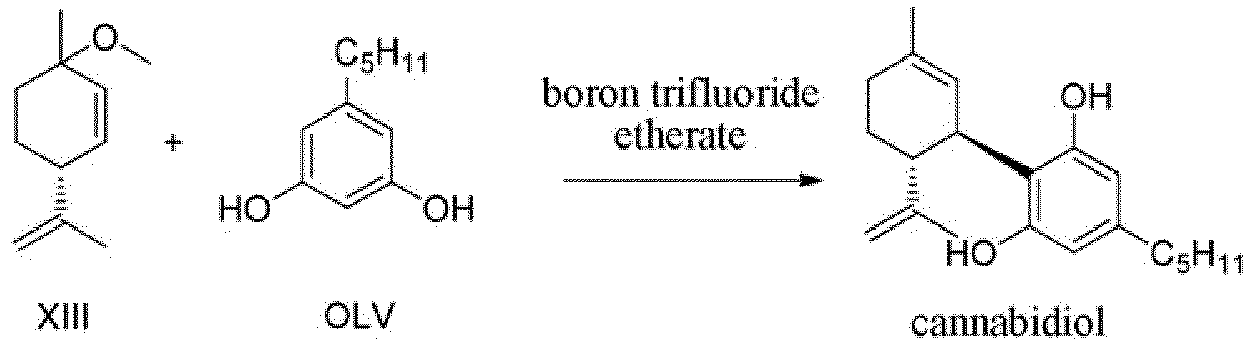
- OLV (1.0 g, 5.6 mmol) was dissolved in dichloromethane/toluene, added with anhydrous magnesium sulfate, and dropped slowly with a solution of boron trifluoride etherate (0.15 g, 0.1 eq) in toluene at -10°C to 0°C, followed by dropwise addition of XIII (1.02 g, 1.1 eq) at -10°C to 0°C. TLC showed that the reaction was almost complete. The reaction mixture was added with saturated sodium bicarbonate to quench the reaction, added with water and layered. The organic phase was concentrated to a small volume, added with n-heptane, methanol, and a 10% KOH aqueous solution and layered. The organic phase was adjusted with a saturated tartaric acid aqueous solution to pH=6-7, concentrated to dryness to obtain 800 mg of a light brown oil. The above oil was added with petroleum ether, and stirred for 12 h at -20°C. A large amount of solids were precipitated out, filtered and dried to obtain 500 mg of the product with a total yield of 28.4%.
- 1H NMR (DMSO, 400 MHz): 0.87 (t, 3H), 1.20-1.33 (m, 4H), 1.44-1.51 (m, 2H), 1.59 (s, 3H), 1.60 (s, 3H), 1.63-1.70 (m, 2H), 1.89-1.94 (m, 1H), 2.07-2.13 (m, 1H), 2.30 (t, 2H), 3.04(dr, 1H), 3.82-3.85(m, 1H), 4.41 (d, 1H), 4.50 (d, 1H), 5.09 (s, 1H), 6.02 (s, br, 2H), 8.60 (s, br, 2H). LR-MS (ESI) m/z: 313 (M-H)-.
-

- X-1 (1 g, 4.2 mmol) was dissolved in dichloromethane, added with trifluoromethanesulfonic anhydride (0.1 g, 0.08 eq) in dichloromethane at -10°C to 0°C, followed by addition of XII (702 mg, 1.1 eq) at -10°C to 0°C. TLC showed that the reaction was almost complete. The reaction mixture was added with saturated sodium bicarbonate to quench the reaction, added with water and layered. The organic phase was concentrated to a small volume, added with n-heptane, toluene, acetonitrile, and a 10% KOH aqueous solution, stirred and layered. The aqueous phase was added with maleic acid to adjust pH=6-7 and layered with dichloromethane, and the organic phase was concentrated to obtain 1.3 g of XI-1.
- 1H NMR (DMSO, 400 MHz): 0.87 (t, 3H), 1.24-1.33 (m, 4H), 1.41-1.48 (m, 2H), 1.59 (s, 3H), 1.61 (s, 3H), 1.64-1.72 (m, 2H), 1.92-1.96 (m, 1H), 2.09-2.13 (m, 1H), 2.68 (t, 2H), 3.00-3.06(m, 1H), 3.84(s, 3H), 3.89-3.92(m, 1H), 4.44(d, 2H), 5.09 (s, 1H), 6.21 (s, 1H), 9.90 (s, 1H), 11.56 (s, 1H). LR-MS (ESI) m/z: 371 (M-H)-.
- The above XI-1 was dissolved in methanol, added with a 10% KOH aqueous solution, and heated to reflux. TLC showed that XI-1 was completely reacted. The reaction mixture was added with methyl tert-butyl ether and layered. The methyl tert-butyl ether phase was adjusted to pH 6-7 with a saturated tartaric acid aqueous solution, and concentrated to remove methyl tert-butyl ether to obtain 0.9 g of a light brown oil. The light brown oil was dissolved in cycloheptane, and stirred at -20°C for 12h. A large amount of solids were precipitated out, filtered and dried to obtain 680 mg of cannabidiol in crystal form A as a white solid with a yield in two steps of 53.4% and a HPLC purity of 99.5%.
- 1H NMR (DMSO, 400 MHz): 0.87 (t, 3H), 1.20-1.33 (m, 4H), 1.44-1.51 (m, 2H), 1.59 (s, 3H), 1.60 (s, 3H), 1.63-1.70 (m, 2H), 1.89-1.94 (m, 1H), 2.07-2.13 (m, 1H), 2.30 (t, 2H), 3.04(dr, 1H), 3.82-3.85(m, 1H), 4.41 (d, 1H), 4.50 (d, 1H), 5.09 (s, 1H), 6.02 (s, br, 2H), 8.60 (s, br, 2H). LR-MS (ESI) m/z: 313 (M-H)-.
- The X-ray powder diffraction pattern of the cannabidiol crystal form A was measured, and the result was the same as that in Example 1.
- 1 g of the white solid was dissolved in n-heptane under heating, and kept at -30°C to -40°C for 48h. A large amount of crystals were formed, and 500 mg of single crystal of the crystal form A was obtained by filtration. The analysis result of the single crystal of the crystal form A was the same as that in Example 1.
-

- X-1 (1.0 g, 4.2 mmol) was dissolved in dichloromethane, added with anhydrous magnesium sulfate, and dropped slowly with a solution of methanesulfonic anhydride (0.21 g, 0.3 eq) in dichloromethane at -10°C to 0°C, followed by dropwise addition of XII (0.72 g, 1.1 eq) at -10°C to 0°C. TLC showed that the reaction was almost complete. The reaction mixture was added with saturated sodium bicarbonate to quench the reaction, added with water and layered. The organic phase was concentrated to a small volume, added with cyclohexane, methyl tert-butyl ether, N,N-dimethylformamide and a 10% LiOH aqueous solution and layered. The lower layer was adjusted to pH=6-7 with fumaric acid and layered with ethyl acetate, and the organic phase was concentrated to obtain 1.12 g of XI-1.
- The above XI-1 was dissolved in N,N-dimethylacetamide, added with anhydrous magnesium chloride (800 mg, 2 eq) and N,N-diisopropylethylamine (1.08 g, 2 eq), and heated to 128°C to react overnight. The reaction mixture was cooled down to room temperature, added with diethyl ether and layered. The diethyl ether phase was adjusted to pH=6-7 with a saturated tartaric acid aqueous solution, concentrated to dryness to remove diethyl ether to obtain 0.85 g of a light brown oil. The above light brown oil was added with cyclohexane and stirred at -20°C for 12h. A large amount of solids were precipitated out, filtered and dried to obtain 580 mg of cannabidiol in crystal form A with a yield in two steps of 45.2%.
- The NMR spectrum of this compound was measured, and it was the same as the product of Example 5.
-

- X-1 (1.0 g, 4.2 mmol) was dissolved in tetrahydrofuran, dropped slowly with a solution of trifluoroacetyl trifluoromethanesulfonate (0.11 g, 0.1 eq) in tetrahydrofuran at -10°C to 0°C, followed by dropwise addition of XII (0.702 g, 1.1 eq) at -10°C to 0°C. TLC showed that the reaction was almost complete. The reaction mixture was added with saturated sodium bicarbonate to quench the reaction, added with water and layered. The organic phase was concentrated to a small volume, added with n-hexane, cyclopentyl methyl ether, methanol and a 10% KOH aqueous solution and layered. The lower layer was adjusted with tartaric acid to pH=6-7 and layered with isopropyl acetate, and the organic phase was concentrated to obtain 1.38 g of XI-1.
- The above XI-1 was dissolved in tetrahydrofuran, added with a 10% NaOH aqueous solution, and heated to reflux. TLC showed that XI-1 was reacted completely. The reaction mixture was added with toluene and layered. The toluene phase was adjusted to pH 6-7 with saturated tartaric acid aqueous solution, and concentrated to dryness to remove toluene to obtain 0.81 g of a light brown oil. The above light brown oil was added with n-hexane and stirred at -20°C for 12h. A large amount of solids were precipitated out, filtered and dried to obtain 550 mg of cannabidiol in crystal form A with a yield in two steps of 42.6%.
- The NMR spectrum of this compound was measured, and it was the same as the product of Example 5.
-

- X-1 (1.0 g, 4.2 mmol) was dissolved in n-heptane, dropped slowly with a solution of trimethylsilyl trifluoromethanesulfonate (0.1 g, 0.1 eq) in toluene at -10°C to 0°C, followed by dropwise addition of XII (702 mg, 1.leq) at -10°C to 0°C. TLC showed that the reaction was almost complete. The reaction mixture was added with saturated sodium bicarbonate to quench the reaction, added with water and layered. The organic phase was concentrated to a small volume, added with xylene, n-heptane, dimethyl sulfoxide and a 10% LiOH aqueous solution and layered. The aqueous phase was adjusted to pH=6-7 with citric acid and layered with chloroform, and the organic phase was concentrated to obtain 1.44g of XI-1.
- The above XI-1 was dissolved in ethylene glycol, added with lithium chloride (356 mg, 2 eq) and N,N-diisopropylethylamine (1.08 g, 2 eq), and heated to 128°C to react overnight. The reaction mixture was cooled down to room temperature, added with isopropyl ether and layered. The isopropyl ether phase was adjusted to pH=6-7 with saturated tartaric acid aqueous solution, concentrated to dryness to remove isopropyl ether to obtain 0.9 g of a light brown oil. The above light brown oil was added with cyclohexane and stirred at -20°C for 12h. A large amount of solids were precipitated out, filtered and dried to obtain 700 mg of cannabidiol in crystal form A with a yield in two steps of 54.2%.
- The NMR spectrum of this compound was measured, and it was the same as the product of Example 5.
-

- X-1 (1.0 g, 4.2 mmol) was dissolved in methyl tert-butyl ether, added with sodium sulfate, dropped slowly with a solution of trimethylsilyl iodide (0.84 g, 0.1 eq) in methyl tert-butyl ether at -10°C to 0°C, followed by dropwise addition of XII (702 mg, 1.1 eq) at -10°C to 0°C. TLC showed that the reaction was almost complete. The reaction mixture was added with saturated sodium bicarbonate to quench the reaction, added with water and layered. The organic phase was concentrated to a small volume, added with cyclohexane, N,N-methylacetamide and a 10% NaOH aqueous solution and layered. The lower layer was adjusted to pH=6-7 with maleic acid and layered with cyclohexane, and the organic phase was concentrated to obtain 1.29 g of XI-1.
- The above XI-1 was dissolved in acetonitrile, added with a 10% LiOH aqueous solution, and heated to reflux. TLC showed that XI-1 was reacted completely. The reaction mixture was added with n-hexane and layered. The n-hexane phase was adjusted to pH 6-7 with saturated tartaric acid aqueous solution, concentrated to dryness to remove n-hexane to obtain 0.9 g of a light brown oil. The above light brown oil was added with n-hexane and stirred at -20°C for 12h. A large amount of solids were precipitated out, filtered and dried to obtain 600 mg of cannabidiol in crystal form A with a yield in two steps of 46.4%.
- The NMR spectrum of this compound was measured, and it was the same as the product of Example 5.
-

- X-1 (1.0g, 4.2mmol) was dissolved in 1,2-dichloroethane, dropped slowly with a solution of p-toluenesulfonic anhydride (1.36g, 0.1eq) in 1,2-dichloroethane at -10°C to 0°C, followed by dropwise addition of XII (702mg, 1.leq) at -10°C to 0°C. TLC showed that the reaction was almost complete. The reaction mixture was added with saturated sodium bicarbonate to quench the reaction, added with water and layered. The organic phase was concentrated to a small volume, added with petroleum ether, methanol and a 10% KOH aqueous solution and layered. The lower layer was adjusted to pH=6-7 with maleic acid, filtered and layered with n-octane, and the organic phase was concentrated to obtain 1.36 g of XI-1 as an oil.
- The above XI-1 was dissolved in toluene, added with a 10% LiOH aqueous solution, and heated to reflux. TLC showed that XI-1 was reacted completely. The reaction mixture was added with n-octane and layered. The n-octane phase was adjusted to pH 6-7 with saturated tartaric acid aqueous solution, concentrated to dryness to remove n-octane to obtain 0.9 g of a light brown oil. The above light brown oil was added with n-octane and stirred at -20°C for 12h. A large amount of solids were precipitated out, filtered and dried to obtain 610 mg of cannabidiol in crystal form A with a yield in two steps of 47.1%.
- The NMR spectrum of this compound was measured, and it was the same as the product of Example 5.
-

- X-2 (1.0 g, 3.76 mmol) was dissolved in chlorobenzene, dropped slowly with a solution of trifluoromethanesulfonic anhydride (1.0 g, 0.08 eq) in chlorobenzene at -10°C to 0°C, followed by dropwise addition of XII (0.629 g, 1.1 eq) at -10°C to 0°C. TLC showed that the reaction was almost complete. The reaction mixture was added with saturated sodium bicarbonate to quench the reaction, added with water and layered. The organic phase was concentrated to a small volume, added with n-heptane, xylene, methanol and a 10% LiOH aqueous solution and layered. The lower layer was adjusted to pH=6-7 with maleic acid, filtered and layered with n-heptane, and the organic phase was concentrated to obtain 1.36 g of XI-2.
- The above XI-2 was dissolved in dimethyl sulfoxide, added with magnesium tert-butoxide (1.28 g, 2 eq), and heated to reflux. TLC showed that XI-1 was reacted completely. The reaction mixture was added with petroleum ether and layered. The petroleum ether phase was adjusted to pH 6-7 with saturated tartaric acid aqueous solution, concentrated to dryness to remove petroleum ether to obtain 0.9 g of a light brown oil. The above light brown oil was added with n-heptane and stirred at -10°C to 0°C for 4h. A large amount of solids were precipitated out, and filtered to obtain 850 mg of white solids. The white solids above were added with cyclopentane and stirred at -20°C for 12h. A large amount of solids were precipitated out, filtered and dried to obtain 700mg of cannabidiol in crystal form A with a yield in two steps of 54.2%.
- The NMR spectrum of this compound was measured, and it was the same as the product of Example 1.
-

- OLV (1.0 g, 5.6 mmol) was dissolved in dichloromethane/toluene, added with anhydrous magnesium sulfate, and dropped slowly with a solution of trifluoromethanesulfonic anhydride (0.15 g, 0.1 eq) in toluene at -10°C to 0°C, followed by dropwise addition of XII (938 mg, 1.1 eq) at -10°C to 0°C. TLC showed that the reaction was almost complete. The reaction mixture was added with saturated sodium bicarbonate to quench the reaction, added with water and layered. The organic phase was concentrated to a small volume, added with cyclohexane, methanol, and a 10% KOH aqueous solution and layered. The organic phase was adjusted to pH=6-7 with saturated tartaric acid aqueous solution, concentrated to dryness to obtain 1.36 g of a light brown oil. The above light brown oil was added with n-heptane and stirred at -20°C for 12h. A large amount of solids were precipitated out, filtered and dried to obtain 900 mg of a light white solid with a purity of 90%. The above solid was dissolved in n-heptane and stirred at -20°C for 12h. A large amount of solids were precipitated out, filtered and dried to obtain 700 mg of the product with a total yield of 39.7%.
- The NMR spectrum of this compound was measured, and it was the same as the product of Example 4.
-

- X-1 (1 g, 4.2 mmol) was dissolved in dichloromethane/toluene, dropped slowly with boron trifluoride etherate (60mg, 0.1eq) at -10°C to 0°C, followed by dropwise addition of XIII (769 mg, 1.1 eq) at -10°C to 0°C. TLC showed that the reaction was almost complete. The reaction mixture was added with saturated sodium bicarbonate to quench the reaction, added with water and layered. The organic phase was concentrated to a small volume, added with n-heptane, xylene, acetonitrile and a 10% KOH aqueous solution and layered. The lower layer was adjusted to pH=6-7 with maleic acid and layered with n-heptane, and the organic phase was concentrated to obtain 1.5 g of XI-1.
- The above XI-1 was dissolved in methanol, added with a 10% KOH aqueous solution, and heated to reflux. TLC showed that XI-1 was reacted completely. The reaction mixture was cooled down to room temperature, added with cyclopentyl methyl ether and layered. The cyclopentyl methyl ether phase was adjusted to pH 6-7 with saturated tartaric acid aqueous solution, concentrated to dryness to remove cyclopentyl methyl ether to obtain 1.1 g of a light brown oil. The above light brown oil was dissolved in n-hexane and stirred at -10°C to 0°C for 4h. A large amount of solids were precipitated out, filtered and dried to obtain 850 mg of cannabidiol in crystal form A with a yield in two steps of 66.5%.
- The NMR spectrum of this compound was measured, and it was the same as the product of Example 5.
-

- X-8 (1 g, 4.8 mmol) was dissolved in dichloromethane/toluene, dropped slowly with boron trifluoride etherate (65 mg, 0.1 eq) at -10°C to 0°C, followed by dropwise addition of XIII (820 mg, 1.1 eq) at -10°C to 0°C. TLC showed that the reaction was almost complete. The reaction mixture was added with saturated sodium bicarbonate to quench the reaction, added with water and layered. The organic phase was concentrated to a small volume, added with n-heptane, xylene, acetonitrile and a 10% KOH aqueous solution and layered. The lower layer was adjusted to pH=6-7 with maleic acid and layered with n-heptane, and the organic phase was concentrated to obtain 1.6 g of compound XI-8.
- The above XI-8 was dissolved in methanol, added with a 10% KOH aqueous solution, and heated to reflux. TLC showed that XI-8 was reacted completely. The reaction mixture was cooled down to room temperature, added with cyclopentyl methyl ether and layered. The cyclopentyl methyl ether phase was adjusted to pH 6-7 with saturated tartaric acid aqueous solution, concentrated to dryness to remove cyclopentyl methyl ether to obtain 950 mg of V-8 with a yield in two steps of 72.5%.
- 1H NMR (DMSO, 400 MHz): 1.60(s, 3H), 1.61 (s, 3H), 1.62-1.71 (m, 2H), 1.91-2.03 (m, 1H), 2.08-2.15 (m, 1H), 3.05(dr, 1H), 3.84-3.88(m, 1H), 4.41 (d, 1H), 4.53 (d, 1H), 5.09 (s, 1H), 5.12 (d, 1H), 5.49 (d, 1H), 6.29 (s, br, 2H), 6.43-6.50 (m, 1H), 8.94 (s, br, 2H). LR-MS (ESI) m/z: 269 (M-H)-.
-

- X-8 (1 g, 4.8 mmol) was dissolved in toluene, dropped slowly with trifluoromethanesulfonic anhydride (88mg, 0.1eq) at -10°C to 0°C, followed by dropwise addition of XII (803 mg, 1.1 eq) at -10°C to 0°C. TLC showed that the reaction was almost complete. The reaction mixture was added with saturated sodium bicarbonate to quench the reaction, added with water and layered. The organic phase was concentrated to a small volume, added with n-hexane, xylene, acetonitrile and a 10% KOH aqueous solution and layered. The lower layer was adjusted to pH=6-7 with maleic acid and layered with n-hexane, and the organic phase was concentrated to obtain 1.5 g of XI-8.
- The above XI-8 was dissolved in methanol, added with a 10% KOH aqueous solution, and heated to reflux. TLC showed that XI-8 was reacted completely. The reaction mixture was cooled down to room temperature, added with cyclopentyl methyl ether and layered. The cyclopentyl methyl ether phase was adjusted to pH 6-7 with saturated tartaric acid aqueous solution, concentrated to dryness to remove cyclopentyl methyl ether to obtain 850 mg of V-8 with a yield in two steps of 64.9%.
- 1H NMR (DMSO, 400 MHz): 1.60(s, 3H), 1.61 (s, 3H), 1.62-1.71 (m, 2H), 1.91-2.03 (m, 1H), 2.08-2.15 (m, 1H), 3.05(dr, 1H), 3.84-3.88(m, 1H), 4.41 (d, 1H), 4.53 (d, 1H), 5.09 (s, 1H), 5.12 (d, 1H),5.49 (d, 1H), 6.29 (s, br, 2H), 6.43-6.50 (m, 1H), 8.94 (s, br, 2H). LR-MS (ESI) m/z: 269 (M-H)-.
-

- OLV-1 (1.0 g, 7.4 mmol) was dissolved in dichloromethane, added with anhydrous magnesium sulfate, and dropped slowly with a solution of boron trifluoride etherate (0.2 g, 0.1 eq) in toluene at -10°C to 0°C, followed by dropwise addition of XIII (1.35g, 1.1 eq) at -10°C to 0°C. TLC showed that the reaction was almost complete. The reaction mixture was added with saturated sodium bicarbonate to quench the reaction, added with water and layered. The organic phase was concentrated to a small volume, added with n-heptane, methanol, and a 10% KOH aqueous solution and layered. The organic phase was adjusted to pH=6-7 with saturated tartaric acid aqueous solution, concentrated to dryness to obtain 800mg of V-8 with a yield of 40.2%.
- The NMR spectrum of this compound was measured, and it was the same as the product of Example 14.
-

- X-9 (1 g, 3.9 mmol) was dissolved in dichloromethane, dropped slowly with boron trifluoride etherate (55 mg, 0.1 eq) at -10°C to 0°C, followed by dropwise addition of XIII (260 mg, 1.1 eq) at -10°C to 0°C. TLC showed that the reaction was almost complete. The reaction mixture was added with saturated sodium bicarbonate to quench the reaction, added with water and layered. The organic phase was concentrated to a small volume, added with cyclohexane, toluene, methanol and 10% KOH aqueous solution and layered. The lower layer was adjusted to pH=6-7 with maleic acid and layered with cyclohexane, and the organic phase was concentrated to obtain 800mg of XI-9.
- The above XI-9 was dissolved in ethanol, added with a 10% NaOH aqueous solution, and heated to reflux. TLC showed that XI-9 was reacted completely. The reaction mixture was cooled down to room temperature, added with cyclopentyl methyl ether and layered. The cyclopentyl methyl ether phase was adjusted to pH=6-7 with saturated tartaric acid aqueous solution, concentrated to dryness to remove cyclopentyl methyl ether to obtain 600 mg of V-9 with a yield in two steps of 62.5%.
- 1H NMR (DMSO, 400 MHz): 1.60(s, 3H), 1.64 (s, 3H), 1.64-1.74 (m, 2H), 1.93-2.02 (m, 1H), 2.09-2.18 (m, 1H), 3.11(dr, 1H), 3.91-3.94(m, 1H), 4.46 (d, 1H), 4.56 (d, 1H), 5.14 (s, 1H), 6.48 (s, br, 2H), 7.28-7.33 (m, 1H), 7.40-7.48 (m, 4H), 9.07 (s, br, 2H). LR-MS (ESI) m/z: 319 (M-H)-.
-

- X-9 (1 g, 3.9 mmol) was dissolved in dichloromethane, dropped slowly with methanesulfonic anhydride (100mg, 0.2eq) at -10°C to 0°C, followed by dropwise addition of XII (246mg, 1.1 eq) at -10°C to 0°C. TLC showed that the reaction was almost complete. The reaction mixture was added with saturated sodium bicarbonate to quench the reaction, added with water and layered. The organic phase was concentrated to a small volume, added with cyclohexane, toluene, methanol and a 10% KOH aqueous solution and layered. The lower layer was adjusted to pH=6-7 with maleic acid, layered with cyclohexane, and concentrated to obtain 800mg of XI-9.
- The above XI-9 was dissolved in ethanol, added with a 10% NaOH aqueous solution, and heated to reflux. TLC showed that XI-9 was reacted completely. The reaction mixture was cooled down to room temperature, added with cyclopentyl methyl ether and layered. The cyclopentyl methyl ether phase was adjusted to pH=6-7 with saturated tartaric acid aqueous solution, concentrated to dryness to remove cyclopentyl methyl ether to obtain 700 mg of V-9 with a yield in two steps of 72.9%.
- 1H NMR (DMSO, 400 MHz): 1.60(s, 3H), 1.64 (s, 3H), 1.64-1.74 (m, 2H), 1.93-2.02 (m, 1H), 2.09-2.18 (m, 1H), 3.11(dr, 1H), 3.91-3.94(m, 1H), 4.46 (d, 1H), 4.56 (d, 1H), 5.14 (s, 1H), 6.48 (s, br, 2H), 7.28-7.33 (m, 1H), 7.40-7.48 (m, 4H), 9.07 (s, br, 2H). LR-MS (ESI) m/z: 319 (M-H)-.
-

- OLV-2 (1.0 g, 5.4 mmol) was dissolved in diethyl ether, added with anhydrous magnesium sulfate, and dropped slowly with a solution of boron trifluoride etherate (0.12 g, 0.1 eq) in diethyl ether at -10°C to 0°C, followed by dropwise addition of XIII (990g, 1.1 eq) at -10°C to 0°C. TLC showed that the reaction was almost complete. The reaction mixture was added with saturated sodium bicarbonate to quench the reaction, added with water and layered. The organic phase was concentrated to a small volume, added with n-heptane, methanol, and a 10% KOH aqueous solution and layered. The organic phase was adjusted to pH=6-7 with saturated tartaric acid aqueous solution, concentrated to dryness to obtain 800mg of V-9 with a yield of 46.5%.
- 1H NMR (DMSO, 400 MHz): 1.60(s, 3H), 1.64 (s, 3H), 1.64-1.74 (m, 2H), 1.93-2.02 (m, 1H), 2.09-2.18 (m, 1H), 3.11(dr, 1H), 3.91-3.94(m, 1H), 4.46 (d, 1H), 4.56 (d, 1H), 5.14 (s, 1H), 6.48 (s, br, 2H), 7.28-7.33 (m, 1H), 7.40-7.48 (m, 4H), 9.07 (s, br, 2H). LR-MS (ESI) m/z: 319 (M-H)-.
-

- X-2 (1.0 g, 3.76 mmol) was dissolved in chlorobenzene, and dropped slowly with a solution of trifluoromethanesulfonic anhydride (1.0 g, 0.08 eq) in chlorobenzene at -10°C to 0°C, followed by dropwise addition of XVII (681 mg, 1.1eq) at -10°C to 0°C. TLC showed that the reaction was almost complete. The reaction mixture was added with saturated sodium bicarbonate to quench the reaction, added with water and layered. The organic phase was concentrated to a small volume, added with cyclohexane, chlorobenzene, methanol and a 10% LiOH aqueous solution and layered. The lower layer was adjusted to pH=6-7 with maleic acid, filtered and layered with cyclohexane and the organic phase was concentrated to obtain 1.46g of XI-2.
- 1H NMR (DMSO, 400 MHz): 0.87 (t, 3H), 1.24-1.35 (m, 7H), 1.43-1.48 (m, 2H), 1.59 (s, 3H), 1.61 (s, 3H), 1.64-1.72 (m, 2H), 1.92-1.96 (m, 1H), 2.09-2.16 (m, 1H), 2.70 (t, 2H), 3.00-3.06(m, 1H), 3.89-3.92(m, 1H), 4.32 (q, 2H), 4.42(d, 1H), 4.60(d, 1H), 5.09 (s, 1H), 6.20 (s, 1H), 9.92 (s, 1H), 11.80 (s, 1H). LR-MS (ESI) m/z: 385 (M-H)-.
- The above XI-2 was dissolved in methanol, added with a 10% LiOH aqueous solution, and heated to reflux. TLC showed that XI-2 was reacted completely. The reaction mixture was added with petroleum ether and layered. The petroleum ether phase was adjusted to pH 6-7 with saturated tartaric acid aqueous solution, concentrated to dryness to remove petroleum ether to obtain 1.02 g of a light brown oil. The above light brown oil was dissolved in n-heptane and stirred at -10°C to 0°C for 4h. A large amount of solids were precipitated out, and filtered to obtain 800 mg of cannabidiol in crystal form A as a white solid, with a yield in two steps of 64.5% and a HPLC purity of 99.5%.
- 1H NMR (DMSO, 400 MHz): 0.87 (t, 3H), 1.20-1.33 (m, 4H), 1.44-1.51 (m, 2H), 1.59 (s, 3H), 1.60 (s, 3H), 1.63-1.70 (m, 2H), 1.89-1.94 (m, 1H), 2.07-2.13 (m, 1H), 2.30 (t, 2H), 3.04(dr, 1H),3.82-3.85(m, 1H),4.41 (d, 1H), 4.50 (d, 1H), 5.09 (s, 1H), 6.02 (s, br, 2H), 8.60 (s, br, 2H). LR-MS (ESI) m/z: 313 (M-H)-.
-

- X-5 (1.0 g, 5.6 mmol) was dissolved in dichloromethane/toluene, added with anhydrous magnesium sulfate, and dropped slowly with a solution of trifluoromethanesulfonic anhydride (0.15 g, 0.1 eq) in toluene at -10°C to 0°C, followed by dropwise addition of XVIII (895 mg, 1.1 eq) at -10°C to 0°C. TLC showed that the reaction was almost complete. The reaction mixture was added with saturated sodium bicarbonate to quench the reaction, added with water and layered. The organic phase was concentrated to a small volume, added with cyclohexane, methanol, and a 10% KOH aqueous solution and layered. The lower layer was adjusted with saturated tartaric acid aqueous solution to pH=5-6, layered with dichloromethane. The organic phase was concentrated to dryness to obtain 800 mg of the product with a total yield of 49.9%.
- 1H NMR (CDCl3, 400 MHz) :0.90 (3H, m), 1.20- 1.33 (4H, m), 1.55 (2H, m), 1.72 (3H s), 1.80 (3H, s), 2.01- 2.39(5H, m), 2.92 (2H, t), 4.10 (1H, m), 4.40 (1H, s), 4.55 (1H, s), 5.57(1H, s), 6.26(1H, s), 6.66(2H, s), 11.85 (1H, s). LR-MS (ESI) m/z: 357 (M-H)-.
-

- X-5 (1.0 g, 5.6 mmol) was dissolved in chloroform, added with anhydrous magnesium sulfate, and dropped slowly with a solution of methanesulfonic acid (85mg, 0.2 eq) in toluene at -10°C to 0°C, followed by dropwise addition of XVIII (938 mg, 1.1 eq) at -10°C to 0°C. TLC showed that the reaction was almost complete. The reaction mixture was added with saturated sodium bicarbonate to quench the reaction, added with water and layered. The organic phase was concentrated to a small volume, added with petroleum ether, methanol, and a 10% KOH aqueous solution and layered. The lower layer was adjusted with saturated tartaric acid aqueous solution to pH=5-6, and layered with n-heptane. The organic phase was concentrated to dryness to obtain 700 mg of the product with a total yield of 43.6%.
- 1H NMR (CDCl3, 400 MHz) :0.90 (3H, m), 1.20- 1.33 (4H, m), 1.55 (2H, m), 1.72 (3H s), 1.80 (3H, s), 2.01- 2.39(5H, m), 2.92 (2H, t), 4.10 (1H, m), 4.40 (1H, s), 4.55 (1H, s), 5.57(1H, s), 6.26(1H, s), 6.66(2H, s), 11.85 (1H, s). LR-MS (ESI) m/z: 357 (M-H)-.
-

- OLV (1.0 g, 5.6 mmol) was dissolved in dichloromethane/toluene, added with anhydrous magnesium sulfate, and dropped slowly with a solution of boron trifluoride etherate (0.15 g, 0.1 eq) in toluene at -10°C to 0°C, followed by dropwise addition of XVII (1.02g, 1.1 eq) at -10°C to 0°C. TLC showed that the reaction was almost complete. The reaction mixture was added with saturated sodium bicarbonate to quench the reaction, added with water and layered. The organic phase was concentrated to a small volume, added with n-heptane, methanol, and a 10% KOH aqueous solution and layered. The organic phase was adjusted to pH=6-7 with saturated tartaric acid aqueous solution, concentrated to dryness to obtain 800mg of a light brown oil. The above oil was added with petroleum ether, and stirred at -20°C for 12h. A large amount of solids were precipitated out, filtered and dried to obtain 600 mg of the product with a total yield of 34.8%.
- 1H NMR (DMSO, 400 MHz): 0.87 (t, 3H), 1.20-1.33 (m, 4H), 1.44-1.51 (m, 2H), 1.59 (s, 3H), 1.60 (s, 3H), 1.63-1.70 (m, 2H), 1.89-1.94 (m, 1H), 2.07-2.13 (m, 1H), 2.30 (t, 2H), 3.04(dr, 1H), 3.82-3.85(m, 1H), 4.41 (d, 1H), 4.50 (d, 1H), 5.09 (s, 1H), 6.02 (s, br, 2H), 8.60 (s, br, 2H). LR-MS (ESI) m/z: 313 (M-H)-.
-

- X-1 (1 g, 4.2 mmol) was dissolved in dichloromethane, and dropped slowly with a solution of trifluoromethanesulfonic anhydride (0.1 g, 0.08 eq) in dichloromethane at -10°C to 0°C, followed by dropwise addition of XIV (802 mg, 1.1 eq) at-10°C to 0°C. TLC showed that the reaction was almost complete. The reaction mixture was added with saturated sodium bicarbonate to quench the reaction, added with water and layered. The organic phase was concentrated to a small volume, added with n-heptane, toluene, acetonitrile and a 10% KOH aqueous solution, stirred and layered. The aqueous phase was added with maleic acid to adjust pH=6-7 and layered with dichloromethane, and the organic phase was concentrated to obtain 1.4g of XI-1.
- 1H NMR (DMSO, 400 MHz): 0.87 (t, 3H), 1.24-1.33 (m, 4H), 1.41-1.48 (m, 2H), 1.59 (s, 3H), 1.61 (s, 3H), 1.64-1.72 (m, 2H), 1.92-1.96 (m, 1H), 2.09-2.13 (m, 1H), 2.68 (t, 2H), 3.00-3.06(m, 1H), 3.84(s, 3H), 3.89-3.92(m, 1H), 4.44(d, 2H), 5.09 (s, 1H), 6.21 (s, 1H), 9.90 (s, 1H), 11.56 (s, 1H). LR-MS (ESI) m/z: 371 (M-H)-.
- The above XI-1 was dissolved in N,N-dimethylacetamide, added with anhydrous magnesium chloride (800 mg, 2 eq) and N,N-diisopropylethylamine (1.08 g, 2 eq), and heated to 128°C to react overnight. The reaction mixture was cooled down to room temperature, added with methyl tert-butyl ether and layered. The methyl tert-butyl ether phase was adjusted to pH=6-7 with saturated tartaric acid aqueous solution, concentrated to dryness to remove methyl tert-butyl ether to obtain 1.1 g of a light brown oil. The above light brown oil was dissolved in cycloheptane and stirred at -20°C for 12h. A large amount of solids were precipitated out, filtered and dried to obtain 780 mg of cannabidiol in crystal form A with a yield in two steps of 61.2% and a HPLC purity of 99.5%.
- 1H NMR (DMSO, 400 MHz): 0.87 (t, 3H), 1.20-1.33 (m, 4H), 1.44-1.51 (m, 2H), 1.59 (s, 3H), 1.60 (s, 3H), 1.63-1.70 (m, 2H), 1.89-1.94 (m, 1H), 2.07-2.13 (m, 1H), 2.30 (t, 2H), 3.04(dr, 1H), 3.82-3.85(m, 1H), 4.41 (d, 1H), 4.50 (d, 1H), 5.09 (s, 1H), 6.02 (s, br, 2H), 8.60 (s, br, 2H). LR-MS (ESI) m/z: 313 (M-H)-.
- The X-ray powder diffraction pattern of the cannabidiol crystal form A was measured, and the result was the same as that in Example 1.
- 1 g of the white solid above was dissolved in n-heptane under heating, and kept at -30°C to -40°C for 48h. A large amount of crystals were formed, and filtered to obtain 500 mg of single crystal of the crystal form A. The analysis result of the single crystal of the crystal form A is the same as that in Example 1.
-

- X-1 (1.0 g, 4.2 mmol) was dissolved in dichloromethane, added with anhydrous magnesium sulfate, and dropped slowly with a solution of methanesulfonic anhydride (0.21 g, 0.3 eq) in dichloromethane at -10°C to 0°C, followed by dropwise addition of XIIV (1.24 g, 1.1 eq) at -10°C to 0°C. TLC showed that the reaction was almost complete. The reaction mixture was added with saturated sodium bicarbonate to quench the reaction, added with water and layered. The organic phase was concentrated to a small volume, added with cyclohexane, methyl tert-butyl ether, N,N-dimethylformamide and a 10% LiOH aqueous solution and layered. The lower layer was adjusted to pH=6-7 with fumaric acid and layered with ethyl acetate, and the organic phase was concentrated to obtain 1.12 g of XI-1.
- 1H NMR (DMSO, 400 MHz): 0.87 (t, 3H), 1.24-1.33 (m, 4H), 1.41-1.48 (m, 2H), 1.59 (s, 3H), 1.61 (s, 3H), 1.64-1.72 (m, 2H), 1.92-1.96 (m, 1H), 2.09-2.13 (m, 1H), 2.68 (t, 2H), 3.00-3.06(m, 1H), 3.84(s, 3H), 3.89-3.92(m, 1H), 4.44(d, 2H), 5.09 (s, 1H), 6.21 (s, 1H), 9.90 (s, 1H), 11.56 (s, 1H). LR-MS (ESI) m/z: 371 (M-H)-.
- The above XI-1 was dissolved in ethanol, added with a 10% NaOH aqueous solution, and heated to reflux. TLC showed that XI-1 was reacted completely. The reaction mixture was added with diethyl ether and layered. The diethyl ether phase was adjusted to pH 6-7 with saturated tartaric acid aqueous solution, concentrated to dryness to remove diethyl ether to obtain 0.85 g of a light brown oil. The above light brown oil was added with cyclohexane and stirred at -20°C for 12h. A large amount of solids were precipitated out, filtered and dried to obtain 680 mg of cannabidiol in crystal form A with a yield in two steps of 53.0%.
- 1H NMR (DMSO, 400 MHz): 0.87 (t, 3H), 1.20-1.33 (m, 4H), 1.44-1.51 (m, 2H), 1.59 (s, 3H), 1.60 (s, 3H), 1.63-1.70 (m, 2H), 1.89-1.94 (m, 1H), 2.07-2.13 (m, 1H), 2.30 (t, 2H), 3.04(dr, 1H), 3.82-3.85(m, 1H), 4.41 (d, 1H), 4.50 (d, 1H), 5.09 (s, 1H), 6.02 (s, br, 2H), 8.60 (s, br, 2H). LR-MS (ESI) m/z: 313 (M-H)-.
-

- X-1 (1.0 g, 4.2 mmol) was dissolved in tetrahydrofuran, dropped slowly a solution of trifluoroacetyl trifluoromethanesulfonate (0.11 g, 0.1 eq) in tetrahydrofuran at -10°C to 0°C, followed by dropwise addition of XIVI (1.42 g, 1.1 eq). TLC showed that the reaction was almost complete. The reaction mixture was added with saturated sodium bicarbonate to quench the reaction, added with water and layered. The organic phase was concentrated to a small volume, added with n-hexane, cyclopentyl methyl ether, methanol and a 10% KOH aqueous solution and layered. The lower layer was adjusted with tartaric acid to pH=6-7 and layered with isopropyl acetate, and the organic phase was concentrated to obtain 1.28 g of XI-1.
- 1H NMR (DMSO, 400 MHz): 0.87 (t, 3H), 1.24-1.33 (m, 4H), 1.41-1.48 (m, 2H), 1.59 (s, 3H), 1.61 (s, 3H), 1.64-1.72 (m, 2H), 1.92-1.96 (m, 1H), 2.09-2.13 (m, 1H), 2.68 (t, 2H), 3.00-3.06(m, 1H), 3.84(s, 3H), 3.89-3.92(m, 1H), 4.44(d, 2H), 5.09 (s, 1H), 6.21 (s, 1H), 9.90 (s, 1H), 11.56 (s, 1H). LR-MS (ESI) m/z: 371 (M-H)-.
- The above XI-1 was dissolved in N,N-dimethylacetamide, added with anhydrous magnesium chloride (800 mg, 2 eq) and N,N-diisopropylethylamine (1.08 g, 2 eq), and heated to 128°C to react overnight. The reaction mixture was cooled down to room temperature, added with toluene and layered. The toluene phase was adjusted to pH=6-7 with saturated tartaric acid aqueous solution, concentrated to dryness to remove toluene to obtain 0.81 g of a light brown oil. The above light brown oil was added with n-hexane and stirred at -20°C for 12h. A large amount of solids were precipitated out, filtered and dried to obtain 650 mg of cannabidiol in crystal form A with a yield in two steps of 50.4%.
- 1H NMR (DMSO, 400 MHz): 0.87 (t, 3H), 1.20-1.33 (m, 4H), 1.44-1.51 (m, 2H), 1.59 (s, 3H), 1.60 (s, 3H), 1.63-1.70 (m, 2H), 1.89-1.94 (m, 1H), 2.07-2.13 (m, 1H), 2.30 (t, 2H), 3.04(dr, 1H), 3.82-3.85(m, 1H), 4.41 (d, 1H), 4.50 (d, 1H), 5.09 (s, 1H), 6.02 (s, br, 2H), 8.60 (s, br, 2H). LR-MS (ESI) m/z: 313 (M-H)-.
-

- X-1 (1.0 g, 4.2 mmol) was dissolved in n-heptane, dropped slowly with a solution of trimethylsilyl trifluoromethanesulfonate (0.1 g, 0.1 eq) in toluene at -10°C to 0°C, followed by dropwise addition of XVII (702 mg, 1.leq) at -10°C to 0°C. TLC showed that the reaction was almost complete. The reaction mixture was added with saturated sodium bicarbonate to quench the reaction, added with water and layered. The organic phase was concentrated to a small volume, added with xylene, n-heptane, dimethyl sulfoxide and a 10% LiOH aqueous solution and layered. The aqueous phase was adjusted to pH=6-7 with citric acid and layered with chloroform, and the organic phase was concentrated to obtain 1.44g of XI-1.
- 1H NMR (DMSO, 400 MHz): 0.87 (t, 3H), 1.24-1.33 (m, 4H), 1.41-1.48 (m, 2H), 1.59 (s, 3H), 1.61 (s, 3H), 1.64-1.72 (m, 2H), 1.92-1.96 (m, 1H), 2.09-2.13 (m, 1H), 2.68 (t, 2H), 3.00-3.06(m, 1H), 3.84(s, 3H), 3.89-3.92(m, 1H), 4.44(d, 2H), 5.09 (s, 1H), 6.21 (s, 1H), 9.90 (s, 1H), 11.56 (s, 1H). LR-MS (ESI) m/z: 371 (M-H)-.
- The above XI-1 was dissolved in ethylene glycol, and added with a 10% LiOH aqueous solution. The resulting mixture was heated to reflux. TLC showed that XI-1 was reacted completely. The reaction mixture was added with isopropyl ether and layered. The isopropyl ether phase was adjusted to pH=6-7 with saturated tartaric acid aqueous solution, concentrated to dryness to remove isopropyl ether to obtain 0.9 g of a light brown oil. The above light brown oil was added with cyclohexane and stirred at -20°C for 12h. A large amount of solids were precipitated out, filtered and dried to obtain 750 mg of cannabidiol in crystal form A with a yield in two steps of 58.1%.
- 1H NMR (DMSO, 400 MHz): 0.87 (t, 3H), 1.20-1.33 (m, 4H), 1.44-1.51 (m, 2H), 1.59 (s, 3H), 1.60 (s, 3H), 1.63-1.70 (m, 2H), 1.89-1.94 (m, 1H), 2.07-2.13 (m, 1H), 2.30 (t, 2H), 3.04(dr, 1H), 3.82-3.85(m, 1H), 4.41 (d, 1H), 4.50 (d, 1H), 5.09 (s, 1H), 6.02 (s, br, 2H), 8.60 (s, br, 2H). LR-MS (ESI) m/z: 313 (M-H)-.
-

- X-1 (1.0 g, 4.2 mmol) was dissolved in methyl tert-butyl ether, added with sodium sulfate, and dropped slowly with a solution of trimethylsilyl iodide (0.84 g, 0.1 eq) in methyl tert-butyl ether at -10°C to 0°C, followed by dropwise addition of XIIVI (900 mg, 1.1 eq) at -10°C to 0°C. TLC showed that the reaction was almost complete. The reaction mixture was added with saturated sodium bicarbonate to quench the reaction, and added with water and layered. The organic phase was concentrated to a small volume, added with cyclohexane, N,N-methylacetamide and a 10% NaOH aqueous solution and layered. The lower layer was adjusted to pH=6-7 with maleic acid and layered with cyclohexane, and the organic phase was concentrated to obtain 1.39 g of XI-1.
- 1H NMR (DMSO, 400 MHz): 0.87 (t, 3H), 1.24-1.33 (m, 4H), 1.41-1.48 (m, 2H), 1.59 (s, 3H), 1.61 (s, 3H), 1.64-1.72 (m, 2H), 1.92-1.96 (m, 1H), 2.09-2.13 (m, 1H), 2.68 (t, 2H), 3.00-3.06(m, 1H), 3.84(s, 3H), 3.89-3.92(m, 1H),4.44(d, 2H), 5.09 (s, 1H), 6.21 (s, 1H), 9.90 (s, 1H), 11.56 (s, 1H). LR-MS (ESI) m/z: 371 (M-H)-.
- The above XI-1 was dissolved in acetonitrile, added with a 10% LiOH aqueous solution, and heated to reflux. TLC showed that XI-1 was reacted completely. The reaction mixture was added with n-hexane and layered. The n-hexane phase was adjusted to pH 6-7 with saturated tartaric acid aqueous solution, concentrated to dryness to remove n-hexane to obtain 0.9 g of a light brown oil. The above light brown oil was added with n-hexane and stirred at -20°C for 12h. A large amount of solids were precipitated out, filtered and dried to obtain 750 mg of cannabidiol in crystal form A with a yield in two steps of 58.0%.
- 1H NMR (DMSO, 400 MHz): 0.87 (t, 3H), 1.20-1.33 (m, 4H), 1.44-1.51 (m, 2H), 1.59 (s, 3H), 1.60 (s, 3H), 1.63-1.70 (m, 2H), 1.89-1.94 (m, 1H), 2.07-2.13 (m, 1H), 2.30 (t, 2H), 3.04(dr, 1H), 3.82-3.85(m, 1H), 4.41 (d, 1H), 4.50 (d, 1H), 5.09 (s, 1H), 6.02 (s, br, 2H), 8.60 (s, br, 2H). LR-MS (ESI) m/z: 313 (M-H)-.
-

- X-1 (1.0g, 4.2mmol) was dissolved in 1,2-dichloroethane, dropped slowly with a solution of p-toluenesulfonic anhydride (1.36g, 0.1eq) in 1,2-dichloroethane at -10°C to 0°C, followed by dropwise addition of XIIVII (1.24 mg, 1.1 eq) at -10°C to 0°C. TLC showed that the reaction was almost complete. The reaction mixture was added with saturated sodium bicarbonate to quench the reaction, added with water and layered. The organic phase was concentrated to a small volume, added with petroleum ether, methanol and a 10% KOH aqueous solution and layered. The lower layer was adjusted to pH=6-7 with maleic acid, filtered and layered with n-octane, and the organic phase was concentrated to obtain 1.32 g of XI-1 as an oil.
- 1H NMR (DMSO, 400 MHz): 0.87 (t, 3H), 1.24-1.33 (m, 4H), 1.41-1.48 (m, 2H), 1.59 (s, 3H), 1.61 (s, 3H), 1.64-1.72 (m, 2H), 1.92-1.96 (m, 1H), 2.09-2.13 (m, 1H), 2.68 (t, 2H), 3.00-3.06(m, 1H), 3.84(s, 3H), 3.89-3.92(m, 1H), 4.44(d, 2H), 5.09 (s, 1H), 6.21 (s, 1H), 9.90 (s, 1H), 11.56 (s, 1H). LR-MS (ESI) m/z: 371 (M-H)-.
- The above XI-1 was dissolved in toluene, added with a 10% LiOH aqueous solution, and heated to reflux. TLC showed that XI-1 was reacted completely. The reaction mixture was added with n-octane and layered. The n-octane phase was adjusted to pH 6-7 with saturated tartaric acid aqueous solution, concentrated to dryness to remove n-octane to obtain 0.9 g of a light brown oil. The above light brown oil was added with n-octane and stirred at -20°C for 12h. A large amount of solids were precipitated out, filtered and dried to obtain 680 mg of cannabidiol in crystal form A with a yield in two steps of 52.7%.
- 1H NMR (DMSO, 400 MHz): 0.87 (t, 3H), 1.20-1.33 (m, 4H), 1.44-1.51 (m, 2H), 1.59 (s, 3H), 1.60 (s, 3H), 1.63-1.70 (m, 2H), 1.89-1.94 (m, 1H), 2.07-2.13 (m, 1H), 2.30 (t, 2H), 3.04(dr, 1H), 3.82-3.85(m, 1H), 4.41 (d, 1H), 4.50 (d, 1H), 5.09 (s, 1H), 6.02 (s, br, 2H), 8.60 (s, br, 2H). LR-MS (ESI) m/z: 313 (M-H)-.
-

- X-2 (1.0 g, 3.76 mmol) was dissolved in chlorobenzene, dropped slowly with a solution of trifluoromethanesulfonic anhydride (1.0 g, 0.08 eq) in chlorobenzene at -10°C to 0°C, followed by dropwise addition of XVVII (1.42 g, 1.1 eq) at -10°C to 0°C. TLC showed that the reaction was almost complete. The reaction mixture was added with saturated sodium bicarbonate to quench the reaction, added with water and layered. The organic phase was concentrated to a small volume, added with n-heptane, xylene, methanol and a 10% LiOH aqueous solution and layered. The lower layer was adjusted to pH=6-7 with maleic acid, filtered and layered with n-heptane, and the organic phase was concentrated to obtain 1.36g of XI-2.
- 1H NMR (DMSO, 400 MHz): 0.87 (t, 3H), 1.24-1.35 (m, 7H), 1.43-1.48 (m, 2H), 1.59 (s, 3H), 1.61 (s, 3H), 1.64-1.72 (m, 2H), 1.92-1.96 (m, 1H), 2.09-2.16 (m, 1H), 2.70 (t, 2H), 3.00-3.06(m, 1H), 3.89-3.92(m, 1H), 4.32 (q, 2H), 4.42(d, 1H), 4.60(d, 1H), 5.09 (s, 1H), 6.20 (s, 1H), 9.92 (s, 1H), 11.80 (s, 1H). LR-MS (ESI) m/z: 385 (M-H)-.
- The above XI-2 was dissolved in methanol, added with a 10% LiOH aqueous solution, and heated to reflux. TLC showed that XI-2 was reacted completely. The reaction mixture was added with petroleum ether and layered. The petroleum ether phase was adjusted to pH 6-7 with saturated tartaric acid aqueous solution, concentrated to dryness to remove petroleum ether to obtain 0.9 g of a light brown oil. The above light brown oil was dissolved in n-heptane and stirred at -10°C to 0°C for 4h. A large amount of solids were precipitated out, and filtered to obtain 850 mg of a white solid. The above solid was added with cyclopentane and stirred at -20°C for 12h. A large amount of solids were precipitated out, filtered and dried to obtain 850 mg of cannabidiol in crystal form A with a yield in two steps of 65.8%.
- 1H NMR (DMSO, 400 MHz): 0.87 (t, 3H), 1.20-1.33 (m, 4H), 1.44-1.51 (m, 2H), 1.59 (s, 3H), 1.60 (s, 3H), 1.63-1.70 (m, 2H), 1.89-1.94 (m, 1H), 2.07-2.13 (m, 1H), 2.30 (t, 2H), 3.04(dr, 1H), 3.82-3.85(m, 1H), 4.41 (d, 1H), 4.50 (d, 1H), 5.09 (s, 1H), 6.02 (s, br, 2H), 8.60 (s, br, 2H). LR-MS (ESI) m/z: 313 (M-H)-.
-
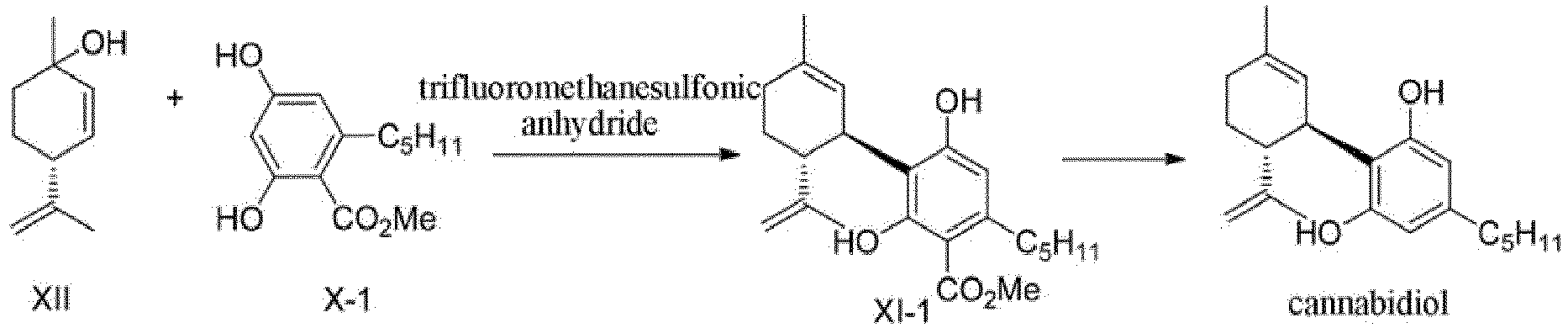
- X-1 (1 g, 4.2 mmol) was dissolved in dichloromethane, added with a solution of trifluoromethanesulfonic anhydride (0.1 g, 0.08 eq) in dichloromethane at -10°C to 0°C, followed by dropwise addition of XII (702 mg, 1.1 eq) at-10°C to 0°C. TLC showed that the reaction was almost complete. The reaction mixture was added with saturated sodium bicarbonate to quench the reaction, added with water and layered. The organic phase was concentrated to a small volume, added with n-heptane, toluene, acetonitrile and a 10% KOH aqueous solution, stirred and layered. The aqueous phase was added with maleic acid to adjust pH=6-7, layered with dichloromethane, and concentrated to obtain 1.3g of XI-1.
- 1H NMR (DMSO, 400 MHz): 0.87 (t, 3H), 1.24-1.33 (m, 4H), 1.41-1.48 (m, 2H), 1.59 (s, 3H), 1.61 (s, 3H), 1.64-1.72 (m, 2H), 1.92-1.96 (m, 1H), 2.09-2.13 (m, 1H), 2.68 (t, 2H), 3.00-3.06(m,1H),3.84(s,3H), 3.89-3.92(m,1H),4.44(d, 2H), 5.09 (s, 1H), 6.21 (s, 1H), 9.90 (s, 1H), 11.56 (s, 1H). LR-MS (ESI) m/z: 371 (M-H)-.
- The above XI-1 was dissolved in dimethyl sulfoxide, added with magnesium tert-butoxide (1.4 g, 2 eq), and heated at 120-130 °C. TLC showed that XI-1 was reacted completely. The reaction mixture was added with methyl tert-butyl ether and layered. The methyl tert-butyl ether phase was adjusted to pH=6-7 with saturated tartaric acid aqueous solution, concentrated to dryness to remove methyl tert-butyl ether to obtain 0.9 g of a light brown oil. The above light brown oil was dissolved in cycloheptane and stirred at -20°C for 12h. A large amount of solids were precipitated out, filtered and dried to obtain 680 mg of cannabidiol in crystal form A with a yield in two steps of 53.4% and a HPLC purity of 99.5%.
- 1H NMR (DMSO, 400 MHz): 0.87 (t, 3H), 1.20-1.33 (m, 4H), 1.44-1.51 (m, 2H), 1.59 (s, 3H), 1.60 (s, 3H), 1.63-1.70 (m, 2H), 1.89-1.94 (m, 1H), 2.07-2.13 (m, 1H), 2.30 (t, 2H), 3.04(dr, 1H), 3.82-3.85(m, 1H), 4.41 (d, 1H), 4.50 (d, 1H), 5.09 (s, 1H), 6.02 (s, br, 2H), 8.60 (s, br, 2H). LR-MS (ESI) m/z: 313 (M-H)-.
-

- X-1 (1 g, 4.2 mmol) was dissolved in dichloromethane, added with a solution of trifluoromethanesulfonic anhydride (0.1 g, 0.08 eq) in dichloromethane at -10°C to 0°C, followed by dropwise addition of XII (702 mg, 1.1 eq) at-10°C to 0°C. TLC showed that the reaction was almost complete. The reaction mixture was added with saturated sodium bicarbonate to quench the reaction, added with water and layered. The organic phase was concentrated to a small volume, added with n-heptane, toluene, acetonitrile and a 10% KOH aqueous solution, stirred and layered. The aqueous phase was added with maleic acid to adjust pH=6-7 and layered with dichloromethane, and the organic phase was concentrated to obtain 1.3g of XI-1.
- 1H NMR (DMSO, 400 MHz): 0.87 (t, 3H), 1.24-1.33 (m, 4H), 1.41-1.48 (m, 2H), 1.59 (s, 3H), 1.61 (s, 3H), 1.64-1.72 (m, 2H), 1.92-1.96 (m, 1H), 2.09-2.13 (m, 1H), 2.68 (t, 2H), 3.00-3.06(m,1H),3.84(s,3H), 3.89-3.92(m,1H),4.44(d, 2H), 5.09 (s, 1H), 6.21 (s, 1H), 9.90 (s, 1H), 11.56 (s, 1H). LR-MS (ESI) m/z: 371 (M-H)-.
- The above XI-1 was dissolved in dimethyl sulfoxide, added with magnesium isopropoxide (1.2 g, 2 eq), and heated at 120-130 °C. TLC showed that XI-1 was reacted completely. The reaction mixture was added with methyl tert-butyl ether and layered. The methyl tert-butyl ether phase was adjusted to pH=6-7 with saturated tartaric acid aqueous solution, concentrated to dryness to remove methyl tert-butyl ether to obtain 0.9 g of a light brown oil. The above light brown oil was dissolved in cycloheptane and stirred at -20°C for 12h. A large amount of solids were precipitated out, filtered and dried to obtain 680 mg of cannabidiol in crystal form A with a yield in two steps of 53.4% and a HPLC purity of 99.5%.
- 1H NMR (DMSO, 400 MHz): 0.87 (t, 3H), 1.20-1.33 (m, 4H), 1.44-1.51 (m, 2H), 1.59 (s, 3H), 1.60 (s, 3H), 1.63-1.70 (m, 2H), 1.89-1.94 (m, 1H), 2.07-2.13 (m, 1H), 2.30 (t, 2H), 3.04(dr,1H),3.82-3.85(m,1H),4.41 (d, 1H), 4.50 (d, 1H), 5.09 (s, 1H), 6.02 (s, br, 2H), 8.60 (s, br, 2H). LR-MS (ESI) m/z: 313 (M-H)-.
-

- X-1 (1 g, 4.2 mmol) was dissolved in dichloromethane, added with a solution of trifluoromethanesulfonic anhydride (0.1 g, 0.08 eq) in dichloromethane at -10°C to 0°C, followed by dropwise addition of XII (702 mg, 1.1 eq) at-10°C to 0°C. TLC showed that the reaction was almost complete. The reaction mixture was added with saturated sodium bicarbonate to quench the reaction, added with water and layered. The organic phase was concentrated to a small volume, added with n-heptane, toluene, acetonitrile and a 10% KOH aqueous solution, stirred and layered. The aqueous phase was added with maleic acid to adjust pH=6-7 and layered with dichloromethane, and the organic phase was concentrated to obtain 1.3g of XI-1.
- 1H NMR (DMSO, 400 MHz): 0.87 (t, 3H), 1.24-1.33 (m, 4H), 1.41-1.48 (m, 2H), 1.59 (s, 3H), 1.61 (s, 3H), 1.64-1.72 (m, 2H), 1.92-1.96 (m, 1H), 2.09-2.13 (m, 1H), 2.68 (t, 2H), 3.00-3.06(m,1H),3.84(s,3H), 3.89-3.92(m,1H),4.44(d, 2H), 5.09 (s, 1H), 6.21 (s, 1H), 9.90 (s, 1H), 11.56 (s, 1H). LR-MS (ESI) m/z: 371 (M-H)-.
- The above XI-1 was dissolved in N,N-dimethylacetamide, added with anhydrous magnesium chloride (800 mg, 2 eq) and sodium tert-butoxide (860 mg, 2 eq), and heated to 128°C to react overnight. The reaction mixture was cooled down to room temperature, added with methyl tert-butyl ether and layered. The methyl tert-butyl ether phase was adjusted to pH=6-7 with saturated tartaric acid aqueous solution, concentrated to dryness to remove methyl tert-butyl ether to obtain 1.1 g of a light brown oil. The above light brown oil was dissolved in cycloheptane and stirred at -20°C for 12h. A large amount of solids were precipitated out, filtered and dried to obtain 740 mg of cannabidiol in crystal form A with a yield in two steps of 58.1% and a HPLC purity of 99.5%.
-

- X-1 (1 g, 4.2 mmol) was dissolved in dichloromethane, added with a solution of trifluoromethanesulfonic anhydride (0.1 g, 0.08 eq) in dichloromethane at -10°C to 0°C, followed by dropwise addition of XII (702 mg, 1.1 eq) at-10°C to 0°C. TLC showed that the reaction was almost complete. The reaction mixture was added with saturated sodium bicarbonate to quench the reaction, added with water and layered. The organic phase was concentrated to a small volume, added with n-heptane, toluene, acetonitrile and a 10% KOH aqueous solution, stirred and layered. The aqueous phase was added with maleic acid to adjust pH=6-7 and layered with dichloromethane, and the organic phase was concentrated to obtain 1.3g of XI-1.
- 1H NMR (DMSO, 400 MHz): 0.87 (t, 3H), 1.24-1.33 (m, 4H), 1.41-1.48 (m, 2H), 1.59 (s, 3H), 1.61 (s, 3H), 1.64-1.72 (m, 2H), 1.92-1.96 (m, 1H), 2.09-2.13 (m, 1H), 2.68 (t, 2H), 3.00-3.06(m,1H),3.84(s,3H), 3.89-3.92(m,1H),4.44(d, 2H), 5.09 (s, 1H), 6.21 (s, 1H), 9.90 (s, 1H), 11.56 (s, 1H). LR-MS (ESI) m/z: 371 (M-H)-.
- The above XI-1 was dissolved in dimethyl sulfoxide, added with anhydrous magnesium chloride (800 mg, 2 eq) and sodium hydroxide (336 mg, 2 eq), and heated to 128°C to react overnight. The reaction mixture was cooled down to room temperature, added with methyl tert-butyl ether and layered. The methyl tert-butyl ether phase was adjusted to pH=6-7 with saturated tartaric acid aqueous solution, concentrated to dryness to remove methyl tert-butyl ether to obtain 1.1 g of a light brown oil. The above light brown oil was dissolved in cycloheptane and stirred at -20°C for 12h. A large amount of solids were precipitated out, filtered and dried to obtain 680 mg of cannabidiol in crystal form A with a yield in two steps of 53.3% and a HPLC purity of 99.5%.
- The above examples are only to illustrate the technical concept and characteristics of the present invention, so that a person skilled in the art can understand the content of the present invention and implement them accordingly, and the protection scope of the present invention is not limited by them. All equivalent changes or modifications made according to the spirit and scope of the present invention should be covered by the protection scope of the present invention.
Claims (16)
- A method for preparing a compound of formula I, which is one of the following methods:

reacting a compound of formula II with a compound of formula III in the presence of a catalyst M to produce the compound of formula I,
reacting a compound of formula VI with a compound of formula III in the presence of a catalyst M to produce the compound of formula I, R1 and R4 are each independently hydrogen, -(O=)CR1a, -SO2R1b, substituted or unsubstituted C1-C20 linear or branched alkyl, substituted or unsubstituted C3-C20 cycloalkyl, substituted or unsubstituted benzyl, or substituted or unsubstituted C6-C20 aryl; wherein R1a and R1b are each independently hydrogen, substituted or unsubstituted C1-C20 linear or branched alkyl, substituted or unsubstituted C3-C20 cycloalkyl, substituted or unsubstituted benzyl, or substituted or unsubstituted C6-C20 aryl, preferably, R1a and R1b are each independently hydrogen, methyl, ethyl, propyl, phenyl, benzyl, phenethyl or phenylpropyl, wherein the substituent for the "substituted" is hydroxyl, amino, mercapto, an organophosphorus group, halogen, C1-C10 alkyl, C3-C10 cycloalkyl, or C1-C10 alkoxy,further preferably, R1 and R4 are each independently hydrogen, methyl, ethyl, cyclopropylmethyl, methoxymethyl, 2-methoxyethyl, acetyl, propionyl, benzoyl, phenylacetyl, phenylpropionyl, methanesulfonyl, trifluoromethanesulfonyl or p-toluenesulfonyl,R2 is hydrogen, carboxyl, -COOR5 or -CONRcRd; wherein R5 is C1-C20 linear or branched alkyl, C3-C20 cycloalkyl, benzyl, or C6-C20 aryl; preferably, R5 is methyl or ethyl; wherein Rc and Rd are each independently hydrogen, substituted or unsubstituted C1-C20 linear or branched alkyl, substituted or unsubstituted C3-C20 cycloalkyl, substituted or unsubstituted benzyl, or substituted or unsubstituted C6-C20 aryl; the substituent for the "substituted" is hydroxyl, amino, mercapto, an organophosphorus group, halogen, C1-C10 alkyl, C3-C10 cycloalkyl, or C1-C10 alkoxy; preferably, Rc and Rd are each independently hydrogen, methyl, ethyl or hydroxyethyl;further preferably, R2 is hydrogen, -COOH, -COOCH3, -COOC2H5 or -(CH2CH2)2NCH3,R3 is substituted or unsubstituted C1-C20 linear or branched alkyl, substituted or unsubstituted C3-C20 cycloalkyl, substituted or unsubstituted C3-C20 alkenyl, substituted or unsubstituted C3-C20 alkynyl, substituted or unsubstituted C3-C20 acyl, substituted or unsubstituted C6-C20 aryl, or substituted or unsubstituted C2-C20 heteroaryl containing one or more atoms selected from the group consisting of oxygen, nitrogen, sulfur and phosphorus, wherein the substituent for the "substituted" is one or more selected from the group consisting of halogen; hydroxyl; C1-C20 alkyl; -O-C1-C20 alkyl; -NRaRb, wherein Ra and Rb are each independently selected from the group consisting of hydrogen and C1-C4 alkyl; -SO-C1-C20 alkyl; -SO2-C1-C20 alkyl; C3-C20 alkenyl; C3-C20 alkynyl; C1-C20 acyl; C6-C20 aryl; C2-C20 heteroaryl containing one or more atoms selected from the group consisting of oxygen, nitrogen, sulfur and phosphorus; C3-C20 cycloalkyl; and C2-C20 heterocyclyl containing one or more atoms selected from the group consisting of oxygen, nitrogen, sulfur and phosphorus; preferably, R3 is -C5H11.
 - The method according to claim 1, wherein,R1 and R4 are each independently -(O=)CR1a, -SO2R1b, substituted or unsubstituted C1-C20 linear or branched alkyl, substituted or unsubstituted C3-C20 cycloalkyl, substituted or unsubstituted benzyl, or substituted or unsubstituted C6-C20 aryl,the catalyst M is one or more selected from the group consisting of Lewis acids, protic acids, acid anhydrides, silylesters, and silanes;preferably,the Lewis acid is selected from the group consisting of boron trihalides, more preferably, boron trichloride, boron trifluoride; aluminum trihalides, more preferably, aluminum trichloride, aluminum tribromide; transition metal salts, especially transition metal halide or trifluoromethanesulfonate, more preferably titanium tetrachloride, zinc chloride, zinc bromide, zinc trifluoromethanesulfonate; halides of the elements of the fourth, fifth, and sixth main groups in the periodic table of elements, more preferably, tin tetrachloride, phosphorus oxychloride, thionyl chloride, sulfone dichloride;the protic acid is selected from the group consisting of perchloric acid, hydrogen halides, sulfuric acid, bisulfates, phosphoric acid, biphosphates, pyrophosphoric acid, R6COOH and R7SO3H; wherein R6 and R7 are each independently substituted or unsubstituted C1-C30 linear or branched alkyl, substituted or unsubstituted C3-C30 cycloalkyl, substituted or unsubstituted benzyl, or substituted or unsubstituted C6-C30 aryl, wherein the substituent for the "substituted" is one or more selected from the group consisting of carboxyl, phosphoric acid group, sulfonic acid group, phosphorous acid group and halogen;the acid anhydride is one or more selected from the group consisting of trifluoromethanesulfonic anhydride, trifluoroacetic anhydride, methanesulfonic anhydride, ethanesulfonic anhydride, phenylmethanesulfonic anhydride, p-toluenesulfonic anhydride, trifluoroacetyl trifluoromethanesulfonate;the silylester is one or two selected from the group consisting of trimethylsilyl trifluoromethanesulfonate and triethylsilyl trifluoromethanesulfonate;the silane is one or more selected from the group consisting of trimethyliodosilane, triethyliodosilane, trimethylbromosilane, and trimethylchlorosilane.
- The method according to claim 1, wherein R1 and R4 are each independently hydrogen, and the catalyst M is one or more selected from the group consisting of acid anhydrides, silylesters, and silanes;preferably,the acid anhydride is one or more selected from the group consisting of trifluoromethanesulfonic anhydride, trifluoroacetic anhydride, methanesulfonic anhydride, ethanesulfonic anhydride, phenylmethanesulfonic anhydride, and p-toluenesulfonic anhydride;the silylester is trimethylsilyl trifluoromethanesulfonate;the silane is one or more selected from the group consisting of trimethyliodosilane, triethyliodosilane, trimethylbromosilane and trimethylchlorosilane;more preferably, the catalyst M is one or more selected from the group consisting of methanesulfonic anhydride, trifluoromethanesulfonic anhydride, trimethylsilyl trifluoromethanesulfonate and trimethylsilyl iodide.
- The method according to claim 1, wherein the feeding molar ratio of the catalyst M to the compound of formula II or VI is 0.01:1 to 1:1, preferably 0.03:1 to 0.5:1, and more preferably 0.05 :1 to 0.5:1.
- The method according to claim 1, wherein the compound of formula II or VI is reacted with the compound of formula III in a solvent, the solvent is one or a mixture of two or more selected from the group consisting of alkanes, aromatic hydrocarbons, halogenated hydrocarbons, esters, ethers and polar aprotic solvents,preferably,the alkane is a C5-C20 linear or branched or cyclic alkane;the aromatic hydrocarbon is a substituted benzene compound;the halogenated hydrocarbon is selected from the group consisting of dichloromethane, 1,2-dichloroethane and chloroform;the ester is selected from the group consisting of methyl acetate, ethyl acetate, isopropyl acetate and butyl acetate;the ether is selected from the group consisting of tetrahydrofuran, dioxane, 2-methyltetrahydrofuran, diethyl ether, ethylene glycol dimethyl ether, cyclopentyl methyl ether and methyl tert-butyl ether;the polar aprotic solvent is selected from the group consisting of acetonitrile, acetone, N,N-dimethylformamide, dimethylsulfoxide, N-methylpyrrolidone and dimethylsulfoxide,further preferably, the solvent is one or a mixture of two or more selected from the group consisting of n-heptane, n-hexane, toluene, xylene, chlorobenzene, dichloromethane, ethyl acetate, and tetrahydrofuran.
- The method according to claim 1, wherein the feeding molar ratio of the compound of formula II or VI to the compound of formula III is 1:5 to 5:1, preferably 0.5:1 to 2:1, and more preferably 0.8: 1 to 1.5:1.
- The method according to claim 1, wherein:the reaction is carried out at a temperature of -30°C to 50°C, preferably -20°C to 40°C; and/orthe reaction time of the reaction is 1h to 24h.
- The method according to claim 1, further comprising a step of purifying the compound of formula I by layering, preferably, the step of purifying the compound of formula I includes two routes:Route (a):
in the case that the reaction solvent is a polar aprotic solvent selected from the group consisting of acetonitrile, acetone, N,N-dimethylformamide, dimethylsulfoxide, N-methylpyrrolidone and dimethylsulfoxide, after the reaction between the compound of formula II or VI and the compound of formula III is completed, the reaction mixture is added with saturated sodium bicarbonate to quench the reaction, added with an aqueous inorganic alkali solution and then with a solvent or a mixed solvent of two or more selected from the group consisting of hydrocarbon solvents and ether solvents for layering;Route (b):
in the case that the reaction solvent is one or a mixture of two or more selected from the group consisting of alkanes, aromatic hydrocarbons, halogenated hydrocarbons, esters and ethers other than the polar aprotic solvent, after the reaction between the compound of formula II or VI and the compound of formula III is completed, the reaction mixture is added with saturated sodium bicarbonate to quench the reaction, and then with water and layered, and the organic phase is concentrated to remove the solvent to obtain a crude product of formula I, which is added with an aqueous inorganic alkali solution, and then with a solvent or a mixed solvent of two or more selected from the group consisting of hydrocarbon solvents and ether solvents for layering. - The method according to claim 8, wherein the solvent used for layering is a mixture of one or a mixed solvent of two or more selected from the group consisting of hydrocarbon solvents and ether solvents, and an aqueous inorganic alkali solution;the hydrocarbon solvent includes alkane solvents selected from the group consisting of C5-C20 linear or branched or cyclic alkane; and unsaturated aromatic hydrocarbon solvents selected from the group consisting of toluene, chlorobenzene, xylene and nitrobenzene;the ether solvent is selected from the group consisting of tetrahydrofuran, methyl tert-butyl ether, diethyl ether, cyclopentyl methyl ether, isopropyl ether, anisole, ethylene glycol dimethyl ether, tetrahydropyran, and dioxane;the inorganic alkali in the aqueous inorganic alkali solution is one or a mixture of two or more selected from sodium hydroxide, potassium hydroxide, lithium hydroxide, sodium carbonate, potassium carbonate, and lithium carbonate, the mass fraction of the aqueous inorganic alkali solution is 1%-30%;preferably, the step of purifying the compound of formula I further comprises: adjusting the pH of the aqueous phase to 6-7 with an acid after layering, adding an organic solvent to the aqueous phase for extraction, and concentrating the combined organic phase to dryness to obtain the compound of formula I,wherein, preferably, the acid used may be one of organic acids and inorganic acids, wherein the organic acid used is selected from the group consisting of formic acid, acetic acid, propionic acid, oxalic acid, maleic acid, citric acid, tartaric acid, methanesulfonic acid, benzenesulfonic acid, wherein the inorganic acid used is selected from the group consisting of hydrochloric acid, sulfuric acid, and phosphoric acid;wherein, preferably, the organic solvent is one or a mixture of two or more selected from the group consisting of 2-methyltetrahydrofuran, diethyl ether, ethylene glycol dimethyl ether, a C5-C20 linear or branched or cyclic alkane, benzene, toluene, xylene, dichloromethane, 1,2-dichloroethane, chloroform, cyclopentyl methyl ether, and methyl tert-butyl ether, preferably selected from the group consisting of dichloromethane, tetrahydrofuran, toluene, xylene, chlorobenzene, n-heptane, and n-hexane.
- A method for preparing a compound of formula V, comprising:using the method of any one of claims 1-9 to prepare the compound of formula I,removing R2 from the compound of formula I to produce a compound of formula V,
 wherein, R2 is carboxyl, -COOR5 or -CONRcRd; wherein R5 is C1-C20 linear or branched alkyl, C3-C20 cycloalkyl, benzyl, or C6-C20 aryl; preferably, R5 is methyl or ethyl; and wherein Rc and Rd are each independently hydrogen, substituted or unsubstituted C1-C20 linear or branched alkyl, substituted or unsubstituted C3-C20 cycloalkyl, substituted or unsubstituted benzyl, or substituted or unsubstituted C6-C20 aryl; the substituent for the "substituted" is hydroxyl, amino, mercapto, an organophosphorus group, halogen, C1-C10 alkyl, C3-C10 cycloalkyl, or C1-C10 alkoxy; preferably, Rc and Rd are each independently hydrogen, methyl, ethyl or hydroxyethyl;further preferably, R2 is hydrogen, -COOH, -COOCH3, -COOC2H5 or -(CH2CH2)2NCH3,R3 is substituted or unsubstituted C1-C20 linear or branched alkyl, substituted or unsubstituted C3-C20 cycloalkyl, substituted or unsubstituted C3-C20 alkenyl, substituted or unsubstituted C3-C20 alkynyl, substituted or unsubstituted C3-C20 acyl, substituted or unsubstituted C6-C20 aryl, or substituted or unsubstituted C2-C20 heteroaryl containing one or more atoms selected from the group consisting of oxygen, nitrogen, sulfur and phosphorus, wherein the substituent for the "substituted" is one or more selected from the group consisting of halogen; hydroxyl; C1-C20 alkyl; -O-C1-C20 alkyl; -NRaRb, wherein Ra and Rb are each independently selected from the group consisting of hydrogen and C1-C4 alkyl; -SO-C1-C20 alkyl; -SO2-C1-C20 alkyl; C3-C20 alkenyl; C3-C20 alkynyl; C1-C20 acyl; C6-C20 aryl; C2-C20 heteroaryl containing one or more atoms selected from the group consisting of oxygen, nitrogen, sulfur and phosphorus; C3-C20 cycloalkyl; and C2-C20 heterocyclyl containing one or more atoms selected from the group consisting of oxygen, nitrogen, sulfur and phosphorus; preferably, R3 is -C5H11.
 - The method according to claim 10, wherein the reaction of removing R2 from the compound of formula I to produce the compound of formula V is carried out in the presence of one or a mixture of two or more selected from the group consisting of alkalis, and an alkali metal or alkaline earth metal salts;wherein preferably, the alkali is one or a mixture of two or more selected from the group consisting of alkali metal or alkaline earth metal hydroxides, alkali metal or alkaline earth metal carbonates, alkali metal or alkaline earth metal alkoxides, and nitrogen-containing organic bases, more preferably selected from the group consisting of sodium hydroxide, potassium hydroxide, lithium hydroxide, sodium carbonate, potassium carbonate, lithium carbonate, sodium methoxide, potassium methoxide, lithium ethoxide, sodium ethoxide, magnesium methoxide, magnesium ethoxide, magnesium n-propoxide, calcium methoxide, calcium ethoxide, sodium tert-butoxide, lithium tert-butoxide, magnesium tert-butoxide, magnesium isobutoxide, magnesium tert-amyloxide, N-methylmorpholine, N,N-diisopropylethylamine, triethylamine, tripropylamine, tri-n-propylamine, triisopropylamine, tributylamine, pyridine, pyrimidine, quinoline, N-methylpiperidine, N-methylpiperazine, imidazole, dimethylaminopyridine, N-methylmorpholine, dimethylaniline, 1,8-diazabicyclo[5.4.0]undec-7-ene (DBU), 1,5-diazabicyclo[4.3.0]non-5-ene (DBN), and 1,4-diazabicyclo[2.2.2]octane (DABCO); preferably, the alkali is selected from the group consisting of sodium hydroxide, potassium hydroxide, lithium hydroxide, sodium carbonate, potassium carbonate, lithium carbonate, magnesium ethoxide, magnesium n-propoxide, magnesium tert-butoxide and magnesium isobutoxide; more preferably, the alkali is sodium hydroxide, potassium hydroxide, lithium hydroxide, sodium carbonate, potassium carbonate, lithium carbonate, magnesium ethoxide, or magnesium tert-butoxide;wherein, preferably, the alkali metal or alkaline earth metal salt is one or a mixture of two or more selected from the group consisting of alkali metal or alkaline earth metal halides, alkali metal or alkaline earth metal carboxylates, and alkali metal or alkaline earth metal sulfonates; more preferably the alkali metal or alkaline earth metal salt is selected from the group consisting of lithium chloride, lithium bromide, lithium iodide, lithium acetate, lithium trifluoroacetate, lithium benzoate, lithium trifluoromethanesulfonate, lithium methanesulfonate, lithium phenylmethanesulfonate; sodium chloride, sodium bromide, sodium iodide, sodium acetate, sodium trifluoroacetate, sodium benzoate, sodium trifluoromethanesulfonate, sodium methanesulfonate, sodium phenylmethanesulfonate; potassium chloride, potassium bromide, potassium iodide, potassium acetate, potassium trifluoroacetate, potassium benzoate, potassium trifluoromethanesulfonate, potassium methanesulfonate, potassium phenylmethanesulfonate; magnesium chloride, magnesium bromide, magnesium iodide, magnesium acetate, magnesium trifluoroacetate, benzoic acid magnesium, magnesium trifluoromethanesulfonate, magnesium methanesulfonate, magnesium phenylmethanesulfonate, calcium chloride, calcium bromide, calcium acetate, calcium trifluoroacetate, and calcium benzoate; preferably, the alkali metal or alkaline earth metal salt is lithium bromide, lithium chloride, sodium chloride, potassium chloride, magnesium bromide, or magnesium chloride; more preferably, the alkali metal or alkaline earth metal salt is magnesium chloride or lithium chloride;wherein, a solvent is used to carry out the reaction, preferably, the solvent is one or a mixture of two or more selected from the group consisting of methanol, ethanol, isopropanol, ethylene glycol, tetrahydrofuran, dioxane, 2-methyltetrahydrofuran, diethyl ether, ethylene glycol dimethyl ether, cyclopentyl methyl ether, methyl tert-butyl ether, dimethyl sulfoxide, N-methylpyrrolidone, N,N-dimethylformamide, N,N-dimethylacetamide, N,N-diethylformamide, N,N-diethylacetamide and water.
- The method according to claim 11, wherein the feeding molar ratio of the alkali metal or alkaline earth metal salt to the compound of formula I is 20:1 to 1:4, preferably 15:1 to 1:2, more preferably 10:1 to 1:1; and the feeding molar ratio of the alkali to the compound of formula I is 10:1 to 1:4; preferably 8:1 to 1:3, more preferably 5: 1 to 1:1.
- The method according to claim 10, further comprising a step of purifying the compound of formula V, wherein the step of purifying the compound of formula V comprises adding a solvent to the crude product of the compound of formula V for layering, preferably the solvent used for layering is a mixture of one or a mixed solvent of two or more selected from the group consisting of alkane solvents, ether solvents and unsaturated aromatic hydrocarbon solvents, and an aqueous inorganic alkali solution;further preferably,the alkane solvent is a C5-C20 linear or branched or cyclic alkane;the ether solvent is one or a mixture of two or more selected from the group consisting of tetrahydrofuran, methyl tert-butyl ether, diethyl ether, cyclopentyl methyl ether, isopropyl ether, anisole, ethylene glycol dimethyl ether, tetrahydropyran, and dioxane;the unsaturated aromatic hydrocarbon solvent is selected from the group consisting of toluene, chlorobenzene, and xylene;the inorganic alkali in the aqueous inorganic alkali solution of is one or a mixture of two or more selected from sodium hydroxide, potassium hydroxide, lithium hydroxide, sodium carbonate, potassium carbonate, and lithium carbonate, the mass fraction of the aqueous inorganic alkali solution is 1%-30%;preferably, the step of purifying the compound of formula V further comprises: adjusting the pH of the organic phase to 6-7 with an acid after completion of layering, and after layering, concentrating the organic phase to dryness to obtain an oily compound of formula V;wherein, preferably, the acid used is one of organic acids and inorganic acids, wherein, more preferably, the organic acid used is selected from the group consisting of formic acid, acetic acid, propionic acid, oxalic acid, maleic acid, citric acid, tartaric acid, methanesulfonic acid, and benzenesulfonic acid; wherein, further more preferably, the inorganic acid used is selected from the group consisting of hydrochloric acid, sulfuric acid, and phosphoric acid.
- A crystal form A of cannabidiol, wherein:the DSC spectrum data of the crystal form A are as follows: onset=65.46±1°C, peak=68.66±1°C;the X-ray powder diffraction data of the crystal form A are as follows: there are X-ray diffraction peaks at 2θ of 5.097°±0.2°, 9.40°±0.2°, 9.71°±0.2°, 10.22°±0.2°, 11.79°±0.2°, 12.503°±0.2°, 13.147°±0.2°, 13.787°±0.2°, 15.086°±0.2°, 17.05°±0.2°, 17.40°±0.2°, 17.98°±0.2°, 19.00°±0.2°, 19.83°±0.2°, 20.891°±0.2°, 21.685°±0.2°22.17°±0.2°,22.60°±0.2°, 24.416°±0.2°, 29.091°±0.2°, and 31.133°±0.2°.
- A method for preparing the crystal form A of cannabidiol, comprising: dissolving cannabidiol in an alkane solvent in amount of 0.2-10 times of the weight of the cannabidiol, cooling to a temperature of -50°C to 10°C, stirring or standing at the temperature, and then filtering or centrifuging the suspension to separate and obtain the crystal form A of cannabidiol, preferably, the alkane solvent is one or a mixture of two or more selected from the group consisting of C4-C20 linear or branched or cyclic alkanes.
- The method according to claim 14, wherein the cannabidiol is prepared by the method of any one of claims 10-13.
Applications Claiming Priority (3)
| Application Number | Priority Date | Filing Date | Title |
|---|---|---|---|
| CN201910410760 | 2019-05-17 | ||
| CN201911185126.XA CN111943813B (en) | 2019-05-17 | 2019-11-27 | Preparation method of cannabidiol compound |
| PCT/CN2020/090417 WO2020233502A1 (en) | 2019-05-17 | 2020-05-15 | Method for preparing cannabidiol compound |
Publications (2)
| Publication Number | Publication Date |
|---|---|
| EP3971158A1 true EP3971158A1 (en) | 2022-03-23 |
| EP3971158A4 EP3971158A4 (en) | 2023-07-05 |
Family
ID=73336484
Family Applications (1)
| Application Number | Title | Priority Date | Filing Date |
|---|---|---|---|
| EP20809416.9A Pending EP3971158A4 (en) | 2019-05-17 | 2020-05-15 | METHOD OF MAKING A CANNABIDIOL COMPOUND |
Country Status (5)
| Country | Link |
|---|---|
| US (1) | US20220204431A1 (en) |
| EP (1) | EP3971158A4 (en) |
| JP (1) | JP7426412B2 (en) |
| CN (1) | CN111943813B (en) |
| WO (1) | WO2020233502A1 (en) |
Families Citing this family (10)
| Publication number | Priority date | Publication date | Assignee | Title |
|---|---|---|---|---|
| CN112811980B (en) * | 2020-12-01 | 2022-03-25 | 山东金城金奥医药科技有限公司 | Method for continuously preparing cannabidiol intermediate by green light oxidation |
| JP2024502751A (en) | 2020-12-17 | 2024-01-23 | ナル バイオ, インコーポレイテッド | Synthesis of cannabidiol and its analogs, and related compounds, formulations, and methods of use |
| WO2022213120A1 (en) * | 2021-04-02 | 2022-10-06 | Lygos, Inc. | Cannabinoids from substituted resorcinol carboxylic acids |
| CN115504862B (en) * | 2021-06-07 | 2024-07-05 | 南通新世元生物科技有限公司 | Preparation method of cannabigerol |
| CN115504864A (en) * | 2021-06-07 | 2022-12-23 | 南通新世元生物科技有限公司 | Method for obtaining high-purity cannabidiol from industrial cannabis sativa |
| CN113603568A (en) * | 2021-07-19 | 2021-11-05 | 厦门朝阳生物工程有限公司 | Preparation method of cannabidiol |
| CN115724739A (en) * | 2021-08-24 | 2023-03-03 | 山东特珐曼药业有限公司 | A class of resorcinol carboxylate metal complexes, eutectics or salts and their preparation methods and uses |
| WO2024028516A1 (en) | 2022-08-05 | 2024-02-08 | Salud & Semillas, S.L. | CANNABINOID SYNTHESIS STARTING OUT FROM OLIVETOL AND TERPENE IN DICHLOROMETHANE WITH FeCl3 * 6H2O AS CATALYST |
| CN117700304A (en) * | 2022-09-01 | 2024-03-15 | 卡那比生物科学有限公司 | Preparation method and application of cannabidiol |
| CN117024302B (en) * | 2023-08-10 | 2025-08-08 | 齐齐哈尔大学 | Cannabidiol acetamide and its preparation method and application |
Family Cites Families (30)
| Publication number | Priority date | Publication date | Assignee | Title |
|---|---|---|---|---|
| US2894040A (en) * | 1953-09-28 | 1959-07-07 | Glidden Co | Isomerization of terpenic alcohols |
| US4025516A (en) * | 1975-06-23 | 1977-05-24 | The John C. Sheehan Institute For Research, Inc. | Process for the preparation of (-)-6a,10a-trans-6a,7,8,10a-tetrahydrodibenzo[b,d]-pyrans |
| DE4100441A1 (en) | 1991-01-09 | 1992-07-16 | Mack Chem Pharm | PROCESS FOR PREPARING 6,12-DIHYDRO-6-HYDROXY-CANNABIDIOL AND USE THEREOF FOR THE PREPARATION OF TRANS-DELTA-9-TETRAHYDROCANNABINOL |
| US6563009B1 (en) * | 1999-07-12 | 2003-05-13 | Virginia Commonwealth University | Vasodilator cannabinoid analogs |
| WO2004092101A2 (en) * | 2003-04-10 | 2004-10-28 | Mallinckrodt Inc. | Olivetol-cyclodextrin complexes and regio-selective process for preparing delta 9-tetrahydrocannabinol |
| TWI369203B (en) * | 2004-11-22 | 2012-08-01 | Euro Celtique Sa | Methods for purifying trans-(-)-△9-tetrahydrocannabinol and trans-(+)-△9-tetrahydrocannabinol |
| CN101198324B (en) * | 2005-06-16 | 2011-06-08 | 欧洲凯尔特公司 | Cannabinoid active pharmaceutical ingredient for improved dosage forms |
| ZA200802767B (en) * | 2005-09-29 | 2009-09-30 | Amr Technology Inc | Process for production of delta-9-tetrahydrocannabinol |
| ES2534900T3 (en) * | 2007-07-30 | 2015-04-30 | Zynerba Pharmaceuticals, Inc. | Cannabidiol prodrugs, compositions comprising cannabidiol prodrugs and methods of use thereof |
| DE102009019322A1 (en) * | 2009-04-30 | 2010-11-11 | The Health Concept Gmbh | Process for the preparation of synthetic cannabinoids |
| US20120172339A1 (en) * | 2009-07-10 | 2012-07-05 | Northeastern University | Angiogenic resorcinol derivatives |
| EP2842933B1 (en) * | 2013-09-03 | 2015-07-29 | Symrise AG | Mixtures of cannabinoid compounds, their preparation and use |
| EP3094318B1 (en) * | 2014-01-13 | 2020-02-19 | Kannalife Sciences, Inc. | Novel functionalized 1,3-benzene diols and their method of use for the treatment of hepatic encephalopathy |
| EP3061450A1 (en) * | 2015-02-26 | 2016-08-31 | Symrise AG | Mixtures of cannabinoid compounds, their preparation and use |
| EP3643697A1 (en) * | 2015-02-27 | 2020-04-29 | The Feinstein Institute for Medical Research | Treatment method, compounds, and method of increasing trpv2 activity |
| US20170008869A1 (en) * | 2015-07-10 | 2017-01-12 | Noramco, Inc. | Process for the production of cannabidiol and delta-9-tetrahydrocannabinol |
| MX2018000515A (en) * | 2015-07-16 | 2018-09-26 | Yissum Res Dev Co Of Hebrew Univ Jerusalem Ltd | Flourinated cbd compounds, compositions and uses thereof. |
| EP3455213B1 (en) * | 2016-05-13 | 2021-11-24 | Symrise AG | Method for purifying cannabinoid compounds via simulated moving bed chromatography |
| US10053407B2 (en) * | 2016-06-01 | 2018-08-21 | S&B Pharma, Inc. | Crystalline cannabidivarin |
| US10399920B2 (en) * | 2016-06-01 | 2019-09-03 | S&B Pharma, Inc. | Crystalline form of cannabidiol |
| CN106810426B (en) * | 2016-12-29 | 2020-05-08 | 暨明医药科技(苏州)有限公司 | Method for synthesizing cannabidiol |
| AU2018317939B2 (en) * | 2017-08-16 | 2021-06-03 | The University Of Sydney | Synthesis of phytocannabinoids including a decarboxylation step |
| CN111194303A (en) * | 2017-08-16 | 2020-05-22 | 悉尼大学 | Synthesis of Phytocannabinoids Including a Demethylation Step |
| SG11202001725SA (en) * | 2017-09-01 | 2020-03-30 | Pureform Global Inc | Synthetic cannabidiol compositions and methods of making the same |
| WO2019079677A1 (en) * | 2017-10-20 | 2019-04-25 | Corbus Pharmaceuticals, Inc. | Methods and compositions relating to ultrapure 5-(1,1-dimethylheptyl)-resorcinol |
| EP3653596A1 (en) * | 2018-11-14 | 2020-05-20 | Indena S.p.A. | Continuous flow synthesis of cannabidiol |
| GB2579179A (en) * | 2018-11-21 | 2020-06-17 | Gw Res Ltd | Cannabidiol-type cannabinoid compound |
| CN109734591A (en) * | 2018-12-26 | 2019-05-10 | 江苏暨明医药科技有限公司 | A kind of cannabidiol intermediate and preparation method thereof with and application |
| CN110283048B (en) * | 2019-06-28 | 2020-09-11 | 云南翰谷生物科技有限公司 | Preparation method of cannabidiol crystal |
| CN110304994B (en) * | 2019-07-01 | 2022-04-01 | 吴平 | Method for extracting high-purity cannabidiol from industrial cannabis sativa |
-
2019
- 2019-11-27 CN CN201911185126.XA patent/CN111943813B/en active Active
-
2020
- 2020-05-15 US US17/611,348 patent/US20220204431A1/en not_active Abandoned
- 2020-05-15 EP EP20809416.9A patent/EP3971158A4/en active Pending
- 2020-05-15 WO PCT/CN2020/090417 patent/WO2020233502A1/en not_active Ceased
- 2020-05-15 JP JP2021568975A patent/JP7426412B2/en active Active
Also Published As
| Publication number | Publication date |
|---|---|
| EP3971158A4 (en) | 2023-07-05 |
| WO2020233502A1 (en) | 2020-11-26 |
| JP2022533405A (en) | 2022-07-22 |
| CN111943813A (en) | 2020-11-17 |
| US20220204431A1 (en) | 2022-06-30 |
| CN111943813B (en) | 2023-04-14 |
| JP7426412B2 (en) | 2024-02-01 |
Similar Documents
| Publication | Publication Date | Title |
|---|---|---|
| US20220204431A1 (en) | Method for preparing cannabidiol compound | |
| EP3319952B1 (en) | Process for the production of cannabidiol and delta-9-tetrahydrocannabinol | |
| JP5485237B2 (en) | Crystal of spiroketal derivative and process for producing the same | |
| US10913756B2 (en) | Phosphoramidate compound and preparation method and crystal thereof | |
| EP1200386B1 (en) | Process for the preparation of naproxene nitroxyalkylesters | |
| EP4129973A1 (en) | Lithium sulfamate derivatives | |
| CN101302207B (en) | Preparation of 3-o-alkyl-5,6-o-(1-methyl ethylidine)-l-ascorbic acid and preparation of 5,6-o-(1- methyl ethylidine)-l- ascorbic acid | |
| WO2020155613A1 (en) | Preparation method for ecteinascidin compound and intermediate thereof | |
| CN113683648A (en) | A kind of synthetic method of 2'-fluoro-2'-deoxyuridine and intermediate thereof | |
| CN102199180B (en) | Preparation method of capectabine | |
| KR20200019092A (en) | Preparation of intermediates useful for the synthesis of SGLT inhibitors | |
| EP3854800B1 (en) | High-yield preparation method for novel vascular leakage blocker | |
| CN105237549B (en) | A kind of synthetic method of sirolimus 40- ether derivants | |
| WO2010119890A1 (en) | Method for producing tetrahydropyran compound and intermediate thereof | |
| CN115677774B (en) | Phosphonate derivatives and preparation methods and uses thereof | |
| CN116947724B (en) | Synthesis method of latanoprost | |
| JP2750170B2 (en) | Method for producing steroid derivatives | |
| JPH06739B2 (en) | 5-Thia-Δ7-prostaglandin Es and method for producing the same | |
| JPH04139183A (en) | Production of quinuclidine-4-carboxamide |
Legal Events
| Date | Code | Title | Description |
|---|---|---|---|
| STAA | Information on the status of an ep patent application or granted ep patent |
Free format text: STATUS: THE INTERNATIONAL PUBLICATION HAS BEEN MADE |
|
| PUAI | Public reference made under article 153(3) epc to a published international application that has entered the european phase |
Free format text: ORIGINAL CODE: 0009012 |
|
| STAA | Information on the status of an ep patent application or granted ep patent |
Free format text: STATUS: REQUEST FOR EXAMINATION WAS MADE |
|
| 17P | Request for examination filed |
Effective date: 20211213 |
|
| AK | Designated contracting states |
Kind code of ref document: A1 Designated state(s): AL AT BE BG CH CY CZ DE DK EE ES FI FR GB GR HR HU IE IS IT LI LT LU LV MC MK MT NL NO PL PT RO RS SE SI SK SM TR |
|
| DAV | Request for validation of the european patent (deleted) | ||
| DAX | Request for extension of the european patent (deleted) | ||
| A4 | Supplementary search report drawn up and despatched |
Effective date: 20230602 |
|
| RIC1 | Information provided on ipc code assigned before grant |
Ipc: C07C 37/50 20060101ALI20230526BHEP Ipc: C07C 37/16 20060101ALI20230526BHEP Ipc: C07C 65/19 20060101ALI20230526BHEP Ipc: C07C 51/353 20060101ALI20230526BHEP Ipc: C07C 69/94 20060101ALI20230526BHEP Ipc: C07C 67/343 20060101ALI20230526BHEP Ipc: C07C 39/23 20060101ALI20230526BHEP Ipc: C07C 37/11 20060101ALI20230526BHEP Ipc: C07C 37/52 20060101AFI20230526BHEP |
|
| STAA | Information on the status of an ep patent application or granted ep patent |
Free format text: STATUS: EXAMINATION IS IN PROGRESS |
|
| 17Q | First examination report despatched |
Effective date: 20241216 |