EP3968983B1 - Macrocyclic broad spectrum antibiotics - Google Patents
Macrocyclic broad spectrum antibiotics Download PDFInfo
- Publication number
- EP3968983B1 EP3968983B1 EP20814144.0A EP20814144A EP3968983B1 EP 3968983 B1 EP3968983 B1 EP 3968983B1 EP 20814144 A EP20814144 A EP 20814144A EP 3968983 B1 EP3968983 B1 EP 3968983B1
- Authority
- EP
- European Patent Office
- Prior art keywords
- amino
- compound
- mmol
- methyl
- resistant
- Prior art date
- Legal status (The legal status is an assumption and is not a legal conclusion. Google has not performed a legal analysis and makes no representation as to the accuracy of the status listed.)
- Active
Links
Classifications
-
- C—CHEMISTRY; METALLURGY
- C07—ORGANIC CHEMISTRY
- C07D—HETEROCYCLIC COMPOUNDS
- C07D239/00—Heterocyclic compounds containing 1,3-diazine or hydrogenated 1,3-diazine rings
- C07D239/02—Heterocyclic compounds containing 1,3-diazine or hydrogenated 1,3-diazine rings not condensed with other rings
- C07D239/24—Heterocyclic compounds containing 1,3-diazine or hydrogenated 1,3-diazine rings not condensed with other rings having three or more double bonds between ring members or between ring members and non-ring members
- C07D239/28—Heterocyclic compounds containing 1,3-diazine or hydrogenated 1,3-diazine rings not condensed with other rings having three or more double bonds between ring members or between ring members and non-ring members with hetero atoms or with carbon atoms having three bonds to hetero atoms with at the most one bond to halogen, directly attached to ring carbon atoms
- C07D239/32—One oxygen, sulfur or nitrogen atom
- C07D239/42—One nitrogen atom
-
- A—HUMAN NECESSITIES
- A61—MEDICAL OR VETERINARY SCIENCE; HYGIENE
- A61K—PREPARATIONS FOR MEDICAL, DENTAL OR TOILETRY PURPOSES
- A61K31/00—Medicinal preparations containing organic active ingredients
- A61K31/16—Amides, e.g. hydroxamic acids
- A61K31/165—Amides, e.g. hydroxamic acids having aromatic rings, e.g. colchicine, atenolol, progabide
-
- C—CHEMISTRY; METALLURGY
- C07—ORGANIC CHEMISTRY
- C07K—PEPTIDES
- C07K5/00—Peptides containing up to four amino acids in a fully defined sequence; Derivatives thereof
- C07K5/04—Peptides containing up to four amino acids in a fully defined sequence; Derivatives thereof containing only normal peptide links
- C07K5/10—Tetrapeptides
- C07K5/1002—Tetrapeptides with the first amino acid being neutral
- C07K5/1005—Tetrapeptides with the first amino acid being neutral and aliphatic
-
- A—HUMAN NECESSITIES
- A61—MEDICAL OR VETERINARY SCIENCE; HYGIENE
- A61K—PREPARATIONS FOR MEDICAL, DENTAL OR TOILETRY PURPOSES
- A61K31/00—Medicinal preparations containing organic active ingredients
- A61K31/33—Heterocyclic compounds
- A61K31/395—Heterocyclic compounds having nitrogen as a ring hetero atom, e.g. guanethidine or rifamycins
- A61K31/495—Heterocyclic compounds having nitrogen as a ring hetero atom, e.g. guanethidine or rifamycins having six-membered rings with two or more nitrogen atoms as the only ring heteroatoms, e.g. piperazine or tetrazines
- A61K31/505—Pyrimidines; Hydrogenated pyrimidines, e.g. trimethoprim
-
- C—CHEMISTRY; METALLURGY
- C07—ORGANIC CHEMISTRY
- C07D—HETEROCYCLIC COMPOUNDS
- C07D245/00—Heterocyclic compounds containing rings of more than seven members having two nitrogen atoms as the only ring hetero atoms
- C07D245/02—Heterocyclic compounds containing rings of more than seven members having two nitrogen atoms as the only ring hetero atoms not condensed with other rings
-
- A—HUMAN NECESSITIES
- A61—MEDICAL OR VETERINARY SCIENCE; HYGIENE
- A61K—PREPARATIONS FOR MEDICAL, DENTAL OR TOILETRY PURPOSES
- A61K31/00—Medicinal preparations containing organic active ingredients
- A61K31/33—Heterocyclic compounds
- A61K31/335—Heterocyclic compounds having oxygen as the only ring hetero atom, e.g. fungichromin
- A61K31/35—Heterocyclic compounds having oxygen as the only ring hetero atom, e.g. fungichromin having six-membered rings with one oxygen as the only ring hetero atom
- A61K31/351—Heterocyclic compounds having oxygen as the only ring hetero atom, e.g. fungichromin having six-membered rings with one oxygen as the only ring hetero atom not condensed with another ring
-
- A—HUMAN NECESSITIES
- A61—MEDICAL OR VETERINARY SCIENCE; HYGIENE
- A61K—PREPARATIONS FOR MEDICAL, DENTAL OR TOILETRY PURPOSES
- A61K31/00—Medicinal preparations containing organic active ingredients
- A61K31/33—Heterocyclic compounds
- A61K31/395—Heterocyclic compounds having nitrogen as a ring hetero atom, e.g. guanethidine or rifamycins
- A61K31/435—Heterocyclic compounds having nitrogen as a ring hetero atom, e.g. guanethidine or rifamycins having six-membered rings with one nitrogen as the only ring hetero atom
- A61K31/47—Quinolines; Isoquinolines
- A61K31/4709—Non-condensed quinolines and containing further heterocyclic rings
-
- A—HUMAN NECESSITIES
- A61—MEDICAL OR VETERINARY SCIENCE; HYGIENE
- A61K—PREPARATIONS FOR MEDICAL, DENTAL OR TOILETRY PURPOSES
- A61K31/00—Medicinal preparations containing organic active ingredients
- A61K31/33—Heterocyclic compounds
- A61K31/395—Heterocyclic compounds having nitrogen as a ring hetero atom, e.g. guanethidine or rifamycins
- A61K31/495—Heterocyclic compounds having nitrogen as a ring hetero atom, e.g. guanethidine or rifamycins having six-membered rings with two or more nitrogen atoms as the only ring heteroatoms, e.g. piperazine or tetrazines
- A61K31/496—Non-condensed piperazines containing further heterocyclic rings, e.g. rifampin, thiothixene or sparfloxacin
-
- A—HUMAN NECESSITIES
- A61—MEDICAL OR VETERINARY SCIENCE; HYGIENE
- A61K—PREPARATIONS FOR MEDICAL, DENTAL OR TOILETRY PURPOSES
- A61K31/00—Medicinal preparations containing organic active ingredients
- A61K31/33—Heterocyclic compounds
- A61K31/395—Heterocyclic compounds having nitrogen as a ring hetero atom, e.g. guanethidine or rifamycins
- A61K31/495—Heterocyclic compounds having nitrogen as a ring hetero atom, e.g. guanethidine or rifamycins having six-membered rings with two or more nitrogen atoms as the only ring heteroatoms, e.g. piperazine or tetrazines
- A61K31/4965—Non-condensed pyrazines
- A61K31/497—Non-condensed pyrazines containing further heterocyclic rings
-
- A—HUMAN NECESSITIES
- A61—MEDICAL OR VETERINARY SCIENCE; HYGIENE
- A61K—PREPARATIONS FOR MEDICAL, DENTAL OR TOILETRY PURPOSES
- A61K31/00—Medicinal preparations containing organic active ingredients
- A61K31/33—Heterocyclic compounds
- A61K31/395—Heterocyclic compounds having nitrogen as a ring hetero atom, e.g. guanethidine or rifamycins
- A61K31/495—Heterocyclic compounds having nitrogen as a ring hetero atom, e.g. guanethidine or rifamycins having six-membered rings with two or more nitrogen atoms as the only ring heteroatoms, e.g. piperazine or tetrazines
- A61K31/505—Pyrimidines; Hydrogenated pyrimidines, e.g. trimethoprim
- A61K31/506—Pyrimidines; Hydrogenated pyrimidines, e.g. trimethoprim not condensed and containing further heterocyclic rings
-
- A—HUMAN NECESSITIES
- A61—MEDICAL OR VETERINARY SCIENCE; HYGIENE
- A61K—PREPARATIONS FOR MEDICAL, DENTAL OR TOILETRY PURPOSES
- A61K31/00—Medicinal preparations containing organic active ingredients
- A61K31/33—Heterocyclic compounds
- A61K31/395—Heterocyclic compounds having nitrogen as a ring hetero atom, e.g. guanethidine or rifamycins
- A61K31/535—Heterocyclic compounds having nitrogen as a ring hetero atom, e.g. guanethidine or rifamycins having six-membered rings with at least one nitrogen and one oxygen as the ring hetero atoms, e.g. 1,2-oxazines
- A61K31/5375—1,4-Oxazines, e.g. morpholine
- A61K31/5377—1,4-Oxazines, e.g. morpholine not condensed and containing further heterocyclic rings, e.g. timolol
-
- A—HUMAN NECESSITIES
- A61—MEDICAL OR VETERINARY SCIENCE; HYGIENE
- A61K—PREPARATIONS FOR MEDICAL, DENTAL OR TOILETRY PURPOSES
- A61K31/00—Medicinal preparations containing organic active ingredients
- A61K31/33—Heterocyclic compounds
- A61K31/395—Heterocyclic compounds having nitrogen as a ring hetero atom, e.g. guanethidine or rifamycins
- A61K31/54—Heterocyclic compounds having nitrogen as a ring hetero atom, e.g. guanethidine or rifamycins having six-membered rings with at least one nitrogen and one sulfur as the ring hetero atoms, e.g. sulthiame
- A61K31/542—Heterocyclic compounds having nitrogen as a ring hetero atom, e.g. guanethidine or rifamycins having six-membered rings with at least one nitrogen and one sulfur as the ring hetero atoms, e.g. sulthiame ortho- or peri-condensed with heterocyclic ring systems
- A61K31/545—Compounds containing 5-thia-1-azabicyclo [4.2.0] octane ring systems, i.e. compounds containing a ring system of the formula:, e.g. cephalosporins, cefaclor, or cephalexine
-
- A—HUMAN NECESSITIES
- A61—MEDICAL OR VETERINARY SCIENCE; HYGIENE
- A61K—PREPARATIONS FOR MEDICAL, DENTAL OR TOILETRY PURPOSES
- A61K31/00—Medicinal preparations containing organic active ingredients
- A61K31/70—Carbohydrates; Sugars; Derivatives thereof
- A61K31/702—Oligosaccharides, i.e. having three to five saccharide radicals attached to each other by glycosidic linkages
-
- A—HUMAN NECESSITIES
- A61—MEDICAL OR VETERINARY SCIENCE; HYGIENE
- A61K—PREPARATIONS FOR MEDICAL, DENTAL OR TOILETRY PURPOSES
- A61K38/00—Medicinal preparations containing peptides
- A61K38/04—Peptides having up to 20 amino acids in a fully defined sequence; Derivatives thereof
- A61K38/08—Peptides having 5 to 11 amino acids
-
- A—HUMAN NECESSITIES
- A61—MEDICAL OR VETERINARY SCIENCE; HYGIENE
- A61K—PREPARATIONS FOR MEDICAL, DENTAL OR TOILETRY PURPOSES
- A61K38/00—Medicinal preparations containing peptides
- A61K38/04—Peptides having up to 20 amino acids in a fully defined sequence; Derivatives thereof
- A61K38/12—Cyclic peptides, e.g. bacitracins; Polymyxins; Gramicidins S, C; Tyrocidins A, B or C
-
- A—HUMAN NECESSITIES
- A61—MEDICAL OR VETERINARY SCIENCE; HYGIENE
- A61K—PREPARATIONS FOR MEDICAL, DENTAL OR TOILETRY PURPOSES
- A61K38/00—Medicinal preparations containing peptides
- A61K38/04—Peptides having up to 20 amino acids in a fully defined sequence; Derivatives thereof
- A61K38/14—Peptides containing saccharide radicals; Derivatives thereof, e.g. bleomycin, phleomycin, muramylpeptides or vancomycin
-
- A—HUMAN NECESSITIES
- A61—MEDICAL OR VETERINARY SCIENCE; HYGIENE
- A61K—PREPARATIONS FOR MEDICAL, DENTAL OR TOILETRY PURPOSES
- A61K38/00—Medicinal preparations containing peptides
- A61K38/16—Peptides having more than 20 amino acids; Gastrins; Somatostatins; Melanotropins; Derivatives thereof
- A61K38/164—Peptides having more than 20 amino acids; Gastrins; Somatostatins; Melanotropins; Derivatives thereof from bacteria
-
- A—HUMAN NECESSITIES
- A61—MEDICAL OR VETERINARY SCIENCE; HYGIENE
- A61K—PREPARATIONS FOR MEDICAL, DENTAL OR TOILETRY PURPOSES
- A61K45/00—Medicinal preparations containing active ingredients not provided for in groups A61K31/00 - A61K41/00
- A61K45/06—Mixtures of active ingredients without chemical characterisation, e.g. antiphlogistics and cardiaca
-
- A—HUMAN NECESSITIES
- A61—MEDICAL OR VETERINARY SCIENCE; HYGIENE
- A61P—SPECIFIC THERAPEUTIC ACTIVITY OF CHEMICAL COMPOUNDS OR MEDICINAL PREPARATIONS
- A61P31/00—Antiinfectives, i.e. antibiotics, antiseptics, chemotherapeutics
- A61P31/04—Antibacterial agents
-
- C—CHEMISTRY; METALLURGY
- C07—ORGANIC CHEMISTRY
- C07D—HETEROCYCLIC COMPOUNDS
- C07D239/00—Heterocyclic compounds containing 1,3-diazine or hydrogenated 1,3-diazine rings
- C07D239/02—Heterocyclic compounds containing 1,3-diazine or hydrogenated 1,3-diazine rings not condensed with other rings
- C07D239/24—Heterocyclic compounds containing 1,3-diazine or hydrogenated 1,3-diazine rings not condensed with other rings having three or more double bonds between ring members or between ring members and non-ring members
- C07D239/28—Heterocyclic compounds containing 1,3-diazine or hydrogenated 1,3-diazine rings not condensed with other rings having three or more double bonds between ring members or between ring members and non-ring members with hetero atoms or with carbon atoms having three bonds to hetero atoms with at the most one bond to halogen, directly attached to ring carbon atoms
-
- C—CHEMISTRY; METALLURGY
- C07—ORGANIC CHEMISTRY
- C07D—HETEROCYCLIC COMPOUNDS
- C07D401/00—Heterocyclic compounds containing two or more hetero rings, having nitrogen atoms as the only ring hetero atoms, at least one ring being a six-membered ring with only one nitrogen atom
- C07D401/02—Heterocyclic compounds containing two or more hetero rings, having nitrogen atoms as the only ring hetero atoms, at least one ring being a six-membered ring with only one nitrogen atom containing two hetero rings
- C07D401/12—Heterocyclic compounds containing two or more hetero rings, having nitrogen atoms as the only ring hetero atoms, at least one ring being a six-membered ring with only one nitrogen atom containing two hetero rings linked by a chain containing hetero atoms as chain links
-
- C—CHEMISTRY; METALLURGY
- C07—ORGANIC CHEMISTRY
- C07D—HETEROCYCLIC COMPOUNDS
- C07D401/00—Heterocyclic compounds containing two or more hetero rings, having nitrogen atoms as the only ring hetero atoms, at least one ring being a six-membered ring with only one nitrogen atom
- C07D401/14—Heterocyclic compounds containing two or more hetero rings, having nitrogen atoms as the only ring hetero atoms, at least one ring being a six-membered ring with only one nitrogen atom containing three or more hetero rings
-
- C—CHEMISTRY; METALLURGY
- C07—ORGANIC CHEMISTRY
- C07D—HETEROCYCLIC COMPOUNDS
- C07D498/00—Heterocyclic compounds containing in the condensed system at least one hetero ring having nitrogen and oxygen atoms as the only ring hetero atoms
- C07D498/02—Heterocyclic compounds containing in the condensed system at least one hetero ring having nitrogen and oxygen atoms as the only ring hetero atoms in which the condensed system contains two hetero rings
- C07D498/08—Bridged systems
-
- A—HUMAN NECESSITIES
- A61—MEDICAL OR VETERINARY SCIENCE; HYGIENE
- A61K—PREPARATIONS FOR MEDICAL, DENTAL OR TOILETRY PURPOSES
- A61K2300/00—Mixtures or combinations of active ingredients, wherein at least one active ingredient is fully defined in groups A61K31/00 - A61K41/00
-
- C—CHEMISTRY; METALLURGY
- C07—ORGANIC CHEMISTRY
- C07D—HETEROCYCLIC COMPOUNDS
- C07D403/00—Heterocyclic compounds containing two or more hetero rings, having nitrogen atoms as the only ring hetero atoms, not provided for by group C07D401/00
- C07D403/02—Heterocyclic compounds containing two or more hetero rings, having nitrogen atoms as the only ring hetero atoms, not provided for by group C07D401/00 containing two hetero rings
- C07D403/12—Heterocyclic compounds containing two or more hetero rings, having nitrogen atoms as the only ring hetero atoms, not provided for by group C07D401/00 containing two hetero rings linked by a chain containing hetero atoms as chain links
-
- Y—GENERAL TAGGING OF NEW TECHNOLOGICAL DEVELOPMENTS; GENERAL TAGGING OF CROSS-SECTIONAL TECHNOLOGIES SPANNING OVER SEVERAL SECTIONS OF THE IPC; TECHNICAL SUBJECTS COVERED BY FORMER USPC CROSS-REFERENCE ART COLLECTIONS [XRACs] AND DIGESTS
- Y02—TECHNOLOGIES OR APPLICATIONS FOR MITIGATION OR ADAPTATION AGAINST CLIMATE CHANGE
- Y02A—TECHNOLOGIES FOR ADAPTATION TO CLIMATE CHANGE
- Y02A50/00—TECHNOLOGIES FOR ADAPTATION TO CLIMATE CHANGE in human health protection, e.g. against extreme weather
- Y02A50/30—Against vector-borne diseases, e.g. mosquito-borne, fly-borne, tick-borne or waterborne diseases whose impact is exacerbated by climate change
Definitions
- Antibiotic resistance is a serious and growing phenomenon in contemporary medicine and has emerged as a major public health concern of the 21st century.
- certain antibacterial compounds have been described in International Patent Publication No. WO 2018/149419 . Some of these antibacterial compounds are shown in Table 1. Table 1 Cp.
- the compounds can be used for the treatment of microbial infections, such as for the treatment of bacterial infections.
- the macrocyclic compounds may act by inhibition of bacterial type 1 signal peptidase (SpsB), an essential protein in bacteria.
- the signal peptidase is a Gram-negative signal peptidase.
- the signal peptidase is LepB.
- the compounds of the invention are useful for the treatment of gram negative bacterial infections, and particularly useful in the treatment of infection associated with non-fermenter bacteria.
- the compound is: (a) (8S,11S,14S)-18-hydroxy-11-methyl-14-[methyl-[(2S)-2-[[4-amino-2-(4-tert-butylphenyl)-6-methyl-pyrimidine-5-carbonyl]amino]-3-(sulfamoylamino)propanoyl]amino]-10,13-dioxo-3,17-bis[(2R)-3-amino-2-hydroxy-propoxy]-9,12-diazatricyclo[13.3.1.12,6]icosa-1(18),2(20),3,5,15(19),16-hexaene-8-carboxylic acid; or (b) (8S,11S,14S)-18-hydroxy-11-methyl-14-[methyl-[(2S)-4-amino-2-[[4-amino-2-(4-tert-butylphenyl)-6-methyl-pyr
- composition comprising a compound disclosed herein, or a pharmaceutically acceptable salt thereof, and a pharmaceutically acceptable excipient.
- the compound or pharmaceutically acceptable salt thereof may find utility in a method of treatment of a bacterial infection in a mammal, comprising administering to the mammal an effective amount of a compound disclosed herein, or a pharmaceutically acceptable salt thereof, to the mammal at a frequency and for a duration sufficient to provide a beneficial effect to the mammal.
- references throughout to a method of treatment by therapy are to be interpreted as references to the compound or pharmaceutically acceptable salt thereof for use in those methods.
- the compound or pharmaceutically acceptable salt thereof may be for use in a method of treatment of a lepB-mediated infection in a mammal, comprising administering to the mammal an effective amount of a compound disclosed herein, or a pharmaceutically acceptable salt thereof, to the mammal at a frequency and for a duration sufficient to provide a beneficial effect to the mammal.
- the bacterial infection is an infection involving Pseudomonas aeruginosa, Pseudomonas fluorescens, Pseudomonas acidovorans, Pseudomonas alcaligenes, Pseudomonas putida, Stenotrophomonas maltophilia, Burkholderia cepacia, Aeromonas hydrophilia, Escherichia coli, Citrobacter freundii, Salmonella typhimurium, Salmonella typhi, Salmonella paratyphi, Salmonella enteritidis, Shigella dysenteriae, Shigella flexneri, Shigella sonnei, Enterobacter cloacae, Enterobacter aerogenes, Klebsiella pneumoniae, Klebsiella oxytoca, Serratia marcescens, Francisella tularensis, Morganella morganii, Proteus
- the bacterial infection is an infection involving Acinetobacter baumannii, Klebsiella pneumoniae, or Pseudomonas aeruginosa. In some instances of such a method, the bacterial infection is an infection involving Acinetobacter baumannii. In some instances of such a method, the bacterial infection is an infection involving a Gram-negative bacteria. In some instances of such a method, the method further comprises administering a second therapeutic agent. In some instances of such a method, the second therapeutic agent is not a SpsB or LepB inhibitor.
- the second therapeutic agent is an aminoglycoside antibiotic, fluoroquinolone antibiotic, ⁇ -lactam antibiotic, macrolide antibiotic, glycopeptide antibiotic, rifampicin, chloramphenicol, fluoramphenicol, colistin, mupirocin, bacitracin, daptomycin, or linezolid.
- the second therapeutic agent is a ⁇ -lactam antibiotic.
- the ⁇ -lactam antibiotic is selected from penicillins, monobactams, cephalosporins, cephamycins, and carbapenems.
- the ⁇ -lactam antibiotic is selected from Azlocillin, Amoxicillin, Ampicillin, Doripenem, Meropenem, Biapenem, Cefamandole, Imipenem, Mezlocillin, Cefmetazole, Cefprozil, Piperacillin/tazobactam, Carbenicillin, Cefaclor, Cephalothin, Ertapenem, Cefazolin, Cefepime, Cefonicid, Cefoxitin, Ceftazidime, Oxacillin, Cefdinir, Cefixime, Cefotaxime, Cefotetan, Cefpodoxime, Ceftizoxime, Ceftriaxone, Faropenem, Mecillinam, Methicillin, Moxalactam, Ticarcillin, Tomopenem, Ceftobiprole, Ceftaroline, Flomoxef, Cefiprome, and Cefozo
- treat do not necessarily imply 100% or complete treatment, prevention, amelioration, or inhibition. Rather, there are varying degrees of treatment, prevention, amelioration, and inhibition of which one of ordinary skill in the art recognizes as having a potential benefit or therapeutic effect.
- the disclosed methods can provide any amount of any level of treatment, prevention, amelioration, or inhibition of the disorder in a mammal.
- a disorder, including symptoms or conditions thereof may be reduced by, for example, about 100%, about 90%, about 80%, about 70%, about 60%, about 50%, about 40%, about 30%, about 20%, or about 10%.
- treatment, prevention, amelioration, or inhibition provided by the methods disclosed herein can include treatment, prevention, amelioration, or inhibition of one or more conditions or symptoms of the disorder, e.g., cancer or an inflammatory disease.
- treatment,” “prevention,” “amelioration,” or “inhibition” encompass delaying the onset of the disorder, or a symptom or condition thereof.
- an “effective amount” or “therapeutically effective amount,” as used herein, refer to a sufficient amount of a compound disclosed herein being administered which will relieve to some extent one or more of the symptoms of the disease or condition being treated, e.g., cancer or an inflammatory disease. In some instances, the result is a reduction and/or alleviation of the signs, symptoms, or causes of a disease, or any other desired alteration of a biological system.
- an “effective amount” for therapeutic uses is the amount of the composition comprising a compound disclosed herein required to provide a clinically significant decrease in disease symptoms.
- an appropriate "effective" amount in any individual case is determined using techniques, such as a dose escalation study.
- mammals as used herein, “individual” (as in the subject of the treatment) means both mammals and non-mammals. Mammals include, for example, humans; non-human primates, e.g. apes and monkeys; and non-primates, e.g. dogs, cats, cattle, horses, sheep, and goats. Non-mammals include, for example, fish and birds.
- disease or “disorder” or “malcondition” are used interchangeably, and are used to refer to diseases or conditions wherein a bacterial SPase plays a role in the biochemical mechanisms involved in the disease or malcondition such that a therapeutically beneficial effect can be achieved by acting on the enzyme.
- Acting on can include binding to SPase and/or inhibiting the bioactivity of an SPase.
- substantially as the term is used herein means completely or almost completely; for example, a composition that is "substantially free” of a component either has none of the component or contains such a trace amount that any relevant functional property of the composition is unaffected by the presence of the trace amount, or a compound is "substantially pure” is there are only negligible traces of impurities present.
- the compound or pharmaceutically acceptable salt thereof is selected from a compound in Table 2 or a pharmaceutically acceptable salt thereof.
- Table 2 Ex. # Structure Name 2 (8S,11S,14S)-18-hydroxy-11-methyl-14-[methyl-[(2S)-2-[[4-amino-2-(4-tert-butylphenyl)-6-methyl-pyrimidine-5-carbonyl]amino]-3-(sulfamoylamino)propanoyl] amino] - 10,13 -dioxo-3,17 -bis [(2R)-3 -amino-2-hydroxy-propoxy] -9,12-diazatricyclo[13.3.1.12,6]icosa-1(18),2(20),3,5,15(19),16-hexaene-8-carboxylic acid 4 (8S,11S,14S)-18-hydroxy-11-methyl-14-[methyl-[(2S)-4-amino-2-[[4-amino-2-[4-
- the compound is (8S,11S,14S)-18-hydroxy-11-methyl-14-[methyl-[(2S)-2-[[4-amino-2-(4-tert-butylphenyl)-6-methyl-pyrimidine-5-carbonyl]amino]-3-(sulfamoylamino)propanoyl] amino] -10,13 -dioxo-3,17-bis [(2R)-3 -amino-2-hydroxy-propoxy] -9,12-diazatricyclo[13.3.1.12,6]icosa-1(18),2(20),3,5,15(19),16-hexaene-8-carboxylic acid.
- the compound is (8S,11S,14S)-18-hydroxy-11-methyl-14-[methyl-[(2S)-4-amino-2-[[4-amino-2-(4-tert-butylphenyl)-6-methyl-pyrimidine-5-carbonyl]amino]butanoyl]amino]-10,13-dioxo-3,17-bis[(2R)-3-amino-2-hydroxy-propoxy]-9,12-diazatricyclo[13.3.1.12,6]icosa-1(18),2(20),3,5,15(19),16-hexaene-8-carboxylic acid.
- the compound is (8S,11S,14S)-18-hydroxy-11-methyl-14-[methyl-[(2S)-4-amino-2-[[4-methyl-2-[4-(1-methylcyclopropyl)phenyl]pyrimidine-5-carbonyl]amino]butanoyl]amino]-10,13-dioxo-3,17-bis[(2R)-3-amino-2-hydroxy-propoxy]-9,12-diazatricyclo[13.3.1.12,6]icosa-1(18),2(20),3,5,15(19),16-hexaene-8-carboxylic acid.
- the compound is (8S,11S,14S)-18-hydroxy-11-methyl-14-[methyl-[(2S)-4-amino-2-[[2-(4-tert-butylphenyl)-4-amino-6-difluoromethyl-pyrimidine-5-carbonyl]amino]butanoyl]amino]-10,13-dioxo-3,17-bis[(2R)-3-amino-2-hydroxy-propoxy]-9,12-diazatricyclo[13.3.1.12,6]icosa-1(18),2(20),3,5,15(19),16-hexaene-8-carboxylic acid.
- the compounds described herein possess one or more chiral centers and each center exists in the R configuration, or S configuration.
- mixtures of enantiomers and/or diastereoisomers, resulting from a single preparative step, combination, or interconversion are useful for the applications described herein.
- the compounds described herein are prepared as their individual stereoisomers by reacting a racemic mixture of the compound with an optically active resolving agent to form a pair of diastereoisomeric compounds, separating the diastereomers and recovering the optically pure enantiomers. In some instances, dissociable complexes are preferred.
- the diastereomers have distinct physical properties (e.g., melting points, boiling points, solubilities, reactivity, etc.) and are separated by taking advantage of these dissimilarities.
- the diastereomers are separated by chiral chromatography, or preferably, by separation/resolution techniques based upon differences in solubility.
- the optically pure enantiomer is then recovered, along with the resolving agent.
- the compounds described herein exist as their pharmaceutically acceptable salts.
- the methods disclosed herein include methods of treating diseases by administering such pharmaceutically acceptable salts.
- the methods disclosed herein include methods of treating diseases by administering such pharmaceutically acceptable salts as pharmaceutical compositions.
- the compounds described herein possess acidic or basic groups and therefor react with any of a number of inorganic or organic bases, and inorganic and organic acids, to form a pharmaceutically acceptable salt.
- these salts are prepared in situ during the final isolation and purification of the compounds disclosed herein, or by separately reacting a purified compound in its free form with a suitable acid or base, and isolating the salt thus formed.
- Examples of pharmaceutically acceptable salts include those salts prepared by reaction of the compounds described herein with a mineral, organic acid, or inorganic base, such salts including acetate, acrylate, adipate, alginate, aspartate, benzoate, benzenesulfonate, bisulfate, bisulfite, bromide, butyrate, butyn-1,4-dioate, camphorate, camphorsulfonate, caproate, caprylate, chlorobenzoate, chloride, citrate, cyclopentanepropionate, decanoate, digluconate, dihydrogenphosphate, dinitrobenzoate, dodecylsulfate, ethanesulfonate, formate, fumarate, glucoheptanoate, glycerophosphate, glycolate, hemisulfate, heptanoate, hexanoate, hexyne-1,6-dioate, hydroxybenzo
- the compounds described herein can be prepared as pharmaceutically acceptable salts formed by reacting the free base form of the compound with a pharmaceutically acceptable inorganic or organic acid, including, but not limited to, inorganic acids such as hydrochloric acid, hydrobromic acid, sulfuric acid, nitric acid, phosphoric acid metaphosphoric acid, and the like; and organic acids such as acetic acid, propionic acid, hexanoic acid, cyclopentanepropionic acid, gly colic acid, pyruvic acid, lactic acid, malonic acid, succinic acid, malic acid, maleic acid, fumaric acid, p-toluenesulfonic acid, tartaric acid, trifluoroacetic acid, citric acid, benzoic acid, 3-(4-hydroxybenzoyl)benzoic acid, cinnamic acid, mandelic acid, arylsulfonic acid, methanesulfonic acid, ethanesulfonic acid, 1,2-e
- those compounds described herein which comprise a free acid group react with a suitable base, such as the hydroxide, carbonate, bicarbonate, sulfate, of a pharmaceutically acceptable metal cation, with ammonia, or with a pharmaceutically acceptable organic primary, secondary, tertiary, or quaternary amine.
- a suitable base such as the hydroxide, carbonate, bicarbonate, sulfate, of a pharmaceutically acceptable metal cation, with ammonia, or with a pharmaceutically acceptable organic primary, secondary, tertiary, or quaternary amine.
- Representative salts include the alkali or alkaline earth salts, like lithium, sodium, potassium, calcium, and magnesium, and aluminum salts and the like.
- bases include sodium hydroxide, potassium hydroxide, choline hydroxide, sodium carbonate, N + (C 1-4 alkyl) 4 , and the like.
- Organic amines useful for the formation of base addition salts include ethylamine, diethylamine, ethylenediamine, ethanolamine, diethanolamine, piperazine, and the like. It should be understood that the compounds described herein also include the quaternization of any basic nitrogen-containing groups they contain. In some embodiments, water or oil-soluble or dispersible products are obtained by such quaternization.
- Tautomers are compounds that are interconvertible by migration of a hydrogen atom, accompanied by a switch of a single bond and adjacent double bond. In bonding arrangements where tautomerization is possible, a chemical equilibrium of the tautomers will exist. All tautomeric forms of the compounds disclosed herein are contemplated. The exact ratio of the tautomers depends on several factors, including temperature, solvent, and pH.
- the compounds can be used in methods of treating a mammal in need of such treatment comprising administering to the mammal an antibacterial effective amount of any of the aforementioned compounds at a frequency and for a duration sufficient to provide a beneficial effect to the mammal.
- the mammal has a bacteria-related infection that is resistant to treatment with arylomycin A2.
- the causative bacteria species of the bacteria infection is an infection involoving Pseudomonas aeruginosa, Pseudomonas fluorescens, Pseudomonas acidovorans, Pseudomonas alcaligenes, Pseudomonas putida, Stenotrophomonas maltophilia, Burkholderia cepacia, Aeromonas hydrophilia, Escherichia coli, Citrobacter freundii, Salmonella typhimurium, Salmonella typhi, Salmonella paratyphi, Salmonella enteritidis, Shigella dysenteriae, Shigella flexneri, Shigella sonnei, Enterobacter cloacae, Enterobacter aerogenes, Klebsiella pneumoniae, Klebsiella oxytoca, Serratia marcescens, Francisella tularensis, Morganella morg
- the bacterial infection is an infection involving a Gram-negative bacteria.
- the gram-negative bacteria may be, for example, Escheria coli, Klebsiella pneumoniae, Pseudomonas aeruginosa, Acinetobacter baumanii, Neisseria gonorrhoeae, Neisseria meningitidis, Chlamydia trachomatis, Moraxella catarrhalis, Haemophilus influenzae, Proteus mirabilis, Enterobacter cloacae, Serratia marcescens, Helicobacter pylori, Salmonella enteritidis, Salmonella typhi, Legionella pneumophila, Haemophilus influenzae, Vibrio cholerae, Pseudomonas stutzeri, Ralstonia solanacearum, or Xylella fastidiosa.
- the bacterial infection is an infection involving non-fermenter bacteria.
- non-fermenter bacteria may be, for example, Acinetobacter baumannii, Achromobacter xylosoxidans, Bordetella pertussis, Burkholderia cepacia (also known as Pseudomonas cepacia ), Burkholderia pseudomallei (also known as Pseudomonas pseudomallei ), Elizabethkingia meningoseptica (also known as Chryseobacterium meningosepticum ), Moraxella catarrhalis (also known as Branhamella catarrhalis ), Pseudomonas aeruginosa, or Stenotrophomonas maltophilia (also known as Pseudomonas maltophilia ).
- the bacterial infection is a lepB-mediated infection.
- the bacterial infection is an infection involving a Gram-positive bacteria.
- the methods of treating a mammal in need of such treatment are methods comprising administering to the mammal a second therapeutic agent to any of the aforementioned methods of treatment.
- the second therapeutic agent is a not an SpsB or LepB inhibitor.
- the second therapeutic agent is an aminoglycoside antibiotic, fluoroquinolone antibiotic, ⁇ -lactam antibiotic, macrolide antibiotic, glycopeptide antibiotic, rifampicin, chloramphenicol, fluoramphenicol, colistin, mupirocin, bacitracin, daptomycin, or linezolid.
- Some such methods are a method for treating a bacterial infection in a patient, preferably a human, where the treatment includes administering a therapeutically or pharmacologically effective amount of a combination of 1) a ⁇ -lactam antibiotic; and 2) a compound disclosed herein, or a pharmaceutically acceptable salt thereof; and 3) a pharmaceutically acceptable carrier.
- the ⁇ -lactam antibiotic may be a carbapenem, cephalosporin, cephamycin, monobactam or penicillin.
- Exemplary carbapenem antibiotics useful in the methods include ertapenem, imipenem, biapenem, and meropenem.
- cephalosporin antibiotics useful in the methods include, ceftobiprole, ceftaroline, Cefiprome, Cefozopran, cefepime, Cefotaxime, and ceftriazone.
- penicillin antibiotics useful in the methods include ampicillin, amoxacillin, piperacillin, oxacillin, cloxacillin, methicillin, and nafcillin.
- the ⁇ -lactam may be administered with a ⁇ -lactamase inhibitor.
- the carbapenem may be administered with a DHP inhibitor, e.g., cilastatin.
- the ⁇ -lactam antibiotic and compound disclosed herein can be administered sequentially or concurrently.
- the ⁇ -lactam antibiotic and compound disclosed herein are administered together.
- the ⁇ -lactam antibiotic and compound disclosed herein may be administered in the same formulation or in separate formulations.
- either the ⁇ -lactam or compound disclosed herein may be administered first. After administration of the first compound, the other compound is administered, for example, within from 1 to 60 minutes, e.g., within 1, 2, 3, 4, 5, 10, 15, 30, or 60 minutes.
- a ⁇ -lactamase inhibitor when used, it may be administered separately, or in a formulation with the compound disclosed herein and/or ⁇ -lactam antibiotic. In one aspect, when a DHP inhibitor is used to improve the stability of a carbapenem, it may be administered separately, or in a formulation with the compound disclosed herein and/or carbapenem.
- compositions comprising a compound disclosed herein, a pharmaceutically acceptable carrier, and optionally a ⁇ -lactam antibiotic.
- the ⁇ -lactam antibiotic and the compound disclosed herein are present in such amounts that their combination constitutes a therapeutically effective amount. Due to the potentiating effects of the compound disclosed herein, the amount of ⁇ -lactam antibiotic present in a combination may be less that of a ⁇ -lactam antibiotic used alone.
- the composition further comprises a ⁇ -lactamase antibiotic.
- ⁇ -lactam antibiotic is a carbapenem
- a pharmaceutical composition comprising a carbapenem antibiotic, a DHP inhibitor, a compound disclosed herein, and a pharmaceutically acceptable carrier.
- the carbapenem antibiotic is preferably selected from the group consisting of ertapenem, imipenem, and meropenem.
- a compound disclosed herein is for use in treating a bacterial infection.
- a compound disclosed herein, in combination with one or more additional therapeutical agents including a ⁇ -lactam antibiotic for use in the preparation of a medicament for treating a bacterial infection.
- a compound disclosed herein can enhance the activity of a ⁇ -lactam antibacterial agent by inducing susceptibility to the antibacterial agent in a drugresistant strain such as MRSA. In some instances, a compound disclosed herein can enhance the activity of a ⁇ -lactam antibacterial agent by reducing the dosage of the antibacterial agent need for a therapeutic effect in a drug-sensitive strain.
- a compound disclosed herein reduces the Minimum Inhibitory Concentration (MIC) of an antibacterial agent (where the MIC is the minimum concentration of antibacterial agent which will completely inhibit growth) in a susceptible strain
- MIC Minimum Inhibitory Concentration
- compounds disclosed herein can enhance the activity of an antibacterial agent such as a carbapenem to prevent the emergence of a resistant sub-population in a heterogeneous bacterial population with a resistant sub-population.
- Potentiators can be used to enhance the activity of antibacterial agents whose clinical efficacy has been limited by the increasing prevalence of resistant strains.
- a compound disclosed herein is for use as a potentiator wherein a compound disclosed herein can be administered together with a ⁇ -lactam antibiotic (either concurrently or sequentially) to allow effective treatment of an infection involving a resistant bacterium, or to reduce the amount of antibacterial agent necessary to treat an infection.
- MRSA methicillin-resistant S. aureus
- VRE vancomycin-resistant Enterococcus sp.
- multidrug-resistant E. faecium macrolide-resistant S. aureus and S. epidermidis
- linezolideresistant S. aureus and E. faecium is a compound described
- Staphylococcus aureus (S. aureus), a spherical bacterium, is the most common cause of staph infections.
- S. aureus has been known to cause a range of illnesses from minor skin infections, such as pimples, impetigo, boils, cellulitis folliculitis, furuncles, carbuncles, scalded skin syndrome, abscesses, to life-threatening diseases such as pneumonia, meningitis, osteomyelitis endocarditis, toxic shock syndrome, and septicemia.
- S. aureus is one of the most common causes of nosocomial infections, often causing postsurgical wound infections.
- Methicillin was introduced in the late 1950s to treat infections caused by penicillin-resistant S. aureus. It has been reported previously that S . aureus isolates had acquired resistance to methicillin (methicillin-resistant S . aureus, MRSA).
- the methicillin resistance gene ( mecA ) encodes a methicillin-resistant penicillin-binding protein that is not present in susceptible strains. mecA is carried on a mobile genetic element, the staphylococcal cassette chromosome mec ( SCCmec ), of which four forms have been described that differ in size and genetic composition.
- SCCmec staphylococcal cassette chromosome mec
- the bacterium is a Gram-positive bacteria.
- the Gram-positive bacterium is S. aureus.
- the S. aureus is resistant or refractory to a beta-lactam antibiotic.
- the beta-lactam antibiotic belongs to the class of penicillins.
- the beta-lactam antibiotic is methicillin.
- the subject has a methicillin-resistant S. aureus bacteria.
- the beta-lactam antibiotic is flucloxacillin.
- a method for treating a subject having a dicloxacillin-resistant bacteria comprising administering to the subject a compound disclosed herein or a pharmaceutically acceptable salt thereof wherein the subject is refractory to dicloxacillin.
- a method for treating a subject having a methicillin-resistant bacteria comprising administering a compound disclosed herein or a pharmaceutically acceptable salt thereof wherein the subject has been determined to have a methicillin-resistant bacteria.
- the subject is screened for methicillin-resistant bacteria.
- the subject screening is performed through a nasal culture.
- the methicillin-resistant bacteria is detected by swabbing the nostril(s) of the subject and isolating the bacteria.
- Real-time PCR and/or Quantitative PCR is employed to determine whether the subject has a methicillin-resistant bacteria.
- a method for treating a subject having a first-generation cephalosporin-resistant bacteria comprising administering a compound disclosed herein or a pharmaceutically acceptable salt thereof wherein the subject is refractory to a first-generation cephalosporin.
- the bacteria is resistant to a first-generation cephalosporin.
- the bacteria is resistant to cefacetrile.
- the bacteria is resistant to cefadroxil.
- the bacteria is resistant to cefalexin.
- the bacteria is resistant to cefaloglycin.
- the bacteria is resistant to cefalonium.
- the bacteria is resistant to cefaloridine.
- the bacteria is resistant to cefalotin. In a further aspect, the bacteria is resistant to cefapirin. In yet a further aspect, the bacteria is resistant to cefatrizine. In one aspect, the bacteria is resistant to cefazaflur. In another aspect, the bacteria is resistant to cefazedone. In yet another aspect, the bacteria is resistant to cefazolin. In a further aspect, the bacteria is resistant to cefradine. In yet a further aspect, the bacteria is resistant to cefroxadine. In one aspect, the bacteria is resistant to ceftezole.
- a method for treating a subject having a second-generation cephalosporin-resistant bacteria comprising administering a compound disclosed herein or a pharmaceutically acceptable salt thereof wherein the subject is refractory to a second-generation cephalosporin.
- the bacteria is resistant to a second-generation cephalosporin.
- the bacteria is resistant to cefaclor.
- the bacteria is resistant to cefonicid.
- the bacteria is resistant to cefprozil.
- the bacteria is resistant to cefuroxime.
- the bacteria is resistant to cefuzonam.
- the bacteria is resistant to cefmetazole.
- the bacteria is resistant to cefotetan.
- the bacteria is resistant to cefoxitin.
- a method for treating a subject having a third-generation cephalosporin-resistant bacteria comprising administering a compound disclosed herein or a pharmaceutically acceptable salt thereof wherein the subject is refractory to a third-generation cephalosporin.
- the bacteria is resistant to a third-generation cephalosporin.
- the bacteria is resistant to cefcapene.
- the bacteria is resistant to cefdaloxime.
- the bacteria is resistant to cefdinir.
- the bacteria is resistant to cefditoren.
- the bacteria is resistant to cefixime.
- the bacteria is resistant to cefmenoxime.
- the bacteria is resistant to cefodizime. In a further aspect, the bacteria is resistant to cefotaxime. In yet a further aspect, the bacteria is resistant to cefpimizole. In one aspect, the bacteria is resistant to cefpodoxime. In another aspect, the bacteria is resistant to cefteram. In yet another aspect, the bacteria is resistant to ceftibuten. In a further aspect, the bacteria is resistant to ceftiofur. In yet a further aspect, the bacteria is resistant to ceftiolene. In one aspect, the bacteria is resistant to ceftizoxime. In another aspect, the bacteria is resistant to ceftriaxone. In yet another aspect, the bacteria is resistant to cefoperazone. In yet a further aspect, the bacteria is resistant to ceftazidime.
- a method for treating a subject having a fourth-generation cephalosporin-resistant bacteria comprising administering a compound disclosed herein or a pharmaceutically acceptable salt thereof wherein the subject is refractory to a fourth-generation cephalosporin.
- the bacteria is resistant to a fourth-generation cephalosporin.
- the bacteria is resistant to cefclidine.
- the bacteria is resistant to cefepime.
- the bacteria is resistant to cefluprenam.
- the bacteria is resistant to cefoselis.
- the bacteria is resistant to cefozopran.
- the bacteria is resistant to cefpirome.
- the bacteria is refractory to cefquinome.
- the bacteria is resistant to a carbapenem.
- the bacteria is resistant to imipenem.
- the bacteria is resistant to meropenem.
- the bacteria is resistant to ertapenem.
- the bacteria is resistant to faropenem.
- the bacteria is resistant to doripenem.
- the bacteria is resistant to panipenem.
- the bacteria is resistant to biapenem,
- Vancomycin-intermediate Staphylococcus aureus and vancomycin-resistant staphylococcus aureus are specific types of antimicrobial-resistant Staph bacteria that are refractory to vancomycin treatment.
- S. aureus isolates for which vancomycin MICs are 4-8 ⁇ g/mL are classified as vancomycin-intermediate and isolates for which vancomycin MICs are ⁇ 16 ⁇ g/mL are classified as vancomycin-resistant (Clinical and Laboratory Standards Institute/NCCLS. Performance Standards for Antimicrobial Susceptibility Testing. Sixteenth informational supplement. M100-S16. Wayne, PA: CLSI, 2006).
- MIC minimum inhibitory concentration
- a common method for determining the MIC of an antibiotic is to prepare several tubes containing serial dilutions of the antibiotic, that are then inoculated with the bacterial isolate of interest. The MIC of an antibiotic is determined from the tube with the lowest concentration that shows no turbidity (no growth).
- the disclosure is a method of treating a subject having a bacterial infection comprising administering to the subject a compound disclosed herein or a pharmaceutically acceptable salt thereof wherein the bacterial infection comprises a vancomycin-intermediate Staphylococcus aureus bacterium.
- the vancomycin-intermediate Staphylococcus aureus bacterium has a MIC of between about 4 to about 8 ⁇ g/mL.
- the vancomycin-intermediate Staphylococcus aureus bacterium has a MIC of about 4 ⁇ g/mL.
- the vancomycin-intermediate Staphylococcus aureus bacterium has a MIC of about 5 ⁇ g/mL. In a further aspect, the vancomycin-intermediate Staphylococcus aureus bacterium has a MIC of about 6 ⁇ g/mL. In yet a further aspect, the vancomycin-intermediate Staphylococcus aureus bacterium has a MIC of about 7 ⁇ g/mL. In one aspect, the vancomycin-intermediate Staphylococcus aureus bacterium has a MIC of about 8 ⁇ g/mL.
- the vancomycin-resistant Staphylococcus aureus bacterium has a MIC of between about 16 ⁇ g/mL. In another aspect, the vancomycin-resistant Staphylococcus aureus bacterium has a MIC of about ⁇ 16 ⁇ g/mL. In yet another aspect, the vancomycin-resistant Staphylococcus aureus bacterium has a MIC of about 20 ⁇ g/mL. In a further aspect, the vancomycin-resistant Staphylococcus aureus bacterium has a MIC of about 25 ⁇ g/mL.
- conditions to be treated by the compounds described herein include, but are not limited to, endocarditis, osteomyelitis, neningitis, skin and skin structure infections, genitourinary tract infections, abscesses, and necrotizing infections.
- the compounds disclosed herein are for use to treat conditions, such as, but not limited to, diabetic foot infections, decubitus ulcers, burn infections, animal or human bite wound infections, synergistic-necrotizing gangrene, necrotizing fascilitis, intra-abdominal infection associated with breeching of the intestinal barrier, pelvic infection associated with breeching of the intestinal barrier, aspiration pneumonia, and post-operative wound infections.
- the conditions listed herein are caused by, contain, or result in the presence of VISA and/or VRSA.
- Enterococci are bacteria that are normally present in the human intestines and in the female genital tract and are often found in the environment. These bacteria sometimes cause infections. In some cases, enterococci have become resistant to vancomycin (also known as vancomycin-resistant enterococci or VRE.) Common forms of resistance to vancomycin occur in enterococcal strains that involve the acquisition of a set of genes endoding proteins that direct peptidoglycan precursors to incorporate D-Ala-D-Lac instead of D-Ala-D-Ala. The six different types of vancomycin resistance shown by enterococcus are: Van-A, Van-B, Van-C, Van-D, Van-E and Van-F.
- Van-A VRE is resistant to both vancomycin and teicoplanin
- Van-B VRE is resistant to vancomycin but sensitive to teicoplanin
- Van-C is partly resistant to vancomycin, and sensitive to teicoplanin.
- the disclosure is a method of treating a subject having a vancomycin-resistant enterococci comprising administering to the subject a compound disclosed herein or a pharmaceutically acceptable salt thereof wherein the enterococci has developed resistance to vancomycin.
- the subject has been previously treated with vancomycin for a sustained period of time.
- the subject has been hospitalized.
- the subject has a weakened immune system such as patients in Intensive Care Units or in cancer or transplant wards.
- the subject has undergone surgical procedures such as, for example, abdominal or chest surgery.
- the subject has been colonized vith VRE.
- the subject has a medical device such that an infection has developed.
- the medical device is a urinary catheter or central intravenous (IV) catheter.
- a method of treating a subject having a vancomycin-resistant enterococci comprising administering to the subject a compound disclosed herein or a pharmaceutically acceptable salt thereof wherein the enterococcus has Van-A resistance.
- a method of treating a subject having a vancomycin-resistant enterococci comprising administering to the subject a compound disclosed herein or a pharmaceutically acceptable salt thereof wherein the enterococcus has Van-B resistance.
- a method of treating a subject having a vancomycin-resistant enterococci comprising administering to the subject a compound disclosed herein or a pharmaceutically acceptable salt thereof wherein the enterococcus has Van-C resistance.
- compositions described herein comprise a therapeutically effective amount of a compound described herein (i.e., a compound disclosed herein) formulated together with one or more pharmaceutically acceptable carriers.
- pharmaceutically acceptable carrier means a non-toxic, inert solid, semi-solid or liquid filler, diluent, encapsulating material or formulation auxiliary of any type.
- materials which can serve as pharmaceutically acceptable carriers are sugars such as lactose, glucose and sucrose; starches such as corn starch and potato starch; cellulose and its derivatives such as sodium carboxymethyl cellulose, ethyl cellulose and cellulose acetate; powdered tragacanth; malt; gelatin; talc; excipients such as cocoa butter and suppository waxes; oils such as peanut oil, cottonseed oil; safflower oil; sesame oil; olive oil; corn oil and soybean oil; glycols; such a propylene glycol; esters such as ethyl oleate and ethyl laurate; agar; buffering agents such as magnesium hydroxide and aluminum hydroxide; alginic acid; pyrogen-free water; isotonic saline; Ringer's solution; ethyl alcohol, and phosphate buffer solutions, as well as other non-toxic compatible lubricants such as sodium lauryl sulf
- compositions described herein can be for being administered to humans and other animals orally, rectally, parenterally, intracisternally, intravaginally, intraperitoneally, topically (as by powders, ointments, or drops), bucally, or as an oral or nasal spray, or a liquid aerosol or dry powder formulation for inhalation.
- Liquid dosage forms for oral administration include pharmaceutically acceptable emulsions, microemulsions, solutions, suspensions, syrups and elixirs.
- the liquid dosage forms optionally contain inert diluents commonly used in the art such as, for example, water or other solvents, solubilizing agents and emulsifiers such as ethyl alcohol, isopropyl alcohol, ethyl carbonate, ethyl acetate, benzyl alcohol, benzyl benzoate, propylene glycol, 1,3-butylene glycol, dimethylformamide, oils (in particular, cottonseed, groundnut, corn, germ, olive, castor, and sesame oils), glycerol, tetrahydrofurfuryl alcohol, polyethylene glycols and fatty acid esters of sorbitan, and mixtures thereof.
- the oral compositions can also include adjuvants such as wetting agents,
- Injectable preparations for example, sterile injectable aqueous or oleaginous suspensions are optionally formulated according to the known art using suitable dispersing or wetting agents and suspending agents.
- the sterile injectable preparation is optionally a sterile injectable solution, suspension or emulsion in a nontoxic parenterally acceptable diluent or solvent, for example, as a solution in 1,3-butanediol.
- the acceptable vehicles and solvents that are optionally employed are water, Ringer's solution, U.S.P. and isotonic sodium chloride solution.
- sterile, fixed oils are conventionally employed as a solvent or suspending medium.
- any bland fixed oil can be employed including synthetic mono- or diglycerides.
- fatty acids such as oleic acid are used in the preparation of injectables.
- the injectable formulations can be sterilized, for example, by filtration through a bacterialretaining filter, or by incorporating sterilizing agents in the form of sterile solid compositions which can be dissolved or dispersed in sterile water or other sterile injectable medium prior to use.
- the rate of drug release can be controlled.
- biodegradable polymers include poly(orthoesters) and poly(anhydrides).
- Depot injectable formulations are optionally prepared by entrapping the drug in liposomes or microemulsions which are compatible with body tissues.
- compositions for rectal or vaginal administration are preferably suppositories which can be prepared by mixing the compound described herein (i.e., a compound disclosed herein) with suitable nonirritating excipients or carriers such as cocoa butter, polyethylene glycol or a suppository wax which are solid at ambient temperature but liquid at body temperature and therefore melt in the rectum or vaginal cavity and release the active compound.
- suitable nonirritating excipients or carriers such as cocoa butter, polyethylene glycol or a suppository wax which are solid at ambient temperature but liquid at body temperature and therefore melt in the rectum or vaginal cavity and release the active compound.
- Solid dosage forms for oral administration include capsules, tablets, pills, powders, and granules.
- the active compound is mixed with at least one inert, pharmaceutically acceptable excipient or carrier such as sodium citrate or dicalcium phosphate and/or a) fillers or extenders such as starches, lactose, sucrose, glucose, mannitol, and silicic acid, b) binders such as, for example, carboxymethylcellulose, alginates, gelatin, polyvinylpyrrolidinone, sucrose, and acacia, c) humectants such as glycerol, d) disintegrating agents such as agar-agar, calcium carbonate, potato or tapioca starch, alginic acid, certain silicates, and sodium carbonate, e) solution retarding agents such as paraffin, f) absorption accelerators such as quaternary ammonium compounds, g) wetting agents such as, for example, acetyl alcohol and
- compositions of a similar type are optionally employed as fillers in soft and hard-filled gelatin capsules using such excipients as lactose or milk sugar as well as high molecular weight polyethylene glycols and the like.
- the solid dosage forms of tablets, dragees, capsules, pills, and granules can be prepared with coatings and shells such as enteric coatings and other coatings known in the pharmaceutical formulating art. They optionally contain opacifying agents and can also be of a composition that they release the active ingredient(s) only, or preferentially, in a certain part of the intestinal tract, optionally, in a delayed manner. Examples of embedding compositions which can be used include polymeric substances and waxes.
- compositions of a similar type are optionally employed as fillers in soft and hard-filled gelatin capsules using such excipients as lactose or milk sugar as well as high molecular weight polyethylene glycols and the like.
- the active compounds can also be in micro-encapsulated form with one or more excipients as noted above.
- the solid dosage forms of tablets, dragees, capsules, pills, and granules can be prepared with coatings and shells such as enteric coatings, release controlling coatings and other coatings known in the pharmaceutical formulating art.
- the active compound is optionally admixed with at least one inert diluent such as sucrose, lactose or starch.
- Such dosage forms optionally comprise, as is normal practice, additional substances other than inert diluents, e.g., tableting lubricants and other tableting aids such a magnesium stearate and microcrystalline cellulose.
- the dosage forms optionally comprise buffering agents. They optionally contain opacifying agents and can also be of a composition that they release the active ingredient(s) only, or preferentially, in a certain part of the intestinal tract, optionally, in a delayed manner.
- opacifying agents include polymeric substances and waxes.
- Dosage forms for topical or transdermal administration of a compound described herein include ointments, pastes, creams, lotions, gels, powders, solutions, sprays, inhalants or patches.
- the active component is admixed under sterile conditions with a pharmaceutically acceptable carrier and any needed preservatives or buffers as are optionally required. Ophthalmic formulations, ear drops, and the like are also contemplated.
- the ointments, pastes, creams and gels may contain, in addition to an active compound described herein, excipients such as animal and vegetable fats, oils, waxes, paraffins, starch, tragacanth, cellulose derivatives, polyethylene glycols, silicones, bentonites, silicic acid, talc and zinc oxide, or mixtures thereof.
- excipients such as animal and vegetable fats, oils, waxes, paraffins, starch, tragacanth, cellulose derivatives, polyethylene glycols, silicones, bentonites, silicic acid, talc and zinc oxide, or mixtures thereof.
- compositions described herein are optionally formulated for delivery as a liquid aerosol or inhalable dry powder.
- Liquid aerosol formulations are optionally nebulized predominantly into particle sizes that can be delivered to the terminal and respiratory bronchioles where bacteria reside in patients with bronchial infections, such as chronic bronchitis and pneumonia.
- Pathogenic bacteria are commonly present throughout airways down to bronchi, bronchioli and lung parenchema, particularly in terminal and respiratory bronchioles. During exacerbation of infection, bacteria can also be present in alveoli.
- Liquid aerosol and inhalable dry powder formulations are preferably delivered throughout the endobronchial tree to the terminal bronchioles and eventually to the parenchymal tissue.
- Aerosolized formulations described herein are optionally delivered using an aerosol forming device, such as a jet, vibrating porous plate or ultrasonic nebulizer, preferably selected to allow the formation of an aerosol particles having with a mass medium average diameter predominantly between 1 to 5 micron.
- the formulation preferably has balanced osmolarity ionic strength and chloride concentration, and the smallest aerosolizable volume able to deliver effective dose of the compounds described herein compound described herein (i.e., a compound disclosed herein) to the site of the infection.
- the aerosolized formulation preferably does not impair negatively the functionality of the airways and does not cause undesirable side effects.
- Aerosolization devices suitable for administration of aerosol formulations described herein include, for example, jet, vibrating porous plate, ultrasonic nebulizers and energized dry powder inhalers, that are able to nebulize the formulation into aerosol particle size predominantly in the size range from 1-5 ⁇ . Predominantly in this application means that at least 70% but preferably more than 90% of all generated aerosol particles are within 1-5 ⁇ range.
- a jet nebulizer works by air pressure to break a liquid solution into aerosol droplets. Vibrating porous plate nebulizers work by using a sonic vacuum produced by a rapidly vibrating porous plate to extrude a solvent droplet through a porous plate.
- An ultrasonic nebulizer works by a piezoelectric crystal that shears a liquid into small aerosol droplets.
- a variety of suitable devices are available, including, for example, AeroNebTM and AeroDoseTM vibrating porous plate nebulizers (AeroGen, Inc., Sunnyvale, California), Sidestream ® nebulizers (Medic-Aid Ltd., West Wales, England), Pari LC ® and Pari LC Star ® jet nebulizers (Pari Respiratory Equipment, Inc., Richmond, Virginia), and AerosonicTM (DeVilbiss Medizinische Kunststoffische Kunststoffische Kunststoffische Kunststoffische Kunststoffische Kunststoffische Kunststoffische Kunststoffische Kunststoffische Kunststoffische Kunststoffische Kunststoffische Kunststoffestoff (Deutschland) GmbH, Heiden, Germany) and UltraAire ® (Omron Healthcare, Inc., Vernon Hills, Illinois) ultrasonic nebulizers.
- AeroNebTM and AeroDoseTM vibrating porous plate nebulizers (A
- compounds described herein compound described herein are formulated for use as topical powders and sprays that contain, in addition to the compounds described herein, excipients such as lactose, talc, silicic acid, aluminum hydroxide, calcium silicates and polyamide powder, or mixtures of these substances.
- Sprays optionally contain customary propellants such as chlorofluorohydrocarbons.
- Transdermal patches have the added advantage of providing controlled delivery of a compound to the body.
- dosage forms can be made by dissolving or dispensing the compound in the proper medium.
- Absorption enhancers can also be used to increase the flux of the compound across the skin.
- the rate can be controlled by either providing a rate controlling membrane or by dispersing the compound in a polymer matrix or gel.
- bacterial infections are treated or prevented in a patient such as a human or lower mammal by administering to the patient a therapeutically effective amount of a compound described herein, in such amounts and for such time as is necessary to achieve the desired result.
- a therapeutically effective amount of a compound described herein is meant a sufficient amount of the compound to treat bacterial infections, at a reasonable benefit/risk ratio applicable to any medical treatment. It will be understood, however, that the total daily usage of the compounds and compositions described herein will be decided by the attending physician within the scope of sound medical judgment.
- the specific therapeutically effective dose level for any particular patient will depend upon a variety of factors including the disorder being treated and the severity of the disorder; the activity of the specific compound employed; the specific composition employed; the age, body weight, general health, sex and diet of the patient; the time of administration, route of administration, and rate of excretion of the specific compound employed; the duration of the treatment; drugs used in combination or coincidental with the specific compound employed; and like factors known in the medical arts.
- the total daily dose of the compounds described herein compound described herein (i.e., a compound disclosed herein) administered to a human or other mammal in single or in divided doses can be in amounts, for example, from 0.01 to 50 mg/kg body weight or more usually from 0.1 to 25 mg/kg body weight.
- Single dose compositions may contain such amounts or submultiples thereof to make up the daily dose.
- treatment regimens described herein comprise administration to a patient in need of such treatment from about 10 mg to about 2000 mg of the compound(s) described herein per day in single or multiple doses.
- Step 1 To a solution of compound 1 (51.0 g, 78.3 mmol), Ag 2 SO 4 (17.1 g, 54.8 mmol) in MeOH (250 mL) and THF (250 mL) was added I 2 (21.8 g, 86.1 mmol) at 25°C. The reaction mixture was stirred for 2 h at 25°C and filtered. The filtrate was concentrated to dryness. The residue was partitioned between ethyl acetate (300 mL) and saturated aqueous Na 2 S 2 O 3 solution (300 mL). The organic phase was separated and washed with brine (2 x 300 mL), dried over Na 2 SO 4 and concentrated to dryness to afford crude compound 2 (60.0 g, 98.6% yield) as a yellow solid.
- Step 2 To a solution of compound 2 (60.0 g, 77.2 mmol) and DIEA (38.3 mL, 231.0 mmol) in CH 2 Cl 2 (600 mL) was added SEMCl (27.1 mL, 154.0 mmol). The reaction was stirred at 25°C for 2 h and concentrated to dryness. The residue was diluted with ethyl acetate (500 mL), washed with water (2 x 500 mL) and brine (2 x 500 mL), dried over Na 2 SO 4 and concentrated to dryness. The crude product was purified by column chromatography (silica gel, 100-200 mesh, 10 - 40% ethyl acetate in petroleum ether) to give compound 3 (65.0 g, 92.8% yield) as a yellow solid.
- Step 3 A mixture of compound 3 (20.00 g, 22.0 mmol), bis(pinacolato)diboron (8.39 g, 33.0 mmol), triphenylphosphine (1.16 g, 4.4 mmol), tricyclohexylphosphine (1.24 g, 4.4 mmol), Pd(OAc) 2 (0.49 g, 2.2 mmol) and K 2 OA C (8.65 g, 88.1 mmol) in DMSO (200 mL) and water (20 mL) was stirred at 80°C for 1 h under nitrogen atmosphere. After cooling to room temperature, the reaction mixture was diluted with ethyl acetate (200 mL) and filtered. The filtrate was washed with water (2 x 200 mL) and brine (200 mL), dried over Na 2 SO 4 and concentrated to give crude compound 4 (20.00 g, 97% yield) as a gray solid (three parallel batches were combined at this stage).
- Step 4 To a solution of compound 4 (60.0 g, 66.0 mmol) in MeOH (600 mL) was added H 2 O 2 (135 mL, 1.3 mol). The mixture was stirred at 0°C for 2 h and diluted with ethyl acetate (700 mL). The mixture was washed with saturated aqueous NaHCO 3 (2 ⁇ 200 mL), saturated aqueous Na 2 S 2 O 3 (500 mL), brine (2 ⁇ 200 mL), dried over Na 2 SO 4 and concentrated under reduced pressure.
- Step 5 To a solution of compound 5 (50.0 g, 62.7 mmol) in ethanol (700 mL) was added 10% Pd/C (14.7 g, 13.8 mmol) and a drop of ammonia. The mixture was stirred under hydrogen (50 psi) at 40°C for 5 h and filtered. The filtrate was concentrated to obtain crude compound 6 (35.0 g, 97.4% yield) as a white solid.
- Step 6 To a solution of compound 6 (35.0 g, 61.0 mmol) in DMA (400 mL) was added CbzOSu (15.2 g, 60.9 mmol) in DMA (20.0 mL) dropwise at 0°C. After addition, the mixture was stirred at 15°C for 14 h and then diluted with ethyl acetate (500 mL). The separated organic phase was washed with brine (3 x 200 mL), dried over Na 2 SO 4 and concentrated. The residue was purified by column chromatography (silica gel, 100-200 mesh, 55% ethyl acetate in petroleum ether) to give compound 7 (21.0 g, 97.0% yield) as a white solid.
- Step 7 To a solution of compound 7 (21.0 g, 29.7 mmol) in DMF (84.0 mL) was added compound 8 (23.1 g, 89.0 mmol) and K 2 CO 3 (24.6 g, 178.0 mmol). The mixture was stirred at 50°C for 16 h, and another portion of compound 8 (23.1g, 89.0 mmol) and K 2 CO 3 (24.6 g, 178 mmol) was added. The reaction mixture was stirred at 50°C for 1 h, diluted with ethyl acetate (500 mL) and filtered. The filtrate was washed with brine (2 ⁇ 300 mL), dried over Na 2 SO 4 and concentrated to dryness. The crude was purified by column chromatography (silica gel, 100-200 mesh, 55% ethyl acetate in petroleum ether) to give compound 9 (20.0 g, 83.3 % yield) as a white solid.
- Step 8 To a solution of compound 9 (24.0 g, 29.3 mmol) in MeCN (200 mL) and water (100 mL) was added NaN 3 (27.3 g, 420 mmol) and CeCl 3 (3.6 g, 14.6 mmol). The mixture was stirred at 75°C for 16 h. The reaction mixture was diluted with ethyl acetate (700 mL) and filtered. The filtrate was washed with brine (2 x 200 mL), dried over Na 2 SO 4 and concentrated to dryness. The residue was dissolved in DMF (200 mL) were added K 2 CO 3 (16.2 g, 117 mmol) and MeI (12.5 g, 87.8 mmol).
- the reaction was stirred at 25°C for 1 h, diluted with ethyl acetate (600 mL) and filtered. The filtrate was washed with brine (3 x 300 mL), dried over Na 2 SO 4 and concentrated to dryness.
- Boc 2 O (14.7 g, 67.3 mmol) was added to the reaction mixture mentioned above.
- the reaction was stirred at 30°C for another 1 h and concentrated to dryness.
- the residue was diluted with ethyl acetate (700 mL), washed with brine (2 ⁇ 300 mL), dried over Na 2 SO 4 and concentrated.
- the crude was purified by column chromatography (silica gel, 100-200 mesh, 17% acetone in petroleum ether and then 85% ethyl acetate in petroleum ether) to obtain compound 10 (24.4 g, 79.2 % yield) as a white solid.
- Step 1 A mixture of compound 10 (5.00 g, 4.74 mmol) and 10% palladium on carbon (1.51 g, 1.42 mmol) in ethanol (100 mL) was stirred under hydrogen (50 psi) at 35°C for 2 h and filtered. The filtrate was concentrated to give the crude compound 11 (4.30 g, 98.5% yield) as a white solid.
- Step 2 To a solution of compound 11 (4.30 g, 4.67 mmol) and compound 12 (2.54 g, 6.08 mmol) in THF (43 mL) was added DIEA and HATU (2.13 g, 5.61 mmol) at 0°C. After addition, the reaction mixture was stirred at 25°C for 3 h and quenched by addition of methanol (1 mL). The reaction mixture was concentrated and then diluted with ethyl acetate (100 mL). The solution was washed with saturated aqueous Na 2 CO 3 (150 mL), brine (150 mL ⁇ 2), dried over Na 2 SO 4 and concentrated. The residue was purified by column chromatography (silica gel, 100-200 mesh, 50 - 70% ethyl acetate in petroleum ether) to give compound 13 (6.00 g, 97.3% yield) as a white solid.
- Step 3 To a solution of compound 13 (150 mg, 0.11 mmol) and a drop of NH 3 ⁇ H 2 O in ethanol (15.0 mL) was added 10% Pd/C (36.3 mg, 0.03 mmol). The reaction was stirred at 30°C under H 2 atmosphere (15 psi) for 2 h and filtered. The filtrate was concentrated to give compound 14 (135 mg, 63.0 % yield) as a white solid.
- LCMS Method 5-95 AB, ESI
- ESI Compounds were eluted using a gradient from 5% AcCN/H 2 O over 0.7 min to 95% AcCN/H 2 O. This concentration was held for 0.4 min. Flow rate 1.5 mL/min, using a Merck RP-18e, 2x25 mm column. TFA was present at 0.05% in all chromatographic solvents;
- LCMS Method: Waters Acquity UPLC using a 2.1 ⁇ 30mm CSH 1.8um C18 column held at 40°C and ESI ionization.
- Step 1 To a solution of 1-(4-(tert-butyl)phenyl)-6-oxo-1,6-dihydropyridazine-4-carboxylic acid (46.5 mg, 0.17 mmol) (synthesis provided in Example 3 ) in DMF (1.00 mL) and dichloromethane (8.00 mL) was added DIEA (159 uL, 0.91 mmol) and HATU (104 mg, 0.27 mmol) at 0°C. After 5 min, compound 14 (135 mg, 0.11 mmol) was added. The reaction was stirred at 20°C for 2 h and quenched by addition of methanol (0.50 mL). The reaction mixture was concentrated to dryness.
- DIEA 159 uL, 0.91 mmol
- HATU 104 mg, 0.27 mmol
- Step 5 To a solution of compound 16 (80.0 mg, 0.06 mmol) in methanol (1.00 mL) was added HCl (4 N in methanol, 0.08 mL, 0.32 mmol). The mixture was stirred at 30°C for 0.5 h and quenched by addition of NaHCOs (70.0 mg, 0.83 mmol). The mixture was concentrated, and then THF (5 mL), water (1 mL) and Boc 2 O (0.01 mL, 0.06 mmol) was added. The mixture was stirred at 30°C for 0.5 h and diluted with water (10 mL) and ethyl acetate (20 mL).
- Step 7 A mixture of compound 18 (49 mg, 0.04 mmol) in 5% TFA in HFIP (3 mL, 2.01 mmol) was stirred at 35°C for 3 h and concentrated. The residue was diluted with methanol (5 mL) and neutralized with NaHCO 3 . After filtration, the filtrate was purified by preparative HPLC (acetonitrile 19-29% / 0.2% formic acid in water) to give the title compound (12.6 mg, 32.9% yield) as a white solid.
- Step1 A solution of diethyl malonate (8.00 g, 50.00 mmol), triethylorthoacetate (24.30 g, 150.00 mmol), ZnCl 2 (2.01 mg, 0.01 mmol) and Ac 2 O (1.00 mL, 4.32 mmol) was heated at 135°C for 6 h, while additional Ac 2 O (1.00 mL, 4.32 mmol) was added every 30 min. The reaction mixture was cooled to room temperature and partitioned between (200 mL) and ethyl acetate (200 mL). The organic layer was dried with Na 2 SO 4 and concentrated to dryness.
- Step 2 LHMDS (1N in THF, 50.2 mL, 50.2 mmol) was added to a solution of 4-(tert-butyl)benzonitrile (4.00 g, 25.1 mmol) in THF (30 mL) at 0°C. The reaction was stirred for 16 h at 20°C. The mixture was quenched by addition of aqueous HCl (4 M, 20 mL) at 0 °C, and then adjusted to pH > 8 by addition of aqueous NaOH (4 M). The separated aqueous layer was extracted with dicloromethane (3 ⁇ 30 mL). The combined organic layers were dried with Na 2 SO 4 and concentrated to dryness to give crude 4-(tert-butyl)benzimidamide (3.30 g, 74.5% yield) as brown solid.
- Step 3 Sodium (470 mg, 20.4 mmol) was added to ethanol (10 mL) and stirred for 30 min. This freshly prepared sodium ethoxide solution was added to a solution of diethyl 2-(1-ethoxyethylidene)malonate (4.23 g, 18.4 mmol) and 4-(tert-butyl)benzimidamide (1.80 g, 10.2 mmol) in ethanol (30 mL). The reaction mixture was stirred at 50°C for 16 h and quenched with saturated aqueous NH 4 Cl (30 mL). The mixture was extracted with ethyl acetate (100 mL). The organic layer was washed with brine (30 mL) and concentrated.
- Step 4 A mixture of POCl 3 (5.00 mL, 50.6 mmol) and ethyl 2-(4-(tert-butyl)phenyl)-4-methyl-6-oxo-1,6-dihydropyrimidine-5-carboxylate (1.00 g, 3.2 mmol) was stirred at 110°C for 2 h. The mixture was concentrated in vacuo and diluted with ethyl acetate (100 mL). The solution was washed with saturated aqueous NaHCOs (50 mL), dried over Na 2 SO 4 and concentrated to dryness.
- Step 5 A mixture of ethyl 2-(4-(tert-butyl)phenyl)-4-chloro-6-methylpyrimidine-5-carboxylate (1.00 g, 3.00 mmol) and ammonia (4 M in MeOH, 25.0 mL, 100.0 mmol) was stirred for 16 h at 70°C. The reaction was concentrated to dryness and diluted with ethyl acetate (100 mL). The solution was washed with water (2 x 30 mL), brine (30 mL), dried with Na 2 SO 4 and concentration to dryness.
- Step 6 A mixture of methyl 4-amino-2-(4-(tert-butyl)phenyl)-6-methylpyrimidine-5-carboxylatet (900 mg, 3.0 mmol) and NaOH (601 mg, 15.0 mmol) in water (5 mL) and MeOH (15 mL) was stirred at 80°C for 3 h and concentrated under reduced pressure. The residue was acidified to pH ⁇ 5 by addition of 1 M HCl and extracted with ethyl acetate (2 x 80 mL). The combined organic layers were concentrated under reduced pressure to give crude 4-amino-2-(4-(tert-butyl)phenyl)-6-methylpyrimidine-5-carboxylic acid (850 mg, 99.1% yield) as white solid.
- the (formic acid salt) was prepared as described in Example 1 , replacing 1-(4-(tert-butyl)phenyl)-6-oxo-1,6-dihydropyridazine-4-carboxylic acid with 4-amino-2-(4-(tert-butyl)phenyl)-6-methylpyrimidine-5-carboxylic acid in the first step.
- Step 1 To a solution of compound 10 (200 mg, 0.19 mmol) and a drop of NH 3 ⁇ H 2 O in ethanol (15 mL) was added 10% Pd/C (60.6 mg, 0.06 mmol). The reaction mixture was stirred at 30°C under H 2 atmosphere (15 psi) for 2 h and filtrated. The filtrate was concentrated to give crude compound 11 (174 mg, 100% yield) as a white solid.
- Step 2 To a solution of compound 11 (174 mg, 0.19 mmol) in dichloromethane (10 mL) was added DIEA (0.13 mL, 0.76 mmol) and (S)-2-(((benzyloxy)carbonyl)amino)-4-((tert-butoxycarbonyl)amino)butanoic acid (134 mg, 0.38 mmol) at 0°C, followed by a solution of HATU (86.8 mg, 0.23 mmol) in DMF (1 mL). The mixture was stirred at 20°C for 2 h and quenched with MeOH (0.5 mL).
- Step 3 To a solution of compound 19 (200 mg, 0.16 mmol) and a drop of ammonium hydroxide in ethanol (15 mL) was added 10% Pd/C (76.4 mg, 0.07 mmol). The reaction mixture was stirred at 40°C under H 2 atmosphere (15 psi) for 6 h and filtered. The filtrate was concentrated to get crude compound 20 (178 mg, 100% yield) as a white solid.
- Step 1 A mixture of 6-oxo-1,6-dihydropyridazine-4-carboxylic acid (2.00 g, 14.3 mmol) and HCl (4 M in MeOH, 15.0 mL, 60.0 mmol) was stirred at 25°C for 24 h and concentrated. The residue was purified by column chromatography (silica gel, 100-200 mesh, 30%-60% ethyl acetate in petroleum ether) to give methyl 6-oxo-1,6-dihydropyridazine-4-carboxylate (1.00 g, 45.5% yield) as a white solid.
- Step 2 A mixture of (4-(tert-butyl)phenyl)boronic acid (118 mg, 0.65 mmol), methyl 6-oxo-1,6-dihydropyridazine-4-carboxylate (500 mg, 3.24 mmol), copper (II) acetate (24 mg, 0.13 mmol)) and pyridine (2 mL) in dichloromethane (10 mL) was stirred at 25°C for 24 h and concentrated. The residue was diluted with ethyl acetate (80 mL) and washed with brine (2 x 30 mL), dried and concentrated.
- the title compound was prepared from compound 20 using the procedure of Example 1 , replacing 1-(4-(tert-butyl)phenyl)-6-oxo-1,6-dihydropyridazine-4-carboxylic acid with 4-amino-2-(4-(isopentyloxy)phenyl)-6-methylpyrimidine-5-carboxylic acid.
- the title compound was prepared from compound 20 using the procedure of Example 1 replacing 1-(4-(tert-butyl)phenyl)-6-oxo-1,6-dihydropyridazine-4-carboxylic acid with 2-(4-isopropoxyphenyl)-4-methylpyrimidine-5-carboxylic acid.
- the title compound was prepared from compound 20 using the procedure of Example 1 , replacing 1-(4-(tert-butyl)phenyl)-6-oxo-1,6-dihydropyridazine-4-carboxylic acid with 4-amino-2-(4-(tert-butyl)phenyl) -6-methylpyrimidine-5-carboxylic acid.
- the title compound was prepared from compound 20 using the procedure of Example 1 , replacing 1-(4-(tert-butyl)phenyl)-6-oxo-1,6-dihydropyridazine-4-carboxylic acid with 4-methyl-2-(4-(1-methylcyclopropyl)phenyl) pyrimidine-5-carboxylic acid.
- Step 1 A solution of boron trifluoride diethyl etherate (2.68 mL, 21.71 mmol, 1.05 equiv) in acetonitrile (19.2 mL) was stirred for 15 min under N 2 at -30°C. 1,1,2,2-tetrafluoro-N,N-dimethyl-ethanamine (3.0 g, 20.68 mmol, 1.0 equiv) in acetonitrile (27 mL) was added and the mixture was stirred for 5 min. The reaction was brought back to room temperature.
- Step 2 2-[1-(dimethylamino)-2,2-difluoro-ethylidene]propanedinitrile (150 mg, 0.8800 mmol, 1.0 equiv) and (4-tert-butylbenzenecarboximidoyl)ammonium chloride (372.87 mg, 1.75 mmol, 2.0 equiv) were dissolved in absolute ethanol (2.9214 mL, 0.3 M) and capped in a microwave vial. The reaction was heated to 70°C under microwave irradiation and stirred for 30 minutes. After cooling to room temperature, the reaction mixture was concentrated under reduced pressure.
- Step 3 4-amino-2-(4-tert-butylphenyl)-6-(difluoromethyl)pyrimidine-5-carbonitrile (160 mg, 0.5300 mmol, 1.0 equiv) was dissolved in absolute EtOH (2.6 mL). An aqueous solution of 4 M potassium hydroxide (0.66 mL, 2.65 mmol, 5.0 equiv) was added and reaction mixture was heated to 70 °C for 18h. The reaction mixture was cooled to room temperature, a 1 N solution of KHSO 4 was added and the reaction mixture was diluted with EtOAc (20 mL). The phases were separated and the aqueous layer was extracted with EtOAc (2 x 20 mL).
- the title compound was prepared from compound 20 using the procedure of Example 1 , replacing 1-(4-(tert-butyl)phenyl)-6-oxo-1,6-dihydropyridazine-4-carboxylic acid with 4-amino-2-(4-(tert-butyl)phenyl)-6-(difluoromethyl)pyrimidine-5-carboxylic acid.
- the title compound was prepared from compound 20 using the procedure of Example 1 , replacing 1-(4-(tert-butyl)phenyl)-6-oxo-1,6-dihydropyridazine-4-carboxylic acid with 4-amino-2-(4-(tert-butyl)-2-hydroxyphenyl)-6-methylpyrimidine-5-carboxylic acid.
- the title compound was prepared from compound 20 using the procedure of Example 1 , replacing 1-(4-(tert-butyl)phenyl)-6-oxo-1,6-dihydropyridazine-4-carboxylic acid with 4-amino-2-(1,1-dimethylindan-5-yl)-6-methyl-pyrimidine-5-carboxylic acid.
- Step 1 To a solution of compound 5 (2.0 g, 2.5 mmol) (synthesized as in General Procedure A ), in DMF (12 mL) was added tert -butyl (5 S )-5-[(3-nitrophenyl)sulfonyloxymethyl]-2-oxo-oxazolidine-3-carboxylate (1.36g, 3.38 mmol) (synthesized as in General Procedure D starting with ( S )-3-amino-1,2-propanediol) and potassium carbonate (1.04 g, 7.52 mmol) at 25°C under inert atmosphere. The reaction mixture was stirred for 16 h at 25°C. The reaction mixture was poured into water/sat.
- Step 2 Compound 6 (1.99g, 2 mmol) was dissolved in methanol (12.7 mL) and the reaction flask was purged with nitrogen prior to the addition of the catalyst palladium on carbon 10% wt. (159 mg, 0.15 mmol). The reaction mixture was purged with hydrogen and was stirred under 1 atm hydrogen at 25 °C for 3h. The reaction flask was purged with nitrogen bubbling into solution for 15 minutes prior to the addition of Cbz-O-succinimide (0.5 g, 2 mmol). The reaction was stirred at 25°C for 16 h. The reaction mixture was filtered through Celite and concentrated under reduced pressure.
- Step 4 To a solution of compound 8 (1.72 g, 1.55 mmol) in methanol (17 mL) was added p toluenesulfonic acid (29 mg, 0.155 mmol). The reaction mixture was stirred at 25 °C for 16 h. The reaction mixture was poured into water/aqueous sat. NaHCOs (1:1) dropwise under stirring. A beige solid precipitates and was recovered by filtration. The solid was dissolved in DCM, dried with Na 2 SO 4 , filtered and concentrated under reduced pressure to yield crude compound 9 (1.52 g, 100 % yield) as an off white solid.
- Step 5 A solution of compound 9 (1.52 g, 1.55 mmol) in DMF (15 mL) and methanol (0.565 mL) under inert atmosphere (N 2 ) was cooled to -15 °C. To the cold solution was added cesium carbonate (1.07 g, 3.28 mmol) and the reaction mixture was stirred at -20 to -15 °C over 6h. The filtrate was concentrated to obtain crude compound 6 (35.0 g, 97.4% yield) as a white solid. The reaction mixture was diluted with EtOAc (20 mL) and water (20 mL) at -15 °C.
- Step 1 A 5 L flask was charged with (A)-3-amino-1,2-propanediol (107 mL, 1.38 mol) and 10 volume of both THF (1260 mL) and water (1260 mL) were added. The reaction material was stirred at room temperature until complete dissolution (20 minutes). Then, the solution was cooled to 0 °C and potassium carbonate (229.4 g, 1.66 mol) was added. Finally, benzyl chloroformate (237 mL, 1.66 mol) was charged into an addition funnel and was added dropwise to the reaction mixture while keeping internal temperature under 8 °C (on a period of 60 minutes). After completion of the reaction (2h), layers were separated.
- Step1 To a solution of 5-bromopyridin-2-ol (2.00 g, 11.49 mmol) in DMF (10.0 mL) was added 1-bromo-3,3-dimethylbutane (2.85 g, 17.2 mmol) and Ag 2 CO 3 (9.51 g, 34.5 mmol). The reaction mixture was stirred at 110°C for 2 h. The reaction mixture was diluted with ethyl acetate (40 mL). After filtration, the filtrate was washed with brine (3 x 40 mL), and dried over Na 2 SO 4 . After filtration, the filtrate was concentrated to dryness.
- Step 2 A mixture of 5-bromo-2-(3,3-dimethylbutoxy)pyridine (1.20 g, 4.65 mmol), KOAc (1.37 g, 14.0 mmol), Pd(dppf)Cl 2 (345 mg, 0.46 mmol), bis(pinacolato)diboron (1.77 g, 6.97 mmol) in DMF (10.0 mL) was stirred under nitrogen at 80°C for 16 h. The reaction mixture was diluted with ethyl acetate (20 mL), then filtered and the filtrate was washed with brine (3 x 20 mL). The organic layer was concentrated in vacuo to dryness.
- Step 3 A mixture of 2-(3,3-dimethylbutoxy)-5-(4,4,5,5-tetramethyl-1,3,2-dioxaborolan-2-yl)pyridine (300 mg, 0.98 mmol), ethyl 2-chloro-4-((4-methoxybenzyl)amino)-6-methylpyrimidine-5-carboxylate (347 mg, 1.03 mmol), Pd(dppf)Cl 2 (36.0 mg, 0.05 mmol) and Na 2 CO 3 (312 mg, 2.95 mmol) in a mixture of 1,4-dioxane (6.0 mL) and water (0.60 mL) was purged with N 2 (15 psi) and heated at 100°C for 16 h.
- Step 4 To a solution of ethyl 2-(6-(3,3-dimethylbutoxy)pyridin-3-yl)-4-((4-methoxybenzyl)amino)-6-methylpyrimidine-5-carboxylate (175.0 mg, 0.37 mmol) in acetonitrile (4.00 mL) and water (2.00 mL) was added ceric ammonium nitrate (802 mg, 1.46 mmol). The reaction was stirred at 20°C for 30 min. The reaction mixture was partitioned between ethyl acetate (20 mL) and water (20 mL). The organic layer was washed with brine (2 x 20 mL), dried with Na 2 SO 4 and concentrated to dryness.
- Step 5 To a solution of ethyl 4-amino-2-(6-(3,3-dimethylbutoxy)pyridin-3-yl)-6-methylpyrimidine-5-carboxylate (100 mg, 0.28 mmol) in methanol (5.00 mL) and water (1.00 mL) was added NaOH (44.6 mg, 1.12 mmol). The reaction mixture was stirred at 80°C for 1 h. The mixture was concentrated to dryness. The mixture was adjust to pH 2 with HCl (1 M).
- 4-amino-2-(4-(tert-butyl)-2-fluorophenyl)-6-methylpyrimidine-5-carboxylic acid was prepared as described in Example 14 , replacing 2-(3,3-dimethylbutoxy)-5-(4,4,5,5-tetramethyl-1,3,2-dioxaborolan-2-yl)pyridine with 2-(4-( tert -butyl)-2-fluorophenyl)-4,4,5,5-tetramethyl-1,3,2-dioxaborolane.
- Step 1 Copper (II) acetylacetonate (237 mg, 0.905 mmol) was added to a solution of tert -butyl acetoacetate (3.0 mL, 18.1 mmol) and ethyl cyanoformate (1.8 mL, 18.2 mmol) in DCM (12.1 mL). The reaction mixture was stirred at room temperature for 48 h then concentrated under reduced pressure.
- Step 2 1,1,3,3-Tetramethylguanidine (1.69 mL, 13.5 mmol) was added to a solution of O1 -tert- butyl O4-ethyl ( E )-2-acetyl-3-amino-but-2-enedioate (1.73 g, 6.72 mmol) and 4- tert -butylbenzamidine (1.30 g, 7.40 mmol) in DCM (13.4 mL). The reaction mixture was stirred at room temperature for 16 h then quenched with 1M aqueous KHSO 4 . The mixture was extracted with EtOAc (3x). The organic layers were combined, dried over Na 2 SO 4 , filtered and concentrated under reduced pressure.
- Step 3 Isobutyl chloroformate (501 uL, 3.86 mmol) was added to a solution of 5- tert- butoxycarbonyl-2-(4- tert -butylphenyl)-6-methyl-pyrimidine-4-carboxylic acid (1.30 g, 3.51 mmol) and triethylamine (538 uL, 3.86 mmol) in THF (35 mL) at 0 °C. The reaction mixture was stirred at room temperature for 15 min then cooled to 0 °C. Lithium borohydride (255 mg, 12.3 mmol) was added and the reaction mixture was stirred at room temperature for 1h30.
- Step 4 Carbon tetrabromide (444 mg, 1.34 mmol), triphenylphosphine (367 mg, 1.40 mmol) and sodium azide (396 mg, 6.09 mmol) were added to a solution of tert -butyl 2-(4- tert -butylphenyl)-4-(hydroxymethyl)-6-methyl-pyrimidine-5-carboxylate (434 mg, 1.22 mmol) in DMF (8.1 mL). Triethylamine (373 uL, 2.68 mmol) was then added and the reaction mixture was stirred at room temperature for 1 h.
- Step 5 Fmoc chloride (384 mg, 1.49 mmol) and sodium carbonate (182 mg, 1.71 mmol) were added to a solution of tert -butyl 4-(azidomethyl)-2-(4- tert -butylphenyl)-6-methyl-pyrimidine-5-carboxylate (436 mg, 1.14 mmol) in ethanol (8.7 mL). The reaction mixture was purged with N 2 for 5 min then palladium on carbon (10% loading) 55% wet (122 mg, 0.114 mmol) was added. The reaction was purged with H 2 for 5 min then stirred under H 2 (1 atm) for 16 h. The reaction mixture was purged with N 2 .
- Step 6 Trifluoroacetic acid (6.5 mL) was added to a solution of tert -butyl 2-(4- tert- butylphenyl)-4-[(9 H -fluoren-9-ylmethoxycarbonylamino)methyl]-6-methyl-pyrimidine-5-carboxylate (487 mg, 0.843 mmol) in DCM (13 mL). The reaction mixture was stirred at room temperature for 12 h then concentrated under reduced pressure.
- In vitro antimicrobial activity of each compound was determined by measuring minimal inhibitor concentrations (MICs) using the broth micro-dilution technique as approved by the Clinical and Laboratory Standards Institute (CLSI) (Methods for Dilution Antimicrobial Susceptibility Tests for Bacteria that Grow Aerobically; Approved Standard - Eighth Edition. CLSI document M07-A8. Wayne, PA: Clinical and Laboratory Standards; 2009).
- Antibacterial activity was measure against Escherichia coli strain ATCC 25922 ( E . coli ), Klebsiella pneumoniae ATCC 700603 ( K. pneumoniae ), Acinetobacter baumannii ATCC 17978 ( A.
- Test compounds were prepared in DMSO at a concentration of 64 ug/ml. The compounds were tested under several different dilution formats. In protocol 1, the compound stocks were diluted into testing media at a concentration of 64 ⁇ g/ml and serial 2-fold dilutions were made in the same media, in 96-well U bottom microtiter dishes, for a total of 10 compound concentrations. In protocol 2, the compound stocks were diluted into testing media at a concentration of 4 ⁇ g/mL and serial 2-fold dilutions were made in the same media, in 96-well U bottom microtiter dishes, for a total of 10 compound concentrations.
- protocol 3 compound stocks were diluted into testing media at a concentration of 0.5 ⁇ g/mL, with serial 2-fold dilutions conducted as described above.
- protocol 4 compound stocks were diluted into testing media at a concentration of 0.13 ⁇ g/mL, with serial 2-fold dilutions conducted as described above.
- Inocula suspensions were added to the 2-fold serial dilutions of test compounds to a final density of OD 600nm of 0.0005 and incubated at 35°C for 22 hours. After incubation the plates were examined visually and the lowest concentration of test compound that completely prevented bacterial growth were recorded as the MICs.
- MICs were also determined in growth media supplemented with 50% serum.
- Bacterial inocula and test compound dilution plates were prepared using the same protocol as described above for the standard MICs assay, with the exception that a mixture of 50% v/v Mueller Hinton II cation adjusted Broth and 50% v/v mouse sterile filtered serum (Equitech-Bio) was used in place of 100% Mueller Hinton II cation adjusted Broth. The results are listed in Table 3 (MIC, IC 50 values micromolar).
- the minced tissues were homogenized with 30 ml Mito Homogenization Buffer in 40 ml dounce homogenizer and a smooth glass grinder.
- the homogenate was split into two clean 30 ml polycarbonate tubes and centrifuged at 1,000 x g, 4 °C, for 3 minutes.
- the supernatant was subjected to further centrifugation at 10,000 x g, 4 °C, for 10 minutes.
- the supernatant was discarded and mitochondrial pellet was suspended in Mito Isolation Buffer using a glass stirring rod and stored on ice until use. Protein concentration of mitochondria was determined using a bicinchoninic acid protein assay kit (Thermo Scientific, Waltham, MA).
- Oxygen consumption was measured for 30 min at 30°C using a spectrofluorimeter (FLUOstar Omega, BMG Labtech, Cary, NC).
- FLUOstar Omega BMG Labtech, Cary, NC
- S3 DMSO vehicle control and antimycin A (10 ⁇ M) were used to define 0% and 100% inhibition.
- S2 DMSO vehicle and FCCP (0.5-1 ⁇ M) was used to define 0% and 100% uncoupling, respectively.
- Area under curve typically in a range of 0-12 min (S3) or 0-24 min (S2) was used for calculations.
- IC 50 or UC 50 uncoupling concentration
- a concentration that causes 50% of inhibition or maximal (uncoupling) activation of oxygen consumption was used to evaluate experimental quality.
- the mitochondrial oxygen consumption rate (OCR) assay is considered a reliable indicator of potential internal organ toxicity issues that may occur with powerful antibiotics.
- the carboxylate compounds of the invention show unexpected lower toxicity than prior art "glycine nitrile" arylomycin analogs (see, e.g., WO 2018/149419 ) in the mitochondrial oxygen consumption rate (OCR) assay.
- the subject compounds in general exhibit OCR IC50 values that are better by an order of magnitude compared to such compounds. Exemplary OCR values for the compounds of the invention are shown in Table 3. Table 3 Ex. # Mitochondrial Oxygen Consumption Rate IC 50 ( ⁇ M) 2 261 4 119 5 >250 6 >200 7 >250 8 >100 9 >100 10 >100 11 >100 13 >100 15 >100 16 >100 17 >200
- the compounds of the invention are effective against gram-negative bacteria, and are surprisingly effective against non-fermenter bacteria.
- MIC values were determined for each of the compounds in both "broth" and serum-based assays, as the serum based assay more accurately represents the performance of the compounds as an antibiotic under physiological conditions.
- Serum MIC values for representative compounds against E. coli, Klebsiella pneumoniae, Pseudomonas aeruginosa and Acinetobacter aaumanii are shown in Table 4.
- Table 4 Ex. # E. coli 25922 Serum MIC ( ⁇ M) K. pneumoniae 700603 Serum MIC ( ⁇ M) P. aeruginosa 01 Serum MIC ( ⁇ M) A.
- the compounds of the invention show unexpectedly good MIC values against Acinetobacter baumanii in the serum assay.
- Table 5 shows the serum MIC values against Acinetobacter baumanii for each of the compounds.
- Table 5 Ex. # Acinetobacter baumanii 17978 Serum MIC ( ⁇ M) 2 11 4 8 5 16 6 16 7 11 8 4 9 16 10 8 11 16 13 8 15 16 16 8 17 14
- Mitochondrial oxygen consumption rate and serum MIC values against E. coli, Klebsiella pneumoniae, Pseudomonas aeruginosa and Acinetobacter baumanii for the compounds of Table 1 are shown in Tables 6 and 7, respectively.
- a pharmaceutical topical gel composition 100 mg of a compound disclosed herein is mixed with 1.75 g of hydroxypropyl cellulose, 10 mL of propylene glycol, 10 mL of isopropyl myristate and 100 mL of purified alcohol USP. The resulting gel mixture is then incorporated into containers, such as tubes, which are suitable for topical administration.
Landscapes
- Health & Medical Sciences (AREA)
- Chemical & Material Sciences (AREA)
- Organic Chemistry (AREA)
- Life Sciences & Earth Sciences (AREA)
- Medicinal Chemistry (AREA)
- General Health & Medical Sciences (AREA)
- Pharmacology & Pharmacy (AREA)
- Animal Behavior & Ethology (AREA)
- Public Health (AREA)
- Veterinary Medicine (AREA)
- Epidemiology (AREA)
- Proteomics, Peptides & Aminoacids (AREA)
- Engineering & Computer Science (AREA)
- Bioinformatics & Cheminformatics (AREA)
- Immunology (AREA)
- Gastroenterology & Hepatology (AREA)
- Nuclear Medicine, Radiotherapy & Molecular Imaging (AREA)
- Communicable Diseases (AREA)
- Oncology (AREA)
- Chemical Kinetics & Catalysis (AREA)
- General Chemical & Material Sciences (AREA)
- Molecular Biology (AREA)
- Biophysics (AREA)
- Genetics & Genomics (AREA)
- Biochemistry (AREA)
- Pharmaceuticals Containing Other Organic And Inorganic Compounds (AREA)
- Medicines That Contain Protein Lipid Enzymes And Other Medicines (AREA)
- Peptides Or Proteins (AREA)
- Medicines Containing Material From Animals Or Micro-Organisms (AREA)
- Preparation Of Compounds By Using Micro-Organisms (AREA)
- Preparing Plates And Mask In Photomechanical Process (AREA)
- Steroid Compounds (AREA)
- Nitrogen And Oxygen Or Sulfur-Condensed Heterocyclic Ring Systems (AREA)
Description
- Antibiotic resistance is a serious and growing phenomenon in contemporary medicine and has emerged as a major public health concern of the 21st century. For example, certain antibacterial compounds have been described in International Patent Publication No.
WO 2018/149419 . Some of these antibacterial compounds are shown in Table 1.Table 1 Cp. # Structure Name 254 
rac-(8S,11S,14S)-18-(2-aminoethoxy)-N-(cyanomethyl)-3-hydroxy-11-methyl-14-[methyl-[rac-(2S)-4-amino-2-[[2-(4-tert-butylphenyl)-4,6-dimethyl-pyrimidine-5-carbonyl]amino]butanoyl]amino]-10,13-dioxo-9,12-diazatricyclo[13.3.1.12,6]icosa-1(18),2(20),3,5,15(19),16-hexaene-8-carboxamide 561-15 
rac-(8S,11S,14S)-4-(2-aminoethoxy)-3,18-dihydroxy-11-methyl-14-[methyl-[rac-(2S)-4-amino-2-[[2-(4-tert-butylphenyl)-4,6-dimethyl-pyrimidine-5-carbonyl]amino]butanoyl]amino]-10,13-dioxo-9,12-diazatricyclo[13.3.1.12,6]icosa-1(18),2,4,6(20),15(19),16-hexaene-8-carboxylic acid 563 
rac-(8S,11S,14S)-4,18-bis(2-aminoethoxy)-3-hydroxy-11-methyl-14-[methyl-[rac-(2S)-4-amino-2-[[2-(4-tert-butylphenyl)-4,6-dimethyl-pyrimidine-5-carbonyl]amino]butanoyl]amino]-10,13-dioxo-9,12-diazatricyclo[13.3.1.12,6]icosa-1(18),2,4,6(20),15(19),16-hexaene-8-carboxylic acid 582 
rac-(8S,11S,14S)-N-(cyanomethyl) -18 -hydroxy-11-methyl-14-[methyl-[rac-(2S)-2-[[2-(4-tert-butylphenyl)-4,6-dimethyl-pyrimidine-5-carbonyl]amino]-3-(sulfamoylamino)propanoyl] amino] -10,13-dioxo-3,17-bis[rac-(2R)-3-amino-2-hydroxy-propoxy]-9,12-diazatricyclo[13.3.1.12,6]icosa-1(18),2(20),3,5,15(19),16-hexaene-8-carboxamide 586 
rac-(8S,11S,14S)-N-(cyanomethyl)-18-methoxy-11-methyl-14-[methyl-[rac-(2S)-4-amino-2-[[2-(4-tert-butylphenyl)-4,6-dimethyl-pyrimidine-5-carbonyl]amino]butanoyl]amino]-10,13-dioxo-3,17-bis[rac-(2R)-3-amino-2-hydroxy-propoxy]-9,12-diazatricyclo[13.3.1.12,6]icosa-1(18),2(20),3,5,15(19),16-hexaene-8-carboxamide 633 
(8S,11S,14S)-14-[[(2S)-4-amino-2-[[2-(4-tert-butylphenyl)-4,6-dimethyl-pyrimidine-5-carbonyl]amino]butanoyl]-methyl-amino]-17,18-bis(2-aminoethoxy)-N-(cyanomethyl)-3 -hydroxy-11-methyl-10,13-dioxo-9,12-diazatricyclo[13.3.1.12,6]icosa-1(18),2(20),3,5,15(19),16-hexaene-8-carboxamide 638 
rac-(8S,11S,14S)-3,18-bis(2-aminoethoxy)-11-methyl-14-[methyl-[rac-(2S)-4-amino-2-[[4,6-dimethyl-2-(4-pentoxyphenyl)pyrimidine-5-carbonyl]amino]butanoyl]amino]-10,13-dioxo-9,12-diazatricyclo[13.3.1.12,6]icosa-1(18),2(20),3,5,15(19),16-hexaene-8-carboxylic acid 639 
rac-(8S,11S,14S)-3,18-bis(2-aminoethoxy)-11-methyl-14-[methyl-[rac-(2S)-4-amino-2-[[2-[4-(1-ethylcyclopropoxy)phenyl]-4,6-dimethyl-pyrimidine-5-carbonyl]amino]butanoyl]amino]-10,13-dioxo-9,12-diazatricyclo[13.3.1.12,6]icosa-1(18),2(20),3,5,15(19),16-hexaene-8-carboxylic acid 640 
rac-(8S,11S,14S)-3,18-bis(2-aminoethoxy)-11-methyl-14-[methyl-[rac-(2S)-4-amino-2-[[2-(4-tert-butylphenyl)-4-methyl-pyrimidine-5-carbonyl]amino]butanoyl]amino]-10,13-dioxo-9,12-diazatricyclo[13.3.1.12,6]icosa-1(18),2(20),3,5,15(19),16-hexaene-8-carboxylic acid 641 
rac-(8S,11S,14S)-3,18-bis(2-aminoethoxy)-11-methyl-14-[methyl-[rac-(2S)-4-amino-2-[[2-(4-hexoxyphenyl)-4,6-dimethyl-pyrimidine-5-carbonyl]amino]butanoyl]amino]-10,13-dioxo-9,12-diazatricyclo[13.3.1.12,6]icosa-1(18),2(20),3,5,15(19),16-hexaene-8-carboxylic acid 642 
rac-(8S,11S,14S)-3-(2-aminoethoxy)-18-hydroxy-11-methyl-14-[methyl-[rac-(2S)-4-amino-2-[[4,6-dimethyl-2-(4-pentoxyphenyl)pyrimidine-5-carbonyl]amino]butanoyl]amino]-10,13-dioxo-9,12-diazatricyclo[13.3.1.12,6]icosa-1(18),2(20),3,5,15(19),16-hexaene-8-carboxylic acid 643 
rac-(8S,11S,14S)-18-(2-aminoethoxy)-3-hydroxy-11-methyl-14-[methyl-[rac-(2S)-4-amino-2-[[2-(4-isopropoxyphenyl)-4,6-dimethyl-pyrimidine-5-carbonyl]amino]butanoyl]amino]-10,13-dioxo-9,12-diazatricyclo[13.3.1.12,6]icosa-1(18),2(20),3,5,15(19),16-hexaene-8-carboxylic acid 644 
rac-(8S,11S,14S)-18-(2-aminoethoxy)-3-hydroxy-11-methyl-14-[methyl-[rac-(2S)-4-amino-2-[[6-(4-tert-butylphenyl)-2,4-dimethyl-pyridine-3-carbonyl]amino]butanoyl]amino]-10,13-dioxo-9,12-diazatricyclo[13.3.1.12,6]icosa-1(18),2(20),3,5,15(19),16-hexaene-8-carboxlic acid 645 
rac-(8S,11S,14S)-3,18-bis(2-aminoethoxy)-! 1-methyl-14-[methyl-[rac-(2S)-4-amino-2-[[2-(4-tert-butylphenyl)-4,6-dimethyl-pyrimidine-5-carbonyl]amino]butanoyl]amino]-10,13-dioxo-9,12-diazatricyclo[13.3.1.12,6]icosa-1(18),2(20),3,5,15(19),16-hexaene-8-carboxylic acid 646 
rac-(8S,11S,14S)-18-(2-aminoethoxy)-3-hydroxy-11-methyl-14-[methyl-[rac-(2S)-4-amino-2-[[2-(4-tert-butylphenyl)-4,6-dimethyl-pyrimidine-5-carbonyl]amino]butanoyl]amino]-10,13-dioxo-9,12-diazatricyclo[13.3.1.12,6]icosa-1(18),2(20),3,5,15(19),16-hexaene-8-carboxylic acid 647 
rac-(8S,11S,14S)-3,18-bis(2-aminoethoxy)-11-methyl-14-[methyl-[rac-(2S)-4-amino-2-[[2-(1,1-dimethylindan-5-yl)-4,6-dimethyl-pyrimidine-5-carbonyl]amino]butanoyl]amino]-10,13-dioxo-9,12-diazatricyclo[13.3.1.12,6]icosa-1(18),2(20),3,5,15(19),16-hexaene-8-carboxylic acid 648 
rac-(8S,11S,14S)-18-(2-aminoethoxy)-3-hydroxy-11-methyl-14-[methyl-[rac-(2S)-4-amino-2-[[4,6-dimethyl-2-(4-pentoxyphenyl)pyrimidine-5-carbonyl]amino]butanoyl]amino]-10,13-dioxo-9,12-diazatricyclo[13.3.1.12,6]icosa-1(18),2(20),3,5,15(19),16-hexaene-8-carboxylic acid 649 
rac-(4S,7S,10S)-10-(rac-(S)-4-amino-2-(2-(4-(tert-butyl)phenyl)-4,6-dimethylpyrimidine-5-carboxamido)-N-methylbutanamido)-26-(2-aminoethoxy)-7-methyl-12,6,9-trioxo-12,13-dihydro-5,8-diaza-1(7,5)-benzo[d]oxazola-2(1,3)-benzenacyclodecaphane-4-carboxylic acid - However, additional novel classes of broad-spectrum antibiotics are still needed to treat particular multidrug-resistant pathogens.
- Described herein are novel macrocyclic compounds. The compounds can be used for the treatment of microbial infections, such as for the treatment of bacterial infections. In various instances, the macrocyclic compounds may act by inhibition of bacterial type 1 signal peptidase (SpsB), an essential protein in bacteria. In some instances, the signal peptidase is a Gram-negative signal peptidase. In some instances, the signal peptidase is LepB. The compounds of the invention are useful for the treatment of gram negative bacterial infections, and particularly useful in the treatment of infection associated with non-fermenter bacteria.
- In one aspect described herein is a compound, or a pharmaceutically acceptable salt thereof, wherein the compound is selected from the group consisting of:


- In some embodiments of the compound or pharmaceutically acceptable salt thereof, the compound is: (a) (8S,11S,14S)-18-hydroxy-11-methyl-14-[methyl-[(2S)-2-[[4-amino-2-(4-tert-butylphenyl)-6-methyl-pyrimidine-5-carbonyl]amino]-3-(sulfamoylamino)propanoyl]amino]-10,13-dioxo-3,17-bis[(2R)-3-amino-2-hydroxy-propoxy]-9,12-diazatricyclo[13.3.1.12,6]icosa-1(18),2(20),3,5,15(19),16-hexaene-8-carboxylic acid; or (b) (8S,11S,14S)-18-hydroxy-11-methyl-14-[methyl-[(2S)-4-amino-2-[[4-amino-2-(4-tert-butylphenyl)-6-methyl-pyrimidine-5-carbonyl]amino]butanoyl]amino]-10,13-dioxo-3,17-bis[(2R)-3-amino-2-hydroxy-propoxy]-9,12-diazatricyclo[13.3.1.12,6]icosa-1(18),2(20),3,5,15(19),16-hexaene-8-carboxylic acid; or (c) (8S,11S,14S)-18-hydroxy-11-methyl-14-[methyl-[(2S)-4-amino-2-[[4-methyl-2-[4-(1-methylcyclopropyl)phenyl]pyrimidine-5-carbonyl]amino]butanoyl]amino]-10,13-dioxo-3,17-bis[(2R)-3-amino-2-hydroxy-propoxy]-9,12-diazatricyclo[13.3.1.12,6]icosa-1(18),2(20),3,5,15(19),16-hexaene-8-carboxylic acid; or (d) (8S,11S,14S)-18-hydroxy-11-methyl-14-[methyl-[(2S)-4-amino-2-[[2-(4-tert-butylphenyl)-4-amino-6-difluoromethyl-pyrimidine-5-carbonyl]amino]butanoyl]amino]-10,13-dioxo-3,17-bis[(2R)-3-amino-2-hydroxy-propoxy]-9,12-diazatricyclo[13.3.1.12,6]icosa-1(18),2(20),3,5,15(19),16-hexaene-8-carboxylic acid.
- Also disclosed herein is a pharmaceutical composition comprising a compound disclosed herein, or a pharmaceutically acceptable salt thereof, and a pharmaceutically acceptable excipient.
- The compound or pharmaceutically acceptable salt thereof may find utility in a method of treatment of a bacterial infection in a mammal, comprising administering to the mammal an effective amount of a compound disclosed herein, or a pharmaceutically acceptable salt thereof, to the mammal at a frequency and for a duration sufficient to provide a beneficial effect to the mammal. References throughout to a method of treatment by therapy are to be interpreted as references to the compound or pharmaceutically acceptable salt thereof for use in those methods.
- The compound or pharmaceutically acceptable salt thereof may be for use in a method of treatment of a lepB-mediated infection in a mammal, comprising administering to the mammal an effective amount of a compound disclosed herein, or a pharmaceutically acceptable salt thereof, to the mammal at a frequency and for a duration sufficient to provide a beneficial effect to the mammal. In some instances of such a method, the bacterial infection is an infection involving Pseudomonas aeruginosa, Pseudomonas fluorescens, Pseudomonas acidovorans, Pseudomonas alcaligenes, Pseudomonas putida, Stenotrophomonas maltophilia, Burkholderia cepacia, Aeromonas hydrophilia, Escherichia coli, Citrobacter freundii, Salmonella typhimurium, Salmonella typhi, Salmonella paratyphi, Salmonella enteritidis, Shigella dysenteriae, Shigella flexneri, Shigella sonnei, Enterobacter cloacae, Enterobacter aerogenes, Klebsiella pneumoniae, Klebsiella oxytoca, Serratia marcescens, Francisella tularensis, Morganella morganii, Proteus mirabilis, Proteus vulgaris, Providencia alcalifaciens, Providencia rettgeri, Providencia stuartii, Acinetobacter baumannii, Acinetobacter calcoaceticus, Acinetobacter haemolyticus, Yersinia enterocolitica, Yersinia pestis, Yersinia pseudotuberculosis, Yersinia intermedia, Bordetella pertussis, Bordetella parapertussis, Bordetella bronchiseptica, Haemophilus influenzae, Haemophilus parainfluenzae, Haemophilus haemolyticus, Haemophilus parahaemolyticus, Haemophilus ducreyi, Pasteurella multocida, Pasteurella haemolytica, Branhamella catarrhalis, Helicobacter pylori, Campylobacter fetus, Campylobacter jejuni, Campylobacter coli, Borrelia burgdorferi, Vibrio cholerae, Vibrio parahaemolyticus, Legionella pneumophila, Listeria monocytogenes, Neisseria gonorrhoeae, Neisseria meningitidis, Kingella, Moraxella, Gardnerella vaginalis, Bacteroides fragilis, Bacteroides distasonis, Bacteroides 3452A homology group, Bacteroides vulgatus, Bacteroides ovalus, Bacteroides thetaiotaomicron, Bacteroides uniformis, Bacteroides eggerthii, Bacteroides splanchnicus, Clostridium difficile, Mycobacterium tuberculosis, Mycobacterium avium, Mycobacterium intracellulare, Mycobacterium leprae, Corynebacterium diphtheriae, Corynebacterium ulcerans, Streptococcus pneumoniae, Streptococcus agalactiae, Streptococcus pyogenes, Enterococcus faecalis, Enterococcus faecium, Staphylococcus aureus, Staphylococcus epidermidis, Staphylococcus saprophyticus, Staphylococcus intermedius, Staphylococcus hyicus subsp. hyicus, Staphylococcus haemolyticus, Staphylococcus hominis, or Staphylococcus saccharolyticus. In some instances of such a method, the bacterial infection is an infection involving Acinetobacter baumannii, Klebsiella pneumoniae, or Pseudomonas aeruginosa. In some instances of such a method, the bacterial infection is an infection involving Acinetobacter baumannii. In some instances of such a method, the bacterial infection is an infection involving a Gram-negative bacteria. In some instances of such a method, the method further comprises administering a second therapeutic agent. In some instances of such a method, the second therapeutic agent is not a SpsB or LepB inhibitor. In some instances of such a method, the second therapeutic agent is an aminoglycoside antibiotic, fluoroquinolone antibiotic, β-lactam antibiotic, macrolide antibiotic, glycopeptide antibiotic, rifampicin, chloramphenicol, fluoramphenicol, colistin, mupirocin, bacitracin, daptomycin, or linezolid. In some instances the second therapeutic agent is a β-lactam antibiotic. In some instances the β-lactam antibiotic is selected from penicillins, monobactams, cephalosporins, cephamycins, and carbapenems. In some instances of such a method of treatment, the β-lactam antibiotic is selected from Azlocillin, Amoxicillin, Ampicillin, Doripenem, Meropenem, Biapenem, Cefamandole, Imipenem, Mezlocillin, Cefmetazole, Cefprozil, Piperacillin/tazobactam, Carbenicillin, Cefaclor, Cephalothin, Ertapenem, Cefazolin, Cefepime, Cefonicid, Cefoxitin, Ceftazidime, Oxacillin, Cefdinir, Cefixime, Cefotaxime, Cefotetan, Cefpodoxime, Ceftizoxime, Ceftriaxone, Faropenem, Mecillinam, Methicillin, Moxalactam, Ticarcillin, Tomopenem, Ceftobiprole, Ceftaroline, Flomoxef, Cefiprome, and Cefozopran. In some instances of such a method, the method further comprises administering a β-lactamase inhibitor.
- As used herein and in the appended claims, the singular forms "a," "and," and "the" include plural referents unless the context clearly dictates otherwise. Thus, for example, reference to "an agent" includes a plurality of such agents, and reference to "the cell" includes reference to one or more cells (or to a plurality of cells) and equivalents thereof known to those skilled in the art, and so forth. When ranges are used herein for physical properties, such as molecular weight, or chemical properties, such as chemical formulae, all combinations and subcombinations of ranges and specific embodiments therein are intended to be included. The term "about" when referring to a number or a numerical range means that the number or numerical range referred to is an approximation within experimental variability (or within statistical experimental error), and thus the number or numerical range, in some instances, will vary between 1% and 15% of the stated number or numerical range. The term "comprising" (and related terms such as "comprise" or "comprises" or "having" or "including") is not intended to exclude that in other certain embodiments, for example, an embodiment of any composition of matter, composition, method, or process, or the like, described herein, "consist of" or "consist essentially of" the described features.
- As used in the specification and appended claims, unless specified to the contrary, the following terms have the meaning indicated below.
- As used in the specification and appended claims, unless specified to the contrary, the following terms have the meaning indicated below.
- The terms "treat," "prevent," "ameliorate," and "inhibit," as well as words stemming therefrom, as used herein, do not necessarily imply 100% or complete treatment, prevention, amelioration, or inhibition. Rather, there are varying degrees of treatment, prevention, amelioration, and inhibition of which one of ordinary skill in the art recognizes as having a potential benefit or therapeutic effect. In this respect, the disclosed methods can provide any amount of any level of treatment, prevention, amelioration, or inhibition of the disorder in a mammal. For example, a disorder, including symptoms or conditions thereof, may be reduced by, for example, about 100%, about 90%, about 80%, about 70%, about 60%, about 50%, about 40%, about 30%, about 20%, or about 10%. Furthermore, the treatment, prevention, amelioration, or inhibition provided by the methods disclosed herein can include treatment, prevention, amelioration, or inhibition of one or more conditions or symptoms of the disorder, e.g., cancer or an inflammatory disease. Also, for purposes herein, "treatment," "prevention," "amelioration," or "inhibition" encompass delaying the onset of the disorder, or a symptom or condition thereof.
- The terms "effective amount" or "therapeutically effective amount," as used herein, refer to a sufficient amount of a compound disclosed herein being administered which will relieve to some extent one or more of the symptoms of the disease or condition being treated, e.g., cancer or an inflammatory disease. In some instances, the result is a reduction and/or alleviation of the signs, symptoms, or causes of a disease, or any other desired alteration of a biological system. For example, an "effective amount" for therapeutic uses is the amount of the composition comprising a compound disclosed herein required to provide a clinically significant decrease in disease symptoms. In some instances, an appropriate "effective" amount in any individual case is determined using techniques, such as a dose escalation study.
- As used herein, "individual" (as in the subject of the treatment) means both mammals and non-mammals. Mammals include, for example, humans; non-human primates, e.g. apes and monkeys; and non-primates, e.g. dogs, cats, cattle, horses, sheep, and goats. Non-mammals include, for example, fish and birds.
- The term "disease" or "disorder" or "malcondition" are used interchangeably, and are used to refer to diseases or conditions wherein a bacterial SPase plays a role in the biochemical mechanisms involved in the disease or malcondition such that a therapeutically beneficial effect can be achieved by acting on the enzyme. "Acting on" SPase can include binding to SPase and/or inhibiting the bioactivity of an SPase.
- "Substantially" as the term is used herein means completely or almost completely; for example, a composition that is "substantially free" of a component either has none of the component or contains such a trace amount that any relevant functional property of the composition is unaffected by the presence of the trace amount, or a compound is "substantially pure" is there are only negligible traces of impurities present.
- The compound or pharmaceutically acceptable salt thereof is selected from a compound in Table 2 or a pharmaceutically acceptable salt thereof.
Table 2 Ex. # Structure Name 2 
(8S,11S,14S)-18-hydroxy-11-methyl-14-[methyl-[(2S)-2-[[4-amino-2-(4-tert-butylphenyl)-6-methyl-pyrimidine-5-carbonyl]amino]-3-(sulfamoylamino)propanoyl] amino] - 10,13 -dioxo-3,17 -bis [(2R)-3 -amino-2-hydroxy-propoxy] -9,12-diazatricyclo[13.3.1.12,6]icosa-1(18),2(20),3,5,15(19),16-hexaene-8-carboxylic acid 4 
(8S,11S,14S)-18-hydroxy-11-methyl-14-[methyl-[(2S)-4-amino-2-[[4-amino-2-[4-(3,3-dimethylbutoxy)phenyl]-6-methyl-pyrimidine-5-carbonyl]amino]butanoyl]amino]-10,13-dioxo-3,17-bis [(2R)-3-amino-2-hydroxy-propoxy] -9,12-diazatricyclo[13.3.1.12,6]icosa-1(18),2(20),3,5,15(19),16-hexaene-8-carboxylic acid 5 
(8S,11S,14S)-18-hydroxy-11-methyl-14-[methyl-[(2S)-4-amino-2-[[2-(4-isopropoxyphenyl)-4-methylpyrimidine-5-carbonyl]amino]butanoyl]amino]-10,13-dioxo-3,17-bis[(2R)-3-amino-2-hydroxy-propoxy] -9,12-diazatricyclo[13.3.1.12,6]icosa-1(18),2(20),3,5,15(19),16-hexaene-8-carboxylic acid 6 
(8S,11S,14S)-18-hydroxy-11-methyl-14-[methyl-[(2S)-4-amino-2-[[4-amino-2-(4-tert-butylphenyl)-6-methylpyrimidine-5-carbonyl]amino]butanoyl]amino]-10,13-dioxo-3,17-bis[(2R)-3-amino-2-hydroxy-propoxy] -9,12-diazatricyclo[13.3.1.12,6]icosa-1(18),2(20),3,5,15(19),16-hexaene-8-carboxylic acid 7 
(8S,11S,14S)-18-hydroxy-11-methyl-14-[methyl-[(2S)-4-amino-2-[[4-methyl-2-[4-(1-methylcyclopropyl)phenyl]pyrimidine-5-carbonyl]amino]butanoyl]amino]-10,13 -dioxo-3,17 -bis [(2R)-3 -amino-2-hydroxy-propoxy] -9,12-diazatricyclo[13.3.1.12,6]icosa-1(18),2(20),3,5,15(19),16-hexaene-8-carboxylic acid 8 
(8S,11S,14S)-18-hydroxy-11-methyl-14-[methyl-[(2S)-4-amino-2-[[2-(4-tert-butylphenyl)-4-amino-6-difluoromethyl-pyrimidine-5-carbonyl]amino]butanoyl]amino]-10,13-dioxo-3,17-bis[(2R)-3-amino-2-hydroxy-propoxy] -9,12-diazatricyclo[13.3.1.12,6]icosa-1(18),2(20),3,5,15(19),16-hexaene-8-carboxylic acid 9 
(8S,11S,14S)-14-[[(2S)-2-[[4-amino-2-[4-(1,1-difluoro-2-methylpropyl)phenyl]-6-methyl-pyrimidine-5-carbonyl]amino]-3-(sulfamoylamino)propanoyl]-methyl-amino]-3,17-bis[(2R)-3-amino-2-hydroxy-propoxy]-18-hydroxy-11-methyl-10,13-dioxo-9,12-diazatricyclo[13.3.1.12,6]icosa-1(18),2(20),3,5,15(19),16-hexaene-8-carboxylic acid 10 
(8 S, 11S, 14S)-14-[[(2S)-4-amino-2-[[4-amino-2-(4-tert-butyl-2-hydroxyphenyl)-6-methyl-pyrimidine-5-carbonyl]amino]butanoyl]-methyl-amino]-3,17-bis[(2R)-3-amino-2-hydroxy-propoxy]-18-hydroxy-11-methyl-10,13-dioxo-9,12-diazatricyclo[13.3.1.12,6]icosa-1(19),2(20),3,5,15,17-hexaene-8-carboxylic acid 11 
(8S,11S,14S)-18-hydroxy-11-methyl-14-[methyl-[(2S)-4-amino-2-[[4-amino-2-(1,1-dimethylindan-5-yl)-6-methylpyrimidine-5-carbonyl]amino]butanoyl]amino]-10,13-dioxo-3,17-bis[(2R)-3-amino-2-hydroxy-propoxy] -9,12-diazatricyclo[13.3.1.12,6]icosa-1(18),2(20),3,5,15(19),16-hexaene-8-carboxylic acid 13 
(8S,11S,14S)-14-[[(2S)-2-[[4-amino-2-(4-tert-butylphenyl)-6-methylpyrimidine-5-carbonyl]amino]-3-(sulfamoylamino)propanoyl]-methyl-amino]-3-[(2R)-3-amino-2-hydroxy-propoxy]-17-[(2S)-3-amino-2-hydroxy-propoxy]-18-hydroxy-11-methyl-10,13-dioxo-9,12-diazatricyclo[13.3.1.12,6]icosa-1(19),2(20),3,5,15,17-hexaene-8-carboxylic acid 15 
(8S,11S,14S)-14-[[(2S)-2-[[4-amino-2-(4-tert-butyl-2-fluoro-phenyl)-6-methylpyrimidine-5-carbonyl]amino]-3-(sulfamoylamino)propanoyl]-methyl-amino]-3,17-bis [(2R)-3-amino-2-hydroxy-propoxy]-18-hydroxy-11-methyl-10,13-dioxo-9,12-diazatricyclo[13.3.1.12,6]icosa-1(18),2(20),3,5,15 (19),16-hexaene -8 - carboxylic acid 16 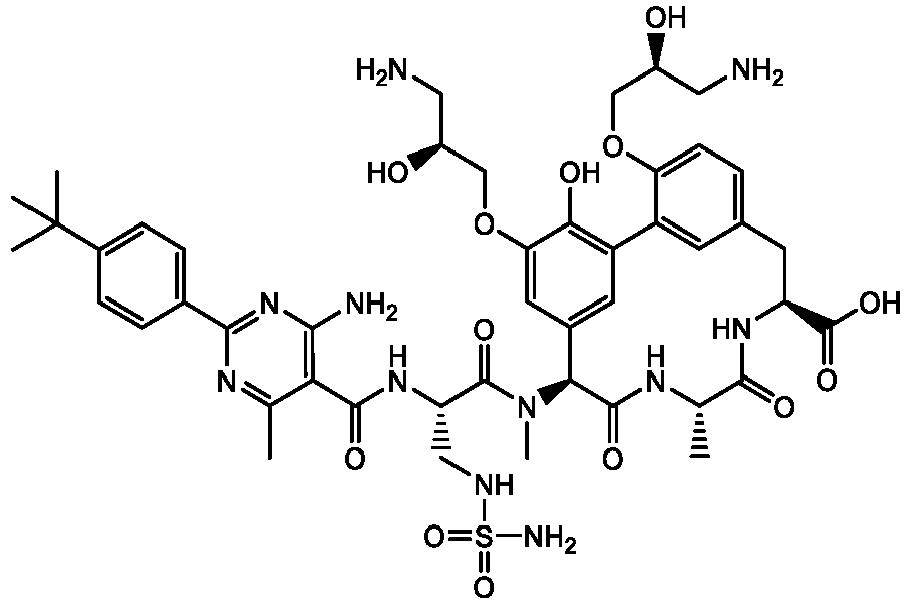
(8S,11S,14S)-14-[[(2S)-2-[[4-amino-2-(4-tert-butylphenyl)-6-methylpyrimidine-5-carbonyl]amino]-3-(sulfamoylamino)propanoyl]-methyl-amino]-3,17-bis[(2S)-3-amino-2-hydroxy-propoxy]-18-hydroxy-11-methyl-10,13-dioxo-9,12-diazatricyclo[13.3.1.12,6]icosa-1(18),2(20),3,5,15 (19),16-hexaene -8 - carboxylic acid 17 
(8S,11S,14S)-3,17-bis[(2R)-3-amino-2-hydroxy-propoxy]-14-[[(2S)-2-[[4-(aminomethyl)-2-(4-tert-butylphenyl)-6-methyl-pyrimidine-5-carbonyl]amino]-3-(sulfamoylamino)propanoyl]-methyl-amino]-18-hydroxy-11-methyl-10,13-dioxo-9,12-diazatricyclo[13.3.1.12,6]icosa-1(18),2(20),3,5,15(19),16-hexaene-8-carboxylic acid - In some embodiments, the compound is (8S,11S,14S)-18-hydroxy-11-methyl-14-[methyl-[(2S)-2-[[4-amino-2-(4-tert-butylphenyl)-6-methyl-pyrimidine-5-carbonyl]amino]-3-(sulfamoylamino)propanoyl] amino] -10,13 -dioxo-3,17-bis [(2R)-3 -amino-2-hydroxy-propoxy] -9,12-diazatricyclo[13.3.1.12,6]icosa-1(18),2(20),3,5,15(19),16-hexaene-8-carboxylic acid.
- In some embodiments, the compound is (8S,11S,14S)-18-hydroxy-11-methyl-14-[methyl-[(2S)-4-amino-2-[[4-amino-2-(4-tert-butylphenyl)-6-methyl-pyrimidine-5-carbonyl]amino]butanoyl]amino]-10,13-dioxo-3,17-bis[(2R)-3-amino-2-hydroxy-propoxy]-9,12-diazatricyclo[13.3.1.12,6]icosa-1(18),2(20),3,5,15(19),16-hexaene-8-carboxylic acid.
- In some embodiments, the compound is (8S,11S,14S)-18-hydroxy-11-methyl-14-[methyl-[(2S)-4-amino-2-[[4-methyl-2-[4-(1-methylcyclopropyl)phenyl]pyrimidine-5-carbonyl]amino]butanoyl]amino]-10,13-dioxo-3,17-bis[(2R)-3-amino-2-hydroxy-propoxy]-9,12-diazatricyclo[13.3.1.12,6]icosa-1(18),2(20),3,5,15(19),16-hexaene-8-carboxylic acid.
- In some embodiments, the compound is (8S,11S,14S)-18-hydroxy-11-methyl-14-[methyl-[(2S)-4-amino-2-[[2-(4-tert-butylphenyl)-4-amino-6-difluoromethyl-pyrimidine-5-carbonyl]amino]butanoyl]amino]-10,13-dioxo-3,17-bis[(2R)-3-amino-2-hydroxy-propoxy]-9,12-diazatricyclo[13.3.1.12,6]icosa-1(18),2(20),3,5,15(19),16-hexaene-8-carboxylic acid.
- In some situations, the compounds described herein possess one or more chiral centers and each center exists in the R configuration, or S configuration. In additional aspects of the compounds and methods provided herein, mixtures of enantiomers and/or diastereoisomers, resulting from a single preparative step, combination, or interconversion are useful for the applications described herein. In some instances, the compounds described herein are prepared as their individual stereoisomers by reacting a racemic mixture of the compound with an optically active resolving agent to form a pair of diastereoisomeric compounds, separating the diastereomers and recovering the optically pure enantiomers. In some instances, dissociable complexes are preferred. In some instances, the diastereomers have distinct physical properties (e.g., melting points, boiling points, solubilities, reactivity, etc.) and are separated by taking advantage of these dissimilarities. In some instances, the diastereomers are separated by chiral chromatography, or preferably, by separation/resolution techniques based upon differences in solubility. In some instances, the optically pure enantiomer is then recovered, along with the resolving agent.
- In some embodiments, the compounds described herein exist as their pharmaceutically acceptable salts. In some instances, the methods disclosed herein include methods of treating diseases by administering such pharmaceutically acceptable salts. In some instances, the methods disclosed herein include methods of treating diseases by administering such pharmaceutically acceptable salts as pharmaceutical compositions.
- In some embodiments, the compounds described herein possess acidic or basic groups and therefor react with any of a number of inorganic or organic bases, and inorganic and organic acids, to form a pharmaceutically acceptable salt. In some embodiments, these salts are prepared in situ during the final isolation and purification of the compounds disclosed herein, or by separately reacting a purified compound in its free form with a suitable acid or base, and isolating the salt thus formed.
- Examples of pharmaceutically acceptable salts include those salts prepared by reaction of the compounds described herein with a mineral, organic acid, or inorganic base, such salts including acetate, acrylate, adipate, alginate, aspartate, benzoate, benzenesulfonate, bisulfate, bisulfite, bromide, butyrate, butyn-1,4-dioate, camphorate, camphorsulfonate, caproate, caprylate, chlorobenzoate, chloride, citrate, cyclopentanepropionate, decanoate, digluconate, dihydrogenphosphate, dinitrobenzoate, dodecylsulfate, ethanesulfonate, formate, fumarate, glucoheptanoate, glycerophosphate, glycolate, hemisulfate, heptanoate, hexanoate, hexyne-1,6-dioate, hydroxybenzoate, γ-hydroxybutyrate, hydrochloride, hydrobromide, hydroiodide, 2-hydroxyethanesulfonate, iodide, isobutyrate, lactate, maleate, malonate, methanesulfonate, mandelate metaphosphate, methanesulfonate, methoxybenzoate, methylbenzoate, monohydrogenphosphate, 1-napthalenesulfonate, 2-napthalenesulfonate, nicotinate, nitrate, palmoate, pectinate, persulfate, 3-phenylpropionate, phosphate, picrate, pivalate, propionate, pyrosulfate, pyrophosphate, propiolate, phthalate, phenylacetate, phenylbutyrate, propane sulfonate, salicylate, succinate, sulfate, sulfite, succinate, suberate, sebacate, sulfonate, tartrate, thiocyanate, tosylateundeconate, and xylenesulfonate.
- Further, the compounds described herein can be prepared as pharmaceutically acceptable salts formed by reacting the free base form of the compound with a pharmaceutically acceptable inorganic or organic acid, including, but not limited to, inorganic acids such as hydrochloric acid, hydrobromic acid, sulfuric acid, nitric acid, phosphoric acid metaphosphoric acid, and the like; and organic acids such as acetic acid, propionic acid, hexanoic acid, cyclopentanepropionic acid, glycolic acid, pyruvic acid, lactic acid, malonic acid, succinic acid, malic acid, maleic acid, fumaric acid, p-toluenesulfonic acid, tartaric acid, trifluoroacetic acid, citric acid, benzoic acid, 3-(4-hydroxybenzoyl)benzoic acid, cinnamic acid, mandelic acid, arylsulfonic acid, methanesulfonic acid, ethanesulfonic acid, 1,2-ethanedisulfonic acid, 2-hydroxyethanesulfonic acid, benzenesulfonic acid, 2-naphthalenesulfonic acid, 4-methylbicyclo-[2.2.2]oct-2-ene-1-carboxylic acid, glucoheptonic acid, 4,4'-methylenebis-(3-hydroxy-2-ene-1-carboxylic acid), 3-phenylpropionic acid, trimethylacetic acid, tertiary butylacetic acid, lauryl sulfuric acid, gluconic acid, glutamic acid, hydroxynaphthoic acid, salicylic acid, stearic acid, and muconic acid.
- In some embodiments, those compounds described herein which comprise a free acid group react with a suitable base, such as the hydroxide, carbonate, bicarbonate, sulfate, of a pharmaceutically acceptable metal cation, with ammonia, or with a pharmaceutically acceptable organic primary, secondary, tertiary, or quaternary amine. Representative salts include the alkali or alkaline earth salts, like lithium, sodium, potassium, calcium, and magnesium, and aluminum salts and the like. Illustrative examples of bases include sodium hydroxide, potassium hydroxide, choline hydroxide, sodium carbonate, N+(C1-4 alkyl)4, and the like.
- Representative organic amines useful for the formation of base addition salts include ethylamine, diethylamine, ethylenediamine, ethanolamine, diethanolamine, piperazine, and the like. It should be understood that the compounds described herein also include the quaternization of any basic nitrogen-containing groups they contain. In some embodiments, water or oil-soluble or dispersible products are obtained by such quaternization.
- In some situations, compounds exist as tautomers. The compounds described herein include all possible tautomers within the formulas described herein. Tautomers are compounds that are interconvertible by migration of a hydrogen atom, accompanied by a switch of a single bond and adjacent double bond. In bonding arrangements where tautomerization is possible, a chemical equilibrium of the tautomers will exist. All tautomeric forms of the compounds disclosed herein are contemplated. The exact ratio of the tautomers depends on several factors, including temperature, solvent, and pH.
- The compounds can be used in methods of treating a mammal in need of such treatment comprising administering to the mammal an antibacterial effective amount of any of the aforementioned compounds at a frequency and for a duration sufficient to provide a beneficial effect to the mammal. In one such method, the mammal has a bacteria-related infection that is resistant to treatment with arylomycin A2. In a further such method, the causative bacteria species of the bacteria infection is an infection involoving Pseudomonas aeruginosa, Pseudomonas fluorescens, Pseudomonas acidovorans, Pseudomonas alcaligenes, Pseudomonas putida, Stenotrophomonas maltophilia, Burkholderia cepacia, Aeromonas hydrophilia, Escherichia coli, Citrobacter freundii, Salmonella typhimurium, Salmonella typhi, Salmonella paratyphi, Salmonella enteritidis, Shigella dysenteriae, Shigella flexneri, Shigella sonnei, Enterobacter cloacae, Enterobacter aerogenes, Klebsiella pneumoniae, Klebsiella oxytoca, Serratia marcescens, Francisella tularensis, Morganella morganii, Proteus mirabilis, Proteus vulgaris, Providencia alcalifaciens, Providencia rettgeri, Providencia stuartii, Acinetobacter baumannii, Acinetobacter calcoaceticus, Acinetobacter haemolyticus, Yersinia enterocolitica, Yersinia pestis, Yersinia pseudotuberculosis, Yersinia intermedia, Bordetella pertussis, Bordetella parapertussis, Bordetella bronchiseptica, Haemophilus influenzae, Haemophilus parainfluenzae, Haemophilus haemolyticus, Haemophilus parahaemolyticus, Haemophilus ducreyi, Pasteurella multocida, Pasteurella haemolytica, Branhamella catarrhalis, Helicobacter pylori, Campylobacter fetus, Campylobacter jejuni, Campylobacter coli, Borrelia burgdorferi, Vibrio cholerae, Vibrio parahaemolyticus, Legionella pneumophila, Listeria monocytogenes, Neisseria gonorrhoeae, Neisseria meningitidis, Kingella, Moraxella, Gardnerella vaginalis, Bacteroides fragilis, Bacteroides distasonis, Bacteroides 3452A homology group, Bacteroides vulgatus, Bacteroides ovalus, Bacteroides thetaiotaomicron, Bacteroides uniformis, Bacteroides eggerthii, Bacteroides splanchnicus, Clostridium difficile, Mycobacterium tuberculosis, Mycobacterium avium, Mycobacterium intracellulare, Mycobacterium leprae, Corynebacterium diphtheriae, Corynebacterium ulcerans, Streptococcus pneumoniae, Streptococcus agalactiae, Streptococcus pyogenes, Enterococcus faecalis, Enterococcus faecium, Staphylococcus aureus, Staphylococcus epidermidis, Staphylococcus saprophyticus, Staphylococcus intermedius, Staphylococcus hyicus subsp. hyicus, Staphylococcus haemolyticus, Staphylococcus hominis, or Staphylococcus saccharolyticus.
- In another such method the bacterial infection is an infection involving a Gram-negative bacteria. In such methods, the gram-negative bacteria may be, for example, Escheria coli, Klebsiella pneumoniae, Pseudomonas aeruginosa, Acinetobacter baumanii, Neisseria gonorrhoeae, Neisseria meningitidis, Chlamydia trachomatis, Moraxella catarrhalis, Haemophilus influenzae, Proteus mirabilis, Enterobacter cloacae, Serratia marcescens, Helicobacter pylori, Salmonella enteritidis, Salmonella typhi, Legionella pneumophila, Haemophilus influenzae, Vibrio cholerae, Pseudomonas stutzeri, Ralstonia solanacearum, or Xylella fastidiosa.
- In certain methods, the bacterial infection is an infection involving non-fermenter bacteria. Such non-fermenter bacterial may be, for example, Acinetobacter baumannii, Achromobacter xylosoxidans, Bordetella pertussis, Burkholderia cepacia (also known as Pseudomonas cepacia), Burkholderia pseudomallei (also known as Pseudomonas pseudomallei), Elizabethkingia meningoseptica (also known as Chryseobacterium meningosepticum), Moraxella catarrhalis (also known as Branhamella catarrhalis), Pseudomonas aeruginosa, or Stenotrophomonas maltophilia (also known as Pseudomonas maltophilia).
- In another method the bacterial infection is a lepB-mediated infection.
- In a further method, the bacterial infection is an infection involving a Gram-positive bacteria.
- In a further aspect the methods of treating a mammal in need of such treatment are methods comprising administering to the mammal a second therapeutic agent to any of the aforementioned methods of treatment. In another method, the second therapeutic agent is a not an SpsB or LepB inhibitor. In another method, the second therapeutic agent is an aminoglycoside antibiotic, fluoroquinolone antibiotic, β-lactam antibiotic, macrolide antibiotic, glycopeptide antibiotic, rifampicin, chloramphenicol, fluoramphenicol, colistin, mupirocin, bacitracin, daptomycin, or linezolid.
- Some such methods are a method for treating a bacterial infection in a patient, preferably a human, where the treatment includes administering a therapeutically or pharmacologically effective amount of a combination of 1) a β-lactam antibiotic; and 2) a compound disclosed herein, or a pharmaceutically acceptable salt thereof; and 3) a pharmaceutically acceptable carrier. In such methods where a β-lactam antibiotic is used in combination with a compound disclosed herein, the β-lactam antibiotic may be a carbapenem, cephalosporin, cephamycin, monobactam or penicillin. Exemplary carbapenem antibiotics useful in the methods include ertapenem, imipenem, biapenem, and meropenem. Exemplary cephalosporin antibiotics useful in the methods include, ceftobiprole, ceftaroline, Cefiprome, Cefozopran, cefepime, Cefotaxime, and ceftriazone. Exemplary penicillin antibiotics useful in the methods include ampicillin, amoxacillin, piperacillin, oxacillin, cloxacillin, methicillin, and nafcillin. In some methods, the β-lactam may be administered with a β-lactamase inhibitor. In some methods, the carbapenem may be administered with a DHP inhibitor, e.g., cilastatin.
- In various instances where a compound disclosed herein and a β-lactam antibiotic are for use in combination, the β-lactam antibiotic and compound disclosed herein can be administered sequentially or concurrently. Preferably, the β-lactam antibiotic and compound disclosed hereinare administered together. When administered concurrently, the β-lactam antibiotic and compound disclosed herein may be administered in the same formulation or in separate formulations. When administered sequentially, either the β-lactam or compound disclosed herein may be administered first. After administration of the first compound, the other compound is administered, for example, within from 1 to 60 minutes, e.g., within 1, 2, 3, 4, 5, 10, 15, 30, or 60 minutes. In one aspect, when a β-lactamase inhibitor is used, it may be administered separately, or in a formulation with the compound disclosed herein and/or β-lactam antibiotic. In one aspect, when a DHP inhibitor is used to improve the stability of a carbapenem, it may be administered separately, or in a formulation with the compound disclosed herein and/or carbapenem.
- Further described herein are pharmaceutical compositions comprising a compound disclosed herein, a pharmaceutically acceptable carrier, and optionally a β-lactam antibiotic. In embodiments where a combination is used, the β-lactam antibiotic and the compound disclosed herein, are present in such amounts that their combination constitutes a therapeutically effective amount. Due to the potentiating effects of the compound disclosed herein, the amount of β-lactam antibiotic present in a combination may be less that of a β-lactam antibiotic used alone. In certain embodiments, the composition further comprises a β-lactamase antibiotic.
- In further embodiments where the β-lactam antibiotic is a carbapenem, is provided a pharmaceutical composition comprising a carbapenem antibiotic, a DHP inhibitor, a compound disclosed herein, and a pharmaceutically acceptable carrier. In some embodiments where the β-lactara antibiotic is a carbepenem, the carbapenem antibiotic is preferably selected from the group consisting of ertapenem, imipenem, and meropenem.
- In some aspects of the disclosure a compound disclosed herein is for use in treating a bacterial infection. In some aspects of the disclosure is a compound disclosed herein, in combination with one or more additional therapeutical agents including a β-lactam antibiotic, for use in treating a bacterial infection. In some aspects of the disclosure is a compound disclosed herein for use as a medicament for treating a bacterial infection. In some aspects of the disclosure is a compound disclosed herein, in combination with one or more additional therapeutical agents including a β-lactam antibiotic, for use as a medicament for treating a bacterial infection. In some aspects of the disclosure is a compound disclosed herein for use in the preparation of a medicament for treating a bacterial infection. In some aspects of the disclosure is a compound disclosed herein, in combination with one or more additional therapeutical agents including a β-lactam antibiotic, for use in the preparation of a medicament for treating a bacterial infection.
- In some aspects of the disclosure described herein, a compound disclosed herein can enhance the activity of a β-lactam antibacterial agent by inducing susceptibility to the antibacterial agent in a drugresistant strain such as MRSA. In some instances, a compound disclosed herein can enhance the activity of a β-lactam antibacterial agent by reducing the dosage of the antibacterial agent need for a therapeutic effect in a drug-sensitive strain. For example, if a compound disclosed herein reduces the Minimum Inhibitory Concentration (MIC) of an antibacterial agent (where the MIC is the minimum concentration of antibacterial agent which will completely inhibit growth) in a susceptible strain, then such treatment may be advantageous to enable a reduction in the amount of antibacterial agent administered (could reduce side effects of an antibiotic), or to decrease the frequency of administration. In some instances, compounds disclosed herein can enhance the activity of an antibacterial agent such as a carbapenem to prevent the emergence of a resistant sub-population in a heterogeneous bacterial population with a resistant sub-population.
- Potentiators can be used to enhance the activity of antibacterial agents whose clinical efficacy has been limited by the increasing prevalence of resistant strains. In some instances described herein, a compound disclosed herein is for use as a potentiator wherein a compound disclosed herein can be administered together with a β-lactam antibiotic (either concurrently or sequentially) to allow effective treatment of an infection involving a resistant bacterium, or to reduce the amount of antibacterial agent necessary to treat an infection.
- In one instance, is a compound described herein which displays antibiotic activity useful in the treatment of bacterial infections, such as by way of example only, various strains of S. aureus, S. pneumoniae, E. faecalis, E. faecium, B. subtilis and E. coli including species that are resistant to many known antibiotics such as methicillin-resistant S. aureus (MRSA), vancomycin-resistant Enterococcus sp. (VRE), multidrug-resistant E. faecium, macrolide-resistant S. aureus and S. epidermidis, and linezolideresistant S. aureus and E. faecium.
- Staphylococcus aureus (S. aureus), a spherical bacterium, is the most common cause of staph infections. S. aureus has been known to cause a range of illnesses from minor skin infections, such as pimples, impetigo, boils, cellulitis folliculitis, furuncles, carbuncles, scalded skin syndrome, abscesses, to life-threatening diseases such as pneumonia, meningitis, osteomyelitis endocarditis, toxic shock syndrome, and septicemia. Further, S. aureus is one of the most common causes of nosocomial infections, often causing postsurgical wound infections.
- Methicillin was introduced in the late 1950s to treat infections caused by penicillin-resistant S. aureus. It has been reported previously that S. aureus isolates had acquired resistance to methicillin (methicillin-resistant S. aureus, MRSA). The methicillin resistance gene (mecA) encodes a methicillin-resistant penicillin-binding protein that is not present in susceptible strains. mecA is carried on a mobile genetic element, the staphylococcal cassette chromosome mec (SCCmec), of which four forms have been described that differ in size and genetic composition. The methicillin-resistant penicillin-binding protein allows for resistance to β-lactam antibiotics and obviates their clinical use during MRSA infections.
- In one aspect of the disclosure is a method for treating a subject having a resistant bacterium comprising administering to the subject a compound disclosed herein or a pharmaceutically acceptable salt thereof. In one aspect, the bacterium is a Gram-positive bacteria. In another aspect, the Gram-positive bacterium is S. aureus. In a further aspect, the S. aureus is resistant or refractory to a beta-lactam antibiotic. In yet a further aspect, the beta-lactam antibiotic belongs to the class of penicillins. In a further aspect, the beta-lactam antibiotic is methicillin. In yet another aspect, the subject has a methicillin-resistant S. aureus bacteria. In one aspect the beta-lactam antibiotic is flucloxacillin. In another aspect is a method for treating a subject having a dicloxacillin-resistant bacteria comprising administering to the subject a compound disclosed herein or a pharmaceutically acceptable salt thereof wherein the subject is refractory to dicloxacillin. Also disclosed herein is a method for treating a subject having a methicillin-resistant bacteria comprising administering a compound disclosed herein or a pharmaceutically acceptable salt thereof wherein the subject has been determined to have a methicillin-resistant bacteria. In one aspect the subject is screened for methicillin-resistant bacteria. In another aspect, the subject screening is performed through a nasal culture. In a further aspect the methicillin-resistant bacteria is detected by swabbing the nostril(s) of the subject and isolating the bacteria. In another aspect, Real-time PCR and/or Quantitative PCR is employed to determine whether the subject has a methicillin-resistant bacteria.
- In one aspect is a method for treating a subject having a first-generation cephalosporin-resistant bacteria comprising administering a compound disclosed herein or a pharmaceutically acceptable salt thereof wherein the subject is refractory to a first-generation cephalosporin. In one aspect, the bacteria is resistant to a first-generation cephalosporin. In a further aspect, the bacteria is resistant to cefacetrile. In another aspect, the bacteria is resistant to cefadroxil. In yet another aspect, the bacteria is resistant to cefalexin. In one aspect, the bacteria is resistant to cefaloglycin. In another aspect, the bacteria is resistant to cefalonium. In another aspect, the bacteria is resistant to cefaloridine. In yet another aspect, the bacteria is resistant to cefalotin. In a further aspect, the bacteria is resistant to cefapirin. In yet a further aspect, the bacteria is resistant to cefatrizine. In one aspect, the bacteria is resistant to cefazaflur. In another aspect, the bacteria is resistant to cefazedone. In yet another aspect, the bacteria is resistant to cefazolin. In a further aspect, the bacteria is resistant to cefradine. In yet a further aspect, the bacteria is resistant to cefroxadine. In one aspect, the bacteria is resistant to ceftezole.
- In one aspect is a method for treating a subject having a second-generation cephalosporin-resistant bacteria comprising administering a compound disclosed herein or a pharmaceutically acceptable salt thereof wherein the subject is refractory to a second-generation cephalosporin. In another aspect, the bacteria is resistant to a second-generation cephalosporin. In a further aspect, the bacteria is resistant to cefaclor. In another aspect, the bacteria is resistant to cefonicid. In yet another aspect, the bacteria is resistant to cefprozil. In one aspect, the bacteria is resistant to cefuroxime. In another aspect, the bacteria is resistant to cefuzonam. In another aspect, the bacteria is resistant to cefmetazole. In yet another aspect, the bacteria is resistant to cefotetan. In a further aspect, the bacteria is resistant to cefoxitin.
- In one aspect is a method for treating a subject having a third-generation cephalosporin-resistant bacteria comprising administering a compound disclosed herein or a pharmaceutically acceptable salt thereof wherein the subject is refractory to a third-generation cephalosporin. In another aspect, the bacteria is resistant to a third-generation cephalosporin. In a further aspect, the bacteria is resistant to cefcapene. In another aspect, the bacteria is resistant to cefdaloxime. In yet another aspect, the bacteria is resistant to cefdinir. In one aspect, the bacteria is resistant to cefditoren. In another aspect, the bacteria is resistant to cefixime. In another aspect, the bacteria is resistant to cefmenoxime. In yet another aspect, the bacteria is resistant to cefodizime. In a further aspect, the bacteria is resistant to cefotaxime. In yet a further aspect, the bacteria is resistant to cefpimizole. In one aspect, the bacteria is resistant to cefpodoxime. In another aspect, the bacteria is resistant to cefteram. In yet another aspect, the bacteria is resistant to ceftibuten. In a further aspect, the bacteria is resistant to ceftiofur. In yet a further aspect, the bacteria is resistant to ceftiolene. In one aspect, the bacteria is resistant to ceftizoxime. In another aspect, the bacteria is resistant to ceftriaxone. In yet another aspect, the bacteria is resistant to cefoperazone. In yet a further aspect, the bacteria is resistant to ceftazidime.
- In one aspect is a method for treating a subject having a fourth-generation cephalosporin-resistant bacteria comprising administering a compound disclosed herein or a pharmaceutically acceptable salt thereof wherein the subject is refractory to a fourth-generation cephalosporin. In another aspect, the bacteria is resistant to a fourth-generation cephalosporin. In a further aspect, the bacteria is resistant to cefclidine. In another aspect, the bacteria is resistant to cefepime. In yet another aspect, the bacteria is resistant to cefluprenam. In one aspect, the bacteria is resistant to cefoselis. In another aspect, the bacteria is resistant to cefozopran. In another aspect, the bacteria is resistant to cefpirome. In yet another aspect, the bacteria is refractory to cefquinome.
- In one aspect is a method for treating a subject having a carbapenem-resistant bacteria comprising administering a compound disclosed herein or a pharmaceutically acceptable salt thereof wherein the subject is refractory to a carbapenem. In another aspect, the bacteria is resistant to a carbapenem. In a further aspect, the bacteria is resistant to imipenem. In another aspect, the bacteria is resistant to meropenem. In yet another aspect, the bacteria is resistant to ertapenem. In one aspect, the bacteria is resistant to faropenem. In another aspect, the bacteria is resistant to doripenem. In another aspect, the bacteria is resistant to panipenem. In yet another aspect, the bacteria is resistant to biapenem,
- Vancomycin-intermediate Staphylococcus aureus and vancomycin-resistant staphylococcus aureus are specific types of antimicrobial-resistant Staph bacteria that are refractory to vancomycin treatment. S. aureus isolates for which vancomycin MICs are 4-8 µg/mL are classified as vancomycin-intermediate and isolates for which vancomycin MICs are ≥16 µg/mL are classified as vancomycin-resistant (Clinical and Laboratory Standards Institute/NCCLS. Performance Standards for Antimicrobial Susceptibility Testing. Sixteenth informational supplement. M100-S16. Wayne, PA: CLSI, 2006).
- As used herein, the term "minimum inhibitory concentration" (MIC) refers to the lowest concentration of an antibiotic that is needed to inhibit growth of a bacterial isolate in vitro. A common method for determining the MIC of an antibiotic is to prepare several tubes containing serial dilutions of the antibiotic, that are then inoculated with the bacterial isolate of interest. The MIC of an antibiotic is determined from the tube with the lowest concentration that shows no turbidity (no growth).
- In one aspect of the disclosure is a method of treating a subject having a bacterial infection comprising administering to the subject a compound disclosed herein or a pharmaceutically acceptable salt thereof wherein the bacterial infection comprises a vancomycin-intermediate Staphylococcus aureus bacterium. In one aspect, the vancomycin-intermediate Staphylococcus aureus bacterium has a MIC of between about 4 to about 8 µg/mL. In another aspect, the vancomycin-intermediate Staphylococcus aureus bacterium has a MIC of about 4 µg/mL. In yet another aspect, the vancomycin-intermediate Staphylococcus aureus bacterium has a MIC of about 5 µg/mL. In a further aspect, the vancomycin-intermediate Staphylococcus aureus bacterium has a MIC of about 6 µg/mL. In yet a further aspect, the vancomycin-intermediate Staphylococcus aureus bacterium has a MIC of about 7 µg/mL. In one aspect, the vancomycin-intermediate Staphylococcus aureus bacterium has a MIC of about 8 µg/mL.
- In another aspect is a method of treating a subject having a bacterial infection comprising administering to the subject a compound disclosed herein or a pharmaceutically acceptable salt thereof wherein the bacterial infection comprises a vancomycin-resistant Staphylococcus aureus bacterium. In one aspect, the vancomycin-resistant Staphylococcus aureus bacterium has a MIC of between about 16 µg/mL. In another aspect, the vancomycin-resistant Staphylococcus aureus bacterium has a MIC of about ≥ 16 µg/mL. In yet another aspect, the vancomycin-resistant Staphylococcus aureus bacterium has a MIC of about 20 µg/mL. In a further aspect, the vancomycin-resistant Staphylococcus aureus bacterium has a MIC of about 25 µg/mL.
- In one aspect, conditions to be treated by the compounds described herein include, but are not limited to, endocarditis, osteomyelitis, neningitis, skin and skin structure infections, genitourinary tract infections, abscesses, and necrotizing infections. In another aspect, the compounds disclosed herein are for use to treat conditions, such as, but not limited to, diabetic foot infections, decubitus ulcers, burn infections, animal or human bite wound infections, synergistic-necrotizing gangrene, necrotizing fascilitis, intra-abdominal infection associated with breeching of the intestinal barrier, pelvic infection associated with breeching of the intestinal barrier, aspiration pneumonia, and post-operative wound infections. In another aspect, the conditions listed herein are caused by, contain, or result in the presence of VISA and/or VRSA.
- Enterococci are bacteria that are normally present in the human intestines and in the female genital tract and are often found in the environment. These bacteria sometimes cause infections. In some cases, enterococci have become resistant to vancomycin (also known as vancomycin-resistant enterococci or VRE.) Common forms of resistance to vancomycin occur in enterococcal strains that involve the acquisition of a set of genes endoding proteins that direct peptidoglycan precursors to incorporate D-Ala-D-Lac instead of D-Ala-D-Ala. The six different types of vancomycin resistance shown by enterococcus are: Van-A, Van-B, Van-C, Van-D, Van-E and Van-F. In some cases, Van-A VRE is resistant to both vancomycin and teicoplanin, while in other cases, Van-B VRE is resistant to vancomycin but sensitive to teicoplanin; in further cases Van-C is partly resistant to vancomycin, and sensitive to teicoplanin.
- In one aspect of the disclosure is a method of treating a subject having a vancomycin-resistant enterococci comprising administering to the subject a compound disclosed herein or a pharmaceutically acceptable salt thereof wherein the enterococci has developed resistance to vancomycin. In one aspect, the subject has been previously treated with vancomycin for a sustained period of time. In another aspect, the subject has been hospitalized. In yet another aspect, the subject has a weakened immune system such as patients in Intensive Care Units or in cancer or transplant wards. In a further aspect, the subject has undergone surgical procedures such as, for example, abdominal or chest surgery. In yet a further aspect, the subject has been colonized vith VRE. In one aspect, the subject has a medical device such that an infection has developed. In another aspect, the medical device is a urinary catheter or central intravenous (IV) catheter.
- In another aspect, is a method of treating a subject having a vancomycin-resistant enterococci comprising administering to the subject a compound disclosed herein or a pharmaceutically acceptable salt thereof wherein the enterococcus has Van-A resistance.
- In another aspect, is a method of treating a subject having a vancomycin-resistant enterococci comprising administering to the subject a compound disclosed herein or a pharmaceutically acceptable salt thereof wherein the enterococcus has Van-B resistance.
- In another aspect, is a method of treating a subject having a vancomycin-resistant enterococci comprising administering to the subject a compound disclosed herein or a pharmaceutically acceptable salt thereof wherein the enterococcus has Van-C resistance.
- Pharmaceutical compositions described herein comprise a therapeutically effective amount of a compound described herein (i.e., a compound disclosed herein) formulated together with one or more pharmaceutically acceptable carriers. As used herein, the term "pharmaceutically acceptable carrier" means a non-toxic, inert solid, semi-solid or liquid filler, diluent, encapsulating material or formulation auxiliary of any type. Some examples of materials which can serve as pharmaceutically acceptable carriers are sugars such as lactose, glucose and sucrose; starches such as corn starch and potato starch; cellulose and its derivatives such as sodium carboxymethyl cellulose, ethyl cellulose and cellulose acetate; powdered tragacanth; malt; gelatin; talc; excipients such as cocoa butter and suppository waxes; oils such as peanut oil, cottonseed oil; safflower oil; sesame oil; olive oil; corn oil and soybean oil; glycols; such a propylene glycol; esters such as ethyl oleate and ethyl laurate; agar; buffering agents such as magnesium hydroxide and aluminum hydroxide; alginic acid; pyrogen-free water; isotonic saline; Ringer's solution; ethyl alcohol, and phosphate buffer solutions, as well as other non-toxic compatible lubricants such as sodium lauryl sulfate and magnesium stearate, as well as coloring agents, releasing agents, coating agents, sweetening, flavoring and perfuming agents, preservatives and antioxidants can also be present in the composition, according to the judgment of the formulator. The pharmaceutical compositions described herein can be for being administered to humans and other animals orally, rectally, parenterally, intracisternally, intravaginally, intraperitoneally, topically (as by powders, ointments, or drops), bucally, or as an oral or nasal spray, or a liquid aerosol or dry powder formulation for inhalation.
- Liquid dosage forms for oral administration include pharmaceutically acceptable emulsions, microemulsions, solutions, suspensions, syrups and elixirs. In addition to the active compounds, the liquid dosage forms optionally contain inert diluents commonly used in the art such as, for example, water or other solvents, solubilizing agents and emulsifiers such as ethyl alcohol, isopropyl alcohol, ethyl carbonate, ethyl acetate, benzyl alcohol, benzyl benzoate, propylene glycol, 1,3-butylene glycol, dimethylformamide, oils (in particular, cottonseed, groundnut, corn, germ, olive, castor, and sesame oils), glycerol, tetrahydrofurfuryl alcohol, polyethylene glycols and fatty acid esters of sorbitan, and mixtures thereof. Besides inert diluents, the oral compositions can also include adjuvants such as wetting agents, emulsifying and suspending agents, sweetening, flavoring, and perfuming agents.
- Injectable preparations, for example, sterile injectable aqueous or oleaginous suspensions are optionally formulated according to the known art using suitable dispersing or wetting agents and suspending agents. The sterile injectable preparation is optionally a sterile injectable solution, suspension or emulsion in a nontoxic parenterally acceptable diluent or solvent, for example, as a solution in 1,3-butanediol. Among the acceptable vehicles and solvents that are optionally employed are water, Ringer's solution, U.S.P. and isotonic sodium chloride solution. In addition, sterile, fixed oils are conventionally employed as a solvent or suspending medium. For this purpose any bland fixed oil can be employed including synthetic mono- or diglycerides. In addition, fatty acids such as oleic acid are used in the preparation of injectables.
- The injectable formulations can be sterilized, for example, by filtration through a bacterialretaining filter, or by incorporating sterilizing agents in the form of sterile solid compositions which can be dissolved or dispersed in sterile water or other sterile injectable medium prior to use.
- In order to prolong the effect of a drug, it is often desirable to slow the absorption of the drug from subcutaneous or intramuscular injection. This is optionally accomplished by the use of a liquid suspension of crystalline or amorphous material with poor water solubility. The rate of absorption of the drug then depends upon its rate of dissolution which, in turn, may depend upon crystal size and crystalline form. Alternatively, delayed absorption of a parenterally administered drug form is optionally accomplished by dissolving or suspending the drug in an oil vehicle. Injectable depot forms are made by forming microencapsule matrices of the drug in biodegradable polymers such as polylactide-polyglycolide. Depending upon the ratio of drug to polymer and the nature of the particular polymer employed, the rate of drug release can be controlled. Examples of other biodegradable polymers include poly(orthoesters) and poly(anhydrides). Depot injectable formulations are optionally prepared by entrapping the drug in liposomes or microemulsions which are compatible with body tissues.
- Compositions for rectal or vaginal administration are preferably suppositories which can be prepared by mixing the compound described herein (i.e., a compound disclosed herein) with suitable nonirritating excipients or carriers such as cocoa butter, polyethylene glycol or a suppository wax which are solid at ambient temperature but liquid at body temperature and therefore melt in the rectum or vaginal cavity and release the active compound.
- Solid dosage forms for oral administration include capsules, tablets, pills, powders, and granules. In such solid dosage forms, the active compound is mixed with at least one inert, pharmaceutically acceptable excipient or carrier such as sodium citrate or dicalcium phosphate and/or a) fillers or extenders such as starches, lactose, sucrose, glucose, mannitol, and silicic acid, b) binders such as, for example, carboxymethylcellulose, alginates, gelatin, polyvinylpyrrolidinone, sucrose, and acacia, c) humectants such as glycerol, d) disintegrating agents such as agar-agar, calcium carbonate, potato or tapioca starch, alginic acid, certain silicates, and sodium carbonate, e) solution retarding agents such as paraffin, f) absorption accelerators such as quaternary ammonium compounds, g) wetting agents such as, for example, acetyl alcohol and glycerol monostearate, h) absorbents such as kaolin and bentonite clay, and i) lubricants such as talc, calcium stearate, magnesium stearate, solid polyethylene glycols, sodium lauryl sulfate, and mixtures thereof. In the case of capsules, tablets and pills, the dosage form optionally comprise buffering agents.
- Solid compositions of a similar type are optionally employed as fillers in soft and hard-filled gelatin capsules using such excipients as lactose or milk sugar as well as high molecular weight polyethylene glycols and the like.
- The solid dosage forms of tablets, dragees, capsules, pills, and granules can be prepared with coatings and shells such as enteric coatings and other coatings known in the pharmaceutical formulating art. They optionally contain opacifying agents and can also be of a composition that they release the active ingredient(s) only, or preferentially, in a certain part of the intestinal tract, optionally, in a delayed manner. Examples of embedding compositions which can be used include polymeric substances and waxes.
- Solid compositions of a similar type are optionally employed as fillers in soft and hard-filled gelatin capsules using such excipients as lactose or milk sugar as well as high molecular weight polyethylene glycols and the like.
- The active compounds can also be in micro-encapsulated form with one or more excipients as noted above. The solid dosage forms of tablets, dragees, capsules, pills, and granules can be prepared with coatings and shells such as enteric coatings, release controlling coatings and other coatings known in the pharmaceutical formulating art. In such solid dosage forms the active compound is optionally admixed with at least one inert diluent such as sucrose, lactose or starch. Such dosage forms optionally comprise, as is normal practice, additional substances other than inert diluents, e.g., tableting lubricants and other tableting aids such a magnesium stearate and microcrystalline cellulose. In the case of capsules, tablets and pills, the dosage forms optionally comprise buffering agents. They optionally contain opacifying agents and can also be of a composition that they release the active ingredient(s) only, or preferentially, in a certain part of the intestinal tract, optionally, in a delayed manner. Examples of embedding compositions which can be used include polymeric substances and waxes.
- Dosage forms for topical or transdermal administration of a compound described herein include ointments, pastes, creams, lotions, gels, powders, solutions, sprays, inhalants or patches. The active component is admixed under sterile conditions with a pharmaceutically acceptable carrier and any needed preservatives or buffers as are optionally required. Ophthalmic formulations, ear drops, and the like are also contemplated.
- The ointments, pastes, creams and gels may contain, in addition to an active compound described herein, excipients such as animal and vegetable fats, oils, waxes, paraffins, starch, tragacanth, cellulose derivatives, polyethylene glycols, silicones, bentonites, silicic acid, talc and zinc oxide, or mixtures thereof.
- Compositions described herein are optionally formulated for delivery as a liquid aerosol or inhalable dry powder. Liquid aerosol formulations are optionally nebulized predominantly into particle sizes that can be delivered to the terminal and respiratory bronchioles where bacteria reside in patients with bronchial infections, such as chronic bronchitis and pneumonia. Pathogenic bacteria are commonly present throughout airways down to bronchi, bronchioli and lung parenchema, particularly in terminal and respiratory bronchioles. During exacerbation of infection, bacteria can also be present in alveoli. Liquid aerosol and inhalable dry powder formulations are preferably delivered throughout the endobronchial tree to the terminal bronchioles and eventually to the parenchymal tissue.
- Aerosolized formulations described herein are optionally delivered using an aerosol forming device, such as a jet, vibrating porous plate or ultrasonic nebulizer, preferably selected to allow the formation of an aerosol particles having with a mass medium average diameter predominantly between 1 to 5 micron. Further, the formulation preferably has balanced osmolarity ionic strength and chloride concentration, and the smallest aerosolizable volume able to deliver effective dose of the compounds described herein compound described herein (i.e., a compound disclosed herein) to the site of the infection. Additionally, the aerosolized formulation preferably does not impair negatively the functionality of the airways and does not cause undesirable side effects.
- Aerosolization devices suitable for administration of aerosol formulations described herein include, for example, jet, vibrating porous plate, ultrasonic nebulizers and energized dry powder inhalers, that are able to nebulize the formulation into aerosol particle size predominantly in the size range from 1-5µ. Predominantly in this application means that at least 70% but preferably more than 90% of all generated aerosol particles are within 1-5µ range. A jet nebulizer works by air pressure to break a liquid solution into aerosol droplets. Vibrating porous plate nebulizers work by using a sonic vacuum produced by a rapidly vibrating porous plate to extrude a solvent droplet through a porous plate. An ultrasonic nebulizer works by a piezoelectric crystal that shears a liquid into small aerosol droplets. A variety of suitable devices are available, including, for example, AeroNebTM and AeroDoseTM vibrating porous plate nebulizers (AeroGen, Inc., Sunnyvale, California), Sidestream® nebulizers (Medic-Aid Ltd., West Sussex, England), Pari LC® and Pari LC Star® jet nebulizers (Pari Respiratory Equipment, Inc., Richmond, Virginia), and AerosonicTM (DeVilbiss Medizinische Produkte (Deutschland) GmbH, Heiden, Germany) and UltraAire® (Omron Healthcare, Inc., Vernon Hills, Illinois) ultrasonic nebulizers.
- In some embodiments, compounds described herein compound described herein (i.e., a compound disclosed herein) are formulated for use as topical powders and sprays that contain, in addition to the compounds described herein, excipients such as lactose, talc, silicic acid, aluminum hydroxide, calcium silicates and polyamide powder, or mixtures of these substances. Sprays optionally contain customary propellants such as chlorofluorohydrocarbons.
- Transdermal patches have the added advantage of providing controlled delivery of a compound to the body. Such dosage forms can be made by dissolving or dispensing the compound in the proper medium. Absorption enhancers can also be used to increase the flux of the compound across the skin. The rate can be controlled by either providing a rate controlling membrane or by dispersing the compound in a polymer matrix or gel.
- According to the methods of treatment described herein, bacterial infections are treated or prevented in a patient such as a human or lower mammal by administering to the patient a therapeutically effective amount of a compound described herein, in such amounts and for such time as is necessary to achieve the desired result. By a "therapeutically effective amount" of a compound described herein is meant a sufficient amount of the compound to treat bacterial infections, at a reasonable benefit/risk ratio applicable to any medical treatment. It will be understood, however, that the total daily usage of the compounds and compositions described herein will be decided by the attending physician within the scope of sound medical judgment. The specific therapeutically effective dose level for any particular patient will depend upon a variety of factors including the disorder being treated and the severity of the disorder; the activity of the specific compound employed; the specific composition employed; the age, body weight, general health, sex and diet of the patient; the time of administration, route of administration, and rate of excretion of the specific compound employed; the duration of the treatment; drugs used in combination or coincidental with the specific compound employed; and like factors known in the medical arts.
- The total daily dose of the compounds described herein compound described herein (i.e., a compound disclosed herein) administered to a human or other mammal in single or in divided doses can be in amounts, for example, from 0.01 to 50 mg/kg body weight or more usually from 0.1 to 25 mg/kg body weight. Single dose compositions may contain such amounts or submultiples thereof to make up the daily dose. In general, treatment regimens described herein comprise administration to a patient in need of such treatment from about 10 mg to about 2000 mg of the compound(s) described herein per day in single or multiple doses.
- Compounds disclosed herein are made by the methods depicted in the reaction schemes shown below. Procedures are provided herein that, in combination with the knowledge of the synthetic organic chemist of ordinary skill in the art, are in some embodiments used to prepare the full range of compounds as disclosed and claimed herein.
-

- Step 1: To a solution of compound 1 (51.0 g, 78.3 mmol), Ag2SO4 (17.1 g, 54.8 mmol) in MeOH (250 mL) and THF (250 mL) was added I2 (21.8 g, 86.1 mmol) at 25°C. The reaction mixture was stirred for 2 h at 25°C and filtered. The filtrate was concentrated to dryness. The residue was partitioned between ethyl acetate (300 mL) and saturated aqueous Na2S2O3 solution (300 mL). The organic phase was separated and washed with brine (2 x 300 mL), dried over Na2SO4 and concentrated to dryness to afford crude compound 2 (60.0 g, 98.6% yield) as a yellow solid.
- Step 2: To a solution of compound 2 (60.0 g, 77.2 mmol) and DIEA (38.3 mL, 231.0 mmol) in CH2Cl2 (600 mL) was added SEMCl (27.1 mL, 154.0 mmol). The reaction was stirred at 25°C for 2 h and concentrated to dryness. The residue was diluted with ethyl acetate (500 mL), washed with water (2 x 500 mL) and brine (2 x 500 mL), dried over Na2SO4 and concentrated to dryness. The crude product was purified by column chromatography (silica gel, 100-200 mesh, 10 - 40% ethyl acetate in petroleum ether) to give compound 3 (65.0 g, 92.8% yield) as a yellow solid.
- Step 3: A mixture of compound 3 (20.00 g, 22.0 mmol), bis(pinacolato)diboron (8.39 g, 33.0 mmol), triphenylphosphine (1.16 g, 4.4 mmol), tricyclohexylphosphine (1.24 g, 4.4 mmol), Pd(OAc)2 (0.49 g, 2.2 mmol) and K2OAC (8.65 g, 88.1 mmol) in DMSO (200 mL) and water (20 mL) was stirred at 80°C for 1 h under nitrogen atmosphere. After cooling to room temperature, the reaction mixture was diluted with ethyl acetate (200 mL) and filtered. The filtrate was washed with water (2 x 200 mL) and brine (200 mL), dried over Na2SO4 and concentrated to give crude compound 4 (20.00 g, 97% yield) as a gray solid (three parallel batches were combined at this stage).
- Step 4: To a solution of compound 4 (60.0 g, 66.0 mmol) in MeOH (600 mL) was added H2O2 (135 mL, 1.3 mol). The mixture was stirred at 0°C for 2 h and diluted with ethyl acetate (700 mL). The mixture was washed with saturated aqueous NaHCO3 (2 × 200 mL), saturated aqueous Na2S2O3 (500 mL), brine (2 × 200 mL), dried over Na2SO4 and concentrated under reduced pressure. The residue was purified by column chromatography (silica gel, 100-200 mesh, 10 - 50% ethyl acetate in petroleum ether) to give a crude product, which was further purified by preparative HPLC (water (0.04% NH3H2O + 10mM NH4HCO3) - ACN) to give compound 5 (37.0 g, 70.1% yield) as a white solid.
- Step 5: To a solution of compound 5 (50.0 g, 62.7 mmol) in ethanol (700 mL) was added 10% Pd/C (14.7 g, 13.8 mmol) and a drop of ammonia. The mixture was stirred under hydrogen (50 psi) at 40°C for 5 h and filtered. The filtrate was concentrated to obtain crude compound 6 (35.0 g, 97.4% yield) as a white solid.
- Step 6: To a solution of compound 6 (35.0 g, 61.0 mmol) in DMA (400 mL) was added CbzOSu (15.2 g, 60.9 mmol) in DMA (20.0 mL) dropwise at 0°C. After addition, the mixture was stirred at 15°C for 14 h and then diluted with ethyl acetate (500 mL). The separated organic phase was washed with brine (3 x 200 mL), dried over Na2SO4 and concentrated. The residue was purified by column chromatography (silica gel, 100-200 mesh, 55% ethyl acetate in petroleum ether) to give compound 7 (21.0 g, 97.0% yield) as a white solid.
- Step 7: To a solution of compound 7 (21.0 g, 29.7 mmol) in DMF (84.0 mL) was added compound 8 (23.1 g, 89.0 mmol) and K2CO3 (24.6 g, 178.0 mmol). The mixture was stirred at 50°C for 16 h, and another portion of compound 8 (23.1g, 89.0 mmol) and K2CO3 (24.6 g, 178 mmol) was added. The reaction mixture was stirred at 50°C for 1 h, diluted with ethyl acetate (500 mL) and filtered. The filtrate was washed with brine (2 × 300 mL), dried over Na2SO4 and concentrated to dryness. The crude was purified by column chromatography (silica gel, 100-200 mesh, 55% ethyl acetate in petroleum ether) to give compound 9 (20.0 g, 83.3 % yield) as a white solid.
- Step 8: To a solution of compound 9 (24.0 g, 29.3 mmol) in MeCN (200 mL) and water (100 mL) was added NaN3 (27.3 g, 420 mmol) and CeCl3 (3.6 g, 14.6 mmol). The mixture was stirred at 75°C for 16 h. The reaction mixture was diluted with ethyl acetate (700 mL) and filtered. The filtrate was washed with brine (2 x 200 mL), dried over Na2SO4 and concentrated to dryness. The residue was dissolved in DMF (200 mL) were added K2CO3 (16.2 g, 117 mmol) and MeI (12.5 g, 87.8 mmol). The reaction was stirred at 25°C for 1 h, diluted with ethyl acetate (600 mL) and filtered. The filtrate was washed with brine (3 x 300 mL), dried over Na2SO4 and concentrated to dryness.
- The residue was dissolved in THF (480 mL) and added PPh3 (46.1 g, 176 mmol) and H2O (6.33 g, 351 mmol). The solution was stirred at 35°C for 16 h.
- Boc2O (14.7 g, 67.3 mmol) was added to the reaction mixture mentioned above. The reaction was stirred at 30°C for another 1 h and concentrated to dryness. The residue was diluted with ethyl acetate (700 mL), washed with brine (2 × 300 mL), dried over Na2SO4 and concentrated. The crude was purified by column chromatography (silica gel, 100-200 mesh, 17% acetone in petroleum ether and then 85% ethyl acetate in petroleum ether) to obtain compound 10 (24.4 g, 79.2 % yield) as a white solid.
-

- Step 1: A mixture of compound 10 (5.00 g, 4.74 mmol) and 10% palladium on carbon (1.51 g, 1.42 mmol) in ethanol (100 mL) was stirred under hydrogen (50 psi) at 35°C for 2 h and filtered. The filtrate was concentrated to give the crude compound 11 (4.30 g, 98.5% yield) as a white solid.
- Step 2: To a solution of compound 11 (4.30 g, 4.67 mmol) and compound 12 (2.54 g, 6.08 mmol) in THF (43 mL) was added DIEA and HATU (2.13 g, 5.61 mmol) at 0°C. After addition, the reaction mixture was stirred at 25°C for 3 h and quenched by addition of methanol (1 mL). The reaction mixture was concentrated and then diluted with ethyl acetate (100 mL). The solution was washed with saturated aqueous Na2CO3 (150 mL), brine (150 mL × 2), dried over Na2SO4 and concentrated. The residue was purified by column chromatography (silica gel, 100-200 mesh, 50 - 70% ethyl acetate in petroleum ether) to give compound 13 (6.00 g, 97.3% yield) as a white solid.
- Step 3: To a solution of compound 13 (150 mg, 0.11 mmol) and a drop of NH3·H2O in ethanol (15.0 mL) was added 10% Pd/C (36.3 mg, 0.03 mmol). The reaction was stirred at 30°C under H2 atmosphere (15 psi) for 2 h and filtered. The filtrate was concentrated to give compound 14 (135 mg, 63.0 % yield) as a white solid.
- The methods for LCMS analysis are as follows: LCMS (Method 5-95 AB, ESI): ESI, Compounds were eluted using a gradient from 5% AcCN/H2O over 0.7 min to 95% AcCN/H2O. This concentration was held for 0.4 min. Flow rate 1.5 mL/min, using a Merck RP-18e, 2x25 mm column. TFA was present at 0.05% in all chromatographic solvents; LCMS (Method 5-100 AB, 7 min): Instrument: Waters Acquity UPLC using a 2.1 × 30mm CSH 1.8um C18 column held at 40°C and ESI ionization. Compounds were eluted using a gradient from 5% B in eluant A over 5.2 min to 100% B. This concentration was held for 1.8 min and the total run time was 7 minutes. The flow rate was 0.9 mL/min, and the eluants were: (A) Milli-Q water + 10 mM ammonium formate at pH=3.8 and (B) MeCN.
-


- Step 1: To a solution of 1-(4-(tert-butyl)phenyl)-6-oxo-1,6-dihydropyridazine-4-carboxylic acid (46.5 mg, 0.17 mmol) (synthesis provided in Example 3) in DMF (1.00 mL) and dichloromethane (8.00 mL) was added DIEA (159 uL, 0.91 mmol) and HATU (104 mg, 0.27 mmol) at 0°C. After 5 min, compound 14 (135 mg, 0.11 mmol) was added. The reaction was stirred at 20°C for 2 h and quenched by addition of methanol (0.50 mL). The reaction mixture was concentrated to dryness. The residue was partitioned between ethyl acetate (30 mL) and water (20 mL). The aqueous phase was extracted with ethyl acetate (2 x 30 mL). The combined organic layers were washed with brine (3 x 80 mL), dried over Na2SO4 and concentrated to dryness. The crude was purified by preparative TLC (10% methanol in dichloromethane) to obtain compound 16 (80.0 mg, 48.8% yield) as a yellow solid.
- Step 5: To a solution of compound 16 (80.0 mg, 0.06 mmol) in methanol (1.00 mL) was added HCl (4 N in methanol, 0.08 mL, 0.32 mmol). The mixture was stirred at 30°C for 0.5 h and quenched by addition of NaHCOs (70.0 mg, 0.83 mmol). The mixture was concentrated, and then THF (5 mL), water (1 mL) and Boc2O (0.01 mL, 0.06 mmol) was added. The mixture was stirred at 30°C for 0.5 h and diluted with water (10 mL) and ethyl acetate (20 mL). The separated aqueous phase was washed with ethyl acetate (2 x 20 mL). The combined organic layers were washed with brine (60 mL), dried over Na2SO4 and concentrated. The residue was purified by preparative TLC (10% methanol in dichloromethane) to give compound 17 (50.0 mg, 68.7% yield) as a yellow solid.
- Step 6: To a solution of compound 17 (50.0 mg, 0.04 mmol) in THF (4.00 mL) was added a solution of LiOH·H2O (4.8 mg, 0.11 mmol) in water (1 mL). The reaction was stirred at 20°C for 1 h and concentrated. The residue was diluted with water (20 mL) and adjusted to pH = 4 by addition of 5% aqueous KHSO4. The mixture was extracted with ethyl acetate (3 x 30 mL). The combined organic layers were dried over Na2SO4 and concentrated to obtain crude compound 18 (49.0 mg, 99.1% yield) as a white solid.
- Step 7: A mixture of compound 18 (49 mg, 0.04 mmol) in 5% TFA in HFIP (3 mL, 2.01 mmol) was stirred at 35°C for 3 h and concentrated. The residue was diluted with methanol (5 mL) and neutralized with NaHCO3. After filtration, the filtrate was purified by preparative HPLC (acetonitrile 19-29% / 0.2% formic acid in water) to give the title compound (12.6 mg, 32.9% yield) as a white solid. 1H NMR (400 MHz, DMSO - d6 ) δ (ppm) 9.39 (s, 1 H), 8.47 - 8.30 (m, 2H), 7.57 - 7.50 (m, 5H), 7.05 - 6.73 (m, 5H), 6.36 - 6.22 (m, 2H), 5.13 - 5.01 (m, 1H), 4.64 (s, 1H), 4.22 - 3.99 (m, 10H), 3.25 - 2.67 (m, 12H), 1.32 - 1.06 (m, 12H). LCMS (Method 5-95 AB, ESI): RT = 0.789 min, [M+H]+= 995.8.
-


- Step1: A solution of diethyl malonate (8.00 g, 50.00 mmol), triethylorthoacetate (24.30 g, 150.00 mmol), ZnCl2 (2.01 mg, 0.01 mmol) and Ac2O (1.00 mL, 4.32 mmol) was heated at 135°C for 6 h, while additional Ac2O (1.00 mL, 4.32 mmol) was added every 30 min. The reaction mixture was cooled to room temperature and partitioned between (200 mL) and ethyl acetate (200 mL). The organic layer was dried with Na2SO4 and concentrated to dryness. The residue was purified by column chromatography (silica gel, 100-200 mesh, 10 - 20% ethyl acetate in petroleum ether) to afford diethyl 2-(1-ethoxyethylidene)malonate (9.00 g, 78.3% yield) as a yellow solid.
- Step 2: LHMDS (1N in THF, 50.2 mL, 50.2 mmol) was added to a solution of 4-(tert-butyl)benzonitrile (4.00 g, 25.1 mmol) in THF (30 mL) at 0°C. The reaction was stirred for 16 h at 20°C. The mixture was quenched by addition of aqueous HCl (4 M, 20 mL) at 0 °C, and then adjusted to pH > 8 by addition of aqueous NaOH (4 M). The separated aqueous layer was extracted with dicloromethane (3 × 30 mL). The combined organic layers were dried with Na2SO4 and concentrated to dryness to give crude 4-(tert-butyl)benzimidamide (3.30 g, 74.5% yield) as brown solid.
- Step 3: Sodium (470 mg, 20.4 mmol) was added to ethanol (10 mL) and stirred for 30 min. This freshly prepared sodium ethoxide solution was added to a solution of diethyl 2-(1-ethoxyethylidene)malonate (4.23 g, 18.4 mmol) and 4-(tert-butyl)benzimidamide (1.80 g, 10.2 mmol) in ethanol (30 mL). The reaction mixture was stirred at 50°C for 16 h and quenched with saturated aqueous NH4Cl (30 mL). The mixture was extracted with ethyl acetate (100 mL). The organic layer was washed with brine (30 mL) and concentrated. The residue was purified by column chromatography (silica gel, 100-200 mesh, 0 - 5% ethyl acetate in petroleum ether) to afford ethyl 2-(4-(tert-butyl)phenyl)-4-methyl-6-oxo-1,6-dihydropyrimidine-5-carboxylate (1.00 g, 31.1% yield) as white solid.
- Step 4: A mixture of POCl3 (5.00 mL, 50.6 mmol) and ethyl 2-(4-(tert-butyl)phenyl)-4-methyl-6-oxo-1,6-dihydropyrimidine-5-carboxylate (1.00 g, 3.2 mmol) was stirred at 110°C for 2 h. The mixture was concentrated in vacuo and diluted with ethyl acetate (100 mL). The solution was washed with saturated aqueous NaHCOs (50 mL), dried over Na2SO4 and concentrated to dryness. The residue was purified by column chromatography (silica gel, 100-200 mesh, 0 - 10% ethyl acetate in petroleum) to give ethyl 2-(4-(tert-butyl)phenyl)-4-chloro-6-methylpyrimidine-5-carboxylate (0.90 g, 85.0% yield) as a pale yellow solid.
- Step 5: A mixture of ethyl 2-(4-(tert-butyl)phenyl)-4-chloro-6-methylpyrimidine-5-carboxylate (1.00 g, 3.00 mmol) and ammonia (4 M in MeOH, 25.0 mL, 100.0 mmol) was stirred for 16 h at 70°C. The reaction was concentrated to dryness and diluted with ethyl acetate (100 mL). The solution was washed with water (2 x 30 mL), brine (30 mL), dried with Na2SO4 and concentration to dryness. The crude was purified by column chromatography (silica gel, 100-200 mesh, 0 - 5% ethyl acetate in petroleum ether) to give methyl 4-amino-2-(4-(tert-butyl)phenyl)-6-methylpyrimidine-5-carboxylate (900 mg, 95.6% yield) as white solid.
- Step 6: A mixture of methyl 4-amino-2-(4-(tert-butyl)phenyl)-6-methylpyrimidine-5-carboxylatet (900 mg, 3.0 mmol) and NaOH (601 mg, 15.0 mmol) in water (5 mL) and MeOH (15 mL) was stirred at 80°C for 3 h and concentrated under reduced pressure. The residue was acidified to pH < 5 by addition of 1 M HCl and extracted with ethyl acetate (2 x 80 mL). The combined organic layers were concentrated under reduced pressure to give crude 4-amino-2-(4-(tert-butyl)phenyl)-6-methylpyrimidine-5-carboxylic acid (850 mg, 99.1% yield) as white solid.
- The (formic acid salt) was prepared as described in Example 1, replacing 1-(4-(tert-butyl)phenyl)-6-oxo-1,6-dihydropyridazine-4-carboxylic acid with 4-amino-2-(4-(tert-butyl)phenyl)-6-methylpyrimidine-5-carboxylic acid in the first step. 1H NMR (400MHz, MeOH - d4 ) δ (ppm) 8.36 - 8.10 (m, 3H), 7.63 - 7.34 (m, 2H), 7.27 - 6.28 (m, 6H), 5.28 - 5.10 (m, 1H), 4.74 - 4.45 (m, 2H), 4.42 - 3.90 (m, 6H), 3.87 - 3.35 (m, 3H), 3.29 - 2.89 (m, 8H), 2.87 - 2.37 (m, 3H), 1.49 - 1.15 (m, 12H). LCMS (Method 5-95 AB, ESI): RT = 0.610 min, [M+H]+ = 1008.4.
-


- Step 1: To a solution of compound 10 (200 mg, 0.19 mmol) and a drop of NH3·H2O in ethanol (15 mL) was added 10% Pd/C (60.6 mg, 0.06 mmol). The reaction mixture was stirred at 30°C under H2 atmosphere (15 psi) for 2 h and filtrated. The filtrate was concentrated to give crude compound 11 (174 mg, 100% yield) as a white solid.
- Step 2: To a solution of compound 11 (174 mg, 0.19 mmol) in dichloromethane (10 mL) was added DIEA (0.13 mL, 0.76 mmol) and (S)-2-(((benzyloxy)carbonyl)amino)-4-((tert-butoxycarbonyl)amino)butanoic acid (134 mg, 0.38 mmol) at 0°C, followed by a solution of HATU (86.8 mg, 0.23 mmol) in DMF (1 mL). The mixture was stirred at 20°C for 2 h and quenched with MeOH (0.5 mL). The mixture was diluted with water (10 mL) and extracted with ethyl acetate (3 x 30 mL). The combined organic layers were washed with brine (3 x 30 mL), dried and concentrated. The residue was purified by column chromatography (silica gel, 100-200 mesh, 5% MeOH in dichloromethane) to yield compound 19 (200 mg, 83.8% yield) as a white solid.
- Step 3: To a solution of compound 19 (200 mg, 0.16 mmol) and a drop of ammonium hydroxide in ethanol (15 mL) was added 10% Pd/C (76.4 mg, 0.07 mmol). The reaction mixture was stirred at 40°C under H2 atmosphere (15 psi) for 6 h and filtered. The filtrate was concentrated to get crude compound 20 (178 mg, 100% yield) as a white solid.


- Step 1: A mixture of 6-oxo-1,6-dihydropyridazine-4-carboxylic acid (2.00 g, 14.3 mmol) and HCl (4 M in MeOH, 15.0 mL, 60.0 mmol) was stirred at 25°C for 24 h and concentrated. The residue was purified by column chromatography (silica gel, 100-200 mesh, 30%-60% ethyl acetate in petroleum ether) to give methyl 6-oxo-1,6-dihydropyridazine-4-carboxylate (1.00 g, 45.5% yield) as a white solid.
- Step 2: A mixture of (4-(tert-butyl)phenyl)boronic acid (118 mg, 0.65 mmol), methyl 6-oxo-1,6-dihydropyridazine-4-carboxylate (500 mg, 3.24 mmol), copper (II) acetate (24 mg, 0.13 mmol)) and pyridine (2 mL) in dichloromethane (10 mL) was stirred at 25°C for 24 h and concentrated. The residue was diluted with ethyl acetate (80 mL) and washed with brine (2 x 30 mL), dried and concentrated. The crude was purified by column chromatography (silica gel, 100-200 mesh, 33% ethyl acetate in petroleum ether) to give methyl 1-(4-(tert-butyl)phenyl)-6-oxo-1,6-dihydropyridazine -4-carboxylate (770 mg, 82.9% yield) as a white solid.
- Step 3: A mixture of methyl 1-(4-(tert-butyl)phenyl)-6-oxo-1,6-dihydropyridazine -4-carboxylate (770 mg, 2.69 mmol) and lithium hydroxide hydrate (247 mg, 10.8 mmol) in THF (10 mL) and water (2 mL) was stirred for 2 h at 25°C and concentrated. The residue was adjusted to pH = 3 with 1M HCl and extracted with ethyl acetate (2 x 50 mL). The combined organic layers were dried and concentrated to give crude 1-(4-(tert-butyl)phenyl)-6-oxo-1,6-dihydropyridazine-4-carboxylic acid (730 mg, 99.7% yield) as a white solid.
- The title compound was prepared using the procedure of Example 1, replacing compound 14 with compound 20. 1H NMR (400 MHz, DMSO-d6 ): δ (ppm) 8.43 (s, 1H), 8.38 - 8.28 (m, 2H), 8.14 - 8.07 (m, 1H), 7.60 - 7.44 (m, 5H), 7.10 - 7.04 (m, 1H), 6.93 - 6.91 (m, 1H), 6.78 (s, 2H), 6.35 (s, 1H), 6.24 (s, 1H), 5.05 - 4.94 (m, 1H), 4.67 - 4.65 (m, 3H), 4.35 (s, 1H), 4.12 - 3.93 (m, 11H), 3.3 - 3.27 (m, 2H), 3.17 - 3.10 (m, 3H), 2.99 - 2.97 (m, 4H), 2.80 (s, 4H), 2.67 - 2.64 (m, 1H), 2.12 - 2.03 (m, 2H), 1.33 - 1.28 (m, 9H), 1.17 - 1.00 (m, 3H). LCMS (Method 5-95 AB, ESI): RT = 0.797 min, [M+H]+ = 929.4.
-
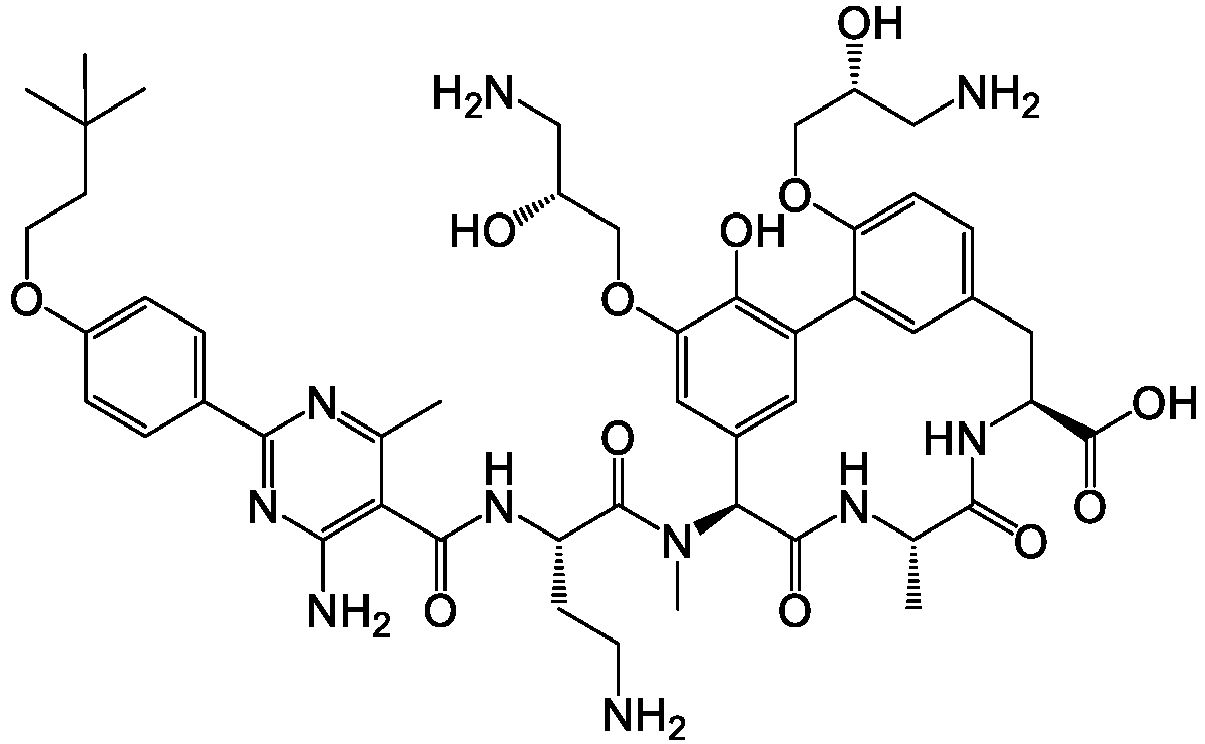
- The title compound was prepared from compound 20 using the procedure of Example 1, replacing 1-(4-(tert-butyl)phenyl)-6-oxo-1,6-dihydropyridazine-4-carboxylic acid with 4-amino-2-(4-(isopentyloxy)phenyl)-6-methylpyrimidine-5-carboxylic acid. 1H NMR (400 MHz, MeOH - d4 ) δ (ppm) 8.41 (s, 1H), 8.23 (d, J = 8.8 Hz, 2H), 7.18 - 7.04 (m, 1H), 6.97 (d, J = 8.8 Hz, 2H), 6.93 - 6.87 (m, 1H), 6.84 (s, 1H), 6.81 (s, 1H), 6.60 (s, 1H), 6.46 (s, 1H), 4.87 - 4.73 (m, 2H), 4.52 - 4.41 (m, 1H), 4.24 - 4.01 (m, 8H), 3.27 - 2.97 (m, 11H), 2.45 (s, 3H), 2.31 - 2.11 (m, 2H), 1.75 (t, J = 6.8 Hz, 2H), 1.34 (d, J = 6.8 Hz, 3H), 1.02 (s, 9H). LCMS (Method 5-95 AB, ESI): RT = 0.767 min, [M+H]+ = 987.8.
-

- The title compound was prepared from compound 20 using the procedure of Example 1 replacing 1-(4-(tert-butyl)phenyl)-6-oxo-1,6-dihydropyridazine-4-carboxylic acid with 2-(4-isopropoxyphenyl)-4-methylpyrimidine-5-carboxylic acid. 1H NMR (400 MHz, MeOH-d4 ): δ (ppm) 8.89 (s, 1H), 8.23 (d, J = 8.8 Hz, 2H), 7.05 - 6.92 (m, 4H), 6.87 - 6.82 (m, 1 H), 6.66 (s, 1H), 6.51 (s, 1H), 6.42 (s, 1 H), 5.20 - 5.11 (m, 1H), 4.83 - 4.72 (m, 2 H), 4.69 - 4.59 (m, 1H), 4.40 - 4.03 (m, 6 H), 3.40 - 3.32 (m, 1H), 3.29 - 3.07 (m, 6H), 2.99 (s, 3H), 2.97 - 2.80 (m, 1H), 2.70 (s, 12H), 2.68 (s, 3H), 2.39 - 2.15 (m, 2H), 1.47 - 1.30 (m, 9H). LCMS (Method 5-95 AB, ESI): RT = 0.732 min, [M+H]+ = 930.7.
-

- The title compound was prepared from compound 20 using the procedure of Example 1, replacing 1-(4-(tert-butyl)phenyl)-6-oxo-1,6-dihydropyridazine-4-carboxylic acid with 4-amino-2-(4-(tert-butyl)phenyl) -6-methylpyrimidine-5-carboxylic acid. 1H NMR (400 MHz, MeOH-d4 ): δ (ppm) 8.24 (s, 1H), 8.23 - 8.17 (m, 2H), 7.54 - 7.48 (m, 1H), 7.21 - 7.14 (m, 1H), 7.02 - 6.92 (m, 1H), 6.88 (s, 1H), 6.85 (s, 1H), 6.59 (s, 1H), 6.45 (s, 1H), 5.30 - 5.01 (m, 1H), 4.83 - 4.79 (m, 2H), 4.66 - 4.52 (m, 1H), 4.25 - 4.04 (m, 6H), 3.25 - 2.99 (m, 10H), 2.52 - 2.43 (m, 3H), 2.33 - 2.08 (m, 2H), 1.40 - 1.33 (s, 12H). LCMS (Method 5-95 AB, ESI): RT = 0.592 min, [M+H]+ = 943.4.
-

- The title compound was prepared from compound 20 using the procedure of Example 1, replacing 1-(4-(tert-butyl)phenyl)-6-oxo-1,6-dihydropyridazine-4-carboxylic acid with 4-methyl-2-(4-(1-methylcyclopropyl)phenyl) pyrimidine-5-carboxylic acid. 1H NMR (400 MHz, MeOH-d4 ): δ (ppm) 8.79 (s, 1H), 8.20 (d, J = 8.4 Hz, 2H), 7.31 (d, J = 8.4 Hz, 2 H), 7.00 - 6.80 (m, 3 H), 6.88 (s, 1H), 6.44 (s, 1 H), 6.40 (s, 1 H), 5.18 - 5.10 (m, 1H), 4.84 - 4.71 (m, 1 H), 4.65 - 4.53 (m, 1H), 4.37 - 4.30 (m, 1H), 4.28 - 4.17(m, 2H), 4.16 - 3.97 (m, 3H), 3.27 - 3.08 (m, 6H), 3.06 - 2.73 (m, 5H), 2.70 (s, 12H), 2.62 (s, 3H), 2.37 - 2.15 (m, 2H), 1.47 (s, 3H), 1.37 (d, J = 6.8 Hz, 3H), 1.02 - 0.92 (m, 2H), 0.91 - 0.82 (m, 2H). LCMS (Method 5-95 AB, ESI): RT = 0.763 min, [M+H]+ = 926.3.
-


- The general procedure for the synthesis of the 4-amino-2-(4-tert-butylphenyl)-6-(difluoromethyl)pyrimidine-5-carbonitrile was performed using procedures from Chem. Eur. J. 2018, 24, 1311-1316.
- Step 1: A solution of boron trifluoride diethyl etherate (2.68 mL, 21.71 mmol, 1.05 equiv) in acetonitrile (19.2 mL) was stirred for 15 min under N2 at -30°C. 1,1,2,2-tetrafluoro-N,N-dimethyl-ethanamine (3.0 g, 20.68 mmol, 1.0 equiv) in acetonitrile (27 mL) was added and the mixture was stirred for 5 min. The reaction was brought back to room temperature. A solution of malononitrile (1.37 g, 20.68 mmol, 1.0 equiv) in dry acetonitrile (19.2 mL) was added to the solution under inert atmosphere at 25°C, rapidly followed by N,N-diisopropylethylamine (5.4 mL, 31.01 mmol, 1.5 equiv). The mixture was stirred for 2 hrs. The reaction was quenched by addition of silica gel. The solution was concentrated under reduced pressure to give a yellow solid residue, which purified by column chromatography (silica gel, 100-200 mesh, 10-50% EtOAc in heptanes) to yield 2-[1-(dimethylamino)-2,2-difluoro-ethylidene]propanedinitrile (1.68g, 9.816 mmol, 48% yield) as a yellow solid.
- Step 2: 2-[1-(dimethylamino)-2,2-difluoro-ethylidene]propanedinitrile (150 mg, 0.8800 mmol, 1.0 equiv) and (4-tert-butylbenzenecarboximidoyl)ammonium chloride (372.87 mg, 1.75 mmol, 2.0 equiv) were dissolved in absolute ethanol (2.9214 mL, 0.3 M) and capped in a microwave vial. The reaction was heated to 70°C under microwave irradiation and stirred for 30 minutes. After cooling to room temperature, the reaction mixture was concentrated under reduced pressure. The crude reaction mixture was then purified by flash chromatography (silica gel, 100-200 mesh, 0-50% EtOAc in heptanes) to yield 4-amino-2-(4-tert-butylphenyl)-6-(difluoromethyl)pyrimidine-5-carbonitrile (175 mg, 0.5789 mmol, 66 % yield) as a white solid.
- Step 3: 4-amino-2-(4-tert-butylphenyl)-6-(difluoromethyl)pyrimidine-5-carbonitrile (160 mg, 0.5300 mmol, 1.0 equiv) was dissolved in absolute EtOH (2.6 mL). An aqueous solution of 4 M potassium hydroxide (0.66 mL, 2.65 mmol, 5.0 equiv) was added and reaction mixture was heated to 70 °C for 18h. The reaction mixture was cooled to room temperature, a 1 N solution of KHSO4 was added and the reaction mixture was diluted with EtOAc (20 mL). The phases were separated and the aqueous layer was extracted with EtOAc (2 x 20 mL). The organic layers were combined, washed with brine (2 x 20 mL), dried over Na2SO4, filtered and concentrated under reduced pressure to yield 4-amino-2-(4-(tert-butyl)phenyl)-6-(difluoromethyl)pyrimidine-5-carboxylic acid as a yellow solid (170 mg, 0.53 mmol, 99% crude yield) which was used without further purification.
- The title compound was prepared from compound 20 using the procedure of Example 1, replacing 1-(4-(tert-butyl)phenyl)-6-oxo-1,6-dihydropyridazine-4-carboxylic acid with 4-amino-2-(4-(tert-butyl)phenyl)-6-(difluoromethyl)pyrimidine-5-carboxylic acid. 1H NMR (400MHz, DMSO - d6 ) δ (ppm) 9.25 (d, 5.6 Hz, 1H), 8.85 (d, J=8.1 Hz, 1H), 8.32 (d, J=7.6 Hz, 1H), 8.21 (d, J=8.6 Hz, 2H), 7.52 (d, J=8.7 Hz, 2H), 7.19 (dd, J=8.6, 2.2 Hz, 1H), 7.01 (d, J=8.6 Hz, 1H), 6.83 (s, 1H), 6.73 (s, 1H), 6.66-6.75 (m, 2H), 6.26-6.33 (m, 2H), 4.80 (m, 1H), 4.73-4.60 (m, 2H), 4.08-3.88 (m, 6H), 3.28 (d, J=15.1 Hz, 1H), 3.03-2.78 (m, 11H), 2.35 (s, 3H), 2.09-1.99 (m, 1H), 1.97-1.86 (m, 1H), 1.29 (s, 9H), 1.17 (d, J=6.7 Hz, 3H). LCMS (Method 5-100 AB, 6 min): RT = 1.66 min, [M+H] + = 979.3.
-
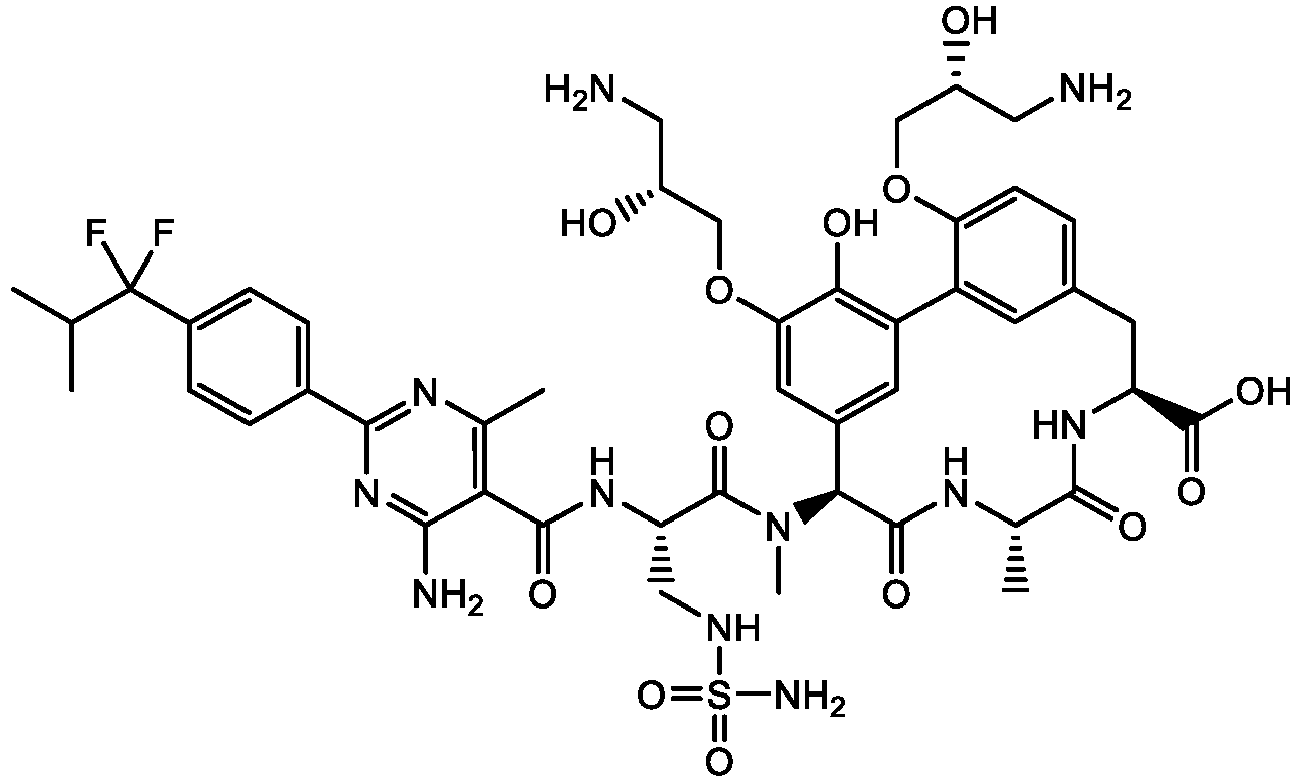
- The title compound was prepared as described in Example 1, replacing 1-(4-(tert-butyl)phenyl)-6-oxo-1,6-dihydropyridazine-4-carboxylic acid with 4-amino-2-(4-(1,1-difluoro-2-methylpropyl)phenyl)-6-methylpyrimidine-5-carboxylic acid. 1H NMR (400MHz, MeOH - d4 ) δ (ppm) 8.42 - 8.34 (m, 3H), 7.61 - 7.49 (m, 2H), 7.21 - 7.03 (m, 1H), 6.97 - 6.72 (m, 3H), 6.68 - 6.56 (m, 1H), 6.47 (s, 1H), 5.20 - 5.10 (m, 1H), 4.84 - 4.73 (m, 2H), 4.41 - 4.00 (m, 6H), 3.75 - 3.32 (m, 3H), 3.27 - 2.91 (m, 8H), 2.64 - 2.30 (m, 4H), 1.45 - 1.25 (m, 3H), 1.00 (d, J= 6.8 Hz, 6H). LCMS (Method 5-95 AB, ESI): RT = 0.645 min, [M+H]+ = 1045.0.
-

- The title compound was prepared from compound 20 using the procedure of Example 1, replacing 1-(4-(tert-butyl)phenyl)-6-oxo-1,6-dihydropyridazine-4-carboxylic acid with 4-amino-2-(4-(tert-butyl)-2-hydroxyphenyl)-6-methylpyrimidine-5-carboxylic acid. 1H NMR (400MHz, DMSO) δ 8.87 (d, J = 8.1Hz, 1H), 8.33 (d, J = 7.8Hz, 1H), 8.17 (d, J = 8.4Hz, 1H), 7.21 (d, J = 8.7Hz, 1H), 7.02 (d, J = 8.6Hz, 1H), 6.97 (dd, J = 8.5, 1.9 Hz, 1H), 6.87 (d, J = 1.9Hz, 1H), 6.75 (s, 1H), 6.69 (d, J = 1.5Hz, 1H), 6.33 (s, 1H), 6.30 (s, 1H), 4.84 (dd, J = 9.6, 4.1Hz, 1H), 4.74 - 4.63 (m, 2H), 4.11 - 3.90 (m, 6H), 3.34 - 3.25 (m, 1H), 3.12 - 2.79 (m, 10H), 2.37 (s, 3H), 2.36 (s, 15H), 2.10 - 1.89 (m, 2H), 1.27 (s, 9H), 1.18 (d, J = 6.7Hz, 3H). LCMS (Method 5-100 AB, 7 min): RT = 1.64 min, [M+H] + = 959.7.
-

- The title compound was prepared from compound 20 using the procedure of Example 1, replacing 1-(4-(tert-butyl)phenyl)-6-oxo-1,6-dihydropyridazine-4-carboxylic acid with 4-amino-2-(1,1-dimethylindan-5-yl)-6-methyl-pyrimidine-5-carboxylic acid. 1H NMR (400MHz, DMSO+D2O) δ 8.32 (s, 3H), 8.07-8.05 (m, 2H), 7.22 (d, J = 8.8Hz, 1H), 7.08 (d, J = 9.6Hz, 1H), 6.89 (d, J = 8.5Hz, 1H), 6.72 (s, 1H), 6.69 (s, 1H), 6.37 (s, 1H), 6.24 (s, 1H), 4.85-4.79 (m, 1H), 4.62-4.55 (m, 1H), 4.11-4.06 (m, 1H), 4.06-3.96 (m, 4H), 3.95-3.91 (m, 2H), 3.26-3.19 (m, 1H), 3.02-2.80 (m, 12H), 2.32 (s, 3H), 2.09 - 1.83 (m, 4H), 1.20 (s, 6H), 1.16 (d, J = 7.0Hz, 3H). LCMS (Method 5-100 AB, 7 min): RT = 1.59 min, [M+H] + = 962.5.
-

- The title compound was prepared as described in Example 1, replacing 1-(4-(tert-butyl)phenyl)-6-oxo-1,6-dihydropyridazine-4-carboxylic acid with 2-amino-6-(4-(tert-butyl)phenyl)-4-methylnicotinic acid. 1H NMR (400MHz, DMSO+D2O) δ 8.93 (d, J = 9.3Hz, 1H), 8.37 (d, J = 9.2Hz, 1H), 7.81 (d, J = 8.5Hz, 2H), 7.60 (d, J = 8.5Hz, 2H), 7.24 - 7.15 (m, 2H), 7.02 (d, J = 8.9Hz, 1H), 6.76 - 6.65 (m, 2H), 6.31 (s, 1H), 6.23 (s, 1H), 5.02 - 4.92 (m, 1H), 4.77 - 4.60 (m, 2H), 4.14 - 3.86 (m, 6H), 3.42 - 3.23 (m, 2H), 3.18 - 2.76 (m, 9H), 2.37 (s, 12H), 1.31 (s, 9H), 1.17 (d, J = 6.7Hz, 3H). LCMS (Method 5-100 AB, 7 min): RT = 1.77 min, [M+H] + = 1007.5.
-

- Step 1: To a solution of compound 5 (2.0 g, 2.5 mmol) (synthesized as in General Procedure A), in DMF (12 mL) was added tert-butyl (5S)-5-[(3-nitrophenyl)sulfonyloxymethyl]-2-oxo-oxazolidine-3-carboxylate (1.36g, 3.38 mmol) (synthesized as in General Procedure D starting with (S)-3-amino-1,2-propanediol) and potassium carbonate (1.04 g, 7.52 mmol) at 25°C under inert atmosphere. The reaction mixture was stirred for 16 h at 25°C. The reaction mixture was poured into water/sat. aqueous NaHCOs (1:1) dropwise under stirring. A beige solid precipitates and was recovered by filtration. The solid was purified by column chromatography (silica gel, 100-200 mesh, 25 - 100% EtOAc in (1:1) DCM/heptanes mixture) to yield compound 6 (1.99 g, 79.6% yield) as a white solid.
- Step 2: Compound 6 (1.99g, 2 mmol) was dissolved in methanol (12.7 mL) and the reaction flask was purged with nitrogen prior to the addition of the catalyst palladium on carbon 10% wt. (159 mg, 0.15 mmol). The reaction mixture was purged with hydrogen and was stirred under 1 atm hydrogen at 25 °C for 3h. The reaction flask was purged with nitrogen bubbling into solution for 15 minutes prior to the addition of Cbz-O-succinimide (0.5 g, 2 mmol). The reaction was stirred at 25°C for 16 h. The reaction mixture was filtered through Celite and concentrated under reduced pressure. The residue was diluted with ethyl acetate (100 mL), washed with water (2 x 100 mL) and brine (2 x 100 mL), dried over Na2SO4 and concentrated to dryness to give compound 7 (1.81 g, 99.8% yield) as an off white solid.
- Step 4: To a solution of compound 8 (1.72 g, 1.55 mmol) in methanol (17 mL) was added ptoluenesulfonic acid (29 mg, 0.155 mmol). The reaction mixture was stirred at 25 °C for 16 h. The reaction mixture was poured into water/aqueous sat. NaHCOs (1:1) dropwise under stirring. A beige solid precipitates and was recovered by filtration. The solid was dissolved in DCM, dried with Na2SO4, filtered and concentrated under reduced pressure to yield crude compound 9 (1.52 g, 100 % yield) as an off white solid.
- Step 5: A solution of compound 9 (1.52 g, 1.55 mmol) in DMF (15 mL) and methanol (0.565 mL) under inert atmosphere (N2) was cooled to -15 °C. To the cold solution was added cesium carbonate (1.07 g, 3.28 mmol) and the reaction mixture was stirred at -20 to -15 °C over 6h. The filtrate was concentrated to obtain crude compound 6 (35.0 g, 97.4% yield) as a white solid. The reaction mixture was diluted with EtOAc (20 mL) and water (20 mL) at -15 °C. Phases were separated and the organic phase was washed with water (2 × 30 mL) and brine (2 × 30 mL) then dried over Na2SO4 and concentrated under reduced pressure. The solid was purified by column chromatography (silica gel, 100-200 mesh, 2 - 10% MeOH in DCM) to yield compound 10 (1.07 g, 75 % yield) as a white solid.
-

- Step 1: A 5 L flask was charged with (A)-3-amino-1,2-propanediol (107 mL, 1.38 mol) and 10 volume of both THF (1260 mL) and water (1260 mL) were added. The reaction material was stirred at room temperature until complete dissolution (20 minutes). Then, the solution was cooled to 0 °C and potassium carbonate (229.4 g, 1.66 mol) was added. Finally, benzyl chloroformate (237 mL, 1.66 mol) was charged into an addition funnel and was added dropwise to the reaction mixture while keeping internal temperature under 8 °C (on a period of 60 minutes). After completion of the reaction (2h), layers were separated. The organic layer was concentrated under reduced pressure (by half) while water phase was extracted 3 times with EtOAc (3 x 1260 mL). All organics were combined, washed with brine, dried with anhydrous sodium sulfate, filtered and concentrated to 2-3 volume. Heptanes (1260 mL) was added to the residue and it was stirred between 10-20 °C for 2-3 hours. The white solid formed was filtered and washed with heptanes. The solid was transferred to a flask and placed under high vacuum to dry and yielded compound 2 (325 g, 104 % yield) as a white solid.
- Compound 2 (175 g, 779 mmol) was charged in a 3 neck, 5L round bottom flask equipped with a thermometer and was dissolved in THF (2631 mL). The solution was cooled to 0 °C and potassium tert-butoxide (96.13 g, 857 mmol) was added portion wise while keeping temperature between 0-10 °C. Once addition of the reagent was completed, the reaction mixture was allowed to warm to 25 °C and was stirred for 3h. Upon completion, the reaction mixture was cooled again using ice bath to maintain internal temperature around 10°C while 4M HCl in dioxane was added to the reaction mixture until pH reach 5-6. The reaction mixture was then stirred at 25 °C for 30 minutes. The precipitate was filtered and washed with MeCN (700 mL) twice. The wet cake was charged in a 2 L erlenmeyer and stirred with 1.5L of MeCN for 30 minutes. The solid was again filtered and washed with MeCN (700 mL) twice. All organics were combined and concentrated under reduced pressure into 2-3 V below 45 °C. To the resulting suspension was added MTBE (1.5 L) and the suspension was concentrated again under reduced pressure until 2-3 V below 45°C. 1-1.5 L of MTBE was added to the suspension and it was stirred at room temperature for 30 minutes. The solid was then collected by filtration and washed with MTBE (1L). The solid was dried under vacuum to yield compound 3 (85.5 g, 93.8 % yield) as an off white solid.
- Compound 3 (75 g, 640 mmol) was charged in a 2 L round bottom flask and 6V of MeCN (450 mL) was added followed by pyridine (155 mL, 1.92 mol). The resulting solution was cooled to 0 °C. Then, 3-nitrobenzenesulfonyl chloride (149 g, 673 mmol) was added portion wise while maintaining the temperature under 10 °C. The reaction mixture was stirred at 0 °C for 2h. Upon completion, the reaction mixture was concentrated under reduced pressure to 2-3 V. MTBE (10 V, 750 mL) was then added to the flask and the resulting mixture was concentrated under reduced pressure to 2-3 V. 1.5 L of sat. NaHCOs solution (20 V) was added. The mixture was vigorously stirred at 10-20 °C for 30 minutes. The resulting mixture was filtered and washed with water twice (1000 mL x 2). The wet cake was collected and charge back into a round bottom flask. 1.5 L of sat. NaHCOs solution (20 V) was added. The mixture was vigorously stirred at 10-20 °C for 30 minutes. The resulting mixture was filtered and washed with water twice (1000 mL x 2). The wet cake was collected and charge back into a round bottom flask. Water (10 V, 750 mL) and MTBE (5 V, 375 mL) were added and the resulting biphasic suspension was vigorously stirred for 30 minutes. The solids were filtered, washed twice with MTBE (400 mL x 2). The cake was dried under high vacuum to yield compound 4 (178 g, 92% yield) as an off white solid.
- Compound 4 (182.7 g, 604 mmol) was added in 5 L round bottom flask with 4-dimethylaminopyridine (7.38 g, 60.4 mmol) and MeCN (1.1 L) was added. The reaction mixture was cooled to 0 °C and di-tert-butyl dicarbonate (237.5 g, 1.1 mol) was added keeping reaction temperature under 0 °C. The reaction mixture was stirred at 0 °C for 1h. Upon completion, the reaction mixture was concentrated under reduced pressure. MeOH (500 mL) was added to the mixture and it was concentrated under reduced pressure to a thick orange gum. 700 mL of MeOH was added to the mixture. The reaction flask was placed under sonication for 3 minutes. A white precipitate formed and it was stirred at room temperature for 30 minutes. The solid was recovered by filtration and washed with cold MeOH to afford compound 5 (191.4 g, 78.7% yield) as a white solid. 98.95 %ee. 1H NMR (400 MHz, CDCl3) δ 8.77 (t, J = 1.9 Hz, 1H), 8.56 (ddd, J = 8.3, 2.2, 1.0 Hz, 1H), 8.25 (ddd, J = 7.9, 1.7, 1.1 Hz, 1H), 7.85 (t, J = 8.0 Hz, 1H), 4.75 - 4.67 (m, 1H), 4.36 (dd, J = 11.5, 3.5 Hz, 1H), 4.30 (dd, J = 11.5, 4.2 Hz, 1H), 4.05 (dd, J = 10.6, 9.2 Hz, 1H), 3.82 (dd, J = 10.6, 6.2 Hz, 1H), 1.53 (s, 9H).
-
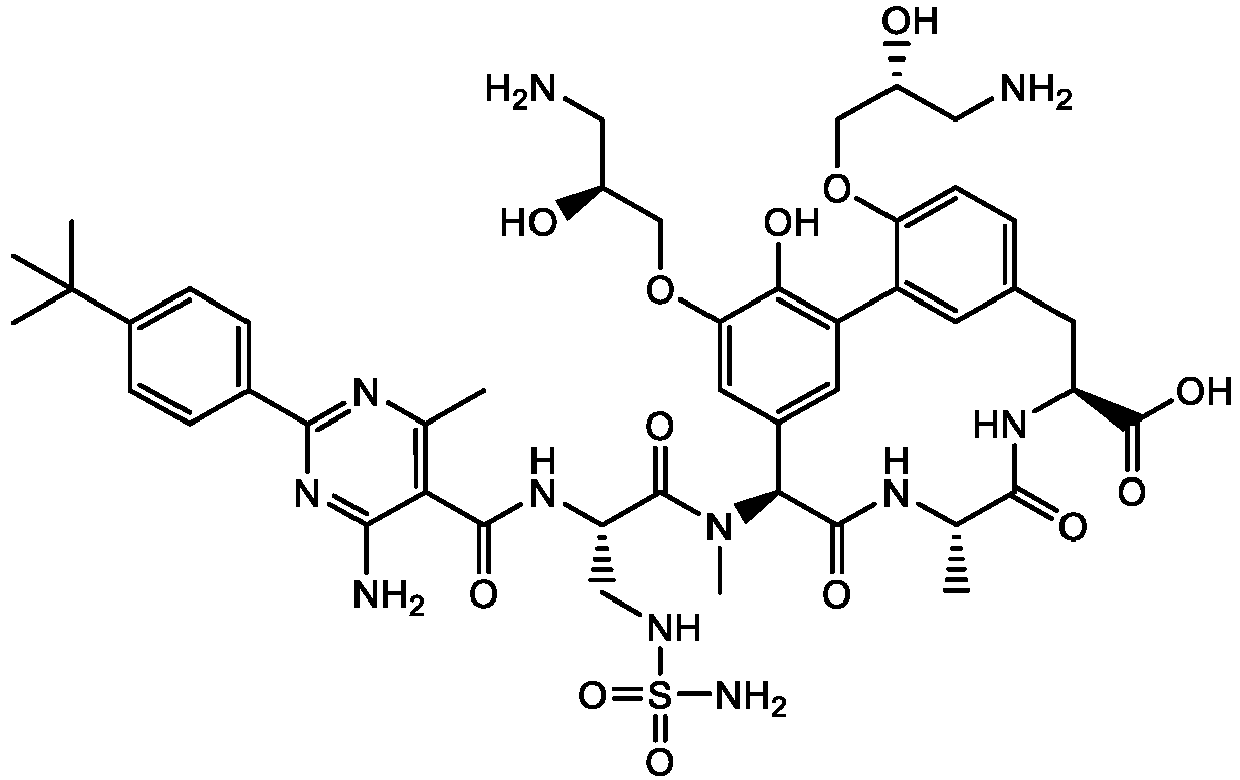
- The title compound was prepared as described in Example 1, replacing 1-(4-(tert-butyl)phenyl)-6-oxo-1,6-dihydropyridazine-4-carboxylic acid with 4-amino-2-(4-(tert-butyl)phenyl)-6-methylpyrimidine-5-carboxylic acid and compound 14 by compound 10 described in procedure C. 1H NMR (400 MHz, DMSO - d6 + D2O) δ (ppm) δ 9.28 (d, J = 3.9 Hz, 1H), 8.91 (d, J = 6.7 Hz, 1H), 8.31 (d, J = 5.0 Hz, 1H), 8.06 (d, J = 7.9 Hz, 2H), 7.63 (d, J = 8.2 Hz, 2H), 7.19 (d, J = 7.8 Hz, 1H), 7.00 (d, J = 8.7 Hz, 1H), 6.69 (d, J = 6.2 Hz, 2H), 6.28 (s, 1H), 6.17 (s, 1H), 5.06 - 4.93 (m, 1H), 4.73 - 4.59 (m, 2H), 4.17 - 3.94 (m, 8H), 3.41 - 3.33 (m, 1H), 3.32 - 3.22 (m, 1H), 3.17 - 3.06 (m, 1H), 3.05 - 2.95 (m, 2H), 2.92 - 2.76 (m, 1H), 2.85 (s, 3H), 2.42 (s, 3H), 2.39 (s, 9H), 1.29 (s, 9H), 1.16 (d, J = 6.4 Hz, 3H). LCMS (Method 5-100 AB, 7 min): RT = 1.62 min, [M+H]+= 1008.5.
-


- Step1: To a solution of 5-bromopyridin-2-ol (2.00 g, 11.49 mmol) in DMF (10.0 mL) was added 1-bromo-3,3-dimethylbutane (2.85 g, 17.2 mmol) and Ag2CO3 (9.51 g, 34.5 mmol). The reaction mixture was stirred at 110°C for 2 h. The reaction mixture was diluted with ethyl acetate (40 mL). After filtration, the filtrate was washed with brine (3 x 40 mL), and dried over Na2SO4. After filtration, the filtrate was concentrated to dryness. The residue was purified by column (silica gel, 100-200 mesh, 0 - 10% ethyl acetate in petroleum) to obtain 5-bromo-2-(3,3-dimethylbutoxy)pyridine (1.00 g, 33.7% yield) as yellow oil.
- Step 2: A mixture of 5-bromo-2-(3,3-dimethylbutoxy)pyridine (1.20 g, 4.65 mmol), KOAc (1.37 g, 14.0 mmol), Pd(dppf)Cl2 (345 mg, 0.46 mmol), bis(pinacolato)diboron (1.77 g, 6.97 mmol) in DMF (10.0 mL) was stirred under nitrogen at 80°C for 16 h. The reaction mixture was diluted with ethyl acetate (20 mL), then filtered and the filtrate was washed with brine (3 x 20 mL). The organic layer was concentrated in vacuo to dryness. The residue was purified by column chromatography (silica gel, 100-200 mesh, 50 - 100 % ethyl acetate in petroleum) to give 2-(3,3-dimethylbutoxy)-5-(4,4,5,5-tetramethyl-1,3,2-dioxaborolan-2-yl)pyridine (480 mg, 33.8% yield) as a yellow oil.
- Step 3: A mixture of 2-(3,3-dimethylbutoxy)-5-(4,4,5,5-tetramethyl-1,3,2-dioxaborolan-2-yl)pyridine (300 mg, 0.98 mmol), ethyl 2-chloro-4-((4-methoxybenzyl)amino)-6-methylpyrimidine-5-carboxylate (347 mg, 1.03 mmol), Pd(dppf)Cl2 (36.0 mg, 0.05 mmol) and Na2CO3 (312 mg, 2.95 mmol) in a mixture of 1,4-dioxane (6.0 mL) and water (0.60 mL) was purged with N2 (15 psi) and heated at 100°C for 16 h. After filtration, 20 mL ethyl acetate was added to the mixture. The mixture was washed with brine (2 x 20 mL). The organic layer was dried with Na2SO4 and concentrated to dryness. The crude material was purified by column (silica gel, 100-200 mesh, 0-5 % ethyl acetate in petroleum) to give ethyl 2-(6-(3,3-dimethylbutoxy)pyridin-3-yl)-4-((4-methoxybenzyl)amino)-6-methylpyrimidine-5-carboxylate (370 mg, 78.7% yield) as a yellow solid.
- Step 4: To a solution of ethyl 2-(6-(3,3-dimethylbutoxy)pyridin-3-yl)-4-((4-methoxybenzyl)amino)-6-methylpyrimidine-5-carboxylate (175.0 mg, 0.37 mmol) in acetonitrile (4.00 mL) and water (2.00 mL) was added ceric ammonium nitrate (802 mg, 1.46 mmol). The reaction was stirred at 20°C for 30 min. The reaction mixture was partitioned between ethyl acetate (20 mL) and water (20 mL). The organic layer was washed with brine (2 x 20 mL), dried with Na2SO4 and concentrated to dryness. The crude was purified by preparative TLC (ethyl acetate: petroleum ether = 1: 10, Rf = 0.3) to give ethyl 4-amino-2-(6-(3,3-dimethylbutoxy)pyridin-3-yl)-6-methylpyrimidine-5-carboxylate (100 mg, 76.3% yield) as a yellow solid.
- Step 5: To a solution of ethyl 4-amino-2-(6-(3,3-dimethylbutoxy)pyridin-3-yl)-6-methylpyrimidine-5-carboxylate (100 mg, 0.28 mmol) in methanol (5.00 mL) and water (1.00 mL) was added NaOH (44.6 mg, 1.12 mmol). The reaction mixture was stirred at 80°C for 1 h. The mixture was concentrated to dryness. The mixture was adjust to pH 2 with HCl (1 M). The aqueous layer was extracted with ethyl acetate (2 x 60 mL) and the combined organic layers were concentrated to obtain 4-amino-2-(6-(3,3-dimethylbutoxy)pyridin-3-yl)-6-methylpyrimidine-5-carboxylic acid (80 mg, 86.8% yield) as a white solid.
- The title compound was prepared as described in Example 1, replacing 1-(4-(tert-butyl)phenyl)-6-oxo-1,6-dihydropyridazine-4-carboxylic acid with 4-amino-2-(6-(3,3-dimethylbutoxy)pyridin-3-yl)-6-methylpyrimidine-5-carboxylic acid. 1H NMR (400MHz, MeOH - d4 ) 9.04 (s, 1H), 8.51 - 8.42 (m, 2H), 7.12 - 6.99 (m, 1H), 6.89 - 6.69 (m, 3H), 6.55 (s, 1H), 5.27 - 5.10 (m, 1H), 4.83 - 4.73 (m, 2H), 4.53 - 4.29 (m, 3H), 4.18 - 4.07 (m, 3H), 4.05 - 3.92 (m, 1H), 3.67 - 3.52 (m, 1H), 3.44 - 3.37 (m, 1H), 3.36 - 3.33 (m, 1H), 3.29 - 3.19 (m, 2H), 3.18 - 3.09 (m, 2H), 3.07 (s, 3H), 3.00 - 2.91( m, 1H), 2.45 (s, 3H), 1.79 - 1.67 (m, 2H), 1.41 - 1.28 (m, 2H), 1.00 (s, 9H). LCMS (Method 10-80 AB, ESI): RT = 1.868 min, [M+H]+ = 1054.6.
-

- 4-amino-2-(4-(tert-butyl)-2-fluorophenyl)-6-methylpyrimidine-5-carboxylic acid was prepared as described in Example 14, replacing 2-(3,3-dimethylbutoxy)-5-(4,4,5,5-tetramethyl-1,3,2-dioxaborolan-2-yl)pyridine with 2-(4-(tert-butyl)-2-fluorophenyl)-4,4,5,5-tetramethyl-1,3,2-dioxaborolane. The title compound was prepared as described in Example 1, replacing 1-(4-(tert-butyl)phenyl)-6-oxo-1,6-dihydropyridazine-4-carboxylic acid with 4-amino-2-(4-(tert-butyl)-2-fluorophenyl)-6-methylpyrimidine-5-carboxylic acid. 1H NMR (400MHz, MeOH - d4 ) δ (ppm) 7.75 - 7.69 (m, 1H), 7.34 - 7.26 (m, 1H), 7.25 - 7.17 (m, 1H), 7.12 - 7.01 (m, 1H), 6.96 - 6.73 (m, 3H), 6.63 - 6.54 (m, 1H), 6.44 (s, 1H), 5.21 - 5.10 (m, 1H), 4.82 - 4.65 (m, 4H), 4.44 (s, 1H), 4.32 - 3.87 (m, 6H), 3.66 - 3.48 (m, 1H), 3.42 - 3.32 (m, 1H), 3.25 - 2.87 (m, 8H), 2.49 - 2.32 (m, 3H), 1.39 - 1.29 (m, 12H). LCMS (Method 5-95 AB, ESI): RT = 0.769 min, [M+H]+= 1026.5.
-

- The title compound was prepared as described in Example 13, replacing tert-butyl (5R)-5-[(3-nitrophenyl)sulfonyloxymethyl]-2-oxo-oxazolidine-3-carboxylate in step 3 with tert-butyl (5S)-5-[(3-nitrophenyl)sulfonyloxymethyl]-2-oxo-oxazolidine-3-carboxylate . 1H NMR (400MHz, DMSO+D2O) δ 8.98 - 8.90 (m, 1H), 8.40 - 8.31 (m, 1H), 8.12 (d, J = 8.5Hz, 2H), 7.62 (d, J = 8.4Hz, 2H), 7.21 (d, J = 7.3Hz, 1H), 7.04 (d, J = 8.6Hz, 1H), 6.76 - 6.67 (m, 2H), 6.30 (s, 1H), 6.21 (s, 1H), 5.00-4.96 (m, 1H), 4.74 - 4.62 (m, 2H), 4.14 - 3.95 (m, 5H), 3.93 - 3.82 (m, 1H), 3.40 - 3.24 (m, 2H), 3.18 - 2.93 (m, 4H), 2.92 - 2.83 (m, 4H), 2.82 - 2.75 (m, 1H), 2.46 (s, 3H), 2.37 (s, 9H), 1.31 (s, 9H), 1.22 - 1.15 (m, 3H). LCMS (Method 5-100 AB, 7 min): RT = 1.67 min, [M+H]+= 1008.6.
-

- Step 1: Copper (II) acetylacetonate (237 mg, 0.905 mmol) was added to a solution of tert-butyl acetoacetate (3.0 mL, 18.1 mmol) and ethyl cyanoformate (1.8 mL, 18.2 mmol) in DCM (12.1 mL). The reaction mixture was stirred at room temperature for 48 h then concentrated under reduced pressure. The residue was purified by column chromatography (silica gel, 100-200 mesh, 0 - 60% EtOAc in heptanes) to yield O1-tert-butyl O4-ethyl (E)-2-acetyl-3-amino-but-2-enedioate (1.73 g, 37.2% yield) as a dark grey oil (mix of two geometric isomers).
- Step 2: 1,1,3,3-Tetramethylguanidine (1.69 mL, 13.5 mmol) was added to a solution of O1-tert-butyl O4-ethyl (E)-2-acetyl-3-amino-but-2-enedioate (1.73 g, 6.72 mmol) and 4-tert-butylbenzamidine (1.30 g, 7.40 mmol) in DCM (13.4 mL). The reaction mixture was stirred at room temperature for 16 h then quenched with 1M aqueous KHSO4. The mixture was extracted with EtOAc (3x). The organic layers were combined, dried over Na2SO4, filtered and concentrated under reduced pressure. The residue was purified by column chromatography (silica gel, 100-200 mesh, 0 - 10% MeOH in DCM) to yield the title compound 5-tert-butoxycarbonyl-2-(4-tert-butylphenyl)-6-methyl-pyrimidine-4-carboxylic acid (1.21 g, 48.6% yield) as off-white solid.
- Step 3: Isobutyl chloroformate (501 uL, 3.86 mmol) was added to a solution of 5-tert-butoxycarbonyl-2-(4-tert-butylphenyl)-6-methyl-pyrimidine-4-carboxylic acid (1.30 g, 3.51 mmol) and triethylamine (538 uL, 3.86 mmol) in THF (35 mL) at 0 °C. The reaction mixture was stirred at room temperature for 15 min then cooled to 0 °C. Lithium borohydride (255 mg, 12.3 mmol) was added and the reaction mixture was stirred at room temperature for 1h30. MeOH (10 mL) was added at 0 °C followed by saturated aqueous NH4Cl. The mixture was then warmed to room temperature and extracted with EtOAc (3x). The organic layers were combined, washed with brine, dried over Na2SO4, filtered and concentrated under reduced pressure. The residue was purified by column chromatography (silica gel, 100-200 mesh, 0 - 10% MeOH in DCM) to yield tert-butyl 2-(4-tert-butylphenyl)-4-(hydroxymethyl)-6-methyl-pyrimidine-5-carboxylate (679 mg, 54.3% yield) as yellow oil.
- Step 4: Carbon tetrabromide (444 mg, 1.34 mmol), triphenylphosphine (367 mg, 1.40 mmol) and sodium azide (396 mg, 6.09 mmol) were added to a solution of tert-butyl 2-(4-tert-butylphenyl)-4-(hydroxymethyl)-6-methyl-pyrimidine-5-carboxylate (434 mg, 1.22 mmol) in DMF (8.1 mL). Triethylamine (373 uL, 2.68 mmol) was then added and the reaction mixture was stirred at room temperature for 1 h. Additional portions of carbon tetrabromide (444 mg, 1.34 mmol), triphenylphosphine (367 mg, 1.40 mmol), and triethylamine (373 uL, 2.68 mmol) were added and the reaction mixture was stirred at room temperature for 16 h. The reaction mixture was diluted with EtOAc then washed with saturated aqueous NaHCO3, water, and brine. The organic layers were combined, dried over Na2SO4, filtered and concentrated under reduced pressure. The crude material was purified by column chromatography (silica gel, 100-200 mesh, 0 - 20% EtOAc in heptanes) to yield tert-butyl 4-(azidomethyl)-2-(4-tert-butylphenyl)-6-methyl-pyrimidine-5-carboxylate (315 mg, 67.8% yield) as yellow oil.
- Step 5: Fmoc chloride (384 mg, 1.49 mmol) and sodium carbonate (182 mg, 1.71 mmol) were added to a solution of tert-butyl 4-(azidomethyl)-2-(4-tert-butylphenyl)-6-methyl-pyrimidine-5-carboxylate (436 mg, 1.14 mmol) in ethanol (8.7 mL). The reaction mixture was purged with N2 for 5 min then palladium on carbon (10% loading) 55% wet (122 mg, 0.114 mmol) was added. The reaction was purged with H2 for 5 min then stirred under H2 (1 atm) for 16 h. The reaction mixture was purged with N2. Additional portions of sodium carbonate (121 mg, 1.14 mmol) and Fmoc chloride (147 mg, 0.568 mmol) were added. The reaction mixture was stirred at room temperature for 5 h then filtered through Celite. The filter cake was washed with MeOH then filtrate was concentrated under reduced pressure. The crude was purified by column chromatography (silica gel, 100-200 mesh, 0 - 30% EtOAc in heptanes) to yield tert-butyl 2-(4-tert-butylphenyl)-4-[(9H-fluoren-9-ylmethoxycarbonylamino)methyl]-6-methyl-pyrimidine-5-carboxylate (487 mg, 73.8% yield) as colorless oil.
- Step 6: Trifluoroacetic acid (6.5 mL) was added to a solution of tert-butyl 2-(4-tert-butylphenyl)-4-[(9H-fluoren-9-ylmethoxycarbonylamino)methyl]-6-methyl-pyrimidine-5-carboxylate (487 mg, 0.843 mmol) in DCM (13 mL). The reaction mixture was stirred at room temperature for 12 h then concentrated under reduced pressure. The crude material was purified by column chromatography (C-18, 5 - 70% acetonitrile in 10 mM aqueous NH4HCO2) to yield 2-(4-tert-butylphenyl)-4-[(9H-fluoren-9-ylmethoxycarbonylamino)-methyl]-6-methyl-pyrimidine-5-carboxylic acid (303 mg, 68.9 % yield) as an off-white solid.
- The title compound was prepared as described in Example 1, replacing 1-(4-(tert-butyl)phenyl)-6-oxo-1,6-dihydropyridazine-4-carboxylic acid with 2-(4-tert-butylphenyl)-4-[(9H-fluoren-9-ylmethoxycarbonylamino)-methyl]-6-methyl-pyrimidine-5-carboxylic acid. 1H NMR (400MHz, DMSO+H2O) δ 8.40 (d, J = 8.4Hz, 2H), 8.34 (s, 2H), 7.55 (d, J= 7.8Hz, 2H), 7.09 - 7.00 (m, 1H), 6.93 - 6.85 (m, 1H), 6.77 - 6.71 (m, 1H), 6.68 (s, 1H), 6.38 (s, 1H), 6.26 (s, 1H), 5.13 - 5.05 (m, 1H), 4.62 (q, J = 5.6Hz, 1H), 4.18 - 3.85 (m, 9H), 3.39 - 3.30 (m, 2H), 3.28 - 3.18 (m, 1H), 3.18 - 3.09 (m, 1H), 3.08 - 2.75 (m, 7H), 2.55 (s, 3H), 1.32 (s, 9H), 1.17 (d, J = 6.7Hz, 3H). LCMS (Method 5-100 AB, 7 min): RT = 1.46 min, [M+H] + = 1022.5.
- In vitro antimicrobial activity of each compound was determined by measuring minimal inhibitor concentrations (MICs) using the broth micro-dilution technique as approved by the Clinical and Laboratory Standards Institute (CLSI) (Methods for Dilution Antimicrobial Susceptibility Tests for Bacteria that Grow Aerobically; Approved Standard - Eighth Edition. CLSI document M07-A8. Wayne, PA: Clinical and Laboratory Standards; 2009). Antibacterial activity was measure against Escherichia coli strain ATCC 25922 (E. coli), Klebsiella pneumoniae ATCC 700603 (K. pneumoniae), Acinetobacter baumannii ATCC 17978 (A. baumannii), and Pseudomonas aeruginosa PA01 (P. aeruginosa), each of which is representative of a clinically relevant Gram-negative species. Cells were inoculated onto plates of Mueller Hinton Agar and grown at 37°C for 16-18 hours. Inocula suspensions were prepared by scraping cells into 1mL of testing media (Mueller Hinton II cation adjusted Broth) and diluting to a final OD 600 nm of 0.01.
- Test compounds were prepared in DMSO at a concentration of 64 ug/ml. The compounds were tested under several different dilution formats. In protocol 1, the compound stocks were diluted into testing media at a concentration of 64 µg/ml and serial 2-fold dilutions were made in the same media, in 96-well U bottom microtiter dishes, for a total of 10 compound concentrations. In protocol 2, the compound stocks were diluted into testing media at a concentration of 4 µg/mL and serial 2-fold dilutions were made in the same media, in 96-well U bottom microtiter dishes, for a total of 10 compound concentrations. In protocol 3, compound stocks were diluted into testing media at a concentration of 0.5 µg/mL, with serial 2-fold dilutions conducted as described above. In protocol 4, compound stocks were diluted into testing media at a concentration of 0.13 µg/mL, with serial 2-fold dilutions conducted as described above. Inocula suspensions were added to the 2-fold serial dilutions of test compounds to a final density of OD 600nm of 0.0005 and incubated at 35°C for 22 hours. After incubation the plates were examined visually and the lowest concentration of test compound that completely prevented bacterial growth were recorded as the MICs. To assess antimicrobial activity in the presence of plasma proteins, MICs were also determined in growth media supplemented with 50% serum. Bacterial inocula and test compound dilution plates were prepared using the same protocol as described above for the standard MICs assay, with the exception that a mixture of 50% v/v Mueller Hinton II cation adjusted Broth and 50% v/v mouse sterile filtered serum (Equitech-Bio) was used in place of 100% Mueller Hinton II cation adjusted Broth. The results are listed in Table 3 (MIC, IC50 values micromolar).
- Male Sprague-Dawley rats (8-10 weeks of age) were euthanized with an overdose of carbon dioxide. The liver was rapidly excised and placed in ice-cold phosphate-buffered saline (PBS) before isolation process. Mitochondria were isolated using the MitoCheck® Mitochondrial Isolation Kit (Cayman Chemical #701010, Ann Arbor, MI) according to manufacturer's instructions. In brief, approximately 10-14 grams of liver tissues were finely minced using a pair of scissors, and washed repeatedly with ice-cold PBS, followed by Mito Isolation Buffer. The minced tissues were homogenized with 30 ml Mito Homogenization Buffer in 40 ml dounce homogenizer and a smooth glass grinder. The homogenate was split into two clean 30 ml polycarbonate tubes and centrifuged at 1,000 x g, 4 °C, for 3 minutes. The supernatant was subjected to further centrifugation at 10,000 x g, 4 °C, for 10 minutes. The supernatant was discarded and mitochondrial pellet was suspended in Mito Isolation Buffer using a glass stirring rod and stored on ice until use. Protein concentration of mitochondria was determined using a bicinchoninic acid protein assay kit (Thermo Scientific, Waltham, MA).
- Oxygen consumption was monitored as essentially described by Will et al., "Analysis of mitochondrial function using phosphorescent oxygen-sensitive probes," Nature Protocols Vol. 1(6) (2006) 2563. Briefly, isolated mitochondria (50 µg mitochondrial proteins / state 3 (S3) of mitochondrial respiration for inhibitor identification, 100 µg / S2 for uncoupler identification) were incubated with compounds in 25 µl of Measurement Buffer (MB: 250mM sucrose, 15mM KCl, 1mM EGTA, 5mM MgCl2, 30mM K2HPO4,pH 7.4) including 1% DMSO on ice for 1 hour, then mixed with 25 µl of substrate mixture including an oxygen-sensitive phosphorescent dye (MitoXpress Xtra, Agilent, Santa Clara, CA), glutamate (25mM, G1626, Sigma, St. Louis, MO), malate (25mM, M6413, Sigma), ADP (3.3 mM, A2754, Sigma, only for S3 of mitochondrial respiration), Fatty acid free BSA (0.1%, A0281, Sigma), and a complex II-specific inhibitor TTFA (2 µM, T27006, Sigma for the assessment of complex I-mitochondrial respiration with glutamate/malate) in a black wall/clear bottom 384-well plate. The mixtures were covered with HS mineral oil (Agilent) using the Viaflo 384-channel pipette (Integra, Hudson, NH). Oxygen consumption was measured for 30 min at 30°C using a spectrofluorimeter (FLUOstar Omega, BMG Labtech, Cary, NC). In S3, DMSO vehicle control and antimycin A (10 µM) were used to define 0% and 100% inhibition. In S2, DMSO vehicle and FCCP (0.5-1 µM) was used to define 0% and 100% uncoupling, respectively. Area under curve typically in a range of 0-12 min (S3) or 0-24 min (S2) was used for calculations. IC50 or UC50 (uncoupling concentration), a concentration that causes 50% of inhibition or maximal (uncoupling) activation of oxygen consumption, was used to evaluate experimental quality. Data were presented as µM (per 50 µg (S3) or 100 µg (S2) mitochondrial proteins). Compounds with IC50: < 100 µM (S3) and/or UC50: < 200 µM (S2) were considered as high-risk on mitochondrial toxicity. Compounds with 25-50% changes in inhibition and/or uncoupling were categorized as medium-risk, since compounds with > 25 % changes are considered as responders.
- Toxicity associated with mitochondrial dysfunction has presented a problem for promising potential antibiotics as we as other types of therapeutics. The mitochondrial oxygen consumption rate (OCR) assay is considered a reliable indicator of potential internal organ toxicity issues that may occur with powerful antibiotics. The carboxylate compounds of the invention show unexpected lower toxicity than prior art "glycine nitrile" arylomycin analogs (see, e.g.,
WO 2018/149419 ) in the mitochondrial oxygen consumption rate (OCR) assay. The subject compounds in general exhibit OCR IC50 values that are better by an order of magnitude compared to such compounds. Exemplary OCR values for the compounds of the invention are shown in Table 3.Table 3 Ex. # Mitochondrial Oxygen Consumption Rate IC50 (µM) 2 261 4 119 5 >250 6 >200 7 >250 8 >100 9 >100 10 >100 11 >100 13 >100 15 >100 16 >100 17 >200 - The compounds of the invention are effective against gram-negative bacteria, and are surprisingly effective against non-fermenter bacteria. MIC values were determined for each of the compounds in both "broth" and serum-based assays, as the serum based assay more accurately represents the performance of the compounds as an antibiotic under physiological conditions. Serum MIC values for representative compounds against E. coli, Klebsiella pneumoniae, Pseudomonas aeruginosa and Acinetobacter aaumanii are shown in Table 4.
Table 4 Ex. # E. coli 25922 Serum MIC (µM) K. pneumoniae 700603 Serum MIC (µM) P. aeruginosa 01 Serum MIC (µM) A. baumanii 17978 Serum MIC (µM) 2 0.5 0.5 3.3 11 4 0.25 0.25 4 8 5 0.58 0.46 64 16 6 0.5 0.25 16 16 7 0.21 0.17 43 11 8 0.25 0.25 16 4 9 0.5 0.5 12 16 10 0.25 0.25 8 8 11 0.25 0.25 16 16 13 0.75 0.75 4 8 15 1 1 6 16 16 0.5 0.5 4 8 17 0.5 0.31 8 14 - For example, the compounds of the invention show unexpectedly good MIC values against Acinetobacter baumanii in the serum assay. Table 5 below shows the serum MIC values against Acinetobacter baumanii for each of the compounds.
Table 5 Ex. # Acinetobacter baumanii 17978 Serum MIC (µM) 2 11 4 8 5 16 6 16 7 11 8 4 9 16 10 8 11 16 13 8 15 16 16 8 17 14 - Mitochondrial oxygen consumption rate and serum MIC values against E. coli, Klebsiella pneumoniae, Pseudomonas aeruginosa and Acinetobacter baumanii for the compounds of Table 1 are shown in Tables 6 and 7, respectively.
Table 6 Cp. # Mitochondrial Oxygen Consumption Rate ICso (µM) 254 20 582 10 Table 7 Cp. # E. coli 25922 Serum MIC (µM) A. pneumoniae 700603 Serum MIC (µM) P. aeruginosa 01 Serum MIC (µM) A. baumanii 17978 Serum MIC (µM) 254 0.19 0.73 13 9.3 561-15 2 4 64 64 563 0.75 0.75 64 64 582 0.29 0.25 1.5 2 586 0.094 0.094 2 2 633 0.063 0.063 4 5 638 0.75 1 64 64 639 0.5 1 64 64 640 0.5 0.75 64 64 641 0.75 1 64 64 642 25 1.1 53 71 643 2.3 4.6 73 73 644 1.2 4.6 74 74 645 0.53 0.55 67 67 646 0.55 0.58 69 69 647 0.5 1 64 64 648 0.6 1.3 >128 >96 649 1 2 64 64 - To prepare a pharmaceutical topical gel composition, 100 mg of a compound disclosed herein is mixed with 1.75 g of hydroxypropyl cellulose, 10 mL of propylene glycol, 10 mL of isopropyl myristate and 100 mL of purified alcohol USP. The resulting gel mixture is then incorporated into containers, such as tubes, which are suitable for topical administration.
Claims (6)
- A compound, or a pharmaceutically acceptable salt thereof, wherein the compound is selected from the group consisting of:


- The compound of claim 1, or a pharmaceutically acceptable salt thereof, wherein the compound is (8S,11S,14S)-18-hydroxy-11-methyl-14-[methyl-[(2S)-2-[[4-amino-2-(4-tert-butylphenyl)-6-methyl-pyrimidine-5 -carbonyl] amino] -3 -(sulfamoylamino)propanoyl]amino]-10,13-dioxo-3,17-bis[(2R)-3-amino-2-hydroxy-propoxy]-9,12-diazatricyclo[13.3.1.12,6]icosa-1(18),2(20),3,5,15(19),16-hexaene-8-carboxylic acid.
- The compound of claim 1, or a pharmaceutically acceptable salt thereof, wherein the compound is (8S,11S,14S)-18-hydroxy-11-methyl-14-[methyl-[(2S)-4-amino-2-[[4-amino-2-(tert-butylphenyl)-6-methyl-pyrimidine-5-carbonyl]amino]butanoyl]amino]-10,13-dioxo-3,17-bis[(2R)-3-amino-2-hydroxy-propoxy]-9,12-diazatricyclo[13.3.1.12,6]icosa-1(18),2(20),3,5,15(19),16-hexaene-8-carboxylic acid.
- The compound of claim 1, or a pharmaceutically acceptable salt thereof, wherein the compound is (8S,11S,14S)-18-hydroxy-11-methyl-14-[methyl-[(2S)-4-amino-2-[[4-methyl-2-[4-(1-methylcyclopropyl)phenyl]pyrimidine-5-carbonyl]amino]butanoyl]amino]-10,13-dioxo-3,17-bis[(2R)-3-amino-2-hydroxy-propoxy]-9,12-diazatricyclo[13.3.1.12,6]icosa-1(18),2(20),3,5,15(19),16-hexaene-8-carboxylic acid.
- The compound of claim 1, or a pharmaceutically acceptable salt thereof, wherein the compound is (8S,11S,14S)-18-hydroxy-11-methyl-14-[methyl-[(2S)-4-amino-2-[[2-(4-tert-butylphenyl)-4-amino-6-difluoromethyl-pyrimidine-5-carbonyl]amino]butanoyl]amino]-10,13-dioxo-3,17-bis[(2R)-3-amino-2-hydroxy-propoxy]-9,12-diazatricyclo[13.3.1.12,6]icosa-1(18),2(20),3,5,15(19),16-hexaene-8-carboxylic acid.
- A pharmaceutical composition comprising the compound of any one of claims 1-5, or a pharmaceutically acceptable salt thereof, and a pharmaceutically acceptable excipient.
Priority Applications (4)
| Application Number | Priority Date | Filing Date | Title |
|---|---|---|---|
| SI202030269T SI3968983T1 (en) | 2019-05-28 | 2020-05-27 | Broad-spectrum macrocyclic antibiotics |
| RS20231102A RS64852B1 (en) | 2019-05-28 | 2020-05-27 | Macrocyclic broad spectrum antibiotics |
| EP23189412.2A EP4289480A3 (en) | 2019-05-28 | 2020-05-27 | Macrocyclic broad spectrum antibiotics |
| HRP20231497TT HRP20231497T8 (en) | 2019-05-28 | 2020-05-27 | BROAD SPECTRUM MACROCYCLIC ANTIBIOTICS |
Applications Claiming Priority (2)
| Application Number | Priority Date | Filing Date | Title |
|---|---|---|---|
| US201962853457P | 2019-05-28 | 2019-05-28 | |
| PCT/US2020/034670 WO2020243155A1 (en) | 2019-05-28 | 2020-05-27 | Macrocyclic broad spectrum antibiotics |
Related Child Applications (2)
| Application Number | Title | Priority Date | Filing Date |
|---|---|---|---|
| EP23189412.2A Division EP4289480A3 (en) | 2019-05-28 | 2020-05-27 | Macrocyclic broad spectrum antibiotics |
| EP23189412.2A Division-Into EP4289480A3 (en) | 2019-05-28 | 2020-05-27 | Macrocyclic broad spectrum antibiotics |
Publications (3)
| Publication Number | Publication Date |
|---|---|
| EP3968983A1 EP3968983A1 (en) | 2022-03-23 |
| EP3968983A4 EP3968983A4 (en) | 2022-06-22 |
| EP3968983B1 true EP3968983B1 (en) | 2023-09-13 |
Family
ID=73551292
Family Applications (2)
| Application Number | Title | Priority Date | Filing Date |
|---|---|---|---|
| EP20814144.0A Active EP3968983B1 (en) | 2019-05-28 | 2020-05-27 | Macrocyclic broad spectrum antibiotics |
| EP23189412.2A Pending EP4289480A3 (en) | 2019-05-28 | 2020-05-27 | Macrocyclic broad spectrum antibiotics |
Family Applications After (1)
| Application Number | Title | Priority Date | Filing Date |
|---|---|---|---|
| EP23189412.2A Pending EP4289480A3 (en) | 2019-05-28 | 2020-05-27 | Macrocyclic broad spectrum antibiotics |
Country Status (33)
| Country | Link |
|---|---|
| US (2) | US11208387B2 (en) |
| EP (2) | EP3968983B1 (en) |
| JP (3) | JP7078807B2 (en) |
| KR (4) | KR20250020719A (en) |
| CN (1) | CN114007605B (en) |
| AR (1) | AR119019A1 (en) |
| AU (2) | AU2020282975B2 (en) |
| BR (1) | BR112021024010A2 (en) |
| CA (1) | CA3141853A1 (en) |
| CL (1) | CL2021003153A1 (en) |
| CO (1) | CO2021017561A2 (en) |
| CR (1) | CR20210682A (en) |
| DK (1) | DK3968983T3 (en) |
| ES (1) | ES2961566T3 (en) |
| FI (1) | FI3968983T3 (en) |
| HR (1) | HRP20231497T8 (en) |
| HU (1) | HUE063847T2 (en) |
| IL (2) | IL295889B2 (en) |
| LT (1) | LT3968983T (en) |
| MA (1) | MA55981B1 (en) |
| MX (1) | MX2021014554A (en) |
| NZ (1) | NZ783605A (en) |
| PE (2) | PE20240066A1 (en) |
| PH (1) | PH12021552972A1 (en) |
| PL (1) | PL3968983T3 (en) |
| PT (1) | PT3968983T (en) |
| RS (1) | RS64852B1 (en) |
| SA (1) | SA521430976B1 (en) |
| SG (1) | SG11202112920SA (en) |
| SI (1) | SI3968983T1 (en) |
| TW (1) | TWI815017B (en) |
| WO (1) | WO2020243155A1 (en) |
| ZA (1) | ZA202502195B (en) |
Families Citing this family (6)
| Publication number | Priority date | Publication date | Assignee | Title |
|---|---|---|---|---|
| RU2761476C2 (en) | 2015-11-20 | 2021-12-08 | АрКьюИкс ФАРМАСЬЮТИКЭЛС, ИНК. | Macrocyclic antibiotics of wide spectrum of action |
| KR102602837B1 (en) * | 2021-03-08 | 2023-11-15 | 차의과학대학교 산학협력단 | An antipathogenic compound |
| CN113583003A (en) * | 2021-08-05 | 2021-11-02 | 广东西捷药业有限公司 | Vardenafil analogue and synthetic method and application thereof |
| CN113933416B (en) * | 2021-09-30 | 2023-10-10 | 海南海灵化学制药有限公司 | Method for detecting impurities in cefpirome sulfate for injection |
| EP4615988A1 (en) | 2022-11-11 | 2025-09-17 | Genentech Inc. | Enzymatic asymmetric syntheses of n-alkyl amino acids |
| CN117946013B (en) * | 2024-01-25 | 2024-07-02 | 白银康寓信生物科技有限公司 | Method for synthesizing 5, 6-dihalogen-3-aminopyrazine-2-methyl formate by one-pot method |
Family Cites Families (31)
| Publication number | Priority date | Publication date | Assignee | Title |
|---|---|---|---|---|
| US3128280A (en) | 1959-10-23 | 1964-04-07 | Searle & Co | 1-(alkoxylated/halogenated phenyl)-3-pyridylmethylureas |
| US5204328A (en) | 1990-06-26 | 1993-04-20 | Merck & Co., Inc. | Peptides having atrial natriuretic factor activity |
| WO1997016558A1 (en) | 1995-11-03 | 1997-05-09 | E.I. Du Pont De Nemours And Company | Positive selection vector for bacillus sp. |
| CZ298749B6 (en) | 1996-10-18 | 2008-01-16 | Vertex Pharmaceuticals Incorporated | Inhibitors of serine proteases and pharmaceutical compositions in which the inhibitors are comprised |
| EP0895999A1 (en) | 1997-08-06 | 1999-02-10 | Pfizer Products Inc. | C-4" substituted macrolide antibiotics |
| GB9902399D0 (en) | 1999-02-03 | 1999-03-24 | Smithkline Beecham Plc | Compounds |
| US6660832B1 (en) | 1999-08-20 | 2003-12-09 | Isis Pharmaceuticals, Inc. | Macrocyclic compounds and preparation methods thereof |
| US6951840B2 (en) | 2001-08-31 | 2005-10-04 | Eli Lilly And Company | Lipoglycopeptide antibiotics |
| DE10226921A1 (en) | 2002-06-17 | 2003-12-24 | Bayer Ag | Antibacterial amide macrocycles |
| EP2147925A1 (en) | 2003-07-17 | 2010-01-27 | Migenix Inc. | Compositions of lipopeptide antibiotic derivatives and methods of use thereof |
| DE10358824A1 (en) | 2003-12-16 | 2005-07-21 | Bayer Healthcare Ag | Antibacterial macrocycles with substituted biphenyl |
| DE102005014245A1 (en) | 2005-03-30 | 2006-10-05 | Aicuris Gmbh & Co. Kg | Antibacterial amide macrocycles V |
| DE102005014247A1 (en) | 2005-03-30 | 2006-10-05 | Aicuris Gmbh & Co. Kg | Antibacterial Amide Macrocycles VI |
| BR112012021806A2 (en) | 2010-03-01 | 2015-09-08 | Myrexis Inc | compounds and their therapeutic uses. |
| AU2011224710A1 (en) | 2010-03-09 | 2012-09-06 | Merck Canada Inc. | Bridged lipoglycopeptides that potentiate the activity of beta-lactam antibacterials |
| US20130130985A1 (en) | 2010-04-01 | 2013-05-23 | Paul Alewood | Oxytocin peptide analogues |
| BR112013006265A2 (en) | 2010-09-15 | 2016-06-07 | Scripps Research Inst | general arylomycin-like antibiotic spectra |
| US10501493B2 (en) | 2011-05-27 | 2019-12-10 | Rqx Pharmaceuticals, Inc. | Broad spectrum antibiotics |
| WO2012166665A2 (en) | 2011-05-27 | 2012-12-06 | Rqx Pharmaceuticals, Inc. | Broad spectrum antibiotics |
| CN103159830B (en) | 2011-12-15 | 2017-06-20 | 上海来益生物药物研究开发中心有限责任公司 | Lipopeptide compound |
| FR2986154B1 (en) | 2012-01-31 | 2017-08-04 | Pierre Fabre Dermo Cosmetique | NEW PHOTOPROTECTIVE SYSTEM |
| MX2014011067A (en) * | 2012-03-14 | 2015-09-22 | Scripps Research Inst | Broad spectrum antibiotic arylomycin analogs. |
| CN103788176A (en) | 2012-10-31 | 2014-05-14 | 上海来益生物药物研究开发中心有限责任公司 | Arylomycin compound and preparation method and application thereof |
| JP6437443B2 (en) | 2012-11-21 | 2018-12-12 | アールキューエックス ファーマシューティカルズ,インク. | Macrocyclic wide-area antibiotics |
| US10392422B2 (en) | 2014-05-20 | 2019-08-27 | Rqx Pharmaceuticals, Inc. | Macrocyclic broad spectrum antibiotics |
| ITUB20154591A1 (en) | 2015-10-12 | 2017-04-12 | Crestoptics S R L | CONFOCAL MICROSCOPY AND RELATIVE PROCEDURE OF ACQUISITION AND PROCESSING OF IMAGES |
| RU2761476C2 (en) | 2015-11-20 | 2021-12-08 | АрКьюИкс ФАРМАСЬЮТИКЭЛС, ИНК. | Macrocyclic antibiotics of wide spectrum of action |
| TWI725075B (en) * | 2015-11-20 | 2021-04-21 | 美商Rqx製藥公司 | Macrocyclic broad spectrum antibiotics |
| ES2979245T3 (en) | 2017-02-15 | 2024-09-25 | Rqx Pharmaceuticals Inc | Broad spectrum macrocyclic antibiotics |
| SG11201908932SA (en) | 2017-03-27 | 2019-10-30 | Hoffmann La Roche | Process for making arylomyin ring analogs |
| WO2019067498A2 (en) | 2017-09-29 | 2019-04-04 | Genentech, Inc. | Peptide antibiotic complexes and methods of use thereof |
-
2020
- 2020-05-27 PT PT208141440T patent/PT3968983T/en unknown
- 2020-05-27 SI SI202030269T patent/SI3968983T1/en unknown
- 2020-05-27 FI FIEP20814144.0T patent/FI3968983T3/en active
- 2020-05-27 SG SG11202112920SA patent/SG11202112920SA/en unknown
- 2020-05-27 KR KR1020257002841A patent/KR20250020719A/en active Pending
- 2020-05-27 TW TW109117701A patent/TWI815017B/en active
- 2020-05-27 DK DK20814144.0T patent/DK3968983T3/en active
- 2020-05-27 BR BR112021024010A patent/BR112021024010A2/en unknown
- 2020-05-27 KR KR1020217042492A patent/KR102450071B1/en active Active
- 2020-05-27 CN CN202080040183.3A patent/CN114007605B/en active Active
- 2020-05-27 WO PCT/US2020/034670 patent/WO2020243155A1/en not_active Ceased
- 2020-05-27 US US16/884,679 patent/US11208387B2/en active Active
- 2020-05-27 HR HRP20231497TT patent/HRP20231497T8/en unknown
- 2020-05-27 EP EP20814144.0A patent/EP3968983B1/en active Active
- 2020-05-27 LT LTEPPCT/US2020/034670T patent/LT3968983T/en unknown
- 2020-05-27 NZ NZ783605A patent/NZ783605A/en unknown
- 2020-05-27 JP JP2021570324A patent/JP7078807B2/en active Active
- 2020-05-27 KR KR1020227033626A patent/KR102688389B1/en active Active
- 2020-05-27 KR KR1020247021145A patent/KR102764861B1/en active Active
- 2020-05-27 IL IL295889A patent/IL295889B2/en unknown
- 2020-05-27 MX MX2021014554A patent/MX2021014554A/en unknown
- 2020-05-27 IL IL288294A patent/IL288294B/en unknown
- 2020-05-27 EP EP23189412.2A patent/EP4289480A3/en active Pending
- 2020-05-27 PE PE2023002563A patent/PE20240066A1/en unknown
- 2020-05-27 HU HUE20814144A patent/HUE063847T2/en unknown
- 2020-05-27 PH PH1/2021/552972A patent/PH12021552972A1/en unknown
- 2020-05-27 ES ES20814144T patent/ES2961566T3/en active Active
- 2020-05-27 RS RS20231102A patent/RS64852B1/en unknown
- 2020-05-27 PL PL20814144.0T patent/PL3968983T3/en unknown
- 2020-05-27 PE PE2021001977A patent/PE20230383A1/en unknown
- 2020-05-27 AU AU2020282975A patent/AU2020282975B2/en active Active
- 2020-05-27 AR ARP200101493A patent/AR119019A1/en unknown
- 2020-05-27 CA CA3141853A patent/CA3141853A1/en active Pending
- 2020-05-27 CR CR20210682A patent/CR20210682A/en unknown
- 2020-05-27 MA MA55981A patent/MA55981B1/en unknown
-
2021
- 2021-11-26 CL CL2021003153A patent/CL2021003153A1/en unknown
- 2021-11-28 SA SA521430976A patent/SA521430976B1/en unknown
- 2021-12-17 US US17/644,861 patent/US20220135528A1/en active Pending
- 2021-12-21 CO CONC2021/0017561A patent/CO2021017561A2/en unknown
-
2022
- 2022-05-19 JP JP2022082018A patent/JP7508507B2/en active Active
-
2023
- 2023-01-24 AU AU2023200369A patent/AU2023200369B2/en active Active
-
2024
- 2024-06-19 JP JP2024098789A patent/JP7842812B2/en active Active
-
2025
- 2025-03-12 ZA ZA2025/02195A patent/ZA202502195B/en unknown
Also Published As
Similar Documents
| Publication | Publication Date | Title |
|---|---|---|
| US11208387B2 (en) | Macrocyclic broad spectrum antibiotics | |
| US10392422B2 (en) | Macrocyclic broad spectrum antibiotics | |
| JP6873993B2 (en) | Macrocycle broad-spectrum antibiotic | |
| WO2014081886A1 (en) | Macrocyclic broad spectrum antibiotics | |
| CN115215923B (en) | Macrocyclic broad-spectrum antibiotics | |
| TWI919116B (en) | Macrocyclic broad spectrum antibiotics | |
| RU2834484C2 (en) | Broad-spectrum macrocyclic antibiotics | |
| HK40002868A (en) | Macrocyclic broad spectrum antibiotics |
Legal Events
| Date | Code | Title | Description |
|---|---|---|---|
| REG | Reference to a national code |
Ref country code: HR Ref legal event code: TUEP Ref document number: P20231497T Country of ref document: HR |
|
| STAA | Information on the status of an ep patent application or granted ep patent |
Free format text: STATUS: THE INTERNATIONAL PUBLICATION HAS BEEN MADE |
|
| PUAI | Public reference made under article 153(3) epc to a published international application that has entered the european phase |
Free format text: ORIGINAL CODE: 0009012 |
|
| STAA | Information on the status of an ep patent application or granted ep patent |
Free format text: STATUS: REQUEST FOR EXAMINATION WAS MADE |
|
| 17P | Request for examination filed |
Effective date: 20211215 |
|
| AK | Designated contracting states |
Kind code of ref document: A1 Designated state(s): AL AT BE BG CH CY CZ DE DK EE ES FI FR GB GR HR HU IE IS IT LI LT LU LV MC MK MT NL NO PL PT RO RS SE SI SK SM TR |
|
| REG | Reference to a national code |
Ref legal event code: R079 Ipc: C07D0403120000 Ref country code: DE Ref legal event code: R079 Ref document number: 602020017752 Country of ref document: DE Free format text: PREVIOUS MAIN CLASS: A61K0031395000 Ipc: C07D0403120000 |
|
| A4 | Supplementary search report drawn up and despatched |
Effective date: 20220525 |
|
| RIC1 | Information provided on ipc code assigned before grant |
Ipc: A61P 31/04 20060101ALI20220519BHEP Ipc: A61K 31/395 20060101ALI20220519BHEP Ipc: C07D 245/04 20060101ALI20220519BHEP Ipc: C07D 403/12 20060101AFI20220519BHEP |
|
| DAX | Request for extension of the european patent (deleted) | ||
| RAV | Requested validation state of the european patent: fee paid |
Extension state: MA Effective date: 20211215 |
|
| GRAP | Despatch of communication of intention to grant a patent |
Free format text: ORIGINAL CODE: EPIDOSNIGR1 |
|
| STAA | Information on the status of an ep patent application or granted ep patent |
Free format text: STATUS: GRANT OF PATENT IS INTENDED |
|
| INTG | Intention to grant announced |
Effective date: 20230324 |
|
| P01 | Opt-out of the competence of the unified patent court (upc) registered |
Effective date: 20230518 |
|
| GRAS | Grant fee paid |
Free format text: ORIGINAL CODE: EPIDOSNIGR3 |
|
| GRAA | (expected) grant |
Free format text: ORIGINAL CODE: 0009210 |
|
| STAA | Information on the status of an ep patent application or granted ep patent |
Free format text: STATUS: THE PATENT HAS BEEN GRANTED |
|
| AK | Designated contracting states |
Kind code of ref document: B1 Designated state(s): AL AT BE BG CH CY CZ DE DK EE ES FI FR GB GR HR HU IE IS IT LI LT LU LV MC MK MT NL NO PL PT RO RS SE SI SK SM TR |
|
| REG | Reference to a national code |
Ref country code: CH Ref legal event code: EP |
|
| REG | Reference to a national code |
Ref country code: PT Ref legal event code: SC4A Ref document number: 3968983 Country of ref document: PT Date of ref document: 20231004 Kind code of ref document: T Free format text: AVAILABILITY OF NATIONAL TRANSLATION Effective date: 20230927 |
|
| REG | Reference to a national code |
Ref country code: DE Ref legal event code: R096 Ref document number: 602020017752 Country of ref document: DE |
|
| REG | Reference to a national code |
Ref country code: IE Ref legal event code: FG4D |
|
| REG | Reference to a national code |
Ref country code: NL Ref legal event code: FP |
|
| REG | Reference to a national code |
Ref country code: DK Ref legal event code: T3 Effective date: 20231026 |
|
| REG | Reference to a national code |
Ref country code: FI Ref legal event code: FGE |
|
| REG | Reference to a national code |
Ref country code: SE Ref legal event code: TRGR |
|
| REG | Reference to a national code |
Ref country code: NO Ref legal event code: T2 Effective date: 20230913 |
|
| REG | Reference to a national code |
Ref country code: GR Ref legal event code: EP Ref document number: 20230402445 Country of ref document: GR Effective date: 20240110 |
|
| PG25 | Lapsed in a contracting state [announced via postgrant information from national office to epo] |
Ref country code: LV Free format text: LAPSE BECAUSE OF FAILURE TO SUBMIT A TRANSLATION OF THE DESCRIPTION OR TO PAY THE FEE WITHIN THE PRESCRIBED TIME-LIMIT Effective date: 20230913 |
|
| REG | Reference to a national code |
Ref country code: SK Ref legal event code: T3 Ref document number: E 43036 Country of ref document: SK |
|
| REG | Reference to a national code |
Ref country code: HU Ref legal event code: AG4A Ref document number: E063847 Country of ref document: HU |
|
| REG | Reference to a national code |
Ref country code: MA Ref legal event code: VAGR Ref document number: 55981 Country of ref document: MA Kind code of ref document: B1 |
|
| REG | Reference to a national code |
Ref country code: HR Ref legal event code: T1PR Ref document number: P20231497 Country of ref document: HR |
|
| REG | Reference to a national code |
Ref country code: ES Ref legal event code: FG2A Ref document number: 2961566 Country of ref document: ES Kind code of ref document: T3 Effective date: 20240312 |
|
| REG | Reference to a national code |
Ref country code: AT Ref legal event code: UEP Ref document number: 1611209 Country of ref document: AT Kind code of ref document: T Effective date: 20230913 |
|
| PG25 | Lapsed in a contracting state [announced via postgrant information from national office to epo] |
Ref country code: IS Free format text: LAPSE BECAUSE OF FAILURE TO SUBMIT A TRANSLATION OF THE DESCRIPTION OR TO PAY THE FEE WITHIN THE PRESCRIBED TIME-LIMIT Effective date: 20240113 |
|
| PG25 | Lapsed in a contracting state [announced via postgrant information from national office to epo] |
Ref country code: SM Free format text: LAPSE BECAUSE OF FAILURE TO SUBMIT A TRANSLATION OF THE DESCRIPTION OR TO PAY THE FEE WITHIN THE PRESCRIBED TIME-LIMIT Effective date: 20230913 Ref country code: IS Free format text: LAPSE BECAUSE OF FAILURE TO SUBMIT A TRANSLATION OF THE DESCRIPTION OR TO PAY THE FEE WITHIN THE PRESCRIBED TIME-LIMIT Effective date: 20240113 Ref country code: EE Free format text: LAPSE BECAUSE OF FAILURE TO SUBMIT A TRANSLATION OF THE DESCRIPTION OR TO PAY THE FEE WITHIN THE PRESCRIBED TIME-LIMIT Effective date: 20230913 |
|
| REG | Reference to a national code |
Ref country code: HR Ref legal event code: ODRP Ref document number: P20231497 Country of ref document: HR Payment date: 20240425 Year of fee payment: 5 |
|
| REG | Reference to a national code |
Ref country code: DE Ref legal event code: R097 Ref document number: 602020017752 Country of ref document: DE |
|
| REG | Reference to a national code |
Ref country code: CH Ref legal event code: PK Free format text: BERICHTIGUNGEN |
|
| PLBE | No opposition filed within time limit |
Free format text: ORIGINAL CODE: 0009261 |
|
| STAA | Information on the status of an ep patent application or granted ep patent |
Free format text: STATUS: NO OPPOSITION FILED WITHIN TIME LIMIT |
|
| RIN2 | Information on inventor provided after grant (corrected) |
Inventor name: ROY, STEPHANIE Inventor name: BOUDREAULT, JONATHAN Inventor name: PELLETIER, GUILLAUME Inventor name: STURINO, CLAUDIO Inventor name: SOW, BOUBACAR Inventor name: WINTER, DANA Inventor name: SMITH, PETER ANDREW Inventor name: KOEHLER, MICHAEL FRIEDRICH THOMAS |
|
| REG | Reference to a national code |
Ref country code: HR Ref legal event code: T8IS Ref document number: P20231497 Country of ref document: HR |
|
| REG | Reference to a national code |
Ref country code: SK Ref legal event code: TA4A Ref document number: E 43036 Country of ref document: SK Free format text: (72) KOEHLER MICHAEL FRIEDRICH THOMAS, SAN FRANCISCO, CALIFORNIA, US; SMITH PETER ANDREW, SAN FRANCISCO, CALIFORNIA, US; WINTER DANA, MONTREAL, QUEBEC, CA; SOW BOUBACAR, MONTREAL, QUEBEC, CA; STURINO CLAUDIO, MONTREAL, QUEBEC, CA; PELLETIER GUILLAUME, QUEBEC, CA; BOUDREAULT JONATHAN, QUEBEC, CA; ROY STEPHANIE, QUEBEC, CA |
|
| 26N | No opposition filed |
Effective date: 20240614 |
|
| REG | Reference to a national code |
Ref country code: SI Ref legal event code: SP72 Inventor name: ROY STEPHANIE; CA Effective date: 20240719 Ref country code: SI Ref legal event code: SP72 Inventor name: BOUDREAULT JONATHAN; CA Effective date: 20240719 Ref country code: SI Ref legal event code: SP72 Inventor name: PELLETIER GUILLAUME; CA Effective date: 20240719 Ref country code: SI Ref legal event code: SP72 Inventor name: STURINO CLAUDIO; CA Effective date: 20240719 Ref country code: SI Ref legal event code: SP72 Inventor name: SOW BOUBACAR; CA Effective date: 20240719 Ref country code: SI Ref legal event code: SP72 Inventor name: WINTER DANA; CA Effective date: 20240719 Ref country code: SI Ref legal event code: SP72 Inventor name: SMITH PETER ANDREW; US Effective date: 20240719 Ref country code: SI Ref legal event code: SP72 Inventor name: KOEHLER MICHAEL FRIEDRICH THOMAS; US Effective date: 20240719 |
|
| PG25 | Lapsed in a contracting state [announced via postgrant information from national office to epo] |
Ref country code: MC Free format text: LAPSE BECAUSE OF FAILURE TO SUBMIT A TRANSLATION OF THE DESCRIPTION OR TO PAY THE FEE WITHIN THE PRESCRIBED TIME-LIMIT Effective date: 20230913 |
|
| PG25 | Lapsed in a contracting state [announced via postgrant information from national office to epo] |
Ref country code: LU Free format text: LAPSE BECAUSE OF NON-PAYMENT OF DUE FEES Effective date: 20240527 |
|
| PG25 | Lapsed in a contracting state [announced via postgrant information from national office to epo] |
Ref country code: MC Free format text: LAPSE BECAUSE OF FAILURE TO SUBMIT A TRANSLATION OF THE DESCRIPTION OR TO PAY THE FEE WITHIN THE PRESCRIBED TIME-LIMIT Effective date: 20230913 Ref country code: LU Free format text: LAPSE BECAUSE OF NON-PAYMENT OF DUE FEES Effective date: 20240527 |
|
| PGFP | Annual fee paid to national office [announced via postgrant information from national office to epo] |
Ref country code: NL Payment date: 20250423 Year of fee payment: 6 |
|
| REG | Reference to a national code |
Ref country code: HR Ref legal event code: ODRP Ref document number: P20231497 Country of ref document: HR Payment date: 20250514 Year of fee payment: 6 |
|
| PGFP | Annual fee paid to national office [announced via postgrant information from national office to epo] |
Ref country code: FI Payment date: 20250423 Year of fee payment: 6 |
|
| PGFP | Annual fee paid to national office [announced via postgrant information from national office to epo] |
Ref country code: PL Payment date: 20250424 Year of fee payment: 6 Ref country code: DE Payment date: 20250423 Year of fee payment: 6 |
|
| PGFP | Annual fee paid to national office [announced via postgrant information from national office to epo] |
Ref country code: ES Payment date: 20250602 Year of fee payment: 6 Ref country code: DK Payment date: 20250423 Year of fee payment: 6 |
|
| PGFP | Annual fee paid to national office [announced via postgrant information from national office to epo] |
Ref country code: LT Payment date: 20250423 Year of fee payment: 6 |
|
| PGFP | Annual fee paid to national office [announced via postgrant information from national office to epo] |
Ref country code: RS Payment date: 20250515 Year of fee payment: 6 Ref country code: HU Payment date: 20250515 Year of fee payment: 6 Ref country code: NO Payment date: 20250424 Year of fee payment: 6 |
|
| PGFP | Annual fee paid to national office [announced via postgrant information from national office to epo] |
Ref country code: BE Payment date: 20250423 Year of fee payment: 6 Ref country code: IT Payment date: 20250423 Year of fee payment: 6 |
|
| PGFP | Annual fee paid to national office [announced via postgrant information from national office to epo] |
Ref country code: HR Payment date: 20250514 Year of fee payment: 6 |
|
| PGFP | Annual fee paid to national office [announced via postgrant information from national office to epo] |
Ref country code: PT Payment date: 20250424 Year of fee payment: 6 |
|
| PGFP | Annual fee paid to national office [announced via postgrant information from national office to epo] |
Ref country code: FR Payment date: 20250423 Year of fee payment: 6 |
|
| PGFP | Annual fee paid to national office [announced via postgrant information from national office to epo] |
Ref country code: GR Payment date: 20250424 Year of fee payment: 6 Ref country code: BG Payment date: 20250429 Year of fee payment: 6 |
|
| PGFP | Annual fee paid to national office [announced via postgrant information from national office to epo] |
Ref country code: CH Payment date: 20250601 Year of fee payment: 6 |
|
| PGFP | Annual fee paid to national office [announced via postgrant information from national office to epo] |
Ref country code: RO Payment date: 20250505 Year of fee payment: 6 Ref country code: AT Payment date: 20250424 Year of fee payment: 6 |
|
| PGFP | Annual fee paid to national office [announced via postgrant information from national office to epo] |
Ref country code: TR Payment date: 20250429 Year of fee payment: 6 Ref country code: SK Payment date: 20250429 Year of fee payment: 6 |
|
| PGFP | Annual fee paid to national office [announced via postgrant information from national office to epo] |
Ref country code: CZ Payment date: 20250429 Year of fee payment: 6 |
|
| PGFP | Annual fee paid to national office [announced via postgrant information from national office to epo] |
Ref country code: IE Payment date: 20250424 Year of fee payment: 6 |
|
| PGFP | Annual fee paid to national office [announced via postgrant information from national office to epo] |
Ref country code: SI Payment date: 20250429 Year of fee payment: 6 Ref country code: SE Payment date: 20250423 Year of fee payment: 6 |
|
| PG25 | Lapsed in a contracting state [announced via postgrant information from national office to epo] |
Ref country code: CY Free format text: LAPSE BECAUSE OF FAILURE TO SUBMIT A TRANSLATION OF THE DESCRIPTION OR TO PAY THE FEE WITHIN THE PRESCRIBED TIME-LIMIT; INVALID AB INITIO Effective date: 20200527 |
|
| VSFP | Annual fee paid to validation state [announced via postgrant information from national office to epo] |
Ref country code: MA Payment date: 20240429 Year of fee payment: 5 |
|
| VSFP | Annual fee paid to validation state [announced via postgrant information from national office to epo] |
Ref country code: MA Payment date: 20250521 Year of fee payment: 6 |
|
| PGFP | Annual fee paid to national office [announced via postgrant information from national office to epo] |
Ref country code: GB Payment date: 20260317 Year of fee payment: 7 |