EP3968648A1 - Bitrate decision model training method and electronic device - Google Patents
Bitrate decision model training method and electronic device Download PDFInfo
- Publication number
- EP3968648A1 EP3968648A1 EP20914063.1A EP20914063A EP3968648A1 EP 3968648 A1 EP3968648 A1 EP 3968648A1 EP 20914063 A EP20914063 A EP 20914063A EP 3968648 A1 EP3968648 A1 EP 3968648A1
- Authority
- EP
- European Patent Office
- Prior art keywords
- moment
- bit rate
- decision
- model
- variation information
- Prior art date
- Legal status (The legal status is an assumption and is not a legal conclusion. Google has not performed a legal analysis and makes no representation as to the accuracy of the status listed.)
- Withdrawn
Links
Images



Classifications
-
- H—ELECTRICITY
- H04—ELECTRIC COMMUNICATION TECHNIQUE
- H04N—PICTORIAL COMMUNICATION, e.g. TELEVISION
- H04N21/00—Selective content distribution, e.g. interactive television or video on demand [VOD]
- H04N21/20—Servers specifically adapted for the distribution of content, e.g. VOD servers; Operations thereof
- H04N21/23—Processing of content or additional data; Elementary server operations; Server middleware
- H04N21/234—Processing of video elementary streams, e.g. splicing of video streams or manipulating encoded video stream scene graphs
- H04N21/23406—Processing of video elementary streams, e.g. splicing of video streams or manipulating encoded video stream scene graphs involving management of server-side video buffer
-
- H—ELECTRICITY
- H04—ELECTRIC COMMUNICATION TECHNIQUE
- H04N—PICTORIAL COMMUNICATION, e.g. TELEVISION
- H04N21/00—Selective content distribution, e.g. interactive television or video on demand [VOD]
- H04N21/20—Servers specifically adapted for the distribution of content, e.g. VOD servers; Operations thereof
- H04N21/21—Server components or server architectures
- H04N21/218—Source of audio or video content, e.g. local disk arrays
- H04N21/2187—Live feed
-
- H—ELECTRICITY
- H04—ELECTRIC COMMUNICATION TECHNIQUE
- H04N—PICTORIAL COMMUNICATION, e.g. TELEVISION
- H04N21/00—Selective content distribution, e.g. interactive television or video on demand [VOD]
- H04N21/20—Servers specifically adapted for the distribution of content, e.g. VOD servers; Operations thereof
- H04N21/25—Management operations performed by the server for facilitating the content distribution or administrating data related to end-users or client devices, e.g. end-user or client device authentication, learning user preferences for recommending movies
- H04N21/266—Channel or content management, e.g. generation and management of keys and entitlement messages in a conditional access system, merging a VOD unicast channel into a multicast channel
- H04N21/2662—Controlling the complexity of the video stream, e.g. by scaling the resolution or bitrate of the video stream based on the client capabilities
-
- G—PHYSICS
- G06—COMPUTING OR CALCULATING; COUNTING
- G06N—COMPUTING ARRANGEMENTS BASED ON SPECIFIC COMPUTATIONAL MODELS
- G06N3/00—Computing arrangements based on biological models
- G06N3/02—Neural networks
- G06N3/04—Architecture, e.g. interconnection topology
- G06N3/045—Combinations of networks
-
- G—PHYSICS
- G06—COMPUTING OR CALCULATING; COUNTING
- G06N—COMPUTING ARRANGEMENTS BASED ON SPECIFIC COMPUTATIONAL MODELS
- G06N3/00—Computing arrangements based on biological models
- G06N3/02—Neural networks
- G06N3/04—Architecture, e.g. interconnection topology
- G06N3/0499—Feedforward networks
-
- G—PHYSICS
- G06—COMPUTING OR CALCULATING; COUNTING
- G06N—COMPUTING ARRANGEMENTS BASED ON SPECIFIC COMPUTATIONAL MODELS
- G06N3/00—Computing arrangements based on biological models
- G06N3/02—Neural networks
- G06N3/08—Learning methods
-
- G—PHYSICS
- G06—COMPUTING OR CALCULATING; COUNTING
- G06N—COMPUTING ARRANGEMENTS BASED ON SPECIFIC COMPUTATIONAL MODELS
- G06N3/00—Computing arrangements based on biological models
- G06N3/02—Neural networks
- G06N3/08—Learning methods
- G06N3/092—Reinforcement learning
-
- H—ELECTRICITY
- H04—ELECTRIC COMMUNICATION TECHNIQUE
- H04N—PICTORIAL COMMUNICATION, e.g. TELEVISION
- H04N19/00—Methods or arrangements for coding, decoding, compressing or decompressing digital video signals
- H04N19/10—Methods or arrangements for coding, decoding, compressing or decompressing digital video signals using adaptive coding
- H04N19/102—Methods or arrangements for coding, decoding, compressing or decompressing digital video signals using adaptive coding characterised by the element, parameter or selection affected or controlled by the adaptive coding
- H04N19/115—Selection of the code volume for a coding unit prior to coding
-
- H—ELECTRICITY
- H04—ELECTRIC COMMUNICATION TECHNIQUE
- H04N—PICTORIAL COMMUNICATION, e.g. TELEVISION
- H04N19/00—Methods or arrangements for coding, decoding, compressing or decompressing digital video signals
- H04N19/10—Methods or arrangements for coding, decoding, compressing or decompressing digital video signals using adaptive coding
- H04N19/134—Methods or arrangements for coding, decoding, compressing or decompressing digital video signals using adaptive coding characterised by the element, parameter or criterion affecting or controlling the adaptive coding
- H04N19/146—Data rate or code amount at the encoder output
- H04N19/152—Data rate or code amount at the encoder output by measuring the fullness of the transmission buffer
-
- H—ELECTRICITY
- H04—ELECTRIC COMMUNICATION TECHNIQUE
- H04N—PICTORIAL COMMUNICATION, e.g. TELEVISION
- H04N19/00—Methods or arrangements for coding, decoding, compressing or decompressing digital video signals
- H04N19/10—Methods or arrangements for coding, decoding, compressing or decompressing digital video signals using adaptive coding
- H04N19/169—Methods or arrangements for coding, decoding, compressing or decompressing digital video signals using adaptive coding characterised by the coding unit, i.e. the structural portion or semantic portion of the video signal being the object or the subject of the adaptive coding
- H04N19/184—Methods or arrangements for coding, decoding, compressing or decompressing digital video signals using adaptive coding characterised by the coding unit, i.e. the structural portion or semantic portion of the video signal being the object or the subject of the adaptive coding the unit being bits, e.g. of the compressed video stream
-
- H—ELECTRICITY
- H04—ELECTRIC COMMUNICATION TECHNIQUE
- H04N—PICTORIAL COMMUNICATION, e.g. TELEVISION
- H04N21/00—Selective content distribution, e.g. interactive television or video on demand [VOD]
- H04N21/20—Servers specifically adapted for the distribution of content, e.g. VOD servers; Operations thereof
- H04N21/23—Processing of content or additional data; Elementary server operations; Server middleware
- H04N21/234—Processing of video elementary streams, e.g. splicing of video streams or manipulating encoded video stream scene graphs
- H04N21/2343—Processing of video elementary streams, e.g. splicing of video streams or manipulating encoded video stream scene graphs involving reformatting operations of video signals for distribution or compliance with end-user requests or end-user device requirements
- H04N21/234354—Processing of video elementary streams, e.g. splicing of video streams or manipulating encoded video stream scene graphs involving reformatting operations of video signals for distribution or compliance with end-user requests or end-user device requirements by altering signal-to-noise ratio parameters, e.g. requantization
-
- H—ELECTRICITY
- H04—ELECTRIC COMMUNICATION TECHNIQUE
- H04N—PICTORIAL COMMUNICATION, e.g. TELEVISION
- H04N21/00—Selective content distribution, e.g. interactive television or video on demand [VOD]
- H04N21/20—Servers specifically adapted for the distribution of content, e.g. VOD servers; Operations thereof
- H04N21/23—Processing of content or additional data; Elementary server operations; Server middleware
- H04N21/24—Monitoring of processes or resources, e.g. monitoring of server load, available bandwidth, upstream requests
- H04N21/2401—Monitoring of the client buffer
-
- H—ELECTRICITY
- H04—ELECTRIC COMMUNICATION TECHNIQUE
- H04N—PICTORIAL COMMUNICATION, e.g. TELEVISION
- H04N21/00—Selective content distribution, e.g. interactive television or video on demand [VOD]
- H04N21/20—Servers specifically adapted for the distribution of content, e.g. VOD servers; Operations thereof
- H04N21/23—Processing of content or additional data; Elementary server operations; Server middleware
- H04N21/24—Monitoring of processes or resources, e.g. monitoring of server load, available bandwidth, upstream requests
- H04N21/2402—Monitoring of the downstream path of the transmission network, e.g. bandwidth available
-
- H—ELECTRICITY
- H04—ELECTRIC COMMUNICATION TECHNIQUE
- H04N—PICTORIAL COMMUNICATION, e.g. TELEVISION
- H04N21/00—Selective content distribution, e.g. interactive television or video on demand [VOD]
- H04N21/20—Servers specifically adapted for the distribution of content, e.g. VOD servers; Operations thereof
- H04N21/25—Management operations performed by the server for facilitating the content distribution or administrating data related to end-users or client devices, e.g. end-user or client device authentication, learning user preferences for recommending movies
- H04N21/251—Learning process for intelligent management, e.g. learning user preferences for recommending movies
-
- H—ELECTRICITY
- H04—ELECTRIC COMMUNICATION TECHNIQUE
- H04N—PICTORIAL COMMUNICATION, e.g. TELEVISION
- H04N21/00—Selective content distribution, e.g. interactive television or video on demand [VOD]
- H04N21/20—Servers specifically adapted for the distribution of content, e.g. VOD servers; Operations thereof
- H04N21/25—Management operations performed by the server for facilitating the content distribution or administrating data related to end-users or client devices, e.g. end-user or client device authentication, learning user preferences for recommending movies
- H04N21/262—Content or additional data distribution scheduling, e.g. sending additional data at off-peak times, updating software modules, calculating the carousel transmission frequency, delaying a video stream transmission, generating play-lists
- H04N21/26208—Content or additional data distribution scheduling, e.g. sending additional data at off-peak times, updating software modules, calculating the carousel transmission frequency, delaying a video stream transmission, generating play-lists the scheduling operation being performed under constraints
- H04N21/26216—Content or additional data distribution scheduling, e.g. sending additional data at off-peak times, updating software modules, calculating the carousel transmission frequency, delaying a video stream transmission, generating play-lists the scheduling operation being performed under constraints involving the channel capacity, e.g. network bandwidth
-
- H—ELECTRICITY
- H04—ELECTRIC COMMUNICATION TECHNIQUE
- H04N—PICTORIAL COMMUNICATION, e.g. TELEVISION
- H04N21/00—Selective content distribution, e.g. interactive television or video on demand [VOD]
- H04N21/40—Client devices specifically adapted for the reception of or interaction with content, e.g. set-top-box [STB]; Operations thereof
- H04N21/43—Processing of content or additional data, e.g. demultiplexing additional data from a digital video stream; Elementary client operations, e.g. monitoring of home network or synchronising decoder's clock; Client middleware
- H04N21/44—Processing of video elementary streams, e.g. splicing a video clip retrieved from local storage with an incoming video stream or rendering scenes according to encoded video stream scene graphs
- H04N21/4402—Processing of video elementary streams, e.g. splicing a video clip retrieved from local storage with an incoming video stream or rendering scenes according to encoded video stream scene graphs involving reformatting operations of video signals for household redistribution, storage or real-time display
- H04N21/440281—Processing of video elementary streams, e.g. splicing a video clip retrieved from local storage with an incoming video stream or rendering scenes according to encoded video stream scene graphs involving reformatting operations of video signals for household redistribution, storage or real-time display by altering the temporal resolution, e.g. by frame skipping
-
- H—ELECTRICITY
- H04—ELECTRIC COMMUNICATION TECHNIQUE
- H04N—PICTORIAL COMMUNICATION, e.g. TELEVISION
- H04N21/00—Selective content distribution, e.g. interactive television or video on demand [VOD]
- H04N21/60—Network structure or processes for video distribution between server and client or between remote clients; Control signalling between clients, server and network components; Transmission of management data between server and client, e.g. sending from server to client commands for recording incoming content stream; Communication details between server and client
- H04N21/63—Control signaling related to video distribution between client, server and network components; Network processes for video distribution between server and clients or between remote clients, e.g. transmitting basic layer and enhancement layers over different transmission paths, setting up a peer-to-peer communication via Internet between remote STB's; Communication protocols; Addressing
- H04N21/637—Control signals issued by the client directed to the server or network components
- H04N21/6377—Control signals issued by the client directed to the server or network components directed to server
- H04N21/6379—Control signals issued by the client directed to the server or network components directed to server directed to encoder, e.g. for requesting a lower encoding rate
-
- G—PHYSICS
- G06—COMPUTING OR CALCULATING; COUNTING
- G06N—COMPUTING ARRANGEMENTS BASED ON SPECIFIC COMPUTATIONAL MODELS
- G06N7/00—Computing arrangements based on specific mathematical models
- G06N7/01—Probabilistic graphical models, e.g. probabilistic networks
Definitions
- the present disclosure relates to the field of video live streaming, and in particular, to a method for training a bit rate decision model, and an electronic device.
- Network fluctuations have a huge impact on live video streaming.
- an electronic device needs to adjust a video stream bit rate according to the network fluctuations.
- a video bit rate is generally controlled using the following method: a bit rate of video data sent by an electronic device is adjusted to maintain the duration of cached video on a client within a given range. For example, the duration of the cached live video on the client is maintained within a range of 10s to 20s. When the duration of the cached live video is less than 10s, the bit rate of transmission is reduced, to reduce the clarity of the video, such that the same video data packet carries a live video of a longer duration; when the duration of the cached live video is longer than 20s, the bit rate of transmission is increased, to improve the clarity of the video, such that the same video data packet carries a live video of a longer duration.
- the present disclosure provides a method for training a bit rate decision model and an electronic device.
- the technical solutions of the present disclosure are as follows.
- a method for training a bit rate decision model is provided.
- the method is applied to an electronic device and includes:
- a method for bit rate deciding is provided.
- the method is applied to an electronic device and includes:
- an apparatus for training a bit rate decision model including:
- a bit rate deciding apparatus including:
- an electronic device including:
- an electronic device including:
- a storage medium wherein instructions in the storage medium, when executed by a processor of an electronic device, cause the electronic device to be capable of performing the following steps:
- a storage medium wherein instructions in the storage medium, when executed by a processor of an electronic device, cause the electronic device to be capable of performing the following steps:
- a computer program product wherein instructions in the computer program product, when executed by a processor of an electronic device, cause the electronic device to be capable of performing the following steps:
- a computer program product wherein instructions in the computer program product, when executed by a processor of an electronic device, cause the electronic device to be capable of performing the following steps:
- a bit rate is used for indicating how much information is contained in a video block of a certain time length.
- the video with a higher bit rate at the same compression ratio has higher definition.
- a buffer is used for storing video data that has not been sent yet.
- the size of the buffer is limited. In the field of live streaming, it is desirable to control the video data stored in the buffer to be as small as possible to ensure real-time live streaming.
- a network throughput refers to the amount of data transmitted per unit of time.
- a bit rate decision model is trained to predict a bit rate required at a next moment based on network transmission information of a previous moment.
- the method for training a bit rate decision model in the embodiments of the present disclosure is described below.
- the method for training a bit rate decision model includes three processes: data collection, training environment creating, and training.
- an electronic device acquires multiple pieces of related information for indicating a video transmission environment in a data transmission process of the electronic device.
- the related information includes, but not limited to, a historical network throughput W, buffer time length information B, a historical bit rate decision R, and historical buffer time length variation information ⁇ B.
- the related information described above may correspond to different data collection time scales.
- the data collection time scales may include a long interval and a short interval.
- the long interval is a time interval between two bit rate decisions
- a short interval is a time interval between two adjacent video frames.
- the duration of the long interval and the duration of the short interval may be set according to actual requirements, which are not limited in the embodiments of the present disclosure.
- a bit rate decision refers to a manner of adjusting a current bit rate.
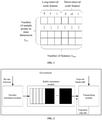
- the form of data collection may be as shown in FIG. 1 .
- the electronic device can collect network throughputs W of the long interval and the short interval simultaneously, which are denoted by W L and Ws respectively, and can also collect buffer time length information B of the long interval and the short interval simultaneously, which are denoted by B L and B S respectively.
- W L and Ws network throughputs W of the long interval and the short interval simultaneously
- B L and B S buffer time length information
- the electronic device may only collect data in the long interval, which is denoted by R L ; and for the historical buffer time length variation information ⁇ B, the electronic device may only collect data in the short interval, which is denoted by ⁇ B S .
- the electronic device acquires data of different time scales, which has different meanings for the bit rate decision.
- Information in the short interval can be used for handling sudden situations in the bit rate decision, while information in the long interval enables the bit rate decision model to capture global information of data, to reduce incorrect decisions.
- a basic model architecture adopts any neural network, for example, deep deterministic policy gradient (DDPG), asynchronous advantage actor-critic (A3C), or policy gradients, which is not limited in the embodiments of the present disclosure.
- DDPG deep deterministic policy gradient
- A3C asynchronous advantage actor-critic
- policy gradients which is not limited in the embodiments of the present disclosure.
- the training process of the bit rate decision model can adopt a method of interaction between a simulated interactive environment and the model (a method of interaction between a simulated interactive environment and a model is used in embodiments of the present disclosure). Based on this, a simulated interactive environment can be created to simulate actual variations of the network throughput.
- the electronic device inputs collected records of the real network throughput over time into the simulated interactive environment.
- the simulated interactive environment sends video data according to the collected real network throughput and acquires related information of a current video transmission environment.
- the bit rate decision model outputs a corresponding bit rate decision based on the related information of the video transmission environment acquired from the simulated interactive environment.
- a decision evaluation model outputs an evaluation value according to the decision bit rate outputted by the bit rate decision model.
- the obtained evaluation value is a reward function that helps the bit rate decision to learn the bit rate decision.
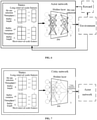
- the structure of the simulated interactive environment is shown in FIG. 2 , including three modules: an encoder simulation module, a buffer simulation module, and a transmitting simulation module.
- the encoder simulation module is configured to receive a bit rate prediction from the bit rate decision model and send video data of the corresponding bit rate to the buffer simulation module. It should be noted that the size of the video data is affected by the size of each frame in the video data in addition to the bit rate.
- the encoder simulation module can encode the video data to make the size of the video data fluctuate randomly within a certain range that satisfies a bit rate constraint. It is also necessary to set a bit rate and a video data size that match the actual live video on the encoder simulation module.
- the buffer simulation module is configured to receive and send video data.
- the buffer simulation module may be implemented based on a limited-capacity queue.
- the buffer simulation module receives the video data from the encoder simulation module at certain frame intervals and sends the video data to the transmitting simulation module.
- the transmitting simulation module is configured to receive a virtual network throughput, wherein the virtual network throughput is used for simulating the variation of an actual available bandwidth of the network.
- the virtual network throughput is a pre-collected record of the real bandwidth over time.
- the transmitting simulation module is also configured to send the video data from the buffer simulation module based on the limit of the network throughput, thereby achieving the purpose of consuming the video data in the buffer simulation module at a rate determined by the network throughput.
- the encoder simulation module sends video data of a fixed time length to the buffer simulation module at a time.
- the network throughput fluctuates over time. Extracting video data from the buffer simulation module based on the network throughput means that the transmitting simulation module does not extract video data from the buffer simulation module randomly, and the speed of video data extraction depends on the current network throughput. For example, if the current network throughput is 1000 KB/s, it means that the transmitting simulation module can extract 1000 KB of video data per second from the buffer simulation module. If the size of a single piece of video data is 50 KB, the transmitting simulation module can extract 20 pieces of video data per second; if the size of a piece of video data is 25 KB, the transmitting simulation module can extract 40 pieces of video data per second. The remaining capacity of the buffer simulation module changes from time to time.
- the transmitting simulation module extracts video data from the buffer simulation module at a lower speed.
- the amount of video data send by the encoder simulation module to the buffer is fixed, the amount of data stored in the buffer simulation module increases, and accordingly, the remaining capacity of the buffer decreases.
- the video data in the buffer simulation module reaches the capacity limit of the buffer simulation module, the video data is discarded based on the "first-in, first-out" principle.
- the embodiments of the present disclosure provide a model training process based on a simulated interactive environment.
- the basic conception is as follows: the electronic device makes a bit rate decision by inputting sample data to a first model, and the first model outputs a decision bit rate; the electronic device inputs the decision bit rate to the simulated interactive environment, and the simulated interactive environment adjusts a transmitting bit rate of video data based on the received decision bit rate.
- the electronic device acquires time length variation information of the buffer simulation module in the simulated interactive environment in the foregoing process, and inputs the time length variation information of the buffer simulation module, the decision bit rate, and the network throughput to a second model, such that the second model outputs an evaluation value.
- the electronic device updates a model parameter of the first model based on the evaluation value.
- the first model, the simulated interactive environment, and the second model interact continuously, to finally obtain the bit rate decision model.
- the bit rate decision model is capable of predicting a decision bit rate based on related information of the video transmission environment. For the training process of the bit rate decision model, refer to steps 501 to 507.
- FIG. 3 is a flowchart of a method for training a bit rate decision model.
- the method is applied to an electronic device, and as shown in FIG. 3 , includes the following steps:
- the electronic device inputs a network throughput at a first moment, first time length variation information, and a target decision bit rate at a second moment to a first model simultaneously, to cause the first model to output a plurality of first probabilities corresponding to a plurality of first decision bit rates, wherein the second moment is a previous bit rate decision moment of the first moment, and the first time length variation information is time length variation information of a buffer simulation module in a simulated interactive environment at the first moment.
- the electronic device determines a target decision bit rate at the first moment, the target decision bit rate at the first moment being a first decision bit rate whose first probability meets a first target condition.
- the electronic device acquires second time length variation information by inputting the target decision bit rate at the first moment to the simulated interactive environment, wherein the second time length variation information is time length variation information of the buffer simulation module in the simulated interactive environment at a third moment, and the third moment is a next video data transmission moment of the first moment.
- the electronic device acquires a first evaluation value based on a network throughput at the third moment, the second time length variation information, and the target decision bit rate at the first moment, the first evaluation value being an evaluation value of the target decision bit rate at the first moment.
- the electronic device updates a model parameter of the first model based on the first evaluation value until any iteration process meets a first iteration ending condition, to obtain a bit rate decision model, the bit rate decision model being the first model obtained by the iteration process that meets the first iteration ending condition.
- the simulated interactive environment further includes an encoder simulation module and a transmitting simulation module, and the step of acquiring second time length variation information by inputting the target decision bit rate at the first moment to the simulated interactive environment includes:
- the network throughput includes a first network throughput and a second network throughput
- the first network throughput is a network throughput captured within a time range of an interval between two video frames
- the second network throughput is a network throughput within a bit rate decision interval.
- the time length variation information of the buffer simulation module includes first buffer time length variation information and second buffer time length variation information, the first buffer time length variation information is buffer time length variation information captured within the time range of the interval between two video frames, and the second buffer time length variation information is buffer time length variation information within the bit rate decision interval.
- the step of acquiring a first evaluation value of the target decision bit rate at the first moment based on a network throughput at the third moment, the second time length variation information, and the target decision bit rate at the first moment includes: inputting the network throughput at the third moment, the second time length variation information, and the target decision bit rate at the first moment to a second model simultaneously, to cause the second model to output the first evaluation value.
- the method further includes:
- the method before the step of inputting a network throughput at a first moment, first time length variation information, and a target decision bit rate at a second moment to a first model simultaneously, the method further includes:
- FIG. 4 is a flowchart of a method for bit rate deciding.
- the method is applied to an electronic device, and as shown in FIG. 4 , includes the following steps:
- the electronic device inputs a network throughput at a fifth moment, first parameter variation information, and a target decision bit rate at a sixth moment to a bit rate decision model simultaneously, to cause the bit rate decision model to output a plurality of third probabilities corresponding to a plurality of third decision bit rates, wherein the sixth moment is a previous bit rate decision moment of the fifth moment, and the first parameter variation information is parameter variation information of a buffer at the fifth moment.
- the electronic device determines a target decision bit rate at the fifth moment, the target decision bit rate at the fifth moment being a third decision bit rate whose third probability meets a third target condition.
- the third probability meeting the third target condition means that the third probability is the highest among the plurality of third probabilities.
- the electronic device adjusts a bit rate of video data based on the target decision bit rate at the fifth moment, the bit rate decision model being a bit rate decision model trained by using the foregoing method for training a bit rate decision model.
- the method further includes:
- FIG. 5 is a flowchart of a method for training a bit rate decision model. As shown in FIG. 5 , the method is applied to an electronic device, and includes the following steps:
- the electronic device inputs a network throughput at a first moment, first time length variation information, and a target decision bit rate at a second moment to a first model simultaneously, to cause the first model to output a plurality of first probabilities corresponding to a plurality of first decision bit rates, wherein the second moment is a previous bit rate decision moment of the first moment, and the first time length variation information is time length variation information of a buffer simulation module in a simulated interactive environment at the first moment.
- the electronic device forms a first parameter matrix by using the network throughput at the first moment, the first time length variation information, and the target decision bit rate at the second moment, and inputs the first parameter matrix to the first model.
- the parameter matrix is multiplied by at least one weight matrix of the first model, to obtain a plurality of first feature vectors, and the plurality of first feature vectors are mapped to a plurality of first probabilities. For example, if the network throughput W at the first moment is 500 Kbps, the target decision bit rate R at the second moment is 0.7, and the first time length variation information ⁇ B is 3%, the electronic device generates a one-dimensional first parameter matrix [500, 0.7, 3] T .
- the electronic device multiplies the weight matrix [0.2, 1, 0.3] with the first parameter matrix, to obtain first feature vectors [10, 0.7, 0.9] T , and maps the first feature vectors to a plurality of first probabilities, e.g., [0.76, 0.05, 0.07] T , through a normalization function (SoftMax), wherein numbers in the first feature vectors represent probabilities of the corresponding first decision bit rates.
- SoftMax normalization function
- an interval between the first moment and the second moment is set in advance, and switching is performed directly at a regular time.
- the interval between the first moment and the second moment is determined by the electronic device in real time, which is not limited in the embodiments of the present disclosure.
- the first decision bit rate is a multiple of bit rate adjustment or a bit rate value. If the first decision bit rate is a multiple of bit rate adjustment, the first probabilities outputted by the bit rate decision model correspond to different bit rate adjustment multiples, such as 0.7, 0.8, 0.9, 1.0, 1.05, 1.1, and 1.15, wherein each number indicates a multiple for adjusting the bit rate at the previous moment to be the bit rate of the current video data. If 0.7 among the plurality of first decision bit rates corresponds to the highest first probability, the electronic device adjusts the bit rate of the current video data to be 0.7 times the bit rate at the previous moment through the encoder simulation module.
- the electronic device determines a target decision bit rate at the first moment, the target decision bit rate at the first moment being a first decision bit rate whose first probability meets a first target condition.
- the first probability meeting the first target condition means that the first probability is the highest among the plurality of third probabilities.
- the electronic device acquires second time length variation information by inputting the target decision bit rate at the first moment to the simulated interactive environment, wherein the second time length variation information is time length variation information of the buffer simulation module in the simulated interactive environment at a third moment, and the third moment is a next video data transmission moment of the first moment.
- the simulated interactive environment further includes an encoder simulation module and a transmitting simulation module.
- the electronic device inputs the target decision bit rate at the first moment to the encoder simulation module, to cause the encoder simulation module to transmit video data of the target decision bit rate at the first moment to the buffer simulation module.
- the electronic device extracts the video data from the buffer simulation module based on a rate indicated by the transmitting simulation module.
- the electronic device acquires the second time length variation information based on a storage capacity difference of the buffer simulation module for the video data between the first moment and the third moment.
- the electronic device inputs a network throughput at the third moment, the second time length variation information, and the target decision bit rate at the first moment to a second model simultaneously, to cause the second model to output a first evaluation value.
- the electronic device forms a second parameter matrix by using the network throughput at the third moment, the second time length variation information, and the target decision bit rate at the first moment.
- the electronic device inputs the second parameter matrix to the second model, operation is performed on the second parameter matrix by using at least one weight matrix of the second model, to obtain a plurality of second feature vectors, and the plurality of second feature vectors are mapped to a first evaluation value.
- the electronic device For example, if the network throughput W at the third moment is 450 Kbps, the target decision bit rate R at the first moment is 0.5, and the time length variation information ⁇ B of the buffer simulation module at the third moment is 2%, the electronic device generates a one-dimensional second parameter matrix [450, 0.5, 2] T .
- the electronic device multiplies the weight matrix [0.1, 1, 0.5] with the second parameter matrix, to obtain second feature vectors [4.5, 0.5, 1] T , and maps the second feature vectors to a first evaluation value, such as 0.6, through a sigmoid growth curve (Sigmoid).
- Sigmoid sigmoid growth curve
- the electronic device updates a model parameter of the first model based on the first evaluation value until any iteration process meets a first iteration ending condition, to obtain a bit rate decision model, the bit rate decision model being the first model obtained by the iteration process that meets the first iteration ending condition.
- the electronic device updates the at least one weight matrix of the first model based on the first evaluation value, until a function value of a loss function of the first model is lower than a target threshold or the number of iterations reaches a target count, and at this point, the training of the first model is finished, and the bit rate decision model is obtained, wherein the target threshold and the target count may be set according to actual situations, which are not limited in the embodiments of the present disclosure.
- the electronic device inputs the network throughput at the third moment, the second time length variation information, and the target decision bit rate at the first moment to the first model simultaneously to obtain a target decision bit rate at the third moment.
- the method for determining the target decision bit rate at the third moment by the electronic device belongs to the same inventive conception as the method for determining the target decision bit rate at the first moment, and is not described in detail herein.
- the electronic device updates a model parameter of the second model based on a network throughput at a fourth moment, third time length variation information, and the target decision bit rate at the third moment until any iteration process meets a second iteration ending condition, to obtain a decision evaluation model, wherein the decision evaluation model is the second model obtained by the iteration process that meets the second iteration ending condition, the fourth moment is a next video data transmission moment of the third moment, and the third time length variation information is time length variation information of the buffer simulation module in the simulated interactive environment at the fourth moment.
- the electronic device inputs sample data to the first model, to cause the first model to output a plurality of second probabilities corresponding to a plurality of second decision bit rates, the sample data including a historical decision bit rate, historical buffer time length information, historical buffer time length variation information, and a historical network throughput.
- the electronic device determines a sample target bit rate, the sample target bit rate being a second decision bit rate whose second probability meets a second target condition.
- the electronic device acquires sample time length variation information of the buffer simulation module in the simulated interactive environment by inputting the sample target bit rate to the simulated interactive environment.
- the electronic device inputs the sample target bit rate, the sample time length variation information, and a network bandwidth at a next video data transmission moment to the second model, to cause the second model to output a second evaluation value.
- the electronic device updates the model parameter of the first model based on the second evaluation value.
- the second probability meeting the second target condition means that the second probability is the highest among the plurality of second probabilities.
- the sample data is from a user terminal watching the video or from a server.
- the source of the sample data is not limited in the embodiments of the present disclosure.
- the electronic device can train a plurality of bit rate decision models based on different network bandwidths, and obtain parameters of a primary bit rate decision model based on model parameters of the plurality of bit rate decision models obtained through training.
- the primary bit rate decision model is the bit rate decision model that makes the bit rate decision in the live streaming process.
- each of the bit rate decision models can acquire a first reference number of training parameters.
- the training parameters at least include representing a video transmission environment an evaluation value corresponding to the related information representing the video transmission environment.
- the electronic device sends the first reference number of training parameters to the primary bit rate decision model through each of the bit rate decision models, and updates the model parameters of the primary bit rate decision model based on the first reference number of training parameters.
- the electronic device sends the updated model parameters to each of the bit rate decision models through the primary bit rate decision model.
- the electronic device controls each of the bit rate decision models to replace the model parameters with the received model parameters, and then continues the training in different simulated interactive environments.
- the foregoing steps are repeated until the electronic device updates the model parameters of the primary bit rate decision model for a reference number of times, and then the training is finished.
- the reference number of times may be set according to actual requirements, and is not limited in the embodiments of the present disclosure.
- the training of the primary bit rate decision model provided in the embodiments of the present disclosure can be finished after the model parameters are updated for the reference number of times as described above; alternatively, time for stopping the training can also be determined based on the loss function of the model, which is not limited in the embodiments of the present disclosure.
- the method for training a bit rate decision model provided by the embodiments of the present disclosure is illustrated by using an asynchronous update reinforcement model (actor-critic).
- the bit rate decision model is an Actor network
- the decision evaluation model is a Critic network.
- the Critic network is for outputting evaluation values based on time length variation information of the buffer simulation module in the simulated interactive environment obtained by selecting different bit rates at different network throughputs.
- the Actor network adjusts the model parameters based on the evaluation values outputted by the Critic network.
- the Critic network adjusts the model parameters based on the related information representing the video transmission environment at the current moment and the decision bit rate at the previous moment. In other words, the Critic network evaluates the decision bit rate outputted by the Actor network, and the Actor network uses the evaluation value outputted by the Critic network as a training target.
- the Actor network adjusts the model parameters through the following formula (1)
- the Critic network adjusts the model parameters through the following formula (2): ⁇ a ⁇ ⁇ a 0 + ⁇ a ⁇ t ⁇ ⁇ log ⁇ ⁇ s t a t A s t a t ⁇ c ⁇ ⁇ c 0 ⁇ ⁇ c ⁇ t ⁇ ⁇ v r t + ⁇ V ⁇ s t + 1 ⁇ c ⁇ V ⁇ s t ⁇ v 2
- ⁇ a is a parameter of the Actor network
- ⁇ a is a learning rate of the Actor network
- ⁇ ⁇ (st, at) is a bit rate prediction of the Actor network
- a (st, at) is an evaluation value outputted by the Critic network
- ⁇ c is a parameter of the Critic network
- ⁇ c is a learning rate of the Critic network
- only the Actor network is in the active state, while during training, both the Actor network and the Critic network are in the active state.
- the last output layer of the Critic network is different from that of the Actor network.
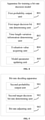
- the last layer of the Critic network is a linear output layer without an activation function; the last output layer of the Actor network is a SoftMax output layer. Except for the last output layer, all other structures of the Critic network and the Actor network are the same.
- the structure of the Actor network is shown in FIG. 6
- the structure of the Critic network is as shown in FIG. 7 . It should be noted that, the structures of the Critic network and the Actor network may be designed based on the actual situation, and are not limited in the embodiments of the present disclosure.
- FIG. 8 is a block diagram of an apparatus for training a bit rate decision model.
- the apparatus includes a first probability outputting unit 801, a first target decision bit rate determining unit 802, a time length variation information determining unit 803, an evaluation value acquiring unit 804, and a model parameter updating unit 805.
- the first probability outputting unit 801 is configured to input a network throughput at a first moment, first time length variation information, and a target decision bit rate at a second moment to a first model simultaneously, to cause the first model to output a plurality of first probabilities corresponding to a plurality of first decision bit rates, wherein the second moment is a previous bit rate decision moment of the first moment, and the first time length variation information is time length variation information of a buffer simulation module in a simulated interactive environment at the first moment.
- the first target decision bit rate determining unit 802 is configured to determine a target decision bit rate at the first moment, the target decision bit rate at the first moment being a first decision bit rate whose first probability meets a first target condition.
- the time length variation information acquiring unit 803 is configured to acquire second time length variation information by inputting the target decision bit rate at the first moment to the simulated interactive environment, wherein the second time length variation information is time length variation information of the buffer simulation module in the simulated interactive environment at a third moment, and the third moment is a next video data transmission moment of the first moment.
- the evaluation value acquiring unit 804 is configured to acquire a first evaluation value based on a network throughput at the third moment, the second time length variation information, and the target decision bit rate at the first moment, the first evaluation value being an evaluation value of the target decision bit rate at the first moment.
- the model parameter updating unit 805 is configured to update a model parameter of the first model based on the first evaluation value until any iteration process meets a first iteration ending condition, to obtain a bit rate decision model, the bit rate decision model being the first model obtained by the iteration process that meets the first iteration ending condition.
- the simulated interactive environment further includes an encoder simulation module and a transmitting simulation module
- the time length variation information acquiring unit includes:
- the network throughput includes a first network throughput and a second network throughput
- the first network throughput is a network throughput captured within a time range of an interval between two video frames
- the second network throughput is a network throughput within a bit rate decision interval.
- the time length variation information of the buffer simulation module includes first buffer time length variation information and second buffer time length variation information, the first buffer time length variation information is buffer time length variation information captured within the time range of the interval between two video frames, and the second buffer time length variation information is buffer time length variation information within the bit rate decision interval.
- the evaluation value acquiring unit is configured to input the network throughput at the third moment, the second time length variation information, and the target decision bit rate at the first moment to a second model simultaneously, to cause the second model to output the first evaluation value.
- the apparatus further includes:
- the first probability outputting unit is further configured to input sample data to the first model in a first model training process, to cause the first model to output a plurality of second probabilities corresponding to a plurality of second decision bit rates, the sample data including a historical decision bit rate, historical buffer time length information, historical buffer time length variation information, and a historical network throughput.
- the target decision bit rate determining unit at the first moment is further configured to determine a sample target bit rate, the sample target bit rate being a second decision bit rate whose second probability meets a second target condition.
- the time length variation information acquiring unit is further configured to acquire sample time length variation information of the buffer simulation module in the simulated interactive environment by inputting the sample target bit rate to the simulated interactive environment.
- the evaluation value acquiring unit is further configured to input the sample target bit rate, the sample time length variation information, and a network bandwidth at a next video data transmission moment to a second model, to cause the second model to output a second evaluation value.
- the model parameter updating unit is further configured to update the model parameter of the first model based on the second evaluation value.
- FIG. 9 is a block diagram of a bit rate deciding apparatus.
- the apparatus includes a second probability outputting unit 901, a second target decision bit rate determining unit 902, and a bit rate adjusting unit 903.
- the second probability outputting unit 901 is configured to input a network throughput at a fifth moment, first parameter variation information, and a target decision bit rate at a sixth moment to a bit rate decision model simultaneously, to cause the bit rate decision model to output a plurality of third probabilities corresponding to a plurality of third decision bit rates, wherein the sixth moment is a previous bit rate decision moment of the fifth moment, and the first parameter variation information is parameter variation information of a buffer at the fifth moment.
- the second target decision bit rate determining unit 902 is configured to determine a target decision bit rate at the fifth moment, the target decision bit rate at the fifth moment being a third decision bit rate whose third probability meets a third target condition.
- the bit rate adjusting unit 903 is configured to adjust a bit rate of video data based on the target decision bit rate at the fifth moment, the bit rate decision model being a bit rate decision model trained by using the foregoing apparatus for training a bit rate decision model.
- the apparatus further includes: a bit rate decision model updating unit, configured to update a model parameter of the bit rate decision model based on the target decision bit rate at the fifth moment and a network throughput at a seventh moment, the seventh moment being a next video data transmission moment of the fifth moment.
- a bit rate decision model updating unit configured to update a model parameter of the bit rate decision model based on the target decision bit rate at the fifth moment and a network throughput at a seventh moment, the seventh moment being a next video data transmission moment of the fifth moment.
- an embodiment of the present disclosure further provides an electronic device.
- the electronic device includes:
- the simulated interactive environment further includes an encoder simulation module and a transmitting simulation module, and the processor 1001 is configured to perform the following steps:
- the network throughput includes a first network throughput and a second network throughput
- the first network throughput is a network throughput captured within a time range of an interval between two video frames
- the second network throughput is a network throughput within a bit rate decision interval.
- the time length variation information of the buffer simulation module includes first buffer time length variation information and second buffer time length variation information, the first buffer time length variation information is buffer time length variation information captured within the time range of the interval between two video frames, and the second buffer time length variation information is buffer time length variation information within the bit rate decision interval.
- the processor 1001 is configured to perform the following steps: inputting the network throughput at the third moment, the second time length variation information, and the target decision bit rate at the first moment to a second model simultaneously, to cause the second model to output the first evaluation value.
- the processor 1001 is configured to perform the following steps:
- the processor 1001 is configured to perform the following steps:
- an embodiment of the present disclosure further provides an electronic device.
- the electronic device includes:
- the processor 1101 is configured to perform the following steps: updating a model parameter of the bit rate decision model based on the target decision bit rate at the fifth moment and a network throughput at a seventh moment, the seventh moment being a next video data transmission moment of the fifth moment.
- the processor may be a central processing unit (CPU), or may be another general-purpose processor, a digital signal processor (DSP), an application specific integrated circuit (ASIC), a field-programmable gate array (FPGA) or another programmable logic device, a discrete gate, a transistor logic device, a discrete hardware component, etc.
- the general purpose processor may be a microprocessor or any conventional processor, or the like. It should be noted that, the processor may be a processor that supports advanced RISC machines (ARM) architecture.
- the memory may include a read-only memory (ROM) and a random access memory (RAM), and provide instructions and data to the processor.
- the memory may further include a non-volatile RAM.
- the storage device may also store information about the device type.
- the memory may be a volatile memory or a non-volatile memory, or may include both a volatile memory and a non-volatile memory.
- the non-volatile memory may be a read-only memory (ROM), a programmable ROM (PROM), an erasable PROM (EPROM), an electrically EPROM (EEPROM), or a flash memory.
- the volatile memory may be a random access memory (RAM), which is used as an external cache.
- RAM random access memory
- DRAM dynamic random access memory
- SDRAM synchronous DRAM
- DDR SDRAM double data random SDRAM
- ESDRAM enhanced SDRAM
- SLDRAM synchlink DRAM
- DRRAM direct rambus RAM
- the present disclosure provides a storage medium. Instructions in the storage medium, when executed by a processor of an electronic device, cause the electronic device to be capable of performing the following steps:
- the simulated interactive environment further includes an encoder simulation module and a transmitting simulation module, and the electronic device is configured to perform the following steps:
- the network throughput includes a first network throughput and a second network throughput
- the first network throughput is a network throughput captured within a time range of an interval between two video frames
- the second network throughput is a network throughput within a bit rate decision interval.
- the time length variation information of the buffer simulation module includes first buffer time length variation information and second buffer time length variation information, the first buffer time length variation information is buffer time length variation information captured within the time range of the interval between two video frames, and the second buffer time length variation information is buffer time length variation information within the bit rate decision interval.
- the electronic device is configured to perform the following steps: inputting the network throughput at the third moment, the second time length variation information, and the target decision bit rate at the first moment to a second model simultaneously, to cause the second model to output the first evaluation value.
- the electronic device is configured to perform the following steps:
- the electronic device is configured to perform the following steps:
- the present disclosure provides a storage medium. Instructions in the storage medium, when executed by a processor of an electronic device, cause the electronic device to be capable of performing the following steps:
- the electronic device is configured to perform the following steps: updating a model parameter of the bit rate decision model based on the target decision bit rate at the fifth moment and a network throughput at a seventh moment, the seventh moment being a next video data transmission moment of the fifth moment.
- the present disclosure provides a computer program product. Instructions in the computer program product, when executed by a processor of an electronic device, can cause the processer or the electronic device to perform the following steps:
- the simulated interactive environment further includes an encoder simulation module and a transmitting simulation module, and the processor or the electronic device is configured to perform the following steps:
- the network throughput includes a first network throughput and a second network throughput
- the first network throughput is a network throughput captured within a time range of an interval between two video frames
- the second network throughput is a network throughput within a bit rate decision interval.
- the time length variation information of the buffer simulation module includes first buffer time length variation information and second buffer time length variation information, the first buffer time length variation information is buffer time length variation information captured within the time range of the interval between two video frames, and the second buffer time length variation information is buffer time length variation information within the bit rate decision interval.
- the processor or the electronic device is configured to perform the following steps: inputting the network throughput at the third moment, the second time length variation information, and the target decision bit rate at the first moment to a second model simultaneously, to cause the second model to output the first evaluation value.
- the processor or the electronic device is configured to perform the following steps:
- the processor or the electronic device is configured to perform the following steps:
- the present disclosure provides a computer program product. Instructions in the computer program product, when executed by a processor of an electronic device, can cause the processer or the electronic device to perform the following steps:
- the processor or the electronic device is configured to perform the following steps: updating a model parameter of the bit rate decision model based on the target decision bit rate at the fifth moment and a network throughput at a seventh moment, the seventh moment being a next video data transmission moment of the fifth moment.
- FIG. 12 is a sample graph of bandwidth over time. Referring to FIG. 12 , a waveform with great fluctuations is selected for verification of the sine-wave network bandwidth.
- the horizontal coordinate in the figure is time in seconds; curve a is the real bandwidth variation in Mbps; curve b is the buffer time length variation in seconds; curve c is the bit rate selected by the model, in Mbps; curve d is the actual throughput for sending video data, in Mbps.
- the video bit rate control method provided by the present disclosure can make the actual throughput for sending video data follow the real bandwidth well, so that the throughput for sending video data is almost equal to the actual unpredictable network bandwidth, while keeping the amount of data stored in the buffer at a relatively low level, which ensures both the throughput for sending live video and the real-time performance of the live video streaming.
Landscapes
- Engineering & Computer Science (AREA)
- Signal Processing (AREA)
- Multimedia (AREA)
- Physics & Mathematics (AREA)
- Theoretical Computer Science (AREA)
- Databases & Information Systems (AREA)
- Computing Systems (AREA)
- Mathematical Physics (AREA)
- Software Systems (AREA)
- Evolutionary Computation (AREA)
- General Health & Medical Sciences (AREA)
- Molecular Biology (AREA)
- Biophysics (AREA)
- General Engineering & Computer Science (AREA)
- General Physics & Mathematics (AREA)
- Data Mining & Analysis (AREA)
- Biomedical Technology (AREA)
- Computational Linguistics (AREA)
- Artificial Intelligence (AREA)
- Life Sciences & Earth Sciences (AREA)
- Health & Medical Sciences (AREA)
- Computer Networks & Wireless Communication (AREA)
- Data Exchanges In Wide-Area Networks (AREA)
- Two-Way Televisions, Distribution Of Moving Picture Or The Like (AREA)
Abstract
Description
- The present disclosure claims priority to
Chinese Patent Application No. 202010046898.1, filed on January 16, 2020 - The present disclosure relates to the field of video live streaming, and in particular, to a method for training a bit rate decision model, and an electronic device.
- Network fluctuations have a huge impact on live video streaming. In order to avoid lagging while maintaining a certain level of clarity, an electronic device needs to adjust a video stream bit rate according to the network fluctuations.
- A video bit rate is generally controlled using the following method: a bit rate of video data sent by an electronic device is adjusted to maintain the duration of cached video on a client within a given range. For example, the duration of the cached live video on the client is maintained within a range of 10s to 20s. When the duration of the cached live video is less than 10s, the bit rate of transmission is reduced, to reduce the clarity of the video, such that the same video data packet carries a live video of a longer duration; when the duration of the cached live video is longer than 20s, the bit rate of transmission is increased, to improve the clarity of the video, such that the same video data packet carries a live video of a longer duration.
- The present disclosure provides a method for training a bit rate decision model and an electronic device. The technical solutions of the present disclosure are as follows.
- In an aspect, a method for training a bit rate decision model is provided. The method is applied to an electronic device and includes:
- inputting a network throughput at a first moment, first time length variation information, and a target decision bit rate at a second moment to a first model simultaneously, to cause the first model to output a plurality of first probabilities corresponding to a plurality of first decision bit rates, wherein the second moment is a previous bit rate decision moment of the first moment, and the first time length variation information is time length variation information of a buffer simulation module in a simulated interactive environment at the first moment;
- determining a target decision bit rate at the first moment, the target decision bit rate at the first moment being a first decision bit rate whose first probability meets a first target condition;
- acquiring second time length variation information by inputting the target decision bit rate at the first moment to the simulated interactive environment, wherein the second time length variation information is time length variation information of the buffer simulation module in the simulated interactive environment at a third moment, and the third moment is a next video data transmission moment of the first moment;
- acquiring a first evaluation value based on a network throughput at the third moment, the second time length variation information, and the target decision bit rate at the first moment, the first evaluation value being an evaluation value of the target decision bit rate at the first moment; and
- updating a model parameter of the first model based on the first evaluation value until any iteration process meets a first iteration ending condition, to obtain a bit rate decision model, the bit rate decision model being the first model obtained by the iteration process that meets the first iteration ending condition.
- In an aspect, a method for bit rate deciding is provided. The method is applied to an electronic device and includes:
- inputting a network throughput at a fifth moment, first parameter variation information, and a target decision bit rate at a sixth moment to a bit rate decision model simultaneously, to cause the bit rate decision model to output a plurality of third probabilities corresponding to a plurality of third decision bit rates, wherein the sixth moment is a previous bit rate decision moment of the fifth moment, and the first parameter variation information is parameter variation information of a buffer at the fifth moment;
- determining a target decision bit rate at the fifth moment, the target decision bit rate at the fifth moment being a third decision bit rate whose third probability meets a third target condition; and
- adjusting a bit rate of video data based on the target decision bit rate at the fifth moment, the bit rate decision model being a bit rate decision model trained by using the method for training a bit rate decision model according to
claim 1. - In an aspect, an apparatus for training a bit rate decision model is provided, including:
- a first probability outputting unit, configured to input a network throughput at a first moment, first time length variation information, and a target decision bit rate at a second moment to a first model simultaneously, to cause the first model to output a plurality of first probabilities corresponding to a plurality of first decision bit rates, wherein the second moment is a previous bit rate decision moment of the first moment, and the first time length variation information is time length variation information of a buffer simulation module in a simulated interactive environment at the first moment;
- a first target decision bit rate determining unit, configured to determine a target decision bit rate at the first moment, the target decision bit rate at the first moment being a first decision bit rate whose first probability meets a first target condition;
- a time length variation information acquiring unit, configured to acquire second time length variation information by inputting the target decision bit rate at the first moment to the simulated interactive environment, wherein the second time length variation information is time length variation information of the buffer simulation module in the simulated interactive environment at a third moment, and the third moment is a next video data transmission moment of the first moment;
- an evaluation value acquiring unit, configured to acquire a first evaluation value based on a network throughput at the third moment, the second time length variation information, and the target decision bit rate at the first moment, the first evaluation value being an evaluation value of the target decision bit rate at the first moment; and
- a model parameter updating unit, configured to update a model parameter of the first model based on the first evaluation value until any iteration process meets a first iteration ending condition, to obtain a bit rate decision model, the bit rate decision model being the first model obtained by the iteration process that meets the first iteration ending condition.
- In an aspect, a bit rate deciding apparatus is provided, including:
- a second probability outputting unit, configured to input a network throughput at a fifth moment, first parameter variation information, and a target decision bit rate at a sixth moment to a bit rate decision model simultaneously, to cause the bit rate decision model to output a plurality of third probabilities corresponding to a plurality of third decision bit rates, wherein the sixth moment is a previous bit rate decision moment of the fifth moment, and the first parameter variation information is parameter variation information of a buffer at the fifth moment;
- a second target decision bit rate determining unit, configured to determine a target decision bit rate at the fifth moment, the target decision bit rate at the fifth moment being a third decision bit rate whose third probability meets a third target condition; and
- a bit rate adjusting unit, configured to adjust a bit rate of video data based on the target decision bit rate at the fifth moment, the bit rate decision model being a bit rate decision model trained by using the apparatus for training a bit rate decision model according to claim 9.
- In an aspect, an electronic device is provided, including:
- a processor; and
- a memory configured to store an instruction executable by the processor,
- wherein the processor is configured to perform the following steps:
- inputting a network throughput at a first moment, first time length variation information, and a target decision bit rate at a second moment to a first model simultaneously, to cause the first model to output a plurality of first probabilities corresponding to a plurality of first decision bit rates, wherein the second moment is a previous bit rate decision moment of the first moment, and the first time length variation information is time length variation information of a buffer simulation module in a simulated interactive environment at the first moment;
- determining a target decision bit rate at the first moment, the target decision bit rate at the first moment being a first decision bit rate whose first probability meets a first target condition;
- acquiring second time length variation information by inputting the target decision bit rate at the first moment to the simulated interactive environment, wherein the second time length variation information is time length variation information of the buffer simulation module in the simulated interactive environment at a third moment, and the third moment is a next video data transmission moment of the first moment;
- acquiring a first evaluation value based on a network throughput at the third moment, the second time length variation information, and the target decision bit rate at the first moment, the first evaluation value being an evaluation value of the target decision bit rate at the first moment; and
- updating a model parameter of the first model based on the first evaluation value until any iteration process meets a first iteration ending condition, to obtain a bit rate decision model, the bit rate decision model being the first model obtained by the iteration process that meets the first iteration ending condition.
- In an aspect, an electronic device is provided, including:
- a processor; and
- a memory configured to store an instruction executable by the processor,
- wherein the processor is configured to perform the following steps:
- inputting a network throughput at a fifth moment, first parameter variation information, and a target decision bit rate at a sixth moment to a bit rate decision model simultaneously, to cause the bit rate decision model to output a plurality of third probabilities corresponding to a plurality of third decision bit rates, wherein the sixth moment is a previous bit rate decision moment of the fifth moment, and the first parameter variation information is parameter variation information of a buffer at the fifth moment;
- determining a target decision bit rate at the fifth moment, the target decision bit rate at the fifth moment being a third decision bit rate whose third probability meets a third target condition; and
- adjusting a bit rate of video data based on the target decision bit rate at the fifth moment, the bit rate decision model being a bit rate decision model trained by using the electronic device described in the foregoing aspect.
- In an aspect, a storage medium is provided, wherein instructions in the storage medium, when executed by a processor of an electronic device, cause the electronic device to be capable of performing the following steps:
- inputting a network throughput at a first moment, first time length variation information, and a target decision bit rate at a second moment to a first model simultaneously, to cause the first model to output a plurality of first probabilities corresponding to a plurality of first decision bit rates, wherein the second moment is a previous bit rate decision moment of the first moment, and the first time length variation information is time length variation information of a buffer simulation module in a simulated interactive environment at the first moment;
- determining a target decision bit rate at the first moment, the target decision bit rate at the first moment being a first decision bit rate whose first probability meets a first target condition;
- acquiring second time length variation information by inputting the target decision bit rate at the first moment to the simulated interactive environment, wherein the second time length variation information is time length variation information of the buffer simulation module in the simulated interactive environment at a third moment, and the third moment is a next video data transmission moment of the first moment;
- acquiring a first evaluation value based on a network throughput at the third moment, the second time length variation information, and the target decision bit rate at the first moment, the first evaluation value being an evaluation value of the target decision bit rate at the first moment; and
- updating a model parameter of the first model based on the first evaluation value until any iteration process meets a first iteration ending condition, to obtain a bit rate decision model, the bit rate decision model being the first model obtained by the iteration process that meets the first iteration ending condition.
- In an aspect, a storage medium is provided, wherein instructions in the storage medium, when executed by a processor of an electronic device, cause the electronic device to be capable of performing the following steps:
- inputting a network throughput at a fifth moment, first parameter variation information, and a target decision bit rate at a sixth moment to a bit rate decision model simultaneously, to cause the bit rate decision model to output a plurality of third probabilities corresponding to a plurality of third decision bit rates, wherein the sixth moment is a previous bit rate decision moment of the fifth moment, and the first parameter variation information is parameter variation information of a buffer at the fifth moment;
- determining a target decision bit rate at the fifth moment, the target decision bit rate at the fifth moment being a third decision bit rate whose third probability meets a third target condition; and
- adjusting a bit rate of video data based on the target decision bit rate at the fifth moment, the bit rate decision model being a bit rate decision model trained by using the storage medium described in the foregoing aspect.
- In an aspect, a computer program product is provided, wherein instructions in the computer program product, when executed by a processor of an electronic device, cause the electronic device to be capable of performing the following steps:
- inputting a network throughput at a first moment, first time length variation information, and a target decision bit rate at a second moment to a first model simultaneously, to cause the first model to output a plurality of first probabilities corresponding to a plurality of first decision bit rates, wherein the second moment is a previous bit rate decision moment of the first moment, and the first time length variation information is time length variation information of a buffer simulation module in a simulated interactive environment at the first moment;
- determining a target decision bit rate at the first moment, the target decision bit rate at the first moment being a first decision bit rate whose first probability meets a first target condition;
- acquiring second time length variation information by inputting the target decision bit rate at the first moment to the simulated interactive environment, wherein the second time length variation information is time length variation information of the buffer simulation module in the simulated interactive environment at a third moment, and the third moment is a next video data transmission moment of the first moment;
- acquiring a first evaluation value based on a network throughput at the third moment, the second time length variation information, and the target decision bit rate at the first moment, the first evaluation value being an evaluation value of the target decision bit rate at the first moment; and
- updating a model parameter of the first model based on the first evaluation value until any iteration process meets a first iteration ending condition, to obtain a bit rate decision model, the bit rate decision model being the first model obtained by the iteration process that meets the first iteration ending condition.
- In an aspect, a computer program product is provided, wherein instructions in the computer program product, when executed by a processor of an electronic device, cause the electronic device to be capable of performing the following steps:
- inputting a network throughput at a fifth moment, first parameter variation information, and a target decision bit rate at a sixth moment to a bit rate decision model simultaneously, to cause the bit rate decision model to output a plurality of third probabilities corresponding to a plurality of third decision bit rates, wherein the sixth moment is a previous bit rate decision moment of the fifth moment, and the first parameter variation information is parameter variation information of a buffer at the fifth moment;
- determining a target decision bit rate at the fifth moment, the target decision bit rate at the fifth moment being a third decision bit rate whose third probability meets a third target condition; and
- adjusting a bit rate of video data based on the target decision bit rate at the fifth moment, the bit rate decision model being a bit rate decision model trained by using the computer program product described in the foregoing aspect.
- It should be understood that the above general description and the detailed description in the following text are only exemplary and explanatory, and should not be construed as a limitation to the present disclosure.
- The accompanying drawings, which are incorporated in and constitute a part of this description, illustrate the embodiments of the present disclosure and together with the description, serve to explain the principles of the present disclosure.
-
FIG. 1 is a schematic diagram of a video data collection type. -
FIG. 2 is a schematic structural diagram of a simulated interactive environment. -
FIG. 3 is a flowchart of a method for training a bit rate decision model. -
FIG. 4 is a flowchart of a method for bit rate deciding. -
FIG. 5 is a flowchart of a method for training a bit rate decision model. -
FIG. 6 is a schematic structural diagram of an Actor network. -
FIG. 7 is a schematic structural diagram of a Critic network. -
FIG. 8 is a block diagram of an apparatus for training a bit rate decision model. -
FIG. 9 is a block diagram of a bit rate deciding apparatus. -
FIG. 10 is a structural diagram of an electronic device. -
FIG. 11 is a structural diagram of an electronic device. -
FIG. 12 is a sample graph of bandwidth over time. - To make those of ordinary skill in the art better understand the technical solutions of the present disclosure, the following clearly and completely describes the technical solutions in the embodiments of the present disclosure with reference to the accompanying drawings.
- It should be noted that the terms "first", "second", and so on in the specification and claims of the present disclosure and in the accompanying drawings are intended to distinguish between similar objects but do not necessarily indicate a specific order or sequence. It should be understood that the data used in such a way may be exchanged under proper conditions to make it possible to implement the described embodiments of present disclosure in sequences except those illustrated or described herein. The implementation manners described in the following exemplary embodiments of the present disclosure do not represent all implementation manners consistent with the present disclosure. On the contrary, they are only embodiments of an apparatus and a method detailed in the appended claims and consistent with some aspects of the present disclosure.
- Terms in the present disclosure are illustrated hereinafter:
- A bit rate is used for indicating how much information is contained in a video block of a certain time length. The video with a higher bit rate at the same compression ratio has higher definition.
- A buffer is used for storing video data that has not been sent yet. The size of the buffer is limited. In the field of live streaming, it is desirable to control the video data stored in the buffer to be as small as possible to ensure real-time live streaming.
- A network throughput refers to the amount of data transmitted per unit of time.
- In embodiments of the present disclosure, a bit rate decision model is trained to predict a bit rate required at a next moment based on network transmission information of a previous moment. The method for training a bit rate decision model in the embodiments of the present disclosure is described below. The method for training a bit rate decision model includes three processes: data collection, training environment creating, and training.
- In the data collection process, in some embodiments, an electronic device acquires multiple pieces of related information for indicating a video transmission environment in a data transmission process of the electronic device. The related information includes, but not limited to, a historical network throughput W, buffer time length information B, a historical bit rate decision R, and historical buffer time length variation information ΔB. The related information described above may correspond to different data collection time scales. For example, the data collection time scales may include a long interval and a short interval. The long interval is a time interval between two bit rate decisions, and a short interval is a time interval between two adjacent video frames. Certainly, the duration of the long interval and the duration of the short interval may be set according to actual requirements, which are not limited in the embodiments of the present disclosure. A bit rate decision refers to a manner of adjusting a current bit rate. For example, the form of data collection may be as shown in
FIG. 1 . The electronic device can collect network throughputs W of the long interval and the short interval simultaneously, which are denoted by WL and Ws respectively, and can also collect buffer time length information B of the long interval and the short interval simultaneously, which are denoted by BL and BS respectively. For the historical bit rate decision R, the electronic device may only collect data in the long interval, which is denoted by RL; and for the historical buffer time length variation information ΔB, the electronic device may only collect data in the short interval, which is denoted by Δ BS. In the foregoing data collection process, the electronic device acquires data of different time scales, which has different meanings for the bit rate decision. Information in the short interval can be used for handling sudden situations in the bit rate decision, while information in the long interval enables the bit rate decision model to capture global information of data, to reduce incorrect decisions. - In the training environment creating process, in some embodiments, a basic model architecture adopts any neural network, for example, deep deterministic policy gradient (DDPG), asynchronous advantage actor-critic (A3C), or policy gradients, which is not limited in the embodiments of the present disclosure.
- In some embodiments, if the bit rate decision model is trained in a real environment during actual model training, an actual interaction time is synchronized with the real time. In this case, the bit rate decision model experiences very limited environment changes, resulting in low training efficiency of the bit rate decision model. In embodiments of the present disclosure, the training process of the bit rate decision model can adopt a method of interaction between a simulated interactive environment and the model (a method of interaction between a simulated interactive environment and a model is used in embodiments of the present disclosure). Based on this, a simulated interactive environment can be created to simulate actual variations of the network throughput. The electronic device inputs collected records of the real network throughput over time into the simulated interactive environment. The simulated interactive environment sends video data according to the collected real network throughput and acquires related information of a current video transmission environment. The bit rate decision model outputs a corresponding bit rate decision based on the related information of the video transmission environment acquired from the simulated interactive environment. After that, a decision evaluation model outputs an evaluation value according to the decision bit rate outputted by the bit rate decision model. As the bit rate decisions made by the bit rate decision model will affect the simulated interactive environment, the simulated interactive environment will change, and finally the related information fed to the decision evaluation model will also change. The whole training process is the repetition of the above interactions. In some embodiments, the obtained evaluation value is a reward function that helps the bit rate decision to learn the bit rate decision. In some embodiments, the structure of the simulated interactive environment is shown in
FIG. 2 , including three modules: an encoder simulation module, a buffer simulation module, and a transmitting simulation module. - The encoder simulation module is configured to receive a bit rate prediction from the bit rate decision model and send video data of the corresponding bit rate to the buffer simulation module. It should be noted that the size of the video data is affected by the size of each frame in the video data in addition to the bit rate. The encoder simulation module can encode the video data to make the size of the video data fluctuate randomly within a certain range that satisfies a bit rate constraint. It is also necessary to set a bit rate and a video data size that match the actual live video on the encoder simulation module.
- The buffer simulation module is configured to receive and send video data. The buffer simulation module may be implemented based on a limited-capacity queue. The buffer simulation module receives the video data from the encoder simulation module at certain frame intervals and sends the video data to the transmitting simulation module.
- The transmitting simulation module is configured to receive a virtual network throughput, wherein the virtual network throughput is used for simulating the variation of an actual available bandwidth of the network. In some embodiments, the virtual network throughput is a pre-collected record of the real bandwidth over time. The transmitting simulation module is also configured to send the video data from the buffer simulation module based on the limit of the network throughput, thereby achieving the purpose of consuming the video data in the buffer simulation module at a rate determined by the network throughput.
- In some embodiments, the encoder simulation module sends video data of a fixed time length to the buffer simulation module at a time. The decision bit rate outputted by the bit rate decision model results in a change in the size of a single piece of video data. For example, if the duration of a piece of video data is 10s, the current video data size is 50 kilobytes (KB), and the decision bit rate outputted by the bit rate decision model at the next moment is 0.7, the electronic device changes the current bit rate of the video data to be 0.7 times the bit rate at the previous moment, and accordingly, the size of a piece of video data becomes 50×0.7=35 KB.
- In some embodiments, the network throughput fluctuates over time. Extracting video data from the buffer simulation module based on the network throughput means that the transmitting simulation module does not extract video data from the buffer simulation module randomly, and the speed of video data extraction depends on the current network throughput. For example, if the current network throughput is 1000 KB/s, it means that the transmitting simulation module can extract 1000 KB of video data per second from the buffer simulation module. If the size of a single piece of video data is 50 KB, the transmitting simulation module can extract 20 pieces of video data per second; if the size of a piece of video data is 25 KB, the transmitting simulation module can extract 40 pieces of video data per second. The remaining capacity of the buffer simulation module changes from time to time. If the current network throughput is small, the transmitting simulation module extracts video data from the buffer simulation module at a lower speed. In this case, since the amount of video data send by the encoder simulation module to the buffer is fixed, the amount of data stored in the buffer simulation module increases, and accordingly, the remaining capacity of the buffer decreases.
- In some embodiments, if the video data in the buffer simulation module reaches the capacity limit of the buffer simulation module, the video data is discarded based on the "first-in, first-out" principle.
- In the training process, the embodiments of the present disclosure provide a model training process based on a simulated interactive environment. The basic conception is as follows: the electronic device makes a bit rate decision by inputting sample data to a first model, and the first model outputs a decision bit rate; the electronic device inputs the decision bit rate to the simulated interactive environment, and the simulated interactive environment adjusts a transmitting bit rate of video data based on the received decision bit rate. The electronic device acquires time length variation information of the buffer simulation module in the simulated interactive environment in the foregoing process, and inputs the time length variation information of the buffer simulation module, the decision bit rate, and the network throughput to a second model, such that the second model outputs an evaluation value. The electronic device updates a model parameter of the first model based on the evaluation value. The first model, the simulated interactive environment, and the second model interact continuously, to finally obtain the bit rate decision model. The bit rate decision model is capable of predicting a decision bit rate based on related information of the video transmission environment. For the training process of the bit rate decision model, refer to
steps 501 to 507. -
FIG. 3 is a flowchart of a method for training a bit rate decision model. The method is applied to an electronic device, and as shown inFIG. 3 , includes the following steps:
In 301, the electronic device inputs a network throughput at a first moment, first time length variation information, and a target decision bit rate at a second moment to a first model simultaneously, to cause the first model to output a plurality of first probabilities corresponding to a plurality of first decision bit rates, wherein the second moment is a previous bit rate decision moment of the first moment, and the first time length variation information is time length variation information of a buffer simulation module in a simulated interactive environment at the first moment. - In 302, the electronic device determines a target decision bit rate at the first moment, the target decision bit rate at the first moment being a first decision bit rate whose first probability meets a first target condition.
- In 303, the electronic device acquires second time length variation information by inputting the target decision bit rate at the first moment to the simulated interactive environment, wherein the second time length variation information is time length variation information of the buffer simulation module in the simulated interactive environment at a third moment, and the third moment is a next video data transmission moment of the first moment.
- In 304, the electronic device acquires a first evaluation value based on a network throughput at the third moment, the second time length variation information, and the target decision bit rate at the first moment, the first evaluation value being an evaluation value of the target decision bit rate at the first moment.
- In 305, the electronic device updates a model parameter of the first model based on the first evaluation value until any iteration process meets a first iteration ending condition, to obtain a bit rate decision model, the bit rate decision model being the first model obtained by the iteration process that meets the first iteration ending condition.
- In some embodiments, the simulated interactive environment further includes an encoder simulation module and a transmitting simulation module, and the step of acquiring second time length variation information by inputting the target decision bit rate at the first moment to the simulated interactive environment includes:
- inputting the target decision bit rate at the first moment to the encoder simulation module, to cause the encoder simulation module to transmit video data of the target decision bit rate at the first moment to the buffer simulation module;
- extracting the video data from the buffer simulation module based on a rate indicated by the transmitting simulation module; and
- acquiring the second time length variation information based on a storage capacity difference of the buffer simulation module for the video data between the first moment and the third moment.
- In some embodiments, the network throughput includes a first network throughput and a second network throughput, the first network throughput is a network throughput captured within a time range of an interval between two video frames, and the second network throughput is a network throughput within a bit rate decision interval.
- The time length variation information of the buffer simulation module includes first buffer time length variation information and second buffer time length variation information, the first buffer time length variation information is buffer time length variation information captured within the time range of the interval between two video frames, and the second buffer time length variation information is buffer time length variation information within the bit rate decision interval.
- In some embodiments, the step of acquiring a first evaluation value of the target decision bit rate at the first moment based on a network throughput at the third moment, the second time length variation information, and the target decision bit rate at the first moment includes:
inputting the network throughput at the third moment, the second time length variation information, and the target decision bit rate at the first moment to a second model simultaneously, to cause the second model to output the first evaluation value. - In some embodiments, after the step of updating a model parameter of the first model based on the first evaluation value, the method further includes:
- inputting the network throughput at the third moment, the second time length variation information, and the target decision bit rate at the first moment to the first model simultaneously to obtain a target decision bit rate at the third moment; and
- updating a model parameter of the second model based on a network throughput at a fourth moment, third time length variation information, and the target decision bit rate at the third moment until any iteration process meets a second iteration ending condition, to obtain a decision evaluation model, wherein the decision evaluation model is the second model obtained by the iteration process that meets the second iteration ending condition, the fourth moment is a next video data transmission moment of the third moment, and the third time length variation information is time length variation information of the buffer simulation module in the simulated interactive environment at the fourth moment.
- In some embodiments, before the step of inputting a network throughput at a first moment, first time length variation information, and a target decision bit rate at a second moment to a first model simultaneously, the method further includes:
- inputting sample data to the first model in a first model training process, to cause the first model to output a plurality of second probabilities corresponding to a plurality of second decision bit rates, the sample data including a historical decision bit rate, historical buffer time length information, historical buffer time length variation information, and a historical network throughput;
- determining a sample target bit rate, the sample target bit rate being a second decision bit rate whose second probability meets a second target condition;
- acquiring sample time length variation information of the buffer simulation module in the simulated interactive environment by inputting the sample target bit rate to the simulated interactive environment;
- inputting the sample target bit rate, the sample time length variation information, and a network bandwidth at a next video data transmission moment to a second model, to cause the second model to output a second evaluation value; and
- updating the model parameter of the first model based on the second evaluation value.
-
FIG. 4 is a flowchart of a method for bit rate deciding. The method is applied to an electronic device, and as shown inFIG. 4 , includes the following steps:
In 401, the electronic device inputs a network throughput at a fifth moment, first parameter variation information, and a target decision bit rate at a sixth moment to a bit rate decision model simultaneously, to cause the bit rate decision model to output a plurality of third probabilities corresponding to a plurality of third decision bit rates, wherein the sixth moment is a previous bit rate decision moment of the fifth moment, and the first parameter variation information is parameter variation information of a buffer at the fifth moment. - In 402, the electronic device determines a target decision bit rate at the fifth moment, the target decision bit rate at the fifth moment being a third decision bit rate whose third probability meets a third target condition.
- In some embodiments, the third probability meeting the third target condition means that the third probability is the highest among the plurality of third probabilities.
- In 403, the electronic device adjusts a bit rate of video data based on the target decision bit rate at the fifth moment, the bit rate decision model being a bit rate decision model trained by using the foregoing method for training a bit rate decision model.
- In some embodiments, after the step of adjusting a bit rate of video data based on the target decision bit rate at the fifth moment, the method further includes:
- updating a model parameter of the bit rate decision model based on the target decision bit rate at the fifth moment and a network throughput at a seventh moment, the seventh moment being a next video data transmission moment of the fifth moment.
-
FIG. 5 is a flowchart of a method for training a bit rate decision model. As shown inFIG. 5 , the method is applied to an electronic device, and includes the following steps: - In 501, the electronic device inputs a network throughput at a first moment, first time length variation information, and a target decision bit rate at a second moment to a first model simultaneously, to cause the first model to output a plurality of first probabilities corresponding to a plurality of first decision bit rates, wherein the second moment is a previous bit rate decision moment of the first moment, and the first time length variation information is time length variation information of a buffer simulation module in a simulated interactive environment at the first moment.
- In some embodiments, the electronic device forms a first parameter matrix by using the network throughput at the first moment, the first time length variation information, and the target decision bit rate at the second moment, and inputs the first parameter matrix to the first model. The parameter matrix is multiplied by at least one weight matrix of the first model, to obtain a plurality of first feature vectors, and the plurality of first feature vectors are mapped to a plurality of first probabilities. For example, if the network throughput W at the first moment is 500 Kbps, the target decision bit rate R at the second moment is 0.7, and the first time length variation information ΔB is 3%, the electronic device generates a one-dimensional first parameter matrix [500, 0.7, 3]T. The electronic device multiplies the weight matrix [0.2, 1, 0.3] with the first parameter matrix, to obtain first feature vectors [10, 0.7, 0.9]T, and maps the first feature vectors to a plurality of first probabilities, e.g., [0.76, 0.05, 0.07]T, through a normalization function (SoftMax), wherein numbers in the first feature vectors represent probabilities of the corresponding first decision bit rates.
- It should be noted that, in some embodiments, an interval between the first moment and the second moment is set in advance, and switching is performed directly at a regular time. In some embodiments, the interval between the first moment and the second moment is determined by the electronic device in real time, which is not limited in the embodiments of the present disclosure. In some embodiments, the first decision bit rate is a multiple of bit rate adjustment or a bit rate value. If the first decision bit rate is a multiple of bit rate adjustment, the first probabilities outputted by the bit rate decision model correspond to different bit rate adjustment multiples, such as 0.7, 0.8, 0.9, 1.0, 1.05, 1.1, and 1.15, wherein each number indicates a multiple for adjusting the bit rate at the previous moment to be the bit rate of the current video data. If 0.7 among the plurality of first decision bit rates corresponds to the highest first probability, the electronic device adjusts the bit rate of the current video data to be 0.7 times the bit rate at the previous moment through the encoder simulation module.
- In 502, the electronic device determines a target decision bit rate at the first moment, the target decision bit rate at the first moment being a first decision bit rate whose first probability meets a first target condition.
- In some embodiments, the first probability meeting the first target condition means that the first probability is the highest among the plurality of third probabilities.
- In 503, the electronic device acquires second time length variation information by inputting the target decision bit rate at the first moment to the simulated interactive environment, wherein the second time length variation information is time length variation information of the buffer simulation module in the simulated interactive environment at a third moment, and the third moment is a next video data transmission moment of the first moment.
- In some embodiments, the simulated interactive environment further includes an encoder simulation module and a transmitting simulation module. The electronic device inputs the target decision bit rate at the first moment to the encoder simulation module, to cause the encoder simulation module to transmit video data of the target decision bit rate at the first moment to the buffer simulation module. The electronic device extracts the video data from the buffer simulation module based on a rate indicated by the transmitting simulation module. The electronic device acquires the second time length variation information based on a storage capacity difference of the buffer simulation module for the video data between the first moment and the third moment.
- In 504, the electronic device inputs a network throughput at the third moment, the second time length variation information, and the target decision bit rate at the first moment to a second model simultaneously, to cause the second model to output a first evaluation value.
- In some embodiments, the electronic device forms a second parameter matrix by using the network throughput at the third moment, the second time length variation information, and the target decision bit rate at the first moment. The electronic device inputs the second parameter matrix to the second model, operation is performed on the second parameter matrix by using at least one weight matrix of the second model, to obtain a plurality of second feature vectors, and the plurality of second feature vectors are mapped to a first evaluation value.
- For example, if the network throughput W at the third moment is 450 Kbps, the target decision bit rate R at the first moment is 0.5, and the time length variation information ΔB of the buffer simulation module at the third moment is 2%, the electronic device generates a one-dimensional second parameter matrix [450, 0.5, 2]T. The electronic device multiplies the weight matrix [0.1, 1, 0.5] with the second parameter matrix, to obtain second feature vectors [4.5, 0.5, 1]T, and maps the second feature vectors to a first evaluation value, such as 0.6, through a sigmoid growth curve (Sigmoid).
- In 505, the electronic device updates a model parameter of the first model based on the first evaluation value until any iteration process meets a first iteration ending condition, to obtain a bit rate decision model, the bit rate decision model being the first model obtained by the iteration process that meets the first iteration ending condition.
- In some embodiments, the electronic device updates the at least one weight matrix of the first model based on the first evaluation value, until a function value of a loss function of the first model is lower than a target threshold or the number of iterations reaches a target count, and at this point, the training of the first model is finished, and the bit rate decision model is obtained, wherein the target threshold and the target count may be set according to actual situations, which are not limited in the embodiments of the present disclosure.
- In 506, the electronic device inputs the network throughput at the third moment, the second time length variation information, and the target decision bit rate at the first moment to the first model simultaneously to obtain a target decision bit rate at the third moment.
- The method for determining the target decision bit rate at the third moment by the electronic device belongs to the same inventive conception as the method for determining the target decision bit rate at the first moment, and is not described in detail herein.
- In 507, the electronic device updates a model parameter of the second model based on a network throughput at a fourth moment, third time length variation information, and the target decision bit rate at the third moment until any iteration process meets a second iteration ending condition, to obtain a decision evaluation model, wherein the decision evaluation model is the second model obtained by the iteration process that meets the second iteration ending condition, the fourth moment is a next video data transmission moment of the third moment, and the third time length variation information is time length variation information of the buffer simulation module in the simulated interactive environment at the fourth moment.
- It should be noted that, before 501 to 507, that is, in the training process of the first model, parameter information of each part in the simulated interactive environment has not been generated yet. Therefore, in some embodiments, the electronic device inputs sample data to the first model, to cause the first model to output a plurality of second probabilities corresponding to a plurality of second decision bit rates, the sample data including a historical decision bit rate, historical buffer time length information, historical buffer time length variation information, and a historical network throughput. The electronic device determines a sample target bit rate, the sample target bit rate being a second decision bit rate whose second probability meets a second target condition. The electronic device acquires sample time length variation information of the buffer simulation module in the simulated interactive environment by inputting the sample target bit rate to the simulated interactive environment. The electronic device inputs the sample target bit rate, the sample time length variation information, and a network bandwidth at a next video data transmission moment to the second model, to cause the second model to output a second evaluation value. The electronic device updates the model parameter of the first model based on the second evaluation value. In some embodiments, the second probability meeting the second target condition means that the second probability is the highest among the plurality of second probabilities.
- In some embodiments, the sample data is from a user terminal watching the video or from a server. The source of the sample data is not limited in the embodiments of the present disclosure.
- In some embodiments, the electronic device can train a plurality of bit rate decision models based on different network bandwidths, and obtain parameters of a primary bit rate decision model based on model parameters of the plurality of bit rate decision models obtained through training. The primary bit rate decision model is the bit rate decision model that makes the bit rate decision in the live streaming process. For example, each of the bit rate decision models can acquire a first reference number of training parameters. The training parameters at least include representing a video transmission environment an evaluation value corresponding to the related information representing the video transmission environment. The electronic device sends the first reference number of training parameters to the primary bit rate decision model through each of the bit rate decision models, and updates the model parameters of the primary bit rate decision model based on the first reference number of training parameters. Then, the electronic device sends the updated model parameters to each of the bit rate decision models through the primary bit rate decision model. The electronic device controls each of the bit rate decision models to replace the model parameters with the received model parameters, and then continues the training in different simulated interactive environments. The foregoing steps are repeated until the electronic device updates the model parameters of the primary bit rate decision model for a reference number of times, and then the training is finished. The reference number of times may be set according to actual requirements, and is not limited in the embodiments of the present disclosure. It should be noted that, the training of the primary bit rate decision model provided in the embodiments of the present disclosure can be finished after the model parameters are updated for the reference number of times as described above; alternatively, time for stopping the training can also be determined based on the loss function of the model, which is not limited in the embodiments of the present disclosure.
- The method for training a bit rate decision model provided by the embodiments of the present disclosure is illustrated by using an asynchronous update reinforcement model (actor-critic). The bit rate decision model is an Actor network, and the decision evaluation model is a Critic network. The Critic network is for outputting evaluation values based on time length variation information of the buffer simulation module in the simulated interactive environment obtained by selecting different bit rates at different network throughputs. The Actor network adjusts the model parameters based on the evaluation values outputted by the Critic network. The Critic network adjusts the model parameters based on the related information representing the video transmission environment at the current moment and the decision bit rate at the previous moment. In other words, the Critic network evaluates the decision bit rate outputted by the Actor network, and the Actor network uses the evaluation value outputted by the Critic network as a training target.
- In some embodiments, the Actor network adjusts the model parameters through the following formula (1), and the Critic network adjusts the model parameters through the following formula (2):


- In some embodiments, during the bit rate decision, only the Actor network is in the active state, while during training, both the Actor network and the Critic network are in the active state.
- In some embodiments, the last output layer of the Critic network is different from that of the Actor network. The last layer of the Critic network is a linear output layer without an activation function; the last output layer of the Actor network is a SoftMax output layer. Except for the last output layer, all other structures of the Critic network and the Actor network are the same. In some embodiments, the structure of the Actor network is shown in
FIG. 6 , and the structure of the Critic network is as shown inFIG. 7 . It should be noted that, the structures of the Critic network and the Actor network may be designed based on the actual situation, and are not limited in the embodiments of the present disclosure. -
FIG. 8 is a block diagram of an apparatus for training a bit rate decision model. Referring toFIG. 8 , the apparatus includes a firstprobability outputting unit 801, a first target decision bitrate determining unit 802, a time length variationinformation determining unit 803, an evaluationvalue acquiring unit 804, and a modelparameter updating unit 805. - The first
probability outputting unit 801 is configured to input a network throughput at a first moment, first time length variation information, and a target decision bit rate at a second moment to a first model simultaneously, to cause the first model to output a plurality of first probabilities corresponding to a plurality of first decision bit rates, wherein the second moment is a previous bit rate decision moment of the first moment, and the first time length variation information is time length variation information of a buffer simulation module in a simulated interactive environment at the first moment. - The first target decision bit
rate determining unit 802 is configured to determine a target decision bit rate at the first moment, the target decision bit rate at the first moment being a first decision bit rate whose first probability meets a first target condition. - The time length variation
information acquiring unit 803 is configured to acquire second time length variation information by inputting the target decision bit rate at the first moment to the simulated interactive environment, wherein the second time length variation information is time length variation information of the buffer simulation module in the simulated interactive environment at a third moment, and the third moment is a next video data transmission moment of the first moment. - The evaluation
value acquiring unit 804 is configured to acquire a first evaluation value based on a network throughput at the third moment, the second time length variation information, and the target decision bit rate at the first moment, the first evaluation value being an evaluation value of the target decision bit rate at the first moment. - The model
parameter updating unit 805 is configured to update a model parameter of the first model based on the first evaluation value until any iteration process meets a first iteration ending condition, to obtain a bit rate decision model, the bit rate decision model being the first model obtained by the iteration process that meets the first iteration ending condition. - In some embodiments, the simulated interactive environment further includes an encoder simulation module and a transmitting simulation module, and the time length variation information acquiring unit includes:
- a video data transmitting subunit, configured to input the target decision bit rate at the first moment to the encoder simulation module, to cause the encoder simulation module to transmit video data of the target decision bit rate at the first moment to the buffer simulation module;
- a video data extracting subunit, configured to extract the video data from the buffer simulation module based on a rate indicated by the transmitting simulation module; and
- a time length variation information acquiring subunit, configured to acquire the second time length variation information based on a storage capacity difference of the buffer simulation module for the video data between the first moment and the third moment.
- In some embodiments, the network throughput includes a first network throughput and a second network throughput, the first network throughput is a network throughput captured within a time range of an interval between two video frames, and the second network throughput is a network throughput within a bit rate decision interval.
- The time length variation information of the buffer simulation module includes first buffer time length variation information and second buffer time length variation information, the first buffer time length variation information is buffer time length variation information captured within the time range of the interval between two video frames, and the second buffer time length variation information is buffer time length variation information within the bit rate decision interval.
- In some embodiments, the evaluation value acquiring unit is configured to input the network throughput at the third moment, the second time length variation information, and the target decision bit rate at the first moment to a second model simultaneously, to cause the second model to output the first evaluation value.
- In some embodiments, the apparatus further includes:
- a third moment target bit rate decision determining unit, configured to input the network throughput at the third moment, the second time length variation information, and the target decision bit rate at the first moment to the first model simultaneously to obtain a target decision bit rate at the third moment; and
- a decision evaluation model determining unit, configured to update a model parameter of the second model based on a network throughput at a fourth moment, third time length variation information, and the target decision bit rate at the third moment until any iteration process meets a second iteration ending condition, to obtain a decision evaluation model, wherein the decision evaluation model is the second model obtained by the iteration process that meets the second iteration ending condition, the fourth moment is a next video data transmission moment of the third moment, and the third time length variation information is time length variation information of the buffer simulation module in the simulated interactive environment at the fourth moment.
- In some embodiments, the first probability outputting unit is further configured to input sample data to the first model in a first model training process, to cause the first model to output a plurality of second probabilities corresponding to a plurality of second decision bit rates, the sample data including a historical decision bit rate, historical buffer time length information, historical buffer time length variation information, and a historical network throughput.
- The target decision bit rate determining unit at the first moment is further configured to determine a sample target bit rate, the sample target bit rate being a second decision bit rate whose second probability meets a second target condition.
- The time length variation information acquiring unit is further configured to acquire sample time length variation information of the buffer simulation module in the simulated interactive environment by inputting the sample target bit rate to the simulated interactive environment.
- The evaluation value acquiring unit is further configured to input the sample target bit rate, the sample time length variation information, and a network bandwidth at a next video data transmission moment to a second model, to cause the second model to output a second evaluation value.
- The model parameter updating unit is further configured to update the model parameter of the first model based on the second evaluation value.
- Manners of operations performed by the modules in the foregoing apparatus have been described in detail in the related method, and details are not described herein again.
-
FIG. 9 is a block diagram of a bit rate deciding apparatus. Referring toFIG. 9 , the apparatus includes a secondprobability outputting unit 901, a second target decision bitrate determining unit 902, and a bitrate adjusting unit 903. - The second
probability outputting unit 901 is configured to input a network throughput at a fifth moment, first parameter variation information, and a target decision bit rate at a sixth moment to a bit rate decision model simultaneously, to cause the bit rate decision model to output a plurality of third probabilities corresponding to a plurality of third decision bit rates, wherein the sixth moment is a previous bit rate decision moment of the fifth moment, and the first parameter variation information is parameter variation information of a buffer at the fifth moment. - The second target decision bit
rate determining unit 902 is configured to determine a target decision bit rate at the fifth moment, the target decision bit rate at the fifth moment being a third decision bit rate whose third probability meets a third target condition. - The bit
rate adjusting unit 903 is configured to adjust a bit rate of video data based on the target decision bit rate at the fifth moment, the bit rate decision model being a bit rate decision model trained by using the foregoing apparatus for training a bit rate decision model. - In some embodiments, the apparatus further includes:
a bit rate decision model updating unit, configured to update a model parameter of the bit rate decision model based on the target decision bit rate at the fifth moment and a network throughput at a seventh moment, the seventh moment being a next video data transmission moment of the fifth moment. - Manners of operations performed by the modules in the apparatus in the foregoing embodiment have been described in detail in the embodiments of the related method, and details are not described herein again.
- Based on the same conception, an embodiment of the present disclosure further provides an electronic device. As shown in
FIG. 10 , the electronic device includes: - a
processor 1001; and - a
memory 1002 configured to store an instruction executable by theprocessor 1001, - wherein the
processor 1001 is configured to perform the following steps: - inputting a network throughput at a first moment, first time length variation information, and a target decision bit rate at a second moment to a first model simultaneously, to cause the first model to output a plurality of first probabilities corresponding to a plurality of first decision bit rates, wherein the second moment is a previous bit rate decision moment of the first moment, and the first time length variation information is time length variation information of a buffer simulation module in a simulated interactive environment at the first moment;
- determining a target decision bit rate at the first moment, the target decision bit rate at the first moment being a first decision bit rate whose first probability meets a first target condition;
- acquiring second time length variation information by inputting the target decision bit rate at the first moment to the simulated interactive environment, wherein the second time length variation information is time length variation information of the buffer simulation module in the simulated interactive environment at a third moment, and the third moment is a next video data transmission moment of the first moment;
- acquiring a first evaluation value based on a network throughput at the third moment, the second time length variation information, and the target decision bit rate at the first moment, the first evaluation value being an evaluation value of the target decision bit rate at the first moment; and
- updating a model parameter of the first model based on the first evaluation value until any iteration process meets a first iteration ending condition, to obtain a bit rate decision model, the bit rate decision model being the first model obtained by the iteration process that meets the first iteration ending condition.
- In some embodiments, the simulated interactive environment further includes an encoder simulation module and a transmitting simulation module, and the
processor 1001 is configured to perform the following steps: - inputting the target decision bit rate at the first moment to the encoder simulation module, to cause the encoder simulation module to transmit video data of the target decision bit rate at the first moment to the buffer simulation module;
- extracting the video data from the buffer simulation module based on a rate indicated by the transmitting simulation module; and
- acquiring the second time length variation information based on a storage capacity difference of the buffer simulation module for the video data between the first moment and the third moment.
- In some embodiments, the network throughput includes a first network throughput and a second network throughput, the first network throughput is a network throughput captured within a time range of an interval between two video frames, and the second network throughput is a network throughput within a bit rate decision interval.
- The time length variation information of the buffer simulation module includes first buffer time length variation information and second buffer time length variation information, the first buffer time length variation information is buffer time length variation information captured within the time range of the interval between two video frames, and the second buffer time length variation information is buffer time length variation information within the bit rate decision interval.
- In some embodiments, the
processor 1001 is configured to perform the following steps:
inputting the network throughput at the third moment, the second time length variation information, and the target decision bit rate at the first moment to a second model simultaneously, to cause the second model to output the first evaluation value. - In some embodiments, the
processor 1001 is configured to perform the following steps: - inputting the network throughput at the third moment, the second time length variation information, and the target decision bit rate at the first moment to the first model simultaneously to obtain a target decision bit rate at the third moment; and
- updating a model parameter of the second model based on a network throughput at a fourth moment, third time length variation information, and the target decision bit rate at the third moment until any iteration process meets a second iteration ending condition, to obtain a decision evaluation model, wherein the decision evaluation model is the second model obtained by the iteration process that meets the second iteration ending condition, the fourth moment is a next video data transmission moment of the third moment, and the third time length variation information is time length variation information of the buffer simulation module in the simulated interactive environment at the fourth moment.
- In some embodiments, the
processor 1001 is configured to perform the following steps: - inputting sample data to the first model in a first model training process, to cause the first model to output a plurality of second probabilities corresponding to a plurality of second decision bit rates, the sample data including a historical decision bit rate, historical buffer time length information, historical buffer time length variation information, and a historical network throughput;
- determining a sample target bit rate, the sample target bit rate being a second decision bit rate whose second probability meets a second target condition;
- acquiring sample time length variation information of the buffer simulation module in the simulated interactive environment by inputting the sample target bit rate to the simulated interactive environment;
- inputting the sample target bit rate, the sample time length variation information, and a network bandwidth at a next video data transmission moment to a second model, to cause the second model to output a second evaluation value; and
- updating the model parameter of the first model based on the second evaluation value.
- Based on the same conception, an embodiment of the present disclosure further provides an electronic device. As shown in
FIG. 11 , the electronic device includes: - a
processor 1101; and - a
memory 1102 configured to store an instruction executable by theprocessor 1101, - wherein the
processor 1101 is configured to perform the following steps: - inputting a network throughput at a fifth moment, first parameter variation information, and a target decision bit rate at a sixth moment to a bit rate decision model simultaneously, to cause the bit rate decision model to output a plurality of third probabilities corresponding to a plurality of third decision bit rates, wherein the sixth moment is a previous bit rate decision moment of the fifth moment, and the first parameter variation information is parameter variation information of a buffer at the fifth moment;
- determining a target decision bit rate at the fifth moment, the target decision bit rate at the fifth moment being a third decision bit rate whose third probability meets a third target condition; and
- adjusting a bit rate of video data based on the target decision bit rate at the fifth moment, the bit rate decision model being a bit rate decision model trained by using the electronic device according to claim 17.
- In some embodiments, the
processor 1101 is configured to perform the following steps:
updating a model parameter of the bit rate decision model based on the target decision bit rate at the fifth moment and a network throughput at a seventh moment, the seventh moment being a next video data transmission moment of the fifth moment. - In some embodiments, the processor may be a central processing unit (CPU), or may be another general-purpose processor, a digital signal processor (DSP), an application specific integrated circuit (ASIC), a field-programmable gate array (FPGA) or another programmable logic device, a discrete gate, a transistor logic device, a discrete hardware component, etc. The general purpose processor may be a microprocessor or any conventional processor, or the like. It should be noted that, the processor may be a processor that supports advanced RISC machines (ARM) architecture.
- In some embodiments, the memory may include a read-only memory (ROM) and a random access memory (RAM), and provide instructions and data to the processor. The memory may further include a non-volatile RAM. For example, the storage device may also store information about the device type.
- The memory may be a volatile memory or a non-volatile memory, or may include both a volatile memory and a non-volatile memory. The non-volatile memory may be a read-only memory (ROM), a programmable ROM (PROM), an erasable PROM (EPROM), an electrically EPROM (EEPROM), or a flash memory. The volatile memory may be a random access memory (RAM), which is used as an external cache. By way of illustration, but not limitation, many forms of RAM are available, for example, a static RAM (SRAM), a dynamic random access memory (DRAM), a synchronous DRAM (SDRAM), a double data random SDRAM (DDR SDRAM), enhanced SDRAM (ESDRAM), synchlink DRAM (SLDRAM), and direct rambus RAM (DRRAM).
- The present disclosure provides a storage medium. Instructions in the storage medium, when executed by a processor of an electronic device, cause the electronic device to be capable of performing the following steps:
- inputting a network throughput at a first moment, first time length variation information, and a target decision bit rate at a second moment to a first model simultaneously, to cause the first model to output a plurality of first probabilities corresponding to a plurality of first decision bit rates, wherein the second moment is a previous bit rate decision moment of the first moment, and the first time length variation information is time length variation information of a buffer simulation module in a simulated interactive environment at the first moment;
- determining a target decision bit rate at the first moment, the target decision bit rate at the first moment being a first decision bit rate whose first probability meets a first target condition;
- acquiring second time length variation information by inputting the target decision bit rate at the first moment to the simulated interactive environment, wherein the second time length variation information is time length variation information of the buffer simulation module in the simulated interactive environment at a third moment, and the third moment is a next video data transmission moment of the first moment;
- acquiring a first evaluation value based on a network throughput at the third moment, the second time length variation information, and the target decision bit rate at the first moment, the first evaluation value being an evaluation value of the target decision bit rate at the first moment; and
- updating a model parameter of the first model based on the first evaluation value until any iteration process meets a first iteration ending condition, to obtain a bit rate decision model, the bit rate decision model being the first model obtained by the iteration process that meets the first iteration ending condition.
- In some embodiments, the simulated interactive environment further includes an encoder simulation module and a transmitting simulation module, and the electronic device is configured to perform the following steps:
- inputting the target decision bit rate at the first moment to the encoder simulation module, to cause the encoder simulation module to transmit video data of the target decision bit rate at the first moment to the buffer simulation module;
- extracting the video data from the buffer simulation module based on a rate indicated by the transmitting simulation module; and
- acquiring the second time length variation information based on a storage capacity difference of the buffer simulation module for the video data between the first moment and the third moment.
- In some embodiments, the network throughput includes a first network throughput and a second network throughput, the first network throughput is a network throughput captured within a time range of an interval between two video frames, and the second network throughput is a network throughput within a bit rate decision interval.
- The time length variation information of the buffer simulation module includes first buffer time length variation information and second buffer time length variation information, the first buffer time length variation information is buffer time length variation information captured within the time range of the interval between two video frames, and the second buffer time length variation information is buffer time length variation information within the bit rate decision interval.
- In some embodiments, the electronic device is configured to perform the following steps:
inputting the network throughput at the third moment, the second time length variation information, and the target decision bit rate at the first moment to a second model simultaneously, to cause the second model to output the first evaluation value. - In some embodiments, the electronic device is configured to perform the following steps:
- inputting the network throughput at the third moment, the second time length variation information, and the target decision bit rate at the first moment to the first model simultaneously to obtain a target decision bit rate at the third moment; and
- updating a model parameter of the second model based on a network throughput at a fourth moment, third time length variation information, and the target decision bit rate at the third moment until any iteration process meets a second iteration ending condition, to obtain a decision evaluation model, wherein the decision evaluation model is the second model obtained by the iteration process that meets the second iteration ending condition, the fourth moment is a next video data transmission moment of the third moment, and the third time length variation information is time length variation information of the buffer simulation module in the simulated interactive environment at the fourth moment.
- In some embodiments, the electronic device is configured to perform the following steps:
- inputting sample data to the first model in a first model training process, to cause the first model to output a plurality of second probabilities corresponding to a plurality of second decision bit rates, the sample data including a historical decision bit rate, historical buffer time length information, historical buffer time length variation information, and a historical network throughput;
- determining a sample target bit rate, the sample target bit rate being a second decision bit rate whose second probability meets a second target condition;
- acquiring sample time length variation information of the buffer simulation module in the simulated interactive environment by inputting the sample target bit rate to the simulated interactive environment;
- inputting the sample target bit rate, the sample time length variation information, and a network bandwidth at a next video data transmission moment to a second model, to cause the second model to output a second evaluation value; and
- updating the model parameter of the first model based on the second evaluation value.
- The present disclosure provides a storage medium. Instructions in the storage medium, when executed by a processor of an electronic device, cause the electronic device to be capable of performing the following steps:
- inputting a network throughput at a fifth moment, first parameter variation information, and a target decision bit rate at a sixth moment to a bit rate decision model simultaneously, to cause the bit rate decision model to output a plurality of third probabilities corresponding to a plurality of third decision bit rates, wherein the sixth moment is a previous bit rate decision moment of the fifth moment, and the first parameter variation information is parameter variation information of a buffer at the fifth moment;
- determining a target decision bit rate at the fifth moment, the target decision bit rate at the fifth moment being a third decision bit rate whose third probability meets a third target condition; and
- adjusting a bit rate of video data based on the target decision bit rate at the fifth moment, the bit rate decision model being a bit rate decision model trained by using the electronic device according to claim 17.
- In some embodiments, the electronic device is configured to perform the following steps:
updating a model parameter of the bit rate decision model based on the target decision bit rate at the fifth moment and a network throughput at a seventh moment, the seventh moment being a next video data transmission moment of the fifth moment. - The present disclosure provides a computer program product. Instructions in the computer program product, when executed by a processor of an electronic device, can cause the processer or the electronic device to perform the following steps:
- inputting a network throughput at a first moment, first time length variation information, and a target decision bit rate at a second moment to a first model simultaneously, to cause the first model to output a plurality of first probabilities corresponding to a plurality of first decision bit rates, wherein the second moment is a previous bit rate decision moment of the first moment, and the first time length variation information is time length variation information of a buffer simulation module in a simulated interactive environment at the first moment;
- determining a target decision bit rate at the first moment, the target decision bit rate at the first moment being a first decision bit rate whose first probability meets a first target condition;
- acquiring second time length variation information by inputting the target decision bit rate at the first moment to the simulated interactive environment, wherein the second time length variation information is time length variation information of the buffer simulation module in the simulated interactive environment at a third moment, and the third moment is a next video data transmission moment of the first moment;
- acquiring a first evaluation value based on a network throughput at the third moment, the second time length variation information, and the target decision bit rate at the first moment, the first evaluation value being an evaluation value of the target decision bit rate at the first moment; and
- updating a model parameter of the first model based on the first evaluation value until any iteration process meets a first iteration ending condition, to obtain a bit rate decision model, the bit rate decision model being the first model obtained by the iteration process that meets the first iteration ending condition.
- In some embodiments, the simulated interactive environment further includes an encoder simulation module and a transmitting simulation module, and the processor or the electronic device is configured to perform the following steps:
- inputting the target decision bit rate at the first moment to the encoder simulation module, to cause the encoder simulation module to transmit video data of the target decision bit rate at the first moment to the buffer simulation module;
- extracting the video data from the buffer simulation module based on a rate indicated by the transmitting simulation module; and
- acquiring the second time length variation information based on a storage capacity difference of the buffer simulation module for the video data between the first moment and the third moment.
- In some embodiments, the network throughput includes a first network throughput and a second network throughput, the first network throughput is a network throughput captured within a time range of an interval between two video frames, and the second network throughput is a network throughput within a bit rate decision interval.
- The time length variation information of the buffer simulation module includes first buffer time length variation information and second buffer time length variation information, the first buffer time length variation information is buffer time length variation information captured within the time range of the interval between two video frames, and the second buffer time length variation information is buffer time length variation information within the bit rate decision interval.
- In some embodiments, the processor or the electronic device is configured to perform the following steps:
inputting the network throughput at the third moment, the second time length variation information, and the target decision bit rate at the first moment to a second model simultaneously, to cause the second model to output the first evaluation value. - In some embodiments, the processor or the electronic device is configured to perform the following steps:
- inputting the network throughput at the third moment, the second time length variation information, and the target decision bit rate at the first moment to the first model simultaneously to obtain a target decision bit rate at the third moment; and
- updating a model parameter of the second model based on a network throughput at a fourth moment, third time length variation information, and the target decision bit rate at the third moment until any iteration process meets a second iteration ending condition, to obtain a decision evaluation model, wherein the decision evaluation model is the second model obtained by the iteration process that meets the second iteration ending condition, the fourth moment is a next video data transmission moment of the third moment, and the third time length variation information is time length variation information of the buffer simulation module in the simulated interactive environment at the fourth moment.
- In some embodiments, the processor or the electronic device is configured to perform the following steps:
- inputting sample data to the first model in a first model training process, to cause the first model to output a plurality of second probabilities corresponding to a plurality of second decision bit rates, the sample data including a historical decision bit rate, historical buffer time length information, historical buffer time length variation information, and a historical network throughput;
- determining a sample target bit rate, the sample target bit rate being a second decision bit rate whose second probability meets a second target condition;
- acquiring sample time length variation information of the buffer simulation module in the simulated interactive environment by inputting the sample target bit rate to the simulated interactive environment;
- inputting the sample target bit rate, the sample time length variation information, and a network bandwidth at a next video data transmission moment to a second model, to cause the second model to output a second evaluation value; and
- updating the model parameter of the first model based on the second evaluation value.
- The present disclosure provides a computer program product. Instructions in the computer program product, when executed by a processor of an electronic device, can cause the processer or the electronic device to perform the following steps:
- inputting a network throughput at a fifth moment, first parameter variation information, and a target decision bit rate at a sixth moment to a bit rate decision model simultaneously, to cause the bit rate decision model to output a plurality of third probabilities corresponding to a plurality of third decision bit rates, wherein the sixth moment is a previous bit rate decision moment of the fifth moment, and the first parameter variation information is parameter variation information of a buffer at the fifth moment;
- determining a target decision bit rate at the fifth moment, the target decision bit rate at the fifth moment being a third decision bit rate whose third probability meets a third target condition; and
- adjusting a bit rate of video data based on the target decision bit rate at the fifth moment, the bit rate decision model being a bit rate decision model trained by using the electronic device according to claim 17.
- In some embodiments, the processor or the electronic device is configured to perform the following steps:
updating a model parameter of the bit rate decision model based on the target decision bit rate at the fifth moment and a network throughput at a seventh moment, the seventh moment being a next video data transmission moment of the fifth moment. -
FIG. 12 is a sample graph of bandwidth over time. Referring toFIG. 12 , a waveform with great fluctuations is selected for verification of the sine-wave network bandwidth. The horizontal coordinate in the figure is time in seconds; curve a is the real bandwidth variation in Mbps; curve b is the buffer time length variation in seconds; curve c is the bit rate selected by the model, in Mbps; curve d is the actual throughput for sending video data, in Mbps. It can be seen that the video bit rate control method provided by the present disclosure can make the actual throughput for sending video data follow the real bandwidth well, so that the throughput for sending video data is almost equal to the actual unpredictable network bandwidth, while keeping the amount of data stored in the buffer at a relatively low level, which ensures both the throughput for sending live video and the real-time performance of the live video streaming. - A person skilled in the art can easily think of other implementation solutions of the present disclosure after considering the specification and practicing the disclosure herein. The present disclosure is intended to cover any variations, purposes or applicable changes of the present disclosure. Such variations, purposes or applicable changes follow the general principle of the present disclosure and include common knowledge or conventional technical means in the technical field which is not disclosed in the present disclosure. The specification and embodiments are merely considered as illustrative, and the real scope and spirit of the present disclosure are pointed out by the appended claims.
- It should be noted that, the present disclosure is not limited to the precise structures that have been described above and shown in the accompanying drawings, and can be modified and changed in many ways without departing from the scope of the present disclosure. The scope of the present disclosure is defined by the appended claims.
Claims (26)
- A method for training a bit rate decision model, applied to an electronic device, comprising:inputting a network throughput at a first moment, first time length variation information, and a target decision bit rate at a second moment to a first model simultaneously, to cause the first model to output a plurality of first probabilities corresponding to a plurality of first decision bit rates, wherein the second moment is a previous bit rate decision moment of the first moment, and the first time length variation information is time length variation information of a buffer simulation module in a simulated interactive environment at the first moment;determining a target decision bit rate at the first moment, the target decision bit rate at the first moment being a first decision bit rate whose first probability meets a first target condition;acquiring second time length variation information by inputting the target decision bit rate at the first moment to the simulated interactive environment, wherein the second time length variation information is time length variation information of the buffer simulation module in the simulated interactive environment at a third moment, and the third moment is a next video data transmission moment of the first moment;acquiring a first evaluation value based on a network throughput at the third moment, the second time length variation information, and the target decision bit rate at the first moment, the first evaluation value being an evaluation value of the target decision bit rate at the first moment; andupdating a model parameter of the first model based on the first evaluation value until any iteration process meets a first iteration ending condition, to obtain a bit rate decision model, the bit rate decision model being the first model obtained by the iteration process that meets the first iteration ending condition.
- The method according to claim 1, wherein the simulated interactive environment further comprises an encoder simulation module and a transmitting simulation module, and said acquiring second time length variation information by inputting the target decision bit rate at the first moment to the simulated interactive environment comprises:inputting the target decision bit rate at the first moment to the encoder simulation module, to cause the encoder simulation module to transmit video data of the target decision bit rate at the first moment to the buffer simulation module;extracting the video data from the buffer simulation module based on a rate indicated by the transmitting simulation module; andacquiring the second time length variation information based on a storage capacity difference of the buffer simulation module for the video data between the first moment and the third moment.
- The method according to claim 1, wherein the network throughput comprises a first network throughput and a second network throughput, the first network throughput is a network throughput captured within a time range of an interval between two video frames, and the second network throughput is a network throughput within a bit rate decision interval; and
the time length variation information of the buffer simulation module comprises first buffer time length variation information and second buffer time length variation information, the first buffer time length variation information is buffer time length variation information captured within the time range of the interval between two video frames, and the second buffer time length variation information is buffer time length variation information within the bit rate decision interval. - The method according to claim 1, wherein said acquiring a first evaluation value of the target decision bit rate at the first moment based on a network throughput at the third moment, the second time length variation information, and the target decision bit rate at the first moment comprises:
inputting the network throughput at the third moment, the second time length variation information, and the target decision bit rate at the first moment to a second model simultaneously, to cause the second model to output the first evaluation value. - The method according to claim 4, wherein after said updating a model parameter of the first model based on the first evaluation value, the method further comprises:inputting the network throughput at the third moment, the second time length variation information, and the target decision bit rate at the first moment to the first model simultaneously to obtain a target decision bit rate at the third moment; andupdating a model parameter of the second model based on a network throughput at a fourth moment, third time length variation information, and the target decision bit rate at the third moment until any iteration process meets a second iteration ending condition, to obtain a decision evaluation model, wherein the decision evaluation model is the second model obtained by the iteration process that meets the second iteration ending condition, the fourth moment is a next video data transmission moment of the third moment, and the third time length variation information is time length variation information of the buffer simulation module in the simulated interactive environment at the fourth moment.
- The method according to claim 1, wherein before said inputting a network throughput at a first moment, first time length variation information, and a target decision bit rate at a second moment to a first model simultaneously, the method further comprises:inputting sample data to the first model in a first model training process, to cause the first model to output a plurality of second probabilities corresponding to a plurality of second decision bit rates, the sample data comprising a historical decision bit rate, historical buffer time length information, historical buffer time length variation information, and a historical network throughput;determining a sample target bit rate, the sample target bit rate being a second decision bit rate whose second probability meets a second target condition;acquiring sample time length variation information of the buffer simulation module in the simulated interactive environment by inputting the sample target bit rate to the simulated interactive environment;inputting the sample target bit rate, the sample time length variation information, and a network bandwidth at a next video data transmission moment to a second model, to cause the second model to output a second evaluation value; andupdating the model parameter of the first model based on the second evaluation value.
- A method for bit rate deciding, applied to an electronic device, comprising:inputting a network throughput at a fifth moment, first parameter variation information, and a target decision bit rate at a sixth moment to a bit rate decision model simultaneously, to cause the bit rate decision model to output a plurality of third probabilities corresponding to a plurality of third decision bit rates, wherein the sixth moment is a previous bit rate decision moment of the fifth moment, and the first parameter variation information is parameter variation information of a buffer at the fifth moment;determining a target decision bit rate at the fifth moment, the target decision bit rate at the fifth moment being a third decision bit rate whose third probability meets a third target condition; andadjusting a bit rate of video data based on the target decision bit rate at the fifth moment, the bit rate decision model being a bit rate decision model trained by using the method according to claim 1.
- The method according to claim 7, wherein after said adjusting a bit rate of video data based on the target decision bit rate at the fifth moment, the method further comprises:updating a model parameter of the bit rate decision model based on the target decision bit rate at the fifth moment and a network throughput at a seventh moment, the seventh moment being a next video data transmission moment of the fifth moment.
- An apparatus for training a bit rate decision model, comprising:a first probability outputting unit, configured to input a network throughput at a first moment, first time length variation information, and a target decision bit rate at a second moment to a first model simultaneously, to cause the first model to output a plurality of first probabilities corresponding to a plurality of first decision bit rates, wherein the second moment is a previous bit rate decision moment of the first moment, and the first time length variation information is time length variation information of a buffer simulation module in a simulated interactive environment at the first moment;a first target decision bit rate determining unit, configured to determine a target decision bit rate at the first moment, the target decision bit rate at the first moment being a first decision bit rate whose first probability meets a first target condition;a time length variation information acquiring unit, configured to acquire second time length variation information by inputting the target decision bit rate at the first moment to the simulated interactive environment, wherein the second time length variation information is time length variation information of the buffer simulation module in the simulated interactive environment at a third moment, and the third moment is a next video data transmission moment of the first moment;an evaluation value acquiring unit, configured to acquire a first evaluation value based on a network throughput at the third moment, the second time length variation information, and the target decision bit rate at the first moment, the first evaluation value being an evaluation value of the target decision bit rate at the first moment; anda model parameter updating unit, configured to update a model parameter of the first model based on the first evaluation value until any iteration process meets a first iteration ending condition, to obtain a bit rate decision model, the bit rate decision model being the first model obtained by the iteration process that meets the first iteration ending condition.
- The apparatus according to claim 9, wherein the simulated interactive environment further comprises an encoder simulation module and a transmitting simulation module, and the time length variation information acquiring unit comprises:a video data transmitting subunit, configured to input the target decision bit rate at the first moment to the encoder simulation module, to cause the encoder simulation module to transmit video data of the target decision bit rate at the first moment to the buffer simulation module;a video data extracting subunit, configured to extract the video data from the buffer simulation module based on a rate indicated by the transmitting simulation module; anda time length variation information acquiring subunit, configured to acquire the second time length variation information based on a storage capacity difference of the buffer simulation module for the video data between the first moment and the third moment.
- The apparatus according to claim 9, wherein the network throughput comprises a first network throughput and a second network throughput, the first network throughput is a network throughput captured within a time range of an interval between two video frames, and the second network throughput is a network throughput within a bit rate decision interval; and
the time length variation information of the buffer simulation module comprises first buffer time length variation information and second buffer time length variation information, the first buffer time length variation information is buffer time length variation information captured within the time range of the interval between two video frames, and the second buffer time length variation information is buffer time length variation information within the bit rate decision interval. - The apparatus according to claim 9, wherein the evaluation value acquiring unit is configured to input the network throughput at the third moment, the second time length variation information, and the target decision bit rate at the first moment to a second model simultaneously, to cause the second model to output the first evaluation value.
- The apparatus according to claim 12, further comprising:a third moment target bit rate decision determining unit, configured to input the network throughput at the third moment, the second time length variation information, and the target decision bit rate at the first moment to the first model simultaneously to obtain a target decision bit rate at the third moment; anda decision evaluation model determining unit, configured to update a model parameter of the second model based on a network throughput at a fourth moment, third time length variation information, and the target decision bit rate at the third moment until any iteration process meets a second iteration ending condition, to obtain a decision evaluation model, wherein the decision evaluation model is the second model obtained by the iteration process that meets the second iteration ending condition, the fourth moment is a next video data transmission moment of the third moment, and the third time length variation information is time length variation information of the buffer simulation module in the simulated interactive environment at the fourth moment.
- The apparatus according to claim 9, wherein the first probability outputting unit is further configured to input sample data to the first model in a first model training process, to cause the first model to output a plurality of second probabilities corresponding to a plurality of second decision bit rates, the sample data comprising a historical decision bit rate, historical buffer time length information, historical buffer time length variation information, and a historical network throughput;the first target decision bit rate determining unit is further configured to determine a sample target bit rate, the sample target bit rate being a second decision bit rate whose second probability meets a second target condition;the time length variation information acquiring unit is further configured to acquire sample time length variation information of the buffer simulation module in the simulated interactive environment by inputting the sample target bit rate to the simulated interactive environment;the evaluation value acquiring unit is further configured to input the sample target bit rate, the sample time length variation information, and a network bandwidth at a next video data transmission moment to a second model, to cause the second model to output a second evaluation value; andthe model parameter updating unit is further configured to update the model parameter of the first model based on the second evaluation value.
- A bit rate deciding apparatus, comprising:a second probability outputting unit, configured to input a network throughput at a fifth moment, first parameter variation information, and a target decision bit rate at a sixth moment to a bit rate decision model simultaneously, to cause the bit rate decision model to output a plurality of third probabilities corresponding to a plurality of third decision bit rates, wherein the sixth moment is a previous bit rate decision moment of the fifth moment, and the first parameter variation information is parameter variation information of a buffer at the fifth moment;a second target decision bit rate determining unit, configured to determine a target decision bit rate at the fifth moment, the target decision bit rate at the fifth moment being a third decision bit rate whose third probability meets a third target condition; anda bit rate adjusting unit, configured to adjust a bit rate of video data based on the target decision bit rate at the fifth moment, the bit rate decision model being a bit rate decision model trained by using the apparatus according to claim 9.
- The bit rate deciding apparatus according to claim 15, further comprising:
a bit rate decision model updating unit, configured to update a model parameter of the bit rate decision model based on the target decision bit rate at the fifth moment and a network throughput at a seventh moment, the seventh moment being a next video data transmission moment of the fifth moment. - An electronic device, comprising:a processor; anda memory configured to store an instruction executable by the processor;wherein the processor is configured to perform the following steps:inputting a network throughput at a first moment, first time length variation information, and a target decision bit rate at a second moment to a first model simultaneously, to cause the first model to output a plurality of first probabilities corresponding to a plurality of first decision bit rates, wherein the second moment is a previous bit rate decision moment of the first moment, and the first time length variation information is time length variation information of a buffer simulation module in a simulated interactive environment at the first moment;determining a target decision bit rate at the first moment, the target decision bit rate at the first moment being a first decision bit rate whose first probability meets a first target condition;acquiring second time length variation information by inputting the target decision bit rate at the first moment to the simulated interactive environment, wherein the second time length variation information is time length variation information of the buffer simulation module in the simulated interactive environment at a third moment, and the third moment is a next video data transmission moment of the first moment;acquiring a first evaluation value based on a network throughput at the third moment, the second time length variation information, and the target decision bit rate at the first moment, the first evaluation value being an evaluation value of the target decision bit rate at the first moment; andupdating a model parameter of the first model based on the first evaluation value until any iteration process meets a first iteration ending condition, to obtain a bit rate decision model, the bit rate decision model being the first model obtained by the iteration process that meets the first iteration ending condition.
- The electronic device according to claim 17, wherein the simulated interactive environment further comprises an encoder simulation module and a transmitting simulation module, and the processor is configured to perform the following steps:inputting the target decision bit rate at the first moment to the encoder simulation module, to cause the encoder simulation module to transmit video data of the target decision bit rate at the first moment to the buffer simulation module;extracting the video data from the buffer simulation module based on a rate indicated by the transmitting simulation module; andacquiring the second time length variation information based on a storage capacity difference of the buffer simulation module for the video data between the first moment and the third moment.
- The electronic device according to claim 17, wherein the network throughput comprises a first network throughput and a second network throughput, the first network throughput is a network throughput captured within a time range of an interval between two video frames, and the second network throughput is a network throughput within a bit rate decision interval; and
the time length variation information of the buffer simulation module comprises first buffer time length variation information and second buffer time length variation information, the first buffer time length variation information is buffer time length variation information captured within the time range of the interval between two video frames, and the second buffer time length variation information is buffer time length variation information within the bit rate decision interval. - The electronic device according to claim 17, wherein the processor is configured to perform the following step:
inputting the network throughput at the third moment, the second time length variation information, and the target decision bit rate at the first moment to a second model simultaneously, to cause the second model to output the first evaluation value. - The electronic device according to claim 20, wherein the processor is configured to perform the following step:inputting the network throughput at the third moment, the second time length variation information, and the target decision bit rate at the first moment to the first model simultaneously to obtain a target decision bit rate at the third moment; andupdating a model parameter of the second model based on a network throughput at a fourth moment, third time length variation information, and the target decision bit rate at the third moment until any iteration process meets a second iteration ending condition, to obtain a decision evaluation model, wherein the decision evaluation model is the second model obtained by the iteration process that meets the second iteration ending condition, the fourth moment is a next video data transmission moment of the third moment, and the third time length variation information is time length variation information of the buffer simulation module in the simulated interactive environment at the fourth moment.
- The electronic device according to claim 17, wherein the processor is configured to perform the following step:inputting sample data to the first model in a first model training process, to cause the first model to output a plurality of second probabilities corresponding to a plurality of second decision bit rates, the sample data comprising a historical decision bit rate, historical buffer time length information, historical buffer time length variation information, and a historical network throughput;determining a sample target bit rate, the sample target bit rate being a second decision bit rate whose second probability meets a second target condition;acquiring sample time length variation information of the buffer simulation module in the simulated interactive environment by inputting the sample target bit rate to the simulated interactive environment;inputting the sample target bit rate, the sample time length variation information, and a network bandwidth at a next video data transmission moment to a second model, to cause the second model to output a second evaluation value; andupdating the model parameter of the first model based on the second evaluation value.
- An electronic device, comprising:a processor; anda memory configured to store an instruction executable by the processor;wherein the processor is configured to perform the following steps:inputting a network throughput at a fifth moment, first parameter variation information, and a target decision bit rate at a sixth moment to a bit rate decision model simultaneously, to cause the bit rate decision model to output a plurality of third probabilities corresponding to a plurality of third decision bit rates, wherein the sixth moment is a previous bit rate decision moment of the fifth moment, and the first parameter variation information is parameter variation information of a buffer at the fifth moment;determining a target decision bit rate at the fifth moment, the target decision bit rate at the fifth moment being a third decision bit rate whose third probability meets a third target condition; andadjusting a bit rate of video data based on the target decision bit rate at the fifth moment, the bit rate decision model being a bit rate decision model trained by using the electronic device according to claim 17.
- The electronic device according to claim 23, wherein the processor is configured to perform the following step: updating a model parameter of the bit rate decision model based on the target decision bit rate at the fifth moment and a network throughput at a seventh moment, the seventh moment being a next video data transmission moment of the fifth moment.
- A storage medium, wherein instructions in the storage medium, when executed by a processor of an electronic device, cause the electronic device to be capable of performing the following steps:inputting a network throughput at a first moment, first time length variation information, and a target decision bit rate at a second moment to a first model simultaneously, to cause the first model to output a plurality of first probabilities corresponding to a plurality of first decision bit rates, wherein the second moment is a previous bit rate decision moment of the first moment, and the first time length variation information is time length variation information of a buffer simulation module in a simulated interactive environment at the first moment;determining a target decision bit rate at the first moment, the target decision bit rate at the first moment being a first decision bit rate whose first probability meets a first target condition;acquiring second time length variation information by inputting the target decision bit rate at the first moment to the simulated interactive environment, wherein the second time length variation information is time length variation information of the buffer simulation module in the simulated interactive environment at a third moment, and the third moment is a next video data transmission moment of the first moment;acquiring a first evaluation value based on a network throughput at the third moment, the second time length variation information, and the target decision bit rate at the first moment, the first evaluation value being an evaluation value of the target decision bit rate at the first moment; andupdating a model parameter of the first model based on the first evaluation value until any iteration process meets a first iteration ending condition, to obtain a bit rate decision model, the bit rate decision model being the first model obtained by the iteration process that meets the first iteration ending condition.
- A storage medium, wherein instructions in the storage medium, when executed by a processor of an electronic device, cause the electronic device to be capable of performing the following steps:inputting a network throughput at a fifth moment, first parameter variation information, and a target decision bit rate at a sixth moment to a bit rate decision model simultaneously, to cause the bit rate decision model to output a plurality of third probabilities corresponding to a plurality of third decision bit rates, wherein the sixth moment is a previous bit rate decision moment of the fifth moment, and the first parameter variation information is parameter variation information of a buffer at the fifth moment;determining a target decision bit rate at the fifth moment, the target decision bit rate at the fifth moment being a third decision bit rate whose third probability meets a third target condition; andadjusting a bit rate of video data based on the target decision bit rate at the fifth moment, the bit rate decision model being a bit rate decision model trained by using the storage medium according to claim 25.
Applications Claiming Priority (2)
| Application Number | Priority Date | Filing Date | Title |
|---|---|---|---|
| CN202010046898.1A CN113132765A (en) | 2020-01-16 | 2020-01-16 | Code rate decision model training method and device, electronic equipment and storage medium |
| PCT/CN2020/129671 WO2021143344A1 (en) | 2020-01-16 | 2020-11-18 | Bitrate decision model training method and electronic device |
Publications (2)
| Publication Number | Publication Date |
|---|---|
| EP3968648A1 true EP3968648A1 (en) | 2022-03-16 |
| EP3968648A4 EP3968648A4 (en) | 2022-08-24 |
Family
ID=76771700
Family Applications (1)
| Application Number | Title | Priority Date | Filing Date |
|---|---|---|---|
| EP20914063.1A Withdrawn EP3968648A4 (en) | 2020-01-16 | 2020-11-18 | Bitrate decision model training method and electronic device |
Country Status (4)
| Country | Link |
|---|---|
| US (1) | US20220124387A1 (en) |
| EP (1) | EP3968648A4 (en) |
| CN (1) | CN113132765A (en) |
| WO (1) | WO2021143344A1 (en) |
Cited By (1)
| Publication number | Priority date | Publication date | Assignee | Title |
|---|---|---|---|---|
| CN114827683A (en) * | 2022-04-18 | 2022-07-29 | 天津大学 | Video self-adaptive code rate control system and method based on reinforcement learning |
Families Citing this family (5)
| Publication number | Priority date | Publication date | Assignee | Title |
|---|---|---|---|---|
| CN113259730B (en) * | 2021-07-06 | 2021-12-14 | 北京达佳互联信息技术有限公司 | Code rate adjustment method and device for live broadcast |
| CN114039916B (en) * | 2021-10-21 | 2022-09-16 | 北京邮电大学 | Deep mixing model flow control method and device for real-time video quality optimization and storage medium |
| CN115499657B (en) * | 2022-06-30 | 2025-05-06 | 深圳市腾讯计算机系统有限公司 | Training method, application method, device and equipment of video code rate self-adaptive network |
| CN118175356A (en) * | 2022-12-09 | 2024-06-11 | 中兴通讯股份有限公司 | Video transmission method, device, equipment and storage medium |
| CN116634231B (en) * | 2023-05-25 | 2026-01-20 | 北京达佳互联信息技术有限公司 | Video code rate determining method and device, electronic equipment and storage medium thereof |
Family Cites Families (56)
| Publication number | Priority date | Publication date | Assignee | Title |
|---|---|---|---|---|
| US6771644B1 (en) * | 1999-09-17 | 2004-08-03 | Lucent Technologies Inc. | Program insertion in real time IP multicast |
| US6665705B1 (en) * | 1999-10-19 | 2003-12-16 | International Business Machines Corporation | Method and apparatus for proxy replication |
| US7594249B2 (en) * | 2001-05-04 | 2009-09-22 | Entropic Communications, Inc. | Network interface device and broadband local area network using coaxial cable |
| US8392952B2 (en) * | 2002-05-03 | 2013-03-05 | Time Warner Cable Enterprises Llc | Programming content processing and management system and method |
| US7792984B2 (en) * | 2003-01-23 | 2010-09-07 | International Business Machines Corporation | Systems and methods for the distribution of bulk data using multicast routing that mitigates network traffic on subnets |
| US7400588B2 (en) * | 2003-08-01 | 2008-07-15 | Thomson Licensing | Dynamic rate adaptation using neural networks for transmitting video data |
| US20080037420A1 (en) * | 2003-10-08 | 2008-02-14 | Bob Tang | Immediate ready implementation of virtually congestion free guaranteed service capable network: external internet nextgentcp (square waveform) TCP friendly san |
| US7430222B2 (en) * | 2004-02-27 | 2008-09-30 | Microsoft Corporation | Media stream splicer |
| US7983160B2 (en) * | 2004-09-08 | 2011-07-19 | Sony Corporation | Method and apparatus for transmitting a coded video signal |
| US8135040B2 (en) * | 2005-11-30 | 2012-03-13 | Microsoft Corporation | Accelerated channel change |
| US20080098420A1 (en) * | 2006-10-19 | 2008-04-24 | Roundbox, Inc. | Distribution and display of advertising for devices in a network |
| US20090025027A1 (en) * | 2007-07-20 | 2009-01-22 | Michael Craner | Systems & methods for allocating bandwidth in switched digital video systems based on interest |
| US8813141B2 (en) * | 2007-08-08 | 2014-08-19 | At&T Intellectual Properties I, L.P. | System and method of providing video content |
| US8316409B2 (en) * | 2007-10-11 | 2012-11-20 | James Strothmann | Simultaneous access to media in a media delivery system |
| US8578432B2 (en) * | 2007-12-07 | 2013-11-05 | Cisco Technology, Inc. | Policy control over switched delivery networks |
| CN101188752A (en) * | 2007-12-18 | 2008-05-28 | 方春 | A self-adapted code rate control method based on relevancy |
| US9094140B2 (en) * | 2008-04-28 | 2015-07-28 | Time Warner Cable Enterprises Llc | Methods and apparatus for audience research in a content-based network |
| EP2297957B1 (en) * | 2008-07-03 | 2014-09-03 | Telefonaktiebolaget LM Ericsson (publ) | Fast channel switching in tv broadcast systems |
| US8014393B1 (en) * | 2008-08-05 | 2011-09-06 | Cisco Technology, Inc. | Bandwidth optimized rapid channel change in IP-TV network |
| US9800926B2 (en) * | 2008-08-13 | 2017-10-24 | At&T Intellectual Property I, L.P. | Peer-to-peer video data sharing |
| US8112781B2 (en) * | 2008-10-07 | 2012-02-07 | General Instrument Corporation | Content delivery system having an edge resource manager performing bandwidth reclamation |
| US8321887B2 (en) * | 2008-11-10 | 2012-11-27 | Time Warner Cable Inc. | Displaying enhanced advertisements simultaneously across substantially all channels |
| US8949888B2 (en) * | 2008-12-30 | 2015-02-03 | Verizon Patent And Licensing Inc. | Systems and methods for efficient messaging and targeted IP multicast advertisement in communication networks |
| CA2774480C (en) * | 2009-09-15 | 2023-02-28 | Comcast Cable Communications, Llc | Control plane architecture for multicast cache-fill |
| US10264029B2 (en) * | 2009-10-30 | 2019-04-16 | Time Warner Cable Enterprises Llc | Methods and apparatus for packetized content delivery over a content delivery network |
| US10003851B2 (en) * | 2009-11-24 | 2018-06-19 | Imagine Communications Corp. | Managed multiplexing of video in an adaptive bit rate environment |
| US9158769B2 (en) * | 2009-12-28 | 2015-10-13 | Adam Dunstan | Systems and methods for network content delivery |
| EP2534836A4 (en) * | 2010-02-11 | 2014-10-01 | Beaumaris Networks Inc D B A Bni Video | MULTISERVICE BANDWIDTH ALLOCATION |
| JP5569053B2 (en) * | 2010-03-11 | 2014-08-13 | ソニー株式会社 | Content distribution apparatus, content distribution method, and transmission server |
| GB2490659A (en) * | 2011-05-04 | 2012-11-14 | Nds Ltd | Fast channel change using channel packs comprising independently decodable frame segments having differing qualities |
| US9380079B2 (en) * | 2011-06-29 | 2016-06-28 | Cable Television Laboratories, Inc. | Content multicasting |
| US8676995B1 (en) * | 2011-07-07 | 2014-03-18 | Cisco Technology, Inc. | System and method for enabling pairing of a companion device with a mate device for performing a companion service |
| US9264508B2 (en) * | 2011-08-19 | 2016-02-16 | Time Warner Cable Enterprises Llc | Apparatus and methods for reduced switching delays in a content distribution network |
| US9197907B2 (en) * | 2011-10-07 | 2015-11-24 | Ericsson Ab | Adaptive ads with advertising markers |
| US9485526B2 (en) * | 2012-07-16 | 2016-11-01 | Time Warner Cable Enterprises Llc | Multi-stream shared communication channels |
| US10708335B2 (en) * | 2012-11-16 | 2020-07-07 | Time Warner Cable Enterprises Llc | Situation-dependent dynamic bit rate encoding and distribution of content |
| US9402107B2 (en) * | 2013-03-15 | 2016-07-26 | Time Warner Cable Enterprises Llc | Apparatus and methods for delivery of multicast and unicast content in a content delivery network |
| US9066153B2 (en) * | 2013-03-15 | 2015-06-23 | Time Warner Cable Enterprises Llc | Apparatus and methods for multicast delivery of content in a content delivery network |
| US9628405B2 (en) * | 2014-04-07 | 2017-04-18 | Ericsson Ab | Merging multicast ABR and unicast ABR with progressive download ABR in a customer premises device within the same video delivery pipe |
| US9685166B2 (en) * | 2014-07-26 | 2017-06-20 | Huawei Technologies Co., Ltd. | Classification between time-domain coding and frequency domain coding |
| US10863217B2 (en) * | 2015-02-07 | 2020-12-08 | Ssimwave Inc. | Method and system for smart adaptive video streaming driven by perceptual quality-of-experience estimations |
| US9826262B2 (en) * | 2015-09-09 | 2017-11-21 | Ericsson Ab | Fast channel change in a multicast adaptive bitrate (MABR) streaming network using multicast repeat segment bursts in a shared progressive ABR download pipe |
| US9788053B2 (en) * | 2015-09-09 | 2017-10-10 | Ericsson Ab | Fast channel change in a multicast adaptive bitrate (MABR) streaming network using HTTP download segment recovery in a dedicated bandwidth pipe |
| US9826261B2 (en) * | 2015-09-09 | 2017-11-21 | Ericsson Ab | Fast channel change in a multicast adaptive bitrate (MABR) streaming network using multicast repeat segment bursts in a dedicated bandwidth pipe |
| US10104413B2 (en) * | 2016-07-07 | 2018-10-16 | Telefonaktiebolaget Lm Ericsson (Publ) | Bandwidth and ABR video QoE management based on OTT video providers and devices |
| US9888278B2 (en) * | 2016-07-07 | 2018-02-06 | Telefonaktiebolaget Lm Ericsson (Publ) | Bandwidth and ABR video QoE management based on OTT video providers and devices |
| WO2018017546A1 (en) * | 2016-07-18 | 2018-01-25 | Google Llc | Training machine learning models on multiple machine learning tasks |
| US10063902B2 (en) * | 2016-12-22 | 2018-08-28 | Cisco Technology, Inc. | ABR network profile selection engine |
| US11868882B2 (en) * | 2017-06-28 | 2024-01-09 | Deepmind Technologies Limited | Training action selection neural networks using apprenticeship |
| CN108063961B (en) * | 2017-12-22 | 2020-07-31 | 深圳市云网拜特科技有限公司 | Self-adaptive code rate video transmission method and system based on reinforcement learning |
| WO2019197715A1 (en) * | 2018-04-09 | 2019-10-17 | Nokia Technologies Oy | An apparatus, a method and a computer program for running a neural network |
| CN109218744B (en) * | 2018-10-17 | 2019-11-22 | 华中科技大学 | A Bitrate Adaptive UAV Video Stream Transmission Method Based on DRL |
| CN110149534B (en) * | 2019-06-12 | 2021-06-08 | 深圳市大数据研究院 | Decision tree-based adaptive video stream transcoding method and device |
| CN110312143B (en) * | 2019-07-25 | 2020-10-16 | 北京达佳互联信息技术有限公司 | Video code rate control method and device, electronic equipment and storage medium |
| CN111031387B (en) * | 2019-11-21 | 2020-12-04 | 南京大学 | A method for controlling the video encoding flow rate of a monitoring video sending end |
| US11316794B1 (en) * | 2020-01-26 | 2022-04-26 | Zodiac Systems, Llc | Method and system for improving adaptive bit rate content and data delivery |
-
2020
- 2020-01-16 CN CN202010046898.1A patent/CN113132765A/en active Pending
- 2020-11-18 EP EP20914063.1A patent/EP3968648A4/en not_active Withdrawn
- 2020-11-18 WO PCT/CN2020/129671 patent/WO2021143344A1/en not_active Ceased
-
2021
- 2021-12-27 US US17/562,687 patent/US20220124387A1/en not_active Abandoned
Cited By (2)
| Publication number | Priority date | Publication date | Assignee | Title |
|---|---|---|---|---|
| CN114827683A (en) * | 2022-04-18 | 2022-07-29 | 天津大学 | Video self-adaptive code rate control system and method based on reinforcement learning |
| CN114827683B (en) * | 2022-04-18 | 2023-11-07 | 天津大学 | Video self-adaptive code rate control system and method based on reinforcement learning |
Also Published As
| Publication number | Publication date |
|---|---|
| US20220124387A1 (en) | 2022-04-21 |
| EP3968648A4 (en) | 2022-08-24 |
| CN113132765A (en) | 2021-07-16 |
| WO2021143344A1 (en) | 2021-07-22 |
Similar Documents
| Publication | Publication Date | Title |
|---|---|---|
| US20220124387A1 (en) | Method for training bit rate decision model, and electronic device | |
| US11847541B2 (en) | Training neural networks using data augmentation policies | |
| EP3480741B1 (en) | Reinforcement and imitation learning for a task | |
| US10872299B2 (en) | Memory augmented generative temporal models | |
| US11951622B2 (en) | Domain adaptation using simulation to simulation transfer | |
| US11983245B2 (en) | Unmanned driving behavior decision-making and model training | |
| CN109784153A (en) | Emotion identification method, apparatus, computer equipment and storage medium | |
| EP3732631A1 (en) | Neural architecture search for dense image prediction tasks | |
| KR102300903B1 (en) | Data augmentation method and apparatus, and computer program | |
| WO2022015390A1 (en) | Hardware-optimized neural architecture search | |
| US20220230065A1 (en) | Semi-supervised training of machine learning models using label guessing | |
| EP3520037A1 (en) | Training neural networks using a variational information bottleneck | |
| EP3710993B1 (en) | Image segmentation using neural networks | |
| EP3619654A1 (en) | Continuous parametrizations of neural network layer weights | |
| CN112269769A (en) | Data compression method and device, computer equipment and storage medium | |
| US11514313B2 (en) | Sampling from a generator neural network using a discriminator neural network | |
| WO2022189493A2 (en) | Generating output signals using variable-rate discrete representations | |
| US20190179889A1 (en) | System and Method for the Detection and Reporting of Occupational Safety Incidents | |
| CN111402121A (en) | Image style conversion method and device, computer equipment and storage medium | |
| Orlić | WEATHERNOWCASTING USING RADARIMAGING AND MACHINE LEARNING | |
| Orlić | Korekcija kratkoročne vremenske prognoze radarskim snimcima i strojnim učenjem | |
| WO2025106619A1 (en) | Optimizing edge-assisted augmented reality devices | |
| WO2020234299A1 (en) | Energy-based associative memory neural networks | |
| EP4022512A1 (en) | Gated linear contextual bandits |
Legal Events
| Date | Code | Title | Description |
|---|---|---|---|
| STAA | Information on the status of an ep patent application or granted ep patent |
Free format text: STATUS: THE INTERNATIONAL PUBLICATION HAS BEEN MADE |
|
| PUAI | Public reference made under article 153(3) epc to a published international application that has entered the european phase |
Free format text: ORIGINAL CODE: 0009012 |
|
| STAA | Information on the status of an ep patent application or granted ep patent |
Free format text: STATUS: REQUEST FOR EXAMINATION WAS MADE |
|
| 17P | Request for examination filed |
Effective date: 20211210 |
|
| AK | Designated contracting states |
Kind code of ref document: A1 Designated state(s): AL AT BE BG CH CY CZ DE DK EE ES FI FR GB GR HR HU IE IS IT LI LT LU LV MC MK MT NL NO PL PT RO RS SE SI SK SM TR |
|
| A4 | Supplementary search report drawn up and despatched |
Effective date: 20220722 |
|
| RIC1 | Information provided on ipc code assigned before grant |
Ipc: H04N 21/24 20110101ALI20220718BHEP Ipc: G06N 7/00 20060101ALI20220718BHEP Ipc: G06N 3/04 20060101ALI20220718BHEP Ipc: G06N 3/08 20060101ALI20220718BHEP Ipc: H04N 21/2662 20110101AFI20220718BHEP |
|
| DAV | Request for validation of the european patent (deleted) | ||
| DAX | Request for extension of the european patent (deleted) | ||
| STAA | Information on the status of an ep patent application or granted ep patent |
Free format text: STATUS: THE APPLICATION HAS BEEN WITHDRAWN |
|
| 18W | Application withdrawn |
Effective date: 20231221 |