EP3968612A1 - Multicast and broadcast storm prevention - Google Patents
Multicast and broadcast storm prevention Download PDFInfo
- Publication number
- EP3968612A1 EP3968612A1 EP21195841.8A EP21195841A EP3968612A1 EP 3968612 A1 EP3968612 A1 EP 3968612A1 EP 21195841 A EP21195841 A EP 21195841A EP 3968612 A1 EP3968612 A1 EP 3968612A1
- Authority
- EP
- European Patent Office
- Prior art keywords
- data packet
- artifice
- node
- processor
- network
- Prior art date
- Legal status (The legal status is an assumption and is not a legal conclusion. Google has not performed a legal analysis and makes no representation as to the accuracy of the status listed.)
- Pending
Links
- 230000002265 prevention Effects 0.000 title 1
- 238000011144 upstream manufacturing Methods 0.000 claims description 18
- 238000004891 communication Methods 0.000 claims description 3
- 238000000034 method Methods 0.000 abstract description 8
- 230000008901 benefit Effects 0.000 description 4
- 238000010586 diagram Methods 0.000 description 4
- 230000002457 bidirectional effect Effects 0.000 description 2
- 238000010276 construction Methods 0.000 description 2
- 230000001351 cycling effect Effects 0.000 description 1
- 238000013500 data storage Methods 0.000 description 1
- 238000001514 detection method Methods 0.000 description 1
- 238000013507 mapping Methods 0.000 description 1
Images


Classifications
-
- H—ELECTRICITY
- H04—ELECTRIC COMMUNICATION TECHNIQUE
- H04L—TRANSMISSION OF DIGITAL INFORMATION, e.g. TELEGRAPHIC COMMUNICATION
- H04L45/00—Routing or path finding of packets in data switching networks
- H04L45/18—Loop-free operations
-
- H—ELECTRICITY
- H04—ELECTRIC COMMUNICATION TECHNIQUE
- H04L—TRANSMISSION OF DIGITAL INFORMATION, e.g. TELEGRAPHIC COMMUNICATION
- H04L45/00—Routing or path finding of packets in data switching networks
- H04L45/02—Topology update or discovery
-
- H—ELECTRICITY
- H04—ELECTRIC COMMUNICATION TECHNIQUE
- H04L—TRANSMISSION OF DIGITAL INFORMATION, e.g. TELEGRAPHIC COMMUNICATION
- H04L45/00—Routing or path finding of packets in data switching networks
- H04L45/16—Multipoint routing
-
- H—ELECTRICITY
- H04—ELECTRIC COMMUNICATION TECHNIQUE
- H04L—TRANSMISSION OF DIGITAL INFORMATION, e.g. TELEGRAPHIC COMMUNICATION
- H04L45/00—Routing or path finding of packets in data switching networks
- H04L45/22—Alternate routing
-
- H—ELECTRICITY
- H04—ELECTRIC COMMUNICATION TECHNIQUE
- H04L—TRANSMISSION OF DIGITAL INFORMATION, e.g. TELEGRAPHIC COMMUNICATION
- H04L45/00—Routing or path finding of packets in data switching networks
- H04L45/28—Routing or path finding of packets in data switching networks using route fault recovery
-
- H—ELECTRICITY
- H04—ELECTRIC COMMUNICATION TECHNIQUE
- H04L—TRANSMISSION OF DIGITAL INFORMATION, e.g. TELEGRAPHIC COMMUNICATION
- H04L45/00—Routing or path finding of packets in data switching networks
- H04L45/48—Routing tree calculation
-
- H—ELECTRICITY
- H04—ELECTRIC COMMUNICATION TECHNIQUE
- H04L—TRANSMISSION OF DIGITAL INFORMATION, e.g. TELEGRAPHIC COMMUNICATION
- H04L61/00—Network arrangements, protocols or services for addressing or naming
- H04L61/50—Address allocation
- H04L61/5007—Internet protocol [IP] addresses
Definitions
- Network broadcast and multicast packets are typically transmitted over a lower layer network, such as an Ethernet local area network (LAN), or a point to point link, using a lower layer broadcast address for both broadcast and multicast, or a lower layer multicast address for multicast traffic.
- a lower layer network such as an Ethernet local area network (LAN), or a point to point link
- Data networks can experience broadcast and multicast storms where broadcast and multicast packets are routed or switched in a loop between routers or switches so that traffic is sent across a network link multiple times, consuming significant network capacity. This is especially problematic as network topologies change so that routes in different routers and switches are inconsistent.
- embodiments of the inventive concepts disclosed herein are directed to a system and method for identifying packets in a that may be stuck in a loop.
- the network is logically organized as a tree and packets are modified with an artifice to identify the packets intended directionality within the tree. If the actual directionality conflicts with the intended directionality, a potential loop is indicated.
- the artifice is a flag in the link header, link address, or IP address associated with the packet.
- inventive concepts are not limited in their application to the details of construction and the arrangement of the components or steps or methodologies set forth in the following description or illustrated in the drawings.
- inventive concepts disclosed herein may be practiced without these specific details.
- well-known features may not be described in detail to avoid unnecessarily complicating the instant disclosure.
- inventive concepts disclosed herein are capable of other embodiments or of being practiced or carried out in various ways. Also, it is to be understood that the phraseology and terminology employed herein is for the purpose of description and should not be regarded as limiting.
- a letter following a reference numeral is intended to reference an embodiment of the feature or element that may be similar, but not necessarily identical, to a previously described element or feature bearing the same reference numeral (e.g., 1, 1a, 1b).
- reference numeral e.g. 1, 1a, 1b
- Such shorthand notations are used for purposes of convenience only, and should not be construed to limit the inventive concepts disclosed herein in any way unless expressly stated to the contrary.
- any reference to "one embodiment,” or “some embodiments” means that a particular element, feature, structure, or characteristic described in connection with the embodiment is included in at least one embodiment of the inventive concepts disclosed herein.
- the appearances of the phrase “in some embodiments” in various places in the specification are not necessarily all referring to the same embodiment, and embodiments of the inventive concepts disclosed may include one or more of the features expressly described or inherently present herein, or any combination of sub-combination of two or more such features, along with any other features which may not necessarily be expressly described or inherently present in the instant disclosure.
- embodiments of the inventive concepts disclosed herein are directed to a system and method for identifying packets in a that may be stuck in a loop.
- the network is logically organized as a tree and packets are modified with an artifice to identify the packets intended directionality within the tree. If the actual directionality conflicts with the intended directionality, a potential loop is indicated.
- one or more packets may be received by a first router 100 in the network and then routed to a second router 102 based on a path determined by an internal routing table and the intended destination of the one or more packets.
- the second router 102 likewise routes the one or more packets to a third router 104 based on a path determined by an internal routing table and the intended destination of the one or more packets.
- the third router 104 determines that the one or more packets should be routed to the first router 100, the one or more packets would be stuck in a loop until a predetermined hop count limit is reached.
- multiple packets may consume bandwidth while cycling through the network to reach the hop count limit.
- Protocols such as Protocol Independent Multicast (PIM) Sparse Mode (SM) or PIM Bidirectional (BIDIR) mode, include routing trees and reverse path forwarding (RPF) checks to prevent multicast traffic from traveling upstream towards the root node of the tree; the root node may be either a multicast source or multicast rendezvous point (RP) depending upon the routing protocol. Multicast storms may occur if routing table are incorrect or unstable, such as during route updates.
- PIM Protocol Independent Multicast
- SM Protocol Independent Multicast
- BIDIR PIM Bidirectional
- RPF reverse path forwarding
- Multicast storms may occur if routing table are incorrect or unstable, such as during route updates.
- some protocols include a maximum hop count, such as time to live (TTL) for Internet Protocol version 4 (IPv4) and hop limit for IPv6.
- TTL time to live
- IPv4 Internet Protocol version 4
- IPv6 hop limit
- some systems may discard a packet if it has been routed by a specific router 100, 102, 104 before.
- Such methodology requires each packet to be unique identifiable by each router 100, 102, 104.
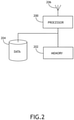
- FIG. 2 a block diagram of a system suitable for implementing an exemplary embodiment is shown.
- the system embodied in a node or router in a network, comprises a processor 200, memory 202 connected to the processor 200 for embodying processor executable code, and a data storage element 204 for storing data packets.
- the system also includes a data communication element 206 for sending and receiving data packets to and from other nodes or routers in the network.
- the processor 200 builds or receives a unidirectional tree structure corresponding to the structure of the network rooted at a specific point in network or a group portion of the network.
- each source node within the network may produce a tree to each receiver in the network, potentially including shortest path trees.
- Protocols useful for implementing the tree-building methodology may include PIM-SM, PIM-DM, PIM-Bidirectional, etc.
- the processor 200 determines if the data packet includes a flag or other artifice indicating the indented direction of delivery upstream or downstream. If such an artifice exists, the processor 200 checks the destination for consistency with corresponding routing / switching tables before forwarding to determine if the data packet's route within the tree structure is inconsistent with the indicated intended direction. If inconsistent, then the processor 200 discards the data packet to prevent a storm. If the indicated intended direction is consistent, then the data packet is only routed further along the indicated direction.
- the processor 200 determines the intended direction and includes such artifice in the data packet before routing.
- Such artifice may be included as a portion of the link layer packet header.
- the artifice may comprise a link layer header control field or a portion of a link layer address.
- two lower layer network / LAN addresses may be defined to correspond to an upstream and downstream broadcast or multicast group instead of a single broadcast / multicast address.
- an standard Ethernet broadcast address such as FF.FF.FF.FF.FF
- an alternative address such as F3.FF.FF.FF.FF.FF
- a standard IP multicast to Ethernet multicast address mapping from RFC 1112 for IPv4 and RFC 2464 for IPv6 may be used for multicast upstream and an alternative address may be used for multicast downstream.
- the forwarding node when a router forwards a broadcast or multicast packet on a link, if it is forwarding it upstream, the forwarding node may set an upstream / downstream field / flag.
- a router may perform standard storm detection methods, such as RPF, max limit, and hop count checks. In addition, it may also check whether the packet is being sent upstream or downstream and if the next hop route matches the expected routing direction. If not, then the packet is discarded.
- a processor in a node of a network builds 300 one or more tree structures corresponding to the network structure according to a protocol such as PIM-SM, PIM-DM, PIM-Bidirectional, etc.
- each processor may also build 302 one or more trees corresponding to one or more shortest paths to other nodes within the network.
- a source node in the network determines 304 if the data packet is directed upstream or downstream (toward or away from the root node) within the tree structure.
- the data packet is modified to indicate the upstream or downstream directionality.
- the receiving node determines if an indicator of directionality exists in the data packet; if so, the receiving node determines 308 if the data packet being routed contrary to the indicated directionality. When a data packet is determined to be moving contrary to the indicated directionality, even if the a predetermined hop count has not been reached, further routing of the data packet is discontinued.
- Exemplary embodiments enable detecting broadcast and multicast storms when routing protocols are changing or inconsistent between routers.
- Come embodiments may utilize existing header space so that no overhead is added, instead reusing lower layer network address fields to indicate whether a multicast or broadcast packet is sent upstream or downstream.
Landscapes
- Engineering & Computer Science (AREA)
- Computer Networks & Wireless Communication (AREA)
- Signal Processing (AREA)
- Data Exchanges In Wide-Area Networks (AREA)
Abstract
Description
- Network broadcast and multicast packets are typically transmitted over a lower layer network, such as an Ethernet local area network (LAN), or a point to point link, using a lower layer broadcast address for both broadcast and multicast, or a lower layer multicast address for multicast traffic.
- Data networks can experience broadcast and multicast storms where broadcast and multicast packets are routed or switched in a loop between routers or switches so that traffic is sent across a network link multiple times, consuming significant network capacity. This is especially problematic as network topologies change so that routes in different routers and switches are inconsistent.
- In one aspect, embodiments of the inventive concepts disclosed herein are directed to a system and method for identifying packets in a that may be stuck in a loop. The network is logically organized as a tree and packets are modified with an artifice to identify the packets intended directionality within the tree. If the actual directionality conflicts with the intended directionality, a potential loop is indicated.
- In a further aspect, the artifice is a flag in the link header, link address, or IP address associated with the packet.
- It is to be understood that both the foregoing general description and the following detailed description are exemplary and explanatory only and should not restrict the scope of the claims. The accompanying drawings, which are incorporated in and constitute a part of the specification, illustrate exemplary embodiments of the inventive concepts disclosed herein and together with the general description, serve to explain the principles.
- The numerous advantages of the embodiments of the inventive concepts disclosed herein may be better understood by those skilled in the art by reference to the accompanying figures in which:
-
FIG. 1 shows a block diagram of a network according to an exemplary embodiment; -
FIG. 2 shows a block diagram of a system suitable for implementing an exemplary embodiment; -
FIG. 3 shows a flowchart of a method according to an exemplary embodiment; - Before explaining at least one embodiment of the inventive concepts disclosed herein in detail, it is to be understood that the inventive concepts are not limited in their application to the details of construction and the arrangement of the components or steps or methodologies set forth in the following description or illustrated in the drawings. In the following detailed description of embodiments of the instant inventive concepts, numerous specific details are set forth in order to provide a more thorough understanding of the inventive concepts. However, it will be apparent to one of ordinary skill in the art having the benefit of the instant disclosure that the inventive concepts disclosed herein may be practiced without these specific details. In other instances, well-known features may not be described in detail to avoid unnecessarily complicating the instant disclosure. The inventive concepts disclosed herein are capable of other embodiments or of being practiced or carried out in various ways. Also, it is to be understood that the phraseology and terminology employed herein is for the purpose of description and should not be regarded as limiting.
- As used herein a letter following a reference numeral is intended to reference an embodiment of the feature or element that may be similar, but not necessarily identical, to a previously described element or feature bearing the same reference numeral (e.g., 1, 1a, 1b). Such shorthand notations are used for purposes of convenience only, and should not be construed to limit the inventive concepts disclosed herein in any way unless expressly stated to the contrary.
- Further, unless expressly stated to the contrary, "or" refers to an inclusive or and not to an exclusive or. For example, a condition A or B is satisfied by anyone of the following: A is true (or present) and B is false (or not present), A is false (or not present) and B is true (or present), and both A and B are true (or present).
- In addition, use of the "a" or "an" are employed to describe elements and components of embodiments of the instant inventive concepts. This is done merely for convenience and to give a general sense of the inventive concepts, and "a" and "an" are intended to include one or at least one and the singular also includes the plural unless it is obvious that it is meant otherwise.
- Finally, as used herein any reference to "one embodiment," or "some embodiments" means that a particular element, feature, structure, or characteristic described in connection with the embodiment is included in at least one embodiment of the inventive concepts disclosed herein. The appearances of the phrase "in some embodiments" in various places in the specification are not necessarily all referring to the same embodiment, and embodiments of the inventive concepts disclosed may include one or more of the features expressly described or inherently present herein, or any combination of sub-combination of two or more such features, along with any other features which may not necessarily be expressly described or inherently present in the instant disclosure.
- Broadly, embodiments of the inventive concepts disclosed herein are directed to a system and method for identifying packets in a that may be stuck in a loop. The network is logically organized as a tree and packets are modified with an artifice to identify the packets intended directionality within the tree. If the actual directionality conflicts with the intended directionality, a potential loop is indicated.
- Referring to
FIG. 1 , a block diagram of a network according to an exemplary embodiment is shown. In an example of a multicast storm, one or more packets may be received by afirst router 100 in the network and then routed to asecond router 102 based on a path determined by an internal routing table and the intended destination of the one or more packets. Thesecond router 102 likewise routes the one or more packets to athird router 104 based on a path determined by an internal routing table and the intended destination of the one or more packets. Where thethird router 104 determines that the one or more packets should be routed to thefirst router 100, the one or more packets would be stuck in a loop until a predetermined hop count limit is reached. - Without a mechanism to identify when the one or more packets are stuck in a loop, multiple packets may consume bandwidth while cycling through the network to reach the hop count limit.
- Protocols such as Protocol Independent Multicast (PIM) Sparse Mode (SM) or PIM Bidirectional (BIDIR) mode, include routing trees and reverse path forwarding (RPF) checks to prevent multicast traffic from traveling upstream towards the root node of the tree; the root node may be either a multicast source or multicast rendezvous point (RP) depending upon the routing protocol. Multicast storms may occur if routing table are incorrect or unstable, such as during route updates.
- Furthermore, some protocols include a maximum hop count, such as time to live (TTL) for Internet Protocol version 4 (IPv4) and hop limit for IPv6. The hop count is tracked each time the packet is forwarded with the packet being discarded whenever the maximum number of relays has occurred.
- Alternatively, some systems may discard a packet if it has been routed by a
specific router router - Referring to
FIG. 2 , a block diagram of a system suitable for implementing an exemplary embodiment is shown. The system, embodied in a node or router in a network, comprises aprocessor 200,memory 202 connected to theprocessor 200 for embodying processor executable code, and adata storage element 204 for storing data packets. The system also includes adata communication element 206 for sending and receiving data packets to and from other nodes or routers in the network. - In at least one embodiment, the
processor 200 builds or receives a unidirectional tree structure corresponding to the structure of the network rooted at a specific point in network or a group portion of the network. In at least one embodiment, each source node within the network may produce a tree to each receiver in the network, potentially including shortest path trees. Protocols useful for implementing the tree-building methodology may include PIM-SM, PIM-DM, PIM-Bidirectional, etc. - When the
processor 200 receives a data packet, theprocessor 200 determines if the data packet includes a flag or other artifice indicating the indented direction of delivery upstream or downstream. If such an artifice exists, theprocessor 200 checks the destination for consistency with corresponding routing / switching tables before forwarding to determine if the data packet's route within the tree structure is inconsistent with the indicated intended direction. If inconsistent, then theprocessor 200 discards the data packet to prevent a storm. If the indicated intended direction is consistent, then the data packet is only routed further along the indicated direction. - In at least one embodiment, if the
processor 200 determines that the data packet does not include an artifice indicating the intended direction, theprocessor 200 determines the intended direction and includes such artifice in the data packet before routing. Such artifice may be included as a portion of the link layer packet header. In at least one embodiment, the artifice may comprise a link layer header control field or a portion of a link layer address. In at least one embodiment, two lower layer network / LAN addresses may be defined to correspond to an upstream and downstream broadcast or multicast group instead of a single broadcast / multicast address. For example, an standard Ethernet broadcast address (such as FF.FF.FF.FF.FF.FF) may correspond to broadcast upstream and an alternative address (such as F3.FF.FF.FF.FF.FF) may correspond to a broadcast downstream. - Alternatively, or in addition, a standard IP multicast to Ethernet multicast address mapping from RFC 1112 for IPv4 and RFC 2464 for IPv6 may be used for multicast upstream and an alternative address may be used for multicast downstream.
- In at least one embodiment, when a router forwards a broadcast or multicast packet on a link, if it is forwarding it upstream, the forwarding node may set an upstream / downstream field / flag. When a router receives the packet, it may perform standard storm detection methods, such as RPF, max limit, and hop count checks. In addition, it may also check whether the packet is being sent upstream or downstream and if the next hop route matches the expected routing direction. If not, then the packet is discarded.
- Referring to
FIG. 3 , a flowchart of a method according to an exemplary embodiment is shown. A processor in a node of a network builds 300 one or more tree structures corresponding to the network structure according to a protocol such as PIM-SM, PIM-DM, PIM-Bidirectional, etc. In at least one embodiment, each processor may also build 302 one or more trees corresponding to one or more shortest paths to other nodes within the network. - After receiving a data packet, a source node in the network determines 304 if the data packet is directed upstream or downstream (toward or away from the root node) within the tree structure. The data packet is modified to indicate the upstream or downstream directionality.
- At each routing step, the receiving node determines if an indicator of directionality exists in the data packet; if so, the receiving node determines 308 if the data packet being routed contrary to the indicated directionality. When a data packet is determined to be moving contrary to the indicated directionality, even if the a predetermined hop count has not been reached, further routing of the data packet is discontinued.
- Exemplary embodiments enable detecting broadcast and multicast storms when routing protocols are changing or inconsistent between routers. Come embodiments may utilize existing header space so that no overhead is added, instead reusing lower layer network address fields to indicate whether a multicast or broadcast packet is sent upstream or downstream.
- It is believed that the inventive concepts disclosed herein and many of their attendant advantages will be understood by the foregoing description of embodiments of the inventive concepts disclosed, and it will be apparent that various changes may be made in the form, construction, and arrangement of the components thereof without departing from the broad scope of the inventive concepts disclosed herein or without sacrificing all of their material advantages; and individual features from various embodiments may be combined to arrive at other embodiments. The form herein before described being merely an explanatory embodiment thereof, it is the intention of the following claims to encompass and include such changes. Furthermore, any of the features disclosed in relation to any of the individual embodiments may be incorporated into any other embodiment.
Claims (15)
- A node in a network comprising: at least one processor (200) in data communication with a memory storing processor executable code for configuring the at least one processor to:querying nodes in the network to identify a tree structure;receive a data packet for routing within the network;determine if the data packet includes an artifice indicating that the data packet is intended for one of upstream or downstream routing within the network; andif the data packet includes an artifice, determine if the data packet is being routed contrary to the indicated upstream or downstream routing.
- The node of Claim 1, wherein the artifice comprises a flag in a link header.
- The node of Claim 1, wherein the artifice comprises a flag in a link address.
- The node of Claim 1, wherein the artifice comprises a flag in an IP address.
- The node of any preceding Claim, wherein the at least one processor is further configured to build a tree structure according to one of PIM-SM, PIM-DM, or PIM-Bidirectional.
- The node of any preceding Claim, wherein the at least one processor is further configured to:if the data packet does not include an artifice, determine a directionality of the data packet within the tree structure; andinclude an artifice in the data packet indicating the directionality.
- The node of any preceding Claim, wherein the at least one processor is further configured to:flag the data packet as stuck in a loop if the data packet is being routed contrary to indicated upstream or downstream routing; andterminate further routing attempts of the data packet.
- A network system comprising:
a plurality of nodes, each node comprising:
at least one processor in data communication with a memory storing processor executable code for configuring the at least one processor to:querying nodes in the network system to identify a tree structure;receive a data packet for routing within the network system;determine if the data packet includes an artifice indicating that the data packet is intended for one of upstream or downstream routing within the network; andif the data packet includes an artifice, determine if a next hop of the data packet is contrary to the indicated upstream or downstream routing. - The node of Claim 8, wherein the artifice comprises a flag in a link header.
- The node of Claim 8, wherein the artifice comprises a flag in a link address.
- The node of Claim 8, wherein the artifice comprises a flag in an IP address.
- The node of any of Claims 8 to 11, wherein the at least one processor is further configured to build a tree structure according to one of PIM-SM, PIM-DM, or PIM-Bidirectional.
- The node of any of Claims 8 to 12, wherein the at least one processor is further configured to:if the data packet does not include an artifice, determine a directionality of the data packet within the tree structure; andinclude an artifice in the data packet indicating the directionality.
- The node of any of Claims 8 to 13, wherein the at least one processor is further configured to:flag the data packet as stuck in a loop if the data packet is being routed contrary to indicated upstream or downstream routing; andterminate further routing attempts of the data packet.
- The node of Claim 8, wherein the at least one processor is further configured to restrict routing to only nodes that match the indicated upstream or downstream routing.
Applications Claiming Priority (1)
| Application Number | Priority Date | Filing Date | Title |
|---|---|---|---|
| US17/017,535 US11606287B2 (en) | 2020-09-10 | 2020-09-10 | Multicast and broadcast storm prevention |
Publications (1)
| Publication Number | Publication Date |
|---|---|
| EP3968612A1 true EP3968612A1 (en) | 2022-03-16 |
Family
ID=77710568
Family Applications (1)
| Application Number | Title | Priority Date | Filing Date |
|---|---|---|---|
| EP21195841.8A Pending EP3968612A1 (en) | 2020-09-10 | 2021-09-09 | Multicast and broadcast storm prevention |
Country Status (2)
| Country | Link |
|---|---|
| US (1) | US11606287B2 (en) |
| EP (1) | EP3968612A1 (en) |
Families Citing this family (3)
| Publication number | Priority date | Publication date | Assignee | Title |
|---|---|---|---|---|
| US12603838B2 (en) * | 2022-03-31 | 2026-04-14 | Lenovo Global Technology (United States) Inc. | Optimizing network load in multicast communications |
| CN114448907B (en) * | 2022-04-11 | 2022-07-22 | 希诺麦田技术(深圳)有限公司 | Multicast flooding prevention method, device and equipment |
| US12518027B1 (en) | 2023-09-01 | 2026-01-06 | Rockwell Collins, Inc. | Dynamic IPsec system and method |
Citations (2)
| Publication number | Priority date | Publication date | Assignee | Title |
|---|---|---|---|---|
| US20030223402A1 (en) * | 2002-06-04 | 2003-12-04 | Sanchez Juan Diego | Efficient reverse path forwarding check mechanism |
| US20130279366A1 (en) * | 2012-04-20 | 2013-10-24 | Sachin Surendran | Self-healing communications network |
Family Cites Families (15)
| Publication number | Priority date | Publication date | Assignee | Title |
|---|---|---|---|---|
| AU5516300A (en) * | 1999-06-07 | 2000-12-28 | Nortel Networks Limited | Mechanism for splicing trees |
| JP4258698B2 (en) | 2001-03-21 | 2009-04-30 | 日本電気株式会社 | Broadcast system, broadcast method thereof, and broadcast program |
| GB0407144D0 (en) * | 2004-03-30 | 2004-05-05 | British Telecomm | Networks |
| US7573835B2 (en) | 2004-08-16 | 2009-08-11 | Renesas Technology Corporation | Method, system, node, computer program product and communication packet for communicating information in an ad-hoc hierarchically addressed communication network |
| US7996558B2 (en) | 2005-03-01 | 2011-08-09 | Industrial Technology Research Institute | Methods and systems for a routing protocol |
| CN100550917C (en) | 2005-04-18 | 2009-10-14 | 财团法人工业技术研究院 | Prime number numbering address allocation method and unique numbering address allocation method using same |
| CN102549982A (en) * | 2009-10-02 | 2012-07-04 | 瑞典爱立信有限公司 | Technique for controlling data forwarding in computer networks |
| US8804719B2 (en) * | 2010-06-29 | 2014-08-12 | Cisco Technology, Inc. | In-band multicast trace in IP and MPLS networks |
| US10027508B2 (en) * | 2010-08-31 | 2018-07-17 | Siklu Communication ltd. | Extended ring-like communication architecture |
| CN102340452B (en) | 2011-10-14 | 2018-03-02 | 中兴通讯股份有限公司 | A kind of method and wireless device that route transmission is realized based on single IPv6 address prefixs |
| US9094224B2 (en) * | 2012-07-31 | 2015-07-28 | Cisco Technology, Inc. | Acknowledged multicast convergence |
| US9838303B2 (en) * | 2015-03-20 | 2017-12-05 | Juniper Networks, Inc. | PIM source discovery by last hop router |
| WO2017034479A1 (en) | 2015-08-21 | 2017-03-02 | Yan Singapore Pte. Ltd. | System and method for managing a network |
| CN107182103B (en) | 2017-04-27 | 2020-07-17 | 浙江工商大学 | Cooperative broadcasting method based on neighbor broadcasting coefficient in mobile self-organizing network |
| US10560322B1 (en) * | 2019-07-11 | 2020-02-11 | Synap Technologies Ltd. | Network protocol for mesh capability in narrow-band wireless networks |
-
2020
- 2020-09-10 US US17/017,535 patent/US11606287B2/en active Active
-
2021
- 2021-09-09 EP EP21195841.8A patent/EP3968612A1/en active Pending
Patent Citations (2)
| Publication number | Priority date | Publication date | Assignee | Title |
|---|---|---|---|---|
| US20030223402A1 (en) * | 2002-06-04 | 2003-12-04 | Sanchez Juan Diego | Efficient reverse path forwarding check mechanism |
| US20130279366A1 (en) * | 2012-04-20 | 2013-10-24 | Sachin Surendran | Self-healing communications network |
Also Published As
| Publication number | Publication date |
|---|---|
| US11606287B2 (en) | 2023-03-14 |
| US20220078108A1 (en) | 2022-03-10 |
Similar Documents
| Publication | Publication Date | Title |
|---|---|---|
| US8761044B2 (en) | Selection of multicast router interfaces in an L2 switch connecting end hosts and routers, which is running IGMP and PIM snooping | |
| EP1597875B1 (en) | Method and device for protocol-independent realization of ip multicast | |
| EP3151488B1 (en) | Multicast only fast re-route over remote loop-free alternate backup path | |
| US8571029B1 (en) | Label switched path hierarchy for intra-area segments of inter-area point-to-multipoint label switched paths | |
| US8036220B2 (en) | Pre-dropping of a packet if its time-to-live (TTL) value is not large enough to reach a destination | |
| US20110286450A1 (en) | Multicast hello on demand | |
| US20080205397A1 (en) | Method for forwarding multicast packets in a virtual private local area network service | |
| US20090161560A1 (en) | Node, method and system of fault localization in multicast mpls networks | |
| US9838210B1 (en) | Robust control plane assert for protocol independent multicast (PIM) | |
| EP3035592B1 (en) | Enhanced protocol independent multicast source registration over a reliable transport | |
| US11606287B2 (en) | Multicast and broadcast storm prevention | |
| WO2013003981A1 (en) | Dynamic updating of a label switched path | |
| CN107623630B (en) | Bit index explicit copy information transfer method and device | |
| US11909546B2 (en) | Method and network node for sending and obtaining assert packet | |
| EP3958517B1 (en) | Weighted multicast join load balance | |
| CN101163103A (en) | Method of implementing fast rerouting | |
| EP3151489A1 (en) | Mldp multicast only fast re-route over remote loop-free alternate backup path | |
| EP4037255B1 (en) | Upstream multicast hop (umh) extensions for anycast deployments | |
| EP3907940B1 (en) | Ingress replication procedures to facilitate migration to segment routing technology in a computer network | |
| US20210392009A1 (en) | Multicast source discovery protocol (msdp) loop avoidance | |
| EP3923529B1 (en) | Multicast source discovery protocol (msdp) loop avoidance | |
| US11323364B2 (en) | Ingress replication procedures to facilitate migration to segment routing technology in a computer network | |
| CN103595609B (en) | TRILL network interconnected method, system and equipment | |
| AU2004217224B2 (en) | Method and device for protocol-independent realization of IP multicast | |
| Mode et al. | The Testking network is implementing IP multicast, and they wish to avoid the problems described above. Based on this information, what IP multicast technology would you recommend? Caution: This protocol should avoid maintaining source-specific forwarding state, thereby reducing the amount of memory needed by the number of sources per |
Legal Events
| Date | Code | Title | Description |
|---|---|---|---|
| PUAI | Public reference made under article 153(3) epc to a published international application that has entered the european phase |
Free format text: ORIGINAL CODE: 0009012 |
|
| STAA | Information on the status of an ep patent application or granted ep patent |
Free format text: STATUS: THE APPLICATION HAS BEEN PUBLISHED |
|
| AK | Designated contracting states |
Kind code of ref document: A1 Designated state(s): AL AT BE BG CH CY CZ DE DK EE ES FI FR GB GR HR HU IE IS IT LI LT LU LV MC MK MT NL NO PL PT RO RS SE SI SK SM TR |
|
| STAA | Information on the status of an ep patent application or granted ep patent |
Free format text: STATUS: REQUEST FOR EXAMINATION WAS MADE |
|
| 17P | Request for examination filed |
Effective date: 20220916 |
|
| RBV | Designated contracting states (corrected) |
Designated state(s): AL AT BE BG CH CY CZ DE DK EE ES FI FR GB GR HR HU IE IS IT LI LT LU LV MC MK MT NL NO PL PT RO RS SE SI SK SM TR |
|
| STAA | Information on the status of an ep patent application or granted ep patent |
Free format text: STATUS: EXAMINATION IS IN PROGRESS |
|
| 17Q | First examination report despatched |
Effective date: 20240409 |