EP3968017A1 - Method for analyzing copolycarbonate - Google Patents
Method for analyzing copolycarbonate Download PDFInfo
- Publication number
- EP3968017A1 EP3968017A1 EP20825696.6A EP20825696A EP3968017A1 EP 3968017 A1 EP3968017 A1 EP 3968017A1 EP 20825696 A EP20825696 A EP 20825696A EP 3968017 A1 EP3968017 A1 EP 3968017A1
- Authority
- EP
- European Patent Office
- Prior art keywords
- chemical formula
- polysiloxane
- aromatic diol
- diol compound
- copolycarbonate
- Prior art date
- Legal status (The legal status is an assumption and is not a legal conclusion. Google has not performed a legal analysis and makes no representation as to the accuracy of the status listed.)
- Granted
Links
- TUOBGXQRXMMQSZ-UHFFFAOYSA-N CC(C)(O[Si]1(CC2)C2(CCc2ccccc2O)CC1)[Si](C)(C)CCCc1ccccc1O Chemical compound CC(C)(O[Si]1(CC2)C2(CCc2ccccc2O)CC1)[Si](C)(C)CCCc1ccccc1O TUOBGXQRXMMQSZ-UHFFFAOYSA-N 0.000 description 1
- 0 Oc1ccc(*c(cc2)ccc2O)cc1 Chemical compound Oc1ccc(*c(cc2)ccc2O)cc1 0.000 description 1
Classifications
-
- B—PERFORMING OPERATIONS; TRANSPORTING
- B01—PHYSICAL OR CHEMICAL PROCESSES OR APPARATUS IN GENERAL
- B01D—SEPARATION
- B01D15/00—Separating processes involving the treatment of liquids with solid sorbents; Apparatus therefor
- B01D15/08—Selective adsorption, e.g. chromatography
- B01D15/26—Selective adsorption, e.g. chromatography characterised by the separation mechanism
- B01D15/34—Size-selective separation, e.g. size-exclusion chromatography; Gel filtration; Permeation
-
- G—PHYSICS
- G01—MEASURING; TESTING
- G01N—INVESTIGATING OR ANALYSING MATERIALS BY DETERMINING THEIR CHEMICAL OR PHYSICAL PROPERTIES
- G01N24/00—Investigating or analyzing materials by the use of nuclear magnetic resonance, electron paramagnetic resonance or other spin effects
- G01N24/08—Investigating or analyzing materials by the use of nuclear magnetic resonance, electron paramagnetic resonance or other spin effects by using nuclear magnetic resonance
- G01N24/087—Structure determination of a chemical compound, e.g. of a biomolecule such as a protein
-
- C—CHEMISTRY; METALLURGY
- C08—ORGANIC MACROMOLECULAR COMPOUNDS; THEIR PREPARATION OR CHEMICAL WORKING-UP; COMPOSITIONS BASED THEREON
- C08J—WORKING-UP; GENERAL PROCESSES OF COMPOUNDING; AFTER-TREATMENT NOT COVERED BY SUBCLASSES C08B, C08C, C08F, C08G or C08H
- C08J11/00—Recovery or working-up of waste materials
- C08J11/04—Recovery or working-up of waste materials of polymers
- C08J11/10—Recovery or working-up of waste materials of polymers by chemically breaking down the molecular chains of polymers or breaking of crosslinks, e.g. devulcanisation
- C08J11/18—Recovery or working-up of waste materials of polymers by chemically breaking down the molecular chains of polymers or breaking of crosslinks, e.g. devulcanisation by treatment with organic material
- C08J11/22—Recovery or working-up of waste materials of polymers by chemically breaking down the molecular chains of polymers or breaking of crosslinks, e.g. devulcanisation by treatment with organic material by treatment with organic oxygen-containing compounds
- C08J11/24—Recovery or working-up of waste materials of polymers by chemically breaking down the molecular chains of polymers or breaking of crosslinks, e.g. devulcanisation by treatment with organic material by treatment with organic oxygen-containing compounds containing hydroxyl groups
-
- G—PHYSICS
- G01—MEASURING; TESTING
- G01N—INVESTIGATING OR ANALYSING MATERIALS BY DETERMINING THEIR CHEMICAL OR PHYSICAL PROPERTIES
- G01N30/00—Investigating or analysing materials by separation into components using adsorption, absorption or similar phenomena or using ion-exchange, e.g. chromatography or field flow fractionation
- G01N30/02—Column chromatography
- G01N30/88—Integrated analysis systems specially adapted therefor, not covered by a single one of the groups G01N30/04 - G01N30/86
-
- C—CHEMISTRY; METALLURGY
- C08—ORGANIC MACROMOLECULAR COMPOUNDS; THEIR PREPARATION OR CHEMICAL WORKING-UP; COMPOSITIONS BASED THEREON
- C08J—WORKING-UP; GENERAL PROCESSES OF COMPOUNDING; AFTER-TREATMENT NOT COVERED BY SUBCLASSES C08B, C08C, C08F, C08G or C08H
- C08J2369/00—Characterised by the use of polycarbonates; Derivatives of polycarbonates
-
- G—PHYSICS
- G01—MEASURING; TESTING
- G01N—INVESTIGATING OR ANALYSING MATERIALS BY DETERMINING THEIR CHEMICAL OR PHYSICAL PROPERTIES
- G01N30/00—Investigating or analysing materials by separation into components using adsorption, absorption or similar phenomena or using ion-exchange, e.g. chromatography or field flow fractionation
- G01N30/02—Column chromatography
- G01N30/04—Preparation or injection of sample to be analysed
- G01N30/06—Preparation
- G01N2030/067—Preparation by reaction, e.g. derivatising the sample
-
- G—PHYSICS
- G01—MEASURING; TESTING
- G01N—INVESTIGATING OR ANALYSING MATERIALS BY DETERMINING THEIR CHEMICAL OR PHYSICAL PROPERTIES
- G01N30/00—Investigating or analysing materials by separation into components using adsorption, absorption or similar phenomena or using ion-exchange, e.g. chromatography or field flow fractionation
- G01N30/02—Column chromatography
- G01N30/88—Integrated analysis systems specially adapted therefor, not covered by a single one of the groups G01N30/04 - G01N30/86
- G01N2030/8809—Integrated analysis systems specially adapted therefor, not covered by a single one of the groups G01N30/04 - G01N30/86 analysis specially adapted for the sample
- G01N2030/884—Integrated analysis systems specially adapted therefor, not covered by a single one of the groups G01N30/04 - G01N30/86 analysis specially adapted for the sample organic compounds
-
- G—PHYSICS
- G01—MEASURING; TESTING
- G01N—INVESTIGATING OR ANALYSING MATERIALS BY DETERMINING THEIR CHEMICAL OR PHYSICAL PROPERTIES
- G01N30/00—Investigating or analysing materials by separation into components using adsorption, absorption or similar phenomena or using ion-exchange, e.g. chromatography or field flow fractionation
- G01N30/02—Column chromatography
- G01N30/88—Integrated analysis systems specially adapted therefor, not covered by a single one of the groups G01N30/04 - G01N30/86
- G01N2030/8809—Integrated analysis systems specially adapted therefor, not covered by a single one of the groups G01N30/04 - G01N30/86 analysis specially adapted for the sample
- G01N2030/884—Integrated analysis systems specially adapted therefor, not covered by a single one of the groups G01N30/04 - G01N30/86 analysis specially adapted for the sample organic compounds
- G01N2030/885—Integrated analysis systems specially adapted therefor, not covered by a single one of the groups G01N30/04 - G01N30/86 analysis specially adapted for the sample organic compounds involving polymers
-
- G—PHYSICS
- G01—MEASURING; TESTING
- G01N—INVESTIGATING OR ANALYSING MATERIALS BY DETERMINING THEIR CHEMICAL OR PHYSICAL PROPERTIES
- G01N24/00—Investigating or analyzing materials by the use of nuclear magnetic resonance, electron paramagnetic resonance or other spin effects
- G01N24/08—Investigating or analyzing materials by the use of nuclear magnetic resonance, electron paramagnetic resonance or other spin effects by using nuclear magnetic resonance
-
- G—PHYSICS
- G01—MEASURING; TESTING
- G01N—INVESTIGATING OR ANALYSING MATERIALS BY DETERMINING THEIR CHEMICAL OR PHYSICAL PROPERTIES
- G01N30/00—Investigating or analysing materials by separation into components using adsorption, absorption or similar phenomena or using ion-exchange, e.g. chromatography or field flow fractionation
- G01N30/02—Column chromatography
- G01N30/04—Preparation or injection of sample to be analysed
- G01N30/06—Preparation
Definitions
- the present invention relates to a method of analyzing a copolycarbonate.
- Polycarbonate resins are prepared by condensation-polymerization of an aromatic diol such as bisphenol A with a carbonate precursor such as a phosgene, and have excellent impact strength, dimensional stability, heat resistance, transparency, etc.
- a carbonate precursor such as a phosgene
- the polycarbonate resins have application in a wide range of uses, such as exterior materials of electrical and electronic products, automobile parts, building materials, optical components, etc.
- Physical properties of the polycarbonate are greatly influenced by its molecular weight and molecular weight distribution. Therefore, analysis of the molecular weight of the polycarbonate is the most basic and important analysis in terms of predicting the physical properties of the polymer.
- a method of analyzing a molecular weight of a polymer such as polycarbonate an end group analysis, a method of using colligative properties, a light scattering method, a ultracentrifugal method, viscometry, or gel permeation chromatography (GPC) is frequently used.
- the most representative method of analyzing a molecular weight of a polymer is gel permeation chromatography, which is one of the most useful methods of measuring a ratio of a relative molecular weight using a standard material, of which a molecular weight is known.
- a method of measuring the molecular weights of the diol compounds decomposed by cleaving carbonate bonds of the copolycarbonate may be generally used in order to measure the content and the molecular weight of different repeating units included in the corresponding copolycarbonate.
- a method of cleaving the carbonate bonds may include thermal pyrolysis, solvolysis using a supercritical fluid (methanol, ethanol, toluene, etc.), cleavage using microwaves, etc.
- NMR nuclear magnetic resonance
- an average molecular weight of the polysiloxane used in the copolycarbonate may be calculated, but a molecular weight distribution of the polysiloxane, which influences physical properties, may not be determined, and when two or more different polysiloxane structures are introduced, the molecular weights of the respective polysiloxanes may not be determined.
- a method of analyzing a copolycarbonate in which a polysiloxane structure is introduced into the main chain of a polycarbonate, the method capable of more accurately analyzing a weight average molecular weight, a number average molecular weight, and a molecular weight distribution of a polysiloxane-containing aromatic diol compound which is used as a starting material.
- a method of analyzing a copolycarbonate including the steps of reacting the copolycarbonate including a first repeating unit derived from an aromatic diol compound and a second repeating unit derived from a polysiloxane-containing aromatic diol compound with methanol to decompose the copolycarbonate into the aromatic diol compound and the polysiloxane-containing aromatic diol compound; and performing gel permeation chromatography of the decomposed polysiloxane-containing aromatic diol compound.
- the method of analyzing a copolycarbonate may include the steps of reacting the copolycarbonate including a first repeating unit derived from an aromatic diol compound and a second repeating unit derived from a polysiloxane-containing aromatic diol compound with methanol to decompose the copolycarbonate into the aromatic diol compound and the polysiloxane-containing aromatic diol compound; and performing gel permeation chromatography of the decomposed polysiloxane-containing aromatic diol compound.
- a polycarbonate is prepared by condensation-polymerization of an aromatic diol compound such as bisphenol A with a carbonate precursor such as a phosgene, and has excellent impact strength, dimensional stability, heat resistance, transparency, etc.
- a carbonate precursor such as a phosgene
- the polycarbonate has application in a wide range of uses, such as exterior materials of electrical and electronic products, automobile parts, building materials, optical components, etc.
- a polysiloxane structure may be introduced into the main chain of the polycarbonate, and as a result, various physical properties may be improved.
- the physical properties of the polycarbonate are greatly influenced by its molecular weight and molecular weight distribution. Therefore, analysis of the molecular weight of the polycarbonate is the most basic and important analysis in terms of predicting the physical properties of the polymer.
- the copolycarbonate including the first repeating unit derived from the aromatic diol compound and the second repeating unit derived from the polysiloxane-containing aromatic diol compound is reacted with methanol to decompose the copolycarbonate into the aromatic diol compound and the polysiloxane-containing aromatic diol compound which are original starting materials, and the molecular weight of the decomposed polysiloxane-containing aromatic diol compound may be measured by gel permeation chromatography (GPC), leading to the present invention.
- GPC gel permeation chromatography
- the first repeating unit derived from the aromatic diol compound is formed by reacting the aromatic diol compound with a carbonate precursor, and the first repeating unit is distinguished from the second repeating unit described below in that it does not include polysiloxane.
- the first repeating unit derived from the aromatic diol compound may be specifically represented by Chemical Formula 1: in Chemical Formula 1,
- R 1 to R 4 are each independently hydrogen, methyl, chloro, or bromo.
- Z is preferably linear or branched C 1-10 alkylene unsubstituted or substituted with phenyl, and more preferably, methylene, ethane-1,1-diyl, propane-2,2-diyl, butane-2,2-diyl, 1-phenylethane-1,1-diyl, or diphenylmethylene.
- Z is preferably cyclohexane-1,1-diyl, O, S, SO, SO 2 , or CO.
- the repeating unit represented by Chemical Formula 1 may be derived from one or more aromatic diol compounds selected from the group consisting of bis(4-hydroxyphenyl)methane, bis(4-hydroxyphenyl)ether, bis(4-hydroxyphenyl)sulfone, bis(4-hydroxyphenyl)sulfoxide, bis(4-hydroxyphenyl)sulfide, bis(4-hydroxyphenyl)ketone, 1,1-bis(4-hydroxyphenyl)ethane, bisphenol A, 2,2-bis(4-hydroxyphenyl)butane, 1,1-bis(4-hydroxyphenyl)cyclohexane, 2,2-bis(4-hydroxy-3,5-dibromophenyl)propane, 2,2-bis(4-hydroxy-3,5-dichlorophenyl)propane, 2,2-bis(4-hydroxy-3-bromophenyl)propane, 2,2-bis(4-hydroxy-3-chlorophenyl)propane, 2,2-bis(4-
- the description 'derived from an aromatic diol compound' means that a hydroxy group of the aromatic diol compound and a carbonate precursor are reacted to form the repeating unit represented by Chemical Formula 1.
- the repeating unit represented by Chemical Formula 1 is derived from an aromatic diol compound represented by the following Chemical Formula 1-1: in Chemical Formula 1-1,
- the carbonate precursor may include one or more selected from the group consisting of dimethyl carbonate, diethyl carbonate, dibutyl carbonate, dicyclohexyl carbonate, diphenyl carbonate, ditolyl carbonate, bis(chlorophenyl)carbonate, di-m-cresyl carbonate, dinaphthyl carbonate, bis(diphenyl)carbonate, phosgene, triphosgene, diphosgene, bromophosgene and bishaloformate.
- triphosgene or phosgene may be used.
- the structure of the polysiloxane-containing aromatic diol compound which is an analysis target of the present invention is not particularly limited, as long as a polysiloxane residue is included in the compound, and a bond cleaved by alkali-catalyzed alcoholysis, for example, an ester bond is not included.
- a bond cleaved by alkali-catalyzed alcoholysis for example, an ester bond is not included.
- the compound includes the bond cleaved by alkali-catalyzed alcoholysis, it may be decomposed by methanolysis described below. Therefore, it is difficult to accurately measure the molecular weight by applying the analysis method of the present invention alone.
- the structure of the polysiloxane-containing compound is analyzed by applying NMR analysis in combination with the analysis method of the present invention, it is possible to analyze the molecular weights of the respective repeating units.
- the second repeating unit derived from the polysiloxane-containing aromatic diol compound may be represented by the following Chemical Formula 2 to Chemical Formula 5, but is not limited thereto: in Chemical Formula 2,
- X 1 is each independently C 2-10 alkylene, more preferably, C 2-4 alkylene, and most preferably, propane-1,3-diyl.
- R 5 is each independently hydrogen, methyl, ethyl, propyl, 3-phenylpropyl, 2-phenylpropyl, 3-(oxiranylmethoxy)propyl, fluoro, chloro, bromo, iodo, methoxy, ethoxy, propoxy, allyl, 2,2,2-trifluoroethyl, 3,3,3-trifluoropropyl, phenyl, or naphthyl.
- R 5 is each independently C 1-10 alkyl, more preferably, C 1-6 alkyl, much more preferably, C 1-3 alkyl, and most preferably, methyl.
- n is an integer of 10 or more, 15 or more, 20 or more, 25 or more, 30 or more, 31 or more, or 32 or more, and 50 or less, 45 or less, 40 or less, 39 or less, 38 or less, or 37 or less.
- X 2 is each independently C 2-10 alkylene, more preferably, C 2-6 alkylene, and most preferably isobutylene.
- Y 1 is hydrogen
- R 6 is each independently hydrogen, methyl, ethyl, propyl, 3-phenylpropyl, 2-phenylpropyl, 3-(oxiranylmethoxy)propyl, fluoro, chloro, bromo, iodo, methoxy, ethoxy, propoxy, allyl, 2,2,2-trifluoroethyl, 3,3,3-trifluoropropyl, phenyl, or naphthyl.
- R 6 is each independently C 1-10 alkyl, more preferably, C 1-6 alkyl, much more preferably, C 1-3 alkyl, and most preferably, methyl.
- m is an integer of 30 or more, 35 or more, 40 or more, 45 or more, 46 or more, 47 or more, or 48 or more, and 70 or less, 65 or less, 60 or less, 55 or less, 54 or less, 53 or less, or 52 or less.
- the repeating unit represented by Chemical Formula 2 may be represented by the following Chemical Formula 2-2: in Chemical Formula 2-2, R 5 and n are the same as defined in Chemical Formula 2.
- R 5 is methyl.
- the repeating unit represented by Chemical Formula 3 may be represented by the following Chemical Formula 3-2: in Chemical Formula 3-2, R 6 and m are the same as defined in Chemical Formula 3.
- R 6 is methyl.
- the repeating unit represented by Chemical Formula 2 and the repeating unit represented by Chemical Formula 3 are derived from a polysiloxane compound represented by the following Chemical Formula 2-1 and a polysiloxane compound represented by the following Chemical Formula 3-1, respectively: in Chemical Formula 2-1, X 1 , R 5 , and n are the same as defined in Chemical Formula 2, in Chemical Formula 3-1, X 2 , Y 1 , R 6 , and m are the same as defined in Chemical Formula 3.
- the description 'derived from a polysiloxane compound' means that a hydroxy group of each polysiloxane compound and a carbonate precursor are reacted to form the repeating units represented by Chemical Formulae 2 to 5, respectively.
- the carbonate precursors that may be used in the formation of the repeating units of Chemical Formulae 2 to 5 are the same as described in the carbonate precursor that may be used in the formation of the repeating unit of Chemical Formula 1 described above.
- the copolycarbonate including the first repeating unit and the second repeating unit is reacted with methanol to decompose the copolycarbonate into the aromatic diol compound and the polysiloxane-containing aromatic diol compound which are starting materials.
- the copolycarbonate when the copolycarbonate is reacted with methanol under alkaline conditions, it may be decomposed by an alkali-catalyzed alcoholysis reaction into the aromatic diol compound and the polysiloxane-containing aromatic diol compound, which are starting materials, respectively.
- the copolycarbonate may be decomposed into the aromatic diol compound and the polysiloxane-containing aromatic diol compound.
- an alkali salt is dissolved in methanol to prepare an alkali hydroxide solution.
- the alkali salt used herein may be, for example, sodium hydroxide (NaOH), potassium hydroxide (KOH), or ammonium hydroxide (NH 4 OH), but the present invention is not limited thereto.
- the carbonate bond is decomposed by the alkali-catalyzed alcoholysis reaction, and as a result, the copolycarbonate may be decomposed into the aromatic diol compound and the polysiloxane-containing aromatic diol compound.
- the temperature of the alkali-catalyzed alcoholysis reaction may be 40°C to 80°C, or 60°C to 70°C.
- the reaction time is not particularly limited, as long as it is a time for which the copolycarbonate may be completely decomposed.
- the reaction may be performed for, for example, 1 hr to 10 hr, or 2 hr to 8 hr, and in order to facilitate the reaction, the reaction may be performed under stirring using a magnetic bar, etc.
- the reaction may be performed in a hydrocarbon-based solvent.
- aliphatic hydrocarbon solvents having 5 to 12 carbon atoms such as pentane, hexane, heptane, nonane, decane, and isomers thereof, aromatic hydrocarbon solvents such as toluene and benzene, chlorine-substituted hydrocarbon solvents such as dichloromethane and chlorobenzene, etc. may be used, but the present invention is not limited thereto.
- the copolycarbonate and methanol are reacted to decompose the copolycarbonate into the aromatic diol compound and the polysiloxane-containing aromatic diol compound, and then the decomposition product is quenched using liquid nitrogen without a separate extraction and/or purification process, and is diluted with a solvent such as THF, followed by GPC.
- a solvent such as THF, followed by GPC.
- Bisphenol, dimethyl carbonate, methanol, NaOH, and the like are present in the decomposition product, but a polymeric material which may be identified through GPC is only the polysiloxane-containing aromatic diol compound, and therefore, no additional extraction and/or purification processes are required.
- the molecular weight and the molecular weight distribution of the polysiloxane-containing aromatic diol compound in copolycarbonate may be more accurately analyzed while the process is simplified.
- the mixture containing the aromatic diol compound and the polysiloxane-containing aromatic diol compound is quenched with distilled water and/or toluene, and left at room temperature, it is separated into the crystalline aromatic diol compound and the amorphous polysiloxane-containing aromatic diol compound, and the separated polysiloxane-containing aromatic diol compound may be extracted, followed by GPC.
- the weight average molecular weight, number average molecular weight, and molecular weight distribution of the extracted polysiloxane-containing aromatic diol compound may be obtained by the GPC.
- the GPC is a kind of liquid-solid-phase liquid chromatography using an elution method, in which a large molecule is first eluted due to the size of a solute molecule. When molecules have the same size, they may be eluted at the same position, regardless of the type of solutes or the type of functional groups.
- a mobile phase is based on a liquid chromatography grade, and may be used after filtration, and a solvent having a high viscosity is used by raising its temperature, and the solvent may be appropriately selected, taking the temperature of each solvent into consideration.
- a polar solvent is used as the solvent, it is necessary to use an additive to prevent formation of micelles.
- the type of a column filler used in the GPC is not particularly limited, but, for example, a rigid or semi-rigid, cross-linked macromolecular polymer, and glass or silica with a controlled pore size may be used.
- the filler may withstand a pressure of up to 3000 psi, and aqueous solutions and various polar organic solvents may be used. Porous glass and silica may be used after being prepared to have various pore sizes.
- These fillers are chemically resistant to pH of 10 or less, and are resistant to aqueous solutions and polar organic solvents. In the case of using a non-polar solvent, the surface must be deactivated by silylation in order to avoid irreversible retention by polar solutes.
- the packing volume may be maintained constant at a high flow rate and high pressure.
- the GPC device is not particularly limited, but may consist of, for example, a pump, a sample injector, and a detector.
- the pump must be able to maintain a constant flow rate, and requires reproducibility of the flow rate, particularly, reproducibility independent of viscosity of the polymer.
- it is generally required to raise the temperature to 55°C or higher.
- the amounts of the sample and the standard material injected into the sample injector should be equal, and in general, Rheodyne, U6K, auto injector type, etc. may be used.
- the injection amounts of the sample and the standard material are usually about 50 ⁇ l to 100 ⁇ l per column.
- the type of the detector is not particularly limited, but for example, a differential refractometer and a spectrophotometric detector operating in the ultraviolet and infrared regions may be used.
- the detector has an operating volume of 1 ml to 10 ml in an exclusion tube having a length of 3 m to 6 m, and the analysis time is usually less than 30 minutes.
- the weight average molecular weight, the number average molecular weight, and the molecular weight distribution of the polysiloxane-containing aromatic diol compound used as a starting material may be accurately analyzed.
- nuclear magnetic resonance may be additionally performed on the copolycarbonate into which the polysiloxane structure is introduced.
- the structures of the repeating units constituting the copolycarbonate may be inferred by NMR analysis, and therefore, even when the repeating unit of the copolycarbonate to be analyzed by the present invention, i.e., the polysiloxane-containing aromatic diol compound includes a functional group decomposable in methanol, the weight average molecular weight, the number average molecular weight, and the molecular weight distribution of the repeating unit may be obtained by taking together the structure analyzed by NMR.
- a copolycarbonate including a first repeating unit derived from bisphenol A (BPA) of LG Chem, Ltd. and a second repeating unit derived from a polysiloxane-containing aromatic diol compound having the following structural formula (including polysiloxane-containing aromatic diol compound in an amount of 7% by weight, based on the total weight of the copolycarbonate) was prepared.
- the following polysiloxane-containing aromatic diol compound used as a starting material had a weight average molecular weight of 4,830 g/mol, a number average molecular weight of 3,300 g/mol, and a molecular weight distribution (Mw/Mn) of 1.47.
- Copolycarbonate FG1700 of Idemitsu Co. including a repeating unit derived from a polysiloxane-containing aromatic diol compound, was prepared.
- Copolycarbonate EXL1414 of Sabic Corp. including a repeating unit derived from a polysiloxane-containing aromatic diol compound, was prepared.
- Copolycarbonate 3022PJ of Samyang Corp. including a repeating unit derived from a polysiloxane-containing aromatic diol compound, was prepared.
- the decomposition product including the polysiloxane-containing diol compound was quenched in liquid nitrogen at -196°C, and 4 g of the decomposition product was diluted in 200 ml of a tetrahydrofuran (THF) solvent to prepare a sample of about 20,000 ppm, of which molecular weight was measured using a Agilent 1200 series GPC system through an RI detector at a flow rate of 1 ml/min.
- THF tetrahydrofuran
- the weight average molecular weight, the number average molecular weight, and the molecular weight distribution of the decomposed polysiloxane-containing aromatic diol compound with respect to the weight average molecular weight, the number average molecular weight, and the molecular weight distribution of the polysiloxane-containing aromatic diol compound which is a starting material before polymerization were about 104%, about 101%, and about 103%, respectively, indicating that the error was within 5%, as compared with the measured values of the actual starting material.
- the copolycarbonates of Preparation Examples 2 to 4 were decomposed in the same manner as in Example 1.
- 4 g of the decomposition product including the decomposed polysiloxane-containing diol compound was diluted in 200 ml of a tetrahydrofuran (THF) solvent to prepare a sample of about 20,000 ppm, of which molecular weight was measured using a Agilent 1200 series GPC system through an RI detector at a flow rate of 1 ml/min.
- THF tetrahydrofuran
- eight PS standards were used to prepare a calibration curve, and based on the curve, the weight average molecular weight, the number average molecular weight, and the molecular weight distribution of each sample were determined.
- the number of the repeating unit derived from the polysiloxane-containing diol compound was calculated using proton, and multiplied by the molecular weight of one repeating unit, which may be determined as the number average molecular weight.
- the number average molecular weights of the polysiloxane-containing aromatic diol compounds decomposed according to the method of the present invention were about 80%, about 99.8%, and about 51.8% of those of the copolycarbonates including different structures of polysiloxane, as measured by NMR.
- the number average molecular weight measured by GPC was about 51% of the number average molecular weight measured by NMR, which may be attributed to that the polysiloxane-containing aromatic diol compound includes ester bonds during analysis of its structure by NMR, and these ester bonds are also decomposed during methanolysis. Accordingly, considering the decomposition of the ester bonds, it is almost consistent with the number average molecular weight measured by NMR.
Landscapes
- Chemical & Material Sciences (AREA)
- Physics & Mathematics (AREA)
- Health & Medical Sciences (AREA)
- Life Sciences & Earth Sciences (AREA)
- Analytical Chemistry (AREA)
- Pathology (AREA)
- Immunology (AREA)
- General Physics & Mathematics (AREA)
- General Health & Medical Sciences (AREA)
- Biochemistry (AREA)
- High Energy & Nuclear Physics (AREA)
- Chemical Kinetics & Catalysis (AREA)
- Medicinal Chemistry (AREA)
- Organic Chemistry (AREA)
- Polymers & Plastics (AREA)
- Sustainable Development (AREA)
- Spectroscopy & Molecular Physics (AREA)
- Molecular Biology (AREA)
- Crystallography & Structural Chemistry (AREA)
- Polyesters Or Polycarbonates (AREA)
Abstract
Description
- The present application is based on, and claims priority from,
Korean Patent Application Nos. 10-2019-0073540 10-2020-0074897, filed on June 20, 2019 and June 19, 2020 - The present invention relates to a method of analyzing a copolycarbonate.
- Polycarbonate resins are prepared by condensation-polymerization of an aromatic diol such as bisphenol A with a carbonate precursor such as a phosgene, and have excellent impact strength, dimensional stability, heat resistance, transparency, etc. Thus, the polycarbonate resins have application in a wide range of uses, such as exterior materials of electrical and electronic products, automobile parts, building materials, optical components, etc.
- Recently, in order to apply these polycarbonate resins to more varied fields, many studies have been made to obtain desired physical properties by copolymerizing two or more aromatic diol compounds having different structures from each other and introducing units having different structures into the main chain of the polycarbonate.
- Especially, recent studies have been conducted on introducing a polysiloxane structure into the main chain of the polycarbonate.
- Physical properties of the polycarbonate are greatly influenced by its molecular weight and molecular weight distribution. Therefore, analysis of the molecular weight of the polycarbonate is the most basic and important analysis in terms of predicting the physical properties of the polymer.
- Generally, as a method of analyzing a molecular weight of a polymer such as polycarbonate, an end group analysis, a method of using colligative properties, a light scattering method, a ultracentrifugal method, viscometry, or gel permeation chromatography (GPC) is frequently used.
- The most representative method of analyzing a molecular weight of a polymer is gel permeation chromatography, which is one of the most useful methods of measuring a ratio of a relative molecular weight using a standard material, of which a molecular weight is known.
- Meanwhile, in the case of a copolycarbonate in which a polysiloxane structure is introduced into the main chain by copolymerizing two or more aromatic diol compounds having different structures from each other, a method of measuring the molecular weights of the diol compounds decomposed by cleaving carbonate bonds of the copolycarbonate may be generally used in order to measure the content and the molecular weight of different repeating units included in the corresponding copolycarbonate. A method of cleaving the carbonate bonds may include thermal pyrolysis, solvolysis using a supercritical fluid (methanol, ethanol, toluene, etc.), cleavage using microwaves, etc. However, in the above cleavage methods, a large amount of energy is used. Therefore, since polysiloxane is also decomposed into polysiloxane units, it is difficult to accurately analyze the content and the molecular weight of the original repeating units.
- Alternatively, there is a method of using nuclear magnetic resonance (NMR) without decomposition of the copolycarbonate. When the nuclear magnetic resonance method is used, an average molecular weight of the polysiloxane used in the copolycarbonate may be calculated, but a molecular weight distribution of the polysiloxane, which influences physical properties, may not be determined, and when two or more different polysiloxane structures are introduced, the molecular weights of the respective polysiloxanes may not be determined.
- Accordingly, there is a demand for a method of analyzing a polymer, the method capable of accurately analyzing a content ratio, a molecular weight, and a molecular weight distribution of each repeating unit included in copolycarbonate, in which the polysiloxane structure is introduced into the main chain.
- There is provided a method of analyzing a copolycarbonate, in which a polysiloxane structure is introduced into the main chain of a polycarbonate, the method capable of more accurately analyzing a weight average molecular weight, a number average molecular weight, and a molecular weight distribution of a polysiloxane-containing aromatic diol compound which is used as a starting material.
- To solve the above problem, there is provided a method of analyzing a copolycarbonate, the method including the steps of reacting the copolycarbonate including a first repeating unit derived from an aromatic diol compound and a second repeating unit derived from a polysiloxane-containing aromatic diol compound with methanol to decompose the copolycarbonate into the aromatic diol compound and the polysiloxane-containing aromatic diol compound; and performing gel permeation chromatography of the decomposed polysiloxane-containing aromatic diol compound.
- According to an analysis method of the present invention, with regard to a copolycarbonate, in which a polysiloxane structure is introduced into the main chain, it is possible to more accurately analyze a weight average molecular weight, a number average molecular weight, and a molecular weight distribution of a polysiloxane-containing aromatic diol compound which is used as a starting material.
- The present invention may be variously modified and have various forms, and specific embodiments will be illustrated and described in detail as follows. It should be understood, however, that the description is not intended to limit the present invention to the particular forms disclosed, but on the contrary, the intention is to cover all modifications, equivalents, and alternatives falling within the spirit and scope of the invention.
- Hereinafter, a method of analyzing a copolycarbonate according to one exemplary embodiment of the present invention will be described.
- The method of analyzing a copolycarbonate according to a specific embodiment of the present invention may include the steps of reacting the copolycarbonate including a first repeating unit derived from an aromatic diol compound and a second repeating unit derived from a polysiloxane-containing aromatic diol compound with methanol to decompose the copolycarbonate into the aromatic diol compound and the polysiloxane-containing aromatic diol compound; and performing gel permeation chromatography of the decomposed polysiloxane-containing aromatic diol compound.
- A polycarbonate is prepared by condensation-polymerization of an aromatic diol compound such as bisphenol A with a carbonate precursor such as a phosgene, and has excellent impact strength, dimensional stability, heat resistance, transparency, etc. Thus, the polycarbonate has application in a wide range of uses, such as exterior materials of electrical and electronic products, automobile parts, building materials, optical components, etc.
- To further improve physical properties of the polycarbonate, a polysiloxane structure may be introduced into the main chain of the polycarbonate, and as a result, various physical properties may be improved.
- Meanwhile, the physical properties of the polycarbonate are greatly influenced by its molecular weight and molecular weight distribution. Therefore, analysis of the molecular weight of the polycarbonate is the most basic and important analysis in terms of predicting the physical properties of the polymer.
- However, in the case of the copolycarbonate, in which a polysiloxane structure is introduced into the main chain by copolymerizing two or more aromatic diol compounds having different structure from each other, it is not easy to accurately analyze the molecular weight of only the repeating unit containing the polysiloxane structure.
- Alternatively, there is a method of analyzing the copolycarbonate using nuclear magnetic resonance (NMR) without decomposition of the copolycarbonate. However, when two or more different kinds of polysiloxane structures are introduced into the copolycarbonate, it is difficult to distinguish respective polysiloxane structures from each other, and although analysis of the molecular weight is possible, it is impossible to analyze the molecular weight distribution, which has a large influence on physical properties of the polymer.
- Accordingly, it was found that the copolycarbonate including the first repeating unit derived from the aromatic diol compound and the second repeating unit derived from the polysiloxane-containing aromatic diol compound is reacted with methanol to decompose the copolycarbonate into the aromatic diol compound and the polysiloxane-containing aromatic diol compound which are original starting materials, and the molecular weight of the decomposed polysiloxane-containing aromatic diol compound may be measured by gel permeation chromatography (GPC), leading to the present invention.
- The first repeating unit derived from the aromatic diol compound is formed by reacting the aromatic diol compound with a carbonate precursor, and the first repeating unit is distinguished from the second repeating unit described below in that it does not include polysiloxane.
- The first repeating unit derived from the aromatic diol compound may be specifically represented by Chemical Formula 1:

- R1 to R4 are each independently hydrogen, C1-10 alkyl, C1-10 alkoxy, or halogen, and
- Z is C1-10 alkylene unsubstituted or substituted with phenyl, C3-15 cycloalkylene unsubstituted or substituted with C1-10 alkyl, O, S, SO, SO2, or CO.
- In Chemical Formula 1, preferably, R1 to R4 are each independently hydrogen, methyl, chloro, or bromo.
- Further, Z is preferably linear or branched C1-10 alkylene unsubstituted or substituted with phenyl, and more preferably, methylene, ethane-1,1-diyl, propane-2,2-diyl, butane-2,2-diyl, 1-phenylethane-1,1-diyl, or diphenylmethylene. Further, Z is preferably cyclohexane-1,1-diyl, O, S, SO, SO2, or CO.
- Preferably, the repeating unit represented by Chemical Formula 1 may be derived from one or more aromatic diol compounds selected from the group consisting of bis(4-hydroxyphenyl)methane, bis(4-hydroxyphenyl)ether, bis(4-hydroxyphenyl)sulfone, bis(4-hydroxyphenyl)sulfoxide, bis(4-hydroxyphenyl)sulfide, bis(4-hydroxyphenyl)ketone, 1,1-bis(4-hydroxyphenyl)ethane, bisphenol A, 2,2-bis(4-hydroxyphenyl)butane, 1,1-bis(4-hydroxyphenyl)cyclohexane, 2,2-bis(4-hydroxy-3,5-dibromophenyl)propane, 2,2-bis(4-hydroxy-3,5-dichlorophenyl)propane, 2,2-bis(4-hydroxy-3-bromophenyl)propane, 2,2-bis(4-hydroxy-3-chlorophenyl)propane, 2,2-bis(4-hydroxy-3-methylphenyl)propane, 2,2-bis(4-hydroxy-3,5-dimethylphenyl)propane, 1,1-bis(4-hydroxyphenyl)-1-phenylethane, bis(4-hydroxyphenyl)diphenylmethane, and a,ω-bis[3-(o-hydroxyphenyl)propyl]polydimethylpolysiloxane.
- The description 'derived from an aromatic diol compound' means that a hydroxy group of the aromatic diol compound and a carbonate precursor are reacted to form the repeating unit represented by Chemical Formula 1.
- The repeating unit represented by Chemical Formula 1 is derived from an aromatic diol compound represented by the following Chemical Formula 1-1:

- R1 to R4, and Z are the same as defined in Chemical Formula 1.
- For example, when bisphenol A, which is an aromatic diol compound, and triphosgene, which is a carbonate precursor, are polymerized, the repeating unit represented by Chemical Formula 1 may be represented by the following Chemical Formula 1-2:

- The carbonate precursor may include one or more selected from the group consisting of dimethyl carbonate, diethyl carbonate, dibutyl carbonate, dicyclohexyl carbonate, diphenyl carbonate, ditolyl carbonate, bis(chlorophenyl)carbonate, di-m-cresyl carbonate, dinaphthyl carbonate, bis(diphenyl)carbonate, phosgene, triphosgene, diphosgene, bromophosgene and bishaloformate. Preferably, triphosgene or phosgene may be used.
- The structure of the polysiloxane-containing aromatic diol compound which is an analysis target of the present invention is not particularly limited, as long as a polysiloxane residue is included in the compound, and a bond cleaved by alkali-catalyzed alcoholysis, for example, an ester bond is not included. When the compound includes the bond cleaved by alkali-catalyzed alcoholysis, it may be decomposed by methanolysis described below. Therefore, it is difficult to accurately measure the molecular weight by applying the analysis method of the present invention alone. However, when the structure of the polysiloxane-containing compound is analyzed by applying NMR analysis in combination with the analysis method of the present invention, it is possible to analyze the molecular weights of the respective repeating units.
- According to one exemplary embodiment of the present invention, the second repeating unit derived from the polysiloxane-containing aromatic diol compound may be represented by the following Chemical Formula 2 to Chemical Formula 5, but is not limited thereto:
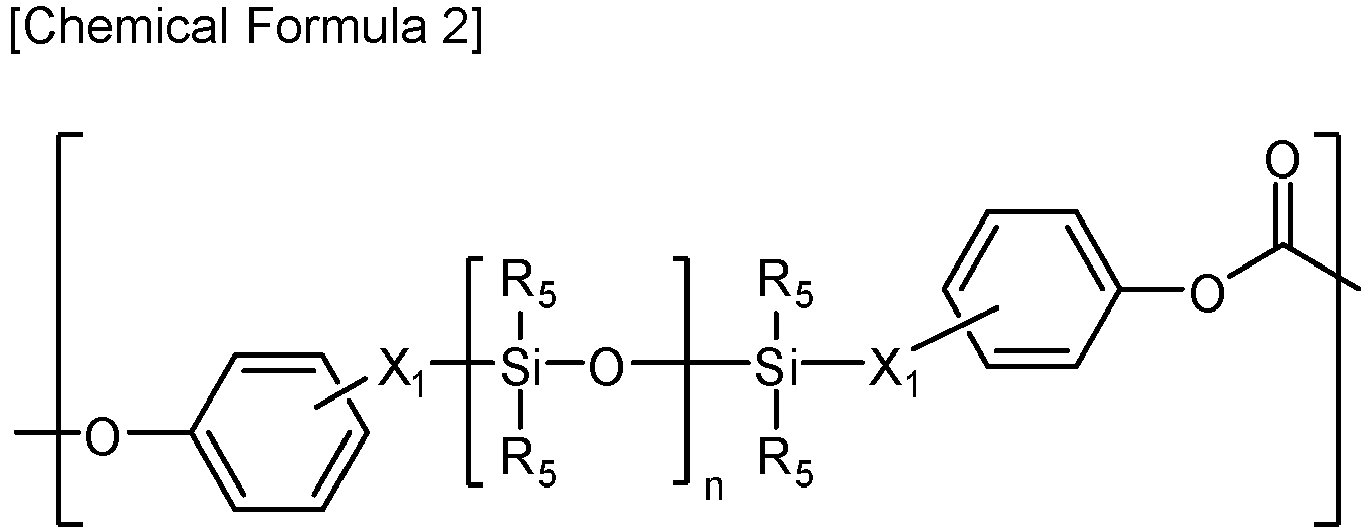
- X1 is each independently C1-10 alkylene,
- R5 is each independently hydrogen; unsubstituted or oxiranyl, oxiranyl-substituted C1-10 alkoxy, or C6-20 aryl-substituted C1-15 alkyl; halogen; C1-10 alkoxy; allyl; C1-10 haloalkyl; or C6-20 aryl, and
- n is an integer of 10 to 200,

- X2 is each independently C1-10 alkylene,
- Y1 is each independently hydrogen, C1-6 alkyl, halogen, hydroxy, C1-6 alkoxy, or C6-20 aryl,
- R6 is each independently hydrogen; unsubstituted or oxiranyl, oxiranyl-substituted C1-10 alkoxy, or C6-20 aryl-substituted C1-15 alkyl; halogen; C1-10 alkoxy; allyl; C1-10 haloalkyl; or C6-20 aryl, and
- m is an integer of 10 to 200,

- X3 is each independently C1-10 alkylene,
- Y2 is each independently hydrogen, C1-6 alkyl, halogen, hydroxy, C1-6 alkoxy, or C6-20 aryl,
- R7 is each independently hydrogen; unsubstituted or oxiranyl, oxiranyl-substituted C1-10 alkoxy, or C6-20 aryl-substituted C1-15 alkyl; halogen; C1-10 alkoxy; allyl; C1-10 haloalkyl; or C6-20 aryl, and
- k is an integer of 10 to 200,
- in Chemical Formula 5,
- X4 is each independently C1-10 alkylene,
- Y is C1-10 alkylene or C6-20 arylene,
- R8 is each independently hydrogen; unsubstituted or oxiranyl, oxiranyl-substituted C1-10 alkoxy, or C6-20 aryl-substituted C1-15 alkyl; halogen; C1-10 alkoxy; allyl; C1-10 haloalkyl; or C6-20 aryl, and
- q is an integer of 10 to 200.
- In Chemical Formula 2, preferably, X1 is each independently C2-10 alkylene, more preferably, C2-4 alkylene, and most preferably, propane-1,3-diyl.
- Preferably, R5 is each independently hydrogen, methyl, ethyl, propyl, 3-phenylpropyl, 2-phenylpropyl, 3-(oxiranylmethoxy)propyl, fluoro, chloro, bromo, iodo, methoxy, ethoxy, propoxy, allyl, 2,2,2-trifluoroethyl, 3,3,3-trifluoropropyl, phenyl, or naphthyl. Preferably, R5 is each independently C1-10 alkyl, more preferably, C1-6 alkyl, much more preferably, C1-3 alkyl, and most preferably, methyl.
- Preferably, n is an integer of 10 or more, 15 or more, 20 or more, 25 or more, 30 or more, 31 or more, or 32 or more, and 50 or less, 45 or less, 40 or less, 39 or less, 38 or less, or 37 or less.
- In Chemical Formula 3, preferably, X2 is each independently C2-10 alkylene, more preferably, C2-6 alkylene, and most preferably isobutylene.
- Preferably, Y1 is hydrogen.
- Preferably, R6 is each independently hydrogen, methyl, ethyl, propyl, 3-phenylpropyl, 2-phenylpropyl, 3-(oxiranylmethoxy)propyl, fluoro, chloro, bromo, iodo, methoxy, ethoxy, propoxy, allyl, 2,2,2-trifluoroethyl, 3,3,3-trifluoropropyl, phenyl, or naphthyl. Preferably, R6 is each independently C1-10 alkyl, more preferably, C1-6 alkyl, much more preferably, C1-3 alkyl, and most preferably, methyl.
- Preferably, m is an integer of 30 or more, 35 or more, 40 or more, 45 or more, 46 or more, 47 or more, or 48 or more, and 70 or less, 65 or less, 60 or less, 55 or less, 54 or less, 53 or less, or 52 or less.
- Preferably, the repeating unit represented by Chemical Formula 2 may be represented by the following Chemical Formula 2-2:


- Preferably, the repeating unit represented by Chemical Formula 3 may be represented by the following Chemical Formula 3-2:

- The repeating unit represented by Chemical Formula 2 and the repeating unit represented by Chemical Formula 3 are derived from a polysiloxane compound represented by the following Chemical Formula 2-1 and a polysiloxane compound represented by the following Chemical Formula 3-1, respectively:

X1, R5, and n are the same as defined in Chemical Formula 2,
X2, Y1, R6, and m are the same as defined in Chemical Formula 3. - The description 'derived from a polysiloxane compound' means that a hydroxy group of each polysiloxane compound and a carbonate precursor are reacted to form the repeating units represented by Chemical Formulae 2 to 5, respectively. Further, the carbonate precursors that may be used in the formation of the repeating units of Chemical Formulae 2 to 5 are the same as described in the carbonate precursor that may be used in the formation of the repeating unit of Chemical Formula 1 described above.
- As described above, the copolycarbonate including the first repeating unit and the second repeating unit is reacted with methanol to decompose the copolycarbonate into the aromatic diol compound and the polysiloxane-containing aromatic diol compound which are starting materials.
- According to one exemplary embodiment of the present invention, when the copolycarbonate is reacted with methanol under alkaline conditions, it may be decomposed by an alkali-catalyzed alcoholysis reaction into the aromatic diol compound and the polysiloxane-containing aromatic diol compound, which are starting materials, respectively. In other words, according to the alkali-catalyzed alcoholysis reaction, the copolycarbonate may be decomposed into the aromatic diol compound and the polysiloxane-containing aromatic diol compound.
- More specifically, an alkali salt is dissolved in methanol to prepare an alkali hydroxide solution. The alkali salt used herein may be, for example, sodium hydroxide (NaOH), potassium hydroxide (KOH), or ammonium hydroxide (NH4OH), but the present invention is not limited thereto.
- When the alkali hydroxide solution thus prepared is reacted with copolycarbonate, the carbonate bond is decomposed by the alkali-catalyzed alcoholysis reaction, and as a result, the copolycarbonate may be decomposed into the aromatic diol compound and the polysiloxane-containing aromatic diol compound. In this regard, the temperature of the alkali-catalyzed alcoholysis reaction may be 40°C to 80°C, or 60°C to 70°C. In addition, the reaction time is not particularly limited, as long as it is a time for which the copolycarbonate may be completely decomposed. However, the reaction may be performed for, for example, 1 hr to 10 hr, or 2 hr to 8 hr, and in order to facilitate the reaction, the reaction may be performed under stirring using a magnetic bar, etc.
- The reaction may be performed in a hydrocarbon-based solvent. For example, aliphatic hydrocarbon solvents having 5 to 12 carbon atoms, such as pentane, hexane, heptane, nonane, decane, and isomers thereof, aromatic hydrocarbon solvents such as toluene and benzene, chlorine-substituted hydrocarbon solvents such as dichloromethane and chlorobenzene, etc. may be used, but the present invention is not limited thereto.
- According to the present invention, as described above, the copolycarbonate and methanol are reacted to decompose the copolycarbonate into the aromatic diol compound and the polysiloxane-containing aromatic diol compound, and then the decomposition product is quenched using liquid nitrogen without a separate extraction and/or purification process, and is diluted with a solvent such as THF, followed by GPC. Bisphenol, dimethyl carbonate, methanol, NaOH, and the like are present in the decomposition product, but a polymeric material which may be identified through GPC is only the polysiloxane-containing aromatic diol compound, and therefore, no additional extraction and/or purification processes are required. As described, since no separate extraction process is required after decomposition, the molecular weight and the molecular weight distribution of the polysiloxane-containing aromatic diol compound in copolycarbonate may be more accurately analyzed while the process is simplified.
- Alternatively, after the reaction is completed, when the mixture containing the aromatic diol compound and the polysiloxane-containing aromatic diol compound is quenched with distilled water and/or toluene, and left at room temperature, it is separated into the crystalline aromatic diol compound and the amorphous polysiloxane-containing aromatic diol compound, and the separated polysiloxane-containing aromatic diol compound may be extracted, followed by GPC.
- Next, the extracted polysiloxane-containing aromatic diol compound is subjected to gel permeation chromatography (GPC), and a GPC curve graph is obtained.
- The weight average molecular weight, number average molecular weight, and molecular weight distribution of the extracted polysiloxane-containing aromatic diol compound may be obtained by the GPC.
- The GPC is a kind of liquid-solid-phase liquid chromatography using an elution method, in which a large molecule is first eluted due to the size of a solute molecule. When molecules have the same size, they may be eluted at the same position, regardless of the type of solutes or the type of functional groups.
- In the GPC, a mobile phase is based on a liquid chromatography grade, and may be used after filtration, and a solvent having a high viscosity is used by raising its temperature, and the solvent may be appropriately selected, taking the temperature of each solvent into consideration. When a polar solvent is used as the solvent, it is necessary to use an additive to prevent formation of micelles.
- The type of a column filler used in the GPC is not particularly limited, but, for example, a rigid or semi-rigid, cross-linked macromolecular polymer, and glass or silica with a controlled pore size may be used. The filler may withstand a pressure of up to 3000 psi, and aqueous solutions and various polar organic solvents may be used. Porous glass and silica may be used after being prepared to have various pore sizes. These fillers are chemically resistant to pH of 10 or less, and are resistant to aqueous solutions and polar organic solvents. In the case of using a non-polar solvent, the surface must be deactivated by silylation in order to avoid irreversible retention by polar solutes. The packing volume may be maintained constant at a high flow rate and high pressure.
- The GPC device is not particularly limited, but may consist of, for example, a pump, a sample injector, and a detector.
- The pump must be able to maintain a constant flow rate, and requires reproducibility of the flow rate, particularly, reproducibility independent of viscosity of the polymer. In addition, when analysis is performed at a high temperature, it is generally required to raise the temperature to 55°C or higher.
- The amounts of the sample and the standard material injected into the sample injector should be equal, and in general, Rheodyne, U6K, auto injector type, etc. may be used. The injection amounts of the sample and the standard material are usually about 50 µl to 100 µl per column.
- The type of the detector is not particularly limited, but for example, a differential refractometer and a spectrophotometric detector operating in the ultraviolet and infrared regions may be used. The detector has an operating volume of 1 ml to 10 ml in an exclusion tube having a length of 3 m to 6 m, and the analysis time is usually less than 30 minutes.
- With respect to the copolycarbonate into which the polysiloxane structure is introduced by the above described method, the weight average molecular weight, the number average molecular weight, and the molecular weight distribution of the polysiloxane-containing aromatic diol compound used as a starting material may be accurately analyzed.
- Meanwhile, according to one exemplary embodiment of the present invention, nuclear magnetic resonance (NMR) may be additionally performed on the copolycarbonate into which the polysiloxane structure is introduced. The structures of the repeating units constituting the copolycarbonate may be inferred by NMR analysis, and therefore, even when the repeating unit of the copolycarbonate to be analyzed by the present invention, i.e., the polysiloxane-containing aromatic diol compound includes a functional group decomposable in methanol, the weight average molecular weight, the number average molecular weight, and the molecular weight distribution of the repeating unit may be obtained by taking together the structure analyzed by NMR.
- The present invention will be described in more detail with reference to the following exemplary embodiments. However, the following exemplary embodiments are for illustrative purposes only, and the scope of the present invention is not intended to be limited by the following exemplary embodiments.
- A copolycarbonate including a first repeating unit derived from bisphenol A (BPA) of LG Chem, Ltd. and a second repeating unit derived from a polysiloxane-containing aromatic diol compound having the following structural formula (including polysiloxane-containing aromatic diol compound in an amount of 7% by weight, based on the total weight of the copolycarbonate) was prepared.
- The following polysiloxane-containing aromatic diol compound used as a starting material had a weight average molecular weight of 4,830 g/mol, a number average molecular weight of 3,300 g/mol, and a molecular weight distribution (Mw/Mn) of 1.47.

- Copolycarbonate FG1700 of Idemitsu Co., including a repeating unit derived from a polysiloxane-containing aromatic diol compound, was prepared.

- Copolycarbonate EXL1414 of Sabic Corp., including a repeating unit derived from a polysiloxane-containing aromatic diol compound, was prepared.

- Copolycarbonate 3022PJ of Samyang Corp., including a repeating unit derived from a polysiloxane-containing aromatic diol compound, was prepared.

- The repeating units of Preparation Examples 2 to 4 were structures analyzed by NMR.
- 1 g of the copolycarbonate pellet of Preparation Example 1 was dissolved in 2 ml of toluene, and 34 mg of NaOH was dissolved in 1 ml of methanol, and these two solutions were mixed. The mixed solution was heated at 60 °C under stirring, and allowed to react for 6 hr until no pellet forms were left.
- After the decomposition reaction was completed, the decomposition product including the polysiloxane-containing diol compound was quenched in liquid nitrogen at -196°C, and 4 g of the decomposition product was diluted in 200 ml of a tetrahydrofuran (THF) solvent to prepare a sample of about 20,000 ppm, of which molecular weight was measured using a Agilent 1200 series GPC system through an RI detector at a flow rate of 1 ml/min. To calculate the molecular weight of the sample, eight PS standards were used to prepare a calibration curve, and based on the curve, the weight average molecular weight, the number average molecular weight, and the molecular weight distribution of the sample were determined and shown in Table 1 below.
[Table 1] Weight average molecular weight (Mw, unit: g/mol) Number average molecular weight (Mn, unit: g/mol) Molecular weight distribution (PDI, Mw/Mn) Reference Example (polysiloxane- 4,830 3,300 1.47 containing aromatic diol compound used as starting material) Example 1 5,050 3,340 1.51 - Referring to Table 1, the weight average molecular weight, the number average molecular weight, and the molecular weight distribution of the decomposed polysiloxane-containing aromatic diol compound with respect to the weight average molecular weight, the number average molecular weight, and the molecular weight distribution of the polysiloxane-containing aromatic diol compound which is a starting material before polymerization were about 104%, about 101%, and about 103%, respectively, indicating that the error was within 5%, as compared with the measured values of the actual starting material.
- The copolycarbonates of Preparation Examples 2 to 4 were decomposed in the same manner as in Example 1.
4 g of the decomposition product including the decomposed polysiloxane-containing diol compound was diluted in 200 ml of a tetrahydrofuran (THF) solvent to prepare a sample of about 20,000 ppm, of which molecular weight was measured using a Agilent 1200 series GPC system through an RI detector at a flow rate of 1 ml/min. To calculate the molecular weight of the sample, eight PS standards were used to prepare a calibration curve, and based on the curve, the weight average molecular weight, the number average molecular weight, and the molecular weight distribution of each sample were determined. - The structures of the copolycarbonates of Preparation Examples 2 to 4 were analyzed by 1H-NMR using Varian 500 MHz, and the number average molecular weight of the polysiloxane-containing diol compound was measured.
- For the analysis of the molecular weight of the polysiloxane-containing diol compound by 1H-NMR, the number of the repeating unit derived from the polysiloxane-containing diol compound was calculated using proton, and multiplied by the molecular weight of one repeating unit, which may be determined as the number average molecular weight.
- The weight average molecular weight and the number average molecular weight, which were measured for the polysiloxane-containing aromatic diol compounds of Examples 2 to 4 by GPC and NMR, respectively, were compared in Table 2 below.
[Table 2] Weight average molecular weight (unit: g/mol) as measured by GPC Number average molecular weight (unit: g/mol) as measured by NMR Number average molecular weight (unit: g/mol) as measured by GPC Molecular weight distribution as measured by GPC Example 2 6,190 5,750 4,600 1.35 Example 3 5,660 4,000 3,990 1.42 Example 4 3,170 4,770 2,470 1.28 - Referring to Table 2, the number average molecular weights of the polysiloxane-containing aromatic diol compounds decomposed according to the method of the present invention were about 80%, about 99.8%, and about 51.8% of those of the copolycarbonates including different structures of polysiloxane, as measured by NMR.
- In the case of Example 4, the number average molecular weight measured by GPC was about 51% of the number average molecular weight measured by NMR, which may be attributed to that the polysiloxane-containing aromatic diol compound includes ester bonds during analysis of its structure by NMR, and these ester bonds are also decomposed during methanolysis. Accordingly, considering the decomposition of the ester bonds, it is almost consistent with the number average molecular weight measured by NMR.

Claims (12)
- A method of analyzing a copolycarbonate, the method comprising:reacting the copolycarbonate including a first repeating unit derived from an aromatic diol compound and a second repeating unit derived from a polysiloxane-containing aromatic diol compound with methanol to decompose the copolycarbonate into the aromatic diol compound and the polysiloxane-containing aromatic diol compound; andperforming gel permeation chromatography of the decomposed polysiloxane-containing aromatic diol compound.
- The method of claim 1, wherein the step of performing gel permeation chromatography of the decomposed polysiloxane-containing aromatic diol compound is performed by quenching the decomposition product including the decomposed polysiloxane-containing aromatic diol compound using liquid nitrogen and then diluting the product, followed by GPC.
- The method of claim 2, comprising no process of separately extracting the polysiloxane-containing aromatic diol compound from the decomposition product.
- The method of claim 1, wherein the first repeating unit is represented by the following Chemical Formula 1:

 R1 to R4 are each independently hydrogen, C1-10 alkyl, C1-10 alkoxy, or halogen, andZ is C1-10 alkylene unsubstituted or substituted with phenyl, C3-15 cycloalkylene unsubstituted or substituted with C1-10 alkyl, O, S, SO, SO2, or CO.
 - The method of claim 1, wherein the second repeating unit is represented by any one of the following Chemical Formula 2 to Chemical Formula 5:
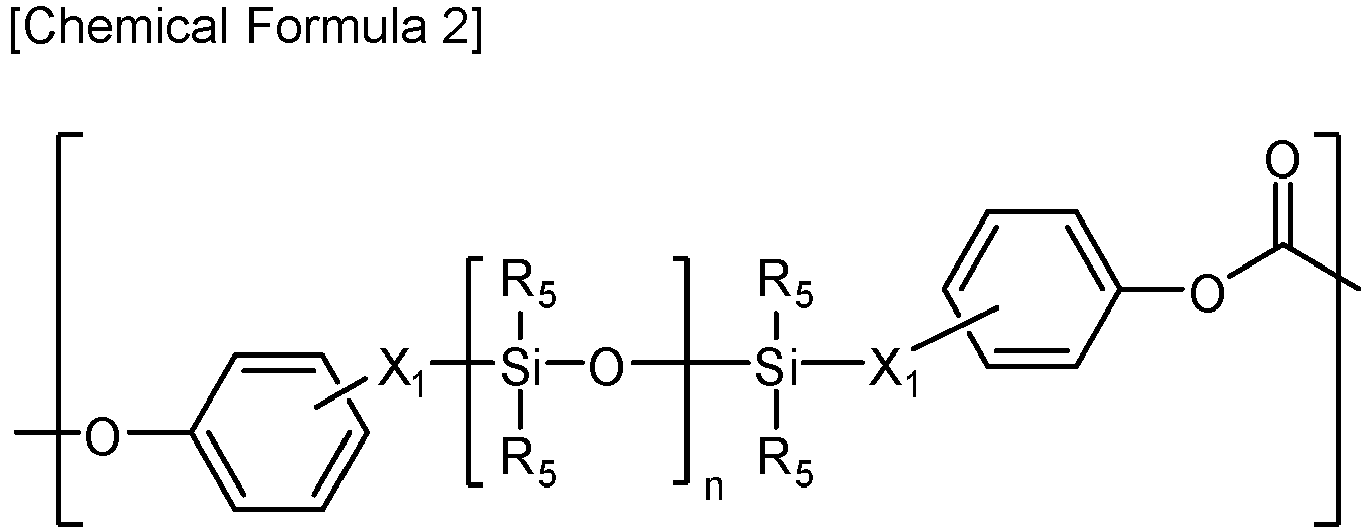 X1 is each independently C1-10 alkylene,R5 is each independently hydrogen; unsubstituted or oxiranyl, oxiranyl-substituted C1-10 alkoxy, or C6-20 aryl-substituted C1-15 alkyl; halogen; C1-10 alkoxy; allyl; C1-10 haloalkyl; or C6-20 aryl, andn is an integer of 10 to 200,in Chemical Formula 3,
 X2 is each independently C1-10 alkylene,Y1 is each independently hydrogen, C1-6 alkyl, halogen, hydroxy, C1-6 alkoxy, or C6-20 aryl,R6 is each independently hydrogen; unsubstituted or oxiranyl, oxiranyl-substituted C1-10 alkoxy, or C6-20 aryl-substituted C1-15 alkyl; halogen; C1-10 alkoxy; allyl; C1-10 haloalkyl; or C6-20 aryl, andm is an integer of 10 to 200,in Chemical Formula 4,
 X3 is each independently C1-10 alkylene,Y2 is each independently hydrogen, C1-6 alkyl, halogen, hydroxy, C1-6 alkoxy, or C6-20 aryl,R7 is each independently hydrogen; unsubstituted or oxiranyl, oxiranyl-substituted C1-10 alkoxy, or C6-20 aryl-substituted C1-15 alkyl; halogen; C1-10 alkoxy; allyl; C1-10 haloalkyl; or C6-20 aryl, andk is an integer of 10 to 200,in Chemical Formula 5,
 X4 is each independently C1-10 alkylene,Y is C1-10 alkylene or C6-20 arylene,R8 is each independently hydrogen; unsubstituted or oxiranyl, oxiranyl-substituted C1-10 alkoxy, or C6-20 aryl-substituted C1-15 alkyl; halogen; C1-10 alkoxy; allyl; C1-10 haloalkyl; or C6-20 aryl, andq is an integer of 10 to 200.
 - The method of claim 4, wherein the repeating unit represented by Chemical Formula 1 is derived from an aromatic diol compound represented by the following Chemical Formula 1-1:

R1 to R4 and Z are the same as defined in Chemical Formula 1. - The method of claim 5, wherein the repeating unit represented by Chemical Formula 2 is derived from a polysiloxane compound represented by the following Chemical Formula 2-1:
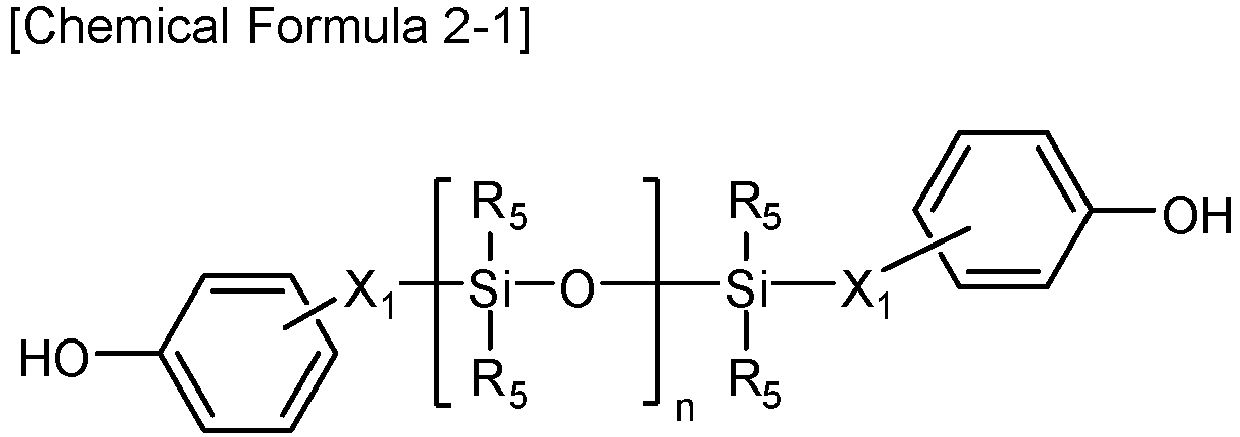
X1, R5 and n are the same as defined in Chemical Formula 2. - The method of claim 5, wherein the repeating unit represented by Chemical Formula 3 is derived from a polysiloxane compound represented by the following Chemical Formula 3-1:

X2, Y1, R6 and m are the same as defined in Chemical Formula 3. - The method of claim 1, wherein a weight average molecular weight, a number average molecular weight, and a molecular weight distribution are obtained by the gel permeation chromatography.
- The method of claim 1, wherein the step of reacting the copolycarbonate with methanol includes the steps of dissolving an alkali salt in methanol to prepare an alkali hydroxide solution; and reacting the prepared alkali hydroxide solution with the copolycarbonate to perform an alkali-catalyzed alcoholysis reaction.
- The method of claim 10, wherein the alkali-catalyzed alcoholysis reaction is performed at 40°C to 80°C.
- The method of claim 1, further comprising the step of performing nuclear magnetic resonance (NMR) of the copolycarbonate.
Applications Claiming Priority (2)
| Application Number | Priority Date | Filing Date | Title |
|---|---|---|---|
| KR20190073540 | 2019-06-20 | ||
| PCT/KR2020/008009 WO2020256494A1 (en) | 2019-06-20 | 2020-06-19 | Method for analyzing copolycarbonate |
Publications (3)
| Publication Number | Publication Date |
|---|---|
| EP3968017A1 true EP3968017A1 (en) | 2022-03-16 |
| EP3968017A4 EP3968017A4 (en) | 2022-09-14 |
| EP3968017B1 EP3968017B1 (en) | 2025-01-15 |
Family
ID=74088817
Family Applications (1)
| Application Number | Title | Priority Date | Filing Date |
|---|---|---|---|
| EP20825696.6A Active EP3968017B1 (en) | 2019-06-20 | 2020-06-19 | Method for analyzing copolycarbonate |
Country Status (3)
| Country | Link |
|---|---|
| EP (1) | EP3968017B1 (en) |
| KR (1) | KR102554769B1 (en) |
| CN (1) | CN114096835A (en) |
Family Cites Families (12)
| Publication number | Priority date | Publication date | Assignee | Title |
|---|---|---|---|---|
| US6136521A (en) * | 1997-02-20 | 2000-10-24 | Idemitsu Kosan Co., Ltd. | Polycarbonate, and molding and electrophotographic photoreceptor prepared therefrom |
| US6395862B1 (en) * | 2001-01-12 | 2002-05-28 | General Electric Company | Melt polycarbonate catalyst systems |
| CN101415750A (en) * | 2006-04-20 | 2009-04-22 | 三菱化学株式会社 | Polycarbonate resin |
| CN101407450A (en) * | 2008-05-14 | 2009-04-15 | 青岛科技大学 | Chemical recovery method for waste polycarbonate material |
| US9234096B2 (en) * | 2011-02-03 | 2016-01-12 | Sabic Global Technologies B.V. | Color and heat stable polycarbonate compositions and methods of making |
| KR101492956B1 (en) * | 2011-12-26 | 2015-02-13 | 주식회사 삼양사 | Method of preparing polysiloxane-polycarbonate copolymer |
| JP6163644B2 (en) * | 2012-03-30 | 2017-07-19 | 三菱ケミカル株式会社 | Polycarbonate resin and composition thereof |
| JP6355951B2 (en) * | 2014-03-31 | 2018-07-11 | 出光興産株式会社 | Polyorganosiloxane, polycarbonate-polyorganosiloxane copolymer and method for producing the same |
| WO2016089135A2 (en) * | 2014-12-04 | 2016-06-09 | 주식회사 엘지화학 | Copolycarbonate resin composition and article comprising same |
| WO2017111499A1 (en) * | 2015-12-24 | 2017-06-29 | 주식회사 엘지화학 | Polymer compound, method for preparing modified conjugated diene-based polymer by using same, and modified conjugated diene-based polymer |
| WO2018035185A1 (en) * | 2016-08-17 | 2018-02-22 | Zeus Industrial Products, Inc. | Polymer alcoholysis |
| KR102168679B1 (en) * | 2016-10-20 | 2020-10-21 | 주식회사 엘지화학 | Copolycarbonate and resin compositin comprising the same |
-
2020
- 2020-06-19 KR KR1020200074897A patent/KR102554769B1/en active Active
- 2020-06-19 EP EP20825696.6A patent/EP3968017B1/en active Active
- 2020-06-19 CN CN202080044671.1A patent/CN114096835A/en active Pending
Also Published As
| Publication number | Publication date |
|---|---|
| KR20200145751A (en) | 2020-12-30 |
| EP3968017B1 (en) | 2025-01-15 |
| EP3968017A4 (en) | 2022-09-14 |
| KR102554769B1 (en) | 2023-07-12 |
| CN114096835A (en) | 2022-02-25 |
Similar Documents
| Publication | Publication Date | Title |
|---|---|---|
| TWI586702B (en) | Copolycarbonate resin composition | |
| EP3081584A1 (en) | Polycarbonate-polyorganosiloxane copolymer and method for producing same | |
| US7863404B2 (en) | Method of making isosorbide polycarbonate | |
| EP2937373B1 (en) | Copolycarbonate resin and product comprising same | |
| Kayan | Copolymerization reactions of butadiene monoxide with 3‐glycidyloxypropyltrimethoxysilane and styrene oxide and their glycol derivatives | |
| US11118009B2 (en) | Aromatic polycarbonate oligomer solid | |
| Mei et al. | Synthesis and characterization of novel glycerol‐derived polycarbonates with pendant hydroxyl groups | |
| CN113646359A (en) | Polycarbonate resin | |
| EP2921517A1 (en) | Production method for aromatic polycarbonate resin having increased molecular weight | |
| EP3968017B1 (en) | Method for analyzing copolycarbonate | |
| US12631616B2 (en) | Method of analyzing copolycarbonate | |
| US20220244235A1 (en) | Method of analyzing copolycarbonate | |
| Sharma et al. | Microstructure and Properties of Poly (amide urethane) s: Comparison of the Reactivity of α‐Hydroxy‐ω‐O‐phenyl Urethanes and α‐Hydroxy‐ω‐O‐hydroxyethyl Urethanes | |
| JP6176066B2 (en) | Polycarbonate resin composition | |
| CN112449645B (en) | Polycarbonate resin and method for producing same | |
| US6288204B1 (en) | Branched polycarbonate resin and process for producing the same | |
| EP3381980B1 (en) | Polycarbonate resin composition | |
| EP3388466A1 (en) | Aromatic polycarbonate oligomer solid | |
| Miyasaka et al. | Synthesis of hyperbranched polycarbonate by novel polymerization of di-tert-butyl tricarbonate with 1, 1, 1-tris (4-hydroxyphenyl) ethane | |
| EP3205685B1 (en) | Copolycarbonate and composition comprising same | |
| KR102509705B1 (en) | Method of analyzing polycarbonate linear oligomer mixture and method of synthesizing polycarbonate cyclic oligomer by using the same | |
| Narcross et al. | Increasing the Lifetime of Epoxy Components with Antioxidant Stabilizers | |
| JPS59120627A (en) | Production of polysulfide carbonate | |
| EP3632956A1 (en) | Aromatic polycarbonate oligomer solid | |
| EP3388467A1 (en) | Aromatic polycarbonate oligomer solid |
Legal Events
| Date | Code | Title | Description |
|---|---|---|---|
| STAA | Information on the status of an ep patent application or granted ep patent |
Free format text: STATUS: THE INTERNATIONAL PUBLICATION HAS BEEN MADE |
|
| PUAI | Public reference made under article 153(3) epc to a published international application that has entered the european phase |
Free format text: ORIGINAL CODE: 0009012 |
|
| STAA | Information on the status of an ep patent application or granted ep patent |
Free format text: STATUS: REQUEST FOR EXAMINATION WAS MADE |
|
| 17P | Request for examination filed |
Effective date: 20211206 |
|
| AK | Designated contracting states |
Kind code of ref document: A1 Designated state(s): AL AT BE BG CH CY CZ DE DK EE ES FI FR GB GR HR HU IE IS IT LI LT LU LV MC MK MT NL NO PL PT RO RS SE SI SK SM TR |
|
| A4 | Supplementary search report drawn up and despatched |
Effective date: 20220812 |
|
| RIC1 | Information provided on ipc code assigned before grant |
Ipc: G01N 30/06 20060101ALI20220808BHEP Ipc: C08J 11/24 20060101ALI20220808BHEP Ipc: G01N 24/08 20060101ALI20220808BHEP Ipc: B01D 15/34 20060101ALI20220808BHEP Ipc: G01N 30/88 20060101AFI20220808BHEP |
|
| DAV | Request for validation of the european patent (deleted) | ||
| DAX | Request for extension of the european patent (deleted) | ||
| GRAP | Despatch of communication of intention to grant a patent |
Free format text: ORIGINAL CODE: EPIDOSNIGR1 |
|
| STAA | Information on the status of an ep patent application or granted ep patent |
Free format text: STATUS: GRANT OF PATENT IS INTENDED |
|
| INTG | Intention to grant announced |
Effective date: 20241010 |
|
| GRAS | Grant fee paid |
Free format text: ORIGINAL CODE: EPIDOSNIGR3 |
|
| GRAA | (expected) grant |
Free format text: ORIGINAL CODE: 0009210 |
|
| STAA | Information on the status of an ep patent application or granted ep patent |
Free format text: STATUS: THE PATENT HAS BEEN GRANTED |
|
| AK | Designated contracting states |
Kind code of ref document: B1 Designated state(s): AL AT BE BG CH CY CZ DE DK EE ES FI FR GB GR HR HU IE IS IT LI LT LU LV MC MK MT NL NO PL PT RO RS SE SI SK SM TR |
|
| REG | Reference to a national code |
Ref country code: CH Ref legal event code: EP Ref country code: GB Ref legal event code: FG4D |
|
| REG | Reference to a national code |
Ref country code: DE Ref legal event code: R096 Ref document number: 602020044927 Country of ref document: DE |
|
| REG | Reference to a national code |
Ref country code: IE Ref legal event code: FG4D |
|
| REG | Reference to a national code |
Ref country code: NL Ref legal event code: MP Effective date: 20250115 |
|
| PG25 | Lapsed in a contracting state [announced via postgrant information from national office to epo] |
Ref country code: NL Free format text: LAPSE BECAUSE OF FAILURE TO SUBMIT A TRANSLATION OF THE DESCRIPTION OR TO PAY THE FEE WITHIN THE PRESCRIBED TIME-LIMIT Effective date: 20250115 |
|
| PG25 | Lapsed in a contracting state [announced via postgrant information from national office to epo] |
Ref country code: RS Free format text: LAPSE BECAUSE OF FAILURE TO SUBMIT A TRANSLATION OF THE DESCRIPTION OR TO PAY THE FEE WITHIN THE PRESCRIBED TIME-LIMIT Effective date: 20250415 |
|
| PG25 | Lapsed in a contracting state [announced via postgrant information from national office to epo] |
Ref country code: FI Free format text: LAPSE BECAUSE OF FAILURE TO SUBMIT A TRANSLATION OF THE DESCRIPTION OR TO PAY THE FEE WITHIN THE PRESCRIBED TIME-LIMIT Effective date: 20250115 |
|
| PG25 | Lapsed in a contracting state [announced via postgrant information from national office to epo] |
Ref country code: PL Free format text: LAPSE BECAUSE OF FAILURE TO SUBMIT A TRANSLATION OF THE DESCRIPTION OR TO PAY THE FEE WITHIN THE PRESCRIBED TIME-LIMIT Effective date: 20250115 |
|
| PGFP | Annual fee paid to national office [announced via postgrant information from national office to epo] |
Ref country code: DE Payment date: 20250520 Year of fee payment: 6 |
|
| PG25 | Lapsed in a contracting state [announced via postgrant information from national office to epo] |
Ref country code: ES Free format text: LAPSE BECAUSE OF FAILURE TO SUBMIT A TRANSLATION OF THE DESCRIPTION OR TO PAY THE FEE WITHIN THE PRESCRIBED TIME-LIMIT Effective date: 20250115 |
|
| REG | Reference to a national code |
Ref country code: LT Ref legal event code: MG9D |
|
| PG25 | Lapsed in a contracting state [announced via postgrant information from national office to epo] |
Ref country code: NO Free format text: LAPSE BECAUSE OF FAILURE TO SUBMIT A TRANSLATION OF THE DESCRIPTION OR TO PAY THE FEE WITHIN THE PRESCRIBED TIME-LIMIT Effective date: 20250415 Ref country code: IS Free format text: LAPSE BECAUSE OF FAILURE TO SUBMIT A TRANSLATION OF THE DESCRIPTION OR TO PAY THE FEE WITHIN THE PRESCRIBED TIME-LIMIT Effective date: 20250515 |
|
| REG | Reference to a national code |
Ref country code: AT Ref legal event code: MK05 Ref document number: 1760145 Country of ref document: AT Kind code of ref document: T Effective date: 20250115 |
|
| PG25 | Lapsed in a contracting state [announced via postgrant information from national office to epo] |
Ref country code: HR Free format text: LAPSE BECAUSE OF FAILURE TO SUBMIT A TRANSLATION OF THE DESCRIPTION OR TO PAY THE FEE WITHIN THE PRESCRIBED TIME-LIMIT Effective date: 20250115 |
|
| PG25 | Lapsed in a contracting state [announced via postgrant information from national office to epo] |
Ref country code: LV Free format text: LAPSE BECAUSE OF FAILURE TO SUBMIT A TRANSLATION OF THE DESCRIPTION OR TO PAY THE FEE WITHIN THE PRESCRIBED TIME-LIMIT Effective date: 20250115 Ref country code: PT Free format text: LAPSE BECAUSE OF FAILURE TO SUBMIT A TRANSLATION OF THE DESCRIPTION OR TO PAY THE FEE WITHIN THE PRESCRIBED TIME-LIMIT Effective date: 20250515 |
|
| PGFP | Annual fee paid to national office [announced via postgrant information from national office to epo] |
Ref country code: FR Payment date: 20250521 Year of fee payment: 6 |
|
| PG25 | Lapsed in a contracting state [announced via postgrant information from national office to epo] |
Ref country code: BG Free format text: LAPSE BECAUSE OF FAILURE TO SUBMIT A TRANSLATION OF THE DESCRIPTION OR TO PAY THE FEE WITHIN THE PRESCRIBED TIME-LIMIT Effective date: 20250115 Ref country code: GR Free format text: LAPSE BECAUSE OF FAILURE TO SUBMIT A TRANSLATION OF THE DESCRIPTION OR TO PAY THE FEE WITHIN THE PRESCRIBED TIME-LIMIT Effective date: 20250416 |
|
| PG25 | Lapsed in a contracting state [announced via postgrant information from national office to epo] |
Ref country code: AT Free format text: LAPSE BECAUSE OF FAILURE TO SUBMIT A TRANSLATION OF THE DESCRIPTION OR TO PAY THE FEE WITHIN THE PRESCRIBED TIME-LIMIT Effective date: 20250115 |
|
| PG25 | Lapsed in a contracting state [announced via postgrant information from national office to epo] |
Ref country code: SE Free format text: LAPSE BECAUSE OF FAILURE TO SUBMIT A TRANSLATION OF THE DESCRIPTION OR TO PAY THE FEE WITHIN THE PRESCRIBED TIME-LIMIT Effective date: 20250115 |
|
| PG25 | Lapsed in a contracting state [announced via postgrant information from national office to epo] |
Ref country code: SM Free format text: LAPSE BECAUSE OF FAILURE TO SUBMIT A TRANSLATION OF THE DESCRIPTION OR TO PAY THE FEE WITHIN THE PRESCRIBED TIME-LIMIT Effective date: 20250115 |
|
| PG25 | Lapsed in a contracting state [announced via postgrant information from national office to epo] |
Ref country code: DK Free format text: LAPSE BECAUSE OF FAILURE TO SUBMIT A TRANSLATION OF THE DESCRIPTION OR TO PAY THE FEE WITHIN THE PRESCRIBED TIME-LIMIT Effective date: 20250115 |
|
| PG25 | Lapsed in a contracting state [announced via postgrant information from national office to epo] |
Ref country code: IT Free format text: LAPSE BECAUSE OF FAILURE TO SUBMIT A TRANSLATION OF THE DESCRIPTION OR TO PAY THE FEE WITHIN THE PRESCRIBED TIME-LIMIT Effective date: 20250115 |
|
| REG | Reference to a national code |
Ref country code: DE Ref legal event code: R097 Ref document number: 602020044927 Country of ref document: DE |
|
| PG25 | Lapsed in a contracting state [announced via postgrant information from national office to epo] |
Ref country code: CZ Free format text: LAPSE BECAUSE OF FAILURE TO SUBMIT A TRANSLATION OF THE DESCRIPTION OR TO PAY THE FEE WITHIN THE PRESCRIBED TIME-LIMIT Effective date: 20250115 Ref country code: EE Free format text: LAPSE BECAUSE OF FAILURE TO SUBMIT A TRANSLATION OF THE DESCRIPTION OR TO PAY THE FEE WITHIN THE PRESCRIBED TIME-LIMIT Effective date: 20250115 |
|
| PG25 | Lapsed in a contracting state [announced via postgrant information from national office to epo] |
Ref country code: RO Free format text: LAPSE BECAUSE OF FAILURE TO SUBMIT A TRANSLATION OF THE DESCRIPTION OR TO PAY THE FEE WITHIN THE PRESCRIBED TIME-LIMIT Effective date: 20250115 |
|
| PG25 | Lapsed in a contracting state [announced via postgrant information from national office to epo] |
Ref country code: SK Free format text: LAPSE BECAUSE OF FAILURE TO SUBMIT A TRANSLATION OF THE DESCRIPTION OR TO PAY THE FEE WITHIN THE PRESCRIBED TIME-LIMIT Effective date: 20250115 |
|
| PLBE | No opposition filed within time limit |
Free format text: ORIGINAL CODE: 0009261 |
|
| STAA | Information on the status of an ep patent application or granted ep patent |
Free format text: STATUS: NO OPPOSITION FILED WITHIN TIME LIMIT |
|
| REG | Reference to a national code |
Ref country code: CH Ref legal event code: L10 Free format text: ST27 STATUS EVENT CODE: U-0-0-L10-L00 (AS PROVIDED BY THE NATIONAL OFFICE) Effective date: 20251126 |
|
| 26N | No opposition filed |
Effective date: 20251016 |
|
| REG | Reference to a national code |
Ref country code: CH Ref legal event code: H13 Free format text: ST27 STATUS EVENT CODE: U-0-0-H10-H13 (AS PROVIDED BY THE NATIONAL OFFICE) Effective date: 20260127 |
|
| PG25 | Lapsed in a contracting state [announced via postgrant information from national office to epo] |
Ref country code: MC Free format text: LAPSE BECAUSE OF FAILURE TO SUBMIT A TRANSLATION OF THE DESCRIPTION OR TO PAY THE FEE WITHIN THE PRESCRIBED TIME-LIMIT Effective date: 20250115 |
|
| PG25 | Lapsed in a contracting state [announced via postgrant information from national office to epo] |
Ref country code: LU Free format text: LAPSE BECAUSE OF NON-PAYMENT OF DUE FEES Effective date: 20250619 |
|
| GBPC | Gb: european patent ceased through non-payment of renewal fee |
Effective date: 20250619 |
|
| REG | Reference to a national code |
Ref country code: BE Ref legal event code: MM Effective date: 20250630 |
|
| PG25 | Lapsed in a contracting state [announced via postgrant information from national office to epo] |
Ref country code: GB Free format text: LAPSE BECAUSE OF NON-PAYMENT OF DUE FEES Effective date: 20250619 |
|
| PG25 | Lapsed in a contracting state [announced via postgrant information from national office to epo] |
Ref country code: IE Free format text: LAPSE BECAUSE OF NON-PAYMENT OF DUE FEES Effective date: 20250619 |
|
| PG25 | Lapsed in a contracting state [announced via postgrant information from national office to epo] |
Ref country code: BE Free format text: LAPSE BECAUSE OF NON-PAYMENT OF DUE FEES Effective date: 20250630 |
|
| PG25 | Lapsed in a contracting state [announced via postgrant information from national office to epo] |
Ref country code: CH Free format text: LAPSE BECAUSE OF NON-PAYMENT OF DUE FEES Effective date: 20250630 |