EP3967330A1 - Methods for the synthesis of bioactivated metal nanocluster and their medical application - Google Patents
Methods for the synthesis of bioactivated metal nanocluster and their medical application Download PDFInfo
- Publication number
- EP3967330A1 EP3967330A1 EP20306002.5A EP20306002A EP3967330A1 EP 3967330 A1 EP3967330 A1 EP 3967330A1 EP 20306002 A EP20306002 A EP 20306002A EP 3967330 A1 EP3967330 A1 EP 3967330A1
- Authority
- EP
- European Patent Office
- Prior art keywords
- bioactivated
- formula
- nanocluster
- ligands
- metal nanocluster
- Prior art date
- Legal status (The legal status is an assumption and is not a legal conclusion. Google has not performed a legal analysis and makes no representation as to the accuracy of the status listed.)
- Withdrawn
Links
- 229910052751 metal Inorganic materials 0.000 title claims abstract description 116
- 239000002184 metal Substances 0.000 title claims abstract description 116
- 230000015572 biosynthetic process Effects 0.000 title claims description 41
- 238000000034 method Methods 0.000 title claims description 41
- 238000003786 synthesis reaction Methods 0.000 title claims description 37
- 239000003446 ligand Substances 0.000 claims abstract description 148
- 239000000203 mixture Substances 0.000 claims abstract description 57
- 239000010931 gold Substances 0.000 claims description 82
- PCHJSUWPFVWCPO-UHFFFAOYSA-N gold Chemical compound [Au] PCHJSUWPFVWCPO-UHFFFAOYSA-N 0.000 claims description 76
- 229910052737 gold Inorganic materials 0.000 claims description 73
- 206010028980 Neoplasm Diseases 0.000 claims description 52
- 230000000975 bioactive effect Effects 0.000 claims description 51
- 239000000243 solution Substances 0.000 claims description 50
- 210000004027 cell Anatomy 0.000 claims description 48
- 201000011510 cancer Diseases 0.000 claims description 38
- 239000011159 matrix material Substances 0.000 claims description 35
- 239000003814 drug Substances 0.000 claims description 21
- DHMQDGOQFOQNFH-UHFFFAOYSA-N Glycine Chemical compound NCC(O)=O DHMQDGOQFOQNFH-UHFFFAOYSA-N 0.000 claims description 18
- CKLJMWTZIZZHCS-REOHCLBHSA-N L-aspartic acid Chemical compound OC(=O)[C@@H](N)CC(O)=O CKLJMWTZIZZHCS-REOHCLBHSA-N 0.000 claims description 18
- 235000001014 amino acid Nutrition 0.000 claims description 15
- 229940024606 amino acid Drugs 0.000 claims description 15
- 150000001413 amino acids Chemical class 0.000 claims description 15
- KDXKERNSBIXSRK-UHFFFAOYSA-N Lysine Natural products NCCCCC(N)C(O)=O KDXKERNSBIXSRK-UHFFFAOYSA-N 0.000 claims description 14
- PXHVJJICTQNCMI-UHFFFAOYSA-N Nickel Chemical compound [Ni] PXHVJJICTQNCMI-UHFFFAOYSA-N 0.000 claims description 14
- BASFCYQUMIYNBI-UHFFFAOYSA-N platinum Chemical compound [Pt] BASFCYQUMIYNBI-UHFFFAOYSA-N 0.000 claims description 14
- 239000000546 pharmaceutical excipient Substances 0.000 claims description 13
- WHUUTDBJXJRKMK-UHFFFAOYSA-N Glutamic acid Natural products OC(=O)C(N)CCC(O)=O WHUUTDBJXJRKMK-UHFFFAOYSA-N 0.000 claims description 12
- AGPKZVBTJJNPAG-WHFBIAKZSA-N L-isoleucine Chemical compound CC[C@H](C)[C@H](N)C(O)=O AGPKZVBTJJNPAG-WHFBIAKZSA-N 0.000 claims description 12
- ROHFNLRQFUQHCH-YFKPBYRVSA-N L-leucine Chemical compound CC(C)C[C@H](N)C(O)=O ROHFNLRQFUQHCH-YFKPBYRVSA-N 0.000 claims description 12
- COLNVLDHVKWLRT-QMMMGPOBSA-N L-phenylalanine Chemical compound OC(=O)[C@@H](N)CC1=CC=CC=C1 COLNVLDHVKWLRT-QMMMGPOBSA-N 0.000 claims description 12
- OUYCCCASQSFEME-QMMMGPOBSA-N L-tyrosine Chemical compound OC(=O)[C@@H](N)CC1=CC=C(O)C=C1 OUYCCCASQSFEME-QMMMGPOBSA-N 0.000 claims description 12
- KZSNJWFQEVHDMF-UHFFFAOYSA-N Valine Natural products CC(C)C(N)C(O)=O KZSNJWFQEVHDMF-UHFFFAOYSA-N 0.000 claims description 12
- 239000007864 aqueous solution Substances 0.000 claims description 12
- 229940079593 drug Drugs 0.000 claims description 11
- 108090000765 processed proteins & peptides Proteins 0.000 claims description 11
- 238000011282 treatment Methods 0.000 claims description 11
- 235000018417 cysteine Nutrition 0.000 claims description 10
- XUJNEKJLAYXESH-UHFFFAOYSA-N cysteine Natural products SCC(N)C(O)=O XUJNEKJLAYXESH-UHFFFAOYSA-N 0.000 claims description 10
- 235000003704 aspartic acid Nutrition 0.000 claims description 9
- OQFSQFPPLPISGP-UHFFFAOYSA-N beta-carboxyaspartic acid Natural products OC(=O)C(N)C(C(O)=O)C(O)=O OQFSQFPPLPISGP-UHFFFAOYSA-N 0.000 claims description 9
- 239000003638 chemical reducing agent Substances 0.000 claims description 9
- 150000002343 gold Chemical class 0.000 claims description 9
- 102000004169 proteins and genes Human genes 0.000 claims description 9
- 108090000623 proteins and genes Proteins 0.000 claims description 9
- 125000006850 spacer group Chemical group 0.000 claims description 9
- 150000003573 thiols Chemical group 0.000 claims description 9
- RYGMFSIKBFXOCR-UHFFFAOYSA-N Copper Chemical compound [Cu] RYGMFSIKBFXOCR-UHFFFAOYSA-N 0.000 claims description 8
- 229910004042 HAuCl4 Inorganic materials 0.000 claims description 8
- 229910052802 copper Inorganic materials 0.000 claims description 8
- 239000010949 copper Substances 0.000 claims description 8
- 239000003550 marker Substances 0.000 claims description 8
- 235000018102 proteins Nutrition 0.000 claims description 8
- XLYOFNOQVPJJNP-UHFFFAOYSA-N water Substances O XLYOFNOQVPJJNP-UHFFFAOYSA-N 0.000 claims description 8
- LYCAIKOWRPUZTN-UHFFFAOYSA-N Ethylene glycol Chemical group OCCO LYCAIKOWRPUZTN-UHFFFAOYSA-N 0.000 claims description 7
- HNDVDQJCIGZPNO-YFKPBYRVSA-N L-histidine Chemical compound OC(=O)[C@@H](N)CC1=CN=CN1 HNDVDQJCIGZPNO-YFKPBYRVSA-N 0.000 claims description 7
- FFEARJCKVFRZRR-BYPYZUCNSA-N L-methionine Chemical compound CSCC[C@H](N)C(O)=O FFEARJCKVFRZRR-BYPYZUCNSA-N 0.000 claims description 7
- 239000004472 Lysine Substances 0.000 claims description 7
- 108700011259 MicroRNAs Proteins 0.000 claims description 7
- BQCADISMDOOEFD-UHFFFAOYSA-N Silver Chemical compound [Ag] BQCADISMDOOEFD-UHFFFAOYSA-N 0.000 claims description 7
- 229910052759 nickel Inorganic materials 0.000 claims description 7
- 229910052697 platinum Inorganic materials 0.000 claims description 7
- 229910052709 silver Inorganic materials 0.000 claims description 7
- 239000004332 silver Substances 0.000 claims description 7
- 239000004475 Arginine Substances 0.000 claims description 6
- DCXYFEDJOCDNAF-UHFFFAOYSA-N Asparagine Chemical compound OC(=O)C(N)CC(N)=O DCXYFEDJOCDNAF-UHFFFAOYSA-N 0.000 claims description 6
- 102000003922 Calcium Channels Human genes 0.000 claims description 6
- 108090000312 Calcium Channels Proteins 0.000 claims description 6
- 239000004471 Glycine Substances 0.000 claims description 6
- QNAYBMKLOCPYGJ-REOHCLBHSA-N L-alanine Chemical compound C[C@H](N)C(O)=O QNAYBMKLOCPYGJ-REOHCLBHSA-N 0.000 claims description 6
- QIVBCDIJIAJPQS-VIFPVBQESA-N L-tryptophane Chemical compound C1=CC=C2C(C[C@H](N)C(O)=O)=CNC2=C1 QIVBCDIJIAJPQS-VIFPVBQESA-N 0.000 claims description 6
- KZSNJWFQEVHDMF-BYPYZUCNSA-N L-valine Chemical compound CC(C)[C@H](N)C(O)=O KZSNJWFQEVHDMF-BYPYZUCNSA-N 0.000 claims description 6
- ROHFNLRQFUQHCH-UHFFFAOYSA-N Leucine Natural products CC(C)CC(N)C(O)=O ROHFNLRQFUQHCH-UHFFFAOYSA-N 0.000 claims description 6
- ONIBWKKTOPOVIA-UHFFFAOYSA-N Proline Natural products OC(=O)C1CCCN1 ONIBWKKTOPOVIA-UHFFFAOYSA-N 0.000 claims description 6
- MTCFGRXMJLQNBG-UHFFFAOYSA-N Serine Natural products OCC(N)C(O)=O MTCFGRXMJLQNBG-UHFFFAOYSA-N 0.000 claims description 6
- AYFVYJQAPQTCCC-UHFFFAOYSA-N Threonine Natural products CC(O)C(N)C(O)=O AYFVYJQAPQTCCC-UHFFFAOYSA-N 0.000 claims description 6
- 239000004473 Threonine Substances 0.000 claims description 6
- QIVBCDIJIAJPQS-UHFFFAOYSA-N Tryptophan Natural products C1=CC=C2C(CC(N)C(O)=O)=CNC2=C1 QIVBCDIJIAJPQS-UHFFFAOYSA-N 0.000 claims description 6
- 235000004279 alanine Nutrition 0.000 claims description 6
- 125000000217 alkyl group Chemical group 0.000 claims description 6
- ODKSFYDXXFIFQN-UHFFFAOYSA-N arginine Natural products OC(=O)C(N)CCCNC(N)=N ODKSFYDXXFIFQN-UHFFFAOYSA-N 0.000 claims description 6
- 235000013922 glutamic acid Nutrition 0.000 claims description 6
- 239000004220 glutamic acid Substances 0.000 claims description 6
- ZDXPYRJPNDTMRX-UHFFFAOYSA-N glutamine Natural products OC(=O)C(N)CCC(N)=O ZDXPYRJPNDTMRX-UHFFFAOYSA-N 0.000 claims description 6
- HNDVDQJCIGZPNO-UHFFFAOYSA-N histidine Natural products OC(=O)C(N)CC1=CN=CN1 HNDVDQJCIGZPNO-UHFFFAOYSA-N 0.000 claims description 6
- AGPKZVBTJJNPAG-UHFFFAOYSA-N isoleucine Natural products CCC(C)C(N)C(O)=O AGPKZVBTJJNPAG-UHFFFAOYSA-N 0.000 claims description 6
- 229960000310 isoleucine Drugs 0.000 claims description 6
- 229930182817 methionine Natural products 0.000 claims description 6
- 239000008194 pharmaceutical composition Substances 0.000 claims description 6
- COLNVLDHVKWLRT-UHFFFAOYSA-N phenylalanine Natural products OC(=O)C(N)CC1=CC=CC=C1 COLNVLDHVKWLRT-UHFFFAOYSA-N 0.000 claims description 6
- 150000003141 primary amines Chemical class 0.000 claims description 6
- OUYCCCASQSFEME-UHFFFAOYSA-N tyrosine Natural products OC(=O)C(N)CC1=CC=C(O)C=C1 OUYCCCASQSFEME-UHFFFAOYSA-N 0.000 claims description 6
- 239000004474 valine Substances 0.000 claims description 6
- 102000004310 Ion Channels Human genes 0.000 claims description 5
- 108090000862 Ion Channels Proteins 0.000 claims description 5
- 108091034117 Oligonucleotide Proteins 0.000 claims description 5
- -1 alkyl carboxylic acid Chemical class 0.000 claims description 5
- 230000001093 anti-cancer Effects 0.000 claims description 5
- 210000004899 c-terminal region Anatomy 0.000 claims description 5
- 230000002452 interceptive effect Effects 0.000 claims description 5
- 230000001225 therapeutic effect Effects 0.000 claims description 5
- KHMXVEUBFTUDOT-WSTBAARBSA-N 2-aminoacetic acid;(2s)-2-aminobutanedioic acid;(2s)-2-amino-5-(diaminomethylideneamino)pentanoic acid Chemical compound NCC(O)=O.OC(=O)[C@@H](N)CC(O)=O.OC(=O)[C@@H](N)CCCNC(N)=N KHMXVEUBFTUDOT-WSTBAARBSA-N 0.000 claims description 4
- LFQSCWFLJHTTHZ-UHFFFAOYSA-N Ethanol Chemical compound CCO LFQSCWFLJHTTHZ-UHFFFAOYSA-N 0.000 claims description 4
- 125000005011 alkyl ether group Chemical group 0.000 claims description 4
- 210000001808 exosome Anatomy 0.000 claims description 4
- 238000002405 diagnostic procedure Methods 0.000 claims description 3
- 150000003839 salts Chemical class 0.000 claims description 3
- 102100025222 CD63 antigen Human genes 0.000 claims description 2
- 102100027221 CD81 antigen Human genes 0.000 claims description 2
- 102100037904 CD9 antigen Human genes 0.000 claims description 2
- 108010062745 Chloride Channels Proteins 0.000 claims description 2
- 102000011045 Chloride Channels Human genes 0.000 claims description 2
- 101000934368 Homo sapiens CD63 antigen Proteins 0.000 claims description 2
- 101000914479 Homo sapiens CD81 antigen Proteins 0.000 claims description 2
- 101000738354 Homo sapiens CD9 antigen Proteins 0.000 claims description 2
- 102000004257 Potassium Channel Human genes 0.000 claims description 2
- 108010052164 Sodium Channels Proteins 0.000 claims description 2
- 102000018674 Sodium Channels Human genes 0.000 claims description 2
- 108700031126 Tetraspanins Proteins 0.000 claims description 2
- 102000043977 Tetraspanins Human genes 0.000 claims description 2
- 229920001184 polypeptide Polymers 0.000 claims description 2
- 108020001213 potassium channel Proteins 0.000 claims description 2
- 102000004196 processed proteins & peptides Human genes 0.000 claims description 2
- 238000001308 synthesis method Methods 0.000 abstract 1
- RWSXRVCMGQZWBV-WDSKDSINSA-N glutathione Chemical compound OC(=O)[C@@H](N)CCC(=O)N[C@@H](CS)C(=O)NCC(O)=O RWSXRVCMGQZWBV-WDSKDSINSA-N 0.000 description 44
- 229960003180 glutathione Drugs 0.000 description 24
- 238000003384 imaging method Methods 0.000 description 21
- 238000011534 incubation Methods 0.000 description 13
- 241000252212 Danio rerio Species 0.000 description 12
- 235000013601 eggs Nutrition 0.000 description 12
- 239000002105 nanoparticle Substances 0.000 description 12
- 238000012360 testing method Methods 0.000 description 11
- 239000002245 particle Substances 0.000 description 9
- HEDRZPFGACZZDS-UHFFFAOYSA-N Chloroform Chemical compound ClC(Cl)Cl HEDRZPFGACZZDS-UHFFFAOYSA-N 0.000 description 8
- 150000001875 compounds Chemical class 0.000 description 8
- 230000005284 excitation Effects 0.000 description 8
- 238000002474 experimental method Methods 0.000 description 8
- 238000002173 high-resolution transmission electron microscopy Methods 0.000 description 8
- 210000001161 mammalian embryo Anatomy 0.000 description 8
- 206010061902 Pancreatic neoplasm Diseases 0.000 description 7
- 210000001136 chorion Anatomy 0.000 description 7
- 238000001914 filtration Methods 0.000 description 7
- 150000002632 lipids Chemical class 0.000 description 7
- 230000003287 optical effect Effects 0.000 description 7
- 239000000126 substance Substances 0.000 description 7
- 230000008685 targeting Effects 0.000 description 7
- 238000002835 absorbance Methods 0.000 description 6
- 125000004432 carbon atom Chemical group C* 0.000 description 6
- 208000037265 diseases, disorders, signs and symptoms Diseases 0.000 description 6
- 230000000694 effects Effects 0.000 description 6
- 238000004108 freeze drying Methods 0.000 description 6
- 230000012010 growth Effects 0.000 description 6
- 201000002528 pancreatic cancer Diseases 0.000 description 6
- 239000000725 suspension Substances 0.000 description 6
- 210000004881 tumor cell Anatomy 0.000 description 6
- SNKAWJBJQDLSFF-NVKMUCNASA-N 1,2-dioleoyl-sn-glycero-3-phosphocholine Chemical compound CCCCCCCC\C=C/CCCCCCCC(=O)OC[C@H](COP([O-])(=O)OCC[N+](C)(C)C)OC(=O)CCCCCCC\C=C/CCCCCCCC SNKAWJBJQDLSFF-NVKMUCNASA-N 0.000 description 5
- 238000006243 chemical reaction Methods 0.000 description 5
- 238000004163 cytometry Methods 0.000 description 5
- 210000002257 embryonic structure Anatomy 0.000 description 5
- 239000007788 liquid Substances 0.000 description 5
- 208000015486 malignant pancreatic neoplasm Diseases 0.000 description 5
- 210000004379 membrane Anatomy 0.000 description 5
- 239000012528 membrane Substances 0.000 description 5
- 210000004940 nucleus Anatomy 0.000 description 5
- 230000002018 overexpression Effects 0.000 description 5
- 208000008443 pancreatic carcinoma Diseases 0.000 description 5
- 239000007787 solid Substances 0.000 description 5
- 241000251468 Actinopterygii Species 0.000 description 4
- IJGRMHOSHXDMSA-UHFFFAOYSA-N Atomic nitrogen Chemical compound N#N IJGRMHOSHXDMSA-UHFFFAOYSA-N 0.000 description 4
- 108010024636 Glutathione Proteins 0.000 description 4
- 102000049666 ORAI1 Human genes 0.000 description 4
- 108700027851 ORAI1 Proteins 0.000 description 4
- 239000004480 active ingredient Substances 0.000 description 4
- 125000004429 atom Chemical group 0.000 description 4
- 229910052799 carbon Inorganic materials 0.000 description 4
- 238000002512 chemotherapy Methods 0.000 description 4
- 230000006378 damage Effects 0.000 description 4
- 201000010099 disease Diseases 0.000 description 4
- 238000001000 micrograph Methods 0.000 description 4
- 210000000865 mononuclear phagocyte system Anatomy 0.000 description 4
- 239000003921 oil Substances 0.000 description 4
- 238000002360 preparation method Methods 0.000 description 4
- 230000005855 radiation Effects 0.000 description 4
- 238000011160 research Methods 0.000 description 4
- HEMHJVSKTPXQMS-UHFFFAOYSA-M Sodium hydroxide Chemical compound [OH-].[Na+] HEMHJVSKTPXQMS-UHFFFAOYSA-M 0.000 description 3
- 208000024313 Testicular Neoplasms Diseases 0.000 description 3
- 238000004458 analytical method Methods 0.000 description 3
- 239000000872 buffer Substances 0.000 description 3
- 238000003745 diagnosis Methods 0.000 description 3
- 239000006185 dispersion Substances 0.000 description 3
- 239000000839 emulsion Substances 0.000 description 3
- 238000005538 encapsulation Methods 0.000 description 3
- 238000009472 formulation Methods 0.000 description 3
- 239000002502 liposome Substances 0.000 description 3
- 230000007774 longterm Effects 0.000 description 3
- 238000004519 manufacturing process Methods 0.000 description 3
- 230000007246 mechanism Effects 0.000 description 3
- 108091070501 miRNA Proteins 0.000 description 3
- 239000002679 microRNA Substances 0.000 description 3
- VLKZOEOYAKHREP-UHFFFAOYSA-N n-Hexane Chemical compound CCCCCC VLKZOEOYAKHREP-UHFFFAOYSA-N 0.000 description 3
- 229940124531 pharmaceutical excipient Drugs 0.000 description 3
- 230000008569 process Effects 0.000 description 3
- 230000001681 protective effect Effects 0.000 description 3
- 238000000746 purification Methods 0.000 description 3
- 238000001959 radiotherapy Methods 0.000 description 3
- 239000000376 reactant Substances 0.000 description 3
- 238000002603 single-photon emission computed tomography Methods 0.000 description 3
- 238000003756 stirring Methods 0.000 description 3
- 238000002560 therapeutic procedure Methods 0.000 description 3
- 210000001519 tissue Anatomy 0.000 description 3
- 231100000419 toxicity Toxicity 0.000 description 3
- 230000001988 toxicity Effects 0.000 description 3
- 229910021642 ultra pure water Inorganic materials 0.000 description 3
- 239000012498 ultrapure water Substances 0.000 description 3
- 238000009281 ultraviolet germicidal irradiation Methods 0.000 description 3
- 230000009452 underexpressoin Effects 0.000 description 3
- YNGDWRXWKFWCJY-UHFFFAOYSA-N 1,4-Dihydropyridine Chemical compound C1C=CNC=C1 YNGDWRXWKFWCJY-UHFFFAOYSA-N 0.000 description 2
- NMTORNTWKBVPQL-UHFFFAOYSA-N 1-[2-[4-[2-(4-methoxyphenyl)ethoxy]phenyl]ethyl]benzimidazole Chemical compound COC1=CC=C(CCOC2=CC=C(CCN3C(C=CC=C4)=C4N=C3)C=C2)C=C1 NMTORNTWKBVPQL-UHFFFAOYSA-N 0.000 description 2
- KSXTUUUQYQYKCR-LQDDAWAPSA-M 2,3-bis[[(z)-octadec-9-enoyl]oxy]propyl-trimethylazanium;chloride Chemical compound [Cl-].CCCCCCCC\C=C/CCCCCCCC(=O)OCC(C[N+](C)(C)C)OC(=O)CCCCCCC\C=C/CCCCCCCC KSXTUUUQYQYKCR-LQDDAWAPSA-M 0.000 description 2
- 229940127291 Calcium channel antagonist Drugs 0.000 description 2
- CKLJMWTZIZZHCS-UWTATZPHSA-N D-aspartic acid Chemical group OC(=O)[C@H](N)CC(O)=O CKLJMWTZIZZHCS-UWTATZPHSA-N 0.000 description 2
- RTZKZFJDLAIYFH-UHFFFAOYSA-N Diethyl ether Chemical compound CCOCC RTZKZFJDLAIYFH-UHFFFAOYSA-N 0.000 description 2
- UGJMXCAKCUNAIE-UHFFFAOYSA-N Gabapentin Chemical compound OC(=O)CC1(CN)CCCCC1 UGJMXCAKCUNAIE-UHFFFAOYSA-N 0.000 description 2
- WQZGKKKJIJFFOK-GASJEMHNSA-N Glucose Natural products OC[C@H]1OC(O)[C@H](O)[C@@H](O)[C@@H]1O WQZGKKKJIJFFOK-GASJEMHNSA-N 0.000 description 2
- 229930012538 Paclitaxel Natural products 0.000 description 2
- FAPWRFPIFSIZLT-UHFFFAOYSA-M Sodium chloride Chemical compound [Na+].[Cl-] FAPWRFPIFSIZLT-UHFFFAOYSA-M 0.000 description 2
- 241000519995 Stachys sylvatica Species 0.000 description 2
- UCKMPCXJQFINFW-UHFFFAOYSA-N Sulphide Chemical group [S-2] UCKMPCXJQFINFW-UHFFFAOYSA-N 0.000 description 2
- 238000010521 absorption reaction Methods 0.000 description 2
- 230000002776 aggregation Effects 0.000 description 2
- 238000004220 aggregation Methods 0.000 description 2
- 101150113720 aunc gene Proteins 0.000 description 2
- 239000007853 buffer solution Substances 0.000 description 2
- 239000000480 calcium channel blocker Substances 0.000 description 2
- 238000005119 centrifugation Methods 0.000 description 2
- 230000000052 comparative effect Effects 0.000 description 2
- 239000008367 deionised water Substances 0.000 description 2
- 230000001419 dependent effect Effects 0.000 description 2
- 238000001514 detection method Methods 0.000 description 2
- 238000009826 distribution Methods 0.000 description 2
- 238000012377 drug delivery Methods 0.000 description 2
- SDUQYLNIPVEERB-QPPQHZFASA-N gemcitabine Chemical compound O=C1N=C(N)C=CN1[C@H]1C(F)(F)[C@H](O)[C@@H](CO)O1 SDUQYLNIPVEERB-QPPQHZFASA-N 0.000 description 2
- 229960005277 gemcitabine Drugs 0.000 description 2
- 239000008103 glucose Substances 0.000 description 2
- 238000001727 in vivo Methods 0.000 description 2
- 238000001990 intravenous administration Methods 0.000 description 2
- 238000004020 luminiscence type Methods 0.000 description 2
- 238000002595 magnetic resonance imaging Methods 0.000 description 2
- 239000000463 material Substances 0.000 description 2
- 230000001404 mediated effect Effects 0.000 description 2
- GHASVSINZRGABV-UHFFFAOYSA-N natural 5-fluorouracil derivative Natural products FC1=CNC(=O)NC1=O GHASVSINZRGABV-UHFFFAOYSA-N 0.000 description 2
- 229910052757 nitrogen Inorganic materials 0.000 description 2
- 238000000879 optical micrograph Methods 0.000 description 2
- 229960001592 paclitaxel Drugs 0.000 description 2
- 239000012071 phase Substances 0.000 description 2
- 239000011148 porous material Substances 0.000 description 2
- 239000000843 powder Substances 0.000 description 2
- 239000002096 quantum dot Substances 0.000 description 2
- 238000002601 radiography Methods 0.000 description 2
- 239000011541 reaction mixture Substances 0.000 description 2
- 230000009467 reduction Effects 0.000 description 2
- 238000004611 spectroscopical analysis Methods 0.000 description 2
- 238000001228 spectrum Methods 0.000 description 2
- 230000006641 stabilisation Effects 0.000 description 2
- 238000011105 stabilization Methods 0.000 description 2
- 239000006228 supernatant Substances 0.000 description 2
- 208000024891 symptom Diseases 0.000 description 2
- RCINICONZNJXQF-MZXODVADSA-N taxol Chemical compound O([C@@H]1[C@@]2(C[C@@H](C(C)=C(C2(C)C)[C@H](C([C@]2(C)[C@@H](O)C[C@H]3OC[C@]3([C@H]21)OC(C)=O)=O)OC(=O)C)OC(=O)[C@H](O)[C@@H](NC(=O)C=1C=CC=CC=1)C=1C=CC=CC=1)O)C(=O)C1=CC=CC=C1 RCINICONZNJXQF-MZXODVADSA-N 0.000 description 2
- 231100000331 toxic Toxicity 0.000 description 2
- 230000002588 toxic effect Effects 0.000 description 2
- 231100000820 toxicity test Toxicity 0.000 description 2
- 238000012546 transfer Methods 0.000 description 2
- 230000032258 transport Effects 0.000 description 2
- 239000007762 w/o emulsion Substances 0.000 description 2
- 238000005406 washing Methods 0.000 description 2
- HMJIYCCIJYRONP-UHFFFAOYSA-N (+-)-Isradipine Chemical compound COC(=O)C1=C(C)NC(C)=C(C(=O)OC(C)C)C1C1=CC=CC2=NON=C12 HMJIYCCIJYRONP-UHFFFAOYSA-N 0.000 description 1
- PVHUJELLJLJGLN-INIZCTEOSA-N (S)-nitrendipine Chemical compound CCOC(=O)C1=C(C)NC(C)=C(C(=O)OC)[C@@H]1C1=CC=CC([N+]([O-])=O)=C1 PVHUJELLJLJGLN-INIZCTEOSA-N 0.000 description 1
- 108091032973 (ribonucleotides)n+m Proteins 0.000 description 1
- HYZJCKYKOHLVJF-UHFFFAOYSA-N 1H-benzimidazole Chemical compound C1=CC=C2NC=NC2=C1 HYZJCKYKOHLVJF-UHFFFAOYSA-N 0.000 description 1
- SGTNSNPWRIOYBX-UHFFFAOYSA-N 2-(3,4-dimethoxyphenyl)-5-{[2-(3,4-dimethoxyphenyl)ethyl](methyl)amino}-2-(propan-2-yl)pentanenitrile Chemical compound C1=C(OC)C(OC)=CC=C1CCN(C)CCCC(C#N)(C(C)C)C1=CC=C(OC)C(OC)=C1 SGTNSNPWRIOYBX-UHFFFAOYSA-N 0.000 description 1
- JKMHFZQWWAIEOD-UHFFFAOYSA-N 2-[4-(2-hydroxyethyl)piperazin-1-yl]ethanesulfonic acid Chemical compound OCC[NH+]1CCN(CCS([O-])(=O)=O)CC1 JKMHFZQWWAIEOD-UHFFFAOYSA-N 0.000 description 1
- BLTWBHUAIGZHNV-UHFFFAOYSA-N 2-[4-[2-(4-methoxyphenyl)ethoxy]phenyl]ethyl methanesulfonate Chemical compound COC1=CC=C(CCOC2=CC=C(CCOS(C)(=O)=O)C=C2)C=C1 BLTWBHUAIGZHNV-UHFFFAOYSA-N 0.000 description 1
- NSVFSAJIGAJDMR-UHFFFAOYSA-N 2-[benzyl(phenyl)amino]ethyl 5-(5,5-dimethyl-2-oxido-1,3,2-dioxaphosphinan-2-yl)-2,6-dimethyl-4-(3-nitrophenyl)-1,4-dihydropyridine-3-carboxylate Chemical compound CC=1NC(C)=C(C(=O)OCCN(CC=2C=CC=CC=2)C=2C=CC=CC=2)C(C=2C=C(C=CC=2)[N+]([O-])=O)C=1P1(=O)OCC(C)(C)CO1 NSVFSAJIGAJDMR-UHFFFAOYSA-N 0.000 description 1
- NMKSAYKQLCHXDK-UHFFFAOYSA-N 3,3-diphenyl-N-(1-phenylethyl)-1-propanamine Chemical compound C=1C=CC=CC=1C(C)NCCC(C=1C=CC=CC=1)C1=CC=CC=C1 NMKSAYKQLCHXDK-UHFFFAOYSA-N 0.000 description 1
- UIAGMCDKSXEBJQ-IBGZPJMESA-N 3-o-(2-methoxyethyl) 5-o-propan-2-yl (4s)-2,6-dimethyl-4-(3-nitrophenyl)-1,4-dihydropyridine-3,5-dicarboxylate Chemical compound COCCOC(=O)C1=C(C)NC(C)=C(C(=O)OC(C)C)[C@H]1C1=CC=CC([N+]([O-])=O)=C1 UIAGMCDKSXEBJQ-IBGZPJMESA-N 0.000 description 1
- XTFPDGZNWTZCMF-DHZHZOJOSA-N 3-o-methyl 5-o-[(e)-3-phenylprop-2-enyl] 2,6-dimethyl-4-(3-nitrophenyl)-1,4-dihydropyridine-3,5-dicarboxylate Chemical compound COC(=O)C1=C(C)NC(C)=C(C(=O)OC\C=C\C=2C=CC=CC=2)C1C1=CC=CC([N+]([O-])=O)=C1 XTFPDGZNWTZCMF-DHZHZOJOSA-N 0.000 description 1
- RZTAMFZIAATZDJ-HNNXBMFYSA-N 5-o-ethyl 3-o-methyl (4s)-4-(2,3-dichlorophenyl)-2,6-dimethyl-1,4-dihydropyridine-3,5-dicarboxylate Chemical compound CCOC(=O)C1=C(C)NC(C)=C(C(=O)OC)[C@@H]1C1=CC=CC(Cl)=C1Cl RZTAMFZIAATZDJ-HNNXBMFYSA-N 0.000 description 1
- 102100033350 ATP-dependent translocase ABCB1 Human genes 0.000 description 1
- NCUCGYYHUFIYNU-UHFFFAOYSA-N Aranidipine Chemical compound COC(=O)C1=C(C)NC(C)=C(C(=O)OCC(C)=O)C1C1=CC=CC=C1[N+]([O-])=O NCUCGYYHUFIYNU-UHFFFAOYSA-N 0.000 description 1
- ZKFQEACEUNWPMT-UHFFFAOYSA-N Azelnidipine Chemical compound CC(C)OC(=O)C1=C(C)NC(N)=C(C(=O)OC2CN(C2)C(C=2C=CC=CC=2)C=2C=CC=CC=2)C1C1=CC=CC([N+]([O-])=O)=C1 ZKFQEACEUNWPMT-UHFFFAOYSA-N 0.000 description 1
- OYPRJOBELJOOCE-UHFFFAOYSA-N Calcium Chemical compound [Ca] OYPRJOBELJOOCE-UHFFFAOYSA-N 0.000 description 1
- 241000282465 Canis Species 0.000 description 1
- GAGWJHPBXLXJQN-UORFTKCHSA-N Capecitabine Chemical compound C1=C(F)C(NC(=O)OCCCCC)=NC(=O)N1[C@H]1[C@H](O)[C@H](O)[C@@H](C)O1 GAGWJHPBXLXJQN-UORFTKCHSA-N 0.000 description 1
- GAGWJHPBXLXJQN-UHFFFAOYSA-N Capecitabine Natural products C1=C(F)C(NC(=O)OCCCCC)=NC(=O)N1C1C(O)C(O)C(C)O1 GAGWJHPBXLXJQN-UHFFFAOYSA-N 0.000 description 1
- KJEBULYHNRNJTE-DHZHZOJOSA-N Cinalong Chemical compound COCCOC(=O)C1=C(C)NC(C)=C(C(=O)OC\C=C\C=2C=CC=CC=2)C1C1=CC=CC([N+]([O-])=O)=C1 KJEBULYHNRNJTE-DHZHZOJOSA-N 0.000 description 1
- UHDGCWIWMRVCDJ-CCXZUQQUSA-N Cytarabine Chemical compound O=C1N=C(N)C=CN1[C@H]1[C@@H](O)[C@H](O)[C@@H](CO)O1 UHDGCWIWMRVCDJ-CCXZUQQUSA-N 0.000 description 1
- CKLJMWTZIZZHCS-UHFFFAOYSA-N D-OH-Asp Natural products OC(=O)C(N)CC(O)=O CKLJMWTZIZZHCS-UHFFFAOYSA-N 0.000 description 1
- HNDVDQJCIGZPNO-RXMQYKEDSA-N D-histidine Chemical compound OC(=O)[C@H](N)CC1=CN=CN1 HNDVDQJCIGZPNO-RXMQYKEDSA-N 0.000 description 1
- FFEARJCKVFRZRR-SCSAIBSYSA-N D-methionine Chemical compound CSCC[C@@H](N)C(O)=O FFEARJCKVFRZRR-SCSAIBSYSA-N 0.000 description 1
- 206010061818 Disease progression Diseases 0.000 description 1
- 241000282324 Felis Species 0.000 description 1
- XQLWNAFCTODIRK-UHFFFAOYSA-N Gallopamil Chemical compound C1=C(OC)C(OC)=CC=C1CCN(C)CCCC(C#N)(C(C)C)C1=CC(OC)=C(OC)C(OC)=C1 XQLWNAFCTODIRK-UHFFFAOYSA-N 0.000 description 1
- 239000007995 HEPES buffer Substances 0.000 description 1
- 101001024703 Homo sapiens Nck-associated protein 5 Proteins 0.000 description 1
- FBOZXECLQNJBKD-ZDUSSCGKSA-N L-methotrexate Chemical compound C=1N=C2N=C(N)N=C(N)C2=NC=1CN(C)C1=CC=C(C(=O)N[C@@H](CCC(O)=O)C(O)=O)C=C1 FBOZXECLQNJBKD-ZDUSSCGKSA-N 0.000 description 1
- 241000124008 Mammalia Species 0.000 description 1
- 108010047230 Member 1 Subfamily B ATP Binding Cassette Transporter Proteins 0.000 description 1
- ZDZOTLJHXYCWBA-VCVYQWHSSA-N N-debenzoyl-N-(tert-butoxycarbonyl)-10-deacetyltaxol Chemical compound O([C@H]1[C@H]2[C@@](C([C@H](O)C3=C(C)[C@@H](OC(=O)[C@H](O)[C@@H](NC(=O)OC(C)(C)C)C=4C=CC=CC=4)C[C@]1(O)C3(C)C)=O)(C)[C@@H](O)C[C@H]1OC[C@]12OC(=O)C)C(=O)C1=CC=CC=C1 ZDZOTLJHXYCWBA-VCVYQWHSSA-N 0.000 description 1
- 102100036946 Nck-associated protein 5 Human genes 0.000 description 1
- 206010061309 Neoplasm progression Diseases 0.000 description 1
- ZBBHBTPTTSWHBA-UHFFFAOYSA-N Nicardipine Chemical compound COC(=O)C1=C(C)NC(C)=C(C(=O)OCCN(C)CC=2C=CC=CC=2)C1C1=CC=CC([N+]([O-])=O)=C1 ZBBHBTPTTSWHBA-UHFFFAOYSA-N 0.000 description 1
- FAIIFDPAEUKBEP-UHFFFAOYSA-N Nilvadipine Chemical compound COC(=O)C1=C(C#N)NC(C)=C(C(=O)OC(C)C)C1C1=CC=CC([N+]([O-])=O)=C1 FAIIFDPAEUKBEP-UHFFFAOYSA-N 0.000 description 1
- 241001635529 Orius Species 0.000 description 1
- 239000005662 Paraffin oil Substances 0.000 description 1
- 102000057297 Pepsin A Human genes 0.000 description 1
- 108090000284 Pepsin A Proteins 0.000 description 1
- 241000288906 Primates Species 0.000 description 1
- 241000283984 Rodentia Species 0.000 description 1
- 239000012507 Sephadex™ Substances 0.000 description 1
- KEAYESYHFKHZAL-UHFFFAOYSA-N Sodium Chemical compound [Na] KEAYESYHFKHZAL-UHFFFAOYSA-N 0.000 description 1
- 229930006000 Sucrose Natural products 0.000 description 1
- CZMRCDWAGMRECN-UGDNZRGBSA-N Sucrose Chemical compound O[C@H]1[C@H](O)[C@@H](CO)O[C@@]1(CO)O[C@@H]1[C@H](O)[C@@H](O)[C@H](O)[C@@H](CO)O1 CZMRCDWAGMRECN-UGDNZRGBSA-N 0.000 description 1
- 201000000331 Testicular germ cell cancer Diseases 0.000 description 1
- 206010057644 Testis cancer Diseases 0.000 description 1
- 230000002159 abnormal effect Effects 0.000 description 1
- 238000009825 accumulation Methods 0.000 description 1
- 239000000654 additive Substances 0.000 description 1
- 239000000443 aerosol Substances 0.000 description 1
- 239000005030 aluminium foil Substances 0.000 description 1
- 125000003277 amino group Chemical group 0.000 description 1
- 229960000528 amlodipine Drugs 0.000 description 1
- HTIQEAQVCYTUBX-UHFFFAOYSA-N amlodipine Chemical compound CCOC(=O)C1=C(COCCN)NC(C)=C(C(=O)OC)C1C1=CC=CC=C1Cl HTIQEAQVCYTUBX-UHFFFAOYSA-N 0.000 description 1
- 239000002246 antineoplastic agent Substances 0.000 description 1
- 239000003963 antioxidant agent Substances 0.000 description 1
- 239000007900 aqueous suspension Substances 0.000 description 1
- 229950007556 aranidipine Drugs 0.000 description 1
- 238000010420 art technique Methods 0.000 description 1
- LMEKQMALGUDUQG-UHFFFAOYSA-N azathioprine Chemical compound CN1C=NC([N+]([O-])=O)=C1SC1=NC=NC2=C1NC=N2 LMEKQMALGUDUQG-UHFFFAOYSA-N 0.000 description 1
- 229960002170 azathioprine Drugs 0.000 description 1
- 229950004646 azelnidipine Drugs 0.000 description 1
- 229960002992 barnidipine Drugs 0.000 description 1
- VXMOONUMYLCFJD-DHLKQENFSA-N barnidipine Chemical compound C1([C@@H]2C(=C(C)NC(C)=C2C(=O)OC)C(=O)O[C@@H]2CN(CC=3C=CC=CC=3)CC2)=CC=CC([N+]([O-])=O)=C1 VXMOONUMYLCFJD-DHLKQENFSA-N 0.000 description 1
- 230000004888 barrier function Effects 0.000 description 1
- 230000008901 benefit Effects 0.000 description 1
- 229960004916 benidipine Drugs 0.000 description 1
- QZVNQOLPLYWLHQ-ZEQKJWHPSA-N benidipine Chemical compound C1([C@H]2C(=C(C)NC(C)=C2C(=O)OC)C(=O)O[C@H]2CN(CC=3C=CC=CC=3)CCC2)=CC=CC([N+]([O-])=O)=C1 QZVNQOLPLYWLHQ-ZEQKJWHPSA-N 0.000 description 1
- 230000005540 biological transmission Effects 0.000 description 1
- 239000000090 biomarker Substances 0.000 description 1
- 239000008280 blood Substances 0.000 description 1
- 210000004369 blood Anatomy 0.000 description 1
- 210000004204 blood vessel Anatomy 0.000 description 1
- 238000011095 buffer preparation Methods 0.000 description 1
- 239000004067 bulking agent Substances 0.000 description 1
- 239000011575 calcium Substances 0.000 description 1
- 229910052791 calcium Inorganic materials 0.000 description 1
- 229960004117 capecitabine Drugs 0.000 description 1
- 230000003197 catalytic effect Effects 0.000 description 1
- 230000011712 cell development Effects 0.000 description 1
- 230000010261 cell growth Effects 0.000 description 1
- 210000000170 cell membrane Anatomy 0.000 description 1
- 210000003855 cell nucleus Anatomy 0.000 description 1
- 210000002421 cell wall Anatomy 0.000 description 1
- 239000002738 chelating agent Substances 0.000 description 1
- 239000003153 chemical reaction reagent Substances 0.000 description 1
- 230000000973 chemotherapeutic effect Effects 0.000 description 1
- 229960003020 cilnidipine Drugs 0.000 description 1
- 229960003597 clevidipine Drugs 0.000 description 1
- KPBZROQVTHLCDU-GOSISDBHSA-N clevidipine Chemical compound CCCC(=O)OCOC(=O)C1=C(C)NC(C)=C(C(=O)OC)[C@H]1C1=CC=CC(Cl)=C1Cl KPBZROQVTHLCDU-GOSISDBHSA-N 0.000 description 1
- 239000000084 colloidal system Substances 0.000 description 1
- 238000004040 coloring Methods 0.000 description 1
- 238000007796 conventional method Methods 0.000 description 1
- 238000001816 cooling Methods 0.000 description 1
- 239000011258 core-shell material Substances 0.000 description 1
- 229960000684 cytarabine Drugs 0.000 description 1
- 229940127089 cytotoxic agent Drugs 0.000 description 1
- 230000007423 decrease Effects 0.000 description 1
- 230000003247 decreasing effect Effects 0.000 description 1
- 229940124447 delivery agent Drugs 0.000 description 1
- 238000013461 design Methods 0.000 description 1
- 238000011161 development Methods 0.000 description 1
- 230000018109 developmental process Effects 0.000 description 1
- HSUGRBWQSSZJOP-RTWAWAEBSA-N diltiazem Chemical compound C1=CC(OC)=CC=C1[C@H]1[C@@H](OC(C)=O)C(=O)N(CCN(C)C)C2=CC=CC=C2S1 HSUGRBWQSSZJOP-RTWAWAEBSA-N 0.000 description 1
- 229960004166 diltiazem Drugs 0.000 description 1
- 230000005750 disease progression Effects 0.000 description 1
- 208000035475 disorder Diseases 0.000 description 1
- 229960003668 docetaxel Drugs 0.000 description 1
- 239000003937 drug carrier Substances 0.000 description 1
- 239000013583 drug formulation Substances 0.000 description 1
- 229950003102 efonidipine Drugs 0.000 description 1
- 239000003995 emulsifying agent Substances 0.000 description 1
- 230000012202 endocytosis Effects 0.000 description 1
- 230000007613 environmental effect Effects 0.000 description 1
- 125000001033 ether group Chemical group 0.000 description 1
- 229960003580 felodipine Drugs 0.000 description 1
- 229960002602 fendiline Drugs 0.000 description 1
- 238000000684 flow cytometry Methods 0.000 description 1
- 229960000390 fludarabine Drugs 0.000 description 1
- GIUYCYHIANZCFB-FJFJXFQQSA-N fludarabine phosphate Chemical compound C1=NC=2C(N)=NC(F)=NC=2N1[C@@H]1O[C@H](COP(O)(O)=O)[C@@H](O)[C@@H]1O GIUYCYHIANZCFB-FJFJXFQQSA-N 0.000 description 1
- 239000006260 foam Substances 0.000 description 1
- 229960002870 gabapentin Drugs 0.000 description 1
- 229960000457 gallopamil Drugs 0.000 description 1
- 239000003349 gelling agent Substances 0.000 description 1
- 230000030414 genetic transfer Effects 0.000 description 1
- 210000002816 gill Anatomy 0.000 description 1
- 239000001963 growth medium Substances 0.000 description 1
- 230000003118 histopathologic effect Effects 0.000 description 1
- 210000000987 immune system Anatomy 0.000 description 1
- 230000006872 improvement Effects 0.000 description 1
- 238000000338 in vitro Methods 0.000 description 1
- 230000005764 inhibitory process Effects 0.000 description 1
- 239000007972 injectable composition Substances 0.000 description 1
- 229940102223 injectable solution Drugs 0.000 description 1
- 239000002198 insoluble material Substances 0.000 description 1
- 230000003993 interaction Effects 0.000 description 1
- 229960004427 isradipine Drugs 0.000 description 1
- 210000003734 kidney Anatomy 0.000 description 1
- 230000002147 killing effect Effects 0.000 description 1
- 229960004340 lacidipine Drugs 0.000 description 1
- GKQPCPXONLDCMU-CCEZHUSRSA-N lacidipine Chemical compound CCOC(=O)C1=C(C)NC(C)=C(C(=O)OCC)C1C1=CC=CC=C1\C=C\C(=O)OC(C)(C)C GKQPCPXONLDCMU-CCEZHUSRSA-N 0.000 description 1
- 229960004294 lercanidipine Drugs 0.000 description 1
- ZDXUKAKRHYTAKV-UHFFFAOYSA-N lercanidipine Chemical compound COC(=O)C1=C(C)NC(C)=C(C(=O)OC(C)(C)CN(C)CCC(C=2C=CC=CC=2)C=2C=CC=CC=2)C1C1=CC=CC([N+]([O-])=O)=C1 ZDXUKAKRHYTAKV-UHFFFAOYSA-N 0.000 description 1
- 210000004185 liver Anatomy 0.000 description 1
- 229960003963 manidipine Drugs 0.000 description 1
- ANEBWFXPVPTEET-UHFFFAOYSA-N manidipine Chemical compound COC(=O)C1=C(C)NC(C)=C(C(=O)OCCN2CCN(CC2)C(C=2C=CC=CC=2)C=2C=CC=CC=2)C1C1=CC=CC([N+]([O-])=O)=C1 ANEBWFXPVPTEET-UHFFFAOYSA-N 0.000 description 1
- 239000008204 material by function Substances 0.000 description 1
- 238000005259 measurement Methods 0.000 description 1
- 108020004999 messenger RNA Proteins 0.000 description 1
- 230000001394 metastastic effect Effects 0.000 description 1
- 206010061289 metastatic neoplasm Diseases 0.000 description 1
- 229960000485 methotrexate Drugs 0.000 description 1
- VKQFCGNPDRICFG-UHFFFAOYSA-N methyl 2-methylpropyl 2,6-dimethyl-4-(2-nitrophenyl)-1,4-dihydropyridine-3,5-dicarboxylate Chemical compound COC(=O)C1=C(C)NC(C)=C(C(=O)OCC(C)C)C1C1=CC=CC=C1[N+]([O-])=O VKQFCGNPDRICFG-UHFFFAOYSA-N 0.000 description 1
- 108091030789 miR-302 stem-loop Proteins 0.000 description 1
- 108091062637 miR-367 stem-loop Proteins 0.000 description 1
- 108091084261 miR-371a stem-loop Proteins 0.000 description 1
- 108091062109 miR-372 stem-loop Proteins 0.000 description 1
- 108091043953 miR-373 stem-loop Proteins 0.000 description 1
- 239000002480 mineral oil Substances 0.000 description 1
- 235000010446 mineral oil Nutrition 0.000 description 1
- 239000002088 nanocapsule Substances 0.000 description 1
- 239000002077 nanosphere Substances 0.000 description 1
- 230000007935 neutral effect Effects 0.000 description 1
- 229960001783 nicardipine Drugs 0.000 description 1
- 229960001597 nifedipine Drugs 0.000 description 1
- HYIMSNHJOBLJNT-UHFFFAOYSA-N nifedipine Chemical compound COC(=O)C1=C(C)NC(C)=C(C(=O)OC)C1C1=CC=CC=C1[N+]([O-])=O HYIMSNHJOBLJNT-UHFFFAOYSA-N 0.000 description 1
- 229960005366 nilvadipine Drugs 0.000 description 1
- 229960000715 nimodipine Drugs 0.000 description 1
- 229960000227 nisoldipine Drugs 0.000 description 1
- 229960005425 nitrendipine Drugs 0.000 description 1
- 239000012038 nucleophile Substances 0.000 description 1
- 231100000590 oncogenic Toxicity 0.000 description 1
- 230000002246 oncogenic effect Effects 0.000 description 1
- 101150060735 orai1 gene Proteins 0.000 description 1
- 210000000056 organ Anatomy 0.000 description 1
- QOFFJEBXNKRSPX-ZDUSSCGKSA-N pemetrexed Chemical compound C1=N[C]2NC(N)=NC(=O)C2=C1CCC1=CC=C(C(=O)N[C@@H](CCC(O)=O)C(O)=O)C=C1 QOFFJEBXNKRSPX-ZDUSSCGKSA-N 0.000 description 1
- 229960005079 pemetrexed Drugs 0.000 description 1
- 229940111202 pepsin Drugs 0.000 description 1
- 239000000825 pharmaceutical preparation Substances 0.000 description 1
- 229940127557 pharmaceutical product Drugs 0.000 description 1
- 150000003904 phospholipids Chemical class 0.000 description 1
- 229920001223 polyethylene glycol Polymers 0.000 description 1
- 229950004891 pranidipine Drugs 0.000 description 1
- 239000002244 precipitate Substances 0.000 description 1
- 238000001556 precipitation Methods 0.000 description 1
- AYXYPKUFHZROOJ-ZETCQYMHSA-N pregabalin Chemical compound CC(C)C[C@H](CN)CC(O)=O AYXYPKUFHZROOJ-ZETCQYMHSA-N 0.000 description 1
- 229960001233 pregabalin Drugs 0.000 description 1
- 239000003755 preservative agent Substances 0.000 description 1
- 239000000047 product Substances 0.000 description 1
- 230000002062 proliferating effect Effects 0.000 description 1
- 238000011002 quantification Methods 0.000 description 1
- 102000006581 rab27 GTP-Binding Proteins Human genes 0.000 description 1
- 108010033990 rab27 GTP-Binding Proteins Proteins 0.000 description 1
- 150000003254 radicals Chemical class 0.000 description 1
- 239000012217 radiopharmaceutical Substances 0.000 description 1
- 229940121896 radiopharmaceutical Drugs 0.000 description 1
- 230000002799 radiopharmaceutical effect Effects 0.000 description 1
- 230000000637 radiosensitizating effect Effects 0.000 description 1
- 230000035484 reaction time Effects 0.000 description 1
- 230000009257 reactivity Effects 0.000 description 1
- 210000005227 renal system Anatomy 0.000 description 1
- 230000027756 respiratory electron transport chain Effects 0.000 description 1
- 230000004044 response Effects 0.000 description 1
- 230000000717 retained effect Effects 0.000 description 1
- 239000012465 retentate Substances 0.000 description 1
- 210000002966 serum Anatomy 0.000 description 1
- 231100000004 severe toxicity Toxicity 0.000 description 1
- 238000001542 size-exclusion chromatography Methods 0.000 description 1
- 239000011780 sodium chloride Substances 0.000 description 1
- 239000012312 sodium hydride Substances 0.000 description 1
- 229910000104 sodium hydride Inorganic materials 0.000 description 1
- 210000004872 soft tissue Anatomy 0.000 description 1
- 239000007790 solid phase Substances 0.000 description 1
- 239000002904 solvent Substances 0.000 description 1
- 210000000952 spleen Anatomy 0.000 description 1
- 238000001694 spray drying Methods 0.000 description 1
- 239000003381 stabilizer Substances 0.000 description 1
- 239000011550 stock solution Substances 0.000 description 1
- 238000006467 substitution reaction Methods 0.000 description 1
- 239000005720 sucrose Substances 0.000 description 1
- 239000004094 surface-active agent Substances 0.000 description 1
- 238000001356 surgical procedure Methods 0.000 description 1
- 230000002123 temporal effect Effects 0.000 description 1
- 230000002381 testicular Effects 0.000 description 1
- 201000003120 testicular cancer Diseases 0.000 description 1
- 150000003568 thioethers Chemical group 0.000 description 1
- 125000003396 thiol group Chemical group [H]S* 0.000 description 1
- 231100000041 toxicology testing Toxicity 0.000 description 1
- 230000004614 tumor growth Effects 0.000 description 1
- 230000005751 tumor progression Effects 0.000 description 1
- 239000002691 unilamellar liposome Substances 0.000 description 1
- 102000009816 urokinase plasminogen activator receptor activity proteins Human genes 0.000 description 1
- 108040001269 urokinase plasminogen activator receptor activity proteins Proteins 0.000 description 1
- 239000013598 vector Substances 0.000 description 1
- 229960001722 verapamil Drugs 0.000 description 1
Images





Classifications
-
- A—HUMAN NECESSITIES
- A61—MEDICAL OR VETERINARY SCIENCE; HYGIENE
- A61K—PREPARATIONS FOR MEDICAL, DENTAL OR TOILETRY PURPOSES
- A61K49/00—Preparations for testing in vivo
- A61K49/001—Preparation for luminescence or biological staining
- A61K49/0063—Preparation for luminescence or biological staining characterised by a special physical or galenical form, e.g. emulsions, microspheres
- A61K49/0065—Preparation for luminescence or biological staining characterised by a special physical or galenical form, e.g. emulsions, microspheres the luminescent/fluorescent agent having itself a special physical form, e.g. gold nanoparticle
-
- A—HUMAN NECESSITIES
- A61—MEDICAL OR VETERINARY SCIENCE; HYGIENE
- A61K—PREPARATIONS FOR MEDICAL, DENTAL OR TOILETRY PURPOSES
- A61K49/00—Preparations for testing in vivo
- A61K49/001—Preparation for luminescence or biological staining
- A61K49/0063—Preparation for luminescence or biological staining characterised by a special physical or galenical form, e.g. emulsions, microspheres
- A61K49/0065—Preparation for luminescence or biological staining characterised by a special physical or galenical form, e.g. emulsions, microspheres the luminescent/fluorescent agent having itself a special physical form, e.g. gold nanoparticle
- A61K49/0067—Preparation for luminescence or biological staining characterised by a special physical or galenical form, e.g. emulsions, microspheres the luminescent/fluorescent agent having itself a special physical form, e.g. gold nanoparticle quantum dots, fluorescent nanocrystals
Definitions
- the present disclosure relates to methods for the synthesis of bioactivated metal nanoclusters, and their medical application.
- Cancer remains one of the most devastating diseases in the world with more than 10 million new cases every year.
- the rate of growth of tumour masses is impressive, as tumour cells replicate much faster than healthy cells; hence the need for treatments that are sufficiently effective to counteract the rate of tumour cell development while minimizing the destruction of healthy tissues.
- the treatments currently used to treat cancer are generally intrusive processes with many side effects: chemotherapy to shrink the tumour, followed by surgery to remove it when possible, and additional chemotherapy and radiotherapy.
- chemotherapeutic agents are distributed non-specifically in the body and therefore damage both cancer and healthy cells: this limits the dose received by the cancer cells and makes the treatment excessively toxic to the body.
- radiotherapy which is used in about 50% of patients. Similar to chemotherapy, one of the main problems with this technique is the non-specificity, as the beams are able to kill both cancerous and healthy cells. It is therefore extremely important, using an improved imaging technique, to precisely define the volume of the tumour mass and to adjust the radiation dose administered to the patient.
- a state-of-the-art technique is the use of radiosensitizers that are capable of increase the effectiveness of radiation therapy by increasing the damage to the cell.
- the most common radiosensitizers are chemotherapeutic types and are intended to reduce the resistance of tumour cells, for example by preventing the formation of the blood capillaries that nourish them.
- NPs nanoparticles
- the ability to select the surface ligands of such particles makes it possible to use recognition ligands that preferentially bind to tumor cells while adding fluorophores for imaging and diagnosis.
- this method allows the transport of chemopharmaceuticals or radiopharmaceuticals to the NP surface and their preferential release directly to the tumor area. Thanks to nanoparticles, it is therefore possible to increase the specificity of treatments and to allow the drug to enter directly into the cell to increase its effectiveness.
- NPs by binding to the cell via specific receptors, are able to bypass the recognition of P-glycoprotein (one of the main defence mechanisms) and penetrate the cell's immune system usually in the cell by endocytosis.
- NPs have also played the innovative role of radio sensitizers in recent years, although it's still only at the experimental research level.
- the operating principle is based on the ability of the metal to absorb, scatter and re-emit incident radiation by X-rays, photoelectrons, Compton electrons and Auger electrons causing radiochemical damage (free radicals and ionization). Thanks to the recognition ligands, the NPs are mainly located on the surface or inside the tumor cells, thus allowing the exaltation of radiation preferentially at the tumor level. This is due to the fact that elements with a high atomic number (Z) have a higher energy absorption coefficient than soft tissue.
- Z atomic number
- AuNPs gold nanoparticles
- AuNPs gold nanoparticles
- RES reticuloendothelial system
- Reducing the size of AuNPs ⁇ 20 nm would avoid this problem as the particles could easily escape the reticuloendothelial system (RES).
- the size must be even smaller ( ⁇ 5.5 nm). If the particles cannot be eliminated by the kidneys, they accumulate in the body, making them toxic in the long term.
- NCs nanoclusters
- ligands such as glutathione (GSH)
- GSH glutathione
- HD small hydrodynamic diameter
- bioactivated metal nanoclusters comprising ligands that specifically recognize a predefined target, and preferably, receptors expressed by cancer cells.
- the present inventors have now found a way to design and produce a bioactivated metal nanocluster which is chemically stable and photostable even if stored at ambient or short term elevated temperatures so that it can be produced on commercial scale and supplied either as ready-to-use pharmaceutical product or as an active ingredient in a specific drug formulation.
- One first aspect of the invention relates to a bioactivated metal nanocluster comprising a mixture of ligands linked to a fluorescent metallic nanocluster, wherein the mixture comprises at least ligands linked to a fluorescent metallic nanocluster of formula (Ib) : Y-A p E n' (X 2 ) (Ib) wherein
- the invention relates to a pharmaceutical composition
- a pharmaceutical composition comprising:
- the present invention further relates to a bioactivated metal nanocluster of the invention obtainable by the method of the invention, wherein it has a stability at 4°C of at least 1 month, preferably at least 6 months, more preferably at least 12 months, even more preferably between 1 to 24 months, even more preferably between 4 to 18 months, even more preferably between 6 to 12 months.
- Another aspect of the invention relates to a bioactivated metal nanocluster of the invention or a composition of the invention for use as a medicament.
- the invention relates to a bioactivated metal nanocluster of the invention or a composition of the invention for use in treating cancer.
- the present invention further relates to a bioactivated metal nanocluster of the invention or a composition of the invention for use in detecting cancer.
- cancer refers to cells having the capacity for autonomous growth which is an abnormal state or condition characterized by rapidly proliferating cell growth.
- the term is meant to include all types of cancerous growths or oncogenic processes, metastatic tissues or malignantly transformed cells, tissues, or organs, irrespective of histopathologic type or stage of invasiveness.
- treatment of' and “treating” includes the amelioration or cessation of a disease, disorder, or a symptom thereof.
- treatment may refer to the inhibition of the growth of the tumor, or the reduction of the size of the tumor.
- bioactive ligand means ligand that specifically recognizes a predefined target, and preferably, receptors expressed by cancer cells.
- the bioactive ligand can have the formula Ia: ApEn(X1) or Ic: ApEn"(X 3 ) or mixtures thereof.
- matrix ligand means ligand which does not recognize a predefined target but is only here to dilute the surface proportion of the bioactive ligand and preserve the colloidal stability as well as the photostability of the metal nanocluster.
- the matrix ligand is of formula Ib: ApEn'(X 2 ).
- metal nanocluster means small aggregates of metal atoms that represent an intermediate state between a molecule and a nanoparticle. They are smaller than 5,5 nm, preferably smaller than 2nm.
- bioactivated metal nanocluster means that the metal nanocluster has been linked to ligands or mixtures thereof which specifically recognize a predefined target, and preferably, receptors expressed by cancer cells.
- the term "mixture of ligands linked to a fluorescent metallic nanocluster” means that at the surface of the metal nanocluster, each metal atom is linked to a ligand.
- the ligand can be either a bioactive ligand or either a matrix ligand.
- the term "linked" in ligands linked to a fluorescent metallic nanocluster means that ligands are directly linked to the fluorescent metallic nanocluster.
- the linking bond is either covalent or non-covalent bond between the ligands and the fluorescent metallic nanocluster, preferably the bond is covalent bond and more preferably a organometallic bond.
- pharmaceutical acceptable excipient means excipient conventionally used in the pharmaceutical field which does not, and is limited only by physico-chemical considerations, such as solubility and lack of reactivity with the active compound(s).
- the terms "effective amount” or “therapeutically efficient amount” of a compound refer to an amount of the compound that will elicit the biological or medical response of a subject, preferably ameliorate the symptoms, alleviate conditions, slow or delay disease progression, or prevent a disease.
- the term "in dried form” refers to a pharmaceutical composition that has been dried , for example via spray-drying, to a powder having a moisture content below about 10% by weight, usually below about 5% by weight, and preferably below about 3%.
- the NCs is preferably lyophilized.
- % has herein the meaning of molar percentage which is the molecule proportion in percent (%mol).
- short alkyl chain refers to an alkyl chain between 1 and 3 carbon atoms, preferably 1 or 2 carbon atoms, more preferably 1 carbon atom.
- NCs are made up of an aggregate of atoms smaller than 2 nm in size.
- the very small dimensions (comparable to the wavelength of electrons at the Fermi level) give rise to a quantum confinement effect that generates electronic levels with discretized energy and new optical properties.
- NCs, after quantum confinement, do not have the collective plasmon excitation typical of nanoparticles and have composition- and size-dependent fluorescence properties.
- the bioactivated metal nanocluster of the invention is composed of a core which is the metal nanocluster.
- the surface metal atoms in the nanocluster are linked to a ligand.
- the ligand can be either a matrix ligand or either a bioactive ligand. Therefore, the surface of the bioactivated metal nanocluster comprises either matrix ligands, either bioactive ligands or mixtures thereof. For example, when the surface of the bioactivated metal nanocluster consists of matrix ligands, it means that the proportion of the matrix ligand is 100%.
- the bioactivated metal nanocluster comprises a mixture of ligands linked to a fluorescent metallic nanocluster, wherein the mixture comprises at least ligands linked to a fluorescent metallic nanocluster of formula (Ib): Y-A p E n' (X 2 ) (Ib) Y, being on the N terminal side of A, is the fluorescent metallic nanocluster wherein the metal is selected from the group consisting of gold, copper, silver, platinum, and nickel.
- Y is a fluorescent gold nanocluster of formula Au.
- AuNCs have a fluorescence that can vary from the visible (VIS) to the near infrared (NIR) range by simply changing the number of gold atoms.
- ApEn'(X 2 ) is a matrix ligand of formula (Ib).
- the matrix ligand must possess properties adapted to the fluorescent metallic nanocluster.
- the metal is gold of formula Au
- A must have an affinity for gold and must be capable of reducing gold from Au(III) to Au(I) and Au(0).
- A is an anchor composed of an (L) or (D) amino acid selected from the group comprising Glycine (Gly), Alanine (Ala), Valine (Val), Cysteine (Cys), Proline (Pro), Leucine (Leu), Isoleucine (Ile), Methionine (Met), Tryptophan (Trp), Phenylalanine (Phe), Lysine (Lys), Arginine (Arg), Histidine (His), Threonine (Thr), Tyrosine (Tyr), Serine (Ser), Asparagin (Asn), Glutamine (Gln), Aspartic Acid (Asp), Glutamic acid (Glu), and mixture thereof.
- A is an (L) or (D) amino acid comprising a thiol function, more preferably A is an (L) or (D) Methionine (Met, M) or an (L) or (D) Cysteine (Cys, C) or an (L) or (D) Histidine (His, H), even more preferably A is an (L) or (D) Cysteine (Cys, C) and particularly A is an (L) Cysteine (Cys, C).
- p is an integer greater than 1, preferably between 1 to 10, more preferably between 2 and 6, even more preferably 3.
- E is a spacer composed of ethylene glycol unit.
- E is on the C terminal side of the anchor, A, and serves as a flexible hydrophilic spacer capable of protecting the fluorescence of the metal NC, preferably the gold NC.
- E being on the C terminal side of A, is a spacer composed of ethylene glycol unit repeated n' time.
- n' is an integer greater than or equal to 1, preferably between 2 to 20, more preferably between 3 and 8, even more preferably 4 or 6.
- the presence of E improves colloidal stability and preserves the optical properties of the NCs.
- X 2 is a matrix ligand selected from the group comprising at least one (L) or (D) amino acid or a primary amine (-RNH 2 ) or alcohol (-RCH 2 OH) or alkyl carboxylic acid (-RCO 2 H) or alkyl ether group (-ROR'), wherein the matrix ligand does not contain thiol function and R and R' are short alkyl chain.
- X 2 is a matrix ligand selected from the group comprising a primary amine (-RNH 2 ) or alcohol (-RCH 2 OH) or alkyl carboxylic acid (-RCO 2 H) or alkyl ether group (-ROR') wherein R and R' are short alkyl chain of between 1 and 3 carbon atoms, more preferably 1 or 2 carbon atoms, even more preferably 1 carbon atom.
- X 2 is at least one (L) or (D) amino acid selected from the group comprising Glycine (Gly), Alanine (Ala), Valine (Val), Cysteine (Cys), Proline (Pro), Leucine (Leu), Isoleucine (Ile), Methionine (Met), Tryptophan (Trp), Phenylalanine (Phe), Lysine (Lys), Arginine (Arg), Histidine (His), Threonine (Thr), Tyrosine (Tyr), Serine (Ser), Asparagin (Asn), Glutamine (Gln), Aspartic Acid (Asp), Glutamic acid (Glu), and mixture thereof.
- X 2 is one (L) or (D) amino acid selected from the group comprising Glycine (Gly), Alanine (Ala), Valine (Val), Cysteine (Cys), Proline (Pro), Leucine (Leu), Isoleucine (Ile), Methionine (Met), Tryptophan (Trp), Phenylalanine (Phe), Lysine (Lys), Arginine (Arg), Histidine (His), Threonine (Thr), Tyrosine (Tyr), Serine (Ser), Asparagin (Asn), Glutamine (Gln), Aspartic Acid (Asp), Glutamic acid (Glu).
- X 2 is an (L) or (D) Aspartic Acid (Asp, D) or an (L) or (D) Lysine (Lys, K).
- X 2 is an (L) or (D) Aspartic Acid (Asp, D).
- X 2 is an (L) Aspartic Acid (Asp, D).
- the presence of X 2 allows obtaining a matrix activity i.e. inert activity that does not allow the ligand to recognize any predefined target while not interacting with gold.
- the bond between Y and A is either covalent or non-covalent, preferably the bond is covalent bond and more preferably an organometallic bond.
- the bonds between A and E, and E and X 2 are amide bonds.
- the bioactivated metal nanocluster further comprises ligands and mixtures thereof which are bioactive ligands.
- the chemical structure of bioactive ligands influences the synthesis, the physico-chemical properties and the possible catalytic applications of such bioactivated metal NCs.
- the type of bioactive ligand influences the speed of the formation process and the size of the bioactivated metal NCs thus obtained.
- the bioactive ligands can have the formula (Ia): ApEn(X 1 ) or (Ic): ApEn"(X 3 ) or mixtures thereof.
- the mixture of ligands linked to a fluorescent metallic nanocluster can be a mixture of formula (Ia) and (Ib) or a mixture of formula (Ia), (Ib) and (Ic) or a mixture of formula (Ia) and (Ic).
- the bioactivated metal nanocluster further comprises bioactive ligands of formula (Ia) or (Ic) or mixtures thereof: Y-A p E n (X 1 ) (Ia) Y-A p E n" (X 3 ) (Ic)
- Y, Ap, E are as defined above.
- ApEn(X1) is a bioactive ligand of formula (Ib).
- n is an integer greater than or equal to 1, preferably between 2 to 20, more preferably between 3 and 8, even more preferably 4 or 6.
- X 1 is a marker which is either a ligand interacting or interfering with ion channels selected from calcium channels, potassium channels, sodium channels, chlorine channels, either a receptor ligand expressed by cancer cells or exosomes selected from the group comprising at least one (L) or (D) amino acid, preferably U11 polypeptide, glycine-aspartate-arginine (RGD) or any sequence comprising RGD, or microRNAs identified as cancer markers ( Valadi, H.; Ekström, K.; Bossios, A.; Sjöstrand, M.; Lee, J. J.; Lotvall, J. O.
- Rab27a Supports Exosome-Dependent and -Independent Mechanisms That Modify the Tumor Microenvironment and Can Promote Tumor Progression. Cancer Research 2012, 72 (19), 4920-4930 ; Yoshioka, Y.; Konishi, Y.; Kosaka, N.; Katsuda, T.; Kato, T.; Ochiya, T. Comparative Marker Analysis of Extracellular Vesicles in Different Human Cancer Types. Journal of Extracellular Vesicles 2013, 2 (1), 20424 ), wherein the marker does not contain thiol function.
- the presence of X 1 allows obtaining a bioactivity, i.e. to specifically recognize a predefined target, and preferably, ion channels or receptors expressed by cancer cells or exosomes, while not interacting with gold.
- X 1 is a ligand interacting or interfering with the calcium channel such as a calcium channel blocker selected from the group consisting of dihydropyridine such as Amlodipine, Aranidipine, Azelnidipine, Barnidipine, Benidipine, Cilnidipine, Clevidipine, Efonidipine, Felodipine, Isradipine, Lacidipine, Lercanidipine, Manidipine, Nicardipine, Nifedipine, Nilvadipine, Nimodipine, Nisoldipine, Nitrendipine, and Pranidipine, or non-dihydropyridine such as Verapamil, Fendiline, Gallopamil, Diltiazem, gabapentin and pregabalin.
- dihydropyridine such as Amlodipine, Aranidipine, Azelnidipine, Barnidipine, Benidipine, Cilnidipine, Clevidipine, E
- X 1 is a ligand interacting or interfering with the calcium channel ORAI1, such as the compound 1-[4-(4-Methoxyphenethoxy)phenethyl]-1H-benzo[d]imidazole of formula A:
- the compound of formula A in order to graft the compound of formula A onto the spacer E, which is a spacer composed of ethylene glycol unit repeated n' times, the compound of formula A must be substituted, preferably by nucleophile substitution, at one of its ends by an amino group such as a primary amine (-RNH 2 ).
- a primary amine is substituted at the end wherein the ether group is present.
- X 1 When X 1 is a ligand interacting or interfering with the calcium channel it allows to determine the level of underexpression or overexpression of these calcium channels.
- the underexpression or overexpression being a warning sign.
- the overexpression of the calcium channels ORAI1 may indicate that the patient has cancer.
- the level of overexpression can then be quantified to help diagnose cancer.
- the underexpression or overexpression of these calcium channels ORAI1 may help diagnose pancreatic and/or testicular cancers.
- the bond between Y and A is either covalent or non-covalent, preferably the bond is covalent bond and more preferably an organometallic bond.
- the bonds between A and E, and E and X 1 are amide bond.
- ApEn (X 3 ), is a bioactive ligand of formula (Ic).
- n" is an integer greater than or equal to 1, preferably between 2 to 20, more preferably between 3 and 8, even more preferably 4 or 6.
- X 3 is a medicine selected from the group comprising anticancer medicines, an oligonucleotide selected from the group comprising anticancer medicines, or microRNAs (miRNAs) coding proteins of therapeutic interest, wherein the medicine or the oligonucleotide does not contain thiol function.
- the presence of X 3 allows obtaining a bioactivity i.e. to specifically recognize a predefined target, and preferably, ion channels or receptors expressed by cancer cells, while not interacting with gold.
- X 3 is an anticancer medicine selected from the group consisting of docetaxel, paclitaxel, methotrexate, pemetrexed, azathioprine, fludarabine, 5-fluorouracile, capecitabine, cytarabine, gemcitabine, preferably paclitaxel or gemcitabine.
- X 3 is a miRNA coding proteins of therapeutic interest such as miRNA members of the miR-371-373 and miR-302/367 groups ( Syring, I.; Bartels, J.; Holdenrieder, S.; Kristiansen, G.; Müller, S. C.; Ellinger, J. Circulating Serum MiRNA (MiR-367-3p, MiR-371a-3p, MiR-372-3p and MiR-373-3p) as Biomarkers in Patients with Testicular Germ Cell Cancer. Journal of Urology 2015, 193 (1), 331-337 ) which are highly expressed in all testicular cancers, regardless of patient age, tumour site or histological subtype. The quantification of circulating miRNAs has the potential to address unmet clinical needs in testicular tumours and provide major benefits to patients.
- miRNA members of the miR-371-373 and miR-302/367 groups Syring, I.; Bartels, J.; Holdenrieder, S.; Kristiansen, G.; Müller, S.
- the bond between Y and A is either covalent or non-covalent, preferably the bond is covalent bond and more preferably an organometallic bond.
- the bonds between A and E, and E and X 3 are amide bond.
- bioactive ligands are a mixture of bioactive ligands.
- the mixture of bioactive ligands can be a mixture of markers and medicines.
- the bioactivated metal nanocluster can comprise matrix ligands, bioactive ligands which are markers and bioactive ligands which are medicines. Therefore the marker will be able to target a particular motif such as a receptor, and once the marker has recognized its target, the drug will be able to treat it.
- the bioactive ligands can be either markers or medicines or mixtures thereof.
- the bioactivated metal nanocluster has a proportion of the bioactive ligands of formula (Ia) at the surface of the bioactivated metal nanocluster of between 0,5% to 10%, preferably between 1% to 6%, more preferably between 3% to 5 %, the proportion of the bioactive ligands of formula (Ia) added to the proportion of the matrix ligands of formula (Ib) representing 100% at the surface of the bioactivated metal nanocluster.
- the proportion of the bioactive ligands of formula (Ic) at the surface of the bioactivated metal nanocluster is between 0,5% to 10%, preferably between 1% to 6%, more preferably between 3% to 5%, the proportion of the bioactive ligands of formula (Ic) added to the proportion of the matrix ligands of formula (Ib) representing 100% at the surface of the bioactivated metal nanocluster.
- composition comprising the bioactivated metal nanocluster of the invention
- the invention relates to a pharmaceutical composition
- a pharmaceutical composition comprising:
- the bioactivated metal nanoclusters are in solid form.
- the bioactivated metal nanoclusters are in thin particulate form. More preferably, the bioactivated nanoclusters are lyophilized to keep their integrity at about -20°C.
- the at least one pharmaceutical acceptable excipient can be any of the excipients conventionally used in the pharmaceutical field such as surfactants, emulsifiers, lipids, hydrophilic or lipophilic gelling agents, hydrophilic or lipophilic additives, preservatives, antioxidants, solvents, bulking agent, chelating agents, colouring materials, and other pharmaceutical acceptable excipient.
- the pharmaceutical composition comprises at least one excipient at content between 30% and 99%, preferably between 50% and 98% and more preferably between 90% and 97% and even more preferably about 95% by weight relative to the total amount of said composition.
- the at least one pharmaceutical excipient is in liquid form. Therefore, the composition of the invention can be in the form of any dispersion comprising a solid phase such as a suspension such as a colloid, an aerosol, or foam.
- the bioactivated metal nanoclusters are in solid form and are encapsulated in a carrier system such as liposome or polymeric nanoparticle.
- Liposomes refer to vesicles consisting of a phospholipid bilayer on the periphery of an aqueous core, these liposomes generally serve to transport and protect active ingredients and are active ingredient delivery agent.
- Nanoparticles are either nanospheres that are "solid” spheres or nanocapsules that have a liquid or gelled core. These nanoparticles protect, isolate and allow a gradual release of the active ingredient they contain.
- the bioactivated metal nanoclusters are encapsulated in any of the carrier system compatible with the hydrophilic properties of the bioactivated metal nanocluster. More preferably the bioactivated metal nanoclusters are encapsulated in multilamellar lipidic structures such as multilamellar vesicles (MLVs).
- MLVs multilamellar lipidic structures
- the at least one pharmaceutical excipient is in liquid form.
- the at least one pharmaceutical excipient is any excipient compatible with the carrier system chosen. Therefore, the composition of the invention can be in the form of any dispersion comprising a vehicular phase such as an emulsion or a suspension.
- the synthesis of the invention aims at producing in one step with not much reagent, a highly fluorescent bioactivated NCs.
- ligands of the invention have the capacity to be either a reducing agent, either stabilizing agent while being a matrix and/or bioactive ligands. Therefore the method of the invention does not involve any other reducing agent.
- Ligands of the invention will reduce de metal in order to form a compact shell in only one step.
- the step c of reacting during sufficient period of time at a temperature between 20°C and 200°C, preferably 70°C to 150°C, more preferably about 120°C allows to reduce the synthesis time and to tune the nanocluster size.
- the pH is also a parameter that allows to tune the nanocluster size. Indeed, in the present invention, the more basic the pH, the smaller the size of nanoclusters.
- the step c of reacting is done with a pH of between 13 and 3, preferably between 5 and 4.
- the sufficient period of time of step c. is between 1 minute to 24 hours, preferably between 1 hour to 12 hours, more preferably between 2 hours to 6 hours, even more preferably about 4 hours.
- the step a. of the method further comprises an aqueous solution of ligands of formula (Ia) and/or(Ic) as defined above.
- aqueous solution of ligands of formula (Ib) and (Ia) and/or(Ic) have an anchor A composed of (L) or (D) amino acid comprising a thiol function
- the solution of the metal is a solution of gold salts of formula HAuCl 4
- these ligands have so much affinity to gold thanks to the S-Au bond, that the electron transfer between the ligands and the gold will increase the fluorescence emitted by the bioactivated metal nanocluster of the invention.
- the method further comprises step e. purifying the bioactivated metal nanocluster formed.
- Purifying can consist in method widely used in laboratory.
- a method used in the laboratory to purify NCs consists in using filters combining centrifugation and size exclusion chromatography such as NAP-5 Sephadex TM G-25 columns purchased by Fisher Scientific, or filtration such as Amicon commercial purification system and particularly Amicon Ultra-2, Membrane Ultracel-3, PMNL 3 kDa purchased by Merck.
- filters combining centrifugation and size exclusion chromatography such as NAP-5 Sephadex TM G-25 columns purchased by Fisher Scientific, or filtration such as Amicon commercial purification system and particularly Amicon Ultra-2, Membrane Ultracel-3, PMNL 3 kDa purchased by Merck.
- Amicon commercial purification system and particularly Amicon Ultra-2, Membrane Ultracel-3, PMNL 3 kDa purchased by Merck.
- the presence of very small pores in the filter allows ligands to be selectively released by centr
- the filter has a cut-off threshold of 3kDa, such as the Amicon Ultracel 3kDa which has a pore size sufficient to purify red emitting NCs (diameter ⁇ 17 nm) but too large to filter blue emitting NCs (diameter ⁇ 1 nm).
- a cut-off threshold of 3kDa such as the Amicon Ultracel 3kDa which has a pore size sufficient to purify red emitting NCs (diameter ⁇ 17 nm) but too large to filter blue emitting NCs (diameter ⁇ 1 nm).
- the filter has a cut-off threshold of 1kDa, such as Amicon Ultra-2, Membrane Ultracel-3, PMNL 1 kDa purchased by Merck. This makes it possible to purify the smaller blue emitting NCs. These ones with a size greater than 1kDa, will be retained by the filter. It is the retentate which will be recovered at the end of the purification.
- 1kDa such as Amicon Ultra-2, Membrane Ultracel-3, PMNL 1 kDa purchased by Merck.
- the step e of purifying the bioactivated metal nanocluster formed consists of a filtration with a cut-off threshold of 3kDa and/or a filtration with a cut-off threshold of 1kDa.
- the method does not comprise step e of purifying the bioactivated metal nanocluster. Indeed, excess ligand helps stabilize the NCs and increase their fluorescence. To preserve the NCs in the long term, a lyophilized suspension is an interesting formulation for industrial use or for certain analytical techniques.
- the method further comprises a freeze-drying step.
- This freeze-drying step can comprise the following steps:
- the temperature of the freeze-drying step is between -70°C and -30°C, preferably between, -60°C and -40°C, more preferably between -55°C and -45°C, and even more preferably about -50°C.
- the pressure of the freeze-drying step is between 0.05mbar and 0.15 mbar, preferably between 0.075 mbar and 0.125 mbar, more preferably around 0.1 mbar.
- the time required for freeze-drying a suspension containing 3 mL of water is between 2 hours and 6 hours, preferably between 3 hours and 5 hours, more preferably around 4 hours.
- the present invention further relates to a bioactivated metal nanocluster of the invention obtainable by the method of the invention, wherein it has a stability at 4°C at least 1 month, preferably at least 6 months, more preferably at least 12 months, even more preferably between 1 to 24 months, even more preferably between 4 to 18 months, even more preferably between 6 to 12 months.
- the stability can be assessed by evaluating the capacity of the bioactivated metal nanocluster to disperse correctly in water.
- the test consists in redispersing the bioactivated metal nanocluster in water, performing a size-dependent filtration with a very low cut off of about 3kDa, and, observing under UV irradiation if the bioactivated metal nanocluster passes through the filter. If they are well dispersed, no fluorescence is lost before and after filtration.
- Another possible test consists in observing under UV irradiation the fluorescence of the bioactivated metal nanocluster before and after the filtration. The presence of aggregates indicates that the bioactivated metal nanocluster is not stable.
- Another aspect of the invention relates to a bioactivated metal nanocluster of the invention or a composition of the invention for use as a medicament.
- the invention relates to a bioactivated metal nanocluster of the invention or a composition of the invention for use in a method for treatment of a cancer in a subject in need thereof.
- the cancer is selected from the group comprising testicular cancer, and pancreatic cancer.
- the invention relates to the use of a bioactivated metal nanocluster of the invention or a composition of the invention for the manufacture of a medicament for treating a cancer in a subject in need thereof.
- the invention in another aspect, relates to a method for treating a cancer in a subject in need thereof, said method comprising the step of administering a bioactivated metal nanocluster of the invention or a composition of the invention to said subject in need thereof.
- present invention further relates to a bioactivated metal nanocluster of the invention or a composition of the invention for use in a diagnostic method of a cancer in a subject in need thereof comprising the steps of administering a bioactivated metal nanocluster of the invention or a composition of the invention to said subject in need thereof, and acquiring an image of said subject.
- the invention also relates to an in vitro diagnostic method of a cancer comprising acquiring an image of a subject sample comprising a bioactivated metal nanocluster of the invention or a composition of the invention.
- the invention relates to the use of a bioactivated metal nanocluster of the invention or a composition of the invention for the manufacture of a medicament for detecting a cancer in a subject in need thereof.
- the invention in another aspect, relates to a method for detecting a cancer in a subject in need thereof, said method comprising the step of: administering a bioactivated metal nanocluster of the invention or a composition of the invention to said subject in need thereof, acquiring an image of said subject.
- the diagnostic or detection is made by imaging. More preferably, optical fluorescence, X-ray, radiography, magnetic resonance imaging (MRI) and spectroscopy (MRS), single-photon-emission computed tomography (SPECT).
- imaging methods involving gold are optical fluorescence, X-ray, radiography, magnetic resonance imaging (MRI) and spectroscopy (MRS), single-photon-emission computed tomography (SPECT).
- SPECT single-photon-emission computed tomography
- the imaging method will be the SPECT imaging.
- Such bioactivated metal nanocluster may be ready for use as an injectable solution, preferably for in vivo detection of tumors by imaging in a subject in need thereof.
- the subject is a mammal, for example but not limited to a rodent, canine, feline, or primate. In preferred aspects, the subject is a human.
- an efficient amount of the bioactivated metal nanocluster for the diagnosis is administered to said subject 1 time per imaging.
- imaging may be acquired 1 to 70 hours, more preferably between 20 to 40 hours, after the intravenous administration of the bioactivated metal nanocluster to the subject, and even more preferably about 24 hours after the administration of the bioactivated metal nanocluster to the subject.
- the minimum recommended time to wait before starting imaging is 1 hour after the intravenous administration.
- Example 1 Synthesis of the fluorescent metallic nanocluster linked to matrix ligands
- the matrix ligand used in this example is Aspartic acid.
- the capacity of the ligand to be a reducing agent as well as a ligand has been tested to achieve a one-step synthesis without the use of further reducing agent and while having good fluorescence.
- Reactants are Cys 3 -E 6 -Asp of formula A and HAuCl 4 .
- Cys 3 -E 6 -Asp of formula A is prepared according the article " Quantum Dots to Target Polyhistidine-Tagged Proteins" J. AM. CHEM. SOC., vol.131, no. 41, 2009;14738-14746 .
- Gold salts HAuCl 4 are purchased from Sigma Aldrich.
- the gold NCs have to possess good fluorescence properties.
- the gold NCs solution thus formed have been tested trough a spectrofluorimeter in order to evaluate their fluorescence properties. This technique allows to evaluate the fluorescence of NCs.
- the gold NCs solution obtained after the synthesis is poured inside the cuvette of the spectrofluorimeter without being diluted.
- the excitation wavelength used is 405 nm and slits size of 2 nm. Results are shown in Figure 1 .
- Figure 1 shows that fluorescence of gold NCs is high after 4 hours of synthesis. These spectra demonstrate the generation of blue emitting (475 nm peak) gold NCs in the presence of the Cys 3 -E 6 -Asp ligand alone is possible quickly and without the use of further reactant such as, a reducing agent. However, if the reaction is allowed to continue for long periods of time, such as 22 hours, the gold NCs degrade and consequently the fluorescence as well.
- Example 2 Synthesis of the fluorescent metallic nanocluster linked to a mixture of matrix ligands and bioactive ligands
- the bioactive ligand used in this example is U 11 and the matrix ligand is aspartic acid.
- the U11 peptide is known for its ability to recognize uPAR overexpressed in pancreatic cancer cells.
- the synthesis conducted for this purpose uses Cys 3 -E 6 -Asp of formula A and 1% and 3% of U11 peptide. Different percentages have been tested in order to optimize the ratio between the two ligands for the best fluorescence signal.
- Reactants are Cys3-E6-Asp of formula A, HAuC14 and U11 peptide of formula B.
- Cys 3 -E 6 -Asp of formula A is prepared according the article " Quantum Dots to Target Polyhistidine-Tagged Proteins" J. AM. CHEM. SOC., vol.131, no. 41, 2009;14738-14746 .
- Gold salts HAuCl 4 and U11 peptide are purchased respectively from Sigma Aldrich and Agentide Inc (USA).
- a freshly prepared aqueous solution of Cys 3 -E 6 -Asp of formula A (1.98 eq, 20 mM, 0.595 mL, 11,9 ⁇ mol) were mixed with a solution of U11 (0.02 eq, 1 mM, 0.12 mL, 0.12 ⁇ mol) and 1.485 mL of ultrapure water.
- the solution was heated in oil bath at 120°C and HAuC14 (1 eq, 20 mM, 0.3 mL, 6 ⁇ mol) and was rapidly added to it. The reaction was stopped after stirring for 4h.
- An aqueous solution of blue-emitting Au-Cys 3 -E 6 -U 11 1 mol% NCs was formed.
- Figure 3 and Figure 4 show respectively the fluorescence and absorbance of NCs synthesized with 1% and 3% mol of U11.
- gold NCs have a strong fluorescence in the blue region after synthesis.
- the comparison of figures 1 and 3 demonstrates that the addition of U11 in the one-step synthesis generates an increase in blue-emitting (470nm peak) fluorescence for all percentages tested.
- the fluorescence intensity has doubled with 1% of U11 and quadrupled with 3% of U11 compared to the gold NCs of example 1.
- the highest fluorescence intensity occurs with 3% U11 which also has an absorbance greater than the excitation wavelength (405 nm).
- bioactive ligand used in this example is the compound 1-[4-(4-Methoxyphenethoxy)phenethyl]-1H-benzo[d]imidazole of formula A (called A hereafter):
- the 1-[4-(4-Methoxyphenethoxy)phenethyl]-1H-benzo[d]imidazole compound is obtained through the following synthesis : to a vigorous stirred (550 rpm) solution of benzimidazole (2 mmol) in 3.4 ml of DMF was added portion-wise sodium hydride 60% dispersion in mineral oil (0.081 g, 2 mmol) and the resulting suspension is stirred during 5 minutes. After addition of 4-(4-methoxyphenethoxy)phenethyl methanesulfonate (1 mmol) in one portion, the reaction mixture is heated at 60°C during 12 hours.
- the bioactive ligand as described above is substituted on its ether side with NH 2 .
- Example 3 Study of the size of the gold NCs from example 2 using HR-TEM
- HR-TEM High-resolution transmission electron microscopy
- JEM 1400 JEOL, 120 kV TEM
- ORIUS 1000 camera from the University of Rennes 1 (TEM platform Mric-UMS 3480-Biosit-University of Rennes1).
- the images were taken in HR-TEM mode in order to allow the imaging of objects of the order of a few nanometres and to check their crystallinity.
- Figure 5 shows that the gold NCs with 3% of U11 are so small that they are barely distinguishable. In fact, as shown in Figure 6 , they have an average size of 1 nm and the peak is quite thin, indicating that the dimensions of the gold NCs are rather uniform in the sample.
- This example demonstrates that the presence of U11 peptide, with its 3 thiol groups, creates small bioactivated gold NCs that emit in the blue.
- the gold NCs of the invention have the capacity to be used as markers for imaging and could be used, for example, as novel markers for the diagnosis of cancer diseases.
- Example 4 Study of targeting efficiency of the gold NCs from example 2
- a solution containing 2 billion pancreatic cells is centrifuged at 2000 rpm for 7 minutes, after which the supernatant is removed. 1.2 ml of calcium-containing buffer is added to the centrifuged cells. 200 ⁇ L of the resulting solution is added to each well, as well as 100 ⁇ L of the gold NCs solution, Au-Cys3-E6-Asp NCs, (at a concentration in the ⁇ M range).
- the 2 billion cells in the solution are left to incubate with the gold NCs solution for 30 minutes in the "Non-Tissue Culture" wells. At the end of the 30 minutes, washing is carried out by adding 4 ml of buffer to well containing the incubated sample, centrifuging at 2000 rpm for 7 minutes and removing the supernatant.
- Figure 7 demonstrates, as in example 2, that the addition of U11 at the surface of gold NCs shifts the peak at higher fluorescence intensities (right shift of the peak in graph B compared to graph A).
- the one-step synthesis according to the invention it is possible to obtain very small gold NCs capable of passing the membranes and targeting the nucleus. Therefore, the gold NCs of the invention are good candidates for the development of markers or drugs useful in the imaging and therapy of diseases such as cancer.
- Example 4 Comparative example with Au-GSH
- Glutathione The peptide currently most used for the synthesis of gold NCs is glutathione (GSH). This peptide is both ligand (via the SH group) and reducer. Glutathione is composed of three amino acids, including cysteine: this amino acid allows the ligand to be anchored to gold through the sulphide (SH) group, which is also capable of reducing gold and interacting with gold so as to anchor glutathione to gold by a strong Au-S bond.
- SH sulphide
- Figure 10 and 11 show that GSH NCs are heavier than the gold NCs of the invention ( figures 5 and 6 ).
- a toxicity test was performed using the eggs of a transparent fish called Zebrafish currently used in many toxicity studies. For our experiments we used the early embryo stage and added the NCs to the marine solution in which the Zebrafish live.
- a first experiment consisted in studying the penetrability of NCs against the protective envelop formed by the egg wall (the Chorion).
- the buffer used is a 135mM solution of NaCl, 5mM of KCl, 1 mM of MgCl, 10 mM of HEPES and 10 mM of glucose.
- the pH was brought to 7.4 by adding 3mL of 1M NaOH solution.
- pancreatic cancer cells PANC 1
- the wells containing pancreatic cancer cells were washed twice using the culture medium. After emptying the wells, 50 ⁇ L of a NCs solution was added at a standard concentration C, that obtained following the synthesis. The cells are left to incubate together with the NCs solution for one hour at 37 ° C, isolating with parafilm. At the end of the incubation period two more washes are carried out using the buffer solution mentioned above. At the end of the washing, each well is filled with 200 ⁇ L of buffer solution and the cells are viewed under a fluorescence light microscope.
- NCs Different concentrations of NCs (C, C/2, C/4, C/6) were tested, and as expected, we had less toxicity for lower NCs concentrations.
- Example 6 formulation of the gold NCs of example 2
- a lyophilized suspension of the gold NCs is an interesting formulation for industrial use or for certain analytical techniques.
- the aqueous suspension of NCs is first frozen in liquid nitrogen, then the flask is placed under high vacuum under pressure and temperature conditions that allow the water contained in the sample to sublimate.
- a method of transporting gold NCs of the invention is to encapsulate them in GUVs (Giant Unilamellar Vesicles).
- the GUV formation protocol follows a procedure described in the article Matsushita- Ishiodori, Y.; Hanczyc, M. M.; Wang, A.; Szostak, J. W.; Yomo, T. Using Imaging Flow Cytometry to Quantify and Optimize Giant Vesicle Production by Water-in-Oil Emulsion Transfer Methods. Langmuir 2019, 35 (6), 2375-2382 .
- the lipid solution (3) has been prepared using neutral lipids DOPC or DOPC + 5% DOTAP positive. In both cases, the lipids are dissolved in chloroform to give a final concentration of 10 mg/mL. Then 20 ⁇ L of this solution in chloroform is added to 1800 ⁇ L of paraffin oil in a 5 mL flask and the solution is heated at 80°C for 30 min without stopper. In this way, the chloroform evaporates and causes the creation of a lipid solution in the oil. To make sure that all the chloroform has evaporated, the solutions are placed in the desiccator for 20 min. The lipid solution (3) is ready.
- Figure 14 shows strong fluorescence only inside the GUVs, where they are encapsulated.
- the GUVs are also stable and there is no formation of aggregates with the NCs of the invention.
- Figure 15 shows the formation of aggregates which, having a stronger fluorescence, masks that of the rest of the encapsulated GSH NCs.
- GSH NCs are less stable as they tend to aggregate more easily than gold NCs of example 1.
- gold NCs of example 1 have surface ligands with longer chains (thanks to PEGs), they have steric stabilization compared to GSH NCs. In addition they also have electrostatic stabilization. Therefore the aggregation of NCs of the invention is well more difficult. The best results are obtained with gold NCs of the invention Figure 14 .
Landscapes
- Health & Medical Sciences (AREA)
- Engineering & Computer Science (AREA)
- Chemical & Material Sciences (AREA)
- General Health & Medical Sciences (AREA)
- Biomedical Technology (AREA)
- Epidemiology (AREA)
- Life Sciences & Earth Sciences (AREA)
- Animal Behavior & Ethology (AREA)
- Inorganic Chemistry (AREA)
- Public Health (AREA)
- Veterinary Medicine (AREA)
- Materials Engineering (AREA)
- Nanotechnology (AREA)
- Medicines That Contain Protein Lipid Enzymes And Other Medicines (AREA)
- Pharmaceuticals Containing Other Organic And Inorganic Compounds (AREA)
- Medicinal Preparation (AREA)
Abstract
The present invention relates to a bioactivated metal nanocluster comprising a mixture of ligands linked to a fluorescent metallic nanocluster, their synthesis methods, and their medical applications.
Description
- The present disclosure relates to methods for the synthesis of bioactivated metal nanoclusters, and their medical application.
- Cancer remains one of the most devastating diseases in the world with more than 10 million new cases every year. The rate of growth of tumour masses is impressive, as tumour cells replicate much faster than healthy cells; hence the need for treatments that are sufficiently effective to counteract the rate of tumour cell development while minimizing the destruction of healthy tissues. The treatments currently used to treat cancer are generally intrusive processes with many side effects: chemotherapy to shrink the tumour, followed by surgery to remove it when possible, and additional chemotherapy and radiotherapy.
- Over the past 25 years, much research has increased the effectiveness of therapies, but these improvements are not yet sufficient. Current studies focus on creating vectors to deliver the drug directly to the site of interest (drug delivery), finding new targets to attack (e.g. blood vessels that feed tumour growth) and try to improve current treatments by making them more effective and selective. The objective of these studies is to increase the quality of life and life expectancy of patients.
- One of the conventional methods used to treat cancer is chemotherapy. Conventional chemotherapeutic agents are distributed non-specifically in the body and therefore damage both cancer and healthy cells: this limits the dose received by the cancer cells and makes the treatment excessively toxic to the body.
- The other widely used method of cancer treatment is radiotherapy, which is used in about 50% of patients. Similar to chemotherapy, one of the main problems with this technique is the non-specificity, as the beams are able to kill both cancerous and healthy cells. It is therefore extremely important, using an improved imaging technique, to precisely define the volume of the tumour mass and to adjust the radiation dose administered to the patient. A state-of-the-art technique is the use of radiosensitizers that are capable of increase the effectiveness of radiation therapy by increasing the damage to the cell. The most common radiosensitizers are chemotherapeutic types and are intended to reduce the resistance of tumour cells, for example by preventing the formation of the blood capillaries that nourish them.
- In recent years, the possibility of using nanoparticles (NPs) to improve existing therapies has been explored. The ability to select the surface ligands of such particles makes it possible to use recognition ligands that preferentially bind to tumor cells while adding fluorophores for imaging and diagnosis. In application to drug delivery, this method allows the transport of chemopharmaceuticals or radiopharmaceuticals to the NP surface and their preferential release directly to the tumor area. Thanks to nanoparticles, it is therefore possible to increase the specificity of treatments and to allow the drug to enter directly into the cell to increase its effectiveness. NPs, by binding to the cell via specific receptors, are able to bypass the recognition of P-glycoprotein (one of the main defence mechanisms) and penetrate the cell's immune system usually in the cell by endocytosis.
- NPs have also played the innovative role of radio sensitizers in recent years, although it's still only at the experimental research level. The operating principle is based on the ability of the metal to absorb, scatter and re-emit incident radiation by X-rays, photoelectrons, Compton electrons and Auger electrons causing radiochemical damage (free radicals and ionization). Thanks to the recognition ligands, the NPs are mainly located on the surface or inside the tumor cells, thus allowing the exaltation of radiation preferentially at the tumor level. This is due to the fact that elements with a high atomic number (Z) have a higher energy absorption coefficient than soft tissue.
- Among these emerging radiosensitizers, gold nanoparticles (AuNPs) are particularly attractive due to their strong interaction with radiation (ZAu = 79), good biocompatibility and excellent chemical stability. However, most AuNPs are generally larger than 50 nm, which induces their capture and absorption by the reticuloendothelial system (RES) and thus leads to their accumulation in the liver and spleen. Reducing the size of AuNPs (<20 nm) would avoid this problem as the particles could easily escape the reticuloendothelial system (RES). However, to be expelled from the renal system, the size must be even smaller (<5.5 nm). If the particles cannot be eliminated by the kidneys, they accumulate in the body, making them toxic in the long term.
- The technical solution to this problem could therefore be the use of AuNPs with sizes below 2 nm, which are called nanoclusters (NCs). In combination with ligands such as glutathione (GSH), it guarantees excellent biocompatibility and small hydrodynamic diameter (HD). In addition, it has also been shown that by decreasing the size, the efficiency of radiosensitization increases. However, and until now, there is no ligand capable of being at the same time highly fluorescent, small (<5.5 nm), photostable and at the same time recognizing a predefined target.
- We sought to develop a single step synthesis of bioactivated metal nanoclusters comprising ligands that specifically recognize a predefined target, and preferably, receptors expressed by cancer cells.
- The present inventors have now found a way to design and produce a bioactivated metal nanocluster which is chemically stable and photostable even if stored at ambient or short term elevated temperatures so that it can be produced on commercial scale and supplied either as ready-to-use pharmaceutical product or as an active ingredient in a specific drug formulation.
- One first aspect of the invention relates to a bioactivated metal nanocluster comprising a mixture of ligands linked to a fluorescent metallic nanocluster, wherein the mixture comprises at least ligands linked to a fluorescent metallic nanocluster of formula (Ib) :
Y-ApEn'(X2) (Ib)
wherein - Y, being on the N terminal side of A, is the fluorescent metallic nanocluster wherein the metal is selected from the group consisting of gold, copper, silver, platinum, and nickel;
- ApEn'(X2), is a matrix ligand of formula (Ib);
- A is an anchor composed of an (L) or (D) amino acid selected from the group comprising Glycine (Gly), Alanine (Ala), Valine (Val), Cysteine (Cys), Proline (Pro), Leucine (Leu), Isoleucine (Ile), Methionine (Met), Tryptophan (Trp), Phenylalanine (Phe), Lysine (Lys), Arginine (Arg), Histidine (His), Threonine (Thr), Tyrosine (Tyr), Serine (Ser), Asparagin (Asn), Glutamine (Gln), Aspartic Acid (Asp), Glutamic acid (Glu), and mixture thereof;
- p is an integer greater than 1, preferably between 1 to 10, more preferably between 2 and 6, even more preferably 3 ;
- E, being on the C terminal side of A, is a spacer composed of ethylene glycol unit repeated n' times;
- n' is an integer greater than or equal to 1, preferably between 2 to 20, more preferably between 3 and 8, even more preferably 4 or 6 ;and
- X2 is a matrix ligand selected from the group comprising at least one (L) or (D) amino acid or a primary amine (-RNH2) or alcohol (-RCH2OH) or alkyl carboxylic acid (-RCO2H) or alkyl ether group (-ROR'), wherein the matrix ligand does not contain thiol function and R and R' are short alkyl chain.
- In another aspect, the invention relates to a pharmaceutical composition comprising:
- a. The bioactivated metal nanocluster of the invention, and
- b. At least one pharmaceutical acceptable excipient.
- It is another object of the present invention to provide a method for the synthesis of the bioactivated metal nanocluster of the invention, wherein said method comprises the following steps :
- a. Providing, an aqueous solution comprising at least the ligands of formula (Ib) as defined in the invention and water,
- b. Adding a solution of the metal salts selected from the group consisting of gold, copper, silver, platinum, and nickel, preferably a solution of gold salts of formula HAuCl4,
- c. Reacting during sufficient period of time at a temperature between 20°C and 200°C, preferably 70°C to 150°C, more preferably about 120°C,
- d. Recovering the bioactivated metal nanocluster formed, and
- e. Optionally, purifying the bioactivated metal nanocluster formed.
- The present invention further relates to a bioactivated metal nanocluster of the invention obtainable by the method of the invention, wherein it has a stability at 4°C of at least 1 month, preferably at least 6 months, more preferably at least 12 months, even more preferably between 1 to 24 months, even more preferably between 4 to 18 months, even more preferably between 6 to 12 months.
- Another aspect of the invention relates to a bioactivated metal nanocluster of the invention or a composition of the invention for use as a medicament.
- In another aspect, the invention relates to a bioactivated metal nanocluster of the invention or a composition of the invention for use in treating cancer.
- Finally, the present invention further relates to a bioactivated metal nanocluster of the invention or a composition of the invention for use in detecting cancer.
- Terms as used throughout the invention are hereafter defined.
- As used herein, the term "cancer" refers to cells having the capacity for autonomous growth which is an abnormal state or condition characterized by rapidly proliferating cell growth. The term is meant to include all types of cancerous growths or oncogenic processes, metastatic tissues or malignantly transformed cells, tissues, or organs, irrespective of histopathologic type or stage of invasiveness.
- The phrase "treatment of' and "treating" includes the amelioration or cessation of a disease, disorder, or a symptom thereof. In particular, with reference to the treatment of a tumor, the term "treatment" may refer to the inhibition of the growth of the tumor, or the reduction of the size of the tumor.
- As used herein, the term "bioactive ligand" means ligand that specifically recognizes a predefined target, and preferably, receptors expressed by cancer cells. The bioactive ligand can have the formula Ia: ApEn(X1) or Ic: ApEn"(X3) or mixtures thereof.
- As used herein, the term "matrix ligand" means ligand which does not recognize a predefined target but is only here to dilute the surface proportion of the bioactive ligand and preserve the colloidal stability as well as the photostability of the metal nanocluster. The matrix ligand is of formula Ib: ApEn'(X2).
- As used herein, the term "metal nanocluster (NCs)" means small aggregates of metal atoms that represent an intermediate state between a molecule and a nanoparticle. They are smaller than 5,5 nm, preferably smaller than 2nm.
- As used herein, the term "bioactivated metal nanocluster" means that the metal nanocluster has been linked to ligands or mixtures thereof which specifically recognize a predefined target, and preferably, receptors expressed by cancer cells.
- As used herein, the term "mixture of ligands linked to a fluorescent metallic nanocluster" means that at the surface of the metal nanocluster, each metal atom is linked to a ligand. The ligand can be either a bioactive ligand or either a matrix ligand.
- As used herein, the term "linked" in ligands linked to a fluorescent metallic nanocluster means that ligands are directly linked to the fluorescent metallic nanocluster. The linking bond is either covalent or non-covalent bond between the ligands and the fluorescent metallic nanocluster, preferably the bond is covalent bond and more preferably a organometallic bond.
- As used herein, the term "pharmaceutical acceptable excipient" means excipient conventionally used in the pharmaceutical field which does not, and is limited only by physico-chemical considerations, such as solubility and lack of reactivity with the active compound(s).
- As used herein, the terms "effective amount" or "therapeutically efficient amount" of a compound refer to an amount of the compound that will elicit the biological or medical response of a subject, preferably ameliorate the symptoms, alleviate conditions, slow or delay disease progression, or prevent a disease.
- As used herein, the term "in dried form" refers to a pharmaceutical composition that has been dried , for example via spray-drying, to a powder having a moisture content below about 10% by weight, usually below about 5% by weight, and preferably below about 3%. The NCs is preferably lyophilized.
- Unless otherwise defined, "%" has herein the meaning of molar percentage which is the molecule proportion in percent (%mol).
- If not stated herein otherwise, "about" means ±15 minutes when it is expressed in minute, or ±5°C when it is expressed in degree, or ± 20%, preferably ± 10%, more preferably ± 5% when it is expressed in %.
- As used herein, the term "short alkyl chain" refers to an alkyl chain between 1 and 3 carbon atoms, preferably 1 or 2 carbon atoms, more preferably 1 carbon atom.
- Nanoclusters (NCs) are made up of an aggregate of atoms smaller than 2 nm in size. The very small dimensions (comparable to the wavelength of electrons at the Fermi level) give rise to a quantum confinement effect that generates electronic levels with discretized energy and new optical properties. NCs, after quantum confinement, do not have the collective plasmon excitation typical of nanoparticles and have composition- and size-dependent fluorescence properties.
- The bioactivated metal nanocluster of the invention is composed of a core which is the metal nanocluster. The surface metal atoms in the nanocluster are linked to a ligand. The ligand can be either a matrix ligand or either a bioactive ligand. Therefore, the surface of the bioactivated metal nanocluster comprises either matrix ligands, either bioactive ligands or mixtures thereof. For example, when the surface of the bioactivated metal nanocluster consists of matrix ligands, it means that the proportion of the matrix ligand is 100%.
- Advantageously, the bioactivated metal nanocluster comprises a mixture of ligands linked to a fluorescent metallic nanocluster, wherein the mixture comprises at least ligands linked to a fluorescent metallic nanocluster of formula (Ib):
Y-ApEn'(X2) (Ib)
Y, being on the N terminal side of A, is the fluorescent metallic nanocluster wherein the metal is selected from the group consisting of gold, copper, silver, platinum, and nickel. Preferably Y is a fluorescent gold nanocluster of formula Au. AuNCs have a fluorescence that can vary from the visible (VIS) to the near infrared (NIR) range by simply changing the number of gold atoms. - ApEn'(X2), is a matrix ligand of formula (Ib). The matrix ligand must possess properties adapted to the fluorescent metallic nanocluster. When the metal is gold of formula Au, A must have an affinity for gold and must be capable of reducing gold from Au(III) to Au(I) and Au(0).
- A is an anchor composed of an (L) or (D) amino acid selected from the group comprising Glycine (Gly), Alanine (Ala), Valine (Val), Cysteine (Cys), Proline (Pro), Leucine (Leu), Isoleucine (Ile), Methionine (Met), Tryptophan (Trp), Phenylalanine (Phe), Lysine (Lys), Arginine (Arg), Histidine (His), Threonine (Thr), Tyrosine (Tyr), Serine (Ser), Asparagin (Asn), Glutamine (Gln), Aspartic Acid (Asp), Glutamic acid (Glu), and mixture thereof. Preferably, A is an (L) or (D) amino acid comprising a thiol function, more preferably A is an (L) or (D) Methionine (Met, M) or an (L) or (D) Cysteine (Cys, C) or an (L) or (D) Histidine (His, H), even more preferably A is an (L) or (D) Cysteine (Cys, C) and particularly A is an (L) Cysteine (Cys, C).
- p is an integer greater than 1, preferably between 1 to 10, more preferably between 2 and 6, even more preferably 3.
- E is a spacer composed of ethylene glycol unit. E is on the C terminal side of the anchor, A, and serves as a flexible hydrophilic spacer capable of protecting the fluorescence of the metal NC, preferably the gold NC. Advantageously, E, being on the C terminal side of A, is a spacer composed of ethylene glycol unit repeated n' time. n' is an integer greater than or equal to 1, preferably between 2 to 20, more preferably between 3 and 8, even more preferably 4 or 6. The presence of E improves colloidal stability and preserves the optical properties of the NCs.
- X2 is a matrix ligand selected from the group comprising at least one (L) or (D) amino acid or a primary amine (-RNH2) or alcohol (-RCH2OH) or alkyl carboxylic acid (-RCO2H) or alkyl ether group (-ROR'), wherein the matrix ligand does not contain thiol function and R and R' are short alkyl chain.
- In an embodiment, X2 is a matrix ligand selected from the group comprising a primary amine (-RNH2) or alcohol (-RCH2OH) or alkyl carboxylic acid (-RCO2H) or alkyl ether group (-ROR') wherein R and R' are short alkyl chain of between 1 and 3 carbon atoms, more preferably 1 or 2 carbon atoms, even more preferably 1 carbon atom.
- In another embodiment, X2 is at least one (L) or (D) amino acid selected from the group comprising Glycine (Gly), Alanine (Ala), Valine (Val), Cysteine (Cys), Proline (Pro), Leucine (Leu), Isoleucine (Ile), Methionine (Met), Tryptophan (Trp), Phenylalanine (Phe), Lysine (Lys), Arginine (Arg), Histidine (His), Threonine (Thr), Tyrosine (Tyr), Serine (Ser), Asparagin (Asn), Glutamine (Gln), Aspartic Acid (Asp), Glutamic acid (Glu), and mixture thereof. More preferably X2 is one (L) or (D) amino acid selected from the group comprising Glycine (Gly), Alanine (Ala), Valine (Val), Cysteine (Cys), Proline (Pro), Leucine (Leu), Isoleucine (Ile), Methionine (Met), Tryptophan (Trp), Phenylalanine (Phe), Lysine (Lys), Arginine (Arg), Histidine (His), Threonine (Thr), Tyrosine (Tyr), Serine (Ser), Asparagin (Asn), Glutamine (Gln), Aspartic Acid (Asp), Glutamic acid (Glu). Even more preferably X2 is an (L) or (D) Aspartic Acid (Asp, D) or an (L) or (D) Lysine (Lys, K). Particularly X2 is an (L) or (D) Aspartic Acid (Asp, D). More particularly X2 is an (L) Aspartic Acid (Asp, D). The presence of X2 allows obtaining a matrix activity i.e. inert activity that does not allow the ligand to recognize any predefined target while not interacting with gold.
- The bond between Y and A is either covalent or non-covalent, preferably the bond is covalent bond and more preferably an organometallic bond. The bonds between A and E, and E and X2 are amide bonds.
- According to further embodiment the bioactivated metal nanocluster further comprises ligands and mixtures thereof which are bioactive ligands. The chemical structure of bioactive ligands influences the synthesis, the physico-chemical properties and the possible catalytic applications of such bioactivated metal NCs. During synthesis, the type of bioactive ligand influences the speed of the formation process and the size of the bioactivated metal NCs thus obtained. The bioactive ligands can have the formula (Ia): ApEn(X1) or (Ic): ApEn"(X3) or mixtures thereof. Particularly, the mixture of ligands linked to a fluorescent metallic nanocluster can be a mixture of formula (Ia) and (Ib) or a mixture of formula (Ia), (Ib) and (Ic) or a mixture of formula (Ia) and (Ic).
- Advantageously, the bioactivated metal nanocluster further comprises bioactive ligands of formula (Ia) or (Ic) or mixtures thereof:
Y-ApEn(X1) (Ia)
Y-ApEn"(X3) (Ic)
- Y, Ap, E are as defined above.
- ApEn(X1), is a bioactive ligand of formula (Ib).
- n is an integer greater than or equal to 1, preferably between 2 to 20, more preferably between 3 and 8, even more preferably 4 or 6.
- X1 is a marker which is either a ligand interacting or interfering with ion channels selected from calcium channels, potassium channels, sodium channels, chlorine channels, either a receptor ligand expressed by cancer cells or exosomes selected from the group comprising at least one (L) or (D) amino acid, preferably U11 polypeptide, glycine-aspartate-arginine (RGD) or any sequence comprising RGD, or microRNAs identified as cancer markers (Valadi, H.; Ekström, K.; Bossios, A.; Sjöstrand, M.; Lee, J. J.; Lotvall, J. O. Exosome-Mediated Transfer of MRNAs and MicroRNAs Is a Novel Mechanism of Genetic Exchange between Cells. Nature Cell Biology 2007, 9 (6), 654-659.), or antibodies addressed against the tetraspanin family proteins such as CD63, CD81 and CD9 (Mathivanan, S.; Simpson, R. J. ExoCarta: A Compendium of Exosomal Proteins and RNA. PROTEOMICS 2009, 9 (21), 4997-5000; Bobrie, A.; Krumeich, S.; Reyal, F.; Recchi, C.; Moita, L. F.; Seabra, M. C.; Ostrowski, M.; Thery, C. Rab27a Supports Exosome-Dependent and -Independent Mechanisms That Modify the Tumor Microenvironment and Can Promote Tumor Progression. Cancer Research 2012, 72 (19), 4920-4930;Yoshioka, Y.; Konishi, Y.; Kosaka, N.; Katsuda, T.; Kato, T.; Ochiya, T. Comparative Marker Analysis of Extracellular Vesicles in Different Human Cancer Types. Journal of Extracellular Vesicles 2013, 2 (1), 20424), wherein the marker does not contain thiol function. The presence of X1 allows obtaining a bioactivity, i.e. to specifically recognize a predefined target, and preferably, ion channels or receptors expressed by cancer cells or exosomes, while not interacting with gold.
- In an embodiment X1 is a ligand interacting or interfering with the calcium channel such as a calcium channel blocker selected from the group consisting of dihydropyridine such as Amlodipine, Aranidipine, Azelnidipine, Barnidipine, Benidipine, Cilnidipine, Clevidipine, Efonidipine, Felodipine, Isradipine, Lacidipine, Lercanidipine, Manidipine, Nicardipine, Nifedipine, Nilvadipine, Nimodipine, Nisoldipine, Nitrendipine, and Pranidipine, or non-dihydropyridine such as Verapamil, Fendiline, Gallopamil, Diltiazem, gabapentin and pregabalin.
- In another embodiment, X1 is a ligand interacting or interfering with the calcium channel ORAI1, such as the compound 1-[4-(4-Methoxyphenethoxy)phenethyl]-1H-benzo[d]imidazole of formula A:

- In this embodiment, in order to graft the compound of formula A onto the spacer E, which is a spacer composed of ethylene glycol unit repeated n' times, the compound of formula A must be substituted, preferably by nucleophile substitution, at one of its ends by an amino group such as a primary amine (-RNH2). Preferably, a primary amine is substituted at the end wherein the ether group is present.
- When X1 is a ligand interacting or interfering with the calcium channel it allows to determine the level of underexpression or overexpression of these calcium channels. The underexpression or overexpression being a warning sign. For example, the overexpression of the calcium channels ORAI1 may indicate that the patient has cancer. The level of overexpression can then be quantified to help diagnose cancer. Preferably, the underexpression or overexpression of these calcium channels ORAI1 may help diagnose pancreatic and/or testicular cancers.
- The bond between Y and A is either covalent or non-covalent, preferably the bond is covalent bond and more preferably an organometallic bond. The bonds between A and E, and E and X1 are amide bond.
- ApEn"(X3), is a bioactive ligand of formula (Ic).
- n" is an integer greater than or equal to 1, preferably between 2 to 20, more preferably between 3 and 8, even more preferably 4 or 6.
- X3 is a medicine selected from the group comprising anticancer medicines, an oligonucleotide selected from the group comprising anticancer medicines, or microRNAs (miRNAs) coding proteins of therapeutic interest, wherein the medicine or the oligonucleotide does not contain thiol function. The presence of X3 allows obtaining a bioactivity i.e. to specifically recognize a predefined target, and preferably, ion channels or receptors expressed by cancer cells, while not interacting with gold.
- In an embodiment X3 is an anticancer medicine selected from the group consisting of docetaxel, paclitaxel, methotrexate, pemetrexed, azathioprine, fludarabine, 5-fluorouracile, capecitabine, cytarabine, gemcitabine, preferably paclitaxel or gemcitabine.
- In an embodiment X3 is a miRNA coding proteins of therapeutic interest such as miRNA members of the miR-371-373 and miR-302/367 groups (Syring, I.; Bartels, J.; Holdenrieder, S.; Kristiansen, G.; Müller, S. C.; Ellinger, J. Circulating Serum MiRNA (MiR-367-3p, MiR-371a-3p, MiR-372-3p and MiR-373-3p) as Biomarkers in Patients with Testicular Germ Cell Cancer. Journal of Urology 2015, 193 (1), 331-337) which are highly expressed in all testicular cancers, regardless of patient age, tumour site or histological subtype. The quantification of circulating miRNAs has the potential to address unmet clinical needs in testicular tumours and provide major benefits to patients.
- The bond between Y and A is either covalent or non-covalent, preferably the bond is covalent bond and more preferably an organometallic bond. The bonds between A and E, and E and X3 are amide bond.
- The possibility of combining different types of bioactive ligands by using a mixture of bioactive ligands on the same bioactivated metal nanocluster allows exploiting simultaneously the different functionalities of the different ligands. According to a specific embodiment, bioactive ligands are a mixture of bioactive ligands. For example, the mixture of bioactive ligands can be a mixture of markers and medicines. Specifically, in a therapeutic application in cancer, the bioactivated metal nanocluster can comprise matrix ligands, bioactive ligands which are markers and bioactive ligands which are medicines. Therefore the marker will be able to target a particular motif such as a receptor, and once the marker has recognized its target, the drug will be able to treat it. For example, the bioactive ligands can be either markers or medicines or mixtures thereof.
- According to another embodiment, the bioactivated metal nanocluster has a proportion of the bioactive ligands of formula (Ia) at the surface of the bioactivated metal nanocluster of between 0,5% to 10%, preferably between 1% to 6%, more preferably between 3% to 5 %, the proportion of the bioactive ligands of formula (Ia) added to the proportion of the matrix ligands of formula (Ib) representing 100% at the surface of the bioactivated metal nanocluster. According to another embodiment, the proportion of the bioactive ligands of formula (Ic) at the surface of the bioactivated metal nanocluster is between 0,5% to 10%, preferably between 1% to 6%, more preferably between 3% to 5%, the proportion of the bioactive ligands of formula (Ic) added to the proportion of the matrix ligands of formula (Ib) representing 100% at the surface of the bioactivated metal nanocluster.
- In another embodiment, the proportion of the bioactive ligands of formula (Ia) at the surface of the bioactivated metal nanocluster of between 0,5% to 10%, preferably between 1% to 6%, more preferably between 3% to 5 %, and the proportion of the bioactive ligands of formula (Ic) at the surface of the bioactivated metal nanocluster is between 0,5% to 10 %, preferably between 1% to 6%, more preferably between 3% to 5%, the proportion of the bioactive ligands of formula (Ia) and (Ic) added to the proportion of the matrix ligands of formula (Ib) representing 100% at the surface of the bioactivated metal nanocluster.
- In another aspect, the invention relates to a pharmaceutical composition comprising:
- a. The bioactivated metal nanoclusters of the invention, and
- b. At least one pharmaceutical acceptable excipient.
- In an embodiment, the bioactivated metal nanoclusters are in solid form. Preferably, the bioactivated metal nanoclusters are in thin particulate form. More preferably, the bioactivated nanoclusters are lyophilized to keep their integrity at about -20°C.
- The at least one pharmaceutical acceptable excipient can be any of the excipients conventionally used in the pharmaceutical field such as surfactants, emulsifiers, lipids, hydrophilic or lipophilic gelling agents, hydrophilic or lipophilic additives, preservatives, antioxidants, solvents, bulking agent, chelating agents, colouring materials, and other pharmaceutical acceptable excipient.
- Preferably the pharmaceutical composition comprises at least one excipient at content between 30% and 99%, preferably between 50% and 98% and more preferably between 90% and 97% and even more preferably about 95% by weight relative to the total amount of said composition.
- In an embodiment the at least one pharmaceutical excipient is in liquid form. Therefore, the composition of the invention can be in the form of any dispersion comprising a solid phase such as a suspension such as a colloid, an aerosol, or foam.
- In another embodiment, the bioactivated metal nanoclusters are in solid form and are encapsulated in a carrier system such as liposome or polymeric nanoparticle. Liposomes refer to vesicles consisting of a phospholipid bilayer on the periphery of an aqueous core, these liposomes generally serve to transport and protect active ingredients and are active ingredient delivery agent. Nanoparticles are either nanospheres that are "solid" spheres or nanocapsules that have a liquid or gelled core. These nanoparticles protect, isolate and allow a gradual release of the active ingredient they contain. Preferably, the bioactivated metal nanoclusters are encapsulated in any of the carrier system compatible with the hydrophilic properties of the bioactivated metal nanocluster. More preferably the bioactivated metal nanoclusters are encapsulated in multilamellar lipidic structures such as multilamellar vesicles (MLVs).
- In an embodiment the at least one pharmaceutical excipient is in liquid form. Preferably the at least one pharmaceutical excipient is any excipient compatible with the carrier system chosen. Therefore, the composition of the invention can be in the form of any dispersion comprising a vehicular phase such as an emulsion or a suspension.
- The synthesis of the invention aims at producing in one step with not much reagent, a highly fluorescent bioactivated NCs. To do that, ligands of the invention have the capacity to be either a reducing agent, either stabilizing agent while being a matrix and/or bioactive ligands. Therefore the method of the invention does not involve any other reducing agent. Ligands of the invention will reduce de metal in order to form a compact shell in only one step.
- It is another object of the present invention to provide a method for the synthesis of the bioactivated metal nanocluster of the invention, wherein said method comprises the following steps :
- a. Providing, an aqueous solution comprising at least the ligands of formula (Ib) as defined in the invention and water,
- b. Adding a solution of the metal salts selected from the group consisting of gold, copper, silver, platinum, and nickel, preferably a solution of gold salts of formula HAuCl4,
- c. Reacting during sufficient period of time at a temperature between 20°C and 200°C, preferably 70°C to 150°C, more preferably about 120°C,
- d. Recovering the bioactivated metal nanocluster formed, and
- e. Optionally, purifying the bioactivated metal nanocluster formed.
- The step c of reacting during sufficient period of time at a temperature between 20°C and 200°C, preferably 70°C to 150°C, more preferably about 120°C allows to reduce the synthesis time and to tune the nanocluster size. As specified in articles Kawasaki, H.; Hamaguchi, K.; Osaka, I.; Arakawa, R. Ph-Dependent Synthesis of Pepsin-Mediated Gold Nanoclusters with Blue Green and Red Fluorescent Emission. Advanced Functional Materials 2011, 21 (18), 3508-3515 and Yu, Y.; Chen, X.; Yao, Q.; Yu, Y.; Yan, N.; Xie, J. Scalable and Precise Synthesis of Thiolated Au 10-12, , the pH is also a parameter that allows to tune the nanocluster size. Indeed, in the present invention, the more basic the pH, the smaller the size of nanoclusters. In an embodiment the step c of reacting is done with a pH of between 13 and 3, preferably between 5 and 4.
- In another embodiment the sufficient period of time of step c. is between 1 minute to 24 hours, preferably between 1 hour to 12 hours, more preferably between 2 hours to 6 hours, even more preferably about 4 hours.
- In an embodiment, the step a. of the method further comprises an aqueous solution of ligands of formula (Ia) and/or(Ic) as defined above.
- In an embodiment, when the aqueous solution of ligands of formula (Ib) and (Ia) and/or(Ic) have an anchor A composed of (L) or (D) amino acid comprising a thiol function, and the solution of the metal is a solution of gold salts of formula HAuCl4, these ligands have so much affinity to gold thanks to the S-Au bond, that the electron transfer between the ligands and the gold will increase the fluorescence emitted by the bioactivated metal nanocluster of the invention.
- In an embodiment, the method further comprises step e. purifying the bioactivated metal nanocluster formed. Purifying can consist in method widely used in laboratory. For example, a method used in the laboratory to purify NCs consists in using filters combining centrifugation and size exclusion chromatography such as NAP-5 Sephadex™ G-25 columns purchased by Fisher Scientific, or filtration such as Amicon commercial purification system and particularly Amicon Ultra-2, Membrane Ultracel-3,
PMNL 3 kDa purchased by Merck. The presence of very small pores in the filter allows ligands to be selectively released by centrifugation without allowing NCs to pass through. - In an embodiment, the filter has a cut-off threshold of 3kDa, such as the Amicon Ultracel 3kDa which has a pore size sufficient to purify red emitting NCs (diameter ≈ 17 nm) but too large to filter blue emitting NCs (diameter ≈ 1 nm). This makes it possible to separate the two types of NCs in a mixture, which is a very interesting point in terms of purification after synthesis.
- In another embodiment, the filter has a cut-off threshold of 1kDa, such as Amicon Ultra-2, Membrane Ultracel-3,
PMNL 1 kDa purchased by Merck. This makes it possible to purify the smaller blue emitting NCs. These ones with a size greater than 1kDa, will be retained by the filter. It is the retentate which will be recovered at the end of the purification. - In an embodiment, the step e of purifying the bioactivated metal nanocluster formed consists of a filtration with a cut-off threshold of 3kDa and/or a filtration with a cut-off threshold of 1kDa.
- In another embodiment, the method does not comprise step e of purifying the bioactivated metal nanocluster. Indeed, excess ligand helps stabilize the NCs and increase their fluorescence. To preserve the NCs in the long term, a lyophilized suspension is an interesting formulation for industrial use or for certain analytical techniques.
- In an embodiment, the method further comprises a freeze-drying step. This freeze-drying step can comprise the following steps:
- Freeze the bioactivated metal nanocluster thus recovered in liquid nitrogen,
- Place the bioactivated metal nanocluster frozen under high vacuum and pressure,
- Recover the solid particles of the bioactivated metal nanocluster thus freeze-dried,
- Optionally, suspend the bioactivated metal nanocluster thus freeze-dried and check under UV irradiation the presence or not of aggregate.
- In an embodiment, the temperature of the freeze-drying step is between -70°C and -30°C, preferably between, -60°C and -40°C, more preferably between -55°C and -45°C, and even more preferably about -50°C.
- In an embodiment, the pressure of the freeze-drying step is between 0.05mbar and 0.15 mbar, preferably between 0.075 mbar and 0.125 mbar, more preferably around 0.1 mbar.
- In an embodiment, the time required for freeze-drying a suspension containing 3 mL of water is between 2 hours and 6 hours, preferably between 3 hours and 5 hours, more preferably around 4 hours.
- The present invention further relates to a bioactivated metal nanocluster of the invention obtainable by the method of the invention, wherein it has a stability at 4°C at least 1 month, preferably at least 6 months, more preferably at least 12 months, even more preferably between 1 to 24 months, even more preferably between 4 to 18 months, even more preferably between 6 to 12 months.
- The stability can be assessed by evaluating the capacity of the bioactivated metal nanocluster to disperse correctly in water. The test consists in redispersing the bioactivated metal nanocluster in water, performing a size-dependent filtration with a very low cut off of about 3kDa, and, observing under UV irradiation if the bioactivated metal nanocluster passes through the filter. If they are well dispersed, no fluorescence is lost before and after filtration. Another possible test consists in observing under UV irradiation the fluorescence of the bioactivated metal nanocluster before and after the filtration. The presence of aggregates indicates that the bioactivated metal nanocluster is not stable.
- Another aspect of the invention relates to a bioactivated metal nanocluster of the invention or a composition of the invention for use as a medicament.
- In another aspect, the invention relates to a bioactivated metal nanocluster of the invention or a composition of the invention for use in a method for treatment of a cancer in a subject in need thereof. Preferably the cancer is selected from the group comprising testicular cancer, and pancreatic cancer.
- In another aspect, the invention relates to the use of a bioactivated metal nanocluster of the invention or a composition of the invention for the manufacture of a medicament for treating a cancer in a subject in need thereof.
- In another aspect, the invention relates to a method for treating a cancer in a subject in need thereof, said method comprising the step of administering a bioactivated metal nanocluster of the invention or a composition of the invention to said subject in need thereof.
- In another embodiment present invention further relates to a bioactivated metal nanocluster of the invention or a composition of the invention for use in a diagnostic method of a cancer in a subject in need thereof comprising the steps of administering a bioactivated metal nanocluster of the invention or a composition of the invention to said subject in need thereof, and acquiring an image of said subject.
- The invention also relates to an in vitro diagnostic method of a cancer comprising acquiring an image of a subject sample comprising a bioactivated metal nanocluster of the invention or a composition of the invention.
- In another aspect, the invention relates to the use of a bioactivated metal nanocluster of the invention or a composition of the invention for the manufacture of a medicament for detecting a cancer in a subject in need thereof.
- In another aspect, the invention relates to a method for detecting a cancer in a subject in need thereof, said method comprising the step of: administering a bioactivated metal nanocluster of the invention or a composition of the invention to said subject in need thereof, acquiring an image of said subject.
- Preferably, the diagnostic or detection is made by imaging. More preferably, optical fluorescence, X-ray, radiography, magnetic resonance imaging (MRI) and spectroscopy (MRS), single-photon-emission computed tomography (SPECT). Indeed, the imaging methods involving gold are optical fluorescence, X-ray, radiography, magnetic resonance imaging (MRI) and spectroscopy (MRS), single-photon-emission computed tomography (SPECT). When gold radioisotopes are used the imaging method will be the SPECT imaging.
- Such bioactivated metal nanocluster may be ready for use as an injectable solution, preferably for in vivo detection of tumors by imaging in a subject in need thereof.
- The requirements for effective pharmaceutical carriers for injectable compositions are well-known to those of ordinary skill in the art.
- In certain aspects the subject is a mammal, for example but not limited to a rodent, canine, feline, or primate. In preferred aspects, the subject is a human.
- In specific embodiments, an efficient amount of the bioactivated metal nanocluster for the diagnosis is administered to said subject 1 time per imaging.
- Preferably, imaging may be acquired 1 to 70 hours, more preferably between 20 to 40 hours, after the intravenous administration of the bioactivated metal nanocluster to the subject, and even more preferably about 24 hours after the administration of the bioactivated metal nanocluster to the subject. The minimum recommended time to wait before starting imaging is 1 hour after the intravenous administration.
-
-
Figure 1 : Fluorescence Evolution of A-Cys3-E6-Asp ; Excitation 405 nm, during the synthesis at T=120°C; x=wavelength of the fluorescence emitted; y= fluorescence intensity emitted. -
Figure 2 : Absorbance evolution of Au-Cys3-E6-Asp during the synthesis; T=120°C; x=wavelength of the fluorescence emitted; y= fluorescence intensity emitted. -
Figure 3 : Fluorescence evolution of the mixture of Au-Cys3-E6-Asp and Au-Cys3-E6-U11; Excitation : 405 nm; x=wavelength of the fluorescence emitted; y= fluorescence intensity emitted. -
Figure 4 : Absorbance evolution of the mixture of Au-Cys3-E6-Asp and Au-Cys3-E6-U11; Excitation : 405 nm; x=wavelength of the fluorescence emitted; y= fluorescence intensity emitted. -
Figure 5 : HR-TEM Images of gold NCs with 97% of matrix ligand Cys3-E6-Asp and 3% of Cys3-E6-U11 ligand. -
Figure 6 : Size Distribution of gold NCs with 97% of matrix ligand Cys3-E6-Asp and 3% of Cys3-E6-U11 ligand. -
Figure 7 : Cytometry tumor pancreatic cells with A. Cells + blue NCs (0%U11); B. Cells + blue NCs (1%U11); C. Cells + blue NCs (3%U11); x= fluorescence intensity; y= the number of cells. -
Figure 8 : Fluorescence optical microscope image of pancreatic cancer cells (PANC1) incubated in the presence of (a) NCs of example 1 (0%U11) (b) NCs of example 2 (3% U11). -
Figure 9 : Fluorescence optical microscope image of pancreatic cell nuclei (PANC1) labeled with NCs of example 2 (3% U11). -
Figure 10 : HR-TEM Images of GSH NCs. -
Figure 11 : Size Distribution of GSH NCs. -
Figure 12 : Cytometry tumor pancreatic cells with Cells + GSHNCs; x= fluorescence intensity; y= the number of cells. -
Figure 13 : Microscope images of early embryo stage zebra fish eggs after six hours of incubation in the presence of GSH NCs, Au-Cys3-E6-Asp NCs or without NCs (control) -
Figure 14 : Microscope images of early embryo stage zebra fish embryo after an hour of incubation in presence of Au-Cys3-E6-Asp NCs with different excitation wavelength: a, (a) blue fluorescence showing the presence of fluorescent white spots, (b) red fluorescence showing no fluorescence as expected from these NC, (c) phase contrast images showing the corresponding embryo without any excitation for fluorescence -
Figure 15 : Microscope images of GUV encapsulation with A. GUV (DOPC)+ Au-Cys3-E6-Asp NCs and B. GUV (DOPC/DOTAP)+ Au-Cys3-E6-Asp NCs. -
Figure 16 : Microscope images of GUV encapsulation with GUV (DOPC)+ GSH NCs. - Hereinafter, the present disclosure is described in more details.
- The matrix ligand used in this example is Aspartic acid. The capacity of the ligand to be a reducing agent as well as a ligand has been tested to achieve a one-step synthesis without the use of further reducing agent and while having good fluorescence.
- Reactants are Cys3-E6-Asp of formula A and HAuCl4.

- The Cys3-E6-Asp of formula A is prepared according the article " Quantum Dots to Target Polyhistidine-Tagged Proteins" J. AM. CHEM. SOC., vol.131, no. 41, 2009;14738-14746. Gold salts HAuCl4 are purchased from Sigma Aldrich.
- A freshly prepared aqueous solution of Cys3-E6-Asp of formula A (20 mM, 0.585 mL) were mixed with 2.115 mL of ultrapure water. The solution was heated in oil bath at 120°C and HAuCl4 (20 mM, 0.3 mL) and was rapidly added to it. The reaction was stopped after stirring for 4h. An aqueous solution of the blue-emitting bioactivated nanoclusters (NCs) Au-CyS3-E6-Asp was formed.
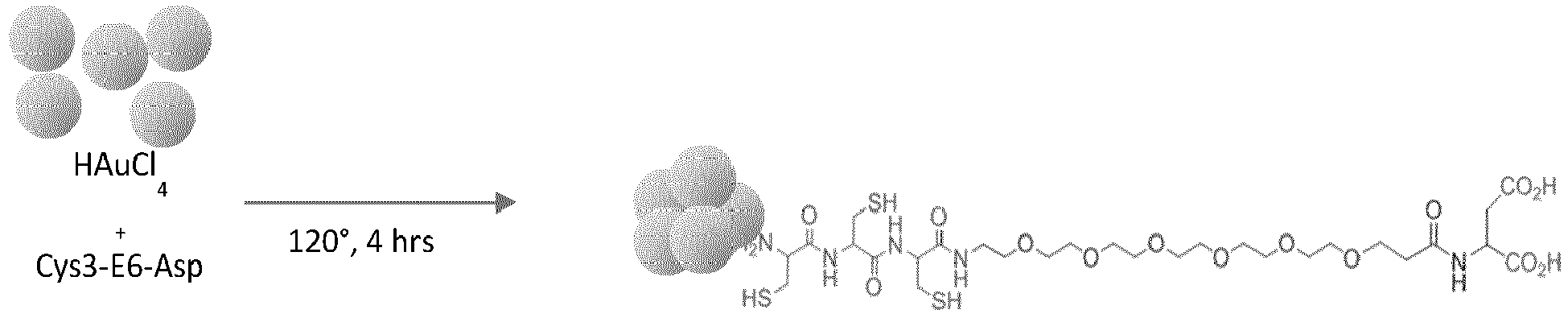
- To be used in imagery, the gold NCs have to possess good fluorescence properties.
- The gold NCs solution thus formed have been tested trough a spectrofluorimeter in order to evaluate their fluorescence properties. This technique allows to evaluate the fluorescence of NCs.
- The gold NCs solution obtained after the synthesis is poured inside the cuvette of the spectrofluorimeter without being diluted. The excitation wavelength used is 405 nm and slits size of 2 nm. Results are shown in
Figure 1 . -
Figure 1 shows that fluorescence of gold NCs is high after 4 hours of synthesis. These spectra demonstrate the generation of blue emitting (475 nm peak) gold NCs in the presence of the Cys3-E6-Asp ligand alone is possible quickly and without the use of further reactant such as, a reducing agent. However, if the reaction is allowed to continue for long periods of time, such as 22 hours, the gold NCs degrade and consequently the fluorescence as well. - The temporal evolution of absorbance during the reaction was also studied. Results are shown in
Figure 2. Figure 2 demonstrates that the absorbance continues to increase even after long reaction times showing that the quantum efficiency decreases considerably, as the sample absorbs more photons but emits fewer fluorescence photons. - This test demonstrates that it is possible to obtain in a one-step synthesis of 4 hours without using any other reducing agent, a gold NCs with a fluorescence high enough to be used in imaging.
- In order to be able to use the gold NCs for targeting, it is necessary to functionalize the surface of the NCs via recognition segments such as a bioactive ligand.
- An important point was to verify that the addition of a bioactive ligand recognized by cancer cells did not significantly affect the fluorescence properties of the NCs of example 1, so that they could be used as markers for imaging.
- The bioactive ligand used in this example is U11 and the matrix ligand is aspartic acid. The U11 peptide is known for its ability to recognize uPAR overexpressed in pancreatic cancer cells. The synthesis conducted for this purpose uses Cys3-E6-Asp of formula A and 1% and 3% of U11 peptide. Different percentages have been tested in order to optimize the ratio between the two ligands for the best fluorescence signal.
- When U11 is used at a proportion of 3%, the resulted proportion of each ligand at the surface of the gold NCs is 3% for the receptor ligand expressed by cancer cells with U11 and 97% for the matrix ligand with Aspartic acid.
- Reactants are Cys3-E6-Asp of formula A, HAuC14 and U11 peptide of formula B.

- The Cys3-E6-Asp of formula A is prepared according the article " Quantum Dots to Target Polyhistidine-Tagged Proteins" J. AM. CHEM. SOC., vol.131, no. 41, 2009;14738-14746. Gold salts HAuCl4 and U11 peptide are purchased respectively from Sigma Aldrich and Agentide Inc (USA).
- A freshly prepared aqueous solution of Cys3-E6-Asp of formula A (1.98 eq, 20 mM, 0.595 mL, 11,9 µmol) were mixed with a solution of U11 (0.02 eq, 1 mM, 0.12 mL, 0.12 µmol) and 1.485 mL of ultrapure water. The solution was heated in oil bath at 120°C and HAuC14 (1 eq, 20 mM, 0.3 mL, 6 µmol) and was rapidly added to it. The reaction was stopped after stirring for 4h. An aqueous solution of blue-emitting Au-Cys3-E6-U11 1 mol% NCs was formed.
- A freshly prepared aqueous solution of Cys3-E6-Asp of formula A (1.95 eq, 20 mM, 0.585 mL, 11.7 µmol) were mixed with a solution of U11 (0.06 eq,1 mM, 0.35 mL, 0.35 µmol) and 1.765 mL of ultrapure water. The solution was heated in oil bath at 120°C and HAuC14 (1 eq, 20 mM, 0.3 mL, 6 µmol) and was rapidly added to it. The reaction was stopped after stirring for 4h. An aqueous solution of blue-emitting Au-Cys3-E6-U11 3 mol% NCs was formed.

- The same protocol of example 1 has been used in this example with two samples containing 1% and 3% mol of U11 previously obtained.
-
Figure 3 and Figure 4 show respectively the fluorescence and absorbance of NCs synthesized with 1% and 3% mol of U11. As in example 1, gold NCs have a strong fluorescence in the blue region after synthesis. However, the comparison offigures 1 and3 demonstrates that the addition of U11 in the one-step synthesis generates an increase in blue-emitting (470nm peak) fluorescence for all percentages tested. Particularly, the fluorescence intensity has doubled with 1% of U11 and quadrupled with 3% of U11 compared to the gold NCs of example 1. The highest fluorescence intensity occurs with 3% U11 which also has an absorbance greater than the excitation wavelength (405 nm). - This test demonstrates that the addition of a bioactive ligand does not significantly affect the fluorescence properties of the gold NCs. Further, the addition of U11 peptide enhances the fluorescence. It is therefore possible to obtain in a one-step synthesis of 4 hours without using any other reducing agent, bioactivated gold NCs with a fluorescence high enough to be used in imaging.
- Another important point was to verify that the addition of a bioactive ligand that recognizes calcium channel such as ORAI1 did not significantly affect the fluorescence properties of the NCs of example 1, so that they could be used as markers to diagnose cancer.
- The bioactive ligand used in this example is the compound 1-[4-(4-Methoxyphenethoxy)phenethyl]-1H-benzo[d]imidazole of formula A (called A hereafter):

- The 1-[4-(4-Methoxyphenethoxy)phenethyl]-1H-benzo[d]imidazole compound is obtained through the following synthesis : to a vigorous stirred (550 rpm) solution of benzimidazole (2 mmol) in 3.4 ml of DMF was added
portion-wise sodium hydride 60% dispersion in mineral oil (0.081 g, 2 mmol) and the resulting suspension is stirred during 5 minutes. After addition of 4-(4-methoxyphenethoxy)phenethyl methanesulfonate (1 mmol) in one portion, the reaction mixture is heated at 60°C during 12 hours. After cooling down to room temperature, deionised water (34 ml) was added to the reaction mixture, the flask was shaken manually and then stored at 4°C (refrigerator) during 6 hours until complete precipitation. The insoluble material was recovered by filtration in a Buchner funnel (porosity N°4) and the precipitate was washed successively with deionised water (3 x 17 ml) and hexane (3 x 7 ml). The resulting solid was further dried under high vacuum (10-3 Torr) and afforded 0.307 g of the desired compound of formula A as white powder in 77% yield. Mp = 116-118°C. - In order to graft the bioactive ligand onto the spacer, which in this case is composed of 6 ethylene glycol units, the bioactive ligand as described above is substituted on its ether side with NH2.
- The sample with the highest luminescence emission (3%) of the example 2 was analysed with HR-TEM technique to study the size of the gold NCs. High-resolution transmission electron microscopy (HR-TEM) is an imaging modality of transmission electron microscopes (TEM) that allows direct imaging of the atomic structure of the sample. The sample was imaged with a TEM (JEM 1400 JEOL, 120 kV) equipped with an ORIUS 1000 camera from the University of Rennes 1 (TEM platform Mric-UMS 3480-Biosit-University of Rennes1). The images were taken in HR-TEM mode in order to allow the imaging of objects of the order of a few nanometres and to check their crystallinity.
- The sample was deposited and left to dry on appropriate copper grids according to the following procedure:
- Place a sheet of aluminium foil covered with a parafilm;
- Place a drop of 40 µl of the sample on the parafilm;
- Place a grid on the drop, taking care to bring the functional part of the grid in contact with the sample and wait 3 minutes;
- Remove the grid with tweezers and absorb the excess product with a piece of paper before putting it in the case;
- Let the sample to dry for about 24 hours before looking at it under the microscope HR-TEM.
-
Figure 5 shows that the gold NCs with 3% of U11 are so small that they are barely distinguishable. In fact, as shown inFigure 6 , they have an average size of 1 nm and the peak is quite thin, indicating that the dimensions of the gold NCs are rather uniform in the sample. This example demonstrates that the presence of U11 peptide, with its 3 thiol groups, creates small bioactivated gold NCs that emit in the blue. - Therefore this example demonstrates that the synthesis of the invention allows generating bioactivated gold NCs of very small size, in a single step, while obtaining sufficient fluorescence to be used in imaging.
- The gold NCs of the invention have the capacity to be used as markers for imaging and could be used, for example, as novel markers for the diagnosis of cancer diseases.
- In addition to the influence of the different percentages of U11 on fluorescence of the gold NCs, an extremely important point to study is the percentage allowing a better targeting efficiency.
- It has been assessed the capacity of gold NCs of examples 1 and 2 (with and without U11 peptide) to recognize and position themselves on the wall of pancreatic tumor cells. To assess this capacity, cytometry and fluorescence optical microscope techniques have been used.
- A solution containing 2 billion pancreatic cells is centrifuged at 2000 rpm for 7 minutes, after which the supernatant is removed. 1.2 ml of calcium-containing buffer is added to the centrifuged cells. 200 µL of the resulting solution is added to each well, as well as 100 µL of the gold NCs solution, Au-Cys3-E6-Asp NCs, (at a concentration in the µM range).
- The 2 billion cells in the solution are left to incubate with the gold NCs solution for 30 minutes in the "Non-Tissue Culture" wells. At the end of the 30 minutes, washing is carried out by adding 4 ml of buffer to well containing the incubated sample, centrifuging at 2000 rpm for 7 minutes and removing the supernatant.
- The same protocol has been used in this example for three samples of gold NC of example 2 containing 0%, 1% and 3% of U11.
- In the
figure 7 , the results of the measurement for Cys3-E6-Asp NCs (NCs with 0% of ligand U11), Cys3-E6-Asp(99%)/U11(1%) NCs (NCs with 1% of ligand U11), and Cys3-E6-Asp(97%)/U11(3%) NCs (NCs with 3% of ligand U11) are presented. The red and green graphs represent two different cell populations. -
Figure 7 demonstrates, as in example 2, that the addition of U11 at the surface of gold NCs shifts the peak at higher fluorescence intensities (right shift of the peak in graph B compared to graph A). - In addition, in Figure C, the right shift continues to increase indicating that the number of cells with higher fluorescence intensity increases when the percentage of U11 increases. This demonstrates that, at higher percentages of Ull, the gold NCs adhere more to the cell wall and increase its fluorescence.
- In conclusion, the 3% U11 gold NCs are the optimal percentage allowing a better targeting efficiency.
- Image of samples with 0% and 3% U11 were obtained in
Figure 8 (a) and (b) respectively. As can be learned fromFig. 8 , under the same conditions and at the same concentrations, only the NCs containing U11 are able to mark the cancer cells demonstrating that U11 is a good marker for pancreatic cancer cells. By zooming the image b offigure 8 and looking at it in more detail inFigure 9 , it is demonstrated that the NCs of example 2 with 3% U11 do not simply position themselves on the membrane, but pass membranes until it reaches the inside of the nucleus without killing cells. As demonstrated by example 3, it is thanks to the ultrasmall dimensions of about 1.5 nm of the gold NCs obtained through the synthesis of this invention, that they manage to overcome the cell membrane and position themselves inside the nucleus of the cell still alive. - This result is extremely important since it is now possible with the gold NCs of the invention to target protein presents in the nuclei while maintaining the cells targeted alive. Therefore a perspective to provide oligonucleotide, such as ARN, in the nucleus of targeted cells is possible.
- Thanks to the one-step synthesis according to the invention, it is possible to obtain very small gold NCs capable of passing the membranes and targeting the nucleus. Therefore, the gold NCs of the invention are good candidates for the development of markers or drugs useful in the imaging and therapy of diseases such as cancer.
- The peptide currently most used for the synthesis of gold NCs is glutathione (GSH). This peptide is both ligand (via the SH group) and reducer. Glutathione is composed of three amino acids, including cysteine: this amino acid allows the ligand to be anchored to gold through the sulphide (SH) group, which is also capable of reducing gold and interacting with gold so as to anchor glutathione to gold by a strong Au-S bond.
- The known and used protocol for the chemical synthesis of GSH AuNCs is described in the literature Luo, Z.; Yuan, X.; Yu, Y.; Zhang, Q.; Leong, D. T; Lee, J. Y.; Xie, J. From Aggregation-Induced Emission of Au(I)-Thiolate Complexes to Ultrabright Au(0)@Au(I)-Thiolate Core-Shell Nanoclusters. Journal of the American Chemical Society 2012, 134 (40), 16662-16670. https://doi.org/10.1021/ja306199p . However, this synthesis does not aim to functionalize gold NCs i.e. gold NCs capable of targeting via recognition segments, therefore further steps have to be done to render the gold NCs useful in imaging and therapeutic.
- The same protocol of example 4.1 has been used in this example with a sample containing Au-GSH NCs prepared as described in the above mentioned literature. Their fluorescence properties are shown in
Figure 10 . -
Figure 10 and 11 show that GSH NCs are heavier than the gold NCs of the invention (figures 5 and 6 ). BothFigure 12 and the control (Figure 7A ) in which NCs are not present, show a similar spectrum, this indicates that the incubation of GSH NCs had no effect on the increase in the number of cells with higher fluorescence. These results can be explained by the fact that the GSH NCs are not functionalized; therefore their targeting properties are scarce, unlike the NCs of the invention. - Prior to any in vivo application of the NCs of example 2 with 3% U11, several toxicity tests must be conducted.
- A toxicity test was performed using the eggs of a transparent fish called Zebrafish currently used in many toxicity studies. For our experiments we used the early embryo stage and added the NCs to the marine solution in which the Zebrafish live.
- A first experiment consisted in studying the penetrability of NCs against the protective envelop formed by the egg wall (the Chorion).
- A further experiment consisted in studying the penetrability of NCs in the embryo without its Chorion. In this experiment, the protective shell of the egg is no longer present.
- All the experiments have been carried out on the Biosit plateform at the University Rennes 1 (SFR MS CNRS3480 -INSERM 018) with the technical assistance of Remy Le Guével.
- The buffer used is a 135mM solution of NaCl, 5mM of KCl, 1 mM of MgCl, 10 mM of HEPES and 10 mM of glucose. The pH was brought to 7.4 by adding 3mL of 1M NaOH solution.
- The wells containing pancreatic cancer cells (PANC 1) were washed twice using the culture medium. After emptying the wells, 50 µL of a NCs solution was added at a standard concentration C, that obtained following the synthesis. The cells are left to incubate together with the NCs solution for one hour at 37 ° C, isolating with parafilm. At the end of the incubation period two more washes are carried out using the buffer solution mentioned above. At the end of the washing, each well is filled with 200 µL of buffer solution and the cells are viewed under a fluorescence light microscope.
- Initially, using an optical microscope, the eggs still alive were chosen, distinguishable from the inside of a yellow color. In each well, 3 eggs selected in this way were inserted together with 80 µL of marine solution and 80 µL of a standard concentration NCs solution (concentration C) to reach a final concentration of C/2. To test also a different concentration other wells were filled with 133 µL of marine solution and 27 µL of the solution of NCs at standard concentration C to obtain a final concentration of C/6. We immediately moved to the fluorescence light microscope to follow the evolution of egg growth and the influence of NCs. Eggs were observed daily for the next 3 days.
- In each well, 5 selected Zebrafish embryos already released from the chorion were inserted together with 187 µL of marine solution and 63 µL of a standard concentration NCs solution to reach a final concentration of C/4. To test also a different concentration other wells were filled with 208 µL of marine solution and 42 µL of the solution of NCs at standard concentration to reach a final concentration of C/6. We immediately underwent a fluorescence light microscope to follow the evolution of the influence of NCs on Zebrafish embryos. Embryos were observed daily for the next 3 days.
- Results are shown in
figure 13 . Through this experiment it has been noticed that NCs with red fluorescence (GSH NCs) cannot overcome the chorion barrier and position themselves on it. On the contrary, gold NCs of the invention with blue fluorescence (Au-Cys3-E6-Asp NCs) manage to overcome it and do not accumulate in any particular area, showing only a background of diffuse blue fluorescence. This difference is certainly attributable to the size of the NCs. Since as already known in the literature Braunbeck, T.; Kais, B.; Lammer, E.; Otte, J.; Schneider, K.; Stengel, D.; Strecker, R. The Fish Embryo Test (FET): Origin, Applications, and Future. Environmental Science and Pollution Research 2015, 22 (21), 16247-16261 , the chorion allows only molecules smaller than 3kDa to pass, a condition respected by the blue particles but not by the red ones. - Different concentrations of NCs (C, C/2, C/4, C/6) were tested, and as expected, we had less toxicity for lower NCs concentrations.
- These embryos are not yet able to feed themselves and use the pouch positioned under the head to do so. In this experiment, the protective shell of the egg is no longer present; therefore the fish are more exposed to NCs, even to NCs with red luminescence that previously could not overcome the chorion.
- Regardless of the type of NCs, greater toxicity was shown in all cases when incubating with non-purified NCs. It has been observed that he NCs with red fluorescence, GSH NCs, cannot penetrate inside the Zebrafish, and this result is the same regardless of the incubation time and the concentration of the NCs in the marine solution.
- Carrying out the same experiment in the presence of blue fluorescent NCs of the invention (C3E6D NCs) the result is totally different. Indeed, as can be seen in
figure 14 , these smaller blue NCs, corresponding to white spots in the figure, are able to enter the fish in times that depend on the concentration of NCs used: for higher concentrations there are shorter internalization times, using the same type of NCs with the same ligand. In addition, it is noted that the blue fluorescence initially appears in the head and then passes into the rest of the body. This positioning could be due to the fact that the only way for NCs to enter at this fish growth stage through its gills. The mouth is not yet a way of access since at this stage nourishment still takes place through the bag. - Since the exposure time required for the internalisation of blue fluorescent NCs does not lead to excessive mortality, it should be possible to interrupt the exposure after the internalization has occurred and thus block the effects of toxicity due to too long exposure times.
- Both the GSH NCs and the NCs of the invention, Au-Cys3-E6- Asp/
U11 3 mol%, after an hour of incubation with the Zebrafish, give a low mortality. The most obvious difference between the two types of NCs is that in the case of GSH NCs there is no internalization, regardless of the concentration and incubation time, unlike the Au-Cys3-E6- Asp/U11 3 mol% of the invention which are already internalized after one hour of incubation. - To preserve NCs in the long term, a lyophilized suspension of the gold NCs is an interesting formulation for industrial use or for certain analytical techniques.
- The aqueous suspension of NCs is first frozen in liquid nitrogen, then the flask is placed under high vacuum under pressure and temperature conditions that allow the water contained in the sample to sublimate.
- After 24 hours, it is checked that the fluorescence is preserved and especially that the particles can be resuspended in the water without any problem of aggregation at the desired concentration.
- A method of transporting gold NCs of the invention is to encapsulate them in GUVs (Giant Unilamellar Vesicles).
- The GUV formation protocol follows a procedure described in the article Matsushita- Ishiodori, Y.; Hanczyc, M. M.; Wang, A.; Szostak, J. W.; Yomo, T. Using Imaging Flow Cytometry to Quantify and Optimize Giant Vesicle Production by Water-in-Oil Emulsion Transfer Methods. Langmuir 2019, 35 (6), 2375-2382 .
- Initially, 4 solutions are prepared:
- 1.
Inner solution 25 µL of sucrose solution (1 M) + 25 µL of gold NCs solution of example 1 or GSH NCs of example 5; - 2. Stock solution (
glucose 500 mM); - 3. Lipid solution.
- The lipid solution (3) has been prepared using neutral lipids DOPC or DOPC + 5% DOTAP positive. In both cases, the lipids are dissolved in chloroform to give a final concentration of 10 mg/mL. Then 20 µL of this solution in chloroform is added to 1800 µL of paraffin oil in a 5 mL flask and the solution is heated at 80°C for 30 min without stopper. In this way, the chloroform evaporates and causes the creation of a lipid solution in the oil. To make sure that all the chloroform has evaporated, the solutions are placed in the desiccator for 20 min. The lipid solution (3) is ready.
- 50 µL of solution (1) + 400 µL of solution (3) are placed in an eppendorf and vortexed for 40s to form a water-in-oil (w/o) emulsion. In a second eppendorf, 200 µL of (2) is introduced, to which the newly formed emulsion is gently added.
- Wait 10 minutes and place the emulsion for overnight incubation. The GUVs then formed on the bottom and are removed the next day to another Eppendorf and redispersed in 300 µL of solution (2). The GUVs are placed for overnight incubation. The next day, the bottom is taken up again and the GUVs are ready to be stored in the refrigerator.
- Results are shown in
figures 14 and15 .Figure 14 shows strong fluorescence only inside the GUVs, where they are encapsulated. The GUVs are also stable and there is no formation of aggregates with the NCs of the invention.Figure 15 shows the formation of aggregates which, having a stronger fluorescence, masks that of the rest of the encapsulated GSH NCs. - This is due to the fact that GSH NCs are less stable as they tend to aggregate more easily than gold NCs of example 1. As gold NCs of example 1 have surface ligands with longer chains (thanks to PEGs), they have steric stabilization compared to GSH NCs. In addition they also have electrostatic stabilization. Therefore the aggregation of NCs of the invention is well more difficult. The best results are obtained with gold NCs of the invention
Figure 14 .
Claims (15)
- A bioactivated metal nanocluster comprising a mixture of ligands linked to a fluorescent metallic nanocluster, wherein the mixture comprises at least ligands linked to a fluorescent metallic nanocluster of formula (Ib) :
Y-ApEn'(X2) (Ib)
whereinY, being on the N terminal side of A, is the fluorescent metallic nanocluster wherein the metal is selected from the group consisting of gold, copper, silver, platinum, and nickel;ApEn'(X2), is a matrix ligand of formula (Ib);A is an anchor composed of an (L) or (D) amino acid selected from the group comprising Glycine (Gly), Alanine (Ala), Valine (Val), Cysteine (Cys), Proline (Pro), Leucine (Leu), Isoleucine (Ile), Methionine (Met), Tryptophan (Trp), Phenylalanine (Phe), Lysine (Lys), Arginine (Arg), Histidine (His), Threonine (Thr), Tyrosine (Tyr), Serine (Ser), Asparagin (Asn), Glutamine (Gln), Aspartic Acid (Asp), Glutamic acid (Glu), and mixture thereof;p is an integer greater than 1, preferably between 1 to 10, more preferably between 2 and 6, even more preferably 3 ;E, being on the C terminal side of A, is a spacer composed of ethylene glycol unit repeated n' times;n' is an integer greater than or equal to 1, preferably between 2 to 20, more preferably between 3 and 8, even more preferably 4 or 6;andX2 is a matrix ligand selected from the group comprising at least one (L) or (D) amino acid or a primary amine (-RNH2) or alcohol (-RCH2OH) or alkyl carboxylic acid (-RCO2H) or alkyl ether group (-ROR'), wherein the matrix ligand does not contain thiol function and R and R' are short alkyl chain. - The bioactivated metal nanocluster of claim 1, wherein it further comprises bioactive ligands of formula (Ia) or (Ic) or mixtures thereof:
Y-ApEn(X1) (Ia)
Y-ApEn"(X3) (Ic)
whereinY, being on the N terminal side of A, is the fluorescent metallic nanocluster wherein the metal is selected from the group consisting of gold, copper, silver, platinum, and nickel;ApEn(X1), is a bioactive ligand of formula (Ia);ApEn"(X3), is a bioactive ligand of formula (Ic);A is an anchor composed of an (L) or (D) amino acid selected from the group comprising Glycine (Gly), Alanine (Ala), Valine (Val), Cysteine (Cys), Proline (Pro), Leucine (Leu), Isoleucine (Ile), Methionine (Met), Tryptophan (Trp), Phenylalanine (Phe), Lysine (Lys), Arginine (Arg), Histidine (His), Threonine (Thr), Tyrosine (Tyr), Serine (Ser), Asparagin (Asn), Glutamine (Gln), Aspartic Acid (Asp), Glutamic acid (Glu), and mixture thereof;p is an integer greater than 1, preferably between 1 to 10, more preferably between 2 and 6, even more preferably 3 ;E, being on the C terminal side of A, is a spacer composed of ethylene glycol unit repeated n or n" times;n is an integer greater than or equal to 1, preferably between 2 to 20, more preferably between 3 and 8, even more preferably 4 or 6;n" is an integer greater than or equal to 1, preferably between 2 to 20, more preferably between 3 and 8, even more preferably 4 or 6 ;X1 is a marker which is either a ligand interacting or interfering with ion channels selected from calcium channels, potassium channels, sodium channels, chlorine channels, either a receptor ligand expressed by cancer cells or exosomes selected from the group comprising at least one (L) or (D) amino acid, preferably U11 polypeptide, glycine-aspartate-arginine (RGD) or any sequence comprising RGD, or microRNAs identified as cancer markers, or antibodies addressed against the tetraspanin family proteins such as CD63, CD81 and CD9, wherein the marker does not contain thiol function; andX3 is a medicine selected from the group comprising anticancer medicines and ion channel blockers, an oligonucleotide selected from the group comprising anticancer medicines, or microRNAs coding proteins of therapeutic interest, wherein the medicine or the oligonucleotide does not contain thiol function. - The bioactivated metal nanocluster of claim 1 or 2, wherein it comprises mixture of ligands linked to a fluorescent metallic nanocluster of formula (Ia) and (Ib) or (Ia), (Ib) and (Ic) or (Ia) and (Ic).
- The bioactivated metal nanocluster of claims 2 or 3, wherein the proportion of the bioactive ligands of formula (Ia) at the surface of the bioactivated metal nanocluster is between 0,5% to 10%, preferably between 1% to 6%, more preferably between 3% to 5%, the proportion of the bioactive ligands of formula (Ia) added to the proportion of the matrix ligands of formula (Ib) representing 100% at the surface of the bioactivated metal nanocluster.
- The bioactivated metal nanocluster of claims 2 or 3, wherein the proportion of the bioactive ligands of formula (Ic) at the surface of the bioactivated metal nanocluster is between 0,5% to 10%, preferably between 1% to 6%, more preferably between 3% to 5%, the proportion of the bioactive ligands of formula (Ic) added to the proportion of the matrix ligands of formula (Ib) representing 100% at the surface of the bioactivated metal nanocluster.
- The bioactivated metal nanocluster of claims 2 or 3, wherein the proportion of the bioactive ligands of formula (Ia) at the surface of the bioactivated metal nanocluster of between 0,5% to 10%, preferably between 1% to 6%, more preferably between 3% to 5 %, and the proportion of the bioactive ligands of formula (Ic) at the surface of the bioactivated metal nanocluster is between 0,5% to 10%, preferably between 1% to 6%, more preferably between 3% to 5%, the proportion of the bioactive ligands of formula (Ia) and (Ic) added to the proportion of the matrix ligands of formula (Ib) representing 100% at the surface of the bioactivated metal nanocluster.
- A pharmaceutical composition comprising :a. The bioactivated metal nanocluster as defined in claims 1 to 6,b. At least one pharmaceutical acceptable excipient.
- A method for the synthesis of the bioactivated metal nanocluster of claims 1 to 6, wherein said method comprises the following steps :a. Providing, an aqueous solution comprising at least the ligands of formula (Ib) as defined in claim 1 and water,b. Adding a solution of the metal salts selected from the group consisting of gold, copper, silver, platinum, and nickel, preferably a solution of gold salts of formula HAuCl4,c. Reacting during sufficient period of time at a temperature between 20°C and 200°C, preferably 70°C to 150°C, more preferably about 120°C,d. Recovering the bioactivated metal nanocluster formed, ande. Optionally, purifying the bioactivated metal nanocluster formed.
- The method of claim 8 wherein the step a. further comprises an aqueous solution of ligands of formula (Ia) and/or (Ic).
- The method of claim 8 or 9 wherein the sufficient period of time of step c. is between 1 minute to 24 hours, preferably between 1 to 12h, more preferably between 2 to 6h, even more preferably about 4h.
- The method of claims 8 to 10, wherein the synthesis does not involve any other reducing agent.
- A bioactivated metal nanocluster of claims 1 to 6 obtainable by the method of claim 8 to 11, wherein it has a stability at 4°C of at least 1 month, preferably at least 6 months, more preferably at least 12 months, even more preferably between 1 to 24 months, even more preferably between 4 to 18 months, even more preferably between 6 to 12 months.
- A bioactivated metal nanocluster of claims 1 to 6 or a composition of claim 7 for use as a medicament.
- A bioactivated metal nanocluster of claims 1 to 6 or a composition of claim 7 for use in a method for treatment of a cancer in a subject in need thereof.
- A bioactivated metal nanocluster of claims 1 to 6 or a composition of claim 7 for use in a diagnostic method of a cancer in a subject in need thereof comprising the steps of administering a bioactivated metal nanocluster of claims 1 to 6 or a composition of claim 7 to said subject in need thereof, and acquiring an image of said subject.
Priority Applications (1)
| Application Number | Priority Date | Filing Date | Title |
|---|---|---|---|
| EP20306002.5A EP3967330A1 (en) | 2020-09-10 | 2020-09-10 | Methods for the synthesis of bioactivated metal nanocluster and their medical application |
Applications Claiming Priority (1)
| Application Number | Priority Date | Filing Date | Title |
|---|---|---|---|
| EP20306002.5A EP3967330A1 (en) | 2020-09-10 | 2020-09-10 | Methods for the synthesis of bioactivated metal nanocluster and their medical application |
Publications (1)
| Publication Number | Publication Date |
|---|---|
| EP3967330A1 true EP3967330A1 (en) | 2022-03-16 |
Family
ID=72615779
Family Applications (1)
| Application Number | Title | Priority Date | Filing Date |
|---|---|---|---|
| EP20306002.5A Withdrawn EP3967330A1 (en) | 2020-09-10 | 2020-09-10 | Methods for the synthesis of bioactivated metal nanocluster and their medical application |
Country Status (1)
| Country | Link |
|---|---|
| EP (1) | EP3967330A1 (en) |
Cited By (3)
| Publication number | Priority date | Publication date | Assignee | Title |
|---|---|---|---|---|
| CN114605985A (en) * | 2022-03-29 | 2022-06-10 | 东南大学 | Preparation method and application of pH-responsive luminescent gold nanocluster |
| CN114752369A (en) * | 2022-03-28 | 2022-07-15 | 中国石油大学(华东) | Preparation method of ratio-type fluorescent probe and application of ratio-type fluorescent probe in tyrosinase detection |
| CN119462823A (en) * | 2024-11-08 | 2025-02-18 | 西北工业大学 | Gold cluster nanozyme ligand, self-assembling hydrogel and hydrogel preparation method |
Citations (2)
| Publication number | Priority date | Publication date | Assignee | Title |
|---|---|---|---|---|
| US20130216588A1 (en) * | 2012-02-17 | 2013-08-22 | Pi-Tai Chou | Insulin-gold nanocluster, pharmaceutical composition for reducing blood glucose comprising the same, and method for detecting adipose cells in tissue by using the same |
| CN110724519A (en) * | 2019-10-29 | 2020-01-24 | 西北工业大学深圳研究院 | Preparation method and application of fluorescence-enhanced gold nanocluster composite material based on supermolecule macrocycle |
-
2020
- 2020-09-10 EP EP20306002.5A patent/EP3967330A1/en not_active Withdrawn
Patent Citations (2)
| Publication number | Priority date | Publication date | Assignee | Title |
|---|---|---|---|---|
| US20130216588A1 (en) * | 2012-02-17 | 2013-08-22 | Pi-Tai Chou | Insulin-gold nanocluster, pharmaceutical composition for reducing blood glucose comprising the same, and method for detecting adipose cells in tissue by using the same |
| CN110724519A (en) * | 2019-10-29 | 2020-01-24 | 西北工业大学深圳研究院 | Preparation method and application of fluorescence-enhanced gold nanocluster composite material based on supermolecule macrocycle |
Non-Patent Citations (17)
| Title |
|---|
| "Quantum Dots to Target Polyhistidine-Tagged Proteins", J. AM. CHEM. SOC., vol. 131, no. 41, 2009, pages 14738 - 14746 |
| BOBRIE, A.KRUMEICH, S.REYAL, F.RECCHI, C.MOITA, L. F.SEABRA, M. C.OSTROWSKI, MTHERY, C.: "Rab27a Supports Exosome-Dependent and -Independent Mechanisms That Modify the Tumor Microenvironment and Can Promote Tumor Progression", CANCER RESEARCH, vol. 72, no. 19, 2012, pages 4920 - 4930 |
| BRAUNBECK, TKAIS, B.LAMMER, E.OTTE, J.SCHNEIDER, K.STENGEL, D.STRECKER, R.: "The Fish Embryo Test (FET): Origin, Applications, and Future", ENVIRONMENTAL SCIENCE AND POLLUTION RESEARCH, vol. 22, no. 21, 2015, pages 16247 - 16261, XP035576755, DOI: 10.1007/s11356-014-3814-7 |
| DIF AURÉLIEN ET AL: "Small and Stable Peptidic PEGylated Quantum Dots to Target Polyhistidine-Tagged Proteins with Controlled Stoichiometry", JOURNAL OF THE AMERICAN CHEMICAL SOCIETY, vol. 131, no. 41, 21 October 2009 (2009-10-21), US, pages 14738 - 14746, XP055772507, ISSN: 0002-7863, DOI: 10.1021/ja902743u * |
| GURUNATHA KARGAL L. ET AL: "Nanoparticles Self-Assembly Driven by High Affinity Repeat Protein Pairing", ACS NANO, vol. 10, no. 3, 12 February 2016 (2016-02-12), pages 3176 - 3185, XP055772480, ISSN: 1936-0851, DOI: 10.1021/acsnano.5b04531 * |
| HAMON C ET AL: "Replacement of CTAB with peptidic ligands at the surface of gold nanorods and their self-assembling properties", JOURNAL OF COLLOID AND INTERFACE SCIENCE, ACADEMIC PRESS,INC, US, vol. 424, 13 March 2014 (2014-03-13), pages 90 - 97, XP028638771, ISSN: 0021-9797, DOI: 10.1016/J.JCIS.2014.03.002 * |
| HAMON C. ET AL: "An aqueous one-pot route to gold/quantum rod heterostructured nanoparticles functionalized with DNA", CHEMICAL COMMUNICATIONS, vol. 51, no. 89, 1 January 2015 (2015-01-01), pages 16119 - 16122, XP055772474, ISSN: 1359-7345, DOI: 10.1039/C5CC05148G * |
| KAWASAKI, H.HAMAGUCHI, K.OSAKA, I.ARAKAWA, R.: "Ph-Dependent Synthesis of Pepsin-Mediated Gold Nanoclusters with Blue Green and Red Fluorescent Emission", ADVANCED FUNCTIONAL MATERIALS, vol. 21, no. 18, 2011, pages 3508 - 3515 |
| LI HUI ET AL: "Combination of active targeting, enzyme-triggered release and fluorescent dye into gold nanoclusters for endomicroscopy-guided photothermal/photodynamic therapy to pancreatic ductal adenocarcinoma", BIOMATERIALS, ELSEVIER, AMSTERDAM, NL, vol. 139, 23 May 2017 (2017-05-23), pages 30 - 38, XP085076813, ISSN: 0142-9612, DOI: 10.1016/J.BIOMATERIALS.2017.05.030 * |
| LUO, Z.YUAN, X.YU, Y.ZHANG, Q.LEONG, D. TLEE, J. Y.XIE, J.: "From Aggregation-Induced Emission of Au(I)-Thiolate Complexes to Ultrabright Au(0)@Au(1)— Thiolate Core-Shell Nanoclusters", JOURNAL OF THE AMERICAN CHEMICAL SOCIETY, vol. 134, no. 40, 2012, pages 16662 - 16670, XP055224556, DOI: 10.1021/ja306199p |
| MATHIVANAN, S.SIMPSON, R. J.: "ExoCarta: A Compendium of Exosomal Proteins and RNA", PROTEOMICS, vol. 9, no. 21, 2009, pages 4997 - 5000 |
| MATSUSHITA-ISHIODORI, Y.HANCZYC, M. M.WANG, A.SZOSTAK, J. W.YOMO, T.: "Using Imaging Flow Cytometry to Quantify and Optimize Giant Vesicle Production by Water-in-Oil Emulsion Transfer Methods", LANGMUIR, vol. 35, no. 6, 2019, pages 2375 - 2382 |
| SYRING, I.BARTELS, J.HOLDENRIEDER, S.KRISTIANSEN, G.MULLER, S. C.ELLINGER, J.: "Circulating Serum MiRNA (MiR-367-3p, MiR-371a-3p, MiR-372-3p and MiR-373-3p) as Biomarkers in Patients with Testicular Germ Cell Cancer", JOURNAL OF UROLOGY, vol. 193, no. 1, 2015, pages 331 - 337, XP029113018, DOI: 10.1016/j.juro.2014.07.010 |
| TROUILLER ANNE JULIETTE ET AL: "Chemistry for oncotheranostic gold nanoparticles", EUROPEAN JOURNAL OF MEDICINAL CHEMISTRY, ELSEVIER, AMSTERDAM, NL, vol. 99, 20 May 2015 (2015-05-20), pages 92 - 112, XP029222664, ISSN: 0223-5234, DOI: 10.1016/J.EJMECH.2015.05.024 * |
| VALADI, H.EKSTROM, K.BOSSIOS, A.SJOSTRAND, M.LEE, J. J.LOTVALL, J. O.: "Exosome-Mediated Transfer of MRNAs and MicroRNAs Is a Novel Mechanism of Genetic Exchange between Cells", NATURE CELL BIOLOGY, vol. 9, no. 6, 2007, pages 654 - 659 |
| YOSHIOKA, Y.KONISHI, Y.KOSAKA, N.KATSUDA, T.KATO, T.OCHIYA, T.: "Comparative Marker Analysis of Extracellular Vesicles in Different Human Cancer Types", JOURNAL OF EXTRACELLULAR VESICLES, vol. 2, no. 1, 2013, pages 20424, XP055386593, DOI: 10.3402/jev.v2i0.20424 |
| YU, Y.CHEN, X.YAO, Q.YU, Y.YAN, N.XIE, J.: "Scalable and Precise Synthesis of Thiolated Au , Au , Au , and Au Nanoclusters via PH Controlled CO Reduction", CHEMISTRY OF MATERIALS, vol. 25, no. 6, 2013, pages 946 - 952 |
Cited By (4)
| Publication number | Priority date | Publication date | Assignee | Title |
|---|---|---|---|---|
| CN114752369A (en) * | 2022-03-28 | 2022-07-15 | 中国石油大学(华东) | Preparation method of ratio-type fluorescent probe and application of ratio-type fluorescent probe in tyrosinase detection |
| CN114605985A (en) * | 2022-03-29 | 2022-06-10 | 东南大学 | Preparation method and application of pH-responsive luminescent gold nanocluster |
| CN114605985B (en) * | 2022-03-29 | 2023-11-28 | 东南大学 | Preparation method and application of pH-responsive luminescent gold nanoclusters |
| CN119462823A (en) * | 2024-11-08 | 2025-02-18 | 西北工业大学 | Gold cluster nanozyme ligand, self-assembling hydrogel and hydrogel preparation method |
Similar Documents
| Publication | Publication Date | Title |
|---|---|---|
| AU2022201963B2 (en) | Fusogenic liposome-coated porous silicon nanoparticles | |
| Sharma et al. | Development and characterization of metal oxide nanoparticles for the delivery of anticancer drug | |
| Bwatanglang et al. | In vivo tumor targeting and anti-tumor effects of 5-fluororacil loaded, folic acid targeted quantum dot system | |
| Chiang et al. | Enhancement of cancer therapy efficacy by trastuzumab-conjugated and pH-sensitive nanocapsules with the simultaneous encapsulation of hydrophilic and hydrophobic compounds | |
| Shahin et al. | Engineered breast tumor targeting peptide ligand modified liposomal doxorubicin and the effect of peptide density on anticancer activity | |
| Fan et al. | Multifunctional all-in-one drug delivery systems for tumor targeting and sequential release of three different anti-tumor drugs | |
| Guven et al. | Carbon nanotube capsules enhance the in vivo efficacy of cisplatin | |
| JP2020183393A (en) | Composition and method of bile acid particles | |
| EP3967330A1 (en) | Methods for the synthesis of bioactivated metal nanocluster and their medical application | |
| AU2007286203A1 (en) | Multistage delivery of active agents | |
| JP2011500652A (en) | Use of lanthanide-based nanoparticles as radiosensitizers | |
| Bai et al. | CXCR4 and CD44 dual-targeted Prussian blue nanosystem with daunorubicin loaded for acute myeloid leukemia therapy | |
| Jatal et al. | Sphingomyelin nanosystems decorated with TSP-1 derived peptide targeting senescent cells | |
| TW201018488A (en) | Tumor-targeting peptides and their uses in detecting and treating cancers | |
| Kulkarni et al. | Engineered transferrin-conjugated PEGylated multifunctional MOF-74 as precision nanotheranostics for triple-negative breast cancer | |
| Andreana et al. | Smart hyaluronated micelles to enhance a gemcitabine prodrug efficacy | |
| Park et al. | HER2-specific aptide conjugated magneto-nanoclusters for potential breast cancer imaging and therapy | |
| CN108653743B (en) | A kind of heart-brain dual-targeting liposome and its preparation method and application | |
| US20140099256A1 (en) | Radioactive luminescent nanoparticle compositions | |
| CN111494644B (en) | Nano-carrier containing RGD sequence peptide, preparation method thereof, drug-loading system, preparation method and application thereof | |
| Wang et al. | Optimization of landscape phage fusion protein-modified polymeric PEG-PE micelles for improved breast cancer cell targeting | |
| Jadhav et al. | Erythrocyte nanovesicles as chemotherapeutic drug delivery platform for cancer therapy | |
| JP6321305B2 (en) | Nanoparticle composition for drug delivery | |
| EP3713496A2 (en) | Ultrasound susceptible magnetic directed nano drug carrier system | |
| KR20240000677A (en) | Novel cyclic peptides based on nano-bio-structural control of peptide assemblies, peptidesomes with core/shell structure comprising thereof and uses thereof |
Legal Events
| Date | Code | Title | Description |
|---|---|---|---|
| PUAI | Public reference made under article 153(3) epc to a published international application that has entered the european phase |
Free format text: ORIGINAL CODE: 0009012 |
|
| STAA | Information on the status of an ep patent application or granted ep patent |
Free format text: STATUS: THE APPLICATION HAS BEEN PUBLISHED |
|
| AK | Designated contracting states |
Kind code of ref document: A1 Designated state(s): AL AT BE BG CH CY CZ DE DK EE ES FI FR GB GR HR HU IE IS IT LI LT LU LV MC MK MT NL NO PL PT RO RS SE SI SK SM TR |
|
| STAA | Information on the status of an ep patent application or granted ep patent |
Free format text: STATUS: THE APPLICATION IS DEEMED TO BE WITHDRAWN |
|
| 18D | Application deemed to be withdrawn |
Effective date: 20220917 |