EP3966807B1 - On-device custom wake word detection - Google Patents
On-device custom wake word detection Download PDFInfo
- Publication number
- EP3966807B1 EP3966807B1 EP20720986.7A EP20720986A EP3966807B1 EP 3966807 B1 EP3966807 B1 EP 3966807B1 EP 20720986 A EP20720986 A EP 20720986A EP 3966807 B1 EP3966807 B1 EP 3966807B1
- Authority
- EP
- European Patent Office
- Prior art keywords
- wake word
- model
- wake
- user
- audio
- Prior art date
- Legal status (The legal status is an assumption and is not a legal conclusion. Google has not performed a legal analysis and makes no representation as to the accuracy of the status listed.)
- Active
Links
Images







Classifications
-
- G—PHYSICS
- G10—MUSICAL INSTRUMENTS; ACOUSTICS
- G10L—SPEECH ANALYSIS TECHNIQUES OR SPEECH SYNTHESIS; SPEECH RECOGNITION; SPEECH OR VOICE PROCESSING TECHNIQUES; SPEECH OR AUDIO CODING OR DECODING
- G10L15/00—Speech recognition
- G10L15/06—Creation of reference templates; Training of speech recognition systems, e.g. adaptation to the characteristics of the speaker's voice
- G10L15/063—Training
-
- G—PHYSICS
- G06—COMPUTING OR CALCULATING; COUNTING
- G06N—COMPUTING ARRANGEMENTS BASED ON SPECIFIC COMPUTATIONAL MODELS
- G06N3/00—Computing arrangements based on biological models
- G06N3/02—Neural networks
- G06N3/04—Architecture, e.g. interconnection topology
- G06N3/044—Recurrent networks, e.g. Hopfield networks
-
- G—PHYSICS
- G06—COMPUTING OR CALCULATING; COUNTING
- G06N—COMPUTING ARRANGEMENTS BASED ON SPECIFIC COMPUTATIONAL MODELS
- G06N3/00—Computing arrangements based on biological models
- G06N3/02—Neural networks
- G06N3/04—Architecture, e.g. interconnection topology
- G06N3/044—Recurrent networks, e.g. Hopfield networks
- G06N3/0442—Recurrent networks, e.g. Hopfield networks characterised by memory or gating, e.g. long short-term memory [LSTM] or gated recurrent units [GRU]
-
- G—PHYSICS
- G06—COMPUTING OR CALCULATING; COUNTING
- G06N—COMPUTING ARRANGEMENTS BASED ON SPECIFIC COMPUTATIONAL MODELS
- G06N3/00—Computing arrangements based on biological models
- G06N3/02—Neural networks
- G06N3/04—Architecture, e.g. interconnection topology
- G06N3/045—Combinations of networks
-
- G—PHYSICS
- G06—COMPUTING OR CALCULATING; COUNTING
- G06N—COMPUTING ARRANGEMENTS BASED ON SPECIFIC COMPUTATIONAL MODELS
- G06N3/00—Computing arrangements based on biological models
- G06N3/02—Neural networks
- G06N3/04—Architecture, e.g. interconnection topology
- G06N3/0495—Quantised networks; Sparse networks; Compressed networks
-
- G—PHYSICS
- G06—COMPUTING OR CALCULATING; COUNTING
- G06N—COMPUTING ARRANGEMENTS BASED ON SPECIFIC COMPUTATIONAL MODELS
- G06N3/00—Computing arrangements based on biological models
- G06N3/02—Neural networks
- G06N3/08—Learning methods
-
- G—PHYSICS
- G06—COMPUTING OR CALCULATING; COUNTING
- G06N—COMPUTING ARRANGEMENTS BASED ON SPECIFIC COMPUTATIONAL MODELS
- G06N3/00—Computing arrangements based on biological models
- G06N3/02—Neural networks
- G06N3/08—Learning methods
- G06N3/084—Backpropagation, e.g. using gradient descent
-
- G—PHYSICS
- G06—COMPUTING OR CALCULATING; COUNTING
- G06N—COMPUTING ARRANGEMENTS BASED ON SPECIFIC COMPUTATIONAL MODELS
- G06N3/00—Computing arrangements based on biological models
- G06N3/02—Neural networks
- G06N3/08—Learning methods
- G06N3/09—Supervised learning
-
- G—PHYSICS
- G10—MUSICAL INSTRUMENTS; ACOUSTICS
- G10L—SPEECH ANALYSIS TECHNIQUES OR SPEECH SYNTHESIS; SPEECH RECOGNITION; SPEECH OR VOICE PROCESSING TECHNIQUES; SPEECH OR AUDIO CODING OR DECODING
- G10L15/00—Speech recognition
- G10L15/08—Speech classification or search
- G10L15/16—Speech classification or search using artificial neural networks
-
- G—PHYSICS
- G10—MUSICAL INSTRUMENTS; ACOUSTICS
- G10L—SPEECH ANALYSIS TECHNIQUES OR SPEECH SYNTHESIS; SPEECH RECOGNITION; SPEECH OR VOICE PROCESSING TECHNIQUES; SPEECH OR AUDIO CODING OR DECODING
- G10L17/00—Speaker identification or verification techniques
- G10L17/22—Interactive procedures; Man-machine interfaces
- G10L17/24—Interactive procedures; Man-machine interfaces the user being prompted to utter a password or a predefined phrase
-
- G—PHYSICS
- G06—COMPUTING OR CALCULATING; COUNTING
- G06N—COMPUTING ARRANGEMENTS BASED ON SPECIFIC COMPUTATIONAL MODELS
- G06N7/00—Computing arrangements based on specific mathematical models
- G06N7/01—Probabilistic graphical models, e.g. probabilistic networks
-
- G—PHYSICS
- G10—MUSICAL INSTRUMENTS; ACOUSTICS
- G10L—SPEECH ANALYSIS TECHNIQUES OR SPEECH SYNTHESIS; SPEECH RECOGNITION; SPEECH OR VOICE PROCESSING TECHNIQUES; SPEECH OR AUDIO CODING OR DECODING
- G10L15/00—Speech recognition
- G10L15/06—Creation of reference templates; Training of speech recognition systems, e.g. adaptation to the characteristics of the speaker's voice
- G10L15/065—Adaptation
- G10L15/07—Adaptation to the speaker
-
- G—PHYSICS
- G10—MUSICAL INSTRUMENTS; ACOUSTICS
- G10L—SPEECH ANALYSIS TECHNIQUES OR SPEECH SYNTHESIS; SPEECH RECOGNITION; SPEECH OR VOICE PROCESSING TECHNIQUES; SPEECH OR AUDIO CODING OR DECODING
- G10L15/00—Speech recognition
- G10L15/08—Speech classification or search
- G10L2015/088—Word spotting
Definitions
- a personal assistant is an application or service that retrieves information, executes a task, or initiates execution of a task on behalf of a user, sometimes after a device detects that a user has uttered a wake word. Users can communicate with such personal assistants using a conversational interface, such as a microphone and speaker.
- Patent document US 2016/180838 discloses a method and device for generating user-defined wake words using LSTM neural networks.
- a device can include memory including model parameters that define a recurrent neural network transducer (RNNT) wake word detection model and a lookup table (LUT) indicating a hidden vector to be generated in response to a phoneme of a user-specified wake word, a microphone to capture audio, processing circuitry to receive the audio from the microphone, determine, using the wake word detection model, whether the audio includes an utterance of the wake word, and perform a task indicated in the audio after the wake word.
- the wake word detection model can be trained using standard phonemes and whole word phonemes.
- the processing circuitry can reset the wake word detection model to erase a history of processed audio.
- the reset can occur in response to determining one of the wake word was uttered and a specified period of time has elapsed.
- the wake word detection model can be compressed using single value decomposition (SVD).
- the wake word detection model can include weights quantized to 8-bit or 16-bit values.
- a personal assistant and related technologies can enable a user to obtain information, execute tasks, and perform other activities. Users can interact with or control such personal assistants via conversational interfaces such as messaging, chat, audio commands, or the like.
- a wake word is typically spoken.
- a wake word is a word or phrase that indicates, to the personal assistant, that the user is asking the personal assistant to perform a task. Wake words are typically static and preprogrammed into a personal assistant. For example, Microsoft ® Corporation of Redmond, Washington, United States, has a personal assistant that can be accessed using the phrase "Hey Cortana".
- One or more embodiments can employ a general acoustic model (AM) that does not need wake word-specific training.
- AM general acoustic model
- this model can be compressed by SVD (singular value decomposition) and quantized (e.g., to 8 bits, 16 bits, or the like, per weight).
- SVD single value decomposition
- quantized e.g., to 8 bits, 16 bits, or the like, per weight.
- the CTC can be used in conjunction with an adaptable background language model (BLM) and keyword graph to build a high correct acceptance (CA) and low false acceptance (FA) custom keyword detection system.
- CA correct acceptance
- FA low false acceptance
- the floating point weights (e.g., 32-bit) in the SVD factor matrices can be quantized. This helps to compress the model size to about 1/4 th the size, which reduces the amount of data that has to be read from the main memory during execution in case the matrix weights are not already preloaded in CPU cache. This also helps to increase the efficiency of vector-matrix multiplies of single input multiple data (SIMD) processing elements in case the weights are already resident in the central processing unit (CPU) cache.
- SIMD single input multiple data
- CPU cache central processing unit
- Many current hardware architectures implement multiply-add SIMD operations, which can execute on registers of up to 256-bits. In case those registers contain 8-bit values, a single SIMD instruction can multiply and add 32 elements in a single cycle, 4 times more than if those registers contained 32-bit floating point values.
- an asymmetrical range of the values of a single matrix row can be assumed, then compressed down to the 8-bit target range.
- the quantized values can be stored to a disk.
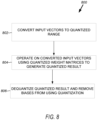
- the evaluation procedure is as follows input vectors are converted to 8-bit using the same asymmetrical quantization scheme, and the matrix multiplication can be performed with 8-bit SIMD instructions. The matrix product can then be converted back to floating point range (dequantized) and the matrix biases are added.
- a whole word phoneme is a symbol dedicated to representing a single word and the possible multiple pronunciations thereof.
- the whole word phoneme can be appended to the standard phoneme set and used to train the NN.
- the wake word, a numerical digit (e.g., "one", "two", “three”, etc.), or other word can be assigned a whole word phoneme.
- a phoneme deconstruction of the word "box” can be "/b/a/ks/”.
- the symbol, @ can be replace each phoneme in the deconstruction and the NN can be trained based on "/@/@/@/”. This removes bias towards the pronunciation of each of the phonemes in "box” and biases the NN towards recognition of the word "box”.
- the LM 334 can determine a probability of observing an i th gram based on a context history of the preceding n-1 grams, where n is the number of grams in the technique.
- the LM 334 can be trained using any words of a dictionary or all words of the dictionary minus the wake word(s). In removing the wake word, the wake word can be pruned from the LM 334.
- the LM 334 can be a unigram LM, such as to save execution time and memory overhead.
- the decoding graph 332 indicates the sequence of phonemes in the wake word by a directed graph or a trie (see FIG. 10 ). Using the decoding graph 332, a next phoneme of the wake word can be determined based on the current location in the wake word graph 332.
- the wake word graph 332 is a dynamic component.
- the wake word graph 332 can include a phoneme graph of a wake word 344 that, when traversed indicates that the wake word 344 has been uttered.
- the wake word graph 332 can account for different pronunciations of the same word or even for multiple wake words.
- the wake word graph 332 can begin with a blank (silence) phoneme so that the wake word 344 is only detected following silence or as uttered at a beginning of a phrase.
- the beam search decoder 338 can determine the likelihood that the audio features 342 correspond to an utterance of the wake word 334 based on the output of the AM 330 and the decoding graph 332. Keyword detection can occur if the best current hypothesis emanates from the keyword portion of the decoding graph 332 and not from the LM 334.
- the beam search decoder 338 can include low probability hypotheses pruned from a search space.
- the low probability hypotheses include probabilities below a specified threshold.
- a maximum number e.g., 10, 25, 50, 100, more or fewer candidates, or some number therebetween
- scoring candidates can be retained at each decoding step.
- the beam search decoder 338 implements a heuristic search algorithm that explores a graph by expanding the most promising node in a limited set.
- Beam search is an optimization of best-first search that reduces its memory requirements.
- Best-first search is a graph search which orders all partial solutions according to some heuristic. But in beam search, only a predetermined number of best partial solutions are kept as candidates.
- the beam search decoder 338 can be implemented as a token-passing decoder operating on a graph of possible pronunciation hypotheses (e.g., the wake word graph 332).
- the wake word graph 332 can be structured as a trie, where possible prefixes are merged. Merging the prefixes can conserve memory space.
- Each node of the trie can represent a pronunciation prefix.
- the trie can include a prediction network output for that prefix.
- An example of such a trie is provided in FIG. 10 .
- the beam search decoder 338 explores the wake word graph 332, it can look up the prediction network outputs stored in those nodes based on output from the AM 330, such as if an RNNT model is used.
- FIG. 10 illustrates a diagram of such a trie.
- a probability vector output from the beam search decoder 338 can be compared to a confidence threshold at operation 340.
- the confidence threshold can be set by the user 130, such as to be more or less sensitive to detection of the wake word 344. A higher confidence threshold will have fewer false acceptances (FAs) while a lower confidence threshold will have more FAs. If an entry in the beam search decoder 338 corresponding to the wake word is greater than a threshold, the keyword can be detected at operation 346. If the entry in the beam search decoder 338 corresponding to the wake word is not greater than the threshold, the keyword is not detected at operation 348.
- a single keyword detection is insufficient to indicate the wake word was uttered. This is, at least in part, because an output of the beam search decoder 338 can change paths mid-audio. This is, at least in part, because the probabilities of what is predicted as being in the phonemes of the audio can depend on what has been said before. By waiting until a specified number of detections (since a last start symbol) is indicated by the operation 340, fewer FAs can be triggered.
- Output from the beam search decoder 338 can be provided in a streaming fashion.
- the output can include a start character, generally indicated by detected silence.
- the output can then, for each frame, determine phonemes in all the frames from the start up to the current frame, includes audio of a phoneme and generate a string corresponding thereto.
- the keyword can be detected at operation 346 if two predictions from the last start symbol include the wake word 344.
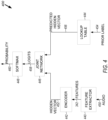
- FIG. 4 illustrates, by way of example, a diagram of an embodiment of a system 400 for wake word detection.
- the system 400 can be implemented by the wake word model engine 142.
- the AM 330 and the LM 334 can be implemented using a recurrent neural network transducer (RNNT).
- the system 400 is sometimes called an RNNT.
- the system 400 as illustrated includes a feature extractor 440, encoder 442, lookup table (LUT) 444, joint network 446, and normalizer (e.g., softmax layer 448).
- LUT lookup table
- softmax layer 448 normalizer
- the feature extractor 440 receives sampled audio 450 and produces features 342 of the frame (usually 10 - 30 milliseconds per frame) of the audio 450.
- Example features include Mel frequency cepstral coefficients, linear predictive coding coefficients, perceptual linear prediction, relative spectrum transform analysis, and gammatone log energies. Many other features can be used.
- the feature helps characterize the content of the frames relative to one another by compactly modeling distinct portions of the sampled audio 450.
- the encoder 442 receives the features 342 and provides a hidden vector 452.
- the encoder 442 acts as the AM 330 and a predicted hidden vector 456 acts as the LM 334.
- An advantage of the system 400 is that output targets can be extracted from the system 400 in a streaming fashion. This is due, at least in part, to the system 400 operating on less than an entire encoded utterance.
- the LUT 444 can store pre-computed vectors from a prediction network (e.g., a wake word graph 332).
- the input of the prediction network can be the last predicted label (the prior label 454).
- the prediction network and joint network 446 typically need to be recalculated for different result candidates. This increases the computational cost significantly.
- the decoding network is constrained to contain only the wake word, which means the input sequence of the prediction network is fixed for a given wake word.
- hidden vectors of the prediction network can be computed in and stored in the LUT 444. Instead of operating a prediction network, as previously done by others, the hidden vectors of a prediction network operating on the wake word 344 can be stored in the LUT 444. This saves significant computation and memory resources and allows more devices to perform wake word detection.
- the joint network 446 joins the two hidden vectors 452, 456 together and outputs the posterior of the predicted label from the LUT 444 and the hidden vector 452.
- the joint network 446 can comprise feed forward layers that compute logits 458 for every frame and label.
- the logits 458 can be converted to a probability distribution 460 over the labels by a softmax layer 448.
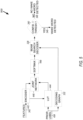
- the system 400 of FIG. 4 is a subset of the system 500 of FIG. 5 .
- the system 500 includes some components from the system 400 and the system 300.
- the systems 300, 400, 500 are efficient (in terms of computational and memory efficiency) wake word spotting systems.
- the systems 300, 400, 500 can check whether a segment of speech contains the wake word or not.
- Popular wake word spotting systems in products pre-define a wake word in and the user can only use that word to wake up the personal assistant (Cortana ® with keyword "Cortana").
- the customized wake word detection systems 300, 400, 500 allow users or product developers to use any custom wake word.
- the wake word graph generator 144 of the wake word model engine 142 can generate a decoding graph 332 specifically for only the custom wake word and different pronunciations thereof.
- audio is passed through the decoding graph 332 with either the AM 330 and the LM 334, or the RNNT model with the LUT 444.
- the output can be provided to a beam search decoder 338 that produces a confidence score which shows how likely the audio contains the wake word. The confidence score is then compared with a predefined threshold to determine whether the wake word is present at operation 340.
- the NNs of the system 400, 500 can be trained using whole word (WW) phonemes to model special words, like digits and letters or the wake word. Digits and letters are difficult to recognize in automatic speech recognition compared with common words. For these special words, specific phonemes can be used in place of standard phonemes to represent the pronunciations. These specific phonemes are sometimes called WW phones.
- WW whole word
- the system 300, 400, 500 can operate on the device 110, which can be memory or processing power limited.
- One way of reducing the memory overhead of the system 300, 400, 500 is to use singular vector decomposition (SVD) on matrices (e.g., weight matrices) thereof. Using SVD reduces (compresses) the model size and computational cost while still retaining model accuracy after the compression.
- SVD singular vector decomposition
- a single weight matrix is replaced with two weight matrices. This means that a single layer of the NN is replaced with two layers of the NN.
- the advantage of this, is that a single weight matrix can be replaced with two matrices that, in combination, include fewer parameters than the single weight matrix.
- FIG. 6 depicts decomposing a weight matrix of an NN model into two matrices with smaller dimensions.
- the m columns of U and the n columns of V are referred to as the left-singular vectors and right singular vectors of A, respectively. Since A is a sparse matrix, a large part of A's singular values are typically very small. Setting the small values to 0 does not considerably change the values of elements in matrix A.
- An RNN such as an RNNT, operates based on current inputs and prior outputs.
- the history can cause the accuracy of the RNN to decrease. This is, at least in part, because whether the wake word 344 is present in an utterance now is independent of what was uttered a specified amount of time (e.g., five seconds, ten seconds, thirty seconds, one minute, greater or lesser time, or some amount of time therebetween) in the past.
- Another technique for reducing the size of the model and decreasing latency in identifying a wake word includes compressing the model with quantization, such as 8-bit or 16-bit quantization.
- the quantization can be applied to 32-bit floating point weights in the encoder 442 and joint network 446 matrices. This helps to compress the model size by about 4x.
- This compression reduces the amount of data that has to be read from main memory during execution in case the matrix weights are not already preloaded in central processing unit (CPU) cache. This helps increase the efficiency of vector-matrix multiplies of the on-chip processing elements in case the weights are already resident in the CPU cache.
- a variation in the order of operations discussed regarding FIG. 9 can include aggregating output of the first layer at the cache memory 802 and doing a batch write to the memory 160 (or not writing to the memory 160 if the cache memory 802 is sufficiently large). This can save time in by performing fewer write operations to the memory 160.
- Yet another variation in the order of operations discussed regarding FIG. 9 can include operating, using a next layer, on the outputs of a layer in a different order than the outputs were generated.
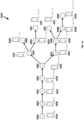
- FIG. 10 illustrates, by way of example, a diagram of an embodiment of a beam search decoding trie 1000 for the word "computer". Note how the beam search decoding trie 1000 allows for multiple pronunciations of the same word.
- the trie 1000 includes phonemes 880 and vectors 882 that are retrieved while traversing the trie 1000.
- the alphabet of the trie 1000 is composed of only the phonemes of the wake word 344, which is "computer” in the example of FIG. 10 .
- the trie for different wake words is different and can be generated by the wake word decode graph generator 144 of the wake word model engine 142, such as offline.
- Frame skipping includes presenting only a subset of all frames as input to the wake word detection technique. When used with frame stacking, the knowledge of all frames can still be present, but with fewer operations performed by the wake word detection technique.
- a machine is configured to carry out a method by having software code for that method stored in a memory that is accessible to the processor(s) of the machine.
- the processor(s) access the memory to implement the method.
- the instructions for carrying out the method are hard-wired into the processor(s).
- a portion of the instructions are hard-wired, and a portion of the instructions are stored as software code in the memory.
- FIG. 11 illustrates, by way of example, a diagram of an embodiment of a method 1100 for on-device custom wake word detection.
- the method 1100 as illustrated includes receiving audio from a microphone of a device, at operation 1102; determining, using a wake word detection model, whether the audio includes an utterance of the wake word, at operation 1104; and performing a task detected in the audio after the utterance of the wake word, at operation 1106.
- the wake word detection model can include an RNNT and LUT indicating a hidden vector to be generated in response to a phoneme.
- the wake word detection model can be trained using standard phonemes and whole word phonemes.
- the method 1100 can further include resetting the wake word detection model to erase a history of processed audio. The reset can occur in response to determining one of the wake word was uttered and a specified period of time has elapsed.
- the method 1100 can further include, wherein the wake word detection model is compressed using singular value decomposition (SVD).
- the method 1100 can further include, wherein the wake word detection model includes weights quantized to 8-bit or 16-bit values.
- the method 1100 can further include receiving the wake word from a user.
- the method 1100 can further include providing the wake word to a wake word model engine.
- the method 1100 can further include receiving from the wake word model engine, a wake word graph of the wake word indicating a phoneme sequence of the wake word and alternate pronunciations of the wake word.
- the method 1100 can further include, wherein the wake word graph is part of the wake word detection model.
- the method 1100 can further include receiving from the wake word model engine, a wake word graph of the wake word indicating a phoneme sequence of the wake word and alternate pronunciations of the wake word and a background language model with unigrams and bi-grams of the wake word removed therefrom.
- the method 1100 can further include, wherein the wake word graph and the background language model are part of the wake word detection model.
- FIG. 12 illustrates, by way of example, a block diagram of an embodiment of a machine 1200 (e.g., a computer system) to implement one or more embodiments.
- a machine 1200 e.g., a computer system
- One example machine 1200 may include a processing unit 1202, memory 1203, removable storage 1210, and non-removable storage 1212.
- the example computing device is illustrated and described as machine 1200, the computing device may be in different forms in different embodiments.
- the computing device may instead be a smartphone, a tablet, smartwatch, or other computing device including the same or similar elements as illustrated and described regarding FIG. 12 .
- Devices such as smartphones, smart speakers, tablets, and smartwatches are generally collectively referred to as mobile devices.
- the various data storage elements are illustrated as part of the machine 1200, the storage may also or alternatively include cloud-based storage accessible via a network, such as the Internet.
- Memory 1203 may include volatile memory 1214 and non-volatile memory 1208.
- the machine 1200 may include - or have access to a computing environment that includes - a variety of computer-readable media, such as volatile memory 1214 and non-volatile memory 1208, removable storage 1210 and non-removable storage 1212.
- Computer storage includes random access memory (RAM), read only memory (ROM), erasable programmable read-only memory (EPROM) & electrically erasable programmable read-only memory (EEPROM), flash memory or other memory technologies, compact disc read-only memory (CD ROM), Digital Versatile Disks (DVD) or other optical disk storage, magnetic cassettes, magnetic tape, magnetic disk storage or other magnetic storage devices capable of storing computer-readable instructions for execution to perform functions described herein.
- RAM random access memory
- ROM read only memory
- EPROM erasable programmable read-only memory
- EEPROM electrically erasable programmable read-only memory
- flash memory or other memory technologies
- the machine 1200 may include or have access to a computing environment that includes input 1206, output 1204, and a communication connection 1216.
- Output 1204 may include a display device, such as a touchscreen, that also may serve as an input device.
- the input 1206 may include one or more of a touchscreen, touchpad, mouse, keyboard, camera, one or more device-specific buttons, one or more sensors integrated within or coupled via wired or wireless data connections to the machine 1200, and other input devices.
- the computer may operate in a networked environment using a communication connection to connect to one or more remote computers, such as database servers, including cloud-based servers and storage.
- the remote computer may include a personal computer (PC), server, router, network PC, a peer device or other common network node, or the like.
- the communication connection may include a Local Area Network (LAN), a Wide Area Network (WAN), cellular, Institute of Electrical and Electronics Engineers (IEEE) 802.11 (Wi-Fi), Bluetooth, or other networks.
- LAN Local Area Network
Landscapes
- Engineering & Computer Science (AREA)
- Physics & Mathematics (AREA)
- Theoretical Computer Science (AREA)
- Health & Medical Sciences (AREA)
- Computational Linguistics (AREA)
- Artificial Intelligence (AREA)
- Evolutionary Computation (AREA)
- General Health & Medical Sciences (AREA)
- General Physics & Mathematics (AREA)
- Biophysics (AREA)
- Biomedical Technology (AREA)
- Molecular Biology (AREA)
- Computing Systems (AREA)
- General Engineering & Computer Science (AREA)
- Data Mining & Analysis (AREA)
- Mathematical Physics (AREA)
- Software Systems (AREA)
- Life Sciences & Earth Sciences (AREA)
- Audiology, Speech & Language Pathology (AREA)
- Human Computer Interaction (AREA)
- Acoustics & Sound (AREA)
- Multimedia (AREA)
- Machine Translation (AREA)
Description
- The use of automatic personal assistants has grown significantly. A personal assistant is an application or service that retrieves information, executes a task, or initiates execution of a task on behalf of a user, sometimes after a device detects that a user has uttered a wake word. Users can communicate with such personal assistants using a conversational interface, such as a microphone and speaker. Patent document
US 2016/180838 discloses a method and device for generating user-defined wake words using LSTM neural networks. - The following presents a shortened summary of various aspects of this disclosure in order to provide a basic understanding of such aspects. This summary is not an extensive overview of all contemplated aspects and is intended to neither identify key or critical elements nor delineate the scope of such aspects. Its purpose is to present some concepts of this disclosure in a compact form as a prelude to the more detailed description that is presented later.
- In one aspect of the present disclosure, systems and methods are disclosed for on-device customized wake word detection. In one instance a device can include memory including model parameters that define a recurrent neural network transducer (RNNT) wake word detection model and a lookup table (LUT) indicating a hidden vector to be generated in response to a phoneme of a user-specified wake word, a microphone to capture audio, processing circuitry to receive the audio from the microphone, determine, using the wake word detection model, whether the audio includes an utterance of the wake word, and perform a task indicated in the audio after the wake word. The wake word detection model can be trained using standard phonemes and whole word phonemes.
- The processing circuitry can reset the wake word detection model to erase a history of processed audio. The reset can occur in response to determining one of the wake word was uttered and a specified period of time has elapsed. The wake word detection model can be compressed using single value decomposition (SVD). The wake word detection model can include weights quantized to 8-bit or 16-bit values. The processing circuitry can receive the wake word from a user, provide the wake word to a wake word model engine, and receive from the wake word model engine, a wake word graph of the wake word indicating a phoneme sequence of the wake word and alternate pronunciations of the wake word and a background language model with unigrams and bi-grams of the wake word removed therefrom, wherein the wake word graph and the background language model are part of the wake word detection model.
-
-
FIG. 1 illustrates, by way of example, a logical block diagram of an embodiment of a system. -
FIG. 2 illustrates, by way of example, a flow diagram of an embodiment of a method for wake word detection model customization. -
FIGS. 3-5 illustrate, by way of example, logical block diagrams of respective embodiments of at least a portion of wake word detection systems. -
FIG. 6 illustrates, by way of example, a flow diagram of a decomposition of a weight matrix of a neural network (NN) model into two matrices with smaller dimensions. -
FIG. 7 illustrates, by way of example, a logical block diagram of an embodiment of a quantized NN. -
FIG. 8 illustrates, by way of example, a flow diagram of an embodiment of a method for using quantized matrices at runtime. -
FIG. 9 illustrates, by way of example, a logical block diagram of an embodiment of a system configured for execution batching. -
FIG. 10 illustrates, by way of example, a flow diagram of an embodiment of a beam search decoding trie for the word "computer". -
FIG. 11 illustrates, by way of example, a flow diagram of an embodiment of a method for on-device custom wake word detection. -
FIG. 12 illustrates, by way of example, a block diagram of an embodiment of a machine (e.g., a computer system) to implement one or more embodiments. - Aspects and implementations of the present disclosure are directed to detecting whether a user has uttered a wake word, such as on a memory or processing bandwidth limited device.
- A personal assistant and related technologies can enable a user to obtain information, execute tasks, and perform other activities. Users can interact with or control such personal assistants via conversational interfaces such as messaging, chat, audio commands, or the like. To access a personal assistant, a wake word is typically spoken. A wake word is a word or phrase that indicates, to the personal assistant, that the user is asking the personal assistant to perform a task. Wake words are typically static and preprogrammed into a personal assistant. For example, Microsoft® Corporation of Redmond, Washington, United States, has a personal assistant that can be accessed using the phrase "Hey Cortana". However, some people may not like the phrase, may use the word "Cortana" in reference to something other than the personal assistant, thus confusing the personal assistant, or may otherwise want to choose their own wake word for accessing the personal assistant. Such user-chosen wake words are called "custom wake words" herein.
- However, detecting a custom (user-defined) wake word is challenging for a number of reasons. One reason is that an efficient model for detecting the wake word may not readily exist. Another reason is that a general speech recognition (SR) model may be prohibitively large for storing and executing on a memory or processing bandwidth limited device. The model may further cause latency that frustrates a user attempting to use the personal assistant.
- Wake word detection can be an important part of voice interfaces (such as a personal assistant). Advances in wake word detection focus on training low-complexity models (e.g., models that consume small amounts of memory or processing circuitry bandwidth) that detect an utterance of a predetermined static wake word. The prior pretrained models require large amounts of wake word samples and training to be effective. The models for detection of such custom wake words can be difficult or impossible to build due to either data sparsity, computational demands for training, or both. Embodiments herein provide a system capable of detecting custom user-defined wake words, such as on memory or processing bandwidth limited devices.
- Unlike static wake word-dependent models, embodiments include an efficient model, trained from readily available general-purpose speech data, that can be tailored to recognize a user-defined wake word without retraining. A customization of the model can take place as part of the system setup before deployment. The customization can include a customized decoding graph or a lookup table (LUT) that decodes for the wake word.
- Embodiments herein do not need specialized training. Instead, embodiments include a general acoustic model (AM) (e.g., a connectionist temporal classification (CTC) network) and language model (LM) or something that performs operations of the AM and LM (e.g., a recurrent neural network transducer (RNN-T)). Embodiments can help detect a custom wake word using a decoding graph that is customized to the wake word. A decoder can receive the output from the AM, LM, and decoding graph to determine whether it is likely that the custom wake word was uttered.
- One or more operations can be performed on the acoustic model (AM) of a custom wake word detector to reduce its size. Such operations can include a singular value decomposition (SVD) or quantization. The AM can be used in conjunction with an adaptable background language model (BLM) and wake word graph. Embodiments with such structures can provide a high CA and low FA custom wake word detection system.
- One or more embodiments can employ a general acoustic model (AM) that does not need wake word-specific training. To run on low-power hardware, this model can be compressed by SVD (singular value decomposition) and quantized (e.g., to 8 bits, 16 bits, or the like, per weight). The CTC can be used in conjunction with an adaptable background language model (BLM) and keyword graph to build a high correct acceptance (CA) and low false acceptance (FA) custom keyword detection system.
- Accordingly, described herein in various implementations are technologies, including methods, machine-readable mediums, and systems, that enable on-device detection of a custom wake word.
- It can therefore be appreciated that the described technologies are directed to and address specific technical challenges and longstanding deficiencies in multiple technical areas, including but not limited to communication interfaces, semantic relationships, and personal assistants. As described in detail herein, the disclosed technologies provide specific, technical solutions to the referenced technical challenges and unmet needs in the referenced technical fields and provide numerous advantages and improvements upon conventional approaches. Additionally, in various implementations one or more of the hardware elements, components, etc., referenced herein operate to enable, improve, and/or enhance the described technologies, such as in a manner described herein.
-
FIG. 1 illustrates, by way of example, a diagram of an embodiment of asystem 100. As shown, thesystem 100 includesdevice 110 which can be a laptop computer, a desktop computer, a terminal, a mobile phone, a tablet computer, a smart watch, a digital music player, a server, a smart speaker, and the like.User 130 can be a human user who interacts withdevice 110. For example,user 130 can provide various inputs (e.g., via an input device/interface such as a keyboard, mouse, touchscreen, microphone, etc.) todevice 110.Device 110 can also display, project, and/or otherwise provide content to user 130 (e.g., via output components such as a screen, speaker, etc.). - As shown in
FIG. 1 ,device 110 can includepersonal assistant 116.Personal assistant 116 can be an application or module that configures/enables thedevice 110 to interact with, provide content to, and/or otherwise perform operations on behalf ofuser 130. For example,personal assistant 116 can receive communications and/or request(s) fromuser 130 and present/provide responses to such request(s) (e.g., within a conversational or 'chat' interface). In certain implementations,personal assistant 116 can also identify content that can be relevant to user 130 (e.g., based on a location of the user or other such context) and present such content to the user.Personal assistant 116 can also enableuser 130 to initiate and/or configure other application(s) (e.g.,application 118A, as described below). For example,personal assistant 116 can initiate an application (e.g., a media player application, a web search application, a navigation application, or the like) that fulfills a request provided by the user.Personal assistant 116 can also initiate or perform various other operations, some of which are described herein. - As shown in
FIG. 1 ,device 110 can also include various applications, programs, modules, or the like, such as wakeword detection application 118A andapplication 118B. The referenced applications can be stored in memory of device 110 (e.g., memory 1103 as depicted inFIG. 12 and described below). One or more processor(s) of device 110 (e.g.,processing unit 1102 as depicted inFIG. 12 and described below) can execute such application(s). In doing so,device 110 can be configured to perform various operations, present content touser 130, etc. Examples of such applications include but are not limited to: social media/messaging applications, applications that facilitate transactions (e.g., food purchases), etc. - It should also be noted that while various components (e.g.,
personal assistant 116,application 118B, etc.) are depicted (e.g., inFIG. 1 ) as operating ondevice 110, this is only for the sake of clarity. However, in other implementations the referenced components (e.g.,application 118B) can also be implemented on other devices/machines. For example, in lieu of executing locally atdevice 110,application 118B (e.g., a ride-sharing application) can be implemented remotely (e.g., on a server device or within a cloud service or framework). - As also shown in
FIG. 1 ,device 110 can connect to and/or otherwise communicate withserver 140 vianetwork 120.Network 120 can include one or more networks such as the Internet, a wide area network (WAN), a local area network (LAN), a virtual private network (VPN), an intranet, and the like. -
Server 140 can be, for example, a server computer, computing device, storage service (e.g., a 'cloud' service), etc., and can include wakeword model engine 142 andmemory 160. The wakeword model engine 142 can execute an application thereof (e.g., the wake worddecode graph generator 144 or the background LM generator 146) using processing circuitry (e.g.,processing unit 1102 as depicted inFIG. 12 and described below). - The wake
word model engine 142 can include an application or module that configures/enablesserver 140 to perform various operations such as are described herein. For example, wakeword model engine 142 can configure/enableserver 140 to receive a message indicating a requested wake word was detected, such as from thedevice 110. The message can be received through thenetwork 120. The wakeword model engine 142 can generate a wake word graph, such as by using the wakeword graph generator 144. - Unlike static wake word-dependent models, embodiments can include an efficient model, trained from readily available general-purpose speech data, that can be tailored to recognize a user-defined wake word without retraining. A customization of the model can take place as part of the system setup before deployment. The customization can be performed by the wake
word model engine 142 with input from thedevice 110. - The
device 110 can provide a message to theserver 140, such as through a web portal connected to theserver 140. The message can indicate that the custom wake word was detected in audio, such as by the wakeword detection application 118A. Theserver 140 can execute a wakeword model engine 142. The wake word model engine (sometimes called processing circuitry) can use a wake word graph from a wakeword graph generator 144 and a background LM from abackground LM generator 146 to determine whether the wake word was present in the audio. - The custom wake word graph generated by the wake word
decode graph generator 144 can optionally decode alternative plausible pronunciations for the custom wake word. The alternative plausible pronunciations can be included in the custom wake word graph (e.g., decoding graph 332). - The background LMs generated by the
background LM generator 146 can include a pruned or unpruned version of a pre-existing background LM (BLM). Pruning can remove the wake word (and alternative pronunciations) therefrom. The BLM can include an n-gram language model, where n is an integer greater than zero (0). If the BLM is static, no changes are made between deployments. If the BLM is dynamic, the custom wake word and pronunciations thereof can be removed from therefrom. - The
user 130 can enter the custom wake word using a web portal connected to theserver 140. Theserver 140 can execute the custom wake worddecode graph generator 144 and optionally operation abackground model generator 146. The custom wake word graph generated by the wake worddecode graph generator 144 can optionally identify or determine alternative plausible pronunciations for the custom wake word. - The
background LM generator 146 can prune a pre-existing background LM to remove the wake word (and alternative pronunciations) therefrom. The wakeword model engine 142 can package the custom wake word graph, the customized or standard BLM, and the standard AM in a form suitable for deployment, such as an executable file, a disk image file (DMG), or the like. The wakeword detection application 118A can include the deployed, customized wake word package. - Using the portal relieves the
user 130 from setting up and deploying complicated tools for customizing the wake word graph or BLM, simplifies the model deployment flow, and allows for easy updates of the components of the model. - As a wake word graph and a pruning of the BLM are quick operations, the latency in customizing the device wake word detection in this manner is small. A user can specify a wake word and be using the custom wake word to access their personal assistant within minutes.
-
FIG. 2 illustrates, by way of example, a diagram of an embodiment of amethod 200 for wake word detection model customization. Themethod 200 as illustrated includes receiving a user-specified wake word, atoperation 202; generating a customized model for the received wake word, atoperation 204; and packaging the generated customized model and deploying the customized model on thedevice 110, atoperation 206. The wake word can be specified in plain text atoperation 202. The customized model can be generated without retraining so as to reduce latency between receiving the wake word atoperation 202 and generating the customized model atoperation 204. - The customized model can include at least one static component and at least one dynamic component. The static component can include an acoustic model (AM) 330 (see
FIG. 3 ). TheAM 330 can be compressed or otherwise configured for efficient operation in a number of ways, including at least one of (1) NN layer quantization; (2) frame skipping; (3) frame stacking; (4) single value decomposition (SVD); and (5) frame batching. Each of these is discussed elsewhere herein. A confidence classifier (part of a beam search decoder 338) can be static. The confidence classifier can be used to assign a score that, based on a score value relative to a threshold, determines whether the audio includes an utterance of the wake word. NN layer quantization, SVD, frame skipping, frame stacking, and frame batching are discussed with regard to FIGS. and elsewhere herein. - A background language model (BLM) can be either static or dynamic. If the BLM is dynamic, the wake word can be removed from therefrom. To generate the BLM, a large general-purpose n-gram language model can be reduced by an entropy-based pruning to reduce its size. After the user specifies the wake word, the unigrams and n-grams containing that wake word can be removed from the model. This language model can be converted to a graph, with each word replaced by its phoneme pronunciation. This graph can then be determinized and minimized.
- A custom wake word graph is a dynamic component. The custom wake word graph can include a phoneme graph of the custom wake word that, when traversed indicates that the custom wake word has been uttered. The custom wake word graph can account for different pronunciations of the same word or even for multiple custom wake words. After the user specifies the custom wake word, a unified trained text normalization and letter-to-sound system can produce a list of plausible pronunciations for the custom wake word. This list can then be compiled into a graph, which can then be determinized and minimized.
- The custom wake word can be detected using a
decoding graph 341 that is a union of an (adapted) backgroundlanguage model graph 334 and a custom wake wordspecific decoding graph 332. The beam search (token-passing)decoder 338 can then use output of theCTC AM 330 along with thedecoding graph 341 to match the input audio to the wake word. The wake word can be detected if a token reaches the graph end state, the token's accumulated acoustic and language model score is larger than a relative score, and the confidence classifier output is larger than a predefined threshold. -
FIGS. 3 ,4 , and5 illustrate, by way of example, diagrams of respective embodiments of at least a portion of wakeword detection systems word detection systems device 110 using the wakeword detection application 118A. - The
system 300 as illustrated includes anAM 330, abeam search decoder 338, abackground LM 334, a wake wordspecific decoding graph 332, and a confidence threshold check atoperation 340. TheAM 330 is used in SR to represent a relationship between an audio signal (features of an audio signal) and phonemes or other linguistic units that make up speech. TheAM 330 is learned from a set of audio recordings or their corresponding transcripts. In some embodiments, theAM 330 can include a recurrent neural network (RNN) trained using a connectionist temporal classification (CTC) neural network (NN). CTC refers to outputs and scoring and is independent of underlying NN structure. The RNN can include long short-term memory (LSTM) units. - CTC is particularly useful when there are more observations than labels. CTC is a technique for modeling a conditional probability distribution over sequence data when frame-level alignments of the target label sequence are unknown. CTC augments the set of output targets with an additional symbol, referred to as the blank symbol. CTC models the output probability of the target sequence conditioned on the input by marginalizing over all possible frame-level alignments, where each output label is assumed to be independent of the other labels, conditioned on the input.
- The CTC generates a continuous output that is trained to model the probability of the label. The CTC output can be backpropagated to update the NN weights. Alternatively, a hidden Markov model (HMM) can be used in place of the CTC. The
AM 330 can receiveaudio features 342 and produce a series of likelihood vectors that the audio features 342 correspond to phonemes. - Static components are model components that are trained ahead of time and remain independent of the chosen keyword. A CTC model can be trained using a uniform frame-skipping training technique, where frames are stacked to form a super-vector, and then two frames are skipped. This style of training reduces the AM frame rate to a third of the original, and speeds up both training time and runtime, as only a third of the input data needs to be processed by the model without loss of information.
- The AM can be trained using a teacher/student training procedure in which large and small LSTM models are trained with a cross-entropy (CE) objective function. The CE objective function in the small LSTM model can then be replaced with a connectionist temporal classification (CTC) objective function. The large LSTM model can then be used as a teacher of the small LSTM CTC model. Instead of Hidden Markov Model (HMM) states or context-dependent phonemes, the CTC model targets 26 phonemes, which helps reduce the size of the dynamic model components and ultimately the search space of the token-passing decoder.
- After the model is trained, an approximated SVD matrix factorization can be applied to a "pre-nonlinear signals" calculation matrix and retrained. Depending on the approximation factor this can result in a considerable amount of compression of the model size without accuracy loss.
- The floating point weights (e.g., 32-bit) in the SVD factor matrices can be quantized. This helps to compress the model size to about 1/4th the size, which reduces the amount of data that has to be read from the main memory during execution in case the matrix weights are not already preloaded in CPU cache. This also helps to increase the efficiency of vector-matrix multiplies of single input multiple data (SIMD) processing elements in case the weights are already resident in the central processing unit (CPU) cache. Many current hardware architectures implement multiply-add SIMD operations, which can execute on registers of up to 256-bits. In case those registers contain 8-bit values, a single SIMD instruction can multiply and add 32 elements in a single cycle, 4 times more than if those registers contained 32-bit floating point values.
- To preserve the NN accuracy and fully utilize the range of (-128, 127), an asymmetrical range of the values of a single matrix row can be assumed, then compressed down to the 8-bit target range. The quantized values can be stored to a disk. At runtime, the evaluation procedure is as follows input vectors are converted to 8-bit using the same asymmetrical quantization scheme, and the matrix multiplication can be performed with 8-bit SIMD instructions. The matrix product can then be converted back to floating point range (dequantized) and the matrix biases are added.
- The phonemes can include standard phonemes, such as 40 or 44 standard phonemes. The phonemes can include whole word phonemes. Training the
AM 330 using the standard phonemes and the whole word phonemes can help a model better recognize the words associated with the whole word phonemes. - Consider an audio data set that includes a large number of utterances of the word "x box". An ML technique trained on this audio can bias the phoneme "/b/" to the pronunciation in the word "box". This can be problematic for a wake word of "BMW", "beamer", or the like, that includes a different pronunciation of the phoneme. The NN can have trouble in detecting the "bee" sound when it is trained using an overwhelming number of words with the "bah" sound. For the word "one", the traditional phoneme sequence is "w aa n". The whole word phoneme sequence can be "w ONE1 ONE2 n". The phones "ONE1" and "ONE2" are specific phones used only for the word "one". In this way, the model can learn the phonemes for the word "one" better.
- A whole word phoneme is a symbol dedicated to representing a single word and the possible multiple pronunciations thereof. The whole word phoneme can be appended to the standard phoneme set and used to train the NN. The wake word, a numerical digit (e.g., "one", "two", "three", etc.), or other word can be assigned a whole word phoneme. Consider the word "box". A phoneme deconstruction of the word "box" can be "/b/a/ks/". Instead of training the NN using this phoneme deconstruction, the symbol, @, can be replace each phoneme in the deconstruction and the NN can be trained based on "/@/@/@/". This removes bias towards the pronunciation of each of the phonemes in "box" and biases the NN towards recognition of the word "box".
- The
LM 334 can determine a probability of observing an ith gram based on a context history of the preceding n-1 grams, where n is the number of grams in the technique. TheLM 334 can be trained using any words of a dictionary or all words of the dictionary minus the wake word(s). In removing the wake word, the wake word can be pruned from theLM 334. In some embodiments, theLM 334 can be a unigram LM, such as to save execution time and memory overhead. - The
decoding graph 332 indicates the sequence of phonemes in the wake word by a directed graph or a trie (seeFIG. 10 ). Using thedecoding graph 332, a next phoneme of the wake word can be determined based on the current location in thewake word graph 332. - The
wake word graph 332 is a dynamic component. Thewake word graph 332 can include a phoneme graph of awake word 344 that, when traversed indicates that thewake word 344 has been uttered. Thewake word graph 332 can account for different pronunciations of the same word or even for multiple wake words. Thewake word graph 332 can begin with a blank (silence) phoneme so that thewake word 344 is only detected following silence or as uttered at a beginning of a phrase. - The
beam search decoder 338 can determine the likelihood that the audio features 342 correspond to an utterance of thewake word 334 based on the output of theAM 330 and thedecoding graph 332. Keyword detection can occur if the best current hypothesis emanates from the keyword portion of thedecoding graph 332 and not from theLM 334. - The
beam search decoder 338 can include low probability hypotheses pruned from a search space. The low probability hypotheses include probabilities below a specified threshold. Using the beam-search decoder 338, a maximum number (e.g., 10, 25, 50, 100, more or fewer candidates, or some number therebetween) of scoring candidates can be retained at each decoding step. - The
beam search decoder 338 implements a heuristic search algorithm that explores a graph by expanding the most promising node in a limited set. Beam search is an optimization of best-first search that reduces its memory requirements. Best-first search is a graph search which orders all partial solutions according to some heuristic. But in beam search, only a predetermined number of best partial solutions are kept as candidates. - The
beam search decoder 338 can be implemented as a token-passing decoder operating on a graph of possible pronunciation hypotheses (e.g., the wake word graph 332). Thewake word graph 332 can be structured as a trie, where possible prefixes are merged. Merging the prefixes can conserve memory space. Each node of the trie can represent a pronunciation prefix. The trie can include a prediction network output for that prefix. An example of such a trie is provided inFIG. 10 . When thebeam search decoder 338 explores thewake word graph 332, it can look up the prediction network outputs stored in those nodes based on output from theAM 330, such as if an RNNT model is used.FIG. 10 illustrates a diagram of such a trie. - A probability vector output from the
beam search decoder 338 can be compared to a confidence threshold atoperation 340. The confidence threshold can be set by theuser 130, such as to be more or less sensitive to detection of thewake word 344. A higher confidence threshold will have fewer false acceptances (FAs) while a lower confidence threshold will have more FAs. If an entry in thebeam search decoder 338 corresponding to the wake word is greater than a threshold, the keyword can be detected atoperation 346. If the entry in thebeam search decoder 338 corresponding to the wake word is not greater than the threshold, the keyword is not detected atoperation 348. - In some embodiments, a single keyword detection is insufficient to indicate the wake word was uttered. This is, at least in part, because an output of the
beam search decoder 338 can change paths mid-audio. This is, at least in part, because the probabilities of what is predicted as being in the phonemes of the audio can depend on what has been said before. By waiting until a specified number of detections (since a last start symbol) is indicated by theoperation 340, fewer FAs can be triggered. - Output from the
beam search decoder 338 can be provided in a streaming fashion. The output can include a start character, generally indicated by detected silence. The output can then, for each frame, determine phonemes in all the frames from the start up to the current frame, includes audio of a phoneme and generate a string corresponding thereto. The keyword can be detected atoperation 346 if two predictions from the last start symbol include thewake word 344. -
FIG. 4 illustrates, by way of example, a diagram of an embodiment of asystem 400 for wake word detection. Thesystem 400 can be implemented by the wakeword model engine 142. In some embodiments, theAM 330 and theLM 334 can be implemented using a recurrent neural network transducer (RNNT). Thesystem 400 is sometimes called an RNNT. Thesystem 400 as illustrated includes afeature extractor 440,encoder 442, lookup table (LUT) 444,joint network 446, and normalizer (e.g., softmax layer 448). - The
feature extractor 440 receives sampledaudio 450 and producesfeatures 342 of the frame (usually 10 - 30 milliseconds per frame) of the audio 450. Example features include Mel frequency cepstral coefficients, linear predictive coding coefficients, perceptual linear prediction, relative spectrum transform analysis, and gammatone log energies. Many other features can be used. The feature helps characterize the content of the frames relative to one another by compactly modeling distinct portions of the sampledaudio 450. - The
encoder 442 receives thefeatures 342 and provides a hidden vector 452. Theencoder 442 acts as theAM 330 and a predictedhidden vector 456 acts as theLM 334. An advantage of thesystem 400 is that output targets can be extracted from thesystem 400 in a streaming fashion. This is due, at least in part, to thesystem 400 operating on less than an entire encoded utterance. - The
LUT 444 can store pre-computed vectors from a prediction network (e.g., a wake word graph 332). The input of the prediction network can be the last predicted label (the prior label 454). When decoding, the prediction network andjoint network 446 typically need to be recalculated for different result candidates. This increases the computational cost significantly. In thesystems wake word 344, hidden vectors of the prediction network can be computed in and stored in theLUT 444. Instead of operating a prediction network, as previously done by others, the hidden vectors of a prediction network operating on thewake word 344 can be stored in theLUT 444. This saves significant computation and memory resources and allows more devices to perform wake word detection. - The
joint network 446 joins the twohidden vectors 452, 456 together and outputs the posterior of the predicted label from theLUT 444 and the hidden vector 452. Thejoint network 446 can comprise feed forward layers that computelogits 458 for every frame and label. Thelogits 458 can be converted to aprobability distribution 460 over the labels by asoftmax layer 448. - The
system 400 ofFIG. 4 is a subset of thesystem 500 ofFIG. 5 . Thesystem 500 includes some components from thesystem 400 and thesystem 300. Thesystems systems - The customized wake
word detection systems word graph generator 144 of the wakeword model engine 142 can generate adecoding graph 332 specifically for only the custom wake word and different pronunciations thereof. Then audio is passed through thedecoding graph 332 with either theAM 330 and theLM 334, or the RNNT model with theLUT 444. The output can be provided to abeam search decoder 338 that produces a confidence score which shows how likely the audio contains the wake word. The confidence score is then compared with a predefined threshold to determine whether the wake word is present atoperation 340. - Similar to the
system 300 discussed previously, the NNs of thesystem - It can be advantageous to reduce the size and processing latency of the
system system device 110, which can be memory or processing power limited. One way of reducing the memory overhead of thesystem - In SVD, a single weight matrix is replaced with two weight matrices. This means that a single layer of the NN is replaced with two layers of the NN. The advantage of this, is that a single weight matrix can be replaced with two matrices that, in combination, include fewer parameters than the single weight matrix.
-
FIG. 6 depicts decomposing a weight matrix of an NN model into two matrices with smaller dimensions. Aweight matrix A 610 is an mxn weight matrix in the NN model. Applying SVD to weightmatrix A 610 produces A mx n = U mx nΣ nx nV nx n T (formula (1)) 320 where Σ is a diagonal matrix with A's singular values on the diagonal in the decreasing order. The m columns of U and the n columns of V are referred to as the left-singular vectors and right singular vectors of A, respectively. Since A is a sparse matrix, a large part of A's singular values are typically very small. Setting the small values to 0 does not considerably change the values of elements in matrix A. -
Element 630 ofFIG. 6 shows keeping the largest k singular values of A. Keeping the largest k singular values of A, formula (1) may be rewritten as A mx n = U mxk Σ kx kV kx n T as can be seen inelement 640. This may further be represented as A mx n = U mxk W kxnk where W kxnk = Σ kxk V kx n T as can be seen in element 350 that shows matrix A decomposed into two smaller matrices U and W. - As can be seen by referring to
FIG. 6 , the number of parameters changes from m*n inmatrix A 610 to (m+n)k. The DNN model size is reduced when k is much smaller than m and n. The value of k can be set to a pre-decided value or determined using information from the weight matrices being reduced. - As previously discussed, the
LUT 444 can store pre-computed vectors from a prediction network (e.g., a wake word graph 332). The input of the prediction network can be the last predicted label (the prior label 454). After the user decides thewake word 344, hidden vectors of the prediction network can be computed in and stored in theLUT 444. Instead of operating a prediction network, as previously done by others, the hidden vectors of a prediction network operating on thewake word 344 can be stored in theLUT 444. This saves significant computation and memory resources and allows more devices to perform wake word detection. - An RNN, such as an RNNT, operates based on current inputs and prior outputs. In the context of detecting a custom wake word, the history can cause the accuracy of the RNN to decrease. This is, at least in part, because whether the
wake word 344 is present in an utterance now is independent of what was uttered a specified amount of time (e.g., five seconds, ten seconds, thirty seconds, one minute, greater or lesser time, or some amount of time therebetween) in the past. - To help retain accuracy of the RNN, CTC, language model or the decoder they can be reset periodically (e.g., every five seconds, ten seconds, thirty seconds, one minute, greater or lesser time, or some amount of time therebetween). There is a small chance, that the reset can occur while the
user 130 is uttering thewake word 344. Thus, a short rewind of the audio 450 can increase the accuracy and stability. The amount of rewind can be a maximum amount of time it takes theuser 130 to utter thewake word 344 or other amount of time. In some embodiments, the reset can occur after a wake word is detected. - Another technique for reducing the size of the model and decreasing latency in identifying a wake word includes compressing the model with quantization, such as 8-bit or 16-bit quantization. The quantization can be applied to 32-bit floating point weights in the
encoder 442 andjoint network 446 matrices. This helps to compress the model size by about 4x. This compression reduces the amount of data that has to be read from main memory during execution in case the matrix weights are not already preloaded in central processing unit (CPU) cache. This helps increase the efficiency of vector-matrix multiplies of the on-chip processing elements in case the weights are already resident in the CPU cache. Many current hardware architectures implement multiply-add single instruction, multiple data (SIMD) operations, which can execute on registers of up to 256-bits. In case those registers contain 8-bit values, a single SIMD instruction can multiply and add 32 elements in a single cycle, 4 times more than if those registers contained 32-bit floating point values. - To preserve the NN accuracy and fully utilize the range of (-128,127), an asymmetrical range of the values of a single matrix row can be allowed, then compressed down to the target range allowed by the quantization. The quantized values can be stored to memory.
-
FIG. 7 illustrates, by way of example, a diagram of an embodiment of aquantized NN 700. TheNN 700 can be part of theAM 330, theencoder 442 or other part of a model. TheNN 700 as illustrated includes seven quantized layers 772 and asoftmax layer 774. The quantized layers 772A, 772B, 772C, 772D, 772E, 772F, 772G can be quantized to a same or different number range. In some embodiments, thequantized layers quantized layers -
FIG. 8 illustrates, by way of example, a diagram of an embodiment of amethod 800 for using quantized matrices at runtime. Themethod 800 as illustrated includes: converting input vectors to a quantized range (e.g., 8-bit, 16-bit, etc.), at operation 820; operating on the converted input vectors using a quantized weight matrix to generate quantized result, at operation 840; and dequantizing the quantized result and removing biases realized from using quantization, at operation 860. The operation 820 can be performed using a same asymmetrical quantization scheme used to quantize the weight matrices of the model. The operation 840 can be performed using SIMD instructions. The operation 860 can include converting the dequantized result to floating point (e.g., 32-bit, 64-bit, etc.). -
FIG. 9 illustrates, by way of example, a diagram of an embodiment of asystem 900 configured for execution batching. Thesystem 900 as illustrated includes thememory 160,processing circuitry 804, and acache memory 802. Theprocessing circuitry 804, thecache memory 802, and thememory 160 can be part of the wakeword model engine 142. However, the operations performed by thesystem 800 can be implemented using thedevice 110. The operations illustrated inFIG. 9 can be performed in the order illustrated inFIG. 9 , with some variation possible. - At
operation 902, weights for a first layer of an NN can be loaded from thememory 160 into acache memory 802. At operation 903, the weights for the first layer of the NN can be provided to theprocessing circuitry 804 for execution. At operation 904 first audio features from a first audio frame of an audio sample can be provided to thecache memory 802. At operation 905, the audio features from the first audio frame can be provided to theprocessing circuitry 804. Theprocessing circuitry 804 can operate on the audio features using the NN configured using the layer weights provided at operation 903. Theprocessing circuitry 804 can provide a corresponding output of the first layer based on the audio features from the first audio frame to thecache memory 802 at operation 906. Atoperation 907, the output of the first layer based on the first audio frame can be provided to thememory 160. - The process of operations 903-907 then repeats for a next audio frame at operations 908-912, and a next audio frame, until an Nth audio frame is processed at operations 913-917. After N (N > 1) audio frames have been processed by the first layer of the NN, weights for a second layer of the NN can be loaded from the
memory 160 into thecache memory 802, atoperation 918. Then the operations 903-917 can be repeated at operations 918-933, with the input being different and the weights of the layer or configuration of the layer being different. The input can be a respective output from the first layer (the immediately previous layer). The NN layer weights or configuration can be different. - An advantage provided by the technique of
FIG. 8 can be provided by holding NN layer P parameters in CPU cache and processing data of multiple frames while parameters remain in cache. Consider a typical application in whichlayer 1 processes a first audio frame, then layer 2 processes the output of thelayer 1, then layer 3 processes the output of thelayer 2, and so on until layer P processes the output of layer P-1. This process then typically repeats for every single frame. In this process, the CPU loads from memory (the layer parameters) over and over again for every frame. Using the technique ofFIG. 8 , it takes only one memory access to load the memory into CPU cache for N audio frames, and instead reads from theCPU cache memory 802 to load the parameters. This is sometimes called execution batching. This process includes, instead of N*P memory accesses for parameters of N frames and P layers, there is only P memory accesses for the parameters. This provides significant runtime speed up asmemory 160 access takes significantly longer thancache memory 802 access. - A variation in the order of operations discussed regarding
FIG. 9 can include aggregating output of the first layer at thecache memory 802 and doing a batch write to the memory 160 (or not writing to thememory 160 if thecache memory 802 is sufficiently large). This can save time in by performing fewer write operations to thememory 160. Yet another variation in the order of operations discussed regardingFIG. 9 can include operating, using a next layer, on the outputs of a layer in a different order than the outputs were generated. -
FIG. 10 illustrates, by way of example, a diagram of an embodiment of a beamsearch decoding trie 1000 for the word "computer". Note how the beamsearch decoding trie 1000 allows for multiple pronunciations of the same word. Thetrie 1000 includes phonemes 880 and vectors 882 that are retrieved while traversing thetrie 1000. The alphabet of thetrie 1000 is composed of only the phonemes of thewake word 344, which is "computer" in the example ofFIG. 10 . The trie for different wake words is different and can be generated by the wake worddecode graph generator 144 of the wakeword model engine 142, such as offline. - Frame stacking includes providing features of multiple, consecutive frames as input to the wake word detection technique. The stacked frame includes audio features from multiple consecutive frames.
- Frame skipping includes presenting only a subset of all frames as input to the wake word detection technique. When used with frame stacking, the knowledge of all frames can still be present, but with fewer operations performed by the wake word detection technique.
- An advantage of embodiments includes leveraging a general automatic speech recognition (ASR) (e.g., universal acoustic model and language model) for wake word detection. Such a system reduces development effort as the ASR already exists. Further, using the wake word detection with the ASR improves the accuracy of the ASR. This is due, at least in part, to making the ASR recognize the phonemes of the wake word with fewer FAs and more CAs. These phonemes are very likely to occur in other words and will be more accurately detected by the wake word detection with ASR.
- An advantage of embodiments includes single-pass (low latency) verification of a wake word. Further, embodiments can do a single-pass verification of multiple wake words. There is nothing that limits the number of wake words that can be chosen by the
user 130. The components that might change to accommodate multiple wake words include thedecoding graph 332 and the LM 334 (if the wake words are removed from the BLM 334). - As used herein, the term "configured" encompasses its plain and ordinary meaning. In one example, a machine is configured to carry out a method by having software code for that method stored in a memory that is accessible to the processor(s) of the machine. The processor(s) access the memory to implement the method. In another example, the instructions for carrying out the method are hard-wired into the processor(s). In yet another example, a portion of the instructions are hard-wired, and a portion of the instructions are stored as software code in the memory.
-
FIG. 11 illustrates, by way of example, a diagram of an embodiment of amethod 1100 for on-device custom wake word detection. Themethod 1100 as illustrated includes receiving audio from a microphone of a device, atoperation 1102; determining, using a wake word detection model, whether the audio includes an utterance of the wake word, atoperation 1104; and performing a task detected in the audio after the utterance of the wake word, atoperation 1106. The wake word detection model can include an RNNT and LUT indicating a hidden vector to be generated in response to a phoneme. The wake word detection model can be trained using standard phonemes and whole word phonemes. - The
method 1100 can further include resetting the wake word detection model to erase a history of processed audio. The reset can occur in response to determining one of the wake word was uttered and a specified period of time has elapsed. Themethod 1100 can further include, wherein the wake word detection model is compressed using singular value decomposition (SVD). Themethod 1100 can further include, wherein the wake word detection model includes weights quantized to 8-bit or 16-bit values. - The
method 1100 can further include receiving the wake word from a user. Themethod 1100 can further include providing the wake word to a wake word model engine. Themethod 1100 can further include receiving from the wake word model engine, a wake word graph of the wake word indicating a phoneme sequence of the wake word and alternate pronunciations of the wake word. Themethod 1100 can further include, wherein the wake word graph is part of the wake word detection model. Themethod 1100 can further include receiving from the wake word model engine, a wake word graph of the wake word indicating a phoneme sequence of the wake word and alternate pronunciations of the wake word and a background language model with unigrams and bi-grams of the wake word removed therefrom. Themethod 1100 can further include, wherein the wake word graph and the background language model are part of the wake word detection model. -
FIG. 12 illustrates, by way of example, a block diagram of an embodiment of a machine 1200 (e.g., a computer system) to implement one or more embodiments. One example machine 1200 (in the form of a computer), may include aprocessing unit 1202,memory 1203,removable storage 1210, andnon-removable storage 1212. Although the example computing device is illustrated and described asmachine 1200, the computing device may be in different forms in different embodiments. For example, the computing device may instead be a smartphone, a tablet, smartwatch, or other computing device including the same or similar elements as illustrated and described regardingFIG. 12 . Devices such as smartphones, smart speakers, tablets, and smartwatches are generally collectively referred to as mobile devices. Further, although the various data storage elements are illustrated as part of themachine 1200, the storage may also or alternatively include cloud-based storage accessible via a network, such as the Internet. -
Memory 1203 may includevolatile memory 1214 andnon-volatile memory 1208. Themachine 1200 may include - or have access to a computing environment that includes - a variety of computer-readable media, such asvolatile memory 1214 andnon-volatile memory 1208,removable storage 1210 andnon-removable storage 1212. Computer storage includes random access memory (RAM), read only memory (ROM), erasable programmable read-only memory (EPROM) & electrically erasable programmable read-only memory (EEPROM), flash memory or other memory technologies, compact disc read-only memory (CD ROM), Digital Versatile Disks (DVD) or other optical disk storage, magnetic cassettes, magnetic tape, magnetic disk storage or other magnetic storage devices capable of storing computer-readable instructions for execution to perform functions described herein. - The
machine 1200 may include or have access to a computing environment that includesinput 1206,output 1204, and acommunication connection 1216.Output 1204 may include a display device, such as a touchscreen, that also may serve as an input device. Theinput 1206 may include one or more of a touchscreen, touchpad, mouse, keyboard, camera, one or more device-specific buttons, one or more sensors integrated within or coupled via wired or wireless data connections to themachine 1200, and other input devices. The computer may operate in a networked environment using a communication connection to connect to one or more remote computers, such as database servers, including cloud-based servers and storage. The remote computer may include a personal computer (PC), server, router, network PC, a peer device or other common network node, or the like. The communication connection may include a Local Area Network (LAN), a Wide Area Network (WAN), cellular, Institute of Electrical and Electronics Engineers (IEEE) 802.11 (Wi-Fi), Bluetooth, or other networks. - Computer-readable instructions stored on a computer-readable storage device are executable by the processing unit 1202 (sometimes called processing circuitry) of the
machine 1200. A hard drive, CD-ROM, and RAM are some examples of articles including a non-transitory computer-readable medium such as a storage device. For example, acomputer program 1218 may be used to causeprocessing unit 1202 to perform one or more methods or algorithms described herein. - Processing circuitry includes electric or electronic components configured to perform operations of hardware, an application, or engine. The components can include a transistor, resistor, capacitor, diode, inductor, logic gate (e.g., AND, OR, XOR, negate, buffer, or the like), multiplexer, switch, oscillator, power supply, analog to digital converter, digital to analog converter, CPU, field programmable gate array (FPGA), application specific integrated circuit (ASIC), graphics processing unit, or the like.
- Example 1 includes a device comprising memory including model parameters that define a recurrent neural network transducer (RNNT) wake word detection model and a lookup table (LUT) indicating a hidden vector to be generated in response to a phoneme of a user-specified wake word, a microphone to capture audio, processing circuitry to receive the audio from the microphone, determine, using the wake word detection model, whether the audio includes an utterance of the wake word, and perform a task detected in the audio after the wake word.
- In Example 2, Example 1 can further include, wherein the wake word detection model is trained using standard phonemes and whole word phonemes.
- In Example 3, at least one of Examples 1-2 can further include, wherein the processing circuitry is further to reset the wake word detection model to erase a history of processed audio.
- In Example 4, Example 3 can further include, wherein the reset occurs in response to determining one of the wake word was uttered and a specified period of time has elapsed.
- In Example 5, at least one of Examples 1-4 can further include, wherein the wake word detection model is compressed using single value decomposition (SVD).
- In Example 6, Example 5 can further include, wherein the wake word detection model includes weights quantized to 8-bit or 16-bit values.
- In Example 7, at least one of Examples 1-6 can further include, wherein the processing circuitry is further to receive the wake word from a user, provide the wake word to a wake word model engine, and receive from the wake word model engine, a wake word graph of the wake word indicating a phoneme sequence of the wake word and alternate pronunciations of the wake word, wherein the wake word graph is part of the wake word detection model.
- In Example 8 the processing circuitry is further to receive the wake word from a user, provide the wake word to a wake word model engine, and receive from the wake word model engine, a wake word graph of the wake word indicating a phoneme sequence of the wake word and alternate pronunciations of the wake word and a background language model with unigrams and bi-grams of the wake word removed therefrom, wherein the wake word graph and the background language model are part of the wake word detection model.
- Example 9 includes a method of on-device wake word detection consistent with the teaching of this disclosure.
- Example 10 includes a non-transitory machine-readable medium including instructions that, when executed by a machine, cause the machine to perform operations of on-device wake word detection consistent with the teaching this disclosure.
- Means for performing the method of Example 9.
- The operations, functions, or algorithms described herein may be implemented in software in some embodiments. The software may include computer executable instructions stored on computer or other machine-readable media or storage medium, such as one or more non-transitory memories (e.g., a non-transitory machine-readable medium) or other type of hardware-based storage devices, either local or networked. Further, such functions may correspond to subsystems, which may be software, hardware, firmware or a combination thereof. Multiple functions may be performed in one or more subsystems as desired, and the embodiments described are merely examples. The software may be executed on a digital signal processor, ASIC, microprocessor, central processing unit (CPU), graphics processing unit (GPU), field programmable gate array (FPGA), or other type of processor operating on a computer system, such as a personal computer, server or other computer system, turning such computer system into a specifically programmed machine. The functions or algorithms may be implemented using processing circuitry, such as may include electric and/or electronic components (e.g., one or more transistors, resistors, capacitors, inductors, amplifiers, modulators, demodulators, antennas, radios, regulators, diodes, oscillators, multiplexers, logic gates, buffers, caches, memories, GPUs, CPUs, field programmable gate arrays (FPGAs), or the like).
- NNs are computational structures that are loosely modeled on biological neurons. Generally, NNs encode information (e.g., data or decision making) via weighted connections (e.g., synapses) between nodes (e.g., neurons). Modern NNs are foundational to many machine learning applications.
- Many NNs are represented as matrices of weights that correspond to the modeled connections. NNs operate by accepting data into a set of input neurons that often have many outgoing connections to other neurons. At each traversal between neurons, the corresponding weight modifies the input and is tested against a threshold at the destination neuron. If the weighted value exceeds the threshold, the value is again weighted, or transformed through a nonlinear function, and transmitted to another neuron further down the NN graph-if the threshold is not exceeded then, generally, the value is not transmitted to a down-graph neuron and the synaptic connection remains inactive. The process of weighting and testing continues until an output neuron is reached; the pattern and values of the output neurons constituting the result of the NN processing.
- The correct operation of most NNs relies on accurate weights. However, NN designers do not generally know which weights will work for a given application. Instead, a training process is used to arrive at appropriate weights. NN designers typically choose a number of neuron layers or specific connections between layers including circular connection. Instead, a training process generally proceeds by selecting initial weights, which may be randomly selected. Training data is fed into the NN and results are compared to an objective function that provides an indication of error. The error indication is a measure of how wrong the NN's result is compared to an expected result. This error is then used to correct the weights. Over many iterations, the weights will collectively converge to encode the operational data into the NN. This process may be called an optimization of the objective function (e.g., a cost or loss function), whereby the cost or loss is minimized.
- A gradient descent technique is often used to perform the objective function optimization. A gradient (e.g., partial derivative) is computed with respect to layer parameters (e.g., aspects of the weight) to provide a direction, and possibly a degree, of correction, but does not result in a single correction to set the weight to a "correct" value. That is, via several iterations, the weight will move towards the "correct," or operationally useful, value. In some implementations, the amount, or step size, of movement is fixed (e.g., the same from iteration to iteration). Small step sizes tend to take a long time to converge, whereas large step sizes may oscillate around the correct value or exhibit other undesirable behavior. Variable step sizes may be attempted to provide faster convergence without the downsides of large step sizes.
- Backpropagation is a technique whereby training data is fed forward through the NN-here "forward" means that the data starts at the input neurons and follows the directed graph of neuron connections until the output neurons are reached-and the objective function is applied backwards through the NN to correct the synapse weights. At each step in the backpropagation process, the result of the previous step is used to correct a weight. Thus, the result of the output neuron correction is applied to a neuron that connects to the output neuron, and so forth until the input neurons are reached. Backpropagation has become a popular technique to train a variety of NNs. Any well-known optimization algorithm for back propagation may be used, such as stochastic gradient descent (SGD), Adam, etc. For machine learning of the intent, a supervised technique can be employed.
- Although a few embodiments have been described in detail above, other modifications are possible. The scope of protection, however, is as defined by the following claims.
Claims (15)
- A device comprising:memory including model parameters that define a custom wake word detection model, the wake word detection model including a recurrent neural network transducer (RNNT) and a lookup table (LUT), the LUT indicating a predicted hidden vector to be provided in response to a phoneme of a user-specified wake word, wherein the predicted hidden vector is a pre-computed vector computed from a last predicted label and stored in the LUT;a microphone to capture audio;a feature extractor configured to:receive the audio from the microphone and produce features of a frame of the audio;an encoder configured to receive the features and provide a second hidden vector;wherein the encoder acts as acoustic model and the predicted hidden vector acts as language model;a joint network configured to:join the predicted hidden vector and the second hidden vector and to output a posterior of a predicted label from the LUT and the second hidden vector;processing circuitry configured to:determine, using the wake word detection model, whether the audio includes an utterance of the user-specified wake word; andwake up a personal assistant after determining the audio includes the utterance of the user-specified wake word.
- The device of claim 1, wherein the wake word detection model is trained using standard phonemes and whole word phonemes.
- The device of claim 1, wherein the processing circuitry is further to reset the wake word detection model to erase a history of processed audio.
- The device of claim 3, wherein the reset occurs in response to determining one of the wake word was uttered and a specified period of time has elapsed.
- The device of claim 1, wherein the wake word detection model is compressed using single value decomposition (SVD).
- The device of claim 5, wherein the wake word detection model includes weights quantized to 8-bit or 16-bit values.
- The device of claim 1, wherein the processing circuitry is to:receive the wake word from a user;provide the wake word to a wake word model engine; andreceive from the wake word model engine, a wake word graph of the wake word indicating a phoneme sequence of the wake word and alternate pronunciations of the wake word;wherein the wake word graph is part of the wake word detection model.
- The device of claim 1, wherein the processing circuitry is to:receive the wake word from a user;provide the wake word to a wake word model engine; andreceive from the wake word model engine, a wake word graph of the wake word indicating a phoneme sequence of the wake word and alternate pronunciations of the wake word and a background language model with unigrams and bi-grams of the wake word removed therefrom;wherein the wake word graph and the background language model are part of the wake word detection model.
- A method of on-device custom wake word detection using a wake word detection model, the wake word detection model including a recurrent neural network transducer (RNNT) and a lookup table (LUT), the LUT indicating a predicted hidden vector to be provided in response to a phoneme of a user-specified wake word, wherein the predicted hidden vector is a pre-computed vector computed from a last predicted label and stored in the LUT, the method comprising:receiving audio from a microphone of a device;producing, by an extractor, features of a frame of the audio;providing, by an encoder, a second hidden vector based on the features;wherein the encoder acts as acoustic model and a predicted hidden vector acts as language model;joining, by a joint network, the predicted hidden vector and the second hidden vector outputting, by the joint network, a posterior of a predicted label from the LUT and the second hidden vector;determining, using a wake word detection model, whether the audio includes an utterance of a user-specified wake word; andwaking up a personal assistant after determining the audio includes the utterance of the user-specified wake word.
- The method of claim 9, wherein the wake word detection model is trained using standard phonemes and whole word phonemes.
- The method of claim 9, further comprising resetting the wake word detection model to erase a history of processed audio.
- The method of claim 11, wherein the reset occurs in response to determining one of the wake word was uttered and a specified period of time has elapsed.
- The method of claim 9, wherein the wake word detection model is compressed using single value decomposition (SVD).
- The method of claim 13, wherein the wake word detection model includes weights quantized to 8-bit or 16-bit values.
- The method of claim 9, further comprising:receiving the user-specified wake word from a user;providing the user-specified wake word to a wake word model engine; andreceiving from the wake word model engine, a wake word graph of the user-specified wake word indicating a phoneme sequence of the user-specified wake word and alternate pronunciations of the user-specified wake word;wherein the wake word graph is part of the wake word detection model.
Applications Claiming Priority (3)
| Application Number | Priority Date | Filing Date | Title |
|---|---|---|---|
| US201962843543P | 2019-05-05 | 2019-05-05 | |
| US16/522,416 US11132992B2 (en) | 2019-05-05 | 2019-07-25 | On-device custom wake word detection |
| PCT/US2020/025086 WO2020226778A1 (en) | 2019-05-05 | 2020-03-26 | On-device custom wake word detection |
Publications (2)
| Publication Number | Publication Date |
|---|---|
| EP3966807A1 EP3966807A1 (en) | 2022-03-16 |
| EP3966807B1 true EP3966807B1 (en) | 2025-07-02 |
Family
ID=73016681
Family Applications (1)
| Application Number | Title | Priority Date | Filing Date |
|---|---|---|---|
| EP20720986.7A Active EP3966807B1 (en) | 2019-05-05 | 2020-03-26 | On-device custom wake word detection |
Country Status (3)
| Country | Link |
|---|---|
| US (2) | US11132992B2 (en) |
| EP (1) | EP3966807B1 (en) |
| WO (1) | WO2020226778A1 (en) |
Families Citing this family (31)
| Publication number | Priority date | Publication date | Assignee | Title |
|---|---|---|---|---|
| CN109243428B (en) * | 2018-10-15 | 2019-11-26 | 百度在线网络技术(北京)有限公司 | A kind of method that establishing speech recognition modeling, audio recognition method and system |
| US11222622B2 (en) | 2019-05-05 | 2022-01-11 | Microsoft Technology Licensing, Llc | Wake word selection assistance architectures and methods |
| US11158305B2 (en) | 2019-05-05 | 2021-10-26 | Microsoft Technology Licensing, Llc | Online verification of custom wake word |
| US11205420B1 (en) * | 2019-06-10 | 2021-12-21 | Amazon Technologies, Inc. | Speech processing using a recurrent neural network |
| US12322386B2 (en) * | 2019-07-22 | 2025-06-03 | Lg Electronics Inc. | Display device and operation method for same |
| US20220343895A1 (en) * | 2019-08-22 | 2022-10-27 | Fluent.Ai Inc. | User-defined keyword spotting |
| CN110634483B (en) * | 2019-09-03 | 2021-06-18 | 北京达佳互联信息技术有限公司 | Human-computer interaction method, device, electronic device and storage medium |
| US20210158803A1 (en) * | 2019-11-21 | 2021-05-27 | Lenovo (Singapore) Pte. Ltd. | Determining wake word strength |
| CN111061909B (en) * | 2019-11-22 | 2023-11-28 | 腾讯音乐娱乐科技(深圳)有限公司 | Accompaniment classification method and accompaniment classification device |
| US12125482B2 (en) * | 2019-11-22 | 2024-10-22 | Intel Corporation | Adaptively recognizing speech using key phrases |
| US11341954B2 (en) * | 2019-12-17 | 2022-05-24 | Google Llc | Training keyword spotters |
| JP7380188B2 (en) * | 2019-12-24 | 2023-11-15 | 富士通株式会社 | Update program, update method, and information processing device |
| US11308958B2 (en) * | 2020-02-07 | 2022-04-19 | Sonos, Inc. | Localized wakeword verification |
| CN111312240A (en) * | 2020-02-10 | 2020-06-19 | 北京达佳互联信息技术有限公司 | Data control method and device, electronic equipment and storage medium |
| KR102827834B1 (en) * | 2020-03-04 | 2025-07-01 | 구글 엘엘씨 | Consistency prediction for streaming sequence models |
| CN113470662B (en) | 2020-03-31 | 2024-08-27 | 微软技术许可有限责任公司 | Generating and using text-to-speech data for keyword spotting systems and speaker adaptation in speech recognition systems |
| TWI767532B (en) * | 2021-01-22 | 2022-06-11 | 賽微科技股份有限公司 | A wake word recognition training system and training method thereof |
| US12027162B2 (en) * | 2021-03-03 | 2024-07-02 | Google Llc | Noisy student teacher training for robust keyword spotting |
| CN115148197A (en) * | 2021-03-31 | 2022-10-04 | 华为技术有限公司 | Voice wake-up method, device, storage medium and system |
| KR20240000474A (en) * | 2021-04-27 | 2024-01-02 | 하만인터내셔날인더스트리스인코포레이티드 | Keyword spotting method based on neural network |
| US12165648B2 (en) * | 2021-05-25 | 2024-12-10 | Samsung Electronics Co., Ltd. | Electronic device and operation method thereof |
| CN113539295B (en) * | 2021-06-10 | 2024-04-23 | 联想(北京)有限公司 | Voice processing method and device |
| CN115985300B (en) * | 2021-10-15 | 2025-09-16 | 赛微科技股份有限公司 | Intelligent expansion similar word model system |
| CN114420098B (en) * | 2022-01-20 | 2024-09-03 | 思必驰科技股份有限公司 | Wake-up word detection model training method, electronic device and storage medium |
| EP4506937A4 (en) * | 2022-04-06 | 2026-03-04 | Beijing Baidu Netcom Sci & Tech Co Ltd | Voice wake-up model training method and apparatus, voice wake-up method and apparatus, device and storage medium |
| US12223953B2 (en) * | 2022-05-05 | 2025-02-11 | Microsoft Technology Licensing, Llc | End-to-end automatic speech recognition system for both conversational and command-and-control speech |
| CN115223573A (en) * | 2022-07-15 | 2022-10-21 | 北京百度网讯科技有限公司 | Voice wake-up method and device, electronic equipment and storage medium |
| CN116153296A (en) * | 2022-09-07 | 2023-05-23 | 浙江大胜达包装股份有限公司 | A voice wake-up method, device and storage medium based on continuous learning model |
| CN115762521B (en) * | 2022-10-11 | 2025-07-15 | 浙江大华技术股份有限公司 | A keyword recognition method and related device |
| WO2025052386A1 (en) * | 2023-09-06 | 2025-03-13 | Aiola Ltd. | System and method of recognizing keywords in an audio stream |
| US12373391B1 (en) | 2024-07-29 | 2025-07-29 | Dropbox, Inc. | Dynamic facet generation using large language models |
Citations (1)
| Publication number | Priority date | Publication date | Assignee | Title |
|---|---|---|---|---|
| US20160180838A1 (en) * | 2014-12-22 | 2016-06-23 | Google Inc. | User specified keyword spotting using long short term memory neural network feature extractor |
Family Cites Families (32)
| Publication number | Priority date | Publication date | Assignee | Title |
|---|---|---|---|---|
| AU2850399A (en) | 1998-03-03 | 1999-09-20 | Lernout & Hauspie Speech Products N.V. | Multi-resolution system and method for speaker verification |
| US9142215B2 (en) | 2012-06-15 | 2015-09-22 | Cypress Semiconductor Corporation | Power-efficient voice activation |
| US9536528B2 (en) | 2012-07-03 | 2017-01-03 | Google Inc. | Determining hotword suitability |
| AU2012388796B2 (en) | 2012-08-30 | 2018-10-18 | Genesys Cloud Services, Inc. | Method and system for predicting speech recognition performance using accuracy scores |
| US10019983B2 (en) | 2012-08-30 | 2018-07-10 | Aravind Ganapathiraju | Method and system for predicting speech recognition performance using accuracy scores |
| US9275637B1 (en) | 2012-11-06 | 2016-03-01 | Amazon Technologies, Inc. | Wake word evaluation |
| US9477753B2 (en) | 2013-03-12 | 2016-10-25 | International Business Machines Corporation | Classifier-based system combination for spoken term detection |
| US9530416B2 (en) | 2013-10-28 | 2016-12-27 | At&T Intellectual Property I, L.P. | System and method for managing models for embedded speech and language processing |
| US9373321B2 (en) | 2013-12-02 | 2016-06-21 | Cypress Semiconductor Corporation | Generation of wake-up words |
| US8719039B1 (en) | 2013-12-05 | 2014-05-06 | Google Inc. | Promoting voice actions to hotwords |
| US9472182B2 (en) | 2014-02-26 | 2016-10-18 | Microsoft Technology Licensing, Llc | Voice font speaker and prosody interpolation |
| US9697828B1 (en) | 2014-06-20 | 2017-07-04 | Amazon Technologies, Inc. | Keyword detection modeling using contextual and environmental information |
| US9263042B1 (en) | 2014-07-25 | 2016-02-16 | Google Inc. | Providing pre-computed hotword models |
| US20160328949A1 (en) | 2015-05-06 | 2016-11-10 | Victoria Zhong | Method for an Automated Distress Alert System with Speech Recognition |
| US10235007B2 (en) | 2015-05-21 | 2019-03-19 | Gammakite, Llc | Guided operation of a language device based on constructed, time-dependent data structures |
| US10438593B2 (en) | 2015-07-22 | 2019-10-08 | Google Llc | Individualized hotword detection models |
| JP6679898B2 (en) | 2015-11-24 | 2020-04-15 | 富士通株式会社 | KEYWORD DETECTION DEVICE, KEYWORD DETECTION METHOD, AND KEYWORD DETECTION COMPUTER PROGRAM |
| US20180018973A1 (en) | 2016-07-15 | 2018-01-18 | Google Inc. | Speaker verification |
| US10614798B2 (en) | 2016-07-29 | 2020-04-07 | Arizona Board Of Regents On Behalf Of Arizona State University | Memory compression in a deep neural network |
| CN106611597B (en) | 2016-12-02 | 2019-11-08 | 百度在线网络技术(北京)有限公司 | Voice awakening method and device based on artificial intelligence |
| WO2018195185A1 (en) * | 2017-04-20 | 2018-10-25 | Google Llc | Multi-user authentication on a device |
| US10504511B2 (en) | 2017-07-24 | 2019-12-10 | Midea Group Co., Ltd. | Customizable wake-up voice commands |
| US11721329B2 (en) | 2017-09-11 | 2023-08-08 | Indian Institute Of Technology, Delhi | Method, system and apparatus for multilingual and multimodal keyword search in a mixlingual speech corpus |
| US10403266B2 (en) | 2017-10-18 | 2019-09-03 | Intel Corporation | Detecting keywords in audio using a spiking neural network |
| WO2019126880A1 (en) | 2017-12-29 | 2019-07-04 | Fluent.Ai Inc. | A low-power keyword spotting system |
| US10872602B2 (en) | 2018-05-24 | 2020-12-22 | Dolby Laboratories Licensing Corporation | Training of acoustic models for far-field vocalization processing systems |
| US10832671B2 (en) | 2018-06-25 | 2020-11-10 | Intel Corporation | Method and system of audio false keyphrase rejection using speaker recognition |
| US11145293B2 (en) * | 2018-07-20 | 2021-10-12 | Google Llc | Speech recognition with sequence-to-sequence models |
| US10861446B2 (en) | 2018-12-10 | 2020-12-08 | Amazon Technologies, Inc. | Generating input alternatives |
| US11222622B2 (en) | 2019-05-05 | 2022-01-11 | Microsoft Technology Licensing, Llc | Wake word selection assistance architectures and methods |
| US11158305B2 (en) | 2019-05-05 | 2021-10-26 | Microsoft Technology Licensing, Llc | Online verification of custom wake word |
| US11217245B2 (en) | 2019-08-29 | 2022-01-04 | Sony Interactive Entertainment Inc. | Customizable keyword spotting system with keyword adaptation |
-
2019
- 2019-07-25 US US16/522,416 patent/US11132992B2/en active Active
-
2020
- 2020-03-26 EP EP20720986.7A patent/EP3966807B1/en active Active
- 2020-03-26 WO PCT/US2020/025086 patent/WO2020226778A1/en not_active Ceased
-
2021
- 2021-09-14 US US17/474,829 patent/US11798535B2/en active Active
Patent Citations (1)
| Publication number | Priority date | Publication date | Assignee | Title |
|---|---|---|---|---|
| US20160180838A1 (en) * | 2014-12-22 | 2016-06-23 | Google Inc. | User specified keyword spotting using long short term memory neural network feature extractor |
Also Published As
| Publication number | Publication date |
|---|---|
| US20200349927A1 (en) | 2020-11-05 |
| WO2020226778A1 (en) | 2020-11-12 |
| US11132992B2 (en) | 2021-09-28 |
| US20210407498A1 (en) | 2021-12-30 |
| US11798535B2 (en) | 2023-10-24 |
| EP3966807A1 (en) | 2022-03-16 |
Similar Documents
| Publication | Publication Date | Title |
|---|---|---|
| US11798535B2 (en) | On-device custom wake word detection | |
| EP3966813B1 (en) | Online verification of custom wake word | |
| JP7263492B2 (en) | End-to-end streaming keyword spotting | |
| US12512096B2 (en) | Speech recognition using dialog history | |
| US10943583B1 (en) | Creation of language models for speech recognition | |
| JP6686154B2 (en) | Utterance recognition method and device | |
| JP7351018B2 (en) | Proper noun recognition in end-to-end speech recognition | |
| US10580432B2 (en) | Speech recognition using connectionist temporal classification | |
| KR20220130565A (en) | Keyword detection method and device | |
| CN110782870A (en) | Speech synthesis method, speech synthesis device, electronic equipment and storage medium | |
| JP7544989B2 (en) | Lookup Table Recurrent Language Models | |
| Lugosch et al. | Donut: Ctc-based query-by-example keyword spotting | |
| EP4060657B1 (en) | Method and apparatus with decoding in neural network for speech recognition | |
| JP2024538019A (en) | Joint Unsupervised and Supervised Training (JUST) for Multilingual Automatic Speech Recognition | |
| JP7826498B2 (en) | Self-supervised learning for audio processing | |
| US20240428056A1 (en) | Performing tasks using generative neural networks | |
| US12334055B2 (en) | Stochastic future context for speech processing | |
| US12051421B2 (en) | Method for pronunciation transcription using speech-to-text model | |
| Niyozmatova et al. | Language and acoustic modeling in Uzbek speech recognition | |
| Zhang | Research on Modeling of Speech Recognition Based on Deep Learning | |
| Köling | Performance analysis of on-device streaming speech recognition | |
| Zhao | Improving end-to-end transformer model architecture in ASR | |
| Vu et al. | Online adaptation of language models for speech recognition | |
| Abdelhamid et al. | Joint optimization on decoding graphs using minimum classification error criterion |
Legal Events
| Date | Code | Title | Description |
|---|---|---|---|
| STAA | Information on the status of an ep patent application or granted ep patent |
Free format text: STATUS: UNKNOWN |
|
| STAA | Information on the status of an ep patent application or granted ep patent |
Free format text: STATUS: THE INTERNATIONAL PUBLICATION HAS BEEN MADE |
|
| PUAI | Public reference made under article 153(3) epc to a published international application that has entered the european phase |
Free format text: ORIGINAL CODE: 0009012 |
|
| STAA | Information on the status of an ep patent application or granted ep patent |
Free format text: STATUS: REQUEST FOR EXAMINATION WAS MADE |
|
| 17P | Request for examination filed |
Effective date: 20211103 |
|
| AK | Designated contracting states |
Kind code of ref document: A1 Designated state(s): AL AT BE BG CH CY CZ DE DK EE ES FI FR GB GR HR HU IE IS IT LI LT LU LV MC MK MT NL NO PL PT RO RS SE SI SK SM TR |
|
| DAV | Request for validation of the european patent (deleted) | ||
| DAX | Request for extension of the european patent (deleted) | ||
| STAA | Information on the status of an ep patent application or granted ep patent |
Free format text: STATUS: EXAMINATION IS IN PROGRESS |
|
| 17Q | First examination report despatched |
Effective date: 20231221 |
|
| GRAP | Despatch of communication of intention to grant a patent |
Free format text: ORIGINAL CODE: EPIDOSNIGR1 |
|
| STAA | Information on the status of an ep patent application or granted ep patent |
Free format text: STATUS: GRANT OF PATENT IS INTENDED |
|
| INTG | Intention to grant announced |
Effective date: 20250211 |
|
| P01 | Opt-out of the competence of the unified patent court (upc) registered |
Free format text: CASE NUMBER: APP_10901/2025 Effective date: 20250305 |
|
| GRAS | Grant fee paid |
Free format text: ORIGINAL CODE: EPIDOSNIGR3 |
|
| GRAA | (expected) grant |
Free format text: ORIGINAL CODE: 0009210 |
|
| STAA | Information on the status of an ep patent application or granted ep patent |
Free format text: STATUS: THE PATENT HAS BEEN GRANTED |
|
| AK | Designated contracting states |
Kind code of ref document: B1 Designated state(s): AL AT BE BG CH CY CZ DE DK EE ES FI FR GB GR HR HU IE IS IT LI LT LU LV MC MK MT NL NO PL PT RO RS SE SI SK SM TR |
|
| REG | Reference to a national code |
Ref country code: GB Ref legal event code: FG4D |
|
| REG | Reference to a national code |
Ref country code: CH Ref legal event code: EP |
|
| REG | Reference to a national code |
Ref country code: DE Ref legal event code: R096 Ref document number: 602020053762 Country of ref document: DE |
|
| REG | Reference to a national code |
Ref country code: IE Ref legal event code: FG4D |
|
| REG | Reference to a national code |
Ref country code: NL Ref legal event code: FP |
|
| PG25 | Lapsed in a contracting state [announced via postgrant information from national office to epo] |
Ref country code: PT Free format text: LAPSE BECAUSE OF FAILURE TO SUBMIT A TRANSLATION OF THE DESCRIPTION OR TO PAY THE FEE WITHIN THE PRESCRIBED TIME-LIMIT Effective date: 20251103 |
|
| REG | Reference to a national code |
Ref country code: AT Ref legal event code: MK05 Ref document number: 1810204 Country of ref document: AT Kind code of ref document: T Effective date: 20250702 |
|
| PG25 | Lapsed in a contracting state [announced via postgrant information from national office to epo] |
Ref country code: IS Free format text: LAPSE BECAUSE OF FAILURE TO SUBMIT A TRANSLATION OF THE DESCRIPTION OR TO PAY THE FEE WITHIN THE PRESCRIBED TIME-LIMIT Effective date: 20251102 |
|
| PG25 | Lapsed in a contracting state [announced via postgrant information from national office to epo] |
Ref country code: NO Free format text: LAPSE BECAUSE OF FAILURE TO SUBMIT A TRANSLATION OF THE DESCRIPTION OR TO PAY THE FEE WITHIN THE PRESCRIBED TIME-LIMIT Effective date: 20251002 |
|
| REG | Reference to a national code |
Ref country code: LT Ref legal event code: MG9D |
|
| PG25 | Lapsed in a contracting state [announced via postgrant information from national office to epo] |
Ref country code: AT Free format text: LAPSE BECAUSE OF FAILURE TO SUBMIT A TRANSLATION OF THE DESCRIPTION OR TO PAY THE FEE WITHIN THE PRESCRIBED TIME-LIMIT Effective date: 20250702 |
|
| PG25 | Lapsed in a contracting state [announced via postgrant information from national office to epo] |
Ref country code: FI Free format text: LAPSE BECAUSE OF FAILURE TO SUBMIT A TRANSLATION OF THE DESCRIPTION OR TO PAY THE FEE WITHIN THE PRESCRIBED TIME-LIMIT Effective date: 20250702 |
|
| PG25 | Lapsed in a contracting state [announced via postgrant information from national office to epo] |
Ref country code: HR Free format text: LAPSE BECAUSE OF FAILURE TO SUBMIT A TRANSLATION OF THE DESCRIPTION OR TO PAY THE FEE WITHIN THE PRESCRIBED TIME-LIMIT Effective date: 20250702 |
|
| PG25 | Lapsed in a contracting state [announced via postgrant information from national office to epo] |
Ref country code: GR Free format text: LAPSE BECAUSE OF FAILURE TO SUBMIT A TRANSLATION OF THE DESCRIPTION OR TO PAY THE FEE WITHIN THE PRESCRIBED TIME-LIMIT Effective date: 20251003 |
|
| PG25 | Lapsed in a contracting state [announced via postgrant information from national office to epo] |
Ref country code: CZ Free format text: LAPSE BECAUSE OF FAILURE TO SUBMIT A TRANSLATION OF THE DESCRIPTION OR TO PAY THE FEE WITHIN THE PRESCRIBED TIME-LIMIT Effective date: 20250702 Ref country code: SE Free format text: LAPSE BECAUSE OF FAILURE TO SUBMIT A TRANSLATION OF THE DESCRIPTION OR TO PAY THE FEE WITHIN THE PRESCRIBED TIME-LIMIT Effective date: 20250702 |
|
| PG25 | Lapsed in a contracting state [announced via postgrant information from national office to epo] |
Ref country code: LV Free format text: LAPSE BECAUSE OF FAILURE TO SUBMIT A TRANSLATION OF THE DESCRIPTION OR TO PAY THE FEE WITHIN THE PRESCRIBED TIME-LIMIT Effective date: 20250702 |
|
| PG25 | Lapsed in a contracting state [announced via postgrant information from national office to epo] |
Ref country code: BG Free format text: LAPSE BECAUSE OF FAILURE TO SUBMIT A TRANSLATION OF THE DESCRIPTION OR TO PAY THE FEE WITHIN THE PRESCRIBED TIME-LIMIT Effective date: 20250702 Ref country code: PL Free format text: LAPSE BECAUSE OF FAILURE TO SUBMIT A TRANSLATION OF THE DESCRIPTION OR TO PAY THE FEE WITHIN THE PRESCRIBED TIME-LIMIT Effective date: 20250702 |
|
| PG25 | Lapsed in a contracting state [announced via postgrant information from national office to epo] |
Ref country code: RS Free format text: LAPSE BECAUSE OF FAILURE TO SUBMIT A TRANSLATION OF THE DESCRIPTION OR TO PAY THE FEE WITHIN THE PRESCRIBED TIME-LIMIT Effective date: 20251002 |
|
| PG25 | Lapsed in a contracting state [announced via postgrant information from national office to epo] |
Ref country code: ES Free format text: LAPSE BECAUSE OF FAILURE TO SUBMIT A TRANSLATION OF THE DESCRIPTION OR TO PAY THE FEE WITHIN THE PRESCRIBED TIME-LIMIT Effective date: 20250702 |
|
| PGFP | Annual fee paid to national office [announced via postgrant information from national office to epo] |
Ref country code: NL Payment date: 20260219 Year of fee payment: 7 |
|
| PG25 | Lapsed in a contracting state [announced via postgrant information from national office to epo] |
Ref country code: SM Free format text: LAPSE BECAUSE OF FAILURE TO SUBMIT A TRANSLATION OF THE DESCRIPTION OR TO PAY THE FEE WITHIN THE PRESCRIBED TIME-LIMIT Effective date: 20250702 |
|
| PGFP | Annual fee paid to national office [announced via postgrant information from national office to epo] |
Ref country code: GB Payment date: 20260219 Year of fee payment: 7 |
|
| PG25 | Lapsed in a contracting state [announced via postgrant information from national office to epo] |
Ref country code: DK Free format text: LAPSE BECAUSE OF FAILURE TO SUBMIT A TRANSLATION OF THE DESCRIPTION OR TO PAY THE FEE WITHIN THE PRESCRIBED TIME-LIMIT Effective date: 20250702 |
|
| PGFP | Annual fee paid to national office [announced via postgrant information from national office to epo] |
Ref country code: DE Payment date: 20260219 Year of fee payment: 7 |
|
| PG25 | Lapsed in a contracting state [announced via postgrant information from national office to epo] |
Ref country code: IT Free format text: LAPSE BECAUSE OF FAILURE TO SUBMIT A TRANSLATION OF THE DESCRIPTION OR TO PAY THE FEE WITHIN THE PRESCRIBED TIME-LIMIT Effective date: 20250702 |
|
| PGFP | Annual fee paid to national office [announced via postgrant information from national office to epo] |
Ref country code: FR Payment date: 20260219 Year of fee payment: 7 |
|
| PG25 | Lapsed in a contracting state [announced via postgrant information from national office to epo] |
Ref country code: EE Free format text: LAPSE BECAUSE OF FAILURE TO SUBMIT A TRANSLATION OF THE DESCRIPTION OR TO PAY THE FEE WITHIN THE PRESCRIBED TIME-LIMIT Effective date: 20250702 Ref country code: SK Free format text: LAPSE BECAUSE OF FAILURE TO SUBMIT A TRANSLATION OF THE DESCRIPTION OR TO PAY THE FEE WITHIN THE PRESCRIBED TIME-LIMIT Effective date: 20250702 |
|
| PLBE | No opposition filed within time limit |
Free format text: ORIGINAL CODE: 0009261 |
|
| STAA | Information on the status of an ep patent application or granted ep patent |
Free format text: STATUS: NO OPPOSITION FILED WITHIN TIME LIMIT |